Hypersonic weapons— especially if they achieve precision accuracy—may trigger shock waves in the strategic balance.
—Andrew F. Krepinevich Jr., The Origins of Victory
Any future large-scale conflict in the Pacific will be in a highly contested environment where US capability will be aggressively challenged in the air, on land, at sea, and in space. The US military must have the ability to rapidly deliver lethal effects at range in a timescale of relevance. On their own, traditional strike weapons do not have sufficient speed or range to enable effective operation on what will be the highly contested battlefield of the future. Hypersonic weapons, if fielded in sufficient numbers to defeat critical targets necessary to degrade adversary capabilities, will enable effective use of traditional weapon systems and allow for future battlefield dominance. A layered defeat construct must be deployed to defend against ballistic and hypersonic missiles targeting US assets.
Bottom lines up front
y Near term: Hypersonics are vital to “kick down the door” of enemy anti-access/area denial systems to enable less-exquisite forces to attack in mass.
y Long term: A high-low mix of hypersonic and traditional weapons will be key to asserting military advantage.
y What’s at stake: Delaying the fielding of hypersonic weapons would increase strategic risk; expediting the fielding of hypersonic strike weapons would improve lethality and deterrence and reduce strategic risk.
How do hypersonic weapons fit into weapons evolution? For centuries, weapons have trended toward increasing speed, range, and accuracy. Hypersonic weapons build on these trends. Advanced engine technology and improved materials enable missiles to travel at hypersonic speeds (above Mach 5) while maintaining meaningful maneuverability. Because of their speed, hypersonic weapons, especially hypersonic
cruise missiles, tend to have greater ranges than similarly sized weapons.
Faster weapons with longer ranges are more lethal than slower, shorter-range weapons. The faster speeds mean that targets have less time to evade or defend themselves. Hypersonic weapons are more likely to penetrate enemy defenses optimized for slower munitions, meaning missile salvos can comprise fewer missiles. Longer ranges mean that shooters can engage from farther away, potentially outside detection or engagement range of enemy defenses, depending on launch platform capabilities.
In the next decade, exquisite hypersonic weapons will be keys to “open the door” for forces equipped with more traditional weapons. This paradigm is like the United States’ 1991 employment of the new F-117 stealth fighters equipped with precision bombs to dramatically degrade Iraqi air defense command and control. This innovation made it possible for traditional airpower to attack other targets. In a similar vein, highly capable platforms like the B-21 stealth bombers or Virginia-class fast-attack submarines
A vision for US hypersonic weapons
HYPERSONIC WEAPONS ARE 5 TO 20 TIMES FASTER THAN TRADITIONAL MISSILES REACTION TIME IS UP TO 6X SHORTER
can employ hypersonic weapons against high-value targets in enemy defenses, reducing the overall effectiveness of the enemy defense system at much lower cost than a more traditional force package.
How can hypersonic weapons increase near-term lethality in the Indo-Pacific context? Consider a large surface warship like China’s Type 055 (or Renhai-class) cruiser. These vessels are potent sea- and air-control platforms, able to detect and engage air and surface targets hundreds of miles away. They are key nodes within a broader anti-access/area denial (A2/AD) system, capable of extending the A2/AD bubble well into the Pacific Ocean in the event of war. They usually steam in a task group of several other warships, adding missiles and antisubmarine capabilities as well. Moreover, that group is also likely to be protected by fighter aircraft and possibly shore-based surface-to-air missiles. One can assume that the task group could engage incoming missiles at a range of at least one hundred nautical miles.1
A traditional cruise missile launched from several hundred miles away from the ship traveling at about Mach 1 (or slower) would take up to an hour to reach the ship. In contrast, a hypersonic cruise missile closes that distance in just ten minutes or less. The ship defenses have one-fifth the time to detect, maneuver, and engage a hypersonic threat compared to a traditional missile.
Calculating how many missiles will “leak” through the enemy defenses is extremely challenging. Empirical studies of anti-ship missile attacks show that a good assumption for hits is 30 percent against older defenses, likely less against more modern
How do hypersonics improve survivability?
The ability to deliver timely and survivable lethal effects from outside of an enemy’s defended perimeter means that hypersonic weapons significantly reduce the operational risk for the launching forces. Air and missile defense forces defend themselves, broadly speaking, by “shooting the arrows,” (destroying incoming missiles), “shooting the archers,” (neutralizing launch platforms before they fire their munitions), or both. Peer adversaries like China use both methods.
Continuing the cruiser example, the ship uses its defenses to engage incoming mis-
1. Eric Wertheim, “Type 055 Renhai-Class Cruiser: China’s Premier Surface Combatant,” US Naval Institute, March 2023, https://www.usni.org/magazines/proceedings/2023/march/ type-055-renhai-class-cruiser-chinas-premier-surface-combatant
2. John Schulte, “An Analysis of the Historical Effectiveness of Anti-Ship Cruise Missiles in Littoral Warfare” (master’s thesis, Naval Postgraduate School, September 1994), 15–18, https:// apps.dtic.mil/sti/pdfs/ADB192139.pdf; and B. R. Prakash, “Analysis of Missile Effectiveness – A Historical Perspective,” Defense Research and Studies, August 2020, https://dras.in/ analysis-of-missile-effectiveness-a-historical-perspective/
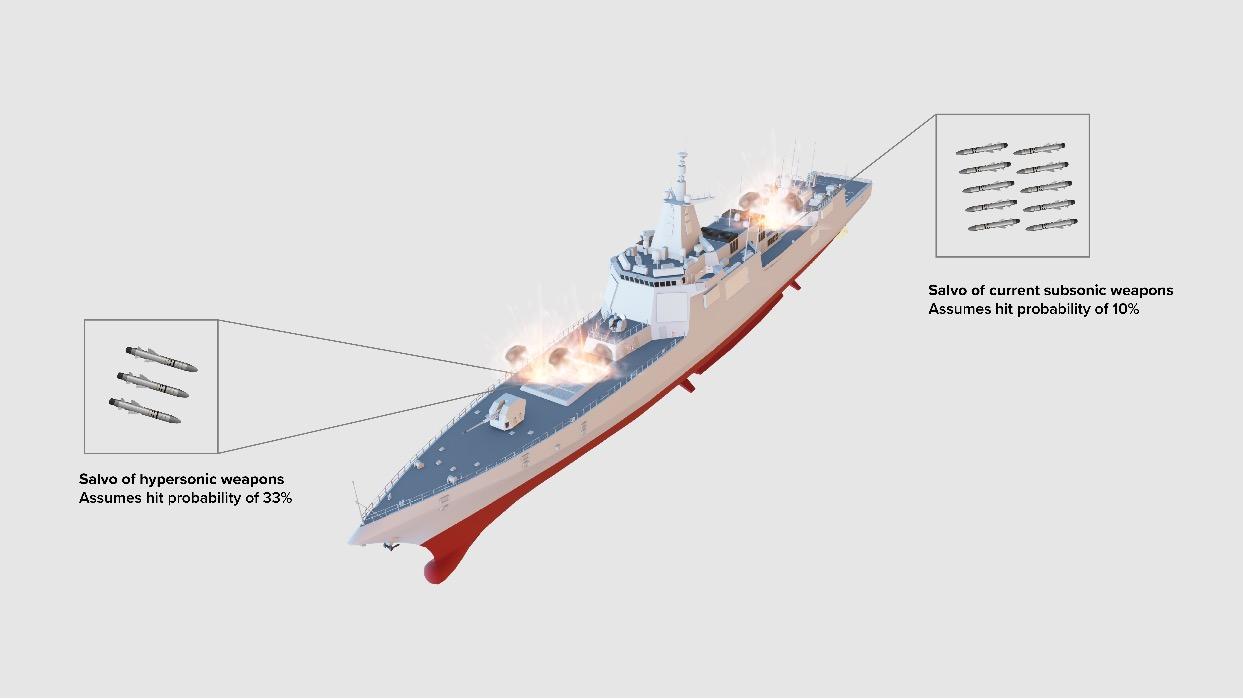
3. Prakash, “Analysis of Missile Effectiveness.” defenses.2 One can assume a need for one-quarter to one-third as many hypersonic weapons to achieve the same effects as traditional weapons based on this same analysis (i.e., an advanced weapon against older defenses not designed to counter it). Successful strikes (i.e., the ship was knocked out of action) against ships with less capable defenses were between 30 and 60 percent. When missiles were fired against ships with capable defenses, this rate fell to only 13 percent.3 Since existing missiles are well understood by most navies, one can assume that traditional missiles will likely have success rates of around 10 percent. In contrast, there are essentially no effective defenses (especially shipborne) against hypersonic weapons: It is therefore reasonable to assume a success rate closer to 30 percent. This change not only reduces the weapon cost per target but also places far fewer launch platforms at risk throughout a campaign. This example could be easily applied to other target sets, launch platforms, and so on, and does not take into account the enabling assets required for the strike force.
A vision for US hypersonic weapons
siles (or launch platforms if they get too close). However, many current weapons outrange the cruiser’s defenses. As a result, a high-end adversary will likely ensure that shore-based surface-to-air missiles, surface-to-surface missiles, fighters, submarines, and so on, are complementing the cruiser to further extend the defensive perimeter. Incoming bombers or surface vessels will likely be engaged outside the range of US missiles by these defenses.
A stealth bomber needs to be within several hundred nautical miles of the cruiser to engage with an extended-range antiship missile. Even if the cruiser is several hundred miles from the coastline, at least some other defensive assets will likely engage, whether a carrier- or land-based aircraft, possibly supported by tankers. In the near future, those fighters will likely have unmanned combat-autonomous vehicles (UCAVs) with them. Therefore, the US bomber needs to be protected by fighters. This package will likely need electronic warfare (EW) platforms, targeting assets, tactical command and control, and, significantly, tankers, as the strike package likely re-
quires several aerial refuelers to get it to and from the fight.
A hypersonic-equipped surface force can achieve the same level of lethality with improved survivability: The ability to launch from twice the range or more puts the hypersonic-equipped force beyond the reach of many of the defenses, notably reducing the size of the enabling assets needed for the strike package while simultaneously reducing operational risk.
How do hypersonics generate improved campaign effectiveness? In the near term, leveraging hypersonic weapons in a highlow weapons mix will allow critical targets to be struck with increased effectiveness and at lower risk. This means fewer weapons need to be used to break down the A2/ AD system; fewer assets lost during that process; and overall, a more sustainable, effective, and affordable campaign.
Returning to the high-end cruiser example and using round numbers, one can assume that traditional subsonic antiship missiles cost approximately $3 million each and hypersonic antiship cruise missiles cost $6 million each (a reasonable assumption with larger purchase orders).4 One can also assume that it will take, on average, ten traditional subsonic missiles to disable the cruiser and it will take three hypersonic antiship missiles. The missile procurement cost to complete the mission is $30 million for the traditional missiles and $18 million for the hypersonic missiles.
Using a single hypersonic missile to first degrade the ship’s defenses followed by two traditional missiles brings the weapon cost down to $12 million. Now, to take it one step further, independent of type, each missile requires one weapon station, and each launch platform has a fixed number of weapon stations. If the number of weapon
4. John Tirpak, “Air Force Ramps Up Multiyear Buy,” Air & Space Forces Magazine, Air & Space Force Association, April 2024, https://www.airandspaceforces.com/navy-shoots-four-lrasmair-force-multiyear-buy/. For cost of the hypersonic weapons, see below discussion of AIM120 cost. While hypersonic weapons currently in development cost at least $18 million, none of these weapons are in large-scale production. The AIM-120 example illustrates that, once a weapon is procured in larger numbers, the cost should drop significantly.
Fig. 1: Salvo-size comparison shows hypersonic advantage over subsonic weapons
A vision for US hypersonic weapons
stations used is reduced by one-third for an individual target, then the number of targets any specific launch platform can attack increases by a factor of three, dramatically increasing the overall campaign effectiveness of a given force.
While this example is intended to be illustrative, it demonstrates that a mix of hypersonic and traditional strike weapons has the potential to significantly increase force effectiveness and reduce mission cost. This increase in mission effectiveness becomes dramatic when the number of high-value, heavily defended targets—as anticipated for any future conflict—is considered.
In addition to the difference in cost for this example, consider an array of related questions: How many launch platforms might be lost taking higher-risk shots with traditional weapons compared to hypersonic ones? How many fewer strike packages are needed each day in a campaign by a longer-ranged hypersonic-equipped force? How much easier is resupply if the number of missiles to be replenished is measured in tens to hundreds (in the hypersonic category) versus hundreds to thousands (of traditional ones)? While the optimal combination of capability and respective inventory should be determined with a more detailed and specific analysis by the joint force, the answers to these questions dictate that policymakers should use decision metrics that reflect the dramatic improvement in mission effective-
ness enabled by hypersonic weapons and not simply weapon cost when making critical acquisition and weapon-mix decisions.
Finally, in any conflict in the Pacific, the United States will be faced with an adversary that has a large inventory of longrange ballistic, supersonic, and hypersonic strike missiles. These missiles will be able to deliver effects on US land and sea forces out to hundreds of miles in a matter of minutes. The US military must be able to strike at range within a similar timescale so as not to lose control of the battlespace. Traditional long-range, US strike missiles are subsonic, however, limiting the military’s ability to do so. That asymmetry in battlefield timescale reduces the United States’ warfighting effectiveness and overall tactical deterrence, highlighting an additional imperative to field hypersonic strike missiles in meaningful numbers.
What is a long-term vision of hypersonic weapons? In the longer term, twenty to thirty years from now, the majority of missiles, fired from all platforms, may very likely be hypersonic weapons. Air combat weapons evolved from exclusively short-range weapons in the early 1980s to mostly medium-range weapons by the 2000s. In the same way, air-to-surface munitions evolved from predominantly unguided “dumb” bombs in 1990 to almost exclusively precision-guided munitions by 2015. It is reasonable to envision a future in which missile speeds evolve from the current norms (less
A vision for US hypersonic weapons
than Mach 1 to Mach 3) to hypersonic (Mach 5+) speeds in the next twenty to thirty years. But hypersonic weapons are so expensive—are they worth the cost? The short answer is yes. Hypersonic weapons are the future of weapons. Fielding accurate hypersonic weapons in moderate quantities will deliver notable military advantage to the United States. Not doing so might put the United States at a dangerous disadvantage to China and other competitors.
Moreover, these weapons are very expensive now (compared to traditional missiles) precisely because the systems are rapidly fielded, first-generation prototypes that are procured in small numbers. As weapons progress through typical upgrade plans, technology continues to mature, and production efficiencies are realized along with increased procurement numbers, economies of scale are likely to kick in and costs can be expected to begin to decline significantly.
One example of this process is the now-ubiquitous AIM-120 Advanced Medium Range Air-to-Air Missile. (RTX, a sponsor of the Scowcroft Center’s Hypersonic Capabilities Task Force, produces the AIM-120.) When its procurement began in 1987, each missile cost $997,000. When the peak efficiencies were reached in the late 1990s, the unit cost of the AIM-120 was $105,000.5 Policymakers should expect a similar decrease in unit cost of hypersonic weapons with sustained procurement.
Achieving this future vision rests on assumptions that policymakers can influence. Three stand out.
1. Promoting continued development of hypersonic weapons will result in them transitioning from bespoke weapons for specific platforms, usually large in size, to smaller sizes that can be integrated across multiple platforms.
2. Sustaining research and development will solve critical technical problems over time, notably those related to sensors and materials, among others.
3. Continuing and increasing acquisition will reduce unit cost over time as a demand signal causes industry to invest in appropriate resources and larger orders create economies of scale.
Hypersonic weapons are crucial for future battlefield success. As defenses increase in potency, hypersonic weapons are essential to give the military the lethality it needs to attack key targets and open the door for other forces. Failing to field these weapons, in sufficient quantities, creates strategic risk by making the US military less lethal and less survivable. A US force equipped with hypersonic weapons, on the other hand, is a potent conventional deterrent.
In future publications, the Atlantic Council’s Hypersonic Capabilities Task Force will cover offensive hypersonic capabilities and counter-hypersonic defenses. These papers will offer numerous specific policy recommendations to make this vision of expedited deployment a reality.
5. US Department of Defense, AMRAAM Selected Acquisition Report (SAR), December 2018, Report No. 19-F-1098 DOC 14, Department of Defense, 2018, https://www.esd.whs.mil/ Portals/54/Documents/FOID/Reading%20Room/Selected_Acquisition_Reports/FY_2018_ SARS/19-F-1098_DOC_14_AMRAAM_SAR_Dec_2018.pdf
A vision for US hypersonic weapons
About the authors
Michael White is the lead author of the Atlantic Council’s Hypersonic Capabilities Task Force. He served as the first principal director for hypersonics in the Office of the Secretary of Defense for Research and Engineering. In that capacity, White was responsible for leading the nation’s vision and strategy for developing offensive and defensive warfighting capability enabled by hypersonic systems. Prior to his time in the Department of Defense, he was head of the Air and Missile Defense Sector at the Johns Hopkins University Applied Physics Laboratory.
E. Aaron Brady is a US Air Force officer and A-10 instructor pilot who served as a national defense fellow at the Atlantic Council. The views expressed in this brief represent the personal views of the author and are not necessarily the views of the Department of Defense, the Department of the Air Force, the Air University, or any other US government agency.