ISSUE BRIEF
The Scowcroft Center for Strategy and Security works to develop sustainable, nonpartisan strategies to address the most important security challenges facing the United States and the world. The Center honors General Brent Scowcroft’s legacy of service and embodies his ethos of nonpartisan commitment to the cause of security, support for US leadership in cooperation with allies and partners, and dedication to the mentorship of the next generation of leaders. The Scowcroft Center’s Asia Security Initiative promotes forward-looking strategies and constructive solutions for the most pressing issues affecting the Indo-Pacific region, particularly the rise of China, in order to enhance cooperation between the United States and its regional allies and partners.
Atlantic Council
SCOWCROFT CENTER FOR STRATEGY AND SECURITY
A Next-Generation Agenda for US-ROK-Japan Trilateral Cooperation
DECEMBER 2022
LAUREN GILBERT, SANGHYUN HAN, AND KYOKO IMAI
Trilateral cooperation among the United States, the Republic of Korea (ROK), and Japan is integral to security, prosperity, and freedom in the Indo-Pacific. Accordingly, the Biden administration has made trilateral cooperation a priority for US foreign policy in the region, highlighting defense and nontraditional security issues including: science and technology, climate change, public health, and foreign aid. To advance trilateral cooperation most effectively over time, it will be necessary for next-generation experts from all three countries to explore innovative methods and action-oriented policy proposals.
To advance this aim, the Atlantic Council, in partnership with the Korea Foundation, developed a new agenda for US-ROK-Japan cooperation, centered on next-generation perspectives and research beyond the limits of existing approaches. Instead of relying on rigid institutional structures or proposing mechanisms to litigate historical issues, this project takes a novel, impact-oriented and regional approach to trilateral cooperation. It defines areas where targeted, flexible, and informal cooperative arrangements among the three countries can provide clear mutual benefit, and thus create a foundation for deeper integration. In particular, this project seeks to address issues of both traditional and nontraditional security, such as deterrence, nonproliferation, trade, climate change, and pandemic response.
In pursuit of this agenda, the Atlantic Council and the Korea Foundation convened three private virtual roundtables with rising American, South Korean, and Japanese junior- and mid-career experts who represent the next generation of policymakers, officials, and private-sector leaders who will operationalize trilateral cooperation over the course of their careers. This “Next-Generation Trilateral Network” discussed challenges and opportunities for trilateral cooperation in three areas: security and defense, science and technology (S&T), and global public goods. Based on the ideas raised during the roundtable discussions, the participants offered concrete and actionable recommendations for a next-generation US-ROK-Japan trilateral cooperation agenda with a particular emphasis on
Next-Generation Agenda for US-ROK-Japan Trilateral Cooperation
how policymakers of each country can work together to implement the agenda.
This issue brief highlights the key insights from these roundtable discussions and offers concrete policy recommendations for US-ROK-Japan trilateral cooperation in each of the three aforementioned areas.
US-ROK-Japan Cooperation on Security and Defense
Background
It is indisputable that several of the largest threats to the rules-based international order stem from the Indo-Pacific. As such, the United States, Japan, and South Korea have cooperated to maintain peace and order in the region for more than seventy years. In recent years, China’s economic and military expansion–as well as its increasing aggression— has concerned the democratic powers and caused them to enhance cooperation. Similarly, North Korea’s growing capabilities, and its ever-burgeoning nuclear and missile program, has caused alarm in the
international community and increased security concerns for the United States and its closest allies.
Unlike in Europe, however, where NATO provides a multilateral alliance framework, the security architecture in Northeast Asia is underpinned by two bilateral treaties between Washington and Tokyo and Washington and Seoul. There lacks a formal institutional body for trilateral security cooperation among these three democratic powers. Furthermore, progress toward greater trilateral cooperation is often complicated by intense and historically rooted hostility between Japan and South Korea, diverging threat perceptions, worries about economic vulnerabilities, and political transitions.
Challenges and Opportunities
There are several opportunities and challenges associated with setting a new agenda for enhanced US-ROK-Japan security cooperation. Leadership transitions in the three capitals are an enduring challenge for trilateral security cooperation. Under the Moon, Trump, and Abe administrations, the three countries experienced
2 ATLANTIC COUNCIL
ISSUE BRIEF A
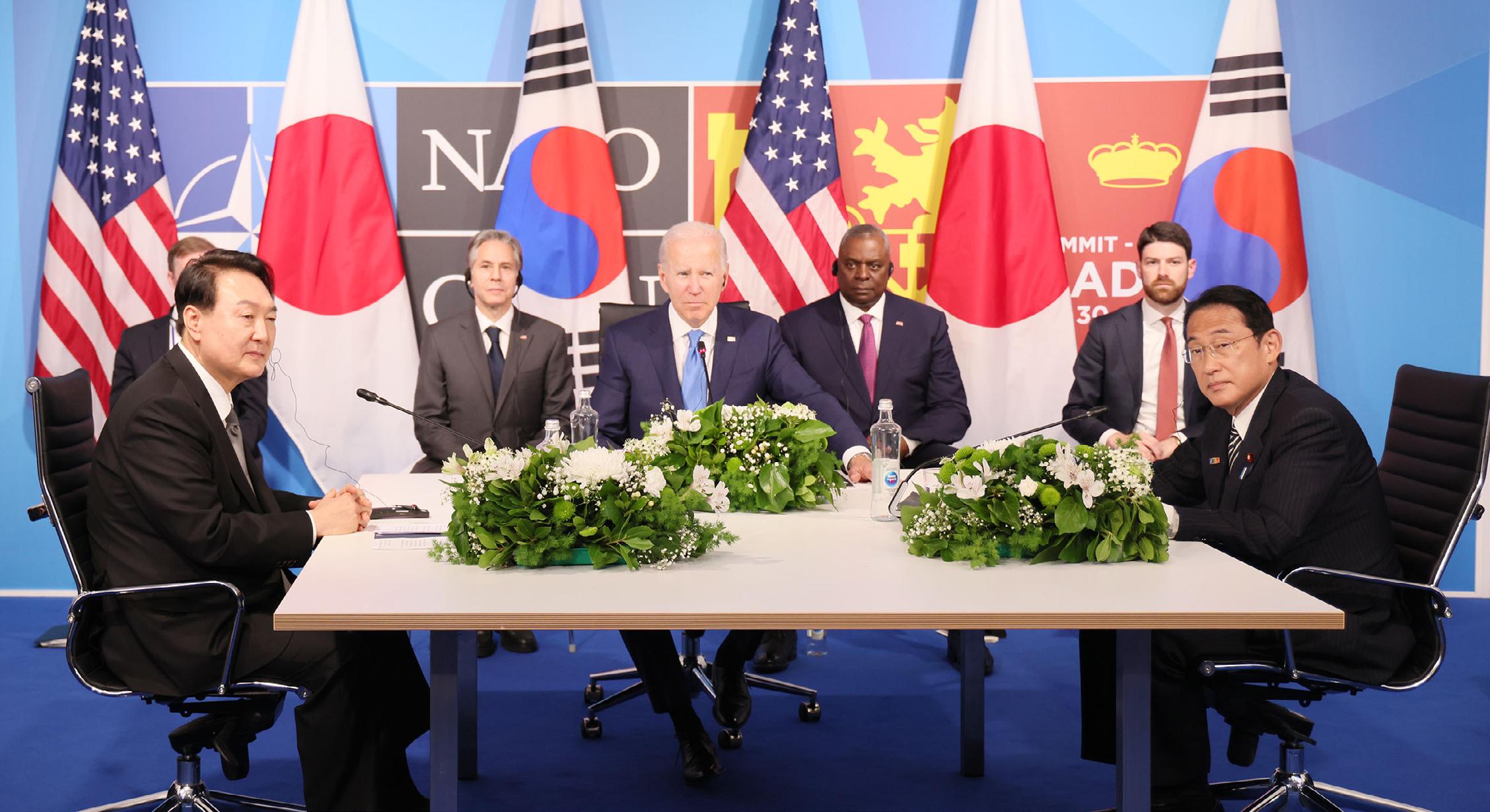
U.S. President Joe Biden and Secretary of State Antony Blinken attend the U.S.- Pacific Island Country Summit at the State Department in Washington, U.S. September 29, 2022. REUTERS/Jonathan Ernst.
A Next-Generation Agenda for US-ROK-Japan Trilateral Cooperation
significant deterioration in trilateral security cooperation leading to South Korea’s consideration of withdrawing from the General Security of Military Information Agreement (GSOMIA), which severely hampered information-sharing and thus trilateral security cooperation writ large.1 Further, since the few existing trilateral security agreements have not been formalized, new leadership could choose to nullify any decisions made by a previous administration.
Another barrier to cooperation is the lack of a common threat perception shared by the United States, South Korea, and Japan. The three countries have disproportionate perspectives on the level of threat posed by North Korea, China, and even Russia. In particular, Washington and Tokyo share concerns about China and North Korea, whereas Seoul has traditionally been more concerned about North Korea and has attempted to maintain a more balanced relationship with China. Furthermore, while the United States and Japan have long held serious concern toward Russia, South Korea held a low threat perception up until the unprecedented Russian invasion of Ukraine. So long as the partners do not share views on the most imminent threats to themselves, each other, and the region, they will struggle to agree upon the best course of action to provide a mutual security guarantee.
An additional related challenge is the threat of economic coercion by China should South Korea and Japan, in particular, take any actions against Chinese interests. This threat was demonstrated by the export bans and retaliatory measures taken against Japan in 2010, following a disagreement over illegal fishing, and against South Korea in 2016 following US deployment of the Terminal High Altitude Area Defense (THAAD) antimissile battery. 2
While this next-generation agenda for trilateral cooperation aims to shift the focus away from historical conflict between South Korea and Japan, it is undeniable that the history of colonization plays a significant role in the lack of a formal security alliance between the two countries, as well as the inconsistent levels of
trilateral cooperation. Despite these challenges, the increasingly fragile regional security environment, demands greater trilateral cooperation. This is made evident in the US Department of Defense’s reference to the US-Japan alliance as “the cornerstone of peace in the Indo-Pacific” and the US-ROK alliance as “the linchpin of peace and prosperity in Northeast Asia” in official reports. 3 This acknowledges that the United States views trilateral cooperation among the three nations as vital to ensuring security and prosperity in the IndoPacific. Most recently, a series of trilateral summits have emphasized the willingness of the three countries under new administrations to enhance cooperation, although we have yet to see tangible steps.
The three countries can take a number of steps to advance trilateral cooperation in the face of such challenges. First, the three countries could focus their efforts on areas of cooperation that are seen as less antagonistic to China and less steeped in historical tensions, that can act as a steppingstone toward enhanced cooperation. Rather than aiming for large-scale military exercises or additional missile defense batteries, the countries should focus on areas of mutual benefit. Possibilities include: combatting money laundering; fighting against illegal, unreported, and unregulated (IUU) fishing; developing contingency plans for situations such as non-combatant evacuation operations (NEO) and cyber-attacks against power grids; and even a potential incursion against Taiwan. The countries should also build upon existing cooperation through new frontiers—namely cyberspace and outer space—where the United States, South Korea, and Japan can collaborate on research and technology transfers. These actions would serve the dual purpose of circumventing areas that could trigger territorial and constitutional tensions, while avoiding the ire of China through perceived offensive actions.
Second, the trilateral group should align their economic security strategies to form a united front against potential retaliation or coercive measures by China. Additionally, the three countries should go beyond simply punitive measures of collective economic defense, but rather, employ a positive-sum perspective. Specifically, they
1 Hyung-Jin Kim, “S. Korea Cancels Japan Intelligence Deal amid Trade Dispute,” Associated Press, August 22, 2019, https://apnews.com/article/ b6f4856f55294c68a4f8228a45ddf362.
2 Keith Bradsher, “Amid Tension, China Blocks Vital Exports to Japan,” New York Times, September 23, 2010, https://www.nytimes.com/2010/09/23/business/ global/23rare.html; “China’s Response to U.S.-South Korean Missile Defense System Deployment and Its Implications,” United States-China Economic and Security Review Commission, July 26, 2017, https://www.uscc.gov/research/chinas-response-us-south-korean-missile-defense-system-deployment-and-itsimplications.
3 “Indo-Pacific Strategy Report,” US Department of Defense, June 1, 2019, 22–24, https://media.defense.gov/2019/Jul/01/2002152311/-1/-1/1/DEPARTMENT-OFDEFENSE-INDO-PACIFIC-STRATEGY-REPORT-2019.PDF.
3 ATLANTIC COUNCIL
ISSUE BRIEF
ISSUE BRIEF A Next-Generation Agenda for US-ROK-Japan Trilateral Cooperation
could reduce their dependency on China by increasing trade with other regional partners, and enacting scenariospecific planning for economic disruptions.
Third, and finally, the three powers should look to institutionalize cooperation wherever possible. The ease with which a change in political leadership in a single country can derail and threaten security cooperation is a particularly salient challenge. As the few existing trilateral security agreements have not been formalized, new leadership can nullify any decisions made by a previous administration. For example, had GSOMIA been institutionalized under the Park administration, the succeeding Moon administration would not have been able to unilaterally declare intent to leave the agreement. Although it is unlikely that the three countries will create a formal, trilateral defense pact any time soon, formal multilateral frameworks in other areas would help maintain institutionalized cooperation even through leadership transitions. South Korea in particular has shown a marked hesitancy to join multilateral institutions, such as the Quad, due to both a reluctance to enter an alliance with Japan and a wariness of antagonizing China. South Korea may be more willing, however, to join multilateral groupings focused on less sensitive aspects of the security architecture including but not limited to building norms and rules for digital connectivity, cyberspace, and other such emerging fields.
Policy Recommendations
In sum, the above review of key challenges and opportunities for improving trilateral security cooperation, leads to concrete recommendations to improve the productivity and operability of existing cooperation mechanisms:
● Rather than focusing on highly sensitive areas of security cooperation, such as large-scale military exercises, the countries should opt for security cooperation in less sensitive areas such as crisis contingency planning, illegal fishing, and other maritime incursions.
● The countries should focus on new frontiers to optimize areas of cooperation that will not serve as
a potential flashpoint such as the space industry and cyberspace. This could include information sharing on cyber threats, coordinating technology transfers, and bolstering cyber defenses.
● The three countries should not only develop a framework for collective defense against coercive economic measures and supply chain attacks by China, but also employ proactive economic steps such as forming novel trade agreements with regional partners and collaborating to enforce sanctions when necessary.
● The trilateral group should aim to institutionalize security cooperation mechanisms, which will in turn enhance interoperability and consistency. To avoid arousing domestic political pushbacks, this should be achieved through multilateral frameworks rather than bilateral or trilateral agreements.
● In addition to existing senior-level summits, the countries should actively convene security dialogues at the working-level. Such convenings create a vital forum to discuss feasible operational strategies and provide a trust-building mechanism.
US-ROK-Japan Cooperation on Science and Technology
Background
As US National Security Advisor Jake Sullivan remarked earlier this year, “advancements in science and technology (S&T) are poised to define the geopolitical landscape of the 21st century.”4 Great powers across the globe are vying for supremacy in these arenas. President Xi Jinping has urged China to cater to the “nation’s strategic demand in the scientific sector.” 5 At the same time, the Biden administration has executed a series of policies, from the bipartisan CHIPS and Science Act to export-control regulations against China to “maintain as large of a lead as possible.”6 This demonstrates that the landscape of S&T leadership is competitive and ever intensifying.
4 “Remarks by National Security Advisor Jake Sullivan at the Special Competitive Studies Project Global Emerging Technologies Summit,” White House, September 16, 2022, https://www.whitehouse.gov/briefing-room/speeches-remarks/2022/09/16/remarks-by-national-security-advisor-jake-sullivan-at-thespecial-competitive-studies-project-global-emerging-technologies-summit/.
5 Cao Desheng, “Xi Calls for Key Tech Breakthroughs,” China Daily, September 7, 2022, https://www.chinadaily.com.cn/a/202209/07/ WS63173c4fa310fd2b29e7646a.html.
6 “Remarks by National Security Advisor Jake Sullivan at the Special Competitive Studies Project Global Emerging Technologies Summit.”
4 ATLANTIC COUNCIL
A Next-Generation Agenda for US-ROK-Japan Trilateral Cooperation
As for the United States, it has begun “rallying likeminded actors to advance an international technology ecosystem.” 7 Given the breadth of S&T, such cooperation with reliable partners already exists in several areas, including the Science, Mathematics, and Research for Transformation (SMART) scholarship-for-service program; the Global Innovation through Science and Technology (GIST) program; and even networks such as the Five Eyes and the Quad.8 The success of such cooperation proves that the United States should further collaborate with technology-faring countries, such as Japan and South Korea. After the inauguration of President Yoon in South Korea and the “historic” trilateral summit in June, the necessity of enhanced trilateral cooperation was made abundantly clear.9 S&T is both a critical and ripe area for cooperation among the United States, Japan, and South Korea: three leading, technologically advanced nations.
Trilateral cooperation itself is not the end, but rather the means to accomplish shared goals. Even with incentives for cooperation, implementation can take longer than anticipated for various reasons, including but not limited to domestic political considerations, threat of retaliation from adversaries, and concerns over cybersecurity and supply chain resilience. Therefore, this chapter seeks to highlight challenges and opportunities for trilateral cooperation on S&T and propose practical recommendations to sustain that cooperation, despite fluctuating domestic political circumstances.
Challenges and Opportunities
More so than in any other area, S&T trilateral cooperation advances through public-private cooperation. The public sectors of the United States, South Korea, and Japan are naturally focused on building their own economies and advantages, which can disincentivize cooperation as they implement export restrictions, import controls,
7 “National Security Strategy,” White House, 2022, 33.
and incentives for domestic job creation. To overcome this hurdle, the three countries’ private sectors can drive S&T cooperation, in alignment with the states’ national strategies. For instance, Westinghouse and Korea Electric Power Corporation—electronic energy companies in the United States and South Korea, respectively—cooperate on nuclear-power technologies, while LG Energy Solution (a South Korean electric vehicle battery firm) and Honda (a Japanese automobile manufacturer) agreed to invest $4.4 billion to establish a battery plant.10 In this way, the private sector should engage with partners from the other two countries, while the public sector draws boundaries for cooperation to avoid instigating political conflicts.
Another challenge arises from competition and historical contentions between regional powers. This is particularly salient between South Korea and Japan, as evidenced by the export and import controls and lawsuits enacted in recent years. To combat this, the United States’ multilateral initiatives fosters a cooperative environment for South Korea and Japan to cooperate on S&T in a less politically sensitive manner. Under the Biden administration, Washington enacted and discussed proactive bilateral S&T cooperation with Japan and South Korea.11 In addition, both countries are members of US-led multilateral initiatives that aim to facilitate S&T cooperation. For example, the two countries—as members of the IndoPacific Economic Framework (IPEF) —recently launched the Mineral Security Partnership with other regional partners to secure access to critical minerals. Participation in this initiative demonstrates US-ROK-Japan willingness and strategic interest in jointly “harnessing innovation” through S&T cooperation, both trilaterally and through broader multilateral frameworks.12
8 “Biennial Report to Congress on International Science & Technology Coordination,” White House, September 2022, https://www.whitehouse.gov/wp-content/ uploads/2022/09/09-2022-Biennial-Report-to-Congress-on-International-Science-Technology-Cooperation.pdf.
9 “Readout of President Biden’s Trilateral with President Yoon Suk Yeol of the Republic of Korea and Prime Minister Fumio Kishida of Japan,” White House, June 29, 2022, https://www.whitehouse.gov/briefing-room/statements-releases/2022/06/29/readout-of-president-bidens-trilateral-with-president-yoon-suk-yeol-ofthe-republic-of-korea-and-prime-minister-fumio-kishida-of-japan/.
10 Michael Wayland, “Honda and LG Energy Solution to build $4.4 billion EV battery plant in U.S.,” CNBC, August 29, 2022, https://www.cnbc.com/2022/08/29/ honda-lg-energy-solution-to-build-4point4-billion-battery-plant-in-us.html.
11 “Japan-US Science and Technology Cooperation,” Ministry of Foreign Affairs of Japan, last visited November 21, 2022, https://www.mofa.go.jp/region/n-america/ us/q&a/science/Science.html; “Fact Sheet: United States—Republic of Korea Partnership,” White House, May 21, 2021, https://www.whitehouse.gov/briefingroom/statements-releases/2021/05/21/fact-sheet-united-states-republic-of-korea-partnership/.
12 “Fact Sheet: In Asia, President Biden and a Dozen Indo-Pacific Partners Launch the Indo-Pacific Economic Framework for Prosperity,” White House, May 23, 2022, https://www.whitehouse.gov/briefing-room/statements-releases/2022/05/23/fact-sheet-in-asia-president-biden-and-a-dozen-indo-pacific-partners-launchthe-indo-pacific-economic-framework-for-prosperity/; “The Indo-Pacific Economic Framework for Prosperity: Biden-Harris Administration’s Negotiating Goals for the Connected Economy (Trade) Pillar,” Office of the US Trade Representative, September 23, 2022, https://ustr.gov/about-us/policy-offices/press-office/pressreleases/2022/september/indo-pacific-economic-framework-prosperity-biden-harris-administrations-negotiating-goals-connected.
5 ATLANTIC COUNCIL
ISSUE BRIEF
ISSUE BRIEF A Next-Generation Agenda for US-ROK-Japan Trilateral Cooperation
Moreover, attempts by authoritarian regimes–namely Russia and China–to design an international environment serving their own interests threatens to undermine the existing rules-based international order. Thus, the United States, Japan, and South Korea have a shared responsibility and interest in safeguarding democratic principles, norms, and standards in the S&T industry. As such, S&T cooperation with likeminded allies and partners is vital to countering authoritarian endeavors. One such area of cooperation is cybersecurity. As digitalization has grown exponentially in recent years, the issue of data governance has become an area of concern. While China and Russia are pushing forward the notion of Internet sovereignty and standards, the United States, South Korea, and Japan both trilaterally, and through the IPEF framework, are seeking to prevent the unethical use of artificial intelligence, ensure online privacy, and promote “trusted and secure cross-border data flows.” 13
Policy Recommendations
While there are political sensitivities inherent in US-ROKJapan cooperation, S&T is less susceptible to political pushback due to a shared sense of responsibility and interest in safeguarding key principles in this sector. In this vein, there are several key steps that the three countries can take.
● The private sector is a key tool for facilitating a cooperative S&T environment. The three countries should focus on enhancing trilateral public-private engagements, in a way that complements national S&T strategies and polices.
● In addition to existing senior-level meetings, the countries should actively convene meetings at the working-level to directly implement policies. Such convenings create a vital forum for discussing feasible implementation strategies and maintain momentum for cooperation.
● Each country’s government must actively engage with the public to raise awareness and emphasize the significance of trilateral cooperation. Not only is a topdown approach from heads-of-state important, but it
must be supplemented with a well-thought-out and thorough bottom-up approach.
● US-ROK-Japan collaboration should focus on building international norms and principles that are rooted in the rule of law and liberal values in newly emerging areas of S&T. This will be of particular importance in areas such as data governance and the digital economy.
US-ROK-Japan Cooperation on Global Public Goods
Background
Of the three areas covered by this next-generation trilateral cooperation agenda, public goods may offer the most promise for cooperation. This is due to the high mutual benefit and low sensitivity associated with public goods, not only for the three countries, but also for likeminded partners in the Indo-Pacific and globally. Yet, the trilateral group faces a number of challenges as it seeks to deliver the greatest impact to regional partners and play to their respective strengths. This chapter summarizes opportunities and challenges, and subsequent recommendations to enhance trilateral cooperation on public goods. Given the wide range of topics that could be covered under this umbrella, the chapter focuses on four priority issues: public health, climate change, foreign aid, and democratic values.
Challenges and Opportunities
Public Health
Amid the ongoing Coronavirus disease 2019 (COVID-19) pandemic, health security has emerged as an area of common concern and opportunity for the United States, South Korea, and Japan. During the crisis, each country showcased different areas of competitive advantage. Despite its aging population, Japan has among the fewest COVID-19 fatalities, South Korea utilized its expertise in technology to expedite the contact-tracing process, and the United States deployed vaccinations at an unprecedentedly rapid rate.14
13 “United States and Indo-Pacific Economic Framework Partners Announce Negotiation Objectives,” Office of the US Trade Representative, September 9, 2022, https://ustr.gov/about-us/policy-offices/press-office/press-releases/2022/september/united-states-and-indo-pacific-economic-framework-partners-announcenegotiation-objectives.
14 Lucy Craft, “Scientists Probe Japan’s Remarkable COVID Success in Hunt for New Vaccine to Protect Some of the Most Vulnerable,” CBS News, June 23, 2022, https://www.cbsnews.com/news/japan-covid-success-factors-hla-cellular-advantage-new-vaccine-research/; Sang-Hun Choe, “South Korea, a Virus Success Story, Now Finds Its Model Unsustainable,” New York Times, February 17, 2022, https://www.nytimes.com/2022/02/17/world/asia/south-korea-covid-spread.html.
6 ATLANTIC COUNCIL
A Next-Generation Agenda for US-ROK-Japan Trilateral Cooperation ISSUE BRIEF
Rather than addressing all aspects of global health diplomacy individually, the trilateral group should divide and conquer. As Japan and South Korea have endured numerous health outbreaks, from severe acute respiratory syndrome (SARS) to Middle East respiratory syndrome (MERS), they were well prepared to implement triedand-tested health responses to combat the COVID-19 outbreak. Government agencies such as the Japan International Cooperation Agency (JICA) and the Korea International Cooperation Agency (KOICA) currently provide medical training, research and development (R&D), and vaccine production. The US-ROK-Japan partnership should emulate and build upon such existing examples of health assistance such as by exporting Japanese and South Korean expertise in health-crisis and disaster management.
The very nature of a global pandemic indicates that any future health crisis threatens to harm the entire world. It is thus vital for the United States, South Korea, and Japan to establish safe and stable pathways to share key findings with each other and with likeminded partners and allies. One takeaway from the COVID-19 crisis is that the United States has been too reliant on China for personal protective equipment (PPE). In response, the United States can either struggle to reshore its entire health supply chain back home or “ally-shore” some of its stockpile to longstanding allies like Japan and South Korea.
Existing bilateral frameworks, such as the MansfieldPhRMA Research Scholars Program, can be adapted to the trilateral model for this purpose.15 This program provides Japanese health professionals with the opportunity to visit and learn from US health institutions. However, this could be enhanced by allowing for bidirectional exchanges among the three countries’ institutions and health representatives.
Climate Change
In an increasingly interconnected and globalized world, health diseases and climate risks are no longer isolated issues for each country to solve on its own. As leaders in the fight against climate change, the United States, South Korea, and Japan are determined to achieve their 2050 net zero carbon emission goals. Given the high bar that these countries have set for themselves and energy shortages arising from conflicts like the Russian invasion of Ukraine, nuclear energy is an increasingly prudent option to consider. However, despite being renewable in nature, nuclear energy is a controversial energy source that requires non-renewable fuel and poses potential risks as seen in the 2011 Fukushima nuclear disaster. Small modular reactors (SMRs) may present a potential solution for overcoming dangers posed by nuclear waste disposal and enabling safe deployment of nuclear facilities in densely populated urban areas.16 Building upon existing examples of bilateral collaboration in the private sector—such as the South Korean company SK Group’s investment in the US company TerraPower—trilateral cooperation on innovative technologies, such as SMRs, would enable burden sharing to offset high upfront costs and lengthy project cycles.17
However, there are two primary roadblocks—one domestic and one international—to capitalizing on nuclear power to mitigate climate change. First, South Korea has faced challenges advancing nuclear technology amid fluctuating domestic policies between administrations. Former President Moon ran on a platform of decreasing the country’s reliance on nuclear power, which curtailed the industry’s sustainability, expertise, and workforce retention.18 Internationally, US cooperation with South Korea and Japan—two giants in the shipbuilding industry—on integrating SMRs onto ships could improve efficiency. However, such cooperation has been inhibited by outdated and protectionist legislation like the Merchant Marine Act of 1920, which dictates that, “only vessels that are US-registered, US-built, and mostly US-owned and crewed can move goods between two US ports.” 19
15 “Mansfield-PhRMA Research Scholars Program,” Maureen and Mike Mansfield Foundation, September 2022, https://mansfieldfdn.org/program/strengtheninggovernment-and-expert-networks/phrma/#:~:text=The%20Mansfield%2DPhRMA%20Research%20Scholars,regulatory%20practices%2C%20and%20 translational%20research.
16 Roberta Bocca and Johnny Wood, “Small Nuclear Reactors Could Make Nuclear Energy Big Again. How Do They Work, and Are They Safe?” World Economic Forum, October 6, 2022, https://www.weforum.org/agenda/2022/10/nuclear-power-power-plant-smrs-clean-energy/.
17 “South Korea’s SK Group invests in Terra Power,” World Nuclear News, August 16, 2022, https://www.world-nuclear-news.org/Articles/South-Koreas-SK-Groupinvests-in-TerraPower.
18 “South Korea’s President Moon Says Plans to Exit Nuclear Power,” Reuters, June 19, 2017, https://www.reuters.com/article/us-southkorea-nuclear-president/ south-koreas-president-moon-says-plans-to-exit-nuclear-power-idUSKBN19A04Q.
19 Colin Grabow, “Fed up with High Gas Prices and Slow Amazon Deliveries? Blame These 2 Century-Old Laws that Need to Be Repealed,” Business Insider, September 13, 2022, https://www.businessinsider.com/laws-killing-us-economy-prices-inflation-jones-act-foreign-dredge-2022-9.
7 ATLANTIC COUNCIL
ISSUE BRIEF A Next-Generation Agenda for US-ROK-Japan Trilateral Cooperation
Enacting these changes would require appealing to policymakers and the public by demonstrating that the benefits arising from sustained investment in clean technologies would outweigh the short-term costs. With the help of Japanese and South Korean government subsidies, the trilateral group can develop and commercialize hydrogen for vital products to curtail climate change such as fuel-cell electric vehicles (EVs). 20 This would enable the Indo-Pacific to diversify critical minerals contained in EV batteries, away from Chinese supply chains.
Foreign Aid
Due to increasing natural disasters and extreme events, climate change is playing an increasingly significant role in US-ROK-Japan foreign aid delivery. Although disaster relief packages can serve as a stopgap, a more permanent solution would be to empower vulnerable nations, like the Pacific islands, with climate mitigation strategies to develop resilience against climate disasters. To achieve this goal, the United States, South Korea, and Japan should determine which area each country is best suited to lead in. For example, Japan and South Korea are regularly faced with natural disasters, which puts them in a strategic position to share lessons learned and strategies with other countries, while the United States can play a more facilitative role. In particular, the US Agency for International Development (USAID) can utilize its experience “providing development assistance to help partner countries on their own development journey to self-reliance” to deliver regionally specific insights and guidance to help Japanese and South Korean aid agencies further their impact in the Indo-Pacific. 21
The United States and Japan often find themselves on opposite sides of the spectrum when it comes to linking democratic principles to aid delivery. On one hand, Japan tends to be quite lenient, going so far as to aid corrupt and autocratic nations. On the other hand, the United States errs on the side of setting high expectations for its recipients, which, in turn, pushes them right into the arms of China. The challenge, therefore, is finding the right balance of using foreign aid as a tool to encourage progress toward liberalization, without hindering regional
relationship-building. Due to the economic repercussions associated with rejecting China and choosing to side with the United States, Association of Southeast Asian Nations (ASEAN) members are highly reluctant to make a zero-sum decision between the two donors. In this respect, although the size and scope of China’s Belt and Road Initiative (BRI) is daunting, the aim of the US-ROKJapan partnership should not be to outpace and recreate the BRI, but to provide high-quality alternatives to the financially burdensome, shoddy, and negatively received projects. 22 Rather than focusing solely on democratic rhetoric, the United States should also trust Japan and South Korea–as established and trusted leaders in the region–to exemplify the benefits of democracy throughout their aid delivery.
Democratic Values
More broadly, the US-ROK-Japan partnership should ensure that its rhetoric surrounding democracy promotion is supported by actionable items. To support this, the three countries should be more intentional about the granularity of assistance they provide. For instance, the building blocks of democracy—including rule of law, good governance, judicial and legal systems—have yet to be fully institutionalized in Southeast Asia. These are tangible and non-sensitive issues that are directly relevant toward improving freedom, openness, and, democracy in the Indo-Pacific. To avoid redundancy and allow for effective coordination, each country should provide overseas training in its respective area of expertise. As an example, Japan can provide guidance on drafting legal codes, while South Korea can train judicial officials.
Gender equality is another democratic value that faces challenges to implementation in all three countries. Although Japan and South Korea have made meaningful strides in furthering female empowerment, East Asian traditional and cultural norms pose barriers to gender progress. For instance, in the workforce, “while Japanese women are well-educated, the country’s unforgiving work culture means that many women leave their jobs after having a child, and never return.”23 The IPEF Upskilling Initiative, recently unveiled by the US Department of Commerce and the Office of the US Trade Representative,
20 Duncan McPherson, Vivek Warrier, and Kenryo Mizutani, “Hydrogen Around the World: Enhancing Japanese and South Korean Energy Security,” Bennett Jones, September 10, 2020, https://www.bennettjones.com/Blogs-Section/Hydrogen-around-the-World-Enhancing-Japanese-and-South-Korean-Energy-Security.
21 “What We Do,” United States Agency for International Development, November 17, 2022, https://www.usaid.gov/what-we-do.
22 Wade Shepard, “How China’s Belt and Road Became a ‘Global Trail of Trouble,’” Forbes, December 10, 2021, https://www.forbes.com/sites/ wadeshepard/2020/01/29/how-chinas-belt-and-road-became-a-global-trail-of-trouble/?sh=18e533cf443d.
23 Dwyer Gunn, “Why Japanese Women Don’t Stay in the Workforce,” JSTOR Daily, January 5, 2016, https://daily.jstor.org/japanese-women-dont-stayworkforce/#:~:text=While%20Japanese%20women%20are%20extremely,in%20an%20article%20last%20year.
8 ATLANTIC COUNCIL
A Next-Generation Agenda for US-ROK-Japan Trilateral Cooperation
offers great promise for training women and girls in male-dominated fields, including data science and cybersecurity, while also encouraging growth of womenowned businesses. 24 Although this initiative originates at the federal level in the United States, encouraging formal and informal dialogues with Japan and South Korea can drive similar progress in both countries.
In a similar manner, alignment of policies and behavior is necessary to achieve long-lasting change on gender issues. Policies such as paid parental leave must first exist in order to address gender inequality. However, legislation alone is insufficient. To fully mobilize mass social action, trilateral cooperation on gender should extend beyond the governmental level into civil society, where wide-scale movements can come to fruition. While Japanese and Korean citizens have the option of paid family leave, both countries struggle to encourage male parents to utilize this benefit. Once a foundational legal structure is established, cross-national civil society exchanges can yield progress on fundamental democratic principles. The #MeToo movement is a prime example of a social movement that began in the United States but gained particular traction with Korean women.
Policy Recommendations
Global public goods offer the greatest common ground and mutual benefit for the United States, South Korea, and Japan, while at the same time ensuring low political sensitivity. However, given the breadth of topics in this area, the three countries must weigh their opportunities and challenges to create an effective division of labor as they seek to safeguard democratic principles in this sector.
● The United States, South Korea, and Japan should each play to their strengths during the provision of public goods. In the context of COVID-19, Japan can export best practices for reducing fatalities, South Korea can offer strategies for high-tech health systems, and the United States can share insights on rapid inoculation. For foreign aid, while Japan and South Korea can use their experience tackling natural disasters to share crisis-management strategies with likeminded allies and partners, the United States can train Japanese and Korean aid agencies on effective leadership the Indo-Pacific. The three countries can also divide and conquer training on the building blocks of democracy, including Japanese assistance
with legal codes and training by Korean judicial officials.
● The trilateral group should build upon existing bilateral mechanisms. For instance, they should expand the work of existing development agencies such as JICA and KOICA, going beyond medical training and R&D to include Japanese and Korean expertise in disaster management. With regard to climate change, existing bilateral private sector partnerships can be adapted trilaterally to share the burden and cost associated with investing in advanced technologies.
● The trilateral partnership should focus on shared threats and areas of benefit. To decrease dependence on China for health supplies, the three countries should rely on one another to divide and conquer production and supply. Similarly, the United States, South Korea, and Japan, should diversify EV battery minerals to avoid being held hostage by Chinese supply chains. Further, to effectively compete with China’s BRI, the US-ROK-Japan partnership should demonstrate the qualitative benefits of each project, rather than focusing on quantitative goals.
● Lastly, in order for US-ROK-Japan cooperation to be successful and long-lasting, its initiatives must be implemented at all levels. For instance, the United States has been a strong advocate for training women and girls in traditionally male-dominated fields and encouraging the growth of women-owned businesses. This can be coupled with formal and informal dialogues with Japan and South Korea to drive progress in these areas not just at the federal level but also at the civil society level. In the public health sector, exchange programs among the three countries’ health professionals and institutions can ensure timely and effective exchanges of research and technologies to prepare for the next crisis.
Conclusion – Principal Recommendations for US-ROKJapan Cooperation
This report calls for enhanced cooperation with likeminded allies and partners in order to counter shared challenges and advance mutual interests across the areas of security and defense, science and technology, and global public goods. Taken together, several essential themes emerge.
24 “Commerce Department Launches the Indo-Pacific Economic Framework for Prosperity (IPEF) Upskilling Initiative,” US Department of Commerce, September 8, 2022, https://www.commerce.gov/news/press-releases/2022/09/commerce-department-launches-indo-pacific-economic-framework-prosperity.
9 ATLANTIC COUNCIL
ISSUE BRIEF
ISSUE
A Next-Generation Agenda for US-ROK-Japan Trilateral Cooperation
First is the need to address the challenge of a powerful and increasingly aggressive China. In the security and defense sector, efforts by the three countries to simply defend their own territory is often perceived by China as hostile and aimed at isolating China. In the past, Chinese complaints along these lines have been accompanied by economic retaliation. As such, the three countries should prepare for Chinese economic reprisals by forming a united front. To avoid aggravating China, rather than enact punitive mechanisms, the countries should be more constructive and proactive. With regard to S&T, the primary objective of trilateral cooperation is to protect against authoritarian threats, including those presented by China’s increasing technological prowess, to existing democratic principles, norms, and standards. The United States, South Korea, and Japan can utilize multilateral frameworks, like IPEF, as tools to ensure the safety and security of scientific research and data. For public goods, the trilateral partnership seeks to diversify away from Chinese supply chains. In the health sector, over-reliance on adversaries for essential supplies can be prevented
by ally-shoring supplies to trusted allies. Furthermore, increased information-sharing can help to collectively mitigate the next health crisis. As for foreign aid, recipient countries are fearful of the economic consequences associated with spurning Chinese assistance. Thus, instead of forcing countries to make a bilateral decision, the US-ROK-Japan partnership should demonstrate the benefits of associated with the democratic aid system.
Second, the three powers need to manage political sensitives as they advance trilateral cooperation. Given the historically fraught relationship between South Korea and Japan, the United States should act as a mediator to facilitate cooperation in areas of high benefit and low sensitivity. In security and defense, the three countries are less willing to be involved in high-stakes activities such as joint military exercises. Thus, the trilateral partnership should address other shared security challenges, which include but are not limited to maritime incursions, crisis contingency planning, and cybersecurity. S&T can work in tandem with security and defense to explore these
10 ATLANTIC COUNCIL
BRIEF
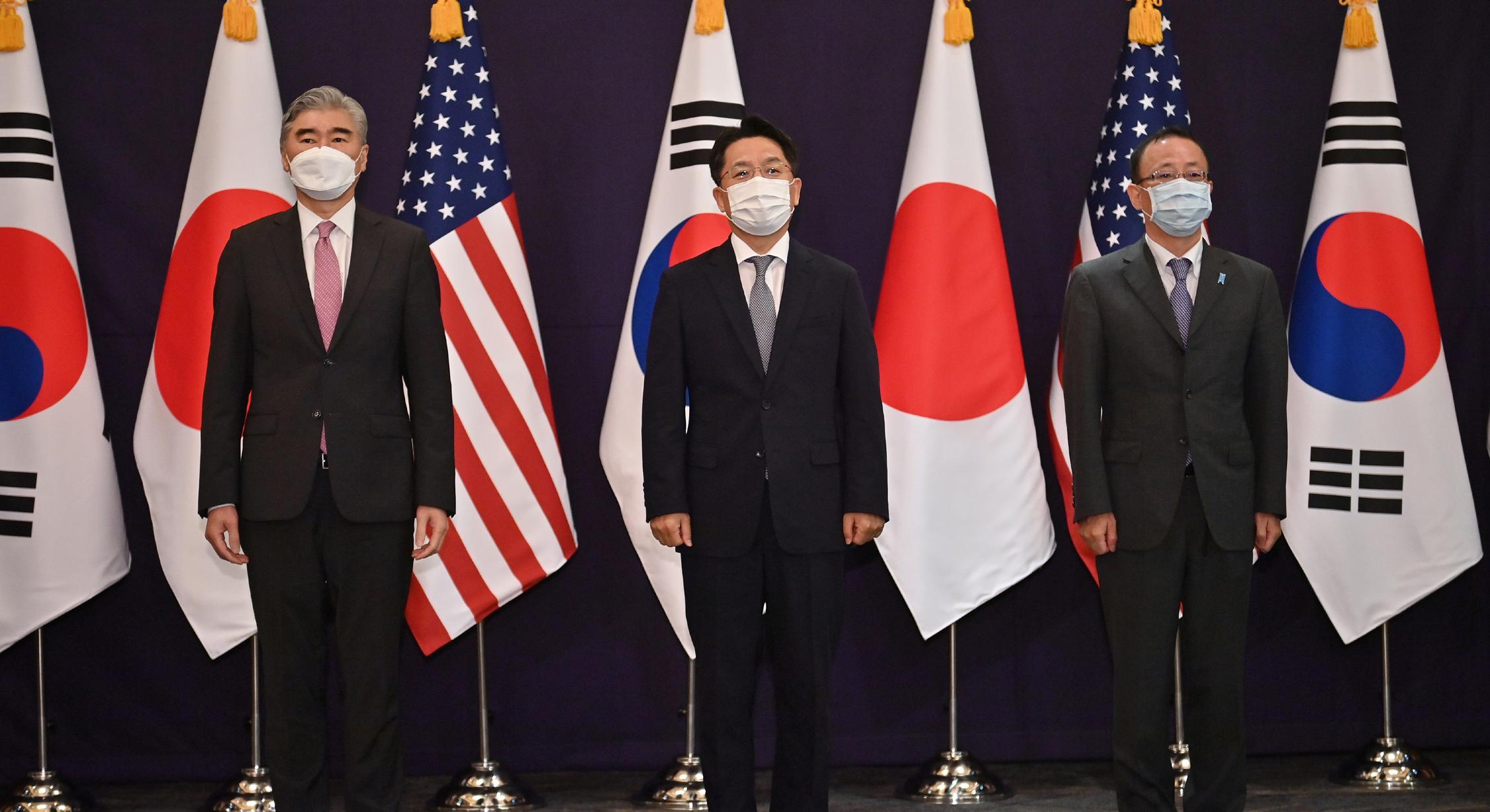
Sung Kim (L), US Special Representative for North Korea, Noh Kyu-duk (C), South Korea’s Special Representative for Korean Peninsula Peace and Security Affairs, and Takehiro Funakoshi (R), Director-General of the Asian and Oceanian Affairs Bureau of the Ministry of Foreign Affairs of Japan, pose for a photo during their trilateral meeting at a hotel in Seoul, South Korea June 21, 2021. Jung Yeon-Je/Pool via REUTERS.
A Next-Generation Agenda for US-ROK-Japan Trilateral Cooperation
new frontiers and safeguard free and fair principles for digital connectivity and data governance. Of the three areas, public goods are least likely to receive domestic pushback. However, many countries that the trilateral group engages with are either semi- or non-democratic. As a result, US-ROK-Japan’s actions are more likely to succeed if they are small, yet meaningful, such as implementing the democratic building blocks.
Lastly, trilateral cooperation requires both top-down institutionalization and bottom-up support from the general populace. With respect to defense and security, trilateral summits are held at the head-of-state level, which indicates a shared willingness to cooperate. However, gaining the public’s support has proved challenging. This can be remedied with a number of solutions, including educating citizens on the long-term benefits of trilateral cooperation that outweigh the seemingly daunting costs. For S&T, the private sector seeks to advance collaboration with the other two countries, while the public sector keeps programs in line with internal policies to prevent external conflicts. With global public goods, the establishment of legislation is an indication of progress on the part of government officials and policymakers. However, in order for long-lasting change to occur, each country’s citizens must help enact such policies in practice. This can be
achieved through formal and informal exchanges at the civil-society level among the United States, Japan, and South Korea as well as with the entire world through multilateral frameworks.
Trilateral cooperation among the United States, Japan, and South Korea has proved challenging over the years, owing largely to historical tensions. As a result, this project has sought perspectives from next-generation leaders of the three countries to define areas where targeted, flexible, and informal cooperative arrangements can provide clear mutual benefit to all. The group ascertained that future cooperation should center on tackling shared challenges including addressing an increasingly belligerent China through proactive yet constructive methods. The three countries can most effectively collaborate by focusing on innovative technologies, as well as small yet meaningful building blocks for democracy to avoid unnecessary flare ups. Lastly, longlasting trilateral progress requires coupling high-level government dialogues with civil society engagements. Through the incorporation of such strategies, the United States, South Korea, and Japan can ensure that trilateral cooperation not only advances but also perseveres in the face of domestic political challenges and a rapidly evolving international environment.
11 ATLANTIC COUNCIL
ISSUE BRIEF
ISSUE BRIEF A Next-Generation Agenda for US-ROK-Japan Trilateral Cooperation
About the authors
Lauren D. Gilbert is an associate director with the Atlantic Council’s Indo-Pacific Security Initiative (IPSI) within the Scowcroft Center for Strategy and Security. In particular, the focus of her work is US-ROK-Japan Trilateral Cooperation, Integrated Nuclear Deterrence, and Trans-Atlantic-Pacific coordination in the aim of defending the rules-based international system. Originally from Texas, Gilbert holds an MIS in International Cooperation from Seoul National University’s Graduate School of International Studies. She also attained her BA in International Relations and Global Studies, with a concentration in International Security and a minor in Asian Studies, from the University of Texas at Austin.
Sanghyun Han is a PhD student in International Affairs, Science, and Technology at Sam Nunn School of International Affairs, Georgia Institute of Technology. His area of interest is emerging technology and statecraft intersecting international political economy and international security. He currently works with the Center for International Strategy, Technology, and Policy at Georgia Tech, and previously worked with the Atlantic Council, the National Bureau of Asian Research, the Center for Foreign Policy Strategy, the Institute of International Studies, and the East Asia Foundation.
Kyoko Imai is a program assistant with the Indo-Pacific Security Initiative (IPSI) of the Atlantic Council’s Scowcroft Center for Strategy and Security where she enhances cooperation between the United States and its regional allies and partners. She spearheaded the initiative’s work on the Korea Foundation Journalist Fellowship Program, US-Japan alliance, USROK-Japan trilateral cooperation, and helped bridge allied perspectives on extended deterrence and implement tabletop exercises on adversary limited nuclear use in East Asia. Kyoko graduated from Georgetown University with a Master of Science in Foreign Service, with a Concentration in Global Politics & Security and a Certificate in Asian Studies. She is from Japan, but grew up in Myanmar, Tunisia, and the United Arab Emirates.
Commentators (Alphabetical Order)
The authors would like to express their gratitude to the following commentators, who participated in several roundtables to discuss a next generation trilateral agenda for US-ROK-Japan cooperation.
The views and opinions expressed in this report are those of the authors, and do not necessarily reflect those of commentators or the organizations with which they are affiliated.
Ms. Chihiro Aita
Project Associate, Energy and Environmental Affairs The National Bureau of Asian Research
Ms. Juliane Doscher Program Manager The Maureen and Mike Mansfield Foundation
Ms. Jada Fraser Editor-in-Chief Georgetown Journal of Asian Affairs
Mr. Spencer Gross Programs Coordinator East-West Center
Mr. Sanghyun Han PhD Student, Sam Nunn School of International Affairs Georgia Institute of Technology
12 ATLANTIC COUNCIL
ISSUE BRIEF
A Next-Generation Agenda for US-ROK-Japan Trilateral Cooperation
Ms. Ariqa Herrera Researcher, Economic Section Embassy of Japan in the United States
Ms. Eleanor Shiori Hughes Defense Analyst The Asia Group
Dr. Bee Yun Jo
Associate Research Fellow, Center for Security and Strategy Korea Institute for Defense Analyses
Ms. Sea Young Sarah Kim Non-resident Fellow Korea Economic Institute of America
Ms. Heeu Millie Kim North Korea Cyber Working Group, Director of Research Belfer Center for Science and International Affairs
Mr. Andrew Jeung Seung Lee Research Associate Korea Institute for Maritime Strategy
Mr. Terrence Matsuo Non-Resident Fellow Korea Economic Institute of America
Mr. Naritada Miura Program Assistant Sasakawa Peace Foundation USA
Ms. Kayla Orta Program Associate, Hyundai Motor-Korea Foundation Center for Korean History and Public Policy Wilson Center
Mr. Andrew Park Senior Analyst of the Center for Maritime Strategy Navy League of the United States
Mrs. Rosa Park-Tokola Senior Project Lead, DPRK Counterproliferation CRDF Global
Ms. Aiko Shimizu
Head of Japan Public Policy, Government and Philanthropy; Adjunct Fellow Twitter; Pacific Forum
Ms. Natalia Slavney
Assistant Editor for “38 North” and Research Associate Stimson Center
13 ATLANTIC COUNCIL
ISSUE BRIEF A Next-Generation Agenda for US-ROK-Japan Trilateral Cooperation
Ms. Kristin Wilson Co-Founder and Advisory Board Member WomEmpowered International
Mr. Heemin Yang Associate Forward Risk and Intelligence
Acknowledgements
The Indo-Pacific Security Initiative, housed within the Scowcroft Center for Strategy and Security, thanks the Korea Foundation for its generous support of our work.
14 ATLANTIC COUNCIL
CHAIRMAN
*John F.W. Rogers
EXECUTIVE CHAIRMAN EMERITUS
*James L. Jones
PRESIDENT AND CEO
*Frederick Kempe
EXECUTIVE VICE CHAIRS
*Adrienne Arsht
*Stephen J. Hadley
VICE CHAIRS
*Robert J. Abernethy
*C. Boyden Gray
*Alexander V. Mirtchev
TREASURER

*George Lund
DIRECTORS
Todd Achilles
Timothy D. Adams
*Michael Andersson
David D. Aufhauser
Barbara Barrett
Colleen Bell
Stephen Biegun
Linden P. Blue
Adam Boehler
John Bonsell
Philip M. Breedlove
Myron Brilliant
*Esther Brimmer
Richard R. Burt
*Teresa Carlson
*James E. Cartwright
John E. Chapoton
Ahmed Charai Melanie Chen
Michael Chertoff
*George Chopivsky
Wesley K. Clark
*Helima Croft
*Ankit N. Desai
Dario Deste
*Paula J. Dobriansky
Joseph F. Dunford, Jr.
Richard Edelman
Thomas J. Egan, Jr.
Stuart E. Eizenstat
Mark T. Esper
*Michael Fisch
Alan H. Fleischmann
Jendayi E. Frazer
Meg Gentle
Thomas H. Glocer
John B. Goodman
*Sherri W. Goodman
Jarosław Grzesiak
Murathan Günal
Frank Haun
Michael V. Hayden
Tim Holt
*Karl V. Hopkins Kay Bailey Hutchison
Ian Ihnatowycz
Mark Isakowitz
Wolfgang F. Ischinger
Deborah Lee James
*Joia M. Johnson
*Safi Kalo
Andre Kelleners
Brian L. Kelly
Henry A. Kissinger
John E. Klein
*C. Jeffrey Knittel
Joseph Konzelmann
Franklin D. Kramer
Laura Lane
Almar Latour
Yann Le Pallec
Jan M. Lodal
Douglas Lute
Jane Holl Lute
William J. Lynn
Mark Machin
Marco Margheri
Michael Margolis
Chris Marlin
William Marron
Christian Marrone
Gerardo Mato
Erin McGrain
John M. McHugh
*Judith A. Miller
Dariusz Mioduski
Michael J. Morell
*Richard Morningstar Georgette Mosbacher
Majida Mourad
Virginia A. Mulberger
Mary Claire Murphy
Edward J. Newberry
Franco Nuschese
Joseph S. Nye
Ahmet M. Ören Sally A. Painter
Ana I. Palacio
*Kostas Pantazopoulos
Alan Pellegrini
David H. Petraeus
*Lisa Pollina
Daniel B. Poneman
*Dina H. Powell
dddMcCormick
Michael Punke
Ashraf Qazi
Thomas J. Ridge Gary Rieschel
Lawrence Di Rita Michael J. Rogers Charles O. Rossotti Harry Sachinis C. Michael Scaparrotti Ivan A. Schlager Rajiv Shah Gregg Sherrill
Jeff Shockey Ali Jehangir Siddiqui Kris Singh Walter Slocombe
Christopher Smith Clifford M. Sobel
James G. Stavridis Michael S. Steele Richard J.A. Steele Mary Streett
*Gil Tenzer
*Frances M. Townsend Clyde C. Tuggle Melanne Verveer Charles F. Wald Michael F. Walsh Ronald Weiser
*Al Williams Maciej Witucki Neal S. Wolin
*Jenny Wood Guang Yang Mary C. Yates Dov S. Zakheim
HONORARY
DIRECTORS
James A. Baker, III
Robert M. Gates
James N. Mattis Michael G. Mullen
Leon E. Panetta
William J. Perry
Condoleezza Rice Horst Teltschik William H. Webster
*Executive Committee Members
List as of November 18, 2022
The Atlantic Council is a nonpartisan organization that promotes constructive US leadership and engagement in international affairs based on the central role of the Atlantic community in meeting today’s global challenges.
This issue brief is written and published in accordance with the Atlantic Council Policy on Intellectual Independence. The author is solely responsible for its analysis and recommendations. The Atlantic Council and its donors do not determine, nor do they necessarily endorse or advocate for, any of this report’s conclusions.
© 2022 The Atlantic Council of the United States. All rights reserved. No part of this publication may be reproduced or transmitted in any form or by any means without permission in writing from the Atlantic Council, except in the case of brief quotations in news articles, critical articles, or reviews. Please direct inquiries to:
Atlantic Council
1030 15th Street, NW, 12th Floor, Washington, DC 20005
(202) 463-7226, www.AtlanticCouncil.org
