A framework for US-Japan cooperation in the Arctic
Issue brief A framework for US-Japan cooperation in the Arctic
Written by Kyoko Imai, Connor McPartland, and Audrey Roh
Bottom lines up front
• Melting ice and rising sea levels increase the strategic importance of Arctic sea routes and natural resources to great power competition.
• Washington’s withdrawal from Arctic climate research has created a vacuum, that if left unfilled by likeminded democracies is sure to be captured by adversaries.
• In close concert with Nordic security partners, Tokyo must step up its contributions to Arctic rules-based governance by building on its foundations of scientific and environmental resilience.
Climate change and aggressive moves by Russia and China to stake out claims in the High North pose serious challenges to the rules-based order that has until recently governed the Arctic. Countries invested in and benefiting from that order have an opportunity to amplify their strategic presence and operational infrastructure. This group not only includes formally recognized Arctic states, like the United States, but also encompasses proximal maritime powers, like Japan, who will undoubtedly be affected by the geopolitical competition that ensues from the opening of new sea routes, uncovering of natural resources, and the second-order consequences of the diverse challenges facing the Arctic.
Japan’s Arctic strategy
Though Japan is not an Arctic state, its status as a maritime state and proximity to the Arctic Ocean means it is easily affected by climate-driven environmental shifts, evolving maritime routes, and infrastructure changes in the Arctic. It has a long history
of Arctic research, being the first non-Arctic state to establish an observation station and gaining Arctic Council observer status in 2013.1
Through its 2015 Arctic Policy, Tokyo has anchored its engagement around three pillars: research and development, international cooperation, and sustainable
1. Khang Pham, “FOIP Goes Northward: Japan’s Maritime Identity, Defense, and Rule of Law in the Arctic,” Arctic Institute, April 7, 2026, https://www.thearcticinstitute.org/foip-goesnorthward-japans-maritime-identity-defense-rule-law-arctic/; and “Japan,” Arctic Council, n.d., https://arctic-council.org/about/observers/japan/.
A framework for US-Japan cooperation in the Arctic
use.2 Its Arctic policy is embedded within Japan’s broader Basic Act on Ocean Policy, which is updated every five years.3 The 2018 Third Basic Plan formally established Arctic policy as a distinct item within its overarching ocean policy.4
In response to geopolitical shocks such as Russia’s invasion of Ukraine, Japanese Arctic engagement has undergone a subtle but important recalibration with explicit discussion of the Arctic in the 2023 Fourth Basic Plan for “comprehensive maritime security.”5 This encompasses not only traditional defense, but also economic security and safeguarding the international maritime order. While Japan does not adopt an explicit military posture in the Arctic, the Fourth Basic Plan stresses the necessity of “upgrading Japan’s defense capabilities and maritime law enforcement capabilities and to constantly strengthen deterrence and response capabilities,” in a stark contrast to previous Basic Plans.6
Despite these shifts, Japan continues to leverage science and technology as a diplomatic tool in Arctic engagements. The 2018 Basic Plan says, “science and technology is Japan’s greatest strength where leadership on Arctic policy is concerned.”7 As such, Japan has established long-term research initiatives such as the Arctic Challenge for Sustainability and launched its first Arctic research vessel, Mirai II, which will serve as an international research platform.8 The forthcoming deployment of Mirai II shows Japan can operate independently in Arctic
conditions while also generating scientific data to strengthen the country’s influence in rule-setting processes.
US Arctic strategy
The second Trump administration’s Arctic approach is centered around natural resource extraction and the region’s importance for defense and security. While the administration has not yet produced a National Strategy for the Arctic region, it has produced policies illustrating a recognition of Arctic potential to boost US prosperity and contribute to homeland defense.
One of the first executive orders signed by President Donald Trump was “Unleashing Alaska’s Extraordinary Resource Potential,” designed to accelerate extraction of Alaskan resources, including in the Arctic.9 The document focuses on Alaskan fossil fuels, particularly building capacity to produce and export liquified natural gas (LNG). The Trump administration has rescinded earlier restrictions on oil and gas development in Alaska, greenlit infrastructure development to increase access to mineral deposits, and renewed oil and gas leasing in the Arctic National Wildlife Refuge.10 The administration has also highlighted the Arctic—especially Greenland—as a critical minerals source to decrease US reliance on China 11
While the Arctic’s role in security has been less prominent in official policy than rhetoric, both the 2025 National Security Strategy and 2026 National Defense Strategy highlight
2. Japan Cabinet Office, “Japan’s Arctic Policy,” October 16, 2015, https://www8.cao.go.jp/ocean/english/arctic/pdf/japans_ap_e.pdf.
3. Japan Cabinet Office, “Basic Act on Ocean Policy,” April 27, 2007, https://www8.cao.go.jp/ocean/english/act/pdf/law_e.pdf.
4. Japan Cabinet Office, Third Basic Plan on Ocean Policy, May 15, 2018, https://www8.cao.go.jp/ocean/english/plan/pdf/plan03_e. pdf.
5. Japan Cabinet Office, “Fourth Basic Plan on Ocean Policy,” Summary, 2023, https://www8.cao.go.jp/ocean/english/plan/pdf/ plan04_gaiyou_e.pdf.
6. Ministry of Defense, “Fundamental Reinforcement of Japan’s Defense Capabilities: Why Now?,” November 2024, https://www. mod.go.jp/en/images/guidline_pamph_english.pdf.
7. Japan Cabinet Office, Third Basic Plan
8. “Arctic Challenge for Sustainability (ArCS),” National Institute of Polar Research, https://www.nipr.ac.jp/arcs/e/; and “Main Specifications: Mirai II,” in “Arctic Research Vessel Overview,” Japan Agency for Marine-Earth Science and Technology (webpage), https:// www.jamstec.go.jp/parv/e/overview/.
9. “Unleashing Alaska’s Extraordinary Resource Potential,” White House, January 20, 2025, https://www.whitehouse.gov/presidential-actions/2025/01/unleashing-alaskas-extraordinary-resource-potential/.
10. “Arctic National Wildlife Refuge Oil and Gas Development,” Environmental & Energy Law Program, Harvard Law School, April 20, 2026, https://eelp.law.harvard.edu/tracker/arctic-national-wildlife-refuge-oil-and-gas-development/; “Fact Sheet: President Donald J. Trump Approves Ambler Road Project to Unlock Alaska’s Mineral Potential,” White House, October 6, 2025, https://www. whitehouse.gov/fact-sheets/2025/10/fact-sheet-president-donald-j-trump-approves-ambler-road-project-to-unlock-alaskas-mineral-potential/.
11. Pavel Devyatkin, “Restraint and Diplomacy in Arctic Policy: Cooperation amid US-Russia-China Tensions,” Quincy Institute for Responsible Statecraft, January 27, 2026, https://quincyinst.org/research/restraint-and-diplomacy-in-arctic-policy-cooperation-amid-u-s-russia-china-tensions/.
A framework for US-Japan cooperation in the Arctic
the need to “secure key terrain” in the Western Hemisphere including in the Arctic.12 This reflects a recognition that the Arctic is a key vector for airborne and maritime threats to the United States and of the role of infrastructure investments in Alaska and Greenland’s Pituffik Space Base for US homeland defense.
Ongoing concern about Russia and China’s malign Arctic activity has pushed the United States to invest in capabilities to increase Arctic presence, including icebreakers for the US Coast Guard. One Arctic-specific strategy that the current administration has produced is an “Arctic Waterways Security Strategy” found in the administration’s 2026 “America’s Maritime Action Plan.”13 It lays out US priorities for ensuring “economic growth and greater prosperity for the American people” in the Arctic including improving domain awareness, expanding the icebreaker fleet, and supporting the security needs of the Marine Transportation System, which encompasses all modes of naval transportation.
Geopolitical tensions
With the Arctic warming nearly four times faster than the rest of the world, melting ice is creating new sea routes requiring navigation by icebreakers.14 While NATO’s forty-five vessels nearly match Russia’s fifty-seven, NATO fleets are outdated 15 On top of its numerical advantage, Russia is the only country with nuclear-powered icebreakers, which don’t require frequent refueling.16
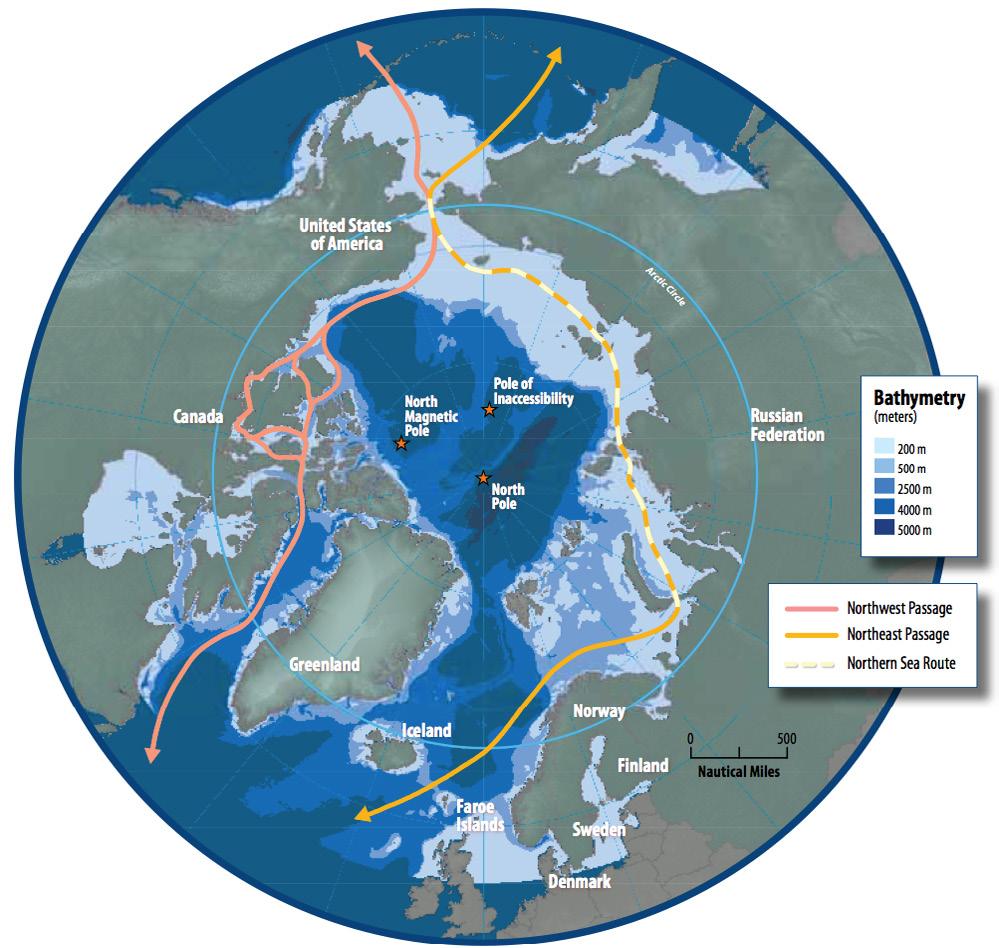
The Iran war has demonstrated that blockades of maritime passageways can impose global consequences. Due to Western sanctions, Russia has diverted oil and gas to the northern sea route, which reduces travel time between Europe and Asia by up to 40 percent.17 Despite the Arctic Council’s vision to promote an Arctic as a “region of peace, stability, and
Map courtesy of the National Oceanic and Atmospheric Administration.
constructive cooperation,” Moscow is claiming the northern sea route as its own and controlling the passage of vessels.18
12. 2026 National Defense Strategy, US Department of Defense, January 23, 2026, https://media.defense.gov/2026/ Jan/23/2003864773/-1/-1/0/2026-NATIONAL-DEFENSE-STRATEGY.PDF.
13. “America’s Maritime Action Plan,” White House, February 2026, https://www.whitehouse.gov/wp-content/uploads/2026/02/Restoring-Americas-Maritime-Dominance.pdf.
14. Mika Rantanen et al., “The Arctic Has Warmed Nearly Four Times Faster than the Globe since 1979,” Communications Earth & Environment 3, no. 168 (2022), https://doi.org/10.1038/s43247-022-00498-3.
15. Theodor Skarvelis, “Arctic Icebreaker Fleets: The Great Gap,” Atlas Institute, August 4, 2025, https://atlasinstitute.org/arctic-icebreaker-fleets-the-great-gap/; and Liselotte Odgaard and Timothy A. Walton, “NATO Should Break the Ice on Unmanned Systems for Icebreakers,” Defense News, June 25, 2025, https://www.defensenews.com/opinion/2025/06/25/nato-should-break-the-iceon-unmanned-systems-for-icebreakers/.
16. Anna J. Davis, “Russia Overextends on Arctic Nuclear Icebreaker Goals,” Jamestown Foundation, December 18, 2025, https:// jamestown.org/russia-overextends-on-arctic-nuclear-icebreaker-goals/.
17. Dasha Thyssen, “Why Russia’s Northern Sea Route Is a Risk for Global Trade,” Deutsche Welle, May 2, 2026, https://www.dw.com/ en/why-russias-northern-sea-route-is-a-risk-for-global-trade/a-76987400.
18. “Arctic Council Strategic Plan 2021 to 2030,” Arctic Council, May 20, 2021, https://oaarchive.arctic-council.org/server/api/core/ bitstreams/118e0bce-9013-460a-81e0-1dbd0870ee05/content; and Jill Goldenziel, Kathy Paradis, and Kathryn Bryk Friedman, “The Other Border Problem: How Russia and China’s Lawfare Threaten the Arctic,” War on the Rocks, May 12, 2026, https://warontherocks.com/the-other-border-problem-how-russia-and-chinas-lawfare-threaten-the-arctic/.
A
The Arctic region, showing shipping routes through the Northeast Passage, Northern Sea Route, and Northwest Passage.
For China, the Arctic presents another lever for wielding global economic influence. It already dominates global critical mineral supply chains, controlling 70 percent of rare earth mining and 90 percent of subsequent refining and processing, which are critical to US national security.19 Chinese President Xi Jinping’s 2025 threat to halt rare earth exports to foreign militaries demonstrated just how vulnerable Washington is to Beijing’s whims.20 Despite China’s near monopoly, it is also seeking access to Greenland’s untapped rare earths. Beijing invests heavily in Russian Arctic energy, giving it discounted pricing and less vulnerability to global shocks, while throwing Moscow a lifeline amid sanctions. Moscow’s dominance of Arctic territory, with over half the coastline of the Arctic Ocean in Russia, and Beijing’s unparalleled refining and processing present a grave threat to a free and fair Arctic energy market.21
DOMESTIC CHALLENGES
Japanese policy constraints
For Japan, these international developments carry evolving implications for economic and maritime security. As a highly trade-dependent economy, Japan has an interest in stable and predictable global sea lanes including in the Arctic. However, while Japan maintains a credible Arctic scientific and diplomatic presence, its limited operational and infrastructural footprint constrains its ability to directly shape emerging developments.
At the same time, Japan’s policy architecture presents internal constraints. While the 2015 Arctic Policy provides a clear strategic foundation, Japan treats the Arctic as a subset of its
ocean policy rather than as a standalone framework, resulting in incremental rather than comprehensive updates. This policy approach risks obscuring the Arctic’s growing importance as a distinct strategic domain shaped by climate change, energy interests, and geopolitical competition.
Finally, Arctic governance is becoming more fragmented with traditional cooperative mechanisms such as the Arctic Council under strain 22
Due to its Arctic proximity, Japan has a vested interest in mitigating geopolitical and environmental challenges with downstream impacts on the Indo-Pacific. Japan’s emphasis on science diplomacy and consensus-based multilateralism remains central but requires greater adaptability as the region evolves into a more competitive landscape.
US strategic obstacles
The second Trump administration has significantly reduced Arctic and polar scientific research conducted by or supported by the US government. For example, the administration not only decommissioned much of the National Oceanic and Atmospheric Administration’s ice and snow monitoring efforts like the Sea Ice Index, but also shut down the Arctic Research Consortium of the United States, which facilitated collaboration and research among scientists and other stakeholders.23
The administration’s funding cuts of climate-related work threaten US ability to achieve Arctic economic and defense objectives. Understanding of Arctic conditions and how they are changing is vital to informing commercial activities like shipping and oil and gas exploration as well as defense and security from infrastructure investment to acoustic sensing. Without access to robust data, the US commercial sector and Department of Defense risk falling behind.
19. Chan Ho-Him and Josh Funk, “China Outlines More Controls on Exports of Rare Earths and Technology,” Associated Press, updated October 9, 2025, https://apnews.com/article/china-earths-exports-trump-dad99d532f858f04d750d0b8c50e5ed6; Angelica Ang, “Beijing’s Dominance in Rare Earth Processing Leaves Others Scrambling to Close the Gap: ‘China Is the Leader, and the U.S. Is Far Behind,’ ” Fortune, March 11, 2026, https://fortune.com/2026/03/11/china-us-rare-earth-processing-critical-minerals/; and Gracelin Baskaran, “China’s New Rare Earth and Magnet Restrictions Threaten US Defense Supply Chains,” Center for Strategic and International Studies, October 9, 2025, https://www.csis.org/analysis/chinas-new-rare-earth-and-magnet-restrictions-threatenus-defense-supply-chains.
20. Arendse Huld, “How Will China’s Rare Earth Export Controls Impact Industries and Businesses?,” China Briefing, November 10, 2025, https://www.china-briefing.com/news/chinas-rare-earth-export-controls-impacts-on-businesses/.
22. Gloria Dickie, “Can the Arctic Council Survive?,” Foreign Policy, April 16, 2026, https://foreignpolicy.com/2026/04/16/arctic-council-trump-greenland-denmark/.
23. “NOAA Decommissions Sea Ice Datasets,” Sabin Center for Climate Change Law, Columbia Law School, https://climate.law.columbia.edu/content/noaa-decommissions-sea-ice-datasets; “Sea Ice Today,” National Snow and Ice Data Center, n.d., https:// nsidc.org/sea-ice-today; and Yereth Rosen, “Arctic Research Consortium Closing Down after Trump Administration Cuts Funding,” Alaska Beacon, September 19, 2025, https://alaskabeacon.com/2025/09/19/arctic-research-consortium-closing-down-after-trump-administration-cuts-funding/.
A framework for US-Japan cooperation in the Arctic
Washington has also damaged relationships with Arctic allies, limiting its ability to exert influence in the region to achieve key objectives. Trump’s rhetoric about purchasing Greenland, making Canada the fifty-first state, and questioning US commitment to NATO has eroded trust in the United States. This distrust is particularly evident in Denmark, where 60 percent view the United States as an adversary rather than an ally. Negative views of the United States could decrease allies’ willingness to invest in the US Arctic.24 While allies are unlikely to halt defense cooperation with the United States through NATO, they may turn to alternative security arrangements to hedge against an unreliable United States.
RECOMMENDED AREAS FOR BILATERAL COOPERATION
Maritime security
With NATO falling behind Russian icebreaker production, as the third-largest global shipbuilder, Japan can contribute high-quality and advanced capabilities to bridge this gap.25 The United States can leverage Japanese expertise to jointly develop autonomous and nuclear-powered icebreakers. The alliance can build upon the SHIPS for America Act of 2024 to reduce export controls for trusted foreign firms to enable training and investment of Japanese technologies into US shipbuilding industry.26 In return, Japanese shipbuilders can boost US production of Arctic-capable vessels beyond limited domestic manufacturing.27 Bolstering the US and Japanese
maritime industrial bases will counter growing Sino-Russian naval cooperation in the Arctic and beyond.
In order for allies to maintain an Arctic foothold, their fleets must be capable of effective maritime domain awareness. One recommendation is for Washington and Tokyo to revive the anti-submarine warfare and acoustic detection employed in the North Pacific during the Cold War.28 The existing underwater surveillance architecture should be upgraded with modern technology to meet present-day challenges. For example, US underwater sonars can be combined with Japanese radar disruption and jamming technology to improve tracking of rival fleets.29
Energy infrastructure
Another area of shared interest for Washington and Tokyo is Arctic energy security. Since Russia’s full-scale invasion of Ukraine, Tokyo has reduced its dependence on Russian energy but still relies on Russian imports for 10 percent of its LNG.30 With 95 percent of Japanese oil coming from an unstable Middle East, energy diversification is vital to Japan’s resilience.31 In 2025, Trump and Japanese Prime Minister Sanae Takaichi announced Japanese investment in the Alaska LNG pipeline to strengthen Japanese energy security, generate US revenue, and reduce Moscow’s market share.32 The leaders also agreed on a framework to strengthen critical mineral supply chains, which leverages joint financing, stockpiling, and a Security Rapid Response Group to address
24. Phillip Walter Wellman, “Majority of Danes Now View US as Adversary Instead of Ally, Poll Finds,” Stars and Stripes, February 4, 2026, https://www.stripes.com/theaters/europe/2026-02-04/danish-survey-us-adversary-20622777.html.
25. David Elliott, “Collaborative and Digital: The Future of Japanese Shipbuilding,” Spectra, Mitsubishi Heavy Industries, April 16, 2026, https://spectra.mhi.com/smart-infrastructure/collaborative-and-digital-the-future-of-japanese-shipbuilding.
26. SHIPS for America Act, H.R. 10493, 118th Cong. (2024) (introduced; referred to committees), https://www.congress.gov/bill/118thcongress/house-bill/10493/text.
27. Khang Pham, “How the SHIPS for America Act Can Help Boost Japan-U.S. Arctic Shipbuilding Cooperation,” Commentary, Arctic Institute, May 22, 2025, https://www.thearcticinstitute.org/hships-america-act-can-help-boost-japan-us-arctic-shipbuilding-cooperation/.
28. Mizuho Kajiwara, “Maritime Security and Underwater Surveillance Technology: Lessons from the Cold War,” Center for Indo-Pacific Affairs, University of Hawaiʻi at Mānoa, January 24, 2024, https://manoa.hawaii.edu/indopacificaffairs/article/maritime-security-and-underwater-surveillance-technology-lessons-from-the-cold-war/.
29. David Axe, “Undersea Sensors—A US Trump Card China Knows It Must Eliminate,” American Strategic Policy Institute, July 25, 2025, https://www.aspistrategist.org.au/undersea-sensors-a-us-trump-card-china-knows-it-must-eliminate/.
30. Yusuke Maekawa, “Japan Says It Is Working to Reduce Dependence on Russian LNG,” Bloomberg, updated October 21, 2025, https://www.bloomberg.com/news/articles/2025-10-21/japan-says-it-is-steadily-reducing-dependence-on-russian-lng.
31. Katya Golubkova, “Japan’s Middle East Energy Dependency—and How It Mitigates Shocks,” Reuters, March 4, 2026, https://www.reuters.com/sustainability/boards-policy-regulation/japans-middle-east-energy-dependency-how-it-mitigates-shocks-2026-03-04/.
32. Takeo Kumagai and Kate Winston, “US, Japan Sign Agreement to Implement $550 bil Investment in US Energy, LNG, Critical Mining,” S&P Global, October 28, 2025, https://www.spglobal.com/energy/en/news-research/latest-news/lng/102825-us-japan-signagreement-to-implement-550-bil-investment-in-us-energy-lng-critical-mining
A
vulnerabilities.33 This Critical Minerals Agreement is uniquely suited to chip away at Moscow’s control of Arctic resources and Beijing’s processing monopoly.34
RECOMMENDED AREAS FOR JAPANESE LEADERSHIP
Strategic diplomacy
Tokyo is vital to filling the gap left by Washington in Arctic soft-power diplomacy. But since Japan is not an Arctic power, it must work in concert with NATO Arctic partners. Japan and its Nordic security partners (Denmark, Finland, Iceland, Norway, and Sweden) can build upon the Northern European Diplomacy Initiative, which emphasized Arctic cooperation in science, technology, and defense.35 Japan’s Basic Plans on Ocean Policy have laid solid foundations but the geopolitical situation calls for updates to Japan’s decade-old Arctic policy. Tokyo must articulate how its overarching strategy for rulesbased governance is supported by ongoing scientific and environmental initiatives.
Scientific research and environmental sustainability
Amidst fractured transatlantic relationships, Tokyo must serve as a trusted interlocutor between North America and Northern Europe to maintain momentum in Arctic scientific research and environmental conservation. On the surface, environmental factors may not seem as alarming as joint maritime exercises by Russia and China. However, naval dominance requires realtime data to navigate obstacles like waves and ice patches.36 The Japan Aerospace Exploration Agency’s Arctic satellites are ideally positioned for data-sharing with likeminded Nordic partners.37 In return, Nordic countries can incorporate Japan into their submarine fiber-optic cable infrastructure.
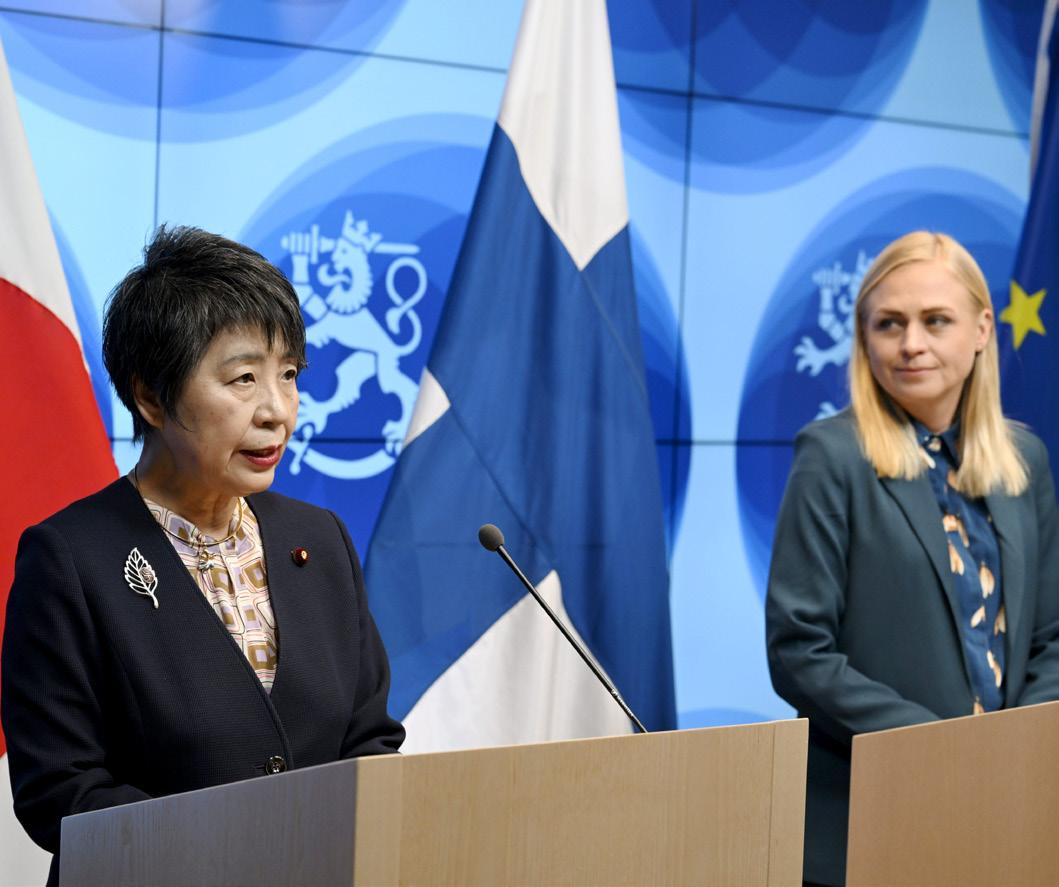
Japanese Foreign Minister Yoko Kamikawa and Finnish Foreign Minister Elina Valtonen attend a joint press conference in Helsinki on January 9, 2024. (Photo by VESA MOILANEN/LEHTIKUVA/Sipa USA) https://www.reutersconnect.com/item/japanese-foreign-minister-yoko-kamikawa-visits-helsinki/dGFnOnJldXRlcnMuY29tLDIwMjQ6bmV3c21sX01UMVNJUEEwMDBBTjk5S1E
Diversifying subsea cables away from the chokepoint at the Suez Canal, through which many currently run, hardens Japanese and Nordic digital infrastructures.38
Disaster risk management
Melting Arctic ice and rising sea levels cause increased storms and flooding, while permafrost thawing and coastline erosion
33. “United States-Japan Framework for Securing the Supply of Critical Minerals and Rare Earths through Mining and Processing,” White House, October 2025, https://www.whitehouse.gov/briefings-statements/2025/10/united-states-japan-framework-for-securing-the-supply-of-critical-minerals-and-rare-earths-through-mining-and-processing/.
34. Kyla H. Kitamura, “U.S.-Japan Critical Minerals Agreement,” Congressional Research Service, IF12517, January 8, 2025, https:// www.congress.gov/crs-product/IF12517.
35. Yuki Tatsumi, “Back to the Future? The Implications of Growing Strategic Competition in the Arctic for the US-Japan Alliance,” Stimson Center, April 4, 2025, https://www.stimson.org/2025/implications-strategic-competition-arctic-us-japan-alliance/.
36. Giulia Saccone, “Legal Scientific Cooperation in the Context of Japan Canada Relations: Pathways for Increased Arctic Cooperation,” Arctic Institute, April 21, 2026, https://www.thearcticinstitute.org/legal-scientific-cooperation-context-japan-canada-relations-pathways-increased-arctic-cooperation/.
37. Riccardo Villa and Jakob Ranglin Grissler, “Liminal Diplomacy at the Poles: Japan’s Disaster Risk Reduction and Making Arctic Order,” Arctic Institute, May 5, 2026, https://www.thearcticinstitute.org/liminal-diplomacy-poles-japans-disaster-risk-reduction-making-arctic-order/.
38. Juha Saunavaara, “The Role of EU-Japan Collaboration in Trans-Arctic Cable Development,” Arctic Institute, April 28, 2026, https:// www.thearcticinstitute.org/role-eu-japan-collaboration-trans-arctic-cable-development/.
A framework for US-Japan cooperation in the Arctic
endanger ecosystems.39 As a country particularly vulnerable to natural disasters, Japan is well-equipped to empower Arctic countries with preparedness tools to confront climateinduced challenges. Japan can share lessons learned from domestic early warning and emergency response systems— by using Japan’s supercomputer to predict Arctic flooding, for example.40 Japanese leadership in disaster management not only improves global situational awareness but also demonstrates Japan’s commitment to a free, fair, and open Arctic founded on the rule-of-law.
CONCLUSION
The Arctic is becoming a pivotal battleground for geopolitical competition. Global warming creates natural hazards that must be expertly navigated, yet at the same time presents opportunities for exploring untapped reserves of natural resources and maritime passageways. Despite the need for real-time and accurate scientific data, Washington has significantly undercut climate-related environmental research and eroded its credibility as a trusted ally. In the midst of strained transalantic relations, Tokyo is an ideal candidate to work alongside its Nordic security partners to safeguard an equitable economic market and open waters in the Arctic. As a global leader in emerging technology, Japan possesses the necessary expertise to upgrade the naval fleet and digital infrastructure of likeminded democracies in order to remain competitive against Beijing and Moscow. Japan, however, does not need to do this completely on its own. It can still rely on Washington in areas such as natural resource investment and maritime security that continue to be vital US national security priorities. Collectively bolstering maritime defense industries and ensuring diversified and resilient supply chains can effectively deter against the coercive activities of adversaries. The vast climate-induced and man-made challenges in the Arctic, and the creative solutions required to tackle them, will have long-lasting implications for the US-Japan alliance both in the region and across the globe.
ACKNOWLEDGEMENTS
This work on Japanese and US engagement in the Arctic lead by the Indo-Pacific Security Initiative of the Atlantic Council’s Scowcroft Center for Strategy and Security has been made possible by support from the Embassy of Japan in the United States of America. The Atlantic Council maintains a strict intellectual independence policy, and the analysis and conclusions presented in this issue brief are the authors’ alone.
39. “Fujitsu Leverages World’s Fastest Supercomputer ‘Fugaku’ and AI to Deliver Real-Time Tsunami Prediction in Joint Project,” International Research Institute of Disaster Science, Tohoku University, Earthquake Research Institute, University of Tokyo, and Fujitsu Laboratories Ltd., February 16, 2021, https://info.archives.global.fujitsu/global/about/resources/news/press-releases/2021/0216-01. html.
40. Giulia Saccone, “Legal Scientific Cooperation in the Context of Japan Canada Relations: Pathways for Increased Arctic Cooperation,” Arctic Institute, April 21, 2026, https://www.thearcticinstitute.org/legal-scientific-cooperation-context-japan-canada-relations-pathways-increased-arctic-cooperation/.
A
About the authors
Kyoko Imai is the associate director and resident fellow for the Indo-Pacific Security Initiative (IPSI) of the Atlantic Council’s Scowcroft Center for Strategy and Security. In this capacity, she implements a wide portfolio of projects to inform and shape the strategies, plans, and policies of the United States and its Indo-Pacific allies and partners to address the most important rising regional security challenges including China’s growing threat to the international order and North Korea’s destabilizing nuclear weapons advancements. She graduated from Georgetown University with a master of science in Foreign Service, with a concentration in Global Politics & Security as well as certificates in Asian Studies and Refugees & Humanitarian Emergencies. She received her bachelor of arts in international relations with a minor in French from the University of Rochester.
Connor McPartland is an associate director with the Atlantic Council’s Transatlantic Security Initiative. Previously, he was deputy director for Arctic and oceans policy in the Office for Arctic & Global Resilience, part of the Office of the Secretary of Defense for Policy at the US Department of Defense (DOD). In this role, he worked to develop defense policy priorities on Arctic security issues and advocate for Arctic capabilities through collaboration across the DOD and with allies and partners. McPartland graduated Phi Beta Kappa from the University of Iowa with a Bachelor of Arts in international relations and German in 2015. He received his master of public policy from the University of Minnesota’s Humphrey School of Public Affairs in 2018.
Audrey Roh is a program assistant at the Atlantic Council’s Indo-Pacific Security Initiative within the Scowcroft Center for Strategy and Security. Roh is a recent graduate from the University of Washington, where she received a bachelor of arts in international studies. As an undergraduate, she was a research fellow for the Global Research Group, where she conducted research on global cybercrime and ransomware threats. Roh also served as editor for her senior task force project on stabilizing Indo-Pacific relations through the US-Japan alliance.
About the center
The Scowcroft Center for Strategy and Security works to develop sustainable, nonpartisan strategies to address the most important security challenges facing the United States and the world. The center honors General Brent Scowcroft’s legacy of service and embodies his ethos of nonpartisan commitment to the cause of security, support for US leadership in cooperation with allies and partners, and dedication to the mentorship of the next generation of leaders.
The Indo-Pacific Security Initiative (IPSI), housed within the Scowcroft Center for Strategy and Security, informs and shapes the strategies, plans, and policies of the United States and its allies and partners to address the most important rising security challenges in the Indo-Pacific, including China’s growing threat to the international order and North Korea’s destabilizing nuclear weapons advancements. IPSI produces innovative analysis, conducts tabletop exercises, hosts public and private convenings, and engages with US, allied, and partner governments, militaries, media, other key private and public-sector stakeholders, and publics.
The Transatlantic Security Initiative’s mission is to contribute to a strong and resilient transatlantic relationship that is prepared to deter and defend, succeed in strategic competition, and harness emerging capabilities to address future threats and opportunities. This mission endures across changing political dynamics on both sides of the Atlantic and in the face of new and evolving threats.