












PUBLISHER
MICHAEL A. MORRIS michael@atljewishtimes.com
EDITOR-IN-CHIEF
SASHA HELLER sasha@atljewishtimes.com
EDITORIAL
Staff Writer & Proofreader
FRAN PUTNEY fran@atljewishtimes.com
Staff Writer and Online Content Coordinator
ROBERT GARBER robbie@atljewishtimes.com
CONTRIBUTORS THIS ISSUE
ALLEN H. LIPIS
BOB BAHR
CHAYA STEINBERG
DAVE SCHECHTER
DAVID OSTROWSKY
GIL ZOHAR
JOE ALTERMAN
JORDAN ROSS
MARCIA CALLER JAFFE
NURIEL SHIMONI-STOIL RENA GRAY
SADIE KITEY
ADVERTISING
Senior Account Manager & Team Supervisor
MICHAL BONELL michal@atljewishtimes.com
Senior Account Manager
ILYSSA KLEIN ilyssa@atljewishtimes.com
CREATIVE DIRECTOR
LILLI JENNISON lilli@atljewishtimes.com
COMMUNITY ENGAGEMENT
Events Director
JACQUELINE MORRIS jacqueline@atlantajewishlifefoundation.com
Atlanta Jewish Connector Coordinator
DIANA COLE diana@atljewishtimes.com
GENERAL OFFICE
Execuitive Assistant
RONIT FRANCO-PINSKY ronit@atljewishtimes.com
Administrative Assistant
ROBIN FREEDMAN Robin@atljewishtimes.com 404-883-2130
Distribution Manager LOU LADINSKY lou@atljewishtimes.com









By Marcia Caller Jaffe
The annual Tasting Experience, hosted by Jewish Family & Career Service (JF&CS) of Atlanta, continued its decadeslong tradition on April 30, bringing together chefs and foodies at The Stave Room on Armour Drive.
Known for blending philanthropy with a vibrant culinary experience, the event highlighted the organization’s mission while celebrating the people and partnerships that sustain it. The Tasting Experience benefits JF&CS’ Intellectual and Developmental Disabilities Services (IDDS) with supportive programs that empower adults with disabilities to live as independently as possible and include the nonsectarian Zimmerman-Horowitz Independent Living Program, IndependenceWORKS Day Program (Community Access Group), and Supported Employment.
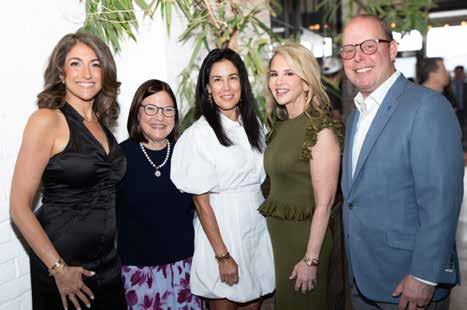

Louise Samsky, The Tasting Experience 2026 cochair; Jay Cranman, JF&CS CEO // All Photos by Patti Covert/Scenesations
“I am blown away with the amount of services that JF&CS supports, and the Innovation Office.
Members of JF&CS’ Intellectual and Developmental Disabilities Services program performed a lively medley.
year’s honoree was JF&CS CEO Emeritus with ‘Jewish’ in its name, and dedicated


Private oncology and hematology care you can trust. Our 19 medical oncologists serve patients across seven metro locations. Our commitment is simple: advanced treatment, near home, centered around you.















The Stave Room housed 23 restaurant vendors, many of whom have been participating since the event’s inception. Guests enjoyed cuisine like turbinado torched sushi, braised brisket, hummus, pasta, and Indian-inspired dishes. A separate dessert room added extra indulgence. Guests were given unlimited access to libations (headed by Mark Brown), and food (aggregated by Amy Fingerhut).
Longtime vendor Stuart Fierman, of The Fifth Group, recalled The Tasting’s origins in Buckhead alongside early organizers, noting that it remains one of his favorite annual fundraisers.
Longtime supporter Norma Kadoori shared her enthusiasm for both the mission and the event. “I have friends who’ve organized this whole thing. I think it’s terrific to have so many people come together like this,” she said, noting that her favorite offerings were salmon nigiri and braised brisket.
Restaurateur Tal Baum, of Olivia Restaurant Group, reflected on the event’s momentum. “I think this is a fabulous event. I’m proud that it’s become so important. This is our fourth [time],” as she served steelhead pastrami with capers.
First-time attendee Dr. Pip Spandorfer expressed his satisfaction. “This is my first year and I was so excited to participate. There was not one thing that I had that was not delicious, unique and fantastic.”
Additional culinary highlights came
from Annie Bradley of Elektra (Forth Hotel), who served a twist on hummus. Chef Matt Marcus, of Truth Be Told, returned for his second year with steak tartare. Mike Davis, of Tre Vele, presented cacio e pepe, sharing his connection to JF&CS through his mother’s work there and his ongoing support for individuals with special needs.
The evening also featured a silent auction including dozens of prizes, like private chef dinners, vacations, and artwork, adding excitement while raising funds. Event co-chair Dayna Royal, who previously chaired the auction, summed up the spirit of giving, “I think JF&CS is an incredible organization. Serving families and clients is a win-win because people are happy to donate and enjoy the event.”
As the evening wound down, beneficiaries of IDDS delivered a lively musical medley of “Don’t Stop Me Now,” and “You’ve Got a Friend in Me.” Their voices rang out with energy and joy.
JF&CS CEO Jay Cranman told the AJT, “This outpouring of support from the community to help us help others is overwhelming.”
The Tasting is more than just a showcase of food. It is a celebration of community and the shared commitment to supporting those in need.
Now, who’s going to Lake Tahoe, Punta Cana, or Cancun with an auction win? ì

By Marcia Caller Jaffe
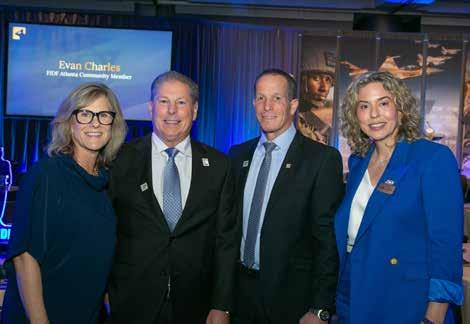
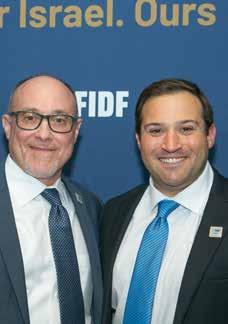
The annual Friends of Israel Defense Forces (FIDF) Gala rolled out on May 4 at the Crowne Plaza Ravinia, drawing a dedicated crowd of supporters, community leaders, soldiers, and survivors united in their commitment to the men and women of the IDF.
FIDF Chairman Fred Distenfield flew in from New York to mingle, as did FIDF President Wendy Moskowitz. Distenfield told the AJT, “There is no other organization like the FIDF that does this important work. That’s why we’re here.”
Moskowitz shared that she is committed to “supporting soldiers and cherishing Jewish survival, so that we can flourish despite all the current challenges.”
Into the grand ballroom, Michal Perl, the new Southeast FIDF director, spoke of her family’s relatives who escaped the Holocaust and served in the Six-Day War. Born in the U.S., she was raised in Israel and served as a weapons instructor in the IDF.
“We serve because we know what Israel is fighting for on all fronts. Here,
American Jews fight hate and antisemitism. These threats threaten both the United States and Israel, so we walk together to confront evil. One single truth: freedom is not free.”
She noted that the FIDF supports soldiers mentally, physically, and spiritually in what she called “the war of a lifetime.”
Eitan Weiss, Israel Consul General to the Southeast, spoke passionately about a
burned FIDF sign he witnessed outside of Gaza. He later revisited the same site and saw the FIDF installation sign had been reinstalled. He said, “I know FIDF investments are really important and help

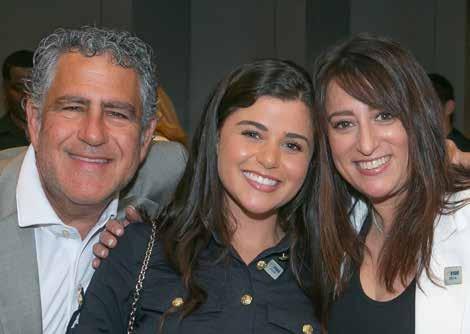
make everyone strong and independent, and I was pleased to see that [new sign].”
A video explained that the fatality rate in the current war is only 7 percent, due in part to FIDF medical care. FIDF also opened a new $18 million mental health center.
Noam Ben-Nun, father of Shlomo who was killed in Gaza, and brother, Yona, shared Shlomo’s heroism and tragic demise. “We got the knock on the door every Israeli parent fears. I looked through the peephole and saw three uniformed officers.” Yona spoke about his brother’s leadership and described his own visit to Auschwitz, returning with no doubts that it was his duty to serve as a counselor at an FIDF camp for grieving children.
Justine Cohn and Felicia Volosin spoke about the FIDF’s support therapy dog program for PTSD. Capt. Idan, of Intelligence Warfare, shared his integral role in building systems to decode enemy information, “work that normally took months was accelerated to completion in weeks. My unit detected Iranian threats before they were deployed, understood enemy patterns, and responded with confidence.”
Lt. Omer, naval officer on INS Nitzachon 23, served on a missile launching ship very similar to the vessel his father served on 35 years earlier. His ship was the first to leave port after Oct. 7, operating as a sea-based version of the Iron Dome, destroying hostile drones.
Sue and Mike Schwartz introduced Barak Deeri, an Oct. 7 hero. En route to rescuing his three brothers, he was rerouted to Kibbutz Be’eri. “Duty comes first,” he said. During an elite raid in enemy territory to rescue hostages, a
grenade shredded his legs. He retaliated by throwing a grenade before losing consciousness for seven days. He was later treated for PTSD and a long recovery with surgeries. Walking to the stage aided by braces, he described running from house to house — “sometimes finding entire families dead, sometimes finding some dead on one side and survivors on the other.”
Later in a hostage raid, he heard enemies shouting, “Allahu Akbar.” His greatest fear was being taken into a tunnel. When he lost consciousness and awoke in a hospital a week later, he thought, “I shouldn’t be here.” He continues to live with chronic pain. He told the crowd, “I certainly see what’s important. Live strong. We fight for western civilization’s values.” He reflected that since Oct. 7, Jews and Israel have emerged stronger together.
New chair of the Atlanta FIDF Council, Ben Levy, closed the program by speaking about his own family’s history, losing 28 relatives in the Holocaust. His words serve as a living reminder of the cost of indifference.
He stated, “’Never Again’ is not a slogan, it’s a promise … our soldiers shout ‘Ani Nishba’ – ‘I swear,’ in their induction ceremony to declare that they will defend us.”
As the youngest local chapter donor of an Impact Scholarship, attorney Levy concluded, “It costs $20,000 to change a combat veteran’s life, break it down over four years … thanking a soldier for service is a wonderful gesture; but helping them get a degree will be part of your legacy … tell your children and grandchildren that when Israel and the Jewish people were under attack, you heeded the call.” ì

The Teacher of the Year Award honors educators in supplemental Jewish education programs who inspire a love of Jewish learning, demonstrate innovation in their teaching, model strong Jewish values, and are committed to ongoing professional growth, with nominees put forward by Education Directors and selected by a review committee.

June 4 | 6 PM Scan

By Jordan Ross
On April 24, the National Council of Jewish Women-Atlanta Section (NCJW) held its seventh annual “Women Who Dare: Celebrating Our Sheroes” luncheon at The Temple to honor four women making significant contributions to the community. The four honorees were Enid Draluck, Michele Hirsch, Beth Schafer, and Joanna Kobylivker.
Luncheon co-chairs Roz Fuchs, Dina Fuchs-Beresin, and Jill Kossman welcomed approximately 350 guests, making this year’s luncheon their most highly attended yet. The invocation and Hamotzi were delivered by Rabbi Peter Berg of The Temple.
While guests dined on fresh salmon around centerpieces crafted with local produce, NCJW Co-Presidents Susan Gordon and Susie Greenberg reminded the crowd of NCJW’s goals of uplifting the community and how they have recently taken action. “We don’t just talk about our values; we live them,” Gordon said.
Next, each woman was recognized with a video interview highlighting their accomplishments and an award.
Enid Draluck
As the co-founder of the Metro Atlanta Food Consortium, Draluck addresses food insecurity and distributes a wide variety of food products to community members in need. “As a Jewish mother, I can never let someone go hungry,” Draluck said. Furthermore, Draluck serves as the co-founder and executive director of Full Circle Living, a nonprofit that works on “leveling the playing field” for women, Black Americans, and American Indians. Draluck is passionate about advocating
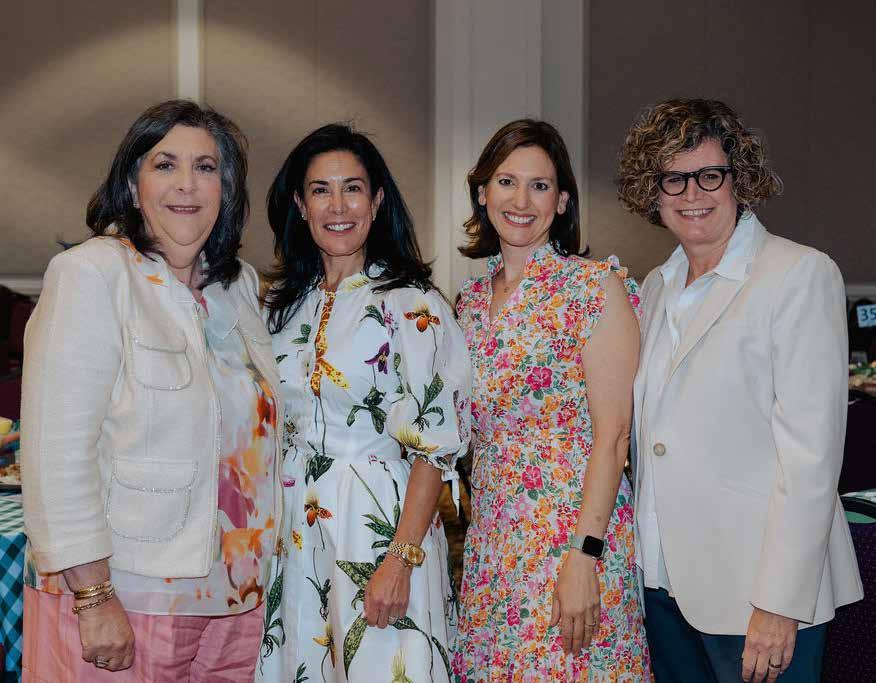
for marginalized voices and noted human trafficking and domestic violence as two of her main focus areas.
Michele
Hirsch serves as the co-president of the Hirsch Legacy Fund, which focuses

on aiding local non-profits that primarily support mental health causes and communities in need. Hirsch was inspired to pursue mental health initiatives after learning of the costs and other barriers to treatment for complex mental health issues that impacted her son. She first began her philanthropic journey by establishing The Peaceful Family Fund, which provided significant financial support to more than 20 families. Hirsch’s work is consistently motivated by her Jewish values, specifically channeling Tikkun Olam, or the value of pursuing activities that repair the world.
As the founding director of Adamah Atlanta, Kobylivker embodies Jewish values by pursuing sustainable practices, environmental education, climate action, and more. She helps local organizations reduce their use of single-use plastics and begin composting. Furthermore, Kobylivker aims to connect young people with their environment through Jewish practices, for example, engaging
students in Tu B’Shvat tree planting programs. She encourages others to get out into their community and to quite literally get their hands dirty to do the work it takes to improve our Earth.
As the Bunzl Family Cantorial Chair at Temple Sinai, Schafer connects her community through Jewish music. Schafer weaves social justice themes into her original music by re-examining Hebrew texts and making music that’s inclusive of a modern audience. As a cantor, Schafer is also a major part of lifecycle events at Temple Sinai. “It is an honor to be invited into others’ lives at their exciting times and at their most challenging times,” Schafer said. She consistently uses music, writing, and compassion to connect her congregation with Judaism and with each other. Each honoree was congratulated with a standing ovation. All four honorees defined a “Shero” as someone who is gracious and consistently uplifts others, qualities they each embody through their leadership and service. ì
By Marcia Caller Jaffe
On May 4, Temple Sinai was the gathering place for the dynamic feminine energy of the Auxiliary of the William Breman Jewish Home luncheon. Approximately 150 members, past presidents, and incoming leaders reflected upon decades of meaningful work while looking ahead to future goals.
Immediate past President Mindy Sard opened the program reflecting on the Auxiliary’s enduring mission and impact. She emphasized that leadership has never been about titles, but rather about purpose and action. She shared how, over the past 40 years, the Auxiliary “has brought together strong women dedicated to making a difference,” grounded in compassion and driven by a shared commitment to care for others. She highlighted the organization’s role in providing comfort during times of fear and uncertainty, with “dignity, compassion, and respect.”
Sard announced the Auxiliary’s largest gift ever — $40,000 — to Jewish HomeLife. She reflected on what this represents, “Our legacy will be linked what we build next, our chance to grow, open doors, include more women who will carry it forward.” She invited all past presidents to stand, honoring the foundation they helped build.
Incoming president Cheryl Schwartz took to the stage, sharing her personal journey with the Auxiliary. She spoke candidly about joining the board without fully knowing what to expect, only to find that it became a meaningful part of her life. Her remarks conveyed gratitude and a strong sense of responsibility as she assumes the new role. Schwartz also outlined her vision for the future, including the formation of a Past Presidents Club to tap into their invaluable insight and experience, ensuring their voices continue to guide the organization. She expressed a desire to increase membership involvement, expand fundraising efforts, and introduce new events to engage a broader audience.
In a lighthearted moment, Schwartz recognized incoming Junior Chair Elizabeth Glass, describing their partnership with humor and affection. She said, “We are a little like Thelma and Louise — partners in crime,” referencing their shared accomplishments in other organizations and hinting at the strong collaboration ahead.
Next, Sheryl Eisenberg, also a past president and head of the nominating committee, addressed the audience. She
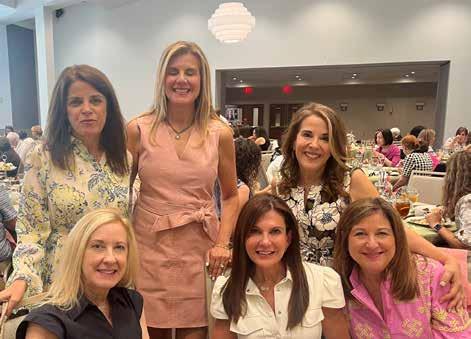
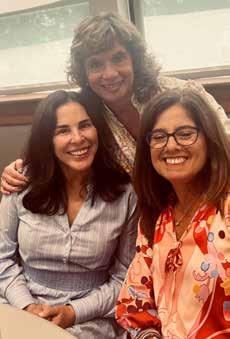
expressed gratitude to the current board for their dedication and formally swore in the incoming board members. Her remarks reinforced the importance of leadership continuity and the strength of the organization’s governance.
The final speaker of the afternoon brought a sentimental close to the program. Jane Weinstein Goff, the first president of the William Breman Junior Auxiliary, traveled in from Arkansas for the occasion, demonstrating her enduring connection to the organization. With humor, she remarked that she was “only 12 when she started,” drawing laughter from the audience. Beyond the joke, her presence symbolized the deep roots and lasting bonds within the Auxiliary. Weinstein Goff praised the group for its fresh energy and innovative ideas, while also acknowledging its unwavering commitment to caring for the most frail and elderly members of the community. Her words served as both encouragement and affirmation, bridging the organization’s past with its future.
As the luncheon concluded, there was a shared sense of optimism and purpose. The newly installed officers, who will serve from 2026 to 2027, are poised to build upon a strong legacy while embracing new opportunities for growth and impact. The event not only celebrated achievements, but also reinforced the Auxiliary’s mission — to support, connect, and care with compassion and dedication for years to come.
Supporter Shannon Clayman told the AJT, “Don’t think of us as just sup-
porting the elderly. Our topnotch rehab center serves many ages, and is there to fall back on. We are all motivated here to give back to the community.” ì

By Sadie Kitey and Nuriel Shimoni-Stoil
When Yaron Waksman describes the ocean, he not only speaks of the waves and the tide; he speaks of healing. Waksman, co-founder and CEO of HaGal Sheli, “My Wave” in Hebrew, a premier Israeli surf-therapy organization, visited The Weber School this April to share how he has transformed surfing into a tool to combat trauma.
As part of a TEDxYouth series organized by Weber School senior Graham Goodhart, Waksman spoke to an audience of students, parents, and teachers, outlining his model, which now helps roughly 5,000 participants annually and has reached more than 20,000 graduates.
At the center of his presentation, he made a simple but striking claim: “trauma does not discriminate, but neither does healing.”
sentation, approximately 82 percent of program participants report a significant reduction in trauma symptoms after completing surf therapy treatment. Waksman emphasized that surf therapy is not about replacing traditional clinical treatment, but about complementing it with a shared and inclusive community. Waksman introduced what he called the S.E.A. framework, a structure used in HaGal Sheli programs:
S- Shifting Structure: Participants are required to stay fully present, mirroring the demands that real-life resilience takes.
E - Emotional Experience: Surfing allows emotions to surface naturally in a safe and contained environment where they can be processed instead of suppressed.
Waksman opened with a story of a 12-year-old boy whose family was the victim of a terrorist attack just north of the Gaza border. While beginning his recovery journey with HaGal Sheli, the inexperienced boy, doubting himself, crashed the surfboard on his first attempt. On his second effort, he fell again. Upset and wanting to quit, Waksman guided him back into the water.
“The fastest way back is catching a wave,” Waksman said, recalling what he

told the boy. “You can do it. Just close your eyes for a moment, take a deep breath, and visualize yourself standing.” On the next attempt, the boy stood up, smiled, and rode the wave back to shore.
A - Anchoring: Small, consistent groups are formed among individuals with shared experiences, creating a community and rebuilding trust.
Each group, separated by age, typically includes around 15 participants, supported by a professional clinical team, a team lead, and trained volunteers, many of whom are program graduates who later return as mentors.
Downsizing can feel like a lot…or it can be simple — with the right guidance. You can start by decluttering. You can start making repairs. Smartest first step? Call Debbie Sonenshine.
With decades of experience, Debbie knows exactly how to:
• Help you decide what to fix and what not to
• Offer guidance on areas of your home to renovate and increase value
• Offer other tips to maximize your home’s value before selling
• Connect you with trusted professionals (organizers, movers, contractors)
• Create a clear, stress-free plan from start to finish
• Don’t waste time. Don’t waste money. Thinking About
Call or email Debbie Sonenshine today for a personalized consultation! Reach Debbie at 404-290-0814 or debbie@sonenshineteam.com
For Waksman, that moment captured the philosophy behind his idea of surf therapy: repeated exposure to challenge, paired with emotional support and community, can rebuild the confidence that trauma once destroyed.
Waksman spoke about the broader context of his mission in Israel. He explained that since Oct. 7, levels of trauma and anxiety have rapidly increased, in what The Times of Israel calls a “national mental health crisis.”
“Israel has become a place of trauma,” he said, emphasizing that exposure to violence, fear, and loss of control has become increasingly widespread in recent years. In light of this, HaGal Sheli has expanded its programs among different groups of people, including at-risk youth, people with disabilities, and trauma survivors.
A central question in Waksman’s talk was why surfing is so effective in trauma recovery when compared with traditional therapy alone.
“Trauma traps your mind and body in place,” he explained. “Surfing demands total presence. You have to be exactly where your body is: breathing, balancing, reacting. There’s no room to be anywhere else.”
He added that the ocean provides something uniquely stabilizing, its consistency. “The sea is going nowhere,” he said. “It won’t change because of what’s happening in your life. That creates a safe space.”
According to data shared in his pre-
“Every wipeout is a chance to rise again,” Waksman said. “We cannot prevent trauma, but we can control what happens next, one wave at a time.”
Later, Waksman addressed what happens when participants feel isolated or disconnected from others in their group. “It takes time,” he said. “It’s not one-sizefits-all.” He explained that the consistent weekly meetings and intentional small group structures are the keys to building trust. “Nobody is left behind,” he added.
When asked how programs are adapted for teenagers, Waksman highlighted themes of future resilience.
“With young people today, there’s anxiety, social pressure, school stress, and social media,” he said. “We focus on visualizing the future, on not giving up, and on learning how to try again.”
He added that these lessons are not limited to surfing but are also meant to translate into everyday life challenges.
He noted that, along with subsidizing his travel expenses, the Jewish Federation of Greater Atlanta also helped fund a group of survivors from Nahal Oz, a kibbutz near Gaza. As he left to return to Israel, his message to his listeners was rooted in simplicity: “Just take the next wave.” ì Sadie Kitey and Nuriel Shimoni-Stoil are co-Editors-in-Chief of Weber's Rampage school newspaper.
By Rena Gray and Chaya Steinberg
Each year, on Presidents’ Day, Intown Jewish Preschool (IJP) staff steps away from the classroom to do something just as important, engaging in higher learning by attending the Kallah, a full-day conference for Jewish preschool educators. Made possible by the Jewish Federation of Greater Atlanta, the Kallah invites teachers from across Atlanta to hear from a variety of professionals and explore current topics in early childhood education.
This year, more than 350 educators from 17 Jewish preschools gathered to share ideas, gain new perspectives, and strengthen their classroom practice. At Intown Jewish Preschool, educators believe strongly that great teachers are lifelong learners, and each session offered meaningful takeaways that IJP teachers have already begun integrating into their classrooms.
Noah Hichenberg, author and preschool director at Adas Israel Congregation, delivered a thought-provoking keynote on the changing nature of childhood in America. He traced this shift back to the Industrial Revolution, when children’s lives moved from an apprenticeship model, learning alongside their parents, to standardized, age-based classrooms with imposed developmental milestones. As families became smaller, a culture of increased supervision emerged, rooted in the belief that closer monitoring keeps children safer. Over time, this has led to a more control-oriented approach to parenting, sometimes at the expense of children’s independence and confidence. This unintentionally created a new generation of anxious children.
His message challenged educators to reconsider how much control adults exert on children’s lives. Rather than directing every moment, he encouraged teachers to “do less and involve more,” trusting children to take initiative, explore their ideas, and participate meaningfully in their environments. Young children, he reminded, are capable contributors when given the opportunity. At IJP, this philosophy deeply resonates with the school’s approach.
One of IJP’s basic tenets is to view the child as a whole being that is competent and capable, the constructor of their own learning. Hearing these ideas through a fresh lens inspired IJP teachers to expand on these opportunities in the classroom.
Mushky Deitsch, an experienced Reggio-inspired toddler teacher, has be-
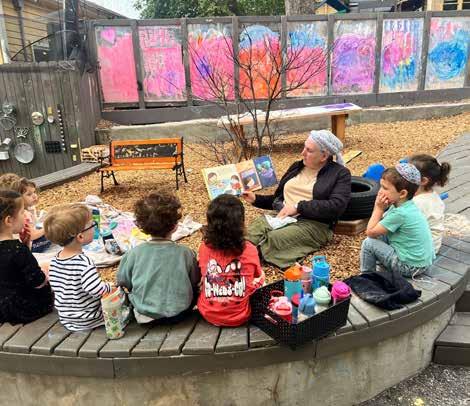

gun thoughtfully following the children’s lead in the realm of the social-emotional. In her twos and threes class, teachers have introduced an open invitation for older children to spend time in their classroom, inspired by an older sibling stopping by for a hug one day. What began as a simple moment quickly evolved into something deeper, richer and more meaningful. The older children embrace their leadership roles with enthusiasm, while the younger children become more regulated, focused, and engaged. This flexible thinking and collaboration on the part of IJP staff creates space for these higher-level interactions to happen.
For Ellyn Dupuis, one of IJP’s newer teachers, the focus on trusting children was especially impactful. One phrase from the conference, “when you’re ready,” has become a guiding principle for her, allowing children the time and autonomy to transition when they feel prepared.
Veteran educator Yael Perez shared that the keynote reinforced much of what IJP already strives to do, remaining flexible and responsive to children’s needs. She is especially interested in exploring ways to be less rigid with the daily schedule, seeking to rise to the challenge set by Hichenberg on this topic: “What would your classroom look like if you took down the clock?”
In IJP’s pre-K classroom, led by sea-
soned educator Dawn Siegel, children begin each day with calisthenics on the playground. These intentional brainbody exercises help prepare them for learning by regulating their energy and increasing focus. Movement is also intentionally integrated into transitions, helping children reset before the next activity.
Amanda Rosenfield, a licensed music therapist and assistant teacher, extends this work into the classroom. Inspired by an occupational therapy session on proprioception - the body’s ability to sense its position in space - she has introduced activities like stretching with resistance bands before they gather for Circle Time. These exercises help children feel more grounded in their bodies and develop a stronger sense of personal space.
Deitsch applies a similar philosophy during Circle Time. When a child has difficulty staying engaged, the focus is not on correcting the behavior, but on supporting the child’s needs. Rather than repeatedly asking a child to sit still, she incorporates their movement into the lesson: “Wow, look how our friend can do this move! Who else can try it?” The other children eagerly join in, and afterward, they are all visibly able to better sit and participate.
Longtime educator Adi Feen was especially inspired by a storytelling workshop that demonstrated how simple props can bring stories to life. She has
already brought many of these joyful, engaging techniques into her classroom. As IJP’s in-house librarian, Feen is passionate about fostering a lifelong love of books. Each week, she carefully selects stories to share with her class, often reading outdoors and incorporating nature walks that take advantage of the school’s beautiful surroundings.
Attending the Kallah was a powerful reminder of the importance of the work IJP staffers do every day as early childhood educators. Regardless of a school’s size or structure, Jewish preschool educators face many of the same realities: supporting and retaining excellent teachers, adapting to evolving family needs, advocating for resources, and guiding children through their earliest and most formative years.
At IJP, this shared mission extends beyond professional development; it lives in the school’s classrooms each day. By trusting children, responding to their needs, and creating meaningful opportunities for independence and connection, IJP staffers are not only strengthening their teaching, but also nurturing confident, capable learners. By meeting children where they are and recognizing what their bodies need, IJP teachers create a responsive and supportive learning environment where every child can thrive. ì Rena Gray and Chaya Steinberg are co-directors at Intown Jewish Preschool.

By Times of Israel
The Lufthansa airline group renewed its suspension of Tel Aviv routes until the end of June but said it could resume some flights at the start of that month depending on the security situation in the region.
The group includes Germany’s flag carrier Lufthansa and low-cost airline Eurowings as well as SWISS, Austrian Airlines, and Brussels Airlines.
Passengers affected by the cancellation of flights to or from Ben Gurion Airport will be contacted by the airlines directly and offered flexible rebooking options or a full refund, the Lufthansa Group said.
May 15, 1941: The Haganah forms the six-section Palmach as an elite unit to protect Jews in Mandatory Palestine from any attack by the Axis powers or Arabs during World War II. After the war, the Palmach smuggles in refugees.
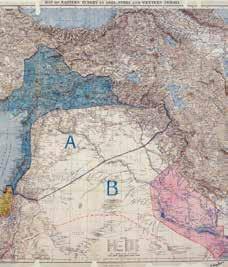
The original map included with the Sykes-Picot Agreement assigns Area A to France and Area B to Britain, with the yellow area to be an international zone.
May 16, 1916: Diplomats Mark Sykes of Britain and Charles Georges-Picot of France complete the Sykes-Picot Agreement, a plan to divide the Ottoman territories in the Middle East between their countries after World War I.
May 17, 1948: The Soviet Union announces its official recognition of the State of Israel. Seeing Israel as a potential ideological ally and as an enemy of Britain, the Communist superpower initially helps arm the new state through proxies.

Illustrative: A Lufthansa aircraft approaches the airport in Frankfurt, Germany, April 28, 2026 // Photo Credit: Michael Probst/AP/Times of Israel
The statement came after the European Union’s aviation agency renewed until May 1 its warning for airlines to avoid most Middle East airspace, including Israel.

Eli Cohen is shown in Syria. Although his body has never been returned to Israel, the Mossad did recover the watch he is wearing in this photo. // Israeli Government Press Office, CC BY-SA 3.0
May 18, 1965: Syria hangs Israeli spy Eli Cohen in a public square in Damascus. Cohen, who had infiltrated the highest levels of Syrian society and government as businessman Kamel Amin Thaabet, was arrested in January.
May 19, 1950: Two planes carrying 175 Jews leave Iraq for Israel via Cyprus, the start of Operation Ezra and Nehemiah, also known as Operation Ali Baba. The operation brings nearly 120,000 Iraqi Jews to Israel by January 1952.
May 20, 1948: The U.N. Security Council appoints Count Folke Bernadotte, a Swedish diplomat, to serve as the mediator for Middle East peace. He negotiates a ceasefire in June but is assassinated in September.
May 21, 1967: Egyptian President Gamal Abdel Nasser mobilizes his military reserves and moves troops into the Sinai after booting out U.N. peacekeepers May 19 and closing the Straits of Tiran to Israeli shipping.
May 22, 1975: After President Gerald Ford suspends economic assistance and reduces arms shipments to Israel, 76 U.S. senators sign a letter in opposition, stressing Israel’s need for enough support to deter attacks.
More than 180 Israeli artists, including some of the country’s most renowned creative spirits, contributed works to “A Plate of Hope and Color,” a week-long art exhibit supporting lone soldiers.
Participating artists included painters and sculptors, ceramicists and graphic designers, such as Michal Rovner, Micha Ullman, Larry Abramson, Jan Rauchwerger, Eli Shamir, Shai Azoulay, Boaz Noy, Vardi Kahana, Michel Kishka and the recently deceased Yair Garbuz. Musicians took part as well, including Riki Gal, David D’Or, Yehudit Ravitz, Yehuda Poliker, Ivri Lider and Arkadi Duchin.

Each artisan created an original work, whether photography, drawings, or paintings on a white ceramic plate, chosen as a symbol of family meals and a place at the table, a concept that lone soldiers can’t take for granted, said Drorit Nitzani, president of the Lone Soldier Center in Memory of Michael Levin, which put together the project.
May 27, 1911: Teddy Kollek, Jerusalem’s mayor from 1965 to 1993, is born near Budapest. His parents name him after Theodor Herzl. He is mentored by David Ben-Gurion and runs for mayor at his behest.

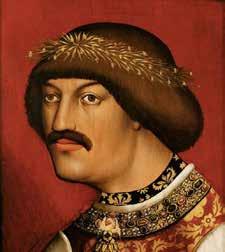
May 23, 1420: Inspired by antisemitic religious fanaticism, Archduke Albert V issues the Wiener Gesera (Viennese Decree), ordering all Austrian Jews to be imprisoned and their possessions to be confiscated.
May 24, 1948: Inexperienced Israeli troops, including many newly arrived Holocaust survivors, fail to capture the Jordanianheld hilltop fortress at Latrun in an effort to relieve the siege of Jerusalem, 10 miles to the east.
May 25, 2010: New York’s first Israeli Jazz Festival, a five-day celebration of the Israeli influence on the global jazz scene, begins. Performers include bass and oud player Omer Avital and clarinet and sax player Anat Cohen.
May 26, 1924: Congress passes the 1924 Immigration Act, which cuts off most immigration from Eastern and Southern Europe. Without the United States as an immigration destination, Jews increasingly go to Palestine.
By Dr. Avishai Teicher,
May 28, 1999: A U.S.-Israeli team discovers the Israeli submarine Dakar, which disappeared in January 1968, broken in half between Crete and Cyprus almost 9,800 feet beneath the surface of the Mediterranean.
May 29, 1911: Poet Leah Goldberg is born in Königsberg, Prussia, now Kaliningrad, Russia. She begins writing poetry in Hebrew and Russian around age 12 and is a published writer before she moves to Tel Aviv in 1935.
May 30, 2009: Ephraim Katzir, Israel’s fourth president, dies at 93 in Rehovot. Born in Kyiv, Katzir made aliyah with his family when he was 9. A prize-winning scientist, he was elected president in May 1973.
Items are provided by the Center for Israel Education (israeled.org), where you can find more details.

By Gil Zohar
Lag b’Omer – the 33rd day of Judaism’s somber seven-week “counting” between Passover and Shavuot (Pentecost) – marks the cessation on Iyar 18 in Judaism’s lunar calendar of a plague that killed 24,000 disciples of Rabbi Akiva (c. 50–135 CE). The Talmud (Yevamot 62b) states the plague was a divine punishment inflicted on the sage’s students because they begrudged their comrades’ spirituality and Torah scholarship.
After the grisly flaying in the Roman capital Caesarea of his beloved master R. Akiva – one of the 10 sages martyred by the genocidal Emperor Hadrian – Rabbi Shimon bar Yochai and his son, Eleazar, fled to the remote Upper Galilee. There, according to tradition, they lived in a cave for 12 years, sustained by the fruit of a carob tree and a spring. Bar Yochai, also known by the Hebrew abbreviation Rashbi, is given the pseudepigraphal credit of writing the Zohar – a mystic Aramaic commentary on the Pentateuch, which is the classic text of the kabbalah. He emerged from his refuge an ascetic and charismatic miracle worker. The Midrash states he “revived the Torah at that time” following the Roman persecution. Dying on Lag b’Omer, he became a legendary figure in the lore of Jewish mysticism and folk religion.
In the 16th century, mystics from the kabbalist center of Safed initiated the annual Lag b’Omer hilula (literally “wedding feast”) to bar Yochai’s nearby tomb atop Mount Merom – Israel’s tallest mountain. In recent years, upwards of 200,000 people have come on this early summer holiday, pitching tents, making bonfires, grilling meat, drinking arak, reciting Psalms, and giving three-year-old boys their first haircut in a unique expression of faith and folk religion.
Implicit in their farbrengen (joyous gathering) is the kabbalist principle that the death of a sage marks the reunion of his soul with his maker – i.e. a spiritual marriage. Joy, rather than grief, marks the anniversary of his passing in direct proportion to the rabbi’s saintly reputation as a miracle worker. The grave, in anticipation of the messianic rebirth of the dead, becomes the site of veneration and feasting.
In 2021, 45 pilgrims were crushed in a tragic stampede on a rickety staircase during the Lag b’Omer celebration at Mount Meron caused by the failure of the site’s ultra-Orthodox guardians to implement public safety precautions dictated by the building and fire code. More than 100,000 pilgrims had flocked to the holy site.

On April 26, Prime Minister Benjamin Netanyahu in consultation with the security cabinet canceled the annual mass celebration at Mount Meron except for a symbolic 1,500 pilgrims over four days. The PM cautioned a Hezbollah missile and rocket attack could cause a mass casualty event. Roadblocks were set up Sunday leading to the pilgrimage compound and remained in place for several days. Additionally, Border Police were deployed to prevent attempts to reach the tomb on foot by scaling the mountain.
“Amid the security threats in northern Israel, avoiding blocked routes is the right way to preserve Jewish tradition joyfully and safely,” Israel Police stated in a press release.
Nevertheless, thousands of scofflaw yeshiva bochers tried to ascend the mountain by hopping fences and skirting police barricades.
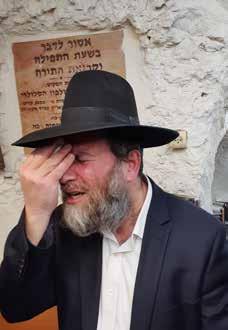
In lieu of the scaled-back celebration at Meron on Lag b’Omer, which this year fell on May 4-5, an alternative hilula took place at the Tomb of Shimon haTzadik (Simon the Just) in east Jerusalem. The tomb is located in Wadi Joz (Arabic for “the Valley of Walnuts”), the dry riverbed separating the Palestinian neighborhoods of Sheikh Jarrah and the American Colony. The mausoleum consists of a catacomb of three interconnecting stepped chambers and a fenced-in courtyard. Visitors separated by gender celebrate with separate tents for men and women.
Some 20,000 celebrants packed the pilgrimage site, creating a carnival-like atmosphere with candy floss and hora
circle dancing. While Israel Police blocked off the street to traffic, hassidim and haredim (ultra-Orthodox Jews), dressed in their Sabbath and festival finery, streamed to the site on foot and by bicycle from their nearby neighborhoods just across the Green Line that divided Israeli and Jordanian Jerusalem from 1949 to 1967.
Some arrived by Jerusalem’s Light Rail, getting off at the Shimon haTzadik station and walking through an Arab neighborhood to reach the holy site. The pilgrims jostled their way through the crowd to visit the tomb, light candles and make heavenly petitions. In the evening, there was a huge bonfire.
As at Meron, three-year-old boys received their first haircut, called halaka in Hebrew and upsherin in Yiddish. Rabbis and community leaders wielded the
scissors. Not surprisingly, many of the children cried or protested, resulting in a botched job – to be fixed later by a professional barber. The locks were left on the sides of a boy’s head to form payot (corners) based on the Biblical injunction (Leviticus 19:27) against shaving the “corners” of one’s head. Traditionally, the first shearing is fed into a fire. Fathers triumphantly paraded their sons on their shoulders while women ululated with joy.
While many contemporary Israelis, both secular and observant, emphasize Judaism’s rational aspect, to witness today’s Lag b’Omer celebrations – whether in Meron or Jerusalem – is to appreciate the profound heritage of kabbala on Jewish life over the centuries. ì
Gil Zohar is a journalist and licensed tour guide in Jerusalem.




Parkaire Landing Shopping Center 4880 Lower Roswell Road, Suite 175, Marietta, GA 30068 www.adamarkjewelers.com | 770-565-6558
Monday-Friday- 10am – 6pm | Saturday- 10am – 4pm Extended Holiday Hours Wed – Fri through Dec 23rd 2025 Open till 8PM

David Ostrowsky
The annual golf tournament for the Marcus Jewish Community Center of Atlanta (MJCCA), the Harry Maziar Classic, continues to reach new heights. A tournament that raised $75,000 and hosted several dozen players in its 2009 debut has expanded exponentially in scope, with its most recent edition held at the Atlanta Athletic Club in Johns Creek on Monday, May 4, bringing in over $640,000 and including more than 300 participants.
In what has become a marquee event on the Atlanta Jewish community calendar, the Harry Maziar Classic, named after the 93-year-old native Atlantan who has been non-stop active in Atlanta’s Jewish Community Center going on 81 years and co-chaired by Joel Libowsky and Brad Oppenheimer, lived up to the billing during its 18th anniversary earlier this month. Not only did the golf tournament, held at its fourth different host site, generate record-setting funds that will be earmarked for scholarships to those seeking financial assistance for MJCCA preschool and day camps as well as Camp Barney Medintz, but it also appealed to an entirely new wave of participants with its first-ever Mah-Jongg Open Play Luncheon for non-golfers, which featured prizes and was held in the clubhouse following the awards reception and silent auction. Thanks to the diversification of programs offered, a recordnumber 302 people signed up for this year’s Harry Maziar Classic.
“The $640,000 raised this year is a direct investment in ensuring that cost is never the reason a child misses out on preschool, day camp, or a summer at Camp Barney Medintz,” shared Jared Powers, CEO of the MJCCA, when speaking to Atlanta Jewish Times last week. “The Harry Maziar Classic has become the financial engine behind that promise, and watching it grow from year to year is a powerful reminder of what this community stands for. We are deeply grateful to every sponsor, player, and volunteer who made this our best year yet.”
There’s a reason that the tournament continues to be named after Maziar every spring. While serving on the boards of Atlanta Jewish organizations

throughout his life, Maziar has been a driving force behind the MJCCA, both as president and as co-chair of the Governance Board. He has helped the beloved institution navigate some challenging financial situations and was chiefly responsible for getting the now annual golf tournament off the ground in the early 2000s. This year, three generations of the Maziar family not only participated in the tournament but also served on the planning committee, including Jake, Neal, and Todd Maziar.
“This tournament has always been about community and bringing people together around a shared commitment to making sure every family in Atlanta’s Jewish community can access what the MJCCA has to offer,” said Harry Maziar, whose three children and eight grandchildren have all been very engaged in MJCCA activities, while the same may hold true for his many great-grandchildren. “Seeing it grow to this level, with three generations of our family carrying it forward, is
something I am incredibly proud of.”
Every year, the Harry Maziar Classic is held in honor of an Atlantan who’s genuinely invested in the Jewish community and has a network of friends, relatives, and business associates who can serve as sponsors and players. This year, the honor went to Sammy Grant, who grew up attending JCC preschool and AJECOMCE day camps before spending 10 summers at Camp Barney Medintz, as both a camper and staff member. Now as an adult, Grant is an attorney, CPA, CFP, and wealth management professional who currently works at HB Wealth following a merger with his firm, SG Financial Advisors. Amidst his hectic professional life, Grant has stayed dedicated to Jewish Atlanta by serving on the MJCCA Board of Directors, including as Board Chair during the recent pandemic. As a recognition of his unswerving commitment to Judaic culture, Grant, who also finds time to be an Ironman triathlete, received the Abe Schwartz Young Leadership Award along with the
great distinction of being featured in this year’s Harry Maziar Classic.
Hopefully, Grant will follow in the footsteps of the many past tournament honorees such as Harry Maziar, Doug Kuniansky, David Kusiel, Eliott Arnovitz, Mark Lichtenstein, Jack Halpern, Ron Brill, Steven Cadranel, and Ken Winkler who have remained thoroughly engaged in different iterations of the fantastic event, whether it be as participants, sponsors, or members of the planning committee.
Though no date for 2027 has been set in stone, planning for the 19th annual Harry Maziar Classic is already in the works. And given the year-over-year improvements in fundraising, sponsorship, and participation, next year’s invitational promises to continue fulfilling its noble mission of providing financial support to individuals and families interested in enjoying all of the wonderful and inclusive year-round community programs that MJCCA offers. ì
By David Ostrowsky
For Braves Nation, it’s starting to feel a lot like 2023.
Three years ago, the Atlanta Braves raced out to a 26-15 start en route to wrapping up the NL East crown by midSeptember and racking up 104 regularseason wins.
This year, the Braves sport an even more impressive record (28-13) at the quarter mark of the season while owning a 9-game cushion in a surprisingly weak NL East. The club is riding a nice wave of momentum into the second half of May and there’s well-deserved buzz around baseball — especially after its pair of consecutive breezy 7-2 wins over the Los Angeles Dodgers to take the road series against the two-time defending champs. But one question will hover over Truist Park all summer: Will this year’s Braves team — one anchored by a deep lineup that bears strong resemblance to the 2023 edition — meet a different fate than that of the 2023 team once October dawns?
Coming off a disastrous, injuryriddled 2025 season, this year’s Braves squad under new manager Walt Weiss, the clear favorite to win NL Manager of the Year, appears well positioned to make a deep postseason run. All-Stars Spencer Strider and Sean Murphy have recently been activated from the injured list and Ha-Seong Kim is inching closer to his big league return. Ozzie Albies has a chance to have one of the greatest offensive seasons ever for a second baseman — just like during his 2023 All-Star season. Matt Olson is squarely in the conversation for NL MVP and ace Chris Sale projects to be in the mix for NL Cy Young. Indeed, both veterans’ careers are on a Cooperstown trajectory.
Showing no signs of any sophomore slump, reigning NL Rookie of the Year Drake Baldwin has emerged as one of the best offensive catchers in baseball. Atlanta has only lost one series all year and the Philadelphia Phillies and New York Mets — their two NL East rivals with starry rosters and bloated payrolls — don’t loom as a threat at this hour. When it comes to the ninth inning, there’s no better offense in baseball than Atlanta’s.
While it’s not yet even Memorial Day, it’s hard to imagine the Braves won’t be in the running alongside the Dodgers, San Diego Padres, and Chicago Cubs for one of the two coveted first-round postseason byes come late summer. For that matter, a potential World Series matchup

against Max Fried and the New York Yankees doesn’t appear to be a fantasy. That’s how promising the first seven-plus weeks of the post-Brian Snitker era have been.
“There’s no babysitting, and that’s the last thing you want to do in a position of leadership. I don’t have to worry about that with these guys. We’ve got great veterans, pros. These guys show up every day. They love coming to the park. They enjoy being around each other. They like working. They like competing. We’ve got a lot of models for the young players to look at,” Weiss, the 49th manager in Braves franchise history who formerly skippered the Colorado Rockies, told the MLB Network during a pregame interview on April 30.
Going into the season, there were legitimate questions how the Braves would fare with All-Star outfielder Jurickson Profar ruled ineligible for the entire year after his appeal of a positive test for performance-enhancing drugs was resolved. There was no telling how long promising young pitcher Spencer Schwellenbach was going to be sidelined with a bum el-
bow. The severity of the newly-acquired Kim’s right middle finger injury was of concern. And yet, even without the services of those three critical players, the Braves have kept rolling.
“Sometimes these things don’t make sense in our game. You do the math and it doesn’t add up,” added Weiss. “We’re far from full strength, but we’re playing really well. It doesn’t mean when we get all of our pieces back, we’re going to play better. This game is hard to figure out sometimes.”
It’s difficult to pinpoint any real cause for concern, but one red flag of sorts has been an occasionally leaky bullpen in the early-to-mid innings. While the back end of the pen has been spectacular with untouchable closer Raisel Iglesias, setup man Robert Suarez, and late-inning reliever Dylan Lee having career years thus far, middle relievers Aaron Bummer, José Suarez, and Joel Payamps have largely scuffled [Suarez and Payamps have since been released]. Perhaps even more alarmingly, right fielder Ronald Acuña, Jr. has been shelved with
a strained left hamstring for well over a week now and there’s no firm date for his return. The 2023 NL MVP did some light jogging in the Dodger Stadium outfield on Sunday and could be activated from the injured list this week, but that’s far from a given.
“It’s still going to be a little time,” Weiss told reporters Sunday. “[Acuña’s] progressing very well. I saw him out there doing the drills, and he looks good. It’s a big leap from doing the little agility drills and then having to run full speed. So, he’s got some boxes to check.”
Of course, there’s not a team in baseball that isn’t flawed or at least slightly derailed by injuries and the Braves are in as good of shape as any club going into the season’s second quarter. Thus far, it’s been quite a drastic turnaround from last year and it seems safe to project Atlanta having a dynamic presence at this year’s All-Star Game hosted by the Phillies, their longtime postseason nemesis.
As Weiss said, “There haven’t been any prolonged stretches where we haven’t been playing good baseball.” ì
SPORTS
By Marcia Caller Jaffe
Just when you think you’ve heard the most amazing stories about industrious young Jews, Floridian Jared Firestone is “golden” in winning “the skeleton.”
On April 20 at Congregation Beth Tefillah, Firestone shared his journey of resilience as a high school track star, inspired by both Judaism and Israel, to leverage his physical prowess and spiritual acumen into winning a gold medal for Israel in the recent Milano Cortina Olympics.
Firestone also appeared on April 19 at Chabad of North Fulton.
Along his journey, Firestone graduated law school, had a stroke and a variety of bizarre ups-and-downs, ultimately finding his way to the Knesset to secure Israeli citizenship.
Firestone was introduced by Rabbi Ari Sollish, who framed the presentation with reflections on Yom HaZikaron honoring fallen soldiers and victims of terror. Then he compared Firestone’s sport to the Bal Shem Tov’s commentary: how small moments can shape outcomes, how discipline must guide emotion (headfirst), and how each individual travels a unique path even when moving along the same track.
The sport at the center of Firestone’s Olympic dream — skeleton — is one of the most physically and mentally demanding events in the Winter Olympics. Athletes race headfirst down an icy track on a small sled, reaching speeds of up to 90 miles per hour. Unlike luge, where competitors lie on their backs, skeleton racers face forward, navigating sharp turns with only subtle shifts in body weight. Precision, reaction time, and fearlessness are essential. Even the smallest miscalculation can result in crashing
into the track walls.
Firestone described how training his mind was just as important as training his body, as he needed to react instinctively while maintaining perfect positioning inches above the ice. His Olympic aspiration was influenced by a desire to honor Jewish coaches and athletes who were killed at the Munich Olympics.
Firestone said, “I want Jews to have a role on the global stage … I don’t feel that the Munich victims have been fully remembered.” He watched the Winter Olympics in Russia and noted that the skeleton “looked super easy.” Ha!
Firestone’s path was anything but straightforward. While attending college and, later, law school, he balanced academics with athletics. Just one month into law school, he experienced a stroke. Diagnosed quickly thanks to his doctorfather, he stepped away from sports for months. Later, with minimal equipment and little experience, he endured bruises, crashes, and frustration. Setbacks continued. A popped bicep required surgery and months of rehabilitation. Later, a crash during a World Cup event left him with broken ribs, forcing him to finish a race in visible pain. With an eye on the prize, he trained in the Miami heat with no air conditioning and wrapped tefillin to maintain spirituality.
His breakthrough came with strong performances that secured Olympic qualification. Still, another challenge emerged: obtaining Israeli citizenship in time to compete. Navigating bureaucracy proved demanding, but he ultimately succeeded, describing the moment he received his passport as a dream realized. One of the highlights of his Olympic experience was carrying the Israeli flag during the opening ceremony. Overcome


with pride, he admitted he forgot the instructions about maintaining formation down the center.
Firestone took questions from the audience. One fan suggested he do a movie for the Jewish Film Festival, in which case Firestone hinted that one was already in production for the San Francisco festival.
Another guest asked if Firestone’s parents and siblings shared his similar intensity traits to which he recalled his father taking 3 a.m. phone calls to help patients. Another guest queried what it was like be-
hind the scenes at the Olympics. Firestone said, “You don’t see it but there’s a truck that takes us up back to the top for each run. No one is walking.”
Recalling that some athletes (Ukraine) were disqualified for making political statements on helmets, Firestone safely painted his with the Mogen Dovid. He also had a kippah engraved with the names of the 11 coaches and athletes who perished in Munich. He concluded, “This was all a dream come true.” ì










I have been wading waste deep through pre-primary election politics the past couple of weeks, so this seems a good time to distract myself with a report on the progress of this year’s garden.
As rainfall this spring has been significantly below normal, I’ve had to unroll the hose and water the crops more than I would like.
In the garden box, arugula shares the front right corner with a prehistoric-looking mullein plant, a pair of tomato plants occupy the left front, broccoli grows in the back left, and the rosemary bush in the back right corner holds senior status, having survived many seasons. In between are banana peppers, basil, and (alone in the center circle) cucumbers.
There were a couple of romaine lettuce plants, but I suspect that a nocturnal visitor nibbled them down to the roots.
I’m a ways from going Carl Spackler on them (see Bill Murray as the golf course assistant greenskeeper in the movie “Caddyshack”), preferring more natural methods. I’ve been told that peppermint spray might be effective.
Elsewhere in the back yard, the blueberry bushes are looking lush and the blackberries are flowering, but
the raspberries remain a mystery.
No longer shaded by the “kiwi plant from hell,” which was dragged to the ground last summer by the basketball hoop it once held hostage, the raspberries seem confused, as if undecided whether to take this season off and enjoy their new-found sunshine or perhaps offer us a small crop.
I learned last year that the plum tree in the back yard is a biennial bearer, producing fruit every other year. This spring, its limbs already are beginning to bow with what appears will be a sizable crop.
Then there are the weeds.
Pulling weeds from the garden box and from beneath the berry plants is a necessary and almost daily task, primarily done by hand.
I could use chemicals, but having eschewed them all these years, I see no reason to start now. Short of a scorched earth approach, the best I can do is work to contain this nuisance.
Now, let’s think of America as a garden invaded by weeds, more a matter of ideas than individuals. The latter exploit the former to inflate their self-importance and afflict those they want followers to blame for any societal ill.
These weeds flourish along the left and right fences in the American garden, finding sustenance in the extremes before creeping toward the middle. When confronted, the people propagating these weeds either blame the targets of their abuse or point a finger toward








the opposite fence, while discounting any culpability on their part.
The American garden is populated with people of varying races, religions, ethnicities, national origins, and cultures, as well as differing socio-economic status, education, and politics.
E Pluribus Unum. Out of many, one.
(That Latin phrase was the motto of the United States, from its adoption by Congress in 1782 — until 1956, when another Congress changed it to “In God We Trust,” to distinguish this country from the atheistic, Communist heathens of the Soviet Union.)
Maintaining the health of the American garden requires vigilance and ongoing efforts to inhibit the spread of weeds.
The weed we call antisemitism — Jew hate in simpler language — is the oldest, and among the hardiest, most virulent, and most noxious.
Antisemitism was not native to this land, but imported by immigrants, many of whom were themselves fleeing prejudice of one kind or another. This weed has found fertile soil in America, particularly among people looking for someone to blame for their struggles.
Where it takes root, antisemitism has proven almost impossible to eradicate, feeding itself from a never-ending stream of resentments. The challenge is to prevent it from infecting other, healthier plants.
In my garden, I pull weeds by hand or aided by an implement, such as a trowel. I don’t have an easy solution to offer for ridding the American garden of antisemitism, but I do know that the Jewish community cannot manage this problem on its own.
We need allies willing to get about the business of fighting antisemitism in their own communities. The Jewish community, meanwhile, must be willing to have difficult, soul-searching conversations about the current-day circumstances that have formed a new layer atop this ancient prejudice.
Tending a garden requires getting down on your knees and putting your hands in the dirt. The work can be difficult, but the reward is nourishing, for a family or for a nation. ì

Michael A. Morris Publisher
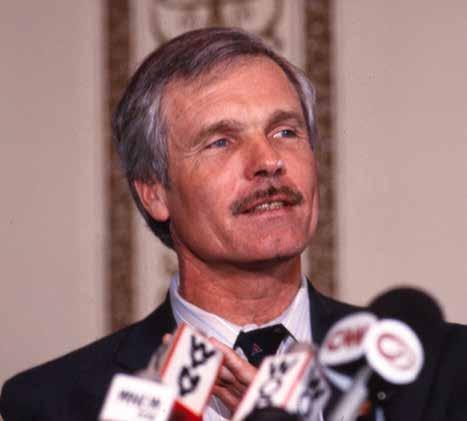
I had the opportunity to meet and spend a few minutes with Ted Turner about 15 years ago. I met him at a function; I was partners in a magazine, travelgirl, and Renee Werbin had put his wife, Jane Fonda, on the cover and that offered us entrance to a private event with them.
Ted and I spoke for about seven or eight minutes, and I walked away a much better person. I am sure he had no clue. One of the things we spoke about during this short conversation was his penchant for picking up trash. He was known to pick up a piece of trash on the street or in a stadium or anywhere where someone else had littered. I asked him about it and said, “Is your goal to clean the streets?” His response was poignant. No, he was not attempting to clean the streets, he was merely doing his small part, as we all should, to make the streets a cleaner place to traverse.
As you can imagine, my friends now
all notice when I pick up garbage along the street or in a store. Just doing my part; think what the streets would look like if we all followed suit.
The other thing I learned I had to glean from his actions. As one might sus pect, I waited patiently for my few min utes with Ted Turner. He was the star of the show wherever he went. When it was my turn, he shook my hand, looked me in the eyes and asked what brought me to this event. For the next seven or eight minutes, we covered three or four topics, and at no time did his eyes wander from mine. He was laser focused on our con versation. A conversation with someone he had never met and most likely would not again, yet, his attention to our con versation was unwavering. His eyes were not wandering around the room looking for someone more important he needed to speak with, he genuinely engaged in our discussion.
I walked away from Ted feeling im portant, heard and empowered. Ted, on your passing, you have renewed your les sons of humility and respect. Next time we have the opportunity to meet, I can guarantee you will see me with renewed passion for emulating my teacher and I hope you spot me picking up a piece of trash, just doing my part.










There’s a famous scene in American music where Louis Armstrong was in the middle of a recording session and accidentally dropped his lyric sheet. Unable to grab it while the tape was still running, he had to think of something to do or say in that moment — and alas, scat singing, the sound of musical yet seemingly random syllables, was invented on the spot.
It’s a great story. But like many great stories, it becomes even more interesting when you look beneath the surface.
Many people know about the important role the Karnofskys, a family of Lithuanian Jewish immigrants in New Orleans, played in Armstrong’s early life. Armstrong worked for them as a boy and remembered them with deep affection. They were religious Jews, and he heard
them praying and singing in their kitchen. He later wrote that they “instilled in me singing from the heart.”
“Singing from the heart” is not about perfection. It is not about hitting a note as cleanly or correctly as possible. It is about meaning what you sing. It is about communicating something real, something true.
Armstrong reportedly told his friend, Cab Calloway, that his inspiration for scat singing came from hearing the Karnofskys praying — what he called “the Jews rockin’.” He never spoke about this publicly, because he worried people might think he was making fun of Jewish prayer. But that wasn’t it at all. He was moved by it. He heard something in those sounds that stayed with him.
So maybe the syllables of scat weren’t quite as random as they seemed. Maybe some of that sound came from Lithuania, through a Jewish kitchen in New Orleans, absorbed by a young Black genius who would transform American music.
Around the same time, in upstate New York, another young musician was
listening closely to Louis Armstrong.
His name was Chaim Arluck. He was the son of a cantor and received much of his early musical education in the choir at his father’s synagogue. Eventually, he changed his name to Harold Arlen and became one of the great American songwriters, composing “Over the Rainbow,” “Stormy Weather,” “Come Rain or Come Shine,” “Get Happy,” and so many other classics.
Arlen was Jewish. Armstrong was Black. One came out of the synagogue; the other came out of New Orleans. But Arlen heard something familiar in Armstrong’s music.
“I don’t know how the hell to explain it,” Arlen once said, “but I hear in jazz and in gospel my father singing.”
Arlen’s father, Samuel, was a cantor and, according to his son, a remarkable improviser. Ben Sidran writes that Arlen considered his father “the most delicious improviser I ever heard.” Arlen recalled listening to a Louis Armstrong record with his father when Samuel suddenly became agitated. He wanted to know where Armstrong had gotten a particular phrase. Arlen explained that it was a common riff, but his father insisted it sounded exactly like something he had improvised during a synagogue service.
At the same time that Arlen was falling in love with Black music, one of the great Black artists of the 20th century was falling in love with Jewish music.



Paul Robeson, the singer, actor, activist, and towering cultural figure, felt a deep connection to Jewish song. As a young man, he reportedly encountered Jewish music through the synagogue of composer Jerome Kern’s grandfather, who served as a cantor. That experience helped spark a lifelong fascination. Robeson went on to perform songs in Hebrew and Yiddish and spoke movingly about the relationship between Black spirituals and Jewish liturgical music.
“From the songs preached or spoken by Negroes in their religious life, and in their deep trouble under slavery,” Robeson said, “it is only a step to the beautiful songs of the Jewish people which are sung or chanted in their synagogues.”
And maybe that is why so much Black and Jewish music seems to live in the same emotional neighborhood.
It’s hard to explain exactly what drew so many music-loving American Jews to Black music — and vice versa — but perhaps the answer lies in the “blue note” both cultures share.
Unlike most European classical tra-
ditions, the goal in both of these musical cultures is not precision. The goal is truth. Hitting the note right at its center is not the only way to hit it. Sliding into or out of the note is more than acceptable — it’s essential. The music lives in the space between the notes.
Don’t believe me? Try playing the sheet music to a blues, gospel, or cantorial piece exactly as written. You’ll feel something missing.
Bob Dylan was asked how he responds to people who say he has a bad voice. His answer was unforgettable: “Sam Cooke said this when told he had a beautiful voice: ‘Well, that’s very kind of you. But voices ought not to be measured by how pretty they are. Instead, they matter only if they convince you that they’re telling the truth.’”
That idea was confirmed for me recently in a unique way. I found myself in the exciting but slightly intimidating position of sitting with one of the most important composers in American music: Mike Stoller, of the legendary Leiber & Stoller songwriting team. They wrote “Hound Dog,” “Stand By Me,” “Kansas City,” and so many other classics.
I told Stoller something I’d always felt but never voiced: “If you play most Jewish songs exactly as written, or most Black spirituals exactly as written — or, and I mean this as a compliment, a lot of your songs, too — they just don’t sound as good. I think they’re meant to be interpreted soulfully. They’re not written for precision. They’re written for truth. Does that resonate with you?”
He lit up.
“Absolutely,” he said. “Back in the early ’50s, Capitol [Records] and others would record our songs with their artists, and we never liked the results. So, we became record producers — to protect the intention of the songs. If we couldn’t be the ones singing or playing, we needed to guide those who did, to make sure it sounded the way we heard it in our heads.”
That line stuck with me: We became producers to protect the intention of our own songs.
To Leiber & Stoller — and later, to Burt Bacharach and others — the written notes were just a sketch. The real magic came in the phrasing, the rhythm, the bend of the note, the breath between syllables. And that’s not something you can fully write down.
It has to be felt.
And that is the sound between the notes. ì

By Dave Schechter
[Editor’s note: The is one in a series of articles about Jewish candidates for federal and state offices in advance of the May 19 primary.]
The Democratic Party race in House District 51 has grown steadily more contentious as the May 19 primary approaches.
The incumbent in the north Fulton County district is two-term Rep. Esther Panitch, at present the only Jewish member of the Georgia General Assembly.
The challenger is Aaron Baker, also Jewish and who identifies as a lesbian, transgender woman, and a member of the Democratic Socialists of America (DSA).
The winner will face Republican Keith Gettman, whom Panitch defeated in the 2024 election, winning 58.1 percent of the votes cast.
According to the latest available campaign finance reports, Panitch had raised nearly $105,000 this campaign cycle and Baker nearly $31,000.
This pot of political stew, now at a boiling roll, has been spiced by denunciations and barbed comments.
Accusations and Explanations
Panitch spelled out her disdain for Democratic Socialists in an early April interview with the Atlanta Journal-Constitution, saying: “They are no different than what the Tea Party did to the Republicans, and now we have MAGA. So, if we’re following the same pattern, and it looks like they are, they are our Tea Party. We’re going to have MAGA on the left.”
The Democratic Socialists of America (DSA) support for the BDS (Boycott, Divestment, Sanctions) movement seeks to use economic pressure to force changes in Israeli policy.
A DSA survey asked candidates: “Do you support the BDS movement to end U.S. support for Israel’s oppression of the Palestinian people and pressure Israel to comply with international law?”
Panitch said that Baker’s agreement to the statement would be “the most relevant” issue to the Jewish community.
Baker told the AJT: “My focus regarding Israel and the Palestinians is on protecting civilians.”
“I believe human rights and international law should be applied consistently, especially when considering how the United States uses its influence abroad,” Baker said, calling economic pressure

“one non-violent tool that can be used to hold governments accountable when those standards aren’t met.”
“From a U.S. policy perspective, I view BDS and related approaches less as cutting off support and more as rethinking how that support is structured. The United States can maintain Israel’s security while ensuring that taxpayer-funded assistance is used in ways that align with human rights and international law,” she said.
A flashpoint in the campaign came on April 25, when Baker launched a website named for Panitch that labeled her a “DINO” (Democrat in name only) and declared that “Esther endorses Republicans, acts like a Republican, and raises Republican money” and that “She has publicly broken with Democrats when it mattered.”
The website cited Panitch’s endorsement of Republican Rusty Paul for reelection as mayor of Sandy Springs and her rebuke of U.S. Sen. Jon Ossoff, who is Jewish, for his support of resolutions to block U.S. sale of particular weapons to Israel, which she called “a different level of betrayal.”
Panitch responded angrily to the website highlighting campaign contributions she has received from five Jewish individuals (some of whom also have donated to Republicans), in particular blasting Baker for posting photographs of the
five.
Panitch posted on Facebook: “Out of around 1,000 donors over four years, Aaron chose five to put on a public list. Every single one is Jewish. That was not an accident.”
The five, also named by Panitch, were:
Seth Greenberg: CEO of ECI US Holdings, LLC, vice chair of the Jewish Federation of Greater Atlanta board of trustees, and a member of the Jewish Agency for Israel board of governors.
David Zalik: entrepreneur and philanthropist; co-founder of the The Zalik Foundation and chair of the Georgia Solidarity Network, a self-described “bipartisan political action committee . . . that supports pro-Israel and pro-Jewish elected officials and legislation in Georgia and advocates for causes good for Georgia and the Jewish Community.”
Emanuel Fialkow: a member of the Georgia Holocaust Commission and director of the Fialkow Family Foundation, whose grant recipients include institutions in the Jewish community.
Stacey Hydrick: a former DeKalb County superior court judge, now director of the Antisemitism Response Network of the Jewish Federation of Greater Atlanta.
Howard Wolfson: a Democratic political strategist and counselor to former New York City Mayor Michael Bloom-
berg, and a critic of Zoran Mandami, the Democratic Socialist elected mayor of New York City.
The website also highlighted General Dynamics, a major U.S. defense contractor, as a contributor to Panitch.
“Aaron calls herself a proud Jew. No Jew compiles lists of other Jews. Ever. We have seen before what happens when someone else compiles lists of Jews for political purposes,” Panitch posted on Facebook. “I know what a target feels like. I have been one. A neo-Nazi sent me death threats while I was passing Georgia’s antisemitism law. He’s serving the maximum five-year sentence. Aaron, take this down.”
The photographs of the five were removed from website, but the text remained.
On her Panitch website, Baker said: “This criticism is not a dismissal of the real threat of antisemitism. The Jewish community is under serious threat, antisemitism is rising, and Esther Panitch herself has been a target of antisemitism and threats of violence. Everyone should have the freedom to practice their religion openly and safely, without intimidation, harassment, or violence.”
Campaign finance reports, including contributions, are available on websites maintained by the state and other organizations. According to the most recent reports available online, Panitch

had raised more than $104,000 in the current election cycle and Baker close to $31,000.
In a statement to the AJT, Baker said: “Examining contributions that a politician chooses to accept is a common practice, and in this case a very significant majority of Rep. Panitch’s donors happen to be Jewish, especially the larger donors that are disclosed in the campaign’s reports. We have chosen to highlight a few donors based on their high profile political and business activities in the community.”
One of those donors, Wolfson, sent the AJT a letter.
“I must confess to a fair bit of surprise at seeing myself become an issue in a Georgia State House primary. As a New Yorker, I can’t say that I was following this particular race. But there I was, being attacked for a contribution I made to Esther Panitch two years ago,” Wolfson wrote. “It seems that despite a lifetime of working to elect Democrats to office, including Georgia Democrats like Stacey Abrams and Lucy McBath, my money has become suspect — at least according to Aaron Baker.”
Wolfson said that he’s never met Panitch and made the donation after the Oct. 7, 2023, terror attacks in Israel.
“Since those attacks we have seen a widespread and concerted effort to narrow the space for Jewish Americans to participate in our civic life. Whether physical assaults on synagogues and Jewish day schools or verbal attacks on college campuses, antisemitism has exploded in the United States. It’s a scary time. But I choose not to be intimidated, and I hope you won’t either. In the face of attacks
designed to dissuade me from participating as a Democrat in our democracy, I am doubling down and making another contribution to Esther Panitch. I can’t vote for her. But I can sure as heck try to make sure she has the help she needs to stand up for what’s right.”
Panitch Touts Legislative Record
Panitch, is 54 years old, a family law and criminal defense attorney by profession, a member of Congregation B’nai Torah, a third-generation member of Hadassah, and co-chair of the legislature’s Georgia-Israel Caucus. She has found opportunities to acquaint colleagues with Judaism, including through an annual legislative Shabbat held at local congregations, and the recent Sine Die Seder on the last day of the General Assembly session.
In two terms, Panitch has received a degree of media attention — not limited to Jewish outlets — unusual for a state legislator, largely through her efforts at combatting antisemitism.
In 2023, Panitch (with Republican Rep. John Carson as chief sponsor) steered legislation that added to the state code a reference to the antisemitism definition adopted by the International Holocaust Remembrance Alliance (IHRA). The IHRA definition is controversial because of its accompanying examples, which critics say equate opposing Israel with antisemitism and could be used to stifle anti-Israel speech.
Panitch pointed with pride to three legislative achievements in the 2026 General Assembly session. Topping the list was the Family Justice Center Act, a bill that she authored, which creates centers
openly transgender member of the General Assembly.
Beyond her gender identity and political affiliations, Baker pointed out that she is a Jewish parent, a digital activist, and a software architect for Coca-Cola. “I’m not shying away from my identities. I embrace all of them,” she told the AJT. Baker, 46, grew up in the 51st District, attending Woodland Elementary, not far from where she lives today. She and her wife, Rev. Andi Woodworth, a pastor at Neighborhood Church, a United Methodist congregation in the Candler Park neighborhood, parent a blended household of five children.
“The policies that I’m fighting for, they’re not extreme,” Baker said, ticking off a list that included affordable housing, health care access, fully-funded public education, bodily autonomy, and ensuring that Georgians have a living wage.
statewide to assist survivors of domestic violence, sexual assault, child abuse, and human trafficking. The measure sailed through committee and floor votes in the state House and Senate without a negative vote, and (at this writing) awaits Gov. Brian Kemp’s signature.
She also was a leading backer of a bill, sent to the governor, that adds statewide civil rights coordinators to address discrimination and protect students, including from antisemitism, though that was not specified in the legislation.
Panitch gained additional publicity as co-author of the Foreign Funding Transparency Act, which requires the state’s public schools and universities to disclose foreign funding, and awaits Kemp’s signature. When she publicly questioned the level of Qatar’s funding in Georgia, Hamad AlMuftah, the deputy chief of mission at the Qatari embassy to the United States, criticized her personally, posting Jan. 29 on X (formerly Twitter): “Again ur spreading disinformation and trying to carter frictions as peole like you always do Facts matter” [sic]
Two days later, AlMuftah posted: “I want to clarify that I never intended to offend the Jewish community, and I have great respect for Jewish people . . . As I mentioned earlier, as an elected official and representative of the public, I urge you to be careful in how you interpret others’ posts. I also hold you in high regard, Rep. Panitch, and I appreciate our constructive dialogue.”
Were she to defeat Panitch and then Gettman, Baker, a first-time candidate for political office, could become the first
As for being a Democratic Socialist, Baker said, “What you find in America is that a lot of our most popular programs are also socialism,” citing as examples public planning and spending on parks, libraries, schools and roads. “They’re all socialism. Socialism is not a dirty word. That’s actually how our country runs.” Baker’s digital activism includes websites that she created, one to provide information about legislation and another to track money in Georgia politics. “I want to make sure we are working towards getting money out of politics,” she said. “We fix government by getting money out of politics and pulling people in.” Baker, who became a Brit Mitzvah at Temple Sinai, expressed concerns common in the Jewish community about antisemitism and security. “During times of intense division, threats, and fears, Jewish people often are the very first to experience discrimination and prejudice,” she said.
“I really feel like my campaign is rooted in Jewish values. They are the core of what I believe in,” Baker said, citing Tikkun Olam, what she called “the ongoing work of fixing what’s broke in our society,” Tzedakah (charity rooted in justice and righteousness), “and that loving your neighborhood and loving the stranger are really important.”
As if summing up at the end of a debate, Baker called herself a “transformative next generation candidate,” adding without hesitation, “I think I would be excellent at this job.”
For her part, Panitch said: “Voters in District 51 deserve someone who not only shares their values but knows how to translate those values into action, and that’s exactly what I’ve done and will continue to do.” ì
By Dave Schechter
[Editor’s note: This is one in a series of articles about Jewish candidates for federal and state offices in advance of the May 19 primary.]
Jewish Democrat Kevin Abel, an Internet technology consultant and admitted policy wonk, is one of three Democrats seeking the party’s nomination in Georgia Senate District 14.
His May 19 primary opponents are Kay Howell, a business consultant, and Nathalie Kanani, an attorney.
The victor will face the winner of a Republican primary field comprised of Michael Dvorscak, a commercial real estate broker; Tamara Johnson-Shealy, a beauty and barber industry consultant, and McKenzie McQueen, an analyst in sales, finance, and supply chain. Any necessary runoff will be held June 16.
The seat currently is held by Democratic state Sen. Josh McClaurin, who is seeking the Democratic nomination for Lieutenant Governor.
McLaurin won re-election in 2024
Jewish Democrat Kevin Abel, an Internet technology consultant and admitted policy wonk, is one of three Democrats seeking the party’s nomination in Georgia Senate District 14 // abelforgeorgia.com
by 10 percentage points, but while District 14 leans Democratic, much of it lies in the 7th congressional district, which President Donald Trump carried with 60

Re-Elect Judge Respected, Trusted, Experienced.
FULTON SUPERIOR COURT VOTE MAY 19, 2026
I ask YOU to join more than two dozen leaders from both sides of the aisle in supporting me with your vote.
Paige Reese Whitaker
FULTON COUNTY SUPERIOR COURT JUDGE
Early voting: Ends May 15, 2026
Election Day: May 19, 2026 Judgewhitaker.com
percent of the vote in 2024.
State Senate District 14 stretches north from the Atlanta city limits in a long slice of Fulton County that takes in portions of Sandy Springs, Roswell, Alpharetta, and Johns Creek.
Abel is a native of South Africa who came to the United States as a teenager, during an exodus of South African Jews, many of whom left the country after the racial upheaval of the 1980s and 1990s.
In Atlanta, his family has been members of Temple Sinai for more than 30 years.
“A central teaching of Judaism that I embrace and have taught my children is Tikkun Olam, repair the world. We all have a role to play in making this world, this country, this state a better place,” Abel told the AJT. “My ‘lane’ is civic service, specifically public office. In this regard, while I didn’t win the congressional race in 2018, I did serve on the GDOT (Georgia Department of Transportation) board for years. Now I have the opportunity to again run to serve.”
In 2018, Abel bid to be the Democratic nominee from Georgia’s 6th congressional district, receiving 46.3 percent of the vote in a narrow loss to Lucy McBath, who went on to win the general election.
Abel believes that Democratic and Republican moderates must work together to improve the legislative process. “Things have only gotten worse since 2018 in terms of the fractional nature of our politics. People have swung further to the left and further to the right, and this idea of a center just gets tougher and tougher to believe in. But, you know, I still
believe that. I still believe in this country, still love this country,” Abel said.
“I have many priorities. I have had my own health care crisis and thank G-d I had health insurance and am well. With the impact of the BBB [President Trump’s “Big Beautiful Bill”] removing hundreds of thousands of Georgians from the insurance rolls, I am a firm believer that it is past time that Georgia expands Medicaid and closes the health insurance gap,” Abel said.
During his time on the Department of Transportation board, “I played a key role in expanding MARTA (new routes on the upcoming Georgia 400 express lanes). On the Senate Transportation Committee, I will advocate for the state to invest substantially in metro Atlanta transit so that by the time our Atlanta population grows by another two million people, we can have a world class regional transit system,” he said.
In recent years, he’s also renewed his interest in the immigrant experience, serving on the board of New American Pathways, an organization that helps resettle newly admitted immigrants.
President Joe Biden appointed Abel in May 2023 to the United States Holocaust Memorial Council, which supports the Holocaust Museum in Washington, D.C., and he continues to serve on that body.
“With respect to the Jewish community, I will advocate for the state to increase funding for security for Jewish institutions to mitigate the massive increase in security costs due to the rise of antisemitism and the threat of violence,” he said.
He admits to a deep interest in how to improve government.
As covered by the AJT, Abel told a September 2025 campaign gathering at his Sandy Springs home, “I’m a policy wonk. I have always been fascinated by policy and how can we be better? How can we solve problems that really shouldn’t be so intractable, like health care and immigration and climate and debt, you know, fiscal issues, and I’m talking, now in the federal context, but all of it applies at a state level as well, in some regard.”
According to the most recently available campaign finance reports, Abel had raised $176,500 and spent $14,400, compared with $51,700 raised by Howell and $105,100 by Kanani.
Georgia legislators receive a base salary of $25,312 and a $247 per day per diem during the 40-day legislative session. ì
By Dave Schechter
[Editor’s note: This is one in a series of articles about Jewish candidates for federal and state offices in advance of the May 19 primary.]
In Georgia House District 48, Adam Cleveland, an attorney and a member at The Temple, is unopposed in the Democratic primary and in the Nov. 3 general election will face Republican incumbent Rep. Scott Hilton, who likewise has no primary opponent.
The district takes in portions of northern Fulton and western Gwinnett counties, including parts of Johns Creek, Roswell, and Peachtree Corners, stretching from the Chattahoochee River to the west and toward Peachtree Industrial Boulevard to the east.
Cleveland, a 48-year-old Atlanta native and University of Georgia graduate, has experience working in the state capitol, helping to draft legislation on creditors rights and lobby for that legislation a decade ago.
Cleveland told the AJT that his legislative priorities are instituting ranked choice voting, term limits at every level of government, and redistricting done by an independent commission, to eliminate gerrymandering that creates bizarrely drawn districts designed to protect members of one party or another.
At present, Democratic state Rep. Esther Panitch is the only Jewish member of the legislature. Cleveland said it is important that there be not only Jewish voices but that the legislature represent the state’s varied demographics.
That also includes people who work with their hands for a living, something Cleveland understands. While an undergraduate at UGA, studying engineering, Cleveland became the maintenance worker at an apartment complex, work that he continued until law school.
He also feels that there is a need for lawyers in the legislature, so that bills are written to meet constitution protections and avoid scenarios in which courts rule a law unconstitutional because it was not written properly.
Ideally, Cleveland said, he would like to “take back the legislation from the political class of people and
back to people like me who don’t want to be there” but have issues of importance they want to see fixed. “Stop what it is and make it what it could be.”
Hilton was elected to the state House in 2022 and re-elected in 2024.
According to the most recent campaign finance re-
ports available through the state, Cleveland had raised $103,330 and spent $11,178, while Hilton had raised $243,000 and spent $55,000.
Georgia legislators receive a base salary of $25,312 and a $247 per day per diem during the 40-day legislative session. ì
As a comprehensive dental office that goes above and beyond our specialty in Cosmetic Dentistry, our patients believe Dr. David Mastro is the right choice for all your family dentistry needs!
it comes to your




By Dave Schechter
[Editor’s note: This is one in a series of articles about Jewish candidates for federal and state offices in advance of the May 19 primary.]
The Democratic primary for U.S. House 11th District pits Barry Wolfert, a Jewish, 35-year resident of East Cobb, against Chris Harden, an attorney from Woodstock, Ga.
The Republican nominee will come from this field: Rob Adkerson, an electrician by trade; William Brown, an attorney; Lisa Carlquist (who suspended her campaign); Dr. John Cowan, a neurosurgeon; John Hobbs, a machinist; Ulama Kasa, an epidemiologist; Chris Mora, a naturopathic doctor; and Tricia Pridemore, a former member of the Georgia Public Service Commission. A runoff, if necessary, will be on June 16.
Incumbent Republican Rep. Barry Loudermilk chose not to seek re-election to a seventh term from the 11th district. In 2024, Republican Donald Trump won 61 percent of the vote in the district, while
Loudermilk received 65 percent.
The 11th is located in north-northwest metro Atlanta, covering Bartow, Gordon, and Pickens counties, along with





Wolfert called Social Security, “a problem that has been kicked down the road since you and I were babies. Congress has just managed to kick it down the road for the next politicians. I’m tired of this.”
He favors removing the wage cap on Social Security. In 2026, only income up to $184,500 is subject to the 6.2 percent Social Security tax. Taking off the cap would inject more money into the system and contribute to easing the financing issue down the road, he said.
Rural health care access affects more than just residents of those areas, Wolfert said, explaining that visitors and tourists who, because of accident or illness, are in need of urgent medical attention, may be at risk if a trauma center or hospital is not available nearby.
western Cherokee County and northwest and central Cobb County. Much of Marietta is in the 11th, along with Woodstock, Canton, and more rural areas.
On social media, the 60-year-old Wolfert describes himself as: “Realtor by day. Beatles tribute band guitarist by night.”
A graduate of Cornell University’s Nolan School of Administration, Wolfert has been a residential real estate broker since 2003, after spending 15 years in the hospitality industry in sales and marketing positions with hotels, convention bureaus, and hospitality-related technology companies.
Wolfert cited as issue priorities: health care, both accessibility and cost; the future solvency of Social Security; and the impact on rural health care of reductions in Medicaid spending over the next decade to pay for tax cuts in Trump’s “Big Beautiful Bill.”
“I didn’t get into this lightly,” he told the AJT. “The timing was right in my life. These issues are happening at a time when they’re affecting me and the people I care about . . . There is a confluence of events which leads me to believe that this is the right time for me and I’m going to do everything I can to win on May 19.”
Calling himself as a “self-employed, self-insured proud participant in the Affordable Care Act and Georgia Access” (the state’s insurance exchange), Wolfert said, “I have seen my health insurance go up three or four times the cost over the 15 years that I’ve been insured . . . this year, an 80 percent premium increase without the subsidy” [the federal subsidies not extended by Congress].
Wolfert defends — “1,000 percent” — Israel’s right to exist. “It has the right to defend itself and its own self-determination.”
On Israel’s response to the Oct. 7, 2023, Hamas-led terror attacks and massacre, Wolfert said, “What happened to the Palestinians and the Gazans is a tragedy and I don’t want to see innocent people die, but if you break into my house, you don’t get to dictate the manner of my response.
“If Hamas had released the hostages relatively quickly, say within 30 days, I would be in a much different position and say Israel should have backed down their military,” Wolfert said.
Wolfert worries that “the younger generation only sees the effect of a David-and-Goliath type of thing,” with Israel in the role of Goliath. He drew a parallel to his days as a Cornell student in the mid-1980s, when apartheid in South Africa was a major issue. “What the younger generation sees now, is they see a stronger country, Israel. They see the poor state of the Palestinians or the Gazans, and they see the effects of what a first-world country is doing to a thirdworld country.”
By coincidence, one of Wolfert’s Cornell University classmates was Fulton County Commissioner Dana Barrett, who is seeking the Democratic nomination for Secretary of State — but who, in 2020, ran an unsuccessful campaign against Loudermilk as the Democratic nominee in the 11th Congressional district.
According to the most recently available campaign finance reports, Wolfert had raised $37,403 and Harden $49,618. U.S. House members are paid $174,000 per year. ì
By Dave Schechter
[Editor’s note: This is one in a series of articles about Jewish candidates for federal and state offices in advance of the May 19 primary.]
The first Jewish woman to serve on the Fulton County Commission is looking to become Georgia’s first Jewish secretary of state.
Dana Barrett will appear on the May 19 primary ballot with three other Democratic hopefuls: Penny Brown Reynolds, a former Fulton County judge who served in the Department of Agriculture under President Joe Biden; Adrian Consonery, a voting rights activist; and Cam Ashling, a small business owner and immigrant rights advocate.
On the other side of the ballot, the Republican primary field is comprised of state Rep. Tim Fleming; former state Rep. Vernon Jones; Kelvin King, owner of a construction firm; Ted Metz, retired insurance executive, and Gabriel Sterling, former chief operating officer of the secretary of state’s office.
Any necessary runoffs will be held June 16.
The current secretary of state, Republican Brad Raffensperger, is seeking the Republican gubernatorial nomination.
If victorious in the primary and general elections, Barrett, as best can be determined, would be Georgia’s first Jewish secretary of state.
Barrett, who was elected to the Fulton County Commission in November 2022, will continue to serve as a couny commissioner while running for secretary of state.
She cited voting rights and securing free and fair elections as priorities, telling the AJT, “Everything to do with elections is a key pillar of my campaign.”
She called it “the height of irresponsibility" that when the legislature two years ago approved a measure — set to take effect this July 1 — banning the use of QR codes to count votes, lawmakers did not provide funding or a road map of how to accomplish this goal.
Barrett said Republican Gov. Brian Kemp should call the General Assembly into special session to delay the effective date of the law, as the time available to implement such a change by November’s general election “is not doable this year.”
Fulton County has been embroiled in several election-related controversies.
In January, the Federal Bureau of Investigation, an arm of the federal Department of Justice, seized Fulton County
records from the 2020 election. President Donald Trump has claimed — without evidence accepted by courts — that he won Georgia’s 2020 presidential vote. Democrat Joe Biden received 11,779 more votes than Trump, who told Raffensperger, in a Jan. 2, 2021, phone call “I just want to find 11,780 votes, which is one more than we have because we won the state.”
Earlier this year, Trump allies also sought to seat two conservative activists on the county election board. After Georgia’s Court of Appeals overturned a trial court order that the county seat the pair or face fines, Barrett posted on Facebook: “I never thought I’d face jail time for doing my job and protecting our elections . . . but I stood firm and we won. As Secretary of State, I’ll never stop fighting to protect our elections. Donald Trump and his MAGA cronies can come for our votes, but they’ll have to come through me first.”
Barrett said she the election controversies propelled her run for secretary of state. “I’ve been very invested in the work I’ve been doing in Fulton County,” she said. “The attacks on our elections have really been ramping up over the years. It kind of came to a fever pitch with the whole issue about putting election deniers on our election board.”
If elected, Barrett said she also wants to bring more attention to the “other” part of the secretary of state’s job, which involves business registrations and professional licensing, “protecting Georgians’ right to choose their own future, to build businesses, to have careers as licensed professionals and to be protected from frauds and scams.”
As to how her Jewish identity informs her candidacy, Barrett said, “I think certainly the core values of justice and fairness and making the world better have driven me into politics . . . [growing
up] We were taught all the stories of history, of Biblical history and more recent history, which made clear that democracy and freedom were fragile.
“We know as Jewish people what happens when people stay silent in the face of extremism. That is a large part of what has driven my willingness to fight back with everything I have to protect
voting rights and democracy,” Barrett said.
Barrett’s resume before becoming a Fulton County commissioner included stints as a talk-radio and television host. Her radio show’s tagline was “It’s salty, it’s got bite and it’s better than a twomartini lunch.”
Barrett was the Democratic nominee in 2020 from U.S. House District 11 but received just 39.5 percent of the vote and was defeated by incumbent Republican Rep. Barry Loudermilk (who this year opted not to seek a seventh term in Congress).
By coincidence, one of Barrett’s Cornell University classmates was Jewish Democrat Barry Wolfert, who is seeking the Democratic nomination in the 11th Congressional district.
According to the recently available state campaign finance reports, Barrett had raised $215,760, compared with $315,130 for Reynolds, $11,480 for Consonery, and $100 by Ashling.
Georgia’s secretary of state is paid $128,637.12 per year. ì

By Dave Schechter
[Editor’s note: This is one in a series of articles about Jewish candidates for federal and state offices in advance of the May 19 primary.]
Even before he has a Republican opponent for the November general election, Georgia Democratic Sen. Jon Ossoff’s bid for a second six-year term in the United States Senate is becoming one of the most closely watched races in the nation.
Republicans want back the seat that Ossoff narrowly won in a January 2021 runoff, receiving 50.6 percent of the vote to defeat incumbent Republican Sen. David Perdue.
Georgia’s first Jewish senator may have to wait beyond the May 19 primary as, with a five-man Republican primary field, there is a reasonable chance that a June 16 runoff will be necessary.
The Republicans seeking to run against Ossoff are: U.S. Rep. Buddy Carter; U.S. Rep. Mike Collins; John Francis Coyne, CEO of a real estate management compa-
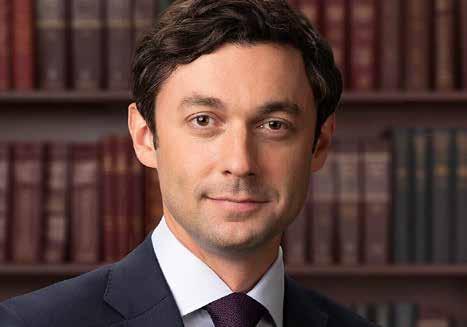
ny; Derek Dooley, a former college football head coach, and Jonathan McColumn, U.S. Army Brigadier General (ret).

soff’s campaign reported having $31.7 million cash on hand, a figure some three times greater than the combined cash on hand reported by the five Republicans on the primary ballot.
Ossoff continues to criticize Trump on a wide range of issues, from Republicans not extending subsidies for Affordable Care Act premiums to the impact of tariffs on the financial health of Georgians to, most recently, the president’s handling of the U.S.-Israeli war against Iran.
Republican Gov. Brian Kemp, who disappointed some in his party by opting not to challenge Ossoff, has endorsed Dooley. Republican President Donald Trump has not made an endorsement in the race.
For now, Ossoff continues to raise money and hone his campaign.
Republicans seem well aware that unseating the 39-year-old Ossoff — the only Democratic senator seeking reelection in a state won by Trump in 2024 — will not be easy. The Washington Post reported that in January, Carter told a Republican gathering in Roberta, Ga.: “Look, this guy’s no slouch. He’s pretty sharp, he’s articulate, he’s young, he’s handsome, he talks well. You better have somebody who can go toe to toe with him.”
The race will be one of the most expensive this mid-term cycle (along with the race to succeed Kemp as governor).
The Senate Leadership Fund, a so-called “Super PAC” (political action committee) announced in April plans to spend $44 million to support the Republican candidate in Georgia, beginning this summer and running through the Nov. 3 general election. That money will show up in various forms of advertising, on broadcast and cable television, on radio, on online platforms, as well as in direct mail and text messages.
Meanwhile, Ossoff’s campaign has reported raising more than $50 million since Jan. 1, 2025. Add in funds from authorized committees and other sources, the campaign collected nearly $57.3 million in that period. As of March 31, Os-
At the same time, Ossoff’s campaign touts his efforts on more localized or statewide issues, measures that often include the Democrat joining with a Republican senator to co-sponsor legislation. He recently was a signatory to a letter urging that funding for the NonProfit Security Program, which has been employed by Jewish institutions to upgrade protection measures, be increased to $750 million, more than doubling the funds currently allocated.
If the steady flow of news releases from the National Republican Senatorial Committee is any indication, Republicans will appeal to Jewish voters — particularly those who previously may have voted for the Democrat six years ago — by attacking Ossoff’s votes in November 2024 and April 2026 in support of several (but not all) resolutions against U.S. sales of certain weapons and equipment to Israel.
In a speech on the Senate floor, delivered after the November 2024 votes, Ossoff said, “I remain steadfastly committed to the U.S.-Israel alliance, and I also believe we must be willing to say no, even to our closest friends, when we believe it is in America’s national interest,” Ossoff said.
Polling conducted in October 2025 for the Atlanta Journal-Constitution suggests a shift in public opinion regarding Israel, particularly among Democrats.
A survey of 1,000 likely Georgia Democratic voters found that 36 percent believed that supporting Israel is in the national interest of the United States, while 44 percent disagreed, and 20 percent did not know. A similar survey of 1,000 likely Republican voters found 85 percent agreeing that supporting Israel was in the U.S. national interest, while 11 percent disagreed, and 4 percent did not know.
The AJC noted that in its 2023 survey, 54 percent of Georgia Democrats thought supporting Israel was in the U.S. national interest, as did about 85 percent of Republicans. ì
By Dave Schechter
May 19 is primary day in Georgia, the first step in whittling the list of wannabes and hopefuls down to those whose names will be on the Nov. 3 general election ballot.
Early voting for the primary is underway, through May 15, but voters should check with their county for specifics, particularly on weekend voting dates.
There are 7,357,604 active voters in Georgia, according to the secretary of state’s office. Early voting began April 27 and by May 11, 6.6 percent of active voters having cast ballots, the vast majority of early in-person and the remainder returned absentee ballots.
The deadline to request an absentee/ mail-in ballot was May 8.
Ballots mailed in must be received by 7 p.m. on May 19.
Polls open on primary day at 7 a.m. and close at 7 p.m., barring special circumstances.
Any runoffs needed after the primaries will be held June 16.
Elections have become a big mon-
ey maker in Georgia. AdImpact, which tracks political advertising spending reported that, by the end of April, $204.6 million already had been spent and reserved in Georgia, the fifth highest state total in the country. The Republican gubernatorial race accounted for most of that — and yet to come will be tens of millions of dollars expended on Georgia’s U.S. Senate race.
Meanwhile, two years ago, the Georgia legislature approved — set to take effect on July 1 — a measure that requires the state to stop using QR codes to count votes, but failed to provide funding or a road map of how the method of counting votes would change.
Now, lawmakers are waiting to see if Republican Gov. Brian Kemp calls them back for a special session to deal with the looming deadline.
Voices on both sides of the aisle suggest that any changes — which would be expensive and, with each passing day, more difficult to implement — wait until after the 2026 elections, implemented perhaps for the 2027 municipal elections, so that any new system can be tested be-

fore the 2028 election cycle.
Likewise, Kemp has said that he will not call the legislature back into special session to take advantage of the recent

By Jordan Ross
On April 7, 1996, Hong Mizelle was involved in a life-threatening car crash in Dunwoody. Mizelle spent the next three months in recovery, treated by many different specialists she credits with saving her life.
“They worked together, performed an eight-hour surgery, and snatched me back from the clutches of death. I lost my right kidney and part of my liver. They gave me the second life,” Mizelle explained.
In the years that followed, Mizelle met her husband and welcomed a son. Describing her thirties as a “second life” after the accident, she pursued a career at the post office in Winston-Salem, N.C. She centered what she calls a “pay it forward” mindset in both her professional and personal life. Mizelle aimed to put more good into the world with her second chance, typically through volunteer work in her local community.
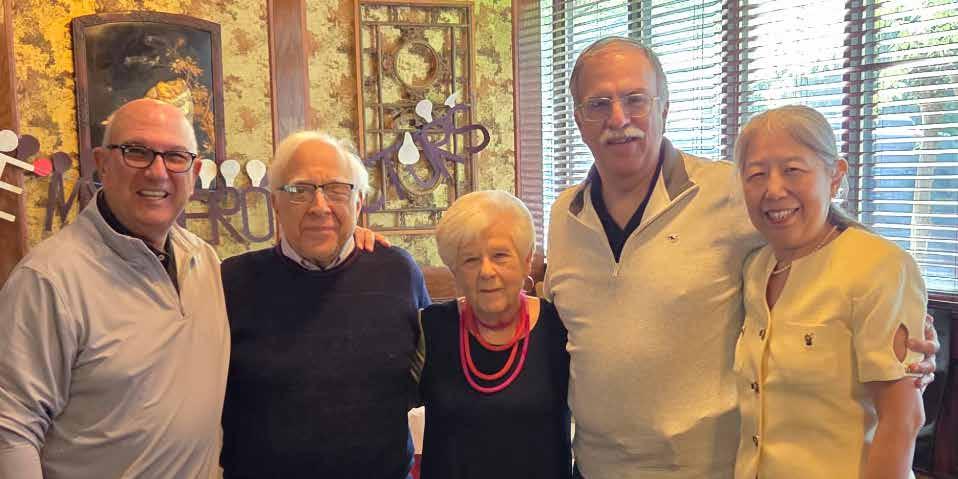
This past April, 30 years after the accident, Mizelle found herself coming back to a persistent desire to express gratitude directly to the doctors who saved her life, “When I retired, I thought, I have to do this. It is my wish - so I think, how can I find them?”


Mizelle began an Internet search to reconnect with the doctors, grateful to her mother, who had taken detailed daily notes while Mizelle was recovering in the hospital.
Numerous phone calls and Facebook messages eventually led her to Dr. Paul Scheinberg. Even after three decades,

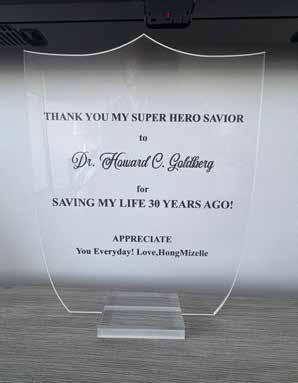
Scheinberg was immediately reminded of Mizelle’s case when she referred to him in a message as “Dr. Deep Breath.”
“As a pulmonologist, I always have to ask people, take a deep breath. And I see lots of international patients, and so, over the years, I’ve learned to say, take a deep breath in probably about 30 languages,” Dr. Scheinberg shared. “When she said, Dr. Deep Breath, I know that she’s the one who I probably asked, ‘How do you say take a deep breath in Mandarin Chinese?’”
Dr. Scheinberg then joined her in searching for and connecting with others on her recovery team.
Mizelle eventually contacted Dr. Howard Goldberg and Dr. Alvaro Lopez and invited them, along with Scheinberg, to a luncheon in Johns Creek. Barbara Abend, wife of Dr. Melvin Abend,

was also in attendance. Dr. Melvin Abend, Mizelle’s surgeon, had unfortunately passed away in 2011, but the group still honored him by visiting his headstone and expressing gratitude to Mrs. Abend.
The group gathered at Masterpiece Chinese Cui sine, and Mizelle decked the space out for the occa sion. She created a posterboard with photos of the doctors, details of her gratitude, and what she had accomplished since they had saved her. Furthermore, she created custom plaques for each doctor, calling them superheroes.


Dr. Scheinberg commented on the recognition, “I was full of gratitude. If anything, people write a note sometimes right afterwards, but never after 30 years.”
Trying to figure out the right words to say to the doctors, Mizelle crafted eight pages of notes. Barbara Abend commented on Mizelle’s efforts, saying, “You’re the only one to do this, you know,” and was grateful for the honor of her husband.
The group dined on shared dishes and caught up on all that had happened over the past 30 years. Mizelle plans to continue her personal mission of honoring others and has already completed several projects for veterans in her community. Her son currently serves in the U.S. Marine Corps, which Mizelle calls the ultimate act of paying it forward.
“I am thankful for my precious life every day. Sometimes it feels unreal. Was that really me going through it and having 30 productive years living in America? But it is real, amazing, and lucky me!” ì





By Gil Zohar
At the ripe young age of 102 1/2, Walter Bingham personifies Jewish heroism and resilience. Recognized by the Guinness Book of World Records as the world’s oldest-working journalist and the world’s most senior radio show host, the Holocaust survivor, World War II hero and Israeli immigrant has a list of accomplishments so long it can’t be adequately detailed in an 800-word article.
He continues to produce the “Walter Bingham Radio Show” broadcast on Arutz Sheva from his home in downtown Jerusalem, attends press conferences, and writes article after illuminating article for The Jerusalem Report.
Interviewed on the occasion of VE-Day (May 8, 1945), Bingham reflects on his neverboring life. Born Wolfgang Billig in Karlsruhe, Germany, on Jan. 5, 1924, the sprightly pensioner recalls his youth growing up in Nazi Germany. Asked if he has any happy childhood memories, a long silence follows. Finally, Bingham spurts out he enjoyed learning to ice skate with his father – who was murdered in the Nazi genocide.
Expelled from public school, Billig and his Jewish classmates took the streetcar to the provisional school set up by the Jewish community. As the tram passed the town market square now renamed for the German dictator, the conductor would announce “Adolf Hitler Platz” – which in Yiddish can be construed to mean “Adolf Hitler
drops dead.” Billig would pronounce sotto voce “Amen.”
Similarly, he remembers a Wehrmacht officer sneezing on the trolley. Instead of wishing him Gesundheit (health), Billig mispronounced the word in the local dialect as Zum Teut (to death) – to which the soldier politely replied, “Danke” (thanks).
Those memories reflect a lifetime of chutzpah and resilience – and trauma.
Billig fled his native land on July 25, 1939, in one of the Kindertransport rescue operations that brought nearly 10,000 Jewish children and teenagers to Britain from Nazi Germany, Austria, the Free City of Danzig, and occupied Czechoslovakia. In Wales, Billig learned English and bided his time until he was old enough to enlist in the British Army and return to Europe. Before being shipped out, an officer ordered him to take the afternoon off and return with an anglicized name. A German moniker, he pointed out, might get him shot if he were to be captured.
Landing in Normandy shortly after D-Day (June 6, 1944), the ambulance driver now renamed Walter Bingham – a name he arbitrarily picked out of a phone book while
quaffing a pint at a pub – made his way to Berlin. After the Battle of Arnheim of “a bridge too far” fame, Bingham was sent for training to become an intelligence officer.
“I get my strength from there,” he says with a smile, pointing at the ceiling of his Jerusalem condominium, crediting G-d for blessing him with good health. He and his daughter, Sonja, also credit Yad Sarah for allowing him to continue to live independently. Though in the last two years, Walter has been using an electric scooter, he is thankful he has never had to use any of the charity’s medical equipment or the emergency call device hanging in his shower.
Sonja, who has two grown sons, Oliver and Alistyre, and spends many hours each week volunteering with Chabad and other worthy causes in Jerusalem, also oversees her father’s busy schedule and helps him with shopping and appointments. She says she is very grateful for Yad Sarah’s Yad Latomech service, which offers counseling and support to family caregivers.
“It’s very helpful to have someone to talk to, to know someone is there,” she says. “Yad Sarah is incredibly important for helping families.”

The family’s connection to Yad Sarah goes back to Walter’s childhood. His mother and grandmother, a leader in the Jewish women’s organization there, were friends with Sarah Lupolianski, the grandmother of Yad Sarah’s founder, Uri (who served as mayor of Jerusalem from 2003 to 2008), and the namesake of the organization. Taking a book from his shelf about his hometown during the Nazi years and the Holocaust, he points to the entry about Sarah Lupolianski: “Deported to Gurs, (in the south of France), in 1940. Disappeared.”
Assumed murdered in the Holocaust, likely at Auschwitz, she is among the millions he thinks about every day, especially now, with Israel at war with Iran, Hezbollah, and Hamas after the massacre of Oct. 7, 2023.
“We are again living like it is 1938,” he says. But in contrast to that period, when it was very difficult to get out of Nazi-occupied areas and when the British limited entrance to Palestine, he says the state of Israel will allow the Jewish people to survive and thrive.
“My message to Am Israel is to consider coming to Israel while you can, with all your possessions, in a planned manner, so that you do not have to run away with just a little suitcase like I did,” he emphasizes.
“At the age of 15, I understood why I was being sent away, unlike a lot of the children around me who were 3 or 4 years old and felt abandoned by their parents,” he says. His father had already been arrested by the Nazis. “But I still started to cry when the train actually pulled away. It was really traumatic for everyone.”
It is also an experience he recently relived. Just a day after the Oct. 7, 2023, killing spree, he and Sonja flew to Berlin along with two others who were saved by the Kindertransport to embark on a long-planned reenactment of the journey for an educational documentary. The film took them from Germany to the Hook of Holland where a ferry crossed the English Channel to Harwich. They finally arrived at London’s Liverpool Street Train Station. A statue there today by Frank Meisler commemorates the arrival of the traumatized children.
“It was extremely important that we undertook this strenuous journey at this time,” he says, describing six days of a packed schedule of flights, trains, and ferries that traced the original route from Germany to London’s Liverpool station, where he had arrived alone in 1939.
After several years living in a countryside estate in Wales with other Zionist youth, Walter joined the British Army, becoming an ambulance driver. He subsequently became an intelligence officer, stationed in post-war Germany, responsible for interrogating high-ranking captured Nazis.
Following demobilization, Bingham became a journalist and advertising executive in London.
Marrying, the couple had Sonja in 1951. He also obtained a pilot’s license and acted in numerous movies and TV shows. He sports a jacket he received on the set when he was a wizard in the original “Harry Potter” film but is prouder of playing Charles Darwin in a BBC production.
Bingham never forgot about his lifetime dream of making Aliyah. He received his Israeli ID card in 2004, at the age of 80, following in the footsteps of his daughter, who had immigrated a few years earlier. In characteristic style, Bingham flew the plane on which he arrived. He has since skydived twice to celebrate his 95th and 100th birthdays, jumping from a plane that took off from the Bar Yehuda Airfield by Masada. “I saw my country from the river to the sea,” he quips. Media savvy, he arranged for German TV to film his most recent jump.
Looking back on his adventurous life, he immediately says his most meaningful memory is reuniting with his mother seven years after she put him on the train to freedom in Britain.
“We each did not know if the other was alive for all those years,” Bingham said. But through a network of relatives, he learned in 1946 that she was alive in Sweden. She had been sent to several Nazi work camps after he left on the Kindertransport, but Swedish officials, allowed to rescue some Scandinavian Jews from the Terezin concentration camp near Prague, for reasons that are still not clear, stopped and picked up his mother and some other Germans along the way, ultimately saving their lives.
This writer would be remiss for not mentioning the walls of photographs, plaques, and letters displayed in Bingham’s office. One notes that France dispatched an aircraft carrier to Haifa Bay in 2017 to bestow upon Bingham the rank of chevalier of the Legion d’Honneur. A letter from Britain’s King George VI attests that Bingham was awarded the Military Medal for Bravery for his selfless work during the Battle of Hill 112 in Normandy from July 10-14, 1944.
“I never killed anybody. But I saved lots of lives,” Bingham says mater-of-factly.
But this writer’s favorite Walter Bingham story involves a less well-known event. One Shabbat dinner at a home in Jerusalem, a drunken man was assaulting a woman in the courtyard. All the guests sat by sheepishly while the noise and screaming mounted. Puffing out his chest and pulling back his jacket to reveal his pistol, Walter brazenly approached the violent man and plainly told him to leave the woman alone and get lost.
His courage made an indelible impression. ì

and stylish living at Heartis
Our commitment to continuous modernization means that we invest in the home you live in, providing unrivaled amenities and fostering a strong sense of community. Heartis Buckhead stands as the premier choice for senior living in Atlanta, offering a lifestyle that blends style, sophistication, and a vibrant community atmosphere.
ONE-BEDROOM APARTMENT HOMES STARTING AT $ 3,995*

A one-of-a-kind property for oneof-a-kind people – with an inspiring and inviting backdrop for vibrant tastes, adventurous spirits and bold personalities – like yours.


No matter the type of living, every apartment comes with the conveniences you need and enough space to add your own style.
A TOUR AND ENJOY
By Marcia Caller Jaffe
Unclogging saltshakers, testing baked goods, and picking up cheese cubes play second fiddle to art created by Yakov Ayzengart, who uses toothpicks “in great numbers” to craft detailed art, objects, and scenes.
A Holocaust survivor approaching his 90th birthday, Ayzengart parlayed his skills as a mechanical engineer to run with the notion of making toothpick bridges, springing from his grandson’s Fernbank Science Center program two decades ago. Since then, his art has evolved into Judaica and other forms of whimsy, one “pick” at a time.
Ayzengart graduated from high school and college in Moldova (in the former USSR) where he was known for his sharp skills in math, science, and geometry. His father served in the Soviet Army and was killed on the battlefield during the first months of war. Ayzengart was raised with his brother by their mother, who was a strong and determined woman.
Despite all the financial challenges

and other backbreaking limitations, education was always a family priority. Ayzengart attended one of the best schools and graduated from college with a degree in mechanical engineering. Before immigrating to the United States, he worked as a mechanical engineer for one of the largest state-run agricultural firms.
From an early age, Ayzengart expressed an interest in woodworking and

became proficient in understanding the function of related tools. His daughter, Marina Zalmanova, recalled, “Even back then, his hobby was working with wood, from carving to wood burning. He didn’t do any other artwork besides that, but he is a good handyman. He has a talent to fix anything. He also actually had an elaborate stamp collection which he brought to the U.S. as a hobby.”
Zalmanova’s son was enrolled in a program at Fernbank, led by an educator who also trained astronauts at Georgia Tech. According to Zalmanova, “They built bridges out of toothpicks and participated in various competitions. My father loved the idea, and after his retirement spent a lot of time designing and building.”
Ayzengart may take months to complete one project, depending on its size and complexity. Patience is another of his virtues. He creates the template, committing all the calculations on paper first and uses Elmer’s wood glue to delicately attach the elements together. All the projects are unique, three-dimensional,

ranging from six inches to a few feet in length. Some are mobile. He specializes in models of different bridges, including one in Atlanta. He also constructs models of shuttles, airplanes, helicopters, tanks, World War II memorials, buildings, dreidels, menorahs, clocks, and vases.
Ayzengart does not yet sell his pieces. He gives them away as gifts to his friends for celebrations and occasions, even his doctors, as an expression of gratitude. Many of his projects are on display at the Medside Adult Care Center, Congregation Ariel, and Jewish Family & Career Services, including the front entrance.
Besides designing and building toothpick projects, Ayzengart writes sketches, scripts, and plays at Medside and participates in the performances. He is not aware of any local artists who are “glued” to this medium but belongs to a Facebook group of like-minded artists.
Ayzengart concluded, “I will continue to build more new and innovative models, depending on my inspiration. This is now my passion.” ì







On Tuesday afternoon, April 14, the residents of Berman Commons gathered in Sugarman Hall for a moving and thoughtfully designed Yom HaShoah Holocaust Remembrance Day program titled “Jewish Life Continues.”
Presented by Oy Vey VR, Inc. and in partnership with Empowerment University for Seniors, the program offered residents — some of whom are living with mild cognitive impairment or memory loss — a gentle and meaningful opportunity to reflect, remember, and reconnect with Jewish history, identity, and resilience.
Rather than focusing only on tragedy, the program was intentionally structured to balance remembrance with dignity, continuity, and hope. Residents participated in a candle-lighting ritual honoring the memory of those who were lost during the Holocaust, followed by a short educational video that helped frame the importance of remembrance across generations. The tone of the gathering remained respectful and supportive throughout, allowing participants to
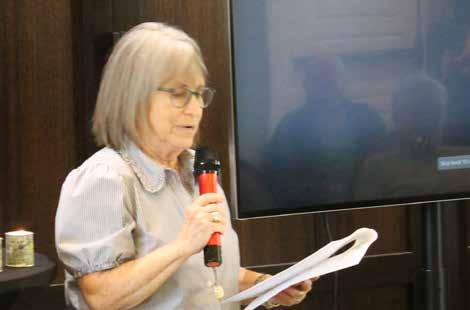
engage comfortably at their own pace.
A central theme of the afternoon was remembering Jewish life before the Holocaust. Through historic photographs and guided discussion, residents were invited to reflect on the traditions and celebra-


tions that shaped Jewish communities across Europe prior to World War II. Participants shared memories of Shabbat dinners, holiday gatherings, and family customs from their own childhoods, creating a powerful sense of connection between personal experience and collective history.
The program then gently transitioned to honoring those who were lost. Facilitators created a quiet space for reflection, emphasizing remembrance without graphic detail — an approach especially appropriate for older adults and residents in memory care. A brief moment of silence allowed participants to acknowledge the lives and communities that were destroyed while reinforcing the importance of continuing to speak their names and preserve their stories.
“It was incredibly meaningful to watch our residents connect with this program in such a personal way. Many of them shared their own memories, traditions, and reflections, which reminded all of us that Holocaust remembrance is not only about the past — it’s about honoring the strength and continuity of Jewish life today. Programs like Jewish Life Continues help our residents feel proud of their identity, connected to their community, and reassured that their stories are an important part of our shared history, said Janece Jenkins, Berman Commons activity director.
For many in attendance, the program sparked memories of hearing about Israel’s founding in 1948 and the sense of hope it represented for Jewish people around the world. Several residents shared reflections about their own visits to Israel or the first time they learned about the new Jewish state, add-
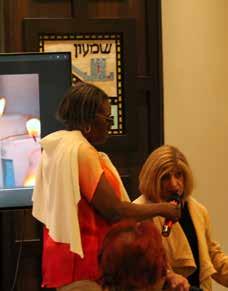
ing a personal dimension to the historical narrative.
The gathering concluded with a celebration of Jewish continuity today. Residents spoke about traditions they have passed down to their children and grandchildren and continue to observe. From lighting Shabbat candles to celebrating Passover and teaching Hebrew words to younger generations, these moments of sharing reinforced the program’s central message: that Jewish life is not only remembered — it is actively lived.
The closing ceromony invited residents to reflect on their role in sustaining Jewish identity across generations. As facilitators reminded participants, “Because of memories, the past is never lost. Because of you, Jewish life continues.” The afternoon ended with residents singing together, creating a shared sense of community and emotional closure that is especially meaningful in memory care settings.
In honoring the past together, residents also affirmed something enduring about the present: Jewish life continues — through memories, through traditions, and through community.
Berman Commons, Jewish HomeLife’s assisted living and memory care community in Dunwoody, is known for its warm, family-like environment and commitment to enriching the lives of its residents. With innovative programs, compassionate caregivers, and a focus on dignity and independence, Berman Commons provides seniors with opportunities to stay engaged, active, and connected. For more information, visit www.jewishhomelife.org/living-options/ berman-commons/. ì
Compiled by AJT Staff




JF&CS Annual Meeting – 8:30 to 10 a.m. Join JF&CS as we recognize our dedicated staff and leadership. Register at https:// tinyurl.com/uffe87hp.

April May 2026 JBaby Intown Small Group - 11:30 a.m. A five-week small group series for local families to bond over music, education, support, and playtime. Designed for babies ages 0–12 months and their parent(s). In this warm, welcoming space, neighborhood families come together for playful learning and meaningful support. You’ll connect with other parents, learn from developmental experts, and share new experiences with your little one — building friendships and a deeper connection to your community along the way. Each session is about 45–60 minutes, with plenty of time to socialize after. Register at https://tinyurl. com/ycy8c7nb.

Tot Shabbat - 6 to 8 p.m. Tot Shabbat from Congregation Dor Tamid is a Shabbat program geared for children (second grade and younger) to laugh, meet new children, make new friends, and explore the wonders of Judaism in an exciting fun way! The service is filled with songs, prayers, blessings, stories, snacks, and a place where a kid can be a kid when they pray to G-d. This service meets on selected Friday nights throughout the year at 6 p.m. Each service is followed by a pot-luck Shabbat dinner. Parents are encouraged to model the behavior they would like to see in their own children. So, remember: Come to Tot Shabbat ready to dance, sing, pray, and have fun. Tot Shabbat is geared toward children 4 and under. Learn more at https://tinyurl.com/w94ra3de.

Date Night on the River - 6 to 9 p.m. Grab your date and come relax on this adultonly evening paddle! Pack a picnic dinner and arrive early at 5:30 p.m. to enjoy it on our grounds. At 6 p.m., guides will lead you on a 2.5-hour trip. All equipment is provided. Ages 21+. Sign up at https://tinyurl.com/7rbkeweh.

Saturday, May 16
Tot Shabbat – 12 to 12:30 p.m. Celebrate Shabbat with Chabad Intown in a fun, relaxed, and welcoming environmentsing, snack, and share joyful moments with your family and the community. Find out more at https://tinyurl.com/axmyewyf.

Sunday, May 17
Shavuot in the Park – 9:30 to 11 a.m. Join PJ Library and the Jewish Federation of Greater Atlanta for a sweet and simple morning filled with ice cream, cheesecake, coffee, and sunshine as we gather for story time and relaxed play. We’ll enjoy delicious dairy treats in honor of Shavuot, connect with friends, and let the kiddos run and play at the park. This super low-key get-together is the perfect way to celebrate Shavuot and kick off summer together. We can’t wait to see your family there! Sign up at https://tinyurl.com/3nak8dck.
Sunday Funday with the Alefbet
Preschool – 10 to 11:30 a.m. Join us for a morning filled with music, joy, and family fun! Local children’s song leader Hannah Zale will kick off the day with an engaging concert that brings joyful Judaism to life through music, guaranteed to get everyone singing and dancing. After the concert, stick around for exciting activities that the whole family will enjoy! Don’t miss this chance to make memories with your family and celebrate together – register now at https://tinyurl. com/4wb5ha8c to secure your spot.

Swing, Slide, and Swap – 10 a.m. to 12 p.m. Join PJ Library and the Jewish Federation of Greater Atlanta for a relaxed and playful park get together. Children will enjoy playing at the park while families connect and take part in a PJ Library book swap. Bring a few PJ Library books your family has outgrown and browse for new stories to take home. Join us for fresh air, fun, and a chance to share the joy of books together! Register at https://tinyurl. com/4n8cks3u.

Shavuot Celebration & End-Of-TheYear Party - 11 a.m. to 12:30 p.m. Join Congregation Or Ve Shalom for a Shavuot Celebration and End-of-Year Party for families, adults, and the entire community. Adults will build their own bouquet and charcuterie board to take home. Kids will enjoy arts & crafts and a foam party. Enjoy Bruster’s ice cream and mini cheesecakes. While supplies last. RSVP required at https://tinyurl.com/4cmuzm8f.
May 2026 JBaby Brookhaven Neighborhood Small Group - 3:30 p.m. A five-week small group series for local families to bond over music, education, support, and playtime. Designed for babies ages 0–12 months and their parent(s). In this warm, welcoming space, neighborhood families come together for playful learning and meaningful support. You’ll connect with other parents, learn from developmental experts, and share new experiences with your little one — building friendships and a deeper connection to your community along the way. Each session is about 45–60 minutes, with plenty of time to socialize after. Register at https://tinyurl.com/3mzjhu8h.
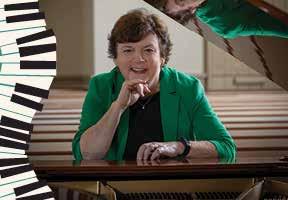
Judy Cole in Concert – 4 to 6 p.m. Join pianist Judy Cole for an inspiring afternoon of beloved piano classics. This solo recital will feature music by Gershwin, Beethoven, Sondheim, Debussy, and more — an elegant journey through some of the most cherished works in the piano repertoire. Proceeds will support The Temple’s Music & Cultural Arts Program. Purchase tickets at https://tinyurl. com/mr3byvwx.

Interfaith Pop-Up: Trivia Night – 7 to 9 p.m. Join JGather for our next monthly Interfaith Pop-Up — Trivia Night! It will be a fun and relaxed evening to connect, test your knowledge, and enjoy great company. Whether you come with your partner or on your own, this is a welcoming chance to meet others and build community. The Federation will cover the first round of drinks and appetizers, so just bring your curiosity and your trivia game. We encourage you to register in advance so we can reserve enough seats for everyone at https://tinyurl.com/e4f37wuu.

Tuesday, May 19
Social Club Flower Arranging Event – 10:30 a.m. Come play a game of Mah Jongg or Rummikub with Chabad of North Fulton and then make a flower arrangement for Shavuot! RSVP at https:// tinyurl.com/3x425uu3.
Torah Reading: Bamidbar
Friday, May 15 Light Shabbat Candles: 8:14 PM
Saturday, May 16 Shabbat Ends: 9:14 PM Shavuot
Thursday, May 21 Light Holiday Candles: 8:18 PM
Friday, May 22 Light Shabbat Holiday Candles from a preexisting flame: 8: 19 P.M.
Saturday, May 23 Shabbat / Holiday Ends: 9:20 PM
Torah Reading: Naso
Friday, May 29 Light Shabbat Candles: 8:24 PM
Saturday, May 30 Shabbat Ends: 9:25 PM

Standing with Israel – 7 to 8:30 p.m. Come hear from Honorable Judge Roy Altman, a federal judge and author of “Israel on Trial.” Altman is one of the country’s most compelling voices for Israel today and was named as one of The Jerusalem Post’s “Top 25 Young Visionaries of 2025.” Judge Altman travels to Israel each year with non-Jewish federal judges, strengthening the relationship between Jews and non-Jews. Hear his story and learn how both Judge Altman and Jewish National Fund-USA are empowering supporters like you to shape Zionist engagement. Reserve your space at https:// tinyurl.com/jstsh3e9.

Hadar Atlanta: Between Eggshells and Authenticity – 7:30 to 9 p.m. While you can repay a debt, you can’t “un-say” a slight. In Jewish ethics, Ona’at Devarim (verbal mistreatment) is legally more severe than financial fraud. Why? Because while a bank account can be audited, a spirit cannot. But if we are constantly calculating the weight of every syllable, do we risk losing our voice entirely? In this OTP session, we’ll dive into the Gemara’s visceral warnings against humiliation while addressing the modern paralysis of “walking on eggshells.” Sign up at https:// tinyurl.com/jfan6snn.

Thursday, May 21
LimmudFest Shavuot - Celebrate Jewish life, arts, culture, and learning over Shavuot with Ramah Darom and Limmud North America. Register at https:// tinyurl.com/3yw8nraw.
Shavuot Program – 6:15 to 9 p.m. Join the North Atlanta Reform Community at Temple Beth Tikvah for our Liel Shavuot service and study sessions. You will have the chance to pray with and learn from rabbis and clergy of Temple Emanuel-El, Temple Kehillat Chaim, Congregation Dor Tamid, and Temple Beth Tikvah. Learn more at https://tinyurl.com/3hyef26s.

Shavuot Dinner – 8 to 11:55 p.m. Join Chabad Intown and Intown Jewish Academy for a delicious and lively Shavuot dinner, creamy cheesecake, and powerful Torah inspiration! Find out more at https://tinyurl.com/2b9uee4e.
Friday, May 22
LimmudFest Shavuot - Celebrate Jewish life, arts, culture, and learning over Shavuot with Ramah Darom and Limmud North America. Register at https:// tinyurl.com/3yw8nraw.

Shavout Pizza Party – 5 to 6 p.m. Come join Mitzvah House to celebrate Rabbi Zalmy’s birthday, have pizza, and hear the 10 Commandments! RSVP at https:// tinyurl.com/yda2u355.

Shavuot Ice Cream Party – 5 p.m. Celebrate Shavuot with Chabad of North Fulton. Learn more at https://tinyurl. com/5ds4vunz.

Community Shavuot Celebration
– 5:30 to 7 p.m. Celebrate Shavuot at Chabad Intown! This Shavuot, we invite you and your family to gather with us on the Beltline for a meaningful and festive Shavuot experience. Join us in honoring the timeless moment when our ancestors received the Torah over 3,300 years ago — the greatest gift of all and a gift that continues to shape our lives today. Learn more at https://tinyurl.com/44jeajfh.
Date Night on the River - 6 to 9 p.m. Grab your date and come relax on this adultonly evening paddle! Pack a picnic dinner and arrive early at 5:30 p.m. to enjoy it on our grounds. At 6 p.m., guides will lead you on a 2.5-hour trip. All equipment is provided. Ages 21+. Sign up at https://tinyurl.com/7rbkeweh.
LimmudFest Shavuot - Celebrate Jewish life, arts, culture, and learning over Shavuot with Ramah Darom and Limmud North America. Register at https:// tinyurl.com/3yw8nraw.
LimmudFest Shavuot - Celebrate Jewish life, arts, culture, and learning over Shavuot with Ramah Darom and Limmud North America. Register at https:// tinyurl.com/3yw8nraw.

Shavuot Sundaes – 10 to 11:30 a.m. Bring the whole family for PJ Library Shavuot Sundaes on the playground. We’ll gather for a morning of play, learning, and (of course!) delicious ice cream. Kids can run, climb, and slide on the playground, cool off at the splash pad, enjoy arts & crafts, and cozy up with PJ Library books. And be sure to stop by for a refreshing ice cream treat! Come celebrate this joyful holiday outdoors with friends, sunshine, and sweet moments together. RSVP at https://tinyurl.com/akyds8rf.
Monday, May 25
LimmudFest Shavuot - Celebrate Jewish life, arts, culture, and learning over Shavuot with Ramah Darom and Limmud North America. Register at https:// tinyurl.com/3yw8nraw.
Thursday, May 28
The Story of American Jews: Past, Present, Future with Avi Posen – 7:30 to 9 p.m. Join us at The Dupree for an evening with Avi Posen, vice president of ConnectED. A creative and forward-thinking educator, Avi brings extensive experience as a former classroom teacher, campus educator, and camp director. He has trained educators and spoken to audiences worldwide on Jewish history, Israel, and antisemitism. Avi will lead us on a historical and interactive journey of accomplishments and influences Jewish Americans have made and address the challenges that lie ahead. Register at https://tinyurl.com/5aa8dca8.
Friday, May 29
Camp Judaea 65th Weekend - Join us for an unforgettable weekend celebrating 65 years of Camp Judaea. This adultsonly celebration brings together alumni, former staff, parents, and friends for a meaningful reunion filled with joy and laughter in the heart of the Blue Ridge Mountains. Sign up at https://tinyurl. com/3fpcu7ed.
Date Night on the River - 6 to 9 p.m. Grab your date and come relax on this adultonly evening paddle! Pack a picnic dinner and arrive early at 5:30 p.m. to enjoy it on our grounds. At 6 p.m., guides will lead you on a 2.5-hour trip. All equipment is provided. Ages 21+. Sign up at https://tinyurl.com/7rbkeweh.
Saturday, May 30
Camp Judaea 65th Weekend - Join us for an unforgettable weekend celebrating 65 years of Camp Judaea. This adultsonly celebration brings together alumni, former staff, parents, and friends for a meaningful reunion filled with joy and laughter in the heart of the Blue Ridge Mountains. Sign up at https://tinyurl. com/3fpcu7ed.
Sunday, May 31
Camp Judaea 65th Weekend - Join us for an unforgettable weekend celebrating 65 years of Camp Judaea. This adultsonly celebration brings together alumni, former staff, parents, and friends for a meaningful reunion filled with joy and laughter in the heart of the Blue Ridge Mountains. Sign up at https://tinyurl. com/3fpcu7ed.

May 2026 JBaby Brookhaven Neighborhood Small Group - 3:30 p.m. A five-week small group series for local families to bond over music, education, support, and playtime. Designed for babies ages 0–12 months and their parent(s). In this warm, welcoming space, neighborhood families come together for playful learning and meaningful support. You’ll connect with other parents, learn from developmental experts, and share new experiences with your little one — building friendships and a deeper connection to your community along the way. Each session is about 45–60 minutes, with plenty of time to socialize after. Register at https://tinyurl.com/mu7yw69u.

Gotta Sing Events: Broadway – 6:30 to 8 p.m. The Anti-Karaoke? Ditch the cringey backing tracks and solo spotlights. We’re cranking original Broadway cast recordings and turning the entire room into one massive, thundering chorus. With every lyric projected as your safety net, you’ve got the ultimate confidence to belt every word alongside everyone else. No solos, no “canned” knockoffs — just a room full of people becoming the lead role together. Bring your voice, leave your inhibitions. Broadway is calling. RSVP at https://tinyurl.com/3ynsrtuf.



Ingredients
For the Chocolate Chip Cookie Dough
1 stick butter, softened
1/2 cup Haddar Brown Sugar, packed additional 1/2 cup granulated sugar
1 large egg
1 teaspoon Gefen Vanilla Extract
1 and 1/2 cups all-purpose flour, such as Glicks
1/2 teaspoon baking soda
1/2 teaspoon salt
1 cup Glicks Chocolate Chips
For the Cheesecake Layer
8 ounces brick cream cheese, softened
1/4 cup granulated sugar
1/2 a beaten egg
1/2 teaspoon Gefen Vanilla Extract
Directions
1. Preheat your oven to 350 degrees Fahrenheit (or 375 if you like a crispier cookie). Line a baking sheet with Gefen Parchment Paper.
2. Whisk the butter and sugars.

3. Add the eggs and vanilla and whisk again, until fully incorporated.
4. Use a fork to mix in the flour, baking soda, and salt. Feel free to use your hands at the end to get all the flour incorporated.
5. Fold in the chocolate chips.
6. Shape the dough into six extra large disks on the baking tray. Do not flatten.
7. In the same bowl you used for the cookie dough, whisk the softened cream cheese until smooth. Add the granulated sugar, 1/2 the egg, and vanilla extract. Mix until well combined.
8. Take a tablespoon of the cheesecake batter and place it on top of a cookie dough disk. Continue with all cookie disks.
9. Bake the cookies in the preheated oven for about 20 to 22 minutes or until the edges are golden brown (or 18 to 20 minutes if you’re doing it at 375 degrees Fahrenheit). Remove the cookies from the oven and allow them to cool on the baking sheet for a few minutes before transferring them to a wire rack to cool.
by Chanie Nayman


Rabbi Moskowitz was cleaning up the house when he came across a box he didn’t recognize.
His wife told him to leave it alone as it was personal. One day, when she was out, the rabbi’s curiosity got the best of him. He opened the box and inside found three eggs and $2,000.
When his wife came home, he admitted he had opened the box and he asked her to explain the contents to him.
She told him that every time he gave a bad sermon, she put an egg in the box …
He interrupted, “In 20 years, only three bad sermons? That’s not bad.”
His wife continued, “… and every time I got to a dozen eggs, I would sell them.”
n. The status achieved by a dull person whose YouTube video, tweet, or Instagram post goes viral.
“Marcus has been strutting around like a movie star ever since his yodeled version of ‘Mr. Blindside’ went viral. That’s shmodom for ya.”
Derived from the Yiddish “shmo,” meaning, “a dull and stupid person.”

By: Yoni Glatt, koshercrosswords@gmail.com
Difficulty Level: Challenging
ACROSS
1. Fire escape component
5. Lunch with Skippy, briefly
8. Notable masked Jew
13. She sometimes sings in Gaelic 14. Pooh pal
15. Yearns
16. OneRepublic hit about those successfully finishing sefira, with 18-Across?
18. See 16-Across
19. Alley-oop toss, e.g.
21. Mrs., in Montreal
22. Classic Neil Young album for Shavuot?
25. She had a Rocky relationship?
28. Kind of scan, for short
29. What one does on Shavuot, according to Alanis Morissette?
31. Toast option
34. Coat with gold
35. Lionel Richie hit about Shavuot?
40. Where, to Nadav?
41. Be scornful
43. Santana’s Shavuot album with the apt track “Revelations”?
47. It sucks
48. Jetta relative
49. What to buy for Shavuot, per a

This week, 100 years ago - 1926
Miley Cyrus smash hit?
52. “___ Gratia Artis” (MGM motto)
53. Socially exclusive
55. Appropriate rock band for Shavuot
58. Appropriate rock band for Shavuot
62. Archipelago near Fiji
63. Potato relative
64. Jewish leader, once
65. Like many kids’ cereals
66. Rel. of Rep.
67. Dragon or decision
1. Boombox button abbr.
2. Family card game
3. Sch. with 217 faculty members that condemned Israel in October of 2023
4. Thief, in Acre
5. Overly proper
6. Tuna’s smaller relative
7. Aids, as a memory
8. Univ. offerings
9. 10, for short
10. Begin successor
11. One of the Munsters
12. Dusseldorf’s (hungry) neighbor
17. Fly, 50% off?
20. Tefilla item

Oscar Straus, diplomat and philanthropist raised in Georgia, and first Jewish United States Cabinet Secretary, dies at 76 years old.
The bar mitzvah ceremony of Nathan Ratner, conducted by Rabbi Joseph Hoffman, makes history as the first heard over radio, on WRNY.
This week, 75 years ago - 1951
Synagogues become food centers in flood-stricken Sioux City.
Paul Ginsberg, national commander of the Jewish War Veterans of the U.S., honored at a dinner at the Progressive Club.
The Jewish Braille Institute of America publishes the first Hebrew Braille textbook for blind English speakers.
Al Woods, Jewish showman and producer of over 400 plays, dies at the age of 81.
A brand-new Hillel building dedicated at the University of North Carolina.
Israel observes third birthday.
This week, 50 years ago - 1976
Mr. and Mrs. Cary Merlin of Atlanta announce the birth of a daughter, Hilary Merlin.
Dr. Howard M. Sigal and Mr. and Mrs. Arnoldo Fiedotin announce the b’not mitzvot ceremony of their daughters, Amy Sigal and Diana Fiedotin, at Ahavath Achim Synagogue.
Mayor Maynard Jackson proclaims May 23 as “Dr. William E Schatten Day” in honor of the Jewish humanitarian and sponsor of Emory University.
Emory’s Tau Epsilon Phi Fraternity chapter sponsors a 21-hour Dance-A-Thon to benefit the American Cancer Society
This week, 25 years ago - 2001
Sada and Emily Jacobson win gold at the world fencing
22. “I wonder...”
23. Locale
24. Creek
26. Some laptops
27. A noble gas
30. “Blech!”
32. Say Kiddush, e.g.
33. “West Side Story” character
36. “___ all right with you...”
37. Net alternative
38. Campbell or Yerushalayim
39. Shift selection
42. Some sodas
43. “Hannah and Her Sisters” star
44. Ancient Jewish monk
45. ___ to be reckoned...
46. Clothing company whose first product was a waterproof boot
48. Deals
50. Award bestowed by The King, for short
51. Steve and Elaine of casino fame
54. Many charity gps.
56. What you continuously do
57. Place-setting pad
59. Beta Israel tribe, per lore
60. Crossword’s favorite Jewish king
61. Martian sound, on “Sesame Street”
championships as part of the U.S. Junior Women’s Sabre Team.
An AJT writer interviews legendary film composer Elmer Bernstein.
Kosher Day raises $4,000 for the Atlanta-area Jewish day schools and high schools.
The bar mitzvah ceremony of Aaron Kuniansky-Altman, son of Robert Altman and Judy Kuniansky, is held at The Temple.
The bat mitzvah ceremony of Nora Arkin, daughter of Rob and Rise Arkin, at Ahavath Achim Synagogue, is announced.
Issues of the AJT (then Southern Israelite) from 1929-1986 can be found for free online at gahistoricnewspapers. galileo.usg.edu/lccn/sn78003973/
Jeannine (Israel) Altmann died peacefully at home on April 27, 2026.
Jeannine was born Aug 10, 1944, in the Belgian Congo in Africa. She is predeceased by her parents, Albert and Sara Israel, who hailed from the Isle of Rhodes before later moving to the Belgian Congo.
Jeannine came to America when she was 15 to live in Montgomery, Ala., with her Aunt Becky and Uncle Saul Alhadeff and her two cousins, Esther and Jeanette Alhadeff. Jeannine, Esther, and Jeannette all became like sisters.
She graduated from Sydney Lanier High School in Montgomery as an honor student and after high school, she attended the University of Alabama where she was a member of Delta Phi Epsilon sorority. It was in college where she met the love of her life, Aaron Altmann, who came to the University of Alabama all the way from Kfar Shmaryahu, Israel, on an academic scholarship. Aaron and Jeannine were married on Aug 22, 1966, and just recently celebrated their 60th wedding anniversary.
After graduating from college, Aaron and Jeannine moved to Atlanta. After a few years, Aaron started his own office furniture and supply company and despite Jeannine being an English major, Aaron convinced her to be his bookkeeper. The two of them would go on to work together in two different businesses spanning more than 50 years.
The main focus of her life was her family. Her children, Steve (Melissa), Karl (Julie), and Sandi (Cary) and her beloved grandchildren, Sara, Brandon, Andrew, Jason, Mallie, Ryan, Ari, and Josie. She loved attending all their sporting events, music concerts, and recitals and whatever other activities they were involved in. She doted on them and nothing made her happier than spending time with them. She also loved watching sports, especially her beloved Braves, which she watched every night, even if they were playing on the west coast. And while she of course Rolled with the Tide, she even rooted for the Dawgs and Gators to support her kids and grandkids.
She was known around town as the Mahjong Queen, playing in multiple games, including with a group of women she played with for over 50 years after meeting them in the Toco Hills area where they first lived after moving to Atlanta. She also famously kept Hallmark in business, never failing to send her friends and family cards on every birthday, anniversary and graduation.
In lieu of flowers, contributions can be made to Congregation Or VeShalom www. ovs.shulcloud.com/payment.php
May her memory be a blessing to all who knew her.
48 Hour Turnaround after receiving your 50 - 75 Pictures (Digital or Prints) Montage delivered to you on DVD, Thumb Drive or Dropbox Upload Mitzvahs, Weddings or Funerals
Once you scan the QR Code below, it will start playing on your phone. Turn your phone sideways and enjoy. I’m Happy to Help if needed 470-962-0455 Barry

Rosalyn Vita Ghitter was born in Augusta, Ga., to Mollie (Wilensky) and Leon Ghitter. After attending Richmond Academy in Augusta and Northwestern University (1958), she worked as a speech therapist in Atlanta and Washington, D.C. She later moved to the Baltimore area, where she served as the director of the Speech and Language Clinic at Towson University (now part of the University of Maryland) and earned her PhD in hearing and speech sciences from the University of Maryland. To this day, colleagues and former students alike speak of her kindness, generosity, and exceptional intellect, as well as her gift as both a teacher and mentor. In 2019, she moved to Atlanta to be closer to family.
Rosalyn adored her husband, Arnold Rudo, who predeceased her in 2009; they enjoyed a marriage rich with friends and laughter. Rosalyn was a devoted sister and friend, known for her incredible warmth and the ability to light up a room. She loved to travel and especially reveled in her role as an aunt and great aunt, and was absolutely treasured by her nephews, nieces, grandniece, and grandnephews.
She is survived by her sister and brother-in-law, Leah and Herbert Zarge, her nephews and nieces, Ellen and Joseph Zarge, Faun and Jonathan Zarge, and her grandniece and grandnephews, David, Jason, Livia, Jeremy, and Ilan Zarge. She was predeceased by her brother, Irvin Ghitter.
Rosalyn truly lived the quote she chose for her high school yearbook: “Knowledge comes, but wisdom lingers.”
In lieu of flowers, contributions can be directed to the Speech and Language Center at Towson University or the Alzheimer’s Association.

Cynthia Ann Pousman passed away on Wednesday, May 6, 2026, peacefully in her beautiful home in Decatur, Ga. She was an incredible person, wife, mother, grandmother, teacher, and community member.
Cynthia had an unquenchable thirst for knowledge as evidenced over her lifetime: a graduate student at the University of Georgia, a biologist at Emory University, a National Board certified biology teacher, and in her retired years, a Georgia State University student studying science, literature, and cinema, as well as her continued pursuit of Jewish teachings and the Hebrew language. And her devotion to educating others was unparalleled. She had an infectious enthusiasm which made learning from her a joy for so many.

As a wife, Cynthia was a true partner to her husband, Mike Pousman, living together around the world, from Kibbutz Keturah in Israel to Camp Judaea, and even a regenerative farm in Hawaii. She was Mike’s biggest advocate, most enjoyable travel partner, and best friend. As a mother, she was gentle-natured while remaining active and involved in her children’s development, always guiding with a calm voice and showing the path with a nudge rather than a push. As a community member, she was reliably on call and ready to step in, making minyan during the week at Adas Yeshurin Synagogue, cleaning up after a latke party at the JCC, or sitting shiva with grieving families.
Cynthia is survived by her sons, Zachary Pousman, and his wife Erin, and Barry Pousman, and his wife, Kimberly; her sister-in-law, Barbara Alcorn; her nephew, Jefferey Sapperstein; and her two favorite people in the world, her grandchildren, Penny Rose and Teddy Orion Pousman.
May her memory be a blessing.
Arrangements by Dressler’s Jewish Funeral Care, 770-451-4999.




Judith “Judy” Kanarish Rubenstein, 87, of Atlanta, Ga., passed away peacefully on Tuesday, May 5. Judy was born on Jan. 13, 1939, in Chicago, Ill., to Isaac and Irene (Funk) Kanarish, the second of four children. Growing up in Chicago in the post-war years, she enjoyed an idyllic childhood, attending Von Steuben High School on the north side of the city.
Judy studied at the University of Illinois before getting a teaching degree at the National College of Education in Evanston, Ill. It was during her time at U of I that she was introduced to her future husband, Arnie Rubenstein, then an undergrad at the University of Michigan. Arnie wrote Judy dozens of letters from Ann Arbor to Urbana-Champaign, and from this initial courtship, a romance blossomed. While Arnie attended medical school in Chicago, Judy taught elementary school in the Chicago Public Schools. They were married in 1961 at the Chicago Sheraton hotel on Michigan Avenue.
Following Arnie’s medical residency, the couple relocated to Atlanta, where they spent the next six decades together, raising three children in the northwest suburbs of the city. In the early years, as the wife of a physician working long hours, Judy busied herself as the cook, dinner party host, carpool driver, sports cheerleader, and general contractor for the family home. As the children grew older and more independent, she devoted time to the community, playing active roles in various causes, including the Jewish Federation of Greater Atlanta, American Jewish Committee, and the William Bremen Jewish Home, where she served as president of the Women’s Auxiliary. Never afraid to make her views known, Judy used pen and paper to petition local leaders about issues of concern, and more than one broken traffic sign and streetlight owed its repair to her tireless advocacy.
Along the way Judy enjoyed tennis, golf (twice hitting a hole-in-one!) and distance running, completing both the Honolulu Marathon and the Callaway Gardens Marathon. Always proud of her adopted Atlanta home, Judy served as a tour guide during the 1996 Summer Olympics.
In later years, Judy cherished her title as “Gigi” to her six grandchildren. Nothing gave her more pleasure than cheering from the stands at one of their sports competitions or patiently reading a storybook at bedtime. Her words and actions set an example that instilled in all of her kids and grandkids a steadfast devotion to family. When not fussing over a family gathering or grandchild’s performance, Judy enjoyed a wide circle of friends in Atlanta and filled her hours with daily exercise, travel, book and stock clubs, contemporary art exhibits, bridge, mahjong, canasta, and community events.
Judy is survived by her loving husband, Arnie Rubenstein; her children, David (Kathy) Rubenstein of Atlanta, Michael (Nirit) Rubenstein of Phoenix, and Beth (Benjamin) Nowak of Atlanta; her grandchildren, Sam (Sophi) Rubenstein of New York City, Jack Rubenstein of New York City, Danny Rubenstein, Ben Rubenstein, and Mika Rubenstein of Phoenix, and Maggie Nowak of Atlanta; and her brothers, Peppie Kanarish of Scottsdale, and Mickie Kanarish of Denver. She was preceded in death by her sister, Sondra Rosner of Boca Raton.
A memorial service honoring Judy’s life service was held at 4:30 p.m., Thursday, May 7, at Temple Sinai - 5645 Dupree Dr NW, Sandy Springs, GA. It was followed by a shiva and reception in Temple Sinai’s social hall.
For those who would like to follow the service on Zoom, please visit Dressler’s Jewish Funeral Care at https://www.jewishfuneralcare.com/. The link will be posted on the day of the service.
In lieu of flowers, the family would welcome gifts in Judy’s memory to The Birthright Israel Foundation. Dressler’s Jewish Funeral Care, 770-451-4999.
Allen H. Lipis
You need projects to keep you alive, and that’s no exaggeration. So, what’s a project?
A project is anything that needs to be done by your involvement, by your doing. A project puts you in action to accomplish. It can be a short-term project like taking the garbage out, or a long-term project like writing a book, or something in between, like taking a trip. Projects keep your mind going and get you thinking about your future. It focuses on helping others. A project is what makes the world go round.
If you focus on short-term projects, then you will need lots of them, for they get done quickly, and then you will have to find more of them. You can have a dozen or more short-term projects in a day, and that’s OK. To do them, it is best to put them on a list of no more than 10 items
and cross them off as they are completed. That allows you to add another project, but no more than 10 active projects at a time. You rarely can finish 10 projects in a day.
Daydreaming about doing a project is not a project. If you want to lose weight and do nothing about it, that’s not a project. If you want to be more physically fit by running, walking, swimming or biking, and you do nothing about it except think about it, that’s not a project – that’s a fantasy! If you just wish you could, or if you talk about doing something in the future, or if you wish you could do what you used to do, then it’s just a dream, it’s just talk and talk is cheap.
Long-term projects should require multiple completion points for success. For weight loss, pick several weight levels to reach and celebrate each of them when you achieve them. You can call each weight level a project completed and then move on. Breaking a project up into intermediate levels is always a good idea, for it means multiple celebrations, and reduces the time to achieve success. If you do not get to finish a long-term


project, you can often be satisfied for having completed part of it since longterm projects are often difficult to finish. There are projects for yourself, but the most satisfying projects are those done for others. Helping another person is always satisfying, especially when that person needs your help. Doing a project for the community is important and, in general, the more people affected by your involvement in a project, the more satisfying it can be. Projects for the Jewish community, like serving on a board, or providing help for a group, are projects that reward you and the group you are working for. If you are depressed, go help someone and it will lessen your negative feelings.
If you’re retired, then projects will keep you useful and alive for yourself and for others. Doing work for charities is extremely valuable if you have the time or the money, but even if you see that others do what you have in mind and you are part of the process in some way, then it’s an important project for you. Some projects fail, but I have learned more from failures than from success.
Failures train the mind and the body to avoid failing in the future, and that’s important because it helps make success happen in the future.
Some projects create much worry. Too much worry about a project is not a good project. You have to know your worry level, and if your worry level is too high, then either avoid the project, or find others to help you with it. Some worry is good, but you have to know your limit. With too much worry, projects tend to fail.
Too many projects is not a good thing. Many projects produce worry and worry leads to failure, and failure leads to self-criticism. You may think you are just not good enough. Projects should be satisfying with a good chance of finishing them. You don’t want to take on a project that you know you cannot do, or if there is no plan in advance on how to succeed.
For any project, you want to feel good about doing it. Any project, however big or small, should make you feel that you are helping to make the world a little better because you were here. ì