

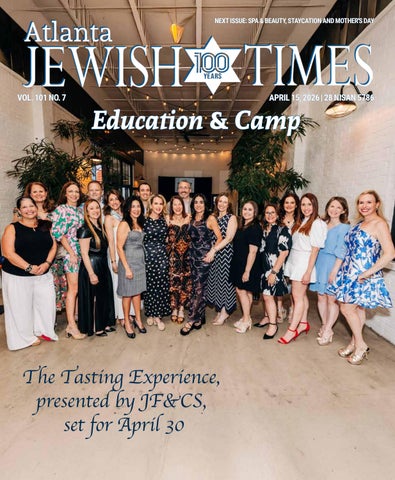
The Tasting Experience, presented by
set for April 30






PUBLISHER
MICHAEL A. MORRIS michael@atljewishtimes.com
EDITOR-IN-CHIEF
SASHA HELLER sasha@atljewishtimes.com
EDITORIAL
Staff Writer & Proofreader
FRAN PUTNEY fran@atljewishtimes.com
Staff Writer and Online Content Coordinator
ROBERT GARBER robbie@atljewishtimes.com
CONTRIBUTORS THIS ISSUE
ALLA UMANSKIY
BOB BAHR
CHANA SHAPIRO
DAVE SCHECHTER
DAVID OSTROWSKY
GIL ZOHAR
JAN JABEN-EILON
MARCIA CALLER JAFFE
REG REGENSTEIN
ROBYN SPIZMAN GERSON
ADVERTISING
Senior Account Manager & Team Supervisor
MICHAL BONELL michal@atljewishtimes.com
Account Manager
ILYSSA KLEIN ilyssa@atljewishtimes.com
CREATIVE DIRECTOR LILLI JENNISON lilli@atljewishtimes.com
COMMUNITY ENGAGEMENT
Events Director
JACQUELINE MORRIS jacqueline@atlantajewishlifefoundation.com
Atlanta Jewish Connector Coordinator DIANA COLE diana@atljewishtimes.com
GENERAL OFFICE
Execuitive Assistant
RONIT FRANCO-PINSKY ronit@atljewishtimes.com
Administrative Assistant ROBIN FREEDMAN Robin@atljewishtimes.com 404-883-2130
Distribution Manager LOU LADINSKY lou@atljewishtimes.com





In the March 31, 2026, edition, on page 14, Atlanta Jewish Times published a Happy Passover advertisement that featured imagery that is inappropriate for the holiday. In a political ad, which was intended to wish our community a Happy Passover while supporting the only Jewish newspaper in Atlanta, an image of challah was featured and went unnoticed. The client was refunded for this ad. To prevent errors like this in the future, Atlanta Jewish Times has enhanced its ad proofing process to include critically checking each ad when proofing each edition. Atlanta Jewish Times thanks the advertiser for their support and regrets the error and any fallout it may have caused.

By Jan Jaben-Eilon
While Atlanta Jews have been wearingly watching the war launched Feb. 28 against Iran by the United States and Israel, members of the local Israeli community have struggled with the difficulty of leading a double life: being Israeli and American living in Atlanta.
“It’s a challenge to carry both” identities, said Netta Cohen, an Atlanta social worker and therapist who has several Israeli clients who have been using her services since Oct. 7, 2023, when the Hamasled surprise attack on Israel resulted in about 1,250 mostly civilians killed and another 250 kidnapped to Gaza.
“We have been in war for two-andone-half years,” said Cohen, trained in both Israel and the U.S. “It’s just another chapter in the war. No one has contacted me just because of this war.”
Galina Tobin, managing director of clinical services at Jewish Family & Career Services (JF&CS), knows what it feels like to “balance living in this country and all that happens here, with worrying

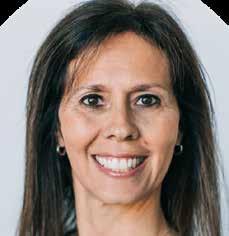
about family” in Israel.
“It’s a unique experience,” she explains. “It’s lonelier to be in the Diaspora during this war. There’s a sense of community there and everyone lifting each other up. Here, you see people who just go through their day without any connection to what’s going on in Israel.”
As both an Israeli and American, To-

bin personally understands that dichotomy. She’s a part of several WhatsApp groups with family members in Israel. She, too, notes how the distress of this latest war with Iran builds on a stress that has existed since Oct. 7, 2023.
That’s when JF&CS launched a crisis line, or Israel Support Line, primarily for members of the Israeli community who need a counselor to talk to. Calling 770677-9399 or emailing IsraelSupport@ jfcsatl.org can help expedite the process of being assigned to a therapist who can speak confidentially with a client in Hebrew or English. JF&CS accepts most insurances and offers a self-pay rate as well.
“You don’t have to be Israeli,” Tobin pointed out. “There are many in the Atlanta Jewish community who have strong connections to Israel.” Some members of the Atlanta Jewish community have sought help after they’ve returned home from an Israel under the threat of missiles, or after volunteer missions. “Holding both of those experiences at once can be challenging.”
If there’s one word Cohen uses to describe her Israeli clients after all this time, it is “exhausted.”
“Israelis are still processing Oct. 7,” said Cohen. “Then, there was Iran I (in June 2025) and Iran II (now).” Israelis wonder whether they can fly to Israel or not, as most airlines have canceled flights to and from Tel Aviv as Iranian missiles have targeted – and sometimes hit – Ben Gurion Airport, closing Israeli air space.
Cohen also mentions the loneliness of being Israeli but living in America. “We don’t whine about living outside. We don’t want to complain. We’re not running to shelters [every time a siren warns of an incoming missile]. What Israelis in Israel are going through is much harder.
But it carries challenges, too, although smaller. The gap between Israel and us is growing and Israel is changing.”
And, this latest chapter of the ongoing war, as Israelis experience it, is different for another reason. Although the U.S. government certainly defensively supported Israel after the 2023 attack, and both Presidents Joe Biden and Donald Trump visited Israel and helped orchestrate successive releases of hostages from Gaza, this time the U.S. military is directly involved in the attacks on Iran.
On Feb. 28, in an unusually coordinated assault, both Israeli and U.S. jets launched missiles and bombs on Iran, and the attacks have continued in subsequent weeks. As time has passed since that initial bombardment, there’s been speculation about talks to end the war as well as reports that the two governments diverge in their preferred time frames to do so.
From the beginning, support for the war against Iran among Americans and Israelis has differed. According to the Israeli Democracy Institute (IDI) in Jerusalem, the Israeli war – entitled Operation Roaring Lion -- had been overwhelmingly supported by Israelis. According to their initial polling, more than 80 percent of Israelis supported the war 12 days after it was launched.
A couple of weeks later, however, the share of Israelis opposed to the war had risen from four percent in the previous survey to 11.5 percent in the latest. In addition, the IDI polling indicates a clear drop in the intensity of support. “The proportion of those who strongly support the operation dropped from 74 percent at the beginning of March when combat commenced, to 68 percent mid-month, and to just 50 percent in the most recent measurement toward the end of” March.
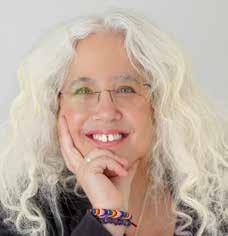
A “common denominator” of local Israelis is concern about their families in Israel, even if their families have easy access to bomb shelters – which not all Israelis have, said Israeli marriage and family therapist Shirley Shani Ben Zvi
The war against Iran is seen quite differently among Americans. In the U.S., according to Reuters’ polling, only 37 percent approve of the war – known as Operation Epic Fury – with 59 percent disapproving.
American Jews fall somewhere in between, reported the Jewish People Policy Institute (JPPI). Its March survey found
that 68 percent of “connected” American Jews support the U.S.-Israel war against Iran, significantly higher than the general U.S. public, with support divided along ideological lines.
The JPPI survey found that many U.S. respondents hold two views, both that Iran’s threat must be addressed, but concern what the fallout in America will be. A majority of connected American Jews polled were concerned that the war could damage Israel’s image in the U.S. as well as fuel antisemitism. There’s also a strong fear of the rising antisemitism that has been experienced in Europe and in the U.S.
According to local therapists who work with Israelis, the fears and opposing emotions come from all sides. They, too, are worried about antisemitism or anti-Israel attacks. But the “common denominator,” said Israeli marriage and family therapist Shirley Shani Ben Zvi, is concern about their families in Israel, even if their families have easy access to bomb shelters – which not all Israelis have.
Beyond the fear is anger, particularly among those “who believe the war was not the brightest idea.”
There’s some confusion as well, noted Ben Zvi. “People say to themselves, ‘I’m glad I left Israel before it got so bad there, but on the other hand I want to go back because I can’t trust my neighbors here.’”
Ben Zvi pointed out that many people often “don’t differentiate between Israel and the Israeli government. There’s a very dangerous blurring on all sides. Many Americans have become anti-Israel. It’s much easier to live in black and white” without seeing the complexities involved, especially in the Middle East. “Israelis grew up knowing how complex” the issues are.
Partly due to language and cultural differences, many local Israelis socialize primarily with other Israelis. “The two communities have different circles,” explains Cohen. Israelis often don’t affiliate with a synagogue, either, so organizations like JF&CS have a bigger challenge connecting to Israelis.
“We have proactively reached out to the Israeli community,” said Anat Granath, director of clinical programs and outreach at JF&CS, said. “Many Israelis don’t know about JF&CS. We have a very active WhatsApp group, sending out messages.” She said that there had
been several meetings in the community in the early weeks of the war.
Tobin added that JF&CS has worked with the Consulate General of Israel to the Southeast as well as community groups, Israeli scouts, and schools to find Israelis who might need its services. “We also started building relationships in Alpharetta where there are a lot of Israelis. We are going to where the clients are.”
The fact that JF&CS has employees connected to Israel through children studying there or who are serving in the Israeli Defense Forces helps, said Tobin. “We can hold our own stress and work with clients at the same time.”
In addition to psychological support from JF&CS, there are just a handful of Israeli therapists in Atlanta. Cohen said she’s one of a few Israelis who practice here. Even if her caseload is full, however, if someone contacts her “with a Hebrew name, I make priority and I will offer a discount. I make it a priority to help Israelis.”
Ben Zvi said one reason she became a therapist was because she wanted to see how people behave. Now she says, “These are crazy times,” adding humorously, “That’s not a clinical term.” ì

By Marcia Caller Jaffe
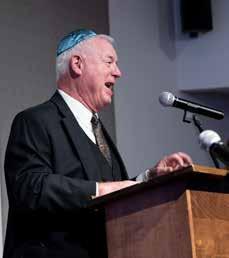
After 38 extraordinary years of leadership at Congregation Beth Shalom (CBS), Rabbi Mark Zimmerman will assume “emeritus” status as the Dunwoody congregation will soon announce the hiring of a new rabbi.
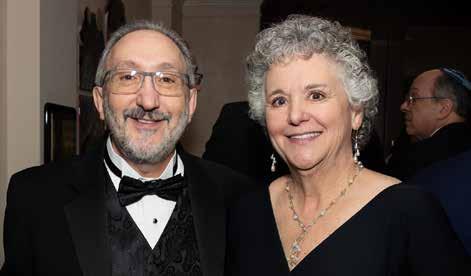
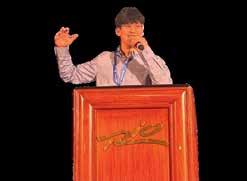
On Sunday, March 22, more than 235 congregation and community members attended a tribute gala/dinner, expressing how truly devoted and appreciated Zimmerman has been, along with wife, Linda. Touched by the outpouring of emotion and admiration, Rabbi Zimmerman said, “It has truly been the most incredible privilege and blessing of my life to have been able to spend nearly four decades of my career right here at Beth Shalom, the most haimesh and spirited shul I have ever known. CBS is truly a community of unparalleled warmth and genuine neshamah which was on full display tonight.”
CBS President Fred Rich began his comments comparing the evening to the recent Oscar Award production. Into his remarks, he became emotional, re-
counting the resilience and love Rabbi Zimmerman has shown congregants throughout the decades with family occasions, b’nai mitzvahs, ceremonies, funerals, baby namings, counseling … “really what you mean to us. Our members’ hearts are touched as we so looked to you for comfort.” Rich also thanked









Anna Shakhnovsky for her diligent work.
Linda Zimmerman is credited for helping shape the congregation with her support, wisdom, warmth, and commitment. She met Rabbi Mark before he began rabbinical school at the Jewish Theological Seminary. She told the






AJT, “I always knew he was destined to become a rabbi — shaped by family history and his deep commitment to Judaism. Our family literally grew up at Beth Shalom, where the community became our extended family. Supporting others through hosting, listening, and pouring my life into our shul community became










my purpose. Now, in retirement, we will have more time to reflect and rediscover ourselves and our family. While I will miss that sense of service, I’m grateful for the slower pace, and I know I’ll always remain deeply connected and involved in our synagogue.”
After a video of grateful congregants, remarks came from Marcy Liberty on behalf of Dunwoody Mayor Lynn Deutch, followed by comments from Rabbi Shalom Lewis (Rabbi Emeritus, Congregation Etz Chaim), Rabbi Brian Glusman (Marcus Jewish Community Center of Atlanta), and Brad Young, executive director of Israel Bonds, Southeast Region.
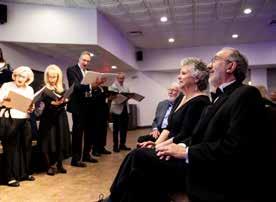
The CBS choir performed parodies from the Broadway show, “The Sound Of Music,” to the tune of “My Favorite Things” and “So Long Farewell,” and a Carlbach medley of David Melech Yisrael, Siman Tov, and Am Yisrael Chai to which numerous guests joined in a hora dance. Contributors to the lyrics included Andy Gothard, Shai Robkin, and Gail Forman. Howard Fish spoke about the new CBS legacy/ endowment program. Rabbi Zimmerman received a standing ovation after the announcement of the sanctuary naming in his and Linda’s honor.
Congregation B’nai Torah Rabbi Joshua Heller told the AJT, “Zimmerman is really an institution. Very few share his accomplishments … committed to one congregation the way that he has. Beth Shalom owes a lot to him.”
Zimmerman indeed has history with countless stories “from the infamous time the power went out on Kol Nidre night, the ice storms of the '90s when congregants huddled together sleeping at the shul with no power in much of the neighborhood, missions to Israel, the zemirot and birkat hamazon circle every Saturday following services, the preschool families, b’nai mitzvah families, the High Holiday Choir, Sisterhood, and the Men’s Club Texas Hold’em group and grillers, Shabbat camping retreats, and the many simchas and sorrows that were shared through the years.”
Rabbi Zimmerman concluded, “We have always been a ‘people-first’ synagogue, and I am absolutely positive Beth Shalom will continue to thrive after my retirement. The only thing I’m not sure of is how they’ll manage Linda’s retirement! Linda has been the most amazing rebbetzin and life partner on this wonderful journey we have been privileged to share together. Beth Shalom will forever be my spiritual home.” ì

By Marcia Caller Jaffe
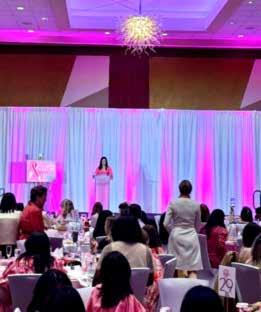
Dynamic networkers Jody Goldstein and Jennifer Fink greeted 385 women at Atlanta’s Cure In Our Lifetime annual breakfast at the Cobb Energy Centre on Wednesday, March 25. The huge ballroom was awash in a sea of pink – outfits, linens and cupcake centerpieces.
Melissa Rosenbaum, breast cancer survivor and journalist, served as moderator. The program began with a Winship Cancer Institute of Emory physician panel, Dr. Kevin Kalinsky, Dr. Tara King, Dr. Neil Iyengar, and Dr. Jane Meisel, who all contributed cutting-edge advances in the entire field of breast cancer treatment, testing, and cross disciplinary collaboration. The Emory Winship Cancer Institute has conducted more than 400 active clinical trials and sees 21,000 new patients every year.
Some of the topics the panel covered were the possibility of using less chemotherapy with a risk-based approach, the age of starting mammography based on risk and lifestyle impact: fiber, microbi-
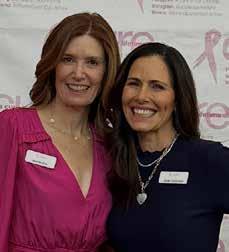
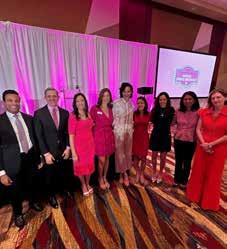
Together, Jennifer Fink and Jody Goldstein founded Atlanta’s “A Cure in Our Lifetime.” This year marks the organization’s 11th anniversary. Over the past decade, they raised more than $5 million in the fight against breast cancer // All photos by Dr. Cary Goldstein
omes, the effects of obesity in body fat, using body composition vs. weight, and yoga. A comparison was made to the use of immunotherapy, similar to what Presi-

dent Jimmy Carter used as an infusion to “tell the body itself” to attack cancer cells, as being “on the table.”
Dosing matters; and it could be that
lower dosages are being looked at with the potential of less side effects. They all agreed that the best objective was to stay out of the operating room and try to in-



Open a Donor-Advised Fund and receive a $180 bonus, to donate to any charity!
This spring, grow your Jewish impact with a Donor-Advised Fund: a simple, tax-smart way to support the causes you care about.


Start your fund and get an immediate tax deduction.
Invest in our expertly managed portfolios and watch your charitable dollars grow.
Support your favorite nonprofits in Atlanta, Israel, and beyond. All on your own timeline, from one secure portal.
or call
tervene on the front end.
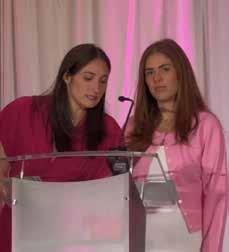
Next up, Fink, a five-year survivor, and Goldstein, a 13-year survivor, introduced their daughters, Alex Fink and Graci Goldstein, who stated how grateful and proud they were of their mothers choosing to tackle problems and that “unfortunately, in women ages 20 to 49, breast cancer is the leading cause of death in the United States.”
The keynote speaker was Sarrah Strimel Bentley, a breast cancer survivor and mother (via surrogacy) who is an advocate for young women facing a breast cancer diagnosis. She has been featured on “Good Morning America,” “ABC News,” and in “Newsweek,” and has appeared in seven Broadway shows as a performer. Her personal journey inspires her to use the phrase “joy mining” as she lived each day getting through this hardship while she was engaged to a young man who stuck with her through it all, including harvesting one fertilized egg with low 20 percent odds, which became their son, Chance.
With quite a sense of humor, Bentley mixed in a few curse words (after all, she’s from The Bronx) and talked about Atlanta’s pollen problem. She said the
breast cancer women’s club is “the worst club, but with the best members.”
She explained that breast cancer is not a sprint, but a marathon, and took a year out of her life to get it back to normal-ish function. She said, “No matter how dim things look, you have to dig deep deeper in the s**t to come out of it.”
Bentley also relayed how she had to advocate fiercely to get quick testing and not wait for several months that was initially scheduled for her because “she was so young and didn’t have a family history [of breast cancer]. She said, “Family history doesn’t mean anything; 85 percent of breast cancers have no family history.”
Bentley shared how she sang and danced to the musical artist Pitbull to get through 28 rounds of therapy, having her ovaries removed, her breasts “popped up,” and eloping in California on the balcony of her real first date.
Goldstein and Fink closed the event by presenting oodles of generous door prizes and graciously thanking the brimming crowd. Goldstein told the AJT, “As breast cancer survivors, Jennifer and I remain deeply committed to the breast cancer and Jewish genetics communities. This year’s event had record attendance.” ì

There are many ways to support Israel and its people, but none is more transformative than a gift to Magen David Adom, Israel’s emergency services system. Your gift to MDA isn’t just changing lives — it’s literally saving them — providing critical care and hospital transport for everyone from victims of heart attacks to rocket attacks. Donate today at MagenDavidAdom.org or call 866.632.2763.
By Reg Regenstein
On Sunday, March 29, the 15th Annual Atlanta Interfaith Hunger Seder was held at the renowned Ahavath Achim Synagogue in Buckhead. It is the second-longest running program of its kind in the United States.
The Interfaith Hunger Seder is sponsored by the Jewish Community Relations Council (JCRC) of Atlanta, whose valuable and dedicated work serves people of all faiths and backgrounds in the United States and Israel.
The seder reminds us that, on Passover, commemorating our liberation from slavery, we are instructed to “Welcome the stranger, and feed the hungry.”
Approximately 100 people attended this year’s seder, led by Rabbi Jason Holtz of Temple Kehillat Chaim and assisted by Rabbi Eric Feld of Ahavath Achim. They were joined by esteemed area clergy, partnering with JCRC on the hunger issue: the Rev. Dr. Lisa Heilig; the Rev. Cassandra E. Henderson; and the Rev. Sean B. Smith.
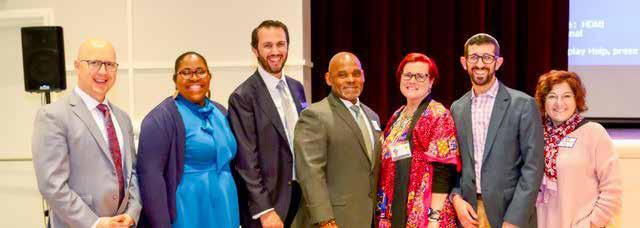
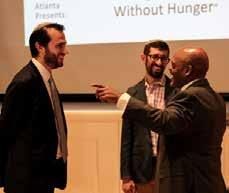
This year’s theme was “Uniting for a Future Without Hunger,” and how the entire community can address the massive problem of food insecurity.
Today, in America, the richest and most prosperous nation ever to exist, some 48 million people go hungry, comprising 14 percent of American households with 14 million children lacking adequate access to food. In Georgia

alone, 1.7 million people face food insecurity, according to Ruby Zimmerman of Mazon.
One in five children in Georgia has no access to healthy, nutritious food, according to The Zadie Project, and the rate of food insecurity among seniors has increased by 68 percent over the past decade.
One-quarter of all college stu-
dents and members of the U.S. military experience periodic hunger, and food pantries operate on or around every U.S. military base.
And yet, there is plenty of food available. According to the U.S. Food and Drug Administration (FDA), Americans waste and discard 60 million tons (120 billion pounds) of food every year, which amounts to almost 40 per-

Since our founding in 1965 with 40 adventurous souls, Canterbury Court has been adding new colors, new shapes, and new stories to the tapestry of lives that makes our senior living community so special. Come join us—the best is yet to come.
Come tour to see what makes our community so deeply vibrant. Call 404-737-2639 or visit CanterburyCourt.org/Tapestry.
cent of the total American food supply, worth about $218 billion, or about 130 billion meals.
Sadly, an astonishing one in eight Americans now rely on the Agriculture Department’s Supplemental Nutrition Assistance Program (SNAP, formerly known as food stamps, which serves more than 42 million participants. While this program is essential, it is far from adequate, and recipients receive only about $2 per person per meal.
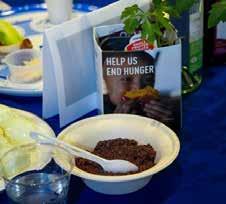
The seder event began with “The Marketplace,” an assembly of a dozenand-a-half partners and supporters, offering opportunities to visit and engage with cooperating local organizations that are on the front lines of fighting to relieve hunger, educating the public, and growing, collecting, and distributing food to needy families.
The largest such group is Mazon: A Jewish Response to Hunger (mazon.org/ georgia), which for 41 years has worked to educate and “to speak truth to power and hold our government accountable for addressing the unconscionable levels of hunger in this country.”
Second Helpings Atlanta works to reduce food waste and collect surplus food that would otherwise be thrown out. Since 2004, it has “rescued” and delivered approximately 35 million pounds to local nonprofits (www.secondhelpingsatlanta.org).
In 2025, The Community Assistance Center (www.ourcac.org), with its 526 monthly volunteers, helped 9,632 clients in 4,440 households, distributing over $2.1 million worth of food, 68 percent of which was fresh from local grocery stores and community partners.
Every year, Community Action Center helps more than 7,000 people, distributing not only food but also providing warm coats and holiday gifts for children.
Other dedicated groups at The Marketplace working to help the hungry included:
Jewish Family & Career Services (jf-
csatl.org); Repair the World (werepair. org); Backpack Buddies of Metro Atlanta (backpackbuddiesATL.org); The Zadie Project; Salem Baptist Church; Atlanta Food Bank community grocery stores (acfb.org); Adamah (adamah.org/atl); Intown Cares intowncares.org); Global Growers Alliance (globalgrowers.org); Metro Atlanta Food Consortium (metroatlantafoodconsortium.org); Bagel Rescue (bagelrescue.com); Food Well Alliance (foodwellalliance.org); and FoodDiversity.org;
JCRC points out that SNAP has been able to reduce food insecurity by 30 percent, but now the Federal government is placing more of the costs on individual states.
Much of the discussion at the seder centered upon an urgent issue: current efforts to cut state funding for hunger programs.
Food assistance has been scheduled to be reduced by $69 billion over the next decade, according to the Congressional Budget Office, with 382,000 Georgians losing SNAP benefits under new work requirements,
As Leslie Anderson of JCRC and Ruby Zimmerman of Mazon described, the Georgia Legislature had two SNAP issues before it that had to be resolved within four days, before the last day of the 2026 session.
Said Harold Kirtz, chair of the seder, “The event was well-attended and wellreceived. The inspirational interfaith clergy representing five faiths helped us further understand the importance of uniting to alleviate food insecurity. Everyone left with a sense of urgency and helpful information to advocate with their state representatives on pivotal current legislation.”
A few days later, Kirtz told the AJT exclusively the good news that $46 million had been added to state hunger programs, and the bill adding additional restrictions to recipients did not pass.
Meanwhile, JCRC Vice President Leah Romberg Harrison, a key organizer of the event, called it “important, unifying and empowering. As summer approaches, the JCRC would like to encourage those who are able to donate to the Atlanta Community Food Bank or other local food organizations. Your donations now will help fill the gap for children by providing food during the summer for those who normally receive nutrition assistance through their schools during the academic year.”
Fortunately, no one at this seder went hungry – following the presentations, a well-deserved sumptuous seder meal was served – a great meal for a great cause! ì

Our commitment to continuous modernization means that we invest in the home you live in, providing unrivaled amenities and fostering a strong sense of community. Heartis Buckhead stands as the premier choice for senior living in Atlanta, offering a lifestyle that blends style, sophistication, and a vibrant community atmosphere.

A one-of-a-kind property for oneof-a-kind people – with an inspiring and inviting backdrop for vibrant tastes, adventurous spirits and bold personalities – like yours.


No matter the type of living, every apartment comes with the conveniences you need and enough space to add your own style.
By Dave Schechter
An unusual second-night Passover seder was held at the Georgia state capitol, on the last and usually most chaotic day of the legislative calendar.
Rep. Esther Panitch, the lone Jewish member of the General Assembly, organized the April 2 “Sine die Seder,” held in a second-floor conference room.
“Sine die” is a Latin term used to signal an indefinite adjournment. In the case of the General Assembly, it is signaled by the rap of gavels in the state House and Senate and members of those bodies flinging piles of paper into the air.
On this night, different from most other nights, the House and Senate often adjourn closer to midnight.
As the House conducted its business throughout the afternoon, Panitch ducked in and out of the chamber to check on preparations for the seder, work mostly in the hands of her chief of staff, Caroline Harper, and Alli Medoff, a friend and co-founder of the Georgia Solidarity Network, a bi-partisan politi-
cal action committee that supports proIsrael and pro-Jewish elected officials and legislation.
The unique seder began not at sunset but shortly after 6 p.m., when Republican House Speaker Jon Burns declared that the chamber would break for dinner.
The three dozen people seated at three long tables included a couple of Panitch’s House colleagues, along with legislative staffers, lobbyists, representatives of Jewish organizations, citizens with an interest in the legislation being debated, and journalists, among them an esteemed Jewish political reporter from the Atlanta Journal-Constitution.
Panitch lit and recited the blessing over the holiday candles and the Shehecheyanu prayer. The proceedings were conducted by her husband, Roger Panitch, using a Haggadah created by their family.
Panitch had invited Burns to attend and shortly after the white-haired House Speaker entered the room and donned a light blue kippah, there was discussion of the afikomen.

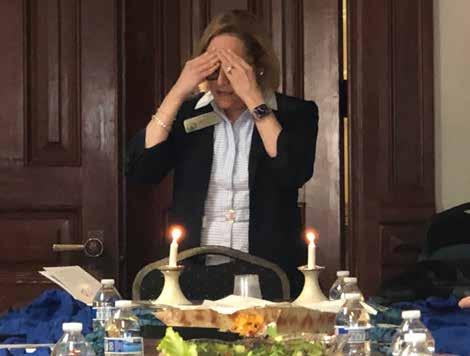
“We can hide it in the budget. No one will find it,” said a voice from the back of the room (which may or may not have been that of a legislator).
Burns sat next to Panitch as she explained the various Passover rituals.
In a deft piece of politics, when it came time to discuss the four sons in the Haggadah, Panitch assigned the role of the wise son to Burns, who read his portion in English.
Panitch, in turn, handled the words of the wicked son, in Hebrew and English.
A highlight — appropriate given when and where the seder took place — was a group recitation of “Sine die-yeinu” (From Election Night to Final Gavel), a play on the Passover song “Dayeinu,” written by Rabbi Michael Bernstein of

Congregation Gesher L’Torah, tracing the progress of an elected legislator and legislation.
A meal — including matzoh balls in chicken soup, stuffed chicken, brisket, salad, potatoes, a blueberry cobbler — was served, after which most of those in attendance, Panitch included, departed, as the House gaveled back into session at 7.30 p.m.
Those who remained sang their way through Chad Gadya (“one little goat” in Aramaic) in English and Barrow County Commissioner Alex Ward delivered the entirety of Echad Mi Yodea (“one who knows”) in Hebrew.
The seder is proscribed to end by midnight. So, too, is the final legislative session, but work in the House and Senate crept over the line from late Thursday to early Friday. ì


combining technology and artistry to create exceptional dentistry. As a comprehensive dental office that goes above and beyond our specialty in Cosmetic Dentistry, our patients believe Dr. David Mastro is the right choice for all your family dentistry needs!
When it comes to your smile and oral health, Dr. Mastro has a proven 30 year track record of providing quality cosmetic and family dental care for families in our local community and around the world.




Soft light glints off a perfect tuna tartare, studded with cucumber and sesame. At the next table, pillowy buns encase craggy smash burgers, the play of texture so addictive that guests linger, debating a second … or third. Flavors are punctuated with the perfect libation, and you realize that whatever delights your taste buds, you’ll find it here.
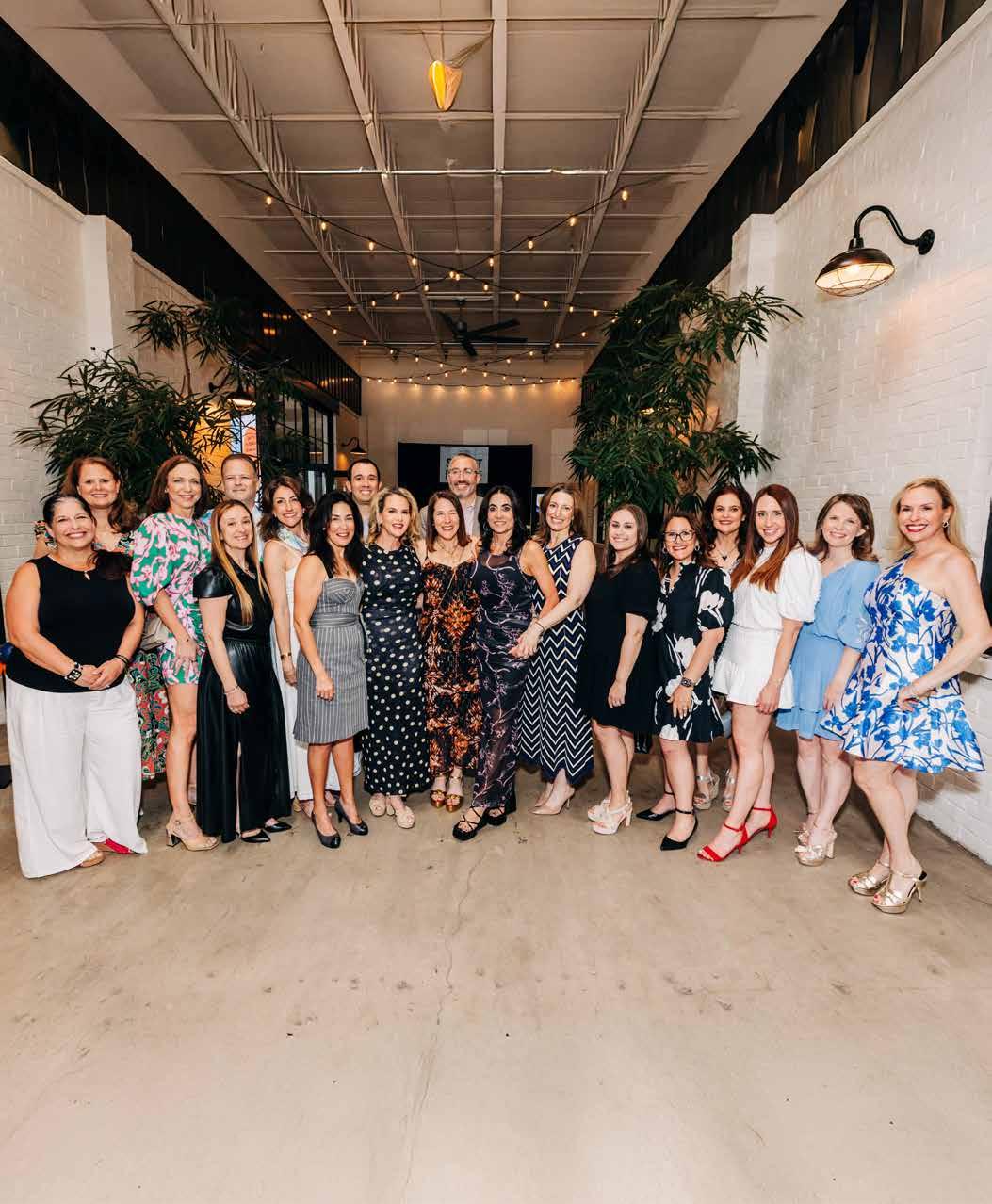
More than Atlanta’s premier food event, Jewish Family & Career Services’ The Tasting Experience is just that: an experience. Held in the industrial-chic Stave Room with its soaring ceilings and swaths of soft lighting, the event unites Jewish Atlanta in all its generations; young professionals mingle with longtime patrons, and it’s not unusual to see entire multigenerational families saying “cheers” in cocktail attire. Around you, the room hums as old friends reconnect, new ones are made, and there’s a shared sense that this is exactly the place to be.
The star of the show is Atlanta’s very best food and beverages. More than 25 of the city’s top restaurants, caterers, and liquor distributors, from High Roller
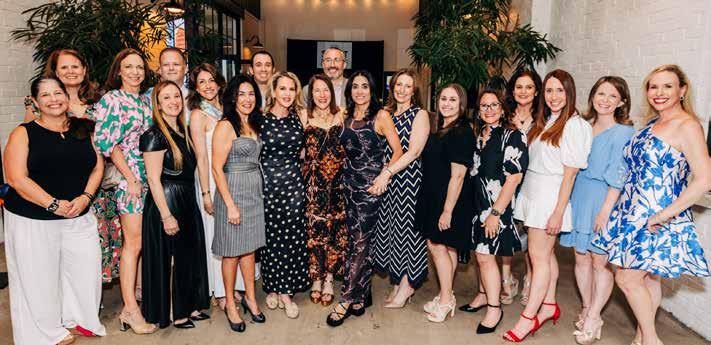
Sushi and Zest Catering to Fifth Group and Added Touch, offer new standouts and longtime favorites. Your culinary travel will take you to Japan, South Af-



rica, Israel, Korea and more. The tastes are perfectly portioned and thoughtfully curated to meet the needs of everyone, including kosher and vegetarian options. Drinks flow from expertly crafted cocktails and fine wines to the signature HAMSA mocktails, ensuring everyone finds their perfect pairing.
Guests taste the good life as the silent auction tempts from the center of the room. Whether you’re looking for a core-memory-worthy vacation, or maybe a unique experience with a good group of friends, consider the silent auction as the first stop for your future memories. Exquisite jewelry and memorabilia for the most passionate collectors are ready to be the perfect gift for someone special, or for yourself. Who knows what you might leave with: a special souvenir, a new favorite wine, and maybe even a new connection.
The cherry on top? Every bite, bid, and sip goes to support JF&CS’ Intellectual & Developmental Disability Services. These services (Independent Living, Supported Employment and our Community Access Day Program) empower JF&CS’ clients to live full lives as independently as possible. Just by attending, you’re empowering lives and strengthening the community. All food and drink are graciously donated by the featured chefs and liquor distributors, reflecting their investment in and support of JF&CS’ services.
Is The Tasting Experience a … date night? Community reunion? Feast? Wine tasting? Vacation shop? Gift destination? Yes to all. Experience it for yourself from 6:30 to 9:30 p.m., April 30. Cocktail attire. Tickets and sponsorships available at thetastingexperience.org. ì





By Bob Bahr
The Atlanta-based Jewish Fertility Foundation (JFF) has received a $3 million grant from the Marcus Foundation. The grant, which will be spread over the next three years, will allow the organization to support a new program for prospective parents in Atlanta and in South Florida who are working with pregnancy surrogates.
It will also qualify the organization to receive an additional foundation grant of $300,000 to expand the organization’s work nationally. The announcement of the new funding initiative was made at JFF’s recent annual meeting.
Elana Frank, who founded the organization after experiencing fertility treatments in the birth of her own children, and serves as CEO, described the series of $20,000 surrogacy grants as an important step forward.
“We recognize $20,000 is not everything, but our hope is that together with this additional support and wrap-around discounts, it’s going to feel like a big hug from the Jewish community at one of

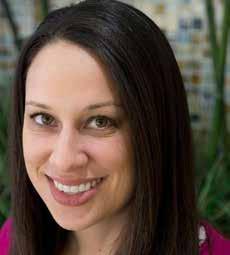
the most important moments in our life. This is a big, big moment for our organization.”
JFF has experienced rapid growth since 2019 when it established its first office outside Atlanta. The organization now operates in 10 cities around the country, with another 16 cities on the
drawing board. Included in that expansion are four locations in California and several in the New York and New England area. By 2030, they expect to serve 10,000 new clients and raise more than $18 million to fund that growth.
Last year, JFF helped in the birth of 101 babies and provided more than $500,000 to fund individual fertility treatments.

Among those was Judith Rapport, who, with her husband, Aaron, received grants that resulted in the birth of their son, Alvin. She is now pregnant again. Rapport expressed her gratitude at the annual meeting for the IVF treatment provided with the help of the foundation.
“We found through this process that IVF was not just a medical procedure. It was an emotional journey filled with hope and grief and a lot of uncertainty; but it was thanks to the support of Jewish Fertility Foundation, we were able to keep going. Your support didn’t just help fund treatment for us. It gave us hope.”
The foundation’s work, in particular IVF and surrogacy, have become hot-button political issues.
In 2024, the Alabama Supreme Court decided that embryos that are often a part of fertility treatments are “persons,” and have the same legal rights as human children. While the ruling did not include IVF specifically, the practical effect was to expose all those who provide fertility services using embryos to possible legal action.

The immediate result was the shuttering of fertility clinics at the University of Alabama-Birmingham hospital and a number of other fertility clinics in the state. In July 2025, the Trump Administration’s “Big Beautiful” financial legislation blocked funding by Medicaid for
organizations providing tax exempt reproductive services if they provide abortions and received more than $800,000 in Medicaid funding during fiscal year 2023. In addition to clinics closing, an exodus of obstetricians and gynecologists has been reported, particularly in the south.
The organization’s experience over the last several years has been an important impetus for its growth, according to Joey Hurd, JFF board chair.
“JFF has been intentionally building and refining a scalable model since 2018, learning what it takes to replicate our work beyond Atlanta and be able to reach more people across the country,” Hurd said. “In 2019, Cincinnati was actually our first expansion site, making our transition from a single market organization to a multi-community model. It helped us test the assumptions around staffing, volunteer leadership, community buy in, fundraising capacity, and what should really live locally vs. nationally.”
Near the top of the priorities for expansion is Los Angeles and San Diego in southern California. Working with the Jewish Federation of Los Angeles, JFF is said to have raised significant capital to start an office there and has recently installed a new West Coast Development manager.
One of those participating in the annual meeting was San Diego Rabbi Yael Ridberg, who has had personal experience with fertility issues. Her words of support at the annual meeting underlined the importance of JFF’s work.
“We can all be the messengers of hope, strength, courage, support, and care, that can encircle and embrace families who dream of building their own family and remind them that their longing need not be done alone.” ì
By Marcia Caller Jaffe
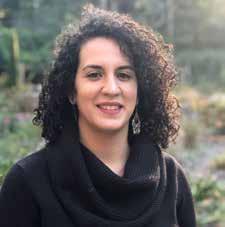
With the repositioning of Beth Gluck as Jewish National Fund (JNF) executive director, Los Angeles native and Persianborn Hedi Toub has taken over this highprofile role for Greater Atlanta.
Toub brings more than 15 years of leadership and experience including nonprofit services, international humanitarian work, financial operations, and business development. She stated, “Jewish National Fund-USA represents the intersection of my professional experience and my lifelong connection to Israel. I am honored to be part of an organization that is building the land and supporting the people of Israel in such impactful and meaningful ways.”
Jewish National Fund-USA also looks forward to Gluck’s new key role in Major Gifts, utilizing her decades of leadership and experience.
Toub’s career includes a senior leadership role with the American Red Cross, where she served as director of international services, overseeing global humanitarian initiatives. Her experience also spans financial and risk management roles in both the United States and Israel. Fluent in English, Hebrew, Farsi, and Spanish, she brings a global perspective and a unique ability to build meaningful relationships across diverse communities.
Outside of her professional life, Toub is married to husband, Farid, a dentist, and is the proud mother of two children, Ari (11) and Ayla (8). In her free time, she enjoys cycling, playing Mahjong, and values spending time with family and community. The Toub home was featured in the Chai Style column, April

8, 2016, “Young Persian Family Creates Persian Vibe.”
Hedi sat down with the AJT to answer some more revealing questions about her outlook and vision.
Jaffe: At what age is it appropriate and what do you think is important to tell children about antisemitism and the war abroad?
Toub: My kids started asking us about the war in Israel right after Oct. 7 happened. They would see us watching the news with shock and disbelief in our reactions. We knew we couldn’t ignore it anymore. We started to have gentle conversations with them, at the time they were 9 and 6. It’s important for them to be aware of what is happening around them and to foster a Zionist identity regardless of the hate.
Jaffe: What specific JNF programs pique your interest?
Toub: What resonates most with me is JNF’s core vision of turning values into tangible impact- building sustainable land to attract 800,000 new residents to Israel’s frontier regions in the north and south, while creating meaningful, lasting connections between the people and the land of Israel.
Jaffe: What are some Persian dishes you make at home?
Toub: I love cooking, especially for Shabbat dinner! Our go-to favorite Persian dishes are Ghormeh-sabzi (a green leafy stew with lamb), Tachin (crispy rice made with saffron and chicken) and Zereshk Polo (rice with barberries). Delicious! Everyone is welcome to our Shabbos table!





Jaffe: What are you reading and streaming?
Toub: Given the current events, we are watching the shows, “Tehran,” and “Lioness.” Love action-based series! I wish I had time to read, maybe when the kids go off to college?
Jaffe: Share more about your past related work.
Toub: During college, I volunteered in Israel with Khevrat Ilan, an organization that runs specialized schools for children with disabilities. It was one of the most meaningful experiences of my life. Working directly with the students and seeing how a thoughtful curriculum and compassionate staff could unlock confidence and joy was incredibly powerful. That experience shaped my leadership today and reinforced the values that guide how I lead.
Jaffe: Is one of your goals to involve younger people?
Toub: Yes. Engaging the younger community is a mission-driven goal through the JNFuture program for ages 22-40. The focus will be on creating structures that invite their participation in meaningful and lasting impacts for the communities of Israel’s north and south.
Jaffe: Do you call Atlanta home? Do you still visit Los Angeles to see family?
Toub: Yes. Atlanta is home! I have strong personal and professional roots here, and I’m deeply connected to the community. That local grounding is important to me, especially in a leadership role where understanding the people, context, and dynamics of Atlanta really matters. ì

By Bob Bahr
Although the forced expulsion of the Jewish population from Spain in 1492 by King Ferdinand and Queen Isabella reshaped Jewish life in Europe, the forced removal of residents from several European countries evolved long before the action by the Spanish rulers.
How that happened and how expulsion of populations was accepted in medieval Europe was the topic of this year’s Tenenbaum lecture at Emory University’s Tam Institute of Jewish Studies.
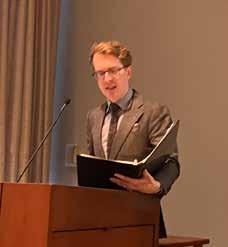
This year’s guest lecturer was Dr. Rowan Dorin, who teaches history at Stanford University and is on the faculty of the Jewish studies program there. His topic was, “The Road To 1492 - Jews, Christians and the Spread of Mass Expulsions in Medieval Europe.”
Although uprooting populations and banishing them from areas where they had long lived was not that unusual in the ancient world, it was rare, according to Dr. Dorin, that people would be forced to live outside the boundaries of a particular empire. It was all but unknown

in the Roman world and in the Byzantine and Ottoman empire of the East. But all that changed beginning in the 11th century in Europe. Instead of looking at the phenomenon of mass expulsion as a Jewish tragedy, Dr. Doran took a different point of view.
“What if we start not from the targets of persecution, but from the tools?,” the Stanford professor asked. “In other

words, what if we frame Jewish expulsions not from the perspective of ‘what else was being done to Jews’ but from the perspective of ‘who else was being expelled?’”
He took as one of his examples the expulsion of the Jews from England in 1290, during the reign of King Edward I. The order brought an end to England’s thriving Jewish community that would not be reestablished for another 400 years. But the expulsion that ended Jewish life for so long in England actually began when the king’s great-grandfather, nearly 150 years before, expelled all the foreign mercenaries who were serving in his army. Over time, other foreign communities were exiled, until in 1240, Edward father, Henry III, expelled foreign merchant bankers. It would be 30 years before Edward began a 20-year campaign of ridding himself of his Jewish population.
“King Edward follows suit upon taking the throne in 1272, first expelling Flemish merchants from the realm as part of a commercial dispute,” Dr. Dorin explained, “and then a year later expelling Italian merchant-bankers on charges of usury. Right after expelling these Italian merchants, Edward goes on to prohibit the kingdom’s Jews from lending at interest — i.e. from engaging in usury.”
The effort in Europe to prohibit the lending of money with interest took off in earnest two years later when Pope Gregory X called a General Council of the Catholic Church that issued a decree that ordered all secular and church officials to expel any foreigners who were engaged in usury. It was a major step forward, according to the professor, toward the banishment of Jews.
“Only two months after the close of the Second Council of Lyon, the bishop of
Angers, in western France, promulgated a new collection of statutes,” Dr. Dorin commented. “Since it was clear, continued the bishop, that ‘the Jews of the diocese openly engaged in the depravity of usury, all clergy and ecclesiastical institutions were henceforth forbidden from renting houses to Jews, or indeed allowing Jews to reside anywhere on church lands.’”
Fifteen years later, the Jews, along with foreigners from Italy, some of whom were also money lenders, were expelled from the region.
It was edicts like this that led to the order in the late 15th century by the rulers of Spain to expel its Jewish population, estimated to be as large as 200,000 people from that country. But not before King Ferdinand. in his decree that Dr. Dorin quoted, which denounced the Jews, “They (the Jews) wickedly and mercilessly consume the wealth and property of Christians through their enormous and unbearable usury,” the Spanish document charged. “Given that those Christians who have come to another land to be usurers must be expelled from cities and towns … how much more should infidel usurers, seducers of Catholics and abettors of heretics, be expelled and kept apart from Catholics for the preservation and protection of both their souls and the Christian religion?”
So, as history unfolded in medieval Europe, whatever punishments fell on the Christians for money lending, Jews would also be punished, as they were, when they were banished from Spain.
“So, a canonical sanction devised two centuries earlier to slow the spread of Christian moneylending,” Dr. Dorin emphasizes, “comes to play a supporting role in the great act of intolerance against Jews that signaled the end of one age and the beginning of another.” ì








By Times of Israel
The Bank of Israel has trimmed its growth outlook for the economy for this year and left interest rates on hold for a second straight meeting, citing high geopolitical uncertainty over the duration and toll of the war with Iran.
“Recent weeks, since the beginning of Operation Roaring Lion, have been marked by considerable geopolitical uncertainty, and the war’s impacts on the economy and on real activity can be seen across all industries,” Bank of Israel Governor Amir Yaron said at a press conference in Jerusalem.
“On the demand side, there is a decline in credit card expenditures and in
April 15, 1940: Weightlifter Yossef Romano, one of the 11 Israelis murdered at the 1972 Munich Olympics, is born in Libya. He makes aliyah in 1946. A nine-time national champion, he is killed fighting off the Munich terrorists.
in April 1988.
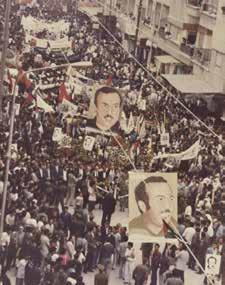
April 16, 1988: Khalil al-Wazir, the planner behind multiple terrorist massacres of Israelis and an organizer of the First Intifada as the Fatah co-founder known as Abu Jihad, is assassinated at his Tunis home by IDF commandos.
April 17, 2006: Rabbi Arthur Hertzberg, a Jewish communal leader perhaps best known as the author of “The Zionist Idea,” dies at 84. A native of Poland who grew up in Baltimore, he embraced Labor Zionism in his teens.

By Times of Israel
Lion.
tourism, and on the supply side, there is an adverse impact on labor supply due to employee absences and military reserves call-ups, alongside disruptions in the supply chains,” he said.
Assuming that the war with Iran and the fighting in Lebanon will end in late April, the central bank said it expects the economy to grow by 3.8 percent in 2026, down from its January forecast of 5.2 percent, before the outbreak of the war.
April 18, 1933: Gen. Edmund Allenby, who led the British offensive that captured Palestine from the Ottomans during World War I, delivers the keynote address at the dedication of the YMCA’s new complex in Jerusalem.
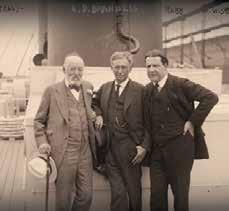
April 19, 1949: Rabbi Stephen Wise, a founder of the U.S. Federation of Zionist Societies and the American Jewish Congress whose leadership positions included the presidency of the American Zionist Movement, dies at 75.
April 20, 1953: Initiated by Education Minister Ben-Zion Dinor, the government presents the first nine Israel Prizes as part of the Yom HaAtzmaut (Independence Day) celebrations. The recipients range from writers and an artist to historians and a doctor.
April 21, 1984: Marcel Janco, a founder of the Dada art movement, dies at the Sheba Medical Center at 88. A native of Romania, he immigrated to the Land of Israel in 1941 and later founded the Ein Hod artists village.
El Al Airlines has suspended its regular flight schedule through April 18, leading to thousands more cancellations for Israelis planning to travel abroad, as wartime airspace restrictions continue to limit operations at Tel Aviv’s Ben Gurion Airport.
Instead, El Al will continue to operate an emergency flight schedule of a limited number of flights to several central gateways, including New York, Los Angeles, Miami, Bangkok, London, Paris, Rome, and Athens.
“Due to the limited number of available seats, passengers [whose flight was cancelled] awaiting assignment are being
April 22, 1978: U.S. Assistant Secretary of State Roy Atherton, amid Middle East trips to advance Israeli-Egyptian peace talks, acknowledges U.S. sympathy for Israel’s security concerns about an independent Palestinian state.
April 23, 1963: Israel’s second president, Yitzhak Ben-Zvi, dies of cancer at 78 after a decade in office. He was a signer of the Declaration of Independence and served in the Knesset until Chaim Weizmann died in 1952.
April 24, 1950: A joint session of the newly elected Jordanian Parliament, featuring equal Jordanian and Palestinian representation, formally annexes the areas west of the Jordan River that the country captured during the 1948-49 war.

IDF soldiers forcibly remove a settler from Yamit, the last Israeli town in Sinai, on April 22, 1982, three days before the final handover of the peninsula to Egypt. // Israeli Government Press Office, CC BY-SA 3.0
April 25, 1982: Two days after razing the last Israeli settlement in Sinai, Israel executes the final handover of the peninsula to Egypt under the terms of their 1979 peace treaty despite domestic political resistance.
April 26, 1881: Anti-Jewish violence since the assassination of Czar Alexander II in March sweeps into Kyiv. Rioters loot and destroy Jewish shops and homes. Authorities warned Kyiv’s Jews on April 25 to stay inside.

accommodated based on priority according to the original ticket issue date, with priority given to exceptional humanitarian medical cases,” El Al said.
United Airlines has extended the suspension of nonstop flight services from New York to Ben Gurion Airport through at least Sept. 7.
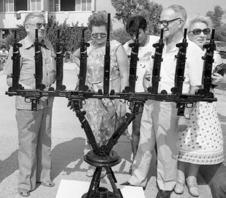
Old Uzi submachine guns are repurposed as a Chanukah menorah. // Israel Press and Photo Agency (IPPA), Dan Hadani Collection, National Library of Israel, CC BY 4.0
April 27, 1955: The Uzi submachine gun makes its public debut as an IDF weapon during a Yom HaAtzmaut parade. The Uzi was first used in the field two months earlier during a paratrooper raid on Egyptian forces in Gaza.
April 28, 1918: Six months after the Balfour Declaration, the British government’s backing of a Jewish homeland in Palestine, the American Jewish Committee offers tepid support, reflecting ambivalence among U.S. Jews.
April 29, 1976: Progressive politician Tamar Zandberg is born in Ramat Gan. An urban environmentalist and social democrat known for women’s advocacy, she is first elected to the Knesset in 2013 and become the Meretz leader in 2018.
Items are provided by the Center for Israel Education (israeled.org), where you can find more details.



By Jan Jaben-Eilon
After the U.S./Israel war on Iran was launched Feb. 28, dozens of Atlantans who had long scheduled to fly to Israel for Passover, to see family or to attend weddings – or all of the above – were suddenly left with homes that they hadn’t prepared for Passover as well as nowhere to celebrate the seders.
To say that it was chaotic for airline passengers during those first weeks of the war – now stretching into months -as airlines stumbled their way forward, is an understatement.
First, Delta Air Lines canceled its nonstop flights between Atlanta and Tel Aviv, set to restart on April 15, after previously operating the route from 2006 to 2011. Soon after that cancelation, the Atlanta-based airline canceled all its flights from other destinations to Tel Aviv until Sept. 5. Atlantans who thought ahead when making their plans to go to Israel during Passover and made their reservations on usually dependable Israeli airlines El Al fared no better.
Wendy Kalman and her husband, Marius Braun, were originally booked on Delta for a flight to Amsterdam on March 12 where they were to connect with an El Al flight to Tel Aviv. The flights weren’t canceled immediately. “Our return was supposed to be leaving March 29 on an El Al flight through” Paris and then Delta back to Atlanta, she said. All canceled.
Now they are booked on a Delta flight leaving Atlanta April 22 for a connecting flight in Paris for Tel Aviv, but it’s anybody’s guess whether those flights will fly. Although Kalman wasn’t planning on being in Israel for Passover, she is clearly frustrated. She missed her granddaughter’s second birthday. “I need to go. We have suitcases full of little girl clothes and ‘Dr. Seuss’ books,” she lamented.
Similarly, whenever David and Eve Adler plan a visit to their son, Jonathan, and his family in Israel, their suitcases are full of gifts for their grandchildren. Not unusually, they planned to celebrate Passover there this year. They had made El Al reservations believing that the Israeli airline would fly even if U.S. airlines didn’t.
Instead, when their flights were canceled, they had to scramble to kashrut their house. Fortunately, thanks to friends, they immediately had invitations for the first seder, plus Friday night and Saturday meals.
Some Atlantans who didn’t get to join family members in Israel for Pass-
“This
over had other family members living in Atlanta with whom they were able to enjoy seders. Former teachers Elie and Tzipi Livnat, who usually spend about half the year in Israel around Passover and the fall High Holidays, instead this year experienced the chaos of getting flights canceled at the last minute.
The Livnats had reservations to fly March 19 to Tel Aviv on Israeli airline Arkia from New York to Tel Aviv. Three days before their scheduled departure, they were canceled. They received an email from Arkia that was “very ambiguous” and required them to fill out a form that included asking them when they would like to rebook. They chose a date, and that flight was changed, too.
“After my flight was canceled, I went to the Arkia website and checked the next flight availability. They had open seats available, however with a hefty $4,000 more than our original flight cost. I was wondering if this was not another trick of them to increase revenue,” he added.
“There was no one to talk to, no way to call them. We could only send an email or WhatsApp message. Their response was 52 hours later, explaining that they were short of employees because so many were drafted into the Israel Defense Forces for the war,” Elie Livnat related.
In early April, Livnat said the couple was hoping to get to Israel soon and stay until after Shavuot, which starts May 21. “Hopefully, the war will end” by then, he added.
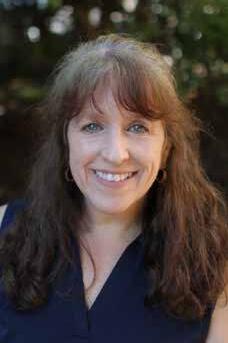
“I need to go. We have suitcases full of little girl clothes and ‘Dr. Seuss’ books,” Wendy Kalman lamented, about her canceled plans to go see her granddaughter in Israel.
With a son and grandchildren in Israel, Alice Wertheim said she usually goes there twice a year – the last time in December. She and her husband, Brian, were supposed to leave on Delta March 26 to spend Passover in Modi’in, between Jerusalem and Tel Aviv, with her family there.
Stuck in Atlanta, one of her nieces invited Alice and Brian to their house for seder. “We spent it with my entire sister’s family. It was very lovely,” said Alice. But now she’s wondering if her Israeli son and family will be able to fly to Atlanta in August as planned.
There are no assurances.
Jodi Wittenberg, owner of kosher grocery store Spicy Peach, said Passover was “super chill for me this year.” Her husband, Josh, however, was “crazy disappointed.” Their story is a bit unique. He made Aliyah in September 2024, so they travel back and forth to see each other.
She was supposed to join him in late March. She had bought an El Al ticket months ago. “I always fly El Al, so I don’t get derailed.” This year, her reservation kept getting canceled and rescheduled and then canceled again. She “packed and unpacked.” She worried about making connecting flights because of the partial U.S. government shutdown that resulted in long security lines.
Finally, she told her husband, “Sorry, I’m not coming.” She ordered catered food for Passover and neighbors helped. She had a “low key” seder at a friend’s
mountain house in Hiawassee, Ga.
Of course, the passenger frustration hasn’t been just one way. Livnat said there are a number of people in his Toco Hills neighborhood who had been in Israel when the war started and haven’t been able to get back to Atlanta. “We have neighbors stuck in Israel for three weeks, some with hotel expenses,” he said. Many Atlantans, however, have family to stay with while they’re in Israel. Myrna Rubel is one Atlantan who left for Israel on Feb. 13 for a two-and-a-halfweek trip that’s turned into a two-and-ahalf-month odyssey, according to Gene, her husband of nearly 62 years. Myrna, he said, is making the best of the situation, staying with their daughter, Laurie, in Ramat Aviv, near Tel Aviv University where she is a professor, and seeing her grandchildren there.
Rubel said his wife had an El Al ticket to return home on April 16, but she had tickets on Israeli airlines more than once since her first scheduled return flight, on March 3, was canceled. And, indeed, that reservation was canceled as well. At press time, Rubel reported that his wife was investigating other options to finally find a way home.
“It seems like 17 years” since she left, her husband said. “This is the first time we’ve been apart on Passover for 62 years.” He had a seder with his son in Atlanta, “except a seat next to me was empty. When we opened the door for Elijah, we hoped Myrna would walk in!” ì
By Gil Zohar
To the delight of ornithologists, amateur bird watchers, photographers, and nature lovers, the annual spring bird migration from Central Africa to Europe and Asia is now underway. The best places to observe the avian wonder are Israel’s Hula Nature Reserve and the nearby Agamon Hula Park, both close to the Galilee Panhandle city of Kiryat Shmona. The twin sites, of global importance for aquatic fowl, are the Middle East’s most critical wetland.
“Some half a billion birds pass through our country out of about 11 billion migratory birds worldwide, twice each year, in autumn and spring. That makes us a true migration superpower,” said Dotan Rotem, an openlands ecologist at the Israel Nature and Parks Authority.
While the eye-popping wonder is best observed in the spring and fall, tens of thousands of birds have today altered their migratory pattern — and now winter in the Hula Valley. Out of a population of 75,000 cranes, which used to commute between Europe and their wintering grounds in Ethiopia, 25,000 now spend December to March in northern Israel.
The best time to see the wonder? Sunrise — when the early bird catches the worm. Migrating birds winging it along the 7,000 mile-long Great Rift Valley — the longest and deepest rift valley in the world — include pelicans, egrets, ibises, swallows, storks, eagles, falcons, cranes, mallards, cormorants, herons, sparrows, common redshanks, and warblers. They are present in inconceivable numbers. More than 200 species of waterfowl alone flock to the two reserves.
Then there are the water buffalo, wild cats, and beavers swimming blithely hither and thither in the marshes. Not to mention the fish and water plants. It’s to the skies, however, that one must look to appreciate Israel’s wildlife: to the delight of birdwatchers, the tiny country is a feathered superpower.
Israel owes its remarkable avian diversity to geography: flying thousands of miles over many weeks, the migrating birds must stop to rest. To the east, the Syrian Desert offers little food or water; to the west, the Mediterranean Sea has few islands on which to land. The Hula Valley in Israel’s north offers the perfect environment of fertile land, fresh water, and bird feed.
The peak times to visit the Hula Valley are October through December, and then March through April. The birds begin returning north from Africa in late February.

If one can only visit one of the two sister sites, this writer recommends the Agamon Hula. Its impressive Hula Valley Bird Sanctuary Visitors and Education Center, named for former Canadian Prime Minister Stephen Harper, was inaugurated in 2019. The reserve includes a five-milelong trail for viewing the feeding grounds. Bicycles and electric golf carts are available.
Apart from the Hula Valley, Israel offers bird lovers a series of bird watching sites stretching along the north-south migration route. These include the Beit Shean Valley’s Kfar Ruppin, Neve Eitan, Maoz Hayim, and Tirat Zevi. All of these locations have major concentrations of fishponds — in other words, lunch for raptors.
Further to the south in the Arava Desert, the birding center at Kibbutz Lotan is also notable. One only needs to look up to see the sky full of eagles, storks, or pelicans. At Ein Evrona, just north of Eilat, a flock of flamingoes are tickled pink to no longer migrate between Turkey and Africa, having found lots of food at the local saltwater fishponds.
The most important of Israel’s several bird research centers is Tel Aviv University’s International Center for the Study of Bird Migration at Latrun. The center uses cameras, radar, and satellites to track the flocks, and updates the birds’ movements. That data is invaluable for minimizing potentially deadly encounters between birds and airplanes.
The Agamon Hula Reserve is relatively new. Lake Agmon was only created in 1998 — a tiny slice of the ancient wetland and swamp that once existed here — and the park opened five years later. It’s an extraordinary success story born out of a vast environmental mistake.
When Israel was created in 1948, the Hula Valley included a 15,000-acre shallow lake and seasonal marshland full of
Encephalitis mosquitoes carrying malaria and other diseases. Lacking environmental awareness, one of the fledgling country’s first decisions was to drain the swamp and create arable land. It was the stuff of legends. Songs were sung about how the heroic pioneers conquered the Hula Valley and turned it into farmland.
The ecological damage was devastating. For the millions of birds who fly the route twice annually, their vital way station to stop, feed, and rest on the long and exhausting journey all but disappeared. Though the government set aside 800 acres of the original marsh as a nature reserve in 1964 — the first in Israel — it just wasn’t enough space.
Flora and fauna became extinct. Organic matter previously filtered by the wetland began contaminating the freshwater Sea of Galilee, a.k.a., Lake Kinneret — Israel’s main natural reservoir. In addition, the region’s peat lands began to subside alarmingly. Once ignited by a brush fire, the peat burned almost endlessly, resulting in air pollution and further environmental degradation.
“In terms of ecology, it was a disaster,” Omri Bonneh, director of KKL-JNF Northern Region, and head of tourist management at Lake Agmon, admitted. “It was part of a general trend worldwide to drain marshland at that time, but no one could understand the negative impact it had on the environment,” he told ISRAEL21c.
By the 1990s, it was clear something had to be done, and fast. Ironically it was KKL-JNF that came to the rescue. Originally in charge of draining the marsh, in the 1990s, the non-governmental organization was handed the task of reviving it.
A parcel of 1,500 acres of marginal agricultural land in the midst of the desiccated marsh was chosen to become an ecological park, and out of this a 100-acre lake was formed. Farmers surrendered their
land on the promise that they would share in the new park’s revenues. Today, more than 400,000 tourists visit the reserve annually.
“It’s become a very important stop site along the rift valley,” says Bonneh. “It’s a kind of bottleneck where birds concentrate and that’s why it’s such a wonderful place to observe so many different species of birds. Any visitor to Hula Valley becomes a bird lover. You can’t visit without being deeply affected.”
So many birds, however, inevitably caused problems for the local farmers who found their field crops of chickpeas and peanuts under attack from the flocks of ravenous cranes.
The KKL-JNF stepped in with a program, aptly named the Crane Project, designed to satisfy both the cranes and the farmers. Food is put out for the birds in specific locations near the lake, and the birds are encouraged to feed there, while being chased from neighboring crop fields.
The scheme now serves as a model elsewhere in Israel and in other countries that suffer similar problems with migrating cranes, including the U.S., which has a large crane population. Their damage to crops is a constant problem, and experts at the Hula Valley collaborate on research activities with the U.S. Forestry Service.
The U.S. is not the only country that Hula collaborates with. Twenty-two states share the Great Rift Valley, from Turkey in the north, to Mozambique in south of the Equator. The goal is to develop at least one similar nature reserve in each of these 22 countries, providing shelter, rest and food for the migrating birds.
“We want to create a network of wellmanaged sites in every country that will maintain and encourage the whole phenomenon of bird migration,” said Bonneh. “It’s a wonderful means of collaboration between nations. Birds don’t know any borders and because of this, we can connect people from different countries, even enemy countries.
“We believe the Hula Valley will gradually become a more important site for international visitors. The site is still far from its potential,” he said.
“Ah,” rhapsodized Inbar Rabin, Agamon Hula’s chief guide, gazing up at the swirling columns in the air. “Isn’t that beautiful?”
Staring up at the birds, she continued: “The Hula Reserve is a beacon to the whole world,” she says simply. “It shows that if we are creative and flexible, we can live together with nature and find winning solutions.” ì
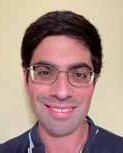
David Ostrowsky
Elle Kaufmann, Georgia’s firstever four-time female wrestling state champion and one of the greatest athletes to ever grace Lovett
High, is now eyeing her next exhilarating adventure: the United States Military Academy at West Point, N.Y. The soonto-be graduating senior from Lovett last week accepted a formal offer from the prestigious institution, which will likely secure her spot on the Army women’s club wrestling team.
Though Kaufmann had options for wrestling at the varsity level for multiple Division I programs (Army does not have a women’s varsity wrestling team), the opportunity to enroll at West Point as a pathway to serving her country one day was too enticing to pass up.
“My focus has always been West Point,” shared Kaufmann, who was also featured in the AJT last year after she secured her then-third straight state wrestling title. “I’ve always kind of been indoctrinated in the military life, especially growing up in a time when the U.S. was actively in a war. A lot of my coaches and a lot of my mentors are actually veterans. I’ve always idolized them because they’re the people who taught me how to be what I am today.”
At times, it may be difficult for Kaufmann, as one of the country’s most accomplished high school wrestlers, to not compete at the highest level possible. But despite her inimitable devotion to the mat in her Lovett career — as an upperclassman over the past couple winters she reeled off victories while battling a series of illnesses and injuries — the prospect of being a West Point cadet took precedence over everything else the moment she toured the school’s sprawling emerald Hudson Valley campus.
“The goal has never been for me to wrestle in college, although I would love to wrestle in college. The goal has always been to get the best education I can and see what comes afterwards,” said Kaufmann, who intends to study law at West Point. “Wrestling, unfortunately, can’t be my life forever.”
Military service is a popular destination for amateur wrestlers. The sport requires relentless sacrifice, tremendous

willpower, and unswerving consistency — all requisites for a successful military career.
“I think combat sports in general have a lot of parallels to the military, because of just how that lifestyle is,” added Kaufmann, who by her estimation would spend 12 hours wrestling and studying every day during the season. “It’s not easy. The amount of discipline you have to have to be in the military — somewhat of the same amount is required for any given combat sport. Wrestling, especially I think, you get some of the most disciplined and hardest-working people. Which is why so many wrestlers go into the military life.
“Wrestling is one of these weird sports where it can be both an individual sport and a team sport. When you’re on the mat, you know that whatever happens, win or lose, it’s all on you. [In military life] you have to be on top of everything and you know that if something goes wrong, it’s on you as much as it is on everybody else. It’s frankly mostly on you.
“When you’re wrestling on the mat,
you’re not just representing yourself. You’re representing your coaches. You’re representing everybody who’s pushed you to this moment so that you can succeed. For me, when I go out on the mat during the high school season, I’m representing the Lovett team. That’s why it’s a team sport.”
Looking ahead, the Army women’s club wrestling team will surely present imposing challenges. Kaufmann will practice and compete against other elite and seasoned wrestlers who are in out-of-this-world physical shape. And then, there’s the time commitment. No stranger to a jampacked day spent exclusively on the mat and in the classroom, Kaufmann is bracing for juggling a rigorous academic courseload with not just wrestling commitments but everything else the academy requires of its cadets. Meanwhile, there could be wrestling beyond her undergrad years at West Point: Should Kaufmann join the military after graduation, she could wrestle for the U.S. military in the World Class Athlete Program (WCAP), which allows soldierathletes to perform on the global stage
— some even advance to the Olympics — while concurrently serving their nation in the military.
But wherever her wrestling journey takes her — for starters, in New York’s bucolic Hudson Valley and perhaps beyond — Kaufmann was truly a trailblazer for women’s wrestling throughout Georgia as her remarkable legacy promises to inspire generations of female athletes who want to push boundaries in the arena. And from a personal perspective, the past several winters will forever represent a formative influence on her life.
“Nothing will ever compare to that first state title, being a freshman coming on the scene with nobody really knowing who I was. It felt a lot different. Now it’s more melancholy, just thinking about all the seasons I’ve gone through, all the teammates that I’ve had, and all the previous seniors that I’ve looked up to for all these years. Now, I am one and it just kind of feels weird that it’s coming to an end.”
As for the next chapter of her life and wrestling career, one that will unfold at West Point, Kaufmann says simply but firmly, “I think I’ll love it there.” ì
By David Ostrowsky
Throughout his long and fascinating life, Barry Benator has always pushed himself to the limit.
When the longtime Dunwoody resident, now 81, was an undergrad student at Georgia Tech in the late 1960s, he wasn’t satisfied with enrolling in Reserve Officers’ Training Corps (ROTC) program for the required two years; he had to stretch it to four to secure the much-coveted Navy ROTC scholarship. Later, as he and his wife settled down to start a family, Benator wasn’t deterred from serving his country as a midshipman, stationed in a submarine for days on end, thousands of miles away from Atlanta.
And when he decided active duty was no longer compatible with raising young children, Benator stayed true to his Navy roots by joining the Naval Reserves, for which he served over the next 24 years. Even after leaving the Navy, Benator has continued serving others by voluntarily piloting ill and injured patients who lack adequate financial resources to and from their treatment centers.
So, perhaps, it shouldn’t come as a surprise to anyone that Benator decided to keep playing in the Marcus Jewish Community Center of Atlanta (MJCCA) recreational men’s basketball league well into his 80s before finally deciding to step aside last month. Though Benator’s the first to acknowledge that his quartercentury-long career pales in comparison to that of his younger brother, Gene’s, legendary MJCCA softball run, the elder Benator was a widely respected fixture in JCC rec league basketball, both at the former facility in East Cobb and the current one on Tilly Mill Road, ever since he took the court as a 58-year-old in a men’s 40plus league. As a fitting recognition of his perseverance and decades-long devotion to JCC basketball, his current team recently held a thoughtful retirement party that started with a gathering at PDK Airport showcasing the plane Benator pilots for angel medical transports and ended with a pizza lunch at a local restaurant.
It wasn’t an easy decision to call it quits, but it was undeniably the right one. Or, as he would quote Clint Eastwood to his teammates, “A man’s got to know his limitations.”
“Even in the 50-plus league, I found that I was going very slow compared to the others,” explained Benator when speaking to the AJT earlier this month. “And I was concerned because I was going slow, that I may cause injury to
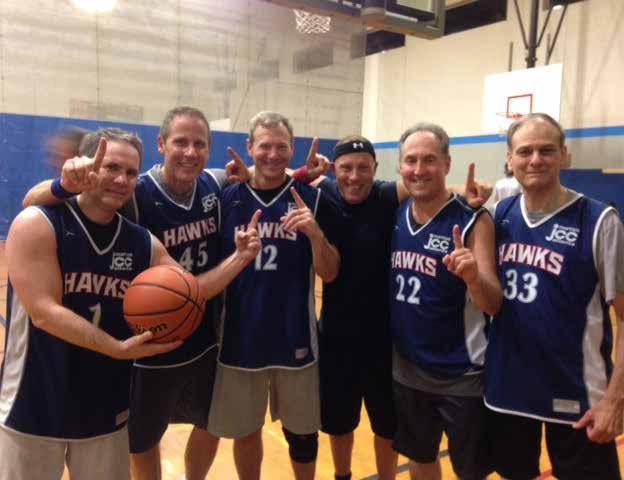
people behind me that altered their steps in order to avoid hurting me. I’m sorry I had to stop, because I just couldn’t move around well enough at my age.”
When revisiting his decades-long JCC hoops career, the elder Benator maintains a refreshing, self-deprecating sense of humor, fully acknowledging the considerable age gap between him and most of his teammates. “I was usually the oldest and slowest guy out there. So, my teammates pretty much carried us, and I contributed where I could.”
A solid two-way player who primarily operated on the perimeter and acquired the moniker “Iso” because of his penchant for scoring when he was isolated against a defender, Benator was a member of several teams that came in first in their respective divisions at both the East Cobb- and Atlanta-based gymnasiums. But the fondest memories that Barry carries with him into retirement — and he will still attend games as a fan when he’s not playing his new sport, pickleball, with his son — are not necessarily those of hoisting trophies with
his teammates (the most recent of which occurred in 2015), but rather those of playing under the watchful eye of little brother, Gene, who officiated many of his games.
“He [Gene] really is a great referee. He showed me no favor, I can tell you that,” pointed out Benator, who also played JCC softball, but did eventually step aside after dealing with the injury bug one too many times.
For Barry, personally, joining a men’s basketball league as a middleaged man and continuing to play for a quarter-century was a testament to his lifelong passion for basketball, which he developed in pick-up games growing up and intramurals with his Georgia Tech fraternity but was at one point hindered from pursuing.
Indeed, his basketball playing days were abruptly interrupted by his Naval duties and although he has absolutely zero regrets in how his Navy career panned out, the lack of recreational sports — and in particular basketball — was a loss of sorts.
“In the Navy on submarines, you’re at sea 70 percent of the time, so we didn’t have time to play a lot of sports,” added Benator. “We were always focused on the mission, which is to defend the country.”
In joining the JCC basketball circuit, Benator was able to find fulfillment. And by playing into his eighth decade, he has been a role model to younger generations of players: Age is just a relative construct and if you really love something, your birth certificate doesn’t have to dictate when it’s time to walk away.
“Basketball players, including the most athletic, usually hang up their basketball shoes long before their 70s,” said David Soloway, a stalwart of JCC men’s basketball and one-time commissioner of the JCC’s over-40 half-court basketball league. “Barry’s basketball endurance into his 80s has been an inspiration to many, including me. Sometimes when teenagers have watched the older guys play basketball, I’ve pointed out Barry and said he’s in his 80s; their responses to that verge on expressions of awe!” ì
On Sunday, March 22, Mem Global, the leading innovator in young adult Jewish community building, dedicated the three Atlanta Moishe Houses in memory of Rabbi Alvin M. Sugarman z”l, made possible through the support of the Marcus Foundation. During this intimate gathering at the Moishe House in Toco Hills, attendees celebrated the extraordinary impact Rabbi Sugarman had on Jewish life in Atlanta, Santa Barbara and beyond, including the pivotal role he played in bringing Moishe House to Atlanta in 2013. The Atlanta Moishe House community quite literally exists because Rabbi Sugarman believed it could, and current Moishe House residents, alumni, community partners, and members of the Sugarman family enjoyed an evening filled with reflection and gratitude.
The program included a moving tribute to Rabbi Sugarman’s decades of leadership at The Temple, his pioneering work in inclusion and interfaith partnership, and his vision for nurturing the Jewish future. Speakers shared personal stories about the ways Rabbi Sugarman shaped their lives, with special reflections from Mem Global
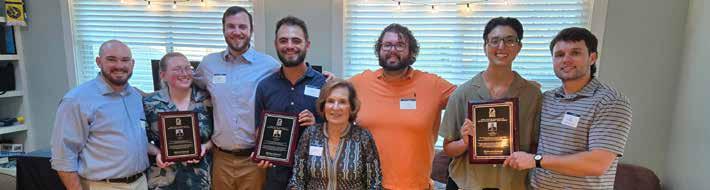
Founder & CEO David Cygielman, Moishe House residents and community members, and tribute videos from people across the country who were connected to both Mem Global and Rabbi Sugarman.
A particularly meaningful moment came when Jacqueline Morris, granddaughter of Bernie Marcus z”l and a past participant in the Moishe House community, shared her own connection to Rabbi Sugarman and the Sugarman family. She recalled how he officiated her baby naming but had retired before her bat mitzvah, so she was deeply moved when Rab-
bi Peter Berg invited Rabbi Sugarman to join him under the chuppah at her wedding, held at The Temple in 2023.
In addition to a plaque dedication, the evening marked the launch of the new Rabbi Alvin M. Sugarman z”l Jewish Learning Series, which will rotate monthly through the three Atlanta Moishe Houses. The Moishe House residents will select the topics and partner with local rabbis to lead discussions and learning sessions for young adults across Atlanta. This initiative brings Rabbi Sugarman’s love of Torah, curiosity, and in-
clusive Jewish community to life.
The night concluded with the unveiling of the dedication plaque and a heartfelt reminder of Rabbi Sugarman’s guiding words from our sacred texts: veyehe bracha, “Be thou a blessing.”
Through the young adults who will continue to gather, learn, lead and build Jewish community in these Moishe Houses, which now bear his name, Rabbi Sugarman’s blessing continues for future generations.
Compiled by AJT Staff
The Hadassah Foundation, a nonprofit 501(c)(3) foundation, is a national United States-based organization with an international grant focus. It was established by Hadassah, The Women’s Zionist Organization of America, in 1998. The Foundation leads the movement to revolutionize the role, perception, and impact of women and girls. It seeks to refocus the priorities concerning women and girls through creative grantmaking. Hadassah believes that advancing gender equity in Israel and the United States through collective funding, relationship building and education, will foster lasting change. The Hadassah Foundation’s mission can be explained with three words: justice, equity, change.
Terry Nordin, president of Hadassah Greater Atlanta, proudly announced, “We are thrilled that Lisa Haynor, a resident of Sandy Springs, was invited to be a member of the National Hadassah Foundation Board. Lisa is a tireless volunteer who has served in various positions and on several boards in Atlanta, including the Jewish Federation of Greater Atlanta, The Davis Academy, Jewish HomeLife, and the Jewish Women’s Fund of Atlanta. She is a retired partner from Aprio Advisory Group.
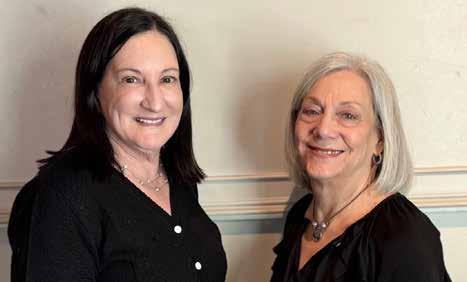
Terry Nordin (right), president of Hadassah Greater Atlanta, congratulates Lisa Haynor of Sandy Springs, on being selected as a board member to the prestigious Hadassah National Foundation which seeks to refocus priorities concerning women and girls through creative grantmaking.
Haynor explains, “I am honored to become a board member of the Hadassah Foundation. I am pleased to say that our programs and grants elevate and empower women and girls in leadership roles as we support organizations, initiatives, and bold ideas that create real and lasting social change.”
Recent 2026 Hadassah Foundation grants include The Dinah Project, a legal initiative dedicated to exposing, monitoring, and advancing criminal accountability for sexual violence perpetrated against women during the Oct. 7, 2023, attack and the subsequent period of captivity. Next, Kumi-SheRise is a
project of Amutat 51, Supersonas, and the Western Negev Regional Cluster that promotes grassroots women’s leadership to rehabilitate the Israeli communities most hurt by Oct. 7 and the ensuing war. Another grant recipient is Ma’at, the only Israeli organization that helps victims of web-based sex crimes by assisting them in identifying their offenders and pursuing appropriate legal action. Also, a multi-year Core Grant was given to QueenB, a non-profit organization focused on increasing female representation in the high-tech sector in Israel. It empowers young women to pursue computer science and engineering, with a focus on building confidence, not just technical skills.
The Hadassah Foundation has awarded over $12 million to more than 1200 organizations. It is a founding member of the Jewish Women’s Funding Network, which brings together the boards and staff of 18 Jewish women’s foundations. The mission of this network is to promote meaningful giving and to improve philanthropy in the Jewish world.”
Compiled by AJT Staff
Washington Institute for Near East Policy Senior Fellow Michael Eisenstadt shared deep expertise on Iran and the U.S.Israel relationship during a whirlwind visit to Atlanta on March 22 and 23.
Brought to town by the Center for Israel Education, Eisenstadt spoke to students online and in person at Emory Hillel, addressed Congregation Or Hadash members and others, then made a presentation to the community at The Dupree. In all, he met with more than 100 people.
Eisenstadt leads the Washington Institute’s Military and Security Studies Program, had multiple postings in the Middle East during 26 years in the U.S. Army Reserve, served as a U.S. government military analyst, and has written extensively about Iran.
His Emory Hillel and Dupree sessions focused on the history and future of the special U.S.-Israel relationship, which for the first time involves fighting a war together. The Or Hadash presentation, which was the annual Tillie and Max Stein Israel Lecture, examined the regional effects of the U.S.-Israel war against Iran, the Gaza war and the Israel-Hezbollah fighting in Lebanon.
Iran, which after its 1979 Islamic revolution had no superpower backer and only one regional ally, Syria, created its own regional Axis of Resistance “through patience, through perseverance, through tremendous resources invested,” Eisenstadt said at Or Hadash. “And just since Oct. 7, within just a couple of years, much of it has been destroyed.”
CIE President Ken Stein, a scholar who has spent more than half a century studying the modern Middle East, contributed his own analysis and expertise to each of the Eisenstadt appearances as they con-
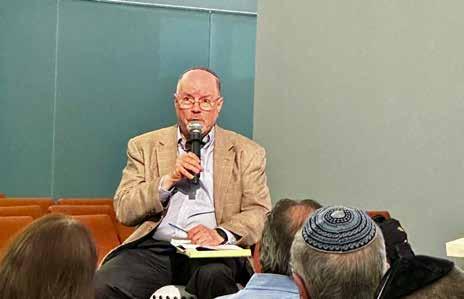

versed with attendees.
Before Oct. 7, 2023, “there was a sense that the U.S. was withdrawing from the Middle East. We were pivoting to Asia. There was a sense that American Jews were definitely distancing from Israel, and perhaps it was irreversible,” Stein told the Or Hadash crowd. “I think antisemitism, like anti-Zionism and anti-Israelism, has thrown American Jews back to one another, even if they don’t particularly like each other’s respective political parties, good, bad, indifferent.”
At The Dupree and for the student audience, Eisenstadt laid out the history of the U.S.-Israel relationship, which has broadly grown closer since the June 1967 Middle East war. The two countries’ cooperation has never been deeper than now. Eisenstadt showed that the military, intelligence, and economic value flows both ways.
But he and Stein warned that things could change if the current war goes badly, with potential effects on elections in Israel and the United States this fall.
“Wars always involve crapshoots and risks,” Eisenstadt said.
Eisenstadt’s Atlanta programs were free, thanks to CIE and the center’s supporters.
CIE is an Atlanta nonprofit with an international reach. The center is dedicated to educating a wide range of learners about modern Israel and its inherent role in Jewish peoplehood. Some of its resources are available through israeled.org; CIE+ members have full access to the site’s growing collection of more than 3,000 posts, as well as special webinars and other benefits.
Compiled by AJT Staff
The Jewish Community Relations Council of Atlanta (JCRC) will hold its quarterly Community Council at 8:30 a.m., Thursday, April 30, at Congregation Ohr HaTorah. The event will bring together a panel of community leaders, advocates, and healthcare leaders to examine food insecurity through a Jewish lens and explore constructive responses both in Atlanta and Israel.
The Community Council will focus not only on understanding the scope and impact of hunger, but also on identifying meaningful actions the Jewish community can take together.
JCRC of Atlanta serves as a common
table for the Atlanta Jewish community, convening individuals and organizations to discuss critical public policy issues and advocate for solutions grounded in Jewish values.
JCRC welcomes participation from anyone interested in lending their voice to help shape a communal response to this important issue.
Register at https://docs.google.com/ forms/d/e/1FAIpQLSdZxRf3zwsFK6cXX cs6iUjDqGh9iixbwL6JDpzYZvHlLWd9gg/ viewform; and visit www.atlantajcrc.org to learn more about JCRC’s work.
Compiled by AJT Staff






Temple













Repair the World’s National Days of Jewish Service will address addressing food access, immigration support, environmental care, and more.



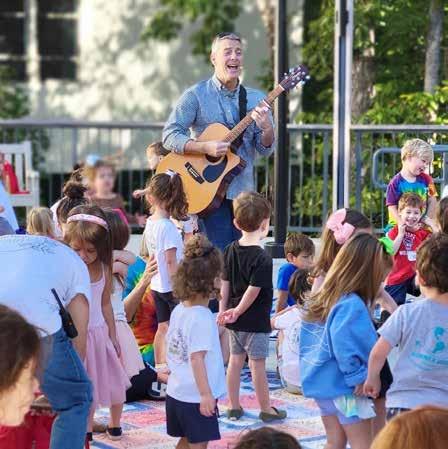
Throughout April, Repair the World’s National Days of Jewish Service (NDJS) spring activation will offer more than 500 volunteer opportunities nationwide, addressing food access, immigration support, environmental care, and more. Led by Repair’s Michael Kay Jewish Service Ambassadors, programming is organized around key April themes: Passover, Earth Day, Holocaust Remembrance, and National Volunteer Week.
“Passover is a time to ask how we can strengthen one another and meet the urgent needs of our communities,” said Melissa Levine, senior director of field activation at Repair the World “NDJS is how we turn that question into action. Coinciding with our Ambassador Blitz to power 500 ambassador-led programs by April 30, thousands of volunteers will show up across the country, building new relationships and addressing urgent local needs.”
Locally, Repair the World Atlanta will celebrate Earth Day with Adamah ATL. They will partner with Peachtree Creek
Greenway as they remove trash from the North Fork Peachtree Creek, which flows into the Chattahoochee River.
Repair the World’s NDJS three annual service activations centered around key moments throughout the year — offering the framework, funding, and tools to strengthen local communities and unite the global Jewish community. The first two NDJS centered on the Jewish High Holidays and MLK Day. Repair the World expects to reach 10,000 volunteers across the three activations.
“Every year at Passover, we retell the story of what it means to be freed — and every year, that story asks something of us,” said Levine “Jewish service ambassadors answer this call as leaders on the ground, building partnerships with local nonprofits and engaging thousands of young adults in meaningful service rooted in Jewish values.”
To learn more or get involved, visit werepair.org/get-involved/campaign/ndjs/.
Compiled by AJT Staff
Atlanta is chocked full of interesting “movers and shakers” - some bent on creativity, empire building, activism and/or just plain having fun and living the good life. Lean in to hear some of the “off the cuff” remarks as to what makes Atlanta businessman, Emanuel Fialkow, tick. Born in an industrial area south of Chicago, Fialkow moved to Atlanta and Ellicott City, Md., while his father worked for Coca-Cola. At 15, he found himself taped to a one-inch-thick oak board in a helicopter headed to the University of Maryland Shock Trauma Center, a moment that made him pause, pray, and realize he’s “not an atheist after all.”
His education took him through Johns Hopkins, Emory, Georgetown (master of professional studies in real estate). Currently, Fialkow is a student at Vanderbilt pursuing a doctor of education in leadership and learning in organizations. This is all built on a public-school foundation. A decision not to pursue medical school (having studied philosophy and art history) pushed him into starting and buying janitorial and maintenance companies, which eventually grew to more than 140 team members. That journey led him to Asher Benator and his brothers, whose early support helped him purchase his first office building.
Over time, and with wife, Stacy (aka “Sunshine”), alongside, he found his way into office and retail real estate investing. If you see Fialkow along the road in his long johns, here’s why.
One thing I’ve learned about real estate is …
I still haven’t figured it out. When everyone is buying property, I seem to be selling; and when everyone is selling, I seem to be buying. Hopefully, one day I’ll get it right and catch up.
My wife says that I’m too sexy for my shirt, pants, and boots; my kids say that I am too hard on them. Maybe one is right?
As a doctoral student, it’s not uncommon for me to be reading three to five studies/articles a week with written evaluations; plus, Adam Grant’s “Think Again,” Sheryl Sandberg’s “Lean In,” George Washington’s “Rules of Civility,” and “Leviticus” (I have an upcoming Torah reading to prepare).
Probably Cuba - stepping into a time machine with better music. Every corner felt like a movie set from seven different decades at once.
Best advice my dad gave me …
At age 8, my dad showed me how to whistle by holding a piece of grass between my thumbs. After a poorly chosen blade of grass experiment, this gave me two life rules: don’t eat yellow snow and don’t trust grass near dogs. It’s amazing how broadly applicable that advice has
One thing people do not know about me …
I was the first “janitor” at the Selig Center until getting fired. These days I’ve upgraded to dodging livestock droppings at the ranch … same theme, bigger scale.
My last fashion disaster was … I popped a snap on my overalls during a cattle feeding session, turned into a full-on catch pen escape mission. I finished the day driving home in nothing but my long
My first job was …
Filling bubble gum machines in the afternoon and washing dishes at a local steak/ salad joint in the evenings. In high school, everyone had two to three jobs. It wasn’t ambition, it was a combination of social structure and the only way to get spending money.
If they made a movie about your life, who would play you?
Any of my sons would play the younger scenes for realism; Georgia Sen. Russ Goodman during the middle years, because he can sing my favorite Elvis song, and Billy Bob Thornton would play me in older years.
The last time I danced …
New Year’s Eve wedding in Beacon, N.Y. It was snowing and so cold that the icicles hanging from my tux still haven’t melted – great time though! ì
Reported by Marcia Caller Jaffe

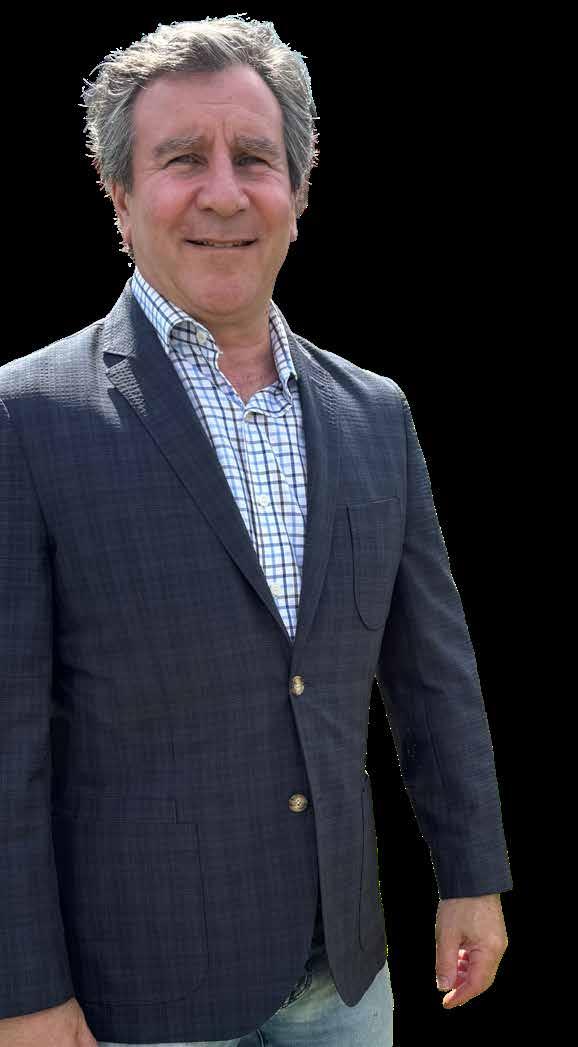

For those slogging their way through that multibox package of matzah you purchased for Passover, I am with you. I expect to be eating matzah brei well into May.
Next year’s first seder will be the evening of April 21, 2027. That date is easily remembered, for me anyway.
Our wedding anniversary (41, thank you) is April 20.
April 21 is the anniversary of my 2023 “widowmaker” heart attack. As that anniversary nears, memories of that day arise frequently. There are moments when I marvel that I am still here. Let’s just say that I was fortunate and leave aside the details.
Passover this year fell a little more than four weeks into the ongoing American and Israeli war with Iran.
As we prepared for our seder in Atlanta, I messaged a friend in Tel Aviv, with a remembrance of a seder 40 years ago at his in-laws’ home in Jerusalem.
“We did not have a seder this year, as we thought it was too risky considering the situation to drive
up to Jerusalem,” he replied. “But between multiple sirens (seven this evening, alone, after three this morning) and trips to the bomb shelter we were able to sit down in our actual dining room for a tremendously good dinner cooked by [his daughter].”
In early March, in an Atlanta tavern full of people trying to be heard over the music as a band played, a Jewish acquaintance asked, just loud enough so that I could hear, whether I thought Jewish Americans would be blamed for the U.S. going to war with Israel against Iran.
I since have been asked the question several times more. I wonder whether, for each of those who have spoken to me — in relatively hushed tones, as if taking care not to be overheard — how many more Jewish Americans have had the same thoughts.
They worry that, the longer the war goes on, and the higher gasoline prices climb, and the more that shipping constraints impact the prices of other goods — and particularly if U.S. casualties rise — blame directed toward Israel could, by extension, affect Jewish communities in this country.
“Operation Epic Fury,” as it is named, began Feb. 28. As of this writing, U.S. casualties total some 380 wounded and 13 killed.
Several thousand U.S. Marines and Army soldiers remain in the region for potential “boots on the

Theme
Week 1: Fun in the Sun
Week 2: Ocean Exploration
Week 3: 4 Mothers, 3 Fathers, & my Daddy
Week 4: Animal Adventure
Week 5: Rocking in the USA
Friday, July 3 - No Camp
Week 6: Science, Nature, & Space
Week 7: Jr. Culinary Week
Week 8: Dance and Sport
Week 9: Under the Big Top Circus

ground” action.
Voices on social media promote the idea that the president of the United States, commander-inchief of the most potent military in the history of the world, has been played and deployed U.S. forces at the bidding of the prime minister of Israel.
(The New York Times recent account of the Feb. 11 White House meeting between President Donald Trump and Prime Minister Benjamin Netanyahu, at which the Israeli reportedly made a persuasive case to the American for war, does little to tamp down such thinking.)
I offer this, from one of those voices: “You’re either for Israel or for America. They’re not an ally. They’re a foreign country bleeding us dry. They’ve taken hundreds of billions from us, they’ve driven us into disastrous wars, including this one. They want to use our military and treasury until we have nothing left.”
By this reasoning, Jewish Americans own a share of the blame for the war unless they renounce any affiliation, affinity, or affection for Israel (never mind how much or how vociferously they oppose the current Israeli government).
Historian Dominic Green sounded an alarm about this rhetoric in a March 31 article written for the Jewish Chronicle, the leading Jewish newspaper in the United Kingdom, headlined, “The ‘stab in the back’ myth to blame Jews if the war goes badly.”
Green wrote: “A global influence campaign, emanating from America’s enemies and exploited for partisan motives, is being used to split the U.S.-Israel alliance, and shove Trump aside.”

Dates
June 1 - 5
June 8 - 12
June 15 - 19
June 22 - 26
June 29 - July 2
July 6 - 10
July 13 - 17
July 20 - 24
July 27 - July 31
We are accepting infants to rising First/Second Graders
Please see www morahcarolsplace com or call 470-659-5484 for more information
Available hours: Monday - Thursday, 8:00 am - 6pm Friday - 8:00am - 4pm

He raised the specter of “an American ‘Dolchstosslegende’, the myth that claimed Germany lost the First World War through a ‘stab in the back.’” The accusation was that Germany was betrayed by communists, socialists, and . . . yes, Jews.
I was struck by two sentences from an article that Erik Ward published on his Substack in midMarch, about Zionism, Israel, and antisemitism, primarily as related to Israel’s war in Gaza after the Oct. 7, 2023, Hamas-led terror attacks in kibbutzim, towns, and an outdoor music festival in southern Israel.
“We do not hold entire peoples responsible for the actions of states. We do not collapse identities into governments,” Ward wrote.
Jewish Americans are familiar with this phenomenon. During the war in Gaza, anti-Israel protests in this country saw Jewish individuals threatened and assaulted, and businesses and institutions the victims of mob violence. More recently, quick thinking by security personnel averted a potential tragedy when a man, angered by Israeli airstrikes against Hezbollah, an Iranian proxy in Lebanon, drove a car into a Michigan synagogue where 140 children were in daycare.
As the U.S. and Israel remain at war against Iran, such expressions of anti-Israel sentiment are what worry the Jewish Americans who spoke to me in hushed tones. ì

Thirtythree years had passed since I last stepped foot inside the hallowed halls of Congregation Beth Shalom. That all changed on March 29 when I attended “Bridges of Hope: Standing Together for a Better Tomorrow,” an emotionally charged, spiritually engaging event hosted by the Atlanta Israel Coalition.
The lineup of performers was incredibly diverse, including a comedian (Tehran Von Gharsi), vocalist (Ghazal Mizrahi), activist (Surinder Dhar), advocate (Mustapha Ezzarghani), and Holocaust survivor (George Rishfeld). It was more than a concert. It was more than a stand-up show. It was more than advocating for unity and raising awareness about the horrors of the Holocaust. It was all of those things and more.
The group of attendees was also just as diverse, with all sects of Judaism represented, as well as a family of Orthodox Haitian Jews.
And there was an open bar – so that’s always nice.
As I sat in Beth Shalom’s sanctuary for the first time in more than three decades, I was overcome with emotion and nostalgia. I harkened back to the Friday nights when our Hebrew school bar mitzvah class would lead services, and to the Saturday mornings gathered in the social hall, enjoying a kiddush after services.
So much had changed and yet it all felt so familiar.
As I mozied through the social hall, I retraced steps I hadn’t walked in ages. I marveled at the synagogue’s growth as I drank another glass of Cabernet.
The event’s theme called for unity and that’s exactly what it felt like mingling with
guests. Everyone was warm, welcoming, and available to receive the evening’s mes sage.
Von Gharsi, who served as the emcee, had the crowd in tears with his set, especial ly the bit where he leaned into his identity. Von Gharsi noted that not only is he a Black Jew, but he is also half-Iranian … and his par ents named him Tehran.

Mizrahi has the voice of an angel and vocalized a medley of songs that rang over the sanctuary, leaving the crowd in awe.
Other performers included JoDavi, a soul composer and recording artist, who also serves as director of the Institute for Black Solidarity with Israel; and Caleiv Jean, a hip-hop producer from Haiti who converted to Orthodox Judaism.
The evening bled solidarity and the unifying vibes were magnetic. I made new friends. I reconnected with old ones. And I left feeling gratified that I attended and inspired for the future.
They say you can’t go home again … that’s not entirely true.
Congregation Beth Shalom was the first synagogue my family joined when I was a child. While Zaban and Camp Barney were my first Jewish play-places, Beth Shalom was my first Jewish home. It’s where I learned Hebrew. It’s where I learned how to pray. It’s where I learned how to be Jewish.
And 33 years after my last appearance (my bar mitzvah), the community of Beth Shalom is stronger than ever. They recently held a tribute gala to honor the service and dedication of Rabbi Mark Zimmerman and his wife, Rebbetzin Linda Zimmerman. Rabbi Zimmerman has announced his plan to retire after leading the congregation for 38 years; however, he will remain as Rabbi Emeritus and will assist in the temple’s search for a new rabbi.
The call for unity that night was answered. Spirits were nourished and uplifted.
I let the wave of nostalgia wash over me one last time before exiting the synagogue.
What a beautiful evening. ì



Spring is a time to refresh, renew, and look ahead. Thoughtful estate planning does the same. Protect the people you love and secure the legacy you leave behind





Rabbi Chaim Neiditch, Orthodox
Rabbi Chaim Neiditch is the Executive Director and founder of the Jewish Student Union of Atlanta and is in his 30th year working with Jewish teens across the greater Atlanta area. He previously ran Atlanta’s Jewish Teen Center, served as regional director for NCSY Southern Region and Atlanta Region, and served on the Presidential Advisory Council of the Jewish Federation of Greater Atlanta. He is the winner of the Marcus Foundation and Jewish Federation’s, “Shark Tank.” He has been named to Atlanta Jewish Times’ 40 Under 40, founded the JSU GO Israel Adventure program for Jewish high school students, and recently testified in front of the Georgia Senate to help pass GA HB-30, the state’s first Antisemitism Hate Crime Bill.

Rabbi Laurence Rosenthal, Conservative Rabbi Laurence Rosenthal is the senior rabbi at Ahavath Achim Synagogue. Rabbi Rosenthal grew up in Los Angeles, graduating from the University of Southern California in Los Angeles, eventually earning a Master of Arts degree in Hebrew Letters and Rabbinic Ordination from the Ziegler School of Rabbinic Studies in May 2008 – after which he joined Ahavath Achim as an associate rabbi. In addition to his duties as senior rabbi, he also served as the president of the Atlanta Rabbinical Association (2019–2021) and is currently Board Chair for Georgia Interfaith Power and Light, inspiring faith-based organizations to take up the cause of environmental stewardship and justice.
In partnership with the Atlanta Rabbinical Association, the AJT's monthly Rabbi Roundtable brings together rabbis from across Atlanta representing each denomination.
Rabbi Menachem Wineberg, Chabad
Rabbi Mendy Wineberg directs Chabad of Dunwoody together with his wife, Sara. Originally from South Africa, Rabbi Wineberg studied in various parts of the U.S., eventually moving to New York where he received his rabbinic ordination. Answering the call of the Lubavitcher Rebbe to bring the light of Judaism to every corner of the globe, the Winebergs established Chabad of Dunwoody in 2022.
Rabbi Steven Rau, Reform Rabbi Steven H. Rau joined The Temple staff as Director of Lifelong Learning in 2002. He oversees The Temple’s Breman Education Center, Project Connect (youth engagement department), Tamid: A Lifetime of Jewish Learning (adult education), and the Weinberg Early Learning Center. Rabbi Rau is actively involved in the greater Jewish educational and rabbinic world, having served nationally as vice president of Varied Rabbinates of the Board of the Central Conference of American Rabbis (CCAR) and on the board of the Association of Reform Jewish Educators. Rabbi Rau is co-author of, “Everyone is Welcome: Creating a Culture of Inclusion in Congregational Schools,” published by URJ Press, and “What’s Mine is Yours: Jewish Learning for Adults of Diverse Abilities,” published by the Florence Melton School of Adult Jewish Learning.
For this month’s discussion, each rabbi was asked the following question:
How should Jewish education respond to increasing ideological diversity within the Jewish community?
Rabbi Laurence Rosenthal
Teach Your Children — And Learn Alongside Them
Judaism has never been afraid of argument. The Talmud enshrines minority opinions not as historical curiosities but as living wisdom. Beit Shammai and Beit Hillel disagreed fiercely, yet their disputes were declared machloket l’shem shamayim — sacred controversy pursued for heaven’s sake. We know this. We celebrate it.
But here is what keeps me up at night: our children are learning it, and their parents are not.
Walk into a Jewish day school, a Hebrew school classroom, a Jewish summer camp, or a USY meeting. You will find young Jews being taught to hold complexity, to wrestle with text, to honor disagreement. Jewish education, at its best, is forming a generation fluent in ideological humility.
Meanwhile, many of their parents are retreating — deeper into ideological silos, narrower in their definitions of who counts as a “real” Jew, more certain than ever about Israel, antisemitism, and the boundaries of Jewish community. The gap between what our children are learning and what their families are modeling grows wider every year.
The Torah does not tell us to outsource Jewish formation. V’shinantam l’vanecha — “you shall teach your children diligently” (Deuteronomy 6:7). The verb is second person singular. You. Not the rabbi. Not the Hebrew school teacher. You.
The most urgent response to ideological diversity is not a better curriculum. It is more family education — structured, intentional opportunities for children and their parents, grandparents, and extended family to learn together. When people wrestle with hard Jewish questions alongside people they love, disagreement becomes generative rather than divisive.
Our children are ready to have these conversations. The question is whether we will join them.
There is a well-known saying, “Two Jews, three opinions.” What may sound like a criticism of Jews is actually steeped in our tradition all the way back to Talmudic times. The term, Machloket L’shem Shamayim (or disagreement for the sake of heaven), teaches that constructive conflict can be aimed at discovering truth over winning. Beit Hillel and Beit Shammai’s Talmudic disputes have provided our people not only with understand of halacha (Jewish law) but also have modeled for us a basis for healthy debate towards finding a greater solution.
In the days following Oct. 7, we quickly learned that the Jewish community had a plethora of opinions on Israel’s response in the wake of the largest massacre of the Jewish people since the Shoah. Our teens and college students were confronted with hateful rhetoric and heightened antisemitism in their institutions’ hallways and on their campuses. Whether they were ardent Zionists deeply connected to their Judaism or they were questioning their own Jewish identities and connections to Israel, they were left on an island to fend for themselves not having been exposed to multiple perspectives in their Jewish education. As educators, we realized that we had failed our students by teaching Israel in a one-sided approach. Learning that their classmates understood Modern Israel’s founding from a completely different perspective caused many to question their beliefs and the teachers who taught them.
Despite our own feelings for Israel, we owe it to our teenagers to teach them the complexities of Israel and differing points of view so that they, too, can form their own opinions and connections to our homeland. For centuries, our people have used Machloket L’shem Shamayim to create greater understanding so long as there is a focus on truth, respectful dialog, and embracing multiple and often conflicting perspectives. So too, in our own ideological disagreements, we should work to maintain loving relationships with family members, friends, peers, and neighbors through our disagreements and perhaps even gain new perspectives and understandings for the sake of heaven.
We refer to the Torah as Torat Emet — the Torah of Truth. The word, emet, is formed from the first, middle, and last letters of the Hebrew alphabet, conveying that its truth is not momentary, but enduring — true across all times and in every age.
What this means for us in our quest to make Torah and Jewish education relevant in the modern age is not that we must look outside of Torah to supply new perspectives, but that we must learn how to uncover them within it.
We live in a world rich with new language, new frameworks, and new ways of understanding the human experience. These perspectives often feel novel and compelling. Yet, rather than seeing them as additions to Torah, they can be understood as expressions of ideas that Torah has always contained.
Modern psychology and science, for example, have given us powerful tools to understand behavior, growth, and wellbeing. What I have found is that the more one studies Torah, the more one recognizes these very ideas embedded within its teachings — sometimes in different language, but with striking depth and clarity.
The task of Jewish education, then, is not to graft external ideas onto Torah, but to reveal the richness already present within it.
If we can show our children that the ideas they are passionate about are already rooted in Torah, we give them a Judaism that is not only practiced, but deeply relevant and alive.
At a time when the Jewish community is experiencing increasing ideological diversity, the question is not whether Jewish education should respond, but how.
The answer begins with a simple truth: education only works when students are engaged. If students are not inspired, if what they are learning does not feel alive and relevant, even the most thoughtful messages will fall flat.
Today’s Jewish students are bright, curious, and exposed to a world of competing ideas. They are not satisfied with surface-level answers, they are searching for depth and meaning. That places a profound responsibility on educators.
First and foremost, educators must engage. Jewish education cannot feel like an obligation or a relic of the past. It must feel alive, sparking curiosity, inviting participation, and creating real connection. When students walk into a classroom or program, they should feel that something meaningful is happening.
This requires more than technique. It requires passion. When educators are energized by Judaism, its wisdom, values, and depth, that energy is contagious.
Judaism must be brought to life. It cannot remain abstract. It must be lived, through Shabbat meals, meaningful conversations, acts of kindness, leadership, authentic friendships, and helping teens develop a real personal relationship with G-d. That is where identity is formed.
At the same time, we must refocus on the essentials. Students need a strong foundation in our values, texts, history, and peoplehood. Our ideology should emerge from Torah, not the other way around. With that grounding, differences become more thoughtful and constructive.
Our role is not to tell students what to think, but to help them find their voice within Judaism, with Judaism as their guide and foundation.
The goal is not to eliminate diversity of thought. Debate has always been part of our tradition. The goal is to develop knowledgeable, passionate Jews who understand what they believe and engage respectfully with others.
If we focus on engagement, meaning, and essentials, ideological diversity will not weaken Jewish identity.
It will strengthen it. ì
By Robyn Spizman Gerson
At the young age of 12, Brooke Bluestein already has a keen sense of what it takes to start a business. Growing up in Atlanta, she attends The Davis Academy and is in sixth grade. This bright business owner launched her company with appearances at the Dunwoody Farmers Market, which debuted her business and from there, she’s on a path to progress. She also appeared at Brook Run Park on March 28 and she plans to appear once a month at local farmer’s markets.
Bluestein’s runaway best sellers include skillfully applied diamond-like bling on a variety of products with a thoughtfully executed detailed pricing strategy based on the cost of the item, time spent applying gems to create a design and a markup. Her creative works of art range from $7 to $30 and even though rainy weather can impact outdoor market appearances, her sales are steady.
Her business idea has been an instant hit, and she turned her artistic hobby into an opportunity with sales to prove the demand. Bluestein’s popular
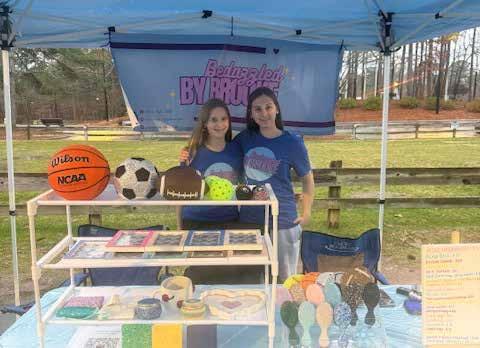

craft is tedious and includes covering objects with tiny, sparkly gems, often using special tools to adhere rhinestones to surfaces like journals, cases, hats, or
books to add glitter and create designs that pop.
In sharing a little about herself, Bluestein thoughtfully described her
life and said, “I live with my mom, Sheryl, dad, Greg, sister, Nicole, and my dog, Charlie.” In Brooke’s free time, she learned to master the skill of diamond

art which is the inspiration of her passion, adding pizzazz and a pop of rhinestone bling to items and transforming them into stylish and colorful creations.
She added, “I also enjoy being with friends, shopping, running track, and swimming. I love traveling to different places with my family. I have always loved doing arts and crafts and started when I was young by doing simple things like coloring and painting. When I was about eight years old, I learned about diamond art. Diamond art is a craft where you create a sparkling picture by placing tiny diamonds onto a sticky, color-coded canvas. I realized that I really liked it so I also then learned how to bedazzle other things that I could keep and use.”
While Bluestein’s other hobbies include competitive swimming, she swims at Dynamo about three to five times a week and enjoys swimming at competitions and swim meets. Bluestein is also on the track team at her school, where she competes in running events and the long jump. When asked about who her inspiration is, she shared, “The person who has probably inspired my creativity the most is my Bubbie (Lisa Karesh). She has always bought me different art and crafts kits that she thinks would be fun for me to try. I love doing the crafts that she gets for me and sometimes we work on them together.”
Bluestein said, “At the beginning of my bedazzling journey, I made hats for one of my mom’s friends. They were plain white hats with her business name on them. The name of her business is MyFriendMD, and I designed that on every hat. At first, each hat took me about eight hours to finish but as I practiced and got faster, I was able to finish them in about two hours. I earned $10 for each hat. By the time I stopped making them, I had made around 70 to 80 hats. I saved the money I earned and used some of it to help start my bedazzling business. One of my family friends, Sarah Siegel, helped me think about ways to sell my products. I wanted to sell them, but I had never thought about setting up a booth at the Dunwoody Farmers Market. Sarah and I talked about different ideas and farmers markets, and craft fairs came up. We emailed them, got accepted, and signed up for several.”
Bluestein’s favorite part of running the business is choosing the products to order for the next market. She likes doing this because she gets to decide what she will buy and bedazzle. This is an important part of preparing for the market. She commented, “The most popular items I sell are picture frames, mirrors and hairbrushes. I usually make about 12 of each for every farmer’s market, and they usually sell out. Those are also my personal favorites to make.”
While Bluestein’s business is off to a great start, when she grows up, she wants to be a surgeon. She shared, “I have wanted to be a surgeon since I was little because my grandma encouraged it and I want to help people. I think bedazzling could help me become a better surgeon because it helps improve fine motor skills. When I am older, I would like to become either a surgical oncologist or a plastic surgeon.”














































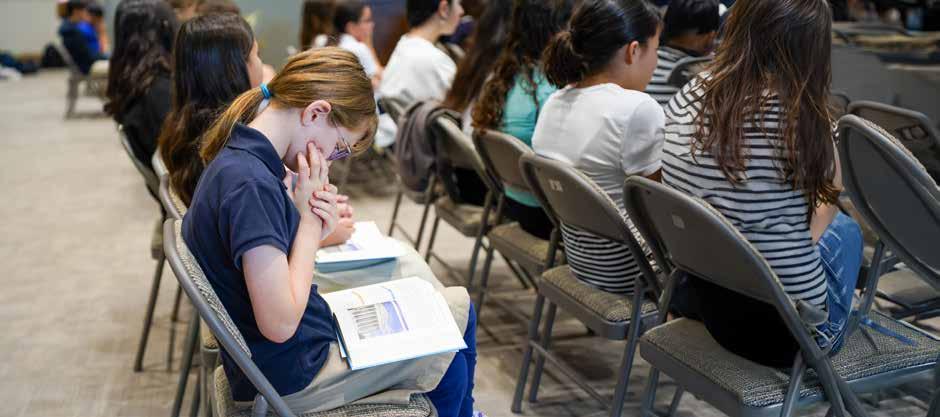
Whether Bluestein becomes an MD or entrepreneur, she’s off to a sparkling success. There is no doubt this soon-to-be-teenager will continue to dazzle. Look out for Brooke at the Dunwoody Farmers Markets and she can be reached for custom orders at sherylblue@ gmail.com. ì

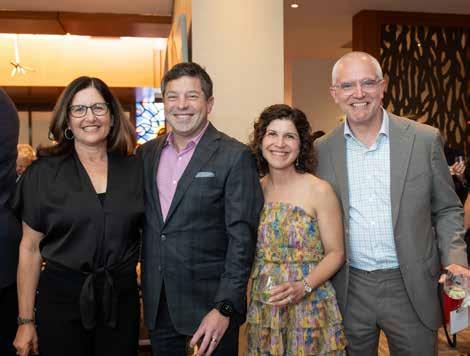
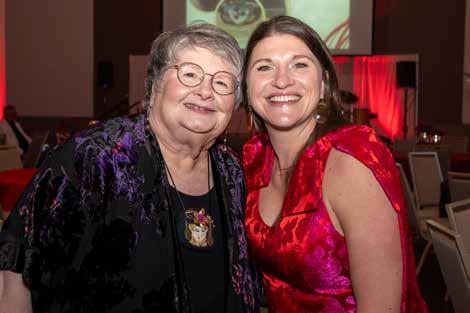
On Saturday, March 14, Temple Sinai hosted its annual celebration, a Ruby Gala celebrating the 40th anniversary of Temple Sinai Preschool while raising vital support for the synagogue and its programs. More than 350 guests gathered for an evening of celebration, community, and philanthropy, raising more than $230,000.
Inspired by the traditional ruby symbol of the 40th anniversary, the event space was transformed with ruby-hued flowers, lighting, and décor. Guests enjoyed lively entertainment from a live band, a silent auction, specialty cocktails and mocktails, and a curated dinner.
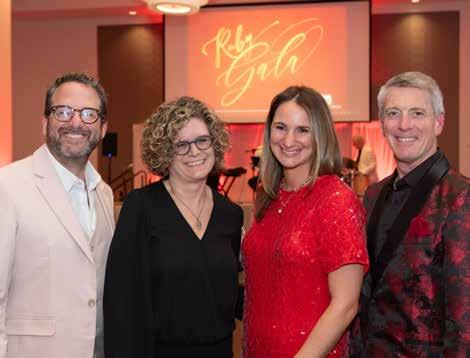

Event Chairs Linda Bachmann and Samantha Ellis welcomed guests throughout the evening, celebrating alongside preschool families, alumni, and teachers past and present as well as synagogue members, and community supporters. Notable leaders included Chuck Fox (Board President), Emily Webb (Board President-Elect), Jamah Maman, Temple Sinai’s director of early childhood learning & engagement, and Lauren Mahady (founder of Temple Sinai Preschool).
The evening included a meaningful program led by the Temple Sinai clergy team — Rabbis Ron Segal, Brad Levenberg, and Sam Trief, along with Bunzl
Family Cantorial Chair Beth Schafer — which marked the close of Shabbat and introduced a special video honoring 40 years of Temple Sinai Preschool and the generations of families it has served.
“When I think of Temple Sinai Preschool, I am hopeful.” said Rabbi Segal, Fellow Senior Rabbi at Temple Sinai. “Knowing the preschool began with 11 students and that we now have more than 170 young learners is a remarkable testament to the excellence of our Preschool — the leadership, teachers, curriculum, facilities, families, and more all combine to create a special learning environment that is quite magical. The fact that our preschool is flourishing
serves as an incredible foundation for our congregation, helping to ensure our continued strength and bright future for the generations to come. Marking the Temple Sinai Preschool’s 40th anniversary on Saturday evening was truly meaningful, and it was wonderful to celebrate the preschool together with so many people from our community.”
Fifth Third Bank served as the presenting sponsor for the gala, joined by more than 100 individuals, families, and corporate sponsors who helped make the evening possible. ì
Compiled by AJT Staff
By Alla Umanskiy
Atlanta’s Jewish community is celebrating a major milestone as local teen Zara Livits has been elected to an international leadership position within BBYO, the world’s leading pluralistic Jewish teen movement.
Livits was elected to serve as International Aym Ha’Chaverot, the International vice president of membership for BBG, the girls’ division of BBYO. BBG, which stands for B’nai B’rith Girls, operates alongside its brother organization, AZA, as one half of the BBYO Movement.
Her election took place at BBYO’s International Convention and was decided through a formal democratic vote. Approximately 400 teen delegates from regions across the United States and around the world participated. Each delegate represents thousands of members in their home region, making the role one of significant responsibility and trust.
“One of the defining characteristics of BBYO is that it is truly teen-led,” Livits explained. “Leaders at every level are elected by their peers rather than appointed by adults.”
As International Aym Ha’Chaverot, Livits is responsible for one of the Movement’s highest priorities: growth. She oversees and supports more than 50 regional membership leaders worldwide, providing training, strategic guidance, and resources to strengthen recruitment and retention systems. Her work focuses on ensuring that new members feel welcomed and that existing members remain engaged.
A key component of her portfolio includes strengthening BBYO’s recruitment framework, known as MRIHA,

which guides regions in identifying prospective members, building meaningful relationships, and helping them become active participants. She also collaborates closely with AZA’s International Moreh to align growth strategies across both divisions of the Movement.
In addition, Livits helps support BBYO’s Chapter Leadership Training Conference (CLTC), coordinating four, 12day summer sessions where teens learn how to lead chapters, plan programming, and build sustainable communities.
Founded in 1924, BBYO connects Jewish teens in more than 60 countries through leadership development, shared values, and global community. Teens plan events, manage budgets, run elections, and serve on boards at every level, while adults act as mentors. The structure gives young people real responsibility and real impact.
For Livits, the role represents a fullcircle moment.
“I joined BBYO in eighth grade looking for somewhere to belong,” she said. “Over time, I found mentors who believed in me and peers who pushed me outside my comfort zone. BBYO gave me a space where my voice mattered.”
Now, as an international leader, she hopes to ensure that thousands of teens worldwide experience that same sense of belonging.
“Membership is the foundation of everything we do,” Livits said. “Without strong membership, there is no programming, no leadership pipeline, and no long-term sustainability.”
Her election not only highlights her personal dedication but also underscores the strength and impact of Atlanta’s Jewish teen community on the global stage. ì



Torah Day School of Atlanta (TDSA) is marking its 40th anniversary year with both appreciation and anticipation. “It is thanks to the many communal investors that made TDSA’s 40 years possible – including the founders, lay leaders, faculty, parents, and donors and, of course, a significant amount of divine intervention,” shared Rabbi Meir Cohen, TDSA’s Head of School. “But we are not letting success lead to complacency. Torah Day School of Atlanta and the entire community of investors is continuing forward with a growth mindset while staying steadfast in our mission of understanding every child and seeking the best ways to reach each generation of students that enter into our ecosystem.”
To do so, TDSA launched its Build Our Future capital campaign a couple of years ago. It involves three pillars: cultivating teacher excellence, building a stunning outdoor experience, and an innovative and electric campus design.
With a generous pledge of $700,000 from the Aronov Foundation, the TDSA Foundation Inc. has established the Aaron and Marjorie Aronov Teacher Excellence


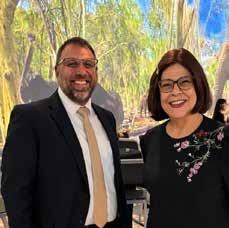
Fund (TEF). Proceeds from this endowment will be used toward faculty enrichment, including training and mentorship programs so that all TDSA teachers are experts at the student-centered approach to education which is the foundation of the school’s pedagogical philosophy.
“There is a direct correlation between TDSA’s success and the growth


and vitality of the Atlanta Jewish community. An empowered teaching staff is a core element in delivering this mission. The Aronov Foundation is committed to helping TDSA invest in its talented faculty through the Teacher Excellence Fund. We are honored to be part of TDSA’s short- and long-term, sustainable success at a critical point in the school’s history and hope to partner with the community to grow the endowment further,” comments Jake Aronov. According to Seth Bernstein, president of the TDSA Foundation, “Donors have identified with this need, and moving forward we see a real opportunity for growth of this fund to provide greater support to TDSA in this critical effort.”
TDSA has also made great progress toward the second component of the campaign to create an engaging outdoor experience. “Thirty-eight percent of our campus is unusable because of drainage issues,” explains Rabbi Cohen.
The Zalik Foundation generously provided a challenge grant to renovate the field and outdoor spaces. “Torah Day School of Atlanta plays a vital role in Jewish Atlanta, and its Toco Hills campus is an important anchor for both the school and the broader neighborhood. We are proud to help support the revitalization of the outdoor space, creating a place where TDSA students and the broader Toco Hills community can play, explore, and connect,” said Helen and David Zalik. The project will make the land usable by installing a new stormwater drainage system. The school has designed a stateof-the-art track and field and will create a one-of-a-kind playground in partnership with Israeli playground manufacturer Psagot. The playground will recreate the geography of the Land of Israel, using materials and equipment that bring the
Jewish homeland to life for TDSA’s students.
“I was involved from the start of TDSA. And even though my children are grown, the school remains essential to the success of the Atlanta Jewish community. That is why I agreed to co-chair this project,” shares Marsha Spector, cochair of the Build Our Future campaign. Together with co-chair Elizabeth Lieberman and their committee, they have succeeded in raising more than $3 million toward the project. “It is a real opportunity to create an inspiring campus for our children and a legacy for the future,” adds Lieberman. TDSA recently secured the necessary permitting from DeKalb County for this project and expects to break ground this spring.
“In thinking about TDSA’s 40-year history and plans for the future, we envision a campus that elicits a sense of pride and awe, designates specific areas by grade-level while creating a community feel through shared spaces and fluid learning environments both inside and outside the building,” a school official said.
At the 40th Anniversary Gala, Rabbi Cohen reflected that “Similar to the Purim story, our history, every step of the way, from our meager beginnings to finding a property in the heart of our community, to just getting our permit authorization for a new field and playground, has been predicated on hidden miracles.”
As TDSA’s community of lay leadership, faculty, volunteers, donors and parents come together to support Torah education, the school hopes it will continue to merit many more hidden miracles and prepare the next generation to find G-d in an ever-challenging world. ì
Compiled by AJT Staff

Atlanta-area families have plenty to celebrate as a new generation of innovators is making its mark at Georgia’s StateLevel Technology Competition.
Students from The Davis Academy recently competed against more than 1,000 participants from across the state, earning top honors in multiple categories and showcasing impressive creativity, curiosity, and problem-solving skills.
State Champions include:
• Noah Milrud and Adam Milrud | Physical Computing (Grades 5–6) – first place
• Brooks Cohen | Video Production (Grades 5–6) – first place
• Lena Halpern | Multimedia Applications (Grades 3–4) – first place
• Shane First and Beau Young | Digital Game Design (Grades 3–4) – first place
• Avital Wikoff | Animation (Grades 5–6)
– third place
The students’ success reflects both
their dedication and the strength of a learning environment that encourages exploration, innovation, and real-world application of skills.
Opportunities like the state competition allow students to take their ideas beyond the classroom and bring them to life on a larger stage.
The Davis Academy extends its appreciation to the faculty and Innovation Team for their guidance, as well as to all students who participated in the inhouse and regional competitions leading up to the state event.
These accomplishments are a source of pride for the school community and a testament to the exciting potential of young innovators in Atlanta. Kol Hakavod to these talented students for their outstanding achievements.ì
Compiled by AJT Staff



At a time when misinformation, polarization, and antisemitism are shaping campus life, Jewish student leadership carries heightened responsibility. Addressing student leaders from eight Georgia colleges and universities across the state, renowned speakers like Josh Levs (former CNN fact-checker and current journalist and author), challenged students to understand the broader impact of their leadership.
Levs told students, “A group like this can have a massive effect well beyond the Jewish community and well beyond any individual small community. I want you to understand what you’re up against … and how you all can become essential in the fight for truth.”
That message framed the second Leven-Silberman Leadership Institute (LSLI) Statewide Leadership Conference, hosted by Hillels of Georgia on Jan. 18–19 in Midtown Atlanta. The two-day gathering brought together close to 80 Jewish student leaders, campus professionals, and distinguished guests for an immersive experience focused on relationshipdriven leadership, belonging, and Jewish purpose.
Unlike traditional leadership conferences, LSLI is designed to return leadership development to its foundations. Through interactive learning, Jewish wisdom, skill-building, and peer and professional engagement, students explored how authentic relationships (not programs alone) sustain vibrant Jewish life on campus.
A defining feature of the conference was its four leadership tracks, each led by industry professionals and Jewish communal leaders who brought real-world expertise into the learning.
The Content Creators track focused on authentic Jewish storytelling and ethical digital presence. TikTok Creator, Chloe Hechter (@chloehecterr), who addressed creating Jewish content without reinforcing harmful antisemitic stereotypes, and Jewish creator, Alyssa Fagien (@atlbucketlist), guided students in creating authentic, values-aligned media.
In the Community Builders track, students learned how belonging is built through active listening and hospitality, with sessions led by Shelly Danz (Atlanta Party Connection) and Paige Simunek (Hillels of Georgia Chief Leadership Of-



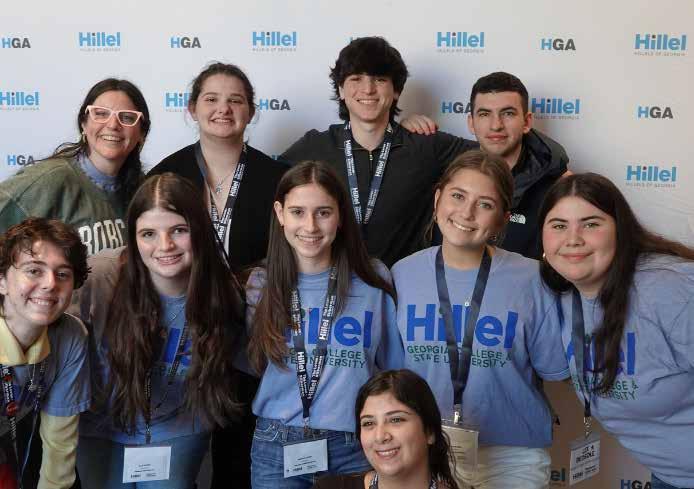
ficer), emphasizing relationship-based engagement as a leadership skill.
The Bridge-Builders track, led by Sara Slag of Repair the World, explored coalition-building and service as tools for strengthening Jewish presence across campus communities, including a hands-
in cultivating leaders who not only take initiative, but who know how to listen, build trust, and sustain vibrant Jewish communities.
Students also received practical professional training from Arthur Povlot, who led workshops on crafting and delivering effective elevator pitches; teaching students how best to articulate their values, leadership experiences, and goals with clarity and confidence.

A highlight of the weekend was the L’Dor V’Dor (From Generation to Generation) Networking Event, which connected students with Atlanta-area Jewish professionals — many of whom are alumni from Hillels of Georgia schools — for mentorship, career exploration, and networking opportunities. This event marks the launch of a larger Hillels of Georgia initiative providing career development for our students.
As students return to campuses across Georgia, they do so equipped not only with new skills, but with a renewed understanding that leadership rooted in relationships, integrity, and Jewish values has impact far beyond campus.
The Hillels of Georgia’s Leven-Silberman Leadership Institute January statewide conference was made possible by generous supporters, including LSLI co-founders, Mike and Andrea Leven and Mark and Linda Silberman; Jewish Federation of Greater Atlanta; and The Marcus Foundation.
For more information and to support future Jewish leaders, visit hillelsofgeorgia.org/lsli.ì


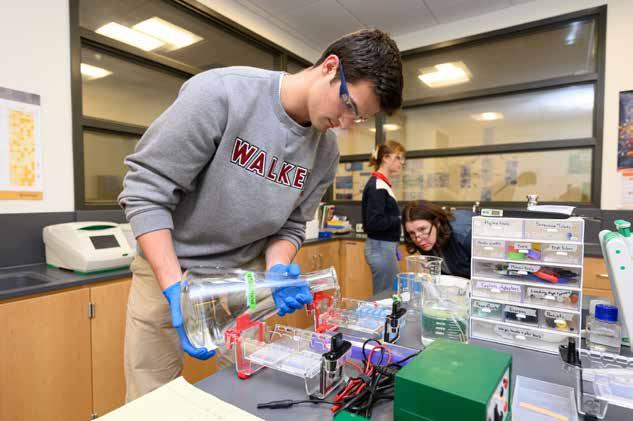

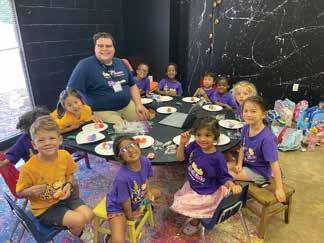
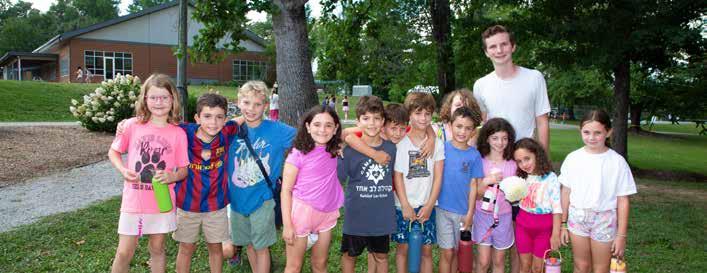
It’s never too early to start planning for summer vacation, especially when those plans involve summer camps. Below you’ll find a compilation of updates from your favorite summer day camps and sleepaway camps.
At Marcus Jewish Community Center of Atlanta (MJCCA) Day Camps, campers make lifelong friendships, try new activities, and have the best summer ever! The possibilities for an amazing summer are endless with theme, sports, performing arts, teen, and traditional camps for kids in rising pre-K through ninth grade.
Creativity shines across a wide range of experiences at the MJCCA’s Performing Arts camps. From new and dynamic dance camps like K-Pop Demon Hunters to set building and lighting design in technical theater to performing in this summer’s musical productions of “Annie,” and “Aladdin,” campers have so many wonderful opportunities to showcase their talents.
There are dozens of ways to pursue hobbies through theme camps at the MJCCA, with new camps added each summer. This year, campers can explore outer space in Space Cadets Camp, tackle obstacles in MrBeast Challenge Camp, and create your own software in App Innovators Camp. Plus, check out all the new places we’ll visit in All Around Atlanta Travel Camp!
At the MJCCA’s Sherry & Harry Maziar Sports Camps, athletes can enjoy traditional sports like baseball, basketball, soccer, flag football, tennis, and pickleball. This year, MJCCA Day Camps has leveled up the competition with adventurous camps like Superhero Sports Ad-
venture, Dude Perfect Sports Challenge, SportsCenter Broadcasting, Carnival Sports Extravaganza, Pickleball, Super Mario Sports Mania, Wrestling, and lots more.
Exciting outdoor adventures happen every day at Camp Isidore Alterman, MJCCA’s traditional camp. In addition to daily swimming in a gorgeous aquatic center, campers take aim on the archery range, climb to the top of the rock wall, fly on the exhilarating high-ropes course, and canoe on the lake or zip line across it.
MJCCA Day Camps also offers a multi-week discount, before-camp and after-camp care, and bus transportation from cities across the metro area. Learn more and register at mjccadaycamps.org.
Ramah Darom’s 30th anniversary is here, and the camp is ready to celebrate. Each session will feature a birthday party filled with fun surprises, and there will be a big festive July Fourth-themed Havdalah honoring 250 years of America. Campers will enjoy new Wet Willy slides, platform tents for campouts, and a special concert and educational programming with musicians from Israel. And there is much more in store. The camp will close its 30th summer by welcoming alumni and their families for a special Labor Day Weekend Shabbaton.
In the City Camps (ITC) is back for its 14th summer, running June 8 through July 31, at Atlanta Jewish Academy in Sandy Springs. Families can register by the week, making it easy to build a schedule that works for them. Before care, after care, and five bus routes are also avail-
able to help make camp accessible and convenient for families across Atlanta.
At ITC, campers don’t just follow a schedule — they create it. Through ITC’s signature “pick your own adventure” model, campers from rising pre-K through ninth grade choose their activities each day, from sports and creative arts to hands-on projects and off-campus adventures for tweens. It’s camp designed around what kids actually want to do, within a structured and supportive environment guided by experienced staff.
What truly makes ITC different is how it feels. ITC is a place where kids are known, included, and encouraged to be themselves. Through sports, arts, cooking, Oneg Shabbat, and shared camp experiences, campers build confidence, connection, and a strong sense of community.
Parents can feel confident knowing that safety and well-being are at the center of everything at ITC, from trained, caring staff to thoughtful systems that support every child socially and emotionally. Campers leave ITC with stronger friendships, greater confidence, and a true sense of belonging.
Registration is still open, and scholarships are available. To learn more or register, visit www.inthecitycamps. org or call 404-698-1134.
At Camp Barney Medintz (CBM), every summer builds on a legacy of connection, growth, and unforgettable experiences — and this year is no exception. Rooted in tradition but always evolving, Camp Barney continues to find thoughtful ways to enhance what makes camp
so special: strong friendships, meaningful moments, and the perfect amount of adventure.
This summer, several exciting additions are bringing fresh energy to camp in ways that feel both new and traditionally like “Our Summer Place.”
For families looking for more flexibility, the camp has introduced a new one-week Camp Barney Experience session in July for rising second and third graders. Previously only offered during the first session in June, this new option gives families greater choice in scheduling — while still delivering the same immersive, confidence-building introduction to overnight camp that younger campers need.
CBM is also launching a new puppy program that brings an extra layer of heart to camp life. Throughout the summer, puppies will spend time at camp, giving campers the opportunity to help care for them — learning responsibility, empathy, and compassion along the way. At the end of their time at camp, these puppies will be available for adoption, making the experience even more meaningful for campers and families alike.
And for a dose of high-flying fun, campers can take on the camp’s new waterfront inflatable — featuring a trapezestyle swing that adds an extra splash of excitement to the lake. It’s the kind of thrill that quickly becomes a favorite memory.
Each of these additions reflects the commitment to keeping camp thoughtful, engaging, and true to what makes Camp Barney so special — where the moments, the friendships, and the feeling of camp stay with you long after summer ends.
URJ Camp Coleman is welcoming summer 2026 with exciting enhancements, creative program expansions, and a deepened commitment to camper wellbeing while staying true to the community spirit that defines camp.
One of the most noticeable upgrades can be found along the shores of Lake Shalom. The beach area has been refreshed with a new sit wall that now runs the full length of the shoreline, offering campers a comfortable space to gather, relax, and cheer one another on. Adding even more lakefront excitement, Camp Coleman has replaced its largest inflatable with a bigger, better slide, making time on the water more thrilling than ever.

Indoors, the dance program received a major boost with the addition of an entire wall of mirrors in the dance room. This improvement enhances instruction and performance while giving campers more opportunities to explore movement, creativity, and self-expression.
Camp Coleman is also excited to introduce trapeze to its aerial circus program this summer. Campers will learn the art of trapeze in a safe, supportive environment that emphasizes trust, confidence-building, and personal growth.
Behind the scenes, Camp Coleman’s health and wellness teams continue to strengthen their integrated approach to camper care. Medical staff, mental health professionals, and wellness educators work collaboratively to support campers’ physical health, emotional wellbeing, and social development, ensuring that each camper is cared for as a whole person.
Finally, summer 2026 will capture the sounds of camp in a new way as campers record original music — alongside beloved community favorites — allowing the joy and energy of Camp Coleman to be shared all year long.
At Camp Judaea, we are always thinking about how to make each summer more meaningful, joyful, and engaging for our campers. While our core traditions remain at the heart of what makes
tion, grounded in our values and with the potential for meaningful, values-driven inter-camp connection.
We continue to strengthen our focus on the full camper experience and ensuring every camper feels seen, supported, and excited to be part of the CJ community.
Curious to see us in action? Join us for A Day at CJ. A one-day immersive, hands-on way to experience Camp Judaea this summer. Prospective campers spend the day participating in activities, meeting staff, and getting a true feel for CJ. It’s the perfect first step for families who want to try camp before committing to the full summer. Join us Sunday June 21 or July 19. More information at cjudaea.org/a-day-at-cj
6 Points Sports Academy
team has thoughtfully updated the menu to better match campers’ favorites and fuel their active days.
We can’t wait for another incredible summer.
Epstein Summer Adventure (ESA) Camp is bringing fresh energy to summer 2026, combining new programming, thoughtful scheduling, and trusted traditions to create an experience that continues to resonate with families year after year.
CJ so special, we’re excited to introduce new experiences and enhance programs to continue creating a dynamic environment where every camper can thrive.
Our days are intentionally designed to reflect our Kehilat Lev Echad, OneHearted Community, values, as we build a community grounded in kindness, respect, responsibility, and integrity. Campers don’t just learn these values, they practice what it means to be part of a caring, connected community.
This summer, we’re excited to introduce 9 Square in the Air, a fast-paced, high-energy game that’s sure to become a camp favorite, along with Water Tag, adding a fun and refreshing twist to our aquatics program.
We’re also expanding the Kibbutz, our animal program, with more animals and more opportunities for hands-on interaction. This popular area of camp continues to offer meaningful experiences that foster responsibility, connection, and curiosity. Campers love visiting the different animals and take full responsibility for their care.
In addition, we will continue to build upon our Kehilat Lev Echad, One Hearted Community initiative by rebranding our Premier League program as Ligat HaLev –League of the Heart, integrated into our Chuggim (electives). By participating in this Chug (elective), campers engage in team-based experiences that foster camp spirit, teamwork, and friendly competi-
Jewish. Sports. Camp. It’s who we are at our core. At 6 Points Sports Academy, elite athletic training meets meaningful Jewish experiences and the magic of summer camp. Each summer in Asheville, N.C., we bring together passionate campers, top-level coaches, and dedicated staff for six unforgettable weeks. With state-of-the-art facilities, athletes train in the sports they love while growing as individuals and connecting to Jewish values.
We’re always pushing forward — evolving, expanding, and listening to our community. As we prepare for our 17th summer, we’re excited to introduce new opportunities and enhancements across camp.
This year, we’re expanding our high school female-identifying community with the addition of a new mishpacha (family/dorm). The Tzfat Turtles will welcome rising tenth graders, reflecting the incredible growth and enthusiasm we’ve seen from our female-identifying campers.
Camp life at 6 Points is all about staying active. From the field to the court to the pool, campers are constantly moving, learning, and competing. In response to camper interest, we’re adding new electives like golf and continuing to create more opportunities for popular activities like pickleball. We’ve also upgraded our equipment and activities with additions like new gaga pits, 9-square, bucket golf, and paddle smash.
We’re also being more intentional with our schedule — reimagining programs like Israel Day, enhancing Shabbat experiences, and building in more time for rest and connection. New teambuilding activities will strengthen bonds within each mishpacha
And, of course, the food matters. Our
Running June 8 through June 26 at The Epstein School in Sandy Springs, this year’s three-week session is intentionally designed to balance structure and flexibility. Campers have the opportunity to fully engage — building friendships, developing skills, and exploring new interests — while families still have time for travel and summer plans beyond camp.
New offerings are adding excitement to this summer’s lineup. Programs like KPop Music Party introduce campers to global music and movement, while the new Summer Newscast program invites children to step into the role of reporters and producers, creating their own broadcast content. These additions reflect ESA Camp’s continued commitment to evolving with campers’ interests while keeping creativity at the forefront.
At the same time, the camp’s most beloved programs remain a strong foundation. Favorites such as Circus Camp, ESA Sports, Art and Cooking, Challenge Island, Chess with Shavi (Bash Chess), and Science continue to provide a balance of fun, creativity, and skill-building that families have come to expect.
ESA Camp is also continuing its partnership with Alliance Theatre Camp for a second year, bringing high-quality theater programming directly to campus across all three weeks — an opportunity that has quickly become a highlight for many campers.
Enrollment this year reflects the program’s strong reputation within the community. Many camps have already reached capacity, and the preschool program is close to full, underscoring families’ confidence in a safe, nurturing, and engaging environment.
With options ranging from oneweek sessions to the full three-week experience, as well as half-day and full-day formats, ESA Camp 2026 offers flexibility without compromising the depth of the experience.
For more information or to register, visit www.esacamp.org.ì
Compiled by AJT Staff
By Marcia Caller Jaffe
Sassy and sparkling artist, “glittery gal” Danielle Berke Weinstein, is particularly drawn to materials that catch and reflect light, because they bring movement and energy to her finished pieces.
She explained, “My work is whimsical, joyful, and highly textured. I primarily work with acrylic paint and mixed media, layering materials to create depth and visual interest. I incorporate glitter, gemstones, and reflective elements sourced from a variety of art supply and specialty stores.”
Texture is central to her work where she wants viewers to feel drawn in, not just by color, but by dimension and the way light interacts with the surface. She added, “Each piece is meant to feel uplifting and celebratory at first glance.”
Weinstein’s Judaica pieces are especially stand-outish. Her overall inspiration comes from nature, childhood nostalgia, and Judaism. Weinstein explained, “Judaica is a particularly meaningful part of my work. I’m drawn to the hamsa for its symbolism of protection, strength, and blessing. I also create pieces inspired by my Jewish identity and by Israel. These themes feel deeply personal, and creating Judaica allows me to express pride, connection, and continuity through art.”
Color plays a central role in her work. While Weinstein uses a broad palette, she’s especially drawn to rich jewel tones — deep blues, vibrant pinks, emerald greens, and purples. She chooses colors intuitively, sometimes guided by mood and symbolism rather than strict rules. Her method begins with preliminary drawings before moving to canvas. Planning gives her a framework, but once the painting begins, there is room for intuition and organic changes. A single piece typically takes between four to eight hours to complete, depending on the level of detail and layering involved, working on one piece at a time “to stay fully immersed in that creative world.”
Weinstein was born and raised in a suburb of Los Angeles, where creativity took center stage. She began taking formal fine art lessons at a private studio at the age of eight. She continued studying art outside of school and into college, gaining experience with a variety of media including pastels, watercolors, and oil paints.
She graduated from the University of California, Santa Cruz. After college, she earned a master’s degree in educa-
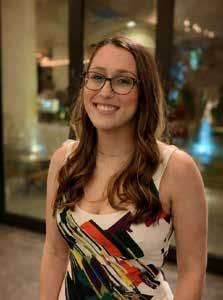
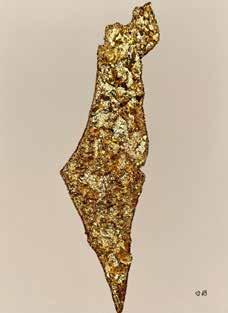

tion from California Lutheran University and went on to work as a middleschool science teacher for several years. She said, “Teaching deeply shaped how I think about process, experimentation, and curiosity — all of which influence my artwork.”
In addition to her art background, she worked as a graphic artist, creating educational clip art for teachers who design and sell science curriculum. That work allowed her to blend her background in science education with visual design.
She also works in her husband’s family business while raising three very


young children. Because of that, her art practice exists within the margins of a very full life, primarily at night and on weekends, carving out time. “That balance between structure and spontaneity mirrors my creative process,” she related.
From her home studio, Weinstein creates late at night when the house is quiet while listening to music. She concluded, “I’ve found that people are deeply drawn to artwork that reflects something personal to them — a place they call home, a school they love, or a meaningful connection. Creating the location and schoolbased pieces allows me to blend symbol-
ism with identity, turning familiar images into something celebratory and personal. Recently, I’ve created a painting of a map of Georgia as well as a UGA bulldog.” Find Weinstein on Instagram @ threehiddengemsart. She accepts commissions, and prices generally range from $125 to $350 depending on size and detail. Weinstein’s handles, “Three Hidden Gems,” are inspired by her daughters — a toddler and infant twins — who are “truly the gems of her life. Motherhood has deeply influenced my work, and each piece reflects the love, hope, and joy I feel for my girls,” she stated. ì
By Marcia Caller Jaffe
Artist Sara Schindel’s childhood in Athens, Ga., involved hours operating industrial sewing machines making handbags as part of her parents’ women’s sportswear company. She recalled that once she made a teepee that was 15 feet tall appliquéd with plant motifs.
This gritty and disciplined background made way for her work as a multimedia artist and painter known for sculptures and assemblages that explore current issues like ecology, health, and the human social condition, not to mention her free-flowing flying carpets.
Schindel noted, “I love to travel and think the flying carpets are symbolic of escape to other places and realms. My travels have influenced my artmaking. I spent last summer at an art residency in Orquevaux, France. The pieces I created there were evocative of the French sunshine and beautiful location.”
Schindel considers herself an “abstract assemblage relief maker” when she’s not painting. Her style has evolved into a coherent visual language. Her work is about “joy through structure, order through play, elevating humble material, and letting shadow and depth do emotional work.”
She further explains the flying carpet theme, “I had a boyfriend in my early 20s who flew airplanes. He took me for a ride in his tiny airplane. I’ve been painting flying carpets and flying people ever since.”
She was given stacks of vintage casino playing cards and began making three-dimensional flying carpets by gluing them together in long strips and attaching them to a substrate to create movement. She then attached jewelry, beads, wire, and other embellishments to the carpets. She works spontaneously when assembling artwork. She added, “My painting projects involve much more preparation: photography and projecting images onto the canvas. I love to travel and think the flying carpets are symbolic of escape to other places.”
Schindel graduated from The John Herron School of Art of Indiana University where she majored in print making and painting. She recalled, “The graphic design students at the school suggested that the fine art students were going to starve but, I, for one, did not.”
After college, she worked in a garment manufacturing plant in Dallas designing images that were heat-transferred on garments. Her next job was in downtown Atlanta working freelance at Rich’s department store in the advertis-
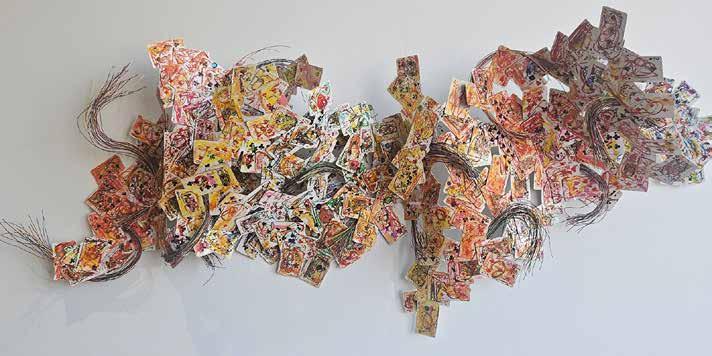
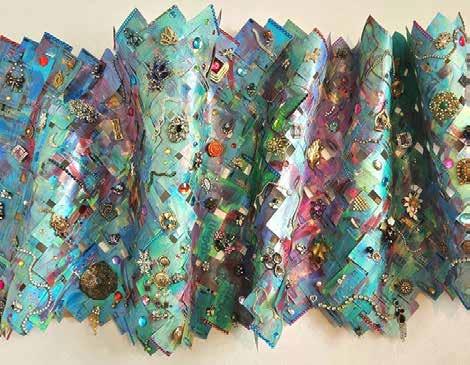
ing department as a fashion stylist, booking models and photographers, accessorizing outfits, and scouting locations.
In terms of growing up in small-ish town Georgia, hers was an interfaith family with culturally different parents. Her maternal side hails from Georgia dairymen and farmers. Her paternal grandparents were New Jersey Jews, where that grandfather was vice president of Bamberger’s department store in Newark, N.J., one of the largest department stores in the world at that time. Schindel remembers her Jewish grandmother fly-
ing into Atlanta from New Jersey wearing a baby seal skin coat with a loaf of stillwarm Jewish rye bread under each arm.
She summarized, “My inspiration comes from nature, spirituality, and my environment. My sister, Alice Schindel, is my greatest inspiration. Her ceramic sculpture is cerebral, thought provoking and fearless. Franz West is another inspiration. I saw his work at the Gagosian Gallery in New York a few years ago, and I literally jumped up and down.”
When Schindel is not jumping up and down, her hobbies include reading,
especially seafaring adventure stories. She’s a member of the Randolph Macon Alumni Book club, even though she is not an alumnus. She belongs to an art share group that meets to discuss members’ ongoing art projects. Andy Steinman’s Art Adventure is a favorite activity as she views private collections and gallery shows with the group. The Georgia Committee, National Museum of Women in the Arts, is another group that Schindel touts.
For more information, please contact saraschindel@gmail.com. ì
Should I or Shouldn’t I? When to Update Your Estate Planning Documents – 5 to 6 p.m. Life-altering events should be a motivator for adults to update their estate planning documents. Time often gets in the way of good intentions, and critical revisions are never made. This presentation will discuss The Five D’s: Death, Divorce, Diagnosis, Dependents, and Displacement and their impact on your estate planning and surrogate decision making. Learn what triggers should prompt a thorough review of your plan, as well as the potential pitfalls facing those who procrastinate. RSVP to https://tinyurl.com/3r45ammm.

Startup Nation Unstoppable -- Inside Israel’s Tech, Economy, and What’s Next – 6 to 7 p.m. What does it take to build world-class technology companies while navigating wars, trade conflicts, and geopolitical upheaval - and come out the other side with record-breaking exits? Join the Georgia Israel Business Alliance (GIBA) and The Dupree for an exclusive fireside chat with two of Israel’s most consequential voices in venture capital: Shlomo Dovrat, co-founder of Viola Group - the firm behind ironSource, Payoneer, Redis, and 200+ Israeli tech companiesand Omry Ben-David, managing partner at Viola Ventures, formerly a Senior VP at Goldman Sachs. The conversation will be moderated by Inon Dinesman, executive director of GIBA. We’ll go deep on the Israeli economy’s remarkable resilience, the 2025 exit boom ($78B), the AI infrastructure wave, and what it all means for corporates and investors in the US. Register at https://tinyurl.com/mrx6prs3.

April/May 2026 JBaby Newborn Small Group- 11 a.m. to 12:30 p.m. Shalom, and welcome to the newest members of the tribe! Whether you’re a first-time parent or adding to your growing family, this warm and welcoming group offers a safe, judgment-free space to share your experiences, ask questions, and build friendships with other new parents who truly understand what you’re going through. From sleepless nights to first smiles, we’ll celebrate the highs and support each other through the lows of early parenthood. It’s an opportunity to explore what it means to be a parent in the Jewish community today and discover simple routines and traditions that fill your family’s days with Jewish joy. Register at https:// tinyurl.com/5xttbepu.

ORT Atlanta Women’s Fashion Event – 11 a.m. to 1 p.m. ORT Atlanta, in partnership with Fox’s Atlanta, presents: a Fashion Show! A light lunch will be served. Reserve your seats at https://tinyurl. com/3cwbhy8x.

Young Professionals Patio Drinks at Ladybird – 6 to 9 p.m. Young professionals, join Kibbitz and Konnect on the patio at Ladybird under the iconic yellow umbrellas! Stop by after work and meet other Jewish singles while enjoying a spring evening on the Beltline. We’ll have appetizers on us and cash bar. RSVP early at https://tinyurl.com/3hhj22xu. This event is open to young professionals ages 22 through early 40s.
26th Annual Plant Sale & Expo – 10 a.m. to 4 p.m. Shop plants grown by Cobb Master Gardeners, explore the kids’ corner, browse the yard sale, and discover unique gifts from 79 specialty vendors (plants, herbs, honey, sauces, crafts, pottery, bird accessories, yard art and more!) Proceeds support gardening education, scholarships, and local demonstration and community gardens. Learn more at https:// tinyurl.com/p32e3scr.

April May 2026 JBaby Intown Small Group- 11:30 a.m. A five-week small group series for local families to bond over music, education, support, and playtime. Designed for babies ages 0–12 months and their parent(s). In this warm, welcoming space, neighborhood families come together for playful learning and meaningful support. You’ll connect with other parents, learn from developmental experts, and share new experiences with your little one — building friendships and a deeper connection to your community along the way. Each session is about 45–60 minutes, with plenty of time to socialize after. Register at https://tinyurl. com/ycy8c7nb.

Shabbat, Me & Rabbi G - 5 to 5:30 p.m. Experience the joy of Shabbat with Rabbi G! This exciting celebration is fun for the whole family, featuring lively Shabbat songs, heartfelt blessings, and delicious challah and grape juice. This is the perfect way to close out the week in a fun and relaxed setting. Get more information at https://tinyurl.com/mr368csb.
Scholar-in-Residence Shabbat Dinner at GLT - 6 p.m. Shabbat Services at Gesher L’Torah followed by Shabbat dinner with program: “Surprising Stories about G*d’s Personality.” Sign up at https://tinyurl.com/473pxp27.
Tot Shabbat - 6 to 8 p.m. Tot Shabbat from Congregation Dor Tamid is a Shabbat program geared for children (second grade and younger) to laugh, meet new children, make new friends, and explore the wonders of Judaism in an exciting fun way! The service is filled with songs, prayers, blessings, stories, snacks, and a place where a kid can be a kid when they pray to G-d. This service meets on selected Friday nights throughout the year at 6 p.m. Each service is followed by a pot-luck Shabbat dinner. Parents are encouraged to model the behavior they would like to see in their own children. So, remember: Come to Tot Shabbat ready to dance, sing, pray, and have fun. Tot Shabbat is geared toward children 4 and under. Learn more at https://tinyurl.com/w94ra3de
Shake It Up Shabbat at Etz Chaim –9:30 a.m. to 12 p.m. Join us at Etz Chaim for our monthly Shabbat morning service geared toward students in kindergarten through seventh grades and their families. The goal of this service is for everyone to become more comfortable in the Radow Sanctuary, where our classes will lead parts of the service. After services, we invite you to join us for our kiddush lunch. Learn more at https://tinyurl. com/29d2bcw7.
Scholar-in-Residence at GLT – 9:30 a.m. to 2:30 p.m. Shabbat Services at Gesher L’Torah followed by Kiddush luncheon and program, “Imagining the Unimaginable in Words and Pictures.” Learn more at https://www.atlantajewishconnector. com/events/scholar-in-residence-at-glt/.
26th Annual Plant Sale & Expo – 10 a.m. to 4 p.m. Shop plants grown by Cobb Master Gardeners, explore the kids’ corner, browse the yard sale, and discover unique gifts from 79 specialty vendors (plants, herbs, honey, sauces, crafts, pottery, bird accessories, yard art and more!) Proceeds support gardening education, scholarships, and local demonstration and community gardens. Learn more at https:// tinyurl.com/p32e3scr.

Sing-a-long Shabbat at Etz Chaim –10:30 a.m. to 12 p.m. Congregation Etz Chaim and the Etz Chaim Preschool invite you and your family to join us for Sing-a-long Shabbat geared for families with young children. Find out more at https://tinyurl.com/yc7ez6ts.
Blue & White Play Day – 10 a.m. to 12 p.m. Join PJ Library, JAccess, and the Jewish Federation of Greater Atlanta for a joyful indoor play celebration at an exciting Play Place just for our community in honor of Yom Ha’atzmaut! We are proud to offer this program in partnership with JAccess, ensuring a welcoming and accessible experience for all families. Kiddos will love the swings, trampolines, playground structures, and an imagination corner designed for creative play. A trained coach will be on-site to help guide children through their play, offering support and guidance where it may be needed. In the party room, families can enjoy a light bagel breakfast along with Israel-themed arts and crafts. This event is inclusive for all so every child can play, explore, and celebrate in their own way. Sign up at https://tinyurl.com/8fndx3jn.
Torah Reading: Tazria-Metzora
Friday, April 17 Light Shabbat Candles: 7:53 PM
Saturday, April 18 Shabbat Ends: 8:50 PM
Torah Reading: Acharei-Kedoshim
Friday, April 24 Light Shabbat Candles: 7:58 PM
Saturday, April 25 Shabbat Ends: 8:56 PM

Kidchella – 3 to 4:30 p.m. Israeli IndepenDANCE Party: Celebrate Yom Ha’atzmaut with music, movement, and hands-on fun for the whole family! Explore our mini shuk with interactive craft stations, games, and Israeli-inspired activities around every corner. Dance it out with our live DJ spinning upbeat Israeli and kid-friendly favorites, then refuel with festive snacks that will make it feel like you just landed in Tel Aviv. Yom Ha’atzmaut is Israel’s Independence Day — a joyful celebration of Israeli culture, community, and spirit. Sign up at https:// tinyurl.com/y4jf682e.

Raise the Roof! The Fiddler Jazz Sessions with the Joe Alterman Trio – 4 to 7 p.m. Join The Breman for the second concert in the Levison Family Music Series! Inspired by great versions of “Fiddler on the Roof” tunes by artists such as Cannonball Adderley, Louis Armstrong, Marlena Shaw and more – Breman favorite Joe Alterman raises the roof of this beloved musical. Alterman will play every song from the soundtrack rearranged and reimagined for his piano trio. Purchase tickets at https://tinyurl. com/c66h5dat.

Summit on Antisemitism- 5 to 8 p.m.
The Temple is excited to partner with our interfaith neighbors for this three-part series. Each session will focus om the different aspects of antisemitism in America today. This session is the Understanding Media Bias with Josh Levs. Register at https://tinyurl.com/yuzcjzkz.

Gotta Sing Events: Broadway – 6:30 to 8 p.m. The Anti-Karaoke. Ditch the cringey backing tracks and solo spotlights. Gotta Sing Events is cranking original Broadway cast recordings and turning the entire room into one massive, thundering chorus. With every lyric projected as your safety net, you’ve got the ultimate confidence to belt every word alongside everyone else. No solos, no “canned” knockoffs — just a room full of people becoming the lead role together. Bring your voice, leave your inhibitions. Broadway is calling. Purchase tickets at https://tinyurl. com/2s3c8hd3
Jewish National Fund-USA Israel Yom Ha’atzmaut Luncheon – 11 a.m. to 1 p.m. Join Women for Israel for an inspiring afternoon showcasing the lasting impact of Jewish National Fund-USA’s work while celebrating Yom Ha’atzmaut. See how strategic investments in housing, healthcare, jobs, tourism, and resilience programs are revitalizing Israel’s north and south, creating opportunity, strengthening communities, and shaping a thriving future for generations to come. RSVP requested at https://tinyurl. com/4jxk4f8s.

Women’s Philanthropy POP Up with JScreen – 7 to 8:30 p.m. Join us for an inspiring evening of connection and learning at Federation’s Women’s Philanthropy POP Up: Philanthropy Opportunity with Purpose. At this special POP Up focused on women’s health, we’ll explore the meaningful local impact of our work through our partnership with JScreen and learn how your support of Federation strengthens and protects our Jewish community. Register at https://tinyurl. com/5dyfmsmy.

April/May 2026 JBaby Newborn Small Group- 11 a.m. to 12:30 p.m. Shalom, and welcome to the newest members of the tribe! Whether you’re a first-time parent or adding to your growing family, this warm and welcoming group offers a safe, judgment-free space to share your experiences, ask questions, and build friendships with other new parents who truly understand what you’re going through. From sleepless nights to first smiles, we’ll celebrate the highs and support each other through the lows of early parenthood. It’s an opportunity to explore what it means to be a parent in the Jewish community today and discover simple routines and traditions that fill your family’s days with Jewish joy. Register at https:// tinyurl.com/5xttbepu.

Yom Ha’Atzmaut - Israel Independence Day Celebration – 5 to 7 p.m. Celebrate Yom Ha’Atzmaut, Israel Independence Day at the JCC. Bring the family for a wonderful evening filled with activities and entertainment for all ages. Kids can enjoy crafts, games, and face painting, all while vibing to live music. It’s the perfect way to experience the spirit of Israel right here in our community. Food available for purchase. Don’t miss out on this fun-filled celebration at https:// tinyurl.com/4mka68ud.
Friday,
April May 2026 JBaby Intown Small Group- 11:30 a.m. A 5-week small group series for local families to bond over music, education, support, and playtime. Designed for babies ages 0–12 months and their parent(s). In this warm, welcoming space, neighborhood families come together for playful learning and meaningful support. You’ll connect with other parents, learn from developmental experts, and share new experiences with your little one — building friendships and a deeper connection to your community along the way. Each session is about 45–60 minutes, with plenty of time to socialize after. Register at https://tinyurl.com/ ycy8c7nb.

NCJW/ATL 7th Annual Women Who Dare: Celebrating Our Sheroes – 12 to 1:30 p.m. Please join NCJW/ATL for their seventh annual luncheon! Women Who Dare: Celebrating Our Sheroes at https:// tinyurl.com/2t4ke8pz.

Nosh & Know: Shabbat at the Market – 10 to 11 a.m. Shabbat is a time to slow down, gather, and savor what nourishes us. Join JBaby and the Jewish Federation of Greater Atlanta at the farmer’s market for a relaxed, baby-friendly experience that blends fresh local food, meaningful Shabbat moments, and expert guidance for parents navigating first foods and allergens. Allergist Dr. Sara Bluestein will address the real anxieties many parents feel around food allergies and introducing new foods, sharing practical tips you can use right away. Together, we’ll explore how eating local can shape family rhythm, how babies learn through taste and exploration, and how Shabbat offers a natural opportunity to build joyful, nourishing rituals. RSVP at https:// tinyurl.com/42ymhk4c.
Limits Pickleball Challenge – 2 to 6 p.m. Join us for the No Limits Pickleball Challenge — a community pickleball fundraiser benefiting Center for Movement Challenges (CFMC). This Atlanta-area pickleball tournament welcomes players for an afternoon of friendly competition, connection, and impact. Whether you’re a seasoned player or new to the game, the No Limits Pickleball Challenge is designed to be fun, inclusive, and meaningful — both on and off the court. Sign up at https://tinyurl.com/3thp4r29.

Israel Independence Day PARTY – 9 p.m. to close. CHAGIGAH is bringing the vibes for Israel Independence Day/ Yom Ha’atzmaut!! Blue and White denim theme party. So come in your trendy jeans, classic denim jackets, cute denim skirts or anything that fits the vibe! Think blue and white, Israeli flags and a dance floor full of denim as we celebrate Israel together. Great people of all ages 21+. All night dancing. Purchase tickets at https:// tinyurl.com/mry57643.

Play Tamid - 9:15 to 11 a.m. Play Tamid is led by Rabbi Jordan and is open to the public (members and non-members of Congregation Dor Tamid). Enjoy crafts, songs, fun activities, and more for children under 4 (parent/ guardian must attend). RSVP at https://tinyurl.com/3farjzrc.
Historic Oakland Cemetery Tour – 10 a.m. to 12 p.m. Plunge into the history of Jewish Atlanta as The Breman explores historic Oakland Cemetery. Amidst Victorian gardens and marble and granite sculptures, we will walk through the history, burial customs, and symbolism found throughout the Jewish grounds of this powerful city landmark. Founded in 1850, Oakland Cemetery is the final resting place for more than 70,000 people, including many of Atlanta’s most notable citizens. It is also home to three separate Jewish burial sections – including the second oldest Jewish burial ground in Georgia. Come enjoy a stroll around one of Atlanta’s most beautiful public parks, while we discuss some fascinating stories of the individual lives and religious organizations that enabled the city’s Jewish community to persist and flourish. Sign up for the tour at https://tinyurl.com/m4ca6b45.

Antisemitism in America Today – 4 p.m. From social media to college campuses to global politics, antisemitism shows up in ways that are both familiar and alarmingly new. Join the MJCCA for an open and engaging conversation with two leading voices in this space, Ambassador Deborah Lipstadt and Brendan Murphy, who bring deep expertise and personal insight to the topic. Guided by our moderator, Barbara Rosenblit, the discussion will explore where antisemitism is coming from, why it persists, and what we can do about it as individuals and as communities. Purchase tickets at https://tinyurl.com/yz6knuzr.

Temple Chamber Players: The Russian Soul in Three Voices – 4 to 5:30 p.m. Join The Temple for an evocative afternoon with the Temple Chamber Players, featuring iconic piano trios by Tchaikovsky and Rachmaninoff. In addition to hearing these remarkable works performed live, audiences will gain a deeper understanding of the music and the musicians who bring it to life. Purchase tickets at https:// tinyurl.com/2vynhbb7.

35+ Singles Cooking Class – 4 to 6:30 p.m.
35+ age singles, join Kibbitz and Konnect at The Cook’s Warehouse for a cooking class experience! The class will begin with beverage service and mingling, then we’ll divide into teams and whip up the selected menu to enjoy together at the end of the class. Join by visiting the link at https://tinyurl.com/38udxp5s.
Sara Wolkenfeld: What We Talk About When We Talk About AI – 12 to 1:30 p.m. Is artificial intelligence a threat, or one of the most transformative tools since the discovery of fire? This session with The Dupree cuts through the noise by using Jewish ethical frameworks to examine the real questions AI raises. Sara Wolkenfeld will explore how timeless values can help us to make thoughtful, responsible choices about the technologies shaping our world. Find out more at https://tinyurl.com/bdf9spaf.

The State of CRE Capital Markets – 6 to 7:30 p.m. The Jewish Commercial Real Estate Network (JCREN) brings together Atlanta’s leading real estate professionals to connect, exchange ideas, and strengthen the future of Jewish Atlanta. This exclusive gathering — one of only two each year — offers a unique opportunity to engage with peers, expand relationships, and hear directly from some of the industry’s most influential voices. At this event, we will host a panel discussion on “The Current State of CRE Capital Markets,” featuring senior leaders from Cousins Properties, The Ardent Companies, and Ares Management. Together, they will share insights from across the capital stack — public REIT equity, opportunistic investment platforms, and institutional real estate credit — to explore how capital is moving in today’s market, where opportunities are emerging, and how investors are navigating the evolving landscape of commercial real estate. Register at https://tinyurl.com/2fxdz9cf.
AJC Atlanta Global Forum Social – 6:30 to 9 p.m. Please join the AJC Atlanta family for a pre-global forum social to learn about sessions and connect with others going to Global Forum. Following light bites, we will host a brief program to review the session options, including the Shabbaton, and the regional dinner on Sunday. You’ll also hear insights from those who have previously attended, an opportunity you won’t want to miss. Sign up at https://tinyurl.com/mv3j8tb3.
The Art and Practice of Living Wondrously – 7:30 to 9 p.m. Join The Dupree for a thoughtful evening of learning, reflection, and conversation centered around the book, “The Art and Practice of Living Wondrously,” by Dr. Ronit Ziv-Kreger. Sign up to attend at https://tinyurl. com/3vtsvm3n.

April / May 2026 JBaby Newborn
Small Group - 11 a.m. to 12:30 p.m. Shalom, and welcome to the newest members of the tribe! Whether you’re a firsttime parent or adding to your growing family, this warm and welcoming group offers a safe, judgment-free space to share your experiences, ask questions, and build friendships with other new parents who truly understand what you’re going through. From sleepless nights to first smiles, we’ll celebrate the highs and support each other through the lows of early parenthood. It’s an opportunity to explore what it means to be a parent in the Jewish community today and discover simple routines and traditions that fill your family’s days with Jewish joy. Register at https://tinyurl.com/5xttbepu.

The Tasting Experience – 7 to 9:30 p.m.
The Tasting Experience benefits the Intellectual & Developmental Disabilities Services of JF&CS. We provide supportive programming to adults with disabilities so they may live fulfilling lives as independently as possible, while supporting their families and caregivers. These programs include the nonsectarian Zimmerman-Horowitz Independent Living Program, the Community Access Group, a community integration day program with numerous outings and activities each week, and Supported Employment, a program helping those who want to work gain the skills they need to get and keep a job while receiving ongoing support to ensure long-term success. Guests will enjoy delicious tastings from some of Atlanta’s best restaurants and caterers; spirits, wine and beer from local distributors; and a silent auction while supporting extraordinary programs and clients. RSVP at https://tinyurl.com/425hxxmk.






Ingredients
Salad
8 ounces (225 grams) Beleaves Spring Mix (or lettuce of your choice)
1 kiwi, peeled and cubed
1 mango, peeled and cubed
1/2 cup pomegranate arils or Gefen Sweetened Dried Cranberries
3/4 cup sliced almonds

1 8-ounce (225-gram) package baby gouda cheese, cubed (or cheese of your choice)
Lemon Poppy Vinaigrette
2/3 cup Gefen Canola Oil
1/3 cup Gefen Honey
1/4 cup Gefen Lemon Juice
1 tablespoon poppy seeds
1/2 teaspoon salt
1/2 teaspoon dried mustard
Directions
1. Layer all salad components in a large bowl.
2. Combine all dressing ingredients in a cruet and shake vigorously (or beat with a whisk).
3. Pour dressing over salad immediately before serving. Toss and enjoy.
Recipe by Rivky Kleiman
Photography: Hudi Greenberger
Food Styling: Janine Kalesis Assisted by Simmy Horwitz kosher.com

Maurice was showing off and said to his friend, Sam, “I bought a new hearing aid yesterday. It cost me $2,000.”
Sam said, “That’s expensive, isn’t it?”
Maurice replied, “Yes, but it’s state-of-the-art.”
“What kind is it?” asked Sam.
“A quarter to twelve,” said Maurice.
n. A person who is dedicated to making peace among friends and family members yet always ends up making things worse.
“Sophie wasn’t speaking to Iris, so Myron, that shlum schlump, entered the scene, and now Sophie isn’t speaking to Iris, Meredith, or Myron.”
From the Yiddish “shlum,” meaning, “peace,” by way of the Hebrew “shalom.” And “schlump” is Yiddish for a “person who is inept.”

By: Yoni Glatt, koshercrosswords@gmail.com
Difficulty Level: Medium
ACROSS
1. Atkins no-no, briefly
5. “Gloomy” guy
8. Where Jack Sparrow stories occur
13. Pilgrimage location in Queens, with “The”
14. It runs in the family
15. “Grand” hits
16. Jewish bread
18. Door fasteners
19. Hangs loose
21. Many a beach resort locale
22. Jewish bread
25. Jewish bread
27. Addresses the congregation, perhaps
28. Tu follower
29. WSJ alternative
30. Not at all ferocious
31. Less diluted
33. (Definitely) Jewish bread
37. Sukkah
38. Destroy
41. “Mamma Mia!” has several
44. Friendly prefix
45. 2024 revenge film with June Squib in the title role
47. Jewish bread
49. Jewish bread

This week, 100 years ago - 1926
50. Con ___ (with liveliness)
51. Actress Bella who played Hilary Friedman in “Blended”
53. Total sons of Abraham
55. Jewish bread?
59. Conservative camp
60. Bracha competition
61. Depletes, as strength
62. No. 3 on AFI’s list of top 10 westerns
63. Brain and spinal cord, initially
64. Not the best negotiator in the Bible
DOWN
1. End of an address
2. “Got it!”
3. Judaism or Christianity (abbr.)
4. Some naturally caffeinated drinks
5. Mythic chalices
6. 64- Across, to Joseph
7. Stand-up pioneer Mort
8. Etna output
9. Rashida who probably won’t be speaking at AIPAC this year
10. “Kol ___ v’kol simcha...”
11. Hire
12. Give approval

The National Council of Jewish Women organize 34 new sections across the U.S. and Canada.
The Palestine-Hebrew Gnesin Theatre is represented at the International Theatrical Exposition in New York City.
This week, 75 years ago - 1951
Chaplain Joseph B. Messing, first Jewish chaplain to reach Korea, returns home.
Ahavath Achim Sisterhood and Brotherhood host joint model seder.
Emory’s Teau Epsilon Phi fraternity moves into its new home on Fraternity Row.
Myer O. Sigal, Macon community leader, announced as new chief of the Georgia Association of B’nai B’rith Lodges.
While criticizing both sides of the conflict, a U.S. state department memo condemns the Israeli bombing of Syrian troops.
This week, 50 years ago - 1976
Mr. and Mrs. Jerry Tillem announce the bat mitzvah of their daughter, Michelle, at Ahavath Achim Synagogue.
Mr. and Mrs. Bernard Friedman of Atlanta announce the bat mitzvah of their daughter, Shari, at Ahavath Achim Synagogue.
Sidney Feldman unanimously elected to third one-year term as head of the Atlanta Jewish Welfare Federation.
Mr. and Mrs. Eli Wise of Atlanta announce the birth of son, Jarrod.
Former Atlantan Flora Hirsch Spiegel, who recalled fleeing from Nazis at 13 years old, is elected mayor of Corona, Calif.
This week, 25 years ago - 2001
AJT highlights playwright Eve Ensler, author of “The Vagina Monologues.”
17. Possible cry on a ride
20. Beatles’ drummer
22. Annoying caller, often
23. Org. that disarmed in 2005
24. “Aladdin” prop
26. 2000s Chevy
28. Play on the sidewalk for money
31. Los Angeles Boulevard with many kosher eateries
32. New life for an old movie
34. 1969 “miracle” site
35. Craft for the affluent
36. Abatement
39. One way to spell “mom” in Israel
40. “No thanks”
41. Fire remnants
42. She can “Carey” a tune
43. Mark of disgrace
45. Crowds, it is said
46. Aaron of Cooperstown
48. 2008 title role for (Adam) Sandler
49. Musical Leonard
52. Bank with headquarters in London
54. 56-Down in English
56. Part of U.N.L.V.
57. Drink that often has a bitter aftertaste, for short
58. The Spartans, briefly

Billy Planer returns as Ahavath Achim’s Youth Director after two years.
Michael and Susan Plasker of Atlanta announce the engagement of their daughter, Shauna, to Steven Grosswald, son of Morton and Sara Grosswald.
Eli Zandman, son of Jay and Shelley Zandman, has his bar mitzvah ceremony at Congregation Shearith Israel.
AJT reports on the ninth annual Lauren’s Run to fundraise for a cure for childhood cancer.
The AJT interviews actor Charles Grodin on his transition to television reporting for “60 Minutes II.”
Issues of the AJT (then Southern Israelite) from 1929-1986 can be found for free online at https://gahistoricnewspapers.galileo. usg.edu/lccn/sn78003973/
Mrs. Mollie Goodman Aczel, née Mollie Doris Goodman, passed away after a long illness on March 21, 2026, in Briarcliff, N.Y., at the age of 86. Born on Aug. 7, 1939, in Houston, Texas, she was the daughter of Aaron and Bessie Goodman and the sister of Michael Goodman and Gerald Goodman.
Mollie’s life was defined by her unwavering dedication to education and her profound commitment to fostering Jewish learning. She earned a bachelor of science in education (Summa Cum Laude) from the University of Houston and went on to complete a master’s in education in special education there as well. Her passion for advancing educational excellence led her to further studies as a Graduate Fellow in the Education of the Gifted at Teachers College, Columbia University. Additionally, she obtained a certification in administration and supervision from Kean College in Union, N.J.
Throughout her distinguished career, Mollie made an indelible impact on Jewish education. She served as the founding Head of School at the Adele and Alfred Davis Academy from 1991 to 1999, where her leadership helped establish a thriving institution dedicated to academic rigor and Jewish values. Prior to this, she was the principal at the Irvin M. Shlenker School in Houston from 1983 to 1988.
Mollie also contributed her expertise as an educational consultant for the Partnership for Excellence in Jewish Education from 1998 to 2014. Her work extended beyond school settings; she served as program coordinator for the Organization for Rehabilitation through Training (ORT) from 2004 to 2005 and as supervisor of student teachers and adjunct faculty at Kean College from 1989 to 1991.
Her lifelong commitment to expanding educational opportunities stemmed from a deep belief in the importance of a strong secular Jewish education. Mollie’s efforts not only helped found one school but also led several others toward growth and success. Her legacy is reflected in countless students and teachers whose lives were enriched by her vision and commitment.
Above all, Mollie was a devoted mother and grandmother. By taking her family on adventures across the globe, she instilled in them a lifelong passion for learning and discovery, leaving behind a legacy of memories they will always hold dear.
Mollie was predeceased by her beloved husband, Dr. Thomas Aczel; her brother, Michael Goodman; and her parents, Aaron and Bessie Goodman. She is survived by her loving family; son, Joseph Aczel, and wife, Debra Lubar, along with their children, Noah, Lilah, and Arden; son, Stephen Aczel, and wife, Jackie Eris Aczel, with their son, Tomas; daughter, Elisabeth Aczel Wallock, and husband, Stuart Wallock, with their sons, William, Andrew, and Aidan; daughter, Bettina Prober, and husband, Michael Prober, with their sons, Ethan, Jonathan, and Benjamin; and brother, Gerald Goodman, and wife, Mary Jo. She is also survived by her devoted caretaker of eight years, Janet Mattheson, who brought joy, friendship, and comfort during the final chapter of Mollie’s life.
Mollie’s memory will live on through those who knew her as an inspiring educator, devoted family member, and advocate for lifelong learning. May her memory be a blessing and bring comfort to all who knew her.
For those who wish, donations may be made in her name to the Alzheimer’s Association at Help fight Alzheimer’s or to Jewish Family Services in Houston at https://www.alexanderjfs.org/ donate.

Irene Louise Berson, 82, of Atlanta, Ga., passed away on March 31, 2026. She was a force of nature who made everyone feel special. She brightened every room she entered with her warmth and enthusiasm and filled it with her laughter and stories. When Irene wasn’t changing lives through her dedicated career as a therapist, she spent her time being an amazing friend, mother, aunt, sister, and grandmother to her biological family and equally important “found families” from all over. She had a way of drawing special and loyal people into her orbit and making sure that each of them received her utmost love and attention.
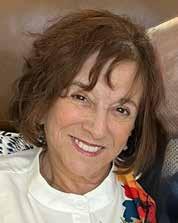
Irene was preceded in death by her parents, Max Kurt and Ruth Gunzenhauser. She is survived by her adoring husband, Bob Clein; her sons, Jeff (Jessica) and Brian (Lisa); her stepchildren, Paul (Michelle) and Marian (Bill); her brother, Stephen (Rochelle); her grandchildren, Alana, Ashley, Chelsea, Liam, Devin, Stephanie (Jared) and Josh (Andrea); her great-grandson, Grant; her nieces, Marisa and Amy (Tom); in addition to so many close friends who she considered family.
A graveside funeral service was held at 2 p.m. on Friday, April 3, 2026, at Greenwood Cemetery with Rabbi Lapidus of The Temple officiating. The funeral was streamed on Zoom, link accessible via the Dressler’s website. Following the funeral, there was a celebration of her life in the social room of 750 Park Avenue NE.
In lieu of food or flowers, please consider making a donation to the Endless Mountain Music Festival in Irene’s memory.
The family wishes to extend their sincere thanks to her caregivers Hazel, Georgia, Shequanna and Kendall. Arrangements by Dressler’s Jewish Funeral Care, 770-451-4999.




Elaine Carp, 77, of Atlanta, Ga., passed away on April 2, 2026. She was born on Dec. 23, 1948, at Grady Hospital and lived in Atlanta her entire life. She was a graduate of Druid Hills High School and attended one year at the University of Georgia before marrying her first husband, Richard Floersheim.
Elaine was a bookkeeper and worked for several years at the Fay Gold Art Gallery before working for many years at Kamin & Associates. Elaine was a dedicated friend, sister, daughter, and especially, mother and grandmother, who was involved in Hadassah, ORT, the resident council board of Village Park Alpharetta, and loved playing Mah Jongg with her friends, and spending time with her significant other, Steven.
Elaine is predeceased by her mother, Bernice Siskin, her father, Marvin Wolkin, and her second husband, Allan Carp. She is survived by her sister, Shirley Zaner, her brother Larry (Susan) Wolkin, her daughter, Marci (Floersheim) Silverman (Jeremy), and grandchildren, Reese and Mira, stepdaughters, Nancy Carp and Jennifer Carp. In lieu of flowers, memorial donations may be made to National MS Society or Excel Program at GT for students with developmental disabilities. Graveside services were held Sunday, April 5, 2026, at Greenwood Cemetery (1173 Cascade Cir SW, Atlanta, Ga 30311) with Rabbi Laurence Rosenthal officiating. Arrangements by Dressler’s Jewish Funeral Care, 770451-4999.
Irene Friedman Kent of Atlanta, Ga., resident of Canterbury Court, passed away peacefully with her family at her side March 31, 2026, at age 100.
Irene was born on Sept. 8, 1925, in Staten Island, N.Y., and was raised, along with her older sister, Esther, in The Bronx.
She married the love of her life, Sol Morris Kent, from Columbus, Ga., in 1950, and began their life together in Atlanta, Ga.
She devoted the early years of her life to her family, creating a warm and steady home as a loving mother and wife. Once her children had grown up and were off to college, she began a second chapter, working at Hermès and several interior design shops in Atlanta.
A lifelong lover of animals, she gave generously of her time and energy to the Atlanta Humane Society, where she became not only a dedicated volunteer but also an exceptional and tireless fundraiser, helping to advance the organization’s mission and care for countless animals in need.
Throughout her life she nurtured a deep appreciation for language and French culture, which she studied with enthusiasm.
She possessed a deep appreciation for fine fashion and timeless style.
She is survived by her sons, Paul Kent and David Kent (Joan Kent); her grandchildren, Lauren Kent Rickoff (Ross Rickoff), Harris Kent, Steven Kent (Amanda Kent), Stuart Kent (Cori Kent), and eight great-grandchildren: Marni, Noah, and Lee Rickoff; Charles, William, Jack, Teddy, and Lily Kent.
She is preceded in death by her parents, Jack and Diana Freidman; her beloved husband, Sol Kent; and her sister, Esther Grundich.
A graveside service was held at 11 a.m. on Friday, April 3, 2026, at Arlington Memorial Park, 201 Mount Vernon Hwy, Sandy Springs, GA 30328.
In lieu of flowers, kindly give to the Atlanta Humane Society, www.atlantahumane.org.
Arrangements by Dressler’s Jewish Funeral Care, 770-451-4999.
Philip Neil Kranz, 83, Rabbi Emeritus, Temple Sinai, Sandy Springs, passed away April 12, 2026. Born in Cleveland, Ohio, Phil was the son of Alyce Bogen and Benjamin Robert Kranz. He is survived by his wife of almost 55 years, Nancy Weston Kranz, daughters: Rebecca Kranz Friedman (Keven) of New Jersey, and Abigail Kranz Ornstein (Bob) of Washington, sister, Shari Kranz Porter, nephews: Doug (Karen) and David (Robyn) Porter, niece: Debbi Porter, grandchildren, Madeline Emilia Friedman, Ariel Bernard Friedman, Celia Sunshine Ornstein, Sasha Bina Ornstein, mother-in-law, Marilyn Weston, sisters-in-law, Laurie Pappas (Edward) and Kathy Pincus (Michael).
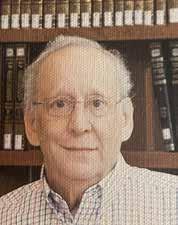
Phil, or Petie, as his Cleveland friends called him, loved Ohio State University and his college friends along with his rabbinic friends from Hebrew Union College in Cincinnati, Ohio. He trained as a naval chaplain while in rabbinical school. He was a proud Cleveland native. He was a loving and doting father, grandfather, and trusted counselor to so many of his congregants from student rabbi days in Lincoln, Neb. and Bainbridge, Ga., to his first pulpit at Chicago Sinai Congregation, and finally at Temple Sinai in Atlanta where he spent the bulk of his career (26 years). He was a former Atlanta Planned Parenthood president, a past Atlanta Rabbinic board member, Holy Innocents School board member, and an honorary board member of the American Jewish Committee. He led Temple Sinai trips to Israel and other locations abroad. He taught sociology of religion at Georgia State University and Agnes Scott College. He loved classical music and maintained a large collection. He was an avid reader and collector of books. The library at Temple Sinai was named in his honor, and he was very proud of it. He was an avid fly fisherman in his earlier years. His advice was widely sought, and he was a dear friend and teacher to so many in the Atlanta area and beyond. He loved the Temple Sinai youth and seeing them grow, prosper and marry, and some went on to become rabbis, citing Phil as a mentor. He was a widely sought-after speaker by many Jewish and non-Jewish organizations. A memorial service was held at 12:30 p.m. on Wednesday, April 15, at Temple Sinai, 5645 Dupree Dr NW, Sandy Springs. In lieu of flowers, contributions may be made to the Kranz Institute of Jewish Learning Fund at Temple Sinai. Zichrono Livracha. May his memory forever be for a blessing. Dressler’s Jewish Funeral Care, 770-451-4999.
Samuel Lee Tuck, 58 of Atlanta, Ga., passed away on April 11, 2026, at home after a courageous battle with cancer. Sammy graduated from the University of Georgia with a BBA and earned a Master’s of Tax from Georgia State, and spent his entire career in public accounting, most recently with Aprio, LLP. Outside of work, he loved spending time with family and friends, playing golf, or camping out at the blackjack table. He was deeply committed to giving back to the Atlanta community, with a particular dedication to supporting the Jewish community.

Sammy is predeceased by his parents, Rhina and Leon Tuck, and his grandmother, Sarah Shaffer, all native Atlantans. He is survived by his wife, Allyson, and children, Leah and Nolan. He is also survived by his brother, Stuart (Helene), many nieces and nephews, and cousins and friends who are like family. Memorial donations may be made to Camp Judaea (https://www.campjudaea.org/ support/giving-opportunities/) or Magen David Adom in memory of Julia Hyman (afmda.org/ donate/). Arrangements by Dressler’s Jewish Funeral Care, 770-451-4999.
Obituaries in the AJT are written and paid for by the families; contact Account Manager Ilyssa Klein at Ilyssa@atljewishtimes.com or 404-883-2130, ext. 122, for details about submission, rates and payments. Death notices, which provide basic details, are free and run as space is available; send submissions to submissions@ atljewishtimes.com.
I was half an hour early, but I had printed out a challenging crossword puzzle, anticipating a boring wait at the doctor’s office. Long ago, I had given up the chance of sitting next to an amiable stranger who would like to engage in a little chat; these days everyone prefers using a cell phone which offers countless opportunities for work, remote socialization, and entertainment. I looked around the room. Yep, the other patients were all absorbed in virtual communication.
The woman on my left seemed to be discussing a dinner party, and her instructions to the person on the other end involved cooking a chicken, or maybe a few chickens. The conversation was loud enough for me to discern the subject, but too soft for me to hear the details, which was unfortunate because I like to cook
chicken and I’m a big fan of dinner parties. I hated missing the details of the party.
The gentleman on my right was sitting next to a woman, probably his spouse. They were both focused on his phone. From their intermittent reactions and frequent laughter, I figured they were scrolling through photos. They appeared to be in their fifties or sixties, the very people who, in the old pre-cell days, would be delighted to relate fun stories about their grandchildren. I miss those old days because I’m a pushover for hearing amusing family anecdotes.
A nurse called Ms. Chicken-Dinner Party, and off she went, still talking on her phone. A minute or two later, a couple and a little girl ambled in. The man took the Chicken-Dinner Party woman’s empty seat next to me, but there was only one empty seat next to it. The man and woman settled into both chairs, and after the woman helped the toddler out of her jacket, the child climbed onto the man’s lap. No one took out a phone; and the woman and man seemed perfectly content. The man leaned toward me, aware that I, too,
was not on my phone, thus possibly available for interaction. He smiled to me, focused on the child on his lap, and said in slightly accented English, “This beautiful girl is my granddaughter.” The woman leaned across her husband toward me, and said, “Dara’s three years old.” She reached into a big tote, took out a doll in frilly clothes and handed it to her granddaughter. Then she took out a bag of graham crackers and gave one to Dara. Having fortified her grandchild with the doll and a snack, the grandmother introduced herself, “I’m Laila.”
I folded my crossword puzzle into my purse. “Does Dara go to preschool?” I asked. “In the morning, then she plays at our house.” Laila’s accent was a bit stronger than her husband’s, but charming. “She likes cats, dolls, crackers and sometimes cheese.” I appreciated the “sometimes cheese” detail. This was getting interesting because, for me, there’s never too much given information. I seldom have a chance to talk to total strangers about their grandchildren, and when I do, it’s never boring.
The woman offered her husband
and me graham crackers. He accepted, but I wanted to talk. “Do you have other grandchildren?” I asked. “Dara is one son’s youngest girl. He has four daughters,” the grandfather answered. “Our other son has one girl and one boy. His boy is in college.” Then Laila asked, “And you?” We talked about our children and grandchildren until the grandfather was called into the doctor’s office. Laila moved over to the seat next to me, and Dara sat in the other chair, where she played a pretend game in which her doll did tricks and danced. Laila reached into her tote again and pulled out a picture book. I thought it was now story time, but Dara paged through the book herself while Laila and I kept talking.
We were chatting about bringing our grandkids with us on errands, when my name was called. I passed Dara’s grandfather getting a printout at the nurses’ station. “I enjoyed talking to you and your wife,” I said. He answered, “My wife loves meeting new people; I do, too, but nobody talks. Everybody’s looking down at their phones.”
“I’m happy we sat next to each other!” I remarked. “Me, too!” he laughed. The nurses just smiled. ì











































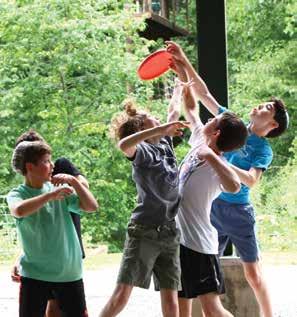
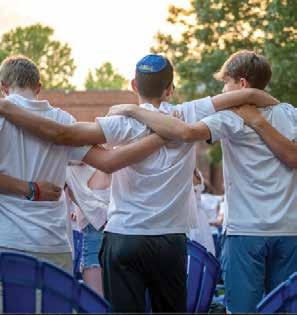
Racing across ziplines, jumping into lakes, singing around campfires, making lifelong friends, and learning skills that shape their future—Jewish overnight camp is where kids grow, explore, and shine.

With support from the Jewish Federation of Greater Atlanta and One Happy Camper, you could receive up to $1,500 off your camper’s first summer at any of these amazing Jewish overnight camps. For more information, email jewishcamp@jewishatlanta.org or reach out directly to the camp of your choice.