

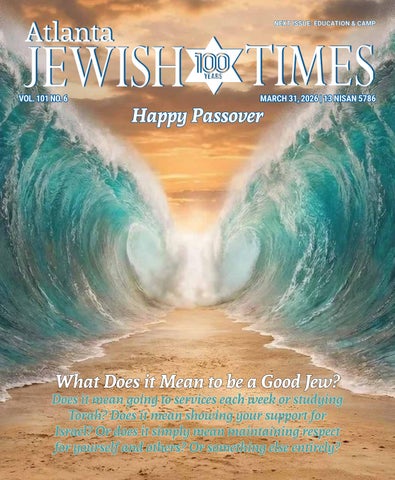
Does it mean going to services each week or studying Torah? Does it mean showing your support for Israel? Or does it simply mean maintaining respect for yourself and others? Or something else entirely?




Added Touch Catering • A lma Cocina • C&S Seafood and O ys ter Bar Cot ton Cravings • Gourmet Catering by A lex • High Roller Sushi
Ibiza Event Catering • Mission + Market • NFA Burger Nothing Bundt Cake • {S}table • Sugar Shane’s • T he Craz y A pron
Tre Vele • Tr uth Be Told • V ino Venue • Whiskey Bird • Zakia • Zes t Catering


PUBLISHER
MICHAEL A. MORRIS michael@atljewishtimes.com
EDITOR-IN-CHIEF
SASHA HELLER sasha@atljewishtimes.com
EDITORIAL
Staff Writer & Proofreader
FRAN PUTNEY fran@atljewishtimes.com
Staff Writer and Online Content Coordinator
ROBERT GARBER robbie@atljewishtimes.com
CONTRIBUTORS THIS ISSUE
BOB BAHR
CHANA SHAPIRO
DAVE SCHECHTER
DAVID OSTROWSKY
DEBBIE DIAMOND GIL ZOHAR
MARCIA CALLER JAFFE
RABBI RICHARD BAROFF DD
ROBYN SPIZMAN GERSON
TESSA SCHARFF
ADVERTISING
Senior Account Manager & Team Supervisor
MICHAL BONELL michal@atljewishtimes.com
Account Manager
ILYSSA KLEIN ilyssa@atljewishtimes.com
CREATIVE DIRECTOR
LILLI JENNISON lilli@atljewishtimes.com
COMMUNITY ENGAGEMENT
Events Director
JACQUELINE MORRIS jacqueline@atlantajewishlifefoundation.com
Atlanta Jewish Connector Coordinator
DIANA COLE diana@atljewishtimes.com
GENERAL OFFICE
Execuitive Assistant RONIT FRANCO-PINSKY ronit@atljewishtimes.com
Administrative Assistant ROBIN FREEDMAN Robin@atljewishtimes.com 404-883-2130
Distribution Manager LOU LADINSKY lou@atljewishtimes.com









By Robert Garber
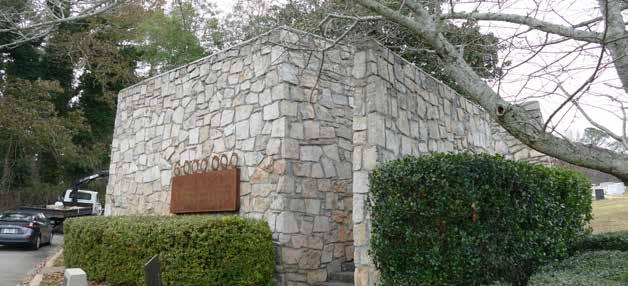
After Passover ends, Yom HaShoah, the International Day of Remembrance for the Holocaust, will be fast approaching. On April 12, at 11 a.m. in Greenwood Cemetery, community members will have the unique opportunity to hear from survivors at the Memorial to the Six Million, one of the first Holocaust memorials in the United States, which has held the annual event
since its founding.
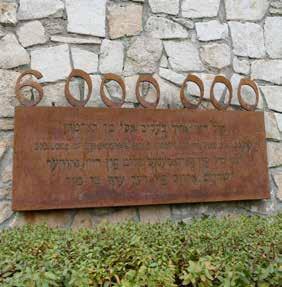
“We think this is the first actual three-dimensional walkthrough memorial,” said Karen Edlin of Eternal Life Hemshech, the organization responsible for the memorial’s upkeep. “April 25, 1965, it was dedicated, and that was their first Yom HaShoah program, and we have done it every year since. The only year we did not have one was 2021.”
She also noted that many people who see it from
the outside don’t realize it is in fact a walk-able space, intentionally designed by survivor and architect Benjamin Hirsch (z’l) to invoke a sense of narrowing from each of the four entrances.
“To have something like this, like the Holocaust memorial – the first one, arguably, in the country – in Atlanta, speaks volumes of the relationship between the South, Judaism, and the complexities of identities,” said David Mitchell, president of the Atlanta Preservation Center.
Though not Jewish himself, Mitchell has attended more events in the Jewish community since he became involved with the restoration of the memorial in 2024. While Landmark Preservation out of Savannah handled most of the restoration, the Atlanta Preservation Center housed the Memorial’s plaques, which were cleaned there one by one.




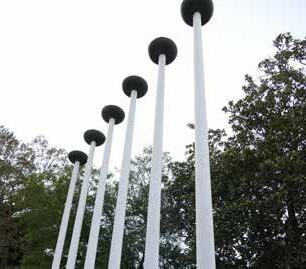
The memorial also had its 60-year-old gas lines leading to the eternal flame and the memorial’s iconic six pillars replaced with new copper piping and also had an automatic igniter to light the torches at the pillars’ top installed.
“I think it speaks volumes that the preservation of something that acknowledges the murder of six million people creates love and affection between people of different faiths and backgrounds,” said Mitchell. “It exemplifies why its preservation and why its existence matters more now than ever.”

“For obvious reasons, the survivors put it in the cemetery,” said Edlin, speaking of the location. “There was a lot of discussion, ‘let’s put it in the Jewish Community Center, let’s put it in the synagogue,’ but they said, ‘Atlanta’s going to grow, they’re going to move the community center,’ which they did, it used to be on Peachtree Street. They felt like a cemetery would be forever.”
However, though Eternal Life Hemshech has worked hard on the memorial’s upkeep, the surrounding cemetery has had significant issues.
“There is a point of recognizing when this may no longer be what you should be doing or want to do, and then politely and professionally transitioning,” said
Mitchell. “And I think Greenwood is in that state of transition.”
“It affects the memorial and it also affects me personally,” said Edlin. “My parents are buried there, my actual grandmother was dug up in Łódź, Poland, and my mother brought her to Greenwood. When my mother did this, I didn’t really understand. I said, ‘what do you mean you’re going to dig your mother up?’ She died when my mother was five years old. She hardly remembered her and it was before the war. She said, ‘who’s going to take care of the grave. There’s no family left, there’s nobody there, there’s nobody in Łódź, Poland.’ And then I went to Łódź, Poland and I understood.”
As for the event itself on April 12, there will be a powerful opportunity for community members to better understand that sense themselves.
“For this Yom HaShoah, we’re going to be doing the same thing we did last year – since we are getting very close to not having any more survivor speakers – we’ll be having around seven or eight survivor speakers. There’ll be more survivors in the audience, some of them choose not to speak,” said Edlin. “We used to have dedicated speakers and then we moved on and we would have a (single) survivor tell their personal story. But we recognize that we are getting to the tail end of the survivors. It’s so important to hear it directly from a survivor because, first of all, we’re in 2026. We’re getting close – we’re not there yet – but we’re getting close to ‘wow, WWII was close to 100 years ago.’ To someone who is a teenager, 20-year-old, 30-year-old, that’s ancient history.
“Being raised in the 80s, I’m part of that generation where WWII has this very significant thing, and the Holocaust is a big part of that,” said Mitchell. “What happened there, how these people were murdered, all these things is kind of a defined component. This isn’t political, this is something that happened, and we should not forget.”
“I think it just serves as a reminder when hate does arrive,” said Edlin. “It can happen anywhere at any time.” ì

By Marcia Caller Jaffe
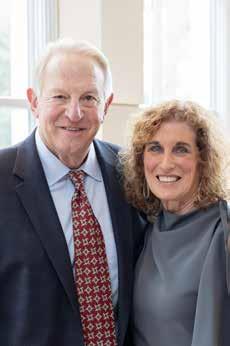
Three hundred change makers were on hand Sunday night, March 8, at The Temple to hear Mara Davis interview CNN’s Dana Bash alongside honoring Linda Davis. The event was held on International Women’s Day celebrating social, economic, cultural, and political achievements of women.
Welcomes were offered by Jewish Women’s Fund of Atlanta (JWFA) Impacts! event chairs, Enid Draluck and Sarah Franco, followed by Mindy Binderman, JWFA chair, and Jodi Hirschfield, JWFA executive director.
Binderman shared about Linda Davis‘ steadfastness and inspiration as a “north star.”
Hirschfield discussed “gift to gain,” where education and grants make impacts to “show the power of collective philanthropy for our daughters and granddaughters to reach their full potential.” Economic equality and empowerment, violence prevention, leadership development, and education are some of the issues JWFA addresses locally, na-

tionally and abroad.
Franco and Draluck related how female leadership goes back to Queen Esther, who “overcame trepidation and
stepped into the moment.” Franco spoke of Linda Davis’ versatility and reliability serving multiple times in various positions and how she doesn’t say “no.”
Atlanta media maven Mara Davis, formerly a radio DJ and TV host, was happy to moderate as she has always been a fan of Dana Bash, whom she referred to
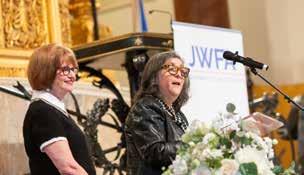
as a “bad ass.” Clad in patent pumps and a sleek black pant suit, Bash praised the iconic Temple citing how her mother attended the Jewish Theological Seminary with Rabbi Peter Berg.
Bash also talked about how social media has changed the landscape of journalism. She stated, “I don’t see myself as an activist. I did a documentary on antisemitism because it was news -- even before Oct. 7.”
Bash also lamented that it was easy to find many incidences of antisemitism. She said that she strives to be objective and focus on truth and facts. Mara Davis asked if she ever gets rattled to which Bash replied, “Sometimes, I want to throw up, but my 14-year-old told me to ‘lock in.’ My key is a ton of preparation role-play on all kinds of incidents and pushback. I don’t want myself to be the story.”
Bash commented on the next generation of female journalists, especially some independents like Katie Couric. She also praised Connie Chung for being a trailblazer. On a personal level, Bash shared that she streams “The Pit,” “Shrinking,” and “Heated Rivalry.” A surprise video announcement saluting Linda Davis came from CNN‘s Wolf Blitzer and thrilled the room.
Linda Davis’ daughters spoke of her leadership by example in both Jewish and non-Jewish spaces and the lessons that she taught about leaving the world a better place and using the buddy system.
“Mother always has a sense of right and wrong and is a good sounding board.“
A video of alternating different hats was shown to emphasize the many different jobs she’s held and duplicated with JWFA. Linda thanked her husband and reminisced about standing on that very Temple bimah for her daughters’ mitzvahs, and that she was now “not alone at the podium with so much support.”
She emphasized her thread of repairing the world through The Temple, its shelter, mass incarceration, Atlanta Jewish Committee, and Camp Twin Lakes. She admired the progress women had made in governorships in mayoral jobs, but still not “at parity.” She also found it not helpful that public figures make disparaging remarks about women. She recalled her youth in small town Nebraska, where her mother drove her 300 miles round-trip to attend confirmation class. She concluded, “There’s nothing more powerful than a committed group of women.“
Senior Temple Rabbi Peter Berg offered comments about the anxiety, fear, heartbreak, and consequences of war, while “holding onto our values of courage and compassion.”
Note that last year, 135 JWFA trustees made 108 grants worth $2.6 million. The Zalik Foundation was thanked for their support. ì


By Marcia Caller Jaffe
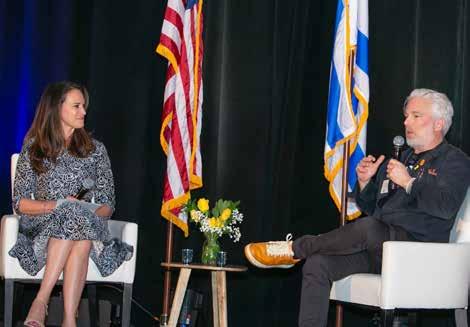
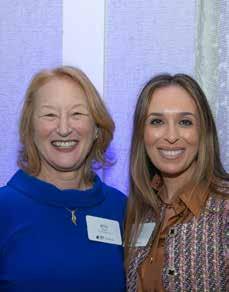
More than 400 Jewish National Fund (JNF) supporters filled the grand ballroom of the Intercontinental Hotel on Sunday night, March 15, for the annual Gladys and Jack Hirsch Breakfast for Dinner event. Early in the program, Hedi Toub was introduced as the new JNF executive director, replacing Beth Gluck, who had served successfully for 16 years and will stay on as JNF’s major gifts executive.
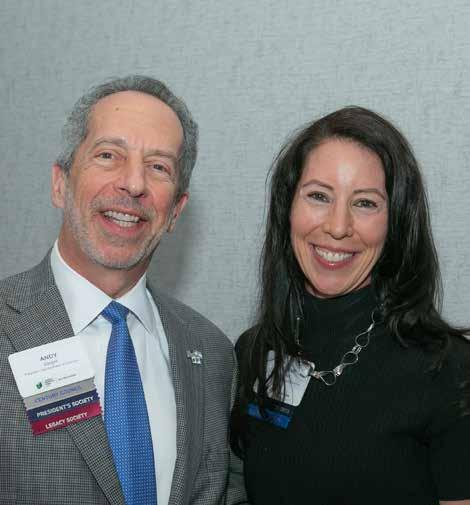
Andy Siegel, president of the Atlanta JNF-USA Board of Directors began, “Tonight’s event represents nearly a year of planning, creativity, and dedication.” On a solemn note, Siegel shared, “We pause to acknowledge the moment we are living in. As the war between Israel and Iran continues, our hearts are with the people of Israel, with the brave men and women of the IDF, and the U.S. service members on the front lines defending freedom and democracy. We pray for their safety, their strength, and for peace.”
He also praised Alexander Muss High School, which helps “shape the next gen-
eration of engaged Jewish leaders — even while the country is at war, they gather in bomb shelters with resilience, optimism, and smiles.”
By video, Gladys and Jack
Hirsch’s grandnephew, Yakov Selevan, deputy mayor in the Golan Heights, praised JNF’s partnership in finding solutions for things like housing, “providing hope and resilience.”




Gluck read a statement from the Israel Consul General to the Southeast, Eitan Weiss, who was not able to attend “because of tight security.” He described Iran‘s attacks as “indiscriminate and



Since 1965, Canterbury Court has been a place where seniors have been cultivating lasting friendships with fascinating people from all walks of life. Together, they weave a rich tapestry of lives that has made our community truly special for 60 years. And the best is yet to come.








Schedule a tour today. Call 404-737-2639, visit CanterburyCourt.org/Friendship, or scan the QR code.


As families gather each year to pass down the story of Passover from one generation to the next, estate planning ensures your own story and legacy are protected for the future
ruthless, creating uncertainty and fear. His message was to remain focused. “JNF has been a central partner in building and strengthening Israel — transforming landscapes, supporting communities, and ensuring that development reaches every corner of our country. Your work reflects something profound: the partnership between Israel and the Jewish people around the world, rooted in shared responsibility and shared destiny.”
A video was shown of the Galilee (Kiryat Shmona) where 40 percent of the population left and has not yet returned. JNF is responding with a state-of-the-art farm/culinary facility, the only one of its kind in the Middle East. Galilee Culinary Institute (GCI) aims to boost the economy as an industry for tourism akin to Tuscany and the Napa Valley.
Karen Isenberg Jones interviewed spice master Lior Lev Sercarz, the school’s director. He explained that he grew up on a humble kibbutz and how his mother did not think that a career in cooking would succeed. Recognizing his talent, he studied in France with a mission “to escape the not-so-good kibbutz food.”
He reported that North Israel was “doing OK” until Oct. 7.
Laying out the opportunities in tandem with the cooking school, in addition to tourism, students will learn about hos-
pitality (the nitty gritty of running a restaurant), food science, food technology, the business of food security, agriculture, baking, and the like.
He said, “The school will have tremendous impact on the region with a brewery, even chocolate, and pastry … it’ll be first-class; many things that restaurateurs and chefs have to know, like what to do when the air conditioning goes down, or if there’s sewage problems. One could be the best cook, but you still have to understand finance.”
The classes will be taught in English. GCI plans to enroll 10 students in 2027 and begin taking applications in May; then slowly roll out more students every three months. The hotel on site will have 20 rooms.
Michele Horesh, event chair, spoke of JNF’s strong foundation of more than a century of helping build Israel’s future, providing the way for future generations with water, security, and more, so families can enter the region; and young people will stay to build under the power of the Circles of Impact … where a ground swell initiative becomes a neighborhood, which becomes a region in the eddy/ripple effect.
Stay tuned for an AJT in-depth interview with Toub as she incorporates her past experience and love for the Jewish people and Israel into her new role. ì




By Robert Garber
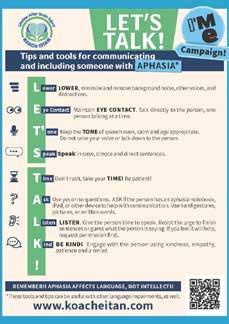
At the beginning of the year, a special event was held at Ohr Hatorah and dozens of other synagogues across the world. World Aphasia Shabbat, a day dedicated to people in the Jewish community with aphasia, helps inform people about the communication disorder, typically caused by a brain injury that can affect speech, reading, writing, and comprehension.
“We didn’t know what aphasia was, we didn’t know a lot of anything at the time,” said Leora Ashman, co-founder of Koach Eitan, an Israel-based charity dedicated to assisting those with aphasia and their families. “We basically had to learn it by living it.”
The organization is named after her husband, Eitan, who had a stroke at the age of 42 and was diagnosed with aphasia. Eitan, who has a specific form called Broca’s aphasia, has unique difficulties with speech.
“He has words, but he can’t always get those words out,” said Ashman. “At
the beginning, he had one word, which was ‘savta,’ his mom, and that word was everything. Everything he wanted to say
came out as ‘savta.’”
The biggest difficulty, however, came after returning from the hospital, and
Wishing you a warm and meaningful Passover.

into a world where no one knew how to interact with Eitan.
“When you can’t express, or even

you say things that are funny, some people may view you as … not competent,” said Ashman. “But aphasia does not affect intellect.”
“When we came home, we had to then teach our community about aphasia because nobody knew what it was,” said Ashman, who discussed beginning Koach Eitan originally as a Facebook page. “I would explain more about what Eitan has, about aphasia, about stroke, and one thing led to another when then people would start reaching out to me.”
Shortly after the organization’s more formal founding in 2022, Atlantan Jeff Weener got in touch with her, and asked if they could teach his community about stroke and aphasia. Weener had himself been diagnosed with aphasia after a stroke during the COVID pandemic.
“I had nine words, basically,” said Weener. “I physically could understand where I was but I couldn’t have the ability to talk about it.”
“That’s aphasia. Everything’s in there, but it’s challenging to retrieve and to articulate words,” said Rabbi Adam Starr, the rabbi of congregation Ohr Hatorah, where Weener is an active member.
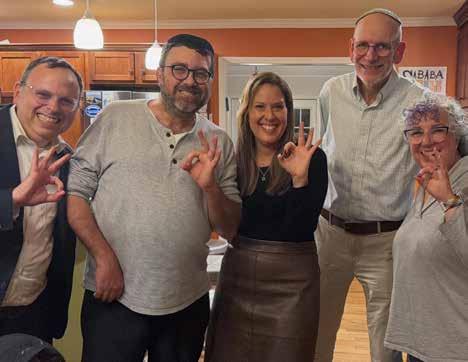
Weener and Rabbi Starr were deeply involved in the first World Aphasia Shabbat over three years ago, originally held in June to coincide with Aphasia Awareness Month.
“We had about 20 shuls, 25 shuls the first year – shuls in Israel and abroad,” said Ashman. “We would send them materials, even got a D’var Torah for the rabbi to say that was connected to the parasha.”
Since then, the amount of participating shuls has grown to more than 40, and the date has been moved to coincide with Parshat Shemot, which mentions Moshe’s speech difficulties.
“Our greatest leader in Jewish history, Moshe Rabbeinu, one of the first things we hear about him – the Torah uses different language to refer to it – but it’s his difficulty of speech,” said Rabbi Starr. “One of the terms is k’vad peh – a heaviness of the lips. There were multiple interpretations about what this was – was this a lisp, was this lack of confidence, or was this something more similar to aphasia, a challenge of articulating what was inside and having those words expressed clearly?”
This was also the first year that Eitan Ashman was cleared to travel by plane since his stroke, coming to the United States to visit his hometown in Boston, and of course, visit Ohr Hatorah for World Aphasia Shabbat.
“It felt like the fulfillment of a dream […] to see him here and introduce him to our community, and to see Jeff and Eitan interact,” said Rabbi Starr. “Saturday night after Shabbat, they were up talking to each other until one in the morning –in ways that they can understand each other like no one else.”
Still, there’s more work to be done. Ashman noted hearing people who had known Weener for years still surprised at so many aspects of Aphasia.
“We need the leaders to know, we need our people to know what these people are going through,” said Ashman. “We need them to know that just because they came back from the hospital, it doesn’t mean that they’re fine. It means that that family needs support. They need encouragement, they need connection.”
“I think it’s a constant learning process,” said Rabbi Starr. “I think we’re all growing in this regard to better understand and communicate and respect how to make Jeff and people like him feel most welcome.” ì

By Debbie Diamond
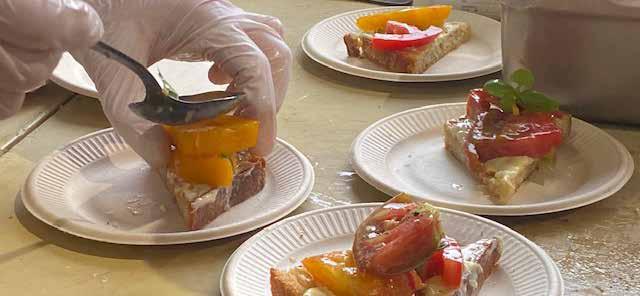
Taste of Atlanta, founded by Dale DeSena and widely recognized as the city’s premier food and drink festival, will celebrate its 25th anniversary from 6 to 10 p.m., Thursday, April 16, at The Works on the Westside (300 Chattahoochee Row).
Marking this major milestone, the event will honor Atlanta’s chefs, restaurants, and culinary innovators who have defined the city as one of the Southeast’s top food destinations. Participating restaurants will include Bistro Niko, Bold Monk Brewing, Chicheria Mexican Kitchen, DAS BBQ, Delilah’s Everyday Soul, El Super Pan, Fox Bros. Bar-B-Q, Il Giallo, Hattie B’s, Kyma, Mission + Market, Morelli’s Ice Cream, NFA Burger, Nine Mile Station, Pricci, Tandoori Pizza & Wing Co, Three Dollar Cafe, The Big Ketch Saltwater Grill, Tiny Lou’s, Woody’s Cheesesteaks, Your Third Spot, and more to be announced.
“Taste of Atlanta has always been about more than food — it’s about community, creativity, and celebrating the people who make this city’s culinary
scene so vibrant,” said DeSena. “The 25th anniversary is an extraordinary opportunity to honor the chefs, kitchen teams, restaurants, mixologists, and loyal guests who have made Taste of Atlanta a defining experience for Atlanta’s food lovers.”
According to DeSena, The Works was chosen this year because she believes it offers the “perfect environment for a celebratory gathering with both indoor and outdoor spaces, along with convenient parking for attendees.” She also
mentioned that Your Third Spot, a popular entertainment venue featuring more than 1,000 games, food and craft cocktails, is located at the venue and will host the official after-party this year. All event attendees will receive complimentary


entry from 9 p.m. to midnight, providing another place for guests to continue connecting and celebrating.
“Taste of Atlanta’s 25th anniversary belongs on a stage that celebrates food, and that’s exactly what The Works does every day,” said Mindy Selig, CEO of Selig Enterprises, owner and developer of The Works. “We’re honored to host this event that’s deeply rooted in the city, as culinary legends and the community come together to celebrate something we all love — gathering around great food.”
Since its debut in 2001, Taste of Atlanta has been more than a festival — it has been a launchpad for culinary talent and a gathering place for food enthusiasts. Over the past quarter-century, the festival has showcased several legendary Atlanta chefs along with emerging talents who have gone on to shape the city’s food scene. From innovative tasting experiences to immersive chef demos, craft cocktails, and live entertainment, Taste of Atlanta has continually evolved while staying true to its mission of turning tasters into diners while celebrating the people, flavors, and creativity that make Atlanta’s food culture extraordinary.
This year’s event promises elevated food and beverage tasting experiences that will be spread inside and outside the venue. Bogey and the Viceroy will perform outside at the camp area and indoors will feature a live DJ and a special appearance by the Seed and Feed Marching Abominables. During the event, culinary icons who have shaped Atlanta’s restaurant scene will be recognized and celebrated for their impact on the city’s dining evolution. Also, classic recipes, iconic dishes, and unforgettable festival moments from past Taste of Atlanta events will be showcased on social media throughout 2026, reminding guests why Taste of Atlanta has become an ac-





claimed Atlanta tradition.
Event sponsors this year include Coca-Cola, Don Julio, The Works, Society Insurance, Aperol, Grand Mariner, St Julian Winery, Senorita Drinks, Rythm Drinks, Regency Centers, Classic Tents & Events, Prima, Savannah Distributing, 680 The Fan, Atlanta Homes & Lifestyles, Atlanta Intown, Best Self, Georgia Voice, Jezebel Magazine, My Midtown Magazine, Rough Draft, Simply Buckhead, Smooth Jazz 101.1, The Atlantan Magazine, and XTRA.
Taste of Atlanta will partner again this year with Second Helpings Atlanta as the official charity partner. According to event organizers, their team collects surplus prepared food at all of their events and delivers it to those in need throughout Atlanta, ensuring the food does not go to waste. In addition, Taste of Atlanta helps support Second Helpings through financial contributions.
In addition to the 25th Taste of Atlanta anniversary celebration, Taste of Atlanta will offer three other culinary events this year — Food That Rocks Sandy Springs on June 4, Grand Tasting Alpharetta on Aug. 27, and Grand Tasting Midtown on Oct. 15. Each of these events showcases the respective neighborhood’s unique gastronomic scene and supports the local restaurant community.
“Four times each year, the culinary community comes together — chefs, beverage makers, sponsors, media and food lovers — and it feels like a giant table where everyone is welcome. I love watching attendees discover cuisines they’ve never tried before and leave with a list of new favorite restaurants they want to support,” said DeSena.
Tickets for the Taste of Atlanta 25th anniversary tasting party and their other culinary events may be purchased at www.tasteofatlanta.com. ì














By Marcia Caller Jaffe
Yearning for a Soho visit? There’s a slice of sophisticated urbane heaven right here on the Beltline. Divine dining, overnight staycaytions, and hosting the next wedding, the relatively new Forth Hotel opened a world of possibilities outside the usual “north of the city” quadrant.
In the Old Fourth Ward, the hotel is smack dab on the Beltline, a hop from Ponce City Market and Chabad Intown, and a five-minute drive to Georgia Tech, Fox Theatre, and Krog Market.
The 196 hotel rooms include iPod docking stations, 43-inch smart TVs, complimentary wi-fi, and special touches like rotary phones, freestanding tubs, second only to the dazzling floor-to-ceiling view of Midtown and downtown. Pull back the black out curtains, and it’s breathtaking. There are also two floors of fully furnished apartments.

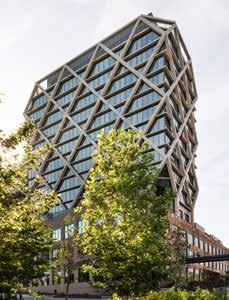
The Forth is not part of a chain. Locally owned by New City Properties, Atlanta native and president Jim Irwin stated, “We set out to combine a high-quality project that fit within the context of the environment with the latest technology, innovation, and sustainability. We made a serious commitment to fine dining, interior design, and guest comfort.”
The Forth features a full spa and 15,000-square-foot workout area. Add in


a Miami Polo Club vibe because on site is this luxury social and wellness club. Irwin added, “Founded on a belief in cultivating the whole self, our Club invites creatives, seekers, and community leaders to experience a new definition of
wellbeing: leisure, fitness, recovery, productivity, dining, intellect, culture, and real connection — all in one dynamic environment.”
Dining at Forth is worth multiple trips for date nights and special oc-
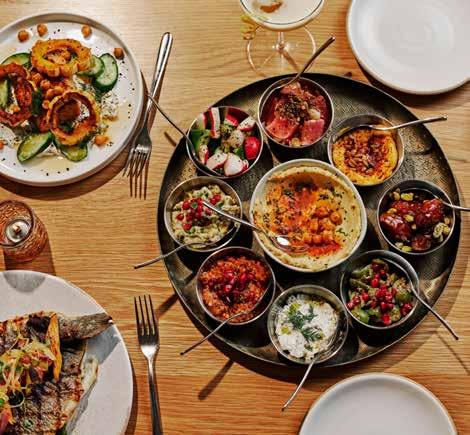
selections.
casions. With two Michelin “mentioned” restaurants, Il Premio (fine Italian), was one of the best Atlanta epicurean experiences for this writer. Our selection:
Ricolla Alla Puttanesca: yellow tail, capers, taggiasca olives, calabrese chili ($24)
Spigola E Cavale: Mediterranean sea bass, cucumber, finger lime, caviar ($34)
Grilled Gem Lettuces: Anchovy dressing, parmigiano pane fritto ($ 16)
Premio Salad: Butter lettuce, peas, artichokes, lemon scented walnuts ($17)
Mero: Yellow wedge grouper, morels, asparagus ($42) *this was halibut on our night.
All items were shareable and were of good value considering the ambiance, ingredients, and impeccable service. Adjacent to Il Premio is Bar Premio with its own lighter menu and a sophisticated crowd that alone is worth the visit.
For breakfast, we dined at Elektra, “paradise found, a sun kissed oasis,” alongside the heated indoor pool. Known for Mediterranean fare, we sampled:
Olive oil pancakes with orange labneh, saffron butter, mixed berries ($14)
Spinach and feta omelet ($12)
Next time: Shakshuka, Citrus Salmon, Yaqtin (butternut squash, tahina, Aleppo pepper, peptitas) Fattoush Salad. One simply cannot go wrong dining at Forth.
Additionally, Moonlight, the rooftop lounge, affords a spectacular view in all directions.
Forth’s exterior design is an exposed
concrete diagrid. Inside interiors provide a warm counterpoint to the building’s contemporary tower. Inspired by classic Americana traditions and European design, Forth’s art connects to nature. Behind the reception desk, a painting by Jack Spencer depicts a forest, marking the beginning of a journey through the hotel. A mountain tapestry is nearby. Adjacent to the lobby is a diorama by Becca Barnet with taxidermy foxes, pinned butterflies, and natural foliage. (Think Fernbank.)
Ideal for a staycation for sure, also consider hosting a wedding or bar mitzvah inside this ideal setting for guests. The ballroom splits but can accommodate from 40 to 400. It’s outfitted with state-of-the-art technology, drop-down screens, projectors, programmable lights, and drapery. The ballroom is a canvas for the imagination and can be rented 60 days advance or further out with a guest room block.
At Forth, feel important and romantic at the same time. Some rooms even have an outdoor fireplace. Travel and Leisure Magazine labeled Forth, “Atlanta’s coolest new hotel in a historic neighborhood.”
Local PR guru Maggie Gallant Isenberg, an early Forth fan said, “The Elektra mezze platter is a must with the pistachio-filled dates as the standout. The chic, coastal-inspired design spanning the indoor and outdoor spaces, along with the lively atmosphere, make for the perfect night out. Unlike anywhere else in Atlanta.” ì

Our most vulnerable citizens, including the elderly, the disabled, and the Holocaust survivors among them, are currently trapped in a landscape of fear and left to wonder if their next meal or a safe haven will exist tomorrow. With every escalation bringing a new tide of hunger, Meir Panim is acting with absolute urgency to bridge the gap between despair and dignity.
Our teams are moving faster than ever to ensure no one is abandoned to this rising tide of violence. We remain on the ground to provide fresh meals, critical supplies, and lifesaving delivery to those who cannot safely leave their homes.
Your donation can provide the strength and stability required to endure this vicious reality for those trapped in a landscape of fear.
By Chana Shapiro
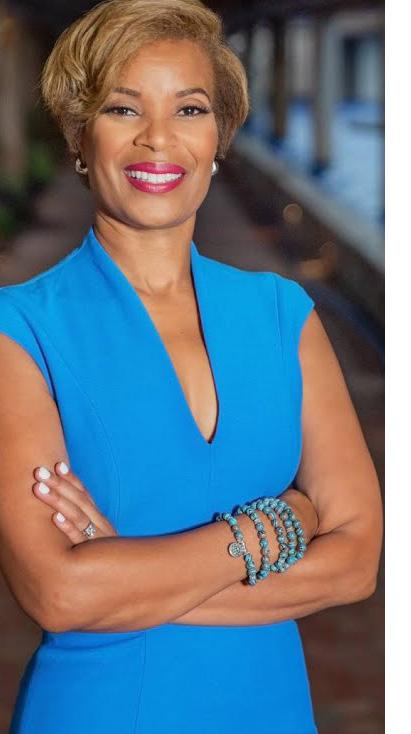
Needle Nook, the legacy yarn-crafts store, held a festive Golden Anniversary celebration on Friday, March 20, exactly 50 years to the day since founder, needlework maven Arlene Jacobson, first opened its doors. Arlene’s daughter, DeAnne Jacobson, who is herself an accomplished knitter, invited the community to honor the longevity and experience the distinct character of the Toco Hills shop that grew to become a hub of activity for yarn crafters throughout Atlanta.
The March 20th fete featured special guests, yarn releases (exotic yarn exclusively produced for the store), stitching events, tarot card reading by Lakbira Sheffield, and hourly raffles of large mystery gift containers of yarn-related items. Decorations, giant bowls of fruit, memorabilia, and lots of flowers increased the feeling of celebration.
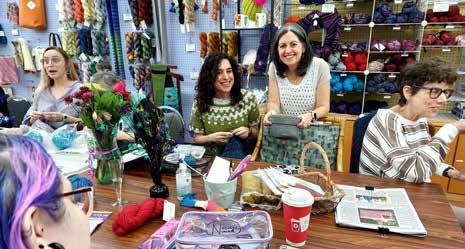
The shop buzzed with animated conversations resulting from friendships that had developed over the years. Worktables were available for the many
women and men who appreciate Needle Nook’s ambiance, which encourages insitu side-by-side creating. One table held a “close-knit” group that meets every Wednesday at the shop (some patrons come several times each week). A gathering of Needle Nook habitues, spanning backgrounds and ages, worked on individual projects at another table. Other customers came to buy, observe, mingle, and join in the fun. Owner DeAnne and her sister, Lori London, wearing personally knitted sweaters, cheerfully welcomed guests and affably managed the crowd and activities.
DeAnne Jacobson is Needle Nook’s owner and manager, a vocational decision that necessitated closing her own flourishing business, Fit and Strong. Running her mother’s popular store was not her original plan. At the University of Georgia, she studied in the School for Forest Resources, and after graduating, she moved to Idaho where she worked for the United States Forest Service, helping biologists gather information about wildlife populations. Gregarious DeAnne eventually found the job too isolating,
and five years later, she returned to Atlanta, where she served as a personal trainer at the Shirley Blumenthal Jewish Community Center and received certification from the American Council on Exercise.
As a member of the fitness staff at the Shirley Blumenthal facility, she led a variety of classes and ran a popular co-ed fitness boot camp. She also taught spinning classes and was a group fitness
instructor and manager for LA Fitness. Next, at the Jewish Community Center Zaban branch, she became a fitness director where she led classes, ran a boot camp, and was in charge of the annual Harris Jacobs Dream Run. DeAnne worked at the Jewish Community Center for 17 years; then COVID hit. With her extensive experience in the field of fitness, and her desire to help others maintain fitness while at home, she launched her


own business, Fit and Strong, in which she worked with clients in their own residences or over Zoom. However, this endeavor came to a sudden stop, when DeAnne’s mother, Arlene, became ill and suddenly passed away. DeAnne decided to pivot again in order to keep Needle Nook open, and she began to add her own touch to the offerings and community involvement of the store.
The inclusive personality of Needle Nook remains, notably in the camaraderie among the crafters who gather in the “haimishe” store to work on individual projects during Open Table hours, informal gatherings of experienced and novice yarn crafters. On a recent Sunday in March, as soon as the door opened, Open Table crafters (carrying totes holding their work, patterns, and tools) and other customers bustled in. Violet, an Australian sheepdog (known as the “yarn dog”), welcomed each new arrival, then crafters settled around a large table to work under a sweeping overhead art installation covering a large section of the ceiling. Named “The Interknit,” this interactive piece is the brainchild of fiber artist Karelle Levy; it creates a canopy of colorful pompoms of all sizes and inventive yarn enhancements. As planned, Needle Nook customers and their children were invited to add their own creations to the installation.
Needle Nook’s vibe, in DeAnne’s words, “is a mixture of connectivity, and creativity.” Her desire to maintain Needle Nook’s homey ambiance and also to enhance experiences among her customers resulted in two permanent additions to Knitting Nook’s fare. Whereas, men often come to Open Table to knit and crochet, Needle Nook now hosts a Tuesday evening Men’s Knitting Circle, a free weekly gathering to which men bring their projects, share tips, and enjoy each other’s company. Another way to improve shop visits was to display the work of select indie vendors. Presently shown are oneof-a-kind lined Filzwork totes made from vintage knit sweaters, and a selection of handmade earrings by local silversmith, Amy Gresens.
The shop provides plenty of yarnbased inspiration. One wall displays a variety of “Learn to Crochet” kits. (DeAnne learned to crochet from one of the kits.) Another wall holds books and folders of patterns and displays, and glass cases hold tools that help customers turn yarn into sui generis fashion. Samples of stylish adult and charming children’s clothing are displayed throughout the store.
DeAnne continues to expand the focus of the store, both in-house and outward. With new inventory, increased classes and ongoing instruction, more at-
tention to yarn-related national events, and joint ventures with local Atlanta groups, DeAnne remains true to her mother’s belief that “craft builds community.” Needle Nook’s yarn aficionados entered the world of Atlanta social action, when a large assortment of handmade knitted and crocheted items was intentionally created and donated in partnership with Georgia Public Broadcasting, in a joint initiative called “Knitting with Neighbors.”
Needle Nook brought “regulars” together to create handmade items for people in need and welcomed donations of handmade items from others; subsequently, Needle Nook facilitated the distribution of hundreds of hats, gloves, socks, shawls, and sweaters. DeAnne emphasizes the shop’s belief that handmade goods carry “a special interpersonal connection far beyond their stitches.” She reflects, “We want to do as many good things for as many people as we can.”
Another social action project in which Needle Nook participates is Melt the Ice, a global effort which began in a woman-owned Minnesota yarn shop. Participants knit bright red hats that mirror hats knitted and worn in Norway to protest Nazi occupation in World War II. Melt the Ice is a silent ICE protest movement in which each knitter purchases a five-dollar pattern, then follows it. Knitters may wear their hats themselves as a protest symbol, donate the hats to community organizations and charities, or sell the hats to support immigrants. To date, at least 100,000 patterns have been sold in 43 countries around the world. DeAnne smiles, “One result has been a huge spike in demand for red yarn across many yarn stores!”
DeAnne notes that, in recent years, there has been an explosion of handcrafting in all demographics, a wave dramatically amplified during COVID’s forced isolation, resulting in men, women, and kids becoming makers with time to try new hobbies or finally return to past creative pursuits. DeAnne believes that needle crafters, alone or in groups, want to create with their own hands items that are made to last, are unique, and have meaning.
For information about Needle Nook’s hours and future Golden Anniversary programming, including community or national initiatives, call the store at (404) 325-0068. Needle Nook is located at 2165 Briarcliff Road, N.E., Atlanta, 30329, in the Briarvista Shopping Center. You can find them at www.needlenookyarns.com; on instagram.com/needlenookyarns; on facebook.com/needlenookyarns; and youtube.com/@NeedleNookYarns; or needlenookshop@gmail.com. ì
Application Deadline: Sunday, April 12
Leaders for Tomorrow LFT
Program for rising sophomores and juniors that enables them to advocate on behalf of the Jewish people and Israel.
^ For more info visit AJC.org/Atlanta/LFT
Black/Jewish Teen Initiative BJTI
Program for rising juniors and seniors that ensures future leaders develop the skills to advocate for the Black and Jewish communities and build lasting relationships with like-minded peers to be effective ambassadors for change.
^ For more info visit AJC.org/Atlanta/BJTI
Senior Leadership Forum SLF
Program for rising seniors to help sharpen students’ Jewish advocacy and leadership skills.
^ For more info visit AJC.org/Atlanta/Seniors


BUSINESS LAW
TAX PLANNING & RESOLUTIONS WILLS, TRUSTS & ESTATES
PRIVATE WEALTH LAW

| MFcounsel.com
By Bob Bahr
While Israel presses forward with its military strikes against the Islamic regime of Iran, an equally determined battle is shaping up against the political forces within Israel that would extend fundamentalist Judaism’s control one of Israel’s most important religious sites.
A bill introduced in Israel’s Knesset last month passed its first reading to give Israel’s Orthodox Chief Rabbinate full control over prayer over the entire Kotel, the Western Wall of the Biblical Temple in Jerusalem.
The practical effect of the bill would be to put an end to egalitarian prayer in the Ezrat Israel plaza of the Kotel and would label any attempt at non-Orthodox worship a “desecration” of the holy site. If passed the law would carry a penalty of up to seven years in prison for such a violation.
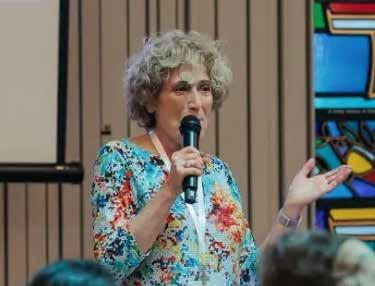
Among those leading the call to pressure Israel’s government to defeat the legislation was Margo Gold, a longtime member Atlanta Ahavath Achim Synagogue, and the immediate past in-

ternational president of the United Synagogue of Conservative Judaism, which represents Conservative Jews around the world.
She called the legislation a “shonda,” a Yiddish term that is usually reserved for moral actions that are scandalously shameful. In a hastily assembled conference call with 400 influential Conservative Jewish leaders, she called on them to share their outrage with Israel’s diplomats and consular officials around the world.
“We are angry. We are hurt, and we need to share that,” Gold said. “I think the part that’s so painful to me is that these are Jews doing this. This is why Israel exists and Jews turning on Jews is one of the most painful things I can imagine.”
Among those who have worked to create a strong voice for liberal Jews in Israel is Rabbi Peter Berg, Senior Rabbi at The Temple. He was a delegate from the Association of Reform Zionists of America, also known as ARZA, at last year’s World Zionist Congress in Jerusalem. The Congress meets every five years to draft a budget for the organization and a list of priorities.
He and the other Reform and Conservative delegates worked and voted together and thought they had “made a big impact” in calling for, among other things, the reopening of the egalitarian section of the Kotel and promoting women’s leadership.
Berg said he came away encouraged by the relationships he saw being formed
among all the delegates to the world body, including those who are Orthodox Israelis.
“My observation was that there’s a real reciprocal relationship, and a real sense that we need each other. And I really felt that, while I was there, that the Israelis felt that they needed the diaspora community, and the diaspora community felt strongly that we need a strong Israel.”
But it’s been a difficult five months since the Congress ended its work in late October. And the response of the Union For Reform Judaism and its religious leaders in the Central Conference of American Rabbis after the Knesset vote was strong and swift. The statement signed by all of Reform’s leaders made clear the concerns of these American Jewish representatives.
“The debate over this legislation raises a fundamental question: Will Israel be a state of the Jewish people or a state for only one interpretation of Judaism? For North American Jews, engagement on this issue is not interference; it is investment. Jewish sovereignty must reflect the diversity, dignity, and shared destiny of the Jewish people everywhere.”
The bill was introduced by Avi Maoz, the sole representative in the Knesset of the Noam Party, which advocates ultraOrthodox radicalism and the establishment of the Chief Rabbinate as a fourth branch of government.
The fact that the bill passed by a vote of 56-47 alarmed and outraged progressive Jewish leaders around the world. The legislation was designed to nullify a ruling by Israel’s High Court that the nation must upgrade the Western Wall’s egalitarian plaza and allow non-Orthodox prayers there.
Earlier this month, the Knesset House Committee moved forward with the bill, voting to send it to the Constitution, Law and Justice Committee, which is chaired by a lawmaker who has a history of working with the Israel’s ultraOrthodox politicians.
The head of the Israeli Movement for Progressive Judaism, Anna Kislanski, called the action a slap in the face for non-Orthodox Jews.
“In the midst of a war, while Jews of all stripes are fighting for their lives and are in the army, in the reserves, and on the home front, the coalition chooses to promote the Western Wall Law, the same law that defines those citizens as secondclass Jews.” ì
By Bob Bahr
The Voices of Resilience program at The Westminster School in Buckhead which, for the past five years, has given a number of students at the prestigious private school an immersive experience of the Holocaust, now has permanent funding.
The family of one of last year’s participants has agreed to provide an endowment for the program that will underwrite the expenses of at least 18 students each year to travel to former centers of Jewish life in Eastern Europe and to experience firsthand at least two of the most notorious Nazi concentration camps of World War II.
The program is being renamed to honor Robert Ratonyi, a Holocaust survivor who spoke at Westminster this year. He has been a frequent speaker over the past 10 years in gatherings large and small, to audiences of Jews and non-Jews, about his experiences during the Holocaust and his life afterwards. He lost his father and 18 close relatives during the German occupation of Hungary.
The program began six years ago, when Jack Halpern, whose grandparent died in the Holocaust, was on the board of directors at Westminster. At the time, he was concerned that a number of Jewish parents were passing up the private school because there was not much there to attract them to the school.
“I went to speak with the president of the school,” Halpern recalls, “because I was concerned that Jewish parents weren’t considering Westminster as often as they were some of the other private schools that they were sending their children to, and I said, I also noticed that there’s not much that is taught in terms
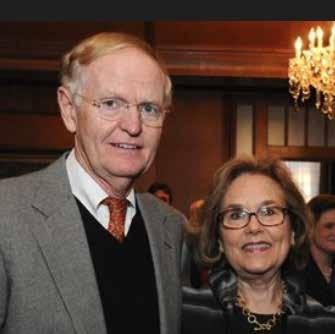
of Jewish history or the Holocaust to the students there. And I wondered if perhaps some change could be implemented to address those concerns.”
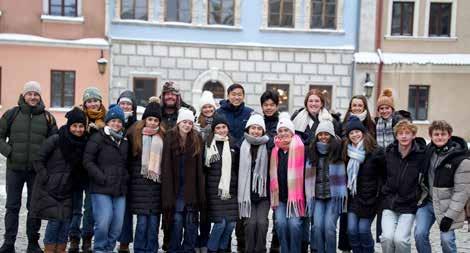
What resulted from that conversation is a program called Voices of Resilience, in which junior and senior class students, both Jewish and non-Jewish, compete for a place in an intensive program of Holocaust education. This year, 81 students applied for 18 slots that were available. One of them was Izzy Winarsky, who had grown up in a family with a strong Jewish identity who was surprised by all that she learned right from the start about the Holocaust and its impact.
“During those three days, when we were still in Atlanta, I learned so much I didn’t know about what happened then. And one of the girls that I went on the trip with, I’d gone to Sunday school with for probably 10 years, and we both said the same thing, wow, we had no idea. about how antisemitism starts, and, how hate develops.”
The 20-day program included an all-
expense paid trip to Warsaw and Krakow in Poland and Prague in Czechoslovakia to study the rich history of Jewish life there. The students were required to keep a daily journal of their thoughts during the journey and when they returned to Atlanta the group created two video projects about what they saw.
A highlight of the trip was a visit to the Majdanek Concentration Camp outside Lublin in Poland, about an hour by train from Warsaw. Snow was falling on the cold January day, and the camp had few visitors. The Westminster students and Winarsky were alone with their thoughts.
“I really can’t put it into words, but when you try to put yourself in other people’s shoes it’s a gut-wrenching experience. It was very, very quiet, and it seemed so peaceful. But then you … realize that … this, is where all those thousands of people died and it leaves you without anything more to say.”
That sense of something profound happening in these young lives is what
motivated the family of Lou and Tom Glenn and their daughter, Rand Glenn Hagen, to provide permanent financing for the program with a seven-figure endowment. Rand Hagen’s daughter was one of last year’s participants.
The announcement of the gift was a gratifying moment in Halpern’s campaign to bring a greater sense of Jewish history to Westminster. It was, after all, a school that began 75 years ago as a project of the North Avenue Presbyterian Church in downtown Atlanta. He now takes pride in how his action as a concerned Jewish parent is going to live on as a testament to Jewish survival.
“The name of the course is Voices of Resilience. And the most important thing to remember is that we are resilient. People have remained proud of being Jewish, are proud of how, despite the terrible things that have happened, we have been able to rekindle Jewish life, even in those many places where it might have been extinguished.” ì

Traci A. Weiss



By Robert Garber
In February, a local hero and veteran celebrated an incredible milestone at a meeting of the Jewish War Veterans – his 102nd birthday. Hilbert “Hibby” Margol, the older by 10 minutes of identical twins, and not one to speak much of himself, had only a little to say on the event itself.
“They had called me in advance to know what kind of cake I want. I said, ‘well, if you insist on a cake, let’s make it vanilla on the inside – that’s for me, and chocolate icing on top – that’s in memory of my wife. She passed away Sept. 22 of last year.’”
He had much more to say, however, on the stories he has dedicated the last decade-and-a-half to telling, after many more years of silence.
“Until about 16 or 17 years ago, I never told my wife or my three children that I was ever even in the military,” said Margol. “It just wasn’t something to talk about.”
This all changed when he was invited to the international March of the Living in Poland. After returning home, he showed some pictures to his neighbors who said he couldn’t keep those stories to himself and helped him set up an event at the Dunwoody Library.
“Just with word-of-mouth advertising. I was really almost shocked when we got there and over 90 people showed up,” said Margol, who, influenced by this, decided he might as well start talking about it more. And he certainly did.
“I stopped counting when I did my 200th presentation,” he said, discussing how he’s talked in various locations across the U.S. and Europe. “I don’t know where I’m at now, but by now I might be close to 300, not counting all the interviews I’ve done over the years.”
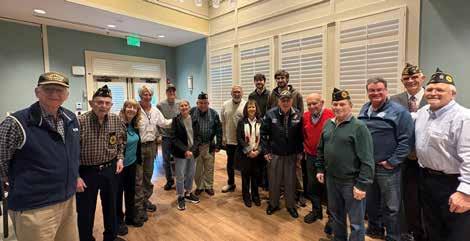
He often discusses how he and his brother, Howard (z’l), ended up in the military, originally joining the ROTC and training as gunners at the University of Florida in Gainesville, before a military recruiter came and suggested if they joined Army Reserve at the time, there was a good chance they’d get to stay in college until they got their degree. But then, in January 1943, before graduating, they were called up for active duty.
“That’s when we realized the recruiter was only talking to the senior ROTC students. He didn’t mean to make that remark to the freshmen, I guess.”
Refusing officer training, as the promotions would cause them to be split up, they opted for a new program, the Army Specialized Training Program, which sent them to college to get trained in engineering.
“We said ‘Going back to college? That’s us!’”
Unfortunately, this program was cancelled after two months, and the brothers were split up. It took no less than a letter from their mother to Presi-
dent Roosevelt himself to get them back together, and they were finally where they would be for the rest of the war, with an artillery division headed to France, and later, Germany.
The other topic he often discusses is the experience when they found the outskirts of the camp at Dachau. The first thing they noticed was the smell, which led a fellow officer to think there was a chemical plant nearby.
“My brother was very close to me so he came over and said he didn’t think it was a chemical factory. Said the odor reminded him of when we were kids, and our mother used to go to a kosher meat market and buy a freshly killed chicken, take it home and hold it over the gas flame on the stove in the kitchen, and burn off any remaining pin feathers. In so doing, it would burn off some of the skin and the fat of the chicken. He said that’s what the odor reminded him of.”
“Then, we saw in three or four places, stacks of bodies in the nude, stacked like cordwood. We didn’t know what we were seeing. We didn’t understand what we

were seeing, because we didn’t know anything about such camps. We thought maybe they were setting all this up to make a movie or something,” said Margol. “We later learned that some months earlier the Germans had run out of coal. Without coal, they could not operate the ovens. So that’s why they left the bodies there.”
Margol has since made it his mission to discuss these events and share the photos and stories and perspectives that are growing rarer and rarer as veterans and survivors pass on. He remains staunch in his hope to prevent anything like this from ever happening again.
“While I’m against wars, I feel they can be necessary – like I feel the current war in Iran was necessary,” said Margol. “But other than that, wars should not happen, period. Because everybody loses, nobody is a real winner. That’s just the way I look at it.”
He intends to continue speaking about his experiences, though he is slowing down just a bit, with only one international trip this year, heading to speak at Normandy on June 1. ì

By Marcia Caller Jaffe
What is more sensual than “un essaim” of French chefs stirring a roux and caramelizing crème brulee? Toque blanche (white hat) clad, “senior-ish” Jewish men learning to splice, dice, and sacrifice $85 to prepare a five-course gourmet meal with wine flights under the tutelage of local chefs as part of Les Marmitons.
Les Marmitons (French for “kitchen helpers” or “chef’s boys”) is a gastronomic social, members-only, international cooking club, focusing on the culinary arts with three Atlanta chapters: Roswell, Canton, and Sandy Springs. The AJT met up with chefs Eddie Wolffe, Wayne Lazarus, and Paul Kent, identified by their blue names emblazoned on apron fronts alongside the year of their initial membership.
Wolffe said, “You could call me ‘a foodie’ as I’ve traveled eight times to Paris to do a deep dive into dining and especially liked eating at L’Atlas. So, at Le Marmitons, I get to play that out and learn new techniques.”
The group meets monthly on Sunday nights at an industrial kitchen just inside I -285. The Valentine’s, Winter Holiday (not all members are Jewish), and picnic events allow female guests. Wolffe, a retired textile engineer, whose French favorites are Coc au Vin and Beef Bourguignon, likes to eat locally at the Colonnade.
“Actually, I’m underwhelmed by the eating out choices in Atlanta. The Brickery was wonderful but no longer exists.” He said, “I’m really good at making suga (sauce) with my ‘taste and go’ method.” When asked what new techniques he has learned, he replied, “I’m adept at cutting lemons and using tongs.”
Kent, with decades of experience in the food industry, now vice president of a Belgian-based spice business, was assigned to the salad course and shared how, after roasting the beets, he used the reserved liquid to fold into the salad dressing, adding, “It’s important to toast the walnuts before topping the arrangement.”
A member for more than years, he joined to “be around a group of guys who love to cook and work together as a team.” His favorite menus involved stuffed chicken breasts and veal, adding, “My best ‘Marmitons trick’ was learning how to slice an onion in just a few cuts.” For an unusual notch in his culinary belt, Kent took his grandfather’s barbeque sauce recipe to market and sold it in 44 stores.
Between courses, that night’s chef, Jamie Adams, of Il Giallo Osteria and Bar (Sandy Springs) and L’Antoinette (Crabapple), worked with the lay chefs in the back kitchen and appeared between courses to go over details. Adams explained the simplicity of that night’s sauce, comprised of very few ingredients, beginning with pureed tomatoes. Note that Les Marmitons chefs are paired in teams and assigned to courses, while getting “clean up” duty is also possible. Two or three members are designated at each session to procure the food selected for the menu.
Lazarus, an attorney, who has been a member for just over a year, claims to have no special affinity for food, but wanted to broaden his horizons. He likes the varying professional chefs and explained, “The different chefs from local restaurants mentor, help with the menu, and direct our activities when we prepare the courses. We then have the option of going to that chef‘s

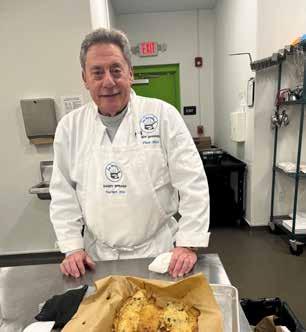
restaurant with a special menu at a special price.”
One of the most practical things Lazarus learned was how to score fish … making shallow, diagonal, or crosshatch cuts into the skin or flesh before cooking. He added, “It’s primarily done to allow heat to penetrate thicker parts for even cooking, enable seasonings/mari-
nades to penetrate deeper, prevent skin from shrinking and curling, and create crispy, textured skin … but my most practical lesson was how to avoid cutting my fingers when chopping vegetables quickly.”
Fun fact, in traditional toques, the more the pleats, the more accomplished the chef. ì



Kotel Cleaned for Passover and Rosh Hashanah
By Gil Zohar
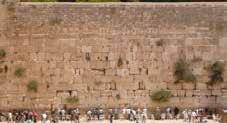
The Kotel got a spruce up ahead of the Passover holiday.
March 31, 2002: Prime Minister Ariel Sharon declares Palestinian Authority President Yasser Arafat the enemy of Israel and the free world after two suicide bombings in one day, including a Hamas attack that kills 16 in Haifa.
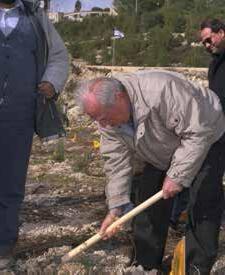
Future Environment Minister Raphael Eitan plants a tree on Tu B’Shevat in 1995. // By Avi Ohayon, Israeli Government Press Office, CC BY-SA 3.0
April 1, 1997: The Knesset passes the Environmental Enforcement Law. Environment Minister Raphael Eitan says the goal is to “make the polluter pay” with fines of up to 600,000 shekels (more than $190,000) after years of lax oversight.
April 2, 2011: Yoel Margalith, a biologist whose discovery of a bacterium toxic to mosquitoes and black flies has saved millions of lives, dies at 78. He was a native of Yugoslavia who survived two Nazi concentration camps as a boy.
As is tradition, volunteers took to the Western Wall in Jerusalem’s Old City to remove hundreds of thousands of the small prayer notes to G-d tucked into the cracks of Judaism’s holiest site. The papers were then ceremonially buried at the ancient Mount of Olives cemetery, making way for the next wave of notes that are sure to come.
The tradition is repeated each Rosh Hashanah, in an effort to keep the Kotel from becoming too cluttered. The notes are carefully removed using sticks that have been submerged in a mikvah, in a series of events overseen by the Wall’s official rabbi, Rabbi Shmuel Rabinovitch.
There were no worshippers at the Kotel due to restrictions on gathering in large groups amid the U.S.-Israeli war with Iran.
April 3, 1949: Israel signs an armistice with Jordan, the third of four such agreements it reaches with Arab states to end the War of Independence. The war leaves the city of Jerusalem divided and the West Bank in Jordan’s control.
April 4, 1948: The Joint Chiefs of Staff report to President Harry Truman that a truce under the U.N. partition plan for Palestine could require 100,000 U.S. troops to monitor, supporting Truman’s new preference for a trusteeship.
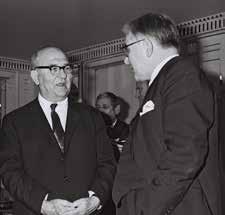
Richard Crossman (right) and Israeli Prime Minister Levi Eshkol talk at a dinner in London in March 1968. // By David Eldan, Israeli Government Press Office, CC BY-SA 3.0
April 5, 1974: British politician Richard Crossman, a member of the Anglo-American Committee of Inquiry on Palestine in 1946, dies at 66. The 1939 White Paper and his experience on the commission made him proZionist.
April 6, 1948: David Ben-Gurion presents the Zionist General Council a five-step plan to prepare for victory after the State of Israel declares independence. He emphasizes military mobilization and unified army and government leadership.
By
The Knesset Finance Committee approved a bill to grant tax credits for corporate research and development (R&D) expenses, in a bid to keep multinational tech firms in Israel.
The Research and Development Law, which can now be held to a full plenum vote, comes as more than two years of war and uncertainty about Israeli democracy have fueled concerns of stagnation and brain drain in the tech sector, which remains the main driver of the country’s economy.
The bill also seeks to offset a tax
April 7, 1967: Israeli Mirage fighter jets shoot down six Soviet-supplied Syrian MiGs over Damascus in an air battle involving 130 planes that follows Syrian shelling of Israeli tractors in the demilitarized zone between the countries.
April 8, 2006: Israel’s growing interest in ballroom dancing, driven by Russian immigration, is rewarded with the country’s first international competition in the sport, the Ten Dance European Cup, before 3,000 spectators in Ashdod.
April 9, 1980: In a White House meeting that includes Egyptian President Anwar Sadat, Prince Bandar bin Sultan, Saudi Arabia’s foreign minister, says the time will come when the Saudis will recognize Israel within the pre-1967 borders.
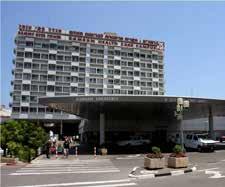
The Teaching Center for Trauma, Emergency, and Mass Casualty Situations of the Rambam Health Care Campus in Haifa was an organizer of the 2005 NATO conference. // Rambam Health Care Campus
April 10, 2005: NATO holds its first event in Israel — a conference on medical preparedness for mass casualty events. Besides Israel, Belgium, the Czech Republic, Finland, Germany, Italy, Jordan, Portugal, Turkey, the United Kingdom and the United States attend.
hike on large companies and comes as a strong shekel has raised payroll and other expenses for firms based abroad that have R&D centers in Israel.
April 11, 1961: A special panel of three judges in Jerusalem opens the war crimes trial of Adolf Eichmann, the Nazi officer who organized and executed the “Final Solution” to the problem of Jewish existence in Europe.
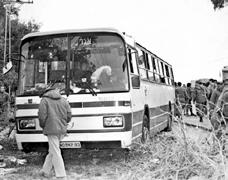
April 12, 1984: Four men hijack Egged Bus 300, carrying 41 passengers from Tel Aviv to Ashkelon. The hijacking turns into a chase toward Egypt. The IDF frees all but one hostage and kills the Arab terrorists, two by execution.
April 13, 1971: Prime Minister Golda Meir meets with leaders of the Black Panthers, Mizrahi activists protesting social injustice and discrimination who are not affiliated with the U.S. Black Panthers. She later calls them “not nice people.”
April 14, 1976: Lt. Gen. David “Dado” Elazar, the IDF chief of staff during the Yom Kippur War, dies of a heart attack at 50, two years after he resigned from the military in disgrace over the failures of the October 1973 war.
Items are provided by the Center for Israel Education (israeled.org), where you can find more details.

By Gil Zohar
Those who think history doesn’t repeat itself may wish to WhatsApp this writer’s 97-year-old mother, Joyce Raymond, to discuss how millions of Londoners like herself sheltered in the British capital’s Tube stations during the Blitz and World War II. The Luftwaffe bombings traumatized her and her two younger sisters, Anita and Renee White. Today the rain of terror from the skies is being repeated across Tel Aviv and Jerusalem.
In the Big Orange and neighboring cities of Ramat Gan and Bnei Brak, nine underground stops on the Red Line of the Light Rail are open 24/7 as public bomb shelters, including on the Sabbath when there is no transportation service. Some denizens of greater Tel Aviv have taken to sleeping on the station platforms overnight rather than returning home after each all-clear alert.
At the time of writing, the Red Line is not operating. Commuters from Jerusalem to Central Israel have been temporarily required to change trains at Ben-Gurion Airport before continuing to Tel Aviv.
Not surprisingly in a country where kvetching is the national sport, some people have complained not all the underground stations have been opened to serve as protected spaces. The Ministry of Transportation has published its list of stations deemed safe which the frantic hordes may freely enter when the missile alert screams.
The Carlebach station, named after Esriel Gotthelf Carlebach (1908-1956), the Leipzig, Germany-born pioneering journalist, founding editor of the daily Maariv, and cousin of Berlin-born troubadour, Rabbi Shlomo Carlebach, has not been opened as it is not deemed suitable as a secure shelter for engineering reasons.
Similarly, in the Eternal Capital of the Jewish people, Yerushalmis are taking cover underground. While all the stops on Jerusalem’s single tram line are on the surface, the Navon Train Station – which is 90 meters below street level and was designed to function as a nuclear bomb shelter – is now serving its secondary purpose apart from transportation.
Home Front Command and Ministry of Defense officials have praised the Israeli public for its resilience in quickly reaching a safe place to shelter when the siren blares.
Israel updated its national building code in 1992 following the Gulf War the previous year when Saddam Hussein rained Scud missiles down on Tel Aviv and Haifa from Iraq. Previously, zoning laws had required condominium apartment buildings to incorporate a basement

A missile strike March 18 near Tel Aviv’s Savidor train station caused a temporary interruption to service. Commuters from Jerusalem to Central Israel were temporarily required to change trains at Ben-Gurion Airport before continuing to Tel Aviv // Photo Credit: Daily Telegraph
bomb shelter. But the threat of heavierthan-air poison gas attacks made those shelters potential death traps. Thus, gas masks were distributed, and every apartment in new residential buildings is now required to have a reinforced and sealed security room, called a mamad in Hebrew. Typically, these are a bedroom protected with extra thick concrete and equipped with a steel door and heavy shutters. A wet towel placed by the door makes for a reasonably airtight seal. Some newer buildings have been designed so that the area around the elevator shaft and stairs serves as a protected miklat for the entire floor.
It’s a uniquely Israeli way of getting to know one’s neighbors.
The number of fatalities has been miraculously low in the night-and-day barrages from Iran and Lebanon since the current war broke out on Feb. 28. At the time of this writing, 21 people – all noncombatants - have been killed in the hundreds of missile and drone attacks targeting civilian regions in the Jewish state. More than 300 ballistic missiles have been launched, including 170 on the war’s first day. No information has been released on the number of drones fired.
Nine Israelis were killed in Beit Shemesh on March 1 when an Iranian ballistic missile scored a direct hit on a residential neighborhood, destroying a synagogue and collapsing the adjoining bomb shelter.
This was the deadliest single strike on Israel since the Iran war began, with more than 40 additional injuries reported. The shelter was in an older pre-1991 building that had been retrofitted.
A Thai agricultural worker in central Israel and four Palestinian women in a beauty salon in the village of Beit Awwa, southwest of Hebron, were killed March 18 by debris from an Iranian ballistic missile. Barrages employing cluster munitions have hit multiple locations across the re-
gion – including near this writer’s home in downtown Jerusalem.
Train service has been interrupted at Tel Aviv’s Savidor station and in Holon, where several buses were damaged. Military censorship prohibits publishing the addresses of hits.
On March 15, Israel Railways reopened the train stations in Hod HaSharon–Sokolov, Bnei Brak, Rishon LeZion HaRishonim and Dimona which were shut down when
the war erupted.
Full service resumed on the lines from Herzliya to Ofakim, and Herzliya to Jerusalem. While the latter stops at BenGurion Airport, service at the international air hub remains greatly reduced. Some travelers are choosing to take a bus to Amman, Jordan, or Sharm esh-Sheikh, Egypt, in order to fly abroad.
The situation remains fluid.
For this writer and family, four overseas guests at Pesach seder have had to say, “Next Year in Jerusalem,” because their flights have been cancelled. This writer lives in a charming stone building in the city center built in 1886 that has neither a miklat nor a mamad. When the siren blares, the family heads to the Herbert Samuel Hotel across the street. There, the synagogue two floors below ground level doubles as the reinforced space. Last Friday, as the Sabbath approached and the air raid alert sounded, a guest was playing the violin, serenading those present with the strains of “Shalom Alechem.” ì
Gil Zohar is a journalist and licensed tour guide in Jerusalem.

By Fran Putney
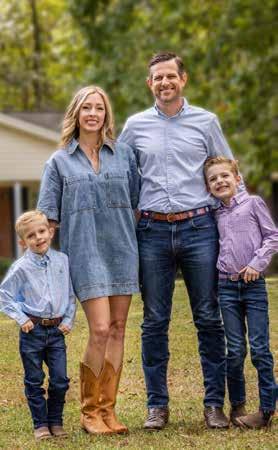
A trip in 1997 was the first time both Hugh Mainzer, then in his early 30s, and his father, had traveled to Israel. The two visited many landmarks and religious sites, but also seeking different kinds of experiences, the father and son decided to find walking trails and connect with hiking groups. From this first experience and subsequent excursions in Israel, often with his wife and children, Mainzer became acquainted with SPNI, the Society to Protect Nature in Israel.
Founded in 1953, SPNI not only maintains the country’s popular hiking trails, but it is Israel’s largest and oldest nonprofit dedicated to conservation, environmental education and advocacy through its many innovative programs.
Mainzer, a long-time public health professional and a veterinarian by training, is a supervisory epidemiologist and preventive medicine officer currently working in CDC’s Office of Readiness and Response. His love of the outdoors and especially his many positive experiences with SPNI in Israel have led him to be-
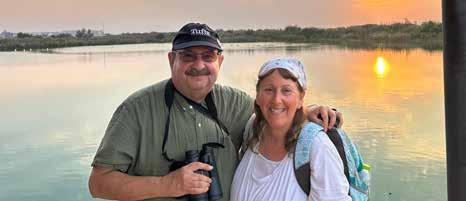
Dr. Hugh Mainzer and his wife, Jill (Jarecki Mainzer), at Maagan Michael, a collaborative rewilding program site where Nature Israel/SPNI is advancing practical, science-backed solutions rooted in Israel’s natural ecosystems -- restoring habitats, strengthening biodiversity, and supporting climate-smart planning.
come more involved in the cause through Nature Israel, the U.S. “friends” organization that supports SPNI.
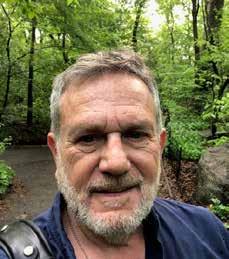
Mainzer helped host a presentation on Feb. 17 by SPNI Director of Partnerships and Development Jay Shofet in Atlanta at Ohr Hatorah, a Modern Orthodox shul in Toco Hills where Mainzer is a member. Shofet, who hails from upstate New York, made Aliyah in 1986 and


works out of Tel Aviv. During the same visit in February, Shofet attended Ramah Darom’s B’teavon culinary retreat where he gave talks about Israeli nature, and his wife, American-Israeli cookbook author Adeena Sussman, was a headliner who spoke about her new book, “Zariz.”
At the Ohr Hatorah gathering, Shofet introduced SPNI’s work and spoke about some of Israel’s natural wonders and the
country’s ecological challenges. Despite its small size, explained Shofet, Israel is considered a global biodiversity hotspot. “That means we have more species of flora and fauna, of plants and animal life, than 97 percent of the globe, because where we are we have the northernmost species of Africa, the westernmost species of Asia, and the southernmost species of Europe all intermingling on this

tiny little land bridge that is Israel/Palestine. And that’s true of all the animals and plants. It’s really incredible.”
But some of Israel’s own policies have worked against its natural ecology. While planting trees in Israel has long been viewed as a mitzvah, Shofet explained that the practice of afforestation has, in fact, been harmful. Not only have the wrong kinds of (non-native) trees been planted in the wrong places, but there has been a misunderstanding that the land is not actually desert, but a Mediterranean scrubland type of ecosystem, which is rich in local ecology and better off left alone. Consequently, these plantings have resulted in cycles of devastating fires that destroy the land and harm wildlife, and SPNI has strongly advocated against such practices. An extensive report, “The Need to Stop Afforestation in Sensitive Natural Sensitive Ecosystems in Israel, and Conserve Israel’s Natural Landscapes,” describes the problem in detail and proposes solutions.
Another SPNI initiative is rehabilitation of the communities, infrastructure, and natural areas that were destroyed in war after Oct. 7, especially in the north, where two years of conflict has left 55,000 acres scorched and imperiled the water system. Likewise, SPNI is developing recovery plans with communities of the Western Negev to ensure the revitalization of both the communities themselves, along with their environmental resources. The planned Living Trail, for example, is intended to provide the region an economic boost by connecting the beautiful natural areas with communities and their local businesses.
An SPNI Startup Nature program helps restore Israel’s wetlands. According to SPNI’s 2025 Annual Report, 13 rewilding projects are on track to achieve 25 percent of the country’s long-term con-
servation goals by restoring over 3,000 additional acres by 2030. With partnership support, the organization is “revolutionizing Israeli conservation through innovative water management, habitat design, and community involvement.” Similar priorities include protecting and reinvigorating Israel’s rivers and seas and making Israeli businesses greener.
As the world’s second largest bird migration fly route, Shofet explained, “Almost the entire Eurasian population of pelicans, cranes, storks, raptors, songbirds, and butterflies migrate over this little land bridge that is Israel on their way to Africa every fall and come back every spring.” In support, SPNI continues to expand its birding network, which not only helps ensure safe passage for nearly a half-billion migrating birds, but is creating new research hubs and eco-tourism destinations.
With so much of Israeli’s population experiencing trauma and a shortage of mental health professionals, SPNI’s mental health and youth programs are more in demand than ever. Its Nature Heals program uses the healing power of nature to provide treatment for victims of trauma, depression, and anxiety. Since Oct. 7, 2023, the program has helped more than 130,000 evacuees, soldiers, and survivors of terror attacks.
Innovative youth programs include a four-day immersive traveling outdoor camp for teens that combines teamwork and guided reflection as well as the “Green Entrepreneur” (Yazam Yarok) clubs, that encourage students to take the lead on hands-on community projects to solve local environmental challenges.
In the organization’s 2025 Annual Report, SPNI CEO Dan Alon wrote: “It is said that in Israel, we experience a decade of history every single day. In such a fast-moving reality, the work of conservation can feel like a paradox. We plant seeds today that may not bear fruit for a generation. We fight battles for landscapes that many will only appreciate years from now.”
For Hugh Mainzer, what’s important in educating others about SPNI’s work is “getting people to tie into what’s going on in Israel in terms of the land, in terms of the ecology, in terms of conservation. Whether it’s the birds, whether it’s the marine life in the Mediterranean, taking healthy gazelles from Jerusalem’s Gazelle Valley and releasing them back into the wild, or putting water back into the Dead Sea -- all that is important for us to understand.”
For more information about SPNI, visit https://www.teva.org.il/. To learn how to support SPNI, visit https://natureisrael.org/. ì


By Bob Bahr
America’s Jewish film festivals have an important role in influencing not just Jewish history but the Jewish future that's the thinking behind a recent effort by a former longtime executive of the New Israel Fund (NIF), Libby Lenkinski, who for 14 years was the vice president for public engagement at the left leaning social and political advocacy group.
Lenkinski, who was responsible for the organization’s communications and its community partnerships, has started an organization called Albi. It’s described as establishing “paradigm-shifting narratives by and about Palestinians and Jews.”
The recently completed Atlanta Jewish Film Festival (AJFF), one of the nation’s largest and most ambitious screening events for productions with a Jewish theme, was seen by Lenkinski as an important opportunity for promoting what she hails as some of her organization’s most important goals.
“We’ve been sold some pretty unhealthy and untrue bills of goods,” she
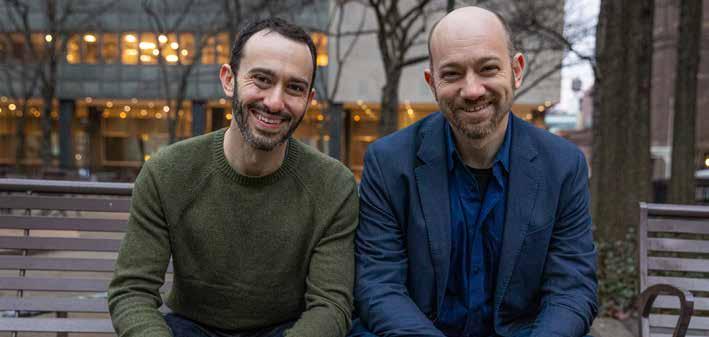
observes. “One is that war is the only inevitable present and future in Israel. Another is that endless division is somehow going to help us. And so, I’m looking for

stories that break through in some way.” She and the New Israel Fund found in the 49 films that were shown during the recent festival at least six that re-
flected the kinds of story that can change existing attitudes.
In support of at least one of those films, “Holding Liat,” she visited the fes-

“Holding Liat” describes the emotionally wrenching process of one hostage’s freedom from captivity in Gaza and its aftermath
tival for three days in February. The film, which had its Atlanta premiere at the AJFF, was scheduled for two screenings at the Tara Theatre and The Springs Cinema. It was among the films nominated for the festival’s Building Bridges Jury Award.
The production had its world premiere at the prestigious Berlin International Film Festival last year and won its top Berlinale Documentary Award. The prominent American filmmaker Darren Aronofsky is listed as the producer.
“Holding Liat” chronicles the anguish of the family of Liat Beinin Atzili, who was taken hostage during the attack by Hamas terrorists on the kibbutz of Nir Oz in southern Israel on Oct. 7, 2023. During the attack, her husband was killed, although his fate was not immediately known.
The documentary follows Liat’s parents, Yehuda and Chaya Beinin, New Jersey natives who live in Israel as they search for help in a vigorous public campaign to try to win her release. Lenkinski became involved, she says, early in the production process and continued to provide guidance to the filmmakers as they shaped the film messaging and their point of view.
“They were still documenting, when we got in touch and stepped in to both advise and help in understanding the different political layers to what was unfolding as they were trying to tell the story authentically. And then, when the film was about to release, we basically planned the entire positioning of the film, together with the film team and their PR. And, as an impact partner, we did some deep work with the team to understand
… what they wanted to be different in the world as a result of this film having been made.”
The film was made by Lance and Brandon Kramer, who were at this year’s AJFF to discuss the documentary. The two filmmakers are distant relative of the Liat family and the relationship gave them a unique and intimate access from the first hours of the process to gain Liat’s release. Then, after her 54 days in captivity, they followed her through her process of readjusting to her life in Israel and the loss of her husband.
During that period, she came to believe that despite all that she had been through that revenge was not something she could muster. She spoke about that belief in a reconciliation between Israelis and Palestinians both in the film and later during the American premiere at the Tribeca Film Festival in New York.
During Lenkinski’s visit during the AJFF, she attended both screenings of the film, held a gathering for potential funders for her organization, and attended a reception by the New Israel Fund that was planned. She also helped to create a third screening of the film on March 8 that NIF planned at the Tara Theatre.
The events of Oct. 7 and its aftermath have given Lenkinski and her supporters in the New Israel Fund a renewed sense of mission and a belief, as she describes it that positive change can still be accomplished.
“After Oct. 7, the attention is clearly there and hasn’t really waned,” she said, “even for a day, and our goal is to engage that attention in positive directions that can lead to better futures and not more polarization.” ì


David Ostrowsky
This Sunday afternoon at the Gainbridge Fieldhouse in downtown Indianapolis, the Emory men’s basketball team is gunning for its first-ever NCAA Division III national championship when it takes on the University of Mary Washington. But for many in Atlanta’s Jewish community, the Eagles have already played their most meaningful game of the spring. The March 13 Sweet Sixteen matchup between Emory and Yeshiva was one of the most highly anticipated Jewish sporting events in Atlanta in recent memory. The Yeshiva University Maccabees touched down in Atlanta with a 22-8 record (including an immaculate 16-0 mark in Skyline Conference play) amid tremendous fanfare from the city’s Jewish community. The Georgia General Assembly paid tribute to the Macs’ milestone season by unveiling a Georgia House resolution, spearheaded by State Rep. Esther Panitch, honoring the program’s impact on global Judaic culture. The next morning, the Atlanta Jewish Academy bussed in dozens of students so they could attend a basketball game that resonated well beyond the on-court action.
And for a while, the regional semifinal game at Emory’s Woodruff PE Center lived up to the billing as Yeshiva, the only college hoops team unable to practice or play on Shabbat, went into the intermission of its first-ever Sweet 16 appearance staring down only a seven-point deficit. Behind dynamic senior guard Zevi Samet, the Macs hung tough against a heavily favored Emory squad before the Eagles put on a second-half clinic on both ends of the floor to prevail, 101-80, before 2,432 fans and secure their spot in the Elite Eight in Fort Wayne, Ind.
“Well, you never take it for granted,” said Emory veteran head coach Jason Zimmerman, who has been calling the shots in Atlanta since 2007. “It means a lot. That’s what we strive to do and there’s a lot of good teams out there. To be able to go two years in a row — our alumni base, our program, all the way from the '90s until now, guys texting, calling, it just means a lot. Guys following us from here, following us online. It’s a special achievement and it’s really hard to do.”
While Yeshiva was essentially a oneman show with Samet, exploding for 43
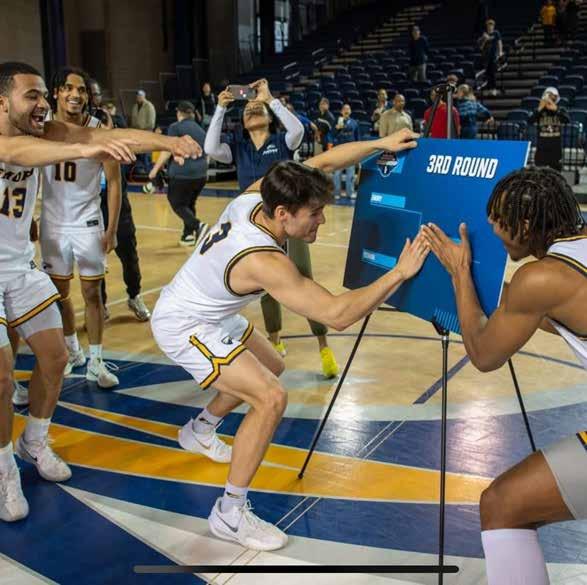
a resounding
points to go along with six boards and five assists in his final collegiate game, Emory was clearly the more-balanced team, one with legitimate national title aspirations, as five players scored in double digits, including most notably senior guard Ben Pearce who paced Emory with 26 points on 8-17 shooting and the dynamic frontcourt duo of Ethan Fauss and AJ Harris, who each went off for 19 points.
After Emory raced out to an imposing 19-5 advantage in the opening minutes, Yeshiva — a program that has become one of the most recognizable in American college basketball — had an answer, courtesy of Samet, the product of Torah Academy of Bergen County who’s widely considered one of the most gifted players in Division III hoops. Sporting his trademark kippah and representing legions of young Orthodox ballplayers across continents, Samet was lights out from the field (15-24) and behind the arc (6-9). After Samet nailed a jumper with 1:28 remaining in the first half, Yeshiva was merely trailing 45-42 and the Eagles were on neon-flashing upset alert. But Emory wouldn’t let it get any closer as the reigning UAA champs outscored the
visitors by a 56-38 margin the rest of the way to secure the cruise-control victory.
“[Samet] is one of the best shot makers that I’ve played against in my four years,” acknowledged Pearce in his postgame comments. “You mess up a coverage, even a little bit, he’s going to make the shot. That’s just the type of player he is. We tip our cap to him. He had 43 points, but we were OK with that if that means we win how we won.”
After just slipping past Roanoke College (an 83-81 OT thriller) in Round Two, Zimmerman was able to give his core rotation players a much-needed breather after a dizzying first half of fast-break heavy basketball.
Emory’s superior depth was on sparkling display as in addition to the sterling performances from Pearce, Fauss, and Harris, guard Jair Knight chipped in 15 points while forward Mario Awasum put up 17 by going a remarkably efficient 7-8 from the field. As a team, Emory had the clear advantage on the glass, out rebounding Yeshiva 49-34 and only yielding nine offensive rebounders to the visitors.
Yeshiva may have had the best player on the court in Samet, but the better
team won and Emory marched on to the heartland for the final rounds of the NCAA tournament. But thanks to Yeshiva and its devoted road-tripping fanbase, Emory may never play in a gymnasium as jam-packed and boisterous as Woodruff PE Center was on the afternoon of Friday, March 13.
“The atmosphere in the gym at 11:30 [1.5 hours before tipoff] was electric,” said Zimmerman. “To see the following that Yeshiva has is really special. We’ve been blessed, we’ve got a couple Jewish guys on our team now. In my 19 years, I’ve had a ton of Jewish guys — some of them are my best friends right now. That pride that comes from following Yeshiva, it helped us as well. It helped us play better because we like to talk about when there’s energy in the gym, you can do two things. You can get distracted or you can narrow your focus. I thought we were narrowly focused there for a while.”
Following the blowout win over Yeshiva, the Eagles squeaked past Illinois Wesleyan University, 83-78, in the regional final before dusting off Christopher Newport University, 72-58, in the Final Four to punch their ticket to the national title game. ì
By David Ostrowsky
A few years back when Harry Kitey was an upperclassman at The Weber School and starting to get recruited by Division III basketball teams, he knew that Emory had a great program — maybe even one of the Top 10 in all Division III. But as he toured the school and met head coach Jason Zimmerman and the current team before ultimately committing to the Eagles, Kitey wasn’t necessarily banking on joining a team that was poised to host its first-ever Division III national championship trophy. But here the Eagles are, needing just one victory over the University of Mary Washington (Va.) on Sunday afternoon in downtown Indianapolis to cement their place in Atlanta sports history.
As thrilling as it is to be on the roster of a potential national championship team, it comes with an undeniable caveat for many players, ones who were accustomed to lighting up Friday night gymnasiums in high school: less playing time.
Earlier this decade, Kitey was “The Man” at Weber, pouring in over 1,000 career points in his sparkling four-year career that put him on the radar screen of DIII coaches across America, including those of Yeshiva and Johns Hopkins along with Emory. The Dunwoody native started from Day One in Weber’s frontcourt and before graduating in 2024 was a two-time GHSA A-D1 Region 6 AllRegion First Team selection as well as a Georgia Basketball Coaches Association 2022-23 All-Star Selection.
Thus far, Kitey, now finishing up his sophomore year at Emory, has not had that kind of transformative impact for Zimmerman’s squad. After appearing in eight games off the bench during his freshman campaign, Kitey has seen slightly more court time this winter, most notably when he came off the pine during the waning minutes of the Sweet 16 victory over Yeshiva at standing room-only Woodruff PE Center Arena on March 13 and during the momentous Final Four win over Christopher Newport University a week later.
Irrespective of the final outcome at Gainbridge Fieldhouse (home of the Indiana Pacers) Sunday afternoon, learning how to accept a supporting role, how to live vicariously through his teammates, how to wait ever-so-patiently for his number to be called has helped Kitey mature into the splendid young man that he is today.

“In life, not everything goes your way. You’re not always going to get the job you want. You’re not always going to get the role you want. You’re not going to get the responsibilities you want sometimes. Being able to make the most of what’s in front of you is really important,” shared Kitey when speaking to the AJT last week.
“I think growing up, part of my maturity as a person and as a basketball player, I would be very hard on myself. I would be getting very upset and letting these little things that I have no control over dictate my mood for the rest of the day or the rest of the week. I just kind of realized you can’t live life with that much stress.”
Though he has thus far played sparingly for Emory, the team-first Kitey brings non-stop energy and enthusiasm to the bench — a helpful pick-me-up for his Eagles teammates who are grinding through the gauntlet of a travel-intensive season.
“It really does make a difference when you have one or two guys — or in our case, the whole bench, really, I think we all do a really good job of it — being very engaged and very uplifting and very
positive,” added Kitey, who’s starting to brace for his accounting final exams while also looking ahead to sun-splashed golf outings with friends this summer. “I think that’s a big part of our team. That’s a big part of why we’re having success.
“If I’m not on the court, I want to do something to be able to positively impact the team.”
Next season — perhaps a title-defending one for Emory —Kitey indeed projects to be on the court more. Emory is heavy on upperclassmen, with several players graduating next month, and Kitey has already shown flashes of his rebounding process, snagging 11 boards this year. Though he loves golf, the lasersharp focus this summer will be on finetuning his hoops skillset and making sure he’s in tip-top condition when preseason starts this autumn.
“That’s the one thing I would say I kind of underestimated. Everyone I talked to said you have to be in great shape to play in college, and I thought I was in great shape. Once you get here, you understand what great shape really is,” acknowledged Kitey, who also played baseball and soccer at Weber. “I would say it
[college basketball] is so much faster. In high school, everyone’s a step slower or multiple steps slower. And just the game moves at a different speed. Especially for us, we play very fast.”
He may or may not take the floor during Sunday’s nationally-televised (ESPN+) championship game that’s part of Final Four weekend — a grand and festive multi-day celebration of college basketball that this year promises to have a sizable Atlanta contingent with Emory students and alums visiting Indy. But for the rest of his life, the Weber alum can say that for at least one afternoon, he did layup lines on the same court that LeBron James, Steph Curry, and Trae Young have balled on.
“It’s going to be incredible,” said Kitey, who as a diehard Hawks fan appreciates the fact that both teams are peaking simultaneously. “I’m unbelievably excited. I know [for] everyone on the team, if we could play tonight, we would all jump on a bus and be there.
“This is a dream season that we’ve had so far and obviously we plan on getting back there, but you just never know for sure.” ì
By Marcia Caller Jaffe
American Jewish Committee (AJC) Atlanta will present the 2026 Distinguished Advocate Award to Ted Blum, a leader whose commitment to Jewish values, civic responsibility, and community strengthening has shaped Jewish Atlanta for decades. The award is one of AJC Atlanta’s highest honors, celebrating individuals who advance the well-being of the Jewish people and uphold democratic principles.
Blum joins recent honorees, including Dov Wilker, Elise Eplan, A.J. Robinson, and Rabbi Peter Berg, continuing the legacy of the former Selig Distinguished Service Award, whose distinguished recipients include Erwin Zaban (z”l), Rabbi Alvin M. Sugarman (z”l), Arthur Blank, and Mike Leven.
The event will be held in Buckhead on May 12, led by Honorary Event Chairs Linda and Steve Selig and Cathy and Steve Kurnanoff, along with Event Chairs Patrice and Ernest Greer, Beth and Gregg Paradies, and Rachel and Garrett Van de Grift … as well as Cabinet Chairs Candy and Steve Berman, Nancy and Randy Gorod, Lisa and Seth Greenberg, Matt
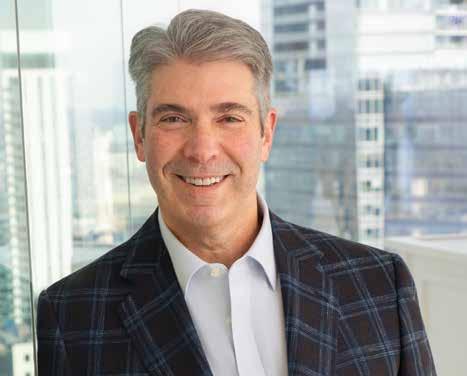
Ted Blum will receive the American Jewish Committee’s 2026 Distinguished Advocate Award on May 12.
Shulman and Michelle and Gary Simon.
Blum’s impact across Jewish Atlanta is far-reaching. He chairs the Atlanta Jewish Foundation and serves on the Board
of Trustees of the Jewish Federation of Greater Atlanta and the Board of Councilors of the AJC Atlanta. His past leadership includes serving as Board Chair
of The Epstein School, serving on the board of the Atlanta Jewish Film Festival, and serving as an advisory committee member for The White Rose Society. Event host committee chairs are Mindy and Warren Binderman, Pam and Mark Rosenthal, Tamar and Mark Stern, Joyce and Ramie Tritt, and Ronit Walker and Matt Bronfman. Access host committee chairs are Michelle and Josh Blum.
Professionally, Blum chairs Greenberg Traurig’s Atlanta office and leads the Atlanta office’s corporate practice, earning respect for his clarity, creativity, and principled counsel in complex transactions. His civic work extends beyond the Jewish community. Blum served as founding chair of the Chick-fil-A Foundation Advisory Board and led the Task Force to Fight Human Trafficking and Slavery, work recognized by both the Rotary Club of Atlanta and Wellspring Living.
Blum often reflects on values shaped by his family’s history as Jewish immigrants and Holocaust survivors — stories he shares in his book, “Calculated Risks.” Blum was also The Lowdown spotlight in Atlanta Jewish Times on July 31, 2020.
As the nation commemorates its historic 250th anniversary, C-SPAN announced that students in Atlanta, Alpharetta, and Suwanee have earned national recognition as 2026 winners in C-SPAN’s annual StudentCam documentary competition.
Max Mendes, a student at The Davis Academy, was a third-prize winner and will receive $750 for the documentary, “Liberty For Sale: Who Really Has A Voice In America?” about campaign finance. CSPAN also recognized Kendrick Phillips who served as an adviser and mentor throughout the StudentCam competition, helping guide this nationally recognized achievement.
Ashaan Patel, a student at The Westminster Schools, was an honorable mention prize winner and will receive $250 for the documentary, “The Loneliness Epidemic,” about loneliness and social isolation in older adults.
Adrith Iyer and Aydin Wada, students at FCS Innovation Academy, were honorable mention prize winners and will receive $250 for the documentary,

“A Bulletproof Nation,” about gun violence. C-SPAN also recognized Lawrence McGilicuddy who served as an adviser and mentor throughout the StudentCam competition, helping guide this nationally recognized achievement.
Ayanfeoluwa Anjoorin, a student at Peachtree Ridge High School was an honorable mention prize winner and will receive $250 for the documentary, “THE GAP - Immigrants and the First Amendment.”
Through this project-based learning experience, students engaged in in-depth research, critical analysis, and original storytelling to explore matters of both personal and national importance. The response was extraordinary: C-SPAN received more than 1,800 documentary submissions from nearly 4,000 students representing 38 states and Washington, D.C., underscoring the competition’s broad national reach and civic impact. The 150 winning videos can be viewed at studentcam.org.
Compiled by AJT Staff
Spring is here. It’s a great time to admire all the beautiful, blooming trees in Atlanta.
Hadassah, the Women’s Zionist Organization of America, addresses climate change through environmental advocacy, education, and initiatives rooted in Jewish values, focusing on sustainability, environmental justice and Israel’s green efforts. Hadassah joined with the Jewish Earth Alliance to support the Jewish community’s efforts to protect our planet. Members of the Georgia Jewish Earth Alliance met with representatives of Georgia’s two U.S. senators to urge them join in these efforts.
The Jewish Earth Alliance (JEA) is an all-volunteer grassroots network of 50 organizations across the country, consisting of people who deeply believe that protecting the Earth is integral to Jewish identity, faith, and practice. The JEA believes that climate change is a moral challenge that demands an urgent response. JEA is mobilizing Jews to stand up and raise a loud, collective voice for policies that they feel reflect their values.
Bill Witherspoon, chair of the board of JEA in Georgia, explains, “Each year The Jewish Earth Alliance enables Jews throughout the country to raise our voices and work with our members of Congress to take action to protect our planet. This year, we were privileged meet with staff members from both of our Georgia United States senators; Sen. Jon Ossoff and Sen. Raphael Warnock. We asked them to take strong and consistent action to protect all people and heal our precious Earth.”
Simone Wilker, advocacy chair for Hadassah Greater Atlanta and the Hadassah Southeastern Region, states, “At Hadassah, we believe that each of us has the power to heal our world. For us, that means bringing
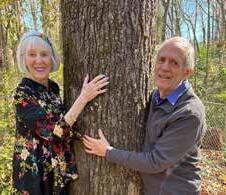
Hugging a tree to protect the environment: (from left) Simone Wilker, advocacy chair for Hadassah Greater Atlanta, and Bill Witherspoon, Georgia Lead for the 2026 Jewish Earth Alliance Lobby Day, asking Georgia’s United States senators to protect the planet.
healing — in every sense of the word — where it’s needed most, in the United States, Israel, and around the globe.”
Every day, Hadassah members are speaking out in multiple ways — from sending messages to meeting face-to-face with elected officials — locally and on the Hill. Hadassah’s founder, Henrietta Szold, saw suffering and took action, bringing emergency health care to mothers and their infants in pre-state Israel. Szold’s passion is in Hadassah’s DNA and continues to drive the organization to make a better world for all.
Hadassah and the Jewish Earth Alliance are committed to empowering their members and supporters to take action in a variety ways. These two organizations are a dynamic force for change. For information about Hadassah, go to: www.hadassah.org. For information about the JEA, go to https:// www.jewishearthalliance.org/who-we-are.
Compiled by AJT Staff



In just six months, PJ Library’s Get Together microgrant program has distributed more than $1 million directly to Jewish families across North America, fueling over 10,000 small group gatherings and marking a dramatic expansion of the program’s reach and impact.
The Get Together program provides $100 microgrants to PJ Library subscriber families in the U.S. and Canada who host at least two other Jewish families for gatherings centered on Jewish holidays, values, or traditions. The program was streamlined and relaunched in September 2025 to make participation easier and more accessible, and the response was immediate.
Locally, Jewish Atlantans have hosted 130 Get Togethers in the past six months totaling $13,000 dispensed.
“In Jewish tradition, community is essential. The popularity of our Get Together microgrants indicates just how much Jewish families from all different backgrounds and experiences are eager to embrace opportunities to meet up,” said Jessica McCormick, director of family experience at PJ Library. “Families tell us that they’ve connected with neighbors and friends for Rosh Hashanah apple picking, Chanukah sufganiyot tastings, challah baking, Havdalah ceremonies,
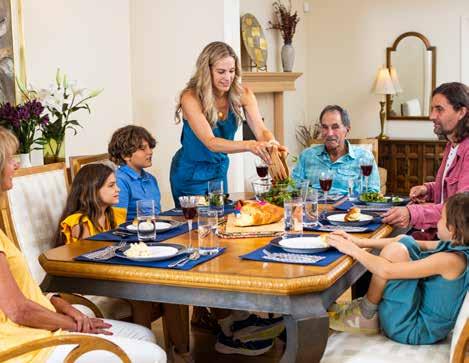
neighborhood clean-ups, and so much more. PJ Library provides families with the tools, framework, and now, incentive to put Jewish traditions and values into action. These grants make it easier for families to celebrate in community.”
The fall relaunch of the Get Together program saw a simplified process to make it even easier for families to secure the $100 grant. Within a few months, participation nearly doubled from the prior year. Participants held more
than 8,000 gatherings between September and December 2025 alone, and the organization directly granted families $800,000 to host Jewish celebrations. The most popular uses for the grants included High Holiday season activities (23 percent), Shabbat and Havdalah gatherings (31 percent), and Chanukah celebrations (26 percent). Throughout fall 2025, nearly 2,500 families hosted a Get Together for the first time, with more than 5,000 hosts organizing more than one Get Together. So far in 2026, more than 2,000 grants have been issued, marking a continued rise from the previous year.
PJ Library subscribers are eligible to receive a $100 Get Together up to five times in a calendar year. The program allows families to host two to 10 other Jewish families and receive reimbursement after submitting a brief narrative report. No receipts are required. The Get Together grants are open to all active PJ Library subscribers in the U.S. and Canada. Families can visit pjlibrary. org to enroll, and existing subscribers can check their email for instructions on participating in the Get Together program.
Compiled by AJT Staff
Atlanta physician and author Dr. Mimi Zieman was honored with the Georgia Author of the Year Award for Memoir on Feb. 26 at the Decatur Library for her book, “Tap Dancing on Everest.” She was also recognized with fellow winners at the Dahlonega Literary Festival on March 7.
Presented by the Georgia Writers Association, the award honors outstanding books by Georgia authors.
“Tap Dancing on Everest” recounts Zieman’s experience as a 25-year-old medical student who joined a historic expedition to Mount Everest in Tibet as the team’s doctor, and its only woman. During the 1988 expedition, the climbers held what is believed to be the first recorded Passover seder on Mount Everest, a moment that reflects the book’s themes of faith, resilience, and identity. The memoir, threaded with Jewish history and tradition, also reflects on Zieman’s upbringing as the daughter of Holocaust survivors who immigrated to New York after World War II and how that legacy
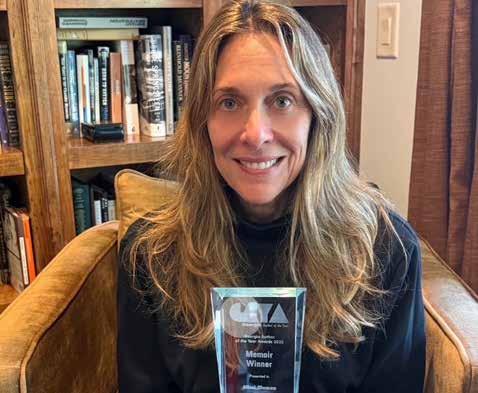
shaped her determination and sense of purpose.
“The search for identity is a universal experience,” Zieman said. “Coming of age on Everest was a dramatic backdrop for discovering what I’m capable of and how I want to use my voice.”
The book has received multiple honors in addition to the Georgia award, including Best Memoir from the American Writing Awards, The BookFest Awards, and the Pencraft Awards for Literary Excellence, as well as Best Non-Fiction Adventure Book in the Readers’ Choice Awards.
Zieman, an OB/GYN and women’s health advocate in Atlanta, previously served as director of family planning at Emory University School of Medicine and chief medical officer of Planned Parenthood Southeast. She also serves on the boards of the Jewish Women’s Archive and the National Council of Jewish Women Atlanta.
Compiled by AJT Staff
A R T I S A N C U S T O M C L O S E T S
E ve r y D ay D e s e r ve s a B e a ut i f ul B e gi n n i n g.
S T A R T W I T H T H E C L O S E T


T h e wa y yo u r d a y s ta rts m a tters . Artis a n C u s to m C lo s ets d es ig n s s pa c es th a t brin g c a lm to th e c h a o s bea u tifu lly o rg a n iz ed , th o u g h tfu lly c ra fted , a n d bu ilt en tirely a ro u n d yo u B eg in with a c o m plim en ta ry d es ig n c o n s u lta tio n , a n d let o u r experts s h o w yo u everyth in g yo u r s pa c e c o u ld be B ec a u s e wh en yo u r h o m e wo rks a s bea u tifu lly a s it lo o ks , everyth in g els e fa lls in to pla c e.
C O M P L I M E N T A R Y D E S I G N C O N S U L T A T I O N A R T I S A N C U S

Dave Schechter
From Where I Sit
Nearly a dozen years ago, an article provocatively titled, “End the ‘Jew Tax,’” appeared on The Huffington Post website.
In August 2014, Israel was at war in Gaza against Hamas. That conflict was responsible, the Anti-Defamation League adjudged, for a “dramatic surge” in anti-Israel and anti-Jewish activity in the United States.
“The poisonous impact is deeply personal for every Diaspora Jew. My family and many others pay what I’ve dubbed the ‘Jew Tax’; that is, the portion of our suburban Chicago synagogue dues that goes for surveillance cameras, alarms and a security guard on duty during services and when kids are in Hebrew school,” wrote Michael Millenson, a self-described “religiously serious” Jew (who also is an expert on health care economics).
Millenson revisited this theme in January 2015, when French Jews were being attacked.
“I wrote in August how some Jewish organizations have taken down identifying signs and how one Jewish day school protects its parking lot with thick steel gates
designed to deter would-be car bombers. I lamented that the anti-Israel anti-semites who cannot put us in ghettos have slowly forced us to build our own walls. The problem has steadily grown,” he said.
Indeed, the problem has continued to grow — along with the cost of protecting the Jewish community.
The Jewish Federations of North America (JFNA) estimates that the Jewish American community spends $765 million annually on security, roughly 14 percent of the budget for “a typical Jewish organization.” That’s three-quarters of a billion dollars not spent on Jewish education, camps, and other programming.
I would suggest that the interior “walls” Jewish Americans construct to protect themselves in environments they deem hostile are part and parcel of the “Jew tax.”
For some, this means removing a mezuzah from the doorpost of their home, tucking a Magen David or Chai necklace inside a shirt, taking off a kippah when walking in public, or even adopting a different name when ordering at a coffee shop, to avoid any issue when a barista calls out a Hebrew or Israeli name.
For others, the anxiety is manifested by self-censorship, exercising restraint and avoiding potentially confrontational conversations that touch on Israel, Jewish life in America, or U.S. politics.
Yes, there are those who respond to anti-Israel and anti-Jewish sentiment by more openly displaying their Jewish identity and by engaging on the same issues.
No judgment here; each must decide for themselves.
There are rigorously observant Jews whose garb makes them more easily identifiable. I recall what Rabbi Yossi New of Chabad of Georgia told a January 2020 community rally held as Jews were being attacked in Brooklyn and New Jersey: “I know I’m stating the obvious, but it’s not how Jewish you look that causes antisemitism. The way one looks is merely the canary in the coal mine.”
This year marks the 25th anniversary of the 9/11 terror attacks, which set off alarms about security nationwide.
In 2004, Congress created the Non Profit Security Grant (NPSG) program, which helps religious institutions and other non-profits considered to be at risk of terrorist or extremist attacks afford security upgrades.
The program — which grew from a proposal by JFNA three months after 9/11 — has distributed some $1.5 billion since its creation. Early on, Jewish organizations reaped an overwhelming majority of the funds. The Jewish Insider reported that in the 2024 cycle, 37 percent of the recipients were Jewish institutions.
No single event forced synagogues, schools, and other Jewish institutions to examine their security as much as the Oct. 27, 2018, massacre of 11 worshippers at the Tree of Life synagogue in Pittsburgh.



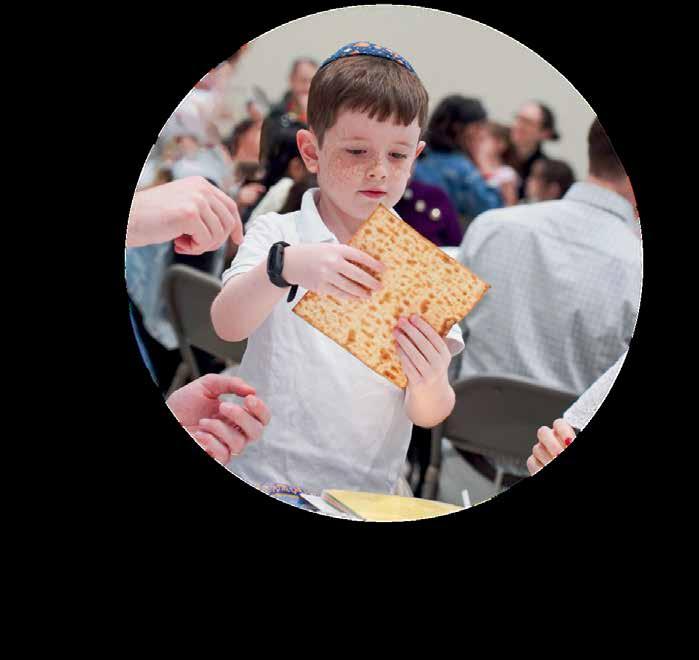
Security concerns intensified when Israel again went to war in Gaza after the Oct. 7, 2023, Hamas-led massacre of 1,200 men, women, and children. AntiIsrael protests saw Jewish institutions and businesses vandalized, and Jews assaulted in such settings as college campuses, restaurants, and public streets.
Consider that in 2016 Congress allocated $20 million to the security grant program. By 2024, that figure had grown by more than ten-fold, to $274.5 million. Pending legislation could see that rise toward $400 million. Jewish groups would like to see $500 million allocated.
Over the past two decades, Jewish institutions have spent large sums on security. Some measures are meant to be obvious, such as the now ubiquitous police presence at Jewish events, fences, concrete barriers, and outdoor lighting. Less visible are stepped up staff security training, and investments in video monitoring, alarm systems and communications equipment.
Jewish groups in Georgia are advocating for the state legislature to create a fund modeled after the federal program.
In the weeks since the United States and Israel began airstrikes on Iran, Jewish voices have expressed concern that depending on the war’s duration, its impact on the price of gasoline and other goods, and particularly if U.S. casualties rise, Israel will be blamed and that, in turn, could endanger the security of the Jewish American community.

Returning to Millenson’s essay, the security fee component of congregation dues is one barometer of the “Jew tax.”
At my congregation, the ask in 2017 was $50. Today it is $180. ì






What does it mean to be a good Jew? Does it mean going to services each week or studying Torah? Does it mean showing your support for Israel? Or does it simply mean maintaining respect for yourself and others? Or something else entirely?
For our Passover holiday issue, we invited members of our staff and community to share their responses.
What Does it Mean to be a Good Jew?
Well, I asked the question … now I have to answer it.
First off, it’s a loaded question – I’ll be the first to admit it. And I was heavily inspired by Dave Schechter’s recent From Where I Sit column entitled, “What’s a Self-Hating Jew?”
Being a “good Jew” can mean many different things as evidenced by so many thoughtful Passover messages shared by our fellow community members.
For me, at this point in my life, being a “good Jew” means serving as the best steward of this publication that I can be. Atlanta Jewish Times is such a valued resource for Jewish Atlanta and it’s my role to ensure the paper and community remain connected. I want the AJT to be the best Jewish paper and website in the country and to serve as a reflection of Jewish Atlanta.
So, personally, being a “good Jew” isn’t so much about going to temple, studying Torah, or performing mitzvahs. It’s about creating the best version of the AJT today while also looking toward the future – for example, finding the next generation of writers. Also, we recently added section headers on our website, making it easier to find section-specific content; and we will launch a new, modernized website (with accompanying app) later this year that I’m certain the community will appreciate.
In the meantime, I’ll be a “good Jew,” waking each day, coming to work, and putting together one of the most trusted Jewish resources in the country. We are all Atlanta Jewish Times. Chag Sameach!
Sasha Heller is the Editor-in-Chief of Atlanta Jewish Times.

What makes a good Jewish person? For me, the answer is l’dor v’dor — from generation to generation. Judaism continues because each generation shares its traditions, stories, and joy with the next. Being a good Jewish person means helping keep that chain unbroken.
This year feels especially meaningful for my family as we celebrate Passover with the newest member of the next generation. My niece, Riley, is still so little, but this Passover she becomes part of something ancient and meaningful.
Our seder table will still be filled with the foods that make Passover feel like home — brisket, matzo ball soup, and even gefilte fish. This year, my sister and I are taking on the challenge of making the gefilte fish from scratch, which feels both exciting and slightly terrifying, so wish us luck!
Moments like this are what l’dor v’dor truly means. Each generation receives these traditions and then passes them forward, connecting our family’s past to its future.
Passover reminds us that Judaism survives because we keep our traditions alive. We gather with family, tell the same ancient story, eat the same symbolic foods, and sing the same songs that Jewish families have shared for generations.
For my family, that idea of l’dor v’dor carries an even deeper meaning. My grandfather is a Holocaust survivor. My grandfather survived the unimaginable, and because he survived, our family is here today celebrating Passover together.
My grandfather used to ask why someone would make it obvious that they were Jewish. Why wear a Star of David necklace or something that identifies you to the world? His life experiences made him cautious. He knew the dangers that could come with being visibly Jewish.
But I see his survival differently.
I wear my Jewish star necklace with pride.
To me, honoring my grandfather means living openly and joyfully as a Jewish person and continuing the traditions that he fought so hard to survive. It means celebrating our holidays, supporting Israel, and passing our heritage on to the next generation.
Being a good Jewish person can look many different ways. It can mean going to synagogue, studying Torah, supporting Israel, or simply celebrating our traditions with family and community.
For me, it always comes back to l’dor v’dor.
When I see my niece playing with her little matzah plushie and listening to “Ma Nishtana,” I see the continuation of a story that my grandfather helped make possible. And that, to me, is what being a good Jewish person truly means.
Lilli Jennison is the Creative Director for Atlanta Jewish Times.
Being a good Jew is about living with purpose, responsibility, and care for others. At its core, it means striving to be a good human being. Jewish tradition places strong emphasis on ethical behavior — treating people with respect, being honest in daily life, showing compassion to those who are struggling, and working toward a more just society. These values encourage individuals to think beyond themselves and contribute positively to the communities around them.
One important way this is expressed is through mitzvahs. In a broader sense, mitzvahs can be understood as meaningful actions that reflect Jewish values. They include acts such as giving charity, helping those in need, visiting the sick, welcoming guests, and standing up for fairness and dignity. These actions turn values into practice. A good Jew tries to bring kindness and responsibility into everyday situations, understanding that small actions can make a real difference.
Supporting Israel is a fundamental way to support Judaism. Israel represents an important center of Jewish life, language, and culture. Jews globally feel an emotional attachment to Israel and consider it an ancestral homeland. Support can take many forms: learning and teaching others about its history, supporting its communities, and praying for a peaceful future where Israel is recognized and accepted by all.
Ultimately, being a good Jew means carrying forward traditions of responsibility, compassion, and community. By focusing on ethical living, practicing mitzvahs through everyday good deeds, and maintaining a connection to the Jewish people and Israel, a person helps strengthen both their own character and the wider world.
Michal Bonell is the Senior Account Manager and Team Supervisor for Atlanta Jewish Times.
Lately, I’ve been thinking about what it means to be a good Jew, especially as a parent and as part of this community. For me, it is not defined by any one practice, but by the everyday moments where we choose kindness, patience, and connection. I see it in the small acts, in how we show up for one another, and in the values we try to pass on to our children. Those choices, quiet as they may be, feel like the truest expression of our tradition.
This year, as we gather to celebrate Passover, we are reminded of the enduring story of freedom, resilience, and hope. The rituals of the holiday invite us not only to remember our past, but to consider our responsibility to one another in the present.
Our family recently experienced these values in a deeply personal way as we celebrated our daughter’s bat mitzvah. Watching her step forward, take ownership of her learning, and lead with confidence and heart was a powerful reminder of the strength and continuity of our tradition. In that moment, we saw the beauty of l’dor v’dor, from generation to generation, come alive. Next month, we’ll celebrate our son’s confirmation, continuing a meaningful tradition. It’s been rewarding to watch him realize the positive impact he can have on the world through his recent fundraising work with Blood Cancer United, helping those in need.
Wishing our entire community a joyful and meaningful Passover. May we continue to learn from one another, celebrate our milestones together, and carry our values forward, l’dor v’dor, with pride and purpose.
Ilyssa Klein is an Account Manager with Atlanta Jewish Times.
Being a “good Jew” can’t be measured by just one aspect. Our identity is layered, complex, and rich. At the core, being a good person comes first, living with morals, integrity, ethics, and respect for others. That is what makes someone a true mensch. As an Israeli, my instinct is to say that supporting Israel is my sole responsibility as a Jew living abroad. And while supporting Israel is essential to me — and always will be my priority, it’s not the only thing that defines my Jewish identity. Still, I hope Jews in the diaspora truly understand how important this support is, especially in these extremely difficult devesting times.
We are witnessing antisemitism breaking records in harassment, hostility, and violence. Even with the wars and ongoing conflicts in the Middle East, Israel continues to be the safest home for the Jewish people. Jews in the diaspora must continue to block out the background noise of anti-Israel and anti-Zionist lies and propaganda. Israel is one of the most complex countries in the world and faces relentless and often unjustified hate — much of it rooted in ignorance, and ignorance is always dangerous. Now more than ever, we can use the voice of all Jews in diaspora.
The rituals, prayers, and celebrations of Jewish holidays with my family are an inseparable part of who I am. I love the traditions — much more than the strictly religious aspects. I believe in action over words, in kindness and community support being just as meaningful as attending temple on Shabbat or the High Holidays.
For me, the religious side of Judaism is about honoring the values of our past while fully embracing the responsibilities of the present. Upholding the heritage with pride, standing unwaveringly against hate, and choosing love, integrity, and positivity are central to our practice. Being a strong and visible representative of the Jewish people in daily life isn’t just important — it is one of the most meaningful commitments and core goals of being a great Jew.
What is a Good Jew?
So, you ask - What defines you as a good Jew? Going to synagogue every week, deciding to eat strictly kosher, or knowing the Torah inside and out, while important to many, is hardly what defines you as a good Jew, especially if everything else you do is morally or ethically wrong. They don’t offset or balance each other out.
For me, understanding that G-d has a purpose and love for all of us is very important. We often question G-d when bad things might occur. We must come to the realization that only G-d knows the answers to those questions and has a purpose for everything that he does. As a Jewish person who understands that hate surrounds us, we must still have love for humankind as a whole and to be the best person we can. We must fight evil with good. I love what Rabbi Schusterman says in this book, “Why G-d Why” – he tells us that “G-d created evil to ultimately foster good and drive our motivation to make moral choices. Without the darkness of evil, we could never appreciate the light and goodness to come from it. Only G-d knows the real reasons for the events he orchestrates in our lifetime”.
I do try and attend Shabbat services every week, not to score points with G-d, but to worship and give praise to G-d for everything he provides to not only me, but the world as a whole. Each day that I awake is like “Manna from Heaven” as I strive to make the present better than the past and today better than yesterday. This is easier said than done, but something we should all strive to do.
Lou Ladinsky is the Distribution Manager for Atlanta Jewish Times.
I heard a story a few months ago from Rabbi Gershom Sizomu, Chief Rabbi of Uganda, about the early days of the Abayudaya, the Ugandan Jewish population who began their practice as a purely Biblical form of Judaism in the early 20th century. They were visited, one Passover, by rabbinic Jews from Israel who witnessed in shock as they performed the Paschal Sacrifice. The Abayudaya, conversely, were surprised at their reaction. Each, according to Rabbi Sizomu, wondered of the other, “Are they really Jewish?”
What makes a good Jew? It is a difficult and potentially dangerous question to answer, as to define a “good Jew,” in many ways, must mean to define a “Jew,” and then to judge to what extent someone does or doesn’t fit that criteria.
I personally think that, if such a judgment can indeed be made, simply how someone asks these sorts of questions may make for a good criteria itself. After all, do we not have a proud history of questioning and argument, going back not just through the centuries of Talmud and Mishnah, but to the millennia of the Torah itself, at whose exact center we find two words: darosh darash - question thoroughly?
But the sages teach there is a right and wrong way to question – that some arguments are productive and for the sake of heaven, while some are only for the sake of advancing the power or perspective of the people who ask them (Pirkei Avot 5:17).
An AJT writer, Dave Schechter, recently wrote a fascinating column about the phrase “self-hating Jew,” a label thrown at others the speaker wishes to demonize or dismiss, a term which “presupposes that some Jews feel qualified to pass judgment on other Jews.” What strikes me here is the assumption of the one using the term that they are exempt from the conversation; that this is about the people they are deriding and does not involve themselves.
Passover is a holiday of questions, asked both well and poorly, and I am reminded in the latter sense of the wicked child, who asks, “What is this service to you?” As the Haggadah says, “He asks, ‘to you,’ and not to himself. He sets himself apart from the community.”
So, what makes a good Jew? Perhaps, one who asks that question of themselves before they ask it of others.
May your seder this year be filled with good questions. Hag Samaech.
Robert Garber is the Online Content Coordinator for Atlanta Jewish Times.
I spend my Sunday mornings teaching religious school at The Temple and I have for seven years. I have taught Hebrew and/or Judaics for third through fifth grade. No matter what I am teaching, eventually my students ask me if it’s OK that they don’t celebrate Shabbat every week or don’t keep kosher.
At this point, I usually start with the differences between Reform and the other sects of Judaism. I explain how some services have a lot more Hebrew than our service and, how we pray, can change based off of what type of congregation you attend. But being a good Jew is not based on what type of congregation you belong to. Nor is it about how often you show up to services. I know people who would say they are Reform, yet show up to services every Friday. And I also know people who would say they are Orthodox but show up to services only on the High Holidays. What I do tell them is that being a Reform Jew in not an excuse to not learn about Judaism. Many Reform Jews belive that we should be changing with the world, not assimilating into nothing. We still have the Jewish culture that we experience in our cooking, in the friends we hang out with, when we come back and teach religious school. Reform Jews though choose what laws we feel are important to us, we are still expected to learn the laws and what it means to be a Jew.
Personally, I celebrate Shabbat every time I am in town on a Friday by going to services or lighting candles at home. I also cover my head every day since I got married. I might not be wearing a sheitel, but I wear a large headband, bow or hat. I will even wear a fascinator sometimes. I also wear a Jewish star around my neck every day. When I started to make friends in Atlanta I do that at Jewish organizations, and now most of my friends are Jewish. And when I cook for large crowds at home, I always make my Nana’s brisket and my great-grandma’s kugel. I donate money to charity and pass out food to the homeless. Being a good Jew isn’t about doing everything. It is about following the laws that are important to you, keeping our culture alive, and doing mitvot. It’s a culmination of all of it, but the most important part of being a good Jew is just being a good person.
Jacqueline Morris is the Director of Events for Atlanta Jewish Times.
I was born and raised in a Jewish conservative family – the youngest of three children. We kept a kosher home, celebrated the Jewish holidays, attended synagogue and Hebrew school, became a bar/bat mitzvah. Was I happy to do some things when I was younger? No, not all the time. Throughout the years, I have found out what it means for me to be a good Jew (and I would like to think a good person). It means that I can sacrifice a few days a year to wake up early in the morning to arrive at synagogue for the High Holy day services, giving acts of kindness such as tzedakah and volunteering my time for a good cause. I continue to be kind and compassionate during good times and bad and although I don’t attend synagogue on a regular basis, I do pray and wish for peace in the world. Most of all, I am a good person, and I continue to be kind and compassionate.
On this Jewish holiday of Passover, I will cook traditional holiday dishes, gather with family at our seder and enjoy a wonderful meal. I know that there are many that will not be as fortunate to do this and I will be thinking of them.
As it is written in the Haggadah, “Next year in Jerusalem.” I hope that someday soon it will be safe there without war and fighting. Wherever you and your family will be this Passover, I wish you a happy, healthy and safe holiday.
Robin Freedman is the Administrative Assistant for Atlanta Jewish Times.
New York Times columnist Bret Stephens recently addressed the annual State of World Jewry conference. “The proper defense against Jew hatred is not to prove the haters wrong by outdoing ourselves in feats of altruism, benevolence and achievement,” he said. “It is to lean into our Jewishness as far as each of us can, irrespective of what anyone else thinks of it.”
Not only do his remarks ring true for me for his thoughts about how to react to rampant antisemitism, but his idea is what comes to mind in thinking about this Passover’s Jewish Times message prompt from our editor: What does it mean to be a good Jew?
Because individual Jewish religious practices and beliefs are so varied and even our communities so diverse, who can say that there is one right way to be a good Jew? In my mind, being a good Jew is being the best Jew for you. I would add, regardless of where you are on the spectrum religiously, for me a few fundamental Jewish values are important to Jewishness, those being: continued learning and educating ourselves about our Judaism and the world; as well as another very Jewish tradition – debating -- respectfully, with each other; and tikkun olam – participating in the effort to repair our world. With that I say: You do you when it comes to being your best Jewish self. Wishing our community, as always, a joyful and meaningful Pesach with family and friends.
Fran Putney is on the Atlanta Jewish Times Editorial Team and serves with the Georgia Commission on the Holocaust.
Judaism doesn’t really define a “good Jew” as one single behavior (like attending services weekly) so much as a relationship of covenant and responsibility — to God (for those who believe), to the Jewish people, and to the wider world.
My personal answer to this question is not what makes a person a good Jew. Rather, what makes a person a good person.
A good person has ethics and character (Middot), which includes honesty, humility, restraint, generosity for others. They are responsible to others whether it be acts of kindness and “righteous giving” (tzedakah). It also includes supporting the community, fighting antisemitism (or wrongs towards others).
I pat myself on the back for raising three kids (now young adults) as Mensches My husband and I taught them along with the school and their religious education to be kind to others, treat others like you want to be treated, and manners. I have yet to hear a teacher say a bad word about them. My youngest is graduating high school in May.
They all deliver truth with empathy and develop trust with their friends, teachers, peers, and future colleagues. They treat everyone as their equals.
I encouraged my kids when they saw a younger child to compliment their stuffed animal or outfit because what kid doesn’t want to hear from an older kid, they are awesome. All my children have volunteered in some way, whether it be with animals, scouts, or being a madrichim. My youngest currently is cleaning her room, specifically her stuffed animals. Her first thought was to donate them to the kids next door. So, they can love them the way she did. My kids are the first ones to tell me if there was wrong towards others (or antisemitism). Whether a person is Asian, Spanish, Jewish, Fat, Thin, Hindu, it should not matter. The only thing that matters is if they are a good person. They were taught violence was wrong, just as much as hurtful words “We live by the Golden Rule, if you don’t have anything nice to say, don’t say it.”
Diana Cole manages the Atlanta Jewish Connector for Atlanta Jewish Times.

Several years ago, I co-hosted a Passover seder at a friend’s apartment in Brooklyn. (He’s now a cantor in Wisconsin.) As we were walking to his building from the subway that morning, carrying bags of groceries full of ingredients for the meal, we ran into a non-Jewish neighbor of his. She asked what we were doing with that much food, so we told her we were preparing for seder.
“A Passover seder,” she pondered. “What’s that?” Since we didn’t want to give a short answer and were laden with heavy bags, we invited her to join us that evening, which she did. Gathered around the seder plate and illuminated by the Yom Tov candles, we shared the story of the Exodus. As we went around the table, we read the Maggid section of the Haggadah; we then explained our history and tradition to her in even greater detail as we enjoyed matzo ball soup and brisket. (She didn’t like gefilte fish.)
Not only were we able to fulfill the mitzvah of Maggid, but we got to do an extra one, albeit one that’s not listed among the traditional 613. We shared the story and the beauty of being Jewish with someone who didn’t know much about it before that day had begun. Illustrating the richness of Jewish heritage and life for that young woman might have been the most special thing we did that evening.
We live in a world that needs us to be openly good Jews. Fulfilling mitzvot is a wonderful way to do this. Even more so, it’s a way for us to show our community and the world how beautiful Jewish life really is.
As we enter Passover this year, may we be blessed to share the beauty of Passover, of our rituals, and of who we really are as Jews. Wishing you and yours a zissen pesach, a kasher pesach
Rabbi Jonathon Adler is a rabbi at Congregation Etz Chaim.
Those who opt for a shortened Passover seder often begin with a famous joke: All Jewish holidays can be reduced to three brief sentences: They tried to kill us; we won; let’s eat! Nine words to tell the story of Passover (or most Jewish holidays for that matter) are quite economical, but I can do better! I can reduce the Passover story to a singular word. The word is adam – person. To truly understand the word adam (human being) we have to look at the foundational text of the Haggadah that explains why this holy season is central to us as Jews. Chayav adam lirot et atzmo ki’eelu hu yatza mi’mitzraim – each person is obligated to see herself or himself as if she or he personally went froth from Egypt. That sentence is the essence of Passover. Once a year, we gather together at our seder tables not only to remember Passover but to relive it. We are reminded that had G-d not taken our ancestors out of Egypt we might still be there today. By tasting the bitter herbs and munching on history in the shape of matzah, we experience both slavery and freedom.
But here’s the rub. The Passover story is not only about us. It’s no accident that the key passage in the Haggadah begins with the phrase “each person is obligated.” It doesn’t say “everyone at the table is obligated” nor does it say “every Jew is obligated” to see him or herself as if he or she went forth from Egypt. The Haggadah uses the word adam (every human), and there is no more universal or inclusive word than adam. Each of us is ben adam – a human being who is literally the child of Adam.
The first human is called adam not because his name is Adam, but because he was the first human being. We have, after all, another Hebrew word for a man (ish) Adam is a generic term that includes all human beings. Adam is of this world and represents every human being. Adam is a frail creature who came forth from the Earth and will eventually return to the Earth.
When we say “every adam” at our Passover seders, we are saying that the story of the Exodus is not more than our personal and national saga as Jews. If it is the story of every person, then it ought to remind us loudly and clearly that before we can be Jews, we must understand what it means to be a human being. The story of the Exodus is the story of cruelty that human beings sometimes show towards one another. It reminds us that we are humans first who have a responsibility to every other human on the planet.
The story of the Exodus, then, is a paradigm. It is not about our unique experience as a nation but about our experiences as human beings. We, Jews, do not have a monopoly on suffering and oppression. Every page of human history has known blood and tears, and we cannot close our eyes to pain when human suffering exists.
The beauty of Passover is that, by telling our own stories, we become aware of our connection to other people; we are also challenged to develop a deep sense of empathy for all human beings who are subject to suffering and victims of injustice. As we celebrate at our seders this year, let us speak the only word that really matters at this moment: adam. We are all human beings. We cannot be Jews if we are not humans first. We cannot tell our own stories unless we are willing to live our stories in the present. Elie Wiesel teaches that the opposite of love is not hate, it is indifference. This year, let us speak this word and remember that it includes all of us: adam.
Rabbi Peter Berg is the Lynne and Howard Halpern Senior Rabbinic Chair for The Temple.





I was blessed to be among the 22 JWC Atlanta women who were on an Israel trip when the recent war broke out. My relationship to Israel and to my Jewishness has been transformed as a result of those days spent in and out of our safe room as well as the harrowing excursion we undertook to evacuate out of Egypt. I fell in love with the heartbeating strength of spirit that awakens among the people who call Israel home.
When the words spoken by Ambassador Huckabee, “Americans in Israel should leave TODAY” ran across my news feed, my heart sank. What we feared when we said yes to the trip now seemed certain. We were immersed in preparing for Shabbat at the time. We were overlooking the Old City on a brief tour and then were free to roam through the Shuk before everything shut down. There was clearly NO WAY to leave TODAY! I was struck by the unfortunate timing of the Ambassador’s message, when same-day flights no longer were available. However, I do understand that telegraphing plans of war is unwise.
Three of us altered our travel plans and booked flights for Saturday morning. The others were planning to go late Saturday, Sunday, or even Monday. We arrived at Ben Gurion at 8 a.m. to a very quiet airport. We got through security and were in process with Passport Control when the sirens blared. We quickly learned that Israel had bombed Iran and war had broken out. G-d was with us as we miraculously were able to secure a taxi and arrive back at the David Citadel Hotel in Jerusalem at the moment the next sirens went off. We joined our sister travelers in the safe room and understood just how special it was to be together — connected as “Voices of Courage” as our journey was titled.
The following days were a blur, navigating between time in and out of safe rooms, yet enveloped by the love of our shared connection. The story of Esther was front and center as we confronted what it would take to exit our bubble of safety and courageously try to make our way home. Thanks to JFNA, Julie, Batsheva, and Israeli angels we boarded a bus at 1 a.m., Wednesday, and not a siren went off between then and when we arrived early am in Taba, Egypt. Once again,-G-d protected. I have written the full story of our group’s experience, and this is but an excerpt. For this word limited purpose, I will close with this — I am interwoven with the Jews of the world. We stand in strength and solidarity. Happy Pesach to all — may peace prevail.
Terri Bonoff is the CEO Emeritus of Jewish Family & Career Services.
What does it mean to be a good Jew? I don’t think this question has a clean answer. In fact, I get a little suspicious when it does. Because most of what I experience, in my own life and in the Jewish community, feels more like tension than clarity. On one hand, we’re taught to take care of our own. There’s a deep instinct there. It shows up in how we build community, how we give, how we show up for each other in hard moments. It’s almost hardwired. And I don’t think that’s wrong. I think it’s human.
At the same time, we carry values that push in the opposite direction. Tikkun olam. Tzedakah. A responsibly beyond our immediate circle. A belief that our lives are meant to add something to the broader world, not just reinforce the boundaries around us.
So, what do we actually do with those two instincts?
Maybe the question isn’t which one is right. Maybe it’s noticing, in real time, when we’re being pulled inward…and asking why.
I’ve felt that more acutely over the past few years. After Oct. 7, there was a real urge, at least for me, to get smaller. To focus inward. To spend less energy trying to bridge gaps that didn’t feel mutual. There were moments where it felt like people we thought we were in community with just weren’t there or didn’t show up in the way we expected. That feeling doesn’t make you less principled. It makes you honest.
But I’ve also been asking what happens if we stay there. We become tighter, more insulated, more certain of who is in and who is out. It may feel safer in the short term, but over time it shrinks something essential, not just our community, but our sense of purpose.
To me, being a good Jew is not about eliminating that instinct. It’s about not letting it become the only one we listen to. It’s about remembering that “our own” can’t just mean people who look like us, think like us, or sit next to us in services. At some point, it has to include the people who need help the most.
Because if everyone only helped their own, I’m not sure that’s a world most of us would actually want to live in.
So maybe being a good Jew is less about drawing the circle tighter, and more about deciding how wide we’re willing to draw it…especially when it’s harder than it used to be.
And if that sounds too simple, it probably is. I don’t think this resolves cleanly. It lives in that tension, between pulling in and reaching out.
The question, at least to me, is simple…when that moment shows up, do we close the circle, or widen it?
Jay Cranman is the CEO of Jewish Family & Career Services Atlanta.
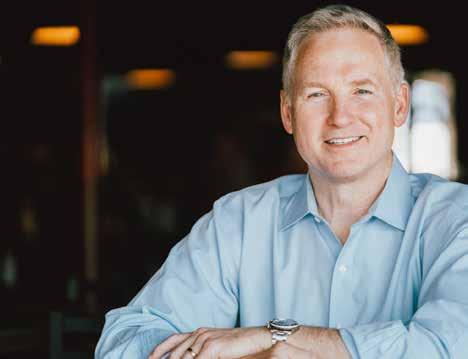



Every year at the end of the Seder, we say, “Next year in Jerusalem.” It’s a phrase we’ve repeated for generations—but this year, it feels more personal, more immediate, and more meaningful than ever.
Passover tells the story of our journey from slavery to freedom, from fear to faith, from exile to home. It reminds us that every generation faces its own challenges, and that our responsibility is not only to remember our past, but to live its lessons in the present. Today, as Israel and Jewish communities around the world face growing hostility, that message feels especially urgent.
I’ve been told recently that wearing my Star of David or expressing my connection to Israel is an act of bravery. To me, it isn’t. It is simply my identity. I am a Jewish woman, and I will not leave that behind when I walk out my door. Our history has shown us that hiding has never been the answer. Strength, faith, and unity have always carried us forward.
“Next year in Jerusalem” is more than tradition—it is a statement of who we are as a people. It reflects our connection to one another, to our history, and to our homeland.
This year, my prayer is for peace—for Israel, for the Jewish people, and for the world. And with that hope, I say: next year in Jerusalem.
Chag Pesach Sameach.
Cheryl Dorchinsky is Founding Executive Director of Atlanta Israel Coalition.
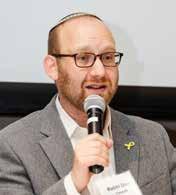
I wasn’t sure what to write for this column about what it means to be a good Jew. So, I asked my Catholic bookkeeper. Without a moment’s hesitation, she replied: “To call your mother!”
We laughed: but she’s not wrong. We share an office wall. In the years that we’ve known each other, she’s probably heard hundreds of conversations I’ve had with different members of my family.
When I meet with conversion students or interfaith spouses, one of the first things they tell me that typically shocks them is how close (sometimes, uncomfortably so) Jewish parents and children can often be with one another.
There are few topics out of bounds among Jewish families. We complain about our days to one another. We yenta about other relatives. We compare notes about various medical ailments and brag about who has it worse as if they were competitive sports. When we relocated to Atlanta 10 years ago, we reconnected with members of our family we hardly knew and yet felt an instant sense of belonging. That’s what family does. It collapses distance.
This is especially true on Pesach. One of the most important mitzvot of Pesach is making sure that every Jew has a place to go. The Haggadah instructs us: kol dichfin yetay veyechol. “Let all who are hungry come and eat.” On Pesach, we keenly feel an extra sense of familial responsibility to care for those in our extended familial orbit. There’s always room for another one, two, or even 10 relatives around the ever-growing seder table. No one gets left behind.
It isn’t always simple. Families argue. Sometimes, it seems that we can literally be divided by oceans. But ultimately, when push comes to shove, there’s not a single member of my family for whom I wouldn’t drop anything I was doing if they needed my help. We call. We come. We make space. Ultimately, my Catholic bookkeeper is right. Mishpacha is the meaning of being a good Jew. It is our unwavering commitment to family: each and every time.
Rabbi Dan Dorsch is the Senior Rabbi of Congregation Etz Chaim in Marietta, Ga., and the immediate past president of the Atlanta Rabbinical Association.
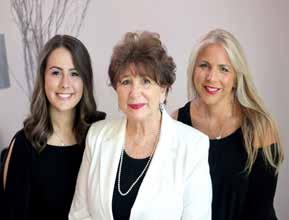















What does it mean to be a good Jew? Is it going to services each week or studying Torah? Is it showing support for Israel? Is it about respecting yourself and others? Or is it something broader, reflected in how we live each day?
This year, amid war, disagreement, and uncertainty, I’ve found myself returning to that question often. How do I move forward as a good Jewish person in a fractured world? In my own life, the mitzvot that shape my relationship with God have been a steadying force, serving as a reminder that my life has purpose. But I am part of a larger world, and I feel a responsibility each day to leave it better than I found it. That can feel daunting when the moral fabric of society feels as though it is fraying.
In moments like these, I think of the teachings of Rabbi Lord Jonathan Sacks, who described Judaism as a religion of action. It’s not only about what we believe, but how we speak, how we treat others, and how we take responsibility for the world around us. To be a good Jew, in this sense, is to act with intention: to choose kindness, to pursue justice, and to show up for others with care and integrity.
We may not always see the full path ahead. The world can feel uncertain, even dark. But Judaism reminds us that we are not without direction. Each act of goodness, each moment of compassion, each decision to act responsibly is a step forward. May we enter this Passover not with perfection, but with purpose, one thoughtful, intentional step at a time from darkness into light.
Chag Kasher V’Sameach.
Rebecca Guttman, MS, is a Program Manager for Jewish Fertility Foundation.
There’s not one answer about to how to be a good Jew, but many answers. For some, it is doing mitzvot, for others, pursuing social justice. Supporting Israel, giving tzedakah, keeping Shabbat -- all of these are important ways to be Jewish. I’m always skeptical of those who claim there is only one way to be a good Jew. On the contrary: questioning, criticizing, grappling, and debating big issues is an essential Jewish trait.
At the same time, I embrace the metaphor that we were all at Sinai, all Jews, past, present, and future. This means that, as a people, we are responsible to care for one another, and that we have a shared future. I believe in Am Yisrael, in Jewish peoplehood.
But just like at Sinai, we are still a “mixed multitude” with many, sometimes conflicting opinions and ways. So, not only are there many ways to be a good Jew, but we actually need all the kinds of Jews in all their various ways of being Jewish.
We may never agree what it means to be a good Jew. But as long as we care enough to show up, to debate, and to strive, and engage with those who might be on a different Jewish path, then we are all being good Jews.
Reuben Haller is an entertainer, musician, poet, and Hebrew calligrapher.
The prompt for this year’s Passover message is: what does it mean to be a “good Jew”? It is a question that has always troubled me, in part because there is no simple or universally satisfying answer. As an observant Jew, I take great pride in keeping Shabbat and kashrut, in observing the holidays, and in striving to fulfill the commandments. For me, that is an essential part of what it means to live as a committed Jew. Yet, I hesitate to project that definition onto others or to judge them by that standard alone.
I am also a committed Zionist. I believe that the modern State of Israel is nothing short of a miracle, and that it is something all Jews should support and help sustain. But does that mean that those who do not share that same level of commitment are somehow “not good Jews?” I am uneasy making such a claim.
So, I return to the question: if there is a standard, what should it be?
Perhaps an answer can be found in the figure of the “wicked child” in the Haggadah, who asks, “What is this to you?” The tradition understands this question as one that separates the child from the community. The issue is not doubt or disagreement, but disengagement.
As it is taught in Pirkei Avot (2:4): “Do not separate yourself from the community.” When a Jew sees themselves as something apart from the collective — no longer bound up in the shared story, responsibility, and destiny of the Jewish people — they risk crossing a line from belonging to detachment.
The Jewish people are diverse, layered, and deeply interconnected. There must be room at our seder tables for every Jew who understands themselves as part of this ongoing story — one that begins with Avraham and continues through us today. We should make space for all who recognize that being Jewish is not incidental, but meaningful — that it is a sacred inheritance we share. And we should hope that all who join us see Israel as a central thread in the fabric of Jewish history and identity, one that has bound our people together since the earliest chapters of Bereshit.
There may be no single definition of a “good Jew.” But perhaps there is a clearer understanding of what it means to step outside the community — when one disengages entirely from the shared identity and destiny of the Jewish people.
This Passover, may our seder tables be open and inclusive, bringing together all who see themselves as part of Am Yisrael. And may we always recognize ourselves as integral members of that enduring collective.
Rabbi Josh Hearshen is the rabbi of Congregation Or VeShalom.

Very early in the seder, we describe four children: wise, wicked, simple, and the one who does not even know how to ask. It is all too easy to see these four children as archetypes through which we might categorize the Jews around us, or even ourselves. The wise child is deeply engaged in the minutiae of the tradition and concerned with fulfilling every responsibility. One might stereotype the wise child as a Jew with a particular type of observance, knowledge or affiliation, a “good Jew.”
The simple child is largely ignorant of the traditions but brings curiosity. We could argue that this, too is a “good Jew.”
Then there is the child who “does not know how to ask.” This is a Jew so distanced that they do not even know that there is a question to ask. How can you judge such a person as good or bad? They don’t even know what they don’t know.
Finally, there is the wicked child, who asks a sharp question (drawn from a Biblical verse) which mocks the tradition. It is implied that the wicked child excludes himself from the community, and we are instructed to respond aggressively and let that child know that indeed, they are outside the fold and would have been left behind in Egypt. It is tempting to see that child as the paradigm of the “bad” Jew.
Today, we might each picture the wicked child as being the opposite of whatever kind of Jew we idealize. One of us might see that person as someone in the same mold as that of the seder, someone who rejects even the most basic aspects of Jewish observance. Some of us might even look in the mirror with guilt and say, “I’m a bad Jew.” But someone else’s vision might be more broad. They might see their “anti-Jew” as someone who does not feel the same way about Israel, does not place enough emphasis on “Tikkun Olam,” or voted for the wrong political party.
However, what is striking about the four children (in the Haggadah anyway) is that they are still at the seder. They are all still in conversation with the Torah and each other. Even the “Wicked” child who rejects so much is still holding on to the language of the Torah. That child might be a wrong Jew, a sinful Jew, a rebellious Jew, but there is still hope. As long as they are willing to sit at the table, they might ultimately come to be worthy to leave Egypt.
Rabbi Joshua Heller is the Senior Rabbi for Congregation B’nai Torah.
What Does it Mean to be a Good Jew?
As Passover approaches, many of us are not only preparing our homes, but also quietly asking ourselves harder questions.
Am I doing enough?
Am I showing up the way I’m supposed to?
Am I a “good Jew?”
It’s an uncomfortable question, and for many people, it carries more pressure than inspiration. In our community, being a “good Jew” is often associated with what can be seen. Going to shul. Keeping mitzvot. Learning Torah. Supporting Israel. These are important and meaningful parts of Jewish life. But when they become the main way we measure ourselves or others, something important can get lost.
At Hineni Toco Hills Mental Health Initiative, we see how much people are carrying that isn’t visible. The parent supporting a child through mental health challenges while trying to prepare for Yom Tov. The individual who shows up to the seder but is struggling internally. The person who feels overwhelmed, isolated, or simply exhausted, and is doing their best to stay connected.
The teaching, derech eretz kadmah l’Torah, means ethical, respectful behavior is the essential foundation that must come before Torah study. Before observance, before performance, before anything that can be measured from the outside, there is the responsibility to be a good person.
That means kindness. It means compassion. It means how we treat others, not only within our own circles, but anyone we encounter, regardless of their background or beliefs.
It also means how we treat ourselves.
A person can be doing all the “right” things and still be struggling. A person can be quietly holding a tremendous amount and still show up with dignity. That counts. That matters.
As we sit at our seder tables this year, surrounded by family and expectation, maybe the question shifts a bit.
Not “Am I a good Jew?” in the narrow sense. But rather:
Am I acting with kindness?
Am I making space for others?
Am I recognizing the humanity in the people around me, and in myself?
That may be a truer place to start.
Sheila Jutan is an Atlanta native, Sandy Springs raised, Toco Hills resident, and is the co-founder of Hineni Toco Hills Mental Health Initiative.





G-d has an audacious dream not yet fulfilled. G-d created a world of beauty and diversity. The dream is that the world will flourish in peace and harmony, creativity and love. Humans were created to be caretakers of that dream. The dream is unfulfilled because our ability to hold G-d’s vision is deeply limited. We are terrible at distinguishing what is “good for all” from what is “good for me.” This universal human tendency, sometimes called the yetzer hara, leads us to deplete natural resources, go to war with one another, and unwittingly follow false gods.
When G-d gave us Torah, and brought us into a Covenant of Mitzvot, G-d asked us to harness our yetzer hara by limiting it for the sake of a greater blessing than immediate self-fulfillment. We refrain from work on Shabbat, we limit what we eat, we devote time each day to G-d in prayer - as tools to teach us that what may seem like arbitrary restrictions are actually exercises for holiness. Living in this way helps us see the world not only through the lens of our self-interest, but through G-d’s interest in bringing about G-d’s audacious dream.
In this world, we protect the vulnerable, we treat natural resources as gifts from G-d, we love the stranger. G-d brought us out of Egypt and into the Promised Land to give us our first opportunity among the nations to model that dream in a small way.
Kings, priests, and prophets tried and failed. We were exiled from the land. But they left us a record of their attempt.
Generation upon generation of rabbis built a way of life that survived the exile. We preserve our disagreements with one another in the humility that we are all trying and failing to live up to G-d’s audacious challenge. We will never cease our attempts, or our disagreements for the sake of heaven.
Today, with the miracle of the State of Israel coming to fruition after generations of rabbis, dreamers, poets, statesmen, and pioneers brought it to bear - we have another chance to try and model G-d’s dream coming into fruition.
Defending the chance is mandatory. Not squandering it is also mandatory.
How will the generations that follow us see our attempt to live up to G-d’s dream?
Oseh Shalom Bimromav, Hu Ya’aseh Shalom Aleinu. V’al Kol Yisrael, V’al Kol Yoshvei Tevel. May the One who creates harmony on high, bring peace to us, to all Israel, and to all who dwell on Earth.
Rabbi Ari Kaiman is the rabbi for Congregation Shearith Israel.
As Passover approaches, Jewish families across Atlanta and around the world will gather around the seder table to retell the story that has shaped our people for thousands of years.
It is the story of a people who knew oppression … and who ultimately found courage, faith, and freedom.
At the seder, we read a line that has echoed across generations: “In every generation, each of us must see ourselves as if we personally came out of Egypt.”
Most years, we read those words as a reminder of our history. But some years, they feel especially real. This is one of those years.
Across the world, we are watching historic events unfold as Israel, the U.S. and other allies confront the threat posed by Iran.
At the same time, Jewish communities everywhere are facing a very troubling rise in antisemitism. In just the past few weeks, we have seen far too many attacks on synagogues around the world, including in Detroit, reminding us that vigilance remains essential.
Moments like this remind us that every generation must take responsibility for the Jewish future.
And our tradition tells us where that responsibility begins: with education. In the Torah we are commanded: “You shall tell your child.” The Haggadah then brings that commandment to life through the story of the four sons. Each child is different. One asks wisely. One pushes back and challenges. One struggles to understand. One does not even know how to ask. And yet the message is clear: every child must be taught. Because while security protects the Jewish present, education protects the Jewish future.
It is how the next generation comes to know their story, their people, and their place in the world.
That is why here in Atlanta, Federation works every day to help ensure our community is safe, strong, and vibrant. We invest in security. We care for those in need. We invest deeply in Jewish education and engagement. And we stand with Israel and Jewish communities around the world, especially in moments like these.
The story of Passover reminds us that freedom was built by a people who took responsibility for one another, and for the generations that would come after them.
As you gather around your seder tables this year, may the story of the Exodus remind us not only of where we came from, but of the future we are building together.
From my family to yours, and from all of us at the Jewish Federation of Greater Atlanta, Chag Pesach Sameach
Renee Kutner is the President and CEO of Jewish Federation of Greater Atlanta.
Carr Family
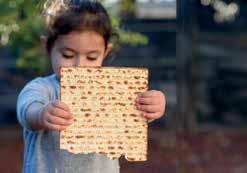
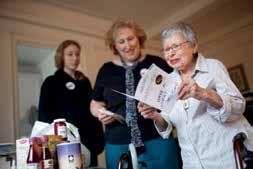
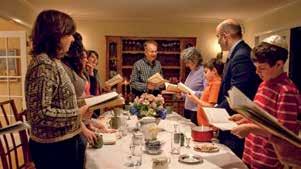
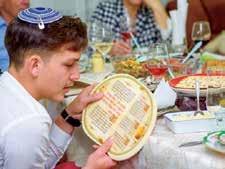






What Does it Mean to be a Good Jew?
There is a moment in the Passover seder when the conversation turns to the Four Children, each asking a different question, each reflecting a different posture toward Jewish life. For generations, we have returned to that scene as if it captures the full range of who we are: the wise, the rebellious, the simple, and the one who does not know how to ask. It’s a powerful framework, for sure. It’s also, perhaps, a little too neat.
The truth is that most of us move between those voices all the time. There are days when we feel deeply engaged and curious and committed to learning and practice. There are other days when we feel distant and skeptical and unsure of what any of it means. And then there are moments when we simply show up without a clear question at all, trusting that something in the cadence of Jewish life will meet us where we are.
So, what does it mean to be a good Jew?
It’s tempting to answer with a checklist: attend services. Study Torah. Support Israel. Act with integrity. Each of these matters, and each reflects a dimension of a life rooted in Jewish values and community. But none of them, on their own, fully captures what is being asked of us.
To be a good Jew is not about choosing the right category; it’s about staying in relationship with our tradition, even when it challenges us. It’s about staying in relationship with our people, even when we disagree. It’s about staying in relationship with the questions themselves, even when the answers are not immediately clear.
Passover reminds us that Jewish identity is not only inherited; it is continually shaped through participation and through the act of telling the story again. Maybe being a good Jew is less about arriving at a fixed definition and more about refusing to opt out, remaining present to the conversation, being willing to ask the hard questions, being willing to listen to answers that reassure us and those that are disruptive, and, either way, being willing to respond.
As such, the Seder table provides great wisdom. Being a good Jew is to remember that every voice matters: those revealing wisdom, those that we hear as challenging, those that are awaiting an invitation to be heard, and those still finding their way.
Rabbi Brad Levenberg is the Senior Rabbi for Temple Sinai and President of the Atlanta Rabbinical Association.
What does it mean to be a good Jew? What an awesome “Jewish” question! It is begging for controversial answers. Most responses are true to some and none are true to others. As opposed to asking what the definition of “is” is, we are faced with the question of what “good” is. This is something that I am clearly not qualified to answer.
As my late father would say when my grandmother made something that appeared to be inedible like schav, pickled herring or chopped liver, I would run away from even looking at these “delicacies” let alone taste them, he would say to me “You don’t know what good is”. In those situations, I heartedly agreed with him.
To answer the question of what is a “good” Jew, well, a tough one. I consider myself to be a pretty good Jew. Not great but possibly good enough. I don’t go to services that often or minyan ever, but I have done a few things that have benefited our Jewish community, assuming you like Kosher BBQ and a family day in the park. I do help members of the community that are in need, although more often than I intend. I also very much support Israel and causes that help her. Does that qualify? Is there a point system? How many do I need? How do I know if I have enough? Is life just an act to get to the next step and we are merely putting on a show in anticipation of a later reward?
How about we put away the scorecard for a while, except for Rosh Hashana and Yom Kippur, and just try to be decent people and treat others decently because it is the “good” thing to do. In reality this is something that will be judged by he who is high above and we’ll find out sooner than some of us anticipate.
Either way, enjoy your seders and your families, leave the door open for Eliahu and pray for the IDF and our families in the war zones.
Chag Sameach.
Jody Pollack is a member of the Hebrew Order of David and previous executive director of the Atlanta Kosher BBQ Festival.

"In every generation, they rise against us. And in every generation, we endure. We endure because we care for one another."
This Passover, as our community navigates a challenging moment, Jewish HomeLife stands with you. We were built by this community, for this community, to ensure that every Jewish family in Atlanta has a place to turn for expert, compassionate care, guided by the values we share.

Compassionate, professional care that allows your loved one to remain where they are most comfortable: at home, surrounded by family.
Skilled nursing and therapy
Personal care and assistance
Chronic disease management
Caregiver support and respite
Serving Greater At

Heart-centered care that honors the whole person by bringing comfort, dignity, and peace to families during life's most sacred passage.
Pain and symptom management
Spiritual and emotional support
Family counseling and guidance
Bereavement care

nd traditions honored


With Passover, we gather to retell a story that is both ancient and alive. The exodus from Egypt is not only a journey from slavery to freedom. It is also about identity, responsibility, and the enduring question of what it means to live as a Jew in every generation.
So, what does it truly mean to live as a “good Jew” today?
For some, the answer begins in the synagogue: showing up, praying in community, and keeping traditions alive. Others find it in the study of Torah, questioning, and seeking wisdom from words that have influenced Jewish life since before the common era. Still, others express it through their support for Israel and the connection to Jewish peoplehood.
But Passover offers us the opportunity to recognize that being a “good Jew” resists a single definition.
At the seder table, we are made aware that a Jew is not judged solely by his or her attendance, scholarship, or affiliation. To be Jewish is a lived experience; an ongoing commitment to values that guide how we move through the world.
Being a good Jew may mean practicing kindness even when it is difficult. It may mean standing up for justice because we know what it is like to feel judged. It may mean building community, caring for those in need, and acting with integrity even when no one is watching.
In Atlanta, Jewish life takes many forms. Some find meaning in tradition, others in culture, others in action. The beauty of Judaism is that it allows for varied paths while, at the same time, cultivating thoughtfulness, compassion, and accountability.
Passover reminds us that freedom is an ongoing responsibility. To be a “good Jew” means not just remembering our liberation but committing to active engagement with our values.
Ultimately, the answer lies in the balance between ritual and ethics, tradition and action, and identity and humanity. To me, this is the essence of being a “good Jew.”
And as we open the door for Elijah and welcome guests, Passover reminds us that being a “good Jew” is not about achieving somebody’s standard of perfection. Rather, it is about keeping the door open for learning, growth, and carrying the story into the future.
Chag Sameach!
Ray Alyssa Rothman is a commercial real estate broker who focuses on land. Her side business is her nonprofit, Kibbitz & Konnect, the premier in-person social network for Atlanta’s Jewish singles community (www.kibbitzkonnect.org).
As Passover approaches, we’re reminded of a story about moving forward - overcoming barriers and stepping into new possibilities.
At the Jewish Educational Loan Fund (JELF), we see this every day. Students come to us with drive and potential, but the rising cost of education can stand in their way. JELF helps remove that barrier.
Through interest-free loans, we provide access to higher education - undergraduate, graduate, and vocational - without the added weight of interest. It’s not just about funding school; it’s about creating opportunity and allowing students to move forward with confidence.
As we gather for Passover, we’re reminded that progress often begins with opportunity - and that helping someone take that next step forward can change everything.
At JELF, we are proud to be part of that journey. Hope you all have a meaningful holiday.
In the book, “I Searched for Wonder,” a spiritual anthology of Rabbi Abraham Joshua Heschel edited by Rabbi Samuel H. Dresner, I have always been inspired by the following passage:
“What message do you have for young people?” asked Carl Stern of NBC in concluding a television interview with Rabbi Abraham Joshua Heschel shortly before his death.
Rabbi Heschel replied, “…Let them remember that there is a meaning beyond absurdity. Let them be sure that every deed counts, that every word has power, and that we all can do our share to redeem the world in spite of all absurdities and all frustrations and all disappointments. And, above all, [let them] remember…to build a life as if it were a work of art.”
Passover is about asking questions about the world, struggling with the truth, and making meaning out of it all. During the seder, we don’t ask four questions, we ask one: Why is this night different than all other nights? The rest are statements that ask for us to respond.
What does it mean to be a Jew in the world today? It is to find meaning beyond absurdity. It is to know our lives matter, our words matter, our deeds matter, and that we all have the ability to build a life as if it were a work of art, flawed as it may be. Perfection is not the goal. Authenticity is. This Passover, may we be authentically proud Jews, and be ever diligent in creating a work of art that we can be proud of.
Chag Pesach Sameach!
Rabbi Larry Sernovitz is the CEO of Hillels of Georgia.


What does it mean to be a good Jew? It is a question that beats at the heart of our people, echoing through the centuries. While my soul finds deep rest in a sanctuary filled with the harmony of prayer and the rigorous beauty of Torah study, I believe the answer to “being good” lies in the quiet, sacred space between our rituals and our relationships.
To find the Ikar — the essence — we must look toward the profound call of Kedoshim Tihyu:
“You shall be holy.” Holiness is not a static state of being; it is an active choice. When Moses stood on the mountain and begged to see the Divine, G-d did not reveal a physical form. Instead, G-d revealed an identity of character: Compassion. Mercy. Kindness. Truth.
We are taught that we are each a fractal of the Divine. If we carry a spark of the Holy within us, then being a “good Jew” is simply the lifelong practice of fanning that spark into a flame. It is about the radical commitment to being a mentsch. Someone may be meticulously observant of every law, but if their heart remains closed to the suffering of others, the ritual is like a song without a melody.
Being a good Jew means living a life of Chesed — active, transformative kindness. It is found in the Eilu Devarim, a prayer recited daily in the morning service, the deeds that have no fixed measure but change the temperature of the world: caring for the lonely, visiting the sick, celebrating with a new couple, respectfully mourning the dead, and honoring our elders through the integrity of our own lives.
We are living in such divided, heavy times. When fear whispers to us to pull inward and lock our doors, our tradition commands us to do the opposite: to bring forth the light. We recognize that a better day will not dawn on its own; it requires our sacred hands to pull the sun over the horizon.
How we treat the stranger, how we protect the vulnerable, and how we plant seeds for the generations to come — this is what it means to be a good Jew.
And so, as we gather at our seder tables this Passover, may we recommit ourselves to our Divinely inspired purpose and place in the world. May we choose, again and again, to be redeemers — and not Pharaohs.
Am Yisrael Chai & a Zissen Pesach to all.
Rabbi Alexandria Shuval-Weiner is the Senior Rabbi for Temple Beth Tikvah in Roswell.
The Long Road of Freedom
At its core, Passover is all about freedom. The story of our Exodus from Egypt has long served as humanity’s enduring paradigm for the longing to be free.
And even today, that longing has not disappeared. Around the world, there are still people who yearn for the same freedom our ancestors sought. One cannot help but think of the Iranian people — many of whom bravely risk their safety in their struggle to live free of the oppression imposed by their radical rulers.
It is worth remembering that even our moment of liberation from Egyptian bondage didn’t instantly solve everything for the Jewish people. Far from it. Freedom did not bring immediate relief.
The former slaves still faced hunger, fear, enemies, and uncertainty. They had to learn how to defend themselves. They had to build a society. They had to transform themselves from oppressed rabble into a people with a shared purpose.
At times, the Israelites even looked back nostalgically at Egypt. Slavery was terrible — but at least it was predictable. You knew where your next meal was coming from. Freedom, by contrast, was uncertain.
Passover therefore marks not the end of the story, but the beginning of a long journey — exciting, meaningful, and sometimes arduous. As the saying goes, life is less about the destination than about the journey.
The Jewish story has always been a long road. After the brutal Oct. 7 attacks, I noticed a slogan appearing everywhere in Israel: Am Ha-Netzach Lo Mefached Miderech Arukah — “The eternal people are not afraid of a long road.”
And it has been a long road. For thousands of years, we have wandered through history — through exile, persecution, renewal, and return.
So, what does it mean to be a good Jew today? Is it attending synagogue regularly? Studying Torah? Supporting Israel? Treating others with respect?
Jewish life includes all of these things. But at its heart lies something deeper: the sense that we are part of a family traveling the same road together.
Because we’ve always seen ourselves this way, Jews built synagogues, hospitals, schools, and agencies wherever we have lived. It is why Jews scattered across the world care so deeply about one another. And it is why, in the 20th century, Jews helped rebuild a sovereign Jewish state after the devastation of the Shoah.
Our Passover seder is, in many ways, a Jewish homecoming. Around the table, we remember where we came from, who we are, and that our story continues.
The road has been long, and it is far from over.
And as long as we continue to walk it together, the journey of the Jewish people will endure for generations yet to come.
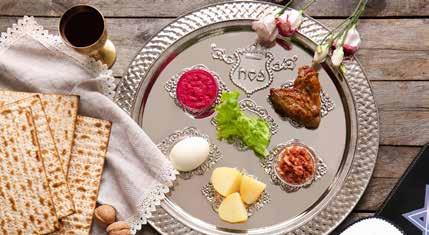






By Bob Bahr
The American Jewish Committee (AJC) held the fifth in its annual series of Unity Seders at The Temple in Midtown on March 11. The event, which grew out of an earlier Passover celebration sponsored by the AJC Black Jewish Coalition has, during its recent history, had to face the reality of serious armed conflict in the world. First, with the Russian invasion of Ukraine in February 2022, and the following year, the terrorist attack in Southern Israel by Hamas in 2023 and the Gaza War that followed that.
This year, the Unity Seder was observed less than two weeks after the armed conflict between Iran and the United States broke out. And, while there was scant mention of that war and the controversy that has ensued, Dov Wilker, AJC’s regional director, ended the evening with a sharp and pointed call for freedom for the Iranian people, who have been ruled by a repressive government for nearly a half-century.
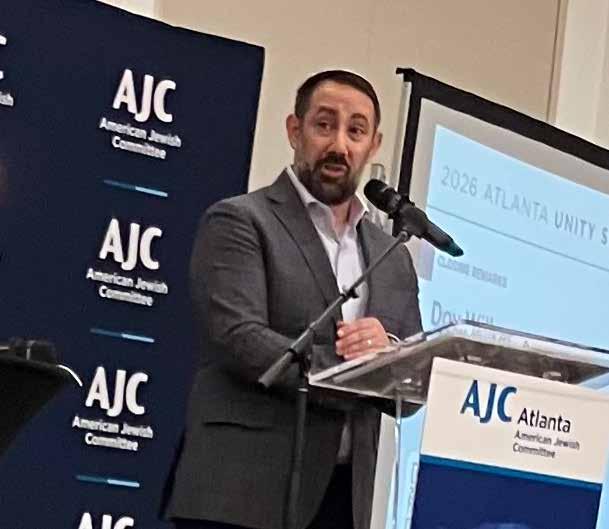
“I do believe that if there’s one thing that unites all of us,” Wilker said, “regardless of our politics, it’s that the oppression that the Iranian people have faced for 47 years is absolutely unacceptable, whether they are Jewish, Zoroastrian, Buddhist. or Muslim. Whatever their faith is, the 92 million people that live in Iran today have an opportunity to regain their freedom, the freedom that has been so harshly taken away from them.”
Attending the Unity Seder were a number of clergy from various denominations and a lay leader from the Catholic Archdiocese. Also participating was Theodore Hertzberg, the U.S, Attorney for the Northern District of Georgia, a representative from Atlanta’s mayor’s office, and eight members of Atlanta’s consular corps.
This year’s event was chaired by Sandra Cuttler, Jonathan Zuff, and Mark Spatt. Among the sponsors were the Lovett School, The Weber School, and Holy Innocents Episcopal School.


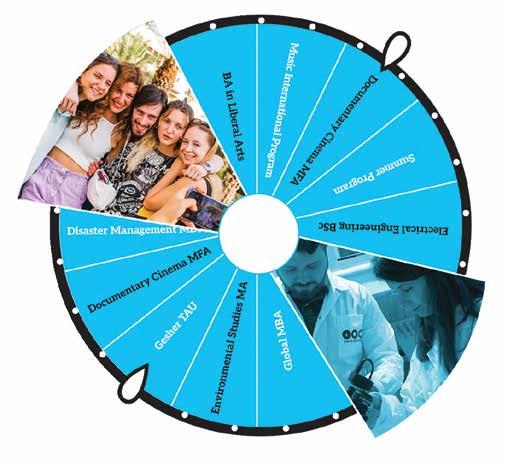

25 Global Degrees
5-Minute Program Spotlights 1 Week of Discovery
Join us for the TAU Lowy International School’s Virtual Open Week
APRIL 12-16, 2026
Meet the people shaping tomorrow. Discover gap year, undergraduate, and graduate programs, all brought together on one virtual stage.
Study and thrive in Israel’s cultural capital with students from over 100 different countries.
Choose from 60+ undergraduate, graduate degrees, study abroad, summer and gap year programs.
Scan here to register:

By Robyn Spizman Gerson
As Passover approaches, Atlanta’s Maos Chitim Fund is calling once again on the Jewish community to uphold an age-old tradition: ensuring that every family can gather around the seder table with the food and provisions needed to celebrate the holiday.
For more than 50 years, this tradition has been upheld by Maos Chitim’s mobilized community doing a mitzvah which has grown significantly in need. It’s a blessing to observe the holiday and celebrate Pesach. Making that opportunity available to those who need assistance is at the heart of this purposeful organization which makes a significant difference in the lives of others.
The name, “Maos Chitim,” literally means, “wheat money,” and is rooted in the Haggadah’s call: “All who are hungry, let them enter and eat. All who are in need, let them come celebrate Pesach.” For decades, Atlanta community members have come together to fulfill this tradition and sacred obligation, raising funds to directly support local families in need. What started as a small group of Jewish community members going doorto-door down Broad Street, asking Jewish store owners for donations to support other Jews at Passover, has now grown to a community-wide endeavor as the Jewish community has grown and spread out around metro Atlanta.
Now located at Jewish Family & Career Services of Atlanta (JF&CS) for 501(c) (3) administrative purposes, Maos Chitim operates as an independent, communityled initiative with its own leadership and dedicated volunteer committee. JF&CS provides the nonprofit status to accept donations and issue acknowledgment letters, while every dollar raised by Maos

Chitim goes directly toward helping families afford Passover food and essentials.
Today, the fund is led by longtime community volunteer Allan Tanenbaum, who has chaired the campaign for more than 20 years. Under his leadership, Maos Chitim continues to adapt to growing needs. In some years, requests for assistance have increased by as much as 30 percent. This year alone, the fund will support more than 600 local families.
“Many of the previous givers of Maos Chitim are now asking for help,” said Allan Tanenbaum. He, along with a group of volunteers, ask the question, “How can we sit at our seder table without having provided for those who truly need assistance so they too can have a seder?”
The Maos Chitim committee, com-




prised of dedicated community members, including Dr. Miles Brett, Rabbi Hillel Konigsburg of Congregation B’nai Torah, Dr. Steven Leff, and Stephen Tanenbaum, emphasizes that participation is just as important as the amount given.
“Rather than focusing on a few large sources of funds, we want more people to participate,” Allan Tanenbaum added. “What gives me a greater sense of accomplishment is the number of people who give, not the size of the gift. This is a community obligation. Despite the significant need, only 1 percent of the local Jewish community has historically contributed to the fund. With Passover expenses rising and economic pressures continuing to affect families across At-

lanta, the committee is urging broader participation. A contribution of just $18 can help make a meaningful difference.” Maos Chitim does not replace donations to other Jewish causes or organizations; it is a focused effort dedicated solely to helping families meet the additional costs of Passover. Every dollar collected is used to provide food and holiday necessities for those in need. As Atlanta prepares to celebrate freedom and renewal, Maos Chitim invites every member of the community, especially the next generation, to step forward, “light the match,” and ensure this tradition continues for decades to come.
To support and learn more about the Maos Chitim Fund please visit give.jfcsatl.org/maos. ì


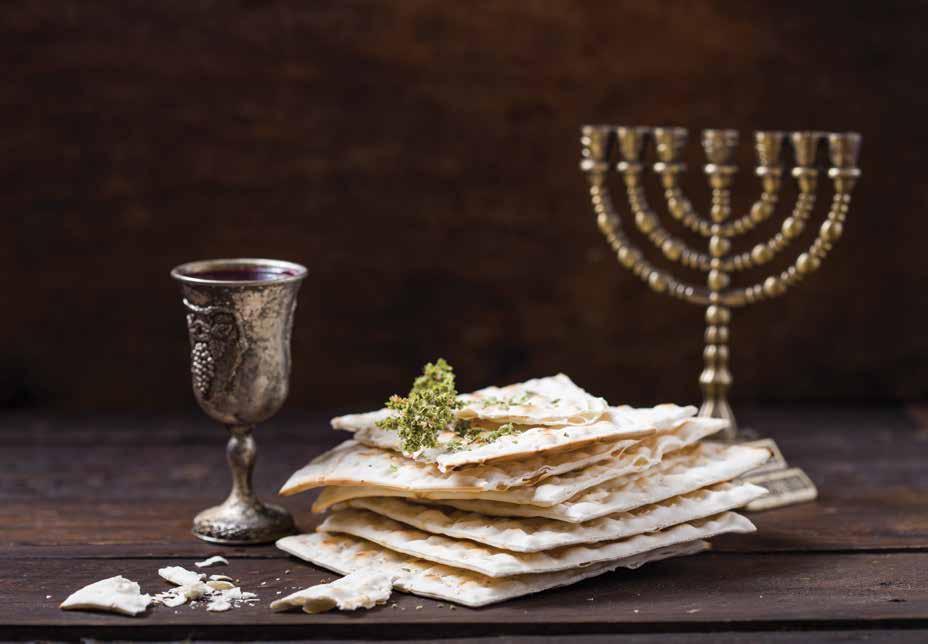
Wishing you a meaningful Passover filled with peace, renewal, and time with loved ones. As this
celebrates
and fresh beginnings, we’re grateful to be part of your journey. Whether you’re finding a
or cherishing the one you’re in. Chag Pesach Sameach from your trusted real estate team.
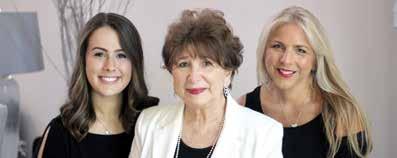
By Marcia Caller Jaffe
“Come From Away” is a true heartwarming story of a small village in Newfoundland that welcomed more than 7,000 stranded airline passengers on 9/11, doubling the town’s population.
The denouement unravels as the close-ups of just a few of the disparate and desperate passengers learn about the kindness of strangers. “From away” those passengers came in varying genders, races, religions, and marital statuses, including a religious rabbi who was set up in a private kitchen to keep kosher, not to mention the “ark-like” circumstance of an animal rescuer/passenger tending to the cages of cats, a dog, and a pregnant monkey.
Be prepared for some adjusting to one actor playing multiple roles in addition to the on-and-off Canadian intonations. “Come From Away” played at the Byers Theatre at the Sandy Springs Performing Arts Center and was presented by City Springs Theatre Company.
As term “happily ever after" so evenly applies, the play provides a sense of
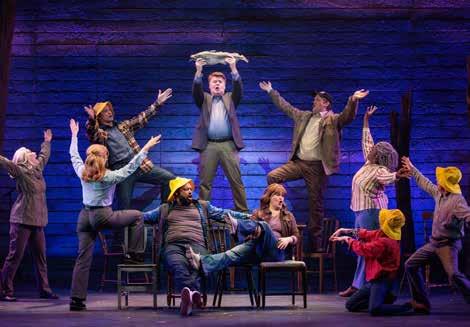
closure, establishing a new normal for trust and the true goodness of humanity. The audience unravels the plot complexities of “what would I do” … if they
We are now welcoming consignments in all collecting categories.
Lê Phổ (French/Vietnamese, 1907-2001) Center: Bouquet Champêtre, 1966 SOLD FOR $108,450
Bottom Right: Les Poppies Rouges et Jaunes, 1976 SOLD FOR $54,400
Vũ Cao Đàm (French/Vietnamese, 1908-2000)
Left: Le Rendez-Vous, 1974 SOLD FOR $57,600
Top Right: Divinité Blanche, 1976 SOLD FOR $102,100
Kristin Vaughn | 404.800.0192 SVP, Trusts, Estates & Private Clients atlanta@freemansauction.com FREEMANSAUCTION.COM
were the pilot, a passenger with pressing matters back home, or as residents who choose to open their homes to any number of strangers, who might need diapers
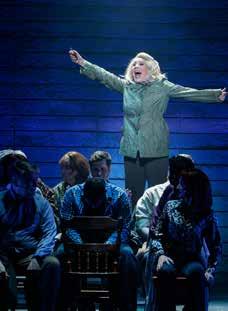
or share rare whiskey.
In terms of past stage grand executions in performances like “Ragtime,” “Music Man,” and “The Producers,” City

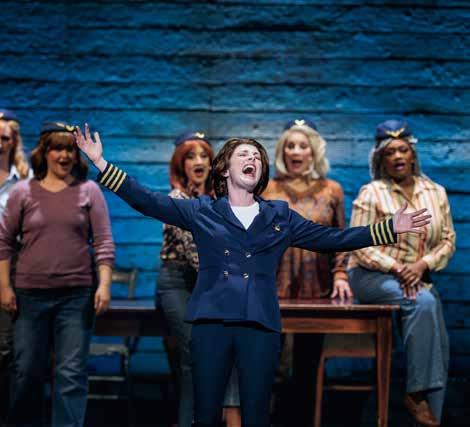
Springs Theatre Company is known for grandiose Broadway-worthy wizardry. Here much is done with moderate fanfare in a central stage flanked by trees. The audience is taken from the plane’s aisles, homes, the town meetings, and bars, by the switch of lighting in the blink of an eye. The plane is one such example where the rows are dark, yet overhead lighting expresses a familiar plane setting. In one such scene, veteran performer Courtenay Collins, who also plays Buehla, a townsperson, doubles as a passenger who panics with arms flailing insisting to exit the plane, while others console her. Her gestures are comedic, but maybe not. The passengers don’t know if they will be grounded another five hours, five days or five weeks.
One connecting point is how local couple Dr. Geoffrey and Marilyn Posner, members of Temple Sinai, were on Delta flight 129 from Ireland when their pilot calmly announced the dire situation. The Posners’ plane was grounded in Canada’s Gander Airport, which has been used for refueling and emergencies since World War II. They ended up in Lewis Porte (population 3,300).
Geoffrey recalled, “There were 350 passengers (Americans and Irish) onboard. Halfway across the Atlantic, our pilot announced that we would be landing in Canada, assured us there was nothing wrong with the plane, and that we would receive updates. As a physician, my initial reaction was, ‘Is there a

Remembering promises made. Celebrating promises fulfilled.


sick passenger aboard?’ When we landed in Gander, we saw other planes lining up. Our pilot told us that the Pentagon and Twin Towers had been hit. Everything was minute to minute. People with family in Manhattan were crying and praying when we were told that an estimated 30,000 people were killed.” That figure was later revised.
Marilyn added, “Since there were 37 planes, we all went to various towns (by school bus) to a large building. We had three meals a day prepared by the townspeople in the facility’s large kitchen.”
Note that part of the play focuses on concurrent bad luck that the local bus drivers were on strike. Again, within the kindness realm, they were convinced to resume for this time period.
The passengers held a reunion years later in Gander where they raised money for scholarships, in addition to donations after returning home.
Coincidentally, Gander had a Jewish mayor. The first day, an inquiry was made for special meal requests. Kosher and other diets were accommodated. A scene in the play portrayed “rabbi” actor, Lowery Brown.
Marilyn concluded, “The world changed after 9/11. There is natural goodness in humanity. In a crisis, people came forward. The townspeople wept as we were leaving. They were preparing a fish fry that afternoon.”
The play was scripted by a Jewish couple, David Hein and Irene Seinkoff. ì
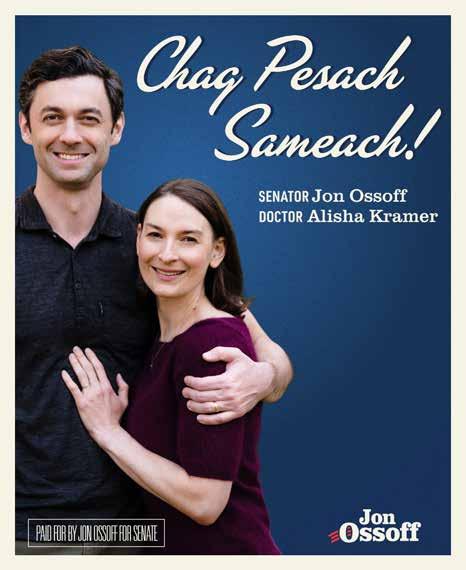
By Tessa Scharff
Coffee shop by day, bar by night, Bar ANA is a new addition to Atlanta’s dining scene, having opened in late November 2025 near Ponce City Market.
The concept was brought to life by co-owners Artie De Los Santos and Claudia Martínez, who also serves as the restaurant’s executive pastry chef. The two set out to create a space centered around hospitality, culture, and desserts.
“Bar ANA really started with a shared idea between myself and Chef Claudia Martínez,” De Los Santos said. “We both come from cultures where hospitality is second nature, where people gather around food, music, and conversation.”
Martínez, a James Beard semifinalist pastry chef, leads the culinary direction of the menu, while De Los Santos brings experience from the beverage and experiential side of hospitality. Together, they saw an opportunity to create a concept that highlights desserts as a central part of the dining experience.
“When we started talking about what we wanted to create, we realized there was an opportunity to center dessert the same way many bars center savory food,” De Los Santos said. “Instead of desserts being an afterthought, they could be the star of the experience.”
The restaurant draws heavily on Afro-Latin cultural influences, blending desserts, cocktails, coffee, and music into one cohesive experience.
Another defining feature of Bar ANA is how the space evolves throughout the day. During the morning and early afternoon hours, the space operates as a coffee shop through its Recuerdos coffee program before transitioning into a cocktail and dessert bar in the evening.
According to De Los Santos, the concept reflects traditions found throughout the Caribbean and Latin America.
“In many Caribbean and Latin American cultures, spaces evolve throughout the day,” he said. “In the morning, it’s coffee and conversation, and by evening it becomes music, drinks, and community.”
Recuerdos, the daytime coffee program, draws inspiration from Mexican coffee culture and focuses on a relaxed neighborhood atmosphere centered around coffee and pastries. As evening approaches, the lighting shifts, the music changes, and the cocktail and dessert program becomes the focus.
The space itself feels cozy and intimate, slightly tucked away from the


busier areas surrounding Ponce City Market. There is also a waiting or overflow area where guests can order drinks while waiting to be seated in the full-service section. On select evenings, the area transforms into a DJ station.
De Los Santos describes the atmosphere as “warm, soulful, and a little sexy,” with music often blending reggae, R&B, salsa, hip-hop, reggaeton, and Afrobeats throughout the night.
Located just steps from Ponce City Market, Bar ANA serves as a convenient stop for those looking to begin an evening out or end the night with dessert and drinks.
The cocktail menu is carefully curated, with drinks designed to complement the dessert offerings. Many of the cocktails lean into flavors that pair naturally with pastries, such as citrus, florals, spice, and tropical notes.
Two of Bar ANA’s signature cocktails are the ANA Daiquiri and the Guava Gin and Tonic.
The ANA Daiquiri is made with Caribbean rum, tamarind, apricot, lime, and orange flower water. The drink is sweet but balanced, with subtle spice and citrus flavors that keep it from tasting overly sugary. It is served in a distinctive flower-shaped glass that adds a memorable visual presentation.
The Guava Gin and Tonic is another refreshing option. Made with guava gin, granada-vallet, and tonic water, the guava flavor is light rather than overly sweet and adds a subtle tropical note.
Another cocktail on the menu is the Callisto, made with gin, vermouth, parfait amour, and absinthe, offering a slightly more herbal and complex flavor profile.
Bar ANA also offers wine, beer, and several non-alcoholic beverage options. The food menu is intentionally limited but thoughtfully curated, with snacks designed to pair well with both the drinks and desserts.
One standout item is the mushroom spinach tart, topped with parmesan and dressed greens. The tart is savory and rich, making it a satisfying option alongside cocktails.
The cheese and charcuterie board can also be ordered as a “cheese-only” board for guests looking for a kosherstyle option. The board features blue and goat cheeses served with toasted focaccia bread, honey, guava jam, and cornichons.
The guava jam stands out as a highlight, particularly when paired with the goat cheese and honey. The combination of sweet, savory, and slightly tangy flavors works well together.
Other snack options include marinated olives and bread service with whipped butter and seasonal jam. Bar snacks are also served alongside the drinks, including a mix of plantains and dark and milk chocolate-covered espresso beans.
Dessert is the centerpiece of the Bar ANA experience. One of the restaurant’s most talked-about desserts is the guava glazed donuts. These donuts are topped with pink peppercorn streusel and
served with cream cheese ice cream. The dish is one of Chef Martínez’s signature creations, which she previously served while working at Miller Union.
Another popular dessert is the Vanilla Pavlova topped with chantilly cream and macerated strawberries and served with a side of passion fruit hibiscus sorbet. The pavlova melts in the mouth, and its sweetness pairs well with the tartness of the sorbet. Originally introduced as a Valentine’s Day special, the dessert became so popular that it was added to the regular menu.
Other desserts include the Mini Mango, covered in white chocolate and topped with coconut crunch; a vanilla bean almond cake with milk chocolate ganache, brown butter mousse, and citrus; the quesillo shortbread tart served with pear sorbet and caramel popcorn; and a rotating ice cream or sorbet of the day.
For first-time visitors, De Los Santos recommends pairing a cocktail with dessert, particularly the Guava Gin and Tonic with the guava glazed donuts.
Bar ANA is open Thursday through Sunday. The bar opens at 6 p.m. and closes at midnight, with extended hours until 2 a.m. on Fridays and Saturdays. The Recuerdos coffee program operates from 7 a.m. to 3 p.m.
Bar ANA is located at 939 Ponce De Leon Ave. NE in Atlanta. Free parking is available behind the restaurant in a shared lot with El Ponce. For more information, visit Bar ANA’s website or call 470-763-9626. ì

Tastemaker design team Kattia Easterly and Sally Belenky, both with Nectar & Nest Interiors, didn’t shy away from a high-performing, floor-toceiling makeover resulting in unapologetic pattern mixing. Equal parts charm and inspiration, the fun twist is that it’s Belenky’s own home with husband, Erik, an attorney with King and Spalding.
Sally explained, “Our mission was to get an ‘old house feel’ in a contemporary environment … homey, ready for entertaining, but not formal.”
Kattia, the principal designer and founder of the firm, added, “We went for a healthy mix of textures like a Tartan plaid rug in the study where we wanted a clean aesthetic centered around the antique desk that had belonged to Sally’s grandfather and to refresh the existing antiques. Sally was open to patterns, prints, wallpaper, color … thus the intense emerald green in the dining room. I’d call the design style ‘transitional.’”
A curated oasis, yes … but take a home tour and leave room for Erik’s
mancave disguised as a golf course.
Marcia: How did this design process take place?
Sally: The house was originally built in 1991. EverCraft LLC (Kattia as a partner) purchased the house in 2021 and renovated down to the studs, extending the back by six feet. Kattia worked with architect Jorge Alain Herrera (Herrera Studio) on the design and made all selections for lighting, tile, flooring, hardware, cabinetry, and paint colors. It took a year to complete the 6,000-square-foot project, including the finished basement and golf room over the garage.
Marcia: Your color palette leans …
Kattia: Definitely blues and greens. We kept some walls white but brought in color and texture in an intentional way. The dining room has bright green grass cloth wallpaper by Thibaut. We also wallpapered both powder rooms and the primary bedroom. We painted Erik’s office, including the trim and bookcases Hale Navy (Benjamin Moore), and his golf room is color drenched in Mouse’s Back (Farrow and Ball), which is a beautiful mocha.
Marcia: What are your favorite pieces of art?
Sally: Amy Dixon’s painting in the
dining room. Then Ben Cook’s landscape and portrait of our dog, Scout, a sevenyear-old English cream golden retriever. Winston Wiant is an Athens artist - we love her painting of Augusta Nationalvery bright and whimsical.
Marcia: Kattia, you are also a contractor?
Kattia: Initially, the house had tremendous bones and the perfect layout to create open space for empty nesters while also having extra bedrooms upstairs. We reimagined the entire house to make it optimal for single-story living with the openair floor plan.
Marcia: What are some kitchen touches?
Kattia: The lighting is from Visual Comfort - coated aluminum pendants with antique brass finish by Carrier and Company. Quartz counters are cleanable and all-purpose but look beautiful, especially on the oversized island.
Sally: Since I’m from New Orleans, I cook Louisiana favorites like gumbo. I like trying different recipes - anything by Ina Garten. Erik’s favorites are roast chicken and meatloaf. He is great about manning the grill outside. Miller is the baker in the family, and Maggie loves to cook, too. We love having a separate scullery for the pantry space, coffee station, and extra ov-
ens and refrigerator drawers. It definitely helps keep the main kitchen much neater.
Marcia: What was the vision for the two guest powder rooms?
Kattia: We believe in making small spaces work hard - like using wallpaper. The more formal powder room features a fun peacock print, and the casual bath near the pool has a blue and green geometric pattern, both by Thibaut.
Marcia: What’s happening in the primary bedroom?
Sally: We recovered our existing sofa, then worked in the black and cream color palette. The damask print black and cream wallpaper (Lee Jofa) was bold initially, but I got used to it. The brass Ralph Lauren lamps are from Visual Comfort. The bedding is Peacock Alley. We decided to have the bed upholstered in green velvet to add a pop of color. The burlwood nightstands are by Made Goods.
Marcia: Describe the girls’ rooms.
Sally: For Miller, we incorporated blush pink with Laura Park custom drapes and decorative pillows and Matouk bedding. Her room reflects her interests: Taylor Swift, tennis, and Legos, along with memorabilia and photos of her friends. Older daughter, Maggie, selected her blue color palette and hanging chair. Some of her de-

cor reflects her semester in Copenhagen. We wanted to give her a little glamour with custom velvet upholstery. The two abstract paintings flanking her bed are by DeAnn Hebert.
Marcia: You are a graduate of Emory Law School. What inspired you to join a design firm?
Sally: I practiced law for eight years before staying home with the kids. Kattia and I became close friends while working on this house. When she decided to start her own design business, I jumped at the chance. She is the creative force, and I work on marketing, business development, and as the initial point of client contact. I love meeting people and helping out with invoicing, errands, or accompanying Kattia to ADAC or the Mart. I have a pretty good eye and bring in the client’s perspective.
Marcia: So why Nectar & Nest?
Kattia: The name really comes from my desire to make the home - a “nest” - a space you love living in. I think of “nectar” as nourishing, - where you go to recharge.
Marcia: How does your penchant for hitting the links play out?
Erik: My golf room features a simulator by Ace Indoor Golf and custom red leather barrel chairs. I can be at Pebble Beach without stepping out the front door. Sally’s jambalaya from scratch and playing a round at St. Andrews sounds like a good time to me. ì





Above:A New Orleans native, Sally makes a spicy jambalaya, among other Louisiana favorites. The counters are quartz with (above) coated aluminum pendants with antique brass finish by Carrier and Company.
Bottom Right: Daughter Maggie, in graduate school at Boston University, selected a blue palette and hanging chair. She claimed some glamour with custom velvet upholstery. The two abstract paintings flanking her bed are by DeAnn Hebert.
Bottom Left: Daughter Miller, a student at Tulane University, chose blush pink with Laura Park custom drapes and decorative pillows. Her room reflects her interests, including Taylor Swift, tennis, and Legos.
Left: Sally and Kattia believe in making small spaces work hard by using bold wallpaper in the guest powder rooms.

Passover Retreat - Enjoy a meaningful, fun family holiday with extraordinary facilitators. Space is very limited for this family-friendly, kosher for Passover Retreat in the North Georgia mountains. Runs through April 10. Register at https:// tinyurl.com/ytwd3rv7.

First Night Passover – 6 p.m. Celebrate the Passover season with The Temple at our unforgettable First Night Seder! Join The Temple clergy and fellow members of our congregation as we come together for a night of joy, reflection, and delicious food. Sign up at https://tinyurl.com/4b883jk8.
Passover Seder – 6 to 8:30 p.m. Sharing first night of Passover seder information for Temple Kehillat Chaim in Roswell. Nonmembers welcome! This is a great family-friendly, engaging seder for all ages. Catered by A&S Culinary Concepts with vegetarian option and kid-friendly option, and kosher style but not certified kosher. Register at https://tinyurl. com/4zcmmy63.
First Night Community Seder at Etz Chaim – 6 to 9 p.m. Join Etz Chaim as Rabbi Dan Dorsch leads us in a meaningful Passover seder complete with wine, a ceremonial seder plate at each table, along with a beautifully curated buffetstyle dinner. RSVP at https://tinyurl.com/ mryv7397.

Community Seder – 7:15 to 10:15 p.m. Experience the liberation and freedom of Passover. Join Chabad Intown for an enchanting Community Passover Seder as we relive the Exodus, discover the eternal meaning of the Haggadah, and enjoy a community seder complete with hand-baked matzah, wine, and a wonderful dinner spiced with unique traditional customs Explore the Kabbalistic insight on the number four: Four cups of wine, four sons, four questions and four types of freedom. RSVP requested at https://tinyurl.com/2nntjpue.
Passover Community Seder -7:30 to 11:15 p.m. Relive the Exodus, discover the eternal meaning of the Haggadah, and enjoy a community seder! The Chabad of Hall County community Passover Seder features a gourmet four-course meal, hand-baked Shmurah Matza, four cups of wine, personal English-Hebrew Haggadahs, and beautiful insights into the festival of freedom. Register at https://tinyurl. com/29mu3m5x.
Epic Passover Seder – 7:30 p.m. Passover is about freedom, good people, great food, and meaningful conversation- and we’d love to celebrate with you. Join Chabad Young Professionals for a relaxed, uplifting Community Seder with hand-baked matzah, four cups of wine, and a delicious holiday dinner. Sign up at https:// tinyurl.com/az74u896.

Chabad of Fulton Community Seder –8 to 9 p.m. Join the Chabad of Fulton for delicious food and a traditional seder. Register at https://tinyurl.com/yfevu34f.

Thursday, April 2
Passover Retreat - Enjoy a meaningful, fun family holiday with extraordinary facilitators. Space is very limited for this family-friendly, kosher for Passover Retreat in the North Georgia mountains. Runs through April 10. Register at https:// tinyurl.com/ytwd3rv7.
Temple Beth David- 2nd Night Passover Seder – 6 to 8 p.m. Join Temple Beth David for a Second Night Passover Seder. RSVP at https://tinyurl.com/35n7kxdu.

K&K Community 2nd Seder – 6 to 10:30 p.m. Have plans for the first seder but not the second? Join Kibbitz and Konnect for an intimate community seder at a private home in Sandy Springs. Seder meal will be kosher for Passover and will include vegetarian options. Please bring a bottle of kosher for Passover wine. Address will be provided on RSVP. Limited seating. Please RSVP at https://tinyurl. com/46fb7jm4.
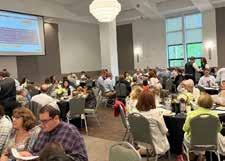
Second Night Passover Seder – 6:30 to 9 p.m. Temple Sinai is so excited to come together for our traditional Second Night Seder. We’ll read the Haggadah with Rabbi Brad Levenberg and enjoy a delicious family-style meal (vegetarian, vegan and gluten-free options available). Families, singles, couples, and community members/guests of all ages are welcome to attend this congregation-wide event. We ask that each couple bring one bottle of wine to share with the table! We would also love to fill the tables with personal seder plates (not to worry, we’ll provide the ritual items if you bring the plate). We hope you’ll bring yours to share. Register at https://tinyurl.com/45tx2jya.
Epic Passover Seder – 7:30 p.m. Passover is about freedom, good people, great food, and meaningful conversation- and we’d love to celebrate with you. Join Chabad Young Professionals for a relaxed, uplifting Community Seder with hand-baked matzah, four cups of wine, and a delicious holiday dinner. Sign up at https:// tinyurl.com/az74u896.
Kabbalat Panim Shabbat Service - 5:45 to 8 p.m. Once a month, Congregation Dor Tamid will gather for a Kabbalat Panim, an Oneg Shabbat before services at 5:45 p.m. We will then move to the sanctuary to welcome in Shabbat together at 6:15 p.m. Find out more at https://tinyurl. com/47rs4bt3.
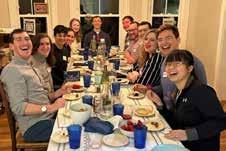
Seder and Sips: An Interfaith Passover Seder – 6 to 9 p.m. Celebrate Passover in a warm and welcoming setting at Seder and Sips: An Interfaith Passover Seder. Created for interfaith couples, this adults-only evening will feature a special third night bonus mini seder. Enjoy seder plate-inspired hors d’oeuvres, dessert, and drinks. Join us for a meaningful and memorable night of connection, tradition, and community. Space is limited –register at https://tinyurl.com/487djyph.
Passover Seder 2026 – 5 to 7 p.m. Please join us for our Annual Passover Seder at Shalom b’Harim. Our seder will be led by Rabbi Matan Peled. All ages are welcome; feel free to bring your children and grandchildren. Purchase tickets at https://tinyurl.com/284p3ck6.

Playground Pop-Up – 10 to 11:30 a.m.
Come enjoy an afternoon of play and community connection! Families are invited to gather at the playground for a fun mix of arts and crafts, snacks, and of course — plenty of PJ Library books to explore. It’s a great chance to meet other families, let the kids run around, and soak up the beautiful spring weather. Drop in anytime and stay as long as you’d like — we can’t wait to see you there! Sign up at https://tinyurl.com/2ub5m9de.
North Fulton Master Gardeners 25th Annual Garden Faire – 9 a.m. to 4 p.m. Plants, plants and more plants–living finds for your gardens from cottage-style to zen and from groundcovers to understory shrubs/trees. Come and check out the Master Gardener donated pass-along plants, the annuals and perennials, our pollinator/native plant experience table, the sales by our partners–Georgia Native Plant Society (native plants) and Alpharetta Community Agriculture Program (edible garden plants), and our many different marketplace vendors. Find out more at https://tinyurl.com/h9xpfrpj.
61st Annual Community Yom Hashoah Service of Remembrance – 11 a.m. to 12:30 p.m. 61st Annual Yom Hashoah program at The Memorial to the Six Million located in Greenwood Cemetery. Join Eternal Life-Hemshech as we remember our six million and pay tribute to our Holocaust survivors in attendance. The powerful program has readings, songs and prayers. Learn more at https://tinyurl. com/dzf2y2rb.
Passover
Wednesday, April 1 Light Holiday Candles at 7:39 p.m.
Thursday, April 2 Light Holiday Candles after 8:36 p.m. from a pre-existing candle.
Shabbat: Intermediate Days of Passover Friday, April 3 Light Shabbat Candles: 7:41 p.m. from a preexisting candle.
Saturday, April 4 Shabbat Ends: 8:37 p.m.
Passover
Tuesday, April 7 Light Holiday Candles at 7:44 p.m.
Wednesday, April 8 Light Holiday Candles at 8:41 p.m. from a pre-existing candle.
Thursday, April 9 Holiday Ends at 8:42 p.m.
Torah Reading: Shemini
Friday, April 10 Light Shabbat Candles: 7:46 p.m.
Saturday, April 11 Shabbat Ends: 8:43 p.m.
Hadassah Greater Atlanta Women’s Empowerment Conference – 11 a.m. to 3 p.m. Hands-on workshops and panel discussions with Hadassah of Greater Atlanta on topics of antisemitism and Alzheimer’s Disease; includes lunch. Register at https://tinyurl.com/2c92ay6h.

Post-Passover Pizza Party – 12:30 to 2 p.m. Celebrate the end of Passover with friends and family at our PJ Library Pizza Party! Join us for a fun, relaxed get-together with pizza, stories, and time to connect after the holiday. Sign up at https:// tinyurl.com/y7pumk4y.
March 2026 JBaby Brookhaven Neighborhood Small Group - 3:30 p.m. A five-week small group series for local families to bond over music, education, support, and playtime. Designed for babies ages 0–12 months and their parent(s). In this warm, welcoming space, neighborhood families come together for playful learning and meaningful support. You’ll connect with other parents, learn from developmental experts, and share new experiences with your little one — building friendships and a deeper connection to your community along the way. Each session is about 45–60 minutes, with plenty of time to socialize after. Register at https://tinyurl.com/mtksanr8.
50s+ Singles Cooking Class – 4 to 6:30 p.m. 50s+ age singles, join Kibbitz and Konnect at The Cook’s Warehouse for a cooking class experience! The class will begin with beverage service and mingling, then we’ll divide into teams and whip up the selected menu to enjoy together at the end of the class. RSVP at https://tinyurl.com/ cn6mwxyv.

Cradles to Classics Music Circle: Dunwoody – 3:30 to 4:30 p.m. Join JBaby for a music circle, led by Here We Grow, for babies at an assisted living facility, where babies, caregivers, and seniors sing songs and play simple instruments together, creating joyful connections between generations. Babies get the benefit of music, bubbes get the benefit of hanging out with babies — everyone wins! Sign up at https://tinyurl.com/2vaxsbbv.

Ladies of the ‘80s Musical Revue – 4 to 6 p.m. The Arts & Authors Department of the MJCCA presents, “Ladies of the ‘80s Musical Revue.” Get ready to rewind, remix, and relive the decade that defined iconic. The totally tubular event of the year is taking over the MJCCA as Independent Artists’ Playhouse unleashes the Ladies of the ’80s! Break out the big hair and bold attitude and motor on over for a radical night of powerhouse performances celebrating the women who ruled the charts and the stage. You’ll go head over heels for our high-voltage tribute to ’80s megaicons like Madonna, Tina Turner, Gloria Estefan, Cyndi Lauper, Diana Ross, and more. Packed with legit jams, fierce vocals, and nonstop nostalgia, this cabaret is pure throwback magic. It’s the ultimate night out for girls (and guys) who just wanna have fun — so don’t miss your chance to get into the groove and express yourself at https://tinyurl.com/mtytu743.
‘Unto Every Person There Is A Name” 2026 Holocaust Remembrance Ceremony – 8:45 a.m. to 4 p.m. B’nai B’rith International (Atlanta) is proud to present the “Unto Every Person There is a Name” 2025 Remembrance Ceremony this year, the 37th anniversary of this global Shoah Memorial Initiative. Register at https://tinyurl.com/469wvc5t.

Music Jam @ The JCC -6 to 8 p.m. Calling all musicians and music lovers for a music jam at the JCC! Bring your instrument(s), friends and jam with fellow musicians. No auditions, no restrictions — just pure musical fun and collaboration. Free and open to people of all ages! Learn more at https:// tinyurl.com/mrnr7hc5.
Connecting The Expecting: Sound Bath – 6:30 to 7:30 p.m. Join PJ Library and the Jewish Federation of Greater Atlanta for a deeply restorative sound bath designed especially for expectant mothers. This gentle experience uses soothing sound frequencies to promote relaxation, reduce stress, and create space for connection between you and your baby. Come as you are, get comfortable, and allow the sounds to support your body and nervous system during this sacred season of pregnancy. Register at https://tinyurl.com/3rc4esj7.

Ingredients
2 cups Gefen Almond Flour
1 cup sugar
2.8 ounces Gefen Vanilla Instant Pudding mix
2 teaspoons baking powder
4 large eggs
1/4 cup orange juice
Gefen Confectioners’ Sugar, for dusting
Directions
1. Preheat the oven to 350 degrees Fahrenheit. Line two 10×5-inch loaf pans with Gefen Parchment Paper. Leave some overhang for easy removal. (If using a 9×5-inch loaf pan take off about 3/4 cup batter and use as a mini cake or muffin. If using paper loaf pan, no parchment paper is needed.)
2. In a large bowl, whisk together the almond flour, sugar, pudding mix, and baking powder.
3. Add the eggs and gently whisk. When the mixture is about halfway combined, pour in the orange juice. Mix just until fully incorporated. Do not overmix.
4. Let the batter sit for a few minutes to thicken slightly.
5. Pour into the prepared pan and smooth the top. Bake until the center is set and a toothpick inserted comes out clean.
6. Let the loaf cool in the pan for a short time, then lift it out using the parchment and cool completely. Once fully cooled, dust the top lightly with confectioners’ sugar before serving.
Recipe by Chaya Surie Goldberger
Photography by Fraidy Feldman
Food Prep by Bracha Back kosher.com

Rabbi Blum is walking down the street one day when he notices a very small boy trying to press a doorbell on a house across the street.
However, the boy is too short and the doorbell is too high for him to reach. After watching the boy’s efforts for some time, Rabbi Blum calls out to the boy, “Would you like some assistance?”
The little boy replies, “Yes, please.”
Rabbi Blum walks up behind the boy, places his hand kindly on the child’s shoulder, leans over and gives the doorbell a solid ring.
Crouching down to the child’s level, Rabbi Blum smiles benevolently and asks, “Is there anything else I can help you with?”
To which the boy replies, “Yes, run like hell.”
n. The status achieved by a dull person whose YouTube video, tweet, or Instagram post goes viral.
“Moshe has been strutting around like a movie star ever since his yodeled version of ‘Mr. Brightside’ went viral. That’s shmodom for ya.”
Derived from the Yiddish, “shmo,” meaning, “a dull and stupid person.”
By: Yoni Glatt, koshercrosswords@gmail.com
Difficulty Level: Challenging

ACROSS
1. Gave money
5. City in central Israel
10. Bit of land at sea
14. Pot ingredient?
15. Once more
16. Sought damages, say
17. Term for an acquaintance you shouldn’t trust?
20. Massachusetts town named after Israel’s capital
21. A piece
22. Piggy
23. California county
26. ___ v’shalom
28. Hit 1998 Adam Sandler film?
33. Cockney’s roll-call response
34. Jewish fashion designer Marc
35. Keret of note
37. Street ___, products from 34-Across
39. Offering from 17-Across?
42. Zeidi alternative
43. Zac of “The Lorax”
45. Waze ways: Abbr.
47. It holds water
48. Offshoot of a city west of Jerusalem full of Americans
52. Half
53. HaZeh, for one
54. Son-gun connector
57. Sons of 42-Across?
59. Gaddafi ruled it, once
63. Passover requirement, once...or another title for this puzzle
67. Angels guard it, according to the Torah
68. Something set
69. Frozen drink brand
70. Hall or its food
71. Amazin’ MLB player
72. Israel’s future?
1. Clumsy hands
2. Buffalo seen in crosswords
3. “ ___ cost you!”
4. Make like an Israeli soldier
5. Sprinted
6. Garland and Gonzales, for short
7. Medieval weapon, or modern spray weapon
8. Fragrant purple flowers
9. Ivri follower
10. Famous Chazon
11. Go well with
12. Former “Tonight Show” host
13. Nose (out)
18. “Have ___ myself clear?”
19. Macbeth or Banquo, e.g.

This week, 100 years ago - 1926
National Council of Jewish Women releases article stating that present immigration laws unfairly force immigrants to choose between staying in the country or keeping their family together.
At its 51st convention, the Jacksonville, Fla. B’nai B’rith decides upon establishing a tuberculosis sanitarium in Nashville, N.C.
This week, 75 years ago- 1951
Two Jewish high school students in Atlanta, Jack Horowitz and Howard Klein, win first and second place in the Barkley Forum Oratorical Contest, gaining scholarships to Emory University.
Atlanta prepares for Cover-All Day, where Jewish men take care of home-making duties while Jewish women go out to canvas for the Jewish Welfare Fund.
Congregation Rodeph Shalom in Rome, Ga., celebrates the “bar mitzvah” of its synagogue building.

Orthodox Jewish Basketball player Tamir Goodman, playing for Towson University.
This week, 50 years ago1976
Emory University appoints Dr. David Blumenthal as the first occupant of its Jay and Leslie Cohen Chair of Jewish Studies.
Local Jewish War Veterans chapter installs married couple, Wolfie and Miriam Bromberg, as heads of its Atlanta Post 112 and Ladies Auxiliary, respectively.
Mr. and Mrs. Jay Senoff announce the bat mitzvah of their daughter, Terri, at Ahavath Achim Synagogue.
Mr. and Mrs. Victor D. Maslia of Atlanta announce the bat mitzvah of their daughter, Donna, at Congregation Or VeShalom.
24. Photos, briefly
25. Egyptian emblem
27. Lt. subordinates
28. Historic Banquet that led to the solidification of the Conservative movement
29. What an inspiring athlete often has
30. Attendees
31. “Gadzooks!”
32. It’s a lot in Judaism?
33. Offering from 28-Across?
36. Offering from 48-Across?
38. Sticks up
40. Combining form in chemistry
41. Orange jacket?
44. Words before “say more”
46. Like David compared to Goliath
49. Admiring words
50. In a neat way
51. Iago’s wife
54. Big name in Israeli food
55. Kind of haircut
56. Top cards
58. Artist that does bad work?
60. E. coli, for one: Abbr.
61. Shloshet ___ Hagbalah
62. Sacked out, old-style
64. Health care VIPs
65. It’s all the rage?
66. 10 cc, e.g.
Mr. and Mrs. Sanford H. Orkin of Atlanta announce the engagement of their daughter, Sherri to Morris Soriano, son of Mr. and Mrs. Joseph Soriana, also of Atlanta.
Two Atlanta women elected to regional office for the Southern District of the NCJW – Mrs. Barbara Asher as district president, and Mrs. Sherry Frank as area chairman.
This week, 25 years ag - 2001
Tamir Goodman, Orthodox Jewish basketball player for Towson University, skips game due to its overlap with Shabbat.
Following in the footsteps of his father, Pete Morris, Bruce Morris becomes President of the MJCCA.
The AJT sits down with local Emmy-winning sportscaster Dave Cohen.
Former Israeli Defense Minister Yitzhak Mordechai convicted of sexual assault.
Issues of the AJT (then Southern Israelite) from 1929-1986 can be found for free online at https://gahistoricnewspapers. galileo.usg.edu/lccn/sn78003973/

Harry Baer, 94, of Dunwoody, Ga., passed away peacefully on March 21, 2026. He was a beloved husband, father, father-in-law, grandfather, great-grandfather, uncle, and friend. Born in Memphis to William and Zelda Baer, he grew up in an Orthodox, kosher home that included older sister, Bertha, and younger sister, Maxine.
May you and your family enjoy the blessings of P
Robin: 404-403-6561 | Lauren: 770-789-4464
Office: 770-394-2131
Direct: 404-495-8233
Robin.Blass@HarryNorman com


After three years of college, he went to medical school at the University of Tennessee, Memphis, and then spent his internship year training as an obstetrician and gynecologist in Dallas and then did his residency back in Memphis. He met the love of his life, Bettye Fisher, at the wedding of mutual friends, and began an almost 72-year marriage during which he and Bettye were completely dedicated to each other.
He began his medical career serving for two years in the Air Force, including a stint in Alaska. He then entered private practice in Tullahoma, Tenn., but after three years decided to start over in Nashville so that his three children could have a more complete and fulfilling Jewish life.
Harry’s life was focused completely on his patients - who loved him dearly - and his family. Not only did he take care of Bettye and his kids, but also his two sisters in Memphis. But he did find time for his weekly poker game with his friends and his Thursday and Saturday evening glasses of scotch.
Raising two daughters and a son at a time before women were truly considered equal, he gave his daughters the same opportunities he afforded his son. He was a proud father who offered sage, thoughtful advice. As much as he delighted in his kids, that emotion was intensified in his grandkids. He would carry each of them around as they pointed a direction, and he would sit down on the floor and play with them for hours. And as they got older, he was there to offer them encouragement, support, and unwavering love.
His retirement from his medical practice enabled him and Bettye to move to Atlanta in 1999 so that they could enjoy their grandkids and actively participate in their lives. Being together for the Jewish holidays was of utmost importance to him. In addition, he and Bettye volunteered with B’nai B’rith, making friends that way. He volunteered at election times as a poll worker and eventually became the captain at his assigned voting place. He thoroughly enjoyed going to Falcons games with his sons-in-law and grandson. And he attended minyan at B’nai Torah as many mornings or evenings as he could.
His last few years were difficult, due to physical and health issues. However, he remained kind and thoughtful and was more concerned about Bettye than he was about himself. His family is so grateful for having had him in their lives for as long as they did.
Harry is survived by his beloved wife of almost 72 years, Bettye; his children, Sherie (Arthur) Gumer, Karen (Michael) Himmelstein, and Jerome (Bonnie) Baer; his grandchildren, Tracy (Marc) Hennes, Jason (Lindsey) Gumer, Laura (Shaun) Hoffman, Arielle Gumer (Max Delahanty), Allison Baer and Jamie Baer; and his nine great-grandchildren, Julian and Amelia Gumer, Emily and Drew Hennes, Dafna, Atara and Yarden Hoffman, and Havi and Benni Delahanty.
A graveside service was held on Tuesday, March 24, at the West End Synagogue Cemetery in Nashville, Tenn.
The family requests that donations in Harry’s memory be made to Congregation B’nai Torah (Atlanta), Temple Emanu-El (Atlanta), or West End Synagogue (Nashville).
Marcie Jean Lefkovitz Bashuk, 68, of Marietta, Ga., passed away peacefully on Saturday, March 28, 2026, surrounded by her loving family.
Born on Oct. 30, 1957, in Nashville, Tenn., she was the youngest of three children, alongside her sister, Leslie “Toe,” and her brother, Steve. She was raised in Cookeville, Tenn., by her devoted parents, Beverly “Pepper” and Arnold.
Marcie’s greatest joy was her family. Nothing meant more to her than being together with her husband, her three children and their spouses, and the two most important people in her life - her grandchildren, Pepper and Lamb. She loved spending time with her friends, was always happiest on a shopping trip, and, above all, devoted herself to caring for her children and grandchildren - which she considered her most important role.
Before starting her family, Marcie attended the University of Georgia, where she was a proud member of Sigma Delta Tau. She later worked as a middle school teacher in Augusta, Ga. She was an incredible friend, mother, and daughter, and will be deeply missed by all who knew and loved her.
She is survived by her husband, Robert; her children, Andrew, Mark, and his wife Julie, and Allie and her husband, Andy; her grandchildren, Pepper and Lamb; and her siblings, Steve and his wife, Judy, and Leslie and her husband, Howard.
A memorial service was held on Monday, March 30 at 11 a.m. at Temple Sinai, 5645 Dupree Drive, Sandy Springs, Ga.
In lieu of flowers, the family welcomes donations to Lung Cancer Foundation of America. Arrangements by Dressler’s Jewish Funeral Care, 770-451-4999.
88, Atlanta
It is with a heavy heart that we announce the passing of our beloved father, grandfather, and husband, Robert Paul Goldstein, on Monday, March 23, 2026. “Bobby G” as he was known, always hoped to be remembered as a good guy with a big heart, and to those who knew him, he was exactly that.
Bobby was born on Sept. 11, 1937, in Baltimore, Md., to Albert and Eunice Goldstein. At age 10, his family relocated to Houston, Texas, where he spent his formative years. He graduated from the University of Pennsylvania’s Wharton School with a degree in finance and commerce. Bobby was a member of Zeta Beta Tau, where he formed lifelong friendships that remained deeply meaningful throughout his life.
Bobby met the love of his life, Elaine “Lainy” Goldstein, at the Standard Club in Atlanta. They married in 1959 and shared 64 magical years until her passing in 2024. Bobby built a long and successful career in the commercial printing industry, where he was greatly admired by all those who worked for and with him. But he was best known for his huge bear hugs and phenomenal sense of humor. Bobby dressed to impress and was honored to be named as one of the top 10 “Best Dressed Men in Atlanta.”
Having lived with Type 1 Diabetes for most of his life, Bobby became an “ambassador” of sorts, mentoring newly diagnosed children and their families on how to live with the disease. Part of Bobby’s legacy is his contribution in the establishment of Camp Kudzu, a camp for children living with Type 1 Diabetes. Bobby spent his energy fundraising and also volunteering at the camp each summer for many years. He devoted himself to causes close to his heart, like Juvenile Diabetes Research Foundation (JDRF) and Camp Kudzu.
Known for his huge smile that could light up a room, his warmth, his humor, and his signature bear hugs, Bobby had a gift for making people feel seen and loved. He will be deeply missed and forever remembered.
Above all, Bobby cherished his family and being a grandfather most of all. He is survived by his children, Bobby Jr. (Amanda) and Nancy Parker (Jimmy); his grandchildren, Josh (Brittany), Brett, Aaron, Stephen, Matthew, Micah, and Madeline. All of the grandchildren loved their “Dannels” dearly. He was preceded in death by his beloved wife, Lainy, and his son, Marc, of blessed memory. We want to give special appreciation to his loyal caregivers, Lily and Hannah, who were unwavering in their care for him.
The funeral was held graveside at Arlington Memorial Park on Wednesday, March 25, at 1 p.m., followed by minyan and shiva at the home of Bobby and Amanda Goldstein, immediately following the service. The family also had a visitation on Thursday, March 26, including minyan and shiva from 4 p.m. to 8 p.m. In lieu of flowers, donations can be made to JDRF, Camp Kudzu, The Temple, or Temple Emanu-El.
Renee Suzanne “Sue” Maline was born in 1943 in Fairfield, Ct. She met her husband, Sandy Kasten, at the JCC in Bridgeport, Ct, and they married in 1967. They lived in Connecticut with their three daughters until they all moved to Atlanta in 1980. Prior to getting married, Sue worked as a buyer for Read’s department store in NYC. Later, she worked as a bank teller and as a bookkeeper for various interior designers in Atlanta. Her greatest loves were undoubtedly her grandchildren, who she doted on as often as possible, and who affectionately referred to her as “Shush” as did so many others.
Sue is survived by her beloved husband of almost 59 years, Sandy Kasten; their children, Stacey (Karl) Hydrick, Rachel (Scott) Berenthal, and Jessica Kasten; her grandchildren, Danny (Kate) Hydrick, Adam Hydrick, and Jared and Kelli Berenthal. She was preceded in death by her parents, Rae and Max Maline, and her brothers, Albert, Morris and Eddie Maline.
A graveside service was held at Arlington Memorial Park in Sandy Springs on Sunday, March 29, at 2:30 pm. Shiva was held Sunday, March 29, and Monday, March 30, at 6 p.m. at the home of Stacey and Karl Hydrick in Dunwoody. In lieu of flowers, donations can be made to Happy Tails Pet Therapy, Inc. Arrangements by Dressler’s Jewish Funeral Care, 770-451-4999.



Martin (Marty) Kwatinetz, 89, of Dunwoody, Ga. (raised in Brooklyn, N.Y.), devoted husband, father, grandfather, and brother, passed away peacefully on March 17, 2026, after a long illness. Marty was the son of the late Philip and Rachel Kwatinetz. Marty was the beloved husband of Mildred and the cherished father of his daughter, Phyllis Abrams, and son, Neil (Robin Belsky) Kwatinetz. He was treasured as “Zayde” by his grandchildren, Jack (Ashley) Kwatinetz, Sydney (Steven) Linton, Katie Kwatinetz, Rachel Abrams and Jacob Abrams. He was also loved by his brother, Gary Kwatinetz, who survives him, as well as numerous loving cousins, extended family members, and friends.
Marty met Mildred through Marty’s uncle, who was a salesman, who did business with Mildred’s father, Jake Morris of Morris Brothers Luggage, located in Atlanta, Ga. Mildred and Marty spent their careers at Morris Brothers, eventually, owning it for several years before they retired in 2008. The business shaped their marriage and their lives. They were married in 1961 and celebrated their 65th anniversary on Jan. 1 of this year.
Marty and Mildred have been active members of Ahavath Achim Synagogue, Mildred for her entire life and Marty since he moved to Atlanta. Marty became a devoted member of Ahavath Achim’s morning minyan in 1989, following the death of his mother, and was still leading the Wednesday morning service via Zoom throughout much of his illness. For several years, Marty was a book reader for Vocal Point (formerly the Georgia Radio Reading Service or GARS) for the blind. He took up philately after his son joined a junior stamp club at Marcus Jewish Community Center of Atlanta and became a committed member of their Israel Philatelist Club.
The funeral was held on Thursday, March 19, 2026, at 10 a.m. at Ahavath Achim Synagogue, 600 Peachtree Battle Ave NW, Atlanta, GA 30327, with Rabbi Laurence Rosenthal officiating.
In lieu of flowers, please make donations to the Ahavath Achim Chesed Fund or to Vocal Point.
Esther Margol, a woman of remarkable independence, boundless energy, and deep compassion, passed away peacefully in her home on March 10, 2026. Born in Valdosta, Ga., in 1927, Esther was the youngest daughter of Latvian immigrants, Benjamin and Rose Landey, who came to America in search of a better life — a legacy of hard work and resilience that Esther carried throughout her 98 years.
Northside Hospital Auxiliary for over 20 years. Esther’s greatest joy was her family. She shared a beautiful marriage of 69 years with her husband, Howard. Her memory will be cherished by her four children: Bruce, Gary, Felice, and Maury. She also leaves behind a vibrant legacy through her nine grandchildren and nine great-grandchildren, all of whom inherited a piece of her spirited heart and her "no-nonsense" wisdom.
A graveside service was held March 13 at Arlington Memorial Park. Dressler’s Jewish Funeral Care, 770-451-4999. “She lived with a fierce determination and a sharp mind, leaving the world a better place — and a bit more organized — than she found it.”
A graveside service for Rosalind Rich Rieser, 86, will be held Saturday, April 4, 2026, at 12 p.m., Westview Cemetery (1680 Westview Dr SW; Atlanta, GA 30310). Rabbi Steven Lebow will officiate. Rosalind passed away July 2, 2025, in Hilton Head Island, S.C.
She was born Rosalind Rich in New York on April 24, 1939, the daughter of Katherine Rosenheim Rieser and Dr. Charles Ely Rieser, and was the great-great granddaughter of Morris Rich, one of the founders of Rich’s Department Store in Atlanta.
After moving to Atlanta at a young age, Rosalind attended “Little Lovett” preschool and graduated from Christ the King High School in 1957. While in high school, Rosalind danced in the senior company of the Atlanta Civic Ballet, which would later become the Atlanta Ballet.
On Feb. 12, 1956, Rosalind was featured on the cover of the Atlanta Journal-Constitution Magazine as a ballerina wearing a flowing red satin skirt and pink sleeveless blouse, holding a box of Valentine heart candy, whispering a secret to Cupid.
After graduating from high school, Rosalind left Atlanta to earn an associate in arts degree in early childhood education from Stephens College in Columbia, Mo. She returned to Atlanta and married Richard Joseph Needle, a native of Tampa, Fla.
Rosalind taught kindergarten at The Lovett School and was active on the Teen Board at Rich’s. She also volunteered as directory editor for the National Council of Jewish Women and was a passionate supporter of the arts in Atlanta. Rosalind was a loving, devoted mother who was very proud of her family heritage. Her hobbies included pottery, ceramic painting, glass beadmaking, and caring for her beloved poodle, Boss.
Rosalind is survived by her son, Charles (and wife, Melissa) Needle of Longmont, Colo., daughter, Katherine Dyess of Sparks, Nev., grandson, Sterling Dyess of Sparks, Nev., niece, Robyn Barkin of Atlanta, and nephew, David Rieser of Sydney, Australia.
Following the graveside service on April 4, a Celebration of Life reception will be held at Swan Coach House at 1:30 p.m. (3130 Slaton Dr, NW; Atlanta, GA 30305).
In memory of Rosalind, donations may be made to the Rosalind Rich Rieser Memorial
Scholarship at Penland School of Craft (https://fundraise.givesmart.com/e/ ivLkpg?vid=1pklmg).
Esther was famously “fierce” and lived life entirely on her own terms. To celebrate her 90th birthday, she purchased a brand-new Cadillac, and she remained a fixture at her local pool for water aerobics well into her mid90s. Beyond her physical vitality, Esther was a dedicated and passionate collector. Wherever her travels took her, she delighted in hunting for vintage head vases and egg cups. Over the decades, she curated one of the largest egg cup collections.
Even while working full-time, Esther prioritized giving back to her community and her heritage. Alongside her husband, Howard, she co-created the American Fund for Latvian Lithuanian Jews. Together, they established and funded a vital soup kitchen and medical clinic in Lithuania, providing a lifeline for those in the lands of her ancestors. Closer to home, she was a dedicated volunteer and a familiar fixture at the
Obituaries in the AJT are written and paid for by the families; contact Account Manager Ilyssa Klein at Ilyssa@atljewishtimes.com or 404-883-2130, ext. 122, for details about submission, rates and payments. Death notices, which provide basic details, are free and run as space is available; send submissions to submissions@atljewishtimes.com.



Ezra the Scribe is one of the most important Biblical figures, indeed a crucial personality in Jewish history. Yet his biography is mostly obscure. This is unfortunate, because his efforts on behalf of his people proved seminal in the long run to the development of Judaism.
The Jewish people may not have survived had it not been for Ezra. Born in Babylonia in the late sixth, or early fifth, century BCE, he was commissioned by Persian king, Artaxerxes, to go to Judea and help the Jews there flourish. At that time (the fifth century BCE), Judea had been part of the Persian Empire for many decades, and the Jerusalem Temple had been rebuilt. Artaxerxes had
also sent his Jewish servant, Nehemiah, to be the governor of Judea at about the same time. Ezra was a Cohen, a priest.
We read the story of Ezra in the book which is named for him. We also read about him in the book named for the governor, Nehemiah. In Jewish tradition, Ezra-Nehemiah is often considered one book, rather that two.
It is in chapter eight of the Book of Nehemiah that we read about Ezra, reciting the Torah of Moses in the public square in Jerusalem; traditionally, the year given for that reading is 444 BCE. My thesis advisor, mentor and friend, Dr. Martin A. Cohen (z’l) said that it was Ezra who made the Torah the “constitution” of the Judean state. As a result of Ezra’s vision and efforts, the Five Books of Moses in scroll form, that is the Sefer Torah, gained a centrality in the religious and community life of the Jewish people which has persisted for more than 24 centuries.
In fact, it is said that Ezra introduced the “Assyrian” or square script




to replace the older alphabet of PaleoHebrew. It is this square alphabet, borrowed from the Aramaic language, which is still used in Torahs, Bibles, prayerbooks, and Israeli newspapers. It is interesting to observe that much of the Book of Ezra (like the preceding Book of Daniel) is written not in Hebrew but in Aramaic. Aramaic, a sister language to Hebrew, was spoken by the Jews in the Babylonian Captivity of the 500s BCE and used by the Achaemenid Persian Empire to follow.
Rabbinic tradition also maintains that it is Ezra who insisted that the Torah scroll be read not only on Shabbat but also on Mondays and Thursdays. Among traditional Jews, this public synagogal reading three days a week is still in force. For all practicing Jews, the Sabbath reading of the Torah is central to Judaism.
There is more. Our sages also suggested that it was Ezra the Scribe who instituted the Men of the Great Assembly who began the process of canoniza-
tion of the entire Bible -- the Hebrew Scriptures, or Tanakh. Canonization is the process by which books are accepted, or not, as part of Holy Scripture.
Finally, the Bible itself maintains that Ezra “interpreted” the Torah. The Hebrew term used is related to the word Midrash. Midrash, whether legal or folkloristic, is crucial to the spirit of rabbinic Judaism. The first leader to do this, according to the Biblical text, is Ezra himself.
The rabbis clearly saw Ezra the Scribe as a giant. Indeed, the name Ezra itself means, “help.” He is at least partially responsible for the public reading of the Torah, the Hebrew alphabet we use, the idea that the Torah should be part of a larger Bible, and the method of interpretation we call Midrash.
It is fascinating that, as long ago as Ezra’s world was, there is so much continuity with our own situation today. Through dealing with life’s problems, we, like him, can make great spiritual progress, building a lasting legacy. ì