








840 Ernest Barrett Pkwy, Ste 520, Kennesaw, GA 30144 Call for directions: (770) 955-5995 5975 Roswell Rd Suite B225, Sandy Springs, GA 30328 Call for directions: (770) 955-5995






Canterbury Court senior living community, you can enjoy the company of extended family from all backgrounds. Whether you take advantage of the many scheduled social events or decide to stay in, you’ll enjoy a new, elegantly finished apartment home and enhanced amenities and services. All with the peace of mind of a continuum of care, if ever needed. With all this awaiting you, what are you waiting for?
To learn more and to schedule a personal tour, contact us today at 404-737-2639, visit CanterburyCourt.org/Mishpucha, or scan the QR code.



PUBLISHER
MICHAEL A. MORRIS michael@atljewishtimes.com
EDITOR-IN-CHIEF
SASHA HELLER sasha@atljewishtimes.com
EDITORIAL
Staff Writer & Proofreader
FRAN PUTNEY fran@atljewishtimes.com
Staff Writer and Online Content Coordinator
ROBERT GARBER robbie@atljewishtimes.com
CONTRIBUTORS THIS ISSUE
ALLEN H. LIPIS
BOB BAHR
DAVE SCHECHTER
DAVID OSTROWSKY
GIL ZOHAR
JAN JABEN-EILON
JOE ALTERMAN
JORDAN ROSS
MARCIA CALLER JAFFE
ADVERTISING
Operations & Sales Manager
MICHAL BONELL michal@atljewishtimes.com
Senior Account Manager
ILYSSA KLEIN ilyssa@atljewishtimes.com
CREATIVE DIRECTOR
LILLI JENNISON lilli@atljewishtimes.com
COMMUNITY ENGAGEMENT
Events Director
JACQUELINE MORRIS jacqueline@atlantajewishlifefoundation.com
Atlanta Jewish Connector Coordinator DIANA COLE diana@atljewishtimes.com
GENERAL OFFICE
Office Manager
RONIT FRANCO-PINSKY ronit@atljewishtimes.com
Distribution Manager
LOU LADINSKY lou@atljewishtimes.com
Administrative Assistant
ROBIN FREEDMAN robin@atljewishtimes.com 404-883-2130
Intern
JOSH LUTCHEN intern@atljewishtimes.com



POSTMASTER send address changes to Atlanta Jewish Times
270 Carpenter Drive Suite 320, Atlanta Ga 30328.
Established 1925 as The Southern Israelite www.atlantajewishtimes.com
ATLANTA JEWISH TIMES (ISSN# 0892-3345) IS PUBLISHED BY SOUTHERN ISRAELITE, LLC © 2026 ATLANTA JEWISH TIMES







By Jan Jaben-Eilon
Everyone knows elections are coming. And with that comes talk of ballots, polls, and who is allowed to vote – or not. In the U.S., it will be the midterms in November. In Israel, the citizens will vote for their next national government. The date is yet to be determined but will be no later than Oct. 27.
But there are several significant differences between elections in the U.S. and Israel.
The most important contrast to understand is that the Israeli government is a parliamentary democracy. “Israel does not have constituencies like in the U.S.,” emphasized Dr. Kenneth W. Stein, founding president and chief content officer of the Atlanta-based Center for Israel Education. The country has one constituency, while the U.S. has 435, he noted, referring to the members of the House of Representatives. The Senate has another 100, representing each state.
Moreover, “Israelis vote for parties that will sit in the Israeli parliament,” known as the Knesset, Stein said. “The parties determine the ranking of the people on their lists and Israelis cast ballots for parties, not
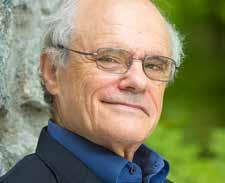
Dr. Kenneth W. Stein, founding president and chief content officer of the Atlanta-based Center for Israel Education, stated that Israel is the “most heavily polled country” in the world.
individuals.” The ranking of the individuals on the party lists is set by primaries or the party leaders.
How many representatives of each party are able to enter the Knesset is determined by the percentage each party receives in an election, Stein said.
“Let’s assume there are 120,000 votes cast,” he proposed a hypothetical, “and a party gets 10,000 votes. It will get 10 seats in the Israeli parliament,” since the Knesset is



comprised of 120 seats.
In reality, a government must hold 61 seats to have a majority. However, no one party has ever won a majority of Knesset seats; the most won by a party was 56 and that was in the 1969 elections. So, each government encompasses a coalition of political parties based on a political or philosophical agreement.
According to Stein, there are three parts to an Israeli election cycle. The first
includes the political parties choosing their lists of candidates. Those lists are presented to the Central Elections Committee about seven weeks before the elections. “The voters choose which person at the top of the list they most want to be prime minister,” and vote for that party.
The second part is campaigning. In Israel, the Central Elections Committee takes out a block of TV airtime before elections to present each party’s ad, free of charge, so

that even the smallest lists have a chance to get exposure with voters. A few weeks before the elections, political advertising must stop, although campaign banners fly along many streets and highways, hanging from bridges and buildings.
For a party to receive the minimum seats of four, it must receive 3.25 percent of the votes cast. If two parties with the same ideology believe, before the elections, that one or both might not achieve the desired clout in the next Knesset, they can decide to run as one party.
For instance, as Stein pointed out, in April two leading party members who had both previously been prime minister – Yair Lapid and Naftali Bennett -- decided they would create one party, called Yachad, or Together. A leader of a new party, Gadi Eisenkot, reportedly has considered joining Yachad. “He looks at the pools of his constituents to see if they want him to join the other party,” Stein said.
The importance of small parties to join together to make sure they reach the required 3.25 percent of votes to attain four seats in the Knesset became very clear in the last election, held in November 2022. “Two left-of-center parties could have created a unity party but didn’t so both parties failed and were left out of the Knesset,” Stein recalled. “If those two parties had combined into one, the long-standing Prime Minister Benjamin Netanyahu would probably not have been able to cobble together a governing coalition.”
Stein stated that Israel is the “most heavily polled country” in the world. That polling includes projections by artificial intelligence and is quite sophisticated, he said, proposing who should run independently and who should unite with another party. “Polling is done on a daily, almost hourly basis,” he added.
The third part of the Israeli election process is the actual election and the procedure that determines who will be appointed the next prime minister. It’s not obvious on election night. “When Israelis go to elections and get the results [of which party received what percentage of the votes], they still don’t know who the prime minister will be. That’s the difference of a parliamentary system,” Stein said.
There are no run-off elections in Israel, like there are in the U.S.
After Israeli elections, the president of the country, which is mostly a ceremonial position, looks at the election results and tries to determine which party or which individual leading a party list has the best chance of forming a coalition and holding it together as long as possible.
From April 2019 to November 2022, Israelis held five elections. “That’s not healthy for a political system,” Stein emphasized.
After the president asks a party head to
form a coalition, that person has 21 days to succeed. If necessary, he can receive another 21 days. As Stein said, Israel “may not have a [new] sitting prime minister by the end of the year.” Until that time, the existing prime minister and his government remain in control. “If Israel goes to war in November after the elections, decisions will be made by those in office now.”
The Israeli system is definitely complicated. Moreover, in both the U.S. and in Israel, various issues may cause voters to vote one way or another. “The key issues that drive Americans generally have to do with financial issues,” said Stein. “In the Israeli landscape, the memory of the Oct. 7, 2023, Hamas attack on Israel is still strong.” And many of the residents of northern Israel who had to move south because of the Hezbollah attacks from Lebanon have still not returned home. “Will they hold this government responsible for that and Gaza? All Israelis have security in mind.”
Another issue in Israel is the current government’s taking away authority from the court system. A third issue for those on the political center left, they want to know which party will more likely make peace with the Palestinians.
Stein believes there’s another issue that will have a major impact on Israeli voters: the distance between the U.S. and Israel over the proposed agreement between Iran and the U.S. “Israelis know that the relationship with the U.S. is important. If they see that the prime minister can’t sustain a relationship with the U.S., they will not vote for the incumbent party,” he said.
On the other hand, recent international polls suggest that the relationship between the two countries has deteriorated due to the U.S. government. A Pew Research Center poll taken in June showed that the percentage of Israelis who believe the U.S. takes their country’s interests into account has fallen to the lowest in more than a decade. The percentage of Israelis who believe that the U.S.’s foreign policy takes Israel into account has dropped from 80 percent in 2013 to 68 percent.
Another poll disclosed that more than two-thirds of the Israeli public believe President Donald Trump’s policies are bad for Israel. The poll, conducted by research institute Agam Labs in partnership with Hebrew University in Jerusalem, showed 67 percent of Israelis believe that Trump’s policies are bad for Israel, including 28 percent who say they are very bad. The same survey showed 72 percent of Israelis blame Trump’s administration for harming the strategic relationship between the two countries. That might take some of the heat off Prime Minister Netanyahu.
And as Stein often points out, “events that haven’t happened yet” could still impact Israel’s upcoming election. ì


Create personal Mitzvah Projects or






By Fran Putney
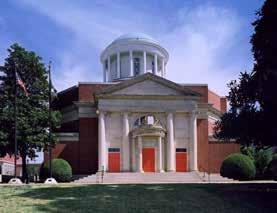
In keeping with The Temple’s commitment to environmental sustainability, Atlanta’s largest Reform congregation has installed 192 solar panels atop its main building that will enable the Midtown synagogue to receive a substantial portion of its electrical power from a renewable source. Not only will the solar power be en-
vironmentally friendly, but the installation is expected to save the congregation as much as 11 percent on its power bills over time, potentially as much as $800,000 over 25 years.
The idea began within The Temple’s Environmental Protection and Sustainability group, co-chaired by Ruth Menter and Jessica Landisman Williams. The group often partners with like-focused nonprofits such as Ada-

mah, a Jewish environmental organization, and Georgia Interfaith Power and Light, and had already helped implement smaller acts of environmental initiatives into the synagogue infrastructure and congregational life. According to Menter, the project accelerated after The Temple’s new executive director, Jeremy Perlin, came onboard in 2023 and when The Temple signed on with Adamah’s Jewish Climate Leadership Coalition. She explained, “With the continuing increase in energy costs and the embracing of other sustainability projects such as recycling, LED bulbs, installation of water bottle refilling station, it felt like the right time to explore solar.”
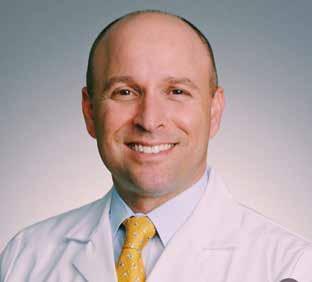
Drs. Marc Seltman & Richard Kaplan and Staff of Personal Care Physicians of Atlanta are pleased and honored to welcome our newest member, Dr. Howard Silverboard.
Dr. Silverboard has had a long and distinguished career practicing Internal Medicine in Atlanta. After specializing for many years in Pulmonary Medicine, he is shifting his knowledge, passion and skills to Primary Care. We are pleased to have this wise, kind and compassionate physician join our team. Dr. Silverboard will be enrolling patients beginning July 1st, 2026.
For her part, Williams, who has an engineering background, described the philosophical thinking behind such a large effort: “So, we are stewards of our planet, and our goal, I believe, is to leave the world a better place than how we found it. And one of the ways we can do that is from an environmental perspective.” She added, “It’s been clear for a long time that one of the ways that we can be good stewards of our planet is to find other ways to provide electricity to The Temple, and solar is a very clean way to do that.”
The decision was made to purchase the panels outright, rather than lease, and to place them atop one of the oldest parts of The Temple’s campus, the Marx Building, which had recently been re-roofed. This made good sense because the lifespan of the solar panels is roughly equal to that of a new roof. The original bottom floor of the Marx Building and the synagogue’s historic sanctuary were built in 1931.
The project required considerable expertise and coordination from both The Temple administration and a group of committed volunteers who studied the options and the overall impact and benefits that would be gained. Eric Vayle, for example, served as the chair of the Building and Grounds Committee at that time, and according to Menter, was “absolutely critical in helping manage the process that led us to be able to make our proposal to the Board for approval.”
Likewise, Brian Banner, an engineer with prior solar experience, assisted in analyzing the various proposals from installers prior to the presentation to The
Temple Board of Trustees last September. After the contract was signed, Banner became the project manager on the ground, working with the installer through final technical design, permitting, installation, and activation while coordinating with Temple staff.
The initial investment was primarily selffunded by The Temple’s Endowment Fund. Additionally, the synagogue was one of nine 2026 organizations selected for grants from the Jewish Solar Challenge, which awarded The Temple $30,000 for its solar power project.
“We are honored to help such an incredible group of organizations across America make the transition to solar power,” said Jewish Solar Challenge (JSC) Founder Mitchell Schwartz. Schwartz founded JSC four years ago to encourage Jewish organizations to go forward with solar power projects by helping to shorten the payback period. The Temple also will receive a federal tax credit, a process being spearheaded by Temple Board of Trustees member Larry Sommerfeld.
As Perlin explained: “One of the practical aspects is that if we’re not spending more and more every year with Georgia Power, or if we’re able to limit the future increases that are passed on to us by Georgia Power, then that means we can have resources to do more programming. We can invest in our community.” Williams added: “What we have discussed doing is that once we pay off what we owe to the Endowment, then we will put the savings into a special account in the Endowment for future environmental sustainability projects.”
And while The Temple’s new WELC preschool building currently under construction won’t be solar powered, the team says the intent is to incorporate as many environmentally-friendly products and features as possible into the plan.
May 6 was the first day the monitoring app began showing how much solar was being generated. Reflecting on seeing this project come to fruition, Menter said: “After working on sustainability initiatives at The Temple for 10 years, I am extremely proud of what we have accomplished with this initial phase of solar. It establishes our congregation as a leader among Jewish institutions for embracing sustainability and also sets an example for other Jewish congregations and our members.” ì

The Marcus Jewish Community Center of Atlanta (MJCCA) is excited to unveil its Fall 2026 Arts & Authors lineup, a richly curated season of live performance and cultural programming designed to inspire, engage, and unite the community through the power of storytelling and the arts. This spectacular season delivers something meaningful for every generation.
“The Arts & Authors season exists to create shared experiences that bring people together,” said Pam Morton, MJCCA arts & authors director. “This fall, we’re featuring a lineup that spans comedy, cabaret, Broadway, and engaging programming for families. All our events are firmly rooted in the belief that live performances have the power to connect us across generations and backgrounds. We look forward to welcoming our community to each of these phenomenal events.”
FALL 2026 EVENT HIGHLIGHTS
Gotta Sing Broadway: A Musical Theater Sing-Along Party
Sunday, Aug. 16 | 6:30 p.m., buffet at 6 p.m.
Get ready to raise your voice and your jazz hands. Gotta Sing Broadway is the sing-along event Atlanta has been waiting for — a joyful, community-filled night celebrating the show tunes everyone knows, loves, and simply cannot help but sing along to. Whether you are a shower singer, a former leading lady, or simply the person who knows every word to Memory, Defying Gravity, or Cabaret, this evening was made for you.
Designed for all generations, the evening promises nostalgia, laughter, and plenty of Broadway magic. No auditions are required — just enthusiasm! A delicious Italian buffet dinner is available for advance purchase, and a cash bar will be open throughout the evening. Dinner tickets must be purchased in advance.

The Velvet Hour: Sinatra, Swing, and Standards
Sunday, Aug. 23 | 4 p.m.
Step into The Velvet Hour, a cabaret evening steeped in the smooth sophistication of the Sinatra era. Featuring timeless jazz and pop standards made famous by legends like Frank Sinatra, Dean Martin, and Ella Fitzgerald, this intimate performance shimmers with romance, swagger, and swing. This dynamic concert-and-cabaret experience showcases Atlanta’s toptier talent in an intimate, electrifying setting. The Velvet Hour promises an evening where the golden age of cool takes center stage.
Harlan Coben: Plot Twist, Life, Craft, and the Messy First Draft
Thursday, Sept. 10 | 7:30 p.m.
Kicking off the countdown to the 35th Edition of the Book Festival of the MJCCA, No. 1 New York Times bestselling author Harlan Coben brings his new memoir, Plot Twist, to the MJCCA stage. With 100 million books in print worldwide and more than twenty blockbuster television and film adaptations to his name, Coben pulls back the curtain on his own writing process in a candid, insightful look at life as a storyteller.
Coben’s Myron Bolitar series earned the Edgar, Shamus, and Anthony Awards, and he serves as creator and executive producer of numerous television adaptations, including Netflix’s Fool Me Once, Stay Close, and The Stranger. A book signing will follow the program, with additional titles available for purchase courtesy of A Cappella Books. All ticket sales are final.
A Night of Kosher Comedy with Eitan Levine
Thursday, Oct. 1 | 7:30 p.m.
Get ready for an unforgettable eve-
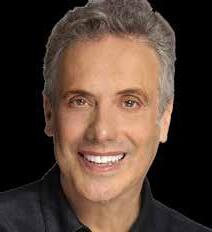

ning of laughter with one of comedy’s fastest-rising stars. New York-based comedian and writer Eitan Levine brings his sharp wit, viral humor, and unmistakably Jewish perspective to the MJCCA stage for a night packed with big laughs.
A Night of Kosher Comedy with Eitan Levine is perfect for a wide audience — whether you’re deeply connected to Jewish culture or simply love smart, high-energy stand-up.
Baddies of Broadway: A Cabaret with Deb Bowman
Saturday, Oct. 10 | 8 p.m.
Powerhouse performer Deb Bowman is back — and she’s unleashing Broadway’s divas, villains, and unapologetically difficult women. Baddies of Broadway is a smart, sultry, and brassy celebration of the women who refused to play by the rules. Accompanied by a six-piece live band, Bowman belts fan favorites from Cabaret, Chicago, Wicked, and more in what promises to be one of the most electrifying evenings of the season.
The MJCCA and Alliance Theatre Project Present All Smiles!
Sunday, Oct. 11 | 10 a.m. and 11:30 a.m. | For ages 0 to 5 (infants under 2 attend free)
How do you smile? With your mouth or your eyes? Does it show on your face or just on the inside? We all have different ways of showing, sharing, and processing our emotions — and All Smiles! is here to explore them all.
Presented in partnership with the Tony Award-winning Alliance Theatre through the Kathy & Ken Bernhardt Theatre for the Very Young, and created in collaboration with the Marcus Autism Center, this delightful, sensory-friendly production is crafted specifically for children ages

zero to five and their grown-ups. Created by Tinashe Kajese-Bolden and Samantha Provenzano and directed by Samantha Provenzano, All Smiles! explores how every smile is unique — and how all our emotions deserve to be celebrated.
Save the Date: 35th Edition of the Book Festival of the MJCCA Nov. 1 to Nov. 22
Mark your calendars. The Book Festival of the MJCCA returns this November, celebrating 35 years of stories that inspire, books that change us, and community that connects us. Widely regarded as one of the most highly anticipated cultural events in the Southeast, the Book Festival brings together dozens of renowned authors for talks, Q&As, and signings across three weeks in November. Tickets go on sale Sept. 1. Additional author announcements and event details to follow.
All events will be held at the MJCCA (5342 Tilly Mill Road, Dunwoody, GA, 30338). For details, please visit https://www.atlantajcc.org/our-programs/arts-authors/ì




By Marcia Caller Jaffe
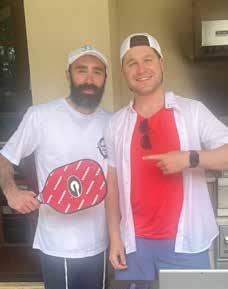
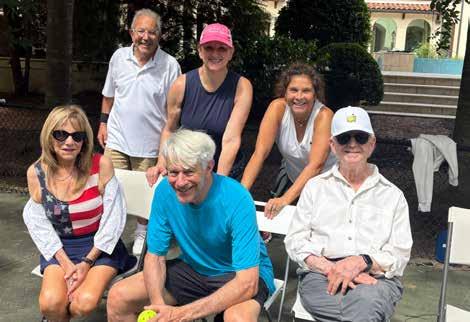
The summer heat was no match for the competitive spirit and communal energy on display June 28, as Chabad Buckhead and Brookhaven held its third annual pickleball tournament.
Departing from tradition, the event moved from its usual base at the Bitsy Grant Tennis Center off Northside Drive to the private Sandy Springs residence of Jeff and Carrla Goldstein, whose generosity in opening their court set the tone for easy parking and accessibility.
Sponsor Rabbi Yisrael New, who also played in the tournament, expressed delight at the response, noting that demand was high enough to require capping participation at 16 teams.
Rabbi New stated, “Thank G-d there is so much exciting momentum at Buckhead Chabad, and we’re grateful to everyone who continues to be part of our growing community. This pickleball tournament has quickly become one of Buckhead Chabad’s signature community events by bringing together people of all ages for a day of friendly competition, connection, and community.”
The turnout reflected the growing enthusiasm for pickleball as a sport that has found a natural home in Jewish community life for its accessibility, social nature, and enough competitive edge to keep things interesting.
Behind the scenes, the logistical engine/wizard powering the event was Daniel Cohen, who used computer algorithms and bracket technology to determine matchups, sequencing, and timing across both courts. Cohen’s coordination kept 16 teams moving. After the final volleys, two teams emerged victorious: The Slay Lazs and Dill with It, a name that would make any pickleball purist smile.
Paddles raised high for this year’s champions -- this writer and Jeremy Lazarus (team ace) took home the Group A title, while in Group B, brother-and-sister team, Elie and Sarah Shapiro, claimed first place, keeping it in the family.
Cohen explained, “Both teams captured their respective division championships and earned well-deserved bragging rights … until the next tournament rolls around.”
He divided the teams across two separate tournaments, both run under a double-elimination format, a deliberate choice that kept the spirit of competition alive. Under this structure, no team was knocked out after a single loss. Every pair could afford one stumble and still claw their way back into contention, ensuring
that early nerves or a rough first match didn’t define anyone’s day.
Participants were asked to self-identify as Beginner, Intermediate, or Advanced upon registration. The Intermediate bracket drew the largest field, though the skill levels blended across the courts. Entry fee was $45 per duo, $25 per single.
Among the players was Marcy Kushner, a returning second-year competitor with a sense of humor about her prospects, who said, “Although I’m not Jared’s [Kushner] cousin — ha! — I did play in last year’s tournament. I didn’t win, but I’m an optimist because I have a great partner, tennis whiz Nancy Blank.”
First-time entrant Ori Ben-Ari brought fresh energy to the courts, competing alongside teammates from Emory Law School in what he described as an “exciting event debut.”
Amit Feldberg, co-chair of the Chabad’s Sisterhood and co-organizer of the tournament, wore multiple hats competing as an Intermediate while running the snack and smoothie bar that kept players hydrated and fueled throughout the oppressive heat. Feldberg partnered with Judy Stolovitz, also co- chair of the event and Sisterhood of Buckhead Chabad.
Cohen concluded, “Overall, the tournament ran smoothly and everyone had a fun time. All ages and skill levels came together to pump up some friendly competition.”
Looking ahead, Rabbi New said, “Mark your calendars for our Pre-Holiday Wine Tasting Aug. 23. Come experience what the excitement at Buckhead Chabad is all about. Reach out to me directly to sign up for Nov. 1 tournament
before it closes out. If this year’s tournament is any indication, the waiting list is likely to fill fast.”
Pickleball overtook tennis in U.S. participants for the first time in 2025
with 24.3 million players. Participation has climbed 171.8 percent over the past three years. Atlanta has more than 40 pickleball locations and sits in the strongest growth region nationally. ì

By Marcia Caller Jaffe
There’s just something about using a block of clay as a canvas that feels so raw, earthy, challenging, and intentional. Throwing, pinching, slabs, and handbuilding involve form, balance, texture, color, and even negative space.
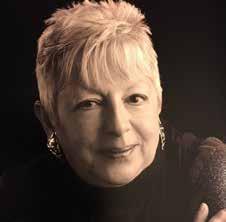
Brookhaven contemporary ceramic artist Adrina Richard begins each piece with a memory. She explained, “It could be an ancient vessel I admired decades ago while studying archaeology, a pattern inspired by my mother’s sewing templates, or a shape that captured my imagination. I try to honor the past and the present and keep it interesting to me, and hopefully, to others.”
Although Richard never took an art class growing up in New York, art has always been part of her life. The daughter of an Armenian seamstress and a musician, she was surrounded by creativity without realizing it would one day parallel her own talents. After moving to Georgia, Richard earned a degree in Spanish and Latin American foreign area studies from Georgia State University before embarking on professional careers as a bookseller, and more than three decades in higher education, overseeing purchasing, construction, facility rentals, and auxiliary services for a university.
Later in life, pottery became her fulltime passion.
“Reading about pre-Columbian art, looking at primitive art and pottery, African and Asian pottery have always inspired me,” she said. Her artistic education came not through a classroom, but through decades of independent study and hands-on experience. Richard has participated in 70 to 80 pottery work-

shops around the country, learning from nationally recognized ceramic artists through demonstrations and intensive studio sessions. She added, “I’ve done wood firing, atmospheric gas firing, and electric firing. Today, I fire exclusively in electric kilns.”
Richard initially learned to throw pottery on a wheel but soon discovered she preferred a less structured approach. “I kept changing the shapes. Eventually, I realized hand-building was a much better fit.”
Using slabs of clay rather than a pottery wheel allows her to create more distinct forms inspired by architecture, ancient artifacts, and Asian ceramics. Her mother’s sewing taught her construction techniques.
Some designs begin as simple sketches while others start as paper models. “Sometimes, I create patterns out of paper first to see if they’ll work before I make a permanent template,” she said. Each vessel is painstakingly assembled by hand. Every slab is textured before construction begins, giving the finished

As always, thank you for reading your Atlanta Jewish times.
work visual depth.
“A large, complicated piece can take an entire day just to assemble,” Richard said. “I texture every piece before I put it together.”
After attaching each side and bottom, she delicately adds feet, handles, and finishing details. Her larger basket forms require the greatest precision. She builds them upside down until the feet are attached. Only then can she turn them over and finish the job. As texture is her forte, once fired, each vessel gets a black wash that settles into the carved surfaces, creating an aged appearance reminiscent of archaeological discoveries, “the ancient feeling.”
While Richard’s exteriors remain primarily black, white, and earthy, the interiors surprise with vibrant glazes. Richard shared, “The inside/outside contrast creates interest and surprise.” Brilliant reds, chartreuses, yellows, blues, greens, and purples often burst from within her vessels, sometimes enhanced by crystalline glazes that catch the light. “I want
people to experience something unexpected when they look inside.”
Although she occasionally accepts commissioned pieces, Richard prefers creating from her own imagination. “I take commissions,” she said, “but I really don’t like to. My best work comes when I have the freedom to explore.”
She exhibits primarily in prestigious indoor juried art shows throughout Georgia and the Southeast like one of this year’s highlights, the 24th Annual Georgia Perspectives Exhibition, an invitational showcase featuring 50 of the state’s leading ceramic artists which will be held Aug. 22 through Sept. 6 at the Oconee County Arts Foundation in Watkinsville.
A member of The Temple, Adrina’s home shelves are filled with her own work and pottery collected from artists around the country. “I’m a sucker for great work,” she admitted.
For more information, please call 404-402-2781 or email adrina@adrinaearthworks.com. ì


By Marcia Caller Jaffe
Along with VCR tapes, phone booths, and pagers, many of today’s millennials eschew cookbooks with the world at their fingertips accessing recipes online.
What began as this simple realization has turned into a successful fundraising effort and a lasting synagogue keepsake. Temple Sinai’s sisterhood, Women of Sinai, has published its new (and probably last) community cookbook, “Recipes From Our Table.”
Twenty-one women came together to collect and organize 197 recipes, and committee member Michelle Young designed an appealing cover to lend a warm, custom feel. Recipes range from appetizers and beverages to soups and salads, vegetables and side dishes, entrées, breads, and desserts. It also features a special Jewish holiday favorites section that includes cherished family recipes such as Bubbie Jacobs’ Mondel Bread, Aunt Riva’s Jello Mold, and Grammy Ellen’s Brisket.
Contributors were invited to share a story or comment with each recipe, transforming the cookbook into more than a collection of recipes — becoming a treasure of family stories, traditions, and memories. Most importantly, all proceeds from cookbook sales benefit Backpack Buddies of Metro Atlanta, a nonprofit organization that provides weekend meals to food-insecure children.
Looking back, cookbook chair Jan Jay realized that Temple Sinai had not published a cookbook in 15 years. During that time, kitchen technology had evolved dramatically, with air fryers, pressure cookers, and sous vide machines becoming commonplace and making meal preparation more efficient. Jay also wanted newer Temple Sinai members and friends to discover one of her favorite Passover recipes from the synagogue’s 2004 cookbook. Passover Stuffing, submitted by then-Senior Rabbi Phil Kranz, had become a cherished Jay family tradition that she has prepared and shared many times over the years. Fortunately, Rabbi Kranz graciously submitted his current version of the recipe for the new cookbook.
Other contributors include Rabbis Ron Segal, Brad Levenberg, and Sam Trief, along with 93 additional Temple Sinai members. Sadly, between the project’s inception in November and the cookbook’s publication in May, the congregation suffered the tremendous loss of Rabbi Kranz, who passed away in April. It was only fitting that the cookbook be dedicated to his memory and in honor of his lasting contri-

“Recipes From Our Table” includes recipes from Rabbis Ron Segal, Brad Levenberg, and Sam Trief, along with 93 additional Temple Sinai members.
butions to the Temple Sinai community.
“I’ve always loved community cookbooks and family recipe collections because they have the best easy, tried and true recipes,” said cookbook co-chair Marci Cohen. “When Jan asked if I could help work on this project, it was an immediate yes. I love that we’ve created this fun, nostalgic keepsake that also benefits a great cause.”
Co-chair Michelle Simon agreed. “There is perhaps no greater expression of L’Dor V’Dor —from generation to generation — than sharing a cherished family recipe. Through this cookbook, we hope families will gather in their kitchens, create lasting memories, and pass these treasured traditions on to their children and grandchildren for years to come.”
“Do we have a fundraising goal? No,” Jay said. “We want to raise as much as we can to help Backpack Buddies make sure no child goes hungry over the weekends.”
“Community partnerships are at the heart of everything we do at Backpack Buddies, and Temple Sinai exemplifies what it means to lead with generosity and purpose. We are deeply grateful that they chose Backpack Buddies as the benefactor of their cookbook. Their support will help us continue providing nutritious meals to children while creating a lasting impact on families throughout our community,” said Denise Bjurholm, CEO of Backpack Buddies.
“One of the greatest blessings of synagogue life is that we don’t celebrate alone and we don’t grieve alone. This cookbook is a beautiful reminder that as members of Temple Sinai our stories, and our lives, are forever intertwined,” said Temple Sinai Rabbi Trief.
The initial printing may soon be sold out. A second printing is planned. The first book is $36 and each additional is $18. To order a copy, please visit: https://tsa.tfaforms.net/159 ì
From Stacy Wolff
Ingredients:
4 c boiling water
1 c quick cooking grits
1 1/2 tsp salt
6 T butter
1 1/2 tsp Worcestershire sauce
2 tsp hot pepper sauce
1 1/4 c shredded sharp cheddar cheese, divided\
1 T dry sherry
1 lg egg, beaten Sprinkle of paprika
Directions:

Preheat oven to 325 degrees. Combine boiling water, grits, and salt in a saucepan; mix well. Cook over low heat, covered, for 5-7 minutes, or until most of water is absorbed. Stir in butter, Worcestershire sauce, hot sauce, 1 cup of the cheese, and sherry. Fold in egg until mixed. Spoon into a greased 2 1/2 qt. baking dish. Sprinkle with remaining cheese and paprika. Bake 1 hour or until bubbly. May need to slightly cool before serving in order to set in the middle.
From Marcie Cohen
Ingredients:
4 tsp salt
2 tsp paprika
1 tsp onion powder
1 tsp dried oregano
1 tsp white pepper
½ tsp black pepper
½ tsp cayenne pepper
½ tsp garlic powder
2 (4 pound) whole chickens or one 5+ pound whole chicken 2 onions, quartered
Mix together salt, paprika, onion powder, oregano, white pepper, black pepper, cayenne pepper, and garlic powder in a small bowl; set aside. Remove and discard giblets from chicken. Rinse chicken cavity; pat dry with paper towels. Rub each chicken inside and out with spice mixture. Place 1 onion into the cavity of each chicken.

Place chickens in resealable plastic bags or double wrap with plastic wrap. From here, you can refrigerate 4 to 6 hours, overnight, or just get to roasting.
Preheat the oven to 250 degrees F (120 degrees C). Place chickens in a roasting pan. Bake uncovered until an instant-read thermometer inserted into the breast meat near (but not touching) the bone reads at least 165 degrees, about 5 hours. Let chickens rest for 10 minutes before carving.

Bonei
Eight outstanding Olim from English-speaking countries have been named recipients of the 12th Annual Sylvan Adams Nefesh B’Nefesh Bonei Zion Prize. The prestigious award recognizes exceptional individuals whose professional achievements, community leadership, and contributions have made a lasting impact on Israeli society and helped strengthen the State of Israel.
The honorees include: Naomi Stuchiner, founder, Beit Issie Shapiro, in the field of Community & Non-Profit; Dr. Philip Klipstein, senior principal scientist, R&D Division, SCD (SemiConductor Devices Ltd.), in the field of Science and Medicine; Rabbanit Chana Henkin, founder and chancellor, Nishmat, in the field of Education; Ami Baran, head, Israel Athletics Association, in the field of Culture, Art & Sports; and Danielle Abraham, co-founder and executive director,
July 15, 1908: Max Fisher is born to Russian Jewish immigrants in Pittsburgh. His Detroit-based Aurora Gasoline grows to have more than 700 gas stations. He devotes his charity to Jewish causes, Israel and Detroit.
Library of Congress
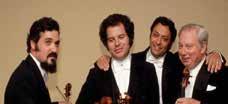
July 16, 1948: Grammy-winning classical musician and conductor Pinchas Zukerman is born in Tel Aviv. He begins playing the violin by age 8, and by 14 he is studying in New York under the sponsorship of violinist Isaac Stern.
July 17, 1906: Yitzchak Ben-Aharon, a pioneer of the kibbutz movement, is born in Romania. He makes it to Palestine in 1928 by walking and riding a donkey. He helps found Kibbutz Givat Haim between Haifa and Tel Aviv.
July 18, 1290: King Edward I orders the expulsion of England’s 4,000 Jews, who had settled there in significant numbers only in the 11th century. Most move to France or Germany. Jews are not allowed back until 1656.

Eight outstanding Olim from Englishspeaking countries have been named recipients of the 12th Annual Sylvan Adams Nefesh B’Nefesh Bonei Zion Prize // Photo Credit: Yossi Zwecker; Avi Ohayon, GPO
Volcani International Partnerships & ReGrow Israel, in the field of Global Impact; and Barak Swarttz, content creator and founder of GRIT for Good, in the field of Young Leadership.
This year’s Special Recognition Award is being presented to Amb. Ron Dermer, former Israeli Ambassador to the United States and former Minister of Strategic Affairs.
Compiled by AJT Staff
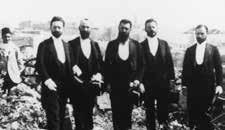
Israel ranked 18th in average personal wealth in the world in 2025 as the number of millionaires continued to grow, boosted by strong financial markets, according to the UBS annual Global Wealth Report published last week.
With average personal wealth in dollar terms of $312,108 per adult at the end of 2025, up from $284,224 in 2024, Israel moved down one spot from the previous year’s annual ranking and was situated before South Korea and after Ireland.

Globally, personal wealth expanded at its fastest pace since 2017, marking the third consecutive year of growth, creating nearly 1 million new millionaires, or more than 2,600 per day. Switzerland
July 23, 2002: On a 51-41 vote, the Knesset approves the Tal Law to address the issue of Haredi yeshiva students receiving exemptions from military service. The Supreme Court rules the law unconstitutional in 2012.
came in at the top of the table in terms of average personal wealth, followed by the U.S. and Luxembourg, among 56 countries that represent more than 92 percent of the world’s wealth, the Swiss bank said.
by AJT Staff

July 19, 1940: Max Bodenheimer, the first Jewish National Fund chairman, dies five years after immigrating to Jerusalem. Born in Germany in 1865, he attended the First Zionist Congress and became close to Theodor Herzl.
July 20, 1951: Palestinian nationalists assassinate Jordan’s first king, Abdullah I, at the entrance to al-Aqsa Mosque. Abdullah discussed peace before Israel declared independence but instead fought and captured the West Bank.
July 21, 1973: In Lillehammer, Norway, a Mossad team targeting the terrorists behind the 1972 Munich Olympics massacre fatally shoots a Moroccan waiter, Ahmed Bouchiki, mistaking him for PLO official Ali Hassan Salameh.
July 22, 1939: Gila Almagor, the “queen of the Israeli cinema and theater,” is born in Haifa. She makes her debut for Habima at age 17 and establishes herself as a leading lady at Tel Aviv’s Cameri Theatre beginning in 1958.
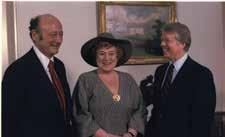
Congresswoman Bella Abzug meets with New York Mayor Ed Koch and President Jimmy Carter in 1978. // By Karl H. Schumacher, Executive Office of the White House
July 24, 1920: Bella Abzug, the first Jewish woman elected to Congress, is born in the Bronx to Orthodox immigrants from Russia. She gains experience for a career in politics by lecturing about Zionism at subway stops as a teen.
July 25, 1992: Aris San, who helped popularize the Greek sound in Israeli music, dies in Budapest at age 52. The Greek native’s hybrid music, known as laika, set the stage for the rise of Mizrahi music in the 1970s.
July 26, 1967: Yigal Allon, a member of the government and a retired general, presents a strategic proposal for Israel’s retention of the Jordan Valley with settlements and military bases as part of a regional Arab-Israeli peace.
July 27, 1955: Bulgarian fighter jets shoot down El Al Flight 402 en route from London’s Heathrow Airport to Israel after the Lockheed Constellation veers into Bulgarian airspace between Vienna, Austria, and Istanbul, Turkey.
July 28, 1923: Mordechai Golinkin’s production of “La Traviata” marks the beginning of opera in the Land of Israel. His Palestine Opera stages 16 productions by 1945, including “Dan Hashomer,” the first opera written in Hebrew.
July 29, 1891: OB-GYN Bernhard Zondek is born in Wronke, Germany, now in Poland. He and Jewish colleague Selmar Aschheim develop the A-Z pregnancy test in 1928. Zondek moves to Mandatory Palestine in 1934.
July 30, 1980: The Knesset passes Basic Law: Jerusalem, enshrining the official Israeli position that a united Jerusalem is the capital of Israel. The U.N. Security Council rejects the law when it passes Resolution 476 on Aug. 20.
Items are provided by the Center for Israel Education (israeled.org), where you can find more details.

By Gil Zohar
The 2,000 members of the Jahalin Bedouin tribe are living on borrowed time on the desert scrublands east of Jerusalem.
Once nomadic princes of the desert, the today sedentary goat and sheep herders live in Khan al-Ahmar – a series of shanty towns clustered along Highway 1 stretching from Jerusalem down toward Jericho and the Dead Sea. They face the imminent destruction of their homes – none of which have running water or electricity. The Israeli government considers them to be the illegal residence of squatters on state land. The mature trees the Bedouin planted when they settled there in 1973 attest to their decades-long residence in the Judean Desert. In their place, the Israeli government is planning to expand the city of Ma’ale Adumim into the adjacent hills to the north known as the E1 corridor.
Caught in a legal limbo between the Palestinian Authority and Israel under the 1992 Oslo Accords, the Jahalin – all of whom share their tribal name as their surname – are slated to be relocated to a site near a garbage dump in Abu Dis in Area A.
For millennia, Bedouin tribes have lived in the Arabian deserts, moving seasonally with their herds of camels, donkeys, cattle, sheep, and goats between the Hijaz to the south, Alexandria to the west, and Damascus to the north.
In the 19th century, Jahalin tribesmen gradually settled around Tel Arad in the Naqab Desert (now the Negev), and by their residency claimed the wasteland as their home. In 1858, the Ottoman Turks, who had occupied Palestine since 1517, introduced a land registration law for the purpose of collecting taxes. The region’s Bedouin, as with most landowners in Palestine, minimized the extent of the registration of their landholdings to ease the tax burden; a ploy they would later regret.
The collapse of the Ottoman Empire in 1918, and the British and French creation of mandates in the Middle East, forced the Bedouin to submit to new laws where their traditional lands lay. During the British mandate over Palestine (192248), the Naqab’s Jahalin and other Bedouin, who numbered approximately 85,000, turned to farming. Wheat, oats, olives, and oranges were cultivated and sold in the markets of Beersheba, together with the livestock.
Although their way of life changed, the Jahalin nevertheless maintained the


patriarchal order of their society, their own legal system, and their own dialect of Arabic. Today, the community’s traditional culture and clan-based lifestyle is under threat.
The Arab-Israeli conflict in 1948 devastated the Naqab’s Bedouin. With the founding of the State of Israel, the majority of the Bedouin fled to neighboring Arab countries – except for the Jahalin, who had no intention of leaving.
As hundreds of thousands of Jewish refugees from the Holocaust and the Middle East arrived, the nascent Jewish State rushed to build settlements and towns to house them. To make room for the creation of the city of Arad, the Jahalin were pushed into the Jordanian-controlled West Bank. Crossing the Green Line, as the 1949 armistice line was called, they migrated northward, settling near Jerusalem on land owned by the West Bank villagers of Abu Dis and Azzariya.
The decade-long peace enjoyed by the Jahalin ended following the 1967 SixDay War when Israel crushed the combined forces of Egypt, Jordan, and Syria, and occupied the West Bank, as well as the Gaza Strip, the Sinai Peninsula, and the Golan Heights.
Throughout the 1970s, portions of land on which the Jahalin tended their sheep and goats were appropriated by the Israeli authorities for military zones and nature reserves.
After a blood feud broke out within the tribe, some of the families were forced out from near Tel Arad. Migrating north through the Judean desert, they settled in their present location in 1973. A turning point came in 1981; the land the Jahalin occupied was seized from its legal owners in Abu Dis and Azzariya and confirmed as state or government land for the settlement of Ma’ale Adumim.
Today, the satellite suburb of Jerusalem houses more than 40,000 people in glittering towers – and is slated to expand
to nearly double that size. Some 750,000 Israelis live among 3 million Palestinians in the disputed area Israel captured in 1967 – known as either Judea and Samaria, or the West Bank.
To make room for those newcomers, the government needs land in the West Bank to expand settlements such as Ma’ale Adumim. However, under Jordanian law, which remains in use in the West Bank, selling land to a Jew is a capital offense because private land purchases could serve as springboards toward claims of sovereignty. The Israeli government bypassed this impasse in the early 1980s by issuing a military decree for use in the West Bank: if the military commander confirmed land to be state land, then it was state land. The military authorities had to take into account, however, that most of the property was legally owned and occupied by private Palestinians. Therefore, an objection could be submitted to a military committee and proof submitted that the land in question was cultivated.
Israel’s High Court, which has no jurisdiction over the occupied West Bank, defined cultivated land as soil plowed for 10 consecutive years. According to this definition, the cultivation of olive and orange trees did not count; the soil under the trees had to be tilled. In addition, in some years, drought plagued the region, rendering the plowing of soil impossible and precluding fulfillment of the criteria set by the High Court.
Objections to the Israeli appropriation of property leased to the Jahalin were submitted by residents of Abu Dis and Azzariya, who tried to prove their ownership. But they could not afford the legal expenses incurred by this procedure, which entailed hiring land surveyors and lawyers. The Jahalin themselves did not file an objection – they were tenants.
Jerusalem fine arts photographer Jay Garfinkel has documented the tribesmen
who are facing eviction.
“Last year, after the Supreme Court revoked the expulsion order of the Dead Sea Bedouin from the Jahalin, I asked Sheikh Eid Jahalin for permission to take a series of portraits of members of his community,” said Garfinkel.
“He asked me why portraits and not documentary-style photography about the living conditions of his community. That’s a fair question. Among other things, I am an art photographer rather than a documentary photographer. But there is a more significant reason. Thousands of Israelis travel on Highway 1 from Jerusalem to the Dead Sea [daily]. The only thing visible from the comfort of their speeding car is the dozens of scattered huts and shepherd pens that dot the mountains along the route. Most people pass the shepherds’ encampment but never stop to see the faces of those who live there. I chose portraits rather than documentary-style photographs because I didn’t want distance between myself and the person in front of me. I want to avoid the clichés of the noble nomadic shepherd. I want you to see the faces of real people up close.
“I want to tell their story from the perspective of a non-political artist; just a regular Israeli Jew whose motivation to tell this story is informed by his religious values; ‘One law alone is there to be for you, for the sojourner and the native of the land’ (Number 9:14).
“I don’t have to agree with the Bedouin’s lifestyle or their residency quest. I think the Supreme Court decision in May 2023 got it right. What is required of me is to treat them with decency and fairness. It means asking my government not to withhold water and electricity from their camp. It means asking my government to allow work permits so they do not have to live in the squalor of poverty. It does not make me a ‘leftie.’ It makes me a Jew who takes Biblical scripture as binding.” ì
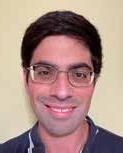
David Ostrowsky
native Ben Grinzaid was studying at the Sackler School of Medicine in Tel Aviv and completing his residency at the Albert Einstein College of Medicine in New York City, something was gnawing at him.
Grinzaid was on the fast track to fulfilling his lifelong goal of becoming a pediatrician, yet he couldn’t stop reminiscing about his ball-playing days at The Weber School, for which he was an ace pitcher in the early 2010s, and later for the University of Georgia’s club team. His burning desire to return to the diamond was finally satisfied a few years ago when he returned home to practice at Focus Pediatrics in Sandy Springs, which afforded him the opportunity to participate in the Marcus Jewish Community Center of Atlanta (MJCCA) Modified Fast Pitch Softball League.
But the 34-year-old Grinzaid hasn’t just participated in the popular and ubercompetitive MJCCA softball league — he’s been one of the most dominant sluggers in the 12-team circuit and one of the linchpins of an Einstein’s squad that just captured both championships (a double elimination tournament inclusive of all teams and a stand-alone championship pitting the five best teams against each other) of the 2026 spring season.
“I did the pre-med track and went to medical school and did the whole doctor thing. I kind of fell off the map with baseball,” explained Grinzaid who, as a flamethrowing pitcher for the Weber Rams graced the cover of the AJT in May 2010 (“Grinzaid Leads Charging Rams”). “I’m living the dream. It’s awesome. I look forward to the Thursday night and Sunday games. There’s less pressure, because I just go up swinging. It’s fun. It’s a good time. It’s competitive. People really get into it. I’m definitely feeling like I’m reliving the glory days more than it being a tease. I wish I was an MLB player, but I guess I kind of kissed those dreams good-bye.
“I’m always curious to know if I didn’t stick with medicine, how far I would have gone.”
Grinzaid’s actual line of work is an endlessly demanding one. In addition to providing healthcare services to newborns, infants, toddlers, elementary school children, adolescents, and teens
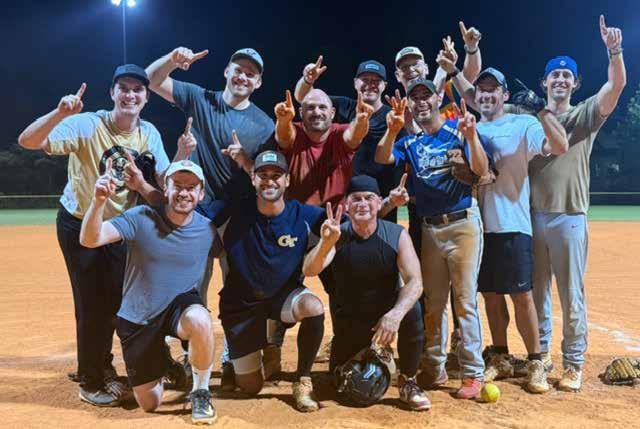
a dominant run through the
of the 2026 MJCCA Modified
throughout the Greater Atlanta area, Grinzaid is constantly saddled with a heavy volume of administrative paperwork. And yet, even with a wife and two young kids at home, he makes it a priority to attend virtually every single one of his team’s softball games.
“I have to be very professional of course in clinic. I have just been able to let loose and play and have a good time,” added Grinzaid, who has also begun moonlighting as a mohel in the Greater Atlanta area. “I’ve always loved sports. Medicine was a passion also, but this is a way for me to channel the athletic side of me. It’s a good stress relief, for sure.”
One of the many wonderful features of MJCCA softball is that it’s designed to be a family-friendly affair. The spring season, which stretches from early March to around Mother’s Day, is split between Thursday evening and Sunday late morning/early afternoon games. For the latter, players are openly encouraged to bring along their kids, which is truthfully how many are able to make the scheduling work.
However, for those Thursday night games, ones not always played in dry and warm conditions, the bleachers are often largely devoid of fans — with one con-
stant exception: Grinzaid’s father, Jimmy, who several decades ago came over to the U.S. from Russia with very limited knowledge of baseball, but quickly took to the game when his son blossomed into an effective high school pitcher. The elder Grinzaid, formerly one of the most accomplished fencers in the U.S., takes great pride in often comprising a oneperson cheering section for his son, who last year bashed a league-leading 15 homers after dedicating himself to the weight room in the off-season.
And after seeing how much sheer joy softball has given his son over the past few years, Jimmy is poised to leave his perch on the bleachers and join Ben on the diamond for the upcoming fall season. After all, rosters are comprised of men ranging from college students to those in their sixties and they have been stacked with quite a few father-son duos through the years.
“Oh my gosh, that would be cool,” said Ben, also a gifted golfer, who was a member of a four-person team that just captured the recent Weber charity golf tournament. “I mean, I would love to play with him. I think he’s the only person in the stands who has come to all the games.”
Grinzaid’s Einsteins team had quite
a run this spring. After a so-so regular season during which they entered the playoffs as the No.5 seed, the nowdefending league champs got hot when the games really mattered. When the league switched back to denser softballs midway through the season after experimenting with softer ones in the early going, the Einsteins’ deep lineup flexed its collective muscle in the postseason, clearing the fences multiple times each game. The club, captained by veteran pitcher Albert Rostin, was actually down 9-1 in the seventh inning of the regular season title game against the Schwartz Schmeckles before storming back to win 22-12, thanks to an impressive power display. Worthy league champs, indeed. While every member of the Einsteins will likely return for the MJCCA fall slate of games, there will not be another Einsteins team. Come Labor Day weekend, players will be drafted by new teams, and the makeup of the league will look vastly different from this spring. But no matter where their respective softball careers take them, Grinzaid and his teammates have cemented their place in the annals of MJCCA softball.
“You can’t beat a double championship,” said Ben. ì
By David Ostrowsky
For the second time this decade, the Maccabiah Games (aka, the Jewish Olympic Games) have not proceeded as originally planned.
In 2021, the COVID-19 pandemic prompted a one-year postponement of the Maccabiah Games. Four years later, in summer 2025, nearly 8,000 Jewish athletes across 55 nations were readying to partake in the “Jewish Olympics” when Israel and Iran suddenly became embroiled in a conflict. Within days, Israeli airspace was essentially closed and Maccabiah organizers, upon concluding that it wasn’t possible to welcome thousands of Jewish athletes to Israel under a state of emergency, quickly pivoted to summer 2026.
Indeed, the 22nd edition of the Maccabiah Games did unfold in Israel earlier this month, representing the largest gathering of the international Jewish community in Israel since the Oct. 7 attacks. Notably, however, this year’s Maccabiah Games, whose slogan is — “Same values. Same vision. Just a little more time,” — only involves approximately 5,000 participants — a sharp decrease from the aforementioned expected turnout last summer as well as the 2022 attendance figure, which eclipsed 10,000. Surely, the ongoing fragile geopolitical situation in the Middle East factored into the lower-than-expected attendance with some countries hesitating to send their respective delegations, including Australia, which had initially canceled its delegation before reversing its decision.
“We were sure that things would be much better by now,” Roy Hessing, Maccabiah’s chief executive, said before the games got underway. “The only really good thing that has happened since then is that all the hostages are back.”
Nevertheless, the U.S. and Israel, per tradition, still had robust representations at the quadrennial sporting festival that first came into existence in Tel Aviv in March 1932. Nearly 2,000 Israelis and 900 Americans — athletes ranging from young teens to seniors in their late eighties and Paralympians — competed in more than a couple dozen different sports at gymnasiums and athletic centers throughout Tel Aviv, Herzliya, Ramat Gan, and Jerusalem. Meanwhile, the 2026 Maccabiah Games transcended athletics as there were ample opportunities to engage in Judaic culture, including an Olympic Village-style festival in Tel Aviv,
visits to the Western Wall, and tours to the sites of the Oct. 7 massacre where many survivors still reside.
“I don’t think it’s hyperbole to say these games are the most meaningful in a generation,” remarked Marshall Einhorn, CEO of the U.S. delegation to the Maccabiah Games, just before all the action started. “After everything that Israel and the global Jewish community have gone through since Oct. 7, 2023, this will be the largest gathering of world Jewry since then, and it is going to be very special.”
Team USA was brimming with geographic diversity as major metropolitan areas such as New York City and Los Angeles were naturally well represented, but so, too, were far lesser-known rural communities like Marfa, Texas, and Laramie, Wyo. Perhaps one reason that there was exceptional geographic diversity was the newly created Under-15 division, which Maccabi World Union initiated after the postponement of last summer’s Games.
Atlanta, of course, also made its presence known with a sizable contingent of talented and dedicated amateur athletes, including Roswell’s Danya Naturman, who just graduated from The Weber School (U19 Boys’ Baseball); Midtown High’s Gevah Schwartz (U15 Boys’ Basketball); Pace Academy’s Jill Agami (U17 Girls’ Basketball); and Riverwood High’s Maya Nebel (U17 Girls’ Soccer).
As is tradition, this year’s Maccabiah Games were truly a global showcase of Jewish athletic talents. Austria, which has been represented at every single Maccabiah Games, was once again in attendance. Hungary’s team was highlighted by a remarkable 87-year-old Holocaust survivor. Cuba had a 51-member strong outfit present. India, despite having a microscopic Jewish population (approximately 4,000 out of 1.4 billion citizens) was represented, as was Mexico, which sent a whopping 353 athletes. And for the first time in Maccabiah history, Taiwan was on hand.
The vibrant international flavor of the Games was on full display at the sold-out opening ceremony at Jerusalem’s Teddy Stadium on July 1. The artistically stunning spectacle showcased performances by Israeli pop star Anna Zak, Israeli musician Idan Raichel, and American singer, actress, and influencer Montana Tucker, who debuted her new tune, “We’re Not Strangers.” One of the ceremony’s finest moments was the Maccabiah flame being lit jointly by Paralym-

pic taekwondo champion Asaf Yasur and Olympic judo silver medalist Inbar Lanir.
The evening, however, also took on a more somber tone when a pre-recorded video message from former hostage Edan Alexander, who recently resumed his IDF service, was broadcast. There was also the powerful Maccabiah flag-toting procession of relatives of the 12 Druze children murdered in the 2024 Hezbollah rocket attack on Majdal Shams and a torch procession spearheaded by Evyatar Zeituni, an IDF Paratroopers Brigade officer who was gravely injured on Oct. 7.
Israeli President Isaac Herzog, Prime Minister Benjamin Netanyahu, and Jerusalem Mayor Moshe Lion gave brief speeches designed to resonate with both their countrymen and the legions of visitors from abroad.
“Through this difficult war, we have proven that despite the pain, we can find the challenge in every crisis,” Herzog said. “This sports celebration is a demonstration of Jewish power that conveys an unequivocal message of joint responsibility and determination to the people of Israel and the entire world.”ì

By Jordan Ross
Before young Jewish students become bar and bat mitzvahs, many will complete a community service project in an area that is meaningful to them. However, few will turn that project into an annual tradition impacting communities in Atlanta and beyond.
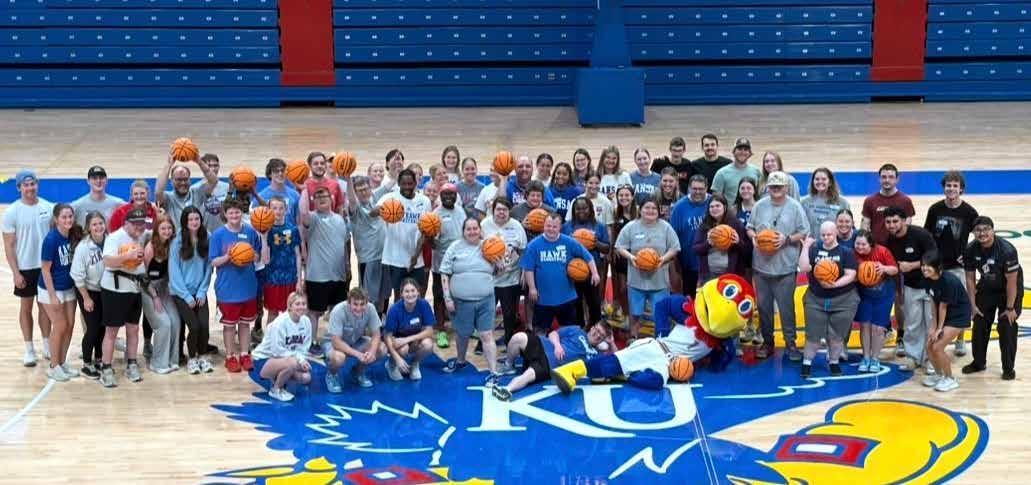
Atlanta native Josh Dwoskin played baseball as a teen and was involved in a local community that ran a baseball team for children with special needs. Dwoskin proceeded to connect with the organizers and implemented his love of sports by creating an opportunity for children with special needs to learn and play basketball.
Dwoskin hosted his initial project at the Marcus Jewish Community Center of Atlanta (MJCCA), which donated a court. He had T-shirts and snacks donated as well and engaged kids and families in fun drills and scrimmage games. Dwoskin enjoyed the experience and received positive feedback from the parents and decided, why stop?
“Seeing all the participants’ joy and having parents come up to me after being like, this is super cool, and their kids
loving it … those reactions make it super easy to want to do it again,” Dwoskin said. “It’s super rewarding to see how much joy it brings everybody involved.”
This past April, Dwoskin hosted his ninth annual event, his third at his col-
lege, the University of Kansas.
“Giving back in order to become a bar mitzvah set the foundation for me to continue to give back to my community even after going to college outside of Atlanta.” Dwoskin has passed on the Kan-
sas program to a fellow classmate who plans to continue the annual event. Year 10 is already in the works, and information regarding dates and where to donate can be found on Instagram @ challenger_basketball_clinic. ì

The Breman, Midtown’s museum and cultural center dedicated to sharing the richness of Jewish culture with diverse Atlanta audiences, has opened an exhibition of photographers Morton Broffman and Jules Aarons.
Presented in partnership with Atlanta’s Lumiére Gallery, “Bronx Boys: Storytelling with a Lens,” brings together the work of two Bronx-born photographers who captured pivotal moments of societal change in 20th century America. While they never met, their work reflects a shared commitment to capturing humanity, resilience and connection found in both historic events and daily life.
Morton Broffman (1928-1992) served as photographer for the National Cathedral in Washington, D.C., from 1966 to 1992. Broffman documented historical events –including Martin Luther King Jr.’s final sermon, days before his assassination, the Selma march and Pentagon protests opposing the Vietnam War – as well as social challenges including poverty in Appalachia. His work, which had largely gone unseen after his death, came back into the light when several of his photos were included in a 2009 exhibition of civil rights photography at Atlanta’s High Museum of Art.
Jules Aarons (1921-2008), a physicist and engineer by trade and a professor at Boston University, began focusing seriously on photography in 1947. Influenced by Henri Cartier-Bresson and New York street photographers, he captured the life of the streets of Boston’s ethnic neighborhoods but also photographed during far-flung travels to stops including Paris, India, and Japan.
Broffman and Aarons were born in

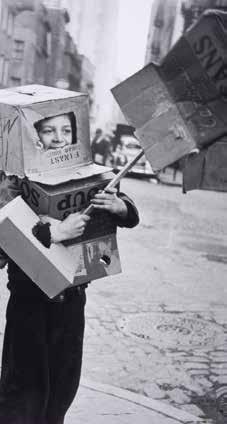
the New York borough of the exhibit’s title to Jewish immigrant parents. Both became college educated, U.S. Army veterans, teachers and masters of photography. That, and they shared a deep interest in, and compassion for, people.
But their parallel paths also allowed for differences: in career directions, the subjects of their work, geographic emphasis, and editorial perspective. While Broffman was a full-time professional photographer, Aarons pursued a career
in science yet also achieved acclaim in his driven side pursuit of photography.
With their cameras, Broffman and Aarons recorded important moments of history in the 1940s and across the next four decades. Each produced excellent photographic images, comparable to the best by photographers who inspired them: Cartier-Bresson, Dorothea Lange, Helen Levitt, Walker Evans and Berenice Abbott.
It’s accepted in the world of photography that a disproportionate number
of historically important photographers have been Jewish for a variety reasons, perhaps including a shared desire to document and preserve memory.
“Telling the stories and sharing the art of these gifted visual storytellers aligns with The Breman’s mission to connect people to Jewish history, culture and arts,” The Breman Executive Director Leslie Gordon says.
Compiled by AJT Staff
Shalom b’Harim, the Jewish community of the North Georgia mountains, is seeking a new spiritual leader. The unaffiliated synagogue serves Hall, Habersham, White, Forsyth, Dawson and Lumpkin counties along with the surrounding areas. The congregation meets in Gainesville for Shabbat services once a month as well as High Holiday services and special occasions.
Shalom b’Harim is looking for a spiritual leader who can conduct Friday evening and/or Saturday morning services and will engage warmly and compassionately with members. The congregation pays generous stipends per service.
It is oriented toward Reform/Conservative worship. There is a core membership of approximately 50 actively

engaged congregants, with greater participation for holidays.
Someone who is passionate about Judaism and willing to play a role in social and civic Jewish-related projects in the community is desired. The spiritual leader should be available for occasional lifecycle events, which will be compensated individually, separately from regular services. More information about Shalom b’Harim is available at shalombharim. org. Interested individuals should send a resume, background and a cover letter to: Shalom b’Harim Rabbi Search Committee c/o Peppe Dragoni, dragonipeppe@ gmail.com. For more information, contact (727) 804-3371.

Is Israel losing America?
I’m not saying that it is.
I’m not saying that it isn’t.
But something is happening.
Anti-Israel animus that once might have been dismissed as being limited to the political extremes has moved toward the middle.
You can suggest that people are being manipulated, but, manipulation or not, the center is shifting, with implications on several fronts.
I am not talking just about polls, though surveys show a softening in public support for Israel, a trend more pronounced among Democrats, though also found in Republican ranks, and notable in younger age cohorts of both parties.
I am not talking just about noise on social media, though this should not be dismissed, particularly those online forums where younger voters consume more of their news (and questionable content) than their elders.
I am not talking just about electoral politics, though in this cycle Israel has become an ideological litmus test, particularly where progressive Democrats question whether a candidate is sufficiently critical of Israel.
I am not talking just about political rhetoric, though
the frequency of statements about Israel suggests a calculated response to changes in public opinion.
I am not talking just about Congress, though resolutions calling for restricting weapons sales to Israel attracted attention for the votes they received, despite their ultimate defeat.
I am talking about a gut feeling, a stew of all the above, seasoned with what I see, hear, and read from a wide variety of sources, having spent some years following this topic.
Granted, I am speaking in broad terms.
To be sure, Israel retains significant backing from the American public at-large, though to a lesser degree among young adults.
From where I sit, a growing number of Americans view Israel as something less than “a light unto the nations,” or as possessing “the world’s most moral army,” or even as an indispensable ally in a difficult region.
Much of this stems from the extent of Israel’s response to Oct. 7, 2023, when Hamas-led terrorists slaughtered 1,200 men, women, and children in kibbutzim, towns, and an outdoor music festival in a section of Israel known as the “Gaza envelope.”
In addition to the deaths of tens of thousands of non-combatants (and thousands of combatants), Israel’s military campaign in Gaza displaced some 1.9 million people and destroyed much of its infrastructure.
Many Jewish Americans feel challenged by a gap
combining technology and artistry to





between their ideal of Israel as a “light unto the nations” and what they see in today, not just Israel’s prosecution of the war in Gaza, but what appears to be a reluctance to rein in attacks by settlers in the West Bank (Judea and Samaria) on infrastructure and households in Palestinian enclaves, and a prime minister at the head of the most ring-wing government in Israel’s history, who has deflected responsibility for the events of Oct. 7 and is embroiled in corruption trials while seeking re-election.
Support for Israel among Jewish Americans is greater among those religiously affiliated, compared with the unaffiliated, and weaker among younger Jewish adults.
The voices I hear within the community range from those whose exasperation with Israel has caused them to question the depth of their affinity to others seemingly less troubled by these issues and supportive of the government.
Easy as it may be to blame the spike in antisemitic activity since Oct. 7 on social media influencers, or leftleaning faculty, or the pro-Palestinian far left and antiJewish far right, Israel’s leaders need to recognize that the welfare of the Jewish community is not divorced from their actions.
The perpetrators who harass and commit acts of violence against Jewish Americans care little that “Israel” and “Jewish” are not interchangeable terms or that there is great diversity of opinion within the Jewish American community regarding Israel.
The level of public support also plays into the debate over U.S. military aid to Israel, which currently stands at $3.8 billion annually (including $500 million for missile defense), under a 10-year agreement that expires in 2028, in addition to some $17 billion-plus in war time supplements since 2023.
Should Israel be treated like other U.S. allies?
Should Israel’s purchases of U.S.-made weaponry be handled the same as purchases by other countries?
Should U.S. aid to Israel be reduced, eliminated, or restructured?
These questions increasingly are being asked by people who once might have been inclined to give Israel the benefit of the doubt, to trust an Israeli government, and to admire the building of the “Jewish state” (in which, it bears repeating, 20 percent of the citizenry is not Jewish).
I’m not saying that Israel is losing America.
I’m not saying that it isn’t.
But something is happening.ì

Joe Alterman Hitting The Chai Notes
As America marks its 250th anniversary, I’ve found myself thinking about one of the nation’s most iconic songs, “God Bless America,” and the remarkable fact that it was written by a Jewish immigrant from the Russian Empire whose earliest memory was of lying beneath a blanket beside a road while his family fled a pogrom and watched their home burn. Born Israel Beilin in 1888, he arrived in New York with his family at the age of 5.
By the time the young immigrant became Irving Berlin, he would do something almost unimaginable: help teach America how to sing about itself.
For generations, Jews in the Russian Empire lived as permanent outsiders. Confined largely to the Pale of Settlement, they were denied equal rights, restricted in where they could live, study, and work, and periodically subjected to violent antisemitism. Families could spend generations there without ever fully belonging. America was hardly free of prejudice, but it offered something radically different: the possibility — not the guarantee — of becoming fully American.
Between 1880 and 1920, roughly two million Jews fled the Russian Empire for the United States. In “There Was a Fire: Jews, Music and the American Dream,” pianist, writer, and historian Ben Sidran captures the scale of that migration in one unforgettable sentence: “Not a family, but a whole people moved.” Many settled in New York, where they became merchants, publishers, labor organizers, comedians — and songwriters.
Sidran offers another beautiful observation. Stephen Foster, who was not Jewish, wrote “Swanee” despite never having seen the Suwannee River. He chose the name simply because it sounded right. But in the hands of the Jewish songwriters of Tin Pan Alley, “Swanee” became one of America’s great symbols of home and longing. They transformed an ordinary Southern river into what Sidran calls “a memory of a memory” … a kind of nostalgia for the America they hoped could exist and somehow already felt they remembered.
Irving Berlin also gave America “White Christmas” and “Easter Parade,” and Philip Roth later joked that Berlin
“de-Christs” both holidays, turning Easter into “a fashion show” and Christmas into “a holiday about snow.” Berlin transformed holidays that were not his own into shared American experiences of seasons, family, ritual, longing, and home.
Berlin was also unusual among the great American songwriters in that he wrote both words and music. He arrived in New York unable to speak English, yet grew up to give Americans words for holidays, home, patriotism, and love. In “How Deep Is the Ocean?” he wrote one of the most beautiful expressions of love in the English language:
How far would I travel
To be where you are?
How far is the journey
From here to a star?
And if I ever lost you
How much would I cry?
How deep is the ocean?
How high is the sky?
His vision of America was never sentimental. In 1933, six years before Billie Holiday introduced “Strange Fruit,” Berlin wrote “Supper Time” for Ethel Waters — a heartbreaking song about the wife of a Black man who had been lynched, preparing to tell her children that their father would never come home. Even as Berlin imagined America at its best, he also made room for its hardest truths.
In 1918, while serving in the United States Army during the First World War, Berlin wrote “God Bless America” for the soldier revue, Yip Yip Yap-hank. Deciding it didn’t fit the show, he put it away in a drawer.
Twenty years later, as fascism spread across Europe, he took it back out.
Kate Smith introduced the song on “The Kate Smith Hour” on Nov. 10, 1938, an Armistice Day broadcast, while Kristallnacht was still unfolding across Germany and Austria. Synagogues were burning. Jewish businesses were being destroyed. Jews were being beaten, arrested, and murdered.
As Americans heard a Russian Jewish immigrant’s prayer for his adopted country, news of the Nazi assault was beginning to reach the U.S. Broadcasts like Smith’s included news, and while the surviving record does not tell us exactly what each listener heard that night, it is possible that some Americans first encountered, “God Bless America,” in the same radio hour that brought them reports of Kristallnacht.
Nearly 30 years later, Louis Armstrong expressed a similar idea more directly.

When Armstrong released “What a Wonderful World” during another period of war, racial injustice, and political division, some critics wondered how anyone could sing about such a wonderful world at a time like that. Armstrong eventually answered them himself: “Seems to me, it ain’t the world that’s so bad but what
we’re doin’ to it.”
I think Berlin understood something similar. “God Bless America” wasn’t written because America had already become everything it promised to be. It was written because someone who knew what life looked like without that promise believed it was still worth praying for. ì


Rabbi Neil Sandler, Conservative Rabbi Neil Sandler, a Conservative rabbi, is the Rabbi Emeritus of Ahavath Achim Synagogue. In recent years he has served as spiritual leader of the Fitzgerald Hebrew Congregation in South Georgia and as a volunteer chaplain to the Jewish community at Emory St. Joseph’s Hospital.
Rabbi Natan Trief, Reform
Rabbi Natan Trief moved to Israel in 2006 and enlisted in the Israel Defense Forces as a combat soldier specializing in search and rescue. He received a Masters of Hebrew Literature and rabbinic ordination from Hebrew Union College-Institute of Religion in 2015. He currently heads adult education for Temple Sinai in Atlanta, where he lives with his wife Samantha, also a rabbi, and their son, Rafael.

In partnership with the Atlanta Rabbinical Association, The AJT's monthly Rabbi Roundtable brings together spiritual leaders from across Atlanta representing each denomination.
Rabbi Ashley Englander, Reform
Rabbi Ashley Englander serves as the Rabbi Educator at Temple Kol Emeth in Marietta. After her ordination from HUCJIR, she served a congregation in Jacksonville, Fla. During her time, she was a rabbinic fellow for Amplify Israel. She has a deep passion for creating immersive, educational experiences for her students through the lens of progressive Judaism. Her love and support of Israel is unwavering, and she works diligently to include Israel education and connection in her curriculum and programming. In addition to a love for Israel, Rabbi Englander has a passion for Jewish ecology. She is a mother to two sons, and has a devoted husband, who continues to support her every step of the way.
For this month’s discussion, each spiritual leader was asked the following question:

When someone experiences the death of a beloved pet as the loss of family, how should rabbis honor that grief while also being honest about the boundaries of Jewish mourning practice?
My 9-year-old labradoodle, Huck, is a big part of our family. We got him a year before our son was born, and he has been with us every step of the way. I often stare at his big brown eyes feeling as though my gaze penetrates his soul. In Hebrew, we say that animals are ba’aley chayim, literally “possessors of life.” That life represents something sacred as does the soul attached to it. But Huck is not human. I notice it constantly as he acts almost entirely on instinct and craving rather than higher-order thinking. In Jewish philosophy, human beings are called ha’midaber (the one who speaks). Our capacity for speech differentiates us from other forms of life and places our neshama on a separate plane.
As my vet reminded me during his recent wellness visit, this was Huck’s first “geriatric” visit. Hopefully he has many good years left, but I am increasingly aware that our time together is finite. For now, I do not want to imagine, but I know his eventual loss will be deeply painful and leave a profound void.
And yet, I remind myself that his soul is not the same as a human soul. I will surely craft some type of mourning ritual, including psalms and personal prayers, but it will likely end there. No Mourner’s Kaddish, el maleh rachamim, or other traditional forms of mourning human beings.
I would not, however, judge someone else who chose a different path of mourning, one more aligned with human rituals. As one of my favorite people always reminds me, there’s something worth noticing when you spell “dog” backwards.
Nearly 40 years ago circumstances converged to create one of the darkest and loneliest nights I had ever experienced. Our young family would soon move to a new community. We had learned that our “first – born,” as we referred to our dog Zahavit, was ill without clear diagnosis. We could not take Zahavit with us to our new home. I drove nearly two hours to a college campus where the School of Veterinary Medicine had agreed to welcome her. My tears flowed freely. The separation from Zahavit felt especially painful. The ride home was unbearable.
Susan and I were in denial about the loss of our dog. We were anxious to move on with our lives. Eventually, the university to which I brought Zahavit contacted us to tell us about poisonous elements she had ingested and the decision to euthanize her. The staff of that veterinary facility were more sensitive than us. They knew that reaching closure following Zahavit’s death was important.
People who suffer the loss of a beloved pet and find ways, including Jewish actions, to mourn the loss are so much wiser than we were. They understand these actions will bring them a measure of comfort and perspective.
The question being addressed to the rabbis here is a difficult one. I learned a long time ago not to be judgmental about the choices people make. Being judgmental when I feel differently about how to act in given circumstances can only force a wedge between me and people I am trying to support. I might encourage certain Jewish actions rather than others. But what does it mean to be “… honest about the boundaries of Jewish mourning practice?” What are those boundaries?
Jewish mourning practices for a pet should be supported if they encourage healthy closure. May the Holy One continue to bless us with sustaining memories of our beloved pets who enriched our lives and the lives of our families.
Judaism has many rituals when it comes to mourning practices. An immediate mourner will render their clothes, abstain from enjoyable routines, and recite the Mourner’s Kaddish. However, Jewish tradition is not as clear about mourning the death of a pet.
In II Samuel, Nathan shared the following parable with David, “There were two men in a city - one rich and one poor. The rich man had lots of animals, and the poor man had one lamb. The poor man tended to the lamb as it grew up and allowed it to nestle on his chest. The lamb was like a daughter to him. A traveler came to the rich man and asked for food, but the rich man refused. Instead, the rich man took the poor man’s lamb and prepared it into a meal. When David heard this story, he became angry and said that the man who killed the lamb deserves to die and should pay for the lamb four times over.”
Our tradition can recognize the possibility of an animal being like a family member to us, while still realizing that animals of our household are seen as property.
A couple asked me how they could mourn the loss of their beloved dog, who in their eyes, was like their daughter. Some might say that pet loss is not equivalent to the loss of a person, therefore, mourning the animal through Jewish practice is not only inappropriate, but also offensive. I have experienced the Jewish mourning rituals found in tradition. However, the grief of losing a pet does not negate the experiences I have encountered. Instead, how can we make Jewish rituals accessible to those who need it in their vulnerable and painful moments?
We can identify rituals that honor both the loss and our tradition. The mourner can honor their deceased pet through a burial, read parashat Noah, or share memories of the pet.
A rabbi can provide the framework of how an individual can use Jewish tradition as they navigate suffering. May we continue to comfort those who are in pain, and let us be strengthened by our tradition as we support them.ì

Our 11th annual pet issue is finally here. We received 61 submissions, including a wide variety of dogs and cats. The first-place winner went to Maddie with her cute glasses and pearl necklace. Lexi, the mahjong pup, came in second place. Third place went to Oiro in his lovely shower cap. Nice Jewish Boy, Churro, graces our cover this issue. We also have a special new "cat"egory featuring the staff's favorite kitty. This special place goes to Doozy. Winners will be notified via email.


6-year-old Schnoodle
Stacey and Darren Davis of Dunwoody
Lexi loves playing with her toys, chasing birds and rabbits, and being wherever her people are. One of her favorite things is sitting with her family while everyone plays Mahjong.




11-year-old Jack Russell terrier Jenny and Jonny Mopper of Dunwoody
Maddie is very energetic for a senior pup! She loves trips to Temple Sinai’s preschool and Home Depot. We just try to keep up with her!


4.5-year-old Golden Retriever Erica and Harris Plofsky of Dunwoody
Oiro is a loveable boy who believes personal space is optional and belly rubs are mandatory. He loves any sort of attention even if it might mean it’s bath time!
6-month-old Maltese/Dachshund mix
Stephanie Stahlman of Midtown
Churro is 8 pounds of Challah eating puppy playfulness. He lives in Midtown Atlanta with his two moms and two teenage human brothers. He was adopted from Homeward Bound Rescue in Blueridge, GA
5-year-old Rescue
Martha Jo and Jerry Katz of East Cobb
Saw Doozy in a photo. We knew she was OUR kitty. Her DNA shows she is a mixture of Rag Doll, Maine Coon, Egyptian and MORE! She loves her purple mouse and pink sock.


7-year-old Golden Retriever
Adam Dreyer of Acworth
Very outgoing, a little bossy at times but a great dog.
3-year-old Australian Labradoodle
Marilyn and Jonathan Arkin of Sandy Springs
Cocopuff is the best pup! Her favorite hobbies are riding shotgun in her Mom's convertible, having her tummy rubbed, and getting cheese from Daddy when he makes his breakfast.


13-year-old Beagle
Bernice Isaac of Marietta
Ditty was kept in a cage for eight years before coming to me. When we lost our sweet Pebbles, I adopted her. She is a fun-loving, sweet beagle who loves to dance and prance around with her stuffed animals.
13-year-old Mixed Rescue
Lissie Stahlman of Brookhaven
Dyna is a 23 lb. bundle of love who has been with me since she was 10 weeks old. She is granddog to my mom who will be 102 in July. Dyna is the love of my life.
13-year-old Havanese Havanese of Atlanta
Cocoa loves belly rubs, but requires us to come to her. She is tiny, so she loves to perch up high to see everything, and frequently tricks us into letting her outside just to lounge in the sun!!
8-year-old Havanese
Pearlann Horowitz of Buckhead
Cosette adores playing dress-up, and our matching hats make the occasion even more special. Made for us and inspired by Lady Astor's timeless style, they capture the charm and sophistication of the St. Regis in its earliest days.
6-year-old Golden Doodle
Matt and Liz Ames of Inman Park
He’s a fluffy muppet

14-year-old Rescue
Lisa & Kenny Gordon of Dunwoody
Sweet as sugar! Ella loves walks with best friend, Chewy, rides happily in the car and joins family vacations. A true lady, she’ll gladly work for food because she’s always hungry and loves everyone.




12/13-year-old Maltese
Shelly Kaplan of Buckhead
Elli, a sweet 4-pound dog, was abandoned during the COVID pandemic. Elli has disabled back legs and can’t jump, but she still runs. She can’t completely roll over, but she still wants belly rubs.
9.5-year-old Miniature Poodle
Hallie Pinstein of Buckhead
Guinness is a labrador trapped in a poodle’s body. He’s obsessed with playing fetch. He loves playing with any kind of ball!
3-year-old Golden Retriever
Barry Ritz of Sandy Springs
Homer is a handsome Golden Retriever who thinks everyone is a new friend. A regular at our local CVS drive-thru, he works his charms for treats, leaving smiles wherever he goes.
6-year-old Australian shepherd
The Williams family of Toco Hills
Huck is the sweetest dog though a bit on the rambunctious side. His favorite activity is listening to the books we read with our grandsons.



3-year-old Cavachon
Laurie and Jonathan Gaby of Dunwoody
Ginger loves everyone and everything. He is amazing with kids. His favorite activities are feng sui of his bed and pillows, and stealing paper towels.
7-year-old Cats
Eliza Cherry of Dunwoody
They’re both adorable cuddle bugs. Scout is crazy at times, obsessed with popcorn, and a princess who loves to be pet. Hobbes is slightly cross eyed, a total goofball, and sometimes I wonder if she’s the reincarnation of my late dog Latke!
8-year-old American Staffordshire Terrier
Traci Sampson of East Atlanta Village
Homie is a happy, sweet boy who loves everyone-people and dogs! He enjoys long walks, car rides, squeaky toys, the kiddie pool, and REALLY loves peanut butter. Homie is also Canine Good Citizen certified!
9-year-old
Rescue- Beagle/Spaniel mix
Jamie and Ilan Weismark of Peachtree Corners
Junie B. was named after the children’s book character, Junie B. Jones. Just like her namesake, she is mischievous and silly. She is now a big sister to a human puppy, and she has been so gentle.



7-year-old Lemon Beagle
Esther Shultz of Roswell
She's a rescue from Angels Among Us. Loves to keep me company in the kitchen when I'm cooking. Sleeps next to me in bed. She inadvertently makes me laugh a lot with some of her actions.
5 and 8-year-old German shorthair
pointer and Labrador Retriever
Amy Rosenberg of Dunwoody
Lily loves chasing any thing that moves: balls, frisbee, squirrel, bird!! Breaker is the sweetest boy who loves a good backscratch.

5-year-old English Cream Golden Retriever
Alanna Grossman of Sandy Springs
Luna is the sweetest and happiest little girl! She loves everyone she meets! She will greet you with her “Lamby” & loves to brawl with uswhen she’s in the mood!

2-year-old Golden Retriever
Kathie and Sid Gottlieb of Johns Creek
Meet Milly, our 2-year-old golden! She loves the beach, long walks, and swiping shoes (never chews them). Neighborhood kids can’t resist her.

14-year-old Cat
Charna Perloe and Howard Kaufman of Virginia Highland
They call me Lanier. Here I am helping prepare for the Paws-over seder. I think I'm 14 years old, but I play like a little kitten. People love me because I'm so cute, chill, and I give free hugs!
1.5-year-old 43% Chihuahua, 41% Dachshund, & 16% Pug
Harvey Kaufman of East Cobb
When excited she dances on her hind legs and then plops down on her back.

6-year-old Puggle
Susanne Katz Karlick and Philip Karlick of Sandy Springs
Mazel is full of love and loves to make friends
8 and 5-year-old Shishon
Thea and Gavin Cohen of Sandy Springs
They love their Shabbat challah.




6-year-old Dog or small pony
Lenny and Sarah Felgin of Sandy Springs
Molly is a goofy dog that thinks she can play with other dogs on TV. She also thinks that one day she will catch a squirrel, though she's never caught one.
6 and 3.5-year-old Rescue breedChihuahua mixes Joan Borchardt of Brookhaven
Moxie and Bitsy love patrolling the backyard for chipmunks and squirrels. When they are not on patrol, you’ll find them on hiking trails around town. They are both rescues and are so sweet! Adopt, don’t shop!
9.5-year-old Boxer/Coonhound mix
Deborah, Nitzan, Aviyah & Oriyah Tzuberi of Sandy Springs
Meet Negev, a 9.5-year Boxer/Coonhound mix. He loves his family, the outdoors, and has never missed Shabbat - when his crumb patrol duties commence!
8-year-old Cavachon Dani Weiss of Decatur
Oscar was rescued when he was 1.5. Always looking for squirrels in the backyard, he spends his time lounging on the furniture, playing and carrying around his stuffed toys. He is cuddly and very loud.




Molly
6-year-old Rescue
Melanie Mailman of Dunwoody
Molly is a lovable, friendly rescue pup. She loves everyone she meets, walks, and puppy play dates with her besties. She is the happiest having her tummy rubbed.
14, 10 and 2.5-year-old Rescue, Rescue and Havanese
Patty & Gus Small of East Cobb
Rosie is a purebred Havanese who is a delight! She is a hilarious little girl who brings her choice toy to me in bed every night!
1-year-old Mixed rescue furbaby
Cheryl and Steve Dorchinsky of Alpharetta
Oscar is extremely curious. He wants to play with our cats but they have no desire to participate. He splashes water in lakes with his tail then jumps and tries to figure out who splashes. He is the most goofy sweet boy in the world.
6-year-old Husky Mix rescue Valerie Kassel, Jr. & Kassel Leventhal of Roswell
Oswald LOVES people and other dogs. He can sing solo and duets. He loves to snuggle. He knows what you’re thinking all the time. He was rescued in 2020 and we brought joy into each other's lives.



1-year-old Shih Tzu
Mara Hewitt of Smyrna/Vinings
Ovechkin(Ovi) has been blessed to be able to bring a smile to the face of everyone he meets. He contorts his body with love to his family, and makes it impossible to say no when it’s belly rub time.
5-year-old Aussie doodle
Rabbi Larry Sernovitz of Marietta
Peaches is extremely friendly and has never met a stranger. She enjoys fetch, long walks, being pet at all times and sharing human food. Her favorite thing is when dog friends can join her to play.
6-year-old Miniature Schnauzer
Lindsey and Jared Parker of Buckhead
Piper is a six-year-old mini schnauzer who loves cuddles, tennis balls, and bringing joy to her family. Her favorite traditions are playing Bally and bringing Mr. Owl to bed every night beside her favorite humans.
2-year-old Labradoodle
Fredricka Kahn of Dunwoody
Ripley is a rescue from Golden Retriever Rescue of Atlanta (GRRA). Although he is a retriever/poodle mix, his personality is 100% lab. He love his stuffies and it’s rare he’s not carrying one in his mouth.



2 and 4-year-old Bulldog and Goldendoodle
Jodi, Zak and Seth Vrono of East Cobb
We call them the odd couple. They’re always wrestling and if there’s a ball around, Ozzie will find it! Will play fetch for hours.
2-year-old Rescue
Audrey & Steve Helfman of Roswell
Pepper is our newest rescue family member, recently adopted from the Dekalb County Animal Shelter. She is a smart, sweet, loving girl that bonded with our family immediately. We have determined her breed to be “ Pure American Good Girl.”
5-year-old Cavapoo
Jaclyn Turner of Brookhaven
Reese is my favorite love bug. He’s just like us, where he has moments where he’s by my side 24/7, or wants a little “me time.” His interests include playing ball (but only inside), chasing squirrels, barking at the TV if the Braves are on, and hogging the pillow.
9-year-old Yorkshire terrier, Maltese mix
Jacquelyn Allen of Eastlake
We adopted this little man and brought him home to a household with 2 other dogs. They get along well. Rocky loves belly rubs and has an affinity for clothes.



9-year-old Basenji mix
Charlotte Rich of Dunwoody
She's a one-of- a-kind rescue. Her radar ears don't miss a sound. She thinks that she owns our street so trespassers beware. Her favorite passtimes are eating and sleeping.

3.5-year-old Cockapoo
Wendy and Rabbi Joshua Heller of Sandy Springs
Ruby is a velcro dog, she is happiest when she's by my side - she's also a huge fan of other dogs, she loves going to Dogtopia to see her friends.
9-year-old Bichon Frise
Carolyn Shenberg of Buckhead
We call him Mayor Samuel because he runs the show. If anyone gets near me he parks himself right in between. Loves chicken.
13-year-old Morkie
Lauren, Monica & Sydney
Schwartz of Dunwoody
Sheldon's snaggletooth makes him stand out in a crowd! He loves taking walks with friends and is always ready to "assume the position" for a belly rub! Sheldon celebrated turning 13 with a Bark Mitzvah!



10-year-old Poodle
Helaine, David, Guy, Aiden and Ella Brill of Decatur
Roxie’s favorite hobbies include cuddling, snuggling, a combination of both she invented called “snuddling” and being cute. Her favorite Jewish holiday is Purim.
11-year-old Rescues
Micah and Evan Staley of Brookhaven
Sammy and Maggie love walks and treats. They also love their new baby sister!
5-year-old Rescue
Joel, Bethany, Reuben, Levi and Maya Friedlander of Dunwoody
Rescued in Denver and enjoyed his move to Atlanta. He loves long walks in the neighborhood, lounging on the porch swing, staring down deer, chasing squirrels, watching movies & eating challah.
6-year-old Bernedoodle
Nancy Schmidt of Atlanta
Shiloh is sweet, lovable and the funniest pup. Her best trick is hugging. The friendliest dog, who is devoted to her family.


4-year-old German Shepard
Marissa and Matthew Persons of Marietta
Simba, rescued from The Humane Society of Forsyth County, is a classic velcro dog following us everywhere! Smart, loyal, very cuddly, with nicknames ranging all the way from Pancake to Sugar Monster.
18 and 13-year-old Cats
Risa Jennison of Peachtree Corners
Spazzy and Kyya love to eat. Spazzy is 19 years old and still acts like a kitten. Kyya is a tripod orange female kitty!
9-year-old Maltese
Joyce Banner of Brookhaven
Teddy is my constant companion and is super in every way - a most charming, handsome, sweet and smart little guy. He kicks around a mini soccer ball as he cheers on Team USA and runs around when he hears "gooooal"!
8-year-old Fox Red Lab Shelly and David Katz of Johns Creek
Virginia is a coffee enthusiast, professional tennis ball chaser, expert swimmer, sunroof-loving road trip companion, and champion napper. Wrapped in a gorgeous fox-red coat and armed with endless sweetness, she’s the kind of dog who makes every day better

6-year-old Pitt Mix
Amy and James Landrum of East Cobb
Rescued from Cobb Shelter. She loves everyone she meets, especially kids.

4-year-old Cat
Tascha Katz of Dawsonville
Meet Taz! Don't let those innocent eyes fool you—he's a total bundle of energy ready to zoom! But once his batteries drain, he instantly transforms into the sweetest cuddler, ruling the roost in his favorite spot.
4-year-old Australian Labradoodle
Howie and Kathy Sachs of Buckhead
Adopted from a breeder in NC. Sweet, affectionate, cuddly
7-year-old American Staffordshire Terrier
Alyssa and Andrew Firestone of Alpharetta
Wally is a constant source of entertainment. He is the ultimate goofball. He is also a big baby. He thinks he is a lap dog (and he is 65 pounds). He catches wild animals in our backyard.



7-year-old Purebred Good Boy
Lilli Jennison
Creative Director
Bagel is a sweet boy. He loves to snuggle with his mama, play with toys, and run around the backyard with his cousins.

4.5-year-old Terrier Mix
Ilyssa Klein
Senior Account Manager
She loves digging, zooming around and throwing toys to herself. She volleys the ball with you by bouncing it off her nose and is just a big snuggler.
7 and 9-year-old Imperial Shih Tzu & Ragamuffin
Lou Ladinsky
Distribution Manager
Best of Friends!!!
Yogi Berra, Odysseus, & Tiki
8,8,7,1.5-year-old cats
Diana Cole
Community Coordinator
My babies all of have four different personalities. Two are skittish, one thinks he is a dog, and the other is a Momma’s Boy. They all get along great (most days). Couldn’t imagine life without them.


11-year-old Chiweenie
Michal Bonell Operations & Sales Manager
Cookie loves to burrow through blankets and create a warm comforting space for herself. She loves her humans but most of all she loves FOOD!
Marble, Opal, Pebble, Onyx and Ruby
Cats and Dogs
Jacqueline Morris Events Director
All of my furbabies are sweeties. The baby, Pebble, is only 14 weeks old. She sleeps on top of the dogs (as seen in photo) and spends all day playing with them.
10 & 4-year-old Labradoodles
Belinda Morris
Chief Financial Officer
Hunter and Marti - the little Rascals. Hunter loves attention and always wants to get the first pets when I come home, but Marti is very soft and snuggly and likes snuggles all through the night.





By Bob Bahr
When Brandt Ross begins work on one of his American history programs, he often reaches first for his guitar. The nearly 90-year-old Ross, who lives with his wife, Ginny, at Sunrise at Huntcliff Summit, an independent living community in Sandy Springs, believes that the music of America is a good place to start when he’s telling the story of America.
“I’ve been singing folk songs since my father bought me my first guitar when I was 10. I’ve got a repertoire, now, of probably about 1,000 songs. Songs that take you back to so much in history. There’s a song for everything.”
The idea of leading classes about American history with music came to him soon after he first retired, about 20 years ago, when he began taking adult education classes at a local university just to stay active. But he soon realized that after a lifetime spent in a deep appreciation of America’s musical heritage, he could teach, too.

“I really got into it, and said, ‘Gee, I can do this. I loved history, and I decided to teach classes that blend the folk music into the history, because our whole history is embodied in the folk music of this


country. I began teaching with a few other retired guys like myself, and did that for about three or four years, and then began doing it on my own, and I’ve been
doing it ever since.”
Over the past several years, he’s put together, perhaps, 30 programs that have become a popular part of the weekly ac-

tivities schedule at the Sandy Springs senior living community.
In recent weeks, in the run-up to America’s 250th anniversary, he’s done programs on the Miracle of America’s Revolution War Victory, the story of Abigail Adams, one of the female founders of the American republic, and the Pirates of the Barbary Coast in North Africa, who were terrorizing American shipping soon after the founding of America -- all of it accompanied by Ross’s guitar and his musical selections.
“I like to take the great stories from history, whether it’s the good news or the bad news. I cover it all because even if our history is flawed, I try and tell the stories that show the remarkable progress America has made over the years.”
Not all of his stories are of the wellknown heroes of history. He describes his discovery recently of Elizebeth Smith Friedman, who, with her husband, William, a Jewish immigrant from Russia, became two of America’s most important cryptologists, breaking the German military codes in two World Wars. Yet, hardly anyone knows their story and certainly even fewer, the songs, that bring their story to life.
“They were absolutely amazing in what they did in learning the secrets of America’s enemies. It’s just one of many great personal stories in our history.”
Ross credits his father, Leonard, who first inspired him to begin performing publicly as a teenager in Highland Park, Ill., where he grew up. He was a successful businessman who had developed a

deep understanding of music. They even performed together at his high school in suburban Chicago.
Later, as a young college student, he got caught up in folk revival of the 1950s with a burning ambition to make music his career. He enrolled in the University of Chicago because it meant he would have easy access to the city’s thriving folk music clubs, like the Gate of Horn, which attracted such stars as Odetta, Joan Baez, Roger McGuinn, and Theodore Bikel.
To support his burgeoning career as a student musician, he sold cookware door-to-door, which is how he met a pretty, young nurse who was working at the University of Chicago’s Billings Hospital. She became his wife, Ginny, and she convinced him that his real talent was in selling not in singing.
He reluctantly shelved the guitar but never gave up singing as a personal hobby and a way to reinforce the bond they share. Sixty-seven years later, he is still singing to her and their three married children, six grandchildren, and a great-grandson.
He eventually became the president of Corbin Ltd., one of the nation’s leading manufacturers of men’s tailored clothing, and a successful business consultant. But, after all these years, it’s the music that keeps him youthful and active.
“It’s so invigorating, first of all, sharing the songs that have become so much of a part of our life in this country. And telling the great stories about this country, that, frankly, so many people are hearing for the first time.” ì



By Bob Bahr
Corso Atlanta, which has become a nationally recognized leader in the development of ultra luxury senior living communities, is expanding. This fall, it’s expected to break ground on a 500-unit community in the Druid Hills neighborhood. The development is to be spread over a 32-acre site owned by Emory University.
The new Corso project is expected to feature the same generous use of exterior and interior space and high level of individual service of its initial Atlanta project on Howell Mill Road. Like that facility, the new project will be built around a continuing care model that allows residents to transition from independent living to assisted care and, if necessary, memory care service without moving from the property.
According to Tim Gary, CEO of Galerie Living, which has developed the Corso properties, a common philosophy guides both of them.
“Whether you’re 8 or 80, happiness matters,” Gary said. “We define happi-


Corso Atlanta is adding 100 units in an 11-story addition on its Howell Mill property.
ness as a feeling of belonging, purpose, comfort, independence, and security. It’s in the moments shared around the family dinner table or running into an old friend while getting coffee. Adding chandeliers and Olympic-sized pools
will change someone’s surroundings. But finding ways to add connection and joy into an everyday moment – that changes someone’s life.”
The new project is close to several Emory Healthcare properties, including the 853-bed Emory University hospital on Clifton Road and the complex of adult healthcare facilities that have been built near North Druid Hills Road.
Included in the new Corso facility will be the rebuilding of the old Candler




Mansion, which was completed in 1922. It’s located near the corner of Briarcliff Road and University Drive, just south of North Decatur Road. The land was a working farm prior to being purchased in 1912 by Asa Griggs “Buddy” Candler, Jr., heir of The Coca-Cola Company.
Over the years, Candler and his wife, Helen, added onto the property, which ultimately included 40 rooms, several greenhouses, two solariums, a ballroom, and even a zoo. The animals were later donated to form an early collection of Zoo Atlanta in Grant Park. The mansion is on the National Registry of Historic Properties. In recent years, the building has been featured in the Netflix TV series, “Stranger Things,” which explores the supernatural.
The Corso project, which is being built on a long-term lease of the property, is expected to be completed in the next several years, but the company has a new website dedicated to the marketing of the project and has opened a waitlist.
The Druid Hills project is just one of several senior living options that are being developed on the Briarcliff location under the Corso brand. There will be several independent cottages and bungalows, some with private garages, They will feature full kitchens, 10-foot ceilings, and eight-foot doorways, with weekly housekeeping and service options.
Also to be offered are what are called City Homes with a private front door and a private patio overlooking the courtyard of the central building. In the main buildings, luxury independent living homes with European-inspired decor will be offered. These units are among those said to offer a transition to assisted living
without a need to move.
Earlier this year, Corso announced a stepped-up plan to replicate the Corso model elsewhere in the country. Currently, there are a total of five new projects either under construction or on the drawing boards, in communities such as Chevy Chase, Md., Tysons Corner, Va., and Philadelphia.
In Atlanta, the Corso project on Howell Mill is adding 100 new residences in an 11-story tower on the south side of the property. New wellness venues, restaurants, and retail amenities are expected to accompany the expansion.
Galerie Management and Capitol Seniors Housing in May agreed to buy Heartis Fayetteville, an independent living, assisted living, and memory care community in Fayetteville, Ga. Galerie Management will run the 167-unit community as Village Park Fayetteville. It joins four other Village Park properties in the metropolitan Atlanta area that the company owns.
The new growth is likely to put increased emphasis on the quality of senior living and service to residents across the three levels of senior care that are offered. It’s something senior managers, like Joshua Peterson, president of Galerie Management, is well aware of.
“When you invest in associates and associate development, you’re building more than just talent. You’re building culture,” said Peterson. “Through that shared culture, every team member, from corporate leadership to our frontline associates, shares an understanding of what great, anticipatory service looks like, and they have the confidence to deliver with authenticity.” ì


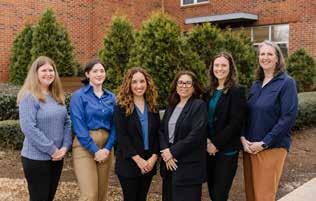


Most people think of legal planning as something that happens around a will: who receives the house, who receives the accounts, and who is in charge when someone dies. That planning matters. But for older adults and their families, the more urgent question is often not “What happens after death?” It is “What happens if mom needs care next month, dad can no longer sign documents, or the spouse must enter a nursing home while the other spouse still needs money to live?”
That is the heart of elder law.
The National Academy of Elder Law Attorneys describes elder and special needs law as work devoted to improving legal services for older adults, people with disabilities, and their families. Elder law brings together legal, financial, medical, and family concerns. It is estate planning with a wider lens: not only where assets go one day, but how a person will be cared for, who will make decisions, how care will be paid for, and how the family can avoid panic-driven choices.
Traditional estate planning usually focuses on death-time transfers: wills, revo-
cable trusts, beneficiary designations, tax planning, and probate avoidance. Elder law includes those tools, but it asks additional questions. Can the plan withstand incapac-
ity? Is the durable power of attorney strong enough to allow Medicaid or VA planning? Are health care advance directives current and practical? If a loved one needs assisted
living, memory care, home care, or nursing home care, what public benefits might help? If no one has legal authority, is guardianship or conservatorship needed?
There’s an unmistakable bond between people and pets. In addition to the “warm fuzzies” we get from having a furry friend, research has revealed that there are health benefits to human-animal connections.
Interacting with animals has been shown to decrease stress hormones, lower blood pressure and boost mood. These benefits can be particularly important for senior adults who find themselves facing the challenges of loneliness and isolation. In one study of people who are aging alone, 73% of respondents reported a greater sense of purpose from owning pets, 81% said that pets provide them with daily structure and routine, and 82% said that they receive emotional and social benefits from their pets.
Is adopting a pet a good idea for your older loved one? Here are some points for families to consider.
Home Environment
When a senior is still living at home, responsible pet ownership centers on the person’s ability to properly care for the pet. Can your loved one…
• Make sure the pet receives regular veterinary care and any needed groom-

ing? Are they able to take the pet to necessary appointments, either on their own or with assistance?
• Keep up with household chores, such as scooping a litter box, cleaning a bird cage or picking up yard waste?
• Ensure that the pet receives proper exercise through regular walks or playing in a fenced yard?
• Remember to provide fresh food and water for the pet every day?
• Provide safe shelter for the pet? If your loved one generally believes that animals should be kept outdoors, adopting a pet may not be a good idea for them.
Financial responsibilities. Costs for vet care, medications, grooming and food can add up for those who are living on fixed budgets. Is your loved one prepared to handle pet expenses?
Home safety. The pet’s temperament and size will play a part in its suitability. A large and energetic dog, for example, may be too much for an older person to safely handle. Likewise, a cat or small dog could pose tripping hazards if your loved one is unsteady on their feet.
Future pet care. If your loved one experiences a change in their physical or
cognitive abilities, it’s wise to think about who would care for their pets if they were unable to do so.
If your loved one is ready to welcome a furry or feathered friend, pet ownership can be beneficial for both the senior and the pet, but it’s important to make sure the right support is in place.
Through its Companion Care program, Kadan Homecare caregivers can help support daily pet care tasks so seniors can continue enjoying the companionship and purpose pets provide while aging at home. Even if they later move into senior living, many communities recognize these benefits and welcome pets.
To talk with our team or to schedule a complimentary in-home senior care consultation, please call 770-396-8997 or email info@kadan.org.

Families should consider using an elder law attorney when aging is no longer theoretical. That may be when a parent receives a dementia diagnosis, when a fall changes the family’s routine overnight, when a hospital discharge planner says “rehab” or “long-term care,” or when monthly care costs begin to drain savings. It may also be years earlier, when healthy retirees want to protect themselves, their spouse, and their children from avoidable confusion.
In a crisis Medicaid planning matter, a family may already be facing a nursing home bill. The goal is to understand the Medicaid rules, protect the healthy spouse where possible, preserve resources within the law, and prepare a Medicaid application that is accurate, complete, and defensible. Medicaid applications are document-heavy, deadline-sensitive and unforgiving. A small mistake can delay benefits or create expensive gaps in coverage.
Veterans and surviving spouses may have another path. Assistance is available to help families evaluate eligibility for VA pension, including enhanced pension benefits for those who need aid and attendance or are housebound. Assistance is also available with applications for VA pension and VA compensation benefits. These programs can be meaningful, but the rules are not casual reading. Service history, medical need, income, assets, and documentation all matter.
Elder law planning also uses familiar estate planning instruments in more purposeful ways. A revocable trust can help organize assets and avoid probate. An irrevocable trust may be appropriate for asset protection or long-term care planning when designed and funded correctly and early enough. A comprehensive durable power of attorney is often the quiet hero of an elder law plan,
giving trusted agents the authority they need before a court becomes involved. Health care advance directives help ensure that medical decisions reflect the client’s wishes and Jewish values of dignity, family responsibility, and honoring life.
Sometimes, however, planning documents are missing, outdated, or insufficient. When an adult can no longer make or communicate decisions, and no valid authority exists, families may need to petition the probate court for guardianship, conservatorship or both. These proceedings are serious. They remove or limit rights, so they should be handled carefully, respectfully, and only when necessary.
Elder law does not end at death. Families often need help administering an estate in probate court or administering a trust. That work includes identifying assets, notifying beneficiaries, handling creditor issues, coordinating with tax advisers, distributing property, and keeping fiduciaries out of trouble. Good administration is a final act of stewardship.
So, who should use an elder law attorney? Adult children worried about aging parents; spouses facing long-term care costs; veterans and surviving spouses who may qualify for benefits; retirees who want more than a simple will. Families navigating dementia, disability, probate court, or trust administration. In short, anyone who wants a plan for the whole journey, not just the last chapter.
The best elder law planning is both practical and humane. It protects everyone and everything a family loves. It turns a frightening maze into a map and gives families the confidence to make hard decisions with steadier hands.
Call Robert M. Goldberg & Associates, PC, at 770-229-5729 to schedule your consultation. ì
Compiled by AJT Staff


What began as an innovative educational pilot program for seniors at Jewish HomeLife’s Berman Commons has rapidly grown into one of Metro Atlanta’s most inspiring enrichment movements for older adults. This summer, Oy Vey VR, Inc. proudly announced the expansion of Empowerment University for Seniors (Empower U) into multiple elder care communities across the region, bringing immersive learning, meaningful engagement, and joyful connection to seniors living in assisted living and memory care settings.
Now underway at communities including Berman Commons, several Brickmont Senior Living properties, and expanding into Sunrise Senior Living communities including Brighton Gardens, the Empower U Summer Trimester is already generating excitement among residents, caregivers, families, and staff alike.
This season’s class lineup features a remarkable collection of immersive educational experiences designed specifically for seniors, including: A Glimpse
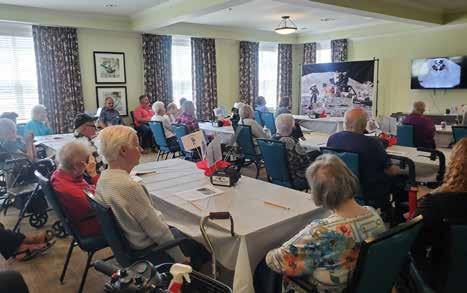
of Jerusalem; A Deep Dive with Dolphins; America at 250: A Red, White and Blue Birthday; Flowers That Changed the World; Morty’s Masterclass Series – The History of Dogs; and many more engaging adventures through history, science,

in discussions, sharing memories, and looking forward to the next class days in advance. Families are telling us their loved ones continue talking about the classes long after they end. That emotional spark is exactly why Empower U exists.”
One recent class, A Glimpse of Jerusalem, invited residents on a breathtaking journey through thousands of years of history — from the days of King David and King Solomon to the modern-day marvels of Jerusalem today. Another favorite, A Deep Dive with Dolphins, filled classrooms with smiles and amazement as residents explored ocean life, incredible underwater footage, and uplifting stories about dolphins and whales that sparked both wonder and heartfelt conversation.
culture, travel, music, and nature.
Each class combines storytelling, fascinating visuals, conversation, music, and in many sessions, immersive virtual reality (VR) experiences that transport residents into the heart of the subject matter. Whether “walking” the ancient streets of Jerusalem, diving beneath the ocean alongside dolphins and blue whales, or reliving the excitement of America’s Bicentennial celebrations, residents are experiencing something far more meaningful than entertainment alone — they are reconnecting with curiosity, memory, emotion, and each other.
“At Empower U, we believe the desire to learn and explore never disappears,” said Stuart Steiner, founder of Empower U. “What we’re seeing inside these communities is extraordinary.
Residents who may normally sit quietly are suddenly laughing, participating
“Programs like Empower U remind us that aging does not mean the end of growth, curiosity, or imagination,” said Sam Cohn, client relations manager at Berman Commons Assisted Living and Memory Care. “The atmosphere completely changes during these classes. Residents become students again — excited, engaged, and connected.”
If you or a family member are interested in experiencing an Empowerment University for Seniors class firsthand, a limited number of guest seats and scholarship opportunities are available at participating communities throughout Metro Atlanta.
For more information about attending a class, sponsorship opportunities, or community partnerships, please contact Stuart Steiner at 404-569-7254 or by email at stuart@oyveyvr.org. ì
Compiled by AJT Staff







What once seemed impossible is now becoming reality in the fight against Alzheimer’s disease.
Researchers can now detect signs of Alzheimer’s years - even decades - before symptoms appear. New treatments are helping slow disease progression. Blood tests are making earlier diagnoses possible. And for the first time, scientists can realistically envision a future where prevention becomes as important as treatment.
These extraordinary advances – and the vital role philanthropy plays in accelerating them – were the focus of the Atlanta Jewish Foundation’s recent Community Conversations event, held June 10 and presented in partnership with Pearlann and Scott Horowitz.
The Community Conversations series brings together thoughtful donors and nonprofit leaders to talk about the community’s pressing and longterm philanthropic needs.
The recent program featured a conversation between Jeffrey Gopen, president and CEO of Jewish HomeLife, and internationally recognized neurologist and neuroscientist Dr. Allan Levey.

Dr. Levey, founding director of the Goizueta Brain Health Institute and director of the Goizueta Alzheimer’s Disease Research Center at Emory University School of Medicine, has spent more than four decades studying Alzheimer’s disease.
“When I started, people really didn’t know what Alzheimer’s disease was,” said Levey. “Everybody used the term ‘senility,’ and that was just thought to be normal aging.”
Four decades later, the field has been

transformed, and new discoveries have shifted the focus from treating symptoms to preventing the disease.
“By the time somebody comes to see us for care and treatment, they’ve probably had the disease for at least 20 to 30 years,” Levey said. “The future, our path, is one toward prevention.”
Researchers can now identify disease-related changes through advanced imaging, spinal fluid testing, and increasingly, blood tests that may allow for earlier diagnosis and intervention. New therapies that remove amyloid plaques from the brain are also beginning to show measurable results.
“It’s almost like the first time man stepped on the moon,” Levey said. “We’ve now landed. We’ve stepped on the moon, and we have our first treatments which can slow down the disease.”
At Emory, approximately 400 patients have received these therapies.
“Over the course of two to three years, over half of them have not changed,” he said. “This is a progressive disease, so to see people not change is really, really remarkable.”
Researchers are also learning more about how lifestyle factors - including exercise, nutrition, blood pressure management, stress reduction, and quality sleep - can support brain health.
“It’s been estimated that maybe 45 percent of cases of Alzheimer’s disease could be prevented through lifestyle changes,” Levey noted.

The discussion also underscored the important role philanthropy plays in advancing medical research.
“While challenges remain, there’s never been more hope than there is today,” said Ghila Sanders, vice president of philanthropic advisory at the Atlanta Jewish Foundation. “Advances in research, diagnosis, treatment, and prevention are changing what is possible, and philanthropy continues to play an important role in helping move that progress forward.”
Levey emphasized that charitable support has been instrumental in advancing Alzheimer’s research.
“Philanthropy has had a dramatic impact on not only my career and our program at Emory, but really globally,” he said.
Philanthropic support helps researchers pursue innovative ideas, invest in new technologies, recruit talented scientists, and accelerate promising discoveries. Levey noted that endowment gifts are particularly impactful – providing long-term stability.
“One of the things that I’ve seen in my career is that every dollar of philanthropy that’s come into us at Emory gets translated probably 100 to 1 in terms of research,” he said.
For many philanthropists, donor-advised funds (DAFs) provide a flexible and tax-efficient way to support causes such as Alzheimer’s research, senior care, and other meaningful causes both locally and globally.
The consequences of losing donor support would be significant.
“If we didn’t have the support of donors, we would have had to lay off probably 70 percent of our research team,” Levey explained. “And laying them off means you don’t just stop the research for a year. You’ve stopped a generation of people from doing research.”
The program also highlighted the importance of caring for older adults currently living with memory loss and cognitive decline. With donors’ generosity, Atlanta Jewish Foundation and Jewish Federation of Greater Atlanta support seniors through initiatives such as AgeWell, the Holocaust Survivor Support Fund, and community partnerships across Jewish Atlanta.
As Levey said, “We all want people to have great golden years.”
Closing the event, Carolyn Oppenheimer, incoming campaign chair of the Jewish Federation of Greater Atlanta, reflected on the impact of the conversation.
“As someone who understands firsthand the pain and heartbreak of living with someone with Alzheimer’s, what I got from today is hope,” she said.
For more information about the Atlanta Jewish Foundation and charitable giving opportunities, including donoradvised funds, visit www.atlantajewishfoundation.org, email foundation@jewishatlanta.org, or call 404-436-0089. ì
This story was submitted by the Atlanta Jewish Foundation.




By Bob Bahr
If there is one theme that resonates throughout the 55-year career of Steven Spielberg, it is his interest in the possibility of life somewhere else in the vast universe. He has explored that idea in some of his most successful films, beginning with “Close Encounters of The Third Kind” in 1977, and in “E.T. - the Extra-Terrestrial” five years later, in 1982. He continued it in “War of the Worlds” in 2006, and even in the 2008 “Indiana Jones and the Kingdom of the Crystal Skull,” where alien life became a plot element.
This summer, he’s returned to this favored subject with “Disclosure Day,” which stars Emily Blunt in a terrific performance as Margaret Fairchild, a television weather girl who gets involved with a rogue computer expert played by Josh O’Connor. He has stolen the records the government has kept of alien visits to America and he’s on the run. His pursuer is his former employer and its CEO who has kept watch over the government’s secret documents and wants them back.
O’Connor as the rogue computer expert, Dr. Daniel Kellner, intends to make public the video records he has carefully copied on a series of storage devices he has stashed away. That’s coming on Disclosure Day.
Kellner is not unlike the real-life whistleblower, Edward Snowden. He is the former contractor at the government’s National Security Agency who leaked a trove of secret government documents that revealed an extensive global surveillance program run by the United States government with the help of the largest international telecommunication companies. He eventually ended up in Russia, where he was granted asylum

and became a citizen in 2022.
Part of what gives the film its otherworldly edge is the role that mind control plays in the effort to make public the stolen records. The company that has employed Kellner has developed a device that can take over and control the action of another person even though they may be hundreds of miles away.
Likewise, Fairchild finds she can suddenly speak fluent Russian, can effortlessly read the most intimate thoughts of others and finds herself spontaneously speaking an alien language. She’s being controlled, too.
As a dramatic device being possessed by mysterious outside forces is nothing new, over a hundred years ago, Yiddishspeaking theater audiences in Eastern Europe were captivated by Shloyme Rappaport’s, “The Dybbuk,” in which a young woman becomes possessed by an evil spirit of her beloved. He is the dybbuk of Jewish folklore.
The story is said to have been developed from the life of a 19th century Has-


sidic rebbe who was a master at exorcising the dybbuks that were said to have inhabited the bodies of some of his followers.
The play inspired George Gershwin to begin a project to turn the story into a production for the Metropolitan Opera. Because of contractual difficulties, it was never realized but Gershwin was energized to pursue another opera project soon after that eventually became “Porgy and Bess.”
On screen, “The Dybbuk” became one of the most successful productions of the brief Yiddish language film renaissance in Eastern Europe of the 1930s.
Both of the stars of Spielberg’s new film must contend with their own individual dybbuks. It’s a kind of drama of the dueling dybbuks that animates the fastmoving suspenseful film that has some truly impressive sequences. One of the film’s best is when the two stars narrowly escape from their automobile after one of their pursuers smashes it into a moving freight train.
But for all its technical skill and
impressive performances, the film lacks much of the magic of Spielberg’s earlier work. Not only does it lack the emotional punch of an “E.T.” or a “Close Encounters,” but it ties up its story a little too neatly to be truly believed, even as a firstrate Hollywood thriller. Somehow, this breathless pursuit of political optimism in today’s world is not very convincing.
It’s been a while since the great director has had commercial success, and, based on the lukewarm response of audiences so far, particularly among the young, it may not make its considerable production budget and its equally large marketing and promotion costs.
The world is infinitely more complex than when Spielberg first began his quest to bring an appreciation of the wonder of otherworldly life. The enemies of wonder are not only government bureaucrats and their hired hands, they are more widespread and threatening than Spielberg would have us believe, and in “Disclosure Day” that sense of pervasive menace never develops. ì




By Marcia Caller Jaffe
Searching for cowboy boots, country music, and Texas-sized portions? Head farther west; but if you’re looking for cuisine that embraces Southern flavors and farm-inspired ingredients, {S}table comes about as close to classy comfort food dining as you’ll find around these parts.
The new DASH Hospitality venture has David Abes “dashing” to and fro among his five dining concepts concentrated in Dunwoody. Abes noted, “Three months after opening, {S}table has quickly established itself as a neighborhood favorite. We’ve been thrilled by the response as the volume of guests has exceeded our expectations.”
Abes elaborated that these first months have focused on refining service, operational flow, presentation, and the cocktail program while maintaining a menu that has been well received from the start. Looking ahead, seasonality will remain central to their philosophy, with rotating specials and fresh ingredients in year-round favorites. {S}table is preparing to unveil an expanded outdoor patio later this summer. The renovated space will feature a shaded awning system, additional seating, outdoor television, and horseshoe games. Planned programming includes live music, community gatherings, and watch parties designed to activate the space year-round.
This is what we sampled:
Appetizer: Black-Eyed Pea Fritter ($16), served atop sweet potato purée with honey vinaigrette and watercress. The fritters immediately drew comparisons to falafel. Texture and appearance were similar, though the black-eyed peas produced a slightly milder flavor. The sweet potato purée added a balance to the savory fritters, while the honey vinaigrette tied it altogether. The most popular appetizer is the Southern Lazy Susan which has been the most talked-about dish featuring pimiento cheese, Georgia gouda, smoked duck, Vidalia onion dip, benne seed crackers, and house pickles. Abes related, “It offers guests a true taste of the South while creating a fun, shareable dining experience.”
Garden Salad ($14): Crisp greens were enhanced by tangy pickled onions, shaved carrots, tomatoes, and molasses vinaigrette. Shareable.
A lighter entrée was the Harvest Bowl ($16): blend of arugula, toasted barley, sweet potatoes, lima beans, and honey vinaigrette. The bowl can be customized with the addition of salmon for $10 (and




prepared choices.
other proteins), made into a more substantial meal. Actually, we substituted for trout which came with two huge filets.
The standout entrée was the WoodRoasted Patagonia Salmon ($28) which traditionally comes with grits, but our table elected to substitute garlic green beans. Yes, the server said it really was imported from Patagonia, the Southwestern tip of Argentina and Chile stretching from the Andes Mountains to the Atlantic and Pacific Oceans.
Another special seafood choice was the Georgia Mountain Trout Pecandine ($28), arriving in a generous portion large enough to bring thoughts of leftovers. The preparation leaned slightly toward the sweeter side.
For dessert, Abes recommends, “Our Seasonal Fruit Cobbler showcases the best
fruit of the season and changes throughout the year. We are currently transitioning from an apple-cinnamon cobbler to a summer peach version. Another guest favorite is the S’mores n’More, our playful take on a campfire classic.”
Private events are becoming an important part of the business. {S}table can accommodate approximately 100 guests indoors, up to 150 for standing receptions, and an additional 50 to 60 on the patio. The venue hosts corporate functions, networking events, rehearsal dinners, birthdays, and family celebrations. DASH Hospitality recently hired Shelley Coplin to oversee event bookings and catering operations.
Abes is actively involved in daily operations, greeting guests and assisting staff. Son, Mitchell, oversees branding, photog-
raphy, and programming, while wife, Julie, helped shape the interior design.
A mishpocha business, approachable, and distinctly Southern, Abes added, “Some of our earliest guests were visitors from upstate New York who happened to stop by while in town for their granddaughter’s bat mitzvah. Stories like that reflect what we hoped {S}table would become, which is a welcoming gathering place for both locals and visitors to Dunwoody.”
After all, with DASH’s Good Vibes Ice Cream Shop, Morty’s Meat & Supply, Bar{n} booze {n} bites, and Message in a Bottle nearby, it’s bound to be Funwoody.
{S}table is closed on Mondays; open from 4 p.m. to 10 p.m., Tuesday to Saturday. and 4 p.m. to 9 p.m., Sunday. 470709-4304. 1317 Dunwoody Village Parkway (look for Marlow’s Tavern nearby). ì





JWC Atlanta Lunch & Learn: Relationships, The Torah & Me – 12:30 to 2 p.m. Join JWC Atlanta for a meaningful Lunch & Learn exploring what the Torah has to say about the most important relationships in our lives. Together, we will look at how Jewish wisdom can help us think more deeply about family, connection, responsibility, and the way we show up for the people around us. RSVP at https:// tinyurl.com/39psb7fy.

Splash Around Town with PJ Library & JBaby: Brookhaven - 10 to 11:30 a.m. Make a splash with PJ Library & JBaby this summer! Families with kids of all ages are invited to cool off and connect at splash pads around town throughout July. These casual, come-and-go playtimes offer water fun and space to splash, play, and relax; there’s something for every age and stage. Be sure to bring swimsuits, towels, and sunscreen! PJ Library and JBaby connectors will be on site with books, light snacks, and friendly faces. Register at https://tinyurl.com/32uyhkvh.

Cub Scout Pack 1818 Meet-and-Greet Water Olympics – 1 to 3 p.m. Join us on Sunday, July 19, for our annual Water Olympics meet and greet! Water balloons and sponge bucket races, pool noodle jumps, and much more! For boys and girls, grades K-5 and their families. RSVP at https://tinyurl.com/mujfjujx.

Young Professionals & 35+ Braves Game – 1:35 p.m. Young professionals and 35+, join Kibbitz & Konnect for an outing to see the Atlanta Braves take on the Texas Rangers! Grab a friend and join us at Truist Park to enjoy a summer Sunday game! First pitch is at 1:35 p.m. Purchase tickets at https://tinyurl. com/3xh7998f.
Splash Around Town with PJ Library & JBaby: Roswell – 4 to 5:30 p.m. Make a splash with PJ Library & JBaby this summer! Families with kids of all ages are invited to cool off and connect at splash pads around town throughout July. These casual, come-and-go playtimes offer water fun and space to splash, play, and relax; there’s something for every age and stage. Be sure to bring swimsuits, towels, and sunscreen! PJ Library and JBaby connectors will be on site with books, light snacks, and friendly faces. Register at https://tinyurl.com/3pntt96u.

Tuesday, July 21
JCRC of Atlanta’s Gold Dome & Donuts – 8:30 to 9:30 a.m. Join Atlanta JCRC on Zoom for a discussion about the Georgia State Education tax credit. Our guests will be: Buzz Brockway, VP of public policy, Georgia Center for Opportunity, Paul Ginburg, associate head of school, The Weber School, and Rich Walter, chief impact officer, Jewish Federation of Greater Atlanta. Get the Zoom Link at https://tinyurl. com/tc6jawvz.

Music Jam at The JCC -6 to 8 p.m. Calling all musicians and music lovers for a Music Jam at the JCC! Bring your instrument(s), friends and jam with fellow musicians. No auditions, no restrictions, just pure musical fun and collaboration. Free and open to people of all ages! Learn more at https://tinyurl.com/mrnr7hc5.

Wednesday, July 22
JWC Atlanta Lunch & Learn: Relationships, The Torah & Me – 12:30 to 2 p.m. Join JWC Atlanta for a meaningful Lunch & Learn exploring what the Torah has to say about the most important relationships in our lives. Together, we will look at how Jewish wisdom can help us think more deeply about family, connection, responsibility, and the way we show up for the people around us. RSVP at https:// tinyurl.com/yub3yt2a.

Tisha B’Av Service - 6 to 9 p.m. Join Temple Beth Tikvah and Congregation Etz Chaim for an OTP Inter-Congregational Collaboration. There will be a dairy dinner, Tisha B’Av learning sessions, Ma’ariv service and chanting of Eichah. RSVP at https://tinyurl.com/3uc3k5yf.

Newborns and Nosh – 11 a.m. to 12:30 p.m. Shalom to the newest members of the tribe! Join us for Newborns & Nosh, a relaxed gathering for parents with babies 0–6 months. Come spend time with other parents who are also in the early weeks or months of life with a new baby. Get support and expert guidance on feeding, sleep, and all the newborn questions, and share in the oy’s and joys together. Enjoy bagels and your favorite drink from Dunkin’ while settling into the warmth of Jewish community. Sign up at https:// tinyurl.com/ya2pfbrx.
Torah Reading: Devarim
Friday, July 17 Light Shabbat Candles: 8:30 PM
Saturday, July 18 Shabbat Ends: 9:30 PM
Torah Reading: Ve’etchanan
Friday, July 24 Light Shabbat Candles: 8:26 PM
Saturday, July 25 Shabbat Ends: 9:25 PM

Dive Into Shabbat - Pool Party at the JCC - 5 to 8 p.m. Just as water nourishes the earth, tradition nourishes our souls: both flowing, refreshing, and full of life. Families are invited to enjoy pool games, water fights, music, and holiday treats while exploring the connection between water, learning, and renewal. Celebrate Shabbat with laughter, splashes, and a fresh take on ancient traditions! Celebrate Shabbat with family and friends! Bring your own picnic or purchase refreshments at the snack bar. Open swim begins at 5 p.m. followed by Shabbat songs and blessings with Rabbi G at 6 p.m. Free ice pops, challah, and grape juice are provided. Bring your friends and enjoy this unique Shabbat celebration. Learn more at https://tinyurl.com/mwp2d4mf.

Splash Around Town with PJ Library & JBaby: Intown - 10 to 11:30 a.m. Make a splash with PJ Library & JBaby this summer! Families with kids of all ages are invited to cool off and connect at splash pads around town throughout July. These casual, come-and-go playtimes offer water fun and space to splash, play, and relax; there’s something for every age and stage. Be sure to bring swimsuits, towels, and sunscreen! PJ Library and JBaby connectors will be on site with books, light snacks, and friendly faces. Register at https://tinyurl.com/5n85jufr.

The Bukharian Jewish Experience – 2 to 3 p.m. The Breman welcomes Liat Tzionov, a traditional cook and storyteller. Liat’s work is rooted in memory. For her, food is how stories are passed down, how traditions are kept, and how identity is preserved. She will offer an immersive journey into the world of Bukharian Jews – one of the oldest and most distinctive Jewish communities. Through storytelling, historical context, and elements that engage all five senses, Liat will guide participants in an exploration of the legacy of the Silk Road, the traditions that shaped Bukharian Jewish life, and the continuity of this heritage today. Purchase tickets at https://tinyurl.com/y384shvj.
George Rishfeld – 2:30 to 5 p.m. As an infant in Nazioccupied Poland, George Rishfeld’s life began with an act of extraordinary courage. Thrown over the barbed-wire fence of the Vilna Ghetto into the waiting arms of a young woman named Halinka, George was saved in a moment that would define the rest of his life. Today, George shares his remarkable story of rescue, resilience, sacrifice, and hope. Join us for a powerful and unforgettable afternoon as George presents his firsthand testimony, offering a deeply personal perspective on one of history’s darkest chapters and the extraordinary courage that can emerge even in the face of unimaginable evil. This special event by Chabad of Hall County is an opportunity to hear directly from a Holocaust survivor, preserve the memory of those who perished, and help ensure that these vital stories continue to educate and inspire future generations. Followed by Q & A. Advance registration is required at https://tinyurl.com/mr2d8k6p.
2026 Atlanta Kosher BBQ Festival – 12 to 4 p.m. Our Festival is centered around a Kosher BBQ Competition where approximately 25 teams compete in kosher Brisket, Beef Ribs, Chicken, and Chili categories. We have a large Vendor Village, children’s activities, music, silent auction, and of course, BBQ. The Atlanta Kashruth Commission supervises the Atlanta Kosher BBQ Festival. Because we are fully compliant with their kosher food handling requirements, all spectrums of the Jewish community can participate, plus, because it is BBQ, the entire Atlanta community joins us as well. This ultimately makes us the most diversly attended food event in Georgia. There will be something for everyone, rain or shine. Learn more at https://tinyurl.com/yjjmapk8.
Atlanta Jewish Life Festival – 12 to 4 p.m. Come celebrate the vibrant Jewish culture and community at the Atlanta Jewish Life Festival! This in-person event is jam-packed with food, music, and activities for all ages. Whether you’re looking to connect, learn, or just have a great time, this festival is the place to be. Everyone’s welcome — bring your friends and family for a day full of fun and celebration! Purchase tickets at https://tinyurl.com/433h78ad.
A Reset for the Nervous System & Collective Healing with Jess Pfeffer! – 3 to 5 p.m. How do we find peace when the world feels so loud? SETTLE invites you to take a conscious pause — to give your body a break from the constant doing and gently return to simply being. This immersive experience offers a reset for your nervous system through somatic tools, sound healing, breathwork, mindful rest, and body awareness. Together, with Chabad Intown, we’ll explore easy, accessible practices that help you recalibrate, release stress, and reconnect to yourself and others. In a safe and supported space, you’ll be held in community, with opportunities to reflect, share, and create meaningful connections. Whether you’re new to nervous system work or looking to deepen your practice, SETTLE is your invitation to slow down and soften into healing — collectively. Register at https:// tinyurl.com/3s7z2m6s.
JWC Atlanta Lunch & Learn: Relationships, The Torah & Me – 12:30 to 2 p.m. Join JWC Atlanta for a meaningful Lunch & Learn exploring what the Torah has to say about the most important relationships in our lives. Together, we will look at how Jewish wisdom can help us think more deeply about family, connection, responsibility, and the way we show up for the people around us. RSVP at https:// tinyurl.com/v9w9m3e5.

Thursday,
Staged Reading of “The World to Come”– 7 to 9 p.m. Every night at the SeaBreeze Hebrew Home for the Aging, Fanny, Barbara, Ruth, and Hal gather for their nightly “Supper Club” meeting. Over Scrabble and charades, the Supper Club gang competes, fights, falls in love, and breaks each other’s hearts. But as the world crumbles around them, they are forced to contend with questions of aging, legacy, and survival. A comingof-age story set in a nursing home, “The World to Come” asks: How do we as a society care for our elders? And can you still come of age at the end of your life? Register for free at The Breman by using this link: https://tinyurl.com/ywxv5tvn.

Ingredients
8-ounce bag arugula
1/2 cup farro, cooked
2 cups seedless watermelon, chopped 1/4 cup feta cheese, cubed
1/4 cup toasted slivered almonds
1 small red onion, thinly sliced
2 sprigs of fresh mint, minced Haddar Kosher Salt, to taste freshly ground Gefen Black Pepper, to taste Tuscanini Balsamic Glaze, to taste
Directions
1. Add all ingredients to a large bowl, then gently toss to combine.
2. Drizzle the top with more balsamic glaze if desired.
kosher.com


An elderly man, Sol, goes to a modern tech store to buy a brandnew, top-of-the-line smartphone. He's a bit overwhelmed by all the features, so the young sales clerk is trying to explain how the phone's advanced artificial intelligence works.
"Look at this, sir," the clerk says enthusiastically. "This phone has a built-in virtual assistant. It monitors your daily habits, it tracks your location, it analyzes your health data, and it automatically predicts exactly what you need before you even ask for it!"
Sol looks at the sleek glass device, scratches his chin, shakes his head, and sighs deeply.
The clerk looks confused. "What's wrong, sir? Don't you want a device that knows absolutely everything about you and constantly looks out for your well-being?"
Sol replies, "Young man, at my age, if I wanted something in my pocket that tracks my every move, judges my health choices, and tells me what I should be doing before I even open my mouth... I'd just put my mother on speakerphone."
Len Lefkowitz, Stone Mountain
n. A web-based matchmaking service that narrows down its clientele to a very small and selective group.
“Nadia is so picky about who she dates, she joined a niche shadkn called J/2 BLT for half-Jews who enjoy eating bacon.”
From the Yiddish “shadkn,” meaning, “matchmaker.”

By: Yoni Glatt, koshercrosswords@gmail.com
Difficulty Level: Challenging
ACROSS
1. A tribe
6. Kind of blocker
10. A Baldwin
14. Andean animal
15. Pesach time
16. Art option
17. Enemy of Cobra
18. “The Fugitive” actress Ward
19. Waiting around
20. Nachshon ben ___nadav
21. Pivotal points in baseball games
23. Lever with a blade
24. Singer Scherzinger
27. Like orange juice
29. Work in the Beit Hamikdash?
31. Can’t miss
33. Gents’ partners
34. Continental prefix
35. School’s booster org.
36. Wear wool and linen, e.g.
38. Org. finishing up for the season
39. Tissue part
42. Israeli urgent care
44. Sudsy Stella
46. Auto designer Ernesto
49. Drive off, as rumors
50. One who might get visitors
51. Puzzle that’s much easier to construct than a crossword

This week, 100 years ago - 1926
53. Academy recognition, informally
54. #1 hit for Boston in 1986
56. Scot”local”
59. Important pitching info.
61. City near Masada
62. It takes flight
64. Dominica, e.g.
65. Lord’s lady
66. “Etc.,” when tripled
67. Movie princess
68. One of the maj. leagues
69. Funny Jackie
DOWN
1. Kelp, for example
2. Like a long shot’s odds
3. Son of King David, per Navi
4. Angsty rock genre
5. “The Facts of Life” star Charlotte
6. Herb used in pesto
7. Most balanced
8. Make unbalanced
9. Figurative son of Rava, per the Talmud
10. Knesset member Azuz
11. Ani ___
12. Cream puff, of sorts
13. Do some arm-twisting
21. Son of G-d, per the Torah

A memorial to Chaim Salomon, Jewish banker who helped finance the American Revolution, is planned in Philadelphia.
Noted Egyptologist Dr. Aaron Ember of Johns Hopkins dies due to a fire from which he tried to save his manuscripts.
This week, 75 years ago - 1951
Max Kroloff of Atlanta is appointed National Director of Membership and Program for B’nai B’rith.
A Long Island rabbi is ousted from his congregation in the midst of pro-Communist allegations. Jewish girl wins Miss Atlantic City pageant.
This week, 50 years ago - 1976
Congregation Anshe S’fard receives Torah from family of Sam Goldstein.
The AJT reports on global reactions to the IDF raid on the Entebbe Airport in Uganda, which saves over a hundred hostages, but which results in the death of Yoni Netanyahu, among others.
Rabbi Emanuel Feldman, spiritual leader at Atlanta’s Congregation Beth Jacob, delivers the opening night benediction at the Democratic National Convention.
Scott Skibell, son of Mr. and Mrs. Erwin Skibell, celebrates his bar mitzvah ceremony at Temple Sinai.
Stuart Alan Danneman, son of Mr. and Mrs. Larry Danneman, celebrates his bar mitzvah ceremony at Ahavath Achim Synagogue.
This week, 25 years ago - 2001
Atlanta chapter of the National Council of Jewish Women announces that the upcoming 30th year of their annual fundraiser, Bargainata, will be its last.
Atlanta native Mark Levy signs his first professional baseball contract with the Johnson City Cardinals in St. Louis.
22. Possible pathway
25. Yaphet’s role in “Raid on Entebbe”
26. Historic concert locale in the Holy Land
28. Possibilities
29. French mountain
30. Possible tax in Isr.
32. Coffee holder
37. Basketball “trophy”
39. Internet annoyances...or an alternate descriptive title for this puzzle?
40. What many husbands do to keep the peace
41. Armani competitor, briefly
42. Notable Middle-East city, with 15-Across
43. Call Yosi Yoni, e.g.
45. “I disapprove” sound
46. Jeff who won a batting title in 2022
47. “... my kingdom for ___ ___!”
48. Like some involved in the “Quality Learing Center” scandal
52. Cow part
55. Ancient Syria
57. Ctrl+Z, on a PC
58. Lima, e.g.
60. Melville novel setting
62. Dr. Henry who’s Ant-Man
63. A.L. West team, on ESPN tickers
Emanuel Feldman, who gave the benediction at the Democratic National Convention in 1976.
Jenna Swartzberg, daughter of Roy and Paula Swartzberg, celebrates her bat mitzvah ceremony at The Temple.
Issues of the AJT (then Southern Israelite) from 1929-1986 can be found for free online at https:// gahistoricnewspapers.galileo.usg.edu/lccn/sn78003973/
Julius Berman, a beloved husband, father, grandfather, and great-grandfather, passed away on June 28, 2026, in Atlanta, Ga., at the age of 95. He was born on Nov. 18, 1930, in Savannah, Ga., and spent his formative years in McRae, Ga., before going on to live a life defined by service, dedication, and deep family devotion.
Julius received his early education in McRae, then at Georgia Military Academy and finally at the University of Georgia. During this time, he developed the discipline and character that would guide him throughout his life.
Prior to his graduation from UGA, he met and soon thereafter married the love of his life, Joanne Shapiro. In 1953, he entered the United States Army serving in Takeyama, Japan. Julius served with honor and was honorably discharged in 1955, attaining the distinguished rank of Second Lieutenant.
Following his military service, Julius and Joanne returned to Savannah, where he established himself as a business owner. His entrepreneurial spirit and strong work ethic later led him to Augusta, Ga., where he joined the family business, Shapiro Packing Co. He contributed meaningfully to the company’s growth and success until its sale, which ushered in a well-earned retirement in Atlanta, the city he called home for the remainder of his life.
Julius was preceded in death by his loving parents, Harry and Sonia Berman, and his beloved wife, Joanne, who passed away on June 24, 2011. Julius and Joanne’s partnership was a cornerstone of the family, and her memory remained with him always.
Julius is survived by his three children: his daughter, Toni Berman Miller of Houston, Texas, and her husband, Gary Miller; his son, Jeffrey N. Berman of Atlanta, and his wife, Kimberly Richardson Berman; and his daughter, Sonia Berman. Julius was the proud grandfather of six grandchildren: Scott Miller (Sarah), Allison Leibman (Neville), Kathleen Berman (Sara), Matthew Berman (Annalise Peters), Brooke Rappaport, and Craig Rappaport; and the cherished great-grandfather of seven great-grandchildren: Owen, Jake and Hunter Miller; Kate, Henry and James Leibman; and Bennett Berman. Julius was also lovingly cared for in his final years by his devoted caregiver, Alethia Belle, whose compassion and dedication brought him comfort and joy.
A private burial will be held at Arlington Memorial Park. For those who wish to honor the memory of Julius, the family requests donations to Jewish HomeLife. Arrangements by Dressler’s Jewish Funeral Care 770-451-4999
Rita Krachmer Bloom, a beloved wife, mother, grandmother, sister, aunt, and friend died peacefully on June 26, 2026. She was 83 years old.
Rita was born in Cedar Rapids, Iowa, in 1943. She moved with her family to Miami in 1958 just before she started 10th grade. After graduating from Miami Beach High School, Rita attended Sophie Newcomb College of Tulane University where she graduated Phi Beta Kappa. A highlight of her college days was spending a semester abroad in Leeds, England, where she was introduced to a hot new English band called The Beatles.
After college, Rita attended Brandeis University to study organic chemistry, ultimately receiving a master’s degree. While at Brandeis, she went on a blind date with a law student named Herschel Bloom, who became the love of her life and her cherished husband of 59 years until his passing in January 2026.
Rita and Herschel moved south to Mississippi in 1968 and then to Atlanta in 1969 where they lived for the rest of their lives. With Atlanta came additions to the family, first Lawton in 1970, then Robert in 1973. The Blooms were a family obsessed with sports, especially baseball, but Rita liked to brag that she was the only one in the family who saw Joe DiMaggio play when her father took her from Iowa to Chicago to see the Yankees play the White Sox.
In addition to raising her family, Rita was active in the community. She served on the board of Temple Sinai and was chair of the Education and Music Committees. She was the head of the Cantorial Search Committee, traveling around the country with Rabbi Kranz to interview prospects.
Rita also began to work with the Atlanta Council for Children’s Television, an organization that worked to improve the quality of television programming for children by promoting educational content and encouraging responsible broadcasting practices, including commercials. She eventually became president of the organization. When it came to concern about children’s screentime and exposure to marketing, Rita was ahead of her time. This children’s-TV advocacy led Rita into a role with the Atlanta city government, first as chair of the cable TV advisory board, then in the office of Mayor Andrew Young as the city’s cable franchise coordinator.
Celebration of Life’s Photo Montage
48 Hour Turnaround after receiving your 50 - 75 Pictures (Digital or Prints) Montage delivered to you on DVD, Thumb Drive or Dropbox Upload Mitzvahs, Weddings or Funerals
Once you scan the QR Code below, it will start playing on your phone. Turn your phone sideways and enjoy. I’m Happy to Help if needed 470-962-0455 Barry

After retiring from city government, Rita pursued her passions for art, classical music, and Judaism. She learned to paint and to play piano. She baked challah on Fridays at the William Bremen Jewish Home and loved attending Shabbat services at Temple Sinai. She traveled the world from Alaska to China to visit her sons. She went to the Metropolitan Opera in New York and frequently attended the Atlanta Symphony, where she served on the board. For over 25 years, she enjoyed spending two weeks every summer in Aspen, Colo., for its highly acclaimed music festival. She packed her days there with concerts, rehearsals, and master classes, and especially loved visiting the music school and watching students learn and perform. Later in life, Rita loved to spend time with her grandchildren, cherishing Thanksgiving time in particular when all five grandchildren were under her roof. She made stuffed cabbage on Wednesday, turkey on Thursday, and helped the grandkids make their own challahs on Friday.
Rita will be remembered for her kindness, elegance, sharp intellect, and deep love for her family and friends. She is survived by her sister, Sally Rabe, her brother, Jay Krachmer, her sons, Lawton and Robert; Lawton’s wife, Brettne; Robert’s wife, Courtney, and her five grandchildren, Jordan, Eloisa, Mason, Anna, and Owen, who were her pride and joy.
A memorial service celebrating Rita’s life was held on Tuesday, June 30, 2026, at 1 p.m. at Temple Sinai, 5645 Dupree Dr NW, Sandy Springs, GA 30327.
In lieu of flowers, donations in Rita’s memory can be made to the following organizations: Jewish HomeLife or Aspen Music Festival and School. Arrangements by Dressler’s Jewish Funeral Care, 770-451-4999.
Sharon “Cookie” Draluck, age 93, passed away peacefully on July 1, 2026. Cookie was born in Atlanta on June 23, 1933, to Irving and Elsie Levy. She was a fixture in the Atlanta Jewish community and never met a stranger, mostly because they were likely to be a cousin. An avid card player, world traveler, and crocheter, she also spent time as a regular volunteer with Atlanta’s Jewish organizations, including Hadassah, the Atlanta Jewish Home and The Epstein School. Above all else, she loved her family and celebrating special occasions and holidays together.
She was preceded in death by her husband, Maurice Draluck. She is survived by her brother, Stanford “Butch” Levy (Andrea), and brother and sisters-in-law, Marvin and Barbara Draluck, and Harriet Draluck, children, Lori Struletz (Allan), Jerry Draluck (Enid), Betsy Popkin (Mark), grandchildren, Adam Struletz (Michael Grad), Scott Struletz (Sophie), Jeffrey Draluck (Erica), Ilana Lind (Jonathan), and Shira Porter (Tyler). She was also fortunate to have great-grandchildren, Abe Struletz, Mia and Bailey Lind, James Tyler and Ellis Porter and Lucy Draluck.
Graveside services were held July 3, 2026, at Crest Lawn Memorial Park, with Rabbi Melvin Sirner officiating. In lieu of flowers, donations may be made to St. Jude Children’s Research Hospital or the charity of one’s choice. Arrangements by Dressler’s Jewish Funeral Care, 770-451-4999.




Dr. Lisa Fetherolf, age 42, of Nokomis, Fla., died June 21, 2026. She is survived by her loving fiancé, Derek, sister, Lauren, brother-inlaw, Adam, and niece and nephew, Aaliyah and Gordon.
Dr. Lisa was born Oct. 18, 1983, to Edward C. Fetherolf and Norene G. Fetherolf (nee Gordon). She grew up in Sarasota, Fla., and graduated from Pine View School for the Gifted. Dr. Lisa went on to pursue her Bachelor of Science degree in psychology from Emory University and Doctor of Chiropractic degree from Life University. Dr. Lisa practiced chiropractic in Atlanta, Ga., and throughout Sarasota County, Fla. She was on the National Board of Chiropractic Examiners and earned the prestigious recognition as Top Chiropractor.
In her free time, Lisa enjoyed caring for her animals, consisting of dogs, birds, fish, and snakes. She especially loved hosting beautiful get-togethers and holiday gatherings at her home year after year, inviting all of those she held dear. Dr. Lisa will be missed beyond words. Arrangements by Dressler’s Jewish Funeral Care, 770-451-4999.
Obituaries in the AJT are written and paid for by the families; contact Account Manager Ilyssa Klein at Ilyssa@atljewishtimes.com or 404-883-2130, ext. 122, for details about submission, rates and payments. Death notices, which provide basic details, are free and run as space is available; send submissions to submissions@atljewishtimes.com.

Roslyn “Ros” Renie Greenberg, 87, of Sandy Springs, Ga., died peacefully and surrounded by her family, on Friday, July 10, 2026. She was born in South Africa to Miriam and Jack Hyton, both of blessed memory. While living in South Africa, Ros was an avid tennis player and worked for many years as an office manager at The South African Institute of Steel Construction. She and her husband, Harold, immigrated to Atlanta, Ga., in 1997 to be with their family.
Ros was a Bronze Life Master bridge player. She spent her time visiting the elderly and was a member of Chabad of Cobb where she attended Shabbat services weekly. She was loved and adored by all who met her and was the heart and soul of her family.
Ros is predeceased by her loving husband of 57 years, Harold Greenberg. Ros is survived by her son and daughter-in-law, Derrick and Tamara Greenberg of Atlanta; son, Ian Greenberg of Dolan Springs, Ariz.; son and daughter-in-law, Ari and Dana Greenberg of Marietta, Ga.; brother and sister-in-law, Herzl and Jenny Hyton of Atlanta; and grandchildren: Ilyse (Scott), Sam, Sarah, and Josh.
The funeral was held at 12 p.m., Sunday, July 12, 2026, graveside, at Crest Lawn Memorial Park with Rabbi Ephraim Silverman officiating. In lieu of flowers, contributions may be made to Chabad of Cobb or St. Jude Children’s Research Hospital. Arrangements by Dressler’s Jewish Funeral Care, 770-451-4999.
Ann Zeider Kaplan passed away peacefully on July 8, 2026. Ann was born in Cork, Ireland to, Abraham and Cheva Zeider, the last of siblings, Sadie, Ethel, Madeline and Shmuel. She emigrated to the United States at the age of 19 to be with close relative, Molly, and her parents, Meir and Cipe Tabaksman. She married Irving Sunshine in 1950 and together they had two sons, Alan and Stan. After Irving’s untimely death in 1954, she raised her two sons until marrying Ted Kaplan in 1965. Ann and Ted became an inseparable team, starting a business; Stag Trailer Supply, later Stag-Parkway together, raising the two boys and eventually travelling the world. In business, she created a strong sense of discipline and reason into environments that constantly changed.
Ann was a remarkable woman, one whose impact touched everyone she came into contact with. She had incredible business intuition, discipline, and significant leadership skills, but most importantly, she had a dramatic impact on her family. She instilled a tremendous value system into her children and grandchildren. Additionally, she made friends all over the world with almost everyone she came into contact with.
Ann is survived by her sons, Dr. Alan (Betty) Sunshine, and Stan (Luci) Sunshine, her four beloved grandchildren and their spouses, Michael (Maya) Sunshine, Justin (Jennifer) Sunshine, Marshall (Meredith) Sunshine, Blake (Adam) Leiber, as well as eight great-grandchildren.
Contributions can be made in her memory to Jewish Federation of Greater Atlanta, Jewish HomeLife, Ahavath Achim Synagogue, or Marcus Jewish Community Center of Atlanta.
Funeral arrangements by Dressler Jewish Funeral Care, 770-451-4999.
Myron Kirsch, 86, a longtime resident of Quincy, Ill., died peacefully surrounded by loved ones July 11, 2026, in Atlanta, Ga.
He was born July 22, 1939, in St. Louis, Mo., the youngest son of David and Ethel Kirsch. He was active in Boy Scouts, attending the 1953 Jamboree in California and earning his Eagle Scout award. He graduated from University City High School in 1957 and served in the U.S. Army Reserves, achieving the rank of staff sergeant.
Myron met the love of his life, Dianne Chanen, on a blind date at Union Station in St. Louis, They were married at Temple B’nai Sholom in Quincy on Aug. 28, 1960, and the couple shared 58 happy years of marriage. After Dianne’s death in 2018, not a day passed when Myron did not talk or think about Dianne.
Myron was a loving husband, father, grandfather, great-grandfather, uncle, and friend to so many. He was a respected Quincy businessman for six decades, operating the family businesses of Chanen’s Auto Supply and IMI Corp., and in his later years working in real estate. Myron was also a leader of the small Quincy Jewish community, serving as president and board member of Temple B’nai Sholom for many years, and a talented musician whose musical ear enabled him to entertain countless community groups and friends with his piano and accordion skills, despite not being able to read a note of music.
Anyone who met Myron knew that his greatest joy and pleasure was raising his and Dianne’s three sons in Quincy — he loved nothing more than telling you about his children (even if you didn’t ask). He was an active and loving presence in his boys’ childhood, hitting fly balls to the neighborhood kids in Madison Park, serving as cubmaster of Madison School Pack 49, developing new aerodynamic techniques for Pinewood Derby cars, and supporting each of his sons as they joined him as Eagle Scouts and later pursued their own careers.
Myron and Dianne moved to Atlanta in 2017 to be near family. They cherished spending time with their children and grandchildren and creating new memories together at their new home at Hammond Glen. After Dianne’s death in 2018, Myron continued to build new friendships in Atlanta, that he valued dearly. He loved his weekend outings with his kids and was thrilled to learn he became a great-grandfather a couple of months before his death.
Myron was a man of great integrity, and he will be missed by all who were fortunate to have known him.
Survivors include children, Jeffrey Kirsch of Conway, Ark., Michael Kirsch (Ilana) of South Bend, Ind., and Greg Kirsch (Lanie) of Atlanta, Ga.; seven grandchildren, Amanda Knock (Phil), Aaron Kirsch (Erica), Max Kirsch, Arielle Kirsch, Asher Kirsch, Eli Kirsch, and Eden Kirsch; and great-grandson, Casper Knock.
Myron was preceded in death by his wife, Dianne; his parents, David and Ethel Kirsch, and parents-in-law, Max and Zelda Chanen, all four of whom made a lasting impact on him; his brothers, Wolff Kirsch and Morton Kirsch; his brother-in-law, Fred Chanen; and his sisters-in-law, Carole Chanen and Marie-Claire Kirsch.
Funeral was in Quincy, Illinois on Friday, July 17. Donations may be made to the Mississippi Valley Council of Boy Scouts of America or the charity of your choice. Arrangements by Dressler’s Jewish Funeral Care, 770-451-4999

David Levine, 83, of Atlanta, passed away on July 3, 2026. David was born in Charleston, S.C., on Dec. 24, 1942, the first child of Anita and Sol Levine, who predeceased him. He is survived by his beloved wife of 48 years, Eve (nee Mendelsohn), his four children (Mandy and spouse, Ulrich, Alison, Scott, and Eric), his much-adored grandchildren, Sophie and Max Brackenhammer, and his siblings, Rose Ross and Ralph Levine. We remember him for his love of the beach (notably, Sullivans Island, S.C.), his penchant for colorful sneakers, and love of music. After growing up in Charleston, with a brief-but-important stint in Barnwell, S.C., David graduated from the University of South Carolina in 1964 and then earned his JD from Emory University School of Law in 1967. He settled in Atlanta, where he practiced law for the next 58 years.
Funeral services were held at Arlington Memorial Cemetery in Sandy Springs, Ga., at 10:30 a.m., Wednesday, July 8. Shiva followed immediately at the home of Nathan Metzger, located at 5275 New London Trace NW, Atlanta, GA 30327, lasting until 3 p.m. Additional Shiva was observed at the Metzger home from 3 p.m. to 7 p.m., Thursday, July 9, and 3 p.m. to 7 p.m., Friday July 10.
In lieu of flowers, donations in memory of David N. Levine may be made to the American Civil Liberties Union (ACLU). Arrangements by Dressler’s Jewish Funeral Care, 770-451-4999.
It is with great sadness that we announce the passing of Alvin K. Lubin on June 21, 2026. He was surrounded by family at the time of his passing.
He is predeceased by his wife of 65 years, Susan S. Lubin, and survived by his three daughters, Sharon Lubin, Kathy Binder, and Julie Lubin, as well as his son-in-law, Steve Binder, his four grandchildren (Selena Sanchez, Brandi Schleter, Daniel Binder and Leah Binder) and six great-grandchildren (Noah, Autumn, Luna, Alesia, Alora and Legend).
Alvin was born on Aug. 10, 1929, in Fall River, Mass. He went to Georgia Institute of Technology on a wrestling scholarship and graduated in 1957. He was a veteran of the United States Army and served proudly in Korean War. After college graduation, he moved to Akron, Ohio, where he met his wife and moved to Cleveland, Ohio. He moved his family to Atlanta in 1972 and was a member of The Temple since 1972.
Funeral services were held at Crest Lawn Memorial Park at 3 p.m., June 23. Arrangements by Dressler’s Jewish Funeral Care, 770-451-4999.

Helen Trattner Ross, 94, passed away peacefully in Atlanta on Friday, July 10, after a remarkable life marked by intellectual curiosity, entrepreneurial success, unwavering independence, and deep devotion to her family and Jewish heritage.
Helen was the beloved wife of Robert Warren Ross, who predeceased her in 2004. She is survived by her two sons, Jim Ross (Teipa) of Windham, Maine, and Doug Ross (Robyn) of Sandy Springs, Ga.; her grandchildren, Stephen Ross (Jane) of Montreal, and Jacob Ross (Chani) of Sandy Springs; and her cherished great-grandchildren, Ari and Ella Ross.
Born on July 4, 1932, in New York City, Helen was very pleased that the country celebrated her birthday with fireworks every year.
Helen attended the University of Connecticut before earning her bachelor’s degree from Framingham State University. In the 1970s, she founded Price Ross Associates, which quickly grew to become the largest residential real estate firm in eastern Massachusetts.
Brian Jay Sherman died July 5, 2026, after a courageous battle with Parkinson’s Disease.
Brian was born in Atlanta on Nov. 9, 1966. He graduated from Briarcliff High School and attended the University of Georgia, where he was a member of the Alpha Epsilon Pi fraternity. It was in college that he met Beth Lindy, and they married in 1995. Brian’s pride and joy were their two children, Jamie and Eric. He returned to school and earned his MBA from Mercer University. Brian enjoyed a long career in the waste and recycling industry, where he helped make our world a cleaner place to live. One of Brian’s greatest accomplishments was saving the life of a young boy in Orange Beach, Ala. When the child got caught in a rip tide, Brian swam out and held the flailing child above water until help arrived and rescued them both. Brian was a funny, light-hearted, courageous, and caring man who will be deeply missed.
Brian is also survived by his mother, Linda Sherman, brother, Cary (Sandi) Sherman, and nephews, Brandon and Jason Sherman. He was preceded in death by his loving father, Leonard Sherman.
In lieu of flowers, donations may be made to The Michael J Fox Foundation or to Temple Emanu-El.
The funeral was held at 2:30 p.m., Wednesday, July 8, at Arlington Memorial Park. Shiva was held at 7 p.m., Wednesday, July 8, and Thursday, July 9, at the home of Beth Sherman at 4584 Chardonnay Court, Dunwoody, GA. Arrangements by Dressler’s Jewish Funeral Care, 770-451-4999.

I have a Ph.D. and I ran a very successful consulting company. I have spoken dozens of times to large audiences both in the U.S. and internationally, but that’s not how I grew up. I grew up as a failure with a reserve that kept me quiet and scared to speak up. I did not speak Yiddish in a yeshiva where all the Judaic teachers spoke Yiddish and so I sat in the back of the room unable to learn anything. I never did anything on my own and I listened to my parents and admired my friends. It never occurred to me that I could change my personality even though I didn’t like who I was, the quiet unassuming young man who followed family and friends.
Then, three things happened that
altered my feelings about myself and helped me see the new me I could become. None of them changed me quickly, but unconsciously I knew I could be different. I could be my own boss, but that thought only occurred later. Change takes time. Here are the things that helped me along the way.
At 14, I passed an exam to attend Brooklyn Technical High School, an honor for me and my elementary school. The principal insisted that I should go there, but I did not want to go, and my parents supported my decision. For the first time, I felt in charge of my life and went to Erasmus Hall High School instead.
At 16, my friend, Bernie, asked me to go fishing with him by taking a fishing boat out from Sheepshead Bay in Brooklyn. My father had taken me fishing many times on boats in Sheepshead Bay, so I knew how to fish, but all these times occurred during the summer when the days were warm, and the ocean was usually calm. I told Bernie, “It’s December
and you must be crazy to want to fish in the middle of the winter.” But Bernie was insistent and I merely followed his insistence.
When I asked my father if I could go, he told me it was a stupid idea, but I pushed hard to go. Finally, my father said that he would let me go to teach me a lesson. He knew I would not be hurt, and he knew I would learn something from going. He said, “You don’t know how awful fishing in December will be. The waters will be rough, you will get sick from the ship rolling back and forth, you will not catch fish, you be nauseous and spend most of the trip below deck where the older men will be playing cards and smoking cigars. So, I went fishing and everything my father told me happened. It was the second time I felt I was charge of my life, though I learned an important lesson to trust people who know more than me on a given subject.
Then, at age 17, as a senior at Erasmus, there was discussion among the seniors that on Senior Day we could
dress as we please in any way that was fun. I convinced my mother that I would go as a pirate, so I cut my pants to make them short, cut the legs into strips, put on a tight blouse from my younger sister, wore a bandana on my head and covered one eye with black patch. I got the courage to get on the train to school and managed to stay in school for an hour or so until the vice principal caught me and sent me home. I was scared to do it, but it was harmless and my parents allowed me to make that decision. I was growing up.
After these harmless events, I knew that I had made the transition from a reserved and quiet young man to someone in charge of his life. My parents let me decide for myself and that gave me the courage to move toward the person I wanted to become. It had taken almost a decade to make that transition, and I thank my parents for the foresight they had to let their son gradually make decisions for himself and thereby manage his own life. ì