Atlanta Jewish Times, VOL. 101 NO. 12, JUNE 30, 2026
Buckhead’s Luxurious Corso Residences are crafted for those who seek a truly world-class lifestyle With every request anticipated and every detail curated to perfection, residency with Corso Atlanta is enlivened by curiosity, intention, and connection Express interest today to explore availability.
Is Your Pet The Next AJT Cover Star?
Is your pet the next cover star for the AJT’s 2026 Pet Section?
Tell Jewish Atlanta about your pet and send us a photo before July 7, 5 p.m.
To try to feature as many pets as possible, there is one entry per household. If you have more than one animal, please send a photo of the animals together. And please fill out the form including all animals on one entry.
Atlanta Jewish Connector Coordinator DIANA COLE diana@atljewishtimes.com
GENERAL OFFICE
Execuitive Assistant
RONIT FRANCO-PINSKY ronit@atljewishtimes.com
Administrative Assistant
ROBIN FREEDMAN robin@atljewishtimes.com 404-883-2130
Distribution Manager LOU LADINSKY lou@atljewishtimes.com Intern
JOSH LUTCHEN intern@atljewishtimes.com The
POSTMASTER
Conexx:
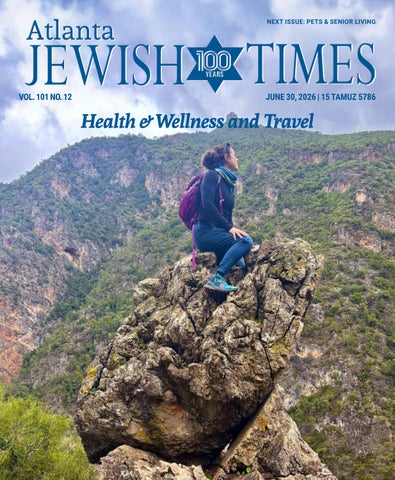
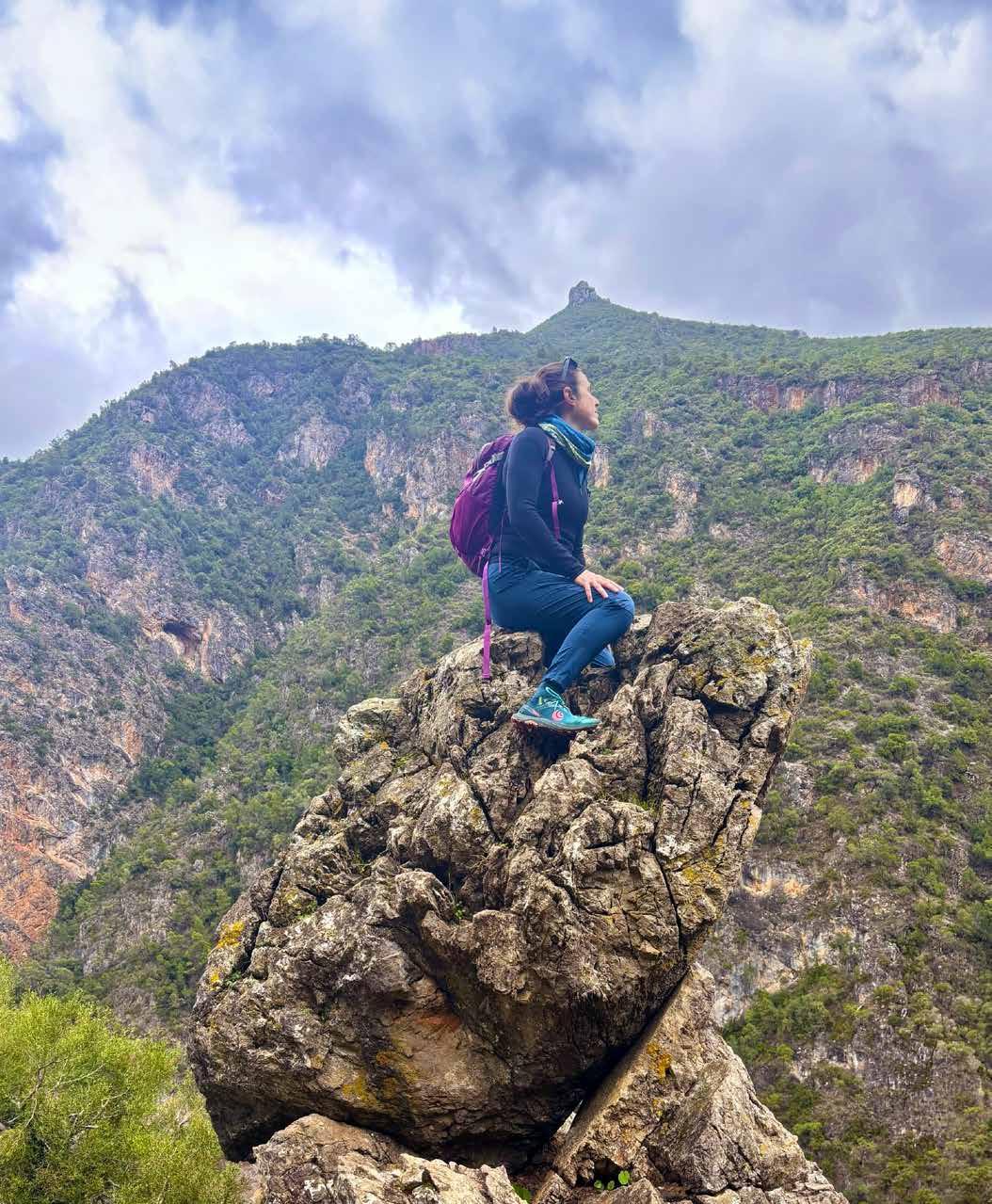
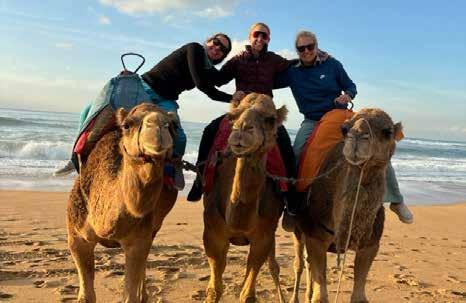
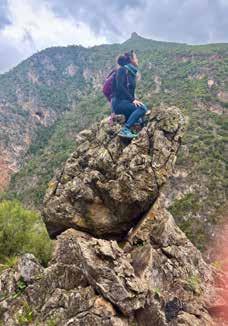
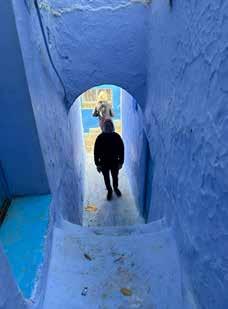
Cover Photo: Shannon Greenhill breathes in the rarified air at Pont de Dieu, Morocco. Her story and more can be found in the Travel section, starting on page 36.
Jewish Federation Celebrates 120 Years
By Marcia Caller Jaffe
More than 300 community members gathered June 4 at The Temple as Jewish Federation of Greater Atlanta marked its 120th Annual Meeting, celebrating a year of record fundraising, honoring outstanding leaders, and looking ahead.
Board Chair Debbie Kuniansky opened by reflecting on the significance of this milestone anniversary. “To serve in this role during our 120th anniversary is both humbling and profoundly inspiring. For 120 years, Federation has stood at the center of Jewish life, raising critical resources, responding in moments of crisis, and helping shape a stronger Jewish future in Atlanta, in Israel, and around the world.”
Next up were performances of Hatikvah and the National Anthem by Josh Meisel, a fifth grader, and Weber School alumna Stella Galanti. Rabbi Peter Berg, Senior Rabbi at The Temple, delivered a D’var Torah.
“The first week of June, Federation
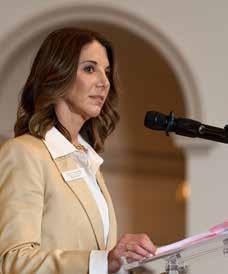
Debbie Kuniansky addresses attendees during the Jewish Federation of Greater Atlanta’s 120th Annual Meeting, reflecting on the organization’s achievements and vision for the future.
erosity reflects your deep commitment to the Jewish people.”
She recognized Silver Circle Soci-
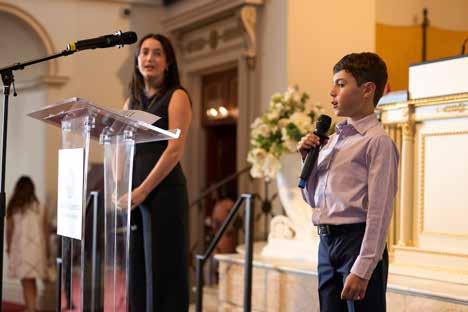
Josh Meisel and Stella Galanti perform Hatikvah and the National Anthem to open the evening’s program at The Temple.
and honored Michael Kogon, Ted Blum, and Avery Kastin for their contributions to campaign growth, foundation develop-
Jewish camping, and trips to Israel are among the most powerful builders of Jewish identity,” she added, “yet for too
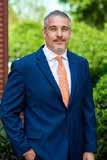
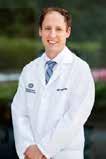
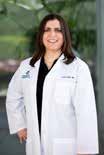
Private oncology and hematology care you can trust. Our 18 medical oncologists serve patients across seven metro locations. Our commitment is simple: advanced treatment, near home, centered around you.
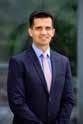
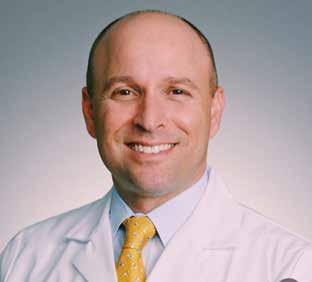
Minesh Patel, MD
Creek
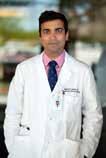
Trevor Feinstein, MD
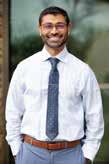
Jamie Haber, MD
Vasily Assikis, MD Newnan
Jonathan Bender, MD Fayetteville
William Jonas, MD Atlanta
Bassel Nazha, MD, MPH Locust Grove
Samantha Shams, MD Atlanta/Sandy Springs
Ha Tran, MD Stockbridge Eiran Warner, MD Atlanta/Sandy Springs
Kutner highlighted the organization’s accomplishments during a year marked by global uncertainty, rising antisemitism, and continued concern for Israel.
“Tonight, as we celebrate Federation’s 120th anniversary, I find myself holding two truths at once: pride in how far we’ve come, and clarity about how much this moment asks of us as a Jewish community.”
She noted Federation’s investments in community security, support services, Jewish education, and Israel engagement and highlighted the launch of Federation’s new Antisemitism Response Network and the hiring of its first director.
“Because responding to antisemitism today requires more than outrage,” Kutner said, “it requires coordination, expertise, partnership, and sustained communal leadership.”
The evening featured presentations of multiple community awards recognizing emerging leaders, Jewish professionals, educators, and volunteers.
“Winning this award is really special, because it’s an acknowledgement that I’m doing the work that I’m being tasked to do in a way that’s actually making an impact on people that I probably don’t know and will never meet,” said Jenn Handel, Federation’s director of Israel engagement, and recipient of the Marilyn Shubin Professional Staff Development Award. “There is no Jew-ish, you are Jewish. Period. The authentic Judaism that I hope to help people find for themselves makes me feel like I wish I had that when I was growing up. One of the most powerful things that I get to do is watch interactions between Jewish Atlantans and Israelis, seeing the impact
of my work.”
Federation leaders also formally installed the Fiscal Year 2027 Board of Trustees slate. Immediate Past Board Chair Beth Arogeti led the election process, thanking outgoing board members and welcoming new officers and trustees.
“We present a slate of inspired and qualified leaders,” Arogeti said. “Each nominee brings a unique skill set and point of view, amplified by a deep commitment to the Jewish people and our incredible Atlanta Jewish community.”
A highlight of the evening was the presentation of the Lifetime of Achievement Award to longtime community leader Linda Selig. The tribute included remarks from her children, Stacey Fisher and Michael Shenk, plus a special introduction by Steve Selig. Shenk and Fisher alternated a “Dayenu” (“that alone would be enough”) theme detailing Linda’s many personal wins and professional dimensions. Those included presidency of The Epstein School PTA, her dominant role in The White Rose Society, serving on the Federation board, working at The Ritz, Anti-Defamation League, and Apparel Mart, running a dance studio, and being “Uma” to all the grandkids.
Speakers emphasized Federation’s role in helping build a thriving Jewish future. “Jewish Atlanta is at an inflection point,” Kuniansky said. “We have the resources, the talent, and the commitment to become the most vibrant Jewish community in the country.”
Kutner echoed that vision, emphasizing that growth and accessibility must remain central priorities. “The future of Jewish Atlanta cannot simply be preserved. It must be built intentionally.” ì
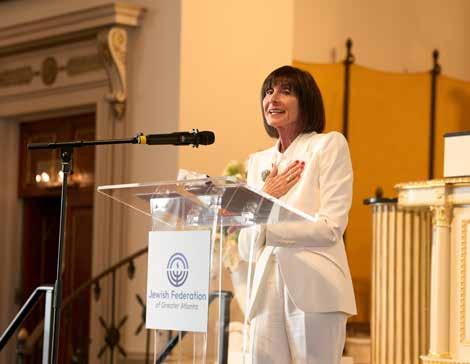
Lifetime Achievement Award recipient Linda Selig speaks after being honored for decades of leadership and service to the Jewish community.
Tessler Tapped to Lead Ra’anana Sister City Committee
By Robert Garber
A partnership between Atlanta and the Israeli city Ra’anana reached a new milestone this past year, in the midst of a change in leadership – celebrating more than 25 years of continued relations for Atlanta’s then-18th Sister City Committee.
Former Committee Chair Dr. Arnold Heller discussed how the AtlantaRa’anana Sister City Committee (ARSCC) first grew out of an International Business Program at North Atlanta High School.
“We began to go on student exchanges and buying missions to purchase goods and sell them in what eventually would become a school store that we would build,” said Heller. “We took it down to Trinidad and Dominican Republic, and Estonia, and Latvia, schools there. Then I said, ‘it’s time for an Israeli school.’ I wrote to a think tank in Jerusalem, and they steered me to Ostrovsky High School in Ra’anana.”
As this program continued, Heller got involved with Atlanta Sister City
Committees, chairing the Atlanta-Rio Committee from 1995 to 1998, but experienced difficulties in forming a counterpart committee in Brazil, and leapt at the chance to start a committee with a city
in Israel. His pre-existing connection to Ra’anana was one of a number of factors that made it a clear choice.
“It was a pretty easy sell, because it was the 10th largest city in Israel, and at
the time we were the 10th largest city in America,” said Heller, who also complimented the city’s leadership. “They were just so capable. You know the saying, if you want something done, give it to a
At Canterbury Court senior living community, you can enjoy raising a glass to lasting friendships with interesting new people from all backgrounds. Whether you take advantage of the many social opportunities or decide to stay in, you’ll enjoy a new, elegantly finished apartment home and enhanced amenities and services. Plus, the peace of mind of a continuum of care, if ever needed. With all this awaiting you, what are you waiting for?
L’Chaim
To learn more and to schedule a personal tour, contact us today at 404-737-2639, visit
CanterburyCourt.org/LChaim, or scan the QR code.
Actual residents enjoying conversation in a Garden Tower apartment.
3750 Peachtree Road, N.E.
3750 Peachtree Road, N.E.
Atlanta, GA 30319
Atlanta, GA 30319
CanterburyCourt.org
CanterburyCourt.org
Independent Living Assisted Living Memory Support
Independent Living Assisted Living Memory Support
Skilled Nursing
Skilled Nursing
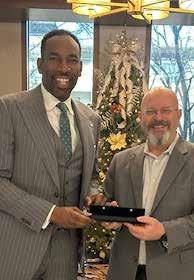
Guy Tessler pictured with Mayor Andre Dickens
City of Ra’anana officials hosted a technology delegation organized by the Technology Association of Georgia and the Consulate General of Israel to the Southeast.
busy person? That’s what this city government was like to me.”
The relationship was confirmed by the city councils in 2000, although the official signings would come later.
“A year later, Atlanta hosted the International Sister Cities worldwide convention,” said Heller. “The twinning was completed there with the two mayors signing in front of the gala with bands and food, and it was just a good celebration.”
There were a series of joint projects and exchanges throughout the years, but Heller’s most memorable moment was a trip to Ra’anana with then-Atlanta Mayor Kasim Reed.
“That was probably my highlight,” said Heller. “Finally, after 16 years, I got an Atlanta mayor to go to Ra’anana. That was big, that doesn’t happen often.”
It was on this trip that Dr. Heller’s path first crossed with Guy Tessler, the current chair of the ARSSC.
“I was the president of what was then called the American-Israel Chamber of Commerce for the Southeast Region, which changed its name to Conexx. In 2015, we took a delegation through American-Israel Chamber with Mayor Kasim Reed. As part of that program, we visited Ra’anana together with Dr. Heller.”
Tessler was approached by a committee member last year, during an Independence Day celebration in Sandy Springs. At the time, he was playing with his band.
“I was all in with my shorts and bandana and guitar in hand, and I said ‘yeah, sure’, and that was how I got involved with this whole thing,” said Tessler.
Change in leadership has also
brought a change in the larger committee.
“Once I got in, I asked the existing members who wants to stay on and who wants to be replaced,” said Tessler. “Most of them were in the bracket of older people, or not necessarily older people but people who feel like they’ve done their part there. Some people were willing to stay for the transition. Definitely the idea is to fill the gaps with younger, more connected people.”
While the sister city program has remained strong, the recent wars have made programming more difficult, often with focus more on reservists in Israel.
“Businesses have collapsed, their families are in trouble, their lives are a mess and they’ve got PTSD,” said Heller. “So, there’s all kinds of programs coming up to help the reservists, to get rid of that numbness, whatever is plaguing them.”
“[Ra’anana] hosted our delegation in December of ‘25,” said Tessler, who has had to cancel multiple flights to Israel for the program since. “They were very welcoming. They saw value in this relationship. There were a lot of things that will be followed up on, but again, at the pace that the security situation conducts.”
Still, for Heller – who occasionally misses his involvement but is glad to see the next generation of the committee take shape – there’s a lot to be proud of.
“As I said, we did a lot of good stuff, and it was nice to build this relationship. I’m not a religious man, and this will give me a really good self-expression of my Judaism and my support for Israel by building and maintaining this relationship.”
For an archive of information about Atlanta’s sister cities, please visit https:// arnoldheller.org/sister-cities/ ì
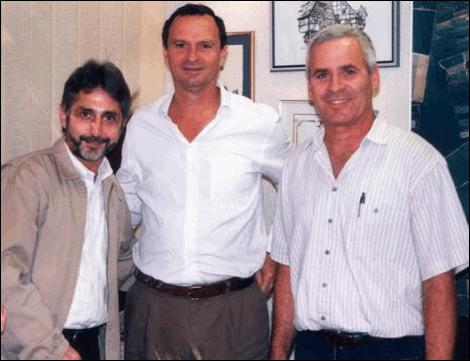
Dr. Arnold Heller pictured with former Ra’anana Mayors Zeev Bielski and Nahum Hofree. At the time, Mayor Hofree was the Ostrovsky High School principal.
Split Decision for Jewish Democrats in Runoff
By Dave Schechter
Democratic voters rendered their judgment on a pair of Jewish candidates in the June 16 runoff elections.
Though results are unofficial until certified, Kevin Abel appeared to have secured the Democratic nomination in state Senate District 14.
Abel received 51 percent of the vote — a 147 vote lead, out of 8,487 cast — against Nathalie Kanani.
His opponent in the Nov. 3 general election will be Republican Michael Dvorscak.
In a statement to the AJT, Abel said: “As of 11:30 p.m. [June 16] it appears that I have enough of a lead to prevail and be certified as the Democratic nominee for state Senate District 14. I want to congratulate my opponent, Nathalie Kanani, on running a well-fought and incredibly close race. Tomorrow is a new day: As Democrats, we need to stop the Republican redistricting efforts, this special legislative session that would gut the Voting Rights Act and further restrict minority representation in our government. And then it will be on to the general election cycle where I will look forward to a healthy debate with the Republican nominee for this state Senate seat.”
Fulton County Commissioner Dana Barrett lost her bid for the Democratic nomination for secretary of state, receiving just 37 percent of the vote against Penny Brown Reynolds.
“I got into this race because elections are under attack here in Georgia and across the country. Even though my name won’t be on the ballot in November, I will do everything in my power to help elect the Democratic nominee because it’s critical that we have a Secretary
of State who won’t bow down to Trump and who is committed to preserving the right to free, fair, and secure elections,”
Barrett said in a statement. “As a Fulton County Commissioner, I will continue
to fight back against the election deniers and Trump loyalists who are doing everything in their power to control the outcome of the vote in 2026 and beyond.”
Additionally, Democratic U.S. Sen. Jon Ossoff now knows that his Republican re-election opponent will be U.S. Rep. Mike Collins, who received 55.5 percent of the vote to defeat former football coach Derek Dooley in the GOP runoff.
Dooley had the long-term backing of Republican Gov. Brian Kemp. Collins was endorsed by Republican President Donald Trump two days before the runoff.
Ossoff is the only Democratic U.S. senator running for re-election in a state that Trump won in 2024. Retaining his seat is critical to the party’s hopes of regaining a majority in the Senate.
The Jewish Democrat issued a statement through his campaign: “Donald Trump’s handpicked candidate Mike Collins is a notorious bigot, antisemite, and extremist currently under federal inves-
tigation for the illegal misuse of tax dollars. Collins, who is only a congressman because his daddy was a congressman, voted to double health insurance premiums for more than a million Georgians, for the Iran War, and for the Trump tariffs.”
Collins posted on the social media platform X: “Georgia, I’m honored to be your Republican nominee for the United States Senate. Now it’s time to get to work, defeat Jon Ossoff, and take this seat back for the people of this state. Hammer Down!”
Trump for his part, posted about the race at 2:50 a.m. June 17, on his Truth Social platform: “So happy for highly respected Congressman Mike Collins. He will win his Senate Race in Georgia against a pathetic failed Democrat Senator, Os(jerk)off, who is a joke in D.C. Nobody even knows who he is!!! I’ll be doing Big TRUMP Rallies for Mike in Georgia! President DJT” ì
In the June 16 runoff, Kevin Abel won, Dana Barrett lost, and Jon Ossoff now knows his Republican opponent.
Locals March in New York for Israel Day Parade
By Cheryl Dorchinsky
This year’s Israel Day Parade in New York City drew a reported record turnout, bringing together people from around the world to celebrate Israel and show their love and pride. Visitors traveled to New York City for the day, while members of the Atlanta community joined in person, adding to the energy along the route. With the NYPD maintaining tight security, the crowd could fully enjoy the music, dancing, and collective sense of unity that defined the parade.
Attendees described the experience as more than a march.
Tovah Shraga said, “Walking in the Israel Parade reminded me that no matter where we come from, we are one people and stronger together, standing proudly with Israel.”
Others shared similar reactions, including excitement at seeing familiar faces in the crowd such as Michal and Michael Bonell.
Atlanta Israel Coalition’s Cheryl Dorchinsky said, “Walking openly and publicly with the same pride other marginalized communities are able to do is a privilege we have in the United States. I will always do my best to support this event. It’s the one day a year where Zionists from all over the world gather and walk with pride. There are many events the weekend of the parade with meaningful, educational, and networking opportunities. We are so fortunate to have the opportunity to meet some of the greatest people in the world and then feature them back in Atlanta for our community. I would encourage all to attend.”
Liza Klahr and her family were also cheering along the parade route, and
Klahr said she would encourage all to attend once. “The energy and unity is unlike anything I have experienced before,” she said."
The parade also highlighted the breadth of its community. In addition to Jewish participants, many faiths were
there, including Christians, Druze community members, and for the first time, a Muslim group — an added sign of unity and shared participation across differences.
As the day ended, Dorchinsky emphasized an invitation: for those who want to participate, feel free to email sha-
lom@atlantaIsrael.org.
This parade is a reminder that even when people live miles apart and come from different communities, when they step into the streets together to support Israel, they become one family.
Am Yisrael Chai. ì
Many Jewish Atlantans attended the Israel Day Parade in New York City to show their support.
Jusidman Rehab Hospital to Become Largest in Israel
A new hospital, with a total investment of approximately $390 million, expected to become the largest rehabilitation hospital in Israel, is being established in Tel Aviv. A Jusidman Family Charitable Foundation will contribute NIS 200 million as a major anchor donation toward the establishment of the new Jusidman Rehabilitation Hospital campus, in partnership with the Tel Aviv Foundation and the Reuth Association. The remaining funding will come from additional municipal, governmental, and private sources.
This donation reflects a strategic philanthropic vision and serves as a cornerstone of the Hope Strategy led by the Tel Aviv Foundation in its 50th year. The Jusidman Family Charitable Foundation donation represents a significant share of the hospital’s construction costs and
Today in Israeli History
June 30, 1937: German, Polish and Russian Jews establish Kibbutz Tirat Zvi in the Beit She’an Valley as one of the first religious kibbutzim during the Tower and Stockade effort to expand the borders of a future state.
July 1, 1973: Col. Yosef “Joe” Alon, a military attaché at the Israeli Embassy, is shot five times in his driveway in suburban Maryland and dies within an hour. No one is arrested in the case, which some link to Black September.
Yossi Benayoun, after playing in Spain and England, appears with Maccabi Haifa in 2015. He continued his professional career in Israel through 2019. // By Botend, own work, CC BY-SA 4.0, via Wikimedia Commons
July 2, 2010: Midfielder Yossi Benayoun leaves Liverpool for fellow English Premier League club Chelsea, owned by Russian-Israeli billionaire Roman Abramovich. In 2014, Benayoun returns to the Israeli pro league, where he started at 16.
ISRAEL PRIDE
NEWS FROM OUR JEWISH HOME
Construction of the Jusidman Rehabilitation Hospital will be completed in the next six years.
helped bring the project to fruition. The establishment of the Jusidman Rehabilitation Hospital is a flagship project in the city’s investment portfolio and one of the most important strategic healthcare initiatives in Israel.
Construction is expected to be completed in approximately six years, marking a transformative step in urban development, rehabilitation, and geriatrics in Israel.
Compiled by AJT Staff
July 3, 1904: Theodor Herzl, the founder of the World Zionist Organization, dies of cardiac sclerosis at 44 in Edlach, Austria, seven years after he organized the First Zionist Congress. His body is reburied in Jerusalem in 1949.
July 4, 1976: Israeli commandos storm the airport in Entebbe, Uganda, to rescue 106 hostages from a hijacked Air France flight. All seven terrorists, 20 Ugandan soldiers, three hostages and one Israeli soldier (Yoni Netanyahu) are killed.
Avraham Burg, then the chairman of the Jewish Agency for Israel, welcomes Russian immigrants to Israel in 1995.
// By Ya’acov Sa’ar, Israeli Government Press Office, CC BY-SA 3.0
July 5, 1950: The Knesset passes the Law of Return, offering an open immigration door to all Jews. It formalizes a policy in place since the provisional government revoked British limits on Jewish immigration in May 1948.
July 6, 1973: Otto Klemperer, a German Jewish conductor and composer, dies at 88 in Zurich. He fled to the United States after the Nazis came to power in 1933. He first performed in the State of Israel in 1970 and gained citizenship.
Local Student Wins Fellowship Showcase in Jerusalem
By Kayla Glickman
One hundred students gathered at the fifth annual Nitzavim Fellowship Impact Project Showcase to mark the culmination of a year-long investment with a different message: the future of Jewish campus life will be shaped by students willing to lead proudly.
The showcase, hosted at the Hebrew University of Jerusalem, featured 17 finalists spanning six projects, with this year’s winning project, titled, “Am Echad,” developed by Ari Gordon of Atlanta, Sacha Feit of Bergen County, N.J., and Skylar Margulies of Long Island, N.Y. The team received $5,000 in seed funding to implement their initiative this fall at Washington University in St. Louis.
Their project aims to connect Jewish college students with Jewish high school and elementary school students from
July 7, 1969: U.N. Secretary-General U Thant says he is considering withdrawing U.N. observers from the Suez Canal zone because of “open warfare” there. Egypt and Israel have shot across the canal daily for three months.
July 8, 1989: Yarden Gerbi is born in Kfar Saba. Gerbi wins eight national judo championships and rises to the top of the world rankings. She becomes the first Israeli to win a world judo title in 2013 and grabs Olympic bronze in 2016.
July 9, 1959: Riots break out in the Haifa neighborhood of Wadi Salib after police officers shoot Yaakov Elkarif while trying to arrest him for being drunk and disorderly. The rioting is Israel’s first mass civil disturbance.
The winning project at this year’s Nitzavim Fellowship Project was “Am Echad,” developed by three students, including Ari Gordon of Atlanta.
different religious backgrounds through free tutoring and mentorship opportunities, using academic support as a vehicle to strengthen Jewish unity and foster deeper connections.
“Jewish students can find real connection and community on campus through meaningful mentoring and tutoring relationships, one partnership at a time,” said Gordon, who grew up in Atlanta. “We’ve already recruited 15 tutors and paired another 15 to 30 students, and we believe that by building strong mentorship networks, we can meaningfully strengthen both our community today and our future.”
The 1927 earthquake caused extensive damage in cities such as Jericho, Jerusalem and Nablus, as well as Salt in Transjordan.
July 11, 1927: A major earthquake kills 300 to 500 people and injures at least 700 others. It is known as the Jericho earthquake, although later research concludes that the epicenter is about 30 miles to the south by the Dead Sea.
July 12, 2006: Hezbollah starts the Second Lebanon War by launching rockets and mortars and ambushing an Israeli patrol across the border, killing three soldiers and abducting two others. The fighting lasts until Aug. 14.
July 13, 1941: Israel Prize-winning singer-songwriter Ehud Manor is born in Binyamina. Manor composes about 1,200 songs, including 1978 Eurovision winner “A-Ba-NiBi,” and translates 600 others into Hebrew.
July 14, 1555: Pope Paul IV issues an antiJewish decree, Cum Nimis Absurdum. The Jews of Rome are forced into a ghetto along the Tiber River. Jews also must wear yellow head coverings and are barred from owning property.
July 10, 1957: Yiddish novelist and playwright Sholem Asch dies at 76 in London. Born in Russian-controlled Poland in 1880, he first visited Palestine in 1908 and wrote about the Jewish connection to the land.
Items are provided by the Center for Israel Education (israeled.org), where you can find more details.
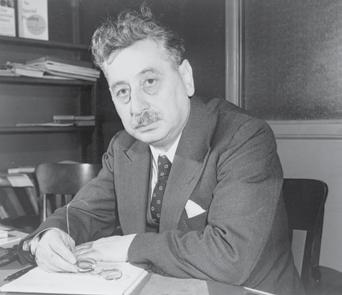
Sholem Asch initially wrote in Hebrew but was persuaded by a fellow writer to switch to Yiddish. // U.S. Library of Congress
The Saga of Gerrer Hassidim
By Gil Zohar
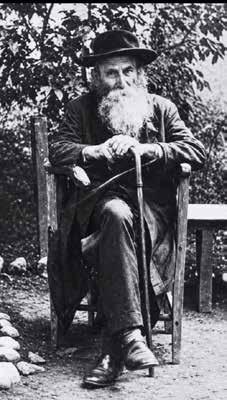
The Vistula, Poland’s longest river, snakes 660 miles north from the Tatra Mountains past Warsaw to the Baltic Sea. Some 20 miles upstream from the capital, the river flows past Góra Kalwaria (Mount Calvary). Today, it’s a dormitory suburb of burgeoning post-Communist Warsaw – which has evolved into Eastern Europe’s hub for hi-tech, skyscrapers, and high-speed trains. Polish Catholics revere the town (population 12,100) as Nowa Jerozolima (New Jerusalem). For world Jewry, it’s the now destroyed center of the Ger Hassidim.
Medieval Góra, located on the escarpment above the Vistula’s flood plain, was destroyed in 1666 during the devastating Swedish invasion of the PolishLithuanian Commonwealth. Reconstruction began in 1670, inspired by a Crusader map of Jerusalem. The street grid forms a Latin cruciform hallowed with churches and monasteries. Those remaining buildings are a place of pilgrimage for the Catholic faithful.
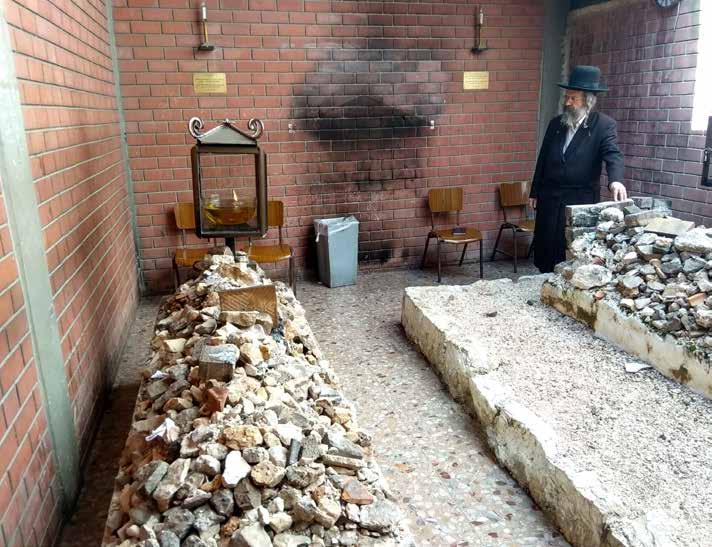
A 20-minute walk along Marianki Street brings one to Góra Kalwaria’s Jewish cemetery, located just behind the Catholic necropolis. Though not as popular a pilgrimage destination as the Ukrainian gravesite of Rabbi Nachman of Breslov in Uman, haredi visitors are not uncommon at the ohel (literally “tent” in Hebrew but meaning a “mausoleum”).
Jews settled there after 1802, when Napoleon abolished the medieval “de non tolerandis Judaeis” law restricting residence by religion. Yiddish became the predominant language in the multilingual town. Called Gur in Hebrew, the shtetl grew rapidly after 1859 when Hassidic Grand Rebbe Yitzchak Meir Rothenburg (1799-1866) settled there. Known affectionately as Reb Itche Meir, he established the powerful dynasty following the death of his brother-in-law, R. Menahem Mendl of Kotzk (1787-1859).
R. Yehudah Aryeh Leib Alter (18471905), the third grand rebbe of Ger, is known as the Sfas Emes (the Language of Truth). His seminal five-volume collection of homilies remains a key work of Hassidism. All of Ger’s dynastic leaders are his descendants.
Since 1996, the sect has been led by its eighth grand rebbe, Yaakov Aryeh Alter (b. 1939). Brooklyn’s The Jewish Press estimates his personal worth to be some $100 million. That wealth comes from real estate investments made by his father, the Imre Emes. Despite the cur-
rent rebbe’s wealth, he lived in an ordinary apartment in Bnei Brak until 2011, when he moved to Jerusalem.
In 1877, the Vistula River Railroad opened, linking Warsaw to Kovel, Ukraine, and benefiting Jewish and Catholic pilgrims en route to Góra Kalwaria. As Czarist Russia slowly modernized, so, too, the town began to prosper. In 1921, 2,691 Jews made it their home – 48.9 percent of the population. Most toiled in petty trade and crafts or provisioned the grand rebbe’s court. Wagoneers transported Hassidim to and from the train station, porters carried their luggage, and landlords rented out rooms during the holy days, when thousands flocked to the town.
Parisian journalist Albert Londres described Góra Kalwaria in his 1929 travelogue, “The Wandering Jew Has Arrived”: “Two thousand inhabitants, but one of the navels of Eastern Jewry. Here, the famous zadick [sic] Alter, successor to Baal Shem Tov, the one who took the Zohar across the Carpathian Mountains in a car, sought contact with God, just like our fans of wireless radio seek the airwaves.”
A decade later, the airwaves were silenced.
When the Nazis occupied Poland in 1939, they immediately targeted Góra Kalwaria’s Jews. Ewald Jauke, the town’s newly appointed ethnic German mayor, banned Jewish residents from engaging in trade. A 100-man forced labor corvée was conscripted daily.
In June 1940, Góra Kalwaria’s 3,500 Jews were restricted to a ghetto, which was liquidated on Feb. 25-26, 1941. Survivors were deported to the Warsaw Ghetto. Hundreds died of starvation and disease. The remainder were gassed in the summer of 1942 in the Treblinka death camp. The handful of survivors never reestablished the Jewish community.
The sect’s fourth Grand Rebbe, Avraham Mordechai Alter (1865-1948), known posthumously as the Imrei Emes (“Sayings of Truth”) after his key text, dodged the Nazi Angel of Death. Together with his son-in-law, three sons, and a grandchild, he fled to Warsaw on Sept. 6, 1939, two days before the Wehrmacht occupied Góra Kalwaria.
Removing his Hassidic garb, the rebbe went incognito. Toward the end of 1939, he and some family members escaped Nazi-occupied Warsaw and traveled to neutral Italy’s Adriatic port of Trieste via Kraków.
When the Imre Emes died in 1948, Jerusalem was being besieged by Jordan’s Arab Legion. Unable to bury their sage in the historic Mount of Olives Cemetery – where the pious have been laid to rest since biblical times - his followers turned the modest courtyard of his shtiebl into a tomb.
Named the Sfas Emes Yeshiva in honor of his father, the prestigious institution closed in 2016 when the group’s headquarters moved to Geula. In the late 1990s, the Great Beit Midrash Gur was inaugurated on Yirmeyahu Street.
Today, Ger constitutes Israel’s largest, wealthiest, and most influential Hassidic group, numbering more than 100,000 members concentrated in Jerusalem, Bnei Brak, and Ashdod. ì
Gil Zohar is a journalist and licensed tour guide in Jerusalem.
Since 1996, the sect has been led by its eighth grand rebbe, Yaakov Aryeh Alter.
SPORTS
Blank’s Soccer Training Facility Continues Legacy
By Alex Yonks
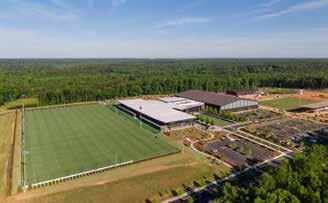
The Arthur M. Blank U.S. Soccer National Training Center in Fayette County has established itself as the permanent headquarters of U.S. Soccer, bringing together all 27 of the federation’s national teams on a single campus for the first time in its history. Named for Atlanta businessman and philanthropist Arthur M. Blank, the facility represents one of the largest investments ever made in American soccer and is undoubtedly poised to positively shape the future of the sport in the United States.
Covering 200 acres, 123 of which are already fully developed, the campus is designed as a year-round training and administrative hub. It includes 17 outdoor playing surfaces, indoor training facilities, and federation headquarters. Among its most notable features are 13 regulation-size natural grass fields, two turf fields, two sand pitches, and more than 400,000 square feet of indoor space. The layout allows multiple teams and programs to operate simultaneously, supporting everything from elite national team camps to coaching education and referee development.
The scale of the project reflects both logistical necessity and long-term planning by U.S. Soccer, which, for more than a century, has operated without a permanent home. The Fayette County campus is set to improve coordination among its programs by placing teams, staff, and support services in a shared location year-round.
Blank played a central role in making this vision possible. His $50 million contribution helped launch the project and ensured his name would be attached to the facility. The gift is consistent with his broader philanthropic approach, which has focused on building longterm institutions in Atlanta and beyond through the Arthur M. Blank Family Foundation.
Best known as co-founder of The Home Depot, owner of the Atlanta Falcons and Atlanta United, Blank has become one of Atlanta’s most influential civic figures. His philanthropic work spans education, healthcare, environmental conservation, youth development, and community investment across Georgia. Rather than focusing on isolated donations, his approach has often emphasized sustained support for systems and institutions intended to generate long-term impact.
At the ribbon-cutting ceremony,
Blank reflected on the broader meaning of the project and the role of sport in connecting people. “Soccer brings so many great human attributes together in the most beautiful way,” he said, framing the center as both a sporting facility and a gathering point for shared advancement and opportunity.
That theme of connection is also embedded in the design and mission of the campus. U.S. Soccer has emphasized that the facility will support not only men’s and women’s senior national teams, but also youth, Paralympic, and extended national team programs. Having these programs on the same campus is intended to create stronger connections between different stages of the national team system while expanding opportunities for athletes across a wide range of competitive levels.
Emma Hayes, U.S. Women’s National Team head coach, highlighted the importance of that shared environment during the opening celebration. “It’s a village.
There’s a community, and there’s a sense of belonging for everyone,” she said.
The center also arrives at a moment when Atlanta has firmly established itself as one of the most important soccer markets in North America. Since Atlanta United joined Major League Soccer in 2017, the club has consistently ranked among the league’s leaders in attendance and fan engagement. Additionally, Arthur M. Blank is a lead investor in the Atlanta National Women’s Soccer League team, yet to be named, that is scheduled to debut in 2028.
Atlanta’s selection as a host city for the 2026 FIFA World Cup further positions the region as a key site in the sport’s expanding American footprint. The addition of the U.S. Soccer National Training Center in nearby Fayette County strengthens that trajectory by providing a permanent year-round base for national team activity, training camps, and programming.
Beyond its athletic function, the fa-
cility contributes to the region’s broader identity as a growing hub for sports. Its presence is expected to bring regular traffic from athletes, coaches, referees, and staff, further embedding U.S. Soccer within the local economy and sports ecosystem.
For U.S. Soccer, the campus represents more than just a training site. It marks a structural evolution in how the organization operates. With coaches, technical staff, and support staff working from one location, U.S. Soccer hopes to improve efficiency, and foster collaboration across all teams and continuity throughout its player development pool, aiming to make the transition from youth level to senior national team more cohesive.
The Arthur M. Blank U.S. Soccer National Training Center stands as both a practical asset and a symbolic one. It signals a new phase of American soccer while reinforcing Atlanta’s growing role in shaping the sport’s future. ì
The Arthur M. Blank U.S. Soccer National Training Center has opened to great fanfare // All photos by U.S. Soccer
The center includes 17 outdoor playing surfaces, indoor training facilities, and federation headquarters.
Notable features include 13 regulation-size natural grass fields, two turf fields, two sand pitches, and more than 400,000 square feet of indoor space.
The Only Jewish Player in the World Cup
Earlier this month, as the U.S. men’s national soccer team was gearing up for its World Cup debut match against Paraguay at Los Angeles Stadium (otherwise known as SoFi Stadium), there was great anticipation among Jewish sports fans from Malibu to Caribou that goaltender, Matt Turner, would get the starting nod for the Stars and Stripes.
Turner, a product of St. Joseph’s Regional High School in Montvale, N.J., who has excelled for the New England Revolution in Major League Soccer (MLS), even acknowledged that there was “not a ton of clarity” as to whether he or Matt Freese, a talented netminder for New York City FC but a relative newcomer to international soccer, would receive the career-defining honor in representing one of the World Cup’s host nations. But, as widely expected, U.S. head coach Mauricio Pochettino went with Freese as his starter against Paraguay. A week after the United States’ 4-1 win in its World Cup opener, Freese was back in net as the U.S. blanked Australia, 2-0.
By all accounts, Turner, who starred for the U.S. during the 2022 World Cup in Qatar — he started all four matches and recorded clean sheets against England and Iran — is the sole Jewish player in this year’s field of competition. Israel, which hasn’t qualified for the World Cup since 1970, is once again not participating — this is partially due to geopolitics that nudged its soccer federation to compete in the talented European body, rather than in Asia — and Jewish MLS players, DeAndre Yedlin (Real Salt Lake) and Daniel Edelman (St. Louis City), both of whom previously played for the U.S. national squad, weren’t able to crack Pochettino’s roster this time.
But with Freese, the son of a prominent neurosurgeon and a healthcare executive who as a teen passed on Manchester United in favor of Harvard, presumably the starter barring a significant injury, Turner may not get onto the pitch this summer. Though Turner, who burst onto the amateur soccer scene as a dominant netminder for Fairfield University last decade, has taken the high road by lauding his teammate, the scarcity of World Cup game action has to be a letdown.
“There’s a million different pictures that go on in my head. I think about it a lot,” Turner told reporters attending Team
USA’s pre-tournament camp in Fayetteville, Ga., in early June as his team was preparing for the opening match against Paraguay. “I’ll probably cry when the national anthem goes. It’s just such a huge honor — overwhelming honor — to be granted that responsibility to be on this team to do our best in those roles and ultimately, change soccer here forever.”
Notably, Turner has not just embraced his American identity, but also his Jewish one. One of the most successful goalies in the MLS has recently opened up about his Jewish roots, explaining how he uncovered his Judaic heritage by locating his paternal great-grandmother’s emigration papers that had allowed her to escape Lithuania during World War II.
“Once I found the documents, I was certainly very, very excited,” Turner shared with the Jewish Telegraphic Agency three years ago. “America, in general, it’s a melting pot, and everybody has those roots elsewhere. So, to understand your story, your history, a little bit is really nice. The more my father and I dug, the more we learned, the more connected I felt to my Jewish side, the Jewish culture of my family. It really
changed a lot of me.”
Turner has really found himself for the Revs, an MLS club whose principal owner, Robert Kraft, is a prominent member of the Greater Boston Jewish community. After going undrafted in the 2016 MLS SuperDraft following a standout collegiate career, the now-31-year-old native of Park Ridge, N.J., agreed to a contract with the Revolution through a preseason trial and was tabbed the starting goaltender in 2018. During his 2021 breakout season, he was named MLS Goalkeeper of the Year and debuted for the U.S. national team, propelling the States to a CONCACAF Gold Cup title while taking home Best Goalkeeper honors.
Since then, Turner, who rejoined the Revs last year on loan from French club Olympique Lyonnais, has floundered at times on the global stage, allowing a combined nine goals in a pair of matches against Switzerland and Belgium over the past year. While those subpar performances may have contributed to his demotion on the current U.S. national squad, his sterling MLS career — he’s actually posted superior numbers to Freese this season —
suggests he would be a viable alternative should the current goaltending situation go sideways.
“I think playing consistent minutes at the level that I’ve been playing at this year has helped me tremendously with that, with staying ready,” said Turner, who’s also served as a backup goalie for Arsenal of the English Premier League. “Unlike in the past where I was kind of scrapping for minutes at the club level and then when you show up to the national team, you’re not as sharp when your number is called, so it’s obviously been really great to be playing consistently, be an important player for my team as well. Of course, it just helps me with my preparation on a weekly basis, daily basis and if my number is called, everybody knows I’ll be ready.”
Should the Americans keep rolling into the knockout round and make a stunning run against the greatest teams in the world, they would play in the July 19 championship match at New York New Jersey Stadium (MetLife Stadium) — less than a half-hour drive from where Turner first learned how to play soccer at the beginning of the century. ì
New England Revolution starting netminder Matt Turner is the back-up goalie for a white-hot United States team and the only Jewish player in this year’s World Cup // Photo Credit: New England Revolution
David Ostrowsky
Braves Still in First as Phillies, Nationals Inch Closer
By David Ostrowsky
For a fleeting moment this spring, it seemed like the Atlanta Braves were destined for a ho-hum second half, a National League East crown wrapped up shortly after Labor Day, a bye in the Wild Card round.
But now, at the halfway juncture of the 2026 MLB season, none of those hypothetical scenarios seem to be coming to fruition. Barring a most improbable epic collapse, the Braves still appear to be a lock for October baseball, but the season’s final three months will have their share of drama. And that may not be a bad thing.
Whereas the 2023 Braves coasted throughout the regular season before coming out flat in the National League Division series against the Philadelphia Phillies, this year’s ballclub no longer has an easy pathway to a first-round bye and homefield throughout the postseason. After the Braves’ mini-skid this month — on June 7, the Braves boasted a 45-21 record before dropping six of their next seven — the Phillies are suddenly in their rearview mirror in the NL East standings while the Los Angeles Dodgers and Milwaukee Brewers loom as worthy pennant contenders. At this hour, the two-time defending World Series champion Dodgers — not the Braves — have the largest division lead in the majors.
Nevertheless, Atlanta is still on pace for a fantastic 102-60 record, even more impressive considering the recent string of injuries to All-Stars Ronald Acuna Jr., Spencer Strider, Sean Murphy, and reigning NL Rookie of the Year Drake Baldwin (who recently returned to action). First-year Atlanta manager Walt Weiss is skippering a fundamentally sound team stacked with Gold Glove winners and burners on the basepaths. The back end of the bullpen is elite. The lineup has tremendous depth and power and tears up left-handed starters — even when left-handed veteran DH Dominic Smith is not in the lineup.
The Aug. 3 trade deadline is quickly approaching and there’s buzz that twotime defending AL Cy Young Award winner and impending free agent Tarik Skubal may be headed to Atlanta to shore up the starting rotation. If not him, perhaps veteran right-handed starter Sonny Gray. And in the here and now, taking two out of three from the Brew Crew at Truist Park last week — with wins against frontline starters Jacob Misiorowski and Kyle Harrison, no
Though the Braves have gone through a bit of a June swoon, the local nine is still well-positioned for a playoff berth as the season’s second half dawns // Photo Credit: Atlanta Braves social media
less — was a nice way to head out west for a brief road trip. Indeed, as the first week of summer unfolds, the Braves are in a very enviable position — and one that is a far cry from a year ago when they were buried in the NL East standings by Father’s Day.
“I think everybody’s just loose. I’m not saying that the other years we weren’t loose, but it just seems that everybody is meshing together,” reliever
Dylan Lee, he of the 2021 world champion Braves, told the AJT recently. “It’s not like we’ve ever had any cliques, but it just seems like everybody’s on the same page. There’s no pressure — I’m not saying there was before either — it’s just like we’re doing the same stuff we’ve been doing. It’s hard to keep a team together, especially a group of guys like this. They all want to be here. They all want to play every day.”
Meanwhile, the Braves are not without a Jewish representation as journeyman first baseman/DH Rowdy Tellez was promoted from Triple-A Gwinnett in the wake of Acuna Jr. (hamstring) hitting the 10-day injured list. The 31-year-old Tellez flashed signs of his trademark power down in the minors (.483 slugging per-
centage) and shortly after his call-up, he came off the pine to smash a monstrous two-run bomb against Milwaukee in the series finale. But, in all likelihood, Tellez doesn’t project to be up in Atlanta very long — Acuna Jr.’s injury is not particularly serious — and will likely be limited to pinch-hitting duty this week with Matt Olson and Smith having a stranglehold on first base and DH, respectively. Unfortunately, Tellez, now in his ninth and potentially final big league season, has sparked attention not for anything he’s done, but rather for what he’s elected not to do. Weiss has spoken glowingly about his club’s collective maturity and the veteran leaders, such as Chris Sale, Austin Riley, Ozzie Albies, Olson, and Lee, who make his life easier, but there was a recent notable exception, courtesy of Tellez, who during a game last Wednesday, refused to play in the outfield. The unfortunate situation unfolded in the late innings of Atlanta’s 7-5 loss to the San Francisco Giants on June 17. After pinch-hitting for shortstop Ha-Seong Kim in the bottom of the eighth, Tellez was asked to trot out to right field for the ninth as Atlanta’s injury-depleted outfield was down a couple
regulars in Acuna Jr. and Michael Harris II. But Tellez insisted on sliding over to first, forcing Olson to not take the field at his normal position for the first time in an MLB game since Aug. 21, 2017.
Ultimately, the awkward lineup shuffling didn’t factor into the game’s final outcome, but Tellez’s intransigence doesn’t bode well for his prospects of staying up in Atlanta for any length of time.
More importantly, from a team perspective, this year’s club seems to once again have outstanding chemistry — but unlike last year, a legitimate chance to play deep into October.
“This team is really special,” said Albies after slamming a walk-off two-run homer with one out in the bottom of the ninth that sealed the Braves’ seriesclinching 4-3 win over the Brewers on Saturday afternoon at Truist Park. “I’ve been on this team for a long time, and it’s a really special group each and every year. This one is definitely one of the top two that I’ve been on. [It’s a] great group of guys. Our staff [does] everything in their power, every single game to go out there and expect to win every day. I’m really honored to be on this team.” ì
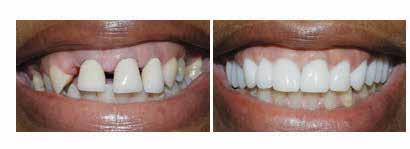
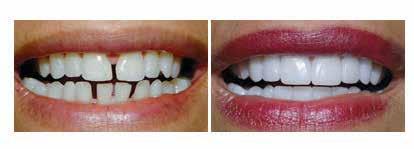
combining technology and artistry to create exceptional dentistry. As a comprehensive dental office that goes above and beyond our specialty in Cosmetic Dentistry, our patients believe Dr. David Mastro is the right choice for all your family dentistry needs!
When it comes to your smile and oral health, Dr. Mastro has a proven 30 year track record of providing quality cosmetic and family dental care for families in our local community and around the world.
Dr. David Mastro
Baron Appointed CEO of Air Force Museum Foundation
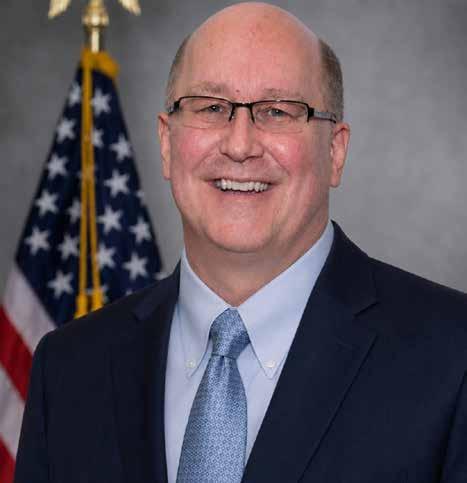
The Air Force Museum Foundation, Inc., formally announced that its Board of Trustees has appointed Seth R. Baron as chief executive officer. The Foundation is the nonprofit organization that raises funds and awareness in support of the National Museum of the U.S. Air Force, in Dayton, Ohio.
This announcement follows an extensive search by the Board of Trustees for an innovative, mission-driven executive leader with experience advancing nonprofit organizations, building high-performing teams, strengthening donor engagement, and scaling philanthropic growth. Melinda Lawrence, who has served as acting CEO and director, retail, since October 2025, will continue as director, retail.
In his new role, Baron will ensure the Air Force Museum Foundation’s continuing strong support of, and partnership with, the National Museum of the U.S. Air Force. Since its incorporation in 1960, the Foundation has provided nearly $100 million to the Museum and the Department of the Air Force, including directly funding 94 percent of the more than 19 acres of indoor exhibit space, and in recent years more than $1 million in annual program support. Trish Young, chair of the Board of Trustees, Air Force Museum Foundation, said, “We are excited to welcome Mr. Seth Baron to the
Foundation. His extensive leadership in the not-for-profit arena and passion for the military make him an exceptional fit
for the CEO position. His success and experience will bring innovative ideas and strategies to the partnership with the
Drits, Rubel Named Leaders of Tomorrow
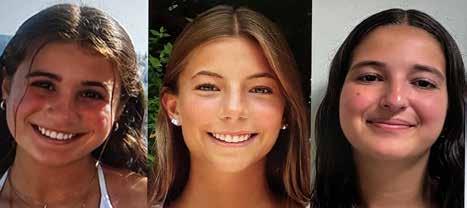
Hadassah Greater Atlanta is proud to announce that National Hadassah has named the winners of the 2026 Hadassah Leaders of Tomorrow Award for Young Women. Amazingly, two of the three winners are from the Atlanta area. These two winners are Lily Drits, 16, of Roswell, and Talia Rubel, 17, of Chamblee.
The award, a merit-based scholarship, is given each year to young women entering the 11th or 12th grades who have shown an unswerving commitment to Israel and the Jewish people and an ability to inspire and be a role model for others.
Each winner will receive $1,500 towards the tuition for Gesher Israel, a summer program offered by Young Judaea. Hadassah’s longtime partner and America’s oldest Zionist youth movement. Drits and Rubel will spend 3½ weeks in Israel this July honing their leadership skills while learning about the country’s culture and history and forging the lifelong friendships for which Gesher Israel – and
Young Judaea – are famous.
Terry Nordin, president of Hadassah Greater Atlanta, explains, “We are so thrilled that two out of three national honorees are young women from Atlanta. We are looking forward to honoring them personally at our Installation.”
Simone Wilker, advocacy chair for Hadassah Greater Atlanta, said, “Hadassah seeks to recognize and empower young women. This summer trip to Israel with Young Judaea will give them an experience they will never forget.”
Created in 2014, the Hadassah Leaders of Tomorrow Award for Young Women grew out of a decades-long partnership between Hadassah, The Women’s Zionist Organization of America, a leading advocate for Israel and Zionism since its founding in 1912, and Young Judaea. By providing merit scholarships that make it possible for American children, teens, and young adults to participate in Young Judaea’s camps, Israel programs,
Museum. I look forward to him advancing our shared goals.”
Prior to joining the Air Force Museum Foundation as CEO, Baron served as a vice president for Friends of the Israel Defense Forces, where he helped advance national strategic initiatives while overseeing the Georgia and Southeast States Region. During his tenure, he played a key role in expanding donor engagement, strengthening regional and national fundraising efforts, and supporting critical programs for soldiers and their families. His work included major donor cultivation, foundation partnerships, emergency campaign leadership, CRM strategy, and board and community engagement.
“I am honored and excited to join the Air Force Museum Foundation as CEO, and I am grateful to the Executive Committee and Search Committee of the Board of Trustees for their confidence,” said Baron.
“The opportunity to support the National Museum of the United States Air Force is both meaningful and inspiring, and I look forward to working with the Foundation team, Museum leadership, the Board, and the Dayton community to advance the mission and strengthen the Foundation’s impact.”
Compiled by AJT Staff
year-round activities and volunteer experiences, Hadassah is strengthening future generations’ connection to Israel and Zionism and shaping tomorrow’s Jewish leaders. To learn more, visit https://www.hadassah.org/press-
Seth Baron has been named CEO of the Air Force Museum Foundation.
(From right) Lily Drits of Roswell, Ga., Talia Rubel of Chamblee, Ga., and Michelle Camhi of Hollywood, Fla., the three winners of the 2026 Hadassah National Leaders of Tomorrow Award for Young Women.
ADULT COUNSELING
GERIATRIC CARE MANAGEMENT
Licensed therapists now accepting new clients, virtually or in person. Most major insurance accepted. jfcsatl.org/gcm jfcsatl.org/adultcounseling
Expert geriatric care managers coordinate the services, support, and answers your family needs, wherever you’re starting from.
Football’s Family Reunion
The oft-quoted commentator “somebody” offered this quip about the men’s World Cup soccer tournament: “The United States is having a giant sleepover with the cousins we never see because our parents hate each other.”
The cousins clearly are less interested in sleeping than carrying on an aroundthe-clock party.
The World Cup is soccer’s greatest spectacle and global social gathering. Having taken our oldest son to the 2006 men’s World Cup in Germany (beware the bar mitzvah presents you promise years in advance), I can attest that football has a language of its own, one more reliant on a love of the game — and perhaps a pint or two — than any particular dialect.
Last week, I joined our youngest son in the upper deck of the Mercedes-Benz Stadium to watch Czechia play South Africa. This was never going to be a marquee matchup and the 1-1 draw was underwhelming.
But the atmosphere around the game was everything the World Cup should be — colorful, lively, and festive.
Beforehand, thousands of people milled about in the sunshine, taking in the scene, and stood in lines to
buy souvenirs, food, and beer.
Inside, the Benz was crowded with fans wearing jerseys, scarves, and flags representing national and club teams from around the world, not only Czechia and South Africa, but also Mexico, England, France, Italy, Argentina, the United States, and elsewhere.
I have a jersey collection, but after some thought, wore a shirt from the 1996 Olympics in Atlanta and a hat from the 2006 World Cup.
Our youngest son knows that I am not a fan of the song “Take Me Home, Country Roads,” by Henry John Deutschendorf, Jr. (aka John Denver), which has become something of an unofficial anthem at World Cup games. That may explain his glee in joining tens of thousands of people, from dozens of countries, singing lustily about West Virginia, a place most likely could not point to on a map.
FIFA, the Federation Internationale de Football Association, the game’s global governing body, expanded the World Cup field this year to 48 teams.
Worries about diluting the quality of the games have been mitigated by the performance of teams from two island nations, Curacao (population: 156,000) and Cabo Verde (population 550,000), both bolstered by stunning goalkeeper performances.
The scenes at the fan fest in Atlanta’s Centennial Park, during and after Cabo Verde’s heroic and historic scoreless draw with Spain inside the Benz, were epic, people from so many nations celebrating with the fans
of the “Blue Sharks.”
Meanwhile, the World Cup party has been led by the Scots. As the “Tartan Army” sings, “No Scotland, no party.” An absence of 28 years from the World Cup will do that.
There were the Scots who moved into an Airbnb near Boston in the dead of night, festooned the exterior of the house with Scottish flags and then, at 6.30 in the morning, introduced themselves to the neighbors with bagpipes.
And when they moved out a week later, again in the dead of night, they draped those flags along the fence of the house across the street and left the homeowner three bottles of their country’s best known product.
While in Boston, the kilt-wearing Scots did their level best to drink the city dry, placed orange traffic cones atop statues (something they fancy doing back home), and joined the Red Sox faithful at Fenway Park in belting out “Sweet Caroline.”
After Scotland’s first two group stage games in Boston, the Tartan Army moved on to Miami (for a match with Brazil), where the police seemed less amused by the orange-cones-on-statues routine.
The Boston Globe waved the Scots goodbye with a full-page salute: “Boston has hosted championships, parades, and celebrations of every kind. But we’ve never hosted guests quite like you all.”
That’s what you get when the cousins visit and make themselves at home.
A similar romance developed in Lawrence, Kan., where Algeria’s “Fennec Foxes” held their base camp. The locals adapted the University of Kansas “Rock Chalk, Jayhawks” chant to “Rock Chalk, Algeria.” Lawrence Mayor Brad Finkeldei said, "We’ve embraced them, and they’ve embraced us.”
Then, there are the Norwegian fans, who seem prone to sitting en masse almost anywhere — be it the bleachers at the center of Times Square in New York City or on the floor of a moving subway train — and, led by a drum, doing the “Viking row.”
Drs. Marc Seltman & Richard Kaplan and Staff of Personal Care Physicians of Atlanta are pleased and honored to welcome our newest member, Dr. Howard Silverboard.
Dr. Silverboard has had a long and distinguished career practicing Internal Medicine in Atlanta. After specializing for many years in Pulmonary Medicine, he is shifting his knowledge, passion and skills to Primary Care. We are pleased to have this wise, kind and compassionate physician join our team. Dr. Silverboard will be enrolling patients beginning July 1st, 2026.
At this writing, the positive results posted by teams representing the World Cup hosts — the U.S., Mexico, and Canada — have their fans happy to join the raucous football family reunion.
There are amusing videos online of tourists from around the world delighting in their discovery of Buccee’s and Waffle House, and partaking in such culinary delights as . . . ranch dressing.
In a rare display of humor, the Transportation Security Administration posted a notice warning that anyone leaving the United States with bottles of ranch dressing should place them in checked, rather than carry-on, luggage.
As for those cousins whose parents don’t like each other, the U.S. government has required Iran’s team to leave the United States after each of its games and return to its base camp in Mexico.
To be sure, the world’s ills don’t vanish because of a soccer tournament, but the World Cup has provided welcome examples of people from around the world getting together and getting along.
Perhaps, as “somebody” also was quoted as saying, football is the answer. ì
Dave Schechter
From Where I Sit
Choosing Jewish Community No Matter the Distance
A couple of weeks ago, I played pickleball with a few friends at Sandy Springs Racquet Center instead of the JCC. There was nothing particularly malicious about this decision; I was not making a statement or acting on some deep personal conflict. Instead, it was far simpler: it was more convenient. My friends and I didn’t want to travel the extra 15 minutes to play on the admittedly far nicer courts at our Jewish Community Center. It was simply closer.
But afterward, I thought about the implications of my actions. What does it mean to call myself a member of the Jewish community if I only support it when it is convenient? What does it mean to just take from it, and what does it mean to give? These questions cannot be ignored; we have to answer them every single day. Oftentimes, the answers that lead us farther from our community aren’t malevolent. They come from a simple reluctance to make an effort. But effort is what sustains this community. Effort is what keeps us alive.
The Jewish community, particularly in Atlanta, is built on the idea of going out of the way to support each other. Jewish life in Atlanta has long been supported by institutions like Hadassah, BBYO, AJC, and the Jewish Federation. Without these foundational organizations working to ensure a thriving Jewish community, a strong Jewish presence in Atlanta would be near impossible. Specifically, synagogues have played an immense role in sustaining Jewish life. Reform synagogues like The Temple and Temple Sinai, Conser-
vative synagogues like Ahavath Achim and Shearith Israel, Orthodox synagogues like Beth Jacob and Beth Tefillah, and the rapidly expanding network of Chabad centers across Atlanta have built Jewish religious and communal life for generations, but these institutions require one essential ingredient: effort. Effort to attend Friday and Saturday services, bar and bat mitzvahs, and High Holidays. Effort to go to events and engage younger generations early and often.
Recently, we have struggled to support these congregations with the same consistency they require. Synagogue attendance across American Jewish life has declined, and many congregations now face aging populations, financial strain, and lower levels of regular participation. Pew Research found that “Jewish adults are among the least likely groups of religiously affiliated Americans to say they attend religious services in person at least monthly.”
Any American or Atlanta Jew can recognize the evident decrease in religious involvement among American Jews, particularly among the younger population. With declining synagogue attendance, maintaining Jewish involvement in one’s life becomes much more difficult. But this isn’t anything new. Historically, many Jewish communities, especially in modern Western societies, have faced high rates of secularization and assimilation. Nevertheless, a decrease in synagogue attendance means greater reliance on outside institutions that often provide far less continuity.
Take BBYO, for example, which has become one of the most popular Jewish youth organizations in the United States, fostering tens of thousands of high school teens. But BBYO is still primarily built around the high school experience. Once teens leave for college, they have to find a new institution. They may find a Hillel or Chabad on campus, but once they leave college, they
need another new organization for Jewish involvement. And before high school, many young Jews may not have a unified program activating that same level of Jewish engagement.
Even BBYO reflects a broader failure to emphasize effort in everyday Jewish life. If Jewish life is shaped mainly by when there is an event planned for us, when our friends are going, or when it feels socially convenient, then convenience becomes the defining aspect of Jewish involvement. This is not an indictment of BBYO; in fact, for many teens, it is their first real introduction to Jewish life. But if Jewish involvement only exists when it is convenient, entertaining, or planned for us, then we have failed to make it part of who we are.
But this problem is not limited to BBYO, synagogues, or any one institution. It is rooted in how we see our community. It is a problem in how we don’t simply sustain Jewish life for ourselves, but rather sustain Jewish life for each other. Too often, involvement in our community only occurs when our friends are going, when it is closer, or when it is already built into our schedule. We participate when it is easy or when we
have to, but the second it requires true effort, it becomes a nuisance rather than a privilege. This is the real test of a community. Not whether we consider ourselves Jewish – culturally or religiously – but whether we put in the effort to sustain the community that allows for that very identity. A true community is not built by those who only show up when it costs them nothing; it is built by those who care enough to go out of their way, even when they could be doing something easier.
This is why the JCC example stuck with me. It was not some moral failure, but it forced me to consider how my habits affect the community that raised me. How can we choose the easier option and still expect our community to stay strong? How often do I embrace my community while simultaneously treating it as optional?
These are questions that, sooner or later, we are going to have to face. Because in the end, the Jewish community is not something we simply inherit. It is something we choose. And we have to keep choosing it, even when it is 15 minutes farther away. ì
Jackson Powers is the Managing Editor of The Weber School’s Rampage newspaper.
Powers Guest Contributor
Rabbi Roundtable
Rabbi Edward Harwitz, Conservative Rabbi Edward Harwitz has been the head of The Weber School in Sandy Springs since 2014. For more than 30 years, Rabbi Harwitz has taught and served in leadership of Jewish organizations, including Jewish camps, high schools, and educational organizations. Rabbi Harwitz earned a B.A. in history and philosophy at George Washington University, a master’s degree in Hebrew letters from The American Jewish University, and a Master of Arts and rabbinic ordination at the Jewish Theological Seminary. He also studied extensively at the Schechter Institute of Jewish Studies in Jerusalem.
Dr. Rebecca Winter, Orthodox Originally from Toronto, Canada, Dr. Winter spent time learning in Israel at Midreshet Lindenbaum, MATAN, and at Stern’s Graduate program for Advanced Talmudic Studies. She recently completed Ohr Torah Stone’s prestigious 4-year International Halakhic Scholars Program and was recently selected as a Sacks Scholar. This is her eighth year teaching Tanach at Atlanta Jewish Academy (AJA), and she loves the genuine curiosity and enthusiasm of AJA’s students. Dr. Winter holds a PhD in clinical neuropsychology, and when she is not at AJA, she enjoys seeing patients in private practice nearby.
In partnership with the Atlanta Rabbinical Association, the AJT’s monthly Rabbi Roundtable brings together spiritual leaders from across Atlanta representing each denomination.
Rabbi Larry Sernovitz, Reform Rabbi Sernovitz is CEO of Hillels of Georgia. He has served the Jewish community for nearly two decades, including as Senior Rabbi at Temple Kol Emeth in Marietta, and previously as Founding Rabbi and executive director of Nafshenu of Cherry Hill, N.J. He earned his rabbinic ordination at Hebrew Union College, where he also received the Rabbi Edwin N. Soslow Memorial Prize in Jewish History. He is deeply involved in the Atlanta community as member of the Leadership Atlanta Class of 2023 and, in 2022, was inducted into the Martin Luther King, Jr. International Board of Preachers at Morehouse College.
For this month’s discussion, each spiritual leader was asked the following question:
What’s one blessing you wish every graduate could hear before stepping into what comes next?
Dr. Rebecca Winter
You will forget a lot of what you learned, but the most important things will remain with you.
There is a striking passage in the Talmud (Temurah 16a) that describes what happened after Moshe’s death. According to the Gemara, the people forgot 3,000 laws. Three thousand! Faced with the loss of their teacher and leader, they turned to Yehoshua, hoping that he would simply restore what had been lost. Instead, he reminded them that the Torah was no longer in Heaven; it had already been entrusted to the Jewish people. And ultimately, the people found their way back to those laws.
As an educator, I find this passage deeply reassuring. Our students will forget a lot. In fact, if we’re being honest, our recent graduates already have. They will forget facts, details, and even some of the lessons we worked hardest to teach. But they also remember more than we give them credit for.
The goal of education was never perfect recall — it was internalization. At some point, ideas become convictions, values become choices, and learning becomes part of a person’s character. A student may forget a particular source but remember a value. They may forget the details of a class discussion but remember how to ask a thoughtful question. They may forget a lesson, but not the person they became while learning it.
None of our graduates have everything figured out. Frankly, most adults don’t either. But my blessing for them is this: when they encounter uncertainty, as they inevitably will, may they trust that the most important things have not been forgotten — only absorbed.
May they carry with them the Torah they have learned, the values they have developed, the relationships that have shaped them, and the resilience they have built. And may they discover, again and again, that these gifts remain with them wherever they go.
Rabbi Edward Harwitz
At the dawn of the 20th century, a generation of young Jews recognized that they lived in a unique historical moment — one filled with both extraordinary opportunity and profound challenge. Inspired by Zionist leaders such as David Ben-Gurion and Ze’ev Jabotinsky, they launched a movement that would change history and establish the modern State of Israel.
How is it that you have earned both the distinction and the burden of being the greatest generation of Diaspora Jews in more than a century? The answer lies not in who you are, but in the moment that has formed you.
That moment was shaped by the two defining communal traumas of your teenage years: the pandemic and lockdown of 2020, and the Hamas attacks of Oct. 7 and their aftermath. Amid war in Israel and the resurgence of antisemitism around the world, you responded not by withdrawing, but by leaning in — taking initiative, assuming responsibility, and seeking opportunities to serve.
Like the young Jewish pioneers who helped build the State of Israel, you understand the complexities and challenges of our world, as well as the opportunities that emerge when intellect, talent, passion, and leadership are placed in service of a cause greater than oneself.
I do not call you our greatest generation because of what you have already accomplished, but by virtue of what this moment now demands of you. It is a charge and a sacred responsibility.
To paraphrase the refrain from the Broadway musical that provided the soundtrack for your lives: “history has its eyes on you.” Know that your parents, teachers, and community believe in you, support and love you, and are counting on you to lead and serve the Jewish people in the years ahead.
Rabbi Larry Sernovitz
My middle child just graduated from The Davis Academy and will be headed to high school next year. As I watched her ascend the steps to the stage to receive her diploma, I felt my eyes well up with tears, mostly happy ones. It feels like it was just yesterday when we welcomed her into the world, gave her a Hebrew name, and prayed that her life would be filled with love, learning, and lessons that would guide her along the way. She made us immensely proud about a year ago when she became a bat mitzvah. But time is our most precious possession, a gift which we can never take for granted or recover once it becomes the past. I hope she, and other graduates, know to make the most of the time we have as the years go by.
The words of Genesis 12:1, Abraham’s call, help us understand the precious nature of time. G-d tells Abraham to, “Lech Lecha,” go forth to the land that G-d will show him. Yes, there is a journey before each of us, and in this case, Abraham. He has to leave the comforts and rituals of home and head out, finding his own way. But, before he does, he must “lecha,” look inward to understand who he is and who he wants to become. This is one of the most complex challenges of our lives. Does Abraham, or any graduate, truly know who it is that they want to become? Hillel says, “If I am not for me, who will be for me.” We must look out for ourselves and make sure we have what we need to create lives of meaning and purpose. But, as anyone who has lived, doesn’t that change depend on our experiences and the people who guide us along the way? What is our true potential and how can we achieve it when challenges come our way? The second lesson any graduate needs to know is to look within to find our own potential and know that the destination is not the key but the journey itself.
Lastly, I received a lesson from a mentor of mine about 24 years ago when I first began rabbinical school that has been a grounding principle in my life ever since. Rabbi Michael Klein Katz stood in the front of my first-year class in Jerusalem and said to us, “Rabbis, in order to be good rabbis, you have to be yourself unless you are not a good person. In that case, be someone else.”
Graduates, be true to yourself, be kind, compassionate, and filled with empathy. For the most part, people are filled with goodness. Treat them that way. It is amazing to see what happens when you recognize the humanity in the people around you. Mazal tov on your journey. Enjoy the learning along the way. Open your hearts to it all. ì
Atlanta Rabbinical Association
HEALTH & WELLNESS
Rabbi Adler’s Transplant Story Leaves Lasting Bonds
By Marcia Caller Jaffe
In the space between grief and gratitude, a bond formed between mourning the loss of a husband and father, with the other celebrating a second chance at life.
Andy Lipman, who died at 51 in January 2025, was a man who defied the odds; and Rabbi Jonathon Adler, assistant rabbi at Congregation Etz Chaim, now carries part of Andy’s legacy within him.
Lipman was born with cystic fibrosis (CF), a genetic disease that, at the time of his diagnosis, carried a life expectancy of about 25 years. Rather than surrender to that prognosis, Lipman spent his life proving it wrong. He became an outspoken advocate for others with CF, channeling his experiences into five books about the disease, the people it affects, raising money, and the resilience required to face it. He was on TikTok and Facebook encouraging others, even sharing news about a promising new drug. Ironically, it was not cystic fibrosis that took Lipman’s life. He died unexpectedly from a brain aneurysm. Because CF
patients rarely qualify as organ donors, Lipman had never registered. His widow, Andrea, knew of his altruism and charac-
ter. When the LifeLink team told her that donation was medically possible, she didn’t hesitate. She knew Andy would
have wanted this. A memory crystallized her decision. Once, when Andy came home deeply
Dermatology Associates of Atlanta: Your Skincare Home
Discover specialized patient care at Dermatology Associates of Atlanta! As the leading dermatology practice in Atlanta, think of us as your “skincare home” where you can explore a variety of treatments for the skin, hair, and nails at one of our eight distinct specialty centers. Whether you’re looking to undergo non-surgical fat reduction with our stateof-the-art Emsculpt® procedure or want help with removing acne scarring, our board-certified dermatologists are here to help.
Our team comprises three exceptional doctors: Dr. D. Scott Karempelis, Dr. Joseph R. Payne, and Dr. Ashley Curtis, along with a staff of highly skilled, board-certified physician assistants. Along with a dedication to their craft, Dr. Ashley Curtis and Dr. Scott Karempelis also hold a Castle Connolly Distinction. Castle Connolly Top Doctors are handselected, featuring only the top 7% of doctors in the country. Doctors can be nominated by their peers to be selected for screening by a physician-led research team. We are extremely proud to have
two doctors on our staff who hold this distinction, further solidifying our commitment to outstanding patient care.
What sets us apart is our eight unique specialty centers, which enable us to deliver patients with truly specialized care. The Dermatology Center assists individuals with various skin conditions, ranging from acne and age spots to hyperpigmentation and other dermatological issues. Skin Medics Medical Spa offers a range of cosmetic dermatology services, including non-surgical fat reduction, dermaplaning, chemical peels, and more. We’re also one of the leading providers of cosmetic laser treatments in the South-
east at our Laser Institute of Georgia center, where we offer services for any issue, including scarring and spider veins. Looking to get rid of unwanted body and facial hair? Our Hair Removal center uses industry-leading laser hair removal and electrolysis technologies! For those suffering from skin conditions like psoriasis and eczema, the Psoriasis Treatment Center and Eczema Treatment Center are experts in addressing your needs. If you’re going through issues with hair loss, The Center for Non-Surgical Hair Loss and The Center for Women’s Hair Loss are industry leaders in this field.
No matter what your dermatological needs look like, our team at Dermatology Associates of Atlanta is ready to help you reach your skin care goals. We pride ourselves on offering top-of-the-line services that are also versatile, enabling us to support patients at every stage of their lives. If you’ve been searching for a dermatologist's office that will listen to you and provide a tailored service experience, give us a call today at (404) 256- 4457! You can also visit our website at https://dermatlanta.com/ for more information and to fill out an appointment request form. We look forward to helping you feel your best from the inside out this new year!
Andrea Lipman and Rabbi Jonathon Adler have formed a bond as the latter lived on with Andy Lipman’s kidney.
Front from left: Dr. D. Scott Karempelis; Dr. Ashley Curtis; Dr. Joseph Payne; Back from left: Danna Dennis Calder, M. M. Sc., PA-C; Mara P. Grosswald, PA-C; Ines Karempelis, PA-C; Del Henderson, PA-C
HEALTH & WELLNESS
moved by a late friend’s Honor Walk, an emotional ceremony accompanying organ donation, he said, “I will never get to do that.” That stayed with her — and ultimately guided her choice.
The day before Andy’s organ recovery, Andrea was at Piedmont Hospital with Rabbi Joshua Heller, of Congregation B’nai Torah, when he mentioned that a local rabbi was in need of a kidney. Andrea immediately asked about the possibility of a match. The LifeLink team confirmed, but a decision was needed at once — the transplant list wouldn’t wait.
Before agreeing, Andrea asked Rabbi Heller, “Tell me about him.” His reply was simple: “I know that he’s a true mensch.”
That was enough. Andrea and Rabbi Heller made the tear-laden decision. Andy’s kidney was going to go to Rabbi Adler — his other kidney, liver, heart valves, and skin — went on to help multiple recipients.
Andrea waited a year before writing Adler a letter — a period that transplant families are encouraged to allow time for both healing and grief. They have since shared coffee, enjoyed lunch with her daughter, and begun a lasting friendship.
When Andrea received Rabbi Adler’s reply, she found exactly what she had hoped for. Knowing Andy’s organs went on to save lives brought comfort. Knowing that his memory had become a source of strength for someone else — that even in his most unexpected ending, Andy was still doing what he had always done — helping others.
Rabbi Adler is fully recovered and thriving. His medical team is encouraged by his lab results, and whereas he once took 17 pills daily for kidney support, he now takes nine. The transformation, he says, goes deeper than the physical.
In a letter to Andrea, Rabbi Adler reflected on how the transplant reshaped his understanding of a phrase he had said countless times: Zichronah Livracha — “may someone’s memory be for a blessing.”
“Before, I often thought about how loved ones’ lives affected me, and what an intangible but wonderful source of blessing these are. But after my surgery, I realized that my donor’s memory is a physical blessing to me,” he said.
Rabbi Adler wrote that learning about Andy’s legacy — his advocacy and love of community — deepened the meaning of this gift. He feels both honored to carry part of Andy and compelled to honor that through how he lives and leads at Congregation Etz Chaim.
Andy Lipman, a University of Georgia graduate, Atlanta Braves fan, and “all around good guy,” was featured in the AJT (October 2024) as his family dedicated the Eva Lipman Pickleball Center at the Marcus Jewish Community Center of Atlanta. There, he praised his mother’s similar warmth and ability to raise money, and recalled the death of his infant sister from CF.
Andrea concluded, “Andy would be amazed to know that he was able to save lives even after his passing and that the recipients are doing so well today.” ì
Andy Lipman was known as a warrior as he raised money and helped others navigate the cystic fibrosis journey.
HEALTH & WELLNESS
Discover Jewish-Owned Medical Marijuana Therapeutics
By Lulu Rosenberg
Since 2019, the women-owned, Jewish-owned practice Medical Marijuana Therapeutics has served as Georgia’s premier medical cannabis certification practice, helping Georgians with chronic health conditions access medical cannabis with safe, well-monitored, and successful outcomes.
Today, they serve around 500-600 patients, offering education, product recommendations, usage guidance, medication interactions, and customized treatment plans. Each patient is evaluated meticulously and carefully to ensure they receive the most comprehensive medical care possible. As much passion as the team possesses, it’s hard to believe that launching this business was never their plan until Melanie Jacobson firsthand experienced the medicinal and therapeutic benefits of medical cannabis.
Jacobson, who faced severe medical challenges growing up, said, “They [her family] had seen me struggle my entire childhood. When they saw how this [medical marijuana] affected me, it really didn’t take much to convince them that we should start this medical practice.”
Jacobson, along with her mother, Vicki Jacobson, and aunt, Madelaine Murad, M.D., came together, each bringing their own specialties to the table, to create Medical Marijuana Therapeutics (MMT). They understood on a personal level how vital it was to make medicallysupported cannabis treatments accessible for others.
Dr. Murad, MMT’s chief medical officer, and Melanie Jacobson, MMT’s director of cannabis consulting, have both undergone extensive education to ensure they can provide the highest standard of
In the field of medical marijuana practices across Georgia, Medical Marijuana Therapeutics stands out for its commitment, guidance, knowledge, qualification, and support.
care to all of their patients. Unlike other typical medical cannabis facilities, MMT does more than issuing medical marijuana cards. Vicki Jacobson, who serves as MMT’s chief operating and marketing officer, said, “We’re not just here to certify patients. We’re here to guide them through the process.”
Through a holistic approach that is fully compliant with Georgia law, MMT offers various services to their patients. The most comprehensive service one
it works to relieve symptoms and pain. After the two appointments, patients receive certification and entrance into the Department of Health Registry for their medical marijuana card. They are given a customized treatment plan, indicating which strains to use, which forms of treatment -- varying from oils, capsules, lozenges, lotions and others, where to purchase them, and how to properly dose them.
The Non-Certification Package includes all the same services as the Certification Package but applies to patients who already have their medical marijuana card. If you live in Georgia and experience any of the following medical conditions, you would qualify for a medical marijuana card: Seizure Disorders, Multiple Sclerosis, Peripheral Neuropathy, Parkinson’s Disease, Alzheimer’s Disease, Tourette’s Syndrome, Amyotrophic Lateral Sclerosis, Autism Spectrum Disorder, Post-Traumatic Stress Disorder, Cancer, Mitochondrial Disease, Sickle Cell Disease, Crohn’s Disease, AIDS, Epidermolysis Bullosa, Intractable Pain, and In Hospice Program.
can receive is the Certification Package, which is most applicable for patients who do not yet have a Georgia medical marijuana card. After a prescreen to verify qualification, patients have a consultation with Dr. Murad, which includes an evaluation of needs, education, and assessment of medical conditions, medications, and possible interactions. Following the consultation, patients meet with Melanie Jacobson, who educates on the cannabis plant and discusses how
For patients who do not have a qualifying condition, they can still benefit from the Product Advisory service, which includes a session with Melanie Jacobson where patients receive education on how they can still benefit from non-THC cannabis and are given a personalized treatment plan. Through every service provided, Vicki Jacobson affirms MMT’s approach: “Everybody’s body chemistry is different. We’re trying to help them get to that sweet spot where they take just enough to get relief, but not so much that they feel uncomfortable [by experiencing psychoactivity].”
As many of the qualifying medical
The women-owned, Jewish-owned practice, Medical Marijuana Therapeutics, serves between 500-600 patients.
conditions affect seniors, MMT is extremely committed to spreading awareness about the benefits of medical cannabis and helping Georgia seniors safely access it. By offering step-by-step guidance, the practice helps patients navigate what can often be an overwhelming and uncertain process while providing the tools and support needed to make informed decisions about their care.
Medical marijuana acts as a natural alternative to a number of medications and can greatly reduce or replace the prescriptions people may be taking. When reflecting on the impact and medical cannabis journey of patients, specifically seniors, Melanie Jacobson said, “A year later, we see them and they’re off several medications, and they’ve restored their quality of life.”
Furthermore, MMT is a solely virtual practice, offering telemedicine all across Georgia. Vicki Jacobson said, “People would drive a couple of hours to come see us. Now we can tell them, ‘You don’t have to leave your house. We can help you online.’”
Through telehealth, MMT is breaking barriers to access across the state and providing supportive care to a rising number of patients seeking alternative, organic treatments.
In addition to making a difference through MMT, Melanie Jacobson is very involved with the legislature regarding Georgia’s medical cannabis program. Working alongside State Rep. Long Tran of Georgia State House District 80, Melanie had the opportunity to draft House Bill 797 in 2023. This legislation later provided foundational language and messaging for the 2026 passage of the Putting Georgia’s Patients First Act, Senate Bill 220 (SB 220). Through the advocacy efforts of Melanie and numerous patient activists, SB 220 expands patient access to medical cannabis and moves Georgia closer to aligning its program with the 41 states that have established comprehen-
HEALTH & WELLNESS
sive medical cannabis programs.
The legislation officially replaces the term “low-THC oil” with “medical cannabis,” increases potency and possession limits, authorizes new delivery methods such as vaporization, and expands qualifying conditions to include lupus, severe arthritis, and severe insomnia. Additionally, SB 220 strengthens physician oversight and improves patient access throughout the certification and treatment process.
According to Vicki Jacobson, under the previous medical cannabis law, THC was limited to 5 percent by weight. Because the cap was based on weight, manufacturers could create products with varying potencies by adjusting the density of the product, as long as the THC content did not exceed 5 percent of the total weight. The new law removes the 5 percent potency limit, but it still restricts the THC to a specific amount. Instead of a percentage cap, it shifts to a milligrambased system, similar to the way pharmaceutical medications are measured. Under SB 220, THC content will be limited to 1,200 mg per individual product container.
When reflecting on her legislative advocacy, Melanie Jacobson expressed, “These barriers [of access] exist for my patients, and I have a way to change that.” The bill, SB 220, will be put into effect on July 1, but Melanie will continue to speak up until Georgia’s medical cannabis is as effective and accessible as possible.
In the field of medical marijuana practices across Georgia, MMT stands out for its commitment, guidance, knowledge, qualification, and support. This practice is an example of devoted people wanting to make a difference based on firsthand experience.
Vicki Jacobson said, “We observed her [Melanie] for so long not feeling well and then saw this metamorphosis. We thought, ‘Wow, we have to share this with the world.’”
Together, they created a practice that delivers real benefits for their patients and restores their quality of life. Melanie Jacobson said, “This is the biggest privilege of my life because I literally couldn’t get out of bed 18 hours a day. Now I can do anything I want.”
Through MMT, Melanie is able to give others the gift of relief that she herself experienced. With the support of her family, they are committed to championing this movement to significantly improve the wellbeing of so many Georgians dealing with qualifying diagnoses. Visit mmtga.com or call or text 404291-9103 to learn more or connect with the devoted team of Medical Marijuana Therapeutics. ì
MODERN LUXURY STYLISH LIVING
Our commitment to continuous
Experience modern luxury and stylish living at Heartis Buckhead
Look and feel your best without having to go far at the rooftop swimming pool.
Alembik Continues Philanthropic Pursuits
By Marcia Caller Jaffe
Retired attorney Judith Alembik became serious as an octogenarian in her pursuit of giving back and favoring the Jewish community. In both July and November of 2024, Alembik was featured in the AJT for two separate seven-figure pledges to Jewish organizations.
Now, at 88, she’s back on the goodwill wagon with yet another meaningful, well considered project. She said, “The greatest joy in giving comes not simply from generosity itself, but from seeing the lasting impact it has on the lives it touches.”
Alembik’s gifts support organizations that nurture and strengthen Jewish youth. She endowed Ahavath Achim Synagogue’s youth education initiatives, established a fund through the Jewish Educational Loan Fund benefiting the children of clergy, and now, together with her son, Gary, has created the Judith and Gary Alembik Youth Mental Health Fund at Jewish Family & Career Services of Atlanta (JF&CS).
This new fund at $1 million will
support youth mental health outreach initiatives through JF&CS’s BeWellATL program, a community-wide initiative dedicated to supporting Jewish youth and the adults in their lives.
Launched in Atlanta in 2023, BeWellATL was created in response to what community leaders identified as a growing youth mental health crisis. The initiative was initially funded through a $500,000 matching grant from The Zalik Foundation, together with support from the Atlanta Jewish Foundation and the Atlanta Jewish Funder Collaborative. In an effort to further encourage community support, The Zalik Foundation will also provide matching funds for the Alembik family’s new gift.
For Gary, the initiative is deeply personal.
“As a family law attorney who regularly serves as a guardian ad litem, I see firsthand the emotional challenges facing many of our young people. Many teens and young adults are struggling with anxiety, isolation, academic pressures, social media stressors, and feelings of hopelessness. Through my work with
families and children, I have seen how important it is for young people to know that they are not alone and that support exists within our community.”
BeWellATL is dedicated to promoting the well-being of Jewish youth. Through partnerships with synagogues, Jewish schools, camps, Hillels, and community organizations, BeWellATL offers peer support initiatives and teen and parent workshops on topics including suicide prevention, neurodiversity, executive functioning, emotional wellness, harm reduction, and the impacts of technology and social media.
Gary reports that according to the CDC’s 2023 Youth Risk Behavior Study, more than four in 10 teens reported feeling persistently sad or hopeless, while roughly one in 10 adolescents had seriously considered suicide. These struggles intensified following the pandemic, increased social isolation, and growing pressures facing young people today.
“I have the privilege of serving on the board of JF&CS and have seen firsthand the extraordinary and deeply personal ways this organization touches lives,” Gary said. “Whether through its clinical
services, support for Holocaust survivors and seniors, or the Ben Massell Dental Clinic, JF&CS meets people where they are with dignity, compassion, and care.”
The Alembik family hopes this latest gift will help reduce the stigma surrounding mental health while ensuring that Jewish youth and families know they have somewhere to turn in difficult moments. Just as importantly, they hope it inspires others to give.
“My parents deeply believed in the Jewish values of tzedakah and tikkun olam, not simply as ideals, but as responsibilities,” Gary concluded. “Our hope is that this gift will strengthen the extraordinary youth mental health work of JF&CS, remind young people that they are not alone, and encourage others to support an organization that touches, uplifts, and improves the lives of so many people throughout our community every single day.”
In creating this fund, Judy Alembik is thinking beyond financial support by helping ensure that young people facing loneliness, anxiety, or emotional struggles know that their community sees and cares for them in times of need. ì
Judy Alembik and son, Gary, practice tikkun olam with the goal of helping young people.
Atlantans Discover New Treatment for Newborns
By Marcia Caller Jaffe
Across the U.S. and Europe, 60,000 to 70,000 babies are born annually at risk for Bronchopulmonary Dysplasia (BPD).
Two local Chabad of Cobb members, Alan Wolk and Dr. Marc Salzberg, run Airway Therapeutics, which is currently conducting phase 2b/3 trials for Zelpultide alfa (ZA) with the intent of it becoming the standard of care for all babies at risk to develop BPD, the most common respiratory disease affecting very early preterm babies born at 22 weeks through less than 28 weeks gestational age, i.e., between 13 and 18 weeks premature.
Wolk related, “Zelpultide alfa is an endogenous protein that these fragile babies are lacking due to their early birth, thus the drug replaces it for the first week until they begin making it on their own. Airway Therapeutics is the only company in the world able to produce humangrade protein to hopefully prevent this. There is no cost for study participants.”
The trial is approved in the U.S., Israel, Germany, France, Belgium, Spain, Italy, Poland and Argentina, with approval pending in Czech Republic and Portugal. More than 80 hospitals will participate when fully implemented. Currently, there are no Atlanta hospitals participating in the trial, but six Israeli hospitals are involved in Tsfat, Haifa, and Jerusalem, including both Hadassah sites.
Both Salzberg and Wolk are heavily involved with Jewish National Fund-USA (JNF) as major donors every year. Wolk is vice president of the JNF national board of directors and is responsible for Israel Impact Investments by JNF; Salzberg cochairs the JNF Health Professionals for Israel in Atlanta with his wife, Carole, along with Dr. Alan and Barbara Kaplan. The team is in the process of raising $100 million to enable completion of the BPD pivotal trial, scale up of manufacturing for ZA, several commercial-sized batches required by the regulators to approve commercialization, and execution of perhaps two adult trials.
Salzberg said, “Assuming successful completion of our BPD trial, the targeted patients are these 22- to 28-week gestational age babies. The medical community caring for these babies post-birth are in large hospital NICU’s in the U.S. and Europe to start. We estimate about 250 to 300 hospitals in each continent will represent the bulk of our customer base. The current trial specifically targets BPD prevention in very premature babies, but the future plan is to run additional trials in the next couple of years focused on
treatment of serious respiratory diseases in adults.”
Salzberg is the chief executive officer and chairman of the board at Airway Therapeutics. With more than 30 years of experience in academic medicine and the pharmaceutical industry, he has a proven track record in managing drug development and clinical research. His expertise spans the clinical management of anticancer and antiviral drug development, including the market introduction of Saquinavir and Ganciclovir.
Salzberg’s career includes several years at Roche, where he contributed significantly to the development of drugs against cancer and viral diseases. He also co-founded and led the Clinical Cancer Research at the University of Basel. Salzberg has founded and grown two contract research organizations. Both of them have been successfully sold.
Salzberg holds a medical doctorate from the University of Basel, Switzerland. His clinical training includes pediatrics and oncology. He is board certified in pharmaceutical medicine.
Wolk is the chief financial officer and chief operating officer and board member at Airway Therapeutics. He possesses 30 years of extensive experience in global business management and leadership, corporate strategy, financial operations, and organizational leadership. He has had a distinguished career at DuPont, and then Invista, fostering business growth and enhancing operational efficiency.
Wolk has held multiple senior executive roles at both DuPont and Invista. As president, he led global businesses with
manufacturing and operations across North America, China, and Europe.
Prior to joining Airway Therapeutics, he taught finance at the University of Georgia’s Terry College of Business.
Dr. Marc Salzberg has led a distinguished career of drug development and academic medicine.
Wolk holds a bachelor of business administration in marketing and a master of business administration in finance, both from The Fox School of Business at Temple University. ì
Andy N. Siegel CPCU, CIC, AAI
Alan Wolk is the CFO and COO of Airway Therapeutics
HEALTH & WELLNESS
Bet Haverim’s Voices for Comfort and Healing Soar
By Lulu Rosenberg
At the end of Lavista Road lies a small but mighty Reconstructionist congregation that bolsters one of the most adventurous synagogue-music based programs in the greater Atlanta area. Home to both a 40-person chorus and the vocal group, Voices for Comfort and Healing, Congregation Bet Haverim (CBH) serves as a leader in connection and pastoral comfort through music.
Unlike the chorus, Voices for Comfort and Healing is non-audition and anyone can join. Led by Rebekka Goldsmith, interim spiritual leader and director of music, and Shana Cohen, long-time congregant of Congregation Bet Haverim, Voices for Comfort and Healing is a vehicle of warmth and wellbeing.
The group was started back in March of 2025 with the purpose of providing comfort anywhere it might be needed. Cohen said, “We have sung in a really wide array of contexts where people need solace.”
The group has sung at shivas, memorials, the Jewish Home, for people in hos-
pice, rehab facilities, and for those recovering from injury, illness, or procedures at home. On Friday, June 12, the group led and sang for CBH’s own Shabbat of Comfort and Healing.
Voices for Comfort and Healing is made up of around 20 to 25 members. Rehearsals are held twice a month, where the group practices and sings a mix of prayers and songs. Each rehearsal begins with members sitting in a semi-circle, seated
ClearWorks
based on vocal range. Goldsmith leads the group through breathing and improvised warm-ups before they sing. Woven into every song and prayer are notions of togetherness, healing, strength, relaxation, and peace: “You are strong enough to weather this storm,” “Remember you are not alone,” “All within you, peaceful.”
An unexpected outcome is how much comfort and healing the group provides for the singers themselves, beyond the community members in need. Group member Sandra Menes shared, “The group is comforting for us. The songs and the music; I walk out more comforted after singing these songs with my community.”
Music on its own has the power to bring people together, but sharing that gift in a safe space, with freedom and encouragement to express oneself through music and words is even more powerful. Every member’s heart is in it, and they are open with themselves, each other, and the music. They are able to take what they have created within the walls of their beautiful synagogue community and share that gift with those who need it most. All the while, they are building friendships and enjoying themselves throughout the process.
Member Nancy Kriseman said Voices for Comfort and Healing is “probably [one of] the most important thing[s] I do in my life right now. And the friendships that we’ve all made with each other. We just have so much fun! It gets silly. It’s just been incredible.”
In rehearsal and during Shabbat services, members are given the opportunity to share thoughtful connections to each prayer and song, encouraging a beautiful integration of personal meaning and shared understanding.
When reflecting on what this group means to her, Shelley Cotlier, member, said, “I wish I had sung to my mother as she was dying, so I want to do that for other people.”
Voices for Comfort and Healing has given her, and others, a space to share in the loss they have experienced. The group is a beacon of warmth, love, and kindness, and truly showcases what people can do for each other.
Goldsmith shared how “you can’t take away people’s pain, but you can give them comfort through presence and sound … it’s a core of Judaism for us as well. It’s how we express tikkun olam, the caring of the world, through music. And chesed: love and kindness.”
Cohen explained how “the ability to just sit with somebody and offer your presence and your love is really all you can do sometimes. But each one of us has the capacity to do that and to be that for somebody else … and each time [we sing for those in need], I and some other folks are surprised when we ourselves react in the moment to what that person is experiencing, because we’ve all been there, in one way or another. We all know loss.”
Voices for Comfort and Healing is more than a vocal group. It’s a community of people coming together to make a difference. Not only for others, but for themselves as well. As Goldsmith thoughtfully summed it up: “It’s so simple, but it’s so big. All these things come from it. This way of just honoring and being with each other.”
One song the group sings perfectly encompasses the impact and intent of Voices for Comfort and Healing: “I may not understand, but if you need a friend, I could sit with you.”
Voices for Comfort and Healing very much sees themselves as a resource for the broader Atlanta Jewish community, and anyone is welcome to call the CBH office at (404) 315-6446 to inquire about arranging a visit from them. It’s truly a gift that stays with you. Even after the melodies have faded, the feeling of purpose and connection lingers. ì
(Back row): Jackie Sherman, Yolanda Asher, Rebekka Goldsmith, Terry Egdal, Shana Cohen, Nancy Kriseman, Amy Lighthill, Nancy Miller, Shelly Cotliar, Michele Casper, Barbara Rubin, Joyce Kinnard; (front row): Henry Farber, Chelsea Szegidewicz, Sandra Menes
Dr. Shiva Talebi Acquires Longstanding Sandy Springs Dental Practice Founded by Dr. Darrel Gilbert
A Different Approach to Dental Care in Sandy Springs
A new chapter has begun for one of Sandy Springs' most respected dental practices.
Tooth Architect Dental Care is proud to announce that Dr. Shiva Talebi, D.M.D., has acquired the dental practice established and nurtured by Dr. Darrel Gilbert, DDS. While ownership has transitioned, the practice remains committed to the same core values that have guided it for decades: conservative dentistry, exceptional patient care, and long-term relationships with the families it serves.
As he transitions into retirement, Dr. Gilbert leaves behind a remarkable legacy of service and community involvement. Patients, team, and colleagues alike are grateful for the foundation he established and the countless smiles he helped create over the years.
Now leading the practice into the future is Dr. Shiva Talebi, a dentist whose unique professional journey brings a fresh perspective to modern dentistry. Before entering the dental profession, Dr. Talebi earned a degree in Architecture from Georgia Tech and worked designing dental and medical offices, experiences that shaped her understanding of both function and aesthetics. Her passion for helping people on a more personal level ultimately inspired her to pursue dentistry, earning her Doctor of Dental Medicine degree from the Dental College of Georgia.
Dr. Shiva Talebi brings a unique perspective to dentistry that blends science, artistry, and patient-centered care. Today,
she leads Tooth Architect Dental Care with a philosophy centered on conservative treatment, prevention, and building lasting relationships with patients. Her goal is to help individuals achieve optimal oral health while providing a comfortable, personalized experience that reflects her commitment to excellence and compassion.
At the heart of Dr. Talebi’s practice is a systemic and holistic approach to dentistry. Rather than focusing solely on teeth, she evaluates how oral health connects to the health of the entire body. Comprehensive examinations may include screening for oral cancer, evaluating airway concerns, assessing the effects of grinding and clenching, and considering factors that can influence overall wellness.
Dr. Talebi believes that dentistry should not automatically begin with drilling or invasive procedures. Instead, she emphasizes prevention, early intervention, minimally invasive treatments, and identifying the root causes of dental problems whenever possible. This whole-body philosophy allows patients to receive care that supports both their oral health and their overall well-being.
The atmosphere at Tooth Architect Dental Care reflects Dr. Talebi’s creative background and personal vision. Unlike the sterile, clinical feel often associated with traditional dental offices, the practice offers a warm and welcoming environment furnished with carefully selected vintage pieces that create a cozy and friendly setting. Dr.Talebi personally
remodeled the office, drawing on her architectural expertise to design a space that helps patients feel relaxed and at home from the moment they walk through the door. The result is an inviting practice where comfort and genuine human connection are just as important as clinical excellence.
Dr. Shiva Talebi was recognized by Incisal Edge magazine as one of its prestigious “40 Under 40” dentists, an honor celebrating emerging leaders who are shaping the future of dentistry. Her selection reflects her commitment to transforming the traditional corporate dental model back into a boutique practice where personalized care comes first and serving the community is a priority. A key factor in her nomination and recognition was her dedication to community service, both inside and outside the office. Dr. Talebi volunteers at the JF&CS Ben Massell Dental Clinic, providing care to underserved individuals, and serves as an ambassador for Dental Lifeline Network, helping adults with disabilities and patients with critical medical conditions receive the dental treatment necessary to obtain medical clearance for life-saving procedures. Her commitment to expanding access to care and improving lives throughout the Sandy Springs community reflects the leadership and service that define this distinguished honor.
Outside the office, Dr. Talebi embraces a life of adventure, creativity, and continuous exploration. An avid traveler, she has solo backpacked through more
than 25 countries, and 22 states seeking meaningful experiences and connections with different cultures around the world. Most recently, she completed the legendary 800-kilometer Camino de Santiago pilgrimage across Spain, a spiritual journey that reflects her determination, resilience, and love of the outdoors. When she is not caring for patients, she is often training for her next hiking adventure somewhere across the globe. At home, Dr. Talebi finds balance in tending to her herb and flower gardens, where she enjoys cultivating plants and spending time in nature. She is also a passionate artist who loves retreating to her art studio to create acrylic and oil paintings, expressing the same creativity and attention to detail that she brings to her work as a dentist.
Tooth Architect Dental Care is conveniently located in Sandy Springs and is currently accepting new patients. Community members seeking comprehensive, personalized dental care are invited to schedule an appointment and experience the next generation of excellence in dentistry.
Address: 6667 Vernon Woods Dr NE Ste B-30, Sandy Springs, GA 30328
Phone: (404) 666-8066
Restored with Vintage Charm by Dr. Talebi
Dr. Shiva Talebi and Dr. Darrel Gilbert
Japan Offers an Enchanting and Exciting Experience
By Robyn Spizman Gerson
Japan. Vibrant. Inspiring. Astounding.
A 10-day bucket-list trip far across the miles carried us through the highlights of ancient treasures, cultural gems and the magnificent nature that makes Japan an irresistible travel destination. Its popularity for travelers looking for a unique and fascinating country makes Japan a go-to choice for a truly immersive experience.
A direct 14-hour flight from Atlanta to Tokyo connected our worlds easing travel and making Japan an overnight flight. Japan will make an indelible impression and the most popular time to visit is the cherry blossom season, which can be late March to early April depending on the region you visit. You’ll be awe struck at the burst of cherry blossom trees. Whether they are in full bloom or fading, the care and attention to Japan’s landscape pays tribute year-round to nature in an exquisite way.
Travel to Japan requires a fasttracked, well-planned itinerary covering
all the details with an experienced tour guide or travel company. Begin by comparing travel style options from cruising to land trips which are offered by a multitude of sources who utilize bullet trains, ferries, buses, or cruise ships.
Along with patience, care, and punctuality, a welcoming culture and pristine environment is reflected in Japan’s focus on cleanliness and conservation. You’ll discover a no-tipping environment and shoe removal, (bring socks) a must as
you respectfully navigate temples. Everything has an origin, a history, and a story and travel light bringing an extra suitcase for all the souvenirs and gifts you’ll amass.
Tokyo is often the first stop and a
Mount Fuji, Japan’s highest mountain, on a clear day in the distance. Japanese styles and the culture are fascinating at every turn.
modern city mixed with highlights preserved in time. From skyscrapers to modern hotels that line the streets, lodging is easy to select from five-star hotels, but book early. If you go during cherry blossom season, expect crowds and visit main attractions early in the morning when they first open. Concierges can write in Japanese any address to show taxis. An English-speaking tour guide is necessary and will be your greatest asset while making the best use of your time. Some restaurants have small seating, non-refundable deposits and experts, a highlighted map, and translation apps keep you on track.
Sharing a recent trip to Japan, seasoned traveler Donna Wilensky said, “I loved the experience of exploring Japan. Each day uncovered a layer of ancient history with customs, beliefs, styles, and artistry living alongside eccentricities. If you’re curious about how and why other people think and live, this is a guaranteed treasure chest. The traditional food, flavors, and smells have survived through ages of culinary changes. The basics remain a solid foundation for inventive cuisine. If you can get over the long flight delving into movies and allow the excitement of what’s ahead to lead you, then definitely Japan is a must.”
Japan is also structured; while it might feel chaotic, it’s highly organized with a respectful culture. Millions of people line the streets at Shibuya Scramble Crossing where thousands cross like a shuffleboard to their destination. Convenience stores, particularly 7-Elevens, are famous for their ATM’s, assortment of foods, snacks, souvenirs and more, and yes, the egg salad sandwich still gets rave reviews.
Japan’s cuisine will be one of the most intensive experiences you will have as there are an endless variety to Japanese food. Plan what you want to experience prior to going. Ramen noodles? Yuso juice? Matcha flavored ice cream? Tempura vegetables? A Japanese traditional tea ceremony? And shoppers get ready. Most museums will have a gift store and shops filled with kimonos, matcha tea, pottery, and even personalized chopsticks. Add beautiful fans, T-shirts, trendy characters, and more.
The Ginza Shopping District in Tokyo, which lines the streets with luxury boutiques and even drug stores, is a shopper’s paradise for souvenirs, every squishy toy on earth, keychains, enhancements for purses and small stores jam-packed with skin care products, electronics, toys, and everything you could possibly imagine. The Shinkansen are Japan’s iconic high-speed “bullet train” network, connecting major cities. To-
TRAVEL
kyo’s train station is also a shopping mall where you’ll discover an array of delicacies, blind boxes, the craze for sealed characters, and more.
Recommended next is the resort town of Hakone. A picturesque ferry ride across Lake Ashi and opportunity (weather permitting) to view Mt. Fuji, Japan’s highest mountain, is a must. On a clear day, it’ll be your good fortune to see it emerging in the distance. Art enthusiasts will love the expansive Hakone Open-Air Museum, renowned for its outdoor sculpture park and environment. A meticulously positioned art experience with beautiful views of the mountains and rolling hills is the first open-air museum in Japan. The grounds are the permanent home of approximately 120 works by well-known modern sculptors including Rodin, Bourdelle, Miro and Moore. The Picasso building is filled with exquisite ceramics, and the Symphonic Sculpture features a stained-glass tower where you can climb steps to panoramic views.
Hakone’s Venetian Glass Museum is another magical spot to visit on a beautiful day, where glass and nature intersect. As you travel, look for a variety of educational opportunities, learning the art of ikebana - Japanese flower arranging, calligraphy, origami and more. Ancient art forms are available at the Itchiku Kubota Museum, near Mount Fuji, featuring a deep dive into Itchiku Kubota, who is considered one of the most important Japanese textile artists of the 20th century presenting the lost art of silk dyeing.
If time allows, visit Hiroshima, the Atomic Bomb Dome and the Peace Memorial Museum and Park where the first atomic bomb fell on Aug. 6, 1945, which is a UNESCO World Heritage Site. The Museum honors the lost lives and is a memorial to a community that was devastated and resiliently rebuilt itself while preserving a tragic history.
And lastly, Kyoto is a crowd-pleasing fan-favorite stop with a variety of options for every traveler. Visiting the downtown retail district starting at Takashimaya Mall with endless fashion options for shoppers. As you head down the main street, it’s lined with stores and boutiques including the fabulous toy store extraordinaire Kiddy Land, whose floors are lined with an eye-popping selection of irresistible toys, grandkid approved.
Your travels in Japan will feel intense and perhaps far-reaching. It will be easy to immerse yourself and discover a world away filled with treasures around every corner.
One thing is certain: Japan is a trip to remember for a lifetime. ì
Locals Explore the Rich Cultural Heritage of Arkansas
By Marcia Caller Jaffe
For seasoned travelers Linda and Jerry Richman, the appeal of a journey was in discovering the unexpected in Arkansas. Having explored destinations in Europe, Asia, South America, Australia, and even the Arctic, the couple once slept in an ice hotel in Quebec and spent nights in a luxury treehouse in Panama.
Seeking a vacation with art and outdoor recreation, the Richmans “cottoned” to the “Natural State.”
Their trip to Arkansas began with a short nonstop flight. During the 1960s, Arkansas became the base of the Walmart Corporation, headquartered in Bentonville.
The Mississippi and the Arkansas Rivers and the Ozarks ramble around. From the world of former President Bill Clinton to former Gov. Mike Huckabee, now U.S. Ambassador to Israel, Jewish influence has a place; and like Georgia, Arkansas invests in Israel Bonds.
Arkansas’ growing reputation as an arts destination is traced to Alice Walton, daughter of Walmart founder Sam Wal-
ton. Jerry Richman mused, “What does the richest woman in the world do with her fortune?”
Alice Walton has invested heavily
in bringing world-class art experiences home, transforming Northwest Arkansas into a cultural hub. The centerpiece of that effort is Crystal Bridges Museum of
American Art in Bentonville. Designed by acclaimed Israeli architect Moshe Safdie, the museum blends seamlessly into the surrounding landscape of forests, ponds,
Dr. Jerry and Linda Richman enjoy Hot Springs.
The couple spotted this pink birdhouse scene in an outdoor garden en route to Bentonville.
TRAVEL
and walking trails. Even more remarkable, admission is free.
Alice Walton’s influence extends beyond Crystal Bridges. She also helped establish The Momentary, a contemporary arts venue in Bentonville, and has supported the Arkansas Museum of Fine Arts in Little Rock, helping ensure broad public access.
The Richmans began in Bentonville where construction cranes dot the skyline, reflecting the city’s rapid growth. A visit to the town square offered a glimpse into the company that transformed retailing. The Walmart Museum chronicles Walmart’s history, displaying products and memorabilia that evoke memories. One highlight was the museum’s old-fashioned ice cream parlor, where a hot fudge sundae still costs only a few dollars.
Linda and Jerry stayed at the 21c Museum Hotel, a contemporary property located within walking distance of downtown attractions and Crystal Bridges. They ate at nearby restaurants -The Preacher’s Son, housed in a restored church, and the popular Table Mesa Bistro. Bentonville has also become one of America’s premier cycling destinations, drawing riders with its network of trails.
The Momentary featured a striking black-and-white photography exhibition showcasing music’s most iconic performers like Elton John, David Bowie, Leon Russell, Johnny Cash, Mick Jagger, and Paul McCartney. From Bentonville, the Richmans headed south toward Hot Springs, stopping at Garvan Woodland Gardens, meandering through forests, ponds, and landscapes with whimsical modern birdhouses and an elegant musical tower.
Next, they explored Hot Springs. Designated as an urban national park,
the city is known for its historic bathhouses lining Bathhouse Row. With advance reservations, the Richmans had a soak in one of the authentic thermal baths.
Their trip continued to Little Rock, checking into the historic downtown Capital Hotel. The Richmans rented Ebikes and set out along a scenic 17-mile trail following the Arkansas River. They saw the Vogel Schwartz Sculpture Garden, featuring more than 75 works along landscaped terraces overlooking the river, and the Clinton Presidential Library which chronicles the eight years of President Clinton’s administration through exhibits, photographs, artifacts, and art (including Judaica). One famous item was his notorious saxophone. Linda and Jerry stepped inside a replica of the Oval Office for a photo opp. Dinner that evening was at the casual Flying Fish restaurant.
The final day of the trip was at the Arkansas Museum of Fine Arts, where they explored collections by artists from Arkansas, the American South, and the U.S. Admission is also free thanks to philanthropic support. Their final discovery was the ESSE Purse Museum, one of only two museums in the world dedicated entirely to handbags. Through fashion and colorful exhibits, the museum traces the evolving role of women throughout the 20th century.
With direct flights connecting both Bentonville and Little Rock to Atlanta, the Richmans labeled Arkansas as “accessible.” Combining art, history, outdoor recreation, and Southern hospitality, sometimes the best trips are close to home.
Jerry said, “We love art, hiking, and new adventures. Arkansas fit the bill and did not disappoint.” ì
The outdoor water sculpture museum Crystal Bridges features designs by Israeli Moshe Safdie, who won awards for harmoniously integrating the building with its landscape.
Adventure Athletes Take on the Waves
By Marcia Caller Jaffe
Shannon Greenhill and wife, Paula Burks, took on challenge and adventure to inhale the flavors of the world with a carefully planned kayaking and hiking expedition across Portugal and Spain, which evolved into an unforgettable journey spanning three continents, towering Atlantic waves, ancient Moroccan cities, in some of the world’s most challenging ocean conditions. Their original itinerary called for flights in and out of Malaga, Spain. But nature had other plans.
Every winter, the pair closely monitor Atlantic Ocean swell forecasts aimed at the small Portuguese fishing village of Nazaré, home to some of the largest surfable waves. The region’s unique underwater canyon funnels massive ocean swells directly toward shore, creating legendary conditions for big-wave surfers.
Greenhill said, “One of those swells came up on the forecast, and we immediately changed our outbound flight to land in Lisbon. We jumped in a rental car and drove 90 minutes north to see the biggest waves we have ever seen in our lives.”
Jet skis towed elite surfers into towering walls of water, some reaching heights of 60 feet. “The highest recorded wave ever surfed is at Nazaré — the 100foot wave,” they noted. Watching this firsthand gave a powerful reminder of nature’s raw force and beauty.”
After Nazaré, they continued south to Portugal’s Algarve region, known for its rugged coastline, where they took on the renowned Seven Valleys Trail. Stretching nearly 20 kilometers between two towns along the Algarve coast, the route features breathtaking views of cliffs plunging hundreds of feet into the Atlantic Ocean.
Greenhill noted, “The coastal topography and expansive views are not for the faint of heart.”
Next, they crossed into Spain for a rainy stop in Seville before the drive to Tarifa, the southernmost point of continental Europe, where they boarded a ferry bound for Tangier. They stayed within Tangier’s historic Kasbah and spent days exploring the winding medina and bustling bazaars before heading into the Rif Mountains and the blue-painted city of Chefchaouen with narrow streets and vivid azure buildings contrasting the rugged mountain landscape.
Greenhill recalls fresh bread baked by Berber women in roadside ovens as, “the Moroccan cuisine was the best I have ever tasted. The spices and flavoring are out of this world.”
Traveling as three women, including two Jews, they felt it prudent to hire a male guide upon arriving in Morocco.
Greenhill stated, “The Moroccans were lovely people, and we felt incredibly comfortable immediately stepping onto African soil.”
Following their Moroccan adventure, the group returned to Europe for the athletic centerpiece of the trip: an intensive surf-ski kayak training camp in Tarifa at the Strait of Gibraltar for the confluence of the Atlantic and Mediterranean. The region’s unique geography creates some of the world’s most demanding paddling conditions.
Burks stated, “The wind and currents off the southernmost tip of Europe
create ocean conditions unlike anywhere else. Africa is just 15 kilometers south, and there are times when conditions create surf in the middle of the ocean.”
Training days followed a rigorous schedule. Mornings began at 9 a.m. until early afternoon, followed by lunch and Spanish siesta. Evening sessions resumed from 4 p.m. until sunset. The camp there was led by Boyan Zlatarev, a Bulgarian paddling expert and founder of Surfski Tarifa. With a background in lifesaving and experience navigating the Strait’s challenging waters, Zlatarev provided extensive safety support. With dangerous conditions, Boyan had GPS tracking and radio, and coast guard on alert each time they entered the water.
The couple’s dedication to training extends far beyond this trip. “Paula and I try to stay fit year-round so that if we pick a specific event, we’re conditioned enough going in that we only need a couple of months of targeted preparation,” said Greenhill. That will soon be tested on the world stage as they will compete in two national championships and two world championships. As members of Team USA’s masters racing squad, they will join 16 American athletes traveling to Halifax, Nova Scotia, for the Sprint World Championships in June. In October, they will represent the United States again in Argentina at the Marathon World Championships and the Pan American Games. ì
The blue-painted city of Chefchaouen has narrow streets and vivid azure buildings contrasting the rugged mountain landscape.
Shannon and Paula took to the waves in Tarifa, Spain.
The travelers took a break from hiking with a camel ride on the beach in Tangiers.
Shannon breathes in the rarified air at Pont de Dieu, Morocco.
The couple enjoys the rainbow in the Rif Mountains.
Novotny Enjoys Transformative Destinations
By Marcia Caller Jaffe
Nikki Novotny’s trips to Peru, Egypt, and India are far more than travel. They’re opportunities for exploration, transformation, and connection — journeys that shape her understanding of herself and the world around her.
From shamans to gurus, Novotny said, “Fellow travelers who began as strangers became close friends through shared experiences and challenges. The journeys provided opportunities to learn about ancient cultures and sacred places plus valuable insights into human connection and personal growth.” In one experience, Novotny slept in a cave, and in another learned how to navigate blindfolded.
The genesis of Novotny’s trips can be traced to August 2024. Following a year of intense personal healing, she experienced “a Kundalini spiritual awakening” that altered her perspective. Seeking to better understand herself, she began studying subjects like intuitive healing. Those explorations ultimately led to a series of international journeys.
The first step came in June 2025, when Novotny attended a weeklong dark and silent retreat. She spent four days in silence wearing masks, guided through breathwork, yoga, movement exercises, mindful eating, and extended periods in nature. Three additional days were devoted to processing and integration. Although the retreat involved complete darkness and silence, Novotny said the time passed surprisingly quickly. The effects of the experience continued to unfold long after the retreat ended.
In Peru, Novotny was struck by the “powerful energy of the land.” The country’s dramatic mountains, ancient sites, and natural landscapes created a strong sense of connection to both nature and history. “The powerful energies of the places we visited were among the most memorable aspects of the trip,” she said. Egypt offered a distinctly different experience. While Peru felt deeply connected to nature, Egypt impressed her with the scale and grandeur of its ancient civilization. Massive temples, towering columns, and monumental structures left a lasting impression. Even after seeing photographs over the years, Novotny found the reality difficult to comprehend.
She recalled, “The size of the temples and monuments was overwhelming, while the intricate carvings and hieroglyphics demonstrated remarkable artistry and precision. The combination of
immense architecture and delicate craftsmanship made the sites so memorable.”
She also sensed a different kind of energy in Egypt. Compared with Peru, the atmosphere felt stronger and more intense, perhaps influenced by the country’s desert landscape and harsher climate. Yet beneath that intensity was a profound connection to thousands of years of human history.
One especially meaningful aspect of the Egypt journey was the opportunity to visit sites connected to Jewish history. In Cairo, the group toured a synagogue. Later, while traveling along the Nile, they visited Elephantine Island, where a Jewish temple once stood before 525 BCE. During that visit, Novotny picked up a
stone and later presented it to Rabbi Laurence Rosenthal, senior rabbi at Ahavath Achim, where Nikki has been an officer and long-standing board member.
In early 2026, Nikki set off to India to meet with 55 Buddhists from 19 countries to mimic Buddha’s Northern Indian path. They were led by an Indian Buddhist authority who has been guiding trips for 38 years, and five monastics from Thich Nhat Hahn’s Plum Village monastery who lead daily meditations and teachings. They visited the place Ghandi last lived, before he was assassinated.
She recalled, “Our first meditation as a group was near the monument erected on the place where Ghandi was killed. We also floated on the Ganges River, where
fires on its banks are tended and burn 24 hours a day, for cremation.”
Modes of travel were also part of the experience. In Peru, participants traveled primarily by van, moving between remote locations and sacred sites. In Egypt, the group sailed portions of the Nile aboard a dahabiya, a traditional boat accommodating approximately a dozen passengers. The smaller vessel allowed travelers to reach sites before the arrival of larger cruise ships, creating opportunities for more intimate visits.
Novotny’s next trip may be less exotic, but still “Nikki style,” as she will head west in a camper van for a road trip with her dog to tour her home state of Colorado and visit Santa Fe, N.M. ì
This is the cave Novotny inhabited during her solo vision quest.
One of Nikki’s retreats required functioning while blindfolded.
Nikki ran (carefully) into these colorful snake charmers along the way.
Nikki Novotny, pictured inside the Great Pyramid, is on a lifelong journey of self-enlightenment and exploration.
A Journey to Jibou
By Chana Shapiro
Jessica Wilson has always treasured feeling close to her third cousins and their families, even though they live far from her own family in Atlanta. The bonds deepened every summer when her sons attended Camp Stone in Pennsylvania with their fourth cousins. The strong family kinship is the generational result of the relationship between Jessica’s maternal grandmother, Hedwig Gross Weiss, and Hedwig’s first cousins, Esther Scher Steinberg and Hedy Israel Heller. The three cousins felt like sisters as the only family survivors of the Holocaust, and the women’s attachment is mirrored among subsequent generations.
One product of the enduring closeness was a multi-family, multi-generational trip back to the family’s roots in Jibou, Romania. The purpose of the journey was to take part in a family memorial service and to personally experience the full restoration of the desecrated graves of Nachum and Basya Scher, Jessica’s greatgreat grandparents. The family trip took shape following an aspirational idea that was proposed by Jessica’s third cousin, Zev Steinberg (Esther’s grandson), who lives in Boston. Jessica notes that a cousins’ group chat over the span of a full year was productive through discussions about the entire grave restoration process and resulted in planning a family trip to Jibou, where many cousins could stand at the gravesite together. The emotionally-laden event took place on May 27.
On a previous trip to Jibou in 2019, Jessica’s cousin, Zev, had been saddened and angered when he saw the desecration of the gravestones of his grandmother’s own grandparents who died and were buried in 1944, shortly before the Hungarian Nazis removed all the Jews from Jibou. Zev was determined to do something about the destroyed graves. He created a detailed family genealogy study, and he gained access to the Romanian government archives from Jibou, from which he gathered the names of every murdered family member. With his cousins, he shared his desire to replace the original, degraded headstones, which marked the graves in a gated Jewish cemetery. The process of restoring the graves was guided by Rabbi Yoseph Meissells, who lives in Brooklyn, N.Y. Rabbi Meissells is known for his wide experience in aiding Jewish families to restore gravesites throughout Europe, and he agreed to help.
Consulting with his cousins, Zev
ordered new headstones to be made in Jibou that would be replicas of the originals, and on which they could include a unique, impactful addition. On the backs of the new gravestones, the names of every family adult or child (31 names in all) who perished in the Holocaust, (and therefore for whom there are no graves), were permanently incised. All useful pieces of the original headstones had been carefully gathered, saved, and power washed, and the family was able to repurpose the largest pieces to create flat grave covers for both graves.
For 82 years, the family’s Holocaust victims had no permanent memorial and were not mourned or ever had Kaddish recited for them. The descendants standing together at Jibou created their own poignant ceremony, during which memories were shared, each reclaimed name was intoned, and they then recited a psalm and select prayers. At the feet of the graves, they positioned framed portraits of Hedwig, Hedy, and Esther, the women who survived and carried the family lore and traditions to America.
Jessica explains, “Traditionally, a Jewish funeral concludes with mourners helping to fill in a grave. Our memorial ceremony was not a funeral. Rather than burying our dead, we were reclaiming their memory and honoring their lives.”
She continues, “It seemed fitting, then, that we decided to end the service
not with Kaddush, an act associated with death, but by planting a tree, to renew and provide continuity with the past.”
The group planted a young chestnut tree beside the restored graves, referencing a chestnut tree featured in a picture the family members have of Jessica’s great-great grandfather, Nachum Scher, sitting peacefully under the chestnut tree in his backyard. The new tree provides shade over the gravesite, which now includes the names of his murdered children and grandchildren.
Jessica lyrically muses, “In a sense, we gave our great-great grandfather the opportunity to sit beneath a chestnut tree once again, surrounded by a group of descendants, who — despite war, loss, and generations of geographical separation — had come together again in Jibou, the hometown he loved.”
Seven members of the three survivors’ descendants met in Jibou. After Jibou, they traveled to Bucharest, where they experienced the threads of family attributes. Jessica’s grandmother often spoke about her father who was a chazzan, and one of the descendants on the trip, Howard Steinberg is a chazzan who beautifully led the memorial prayers at the family service. Notably, the musical gift has continued into another generation: Michael, Jessica’s son, a great-greatgreat grandchild who was on the trip, spontaneously sat at the piano and ser-
enaded everyone in the iconic bar of the Grand Corintha Hotel in Bucharest.
“Moments like these,” Jessica affirms, “make it clear that family traits and talents can endure across generations, connecting us in meaningful and personal ways.”
Jessica summarizes the historical importance and personal impact of the gravestone replacement trip. “As the grandchild of Holocaust survivors, I was raised with a deep sense of responsibility to bear witness and ensure that those who were lost are never forgotten. This journey allowed me to do both — not only by remembering the past, but by honoring our forbearers, alongside my mother and my son. Three generations standing together, in the place where our family’s story began, was a powerful reminder that memory is not only preserved through history, but through the people who carry it forward.”
Jessica Wilson, a social worker, is a geriatric case manager for Jewish Family & Career Services. Her husband, Joey, works in marketing. Their youngest son, Jonathan, attends Atlanta Jewish Academy (AJA); their oldest son, Simeon, is a University of Georgia grad and an AJA alum; and their middle son, Michael, also an AJA alum, is a student at Georgia Tech. Michael and Jonathan are working at Camp Stone this summer. The family are active members of Congregation Ohr HaTorah. ì
Nachum Scher pictured sitting under his backyard chestnut tree.
Jessica Wilson with her son and mother at the gravesite.
Three Generations Return to Riga
By Marcia Caller Jaffe
A family journey through Latvia’s capital bridged memory and history.
The Mebel-Strauss family of six stepped off a plane in Riga, Latvia, carrying things that no guidebook could provide: living memory. The group spanned three generations: grandparents, Lev and Berta, their daughter, Elaine, and husband (Dr.) Ben, and two grandchildren, Michael, 9, and Zoey, 7. For the grandparents, it was a homecoming decades in the making. For the younger members of the family, it was their first international trip.
“Walking through familiar streets brought many memories and stories that shaped our lives,” said Berta, who was born, raised, and earned her engineering degree in Riga before leaving with Lev (also an engineer) in 1979, when Latvia was still one of the 15 republics of the Soviet Union. After getting rejected to emigrate for the first time, it took another year to get the necessary documents. With a 3-year-old daughter (Inna) in tow, they stayed in Vienna for two weeks, then two more months in Italy awating permission to enter the U.S. The couple has returned to Riga several times, drawn back to the city and to the nearby seaside resort town of Jurmala. However, this family trip was different.
Elaine surfaced the idea in 2025, expressing the desire to bring her own family to her parents’ hometown. “It was very important to show both Ben and the kids where Bubbie and Deda grew up,” Elaine explained. When she mentioned the trip to friends, she got puzzled looks. "Where is Riga?” prompting a geography lesson about Latvia’s location on the Baltic Sea.
The 10-day journey had variety. They strolled cobblestone streets in the medieval Old Town, climbed the tower of Saint Peter’s Church for sweeping views across the famous skyline, and saw the Dome Cathedral, an 800-year-old Gothic landmark holding one of Europe’s most celebrated pipe organs, 6,718 pipes. With daily concerts by classically trained musicians, Elaine noted, “It was incredible to be sitting in an 800-year-old building listening to a musician play a 200-year-old organ.”
Riga’s Central Market, housed in a series of vast former German Zeppelin hangars, was another highlight. They sampled local foods with Elaine, liking the cold beet soup (borscht), a traditional Latvian staple. The children and Ben liked pelmeni, hearty Eastern European dumplings. The markets’ stalls sold am-
ber jewelry, hand-woven linens, and woodworking.
The children’s favorite adventure was a 30-minute train ride to Jurmala Beach. They splashed in the cold waters of the Gulf of Riga, collected seashells, and conquered the rope courses at Tarzans Adventure Park.
Ben, visiting Eastern Europe for the first time, was struck by the city’s accessibility. “I was impressed with how easy Riga was to navigate, how well people spoke English, and how impressive the historical architecture was.” Elaine added, “The city’s linguistic landscape has shifted since the Soviet era: while Russian remains widely spoken among older generations, many younger Latvians and teenagers speak little to none. English,
alongside Latvian, has become a common tongue.”
Visiting close to early summer, the flowers bloomed across plazas and outdoor cafés; and they experienced Riga’s extraordinary “summer light” sunrise at 4:30 a.m. and sunset after 10:30 p.m. Walking home from the beach at 8:30 p.m., locals were still out enjoying the golden evening.
Coincidentally, their hotel was just steps from the national headquarters of Latvia’s Pharmacist’s Society. A spontaneous knock at the door led to a meeting (Elaine is a pharmacist) with the organization’s president to discuss pharmacy practice, medication safety, and patient care.
Berta and Lev found meaning they sought in sharing their roots, “Seeing
our grandchildren experience the city strengthened our family bond and gave us a deep appreciation for the legacy we pass from one generation to the next.”
Berta and Lev hope that on a future visit, Michael and Zoey will be old enough to ask questions about the lives their grandparents once lived on those very same streets — and that they will be there to answer them.
Riga’s population is around 590,000, with the metro area exceeding 1 million. Latvia is slightly smaller than Maine. A 2025 estimate suggests around 9,500 Jews live in Latvia. Some say that’s an overestimate based on heritage vs. actually practicing. About 80 percent of Latvia’s Jewish population was murdered in the Holocaust. ì
The family posed at the Turtle statue at Jurmala, known for its healing and spa culture. Riga’s Central Market is housed in former German Zeppelin Hangars
Peitav Synagogue in Riga
Memorial to Jews killed in mass in the forest, Bikerneiki, during the Holocaust
ARTS & CULTURE
‘Basura’ Turns Trash into Triumph
By Marcia Caller Jaffe
The world premiere of “Basura,” featuring music and lyrics by Gloria Estefan and her daughter, Emily, is an originally topical, poignant, and uplifting nod to many themes within a theme.
“Basura” shows how supportive friends, the will to succeed, and a certain Latino grit trumps poverty and bad circumstances. Then there’s the miracle of how one lonely teacher can cause ripples to move the mountain, in this case, a trash heap landfill of a mountain where piles of discarded scrap metal, broken household items, and castoffs is the source of inspiration for The Alliance Theater’s new musical.
“Basura” (“trash” in Spanish), is based on the book by playwright Karen Zacarías, and Tony Award-winning director Michael Greif (“Dear Evan Hansen,” “Rent”). As Atlanta maintains stature as a major Broadway launch pad, hopes are that “Basura’s” debut will become the next Alliance sensation like “The Color Purple,” “Aida,” “The Prom,” “Water for Elephants,” and “Tuck Everlasting.”
"Basura" draws inspiration from a true story based on the real-life Recycled Orchestra of Cateura, a group of young musicians from Paraguay who learned to play instruments fashioned from materials salvaged from a landfill. This journey gained international attention through the award-winning documentary, “Landfill Harmonic,” and became a symbol of hope in communities facing adversity.
The cast is a mélange of local and national talent who can harmonize and really “belt out a number” like “The 23rd of November,” touting the day when an artist first hears her own talent, and “I’m Not You,” an emotional number where a mother and daughter get boondoggled about letting go, oft referring to a butterfly analogy, who needs whom the most.
The stage moves adeptly and has captivating touches … like how the background trash mountain varies with lights and hues, the full orchestra obfuscated behind it, and the airplane scene which this writer focused on recently in touting the airplane scene in the City Springs’ production “Come From Away.” This “Basura” scene opens with a precise cast leaning waaaaaay back on board with white window portals. A lot made from not much. The flight represents, if even briefly, the cast’s relief from poverty, gangs, a break of the heat from home, evading the smell of the trash. The music is major -- in two elevated perches, a violinist and a harpist sup-
ply the music that the cast mimics which suspends disbelief; and only at the end is the full orchestra revealed. There’s always something celestial about a harp or two.
Some side themes leave us guessing: Is one young man homeless because “he is not the man his parents wanted him to be?” Are big corporations behind the trash landfill? The role of the educator is not left for guessing. Teacher, Mario, played by Kevin Del Aguila, sacrificed his car, his treasured violin, and eventually his job to show his belief in these kids. He negotiated passports for students with no birth records, and was the paradigm of persistence
through theft, floods, with zero resources. Noteworthy also is the cast surnames like Alvarez, Andino, Garcia, Diaz, Gomez, Gonzalez, and Rubio. No reframing needed here.
Two adjacent 10-year-olds in the audience were truly captivated. Both are budding musicians in bands and graded “Basura” a solid “A.” One said the production was “15 minutes too long.” Note that there are some “F-words” and milder cursing, but it’s not overdone.
The final scene was set seven years in the future, where cast members related their success in “real life” which began with
the orchestra, all when, initially, they just wanted to “see an ocean” in Rio. This scene was an audience pleaser, expecting to kvell over the initial first-time performance, where they all boarded in the previous scene … and wake up seven years later after performing all around the world including Miami. Yes, “Basura” did “wake us up,” but with a warm blanket and empanadas. “Basura” is playing through Sunday, July 12, excluding Mondays. The Alliance Coca-Cola Stage seats 650. “Basura” has a 15-minute intermission. For more information, please visit https://www.alliancetheatre.org/basura.
“Basura’s” Atlanta audiences are connecting with the play’s emotional core, multicultural perspective, and inspiring real-world origins.
Many are optimistic that “Basura” will advance to film or New York stages. // All photos by Greg Mooney
“Basura” focuses on young people overcoming difficult circumstances through creativity and determination.
Chai Style Garden
Trifecta of South African Gardens
What do Eugene Cohn, David Horwitz, and Barry Mervis have in common? Other than being native South Africans, they cultivate their passion for imaginative gardening. Harking back to their roots, South Africa has one of the richest horticultural traditions, shaped by geography, climate, and culture. And maybe it’s a bit of a South African “Jewish thing,” too.
In the Cape Floristic Region, South Africa had flowering plants grow wild on people’s doorsteps, making it natural to bring them into cultivated gardens. During the British colonial period, the European tradition of ornamental gardening was transplanted to South Africa. The Cape Colony attracted settlers who were avid gardeners, and the mild Mediterranean-like climate of the Western Cape made for year-round gardening. Rainfall and access to reliable water helped. Some of the indigenous favorites that have made their way around the world are Agapanthus, Bird of Paradise, Proteas, Aloes, Plumbago, Gazanias, Freesias, Roses,
Bougainvillea, Jacaranda, Hydrangeas, and Pelargoniums, geraniums of European gardens.
Eugene Cohn grew up in the coastal city of Durban, a city in perpetual bloom. She now operates a flower planting company that brings this coastal vibrancy to clients’ outdoors. Cohn recalled, “We had a modern home and a colorful yard. Hibiscus and orchids grew everywhere, and I loved it all, but took it for granted. My view now mimics tropics like Mexico, with stucco and painted walls, and Mykonos-stark white with blue accents, and brilliant tropical flowers … almost like paint-by-number sets. The remainder is green and neat, filled with flowering perennial shrubs like limelight hydrangeas and knockout roses. Then lilies, clematis, daisies, mums for the fall, and flowering vines over archways and pergolas with crossbones and trumpet vines.
She develops these vignettes for clients — repainting the furniture, adding rugs, umbrellas, and colorful flowerpots, creating happy beautiful scenes. Cohn’s approach is indeed theatrical.
In DeckScapes, she shows clients the magic of enhancing homes (also high-rise residents) with lavish flowerpots seen from the inside out. In winter, she adds spring bulbs for extra surprises — tulips and daffodils. In older homes, she updates front yard designs to enhance curb appeal.
Barry Mervis faced the challenge of hungry deer. Rather than surrender his garden, he channeled his South African aesthetic into a rock garden, layered with tough, deer-resistant groundcovers that work within a dry, sculptural landscape.
He shared, “Between sun-warmed stones and pockets of gravel, liriope forms deep green tufts with ornamental grasses found in dry climates, while staying nearly indestructible in Georgia heat and humidity. Along shaded edges where soil stays cooler, pachysandra spreads in a slow, dense carpet, smoothing transitions between rocks like a living moss substitute.
In brighter seepage areas where water collects after rain, Creeping Jenny grows gently over stone in chartreuse, brightening the otherwise mute palette of gravel and rock. Threaded through pathways and tighter crevices, mondo grass adds fine, dark texture, almost like brushstrokes between boulders, giving the whole design a sense of rhythm and restraint.”
The result, as Mervis described, is a garden that feels both “considered and inevitable.” Together, his plants create a layered ground plane that feels intentional, but not fussy. Deer ignore it, Atlanta weather doesn’t overwhelm it, and the rock structure still serves as the backbone of a dry, sculptural landscape with
a subtle South African feel adapted to the Southeast
He concluded, “It is a garden that quietly insists on its origins — in its bones, its restraint, and its quiet drama — while adapting gracefully to a Georgia hillside far from the Highveld,” referring to the large plateau region around Pretoria with open grasslands and few trees.
Merle and David Horwitz's grounds come upon a wonderland when least expected. Merle’s imprint is evident from the entrance, where she designed the custom aluminum gates and fence work that frame the property. David, who grew up in Cape Town, carries a reverence for its extraordinary natural beauty and botanical gardens.
He relayed, “Cape Town is one of the best and most beautiful cities in the world.”
It was there that he developed his love of landscape on the hiking trails surrounding the city and within the celebrated grounds of Kirstenbosch, the national botanical garden nestled at the foot of Table Mountain. Though work commitments limited his gardening time in South Africa, the landscape never left him.
He said, “Once I got to Atlanta … I noticed that as pretty and green and manicured as the suburbs are, most yards were very bland. That’s when I developed
Marcia Caller Jaffe
Right: Merle and David Horwitz, poodle lovers, prepare their vegetables for a summer bounty // Photo by Howard Mendel
Left: Eugene Cohn’s talent is theatrical and colorful // Photo by Howard Mendel
my own style … we all like to see pretty pots or flower beds greeting us. The cherry on the top is to sit at one’s breakfast table or patio and see a pleasing view. It’s all about the view from inside.”
He elaborated, “Unfortunately, it was a bit of a swamp, so I re-landscaped the property and created what, in my opinion, is close to Kirstenbosch.”
Peaking behind the pathways or lounging by the pool, jaguar and elephant sculptures lurk. A variety of vegetables are in their early pots waiting larger planting.
The Horwitzes first settled in Savannah, on the island community of The Landings at Skidaway — a natural paradise that suited David’s love of sailing, with his yacht just minutes from the house. Then 18 years ago, they found their current property: 2.8 acres locally with two rivers running through it. Now there are the huge copper garden sculptures that David created in his home studio. Merle enjoys the property (especially fond of Foxglove) romping with several poodles, since she is active in a Florida dog rescue organization. She remarked, “I do not like a manicured garden,” to which David joked, “She throws a frothy if they trim back the bushes!” ì
Above: Mervis “plants” well devised rocks with restraint and rhythm.
Right: Mervis’ garden has vibrant color in this sitting area.
Bottom: Cohn’s pool is a sapphire backdrop for the scene behind it // Photo by Howard Mendel
Top Left: David Horwitz created 12-foot copper structures to “plant” in almost three acres along streams // Photo by Howard Mendel
Top Right: The Horwitz pool features a divine view from the home’s deck.
Bottom Right: A safari elephant peers from behind foliage. Merle designed the steppingstones // Photo by Howard Mendel
Bottom Left: Eugene Cohn creates staged vignettes viewable from the inside of the home // Photo by Howard Mendel
CALENDAR
Thursday, July 2
Lord John Mann: A Conversation on Combating Antisemitism – 8 to 9:30 a.m. Join the Jewish Federation of Greater Atlanta, American Jewish Committee (AJC), and The Dupree for a morning conversation with Lord John Mann, the United Kingdom Government’s Independent Adviser on Antisemitism. Lord Mann is internationally recognized for his leadership in addressing antisemitism, strengthening community cohesion, and advancing policies that promote safety and inclusion. Find out more at https:// tinyurl.com/bdhywpv4.
Friday, July 3
Kabbalat Panim Shabbat Service - 5:45 to 8 p.m. Once a month at Congregation Dor Tamid we will gather for a Kabbalat Panim, an Oneg Shabbat before services at 5:45 p.m. We will then move to the sanctuary to welcome in Shabbat together at 6:15 p.m. Find out more at https://tinyurl. com/47rs4bt3.
250th Anniversary of USA Cookout at Etz Chaim – 6 to 9 p.m. Etz Chaim invites the community to celebrate Independence Day with a Shabbat service and cookout dinner. We look forward to seeing new faces and old friends! Dietary laws will be observed. Purchase tickets at https://tinyurl.com/2s49zdtk.
A Star-Spangled Shabbat with Rabbis Analia & Mario – 6:30 to 8:30 p.m. We’re thrilled to welcome back Rabbis Analia and Mario for a special Fourth of July Shabbat at Or Hadash! Join us Friday evening for a festive Kabbalat Shabbat and then return on Shabbat morning for spirited services and Torah discussion, followed by an Israeli-themed kiddush. As America celebrates its 250th birthday, gather with friends old and new for a weekend filled with joyful prayer, festive meals, and the joy of being B’Yachad — together again. Bring your appetite, your ruach, and your red, white, and blue spirit — we’ll take care of the rest. Join us Friday evening for a festive Kabbalat Shabbat followed by a Fourth of July barbecue, expertly grilled by the Men’s Club. Sign up at https://tinyurl.com/37vny3zr.
Friday, July 10
June July 2026 JBaby Intown Small Group - 11:30 a.m. A five-week small group series for local families to bond over music, education, support, and playtime. Designed for babies ages 0–12 months and their parent(s). In this warm, welcoming space, neighborhood families come together for playful learning and meaningful support. You’ll connect with other parents, learn from developmental experts, and share new experiences with your little one — building friendships and a deeper connection to your community along the way. Each session is about 45–60 minutes, with plenty of time to socialize after. Register at https://tinyurl. com/anp88ywj.
Dive
Into Shabbat - Pool Party at the JCC - 5 to 8 p.m. Just as water nourishes the earth, tradition nourishes our souls: both flowing, refreshing, and full of life. Families are invited to enjoy pool games, water fights, music, and holiday treats while exploring the connection between water, learning, and renewal. Celebrate Shabbat with laughter, splashes, and a fresh take on ancient traditions! Celebrate Shabbat with family and friends! Bring your own picnic or purchase refreshments at the snack bar. Open swim begins at 5 p.m. followed by Shabbat songs and blessings with Rabbi G at 6 p.m. Free ice pops, challah, and grape juice are provided. Bring your friends and enjoy this unique Shabbat celebration. Learn more at https://tinyurl.com/mwp2d4mf.
Splash Around Town with PJ
Library, JBaby, and MJCCA – 5 to 8 p.m. Make a splash with PJ Library & JBaby this summer! Families with kids of all ages are invited to cool off and connect at splash pads around town throughout July. These casual, come-and-go playtimes offer water fun and space to splash, play, and relax; there’s something for every age and stage. Be sure to bring swimsuits, towels, and sunscreen! PJ Library and JBaby connectors will be on site with books, light snacks, and friendly faces. Register at https://tinyurl.com/4pd94ze7.
The Great Or Hadash Challah BakeOff – 6:30 to 8:30 p.m. Do you bake a prize-winning challah? Or just love eating one? Join us for the first-ever Or Hadash Challah Bake-Off! Whether you’re entering a loaf or simply volunteering as a very enthusiastic taste tester, this is one Shabbat you won’t want to miss. Talented bakers will compete for bragging rights while attendees sample and score the entries. Then everyone gets to enjoy the results at a special Oneg featuring challah paired with spreads, jams, dried fruits, cheeses, and more. RSVP at https://tinyurl.com/ bdr996v8.
2nd Friday Shabbat Live - 7 to 8:30 p.m.
Join Chabad Intown every second Friday this summer for a beautiful Shabbat evening filled with community, connection, and a relaxed summer vibe. Begin with candle lighting, followed by spirited and soulful Shabbat services, and then gather for fresh challah, comforting chicken soup, and tasty appetizers! It’s easy, welcoming, and full of the kind of togetherness that makes Shabbat so special. RSVP at https://tinyurl.com/c5bvvsb7.
CANDLE-LIGHTING TIMES
Torah Reading: Pinchas
Friday, July 3 Light Shabbat Candles: 8:35 PM
Saturday, July 4 Shabbat Ends: 9:36 PM
Torah Reading: Matot-Massei
Friday, July 10 Light Shabbat Candles: 8:33 PM
Saturday, July 11 Shabbat Ends: 9:34 PM
Atlanta Jewish Times Upcoming Events:
Sunday, October 18
2026 Atlanta Kosher BBQ Festival – 12 to 4 p.m. Our Festival is centered around a Ko sher BBQ Competition where approximately 25 teams compete in kosher Brisket, Beef Ribs, Chicken, and Chili categories. We have a large Vendor Village, children’s activities, music, silent auction, and of course, BBQ. The Atlanta Kashruth Commission supervises the Atlanta Kosher BBQ Festival. Because we are fully compliant with their kosher food handling requirements, all spectrums of the Jewish community can participate, plus, be cause it is BBQ, the entire Atlanta community joins us as well. This ultimately makes us the most diversly attended food event in Georgia. There will be something for everyone, rain or shine. Learn more at https://tinyurl.com/yjjmapk8.
Sunday, January 31, 2027
Atlanta Jewish Life Festival – 12 to 4 p.m. Come celebrate the vibrant Jewish culture and community at the Atlanta Jewish Life Festival! This in-person event is jam-packed with food, music, and activities for all ages. Whether you’re looking to connect, learn, or just have a great time, this festival is the place to be. Everyone’s welcome — bring your friends and family for a day full of fun and celebration! Purchase tickets at https://tinyurl. com/433h78ad.
Saturday, July 11
Splash Around Town with PJ Library & JBaby: North Fulton - 10 to 11:30 a.m.
Make a splash with PJ Library & JBaby this summer! Families with kids of all ages are invited to cool off and connect at splash pads around town throughout July. These casual, come-and-go playtimes offer water fun and space to splash, play, and relax; there’s something for every age and stage. Be sure to bring swimsuits, towels, and sunscreen! PJ Library and JBaby connectors will be on site with books, light snacks, and friendly faces. Register at https://tinyurl.com/2v4a6cv8.
Sunday, July 12
Splash Around Town with PJ Library & JBaby: Dunwoody -
Make a splash with PJ Library & JBaby this summer! Families with kids of all ages are invited to cool off and connect at splash pads around town throughout July. These casual, come-and-go playtimes offer water fun and space to splash, play, and relax; there’s something for every age and stage. Be sure to bring swimsuits, towels, and sunscreen! PJ Library and JBa by connectors will be on site with books, light snacks, and friendly faces. RSVP at https://tinyurl.com/52peeect.
Cradles to Classics Music Circle: In town - 3:45 to 4:15 p.m. Join JBaby for a music circle, led by Here We Grow, for babies at an assisted living facility, where babies, caregivers, and seniors sing songs and play simple instruments together, creating joyful connections between gen erations. Babies get the benefit of music, bubbes get the benefit of hanging out with babies — everyone wins! Sign up at https://tinyurl.com/yvhev2e8.
KEEPING IT KOSHER
Banana Muffins
Ingredients
1 egg
1/2 cup sugar or 1/2 cup + 1/6 cup Health Garden Allulose 1/2 cup oil
4 ripe bananas, mashed
1 teaspoon Gefen Vanilla
1 and 1/2 cups Shibolim White Whole Wheat Flour
1 teaspoon baking powder
1 teaspoon Gefen Baking Soda
3/4 teaspoon cinnamon
1/4 cup chopped pecans
Directions
1. Preheat oven to 350 degrees Fahrenheit. Line a 12-cup muffin pan with paper liners.
2. In a mixer, beat together egg, sugar, and oil. Add bananas and vanilla and mix until combined.
3. In a separate bowl, whisk together flour, baking powder, baking soda, and cinnamon. Fold into wet ingredients. The batter may be lumpy.
4. Using an ice cream scooper, scoop batter into prepared muffin pan. Sprinkle pecans on top. Bake for 18 minutes, or until a toothpick inserted comes out clean.
Recipe by Nechama Norman kosher.com
Hearing Aids
Benny’s hearing has been getting worse of late and he finally decides to buy a hearing aid, but he doesn’t want to spend too much money on it. He goes into a hearing aid shop and asks the salesgirl, “How much do hearing aids cost?”
“That depends on the model,” she replies. “They start from $5 and go up to $2,500.”
Benny says, “Please show me the $5 model.”
The salesgirl puts the $5 device around Benny’s neck and tells him, “All you do is put this stud in your ear and run this length of wire down to your pocket.”
“Nu, does it work?” asked Benny.
“With all due respect,” the salesgirl says, “for $5, it doesn’t work. But when people see it on you, they’ll talk louder.”
YIDDISH WORD
Gifilted
Adj. Stuffed or filled up with anything – with food or even emotion.
“I’m gifilted with anxiety.”
From the Yiddish “gefilte fish,” meaning, “stuffed fish.”
Vacant Expressions
By: Yoni Glatt, koshercrosswords@gmail.com
Difficulty Level: Challenging
ACROSS
1. George Lucas’ alma mater: Abbr.
4. Dash
8. It comes at the end of the year
12. Unspecified degree
13. Future of Judaism?
14. Window unit
15. Some Knesset members might make them when campaigning 17. Bereishis creation
18. Polo boss
19. (Jewish) soup often served with sour cream
20. Quarterfinalists, e.g.
21. Honorific Ottoman title
24. “___ is Hashem”
25. B’way box office buys
26. ___ -handed (come with no gift)
28. Be’eri to Ofakim dir.
29. How a team should work
30. Almost out of koach
33. President Arthur
34. “I’m so frustrated!”
37. Most nosh, to a nutritionist
40. Actor Michael of “Arrested Development”
41. Biblical property disputer
42. Org. for once-a-month swabbies
43. Swiss city bordering both France and Germany
44. Mistake
46. “Yeah, kinda”
47. Winter blanket?
48. Having no mazel bargain hunting
51. Home of the NFL’s Titans
52. Aussie gem
53. It’s dug out
54. Be chutzpadik
55. Computer insert, once
56. Clinton or Obama, once: Abbr.
DOWN
1. Settles in after a trip
2. Peacock, at times
3. Completing them could lead to allowance money
4. Big name in investment Capital
5. Some NHL games end with them
6. Fib
7. Pick-6 results
8. Huge story
9. Hara lead-in
10. Take down some hart
This week, 100 years ago - 1926
For the first time among national Jewish religious organizations, the United Synagogue of America goes outside the U.S. to choose its president, electing Dr. Herman Abramowizh, of Montreal.
This week, 75 years ago- 1951
Native Atlantan Rabbi Simon Noveck is appointed rabbi of the Park Avenue Synagogue.
A set of Jewish parents in New Jersey give birth to triplets.
The MacIver Report, commissioned by the National Community Relations Advisory Council (now Jewish Council for Public Affairs) to determine the efficacy of the member groups (including the ADL, AJC, B’nai B’rith, and JWV), causes controversy even before its release.
This week, 50 years ago - 1976
Jewish inmates in the federal prison system are now entitled to receive kosher meals, thanks to negotiations of the National Jewish Commission on Law and Public Affairs.
Queen Elizabeth entertains President Ephraim Katzir of Israel at Windsor Castle.
Janie Stein, daughter of Mr. and Mrs. Norman Stein, and Sherri Lando, daughter of Mr. and Mrs. Ronald Lando, celebrate their B’not Mitzvot ceremony at Ahavath Achim Synagogue.
11. ___ -handed (go home with no party favor)
15. What many a Yishuv once was
16. Soto, for one
19. Moses, to the Israelites
21. “___ in the Sun” (Poitier film)
22. Noisy piglet
23. Depends, with “on.”
26. “Lou Grant” actor and family
27. BBC competitor
29. Ten dollars ___ (pay wage, perhaps)
31. Tommy John terget, for short
32. Praying without intent, e.g.
35. “Yes, We ___” (“Come in!”)
36. What one’s cup should not be when making kiddish
37. Like the homes of those who have had a mezinka performed for them
38. Contacts’ contact
39. Copland and Spelling
40. Boat loads
43. Voyage beginning?
45. Has claim to
46. Material for some suits
48. Gefilte fish fish
49. Big name in nail polish
50. Barker and Kettle
22-year-old Gil Morgenstern plays fiddle for King Juan Carlos and Queen Sofia of Spain at a White House state dinner presented by President Ford.
This
week, 25
years ago - 2001
The AJT interviews Theodore Bikel, who at this point had played Rabbe Tevye in the touring company for “Fiddler on the Roof” for 34 years, as the play returns to the Fox Theatre.
Walter and Phyllis Felcher, and Louis and Jeanne Wachter, announce the engagement of their children, Lesli Gail Felcher, and Fred Bryan Wachter.
Staff members at the MJCCA raise $750,000 for the 2001 JCC Maccabi Games.
Issues of the AJT (then Southern Israelite) from 1929-1986 can be found for free online at https:// gahistoricnewspapers.galileo.usg.edu/lccn/ sn78003973/
Advertise with
OBITUARIES
Ruth (Simon) Heinemann 101, Atlanta
Ruth (Simon) Heinemann was surrounded by love when she passed on Saturday, June 20, 2026. She had lived a full and rich life at 101. Born in Cloppenburg, Germany, in February of 1925, she was the second oldest of four daughters born to Karl and Selma Simon. Ruth is predeceased by her loving sisters, Edith Babich, Hilde Gernsheimer, and her youngest sister, Ilse Simon.
Ruth and her sister, Hilde, were sent to Dover Court, England, on the first Kindertransport in December of 1938. There they were fortunate enough to meet a group of Jewish philanthropists from Harrogate, England, that were willing to foster religious, Jewish girls and provide them a good education. The girls remained in England for six years. Ruth was trained as a milliner and a seamstress in an exclusive shop. When Ruth and her sister, Hilde, finally received their documents for America, they arrived in Brooklyn, N.Y., and were greeted by their older sister, Edith, in January 1945.
Edith and Ilse had been with the girls’ parents on a ship called the MS St Louis bound for Cuba in 1939 to try to escape the Holocaust, but they were denied entry to Cuba, the United States, and Canada by all three countries. They were forced back to Europe and found themselves in Holland in June of 1939. Edith was able to find a sponsor to provide her papers for Coventry, England, before the Nazis invaded The Netherlands in May of 1940. Karl, Selma, and Ilse were sent to Sobibor Concentration Camp eventually and murdered in May 1943.
Ruth met the love of her life, Manfred Heinemann, a Holocaust survivor from Germany, in a congregation in Brooklyn, N.Y. They were married in 1947 and had three children — Susan Berman (Steven) of Kennesaw, Ga.; Julie Powsner (Richard) of Cary, N.C.; and Gary Phillip Heinemann, who passed in 2010.
Ruth enjoyed homemaking and worked part-time in sales as well as being an active member of Hadassah, Sisterhood, and the former president of the Jewish War Veterans Auxiliary of Post 157 of Framingham, Mass. She was a good wife and loving mother, grandmother, and great-grandmother, and an inspirational friend to many. She loved to read, crochet, play games, and kept her mind active and alert. She had a warm personality that endeared her to people of different ages and backgrounds. She gave generously to charities and worked diligently to share her family’s story of the Holocaust in the hopes of fighting prejudice and antisemitism. More details of her storied life can be found in a biography written by her daughter, Susan, in a book called, “Challenging Faith.”
Ruth had a sincere love of Judaism and practiced faithfully throughout her life. She was challenged by many adversities including her son’s severe Downs’ Syndrome diagnosis at birth, her mental health fluctuations, and Fred’s many illnesses, and several moves throughout their 54 years of marriage.
She was proud of her grandchildren, David Berman (Atlanta, Ga); Daniel Berman; Betsy Steed, and her precious great grandchild, Finn Berman, of Sunnyside, N.Y.
In lieu of flowers, please consider sending a contribution to the Jewish Family & Career Services of Atlanta (Holocaust Fund) 4549 Chamblee Dunwoody Road, Dunwoody, GA 30338. To make a donation to the Memorial Garden Project in honor of Ruth, please visit https:// givebutter.com/memorial_garden
Isabelle Marilyn Sirota Maslia 93,
Atlanta
Isabelle Marilyn Sirota Maslia, beloved wife, mother, Bubbe, great-grandmother (also known as “Bubbe Bell”), aunt, friend, and devoted educator, passed away peacefully on June 17, 2026 (2Tamuz 5786), in Atlanta, Ga., surrounded by her loving family. She was 93 years old.
Born on Dec. 27, 1932, in The Bronx, N.Y., Isabelle was the youngest of three daughters of Rose and Isadore Sirota (z”l). At the age of 3, she moved with her family to Atlanta, Ga., where her father established “Joe’s Market,” a neighborhood grocery in which the family lived above and behind the store. Raised in the Jim Crow South, Isabelle learned early lessons in compassion and integrity from her parents, who extended credit to Black customers when others would not and provided shelter and safety in their store during times of racial unrest when the Ku Klux Klan rode down Pryor Street.
As a child, Isabelle longed for a bicycle but was told she would need to wait due to the economic hardships of the Great Depression and wartime rationing. In its place, her father promised that she would be the first in the family to learn to drive a new automobile after the war — a promise she fulfilled. Though she never learned to ride a bicycle herself, she later taught each of her four children to do so, reflecting her dedication as a mother.
Isabelle graduated from Hoke Smith High School in 1950 with aspirations of becoming a social worker. Although she was academically qualified to attend Atlanta University (a historically Black college and university), which offered the strongest program in the field, segregation prevented her enrollment, and she instead attended Georgia State University. During this time, she was dating her future husband, Albert M. Maslia, a Sephardic Jew studying at the Georgia Institute of Technology. They were married on June 25, 1952, at the Progressive Club and shared nearly 74 years of marriage.
Isabelle devoted herself to supporting her husband during his service as a Second Lieutenant in the United States Army, stationed at Fort Bragg, N.C., and Fort McClellan, Ala. During this period, their first child, Morris, was born in January 1954. After completion of his service, the family returned to Atlanta, where their second child, Sheryl, was born in May 1956.
In 1958, guided by a strong Zionist commitment instilled by her parents, Isabelle and Albert made Aliyah to Israel with their two young children. They settled in the neighborhood of Zahala, north of Tel Aviv, alongside her sister, Beatrice, and brother-in-law, Jerry Renov (z”l). Her sister, Claire, and brother-in-law, Manny Renov (z”l) later joined them in Israel. While living in Israel, her third child, Alisa, was born in November 1959.
Following the deaths of her father, Isadore Sirota (z”l), and her mother-in-law, Linda Maslia (z”l), the family returned to Atlanta, where Albert joined his father, Morris, in the family shoe repair and locksmith business in Little Five Points.
Upon her return to Atlanta, Isabelle began her lifelong career in education at the Hebrew Academy of Atlanta. Fluent in Hebrew following study at an ulpan in Israel and deeply committed to Jewish learning and traditions, she played a foundational role in developing the school’s early childhood Judaic studies program. At a time when full-time Jewish day school education was uncommon in Atlanta, she was a pioneer in the field and enrolled her own children in the school. In November 1964, she gave birth to her fourth child, Ilana.
Isabelle taught at the Hebrew Academy (later Greenfield Hebrew Academy and Atlanta Jewish Academy) for 35 years, retiring in 1997. Over the course of her career, she educated multiple generations of students, including both children and grandchildren of her former pupils. Her work left a lasting impact and legacy on Atlanta’s Jewish educational community and was a source of great pride to her family.
She is survived by her husband, Albert M. Maslia; her children, Morris Maslia (Amy), Sheryl Rechtman (Michael), Alisa Austin (Scott), and Ilana Danneman (Rabbi Mordechai); 12 grandchildren; and six great-grandchildren.
Grandchildren include Jami and Joel Rechtman; Adam (Melissa), Aaron (Brianna), and Zachary Maslia; Matthew (Mary) and Phillip Austin; Jana Austin Bowers (Kyle); and Lev, Carmelle, Rafael, and Nissim (Nechama Devora) Danneman. Great-grandchildren include Isabella and Stephen Austin, Aria and Emmie Maslia, Shoshana Maslia, and Logan Bowers.
The family extends its heartfelt gratitude and sincere thanks to Tobi Lyons for her compassionate care in Isabelle’s final months, and to the second-floor nursing staff of the William Breman Jewish Home for their devoted and dignified care.
A graveside funeral service was held at Greenwood Cemetery, 1173 Cascade Road, Atlanta, Ga. 30311, at 10:30 a.m., June 19, 2026, officiated by Rabbi Joshua Hearshen of Congregation Or VeShalom.
In lieu of flowers, contributions may be made in Isabelle’s memory to Congregation Or VeShalom (www.orveshalom.org) and the William Breman Jewish Home (https://www.jewishhomelife.org), both of which were meaningful to her and her family.
To sign the online guest book and view shiva information, visit www.jewishfuneralcare. com. Arrangements by Dressler’s Jewish Funeral Care, 770-451-4999.
Rosalyn Neusner
87, Duluth
Rosalyn Neusner, 87, of Duluth Ga., passed away on Wednesday, June 17, 2026. Roz was a proud homemaker but also spent time working for various firms including Northeast Public Power as an administrative assistant. She was a prolific reader of crime novels, murder mysteries, and science fiction as well as a Netflix enthusiast. A creative soul at heart, she enjoyed arts and crafts, painting, puzzles and word games, and volunteered at her local adult community center where she served a term as president. She was a lover of all things Mahjong so much that she started a group at Ashwood Meadows and taught a whole new generation the joy of the game.
While these activities kept her active and engaged, her true passion was her family and friends. Roz is predeceased by her husband, Jack, and daughter, Robyn Fritz, sister, Marilyn Kaufman, brother, Charles Moog, and her mother and father, Sam and Dora Moog. She is survived by her son, Barry, and his girlfriend, Ana Cordero, grandchildren, Ryan, Corey, and Shannon Fritz, Jaclyn and Alison Neusner, and her son-in-law, Mike Fritz.
The funeral was held at Greenwood Cemetery at 10 a.m., Monday, June 22. Shiva was hosted by Phillip Kaufman and Brian Carter.
Arrangements by Dressler’s Jewish Funeral Care, 770-451-4999.
OBITUARIES
Sidney Shier
90, Atlanta
Sidney Shier, age 90, passed away on June 16, 2026. He was preceded in death by his daughter, Robyn Shier, sister, Sybil Shier and parents. He is survived by his daughter and son-in-law, Lynn and Rob Hassett and son, Scott Shier, grandchildren, Laura O’Dell (Ryan), Elizabeth Hassett (Jonah Kaplan) and Joe Hassett, four great-grandchildren, Cameron and Rosalie O’Dell, Abram and Eva Kaplan, and former wife, Jackie Kanfer.
Sid was born in Miami, Fla., to Isidore Shier and Rae Glaser Shier. The family moved to Macon, Ga., when Sidney and sister, Sybil, were very young. A born performer, Sidney and Sybil were in talent shows during their youth. Sidney also was a talented puppeteer and performed with his marionettes and self-built stage at many schools in Macon. It was in Macon where he met his lifelong friend and eventual wife, Jackie Frankel. He graduated from Lanier High in Macon and attended the University of Miami for one year. At 19, he moved to New York City, initially staying with an aunt and his cousin, Marilyn Bittrich, with whom he remained close his entire life. He worked as a dance instructor with Arthur Murray. He returned to Atlanta to be with his childhood friend, Jackie, who had recently lost her husband. Sidney and Jackie got married and moved with daughter, Lynn, to Miami, where daughter, Robyn, was born. The family packed up and moved back to Atlanta where son, Scott, was born.
Sid took a job as an interior designer with an Atlanta furniture store. He then went off on his own, initially working out of the basement of his home on Haverhill Drive. His business grew from that point on, and he became a nationally recognized interior designer, working in Atlanta, Miami, Los Angeles, Seattle and New York. He was instrumental in founding ADAC.
Sid was one of Atlanta’s best-known character actors during the 1960s, 70s and 80s. Among his roles were Harold in “Boys in the Band,” Cocky in “Roar of the Greasepaint” (with his daughters, Lynn and Robyn in the chorus). He won the Best Supporting Actor in a Musical from the Atlanta Critics Association for his performance as Hysterium in “A Funny Thing Happened on the Way to the Forum,” and was nominated for Best Actor in a Dramatic role as Common Man in a “Man for All Seasons.”
Sid’s resume included restauranteur, fashion stylist, and display director. In addition to acting, producing and directing, he designed costumes and sets for numerous shows. He performed at Gene and Gabe’s in Midtown, and was in “Heart Strings,” a musical revue at the Fox Theater, to raise money for AIDS support.
Sid moved to Los Angeles in the 1990s. His children and grandchildren would visit him, and all would explore L.A., including a trip to DisneyLand which he managed to survive. Sid returned to Atlanta and, in 2010, produced and performed in his final show, “Confessions of a Nightingale,” a one-man show based on the life of Tennessee Williams, a role he felt deeply connected to. Again, daughters, Lynn and Robyn, assisted in the production. He enjoyed visiting son, Scott, at Scott’s homes in Dallas and Crested Butte.
Sid said his dream was to make New York his permanent home, which he eventually did. He lived on the upper East Side in a fantastically decorated studio apartment and enjoyed going to the theater, walking up and down Fifth Avenue, exploring the city, often with his cousin, Alva, and her husband, Barry Milowitz, having family visit and showing off his adopted city. He maintained ties to Atlanta, returning often and staying with good friends, Arlene and Morty (z”el) Tauber.
Sidney will be dearly missed by all of his family, his friends, and the many people whose lives he touched throughout the years.
Graveside services were held 2 p.m., Sunday, June 21, at Arlington Memorial Park with Rabbi Peter Berg officiating. In lieu of flowers, donations may be made to the charity of one’s choice. Dressler’s Jewish Funeral Care, 770-451-4999.
Obituaries in the AJT are written and paid for by the families; contact Account Manager Ilyssa Klein at Ilyssa@atljewishtimes.com or 404-883-2130, ext. 122, for details about submission, rates and payments. Death notices, which provide basic details, are free and run as space is available; send submissions to submissions@atljewishtimes.com.
Jeffrey Stephen Wasileski 84, Atlanta
Jeffrey Stephen Wasileski, 84, of Atlanta, Ga., passed away peacefully on June 18, 2026. Born on Dec. 2, 1941, in Lorain, Ohio, Jeff lived a life defined by devotion to family, curiosity, and adventure.
Jeff was preceded in death by his beloved wife, Miriam, his father, Joseph and mother, Emily Weigel. He is survived by his son, Randy (Kelly); his daughter, Emily; his cherished granddaughter, Erin; his brother, Dennis Wasileski; his brother and sisterin-law, David and Pearline Franco; as well as many nieces, nephews, and dear friends.
A longtime member of Congregation Or VeShalom, Jeff found joy in lifelong learning and staying active. He practiced martial arts, including Judo and Krav Maga, cheered faithfully for Ohio State football, loved spending time at the beach and snorkeling, and treasured the companionship of his beloved rescue cats. Of all his favorite activities, none brought him greater happiness than spending time with his granddaughter.
Jeff met the love of his life, Miriam, while they were both working for New York Life, beginning a partnership that would span decades. He will be remembered for his strength, kindness, sense of adventure, and unwavering love for his family. After a lifetime together, Jeff is now reunited with his beloved Miriam.
May his memory be a blessing to all who knew and loved him. Donations may be made in Jeff’s memory to Congregation Or VeShalom or to Furkids Animal Rescue and Shelters in Atlanta. Arrangments by Dressler’s Jewish Funeral Care, 770-451-4999.
CLOSING THOUGHTS
The Beauty & Simplicity of Freedom
Shaindle
Schmuckler
Shaindle’s Shpiel
One summer, at the ripe old age of 14, I left camp and spent the weekend with my family at the bungalow colony my dad and my uncle built in Highland Mills, N.Y. Our bungalow colony was located in the New York mountains. These mountains boasted many bungalow colonies where hundreds of families who lived in one of the five boroughs of New York would go to escape the summer heat.
That was the summer I felt my first taste of freedom. My dad announced he was teaching me to drive. Needless to say, if at that moment I could have done cartwheels I would have.
I would be the very first of my friends to know how to drive. They would
have to wait until the age of 18 just to get a driving permit. Yes, I was gloating.
In the city, during the summer, this was how we referred to anywhere but the mountains, my dad drove a silver fourdoor Chevy.
At the bungalows, he drove a two door, red 1945 stick shift Chevy pickup truck.
Dad drove the truck to the area to be used as my training ground. This particular space was chosen because it was well hidden from my mom, aunts, uncles, cousins, and any of our nosey neighbors living at the bungalows.
My outside self sat in the passenger seat appearing calm and excited. My inside self was high on anxiety.
Dad got out of the truck, walked around to the passenger’s side and had me switch to the driver’s seat. When we were both settled, he gave me the following instructions; He pointed to the vertical pedal and announced this is the gas. Then pointed to the horizontal pedal to the left of the gas pedal and announced this is the brake. This was followed by
abbreviated instructions on the gear shift. After a few body-jolting starts and stops, off I went. I was in heaven!
The fact that the entire lesson was at the top of a hill didn’t seem to worry my dad. I was way too stupid, trusting, naïve and excited to realize this was not a good idea, indeed a very bad one. I needn’t have worried.
It was at this moment I experienced my first sense of freedom. I would experience many more firsts. However, this first was delicious.
I still love to drive and every time I do I experience that same sense of freedom. And in case you are wondering, no, my girls did not have their first driving lessons at the top of a hill. ì
Shaindle learned how to drive in a pickup truck on top of a hill when she was 14.