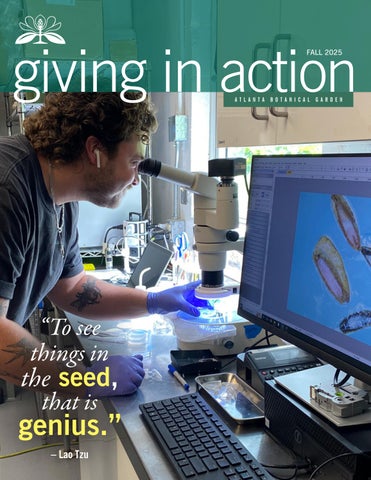
giving in action FALL 2025
“To see things in
the seed, that is
genius.” – Lao Tzu
Growing future champions For many years, horticulturists at the Atlanta Botanical Garden have grown giant waterlilies, including the Victoria ‘Longwood Hybrid’, starting with seeds sourced directly from Longwood Gardens in Kennett Square, Pennsylvania. As our aquatic plant collections—and our team’s expertise— continue to expand, we are taking on new challenges, including attempting to propagate our very own giant waterlilies. These showstopping plants can be found in three different aquatic displays at our Midtown location: the circular Skyline Pond, the linear reflecting pool between the Dorothy Chapman Fuqua Conservatory and the Great Lawn, and the naturalistic pond tucked into the Lou Glenn Children’s Garden. The ‘Longwood Hybrid’ is a cross between two species of the genus (V. amazonica and V. cruziana), and features purple-rimmed, platter-like leaves that can grow up to 6 feet in diameter. It is especially buoyant thanks to a robust network of radiating air pockets, ribs, and cross-veins on the underside of each massive leaf; this unique structure allows each lilypad to distribute weight evenly and hold jawdropping amounts, as evidenced by the worldwide Waterlily Weigh-Off Challenge which captivates millions on social media each summer. For the first time this year, our horticulture team is attempting to “seed the future” by hand-pollinating these night-blooming Victorias on-site. The flowers are brightwhite and female when they first open in the darkness, and when they bloom for a second time, 24 hours later, the flower has transitioned to pink and is male. One night in August, illuminated by a horticulturist’s headlamp, pollen was transferred from a second-night flower to a white-blooming firstnight flower—and then the wait began. After the seed pods mature later this year, our team will prepare to germinate the seeds in carefully controlled conditions, hoping to grow next year’s Waterlily Weigh-Off contenders. We look forward to seeing the results of this inaugural seed germination trial and sharing future successes with you, knowing that your support of the Garden makes it all possible!
Seeds of connection across generations The Garden has a long history of partnering with middle and high school students who have a demonstrated interest in science. From Outreach Programs that bring lab equipment into schools for instruction in soil-quality testing to paid Summer Internships for high schoolers, we know that engaging in hands-on programming catalyzes deeper knowledge, curiosity, confidence, and critical-thinking skills. By working with teachers to build on textbook science learned in school, the Garden’s STEM programming aims to take learning to the next level, motivating young people to make real-world connections, test hypotheses, and discuss results, making education ultimately more memorable and meaningful. Garden educators recently asked what ripple effect might occur when young people take what they’ve learned and find positive ways to share it with others. Aren’t high school students uniquely positioned to bridge generations? They inspire younger children by modeling excitement and discovery, and they have the opportunity to challenge adults to see the world through a fresher, more complex lens. With this goal in mind, our educators launched a new SPEAK (Students Promoting Environmental Awareness & Knowledge) Program this year— inviting high school students to apply to become Garden ambassadors of science and sustainability. This summer, a core group of teenage volunteers were selected to lead interactive mobile SPEAK stations throughout the Garden, engaging in brief conversations with visitors that promoted small but effective ways to become caretakers of our planet.
The cohort of seven SPEAK volunteers engaged guests through synergistic materials and open dialogue on concepts such as sustainable gardening, gardening for wildlife, and growing a home edible garden. It was a great first year, with enthusiastic SPEAK volunteers impressing staff and visitors with their passion and ability to spark intergenerational conversations that had visitors discussing how we can all care for the environment. Garden educators continue to work with several of these students to find deeper ways to stay involved, a clear sign that SPEAK successfully provided a positive platform for mentorship and volunteerism. Your unrestricted operating support helped to provide the first set of SPEAK mobile carts and materials needed to launch this program, giving an opportunity to nurture our next generation of environmental leaders and inspire thousands of Garden guests to take action for a healthier, more sustainable Atlanta and beyond.
Seeds at the heart of saving species Seeds represent the future not only for a single plant; a collection of genetically diverse seeds can mean the future for an entire species. Our collection of seeds from rare and endangered plant species touches every aspect of the Conservation & Research team, and your generosity continues to support their work. These funds help send field teams into remote wilderness habitats across the Southeastern United States, Caribbean, and Latin America to monitor populations of rare plants and collect seed for safeguarding and study. Later, conservation horticulturists germinate seeds to add to living collections and native habitat restoration. Recently, they began working to develop bulk supplies of seed that will be used to restore some of the rarest wetland ecosystems in the Southeast. Seed bank scientists work to devise new methods of treatment for unique and rare seeds, many of which have
never been saved before. They also train the next generation of seed scientists through internship programs so that seed banking remains a viable and efficient approach to plant conservation for generations to come. Our Conservation & Research team of 43 conservation scientists work with diverse partner organizations to implement comprehensive strategies leveraging the most advanced science and technology available to conserve plants today. This approach is crucial to advancing the Garden’s mission to conserve rare and endangered plants in our region and beyond.
Behind the Blooms in Gainesville Every plant begins as something small—sometimes a seed, sometimes a single cutting. At the Garden’s Propagation Nursery in Gainesville, these beginnings are carefully nurtured into the vibrant displays you see throughout the year. Founded in 2004, the nursery was established to expand key plant collections— Acer, Magnolia, Hamamelis, and Hydrangea—while also propagating rare and hard-to-find species in preparation for what would become the Gainesville Garden. The nursery supplied nearly half of the plants used in Gainesville’s initial construction in 2013 and 90% of those for the creation of the Children’s Garden in 2020, bringing these stunning landscapes to life. Spanning more than three acres and featuring a series of greenhouses, shade structures, and outdoor growing areas, the nursery has evolved into a vital resource for the Garden, supplying thousands of plants each year to both our Midtown and Gainesville locations. More than a production facility, the nursery is a living laboratory and botanical archive, where staff propagate plants from the Garden’s extensive collections to ensure their long-term preservation and continued beauty across both campuses. Many of these plants are also shared with public gardens, specialty nurseries, and plant societies around the country, extending the Garden’s impact well beyond our own grounds. At the nursery, our team works on an exciting range of plants, from rare hydrangeas to unusual begonias and bright rain lilies—many of which can be seen in our ever-evolving horticultural displays. You’ll find newly added rain lilies (Zephyranthes flavissima and ‘Heartthrob’) in Midtown’s Cascade Garden and in the Children’s Garden in Gainesville. In the Japanese Garden, Camellia japonica ‘Hakuhan Kujaku’, or “Peacock Camellia,” adds elegance with its weeping habit and red-and-white blossoms. And from our International Plant Exploration Program, Cercis chuniana, a rare redbud from China, is now thriving in both locations, most notable for its bi-color pendant racemes of springtime flowers and brilliant fall color. Your support of the Annual Fund allows us to care for these plants from their earliest days, long before they make their way into the gardens for everyone to enjoy. Camellia japonica ‘Hakuhan Kujaku’, or “Peacock Camellia,”
Giving in Action | atlantabg.org/donate