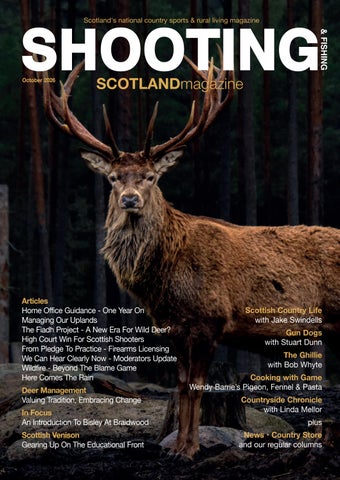
Scotland's national country sports & rural living magazine
& FISHING
October 2026
Articles Home Office Guidance - One Year On Managing Our Uplands The Fiadh Project - A New Era For Wild Deer? High Court Win For Scottish Shooters From Pledge To Practice - Firearms Licensing We Can Hear Clearly Now - Moderators Update Wildfire - Beyond The Blame Game Here Comes The Rain Deer Management Valuing Tradition, Embracing Change
In Focus An Introduction To Bisley At Braidwood Scottish Venison Gearing Up On The Educational Front
magazine
Scottish Country Life with Jake Swindells Gun Dogs with Stuart Dunn The Ghillie with Bob Whyte
Cooking with Game Wendy Barrie’s Pigeon, Fennel & Pasta Countryside Chronicle with Linda Mellor plus
News • Country Store and our regular columns
contents October 2026
NEWS 4, 5, 6, 7, 8 & 9
editor's bit A new mantra – quality over quantity
Firstly, if you are reading this, then welcome to our last issue for this year. We will of course be back in May and November next year. In 2027 we will only be publishing twice a year, as Christina and I have finally decided the time is right to take things a little easier in our dotage! (LOL). Having said that we will also have more time to plan, arrange and work on each issue, so we hope to bring you a bigger magazine with even more content to read. Our new ‘life balance’ will give us the best of both worlds, we hope! “Quality over quantity” is our new mantra going forwards. We have had great encouragement since bringing back this title, and that has helped us to believe in what we are trying to achieve, so to those supporters, we say a huge ‘Thank you”. I hope you all enjoy reading this issue, and remember this, our door is always open for new ideas. Christina and I don’t shoot or fish (we have given them a go though!), so if you can think of something we are missing, or any other thoughts, please do not hesitate in getting in touch. This magazine is for you, but it can also be about you – if you know what I mean? So here it is, our last issue for this year – roll on 2027, and onwards and upwards.
ARTICLES 10 Home Office Guidance - One Year On 12 Managing Our Uplands 14 The Fiadh Project 18 High Court Win For Scottish Shooters 22 From Pledge To Practice - Firearms Licensing 30 We Can Hear Clearly Now - Update On Moderators 32 Wildfire - Beyond The Blame Game 36 Here Comes The Rain DEER MANAGEMENT 16 Deer People - Valuing tradition, Embracing Change IN FOCUS 20 An Introduction To Bisley at Braidwood
18
SCOTTISH VENISON 24 Gearing Up On Educational Front GUNDOGS 26 Are Gundogs Worth All the Effort! THE GHILLIE 38 Climate Change Is Now An Increasingly Important Factor In Salmon Fishing LINDA MELLOR’S COUNTRYSIDE CHRONICLE 40 Life Among The Hills
22
SCOTTISH COUNTRY LIFE 42 With Jake Swindells COUNTRY STORE 46 Essentials and Gift Ideas COLUMNS 9 World Pheasant Association 17 Gamekeepers Welfare Trust 33 Scottish Gamekeepers Association
39 45
Slàinte, Athole. All Editorial & PR enquiries EDITOR Athole Murray Fleming Tel. 01738 639747 E-mail: mail@farmingscotlandmagazine.com
12
All Advertising & Editorial enquiries ADVERTISING DIRECTOR Athole Murray Fleming Tel. 01738 639747 E-mail: mail@farmingscotlandmagazine.com
PRODUCTION DIRECTOR Christina Fleming Email: christina@atholedesign.com
COPYRIGHT This publication has been produced and published by ATHOLE DESIGN & PUBLISHING LTD who are the copyright owners. No reproduction, copying, image scanning, storing or recording of any part of this publication without the permission of ATHOLE DESIGN & PUBLISHING LTD. Contents disclaimer: SHOOTING SCOTLAND MAGAZINE is not responsible for any factual inaccuracies within press information supplied to us. Any concerns regarding such matters should be directed to the supplier of the materials. SHOOTING SCOTLAND MAGAZINE is designed, produced and published by Athole Design & Publishing Ltd., Tolastadh, 18 Corsie Drive, Kinnoull, Perth, Scotland PH2 7BU. Tel. 01738 639747
©ATHOLE DESIGN 2025 ISSN: 2399–2220
©ATHOLE DESIGN 2025
facebook.com/ShootingScotlandMagazine
news
SHOOTING SCOTLAND
GWCT expands landmark research to unlock the secrets behind red grouse declines A new project designed to bring together almost half a century of unique research with field studies of hens to understand what determines breeding success in one of Britain’s most iconic upland birds has been established by the Game & Wildlife Conservation Trust (GWCT) across northern England and Scotland. After spending decades helping shape modern grouse management through its scientific studies and monitoring programme, the GWCT has embarked on its most ambitious study yet into the factors driving red grouse breeding success – the Maternal Grouse Project. GWCT scientists have monitored the same grouse moors across England, Scotland and Wales using standardised spring and summer counts since the early 1980s. Those unrivalled long-term datasets have revealed an increasingly concerning trend. Over the past decade, red grouse populations have experienced a series of sharp
declines. In spring 2025, GWCT’s long-term monitoring recorded an average 40% decline in pair counts across England and a 34% decline in Scotland following a poor 2024 breeding season. Summer brood counts revealed a further decline in adult birds, with numbers falling by 36% in England and 29% in Scotland. While some moors have experienced repeated breeding failures over successive seasons, in 2025 the remaining adult birds did produce more young when compared to the previous year, with an average young-to-old ratio of 1.4 in England (0.9 in 2024) and 1.3 in Scotland (0.6 in 2024). While grouse populations have always fluctuated naturally, recent years have seen several widespread breeding failures and sharp declines across moors managed under a wide range of different systems, suggesting that multiple interacting factors are now influencing productivity and limiting breeding success. The new study represents the culmination of almost 45 years
of grouse research, combining one of the world’s longestrunning red grouse monitoring programmes with intensive field studies following individual hens throughout the breeding season.
The project aims to answer one of the biggest questions facing upland conservation today: why are some grouse populations recovering while others continue to experience poor breeding years?
New research shows that as few as 1% of wild Atlantic salmon are returning to spawn
A new scientific study by the Game & Wildlife Conservation Trust (GWCT) shows the survival of wild Atlantic salmon at sea has declined dramatically. In recent years, on average, only 3% of fish leaving the river have 4
returned to spawn and this figure has regularly dropped below 1%. The research, based on the Trust’s long-term data over more than 20 years, also revealed that overwinter survival of salmon in the river in the first phase of life was
80% higher than at sea, confirming that the marine environment is now a critical bottleneck in the salmon life cycle. Since 2005, researchers at the GWCT’s monitoring station at East Stoke on the River
www.shootingscotlandmagazine.com
Frome in Dorset have tagged around 10,000 juvenile salmon (called parr) annually, allowing individual salmon to be tracked as they grow into smolts, which migrate out to sea in spring. On their journey downstream
news
SHOOTING SCOTLAND the tagged fish are then caught again, measured and released. Detection stations record when they leave the river, and when surviving adults return from the sea to spawn. So far, this year numbers are higher than average, but still only 111 have been recorded as returning. Whereas around 3% come back after one winter at sea (known as one-sea-winter fish), even fewer, about 1.5%, return after two winters at sea. In some years, survival rates were even lower, with as few as 0.4% of one-sea-winter fish and 0.7% of two-sea-winter fish making it back. Overall, rates of survival at sea declined noticeably over the course of the study. GWCT head of fisheries Dylan Roberts who oversaw the project says: “We believe declining marine survival is
driven by warming seas affecting feeding opportunities for salmon at sea. We’re also very concerned about the potential high risk of young salmon being accidentally caught in commercial factory fishing nets. In this context, improving river habitats for salmon is even more crucial. We know from our research that the largest, fittest smolts are three times more likely to return as adults. So, if you get the habitat right, this can help improve the very low marine survival we have been witnessing in recent years.” In the river system, 12% juvenile salmon survived the transition from parr to smolt, with no clear long term trend over the study period. However, in recent years the number of parr being caught for tagging has dropped dramatically from 10,000 in 2023 to 3,226 in 2025.
Highland octogenarian honoured for ‘remarkable’ wildfire fight A Highlander who worked every day for almost a month at the age of nearly 80 to help extinguish Scotland’s biggest ever wildfire was honoured in August. Davie Taylor (79) of Logie, a former Head Gamekeeper, helped fight the Dava wildfire with colleagues last year when it was at its height and had burned 85% of Dunphail on the southern edge of Dava Moor. Thereafter, following three days of round-the-clock firefighting, he then spent the next 22 days digging out and dousing burning peat hotspots
using 5-gallon drums of water sourced from a burn, spades, axes and chainsaws, until the fire was finally out. With the Cairngorms wildfire of recent weeks having been resourced with millions of pounds of technical firefighting equipment, included extended use of water bombing helicopters, the personal feats of Mr Taylor in 2025 was described as ‘remarkable’. Years earlier the highlander had broken his back whilst working but his stubborn determination to see Dunphail www.shootingscotlandmagazine.com
5
news
SHOOTING SCOTLAND
safe, over 25 gruelling days, outweighed his own personal considerations. Surrounded by family at Moy Country Fair in Inverness-shire, Mr Taylor received a specially inaugurated award by the Scottish Gamekeepers Association (SGA) for his efforts and care. The crafted decanter for outstanding services to Conservation and Community was presented by SGA Chairman Alex Hogg, MBE, on the same day former MSP and Rural Cabinet Secretary, Fergus Ewing, received the Ronnie Rose Award. Davie Taylor
Angus Glens estates deliver £6.6m boost for rural economy, new report finds Seven estates in the Angus Glens contributed £6.6m to the economy last year while supporting hundreds of rural jobs, local businesses and biodiversity work, according to a new report published today by the Angus Glens Moorland Group and Scottish Land & Estates. The report sets out, for the first time, a comprehensive evaluation of the economic, environmental and social impacts of moorland management across seven estates during 2025. The publication comes at a time when rural communities, biodiversity recovery and wildfire resilience are high on the public policy agenda, and its findings show that active moorland management in the Angus Glens is already delivering practical outcomes across all three. Among the findings, the estates provided 86 full-time and 768 seasonal jobs, 68 homes in rural areas, annual expenditure of £6.6m, of which £3.66m was spent on employment costs and £2.94m on contractors, goods and services. 6
Moorland management supports jobs, conservation and the economy
The vast majority of expenditure on goods and services – 82.5% – was with local businesses. There were 84 grouse shooting days during the 2025 season, with 54 seasonal employees required on
average, per shoot day, per estate, reflecting the importance of the grouse sector to seasonal work in the region. The report also demonstrates a diverse ecosystem with abundant native wildlife. Detailed ecological
www.shootingscotlandmagazine.com
monitoring on one estate recorded 102 bird species, 145 species of butterfly and moth, 19 mammal species and 146 plant species. Widely distributed across the landholdings are 16 species of bird of prey. The most common
news
SHOOTING SCOTLAND of these – White Tailed Eagle, Golden Eagle, Buzzard, Red Kite, Peregrine Falcon and Kestrel – were recorded on every estate. Key upland species are also found in abundance, including Curlew, Black Grouse, Skylark, Lapwing, and Oystercatcher. These species are facing severe population decline in the rest of the UK, underlining the importance of actively managed upland habitats for their nesting success. Ross Ewing, Director of Moorland & Strategic Projects for Scottish Land & Estates, commented: “Upland estates in the Angus Glens are creating jobs, providing homes for rural workers, supporting local businesses and enhancing the natural environment. “With the right support, the Angus Glens can continue to be a stronghold for biodiversity, a driver of economic activity and a model for integrated land management.”
Record backing as Angus gamekeeper crowned Scotland’s best Over 50 people back youngster for prestigious prize
A young Angus father who left home at 16 for Balmoral has been crowned Scotland’s best young gamekeeper with a record number of endorsements. Jack Brown (20) of Hunthill Estate landed the profession’s most prestigious youth prize at the GWCT Scottish Game Fair, with family, friends and fellows in attendance.
Judges later confirmed that over 50 people, from peers and ex-seniors to community groups, nominated the youngster – a record in the near 30-year history of the award. Jack, born in Irvine, was on the hills aiding his Head Gamekeeper father, Ali, from heather height and left home as a teenager to take up a 2 year
traineeship at Delnadamph, Balmoral. Impressing there, he was offered a Beat Keeper job ‘back home’ at Hunthill in Angus, where he is still employed, managing moorland for red grouse and the array of co-habiting upland wildlife. Awarded by the sector’s professional body, The Scottish Gamekeepers Association (SGA),
Spare parts for Comb, Bingham, Bayle or Senesi plucking machines, brand new and recon for sale - twin motor from £1,485+VAT For Turkeys/Geese and other PoultryWithout Buying the Kit-HIRE IT & save ££££
• Faster Processing Day • Less Mess • Professional Finish • Delivered to your Door • Less Stress • Group Hire Discounts
“Don’t Buy what you only need for a day or two for the year. For the Processing of Game Birds for the next Season try Long term Hire
HIRE IT... SERVICE WORK NOW BEING UNDERTAKEN Poultry/game crates, drinkers & incubators available.
Storey Poultry Supplies tel: 01473 823598 day, evenings and weekends call Mark on: 07879 496970 email: storeypoultrysupplies@btinternet.com www.storeypoultrysupplies.co.uk www.shootingscotlandmagazine.com
7
news
Jack Brown
SHOOTING SCOTLAND the trophy recognises individuals who, by their management and approach, are judged to be an inspiration to future generations and advocates for the sector. Amongst those nominating him were two former winners of the prize, themselves, who vouched for his diligence, professionalism and his drive towards improvement. One endorsement sent to judges, read that the winner passionately improved the ground that he managed, ‘for all the gamebirds, waders and other wildlife within it.’ Another read: “The industry would be in a greater position if we had more youngsters like Jack Brown.’ For the recipient, who received a voucher from sponsor, Quailhollow Kennels Ltd, alongside his trophies, there was never another job which could have lured him from the moors. “I enjoy things like welding but gamekeeping was always going to be first choice for me,” he said. “I’ve helped my dad and learned from him for as long as I can remember. “Modern gamekeeping today requires more tickets, training and is licensed, more so than 20 years ago, but I still wouldn’t choose anything else. “I love this time of the year when the young chicks are on the
ground. Good game management provides for so much more than just game birds and it makes a real difference. “I love seeing the Curlews. They are nice little things. This year, the Lapwings are a bit later with us but it’s nice to help them because they are dropping a bit in number.” As well as honouring youth, the SGA were rewarding, with Long Service medals, individuals who have dedicated their lives to the sector. SGA Chairman Alex Hogg, MBE, presented medals to Danny Lyon, a gamekeeper at Balruddie, Kinross-shire, who started out in 1979. Also receiving accolades were Kenny Horne, who retired age 70 this year, from Teasses Estate in Fife and Sandy Hinshelwood, whose career began at Forest Lodge back in 1972. “Rewarding outstanding individuals is one of the greatest pleasures of our year,” said Chairman, Alex Hogg. “Whether starting out, like Jack, or stepping back, gamekeeping never leaves you. It is a way of life and a privilege, and it is great to show our appreciation for what these individuals are doing, or have done, for our professioan, our rural communities and Scotland’s countryside.”
Salmon and sea trout fishings for sale on the border Esk
An exciting opportunity has come to market with the launch of 8
www.shootingscotlandmagazine.com
fishings on the River Esk, close to the Scottish border.
news
The World Pheasant Association – working hard for the conservation of Galliformes Photo Jonathan Beilby
It’s been a busy and productive 2026 so far for the World Pheasant Association Photo WPA
Fishings at Willow Pool and Cauldron, a highly regarded and scheduled stretch of the renowned River Esk, has been brought to the market through property consultancy Galbraith. The fishings comprise around 1,330 metres of single-bank fishing across two established beats, The Willow and The Cauldron, producing a 10-year average catch of around 36 salmon and 35 sea trout. The fishings include 12 named pools and can comfortably accommodate up to six rods across the two beats, benefiting from four well-positioned fishing huts and good vehicular and pedestrian access. The riverbank, river, woodland and road access extend to approximately 5.11 hectares (12.63 acres) in total. The fishings are located just two miles south of Canonbie, the beats occupy a picturesque stretch of the Border Esk, widely recognised as one of southern Scotland’s finest small salmon rivers, and rises in the Southern Uplands of Scotland, forming part of the Scottish-English border before flowing through Cumbria to the Solway Firth. The river is fed by key tributaries including the White Esk, Black Esk and Liddel Water, the river has created a varied system of streams, runs and pools well suited to both salmon and sea trout fishing. Fishing is predominantly by fly, with spinning permitted during periods of higher water and in the early season, in accordance with Environment Agency regulations. Salmon are managed under a catch-and-release policy, while sea trout may be retained within seasonal limits. Surrounded by attractive farmland and mature woodland, the fishings enjoy a peaceful rural setting while remaining highly accessible. The larger towns of Langholm, Dumfries, Lockerbie and Carlisle are all within convenient driving distance. The fishings benefit from excellent road links via the A7, A74(M) and M6, together with nearby rail connections and international airports, making them easily accessible from across the UK. Fishings At Willow Pool & Cauldron is for sale through Galbraith for Offers Over £135,000.
Mountain Peacock-pheasant display
WPA team at Global Birdfair 2026
February’s Conservation Breeding Advisory Group (CBAG) meeting, hosted by Cotswold Wildlife Park, was very well attended, with informative talks on aviculture as well as updates on conservation projects. Spring followed with the annual charity clay shoots proving as popular as ever, and the welcome news that the Vietnam pheasants have arrived safely at the Breeding Centre in their home country at long last. Hopes are high for the successful establishment of a new breeding population for eventual release into the wild, helping to restore this species to the forests where it belongs. July saw WPA members and volunteers at the Global Birdfair, Rutland; an extravaganza
of many feathered things birdwatching, education, conservation support, and community engagement - a must-visit event for anyone passionate about nature and wildlife. August brings the meeting of the European Conservation and Breeding Group (ECBG), this year in Austria, and a new-look 32-page magazine in the final stages, ready to wing its way out to WPA members. New conservation projects have been confirmed, planning is well underway for
the 9th International Galliformes Symposium in Nepal next year, and we are looking forward to the AGM at WWT Slimbridge in early September. There’s always a lot to do behind the scenes for the success of any conservation cause, and the WPA works tirelessly to support projects and communities, aid in education and awareness, and support and maintain viable breeding populations of vulnerable Galliformes, inand ex-situ around the globe. All this would not be possible without support, so please consider becoming a member or donating. After all, where would we be without our grouse, pheasants, partridges and chickens? For more information, please contact the WPA Office: office@pheasant.org.uk
The World Pheasant Association
The Gateway, 85-101 Sankey Street Warrington, Cheshire, WA1 1SR Tel: +44 7908795416 Email: office @pheasant.org.uk
www.pheasant.org.uk
Registered Charity No. 1181022
SHOOTING SCOTLAND
Home Office Guidance – One Year On By David McKie, Partner Levy & McRae Solicitors LLP
David McKie
I often find it is helpful to refresh and review changes in the law one year after they take hold. Sometimes we find that changes are dramatic and lead to a flurry of activity. For example, in recent years, we have seen in the criminal courts in Scotland very focused and increased trials on historic sex abuse, domestic abuse and online offences. We have also seen the rise of hate crimes. While these are criminal areas of law, criminal law also has its part to play in firearms licensing. There are a number of criminal offences under the Firearms Act which readers should be alert to. I thought it would be helpful first of all to give an overview of what the updated statutory guidance for chief officers of police covered. While the guidance is primarily aimed at chief officers of police, certificate holders should understand the key themes because they will affect both new applications and renewals. The updates place a greater emphasis 10
on public safety, suitability checks, medical information, referees and the ongoing assessment of certificate holders. Taking these in turn, readers should be alert to the following issues: 1. Greater Focus on Suitability The central message is that holding a firearm or shotgun certificate is a responsibility, not an entitlement. Police licensing teams are expected to take a thorough approach when assessing whether an applicant remains fit to possess firearms. This includes considering criminal history, evidence of violence, domestic abuse, dishonesty and other information that may indicate risk. Practical advice: Be open and honest on application forms. Any omission or inaccurate information may raise concerns and delay the process.
2. Medical Checks Remain Important Medical information continues to play a significant role in licensing decisions. Applicants must disclose relevant health conditions, and police may seek information from GPs where appropriate. Recent changes to application forms also include references to certain neurodevelopmental conditions where relevant medical information may need to be considered. Practical advice: Ensure your GP records are up to date and declare any relevant medical conditions. If circumstances change during the life of your certificate, seek advice from your licensing department. 3. Referees Under Increased Scrutiny One of the most significant changes is the move towards
www.shootingscotlandmagazine.com
requiring two referees for firearm and shotgun applications. Referees play an important role in helping police assess an applicant’s suitability and character. Practical advice: Choose referees carefully. They should know you well enough to provide a genuine assessment of your character and suitability. 4. Social Media and Background Checks The guidance confirms that police may consider a wider range of information sources, including social media activity, when assessing applications and renewals. The purpose is to identify potential risks or behaviours that could affect suitability to possess firearms. Practical advice: Remember that online behaviour can be taken into account. Responsible and lawful
SHOOTING SCOTLAND conduct, both online and offline, is increasingly important.
forces recommend applications are submitted several months before expiry.
5. Home Visits and Secure Storage Secure storage remains a fundamental requirement. Licensing officers may carry out home visits and assess security arrangements, particularly where high-value firearms collections or multiple firearms are involved.
Practical advice: Start preparing renewal paperwork well in advance. Check your local force’s website for current processing times and requirements.
Practical advice: Regularly inspect cabinets, locks and security measures. Notify your licensing department promptly if you change address or storage arrangements. 6. Apply Early for Renewals Many police forces continue to experience significant demand on licensing departments. Some
Conclusion The updated guidance reinforces a risk-based approach to firearms licensing. For responsible certificate holders, the message is straightforward: maintain high standards of conduct, keep medical and personal information up to date, ensure secure storage, select suitable referees and submit
renewal applications early. By doing so, applicants can help make the licensing process smoother while supporting the safe and lawful ownership of firearms and shotguns. For any further questions, please do not hesitate to be in touch with me directly.
David McKie
dmckie@lemac.co.uk 07711 302100
All About Deer WWW.MORAYOUTFITTING.CO.UK MORAY OUTFITTING Deer Management Training specialising in DSC1 & 2 courses at our facilities, Morayshire or Alness
Approved Training Providers for the Cairngorm National Park Authority, we are dedicated to providing a professional, open and friendly service – ‘run by stalkers, for stalkers’ Contact John Allan
07833 535060
j.allan121@btinternet.com
www.shootingscotlandmagazine.com
11
SHOOTING SCOTLAND
Managing our uplands: how active land management reduces wildfire risk while benefiting wildlife By Neil Gunn, Wildlife Estates Scotland project manager, Scottish Land and Estates
The risk of wildfires occurring in Scotland is growing. Several events this year, most notably in the Cairngorms, emphasise the need for individuals and organisations to adapt to a new reality. Such events are becoming more frequent and larger in scale. The Carrbridge and Dava wildfires in 2025 burnt across more than 10,000 hectares of moorland and woodland. The Carrbridge fire alone caused significant damage to multiple peatland restoration projects and commercial forestry. The damage to important habitats and 12
associated impact on wildlife was considerable. In recent wildfire incidents, land managers and businesses have played a vital role in cooperative suppression and containment efforts. A report into the response to the Carrbridge and Dava wildfires from landbased and rural businesses, commissioned by Scottish Land and Estates, found that at least 110 employees from 33 surveyed businesses were involved in containing the fires. At least 83 of these individuals had experience in controlled burning techniques.
Land managers used various methods, including fogging, firebreak creation, tactical back burning and suppression by fire beaters and leaf blowers. The response was coordinated through five key stakeholders; the Scottish Fire and Rescue Service, the Cairngorms National Park Authority, Bright Spark Burning Techniques and several estates. The report emphasises how the significant expertise and capabilities brought to bear by land managers are key to wildfire response, particularly in remote areas.
www.shootingscotlandmagazine.com
When it comes to preventative measures, it is also important to recognise and promote the role that land managers can and do play in safely and responsibly reducing wildfire risk. Weather and topography are contributory factors that cannot be controlled, but fuel load is one that can. Across our upland habitats, the amount, continuity and condition of vegetation can influence whether a small fire remains containable or evolves into a landscape-scale emergency. Continuous stands of mature heather, bracken, gorse and scrub
SHOOTING SCOTLAND can carry fire rapidly, especially in dry and windy conditions. A landscape with varied vegetation height, reduced fuel load, fire breaks and wetter restored areas is likely to be more resilient. It gives firefighters and land managers a better chance of containing an outbreak. One proven method for reducing fuel load is muirburn, the controlled burning of heather and other moorland vegetation. Providing it is properly planned and carried out by trained practitioners, it can reduce accumulated fuel loads and create a patchwork of vegetation of different ages. The Scottish Government’s ‘Strategic Action Plan on Wildfires’ published in March of this year promotes regulated muirburn and the use of firebreaks as key preventative actions. Carried out lawfully and responsibly over several
years, muirburn played a role in limiting the spread of the Green Cleugh wildfire that took place near the Pentland Hills in May of this year. The areas that had been burned previously helped land managers and firefighters to gain access to the affected area, acted as firebreaks and slowed the progress of the fire. Although 17 hectares of moorland and grazing land were affected, active land management and a rapid and coordinated response prevented the fire from spreading further. The benefits of properly managed and targeted muirburn extend beyond wildfire risk mitigation. It encourages fresh heather growth for red grouse and deer, while mature heather is retained for shelter and nesting cover. A mosaic of vegetation supports invertebrates, reptiles and ground-nesting birds by
providing more varied structure than a single, ageing stand. Wading birds such as curlew can benefit from the patches of heather left after a controlled burn. In the right circumstances, cutting or swiping can achieve similar outcomes, particularly where burning is unsuitable or where sensitive habitats need protection. As neither nature nor fire respect land boundaries, collaboration at a landscape scale is required to improve the resilience of sensitive habitats to our changing climate. The Wildlife Estates Scotland (WES) accreditation scheme recognises and promotes exemplary sustainable land management that delivers demonstrable and lasting benefits for Scotland’s natural heritage, rural economy and communities. The robust nature of the accreditation, focus on adherence to best practice
www.shootingscotlandmagazine.com
and the emphasis that it places on landscape scale collaboration means that accredited members are viewed as ‘Trusted Operators’ by NatureScot. In the context of the Muirburn Code and associated licencing, WES accreditation is recognised as a means of compliance monitoring. Recent wildfire seasons have demonstrated the importance of coordinated action and active management of our upland landscapes. Land managers cannot control the weather, but they can help shape more resilient landscapes that are less likely to ignite, less likely to burn intensely and easier to protect when fire breaks out. Used responsibly, muirburn and similar measures remain an important part of the toolkit available. The benefits of these measures for habitats and the species that rely on them are equally important.
13
SHOOTING SCOTLAND
The Fiadh Project – a new era for wild deer? By Hugh Webster Rewilding Relations Officer, SCOTLAND: The Big Picture The question of how best to manage deer populations – together with their impacts, both positive and negative – has come to dominate conversations about the future of the natural environment in Scotland. Deer are much loved, offering many of us our sole remaining contact with a large wild animal. And since elk, wild horses, aurochs and wild boar have been entirely lost from our landscapes or become vanishingly rare, Britain’s
14
remaining native deer species play an especially influential role as ecosystem engineers. Among the many natural processes to which they contribute, deer open gaps in thick vegetation that other plants can then exploit, disperse seeds and fertilise the soil with their dung. But deer also add to some of the environmental challenges we face. Excessive deer numbers create heavy feeding pressure and trampling effects that can prevent woodland regeneration,
inhibit peatland restoration and reduce biodiversity. Often, when deer numbers are high, land managers opt to feed animals through the winter months. But if you must feed deer, either to get them through lean periods or to avoid damage to sensitive habitats, then clearly you have more deer than your local environment can support. The practice of feeding deer is closely associated with the sport of deer stalking. Stalking – especially the pursuit of red
www.shootingscotlandmagazine.com
deer – forms an important part of modern Highland culture, supporting jobs, helping to fund the many other roles of an estate stalker and contributing to the survival of rural communities. So the apparent threat that red deer culls pose to the traditions, values and livelihoods of estate stalkers has contributed to a historic tension – between what might loosely be thought of as ‘traditional’ deer stalkers and a newer school of thought focused on habitat restoration through
SHOOTING SCOTLAND reductions in large herbivore numbers. This mirrors a broader culture clash between those who say Scotland has become nature depleted versus those who claim it is not. At SCOTLAND: The Big Picture, we recognise how much wildlife our nation has lost, from charismatic carnivores to littlenoticed wildflowers. Conserving wildlife in a poorly connected network of small, intensively managed reserves has helped slow these losses. But if we ever want to stop them, let alone reverse them – to restore natural abundance and diversity to the wider landscape – we need to think and act differently. Our vision is for a living network of rewilded land and water connecting all of Scotland. Here, natural processes could be restored to more of their full potential, allowing wildlife and people to thrive in equal measure. Naturally, deer are a central part of that vision. In line with this vision, we launched the Fiadh Project in 2024 (inspired by the Scottish Gaelic word for deer and the closely related word for ‘wild’ - fiadhaich). The project aims to inspire fresh conversations between stakeholder groups and to challenge some of the enduring misconceptions surrounding the subject of deer management. The five changes we want to see are:
deer somehow ‘hate’ deer. The Fiadh Project therefore began by showcasing the work – and feelings – of deer stalkers who have led the way in reducing deer numbers on estates working to allow woodland restoration. We highlighted the real love these stalkers have for deer despite their role in killing them – a paradox familiar to many hunters. And we revealed the common ground they share with every other stalker, extending from the skill and pride they show in their work to the unequalled knowledge they have of their ground and their quarry. Nobody hates deer! A second priority was to enhance public appreciation of the enduring importance of deer stalkers. Some people suggest that if we reintroduce wolves and lynx then we’ll no longer need deer stalkers, but
SCOTLAND: The Big Picture has always been clear that this is not the case. The return of wolves to Scotland is not a realistic prospect in the foreseeable future. Lynx are being discussed and could help manage deer impacts, but their numbers and influence will always be limited. Deer stalkers will therefore continue to be vital for deer management and the practical delivery of Scotland’s nature restoration ambitions – as the Fiadh Project has emphasised at every opportunity. Nonetheless, a key challenge remains: how will deer stalking jobs be funded in a landscape with fewer traditional stalking opportunities and fewer paying clients? There is no single answer to this question, but there is broad agreement that more value from venison sales
needs to reach those producing this high quality meat. Our fourth aim has been to help secure a more sustainable future for deer management. This may require changes within the sector – adjusting to lower deer densities and responding to the demand for venison over the summer months. It’s also likely to need public funding. The Fiadh Project endorses this call. Our final aim is to encourage a new way of measuring successful deer management. The Fiadh Project supports the growing shift towards a more holistic approach that prioritises the welfare of healthy deer alongside the restoration of natural habitats within a more diverse, more resilient landscape. It’s a future that looks quite different, but where many of the values remain the same.
SCOTLAND: The Big Picture are proud signatories of the Common Ground Accord. Find out more: https://www.scotlandbigpicture.com/fiadh
· Recognition that all stakeholders respect and value red deer · Greater public appreciation for the vital work of deer stalkers · Scottish venison being better valued for all its benefits · A secure future for the deer management sector · A common focus on managing healthy deer within healthy landscapes It might seem strange to start with seeking recognition that all stakeholders respect and value deer. But one of the most unhelpful and inaccurate narratives surrounding this topic is the idea that those culling www.shootingscotlandmagazine.com
15
deer management
SHOOTING SCOTLAND
Deer People – Valuing Tradition, Embracing Change Deer People – Valuing Tradition, Embracing Change is the latest collaboration between writer Richard Cooke (former Chair of the Association of Deer Management Groups, and current Chair of industry body Scottish Venison), and artist Ian MacGillivray looking at upland deer management in Scotland through the lens of the lives of those involved on the ground or through their related previous or ongoing work. The book features 24 individuals whose lives have been shaped by Scotland’s red deer and offers a unique insight into their thinking and the wealth of knowledge and breadth of tradition behind upland deer management today. Contained in the book’s 130 pages is a rich and diverse collection of essays, quotes and opinions, stunning artwork, and a selection of wild venison recipes. Together these capture the spirit of upland Scotland and its landscape to which these 24 Highland heroes have devoted their lives, caring for environment and habitat and stewarding Scotland’s iconic red deer. All proceeds from sales of the book go to the Association of Deer Management Groups’
‘Deer People’ fund which supports overseas placements for early career deer management and environment professionals, allowing them to study wildlife and landscape management in other countries around the world. ‘Deer People’ placements to date have included North America, Africa and Europe. Also, first published in 2022 Deer People - Twenty four working lives dedicated to deer in the Scottish Highlands, a collaboration between Cooke, MacGillivray and acclaimed photographer Glyn Satterley, has now been reprinted and in the same format as Deer People 2. There is more information about the Deer People fund and reports from previous beneficiaries of support from it on the ADMG website www. deer-management.co.uk/ general-info/tutorials/ The books are priced at £35 for Deer People 2 (published 2026), and £30 for Deer People (first published 2022), with a special offer price of £60 for both. The books can be purchased at www.ianmacgillivray.co.uk/ category/all-products Prints from Ian MacGillivray’s portraits from Deer People 2 are also available from his website.
Next issue of Shooting Scotland out May 2026 16
Front cover, Deer People – Valuing Tradition, Embracing Change
Richard Cooke, author of the new book, with Dr John Fletcher, one of the ‘Deer People’ featured in the latest volume.
www.shootingscotlandmagazine.com
news One of Dumfriesshire’s oldest sporting estates launched for sale Historic 1,242-acre Blackwood Estate brought to the market in the Nith Valley Savills has launched Blackwood Estate to the market, offering buyers the opportunity to acquire one of Dumfriesshire’s oldest and most established sporting estates. Extending to approximately 1,242 acres in the picturesque Nith Valley, the estate combines a historic principal house, additional dwellings, productive farmland, commercial forestry and exceptional sporting interests within a single ownership. It is available as a whole or within separate lots. Occupying a commanding position on the banks of the River Nith, around eight miles northwest of Dumfries, Blackwood represents the kind of traditional Scottish estate that rarely comes to market. Developed and shaped over generations, it brings together a substantial country house, agricultural land, woodland, river frontage, cottages and sporting opportunities in an established and highly private setting. At the centre of the estate sits Blackwood House, a handsome Category B listed country house offering six reception rooms and ten bedrooms, surrounded by mature gardens and policies overlooking one of Scotland’s most celebrated salmon rivers. Beyond the principal residence, the estate includes six cottages, traditional estate buildings and courtyard accommodation, approximately 662 acres of farmland and around 519 acres of woodland, creating a diverse mix of residential, agricultural, forestry and amenity assets.
The end of a busy summer season is in sight, with many shows and events behind us we can reflect on all that has been achieved during the past few months. Though there are always financial and physical implications with attending so many events across the country they are far outstripped by the obvious benefits, in terms of raising the awareness of a charity like the Gamekeepers Welfare Trust and being able to highlight the many different levels of support and assistance that we provide on many levels to all corners of the UK. During these events our nurse team were incredibly busy with providing health checks, which have become a crucially important service and have led to a number of people returning to our stand the following year and declaring that these simple and relatively quick tests ‘saved my life’. Because, as we know, when we are busy working all hours to sustain our jobs, livelihoods
& families our health can be the last thing we take care of and finding the time to make the trip to the doctor can be continually put on the backburner. This summer has brought some of the driest and most extreme weather conditions in living memory, placing unprecedented pressure on the gamekeeping and farming communities across many parts of the country. I do not need to dwell on the many challenges these conditions have created, as they are
already well known and widely reported. What I do want to emphasise however, is our core message: that we are here for you. Whether through practical guidance, financial assistance or simply someone to turn to, we remain committed to supporting you in whatever way we can during these exceptionally difficult times. Please pick up the phone and speak to our team in full confidentiality and most of all take care of yourself.
The Charity can be reached by phone on 01677 470180, by email at enquiries@thegamekeeperswelfaretrust.com, or by text to 07749 896060
SHOOTING SCOTLAND
BASC’s High Court win is a win for Scottish shooters By Peter Clark, Scotland Director British Association for Shooting and Conservation When BASC secured a High Court victory against Natural England, the headlines understandably focused on England’s gamebird release licensing system. Yet for Scotland’s sporting community, the judgment also counts. It demonstrates the importance of having a strong, credible organisation that is prepared to stand up for shooting, challenge public bodies when necessary and ensure that decisions affecting the countryside are made within the law. Although Natural England has no jurisdiction north of the border, the issues raised by the case will resonate with many Scottish shooters. In recent years, Scotland has experienced some of the most significant legislative changes affecting country sports for generations. From the introduction of grouse moor licensing and changes to muirburn legislation, to debates surrounding wildlife management, species protection and land use, the regulatory landscape has become increasingly complex. As regulations evolve, so too does the need for professional representation. The High Court found that Natural England had acted unlawfully by adopting an interpretation of ‘release’ that exceeded the meaning of the legislation enacted by Parliament. The judgment is an important reminder of a fundamental constitutional principle: public bodies must act within the limits of the law. That principle matters 18
just as much in Scotland as it does in England. As Scottish legislation governing country sports continues to develop, it is essential that those implementing and enforcing the law do so fairly, proportionately and within their legal remit. Cases such as this highlight why organisations like BASC exist. Taking a Judicial Review to the High Court is beyond the means of almost every individual, shooting syndicate or sporting estate. Such cases require specialist legal teams, extensive preparation and considerable financial commitment. It is not simply a matter of disagreeing with a decision, it requires assembling evidence, instructing leading counsel and committing to what can be a lengthy legal process. That is precisely where BASC’s strength lies. With
around 150,000 members across the UK, BASC has the resources, expertise and experience to represent shooting at the highest levels. Whether engaging with government ministers, responding to consultations, commissioning scientific research or pursuing legal action, the association has repeatedly demonstrated its ability to influence decisions that affect the future of shooting. For BASC Scotland, that work continues every day. The Scottish political landscape presents unique challenges. Since devolution, Holyrood has developed its own approach to wildlife management and environmental regulation, often differing significantly from Westminster. BASC Scotland has worked closely with the Scottish Government, NatureScot, MSPs and parliamentary committees on issues including firearms
www.shootingscotlandmagazine.com
licensing, deer management, grouse moor licensing, muirburn reform, lead ammunition transition and responsible gamebird management. Much of that work happens quietly. Meetings with ministers rarely make newspaper headlines. Consultation responses are seldom shared widely outside the sector. Scientific evidence submitted to parliamentary committees often receives little public attention. Yet it is this steady, professional engagement that helps shape legislation before it reaches the statute book. Occasionally, however, that influence becomes impossible to ignore. The High Court judgment against Natural England is one such example. It demonstrates that BASC is not simply prepared to lobby government, it is also willing to test the legality
SHOOTING SCOTLAND
of decisions where it believes public authorities have exceeded their powers. That willingness matters. The shooting community is often the subject of intense public and political debate. Decisions affecting rural businesses, conservation projects and sporting traditions increasingly attract scrutiny from campaign groups, regulators and politicians alike. In such an environment, representation needs to be informed, evidenceled and legally robust. Scotland’s rural economy depends heavily on sustainable country sports. Shooting supports employment in some of the country’s most remote communities, underpins investment in habitat management and contributes significantly to conservation through predator control, woodland management and wetland creation. These are positive contributions that deserve effective representation in government. BASC Scotland has consistently argued that conservation and shooting are complementary rather than conflicting objectives. The association’s policy work seeks to ensure that legislation is practical, evidence-based and capable of delivering environmental improvements without placing unnecessary burdens on those who manage the countryside responsibly. The recent High Court victory strengthens BASC’s standing as it continues that work.
It demonstrates that the association possesses not only political influence but also the legal expertise to hold regulators accountable where necessary. That credibility benefits every member, whether they shoot game, stalk deer, wildfowl, rough shoot or simply value the future of sustainable shooting in Scotland. Natural England has indicated that it intends to appeal. Nevertheless, the judgment has already sent a clear message: regulators must operate within the law, and where they fail to do so, they can be challenged successfully. For Scotland’s sporting community, that is perhaps the most important lesson of all. The future of shooting will not be secured through social media debates or angry headlines alone. It will depend upon constructive engagement with government, sound science, effective advocacy and, when circumstances demand it, the willingness to defend the interests of the sporting community before the courts. As Scottish shooting continues to navigate an evolving legislative landscape, this case serves as a timely reminder that strong representation is not simply beneficial, it is essential. Organisations capable of combining political influence, legal expertise and practical understanding of the countryside will play a vital role in ensuring that shooting remains a respected and sustainable part of Scotland’s rural future.
www.shootingscotlandmagazine.com
IN
SHOOTING SCOTLAND
Bisley at Braidwood Based in both the Scottish Borders, Midlem, and just outside London at Bisley. This is a family run business created at Bisley over twenty-five years ago providing clay pigeon shooting
20
for both experts and beginners. Thirteen years ago the Bisley at Braidwood ground was added and completely rebuilt with additional shooting facilities. The Braidwood ground offers shooting lessons from
Tuesday to Sunday for all levels of shooter in the following disciplines. Shotgun clay shooting over 25 stands with up to 6 targets at each stand, a 30 metre air-rifle range with pop-up targets and Scotland’s only 100 metre underground full-bore rifle range. We regularly host Corporate and Charity fundraising events can involving one or all of the above activities. Kitchen and dining area for up to eighty guests at ‘Oscar’s Cafe’. Both locations are open to all comers with all equipment and
www.shootingscotlandmagazine.com
safety elements provided, and a Membership option is for those who are regular users, especially on the fully automated clay shooting system, of the club and gives them discounts on cartridges and clays. Spreading the word to the young and those who have never been introduced to clay shooting is hugely important of course. Especially in rural areas, they are the future of shooting and it is very pleasing to see the reward they get from exceeding their own expectations.
IN
SHOOTING SCOTLAND
As mentioned above the business does corporate and charity fundraising events that include one or all of the clay shooting, air-rifle and full-bore rifle range. Ladies Days and Young Shots days are very popular and have been growing year on year.
The Bisley at Braidwood Ground is very fortunate to have many of Scotland’s top shots living/working in the area. Everyone at Bisley has been very encouraged to see the uplifting effect they have on the young as the skills go from one generation to another and new friendships are born.
Indeed, Bisley is proud to be regarded as the best Pay and Play Shooting Grounds in both England and Scotland and warmly welcome all newcomers. Bisley at Braidwood has also recently received a delivery of 10 new Laporte traps to extend the variety on the grounds
www.shootingscotlandmagazine.com
Coming up - Bisley at Braidwood are delighted to host the SCTA Fitasc Home International on Saturday, 3rd October 2026. Followed by a 100 bird sporting event on Sunday, 4th October. So, there’s a ‘date for your diary’, and you know where to be in October!
21
SHOOTING SCOTLAND
From Pledge to Practice: Taking Firearms Licensing on the Road By CI Bruce Crawford, Police Service of Scotland National Firearms and Explosives Licensing (NFEL)
CI Bruce Crawford (Police Scotland), Jim Fairlie (Minister for Agriculture, Marine and the Islands)
In my first article, I spoke about the reality of mental health within Scotland’s firearms community. I shared my conviction that firearms licensing must start from a position of empathy, trust, and encouraging early help seeking behaviour, rather than generating fear of immediate enforcement. I also issued a direct challenge to the old culture of “toughing it out”—a culture that many readers will have experienced in the shooting community. But changing a culture requires more than writing articles; it demands active, visible presence in the spaces where our rural and sporting 22
communities gather. That is why Police Scotland’s National Firearms and Explosives Licensing team have taken to the road over the past few months in partnership with some wellknown faces. Throughout the agricultural and sporting show season, our team has been part of the Royal Highland Show, Scone and Moy Game Fairs and the Turriff Show with more to come in Dumfries and elsewhere. Side by side with key members of the Scottish Firearms Mental Health Awareness and Support Partnership—including the British Association for Shooting
and Conservation (BASC), RSABI, Change Mental Health, Farmstrong, the British Deer Society (BDS), and NFU Scotland and others—we spoke directly with certificate holders on the ground. This intensive summer campaign was driven by a desire to be part of the shooting sector, not apart from it. We believe that safer communities are not achieved through isolation or rigid bureaucracy, but through genuine, traditional community policing. My desire is to lead a team known and trusted by certificate holders and their families.
www.shootingscotlandmagazine.com
For many visitors, seeing licensing officers chatting over coffee with BASC or NFU Scotland representatives was an eye-opener. It demonstrated our collaborative approach in action, proving that we treat certificate holders as trusted partners rather than just names on a database. This face-to-face contact is beneficial to all and is something we will build on. Many certificate holders still approach licensing with anxiety, fearing that any medical change or life crisis automatically spells the end of their shooting career. One clear benefit of this outreach was the opportunity to allay those
SHOOTING SCOTLAND fears by answering practical, everyday questions regarding medical conditions and suitability in a relaxed setting. At the shows, we provided clear and consistent advice on how we actually go about assessing suitability. We explained that a suitability review is not a trap, but a nuanced assessment of risk and insight. We reassured certificate holders that declaring a period of situational depression, workrelated stress, or grief does not result in automatic revocation. It is in fact a show of strength. Crucially, our presence at these shows created a safe, neutral space for individuals currently experiencing mental health challenges to step forward. Several certificate holders and their family members approached our joint stands to speak about the heavy burdens they were carrying—ranging
from isolation to financial stress. Flanked by trusted organisations like BASC and RSABI, these individuals felt secure enough to voice their worries. Our team was able to listen without judgement, offer immediate reassurance, and discuss voluntary options— such as temporarily storing firearms with a registered dealer or another certificate holder— while they focused on recovery. These were not moments of enforcement; they were realtime interventions of care whilst balancing the need for public safety. A central feature of our outreach was promoting the public Mental Health Pledge: “I pledge to help communities talk openly about mental health and support early action to seek help.” At the events, we invited showgoers, politicians, and industry leaders to sign a pledge
flag displayed at our partner stands. Watching certificate holders, young farmers, and veteran gamekeepers openly sign their names to this pledge was incredibly powerful. This act provided reassurance. Seeing dozens of peers openly sign a commitment to mental health demonstrated the support available to them from the shooting community. It also sent a definitive message across the community that looking after your mind is a core part of responsible gun ownership. When a certificate holder proactively engages with us at an early stage, it signals to policing that they possess self-awareness, strong insight, and responsible judgement. Those are precisely the traits we look for in a suitable licence holder. By working closely with others, we are demonstrating
www.shootingscotlandmagazine.com
that this pioneering partnership model works in practice. We have moved from a reactive system that waits for a crisis to proactive, preventative system that protects people early. We are not done there though and the work continues. To any certificate holder who did not catch us at Scone, Moy, Turriff, or the Highland Show, my message remains unchanged: you do not have to carry your burdens alone. Reach out to your shooting organisation, your GP, or to us directly. Taking that early step is an act of responsibility that protects you, your family, and your sporting future. Together, through open conversation, strong partnerships, and an unwavering commitment to our core values, we are ensuring Scotland remains a safe, supportive, and responsible place to shoot.
23
scottish venison
SHOOTING SCOTLAND
Scottish Venison gears up on education front
With Scottish Venison Day on 4 September, Scottish Venison, the organisation that represents Scotland’s venison producers and processors, is launching a pack of materials that will support activity in the classroom in a bid to provide youngsters with greater understanding about this natural, sustainable and home-grown food source. The materials include (for students) recipe cards and deer species information sheets and (for staff) risk assessment and check list proforma for 24
estate visits, and themes for in classroom or ‘outward bound’ type projects. These are available on the Scottish Venison website www.scottish-venison.com with the recipe cards and species information sheets also available in print. These are being distributed to ‘venison schools ambassadors’ across the country. The school package also includes the link to the Scotland: The Big Picture film, The Value of Venison launched earlier this summer as part of their Fiadh Project so that schools can also
show this in the classroom or that interested students will view it to learn more about deer, deer management, and venison. Schools’ activity on the venison front to date is widespread and pioneered by projects such as Hill to Grill with Glenurquhart High School and the Wild Cooks Project at Aboyne Academy. Other engagement with schools has taken place in Argyll, Perthshire, Fife, the central belt and the Scottish Borders, and Aberdeen. Richard Cooke, Chair of Scottish Venison, says:
www.shootingscotlandmagazine.com
“There is considerable activity already taking place in our schools around educating youngsters about venison. Much of this happens in isolation with a number of processors, small and large, and estates actively engaging with schools and encouraging some level of in-classroom and often outdoor activity too onto the curriculum. “This is an important part of our ongoing strategy for venison to 2030 and we are grateful for the funding from Scottish Government that has enabled this
scottish venison
SHOOTING SCOTLAND suite of materials that we hope will be widely used in schools across Scotland to be produced. “We must recognise too the work done by the Soil Association, BASC Scotland, NatureScot and
other organisations and individuals who are taking the venison message into schools.” Scottish Venison is especially keen to identify schools and local authorities that would be keen
to do more around educating youngsters on the topics of deer, deer management, and venison. Activity centred on these themes falls into a significant number of subjects including geography,
www.shootingscotlandmagazine.com
history, business studies, home economics and nutrition, biology and ecology as well as combining with local landholdings in outdoor visits covering habitat, environment, ecosystems, plants and wildlife. Richard Cooke says: “The themes of deer and venison can be a rich source of activity and learning for students and several successful collaborative programmes are already in place between schools, estates, land managers, venison processors, NGOs and others. Where schools are interested then Scottish Venison will do its best to support them to develop activities and initiatives and potentially facilitate the involvement of other partners such as deer managers, producers or processors.” Schools interested in what Scottish Venison may be able to offer in terms of materials and support should contact mail@ scottish-venison.com or see the education resources pages on the website www.scottish-venison. com
25
SHOOTING SCOTLAND
GUNDOGS
Are gundogs worth all the effort! By Stuart Dunn Chairperson Caledonian Retriever Club As the heading says “are gundogs worth the effort” it’s a question I’ve asked myself on numerous occasions over the last umpteen years, and having looked back over a few decades now to when I first started shooting, and having an interest in gun dogs, and gundog competitions, even I never fully appreciated how much time and effort it would take to produce a well-trained, or competition level gundog of any breed. Having shot for a few years without a gundog, relying on others to retrieve shot or wounded game, I came to the conclusion that if I’m going to continue shooting, then a biddable gundog of some breed has to be a must, hence the journey began. Even over 30 years ago it didn’t seem correct for me anyway, to go shooting, and hope the generosity of fellow shots, would make the time available to “pick” my game, rather than me walk out and try to find it on foot. In fact, now I think anyone who goes shooting game, or wild fowl, should only do so if they have a reasonably welltrained dog to retrieve quarry back to hand, as quickly as possible, especially wounded quarry. Now, I realise that not everyone can own a dog for various reasons such as cost, lifestyle, work commitments, and a host of other reasons, but there has never been 26
a time when shooting of any kind has been under as much pressure from various sections of the community, as it is at present. Therefore, it is imperative that individuals, or shoot “organisers” ensure that all quarry is retrieved as professionally as possible. This will require well trained gundogs. So, in answering the initial headline, yes, gundogs certainly are “worth the effort” On many fronts, gundogs are more than just a well-trained spaniel, retriever, or pointer. For many people the “well trained gundog” is far more than that, a family pet, a friend to everyone in the family, who’s loyalty to you is unquestionable, a “prescription” better than any doctor could prescribe, especially when life is tough, and days are difficult, nothing better than an honest look, or a nudge from the nose of your dog, and a look that has nothing but affection written all over it. So yes, yet again gundogs are worth the effort. As we’ve stated in previous articles having and training a gundog is a huge commitment, in time, effort and cost, but the benefits to owners, and handlers are many fold, but to achieve the end result, and finish up with a capable gundog, or a top-level competition dog, be well prepared for what’s ahead.
A huge amount of time will need to be “set aside” for training any dog, there are no short cuts, it will all take time and effort, the rewards are greater too though, a well “managed” gundog sticks out a mile when your on a shoot day, keepers notice, fellow shots
www.shootingscotlandmagazine.com
notice, and you, as the gun will feel fulfilled when not only have you had a good day with the gun, but you’ve had just as good a day with your dog. There is something quite special about handling your own dog 200 yards over a field. Or,
SHOOTING SCOTLAND
through cover, over fences, walls, or water, and returning to hand with the quarry. So yes, gundogs, are worth all the effort! Should you choose to compete with your gundog the effort required will be even greater. Should you reach the top level in gundog competition, especially at an international level, you will be running and competing, at some of the most stunning, and spectacular estates in the country. The top 2 or 3 international events are hosted all over the UK and Ireland at various venues, and if your lucky enough to be involved individually or as part of a national team, the memories achieved, will stay with you
Gundogs
and your family for a lifetime. So yes, gundogs are worth the effort! Gundog breeds have seen a big increase in recent years, with cocker spaniels, springer spaniels, and most retriever breeds, hopefully this continues, and across Scotland there are numerous gundog clubs that can assist you with good advice and help on how to achieve the best end result, and aid you in reaching your dog’s full potential. So once again, yes gundogs are worth the effort! So why not get onboard, get a gundog, join a club, create some lifelong memories for all the family. Good luck!
Should you need any help or advice, contact the Caledonian Retriever Club, Stuart Dunn on 07860 290157 or have a look on our website – www.caledonianretrieverclub.org.uk www.shootingscotlandmagazine.com
27
Gundogs
SHOOTING SCOTLAND
Protect your dog’s health during the cold nights Very quickly and suddenly autumn starts creeping in and the nights start getting colder. This is when your dog will benefit from a warmer and draught-free place to sleep. A well insulated nest with high sides and a well insulating, orthopaedic mattress is the ideal way to protect your dog from the cold. While it is obvious that kennel dogs need extra protection during the colder months, we must not forget the house dogs. As the central heating goes off in the house, the temperature can drop significantly. This is first noticeable at ground level where
28
your dog spends the night. If you have an old house with a little bit of draught, this is exacerbated. Keeping your dog warm is extremely important. As dogs get older the clinical onset of arthritis will present themselves. It can be a bit of stiffness first, but later this can be a big problem with debilitating pain. Looking after your dog’s joints starting from puppy stage will be one of the best assurances for good health in older age. Making sure he is not chilled
at night and making sure he is not over-exercised at a young age are
www.shootingscotlandmagazine.com
the two main sources of prevention for onset of arthritis.
SHOOTING SCOTLAND
We can hear clearly now…. Sound moderators removed from firearms certification By Fraser Lamb, Scottish Association for Country Sports
Fraser Lamb
It’s not so long ago that sound moderators were thought of as luxury items – nice to have, but a bit fancy and essentially unnecessary. Nowadays it’s almost unthinkable to buy a new rifle without a thread cut for a moderator, and these items are considered to be an indispensable health and safety tools insofar as they will literally stop you going deaf. Moderators come in every shape and size and they have such a far-reaching impact on modern rifle shooting that it’s hard to remember how things were before they showed up in such abundance. Changes to the law around sound moderators have been widely discussed in shooting circles during the course of this summer, particularly since they were removed from the firearms certification process on 29th June, courtesy of the Crime and Policing Act 2026. 30
The maintenance of public safety underpins the Firearms Act 1968 and all the associated amendments. Given that nobody had ever been shot with a moderator on its own, it just made sense to change the law, and whilst there was ongoing lobbying by all of the shooting representative organisations to have these items removed from certification, they were really just pushing at an open door. Home Office policy officials and the police were already in agreement on this matter, understanding it would make sense to free up time and resources which could be focussed on more pressing issues. Having established the principle of change, the real challenge then lay in working out how to attach this amendment to a legislative vehicle and bring it into law. Westminster parliamentary time is precious and difficult to get.
Not only will this save the police a mountain of time in processing variations, but it will also save certificate holders having to apply for a variation and pay £47.00 for it. This change in legislation can only be welcomed by shooting folk. It has to be said that one of the reasons why the police have welcomed the change in legislation is that they had little confidence in their own records regarding a precise number of moderators in circulation. After all, most moderators don’t have serial numbers. Whilst the records would show who had had access to a moderator, given the difficulty in identification, it wasn’t clear if the moderator in question was a stand-alone object – because it was possible that a father and son might be sharing a single moderator - or maybe they used their own? Removing sound moderators from the
www.shootingscotlandmagazine.com
system clears up that confusion immediately. Everybody wins. All that said, what are the implications of the change to the law? Firstly, although the moderator is now a fitting rather than a component part, you still require a firearm or shotgun certificate to possess one. In Scotland, an air weapons certificate will allow you to possess a small bore moderator. You don’t need to record it on your certificate, and you don’t need to show your certificate when you buy it. This opens up the avenue of remote purchase, as there is no need for a Registered Firearms Dealer to either see a certificate or note the transaction in their register. Firearms certificate holders will have either sound moderators listed on their certificates or a variation available to add a moderator (unless it has been
SHOOTING SCOTLAND renewed post 29 June 2026). These details are now null and void. The variation will fall, and when the next certificate is issued, the moderator will fall from the certificate. There is no need for anyone to do anything with their current certificates. It will all get sorted at the next renewal. One issue that has been asked about often is security. To be clear, as moderators are not subject to certification, there is no requirement to have them stored securely in line with the conditions set out on a certificate. That said, the new Section 2A of the 1968 Act requires that a person who possesses a moderator must have a firearm or shotgun certificate. If you leave the moderator out on the kitchen worktop, technically, another person in the household or visiting
the property may come into possession of the sound moderator and therefore breach the law. Notwithstanding that there would need to be a sufficiency of evidence to support a charge, given this is new legislation, you don’t really want to be the first test case. That involves stress and hassle, not to mention expense, in defending the case. It’s just not worth being that principled person wanting to take on the system. My advice is to keep them in the cabinet when they are at home. They have spent many years living there, and they will be quite happy in that environment. Having spent almost 14 years working in the firearms licensing world on both the official and the advocacy sides, I am fully aware of the pragmatic attitudes taken by the strategic leaders in both the policy and policing sides.
We have to mark this change as a moment of success. The challenge is that in England and Wales, 38 different firearms licensing departments very often interpret the guidance and legislation differently. This can lead to inconsistent processes and sometimes the abandonment of the ‘how can I help you’ principles in favour of a them-andus mentality. It is just plain wrong. Given the statutory monopoly that the police have over firearms licensing, it is a shame that there seems to be a failure of customer service in certain forces. If there were an alternative, certificate holders would have a choice - but they don’t. That said, I am aware that forces are being challenged in relation to performance by the NPCC, and this is a very positive step. The Home Secretary has announced a review of policing
www.shootingscotlandmagazine.com
in England and Wales and one of the intentions is to reduce the number of police forces. This will have an impact on the firearms licensing function and given that Scotland went through a reorganisation in 2013, there is a model which works and delivers 98.2% of all certificates being renewed before expiry. One force in England and Wales can only manage to renew 18.5% of certificates before expiry. That shows the gulf in service delivery and that lessons can be learned from those who have ‘been there, done that’. As always, if you encounter any challenges with sound moderators, don’t hesitate to contact your shooting organisation. They will be able to help you – after all, that is what you pay your subscriptions for.
31
SHOOTING SCOTLAND
Wildfire: beyond the blame game Hugh Webster, Rewilding Relations Officer, SCOTLAND: The Big Picture
Following his experience fighting the devastating wildfires that have ravaged part of the Cairngorms National Park, rewilding advocate Hugh Webster discusses how we might reconcile nature restoration with the growing risk of wildfires, urging a joined up approach that combines knowledge, experience and every available tool. The Glenmore-Strathnethy fire has devastated wildlife habitats and stretched SFRS resources. Hundreds of firefighters – including volunteers like me – travelled long distances to tackle the fire alongside RSPB staff, local residents, gamekeepers, neighbouring estate workers and many others. But could this costly disaster have been prevented? Some have blamed the RSPB (who own the land where the fire started). Others have 32
pointed the finger at rewilding organisations and even the Scottish Government. The key accusation is that deer numbers have been excessively reduced while muirburn (the controlled burning of vegetation to create conditions favourable for livestock or game species) has been neglected. As traditionally managed moorland has begun to transition to a more natural mosaic of woodland, bog and everything in between, critics argue that the accompanying flush of vegetation growth has created a dangerous fuel load. This narrative overlooks the fact that a history of muirburn and grazing didn’t prevent the Dava Moor fire in 2025. Before the Dava Moor fire – still Scotland’s largest by area – a much-cited study published in 2024 detailed the hitherto limited spatial overlap between wildfires and areas subjected to muirburn.
Many have used this study to argue that muirburn prevents wildfires, but the study’s authors were more nuanced. They noted that aside from lower fuel loads ‘there may be other reasons that moorlands under muirburn management have fewer wildfires.’ Crucially, they noted that ‘burnt moorland landscapes are less desirable
www.shootingscotlandmagazine.com
destinations for recreational activities than non-burnt ones and have a lower risk of wildfires caused by disposable barbecues and campfires.’ Clearly then, while there is a kernel of truth in the fuelload narrative, the full picture is, as ever, more complicated. Environmental organisations certainly have been working to
The summer wildfires of Scotland are no longer events that may or may not happen, they will, and we need to be better prepared By Kenneth Stephen, The Scottish Gamekeepers Association
In countries where earthquakes happen frequently, buildings are adapted to cope with tremors. On the back of lessons learned, building regulations are reformulated to ensure new homes can flex to withstand quakes. As with all natural or un-natural disasters, there is a period of learning and reflection, usually precipitated by loss. In Scotland, we need to do this (rapidly) with wildfires. So far, in the wildfire debate, climate change has been used as a means to justify or excuse certain types of land management. Blame culture means some bodies have come out, since the Cairngorms fire, and declared: it wasn’t our fault the fire crept dangerously close to homes, it was climate change. The message appears to be, ‘how can we do anything meaningful when climate change is happening globally and we are up against odds far greater than ourselves.’ This argument logically moves on to: we need to stop fussing about the localised consequences of climate change. We need to tackle climate change itself by reducing the burning of fossil fuels, preventing new oilfields in the North Sea, restoring peatlands, etc, etc. None of this is particularly helpful. There are elements of deflection, and, ultimately, it passes responsibility to others, such as national or international governments. Rather than utilising climate change as a means to justify something or excuse something else, we need to look at what can be done, on the ground, by ourselves. In short, we need to stop passing the buck.
The reality is, just as the Ionian islands of Greece had to safeguard peoples’ houses after the lifechanging earthquakes of the fifties, there are European countries who now have local action plans and protocols to fight the wildfires they know are coming. It is called preparedness and it comes from accepting that climate change is very real and that, correspondingly, fire seasons are extending. Rather than buck passing or using climate change as an excuse for lack of action or thought, these approaches accept and acknowledge climate change, using it as a facilitator for greater (not lesser) local action. Responsibility is assumed, not abdicated. Action flows from there.
In some European countries it is now illegal for land managers to allow fuel loads to build without firebreaks. It is a collective responsibility. Lack of responsibility endangers people, properties and businesses. Everyone has a duty to step up… or else. Portugal is a case in point. Following devastating wildfires in 2017, the state imposed a duty on land managers to create mandatory fuel load strips, clear vegetation around buildings, manage forest vegetation and restrict combustible vegetation around civilian infrastructure. In France, which has suffered highly damaging wildfires in Dordogne this summer, the French Forestry Code obliges forest owners to clear vegetation for 50m around buildings. The
www.scottishgamekeepers.co.uk Scottish Gamekeepers Association, Inveralmond Business Centre. 6 Auld Bond Road, South Inveralmond, Perth, PH1 3FX. Tel: 01738 587515
local Marie can extend this to 100m, if deemed appropriate. In South Africa, land managers must maintain a firebreak at their boundary, acknowledging that their fire can rapidly become a neighbours’, if functional breaks are not in place. This will not always stop the spread, of course. Fire is highly dynamic. However, it creates a system of responsibility, and it increases the best chances of minimising damage, which is sometimes all we can do. The summer wildfires of Scotland are no longer events that may or may not happen. Climate change and central land management policies from Edinburgh -fanned by good intentions or not - have created conditions where fires are likely to be regular events. The Cairngorms fire debrief needs to look at all of this. We need to look to neighbours on other shores and take responsibility. If we do, Scotland will be far better - and more prepared.
SHOOTING SCOTLAND
reduce deer numbers, aiming to expand surviving pockets of native woodland, boost biodiversity and restore degraded peatlands. But they have also reintroduced large herbivores to many sites, including those breeds of native cattle and ponies that best replicate the influence of lost species. Crucially, diverse native woodlands don’t reappear
34
overnight. Once browsing pressure is reduced, a shrubby stage precedes trees becoming established, often incorporating relatively flammable species like gorse, broom or juniper with great value for wildlife. Eventually, broadleaf trees like oak, ash, birch and rowan, create more fire-resistant habitats, but as recent fires have shown, coniferous woodlands – even
mature pinewoods – remain vulnerable. Still, if a natural build-up of vegetation can increase the availability of potential fuel, it hardly follows that we should abandon habitat restoration efforts. Similarly, furniture and belongings increase the fuel load in your house. But just as furniture and furnishings turn a house into a home, vegetation
www.shootingscotlandmagazine.com
growth creates complex three dimensional habitats that turn raw physical geography into rich living systems. The notion we should regularly burn or graze all of Scotland down to ankle height just to reduce the risk of uncontrollable wildfires is therefore plainly absurd and fundamentally incompatible with nature recovery. Muirburn kills young trees – including
SHOOTING SCOTLAND threatened species like whortleleaf willow and woolly willow – and eliminates fire-sensitive shrubs like juniper, a ‘Biodiversity Action Plan’ priority species. Without trees, you can’t sustain rare woodland wildlife like capercaillie, red squirrels, Scottish crossbills or pine hoverflies. Nonetheless, woodland expansion remains unwelcome for some. In a break from tackling the fires, I met a farmer at Nethy Bridge who told me, ‘Rewilding has gone too far. We can’t have trees everywhere.’ In reality, the Cairngorms National Park still only enjoys around 17% woodland cover, while Scotland as a whole boasts levels of woodland cover far below the European average. By contrast, over 40% of the Cairngorms continues to be subjected to muirburn. But if rewilding ambitions are entirely defensible, could landowners of all sorts be better
prepared for wildfires? Above all, do we need more firebreaks? These could limit fire spread through recovering habitats, similar to how compartmentation works to limit fire spread in buildings. Natural firebreaks, provided by rivers or wetlands, already do this job, so we need to redouble existing rewetting efforts, but natural firebreaks will never extend everywhere, meaning artificial firebreaks may be needed. These can be ugly and expensive, but there are ways to reduce the cost. . One option might be to use cattle with ‘fenceless’ collars to graze firebreaks. Alternatively, we could plant more fire-resistant deciduous trees in strips through fire-prone habitats. Everything has to be on the table, including muirburn – not as a landscape scale tool of woodland suppression, but as a practical tool for creating and maintaining linear firebreaks where appropriate.
We also need to increase public awareness about wildfire risk alongside stronger legal deterrents. 95% of wildfires in Europe are started by humans and since rewilded landscapes attract more people, this increases the risk of fires. Is a small fine – up to £500 in the Cairngorms – enough of a deterrent against lighting fires when sheep worrying can attract a £40,000 fine? How strictly are current fines enforced? How long will disposable barbecues remain legal? Lastly, we need to reconsider how we respond to wildfires. In the fallout from the GlenmoreStrathnethy fire, questions have been asked about the official response. Do we have enough readily available personnel with the right training and the right equipment to tackle wildfires before they get out of control, especially when such fires often start in remote locations? Does
www.shootingscotlandmagazine.com
the UK need its own aircraft with the capacity to drop really large volumes of water? Climate change is the common enemy here. The debate shouldn’t be about one philosophy of land management versus another but about how we adapt to a growing threat. Everyone has something to contribute, and we’ll reduce wildfire risk far more effectively by combining knowledge, experience and every available tool rather than by indulging in finger-pointing and tribalism. That’s why we’re calling on the Scottish Government to commence an urgent review, involving all stakeholders, to assess our readiness to combat wildfires. It’s time we treated wildfire as the emerging national crisis it really is. If we don’t prepare better for the next one, the consequences could be even worse.
35
SHOOTING SCOTLAND
Here Comes the Rain By Andrew McCaig I am late writing this article. In fact, sufficiently late that I have now had to telephone the editor on more than one occasion to reassure him that it is actually coming. There is, however, a reason. I have been waiting for rain. After months of exceptionally low water on the Spey, I wanted to see what happened when we finally got some. Not a great autumn spate, just enough water to change the river and perhaps answer one of the questions that has dominated this season: are the fish not there, or are conditions simply making them extraordinarily difficult to catch? Eventually the rain came. The river rose from around minus 15 on our gauge to plus nine. It wasn’t a huge rise and it didn’t last long, but the response was immediate. The fish switched on. Fresh grilse and sea trout appeared. Fish were running. Pools which had seemed almost lifeless suddenly came alive and, for a couple of days, the Spey behaved much more like it should. It was wonderful to see and, to
36
some extent, confirmed what many of us had suspected. Prolonged low water, high temperatures and relentless sunshine have undoubtedly suppressed catches this summer. The conditions have certainly been exceptional. Wildfires in the Cairngorms have provided a rather dramatic backdrop to a summer of heat and drought, while the SEPA gauge at Boat o’ Brig has fallen to historic lows. Against that background, poor fishing is hardly surprising. But the rain didn’t answer the more important question. A few days earlier I had been fishing in Iceland. Conditions there were hardly what the fishing books recommend either: very low water, bright sunshine and difficult fishing conditions. Yet the difference was obvious. There were fish. You could see them. There was a head of salmon in the pools and fresh fish continued to run. Despite the low water, those fish were aggressive and catchable in a way that increasingly seems
unusual on Scottish rivers unless we have fresh water. Perhaps Icelandic water temperatures helped. Almost certainly they did. There will be many other differences, and comparing two rivers in two countries after a few days’ fishing is hardly science. But it left me with an uncomfortable observation. Have many of our Scottish salmon rivers effectively become spate rivers? We increasingly seem to require a rise in water to produce the fishing that previous generations regarded as normal. When the rain comes, fish move, become aggressive and catches improve. We understandably conclude that conditions were the problem. But perhaps that only tells half the story.
www.shootingscotlandmagazine.com
If there is a substantial head of fish in a river, some of them will surely remain catchable even when conditions are poor. Iceland appeared to demonstrate exactly that. Conversely, if relatively few fish are present, adverse conditions may make an already depleted population almost invisible to the angler. That distinction matters when looking at the Spey this year. March and April were widely described as encouraging, and they were. But much of that success was concentrated on the lower river. The middle and upper river did not enjoy anything like the same spring. Why? Nor should “encouraging” be confused with “recovered”. Even catches on some of the betterperforming lower beats remain
SHOOTING SCOTLAND dramatically below the historic highs and long-term averages recorded since the early 2000’s. We are in danger of judging a good season against the increasingly poor seasons immediately preceding it rather than against what these rivers once produced. The absence, so far, of the grilse we hoped would follow that spring has made the picture still more difficult to interpret. Norway has again seen rivers closed because of concerns over salmon numbers. Russia provides comparatively little information. Iceland, meanwhile, appears to have enjoyed a good start, with encouraging grilse runs. There is no simple North Atlantic story emerging from 2026. One thing this season has demonstrated beyond much doubt is the importance of conditions. Give salmon cooler water, cloud and a lift in river level and they can become remarkably aggressive. We saw it ourselves when the Spey rose. Fish which had apparently disappeared suddenly became catchable. Behaviour matters enormously. But abundance matters too. Catch and release has been practised across most of the Spey for the best part of twenty-five years. During that same period the river has experienced years of catches far higher than those we see today. It therefore seems increasingly difficult to explain the present position simply through the way we fish. There are fewer fish. Where and why those fish have been lost is a much more complicated question. This is where I think two quite different problems in salmon conservation are too easily muddled together. The first concerns the river itself. What is its carrying capacity? How many juveniles does it produce? What happens to them during drought? What effect do high temperatures have? What are the consequences of changes in water quality, habitat and food availability?
The second question is simpler. How many adult salmon actually come back? They are clearly related, but they are not the same question. And remarkably, on many rivers we cannot answer either with much confidence. We still rely heavily on catches to tell us what is happening to salmon populations. But catches depend upon fish abundance, river height, temperature, sunshine, angling effort, the number and ability of rods fishing and occasionally sheer luck. Effort is particularly important. As catches deteriorate, rods stop coming. Weeks become harder to let. Middle and upper beats in particular can become increasingly quiet. Fewer rods inevitably catch fewer fish, which makes comparison with historic catch records increasingly problematic. It also creates an economic problem that salmon management rarely discusses. What happens when we can no longer persuade people to come fishing? The value of salmon fishing supports ghillies, estates, hotels, restaurants and rural communities. More importantly for the salmon themselves, anglers and fishery owners provide much of the money and political support behind conservation. If confidence in salmon fishing collapses, conservation risks losing one of its greatest constituencies. This is why I struggle with some of the apparently excellent catch statistics reported across Scotland only three or four years ago. Perhaps they represented a genuine, if shortlived, improvement. But they are increasingly difficult to reconcile with what many of us see on rivers today. It raises a broader question about whether catches alone remain an adequate measure of abundance. We need better evidence. On our major rivers, accurate fish counters should surely become the norm rather than the exception. We need to know how many smolts leave and how many adults return.
Within the river, we should be combining juvenile monitoring with continuous measurements of temperature, dissolved oxygen, flow and water quality. Tagging representative groups of juveniles could allow us to understand survival and movement rather than simply finding fewer fish during the next survey and speculating about where they went. Instead of saying that a particular burn doesn’t produce salmon, we might discover that it produced excellent numbers of fry before exceptionally low flows and high temperatures in June caused significant mortality. Or perhaps the juveniles simply moved elsewhere. Equally, we might discover that the burn genuinely isn’t producing. The important thing is that we would know. The same principle should apply to the interventions we make. Riparian tree planting, for example, intuitively makes enormous sense in a warming climate. Yet there is anecdotal evidence from parts of the river that increased tree cover has not necessarily produced the increase in aquatic invertebrate life that some expected, and in certain stretches perhaps never will. That doesn’t mean planting trees is wrong. It means rivers are complicated. And complicated systems make decision-making difficult. Which brings me to perhaps the most uncomfortable question of all. What is the emergency plan if a salmon run fails? At what point does a disappointing season become a biological emergency? What evidence triggers action? What policy tools are available to fishery boards and government? And who has the authority and confidence to deploy them? Last year’s late catches arguably put a shine on what, for much of the season, had looked disastrous. Did that encourage us to conclude that things weren’t quite as bad as feared? And if so, did we miss an opportunity to ask what emergency measures should look like before we actually need them?
www.shootingscotlandmagazine.com
I have considerable sympathy for those charged with making these decisions. Salmon management is extraordinarily complicated and almost every intervention has supporters and opponents. Making the wrong decision carries consequences. But making no decision carries consequences too. Faced with incomplete evidence, the understandable response is caution. Another study, another consultation, another season’s returns. Eventually caution becomes inertia. And inertia can begin to look remarkably like managed decline. The rain this summer has taught us something. Conditions matter enormously. Fish moved, fresh fish appeared and the fishing improved almost immediately. Iceland taught me something else. There is a considerable difference between a river containing plenty of salmon in poor fishing conditions and a river containing too few salmon in poor fishing conditions. If we are going to restore our rivers, we need to understand which problem we are dealing with. That means counting fish rather than estimating them, measuring environmental conditions rather than assuming their effects, and following juveniles through the system so that we understand where success becomes failure. Rain will change the fishing. Evidence might just change the future. 37
The Ghillie
SHOOTING SCOTLAND
By Bob Whyte Ghillie on Catholes, Pitlochrie, Benchil and Luncarty on the River Tay
Climate change is now an increasingly important factor in salmon fishing We had a good spring and were looking forward to the summer and early autumn period, which in recent years has been the most productive time on the river. This is when we traditionally see good numbers of fresh multi-sea-winter salmon, including some lovely fish up to 20 pounds, together with a strong run of grilse that have spent just one year at sea. Unfortunately, this summer brought much warmer weather, which had a significant effect on both the runs and the fishing. July began with good river temperatures and favourable water levels, but sport remained surprisingly slow. As the month progressed, the river fell away and temperatures soared, with several days seeing water temperatures exceed 20°C. At these levels, fishing effectively has to come to a halt. The run was slow to get started, perhaps because the fish sensed what was coming; remarkably, they often seem to know what is happening before we do. In such warm water, salmon become lethargic and are extremely difficult to catch. Various organisations now advise anglers to stop fishing when water temperatures reach these levels. Although this guidance is not compulsory, it relies on anglers recognising the risks and doing the right thing. 38
The principal concern during periods of warm water is fish welfare. Salmon caught in high temperatures become highly stressed and are much more difficult to return safely to the river, reducing their chances of surviving and continuing upstream to their spawning grounds. In these conditions, fish must be handled with particular care, and maintaining the necessary standard of fish handling can sometimes be challenging. One clear indication of a heavily stressed salmon is the dark colouration that can appear along its back. If this is visible, the fish should be kept in the water and supported gently until its normal colour returns and it has recovered sufficiently before being released. Taking the time to ensure the fish has fully recovered before release is essential to giving it the best possible chance of continuing its journey upstream and contributing to the future of the river. Early in July, a few good fish were still being caught on our beats, including salmon up to 16 pounds, but the larger fish soon disappeared and the catch became predominantly grilse. One of the great advantages of a large river such as the Tay is that salmon will continue to enter the system even when water levels are low. Smaller
rivers can suffer much more severely, with insufficient water discouraging fish from entering at all. Grilse were certainly running the Tay despite the conditions, but they proved difficult to tempt. We caught the odd fish, but on several days we decided not to fish in the afternoons. The river is at its coolest during the early morning
www.shootingscotlandmagazine.com
before temperatures rise as the day progresses, so this is really the time when anglers should concentrate their efforts and pin their hopes on finding success. Needless to say, our July catches were well below expectations, and this was reflected across the river as a whole. August began much more positively. Rain during the first
SHOOTING SCOTLAND week lifted the lower river by more than a foot, while cooler weather brought water temperatures back to much more favourable levels. Sport improved considerably across the Tay as a result. We enjoyed an excellent first week with a lovely party who return year after year. Everyone caught fish, making it another memorable visit. Most of the catch consisted of grilse, although the fly produced several better salmon up to 16 pounds. During that week, the river as a whole probably produced more than 300 salmon, with fish into the low twenties. This provided a much-needed lift and reminded us of the quality of fishing the Tay can still offer when conditions are favourable. The party fishing with me is already looking forward to returning next year, which is always a very welcome endorsement. Let us hope that the weather continues to cool and that we receive more rain in the weeks ahead to encourage salmon to run. A good end to the season would certainly be welcome. Climate Change and the Future of Salmon Fishing Climate change is now an increasingly important factor in salmon fishing, and the weather we experienced this summer has brought the issue sharply into focus. Further south, there has been little or no rain, with none forecast for the coming weeks. The obvious concern is whether these conditions could increasingly extend further north over time. For salmon, this
would be extremely serious. They are cold-water fish and depend on clean, cool water throughout their life cycle. This summer will have had a particularly significant impact on unshaded headwaters, where juvenile salmon are born and spend the early part of their lives. When water temperatures become too high, young salmon are forced to use valuable energy seeking out cooler water rather than feeding and growing. As a result, they are likely to be smaller when they smolt and begin their migration to sea the following spring. We therefore need to concentrate our efforts on producing strong, healthy smolts that have the best possible chance of surviving their time at sea and eventually returning to our rivers. Marine survival is influenced by many factors, but producing smaller and weaker smolts is unlikely to help a species that is already facing such significant challenges. One of the most important measures we can take is to create and maintain shade in the upper catchment. Restoring riparian woodland and protecting existing vegetation can help reduce water temperatures, provide better habitat and create cooler refuges for juvenile salmon during periods of extreme heat. This is inevitably a longterm undertaking and will require considerable investment, cooperation and commitment from everyone involved in the river catchment. However, it must also be treated with
urgency. We can no longer afford to wait and hope that conditions return to how they were in the past. The Atlantic salmon is one of our most iconic species, and its future is increasingly
www.shootingscotlandmagazine.com
uncertain. If we are serious about protecting salmon fishing and, more importantly, the salmon themselves, we must act now to give the next generation of fish the best possible chance of survival.
39
Linda Mellor’s COUNTRYSIDE CHRONICLE
Life Among the Hills by Linda Mellor
Linda Mellor
Like many others, I love to read. I’m particularly drawn to old Scottish countryside books where a love and respect for the people, the land and its wildlife flow through every chapter. There’s something especially poignant about being transported back to the time in which they were written. One of my favourites is The High Tops of Black Mount, the 1907 memoir by Alma Imogen Leonora Charlotta Campbell, the Marchioness of Breadalbane. She writes of the exhilaration of reaching the high tops, the challenge of stalking red deer and the privilege of spending time in the hills, but the stalking is only part of the story. Threaded through every page is a deep respect for the landscape, the deer and the people whose lives revolved around both. She admired the skill of the stalkers and ghillies, valued the work of the ponies and dogs, and often visited the families who lived and worked on the estate after returning from a day on the hill. She believed the hills restored the spirit as much as they tested the body. The Marchioness writes about how little importance she placed on appearances. Her advice on clothing is wonderfully practical: good tweeds, stout boots and clothes that allowed freedom to climb, crawl, and lie still on wet ground were all that was required. As she observed, “no absurd extremes are necessary.” Fashion never entered the conversation as 40
Linda Mellor is a writer, photographer and podcaster with a lifelong connection to Scotland’s countryside and country sports. She hosts the Countryside Chronicle podcast and interviews for the Gamekeepers Welfare Trust podcast. Linda is also the author of That’ll Do, For the Love of Country Sports and Women and the Wild (available on Amazon worldwide). comfort, warmth and common sense mattered far more. Her admiration for the people around her appears throughout the book. She praises the judgement of the stalkers, their remarkable instinct for reading the wind, anticipating deer movements and knowing every corrie, burn and skyline. Shooting was only ever a small part of a day’s stalking. The adventure lay in the hours beforehand, patiently working across difficult ground without ever being seen. She also understood that the hill was never occupied by people alone. Her observations extended far beyond deer. Some of her happiest passages describe reaching the summit after a hard climb and sitting quietly while clouds rolled across the hills. She speaks of days when no shot was fired with exactly the same affection as successful stalks, because the true reward was having spent a day in those hills. There is no sense of social distance in those passages, only genuine warmth and respect for the people whose lives were bound to the landscape every bit as much as her own. One sentence, though, perhaps says more than any other: “Give me but one hour of Scotland... Place me there and set me free.” It is difficult to think of a more heartfelt expression of what these hills mean to those who truly know them. Reading the final chapters, another theme becomes impossible to ignore: gratitude. The
Marchioness wasn’t constantly asking what the hills could give her next, she was simply thankful for what they had given her. She was grateful for renewed health, the kindness of neighbours, the companionship of friends and the hospitality she found wherever she went. A stalker’s house was described with warmth rather
than expectation. A cheerful fire, a comfortable bed and a good meal were appreciated as genuine luxuries rather than everyday entitlements. Even a simple Sunday service in a Highland church became something to treasure. She remembered familiar faces, warm smiles and kind farewells. It wasn’t spectacle she
Richard Macgregor with stalking ponies in 1990s at the top of Bealach Dubh on Ben Alder
www.shootingscotlandmagazine.com
COUNTRYSIDE CHRONICLE remembered, it was kindness and being amongst people. This wonderful book still resonates more than a century later. She concludes that there is “no better school than life among the hills” because they teach discipline and endurance, but also something far more valuable. Away from everyday life, the hills put our worries into perspective. Quiet happiness begins to outweigh restless ambition, and that feels strangely absent today. I doubt anyone today could write a book to match her love and respect for the hills or her regard for her quarry because so much has changed. A day on the hill is now just as likely to be measured in likes and views as in miles walked. Before the next ridge is crossed, photographs are uploaded, locations tagged, and equipment displayed for all to see. Too often, the experience becomes something to broadcast rather than quietly absorb. Respect came first for earlier generations. Somewhere along the way we’ve forgotten that Scotland isn’t wilderness but a working landscape. Behind every estate, glen and moor are gamekeepers, stalkers, ghillies, shepherds, farmers and estate workers whose knowledge has shaped these places for generations. The Marchioness never lost sight of that. She understood that the privilege of walking the hills carried with it a responsibility to respect the people who lived and worked there every day. Perhaps that’s what we’ve lost. Not our love of Scotland, but our sense of gratitude for it. The hills don’t owe us an experience, a photograph or a social media moment. They ask only that we arrive with respect, leave with gratitude and recognise what generations before us understood instinctively: that time spent among Scotland’s hills and glens is a privilege. Ironically, deerstalking remains one of Scotland’s last truly traditional occupations, rooted in skills as old as mankind. It appears a life of freedom among vast landscapes, reading wind, ground and deer. Nevertheless behind that beauty lies a profession facing
Working landscape looking down towards Loch Ericht and across to Ben Alder
Early morning stag stalking looking out over Loch Ericht and across to Ben Alder
ever greater pressures: increasing cull targets, relentless scrutiny, the growing threat of wildfire, and the weight of responsibility that comes with managing some of Scotland’s remotest places. Yet those who care for these landscapes are not immune to the pressures of modern working life. The mental wellbeing of
stalkers, gamekeepers and other countryside workers deserves the same recognition, understanding and support afforded to any other profession. Perhaps, in remembering the gratitude and respect of earlier generations, we might also remember to care for those who continue that work today.
www.shootingscotlandmagazine.com
GWT https://shows.acast.com/thegamekeepers-welfare-trustpodcast-1/episodes Countryside Chronicle Conversations https://lindamellorphotography. co.uk/podcast/
41
SCOTTISH COUNTRY LIFE
Wildfires: Scotland Must Move from Reaction to Prevention By Jake Swindells
Scotland’s recent wildfires have provided a stark reminder that the threat facing our countryside is changing. The devastating fires of 2025, followed by the major wildfire in the Cairngorms in July this year, demonstrate that Scotland needs a longterm approach to wildfire prevention — not simply a stronger response once flames are already spreading. The Scottish Government’s own figures show the scale
Muirburn site visit
42
of the challenge. Its Wildfires Strategic Action Plan states that 2025 was Scotland’s “most severe wildfire season on record”, with 241 recorded wildfire incidents, including 109 in April alone. The fires around Carrbridge and Dava Moor burned almost 10,000 hectares. This summer, the Cairngorms again demonstrated how quickly circumstances can deteriorate. In July, changing winds caused
the fire to spread towards Nethy Bridge, resulting in a precautionary evacuation and the declaration of a major incident. First Minister John Swinney described it as “a very serious situation” and thanked the emergency services working to contain it. However, he initially failed to recognise the efforts of land managers and local machinery operators. The Scottish Countryside Alliance has every reason to
commend the firefighters, police officers, local authorities, land managers and rural communities who have responded to these incidents. Their work has been exceptional. The response to the Cairngorms fire included more than 100 firefighters, specialist wildfire units, highvolume pumps and helicopter water-bombing operations. But we must also ask the question: are we doing enough before the fire starts? The Scottish Governments’ Strategic Action Plan explicitly states that “preventing wildfires is the most effective and least costly way” of protecting communities, businesses, nature and infrastructure. It identifies human activity as responsible for the majority of wildfire ignitions, including unattended campfires, equipment sparks, uncontrolled burning and debris burning. That being said, they seem to put little credence on allowing land managers to muirburn without a licensing system that restricts actions that may prevent and most certainly would help contain the spread of a fire. The countryside cannot simply be treated as somewhere for emergency services to defend once
SCOTTISH COUNTRY LIFE a wildfire is established. Prevention has to begin with the way land is managed throughout the year. Firebreaks, vegetation management and carefully regulated muirburn can all have an important role in reducing fuel loads and slowing the spread of fire. Indeed, the Scottish Government has acknowledged this. In evidence published following the 2025 wildfire season, ministers recognised “the positive benefits which can come from controlled burning to create fire breaks” and acknowledged “the critical role of land managers and their knowledge of landscapes.” That acknowledgement matters. Those who live and work on the land often have an intimate understanding of how vegetation, weather, terrain and access interact. Their expertise should be incorporated into wildfire policy rather than treated as an afterthought. We also welcome measures designed to reduce accidental ignitions. New fireprevention byelaws came into force in the Cairngorms National Park in April 2026, restricting outdoor fires and barbecues in public places between April and September, subject to specified exceptions. Public education must accompany such measures. During periods of extreme wildfire danger, people need clear, consistent and highly visible advice about campfires, barbecues, cigarettes and other sources of ignition. In April 2025, when the wildfire danger reached “very high” to “extreme” levels, the Scottish Fire and Rescue Service warned the public to avoid anything involving a naked flame. However, prevention cannot stop at public messaging.
We need better earlywarning systems, stronger local preparedness and greater investment in the practical resources available to rural communities. The Government’s own action plan proposes improved wildfire danger assessments, enhanced early-warning systems, additional specialist equipment for the Scottish Fire and Rescue Service, stronger multi-agency training and a review of helicopter access and aerial support. These commitments should be delivered as a matter of urgency and this experience should prompt a serious discussion about Scotland’s long-term aerial firefighting capacity. We cannot wait until the next major incident to discover gaps in capability and as Fergus Ewing MSP recently stated – next time, there may be loss of life.
Most importantly, we must recognise that wildfire prevention is a shared responsibility. Government has a responsibility to provide the legislation, funding, coordination and emergency capability. Land managers have a responsibility to manage risks on their land. Visitors have a responsibility to follow countryside access guidance and avoid activities that could start fires. Local communities must be supported to develop their own resilience. The Scottish Government itself concludes that wildfires are “a growing, climatedriven threat” requiring “shared responsibility and strong, coordinated action. We agree. The firefighters and volunteers who tackle Scotland’s wildfires deserve our gratitude. But the ultimate measure of success should
not simply be how effectively we extinguish the next major blaze. It should be how many fires we prevent from becoming major incidents in the first place. Scotland’s rural communities, wildlife, farmland, forests and peatlands cannot afford a cycle of increasingly destructive fires followed by emergency responses. We need a countryside policy that values prevention, recognises the expertise of those who manage the land, invests in practical fire mitigation and prepares for a future in which extreme wildfire conditions may become increasingly common. The lesson from recent years is clear: we must ask the Scottish Government to move from reacting to wildfires towards actively preventing them and surely the introduction of a restrictive licensing system should be reconsidered at this critical time.
Newly burnt
43
cooking with game
Pigeon – Fennel – Pasta By Wendy Barrie Fife has thriving populations of wood pigeons and we watch their antics in our kitchen garden: cursing them scoffing our Shetland kale; watching them squabble, and smiling as they coo perpetually. Characters I’ll admit but also fair game, and regularly available from Kingdom Game Ltd at Woodlea who source pigeon, venison, wild boar and other game in season from trusted local sources. They have a game larder and butchery, including beef, Mangalitza pork and lamb, beside Woodlea café bistro & farmshop – very handy for us cooks. Earlier in the week, we had been out at Ardross where they had just harvested fennel and, together with tagliatelle, this makes a deliciously tasty dish. This pasta is special as it is grown, milled and crafted from wheat harvested at Ardross, so no airmiles in this dish, apart from perhaps the pigeons’ final flight.
Ingredients: 4 pigeon breasts A light drizzle of Summer Harvest rapeseed oil 50g butter Season with Blackthorn Sea Salt & crushed red peppercorns ½ fennel bulb, washed & sliced finely 4 Ardross Farm tagliatelle bundles 300mls double cream
Method: • Pan fry fennel in the butter and oil on a medium heat to soften and gently colour. • Cook pasta in boiling salted water for 10 minutes until al dente. • Remove fennel from pan and add seasoned pigeon breasts to sauté for 3minutes each side. Set aside to rest. • Drain pasta and return to pan. Add cooked fennel. • Deglaze the pan juices with cream, bring to simmering point, then pour the pan contents over the pasta. Combine all the flavours. Taste and adjust seasoning. • Pile pasta in bowls, top with sliced pigeon and saved fennel fronds. Serves 2
Wendy is a cook, food writer & campaigner for local sustainable produce & biodiversity. Founder Director of award-winning Scottish Food Guide, Scottish Cheese Trail & Scottish Farm Shops, Wendy is also Leader for Slow Food Ark of Taste & Cooks Alliance in Scotland, IGCAT Global Experts Network member, International Judge & co-founder of Scottish Bread Championship. She has co-written “Meadows: The Swedish Farmer & The Scottish Cook,” with her husband, on regenerative food production, available online & from selected farm shops. 44
www.shootingscotlandmagazine.com
Photograph © Wendy Barrie
The
Country Store
A smock for all seasons
The Hoggs of Fife Torness Trilaminate Smock is built for farming in wet, windy conditions, with 15,000mm waterproofing and 6,000g/m²/24hr breathability. Both men’s and women’s versions share an extended cut, mouldable hood, two-way side zip for ventilation, waterproof zips, adjustable cuffs, and a front pouch pocket. Available in olive, sizes XS–3XL. Price: £116.95 from £129.95 (Get an extra 10% off with code: FarmingScotland10) www.wildandmoor.co.uk
Longthorne 3002 Vitality Game 20GA 30" (111) PSA West
New Longthorne 3002 Vitality Game 20GA with 30" fixed choke (M/IM), coin finished action featuring fine English scroll and contrasting matte and polished finish. Factory selective, adjustable trigger. Pistol grip Woodward style game stock with slim beavertail forearm. Featuring monolithic barrels manufactured out of a single billet of steel contributing to excellent barrel regulation and weight distribution. Includes factory case, tools. Reduced Price: $19,196.00 www.pacificsportingarms.com 46
See what you’ve been missing… The Pulsar Symbion LRF DXR50 fuses thermal, digital day, and digital night vision into one multispectral binocular, with a Picture-in-Picture mode for viewing two channels at once. Its 640×480, 12µm thermal sensor delivers an ultra-fine sub-18mK sensitivity, detecting targets to 2300m, while the builtin laser rangefinder measures out to 1500m (±1m). The digital channel captures via a 4K CMOS sensor, shown on a crisp 1920×1080 AMOLED display.
With nine colour palettes, Wi-Fi streaming, and IP67 weatherproofing, it’s a serious optic for stalking and pest control alike. Price: £3,779.95 www.nightmaster.co.uk
Be quietly confident with the Stoney Creek Suppressor Jacket
The Stoney Creek Suppressor Jacket is built for stealth: a 3-layer Huntlite fabric with a quiet brushed tricot outer, DWR coating, and hydrophilic membrane delivers 100% waterproofing, windproofing, and full seam-sealing. Both men’s and women’s cuts share a twinadjustment wired hood, fleece-lined collar, large ammo-friendly front pockets, and a double storm flap. The men’s version includes shoulder silicone dots for rifle grip. The Suppressor is designed for comfort and quiet freedom of movement. Price: £299.95 www.wildandmoor.co.uk
www.shootingscotlandmagazine.com
The
Country Store
CW classic watch
The SWAROVSKI OPTIK wristwatch stands out thanks to its elegant design, sapphire crystal, and engraved stainless steel case. The white watch face with the hawk logo enhances the refined design, as does the wristband made from smooth black leather with green stitching. Price: £150.00 www.swarovskioptik.com
Game is Food and should be treated as such
At Fisher Game Larders we specialise in the design and manufacture of Larders and Processing facilities, providing a “concept to completion” service that removes the potential headache of building from scratch. From our smaller models through to high-volume commercial sites and AGHE’s, they are designed for productivity and performance. Having access to a Larder increases the ease and efficiency at which you can process and store Game. Whether you’re managing a private estate or a commercial deer stalking venture, the ability to handle game in a hygienic, temperature-controlled environment is a necessity for carcass quality and safety within the food chain. Designed to provide a compact and efficient solution for Game entering the food chain we have our ‘Hunter’ range. They provide an ideal ‘middle-ground’
GWCT x Schöffel Belton Gilet Made for the outdoors, the Belton Gilet uses a breathable and water-repellent four-waystretch softshell outer that is extremely easy to clean and quick-drying. Wear it as a layer while shooting or revel in its everyday versatility while you’re at the stables or running errands in town. Ribbed fleece lining Two-way YKK front zip Schöffel signature brown trim Two external zip security pockets Internal security pocket Price: £180.00 www.gwctshop.org.uk
for clients who have significant throughput and wish to process their own products but do not require a large-scale facility. All models in this range include : Chiller - with a capacity to suit your requirements • Electrics and plumbing - fully commissioned • Rail system throughout and remote-control Hoist - for easy handling • External equipment - including sink, hose and hygiene facilities • Undercover canopy – to provide ease at unloading and increased operational space The larger ‘Midi VPU’ and ‘Hunter Butchery’ have proved to be popular additions to the range. With all the standard features of our smaller models, they also have an integrated Butchery facility. They are proving effective at fulfilling the demands of those processing their own venison.
A ‘Hunter’ Larder offers more than just functional storage – it provides a modern, purposebuilt facility for you to handle and process carcasses in-line with food standards and industry regulations, as well as the care it deserves. Price: Variable on application To explore Fisher Game Larders full range please visit fisheruk. co.uk.
www.shootingscotlandmagazine.com
47
The
Country Store
Three great books from Linda Mellor… That’ll Do
For the Love of Country Sports
By Linda Mellor
By Linda Mellor
Seventy people share personal stories of shooting, stalking and fishing, revealing how country sports shape memories, identity, wellbeing and a lasting connection to the countryside.
A sharply observed and quietly funny Highland tale of estate life, country sports, colourful characters and the secrets hidden among the glens. Paperback £12.99 Kindle £6.99
Hardback £25.00 Paperback £13.99 Kindle £8.99
Women and the Wild (Loving life in Rural Scotland) By Linda Mellor
Through personal stories and reflections, remarkable women share their experiences of rural Scotland, revealing lives shaped by landscape, community, tradition and change. Paperback £12.99 Kindle £8.99
All three books are available from Amazon. More information: lindamellorphotography.co.uk/buy-books 48
www.shootingscotlandmagazine.com