Landscape Resilience - Crofting and Wild Salmon Recovery
Firearms Licensing - Conduct
Supporting the Mental Health of Gun Certificate Holders
“Aiming High” by Hugh Webster
Viewpoint
By Andrew McCaig
Scottish Venison
Local venison hits the menu
Scottish Clay Target Association
What we do!
The Ghillie With Bob Whyte April 2026
Scottish Country Life with Jake Swindells
Cooking with Game
Pan fried partridge & beet dauphinoise
Gundogs
So, can you train a winning gundog? plus
Deer Management • Country Store and our regular columns
editor's bit
Shooting… One’s
mouth off!
Just as in farming, politicians also seem to think they know better than those who live and work within our rural shooting and fishing sectors.
Now, I am not best placed to comment much either, being a Glasgow city boy originally, but luckily, I spent many holidays at our wee family home in Dunkeld, where I grew up to appreciate and love our fantastic rural scenery and lifestyle.
I have only ever shot one rabbit and caught one salmon –both for the pot!
But I know ignorance when I see it in those who hold power, having served on the board of a local Chamber of Commerce for four years, meeting local politicians and councillors –often their high and mighty and ignorant attitudes were a total turn off.
And when party politics came to the fore, it was like watching wee kids fight over who’s ball it was!
I know where I stand on matters relating to Scotland, its land and its people for the future, but party politics bore me to death.
Listen to those with lived experience, listen to those who are affected by your decisions, and most of all, pay attention to them, then think…carefully and with their support where possible.
Slàinte, Athole.
4,5,6,&7
ARTICLES
8 Sporting rates relief scrap shocks shooting community
10 Common ground: Landscape resilience, crofting and wild salmon recovery
22 Firearms licensing - Conduct
28 “Aiming High: by Hugh Webster, Fiadh Project
34 Supporting the mental health of firearms certificate holders
THE 2026 STALKING SHOW PREVIEW
12 The Stalking Show: Bringing the hunting community together
SCOTTISH VENISON
19 Local venison hits the menu at Inverary Primary School
RURAL TRAINING
20 What’s coming next?
SCOTTISH COUNTRY LIFE
24 With Jake Swindells, Scottish Countryside Alliance
GUNDOGS
26 So, can you train a winning gundog?
SCOTTISH CLAY TARGET ASSOCIATION
30 What we do!
DEER MANAGEMENT
31 Natural Environment Bill stage 3 THE GHILLIE
32 2026 - Here we go! By Bob Whyte VIEWPOINT
36 Salmon, abundance, and the stories we tell ourselves
COOKING WITH GAME
40 Wendy Barrie’s pan fried partridge with beet dauphinoise COLUMNS
7 World Pheasant Association
21 Gamekeepers Welfare Trust
33 Scottish Gamekeepers Association
39 Conservation Matters
COUNTRY STORE
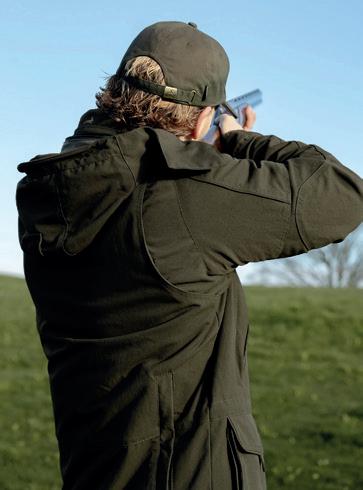
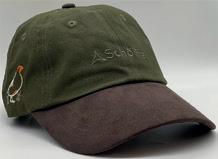
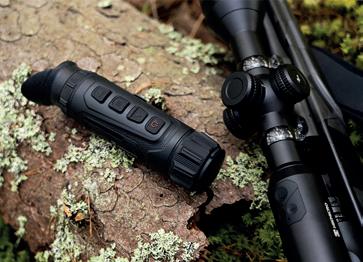
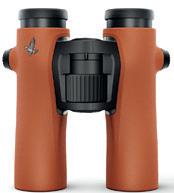
42 Shooting jackets, binoculars, high performance thermal range from Nightmaster, and a few more ideas for your shopping bag!
Short term hire for poultry - turkeys, geese, ducks & chickens …long term hire for game processors
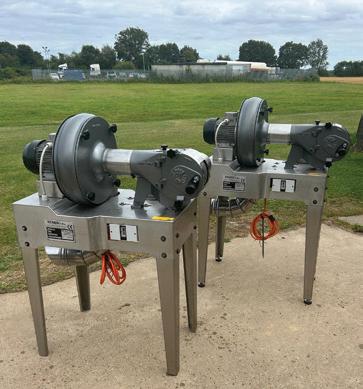
For Growers of Turkeys and other Poultry who do so in small numbers, or for those seeking to expand Production, then hiring a Plucking machine makes sense. you can have a top performing machine, tried and tested within the Poultry Industry for many years at your disposal
This enables you to get the hardest task done with minimal labour input and no Capital outlay of outright purchase.
A Machine eases labour requirements at this busy time of year. Also, any further increase of Production of Poultry for the next season, hiring of Machinery allows Capital/Cash Flow to be channelled into the overall cost of Production/Rearing costs throughout the year.
For established Growers who may already have a Machine, the hiring of another unit can ease the work load and work well around labour availability on certain days in this busy period without the need to spend Capital.
All our Plucking Machines for hire are market leadersBayle MP11 or Senesi Q11, either factory refurbished or new, available in 415volt three phase or 240v single phase, 16amp blue push plugs. Machines come with a sprung loaded Gantry to hold birds in plucking position, 3m of flexible feather outlet pipe and feather bag for collection.
Bird Flu within the Poultry Industry has created challenges and uncertainty, but the Sale of Traditional Christmas Poultry reared and processed on farms within the UK remains strong.
This type of rearing, most commonly found on Family farms, is carried out to the highest standards of welfare, and the people involved are incredibly proud of what they produce for the all-important meal of the year - Christmas Dinner.
We would always prefer to hire machinery to Growers who have had some previous experience with Dry Plucking machines, as with all machinery there is a technique and understanding of the use of itthus you get the most out of the Hire machine!
Short term rates of hire: £235.00/day plus delivery/ collection plus vat Machines are delivered directly via courier.
For more information: www.storeypoultrysupplies. co.uk or Call - 01473 823598
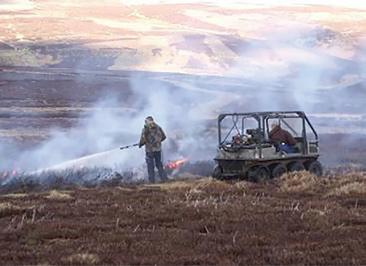
Bespoke fire fogging units help fight suppression
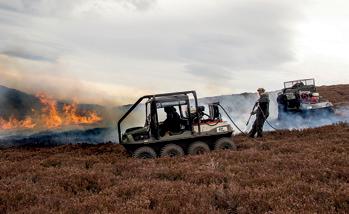
Bespoke fire fogging units - Built by PWS and engineered to deliver precise, reliable, and highly effective fire suppression solutions. Designed around real-world risks rather than off-the-shelf assumptions, each unit is tailored to the specific operational needs of the client to control wild fires.
PWS’s bespoke approach is the ability to build fire fogging
units directly onto all-terrain vehicles (ATVs). These mobile systems are designed for rapid response in challenging terrain where fixed infrastructure or standard fire appliances cannot operate effectively. Mounted seamlessly onto ATVs, the units maintain vehicle stability, manoeuvrability, and payload balance while delivering
immediate fire suppression capability in remote, off-road, or industrial locations. making them highly effective for the control of wildfires in forests, grassland, moorland, and rural areas. ATV-mounted units allow operators to reach fire fronts quickly, establish fire breaks, and suppress spot fires before they escalate.
Every ATV-mounted unit is custom-engineered following a detailed assessment of terrain, fire risk, and operational requirements. Tank capacity, pump performance, nozzle configuration, controls, and mounting frames are all adapted to ensure carefully controlled pressures to rapidly cool flames, displace oxygen at the fire source,
also preventing re-ignition. Bespoke fire fogging units from PWS provide a modern, efficient, and targeted approach to fire protection.
For more information or to discuss your specific requirements don’t hesitate to get in touch –enquiries@pws-ltd.co.uk or call - 01674 840412
The GWCT welcomes a new Ambassador to its programme
The Game & Wildlife Conservation Trust (GWCT) is delighted to announce the expansion of its ambassadorial programme with the appointment of a new ambassador – Chelsea King.
Through the programme, the Trust aims to reach new audiences and highlight its unique role in delivering worldclass scientific research that shapes government policy and
champions game and wildlife management as a vital part of nature conservation.
By welcoming Chelsea, the GWCT hopes to engage younger and more diverse communities and showcase the organisation’s work to enhance the British countryside, boost biodiversity, and drive nature recovery on a landscape scale.
Chelsea King lives within the rural community and has a deep connection to life on the
Spare parts for Comb, Bingham, Bayle or Senesi plucking machines, brand new and recon for sale - twin motor from £1,485+VAT
• Faster Processing Day
• Less Mess
• Professional Finish
For Turkeys/Geese and other PoultryWithout Buying the Kit-HIRE IT & save ££££ “Don’t Buy what you only need for a day or two for the year.
For the Processing of Game Birds for the next Seasontry Long term Hire
tel: 01473 823598 day, evenings and weekends call Mark on: 07879 496970 email: storeypoultrysupplies@btinternet.com www.storeypoultrysupplies.co.uk
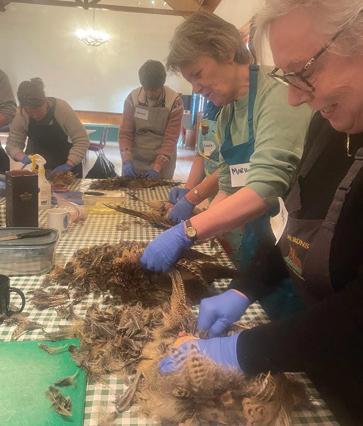
Pluck and Prepare workshops showcase local game
Loch Ness Rural Communities has extended its Pluck & Prepare Workshops due to popular demand from budding chefs keen to learn how to pluck a pheasant, prepare and cook game.
The free events provided hands-on demonstrations, with wonderful game dishes to sample, including game goujons, schnitzel and lasagne, plus some birds to take home.
The first two workshops were held at Dunmaglass Village Hall and Wildside Community Centre, Whitebridge.
Jenny McCallum, coordinator of Loch Ness Rural Communities, said: “More and more people are keen to reduce their food miles and eat locally-sourced, sustainable food. Game from the hills and
land. Living on a farm with a working shoot, she is immersed in the seasonal rhythms of the countryside and the realities of managing land, wildlife, and habitats responsibly.
Through daily life on the farm, Chelsea has gained first-hand experience of deer management and evidence-led predator control, and has seen how science-led decisions play a vital role in supporting habitat balance and biodiversity. Her approach is shaped by a strong respect for animals and wildlife welfare, and by paying close attention to how small, informed actions can have lasting impacts on the landscape.
Chelsea is passionate about encouraging people to develop a meaningful connection with the countryside, and believes that early exposure for children
and young people is essential in fostering understanding and respect for the natural world. Through her children’s book, she aims to spark curiosity and help younger audiences build an early appreciation for wildlife, farming, and life on the land.
She says: “I am delighted to join the Game & Wildlife Conservation Trust as an ambassador and I look forward to supporting its researchled work and helping to share a balanced, science-based approach to conservation and land management.”
The GWCT looks forward to working closely with its ambassadors through the programme as they help to champion the Trust’s mission and inspire future generations to value and conserve the British countryside.
moors around Loch Ness is absolutely delicious and you can’t get any more local. The shoots around here have the finest game in season, and people are keen to reconnect with their heritage, so it is a win-win.
“We had participants of all ages, the youngest was just nine years old and it was great fun, it felt something like The River Cottage meets Blue Peter, so hopefully we have created some life-long pluckers!”
The pheasants were provided by Corriegarth Estate and Dunmaglass Estate, also known for their premium grouse, partridge and venison, all available in season.
Jenny continued: “Our thanks go to the community centre, Dunmaglass and Corriegarth for hosting us and providing the
game, as well as the expertise of the keepers and chefs who showed us how to prepare the birds. We are planning more events, so all those who missed out on the workshops should have their aprons at the ready.”
Scottish game is naturally high in protein, low in fat
and nutritious. Pheasant is particularly versatile, and can be served as a superb whole roast bird, slow-cooked in a casserole, or pan-fried as pheasant goujons.
Over 11,000 full-time jobs are supported as a direct result of sporting shooting in Scotland, often in remote communities.
Scottish Gamekeepers Association – upcoming training dates
Wild Bird (Corvid) and Spring Trap Training (mandatory requirement)
16th March: SGA office, Perth
27th March: Southannan and Fairlie Estates, North Ayrshire
17th April: Erchless Castle, near Beauly
24th April: Minginish Community Hall, Isle of Skye
1st May: Glass Hall, Haugh of Glass near Huntly
To BOOK or for any enquiries, please contact training@ scottishgamekeepers.co.uk
The GWCT Scottish Game Fair is back and better than ever for 2026, tickets are now on sale
Scotland’s much-loved outdoor celebration is officially back. The Game & Wildlife Conservation Trust (GWCT) Scottish Game Fair will return to the stunning grounds of Scone Palace this July (Friday 3-Sunday 5), promising an expanded programme of entertainment, live music, country sports, food, shopping and family-friendly activities, welcoming a range of wellknown faces from across food, farming, rural life and culture.
Contact details: Tickets are now on sale. For further information, visit www.scottishfair.com.
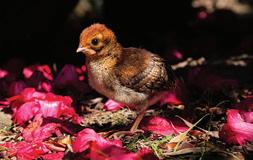
The World Pheasant Association aims to promote the worldwide conservation of Galliformes through scientific studies, education and in-situ projects. Advisory groups work with breeders and enthusiasts in the UK and Europe to collectively provide a lifeline to species that are threatened in the wild and maintain viable genetics through studbook management. Healthy birds with a good genetic base can be held as a backup population for conservation projects.
Fundamental to the success of this important work is the annual census of captive Galliformes. Breeders are encouraged to complete the census form each year to provide vital data on the numbers of birds in their collections – information that is crucial for assessing the conservation status of pheasant species and determining necessary actions to protect them.
The importance of this exercise cannot be overstated.
The Malay Crestless Fireback (Lophura erythrophthalma), subject of one of the WPA’s
recent conservation projects, has undergone a catastrophic decline due to region-wide loss of lowland forest to agriculture, towns and infrastructure. The population trend is thought to have decreased to such an extent that it is now classified as critically endangered. Historically, large numbers of this species were imported into Europe, but accurate and up-to-date data is needed to provide information into the numbers of captive stock and how they are breeding.
The census information is completely anonymous, with all submitted information being combined to determine the trends of different species in collections in the UK and across Europe.
It has never been more important to participate in such a document. Due to the number of new and ever-changing legislation for Galliformes from relevant authorities, this will help show the importance of the captive population of Galliformes.
Should anyone wish to know more or add their own birds to the census please contact the WPA office: office@pheasant.org.uk
Sporting rates relief scrap shocks shooting community
By Peter Clark Scotland Director British Association for Shooting and Conservation
The Scottish Government’s Budget for 2026–27 passed through parliament in January with most media attention fixed on income tax and spending on health and education. Buried in the detailed papers, however, was a decision that has landed hard in rural Scotland: the removal of small business rates relief from most shoots.
The change received little public attention. It was set out in technical budget documents rather than in headline announcements, and it did not feature prominently in wider debate. Yet for those involved in shooting, deer management and land management, its significance was immediately clear.
For BASC, this is not a minor technical adjustment to non-domestic rates. It is a policy change with real consequences for jobs, land management and the day-to-day running of rural businesses across Scotland.
For many years, the majority of shoots and deer management operations, particularly those
involved in deer stalking, game shooting and associated land management, have benefited from rates relief under the Small Business Bonus Scheme. That support has been vital in helping rural businesses remain viable in areas where income often fluctuates seasonally and margins are slim. It has allowed operators to absorb costs that do not disappear in quiet periods and to plan beyond a single season.
Crucially, rates relief has also enabled money to be reinvested in the land. Shoots and deer forests have been able to support deer management, habitat work and conservation activity while maintaining rural employment. In many parts of Scotland, shooting underpins jobs in gamekeeping, stalking and guiding, as well as work for local contractors and businesses linked to accommodation and
hospitality. These activities form an important part of local economies, particularly in remote areas where alternative employment opportunities are limited.
From April 2026, much of that support will be removed. Under the new rules set out in the Budget, sporting rates relief will apply only where land is used solely for deer management, environmental work or vermin control.
Most rural sporting businesses rely on a mix of activities to remain financially sustainable. Deer management, game shooting and environmental work are often carried out side by side, with income from one helping to support another. The requirement for land to be used “solely” for a single purpose bears little relation to how land is managed in the real world.
The practical effect is that many businesses which have previously qualified for full or partial relief will face full rates bills for the first time. While transitional relief has been offered to phase in additional liability over three years, this does little to address the structural pressures facing small rural enterprises.
BASC has been clear in its opposition to the removal of sporting rates relief. Shooting and stalking businesses contribute £780 million to Scotland’s economy and support thousands of jobs, often in some of the most remote parts of the country. These jobs matter. In communities where populations are small and distances are large, the loss of even a handful of roles can have a serious knock-on effect.
The implications extend beyond employment. Shoots invest heavily in habitat
Peter Clark
management, woodland creation, peatland restoration and predator control. This work delivers tangible public benefits, including biodiversity enhancement and carbon sequestration. Rates relief has helped make this private investment possible by giving businesses the financial headroom to commit to long-term land management.
Without relief, there is a real risk that this investment will be reduced or lost altogether. If shoots are forced to cut back, some conservation work will simply not happen. In other cases, the responsibility may fall to public bodies, shifting costs from private operators to the taxpayer and threatening outcomes that are currently being delivered efficiently by rural businesses themselves.
Provisional survey results from BASC members underline the scale of the issue. More than 61 per cent of respondents reported
carrying out two or more of deer management, vermin control or environmental management. Under the 2026–27 rules, which restrict relief to land used solely for one of these purposes, those businesses would no longer qualify for sporting rates relief.
Three-quarters of those surveyed are currently eligible for the Small Business Bonus Scheme on sporting rates, and 92 per cent fall below the £12,000 threshold for 100 per cent relief. On average, they employ or involve six people in activities related to shooting or deer management, highlighting the local jobs at stake.
Members also expressed concern about the wider consequences of losing relief. Many anticipate increases in deer and agricultural damage if management activity is reduced. Nearly half warned of fewer opportunities for young people to become involved in shooting and countryside work. Others pointed
to a likely decline in investment in conservation and natural capital projects. Together, these responses paint a picture of pressure spreading well beyond balance sheets.
In response, BASC has launched an e-lobby campaign urging members and supporters to call on the Scottish Government to reinstate sporting rates relief for shoots. The campaign invites participants to sign and submit an open letter to Shona Robison MSP, cabinet secretary for finance and local government. The letter sets out a practical point: land use in rural enterprises is inevitably integrated, and the requirement for land to be used “solely” for one activity does not reflect reality.
The letter also highlights the economic, social and environmental contribution made by small sporting enterprises, and the risk that this contribution will be undermined if relief is not restored. Alongside the campaign,
BASC continues to raise the issue directly with ministers. Minister Jim Fairlie committed to looking into the matter further during Stage 3 of the Natural Environment Bill, and that engagement is ongoing. What makes the change harder to accept is the lack of consultation that accompanied it. The removal of sporting rates relief was included only in detailed budget documents, without meaningful engagement with affected stakeholders and without a published impact assessment. For a policy with such far-reaching implications for rural Scotland, that represents a missed opportunity for constructive dialogue.
At a time when public money is tight, removing a measure that supports private investment in land management looks shortsighted. The result is a policy that saves little, but risks long-term damage to rural economies and the management of Scotland’s countryside.
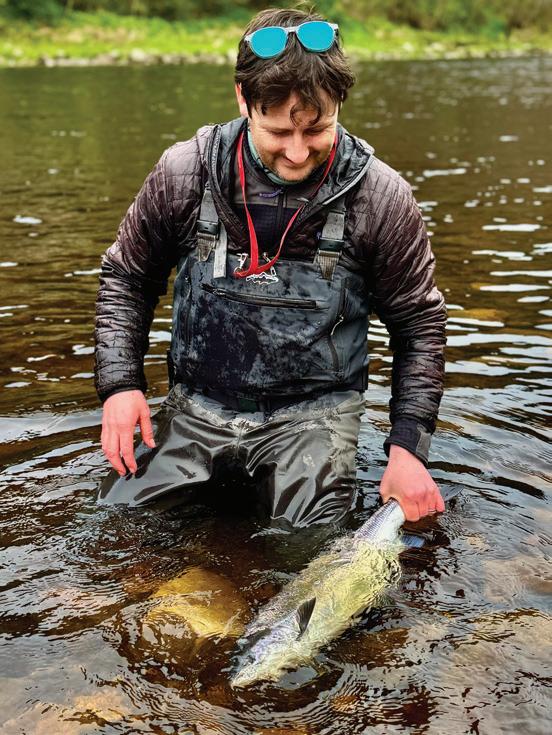
Common Ground Landscape Resilience, Crofting and Wild Salmon Recovery on the Isle of Lewis
By Jonathon Muir, Head of Communications – Atlantic Salmon Trust
Across Scotland, wild Atlantic salmon populations have seen dramatic declines over recent decades. A large part of this decline is due to reduced survival at sea, influenced by climate change, shifting food availability, and human pressures in coastal areas.
These challenges at sea make the role of freshwater habitats even more critical: rivers must produce fit, healthy juvenile wild salmon to give them the best chance of returning as spawning adults. But the freshwater environment itself is under increasing pressure,
facing habitat degradation, barriers to migration, rising water temperatures, erosion and siltation, predation pinch points, and altered flow patterns caused by human activity.
Already across Scotland, vulnerable rivers and streams
are frequently recording water temperatures in excess of 27°C –far into the thermal stress danger zone for a cold water species like the Atlantic salmon. Temperature projections indicate that the far north of Scotland, where wild salmon populations remain relatively healthy, and the Outer Hebrides, are set to face some of the sharpest water temperature rises over the coming decades. This, combined with altered rainfall patterns and extreme weather events, threatens not just wild salmon, but also the landscapes and communities which define these unique places. These potential wild salmon strongholds will soon be facing some of our most severe climate challenges.
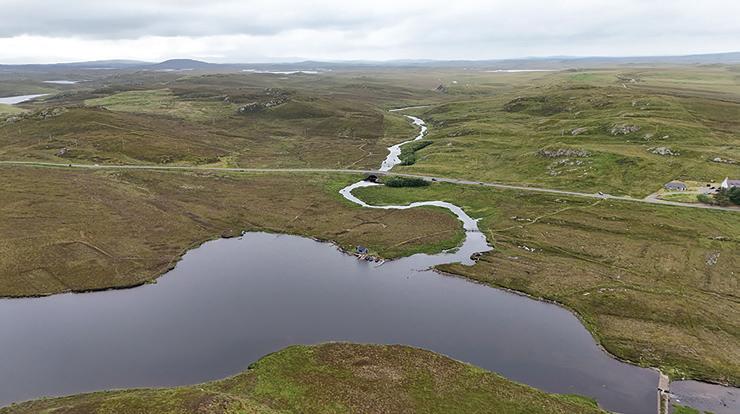
In response, the Atlantic Salmon Trust and its partners are undertaking a bold, communityfocussed approach to restoration on the River Laxay catchment on the Isle of Lewis – a project called Linking the Lochs. The Laxay is characterised by a complex network of rivers, lochs and peatlands, and protecting this area is not only about safeguarding a
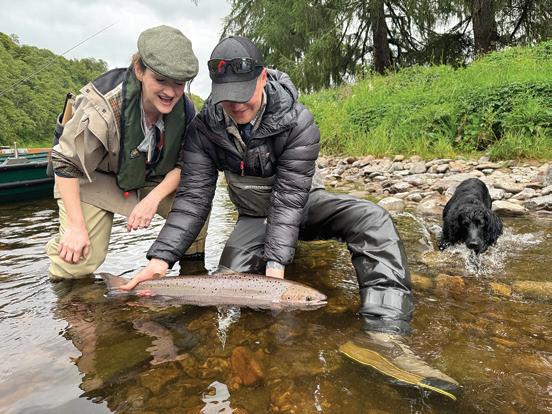
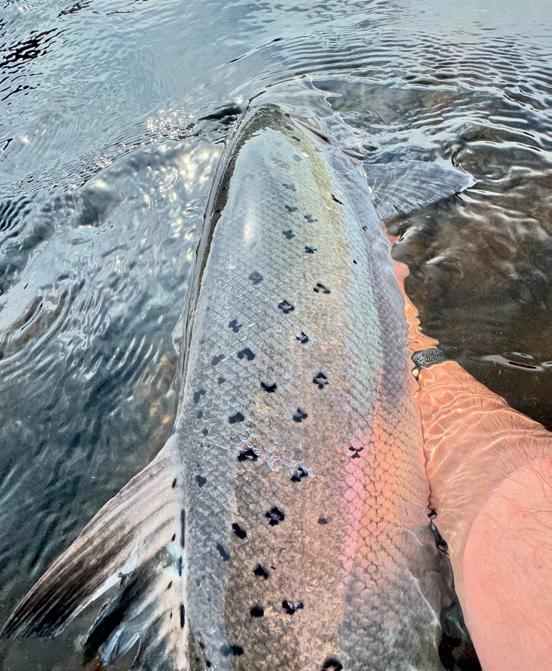
Freshwater salmon
species, but also building resilience into the landscape, and sustaining crofting livelihoods, maintaining a cultural and economic fabric that has shaped the island for centuries. Linking the Lochs, delivered in partnership with the Soval Estate, is rooted in collaboration with the local crofting community, whose knowledge, stewardship, and livelihoods are being championed as central to both ecological recovery and the island’s socioeconomic resilience.
From 2024 to 2025, the project concentrated on building a robust scientific and social foundation. An extensive catchment audit brought together data on hydrology, soils, grazing patterns, woodland potential, and biodiversity. Advanced drone surveys, walkover assessments and ecological baselining provided a shared evidence base to guide restoration. Crofters’ insights on livestock movements, seasonal land use, and historical management informed the mapping of 52 grazing quadrants and survey areas across the catchment. This integration of local knowledge with ecological science ensures that restoration work is grounded in reality and respects the expertise of those who live and work on the land.
Engagement with the crofting community is taking many forms. Collaborative walkovers combined scientific assessment with local observation of water flows, erosion hotspots, and habitat conditions. Stakeholder meetings and informal discussions give crofters space to voice concerns, share experiences, and shape priorities. The project’s approach seeks to avoid imposing solutions from above, recognising crofters as co-developers of the restoration plan, reinforcing trust and long-term commitment.
The restoration framework that emerged is adaptive, place-specific, and designed to deliver multiple benefits. Proposed actions include restoring 1,800 hectares of peatland bogs, enhancing 7km of tributaries to reduce sedimentation, modifying three weirs to improve fish passage, re-naturalising 41 man-made in-stream structures, targeted tree planting to create shade to reduce water temperatures, and restoring vegetation along river and loch edges. These measures will improve river connectivity, restore riparian habitats, enhance wetland function, and increase resilience to drought and flooding.
The aim is ultimately to benefit wild salmon while also delivering broader gains for biodiversity, water quality and climate resilience, demonstrating that environmental and community priorities can advance together.
Equally important is the project’s emphasis on economic opportunity. By employing local suppliers, contractors and environmental consultants, such as Stornoway-based Atlantic 58, Linking the Lochs ensures that restoration work contributes directly to the island economy. From ecological monitoring to habitat management, the project is supporting jobs and developing skills that can sustain livelihoods while also supporting conservation outcomes. This approach demonstrates that environmental restoration and economic resilience are not mutually exclusive but mutually beneficial.
The project recognises that meaningful ecological improvement cannot come at the expense of local communities. Environmental gains are strongest when they enhance livelihoods and respect cultural traditions. Crofting is not simply a way of managing land - it is a way of
life, connecting people, animals and landscapes, and integrating crofting practices into restoration work ensures that interventions can be sustainable, acceptable and welcomed.
Looking ahead, Linking the Lochs sits within the Atlantic Salmon Trust’s wider Watershed Connections programme, which explores how integrated, community-centred catchment restoration can be replicated elsewhere in the UK. Lessons from Lewis are already shaping the Trust’s thinking nationwide, emphasising how successful wild salmon recovery depends as much on strong social relationships as on ecological interventions. Through 2026, the project will continue to refine its restoration plans, secure funding, and begin on-the-ground work, maintaining a collaborative approach. Its message is simple and important - wild salmon recovery is not just about fish, it is about sustaining communities, landscapes, and livelihoods in a rapidly changing world.
Find out more:
The Atlantic Salmon Trust atlanticsalmontrust.org Soval Estate sovalestate.co.uk
The Lochs Area on Lewis
The Stalking Show: Bringing the Hunting Community Together
The Stalking Show, described as an event “created by hunters for hunters,” has become a focal point for the UK’s hunting and stalking community. Founded in 2019, it was born out of a passion for the outdoors and a commitment to showcasing the best the industry has to offer. The show’s organisers, all keen stalkers themselves, bring a unique perspective to its planning and execution, ensuring it meets the needs of visitors and exhibitors alike.
A Clear Focus and Passionate Origins
The Stalking Show was established by a dedicated group of hunting and outdoor enthusiasts with a vision to create a focused and meaningful
event tailored to the stalking community. Show director
David Freer, whose background spans farming, shooting, and event organisation, has played a pivotal role in shaping the show’s development. He explains: “I grew up on a small family farm and developed a huge passion for hunting and fishing. After studying at Sparsholt Agricultural College, I started a small events company alongside farming and shooting. This background drives us to ensure the show genuinely reflects the needs and interests of the stalking community.”
A Diverse and Evolving Experience
This year’s show promises a wide range of attractions, including
an array of competitions, butchery demo’s, skinning demo’s, celebrity game chefs and discussions on key industry topics. The organisers emphasise that all exhibitors must have a clear relevance to stalking, hunting, or vermin control, ensuring the event stays focused on its core audience.
Visitor and exhibitor feedback plays a vital role in shaping the event. “The Stalking Show is very much the people’s event,” says David. “We encourage feedback and ideas from both visitors and exhibitors, ensuring the show evolves each year with significant input from the stalking community.” David
hopes the event will inspire new participants to join the fieldto-fork movement, promoting sustainable hunting practices and showcasing the healthy, accessible products that the countryside has to offer.
Promoting Sustainable Deer Management
Sustainability and responsible hunting are central themes of The Stalking Show.
This year, The Stalking Shows three year working partnership agreement with BASC builds on BASC’s long support for The Stalking Show and confirms the association as its official partner. The
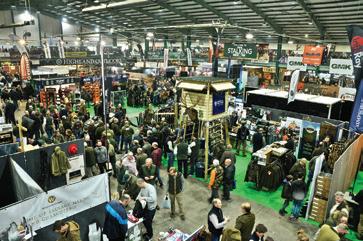
Crowds at Stalking Show
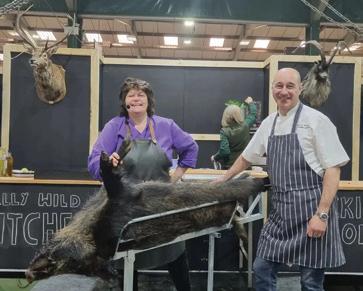
The boar ready for butchering
move underlines a shared aim to promote responsible deer management across the UK.
Working together to deliver a series of educational and engagement initiatives, including live demonstrations and seminars. These will feature interactive displays highlighting
best practice in deer management, habitat conservation and firearm safety. BASC’s deputy director of shooting and operations, Terry Behan, said: “This partnership reflects BASC’s long-term commitment to supporting the stalking community and promoting sustainable deer
management. The Stalking Show has quickly established itself as the focal point for stalkers and gamekeepers across the UK. We’re proud to help drive its continued growth and success.
”David “We’re delighted to strengthen our relationship with BASC through this new
partnership. BASC’s expertise and leadership in shooting and conservation will bring enormous value to our visitors, exhibitors and the wider stalking community.
The British Deer Society (BDS) will continue as the show’s official charity partner.
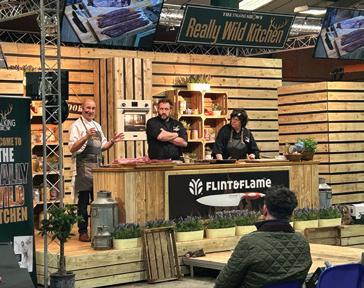
Meeting the celebrities
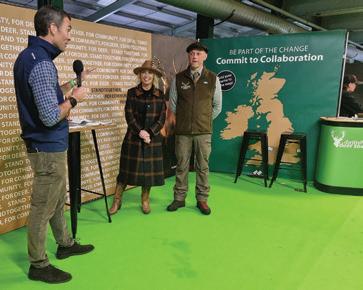
Wild boar demonstration
“The BDS is crucial in communicating the purpose, dedication, and value of the deer stalking community to the wider public,” David notes. “Their presence at the show ensures a strong focus on deer welfare, science, and best practice standards.”
The collaboration includes the BDS’s “Together for Deer” campaign, and the organisation will host open discussions on the stage.
Culinary demonstrations also take centre stage, with chefs Rachel Green and Jose Souto showcasing delicious game dishes and butchery techniques. These attractions highlight the field-to-fork philosophy and demonstrate the benefits of game meat as a sustainable, healthy food source.
Delivering Value to Retailers and Exhibitors
The Stalking Show has become an essential event for retailers and distributors, offering exclusive deals and a focused audience. “We keep costs for exhibitors and visitors to an absolute minimum,” David explains. “This allows retailers to offer show deals that can’t be matched online or at other events.”
The show limits the number of retailers selling similar products to ensure a diverse and competitive environment. This approach has resulted in a waiting list of businesses keen to secure a spot, reinforcing the event’s growing reputation as a must-attend for the industry.
The Wild Boar dem is back showing a detailed step by step preparation of wild boar, The Stalking Show will be the only show in the UK doing this dem so don’t miss it.
We also have demonstrations about taking the deer and wild boar from Hunt, to Harvest, to Plate helping the new comers as well as the experienced Stalkers pick up tips and techniques they can use at home and in the field.
Chef and Author Rachel Green, Chef Chris Marney and Chef, Author & Lecturer Jose Souto have been looking to add a few new segments to the cookery
theatre looking at some other game species not just our 6 UK species. This year again we will be looking in detail at all these UK species under 1 roof and doing a taste test so that you can match one against another.
We also have the return of the popular Stalking Show Butchery Competition. This year Lincolnshire Game and Flint and Flame Knives, are back to help us put together this years competition which is open to everyone, whether it’s your first time or it’s something you do all the time.
A Vision for the Future
As The Stalking Show continues to grow, its organisers have
ambitious plans for the future. The organisers are working with companies and organisations worldwide to maintain the show’s quality and expand its reach.
A key focus is encouraging people of all ages and genders to get involved in sustainable hunting and harvesting practices. By collaborating with partners like the BASC, BDS and other industry stakeholders, The Stalking Show is a hub for the countryside and conservation community, sharing best practices and celebrating the unique heritage of stalking and hunting.
We look forward to welcoming many BASC members and visitors to the event,
and we hope to see you there. The Stalking Show stands out as a focused, community-driven event that champions responsible hunting and sustainable practices. With its emphasis on feedback, collaboration, and accessibility, it continues to grow in both scope and reputation. Whether through thought-provoking discussions, exclusive deals, or culinary inspiration, the show offers something for everyone with an interest in stalking and the countryside. As it looks to the future, The Stalking Show is poised to play a leading role in supporting and shaping the hunting community for years to come.
Standing Together for Deer and Community at The Stalking Show 2026
The British Deer Society (BDS) is delighted to return as the Official Charity Partner of The Stalking Show 2026, continuing our close collaboration with founders David and Deanne Freer to deliver a standout event for the deer management community.
Following the success of 2025, we’re proud to once again work alongside our members, volunteers, supporters and corporate partners to stand together for community, collaboration and high standards in deer welfare and management. The Stalking Show
has fast become a focal point for informed debate, shared learning and connection across the sector — and we’re thrilled to be part of shaping that again this year.
New BDS Premium Membership: Insurance Included, PLUS Access to the BDS Lounge at The Stalking Show
The Stalking Show is where our community connects, and our new BDS Premium Membership (at £98/year) is designed for those who want to be fully part of it.
Among other benefits, BDS Premium members enjoy:
• Access to the BDS Meet & Greet Lounge throughout the show
• Invitation to an exclusive ‘Bacon & Bubbly’ Premium brunch event at The Stalking Show
• £10m third-party liability insurance
• Up to 10% discount on selected BDS training and products (purchased online)
• Firearms licensing and technical advice
Whether you’re coming for the conversations, the learning or the community, BDS Premium membership gives you added confidence, connection and value at The Stalking Show and beyond. Go to bds.org.uk and click Membership to learn more.
What’s On at The BDS Stand?
The BDS stand is located in a prime location at the heart of The Stalking Show and is the go-to place for all those passionate about deer, their welfare, their informed and responsible management and
their place in sustainable, local food systems.
At our stand, you’ll be able to meet our entire community, including our CEO, staff team,
trustees, members, regional branch volunteers, and our firearms advice representative (Chris Downs, firearmslicensing. net), as well as learn about our
Wild boar demonstration
charity’s work and projects such as the Wild Venison Network.
For just £5/ticket, you’ll also be able to enter the BDS Mega Raffle for the chance to win an epic prize bundle that will include a hugely popular Tikka rifle, a Pulsar thermal imaging monocular, an original piece of art by Kevin Alderson-Smith and more!
At our Deer Management, Training and Mentoring Hub, our training team will be on hand to talk about all things deer stalking, training, sector best practice and mentoring opportunities. Whether you’re just starting out or looking for something more advanced, the team will be happy to support and guide you. By this hub, you’ll also be able to enter the BDS Stalking Master Challenge. If your knowledge is up to scratch, you can enter the challenge for the chance to win a 2-day stalking experience with David Freer in Scotland –including accommodation in a log cabin!
Also on the stand, you’ll find a dedicated Police & Humane
Animal Dispatch (HAD) area. Here, representatives from Hampshire & Isle of Wight Constabulary will be on hand to discuss the establishment of their police-led HAD volunteer scheme and the growing national focus on improving deer welfare following vehicle collisions, while representatives from Staffordshire Police will be available to speak to about local firearms licensing and similar topics.
What’s On at The BDSStalking Show Stage?
On the joint BDS–Stalking Show stage (upgraded this year to improve sound, visibility and audience engagement), we will once again lead on delivering panel discussions on contentious topics in deer stalking and management, in addition to workshops and talks.
Stage Highlights include:
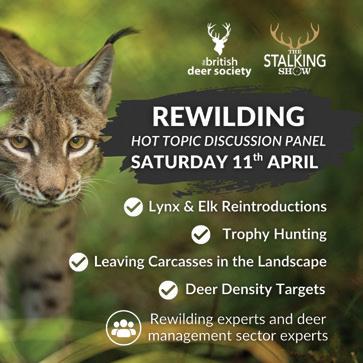
Saturday – Rewilding Panel
A lively, evidence-led discussion exploring rewilding, species
reintroductions (lynx and elk) and the realities of managing deer in complex, modern landscapes. Panellists include representatives from Rewilding Britain and SCOTLAND: The Big Picture.
Sunday – Head Shooting Panel
A frank conversation examining welfare implications, carcass quality, business drivers and public expectations. Panellists include representatives from Oakland Park, Deerbox, UKDTR and veterinary expert, Peter Green.
UK Health Security Agency (UKHSA)
With guests including Paul Childerley (Childerley Sporting), the UKHSA will be discussing disease risks relevant to the deer management community, tackling myths and sharing practical, up-to-date guidance.
Demos, workshops and more with the BDS Corporate Partner Network
• Taneli Pokkinen, Product
Manager of Commercial Rifles, will be joining the stage with our Corporate Partner, GMK Ltd. to present and demonstrate some of their latest gear and discuss what goes into designing rifles like the Tikka T3X Ace Target.
• The Thomas Jacks team will also be on stage to demonstrate some of the latest thermal imaging, digital and night vision optics on the market from Pulsar.
• Game Larder by Tarrant Refrigeration, AGM Venison, Hunter Gatherer Cooking and guests will be running a series of workshops and activities focused on helping members of the deer stalking community learn how to set up, establish and grow their own wild venison food business in their local area.
Full details and timings of stage activities will be shared closer to the show. Follow The Stalking Show on social media to make sure not to miss any updates!
BASC becomes the official partner of The Stalking Show
As the event’s official partner, BASC will have a strong presence at The Stalking Show, taking place on Saturday 11 and Sunday 12 April at Staffordshire County Showground. BASC will host interactive areas open to all visitors, and we are keen to encourage discussion, questions and hands-on engagement throughout the weekend.
How it all began
The Stalking Show was first held in 2022 and quickly established itself as a leading event in the UK shooting calendar. By its second year, it had doubled in size, and by 2024 the show hosted more than 300 exhibitors. It continues to be valued for its bustling and friendly atmosphere and attracts
tens of thousands of visitors, from experienced professionals to newcomers keen to learn more about deer stalking and shooting sports.
The show’s appeal lies in its clear focus on stalking and shooting. It brings together those with a shared interest in field sports, offering opportunities to see new equipment, hear from industry figures and keep up to date with developments across the sector. Many regard it as a hub for the deer-stalking community – a place to meet, browse, purchase the latest equipment, and ask experts questions at the show.
BASC’s continued involvement As the leading organisation
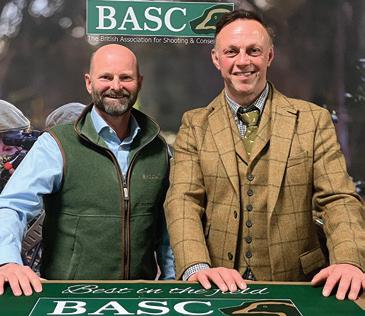
BASC chief executive Ian Bell (left) and The Stalking Show owner/creator/founder David Freer (right).
on deer management, BASC has supported The Stalking Show since its inaugural year, reflecting a shared commitment to high standards in deer management. Our presence at the event has grown year on year, leading to the announcement of a three-year official partnership beginning in 2026.
This partnership strengthens our mutual focus on sustainable deer management, best practice and practical knowledge. Over the next three years, BASC and The Stalking Show will work closely to ensure visitors continue to benefit from a strong programme of interactive discussion and practical demonstrations.
The show also provides an important platform for BASC to highlight the wideranging support available to deer managers. These include training and education, firearms
advice, a dedicated deer team, stalking schemes and a unique mentorship programme designed to support both recreational and professional stalkers.
We recognise the role that responsible deer management plays in supporting rural communities, local economies and the wider countryside. This underpins BASC’s work to help secure a stable venison market and represent deer managers’ and shooters’ rights and interests fairly and effectively. We will continue to speak up for the community with policymakers and to lobby MSPs and MPs to drive practical and positive outcomes.
BASC at The Stalking Show
BASC will host two large interactive stands, where visitors can speak to the team about firearms advice, venison processing, training, education and membership. Attendees
will also have the chance to take part in a mock DSC1-style assessment.
In addition, BASC will deliver a full programme of talks, debates and demonstrations on the main stage in Bingley Hall across both days. Sessions will be led by BASC’s head of deer and woodland management, Martin Edwards, and will include contributions from BASC chief executive Ian Bell, alongside other industry figures and civil servants.
Live demonstrations will include head measuring and butchery, with topics covering the future of deer management, firearms and alternatives to lead ammunition.
BASC will also feature on the second stage during the show, offering further opportunities for visitors to engage with staff and speakers.
Visitors to the BASC stand will have the chance to enter a prize draw to win a thermal optic. Come along to our stand
over the weekend to find out how to enter.
Venison and wild food at the show
BASC is sponsoring the Really Wild Kitchen at The Stalking Show, where visitors can gain inspiration to prepare and cook venison at home. The programme will feature BASC wild food ambassadors Jose Souto and Rachel Green, who will share handy cooking tips and recipes throughout a full programme of demonstrations.
Both chefs are strong advocates for sustainable wild food and improving access to game meat. Alongside cooking demos, they will also show how to skin and butcher deer and wild boar efficiently.
With a packed programme across the weekend, there will be plenty to see and do at The Stalking Show. Tickets cost £20 for a single day or £25 for the weekend and you can book via The Stalking Show website.
Here are a couple of out Shooting Scotland clients who will be at The Stalking Show…
BMC Wholesale
BMC Wholesale are proud to be the UK Distributor of Gateway1® Gateway1® boots are made for hunting, outdoor adventures and are not afraid of tough terrain.
With our Coil lining™, a unique sole system and extreme grip, you get comfort, stability and dry feet – all day, in any weather.
We are always exploring new innovations that will improve comfort, functionality, resilience and durability.
This is exactly how we have already established the Gateway1 brand with recognised innovations such as our Japanrubber™ technology, G1® air spacer™ and Lynx ICEGRIP+™.
Fisher UK
“Game is Food and should be treated as such”
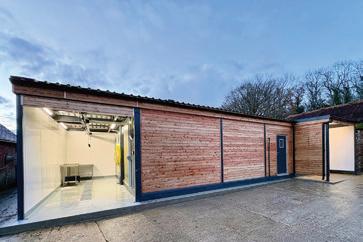
In the modern shooting landscape, the benefits of having access to a Larder increases the ease and efficiency at which you can process and store Game. Whether you’re managing a private estate or a commercial deer stalking venture, the ability to handle game in a hygienic, temperature-controlled environment is a necessity for carcass quality and safety within the food chain.
Specialising in the design and manufacture of Larders and Processing facilities, Fisher Game Larders provides a full “concept to completion” service. From our compact models through to large-scale
commercial sites and AGHE’s, our Larders are designed for productivity and performance.
The benefits of a Fisher Game Larder extend beyond simple refrigeration - each is built with food-safe panels, non-slip flooring and fully commissioned services. An aluminium rail system runs throughout which, when used in conjunction with the electric hoist, significantly reduces the need for manual handling, allowing a single person to manage heavy carcasses with ease and safety.
For those looking to add value to their game, a Fisher Game Larder offers more than just a functional space – it provides a modern, purpose-built facility for you to handle and
process your carcasses in-line with food standards, industry regulations and compliance.
Furthermore, it enables you to treat your game with the care it deserves, which is crucial in an era where provenance and traceability are increasingly important to the end consumer.
The bespoke nature of our buildings allows us to tailor
the internal layout, configuring it to suit the operational needs of individual clients. We also undertake on-site construction projects, as well as offering a full design and consultancy service, drawing on over 20 years of personal and professional experience within the sector.
To explore our full range please visit www.fisheruk.co.uk
Shooting Supplies will be exhibiting once again at the STALKING SHOW in April, our product range of luggage and accessories are all made in the UK and are Taylor made for the STALKING scene where hard wearing durable kit it essential, here at Ogdens we
pride ourselves on the Highest Quality manufacturing using Cordura,Ultraglide zips and pullers,robust webbings and fittings,call on the stand and have a look at the best shooting luggage and extras available in the UK...British made and proud of it.
Ogdens Shooting Supplies
Ogdens
scottish venison
Local venison hits the menu at Inveraray Primary School
Argyll and Bute is renowned for its exceptional local produce, and now pupils at Inveraray Primary School are enjoying a taste of it in their school meals.
Argyll and Bute Council introduced wild venison to school menus on Islay and Jura in January 2025 in what was a UK first. Due to its success, the award-winning initiative has now been extended to Inveraray.
The venison served at Inveraray Primary comes from Argyll Estates and is processed by husband-and-wife team Tom and Katie Kirsop at their game larder, Argyll Game Ltd - ensuring the meat is truly local and sustainably sourced. Children played a key role in shaping the menu by taking part in taste tests to choose their favourite dishes, with wild venison burgers and bolognaise coming out on top.
Venison is a nutrient-dense food, rich in protein and low in saturated fat, making it a healthy addition to school meals. This initiative supports the council’s commitment to climate-friendly, locally sourced food that reduces food miles and promotes sustainability.
Councillor Ross Moreland, Argyll and Bute Council’s Policy Lead for Finance and Commercial Services, said: “We’re delighted to introduce wild venison to Inveraray Primary School. This is about making the most of high-quality
local produce while teaching pupils about sustainability and healthy eating. The success of the pilot on Jura and Islay showed us what a positive impact this can have, and we’re thrilled to see it expand to the mainland.”
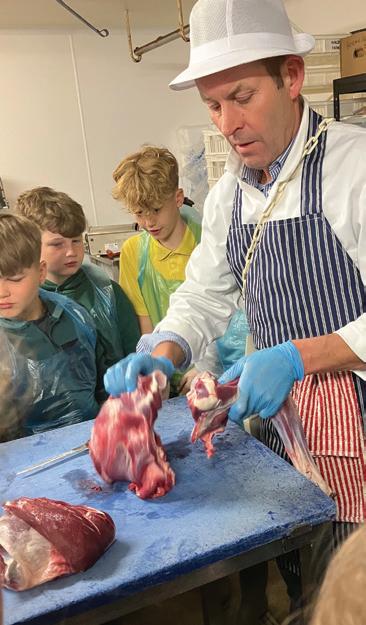
Tom Kirsop from Argyll Game Ltd, has been working with pupils at Inveraray on a number of outdoor learning initiatives, including making and positioning bird boxes throughout the estate so they can monitor and identify the species. The children have also been out with Tom on the hillsides, learning in a natural environment where some of their food comes from.
Tom said: “Having had the opportunity to help the children of Inveraray Primary with their outdoor school programme I am delighted that they have venison on the menu. The pupils visited our processing facility where they helped to produce burgers and sausages which they all loved and went home with some to try. It was really encouraging to see how interested and engaged the children were in the process from hill to plate.
“It is wonderful the children are getting the opportunity to eat sustainably harvested wild freerange venison from the local area with almost zero food miles. Red deer venison is a highly nutritious, lean red meat, packed with protein, iron, zinc, and far less saturated fat than other
protein sources. All in all, a great choice for healthy hearty meals.”
The Council worked with Food for Life Scotland to develop recipes that meet Scottish Nutritional Requirements for Food and Drink in Schools and the Food for Life Served Here standards.
Looking ahead, the Council will continue to monitor the project and explore opportunities to expand this initiative to more schools across Argyll and Bute.
School visit to Argyll Game, Inveraray to learn about venison with Tom Kirsop
What’s Coming Next?
By Stewart Blair Lecturer, UHI North, West and Hebridies Land & Rural Studies
The Wildlife Management & Muirburn (Scotland) Act 2024 has passed, but for keepers on the ground, the real changes are only just beginning. With grouse moor licensing, trapping reform and muirburn regulation still to come, the next two years will define how upland management operates in practice.
When the Wildlife Management & Muirburn (Scotland) Act 2024 received Royal Assent, many in the sector saw it as the end of a long and difficult legislative journey. It marked the start of a much longer process.
While the Act itself is now law, much of what will change day to day on estates has yet
to be switched on. Grouse moor licensing, wildlife trap licensing, muirburn controls and competency requirements are all being phased in through secondary legislation and guidance.
For gamekeepers, that means one thing above all else: this is a transition period—and preparation matters.
Grouse moor licensing: the framework already exists
Grouse moor licensing is one of the most significant structural changes introduced by the Act, even though its full operational impact has yet to be felt.
Under the new framework, driven grouse moors in Scotland
will be required to operate under a licensing scheme administered by NatureScot. The licence itself is held by the estate or controlling interest, but compliance will depend heavily on how management is carried out on the ground.
Crucially, grouse moor licensing is not a single issue measure. Licence conditions are expected to link together:
• Wildlife management practices
• Use of traps and other control methods
• Muirburn activity
• Adherence to wildlife crime and welfare standards
Where serious breaches occur, the Act allows for licence suspension or revocation, either
in full or for specific activities. For keepers, the key point is this: grouse moor licensing brings all other regulatory strands under one umbrella. How muirburn is planned, how traps are set, and how records are kept will no longer be viewed in isolation.
Muirburn licensing: delayed, not dropped
Muirburn licensing was expected to follow quickly after the Act came into force. Instead, implementation has been pushed back, with commencement now expected in Autumn 2026.
That delay has been welcomed by many estates, but it should not be misunderstood.
Stewart Blair
Licensing has not been abandoned—it has simply been postponed. Once the scheme begins, all muirburn in Scotland will require a licence, and burning without one will be a criminal offence.
On the ground, licensing is expected to bring closer scrutiny of burn justification, particularly on peatland. Licences are likely to be granted only where managers can demonstrate that no viable alternative exists. Mandatory training for those carrying out muirburn, along with documented burn plans, is also expected.
For grouse moors, muirburn licensing will sit alongside moor licensing conditions, meaning failures in one area may have wider consequences.
Wildlife trap licensing: the real operational shift
While muirburn licensing has attracted much of the attention, many in the sector believe the biggest day-to-day change will come through wildlife trap licensing.
Current trap registration remains in place for now, but it is widely viewed as a stopgap. Under the new system, a dedicated wildlife trap licence will replace registration for wild bird traps and spring traps used for mammals.
Applying for a licence will require accredited training and formal assessment, with evidence of individual competence tied directly to the licence
For grouse moors operating under a licence, this creates a direct link between keeper competency and estate-level compliance. Poor practice by individuals will no longer be easily separated from the wider management operation.
Snares
Some of the Act’s most controversial elements are already established in law.
Snares are prohibited under the new framework
The shift for keepers is clear: enforcement is no longer just about banned equipment. Documentation, justification and demonstrable welfare compliance are increasingly central—and all feed into licensing decisions.
Training and competency: the quiet revolution
Perhaps the most far-reaching change is not licensing itself, but what sits behind it.
Across grouse moor management, muirburn and trapping, approved training and formal assessment are expected to become the norm. Experience alone will no longer be enough. Competence will need to be demonstrated, recorded and maintained.
This represents a cultural shift for the profession. For many keepers, particularly those with decades in the job, it may feel uncomfortable—but it is clearly the direction in which regulation is moving.
Reviews and future
The Act also builds in its own review mechanism. A formal Scottish Government review is required within five years of Royal Assent.
That review will assess how grouse moor licensing, trapping licences and muirburn controls have operated in practice— and whether further regulation is required. In real terms, the current framework should be viewed as a baseline, not a final settlement.
For the Shooting Community it has been a hectic period; lowground shoots ending their season with a huge sigh of relief not only because it is a constant flurry of activity but has been a challenging season. This in terms of wandering birds, periods of alternating constant wet, cold and mild weather all of which need managing accordingly. Preparation is always the key along with shooting guests and managers who understand requirements and responses both on days out on the hill, on the shoot day, on the river in the woods or carrying out a myriad of duties to ensure that those days are as successful as conditions and the environment will allow. Stalkers, deer managers and upland keepers are also watching Holyrood responses to relevant organisations which are lobbying to put forward practical solutions and sensible amendments to wildlife and land management legislation.
For the keepers, stalkers, and land managers teams there is hopefully time for a break, and this is essential to keep focussed, adapt to changes and refreshed for the next season. For the stalkers and deer managers there is little respite very often, change to focus on different species and for the fishing ghillies and boatmen the seasons are beginning to open with new conversations and energy to bring back guests who often return. The Gamekeepers’ Welfare Trust enters a new year with plans to expand support and repeat the message that help and support is at hand, for those directly involved, for their families and for those who have left the profession either to begin a new career, for health reasons or indeed to retire.
Recognising that there are many ways of reaching out WhatsApp is available too and as always Jamies Helpline, our inhouse nurse, and health services, housing and money matters are ready willing and able to assist in confidence.
Firearms Licensing – Conduct
By David McKie, Partner Levy & McRae Solicitors LLP
In the first of my articles for this magazine, I gave a broad overview of three areas where I come across issues for firearm and shotgun certificate holders – conduct, security and the application process.
I thought it would be helpful to readers to break down each of those topics and give what I hope is the benefit of my experience in how the police will approach issues of conduct.
The starting point is that for a shotgun certificate holder, the police require to be satisfied not only that you have a good reason to have a shotgun, but there is no threat or danger to the public safety or to the peace by issuing a certificate.
In years gone by, the police probably took a much more liberal approach than they do now. You may be surprised at how low the bar can be for the police to be concerned about what constitutes such a threat.
It is not uncommon for me to have fairly fundamental disagreements with the police on where that line should be set.
Even more difficult, however, is for either the police or me to predict how a court will examine the evidence. One certainty of the legal process is its uncertainty.
Conduct is a generic term and should not necessarily have the negative connotation you might assume. It relates, for the purposes of this article, to all aspects of your day to day life, both personal and professional and is not rigidly bound to behaviour when using a gun. It includes social activity both in person and online. It involves day to day relations, discussions and normal activities such as driving and competing in sports.
That is why, when I go round the country speaking to firearm certificate holders, I always stress that conduct should be at the heart of everything you do as a certificate holder. If you want to keep your certificates, you need to ensure that you behave! It is really as simple as that.
The Home Office Guidelines have tightened up to reflect the tightening of the law right across the UK for domestic abuse. If your conduct at home and your relationship is deemed to fall into domestic abuse, the chances of the police allowing you to keep your certificates are very low. You would need fairly strong evidence to persuade the police not to revoke your certificates, even if you are not convicted of a criminal offence, but, for example, are reported to the police over it. Evidence to support domestic abuse would
include phone messages, direct evidence from your partner etc. It is not for me to advise readers on how to manage their relationships, but the best advice I can probably give is to walk away from arguments.
Other conduct which causes the police concern are neighbour disputes, fights, arguments, driving offences and acrimonious separations.
All of the above also apply to both firearm and air weapon certificates, but the difference with those is that there is an additional factor which the police will take into account. That is the fitness of the individual.
This is where individuals’ habits or health can come into play. I will deal with health in the third of my articles, particularly when it comes to the application process, but if the police are
David McKie
aware of a drink problem or even discovering that someone has taken recreational drugs, it is almost inevitable that firearm certificates will be removed. They will obtain a report from your doctor which will cover any health issues.
The best proactive advice I can give you in such circumstances is: -
• Seek help where appropriate.
• There are welfare bodies who will be prepared to assist, including the Gamekeepers’ Welfare Trust, which is an excellent organisation to help gamekeepers.
• Be transparent with the police. My experience of dealing with the police is that they are unreasonable, but they much prefer to deal with people who are upfront
and honest with them. If that involves a temporary period of guns being placed with a third party or in storage, or if it involves the police allowing you to continue to hold guns but on the understanding that you will seek treatment and that you will remain in contact with the police, I have found that that is a
constructive way of retaining firearms, particularly when the alternative is removal or revocation. However, at the heart of that is a transparent and open discussion with the police, because a critical part of firearms licensing law is based on trust.
I am always happy to assist any firearm and shotgun
certificate holder across Scotland and I am happy to have a chat with certificate holders for no charge and with no obligation, to provide outline advice on circumstances and to guide them on how best to deal with a particular situation should it arise.
You can reach me on my contact details below.
SCOTTISH COUNTRY LIFE
SNP deal could spell disaster
By Jake Swindells
Our countryside has been attacked from many angles, particularly over the past few years. Legislation has nipped away at what we can and can’t do, rather than offering support where it is needed. Conservation efforts, rural businesses and farms and estates have all suffered as a result of increasingly restrictive legislation due in Bills currently passing and Acts as passed,
such as Hunting with Dogs, Land Reform and the Natural Environment. Nothing seems to be improved for our sector, just eroded bit by bit.
A recent survey of our membership at the Scottish Countryside Alliance showed that 100% of respondents thought that the Scottish Government did not have rural interests at heart. Can you think of any other poll
or survey that returned such an overwhelming opinion as this? Some might say that it is heavily weighted given that our members tend to be rural based, or at least have strong connections with the countryside, but surely this makes this response more credible.
The Scottish Parliamentary elections on 7 May are fast approaching, and the Scottish
Jake Swindells
Countryside Alliance is gearing up for a busy few months ahead. We are currently hosting political hustings across the country, ensuring that our members, supports and followers have an opportunity to examine exactly what each party intends to do if they win seats, as well as attending numerous party conferences that focus on the up-coming elections.
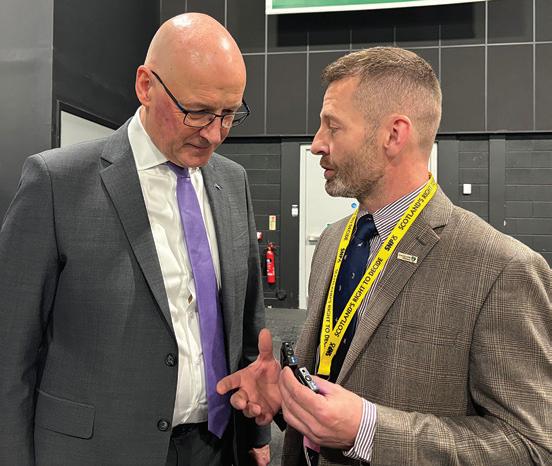
On attending the Scottish National Party Conference in October 2025, I spoke briefly with First Minister John Swinney and enquired as to why his booklet guide for the 3-day event was void of anything to do with rural Scotland and the issues that matter to us most. No fringe events, no speech mentions, nothing. He assured me that rural Scotland is a priority of his and that it will feature in the SNP manifesto. Rural Scotland was virtually absent from the event in any form, so stating that it was a priority was a bit strong, in my opinion. The feeling is that this exclusion had to be highlighted and since this event, overt farm visits, photograph opportunities and mention of rural life has become more commonplace on the run up to the ballot boxes being rolled out. This is welcomed, but viewed by many as an afterthought, and it is all too
Author and John Swinney MSP
obvious to those who live and work in our countryside.
The Scottish Countryside Alliance members wish to see change. Whether this is a change in government or a change in how the Scottish National Party governs, our members have spoken and made it clear that more consideration needs to be given to our Farmers, Gamekeepers, Stalkers, Land Managers, Shop Keepers, Bus Drivers, Nurses, and Landowners. The list goes on.
Whilst some disagreed with many of ex-First Minister Humza Yousafs’ policies, his inspirational decision to dissolve the Bute House Agreement with The Scottish Green Party in 2024 won him a lot of respect from those
who the SNP had alienated. The alliance with The Greens caused potentially irreparable damage to our sector, allowing some horrendous legislation to be introduced that might never be undone. Our fear is that The SNP will make the same mistake again should they need support from another party to remain in power and I can only imagine how rural voters will respond should this happen. Any morsel of confidence left will be lost for good.
An extraordinary amount of MSPs have chosen to stand down in 2026, a shift that will significantly reshape the Scottish Parliament after the May elections. It is thought that around 60 new MSP’s will take a seat in Holyrood and whilst they will need a little time to
settle into their new role, it also may be a chance to breathe new life into our Scottish Parliament building, bringing new ideas and priorities to the fore.
The gap between rural and urban policies is growing ever wider, and the Scottish Countryside Alliance wants rural issues to be prioritised or at least treated with the same urgency that central belt policies seem to be afforded. Hands need to be untied, and investment is urgently needed just to keep our sector alive. We need to get the message across to candidates that rural communities are vitally important to Scotland’s economy, culture and heritage and that homes are being lost and businesses closing down
as a result of poor legislation or decision-making.
The 2026 election is an opportunity to engage openly with both candidates and current MSPs and we will take full advantage of this to make the rural voice heard. For these elections, parliament will be dissolved on 9 April 2026. During this period of dissolution, there are no MSPs sitting and no parliamentary business taking place. It is also worth noting that the Scottish Parliament will be in recess from 26 March until 8 April 2026. If you are passionate about our countryside and want to make a real difference, do your homework and make your vote count when you put your cross in the box.
Deer control is under government scrutiny
GUNDOGS
So, can you train a winning gundog?
By Stuart Dunn Chairperson, Caledonian Retriever Club
Deciding to own and train a gundog, is a big decision in anyone’s lifetime, considering that your chosen dog, will happily be around you and your family for around the next 12-15 years, possibly even longer, so
it’s easy to think it will be straight forward, and that everyday will go to plan, but like most things in life, it never really goes in a straight line.
Enthusiasm, determination, perseverance, time, temperament,
financial resources, commitment and understanding are only a few of the attributes, you the trainer will need to have in your makeup, and that’s before you think of what the dog you’ve chosen, needs to have!
Therefore, it’s imperative that the owner gives a lot of thought early in the planning process as to what he or she wants from their gundog.
Is it simply a shooting companion, a picking up dog,
or a full-on competition dog, either of these will certainly effect your life in many aspects. We all lead busy lives in this day and age, whether it be work, family commitments, or what ever else, bringing a new gundog onto the scene will be a big decision, and a big impact, there’s no magic wand that can be waved around your dog to help train it to a required level, and I’ve never had a dog that trains itself, so it will take a massive amount of your time, and effort. Therefore, think long and hard about how you will fit the new pup into your lifestyle, and how you will nurture the dog into a training plan that meets your expectations, and time resource.
The Caledonian Retriever Club, since its creation encouraged many newcomers into the gundog competition side, and has over the years run training classes, tests and trials, and given advice freely to aid handlers to achieve good training levels, which have helped many newcomers win working tests and field trials.
Obviously not everyone wants to compete at a serious level, but throughout Scotland there are numerous gundog clubs, who can help with training or advice and can benefit the handler especially when you’re starting out training a dog, or
you’ve hit the “wall” with a particular training issue, and maybe need an idea or two on how to sort it out, and club membership can be a great way of getting involved in gundog and shooting in general, all with likeminded people.
I often get asked, what’s the easiest breed of dog to train, in short, none, they all have pros and cons, they all take time, patience and commitment, even the best-bred champion to champion breeding can produce a dog that is a bit of a struggle at times. In recent years there seems to be a big liking for springer spaniels, and golden retrievers , with many new handlers both male and female, coming to the fore, and competing in test and trials, the sport in general can only benefit from this new surge in uptake.
The competition side of gundog ownership was always predominantly male orientated, but in recent years many female handlers have come forward and done extremely well on the competition circuit, and long may it continue!
So, if you have a liking for gundogs, whether it be on the shooting, picking up, or competition side, and maybe feel a bit lost as to how to become involved, or where to get a bit of good advice from like minded people, why not join a club like
the Caledonian Retriever Club and get started!!
Remember, everyone must start some place, but there is no substitute for experience, sound advice, and genuine help, along with a slice of luck too.
Scotland has for decades had a great reputation at the highest level when it comes to competing in the biggest events in Britain, such as the IGL championship, and yet again the 2025 championship was won by a Scottish handler, and the Caledonian Retriever Club and its membership, would like to congratulate Fraser Forbes, and FTCH Carnochway Red Rooster, on winning the event, one of the worlds most coveted competitions.
Over the last eight years, the IGL Championship has been won 5 times by Scottish handlers, an absolutely amazing achievement! ! And is testament to the handler’s dedication, and effort to the sport, and the commitment that’s required to win at the highest level.
Therefore, who knows, maybe you, the young unknown trainer handler can emulate what Fraser and others have done in the past, it’s a great sport to be involved in, so come on get involved!
Please feel free to contact me anytime at the Caledonian Retriever Club or call me on 07860 290157 if you need any help or advice.
Good luck!!
Aiming High
By Hugh Webster, Fiadh Project, SCOTLAND: The Big Picture
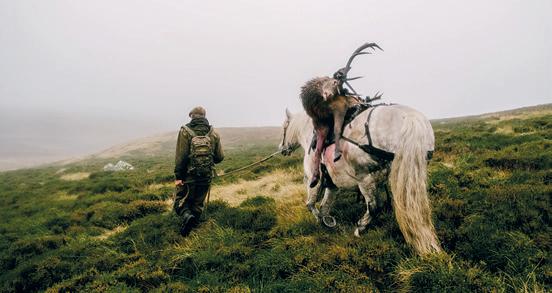
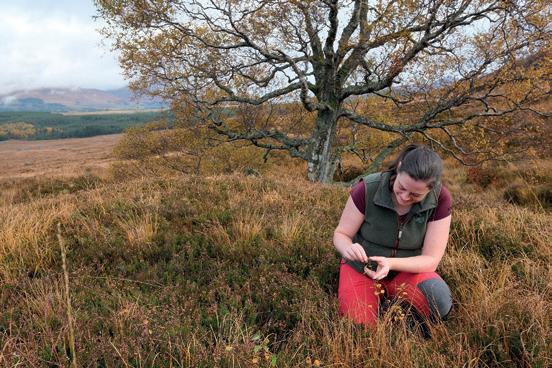
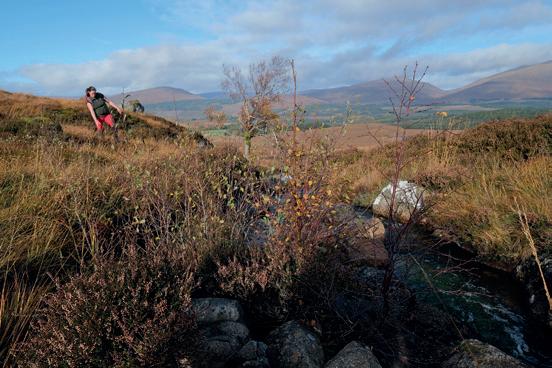
‘The deer stalking team here at Corrour are definitely the heroes of this story,’ Sarah tells me as we pick our way up the northern flank of Chno Dearg. Sarah Watts is the Conservation Manager at Corrour Estate, tasked with delivering and monitoring habitat restoration projects, but she’s quick to reject the title of ‘conservation champion’, insisting that any such accolades belong to the estate’s team of deer stalkers.
‘Their work underpins everything we do here,’ says Sarah. ‘I couldn’t do my job without them.’ As we climb, she stops regularly to inspect young saplings or tall herbs like wild angelica, wood cranesbill and lady’s mantle, stressing that none of the ecological enrichment she’s recording here would be
possible without the work and knowledge of the estate’s deer stalkers.
‘Our head stalker, Allan Macleod, knows more about the birds on Corrour than anybody else,’ Sarah tells me. ‘And he’s also a fantastic botanist. He’s found incredible plants here, including several new to Corrour and one species new to Scotland. The stalking team gets into the most remote places where nobody else goes, so they’ve been really helpful collecting seed and cuttings from our rare montane willows too. As well as managing the deer, they’re instrumental to delivering our restoration projects.’
Reflecting on concerns that traditional roles like stalkers and gamekeepers might become less important as estates focus more
on environmental objectives and less on sporting ones, Sarah is adamant that the opposite is true. ‘We’ve actually increased the number of stalkers on Corrour recently, from four to six. We need them to deliver our objectives and that’s not going to change, because if the habitats are improving then the fertility of the deer will increase. I can’t see us ever being in a situation where we wouldn’t need deer stalkers. Even if we do one day have lynx and wolves, I don’t think the numbers of large carnivores will ever be enough on their own.’
Twenty years ago, Corrour had around fifteen deer per square kilometre, creating unsustainable pressure on the environment. Thanks to the efforts of the estate’s growing
team of stalkers, that density has been steadily reduced to between one and three deer per square kilometre, allowing the process of nature recovery to begin. But Sarah doesn’t focus on deer numbers.
‘Here at Corrour, we’ve not been particularly driven to achieve an arbitrary density of deer across the estate,’ she explains. ‘It’s really all about the habitat response. If we’re seeing the right habitat improvements, we know we’re on the right track.’
None of this means that all grazing is unwelcome. ‘There’s this common misconception that ecologists like me might be really excited about trees and see deer as a problem, but that’s not the case at all,’ explains Sarah. ‘We hugely value our deer. They’re magnificent, iconic large herbivores and grazing is a really important part of the local ecology. It’s just about tackling overgrazing rather than grazing itself being a problem.’
The importance of grazing is one reason the estate favours reducing deer numbers rather than just excluding them from certain areas using fencing. ‘Fencing compartmentalises nature,’ says Sarah. ‘To completely remove large herbivores using fencing is unnatural. Large herbivores cause ground disturbance, which is fantastic for encouraging regeneration, whereas dense masses of ungrazed vegetation inside a fence can make it harder for seedlings to establish.’
The more holistic approach being adopted at Corrour seems to be working. ‘There’s been a wide range of ecological benefits on Corrour, far beyond just trees,’ Sarah tells me. ‘With reduced grazing pressure,
Sarah knows that montane trees are very palatable and vulnerable to overgrazing but is documenting a growing amount of regeneration out on the open hill.
there’s been a pulse of heather growth and we’re also seeing an expansion of grazing-sensitive flowering plants like alpine sawwort, globeflower and bearberry. Many of these provide a vital food source for insects and small mammals, which in turn support predators higher up the food chain.’
One clear example is the successful breeding of hen harriers on Corrour, recorded by the stalking team for the first time this year. ‘We’re convinced this is down to the habitat restoration,’ says Sarah, who points to both the tree regeneration and increased heather growth as key reasons for the raptors’ success.
‘There’s definitely a direct link between deer management and the overall increase in wildlife here,’ continues Sarah, who describes how golden eagles bred successfully here for the first time on record in 2023. She’s also recorded an increase in black grouse: ‘They’re a fantastic indicator species because they require quite diverse habitats, and we now see them regularly on the estate.”
At 550 metres above sea level, Sarah squats to show me a young downy willow, one of the montane willows capable of surviving in this harsh upland environment. It is growing alongside a mix of downy birch, eared willow and tea-leaved willow, all trees that would have once formed a contiguous belt around our mountains but which have become rare in Scotland. ‘Deer management is particularly important for highaltitude trees like mountain birch and the montane willows,’ Sarah explains. ‘They’re especially vulnerable to overgrazing and many populations have been pushed to inaccessible cliff ledges in Scotland, out of the reach of large herbivores.’
This is what makes this group of small, non-descript trees in front of us remarkable.
‘Where we’re sitting just now is really, really exciting,’ says Sarah. ‘Here we’re seeing regeneration of montane willows on the open hill, and we don’t
see that very often in Scotland.’
Crucially, this success has been achieved without any fencing. ‘We’re relying completely on deer management to ensure they aren’t over-browsed.’
To the untrained eye, this kneehigh, forest-in-waiting is still easy to overlook. But seen through
Sarah’s eyes, it’s easy to imagine this fledgling forest beginning to wrap itself around the hill – thanks to the ongoing efforts of the estate’s dedicated deer stalkers.
‘The future looks very exciting,’ smiles Sarah. ‘Right now, we’re still at the beginning of the journey here at Corrour,
witnessing the early days of natural generation. But when you climb up through these landscapes and see the high densities of seedlings coming through, you can picture what it might look like in ten, twenty, or thirty years’ time. And that brings a lot of hope.’
Corrour’s montane woodland is slowly spreading out from the shelter provided by crags, gullies and burns – the only places they could once escape constant browsing by deer.
Sarah inspects a rare montane willow growing out in the open above 550m altitude, thanks to the stalkers’ efforts to reduce grazing pressure.
The Scottish Clay Target Association
The Scottish Clay Target Association (SCTA) exists to promote and encourage in every way at local, national and international level the sport of clay target shooting and to act as the sole governing or delegating body for the sport in Scotland and promote the sport of clay target shooting throughout the UK. Setting standards, organising competitions, supporting clubs, and representing Scottish shooters at UK and international level. More than that, it serves as a bridge between the sport’s long heritage and its modern, inclusive future.
Historically the sports men and women of Britain would shoot pheasants and game birds of all varieties, not until as late as the 1860’s when glass balls filled with feathers were introduced, was shooting available to men and women who could not afford the normal costs of a day out shooting.
Those early experiments laid the groundwork for what would eventually become modern clay shooting. Over time, fragile glass balls gave way to clay targets, and informal practice evolved into organised disciplines such as Trap, Skeet and Sporting. As the sport grew in popularity, the need for structure, safety oversight and fair competition became clear
The SCTA was formed to meet those needs, providing a unified voice for Scottish clay shooters. It works closely with clubs and country associations
to ensure consistent rules, safe practices and high standards of conduct across the sport. Whether a shooter is competing at a Home International event or enjoying a weekend shoot at a local ground, the SCTA’s influence is there in the background, quietly keeping things running smoothly.
Competition is a central pillar of the Association’s work. The SCTA sanctions championships and leagues across multiple disciplines, offering opportunities for shooters of all levels to test
themselves, improve their skills and represent Scotland.
A perfect example of this was that Scotland hosted the Home International Down the Line (DTL) competition in 2025 at Glenmoriston Estate Shooting Ground, teams from Scotland, England, Wales, Northern Ireland and Ireland all attended.
The greatest two days of competition between the home nations whereupon for the first time in 43 years Scotland’s Senior team, captained by Ivar McBay, won the coveted Nobel
industries DTL International Challenge Cup by two points from England. This was an incredible achievement as the quality of shooting from several competitors hitting the maximum 100 x 300 scores. The word to describe all the effort from the start to the end is simply, BRILLIANT.
A huge vote of thanks goes to the many volunteers and sponsors who delivered the effort to create the kind of welcome to our home countries that Scotland was proud of.
If you wish to find out more about the sport, the SCTA can be contacted via email to administrator@scta.co.uk or have a look at the web site www.scta.co.uk where you can join online and enjoy the many benefits offered.
Clay winners
Natural Environment (Scotland) Bill Stage 3 concludes with Scottish Parliament debate
By Richard Playfair
At the time of writing, Stage 3 of the Natural Environment (Scotland) Bill has just concluded with a lengthy debate in the Scottish Parliament chamber on Tuesday 27 January covering deer issues and further discussion on deer over the days immediately following. ADMG Chair Tom Turnbull and ADMG representatives had met with Scottish Government ministers, officials and with NatureScot in the run-up to the debate and had briefed in several amendments to MSPs at Stage 3. Tom Turnbull says:
“I think our efforts have certainly brought results. Scottish Government has listened to us and taken a number of our concerns on board, the need for effective collaborative deer management was repeated over and over through the debate and we certainly feel now that
Government wants to work with us in the uplands in the delivery of its environmental and biodiversity targets.
“Many of the more extreme proposals that came back as amendments at Stage 3 were voted down, and there was some reasonable success in terms of common sense being applied through this process to updating existing legislation.
“Whilst the contentious clause 6ZB remains we are more confident now in terms of the potential scope of its application and, similarly, whilst the amendment on occupiers’ rights that was introduced at Stage 2 remains, Stage 3 has brought safeguards in terms of further consultation on its inclusion in the Deer Code, the requirement for authorisation, and a new offence where the measure is not used appropriately. ADMG
will be involved in these ongoing discussions that will require secondary legislation in advance of its introduction.
The Minister Jim Fairlie’s proposal for a Deer Management and Venison Plan was carried. He expressed the importance of a collaborative approach, the need for incentives, and of developing a “flourishing venison market” as a key driver in taking the sector forward.
It has been gratifying to see the amount of attention given over the course of the Bill to the importance of venison in contributing to the cost of deer management, associated jobs and as an exceptional Scottish food product. Now all that is necessary is a recovery in the price to producers.
Whilst there were attempts to bring amendments into the Bill that would preempt the removal
of rates relief via the Small Business Business Scheme, these were unsuccessful on the grounds of the Natural Environment (Scotland) Bill not being the right place for them. Consequently discussions on sporting rates are continuing and one cannot help but think that the proposal in the Scottish Government’s Budget Bill to remove small business relief for deer forests not operating solely for environmental purposes, with a number of very limited exceptions, is very much at odds with the direction of travel encompassed in the Natural Environment Bill discussions and outcomes. ADMG will continue to press for this measure to be re-assessed and take every opportunity to voice and share its concerns and those of its members over coming weeks.
Red Deer
The Ghillie
The 2026 salmon season has officially begun in Scotland, and there’s a palpable sense of anticipation in the air. As the opening day celebrations have now passed, the season is well under way—though it’s typically a quieter start as anglers wait to see how the catches unfold. This year, however, the weather has been less than ideal. Heavy rainfall has caused frequent spates, making it challenging to cast effectively. We’re all hoping for a break in the
weather soon, allowing the waters to settle and giving us a chance to cast a fly once again.
The opening day was marked by celebrations along the river, with various beats hosting their own events. The biggest gathering took place at Meikleour, where Scotland’s football manager, Steve Clarke, made the ceremonial first cast. The event drew significant media attention, with articles appearing in newspapers, magazines, and coverage from
2026 –Here we go!
By Bob Whyte
Ghillie on Catholes, Pitlochrie, Benchil and Luncarty on the River Tay
STV and the BBC. The exposure was fantastic, showcasing our beautiful river and, hopefully, inspiring more anglers to come and experience it for themselves.
At Stanley, where I had the pleasure of hosting my own celebration, we welcomed guests from Gleneagles Hotel. The event kicked off with a piper who set the tone, and then we made our way down to the river for a traditional water blessing and the all-important first cast. I gave a
short introductory speech, which I wrapped up with a poem written in the style of Robert Burns, celebrating the life cycle of the salmon. The poem, penned by the renowned Ken Reid from the Dee Valley, captured the spirit of the river and its magnificent fish.
Afterward, I introduced my good friend Johnny Muir, who works with the Atlantic Salmon Trust. Johnny gave an insightful speech, highlighting the important conservation efforts taking place
both in the rivers and the sea, aimed at protecting and enhancing our salmon populations for the future.
It’s a season full of hope, and with the right conditions, it could be another great chapter in Scotland’s storied fishing tradition.
Robert Burns inspired poem to the wild salmon by Ken Reid
Ode to the Wild Salmon
From pebble-bed and silver fry,
In shaded burns where currents sigh,
A spark of life learns early law:
Hold fast your lie, defend your shaw.
Each pool a kingdom, hard-won ground, where brothers fade, where loss is found.
By tooth and talon, flood and freeze, they hone their will in narrow seas.
There stirs the call—old as stone, A deeper hunger, ocean-grown.
Beyond the burn, beyond the shore, to chase rich tides and wander more.
At sea, the trial grows sharp and wide:
Plastic drift and poisoned tide,
The lice that cling, the nets that sweep, The warming lanes where hunger’s deep.
Predators circle, farms impose, and ancient rhythms suffer blows-
Yet still they swim, through dark and blue, In times no forebear ever knew.
Years turn. The body knows its hour.
A gentler strength, a final power.
The compass wakes-home draws them fast
To gravel beds of futures past.
But homeward paths are lined with fear: The seal, the dolphin waiting near;
The roar of hulls, the fractured sound, the river’s scent all lost, confound.
Polluted plumes and altered flow
Blur memories they used to know.
At last-the burn, the pool, the bend, Cool water where their journeys end. No leap too high, no gate too closed, They pray-though prayer is uncomposed.
And in the dark of winter’s breath, they spend life’s last to conquer death.
Two shadows meet on redd and stone,
To seed the ground they once called home.
The deed is done. The body fails.
The river keeps its ancient tales.
Yet one thought drifts where hope must roam: Will any child return-come home?
O salmon bold, of silver flame, Your tight outlasts both time and name.
May humankind, with wiser hand, Guard well the waters, sea and land.
For in your rise, your fall, your plea, Swims Scotland’s soul-and what shall be.
www.farmingscotlandmagazine.com
Time to grasp the Scottish nettle?
By Kenneth Stephen, The Scottish Gamekeepers Association
As we gather thoughts following the passage of the Natural Environment Bill, one thing becomes as clear as winter icicle: we need to finally grasp the nettle in Scotland when it comes to expanding deer populations in the lowlands and around our cities.
The Edinburgh Parliament loves nothing better than to scrutinise deer. Perhaps our iconic animal fascinates Parliamentarians or provides them with relief from dour debates on the economy or education.
This scrutiny, however, comes with a condition. The deer being investigated by our Parliamentarians must have antlers and they must be in the ‘highlands’.
As a country, and as a Parliament, we have scrutinised red deer beyond what would be regarded as normal, particularly when we live in a country where NHS waiting times and the cost of living are the real issues vexing the majority.
An additional failing of this disproportionate attention has been the myopic focus on the highland red deer range.
If a man or woman came to earth tomorrow, they would be utterly baffled as to why so much attention has been given to the estimated highland red deer population of circa 250 000
animals when 750 000 (if you accept the oft quoted 1 million deer figure) roam and expand comparatively freely elsewhere.
Why, if the greatest extent of the problem is in the lowlands and around our towns and cities, does NatureScot devote most of its staff to the highlands, where numbers are either stable or reducing?
Why, when the Deer Working Group assembled to pen recommendations to Government on the ‘issue’ of deer, did it devote one afternoon to urban deer and then leave it largely alone when it realised red deer weren’t the main problem?
The truth is, neither the Parliament or the agencies know what to do about roe deer or the lowlands or urban areas, so perhaps the best things to do is to divert attention elsewhere.
Except that this approach is no longer tenable.
If the glimmer of light in the Bill -offered by promises of a National Deer Management Plan- is to act as a beacon well into the next Parliament, politicians need to think big and in detail about Scotland’s real deer problems and where they genuinely are.
If they can do that, then maybe there will be an outcome from the decades of talking and bill-making.
www.scottishgamekeepers.co.uk
Scottish Gamekeepers Association, Inveralmond Business Centre. 6 Auld Bond Road, South Inveralmond, Perth, PH1 3FX. Tel: 01738 587515
Supporting The Mental Health of Firearm Certificate Holders: An Early-Help Approach That Works
By Chief Inspector Bruce Crawford, Police Scotland
Those in policing know firearms licensing is about far more than forms, conditions and safe storage. At its heart, it is about people. Across Scotland, tens of thousands of responsible firearm and shotgun certificate holders take pride in their sport, countryside traditions and commitment to safety. The overwhelming majority go about their lives without ever coming to police attention. Yet, like anyone else, they are not immune to periods of mental health challenge.
Milk prices, changes to sporting rates relief, weather, livestock worrying, isolation, fear of stigma – we know there are a multitude of issues weighing heavily on certificate holders in Scotland.
I continually reflect on how Police Scotland can support certificate holders who experience changes in their mental health, while continuing to discharge our duty to protect the public. This article is not about enforcement. It is about early help, trust, partnership, and encouraging people to seek support before a problem becomes a crisis.
Bruce with David Urquhart of Skye Game
Mental health and firearms - a shared responsibility Mental health touches all Scottish communities. Stress, anxiety, depression and trauma do not discriminate by profession, hobby or background. For certificate holders there can be an added layer of concern; a fear that admitting to difficulties will automatically result in certificates being revoked or that they will be “punished” for being honest.
I want to be clear. Our starting point is not revocation, but support. Firearms licensing teams, local officers and partners in health services all recognise that early engagement is the safest and most constructive approach. When people speak up early we have more options, more flexibility and, crucially, more opportunity to achieve positive outcomes for everyone involved.
Encouraging early contact
One of the most important messages we share with certificate holders is this; if you are struggling, tell someone and tell firearms licensing. It could be your GP, a trusted family member or a shooting organisation. Early contact allows sensible, proportionate steps to be taken, often on a temporary basis, while someone gets the help they need.
In many cases, this can involve voluntary measures. We have seen target shooters move their guns to their club, others to a registered firearms dealer or suitable certificate holder. Some have asked us to store their firearms for a short period. These decisions are not admissions of failure; they are acts of responsibility.
From a policing perspective, these voluntary arrangements demonstrate insight and good judgement. They allow us to work collaboratively not reactively, and they help preserve
the individual’s long-term interests as well as public safety.
When
the system works well:
real-world outcomes
A long-standing shotgun certificate holder contacted firearms licensing after being diagnosed with severe anxiety following a family bereavement. He did not feel himself and wanted advice. Working with him, officers arranged for his shotguns to be stored temporarily elsewhere. He engaged with his GP and counselling services. Several months later, once his health had stabilised and with medical confirmation, his firearms were returned. He continues to shoot safely today.
In another case, a younger firearms certificate holder was experiencing work-related stress. His partner contacted police, not in alarm, but in concern. Officers attended, listened carefully and treated the situation with sensitivity. The certificate holder agreed to a short-term voluntary surrender of his firearms while he accessed support through occupational health and his GP. Throughout, he remained involved in decisions, was kept informed and treated with dignity. The outcome was positive: no enforcement action was required, and the individual later told us the respectful way he was treated made it easier for him to focus on recovery rather than fear.
These are not isolated stories. Across Scotland, similar examples show that when trust exists, and people feel supported rather than judged, the system works. We do not always get it right though, and we seek to continually learn to improve our service to Scotland’s communities.
Partnership is key Police Scotland doesn’t operate in isolation. Our work in this area depends on strong relationships
with health professionals, shooting organisations and charities. Employers, governing bodies and clubs play a vital role in setting the tone by reinforcing that mental wellbeing is part of responsible firearms ownership.
We have established the Scottish Firearms Mental Health and Wellbeing Awareness Partnership to bring almost two dozen key partners under one umbrella to work collectively towards supporting certificate holders and families. You can expect to see us and partners at many of the shows and events across Scotland this year. This is about professionalism as much as empathy. A calm, informed response can make all the difference to someone who is already feeling overwhelmed.
Reducing stigma within the shooting community Stigma is one of the biggest barriers to early help. In some quarters, there remains a perception that “toughing it out” is preferable to speaking up. I would specifically challenge that. Having struggled through my own mental health challenges following involvement in a serious firearms incident, I hid my feelings from those who knew me best and could support me. It took many sleepless nights, flashbacks and private tears before I sought help – and that help was life changing. True responsibility lies in recognising when you need support and taking steps to manage risk appropriately.
Shooting is a discipline built on self-awareness, respect for rules and consideration for others. Looking after your mental health - and being honest about it - is entirely consistent with those values. Far from threatening the future of shooting sports in Scotland, openness helps safeguard it.
A balanced, humane approach
Public safety will always be our priority, but it does not have to come at the expense of compassion. Generally, mental health challenges do not equate to violence or dangerous behaviour. Our task is to assess risk fairly, based on evidence and behaviour, not assumptions or fear.
Where there are serious concerns, we will act decisively. But where people come forward early, show insight and engage with support, we will work just as hard to find proportionate and fair solutions.
A message to certificate holders
If you take one thing from this article, let it be this; you are not alone, and you are not expected to cope in silence. Reaching out early - whether to health services, shooting organisations or the police - protects you, your family and the wider community It preserves your future in shooting.
As the National Firearms and Explosives Licensing Chief Inspector, I am proud of the professionalism and humanity shown by officers and staff across Police Scotland in this area of work. I am equally proud of the many certificate holders who demonstrate integrity by seeking help when they need it. By continuing to talk openly, support one another and work in partnership, we can ensure Scotland remains a place where shooting is conducted safely, responsibly and with care for the wellbeing of all involved.
Note – Details of support available to certificate holders can be found on the Police Scotland website and on the Firearms and Mental Health Awareness and Support leaflet widely available online and sent with every certificate.
Salmon, Abundance, and the Stories We Tell Ourselves
By Andrew McCaig
This article was being finished on the eve of the River Spey opening
As always, there is excitement. The river is in good order. There has been rain, plenty of rain, water levels are good, and other rivers have already started the season well, all things considered. For fishermen, this moment matters. We are forward-looking by instinct. Opening day is about possibility: about the first cast, the first fish, and the sense that this year might be different.
That optimism is not foolish. It is part of what keeps salmon fishing alive.
But it also creates a quiet tension. Each year we arrive at the same point, full of hope, while knowing that the long-term trend remains stubbornly downward. Wanting things to improve is
natural. Expecting a different outcome while repeating the same actions is something else entirely.
That tension — between hope and habit — is the starting point for this article.
The most unsettling findings in Scottish salmon research over the past decade suggest that this tension cannot be wished away.
Between 2017 and 2019, the Atlantic Salmon Trust, working with the Spey Board, undertook an acoustic smolt-tracking programme on the River Spey. The results were stark. Fewer than half of tagged smolts successfully left the river system. More than half were lost before they ever reached the sea.
Follow-up analysis and discussion through 2020–2023 reinforced the same underlying message: freshwater survival on the Spey is a critical bottleneck, not a marginal issue that can be assumed away by pointing to marine uncertainty.
These findings matter because they cut directly across the story we most often tell ourselves about salmon decline — that the decisive failure lies elsewhere, beyond the reach of river managers, in complex and poorly understood marine systems. The Spey data suggest something more uncomfortable. Even on one of Scotland’s most productive rivers, the river itself is a major point of loss.
The research has not been dismissed. It is often referred to in reports and presentations as part of a wider picture of “complex pressures”. But it has not reshaped management in any fundamental way. There has been no sustained refocusing on freshwater survival, and no clear explanation of why such levels of loss are considered acceptable.
That gap — between optimism at the start of each season and the absence of meaningful change — sits at the heart of Scotland’s salmon problem.
Every opening day carries the same unspoken expectation: this year might be different. That expectation persists even as the long-term trend remains stubbornly downward.
It creates a peculiar tension at the heart of modern salmon fishing. We are encouraged to be positive, to celebrate the season ahead, and to speak in hopeful terms — even while knowing, that nothing fundamental has changed.
The sadness lies not in pessimism, but in recognising that optimism alone has become a strategy.
Until relatively recently, rivers were managed with a clear objective: to produce fish. Abundance mattered. Surplus mattered. Without surplus, neither commercial nor recreational fisheries could exist.
That mindset shaped how rivers were run. Stocking, hatcheries, egg planting, and active intervention were routine tools, not ideological battlegrounds. Nearly every major salmon river in Scotland has had a hatchery at some point, many of them for decades. These were not emergency measures; they were standard practice.
SHOOTING SCOTLAND
Today, that history is often quietly forgotten. Rivers are described as having been largely “natural”, and modern management is framed as a corrective to historical ignorance. But this framing is misleading. Rivers were not protected from intervention in the past. They were protected by it.
In the past, recreational anglers and commercial fishermen were not treated as opposing camps. They were part of the same system. Commercial netting did more than remove fish. It generated information. Netting stations forced managers to understand run size, timing, surplus, and sustainability. Rod fisheries benefited directly from that knowledge. Rivers were managed to produce enough fish to support both exploitation and recovery.
This context is almost always missing from modern comparisons with the past. Rod catch figures from the 1950-80 are regularly quoted, often referred to as evidence that historic abundance has been exaggerated. What is rarely acknowledged is that these figures usually exclude commercial netting.
Those fish did not disappear. They were caught.
When netting figures are included, the difference between past and present becomes stark. The decline is not marginal. It is profound.
There is no doubt that water quality has improved dramatically. Rivers are cleaner than they have been for generations, and this achievement deserves recognition.
But cleanliness is not the same as abundance.
Rivers are now frequently described as “healthy”, a term often referred to in policy documents and funding applications. Yet many of these same rivers hold a fraction of the salmon they once did. A river can be chemically clean and biologically impoverished at the same time.
Habitat restoration has followed a similar path. Funding, expertise, and professionalism have never been higher. Spawning beds are restored, banks reprofiled, woody material added. The work is often excellent.
But habitat alone does not create fish
No farmer believes that improving soil without sowing seed will produce crops. Rivers are no different. They are competitive biological systems. Where salmon decline, other species expand. Brown trout, in particular, are highly effective competitors at juvenile stages. Once that balance shifts, salmon struggle to re establish without help.
Choosing not to intervene is not neutral. It is a decision to accept whatever outcome current conditions produce.
Nowhere is the confusion in modern thinking clearer than in debates about stocking.
Current policy largely treats stocking as an exercise in replicating natural spawning. The aim is to imitate what the river might have done anyway, rather than to rebuild stocks meaningfully. This approach may make sense in healthy systems. It makes far less sense where stocks are already critically low.
Replicating scarcity does not lead to recovery.
The purpose of restocking depleted rivers is not to reproduce natural failure. It is to create abundance sufficient to withstand losses. That distinction is routinely blurred.
On the River Spey, the scale of this shift is clear. In 2006, around
2.2 million juvenile salmon were stocked, including fed fry and parr. By 2007 this had already fallen to around 1.8 million. By 2023, stocking amounted to just 192,400 fish, all released as eyed ova or unfed fry, with fed fry and parr no longer permitted.
This is not a minor adjustment. It is a collapse in juvenile inputs of more than an order of magnitude, combined with a retreat to the earliest life stages, where freshwater mortality is highest.
Arguments persist about unfed fry stocked in spring: concerns about dispersal, density, and survival. These debates are often framed as technical, but they are grounded in practical experience.
Every ghillie understands what happens to eggs and small, unfed fry released into rivers with high predation pressure. Many do not survive.
What ghillies consistently want to do instead is stock autumn fed fry or parr: larger, stronger fish, better able to compete, hold territory, and survive the critical early months. That single change would make a material difference on many rivers.
Yet it is precisely this sort of intervention that policy struggles to allow without a serious fight,
which many of our river boards are unwilling to make on our behalf.
The result is predictable. Stocking is permitted only in forms unlikely to create abundance. When abundance fails to appear, that failure is then cited as evidence that stocking itself does not work.
This is a circular logic. Stocking is allowed only to fail, and the failure becomes the proof.
Part of the paralysis in salmon management comes from treating the problem as singular. It is not.
In rivers, the problem is largely one of management. Toolsets have
narrowed. Intervention has become ideologically uncomfortable. Evidence that points towards action is acknowledged academically but rarely translated into practice.
At sea, the problem is different. There, the pressures are real and severe: over fishing, illegal fishing, weak enforcement, and by catch. Freshwater managers point to the marine environment; marine interests largely ignore rivers. Responsibility dissolves somewhere between the two.
Yet one fact remains awkward.
Well managed rivers are not
thriving, but they are surviving. Poorly managed rivers are failing outright. That tells us something important: management still matters.
There is an older intellectual pattern at work here, one that feels surprisingly familiar for those whom enjoy history.
Medieval scholasticism was characterised by intense intellectual effort, elaborate classification, and endless debate — but very little practical testing against reality. Authority was refined, not challenged; thought became detached from action. The system was internally coherent, but increasingly disconnected from the world it claimed to explain.
Modern salmon management risks a similar fate.
We are rich in research, models, frameworks, and reviews. Evidence is gathered carefully, caveated thoroughly, and contextualised endlessly. But when that evidence points towards uncomfortable action — intervention, abundance, trade-offs — it is absorbed into the literature rather than translated into change.
The result is not ignorance. It is a growing separation between knowledge and consequence.
We are no longer short of data. Modern smolt tracking has revealed freshwater losses with a level of precision unimaginable in the past.
And yet, even where evidence points clearly to freshwater bottlenecks, action often fails to follow. The findings are noted, caveated, and absorbed into the language of “complex pressures”. They rarely result in a meaningful change of approach.
A system that cannot act on inconvenient evidence is not precautionary. It is flawed and biased.
For much of the last century, river management depended on anglers. They paid for it, and they lived with the results. If management failed, it was obvious, and those responsible were replaced.
That feedback loop has weakened. Today, restoration is sustained
largely through centralised funding. Success is measured in plans, frameworks, and compliance. Whether salmon numbers increase is often secondary. Projects can fail biologically and still succeed administratively.
This has changed incentives. Managers are rewarded for securing funding and delivering process, not for producing fish. Failure carries little cost for those creating policy or managing our rivers.
It is therefore worth asking whether the most radical improvement to salmon management would not be a new funding stream, but a re connection between decisions and outcomes.
Rivers have collapsed before. They were polluted, overfished, obstructed, and degraded. But when this happened, people were allowed to act.
They stocked aggressively. They built hatcheries. They managed predators. They experimented, adapted, and changed course when things did not work. Intervention was not viewed as heresy. It was viewed as responsibility.
Today, we inherit rivers that are cleaner than they have been for generations, yet we restrict ourselves from using the tools that once rebuilt them. The problem of low salmon numbers is not new. The refusal to intervene decisively is.
The decline of salmon is often presented as an inevitability. It is not. It is the product of choices: about objectives, about acceptable tools, and about what evidence we are willing to act upon.
If abundance is no longer the goal, then decline should not surprise us. If intervention is permitted only when it is unlikely to succeed, failure is the predictable outcome.
Salmon have survived far worse than the present moment. Whether they survive this one depends less on what happens in distant oceans than on whether we are prepared to remember how rivers were once managed — and to accept responsibility for doing so again. For myself, I will live in hope of that first cast and first fish of the season!
Important amendment to muirburn legislation
By Felix Meister, D.Phil., GWCT Senior Advisor Scotland
On Thursday 29 January, Scottish Parliament agreed to pass the Natural Environment (Scotland) Bill, following two days of debate about the final amendments to the Bill. Among the amendments, no 43, introduced by Beatrice Wishart, MSP for Shetland Islands (Scottish Liberal Democrats), proposed to repeal section 14(1)(b)(ii) of the Wildlife Management and Muirburn (Scotland) Act 2024. This section states that Scottish Ministers must grant a licence to burn on “peatland” (land with peat depths over 40cm) if “no other method of vegetation control is practicable”. The amendment was agreed to by Scottish Parliament and is now included in section 34C(2) of the Bill. A more comprehensive amendment (no 162), proposed by Tim Eagle, MSP for Highland and Islands (Scottish Conservatives), which would repeal section 14(1)(b) all together, was rejected.
During debate on the amendment, Minister of Agriculture and Connectivity, Jim Fairlie, said: “I recognise that some members may have concerns about the removal of the requirement to demonstrate that no other method of vegetation control is practicable before a licence for muirburn on peatland is granted. However, NatureScot will still have to be satisfied that any licence is necessary for the specified purpose, and the current evidence on the impacts of alternatives such as cutting or grazing on peatlands is inconclusive, which means that they cannot automatically be assumed to be preferable. For those reasons, I encourage members to support amendments 42 and 43.”
Prior to the debate GWCT Scotland sent an open letter to Jim Fairlie urging him to consider muirburn not only in the context of wildfire mitigation, but also as a tool for the
conservation of sensitive habitats such as blanket bog. In the letter, we summarised a substantial amount of research illustrating positive effects of muirburn on important species such as Sphagnum mosses and cotton grass. We also pointed out that there is very little research into the effects of other methods of vegetation control such as cutting. We concluded that there is no evidence to support a presumption against muirburn and a preference for cutting as included in the current form of the Wildlife Management and Muirburn (Scotland) Act.
The GWCT welcomes the amendment to muirburn legislation as it removes a provision that was not based on scientific evidence. It is our hope that the amended legislation will facilitate carrying out legal muirburn as a conservation tool with vital benefits to blanket-bog management and carbon sequestration.
Felix Meister Muirburn
game cooking with
Pan fried partridge with beet dauphinoise
By Wendy Barrie
Partridge is a favourite in our house, and whilst a potato dauphinoise is delicious, the recipe works equally well using juicy beets instead. I have used an old German variety of fodder beet, Eichendorfer Gelb we experimented with in Ardross Farm walled garden but it would be fine with any readily available yellow beet.
Once portioned, place the remaining partridge carcasses in a pan covered with water, add your choice of seasoning and herbs, simmer for a couple of hours, drain and reserve for wonderful stock another day.
Ingredients:
2 x partridge breasts, with leg on, per person
75g butter
A generous pinch of Blackthorn Scottish sea salt
Freshly milled black pepper
Beet dauphinoise (sufficient for 4 persons)
750g yellow beets, peeled, sliced & par-boiled
A generous scrunch of salt & milled black pepper
400-500mls double cream
75g butter
Method:
• Pre heat oven to 170℃
• Butter an ovenware dish (or individual dishes) and layer in the beets, along with seasoning and dabs of butter.
• Pour over cream, with a wee jiggle to the dish to allow the liquid to spread evenly throughout the beets. The amount of cream will vary slightly depending on your dish as you wish to just cover the beets.
• Bake for 45minutes until golden and bubbling.
• Meanwhile cook partridge on the hob: season the meat, melt butter and, when starting to sizzle, add partridge to the pan, taking care not to let the butter burn. Give the meat 3 minutes on a reasonably high heat, pressing down gently to give the desired colour.
• When golden, turn portions over, pan-fry for a further 2 minutes, basting with the butter, until cooked through. Rest for 5 minutes before serving.
• To serve, set partridge on top of dauphinoise with a brush of pan butter and serve with steamed sprouting broccoli for a colourful tasty nutritious dish. Any remaining juices in the pan can be added to the stock pot.
Wendy is a cook, food writer & campaigner for local sustainable produce & biodiversity. Founder Director of award-winning Scottish Food Guide, Scottish Cheese Trail & Scottish Farm Shops, Wendy is also Leader for Slow Food Ark of Taste & Cooks Alliance in Scotland, IGCAT Global Experts Network member, International Judge & co-founder of Scottish Bread Championship. She has co-written “Meadows: The Swedish Farmer & The Scottish Cook,” with her husband, on regenerative food production, native breeds & recipes, available online & from selected farm shops.
The Harehill Ridgegate Waterproof Shooting Jacket from Wild & Moor is designed for all-weather country use, blending proven performance with practical field features. After three years of development, it combines a PTFE waterproof membrane rated to 20,000mm hydrostatic head with 6000 MVP breathability — keeping you dry and comfortable during long days in wind and rain.
Constructed from hardwearing Oxford nylon, it is fully windproof and made to withstand regular outdoor use. An articulated action back and sleeves allow freedom of movement when mounting your gun or lifting game, while a detachable hood, hand-warming pockets, double-entry game pocket and zipped internal pocket make it genuinely useful on the shoot.
Adjustable cuffs, waist and hem help seal out the weather, and Clarino™ suede on the collar adds a premium finish to a welldesigned shooting jacket.
Introductory offer: 10% off with code HARE10
Ridgegate Waterproof Jacket – £289.95 (£260.96 with code HARE10) www.wildandmoor.co.uk
GWCT Schöffel
Thurslestone Cap
Heritage styling with a versatile five panel shape makes the Thurlestone Cap a throw-on staple for any casual outfit. The hat is made from 100% cotton twill and has a Schöffel branded adjustable buckle fastening.
100% cotton
Cotton twill fabric
Featuring Schöffel and GWCT embroidery.
Five panel design WITH adjustable brass buckle.
Color: Olive
£39.95
www.gwctshop.org.uk
Caesar Guerini Invictus
5 12ga 32 inch Sporting (693) West
Price on request www.pacificsportingarms.com
New Caesar Guerini Invictus 5 Sporting. 12ga 32 inch barrels. Righthanded adjustable comb stock and forend. Outstanding sideplate receiver with deep engraving and gold birds. Factory case. Lifetime warranty. Weight 8lbs 13oz. Pacific Sporting Arms is an Authorized Caesar Guerini Premium dealer.
The Country Store
New HIKMICRO thermal range at Night Master
The new HIKMICRO Lynx 3.0 range is now available from Night Master, offering compact, high-performance thermal for serious field use.
There are six models available, offering 384×288 and 640×512 sensor options (model dependent). The Lynx 3.0 features ≤20mK NETD sensitivity for improved thermal contrast in damp UK conditions, alongside a smooth 50Hz refresh rate. Lens options including 19mm and 35mm provide detection ranges extending beyond 1,000m on selected models, with a 1024×768 OLED display delivering sharp, clear viewing.
Powered by a removable 18650 rechargeable battery, the Lynx 3.0 supports photo/video recording, Wi-Fi connectivity and carries an IP67 weather rating.
Orders over £500 receive a FREE Night Master H1 rechargeable head torch (worth £44.95).
HIKMICRO LYNX 3.0:
Six models – from £399.95 to £1,149.95 www.nightmaster.co.uk
The Country Store
NL Pure 8x32 compact binoculars
John Rigby & Co. unveils the Rigby
Legends
The NL Pure 8x32 are the most compact binoculars in the NL Pure series. With a field of view of 150 m (164 yds), they provide a perfect overview. This makes them ideal travel binoculars for users looking for a premium product. The 8x magnification provides a perfect overview of the action. The 32 mm objective lens diameter is ideal for observing in daylight. Thanks to their wasp waist design, they sit ergonomically in your hand and weigh just 640 g (22.5 oz).
COLOR: burnt-orange or green
£2,160.00
www.swarovskioptik.com
GWCT Polo Shirt
Emblazoned with the iconic GWCT partridge logo, our Polo Shirts are crafted with a durable ribbed collar and taped neck.
The three self colour button placket and twin needle stitching add a touch of sophistication to this classic design. And with a 60°C wash, it’s easy to keep looking fresh and new. Made from a comfortable blend of 50% polyester and 50% cotton.
Regular price £19.95 www.gwctshop.org.uk
Collection, a tribute to the greats of adventure and the golden age of safari
John Rigby & Co. proudly announces the launch of the Rigby Legends Collection, a distinctive new line of safari clothing that pays homage to the explorers and professional hunters whose lives and legacies are forever intertwined with Rigby’s own.
Crafted to the same uncompromising standards as Rigby rifles, each piece in the Legends Collection is built fit for purpose and made to serve the hunters and explorers who value function, authenticity and enduring style.
From the Jungle Jim 436 Safari Jacket (RRP £599.99)
Paul Roberts 10-Yard Vest (RRP £399.99)
Robin Hurt Backup Jacket (RRP £499.99) Finch-Hatton Our of Africa Hat (RRP £149.99)
Every garment embodies the spirit of those who lived for the wild places. Made from durable natural fabrics including heavy-duty cottons, buffalo leather and Merino wool, each piece is designed to perform where it matters most - in the heat, dust and unpredictability of the field - and look cool in the photographs too. Subtle design details evoke Rigby’s timeless aesthetic, while modern tailoring ensures supreme comfort and versatility. www.tinyurl.com/RigbyLegendsCollection
Pulsar Wildlife Alaris ZG30 20mk
thermal imaging monocular
The new Pulsar Wildlife Alaris XG30 takes its name from the Latin, meaning “of the wing”, and is inspired in its design and performance by the passion and needs of the modern birdwatcher. With its sensitive 640×480, 12µm, <20mK sNETD European-made Lynred thermal sensor and a powerful 35 mm f1.0 germanium objective lens, this compact and lightweight monocular is a true pocket-sized powerhouse — revealing even the smallest heat source, in crystal-clear detail, at distances reaching up to 1300 metres. 3 payments of £466.65 at 0% interest available.