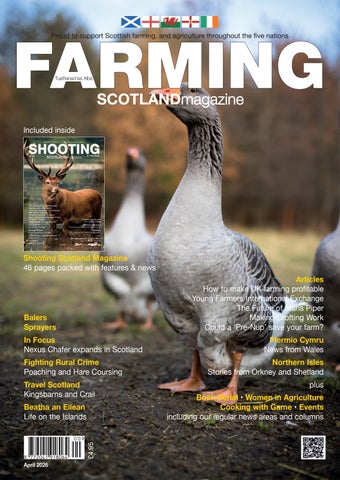
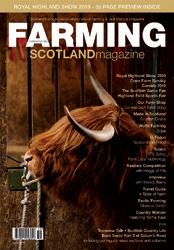
Proud to support Scottish farming, and agriculture throughout the five nations
Included inside
Shooting Scotland Magazine
46 pages packed with features & news
magazine
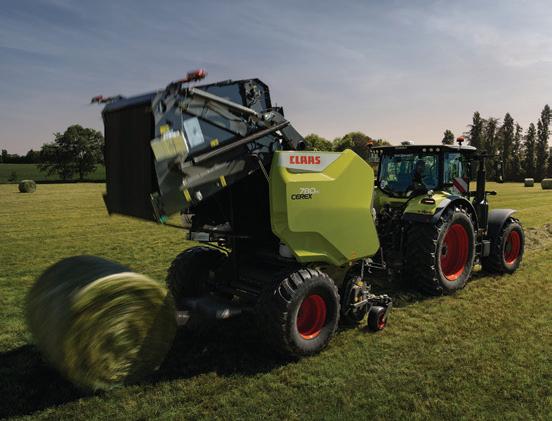
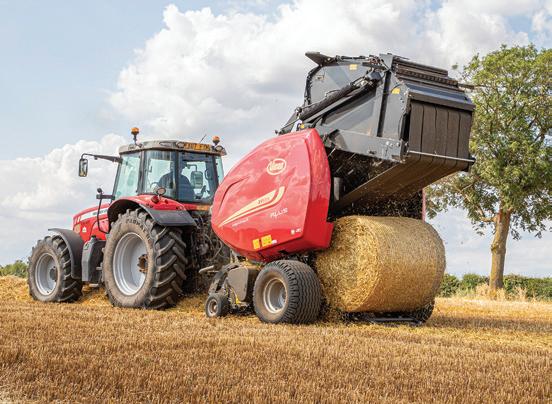
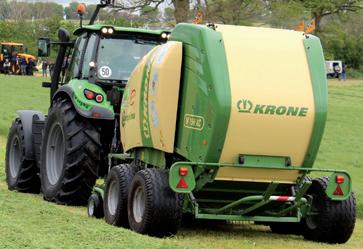
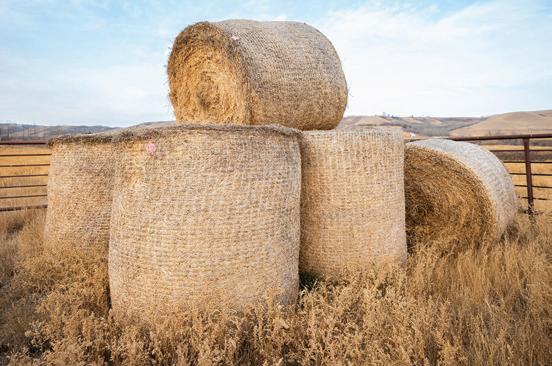
Balers
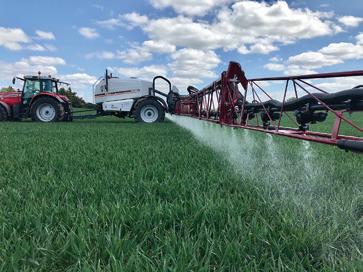
Sprayers In Focus
Nexus Chafer expands in Scotland
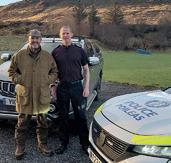
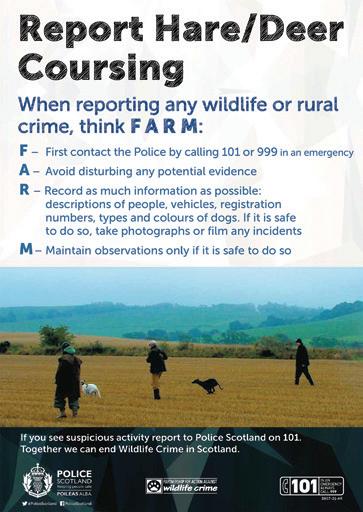
Fighting Rural Crime
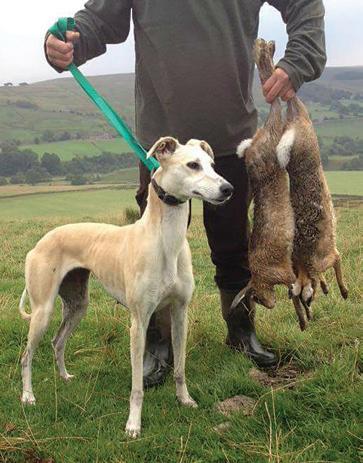
Poaching and Hare Coursing
Travel Scotland
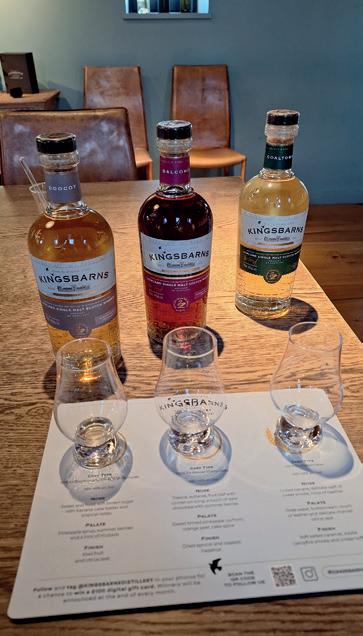
Kingsbarns and Crail
Beatha an Eilean Life on the Islands
Articles
How to make UK farming profitable Young Farmers International Exchange The Future of Maris Piper Making Crofting Work
Could a ‘Pre-Nup’ save your farm?
Ffermio Cymru News from Wales
Northern Isles Stories from Orkney and Shetland plus
Book Serial • Women in Agriculture
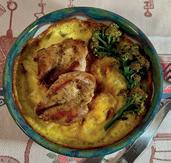
Cooking with Game • Events including our regular news areas and columns
Tuathanachas Alba
Next
editor's bit
Our Barry!
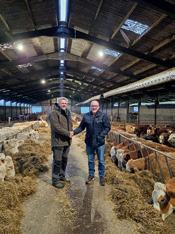
Christina and I would like to wish ‘our’ Barry Tweed, a wonderful retirement and a great time with his grand kids.
Barry also has interests in amateur dramatics and playing tennis, so we know he will be out there enjoying himself while we are stick in the office!!..LOL
As many of his clients will know, Barry has always been quite the character – he always enjoyed chatting and bantering with everyone he met or spoke to.
Barry even appeared on The Crown as a chauffeur to Princess Anne, we could just about see his outline in the shot inside the car, we recognised his nose!
Joking aside, Barry is also into music, and that is how we first met when he was selling ads on local radio.
Barry joined us, and soon became a family friend.
Now the time has come for him to take more time for himself, and after around 20 years, who can blame him?
Our door is always open for a visit whenever up here in Perth, and of course we will miss his banter and the fun he brought to our lives over the years.
So, “All the best to you Barry, enjoy your well-earned retirement, though we suspect the grand kids will keep… you busy”.
Love Athole and Christina.
arable Protect clean bean leaves from chocolate spot spread
Field bean crops have come under severe disease pressure through the prolonged period of extremely wet weather. Every rain event risks further spreading chocolate spot spores onto new growth, warns Syngenta Field Technical Manager, Simon Jackson.
Latest reports from the PGRO have highlighted the high incidence of chocolate spot (Botrytis fabae) and the ongoing need for urgent action. Early applications of fungicide may be needed to prevent further development, it advises.
Growers and agronomists are urged to check crops as a priority, especially on the underside of leaves where leaf spots may be more prevalent. PGRO warns the effects of failing to control early chocolate spot infections can be devastating.
Simon Jackson advocates protecting emerging new leaves from continuing infection at the earliest opportunity. Field trials and growers’ experience have shown AMISTAR can keep leaves green and clean of infection, until weather conditions dry up and the main fungicide programme kicks in.
“It provides good protection of clean leaves, but for added curative activity in high pressure situations, on infected crops in continuous wet weather, tank-mixing a product with some curative activity, such as metconazole, would further increase results,” he suggests.
With recent research into bean disease resistance management in mind, growers should opt to avoid the use of an SDHI at this stage in the season, where the advanced
www.farmingscotlandmagazine.com
technology is to be utilised later in the programme.
One of the challenges with wet soils is finding a spray opportunity and a period where crops are not under stress for application, highlights Simon. Growers should also be alert for potential risk of frost damage exacerbating any spray effects, ideally applying before any frost forecast, or leaving at least five days after a frost event for plants to recover.
“The impacts of early chocolate spot under such highpressure conditions can be severe,” he says. “With all the potential of well-established bean crops from the autumn, the current aim is to protect the new growth. So that when we get to ELATUS ERA timing for both chocolate spot and brown rust, from GS 51, there’s strong clean growth and good yield opportunity.”
Sugar beet benefits from biostimulant boost
Two trials carried out by Richard Austin Agriculture trials manager, Michael Rodger, have demonstrated gains in yield of 9 percent and improved disease tolerance against cercospora leaf spot, rust and powdery mildew.
The plot trials were carried out in Lincolnshire during the 2024/25 growing season, using products from biostimulant specialist Orion FT.
“The best result in the yield trial came from using a combination of Sirius and Pluton. Sirius is a siliconbased biostimulant and Pluton is liquid plant growth-promoting rhizobacteria (PGPR) containing the naturally occurring bacteria Bacillus velezensis,” he says.
He suggests that green leaf coverage was much better than the control which was only given a standard fertiliser and fungicide.
“The plants treated with the biostimulants established faster and grew deeper seeking roots, which was of particular benefit in a year that we experienced severe drought conditions,” he says.
Four, 10-metre plots were used for the trial, and a full scale field trial is planned to further explore the effect of the biostimulants on sugar beet.
“These yield results are encouraging because we also saw the sugar content of the beet treated with Sirius and Pluton increase from 17.3 percent to almost 18,” he adds.
In a second trial carried out simultaneously, the same crop size was treated with Trident Plus, a biostimulant that incorporates copper, zinc and cobalt micronutrients, which are
chelated using a natural citric polymer to boost nutrient uptake.
“Trident Plus was the best performing treatment for rust but we also treated a trial crop with Sirius and Pluton which showed better results for cercospora and powdery mildew. The key takeaway from both trials was that the plant was better equipped to deal with disease and pest pressures. Trident Plus performed better on overall yield, and we saw a 10 percent increase, but Sirius and Pluton were more effective at helping reduce cercospora and powdery mildew damage,” he says.
In the fungal disease trial, the control only received a herbicide and fertiliser, so adding the biostimulants was used as a biological alternative to fungicides.
“While 2024/25 was not a difficult year for fungal pressure because of the dry conditions, it was still impressive how, without a fungicide, the trial crop treated with biostimulants was able to perform so well,” he says.
With many farms looking for ways to reduce reliance on chemicals and find more sustainable solutions to common problems, the use of biostimulants is growing quickly.
“Resistance is becoming more prevalent and the cost of fungicides is only going to increase. Therefore, finding out that biostimulants can perform in this way, and offer yield and disease benefits, will give growers the confidence to consider biostimulants more closely,” he concludes.
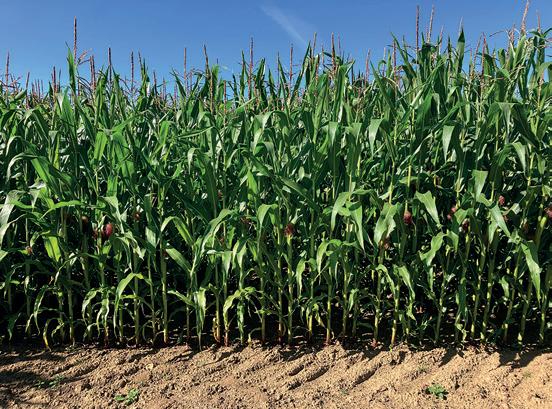
Growing maize as a break crop option in arable rotations
Maize now has the potential to outperform many alternative break crops in gross margin terms whilst offering arable farmers significant rotational benefits such as improved grass weed control, according to experts taking part in a recent Limagrain Field Seeds webinar, attended by farmers from across the UK.
Speakers pointed to the growing demand for anaerobic digester (AD) feedstocks and the high value of grain maize as evidence of market-led opportunities for growers.
They also highlighted the accelerated plant breeding progress that is allowing increased yields of a higher quality crop within a shorter
growing window, which is giving more farmers the opportunity to follow maize successfully with winter wheat, for example.
“Potential returns for arable farmers in many parts of England are attractive, with maize offering around two or three times the gross margin of spring oats or spring beans,” said James Webster-Rusk, Senior
Agribusiness Analysist for The Anderson Centre.
“The market is there, with growing demand for AD feedstocks and many plants looking to replenish depleted stocks in 2026. With regards to grain maize, we currently import 2.5 million tonnes a year, so there are opportunities to replace at least some of this with homegrown crops, and also to grow maize on contract
for crimping, wholecrop or forage.
“In terms of rotational benefits, the different herbicide chemistry used for maize tends to help with the control of grass weeds, including blackgrass, and – being a spring drilled crop with a relatively late harvest – it offers a helpful spread in workloads.”
Whilst maize has historically been associated in some areas with difficult harvesting conditions and
the risk of soil damage, speakers agreed on the modern-day potential for the crop to be environmentally beneficial.
“Breeding advances within the last ten years now mean we are growing high yielding crops of maize that mature in a much shorter growing window,” said Limagrain’s Richard Camplin.
“Earlier harvests are most certainly desirable in terms of soil health, not only avoiding structural
damage but also allowing the establishment of a following crop that will use up surplus nutrients and prevent soil erosion.
“With the emergence of specialist grain maize options like LG 31.160 and very early maturity high yielders such as Harmony, breeding programmes are delivering varieties that work well within rotations and are suited to helping arable farmers respond to the market opportunities.”
Protect yield potential by maintaining foliar fertiliser inputs
Arable growers should resist the temptation to reduce crop nutrients this spring, with trials data suggesting that the application of foliar nutrition can enhance winter wheat yields by more than 0.9t/ha. That is according to ProCam’s crop
nutrition portfolio manager, Phil Burrell, who explains that applying the right nutrients at the right place and right time will be vital to ensuring this year’s crops reach their full potential,
“With last year’s sub-par yields making cashflow tight
for many arable businesses, and rising input costs and subdued commodity prices putting additional pressure on farm finances, there is a lot of talk about how and when to cut back on crop nutrition and disease control,” Phil explains.
“Experience suggests that foliar applied nutrients are amongst the first inputs to be omitted in lean years, but that is a false economy, especially as this year’s crops have come out of the winter with the potential to produce good yields.
“Instead of cutting back, wheat growers should protect and maintain crop biomass and yield potential, not only by applying an effective programme of fungicides to keep diseases such as septoria, rusts and mildew in check, but also by ensuring sufficient nutrients are available to allow crops to fight off disease and progress unhindered to a plentiful harvest,” Phil adds.
Trials carried out by ProCam have shown that winter wheat treated with fungicides and foliar applied nutrients during the stem extension phase will yield as much as 0.7t/ha more than a crop treated with fungicides alone.
“Similarly, crops which receive no fungicides and no foliar nutrition will yield 0.92t/ ha less than a crop which receives no fungicide but does receive foliar nutrition at T1, T2 and T3,” Phil describes.
“The proof of the value of foliar nutrients is therefore clearly evidenced, with healthy, well-
fed crops producing better yields and higher profits.”
Phil explains that nitrogen, magnesium, potassium and sulphur are all important in terms of a crop’s ability to convert sunlight into yield and improve grain quality, while nutrients including boron, copper and zinc are critical in optimising grain set. He therefore encourages growers to think carefully before excluding any foliar nutrition applications.
“Wheat yield is driven by maximising the number of ears per metre square, and by the number and size of grains each ear produces. It therefore stands to reason that crops need to be fed at the growth stages that have the biggest impact on these factors. For that reason, crops must have access to the necessary macroand micro-nutrients they require during stem extension and again when the crop’s main solar panel – the flag leaf – has fully emerged.”
Up to 60% of a crop’s yield is produced by the flag leaf (40%) and ear (20%), with leaf two contributing another 20% Phil adds. “So, it’s essential to keep both leaves and the ear as clean and disease free as possible.
It is therefore understandable why we spend so much time, money and effort on applying fungicides at the correct rate and timing. But applying the right nutrients is arguably just as important.”
Mancozeb Emergency Authorisation Application
Scott Walker, CEO of GB Potatoes, said: “Following the announcement that mancozeb would be withdrawn from use in the UK at the end of the 2025 season, GB Potatoes explored the feasibility of progressing an Emergency Authorisation (EA) application to allow a continued use on potato crops. An EA permitting the use of mancozeb for the 2026 season, would have delivered a significant resistance management benefit at a time of increasing pressure from blight resistance.
“With support from Horticulture Crop Protection Ltd (HCP), a small group of technical experts was convened to develop
an application and to engage constructively with the Health and Safety Executive (HSE) on what would be required for approval. Positive engagement with the authorisation holder, UPL, enabled productive pre-
application discussions to take place.
“However, through these discussions it became clear that, in order to meet HSE risk assessment requirements, any authorisation would be limited to a single application of mancozeb per crop. Such a restriction would not be commercially viable given the additional stewardship requirements that would need to be put in place, and the agronomists involved advised that a single application would deliver only very limited resistance management benefit.
“As a result, and with great disappointment, the decision was taken not to proceed with an Emergency Authorisation application for mancozeb. All possible avenues were explored, and we are very grateful for constructive liaison with HSE as well as the time and effort invested by the team at HCP and by Eric Anderson (Scottish Agronomy), Ruairidh Bain (SRUC), Graham Tomalin (VCS Potatoes) and David Cooke (JHI).”
FARMING
Next issue out May 2026
Subscription page 152
Lodi UK becomes sole distributor of well-known broadspectrum insecticides
Lodi UK has become the sole distributor of the Actellic range of insecticides after the portfolio was acquired from Syngenta by Envu in 2025.
Roger Simpson, managing director at Lodi UK, welcomes this addition to their grain storage range, which came into effect on 1 January 2026.
“Lodi UK are already sole distributors of Envu’s range of K-Obiol products, and this new acquisition further strengthens their grain storage protection offering,” he says.
The new portfolio includes the Actellic Smoke Generator.
“The Actellic Smoke Generator will complement the widely recognised K-Obiol range, providing growers, traders and grain storers with a comprehensive suite of grain protection products,” says Mr Simpson.
“This extension expands coverage against stored grain pests, enhancing the quality and safety of grain.
“This will help streamline the process of grain storage preparation ahead of harvest by having all the products which growers need under one roof.”
Explaining how the product fits into the grain protection portfolio, technical and key accounts director, Ross Goodman, says the Actellic Smoke Generator can be used post-cleaning to target hard-toreach areas where insects may still be residing.
“The smoke fills the empty store or silo and reaches cracks and crevices which sprayers may not be able to get to, helping to eliminate any insects which may still be present after cleaning,” explains Mr Goodman.
He highlights that thorough cleaning and preparation of grain
stores is a key step in preserving grain quality post-harvest.
“A good harvest starts by preparing the grain store correctly; without this you risk insect damage which can rival that of pests and diseases encountered in the field,” Mr Goodman says,
“Once the grain shed has been emptied and cleaned, following with a treatment of K-Obiol EC25 and the Actellic Smoke Generator will protect grain stores from the threat of primary and secondary grain pests causing irreversible damage during harvest.”
Scientists make important discovery in 50-year barley mystery
Researchers at the International Barley Hub, based The James Hutton Institute, searching for ways to make barley a more sustainable crop, have solved the mystery of a barley mutant called desynaptic8, first discovered in the 1970s.
A recent study, published in the Journal of Experimental Botany explains why the chromosomes in these plants do not separate properly during reproduction, causing the plant to produce fewer seeds.
Using modern genetic tools, they discovered that desynaptic8 is caused by damage to HvXRCC2, the barley version of a DNA repair gene also found in humans.
The International Barley Hub (IBH) promotes scientific discovery and innovation to future-proof barley, the predominant crop grown in Scotland and is part of a £62m investment through the Tay Cities Region Deal (TCRD) a partnership between local, Scottish and UK governments and the private, academic and voluntary sectors. Climate
A new approach to deer management for nature and for rural Scotland
change and other environmental challenges, coupled with an increasing demand for the crop means that research into genetics and breeding is vitally important to safeguard production and ensure a sustainable future for this most critical of crops.
Dr Isabelle Colas, deputy director of the International Barley Hub (IBH) and lead author of the report explains more: “The barley crop that farmers grow for food, animal feed, and malting, is dependent on plant breeding to develop new varieties that yield more, resist disease, and cope better with changing weather.
“At the heart of the breeding process is a natural event called meiosis, where plants mix their genetic information to create the next generation. During meiosis, chromosomes exchange pieces of DNA in events known as crossovers. These swaps help chromosomes separate properly and create new combinations of traits. Without enough crossovers, plants can become partly sterile and produce fewer seeds.
www.farmingscotlandmagazine.com
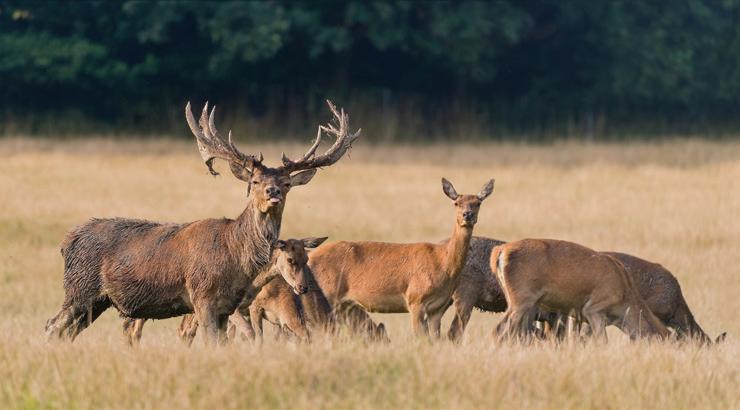
Scotland’s deer are an iconic part of our landscape. But we must be honest: without proper management, deer populations cause real damage to our woodlands, peatlands, and agricultural land. Getting the balance right matters - for nature, for land managers, and for the rural communities whose livelihoods depend on sustainable land use.
The Natural Environment Bill gives us new tools to achieve that balance. At its heart is a National Deer Management and Venison Plan, which I introduced through a Stage 3 amendment. This isn’t about imposing a one-size-fits-all approach from Edinburgh.
It’s about setting out clear priorities, supporting the people who manage deer day-to-day, and maximising the opportunities that venison can bring.
I want to change how we talk about deer management. Too often, the conversation focuses solely on culling numbers. I believe we should focus instead on the high-
quality, sustainable venison we can harvest - a healthy, low-carbon protein that deserves a bigger place on Scottish plates and in Scottish kitchens.
We’ve already invested in venison infrastructure pilots and direct support for land managers. The Bill ensures this work continues with proper strategic direction.
The Natural Environment Bill also strengthens the ability of occupiers of agricultural land and woodland and grazings committees to prevent damage caused by deer on the land that they occupy. This enables crofters and tenant farmers to protect their livelihoods while supporting nature recovery.
Good deer management protects young woodlands, supports peatland restoration, and helps our ecosystems recover. But it also sustains skilled jobs in rural areas and produces excellent food. That’s the balance this Bill helps us strike - and it’s a balance I’m committed to delivering.
Jim Fairlie, Minister for Agriculture and Connectivity
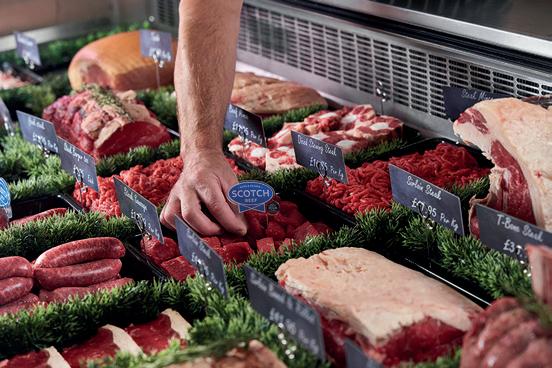
Quality Meat Scotland launches latest marketing campaign to drive footfall to local Scotch Butchers
Quality Meat Scotland (QMS) has launched a new marketing campaign designed to support members of the Scotch Butchers Club and encourage consumers to rediscover the benefits of shopping with their local butcher for quality-assured Scotch Beef, Scotch Lamb and Specially Selected Pork.
The campaign follows independent consumer research recently commissioned by QMS to better understand consumer’s most up-to-date shopping habits and the factors influencing where people choose to buy red meat. The findings provided clear insight into the motivations that drive shoppers to independent butchers as well as the barriers that can often hold them back, helping QMS shape a refreshed marketing approach for Scotch Butchers Club members in 2026 and beyond.
With February recognised as a key trading period for independent butchers, the campaign will roll out across a mix of broadcast, digital, paid social media and print channels to ensure strong visibility and repeated exposure. Advertising will run on Bauer’s Hits Radio Network which includes stations like Forth 1 and Clyde 1 alongside digital display activity on BBC Good Food, social media advertising via Make it Scotch channels and targeted local press placements.
All campaign activity will promote shopping at local butchers who proudly stock Scotch Beef, Scotch Lamb and Specially Selected Pork, directing consumers to the butcher location finder on makeitscotch.com. A new series of short-form videos featuring food journalist and influencer Julia Bryce has been created to run on Facebook, Instagram and TikTok throughout
February and March, providing educational ‘top tips’ to help build confidence amongst those unfamiliar with shopping at a butcher’s and inspire shoppers to visit their local Scotch butcher to buy red meat. In-store support will also be available to members, including a printed steak night recipe card and a digital voucher template, should they wish to use them as part of their own promotions. The campaign will deliver significant reach and impact, with radio advertising alone planned to reach around 1.5 million listeners and generate more than six million
opportunities to hear during the campaign period.
Gordon Newlands, Brand Development Manager at Quality Meat Scotland, said: “Our latest research has given us a clear steer on what today’s consumers want when buying fresh red meat - quality, trust, provenance and expert advice were top of the list. Independent butchers are perfectly placed to deliver all of that, and this campaign focuses on reminding shoppers of the value their local Scotch butcher offers. By combining strong, consistent consumer messaging with practical tools for our
members, we’re aiming to drive footfall and support butchers at an important time of year.”
The Scotch Butchers Club brings together independent butchers committed to sourcing quality-assured Scotch red meat from selected farms. Members benefit from marketing support, consumer insight and promotional tools designed to help them grow their businesses and connect with shoppers.
More information about the Scotch Butchers Club can be found at https://makeitscotch.com/thescotch-butchers-club/
Egg Industry Cries Fowl Over Government Betrayal
British egg industry representatives have accused the UK Government of duplicity, as it continues to undermine British
egg producers and mislead consumers with its ongoing support for imported battery eggs.
The accusation comes as the Government agrees a tariff-free extension of the trade deal with Ukraine, which will see millions
more eggs from battery systems, banned in the UK for more than a decade, flood into the UK.
Another nail in the coffin of British producers came last week with the announcement that the UK Government wants to ban the use of more welfare friendly enriched cages in the UK, while still allowing eggs from these systems to be freely imported.
Nick Allen, Chief Executive of the British Egg Industry Council, said: “The actions of this Government show that it simply doesn’t care about British consumers or British farmers. This policy is deeply flawed and lacks proper consideration of its consequences. It raises serious questions about what outcomes the Government expects to achieve. Across Europe, food safety concerns have already emerged in relation to Ukrainian eggs, with millions exported into the UK and EU.
“While the EU has at least recognised the risks by introducing tariffs, the UK
Government has effectively created an open door for the dumping of battery eggs produced to standards far below those required of British eggs and illegal to be produced in the UK. This exposes unsuspecting consumers to unnecessary risk and unfairly undermines domestic producers who meet significantly higher welfare and safety standards.
“The British Government should be ashamed of its betrayal of both British egg producers and consumers. The UK produces eggs to world-leading welfare and food safety standards, yet the Government appears willing to operate double standards, exposing consumers to lower quality imports, eroding trust in the standards the British public rightly expect.”
Following the latest announcement from the Government, the egg industry is urgently seeking a meeting with the Prime Minister to discuss its concerns.
Scotland The Brand
The Scottish Bean Deserves Our Focus
By Ruth Watson
Many farmers looking out onto waterlogged and flooded fields will be considering the potential for regenerative techniques to help soil structure recovery and improve outcomes. As the cost of inputs continue to soar, the appeal of a legume which delivers its own nitrogen demands and, if intercropped, that of the crop being grown alongside it is clear.
The faba bean has been sustaining our communities for thousands of years, being one of the first crops grown here at the very dawn of agriculture. The faba bean is a common sight in many fields; however, there is one understated variety which has the potential to boost yields, feed livestock with lower methane emissions, and deliver a protein-filled punch to our plates: the Scottish Bean.
Renowned plantsman, Henry Taylor, spent years developing the novel Scottish Bean genotype with its
distinctive white flowers, strong dwarf stem, a heavy cropper – field trials have delivered up to 4 tonnes a hectare – with beans suitable for canning, baking, and eating fresh. Importantly, the bean grows without inputs and flourishes in fields across the country.
Taylor formally gifted the Scottish Bean to the James Hutton Institute (JHI). Dr Pete Iannetta is a research leader at the JHI. He is working to bulk up stocks of the Scottish Bean, with plans to preserve its integrity with a breeding collaboration in a location where there are no other faba beans being grown.
Surprisingly, there is no commercial bean sector in Scotland. Imagine being able to grab a can of Scottish baked beans off the shelf or open a bag of freshly frozen Scottish beans to pop in a hotpot. What would that mean for our farmers, food security, the health of our people and our land?
Ruth Watson is the founder of the Keep Scotland the Brand campaign
WORLD FARMING
Fragile food systems pose an underestimated risk to global stability
As world leaders gatherED at the Munich Security Conference amid rising geopolitical tensions, the International Fund for Agricultural Development (IFAD) is urging governments and investors to treat food security and rural investment as matters of global security.
“Fragile food systems pose an underestimated risk to global stability,” said Alvaro Lario, President of IFAD. “Specifically, access to productive land and reliable freshwater must be prioritized. Land and water deserve as much attention as rare minerals, if not more, as they are key to global stability,” added Lario.
Nearly 80 per cent of the world’s poorest people live in rural areas, where climate shocks, failing food systems and lack of opportunity are acting as force multipliers for conflict, displacement and regional instability.
“When rural communities have access to productive land and water, food security improves, conflicts over resources decrease and economic opportunities arise,” added Lario.
Investing in small-scale producers and rural entrepreneurs to connect them to markets and finance, he said, “does not just promote opportunity and prosperity, it also strengthens the foundations of peace and safeguards some of our most valuable resources”.
IFAD works with governments, UN agencies and the private sector to align food security investments with broader security and foreign policy goals. For almost 50 years, IFAD has invested at the “first mile” of food systems – where
food is grown and livelihoods are made – helping rural communities build resilience before shocks escalate into crises.
IFAD offers scalable, fieldtested solutions that complement geopolitical and diplomatic efforts to build long-term global stability. For every dollar in core contributions, IFAD delivers US$6 in high impact investments, crowding in public, private and domestic finance and positioning the Fund as a frontline actor in promoting stability and prosperity. The Fund helps create the conditions in which private investment can flow into rural economies.
Under the International Consortium for Red Palm Weevil Control Program
ICBA Hosts the Launch of Good Agricultural Practices as a Core Pillar of Red Palm Weevil Management
The International Center for Biosaline Agriculture (ICBA) convened a foundational partners’ meeting at its headquarters in Dubai to initiate work on Good Agricultural Practices (GAP) as a core pillar for the prevention and management of the Red Palm Weevil, under the International Consortium for Red Palm Weevil Control (C4RPWC) programme, supported by the Government of the United Arab Emirates and the Gates Foundation.
The Red Palm Weevil is among the most serious insect pests threatening date palm production systems and the livelihoods dependent on them across a number of countries worldwide. This challenge underscores the need to adopt integrated, sciencebased approaches that prioritize prevention, the health of production systems, and field-level application of Good Agricultural Practices.
The Consortium brings together a range of institutions
implementing the programme through an applied, impactdriven approach, uniting international research centres, national authorities, and local partners to address the key gaps in managing this pest. The programme uses the United Arab Emirates as a testing and validation platform for innovations that are practical, scalable, and transferable to lowand middle-income countries affected by the Red Palm Weevil.
During the meeting in Dubai, representatives from the Ministry of Climate Change and Environment, the Abu Dhabi Agriculture and Food Safety Authority, and the International Center for Agricultural Research in the Dry Areas (ICARDA), joined ICBA experts and date palm farmers to align efforts around practical, evidence-based approaches. These approaches aim to enhance tree health, reduce susceptibility to infestation, and strengthen the resilience and sustainability of date palm production systems, while improving the effectiveness of integrated pest management in the United Arab Emirates, the Arab Republic of Egypt, and the Kingdom of Morocco, among other countries that may benefit from the programme’s outcomes.
Commenting on the launch, Dr Tarifa A. Al Zaabi, Director General of the International Center for Biosaline Agriculture, said: “Managing the Red Palm Weevil cannot rely on isolated solutions or short-term responses. Good Agricultural Practices provide the scientific foundation for any sustainable approach to addressing this challenge. By strengthening the health of date palm trees, improving field management, and supporting informed day-to-day farming decisions, we address the underlying factors that increase susceptibility to infestation. Through ICBA’s contribution to this consortium, and in close collaboration with our partners, we are working to establish a coordinated, evidence-based approach that places prevention, production system resilience, and long-term sustainability at the heart of efforts to protect date palm systems and the livelihoods that depend on them.”
During the meeting, representatives from the Ministry of Climate Change and Environment, the Abu Dhabi Agriculture and Food Safety Authority, and ICARDA, alongside ICBA experts and date palm farmers, aligned on practical, evidence based approaches that strengthen palm health, reduce susceptibility to infestation, and
support more effective Integrated Pest Management (IPM) in the United Arab Emirates, the Arab Republic of Egypt, and the Kingdom of Morocco, with outcomes expected to extend to other countries as the program progresses.
With more than 25 years of applied research experience in date palm systems, ICBA contributes long standing scientific and field expertise to the consortium’s work,
supporting the translation of research into practical guidance and solutions that respond to real challenges faced by farmers and land managers. Through C4RPWC, partners are demonstrating how collaboration, applied science, and field validated practices can protect date palms, safeguard livelihoods, and strengthen agricultural resilience across regions affected by the Red Palm Weevil.
IFAD starts 2026 strong issuing a SEK 750 million sustainable bond to Skandia, AP3 and Kammarkollegiet
The International Fund for Agricultural Development (IFAD) started the year strongly by issuing its thirteenth sustainable bond, as a private placement, under its Sustainable Development Finance Framework to three investors.
The SEK 750 million note was purchased by Skandia, the lead investor, supporting IFAD for the third time, and followed by two new investors: AP3 and Kammarkollegiet.
The proceeds will contribute to finance IFAD’s development projects globally, focusing on transforming rural areas to make them more productive and prosperous, ultimately improving the livelihoods, food security and resilience of millions of rural people.
“We are particularly happy to start the year with this club deal, partnering with Skandia that is now supporting our institution for the third time, and adding two reputable new investors like AP3 and Kammarkollegiet. This deal summarizes IFAD’s wish to build long-term partnerships through repeat-investors and to attract new names with ESG themes at the heart of their investment strategy,”
said Natalia Toschi, Head of Funding, IFAD.
“By investing in IFAD, we contribute to long-term sustainable development where social impact and financial stability go hand in hand. Small-scale farmers play a crucial role in global food security, and investments that create development opportunities are crucial for reducing poverty and creating stable societies,” said Alexander Onica, Head of Skandia’s Fixed Income and Currency Management.
IFAD invests in small-scale farmers to help them improve
their agricultural practices, build their resilience to shocks and access markets, technologies, and value chains by connecting them to rural agribusinesses. Such investments deliver results, increasing food production and farmers’ incomes, and contributing to economic growth, food security and stability. Recent impact analysis shows that IFAD-financed projects increased farmers’ production, income and market access by more than one third. Between 2022 - 2024, nearly 390,000 jobs were created.
How to make UK farming profitable again
Minette Batters talks exclusively to James Farrell, Head of Knight Frank’s Rural Consultancy team, about her recently published review into farming profitability
In spring 2025, the then Defra Secretary Steve Reed commissioned former NFU President Minette Batters to investigate why profitability was such an issue for British farmers and what could be done about it. The result was the Farming Profitability Review. I sat down with Baroness Batters to discuss the report, its findings and why she is confident her 57 recommendations will make a difference. The following are some of the highlights of our conversation.
James Farrell - There was some delay before Defra finally published your report just before Christmas. What was behind that?
Minette Batters - It really came down to the Whitehall grid and end-of-year pressures rather than anything more troubling. Defra was keen to publish earlier and was frustrated by the delay. In some ways, though, it worked to the report’s advantage. When it did come out, it attracted more attention and scrutiny, which is no bad thing for something this important.
You’ve said some people warned you not to take on this review. Why did you go ahead anyway? A lot of people said it would damage my reputation or wouldn’t make any difference. But there’s no point being in the House of Lords if you shy away from big, difficult issues. Farming is at a crossroads. I felt strongly that the sector needed an evidence-based assessment of where we are and what needs to change. Steve Reed asking me to do it was a bold move, and I thought it was right to step up.
How has the farming industry reacted since publication?
The reaction has been overwhelmingly positive. I’ve spoken at conferences, industry meetings and webinars, and the feedback has been supportive across the supply chain. That’s because the report reflects extensive engagement with farmers, processors, retailers and advisers. It’s not a theoretical exercise - it’s the product of real conversations with people who are living these challenges.
What do you see as the biggest challenge now?
Implementation. That’s as much a challenge for the industry as it is for government. We’ve become very good at kicking the can down the road. This report sets out what should happen within six, 12 and 18 months, with clear milestones. Partnership is essential, but it has to deliver outcomes. Otherwise, it risks becoming another talking shop.
Do you think the government will actually act on your recommendations?
The government will have to respond formally, and that matters.
But delivery won’t happen by default. The evidence shows that if we don’t see real change within the next two years, we’ll end up with a very different farming industry - and not one most people would want. The recommendations are practical, phased and grounded in evidence, which makes them harder to ignore. Ultimately, progress depends on government and industry being prepared to work together properly.
What do you think are the report’s most important recommendations?
If I had to strip it back, three things really matter. First, genuine partnership between government and the industry, underpinned by proper market monitoring, so we understand supply and demand and stop repeating boom-and-bust cycles. Second, a new economic model that treats soil and nature as national assets, with investment shared across the supply chain rather than loaded onto farmers alone. And third, schemes that work on every hectare, not just pockets of the country. These recommendations are designed to work together - if you only implement parts of them, the report won’t deliver.
Why is market monitoring such a central theme in the report?
Because we don’t properly understand supply and demand across our food system. When we oversupply, prices collapse and farm businesses suffer. Better market monitoring and balanced scorecards would help stabilise markets and improve resilience. Other countries do this far better than we do. If we want a more stable and investable farming sector, we have to understand what’s coming in, what’s going out and where demand really sits.
With 57 recommendations, was there a risk of diluting the message?
I don’t think so. The review covers all sectors and land types at a time of huge change. If I’d included every ask made of me, there would have been hundreds. The Curry Commission made more than 100 recommendations. The key point is that these recommendations form a coherent package. Cherrypicking a few won’t work - they are designed to function together.
Forty years of subsidies have protected farming businesses from failure. Does it matter if some of them don’t survive? It’s an uncomfortable question, but it’s not as simple as saying weaker businesses should fail. The evidence shows that the midperforming farmer - not the very top or the very bottom - produces most of the nation’s food and is also the most vulnerable. Many good, well-managed businesses struggle because of volatility, scale or market failure, not because they are poorly run. If we allow that middle to collapse, we lose productive capacity, resilience and
Baroness Minette Batters
James Farrell, Head of Rural Consultancy, Knight Frank
rural jobs. Change is inevitable, and businesses will have to adapt, but a managed transition is very different from pulling support without a plan.
Are you proposing a guaranteed minimum income for farmers?
Not a guaranteed income, but a new economic model. Farmers can’t be expected to absorb all the costs of environmental delivery. If the polluter pays, then everyone has to pay. Government has a crucial role because it can provide integrity and scale - something private markets haven’t managed on their own. The aim is profitability, resilience and fairness, while avoiding food inflation.
Why has farming been so consistently undervalued by policymakers?
Because it’s still framed as just 0.6% of GDP. That ignores everything agriculture underpinsfood processing, retail, hospitality, rural jobs and communities. Other countries measure primary production and processing together, and the difference that makes is striking. Until we value farming properly, it won’t receive the strategic attention it deserves.
Should farming become a more formally professionalised industry?
Many farmers, particularly younger ones, want that recognition. Accreditation, skills and safety matter. Others will strongly oppose it. My view is that the opportunity should be there for those who want it, with clear benefits attached. Professionalisation should be enabled, not imposed.
Will you be actively following up to ensure the recommendations are implemented?
Absolutely. I didn’t take this on to write a report that gathers dust. The review sets out clear actions and timelines, and I intend to hold both government and industry to account against them. This isn’t about scoring points - it’s about improving resilience, profitability and long-term confidence in farming. If progress stalls, I will say so.
What excites you most about the next five years?
The potential for large-scale, commercially focused research, better use of data to balance supply and demand, and an economic model that produces more food with less environmental impact. The UK could lead globally on this. If we get it right, farming can be profitable, resilient and central to economic growth.
What is the positive story farming should now be telling?
The public cares deeply about food and farming, but understands very little. That puts responsibility on policymakers, institutions and industry leaders to engage properly. If government and retailers genuinely understand farming, we can deliver what consumers want: British food, produced sustainably, with farmers recognised as part of the solution, not the problem.
Farrell’s view
To condense the wish list of the entire farming sector, which covers a vast range of agricultural businesses from highly commercial arable enterprises to extensive upland livestock units, into 57 considered and meaningful recommendations is no small achievement.
The government’s response to Baroness Batters’ review has been encouraging so far, but the momentum will need to continue if her recommendations are going to add long-term value to an industry worryingly lacking in self-confidence.
But what the review makes very clear is that solving this crisis is not just down to the government. There needs to be a concerted effort by everybody involved in agriculture and across the food chain to cooperate more effectively towards a shared goal.
Farms and landed estates have a crucial role to play in the process, and while Baroness Batters’ recommendations, if actioned, will make the journey easier, their future, without the safety net of subsidies, lies largely in their own hands.
www.farmingscotlandmagazine.com
Become a “Friend of RSABI”
RSABI, the charity dedicated to supporting people in Scottish agriculture, first launched its Supporters’ Scheme more than a decade ago.
Now known as Friends of RSABI, the scheme has grown into a strong community of almost 1,000 supporters, including individuals, businesses and corporate partners. Their ongoing commitment provides a vital income stream, helping RSABI respond to increasing demand for its services and continue supporting those who need it most across the industry.
Heading up the initiative, Fundraising Executive Margo Wills, who has worked at RSABI for over a decade, recalls her very first business supporter, Sam Mercer of Hamilton Ross Group. Sam joined the Supporter Scheme back in 2016 and to this day continues to support as a Friend of RSABI.
“Our Friends of RSABI initiative reflects the incredible community spirit of our supporters and the vital role they play in helping us support people involved in Scottish agriculture. Last year, we set an ambitious target of reaching 1,000
Friends by March 2026, and we’re on track to achieve this, thanks to the continued generosity and enthusiasm of supporters like Sam.” Margo said.
By becoming a Friend of RSABI, supporters directly contribute to the charity’s work, which includes financial assistance, emotional support, and practical guidance for people in Scottish agriculture. This includes free, confidential counselling, delivered quickly after the initial enquiry, and a 24/7 support service, available by calling 0808 1234 555 (calls won’t show up on phone bills) or through a confidential webchat at www.rsabi.org.uk.
As organisations consider their charity partnerships for 2025, RSABI is encouraging companies to become Corporate Friends of RSABI. In addition to funding the charity’s vital work, Corporate Friends receive brand visibility and access to valuable networking opportunities including corporate fundraising events, providing businesses with fun and engaging ways to get involved.
To become a Friend of RSABI or learn more about how your support can help, visit https:// www.rsabi.org.uk/friends or email friends@ rsabi.org.uk.
A look at some baler models and products on the market today
New RB6 series variable chamber round baler from Case IH Balers & Baling
Case IH is launching the RB6 series variable chamber round baler, designed for superior performance, enhanced durability and maximum operator convenience.
The new RB6 series is built for trust and tough conditions, delivering greater reliability, usability and connectivity in two models — the RB456 and RB466.
“With larger operations and tighter harvest windows, operators must be efficient in the field,” said Marco Otten, EU business marketing manager, crop packaging at Case IH. “The new RB6 series is built to deliver that efficiency, as well as durability, in every field and more importantly, in every condition.”
An upgraded chain drive system with premium, higher-strength chains boost performance in heavy crops. Triple-seal bearings extend durability by keeping contaminants out and lubricants in. Extruded rollers now feature a seamless design to increase strength and service life. Reinforced rolls and sealed bearings further enhance resilience and reduce maintenance.
optional Pro 700 Plus or Pro 1200 displays available for nonISOBUS tractors.
With ISOBUS as standard, setup is easier and features such as tractor-baler automation are unlocked when paired with Case IH tractors. Automated baling steps — such as stopping when the bale is ready, net start and tailgate operation — improve throughput and reduce fatigue. Functions can be directly controlled from the cab with
Optional Case IH connectivity solutions, including Basic and Advanced Telematics, bring baler data into FieldOps for access anytime, anywhere. Operators can view field totals, bale drop locations and moisture data to improve transport, storage planning and customer service with shared agronomic insights.
Large baler updates In addition, Case IH is introducing Model Year 2026 updates for the LB436 HD and LB4 XL series large square balers to boost productivity and bale quality for producers. These include a new greasing system using automatic chain lubrication instead of oil, plus a new load-sensing package that enables bale eject and bale ramp activation from the back of the baler as well as from the cab.
CLAAS expands baler assembly capacity in Metz-Woippy
Metz-Woippy/Harsewinkel, 30 January 2026. One year after opening a new prototype workshop, CLAAS yesterday inaugurated two new assembly lines at its Metz-Woippy baler site. This investment is essential for the production of new baler series, such as the CEREX round baler and the next-generation square baler CUBIX, Innovation Award winner in Gold at Agritechnica 2025. It sets up the manufacturing site for future growth in balers.
Strategic investment underlines long-term commitment to France and the Grand Est region
The €3.3 million investment reflects a shared long-term ambition for the future development of the site. Furthermore, it underlines the connection with the region and represents another milestone in the 65-year history of the site.
On the occasion of the opening Cathrina ClaasMühlhäuser, Chairwoman of the Shareholders’ Committee and Thomas Spiering, Chief Operating Officer CLAAS Group welcomed representatives of the state as well as local and regional authorities. “As a family business, balers have been part of our DNA for more than 100 years. Metz is our home for baler production, and France is one of CLAAS’ core markets. This is an invest on our future and reflects our commitment to the Metz region and to France as a whole. I am particularly proud of what our teams in Metz have achieved. I sincerely thank our institutional partners, especially France Relance 2030 and the Mercy Endowment Fund, for their support”, said Cathrina Claas-Mühlhäuser, Chairwoman of the Shareholders’ Committee, at the inauguration.
Balers are at the core of CLAAS’ business and represent
one of the key competencies of the company, keeping with a more than 100 years lasting legacy giving birth to milestones such as the knotter billhook, VARIANT round balers, ROLLATEX net wrapping and QUADRANT square balers. With new generations of variable round and square balers built in a state-of-the-art
“By combining innovative products with future-proof production facilities, we are strengthening the industrial and technological foundations for the continued success of our baler business. Over recent years, we have systematically invested in R&D, our protoshop,
infrastructure and production at the Metz-Woippy site to drive innovation and operational excellence. Last year, our teams successfully delivered the launch of a broad new baler product portfolio, which is now going into production on stateof-the-art production lines for customers all over the world”, says Thomas Spiering, COO.
New binding automation from Fendt Rotana
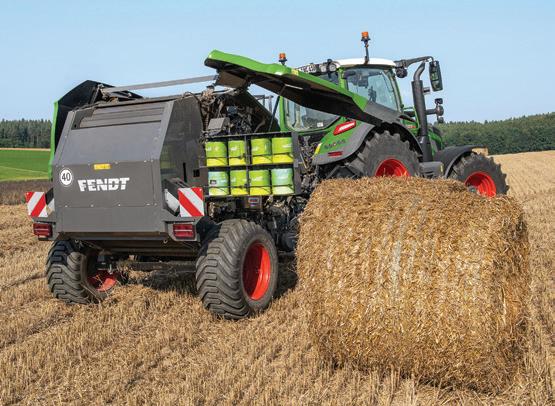
Fendt Rotana F and V series round balers now offer string, net and film binding. A semi-automation cab-controlled system enables operators to change the binding material using preloaded rolls. The Rotana also features a camera to monitor bale ejection helping operators to do more without leaving the cab.
The patented rotating quickchange system can switch between string, net and film baling, to make the transition to another roll of binding material easier for operators. This means operators can load the baler magazine with up to three interchangeable rolls.
The change of rolls was previously managed by
manually turning the baler magazine. However, now only the insertion of the film or net into the feed arms is a manual process.
For string baling the new Rotana can release four strings simultaneously which will significantly reduce idle time when binding. In addition,
factory, CLAAS sets the stage for future growth.
there is more available space to transport rolls with a maximum capacity of eight rolls at any one time.
A new camera is available as an option for the Fendt Rotana. The camera primarily displays the area behind the baler enabling operators to check the quality of the bound bales from the cab and make necessary adjustments more quickly. In addition, the camera increases safety during shunting movements in the yard, because there is better visibility of the area behind the round baler.
The Rotana also features an LED lighting package which offers LED back lights in addition to LED maintenance lights under the side flaps. This helps with visibility but also further increases safety in road traffic.
In order to provide a higher, direct level of service to contractors and farmers in the UK, Harvest Tec has established its own dedicated UK Sales and Service distribution network for its applicator range and Baler’s Choice preservative.
Making high quality hay in Scotland can be challenging at the best of times, with wide variations in moisture content and variable weather conditions resulting in delayed baling, highlighted the benefit of using a preservative such as Harvest Tec Baler’s Choice, which can potentially increase daily output by as much as 30% from as little as £1.43/bale*.
Harvest Tec is a leading manufacturer of advanced manual and automated preservative application systems and moisture sensors, for large square, round and conventional balers.
All Harvest Tec applicators are designed specifically
BALERS
for use with the company’s market leading Baler’s Choice preservative that is buffered to be near-neutral with a consistent Ph of 6.0 that is suitable for use in both hay and straw, and is manufactured under licence in the UK.
For contractors and other baler users, Baler’s Choice has the great benefit that by enabling hay and straw to be safely baled at above 15% moisture, this offers the
potential to lengthen the baling day by maybe an hour each end or bale on days when previously the crop would not be dry enough.
Not only is there a financial benefit through higher daily throughput from the baler, but it also helps simplify logistics and planning and also the potential to save on the time and cost of additional tedding, with the associated risk of damage to the crop.
Baler’s Choice reduces heating and stabilises the temperature within bales, thereby reducing the risk of combustion, in addition to preventing moulds, dust and loss of bale quality, yet is also kind to the baler and safe to handle. Baler’s Choice is also completely safe for livestock, including horses with trials showing it has no negative affect on their performance, making it
ideal where high quality hay is being made for this market.
Harvest Tec Baler’s Choice applicator systems range from simple, straightforward applicators with manual rate setting, through to the advanced Automatic 700 Series applicator that monitors both baler throughput and real time moisture content of the hay or straw as it passes through the baler to automatically adjust the application rate accordingly.
KRONE VariPack V 165 XC Pro
The VariPack Pro chamber is made up of three endless belts that feature a smooth surface. This VariPack was designed to deliver high densities and throughput in dry material such as straw, hay, and haylage. The belts are constantly cleaned by two rollers so they can reliably keep up their good work. The baler is standard with an Autogrease and oiler system and bale loading chute to make day to day running as easy as possible.
The KRONE VariPack V 165 XC Pro has a 17-blade or 26-blade cutting system that can be selected from the cab in groups of 0, 13 or 26 blades to give cutting lengths of 84 mm or 42 mm. The change is made fast and simple for easy adjustment to varying conditions.
The VariPack Pro has a number of automatic features which helps reduce driver fatigue and keep productivity high, the auto back door function will open and shut the rear door in under 5
seconds (this can be controlled manually on slopes) the pickup reel can be set to automatically lift when you reverse a tractor with isobus, it will then lower when you drive forwards.
The machine incorporates KRONE’s EasyFlow pick-up system, which operates without a cam track and uses fewer moving parts. Material is fed through a huge integral rotor designed to
maximise throughput and ensure an even crop flow across the full working width of 2.15m. Both of these features help keep maintenance, service costs and wear to a minimum.
Kubota round balers offer more choice
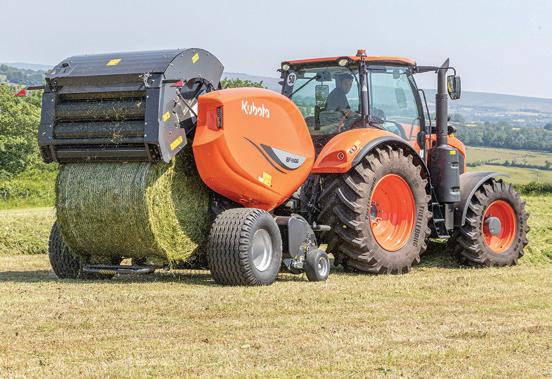
Kubota’s baler line-up continues to evolve. Its fixed and variable chamber line-up includes the heavy duty, high capacity fixed chamber BF3500, along with variable chamber BV5160 and BV5200 Plus models. And for those who want to bale and wrap, the range includes the twin-axle FlexiWrap baler-wrapper combination and the BF1000 FastBale non-stop variable chamber round baler wrapper.
The latest addition to the Kubota baler range is the BF3500. Designed for heavy silage conditions, the BF3500 uses 18 rollers with 50mm diameter bearings, and doublerow roller bearings are used on all main load points.
Two rollers sit in the base of the chamber to give additional support with heavy, wet silage bales, and hydraulic density control provides
consistent bale quality in all crop conditions.
A 2.3m wide pick-up brings extensive upgrades, with an extra tine added on either side, the working width is broadened by 10cm, while a five-bar tine reel incorporates a cam track on both sides of the pickup, with each tine bar supported on four bearings. Tine length has been increased by 10mm and the gap between the stripper plates
has been reduced for improved performance in wet crops.
The BF3500 gets a larger diameter intake rotor, along with a revised drop floor system with a parallelogram action – this extends clearance under the front and rear of the chamber when lowered, says the firm.
PowerBind net injection places the tail of net directly into the bale chamber, without relying on traditional feed
rollers or the use of gravity. Kubota’s BF3500 is also equipped with a 15-knife SuperCut pre-chopping system, plus automatic chain lubrication and auto-greasing.
Baler innovation includes Tractor Implement Management (TIM) for the variable chamber BV models. This ISOBUS solution enables the baler to automatically control certain functions of the tractor to optimise quality and efficiency of the baling process, while reducing operator fatigue.
Engineered to work seamlessly with Kubota’s M7004 Premium KVT tractor, TIM manages the KVT transmission to slow the tractor to a standstill when the bale chamber reaches full. Engine revs are automatically lowered while the net goes on, then the chamber door is automatically opened and closed, to let the bale out.
The system then emits an audible beep to inform the operator that the process is
KUHN updates VB 7100 series balers
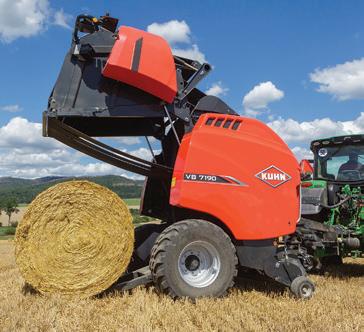
KUHN’s VB 7100 round baler series can now be fitted with a weighing bale kicker and AEF certified automation to simplify repetitive operations
and provide accurate bale information.
The VB 7100 becomes the world’s first section-controlled baler with a GPS-automated
complete, prompting the operator to check that the way ahead is clear before pressing the drive
pedal. This acknowledgement automatically increases rpm and starts the process all over again.
pick-up. The machine uses Task Controller Section Control to automatically lift or lower the pick-up based on field location and crop detection. This reduces operator fatigue and machine wear by preventing unnecessary pick-up ground contact on headlands or areas with no crop.
The baler also features an industry-first AEF Certified Task Controller geo-based (TC-GEO)
function. It enables farmers and contractors to record data such as bale counts, customer information, and mapping for automated management reports. Integration with Tractor Implement Management (TIM) allows the baler to control the tractor throughout the entire baling cycle, while AUX-N enables seamless operation via joystick softkeys.
Also new to the VB 7100 models is a bale weighing system integrated into the bale kicker. By only weighing the bale rather than the entire machine, it allows more accurate bale weights to be recorded between 100kg and 1500kg.
A built-in slope compensation sensor maintains accuracy on uneven ground, while the reading from the standard moisture
sensor on the VB 7100 models can be combined with the bale weight to calculate precise dry matter yield. Using the Task Controller basic, bale weight data can be transferred to management systems, whereas Task Controller Geo adds location details for weighed bales, providing farmers with yield measurements related to specific field areas.
McHale Driving On Balers
For the 2026 season, McHale will be enhancing their grassline offering to include new models in their V6/V8 range of balers while also expanding their centre delivery rake range. The machinery manufacturer is best known for the production of balers, bale wrappers and their flagship product – the McHale Fusion which has also received an added extra in the form of the McHale TerraDrive Axle for next season.
Starting with balers, McHale’s V6-II & V8-II Variable Chamber Balers are the next generation of McHale’s already very popular Variable Chamber Baler Range. These machines have proven themselves around the world and are now enhanced by the introduction of ISOBUS as standard across the V6750II & V8950-II machines. These models also feature a new ISOPlay 6 console if required which enables the machine to operate using a non-ISOBUS tractor. These new features have added to the operator’s comfort and user friendliness of the machine by allowing the operator to experience the highest level of customisation and machine performance.
Aside from the new control functionality, the next generation of V6 & V8 machines also feature Load Cell Bale Shape Indicators for more accurate and responsive measurement of the bale shape, Active Density Control which varies the density pressure regulation at predetermined points of the process and these machines will
be TIM ready to allow the baler to control certain functions of the tractor for improved operator comfort. From a mechanical perspective, these machines are also equipped with quick attach wheels, larger oil tank and spring chain tensioners to help the daily operation and maintenance.
The release of the V6750-II as part of the second generation of McHale’s Variable Chamber range demonstrates McHale’s consistent innovation and progression in our product design to meet customers’ needs and comfort. With the majority of the new features seen on the
V6-II & V8-II based around the comfort and user friendliness of the machine allowing customers to experience the highest level of customisation and machine performance while also delivering a robust and versatile machine that still delivers.
Vicon Plus-series variable chamber balers
With ‘Plus’ designation, Vicon’s RV5200 series variable chamber round balers offer lower running costs with improved output. The RV5216 and RV5220 models are available with a choice of intake system, comprising SuperFeed rotor or 14-knife SuperCut crop chopping system.
Maximum bale sizes are 1.65m and 2.0m respectively, for RV5216 and RV5220 models.
Performance enhancing upgrades include a redesigned roller crop press capable of lifting higher in heavier crops, while the press’ side support arms have also been strengthened and incorporate improved limit stops.
Enhanced protection against crop wrapping is also provided for the bearings, which have now been mounted inside the roller crop press.
Up front, the 2.2m pick-up reel - which features twin-cam tracks and five tine bars - has also been improved. It now features 10mm longer tines and wider stripper plates to improve cleaning in wet crop conditions. The pick-up drive chain has also been increased in size for added durability.
The driveline has received attention and is now equipped with long-life HBC specification chains providing higher fatigue strength and increased wear resistance, compared to conventional chain. The bale chamber has not escaped attention either, with a new design of idler rollers which benefit from a 45% increase in bearing diameter, along with larger internal grease capacity and improved shielding. The idler rollers also gain a
continuous central shaft, which adds rigidity.
Maintenance has been simplified with bale chamber drive rollers gaining cast iron housings and centralised grease banks, ensuring non-productive maintenance time is kept to a minimum. Operator convenience has been improved with a folding PTO stand, which also incorporates hose and cable storage. An easy access rear PTO cover is also provided for simpler maintenance.
Visually the new Plus series models are distinguishable from previous RV models thanks to high-level LED road lights, now positioned out of harm’s way, reducing the likelihood of damage from stray bales.
Nature’s Net Wrap now available for Europe
Well-proven in North America since sales began in 2024, New Holland European dealers can now supply Nature’s Net Wrap, developed by a farmer-founded Canadian firm. Nature’s Net Wrap has been created to counter the environmental impact of plastic net wrap and twine, which accounts for around half of agriculture’s total plastic waste.
Made from plant-based biopolymers, Nature’s Net Wrap offers the same resistance and durability as traditional plastic net wrap, ensuring optimal bale protection. It has a significantly lower manufacturing carbon footprint and addresses key environmental concerns associated with traditional plastic net wrap. Unlike plastic wrap – which can be left behind in fields, contaminate soil and water, or become entangled in machinery such as bale processors and manure spreaders – Nature’s Net Wrap is compostable, reducing the risk of
costly downtime and repairs. It helps farmers save time, reduce costs and environmental impact of their operation and offering a more sustainable bale packaging solution.
The material retains the typical characteristics of conventional net wrap in balers and over bale lifetime, but minimizes disposal concerns, being completely compostable. It is suited to all
round baler makes and models and is available in 122cm or 129.5cmwide rolls of 1,219m length. Nature’s Net Wrap is currently available exclusively through the CNH network.
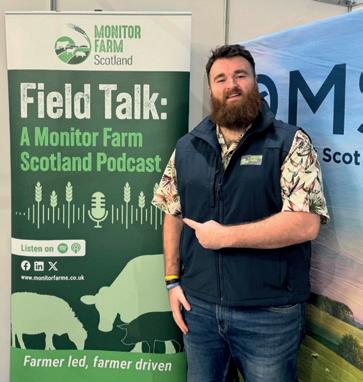
How Young Farmers took Wallace Currie from a Scottish island to six continents
International travel and leadership opportunities inspire Wallace’s support for SAYFC Big Build
Wallace Currie, agri-podcaster and Knowledge Exchange Manager at the UK Agri-Tech Centre, is backing the Scottish Association of Young Farmers Clubs’ (SAYFC) Big Build after Young Farmers opened doors to international travel, lifelong friendships and leadership opportunities that have shaped his career in Scottish agriculture.
Raised on his family’s beef and sheep farm on the Isle of Arran, Wallace remains closely connected to the business, continuing to support the farm alongside his role working from home as a part-time Knowledge Exchange Manager. His work focuses on the Adopt Support Hub, a £21 million development fund offering farmers, growers and foresters up to £100k for on farm trials.
Wallace first became involved with Young Farmers as a way to connect with the local agricultural community. In 2015, he founded Arran Young Farmers Club, successfully running the group until 2017. After the club paused following his move to Dumfries, Wallace was determined to see it return and, in 2025, worked alongside a new committee to restart Arran YFC, where he continues to serve as a committee member. Within a year, the club grew to 41 members and delivered 17 events, re-establishing it as a vibrant part of the island’s rural community.
From 2021 to 2023, Wallace lectured at SRUC in Dumfries, teaching meat and advanced dairy supply chains, sustainable business and agricultural food systems. Starting his lecturing career at just 23, Wallace sought out the SAYFC community as a way to connect
locally. Through Lower Nithsdale Young Farmers, he quickly built lifelong friendships and became immersed in the club, including performing in a SAYFC concert, with a highlight appearance at The Hydro.
Wallace holds an honours degree in Agriculture, a master’s degree in Food Security and a postgraduate qualification in higher and tertiary education. In 2024, he became a Nuffield Scholar, travelling across six continents and 16 countries to explore pathways into agriculture through rural education, youth groups and consumer engagement. He credits SAYFC with unlocking many of these global opportunities and providing the confidence, networks and platforms to engage internationally. More recently, Wallace has also lectured in China with the Royal Agricultural University.
While furthering his career through study and work, Wallace also contributes to the wider sector through podcasting, event hosting and governance roles, including serving as National Communications and Marketing Chair, standing for National Vice Chair, and now sits on the organisation’s National Board - demonstrating his long-term commitment to the future of Young Farmers in Scotland.
Wallace said: “Hand on heart, Young Farmers has given me more in the last two years than almost anything else. It kickstarted my travel, gave me access to people, to strategy, to seats at tables. But most importantly, it gave me a home and a friendship base at a time when I was scared to build one. When I moved to Dumfries, Young Farmers gave me that foundation. It also gave me the opportunity to offer that same sense of belonging
back to the other Young Farmers in Arran. It has massively enhanced my life.
“We had a home at the Royal Highland Centre for 56 years, and it has been a touchpoint for generations of members. The Big Build will ensure we continue to have that base to support our staff and showcase who we are as a proud, member-led organisation. Our new national home will provide us with the space to work closely alongside other organisations supporting agriculture, while giving Young Farmers a space that truly represents us.”
The SAYFC Big Build aims to create a new centre for Scotland’s rural youth, following the loss of its previous headquarters at the Royal Highland Showground. The new facility will provide a year-round base for Young Farmers staff and members, act as a social hub to help tackle rural isolation and strengthen community connections, offer event and office spaces to support collaboration with other agricultural organisations, and include archive and exhibition space to showcase the history of SAYFC.
SAYFC is now encouraging individuals, businesses and supporters across the rural community to get behind the Big Build. Donations will help create a lasting home that supports young people, strengthens rural communities and enables future success stories like Wallace’s.
Businesses, individuals, trusts, and organisations interested in contributing, securing naming rights, or discussing major gifts are encouraged to contact: bigbuild@sayfc.org To find out more about SAYFC’s Big Build or to make a donation, visit https://www.sayfc.org/donate/ sayfcs-big-build/
Wallace Currie
Ffermio Cymru
‘Cigoedd anghofiedig’ –bwyd maethlon y dyfodol?
Gallai cigoedd anghofiedig fel yr afu, y galon a’r arennau ddychwelyd fel math newydd o fwyd llawn maeth, yn ôl gwyddonwyr.
Arferai cig offal fod yn rhan reolaidd o ddiet pobl yn y DU ond mae eu poblogrwydd wedi gostwng yn ystod y degawdau diwethaf, er eu bod yn gymharol rhad ac yn ffynhonnell gyfoethog o fitaminau a mwynau.
Mae ymchwilwyr o athrofa ymchwil IBERS ym Mhrifysgol Aberystwyth wedi bod yn gweithio gyda Hybu Cig Cymru (HCC) i edrych ar y rhesymau dros y gostyngiad yn y galw am y cigoedd hyn yn ogystal â chodi ymwybyddiaeth o’u gwerth maethol uchel.
Dywedodd Dr Siân Mackintosh o Grŵp Ymchwil Systemau Amaethyddol IBERS ym Mhrifysgol Aberystwyth:
“Lle nad ydyn nhw’n yn cael eu defnyddio, mae’r “cigoedd anghofiedig” hyn, sy’n llawn maeth, yn cynrychioli colled sylweddol o faetholion o’n cadwyn fwyd a gellid eu defnyddio i gefnogi iechyd dietegol pobl pan maen nhw’n cael eu bwyta fel rhan o ddiet cytbwys. Gallai fod manteision amgylcheddol hefyd a llai o wastraff bwyd pe bai pobl yn bwyta’r cigoedd yma’n fwy aml.”
Gan weithio gyda gwyddonwyr IBERS, mae staff HCC wedi bod yn cynnal sesiynau blasu mewn digwyddiadau fel Sioe Frenhinol Cymru a’r Ffair Aeaf yn Llanelwedd i gael ymateb pobl i brydau a wnaed gydag afu cig oen Cymreig, megis stroganoff, ffagots a phaté.
Maen nhw hefyd wedi gofyn i sampl bach o bobl lenwi holiadur
er mwyn canfod mwy am farn y cyhoedd ynghylch bwyta afu, calon, arennau neu dafod.
Dywedodd Dr Eleri Thomas, Swyddog Gweithredol Polisi a Datblygu Prosiectau’r Dyfodol yn HCC:
“Rydyn ni’n credu bod potensial sylweddol i’r cigoedd anghofiedig hyn gael eu hailgyflwyno i’n diet ni. Yn ystod sesiynau blasu a gynhaliwyd yn y Ffair Aeaf y llynedd, roedd defnyddwyr yn hoffi’r blas ac yn awyddus i ddysgu mwy am ryseitiau a dulliau coginio, yn ogystal â’r gwerth maen nhw’n ei gynnig.
“Drwy edrych ar ffyrdd o wneud y defnydd gorau o doriadau maethlon oen nad sy’n cael eu llawn gwerthfawrogi, y nod yw cynyddu cynaliadwyedd y gadwyn gyflenwi, cwtogi ar wastraff a chynnig cyfleoedd marchnata newydd.”
Gwnaed yr ymchwil fel rhan o brosiect ehangach Maetholion SMART Cymru, a ariennir gan gynllun Cymorth Arloesi Hyblyg SMART Llywodraeth Cymru.
Arweinir y prosiect gan Dr Christina Marley, Pennaeth y Grŵp Ymchwil Systemau Amaethyddol yn IBERS a Llywydd Cymdeithas Tir Glas Prydain:
“Nod prosiect SMART Nutrient Cymru yw edrych ar ffyrdd o ddal gafael ar faetholion sy’n cael eu colli o fewn systemau bwyd-amaeth sy’n seiliedig ar borthiant. Yn ogystal â gweithio gyda HCC, rydyn ni hefyd wedi bod yn gweithio gyda Gwlân Prydeinig i weld sut y gallwn ni ddatblygu defnyddiau newydd ar gyfer gwlân sy’n ychwanegu gwerth
at y cynnyrch. Mae Dŵr Cymru yn bartner arall yn y prosiect a gyda nhw, rydyn ni’n edrych ar ffyrdd o amddiffyn a gwella ffynonellau dŵr trwy blannu porthiant amgen i weithredu fel byfferau naturiol yn gwahanu tir amaethyddol oddi wrth afonydd a chronfeydd dŵr.”
Mae IBERS yn un o wyth sefydliad ymchwil yn y DU a gefnogir yn strategol gan Gyngor Ymchwil Biotechnoleg a Gwyddorau Biolegol (BBSRC) UKRI ac mae’n darparu gallu cenedlaethol i’r DU mewn gwyddoniaeth glaswelltir a bridio planhigion.
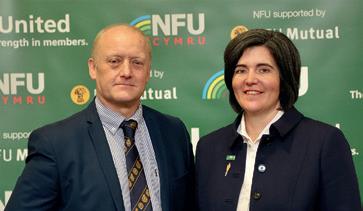
NFU Cymru elects new President and Deputy President
Cardiff dairy farmer Abi Reader has been unanimously elected as the new President of NFU Cymru.
Supporting Abi in her new role will be livestock farmer Paul Williams of Nebo, Clwyd who was elected as the new Deputy President of the union.
The duo were elected at a meeting of NFU Cymru Council in Cardiff Bay on Tuesday 20th January.
New NFU Cymru President Abi Reader is a third-generation farmer, farming dairy, sheep and arable at Goldsland Farm in partnership with her parents and uncle in Wenvoe, just outside Cardiff.
A passionate advocate for promoting food and farming to
the next generation and the wider public, Abi is a co-founder of the Cows on Tour movement and regularly engages with schoolchildren both on farm and in classrooms. A former NFU Cymru Wales Woman Farmer of the Year, she was honoured by the Queen with an MBE in 2019 for her services to agriculture.
Abi first became involved with NFU Cymru in 2012, taking up a vacancy for the position of NFU Cymru Vice County Chair just six months later. During her time in the union fold, Abi has served as NFU Cymru Glamorgan County Chair, NFU Cymru Dairy Board Chair and for the last four years has served as NFU Cymru Deputy President. Abi replaces
outgoing NFU Cymru President Aled Jones, who decided not to stand for re-election after a long and distinguished career with the union.
Speaking on her aspirations for her time as President of NFU Cymru, Abi Reader said: “I am honoured to have been elected as the new President of NFU Cymru by my farming peers. It is a huge responsibility leading our industry in a period of considerable change, but I am ambitious about the opportunities for Welsh agriculture in the years ahead. I’m also eager to build on the important work of our fantastic outgoing President Aled Jones and those who have gone before him.
“This year sees the implementation of the longawaited Sustainable Farming Scheme. NFU Cymru has been at the forefront of the scheme design process in recent years and although the scheme has transformed considerably since its early iterations, we still think there is work to do. I am committed to working with Welsh Government and partners across the industry to fine-tune this scheme where we believe change is needed.
“In addition to the changing policy landscape, we also have considerable political change on the horizon with elections for the new look Senedd fast approaching. NFU Cymru is committed to working with the new Welsh Government and MSs across all parties to help realise our ambitions for Welsh farming and deliver the outcomes Welsh farmers need to drive their businesses forward.”
New NFU Cymru Deputy President Paul Williams farms beef and sheep at Cae Haidd, Nebo, near Llanrwst in partnership with his wife Dwynwen and their three children. Paul has been an active NFU Cymru member for over 20 years and has previously served as NFU Cymru Clwyd County Chairman. He was instrumental in the iconic display of 5,500 pairs of wellingtons laid outside the Senedd in 2023 to show the industry’s opposition to the Welsh Government’s Sustainable Farming Scheme framework at the time.
Speaking after his election, NFU Cymru Deputy President
Paul Williams said: “It is an honour to have been elected to this role within this great organisation. I can’t wait to work with Abi, the wider membership and NFU Cymru’s professional staff to deliver on the issues that matter most to farmers in Wales. As a father with children who are eager to pursue a career in farming themselves, I’m driven to ensure that the next generation is able to push this industry further forward.
“The upcoming changes that we face politically and policy-wise are well documented, however there is also still the day job to be done. Ongoing issues such as bovine TB, the legislative burden of Welsh Government’s water quality regulations and concerns
over milk price continue to trouble farmers across the country.
“As farmers it’s so important that we speak with one strong, collective voice on these issues to deliver change, which is why the effective lobbying of NFU
Cymru is so important. I can’t wait to play my part in this lobbying, whether that’s in Cardiff Bay, Westminster or further afield and doing everything I can to make a difference for farmers throughout Wales.”
NFU Cymru presents dairy asks to Deputy First Minister
NFU Cymru has met with the Deputy First Minister to outline the actions Welsh Government should take to protect the Welsh dairy industry’s long-term viability at this time of market downturn.
While the long-term prospects for the Welsh dairy sector look positive, with global demand for protein growing, the short term outlook is far more challenging. Welsh dairy farmers are currently having to weather a storm that has seen some prices fall by 15ppl since the autumn, the short-term outlook is incredibly tough.
The collapse in milk price is a result of oversupply, both in Wales and further afield. Wholesale prices for all the main dairy commodities – cream, butter, cheddar and powder – have tumbled, which has translated into a dramatic and rapid reduction in farm gate price. The Welsh dairy sector is particularly exposed as the vast majority of the milk that stays in Wales for processing becomes cheese, the market that has seen some of the worst losses.
NFU Cymru met with the Deputy First Minister Huw Irranca-Davies MS on Monday 9th February to share a briefing document containing eight key
actions that Welsh Government can take to support the sector and ensure its long-term viability, both to support incomes and reduce the cost of production. These asks include:
• Evolving the Sustainable Farming Scheme so it is a viable option for all dairy farmers.
• Undertaking an independent review of the cumulative burden that regulations, policies and planning frameworks place on farmers.
• Implementing a comprehensive TB eradication strategy that actively tackles the disease across all its sources
• Working with the Defraappointed Agricultural Supply Chain Adjudicator to ensure the Fair Dealings Obligations (Milk) Regulations 2024 are implemented and applied
NFU Cymru President
Abi Reader added: “This is an extremely difficult period for Wales’ dairy sector, with most farms in Wales receiving a price well below the cost of producing milk. The rapid reduction in price is restricting cash flow, delaying or altering investment decisions and will ultimately impact the viability of our Welsh dairy sector.
With March price announcements already being made, in the six months from October 25 – March 26 we will have seen a conservative estimate of £100m lost from the Welsh rural economy.
“We recognise that the blame for the current market situation cannot be landed at the doors of Welsh Government. However, we do believe there are areas where Welsh Government action could support the dairy sector. In our meeting with the Deputy First Minister, we set out eight key actions Welsh Government can take to support our dairy sectors long term viability and protect the huge contribution to the Welsh economy and rural community that is made off the back of profitable dairy farming businesses.
Built for the conditions that test machinery the hardest. Introducing the New Interceptor 3 — now engineered with: The All-New Nexus Boom
Ultra-durable. Ultra-stable. Designed to handle real-world terrain — from rolling Borders ground to exposed Highland fields.
Nexus E-Plumbing - Smarter. Cleaner. Faster.
• Simplified flow paths, reduced dead spots, faster priming and flushing.
• Nozzle Control — Your Way
• From simple single nozzle outlet systems…
• To 4-way clusters…
• To full individual nozzle PWM control.
• You choose the level of precision.
• You choose the specification.
• We build it to suit your farm.
• Fully customisable.
• Built for uptime.
• Engineered to last.
Nexus Chafer Ltd Still… First in the Field!
We wholeheartedly welcome two fantastic new Scottish dealers to our network:
• All Sellars depots
• Merse Agriculture
Both businesses have deep roots in Scottish agriculture and a strong reputation for customer service.
We’re proud to be working alongside them to support growers across Scotland.
Here’s to a strong partnership and an exciting future together.
Chafer Sentry 3
SPRAYERS …spreading it around!
The Amazone UX 01 Super trailed sprayer
For growers and contractors looking to maximise every suitable spraying window, the Amazone Amazone UX 01 Super trailed sprayer offers a proven combination of output, precision and operator-focused design.
With nominal tank capacities available from 4,200l to 8,600 l, the UX Super is designed to cover significant acreage between fills. In practical terms, that means fewer interruptions, improved daily output and better use of narrow weather windows. When specified with boom widths of anything from 21 metres up to 48 metres, operators can achieve high forward work rates while maintaining precise application across the full working width.
Liquid delivery is managed by a high-capacity piston diaphragm pump rated at up to 650 litres per minute. Coupled with the AmaSelect nozzle switching system enables instantaneous nozzle changing allowing for consistent droplet size over a wide variety of working speeds and application rates as well as CurveControl for accurate application, even around bends.
The SmartCenter operating station brings all filling, induction and cleaning functions together in one logical, clearly laid-out area. This reduces filling time, improves product handling and supports safer, more efficient operation. Optional automated filling and cleaning programmes further
increase ease of use and speed up changeovers between products or at the end of the day.
Automatic boom height control systems and active SwingStop maintain the correct nozzle-to-target distance across undulating uneven terrain. By keeping the boom stable and at the optimum height, operators benefit
from improved spray deposition, reduced drift risk and less overlap. Overall, the UX 01 Super is engineered to deliver measurable gains in output, application precision and operational efficiency — helping professional users apply agrochemicals effectively while maintaining control over costs.
New 5000 litre HORSCH Leeb PT expands self-propelled sprayers
The HORSCH Leeb PT selfpropelled sprayer range has been expanded with the introduction of a 5000-litre model. As with the new Leeb VT, the Leeb 5.230 PT and Leeb 5.300 PT feature a polyethylene tank, and they are powered by either a 230hp or 300hp 6.7-litre six-cylinder FPT Stage 5 compliant engine, along with the new high-comfort cab. A wide range of boom widths, from 24m to 48m, is available on all self-propelled sprayers.
“The 230hp engine suits the 5000-litre model very well and opens up a new segment for HORSCH. We have already seen a lot of interest from farmers wanting a high capacity, high precision selfpropelled sprayer but at lower entry point. The Leeb 5.230 PT offers
the renowned quality, reliability and productivity that HORSCH is known for, at a highly competitive price,” said Stephen Burcham, general manager at HORSCH UK.
All self-propelled models feature an all-new cab that offers significantly higher levels of operator comfort. Quieter, more spacious and more intuitively designed controls that have been specifically tailored to crop care, the new cab creates a productive environment that allows operators to work more effectively.
Based on the latest Claas cab, the state-of-the-art cabin features an advanced A-column terminal as standard and new Leeb-designed armrest and joystick control systems specific for crop care applications. Category IV filtration
is fitted as standard and pneumatic 4-point cabin suspension is available as an option for those looking for ultimate comfort.
The HORSCH Leeb VT was the first sprayer to feature the new cab. It combines variable track adjustment with the well-known
performance of a Leeb PT selfpropelled sprayer. The flexible track adjustment is ideal for mixed crop farms and contractors requiring varying row widths between 1.8m and 2.4m, assisting with stability in the field and manoeuvrability on the road.
Knight Farm Machinery Launch New Sprayers & New Technology
British sprayer specialist Knight Farm Machinery launches multiple innovations for 2026, including revised trailed and selfpropelled sprayer ranges, plus completely new technology for dealing with residual chemical remaining in a sprayer once work is complete, to minimise risk to crops, operators and the public.
With the first units of both series entering production just ahead of the event, Knight is making a pre-show decision on displaying a 6,000-litre example of either its new KT trailed range or its new KSP self-propelled line-up. Whether trailed or selfpropelled, specification will include 36m booms, Knight Individual Nozzle Switching, a LACOS touchscreen terminal
and new SmartRinse technology, which also makes its debut at the show. A fully-automated sprayer rinse system designed to ease operator workload and simplify sprayer rinse cycles in the field, SmartRinse ensures that when the empty sprayer leaves the field the tank, pipework and – in the final stage – nozzles have all been fully rinsed. Further details on how the new system works to manage the application rate in the final stages of spraying will be revealed at the show.
Knight sprayers now all feature new dark grey tanks, and some ranges gain revised capacity options. New KT trailed models are now available in sizes from 3,600 litres right up to a new 12,000-litre design, while the
new KSP self-propelled range spans 3,500-6,000 litres. KM mounted models and KFT front tanks continue to be available in 1,300-1,900-litre capacities, while KDM de-mount models come in 2,500- and 3,000-litre sizes.
Knight booms are available up to 40m, with features
including Knight 4D boom suspension, and can be ordered with Knight’s Contour Master or Contour Master 6G boom contour-following technology. Knight sprayers also feature MAXImizer Pro, for continuous pressurized liquid flow and instant response.
KUHN introduces advanced new generation trailed sprayer range
KUHN Farm Machinery has revealed the Karan high-capacity trailed sprayer range aimed at farmers and contractors requiring high daily spraying outputs and innovative technology to improve application accuracy.
Initially available as the midrange Power model featuring steel and aluminium boom width options from 24 to 39 metres, the Karan range will extend to basic and high-end models, offering boom widths from 18m to 45m, and tank capacities of 4,500, 5,200, 6,000 and 8,000 litres. The Karan offers choice and versatility, with configurations compatible with the simplest operations through to the most advanced requirements.
Edd Fanshawe, KUHN’s arable product specialist, says: “The
new Karan has been four years in development, with extensive field testing, to ensure we’re bringing a product to users that will compete at the high-capacity end of the trailed sprayer market. The design of the machine is 99% new and is specifically aimed at maximising spraying time and accuracy.”
Central to the new range of Karan trailed sprayers is KUHN’s new Eagle1 automatic contour control system – an advanced technology package that uses ultrasonic sensors to constantly monitor and adjust boom position in relation to the spray target. This highly adaptable system adjusts to varying crop height or terrain (from a height of 30cm), ensuring optimum distances are always maintained. The Eagle system
significantly reduces the manual input required by the operator and, alongside a premium suspension design, allows precision spraying at speeds of up to 25kph. Eagle’s capabilities also integrate with
other KUHN innovations onto the Karan sprayer, including 25cm nozzle spacing and the I-Spray spot application technology. The Autoset solution system enables tank filling at 900 litres/
minute and spraying at up to 500 litres/minute, whilst rapid and thorough main tank cleaning is made possible by twin 360-degree rotating nozzles. A newly developed
induction hopper is included as standard on the Karan, offering a rapid intake capacity of up to 220 litres/minute. This system can be enhanced with a closed transfer
system, allowing agrochemicals to be inducted without any operator contact. Existing Manuset, or automated Diluset, provide further control options.
Precision spraying capability on Karan sprayers is achieved through incorporation of KUHN’s established Autospray PWM (pulse width modulation) technology.
Kverneland advances sprayer technology
Kverneland continues to push forward with sprayer technology, design to improve operator safety, efficiency and application accuracy. Among its latest developments are a Closed Transfer System (CTS), iXflowPulse (Pulse Width Modulation) and the advanced DAT Ecopatch, patch spraying system.
DAT Ecopatch is an allin-one AI-vision system that identifies weed patches and sprays Green-on-Brown and Green-on-Green in real time. When weeds are recognised by the camera, a signal is sent to the sprayer and the appropriate nozzles are activated in 4m boom sections, and results in optimisation of plant protection with minimal product usage.
CTS has been developed for integration into the induction hopper of all iXtrack trailed sprayers, to avoid the need to
manually open containers and pour out the contents.
Once mounted on the CTS unit, products flow in a controlled and measured manner, even with part-can volumes. Using suction and pressure connections, empty containers can be cleaned and rinsed before removal from the CTS unit.
Kverneland’s innovative design enables the remaining induction bowl assembly to provide operational flexibility for those needing to add powders or granules for the tank mix.
Kverneland’s iXflow-Pulse delivers greater accuracy and precision through fine-tuning of droplet size, coverage and water volumes.
Using Raven’s Hawkeye to underpin the system, Kverneland Group Mechatronics has integrated PWM control into existing iXspray software. As
a PWM system, iXflow-Pulse manages the duty cycle for opening and closing times of individual nozzles, to maintain droplet size and pressure, without impacting on the desired application rate.
Advantages include an extension of the working range of a single nozzle system, plus a
greater ability to manage speed changes. These include curve compensation to manage the boom speed differential from one end of the boom to the other; starting and stopping on headlands; slowing down during turning; and managing forward speed changes when going up or downhill.
McConnel’s all-new Agribuggy V300
Redesigned from the ground up, the all-new Agribuggy features a redesigned cab, a 50km/h variable transmission, a Cummins engine, heavy-duty drivetrain, and a 3000-litres capacity spray tank for enhanced performance, durability, and output.
With an unloaded weight of just 6,360kg, the Agribuggy V300 remains the marketleading light-footed sprayer that allows growers to spray crops in challenging ground conditions and tough terrain, enabling safe and productive working earlier and later in the year.
The new variable transmission ensures perfect speed control for optimal spraying output, and OMSI
drive axles with locking rear differential provide improved traction and handling with a generous 750mm ground clearance when fitted with largediameter row-crop wheels.
The Agribuggy V300 comes equipped with a 3,000-litre sprayer demount. A new electronic sight gauge with LED display for tank contents and remote PTO control has been added for greater convenience and accuracy. 12/24m aluminium Pommier booms with a pressure recirculation system remain a standard feature.
The machine is equipped with the latest Matrix 908 digital/ colour management display system for improved operational efficiency through its precision
guidance, application control, and data management features. It allows operators to navigate accurately and follow pre-set guidance lines or
boundaries, optimise application rates of fertilisers and chemical treatments and manage jobs and tasks – based on field maps or real-time data.
Team Leader 4: British Built for Accurate, Reliable Crop Protection
Team Sprayers’ Leader 4 sprayer is the ideal tool for farmers tackling crop disease and weed control. It combines reliability, precision, and ease of use in a robust, field-proven machine built for the demands of modern agriculture. Consistent spray performance ensures accurate application of herbicides, fungicides, and pesticides, helping farmers protect crops effectively while avoiding overapplication and reducing input costs.
Designed for stability and durability, the Team Leader 4 performs reliably in challenging field conditions. Its tubular steel booms provide outstanding strength and durability, while
the axle air suspension and pantograph boom lift system which is dampened by a nitrogen accumulator delivers excellent stability during operation. With boom height adjustment from
500 to 2500 mm, operators have maximum control across varying crop and terrain conditions.
Available with a 3000 L or 4000 L tank and with strong pump performance, the sprayer enables longer working periods with fewer refills, boosting productivity during tight spraying windows. Operator comfort is also a priority. The Müller Track Guide 3 ISOBUS terminal, 12-section boom control, stable handling, and good visibility make the sprayer easy to operate while reducing fatigue.
Efficient, accurate, and dependable, the Team Leader 4 helps farmers maintain healthier crops and achieve confident, effective disease and weed control.
Good news from Chafer
We are really pleased to confirm that Chafer is now officially part of Nexus, trading as Nexus Chafer. Part of the name may be new, but everything that truly matters remains the same. The expertise, engineering knowhow, and genuine passion behind the sprayers haven’t changed one bit. We’ve been part of the sprayer world for many years, and we’re fully committed to protecting and building on the Chafer legacy. The machines farmers and sprayers know, trust, and rely on are still at the heart of everything we do.
Our core range — the Interceptor Mk II (selfpropelled), Guardian, and Sentry (trailed) — remains exactly as you expect. These
proven machines continue to deliver the performance, precision, and reliability they’re known for. Of course, we’ll keep making thoughtful,
practical improvements over time, always with farmers and dealers firmly in mind. Progress matters — but it has to work in the real world.
We’re also fully supporting parts and spares for both Chafer and Horstine machines, ensuring you can get exactly what you need, when you need it. Downtime isn’t an option during the season, and we understand how critical backup and availability are to your operation.
Ordering a machine stays straightforward and flexible. You’ll be able to specify your sprayer to suit your farm, your workload, and the way you like to operate. We look forward to revealing our new Scottish dealers further in this publication and online.
For any questions or support, please contact your local dealer. Nick Byrne is also based at Nexus Chafer HQ and brings deep product knowledge and longstanding customer relationships. We’re here to ensure confidence and peace of mind every step of the way.
Nexus Chafer — still First in the Field.
Increasing offshore wind investment and ambition
Funding to position Outer Hebrides as floating offshore wind strategic hub
Investment in Stornoway will help position the Outer Hebrides as a key centre for future offshore wind projects, supporting longterm skilled jobs and boosting supply chain businesses across the islands.
£1.8 million Scottish Government funding will support the initial ground investigation and design stage for Stornoway Port’s proposed new Deep Water South project.
The investment comes as the government announces its decision to reset its offshore wind ambition to up to 40 gigawatts (GW) of new offshore wind capacity by 2040 - enough to power the equivalent of around 45 million homes a year.
The increased ambition, which reflects significant private sector interest in the ScotWind and Innovation and Targeted Oil and Gas (INTOG) seabed leasing rounds, replaces Scotland’s current offshore wind capacity ambition of between 8 – 11 GW by 2030.
Cabinet Secretary for Climate Action and Energy Gillian Martin said:
“Offshore wind represents a huge economic opportunity for the whole of Scotland delivering jobs and attracting major investment across the country.
“Stornoway’s location, skills and existing port infrastructure make it vital to supporting the delivery of some of the enormous economic opportunities presented
by our growing offshore wind industry.
“The proposed expansion of the Deep Water Terminal at Stornoway Port is the latest example of the growth within our offshore wind sector – which is reflected in our updated ambition for offshore wind capacity.
“Increasing our offshore wind capacity ambition to up to 40GW by 2040 reaffirms our commitment to growing the offshore wind sector – giving certainty to investors – and will help to support our national climate ambitions.”
Chief Executive of Stornoway Port, Alex Macleod, said: “This investment is a hugely significant step forward for Stornoway and the wider Outer Hebrides. Deep Water
South is about unlocking the next phase of opportunity, supporting offshore wind, strengthening renewable energy infrastructure and ensuring Stornoway is ready to play a leading role in Scotland’s energy transition.
“The approval of Highlands and Islands Enterpise’s support will allow us to move towards detailed design and enabling works with real momentum. It reflects strong confidence in the Port’s long-term vision and in the role Stornoway can play in Scotland’s offshore wind industry.
“Our investment alongside HIE underlines our commitment to delivering infrastructure that brings lasting economic benefits to the islands.”
The Stalking Show 2026 Preview
Sporting rates relief shock
Landscape Resilience - Crofting and Wild Salmon Recovery
Firearms Licensing - Conduct
Supporting the Mental Health of Gun Certificate Holders
“Aiming High” by Hugh Webster
Viewpoint
By Andrew McCaig
Scottish Venison
Local venison hits the menu
Scottish Clay Target Association
What we do!
The Ghillie With Bob Whyte April 2026
Scottish Country Life with Jake Swindells
Cooking with Game
Pan fried partridge & beet dauphinoise
Gundogs
So, can you train a winning gundog? plus
Deer Management • Country Store and our regular columns
editor's bit
Shooting… One’s
mouth off!
Just as in farming, politicians also seem to think they know better than those who live and work within our rural shooting and fishing sectors.
Now, I am not best placed to comment much either, being a Glasgow city boy originally, but luckily, I spent many holidays at our wee family home in Dunkeld, where I grew up to appreciate and love our fantastic rural scenery and lifestyle.
I have only ever shot one rabbit and caught one salmon –both for the pot!
But I know ignorance when I see it in those who hold power, having served on the board of a local Chamber of Commerce for four years, meeting local politicians and councillors –often their high and mighty and ignorant attitudes were a total turn off.
And when party politics came to the fore, it was like watching wee kids fight over who’s ball it was!
I know where I stand on matters relating to Scotland, its land and its people for the future, but party politics bore me to death.
Listen to those with lived experience, listen to those who are affected by your decisions, and most of all, pay attention to them, then think…carefully and with their support where possible.
Slàinte, Athole.
4,5,6,&7
ARTICLES
8 Sporting rates relief scrap shocks shooting community
10 Common ground: Landscape resilience, crofting and wild salmon recovery
22 Firearms licensing - Conduct
28 “Aiming High: by Hugh Webster, Fiadh Project
34 Supporting the mental health of firearms certificate holders
THE 2026 STALKING SHOW PREVIEW
12 The Stalking Show: Bringing the hunting community together
SCOTTISH VENISON
19 Local venison hits the menu at Inverary Primary School
RURAL TRAINING
20 What’s coming next?
SCOTTISH COUNTRY LIFE
24 With Jake Swindells, Scottish Countryside Alliance
GUNDOGS
26 So, can you train a winning gundog?
SCOTTISH CLAY TARGET ASSOCIATION
30 What we do!
DEER MANAGEMENT
31 Natural Environment Bill stage 3 THE GHILLIE
32 2026 - Here we go! By Bob Whyte VIEWPOINT
36 Salmon, abundance, and the stories we tell ourselves
COOKING WITH GAME
40 Wendy Barrie’s pan fried partridge with beet dauphinoise COLUMNS
7 World Pheasant Association
21 Gamekeepers Welfare Trust
33 Scottish Gamekeepers Association
39 Conservation Matters
COUNTRY STORE
42 Shooting jackets, binoculars, high performance thermal range from Nightmaster, and a few more ideas for your shopping bag!
Short term hire for poultry - turkeys, geese, ducks & chickens …long term hire for game processors
For Growers of Turkeys and other Poultry who do so in small numbers, or for those seeking to expand Production, then hiring a Plucking machine makes sense. you can have a top performing machine, tried and tested within the Poultry Industry for many years at your disposal
This enables you to get the hardest task done with minimal labour input and no Capital outlay of outright purchase.
A Machine eases labour requirements at this busy time of year. Also, any further increase of Production of Poultry for the next season, hiring of Machinery allows Capital/Cash Flow to be channelled into the overall cost of Production/Rearing costs throughout the year.
For established Growers who may already have a Machine, the hiring of another unit can ease the work load and work well around labour availability on certain days in this busy period without the need to spend Capital.
All our Plucking Machines for hire are market leadersBayle MP11 or Senesi Q11, either factory refurbished or new, available in 415volt three phase or 240v single phase, 16amp blue push plugs. Machines come with a sprung loaded Gantry to hold birds in plucking position, 3m of flexible feather outlet pipe and feather bag for collection.
Bird Flu within the Poultry Industry has created challenges and uncertainty, but the Sale of Traditional Christmas Poultry reared and processed on farms within the UK remains strong.
This type of rearing, most commonly found on Family farms, is carried out to the highest standards of welfare, and the people involved are incredibly proud of what they produce for the all-important meal of the year - Christmas Dinner.
We would always prefer to hire machinery to Growers who have had some previous experience with Dry Plucking machines, as with all machinery there is a technique and understanding of the use of itthus you get the most out of the Hire machine!
Short term rates of hire: £235.00/day plus delivery/ collection plus vat Machines are delivered directly via courier.
For more information: www.storeypoultrysupplies. co.uk or Call - 01473 823598
Bespoke fire fogging units help fight suppression
Bespoke fire fogging units - Built by PWS and engineered to deliver precise, reliable, and highly effective fire suppression solutions. Designed around real-world risks rather than off-the-shelf assumptions, each unit is tailored to the specific operational needs of the client to control wild fires.
PWS’s bespoke approach is the ability to build fire fogging
units directly onto all-terrain vehicles (ATVs). These mobile systems are designed for rapid response in challenging terrain where fixed infrastructure or standard fire appliances cannot operate effectively. Mounted seamlessly onto ATVs, the units maintain vehicle stability, manoeuvrability, and payload balance while delivering
immediate fire suppression capability in remote, off-road, or industrial locations. making them highly effective for the control of wildfires in forests, grassland, moorland, and rural areas. ATV-mounted units allow operators to reach fire fronts quickly, establish fire breaks, and suppress spot fires before they escalate.
Every ATV-mounted unit is custom-engineered following a detailed assessment of terrain, fire risk, and operational requirements. Tank capacity, pump performance, nozzle configuration, controls, and mounting frames are all adapted to ensure carefully controlled pressures to rapidly cool flames, displace oxygen at the fire source,
also preventing re-ignition. Bespoke fire fogging units from PWS provide a modern, efficient, and targeted approach to fire protection.
For more information or to discuss your specific requirements don’t hesitate to get in touch –enquiries@pws-ltd.co.uk or call - 01674 840412
The GWCT welcomes a new Ambassador to its programme
The Game & Wildlife Conservation Trust (GWCT) is delighted to announce the expansion of its ambassadorial programme with the appointment of a new ambassador – Chelsea King.
Through the programme, the Trust aims to reach new audiences and highlight its unique role in delivering worldclass scientific research that shapes government policy and
champions game and wildlife management as a vital part of nature conservation.
By welcoming Chelsea, the GWCT hopes to engage younger and more diverse communities and showcase the organisation’s work to enhance the British countryside, boost biodiversity, and drive nature recovery on a landscape scale.
Chelsea King lives within the rural community and has a deep connection to life on the
Spare parts for Comb, Bingham, Bayle or Senesi plucking machines, brand new and recon for sale - twin motor from £1,485+VAT
• Faster Processing Day
• Less Mess
• Professional Finish
For Turkeys/Geese and other PoultryWithout Buying the Kit-HIRE IT & save ££££ “Don’t Buy what you only need for a day or two for the year.
For the Processing of Game Birds for the next Seasontry Long term Hire
tel: 01473 823598 day, evenings and weekends call Mark on: 07879 496970 email: storeypoultrysupplies@btinternet.com www.storeypoultrysupplies.co.uk
Pluck and Prepare workshops showcase local game
Loch Ness Rural Communities has extended its Pluck & Prepare Workshops due to popular demand from budding chefs keen to learn how to pluck a pheasant, prepare and cook game.
The free events provided hands-on demonstrations, with wonderful game dishes to sample, including game goujons, schnitzel and lasagne, plus some birds to take home.
The first two workshops were held at Dunmaglass Village Hall and Wildside Community Centre, Whitebridge.
Jenny McCallum, coordinator of Loch Ness Rural Communities, said: “More and more people are keen to reduce their food miles and eat locally-sourced, sustainable food. Game from the hills and
land. Living on a farm with a working shoot, she is immersed in the seasonal rhythms of the countryside and the realities of managing land, wildlife, and habitats responsibly.
Through daily life on the farm, Chelsea has gained first-hand experience of deer management and evidence-led predator control, and has seen how science-led decisions play a vital role in supporting habitat balance and biodiversity. Her approach is shaped by a strong respect for animals and wildlife welfare, and by paying close attention to how small, informed actions can have lasting impacts on the landscape.
Chelsea is passionate about encouraging people to develop a meaningful connection with the countryside, and believes that early exposure for children
and young people is essential in fostering understanding and respect for the natural world. Through her children’s book, she aims to spark curiosity and help younger audiences build an early appreciation for wildlife, farming, and life on the land.
She says: “I am delighted to join the Game & Wildlife Conservation Trust as an ambassador and I look forward to supporting its researchled work and helping to share a balanced, science-based approach to conservation and land management.”
The GWCT looks forward to working closely with its ambassadors through the programme as they help to champion the Trust’s mission and inspire future generations to value and conserve the British countryside.
moors around Loch Ness is absolutely delicious and you can’t get any more local. The shoots around here have the finest game in season, and people are keen to reconnect with their heritage, so it is a win-win.
“We had participants of all ages, the youngest was just nine years old and it was great fun, it felt something like The River Cottage meets Blue Peter, so hopefully we have created some life-long pluckers!”
The pheasants were provided by Corriegarth Estate and Dunmaglass Estate, also known for their premium grouse, partridge and venison, all available in season.
Jenny continued: “Our thanks go to the community centre, Dunmaglass and Corriegarth for hosting us and providing the
game, as well as the expertise of the keepers and chefs who showed us how to prepare the birds. We are planning more events, so all those who missed out on the workshops should have their aprons at the ready.”
Scottish game is naturally high in protein, low in fat
and nutritious. Pheasant is particularly versatile, and can be served as a superb whole roast bird, slow-cooked in a casserole, or pan-fried as pheasant goujons.
Over 11,000 full-time jobs are supported as a direct result of sporting shooting in Scotland, often in remote communities.
Scottish Gamekeepers Association – upcoming training dates
Wild Bird (Corvid) and Spring Trap Training (mandatory requirement)
16th March: SGA office, Perth
27th March: Southannan and Fairlie Estates, North Ayrshire
17th April: Erchless Castle, near Beauly
24th April: Minginish Community Hall, Isle of Skye
1st May: Glass Hall, Haugh of Glass near Huntly
To BOOK or for any enquiries, please contact training@ scottishgamekeepers.co.uk
Scotland’s much-loved outdoor celebration is officially back. The Game & Wildlife Conservation Trust (GWCT) Scottish Game Fair will return to the stunning grounds of Scone Palace this July (Friday 3-Sunday 5), promising an expanded programme of entertainment, live music, country sports, food, shopping and family-friendly activities, welcoming a range of wellknown faces from across food, farming, rural life and culture.
Contact details: Tickets are now on sale. For further information, visit www.scottishfair.com.
The World Pheasant Association aims to promote the worldwide conservation of Galliformes through scientific studies, education and in-situ projects. Advisory groups work with breeders and enthusiasts in the UK and Europe to collectively provide a lifeline to species that are threatened in the wild and maintain viable genetics through studbook management. Healthy birds with a good genetic base can be held as a backup population for conservation projects.
Fundamental to the success of this important work is the annual census of captive Galliformes. Breeders are encouraged to complete the census form each year to provide vital data on the numbers of birds in their collections – information that is crucial for assessing the conservation status of pheasant species and determining necessary actions to protect them.
The importance of this exercise cannot be overstated.
The Malay Crestless Fireback (Lophura erythrophthalma), subject of one of the WPA’s
recent conservation projects, has undergone a catastrophic decline due to region-wide loss of lowland forest to agriculture, towns and infrastructure. The population trend is thought to have decreased to such an extent that it is now classified as critically endangered. Historically, large numbers of this species were imported into Europe, but accurate and up-to-date data is needed to provide information into the numbers of captive stock and how they are breeding.
The census information is completely anonymous, with all submitted information being combined to determine the trends of different species in collections in the UK and across Europe.
It has never been more important to participate in such a document. Due to the number of new and ever-changing legislation for Galliformes from relevant authorities, this will help show the importance of the captive population of Galliformes.
Should anyone wish to know more or add their own birds to the census please contact the WPA office: office@pheasant.org.uk
Sporting rates relief scrap shocks shooting community
By Peter Clark Scotland Director British Association for Shooting and Conservation
The Scottish Government’s Budget for 2026–27 passed through parliament in January with most media attention fixed on income tax and spending on health and education. Buried in the detailed papers, however, was a decision that has landed hard in rural Scotland: the removal of small business rates relief from most shoots.
The change received little public attention. It was set out in technical budget documents rather than in headline announcements, and it did not feature prominently in wider debate. Yet for those involved in shooting, deer management and land management, its significance was immediately clear.
For BASC, this is not a minor technical adjustment to non-domestic rates. It is a policy change with real consequences for jobs, land management and the day-to-day running of rural businesses across Scotland.
For many years, the majority of shoots and deer management operations, particularly those
involved in deer stalking, game shooting and associated land management, have benefited from rates relief under the Small Business Bonus Scheme. That support has been vital in helping rural businesses remain viable in areas where income often fluctuates seasonally and margins are slim. It has allowed operators to absorb costs that do not disappear in quiet periods and to plan beyond a single season.
Crucially, rates relief has also enabled money to be reinvested in the land. Shoots and deer forests have been able to support deer management, habitat work and conservation activity while maintaining rural employment. In many parts of Scotland, shooting underpins jobs in gamekeeping, stalking and guiding, as well as work for local contractors and businesses linked to accommodation and
hospitality. These activities form an important part of local economies, particularly in remote areas where alternative employment opportunities are limited.
From April 2026, much of that support will be removed. Under the new rules set out in the Budget, sporting rates relief will apply only where land is used solely for deer management, environmental work or vermin control.
Most rural sporting businesses rely on a mix of activities to remain financially sustainable. Deer management, game shooting and environmental work are often carried out side by side, with income from one helping to support another. The requirement for land to be used “solely” for a single purpose bears little relation to how land is managed in the real world.
The practical effect is that many businesses which have previously qualified for full or partial relief will face full rates bills for the first time. While transitional relief has been offered to phase in additional liability over three years, this does little to address the structural pressures facing small rural enterprises.
BASC has been clear in its opposition to the removal of sporting rates relief. Shooting and stalking businesses contribute £780 million to Scotland’s economy and support thousands of jobs, often in some of the most remote parts of the country. These jobs matter. In communities where populations are small and distances are large, the loss of even a handful of roles can have a serious knock-on effect.
The implications extend beyond employment. Shoots invest heavily in habitat
Peter Clark
management, woodland creation, peatland restoration and predator control. This work delivers tangible public benefits, including biodiversity enhancement and carbon sequestration. Rates relief has helped make this private investment possible by giving businesses the financial headroom to commit to long-term land management.
Without relief, there is a real risk that this investment will be reduced or lost altogether. If shoots are forced to cut back, some conservation work will simply not happen. In other cases, the responsibility may fall to public bodies, shifting costs from private operators to the taxpayer and threatening outcomes that are currently being delivered efficiently by rural businesses themselves.
Provisional survey results from BASC members underline the scale of the issue. More than 61 per cent of respondents reported
carrying out two or more of deer management, vermin control or environmental management. Under the 2026–27 rules, which restrict relief to land used solely for one of these purposes, those businesses would no longer qualify for sporting rates relief.
Three-quarters of those surveyed are currently eligible for the Small Business Bonus Scheme on sporting rates, and 92 per cent fall below the £12,000 threshold for 100 per cent relief. On average, they employ or involve six people in activities related to shooting or deer management, highlighting the local jobs at stake.
Members also expressed concern about the wider consequences of losing relief. Many anticipate increases in deer and agricultural damage if management activity is reduced. Nearly half warned of fewer opportunities for young people to become involved in shooting and countryside work. Others pointed
to a likely decline in investment in conservation and natural capital projects. Together, these responses paint a picture of pressure spreading well beyond balance sheets.
In response, BASC has launched an e-lobby campaign urging members and supporters to call on the Scottish Government to reinstate sporting rates relief for shoots. The campaign invites participants to sign and submit an open letter to Shona Robison MSP, cabinet secretary for finance and local government. The letter sets out a practical point: land use in rural enterprises is inevitably integrated, and the requirement for land to be used “solely” for one activity does not reflect reality.
The letter also highlights the economic, social and environmental contribution made by small sporting enterprises, and the risk that this contribution will be undermined if relief is not restored. Alongside the campaign,
BASC continues to raise the issue directly with ministers. Minister Jim Fairlie committed to looking into the matter further during Stage 3 of the Natural Environment Bill, and that engagement is ongoing. What makes the change harder to accept is the lack of consultation that accompanied it. The removal of sporting rates relief was included only in detailed budget documents, without meaningful engagement with affected stakeholders and without a published impact assessment. For a policy with such far-reaching implications for rural Scotland, that represents a missed opportunity for constructive dialogue.
At a time when public money is tight, removing a measure that supports private investment in land management looks shortsighted. The result is a policy that saves little, but risks long-term damage to rural economies and the management of Scotland’s countryside.
Common Ground Landscape Resilience, Crofting and Wild Salmon Recovery on the Isle of Lewis
By Jonathon Muir, Head of Communications – Atlantic Salmon Trust
Across Scotland, wild Atlantic salmon populations have seen dramatic declines over recent decades. A large part of this decline is due to reduced survival at sea, influenced by climate change, shifting food availability, and human pressures in coastal areas.
These challenges at sea make the role of freshwater habitats even more critical: rivers must produce fit, healthy juvenile wild salmon to give them the best chance of returning as spawning adults. But the freshwater environment itself is under increasing pressure,
facing habitat degradation, barriers to migration, rising water temperatures, erosion and siltation, predation pinch points, and altered flow patterns caused by human activity.
Already across Scotland, vulnerable rivers and streams
are frequently recording water temperatures in excess of 27°C –far into the thermal stress danger zone for a cold water species like the Atlantic salmon. Temperature projections indicate that the far north of Scotland, where wild salmon populations remain relatively healthy, and the Outer Hebrides, are set to face some of the sharpest water temperature rises over the coming decades. This, combined with altered rainfall patterns and extreme weather events, threatens not just wild salmon, but also the landscapes and communities which define these unique places. These potential wild salmon strongholds will soon be facing some of our most severe climate challenges.
In response, the Atlantic Salmon Trust and its partners are undertaking a bold, communityfocussed approach to restoration on the River Laxay catchment on the Isle of Lewis – a project called Linking the Lochs. The Laxay is characterised by a complex network of rivers, lochs and peatlands, and protecting this area is not only about safeguarding a
Freshwater salmon
species, but also building resilience into the landscape, and sustaining crofting livelihoods, maintaining a cultural and economic fabric that has shaped the island for centuries. Linking the Lochs, delivered in partnership with the Soval Estate, is rooted in collaboration with the local crofting community, whose knowledge, stewardship, and livelihoods are being championed as central to both ecological recovery and the island’s socioeconomic resilience.
From 2024 to 2025, the project concentrated on building a robust scientific and social foundation. An extensive catchment audit brought together data on hydrology, soils, grazing patterns, woodland potential, and biodiversity. Advanced drone surveys, walkover assessments and ecological baselining provided a shared evidence base to guide restoration. Crofters’ insights on livestock movements, seasonal land use, and historical management informed the mapping of 52 grazing quadrants and survey areas across the catchment. This integration of local knowledge with ecological science ensures that restoration work is grounded in reality and respects the expertise of those who live and work on the land.
Engagement with the crofting community is taking many forms. Collaborative walkovers combined scientific assessment with local observation of water flows, erosion hotspots, and habitat conditions. Stakeholder meetings and informal discussions give crofters space to voice concerns, share experiences, and shape priorities. The project’s approach seeks to avoid imposing solutions from above, recognising crofters as co-developers of the restoration plan, reinforcing trust and long-term commitment.
The restoration framework that emerged is adaptive, place-specific, and designed to deliver multiple benefits. Proposed actions include restoring 1,800 hectares of peatland bogs, enhancing 7km of tributaries to reduce sedimentation, modifying three weirs to improve fish passage, re-naturalising 41 man-made in-stream structures, targeted tree planting to create shade to reduce water temperatures, and restoring vegetation along river and loch edges. These measures will improve river connectivity, restore riparian habitats, enhance wetland function, and increase resilience to drought and flooding.
The aim is ultimately to benefit wild salmon while also delivering broader gains for biodiversity, water quality and climate resilience, demonstrating that environmental and community priorities can advance together.
Equally important is the project’s emphasis on economic opportunity. By employing local suppliers, contractors and environmental consultants, such as Stornoway-based Atlantic 58, Linking the Lochs ensures that restoration work contributes directly to the island economy. From ecological monitoring to habitat management, the project is supporting jobs and developing skills that can sustain livelihoods while also supporting conservation outcomes. This approach demonstrates that environmental restoration and economic resilience are not mutually exclusive but mutually beneficial.
The project recognises that meaningful ecological improvement cannot come at the expense of local communities. Environmental gains are strongest when they enhance livelihoods and respect cultural traditions. Crofting is not simply a way of managing land - it is a way of
life, connecting people, animals and landscapes, and integrating crofting practices into restoration work ensures that interventions can be sustainable, acceptable and welcomed.
Looking ahead, Linking the Lochs sits within the Atlantic Salmon Trust’s wider Watershed Connections programme, which explores how integrated, community-centred catchment restoration can be replicated elsewhere in the UK. Lessons from Lewis are already shaping the Trust’s thinking nationwide, emphasising how successful wild salmon recovery depends as much on strong social relationships as on ecological interventions. Through 2026, the project will continue to refine its restoration plans, secure funding, and begin on-the-ground work, maintaining a collaborative approach. Its message is simple and important - wild salmon recovery is not just about fish, it is about sustaining communities, landscapes, and livelihoods in a rapidly changing world.
Find out more:
The Atlantic Salmon Trust atlanticsalmontrust.org Soval Estate sovalestate.co.uk
The Lochs Area on Lewis
The Stalking Show: Bringing the Hunting Community Together
The Stalking Show, described as an event “created by hunters for hunters,” has become a focal point for the UK’s hunting and stalking community. Founded in 2019, it was born out of a passion for the outdoors and a commitment to showcasing the best the industry has to offer. The show’s organisers, all keen stalkers themselves, bring a unique perspective to its planning and execution, ensuring it meets the needs of visitors and exhibitors alike.
A Clear Focus and Passionate Origins
The Stalking Show was established by a dedicated group of hunting and outdoor enthusiasts with a vision to create a focused and meaningful
event tailored to the stalking community. Show director
David Freer, whose background spans farming, shooting, and event organisation, has played a pivotal role in shaping the show’s development. He explains: “I grew up on a small family farm and developed a huge passion for hunting and fishing. After studying at Sparsholt Agricultural College, I started a small events company alongside farming and shooting. This background drives us to ensure the show genuinely reflects the needs and interests of the stalking community.”
A Diverse and Evolving Experience
This year’s show promises a wide range of attractions, including
an array of competitions, butchery demo’s, skinning demo’s, celebrity game chefs and discussions on key industry topics. The organisers emphasise that all exhibitors must have a clear relevance to stalking, hunting, or vermin control, ensuring the event stays focused on its core audience.
Visitor and exhibitor feedback plays a vital role in shaping the event. “The Stalking Show is very much the people’s event,” says David. “We encourage feedback and ideas from both visitors and exhibitors, ensuring the show evolves each year with significant input from the stalking community.” David
hopes the event will inspire new participants to join the fieldto-fork movement, promoting sustainable hunting practices and showcasing the healthy, accessible products that the countryside has to offer.
Promoting Sustainable Deer Management
Sustainability and responsible hunting are central themes of The Stalking Show.
This year, The Stalking Shows three year working partnership agreement with BASC builds on BASC’s long support for The Stalking Show and confirms the association as its official partner. The
Crowds at Stalking Show
The boar ready for butchering
move underlines a shared aim to promote responsible deer management across the UK.
Working together to deliver a series of educational and engagement initiatives, including live demonstrations and seminars. These will feature interactive displays highlighting
best practice in deer management, habitat conservation and firearm safety. BASC’s deputy director of shooting and operations, Terry Behan, said: “This partnership reflects BASC’s long-term commitment to supporting the stalking community and promoting sustainable deer
management. The Stalking Show has quickly established itself as the focal point for stalkers and gamekeepers across the UK. We’re proud to help drive its continued growth and success.
”David “We’re delighted to strengthen our relationship with BASC through this new
partnership. BASC’s expertise and leadership in shooting and conservation will bring enormous value to our visitors, exhibitors and the wider stalking community.
The British Deer Society (BDS) will continue as the show’s official charity partner.
Meeting the celebrities
Wild boar demonstration
“The BDS is crucial in communicating the purpose, dedication, and value of the deer stalking community to the wider public,” David notes. “Their presence at the show ensures a strong focus on deer welfare, science, and best practice standards.”
The collaboration includes the BDS’s “Together for Deer” campaign, and the organisation will host open discussions on the stage.
Culinary demonstrations also take centre stage, with chefs Rachel Green and Jose Souto showcasing delicious game dishes and butchery techniques. These attractions highlight the field-to-fork philosophy and demonstrate the benefits of game meat as a sustainable, healthy food source.
Delivering Value to Retailers and Exhibitors
The Stalking Show has become an essential event for retailers and distributors, offering exclusive deals and a focused audience. “We keep costs for exhibitors and visitors to an absolute minimum,” David explains. “This allows retailers to offer show deals that can’t be matched online or at other events.”
The show limits the number of retailers selling similar products to ensure a diverse and competitive environment. This approach has resulted in a waiting list of businesses keen to secure a spot, reinforcing the event’s growing reputation as a must-attend for the industry.
The Wild Boar dem is back showing a detailed step by step preparation of wild boar, The Stalking Show will be the only show in the UK doing this dem so don’t miss it.
We also have demonstrations about taking the deer and wild boar from Hunt, to Harvest, to Plate helping the new comers as well as the experienced Stalkers pick up tips and techniques they can use at home and in the field.
Chef and Author Rachel Green, Chef Chris Marney and Chef, Author & Lecturer Jose Souto have been looking to add a few new segments to the cookery
theatre looking at some other game species not just our 6 UK species. This year again we will be looking in detail at all these UK species under 1 roof and doing a taste test so that you can match one against another.
We also have the return of the popular Stalking Show Butchery Competition. This year Lincolnshire Game and Flint and Flame Knives, are back to help us put together this years competition which is open to everyone, whether it’s your first time or it’s something you do all the time.
A Vision for the Future
As The Stalking Show continues to grow, its organisers have
ambitious plans for the future. The organisers are working with companies and organisations worldwide to maintain the show’s quality and expand its reach.
A key focus is encouraging people of all ages and genders to get involved in sustainable hunting and harvesting practices. By collaborating with partners like the BASC, BDS and other industry stakeholders, The Stalking Show is a hub for the countryside and conservation community, sharing best practices and celebrating the unique heritage of stalking and hunting.
We look forward to welcoming many BASC members and visitors to the event,
and we hope to see you there. The Stalking Show stands out as a focused, community-driven event that champions responsible hunting and sustainable practices. With its emphasis on feedback, collaboration, and accessibility, it continues to grow in both scope and reputation. Whether through thought-provoking discussions, exclusive deals, or culinary inspiration, the show offers something for everyone with an interest in stalking and the countryside. As it looks to the future, The Stalking Show is poised to play a leading role in supporting and shaping the hunting community for years to come.
Standing Together for Deer and Community at The Stalking Show 2026
The British Deer Society (BDS) is delighted to return as the Official Charity Partner of The Stalking Show 2026, continuing our close collaboration with founders David and Deanne Freer to deliver a standout event for the deer management community.
Following the success of 2025, we’re proud to once again work alongside our members, volunteers, supporters and corporate partners to stand together for community, collaboration and high standards in deer welfare and management. The Stalking Show
has fast become a focal point for informed debate, shared learning and connection across the sector — and we’re thrilled to be part of shaping that again this year.
New BDS Premium Membership: Insurance Included, PLUS Access to the BDS Lounge at The Stalking Show
The Stalking Show is where our community connects, and our new BDS Premium Membership (at £98/year) is designed for those who want to be fully part of it.
Among other benefits, BDS Premium members enjoy:
• Access to the BDS Meet & Greet Lounge throughout the show
• Invitation to an exclusive ‘Bacon & Bubbly’ Premium brunch event at The Stalking Show
• £10m third-party liability insurance
• Up to 10% discount on selected BDS training and products (purchased online)
• Firearms licensing and technical advice
Whether you’re coming for the conversations, the learning or the community, BDS Premium membership gives you added confidence, connection and value at The Stalking Show and beyond. Go to bds.org.uk and click Membership to learn more.
What’s On at The BDS Stand?
The BDS stand is located in a prime location at the heart of The Stalking Show and is the go-to place for all those passionate about deer, their welfare, their informed and responsible management and
their place in sustainable, local food systems.
At our stand, you’ll be able to meet our entire community, including our CEO, staff team,
trustees, members, regional branch volunteers, and our firearms advice representative (Chris Downs, firearmslicensing. net), as well as learn about our
Wild boar demonstration
charity’s work and projects such as the Wild Venison Network.
For just £5/ticket, you’ll also be able to enter the BDS Mega Raffle for the chance to win an epic prize bundle that will include a hugely popular Tikka rifle, a Pulsar thermal imaging monocular, an original piece of art by Kevin Alderson-Smith and more!
At our Deer Management, Training and Mentoring Hub, our training team will be on hand to talk about all things deer stalking, training, sector best practice and mentoring opportunities. Whether you’re just starting out or looking for something more advanced, the team will be happy to support and guide you. By this hub, you’ll also be able to enter the BDS Stalking Master Challenge. If your knowledge is up to scratch, you can enter the challenge for the chance to win a 2-day stalking experience with David Freer in Scotland –including accommodation in a log cabin!
Also on the stand, you’ll find a dedicated Police & Humane
Animal Dispatch (HAD) area. Here, representatives from Hampshire & Isle of Wight Constabulary will be on hand to discuss the establishment of their police-led HAD volunteer scheme and the growing national focus on improving deer welfare following vehicle collisions, while representatives from Staffordshire Police will be available to speak to about local firearms licensing and similar topics.
What’s On at The BDSStalking Show Stage?
On the joint BDS–Stalking Show stage (upgraded this year to improve sound, visibility and audience engagement), we will once again lead on delivering panel discussions on contentious topics in deer stalking and management, in addition to workshops and talks.
Stage Highlights include:
Saturday – Rewilding Panel
A lively, evidence-led discussion exploring rewilding, species
reintroductions (lynx and elk) and the realities of managing deer in complex, modern landscapes. Panellists include representatives from Rewilding Britain and SCOTLAND: The Big Picture.
Sunday – Head Shooting Panel
A frank conversation examining welfare implications, carcass quality, business drivers and public expectations. Panellists include representatives from Oakland Park, Deerbox, UKDTR and veterinary expert, Peter Green.
UK Health Security Agency (UKHSA)
With guests including Paul Childerley (Childerley Sporting), the UKHSA will be discussing disease risks relevant to the deer management community, tackling myths and sharing practical, up-to-date guidance.
Demos, workshops and more with the BDS Corporate Partner Network
• Taneli Pokkinen, Product
Manager of Commercial Rifles, will be joining the stage with our Corporate Partner, GMK Ltd. to present and demonstrate some of their latest gear and discuss what goes into designing rifles like the Tikka T3X Ace Target.
• The Thomas Jacks team will also be on stage to demonstrate some of the latest thermal imaging, digital and night vision optics on the market from Pulsar.
• Game Larder by Tarrant Refrigeration, AGM Venison, Hunter Gatherer Cooking and guests will be running a series of workshops and activities focused on helping members of the deer stalking community learn how to set up, establish and grow their own wild venison food business in their local area.
Full details and timings of stage activities will be shared closer to the show. Follow The Stalking Show on social media to make sure not to miss any updates!
BASC becomes the official partner of The Stalking Show
As the event’s official partner, BASC will have a strong presence at The Stalking Show, taking place on Saturday 11 and Sunday 12 April at Staffordshire County Showground. BASC will host interactive areas open to all visitors, and we are keen to encourage discussion, questions and hands-on engagement throughout the weekend.
How it all began
The Stalking Show was first held in 2022 and quickly established itself as a leading event in the UK shooting calendar. By its second year, it had doubled in size, and by 2024 the show hosted more than 300 exhibitors. It continues to be valued for its bustling and friendly atmosphere and attracts
tens of thousands of visitors, from experienced professionals to newcomers keen to learn more about deer stalking and shooting sports.
The show’s appeal lies in its clear focus on stalking and shooting. It brings together those with a shared interest in field sports, offering opportunities to see new equipment, hear from industry figures and keep up to date with developments across the sector. Many regard it as a hub for the deer-stalking community – a place to meet, browse, purchase the latest equipment, and ask experts questions at the show.
BASC’s continued involvement As the leading organisation
BASC chief executive Ian Bell (left) and The Stalking Show owner/creator/founder David Freer (right).
on deer management, BASC has supported The Stalking Show since its inaugural year, reflecting a shared commitment to high standards in deer management. Our presence at the event has grown year on year, leading to the announcement of a three-year official partnership beginning in 2026.
This partnership strengthens our mutual focus on sustainable deer management, best practice and practical knowledge. Over the next three years, BASC and The Stalking Show will work closely to ensure visitors continue to benefit from a strong programme of interactive discussion and practical demonstrations.
The show also provides an important platform for BASC to highlight the wideranging support available to deer managers. These include training and education, firearms
advice, a dedicated deer team, stalking schemes and a unique mentorship programme designed to support both recreational and professional stalkers.
We recognise the role that responsible deer management plays in supporting rural communities, local economies and the wider countryside. This underpins BASC’s work to help secure a stable venison market and represent deer managers’ and shooters’ rights and interests fairly and effectively. We will continue to speak up for the community with policymakers and to lobby MSPs and MPs to drive practical and positive outcomes.
BASC at The Stalking Show
BASC will host two large interactive stands, where visitors can speak to the team about firearms advice, venison processing, training, education and membership. Attendees
will also have the chance to take part in a mock DSC1-style assessment.
In addition, BASC will deliver a full programme of talks, debates and demonstrations on the main stage in Bingley Hall across both days. Sessions will be led by BASC’s head of deer and woodland management, Martin Edwards, and will include contributions from BASC chief executive Ian Bell, alongside other industry figures and civil servants.
Live demonstrations will include head measuring and butchery, with topics covering the future of deer management, firearms and alternatives to lead ammunition.
BASC will also feature on the second stage during the show, offering further opportunities for visitors to engage with staff and speakers.
Visitors to the BASC stand will have the chance to enter a prize draw to win a thermal optic. Come along to our stand
over the weekend to find out how to enter.
Venison and wild food at the show
BASC is sponsoring the Really Wild Kitchen at The Stalking Show, where visitors can gain inspiration to prepare and cook venison at home. The programme will feature BASC wild food ambassadors Jose Souto and Rachel Green, who will share handy cooking tips and recipes throughout a full programme of demonstrations.
Both chefs are strong advocates for sustainable wild food and improving access to game meat. Alongside cooking demos, they will also show how to skin and butcher deer and wild boar efficiently.
With a packed programme across the weekend, there will be plenty to see and do at The Stalking Show. Tickets cost £20 for a single day or £25 for the weekend and you can book via The Stalking Show website.
Here are a couple of out Shooting Scotland clients who will be at The Stalking Show…
BMC Wholesale
BMC Wholesale are proud to be the UK Distributor of Gateway1® Gateway1® boots are made for hunting, outdoor adventures and are not afraid of tough terrain.
With our Coil lining™, a unique sole system and extreme grip, you get comfort, stability and dry feet – all day, in any weather.
We are always exploring new innovations that will improve comfort, functionality, resilience and durability.
This is exactly how we have already established the Gateway1 brand with recognised innovations such as our Japanrubber™ technology, G1® air spacer™ and Lynx ICEGRIP+™.
Fisher UK
“Game is Food and should be treated as such”
In the modern shooting landscape, the benefits of having access to a Larder increases the ease and efficiency at which you can process and store Game. Whether you’re managing a private estate or a commercial deer stalking venture, the ability to handle game in a hygienic, temperature-controlled environment is a necessity for carcass quality and safety within the food chain.
Specialising in the design and manufacture of Larders and Processing facilities, Fisher Game Larders provides a full “concept to completion” service. From our compact models through to large-scale
commercial sites and AGHE’s, our Larders are designed for productivity and performance.
The benefits of a Fisher Game Larder extend beyond simple refrigeration - each is built with food-safe panels, non-slip flooring and fully commissioned services. An aluminium rail system runs throughout which, when used in conjunction with the electric hoist, significantly reduces the need for manual handling, allowing a single person to manage heavy carcasses with ease and safety.
For those looking to add value to their game, a Fisher Game Larder offers more than just a functional space – it provides a modern, purpose-built facility for you to handle and
process your carcasses in-line with food standards, industry regulations and compliance.
Furthermore, it enables you to treat your game with the care it deserves, which is crucial in an era where provenance and traceability are increasingly important to the end consumer.
The bespoke nature of our buildings allows us to tailor
the internal layout, configuring it to suit the operational needs of individual clients. We also undertake on-site construction projects, as well as offering a full design and consultancy service, drawing on over 20 years of personal and professional experience within the sector.
To explore our full range please visit www.fisheruk.co.uk
Shooting Supplies will be exhibiting once again at the STALKING SHOW in April, our product range of luggage and accessories are all made in the UK and are Taylor made for the STALKING scene where hard wearing durable kit it essential, here at Ogdens we
pride ourselves on the Highest Quality manufacturing using Cordura,Ultraglide zips and pullers,robust webbings and fittings,call on the stand and have a look at the best shooting luggage and extras available in the UK...British made and proud of it.
Ogdens Shooting Supplies
Ogdens
scottish venison
Local venison hits the menu at Inveraray Primary School
Argyll and Bute is renowned for its exceptional local produce, and now pupils at Inveraray Primary School are enjoying a taste of it in their school meals.
Argyll and Bute Council introduced wild venison to school menus on Islay and Jura in January 2025 in what was a UK first. Due to its success, the award-winning initiative has now been extended to Inveraray.
The venison served at Inveraray Primary comes from Argyll Estates and is processed by husband-and-wife team Tom and Katie Kirsop at their game larder, Argyll Game Ltd - ensuring the meat is truly local and sustainably sourced. Children played a key role in shaping the menu by taking part in taste tests to choose their favourite dishes, with wild venison burgers and bolognaise coming out on top.
Venison is a nutrient-dense food, rich in protein and low in saturated fat, making it a healthy addition to school meals. This initiative supports the council’s commitment to climate-friendly, locally sourced food that reduces food miles and promotes sustainability.
Councillor Ross Moreland, Argyll and Bute Council’s Policy Lead for Finance and Commercial Services, said: “We’re delighted to introduce wild venison to Inveraray Primary School. This is about making the most of high-quality
local produce while teaching pupils about sustainability and healthy eating. The success of the pilot on Jura and Islay showed us what a positive impact this can have, and we’re thrilled to see it expand to the mainland.”
Tom Kirsop from Argyll Game Ltd, has been working with pupils at Inveraray on a number of outdoor learning initiatives, including making and positioning bird boxes throughout the estate so they can monitor and identify the species. The children have also been out with Tom on the hillsides, learning in a natural environment where some of their food comes from.
Tom said: “Having had the opportunity to help the children of Inveraray Primary with their outdoor school programme I am delighted that they have venison on the menu. The pupils visited our processing facility where they helped to produce burgers and sausages which they all loved and went home with some to try. It was really encouraging to see how interested and engaged the children were in the process from hill to plate.
“It is wonderful the children are getting the opportunity to eat sustainably harvested wild freerange venison from the local area with almost zero food miles. Red deer venison is a highly nutritious, lean red meat, packed with protein, iron, zinc, and far less saturated fat than other
protein sources. All in all, a great choice for healthy hearty meals.”
The Council worked with Food for Life Scotland to develop recipes that meet Scottish Nutritional Requirements for Food and Drink in Schools and the Food for Life Served Here standards.
Looking ahead, the Council will continue to monitor the project and explore opportunities to expand this initiative to more schools across Argyll and Bute.
School visit to Argyll Game, Inveraray to learn about venison with Tom Kirsop
What’s Coming Next?
By Stewart Blair Lecturer, UHI North, West and Hebridies Land & Rural Studies
The Wildlife Management & Muirburn (Scotland) Act 2024 has passed, but for keepers on the ground, the real changes are only just beginning. With grouse moor licensing, trapping reform and muirburn regulation still to come, the next two years will define how upland management operates in practice.
When the Wildlife Management & Muirburn (Scotland) Act 2024 received Royal Assent, many in the sector saw it as the end of a long and difficult legislative journey. It marked the start of a much longer process.
While the Act itself is now law, much of what will change day to day on estates has yet
to be switched on. Grouse moor licensing, wildlife trap licensing, muirburn controls and competency requirements are all being phased in through secondary legislation and guidance.
For gamekeepers, that means one thing above all else: this is a transition period—and preparation matters.
Grouse moor licensing: the framework already exists
Grouse moor licensing is one of the most significant structural changes introduced by the Act, even though its full operational impact has yet to be felt.
Under the new framework, driven grouse moors in Scotland
will be required to operate under a licensing scheme administered by NatureScot. The licence itself is held by the estate or controlling interest, but compliance will depend heavily on how management is carried out on the ground.
Crucially, grouse moor licensing is not a single issue measure. Licence conditions are expected to link together:
• Wildlife management practices
• Use of traps and other control methods
• Muirburn activity
• Adherence to wildlife crime and welfare standards
Where serious breaches occur, the Act allows for licence suspension or revocation, either
in full or for specific activities. For keepers, the key point is this: grouse moor licensing brings all other regulatory strands under one umbrella. How muirburn is planned, how traps are set, and how records are kept will no longer be viewed in isolation.
Muirburn licensing: delayed, not dropped
Muirburn licensing was expected to follow quickly after the Act came into force. Instead, implementation has been pushed back, with commencement now expected in Autumn 2026.
That delay has been welcomed by many estates, but it should not be misunderstood.
Stewart Blair
Licensing has not been abandoned—it has simply been postponed. Once the scheme begins, all muirburn in Scotland will require a licence, and burning without one will be a criminal offence.
On the ground, licensing is expected to bring closer scrutiny of burn justification, particularly on peatland. Licences are likely to be granted only where managers can demonstrate that no viable alternative exists. Mandatory training for those carrying out muirburn, along with documented burn plans, is also expected.
For grouse moors, muirburn licensing will sit alongside moor licensing conditions, meaning failures in one area may have wider consequences.
Wildlife trap licensing: the real operational shift
While muirburn licensing has attracted much of the attention, many in the sector believe the biggest day-to-day change will come through wildlife trap licensing.
Current trap registration remains in place for now, but it is widely viewed as a stopgap. Under the new system, a dedicated wildlife trap licence will replace registration for wild bird traps and spring traps used for mammals.
Applying for a licence will require accredited training and formal assessment, with evidence of individual competence tied directly to the licence
For grouse moors operating under a licence, this creates a direct link between keeper competency and estate-level compliance. Poor practice by individuals will no longer be easily separated from the wider management operation.
Snares
Some of the Act’s most controversial elements are already established in law.
Snares are prohibited under the new framework
The shift for keepers is clear: enforcement is no longer just about banned equipment. Documentation, justification and demonstrable welfare compliance are increasingly central—and all feed into licensing decisions.
Training and competency: the quiet revolution
Perhaps the most far-reaching change is not licensing itself, but what sits behind it.
Across grouse moor management, muirburn and trapping, approved training and formal assessment are expected to become the norm. Experience alone will no longer be enough. Competence will need to be demonstrated, recorded and maintained.
This represents a cultural shift for the profession. For many keepers, particularly those with decades in the job, it may feel uncomfortable—but it is clearly the direction in which regulation is moving.
Reviews and future
The Act also builds in its own review mechanism. A formal Scottish Government review is required within five years of Royal Assent.
That review will assess how grouse moor licensing, trapping licences and muirburn controls have operated in practice— and whether further regulation is required. In real terms, the current framework should be viewed as a baseline, not a final settlement.
For the Shooting Community it has been a hectic period; lowground shoots ending their season with a huge sigh of relief not only because it is a constant flurry of activity but has been a challenging season. This in terms of wandering birds, periods of alternating constant wet, cold and mild weather all of which need managing accordingly. Preparation is always the key along with shooting guests and managers who understand requirements and responses both on days out on the hill, on the shoot day, on the river in the woods or carrying out a myriad of duties to ensure that those days are as successful as conditions and the environment will allow. Stalkers, deer managers and upland keepers are also watching Holyrood responses to relevant organisations which are lobbying to put forward practical solutions and sensible amendments to wildlife and land management legislation.
For the keepers, stalkers, and land managers teams there is hopefully time for a break, and this is essential to keep focussed, adapt to changes and refreshed for the next season. For the stalkers and deer managers there is little respite very often, change to focus on different species and for the fishing ghillies and boatmen the seasons are beginning to open with new conversations and energy to bring back guests who often return. The Gamekeepers’ Welfare Trust enters a new year with plans to expand support and repeat the message that help and support is at hand, for those directly involved, for their families and for those who have left the profession either to begin a new career, for health reasons or indeed to retire.
Recognising that there are many ways of reaching out WhatsApp is available too and as always Jamies Helpline, our inhouse nurse, and health services, housing and money matters are ready willing and able to assist in confidence.
Firearms Licensing – Conduct
By David McKie, Partner Levy & McRae Solicitors LLP
In the first of my articles for this magazine, I gave a broad overview of three areas where I come across issues for firearm and shotgun certificate holders – conduct, security and the application process.
I thought it would be helpful to readers to break down each of those topics and give what I hope is the benefit of my experience in how the police will approach issues of conduct.
The starting point is that for a shotgun certificate holder, the police require to be satisfied not only that you have a good reason to have a shotgun, but there is no threat or danger to the public safety or to the peace by issuing a certificate.
In years gone by, the police probably took a much more liberal approach than they do now. You may be surprised at how low the bar can be for the police to be concerned about what constitutes such a threat.
It is not uncommon for me to have fairly fundamental disagreements with the police on where that line should be set.
Even more difficult, however, is for either the police or me to predict how a court will examine the evidence. One certainty of the legal process is its uncertainty.
Conduct is a generic term and should not necessarily have the negative connotation you might assume. It relates, for the purposes of this article, to all aspects of your day to day life, both personal and professional and is not rigidly bound to behaviour when using a gun. It includes social activity both in person and online. It involves day to day relations, discussions and normal activities such as driving and competing in sports.
That is why, when I go round the country speaking to firearm certificate holders, I always stress that conduct should be at the heart of everything you do as a certificate holder. If you want to keep your certificates, you need to ensure that you behave! It is really as simple as that.
The Home Office Guidelines have tightened up to reflect the tightening of the law right across the UK for domestic abuse. If your conduct at home and your relationship is deemed to fall into domestic abuse, the chances of the police allowing you to keep your certificates are very low. You would need fairly strong evidence to persuade the police not to revoke your certificates, even if you are not convicted of a criminal offence, but, for example, are reported to the police over it. Evidence to support domestic abuse would
include phone messages, direct evidence from your partner etc. It is not for me to advise readers on how to manage their relationships, but the best advice I can probably give is to walk away from arguments.
Other conduct which causes the police concern are neighbour disputes, fights, arguments, driving offences and acrimonious separations.
All of the above also apply to both firearm and air weapon certificates, but the difference with those is that there is an additional factor which the police will take into account. That is the fitness of the individual.
This is where individuals’ habits or health can come into play. I will deal with health in the third of my articles, particularly when it comes to the application process, but if the police are
David McKie
aware of a drink problem or even discovering that someone has taken recreational drugs, it is almost inevitable that firearm certificates will be removed. They will obtain a report from your doctor which will cover any health issues.
The best proactive advice I can give you in such circumstances is: -
• Seek help where appropriate.
• There are welfare bodies who will be prepared to assist, including the Gamekeepers’ Welfare Trust, which is an excellent organisation to help gamekeepers.
• Be transparent with the police. My experience of dealing with the police is that they are unreasonable, but they much prefer to deal with people who are upfront
and honest with them. If that involves a temporary period of guns being placed with a third party or in storage, or if it involves the police allowing you to continue to hold guns but on the understanding that you will seek treatment and that you will remain in contact with the police, I have found that that is a
constructive way of retaining firearms, particularly when the alternative is removal or revocation. However, at the heart of that is a transparent and open discussion with the police, because a critical part of firearms licensing law is based on trust.
I am always happy to assist any firearm and shotgun
certificate holder across Scotland and I am happy to have a chat with certificate holders for no charge and with no obligation, to provide outline advice on circumstances and to guide them on how best to deal with a particular situation should it arise.
You can reach me on my contact details below.
SCOTTISH COUNTRY LIFE
SNP deal could spell disaster
By Jake Swindells
Our countryside has been attacked from many angles, particularly over the past few years. Legislation has nipped away at what we can and can’t do, rather than offering support where it is needed. Conservation efforts, rural businesses and farms and estates have all suffered as a result of increasingly restrictive legislation due in Bills currently passing and Acts as passed,
such as Hunting with Dogs, Land Reform and the Natural Environment. Nothing seems to be improved for our sector, just eroded bit by bit.
A recent survey of our membership at the Scottish Countryside Alliance showed that 100% of respondents thought that the Scottish Government did not have rural interests at heart. Can you think of any other poll
or survey that returned such an overwhelming opinion as this? Some might say that it is heavily weighted given that our members tend to be rural based, or at least have strong connections with the countryside, but surely this makes this response more credible.
The Scottish Parliamentary elections on 7 May are fast approaching, and the Scottish
Jake Swindells
Countryside Alliance is gearing up for a busy few months ahead. We are currently hosting political hustings across the country, ensuring that our members, supports and followers have an opportunity to examine exactly what each party intends to do if they win seats, as well as attending numerous party conferences that focus on the up-coming elections.
On attending the Scottish National Party Conference in October 2025, I spoke briefly with First Minister John Swinney and enquired as to why his booklet guide for the 3-day event was void of anything to do with rural Scotland and the issues that matter to us most. No fringe events, no speech mentions, nothing. He assured me that rural Scotland is a priority of his and that it will feature in the SNP manifesto. Rural Scotland was virtually absent from the event in any form, so stating that it was a priority was a bit strong, in my opinion. The feeling is that this exclusion had to be highlighted and since this event, overt farm visits, photograph opportunities and mention of rural life has become more commonplace on the run up to the ballot boxes being rolled out. This is welcomed, but viewed by many as an afterthought, and it is all too
Author and John Swinney MSP
obvious to those who live and work in our countryside.
The Scottish Countryside Alliance members wish to see change. Whether this is a change in government or a change in how the Scottish National Party governs, our members have spoken and made it clear that more consideration needs to be given to our Farmers, Gamekeepers, Stalkers, Land Managers, Shop Keepers, Bus Drivers, Nurses, and Landowners. The list goes on.
Whilst some disagreed with many of ex-First Minister Humza Yousafs’ policies, his inspirational decision to dissolve the Bute House Agreement with The Scottish Green Party in 2024 won him a lot of respect from those
who the SNP had alienated. The alliance with The Greens caused potentially irreparable damage to our sector, allowing some horrendous legislation to be introduced that might never be undone. Our fear is that The SNP will make the same mistake again should they need support from another party to remain in power and I can only imagine how rural voters will respond should this happen. Any morsel of confidence left will be lost for good.
An extraordinary amount of MSPs have chosen to stand down in 2026, a shift that will significantly reshape the Scottish Parliament after the May elections. It is thought that around 60 new MSP’s will take a seat in Holyrood and whilst they will need a little time to
settle into their new role, it also may be a chance to breathe new life into our Scottish Parliament building, bringing new ideas and priorities to the fore.
The gap between rural and urban policies is growing ever wider, and the Scottish Countryside Alliance wants rural issues to be prioritised or at least treated with the same urgency that central belt policies seem to be afforded. Hands need to be untied, and investment is urgently needed just to keep our sector alive. We need to get the message across to candidates that rural communities are vitally important to Scotland’s economy, culture and heritage and that homes are being lost and businesses closing down
as a result of poor legislation or decision-making.
The 2026 election is an opportunity to engage openly with both candidates and current MSPs and we will take full advantage of this to make the rural voice heard. For these elections, parliament will be dissolved on 9 April 2026. During this period of dissolution, there are no MSPs sitting and no parliamentary business taking place. It is also worth noting that the Scottish Parliament will be in recess from 26 March until 8 April 2026. If you are passionate about our countryside and want to make a real difference, do your homework and make your vote count when you put your cross in the box.
Deer control is under government scrutiny
GUNDOGS
So, can you train a winning gundog?
By Stuart Dunn Chairperson, Caledonian Retriever Club
Deciding to own and train a gundog, is a big decision in anyone’s lifetime, considering that your chosen dog, will happily be around you and your family for around the next 12-15 years, possibly even longer, so
it’s easy to think it will be straight forward, and that everyday will go to plan, but like most things in life, it never really goes in a straight line.
Enthusiasm, determination, perseverance, time, temperament,
financial resources, commitment and understanding are only a few of the attributes, you the trainer will need to have in your makeup, and that’s before you think of what the dog you’ve chosen, needs to have!
Therefore, it’s imperative that the owner gives a lot of thought early in the planning process as to what he or she wants from their gundog.
Is it simply a shooting companion, a picking up dog,
or a full-on competition dog, either of these will certainly effect your life in many aspects. We all lead busy lives in this day and age, whether it be work, family commitments, or what ever else, bringing a new gundog onto the scene will be a big decision, and a big impact, there’s no magic wand that can be waved around your dog to help train it to a required level, and I’ve never had a dog that trains itself, so it will take a massive amount of your time, and effort. Therefore, think long and hard about how you will fit the new pup into your lifestyle, and how you will nurture the dog into a training plan that meets your expectations, and time resource.
The Caledonian Retriever Club, since its creation encouraged many newcomers into the gundog competition side, and has over the years run training classes, tests and trials, and given advice freely to aid handlers to achieve good training levels, which have helped many newcomers win working tests and field trials.
Obviously not everyone wants to compete at a serious level, but throughout Scotland there are numerous gundog clubs, who can help with training or advice and can benefit the handler especially when you’re starting out training a dog, or
you’ve hit the “wall” with a particular training issue, and maybe need an idea or two on how to sort it out, and club membership can be a great way of getting involved in gundog and shooting in general, all with likeminded people.
I often get asked, what’s the easiest breed of dog to train, in short, none, they all have pros and cons, they all take time, patience and commitment, even the best-bred champion to champion breeding can produce a dog that is a bit of a struggle at times. In recent years there seems to be a big liking for springer spaniels, and golden retrievers , with many new handlers both male and female, coming to the fore, and competing in test and trials, the sport in general can only benefit from this new surge in uptake.
The competition side of gundog ownership was always predominantly male orientated, but in recent years many female handlers have come forward and done extremely well on the competition circuit, and long may it continue!
So, if you have a liking for gundogs, whether it be on the shooting, picking up, or competition side, and maybe feel a bit lost as to how to become involved, or where to get a bit of good advice from like minded people, why not join a club like
the Caledonian Retriever Club and get started!!
Remember, everyone must start some place, but there is no substitute for experience, sound advice, and genuine help, along with a slice of luck too.
Scotland has for decades had a great reputation at the highest level when it comes to competing in the biggest events in Britain, such as the IGL championship, and yet again the 2025 championship was won by a Scottish handler, and the Caledonian Retriever Club and its membership, would like to congratulate Fraser Forbes, and FTCH Carnochway Red Rooster, on winning the event, one of the worlds most coveted competitions.
Over the last eight years, the IGL Championship has been won 5 times by Scottish handlers, an absolutely amazing achievement! ! And is testament to the handler’s dedication, and effort to the sport, and the commitment that’s required to win at the highest level.
Therefore, who knows, maybe you, the young unknown trainer handler can emulate what Fraser and others have done in the past, it’s a great sport to be involved in, so come on get involved!
Please feel free to contact me anytime at the Caledonian Retriever Club or call me on 07860 290157 if you need any help or advice.
Good luck!!
Aiming High
By Hugh Webster, Fiadh Project, SCOTLAND: The Big Picture
‘The deer stalking team here at Corrour are definitely the heroes of this story,’ Sarah tells me as we pick our way up the northern flank of Chno Dearg. Sarah Watts is the Conservation Manager at Corrour Estate, tasked with delivering and monitoring habitat restoration projects, but she’s quick to reject the title of ‘conservation champion’, insisting that any such accolades belong to the estate’s team of deer stalkers.
‘Their work underpins everything we do here,’ says Sarah. ‘I couldn’t do my job without them.’ As we climb, she stops regularly to inspect young saplings or tall herbs like wild angelica, wood cranesbill and lady’s mantle, stressing that none of the ecological enrichment she’s recording here would be
possible without the work and knowledge of the estate’s deer stalkers.
‘Our head stalker, Allan Macleod, knows more about the birds on Corrour than anybody else,’ Sarah tells me. ‘And he’s also a fantastic botanist. He’s found incredible plants here, including several new to Corrour and one species new to Scotland. The stalking team gets into the most remote places where nobody else goes, so they’ve been really helpful collecting seed and cuttings from our rare montane willows too. As well as managing the deer, they’re instrumental to delivering our restoration projects.’
Reflecting on concerns that traditional roles like stalkers and gamekeepers might become less important as estates focus more
on environmental objectives and less on sporting ones, Sarah is adamant that the opposite is true. ‘We’ve actually increased the number of stalkers on Corrour recently, from four to six. We need them to deliver our objectives and that’s not going to change, because if the habitats are improving then the fertility of the deer will increase. I can’t see us ever being in a situation where we wouldn’t need deer stalkers. Even if we do one day have lynx and wolves, I don’t think the numbers of large carnivores will ever be enough on their own.’
Twenty years ago, Corrour had around fifteen deer per square kilometre, creating unsustainable pressure on the environment. Thanks to the efforts of the estate’s growing
team of stalkers, that density has been steadily reduced to between one and three deer per square kilometre, allowing the process of nature recovery to begin. But Sarah doesn’t focus on deer numbers.
‘Here at Corrour, we’ve not been particularly driven to achieve an arbitrary density of deer across the estate,’ she explains. ‘It’s really all about the habitat response. If we’re seeing the right habitat improvements, we know we’re on the right track.’
None of this means that all grazing is unwelcome. ‘There’s this common misconception that ecologists like me might be really excited about trees and see deer as a problem, but that’s not the case at all,’ explains Sarah. ‘We hugely value our deer. They’re magnificent, iconic large herbivores and grazing is a really important part of the local ecology. It’s just about tackling overgrazing rather than grazing itself being a problem.’
The importance of grazing is one reason the estate favours reducing deer numbers rather than just excluding them from certain areas using fencing. ‘Fencing compartmentalises nature,’ says Sarah. ‘To completely remove large herbivores using fencing is unnatural. Large herbivores cause ground disturbance, which is fantastic for encouraging regeneration, whereas dense masses of ungrazed vegetation inside a fence can make it harder for seedlings to establish.’
The more holistic approach being adopted at Corrour seems to be working. ‘There’s been a wide range of ecological benefits on Corrour, far beyond just trees,’ Sarah tells me. ‘With reduced grazing pressure,
Sarah knows that montane trees are very palatable and vulnerable to overgrazing but is documenting a growing amount of regeneration out on the open hill.
there’s been a pulse of heather growth and we’re also seeing an expansion of grazing-sensitive flowering plants like alpine sawwort, globeflower and bearberry. Many of these provide a vital food source for insects and small mammals, which in turn support predators higher up the food chain.’
One clear example is the successful breeding of hen harriers on Corrour, recorded by the stalking team for the first time this year. ‘We’re convinced this is down to the habitat restoration,’ says Sarah, who points to both the tree regeneration and increased heather growth as key reasons for the raptors’ success.
‘There’s definitely a direct link between deer management and the overall increase in wildlife here,’ continues Sarah, who describes how golden eagles bred successfully here for the first time on record in 2023. She’s also recorded an increase in black grouse: ‘They’re a fantastic indicator species because they require quite diverse habitats, and we now see them regularly on the estate.”
At 550 metres above sea level, Sarah squats to show me a young downy willow, one of the montane willows capable of surviving in this harsh upland environment. It is growing alongside a mix of downy birch, eared willow and tea-leaved willow, all trees that would have once formed a contiguous belt around our mountains but which have become rare in Scotland. ‘Deer management is particularly important for highaltitude trees like mountain birch and the montane willows,’ Sarah explains. ‘They’re especially vulnerable to overgrazing and many populations have been pushed to inaccessible cliff ledges in Scotland, out of the reach of large herbivores.’
This is what makes this group of small, non-descript trees in front of us remarkable.
‘Where we’re sitting just now is really, really exciting,’ says Sarah. ‘Here we’re seeing regeneration of montane willows on the open hill, and we don’t
see that very often in Scotland.’
Crucially, this success has been achieved without any fencing. ‘We’re relying completely on deer management to ensure they aren’t over-browsed.’
To the untrained eye, this kneehigh, forest-in-waiting is still easy to overlook. But seen through
Sarah’s eyes, it’s easy to imagine this fledgling forest beginning to wrap itself around the hill – thanks to the ongoing efforts of the estate’s dedicated deer stalkers.
‘The future looks very exciting,’ smiles Sarah. ‘Right now, we’re still at the beginning of the journey here at Corrour,
witnessing the early days of natural generation. But when you climb up through these landscapes and see the high densities of seedlings coming through, you can picture what it might look like in ten, twenty, or thirty years’ time. And that brings a lot of hope.’
Corrour’s montane woodland is slowly spreading out from the shelter provided by crags, gullies and burns – the only places they could once escape constant browsing by deer.
Sarah inspects a rare montane willow growing out in the open above 550m altitude, thanks to the stalkers’ efforts to reduce grazing pressure.
The Scottish Clay Target Association
The Scottish Clay Target Association (SCTA) exists to promote and encourage in every way at local, national and international level the sport of clay target shooting and to act as the sole governing or delegating body for the sport in Scotland and promote the sport of clay target shooting throughout the UK. Setting standards, organising competitions, supporting clubs, and representing Scottish shooters at UK and international level. More than that, it serves as a bridge between the sport’s long heritage and its modern, inclusive future.
Historically the sports men and women of Britain would shoot pheasants and game birds of all varieties, not until as late as the 1860’s when glass balls filled with feathers were introduced, was shooting available to men and women who could not afford the normal costs of a day out shooting.
Those early experiments laid the groundwork for what would eventually become modern clay shooting. Over time, fragile glass balls gave way to clay targets, and informal practice evolved into organised disciplines such as Trap, Skeet and Sporting. As the sport grew in popularity, the need for structure, safety oversight and fair competition became clear
The SCTA was formed to meet those needs, providing a unified voice for Scottish clay shooters. It works closely with clubs and country associations
to ensure consistent rules, safe practices and high standards of conduct across the sport. Whether a shooter is competing at a Home International event or enjoying a weekend shoot at a local ground, the SCTA’s influence is there in the background, quietly keeping things running smoothly.
Competition is a central pillar of the Association’s work. The SCTA sanctions championships and leagues across multiple disciplines, offering opportunities for shooters of all levels to test
themselves, improve their skills and represent Scotland.
A perfect example of this was that Scotland hosted the Home International Down the Line (DTL) competition in 2025 at Glenmoriston Estate Shooting Ground, teams from Scotland, England, Wales, Northern Ireland and Ireland all attended.
The greatest two days of competition between the home nations whereupon for the first time in 43 years Scotland’s Senior team, captained by Ivar McBay, won the coveted Nobel
industries DTL International Challenge Cup by two points from England. This was an incredible achievement as the quality of shooting from several competitors hitting the maximum 100 x 300 scores. The word to describe all the effort from the start to the end is simply, BRILLIANT.
A huge vote of thanks goes to the many volunteers and sponsors who delivered the effort to create the kind of welcome to our home countries that Scotland was proud of.
If you wish to find out more about the sport, the SCTA can be contacted via email to administrator@scta.co.uk or have a look at the web site www.scta.co.uk where you can join online and enjoy the many benefits offered.
Clay winners
Natural Environment (Scotland) Bill Stage 3 concludes with Scottish Parliament debate
By Richard Playfair
At the time of writing, Stage 3 of the Natural Environment (Scotland) Bill has just concluded with a lengthy debate in the Scottish Parliament chamber on Tuesday 27 January covering deer issues and further discussion on deer over the days immediately following. ADMG Chair Tom Turnbull and ADMG representatives had met with Scottish Government ministers, officials and with NatureScot in the run-up to the debate and had briefed in several amendments to MSPs at Stage 3. Tom Turnbull says:
“I think our efforts have certainly brought results. Scottish Government has listened to us and taken a number of our concerns on board, the need for effective collaborative deer management was repeated over and over through the debate and we certainly feel now that
Government wants to work with us in the uplands in the delivery of its environmental and biodiversity targets.
“Many of the more extreme proposals that came back as amendments at Stage 3 were voted down, and there was some reasonable success in terms of common sense being applied through this process to updating existing legislation.
“Whilst the contentious clause 6ZB remains we are more confident now in terms of the potential scope of its application and, similarly, whilst the amendment on occupiers’ rights that was introduced at Stage 2 remains, Stage 3 has brought safeguards in terms of further consultation on its inclusion in the Deer Code, the requirement for authorisation, and a new offence where the measure is not used appropriately. ADMG
will be involved in these ongoing discussions that will require secondary legislation in advance of its introduction.
The Minister Jim Fairlie’s proposal for a Deer Management and Venison Plan was carried. He expressed the importance of a collaborative approach, the need for incentives, and of developing a “flourishing venison market” as a key driver in taking the sector forward.
It has been gratifying to see the amount of attention given over the course of the Bill to the importance of venison in contributing to the cost of deer management, associated jobs and as an exceptional Scottish food product. Now all that is necessary is a recovery in the price to producers.
Whilst there were attempts to bring amendments into the Bill that would preempt the removal
of rates relief via the Small Business Business Scheme, these were unsuccessful on the grounds of the Natural Environment (Scotland) Bill not being the right place for them. Consequently discussions on sporting rates are continuing and one cannot help but think that the proposal in the Scottish Government’s Budget Bill to remove small business relief for deer forests not operating solely for environmental purposes, with a number of very limited exceptions, is very much at odds with the direction of travel encompassed in the Natural Environment Bill discussions and outcomes. ADMG will continue to press for this measure to be re-assessed and take every opportunity to voice and share its concerns and those of its members over coming weeks.
Red Deer
The Ghillie
The 2026 salmon season has officially begun in Scotland, and there’s a palpable sense of anticipation in the air. As the opening day celebrations have now passed, the season is well under way—though it’s typically a quieter start as anglers wait to see how the catches unfold. This year, however, the weather has been less than ideal. Heavy rainfall has caused frequent spates, making it challenging to cast effectively. We’re all hoping for a break in the
weather soon, allowing the waters to settle and giving us a chance to cast a fly once again.
The opening day was marked by celebrations along the river, with various beats hosting their own events. The biggest gathering took place at Meikleour, where Scotland’s football manager, Steve Clarke, made the ceremonial first cast. The event drew significant media attention, with articles appearing in newspapers, magazines, and coverage from
2026 –Here we go!
By Bob Whyte
Ghillie on Catholes, Pitlochrie, Benchil and Luncarty on the River Tay
STV and the BBC. The exposure was fantastic, showcasing our beautiful river and, hopefully, inspiring more anglers to come and experience it for themselves.
At Stanley, where I had the pleasure of hosting my own celebration, we welcomed guests from Gleneagles Hotel. The event kicked off with a piper who set the tone, and then we made our way down to the river for a traditional water blessing and the all-important first cast. I gave a
short introductory speech, which I wrapped up with a poem written in the style of Robert Burns, celebrating the life cycle of the salmon. The poem, penned by the renowned Ken Reid from the Dee Valley, captured the spirit of the river and its magnificent fish.
Afterward, I introduced my good friend Johnny Muir, who works with the Atlantic Salmon Trust. Johnny gave an insightful speech, highlighting the important conservation efforts taking place
both in the rivers and the sea, aimed at protecting and enhancing our salmon populations for the future.
It’s a season full of hope, and with the right conditions, it could be another great chapter in Scotland’s storied fishing tradition.
Robert Burns inspired poem to the wild salmon by Ken Reid
Ode to the Wild Salmon
From pebble-bed and silver fry,
In shaded burns where currents sigh,
A spark of life learns early law:
Hold fast your lie, defend your shaw.
Each pool a kingdom, hard-won ground, where brothers fade, where loss is found.
By tooth and talon, flood and freeze, they hone their will in narrow seas.
There stirs the call—old as stone, A deeper hunger, ocean-grown.
Beyond the burn, beyond the shore, to chase rich tides and wander more.
At sea, the trial grows sharp and wide:
Plastic drift and poisoned tide,
The lice that cling, the nets that sweep, The warming lanes where hunger’s deep.
Predators circle, farms impose, and ancient rhythms suffer blows-
Yet still they swim, through dark and blue, In times no forebear ever knew.
Years turn. The body knows its hour.
A gentler strength, a final power.
The compass wakes-home draws them fast
To gravel beds of futures past.
But homeward paths are lined with fear: The seal, the dolphin waiting near;
The roar of hulls, the fractured sound, the river’s scent all lost, confound.
Polluted plumes and altered flow
Blur memories they used to know.
At last-the burn, the pool, the bend, Cool water where their journeys end. No leap too high, no gate too closed, They pray-though prayer is uncomposed.
And in the dark of winter’s breath, they spend life’s last to conquer death.
Two shadows meet on redd and stone,
To seed the ground they once called home.
The deed is done. The body fails.
The river keeps its ancient tales.
Yet one thought drifts where hope must roam: Will any child return-come home?
O salmon bold, of silver flame, Your tight outlasts both time and name.
May humankind, with wiser hand, Guard well the waters, sea and land.
For in your rise, your fall, your plea, Swims Scotland’s soul-and what shall be.
www.farmingscotlandmagazine.com
Time to grasp the Scottish nettle?
By Kenneth Stephen, The Scottish Gamekeepers Association
As we gather thoughts following the passage of the Natural Environment Bill, one thing becomes as clear as winter icicle: we need to finally grasp the nettle in Scotland when it comes to expanding deer populations in the lowlands and around our cities.
The Edinburgh Parliament loves nothing better than to scrutinise deer. Perhaps our iconic animal fascinates Parliamentarians or provides them with relief from dour debates on the economy or education.
This scrutiny, however, comes with a condition. The deer being investigated by our Parliamentarians must have antlers and they must be in the ‘highlands’.
As a country, and as a Parliament, we have scrutinised red deer beyond what would be regarded as normal, particularly when we live in a country where NHS waiting times and the cost of living are the real issues vexing the majority.
An additional failing of this disproportionate attention has been the myopic focus on the highland red deer range.
If a man or woman came to earth tomorrow, they would be utterly baffled as to why so much attention has been given to the estimated highland red deer population of circa 250 000
animals when 750 000 (if you accept the oft quoted 1 million deer figure) roam and expand comparatively freely elsewhere.
Why, if the greatest extent of the problem is in the lowlands and around our towns and cities, does NatureScot devote most of its staff to the highlands, where numbers are either stable or reducing?
Why, when the Deer Working Group assembled to pen recommendations to Government on the ‘issue’ of deer, did it devote one afternoon to urban deer and then leave it largely alone when it realised red deer weren’t the main problem?
The truth is, neither the Parliament or the agencies know what to do about roe deer or the lowlands or urban areas, so perhaps the best things to do is to divert attention elsewhere.
Except that this approach is no longer tenable.
If the glimmer of light in the Bill -offered by promises of a National Deer Management Plan- is to act as a beacon well into the next Parliament, politicians need to think big and in detail about Scotland’s real deer problems and where they genuinely are.
If they can do that, then maybe there will be an outcome from the decades of talking and bill-making.
www.scottishgamekeepers.co.uk
Scottish Gamekeepers Association, Inveralmond Business Centre.
6 Auld Bond Road, South Inveralmond, Perth, PH1 3FX. Tel: 01738 587515
Supporting The Mental Health of Firearm Certificate Holders: An Early-Help Approach That Works
By Chief Inspector Bruce Crawford, Police Scotland
Those in policing know firearms licensing is about far more than forms, conditions and safe storage. At its heart, it is about people. Across Scotland, tens of thousands of responsible firearm and shotgun certificate holders take pride in their sport, countryside traditions and commitment to safety. The overwhelming majority go about their lives without ever coming to police attention. Yet, like anyone else, they are not immune to periods of mental health challenge.
Milk prices, changes to sporting rates relief, weather, livestock worrying, isolation, fear of stigma – we know there are a multitude of issues weighing heavily on certificate holders in Scotland.
I continually reflect on how Police Scotland can support certificate holders who experience changes in their mental health, while continuing to discharge our duty to protect the public. This article is not about enforcement. It is about early help, trust, partnership, and encouraging people to seek support before a problem becomes a crisis.
Bruce with David Urquhart of Skye Game
Mental health and firearms - a shared responsibility Mental health touches all Scottish communities. Stress, anxiety, depression and trauma do not discriminate by profession, hobby or background. For certificate holders there can be an added layer of concern; a fear that admitting to difficulties will automatically result in certificates being revoked or that they will be “punished” for being honest.
I want to be clear. Our starting point is not revocation, but support. Firearms licensing teams, local officers and partners in health services all recognise that early engagement is the safest and most constructive approach. When people speak up early we have more options, more flexibility and, crucially, more opportunity to achieve positive outcomes for everyone involved.
Encouraging early contact
One of the most important messages we share with certificate holders is this; if you are struggling, tell someone and tell firearms licensing. It could be your GP, a trusted family member or a shooting organisation. Early contact allows sensible, proportionate steps to be taken, often on a temporary basis, while someone gets the help they need.
In many cases, this can involve voluntary measures. We have seen target shooters move their guns to their club, others to a registered firearms dealer or suitable certificate holder. Some have asked us to store their firearms for a short period. These decisions are not admissions of failure; they are acts of responsibility.
From a policing perspective, these voluntary arrangements demonstrate insight and good judgement. They allow us to work collaboratively not reactively, and they help preserve
the individual’s long-term interests as well as public safety.
When
the system works well:
real-world outcomes
A long-standing shotgun certificate holder contacted firearms licensing after being diagnosed with severe anxiety following a family bereavement. He did not feel himself and wanted advice. Working with him, officers arranged for his shotguns to be stored temporarily elsewhere. He engaged with his GP and counselling services. Several months later, once his health had stabilised and with medical confirmation, his firearms were returned. He continues to shoot safely today.
In another case, a younger firearms certificate holder was experiencing work-related stress. His partner contacted police, not in alarm, but in concern. Officers attended, listened carefully and treated the situation with sensitivity. The certificate holder agreed to a short-term voluntary surrender of his firearms while he accessed support through occupational health and his GP. Throughout, he remained involved in decisions, was kept informed and treated with dignity. The outcome was positive: no enforcement action was required, and the individual later told us the respectful way he was treated made it easier for him to focus on recovery rather than fear.
These are not isolated stories. Across Scotland, similar examples show that when trust exists, and people feel supported rather than judged, the system works. We do not always get it right though, and we seek to continually learn to improve our service to Scotland’s communities.
Partnership is key Police Scotland doesn’t operate in isolation. Our work in this area depends on strong relationships
with health professionals, shooting organisations and charities. Employers, governing bodies and clubs play a vital role in setting the tone by reinforcing that mental wellbeing is part of responsible firearms ownership.
We have established the Scottish Firearms Mental Health and Wellbeing Awareness Partnership to bring almost two dozen key partners under one umbrella to work collectively towards supporting certificate holders and families. You can expect to see us and partners at many of the shows and events across Scotland this year. This is about professionalism as much as empathy. A calm, informed response can make all the difference to someone who is already feeling overwhelmed.
Reducing stigma within the shooting community Stigma is one of the biggest barriers to early help. In some quarters, there remains a perception that “toughing it out” is preferable to speaking up. I would specifically challenge that. Having struggled through my own mental health challenges following involvement in a serious firearms incident, I hid my feelings from those who knew me best and could support me. It took many sleepless nights, flashbacks and private tears before I sought help – and that help was life changing. True responsibility lies in recognising when you need support and taking steps to manage risk appropriately.
Shooting is a discipline built on self-awareness, respect for rules and consideration for others. Looking after your mental health - and being honest about it - is entirely consistent with those values. Far from threatening the future of shooting sports in Scotland, openness helps safeguard it.
A balanced, humane approach
Public safety will always be our priority, but it does not have to come at the expense of compassion. Generally, mental health challenges do not equate to violence or dangerous behaviour. Our task is to assess risk fairly, based on evidence and behaviour, not assumptions or fear.
Where there are serious concerns, we will act decisively. But where people come forward early, show insight and engage with support, we will work just as hard to find proportionate and fair solutions.
A message to certificate holders
If you take one thing from this article, let it be this; you are not alone, and you are not expected to cope in silence. Reaching out early - whether to health services, shooting organisations or the police - protects you, your family and the wider community It preserves your future in shooting.
As the National Firearms and Explosives Licensing Chief Inspector, I am proud of the professionalism and humanity shown by officers and staff across Police Scotland in this area of work. I am equally proud of the many certificate holders who demonstrate integrity by seeking help when they need it. By continuing to talk openly, support one another and work in partnership, we can ensure Scotland remains a place where shooting is conducted safely, responsibly and with care for the wellbeing of all involved.
Note – Details of support available to certificate holders can be found on the Police Scotland website and on the Firearms and Mental Health Awareness and Support leaflet widely available online and sent with every certificate.
Salmon, Abundance, and the Stories We Tell Ourselves
By Andrew McCaig
This article was being finished on the eve of the River Spey opening
As always, there is excitement. The river is in good order. There has been rain, plenty of rain, water levels are good, and other rivers have already started the season well, all things considered. For fishermen, this moment matters. We are forward-looking by instinct. Opening day is about possibility: about the first cast, the first fish, and the sense that this year might be different.
That optimism is not foolish. It is part of what keeps salmon fishing alive.
But it also creates a quiet tension. Each year we arrive at the same point, full of hope, while knowing that the long-term trend remains stubbornly downward. Wanting things to improve is
natural. Expecting a different outcome while repeating the same actions is something else entirely.
That tension — between hope and habit — is the starting point for this article.
The most unsettling findings in Scottish salmon research over the past decade suggest that this tension cannot be wished away.
Between 2017 and 2019, the Atlantic Salmon Trust, working with the Spey Board, undertook an acoustic smolt-tracking programme on the River Spey. The results were stark. Fewer than half of tagged smolts successfully left the river system. More than half were lost before they ever reached the sea.
Follow-up analysis and discussion through 2020–2023 reinforced the same underlying message: freshwater survival on the Spey is a critical bottleneck, not a marginal issue that can be assumed away by pointing to marine uncertainty.
These findings matter because they cut directly across the story we most often tell ourselves about salmon decline — that the decisive failure lies elsewhere, beyond the reach of river managers, in complex and poorly understood marine systems. The Spey data suggest something more uncomfortable. Even on one of Scotland’s most productive rivers, the river itself is a major point of loss.
The research has not been dismissed. It is often referred to in reports and presentations as part of a wider picture of “complex pressures”. But it has not reshaped management in any fundamental way. There has been no sustained refocusing on freshwater survival, and no clear explanation of why such levels of loss are considered acceptable.
That gap — between optimism at the start of each season and the absence of meaningful change — sits at the heart of Scotland’s salmon problem.
Every opening day carries the same unspoken expectation: this year might be different. That expectation persists even as the long-term trend remains stubbornly downward.
It creates a peculiar tension at the heart of modern salmon fishing. We are encouraged to be positive, to celebrate the season ahead, and to speak in hopeful terms — even while knowing, that nothing fundamental has changed.
The sadness lies not in pessimism, but in recognising that optimism alone has become a strategy.
Until relatively recently, rivers were managed with a clear objective: to produce fish. Abundance mattered. Surplus mattered. Without surplus, neither commercial nor recreational fisheries could exist.
That mindset shaped how rivers were run. Stocking, hatcheries, egg planting, and active intervention were routine tools, not ideological battlegrounds. Nearly every major salmon river in Scotland has had a hatchery at some point, many of them for decades. These were not emergency measures; they were standard practice.
SHOOTING SCOTLAND
Today, that history is often quietly forgotten. Rivers are described as having been largely “natural”, and modern management is framed as a corrective to historical ignorance. But this framing is misleading. Rivers were not protected from intervention in the past. They were protected by it.
In the past, recreational anglers and commercial fishermen were not treated as opposing camps. They were part of the same system. Commercial netting did more than remove fish. It generated information. Netting stations forced managers to understand run size, timing, surplus, and sustainability. Rod fisheries benefited directly from that knowledge. Rivers were managed to produce enough fish to support both exploitation and recovery.
This context is almost always missing from modern comparisons with the past. Rod catch figures from the 1950-80 are regularly quoted, often referred to as evidence that historic abundance has been exaggerated. What is rarely acknowledged is that these figures usually exclude commercial netting.
Those fish did not disappear. They were caught.
When netting figures are included, the difference between past and present becomes stark. The decline is not marginal. It is profound.
There is no doubt that water quality has improved dramatically. Rivers are cleaner than they have been for generations, and this achievement deserves recognition.
But cleanliness is not the same as abundance.
Rivers are now frequently described as “healthy”, a term often referred to in policy documents and funding applications. Yet many of these same rivers hold a fraction of the salmon they once did. A river can be chemically clean and biologically impoverished at the same time.
Habitat restoration has followed a similar path. Funding, expertise, and professionalism have never been higher. Spawning beds are restored, banks reprofiled, woody material added. The work is often excellent.
But habitat alone does not create fish
No farmer believes that improving soil without sowing seed will produce crops. Rivers are no different. They are competitive biological systems. Where salmon decline, other species expand. Brown trout, in particular, are highly effective competitors at juvenile stages. Once that balance shifts, salmon struggle to re establish without help.
Choosing not to intervene is not neutral. It is a decision to accept whatever outcome current conditions produce.
Nowhere is the confusion in modern thinking clearer than in debates about stocking.
Current policy largely treats stocking as an exercise in replicating natural spawning. The aim is to imitate what the river might have done anyway, rather than to rebuild stocks meaningfully. This approach may make sense in healthy systems. It makes far less sense where stocks are already critically low.
Replicating scarcity does not lead to recovery.
The purpose of restocking depleted rivers is not to reproduce natural failure. It is to create abundance sufficient to withstand losses. That distinction is routinely blurred.
On the River Spey, the scale of this shift is clear. In 2006, around
2.2 million juvenile salmon were stocked, including fed fry and parr. By 2007 this had already fallen to around 1.8 million. By 2023, stocking amounted to just 192,400 fish, all released as eyed ova or unfed fry, with fed fry and parr no longer permitted.
This is not a minor adjustment. It is a collapse in juvenile inputs of more than an order of magnitude, combined with a retreat to the earliest life stages, where freshwater mortality is highest.
Arguments persist about unfed fry stocked in spring: concerns about dispersal, density, and survival. These debates are often framed as technical, but they are grounded in practical experience.
Every ghillie understands what happens to eggs and small, unfed fry released into rivers with high predation pressure. Many do not survive.
What ghillies consistently want to do instead is stock autumn fed fry or parr: larger, stronger fish, better able to compete, hold territory, and survive the critical early months. That single change would make a material difference on many rivers.
Yet it is precisely this sort of intervention that policy struggles to allow without a serious fight,
which many of our river boards are unwilling to make on our behalf.
The result is predictable. Stocking is permitted only in forms unlikely to create abundance. When abundance fails to appear, that failure is then cited as evidence that stocking itself does not work.
This is a circular logic. Stocking is allowed only to fail, and the failure becomes the proof.
Part of the paralysis in salmon management comes from treating the problem as singular. It is not.
In rivers, the problem is largely one of management. Toolsets have
narrowed. Intervention has become ideologically uncomfortable. Evidence that points towards action is acknowledged academically but rarely translated into practice.
At sea, the problem is different. There, the pressures are real and severe: over fishing, illegal fishing, weak enforcement, and by catch. Freshwater managers point to the marine environment; marine interests largely ignore rivers. Responsibility dissolves somewhere between the two.
Yet one fact remains awkward.
Well managed rivers are not
thriving, but they are surviving. Poorly managed rivers are failing outright. That tells us something important: management still matters.
There is an older intellectual pattern at work here, one that feels surprisingly familiar for those whom enjoy history.
Medieval scholasticism was characterised by intense intellectual effort, elaborate classification, and endless debate — but very little practical testing against reality. Authority was refined, not challenged; thought became detached from action. The system was internally coherent, but increasingly disconnected from the world it claimed to explain.
Modern salmon management risks a similar fate.
We are rich in research, models, frameworks, and reviews. Evidence is gathered carefully, caveated thoroughly, and contextualised endlessly. But when that evidence points towards uncomfortable action — intervention, abundance, trade-offs — it is absorbed into the literature rather than translated into change.
The result is not ignorance. It is a growing separation between knowledge and consequence.
We are no longer short of data. Modern smolt tracking has revealed freshwater losses with a level of precision unimaginable in the past.
And yet, even where evidence points clearly to freshwater bottlenecks, action often fails to follow. The findings are noted, caveated, and absorbed into the language of “complex pressures”. They rarely result in a meaningful change of approach.
A system that cannot act on inconvenient evidence is not precautionary. It is flawed and biased.
For much of the last century, river management depended on anglers. They paid for it, and they lived with the results. If management failed, it was obvious, and those responsible were replaced.
That feedback loop has weakened. Today, restoration is sustained
largely through centralised funding. Success is measured in plans, frameworks, and compliance. Whether salmon numbers increase is often secondary. Projects can fail biologically and still succeed administratively.
This has changed incentives. Managers are rewarded for securing funding and delivering process, not for producing fish. Failure carries little cost for those creating policy or managing our rivers.
It is therefore worth asking whether the most radical improvement to salmon management would not be a new funding stream, but a re connection between decisions and outcomes.
Rivers have collapsed before. They were polluted, overfished, obstructed, and degraded. But when this happened, people were allowed to act.
They stocked aggressively. They built hatcheries. They managed predators. They experimented, adapted, and changed course when things did not work. Intervention was not viewed as heresy. It was viewed as responsibility.
Today, we inherit rivers that are cleaner than they have been for generations, yet we restrict ourselves from using the tools that once rebuilt them. The problem of low salmon numbers is not new. The refusal to intervene decisively is.
The decline of salmon is often presented as an inevitability. It is not. It is the product of choices: about objectives, about acceptable tools, and about what evidence we are willing to act upon.
If abundance is no longer the goal, then decline should not surprise us. If intervention is permitted only when it is unlikely to succeed, failure is the predictable outcome.
Salmon have survived far worse than the present moment. Whether they survive this one depends less on what happens in distant oceans than on whether we are prepared to remember how rivers were once managed — and to accept responsibility for doing so again. For myself, I will live in hope of that first cast and first fish of the season!
Important amendment to muirburn legislation
By Felix Meister, D.Phil., GWCT Senior Advisor Scotland
On Thursday 29 January, Scottish Parliament agreed to pass the Natural Environment (Scotland) Bill, following two days of debate about the final amendments to the Bill. Among the amendments, no 43, introduced by Beatrice Wishart, MSP for Shetland Islands (Scottish Liberal Democrats), proposed to repeal section 14(1)(b)(ii) of the Wildlife Management and Muirburn (Scotland) Act 2024. This section states that Scottish Ministers must grant a licence to burn on “peatland” (land with peat depths over 40cm) if “no other method of vegetation control is practicable”. The amendment was agreed to by Scottish Parliament and is now included in section 34C(2) of the Bill. A more comprehensive amendment (no 162), proposed by Tim Eagle, MSP for Highland and Islands (Scottish Conservatives), which would repeal section 14(1)(b) all together, was rejected.
During debate on the amendment, Minister of Agriculture and Connectivity, Jim Fairlie, said: “I recognise that some members may have concerns about the removal of the requirement to demonstrate that no other method of vegetation control is practicable before a licence for muirburn on peatland is granted. However, NatureScot will still have to be satisfied that any licence is necessary for the specified purpose, and the current evidence on the impacts of alternatives such as cutting or grazing on peatlands is inconclusive, which means that they cannot automatically be assumed to be preferable. For those reasons, I encourage members to support amendments 42 and 43.”
Prior to the debate GWCT Scotland sent an open letter to Jim Fairlie urging him to consider muirburn not only in the context of wildfire mitigation, but also as a tool for the
conservation of sensitive habitats such as blanket bog. In the letter, we summarised a substantial amount of research illustrating positive effects of muirburn on important species such as Sphagnum mosses and cotton grass. We also pointed out that there is very little research into the effects of other methods of vegetation control such as cutting. We concluded that there is no evidence to support a presumption against muirburn and a preference for cutting as included in the current form of the Wildlife Management and Muirburn (Scotland) Act.
The GWCT welcomes the amendment to muirburn legislation as it removes a provision that was not based on scientific evidence. It is our hope that the amended legislation will facilitate carrying out legal muirburn as a conservation tool with vital benefits to blanket-bog management and carbon sequestration.
Felix Meister Muirburn
game cooking with
Pan fried partridge with beet dauphinoise
By Wendy Barrie
Partridge is a favourite in our house, and whilst a potato dauphinoise is delicious, the recipe works equally well using juicy beets instead. I have used an old German variety of fodder beet, Eichendorfer Gelb we experimented with in Ardross Farm walled garden but it would be fine with any readily available yellow beet.
Once portioned, place the remaining partridge carcasses in a pan covered with water, add your choice of seasoning and herbs, simmer for a couple of hours, drain and reserve for wonderful stock another day.
Ingredients:
2 x partridge breasts, with leg on, per person
75g butter
A generous pinch of Blackthorn Scottish sea salt
Freshly milled black pepper
Beet dauphinoise (sufficient for 4 persons)
750g yellow beets, peeled, sliced & par-boiled
A generous scrunch of salt & milled black pepper
400-500mls double cream
75g butter
Method:
• Pre heat oven to 170℃
• Butter an ovenware dish (or individual dishes) and layer in the beets, along with seasoning and dabs of butter.
• Pour over cream, with a wee jiggle to the dish to allow the liquid to spread evenly throughout the beets. The amount of cream will vary slightly depending on your dish as you wish to just cover the beets.
• Bake for 45minutes until golden and bubbling.
• Meanwhile cook partridge on the hob: season the meat, melt butter and, when starting to sizzle, add partridge to the pan, taking care not to let the butter burn. Give the meat 3 minutes on a reasonably high heat, pressing down gently to give the desired colour.
• When golden, turn portions over, pan-fry for a further 2 minutes, basting with the butter, until cooked through. Rest for 5 minutes before serving.
• To serve, set partridge on top of dauphinoise with a brush of pan butter and serve with steamed sprouting broccoli for a colourful tasty nutritious dish. Any remaining juices in the pan can be added to the stock pot.
Wendy is a cook, food writer & campaigner for local sustainable produce & biodiversity. Founder Director of award-winning Scottish Food Guide, Scottish Cheese Trail & Scottish Farm Shops, Wendy is also Leader for Slow Food Ark of Taste & Cooks Alliance in Scotland, IGCAT Global Experts Network member, International Judge & co-founder of Scottish Bread Championship. She has co-written “Meadows: The Swedish Farmer & The Scottish Cook,” with her husband, on regenerative food production, native breeds & recipes, available online & from selected farm shops.
The Harehill Ridgegate Waterproof Shooting Jacket from Wild & Moor is designed for all-weather country use, blending proven performance with practical field features. After three years of development, it combines a PTFE waterproof membrane rated to 20,000mm hydrostatic head with 6000 MVP breathability — keeping you dry and comfortable during long days in wind and rain.
Constructed from hardwearing Oxford nylon, it is fully windproof and made to withstand regular outdoor use. An articulated action back and sleeves allow freedom of movement when mounting your gun or lifting game, while a detachable hood, hand-warming pockets, double-entry game pocket and zipped internal pocket make it genuinely useful on the shoot.
Adjustable cuffs, waist and hem help seal out the weather, and Clarino™ suede on the collar adds a premium finish to a welldesigned shooting jacket.
Introductory offer: 10% off with code HARE10
Ridgegate Waterproof Jacket – £289.95 (£260.96 with code HARE10) www.wildandmoor.co.uk
GWCT Schöffel
Thurslestone Cap
Heritage styling with a versatile five panel shape makes the Thurlestone Cap a throw-on staple for any casual outfit. The hat is made from 100% cotton twill and has a Schöffel branded adjustable buckle fastening.
100% cotton
Cotton twill fabric
Featuring Schöffel and GWCT embroidery.
Five panel design WITH adjustable brass buckle.
Color: Olive
£39.95
www.gwctshop.org.uk
Caesar Guerini Invictus
5 12ga 32 inch Sporting (693) West
Price on request www.pacificsportingarms.com
New Caesar Guerini Invictus 5 Sporting. 12ga 32 inch barrels. Righthanded adjustable comb stock and forend. Outstanding sideplate receiver with deep engraving and gold birds. Factory case. Lifetime warranty. Weight 8lbs 13oz. Pacific Sporting Arms is an Authorized Caesar Guerini Premium dealer.
The Country Store
New HIKMICRO thermal range at Night Master
The new HIKMICRO Lynx 3.0 range is now available from Night Master, offering compact, high-performance thermal for serious field use.
There are six models available, offering 384×288 and 640×512 sensor options (model dependent). The Lynx 3.0 features ≤20mK NETD sensitivity for improved thermal contrast in damp UK conditions, alongside a smooth 50Hz refresh rate. Lens options including 19mm and 35mm provide detection ranges extending beyond 1,000m on selected models, with a 1024×768 OLED display delivering sharp, clear viewing.
Powered by a removable 18650 rechargeable battery, the Lynx 3.0 supports photo/video recording, Wi-Fi connectivity and carries an IP67 weather rating.
Orders over £500 receive a FREE Night Master H1 rechargeable head torch (worth £44.95).
HIKMICRO LYNX 3.0:
Six models – from £399.95 to £1,149.95 www.nightmaster.co.uk
The Country Store
NL Pure 8x32 compact binoculars
John Rigby & Co. unveils the Rigby
Legends
The NL Pure 8x32 are the most compact binoculars in the NL Pure series. With a field of view of 150 m (164 yds), they provide a perfect overview. This makes them ideal travel binoculars for users looking for a premium product. The 8x magnification provides a perfect overview of the action. The 32 mm objective lens diameter is ideal for observing in daylight. Thanks to their wasp waist design, they sit ergonomically in your hand and weigh just 640 g (22.5 oz).
COLOR: burnt-orange or green
£2,160.00
www.swarovskioptik.com
GWCT Polo Shirt
Emblazoned with the iconic GWCT partridge logo, our Polo Shirts are crafted with a durable ribbed collar and taped neck.
The three self colour button placket and twin needle stitching add a touch of sophistication to this classic design. And with a 60°C wash, it’s easy to keep looking fresh and new. Made from a comfortable blend of 50% polyester and 50% cotton.
Regular price £19.95 www.gwctshop.org.uk
Collection, a tribute to the greats of adventure and the golden age of safari
John Rigby & Co. proudly announces the launch of the Rigby Legends Collection, a distinctive new line of safari clothing that pays homage to the explorers and professional hunters whose lives and legacies are forever intertwined with Rigby’s own.
Crafted to the same uncompromising standards as Rigby rifles, each piece in the Legends Collection is built fit for purpose and made to serve the hunters and explorers who value function, authenticity and enduring style.
From the Jungle Jim 436 Safari Jacket (RRP £599.99)
Paul Roberts 10-Yard Vest (RRP £399.99)
Robin Hurt Backup Jacket (RRP £499.99) Finch-Hatton Our of Africa Hat (RRP £149.99)
Every garment embodies the spirit of those who lived for the wild places. Made from durable natural fabrics including heavy-duty cottons, buffalo leather and Merino wool, each piece is designed to perform where it matters most - in the heat, dust and unpredictability of the field - and look cool in the photographs too. Subtle design details evoke Rigby’s timeless aesthetic, while modern tailoring ensures supreme comfort and versatility. www.tinyurl.com/RigbyLegendsCollection
Pulsar Wildlife Alaris ZG30 20mk
thermal imaging monocular
The new Pulsar Wildlife Alaris XG30 takes its name from the Latin, meaning “of the wing”, and is inspired in its design and performance by the passion and needs of the modern birdwatcher. With its sensitive 640×480, 12µm, <20mK sNETD European-made Lynred thermal sensor and a powerful 35 mm f1.0 germanium objective lens, this compact and lightweight monocular is a true pocket-sized powerhouse — revealing even the smallest heat source, in crystal-clear detail, at distances reaching up to 1300 metres. 3 payments of £466.65 at 0% interest available.
£1,399.95
www.wildandmoor.co.uk
The future of Maris Piper under spotlight
Maris Piper has had its day; or has it? That was the provocative title of a GB Potatoes debate at the British Potato Industry Event.
Arguing that the stalwart’s days are numbered was Katy Pook, Head of Brand & Marketing at Greenvale. She touched on Maris Piper’s near 70-year history saying it was bred to be resistant to the most common type of Potato Cyst Nematode.
“It would be fair to say that the food and farming industry looked a little different then, than it does now,” she said.
“The potato sector was dominated by tens of thousands of smaller multi-crop growers mainly supplying local markets and early versions of supermarkets. But that was a far cry from the national distribution networks we have today.”
“When Maris Piper arrived in the market in 1966, the variety Majestic accounted for 60% of the market, but its vulnerabilities to pests and disease and the rise of newer varieties led to its demise –doesn’t that sound familiar?”
Maris Piper’s resistance to PCN and consistency of yields and reliability made it popular with growers. Its multi-use nature meant that it soon established itself and remains in the public’s conscious now, said Katy. But she argued that it has had its day:
“The sector is more industrialised, there are bigger and more complicated machines, greater pressure from pests and diseases with fewer chemical control options and more volatile weather against a background of greater assurance demands.”
At the start of the 2000s, Maris Piper accounted for almost a quarter of the UK potato area. Since the overall area has dropped by almost a third and Maris Piper only accounts for 10% of that area. Whilst also volume share of Maris
Piper in the fresh retail market, has dropped from a 19.5% to 16.5% in the last four years, still incredibly meaningful – but a continuing directional trend.
“Importantly, consumers complain of poor quality, bruising and too much waste at certain times of the year. In the months from March to July Maris Piper’s complaint share is typically 40% of all complaints received – around double its share of units – but it has been as high as 54%.”
She said that Greenvale research found that despite consumers stating that they are attached to the variety, the reality is that 93% of consumers who buy Maris Piper would simply buy other varieties if it wasn’t available on the shelves.
“And, the fact is it is already changing. Retailers are already speaking to us about using alternative varieties and focusing on using Maris Piper, when it is at its best.”
Lots of life in Piper yet Standing up for Maris Piper and arguing that it will far outlive him and most people in the room,
Gordon Stark, Director at Taygrow said:
“Maris Piper has seen off lots of different varieties. It has navigated its way through the chipping market, the packing market and even grown as a salad at one time. It was bred for PCN resistance, specifically rostochiensis. Now there has been an increase in pallida over the years. With the development of new varieties, pallida will be looked after and you will see an increase in rostochiensis and Piper will be part of the resistance armoury to that strain.”
He said the consistency of Maris Piper means that 500,000 tonnes to 700,000 tonnes is still grown every year, with 60 million tonnes of the variety grown over the last 60 years – almost a tonne for every one of the current UK population.
“You look at Piper, it’s cheap to plant, you can get any market for it, it’s never had a penny of royalties paid on it, seed rates can be low in comparison to very high seed costs for other varieties.”
From a consumer point of view, Maris Piper is suggested for a large range of recipes by a host of famous
chefs such as Delia Smith, Jamie Oliver, the Hairy Bikers and Nigella Lawson, according to Gordon.
He acknowledged that a changing climate does make growing Maris Piper more challenging, especially in England, but added that has seen more of the variety being grown in Scotland
“So it’s great for us that you guys can’t grow it anymore. And don’t keep growing if you can’t grow it. Don’t get ambition and ability mixed up lads and lasses!”
The audience debated blight and Maris Piper, the role of genetically engineering new varieties and the mashing quality of the variety and others.
Announcing the result of the vote, debate and GB Potatoes Chair Alex Godfrey said:
“I believe those who believe Maris Piper has had its day may just have the edge, but it is narrow victory and I don’t doubt the debate will rumble on. But congratulations on this occasion to Katy.”
To watch the Maris Piper debate from the British Potato Industry Event see https:// britishpotato.co.uk/industryevent/seminars/
NORTHERN ISLES News
Bull Sales success
Locally-bred bulls were in hot demand in the ring at Orkney Auction Mart, breaking records on an astonishing eight separate occasions.
The history-making Orkney Bull Breeders Association Show and Sale on Wednesday, January 28, saw a high-quality show of stock, with praise lavished on the bull breeders and the farmers who supported them.
The judging was very ably carried out by Mr Colin Sinclair, Ness, Sandwick.
First in the judging ring was the British Blondes with Champion being awarded to Grutha Voldemort, bred by D. D. & J. A. Scott, Grutha, South Ronaldsay. This bull was unsold at the time of sale but found a new home after the sale.
Next in the judging ring was the Charolais breed.
The overall champion was awarded to Baillieston Virgil, bred by W. R. Baillie, Biggings, Toab.
This bull created a lot of interest when in the ring and soon smashed the Orkney Charolais record price achieving 10,000 gns purchased by West Brough, Sanday, beating the previous record of 7,500 gns.
The reserve champion Charolais was awarded to Dounby Vincent bred by Spence, Norton, Dounby.
This bull went on to realise 4,800 gns to D. P. Nicolson, Quoys, South Ronaldsay. A special mention must go to Backakelday Farm, Holm for achieving a second top price of 8,500 gns for Backakelday Vicount purchased by D. J. & M. Alan, Durran Mains, Castletown.
Next in the ring was the highlight of the day which featured a tremendous entry of five Simmental bulls.
The previous record price for Simmentals was 6,000 gns, However, this year, Simmentals were sold for 13,500gns, 12,000gns, 10,500gns, 8,000gns and 7,500gns. These prices speak volumes about the quality of stock that was on offer.
The champion Simmental was awarded to Isbister Ron, bred by A. T. Rendall, Old Hall,
Stromness. This bull created a lot of brisk bidding and achieved a new record price of 10,500 gns purchased by Vetquoy, Dounby.
This new record price resulted in the sale room bursting into the sound of applause, but little did we know there would be two dearer Simmental Bulls to follow.
The reserve champion Simmental was awarded to Swannay Ringleader from Ryan Morgan, The Bungalow, Swannay Farm which realised
7,500 gns to A. & A. Muir, Hermisgarth, Sanday.
A special mention must go to A. T. Rendall for producing two more record breakers with Isbister Playboy selling for 12,000 gns to F. & T. Moar, Withaquoy, Holm, and Isbister Ricky selling for the top price of 13,500 gns to West Brough, Sanday.
In the Aberdeen Angus section, the champion was Burnside Braveheart from P. M. Harcus, Messigate, Tankerness.
This bull generated a lot of brisk bidding and sold for 6,000 gns to W. R. & M. G. Eunson, Steaquoy, Shapinsay. Reserve champion Aberdeen Angus was awarded to Burnside Epic, shown by P. M. Harcus. This bull was unsold at the sale.
Next up was the Limousin breed with a strong entry of three bulls forward. Champion Limousin was awarded to Dwarmo Victory shown by M. & R. Cursiter, Arwick, Evie.
This bull went on to break the Limousin record and sold for 9,000 gns purchased by S. M. Twatt, Lingro, St Ola. Reserve champion Limousin was awarded Backakelday Vintage from Backakleday Farm, Holm.
This bull created a lot of interest and broke the record price once again achieving 9,500 gns to Tormiston Farms, Stenness.
Last in the judging ring was the Shorthorns with Champion Laga Ugo shown by Laga Farms, Evie. This bull was unsold at the time of sale.
Reserve champion was awarded to Queenamoan Vinny, shown by B. & S. Slater, Newbigging, Dounby. This bull was also unsold at the time of sale.
Are we protected against disruption to the food chain?
An agricultural consultant warns there is not a “government on this planet” prepared for the potential disruption to food supply due to climate change.
Osla Jamwal-Fraser of SAC Consulting says bare supermarket shelves, such as those seen in Tesco last month following days of ferry cancellations, will become an even greater problem.
And she says a dramatic change in government policy is required to help support the sale of local produce.
Mrs Jamwal-Fraser says that, 10 years after the Brexit vote, government has failed to come up with a “proper, holistic approach” to what agricultural support will look like.
“We’ve had weather disruption and delays on the boats that they haven’t seen in 13 years. That’s going to become more and more common across the world,” she said.
“I would say that there’s not a government on this planet that is prepared for the disruption to supply chains that climate change is going to create. We spend a lot of time paying lip service to food sovereignty and food security - but what are we actually doing about it?
“Until they actually seriously start legislating the channels of distribution, and saying to supermarkets ‘you have to stock local…’ we’re not really going to change anything much.
“The government will not take concrete proper action until we have mass events of supermarket shelves across the country being empty.”
Citing the political debate in agriculture surrounding the inheritence tax, she said the general public had failed to understand why farmers were “making a carry on” about it.
“Your average Joe Bloggs doesn’t understand the disconnect between the value of the asset and the earning power of the asset in terms of agricultural land.
“We have a whole population deliberately trained to have no concept of what it takes to put food on their plate.”
She said that, while food inflation was going up, consumers were that “under production costs were being paid for the vast majority of our foods”.
“You don’t fix that by making food cheaper - you fix that by creating an economy which redistributes wealth.”
Her comments come after farmers and crofters sought help in navigating their way through the intense bureaucratic process of seeking agricultural support.
At the heart the process over recent years has been the Whole Farm Plan, which requires producers to have five key audits in place by 2028.
But concerns have been raised with the added
requirement of enhanced greening measures, requiring farmers and crofters to take steps to offset any biodiversity or environmental harm through agricultural practices.
Exemptions had been in place, but have now been removed. Mrs Jamwal-Fraser said the move had left producers having to change their practices.
And she said signs were emerging that the added burden was putting producers off seeking some other support mechanisms available to them.
She highlighted a conversation she had had with a colleague at Thainstone, outside Aberdeen.
“We were speaking about the agricultural environment climate scheme applications, and
www.shetlandtimes.co.uk
Tel: 01595 742000 In association with
he said he was curious because he wasn’t seeing a big number applying this year.
“To think about going into a new scheme, you have to have the headspace to think about that.
“I think folk are so fatigued with everything else that’s happening it’s really difficult for them to think about taking on an extra optional scheme that’s going to cost them quite a lot of money to apply for - with no guarantee that they’re going to get in.”
She added: “The government have really underestimated the time and energy and mental headspace it takes businesses to pivot all this, and it actually stops them doing the good stuff that they would otherwise be doing.”
www.orcadian.co.uk
Tel: 01856 879000
environment
The James Hutton Institute cuts emissions by over one-third in five years
The James Hutton Institute is delighted to report that it has reduced its greenhouse gas emissions by approximately 1,750 tCO²e or 14% in 2024/25, more than doubling its annual reduction target of 6%.
Overall emissions are now 35% lower than the baseline set in 2019/20, easily surpassing its longterm target of a 25% reduction.
Sustainability coordinator Stefan Jindra said, “The Hutton offers world-leading scientific solutions for the sustainable
management of land, crops and natural resources that support thriving communities, but is keenly aware that the work it does to reduce the impact on the environment and to ensure that agriculture can adapt to a changing climate, has an environmental impact itself.
“The electricity consumed in laboratories or growing facilities, the fuel needed at farms, the commuting and business travel, the procurement of goods and services and the day to day running of five sites with more than 35 buildings
and over 500 employees all have an impact.
“The biggest improvements in 2024/25 came from lower procurement emissions (mainly due to better data), reduced grid electricity use and less business travel.”
The Hutton began reporting emissions in 2014/15 and set a baseline of 16,450 tCO²e in 2019/20. Most of its emissions come from procurement (60%), followed by energy use, farms, and travel.
Recent construction projects, including new facilities at Invergowrie, Aberdeen and Glensaugh, temporarily increased emissions, but overall emissions have remained on track.
With the exception of 2022/23, the Hutton has consistently achieved and exceeded its annual target emissions reduction and has now compensated for the excess emission recorded that year. Emissions in 2024/25 are already below the target set for 2025/26.
Supporting Sustainable Farming
Virgin Money partners with Trinity AgTech to support Scottish farmers on their journey to a low-carbon future
To support its farming customers’ transition to a low-carbon future, Virgin Money has invested in the deployment of a carbon measurement tool, which will allow farmers to estimate their emissions footprint and understand potential mitigation measures on their own farms, in less than 30 minutes. Virgin Money’s aim is to help and support farmers planning a future with lower carbon and greater biodiversity, whilst continuing to produce food to the very highest standards. Virgin Money will offer selected customers free access to this programme from early 2026.
Designed in partnership with Virgin Money by leading UK agricultural and environmental technology firm Trinity AgTech, the bespoke Rapid environmental assessment programme will help farmers begin their sustainability journey in a science-based, accessible, and practical way. Building on Trinity AgTech’s extensive experience in natural capital and carbon accounting the Rapid system takes basic farm data, such as crop areas, livestock numbers, fuel use and inputs, and turns it into outputs that show estimated carbon emissions across the whole business.
Brian Richardson, Head of Agriculture at Virgin Money gives further background: “Amongst the many challenges our farmers currently face, the agricultural industry needs to deliver its ambitious commitment to carbon reduction in a way that works alongside the essential job of food production.
“For some time, we have been working with our farming customers to use this as an opportunity to improve their carbon and business performance, recognising that carbon often represents a significant cost to the farm. We have worked closely with the Trinity AgTech team to design a simple tool which takes
basic farm data and turns it into meaningful outputs. This is the starting point for introductory benchmarking against their current carbon position, mapping out a plan to reduce emissions and improve on-farm sustainability, and make informed decisions on appropriate actions to include in their future business plans.”
Scott McFarlane, Senior Manager responsible for Business Sustainable Finance, emphasises the wider benefits that farmers gain from carbon reduction and broader natural capital management.
“Using Rapid will help farmers understand where they can potentially reduce emissions across aspects of their business and make informed management decisions about investment options. Taking this initiative can support longterm resilience and natural capital management.”
For farmers who wish to explore deeper analysis beyond the carbon-based, free Rapid assessment, Virgin Money’s partnership with Trinity AgTech will also provide discounted access to Trinity’s award-winning solution Sandy, a full-service endto-end natural capital platform that offers detailed modelling, bespoke
action plans, and advanced insights to improve productivity and resilience. Sandy allows users to fully understand the relationships between carbon, biodiversity, water and soils, their farming outputs and profitability; aligned with major global standards.
Giving further background Anna Woodley, Managing Director at Trinity AgTech, said: “Trinity’s approach is science-led and built around the reality that every farm enterprise is different, so calculations must be tailored accordingly. Rapid has been developed as a fast, barrier-free way for farmers to bring natural capital into everyday business decisionmaking, while Sandy is the logical next step for those who want deeper detail, greater functionality and a more comprehensive picture over time. Together, they can support all farming systems, enterprises and scales — organic and conventional, owned and tenanted, arable and livestock, dairy and poultry, viticulture, controlled environment, anaerobic digestion, ornamental horticulture, woodlands and more.
Rapid is underpinned by the same robust modelling as
Sandy, drawing directly on what we have learned from delivering full-detail assessments. It focuses on the factors that most strongly influence a farm’s footprint, reduces duplication by using single answers in multiple places, and automatically integrates relevant location-based data such as soils and climate. The science remains as rigorous as ever — Rapid simply shifts the administrative burden away from the farmer and into the ‘engine room’, making it easier than ever to get started and progress with confidence.”
Brian Richardson concludes: “This initiative reinforces Virgin Money’s commitment to our farming customers and delivering our purpose of ‘Banking – but fairer, more rewarding, and for the good of society’. We recognise that the future of agricultural finance will depend on a deep understanding of environmental assets. Soil, biodiversity, carbon and water are not just resources, they are natural and financial assets, and by helping farmers understand and value them, Virgin Money is supporting the farming supply chain and enabling farmers to better understand their environmental opportunities.”
Brian Richardson
fighting rural crime
Poaching and Hare Coursing
Constable Gavin Ross, Scottish Investigative Support Officer, UK National Wildlife Crime Unit, seconded from Police Scotland.
This is the third in a series of articles intended to highlight wildlife crime in Scotland. This piece looks at poaching of deer, poaching of fish and hare coursing; what is occurring, what to look out for, the law, and hopefully encourage increased reporting of wildlife criminality which has a significant impact on Scotland’s natural environment.
Deer
In Scotland, deer are protected by virtue of the Deer (Scotland) Act 1996. The main offences relating to deer are:
• Unlawfully killing deer by any means other than shooting
• Shooting deer during close seasons (male deer can now be shot year-round, there remains close seasons for females of all species)
• Using any type of gun and/ or ammunition to shoot deer other than those specified for this purpose.
• Taking without permission NatureScot can issue authorisations allowing named
individuals to cull deer in circumstances that could otherwise constitute an offence.
In recent years, Police Scotland has received fewer reports of deer poaching and this may be because venison prices are low and organised crime tends to be for financial gain.
However, people continue to poach “one for the pot” and this often involves illegal methods such as snaring, air rifles, shotguns or crossbows. This is cruel as it leads to painful injuries or a long slow death. Deer are also subject to coursing by dogs. See the below section on Hare coursing. This is essentially the same, but the dogs can be cross bred to be slightly bigger and more robust to deal with the large prey animal.
Fish
Fishing legislation is complex but in essence no fishing can take place inland without legal permission, either by permit or written permission. Most
offences are covered by the Salmon and Freshwater Fisheries (Consolidation) (Scotland) Act 2003 but there is other legislation which relate to specific parts of Scotland (such as the Tweed and Solway legislation). Poaching, which involves the taking of fish which have been stocked into a body of water, could be dealt with as common law theft.
Salmon fishing is an important industry for rural Scotland but salmon numbers have been struggling in recent years for several reasons. Organised salmon poaching still takes place as there remains a lucrative market for the fish, which have now been formally classified as endangered. This means the effect of any fish taken has an impact, not only on the fishing industry, but on the survival of the species.
Illegal netting is the most common method used by criminals to poach and it can also be the most damaging. It
not only catches volumes of fish, but can also catch other species such as birds and otters. Other methods include deliberate foul hooking (aka ripping, snagging, jagging….), gaffing, even poisoning of the river.
Hare Coursing
Hare coursing involves setting two fast running sighthounds such as greyhounds or lurchers onto a hare. The dogs compete by chasing the hare, are judged on how closely they follow its twists and turns, often ending in the hare being caught and killed. Gambling is frequently involved. The hare suffers crushing injuries normally across its back.
In Scotland, hare coursing is illegal by virtue of the Hunting with Dogs (Scotland) Act 2023. It was previously illegal under both the Wildlife and Countryside Act 1981 and the Protection of Wild Mammals (Scotland) Act 2002. The activity normally takes place in the autumn, winter and spring months, often on stubble or young crop fields. On top of the
Gavin Ross
cruelty to the hare, another issue is the damage to fields and gates from 4x4’s by driven on to the fields. Those involved are often poly-criminals: they are organised criminal networks involved in multiple types of criminal activities.
What to do
If there is an ongoing incident for any of these illegal activities, contact the police via 101 or 999 and provide as much information as possible regarding the location, description of suspects, dogs, and any vehicles nearby that could belong to the suspects. Primarily, keep your distance and keep safe. Do no confront the individuals. Think FARM (See panel).
What to do if you witness wildlife crime
Do
Take note of the date, time, and weather conditions.
If possible, identify a map reference using the What Three Words app, or ideally a GPS reading of both the incident scene and location from where you witnessed the incident.
Note a description of those involved including gender, age, height, clothing, etc.
Write down any vehicle registration numbers, make, model, and colour that may be involved.
Identify other witnesses and obtain their name and contact details.
If possible, video or photograph the scene, or make a rough sketch.
Cover up any suspected poisoned baits or victims to prevent any animal or person from coming into contact with them.
Even if you are not surereport the incident. The evidence of wildlife crime may not always be obvious.
Do not
Do not disturb the scene by moving items or walking about unnecessarily.
Do not touch dead animals or birds, especially if you suspect that poison may have been used.
Do not interfere with legal countryside practices such as the legal use of traps, hides, high seats, and shooting butts.
Never approach suspects or intervene if you suspect someone is committing a wildlife crime –you may put yourself in danger.
Report it
If you witness something you consider a serious wildlife crime, and it is ongoing phone 999.
If you witness something that has taken place phone 101 or report via email: Contactus@ scotland.police.uk.
If you have information or suspicions this may be a missing piece of an investigative jigsaw and you could be a witness or the information could be anonymised and used as intelligence, maybe as part of a search warrant or surveillance operation.
Use your local contacts, dial 101, or your local Police force website Contactus page or call Crimestoppers (0800 555 111) to report this.
Deer poaching
Hare coursing
beef Strathisla Farms to Host Scottish Beef Event
The Scottish Beef Association (SBA), working in conjunction with the National Beef Association (NBA), has announced that the Scottish Beef Event 2027 will take place on Thursday 3rd June 2027 at Strathisla Farms, Islabank, Perthshire, by kind permission of host farmer Adrian Ivory.
The event, widely regarded as one of the most important dates in the Scottish beef calendar, will bring together beef producers, industry specialists and trade exhibitors from across Scotland and beyond for a full day of practical demonstrations, technical insight and discussion.
Visitors can expect to see a wide range of cattle enterprises in action, including commercial suckler cows, Simmental, Charolais, Hereford and Beef Shorthorn genetics, alongside demonstrations of beef systems from birth to slaughter, youngstock management, and a state-of-theart cattle handling system. A strong focus will also be placed on profitability, performance recording and the practical use of figures and EBVs in commercial decision-making.
There will also be a comprehensive programme of speakers and trade stands, offering producers the chance to see the latest developments in breeding, nutrition, health, equipment and farm business management.
Host farmer Adrian Ivory, who manages Strathisla Farms’ pedigree and commercial beef enterprises, said he was pleased to be welcoming the industry to Islabank, “We’re delighted to be hosting the Scottish Beef Event here at Strathisla. My aim with any farm visit is that people go home with at least one idea they can take away and use, something that might improve their system or even just give them something new to try.”
Strathisla Farms runs a mix of pedigree Simmental and Charolais herds alongside a large commercial suckler herd, and has built a reputation for combining strong genetics with a clear focus on performance and efficiency. Adrian Ivory is also well known in the industry as the only person to have won both Farmers Weekly Young Farmer of the Year and Overall Farmer of the Year in the same year (2008), and he currently sits on the board of Quality Meat Scotland (QMS).
NBA CEO Neil Shand said the venue and host farmer made an ideal showcase for the event, “The Scottish Beef Event is all about practical, profitable beef production, and Strathisla Farms is a superb example of that in action. Adrian runs an outstanding business with a clear focus on performance, figures and continuous improvement, exactly the kind of thinking we want to promote. Working alongside the Scottish Beef Association, we’re looking forward to delivering another must-attend event for the Scottish beef industry in 2027.”
The Scottish Beef Event 2027 is expected to attract several thousand visitors and will be free to attend, with full programme details to be announced closer to the time.
Quality Meat Scotland publishes updated 2026 toolkit to support positive red meat conversations
As part of its ongoing work to support informed conversations around red meat, Quality Meat Scotland (QMS) has launched a refreshed edition of its Get in the Know: Celebrating the Positives of Red Meat toolkit. The updated resource is designed to help stakeholders communicate the health, sustainability and socio-economic benefits of Scotland’s red meat industry, while showcasing the heritage and quality behind the Scotch Beef, Scotch Lamb and Specially Selected Pork brands.
Tracy Martin, Reputation Manager at QMS, said: “Our updated 2026 toolkit is designed to cut through the noise around red meat and nutrition. It provides clear, evidence-based information that demonstrates how Scotch Beef, Scotch Lamb and Specially Selected Pork can play an important role in a healthy, balanced diet, while also highlighting the industry’s contribution to sustainable farming and thriving rural communities.”
The toolkit highlights the nutritional value of red meat, which is rich in iron, zinc, vitamin B12 and high-quality protein – all essential for muscle function, immunity and overall health. Research shows that children, teenagers and young adults are at increased risk of low micronutrient intakes when red meat and dairy
consumption is reduced, with zinc deficiency risk rising by up to 35%.
Scottish swimming athlete Lili Mundell also features in the toolkit, explaining how red meat helps her maintain healthy iron levels. She said: “Without adequate iron in the body, the muscles don’t get enough oxygen, leading to fatigue. Small changes to your diet can have a big impact on your energy and performance.”
Recent Make It Scotch research found that almost half of Scottish women are not confident their diet provides enough iron. While tiredness is widely recognised as a symptom of low iron intake, awareness of other signs such as headaches, shortness of breath and brain fog remains low.
The toolkit also explores the wider impact of the Scottish red meat sector, which continues to invest in sustainable farming practices and contributed an estimated £3.5 billion to the economy in 2024, representing over 35% of national farming output.
Packed with infographics, videos, recipes and shareable digital assets, the toolkit supports positive, informed conversations about red meat across Scotland.
For more information and to access the toolkit, visit the QMS website and follow QMS on social media.
Popular Native Breed Livestock Courses Coming to Scotland for First Time
Rare Breeds Survival Trust (RBST) is bringing its popular, practical Conservation Grazing and livestock checking training courses to Scotland for the first time in 2026.
RBST will host four Lantraaccredited courses at Dumfries House, East Ayrshire in April and August 2026. Two of the courses will instruct on Conservation Grazing in practise; the other two courses will deliver an introduction to livestock checking:
• Conservation Grazing in Practice (21st-22nd April, and 25th-26th August): a two-day course on Conservation Grazing and the use of livestock to achieve environmental objectives. The course consists of a mixture of indoor sessions alongside site visits, providing delegates with the knowledge and skills to successfully integrate the delivery of conservation objectives through grazing and land management with different species of livestock. It is suitable for those already involved in Conservation Grazing or those looking to move into the sector.
• Livestock Checkers (23rd April, and 27th August): a oneday introduction to checking livestock and equines in the conservation or land-based sector. The course will give participants the tools to safely check livestock to the appropriate standard, including cattle, sheep, goats, pigs and equines. This course is ideal for beginners, volunteers or anyone involved in the livestock checking process. It is usually only available for group bookings, but the two courses at Dumfries House are accepting individual bookings. All delegates will receive a Lantra certificate after successful completion of their course.
RBST Scottish Co-ordinator Alice Lennox says: “We are thrilled to offer these really worthwhile courses in Scotland for the first time, at the fantastic setting of Dumfries House. RBST has long been leading the way in the use of native breeds for land management that supports the natural environment, and the importance of this approach has become increasingly widely recognised. These courses are a really effective way of learning from the experts about the practical aspects of livestock checking and about applying Conservation Grazing in practise.”
RBST is quality assured by Lantra as an approved training provider. The courses are accredited by Lantra and delivered by Lantra-registered instructors.
Find out more about the courses, their costs and how to register at www.rbst.org.uk/ Pages/Events/Category/training
Shearwell TST tags help you comply with Phase 6 of Scotland’s BVD eradication scheme
Phase 6 of Scotland’s BVD eradication scheme came into force on 1 February 2026, bringing stricter testing requirements. Any calf born to a dam that moved onto a holding while pregnant must now be individually tested for BVD virus within 40 days of birth or before moving off the holding if sooner. These “Trojan cow” calves pose a real risk to herd health, making early and reliable testing essential to prevent costly outbreaks.
Tissue sampling at birth is widely recognised as the most practical and cost-effective way to meet these obligations.
Shearwell TST (Tissue Sampling Tag) tags offer a simple solution, combining official identification with a secure tissue sample in a single step. Tagging calves as soon as possible after birth ensures compliance without additional handling later.
Shearwell TST tags are designed for ease of use, reliability, and accurate sample collection, helping reduce stress on both stock and staff. Samples can be quickly sent to an approved BVD laboratory,
enabling prompt results and clear herd status.
With mandatory testing now in effect, having TST tags on hand - especially for calves born to bought-in, in-calf femalesallows farmers to stay compliant,
protect herd health, and avoid unnecessary disruption.
You can order all your ear tags, including TST, at www. shearwell.co.uk or contact your local Shearwell rep to find out more:
• North Scotland and the Isles: Ellie on 07788 209438 or ellie.mann@shearwell. co.uk
• South Scotland: James on 07714 744686 or james. hickson@shearwell.co.uk
Pre-calving nutrition a priority for spring calving beef herds
Continuing buoyancy in global beef markets should encourage spring calving suckled calf producers to double down on pre-calving nutrition.
This is the advice of Rumenco’s Technical Services Manager Dr Alison Bond, who says correct supplementation should always be a cost-effective investment, but with store and
finished cattle prices forecast to remain strong, farmers should be in a ‘best practice’ mindset.
“The six to eight weeks leading up to calving is one of the most critical parts of the process of producing strong, healthy cattle for sale,” she says, “so providing a proven, well-formulated and balanced source of nutrition at this point should be a priority.
“This is the time when you are seeking a seamless transition from pregnancy to lactation, which will avoid problems such as difficult calvings or milk fever, for example. It is also crucial to the supply of the best quality colostrum to the newborn calf, ensuring protection during the period of vulnerability and priming the immune system to
guard against challenges such as scour and respiratory disease.
“Whether cattle remain housed or are outside on pasture, feed blocks and buckets offer a low-labour solution that ensures all cows receive the supplementation they require.”
Dr Bond points to Rumenco’s specialist pre-calving supplement LIFELINE Pre-
Calver, which offers a balanced supply of vitamins, minerals, trace elements and a number of unique nutritional additives to support cow and calf health.
“Best practice, at this time, is ensuring that cows have everything they need, and that is exactly what LIFELINE Pre-Calver’s unique formulation has been developed to do,” she says. “It has been proven in trials to increase colostrum quality by up to 20%, which could be the difference between a thriving calf and one that is susceptible to disease. There is also a low calcium and high magnesium balance to help mitigate against milk fever, and to minimise the risk of difficult calvings.”
Coming out of a winter in which many suckler producers have faced challenges regarding the quantity and quality of forage, Dr Bond says the risks of mineral and trace element deficiencies could be greater than usual.
“It’s another reason for a best practice approach at this time,” she stresses. “Feeding LIFELINE Pre-Calver will provide a blend of important nutritional boosters along with multiple sources of copper, including protected copper, to support fertility post-calving. There are also high levels of selenium and vitamin E to promote calf vigour and maintain cow health throughout the transition period.
“With a global shortage of protein, and the UK beef herd contracting by over 4% in the last year according to Defra data, producers can be confident that demand will continue to support strong market prices,” Dr Bond concludes. “This should provide confidence and encourage a best practice approach, and a focus on key areas like pre-calving nutrition should be every producer’s priority.”
Calf Vaccines Identified as Low-hanging Fruit in Antibiotic Reduction
Reducing antibiotic use in calves could represent a significant opportunity for dairy farmers to cut overall antimicrobial usage, according to the latest industry data¹², which highlights oral antibiotics as a growing contributor to on-farm antibiotic use.
Figures released by RUMA at the end of 20251 show that calf oral antibiotic sales more than doubled in 2024, rising from 1.92 mg/kg defined daily dose for animals (DDDvet) to 4.03 mg/kg DDDvet. RUMA has now introduced a new target to reduce calf oral antibiotic use by 10% year on year, underlining the importance of addressing antibiotic use in youngstock.
Supporting this, the latest Kingshay results2, covering 967 dairy herds across 136 veterinary practices, show that while average total antimicrobial usage has continued to decline, falling to 12.2 mg/kg PCU in 2025,
down from 12.7 mg/kg PCU in 2024 and 15.7 mg/kg PCU in 2020, usage remains heavily concentrated within a subset of farms.
The data2 revealed that herds ranking in the highest quartile for antibiotic use accounted for 50% of total antibiotics used, with oral products, often administered to calves for respiratory disease and scour, making up 13% of total antibiotic use within these higher-using herds.
While Kingshay data2 showed calf oral antibiotic usage fell from 1.38 mg/kg PCU to 1.05 mg/kg PCU between 2024 and 2025, the contrasting RUMA figures highlight that oral antibiotic use in calves remains a key area of focus for the industry.
Emma Puddy, Kingshay farm services specialist and report co-author, said the use of oral antibiotics in calves can significantly increase overall antimicrobial usage.
“If you use oral antibiotics within calves, you will see that your usage is significantly higher than maybe the group
average, and I think that is really highlighted in our report,” she said.
Ms Puddy added: “Oral antibiotics tend to really increase your overall antimicrobial usage. Injectable treatments are for just one animal and involve only a small amount of product, whereas if you’re treating a whole pen of calves, because 5% of them are getting sick and you want to stop the rest, that’s when oral antibiotics tend to be used more.”
FARMING SCOTLAND MAGAZINE
Next issue out May 2026
Subscription page 152
Housed livestock at risk of respiratory disease following fluctuating weather conditions
Farmers are facing heightened seasonal challenges in protecting livestock health following a rollercoaster of weather conditions that could increase disease risk among housed stock.
The knock-on effects of last summer’s dry conditions on forage supply and silage quality, combined with warmer, damp periods broken by sudden cold snaps and snow, has created the perfect storm for respiratory infections to thrive in livestock this winter.
Dr Richard Wynn, Head of Technical at Crystalyx UK says that with forecast conditions remaining hugely variable,
priority.
“The combination of damp, cold weather and confined
housing can create a perfect breeding ground for pathogens particularly respiratory illnesses like pneumonia,” he says.
maintaining respiratory health for housed cattle is a
Farmers across the country went into winter with tight forage supplies, with many dipping into stocks earlier than planned. Bought-in feed or latecut autumn silage will be the way many stretch winter rations, but Dr Wynn says this could lead to rations that are unintendedly lower in dry matter and sugars.
“If the ration isn’t quite balanced, levels of immunity can be sub-optimal, leaving calves especially vulnerable.
“It’s at times like these that it can be worth supplementing the ration, to help the transition from feeding outdoors to indoors for your animals,” he advises.
Crystalyx Easy Breather is a simple, effective tool to help manage the risk of respiratory challenges, combining a unique blend of mannon oligosaccharides (MOS) and β glucans to help bind harmful pathogens in the gut to support a strong immune system.
According to AHDB, pneumonia in calves costs the UK cattle industry over £50 million every year, with each case costing farmers between £30–£80*, while slower growth and reduced feed conversion adds further pressure on farm profits.
Dr Wynn states that while supplementation is not a replacement for good management practices, when used appropriately it can support livestock in coping with environmental stressors to support overall health and performance.
“Using a low-moisture, high-energy molasses lick can stimulate starter feed intake,” he says.
“For very young calves, this helps to develop the rumen earlier, make better use of available forage and take in the nutrients they need to cope with respiratory challenges.
“For farmers grappling with the difficulties of the changing weather and forage quality, a feed lick that contains natural menthol and eucalyptus oils can support animals in being more relaxed and provide a proactive approach for housed livestock.”
The VET Taking Control of Crypto
By Balfour S Hay BVMS MRCVS
Scour is one of the biggest contributors to poor calf growth and mortalities in dairy and beef systems alike. Of all the different infections within the calf scour complex, Cryptosporidium (commonly known as ‘crypto’) is of particular concern due to its ability to cause profuse diarrhoea with lasting gut damage, its ability to persist in housing for long periods, and its highly contagious nature across many different species (including humans!). Crypto is notoriously difficult to control, but implementation of some important management practices can go a long way to help keep this pesky parasite at bay!
The first step is to know what you’re dealing with: crypto is easily diagnosed by your vet with calf-side scour testing kits, which will also identify any concurrent infections (e.g. rotavirus, coronavirus, E. coli). Calves with crypto (or any scour) should be isolated well away
from other calves to reduce spread of disease. During a crypto infection, calves shed billions of infective oocysts, and ingestion of as few as 17 oocysts can cause disease in another calf.
Being a protozoan parasite rather than a bacterial infection, crypto will not respond to antibiotics and therefore fluid therapy is the mainstay of treatment alongside specific crypto treatment that your vet may prescribe to reduce shedding and severity.
As for most diseases of young calves, good hygiene is key. Thorough steam cleaning of calf housing should be implemented where practical, followed by application of a disinfectant. Crypto is a particularly hardy bug and it is important to note that most commonly used disinfectants are not effective against it, so consult with your vet to choose an appropriate product. Fortunately, crypto is very sensitive to desiccation so
leaving areas to dry afterwards and applying agricultural lime will help to reduce crypto survival. Good biosecurity practices are equally important - mixing calves of different ages and calves from different sources must be avoided wherever possible.
Vaccination is an exciting new tool which can be implemented alongside hygiene and management measures. This vaccine is given to cows pre-calving to allow protective antibodies to reach the calf through the colostrum. Importantly, vaccination is therefore only effective if there is good colostrum management - i.e. if calves receive an adequate quantity of sufficient quality colostrum within the correct timeframe. For dairies, an extended period of transition milk feeding is required to provide sufficient protection. Contact your vet to discuss the implementation of a crypto control plan that works for your system.
Galebreaker launches a retrofit ventilation ridge
Livestock environment specialist, Galebreaker, has launched VentRidge – a cost-effective ventilation system designed to exhaust warm, contaminated air up to four times more effectively than traditional cranked roof ridge tile designs.
VentRidge has been engineered to maximise the effects of natural ventilation and provide a ‘fit for purpose’ solution for both new build, and particularly, existing UK farm buildings.
Warm, humid air forced upwards by the ‘stack effect’ of a fully stocked cattle building must have an adequate exhaust route to avoid being recirculated down through the building. The buildup of humidity and moisture is a direct cause of BRD and Heat stress related illness in older stock.
Galebreaker’s UK and Ireland sales manager Will
Johnson identifies that many livestock buildings suffer from insufficient air flow, frequently providing only 20% of the natural ventilation required.
“A well-designed ridge should be a key element of any natural ventilation strategy, because if dirty air can’t leave the building efficiently, there are real implications for animal health and productivity,” says Mr Johnson.
“We developed VentRidge as a cost-effective solution that can easily be retrofitted to ensure better ventilation for existing livestock buildings.”
Maximised ventilation, designed around real buildings VentRidge has been designed with aerodynamic performance in mind to maximise the benefits of crosswinds. As wind passes across the top of the ridge, the baffles encourage the airflow
to accelerate and create a lowpressure zone. That low pressure increases draw – effectively boosting the ‘suction’ that draws stale air out of the building.
Practical, self-fit, and built to last VentRidge installation can be carried out from inside the building, helping minimise the need for expensive roof safety
netting and it comes with a tenyear warranty.
“One of the biggest barriers to upgrading ridges in older buildings is the difficulty (and cost) of working at height on fragile roof surfaces. VentRidge removes the need for extensive structural work, expensive mechanical ventilation, or rebuilding a shed from scratch,” add Mr Johnson.
Average Intestinal Integrity score reaches a five-year high
Elanco’s 2025 Health Tracking System (HTSi) has recorded the highest annual average Intestinal Integrity (I2) score seen in the past five years.
Louise Ashworth, Elanco’s strategic services lead and account manager, says the I2 figure averaged 95.56 across 2025.
“Building on strong performance in 2024, I2 scores remained exceptionally high throughout 2025, demonstrating the impressive work done by producers to maximise bird health and performance,” says Ms Ashworth.
Although cellular sloughing, excessive intestinal mucus and watery intestinal contents remain the most prevalent intestinal lesions in UK broilers, the frequency of cellular sloughing and excessive intestinal mucus has continued to decline yearon-year, contributing to stability in the average I2 score.
Coccidiosis challenges are another key influencer on Intestinal Integrity.
Ms Ashworth says that while reductions in Eimeria maxima and Eimeria tenella species captured in the HTSi report are encouraging, there remains room
One of the most pertinent results was the further improvement to gizzard health, with prevalence of erosions falling to 15.2% - the lowest recorded level; down from 21% in 2024, and 26% in 2023, which Ms Ashworth suggests could be linked to stricter on-farm biosecurity.
for improvement, reinforcing the importance of a stable and continuous coccidiosis control programme.
“Average levels of E. maxima and E. tenella cases have fallen compared to 2024,
but remain elevated relative to 2022,” she says.
“By contrast, the prevalence of E. acervulina has increased by an average of 4.8% compared to 2024, with no clear seasonal pattern evident.
Ensure calves are getting the best milk powder to optimise future performance
DAIRY farmers are being encouraged to scrutinise the content of their calf milk powders to ensure they are getting the best return on investment in the feed at a time of falling farmgate milk prices.
LLM Farm Vets Clinical Director, Hannah Batty, made the plea at a recent calf conference organised by LLM which is part of VetPartners, a vet-led group of veterinary practices and animal healthcare businesses across the UK and Europe.
“With what is happening to milk prices at the moment, now more than ever is the time for farmers to really ensure that the investment they make in something as expensive as milk powder is giving them the best return,” she said.
“The pre-weaning phase is the most feed-efficient time of a calf’s life and cutting corners on investment in their nutrition at this point is a false economy; it actually isn’t going to benefit you in the long run.”
She said calf nutrition during the pre-weaning phase needs to achieve three things – maintenance, growth, and immunity.
“Maintenance means things that have to happen no matter what, like breathing, moving and other normal physical processes,” explained Ms Batty.
“With growth, we want calves to be achieving a minimum of 800g daily liveweight gain, but the more they do, the better; and for dairy heifers in particular, they’re creating some of those milk producing tissue cells for later on in life so capitalising on this period of growth is key.”
She added: “The third component of nutrition is immunity; when those calves are on higher fat milk powders, there’s more satiation and they’re going to feel fuller and happier.
“However, in instances where there are nutritional challenges,
calves often have health problems like scours, bloating, and lack of thrift.
“I would encourage dairy farmers to analyse the content of their milk powders and to ask detailed questions of their suppliers about fat and nutrient makeup.
“If the people who are providing your powder can’t answer your questions, then you’ve got a problem,” she said.
“It means you need to seek advice from somebody else, such as your nutritionist. Ultimately, in the say way that we know what we’re consuming will fuel our own engines, we need to know the same with our calves.”
She recommended that calves – in particular those younger than four-weeks-old – are fed a milk powder with high dairy proteins and a minimum fat content of 20%.
“You need to make sure they’ve got the energy required to utilise the protein,” explained Ms Batty.
“Also make sure the ash content is less than 8%; this is a real indicator of the quality of the powder and something that’s formed during processing.”
With higher fat milk powders –ranging from 24-25% fat – she said farmers could sometimes afford to reduce the amount of milk powder used from a concentration of 150g/ litre to 135g/litre.
Ms Batty explains that doing this means farmers can still achieve the desired outcomes from the calves in terms of growth and immunity, but without vastly increasing the amount of powder that actually goes into the calf.
“Lastly, as we now enter 2026 and the start of a new year, take the time to reflect on how your calves performed in 2025 and plan for the year ahead so you can ensure your calves are getting what they need to get the performance you want,” concludes Ms Batty.
UK dairy farmers meet new industry targets for antimicrobial use
The continued decline in the use of antimicrobials on UK dairy farms means producers are meeting new industry targets just months after they were set, according to the latest Dairy Antimicrobial Focus Report from Kingshay, part of the VetPartners group.
The report is based on data from 967 dairy herds from 136
vet practices across the UK using the Kingshay Antimicrobial Monitoring Service, between 2024 and early 2025. It shows that average total antimicrobial usage for the year has fallen to 12.2 mg/kg PCU from 12.7 mg/kg PCU in 2024 and 15.7 mg/kg PCU in 2020.
Kingshay farm services specialist and report co-author, Emma Puddy, says farmers should be proud of the figures which meet new targets set out by RUMA (Responsible use of Medicines in Agriculture Alliance) in November.
“The industry’s efforts to reduce antimicrobial use are paying off. It’s encouraging to see the latest RUMA targets are already being met,” she says.
The new RUMA targets cover 2025-2029 and include annual reductions of three-year rolling averages in lactating and dry cow tube usage, plus a new 10% reduction on the previous year for calf oral antibiotics.
All targets have been achieved for this dataset. Lactating cow tube usage has fallen by 41% since 2019 to 0.352 DCDVet, while dry cow tubes are down on the threeyear rolling average, despite a small increase this year.
“The calf oral antibiotics target was also met, with usage down 24% between 2024 and 2025 to 1.05 mg/kg PCU,” says Ms Puddy. “We’ve also seen a 28% reduction in injectable highest priority critically important antimicrobials to 0.005 mg/kg PCU, which is a 98.3% reduction in seven years.”
While the industry-wide progress is encouraging, Ms Puddy says the data shows opportunities
for further improvement, with usage varying between regions and individual herds.
The south and south east of England recorded the lowest average usage at 10.4 mg/kg PCU, while the north of England had the highest at 14.9 mg/kg PCU.
The difference is even more pronounced between individual herds. The top-performing 25% averaged just 4.1mg/kg PCU, compared to 24.3 mg/kg PCU for the highest-using quartile.
“That top quartile really pulls the overall average up – the median across all herds was only 9.8mg/kg PCU,” says Ms Puddy.
She adds that just over half of herds moved between quartiles year-on-year, showing how quickly usage can change.
“A disease outbreak can affect figures rapidly, which is why it is important to keep attention to detail high when it comes to adhering to health protocols, even when usage seems low.”
Kingshay training consultant and farm vet, Michael Head, agrees and says a good starting point for reducing antimicrobial use is monitoring instances of disease through an effective herd health plan.
He adds: “Effective vaccination strategies form part of this because people can tend to reach for antibiotics, but the benefits of
Next generation of dairy lighting is driving milk yields further
An innovative new cow-specific lighting system with automated dimming to mimic sunrise and sunset HAS BEEN launched by DairyLight.
Dr Torjus Baalack, director of DairyLight, says the new system has been designed to help stabilise
strong immunity, genetic advances and good nutrition mean cattle are able to resist disease better, and in turn, reduce the need for antimicrobials.
“Benchmarking is also an important tool because farmers can look at how their herd compares to their neighbours’ herds and identify areas for improvement.”
milk yields and counter seasonal drops during the winter months.
“This development builds on the proven benefits of the original system, with the new generation designed to further support cow comfort and performance,” he explains.
“We’re constantly looking to innovate our technology to deliver an even bigger impact for farmers installing our lighting systems.”
Dr Baalack adds: “The next generation of lighting now has automated dimming built in to mimic the sun rising and setting.
“This means the lighting in sheds for dairy cows housed entirely indoors or just for winter, is closer to their natural environment – improving cows’ wellbeing and performance.”
He says the newer LED lighting builds on the benefits of the company’s first-generation lighting.
The lights simulate the cows’ natural circadian rhythm – using blue-enriched white light for 16-18 hours a day to copy the long summer days, followed by red light at night, Dr Baalack explains.
“The vision behind our lighting systems is to carefully influence milk-producing hormones to support higher yields, and with our current system we’ve seen an average milk yield increase of 9% per cow,” he says.
Dr Baalack explains how during sunrise when the natural daylight increases, the new generation dairy lights automatically dim out to maintain a minimum light level exceeding 200 lux – a measure of light intensity – to keep in sync with the cows’ natural body clock.
“Normally in darkness, cows produce melatonin – a hormone that signals rest whilst reducing the stress hormone, cortisol, thus helping regulate the immune and metabolic function of the cow,” he adds.
“Cows can’t see red light when it is on at night, so this means cows remain in night physiological state.
“However, we can – and thanks to this, the staff can work at night while the cows are allowed to rest, which reduces stress for both staff and the herd.”
He says the 24-hour automation of the light system means farmers do not have to worry about forgetting to turn
Securing a Profitable Future for Scottish Farming and Crofting
By Andrew Connon, President, NFU Scotland
I hope that by the time you are reading this, the weather has improved, fieldwork has begun, and lambing is underway for many of you.
It’s a busy season, but also a time to plan and look ahead.
With the launch of our new manifesto, NFU Scotland is doing exactly thatsetting out a clear vision for profitability, support, and the future of our industry.
An election year lies ahead, bringing change - but with change comes opportunity.
It’s a busy season, but also a time for planning and looking ahead. With the launch of our new manifesto, that is exactly what NFU Scotland is doing - setting out a clear vision for profitability, support, and the future of our industry. Election year lies ahead, bringing change - but with change comes opportunity.
We all know the pressures our industry faces. Markets are volatile, costs are high,
weather is unpredictable, and policies constantly evolve. These challenges can feel daunting, but they also bring opportunity. Everything NFU Scotland does is focused on helping you remain profitable, because without profitability, there’s nothing to build on -no food, no climate action, no jobs for our communities.
Last year, the threat of Inheritance Tax reforms caused real concern across farms and crofts. Futures were at risk. But by standing together, we made a difference. Tractor rallies, letters, meetings with MPsall of you played your part.
The result was a win: the APR and BPR threshold is now £2.5 million per spouse. It shows what a united Union can achieve. But we must remain vigilant. Farmers and crofters must never be penalised for passing on their businesses to their family. Profitability also depends on support from government
www.nfus.org.uk
and fairness in the supply chain. You cannot plan when prices are unpredictable, which is why our ShelfWatch programme matters. It holds retailers to account, highlights where Scottish produce is represented, and pushes for better treatment.
You are on the front line of extreme weather - floods, droughts, and storms - and your climate action must be recognised and supported. Young people, the next generation of farmers and crofters, need practical land access, entry schemes, and skills pathways so they can see a future in this industry.
Together, we’ve achieved a lot - Inheritance Tax, supply chain progress, policy influence - but the work continues. By staying focused, united, and determined, Scotland’s farmers and crofters can remain profitable, resilient, and at the heart of our rural communities.
Andrew Connon, President, NFU Scotland
lights on and off which helps reduce electricity costs.
“A further addition is a builtin Bluetooth control panel, so that settings can be changed from the comfort of your phone, as the panels are often in hard-toreach places,” he adds.
shortened calving intervals, and stronger bulling activity.
Coupled with these benefits, Dr Baalack says DairyLight’s research has shown that LED lighting of this type can support better fertility,
“It’s an exciting change for DairyLight and we will be undertaking a phased roll-out over the next two years,” he adds.
“The first-generation lights have achieved excellent results, and we’re looking forward to seeing the next generation rolled out onto more commercial farms.”
Low-carbon UK forage fibre offers a credible alternative to imported feed ingredients
Sundown is pleased to announce its UK-produced forage fibre feed ingredient, NIS (nutritionally improved straw), has been added to the Global Feed Lifecycle Analysis Institute (GFLI) database with a carbon dioxide equivalent value of just 177kg/t CO²e.
This independently verified figure compares very favourably with many commonly used imported fibre ingredients and underlines the potential of UK by-products to reduce the carbon footprint of milk production.
As the dairy sector faces increasing pressure to cut embedded emissions, the carbon footprint of animal feed is under growing scrutiny. Feed remains one of the largest contributors to the overall carbon footprint of milk production, making ingredient choice a critical lever for change.
David Cubitt, director at Sundown Products, says, “One of the biggest carbon impacts in the production of milk comes from feed. If you include low-carbon ingredients in that feed, you can lower the carbon footprint of milk significantly.”
The inclusion of NIS in the GFLI database as a processed cultivated ingredient provides independently recognised confirmation of its low embedded carbon impact. With a CO²e value of just 177kg/t, NIS compares very favourably with widely used fibre sources such as palm kernel and soya hulls, which are typically imported and carry higher emissions linked to transport and
land use.
NIS is manufactured by Sundown from British straw, a by-product of cereal production, using renewable electricity and transported short distances. This approach avoids the deforestation risks and long supply chains often associated with imported fibre ingredients. All of these factors are fully captured within GFLI’s standardised lifecycle assessment framework, which accounts for land use, processing, and transport.
“Many digestible fibre ingredients used in UK dairy feeds are imported from regions with high risk for environmental damage, and incur high transport emissions. UK-produced NIS avoids deforested regions entirely and delivers the fibre requirements
of a cow’s diet much more efficiently,” explains Mr Cubitt.
“This should give confidence to dairy processors supplying supermarkets who are increasingly looking to reduce their carbon footprint, without raising prices for consumers,” he says.
Beyond its carbon credentials, NIS delivers functional nutritional benefits in grazing and mixed feeding systems. The slow pool fibre in NIS buffers the rumen more effectively than seed coat fibres, and enables higher levels of starch and sugars to be fed. In turn, this can improve protein utilisation and ultimately reduce protein usage per unit of output
This is particularly relevant in grazed and grass silage based dairy systems. Lush grass
supplies more protein than cows can effectively use. Poor protein utilisation increases nitrogen losses and contributes significantly to the carbon footprint of grass-based milk.
“Grass farmers are often surprised that the embedded carbon of grass-based milk is high, largely because protein utilisation is poor. By reducing dietary protein and improving utilisation, you can make a meaningful environmental improvement,” explains Mr Cubitt.
Sundown has recently launched RumiCube 10, a highstarch, high digestible fibre, pelleted feed containing NIS, rolled wheat and rolled beans which is designed to buffer good-quality grass.
Colostrum the unseen ally for outdoor lambing flocks
Lamb viability and survival rates in outdoor lambing flocks will be significantly impacted by the quantity and quality of ewes’ colostrum, irrespective of the wider seasonal management factors such as shepherding, mob size, shelter and available grazing.
So says Rumenco Technical Services Manager Dr Alison Bond, who points to pre-lambing nutrition as the key to ensuring ewes are equipped to provide their lambs with the best possible start in the critical hours and days after lambing.
“We’re seeing a trend towards outdoor lambing in some areas, with a shift to later, easier lambing genetics,” she says, “and this can be an effective way to reduce infrastructure, labour and feed costs.
“There are some important seasonal management factors, such as resting winter pastures to ensure adequate grazing and optimising mob size to minimise issues such as mis-mothering, but the first consideration must be colostrum.
“Ensuring ewes receive the right balanced nutrition in the lead up to lambing is vital, and in many cases this will mean supplementing the ration to provide the energy and protein to support lamb development as well as colostrum and milk production.
“There can never be any guarantees as to what the weather will do, so getting ewes in the best condition to supply ample high quality colostrum should be a priority in the weeks before lambing.”
Dr Bond advises feeding a specialist pre-lambing supplement such as Lifeline Lamb and Ewe buckets or blocks in the six weeks prior to lambing. In addition to supplementing protein and energy requirements, this can also help with forage utilisation, preventing loss of body condition.
“Lifeline Lamb and Ewe is a multi-purpose supplement that will also provide other essential nutrients like minerals, vitamins and trace elements,” she adds. “It also contains a blend of functional nutrients, including lactose, mannan-oligosaccharides and beta-glucans, which independent research has shown will support a ewe’s immune function and enhance colostrum immunoglobulin content by up to 25%.
“When outdoor lambing is underway, there will be factors like the weather that cannot be controlled, but knowing that ewes have had the right
preparation, not least in terms of nutrition, should be a great
reassurance and help keep losses to a minimum.”
Sheep farmers misusing antibiotics for treating orf
A new study1 has revealed that sheep farmers may be misusing antibiotics for the treatment of the zoonotic viral skin infection, orf.
The study, conducted by the Royal Veterinary College (RVC) and NoBACZ Healthcare, found that 65 % of respondents used a topical antibiotic spray and a quarter of farmers admitted using injectable antibiotics, which is not appropriate first line treatment for orf and will have no impact on the viral lesions unless secondary infection is present.
The study also highlighted that while antibiotics were the favoured orf treatment by many farmers, pain relief was used by 34 % and rock salt licks by 14%.
Orf is endemic in the UK, with the disease having been seen on 73 % of respondents’ farms in the past year, with 90 % of sheep farmers with orf on their premises stating that the disease had affected their naturally reared lambs, 50 % highlighting
sheep
that their adult ewes had been affected and 11 % reporting orf in their rams.
Moreover, a third of farmers had reported contracting orf themselves in the past, with 20 % stating that this had been within the last 12 months.
Despite the high prevalence, only 23 % of farmers questioned were using the licensed vaccine, even with the National Office of Animal Health (NOAH) Livestock Vaccination Guideline categorising orf vaccination as a category two vaccination recommended in flocks where there is already orf present on the farm.
David Charles, veterinary surgeon at NoBACZ Healthcare and one of the researchers behind the study, comments: “The impact of orf on flocks is huge, and little has been done to assess treatment approaches or the
economic impact of orf for over a decade2. The new study revealed a median cost per affected lamb was £5.00 and farmers highlighted treatment costs, time involved in treatment, and ewes with mastitis as the biggest areas where these economic losses occur. Management of an orf outbreak can be challenging and there is currently no licensed treatment for the disease. Antibiotics are often not an appropriate choice for the management of orf, and proven antibiotic-free alternatives are a more responsible first choice.”
Ambugreen from NoBACZ Healthcare features unique patented technology providing both physical and microbial protection to prevent the passage of microbes, allowing for natural healing underneath. The longlasting and durable gel barrier is copper-free making it suitable
for use on all livestock, including copper-sensitive sheep breeds.
One sheep farmer who used Ambugreen for an orf outbreak during last year’s lambing season is Eleri Williams from Denbighshire in Wales.
“We see orf cases each season with approximately 50% of lambs affected with lesions around their muzzle, which is followed by transfer onto ewes’ teats,” says Eleri. “In the past we would typically use antibiotic spray to reduce the risk of secondary infection, together with orf buckets and rock salt, however infection would be prolonged, leading to loss of body condition. Where teats were affected, lambs could deteriorate quickly when ewes were too uncomfortable to allow feeding. In the very worst cases we’ve lost lambs.
“Last year we used Ambugreen for the first time
and found significantly fewer instances of orf, with only 20% of lambs and no ewes effected. The Ambugreen barrier seemed to limit the spread of infection between the lambs and onto ewes’ teats, drying the lesions rapidly and improving healing time. We found that lambs kept better body condition throughout treatment and recovery as they were still able to drink from their mothers. Recovery times were also much quicker, with some lambs only requiring a single treatment. In our worst cases, orf was gone within 10-14 days. Ambugreen is now an essential part of my lambing kit as I know I’ll be equipped with something that really works!”
For further information on NoBACZ Healthcare and its products contact your vet, agricultural merchant/country store or visit www.nobacz.com.
Shearer visa crisis threatens global cultural exchange
A Home Office decision to deny overseas sheep shearers a concession to enter the UK without work visas risks ending a rich tradition of cultural and educational exchange in the industry, says the National Sheep Association (NSA).
NSA is disappointed to have learnt of the decision made and shared with the National Association of Agricultural Contractors (NAAC) that leads on the visa concession application, yesterday (Monday 2nd February).
NSA Chief Executive Phil Stocker says: “NSA is dismayed to see the response from Mike Tapp MP, Minister for Migration and Citizenship, yesterday to Jill Hewitt of NAAC saying the application has been rejected.”
NSA believes that a global sharing of information and ideas is now at risk as the UK welcomes shearers each spring and in turn sees its own shepherds and shearers travel to the major sheep farming nations to learn,
extend the shearing season, and swap insights and best practice.
Mr Stocker continues:
“Shearers can visit the UK from Australia and New Zealand each spring and summer as part of a huge international exchange, in which
shearers and shepherds travel the world making industry connections.
“It remains to be seen how our UK shearers and wider agricultural labourers may now fare as the UK negotiates future trade agreements.”
Each year since 2011 a temporary concession has been granted specifically for sheep shearers, allowing no more than 75 shearers in from the southern hemisphere to shear 1.5-2 million sheep in the UK.
Capitalise on strong market prices by minimising losses
Forecasts of strong market prices remaining in the UK sheep sector throughout 2026 should give producers all the incentive needed to take essential steps to minimise losses.
This, says Rumenco’s Technical Services Manager Dr Alison Bond, should include a sharp focus on the nutritional requirements of ewes and their unborn lambs in the lead up to lambing, as shortfalls in key minerals and trace elements are amongst the commonest issues reported.
“According to AHDB records, even the top performing flocks are suffering lamb losses of between 10 and 12 percent in the period from scanning to weaning,” she says. “Whilst a proportion will be unavoidable, there will always be room for improvement and the rewards for increasing lamb sales look set to remain high.
“We know from sheep disease surveillance data, which is routinely collected across the UK, that nutritional deficiencies are a significant factor, with trace elements such as selenium, zinc and cobalt commonly implicated, and these are often issues that can be rectified with the appropriate supplementation.”
Dr Bond says that the six weeks prior to lambing is a
particularly important period, pointing out that 75 percent of foetal growth occurs in this period, significantly increasing the energy and protein requirements of pregnant ewes.
“During this period, the ewe is prioritising the growth of her lamb or lambs while beginning to produce colostrum and is also trying to maintain her own body condition,” she says. “This is the time that supplementary feeding is most important, and offering free access blocks or buckets with a proven formulation will be the best solution for most flocks.
“As well as helping the ewe meet her energy and protein requirements, supplementary feeding is also an opportunity to support forage utilisation and provide the more important minerals and trace elements in the most available form. These are factors that will impact on lamb viability and survival rates and help to minimise the losses that are such a drain on profitability for all flocks.”
Referencing Rumenco’s Lifeline Lamb and Ewe prelambing feed and mineral bucket, Dr Bond points to the many years of research and independent testing that have led to its unique formulation.
Another killer in the country is like a bull in a china shop
By Peter Myles
Over 10 years ago, the stance National Sheep Association (NSA) made against the reintroduction of Lynx was the reason I joined NSA. We are continually knocking them back over and over again! This issue has taken so much of our valuable time over the years, time that could be much better spent on constructive areas of the sheep industry. The latest “Lynx to Scotland” initiative has become more sophisticated where they have held 42 drop-in meetings around the highlands in January and February. We, with many others have made a concerted effort to attend as many of these events as possible. They can be very warm and inviting with often mood music of wild birdsong in the background. I sat in on a wee film extolling the virtues of their reintroduction, with little or no reference to the problems of livestock predation, particularly sheep. My expressions of concerns were casually brushed aside with the cavate that good
compensation would be paid by them initially, then by the Scottish taxpayer in the future. This lies contrary to the First Minister’s statement at the NFUS AGM where he insisted that no Government could make promises of unfunded commitments of compensation in the future. He also reiterated that there would be no plans to give a license to introduce apex predators by the current administration.
I feel the Lynx to Scotland plans are a misguided vanity project with no regard to the indigenous population and businesses who rely on the Scottish landscape for their livelihood. The thought of another killer in the country when we have a fragile enough population of vulnerable species like capercaillie, ground nesting birds and wildcat. It makes me think they are introducing a bull to someone else’s china shop and making a fuss of how handsome the bull is with little concern of the damage to the china!
For further information, please visit https://www.nationalsheep.org.uk/webinars/
“To gain maximum benefit from a pre-lambing block or bucket, it’s advisable to use a proven product like Lifeline,” she adds. “This formulation, for example, has been shown in independent SRUC trials to increase colostrum
immunoglobulin content by 25%. In other studies, it has demonstrated reduced lamb mortality between birth and slaughter, increased growth rates, and improved lambing percentages for ewes in their subsequent reproductive cycle.
“It has been developed to help sheep farmers improve in the key areas, the most important of which is to reduce lamb losses.
“With market values forecast to remain high, it makes absolute sense to keep as many lambs alive as possible, and investing in the best
available supplementation will be a cost-effective solution in most cases.”
Lifeline Lamb and Ewe is available from Rumenco as a free access supplement, recommended for use in the six weeks prior to lambing, in 22.5kg buckets and 80kg tubs.
NSA backed study shows sheep grazing on moorland produce lower methane and carbon dioxide emissions
A major study supported by the National Sheep Association (NSA) has found that sheep grazing on moorland in the Yorkshire Dales emit lower levels of both methane and carbon dioxide than those grazing improved grassland lower down in the valley.
The findings come from Forage for CH4nge, an Innovate UK-funded research project supported by the NSA, which brought together farmers and scientists to better understand how forage type, landscape and traditional sheep breeds influence the environmental footprint of upland sheep farming.
The project measured greenhouse gas emissions from native Swaledale ewes and commercial Texel-cross ewes grazing different forage types across the Yorkshire Dales National Park. Results showed that sheep grazing on unimproved moorland forage produced significantly lower methane and carbon dioxide emissions than those grazing improved (treated, seeded and/or fertilised) or herb-rich grassland.
NSA worked alongside project partners including the Game & Wildlife Conservation Trust (GWCT), UK AgriTech Centre, Scotland’s Rural College (SRUC), the Yorkshire Agricultural Society and local farmers to ensure the study delivered practical, farmerfocused evidence relevant to the future of upland sheep systems.
The study found that native Swaledale ewes produced less methane overall than Texel-cross ewes, largely due to their smaller body size. When methane emissions were adjusted for liveweight, there was little difference between the two breeds. However, sheep of both breeds produced more methane per day when grazing improved grassland compared to herb-rich grassland or moorland forage.
Native Swaledale ewes also produced less carbon dioxide than crossbred ewes, even after adjusting for weight. For both breeds, carbon dioxide emissions were higher when grazing improved and herb-rich grasslands than when grazing moorland.
The three forage types studied reflected typical upland systems. Improved grassland consisted of fertilised and reseeded ryegrass leys designed to maximise yield. Herb-rich grassland was unimproved pasture that had received no fertiliser or farmyard manure for more than 30 years. Moorland forage comprised unimproved rough grazing including heather, bilberry and other upland shrubs on higher ground.
NSA Project Manager Nicola Noble says: This study provides crucial evidence to help demonstrate the current and future importance of sustainable upland sheep farming. It is great to finally be able to share these results after almost a year and a half’s work on this project.”
A total of 120 sheep, including 60 Swaledales and 60 Texel-crosses, grazed one of the three forage types. Methane and carbon dioxide emissions were measured using mobile Portable Accumulation Chambers (PAC) at a farm near Leyburn, North Yorkshire, with individual sheep monitored for 50 minutes under carefully controlled, low-stress conditions. Liveweight and body condition score were also recorded to support accurate comparisons, before sheep were returned to grazing.
The study also highlights the wider climate value of upland landscapes. Wellaerated moorland and upland grassland soils can act as methane sinks, providing ideal conditions for methanotrophic bacteria to break methane down in the soil.
NSA Policy Manager Micheal Priestley adds: “The sheep sector has committed
to reaching net zero by 2040, and reducing methane will be part of that journey, alongside improvements in genetics, nutrition, flock health, efficiency and reduced reliance on fossil fuels. Sheep farmers already play a vital role in managing our uplands, supporting biodiversity and producing highly nutritious food, and this research helps demonstrate how those roles can go hand in hand.”
Lead farmer involved in the work, Adrian ThorntonBerry, says the project shows how native breeds can help deliver environmental benefits while supporting viable farming businesses. “Forage for CH4nge is about showing that farmers are key to a sustainable future for Britain’s uplands. By working with native breeds like the Swaledale, we can farm these sensitive landscapes in a way that protects them for future generations.”
equine Lecture given to discuss how climate change will affect what we feed our horses
Last year’s weather in the UK broke records - with the Met Office confirming 2025 as the warmest and sunniest year since records began - but, while many of us enjoyed the sunshine, this extreme weather has led to a forage shortage within the equine industry.
In turn, this shortage has had a knock-on effect on the cost of conserved forage (hay and haylage) with the price of a tonne of big bale hay in February 2026 being more than double the price for the same amount in February 2025*.
Researchers in the equine industry are now keen to develop a greater understanding of the forages we feed our horses, as well as to look into alternative forages and new feeds, both of which they believe will be essential in order to be able to manage horses sustainably into the future.
Dr Simon Daniels, Associate Professor of Equine Science at the Royal Agricultural University (RAU), explained: “With our changing climate now having such a significant effect on our weather here in the UK, we are really having to consider more sustainable practices for horse management.
“While conserved forage, such as hay and haylage, is the mainstay of the horse’s diet, little consideration is given to
A Moment’s Patience, A Life Saved:
How to pass horses safely on Britain’s roads
understanding, or analysing, the nutritional profile of forage fed to horses not to considering where this fits within the horses diet. We urgently need to consider the practical feeding of horses in line with the UK’s changing climate.”
This, and much more, was recently discussed at a free public lecture - Beyond the Bale: Forage Intelligence and Equine Nutritional Resilience for a Sustainable Future – which took place at the RAU in Cirencester.
Delivered by Dr Daniels and his former college Professor Meriel Moore-Colyer, who is now Professor of Equine Science at Hartpury University, the lecture took place in the University’s Boutflour Hall on Wednesday 25 February 2026.
The speakers discussed horse feeding practices with a focus on forage, using the current research around forage and feed analysis approaches. These concepts were explored alongside horse owner understanding of forage feeding, and explored how, going forwards, we can test new and different forages for horses that might be more suitable within our evolving climate.
These issues were considered in the wider context of other feeding considerations such as equine obesity and feeding for performance horses.
Every year, thousands of horses and riders are put at risk on Britain’s roads. In 2024 alone, 3,118 road incidents involving horses were reported to British Horse Society (BHS). Tragically, 58 horses lost their lives and 97 were injured. In 81% of cases, the cause was a vehicle passing too quickly or too closely.
Horses may be large and powerful, but they are prey animals with a strong flight instinct. Sudden movements, loud engine noises or closepassing vehicles can startle even the calmest horse, with potentially devastating consequences for riders, drivers and other road users. That’s why BHS’s Dead Slow campaign focuses on clear, practical advice for all road users.
We ask that when you encounter a horse on the road, whether ridden, driven or led, you slow down to a maximum of 10mph and pass wide, allowing
at least two metres of space, as set out in the Highway Code. Be patient and heed any signals from the rider or carriage driver asking you to slow down or stop. If a horse shows signs of nervousness, stopping and switching off your engine can make all the difference
On narrow roads, give equestrians time to find a safe place to let you pass. Never rev your engine or move off until the horse is well clear of your vehicle. Riders’ hands must stay on the reins, so a simple nod may be their only way of saying thank you — but it will be heartfelt. Through Dead Slow, BHS continues to lead on information and involvement, awareness and legislative reform, working with policymakers including the Scottish and English Parliaments to improve road safety for all. Small actions from all road users can save lives - slow down, pass wide, and be patient.
Sally Crowe: Making the croft work for me
For Sally Crowe, the working week hasn’t always been so well planned, but a chronic illness left her with no choice but to reevaluate how she approached each day. “I now live by the ‘work smarter, not harder’ philosophy, with the phrase even pinned to my desk as a reminder every morning,” smiles Sally.
Crofting on 65 acres in Keiss, Caithness, This Farming Life star Sally, who has a six-year-old son William, swapped Texel sheep and Limousin cross cattle for easier managed Hill Cheviots and Irish Moiled after contracting the bacterial infection Q Fever around 12 years ago. The illness is spread from farm animals to humans with flu-like symptoms such as fatigue, fever, and muscle pain.
These ill effects can persist for months or years as Chronic Q Fever, which Sally unfortunately developed.
Finding a new way forward
Sally found herself going from a full-on life working multiple jobs, showing livestock and striving for perfection to being forced to rest for up to 17 hours a day, something which heavily affected her mentally and physically.
“The physical limitations were hard, but the mental aspect was harder,” notes Sally. “In farming and crofting, there’s this ingrained belief that ‘you must work hard’ and that really clashed with my sudden physical reality.
“Instead of using a Fitbit to make sure I was doing enough steps as most people do, I was having to use it to monitor them, so I knew when to stop – 3,000 a day was my limit. I really struggled with accepting that I couldn’t work the way I was used to.”
The turning point came when Sally attended a Doug Avery workshop in Thurso, organised by a group of industry leaders, many of whom are now Farmstrong trustees. “It was the first time I’d heard the phrase ‘work smarter, not harder’ - or at least the first time it had resonated so deeply. It was at this talk that I was introduced to the concept of resilience and changing your mindset, and it couldn’t have come at a more pertinent time for me and what I was going through.”
“I remember thinking that nobody was going to come and sort it out for me but that didn’t mean I couldn’t ask for help to make the changes. I got myself a
mentor, I changed my livestock to suit my new working style, and I started to plan my time better.
“I tried online calendars and apps but actually found that a pen and paper suits me best. Now, on the first day of January every
year I put up new calendars on the wall for home life and work life. I mark lambing and calving and any other big work events, and the next thing I mark is our holidays. I love the visual aspect of it.”
Sally with her son William and her parents
New year, new goals It’s not just calendars that Sally likes to have in front of her, every January she also sits down and writes out 50 personal goals for the year ahead. “I’ve got some big ones on there like ‘being debt free by the end of 2026’ but also some trivial fun ones like ‘find a pair of socks that don’t roll down inside your wellies’, there’s no pressure to meet them all, I don’t mind rolling them over into subsequent years, but I do love looking at it around August time and ticking off what I’ve done, I usually manage 35-40 of them.
“As well as that annual list, I also sit down at the start of each month and do some focused monthly ones for the business –again, there’s no pressure to meet them all but just gives me good structure and is great to look back at all you’ve done.”
Living in a multi-generational household with her dad Iain, who helps on the croft as her mother did before moving into a care home, Sally also started working on her mindset. She learned to accept that a job done but not perfect was good enough on the days she was tired or not feeling her best.
“Changing my mindset was not easy. It was about giving myself permission to change how I did things and accept that not everything has to be done today. The person I used to be, working 12- or 15-hour days didn’t make me a better crofter – earning a good living, but being more efficient with my time and strict with working boundaries makes me enjoy it more, and probably makes me a better crofter.”
One practical example of this shift came during a lambing season. “By the end of lambing, the kitchen floor probably needed a bobcat to muck it out,” Sally laughs. “Dad and I were clashing over who should clean it – mum wasn’t mobile, William was too little, and neither of us had time. I finally thought, why are we arguing? Let’s just get someone in.
“Now a cleaner comes once a fortnight. It’s one pressure point removed. She’s bubbly, she flies around, and it gives me a clean reset. Yes, it costs money, but it’s worth every penny for my
wellbeing. That’s the kind of help I’m talking about – identifying what drains you and finding solutions.”
Building a life, not just a business In recent years, Sally has added value to her business by selling meat boxes and eggs direct to consumers and also making sheep skins and tallow candles to sell on.
Launching in 2026, she is establishing a new online community “My Wee Croftie” where, in an online classroom environment, she will help those who are looking to set up their own meat box businesses or build other diverse income streams from their farms or crofts.
Sally’s meticulous planning and strict working times means she still finds time to do the things she enjoys every week.
“Despite the mindset changes being difficult, I’m now actually very protective of my time and my energy, and ultimately my wellbeing.
“Annual holidays and time off at weekends are nonnegotiable. Every Friday night is movie night for me and William. We also go swimming every Sunday morning, and we’ll go out for a four or five mile walk most weekends. I’m working smarter and the result is that I love the life I’m building for myself. Making the croft work for me, instead of the other way round.”
Sally’s advice to other farmers and crofters struggling with burnout or imbalance is simple. “Learn what ‘good enough’ is for you and accept it. If all you manage one day is feeding and watering your stock and feeding yourself, that’s okay.
“And stop telling yourself you can’t go on holiday because nobody else can look after things. Your neighbour or friend might not do it exactly the way you do, but for a few days, does it really matter if they go round the shed a different route? As long as the cattle are fed, watered and standing upright, let go of some control and go enjoy yourself. Then you can repay the favour and allow them to do the same –and that’s a good feeling too.”
www.farmingscotlandmagazine.com
crofting
By Donna Smith
The formal Parliamentary stages of the Crofting and Scottish Land Court Bill have now started with the Stage 1 debate taking place in early January and Stage 2 now in progress as I write this.
The good news is that so far, there seems to be wide spread agreement on the parts of the Bill that work and the parts that perhaps need some amending. Hopefully this continues through stages 2 and 3 and mean that this bill does indeed pass before Parliament dissolves ahead of the election and hopefully without lots of last minute bun fighting, which some might argue is what led to many of the current issues with the legislation back in 2010!
There are some big topics that need discussing though, one example of such being how carbon rights should be handled within the crofting context. We are currently waiting for the Government to give their views on this and it may not be fully resolved in time for this Bill, but there must be clarity soon.
The one thing that all political parties mentioned during the stage 1 debate was that this cannot be the
end and that whilst this Bill does introduce some worthwhile changes, it will do little to address the bigger issues facing crofting. All parties called for a commitment to more wide ranging crofting reform by the next Parliament and this is something we will be pushing to ensure is included in party manifestos ahead of May.
We have also been pressing to strengthen crofters’ and tenants’ rights within the Natural Environment Bill in response to the growing impact of deer damage on croft land.
At Stage 2, MSPs backed an amendment extending crofting tenants’ rights to cull deer on unimproved land and moorland where this is necessary to prevent damage.
The amendment has attracted some opposition, but claims that it would undermine deer management groups are unfounded. It is designed as a backstop, to be used only where existing deer management has failed and damage has become unacceptable. We will continue to press for this provision to remain in the final Bill as it progresses through Parliament.
Elrick Prize winner recognised for advancing crofting on her native Skye
A senior agricultural consultant who has helped advance crofting and farming practices on her native island of Skye has been named as this year’s winner of the Elrick Prize.
Janette Sutherland, who started out as a graduate trainee with SAC Consulting (part of SRUC) more than 20 years ago in 2005, works closely with her fellow crofters and farmers, helping inspire land management changes that have also benefited local wildlife.
The Senior Consultant becomes the fifth winner of the Elrick Prize, which recognises staff members at SAC Consulting who have made a major contribution to improving the sustainability of land use.
The prize was first awarded in 2022 in memory of Senior Consultant Gavin Elrick.
Gavin, who was part of SAC Consulting’s food and footprint team, helped Scottish agriculture become more sustainable by
sharing his vast knowledge with farmers and crofters across the country. His untimely death in November 2020 came as a shock to colleagues and the wider rural community.
Janette was chosen as this year’s winner after judges said she had earned the respect of her crofters and clients and had been involved in ‘some really excellent work in the field of sustainable farming and crofting’.
That work has included the Skye Crofting Corncrake partnership, which encouraged crofters and farmers to make changes to the way they manage their land to help successfully boost numbers of the endangered bird species on the island.
Janette has also worked with the Species on the Edge initiative to help raise awareness of bats’ influence on biodiversity.
Janette said: “It is hard work being a crofter and they don’t tend to have a lot of spare time, so we
try to fit initiatives like this into a wider crofting theme so they can be as involved as possible.
“A lot of it is about raising awareness – for example, with bats, they are a good indicator species. If a croft is supporting bats, that’s an indicator that the right things are being done and you have a healthy ecosystem. When we point out that a pipistrelle bat can eat 30,000 midges a night, that also helps!”
Alongside her team, Janette has built up relationships with generations of crofting families on Skye over the years.
She said: “We liaise with crofters whose grandfathers we may previously had a close working relationship with, so we build up that partnership over the long term. Trust is built and they know we are trying to create situations that are win-wins for them.”
Janette worked with Gavin Elrick and said she was proud
to receive the Elrick Prize in his memory.
She added: “Gavin would come to Skye as part of the Farm Advisory Service and he had so much knowledge, particularly on soils, which we would benefit from.
“He was a very kind colleague and incredibly generous with his time and expertise. He led an industry qualification called FACTS, which inspired me, and I’m pleased to now have a qualification which has such a close link to him. And, of course, to win the Elrick prize is an honour I’m very proud of.”
David Colthart honoured with Miskelly Award for outstanding contribution to the union
One of NFU Scotland’s highest accolades, the prestigious Miskelly award, has this year been awarded to Argyll farmer, David Colthart, for his service and dedication to farming and crofting in the region. Over the years, David has been a Lorn Branch Chair twice and Argyll & Islands Regional Board Member. David has hosted numerous farm visits, including those for Scottish Government Ministers.
Winning the Miskelly award, presented by President Andrew Connon at NFU Scotland’s annual dinner in Glasgow (Thursday 6 February), gives national recognition to David’s incredible contribution to fellow farmers and crofters.
David has worked tirelessly for NFU Scotland on sea eagles, serving as a driving force behind the local groups and the Sea Eagle Stakeholder Panel. He has proved instrumental in securing recognition from NatureScot and the Scottish Government of the damage caused by these birds. As chair of the Argyll stakeholder panel and member of the national panel, he has tenaciously and successfully lobbied for improvements to the Sea Eagle Management Scheme and been involved in the design of recent developments and uplift in payments.
At home, David runs a diversified hill farm based on a tenanted farm at Appin with croft land nearby. He is heavily involved
in renewables with interests in wind turbines and hydro. He consistently creates opportunities for young people in the area to get involved in farming and crofting, and there are always young people involved in whatever David is working on. David is heavily involved in the community as a long serving member of the local community fire station, amongst many other things. He is also a very active director of the farmer owned Oban Livestock Centre.
The Miskelly Award was established in memory of John Miskelly, an inspirational staff member with the Union and was presented by John’s family following his death in 2006. Now being presented for the seventeenth
time, the trophy recognises those who have shown outstanding dedication and commitment to NFU Scotland and Scottish farming and crofting.
Cammy Wilson recognised with NFU Scotland Ambassador Award
Scottish farmer, social media and TV presenter, Cammy Wilson has been awarded NFU Scotland and NFU Mutual’s prestigious Ambassador Award at the Union’s Annual Conference, in recognition of his outstanding contribution to raising the profile of Scottish agriculture.
Established in 2009, the Ambassador Award was set up to recognise those individuals who, through their own efforts, have played an influential role in communicating the work, challenges and the value of Scottish food and farming to a wider audience.
Since launching The Sheep Game in 2019, Cammy has become one of the most relatable and influential voices in the industry, using humour, honesty and reallife experience to shine a spotlight
on modern farming and rural life. His short, authentic online videos – filmed around shearing sheds, lambing fields and farmyards – have resonated far beyond the farming community, helping to connect the public with where their food comes from and the people who produce it.
After 12 years as a Glasgow police officer, Cammy returned to farming in Ayrshire following the death of his father, starting with just four sheep. Today, Cammy and his partner Lizzy, alongside their children Jock, Angus and Bonnie, manage 1,500 breeding sheep.
What began as informal clips shared online has grown into a global following of almost 400,000 subscribers, with more than 180 million views worldwide. Through The Sheep Game and the regular Fed by Farmers podcast, Cammy shares the highs and
lows of farming life – from the pressures and challenges to the pride and resilience that define the sector – educating audiences while entertaining them with interviews of well-known individuals in the in agricultural industry.
Presenting the award, President Andrew Connon recognised Cammy’s unique ability to tell farming’s story in a way that is accessible, engaging and authentic, helping to build understanding and trust between farmers and the wider public.
Andrew Connon said: “The message from across Scottish agriculture is loud and clear – our farmers and crofters are stepping up to deliver food security, protect nature and drive innovation, but they need confidence, clarity and support to do it. Telling that story with honesty and passion,
like Cammy does, makes all the difference in helping people understand the realities of modern farming.”
The Ambassador Award celebrates individuals who go above and beyond to champion Scottish agriculture, and NFU Scotland said Cammy’s impact demonstrates the power of storytelling in building stronger links between rural Scotland and the public.
McDiarmid Park to Host Farmer Football Fundraiser for RSABI
Farmers, crofters and others involved in Scottish agriculture are being invited to get a team together to enter a “Farmers Football Fundraiser” set to take place this summer.
The seven-aside tournament, being organised by agricultural charity RSABI, will be hosted at McDiarmid Park, home of St Johnstone Football Club, in Perth on June 7th.
The idea behind the Football Tournament is to encourage farming folk to get involved in what is sure to be a very special summer of football, by pulling together a team and training over the coming months in preparation for the event in early June.
As well as the mental and physical health benefits of team members getting fitter and getting together to train ahead of the tournament, the hope is that the
event will also draw a great crowd along to enjoy cheering on the farmer players and teams.
RSABI’s #KeepTalking
ambassador Jim Smith and Chief Executive Carol McLaren visited St Johnstone and met players and team manager Simo Valakari to launch the plans for the tournament.
Jim Smith, who farms just a few miles from Perth, is a lifetime Saints supporter and also regularly plays with a local team. He was delighted to be able to step out in the main stadium and have a chance to tell players and staff about the work of RSABI and the #KeepTalking campaign to encourage people to stay connected and look out for each other, particularly during the winter months which can be especially lonely and isolating for some.
“Despite the transfer window being open when I visited and the fact I showed him some pretty
impressive footwork, Simo kept his cards close to his chest as to whether I might be in with a chance of a sign-up,” said Jim.
“Seriously though it was a real first for me, having supported St Johnstone all my life, to be able to meet some of the team pitch-side and the fact the players took such a genuine interest in the work of
RSABI meant a great deal. I think the tournament is a great idea and something for farmers to really look forward to. The date’s in my diary already - I wouldn’t miss it for the world!”
RSABI is asking those interested in taking part to register via a form on the charity’s website www.rsabi.org.uk
From left St Johnstone Head Coach Simo Valakari with Carol McLaren RSABI Chief Executive and farmer comedian Jim Smith at McDairmid Park
estate
A Sutherland estate which has been awarded prestigious international accreditation for its conservation work has told a cross-party group of MSPs about how such work could help meet Scotland’s nature restoration and climate action goals.
Grosvenor’s Reay Forest Estate in Sutherland not only secured the coveted Wildlife Estates Scotland (WES) accreditation at ‘gold’ level, but also received the highest score achieved by any organisation in Europe.
At a Parliamentary reception yesterday [18 February] Ben Mardall, Estate Manager, Grosvenor’s Reay Forest Estate, David Allison, Head Stalker, and Jo Holden, Head of Sustainability at Grosvenor Rural Estates, discussed the estate’s work with Gillian Martin, Cabinet Secretary for Climate Action, along with MSPs Alexander Burnett, Edward Mountain, Finlay Carson, Tim Eagle, Ariane Burgess, Emma Roddick, Graeme Dey, Emma Harper and Jim Fairlie, Minister for Agriculture.
Also in attendance at the event were representatives from the Scottish Government and NatureScot as well as Ross Macleod, Head of Policy (Scotland), for the Game and Wildlife Conservation Trust, Anne McCall, Director of RSPB Scotland, Mark Bilsby, CEO of the Atlantic Salmon Trust and Sarah Jane Laing, CEO of Scottish Land & Estates.
Climate Action Secretary Gillian Martin said:
“Across Scotland, WES estates are restoring habitats, supporting species recovery, improving biodiversity, and sharing what they learn with others. And importantly, they’re also supporting local jobs, education, and rural communities. It’s a great example of how caring for the environment and strengthening the rural economy can absolutely go hand in hand.
Conservation success highlighted at Scottish parliament event
“I would like to congratulate Reay Forest Estate for achieving the first-ever WES Gold accreditation, it’s a huge achievement that sets a high bar, showing exactly what can happen when land managers combine productive land use with a real commitment to looking after nature.”
Ben Mardall, Estate Manager, Grosvenor’s Reay Forest Estate said: “Everything we do at Reay Forest centres on our commitment to delivering a lasting economic, social and environmental benefit in our communities and safeguarding the estate’s sensitive environmental habitats. Wildlife Estates offers the right framework to evaluate and record strategies which have worked well and enables us to cooperate and share best practice with other land managers and conservation organisations. Everyone at Grosvenor is absolutely delighted to have secured this international recognition.”
Miles Montgomerie, chair of Wildlife Estates Scotland, said:
“WES landholdings deliver biodiversity improvements, climate change mitigation and habitat conservation at scale and are increasingly seen as trusted partners by NatureScot and the Scottish Government at a time when working together has never been more important. I’m incredibly impressed by the exceptional work undertaken by Reay Forest as part of the Wildlife Estates family and I congratulate them on their achievement.”
WES is a national version of the European Wildlife Estates initiative, endorsed by the European Commission’s Directorate-General for Environment. Administered by Scottish Land & Estates, it is open to any size and type of landholding, farm, or estate.
Scotland is currently in second place in the league table of Wildlife Estates’ accredited
land in Europe, with only Spain ahead.
Reay Forest is a traditional rural estate renowned for its excellence in conservation, leading country sports and the beauty of its unspoilt landscape.
Over the past year, alongside Grosvenor’s two other rural estates, the Reay Forest Estate has undergone the most accurate information gathering on record of its soils, water and all the living things in its environment, enabling the organisation to make more informed decisions to promote nature recovery and climate resilience.
Alongside existing data, the estate’s expert teams worked with specialist consultants and partner organisations to undertake an extensive ground truthing exercise. A series of science-led surveys were carried out across the rural estates including using lasers to scan from the air to create 3D models of the land that are accurate to 5cm, soil organic carbon sampling – measuring the soil’s ability to store carbon and water – as well as an innovative pilot investigating whether environmental DNA in soils can be used as an early indicator of ecological biodiversity
and therefore soil health.
Working in partnership with conservation charity the Atlantic Salmon Trust (AST), the Reay Forest Estate is delivering one of the UK’s most extensive landscape-scale, ecosystem-wide, conservation projects with the goal of restoring critically endangered wild Atlantic salmon populations.
It is hoped the project will restore 118km2 of the landscape –an area the size of urban Manchester – and plant up to a million trees, enhancing biodiversity and benefitting the whole ecosystem.
The effectiveness of these management actions is being continually assessed using robust science and the latest monitoring techniques, with the knowledge gained benefiting other river systems throughout the world.
The estate carefully manages its deer population using a science-led approach with the aim of supporting measurable improvements in biodiversity and habitat. The Reay Forest estate undertakes extensive habitat impact monitoring that is carried out in conjunction with regular population counts to help inform the management of this important resource and establish sustainable deer densities.
Axing sporting rates relief would land a severe blow on farms and rural businesses, repeating the mistakes of the botched family farm tax, Scottish Land & Estates said today.
The warning came after a meeting of the Scottish Parliament’s Rural Affairs Committee, where government officials and Rural Secretary Mairi Gougeon gave evidence on the Scottish Budget.
Believed to be at the behest of the Scottish Green Party, Finance Secretary Shona Robison announced in her budget last week that the Small Business Bonus Scheme relief will no longer apply to sporting rates from 2026-2027 - except where land managers qualify for a narrow exemption limited to deer or vermin control only.
With no industry consultation and apparently very little consideration of the impact of the policy, land-based businesses –including family farms, not just those businesses which some politicians label as large ‘shooting estates’ – now face paying shooting rates whether shooting takes place or not. Any location where shooting rights exist will be affected by the rates liability – not just commercial shoots as claimed.
With the average farm business income for Less Favoured Area livestock farms just £17,400 according to the most recent government statistics, that leaves Scottish farms facing another potentially crippling rates bill.
A survey carried out by SLE has found examples such as:
A small livestock farm in Orkney using contractors to control damaging goose populations and which currently relies on Small Business Bonus Scheme relief. Under the proposals, the farm would lose that relief because geese are not classed as vermin, undermining its ability to protect grazing land and threatening both business viability and local food production.
A medium-sized Highland estate which carries out extensive deer management alongside renewable energy and farming. Occasional letting of stalking helps fund year-round control, but the loss of SBBS relief would force a choice between increasing shooting activity or cutting deer management jobs.
A small farm in south-east Scotland would be forced to pay sporting rates for rights it does not use and cannot avoid. The owner is now considering introducing commercial shooting simply to cover the new costs or risk the business becoming unviable.
A large Aberdeenshire landholding managed for agriculture and environmental outcomes faces losing SBBS relief. The owner says they may be forced to expand commercial shooting to cover rates, or scale back less profitable environmental work.
SLE said the decision was yet another example of policy being developed without a proper understanding of how rural areas function in practice.
Sarah-Jane Laing, chief executive at Scottish Land & Estates, said: “This appears to be yet another policy dreamt up in a central belt meeting room, with no grasp of the real-life impact it will cause to rural businesses, jobs and livelihoods. It appears to be being pushed as a political sop to the Scottish Green Party, without any meaningful impact assessment having been undertaken.
“While it may have been sold as a move against large estates, the reality is that small and medium-sized family farms and landholdings - many of which carry out little or no commercial shooting - will be the ones paying a heavy financial price.
“The recent revaluation of non-domestic rates is a ticking timebomb for many rural businesses that were actively encouraged by government to
Sarah-Jane Laing
diversify into areas such as selfcatering accommodation and retail to strengthen their long-term viability.
“The reliefs announced by the Finance Secretary amount to little more than a sticking plaster on a system that is fundamentally broken. Thousands of businesses are still facing punishing rates bills and this latest sporting rates fiasco will only intensify that anxiety, dragging even more small rural businesses into the mire at a time when many operate on tight margins and are already struggling to stay afloat.
“As it stands, this decision by the Scottish Government will translate into new rates bills of tens of thousands of pounds a year - costs many businesses simply cannot absorb.
“The exemptions to avoid sporting rates in future are drawn far too narrowly and fail to reflect how land management actually works in practice. Land managers who control animals to protect designated habitats and groundnesting birds, safeguard livestock and food production, or manage wildlife around roads, settlements and infrastructure are being excluded from relief for reasons that make little practical sense.
“There is a clear contradiction at the heart of this proposal. At the same time as the Scottish Government sets ambitious goals on biodiversity restoration, deer management, climate action and sustainable land use, it is proposing to penalise the very people who are actively delivering those outcomes on the ground. That is why we have approached the Finance Secretary with a simple proposal to help maintain SBBS eligibility or at least broaden the scope of exemptions until the impact of the proposals are fully understood.
“Rural Scotland has seen this movie before. Like the UK Government’s family farm inheritance tax saga, a policy devised in isolation is now threatening to inflict real damage on family-run businesses and rural communities. As with that Westminster situation, there is time to fix this if there is political will to do so. Some political figures were quick to claim ownership or support for this policy when it was announcedwe now need politicians with an understanding of rural business to take a stance and drive an urgent rethink, before investment, jobs and businesses are lost.”
Could a pre-nuptial agreement save the family farm?
By Danielle Edgar, Partner at Anderson Strathern
Contrary to common misconceptions, pre- andpost-nuptial agreements aren’t just for celebrities or very high-net-worth individuals. They’re essential, practical and forward-thinking tools for safeguarding wealth and assets, and they’re finding a new lease of life amongst farmers and rural business owners.
Major changes to inheritance tax (IHT) were first announced at the UK’s October 2024 Budget, particularly in relation to agricultural property relief (APR) and business property relief (BPR). This has been followed by further announcements at the end of 2025, which now mean from 6 April 2026, full 100% IHT will be restricted to the first £2.5million of combined agricultural and business property. Any assets eligible for 100% APR and BPR thereafter will drop to 50% relief (an effective 20% IHT rate).
These changes to the IHT regime have prompted many farmers and business owners to accelerate plans to pass down land, property and family businesses to avoid these costs. While early gifting has its benefits, it can also pose significant risks – especially when transferring assets of substantial value to children. Divorce, financial mismanagement or new relationships can all threaten wealth that has taken generations to build.
So, what happens if a well-meaning farmer transfers ownership of land and business to their adult children who might later find themselves headed for a divorce? Well, the intention to keep
Danielle Edgar
the farm in the family and provide a multigenerational business could be in major jeopardy, unless significant legal protections have been put in place.
Nuptial agreements aren’t about expecting failure, they’re about preparing responsibly for the future. Reframing them as ‘insurance plans’ rather than ‘exit strategies’ is a good way to understand their true value.
You don’t take out car insurance expecting an accident, but you’d never drive without it. In the same way, pre- and- post-nuptial agreements aren’t entered into with the intent of a divorce. In uncertain times, they ensure stability, clarity and control.
Fully safeguarding a family farm or business requires a well-rounded strategy including clearly set out agreements, wishes and values. Nuptial agreements don’t remove the courts’ discretion, but when combined with wills, shareholder agreements and family protocols, they provide a
legal safety net to ensure wealth is passed down smoothly, in life or death. When tailored to work together, all these tools play a vital role in protecting assets, preserving family legacies and ensuring compliance with tax and legal obligations.
The benefits are clear, but putting nuptial agreements in place is easier said than done. Despite their importance, many people feel discomfort in discussing financial matters with a partner, or think pre-nuptial agreements are “unromantic” or “overly cautious”. This is especially true in rural communities where personal relationships and business are often deeply intertwined, and financial conversations can feel personal and challenging.
Reframing these agreements as a responsible succession plan can help break the stigma, and the earlier they’re talked about the better. With the right expertise and guidance, a wellwritten nuptial agreement freely
entered into can be a vital tool to help couples maintain control, avoid long-term disputes and have peace of mind.
And if a pre-nuptial agreement isn’t put in place prior to marriage, it isn’t too late. We are seeing more married couples in farming and rural businesses enter into post-nuptial agreements to protect current and future wealth.
Nuptial agreements should not be thought of as out of reach in family farming and business succession. Just like writing a will, they can be an essential tool in maintaining control of family assets and managing intergenerational wealth.
As tax rules shift and more families look to pass down lifetime gifts to the next generation, they must not leave themselves at risk. It’s time to break the stigma and start treating pre- and- post-nuptial agreements as a smart move to maintain control of the family business.
Farming Leaders Back Tech to Cut UK Farm Assurance Burden
UK farm assurance is embracing technology to reduce burden, improve efficiency, and enhance confidence across the supply chain, industry leaders confirmed during a session at this month’s Oxford Farming Conference, organised and sponsored by Map of Ag.
The session, ‘Building Smarter Farm Assurance: From Review to Reality’, comes 12 months after the UK Farm Assurance Review, commissioned by AHDB and the NFU, highlighted the need for a transformational step forward in technology, data management, and collaboration.
Map of Ag’s Rob Burgess,
TRACTOR
TRACTORS
Sample Comprehensive Premiums from: Value: £7,000 On Fleet: £122.52 Value: £15,000 On Fleet: £231.18
Trailers and implements included on comprehensive fleet cover
ESTATES
We have access to a number of insurer schemes covering, high value Estate property, houses and contents
said: “The aim of the Farm Assurance Review was to look at the whole farm assurance process, see how it delivers value to the different stakeholders such as farmers and supply chain consumers, and effectively make recommendations for how it could be improved going forwards.”
Philippa Wiltshire, Director of Standards and Operations at Red Tractor, explained how Red Tractor, which covers over 40,000 British farms, is already turning the Review’s recommendations into action by developing technology-enabled solutions to reduce duplication and audit burdens.
Red Tractor has upgraded its online filing cabinet into an efficiency tool that farmers can use year-round, not just before inspections, and is in the process of introducing innovations such as photo-based records and guidance on prioritising highimpact documents.
MOTOR
Pickups, vans and lorries can be added to fleet policies. We are independent brokers (established in 1982) specialising in Insurance Services to the Agricultural Sector dealing with numerous insurers and hundreds of farmers throughout the UK.
FARM
If you want us to search for the most competitive rates, contact us for a quotation – Hundreds of Farmers have benefited from savings.
Inverness farmer reduced premiums from £1,357 to £941
Aberdeenshire farmer reduced premiums from £5,100 to £3,812
Specialising in Insurance and Financial Services to the Agricultural Sector
“We’re upgrading the Red Tractor Members Portal to make it an easier and more efficient way to stay on top of paperwork”, Mrs Wiltshire explained. “Using the portal means assessors will be able to spend less time during a farm visit looking at paperwork, reducing the length of their visit.”
She also shared details of collaboration in the dairy sector with the Tesco Sustainable Dairy Group to reduce the audit burden.
“Before, these farmers were having additional audits and separate inspectors. By working in partnership with Tesco, we were able to offer farmers the ability to be able to use our portal, to be able to upload records that they needed to for that customer, all very secure.”
Mrs Wiltshire did emphasise the need for farmers to retain full control of their data. “The data is the farmer’s data, and the farmer needs control over that data all the time. Red Tractor doesn’t see and has no access to anything the farmer puts on the portal; it’s purely the assessor.”
Providing an on-farm view, tenant dairy and beef farmer David Christensen who farms in Oxfordshire outlined the complexity of operating across multiple assurance and customer schemes, while stressing their importance to UK food credibility.
“These schemes are hugely important. They’re not universally popular sometimes with farmers, but we’ve got really good food credibility in the UK, and we need something standing behind that to justify the standards and justify the claims.”
Mr Christensen was clear that the issue is not assurance itself, but how it is delivered.
“The most exhausting part of farming today is not the farming, it’s the paperwork.”
He highlighted duplication across schemes as a major source of frustration, praising recent progress where inspections have been combined.
“Hats off to Tesco and Red Tractor for getting that together, because so much of it was overlapping, it was bonkers.”
Looking ahead, Mr Christensen suggested that the next step must be automation rather than repeated manual data entry.
“We’ve talked about only entering data once, but better for me is automatic data collection. There’s a mass of data already there in systems like BCMS, herd management software, robots
and milk recording that could be picked up automatically.”
He also called for better alignment across schemes. “It drives me mad when I’m having to assess animals with a different scale for different organisations. Wherever possible, can we not align measures?”
Mr Christensen suggested that assurance could deliver greater value by combining compliance with practical support and benchmarking.
“There’s a real opportunity for looking at the data to do some benchmarking and comparing how I’m getting on.”
Phil Pearson, Development Director at APS Group, the UK’s largest tomato grower for high street stores, explained how
robotics, precision breeding, and automated data collection are already being used to streamline audits and support compliance across multiple standards in that sector.
However, all speakers stressed that technology alone is not enough. Success requires collaboration across farmers, certification bodies, retailers, and policy makers, while ensuring systems remain affordable and sector appropriate.
Mrs Wiltshire added: “We’ve got to think outside the box as an industry. Don’t just think about what we could change in the next 18 months. What do we want it to look like in five years’ time, or 10 years’ time? This is about continuous change.”
Farmland market shows signs of balance
Farmland values in England and Wales continued to soften in the final quarter of 2025, with experts anticipating the market to remain selective but active into 2026.
Average arable land values fell by 0.6% during the final three months of 2025, easing from the sharper 1.5% decline recorded in the previous quarter. Similarly, the fall in average pasture land values moderated, down 0.4% compared with a 1.2% drop in Q3.
Average arable land values ended the year at £9,494/acre, and average pasture land values stood at £7,778/acre.
The farmland market has undergone a period of adjustment over the past year as economic and political pressures have taken effect.
“Speculation ahead of the autumn budget kept the markets cautious for several months, yet the measures announced ultimately did little to alter the
broader outlook,” says Andrew Chandler, Head of Rural Agency at Carter Jonas. “In late December 2025, the government announced an increase to the proposed APR and BPR threshold from £1m to £2.5 million, offering breathing space and much-needed stability for many family farms and rural businesses. Though only a partial policy reversal, it should help improve market confidence by offering greater clarity and supporting longer-term planning.
“We are not predicting a widespread sale of assets ahead of the implementation of IHT reforms in April, nor did we see evidence of this at the previous proposed £1m threshold. The increase to the threshold announced in December should instead boost confidence in holding or investing in assets, particularly for smaller holdings which are more likely to remain protected from increased tax liabilities.”
Farm diversification: opportunities and tax considerations
Farm diversification has opened new opportunities for many farming businesses, helping create additional income and make more use of land, buildings, and existing skills. From holiday accommodation and farm shops to renewable energy and contracting work, diversification can add stability alongside traditional farming.
When it’s planned well, diversification can strengthen the overall business and help smooth income through the ups and downs of the farming year. Many projects also bring wider benefits, such as supporting the local community or creating opportunities for the next generation.
However, different types of diversification are treated differently for tax, so it’s important to have a clear picture from the start. Some income may be taxed separately from farming profits, and certain activities may trigger additional reporting or VAT requirements once turnover reaches a certain level.
Renewable energy projects can also offer tax reliefs, but these depend on how the project is set up.
This is where early advice can make a real difference. Looking at the structure of a new activity before it starts can help keep reporting straightforward, ensure the right reliefs are claimed, and avoid changes needing to be made later on.
It’s also worth thinking about how a new activity fits into the farm as a whole. Decisions about land use, buildings, or business structure can affect long-term plans, including succession and family ownership.
Taking time to plan ahead helps keep things simple and gives you confidence that the diversification will support the farm now and in the future.
The Bean Counters
At MMG, we work with farming clients to think these decisions through in advance, offering practical tax and financial advice that helps diversification projects run smoothly and deliver lasting value.
land & property
Attractive and Versatile Farm in the Scottish Borders
Galbraith is handling the sale of Westwood Farm, a compact and versatile farming unit in a scenic setting close to Eyemouth in the Scottish Borders.
The property offers an attractive three bedroom farmhouse requiring modernisation, plus a useful range of modern and traditional farm buildings, and a productive mix of arable land, pasture and grazing ground, along with several areas of amenity woodland and rough grazing.Duncan Barrie, a partner with Galbraith, said: “The sale of Westwood Farm offers an excellent opportunity to acquire an attractive, versatile farm in a private position in the pretty hamlet of Houndwood in rural Berwickshire.
“There is good potential for the purchaser to expand on a variety of agricultural, sporting, natural capital, or environmental interests at Westwood Farm, or to develop some of the buildings in a variety of ways, if desired and subject to the necessary planning consents.
“The farm is well located with excellent access onto the A1, combining a highly desirable and scenic rural setting with easy access to local towns and villages, while Edinburgh is about an hour to the north and the farm is less than 15 minutes from the English Border.”
The traditional stone-built farmhouse requires modernisation and refurbishment throughout but offers excellent potential to create a spacious and characterful family home accompanied by a useful range of modern and traditional farm buildings.
The land is bisected by the A1 and the Eye Water, with the majority of the farmland extending north from the farmhouse, while the land in Lot 2 is situated to the south of the A1, accessed via a shared private road.
The village of Reston is approximately four miles to the southeast, while the coastal town
of Eyemouth is about eight miles offering a good range of amenities, as well as primary and secondary schooling. The historic town of Berwick-upon-Tweed is 13.5 miles to the southeast.
Westwood Farm is for sale as a whole, or in two lots, through Galbraith, as follows:
• Westwood Farm, as a wholetraditional farmhouse, range of buildings and land extending to about 85.73 ha (210.95 acres). Offers Over £995,000.
• Westwood Farm Lot 1traditional farmhouse, adaptable range of modern and traditional farm buildings, mix of arable,
pasture and grazing ground extending to about 81.20 ha (200.65 Acres). Offers Over £945,000.
• Westwood Farm Lot 2 – arable and grazing land just to the south of the A1, of about 4.17 Ha (10.30 Acres) in total. Offers Over £50,000.
Rarely available land hits the market near Inverness
Scottish rural property agent Aberdeen & Northern Estates, a division of agricultural cooperative ANM Group, have newly launched over 100 acres of prime arable land in a very much sought-after area near Inverness.
The attractive farmland at Ballinreach Farm, Ardersier, lies in a renowned arable area between Nairn and Inverness just 1,500 yards off the A96. This rarely available offering features predominantly Grade 3 arable land and extends to 106.13 acres, boasting excellent roadside access and is available to purchase as a whole or in two lots.
Associate, Andrew Beedie, said the firm was thrilled to be marketing such an attractive block of land in such a renowned productive area.
“The sale of this rare block of arable land at Ballinreach is most certainly a once-in-alifetime opportunity. Land is scarcely available to buy on the open market in an area where demand outstrips supply and so we anticipate very strong interest from purchasers both near and far.”
Lot 1 extends to around 59.5 acres comprising four field parcels, classed mostly as Grades 3(1) and 3(2) by the
James Hutton Institute. Lot 2 comprises three field parcels extending to around 46.5 acres, classed as a mixture of Grades 3 and 4. Both lots have previously been cropped with cereals and vegetables in the past.
“The land at Ballinreach offers the chance for existing enterprises to add to their land portfolio but equally the flexibility in the lotting allows new entrants or those looking for a smaller area of land to purchase too.
As we continue to expand our service offering across Moray, Inverness and up to Caithness, Orkney and Shetland, this land launch comes at a particularly exciting time for the business in delivering more for our members throughout Scotland.”
page 152
The 106 acres of land at Ballinreach Farm is available as a whole for offers over £640,000. Lot 1 (59.57 acres) is available for offers over £380,000 and Lot 2 (46.56 acres) offers over £260,000. Full sales particulars and further details can be found at: www.anestates.co.uk.
Climate benefits of tree planting could be reduced by soil carbon loss, Stirling professor warns
Deep soils found in forests may be less effective at storing carbon in the long term than previously assumed, potentially reducing the net climate benefits of tree planting, a University of Stirling professor has warned.
Professor Jens-Arne Subke of the University’s Faculty of Natural Sciences has co-authored a new commentary with Dr Thomas Parker of the James Hutton Institute that builds on recent research led by Professor Subke, which warned that the climate benefits of treeplanting could be overstated if soil carbon losses aren’t included in calculations.
Published in Global Change Biology, the commentary examines the findings of a BOKU University led study focused on European beech forests in Central Europe, which showed that ignoring deep soil carbon levels could lead to over optimistic estimates of how much carbon forests are able to store.
While the European study focused on beech forests, earlier research by Professor Subke’s team looked at pine plantations in Scotland – pointing to a wider pattern.
Across the world, significant tree planting campaigns are underway using photosynthesis to store carbon in wood, roots, and soil. However, Professor Subke believes the recent findings show that using forests and deposition of carbon to deep soils may not be as safe a long term option as previously hoped.
Professor Subke explained: “Our findings emphasised that we cannot over-rely on forests to mitigate the impacts of climate change because there is still so much that we don’t understand. Despite accumulating tree biomass, we may be losing carbon
capital – the carbon stored long term in soils and ecosystems – to the atmosphere.”
The study, published last year, found that soils under mature pine forests had about half as much carbon as nearby soils that stayed as grassland, and that the carbon lost from the soil was equal to around a third of the carbon that the trees had absorbed from the atmosphere.
The team also found that carbon left in forest soils was less stable, meaning that it could break down and be released more easily in the future.
During the study, researchers took soil samples from 16 sites in the Scottish Lowlands where pines had been planted on former longterm grasslands - with the oldest planted 68 years ago.
These samples were analysed to assess both carbon content and stability, consistently showing that soil carbon declined as trees aged.
Dr François-Xavier Joly of the French Institute for Agriculture Research (INRAE) in Montpellier, who led the study in Professor Subke’s research team added: “There are important financial incentives for landowners to plant more trees; however, these are linked to presumed benefits brought by a change in vegetation towards forests.
“Our research has added an important aspect to these schemes by clarifying the consequences of tree planting within the soil. Administration of the Woodland Carbon Code, or equivalent schemes, must take account of potential soil losses - which we were able to demonstrate across a significant area in Scotland.”
Commentary co-author, Dr Thomas Parker, said: “Forests are an essential for human and planetary well-being for a range of reasons,
but we need to acknowledge that they are not a silver bullet for all our problems. There are complexities and trade-offs that need to be understood to maximise the net benefits that we gain from forests.”
Dr Mike Perks, climate change scientist at Forest Research added: “More research is needed to better understand carbon storage in soil, including accounting for variations in soil type and texture, tree species productivity, root turnover and density. Also important is increasing our understanding of soil depth, soil processes and where soil carbon ultimately ends up.”
The challenges in transplanting large trees
The transplanting of large trees is often seen as an acceptable compromise between development ambition and environmental responsibility. In practice, however, relocating established trees is one of the most complex and highrisk interventions in the built environment. Success is governed not by good intentions alone, but by biological limits, logistical realities, long lead times, significant cost and sustained aftercare. When any of these factors are underestimated or overlooked, failure is not just possible, it is likely, writes Aaron Morley at Ruskins, the tree transplanting and soil specialists. Understanding the challenges
involved is essential for anyone considering tree transplantation as part of a development or landscape strategy. Large trees are living systems, not interchangeable assets and success depends as much on planning and patience as it does on execution.
One of the most significant constraints in transplanting large trees is timing. Tree movement is governed by biological cycles, not construction programmes. The optimal season for transplanting in the UK runs from October through to March, when trees are dormant and their water demand is low. Attempting to move trees outside this window dramatically increases stress and mortality risk. Trees that are
able to be transplanted with Tree Spades can be relatively easily transplanted using specialist machines during these months.
For larger trees, timing becomes even more complex.
Root pruning, which is essential to encourage a compact, fibrous root system capable of surviving relocation, must be carried out well in advance. In many cases, this means intervention one to two years before the tree is due to be moved. This long lead time is often incompatible with fastmoving development schedules, particularly where tree relocation is considered late in the planning process.
Without sufficient advance preparation, even the most carefully executed transplant can fail, not because of poor workmanship, but because the tree simply has not had time to adapt.
The budget reality
Cost is another major challenge and one that is frequently misunderstood. Transplanting trees using Tree Spades is often more cost-effective than purchasing and planting new trees of equivalent size. However, this equation changes rapidly as tree size increases.
Larger trees require greater preparation, specialist equipment, extended site time and significantly more aftercare. The financial commitment does not end once the tree is
The formal Parliamentary stages of the Crofting and Scottish Land Court Bill
By Steve Williams
replanted. These tree transplants require intensive monitoring and maintenance for many years, sometimes eight years or more, before they can be considered fully established.
This means that the budget for aftercare has to be known when transplanting is being considered, especially with the larger trees - because without competent monitoring and aftercare, the outcomes for the transplanted trees are not favourable. However, the addition of a water supply to facilitate automated irrigation can dramatically reduce costs, when competently monitored.
Furthermore, where a tree is moved to is just as important as how it is moved. Transplanting within the same site is by far the most effective and economical option. When trees need to be transported over distance, complexity and cost can increase significantly.
Moving trees beyond the immediate site usually requires rootballing rather than spade lifting, introducing additional handling, lifting equipment and transport considerations. For larger specimens, the sheer size and weight of the rootball can make use of the public road network impractical or impossible. In these cases, retaining trees within the site boundary becomes not just preferable, but often the only realistic option.
This has now started with the Stage 1 debate taking place in early January and Stage 2 now in progress as I write this.
The good news is that so far, there seems to be wide spread agreement on the parts of the Bill that work and the parts that perhaps need some amending. Hopefully this continues through stages 2 and 3 and mean that this bill does indeed pass before Parliament dissolves ahead of the election and hopefully without lots of last minute bun fighting, which some might argue is what led to many of the current issues with the legislation back in 2010!
There are some big topics that need discussing though, one example of such being how carbon rights should be handled within the crofting context. We are currently waiting for the Government to give their views on this and it may not be fully resolved in time for this Bill, but there must be clarity soon.
The one thing that all political parties mentioned during the stage 1 debate was that this cannot be the end and that whilst this Bill does introduce
some worthwhile changes, it will do little to address the bigger issues facing crofting. All parties called for a commitment to more wide ranging crofting reform by the next Parliament and this is something we will be pushing to ensure is included in party manifestos ahead of May.
We have also been pressing to strengthen crofters’ and tenants’ rights within the Natural Environment Bill in response to the growing impact of deer damage on croft land.
At Stage 2, MSPs backed an amendment extending crofting tenants’ rights to cull deer on unimproved land and moorland where this is necessary to prevent damage.
The amendment has attracted some opposition, but claims that it would undermine deer management groups are unfounded. It is designed as a backstop, to be used only where existing deer management has failed and damage has become unacceptable. We will continue to press for this provision to remain in the final Bill as it progresses through Parliament.
Highland Heritage Woodwork’s timber yard
Coasting along in Kingsbarns and Crail
By Janice Hopper
The East Neuk of Fife is renowned for its glorious coastline, but head a little inland to discover a host of agricultural treats too. A colourful starting point is the small village of Kingsbarns, home to a whisky
and gin distillery. One of the first things guests see when embarking on a guided tour is a traditional plough and the words ‘The Farmer’s Dram’ emblazoned on the wall. This is a distillery proud of its farming
roots, and its welcoming visitor centre reception is situated within a 200 year old horse gang mill. The first cask of single malt, filled in March 2015, is prominently displayed in the old doocot, and the gin school is housed in the former farmer’s cottage. Local farmer Archie Durie features in the tour video alongside his Laureate barley that’s used in the whisky distilling process. Cow horns are used as curious props, whereby visitors smell the contents of the horn (filled with scents like grass or citrus) to identify notes in the whisky. Over the years, the Kingsbarns founders, the Wemyss family, have had wine links in Provence, sheep and avocado farming in Australia, and tea in Kenya. They were also major coal-masters in Fife during the 18th century.
During the tour, visitors learn that Lowland whiskies have a light and fruity flavour, with Kingsbarns utilising water sourced from 330 million year old sandstone, water that fell as rain around sixty years ago and has absorbed the minerals and character of the rock.
The introductory whisky tour concludes with a tasting featuring three malts: the signature Doocot, matured in bourbon casks; Balcomie, matured in 100% ex-Oloroso American Oak Sherry butts from Jerez; and a smoky Coaltown that alludes to the mining history of Fife. A café and gift shop allow for whisky and gin purchases, and a lovely rural detail that’s easy to miss are the small square-tiled patterns on the Kingsbarns bottles, referencing the nesting boxes found in the old doocot. Drivers packs are also available so guests can continue sightseeing by car. Continuing in the doocot theme, head to Roome Bay to take a stroll along the beach. Standing proud over the bay is the ‘beehive’ style Crail Doocot, built in the 1500s, and restored and opened to the public by the Crail Preservation Society. Almost seven metres high, and constructed from sandstone, it once housed hundreds of birds across 700 nest boxes, and provides a curious glimpse into rural habits and diets. In 1503 James IV instructed lords to build doocots to provide food for
The Shoregate
Kingsbarns tasting
their local community, ensuring a steady supply of meat and eggs throughout the year, especially in the more challenging winter months. An added benefit came from the droppings that were used as fertiliser. The project was almost too successful, and by 1617 such builds were restricted as the pigeons naturally consumed a great deal of grain from the surroundings fields. Their decline can also be linked to fashion and prestige, as doocots were no longer seen as status symbols, and pigeon meat no longer graced the finer tables.
With food in mind there are several Crail pitstops that shouldn’t be missed. For hot smoked salmon with real flavour (from the East Neuk Kilnhouse) grab a table at the Crail Harbour Gallery and Tearoom. It also boasts unmissable sea views from its outdoor terrace, with vistas sweeping over to the Isle of May. Next, head to the historic harbour for sweet treats and shellfish. Get a dairy fix at Brodie’s Grannie’s ice cream hut, or visit the seasonal Lobster Shack for fresh crab and lobster.
Once fed and watered dip into the free Crail Museum & Heritage Centre to learn more about farming and agriculture through the ages. Historically, major landholders were often ecclesiastical foundations, with key crops including oats, wheat and bere, with rent often paid to landowners in grain. Other harvests were rye, pea, beans, lint and hemp, and beautiful harvest scenes decorate the walls, painted by Robert Lillie and D.B. Mackay. The museum also covers the impact of the railway, with a station opening in the village in September 1883, running till the Beeching cuts of the 1960s. The line revolutionised the movement of livestock, meat, veg and coal. In fact, the first train comprised of three wagons of oxen and a wagon of malt.
Step outside the museum to see the Mercat Cross, where farmers and producers sold their wares. Historically a market was a sign of prestige, because only
a royal burgh had permission to hold such events, and Crail had received Royal Burgh status as far back as 1178 under King William the Lion. Crail’s trading links with the Low Countries can be traced to roughly the 900s, and the village was a busy herring port in the early 1700s. Today, the harbour’s a picturesque spot for a stroll in the summer sun.
A final stop, ideal for picking up a memento, is Crail Pottery. Situated within converted weavers’ cottages, this family business creates handcrafted pieces featuring local animals, architecture or the beauty of the village, such as the attractive crow-stepped gable houses that populate Crail.
End a visit to Fife with a notably good evening meal and stylish overnight stay at The Shoregate, Crail. This restaurant with rooms leads with its food, and prioritises local produce. Champions of local and Scottish cuisine, especially game, expect suppliers such as the Eask Neuk Kilnhouse, Barnsmuir Farm, the East Neuk Market Garden, St Andrews Cheese Company, plus lobster from St Andrews and clams fresh from Pittenweem. Upstairs, The Shoregate has four bedrooms, including one suite/ family room. A relaxing end to a day exploring this timelessly attractive and historic corner of Fife.
INFO-
Travel Scotland
Kingsbarns Distillery and tourskingsbarnsdistillery.com
Crail Doocotcrailpreservationsociety.org/doocot. Free to visit, donations appreciated.
Crail Museum & Heritage Centre - crailmuseum.uk. The Shoregate - book rooms and meals at theshoregate.com. For more local info browse welcometofife.com.
Crail harbour
Crail architecture
Growing our network, strengthening our community
2026 is a year of growth for WiAS in all areas and we have been excited to grow and strengthen our network recently in Orkney. We held a successful in-person event at the Albert Hotel in Kirkwall. It was an evening with some invaluable interactions and networking followed by a dinner celebrating the incredible women shaping Scotland’s agriculture scene! This panel night was all about sharing stories, sparking conversations, and connecting over a two-course meal with inspiring women in the field. It was led by our fantastic Chair – Cora Cooper, Vice Chair – Julie McLaren and Past Chair –Iona Smith alongside an audience of extraordinary females from the Orkney farming community. Fantastic evening all round, with feedback such as “It’s been very uplifting”
As well as our external engagement and membership expansion we were also joined by some wonderful new committee members who we would love everyone to meet too.
Heather Clark – Heather is currently the Deputy Head of Corporate at Oxbury Bank Plc but brings over 15 years of experience in the financial sector, with the last few years specifically in agricultural banking. Prior to joining Oxbury, Heather held various roles at HSBC, culminating in her most recent one as Agriculture Director. She is passionate about supporting
women in agriculture and has a strong commitment to promoting inclusivity across all enterprise types within the sector. She actively engages with communities across Scotland, leveraging her industry knowledge and leadership experience to make a meaningful impact. She is married to Scott and has 2 children – Niamh (20) and Theo (6). She enjoys educating the family on the sector itself and takes great pride in all that Scotland has to offer within the rural community.
Scott MacIntosh - Scott, was born and raised in Edinburgh and has worked for Bank of Scotland in various roles for 17 years. Scott’s current role is Relationship Manager specialising in Agriculture and covers primarily the South East of Scotland
although travels to both the West coast and Northumberland for a handful of clients. He helps offer a diverse opinion on the board as well as drive forward the organisations goal of encouraging more successful women within the sector. Scott is looking to engage by bringing his strong network whilst sharing knowledge and resources with the group and members.
Away from work, Scott is married to Maria who he met in the Bank and has a daughter Sophia who based on her love of animals, could be the next generation of farmers/ WiAS.
Colleen McRindle - Colleen is a first-generation farmer with no agricultural ties in her family. During her years at the University of Glasgow studying Sociology
and Social & Public Policy, she worked on beef, sheep and dairy farms. Whilst always loving animals as a kid, it was during this time she realised just how much she loved being out and about on farms. Recently she found her dream job working for the Scottish Government in the Rural Payments Department, where she gets to couple her love of farming with policy and legislation. One of the best aspects for Colleen is being on farm speaking with clients about market prices, the weather, and everything else in between. Colleen is passionate about difficulties faced by women in agriculture, especially those who do not have an agricultural family or a farm behind them. She wants to help shape a positive and supportive female agricultural community where everyone is welcome.
Hannah McIntosh – Hannah grew up on her family farm in Stranraer and is a Senior Associate working in the Rural Property, Forestry, Community Land & Crofting Team at Harper Macleod. She is a recommended Lawyer in the Legal 500 in Agriculture and Estates. She has a particular interest in assisting clients with succession planning and providing advice on title matters to assist with various development opportunities. Her background in farming has been great at providing the perspective clients need when providing advice to them. She loves to travel, attend rugby games at Murrayfield and go to as many gigs as possible! Although she is based in Glasgow, she goes home to Stranraer often and loves spending time with family and friends
Beatha an eilean
Feumar sinn an òigridh a bhrosnachadh
Tha fear à Leòdhas a na phàirt den sreath ùr “This Farming Life” ag iarraidh air daoine dèanamh cinnteach gum brosnaich iad an òigridh a dhol as sàs ann an croitearachd - no cha bhith duine air fhàgail son an tradisean a chumail beò.
‘S ann à Bargar air taobh siair an eilein a tha Ally Williamson agus ùidh mhòr aige ann an obair crotreachd, gu sònraichte caoraich. Tha còrr air 450 stoc aige - tòrr a bharrachd na th’aig a’ mhòr chuid de chroitearan.
Tha e fhèin agus a theaghlach na phàirt den sreath ùr “This Farming Life”, a thòisich air an 24mh le dhen Ghearain.
Ged a bha e mi-chinnteach mu dheidhinn gabhail pàirt ann an toiseach - dha-riribh dhiult e dhà no thrì bhliadhnachan air ais - cho-dhùn e gur e àrd-ùrlar math a bhiodh ann airson sgeulachd a’ chroitearachd innse.
Tha e gu mòr airson a dhèanamh soilleir nach gabhadh coimhead as dèidh na tha aige as aonais taic dhaoine eile, a theaghlach gu lèir agus gu sònraichte am balach aige Noah (16) agus a nighean aige Bethany (14).
“Tha mi fhèin is Noah is Bethany ann son an obair a dhèanamh, m’athair cuideachd, mo mhathair air cùlaibh ghnothaichean agus mo chèile Magaidh,” thuirt e. “Tha gach duine cudromach.
“Tha barrachd stoc againn na tha àbhaisteach dha croitearan agus sin as coireach gu feum a h-uile duine a bhith an sàs ann.
“Bha sinn gu math fortanach anns an t-seagh gun tug daoine dhuinn an cothrom fearann a
Le Murray MacLeòid
chleachdadh agus as aonais sin cha bhiodh faisg uimhir againn.
“Tha mise cuideachd air leth fortanach gu bheil ùidh mhòr aig Noah agus Bethany anns a’ chùis agus chan ann dìreach airson ‘s gu bheil an athair aca ag iarraidh orra - glè thric nì iad rudan nan aonar.”
Bho chionn coig bliadhna fhuair Ally cothrom coimhead às dèidh stoc beinne ann an ceann-atuath na Hearadh, nuair a chaochail a dheagh charaid, Aonghas Caimbeul a Bogha Ghlas.
Bha Ally eòlach gu leòr air a bhith trusadh chaorach san sgìre, mar sin cha robh e buileach aineolach, ach an dèidh sin cha do thuig e ceart dè bha roimhe. Agus b’e an iolaire mhara a bu choireach.
“B’àbhaist, leis na caoraich anns na Hearadh, gu faodadh
thu am fàgail an ìre mhath leotha fhèin,” thuirt e. “Ach chan urrainn dhuinn sin a dhèanamh a-nis. Feumaidh sinn caoraich na Hearadh a thoirt air ais a Bhragar son àm breith nan uan. Ma dh’fhàgas sinne iad, caillidh sin mu 70 no 80% dhe na h-uain.”
“Chan eil càil a dh’fhios agam-sa dè tha fa-near san àm ri teachd, ach feumaidh atharrachadh a thighinn no caillidh sinne caoraich air a’ mhonadh. Tha na h-àireamhan a’ tuiteam gu mòr - tha agus na cìobairean agus na croitearan a tha comasach air an obair a dhèanamh.
“Feumaidh atharrachadh a thighinn agus feumaidh e toiseachadh leis an òigridh agus foghlam. Feumaidh sinn toirt air
an òigridh tuigse a’ bhuannachd anns na sean siostaman obrachd agus le teiceòlas an là an-duigh dh’fhaodadh sin cuideachadh.
“Chan eil croitearachd furasta agus chan eil e furasta cas fhaighinn a-steach. Ach feumaidh sinn ar n-aire a chumail air na buannachdadh seach ancòmhnaidh a bhith bruidhinn mu na duilgheadasan.
“Tha òigridh ann a tha deonach a dhèanamh. Feumaidh sinn am brosnachadh agus ma tha sin a’ ciallachadh gu feum mo leitheid-sa beagan talamh a thoirt dhaibh, bu chòir dhuinn sin a dhèanamh.
”Ma nì mise cuideachadh le bhith gabhail pàirt sa phrògram, b’fhiach a dhèanamh son sin fhèin.”
Ach, tha Ally cuideachd mothachail g’eil duilgheadasan gu math bunaiteach mu choinneimh croitearachd an dràsta.
“Tha dith tuigse ann mu cho cudromach ‘s a tha croitearachd,” thuirt e. “A-thaobh poileasaidh is taic tha sinn air ar faicinn mar tuathanaich. Ach, chan e tuathanach a th’unnam. ‘S e croitear a th’unnam.
“Tha an dà rud gu math eadar-dhealaiche. Tha sinn ag obrachadh ann an dòigh gu math diofraichte, ach chan eil aithne air a sin.”
A-rithist, ged-ta, dha-san ‘s e an òigridh a tha bunaiteach agus na cothroman ceart a chruthachadh dhaibh. “Tha aon fìor, mur eil òigridh a’ tighinn a-steach bàsaichidh an rud - chan eil càil nas cinntiche na sin.”
Ally is Noah ag ullachadh caora son fèill
Tha Ally gu mòr airson sgeulachd a chroitearachd innse
You scramble up over the dunes of an isolated beach. You climb to the summit of a lonely hill. You pick your way through the eerie hush of a forest. And then you find them. The traces of the past. The crumb-ling remains that
Wild History Journeys into Lost Scotland
By James Crawford
our ancestors left behind; mosscovered, tumbledown ruins; giant, overgrown earthworks; a circle of forgotten stones. Perhaps they are marked by a tiny symbol on your map, perhaps not. There are no signs or plaques to explain
their fading presence before you, nothing to account for what they once were – who made them or lived in them or abandoned them. Now they are merged with the landscape. They are being reclaimed by nature. They are wild history.
How can history be wild? Well, in one sense, it can’t. Wilderness – true wilderness –means somewhere unaltered by human activity. Today, very few wild environments can be found anywhere on Earth. And arguably, even where they can, the scale and extent of humaninfluenced climate change has filled the very atmosphere, or seas, or soils around them. This is the product of the Anthropocene, the ‘human time’ – the name that has been given to our newest geological era, conceived to acknowledge that the presence and influence of people is no longer just something written on the surface of the Earth but has become woven irrevocably into the very fabric of the planet.
Scotland long ago lost any claim to true wilderness. Since the end of the last Ice Age, some 10,000 years ago, this land has been moved through, occupied, cut up, cut down, dug out, built on and entirely changed. No parts – even those areas that are perceived as the most ‘extreme’ or ‘remote’ – have been left
untouched by people. What has happened to our landscape is an accumulation. Of interventions, of events, of life. It began with hunters stalking their prey north and killing and cooking on land that we now call Scotland. In the process they left behind simple piles of shells and bones in rubbish pits known as middens –fish bones, deer antlers, hazelnut kernels. The scorch marks of the millennia-old fires that they lit, the hearths that they gathered around, have persisted, in the depths of the loam, all the way up to the present day.
As time passed, these traces – so faint and fragmentary at first – built inexorably. Much was destroyed or erased or lost. But not everything. The not everythings from one era merged with the not everythings from another. The fires stopped moving, the walls around them grew solid, the accumulation intensified and accelerated. Ploughshares started to rip up the ground. Axes – and a colder, wetter, windier climate – began to clear the forests. Bit by bit, communities overspread the land, turning the wilderness to their own ends.
The result is that, today, we live entirely among the physical impression and presence of the past. Often it emerges in the shapes of our towns and cities; in the ways our fields look; in
The path of the Cauldstane Slap, looking north to the pass between the hills of East and West Cairn
the bare reaches of our sheepwandered hills and moorlands. Just as before, so much has been destroyed or erased or lost. But at the same time, the list of the not everythings from successive periods has grown vast. Some have even been afforded special status, segregated from the present to be offered up as preserved, curated ruins and tourist attractions; even adopted as national icons. A handful receive millions of visitors each year.
But the majority do not. Rather, they exist in a state of continually fading obscurity, spread out across those parts of the landscape which people once knew, but now, largely, don’t. They are what this book is about. The un-curated and the ignored, the unfiltered and the abandoned. Those places that are not wilderness, but rather feel post-human: the shadows of people’s lives in the landscape, sometimes growing faint, but still persisting. They are what I mean by wild history. History set adrift, let loose, let go. History, in some sense, set free. Just there: overgrown, overlooked – and increasingly untamed.
A few years ago, I began travelling out into the landscape to see some of these sites for myself. What follows is just a fraction of what is out there, a glimpse, if you like, into a whole world of ‘wild’ histories. This is a guide to those sites, but it is a partial and provisional one made up of a series of vignettes from journeys across the country to places that – with a handful of exceptions – see very little in the way of passing traffic.
They include a 2500-yearold hole in the ground found on a lonely knoll in Sutherland, leading down into what may be Scotland’s oldest surviving basement. Colossal ancient border markers delimiting the boundaries
BOOK SERIALISATION
of long extinct kingdoms. Drowned roads and fading drove roads. Beached shipwrecks and rhododendron-choked modernist wrecks. Medieval deer traps and prehistoric cattle ranches. Lost valleys and lost villages. Pictish ‘cities’, Viking boat-burials, a shrine to the goddess of winter and a stone circle surrounding a three-millennia-old lightning strike. A Roman signal station, a concrete hermit’s castle and the regrowing ruins of a cathedral made of trees. A moorland on the cusp of the Highlands that once served as a surrogate for Gallipoli. Five miles of beach and tidal sands studded with the bonebleached uprights of over 2,000 wooden poles.
Largely, I was alone on these journeys, although sometimes I travelled with others. Like Curle, I did a lot of walking and cycling – although, I confess, rather more than just two trips in a car. And I photographed every single site, just as I found it, whether in sun or rain or frost or snow. I thought a lot about
how to organise these sites, what information to include on how to reach them. Some are very easy to find and access. Others offer rather more of a challenge. In the end, I resolved to provide just one simple clue – a grid reference.
Each grid reference is your starting point. Locate it on an OS map, see how it has been rendered and translated into the curves and whorls of contour lines. From there, you can begin to build up a sense not just of this one point, but also of what surrounds it: first ‘reading’ the landscape, and then working out how to get from wherever you are to wherever it is. All these layers of preparation enrich the journey itself: the realisation of what you may have imagined previously only through the map, or experienced at a remove, through pictures and photographs, accounts written by other travellers from other times. Maybe you walk or cycle as you try to connect the abstraction of the grid reference to the reality
of the mountains, hills, rivers and moorlands that surround you.
Once you reach the site, stop for a while, if you can, and watch how the landscape moves and shifts around it. Most likely, there will be no one else there. It is a process that offers up a particular intimacy with the landscape; and which allows you to commune, in whatever way you like, with a history of place. To think of what these sites must have been when first created, or used, or lived in; but also to reflect on their persistence, their ability to be both ‘out of time’ and still here, right in front of you, undeniable features of the modern world.
Perhaps more than anything else, this book is an invitation. An invitation to see for yourself just how much of the past still lives with us in the present. An invitation to explore the unexplored and make pilgrimage to the lost and overlooked. An invitation to ‘use the country itself, as its own map’ – and to see where it will take you.
View from my boat looking inland towards the entrance to the Viking shipyard, Isle of Skye
machinery Highland dealer with 25-year history joins Polaris national dealer network
An agricultural machinery dealer from the Scottish Highlands has marked its 25th year in business by joining the dealer network of global ATV and UTV manufacturer Polaris.
Mark Garrick started Mark Garrick Agricultural Engineers in Elgin, Moray in 2000 with just himself and a van. Since then, Mark, now joined by his son Blair who heads up the sales department, has developed and evolved the business to feature some of the most popular brands in the industry.
Already stocking CASE IH, Manitou and Portequip machinery and equipment, the business says Polaris will sit well alongside its current offering.
Mark said: “We are always looking for different avenues to go down and think Polaris will fit in nicely with our customers. We have got a good range of mixed customers and believe Polaris is a ‘go forward’ product. It will help enhance what we do with the rest of our customer base.
“This is our 25th year and we are looking forward to coming on board with Polaris.”
Mark Garrick Agricultural Engineers has a varied customer base but predominantly deals with mixed farms and arable enterprises. They say having Polaris on board will appeal to these types of business.
Mark added: “We see big potential with sheep and cattle farms. There are a lot of arable farms around us and we have some construction and industrial business customers as well.”
Securing the opportunity to join the Polaris dealer network comes at an opportune moment for Garrick as this Spring will see the launch of the new Polaris Ranger 500 which is designed specifically to meet the growing demand from UK farmers and landowners for a practical, midsize utility vehicle that bridges
the gap between a traditional quad bike (ATV) and a full-size UTV.
Costing less than £10,000, the RANGER 500 offers a compelling “step-up” for those currently using ATVs who require the added safety and comfort of a cab, the convenience of a cargo bed, and the ability to carry a passenger, all while maintaining a compact footprint and approachable price point.
Other key vehicles include the new RANGER Nordic Pro range, which come with a complete factory-fitted premium cab system, in-cab heater and winch as standard, along with the brand new 2-Up Sportsman range with seating for two riders. 2026 also marks the 40th anniversary of the Sportsman ATV.
Neil Pirie, District Sales Manager for Polaris, said: We are delighted to welcome Mark Garrick Agricultural Engineers to our national dealer network. It’s a company that’s now been around for 25 years and that helps to illustrate the quality of customer care they provide.
“They will be a valuable addition to Polaris and it ensures they can provide their customers in the Highlands with even more.”
The AMAZONE Catros compact disc harrow turns 25
A story of success, innovation and passion
Twenty-five years ago, a new era in soil tillage began for AMAZONE. Shortly after the AMAZONE Group took over BBG Bodenbearbeitungsgeräte Leipzig in 1998, the foundations were laid for one of the most
successful products in the AMAZONE soil tillage world. In 2001, the newly developed Catros was launched on the market giving high-performance shallow stubble cultivation. Right from the start, the
innovative design set impressive standards as a compact, three-point linkage mounted implement, equipped with two rows of aggressively angled, individually suspended concave discs mounted on maintenance-
machinery
free, rubber buffer blocks. To date, numerous milestones have marked the development, such as the Smart Frame System, which offers the ultimate in ease of use and optimum handling, high working speeds and area coverage, as well as efficiency and cost-effectiveness – values that are appreciated by farmers worldwide.
Highlights of the on-going development – a variety of options for every farm
Over the years, the Catros has been continuously developed to meet the increasing demands of modern agriculture and the diverse needs of farmers. As early as 2003, the range was expanded to include additional working widths and offered with a new, fully hydraulic working depth adjustment feature. In 2004, the switch was made to oil-immersed, maintenance-free disc bearings. This not only significantly reduced set-up
times and maintenance costs but also permitted a sustainable increase in performance. At this time, AMAZONE also offered
Your dealer for the best range of farm equipment in Central Scotland
its first catch crop seeder box for the simultaneous application of cover crops and fine seeds. This was further developed in line with market requirements and now provides flexible use across a wide variety of AMAZONE soil tillage implements and seed drills under the name GreenDrill. The trailed versions with integrated running gear extended the product range from 2005 onwards and enable greater working widths and use with smaller tractors. In 2007, the range of rear rollers was widened to meet the individual challenges encountered in practice.
With the introduction of the Catros+ model in 2011, the disc harrow concept was significantly expanded: new disc diameters of 510 mm enabled the more intensive incorporation of organic matter. The innovative TS bogey chassis and, for the first time ever, bolt-on bearing shafts on the disc arms ensured even greater flexibility and durability. In 2013, the proPack was added as an optional extra for certain models. This is a special solution for longterm use in slurry application, which was supplemented shortly afterwards with a convenient central lubrication system. From 2016 onwards, the Catros+ 12003-2TS became the new
flagship of the Catros family for large farms and contractors. The 12 metre working width adapts perfectly to any uneven ground thanks to the ContourFrame with its hydraulically pre-pressurised frame sections and individually suspended discs.
The introduction in 2020 of the CatrosXL, brought a new dimension to the range of discs offered, thereby expanding the range of applications. Its 610 mm discs enable deep and intensive mixing of large amounts of organic matter, especially in very heavy and wet soil conditions.
Sustainability and efficiency –for the agriculture of tomorrow Recent years have been dominated by technical innovations designed to make soil tillage more sustainable and efficient. Special optional equipment, such as the X-Cutter disc with a wavy profile, has been developed in response to the increasing demand for shallower soil tillage to protect the soil structure and conserve soil moisture in dry locations. AMAZONE responded to the growing importance of field hygiene with innovative leading tools such as the knife roller. This enables intensive shredding before incorporation, thereby accelerating the decomposition
process. The front-mounted Crushboard provides a powerful crumbling and levelling effect which, in combination with a rear roller and a harrow is therefore ideal for seedbed preparation.
The latest developments have taken the Catros range to new heights in terms of comfort and durability. The Smart Frame System allows the working depth to be adjusted hydraulically from the cab without having to readjust the frame angle. The depth is also adjusted independently of any leading tool. The disc bearing, which has proven itself over two million times, and the HD roller bearing with metal face seal are completely maintenance-free thanks to being filled with gear oil.
ATV Services appointed as AODES dealership
One of Scotland’s most prestigious off-road vehicle dealers, ATV Services, has been appointed as an AODES dealership. AODES’ UK distributor, BOSS ORV, has made the announcement, saying it is a major advantage for the AODES dealer network to have such a historic ATV dealer join the AODES dealer network. ATV Services was founded in 1989 by director John Yuille Snr., originally as a service operation. He was joined by his son less than two years later, and today the business is one of the largest suppliers and servicers of utility ATVs in Scotland. The company has operating centres
£2,250
£2,795
£3,765
£5,000 - £6,150
£2800
£3025
£2950
£3300
£6075
in Hollybush, Ayr, which is also the head office, Newton Stewart, Lochgilphead and Stirling. Initially, the AODES range of ATVs and utility vehicles will be sold and supported by Newton Stewart, to cover Southwest Scotland.
The AODES brand dates back thirty years when it was established as ODES in China, with a USA R&D and distribution centre in California. The range comprises ATVs and UTVs, featuring 525cc and V-Twin engines in 650cc, and 1000cc displacements. Described as being developed for work or play, they are
designed to navigate off-road terrain with ease, seamlessly merging professional utility with outdoor comfort.
BOSS ORV National Sales Manager, Neil Everett says, “AODES are sold in over 100 countries and offer highly competitive, quality alternatives to more well-known brands while providing an exceptional range of functional features and benefits. We’re so pleased to welcome ATV Services as an AODES dealership for sales and support, and look forward to working with John, Billy and the team to offer AODES to Scottish ATV and UTV users.”
Merlo UK announces expanded dealer territory for Vincents
Merlo UK is pleased to confirm the expansion of dealer territories for Southwest dealer Vincents, effective 1st March 2026. Already an authorised agricultural dealer from their Fraddon and Smithaleigh depots since June 2025, Vincents will now represent the Merlo agricultural product range across all four of their branches - Fraddon (Cornwall), Smithaleigh (South Devon), Holsworthy (North Devon), and Wellington (Somerset).
In addition, Vincents will become the authorised Construction dealer for Devon, further strengthening Merlo’s coverage and customer support across the Southwest.
Merlo UK also confirms that Kellands Plant Sales will continue to represent Merlo in Cornwall, ensuring continuity of service for construction customers from their Camelford depot.
Owen Buttle, National Sales Manager at Merlo UK, commented: “Vincents has demonstrated exceptional commitment and capability since joining the Merlo network. Their expansion to full agricultural coverage across all four depots, paired with their appointment as construction dealer for Devon, reinforces our shared ambition to deliver outstanding customer service, product expertise, and local availability. This is another positive step in strengthening Merlo’s footprint across the Southwest.”
A family-run dealership with 60 years of heritage, Vincents has grown into a multi-branch organisation as a full line Kubota dealer serving a wide range of customers across agriculture, groundcare, and construction, with a wideranging product portfolio that includes Kverneland, Ktwo, Joskin, Marshall Trailers across agriculture; Trimax, Trilo,
Cramer, and Baroness in the groundcare sector; and Mecalac, Dynapac, Prodem, and Whites MH across the construction range, plus Nugent Trailers.
The expansion of their Merlo territory reflects both their sustained growth and the strong performance of their Merlo offering since last summer’s appointment.
Nick Vincent, Dealer Principal at Vincents, said:
“Over the past eight months we’ve seen fantastic customer response to the Merlo range, and expanding our agricultural coverage, alongside taking on the construction franchise, allows us to deliver that same high-quality service to even more customers across the region. The Merlo product range fits in seamlessly with our current product offering and gives our customers an allencompassing premium range of products to choose from. Strategically, this development
will strengthen our long-term vision to become the ‘Dealer of Choice in the Southwest’.
KUHN adds 6.1m model to MultiLonger range
KUHN Farm Machinery has added to its Multi-Longer range of hedge and verge cutters with the introduction of a 6.1m model. The 6157 e-TPAL joins the Multi-Longer 7457 e-TPAL as telescopic, left-handed machines, designed specifically for UK and Irish users.
Rhodri Jenkins, KUHN’s grassland product specialist, says: “The 6157 is likely to
be a popular model with UK contractors and farmers, offering the right balance of compact dimensions for road work and excellent reach for field hedges and ditches.”
The Multi-Longer 6157 e-TPAL is fitted as standard with the e-ASSIST system. This maintains a constant cutting head angle on the machine for an even and consistent finish via an
Working with premium brands, including Merlo, continues to be a vital part of that strategy.”
KATTRAK INTERNATIONAL LTD
Distribution, Sales, Hire Fleet, Service, Spares, Training
Wheeled dumpers, tracked dumpers, excavators, telehandlers, special machinery
Kattrak International Ltd is proud to be an official Scottish dealer & distributor for Sunward, Hidromek, Messeri and Holp Rototop Attachments
Kattrak offers a broad range of wheeled & tracked dumpers as well as other machinery for hire at competitive rates
electronic parallelogram, using sensors to control the position. An automatic lift float in all positions for roadside mowing is also part of the feature, while a hydraulically powered debris blower can be mounted on the rear of the Multi-Longer to leave surfaces clear of trimmings.
Rhodri continues: “e-ASSIST allows a consistent cutting head angle and arm height regardless of the working reach. Working on uneven field edges can cause issues whilst trying to maintain a level finish and the e-ASSIST feature aims to make this easier.”
The e-TPAL feature also includes the EP joystick, offering the control of all four proportional movements at the same time. This, combined with KUHN’s VT 61 terminal, provides instant display of key machine data and quick access to settings, such as the control of the parallelogram movement. Rhodri adds that a redesigned joystick will be added soon.
The machine is only available with the STABILINK axle mounted brackets, which can be connected to the tractor in under 15 minutes, for greater assurance at full reach. A heavy-duty A-frame is in development. A standard 1.2m wide head, or optional 1.5m wide unit, (24 or 28
The Air Compressor and Pressure Washer Specialists
T-flails respectively) allow users to build a machine that is tailored to their circumstances. A tractor weighing 5.5t, and a minimum of 100hp, is required.
JAGUAR 1000 from CLAAS receives AE50 Award
The American Society of Agricultural and Biological Engineering (ASABE) has honoured groundbreaking innovations from CLAAS with AE50 Awards: the JAGUAR 1000 forage harvester series and the ORBIS 10500 corn header.
“These two AE50 awards confirm what our customers already know: CLAAS continues to set standards in terms of performance, efficiency, and intelligent machine design for the harvesting of forage crops,” explains Dennis Ogle, Sales Manager for Self-Propelled Harvesting Technology at CLAAS of America. “Both the JAGUAR 1000 series and the ORBIS 10500 were developed in
close collaboration with farmers and contractors, with a focus on real productivity gains and ease of use with a high degree of automation.”
JAGUAR 1000: Top performance in new dimensions
The four models in the JAGUAR 1000 series represent a new generation of forage harvesters, based on more than 50 years of experience in the development and manufacture of selfpropelled forage harvesters. With engine outputs of up to 1,110 hp, the development focus was particularly on a well-thought-out, future-proof overall concept for optimum efficiency and maximum throughput capacity – confirmed, among other things, by the impressive official Guinness World
FARMING SCOTLAND MAGAZINE
Next issue out May 2006
Record for forage harvesting. The convincing arguments include the widest crop flow on the market, fully hydraulic precompression, uncompromising and homogeneous chopping quality, the large 310 mm diameter corncracker for optimum grain release, the drive concept with two independent variable front attachments for newly developed, high-throughput PICK UP and ORBIS front attachments, and a solid chassis with high-traction and ground-protecting running gear. In addition, the JAGUAR 1000 features the latest generation of assistance systems and useroriented digital solutions, including the new NUTRIMETER. Combined with one of the quietest cabs on the market and optional joystick steering, the overall concept of this internationally award-winning series delivers maximum performance, uncompromising comfort, and groundbreaking overall efficiency.
Bridgestone strengthens agricultural route to market with Kirkby Tyres
Bridgestone has announced an enhanced route to market for its agricultural tyre range across the UK, after entering into a new strategic partnership with Kirkby Tyres.
Kirkby Tyres, the awardwinning wholesaler, will stock and supply the full Bridgestone and Firestone agricultural product lineups, ensuring faster deliveries and greater availability all year round. Operating from a 20-acre central site in Liverpool, with 500,000 sq ft of covered warehousing, Kirkby
Tyres offers next-day, nationwide delivery with no minimum order requirement, helping dealers, farmers and contractors access products quickly and efficiently.
At the heart of the partnership is a shared focus on the people that matter most - farmers, dealers, and contractors - with Kirkby’s expertise, logistics capability and customer-first approach helping to ensure tyres are delivered where and when they are needed.
In 2025, Kirkby Tyres was voted No.1 Tyre Wholesaler in
machinery
the UK by the National Tyre Distributors Association (NTDA), underlining its reputation for service excellence. With more than 60 years of experience in tyre and wheel distribution, the business brings deep sector knowledge and proven reliability to the partnership.
David Almazan, Head of UK Region & Commercial Business Unit Director at Bridgestone, said: “This partnership is about putting farmers, our dealer network and contractors first. By working closely with Kirkby Tyres, we can ensure a more efficient access to our Bridgestone Agriculture products, backed by genuine expertise. Kirkby Tyres understands the realities of modern agriculture, and together we are perfectly positioned to support customers with premium tyre products that deliver performance, durability and confidence.”
Kirkby Tyres will stock Bridgestone’s critically acclaimed VT-TRACTOR, VX-
TRACTOR, the new to market VH-IND and VX-R TRACTOR ranges, alongside Firestone agricultural tyres. The VXTRACTOR continues to stand out for its robust casing, extradeep lugs and long wear life, while the VX-R TRACTOR is gaining traction for its wide tread width, consistency across mixed terrain and operator comfort.
The VT-TRACTOR, with its very high flexion construction, allows lower pressures and larger footprints to help protect soil while improving efficiency and productivity.
Kirkby Tyres’ Commercial Director Michael Rosenthal said:
“Partnering with Bridgestone allows us to offer customers access to a historic premium brand and a complete agricultural tyre portfolio. By combining Bridgestone’s highperformance Agriculture tyres with our distribution expertise, we can help farmers reduce downtime and keep machines working when it matters most.”
Deutz-Fahr UK expands dealer network with appointment of Battlefield Machinery in Shropshire
Battlefield Machinery, a leading supplier of agricultural and groundcare equipment, today announced a major strategic partnership with DEUTZFAHR, a globally recognised manufacturer of agricultural machinery. This collaboration will see Battlefield Machinery become an official DEUTZFAHR dealer, significantly broadening its capacity to serve the region’s diverse farming sector, especially in the highhorsepower segment.
The move is a strategic response to evolving customer demand, enabling Battlefield Machinery to offer tractors exceeding 300 horsepower, a key requirement for modern, large-scale farming operartion in the area.
This expansion completes the company’s existing portfolio, ensuring farmers have access to the right machine for every task, from compact utility work to heavy draft applications.
Richard Evans, Managing Director of Battlefield Machinery, commented:
“We are proud to be announced that addition of DEUTZ-FAHR to our current line-up of manufacturers across our trading area. With the average tractor size in our patch now at 180 HP, the huge range of tractors up to 336 Horses gives us the ability to deal with many of our existing and new customers, where we have been short of specification previously.
machinery
Our entire team is excited to expand our existing tractor and machinery portfolio, with the addition of DEUTZ-FAHR, and customers can expect the same trusted levels of support from our parts and service teams as with everything we sell”.
Battlefield Machinery will offer the full range of DEUTZFAHR tractors, alongside comprehensive parts, service, and technical support.
Graham Barnwell, UK Country Manager for DEUTZFAHR, stated:
“We are delighted to welcome Battlefield Machinery into the DEUTZ-FAHR network. Their reputation for outstanding customer service, technical expertise, and proactive support is exactly what we look for in a partner. This collaboration significantly strengthens our presence in a key agricultural region and assures customers of professional support when they invest in our machines.”
Nicerangeof usedmachines nowinstock
Spring promotion on TGB blade range
TGB, one of the leading manufacturers of high-spec agricultural and road-legal ATVs is offering its UK customers a substantial Springtime saving on the Blade 520SL and Blade 600SL of £500, and £1,500.00 with a free TGB rear cargo box worth £500 off the top of the range Blade 1000 LTX EPS Premium.
Designed for tackling challenging terrain and making light work of daily chores, the Blade 520SL is a valuable addition to any work environment. It is powered by TGB’s tried-and-tested, hightorque, 503cc four-stroke, singlecylinder petrol engine, equipped with electronic fuel injection, and selectable two/four-wheel drive. A digital dash, front and rear racks, fully-adjustable front suspension, a winch, and a tow-bar with 850kg pulling capacity make this a versatile workhouse.
Already budget-friendly at an RRP of £6999.00, the new promotion brings the price of the Blade 520SL down to £6499.00.
The Blade 600SL is powered by a torquey 561cc liquid-cooled four-stroke engine equipped with electronic fuel injection and three-stage electronic power steering. It also features selectable two and four-wheel drive through an automatic CVT transmission.
A padded seat and all-round suspension provide all-day riding comfort. Features such as a sturdy rear rack, together with 850kg unbraked towing capacity, and 320mm ground clearance, help to make light work of transporting heavy and bulky loads. Handguards and tough, wide mudguards provide rider protection when facing the rigours of daily utility use.
The go-anywhere TGB Blade 600SL is usually priced at just £7999.00, but drops to £7499.00 for the Springtime promotion.
TGB raised the bar with its Blade 1000 LTX EPS Premium. It is designed for owners and riders who demand a top specification
along with durability and modern convenience. Its cutting-edge technical specification includes EVO LED lights, a smart screen that handles everything from Bluetooth phone connectivity to essential engine metrics designed to maximise the overall performance
of the a powerful four-stroke, liquid-cooled, V-Twin, 997cc engine, which drives through a constantly variable transmission with on-demand two/four-wheel drive. Electric power steering and practical offerings such as a tow hitch and winch are also all part of the standard spec.
RRP for the top-of-the-range Blade 1000 is £12499.00. The limited-time offer price, is just £10,999.00. Take the free rear cargo box into the equation and it offers exceptional value for money.
The TGB Springtime promotion is offered while stocks last in the UK.
Prices quoted include VAT. TGB is the only utility ATV brand in the UK to offer an unrivalled five-year manufacturer limited warranty as standard.
For added peace-of-mind, CESAR security marking, delivered by Datatag, will be applied to the UK sales of new TGB Blade ATVs.
Case IH announces the appointment of Townson Tractors Ltd and Expanded Territories for Lloyd Ltd
Case IH is strengthening its dealer network across Yorkshire, Lancashire, and Cheshire, reinforcing its commitment to delivering exceptional service, support, and product availability to customers in these key regions of Northern England.
Townson Tractors Ltd to Represent Case IH in North & West Yorkshire, the Yorkshire Dales and East Lancashire
Townson Tractors is a long established, family run dealership that is expanding its Hellifield
depot to become a dual branded location, adding Case IH alongside its existing New Holland offering. Known for its strong customer relationships and hands on approach across the Yorkshire Dales, West Yorkshire, and East Lancashire, Townson Tractors Ltd will provide comprehensive sales, service, and parts support throughout these territories.
The appointment of Townson Tractors Ltd ensures local expertise tailored to the livestock and agricultural contracting operations in the area, supporting stronger
regional coverage for Case IH’s growing customer base.
Richard Mattinson, Director of Townson Tractors Ltd, commented: “We are proud to represent Case IH across these iconic farming regions and look forward to supporting customers with industry-leading machinery and dependable service.”
Lloyd Ltd Appointed to North, South & West Lancashire and Cheshire
Following the announcement earlier this year covering the Cumbrian region, Lloyd Ltd will
now expand its coverage to include its depots at Garstang and Holmes Chapel, covering North, South and West Lancashire, as well as Cheshire. This expansion builds on Lloyd Ltd’s strong reputation for customer service, technical expertise, and deep agricultural knowledge.
George Lloyd, Managing Director of Lloyd Ltd, commented: “For the past few weeks, we have been working closely with our partners at Case IH and have seen first-hand the potential to grow the brand across our areas. Their impressive product range
has created real loyalty among its existing customers, and we are excited to have the opportunity to support both current and future customers from our branches in Cheshire and Lancashire. We have experienced teams at both branches who can provide the highest standards of sales and aftersales support.”
Strengthening support for UK Agriculture
These appointments reflect Case IH’s ongoing investment in its UK dealer network, ensuring customers receive the highest levels of
support, product knowledge, and service coverage.
David Rapkins, CNH Business Director UK & ROI, added: “Both Townson Tractors Ltd and Lloyd Ltd bring exceptional
capability, commitment, and regional understanding. Their expanded territories will ensure our customers receive the best possible experience, wherever they are.”
Townson Tractors Ltd and Lloyd Ltd will operate alongside the existing Case IH dealers until the end of 2026, at which point the territories will transfer in full to Townson and Lloyd.
This structured transition is designed to ensure uninterrupted customer support and a seamless handover, allowing Case IH to strengthen its regional coverage while maintaining continuity and stability across all areas.
SlurryKat Launches New Elete Tanker Series
SlurryKat has underlined its position at the forefront of slurry handling innovation with the successful launch of its all new Elete Series slurry tankers.
The Elete series builds on the proven success of SlurryKat’s market leading Premium Plus™ tankers but sits firmly above the existing range. Importantly, the Elete series is not a replacement, instead forming a new flagship tanker line in addition to the Premium Plus™ range, designed to deliver enhanced performance, durability and operator benefits.
Designed entirely from the ground up, the Elete tanker incorporates a number of major engineering advancements, protected by three pending patents and fully registered design rights. Key features include a completely new chassis design, an integrated hydraulically sprung drawbar and an improved anti-surge baffle system.
Hydraulic drawbar suspension is fitted as standard across the range, delivering improved stability on the road and in the field, increased traction, faster filling and emptying and a noticeable reduction in noise pollutionAlongside the new tanker range, SlurryKat also introduced its newly upgraded 12m Farmline dribble bar applicator, which expands the company’s dribble bar offering. While retaining many of the popular features of the Premium Plus™ range, the Farmline model features a completely new main frame, fully adjustable linkage brackets, a wrap-around connection formation and the option of new cultivation attachments.
The strong interest and feedback received throughout LAMMA 2026 highlighted the demand for high performance slurry application equipment and reinforced SlurryKat’s focus on continual product developmentCommenting after the show, SlurryKat CEO Garth Cairns said:
“LAMMA 2026 marked a major milestone for us with the public launch of the Elete tanker range and our new 12m Farmline dribble bar. The response from farmers, contractors and the general public throughout and after the show was extremely positive. After keeping it under wraps for such a long time, to finally unveil our new products to such a great reception is a proud moment for the SlurryKat team.”
FARMING SCOTLAND
MAGAZINE
Next issue out May 2026
GRIMME MultiSep roller separator for receiving hoppers
For the 2026 season, GRIMME is offering the original MultiSep roller separator for the RH 24 series receiving hoppers. This has been used successfully for decades in trailed and selfpropelled harvesters.
The MultiSep is used primarily in heavy and wet conditions. It is equipped with four pairs of rollers. Each pair of rollers consists of a segment roller with four lips and a plain clod roller made of steel. For active cleaning in difficult conditions, the segment rollers and clod rollers can be set to run in opposite directions. In this way, the MultiSep separates moist soil and clods and actively removes weeds and haulm from the crop stream. In lighter conditions,
the roller pairs can be operated in transport position, which means that all rollers rotate in the direction of product flow and the potatoes are cleaned gently.
In addition, the rollers can be adjusted in terms of distance and height, allowing the MultiSep to be effectively adapted to the respective harvesting conditions.
Get ahead at the Pig & Poultry Fair
Pig and poultry producers seeking the latest industry advice, market trends, and innovative technologies are guaranteed all of that and more at this year’s British Pig and Poultry Fair.
The popular biennial event brings together the whole industry under one roof, making for a perfect opportunity to catch up with fellow producers, hear from industry experts, and see new products. “The whole point of the Fair is to connect people with information, ideas, other people, and solutions,” says event organiser Alice Bell at RASE. “Ultimately, it’s designed to help you improve farm performance and leave inspired ready for the future.”
Being biennial makes the Fair an essential showcase of new technology and ideas, says Jonny Lester, general manager at event partner ABN. “It’s the ideal opportunity for producers to connect with others and take home fresh ideas and cutting-
edge solutions to progress their business.”
In the pig theatre, supported by AHDB, visitors can hear from leading experts on the market outlook and how to mitigate the threat of African Swine Fever (ASF), among several other topics.
“The Pig and Poultry Fair is one of the most valuable events in the diary,” says Mark Haighton at AHDB. “It gives us the chance to listen to what matters to producers, share the latest insights and showcase the work AHDB is doing to protect and promote British pork.”
Over in the poultry theatre, speakers will cover the market outlook for both broilers and eggs, as well as the latest information on planning for investment – whether that’s new buildings or updating existing facilities.
“The Fair is supported by all of the key organisations,” says Ms Bell. “Visitors can therefore expect to get the most up-to-
date information and advice on everything from environmental regulations and planning permission to the animal welfare strategy, export prospects and the latest nutritional advice.”
In addition, the innovation theatre will feature a plethora of new products designed to improve animal health, productivity, efficiencies and staff working conditions. “Technology is improving at a rapid pace,” she adds. “It is genuinely transforming the industry, with artificial intelligence providing real-time, usable data that can help you to make more informed decisions. Whether it’s automated climate control, bespoke lighting, realtime disease tracking or intelligent monitors, there is something for everyone to consider and take home.”
With over 340 exhibitors, the whole supply chain will be on-hand to discuss everything from farm labour and on-farm branding to
genetic advances and biosecurity, says Ms Bell. “By bringing the whole industry together, the Fair is an essential event for those who want to stay ahead.”
The British Pig and Poultry Fair is free to attend and takes place on 13-14 May at the NEC, Birmingham. For more information and to register for your FREE ticket visit www. pigandpoultry.org.uk
Adam Henson’s Cotswold Farm Park hits the road for the Great British Farm-Fest
The Great British Farm-Fest, taking place at NAEC Stoneleigh Park 22-24 May 2026, is teaming up with Adam Henson’s Cotswold Farm Park to bring hands-on, family experiences to the festival.
The collaboration, supported by the National Farm Attractions Network (NFAN), aims to combine entertainment and education by bringing real farming stories from across the UK to life and offering visitors of all ages the chance to connect directly with livestock.
The Farmyard will serve as an energetic hub of the festival, where visitors can engage with a rotating programme of interactive activities and live demonstrations. Visitors can expect everything from having a go at showing to lively meet the animal moments, all delivered by experienced handlers and farmers.
At the centre of the Farmyard will be a striking array of livestock pens showcasing a wide range of powerful British breeds from across the UK to celebrate the diversity, resilience and heritage of the nation’s farming.
The Future Farmers Field will inspire the next generation. Young handlers will demonstrate stock skills such as haltering, leading and animal care, while sharing their personal journeys into farming and attendees can participate by voting in live judging sessions.
Sheep shearing, hoof care, stock handling, and other farm skills are also on the agenda in the dedicated Demonstration Theatre. Whilst those looking to get hands on themselves can visit the ‘askthefarmer’ zone where butter churning, wool carding, spinning, mini vet play, feed mixing, and
informal conversations with farmers will take place.
Commenting on the partnership, Adam Henson said: “There is so much to celebrate in British farming. The hard work and heart behind every field, every herd and every harvest runs through generations of farmers across this country.
“That is why this year we are taking Cotswold Farm Park on the road, along with some of the very best Farm Parks and Farmers from across the country, and heading to The Great British Farm-Fest with our favourite farm animals by our side. We can’t wait to come together to listen, to learn and to celebrate what British farming does best.
“Working with the land, caring for our animals and feeding the nation is something to be proud of, and we look forward
to celebrating British farming together at Farm-Fest.” Taking place over three days, the festival will welcome families, farmers and food lovers alike for an event that puts British agriculture firmly in the spotlight. Tickets on sale now: https://farm-fest.org/tickets/
PEOPLE ON THE MOVE
Alan Wiseman
RSABI has appointed Alan Wiseman to the role of Honorary Vice-president of the charity which provides financial, emotional and practical support to people in Scottish agriculture. Prior to retirement, Alan had a long and successful career in the dairy industry. His father, East Kilbride farmer Robert Wiseman Senior, founded Wiseman Dairies in 1947 and Alan played a key role in driving the family milk business forward. Over the years Alan has kept a watchful eye over the work undertaken by RSABI, from advice and encouragement to quietly offering generous support to the charity through the Wiseman Family Charitable Fund.
Most recently this included a £10,000 donation to the Snow Impact Fund RSABI launched early in 2026 to help those most severely affected by the extreme winter weather conditions which left many farmers with damage to buildings and polytunnels and losses of stock, feed and bedding.
Will Fowler Will Fowler has been appointed as OPICO Territory Manager for the East of England & Stocks-Ag Product Manager. Coming from the OPICO sister company StocksAg, Will, will work across the full product offering from; OPICO, HEVA, Stocks-AG, Alpego, Ovlac and Farmdroid. His key responsibilities will be to manage and work with the UK agricultural dealer network, as well as support farmers directly to offer solutions to their enquiries.
Upon joining OPICO, Will explained, “Machinery is my passion. This opportunity at OPICO has given me the chance to work for a well-known British importer, who are at a really exciting stage in their history – including the 60-year anniversary this year. Having worked at dealerships for a number of years, I was familiar with OPICO’s wide product offering but I was pleased to be working with such innovative products, such as the Alpego Inversa and the Farmdroid FD20, both making waves in their respective fields!”
Four New Appointments to
the RSABI Board
RSABI, the organisation supporting people in Scottish agriculture, has announced four new appointments to its board of trustees.
Dr Carolann Barrie and Andrew Sinclair have now joined the board as new trustees, each bringing a wealth of experience and knowledge to their roles with the charity.
Andrew recently completed his third year as chair of NFU Scotland’s Perth branch and has been a director of Perth and Kinross Royal Highland Education Trust for the past 15 years, as well as serving as a governor of Strathallan School.
Dr Carolann Barrie is a fully qualified GP with a wealth of experience across general practice and elderly care. Carolann currently works as a GP in West Lothian and has a keen interest in community-based mental health, continuity of care and multidisciplinary collaboration.
RSABI is also pleased to welcome two new trainee trusteesJoanne Hiddleston and Aileen McIntosh - who have joined the board for a year following the competition of 12 month trainee trustee stints by Beth MacKinnon and Karen Stewart.
Joanne Hiddleston is from a family farm in Dumfriesshire and works as a project coordinator for the Royal Highland Education Trust (RHET). She has a degree in Mental Health Nursing, specialising in child and adolescent care and has been an active member of her local young farmers club for over 12 years.
Aileen McIntosh comes from a farming and construction background and is a Chartered Surveyor working as Regional Lead for Scotland with Savills UK, in a role involving liaising with local authorities, landowners and community groups.
THE BOOK SHELF Rabbits
by Hugo Rifkind
Many will be familiar with Hugo Rifkind from his journalistic career at The Times, but Rabbits shows the real breadth and versatility of his writing. This is a novel which may, at first, feel like familiar territory. A teenage boy, enamoured with the lifestyle of the upper echelon of society, is slowly let into their world – the secrets, struggles, and hedonistic pleasures of the aristocracy – only to soon discover the dark underbelly of violence thrumming beneath it. For readers who have long enjoyed such novels as The Great Gatsby by F. Scott Fitzgerald, Brideshead Revisited by Evelyn Waugh, or The Secret History by Donna Tartt, this premise may sound both compelling and easily recognisable. But, there is something distinct and refreshing about Rifkind’s Rabbits, that is, its Scottishness.
Legendary Scottish crime writer Val McDermid described this novel as ‘like Saltburn, but with kilts,’ drawing a comparison to Emerald Fennel’s darkly comic 2023 film about a student who becomes obsessed with a popular, extremely wealthy fellow classmate. True to this description, Rabbits is a time capsule of 1990’s Edinburgh and Highland Scotland. The novel follows Tommo Dworkin, a teenager who enrols in a posh private school, despite coming from a middle-class background himself. His family
has come upon financial fortune due to his father’s success as an author, and with his mother slowly succumbing to ill health, Tommo’s high school years are saturated with neglect, excessive substance use, and all-consuming male friendships. As its title suggests, many rabbits meet an unfortunate fate in this novel, as Tommo spends his school breaks cavorting around Highland estates owned by the wealthy families of his new friends, getting high and shooting rabbits in the middle of the night.
As much as this novel is a character study of young Tommo, told from his sardonic, witty, semidetached first-person perspective, it is also an exploration of the state of the upper class before the turn of the century in Scotland. They are their grip on their reign, increasingly desperate to hold onto crumbling country houses, willing to go to extreme lengths to secure an inheritance that would’ve once been promised and secure. Rabbits is grounded in such a specific place in time, nostalgically intriguing for readers who lived through this era and equally gripping for those who are discovering it from an outside point of view, much like Tommo himself. Shot through with black humour and recounted in a series of hazy nights of partying that all seem to blur together, Rabbits is a clever meditation on the elite, and just what they will do to protect their fragile, slippery superiority.
Rabbits by Hugo Rifkind was published by Polygon, an imprint of Birlinn in June 2025 (£9.99, paperback) https://birlinn.co.uk/ product/rabbits-3/