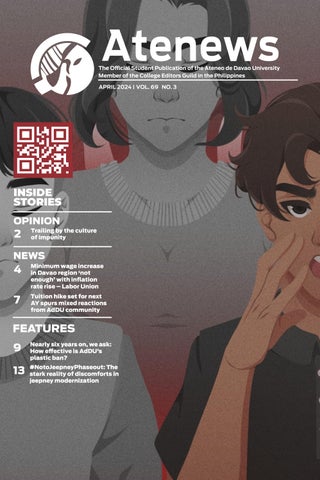



INSIDE STORIES The Official Student Publication of the Ateneo de Davao University APRIL 2024 VOL. 69 NO. 3 OPINION 2 Trailing by the culture of impunity NEWS 4 Minimum wage increase in Davao region ‘not enough’ with inflation rate rise – Labor Union 7 Tuition hike set for next AY spurs mixed reactions from AdDU community FEATURES 9 Nearly six years on, we ask: How effective is AdDU’s plastic ban? 13 #NotoJeepneyPhaseout: The stark reality of discomforts in jeepney modernization Member of the College Editors Guild in the Philippines


Trailing by the culture of impunity
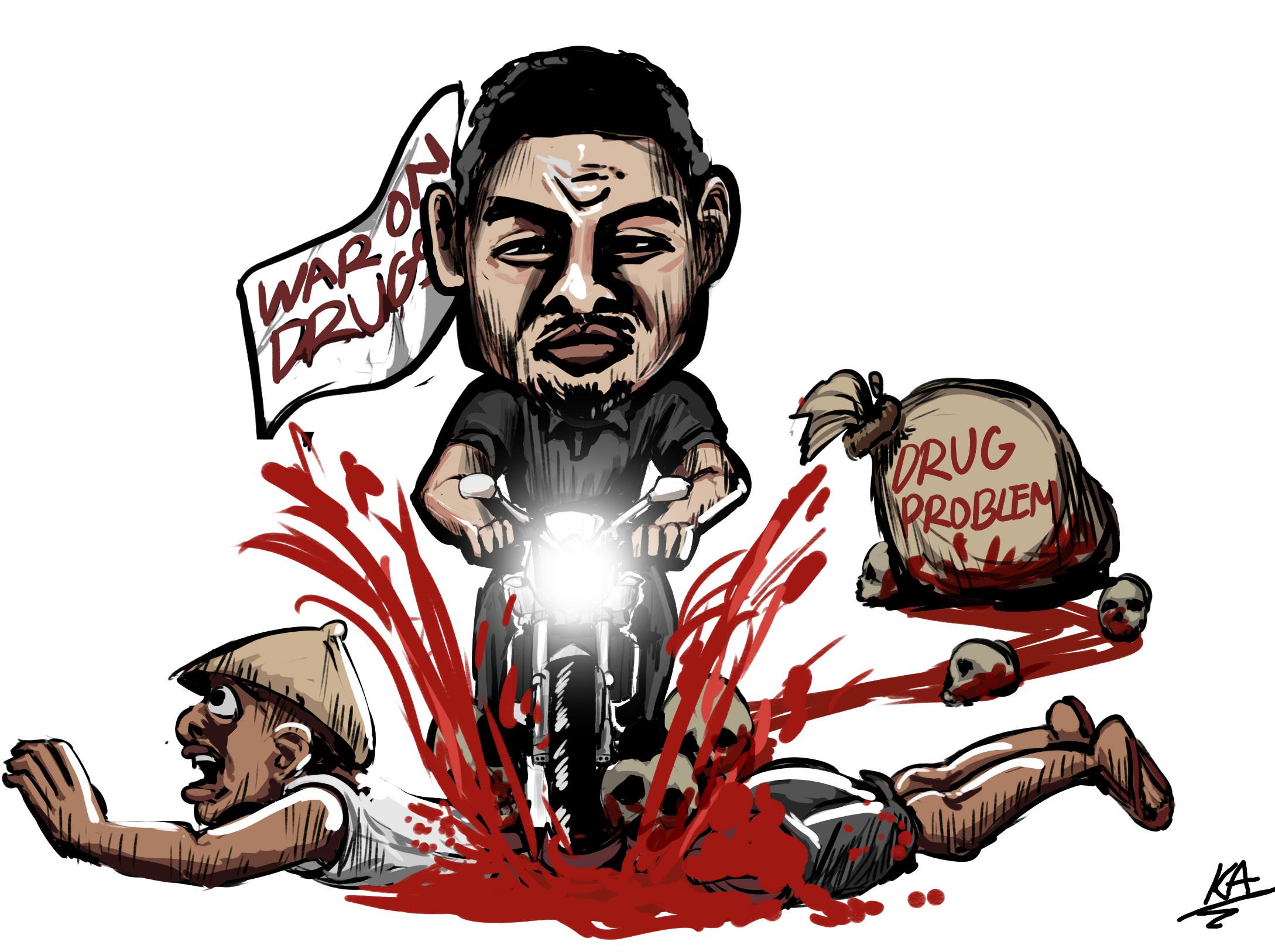
Almost two years have passed since Former President Rodrigo “Digong” Duterte’s administration with ‘war on drugs’ as his signature brushstroke, which smothered blood on countless innocent lives of Filipinos. Following his father’s footsteps, Davao City Mayor Sebastian “Baste” Duterte recently announced on March 22, 2024 his own version of the ‘war on drugs’ in the city. The terror brought by the anti-drug campaign still hangs heavy in the air, yet Davaoeños are once again faced with this chilling prospect.
When Baste declared his campaign against drugs, he initially threatened drug suspects that he would kill them if they would not stop saying, “Kung hindi kayo aalis, kung hindi kayo titigil, papatayin ko kayo.” Although he has clarified that his intention was not to kill drug suspects, there has been a report that seven ‘nanlaban’ drug suspects were killed after his declaration.
The Dutertes have long been successful in framing the drug war under the premise of ‘safety’ and ‘necessity’ that killings seem like a walk in the park. For the general citizenry, especially the Davaoeños who have been with the Dutertes for decades, it is difficult to question their approaches since they have been known to have iron fists and feisty, unfiltered mouths. The effective Duterte rhetoric that ‘it’s either you follow, or you will be killed’ strategy seeped through the Davaoeño culture,
seeming like this is a non-negotiable we have to acknowledge in exchange for our safety.
However, the shreds of evidence on the loss of thousands of lives in this bloody crusade against drugs point out that even if it is ‘necessary’ to ensure the safety of the city, Baste’s rhetorics should be feared rather than celebrated. Digong’s antidrug campaign alone tallied over 12,000 deaths of Filipinos, who were mostly urban poor. If not for the checks and balances of human rights institutions and activists, we would be forced to think that killing is the only solution for drug suspects. Now, it seems like we are casted in a very similar film Digong once directed, where people eat reports of extrajudicial killings in the media for breakfast, and the Filipinos are left to wonder how much more blood from innocent lives will be shed.
Similar to his father, who denied the International Criminal Court’s (ICC) probe on the ‘war on drugs,’ Baste did not fail to carry his father’s torch of disempowering human rights institutions. The Commission on Human Rights conveyed ‘grave concern’ over Baste’s illegal drugs campaign, but Baste even challenged them to probe. Even President Ferdinand “Bongbong” Marcos was called upon to investigate the campaign by Amnesty International, which the President has still not spoken about as of writing. Seeing how the efforts of human rights institutions felt like a mere pebble in the presence of a towering Goliath further reinforces that justice only serves those in
power. Now that even the threat of another cycle of impunity was ignored by the President, we are left with a government that continues to be complicit in the human rights abuses that the Filipinos have long been enduring.
It is alarming how this culture of impunity has stretched and become more evident throughout the years. Yet, the authoritative bodies seem frozen in demanding accountability against these injustices. Despite having our human rights institutions delegitimized by authorities, Filipinos retain the power to demand accountability and work to break free from the cycle of violence. While a safe city remains the vision of comfort for everyone, the citizens must remain vigilant in scrutinizing the moral implications of the anti-drug campaign, lest we become a society blinding falling for an authoritarian regime. With this, our leaders must also stay proactive in instilling the sanctity of human rights and challenge the practices that violate them.
The battle against drugs remains a pressing issue, but Filipinos should not be blinded by the extreme measures that have already violated one’s right to life just to be called a safe city. Standing tall against a culture of impunity might be a shot in the dark, but Filipinos can foster a safe environment through community support, rehabilitation, and compassion from the citizens rather than through a history of oppression and injustice.

Official Student
Gacayan
Rosete ASSOCIATE & NEWS EDITOR
Gargaran MANAGING & PRODUCTIONS EDITOR Joseph Lance Hilaga MANAGING & SOCIAL MEDIA EDITOR
Grace Ruyeras
& FEATURES EDITOR
ART EDITOR FOR PHOTO & WEB Earl
Dicipulo
EDITOR FOR CARTOON & LAYOUT
The
Publication of Ateneo de Davao University Heart Haezel
EDITOR-IN-CHIEF Aika Khent Zainab
Cherisha Nneka
Alona
HONORARY
Toni Anne Albarico
Geibriel
ART
Julianna Kaye Cortez, Ma. Alyza Rovyn de Guzman, Mariah Veronica Keith Rubia, Felia Ross Sichon
NEWS
SENIOR
WRITERS
Rena Christine Bustamante, Kent Empedrad, Criztia Joy Libago, Lancelotte Loriel Piquero, Joshua Angelo Ybanez
NEWS
JUNIOR
WRITERS
FEATURE WRITERS
FEATURE WRITERS James Realuyo
Ryan Nathaniel Balleza, Jerachris Rosal, Wendyl Geronimo SENIOR PHOTOJOURNALISTS Mariz Aylah Cenojas, Daniel Gallego SENIOR LAYOUT ARTISTS Elliot Dimasuhid JUNIOR LAYOUT ARTIST
Buagas, Nolan Benjamin Inso, Mauriz Pagangpang, Valerie Shaine Villegas SENIOR FIELD CORRESPONDENTS
Asentista, Lennard Antoinette Delima. Mari
Dormitorio JUNIOR FIELD CORRESPONDENTS Jan Francis Ranier Talua SENIOR VIDEO EDITOR JUNIOR VIDEO EDITORS Kirby Ayuban, Lian Khimber Lee Rodil, Danelle Gracious Sabanal, Kent Arjy Sanchez Rean Marco Regno SENIOR SOCIAL MEDIA STAFF JUNIOR SOCIAL MEDIA STAFF Danielle Nicole
Julia Rovie De Guia, Vivienne
Padapat JUNIOR WEB DEVELOPER John Shenon Uy Dr. Cheryl Baldric MODERATOR Elliot Dimasuhid TABLOID DESIGN Sean
Penn
SENIOR CARTOONIST opinion The Official Student Publication of the Ateneo de Davao University END THE SILENCE OF THE GAGGED! EDITORIAL
Jaecian Onoh Cesar, Giancarlo Rafael Tabios, Arch Sealtiel Ventura SENIOR
Leanna Kim Apalisoc, Stephen Camahalan, Jerson Francisco, Diwani Ma. Rosemina Gales, Shema Kailah Sacman, Rhyan Amanda Usman JUNIOR
JUNIOR CARTOONIST
Jana
Albett Celine
Andreiane
Fong,
Cynth
Anthony
Lacorte
abOut the cOVer
As journalists, our dedication to our craft and the truth fuels the calls for a world where the freedom of expression is a sacred right, where our pens and critical voices are free from intimidation. Until then, in solidarity, we persist, we craft, we write. Let your stories reasonate and be the force that shatters the silence.
Illustration By Elliot N. Dimasuhid Silence has power, but it is high time to use your might to champion unheard voices.
CONTRIBUTORS
02
Lance Allen Tosloc, Dominic Basalo II, Shanice Angel Yu, Althea Lorraine Befitel, Seth Melvyn Gatinao, Edrian Louis Nabos, Marishka Anne Lobitos
Illustration By Sean Anthony Penn Lacorte


SOLANA
By Aika Khent Zainab Rosete
Ihavecollected a fair share of dress code violations since the campus had a full blast onsite learning modality. One violation I had was due to my eyeletpatterned cardigan, which was not allowed because of its holes, and the second was because of my squared-neck puff sleeve blouse, which was tagged as having a plunging neckline.
I would just brush it off if it happened to me once, especially since the Office of Student Affairs (OSA) dismissed my case. But it happened several times that I felt disempowered for justifying my clothes to the school guard and having to explain my clothing in an email with my picture attached. I would feel so conscious of the stares around me,
 By Cherisha Nneka Gargaran
Basta kulot, salot.
For the longest time, people perceive curly hair as untamed or unkempt. This reflects a pervasive attitude towards people with curls. For many, myself included, it is a constant battle – the frizz, the tangles, the well-meaning (but unhelpful)


Time to move forward from rigid policies
scrutinizing my choice of clothes and whether they could pass or be warranted by the infamous green slip.
I even know someone flagged by the guard because of their ‘ripped’ jeans where the tattered cloth was as big as a thumb. I witnessed my fellow female students get blocked by the school guard because they showed their back skin too much, but I saw some who had the same issue but did not warrant a slip because it could be covered with their long hair. I also know someone who wore civilian clothes on a Thursday but was not given a violation nor questioned by the guard.
Through time, dress codes have been customary and a standard in universities to create a professional environment, accommodate students from different socioeconomic statuses, and instill campus order. For the University, there is a strict adherence to the rule as it is the first line of surveillance if you want to enter the campus. If I were not living in today’s climate and patriarchal bubble, I would find the whole regulation justifiable. However, as I am in a university that taught me to be dynamic, I question why we have to be rigid with our policies.
Since 2016, Ateneans have expressed disparities and inconsistencies in the school’s strict dress code. For once, its implementation is disproportionately focused on girls. At the end of every semester, the amount of female students falling in line to get their SIS unblocked is an obvious manifestation of how the policy is fixated on females.
Further, these dress codes were created during the time when a 42-degree temperature was only a high-grade fever. With the rising heat index in the city, uniforms, and restrictive dress requirements become a burden and an inconvenience.
Nevertheless, OSA has made efforts to accommodate the needs of the students in this weather. For once, OSA lifted the wearing of uniforms from April 16 to 20 in response to the rising heat index in Davao City. Exemptions in wearing uniforms were also made last January when the region experienced heavy downpours.
But in reality, such initiatives do not respond to the actual clamors of the student body. It is counterintuitive to lift uniform policies as a response to the rising heat index in the city, but only for the students to be left with restrictive options in wanting to be comfortable in this scorching heat.

In fact, weather unpredictability is not limited to a week; thus, lifting the wearing of uniforms in a short period of time will still be futile.
If the University cannot altogether abolish uniforms and dress codes, I posit that it is safe to relax some restrictions for now. Just recently, Mapua Malayan Colleges Mindanao released new dress code policies that have allowed modest sleeveless and shorts to let their students be comfortable in this weather pattern. The University has already shown us that it can be possible, as what happened in this year’s SADYA UFest, where the dress restrictions were lifted for the whole week.
As weather patterns continue to be unpredictable and extreme, and the struggle against patriarchy persists, the University should start to be adaptive to what the school community needs. It should also not blur out the underside of the iceberg that this whole debacle is about: appearance is not a judgment of a person. This means that professionalism is an attitude and not based on looks; respect is earned and not just given to someone who has followed the rules religiously, and the blame is not directed at the victim but the beast.
The crown I was born with
advice to “tame” our mane. A recent study revealed that over 80% of women with curly hair have, at some point, straightened their hair to conform to beauty standards.
Growing up, I was taught to view my curls as a burden—a flaw to be concealed rather than embraced. The phrase “basta kulot, salot” echoed in the comments of friends, families, and strangers alike, casting a shadow of shame over my natural hair texture. I craved sleek, straight black hair and envied girls who could effortlessly run their fingers through their hair, be it pin-straight or effortlessly wavy. Hence, I would always get my hair rebonded at hair salons. This constant battle with my natural texture chipped my confidence away, leaving me feeling like my hair was something to be controlled rather than a beautiful part of who I am.
It wasn’t easy. The societal pressures surrounding curly hair are deeply ingrained. These misconceptions can be particularly damaging
during formative years, shaping self-perception and leading to internalized insecurity. However, the tide is slowly turning. Embracing diversity and inclusivity is the cornerstone of the curly hair movement. It goes beyond simply celebrating curls; it’s about challenging the notion that beauty is a one-size-fits-all standard and acknowledging the diversity of hair textures that exists within our communities. Curly hair is a beautiful part of many cultures and ethnicities. Learning about different hair care practices and respecting traditions fosters a sense of belonging within the community. For in embracing our curls, we embrace ourselves.
Moreover, social media has become a powerful platform for the curly-haired community. There are now websites, Facebook pages, and countless YouTube videos dedicated to celebrating and caring for curls. These online spaces not only teach the importance of accepting your curls but also introduce you to the Curly Girl Method (CGM).
The CGM is a hair care routine that emphasizes ditching harsh products and embracing natural ingredients to enhance your curl pattern and promote healthy hair. Through social media, the CGM has become a movement in itself, empowering people to embrace their natural texture and find a routine that works for them. Empowerment came through representation — seeing individuals with curly hair celebrated in the media, on runways, and in everyday life. Slowly but surely, I began to see my curls not as a curse, but as a crown — a symbol of resilience and defiance in the face of adversity.
It’s time to change the face of beauty norms, to challenge the notion that only one type of hair is worthy of admiration and praise. Whether your curls are loose and wavy or tight and coily, they are a reflection of your unique identity and heritage.
This is why men and women with big, curly, or wavy hair flip the beauty norms and flaunt through their captivating allure—that kulot is not salot.
Batang 90s V.S. Gen Z: Denying Climate Change
By Marishka Anne Lobitos
With the rise of the
that people cannot ignore, social media has been filled with complaints, one of which sparked a heated debate between those who grew up in the 90s and what we now consider to be Gen Z.
A comparison of the temperature then and now was the subject of the debate. ‘Batang 90s’ claims that today’s generation is overly sensitive, whining over the heat and reminiscing about their youth playing under the sun; this got the attention of Gen Zs, stating how different the average temperatures of their time and the present. Still, the adults did not change their opinions as their generation continued to receive backlash on social media platforms. I could not help but think that the attitude of those considered the ‘Batang 90s’ toward this extreme heat is caused by their downplaying or denying climate change.
I know that everyone should take climate change seriously, but I just could not figure out why some, if not most, adults disregard this and classify it as something trivial. They should be concerned with this intolerable heat as they are most likely prone to heatstroke due to their age. I find it funny because they seem so stuck in the past that despite modern technologies proving every issue raised today to be accurate, they would just not listen.
This issue reminded me of a time back when I was in elementary school; my Science teacher was discussing the harmful effects of burning plastic and leaves on the ozone layer, and she told the class to inform the person we see burning garbage
respectfully to stop doing it. Young me was excited to go home after hearing it because I had a neighbor whom I could inform about what I had learned during my Science class. It was my way of contributing to environmental stewardship at a young age, but, spoiler alert, I was disappointed when I got home. Elementary student me mustered up the courage to approach her neighbor, shyly saying that burning garbage is bad for the ozone layer, to which the old neighbor agreed with my statement but then proceeded to continue burning her garbage. So, I went home needing clarification about the experience. Only when I turned high school did I realize that adults just did their own thing without thinking about the consequences of their actions.
I could only roll my eyes, thinking about how adults disregard the concerns of my generation. They would always say, “Bata pa kayo, wala kayong alam sa mundong ito,” or “kami nga, sa panahon namin,” every time, and it only fuelled my frustration towards their stubbornness.
The million-dollar question is, “Why are they denying climate change?” I could list down the effects of climate change with basis, and they would still deny it, glorifying their experiences in the past. It is evident that there is a disparity between the past and present temperatures since climate
change was not severe in the past. It is ridiculous to compare everyday experiences with whole different factors and living states. They are also complaining about the heat, so why is it that when the younger generation complains and receives the treatment they deserve per se, impose an online or asynchronous modality of learning for elementary to high school students just so they will not have to suffer the heat in their classrooms, the adults will call them weak and too sensitive. Don’t they see that this is now a health concern? Heat exhaustion is a real thing that could happen to anyone.
These same people who deny climate change are also the same people who would stay at a place where it has its air conditioning system on 24/7 because it is too hot. They are also the same people who prefer to stay home because traveling is hot nowadays. I guess this is the irony of being an adult who is prideful.
What hurt me was when scientists staged a worldwide protest back in 2022, they expressed their fear and warnings about climate change, which gained attention on different social media platforms—with everything they could do to make how critical the condition of our planet is known, they got themselves arrested. I am fully aware that what they did stirred the security of every country
by causing fear in the audience. They were in no position to announce such news, but the idea of waiting for the right people to announce such news would probably be too late for us if they even planned to make such an announcement. But even after that whole commotion with the scientists, some still do not believe in the pressing issue of climate change. It sucks that even those who had the credentials were considered delusional for saying such things; what happens to the rest of us? Will we be able to find someone who cares, who will listen, and who will make an effort to create positive change and address climate change? Most of us are part of Generation Z. Is there a hope that someone from the adult club will listen to us without ridiculing and disregarding us? That will be the day.
I fear that the actions of the youth will be insufficient without the adults listening and cooperating. I fear that as we only endure the scorching heat and place bandaid solutions to mitigate our problems with the heat, everything will be too late. Our actions will determine whether future generations can still see the planet’s beauty. It is time to stop denying climate change—face it and create solutions. Refrain from comparing our generation to yours. We are all suffering from the same irreversible problem, after all.
ZARIYA
VOL. 69 NO. 3 aPrIL 2024 Member of the College Editors Guild of the Philippines G/F Arrupe Hall, Martin Building, Ateneo de Davao University E. Jacinto St., 8016 Davao City Tel. No. (082) 221-2411 loc. 8332 E-mail Address atenews.addu.edu.ph
heat index
BLUE BLOOD
Editor’s Note: The views and opinion expressed by the opinion writers do not necessarily state or reflect those of the publication
news
Almost 40 areas in PH reach ‘dangerous’ heat
index, affects work and health conditions
By Julianne Kaye M. Cortez & Kent B. Empedrad
With the rising summer heat in the country, the Philippine Atmospheric, Geophysical, and Astronomical Services Administration (PAGASA) revealed that 38 areas in the Philippines registered a ‘dangerous’ heat index as of April 27, 2024.
The heat index refers to how hot the temperature is, and some areas of the country have already reached the dangerous temperature level, ranging between 42 and 51 degrees Celsius.
According to PAGASA, areas with the highest heat index recorded include Dagupan City, Bacnotan, Aparri, Tuguegarao City, Laoag City, Iba, Clark Airport (DMIA), Ambulong, Coron, Puerto Princesa City, Zamboanga City, Cotabato City, Maguindanao, and Davao City, among others.
With the inclusion of Davao City as one of the cities with the highest recorded heat index of 42°C, Dabawenyos are noticing the effects of the intense heat.
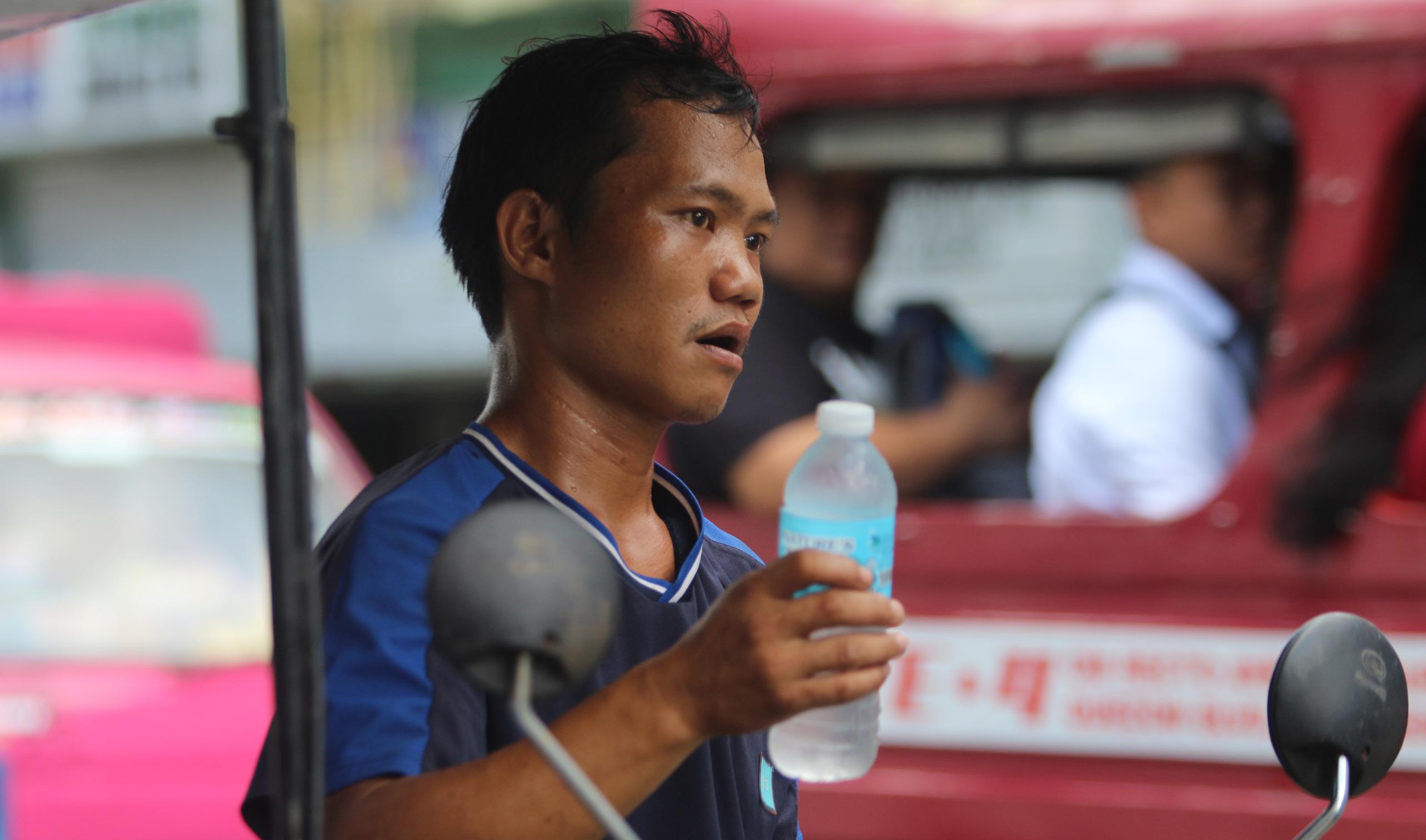
Buko Juice Vendor Wilven Suan shared with Atenews that many workers have been affected and compelled to shift their work hours to the afternoon instead of an earlier time due to the oppressive heat.
“Karon, mu-gawas na lang ko ug hapon, tungod kay karon mu-tungtong sya ug alas onsealas dose, grabe na ka init, dili na kanang ma initan gud ka, murag mu bati na imong lawas ba nga maluya ka ba.”
Sharing the same experience, tricycle driver Dennis Quarteros said that very few passengers are going out because of the heat, which affects his income.
Suan and Quarteros also noticed changes in their areas’ water systems, as there was a gradual decrease in water flow from morning until afternoon.
“Sa karon, sa akong na-obserbahan, ang tubig, una una, tungod sa sa ka init, murag mi minus ang source sa tubig, kay tungod sa ka init sa panahon mao nang naay time nga matingala ka nga hapon na hinay gihapon ang agas,” Suan said.
Suan also believes that the state of the planet is worsening primarily due to chemical pollution and the actions taken by the government solely to generate profit.
“Number 1, sige sila’g pamutol ug kahoy, once gani ka mag putol ka’g kahoy, naa pud kay itanom ug balik, kay number one man gud to nga maka daot sa atong ecosystem kay sa akoa lang nagka
gamay ang kuan sa oxygen, tas nagka dako ang carbon dioxide.”
Schools nationwide have also taken precautionary measures to avoid possible health issues such as dehydration and heat stroke by suspending face-to-face classes, shifting learning modalities, and pushing universities to enable students to wear comfortable clothes.
Ateneo de Davao University (AdDU) student Althea Limpao shared with Atenews how the intensifying heat made her feel strained and exhausted when in school.
“Imagine, I have to travel from Monday to Friday for about an hour and 30 minutes under this heat while I’m wearing a fully-tight covered snow-white uniform. It is mentally and emotionally draining me even though ‘di pa ako nakarating ng school.”
Limpao added that exposure to heat while taking public transportation to school and staying in an airconditioned classroom resulted in migraines and fevers at night.
Another AdDU student, Jhayla Mae Bernadette Cero, suggested that easing the university’s existing uniform policy may help mitigate the effects of the rising heat.
Minimum wage increase in Davao region ‘not enough’ with inflation rate rise – Labor Union
By Criztia Joy N. Libago & Felia Ross H. Sichon
Following the mandate of President Ferdinand “Bongbong” Marcos Jr. to review minimum wage rates in every region of the Philippines, clamors of labor union workers in Davao City to significantly increase wages persist, pushing for the issuance of a P150 wage hike rather than the officiated P38 wage
“I call on the Regional Tripartite Wage and Productivity Boards (RTWPB) to initiate a timely review of the minimum wage rates in their respective regions, with due consideration to the impact of inflation…within 60 days prior to the anniversary of their latest wage order,’’ Marcos said in his speech during Labor Day.
However, as the RTWPB in Region 11 issued a P38 increase in the minimum wage, Kilusang Mayo Uno-Southern Mindanao Region (KMU-SMR) joined with other progressive groups and individuals organized a mass mobilization to press for a liveable wage and workers’ rights, stating that the wage increase is still “very dismal” with inflation on the rise.
As of April 2024, inflation rates run from 3.7%, emerging as a top concern for 70% of adult Filipinos across different socio-economic classes, according to a Pulse Asia Survey, nationwide.
“Continued price increases of rice and meat along with higher domestic oil prices and electricity
rates are the primary sources of upward price pressures for the month. Meanwhile, lower prices of fruits, vegetables, and fish along with the peso appreciation could contribute to downward price pressures,” the Bangko Sentral ng Pilipinas said in a press release on Monday, April 1.
Through this, workers, in Davao City, clamored for better livable wages, claiming that it was “not enough” to adequately provide the needs of their families.
“Ang kahimtang sa sweldo karon sa mga mamumuo very dismal tungkod kay naga-padayon ang pagsaka sa presyo sa mga pamaliton so dili enough ang current na rate of wage or salaries karon sa atong mga mamumuo sa pilipinas og diri particular sa davao region,” Rauf Sissay, Bayan Muna Davao coordinator said to Atenews.
Furthermore, Bryan, KMU-SMR spokesperson, stated the benefits provided for them further deduct their salaries, barely reaching the a livable minimum wage, “Ang mga benepisyo naa naman na sa company mismo ang isa man gud diha kay ang imohang minimum wage, ang kanang imohang sweldo sa matag-adlaw kuhaan pana kaltasan sa imohang mga benipisyo, so dili na siya maabot didto gyud sa saktong minimum wage.”
To further monitor wages accordingly with the inflation rate increase, different sectors from labor unions sectors continue to advise varied strategies to the administration to sustain the needs of labor
workers and their families.
“Sa broad labor movement sa piliipinas, duna nay consensus na kinahanglan ang salary increase is 150 pesos pataas so kana para matubag ang poverty and needs sa atong trabahante og katawhang kapos,” Sissay ended.
In the plight of the workers
When asked about the situation of the minimum wage earners (MWEs) on the wage increase, they are yet to express their contentment as they proceeded to have trouble with the continuous increase of inflation rates.
“Ang pag-increase sa pletehan nagsumikad na siya sa pag-increase sa lana so kung mo increase ang lana, domino effect na mo-increase pud ang basic o mga pamaliton.” Transmision PISTON spokesperson, Larry Arguelles.
With great disadvantage for MWEs, the increase of P38 in wages is insufficient for their everyday needs, as the prices of products also increase. The current minimum pay in Davao’s private sectors is now at P462, which is still P713 less than the anticipated P1175 family living wage—a significant difference given the state of the economy today.
“Usa ni siya sa factor pud nga mas ni-gamay
“Simply lifting the uniform policy might not suffice, especially if we students are required to wear clothing that adds to our discomfort in the heat. The heat can be quite intense, and wearing cooler and more comfortable attire could at least alleviate some of our sufferings.”
She added that easing the dress code, such as permitting shorts within a specific length for both genders and limited styles of sleeveless clothing, could be beneficial to ensure comfort while maintaining a professional appearance for the students.
Hottest days are still expected to come in May, with temperatures possibly peaking, according to PAGASA. Weather specialist Dr. John Manalo explained to GMA Integrated News on April 17 that relative humidity tends to increase during May.
“Because we are heading towards the rainy season, the moisture content in the air also increases compared to April and March, which are also dry.”
The weather service further recommended the public to reduce outdoor activities, stay wellhydrated, and plan daily tasks for cooler periods, particularly later in the day, to prevent potential complications from the effects of extreme heat.
amoang kita or income as driver so mas naga-lisod mi diha sa pang-ekonomiya na mga panginahanglan,” Larry further added.
To compensate for this, different countermeasures were followed such as further organizing different sectors of the working force, to address problems on their unfair wages–prompting interest to fight for livable, and sustainable salary increase.
“Kami nagapadayon kami sa among kampanya alang sa wage increase or salary increase isa na diha ang paglunsad namo og mga kilos protesta sama ni ani para sa pag amplify sa panawagan sa wage increase or salary increase.” Sissay ended.
To commemorate Labor Day, KMU-SMR and other organizations conducted a mass mobilization with the slogan, “Workers, unite! Fight for a wage increase and democratic rights! Advance national democracy!” on May 1, 2024, at Freedom Park, Roxas Avenue, Davao City.

NATIONAL NEWS
The Official Student Publication of the Ateneo de Davao University END THE SILENCE OF THE GAGGED!
LOCAL NEWS
WAGE INCREASE. Dabawenyos take their clamor to the streets, urging government officials to lobby for a liveable wage and acknowledge workers’ rights amid the continuous increase of inflation rates.
PHOTO BY TONI ANNE Y. ALBARICO
04
HEAT STRESS. Residents in Davao City shield themselves from the scorching sun as temperatures hit record highs at Roxas Avenue, with heat indices reaching dangerous levels across the Philippines. PHOTO BY ALTHEA LORRAINE O. BEFITEL.




Human rights abuses continue for activists amid labor organizer disappearance
By Rena Christine V. Bustamante
Highlighting the continuation of human rights abuses faced by activists under the Marcos administration, progressive groups and advocates clamor for answers regarding the disappearance of veteran labor organizer for Kilusang Mayo Uno (KMU - Southern Mindanao Region) William Lariosa, who has been missing since April 10, 2024.
Last seen in Brgy. Butong, Quezon, Bukidnon, eyewitnesses claimed Lariosa was allegedly forcibly arrested by members of the
48th Infantry Battalion.
According to Anakbayan - Southern Mindanao Region spokesperson Beverly Gofredo, the rising cases of enforced disappearances targeting activists is a concerning pattern that is reminiscent of the past Martial Law regime.
“Concerning siya, the fact na wala namang ibang ginawa ang mga manggagawa, mga aktibista, kundi ipaglaban yung karapatan ng mga mamamayang Pilipino. This is de facto Martial Law, hindi formally nag declare ng Martial Law pero makikita natin na ito
ay pattern of different regimes, specifically pattern na kinuha ni Marcos Jr. galing sa kaniyang ama na isang diktador.”
“Nangangamba kami na ito ay mangyayari ulit, kitang-kita naman ang mga pangyayari ngayon, like abductions, red-tagging, and other attacks sa mga progresibong organisasyon at mga organisador,” she added.
Gofredo said that a hearing was held last April 18, in which 48IB Commanding Officer Lt. Col. Gilbert Gomez denied that Lariosa is in the custody of the battalion.
“Until now, di pa rin naman kami tumitigil
Students raise academic unfairness in PHILO 1000, to be mandatory for all enrollees next AY
By Mariah Veronica Keith B. Rubia
Students described ‘unfair’ learning experiences in the Philosophy 1000 course, as it is only required for nonAdDU Senior High graduates, which is then set to become mandatory for all enrollees in the upcoming academic year 2024-2025.
Students from different Senior High institutions pointed out their difficulties when taking PHILO 1000, particularly questioning how AdDU Senior High graduates are not required to take the course with them, which they believe contributes to the perceived disparities in course experience.
A student from BS Computer Science (CS) shared a personal sentiment, revealing that they initially aimed for an “A” upon entering the course, but the demanding nature of PHILO 1000 led them to adjust their expectations to merely aiming for the minimum passing grade.
“It [system for PHILO 1000] creates a barrier by significantly widening the learning gap between the AdDU SHS and Non-AdDU SHS graduates with the former [AdDU SHS graduates] having a higher advantage, and
the latter [non-AdDU SHS graduates] having to endure college-level philosophy,” they told Atenews.
The CS student stated feelings of isolation due to the self-paced nature of the course, much more added when they took it during the pandemic.
Further, another student pointed out that the frustrating part of answering the courseware was the 12-hour cooldown for incorrect responses.
According to them, students who attended Ateneo’s Senior High School program often express that they faced fewer struggles with Philosophy than college-level Philo takers, leaving non-Ateneo SHS graduates frustrated and questioning the adequacy of their high school Philosophy education.
“Isn’t the Philosophy course we took in our respective SHS enough?” the CS student said.
For Dr. Vida Mia Valverde, the Chair of the Philosophy Department, Senior High School Philosophy teachers focus primarily on identifying which philosopher
or school of thought corresponds to particular philosophical concepts rather than emphasizing the intended approach to teaching Philosophy.
“Many students assume that PHILO 1000 is only a content-knowledge acquisition course, that is, a course about consumption and regurgitation of philosophical ideas. This assumption is often the result of their experience of how Philosophy was taught in their Senior High Schools,” Dr. Vida stated.
However, the privilege of collegiate Philosophy exemption for AdDU Senior High graduates will only be granted in the current academic year, as all incoming students will be enrolled and take the PHILO 1000 course renamed GE 1102: Introduction to Philosophical Methods, an interdisciplinary approach, starting AY 2024-2025.
Learning outcomes will still be measured through non-graded and graded formative assessments and a graded summative assessment; however, the course will be required for everyone starting the next academic year as resolved by the Philosophy department to address disparities in learning experiences and to foster a more equitable

sa paghahanap kay William Lariosa, madali lang i-deny ng Armed Forces of the Philippines especially ng 48th Infantry Battalion na wala sa kanilang kamay si Lariosa, pero it doesn’t mean na wala talaga sa kanila kasi hindi lang ito ang unang beses na may mga nangyaring abduction, dito sa administrasyon ni Marcos Jr.,” the spokesperson said.
Gofredo also cited the case of Jonila Castro and Jhed Tamano, who were activists fighting for the rights of fishing communities in Manila Bay before being abducted by military officers in Bataan and forced to surrender.
“In-abduct sila ng Philippine National Police, and then prinesent as mga surrenderees ng National Task Force to End Local Communist Armed Conflict or NTFELCAC, pero before yun dineny yun ng PNP, AFP, and NTF-ELCAC na nasa kamay nila ang dalawa, and nung pagka presscon ay mismo silang dalawa ay prinesent nila ang kanilang sarili na pinilit lang sila na ipa surrender ng mismong estado, which is why we believe na nasa kamay ng Armed Forces of the Philippines, kasi ang mismong estado, ganito ang ginagawa nila ngayon, na kinukuha nila at ina-abduct, at prinepresent sa media as surendurree kahit hindi naman part of the New People’s Army,” Gofredo said.
According to data from the Center for Trade Union and Human Rights (CTUHR), Lariosa is the 24th victim of enforced disappearance under the Marcos administration and is the first reported abduction of a labor organizer in the Mindanao region.
Gofredo also emphasized the significant responsibility of young people in advocating for workers’ rights and other societal issues, encouraging the youth to share stories that reflect the problems faced by laborers and other sectors.
“Pwede itong ipa laganap through social media, and of course, sumali sa mga national democratic mass organizations, para buo ang laban kaugnay doon sa paglaban para sa ating democratic rights. Lastly, sumali sa mga kilos protesta katulad ng May One, dahil tayo mga kabataan ay very critical and very openminded and nagtatanong talaga tayo dahil gusto natin ng pagbabago,” she said.
As of writing, Lariosa’s whereabouts are still unknown.
and supportive academic environment for all.
In AdDU, the General Elective courses are multidisciplinary—each content is thought of in a scientific-mathematical way, a philosophical way, and a theological way. As Valverde mentioned, Philosophy, which focuses on virtue and methods, trains students to think philosophically and approach GE courses holistically.
“A look at the course syllabus/FIDP (Flexible Instruction Delivery Plan), PHILO 1000 aims to develop in students the skill of philosophical thinking, the skill of mentally seeing the whole truth,” she said.
Another student claimed that taking the course would benefit all Ateneo students since “philosophical thinking” applies to all courses and even life in general.
“I think it would benefit both students and teachers even more if the coursework [were] made more accessible and manageable for the students. Specifically, the course structure, grading criteria, and instructional methods could foster a more inclusive and supportive learning environment,” the student from Computer Science claimed.
The said philosophical thinking is developed by distinguishing between philosophical and non-philosophical questions, asking philosophical questions, distinguishing primary from secondary reflection answers to philosophical questions, answering philosophical questions with primary and secondary reflection answers, and putting all these together creatively.
VOL. 69 NO. 3 aPrIL 2024 Member of the College Editors Guild of the Philippines G/F Arrupe Hall, Martin Building, Ateneo de Davao University E. Jacinto St., 8016 Davao City Tel. No. (082) 221-2411 loc. 8332 E-mail Address atenews.addu.edu.ph
LOCAL NEWS
Graphics By Mariz Aylah E. Cenojas
UNIVERSITY NEWS
Fr. San Juan aims to improve university proceedings, openness in uni dialogue
By Joshua Angelo E. Ybanez & Mariah Veronica Keith B. Rubia

Ateneo de Davao University (AdDU) President Fr. Karel San Juan. S.J. identified better administrative proceedings, improved communication, and openness to converse with the whole Ateneo community as his seven-month office progress.
In an interview with Atenews, Fr. San Juan said they have reflected on providing better service to Ateneans, including reviewing the structure of the university proceedings.
As such, the Office of the Academic Vice President will see changes this May as it will be divided into two: Vice President for Basic Education and Vice President for Higher Education.
“To strengthen the service further, it’s better to have one full-time administrator for basic education and one full-time vice president for higher education,” Fr. San Juan said.
Fr. San Juan also expressed that he has fostered better communication among faculty and staff and furthered the community relationship through extensive engagement with different university units and stakeholders.
“I think I’ve been fostering better communications among our leaders [and] among our people. How? Very simple basic things like more frequent communication through social media, even chat groups for quicker dissemination of information, [and] quicker decision-making.”
According to Fr. San Juan, he has met several groups, from the whole academic unit communities to the unions and departments.
“If I know what’s happening at the ground level, it’s better for me to make
decisions–better, effective decisions,” he added.
Philosophy professor Rhine Jay Literatos shared that the President has an organized communication framework, emphasizing careful planning and decision-making.

The President’s communication style appears to be structured and systematic, primarily facilitated through the Associate Vice President (AVP)… the emphasis on avoiding hasty decisions should be appreciated, as it contributes to the overall effectiveness and sustainability of the university’s communication practices.
In response to concerns about university issues such as uniform policies and dress code, Fr. San Juan encouraged students to voice their clamors to relevant university authorities.
“Lobby before revision of dress code. Tap the SAMAHAN. I want the students to be confident in the student government. Feel free to advocate,” he said.
“We will try to listen and hear all perspectives and trust the administrators
that in all honesty and sincerity, we will make the right decisions, but when it comes to that [uniforms], feel free to advocate,” he added.
The current university president also assured the student body that they will take proper measures to protect students against red-tagging.
“We will fight red-tagging whoever is doing that, and our administrators will make sure that wherever you will be deployed in terms of immersion and fieldwork, that we talk to the authorities so that your identity is clear and that you won’t be mistaken,” he further stated.
Fr. San Juan made clear the University’s zero-tolerance policy regarding sexual harassment and will take action to prevent and stop it from happening.
“We should not tolerate such, and there are protocols and then laws that we should implement to counter and to prevent and to stop sexual harassment in campus.”
In the following months and years of his term, Fr. San Juan is committed to bolstering academic, extracurricular, and organizational life by ensuring support in all aspects of the student’s life, along with a strong emphasis on community outreach and service.
“Continuing support for student life, I would call it student life in general, meaning your academic life, your life inside the classrooms and laboratories, making sure that you have adequate facilities [and] making sure that there are enough laboratories and computers and all, [including] internet connection and everything, [in] academic life,” he said.
Political Science second-year student Sarah Jessica Amelda assumes that the President will follow in the footsteps of his predecessor, the former AdDU President Fr. Joel Tabora, and carry upon the unresolved issues in the University.
“I am expecting Fr. Karel to be able to take action on things that Fr. Tabora, the [former] President, was not able to take action on and finish [before stepping down]. For example, the uniform policy,” she said.
Furthermore, Literatos expressed her expectations of the university president in the upcoming academic term, focusing on expediting decision-making and immediate actions.
“By placing a greater emphasis on timely discernment and decision-making, the president can address concerns more promptly, enhancing transparency and clarity for students and faculty…this adjustment will facilitate a more open dialogue, meeting the community’s need for immediate clarity and strengthening unity and effectiveness,” she added.

By placing a greater emphasis on timely discernment and decision-making, the president can address concerns more promptly, enhancing transparency and clarity for students and faculty…this adjustment will facilitate a more open dialogue, meeting the community’s need for immediate clarity and strengthening unity and effectiveness.
The Official Student Publication of the Ateneo de Davao University END THE SILENCE OF THE GAGGED! news
PROGRESS. Fr. Karel San Juan reflected on his terms’ achievements during the last 8 months, highlighting his consistent efforts in being one with the Ateneo community by listening to different stakeholders. PHOTO BY TONI ANNE Y. ALBARICO
06 UNIVERSITY NEWS
Tuition hike set for next AY spurs mixed reactions from AdDU community
By Ma. Alyza Rovyn C. De Guzman & Lancelotte Loriel A. Piquero
Withthe Ateneo de Davao University (AdDU) administration proposing another tuition and other school fees increase (TOSFI) for the next academic year 2024 - 2025, members of the University community expressed mixed reactions and concern with the fee hike given today’s economic climate.
The proposed TOSFI was presented to representatives of the University community in a multi-sectoral consultation meeting last February 23, with the 7% increase centered on personnels’ salary raises and meeting the University’s increasing expenses and developmental needs.
Students’ perspective, concerns
Despite having no official announcement of the increase, students of various disciplines voiced their unease regarding the potential financial implications of the TOSFI.
The rising inflation rates and ongoing financial challenges heightened by the global pandemic contributed to the raised concerns, particularly those from socio-economically disadvantaged backgrounds.
As enrollees with the highest units taken and fees paid in the university, students from the School of Engineering and Architecture (SEA) and the School of Nursing (SON) will be most affected by the tuition fee hike.
In an interview with Atenews, BS Chemical Engineering student Sky Clint Liquit stated that although he is under a scholarship program, he would need more to shoulder the increasing tuition fee.
“As a DOST-SEI scholar student, I use 100% of my allowance and book incentives from the program to pay for my school assessment fees. So, as a student with 30 units, I will tighten my belt more.”
The increase has pushed Liquit to search for other universities that accredit his scholarship program and his undergraduate course.
Student-nurse Chino Isaiah Canete shares the same sentiment, emphasizing that despite the university not being considered the number one nursing school for many people in Davao, Ateneo’s tuition fee is almost twice as much as that of other schools.
“I think it’s fair to claim that AdDU is already the most expensive nursing program not just in Davao but Mindanao as a whole, as even XU had a lower tuition fee in their nursing course than us.”
TOSFI to respond to faculty, staff, and student needs
Finding a balance between financial sustainability and ensuring equitable access to education remains a significant consideration for faculty members.
Industrial Engineering Department Chair Francis Christopher “Kid” Bation told Atenews the importance of added compensation and benefits for the employees through the TOSFI.
“I believe that these funds are crucial for hiring qualified faculty, investing in infrastructure and technology, and offering various academic and nonacademic support services that enhance the overall learning experience of Ateneans,” Bation stated.
In the multisectoral consultation meeting held for the proposed TOSFI,
Academic Vice President Gina Montalan said that the administration hopes to give the university employees a higher take home salary through the fee hike.
Further, Bation emphasized the need to improve the needs of the teaching staff aside from their take home pays.
“It’s crucial for the administration to prioritize other faculty needs, like enhancing faculty development and research support. This will surely benefit both faculty & students and will promote lifelong learning,” he noted.
SAMAHAN President-elect and incoming 4th year Nursing student Leen Lapatis also told Atenews that the proposed increase will compensate for the needs of the University.
“I strongly believe that having the tuition fee increase can help us [nursing students] in learning and improving our skills needed in the hospital and clinical setting,” Lapatis added.
Bation also urges the administration to be more transparent when allocating funds, given that budget reserves will balloon because of tuition hikes.
Lapatis shared the same sentiments, expressing her expectations that the school will be able to properly inform the students of where the fees will go, considering that they are the top stakeholders of the University.
Administrative rationale of TOSFI
University Vice President for Finance and Treasurer Jimmy Delgado specified the factors driving the need for such fee adjustments behind the proposed TOSFI.
The rise in miscellaneous fees will be mainly allocated to accommodate the increasing operational expenses, as well as additional maintenance and security personnel.
Upgrades for school facilities, labs, and equipment, such as installing more Ruckus Wi-Fi Access Points and replacing the Jubilee Hall elevator, also cover part of the increase.
The Vice President for Finance also emphasized that the 7% tuition fee hike is to cope with the rising inflation rates and increase the salary of the University’s faculty and staff as the Collective Bargaining Agreement (CBA) for the union is about to end.
“In the CBA, 3% lang dapat ang increase but 5% was proposed this year since [the] inflation is [recorded at] 6.5-6.8%... kung 3%, aangal itong mga teachers kasi masyadong maliit, di sila makahabol sa 6.5%,” he said.
Delgado noted that spreading the CBA budget over three years is necessary, as condensing it into one year would result in a single lump increase.
As for the students currently in the University, Delgado said that the administration is taking several measures to maintain the number of students presently enrolled, explaining that the tuition fee mainly depends on the number of students enrolling in the academic year.
“With the recent opening of the Advancement Office by Fr. Karel [the University President], the main purpose is to look for funds for scholarships and donations for capital expenditures for equipment. Isa yan sa mga target namin mangyari this year na we will look for funds mainly for scholarships so that we can increase the number of scholars that will be funded externally.”
Currently, the VP for Finance encourages more students to enroll in the following years so that the University does not need a tuition fee hike.
The official TOSFI memorandum will be posted once approved by the Board of Trustees.
VOL. 69 NO. 3 aPrIL 2024 Member of the College Editors Guild of the Philippines G/F Arrupe Hall, Martin Building, Ateneo de Davao University E. Jacinto St., 8016 Davao City Tel. No. (082) 221-2411 loc. 8332 E-mail Address atenews.addu.edu.ph
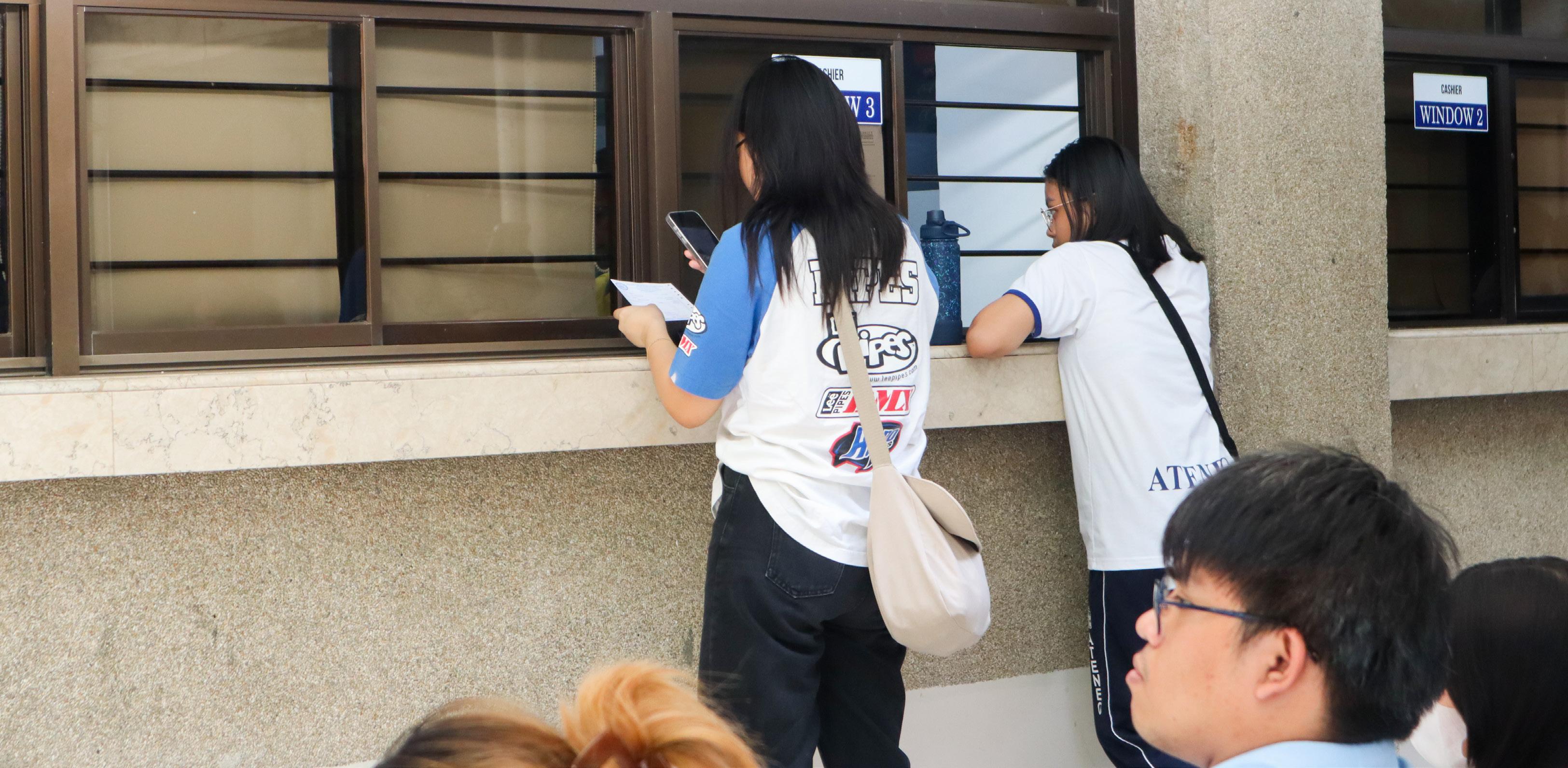
INFLATION. As the semester comes to a close, AdDU students line up to pay their remaining tuition fees for the last time before the proposed implementation of the 7% TOSFI in the upcoming academic year 2024-2025. PHOTO BY SETH MELVYN Z. GATINAO. UNIVERSITY NEWS
Clouded Judgment: the rise of vaping
By Diwani Ma. Rosemina G. Gales & Giancarlo Rafael C. Tabios
Vaping has surged from a niche fad to a global sensation, often advertised as a favorable alternative to smoking. However, beneath the vaporous charm lies a swirling mist of uncertainty and concern, demanding a closer look at the whirling plumes of vapor.
Currently, the vaping trend shows no sign of slowing down, with its peak still out of reach. Vapers’ reasons for its continued flourishing only serve to reinforce its enduring popularity.
“I think it’s because vaping is a quick and straightforward way to release dopamine into your system,” first-year AB International Studies student told Atenews.
But what may begin as a coping mechanism or stress relief can quickly evolve into a cycle of temporary euphoria, trapping individuals in a seemingly inescapable tunnel of dependence.
Discovering euphoria
Exposed to it from a young age, whether through social interactions or the very vapor it emits, vaping has swept the world by storm, even in spaces where smoking is supposedly prohibited. Others who are intrigued are drawn in by questions they seek to answer firsthand. This curiosity leads them to take a leap of faith, inhaling the vapor and embarking on a journey into the euphoric realm of vaping.
“I’ve always been around smokers in life [but] I’ve only started vaping last year, 2023,” first-year AB Psychology student said in an interview. They added that they only vaped at their homes, for others might find it annoying and others may have difficulties with breathing.

While the allure of vaping is undeniable, its rise to prominence raises pertinent questions about its appeal.
Vaping presents a seemingly harmless alternative to traditional smoking, boasting enticing flavors, sleek designs, and reduced exposure to harmful chemicals that appeal to those seeking to quit smoking or find a healthier option. However, an anonymous second-year AB Psychology student finds vaping’s sensory experience goes beyond nicotine intake.

“I am aware of the risks, however, as someone with an oral fixation, I cannot let go of that fidget object I have made out of my vape.”
Moreover, social influences, peer pressure, and cultural standards are essential factors determining how people feel about vaping. Being portrayed positively in popular culture and the media, vaping has also become more accepted in social circles, which appeals to impressionable viewers.
As added by them, “It seemed like everywhere I turned, whether scrolling through Instagram feeds or chatting with friends between classes, vaping was a prevalent topic of discussion and experimentation.”
Additionally, vape customization allows users to tailor their experience, from nicotine levels to flavors and device aesthetics which fosters a deep sense of identity, transforming vaping into a lifestyle, not just a habit.
Navigating through the fog
Still, concerns linger about its long-term health effects and addictive nature, casting a shadow over its perceived benefits.
In an article published by the World Health Organization (WHO) last January 2024, they classified vaping as part of the Electronic Nicotine Delivery System (ENDS), which was said to be bad for the health, especially for the lungs. WHO also stated that the increasing popularity of these e-cigarettes is alarming, primarily because it is marketed toward young people who can immediately develop their addiction to these substances. With this, WHO encourages member-states to implement a comprehensive approach such as higher taxes and banning.
Amidst ongoing debate and uncertainty surrounding vaping, one fact stands out: the importance of informed decision-making and collective action to navigate its evolving landscape.
“Just know that once you take a whiff, it’ll be the start of a spiraling black hole. What may begin as a recreational pastime or coping mechanism can quickly spiral into dependency, trapping users like me in a cycle of addiction and withdrawal,” another second-year AB Psychology student said.

Only by confronting the fog of uncertainty head-on can we hope to clear the air and safeguard the well-being of current and future generations.
Graphics By John Shenon C. Uy feature The Official Student Publication of the Ateneo de Davao University END THE SILENCE OF THE GAGGED! 08
Graphics By Lance Allen A. Tosloc

Nearly six years on, we ask: How effective is AdDU’s
By Jaecian Onoh A. Cesar
Whenthe Ateneo de Davao University implemented the “total ban” against single-use plastics (SUPs) in 2018, there was a brimming sense of hope and a stubborn tinge of defiance in heeding the tall order of combating our “throwaway culture” outline by Pope Francis in his Laudato Si encyclical.
Why there was such a prevailing sense of optimism and audacity is not that hard to answer. Memorandum No. 2018-071 was solid proof of how AdDU held firm in its identity as a progressive institution eager to respond to the pressing issues of our time. There is, indeed, an urgent need to hoist the Philippines up from the quagmire of plastic pollution, and AdDU, was at the forefront to tell the Philippines that with just enough administrative will, we can embody a more sustainable and eco-friendly lifestyle to be “nonconformists” even in the face of a society that systemically relies on plastics in our day-to-day lives.
We are forced—and for good reason— to bring our own water tumblers, use paper bags, utensils, plates, and straws, instead of plastics. We fill out the Ecoteneo’s ERMAP forms to ensure sustainability in our organizations’ school activities. In some cafeteria stalls, we are even incentivized through discounts when we bring our own food containers to lessen water consumption when washing dishes.
Yet, nearly six years since Fr. Joel Tabora inked Memorandum No. 2018071 as an ultimate law in the university entrance gates, where campus guards hawk over would-be smuggled plastic items from our bags, we ask, how dramatic was the change brought by the ban on single-use plastics?
The performative plastic ban?
To some keen observers, there seems to be no change at all. Garbage bins around the campus, as well as the material recovery facility (MRF) at the far end of the Arrupe Hall are unfortunately teeming with single-use plastics. An occasional scan at the pile of rubbish bins leads one to find an assorted mix of plastic cups, lids, utensils, PET bottles, and doy packs, all of which are prohibited inside the campus.
One noticeable thing inside the Finster cafeteria, for example, is that some stalls also sell products in plastic wrappers, like chips, candies, and biscuits. A satellite store on the third floor of the Finster Building sells the same items, mostly in plastic wrappers. One of the vendors in such stalls, who refused to be named for the sake of anonymity, told Atenews that although they themselves are aware of the existing ban on single-use plastics, they cannot disclose how and why the store was still “allowed” in the University since they are also not privy to the dealings and contracts necessary for the establishment of such businesses.
Certainly, it is overwhelmingly ironic to the point of amusement and frustration that one is barred entry inside the campus when they are “caught” having those plastic items inside their bag—all while the University implicitly permits the selling of such items within the school premises.
Although it is somehow an unspoken reality to us, Ateneans, a factor that also makes us interrogate whether the plastic ban is genuine enough is the relative ease at how one can “smuggle” a few plastic items inside the campus, provided that you happen to pass by an empathetic security guard and not the ruthless ones who would suggest you swill down all one liter of your tetra packed-pineapple juice at the gate.
Dan and France, both AB International Studies students, told Atenews of a fond memory when they were preparing meals for their thesis panelists, where they had to hastily find and borrow pitchers from the University staff to transfer three liters of newly purchased soft drinks, all because the security guards would not
plastic ban?
allow the entry of the original plastic containers.
“Even though gets man namin na for the sake of being strict gud sa protocols ang pagbawal sa mga [plastic bottles] sa loob, kay sana ma-understand [ng administration] ba na hindi lahat ng plastics kay single use lang gud,” Dan lamented. “Like sa mga bottles ng 1.5 soft drinks, pwede pa man yan sila ma-reuse. Ano pa ang purpose ng ‘reusable’ bins natin di’ba?” she added.
France chimed in saying, “Funny kaayo kay murag mas nalisoran pa mi og defend kay kuya guard kaysa sa aming panelists. But, kidding aside, if maging stringent sila sa ganiyan na mga policies, kay sana ma-[look over] din nila ang mga gina-benta sa loob ng caf.”
A time to reinvent the plastic ban
To be fair, despite the existing loopholes in the university policy and loose interpretations of what plastics qualify as “single-use,” business establishments surrounding AdDU had already caught on to the university issuance. Coffee shops, food joints, and convenience stores have long been wrapping and serving their products in biodegradable materials, lest they lose valuable profit from their Atenean patrons.
However, the persistent contentions and calls of “an inconvenient policy” reveal the enduring ubiquity of plastics in our daily lives. Sure, one can argue that most, if not all Ateneans can afford and are willing to partake in this pivot for a sustainable lifestyle. Yet, outside our campus’ immediate vicinity, the world still lives and breathes in plastic, so much so, that in 2023, AB Communication students from AdDU launched the welllauded “Bayong-kerohan” campaign to address the colossal plastic waste management in Davao City’s primary public market by reintroducing the use of traditional bayongs made from recycled or dried leaf materials.
Their campaign, including AdDU’s general policy to push for a radical change towards plastic use, waste management, and prohibition, is indicative of just how little effect existing local and national
laws have been in place to ward off singleuse plastics totally. A 2021 study by the Commission on Audit (COA) reported that the Philippines produced 16.63 million metric tons of plastic waste in 2020 alone, two decades since the enactment of RA 9003 or the Ecological Solid Waste Management Act. In fact, it was only in 2022 that the law was amended to hold companies accountable for the plastic packaging they produce.
Out of that million-ton waste in a year, the City Environment and Natural Resources Office of Davao (CENRO) reported in 2021 that Davao City contributes at least 600 to 700 tons of mixed waste a day, a statistic that is way off the target as outlined by the city ordinance on the ban on single-use plastics, and environmental groups, like the Interfacing Development Interventions for Sustainability (IDIS) and the Break Free from Plastic.
Given all these, where does the plastic ban lead us to?
The mandate in place is definitely a welcome step and there’s no denying that the only way to go is forward. But, in the essence of Ignatian discernment, the lingering policy loopholes, the questionable effectiveness of the ban inside our University, and the hard-to-pindown presence of mass manufacturers of plastics in our country invite us all stakeholders of our common home to be in dialogue with ourselves and with others.
What such dialogue entails is not only limited to brash, vainglorious solutions at the expense of real, lasting change. The path towards a true plasticfree Ateneo, or the Philippines for that matter, may just begin when we seriously commit to holding authorities and companies accountable and not settling for draconian measures that benefit no one.
The Official Student Publication of the Ateneo de Davao University END THE SILENCE OF THE GAGGED! montage 09

Digging deeper through the kakapoy
By Alona Grace B. Ruyeras
Kadaghan ba ani? Kapoy na. Tama na!
As Ateneans approach the end of the semester, these words have probably been said more times than ever. Slowly, every task given feels like a rock placed on our shoulders that keeps on getting heavier and heavier as our workload as students increases and the deadlines get nearer. However, we have not only heard these words this time around but also since the beginning of the semester.
From private conversations with friends to anonymous pages, Ateneans have already expressed their kakapoy, how tired they are from all their responsibilities.
While it has been quite some time since we got over the COVID-19 pandemic, post-pandemic adjustments have possibly caused another epidemic: burnout. In a study conducted by Deloitte, burnout in the workplace has been on the rise for Gen Zs and millennials post-pandemic due to heavier workloads. On the other hand, multiple studies have also shown evidence that academic burnout has been prevalent among Filipino students.
Burnout is more than tiredness. It is the feeling of exhaustion caused by various factors, such as workplace and academic responsibilities, that pile up, affecting a person not just mentally but also physically and emotionally. Burnout leaves a person feeling drained, as if their batteries just ran out.
While burnout is neither an official diagnosis nor an actual disorder, it is a concern that should be looked after, especially because it can affect one’s performance. A straight-A student, a competent passionate student leader, and a hardworking employee may all be unproductive individuals once hit by burnout.
Kadaghan Ba Ani: Causes of Burnout
Burnout among students is caused by various external and internal factors according to a study by Lin and Yang (2021). A few of the significant external factors include heavy study loads and academic pressure.
For the past two years, Ateneans have been under different kinds of academic setups. From 2020 to the first half of 2022, everything was fully online. Then, by 2022 to the first half of 2023, we entered a hybrid setup wherein some students began to have classes in physical classrooms. This academic year, we have been introduced to a new, full face-to-face setup, which meant that every Atenean had to readjust once again from the hybrid setup.
With the change of setup also comes a change in workload. One advantage of the online setup was we could do some tasks simultaneously thanks to digital platforms. Asynchronous classes have helped students perform their tasks efficiently at their own pace. However, in the face-to-face classroom setup, time management would be a
student’s best friend. Since students now have to spend an ample amount of time per week in classrooms while they also work on assignments and participate in extracurricular activities, students become more susceptible to experiencing burnout. Tasks have become so heavy that students feel overwhelmed and drained.
When looking at the list of things they need to do, all that a student can say is, “Kadaghan ba ani?”
Kapoy Na: What Burnout Can Do
As mentioned, burnout is more than mere tiredness. It is normal to get tired of certain activities. Reading dozens of chapters, memorizing multiple sets of formulas, searching for related literatures and such tasks are tiring. What is student life anyway if you don’t feel tired?
However, burnout severely affects productivity. When experiencing burnout, you are unable to function optimally. You would not have the energy to work on even the simplest tasks. It also manifests physically and emotionally. You may end up neglecting yourself and your well-being, affecting your relationships with other people.
The World Health Organization (WHO) labels burnout as an “occupational phenomenon,” meaning that its effects are usually limited in the context of a workplace, or in the case of students, a university. However, once unmanaged, it could also lead to
more concerning mental health issues, such as depression, leaving one to sigh, “kapoy na.
Tama Na: What Can Be Done
Inside the head of a student burdened by burnout, they might have tried convincing themselves to stop thinking about it, saying the words “Tama na” repeatedly.
I remember one of my professors telling us in class that “laban lang” is not the most appropriate advice to someone when they are struggling. It only pushes the idea that they aren’t exerting enough effort hence we tell them to fight the problem. Rather, we tell people “padayon”, to continue striving despite the hardships. Amidst the burnout, we tell people to “padayon”, because they have already done their best and all they need is to push through.
But of course, the solution to burnout does not only lie in the hands of the students. An institution that provides platforms for social support lessens the risk of burnout. More than a person’s self-awareness of their problems, burnout, and other mental health concerns require the efforts of the university, the professors, and the efforts of everyone in creating a healthy environment for everyone.
Soon, all the “kadaghan ba,” “kakapoy na,” “tama na,” will turn into “salamat human na.”
The Official Student Publication of the Ateneo de Davao University END THE SILENCE OF THE GAGGED! montage 10
Illustration By Elliot Dimasuhid




The price of anonymity in AdDU’s anonymous pages
By Jerson R. Francisco
If you’re a student, you may have much to say about the things happening around you. You may want to share strong opinions on social issues, raise school-related concerns to the student body, or–as mundane as it may sound–you’re experiencing the nerve-wracking dilemma of whether to confess to your longtime crush. At the same time, you may be worried that these actions will lead to you being judged, harassed, or even bullied. These are valid concerns, and as you ponder upon them, you are presented with a solution:
Why not use an anonymous page to express yourself?
Anonymous pages such as AdDU Freedom Wall and Blue’s Confessions are avenues for practicing our freedom of speech. However, without the proper moderation, the anonymity they provide can be abused by cyberbullies and online harassers. Due to their reach, the aforementioned pages can have severe implications for the Ateneo community.
On the surface, AdDU Freedom Wall and Blue’s Confessions seem
entirely harmless. At some point, we may have tried pasting sticky notes on a physical freedom wall. Freedom wall messages are usually short and sweet–many of them are shy confessions and encouraging words.
Third-year BS Electrical Engineering student Ron Edward Dulhao told Atenews that anonymous pages allow him to express his appreciation for others via an online safe space: “I’ve created or submitted an anonymous post but it only revolves around how I appreciate others. It helps me to completely say what I want to say to the person.”
The overall practice is known to foster a positive atmosphere among its participants, so why shouldn’t the anonymous pages lead to the same outcome?
Unfortunately, this hasn’t been the case with these anonymous pages. Take the now-inactive AdDU Freedom Wall, for example. It had no rules or guidelines for posting; you may find entries throwing shade against particular courses and/or clusters while degrading their associated career paths. One entry outright called the current generation of Ateneans “sheltered little brats.” These posts incite conflict and discord among members of the Ateneo community–the exact opposite of the positive atmosphere we should foster.
An Atenean, who would like to be addressed as Zachary, shared in an interview that they think the mentioned pages are great platforms for spreading awareness. However, abuse can occur: they recalled the “Philo wars” incident
on Blue’s Confessions, which polarized non-AdDU SHS graduates from those who graduated from AdDU SHS.
These online pages can also be used to attack certain students. Many entries reveal the names of students and their courses, which may be damaging to their reputation. Zachary also relayed to Atenews their peers’ experiences with being targeted by specific posts. Despite the use of “nicknames,” the obviousness of the context still revealed the students’ identities. They also added, “If the confessions are attacking a certain student about something they cannot control, then that could be referred [to] as bullying, which results in emotional/psychological damage.” They also stressed that, even if the victims seem to not care, the damage done can be irreversible. These issues must be addressed privately, not in the public eye.

‘Think before you click’ may sound overused, but it rings true. especially when taking these anonymous pages into account.
told Atenews the active role students play in maintaining a safe and respectful online environment for our fellow Ateneans.
The STRAW Head Commissioner advised students experiencing online harassment and bullying from AdDU Freedom Wall or Blue’s Confessions to approach their respec tive clusters’ StRAW representatives or the Office of Student Affairs (OSA) for assistance.
“From what I’ve noticed, the administrators of these anonymous pages often struggle to effectively filter out harmful confessions and content,” Ofamin pointed out.
The fundamental responsibility falls upon us Ateneans to prevent the misuse of anonymous pages. To indirectly quote an anonymous post:
We cannot call ourselves Ateneans if we don’t reflect the magis values we strive to uphold. Cyberbullying and harassment are not “Yippie Yey” activities for AdDU students, after all.
 SAMAHAN Commission on Students’ Rights and Welfare (StRAW) Head Commissioner Camille Ofamin
VOL. 69 NO. 3 aPrIL 2024 Member of the College Editors Guild of the Philippines G/F Arrupe Hall, Martin Building, Ateneo de Davao University E. Jacinto St., 8016 Davao City Tel. No. (082) 221-2411 loc. 8332 E-mail Address atenews.addu.edu.ph
Mariz Aylah E.
Graphics By
Cenojas



#NotoJeepneyPhaseout: The stark reality of discomforts in jeepney modernization
By Stephen S. Camahalan & Leanne Kim D. Apasilocw
Moreoften than not, when confronted about the farreaching outcry of jeepney modernization, some people imagine a society leaning towards an all-adaptive modernized lifestyle. But as the idea of modernization increasingly unblurs, it appears this set out is anchored in a presupposition that what comes as a crucial step in light of the implementation are these traditional units to be put at stake. The much-persevered duties of jeepney drivers are toiled - their children and the families who primarily depend on them.
In the issue promulgated by the Department of Transportation (DOTr), the Public Utility Vehicle Modernization Program (PUVMP) or the Jeepney Modernization was launched. As this program modernizes public utility vehicles, it seeks to rectify transportrelated problems necessary in the country to cater to the environmental implications, safety, and security.
With workers trying to make way for their voices to be heard, it says something about the cruciality of the subject that reflects a sense of responsibility not only towards themselves but also to their children and families. This calls for a discomforting question—has jeepney modernization remained truthful to its purpose rather than being reduced to a level that capitalizes on the discomforts of Filipino people?
Modernization’s
impact beyond drivers
Jeepneys, Filipino’s primary mode of transportation, have long been a significant part of our identity. However, for others, it is more than a mode of transportation; it is also a livelihood—a source of income to make ends meet. From the drivers’ children’s perspective, eradicating their parents’ work will have significant adverse effects.
In a social media post by Aria Woo, a child of a jeepney driver, she stated that although her father was a single parent, he was able to provide for her studies.
“My father has been a driver for as long as I know. Reaching a quota of 500 per day plus 500-900 for gasoline (all of this daily) is already difficult. Not to mention the heat these days and the stormy days he had been through. Thanks to his hard work, I am now graduating from college,” she mentioned in her post.
In an interview with Atenews, she explained how his father went from driving trucks to being a family driver and now a jeepney driver. With his father the only one providing since it’s just the two of them, he received invitations to transition to modern jeepneys but still chose to drive traditional jeepneys as his heart belonged to them.
Val, a first-year Accountancy student from Ateneo de Davao University whose father is also a jeepney driver, stated that jeepney modernization will negatively affect their family. With her father’s job at stake, Val didn’t know how to cope with the government’s eagerness to modernize jeepneys.
“I was actually feeling in between because modernization has a lot of benefits. However, it also has some
disadvantages that could impact the PUJ drivers,” Val told Atenews. Thanks to his father, Val was able to study and pursue her choice of program.
From the narratives of the jeepney drivers’ children, the extensive modernization of jeepneys has hampered their family’s livelihood. It was already difficult for these road heroes with all of the hustle and bustle brought on by their work, and the push for modernity only caused them added misery, temporarily or permanently.
Hope amidst consolidation
With clamors side by side and the hope that the government will hear the plight of the jeepney drivers, the upper hand is still at the helm of a consequential decision as they hold the chance of providing an extension to the consolidated units. Aria Woo also expressed that her family did not receive any financial assistance from the government in relation to modernization.
“Although, there was a time 2-3 years ago, where the local government announced financial assistance, it was a total failure. They were told to go home since, apparently, there was no such thing but father already talked to some of the drivers who were able to receive the financial assistance on that day,” she told Atenews.
The consolidation of the nationwide PUVMP has periled drivers and operators long enough since it was established, with the costly maintenance and the eventual phasing out of traditional units. Drivers are constantly placed at the pitfall, leading to lost income and an unsteady trajectory to jobs.
In Davao City, drivers and operators

amassing about 6,500 units are not impacted by the consolidation of the program in adherence to the Davao Bus Project. The program is intended to benefit Davaoeño commuters through a convenient riding experience, serving as a benchmark for other urban road projects once entirely administered. Although the bus project will not be operational until 2025, Davao City will not be included in the strict deadlines pushed by the PUVMP. With this, jeepney drivers in the city risk losing their jobs completely as the time ticks in the city’s expedition to become more ‘modernized.’
The concept of modernization has always been polarizing. Tuning in with sustainable practices and considering comfort in transportation are a few reasons for this governmental approach. But for drivers, modernization might take a different turn, one that is marked by a resolute resistance. Recently, transport groups in Davao City have been actualizing strikes to shed on their longheld stance on rehabilitating the units and opposing the need for phaseout.
As long as drivers, along with their children and families, are explicitly overthrown at the expense of this transition, then we are not holistically moving toward development. The painful eagerness of unfed hopes—their mere intention to latch onto their long-standing livelihood—continues to be threatened in whatever way this transition is enacted.
The jeepney modernization requires competency, and so does the government implementing it. Assessing that the program is invaluable enough will not satiate the stark reality of discomforts posed to the vulnerable ones. Rather, it should extend to a proactive campaign that aligns with the principles of drivers toward better transitioning - one that is marked by a direction where welfare is the primary concern.
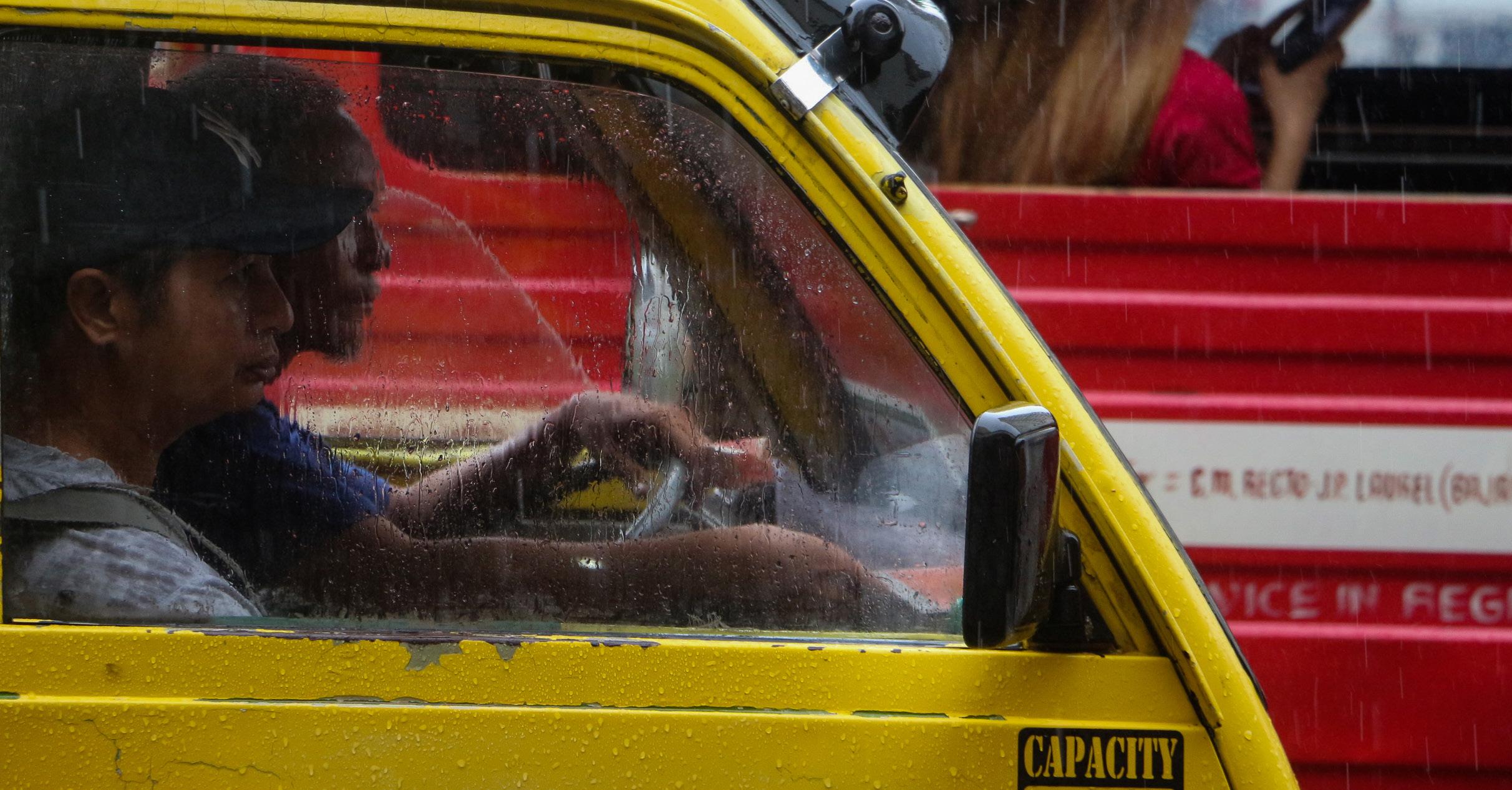
VOL. 69 NO. 3 aPrIL 2024 Member of the College Editors Guild of the Philippines G/F Arrupe Hall, Martin Building, Ateneo de Davao University E. Jacinto St., 8016 Davao City Tel. No. (082) 221-2411 loc. 8332 E-mail Address atenews.addu.edu.ph HIGHLIGHT TRANSITION. Although the consolidation of jeepneys in Davao City is extended until 2025 in preparation for the roll-out of modernized PUVMPs, drivers continue to struggle to make ends meet as the unpredictability of weather patterns persists. PHOTO BY WENDYL A. GERONIMO.
diversions
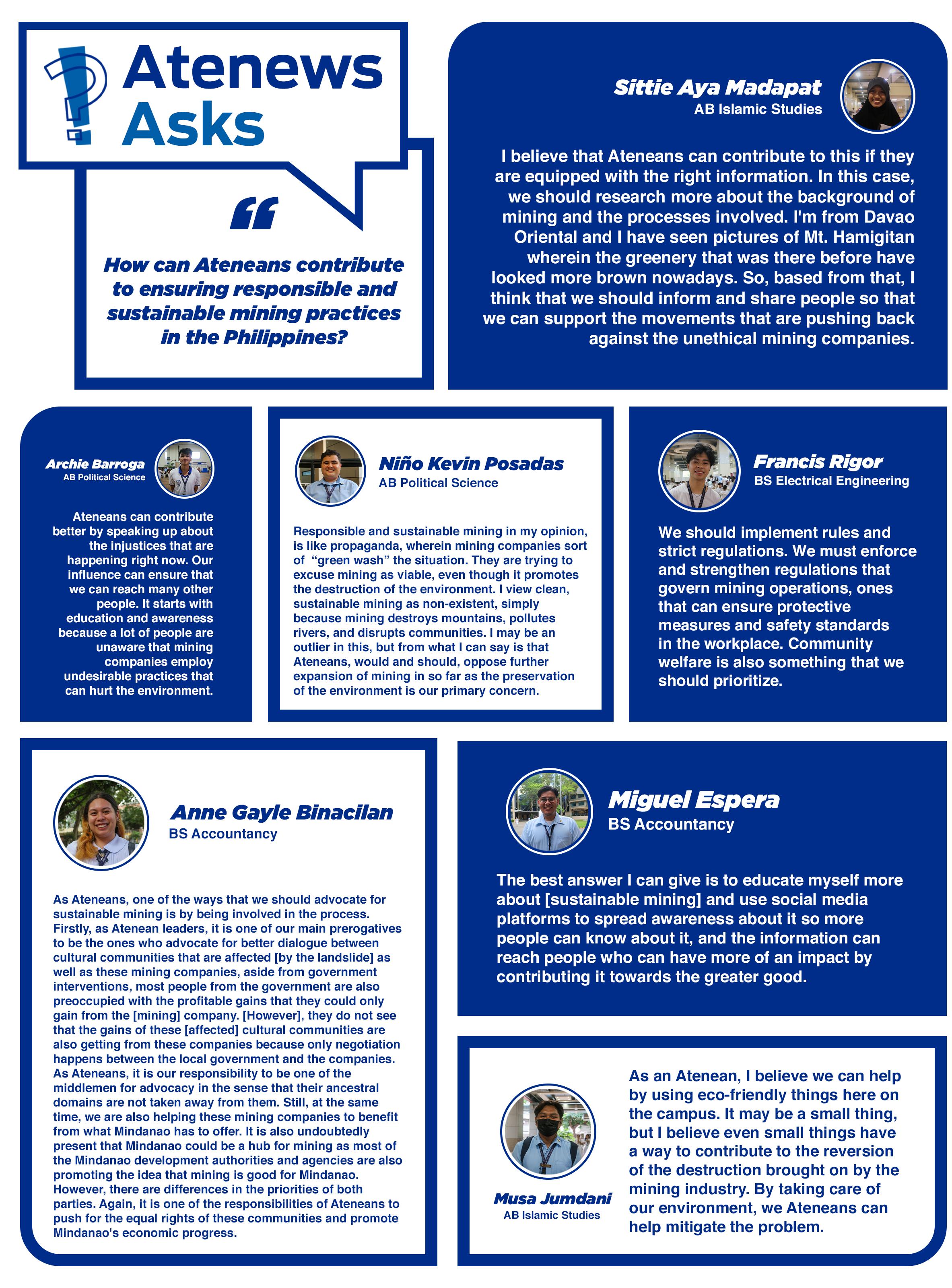 Graphics By Daniel L. Gallego
13 The Official Student Publication of the Ateneo de Davao University END THE SILENCE OF THE GAGGED!
Photos By Edrian Louis F. Nabos
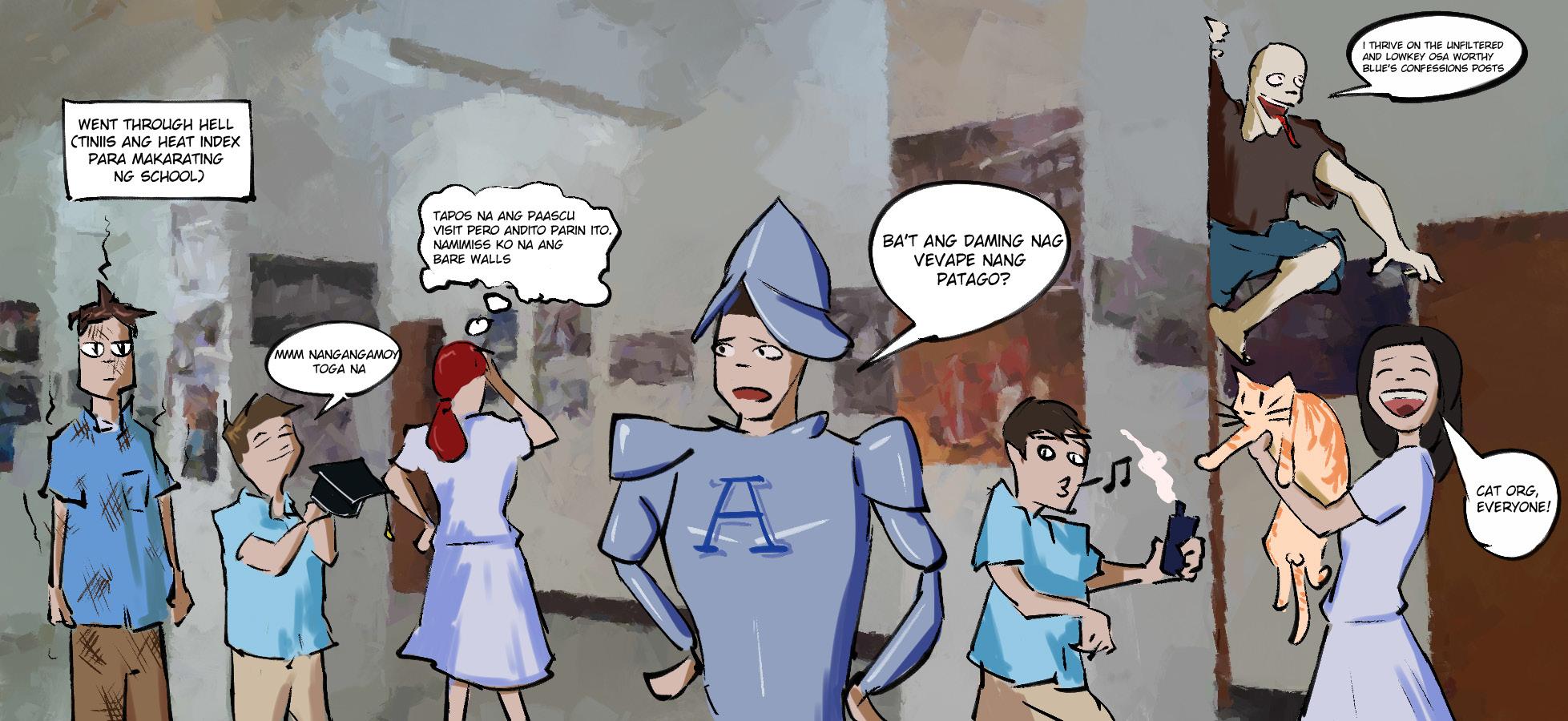

 Baryo Tinyo Illustration By James Alexis P. Realuyo
April 30
Comic By Dominic G. Basalo II
Baryo Tinyo Illustration By James Alexis P. Realuyo
April 30
Comic By Dominic G. Basalo II
VOL. 69 NO. 3 aPrIL 2024 Member of the College Editors Guild of the Philippines G/F Arrupe Hall, Martin Building, Ateneo de Davao University E. Jacinto St., 8016 Davao City Tel. No. (082) 221-2411 loc. 8332 E-mail Address atenews.addu.edu.ph
Graduation Fee Comic By Shanice Angel Yu
Graphics By Earl Geibriel S. Dicipulo
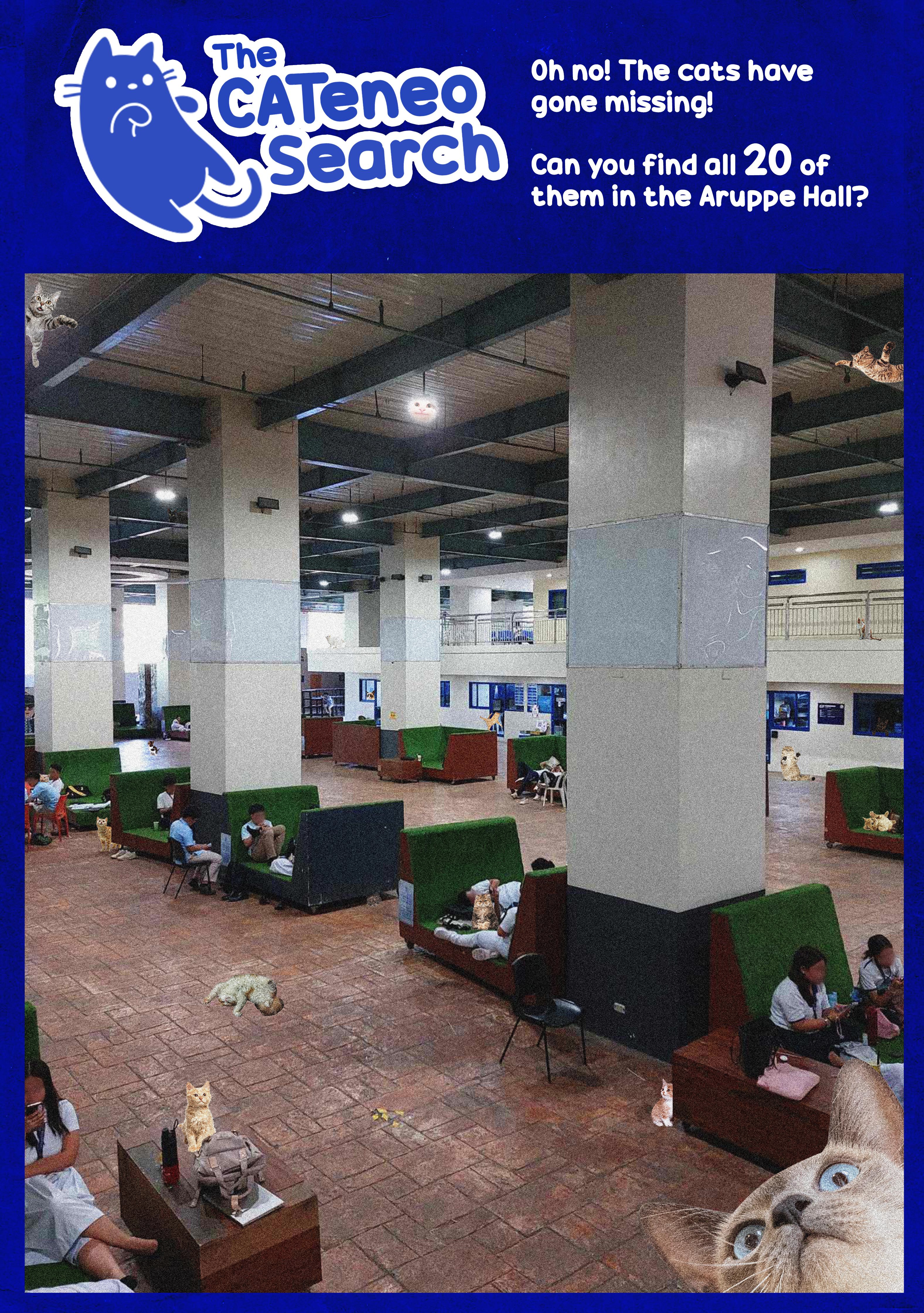
The Official Student Publication of the Ateneo de Davao University END THE SILENCE OF THE GAGGED!
news 15
beyond