
IDEA Mini-Grant Spotlights
2022-2023







The Office of Inclusive Design for Equity and Access would like to thank current and former team members for their support and hard work in coordinating the mini-grants program.
2
Trey Jenkins (he/him) Program Coordinator
Chandra Crudup (she/her)
Associate Dean of IDEA
Mary Mathis Burnett (she/her) Manager of Inclusive Pedagogy
Cynthia Mackey (she/her) Program Coordinator
Positionality Statement
In the IDEA Office we recognize that our social identities and experiences, as well as our position in the Watts College influence our relationship to the work of advancing inclusive practices. Grant making comes with a high degree of power and responsibility.
The IDEA Office is composed of faculty, staff, and students of varying identities including Black, white, queer, and neurodivergent identities. We have done our best to review the outcomes of the IDEA Mini-Grant process through multiple lenses in the Office and always welcome feedback as we continue to reflect on our own relationship to this work and the ways we benefit from, work alongside, and work to change traditional systems of power and oppression.
Office of InclusiveDesignfor Equity & Access
wattsidea@asu.edu


5 6 8 10 12 14 15 16 18 What’s Inside IDEA Office Mini Grants Fall 2022 Awardees Indigenous LeadershipAcademy Institutionalizing Opportunity Seed Exchange ASU Charter Watts College of Public Service and Community Solutions Office of Inclusive Design for Equity and Access (IDEA) Additional Funding Resources

Fall 2022 IDEA Mini-Grants
The IDEAoffice supportsthe advancementof inclusive practice and Watts College’s commitmentto being anti-racist (AR) and antioppressive(AOP)by putting the ASU Charter and Watts Aspirations into action. One way this is achievedis through the Watts IDEAMini Grants, which providemodestseedfundingto employeeswithin the Watts communityto supportbuilding a moreinclusive, equitable,and accessibleWattscommunity. In fall 2022,we received15applications. Each applicationwas reviewed by a committee.Inall, three projects were awarded, totalling $7,510in funding.A fourth projectwas awarded and has deferred until 2023-24dueto speakeravailablity. Guidelinesin the call forproposalsincludedprojects that:
● Create, build, and/or provide space for networking, support, belonging, and mentorship for Watts community members (employees and/or students) that have a common identity
● Create space to deepen understanding of structural inequities by educating and building individual capacity for conversations about race, oppression, and intersecting identities
● Empower participants to share knowledge and resources while developing a safe space engage in advocacy work that leads to systemic change within their units, college, university, or community
● Infuse historical and contemporary content on race, oppression, inclusion, equity, and access into teaching/pedagogy
● Supports a focus on inclusion, equity and access in research projects, policy reform, mentorship programs, group activities, or events:
1) funding for speaker honorariums
2) funding to support small research projects,
3) activity and event funds,
4) community networking/hosting of meetings or forums

Fall 2022 Awardees


6
Three initiatives were awarded mini-grants
01** Indigenous Leadership Academy
KristenTalbert,Staffin Watts College
02* Institutionalizing Opportunity
Joe Kaufman,Staff in the Schoolof PublicAffairs
03* Seed Exchange
Meka Allen,Facultyin Schoolof Social Work
*Newinitiative inWatts
**Formerlyestablishedinitiative inWatts
Indigenous Leadership Academy
Awardees: KristenTalbert, MBA
Award: $2000 Grant awarded for guest speaker honorariums and updatingthe curriculum.

“Each cohort member has a project idea in mind for their community, we just ask that it benefits natives in some capacity. And so, you know, we've had 66 graduates of ILA. And that is 66 different ideas that benefit not just tribal communities, but urban communities.”
66 Total Graduates
8
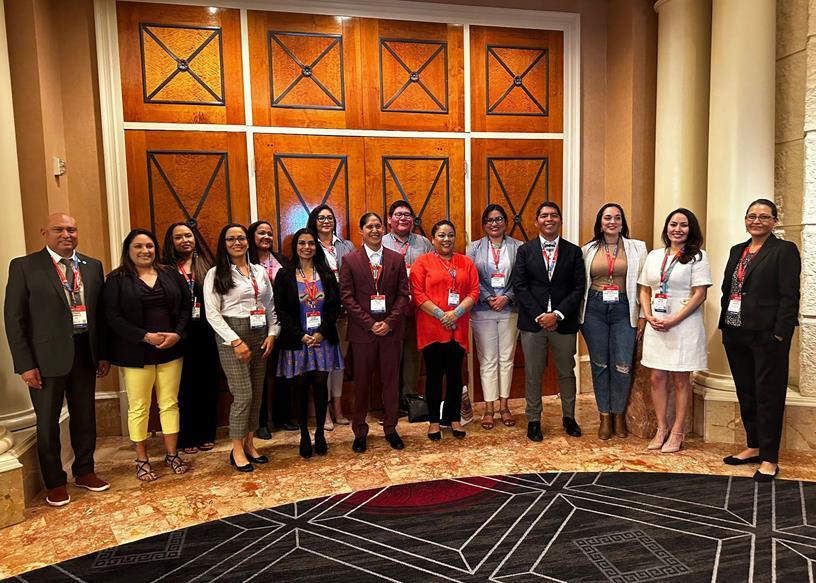
2023 Indigenous Leadership Academy participants
Project Spotlight

Initiative Description
ILA works to build leadership capacity for urban and tribal community members in the Southwest.
“The expanded ILA program will afford participants the opportunity to explore issues and find ways to make a positive difference for Indigenous people in urban and reservation communities within an IDEA lens. The concept of the proposed ILA “IDEA” program is to integrate anti-racism and antioppressionconcepts within each of the ten-ILA module segments. In doing so, participants will be inspired and motivated inhow to execute strategies and lead change intheir communities in consideration of IDEA strategies”

Initiative Impact
Cohort members benefited from guest speakers who have similar shared life experiences.
“We had Chris James, who is the Executive Director of the National Center for American Indian enterprise development. He's from North Carolina…And he's from the rez. He worked for his tribal community for many years. Two people from our cohort were from his same rez. And one of them… is kind of where Chris James was previously. He works for his tribe, in education. He's trying to like expand, but he doesn't know how. And so…it was a really good conversation that we all got to witness between these two. And they had that mutual connection, of having guest speakers from that rez.”
What’s next?
ILA held a strategic planning meeting in February of 2023. Several plans are being explored to expand programming.
“The first ideawas to give presentations to our funder, APS, and their Native American Networking Organization (NANO), hoping that some members would apply to and become a part of the Indigenous Leadership Academy. The second ideawas to start a Tribal leaders academy or a non-profit leadership academy….Lastly, ILA could align our funding proposals to Community Economic Development (CED). [as well as]...show how our work is creating a social impact.”
Institutionalizing Opportunity: Enhancing Pathways to Professional Development and Mentorship for Minoritized Students
Awardee: Joe Kaufman; Dr. Angel Luis Molina; Dr. Yushim Kim; Dr. Maribel Guerrero; Maryjo Douglas Zunk
Award: $1510 Grant awarded for student incentives and materials to convene the listening session.
“...we don't always know the experience of the students. We can identify problems and we can see challenges that we might see. But we don't live their experience. So it's very useful for us to hear from them. So that then we can say, oh, okay…I didn't know about that. And now I know this is an issue. And now you know, we can do something about it.”
1 Listening sessions
19 Student Participants
10
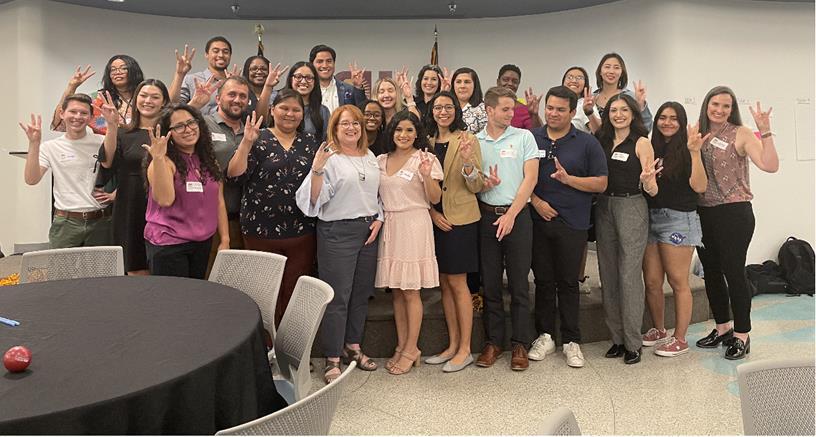
2023 Institutionalize Opportunity participants
Project Spotlight
Initiative Description
SPA hosted a listening session to understand and address student concerns regarding inclusive practices.
“We sought feedback from students, alumni and community partners about their experiences with ASU and SPA. We asked about any barriers they had and solutions they found that worked, or if they did not find solutions.”
“We did a pretty good job of matching a variety of our community partners and alumni and students together and having those discussions and things.”
Initiative Impact
There was a shared sense of openness, transparency, and gratitude in the sharing of student experiences.
“the amount of thank yous that [we] received… was really powerful….We gave them a space where they actually felt like they could share and that they were heard.”
What’s next?
SPA is committed to making the project an annual event.
The SPA submitted and was awarded the George V. Voinovich Public Innovation Challenge Award. “The award comes with $10,000, which would allow us to continue this event for years to come”
“...one of the things that happened as a result of the event is a commitment from the school to have something like this every year,...now we can sort of institutionalize this idea and have an event so that we listen to the students every year and we incorporate that in our plans…we don't just listen once and then decide that we know what's going on. We actually will engage and listen to the students regularly.”
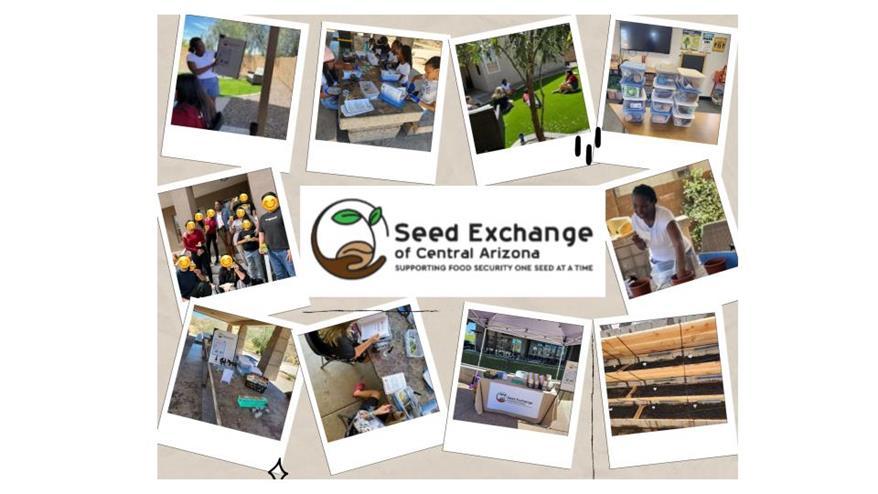
Seed Exchange of Central Arizona Grow
Anywhere program
Awardee: Dr. Meka Allen
Award: $2000 Grant awarded for grow kits and associated costs
“We are gardening as resistance. We see gardening as a way of promoting health with communities that are often overlooked.” Overall the Seed Exchange gave out:
61 Grow kits
145 Pea plant starter kits
300 Sunflower seeds
12
Project Spotlight
Initiative Description
The project was designed to support food insecurity for the South Phoenix community.
“We coordinated with Happy Acres and Florence Crittenton two group homes in the Valley where the majority of children belong to Black, Hispanic, Indigenous and Asian communities. We facilities a workshop with moms of Arizona Democracy Resource Center, a mutual aid organization that advocates and supports justice involved folks. We also participated in the Family Fun Day with Maricopa Village SDA Church, on the Gila River Indian Community.”
The group also participated in Earth Day events including the Hines Property Management Farmers Market.
Initiative Impact
The Seed Exchange was able to disseminate hundreds of seed starting pagackages to communities in Phoenix.
“The Seed Exchange was able to share 61 grow kits to Grow Anywhere workshop participants this year so far. All workshops discussed the devastating impact of food apartheid and how food growing and sharing support wellness.”
“Along with grow kits we shared 145 pea plant starter sacks and 300 hundred sunflower seeds for the community.”
What’s next?
Community support is growing as well as the organization's confidence in soliciting funds..
“We are happy to share we received a generous donation of seeds and volunteers to build out kits…. We also have 100% of our board committed to donating towards 20 kits each, this will bring us 100 more kits this year. We have written for more grants and have been able to schedule out more workshops. Our founder is still committed to providing the resources necessary to continue the work she started in 2020.”
Takeaways
6
The importance of lived experience in inclusive practice
“theamountofthankyousthat[we]received…wasreallypowerful….Wegave themaspacewheretheyactually feltlikethey couldshareand thattheywere heard.” -
Institutionalizing Opportunity
Capturing stories of student and employee’s lived experience is an important first step in cultural and systemic change. We must bear in mind our responsibility to witness one’s story with great care and empathy, and the responsibility to act in transformative ways Borrowing from LatCrit and testimonio, the story is a tool meant to transform and redress harm, injustice, and oppression. It is not a voyeuristic window into someone’s pain (PerezHuber, 2009). It is important to reflect on how to create a space of safety and bravery in sharing one’s story With that in mind, when asking individuals (especially students) to tell their story as a means to gather information for cultural change, consider the following:
● Take time to critically reflect on why the story is needed and to what end.
● Ask yourself, “what will the person gain by sharing their story?”
● Reflect on your own relationship with the project and the people who will share their story. Are there power dynamics to consider? Do people trust you (the team, the institution) to share their authentic experiences?
● Do you have the support of influencers or decision makers to help you implement changes based on what you learn?
● Have a plan to communicate back to those who tell their story on what is being done. This may be multiple communications over time, especially in higher education where change can be slow.
● Set the stage for storytellers. Be clear about what they can share and the expectations. Be clear about why and for what reason their story is necessary. Inform them on how you will share updates following the event.

14
Community building is important now more than ever
“...Itwasareallygoodconversationthatweallgottowitnessbetween thesetwo. Andtheyhadthatmutualconnection,[being from]fromthatrez.”
-Indigenous Leadership Academy
The power of affinity spaces in professional development is seen in many of the Mini Grant projects in the current and previous cycles. Creating a space where individuals can come together through shared experiences, values, and ideas deepens the learning experience When ideating on a project of professional development and/or networking, reflect on the following:
● Affinity spaces are more than simply organizing people by social identity groups.
● Rather, affinity spaces begin with values, goals, beliefs, and actions that are shared and enacted by a group of individuals.
● This does not mean that organizing by social identity groups is wrong, but in thinking about intersecting identities, we can ask ourselves, how can a space be created to reach inclusive goals?
(Gee, 2015; Jones et al., 2016)
14
Don’t be afraid to apply for mini grant funding
“Thisfirstgrantempoweredmetowritemore grants”
-SeedExchange
Writing a grant proposal is an intimidating, yet important experience. We launched IDEA Mini Grants to offer an accessible, modest amount of funding for projects that often go unnoticed, especially for underrepresented groups and topics. Before you tell yourself, “I can’t”, know that the IDEA Office is here to support you, especially when this is your first time. Our next funding cycle is August 2024June 2025. Proposals will be due early May 2024. Start your preparationnow Here are a fewitemsour team can help you with
● Ideageneration
● Facilitating connectionswith potential partners
● Processyour positionalityand relationship to the projectyou want to implement
● Fine tuning logisticsfroman equity perspective
14
ASU Charter
ASU is a comprehensive public research university, measured not by whom it excludes, but by whom it includes and how they succeed; advancing research and discovery of public value; and assuming fundamental responsibility for the economic, social,cultural and overall health of the communities it serves.
14
“
To realize ASU's Charter and undo 400 years of racism in this country, we must all take active steps to dismantle systemic oppression and create inclusive environments in our own communities.”
– Cynthia Leitz, Ph.D., Dean ofWatts College
Watts College of Public Service & Community Solutions
Ensuring Inclusivity in Watts (learn more publicservice.asu.edu/about/ensuring-inclusivity)
In a statement about ensuring inclusivity in Watts, Dean Lietz shared the following:
Engaging inspecific actions that are anti-racist remains essential to our ability to move forward, because adopting an anti-racist lens centers race when considering oppression; it acknowledges and seeks to combat our nation’s long history of violence and discrimination against Black, Indigenous, Latinx and Asian communities. Our commitment to approach our work on a daily basis from an anti-racist perspective must never cease. By saying weare advancing an anti-racist, AND antioppressive approach, it allows us to call out the need to ensure safety, respect, and inclusion of students, staff, and faculty as it relates to multiple identities that can lead to oppression. We are working to advance a truly welcoming and inclusive work and learning environment across the intersecting ways we define ourselves.
As we initiated the implementation of this commitment to an anti-racist and anti-oppressive approach, the most important early action was appointing an associate dean of Inclusive Design for Equity and Access (IDEA). To support her work, a set of graduate students were appointed as IDEA scholars to work with Associate Dean Chandra Crudup to advance initiatives that combat racism and oppressionin the college. These student leaders not only expand our capacity, but they bring perspectives that have been essential to understanding how best to move forward. The creation of this role and office has allowed us to move from talking about diversity, equity, inclusion, and belonging to engaging in actionable steps that allow us to advance this approach.
The IDEA office also created a mini-grant program that invites faculty, staff, and students from across the college to submit proposals for a modest level of seed funding to support ground-up work to help create an inclusive work environment. This, coupled with the Race Talk Circles initiative, has created space for our community to have important conversations about race, a topic that is often avoided.
To advance an anti-racist and anti-oppressive approach in our work and learning environments, we have to first be able to have open and honest conversations about race. All of these efforts have created not just space for conversation, but also ideas that are leading to direct actions that seek to dismantle systems of oppressionand name and address microaggressions that occur in work or learning spaces.
IDEA Office
The IDEA Office strives to advance the college'scommitment to be anti-racist and anti-oppressive.
We do this throughinclusive practice, by embracing the evolving natureof this work to design and support initiatives with Watts’ students,staff, faculty, and community partners
IDEA Office Commitments:
1. EnsuringInclusive& Equitable Environments
Weare committedto ensuring inclusive and equitable learning and working environments for and in collaboration with employees and students of the Watts community.
2. AttuningTowardsTransformativeChange
Weare committedto supporting the ongoing learning process necessaryto createcontinual attunement towards transformative change.
3. Designing InclusivePractices
Weare committedto embedding and designing inclusive practices in our everyday work and within the relationships we build.
4. AccountabilitytoCommunities
Weare committedto holding each other accountable in the quest to build morevibrant, healthy, equitable, and accessiblecommunities.
5. CounteringHarmfulPractices
Weare committedto countering harmful dominant narratives, policies, and procedures with practices that benefit all.
6. AcknowledgingMistakes,Pledgeto Repair
Weare committedto acknowledging where we make mistakes,and we pledge to be transparent about steps towards repair.
7. SupportingNeeds,Addressing Harm,IdentifyingRootCauses
Weare committedto supporting the immediateneeds of individuals or groups, addressing harmful behaviors, and identifying the root causes ofracistand oppressive systems.
8. CelebratingSharedExperiences
Weare committedto celebrating individual uniquenesses and shared experiences.
16
There are a number of resources at ASU that provide financial support for projects and initiatives.
https://inclusion.asu.edu/cci/grants
https://graduate.asu.edu/graduate-insider/apply-now-100knowledge-mobilization-spotlight-grant
https://graduate.asu.edu/current-students/fundingopportunities/awards-and-fellowships/gpsa-graduateresearch-support-program
https://eoss.asu.edu/gpsa/funding/awards/innovation-fellowsprogram
https://eoss.asu.edu/change-the-world
for Campus Inclusion
Grants
Committee
Catalyst
18
Professional Association
Fellowship Program
Graduate Student
Innovation
Graduate College and Graduate Student Professional Association
Graduate Research Support Program
Knowledge Mobilization Spotlight Grant
Graduate College
Outreach and Student Success Change the World
Educational

The IDEA office would liketo thank Watts College for their continued support of the IDEA Mini-GrantProgram.