


Kathryn Sorensen1, Sarah Porter2, Anne Castle3, John Fleck4, Eric Kuhn5, Jack Schmidt6 , Katherine Tara7
As Colorado River supplies and demands reach razor-thin margins, new tools to provide adaptive capacity will play a critical role in sustaining communities across the West. We must reduce our consumption of water, while finding ways to cushion the impact. One of the most innovative tools for doing this, developed over the last two decades, is “Assigned Water” - giving users the ability to store conserved water earmarked for their own future use.
Originally developed as “Intentionally Created Surplus” in the 2007 Colorado River Interim Guidelines, Assigned Water has been revised and expanded through U.S.Mexico Treaty Minutes and as part of the 2019 Drought Contingency Plan. While conceptually simple and demonstrably valuable - a savings bank for conserved water - it is crucial to get the policy tools right as Colorado River management rules evolve.
For agencies granted access to the tool, Assigned Water provides important adaptive capacity to prepare for and manage shortfalls on a volatile river with shrinking supplies. But nearly two decades of operational experience also have exposed unintended consequences. With Assigned Water likely to play a critical role in basin management going forward - including its potential expansion to the Upper Colorado River Basin - it is important to review the strengths of the existing program, and essential lessons learned, to guide the development of river management policies after the current operating rules expire at the end of 2026.
1 Director of Research, Kyl Center for Water Policy, former Director, Phoenix Water Services
2 Director, Kyl Center for Water Policy
3 Senior Fellow, Getches-Wilkinson Center, University of Colorado Law School, former US Commissioner, Upper Colorado River Commission, former Assistant Secretary for Water and Science, US Dept. of the Interior
4 Writer in Residence, Utton Transboundary Resources Center, University of New Mexico
5 Retired General Manager, Colorado River Water Conservation District
6 Director, Center for Colorado River Studies, Utah State University, former Chief, Grand Canyon Monitoring and Research Center
7 Staff Attorney, Utton Transboundary Resources Center, University of New Mexico
Assigned Water allows some users to either conserve water that would have been used, import some categories of tributary water to the mainstem, or to fund system improvements to conserve water that would otherwise have been lost to inefficiencies. This water is then earmarked for the creating agencies’ use, sitting outside of the priority system through which the rest of the Colorado River’s water is allocated. Agencies can pay users to take out their lawns, or fallow farm fields, banking the saved water for future use. By planning ahead, water agencies secure a reliability hedge against shortages as the river shrinks.
But at a time when overall water supplies are declining, Assigned Water creates a category of “private water,” available only to specific users, while remaining water allocated to all users under the existing priority system continues to shrink.
Assigned Water created a tool to overcome the “use it or lose it” problem that left little incentive for water agencies to conserve. Its usefulness and subsequent expansion have led to the existence of 3.5 million acre feet now are stored in Lake Mead, representing the bulk of the available water currently in the reservoir.
By keeping Lake Mead levels higher than they otherwise would have been, Assigned Water delayed formal shortage declarations in the Lower Colorado River Basin. While this was an intended benefit, it has had the practical effect of putting off water use reductions to the detriment of reservoir storage.
Although current rules apply some reductions to Assigned Water accounts, they often fail to fully account for actual evaporation. This results in a subsidy for Assigned Water holders at the expense of water available to everyone else.
Assigned Water creates incentives for agencies to focus their conservation efforts primarily on programs that benefit their own users, potentially at the expense of the kind of broader efforts that will ultimately be needed to bring Colorado River Basin use into balance with physical supply. We must remember that Assigned Water does not permanently reduce the use of a quantity of water; instead it stores it for later, simply deferring that use to the future.
Inequitable Access
Assigned Water is currently available only to a select group of major Colorado River water agencies, depriving other users of the program's benefits.
Operational Neutrality
Assigned Water should not be included in the reservoir levels used to make shortage declaration and determine reservoir operations.
System Assessment
Agencies granted access to Assigned Water should pay a “system assessment” for the privilege. This mechanism would credit their earmarked storage account for a portion of the conserved water while converting the remainder to “System Water,” helping to rebuild storage and meet broad Basin needs.
Evaporation Assessment
Accounting for evaporation should use the best available science, to avoid subsidizing Assigned Water accounts at the expense of the rest of the Basin’s water users.
A wider range of users should be given the opportunity to participate in and benefit from Assigned Water tools.
For more than a century of development, Colorado River governance has lived under a tension between individual communities’ desires to use more water and the collective need to balance basin-scale supply and use for the benefit of the region as a whole. Incentives favoring individual communities at the expense of the collective good have brought us to the edge of the current crisis.
Going forward, Assigned Water can provide a crucial management tool, but the policies we use to implement it must find the balance between individual benefit and collective good.
● Priority Water: Water diverted within the U.S. generally under the prior appropriation system of water allocation.
● Mexican Water: Water that flows past the international border into Mexico pursuant to the 1944 U.S.-Mexico treaty
● Assigned Water: Water resulting from water use reduction programs that is stored in Colorado River Basin reservoirs earmarked for the specific use of the users who created it, outside the normal priority system. Assigned water functions as a sort of private water savings account for those agencies granted the privilege of using the tools.
● System Water: System Water: The collective term for all water in the reservoirs, including Priority, Mexican, and Assigned Water.
● Intentionally Created Surplus: The term used for the Assigned Water initially created under the 2007 Colorado River Interim Guidelines, which became the prototype for similar programs that followed.
● System Conservation: Programs that fund reductions of water use to benefit the Colorado River Basin as a whole by creating System Water for rebuilding reservoir storage or general use under the priority system rather than being allocated to the accounts of specific users.
This paper addresses issues related to current and potential future forms of Assigned Water in the Colorado River system. Currently, Assigned Water is water stored in Lake Mead reservoir that can be delivered independently of the prior appropriation system of water allocation in the Lower Division and that is held in Lake Mead by the Secretary of the Interior (Secretary) for the benefit of a specific entity. Assigned Water is commonly associated with Intentionally Created Surplus or ICS under the 2007 Record of Decision for guidelines for operations at Lake Powell and Lake Mead8 (2007 Guidelines) and under the 2019 Drought Contingency Plan9 (DCP). Assigned Water also includes delayed water deliveries held for the benefit of the Republic of Mexico that can be delivered subsequently in amounts exceeding the annual U.S. treaty obligation to Mexico.10 There are several different categories of Assigned Water, each with unique terms and conditions for creation, storage, and delivery.
Although Assigned Water does not currently exist in Lake Powell or other Upper Division reservoirs, there are proposals to develop an Assigned Water program in the Upper Division.11
Assigned Water programs are inherently complex, and not all of the implications of these programs are readily apparent. In raising these issues, we recognize that there may be important considerations we have overlooked or aspects we have misunderstood. The ideas presented here are intended to spark constructive debate and ongoing discussion that will strengthen the design of future Assigned Water programs.
8 U.S. Department of Interior. (2007). Colorado River Interim Guidelines for Lower Basin Shortages and Coordinated Operations for Lake Powell and Lake Mead: Record of Decision. (2007 Guidelines)
9 U.S. Department of the Interior. (2019). Lower Basin Drought Contingency Plan Agreement, Exhibit 1: Lower Basin Drought Contingency Operations. (LB DCP Exhibit 1).
10 The current U.S. treaty obligation to Mexico on the Colorado River is 1.5 million acre-feet per year. Treaty deliveries and Mexican Assigned Water are capped at 1.7 million acre-feet per year, not including water bypassed to the Cienega de Santa Clara under Minute 242. Water also flows to Mexico in excess of treaty obligations.
11 U.S. Department of Interior. (2026). Draft Environmental Impact Statement Post-2026 Operational Guidelines and Strategies for Lake Powell and Lake Mead. (2026 DEIS)
There are many demands on the Colorado River. The water supply provided by the river is distributed among the Lower Division states of Arizona, California, and Nevada and the Upper Division states of Colorado, New Mexico, Utah, and Wyoming, as well as the Republic of Mexico. There are three broad categories of the Colorado River’s water: water diverted within the U.S. generally under the prior appropriation system of water allocation (Priority Water), water that flows past the international border into Mexico pursuant to the 1944 treaty (Mexican Water), and water held in Lake Mead for the benefit of a specific entity (Assigned Water). All three types of water collectively are Colorado River System Water (System Water).
It is well understood that the combined demands for System Water have long exceeded the watershed’s natural production of stream flow.12 Excluding the Gila River tributary, demands include irrigated agriculture (59%), riparian and wetland use (16%), municipal, commercial and industrial (13%) and reservoir evaporation (12%).13 As a result of the long-term demand and supply imbalance, System Water stored in Lake Powell and Lake Mead is at near-historic lows.14
Colorado River water managers have created many innovative tools to address water management issues generally and reservoir declines more specifically. Of these, Assigned Water is one of the most impactful. Assigned Water programs allow intentionally conserved water to remain in Lake Mead and become available for delivery in a subsequent year, creating flexibility in the delivery of Colorado River water that is of great value. Assigned Water programs also enable transfer of water from higher priority entitlement holders who are willing to sell to lower priority entitlement holders who are willing to buy, providing junior-priority users, and particularly municipal agencies, enhanced ability to maintain reliable supplies.
Assigned Water is a valuable tool that provides crucial flexibility in deliveries as well as the potential for beneficial transactions among sectors, Tribes, states and even countries. Assigned Water programs hold promise as an effective tool to address challenges on the Colorado River after the expiration of the 2007 Guidelines. Even so, Assigned Water has significant implications for Priority Water and for management of the System Water more broadly. Here, we discuss how Assigned Water in its current form can impact Priority Water, and we consider means through which Assigned Water can be leveraged to improve stores of System Water for the benefit of all who depend
12 Schmidt, J. C. et al (2023). The Colorado River water crisis: its origin and the future. WIREs Water: e1672.
13 Richter, B. et al (2024). New water accounting reveals why the Colorado River no longer reaches the sea. Commun Earth Environ 5, 134 (2024). https://doi.org/10.1038/s43247-024-01291-0
14 Schmidt, J. et al. (2025). Colorado River Reservoir Storage – Where We Stand. Colorado River Insights, 2025 Dancing With Deadpool Colorado River Research Group.
on the Colorado River. Well-designed Assigned Water programs can improve Colorado River management, but poorly designed programs will impact Priority Water in ways that can create conflict. Careful design of Assigned Water programs for the post-2026 operating guidelines ensures these programs are productive for System Water and not harmful to Priority Water.
There appears to be recognition of the potential impacts to Priority Water associated with existing Assigned Water.15 Discussions regarding the use of Assigned Water after expiration of the 2007 Guidelines include concepts to address some of these concerns. These conversations also include the possibility of developing an Assigned Water program in the Upper Division. The seven Basin States continue to struggle to reach an agreement for the operations of Lake Powell and Lake Mead after expiration of the 2007 Guidelines. However, it seems clear that if an agreement is reached, it will include new Assigned Water programs. Indeed, in the draft environmental impact assessment released by Reclamation on January 9, 2026, Assigned Water plays a prominent role.16
If the states do not reach agreement and the Secretary imposes operating rules on the Basin, agencies that currently hold Assigned Water in Lake Mead retain access to their water through 2036 or 2056 depending on the specific type of Assigned Water held. However, the creation of some types of Assigned Water would likely no longer occur because requisite forbearance agreements have expired.17 There is much uncertainty, and it is in this context that we offer ideas for productive design of future Assigned Water programs.
Rules related to Assigned Water are complex and have evolved since Assigned Water was first established under the 2007 Guidelines. Some of the basic concepts underlying existing Assigned Water programs are summarized here because they help inform considerations for future design.
Assigned Water is currently created under the Secretary’s authority to allocate surplus water in the Lower Division and under treaty minutes with Mexico. Assigned Water in the Lower Division can be created in many different ways, including:
• By intentionally decreasing use of water for which there is a history of consumptive use (Extraordinary Conservation ICS),
15 Ott, L. et al. (2025, October 8). Letter to Governor Katie Hobbs. 16 2026 DEIS.
17 Kyl Center for Water Policy. (2025). Arizona Guide to Expiration of the 2007 Operating Guidelines for Lakes Powell and Mead
• By making contributions of capital for use in projects designed to realize system efficiencies that save water that otherwise would be lost from the mainstem in the U.S. (System Efficiency ICS),
• By introducing certain tributary water into the Colorado River mainstem (Tributary ICS),
• By introducing non-Colorado River water supplies into the Colorado River mainstream under certain conditions (Imported ICS),
• By paying for water conservation or efficiency projects in Mexico (Binational ICS),
• By deferring water deliveries to Mexico as mutually agreed via treaty minutes (e.g. Intentionally Created Mexican Allocation, Mexican Water Reserve, etc), and
• By converting Extraordinary Conservation ICS, system Efficiency ICS, or Binational ICS into Drought Contingency Plan ICS (DCP ICS).
Entities that have a contract with the Bureau of Reclamation (Reclamation) under Section 5 of the Boulder Canyon Project Act18 to divert, store, or deliver mainstream Colorado River water in the Lower Division (a Section 5 Contractor) order water from a common supply. If one Section 5 Contractor chooses to order less than its priority entitlement under its contract, the unused water is made available in priority to other Section 5 Contractors. Agreements among various Section 5 Contractors not to order another entity’s unused water are necessary to store Assigned Water in Lake Mead. Section 5 Contractors and other necessary parties have entered into forbearance agreements.19 Mexican Assigned Water is stored in Lake Mead pursuant to treaty minutes.
Existing forms of Assigned Water are assessed annual evaporative losses that range from 0-3%; 0% for Extraordinary Conservation ICS under shortage conditions, 0% for System Efficiency ICS and 3% for most other forms.20 Annual evaporative losses were
18 Boulder Canyon Project Act, Pub. L. No. 70-642, 45 Stat. 1057 (1928), codified at 43 U.S.C. § 617d (1928). (Boulder Canyon Project Act).
19 State of Arizona, Palo Verde Irrigation District, Imperial Irrigation District, City of Needles, Coachella Valley Water District, Metropolitan Water District of Southern California, Southern Nevada Water Authority, and Colorado River Commission of Nevada. (2007). Lower Colorado River Basin Intentionally Created Surplus Forbearance Agreement. (2007 Forbearance Agreement).
20 2007 Guidelines; LB DCP Exhibit 1; International Boundary and Water Commission, United States & Mexico. (2010). Minute No. 318: Adjustment of delivery schedules for water allotted to Mexico for the years 2010 through 2013 as a result of infrastructure damage in Irrigation District 014, Río Colorado, caused by the April 2010 earthquake in the Mexicali Valley, Baja California (Minute 318). https://www.ibwc.gov/wpcontent/uploads/2023/03/Min_318.pdf. (Minute 318); International Boundary and Water Commission, United States & Mexico. (2012). Minute 319: Interim international cooperative measures in the Colorado River basin through 2017 and extension of Minute 318 cooperative measures to address the continued effects of the April 2010 earthquake in the Mexicali Valley, Baja California. https://www.ibwc.gov/wpcontent/uploads/2012/11/Minute_319.pdf. (Minute 319).; International Boundary and Water Commission,
first established through the Record of Decision for the 2007 Guidelines and through Mexican treaty minutes but were subsequently changed via federal legislation implementing the DCP and a subsequent Mexican treaty minute. Generally, no evaporative loss is assessed under shortage conditions. The average effective evaporation assessment (evaporative losses assessed against remaining balances each year) was 1% between 2006 and 2024.21
Some categories of Assigned Water were assessed a one-time deduction of 5%, meant to build additional System Water storage in Lake Mead. Other categories were exempted from these deductions. Under the DCP, a one-time deduction was taken on certain Assigned Water such that total assessed losses including system assessment and evaporation totaled 10% cumulatively through 2026. Of approximately 5.5 million acre-feet of Assigned Water creation between 2006 and 2024, deductions of approximately 340,000 acre-feet were assessed, totaling six percent.22
Under the 2007 Guidelines, a total of 2.7 million acre-feet of Extraordinary ICS, Binational ICS and DCP ICS as well as a total of 1.5 million acre-feet of Mexican Assigned Water may be accumulated in Lake Mead,23 but an unlimited volume of System Efficiency ICS can be created. As of the end of 2024, approximately 3.5 million acre-feet of Assigned Water existed in Lake Mead.24
Deliveries of Assigned Water in the Lower Division are limited to 200,000 acre-feet/year for Mexico, 300,000 acre-feet/year each for Arizona and Nevada and 400,000 acrefeet/year for California. Deliveries of Assigned Water are permitted when Lake Mead’s elevation is above 1025 feet. Between Lake Mead elevation 1025 and 1045, the conversion of extraordinary conservation ICS to DCP ICS counts toward the delivery limit for the Lower Division states.25 For context, the elevation of Lake Mead on January 19, 2026 was 1064.37 feet.
United States & Mexico. (2017). Minute No. 323: Extension of cooperative measures and adoption of a binational water scarcity contingency plan in the Colorado River Basin https://www.usbr.gov/lc/region/g4000/4200Rpts/DecreeRpt/2019/48.pdf. (Minute 323).
21 Calculated as total evaporation assessment over remaining balances for all forms of Assigned Water, averaged over the years 2006-2024. Evaporation assessment does not include the evaporation portion of the assessments under the Lower Basin DCP, which was calculated on certain forms of Assigned Water such that total assessed losses including system assessment and evaporation totaled 10% through 2026. Those assessments are included in the calculation of total deductions described in the next paragraph.
22 U.S. Bureau of Reclamation. (2006-2024). Lower Colorado River Water Accounting Report
23 2007 Guidelines.
24 U.S. Bureau of Reclamation. (2006-2024). Lower Colorado River Water Accounting Report. (LB Accounting Report).
25 2007 Guidelines. Beginning January 1, 2027 Mexico can only take delivery of its Assigned Water when Lake Mead’s elevation is above 1,075 feet. Minute 323; LB DCP Exhibit 1.
The amount of Assigned Water in Lake Mead is included in calculations of Lake Mead’s elevation and active storage for the purpose of determining prescribed releases from Lake Powell and for the purpose of declaring shortages under the 2007 Guidelines. However, the amount of Assigned Water in Lake Mead is not included in determination of a Quantified Surplus under the 2007 Guidelines.26
Assigned Water creates extremely valuable flexibility in water deliveries; intentional, consumptive-use water savings in one year can be stored during subsequent years and delivered at some future time. As an example, the Metropolitan Water District of Southern California (MWD) developed Assigned Water in Lake Mead at least in part so that it could take delivery of an amount of Colorado River water greater than it could otherwise receive in years in which allocations from California’s State Water Project are very low and additional water is necessary to meet its customers’ demands. Assigned Water programs allow water with a history of consumptive use to be forborne, saved in the reservoir, and delivered in a future year. In contrast, under the use-it-or-lose-it nature of water rights in the prior appropriation system of water allocation, users have no incentive to conserve because unused water is handed off without compensation to the next most senior water user in the system.
In another example of the value of Assigned Water programs, under the DCP Tribes and cities in central Arizona voluntarily left water in Lake Mead that they would have otherwise used and in exchange Assigned Water owned by the Central Arizona Water Conservation District (CAWCD) was made available to these entities.27 Without the use of Assigned Water for this purpose, it is not clear that the Arizona Legislature would have approved the DCP.
Assigned Water programs also create flexibility for transactions between sectors and even countries in that one entity can pay another entity to create the water savings. Much of MWD’s development of Assigned Water was based on water savings from arrangements with California irrigation districts.28 CAWCD, MWD and the Southern
26 2007 Guidelines.
27 Entities could select dollar compensation or Assigned Water, some chose money. Arizona Department of Water Resources; Arizona Water Banking Authority; Central Arizona Water Conservation District; United States, Bureau of Reclamation. (2019). Arizona Lower Basin Drought Contingency Plan Framework Agreement. https://waterbank.az.gov/sites/default/files/2022-02/5AZLBDCPFrameworkAgreementEXECUTIONVERSION4836-3419-5350v.1.pdf
28 The Metropolitan Water District of Southern California & Palo Verde Irrigation District. (2004). Forbearance and Fallowing Program Agreement. https://www.pvid.org/docs/MWDDocs/Landowner%20Agreement%200820-04%20rh.pdf ; Lamdin, L. (2026). Personal communication.
Nevada Water Authority (SNWA) paid for projects in Mexico and received Binational ICS in return.29
Delivery flexibility and water transfers between economic sectors are extremely valuable tools that should be preserved in any future Assigned Water programs.
If designed properly, future Assigned Water programs in the Upper Division could help the Basin states reach agreement for post-2026 operation of Lake Powell and Lake Mead and avoid Colorado River Compact (Compact) litigation, as well as potentially provide environmental and hydropower benefits.
Current forms of Assigned Water in Lake Mead have some substantial drawbacks.30 To understand these drawbacks, it is helpful to think again of the “pools” of water in Lake Mead and how they interact: Priority Water, Mexican Water and Assigned Water.
Any Mexican Water delivery diminishes the amount of System Water available for Priority Water and Assigned Water since the obligation of deliveries to Mexico is, in effect, the first priority for deliveries of System Water. This is why the U.S. government and other stakeholders in the priority system have made efforts to reduce inadvertent deliveries to Mexico in excess of treaty obligations. It is also why the CAWCD, which delivers some of the lowest priority water in the Lower Division (and whose access to Priority Water is cut first when there is inadequate reservoir storage of System Water), has pushed for the development of replacement water to satisfy Mexican Water delivery obligations via the Yuma Desalting Plant.31 International treaty obligations have a higher priority than any delivery obligation for System Water within the U.S.
The relationship between Priority Water and Assigned Water is less clear. Assigned Water as designed under the 2007 Guidelines and the DCP impacts Priority Water in subtle ways. There is some ambiguity regarding how Priority Water and Assigned Water relate to each other under low reservoir conditions. These impacts are discussed in
29 U.S. Department of the Interior, U.S. Section of the International Boundary and Water Commission, State of Arizona, State of Colorado, State of Nevada, State of New Mexico, State of Utah, State of Wyoming, Upper Colorado River Commission, Central Arizona Water Conservation District, Coachella Valley Water District, Colorado River Board of California, Metropolitan Water District of Southern California, Southern Nevada Water Authority (2012). Memorandum of Agreement on the Implementation of Minute No. 319.
30 Sorensen, K., Porter, S., & Fleck, J. (2024). Enduring Solutions on the Colorado River. Kyl Center for Water Policy, Morrison Institute for Public Policy, Arizona State University & Utton Transboundary Resources Center, University of New Mexico. https://morrisoninstitute.asu.edu/sites/g/files/litvpz841/files/202408/Enduring%20Solutions%20on%20the%20Colorado%20River2.pdf ; Sorensen, K., Porter, S., & Kuhn, E. (2025). Floating Pools & Grand Bargains. Kyl Center for Water Policy, Morrison Institute for Public Policy, Arizona State University.
31 CAP and the water-energy nexus: An interview with David Modeer. Irrigation Leader Magazine, 15(6). http://irrigationleadermagazine.com/flipbooks/2014/june/IL_June_2014.pdf
more detail below, but in short, Assigned Water has the potential to diminish the amount of Priority Water otherwise available.
After consideration of the various aspects of Assigned Water programs and the incentives and disincentives they have created in the past, we offer the following recommendations for future such programs. Please note that where specific numeric quantities are identified in these recommendations, we consider these to be examples of the concept, not necessarily the only correct number.
Perhaps most important among the complications of existing forms of Assigned Water is that it has a direct impact on operations at Lake Powell and Lake Mead.
Assigned Water ‘counts’ in Lake Mead for the purpose of determining reservoir elevations that trigger shortages under the 2007 Guidelines. Counting Assigned Water in Lake Mead for declaring shortages props up the amount of water in the reservoir with water that is not Priority Water and delays declarations of shortages to Priority Water.32 This design under the 2007 Guidelines was intentional, and such delays were touted as a benefit,33 but delaying the declaration of shortage creates winners and losers among those who depend on Priority Water.
Theoretically, in a reservoir system that is steadily declining, delaying the imposition of shortages allows more water to flow to lower-priority entitlement holders in the short term and leaves less water available for senior entitlement holders over the long-term As an example, the existence of Assigned Water delayed shortage cuts in central Arizona.34 As a result, the entities with access to the lowest priority water on the Central Arizona Project (CAP) system (called “Excess” and “Ag Pool” water), including the Arizona Water Banking Authority, the Central Arizona Groundwater Replenishment District (a program within the CAWCD) and many irrigation districts in the CAP service territory, received water for more years than they would have without the presence of Assigned Water in Lake Mead. Delay of shortage created a windfall for these entities, but as a result there is less System Water in storage in Lake Mead than there would have been had deeper shortages been implemented in the absence of Assigned Water in the reservoir.35 Arguably, the result of less System Water in storage in Lake Mead
32 Lamdin, L., & Mead, A. (2025). Intentionally created surplus: Boosting Colorado River reservoirs by two million acre-feet. Metropolitan Water District of Southern California. (Lamdin, ICS).
33 2007 Guidelines
34 Lamdin, ICS.
35 Lamdin, ICS.
may have been or in the future may be less Priority Water availability for those who enjoy higher priority water within the CAP system (called “NIA,” “M&I” and “Indian” water priorities). This dynamic has not played out to the detriment of those in Arizona on the main stem who rely on higher priority water (Priority 1, 2 and 3), but some Yuma-area farmers have expressed concerns that it may.36
In addition, the entity that is impacted by delaying Priority Water shortages in the Lower Division may not be the same entity that owns and benefits from Assigned Water availability.
Most importantly, delaying Priority Water shortages with Assigned Water not available in the priority system functions as a loan against the water stored in Lake Mead. Delaying shortage functions as a debit (delivery of Priority Water) potentially without a corresponding credit (inflow). If enough System Water fills the reservoir to cover the debits over time, the loan is paid. However, System Water stores have been in general decline over time. A default situation (not enough system water to cover all delivery obligations) by treaty cannot impact Mexican Water. Whether such a default would impact Priority Water or Assigned Water is unclear.
Taken to its logical extreme, Assigned Water that is not operationally neutral can effectively replace Priority Water if System Water storage continue to decline.37 This possibility is playing out even now; at the end of 2024, there was approximately 3.5 million acre-feet of Assigned Water in Lake Mead38 and as of January 14, 2026, only approximately 4.24 million acre-feet of water in total above elevation 1000.
• Recommendation: In any newly developed operational guidelines for Lake Powell and Lake Mead, volumes of Assigned Water created after 2026 should be invisible for purposes of determining shortage conditions.39
Assigned Water does not count toward the determination of a Quantified Surplus40 under the 2007 Guidelines41 and should be invisible to surplus determinations other than for flood control releases in any future Assigned Water program. Although spills seem unlikely, the order of spill in times of flood releases should nevertheless be
36 Ott, L. et al. (2025, October 8). Letter to Governor Katie Hobbs.
37 Assigned Water cannot be delivered below elevation 1,025’ in Lake Mead but this restriction affords little protection to Priority Water over the long-term if reservoirs continue to decline.
38 LB Accounting Report.
39 The condition of invisibility is sometimes referred to as “operational neutrality” and the Assigned Water is referred to as being in a “top bank” or a “floating pool.”
40 A Quantified Surplus occurs “In years when the Secretary determines that water should be delivered for beneficial consumptive use to reduce the risk of potential reservoir spills based on the 70R Strategy”: 2007 Guidelines.
41 2007 Guidelines.
addressed. Under the 2007 Guidelines, Quantified and Domestic Surpluses are delivered before Assigned Water, indicating that Assigned Water spills later and therefore is better protected from spilling. The order of spill matters because if Assigned Water spills last, less Priority Water accumulates in the reservoir during large flow events.
• Recommendation: Other than for flood control releases, volumes of Assigned Water created after 2026 should be invisible for purposes of determining surplus in Lake Mead.
• Recommendation: Volumes of Assigned Water in Lake Mead and Lake Powell created after 2026 should spill before all other water, a condition that also functions as a de-facto limit on total accumulation of Assigned Water.42
Conditions Under Which Water is Released from Lake Powell into Lake Mead
Assigned Water is included in calculations of Lake Mead water levels relative to Lake Powell for the purpose of determining prescribed releases from Lake Powell under the 2007 Guidelines.43 This condition means that releases from Lake Powell are reduced because of the existence of Assigned Water in Lake Mead. For example, MWD found that releases from Lake Powell to Lake Mead would have been 658,000 acre-feet greater between 2007 and 2024 without the existence of Extraordinary Conservation ICS in Lake Mead.44 This likely helped protect critical infrastructure at Glen Canyon Dam. Here again, the end result was less Priority Water available in the Lower Division. Thus, the condition of non-neutrality creates winners and losers.
• Recommendation: In any newly developed operational guidelines for Lake Powell and Lake Mead, volumes of Assigned Water created after 2026 and held in Lake Mead or Lake Powell should be invisible for purposes of calculating annual releases from Lake Powell.45
It is important to note that Assigned Water is not a construct under the Compact. Compact obligations are blind to the legal flavor of water delivered from Lake Powell. If Assigned Water is going to exist in the Upper Division in the future, it will be essential for the states to agree on how to account for Assigned Water delivered between the Divisions under the Compact.
42 For example, non-project beneficiary parties are allowed to store water in excess capacity space in Pueblo Reservoir, a component of the federal Fryingpan- Arkansas project, but it always spills first. See Bureau of Reclamation, Final Programmatic Environmental Assessment for Pueblo Reservoir Temporary Excess Capacity Storage Contracting Program, Dec. 2018.
43 2007 Guidelines
44 Lamdin, ICS.
45 This is not an argument that releases from Lake Powell should continue at the same levels as described in the 2007 Guidelines, but rather that in any new operating system that balances the burden of reductions equitably between the two basins, Assigned Water should not be considered in determining that balance.
Reservoir evaporation is a major consumptive use in both basins. The presence of Assigned Water increases the surface area of reservoirs thereby increasing the total evaporation. If Assigned Water is not assessed an annual evaporation rate at least equal to its incremental contribution, the increased evaporation is by default assessed against Priority Water, since Mexican Water deliveries are always held harmless by treaty.46 In other words, Assigned Water evaporation assessed at a rate lower than real evaporation in Lake Mead diminishes the amount of Priority Water available in the Lower Division. Should Assigned Water be stored in Lake Powell under a future program, evaporation assessed at a rate less than real evaporation in Lake Powell diminishes the amount of System Water available to meet Compact deliveries from the Upper to Lower Division and also diminishes the amount of Priority Water available in the Lower Division.
In addition, Mexican treaty obligations are met at the border and while Mexican Assigned Water is subject to evaporation losses, Mexican Water is assessed neither evaporation nor transit losses. Since these real losses are also not assessed against Assigned Water, by default these losses are assessed against Priority Water.
• Recommendation: Reclamation should establish evaporation coefficients applicable to calculation of evaporation caused by storage of Assigned Water. These evaporation coefficients should be based on on-going monitoring and best available science and appropriately funded. Evaporation coefficients should be reassessed every five years, especially in light of a changing climate.
• Recommendation: Future volumes of Assigned Water in any reservoir should be assessed a realistic and conservatively high annual evaporative loss based on these coefficients and on the amount of Assigned Water in storage.
• Recommendation: Future deliveries of Assigned Water should be assessed transit losses where appropriate. Transit losses should also be estimated based on best available science, updated by monitoring and scientific studies, and revised every five years.
• Recommendation: Future volumes of Assigned Water in any reservoir should proportionately share the evaporative (and transit) losses that occur due to Mexican Water delivery obligations (other than for Mexican Assigned Water, which should bear its own losses) and should be assessed a realistic and conservatively high annual evaporative loss based on these coefficients and due to Mexican Water delivery obligations. The evaporative assessment should reflect the proportionate share of Assigned Water and Priority Water in storage.
46 Mexican forms of Assigned Water are assessed evaporative losses in non-shortage conditions but Mexican Water is not.
• Recommendation: Evaporative losses should be assessed under all conditions, including shortage.
Assigned Water exists physically in reservoirs, even if it is operationally neutral.
• Recommendation: Deliveries of Assigned Water should be restricted if necessary to protect critical dam infrastructure.
• Alternative Recommendation: The federal government should compel the sale of Assigned Water for immediate conversion to System Water during years in which reservoirs are at critically low levels.
If future forms of Assigned Water are neutral to Priority Water, no limits on annual deliveries are necessary, except in cases related to protection of critical dam infrastructure.
Determining who should be allowed to engage in transactions to own or use future forms of Assigned Water involves many factors and tradeoffs. Participation requirements deserve deep consideration.
There are proposals for the development of federally controlled Assigned Water.47 Federally controlled Assigned Water could serve various purposes, including conversion to System Water, fulfillment of federal tribal trust responsibilities, protection of critical reservoir levels, protection of public health and safety, fulfillment of legislated environmental requirements and protection of industries of critical national importance, among others. With the resources available to it, the federal government can leverage Assigned Water for the greatest good for the largest number of people. However federal control carries the risk that federal priorities change over time and federally controlled Assigned Water ends up being used for unexpected objectives, for political favorites and even for purposes that are counterproductive from the perspective of other Colorado River stakeholders. For example, use of federally controlled Assigned Water to fulfill federal tribal trust responsibilities may enjoy broad support but use to support data centers may create controversy. In addition, as the entity with the greatest monetary
resources, the U.S. government could conceivably entirely capture the market for Assigned Water from other stakeholders.
• Recommendation: In years in which System Water storage in Lake Powell and Lake Mead is deemed to be inadequate,48 any Assigned Water developed or acquired by the federal government in those years should immediately be converted to System Water. Use for other purposes should be allowed only in conditions in which System Water storage is adequate.
• Recommendation: Dedication of federally-controlled Assigned Water for purposes other than conversion to System Water should occur through a robust and transparent public process.
Currently within the Lower Division, only Section 5 Contractors are allowed to own Assigned Water.49 In addition, Assigned Water created through Extraordinary Conservation ICS in a Lower Division state may only be credited to a Section 5 Contractor in the same state.50 It is in the interest of those that own Assigned Water to limit the ability of others to own Assigned Water, because opportunities to acquire Assigned Water through consumptive-use reductions and efficiencies are limited, as is, at least potentially, storage space in the reservoirs. Furthermore, states generally wish to maximize Colorado River water use over the long-term for economic and ecological benefits within their own borders and therefore would likely prefer to limit opportunities for Assigned Water to be created in one state and subsequently used in another.
Yet, voluntary transactions on the Colorado River enable creative and flexible solutions in the face of scarcity, and Assigned Water unlocks the potential for additional productive transactions among economic sectors, Tribes, states, and Mexico, regardless of the nature of the entity that owns the Assigned Water or its location. Restricting participants in markets for Assigned Water limits the economic gain farmers, Tribes, and other entities can receive under agreements to reduce consumptive use and introduces barriers and complexities.
The ability to acquire Assigned Water created from consumptive-use reductions already crosses sector lines; most of MWD’s Assigned Water is derived from consumptive-use reductions by agriculture.51 CAWCD, MWD and SNWA have purchased Assigned Water from Mexico. More controversially, these transactions could be enabled across state and even Division lines (discussed in more detail below). So long as future forms of
48 Adequate system storage should be determined based on the amount of water in storage above elevation 3500 feet in Lake Powell and 1000 feet in Lake Mead at least prior to infrastructure modifications that alter these protection levels.
49 Boulder Canyon Project Act; 2007 Guidelines.
50 2007 Guidelines.
51 Lamdin, L. (2026, January 13). Personal communication
Assigned Water are neutral to Priority Water and there is agreement among the states regarding accounting for Assigned Water deliveries under the Compact, farmers and Tribes selling consumptive-use savings to the highest bidder for creation of Assigned Water or selling existing Assigned Water harms only those whose end-use value for the water is not high enough to out-bid others. Such transactions may be controversial but on the other hand they can enable vital protections of public health and economic sectors of national importance.
Subcontractors to Section 5 Contractors
Assigned Water takes on additional complexities in the CAP system. CAWCD holds a Section 5 contract for Colorado River water but the cities, private water, mining and power companies that receive Colorado River water through the CAP canal are subcontractors to CAWCD that hold entitlements of varying priority within the CAP system. Subcontractors cannot hold Assigned Water under existing rules. Assigned Water owned by CAWCD is not “project water” subject to delivery according to these priorities and the CAWCD has developed no formal policy describing when, to whom, or how much Assigned Water will be delivered post-2026.
As an example, the city of Phoenix is a subcontractor to the CAWCD and would like to use Assigned Water as an insurance policy that ensures the continuation of deliveries to its surface water treatment plants during very deep shortages. Phoenix’s surface water treatment plants that are dependent on Colorado River deliveries via the CAP canal serve approximately 500,000 people and the Taiwan Semiconductor Manufacturing Corporation. Presumably, deliveries of CAWCD Assigned Water would be equitably available to a group of CAWCD’s customers and wouldn’t solely be available to serve the needs of Phoenix at its surface water treatment plants.52 Phoenix cannot know with any certainty how much Assigned Water CAWCD might own in the future or to whom this water might be made available. Thus, in its existing form, CAWCD’s Assigned Water does not function as an insurance policy for Phoenix since Phoenix cannot know to what degree, if any, Assigned Water owned by CAWCD will be available for delivery at Phoenix’s surface water treatment plants. Yet a goal of Colorado River management post-2026 includes protection of public health and industries of strategic national importance. This issue has particular importance because the CAWCD and its customers are subject to significant Colorado River reductions before senior users on the mainstem in Western Arizona and California.
52 Governance is an issue because responsibilities and representation are unaligned. Unlike for MWD and SNWA, where municipal water providers enjoy direct representation on the board, municipal water providers in the CAWCD service area have no direct representation since CAWCD board directors are elected by county voters. Phoenix’s responsibility is to deliver safe, reliable tap water under all conditions. CAWCD’s responsibility to its subcontractors is to deliver whatever water is available in the CAP priority system.
• Recommendation: Because they are among those most exposed to involuntary shortage, CAWCD subcontractors that rely on deliveries of Colorado River water to surface water treatment plants should be allowed to create, own and acquire Assigned Water.
There is discussion of allowing an entity without an entitlement to Colorado River water (e.g. an environmental non-profit) to own Assigned Water.
Ownership of Assigned Water is a form of capture of Colorado River water for use, sale or lease at some future time. Private entities wishing to acquire Assigned Water without a prior entitlement to Colorado River water may not be transparent as to their ownership structure, investment sources, or purposes for water use. Ownership interests and goals of these entities may change over time as funding and board constitution of private entities (both profit and non-profit) change. Other than existing entitlement holders, the entities with the financial wherewithal to acquire Assigned Water could include environmental non-profit organizations, billionaires, private equity, the U.S. government and foreign nations.
Moreover, it may be possible to achieve third-party purposes (such as environmental protection) in partnership with the federal government through a federally controlled Assigned Water program should federally controlled Assigned Water programs exist in the future and the proposed use is deemed to be in the public interest. In other words, direct ownership may not be necessary. Indeed, the partnership between environmental non-profits and Mexico provides a template. Environmental non-profits paid for projects that conserved Mexican Water and dedicated the savings to Mexico’s Water Reserve. This water can be delivered in the future for environmental purposes in the delta and elsewhere.53
• Recommendation: entities without an entitlement to Colorado River water should not be allowed to own Assigned Water.
There is a reasonable balance to be found between outright libertarianism on the Colorado River on one hand and continuation of the monopoly powers of the biggest Section 5 Contractors on the other, as well as affording protection against profiteers. New programs can liberalize the existing market while also including wise protections. Protections can be enforced through the Secretary’s authority, forbearance agreements, and legislation.
53 Minute 323.
• Recommendation: The Secretary’s approval should be required for all agreements for creation, transfer, or sale of Assigned Water.
• Recommendation: Any Colorado River entitlement holder, with the concurrence of the Secretary, should be allowed to participate in transactions in any state to develop, own or use Assigned Water created from projects in the U.S. (So long as adequate protections are afforded Priority Water and there is agreement between the states regarding accounting for Assigned Water deliveries under the Compact).
• Recommendation: To avoid profiteering, the Assigned Water held by any given Colorado River entitlement-holder should be proportional to its Colorado River entitlement. The annual accumulation and balance of Assigned Water for a single entity in any reservoir should be limited to some (relatively small) multiple of its annual entitlement to Colorado River water.
• Recommendation: To ameliorate concerns about permanent water transfers between states, agreements to create Assigned Water from consumptive-use reductions in one state for delivery in another state should be structured such that there is reasonable means for entities within the state in which the reduction in consumptive-use derives to make use of that water within the state in the future. One means to do so would be to allow agreements to create Assigned Water from consumptive-use reductions in one state for delivery in another state only if the agreements expire after five years and do not include a provision for automatic renewal. Existing Assigned Water storage could continue beyond expiration.
• Recommendation: To ameliorate controversies associated with the transfer of agricultural water for municipal use, agreements to create Assigned Water from consumptive-use reductions in agriculture should include a requirement that the funder of the Assigned Water pay a tax assessed per acre-foot paid to the county or counties from which the consumptive-use reductions derive. The tax could derive from the value of the agricultural economy. Waivers could apply if the Assigned Water creation program creates a net increase in economic value in an agricultural area (e.g., crop switching or crop insurance).
The issue of participation involves not just who ought to be able to access transactions for Assigned Water created through consumptive-use reductions but also whether opportunities to participate in Assigned Water creation via system efficiencies should be available to anyone. Assigned Water associated with Brock Reservoir provides an informative case study. Brock Reservoir stores water at the far downstream end of the Colorado River watershed. The goal of storage in this reservoir is to minimize the amount of water that flows into Mexico in excess of treaty obligations. Had the U.S.
government funded the reservoir and allowed all of the water saved (an expected 2,781,339 acre-feet over the life of the project) to remain in the system as Priority Water, the nominal cost per acre-foot over the expected life of the project would have totaled approximately $70.54 For comparison (though not adjusting for inflation), Reclamation paid between approximately $300 and $2300 per acre-foot for development of System Water through the 2022 Lower Colorado River Basin System Conservation and Efficiency Program.55
Instead, the federal government allowed CAWCD, MWD and SNWA to help fund Brock Reservoir in exchange for allocations of Assigned Water: 400,000 acre-feet to SNWA, and 100,000 acre-feet each to CAWCD and MWD. Each paid approximately $250 per acre-foot (in nominal dollars) of Assigned Water received.56 The amount of Assigned Water allocated to these entities was only 22% of the total projected water savings associated with the project, so in this case the project benefited both Assigned Water and Priority Water. The big lesson here is that the federal government sold 600,000 acre-feet of water at $250 per acre-foot (in nominal dollars) that it later needed to stabilize the river system and to protect critical infrastructure; the federal government subsequently purchased water at between approximately $300 and $2300 per acrefoot.57
The decision to allocate Assigned Water based on funding for an efficiency project may have made sense at the time given funding constraints and other considerations, and the intent here is not to re-litigate that decision, but the example illustrates important considerations:
o Whether the federal government has an obligation to first dedicate system efficiency projects as System Water to offset the impact of Mexican Water deliveries on Priority Water availability,58
54Initial capital costs of $157,847,000 plus actual and projected operating costs across the life of the project, approximately $34,000,000, divided by total projected water savings of 2,781,339 acre-feet. See U.S. Department of the Interior. (2020). Warren H. Brock Reservoir Conservation Summary Report
55 U.S. Bureau of Reclamation. (2025). Phase 2 of the Lower Colorado System Conservation and Efficiency Program (Bucket 2) System Conservation Implementation Agreements https://www.usbr.gov/lc/LCBConservation.html (Bucket 2 Implementation Agreements).
56 U.S. Department of the Interior (2020). Warren H. Brock Reservoir conservation summary report No evaporative losses are assessed against this form of Assigned Water, called System Efficiency Intentionally Created Surplus, and little of this Assigned Water has ever been subsequently delivered, which makes sense since entities that own both Assigned Water subject to evaporative losses and Assigned Water not subject to evaporative losses would withdraw the Assigned Water subject to evaporative losses first.
57 Bucket 2 Implementation Agreements.
58 43 USC 1512: Mexican Water Treaty “The Congress declares that the satisfaction of the requirements of the Mexican Water Treaty from the Colorado River constitutes a national obligation which shall be the first obligation of any water augmentation project planned pursuant to section 1511 of this title and authorized by the Congress. Accordingly, the States of the Upper Division (Colorado, New Mexico, Utah, and Wyoming) and the States of the Lower Division (Arizona, California, and Nevada) shall be relieved from all obligations which
o Whether the federal government should allow third parties to pay for an efficiency project in return for Assigned Water, and if so
o who should be allowed to participate,
o the appropriate method for allocating opportunities to participate in system efficiency projects (e.g. highest bidder) and
o what constitutes a reasonable amount of Assigned Water to allocate in return for funding.
The 2007 Guidelines gave the Secretary sole authority and discretion to make these determinations,59 but looking forward to the post-2026 world, additional guideposts may be warranted.
• Recommendation: The federal government should fund efficiency projects for creation of System Water up until the amount of water that results from such projects sufficiently ameliorates60 the impacts of the annual, national obligation to Mexico to Priority Water users.
o Thereafter, the creation of Assigned Water via efficiency projects in the U.S. should only be allowed if a) System Water storage in Lake Powell and Lake Mead is deemed to be adequate61 or b) the efficiency project benefits System Water over Assigned Water on a ratio of 90/10 over the ensuing five years.
• Recommendation: To the extent participation is offered, participation in efficiency projects in the U.S. in exchange for Assigned Water should be awarded based on an allocation method determined through an open and transparent process (e.g.
may have been imposed upon them by article III(c) of the Colorado River Compact so long as the Secretary shall determine and proclaim that means are available and in operation which augment the water supply of the Colorado River system in such quantity as to satisfy the requirements of the Mexican Water Treaty together with any losses of water associated with the performance of that treaty: Provided, That the satisfaction of the requirements of the Mexican Water Treaty (Treaty Series 994, 59 Stat. 1219), shall be from the waters of the Colorado River pursuant to the treaties, laws, and compacts presently relating thereto, until such time as a feasibility plan showing the most economical means of augmenting the water supply available in the Colorado River below Lee Ferry by two and one-half million acre-feet shall be authorized by the Congress and is in operation as provided in this chapter.” ( Pub. L. 90–537, title II, §202, Sept. 30, 1968, 82 Stat. 887 .)
59 “The Secretary may identify potential system efficiency projects, terms for capital participation in such projects, and types and amounts of benefits the Secretary could provide in consideration of non-federal capital contributions to system efficiency projects, including identification of a portion of the water saved by such projects.” 2007 Guidelines.
60 “Sufficient amelioration” would need to be defined through some collaborative and transparent process.
61 A definition of “adequate" System Water storage should be developed. It should be determined based on the amount of water in storage above elevation 3500 feet in Lake Powell and 1000 feet in Lake Mead.
highest bidder) and should be subject to any limitations on participation, 62 total Assigned Water annual accumulation and balance for that entity.
Assigned Water Transactions Between the U.S. and Mexico
Mexico owns Assigned Water in Lake Mead via treaty minutes, and Mexico’s treaty rights have priority over other delivery obligations on the river. The development of future Mexican Assigned Water depends on the negotiation of terms between the two countries. In recent years, Mexico has been willing to allow funding for conservation projects that create Assigned Water for the benefit of entities in the U.S. Specifically, CAWCD, MWD and SNWA were allowed to fund conservation projects in Mexico and receive Assigned Water in return. Such transactions moved water from lower- to highervalued uses, but these opportunities ought to be made available to a broader set of stakeholders.
• Recommendation: The federal government should hold the right of first refusal to purchase any Mexican Assigned Water up for sale and to fully fund any conservation projects in Mexico that can become Assigned Water during years in which System Water stores are deemed to be inadequate for the sole purpose of converting it to System Water.
• Recommendation: Mexican treaty obligations increase the risk of shortage in the Lower Division and increase the risk of a Compact call. Those in the Lower Division with lowest priority contracts and subcontracts and those in the Upper Division most at risk of curtailment due to a Compact call should be given the second right of refusal up to an amount that equals projected involuntary cuts to Priority Water for each entity over the next two years.
• Recommendation: Thereafter, purchase of Mexican Assigned Water should be awarded to domestic entity with the highest bid and should be subject to any limitations on participation, 63 total Assigned Water annual accumulation and balance for that entity.
Measurement
It can be difficult to discern intentional water savings from downturns in demand due to weather, reductions or elimination of diversions over time, unrelated behavior changes, and other factors. As an example, although conversions of grass landscapes into xeriscape save water in the aggregate over time, individual customer reductions in a given year may vary due to leaks, precipitation, or improperly installed and managed
62 Section 5 Contractor in the Lower Division or Colorado River water entitlement holder in the Upper Division if an Upper Division Assigned Water program exists in the future.
63 Section 5 Contractor in the Lower Division or Colorado River water entitlement holder in the Upper Division if an Upper Division Assigned Water program exists in the future.
landscape irrigation systems. Moreover, such savings may be dedicated to new demands within a municipal water provider’s service area. A grass yard converted to xeric landscaping won’t save water if the new irrigation controllers are improperly set or leaking. As another example, fallowing a field will save water but determining the baseline against which the water savings should be measured is difficult, because water use changes over time based on many factors: precipitation, crop choice, development on farmland, changes in irrigation techniques, and others.
Current Assigned Water programs rely on a fabricated stationarity in historic demands (generally, a historic average over some number of years) to construct a baseline against which savings are measured. Underlying the amount quantified as Assigned Water is an assumption that the water use of the creating entity would have remained relatively constant over time. These assumptions ease administrative burdens but can introduce significant inaccuracies, particularly as the length of time between the measured historic average and the current day increases. It will likely always be difficult to balance the need for administrative ease and the need for accuracy.
In a prior appropriation system, the difference between intentional water savings and use reductions due to other factors is extremely important, because water for which there is no demand should not be stored and assigned to one entity, but should instead flow to the next most senior user. Assigned Water deriving from consumptive-use reductions that stem from anything other than intentional, legitimate, quantifiable reduction in consumptive use is stolen from Priority Water. The same is true for Assigned Water accounted for as imported or shepherded water that doesn’t actually arrive in downstream reservoirs.
Assigned Water programs are doomed to failure if they lack legitimacy and transparency regarding determination of, accounting for, and shepherding of the consumptive-use reductions as well as efficiencies and water importations that will become Assigned Water. Transparent and objective accounting is also essential for the trust among participants adequate to reach forbearance agreements.
• Recommendation: An audit independent of Reclamation64 should be conducted on the existing Assigned Water program in the Lower Division and Mexico. The goals of the audit should be:
o to examine claimed savings for accuracy,
o to assemble a list of lessons learned on measurement and accounting from twenty years of program administration and
o to assemble a list of qualifying activities for reduction of consumptive use, alongside recommended terms and conditions, that can form the foundation of future agreements.
• Recommendation: The audit should be made available to the public with and opportunity to review and comment.
• Recommendation: Assigned Water in any reservoir should only be allowed under a program that accurately measures Assigned Water creation, shepherding, storage and deliveries.
• Recommendation: Owners of Assigned Water should be assessed an annual fee to fund robust measurement and enforcement programs.
There have been proposals in both the Upper Division and the Lower Division to allow entities to create Assigned Water using a baseline of entitlement or filed water right claims rather than historic consumptive use against which to measure water savings.65 However, in the prior appropriation system, to the extent an entity is not using its full entitlement to Colorado River water, someone else is likely already using the remainder. In a chronically over-allocated river system experiencing a general decline in available water supply and reservoir storage, if Assigned Water includes water that does not have a history of consumptive use, Priority Water users (especially CAP water-users who are among the lowest in priority) experience a direct loss of a like amount of water.
By way of example, a proposal to create Assigned Water with currently unused tribal entitlements to Upper Division states’ water would probably result in less water for Lower Division states on an acre-foot per acre-foot basis and ironically, may most significantly impact the Gila River Indian Community, which holds the largest entitlement of low priority CAP water (NIA priority). This is not to say that Tribes should not be compensated for unused or undeveloped decreed federal reserved rights. That is a conversation that must occur between Tribes and the federal government. But because such rights are not currently depleting the Colorado River system, these rights should not become Assigned Water. Such a scheme would compensate Tribes by reducing Priority Water available to junior users in a disproportionate manner.
• Recommendation: Assigned Water created through water savings should derive from a baseline of historic consumptive use, not entitlement or filed water right claims.
Without forbearance agreements or federal legislation, Assigned Water cannot be stored in Lake Mead. In the Upper Division, the creation of Assigned Water requires shepherding to Lake Powell.
• Recommendation: Forbearance/shepherding should be based on qualifying activities, not participants. In other words, withholding of forbearance/shepherding should not be a veto used to exclude participants that would otherwise qualify for development of Assigned Water.
• Recommendation: The means of creating Assigned Water that meet the threshold for agreements to forbear/shepherd should be decided ahead of time. Allowing additional qualifying activities down the road increases flexibility but also potentially undermines trust in Assigned Water programs between participants and more importantly among non-participants who rely solely on the prior appropriation system.
Nothing about Colorado River water-supply management is simple but Assigned Water programs are among the most complicated. Existing Assigned Water programs involve the 2007 Guidelines, numerous funding agreements, letters, forbearance agreements as well as treaty minutes, not to mention confounding changes to evaporative losses, cuts and accounting years after the water savings occurred. It is cumbersome to find and analyze the body of agreements and accounting reports that collectively define the development and management of Assigned Water programs.
In the past, changes to the method of calculating evaporative losses and the types of programs that qualify for consumptive-use reductions were agreed to among a relatively small group of stakeholders and then formally approved via records of decision or federal legislation. Any such future changes should be highlighted and undergo a more rigorous public outreach process to ensure that entitlement holders of Priority Water understand the proposed changes and have an opportunity to provide input.
• Recommendation: Reclamation should compile a centralized, searchable, easily accessible library of all agreements and documents associated with Assigned Water programs.
• Recommendation: Reclamation should develop a new Assigned Water annual report that clearly shows ownership of the several different types of Assigned Water, the status of funding agreements and the flow of dollars, transactions involving Assigned Water, Assigned Water creation by creation category, method and partner, relevant shepherding arrangements, assessments, evaporative losses, deliveries and ending balances and other relevant details.
• Recommendation: Graphs and charts of reservoir elevations should clearly delineate Assigned Water by ownership and method of creation.
The concerns and operational considerations of future Colorado River stakeholders cannot be known. Assigned Water programs of long duration create certainty for current stakeholders but may create inflexibility for future ones. Some existing forms of Assigned Water are protected for 50 years even though if assessed modest 3% losses half would evaporate in approximately twenty-three years. Assigned Water that can only be created through large capital investments should be protected for a reasonable period of time but 50 years is longer than most financing mechanisms; 20- or 30-year bond issuances are common among large municipal water utilities.
• Recommendation: The ability to create or purchase Assigned Water under a given Assigned Water program should expire 20 years after program initiation, a duration long enough for bond financing of capital projects. The ability to store Assigned Water should expire no more than 5 years after expiration of the program under which it was created.
New twists to Assigned Water programs appeared in the DCP. The DCP enabled owners of Assigned Water to borrow Priority Water against their Assigned Water accounts. CAWCD, MWD and SNWA were allowed to convert some forms of ICS into a new category, DCP ICS, which can be stored through 2056 rather than 2036, though delivery of DCP ICS without repayment is only allowed above Lake Mead elevation 1110 feet. Allowing the conversion of existing ICS into DCP ICS was a means to voluntarily contribute water under the DCP while maintaining a chance of getting the water back at some future time. Notably this conversion did little to reduce the imbalance between average supply and average demand.
Such changes to Assigned Water, as well as others, generally have occurred through use of the Secretary’s authority (and more recently through implementing legislation). In the Lower Division the Secretary has much authority as Watermaster and this authority affords flexibility in difficult times. However, complicated changes to obtuse terms and conditions related to Assigned Water may ultimately undermine trust for such programs among holders of Priority Water and among other Assigned Water owners. The trust of entitlement holders of Priority Water as well as the trust of other Assigned Water owners is necessary for Assigned Water programs to succeed over the long term. Caution regarding mid-stream changes to Assigned Water programs is wise.
However, leveraging the flexibility of Assigned Water programs to the direct benefit of Priority Water users may help build and maintain long-term support for Assigned Water
programs. For example, owners of Assigned Water could explore voluntary loans to Priority Water users under certain terms and conditions say, if junior municipal users did not have sufficient supplies to meet basic public health and safety needs. As another example, mandatory loans or conversions from Assigned Water owners to the Priority Water pool when Priority Water stores are low could help spread the benefit of and boost support for Assigned Water programs.
Loans of Assigned Water between owners of Assigned Water affect no one but the participants in the transaction, since default harms the lender not Priority Water. Such transactions create a large amount of flexibility in dealing with shortages, infrastructure constraints, and other conditions.
• Recommendation: Loans against Assigned Water balances should not be allowed where default diminishes the amount of System Water in storage.
• Recommendation: Conversion of existing Assigned Water into another form of Assigned Water governed by different rules should only be allowed after a robust and transparent public process.
• Loans between Assigned Water owners for Assigned Water should be allowed in future programs.
• Recommendation: With proper guardrails, loans from Assigned Water owners to Priority Water users should be allowed, including across state lines.
• Recommendation: With proper guardrails, loans and/or conversions from Assigned Water to the Priority Water pool should be mandatory when Priority Water stores are deemed to be seriously inadequate.66
There is on-going discussion of converting existing, non-operationally neutral Assigned Water into an operationally neutral form in post-2026 operations. Operational neutrality is desirable but there is not a physical way to accomplish this unless:
o some entity diminishes its consumptive use by an amount equal to the proposed conversion,
o enough System Water becomes available to reach an elevation in Lake Mead high enough that removal/conversion of existing Assigned Water harms no entitlement holder, or
o if existing Assigned Water is purchased by the federal government and converted to System Water.
66 A definition of “seriously inadequate" Priority Water stores should be developed.
Addressing the Tragedy of the Commons
Higher stores of System Water have the following benefits:
o Improved hydropower production,
o Improved protection of critical infrastructure,
o Mitigation of risk of cuts to Mexican Water and Priority Water deliveries, and
o Mitigation of risk that Lake Mead water levels fall below 1025 feet and Assigned Water becomes unavailable for delivery.
System conservation occurs when Colorado River consumptive-use and/or losses are intentionally and voluntarily reduced and become System Water. System conservation “is for the sole purpose of increasing storage levels in Lakes Powell and Mead and will not accrue to the benefit or use of any individual user.”67
System conservation creates benefits within the priority system and functions as a credit to the System Water pool. To illustrate this, consider the following charts.
Imagine a System Water pool of 100 acre-feet in Year 1, historic consumptive use of 10 acre-feet and a river that is not providing adequate flows to re-fill the System Water pool. Without the existence of an Assigned Water or system conservation program, the amount of System Water available in Year 2 will be 90 acre-feet (ignoring evaporative losses and other factors for simplicity).
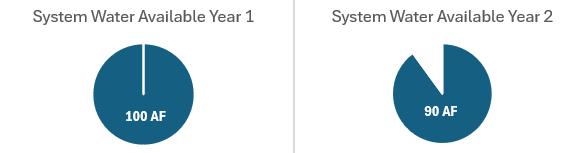
With the existence of a program in which the 10 acre-feet of historic consumption is saved and stored as Assigned Water, the amount of System Water available in Year 2 will also be 90 acre-feet.
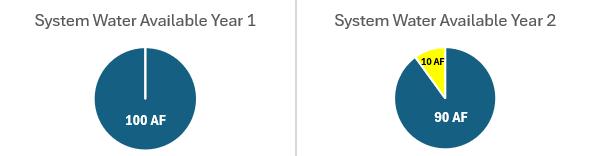
With the existence of a system conservation program in which the 10 acre-feet of historic consumption is saved, the amount of System Water available in Year 2 will be 100 acre-feet.
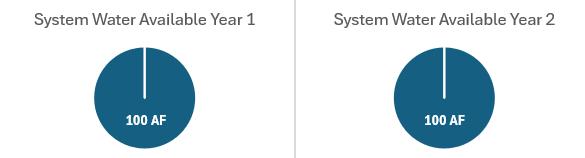
Given a choice, Section 5 Contractors clearly have preferred to invest consumptive-use water savings into Assigned Water, not system conservation. For example, between 2006 and 2024 CAWCD, MWD and SNWA collectively created approximately 4.3 million acre-feet of Assigned Water and funded approximately 309,000 acre-feet of system conservation.68 Table 1 shows the amount of Assigned Water and system conservation each of these three entities funded between 2006 and 2024.
Table 1: Assigned Water and System Conservation Funded by CAWD, MWD and SNWA, 2006-2024
68 Calculated by examining the funding contributions and Lower Division water saved through the 2014 Pilot System Conservation Agreement and its amendments. Water CAWCD intentionally left in Lake Mead as System Water is also included because CAWCD delivery rates increase when less water is delivered, which is a form of funding. LB Accounting Report; U.S. Bureau of Reclamation, Central Arizona Water Conservation District, Southern Nevada Water Authority, Metropolitan Water District of Southern California, Denver Water. (2014). Pilot Program for Funding the Creation of Colorado River System Water Through Voluntary Water Conservation and Reductions in Use. (as amended).: U.S. Department of the Interior. (2021). Pilot Projects Report.
The economic return on Assigned Water creation is high. Minus evaporation charges and assessments, CAWCD, MWD and SNWA retained more than 90% of Assigned Water created. The return on system conservation is low; system conservation benefits to System Water are spread across all entitlement holders in order of priority.69 As an example, when MWD pays Palo Verde Irrigation District (PVID) to forbear its consumptive water use to create Assigned Water, MWD receives more than 90% back in the form of Assigned Water, largely protected from shortage and available over multiple years. If MWD paid PVID to forbear its consumptive water-use to create system conservation, MWD would be unlikely to receive much water in return, if any, because the water would be spread across the priority system beginning with the most senior entitlement holders according to the need to fulfill water orders. Indeed, at current levels of shortage, which do not impact MWD’s allocation, MWD funding for system conservation bolsters System Water that likely would flow to the benefit of CAWCD and SNWA as Priority Water that alleviates their shortages. MWD is responsible to its ratepayers, and it is logical and financially prudent to invest in a program that results in direct and protected water benefits rather than one that results in indirect (at best) and unprotected water benefits. In examples such as this one, investment in system conservation by one entity serves mainly to benefit others. The situation demonstrates how the tragedy of the commons disincentivizes conservation by creating a situation in which entities that restrain their use of a shared resource bear the full cost of that restraint, while the benefits of conservation are shared by everyone.
Yet, presuming the trend of reduced runoff continues, significant cuts in consumptive use are necessary to bring the Colorado River system back into balance and to rebuild stores of System Water that protect critical infrastructure. Even when based on reductions in consumptive-use water, Assigned Water is not a significant overall reduction in consumptive water use over time, because the consumptive-use water saved is delivered in a different year (minus assessments and evaporative losses). Creation of Assigned Water merely alters the timing of consumption. The significant cuts in consumptive use necessary to help stabilize the system must come from involuntary cuts to Priority Water, system conservation (including voluntary cuts to Priority Water if negotiated), or alteration of treaty obligations to Mexico.
There are only so many Colorado River entitlement holders from which a reduction in consumptive use can derive; the pool of water that can be bought out for creation of Assigned Water or for system conservation is a fixed one. Assuming the goal of post2026 operations is a resilient Colorado River system with adequate System Water
69 The return on creation of system conservation is arguably highest on the margin for Section 5 Contractors and subcontractors who take delivery of their water through the CAP system because their water is among the lowest in priority in the Lower Basin and thus first to benefit by increases in System Water. It is notable that CAWCD has funded more system conservation than MWD and SNWA.
storage that benefits entitlement holders of Priority Water at least as much as it benefits owners of Assigned Water, system conservation should be deployed on a large scale. However, given a fixed pool of water that is available for compensated reductions in consumptive use, Assigned Water may crowd out investment in collective Colorado River resilience in favor of individual benefit.
And notably, possession of Assigned Water is a very large benefit to the single entity that owns it because it provides protection from shortage and use-it-or-lose-it rules and because it creates flexibility in water deliveries over multiple years. In addition, to the owner of Assigned Water, storage of water in Lake Mead (or in an upstream reservoir) is likely preferrable to storage elsewhere (in local reservoirs or underground) since there are generally significant costs to storage and recovery of water from these facilities. In contrast the only benefit of Assigned Water to the Colorado River system is for protection of critical dam infrastructure, recreation and hydropower if enough Assigned Water exists to provide these benefits and only to the extent System Water reserves are not already providing the same or similar benefit.
Asking an entity such as MWD to significantly fund system conservation is problematic for the reasons mentioned above MWD is responsible to its rate payers and is unlikely to receive much direct benefit. However, asking entities to help develop System Water in exchange for the benefit of Assigned Water storage is sensible; there is no reason to allow the storage of Assigned Water in federally funded reservoirs for free. But perhaps just as importantly, the challenge on the Colorado River is to avoid the tragedy of the commons the classic struggle between individual versus collective benefit that is currently playing out. This will require collective investment. Indeed, more than 90% of the approximately 3.8 million acre-feet of system conservation created through 2024 was funded by U.S. taxpayers through federal funding in a bid to avoid the tragedy. Yet, federal funds are inherently uncertain and unreliable and the benefits created by that conservation are distributed unevenly.
• Recommendation: Future creation of Assigned Water should be assessed a percentage deduction that becomes System Water at the time of creation to help rebuild System Water in reservoirs.
o The assessment should be determined based on a sliding scale; a 30% assessment70 should apply in water years in which System Water stores are deemed to be inadequate.71 The assessment should then decrease incrementally to 10% as total storage increases.
70 A 30% assessment on the 5.5 million acre-feet of Assigned Water created from 2006 through 2024 would have generated more than 1.6 million acre-feet of System Water, enough to equal one year of the “structural deficit” in the Lower Division plus some breathing room.
71 A definition of “adequate" System Water storage should be developed. It should be determined based on the amount of water in storage above elevation 3500 feet in Lake Powell and 1035 feet in Lake Mead.
• Alternative Recommendation: Colorado River entitlement holders must agree to take shortages above and beyond shortage levels described in the 2007 Guidelines before being allowed to create Assigned Water.
o The amount of shortage should equal 30% of the proposed deposit in years in which System Water stores are deemed to be inadequate. The shortage should then decrease incrementally to 10% as total storage increases.
• Recommendation: During years in which System Water stores are deemed to be inadequate the federal government should hold the right of first refusal to purchase any Assigned Water offered up by willing sellers for the sole purpose of converting it to System Water.
Under the 2007 Interim Guidelines, Assigned Water programs were limited to the Lower Division. Under the 2019 federal legislation that authorized the DCP, the states of the Upper Division were authorized to use a segregated 500,000 acre-feet pool in Lake Powell for demand management purposes. The pool was to be managed by the Upper Colorado River Commission (UCRC). For determining annual releases from Lake Powell, this pool would have been invisible to the system.72 The demand management pool has not been and will likely not be used, and the authorization to use it expires at the end of 2026.
The fact that Assigned Water has not yet been developed in the Upper Division does not mean it cannot be useful tool after 2026. There are opportunities to develop Assigned Water in Lake Powell and the other Upper Division reservoirs in ways that could benefit System Water, the environment, recreation and power generation. In almost all cases, however, if Assigned Water is going to be developed in the Upper Division, it will require a significant level of cooperation among all the Basin states, the major water agencies, and the federal government. In some cases, it may also require the Basin States to waive or creatively interpret provisions of the Compact.
Upper Division Assigned Water could be developed as a tool to reach a seven-state agreement. The purpose could include ensuring continued Upper Division Compact compliance or sharing with the Lower Division the necessary consumptive-use reductions needed to balance the system during critically dry periods. Some type of shortage sharing agreement with the Lower Division, and particularly Arizona and within
72 Agreement Regarding Storage at Colorado River Storage Project Act Reservoirs under an Upper Basin Demand Management Program. (2019).
it, water users on the CAP system, appears to be essential if the Basin States are going to avoid litigation over Compact compliance.
The amount of System Water that the Upper Division actually contributes to the Lower Division states is the natural flow at Lee Ferry less the total of the Upper Division’s consumptive uses (including reservoir evaporation) as reregulated by system storage pursuant to the applicable operating rules (like the 2007 Guidelines). The Compact specifies in Article II that the Upper Division states will not cause the ten-year flow at Lee Ferry to be depleted below 75 million acre-feet plus one half of the annual delivery to Mexico not satisfied by surplus water. The Lower Division States believe that Article III requires the Upper Division states to deliver a specific amount of water at Lee Ferry. Therefore, under the Lower Division states’ interpretation, the Compact sets a limit on Upper Division consumptive use and a floor on how much water must be delivered at Lee Ferry.
Of course, the Upper Division States disagree with this interpretation. Under the Upper Division’s interpretation of the Compact, if the Lower Basin is using more than its Compact apportionment, this excess water use is surplus and that amount must be subtracted from the total obligation to Mexico before calculation of the 50/50 split of the remainder. Further, the Upper Division claims that if climate change, not depletions by the Upper Division States, is causing the Lee Ferry ten-year flows to drop below 75 MAF, there is no Compact violation.
The relationship between the use of Upper Division Assigned Water and continued Upper Division development is a complex issue and one that needs more public discourse. Under the Lower Division states’ Compact interpretation, the levels of natural flows at Lee Ferry seen since 2000, the Upper Division’s current level of development, and the projection that ten-year flows may soon fall below the approximately 82 million acre-feet “trip wire” all suggest that Upper Basin development may already be at the Compact limit. The Upper Division states, of course, have a different interpretation of the Compact and believe that there is currently additional Colorado River water available for development in the Upper Division. The fact that the Lower and Upper Divisions have different interpretations of Compact is one of the core reasons that the Basin states have not yet reached a compromise agreement on post2026 operational guidelines.
From a Lower Division perspective, a waiver of claims over Compact compliance requires a commensurate benefit. Such a benefit could take the form of an agreed reduction in consumptive use in the Upper Division under certain circumstances, such as critical levels in Lake Powell or Lake Mead or a specified level of natural flow in the system. In this type of agreement, Assigned Water in the Upper Division could equal the
agreed amount of the reduction in Upper Division consumptive use plus any increase in consumptive use in the Upper Division that exceeds the existing baseline.
As noted in Floating Pools and Grand Bargains, 73 if the Upper Division states commit to a program that saves an average of 100,000 acre-feet per year coupled with an agreement between the Upper and Lower Divisions to waive Compact litigation, but at the same time new development increases the Upper Division states’ average consumptive use by 150,000 acre-feet per year, there is a net loss of the System Water available in the Lower Division. And because of the priority system, most of the loss of System Water is incurred by water users on the CAP system.
The Upper Division must weigh the benefits of Compact litigation avoidance against the pain of consumptive use reductions and the possibility of forgoing development projects for which increases in consumptive use cannot be offset. The Lower Division must weigh the amount of System Water and Assigned Water it expects to receive from the Upper Division against the benefits and risks inherent in litigation. For Arizona and CAP water-users in particular, who will be subject to large water use reductions no matter the calculus, this is the heart of the issue. If the amount of water they expect to receive on the margin from a “bargain” with the Upper Division is not very large, they may decide to litigate in hope of a better outcome.
Someone must bear the risk of increased consumptive use in the Upper Division. In a post-2026 agreement, the Lower Division could accept that risk, the Upper Division could accept that risk, the risk could be shared by the Divisions in some manner, or the States can ignore it and litigate if consumptive use increases and impacts Compact obligations. The risk exists regardless, and Assigned Water merely functions as a tool that can allow either or both Divisions to bear the risk in a manner that best suits their water users.
In both Divisions, there is the basic question of who gets to participate in Assigned Water programs, but in the Upper Division, the fact that use of Assigned Water that can be drawn down and delivered to the Lower Division to share shortages and avoid Compact litigation involves important operational considerations, as well:
• how the Assigned Water pool would be funded and managed,
• authority for determining the timing and amounts of Assigned Water delivery to the Lower Division,
• how the benefits are distributed amongst the Upper Division entities that fund and/or contribute to the Assigned Water pool, and
73 Sorensen, K., Porter, S., & Kuhn, E. (2025). Floating Pools & Grand Bargains. Kyl Center for Water Policy, Morrison Institute for Public Policy, Arizona State University
• whether the pool would be operated as a unified Upper Division pool or disaggregated by states.
These operational considerations become murkier if Lower Division entities are allowed to own Assigned Water created by consumptive use reductions in the Upper Division. In addition, some entities, such as non-profit organizations, may be interested in developing Assigned Water in the Upper Division for environmental benefits rather than for sharing of consumptive-use reductions and Compact call avoidance.
• Recommendation: Where possible while still maintaining neutrality to Priority Water, and assuming agreement between the states on how to account for Assigned Water deliveries between the Divisions under the Compact, the amount of Assigned Water stored in different reservoirs should be adjusted to optimize for hydropower, environmental and recreational benefits.
If an Upper Division Assigned Water pool used for storing and delivering the Upper Division’s share of consumptive-use reductions becomes a component of a seven-state agreement, there are important implications for Priority Water users and without safeguards, these water users could see a diminishment of their current supplies.
Alongside proper measurement of consumptive-use reductions as described earlier, proper shepherding of the water use savings into the relevant downstream reservoir is necessary. Proper shepherding involves ensuring saved consumptive-use water actually arrives in the relevant downstream reservoir and is not consumed by other water users. Upper Division Assigned Water accounted for as shepherded that does not actually arrive in downstream reservoirs directly diminishes the amount of Priority Water available in the Lower Division and has the potential to diminish the amount of system water available in the Upper Division, as well. The shepherding problem has yet to be solved in the Upper Division states; distance between where water is conserved (e.g. an alfalfa field) and Lake Powell can be several hundred river miles and can cross state lines. Complicating matters, properly measured transit losses must also be assessed.
• Recommendation: Assigned Water created in the Upper Division must be properly shepherded into the relevant downstream reservoir and assessed appropriate transit losses.
Colorado River System Water stores can be rebuilt by imposition of larger involuntary water use reductions, renegotiating the treaty with Mexico, or by imposition of significant taxes on Colorado River water use. These options are extraordinarily unpopular, and for this reason and others, stakeholders have instead sought to use voluntary and compensated water use reductions—system conservation—to address declining reservoir levels. Given this, future Assigned Water programs should be carefully
designed to ensure that Assigned Water represents actual saved consumptive use or real efficiency gains and to avoid crowding out investment in system conservation.
Assigned Water programs have great value and will most likely be a part of any future agreement among the seven Colorado River states regarding the operation of Lake Powell and Lake Mead. Future programs should be designed to avoid negative impacts to Priority Water, should be designed to enhance transparency and trust in administration, and should be leveraged to help rebuild System Water storage.
● In any newly developed operational guidelines for Lake Powell and Lake Mead, volumes of Assigned Water created after 2026 should be invisible for purposes of determining shortage conditions.
● Other than for flood control releases, volumes of Assigned Water created after 2026 should be invisible for purposes of determining surplus in Lake Mead.
● Volumes of Assigned Water in Lake Mead and Lake Powell created after 2026 should spill before all other water, a condition that also functions as a de-facto limit on total accumulation of Assigned Water.
● In any newly developed operational guidelines for Lake Powell and Lake Mead, volumes of Assigned Water created after 2026 and held in Lake Mead or Lake Powell should be invisible for purposes of calculating annual releases from Lake Powell.
● Reclamation should establish evaporation coefficients applicable to calculation of evaporation caused by storage of Assigned Water. These evaporation coefficients should be based on on-going monitoring and best available science and appropriately funded. Evaporation coefficients should be reassessed every five years, especially in light of a changing climate.
● Future volumes of Assigned Water in any reservoir should be assessed a realistic and conservatively high annual evaporative loss based on these coefficients and on the amount of Assigned Water in storage.
● Future deliveries of Assigned Water should be assessed transit losses where appropriate. Transit losses should also be estimated based on best available science, updated by monitoring and scientific studies, and revised every five years.
● Future volumes of Assigned Water in any reservoir should proportionately share the evaporative (and transit) losses that occur due to Mexican Water delivery obligations (other than for Mexican Assigned Water, which should bear its own losses) and should be assessed a realistic and conservatively high annual evaporative loss based on these coefficients and due to Mexican Water delivery obligations. The evaporative assessment should reflect the proportionate share of Assigned Water and Priority Water in storage.
● Evaporative losses should be assessed under all conditions, including shortage.
● Deliveries of Assigned Water should be restricted if necessary to protect critical dam infrastructure.
● Alternative: The federal government should compel the sale of Assigned Water for immediate conversion to System Water during years in which reservoirs are at critically low levels.
● In years in which System Water storage in Lake Powell and Lake Mead is deemed to be inadequate, any Assigned Water developed or acquired by the federal government in those years should immediately be converted to System Water. Use for other purposes should be allowed only in conditions in which System Water storage is adequate.
● Dedication of federally-controlled Assigned Water for purposes other than conversion to System Water should occur through a robust and transparent public process.
● Because they are among those most exposed to involuntary shortage, CAWCD subcontractors that rely on deliveries of Colorado River water to surface water treatment plants should be allowed to create, own and acquire Assigned Water.
● Entities without an entitlement to Colorado River water should not be allowed to own Assigned Water.
● The Secretary’s approval should be required for all agreements for creation, transfer, or sale of Assigned Water.
● Any Colorado River entitlement holder, with the concurrence of the Secretary, should be allowed to participate in transactions in any state to develop, own or use Assigned Water created from projects in the U.S. (So long as adequate protections are afforded Priority Water and there is agreement between the states regarding accounting for Assigned Water deliveries under the Compact).
● To avoid profiteering, the Assigned Water held by any given Colorado River entitlement-holder should be proportional to its Colorado River entitlement. The annual accumulation and balance of Assigned Water for a single entity in any reservoir should be limited to some (relatively small) multiple of its annual entitlement to Colorado River water.
● To ameliorate concerns about permanent water transfers between states, agreements to create Assigned Water from consumptive-use reductions in one state for delivery in another state should be structured such that there is reasonable means for entities within the state in which the reduction in consumptive-use derives to make use of that water within the state in the future. One means to do so would be to allow agreements to create Assigned Water
from consumptive-use reductions in one state for delivery in another state only if the agreements expire after five years and do not include a provision for automatic renewal. Existing Assigned Water storage could continue beyond expiration.
● To ameliorate controversies associated with the transfer of agricultural water for municipal use, agreements to create Assigned Water from consumptive-use reductions in agriculture should include a requirement that the funder of the Assigned Water pay a tax assessed per acre-foot paid to the county or counties from which the consumptive-use reductions derive. The tax could derive from the value of the agricultural economy. Waivers could apply if the Assigned Water creation program creates a net increase in economic value in an agricultural area (e.g., crop switching or crop insurance).
● The federal government should fund efficiency projects for creation of System Water up until the amount of water that results from such projects sufficiently ameliorates the impacts of the annual, national obligation to Mexico to Priority Water users.
o Thereafter, the creation of Assigned Water via efficiency projects in the U.S. should only be allowed if a) System Water storage in Lake Powell and Lake Mead is deemed to be adequate or b) the efficiency project benefits System Water over Assigned Water on a ratio of 90/10 over the ensuing five years.
● To the extent participation is offered, participation in efficiency projects in the U.S. in exchange for Assigned Water should be awarded based on an allocation method determined through an open and transparent process (e.g. highest bidder) and should be subject to any limitations on participation, total Assigned Water annual accumulation and balance for that entity.
● The federal government should hold the right of first refusal to purchase any Mexican Assigned Water up for sale and to fully fund any conservation projects in Mexico that can become Assigned Water during years in which System Water stores are deemed to be inadequate for the sole purpose of converting it to System Water.
● Mexican treaty obligations increase the risk of shortage in the Lower Division and increase the risk of a Compact call. Those in the Lower Division with lowest priority contracts and subcontracts and those in the Upper Division most at risk of curtailment due to a Compact call should be given the second right of refusal up to an amount that equals projected involuntary cuts to Priority Water for each entity over the next two years.
● Thereafter, purchase of Mexican Assigned Water should be awarded to domestic entity with the highest bid and should be subject to any limitations on participation, total Assigned Water annual accumulation and balance for that entity.
● An audit independent of Reclamation should be conducted on the existing Assigned Water program in the Lower Division and Mexico. The goals of the audit should be:
o to examine claimed savings for accuracy,
o to assemble a list of lessons learned on measurement and accounting from twenty years of program administration and
o to assemble a list of qualifying activities for reduction of consumptive use, alongside recommended terms and conditions, that can form the foundation of future agreements.
● The audit should be made available to the public with and opportunity to review and comment.
● Assigned Water in any reservoir should only be allowed under a program that accurately measures Assigned Water creation, shepherding, storage and deliveries.
● Owners of Assigned Water should be assessed an annual fee to fund robust measurement and enforcement programs.
● Assigned Water created through water savings should derive from a baseline of historic consumptive use, not entitlement or filed water right claims.
● Forbearance/shepherding should be based on qualifying activities, not participants. In other words, withholding of forbearance/shepherding should not be a veto used to exclude participants that would otherwise qualify for development of Assigned Water.
● The means of creating Assigned Water that meet the threshold for agreements to forbear/shepherd should be decided ahead of time. Allowing additional qualifying activities down the road increases flexibility but also potentially undermines trust in Assigned Water programs between participants and more importantly among non-participants who rely solely on the prior appropriation system.
● Reclamation should compile a centralized, searchable, easily accessible library of all agreements and documents associated with Assigned Water programs.
● Reclamation should develop a new Assigned Water annual report that clearly shows ownership of the several different types of Assigned Water, the status of funding agreements and the flow of dollars, transactions involving Assigned Water, Assigned Water creation by creation category, method and partner, relevant shepherding arrangements, assessments, evaporative losses, deliveries and ending balances and other relevant details.
● Graphs and charts of reservoir elevations should clearly delineate Assigned Water by ownership and method of creation.
● The ability to create or purchase Assigned Water under a given Assigned Water program should expire 20 years after program initiation, a duration long enough for bond financing of capital projects. The ability to store Assigned Water should expire no more than 5 years after expiration of the program under which it was created.
● Loans against Assigned Water balances should not be allowed where default diminishes the amount of System Water in storage.
● Conversion of existing Assigned Water into another form of Assigned Water governed by different rules should only be allowed after a robust and transparent public process.
● Loans between Assigned Water owners for Assigned Water should be allowed in future programs.
● With proper guardrails, loans from Assigned Water owners to Priority Water users should be allowed, including across state lines.
● With proper guardrails, loans and/or conversions from Assigned Water to the Priority Water pool should be mandatory when Priority Water stores are deemed to be seriously inadequate.
● Future creation of Assigned Water should be assessed a percentage deduction that becomes System Water at the time of creation to help rebuild System Water in reservoirs.
o The assessment should be determined based on a sliding scale; a 30% assessment should apply in water years in which System Water stores are deemed to be inadequate. The assessment should then decrease incrementally to 10% as total storage increases.
● Alternative: Colorado River entitlement holders must agree to take shortages above and beyond shortage levels described in the 2007 Guidelines before being allowed to create Assigned Water.
o The amount of shortage should equal 30% of the proposed deposit in years in which System Water stores are deemed to be inadequate. The shortage should then decrease incrementally to 10% as total storage increases.
● During years in which System Water stores are deemed to be inadequate the federal government should hold the right of first refusal to purchase any Assigned Water offered up by willing sellers for the sole purpose of converting it to System Water.
● Where possible while still maintaining neutrality to Priority Water, and assuming agreement between the states on how to account for Assigned Water deliveries between the Divisions under the Compact, the amount of Assigned Water stored in different reservoirs should be adjusted to optimize for hydropower, environmental and recreational benefits.
● Assigned Water created in the Upper Division must be properly shepherded into the relevant downstream reservoir and assessed appropriate transit losses.