
Swette Center Hawaii Immersive 2025

Page 1


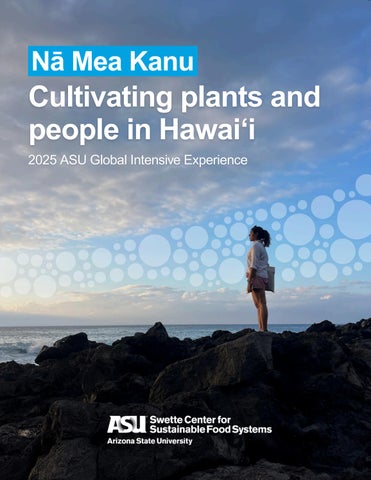
NāMeaKanu Cultivatingplantsand peopleinHawaiʻi

2025 ASU Global Intensive Experience

Kohala, Hawaiʻi

December 13-19, 2025

Our week-long immersive experience in Kohala, Hawaiʻi explored Native Hawaiian relationships to ʻāina (land), wai (water), and mea kanu (cultivated plants) through cultural, ecological, ethical, and historical lenses.

Eight students from diverse disciplines took part in the experience, engaging in handson service learning, moʻolelo (story) sharing with local practitioners, discussions on ahupuaʻa systems (ridge to reef island stewardship practices), regenerative agriculture and aquaculture, and the cultivation of virtue.The course was steeped in reflection and ethical engagement usingASU’s Principled Innovation framework, emphasizing character building and Hawaiian cultural values for human flourishing.

The experience was led and organized by Hawaiʻi-based staff from theASU Swette Center for Sustainable Food Systems, Carly Wyman,Tuki Drake, and Katie Crowe, with faculty support from professors Kathleen Merrigan andTyler DesRoches in theASU School of Sustainability

ʻIole:Aliving laboratory

The immersive experience was based out of ʻIole (ee-OH-lay), a nonprofit organization encompassing 2,400 acres on the northern tip of Hawaiʻi Island.Their mission is to bridge Indigenous practices and modern science to facilitate human transformation towards an abundant future for Hawaiʻi and create models for global impact.Through their relationships withArizona State University, University of Hawaiʻi, and Hawai‘i Community Foundation, as well as with local community partners such as Kohala High School, this “living scientific laboratory” serves as a place for learning and problem solving for a thriving future. ʻIole’s lands are steeped in history, including a site on which King Kamehameha I cultivated loʻi kalo (wetland taro terraces) to feed a growing Native Hawaiian population, as well as the historic Reverend Elias Bond homestead and girls school.

Pairs of students stayed in bungalows and enjoyed colorful sunrises from their lanai (patio).Through shared meals in the historic dining hall, an in-depth property tour with cultural specialist KuliamaiAveiro-Kalaniopio, and on-site classes and workshops, students were immersed in nature, culture, and history throughout the experience.

Understanding culture and context

Native Hawaiian cultural experiences were woven throughout the week, beginning with a traditional ʻawa ceremony during the welcome reception From traditional tattooing practices to hula as a cultural art for self-transformation, students were given the opportunity to learn and engage hands-on with cultural values and practices.

Being on the ʻāina, or the land, allowed me to bridge Western academic frameworks with Indigenous ways of knowing in a way that felt integrative rather than extractive.”

Hawaiʻi taught me that caring for the land and caring for people go hand in hand ”

Engaging diverse perspectives

Though physically isolated from all major continents, Hawaiʻi is just one chain of islands in the wider Pacific island community, where a multiplicity of peoples have a shared rich and interwoven history Students learned about the Hawaiian cultural and linguistic ties to the region, including through traditional foods and crops.

An emphasis was placed on the traditional ahupuaʻa system that once subdivided Hawaiian lands into sections from the ridge of the mountains to the reef for maximal ecological and community abundance.This concept was reinforced through a series of site visits representing actors across the food system, from ridge to reef

Course Schedule

Day 1: Saturday, December 13

Welcome reception and dinner at ʻIole

Traditional ʻawa ceremony

Day 2: Sunday, December 14

Breakfast at ʻIole

Lecture on Hawai‘i and the Interwoven Pacific: History, Language, Food, Culture, and Traditions Overview

SNAP Challenge Activity at Takata’s Grocery Store

Lunch at ʻIole

Lecture on Food Insecurity in Hawaiʻi and Beyond

Lecture on Hawaiian, Polynesian, and Austronesian culture

as seen through Traditional Tattoo and Hula

Hula Workshop with Hālau Haʻa Kea o Nā Wai Hua Lani

Dinner and student reflections at ʻIole

Day 3: Monday, December 15

Breakfast at ʻIole

Visit to Ocean Grace Farms

Lunch at Queen’s Marketplace

Free time at Hāpuna Beach

Dinner at K.O. Pizza

Principled Innovation Activity

Student reflections at ʻIole

Day 4: Tuesday, December 16

Breakfast at ʻIole

Lecture on Ahupuaʻa Ecology

Historic tour of ʻIole

Lecture on Cultivating Plants and People

Lunch at Gill’s Lanai

Service learning visit to Kohala Food Hub

Dinner at Kapaʻa Beach Park

Student reflections at ʻIole

Day 5: Wednesday, December 17

Breakfast at ʻIole

Visit to Kohala High School Academy of Sustainability

Visit to Parker Ranch and Kamuela Hardwoods

Lunch at Waimea Butcher Shop

Visit to Kalāhuipuaʻa Fishponds at Mauna Lani

Dinner and student reflections at ʻIole

Day 6: Thursday, December 18

Breakfast at ʻIole

Visit and lunch at Natural Energy Laboratory of Hawaii (NELHA) Ocean Science and Technology Park

Tour of Blue Ocean Mariculture

Tour of ASU Ridge to Reef Restoration Center

Visit to HIP Agriculture with farm-to-table dinner

Closing student reflections at ʻIole

Day 7: Friday, December 19

Breakfast and wrap-up discussions at ʻIole

Wemetsomanyincrediblepeoplewho sharedtheircultures,histories,and lifestyles.AtOceanGraceFarms,we gottosee,upclose,howtheygrow cacaoandturnitintothemostdelicious chocolate.”

LaylaMushtaq MSUSstudent,Sustainability Solutions

“[Thisexperience]allowedmetoreflect onmylifeandhowIcanincorporate pono,orgoodness,inthewayI currentlylive.Thistripwasextremely valuabletomeandmyundergrad educationatASU.”

AvaCrane BSstudent,BiologicalSciences& EarthandSpaceExploration

Wespentanafternoonvolunteeringat theKohalaFoodHub,whichhas createdawebof 100farmsthatwork togetherasacommunitytobuyandsell inwaysindividualfarmscouldnot It wasinspiring!”

Integrating traditional food experiences

The week would not have been complete without a focus on local food. Students indulged in delicious preparations including fresh poke bowls, catered meals featuring local ingredients, hand-picked fruits, and a farmto-table dinner culminating experience An afternoon of service learning with the Kohala Food Hub reinforced learning concepts, as the group helped to pack locally-grown produce for distribution to give back to this food-insecure community

Students learned about the decline of the ahupuaʻa system and the subsequent century of export-oriented commodity crop plantations, through to today, where food is dependent on just-in-time imports to keep store shelves full This included a field trip to a local market, where students completed the “SNAPchallenge” – finding food items to prepare a day’s worth of meals for under $10 total.

The people

5

8

16

Arizona and Hawaiʻi-based ASU staff and faculty

Arizona and Hawaiʻi-based undergraduate and graduate students

Community educators: Farmers, aquaculturists, cultural practitioners, conservation scientists, teachers

The experience

5 5

10

Structured lectures with a total of 8 class hours and additional daily reflection discussions

Hawaiian cultural experiences, including a hula workshop, Native Hawaiian fishpond tour, ʻawa ceremony, and more

Site visits encompassing service learning, and farm, ranch, and aquaculture tours

“AsTuki shared his knowledge of moʻolelo, cultivating deep and meaningful connections to place and the relationship between ʻāina and kānaka, it felt familiar Far from the high desert where my tribe is from, I was reminded of the Navajo word K’é, which captures the same meaning. I experienced the rooted common wisdom of Indigenous people.”

—ChandleeBegay BSstudent,OceanFutures& Sustainability

One word to describe my experience in this program is transformative ”

—VyTruong BSstudent,PoliticalScience& Government

Wewouldliketogiveaspecialthankyoutothestudents whoshowedupwithopenmindsandenthusiasmtolearn, andtothecommunityeducatorswhograciouslyshared theirexpertinsightswithourstudents:

ToddApo–CEO,ʻIole

KuliamaiAveiro-Kalaniopio–ʻIoleCulturalSpecialist

GabbyCapp–SustainableFoodSystemsMSstudent, ArizonaStateUniversity

AubrieChristensen–ExecutiveDirector,‘Iole ZacharyJudd–VicePresidentofLong-termPlanning, ParkerRanch

DashiellKuhr&ErikaKuhr–Co-directors,HIP Agriculture

PiʻiLaʻeha–NaturalResourceManager,Kalāhuipuaʻa FishpondsatMaunaLani

KimoMiranda,KinohiNeves,NamakaDeMello–HālauHaʻaKeaoNāWaiHuaLani

MayaParish–ExecutiveDirector,KohalaFoodHub

FedericoRotman–VicePresidentofHatchery Operations,BlueOceanMariculture

DeanSnelling–NaturalResource/AgricultureTeacher, KohalaHighSchool

KatieWortman&CoryWortman–OceanGraceFarms

MaianaVillegas&JasonCabilin–ASURidgetoReef

The Swette Center for Sustainable Food Systems is a unit of the ASU School of Sustainability and the Global Futures Laboratory

globalfutures.asu.edu/food/

Turn static files into dynamic content formats.
Create a flipbook