PhD in biostatistics
A doctoral degree in biostatistics from the ASU College of Health Solutions prepares you for a career designing and analyzing clinical trials, interventions and health observational studies. A focus is placed on developing biostatistical methods for public health application with an emphasis on collaborating with a variety of health-related fields, including behavioral science, biomedical informatics, kinesiology, health care delivery, nutrition, population health, speech and hearing and other programs across the College of Health Solutions.
D
Downtown Phoenix campus
circle flask
Full time available STEM OPT Extension program
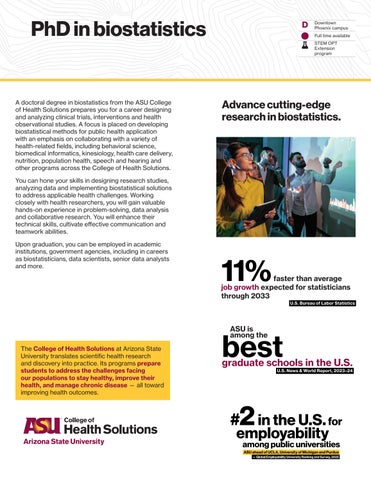
Advance cutting-edge research in biostatistics.
You can hone your skills in designing research studies, analyzing data and implementing biostatistical solutions to address applicable health challenges. Working closely with health researchers, you will gain valuable hands-on experience in problem-solving, data analysis and collaborative research. You will enhance their technical skills, cultivate effective communication and teamwork abilities. Upon graduation, you can be employed in academic institutions, government agencies, including in careers as biostatisticians, data scientists, senior data analysts and more.
11%
faster than average job growth expected for statisticians through 2033 U.S. Bureau of Labor Statistics
ASU is among the
The College of Health Solutions at Arizona State University translates scientific health research and discovery into practice. Its programs prepare students to address the challenges facing our populations to stay healthy, improve their health, and manage chronic disease — all toward improving health outcomes.
best
graduate schools in the U.S.
U.S. News & World Report, 2023–24
PhD in biostatistics program As a doctoral student, you will be actively engaged in research at all stages of your study, allowing you to strengthen your knowledge while building your credentials. A mix of required classes and research, as well as 42 hours of electives, will allow you to design the program that suits your research interests and goals.
Featured courses
Dissertation
BST 601 Biostatistical Theory and Inference Develop a deep understanding of key concepts of biostatistical theory and inference.
Enhance your research skills by applying up to 12 credit hours of dissertation research into a topic of your choosing for your doctoral degree.
BST 603 Survival Data Analysis Cover context and intuition on topics in statistical methods for the analysis of survival data.
Finding your mentor
BST 606 Applied Clinical Trial Design and Analysis Explore the basic concepts of clinical trials and how statistical methods are applied in clinical trial development. Discuss topics of controls, randomization, blinding, sample size calculations and more.
Your mentor is the key to your success. You will work with your mentor from the beginning to the end of the doctoral program. Multiple faculty members conduct research within each focus area — explore your options with the faculty listings on chs.asu.edu and email potential mentors to gauge compatibility. Opt for a mentor based on mutual research interests who has the availability and expertise to support your plan of study.
Featured electives
Funding your PhD
Elective courses can be selected with the guidance program advisor to help tailor your degree to your specific interests.
Students have the opportunity to work with faculty members on funded research projects. Another option is to apply for a position to work with the Biostatistics Consultation Core as a data analyst. Funding can also be sought through awards, fellowships, or becoming a teaching or research assistant. For more information on funding resources, visit graduate.asu.edu.
BMI 603 Health Informatics Database and Modeling Applications Analyze database systems and their specific use and modeling in health care and biomedical environments. Learn through hands-on experience with the modeling and implementation of health-related databases. HCD 511 Health Economics and Policy Examine concepts central to health care economics and their application to important decisions made by patients, families, practitioners, administrators and policy makers. STP 598 Topic: Machine Learning and Deep Learning Gain an understanding of statistical learning and modern techniques of deep learning. By the end of this course, students should have a basic comprehension of learning methods through hands-on software implementation.
Learn more chs.asu.edu
602-496-3300 | chs@asu.edu
24-023 06-2025