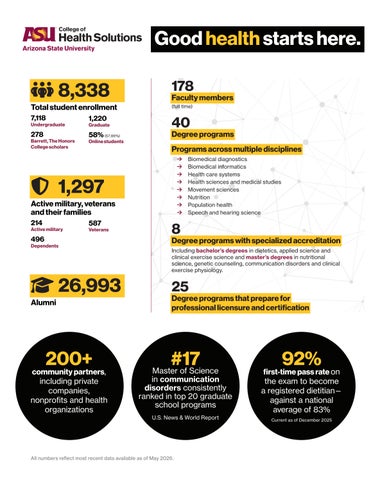
Good health starts here. people-group 8,338
178
Total student enrollment
(full time)
7,118
1,220
278
58% (57.86%)
40
Undergraduate Barrett, The Honors College scholars
Graduate Online students
Faculty members
Degree programs Programs across multiple disciplines arrow-right arrow-right arrow-right arrow-right arrow-right arrow-right arrow-right arrow-right
shield-halved 1,297 Active military, veterans and their families 214
Active military
587
Veterans
496
Dependents
graduation-cap 26,993 Alumni
200+ community partners,
including private companies, nonprofits and health organizations
Biomedical diagnostics Biomedical informatics Health care systems Health sciences and medical studies Movement sciences Nutrition Population health Speech and hearing science
8
Degree programs with specialized accreditation Including bachelor’s degrees in dietetics, applied science and clinical exercise science and master’s degrees in nutritional science, genetic counseling, communication disorders and clinical exercise physiology.
25
Degree programs that prepare for professional licensure and certification
#17 Master of Science
in communication disorders consistently ranked in top 20 graduate school programs U.S. News & World Report
All numbers reflect most recent data available as of May 2026.
92% first-time pass rate on
the exam to become a registered dietitian— against a national average of 83% Current as of December 2025
$29,215,204
$170M+
Sponsored research expenditures
Sponsored research expenditures (since 2015)
Active grants awarded to Health Solutions faculty (principle investigator role)
arrow-right Agency for Healthcare Research and Quality arrow-right National Institutes of Health • • • • • •
National Cancer Institute National Center for Complementary and Integrative Health National Heart, Lung, and Blood Institute National Institute of Allergy and Infectious Diseases National Institute of Child Health and Human Development National Institute of Diabetes and Digestive and Kidney Diseases
• National Institute on Aging • National Institute on Deafness and Other Communication Disorders • National Institute of General Medical Sciences • National Institute on Drug Abuse • National Library of Medicine
arrow-right National Science Foundation • Directorate for Computer and Information Science and Engineering
person 22
book-open 350+
in their profession
in 2025
faculty elected as fellows
journal publications
Including:
Research related to:
• • • • • • • • • • •
• Physical activity and health • Brain and cognitive health • Chronic disease and via metabolic and behavioral research • COVID-19 and public health • Pediatric health and human development
Academy of Nutrition and Dietetics American College of Medical Informatics American College of Physicians American College of Sports Medicine American Heart Association American Speech-Language-Hearing Association American Statistical Association National Academy of Inventors National Academy of Kinesiology Society of Behavioral Medicine The Obesity Society
magnifying-glass 57
Health Solutions investigators
on 150 active National Institutes of Health grants
microscope 8 translational teams • • • • •
Autism Child Language and Literacy Cancer Prevention and Control Maternal Child Health Metabolic Health
• Patient Work • Safety Net Advancement Center • Translational Research in Psychedelics
binoculars Looking ahead The College of Health Solutions will establish three new schools in 2026. These schools will further our mission to improve health outcomes for the communities we serve: • School of Clinical Health Sciences • School of Health Systems Transformation • School of Human Performance and Lifespan Health
Get involved square-instagram square-bluesky linkedin square-facebook square-youtube asuhealthsolutions chs.asu.edu chs@asu.edu | 602-496-3300
06/2026