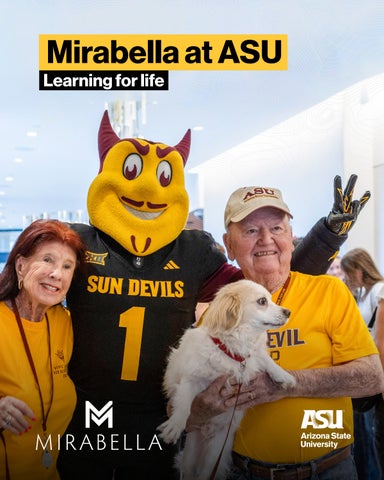
Mirabella at ASU
Learning for life
Mirabella's story Mirabella at Arizona State University opened its doors in 2020 with a bold question: What if ... ... a retirement community could serve as a living laboratory for bridging generational divides and understanding how to support learners across their lives? While Mirabella’s 20 stories have reshaped the Tempe skyline, its greater impact has been conceptual, expanding what a university can and should be in a society where learning must extend well beyond early adulthood. Mirabella’s work was nationally recognized with the 2025 Intergenerational Innovation Award from Generations United and the ASU President’s Award for Principled Innovation, affirming Mirabella as a bold model for the future of higher education. Rooted in the ASU Charter, Mirabella responds directly to the reality that the communities ASU serves are more age-diverse than ever. As the nation approaches a turning point in which there will be more people over 65 than under 18 for the first time in U.S. history, Mirabella demonstrates how a university can create intentional pathways for inclusion, belonging and purpose at every stage of life. Thank you to our founding member residents, our partners at Pacific Retirement Services and the ASU faculty and staff who welcome Mirabella residents into their classrooms and campus spaces. Together, we are proving that learning is truly a lifelong endeavor.
Global aging: What is higher education’s role in our longer lives? Two major demographic shifts have been occurring over the last century, which have profound implications for higher education: Lifespan increase: Improvements in medicine, nutrition and public health during the 20th century doubled the human lifespan in the United States. Birth rate decline: The birth rate fell from 2.12 in 2007 to below 1.6 in 2024 - well below the replacement rate of 2.1 births per woman. While longer lives are one of society’s greatest achievements, higher education was built for a world in which learning was front-loaded into early adulthood, followed by a linear progression into work and retirement. Today, that model no longer reflects how people live, learn or contribute across an extended life course. ASU believes that it is now our responsibility to redesign higher education for an era of longevity in which people return to learning many times, seek purpose at every stage and expect opportunities to find them well past traditional retirement age. Our institutions must prepare students to be adaptive, curious lifelong learners and to succeed in multigenerational environments where they will collaborate with people spanning five generations.
On the cover:
Fred Birch and his wife Gale met at Arizona State College in 1957 as members of the marching band where they accompanied the Sun Devils to the Rose Bowl as a saxophonist/ clarinetist and Gale as a “majorette”. They married, and Fred was deployed as a pilot in the U.S. Air Force, later becoming a commercial airline pilot. In 2020, they returned to ASU as Mirabella residents and enrolled in an ROTC course, the Maroon & Gold Band, and the Choral Union. Recently, Fred participated in an architecture course in the Design School in which students interviewed him and developed an architectural design based on the themes of his life.
Judy and Doug Newton, residents at Mirabella at ASU, believe that exercise has helped them stay healthy and reduce the risk of health challenges.
The ASU Charter ASU is a comprehensive public research university, measured not by whom it excludes, but by whom it includes and how they succeed; advancing research and discovery of public value; and assuming fundamental responsibility for the economic, social, cultural and overall health of the communities it serves.
A more age-inclusive city Mirabella at ASU is part of Tempe’s broader transformation towards becoming a more age-inclusive city. In 2022, Tempe earned its designation as an Age-Friendly City and later as a Dementia-Friendly City, reflecting a commitment to accessibility, inclusivity and intergenerational connection as part of its growth plan. By welcoming older adults as learners, mentors and cultural contributors, Mirabella aligns with the city’s strategic priorities for livability for residents of all ages. Over the past five years, Tempe has expanded age-inclusive programs in transportation, housing and community life, with Mirabella serving as a visible anchor of innovation. Together, the city and ASU have advanced a model in which older adults are not only supported but also celebrated as integral to the fabric of civic and university life.
Mirabella residents and students playing billiards at Sparky's Den in the ASU Memorial Union.
Arizona State University
3
Resident Dave Mills walks to his neuropsychology class, NEU 494: The Social Brain.
4
Mirabella at ASU: Impact Report
Setting the gold standard In 2024, Mirabella at ASU met or exceeded all five criteria and became the first university-based retirement community in the United States to be certified. This milestone signals that Mirabella at ASU has established the gold standard for university-based retirement communities, thanks to the university's unprecedented commitment to achieving mutually beneficial outcomes. Partnerships between senior living communities and nearby higher education institutions have begun to form over the last several decades, uncovering new possibilities for building upon known factors for healthy and resilient aging: community, purpose and intellectual stimulation. In 2006, the title “university-based retirement community” was established to refer to the few senior living communities that emerged as the strongest models meeting the following criteria: •
Located within one mile of the university's core campus facilities.
•
Formal programming to encourage intergenerational engagement.
•
A continuum of care (independent living, assisted living, memory support) to ensure that learning is accessible to all residents.
•
At least 10% of residents have a prior affiliation with the university to promote university affinity within the community.
•
A documented university partnership.
A nationally recognized model Mirabella at ASU has quickly emerged as a nationally recognized model for redefining the opportunity of longevity and the evolution of higher education. Since opening in 2020, Mirabella at ASU has earned widespread acclaim for its innovative approach to purposeful, intergenerational living, garnering awards that highlight excellence in design, innovation and the creation of a new paradigm for connecting generations and learning across the lifespan. Local, regional, or national recognition: •
2025 Intergenerational Innovation Award (Generations United)
•
2024 First University-based Retirement Community Certification in the U.S. (UniversityRetirementCommunities.com)
•
2023 Innovation Award (LeadingAge Arizona) Arizona State University
5
Mirabella at ASU: at a glance Mirabella at ASU is a 20-story Life Plan community located on the northwest corner of the ASU Tempe campus, and is now home to nearly 400 lifelong learners. These lifelong learners have peace of mind knowing they have a full continuum of care, as well as the opportunity to experience ASU’s vibrant campus life. Mirabella residents find their purpose in many ways, including auditing ASU classes, mentoring students, participating in research, enjoying Sun Devil sporting events and volunteering on campus.
Built to advance research, learning and care Mirabella offers 600,000 square feet on 1.6 acres of ASU land and includes stateof-the-art facilities such as: •
238 independent living units
•
Four on-site restaurants
•
17 assisted living units
•
Indoor/outdoor pool
•
20 memory care units
•
Auditorium
•
21 skilled nursing units
•
Library
•
300-space underground parking
•
Art gallery
•
Health club
•
Wood shop
•
Rooftop garden
•
Game and craft rooms
•
Hair salon
Demographic overview Occupancy: 384 residents (95% occupied as of January 2026) Average age: 76 Education: 81% masters degree or higher
6
Mirabella at ASU: Impact Report
ASU alumni: 17% (degreed) Current or retired faculty or staff: 8% Related to current/past student: 30% Previous giving history to ASU: 36%
Mirabella at ASU is located at the northwest of the ASU Tempe campus.
Arizona State University
7
What sets Mirabella apart What sets Mirabella at ASU apart from any other university-based retirement community is its purpose-built integration with campus life, designed to fully immerse residents in the intellectual, cultural and social fabric of ASU.
8
Mirabella at ASU: Impact Report
Location on campus Mirabella is located on the ASU Tempe campus, just steps away from ASU’s School of Art and The Design School. Its strategic location along the arts and culture corridor means that residents are within a 10-minute walk of dozens of arts and culture venues on campus, including the ASU Art Museum, ASU Gammage, Lyceum Theatre and Galvin Playhouse. Music and the arts provide a powerful way to connect generations through shared experience.
Dedicated ASU staff ASU staff promote the full integration of residents into the campus community by serving as ambassadors and guides to the larger metropolitan university. Whether residents want to enroll in classes, find a mentoring opportunity or get tickets to a game, ASU staff are ready to advise and support resident access and integration.
Full campus access All residents are issued SunCard student IDs to provide access to benefits and facilitate their inclusion in ASU campus experiences. This includes: •
The ability to audit any ASU course.
•
Access to eight libraries across four campuses.
•
Presale access to Broadway shows and a group discount at ASU Gammage.
•
DART golf cart access for oncampus transportation and the intercampus shuttle for travel to any of ASU’s metropolitan campuses.
•
•
Complimentary tickets to Sun Devil Athletics (except Men’s Basketball, Football and Hockey).
•
Complimentary tickets for performances and exhibits through the Herberger Institute for Design and the Arts.
•
Affiliate membership pricing at the Sun Devil Fitness Complex.
•
On-campus and 24/7 technology support.
Complimentary use of the Mona Plummer Aquatics Center.
Arizona State University
9
Learning without limits ASU has formed programs to allow lifelong learners to integrate into the inner workings of the university through both faculty- and student-led initiatives that aim to expand the knowledge of the Mirabella community and strengthen generational bonds.
Mirabella’s signature Lifelong Learning Lecture Series The Mirabella Lifelong Learning Lecture Series, held every Thursday afternoon, brings a different ASU faculty member to the community each week to introduce residents to new areas of scholarship, emerging research and academic disciplines they may not have explored. As part of the university ecosystem, Mirabella can offer residents direct access to faculty expertise, creating opportunities to discover classes they may want to audit, research projects they can support and student work they can help advance. The series expands intellectual horizons and deepens the reciprocal connections between residents and the university, reinforcing Mirabella’s role as a dynamic hub for lifelong learning and engagement.
10
Mirabella at ASU: Impact Report
Residents experience Dreamscape Learn, an augmented reality experience that brings science education to life and improves learning outcomes.
Arizona State University
11
“Not only do the AIRs perform, but they teach – they share their art form and themselves with all of us. They truly have been ambassadors in showing how intergenerational communities can and do work.” – Mirabella Resident shared in an anonymous program survey
Caleb Bailey, 27, the artist-inresidence program coordinator, now aims to start a nonprofit that partners with retirement communities and university music programs.
12
Mirabella at ASU: Impact Report
Artist-in-Residence program The Mirabella Artist-in-Residence program is a first-of-its-kind model that brings graduate-level musicians, music therapists and dancers into residence at Mirabella at ASU. These talented artists live alongside residents in exchange for providing high-quality arts programming to the community. Each year, a small cohort of Artist-in-Residence students is selected through a highly competitive process that reflects both exceptional artistic talent and a commitment to community engagement. These students offer nearly 400 performances, workshops and interactive arts experiences annually, transforming Mirabella into a vibrant arts-centered community while expanding their own artistic practice through experimentation. Now on its fifth cohort, the program has cultivated enduring relationships between students and residents. For residents, the presence of emerging artists brings inspiration, energy and a window into contemporary arts education. For students, the opportunity to live and create within a multigenerational community expands their understanding of audience, storytelling, empathy and the social impact of the arts. The result is a powerful model of intergenerational exchange that enriches Mirabella's cultural life and prepares young artists to lead and create in an agediverse world.
“The Artist-in-Residence program will forever change how I interact with this age group, and I suspect how I continue to age myself!” — Michael Shannon, Artist-in-Residence
Arizona State University
13
Lifelong learners, fully engaged Mirabella residents are active, self-directed learners who fully immerse themselves in ASU’s academic life by auditing courses across the university. Each semester, approximately 100 residents enroll in classes ranging from the humanities and social sciences to engineering, design and the arts, pursuing subjects driven purely by curiosity and intellectual exploration rather than degrees or credentials. Their presence enriches the classroom environment, bringing decades of experience, global perspectives and thoughtful questions that elevate discussions for students and faculty alike. Residents often complete readings, participate in group projects, give presentations and engage deeply with course content, modeling the characteristics and mindsets of lifelong learners. Their contributions not only expand the definition of who a “student” can be but also demonstrate the transformative potential of age-diverse classrooms in preparing all learners for a multigenerational world.
“Mirabella learners bring a depth of knowledge and experience into the classroom which benefits everyone, including faculty. And perhaps even more importantly, Mirabella students demonstrate that humans are always learning and that we can learn things that influence us to change. This is the most amazing of all the things.” – ASU Faculty member testimonial from annual feedback survey 14
Mirabella at ASU: Impact Report
Mirabella is purposefully designed to foster connection, learning and belonging across generations.
Arizona State University
15
Where experience meets purpose Mirabella residents are regarded not only as lifelong learners but also as experienced, skilled and knowledgeable contributors and champions of student success. They are encouraged to embed themselves in needed support roles throughout the university, such as mentors, career advisors, project coaches, practice interviewers, guest lecturers, research participants, professional teaching assistants and thesis reviewers, totaling an estimated 16 hours per resident each week of highly skilled volunteerism and mentoring.
ASU students and Mirabella residents volunteer side-by-side at the Pitchfork Pantry pop-up food distribution center.
16
Mirabella at ASU: Impact Report
Mirabella residents volunteer at the ASU Child Development Lab, supporting classrooms and hosting field trips.
ASU’s All Ears Friendship Bench In 2023, the former U.S. Surgeon General declared loneliness and isolation to be a public health epidemic, underscoring the urgent need for solutions that rebuild social connections. The All Ears Friendship Bench Program at ASU is one such response that creates intentional spaces for human connection in the heart of campus life. Originating from a global mental health movement in Zimbabwe, where mental health clinicians are not accessible in rural areas, the All Ears Friendship Bench Program at ASU was established by Chief Wellbeing Officer and Dean of the Edson College of Nursing and Health Innovation, Judith Karshmer. Supported in part by the BHHS Legacy Foundation, the bench's goal is to provide a visible, welcoming spot where students, staff and other members of the campus community can pause, talk and support one another. Unlike formal counseling services, the Friendship Bench is rooted in informal social connection and creates an approachable, low-risk way for people to reach out, start a conversation or simply sit together in solidarity. At ASU, the bench also bridges generations. Mirabella at ASU residents helped launch the program’s pilot on the Tempe campus. For over a year, they have hosted weekly Friendship Bench hours to serve as listeners and mentors. The program has provided approximately 600 hours of Friendship Bench time and reached over 2500 students. The program was named a Program of Distinction by Generations United for best practices in intergenerational programming.
Through the Friendship Bench program, Mirabella at ASU resident Pencie Culiver (right) shares conversation and connection with a student, creating space for meaningful exchange across generations.
Arizona State University
17
Future Physicians Forum After a long clinical career, Dr. Richard J. Kramer looked for purposeful ways to stay engaged in retirement. With no prior relationship to ASU, he and his wife, Leslie, relocated in 2021 to Mirabella from California, looking for opportunities to reconnect with the academic environment. After exploring different needs and opportunities to get involved, he learned that many pre-medical students were seeking exposure and insights into the day-to-day realities of a career in medicine. Motivated to bridge that gap, Kramer worked with faculty in ASU’s College of Health Solutions to establish a mentoring program in which he and four other retired physicians from Mirabella could offer students guidance, conversation, support and insights from their decades of clinical practice. Over the last three years, that mentoring role has deepened, and Kramer now co-leads a structured program, the Future Physicians Forum, along with a student president, that pairs pre-med students with retired physicians willing to share their wisdom and real-world perspective.
“Our later years of life can be a time for mentorship, exploration and innovation. It's a chance to explore new opportunities that offer an exciting way to retire with meaning, and the ability to share all the wisdom, experience and passion we retirees can contribute. These students are what drive me today, and my major source of enjoyment in anything I've done in my life. I’m so thankful to Mirabella for providing me with this opportunity. If I have made a small impact on even one life, it will make my entire life worthwhile.” — Richard Kramer, Mirabella resident
“I’m so thankful for their time to help us practice interactive patient scenarios. It was both challenging and eye-opening. As future medical professionals, it was invaluable for us to practice breaking difficult news, navigating ethical dilemmas and learning how to communicate with compassion.” – ASU student testimonial
Arizona State University
19
Professional Teaching Assistantship The Professional Teaching Assistantship (ProTA) program was developed to leverage the experience of mid-career professionals and recent retirees to support student learning with real-world insight. In courses like FSE 301: Entrepreneurship + Value Creation, where more than 150 students refine and pitch startup ideas, ProTAs work with small groups to help them think through customer needs, business models and the practical realities of launching a venture. Their decades of industry, engineering and entrepreneurial experience enrich the curriculum, offering students guidance that faculty alone cannot always provide at scale. ProTAs meet with students in class, online and outside scheduled hours, helping them strengthen their ideas, prepare pitch decks and build confidence as innovators. This intergenerational model not only enhances student outcomes but also provides residents with meaningful opportunities to apply their expertise, continue learning and contribute to the university community in deeply impactful ways.
“In a class of this size, I can’t be looking over every student’s shoulder. When you bring high-value people like Mirabella residents, the task is not so daunting. In many cases, they are helping the student contextualize the importance of the methodology I am teaching.” – Brent Sebold Director of Entrepreneurship and Innovation at the Ira A. Fulton Schools of Engineering
Roger Weinreber assists with student woodworking projects in ART 274.
20
Mirabella at ASU: Impact Report
Arizona State University
21
Karen Busch, Mirabella at ASU resident and SolarSPELL team volunteer. 22
Mirabella at ASU: Impact Report
SolarSPELL Karen Busch started volunteering with SolarSPELL after hearing Associate Professor Laura Hosman lecture during one of Mirabella’s weekly Lifelong Learning Lectures. For 10 years, SolarSPELL has been deploying solarpowered digital libraries to remote locations worldwide, with the support of Peace Corps volunteers stationed in those communities. As a returned Peace Corps volunteer with a PhD in adult education, SolarSPELL seemed like the perfect opportunity for Busch to leverage her unique professional skills and lived experience to support a worthy innovation. Nearly two years later, she is deeply involved in supporting the project, serving in a variety of functions including improving the survey instrument and interview protocols, training and supervising the qualitative coding of interviews and editing their first paper.
“At 82, what more do I need in my life? It is so empowering to know that I can not only continue to learn at the university level, but also still contribute to the academic community long after I’ve retired. And I’m modeling for students so that they can continue to learn and be part of a university long after they’ve graduated.” – Karen Busch Mirabella resident
In their words “Karen understands the theoretical
“Karen made sure I had a voice
“Karen has lived all over the world,
underpinnings of our work.
on the team, and that I was
and her life experience is an
Sometimes we are too distracted,
contributing to my full potential.
asset. She has been an educator
too busy or too close to it to see the
She has taught me how to play
and a Peace Corps volunteer — those are two groups we work
big picture. She challenges us to see
the devil's advocate, to think big
the big picture. She is also a mentor
picture. I think I’m catching on to
with frequently. Her long-term
to me in building community on our
some of the roles she plays on
commitment has also been so
project team. She hosts an end-of-
the team.”
valuable. She has been working
semester gathering for all of us at her home on campus and has helped me nurture this project team in ways I
on the project longer than most – ASU student testimonial
students, so she can offer so much perspective.”
could not have done on my own.” – ASU student testimonial – ASU faculty testimonial
Arizona State University
23
Connections that strengthen learning and well-being Intergenerational connections on campus create powerful benefits for learners of all ages, strengthening both individual well-being and the broader educational community. Research shows that meaningful relationships across generations reduce ageism, improve social connectedness, and foster greater empathy and understanding, all skills essential for thriving in an age-diverse society. For younger adults, engagement with older peers is linked to higher levels of civic engagement, confidence and real-world problem-solving capacity. Older adults experience increased purpose, reduced isolation and cognitive and emotional benefits. When universities intentionally create opportunities for these relationships to form, they enrich student learning, expand social capital and model the collaborative, multigenerational environments that define the future workforce and society.
Pen Pal program Mirabella’s Pen Pal program is a simple yet powerful way to foster intergenerational connection by pairing residents with ASU students via email. This approach honors students’ preferred communication styles while easing the uncertainty of initiating in-person conversations across generations. The process is simple: Students submit a brief introduction, residents select a partner and send the first message. With more than 60 student participants to date, the program has inspired academic and career choices, reduced stereotypes around aging and offered students a supportive adult connection during a formative time. The first program, implemented in 2023, yielded a 40% retention rate for enduring intergenerational connections. Its impact and replicability earned recognition as a 2024 Best Practices Award recipient from LeadingAge Arizona, affirming its value as a low-cost, high-impact model for intergenerational engagement.
24
Mirabella at ASU: Impact Report
Next Generation Service Corps CoGen mission team The Next Generation Service Corps at Arizona State University is a four-year leadership development program designed to prepare students from all majors to tackle complex social challenges through public service, business, nonprofit and government sectors — equipping them with the skills, mindsets and networks to become ethical, cross-sector problem solvers. A key feature of NGSC is the mission team model. Mission teams bring together small groups of students from diverse academic disciplines to collaborate on solving a real-world social issue such as sustainability, health equity, education or human rights. Each team partners with community organizations, government agencies or private-sector groups to design and implement solutions that create measurable impact. In 2024, NGSC launched its first “cogenerational” mission team composed of both NGSC students and Mirabella residents. This new model is intended to harness the bold, hopeful thinking of the younger generation and, with the institutional know-how and strong professional networks of the older generations, tackle the social challenges that both generations care about.
The Next Generation Service Corps is a multigenerational leadership program. Arizona State University
25
Research informed by lived experience Mirabella residents play an active role in advancing ASU’s research enterprise by serving as lab assistants, study participants, co-designers and thought partners across disciplines. Their involvement ensures that emerging technologies, interventions and scientific insights reflect the real needs, preferences and lived experiences of older adults, which will be essential in a society where longevity is reshaping every sector. This commitment to evidence-based innovation is further strengthened by the ASU Center for Innovation in Healthy and Resilient Aging, which is leading the first-ever longitudinal study on the outcomes of a universitybased retirement community. This study examines how Mirabella’s unique combination of active, learning-centered living, intergenerational relationships, and purposeful engagement influences health, resilience and overall wellbeing, offering insights that can shape the future of aging.
26
Mirabella at ASU: Impact Report
Giving back to support future generations Mirabella residents have cultivated a remarkable community culture of philanthropy that supports ASU’s commitment to student success. Shortly after moving in, residents formed their own Charitable Giving Committee and quickly began mobilizing their time, talent and treasure to support the next generation of learners and leaders. Since the fund's inception just two years ago, they have raised more than $630,000 and issued 55 scholarships to students. Through their generosity, engagement and commitment to learning, Mirabella residents model what it means to be lifelong learners who actively invest in and expand educational opportunities for future generations.
Charitable Giving Committee members Barbara Kirr, Lynne Gleason, and Julianne Bye table on Sun Devil Giving Day to fundraise for Mirabella employee scholarships.
28
Mirabella at ASU: Impact Report
Three generations of learners Meet the Young family: Ann and Jim Crabtree, Kirstin, Jeff, Grayson and Sienna Young. They all live on the ASU Tempe campus. The Young family never expected to become a threegeneration Sun Devil clan. When Kirstin and Jeff first toured colleges with their son, Grayson, they were struck by how many campuses seemed proud of how many students they would reject. ASU felt different from the moment they arrived. “They clearly wanted him,” Kirstin recalled, “and they meant it.” Grayson enrolled and is thriving as a student in Barrett, The Honors College. He pursued chemical engineering, joined a research team at the ASU Biodesign Institute and studied abroad in Germany, all in his first year. When his younger sister Sienna chose ASU to study physics and music, also in Barrett and doing research at the Biodesign Institute, the family joked that maybe the grandparents and even mom and dad should move into Mirabella. Then they realized this was possible. Today, three generations live and learn on the ASU Tempe campus. Kirstin loves her art classes, Jeff is learning music and chemistry so he can keep up with his children, Nana Ann is diving into art, music, and fitness, and Papa Jim is busy in the woodshop, art and Tai Chi. They all have dinner together frequently and share their experiences even as their lives change. As Jeff puts it, ASU has said “yes” to their family at every turn, and Mirabella at ASU has given them a way to build a life for their family centered on lifelong learning.
The Young Family – Ann and Jim Crabtree, Kirstin, Jeff, Grayson, and Sienna. They all live on the ASU Tempe campus.
Connect and build with us For partnership opportunities, strategic collaborations and more information about Mirabella, please contact:
Lindsey Beagley Executive Director, Longevity Innovation Mirabella at ASU ASU Enterprise Partners Lindsey.Beagley@asuep.org
As society faces some of the most complicated issues in recorded history, ASU's Changing Futures® campaign is shaping a world of transformational possibilities for people and communities everywhere.
asuchangingfutures.org