Arizona State University is bringing its proven record of innovation, its unique ability to design new models for success, and its capacity for embracing change to a challenge that impacts the people of Arizona, the country and the world – access to quality health care with results that produce better health outcomes for everyone.
Through Changing Futures, we will build the future of health.
Health outcomes are a global problem, and Arizona is no exception. We believe that new solutions are within reach. ASU Health – ASU’s approach to transforming how health care is designed, delivered and measured – represents this mindset with a radically different approach, not only to educating the professionals of tomorrow but also in making tools available to the public today.
Collaboration is a key component of our success – both within the university and with external partners of all kinds. The answers will come not only from experts in medicine and engineering but also from those in the humanities, communications, business and law. Support will come from clinical partners like HonorHealth and the Mayo Clinic and also from individuals and organizations whose focus is investing in the future.
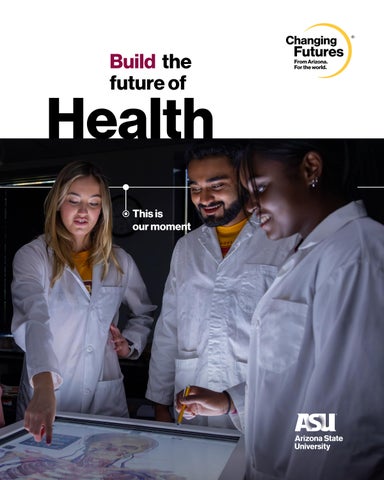
(Front cover) The Anatomage Table in ASU’s College of Integrative Sciences and Arts is a life-sized, 3D imaging system that allows students to virtually examine a human or animal anatomy.
Graduate student
Chris Lue Sang wears a device by FlexBioTech, co-founded by ASU faculty, which makes electronics to help diagnose diseases.
This is our moment to change the future
The next chapter of health begins here
“I believe that the work that ASU is doing now will impact the world, because it’s impacted the way it has worked with communities here in Arizona … What we learn here can be shared across the nation, or even across the world.”
—Dr. John Molina Director of the Arizona Advisory Council on Indian Health Care
ASU PhD student Jay Shah uses artificial intelligence for better MRI analysis in the lab of Teresa Wu, a professor in ASU’s School of Computing and Augmented Intelligence.
The story of ASU over the past 20 years has been one of transformation. A university that measures itself by whom we include and how they succeed, one that reflects the population of the state and that also attracts students from all 50 states and more than 150 countries.
Today ASU is one of the top research universities in the country with world-class faculty and the resources to develop comprehensive, inclusive health solutions.
At ASU, we take responsibility for the communities we serve. That starts in Arizona, a state that currently has among the poorest health outcomes in the nation — ranked 34th in overall health care performance indicators, 42nd in access and affordability and 49th in prevention and treatment.
As a public service university, it is our duty to be part of the solution. In building ASU Health, we are focusing the full energy of the university’s large, diverse and interdisciplinary ecosystem on the health needs facing the state and the nation.
Driving innovation in medicine and health care
In our mission to build the future of health, we will develop a medical school that produces physicians who blend medicine, engineering, technology and humanities to become a different kind of health care leader.
Graduates will leverage new tools, such as AI and data science, to connect with more patients, seek innovative practices and improve health outcomes. We are working to find innovative ways to be impactful to families at home, schools and school districts, hospitals, clinics, pharmacies — everyone.
We will also establish the School of Technology for Public Health and the Health Observatory at ASU, which will bring together disparate, traditional and non-traditional health data sources so they can inform decision-makers, advance new health discoveries and democratize data of social and economic value.
ASU Health will also be a hub for health literacy, equipping the public with the insights and information they need to make informed decisions about their well-being.
And through the university’s commitment to social embeddedness, ASU Health will provide care for our communities — especially in places where access is limited — by collaborating with health system partners to launch ASU Clinics throughout the state.
Amber Hedquist, a PhD student in English and a management intern with ASU Knowledge Enterprise, is researching generative AI. Emerging technologies are a core element of ASU’s approach to health care.
“ASU Health is about four components coming together in an integrated, highly collaborative effort: people, discoveries, information and care.”
—Dr. Sherine Gabriel Executive vice president and university professor ASU Health
In new research, Dr. Karen Anderson and her colleagues at the Biodesign Institute explore sophisticated new methods for screening for oropharyngeal cancer, which has previously evaded early detection.
Building critical early detection tools
When it comes to treating disease, time is of the essence.
“Study after study after study have demonstrated that the earlier we detect the disease, the better opportunity we have to treat it, and potentially even cure it,” says Dr. Joshua LaBaer, executive director of ASU’s Biodesign Institute.
ASU’s Biodesign Institute has developed tools to detect breast cancer, ovarian cancer and HPV early, during the key stages where the diseases are most treatable. These promising breakthroughs will not only improve outcomes and survivability but will also reduce the costs associated with late-stage cancer detection and treatment.
Today, the Biodesign Institute is hard at work to identify blood-based biomarkers in a number of cancers, which will improve both diagnostic and treatment capabilities. These lifesaving discoveries won’t stay at ASU — we share the benefits of our work with people around the world.
Equipping more health care experts with hands-on experience
Improving health outcomes means more than producing more health care professionals — it means producing a different kind of health care professional.
We need more nurses, and tomorrow’s leaders in health require more than textbook knowledge — they need next-level, hands-on education. At the Grace Center for Innovation in Nursing Education, we have brought together educators and state-of-the-art technology and facilities to create a cutting-edge simulation lab.
With over 150,000 simulation hours logged each year across more than 100 fast-paced scenarios, this immersive experience provides our students with the leading knowledge and expertise needed for their careers in nursing. And with our commitment to tripling the number of nurses and nurse practitioners who graduate, we will be shaping more future-ready health professionals than ever before.
“Increasing the number of nurses entering the workforce is the goal so that our community is well taken care of no matter where they are in the state,” says Judith Karshmer, dean and professor of the Edson College of Nursing and Health Innovation.
Nursing student Casey Catalanotto uses virtual reality for her practicum training in the Virtual Reality Simulation Lab, a new space developed by the College of Health Solutions and the Edson College of Nursing and Health Innovation.
Technology developed by NeoLight uses LED-based phototherapy to treat infant jaundice in both hospitals and homes. Co-founder Vivek Kopparthi, ’14 MS in management, says his team used biomedical concepts they learned at ASU to create the technology.
Incubating the bright ideas that will change the future of health
As we chart a brighter future for health in Arizona and across the globe, we know that there are many ways to make a difference. Some students may become doctors, nurses or researchers — others may start a business or work in communications.
At ASU, we nurture the entrepreneurial spirit in students, providing resources to incubate the ideas that will change the world. Take for example, Vivek Kopparthi, ’14 MS in Management, who first had the idea for his company NeoLight in an ASU dorm room. Alongside a team of classmates from ASU’s Ira A. Fulton Schools of Engineering, Kopparthi created a novel phototherapy device to treat jaundice, a disease that leads to 219 infant deaths in Africa daily, and more than 1,000 cases of brain damage or death each day in Southeast Asia.
Kopparthi credits his time at ASU with giving him the space and resources to execute on an ambitious vision along with access to the many disciplines that helped bring NeoLight to fruition. Integrating health and engineering expertise, technological innovation, entrepreneurship and compassion, Kopparthi is helping to save the lives of some of the world’s youngest citizens, providing unprecedented access to essential care and driving change in the global health landscape.
“ASU is a community that has entrepreneurial and creative thinking embodied in the grassroots of its foundation,” says Kopparthi, who now serves as CEO of NeoLight. “It’s a startup mentality on steroids. It’s a phenomenal playground to test out some key concepts, ideas and business plans that give you the launchpad you need to have a successful future.”
Together, we are Changing Futures
Nursing student Nancine Wemmer puts her training into practice in the Virtual Reality Simulation Lab, a new space developed by the College of Health Solutions and the Edson College of Nursing and Health Innovation.
Join us
ASU has an extraordinary track record of success. It is not only what we have accomplished but also how we embrace our responsibility for public service.
Changing Futures will multiply our impact across the state and across the world.
ASU is a comprehensive public research university, measured not by whom it excludes, but by whom it includes and how they succeed; advancing research and discovery of public value; and assuming fundamental responsibility for the economic, social, cultural and overall health of the communities it serves.