Arizona State University is pioneering the technology that will define the next generation and leading the charge to use it responsibly for all.
Through Changing Futures, we will advance technology for good.
If we do not embrace the rapid advancement of technology, we forfeit solutions to our greatest problems — from the health of our communities to the well-being of our planet and everything in between. We aren’t developing technology for innovation’s sake. At ASU, we are advancing technology to move humanity forward while mitigating harm and increasing access.
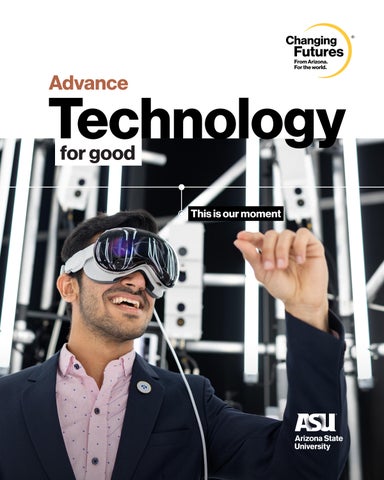
(Front cover) After years at the forefront of education innovation, ASU is still pushing the boundaries of how we teach, learn and work.
A student in Thunderbird’s Executive Master of Global Management program explores the latest advancements in technology.
“At ASU, we are on the leading edge in harnessing AI, the most disruptive technology of our age. We will have millions of learners and students, and at the same time, we will provide a personalized experience for them. The ASU Charter drives us to do both, rather than one or the other.”
— Lev Gonick Chief Information Officer Enterprise Technology
A SpaceX Falcon Heavy rocket with the Psyche spacecraft onboard is launched at NASA’s Kennedy Space Center. The mission is led by principal investigator Lindy Elkins-Tanton of ASU’s School of Earth and Space Exploration and ASU’s Interplanetary Initiative.
Across the globe, humanity’s brightest minds are exploring technology’s potential and its consequences.
ASU is deeply engaged in this process of exploration and innovation. We have the duty and privilege to use technology ethically for the greatest good.
We believe in a future where life-changing technology is within reach for all. ASU advances technology hand in hand with the human experience — evolving the way society learns and accesses research. These efforts also create new, tech-related career opportunities. We are at the forefront of bringing empathy-driven innovation to the world.
Unlocking new possibilities in higher education with OpenAI
In 2024, ASU embarked on a first-of-its-kind collaboration with OpenAI, the AI research and deployment company behind ChatGPT. ASU was among the first universities to bring the advanced capabilities of OpenAI’s ChatGPT Edu product into higher education. We are setting a new precedent for how AI might enhance learning, creativity and student outcomes.
The collaboration with OpenAI complements ASU’s ongoing endeavors in augmented and artificial intelligence. For example, the Center for AI and Data Analytics for Business and Society at ASU’s W. P. Carey School of Business is pioneering the concept of Mindful AI, an ethical and socially responsible approach to this revolutionary technology. Multiple communities of practice at ASU, including a Faculty Ethics Committee and GenAI Community of Practice, have been brought together to ensure responsible innovation. After formally announcing the collaboration with OpenAI, ASU invited ideas from faculty and staff on how to best leverage ChatGPT through the AI Innovation Challenge.
To date, the university has activated more than 500 projects within ASU’s dedicated ChatGPT workspace, a space that allows for responsible, secure exploration of AI across academic, research and work environments.
A learning experience previously limited to clean rooms, students at the ASU Ira A. Fulton Schools of Engineering explore microchip production through extended reality.
At ASU, we are interested in the success of all people, in all places and at all stages of life. We believe that artificial intelligence will play a key role in turning this interest into meaningful action.
Ahead of our peers, we are setting the standard for how AI will shape the individual learning experience. We are spearheading the development of an open model of learning, empowered by AI, that gives students the highest level of adaptable, accessible and personalized education possible.
We see a future at ASU in which AI changes our relationship with knowledge — democratizing access so learners can take charge of their education and chart their own learning pathways with confidence.
ASU’s collaboration with OpenAI is one example of a partnership through which the university aims to advance the future of learning through emerging technologies.
Auryan Ratliff is director of creative and emerging technologies at ASU EdPlus, an enterprise unit focused on the design and delivery of digital teaching and learning models to increase student success and reduce barriers to achievement.
“ASU recognizes that augmented and artificial intelligence systems are here to stay, and we are optimistic about their ability to become incredible tools that help students learn more quickly and understand subjects more thoroughly.”
— Michael M. Crow President Arizona State University
William Graves, chief scientist on the ASU compact X-ray free electron laser project, poses next to a component of the newly commissioned, first-ofits-kind device.
Making game-changing research tools more accessible
X-ray sciences have been instrumental to the progression of human health, renewable energy, quantum technologies and other significant advancements in medicine and science. However, only a handful of X-ray Free Electron Laser facilities exist across the globe, as they cost billions and most require at least a kilometer of space. Recognizing the urgent need to make this technology more accessible, ASU has developed the world’s first compact X-ray Free Electron Laser. This one-of-a-kind, room-sized X-ray laser instrument will fill a critical need for scientists to examine matter at atomic level in ultrafast time.
“The CXFEL’s laser X-ray capabilities and accessibility provide a technology we need for innovative research that can propel successful and meaningful advances in science,” explains Dr. Joshua LaBaer, executive director of the ASU Biodesign Institute. “Molecular and materials science will never be the same.”
The CXFEL at ASU has the potential to be a force-multiplier for discovery. It will drastically reduce the cost of critical X-ray technology — making it more accessible to scientists and researchers and ultimately ushering in a new era of X-ray science. The device’s powerful imaging capability can show how drugs bind to receptors at the surface of cancer cells, fueling development of safer, more effective treatments. It could advance semiconductor designs enabling faster, more efficient electronics. It could improve human health by accelerating drug discovery, optimizing vaccines and eliminating barriers to life-saving and lifechanging medical breakthroughs.
Building a hub for innovation and nationwide impact
Microelectronics and semiconductors are at the heart of today’s technological advances and tomorrow’s solutions. As the world learned through the supply chain disruptions of 2020 and beyond, electronic chips are used in cars, fighter jets, tanks, radio communications equipment and much more. They are critical to our national security and our economy.
In January 2025, the U.S. Commerce Department and Natcast – the operator of the National Semiconductor Technology Center – announced the selection of Arizona as the site of the co-located NSTC Prototyping and NAPMP Advanced Packaging Piloting Facility. The facility — part of the CHIPS for America initiative, which aims to strengthen the U.S. semiconductor supply chain and accelerate unparalleled research and development — is expected to be operational as early as the fourth quarter of 2028 and represents hundreds of new jobs and billions of dollars of investment. It is the third of three CHIPS for America research and development flagship facilities and will be located at the ASU Research Park in Tempe.
Led by ASU, the Southwest Advanced Prototyping Hub, or SWAP Hub, is one of eight Microelectronics Commons Hubs around the country. The hubs aim to boost electronic innovations to advance experimental technology to production for the U.S. Department of Defense. The SWAP Hub has recruited more than 130 partners from academia, government and industry to support this critical work. Hub partners include Northrop Grumman, Intel, NXP Semiconductors and the University of Colorado Boulder. Together, we will accelerate American microelectronic production, build our workforce capabilities and pursue growth-oriented priority areas in technology.
Zhengshan (Jason) Yu is an assistant research professor in the School of Electrical, Computer, and Energy Engineering at ASU, where he received his Ph.D. His team has improved solar panel efficiency from 20% to 28.6% by adding other semiconductor materials on top of the silicon.
“We are bridging the gap at ASU between research and entrepreneurship by advancing the local semiconductor industry and further enhancing economic competitiveness and national defense. A shining example is the Southwest Advanced Prototyping Hub, which leverages the expertise of our faculty and students at the Fulton Schools of Engineering to ensure a vital, sustainable and prosperous future for the area.”
— Sally C. Morton Executive Vice President ASU Knowledge Enterprise
Michael Pechacek, a sophomore computer science major, works on an Android user interface for an app his team is developing.
Hacking the cybersecurity challenge
Cybersecurity is one of the greatest perils in the world of technology today. Cybercrime led to financial losses of $12.5 billion in 2023 alone and the U.S. Department of Homeland Security cites cybersecurity threats to infrastructure as one of the United States’ most significant risks. ASU is hard at work finding solutions, tackling the challenge in new ways and with new resources.
ASU established the American Cybersecurity Education Institute in 2024. ACE will educate the next generation of cybersecurity professionals and address critical workforce shortages—and its reach is already creating impact far beyond ASU.
“The ACE Institute continues to create a home for excellence in cybersecurity education,” says Ross Maciejewski, director of the School of Computing and Augmented Intelligence. “The new endeavor will also further efforts to establish both the university and Arizona as global hubs for innovation.”
One of the core offerings at ACE is pwn.college: an education platform where students learn about and practice core cybersecurity concepts in a hands-on fashion. On the pwn.college site, cybersecurity students from around the world complete programming modules and participate in hacking exercises to gain real insight into how attackers access secured systems.
Changing Futures
At a recent tour of ASU’s Dreamscape Learn, residents of Mirabella, a universitybased retirement community, completed an introductory biology course through an avatar-driven, virtual reality experience in which they explore, observe and collect digital specimens, and solve problems.
Join us
ASU is ready to transform more world-class knowledge into real-world impact — but that’s only possible with advanced technologies.
Through your support for this campaign, you can say “yes” to a bright and equitable future driven by technology. You can help us push boundaries even further, equipping tomorrow’s problem-solvers with the greatest technological capabilities and trusting that they will use them capably, responsibly and creatively.
Charter
ASU is a comprehensive public research university, measured not by whom it excludes, but by whom it includes and how they succeed; advancing research and discovery of public value; and assuming fundamental responsibility for the economic, social, cultural and overall health of the communities it serves.