
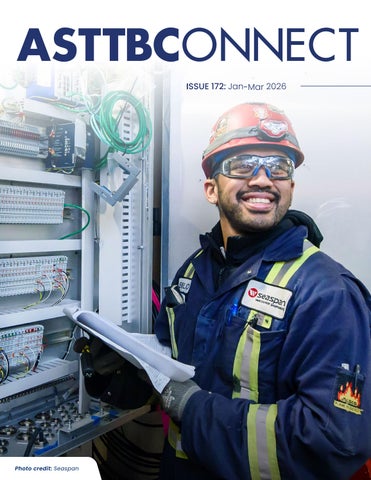
ASTTBConnect Issue No. 172 Jan-Mar 2026

Page 1


ISSUE 172: Jan-Mar 2026

Photo credit: Seaspan

Land Acknowledgement

Headquartered in Surrey, BC, ASTTBC acknowledges the traditional Lands of the Semiahmoo, Katzie, Kwikwetlem, Kwantlen, Qayqayt and Tsawwassen Peoples.

We thank our hosts for their graciousness in welcoming us to carry out our work on their Land.

In so doing, we recognize their inherent Indigenous rights and title, the implementation without qualification of the UN Declaration on the Rights of Indigenous Peoples (UNDRIP), and our support for the 94 calls to action by the Truth and Reconciliation Commission.

Disclaimer: ASTTBC makes no endorsement or guarantee as to the quality or suitability of any activity, professional, product, or service advertised with ASTTBC.

Chair & CEO message

ASTTBC welcomes Shona Lawson as incoming registrar

Updated Standard of Practice for Registered Fire Protection Technicians

ASTTBC by the numbers

Continuing Professional Development: more flexible, more relevant & a reminder to record by May 31, 2026

Linking ASTTBC’s Strategic Goals to the OSPG’s Standards of Good Regulation

House Inspector Exam update

Applying for your first job in the engineering and technology sector

Volunteer with ASTTBC to be a committee member or a file reviewer

Designing the infrastructure that connects communities

Volunteer opportunity: course eecognition evaluators

Wildfireresistant windows: an emerging consideration in BC building design

VIU students design award-winning visual impairment device

In the community Registrant update

Purpose Statement

ASTTBC is committed to protecting British Columbians and the environment by regulating applied science and engineering technologists, technicians, and technical specialists.

Through our code of ethics and practice standards, our registrants are qualified, competent, and accountable. ASTTBC monitors compliance with these standards and investigates breaches when necessary.

ISSUE 172

Jan-Mar 2026

ASTTBCONNECT is published by the Applied Science Technologists & Technicians of BC.

EDITOR: Cara Christopherson 604-585-2788 ext. 501

cchristopherson@asttbc.org

The opinions expressed in ASTTBCONNECT are not necessarily those of ASTTBC or its directors. All rights reserved. This publication may be reproduced provided credit is given as to the source of such material.

The Applied Science Technologists & Technicians of BC (ASTTBC) regulates approximately 6,000 applied science and engineering technology professionals in British Columbia under the Professional Governance Act (PGA) and the International Credentials Recognition Act (ICRA).

For more information, please visit asttbc.org

CHAIR & CEO Message

The past year marked an important milestone for ASTTBC with the completion of the first year of our 2025–2027 strategic plan. Approved by the ASTTBC Board of Directors, this plan provides a clear and measurable roadmap for advancing our mandate in the public interest, strengthening regulatory excellence, and positioning both the organization and our registrants for the anticipated implementation of a reserved scope of practice.

Guided by three strategic goals, the plan reflects ASTTBC’s commitment to responsible regulation, professional accountability, and organizational resilience.

A central focus of the plan is advancing work toward the anticipated reserved scope of practice for technologists and technicians. Over the past year, ASTTBC has worked closely with government partners and fellow regulators to refine the regulatory framework and support alignment as the regulation moves toward Cabinet for consideration. At the same time, we expanded education and outreach to registrants, employers, students, and the public to build awareness and understanding of the anticipated changes. These efforts are foundational to a thoughtful, staged implementation that prioritizes education, clarity, and public confidence.

To illustrate how this work is grounded in strong regulatory practice, page 16 features a visual showing how ASTTBC’s three strategic goals align with the Office of the Superintendent of Professional Governance’s Standards of Good Regulation, reinforcing our risk-based, publicinterest approach.

We also made meaningful strides in increasing awareness of ASTTBC’s regulatory role and the value of technology professionals. Through improved stakeholder relationships, expanded employer and registrant engagement, and enhanced public-facing communications, ASTTBC continued to build trust and visibility across government, industry, and the broader public. These efforts support not only accountability, but also recognition of the essential contributions made by technologists and technicians across British Columbia.

Equally important has been our continued focus on organizational excellence. Over the past year, ASTTBC strengthened its internal culture, modernized operations, enhanced governance frameworks, and invested in staff and leadership. These initiatives ensure the organization is well positioned to meet its statutory responsibilities today, while remaining adaptable and sustainable as our regulatory role continues to evolve.

As we look ahead to the second year of the strategic plan, we remain focused on steady progress, collaboration, and readiness. The work underway positions ASTTBC to responsibly support the profession, protect the public, and deliver on our mandate with confidence and integrity.

We thank our registrants, staff, volunteers, partners, stakeholders, and employers we’ve engaged with for their continued support as we move forward together.

ASTTBC welcomes Shona Lawson as incoming registrar

ASTTBC is proud to welcome Shona Lawson as our new registrar, effective February 9, 2026. Shona Lawson, M.Sc., is a senior regulatory and governance leader with extensive experience advancing public-interest regulation in British Columbia. She was the owner and principal of Oystercatcher Consulting, where she worked with immigrant settlement organizations regarding professional regulation and missiondriven organizations to strengthen governance, compliance, and operational effectiveness.

Previously, she served as registrar and director of compliance and practice at the College of Applied Biologists, overseeing statutory registration, accreditation, complaints, investigations, and professional practice, while leading major regulatory modernization initiatives under the Professional Governance Act. Earlier in her career, Shona held senior environmental leadership roles with the Department of National Defence, providing executive-level advice on compliance, risk management, and governance across complex, multi-stakeholder operations.

Welcome, Shona!

UPDATED STANDARD OF PRACTICE FOR REGISTERED FIRE PROTECTION TECHNICIANS

ASTTBC is pleased to announce the release of its updated Standard of Practice for Fire Protection, effective March 15, 2026. This revised standard reflects current industry needs and provides greater clarity, consistency, and accountability in fire protection inspection, testing, and reporting practices across British Columbia. A summary of changes is available and the RFPT Bulletin Tag Specifications is also now available.

Key updates include a newly designed fire tag, clearer guidance on when pass/fail inspection results should be applied, and the introduction of minimum reporting requirements for testing and inspection reports. The updated standard also provides clarification on stamping requirements for shared or supervised inspections, helping ensure professional accountability is clearly documented. In addition, the standard formally discontinues the practice of pre-stamping fire tags, reinforcing the importance of accurate, site-specific documentation.

These changes are intended to support registered fire protection technicians in delivering highquality, defensible work while helping authorities having jurisdiction and industry partners better interpret inspection outcomes.

To support a smooth rollout, ASTTBC will host two webinars on March 31, 2026 (12pm-1pm and again at 5:30-6:30pm). The sessions are open to all Registered Fire Protection Technicians, authorities having jurisdiction, and fire protection firms, and will provide an overview of the changes along with opportunities for questions and discussion.

ASTTBC registrants can register through their account and non-ASTTBC registrants can register via our website

ASTTBC registrants can claim 1 CPD hour for attending the webinar.

ASTTBC by the numbers

The data from 2025 tells an important story about ASTTBC and its registrants. These figures help guide our work, highlight key trends, and provide insight into the demographics shaping the technology profession across British Columbia.

654*

Number of registration applications received

200*

Required review and decision by the credentials committee

* The numbers above do not include reclassifications

357*

New registrants approved by the credentials committee

Number of files reviewed by the Credentials Committee Number of reclassification

Biotechnology

Building

Chemical

Civil

Computer

Electro-Mechanical

Electronics

Environmental

Geotechnical

Industrial

Information

Marine

Mechanical

Mineral

Naval

Petroleum

CONTINUING PROFESSIONAL DEVELOPMENT:

More flexible, more relevant & a reminder to record by May 31, 2026

Continuing Professional Development (CPD) remains an important part of maintaining professional competence and public trust. Important updates to ASTTBC’s CPD program are designed to make meeting these requirements clearer, more achievable and more meaningful for registrants.

With the current CPD cycle now extended, practising registrants are reminded that the deadline to complete and record CPD activities is May 31, 2026. Please note that individuals who were registered between November 15, 2024 and November 30, 2025 are required to report 12 CPD hours completed between June 1, 2026 and May 31, 2027.

What you need to know

Practising registrants are required to complete 12 CPD hours annually and record them through their ASTTBC online account. ASTTBC’s CPD Guideline outlines what qualifies as eligible CPD, with practical examples to help registrants plan and track their learning.

Registrants who do not meet CPD requirements by the deadline may be subject to a fine imposed by the registrar. In some cases, the Audit and Practice Review Committee may also request a practice review. ASTTBC encourages registrants to engage early and reach out if challenges arise; staff are available to provide guidance and support.

In extenuating circumstances, registrants may request an extension or accommodation. Details are outlined in the CPD Extension and Accommodation Policy.

CPD program updates: what’s changed

Last September, ASTTBC introduced several enhancements to the CPD program following feedback from registrants. These updates aim to reduce administrative pressure while better reflecting how professionals learn and grow in practice.

A new CPD cycle timeline

The CPD cycle now runs from June 1 to May 31, separating CPD reporting from annual registration renewal. This change helps streamline compliance and provides greater flexibility throughout the year.

Extended CPD cycle

To support the transition, the current CPD cycle has been extended by six months, now ending on May 31, 2026. The next CPD cycle will begin on June 1, 2026.

Updated Indigenous awareness and reconciliation training requirements

• New registrants must complete at least two hours of Indigenous awareness and reconciliation training in their first CPDeligible year.

• Existing registrants who completed this training since February 2021 are considered to have met the requirement.

• Existing registrants who have not completed this training must complete it by May 31, 2026.

Modernized CPD categories and activities

The CPD framework has been refreshed to better recognize diverse learning experiences:

• A new Industry Education, Outreach, and Engagement category acknowledges learning that supports both individual development and the profession as a whole.

• Limits on self-directed learning hours have been removed, allowing registrants to claim more than eight hours per cycle.

• A four-hour cap now applies per claim for reading books, journals, and technical publications.

Resources to support you

To help registrants navigate these changes, ASTTBC has made the CPD Update Webinar from September 22, along with a Q&A, available through the ASTTBC Portal. Additional details can be found in Schedule E of the ASTTBC Bylaws and on the Continuing Professional Development webpage.

For questions or support, registrants are encouraged to contact cpd@asttbc.org.

Plan ahead, record regularly, and take advantage of the added flexibilityMay 31, 2026 will be here before you know it.

Linking ASTTBC’s Strategic Goals to the OSPG’s Standards of Good Regulation

This visual demonstrates how ASTTBC’s strategic goals align with the Office of the Superintendent of Professional Governance’s Standards of Good Regulation (SGR), providing a clear representation of how ASTTBC’s activities support and meet these regulatory standards.

OSPG Standards Supported:

SGR 1: Transparency & Accessibility

SGR 2: Regulatory Role & Advocacy Boundaries

SGR 6: Risk Assessment & Mitigation

SGR 7-8: Standards & Guidance

SGR 15: Title & Practice Enforcement (preparatory)

Awareness, Accountability, & Professionalism

OSPG Standards Supported:

SGR 1: Transparency & Communication

SGR 3: Equity, Diversity & Inclusion

SGR 5: Performance Evaluation

SGR 9-10: Education & Continuing Competence

Governance, Culture, & Organizational Capacity GOAL 1: GOAL 2: GOAL 3: 1 2 3

OSPG Standards Supported:

SGR 4: Indigenous Reconciliation

SGR 5-6: Performance & Risk Management

SGR 10: Continuing Competence

SGR 11-20: Registration, Audit, Complaints & Discipline

HOUSE INSPECTOR EXAM UPDATE

ASTTBC is temporarily placing House Inspector exam services on hold for a period of up to six months. During this time, ASTTBC will not be offering or administering exams for House Inspectors and we will also not be processing new House Inspector registration applications.

This pause is part of an internal review being undertaken in response to the Ministry’s recent decision that it is not in the public interest to bring the house inspection profession under the Professional Governance Act (PGA). The review will allow ASTTBC to assess next steps and ensure alignment with the Province’s direction.

ASTTBC supports the Minister’s decision, which reflects a balanced, evidence-based approach that protects consumers while maintaining access to affordable house inspection services. Please click here to read the full announcement.

APPLYING FOR YOUR FIRST JOB IN THE ENGINEERING AND TECHNOLOGY SECTOR

Landing your first job in the engineering or technology sector can feel both exciting and intimidating. After years of lectures, labs, and late-night assignments, the transition from student to professional suddenly becomes very real. For many university graduates and early-career ASTTBC registrants, the job search is unfamiliar territory. With the right preparation and mindset, it can be an opportunity to stand out.

What to Expect as a New Graduate

An important thing to keep in mind is that entry-level roles often emphasize potential over experience. Employers understand that recent graduates may not have years of industry work experience behind them. Instead, most employers are looking for candidates who demonstrate strong fundamentals, adaptability, and a willingness to learn. It’s important to be realistic about the roles and responsibilities that come with an entry level position. Though some tasks may not be glamorous, they often offer an opportunity to build fundamental skills that will help you throughout your career.

You may also notice that job descriptions list a wide range of technical skills, software, and experience levels. It is important not to be discouraged. Employers often use job postings as a wish list rather than a strict checklist. Rarely does any candidate meet every requirement perfectly.

Another reality of the early job search is rejection. While discouraging, this is a normal part of the process and not a reflection of your current ability or future success. Use each application and interview to help you refine your approach and better prepare you for the right opportunity; after an interview consider asking the interviewer to provide you with feedback on the interview when they reach out to you with their decision.

How to Stand Out in a Competitive Market

One of the most effective ways to differentiate yourself is by clearly communicating how your academic experience translates to real-world problem solving.

University projects — including capstone projects, group assignments, and research work — are extremely valuable. Be prepared to explain not only what you worked on, but why certain decisions were made, what challenges arose, and how you overcame them. Employers appreciate candidates who can think critically and reflect on their work.

Involvement outside the classroom also matters. Participation in student organizations, technical clubs, volunteer roles, or internships demonstrates initiative and teamwork. Even part-time or summer jobs unrelated to engineering can highlight transferable skills such as communication, time management, adaptability, conflict resolution, and accountability.

Tailoring your resume and cover letter for each role is another simple but effective way to stand out. Highlight experiences and skills that align directly with the job description and avoid overly generic language. A concise, wellorganized resume that tells a clear story will always make a stronger impression.

Differentiating Yourself in the Interview

The interview is your opportunity to bring your application to life. Preparation is key. Research the company, understand its services or projects, and familiarize yourself with the role. This allows you to ask thoughtful questions and demonstrate genuine interest.

One useful tool during interviews is the STAR method (Situation, Task, Action, Result).

Structuring your answers this way helps you clearly explain your experiences and shows employers how you approach challenges. Academic, work, and extracurricular examples can all be framed effectively using this approach.

Soft skills are equally important. Clear communication, professionalism, and a positive attitude often leave a lasting impression. Employers are not only assessing your ability as an individual, but also how well you may fit within their team.

To help prepare for interviews consider compiling a list of examples to use in your responses — such as how you navigated a challenging project, a time you resolved conflict, or an instance where you learned a new skill quickly.

Learn More: Join the YPG webinar & Q&A Session

To build on the topics discussed in this article, the ASTTBC Young Professionals Group will be hosting a webinar and Q&A session focused on applying for your first job in the engineering and technology sector. This session will provide an opportunity to hear first-hand experiences from young professionals, ask questions, and gain practical insights that are difficult to capture in a job posting or interview guide.

Webinar details:

Date: April 29, 2026

Time: 12pm-1pm

CPD hours: claim 1 CPD hour for attending Register through your ASTTBC account.

About the ASTTBC Young Professionals Group

This article was created by the ASTTBC Young Professionals Group (YPG) to help upcoming graduates and new ASTTBC registrants better understand what to expect and how to approach their first professional role with confidence.

The ASTTBC Young Professionals Group (YPG) represents early-career Applied Science Technologists and Technicians across British Columbia. The group’s goal is to support professional development, encourage engagement within the association, and provide networking and learning opportunities tailored to students, new graduates, and young professionals as they begin their careers.

ASTTBC BOARD OF DIRECTORS 2025

Chair, Brian F. Davies, CTech, RSIS, CGM

Vice chair, Kerry Barth, AScT

Immediate past chair,

Ken Zeleschuk, AScT, PTech, RTMgr, MBA, Dipl.T

Registrant directors:

Jessica Baxter, AScT

Prakash Joshi, AScT, PTech, P.L.Eng.

Randy Meszaros, AScT, PMP, C.E.T.(AB)

Laure Nielsen, AScT, PMP

David Sparanese, PTech, AScT, CPWI3

Lay directors:

Oluwatobi (Tobi) Abisoye, LLB, LL.M., Barrister & Solicitor

Natasha Dookie, BA, CPHR, JD

Terry W. Hawes, LL.M., MBA, CPA, CFE, C.Dir.

Mary O’Callaghan, MBA, FCMC

Registrants are required to notify ASTTBC of any change of name, address, email, place of employment, or other contact information previously provided, within two weeks of any change.

Please update your information to ensure it is current.

ASTTBC is inviting practising and retired registrants in good standing to volunteer as either a committee member and/or file reviewer.

ASTTBC has several statutory committees that we are looking for new volunteers:

Nomination Committee:

Administers the nomination of registrants who are qualified to be nominated for election to the Board in accordance with merit-based selection principles prescribed by the Lieutenant Governor in Council and criteria or preferences for registrant directors is determined by the ASTTBC Board of Directors.

Credentials Committee:

Oversees the application process for new and reinstating registrants of ASTTBC. This committee meets virtually in the evenings on a monthly basis.

Investigation Committee:

Oversees the investigation of allegations of professional misconduct, conduct unbecoming and/or incompetent practice against registrants and makes disposition decisions. This committee meets virtually in the evening approximately five times per year.

Audit and Practice Review Committee:

Oversees the development of practice standards, the annual CPD audit and the practice review process. This committee meets virtually in the evening approximately five times per year.

Discipline Committee:

Conducts disciplinary hearings to determine if allegations of professional misconduct, conduct unbecoming or incompetent practice have occurred. This committee meets on an as-needed basis and may be in person or virtual.

ASTTBC FILE REVIEWERS

ASTTBC File Reviewers assist the Credentials Committee in reviewing applications for new registration (file reviewers may indicate their availability/workload). ASTTBC needs RFPTs in all endorsements, as well as AScTs and CTechs in all disciplines, but could especially use assistance with the following disciplines

Architectural & Building Construction

Biomedical

Civil

Electrical

Electronics

Environmental

Instrumentation

Mechanical

Survey/Geomatics

KEY RESPONSIBILITIES AND EXPECTATIONS INCLUDE:

Reviewing and evaluating applications based on the registration requirements outlined in the ASTTBC Bylaws (“the bylaws”).

Providing insightful, justified, fair, and objective recommendations to the Credentials Committee based on applicants’ education, experience, and competence.

WHY VOLUNTEER AS A FILE REVIEWER?

Gain valuable experience and earn Continuing Professional Development (CPD) hours, eligible under the “volunteering” category in accordance with Section VI and Schedule E of the bylaws.

Contribute to the growth and development of the profession in BC.

Help elevate the profession. Through constructive feedback and recommendations, file reviewers indirectly support applicant development and help identify gaps in education or experience that can be addressed through further learning or practice.

Make a positive impact on the future of applied science and engineering technology professions.

TO BE ELIGIBLE AS AN ASTTBC FILE REVIEWER YOU MUST:

Be a registrant of ASTTBC in good standing.

Have five (5) years of experience in your respective class and discipline.

ELIGIBILITY

A registrant is not eligible for a position on a statutory committee if they:

Are not a resident of British Columbia.

Are the subject of a citation for a discipline hearing which is to be scheduled or which is in process in British Columbia, another province, or a foreign jurisdiction that could result in the registrant’s entitlement to practice in the applicable jurisdiction being cancelled, revoked, suspended or subject to restrictions, terms or conditions for any reason other than late payment or nonpayment of fees.

Are the subject of an ongoing investigation as a result of a complaint or a duty to report.

Have been found by any court, inside or outside of Canada, to be incapable of managing their own affairs.

Are an undischarged bankrupt.

Hold the position of a director, officer or employee of a professional association and/or advocacy body of engineers, applied science and/or engineering technologists or technicians, or a technical specialist subclass or group of subclasses, or have held such a position in the previous six months.

Time spent volunteering on a committee or as a file reviewer is eligible for continuing professional development hours.

TO APPLY, PLEASE SUBMIT AN APPLICATION EXPRESSING YOUR INTEREST IN VOLUNTEERING WITH ASTTBC:

Log into your ASTTBC account https://Registrants.Asttbc.org/web

One-third down the page, select Resources tab

Click Training videos, group benefits and other resources 3

ASTTBC will identify and reach out to volunteers. Volunteering is an excellent way to serve the public interest in the practice of applied science technology. We encourage all who are interested to learn more about this opportunity.

ASTTBC provides training on regulatory processes and related administrative law.

Questions regarding volunteering may be directed to the registrar and deputy registrar by email to registrar@asttbc.org.

In recognition of International Women’s Day, ASTTBC is proud to feature Leticia Harder, AScT (Trainee), a civil designer whose early career reflects curiosity, leadership and a sense of purpose.

Leticia works as a civil designer with Stantec’s Roads & Highways team in Kamloops, supporting the design and delivery of civil infrastructure projects. Her work includes drafting and modelling, assisting with technical analysis and coordinating across disciplines.

A co-op term with Stantec following her second year shifted her direction.

“For the first time, I saw how much thought, coordination and technical precision goes into the infrastructure most people take for granted — roads, utilities, grading and bridges,” she says. “It might not be flashy, but communities don’t function without it.”

That experience clarified where she wanted to focus her career. After graduating, Leticia

“ “ Ask questions. Speak up, even if your voice shakes. Confidence isn’t something you wait for, it’s something you build.

“What I enjoy most is seeing how all the pieces come together,” she says. “Projects can feel complex and abstract at first, but it’s incredibly satisfying to watch a design evolve from early concepts into something tangible and built.”

Although she now works in civil infrastructure, Leticia did not initially plan that path. She began the Architectural and Engineering Technology program at Thompson Rivers University with an interest in design and the creative side of the built environment.

joined Stantec full-time and began developing her expertise in road and highway design. As someone early in her professional journey, she values being trusted with responsibility while continuing to learn from experienced mentors.

“There’s a long runway ahead and so many directions I can take my career,” she says. “That’s exciting.”

Leticia notes that engineering technology remains a male-dominated field. In her postsecondary program, women represented roughly 20 per cent of her class.

“There are times when you might be the only woman in the room or on a site visit,” she says. “Learning to speak up, trust your technical abilities and take up space has been an important part of my growth.”

She believes infrastructure projects benefit from diverse perspectives and inclusive teams.

“Infrastructure is stronger when different voices are part of the conversation. Different perspectives make projects better.”

Beyond her technical role, Leticia serves as a member of ASTTBC’s Young Professionals Group (YPG), where she helps foster connection among early-career professionals, encouraging engagement and mentorship within the region.

“It’s important to build community within the profession,” she says. “Having a network of peers and mentors makes a big difference, especially early in your career.”

Outside of work, she enjoys spending time outdoors in Kamloops, hiking local trails or heading to the lake with her labrador. She approaches both her career and personal life with a growth mindset.

“I don’t expect myself to know everything, especially this early on,” she says. “But I do expect myself to stay curious, work hard and keep improving. Small, consistent effort adds up over time.”

As we recognize International Women’s Day, Leticia encourages women considering careers in applied science and engineering technology to believe in their capabilities.

“Trust your abilities, even when you’re still building them. Ask questions. Speak up, even if your voice shakes. Confidence isn’t something you wait for, it’s something you build.”

VOLUNTEER OPPORTUNITY: COURSE RECOGNITION

EVALUATORS

ASTTBC is seeking qualified volunteers to support our Course Recognition Program by participating in the evaluation of training courses related to Registered Fire Protection Technician registration for the smoke control and special suppression endorsements. Course recognition plays an important role in ensuring that training programs meet the competency expectations required for professional practice in British Columbia. Volunteer evaluators help review course materials and determine whether learning outcomes align with ASTTBC’s registration and competency requirements.

Role summary

As a volunteer course recognition evaluator, you will work as part of a working group to assess course submissions and provide feedback on whether the curriculum meets established technical and professional standards.

Evaluations may include review of:

Course outlines and learning objectives

Instructional hours and delivery format

Assessment methods (exams, assignments, practical components)

Coverage of relevant codes, standards, and safety practices

Alignment with expected competency outcomes

Site visits

- Virtual or in person depending on the course recognition program

Areas of focus

We are currently prioritizing evaluations in the following endorsements:

Commercial Kitchen Exhaust

Smoke control

Fire pumps; and

Special suppression systems

Skills and experience we are looking for

Volunteers should demonstrate skills similar to those expected of accreditation or audit reviewers, including:

Strong technical knowledge in fire protection, including the applicable endorsement(s)

Ability to assess whether course content meets professional competency expectations

Familiarity with regulatory requirements, codes, and industry standards

Experience in inspection, design, installation, or commissioning of relevant systems

Analytical and detail-oriented approach to reviewing documentation

Ability to provide clear, objective, and constructive written feedback

Professional judgment and commitment to fairness and consistency

Experience with program evaluation, auditing, or accreditation processes is an asset

Time commitment

Course evaluations are conducted on an as-needed basis and vary depending on complexity.

Who can apply

We welcome expressions of interest from:

Registered Fire Protection Technicians (RFPTs) with the applicable endorsement(s), or professionals with relevant expertise

Individuals with accreditation, auditing, or curriculum review experience

Individuals should, at a minimum, have the following qualifications:

- be a registrant of ASTTBC in good standing; and

- five (5) years of experience in their respective class and discipline

Why volunteer?

Contribute to public safety and professional standards in BC

Support the development of qualified individuals

Gain valuable experience in program evaluation and accreditation-style review

Earn recognition for service to the profession

How to express interest

If you are interested in volunteering as a course recognition evaluator, please contact rsackey@asttbc.org with the subject line: Course Recognition Evaluators and submit a copy of your resume/CV and a brief summary of your relevant experience and areas of expertise.

Wildfireresistant windows:

an emerging consideration in BC building design

Wildfire risk continues to shape how buildings are designed and constructed across many regions of British Columbia, particularly in communities located near forests, grasslands, and the Wildland–Urban Interface (WUI). As wildfire seasons become longer and more severe, attention is increasingly turning to how building materials and assemblies can better withstand fire exposure.

Windows are among the more vulnerable components of a building envelope during a wildfire. Wind-driven embers and radiant heat can cause glass to crack or fail, creating a pathway for fire to enter a structure even when other exterior elements remain intact. This has led to growing interest in window systems designed and tested for wildfire resistance.

While BC does not currently have a standalone wildfire-specific window standard, many designers and jurisdictions reference California State Fire Marshal (SFM) Standard 12-7A-2. This widely recognized benchmark evaluates window performance under ember exposure, radiant heat, and direct flame contact, and is often cited by organizations such as the International Code Council, Natural Resources Canada, and FireSmart Canada when discussing wildfire-resilient construction strategies.

Window assemblies tested to this standard are intended to reduce the likelihood of ignition and flame spread at the building envelope, addressing one of several potential vulnerabilities during a wildfire event. In wildfire-prone areas of BC, these systems are increasingly considered alongside other mitigation measures such as non-combustible cladding, fire-resistant roofing, and defensible space.

As communities across the province continue to adapt to evolving wildfire conditions, interest in resilient building components is likely to grow. Wildfire-resistant windows offer one example of how building technology and design approaches are evolving in response to changing environmental conditions and fire risk in British Columbia.

StrongerBC Future Skills Grant

The StrongerBC Future Skills Grant is open to British Columbians aged 19 years or older regardless of financial need and covers up to $3,500 per person for eligible short-term skills training at public postsecondary institutions.

LEARN MORE

VIU STUDENTS DESIGN AWARD-WINNING VISUAL IMPAIRMENT DEVICE

Source: The Province newspaper, Jan 01, 2026

Photo caption: Jack Redberger models the wearable tech aid he and fellow Vancouver Island University student Jay Koidhis developed as part of a project in the university’s Information Technology and Applied Systems program. SUPPLIED PHOTO

The Proximity Pal was created to help visually impaired people move about more safely and independently

What started as an assignment in a project management class is becoming a wearable tech aid for people with visual impairments thanks to two students in the Information Technology and Applied Systems (ITAS) program at Vancouver Island University (VIU).

“I wanted to pitch something that was useful, something that made sense and could potentially be used or developed in the real world,” says Jack Redberger, the ITAS student who first came up with the idea for the Proximity Pal. He thought of it after watching a documentary on how difficult it was for blind people to navigate big cities like New York, even with a cane, because of all the scaffolding.

“There were some devices that had been attempted in the past, but nothing that was ever successful, feasible or cost-effective,” he says.

A lot of those devices were also trying to replace the cane, while the Proximity Pal is trying to complement it, according to Redberger, who developed the device with classmate Jay Koidhis.

Designed to be worn across the chest in a small, sleek pouch, the device includes a microprocessor, a sensor, vibration motors and a battery. The components work together to detect and vibrate when an object is about 1.5 metres away, with vibrations increasing in strength as the wearer gets closer to objects.

For his innovative efforts, Redberger was awarded the Lloyd Milburn Innovation Award, which supports students at the University of Victoria and VIU who are tackling real-world health and equity challenges.

He says the Proximity Pal came down to a lot of experiential learning. “It was a lot of trial and error, and figuring things out, but it was a really good experience,” he says.

Redberger is using the prize money to develop a second iteration of the device, to test it with the Canadian National Institute for the Blind and to eventually introduce it to the market.

“The support that we’ve received from both Vancouver Island University and the University of Victoria has been instrumental,” says Koidhis, who helped develop a second prototype for the Proximity Pal.

“The program itself, the way it works, is very applied and hands-on, and our instructor Allan McDonald, who developed the course we were taking, was also instrumental in telling us that we had something we should develop beyond the classroom.”

McDonald says what makes the program stand out are these unique chances to develop viable solutions to real-world problems.

“This project highlights the creativity, innovation and technical expertise cultivated within the program, reflecting our commitment to producing industry-ready graduates,” he says.

The big difference between the first and second versions of the Proximity Pal is a shift from using ultra-sonic sensors to light detection and ranging (LIDAR) technology, which provides both better detection and faster response rates.

Other changes are also being made to make the device smaller, lighter and extend the battery life.

For more information about Vancouver Island University or to find out more about the Information Technology and Applied Systems program, or any of its programs, visit viu.ca.

IN THE COMMUNITY

Post-Secondary

Attended three capstone project presentations at Okanagan College

December 2025 January–February 2026

Met with Thompson Rivers University Water and Waste Technology program head to plan 2026 student presentations

Began booking spring presentations for secondyear students; March sessions confirmed at BCIT, VCC, and Brighton College

Community

February 27, 2026

Participated in the WCOWMA-BC

REGISTRANT UPDATE

New AScT

Ethan Beattie

James Budgell

Chad Carmichael

Wilfredo Raphael Castillo

Klym Collins

Justin Davies

Clayton Dreger

Jody Eastman

Madelaine Fisk

Cristopher Gneo

Tharindu Godamuna Vithana

Thomas Hogan

Hosnia Jawhari

Hans Lopez Ayala

Reza Moodi

David Niezen

Yevgen Ostriak

Peter Rompf

Laen Savage

Willem Sims

Tsz Ho Tam

Jennifer Thiessen

Quinn Thompson

Jonathan Tighe

Joel Tomasiewicz

Lam Duy Tran

Benjamin Tschumi

Nicholas VanSnick

Timothy Warner

Terrence Watson

New RTS

Po-Yi Cheng

Dustin Cunnington

Sean Iskierski

Alireza Kamkhah

Daniel Lim

David Mahmod

Sean Mesina

Sayed Harris Mirzahi

Amin Moshkin

Amarjit Parhar

Raja Sandal

Anoop Singh Sidhu

Tyson Stephen

Michael Tabert

Yogesh Kumar

New CTech

Michael Bridden

Derek Broerken

Gahee Choi

Daniel Johnston

Michael Matousek

Malaykumar Patel

Tavis Phillips

Antonio Ribeiro

Dale Rowan

Retired

Robert Anderson

John Bresnick

Gail Denton

Deanna Fourt

Birk Madsen

Stephen Redly

Gregory Samchek

Sam Thauli

Keith Trulson

Kenneth Zeleschuk

In Memoriam

Peter Shires

Earn CPD!

ASTTBC RFPT Standard of Practice Webinar (12:00 pm)

10-Mar-2026 - 10-Mar-2026

Online

ASTTBC RFPT Standard of Practice Webinar (5:30 pm)

10-Mar-2026 - 10-Mar-2026

Online

YPG Webinar: Applying for your First Job in the Engineering and Technology Sector

29-Apr-2026 - 29-Apr-2026

Online

Shop Superintendent Emcon Services Inc.

Civic Operations GIS Technologist City of Kamloops

Field Review Representative RJC Engineers

Trolley Overhead Engineering Technician

Coast Mountain Bus Company

Registrant Services

Our partners offer exclusive rates on their products and services. Follow the links below to learn more:

» Willis Towers Watson

» TD Insurance Meloche Monnex

» Manulife

» Notarius

To access insurance and other ASTTBC group benefits including discounts to the PNE/Playland, Mark’s Work Wearhouse and more, please log into your ASTTBC account. Once logged on, click the ‘Resources’ tab for more information.

Turn static files into dynamic content formats.
Create a flipbook