Plasmid DNA process intensification with an innovative nanofiber adsorbent

Page 1

Plasmid DNA process intensification with an innovative nanofiber adsorbent C. Childers, E. Pawlowska, K. Moulson, B. Galarza, J. Fletcher, C. Daye, M. Hummersone, and I. Scanlon Astrea Bioseparations, Horizon Park, Barton Road, Comberton, Cambridge, CB23 7AJ, UK

4

Abstract

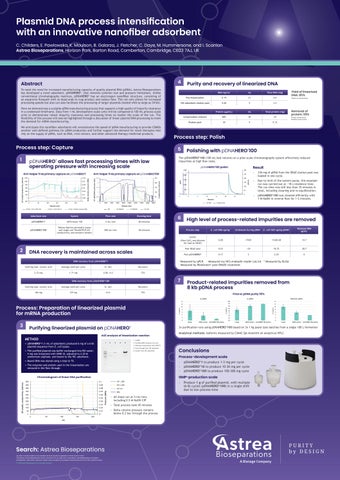
To meet the need for increased manufacturing capacity of quality plasmid DNA (pDNA), Astrea Bioseparations has developed a novel adsorbent, pDNAHERO®, that removes common size and pressure limitations. Unlike conventional chromatography matrices, pDNAHERO® has an electrospun nanofiber structure, consisting of an expansive flowpath with no dead ends to trap product and reduce flow. This not only allows for increased processing speeds but also can also facilitate the processing of larger plasmids (tested with as large as 34 kb).

Purity and recovery of linearized DNA DNA mg/mL*

mL

Total DNA (mg)

Pre-linearization

0.19

21

4.0

HIC-adsorbent elution pool

0.68

5

3.4

Here we demonstrate a scalable pDNA manufacturing process that supports a high quality of impurity clearance in a condensed timeframe. Data from 1 mL development-scale units will be compared to 100 mL process-scale units to demonstrate robust impurity clearance and processing times no matter the scale of the run. The flexibility of this process will also be highlighted through a discussion of linear plasmid DNA processing to meet the demand for mRNA manufacturing. We anticipate this nanofiber adsorbents will revolutionize the speed of pDNA manufacturing to provide CDMOs another well-defined pathway for pDNA production and further support the demand for novel therapies that rely on the supply of pDNA, such as RNA, viral vectors, and other advanced therapy medicinal products.

Process step: Capture

0.025

600

0.02

400

0.015

200

0.01

0

0.005 100

150

200

Elution pool

30

5

0.15

250

0

pDNAHERO®100 polish

2.5 2

200

1.5

150

1

100

0.5

50

0

0 18000

0

2000

4000

6000

8000

10000

12000

14000

16000

Protein measured by Bradford total protein

2000

200

1500

150 1000

100

500

50

0

0 -5

• 336 mg of pDNA from the DEAE elution pool was loaded in one cycle.

250

250

Volume (mL)

Removal of protein: 99%

Result

300

mS/cm

800

50

24

2500

Conductivity (mS/cm)

0.03

Delta column pressure (MPa)

0.035

1000

0

Total protein (mg)

30

Polishing with pDNAHERO®100

AVV helper 11 kb primary capture on pDNAHERO®100 UV (AU)/Delta pressure (bar)

UV (mAU)/Conductivity (mS/cm)

1200

Chrom.1 UV 2_260 mAU

mL

805

The pDNAHERO®100 (100 mL bed volume) on a pilot-scale chromatography system effectively reduced impurities at high flow rates.

pDNAHERO® allows fast processing times with low operating pressure with increasing scale

-200

Protein (µg/mL) Linearization mixture

5

AVV helper 11 kb primary capture on pDNAHERO®1

*Based on densitometry

Process step: Polish

mAU

1

Yield of linearized DNA: 85%

0

5

10

15

20

• pDNAHERO®100 was cleaned efficiently with 1 M NaOH in reverse flow for 1-2 minutes.

25

Minutes UV 260

• Due to limit of the system pump, this example run was carried out at ~18 s residence time. The run time was still less than 35 minutes in total, including cleaning and re-equilibration.

Conductivity

Volume (mL)

Chrom.1 Cond mS/cm

Chrom.1 DeltaC pressure MPa

dP1

UV 260(AU)

UV 280(AU)

C2 (mS)

Adsorbent size

System

Flow rate

Running time

pDNAHERO®1

AKTA Avant 150

5 mL/min

60 minutes

pDNAHERO®100

Watson Marlow peristaltic pump and single use* PendoTECH UV, conductivity, and pressure sensors

500 mL/min

40 minutes

6

High level of process-related impurities are removed Process step

E. coli DNA ug/mg *

Endotoxin Eu/mg pDNA ~ E. coli HCP ug/mg pDNA#

Residual RNA ug/mL+

Lysate

2

(Post-CaCl2 and dilution for load on DEAE)

6.00

17625

11620.68

10.7

Post-DEAE pool

0.53

<25

18.72

28.7

Post-pDNAHERO®

0.17

2

2.25

0

DNA recovery is maintained across scales DNA recovery from pDNAHERO 1

*

®

+

Starting load, nucleic acid

Average yield per cycle

St. dev

Recovery

2.33 mg

1.71 mg

0.06, n=2

73%

Measured by qPCR Measured my NCS endosafe reader LAL kit Measured by RiboGreen® post-DNASE treatment ~

7

DNA recovery from pDNAHERO®100 Starting load, nucleic acid

Average yield per cycle

St. dev

Recovery

166 mg

125 mg

N/A

75%

Final sc pDNA purity 95%

95

12

90

10

8 6

1

2

3

4

80 75

4

70

2

65

0

60 DEAE elution pDNAHERO®100 elution

5

GMP-production scale

Chromatogram oflinear linearDNA DNApurification purification Chromatogram of UV 2_260

0.08

mS/cm

350

0.07

300

0.06

250

0.05

200

0.04

150

0.03

100

0.02

50

0.01

Pressure (MPa)

0.09

400

0

0 50

100

150

200

mL

Search: Astrea Bioseparations Any data or results provided are only examples and do not provide any guarantee of similar results in future. The products of Astrea Bioseparations may be covered by or for use under one or more patents: astreabioseparations.com/patents All trademarks, trade names, trade dress, product names and logos are the property of Astrea UK Services Ltd or their respective owners. © 2025 Astrea Bioseparations Ltd. All rights reserved

Conclusions

• pDNAHERO®1 to produce 1-3 mg per cycle • pDNAHERO®10 to produce 10-30 mg per cycle • pDNAHERO®100 to produce 100-300 mg cycle

• The enzymes and protein used in the linearization are removed in the flow-through.

450

Lysate

Analytical methods: Isoforms measured by CIMAC QA monolith on analytical HPLC

Process-development scale

• Bound DNA was eluted using a step to TE.

UV 1_280

4

0 DEAE elution pDNAHERO®100 elution

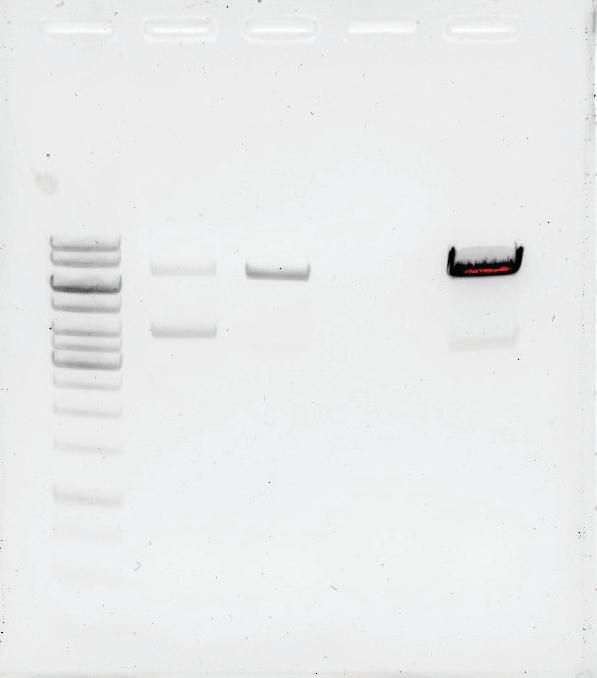
2: Purified pDNA (mixture of sc/oc)

5: Elution from HIC adsorbent

0.1

6

DEAE elution

pDNAHERO®100 elution

3x purification runs using pDNAHERO 100 based on 3x 1 kg paste lysis batches from a single 100 L fermenter

4: Flow-through from HIC adsorbent

500

8

2 Lysate

3: DNA post-linearization with HIND III

• The purified plasmid was buffer exchanged into RO water; 4 mg was linearized with HIND III, adjusted to 2.25 M ammonium sulphate, and bound to the HIC adsorbent.

0

85

% isoform

10

1: Ladder

• pDNAHERO®1 (1 mL of adsorbent) produced 6 mg of a 6 kb plasmid sequence from E. coli lysate.

UV (mAU) conductivity (mS/cm)

14

12

®

AGE analysis of linearization reaction

METHOD

Multimer pDNA

100

% isoform

% isoform

Purifying linearized plasmid on pDNAHERO

®

sc pDNA

14

Lysate

3

Measured by ELISA

Product-related impurities removed from 8 kb pDNA process oc pDNA

Process: Preparation of linearized plasmid for mRNA production

#

MPa

• All steps run at 5 mL/min, including 0.5 M NaOH CIP • Total process took 45 minutes • Delta column pressure remains below 0.2 bar through the process

• Produce 1 g of purified plasmid, with multiple (6-8) cycles (pDNAHERO®100) in a single shift due to low process time


Turn static files into dynamic content formats.

Create a flipbook