
Application note: Intermediate purification and polishing with Q PuraBead® Edge
The choice of chromatographic resin is influenced by many factors particularly the stage of the workflow where the resin is to be used.
Many downstream process developers are aware of the importance of selecting the right surface chemistry to purify the biological molecule of interest. However, it's common practice to focus primarily on surface chemistry (ligand) choices to deliver the desired level of purity without fully considering the crucial influence of the beaded support matrix Many critical process parameters such as porosity, available surface area (capacity) and resistance to flow (back pressure) hinge on the properties of the selected chromatography base matrix. Therefore, when choosing the most suitable chromatography media for a particular application, it is essential to consider not only the ligand chemistry but also the stage of the workflow where the resin will be utilized, the nature of the feed being processed, and the processing speed required to achieve productivity goals.
PuraBead® P6: The Ideal Choice for Challenging
Solutions.
Resin beads of varying sizes play key roles in the chromatography unit operations of downstream processes . Larger beads such as those in the PuraBead® P6 series from Astrea Bioseparations are the resin of choice for handling complex feedstocks, particularly for initial product capture applications. The distinctive flow characteristics of the near- monodisperse 90 µm monodisperse PuraBead® P6 beads create sizable, uniform flow channels, facilitating rapid processing of solutions with minimal back pressure.
Achieving high flow rates while maintaining low back pressures is important, especially during primary capture phases or when dealing with relatively viscous solutions such as plasma or plasma fractions. These scenarios often involve processing viscous feedstocks with a high concentration of proteins or other targets. Beads capable of forming a packed bed with extensive open flow channels are necessary for these tasks. In such applications, the wider elution peak shapes produced by larger beads are offset by the advantages of efficient sample purification, particularly for affinity chromatography where the resolution of sample components relies on binding selectivity not chromatographic performance.

Application note: Intermediate Purification and Polish with Q PuraBead® Edge 1

Are smaller beads better?
For intermediate capture or polishing stages in chromatographic workflows, smaller beads are often preferred. These stages have unique requirements compared to primary capture, which influences the choice of different chromatographic resins. After primary capture, where most impurities and any residual suspended solids are removed, the solution usually becomes less viscous and easier to handle. Importantly, the methods used at this stage differ from those of primary capture. In certain specific applications, affinity chromatography is used for polishing by targeting the capture and removal of difficult to remove impurities. However, in most cases, intermediate capture and polishing steps typically utilize ion exchange (IEX) or hydrophobic interaction (HIC) chromatography.
IEX and HIC chromatography are less selective than affinity chromatography, thus the shape of the chromatographic peaks and the quality of separation are critical for achieving high purity. Larger beads create larger flow paths, which can lead to broader peaks due to zone mixing and diffusional constraints created by large porous beads with relatively long internal diffusional path lengths. Conversely, smaller beads are packed more densely, resulting in narrower flow paths. Critically, smaller beads have shorter internal diffusional path lengths. This feature provides sharper peaks and enables maximum binding capacity to be maintained, even at high flow rates. However, a smaller particle size also increases column back pressure, so choice of particle size is often a co mpromise between product purity, binding capacity, flow rate and overall processing time.
Uniquely, the monodispersity and smaller particle size of PuraBead® Edge combine to provide chromatography resins with low backpressures and high dynamic binding capacities at elevated flow rates, delivering high purity products with shorter processing times. These features make PuraBead® Edge resins the ideal choice for intermediate capture and polishing applications.
Effect of bead size on peak resolution
To assess the improvements in resolution that can be achieved by using smaller bead sizes, three distinct chromatography resins were employed to separate a mixture of three model proteins: Conalbumin, BSA, and β-lactoglobulin. This mixture was passed through columns packed with 90 µm Q PuraBead® P6HF, the newer 65 µm Q PuraBead® Edge, and a commercially sourced 34 µm Q agarose bead sample packed into 10 cm bed length x 1 cm diameter columns. The purification processes for all three resins were executed at a uniform flow rate of 150 cm/h, ensuring consistency across the experiments, even though the Q PuraBead® Edge resin is capable of handling flow rates more than 300 cm/h. Following the separation, the peak distances were measured to determine peak resolution, with the spacing of these peaks indicating the level of purity achievable for the separated proteins.
Application note: Intermediate Purification and Polish with Q PuraBead® Edge 2



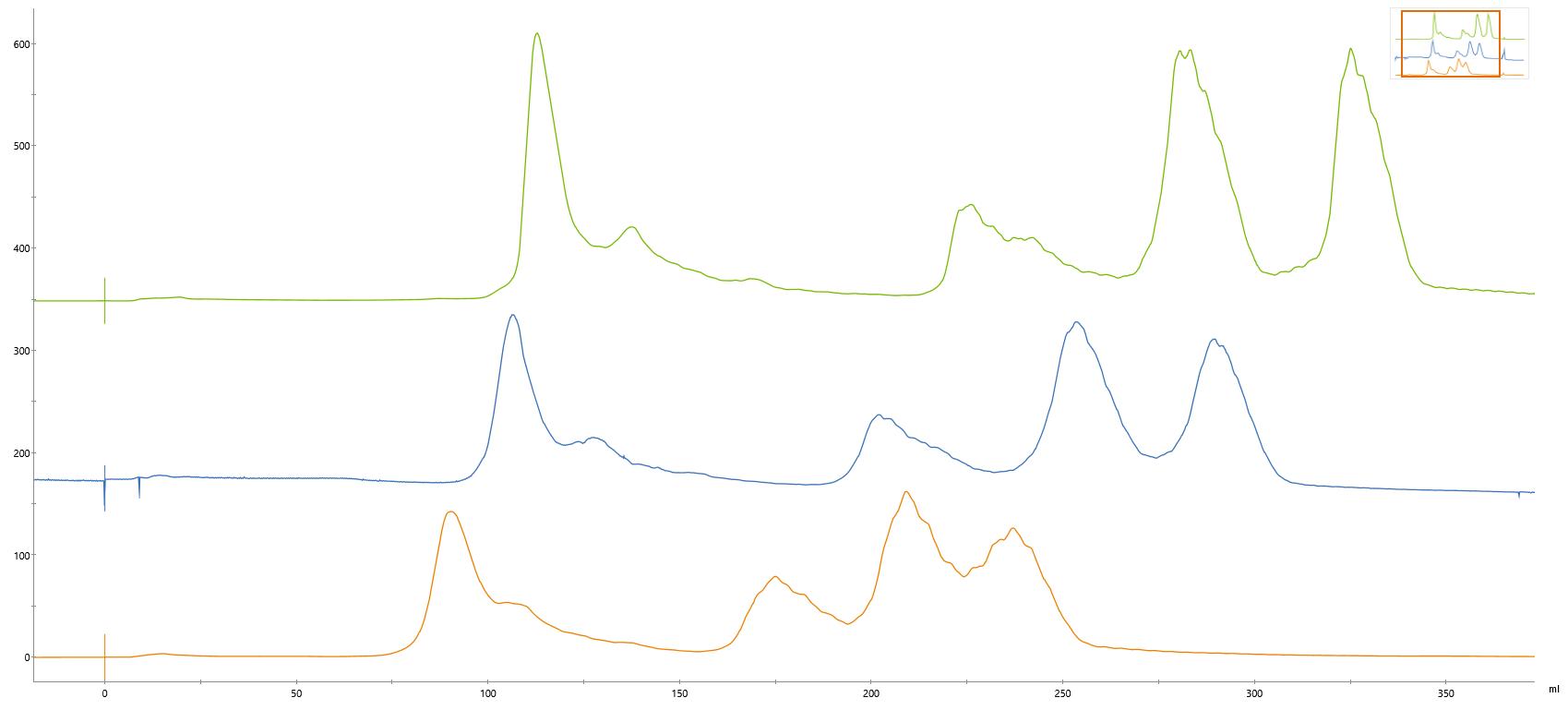

Commercially available Q 34 µm agarose bead



Q PuraBead® Edge

Q PuraBead® P6 HF

1 – Resolution comparison between 90 µm, 65 µm and 34 µm chromatographic beads
The chromatogram presented above indicates that bead size significantly affects resolution to a certain extent. Specifically, for the separation between peaks one and two, all three bead sizes achieve complete resolution. However, for the separation between peaks two and three, the 65 µm Q PuraBead® Edge demonstrates an improvement in resolution exceeding 200% compared to the larger Q PuraBead® P6HF. This trend does not continue with further reduction in bead size. Notably, both the Q PuraBead® Edge and the smaller 34 µm beads yield comparable resolution when analyzing the separation between peaks two and three.
Impact of Bead Size on Flow Rates and Dynamic Binding Efficiency
Given the correlation between bead size, resolution, and flow rate, it is necessary to explore how reducing bead size influences binding capacity as a function of processing speed. For this purpose, we analyzed publicly available flow rate data for PuraBead® P6HF, PuraBead® Edge, and a 34 µm sample. This analysis revealed a trend where smaller bead sizes correspond with reduced flow rates, which aligns with expectations that smaller beads would generate higher backpressure and thus, slower flow rates.
To delve deeper into how flow rate impacts the performance of the PuraBead® Edge, a study was conducted to examine the effect of residence time a function of flow rate on the dynamic binding capacity. This investigation aimed to clarify the interdependencies of these vital process parameters.
The dynamic binding capacity of Q PuraBead® Edge was evaluated across various residence times to assess potential binding capacity reductions associated with shorter contact times.
Application note: Intermediate Purification and Polish with Q PuraBead® Edge 3
Figure
Peak 1 Conalbumin Peak 2 BSA Peak 3 β-lactoglobulin
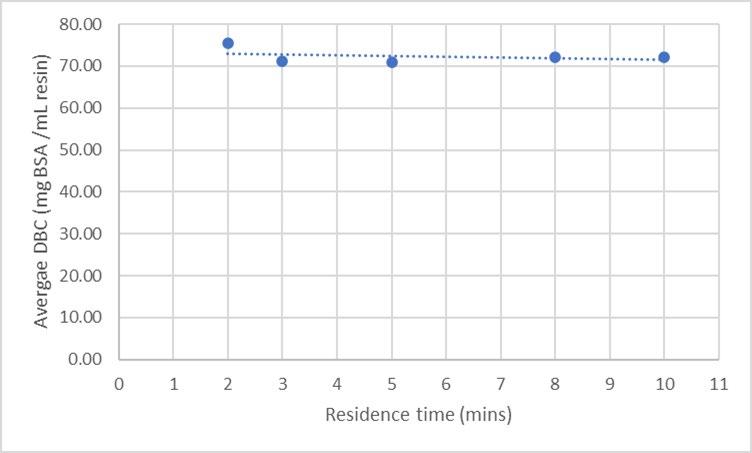
The dynamic binding capacity was measured over residence times ranging from 2 to 10 minutes (linear flow rates of 300 cm/h to 60 cm/h with a packed column 10 cm bed length x 1 cm diameter). The results indicated no decrease in binding capacity at shorter residence times, demonstrating that Q PuraBead® Edge maintains its performance even at higher flow rates.
Conclusion
The choice of resin type in a workflow is influenced by various factors. For tasks such as primary capture or processing of challenging materials (e.g. plasma), larger bead affinity resins such as PuraBead® P6 products are preferred. However, for intermediate and polishing steps, smaller bead products are advantageous, though these can place limitations on workflows as using resins with very small bead diameters can limit flow rates and binding capacities.
Q PuraBead® Edge is the preferred resin for those seeking to achieve high purity and productivity. It offers excellent resolution and high flow rates in combination with high dynamic binding capacities, even at short residence times. This makes Q PuraBead® Edge the ideal choice for intermediate purification and polishing applications, ensuring optimal purity and productivity.
Application note: Intermediate Purification and Polish with Q PuraBead® Edge 4
Figure 2: Dynamic Binding Capacity of Q PuraBead® Edge

All trademarks, trade names, trade dress, product names and logos appearing on this document are the property of Astrea UK Services Ltd. Copyright © 2024 Astrea Bioseparations Ltd. All rights reserved.