Overcoming challenges in mAb polishing: A toolbox approach
Monoclonal antibodies (mAbs) are essential in modern biopharmaceuticals, and their growing prevalence demands advanced, scalable purification methods. This article explores the challenges of downstream polishing and highlights the importance of a comprehensive polishing toolkit that includes a variety of chromatography options to optimize the purification process.
Monoclonal antibodies (mAbs) have transformed the biopharmaceutical landscape since the first was licensed for therapeutic use in 1986. In 2023, mAbs accounted for 70% of all drug approvals by the U.S. Food and Drug Administration (FDA), marking their highest share to date.i
This growing dominance underscores the critical need for efficient and scalable production methods to meet increasing demand. As mAbs become more prevalent in treating a wide range of diseases, biopharmaceutical manufacturers must optimize both upstream and downstream processes to ensure high yields, consistent quality, and cost-effectiveness. The upstream process focuses on maximizing mAb expression through carefully selected cell lines and culture conditions, while the downstream process is designed to purify and refine the product to meet stringent regulatory standards. Purification involves multiple unit operations, including filtration and chromatography, to remove impurities and ensure product safety, potency, and purity. Continuous advancements in these processes are essential for keeping pace with the growing clinical and commercial applications of mAbs.
The downstream purification process for mAbs typically begins with a capture chromatography step, often using Protein A resin to selectively bind antibodies via their Fc regions. This affinity-based capture separates the antibody from impurities, which include host cell proteins (HCPs), host cell DNA, and endotoxin, providing a higher purity starting material for further processing. Following the capture step, additional polishing steps such as ion exchange (IEX), hydrophobic interaction chromatography (HIC), or mixed-mode (MM) chromatography are employed to refine the product, remove residual contaminants, and achieve the required purity for
the final application. The polishing step is also used to remove aggregates of the mAb which can result from the use of high salt concentrations as well as the low pH conditions used for elution from the Protein A column.
This article explores the challenges of downstream polishing and highlights the importance of a comprehensive polishing toolkit that includes a variety of chromatography options to optimize the purification process. Examples of the differences between polishing resins and how this can impact purification underscores the necessity of considering multiple approaches to achieve the best outcome.
Challenges in mAb polishing
Optimizing the mAb polishing step is essential because no single solution fits all, and the process requires balancing trade-offs between yield, purity, time, and scalability. Variations in impurities from different expression systems, as well as differences in antibody size, charge, isoelectric point (pI), and stability necessitate tailored polishing strategies.
Inefficient polishing can result in excessive impurities, antibody loss, prolonged processing times, and product instability, all of which can significantly impact the quality and safety of the final drug product. For example, the presence of too many aggregates can lead to immunogenicity issues while degradation of the antibody can reduce its potency and efficacy. These factors not only affect therapeutic performance but can also lead to regulatory hurdles, increased production costs, and potential batch failures. Therefore, a well-optimized polishing strategy is key to ensuring product consistency, safety, and clinical effectiveness.
A toolbox approach for mAb polishing
While the traditional method of mAb purification using Protein A capture, cation exchange (CEX) bind-and-elute, and anion exchange (AEX) flow-through steps is a good starting point for purification, it is not suitable for all mAb products. Challenges that must be addressed include protein instability in high-salt CEX elution and the presence of problematic HCPs that ion exchange fails to separate from the mAb product.
Because mAb purification presents a range of challenges, a toolbox approach that leverages various resins and purification methods is essential. By screening available options and selecting the right combination of resins based on factors like impurity profiles, protein characteristics, and process conditions, this approach offers greater flexibility, robustness, and adaptability. It allows process developers to fine-tune purification strategies at different stages, ensuring optimal performance across diverse mAb products while maintaining efficiency and scalability.

The polishing toolbox typically includes a range of chromatography techniques used to further purify mAbs after the primary capture step with Protein A or Protein L. After this initial step, one or two additional polishing steps are often required to remove impurities and ensure high purity (Figure 1). Various chromatography systems, such as ion exchange, mixed-mode, or hydrophobic interaction chromatography, can be implemented in either bind-and-elute or flow-through modes, depending on the specific needs of the process. These steps help to refine the mAb product for downstream applications and ensure its suitability for clinical use.
Screening tools
Several methods can be used to evaluate the differences among resins to optimize the polishing phase of downstream processing. Chemical space mapping and viral clearance studies are two available approaches that help distinguish chromatography options within the polishing toolbox, as outlined below.
Working with a tricky mAb molecule?
Astrea Bioseparations has a toolbox of purification strategies available for a broad range of antibody challenges, including:
• Host cell protein reduction
• Viral clearance
• Aggregate removal
• Host cell DNA reduction
• Protein A leachates
• Endotoxin removal
• Light chain separation
• Glycoprotein separation
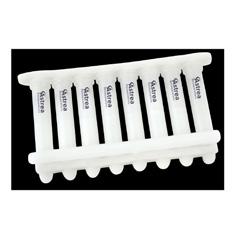


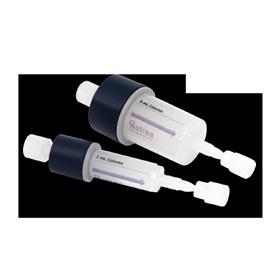
Figure 1: The mAb polishing toolbox contains a variety of chromatographic techniques that can be combined in various ways, using bind-and-elute or flow-through mode.
Chemical space mapping
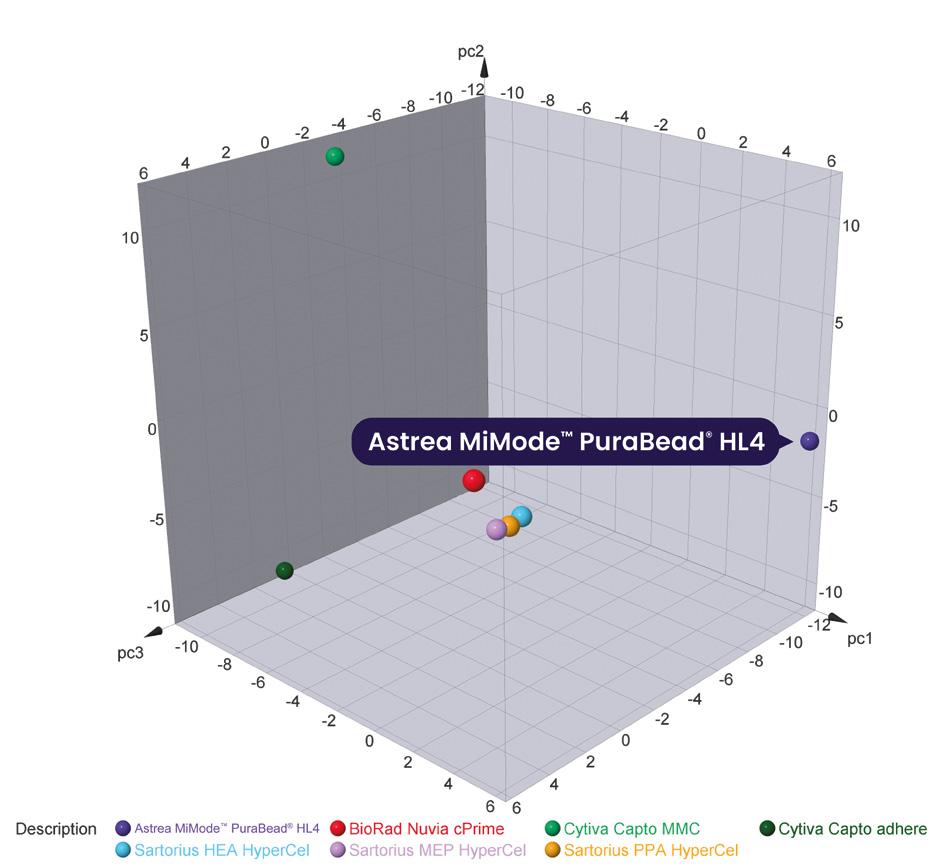
Figure 2 visualizes the chemical diversity of mixed-mode adsorbers by mapping ligand structures based on their functional group similarities. Each point represents a different resin, positioned according to its ligand properties, rather than a simple characteristic such as charge. Clusters in the center of the graph indicate resins with similar ligand structures, suggesting comparable binding behaviors. In contrast, MiMode™ PuraBead® HL4 resin (Astrea Bioseparations) is distinctly positioned to the right, highlighting its unique ligand composition and different mode of action. This distinction stems from its unique chemical structure, which leverages at least six different interaction mechanisms under varying conditions, offering enhanced versatility in protein purification. The graph underscores the importance of ligand chemistry in defining resin performance as resins with similar structures may behave alike, whereas those with distinct chemistries, like MiMode™ PuraBead® HL4 resin, can provide alternative purification strategies. This reinforces the value of a toolbox approach, allowing for resin selection based on specific process needs rather than a one-size-fits-all solution.
Viral clearance from CHO IgG on Q PuraBead®
Viral clearance studies
While viral inactivation steps are incorporated into the mAb purification process, the polishing step is crucial for providing additional viral clearance to further safeguard patient safety and ensure regulatory compliance.
No single polishing strategy guarentee viral clearance across all conditions, therefore, options must be evaluated alongside other key purification metrics, such as HCP removal, yield, and scalability. Different resins and binding mechanisms influence the ability to clear viruses, making a strategic, data-driven approach essential. By integrating viral clearance studies into process development, manufacturers can identify the optimal conditions and adsorbents that balance impurity removal, product recovery, and process efficiency. These studies help fine-tune polishing strategies for efficiency and regulatory compliance.
For example, a comparison of Q PuraBead® anion exchange resin and MiMode™ PuraBead® HL4 mixed-mode resin revealed differences in the log removal of retrovirus-like particles (RVLP) and mock minute virus of mice (MVM) model viruses. The Q PuraBead® resin demonstrated strong viral clearance, as seen in Figure 3, reducing both RVLP and mock MVM below the limit of detection, achieving 3.5-log and 4.2-log reductions, respectively. MiMode™ PuraBead® HL4 resin effectively cleared RVLP, achieving 3.4-log reduction, but did not remove mock MVM under the tested condition. These findings reinforce the
need for a toolbox approach to viral clearance, as different resins exhibit distinct performance profiles.
Advancing bioprocessing performance with sustainable innovation
As the biopharmaceutical industry seeks greener alternatives without compromising performance, agarose-based resins offer a powerful solution by delivering both superior purification capabilities and a reduced environmental footprint. PuraBead® products offer a high-performance, sustainable solution, unlike synthetic resins, which rely on petroleumbased materials. Agarose beads are derived from renewable, sustainably harvested red seaweed, contributing to ocean health by capturing carbon and supporting marine biodiversity. The solar-drying of seaweed further minimizes the energy footprint, making agarose resins a greener alternative without compromising efficiency, as demonstrated in Figure 4.
Beyond raw material sourcing, the innovative aqueous manufacturing process used for PuraBead® agarose beads further enhances their sustainability profile. Unlike conventional resin production, which often relies on oil-based solvents, PuraBead® resins are manufactured without the use of oils or hazardous chemicals. This eco-friendly approach not only minimizes waste and emissions but also results in highly uniform bead sizes, reducing the need for excessive processing and sieving.
The PuraBead® resins can support over 700 clean-in-place (CIP) cycles, enabling long-term, consistent performance while reducing cost per batch and supporting waste reduction and replacement frequency. By choosing agarose-based chromatography resins, biomanufacturers can achieve superior purification performance while actively contributing to corporate sustainability goals. With their high porosity, extensive surface area, and robust flow properties, these resins enable efficient processing with reduced cycle times, enhancing both productivity and resource efficiency. This combination of performance and environmental responsibility makes agarose beads a smart investment in the future of sustainable bioprocessing.
Conclusion
Polishing is a critical step in mAb purification, ensuring the removal of process- and product-related impurities while maintaining high yield, purity, and stability of the therapeutic protein. Given the complexity of mAb molecules and the variability in impurities, which include HCPs, aggregates, and viral contaminants, there is no one-size-fits-all solution for polishing. Instead, an optimized process requires careful balancing of multiple factors, including resin selection, process conditions, and performance trade-offs.
A toolbox approach provides the flexibility and adaptability needed to fine-tune purification strategies for different mAbs. By incorporating multiple resin types, understanding their fundamental differences via chemical space mapping, and leveraging data-driven methodologies like viral clearance studies, manufacturers can systematically identify optimal conditions for impurity removal, yield maximization, and regulatory compliance. This approach not only enhances process robustness and scalability but also ensures greater confidence in product quality, ultimately supporting the development of safe and effective biologics.
Martins AC, Oshiro MY, Albericio F, de la Torre BG. Food and Drug Administration (FDA) Approvals of Biological Drugs in 2023. Biomedicines. 2024 Sep 2;12(9):1992. doi: 10.3390/biomedicines12091992.
Optimizing mAb purification has never been easier. Astrea Bioseparations offers a range of tools to streamline your screening process and help you identify the best adsorbents and conditions with efficiency and precision:
• RoboColumns® – Designed for seamless automation in labs with liquid-handling robots.
• 1 mL or 5 mL pre-packed columns – Ideal for non-automated labs, enabling efficient Design of Experiments (DOE) to reduce the number of experiments.
• 96-well plate format – High-throughput screening for rapid process optimization.
For more information on any of the resins discussed in this article, please visit our website astreabioseparations.com or reach out to us sales@astrea-bio.com