Optimization of process conditions for Vk fragment capture and purification using MiMode PuraBead® HX2
The expanding range of therapeutic modalities, including monoclonal antibodies (mAbs) and their derivatives, present purification challenges due to the diversity of their physical properties and expression systems. This application note demonstrates the potential of MiMode PuraBead® HX2 for antibody fragment capture using an E. coli-derived variable kappa light chain (Vk) fragment as a model feedstock.
Purification of mAbs and their derivatives typically starts with a capture step using either Protein A, which binds the antibody Fc region, or Protein L ligands, which have specificity for the kappa light chain. The performance of these resins can be limited, however, by a lack of base stability and, for Protein L, its narrow specificity.
MiMode PuraBead® HX2 is a mixed-mode chromatography resin with a synthetic ligand that has broad specificity for both antibody kappa and lambda chains. The synthetic ligand allows for robust base stability, and the PuraBead® 6HF base matrix offers stable flow properties even for largescale manufacturing. These attributes make it an appealing alternative to Protein L as a platform technology.
This application note demonstrates the potential of MiMode PuraBead® HX2 for capturing and purifying antibody fragments using an E. coli-derived variable kappa light chain (Vk) fragment as a model feedstock. The optimized workflow showed superior host cell protein (HCP) clearance for Vk fragments compared to a Protein L adsorbent and serves as a guide for purifying antibody fragments using MiMode PuraBead® HX2.
Optimization of MiMode PuraBead® HX2 load step
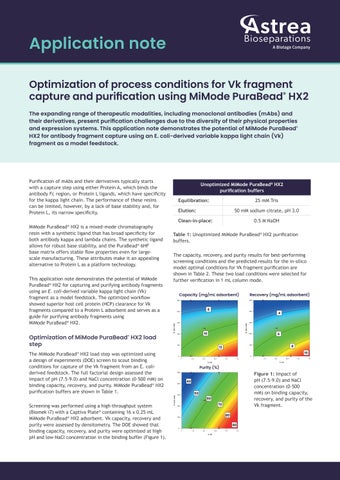
The MiMode PuraBead® HX2 load step was optimized using a design of experiments (DOE) screen to scout binding conditions for capture of the Vk fragment from an E. coliderived feedstock. The full factorial design assessed the impact of pH (7.5–9.0) and NaCl concentration (0–500 mM) on binding capacity, recovery, and purity. MiMode PuraBead® HX2 purification buffers are shown in Table 1.
Screening was performed using a high-throughput system (Biomek i7) with a Captiva Plate® containing 16 x 0.25 mL MiMode PuraBead® HX2 adsorbent. Vk capacity, recovery and purity were assessed by densitometry. The DOE showed that binding capacity, recovery, and purity were optimized at high pH and low-NaCl concentration in the binding buffer (Figure 1).
Unoptimized MiMode PuraBead® HX2 purification buffers
Equilibration: 25 mM Tris
Elution:
Table 1: Unoptimized MiMode PuraBead® HX2 purification buffers.
The capacity, recovery, and purity results for best-performing screening conditions and the predicted results for the in-silico model optimal conditions for Vk fragment purification are shown in Table 2. These two load conditions were selected for further verification in 1 mL column mode.
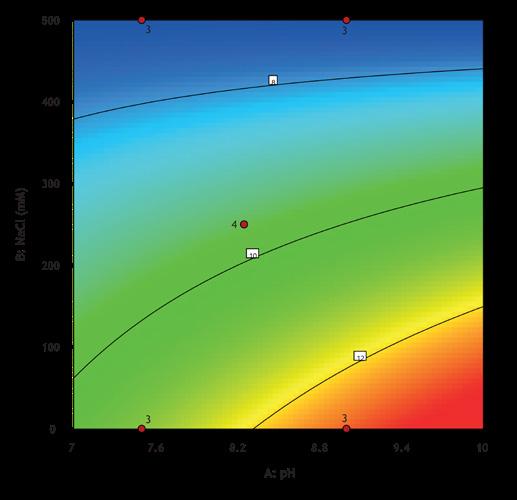
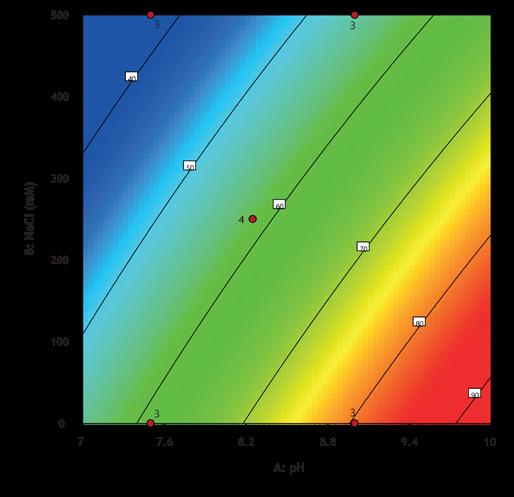
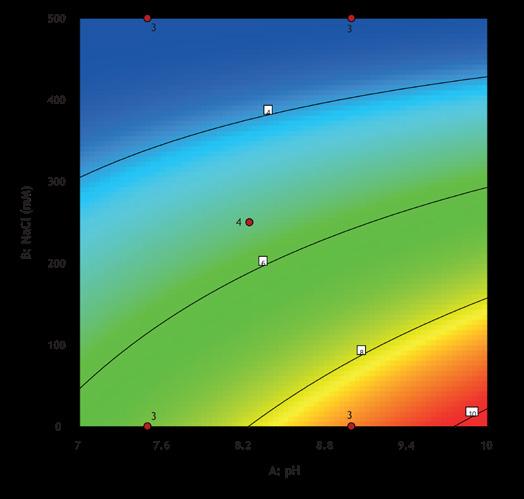
Figure 1: Impact of pH (7.5–9.0) and NaCl concentration (0–500 mM) on binding capacity, recovery, and purity of the Vk fragment.
Table 3: Comparison of Vk amount, recovery, breakthrough, and purity using loading buffers at either pH 9.0 or 9.8. Despite higher purity at pH 9.8, the pH 9.0 condition was selected for further development to maximize Vk capacity, with further optimization focusing on improving purity while maintaining high capacity.
To verify the optimized screen results in column mode, a 1 mL pre-packed MiMode PuraBead® HX2 column was loaded with two buffers meeting the pH requirements of the optimized model (25 mM Tris, pH 9.0, and 25 mM Glycine, 12 mM NaCl, pH 9.8). Fractions were collected during the load phase for Vk breakthrough analysis using reverse-phase HPLC, while densitometry was used to assess fraction purity.
At pH 9.0, 10% breakthrough occurred later, indicating a stronger interaction with the stationary phase (Figure 2). Despite higher Vk purity in the elution following the load at pH 9.8 (Table 3), the pH 9.0 condition was selected for further development to maximize Vk capacity, with additional optimization focusing on improving purity while maintaining high capacity.
Optimization of MiMode PuraBead®
HX2
elution step
To further enhance Vk fragment purity, various buffer systems were tested under optimized load conditions (25 mM Tris base, pH 9.0) using the 1 mL pre-packed MiMode PuraBead® HX2 column. Different pH gradients were created, and fractions were collected for SDS-PAGE analysis (Figure 3). All three gradients effectively separated Vk fragments from non-target proteins, with Vk fragments eluting at a higher pH in the
and pH 9.8
pre-elution wash and elution gradient fractions, while the bound non-target protein was recovered in the strip fractions at pH 3.0 (Figure 4). However, both the citrate and McIlvaines gradients showed gradual recovery of Vk fragments from pH 7.5 to pH 4.0, while the acetate pH 5.5 wash condition demonstrated significantly improved recovery and separation.
Table 2: Optimized load screen purification results for MiMode PuraBead® HX2 for the in-silico predicted condition and top performing screen condition.
Figure 2: Vk breakthrough at pH 9.0
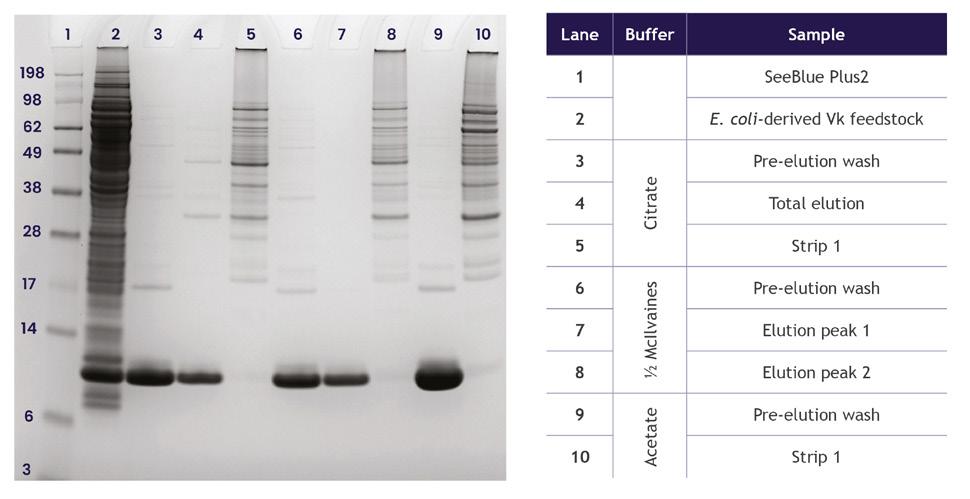
Figure 4: SDS-PAGE analysis of fractions collected from the separations using the three different gradients.
To directly compare the effectiveness of the acetate buffer to the other two buffer systems, a pH 5.5 step elution was performed using citrate and ½ McIlvaines buffers on the 1 mL pre-packed MiMode PuraBead® HX2 column. After the pH 5.5 step, a pH 4.0 step was applied in each buffer, based on the Vk recovery profile from the gradient elution results. Vk fragment recovery was analyzed via reverse-phase HPLC, and purity was assessed by densitometry and a generic E. coli HCP ELISA.
The acetate pH 5.5 buffer outperformed the citrate and ½ McIlvaines buffers in terms of mild Vk elution pH and overall purity (Table 4). While all buffers reached the sensitivity limit of the densitometry assay and differences in purity were detectable only through HCP ELISA, the HCP clearance results confirmed the acetate buffer’s superior performance for highpurity Vk fragments (Figure 5).
Host cell protein (PPM log clearance) Acetate Citrate 1/2 McIlvaines
Figure 5: Impact of the different elution conditions on HCP removal.
Figure 3: Separation of Vk fragments from non-target proteins using three different pH gradients.
Verification of MiMode PuraBead® HX2 performance
The final buffer conditions selected for Vk fragment purification were a pH 9.0 equilibration followed by an elution step in acetate buffer at pH 5.0 (Table 5). The pH 5.0 condition was selected to improve the efficiency of the Vk fragment elution observed at pH 5.5, without significantly compromising the mild elution pH and Vk purity.
Optimized MiMode PuraBead® HX2 purification buffers
Equilibration: 25 mM Tris, pH 9.0
Elution: 50 mM acetate, pH 5.0
Strip: 50 mM citrate, pH 3.0
Clean-in-place: 0.5 M NaOH
The performance of a 1 mL pre-packed MiMode PuraBead® HX2 column was assessed and compared to a Protein L product, also in a 1 mL pre-packed column of equivalent dimensions. Optimization of the elution pH was performed for the competitor product, leading to selection of a pH 3.5 wash condition followed by a pH 2.5 elution step, both in 50 mM citrate buffer (data not shown). Column performance was assessed by Vk recovery (reverse-phase HPLC) and purity (strain-specific BL21(DE3) E. coli HCP ELISA). Non-reduced SDS-PAGE was also used to compare the Vk elution profiles.
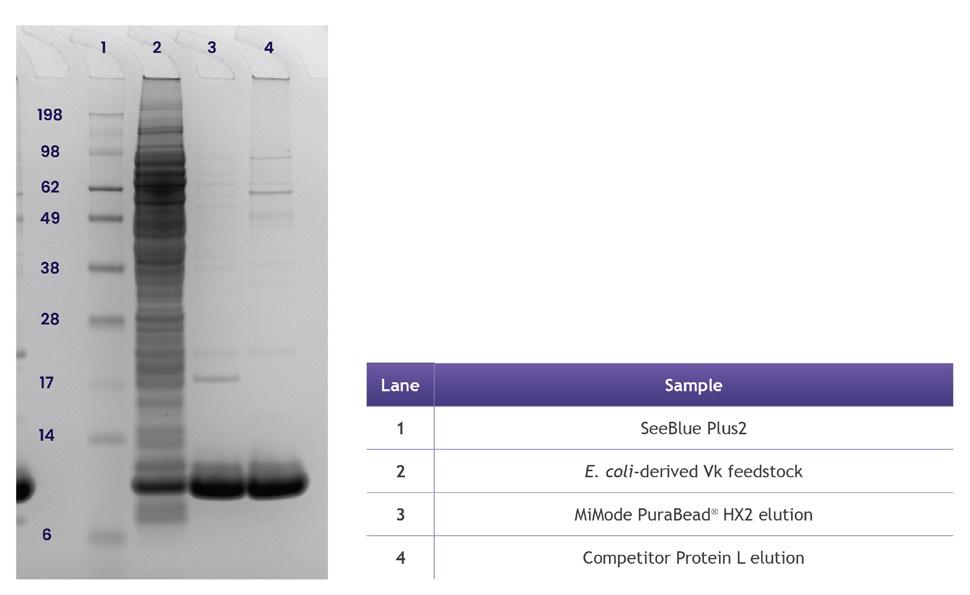
The results showed that, when loaded to approximately 15 mg/mL adsorbent, elution recovery of Vk fragments was comparable between the two adsorbents (Table 6). SDS-PAGE comparison of the elution fractions showed both adsorbents recovered a significantly purified Vk fraction in comparison to the load but that the non-target protein profiles differed between adsorbents (Figure 6). The HCP clearance results demonstrated that the elution purity for MiMode PuraBead® HX2 was higher than that of the Protein L resin at 3.67 PPM log clearance compared to 1.84 PPM log clearance (Figure 7).
Table 4: Comparison of Vk amount, recovery, breakthrough, and purity using the three different elution conditions.
Table 5: Optimized MiMode PuraBead® HX2 purification buffers
Reverse-phase HPLC
Figure 6: SDS-PAGE analysis of fractions collected from the MiMode PuraBead® HX2 resin and a Protein L resin.
Host cell protein (PPM log clearance)
MiMode PuraBead® HX2 Competitor Protein L
Figure 7: Clearance of HCP from the Vk feedstock using MiMode PuraBead® HX2 and a Protein L resin.
Conclusion
The optimized workflow for purifying E. coli-derived Vk fragments using MiMode PuraBead® HX2 demonstrated significant improvements in binding capacity, purity, and HCP clearance. Optimal load conditions were achieved at pH 9.0 with low NaCl for maximal binding capacity and purity. The best elution conditions were using acetate buffer at pH 5.0, ensuring mild conditions while maintaining high purity. MiMode PuraBead® HX2 outperformed Protein L in terms of HCP clearance, with a 3.67 PPM log clearance compared to Protein L’s 1.84 PPM log clearance.
It is also worth noting that MiMode PuraBead® HX2 elution steps were performed at milder pH conditions than the competitor Protein L (pH 2.5), which will reduce the likelihood of protein denaturing and aggregation.
This workflow not only serves as a valuable template for optimizing Vk fragment purification but also provides insights into the potential of MiMode PuraBead® HX2 for the purification of other antibody fragments, such as Fab, scFv, or bispecific antibodies, highlighting its broad applicability across a range of therapeutic modalities.
Astrea Bioseparations is a world class provider of chromatography adsorbent and resin services. With over 30 years of chromatography manufacturing expertise, we deliver a unique and trusted service in close partnership with our clients. For more information, please don’t hesitate to reach out at sales@astrea-bio.com or visit astreabioseparations.com.
Table 6: Comparison of Vk load and recovery on MiMode PuraBead® HX2 and a Protein L resin.