Innovative nanofiber adsorbent for process intensification: Maximizing lentiviral vector yield and reducing host cell impurities S. Yang, C. Daye, B. Sant Mora, H. Dreja, M. Hummersone, and I. Scanlon Astrea Bioseparations, Horizon Park, Barton Road, Comberton, Cambridge, CB23 7AJ, UK
5
90
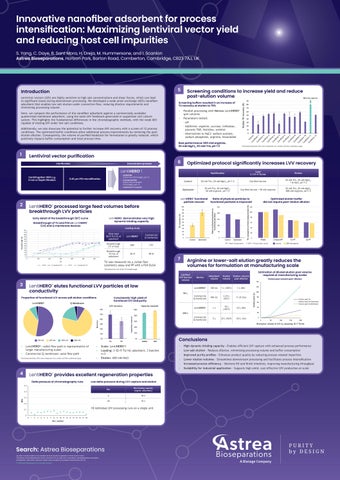
Screening buffers resulted in an increase of TU recovery at elution to 79%
Elution TU recovery (%)
arallel processing with Nereus LentiHERO® P spin columns Parameters tested: - pH - Additives: arginine, sucrose, trehalose, pluronic F68, histidine, sorbitol - Alternatives to NaCl: sodium acetate, sodium phosphate, arginine, hexanediol
• •
Additionally, we also showcase the potential to further increase LVV recovery with a screen of 12 process conditions. The optimized buffer conditions allow additional process improvements by removing the postelution dilution. Consequently, the volume of purified feedstock for formulation is greatly reduced, which positively impacts buffer consumption and total process time.
Lentiviral vector purification Clarification
2
LentiHERO processed large feed volumes before breakthrough LVV particles
0
Breakthrough of TU and P24 on LentiHERO® (LH) and Q membrane devices
Loading study
120 110
Breakthrough (%)
100
Elution 20 mM Tris, 20 mM MgCl2, 1 M NaCl, pH 7.2
Optimized
20 mM Tris, 20 mM MgCl2, 50 mM Arginine, pH 7.2
Clarified harvest + 50 mM arginine
20 mM Tris, 20 mM MgCl2, 800 mM Arginine, pH 7.2
90 80
LentiHERO
Breakthrough CV of load
500*
175*
Breakthrough TU/mL of adsorbent
3E+9
9E+8
®
70 60 50 40 30
10
Commercial Q membrane
50 40 30 20 10 0
0
100
200
300
400
500
Q membrane P24
LH TU
TU was measured via a Jurkat flow cytometry assay and PP with a P24 ELISA
Q membrane TU
Control
7
*Normalized for the initial TU breakthrough
LentiHERO elutes functional LVV particles at low conductivity ®
Proportion of functional LVV across salt elution conditions
Impurity removal
LVV recovery 60%
100%
40% 30% 20% 10%
600 mM
1000 mM
0%
2000 mM
• LentiHERO®: radial flow path is representative of larger manufacturing scales • Commercial Q membrane: axial flow path Functional particles (TU) were measured via a Jurkat cell flow cytometry assay
60%
PP
0
Optimized
Control
Optimized
120 100 80 60 40 20 0
Fresh
1/2xFT = Freeze-thaw cycles
2 hours RT
1x FT
Control
800 mM arginine
2x FT
Device
Adsorbent volume
Elution volume
Estimation of diluted elution pool volume required at manufacturing scales
Elution volume post-dilution
Elution pool volume post-dilution
140
LentiHERO®
100 mL
1 L (10CV)
1 L (Nil)
Commercial Q membrane
450 mL
2.25 L (5CV)
11.25 (5x)
LentiHERO®
1L
10 L (10CV)
10 L (Nil)
Commercial Q membrane
5L
25 L (5CV)
125 L (5x)
120 100 80 Elution pool LH Elution pool LH optimized Elution pool Q membrane
60 40 20 0 0
50
100
150
200
Bioreactor volume of LVV (L) assuming 1E+7 TU/mL 40% 20% 0%
TU
50
200 L
80% Impurities removal
Recovery
50%
200 mM
50 L
Consistently high yield of functional LVV and purity
Q Membrane
LentiHERO®
100
Optimized elution buffer did not require post-elution dilution
Arginine or lower-salt elution greatly reduces the volumes for formulation at manufacturing scale
Clarified LVV harvest volume
3
150
RT = Room temperature
600
CV LH P24
200
0
70 60
Ratio of physical particles to functional particles is improved 250
80
20
Total load 5E+9 TU/mL of adsorbent
Functional particles (TU) were measured via a Jurkat cell flow cytometry assay
Clarified harvest
90
LentiHERO® demonstrates very high dynamic binding capacity
20
20 mM Tris, 20 mM MgCl2, pH 7.2
100
TU recovery (%)
Early detail of the breakthrough (BT) curve
30
Control
LentiHERO® functional particle recover
®
40
Load 2.3 E+9 TU/mL
• ELUTION BUFFER: 0.02 M Tris, 0.6 M NaCl, 0.02 M MgCl2, pH 7.2
• FLOW RATE: 5 mv/min
50
Equilibration
• EQ BUFFER: 0.02 M Tris, 0.02 M MgCl2, pH 7.2
0.45 µm PES microfiltration
60
Optimized protocol significantly increases LVV recovery
Ratio of physical particles to functional particles
Centrifugation 1500 x g, 5 min or Depth filtration
6
Downstream process
70
10
Best performance: 800 mM arginine, 20 mM MgCl2, 20 mM Tris, pH 7.2
1
80
Elution pool (L)
Here, we compare the performance of the nanofiber adsorbent against a commercially available quaternized membrane adsorbent, using the same LVV feedstock generated in suspension cell culture system. This highlights the fundamental differences in the chromatographic methods, with the weak AEX capable of eluting LVV under low salt conditions.
Screening conditions to increase yield and reduce post-elution volume 800 mM arginine
Co nt ro Co l nd i ti Co on 1 nd i ti Co on 2 nd i ti Co on 3 nd i ti Co on 4 nd i ti Co on 5 nd i ti o n Co 6 nd i ti Co on 7 nd i ti Co on 8 nd i ti o Co nd n 9 i ti Co on 10 nd iti Co on 11 nd iti on 12
Lentiviral vectors (LVV) are highly sensitive to high salt concentrations and shear forces, which can lead to significant losses during downstream processing. We developed a weak anion exchange (AEX) nanofiber adsorbent that enables low-salt elution under convective flow, reducing dilution requirements and minimizing processing volume.
TU compared to fresh measurement (%)
Introduction
dsDNA
HCP
• Scale: LentiHERO®1 • Loading: 3–5E+9 TU/mL adsorbent, 3 batches n=3 • Elution: 600 mM NaCl
Conclusions • High dynamic binding capacity – Enables efficient LVV capture with enhanced process performance •
Low-salt elution – Reduces dilution, minimizing processing volume and buffer consumption
• Improved purity profiles – Enhances product quality by reducing process-related impurities • Lower elution volumes – Streamlines downstream processing and facilitates process intensification • Increased process efficiency – Shortens fill-and-finish timelines, improving manufacturing throughput • Scalability for industrial application – Supports high-yield, cost-effective LVV production at scale
4
LentiHERO® provides excellent regeneration properties Delta pressure of chromatography runs
Low delta pressure during LVV capture and elution
0.5
Run
BSA binding capacity (mg/mL adsorbent)
2
59.4
18
59.2
0.4
MPa
0.3 0.2
18 individual LVV processing runs on a single unit
0.1 0 0
1
2
3
4
5
6
7
8
9
10 11 12 13 14 15 16 17 18
Run number
Search: Astrea Bioseparations Any data or results provided are only examples and do not provide any guarantee of similar results in future. The products of Astrea Bioseparations may be covered by or for use under one or more patents: astreabioseparations.com/patents All trademarks, trade names, trade dress, product names and logos are the property of Astrea UK Services Ltd. © 2025 Astrea Bioseparations Ltd. All rights reserved