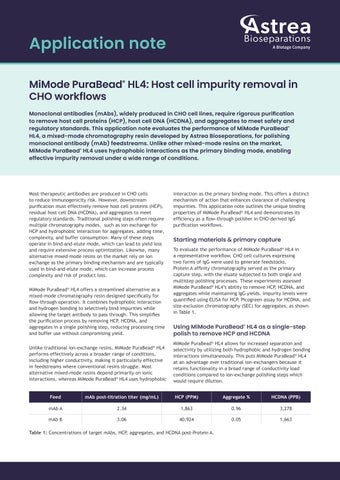
Application note MiMode PuraBead® HL4: Host cell impurity removal in CHO workflows Monoclonal antibodies (mAbs), widely produced in CHO cell lines, require rigorous purification to remove host cell proteins (HCP), host cell DNA (HCDNA), and aggregates to meet safety and regulatory standards. This application note evaluates the performance of MiMode PuraBead® HL4, a mixed-mode chromatography resin developed by Astrea Bioseparations, for polishing monoclonal antibody (mAb) feedstreams. Unlike other mixed-mode resins on the market, MiMode PuraBead® HL4 uses hydrophobic interactions as the primary binding mode, enabling effective impurity removal under a wide range of conditions.
Most therapeutic antibodies are produced in CHO cells to reduce immunogenicity risk. However, downstream purification must effectively remove host cell proteins (HCP), residual host cell DNA (HCDNA), and aggregates to meet regulatory standards. Traditional polishing steps often require multiple chromatography modes, such as ion exchange for HCP and hydrophobic interaction for aggregates, adding time, complexity, and buffer consumption. Many of these steps operate in bind-and-elute mode, which can lead to yield loss and require extensive process optimization. Likewise, many alternative mixed-mode resins on the market rely on ion exchange as the primary binding mechanism and are typically used in bind-and-elute mode, which can increase process complexity and risk of product loss. MiMode PuraBead® HL4 offers a streamlined alternative as a mixed-mode chromatography resin designed specifically for flow-through operation. It combines hydrophobic interaction and hydrogen bonding to selectively bind impurities while allowing the target antibody to pass through. This simplifies the purification process by removing HCP, HCDNA, and aggregates in a single polishing step, reducing processing time and buffer use without compromising yield. Unlike traditional ion-exchange resins, MiMode PuraBead® HL4 performs effectively across a broader range of conditions, including higher conductivity, making it particularly effective in feedstreams where conventional resins struggle. Most alternative mixed-mode resins depend primarily on ionic interactions, whereas MiMode PuraBead® HL4 uses hydrophobic
interaction as the primary binding mode. This offers a distinct mechanism of action that enhances clearance of challenging impurities. This application note outlines the unique binding properties of MiMode PuraBead® HL4 and demonstrates its efficiency as a flow-through polisher in CHO-derived IgG purification workflows.
Starting materials & primary capture To evaluate the performance of MiMode PuraBead® HL4 in a representative workflow, CHO cell cultures expressing two forms of IgG were used to generate feedstocks. Protein A affinity chromatography served as the primary capture step, with the eluate subjected to both single and multistep polishing processes. These experiments assessed MiMode PuraBead® HL4’s ability to remove HCP, HCDNA, and aggregates while maintaining IgG yields. Impurity levels were quantified using ELISA for HCP, Picogreen assay for HCDNA, and size-exclusion chromatography (SEC) for aggregates, as shown in Table 1.
Using MiMode PuraBead® HL4 as a single-step polish to remove HCP and HCDNA MiMode PuraBead® HL4 allows for increased separation and selectivity by utilizing both hydrophobic and hydrogen bonding interactions simultaneously. This puts MiMode PuraBead® HL4 at an advantage over traditional ion-exchangers because it retains functionality in a broad range of conductivity load conditions compared to ion-exchange polishing steps which would require dilution.
Feed
mAb post-titration titer (mg/mL)
HCP (PPM)
Aggregate %
HCDNA (PPB)
mAb A
2.34
1,863
0.96
3,278
mAb B
3.06
40,924
0.05
1,663
Table 1: Concentrations of target mAbs, HCP, aggregates, and HCDNA post-Protein A.