Nanofiber-based anion exchange purification advancing scalable manufacturing of oncolytic viruses and lentiviral vectors S. Yang, C. Daye, B. Sant Mora, M. Hummersone, and I. Scanlon Astrea Bioseparations, Horizon Park, Barton Road, Comberton, Cambridge, CB23 7AJ, UK
5
Introduction
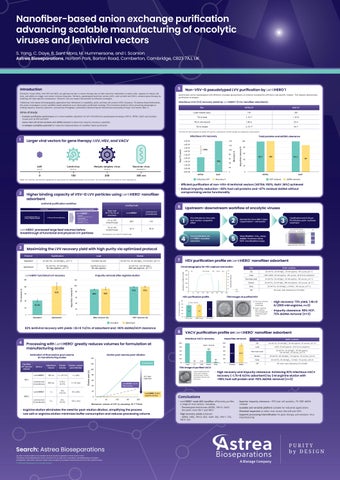
Oncolytic viruses (OVs), like HSV and VACV, are gaining traction in cancer therapy due to their selective replication in tumor cells, capacity to induce cell lysis, and ability to trigger anti-tumor immune responses. Similarly, pseudotyped lentiviral vectors (LVV)—such as GalV and VSV-G—enhance gene therapy by enabling cell-type-specific transduction. However, this can impact downstream purification strategies.
Non-VSV-G pseudotyped LVV purification by LentiHERO®1
Lentiviruses can be pseudotyped with different envelope glycoproteins to enhance transduction efficiency and specific tropism. This impacts downstream purification strategies.
Infectious LVVs (TU) recovery yields by LentiHERO®1 (1 mL nanofiber adsorbent)
Traditional resin-based chromatography approaches face limitations in scalability, yield, and host cell protein (HCP) clearance. To address these bottlenecks, this study investigates a novel nanofiber-based adsorbent as an alternative purification strategy. This innovative platform offers promising advantages in binding capacity, impurity clearance, and process throughput, potentially transforming the downstream processing of large viral vectors (Box 1).
Aims of study
Run
4070A LV
Load volume (mL)
190
300
TU in load
2.1E+7
1.2E+8
TU in non-bound
1.8E+6
2E+6
TU in eluate
>2.1E+7*
4E+7
• Evaluate purification performance of a novel nanofiber adsorbent for LVV with different pseudotyped envelopes (VSV-G, 4070A, GalV) and oncolytic viruses such as HSV and VACV • Assess host-cell-driven proteins and dsDNA removal to determine impurity clearance capability • Investigate scalability potential for industrial implementation of nanofiber-based purification
GalV LV
*The final LVV yield surpassed the loaded LVV quantity, a phenomenon verified through two independent measurements
Infectious LVV recovery
Total proteins and dsDNA clearance
4.5E+07
140
4.0E+07
120
Total TU yield
3.5E+07
AAV
Lentivirus
Herpes simplex virus
Vaccinia virus
20–25 nm
80–120 nm
155–240 nm
360x270x250 nm
100%
3.0E+07
100
2.5E+07
80
2.0E+07
60
36%
1.5E+07
40
1.0E+07
20
5.0E+06 0.0E+00
0
100
200
100
Recovery %
Larger viral vectors for gene therapy: LVV, HSV, and VACV
Impurities removal %
1
0
300 nm
*Note: This schematic representation highlighting the approximate size relationships between viral structures. Fine structural details are omitted for clarity regarding size.
4070A
GalV
Infectious LVV
Recovery %
80 60
100
98.7
99.4
87
40 20 0
4070A
GalV HCP removal
dsDNA removal
• Efficient purification of non-VSV-G lentiviral vectors (4070A: 100%, GalV: 36%) achieved
2
• Robust impurity reduction: >98% host cell proteins and >87% residual dsDNA without compromising vector functionality
Higher binding capacity of VSV-G LVV particles using LentiHERO® nanofiber adsorbent Lentiviral purification workflow
Centrifugation 1500 x g, 5 min or Depth filtration
Downstream process
• EQ BUFFER: 0.02 M Tris, 0.02 M MgCl2, pH 7.2
0.45 µm PES microfiltration
• ELUTION BUFFER: 0.02 M Tris, 0.6 M NaCl, 0.02 M MgCl2, pH 7.2
• FLOW RATE: 5 mv/min
Total load 5E+9 TU/mL of adsorbent
LentiHERO®
Commercial Q membrane
CV to 10% breakthrough
500*
175*
TU at 10% breakthrough
3E+9
9E+8
Upstream-downstream workflow of oncolytic viruses
1
OVs infection to Vero cells and monitor cytopathic effect
2
Harvest the virus after 3 days (supernatant + cell lysate)
4
Virus purification via LentiHERO® nanofiber adsorbent
5
Virus titration: TCID50 assay dsDNA: PicoGreen assay HCP: microBradford assay
TCID50 assay on 96-well plate
Equilibration
Load
Elution
20 mM Tris, 20 mM MgCl2, pH 7.2
Clarified harvest
20 mM Tris, 20 mM MgCl2, 0.6 M NaCl, pH 7.2
Optimized
20 mM Tris, 20 mM MgCl2, 50 mM arginine, pH 7.2
Clarified harvest + 50 mM arginine
20 mM Tris, 20 mM MgCl2, 800 mM arginine, pH 7.2
7
% of recovery or removal
6060
4040
40.8% 40.8% 2020
97% 97%
8080
88% 88%
80% 60% 98% 40%
73%
75%
20% 0% 97% 97% HSV recovery
dsDNA removal
90% 90%
Flow-through
PLW
Elution
120 100 80 60
1000
40
500
20
0
50
100
150
200
250
300
00
Optimized Optimized
DNA DNA removal removal(%) (%) Standard Standard
A
Yield: 1.4E+8 IU 80% 60% 98% 40%
73%
75%
HSV recovery
dsDNA removal
20% 0%
HCP HCPremoval removal(%) (%)
HCP removal
Processing with LentiHERO® greatly reduces volumes for formulation at manufacturing scale
Elution volume
Elution volume post-dilution
LentiHERO®
100 mL
1 L (10 CV)
1 L (Nil)
Commercial Q membrane
450 mL
2.25 L (5 CV)
11.25 (5x)
LentiHERO®
1L
10 L (10 CV)
10 L (Nil)
5L
25 L (5 CV)
200 L
Elution pool volume post-dilution 140 Q membrane
120
Elution pool (L)
50 L
Adsorbent volume
Device
125 L (5x)
100 80
8
20 mM Tris, 20 mM MgCl2, 50 mM arginine, 10% sucrose, pH 7.2 20 mM Tris, 20 mM MgCl2, 800 mM arginine, 10% sucrose, pH 7.2
Strip
20 mM Tris, 20 mM MgCl2, 2 M NaCl, 10% sucrose, pH 7.2
CIP
RO water wash followed by 0.5 M NaOH
EQ
Flow-through
PLW
Elution
140
Strip
120 A: The virion showing icosahedral 100 morphology
B
1500
80
1000 500 20 nm
20 nm
0
50
100
150
200
250
B: Intact, spherical HSV-1 particle60 with envelope40and underlying capsid 20 visible 300
350
400
0
• High recovery: 73% yield, 1.4E+8 IU (800 mM arginine, n=3) • Impurity clearance: 98% HCP, 75% dsDNA removal (n=3) mAU
mS/cm
VACV purification profile on LentiHERO® nanofiber adsorbent Impurities removal
100% 100% Yield: Yield: 1.7E+8 1.7E+8 IU IU
80%80%
Step
Buffer condition
100% 100%
EQ
20 mM Tris, 20 mM MgCl2, 50 mM arginine, 5% sucrose, pH 7.8
80%80%
Load
rVACV, 50 mM arginine, 3E+8 IU/mL adsorbent
62% 62% 60%60%
60%60%
40%40%
40%40%
20%20%
20%20%
0% 0% Load Load
0%0%
0.2% 0.2%
FTFT
PLW PLW
4%4%
0% 0% Elution Elution Strip Strip
A brick-shaped Vaccinia virion with a distinct vaccinia outer surface and dense internal core structures
12.5 fold reduction
60
98.7% 98.7%
Proteins Proteins
92.7% 92.7%
dsDNA dsDNA
Post-load wash
20 mM Tris, 20 mM MgCl2, 50 mM arginine, 150 mM NaCl, 5% sucrose, pH 7.8
Elution
20 mM Tris, 20 mM MgCl2, 2 M arginine, 5% sucrose, pH 6.8
Strip
20 mM Tris, 20 mM MgCl2, 2 M NaCl, 5% sucrose, pH 6.8
CIP
RO water wash followed by 0.5 M NaOH
20
LentiHERO® 0.8 M arginine elution 0
50
100
150
200
Bioreactor volume of LVV (L) assuming 1E+7 TU/mL
Search: Astrea Bioseparations Any data or results provided are only examples and do not provide any guarantee of similar results in future. The products of Astrea Bioseparations may be covered by or for use under one or more patents: astreabioseparations.com/patents All trademarks, trade names, trade dress, product names and logos are the property of Astrea UK Services Ltd or their respective owners.
• High recovery and Impurity clearance: Achieving 62% infectious VACV recovery (~1.7E+8 IU/mL adsorbent) by 2 M arginine elution with >98% host cell protein and >92% dsDNA removal (n=3)
100 nm
LentiHERO® 0.6 M NaCl elution
40
• Arginine elution eliminates the need for post-elution dilution, simplifying the process • Low salt or arginine elution minimizes buffer consumption and reduces processing volume
© 2025 Astrea Bioseparations Ltd. All rights reserved
rHSV-1(KOS), 50 mM arginine, 10% sucrose, 3E+8 IU/mL adsorbent
TEM image of purified VACV
0
Commercial Q membrane
Load
Elution
mS/cm
2000
0
Infectious VACV recovery
Clarified LVV harvest volume
20 mM Tris, 20 mM MgCl2, 50 mM arginine, 10% sucrose pH 7.2
Post-load wash
mAU
0
Buffer condition
EQ
Optimized Optimized
82% lentiviral recovery with yields >2E+9 TU/mL of adsorbent and >90% dsDNA/HCP clearance
Estimation of final elution pool volume at manufacturing scales
400
Step
TEM images of purified HSV 2500
100%
00
350
HSV purification profile
4040
140
Strip
1500
0
6060
2020
Standard Standard
HCP removal
EQ
2000
Absorbance at UV280 nm (mAU)
82% 82%
Yield: 1.4E+8 IU
% of recovery or removal
TU recovery % TU recovery %
8080
Impurities removal % Impurities removal %
100 100
100%
Conductivity (mS/cm)
Impurity removal after arginine elution
Absorbance at UV280 nm (mAU)
2500
120 120
CPE
HSV purification profile on LentiHERO® nanofiber adsorbent Chromatography for HSV capture and elution
Conductivity (mS/cm)
Protocol
LentiHERO functional LVV recovery
Sample 2 replicates
Infectious unit , IU/mL ≅ 0.69 x 1/ TCID50
Standard
100 100
Clarification and 0.45 µm PES filtration post-nuclease treatment
Sample 1 replicates
*Normalized for the initial TU breakthrough
Maximizing the LVV recovery yield with high purity via optimized protocol
®
4
3 Increasing virus dilution
LentiHERO® processed large feed volumes before breakthrough of functional and physical LVV particles
3
6
Loading study
Clarification
Conclusions
• LentiHERO® weak AEX nanofiber effectively purifies a range of viral vectors, including: - Pseudotyped lentiviruses (4070A, VSV-G, GalV) - Oncolytic virus HSV-1 and VACV
• Superior impurity clearance: >97% host cell proteins, 75–100% dsDNA removal
• High recovery yields achieved: - 4070A: 100%, VSV-G: 82%, GalV: 36%, HSV-1: 73%, VACV: 62%
• Supports processing intensification for gene therapy and oncolytic virus manufacturing
• Scalable and versatile platform suitable for industrial applications • Potential expansion to other viral vectors like Ad5 and VLPs