Process development of a scalable purification workflow of plasmid DNA using a novel nanofiber adsorbent Christie Childers, Ganiyu AlliBalogun, Ben Galarza, Joseph Fletcher, Marc Hummersone and Ian Scanlon Astrea Bioseparations, Horizon Park, Barton Road, Comberton, Cambridge, CB23 7AJ, UK
4
Abstract
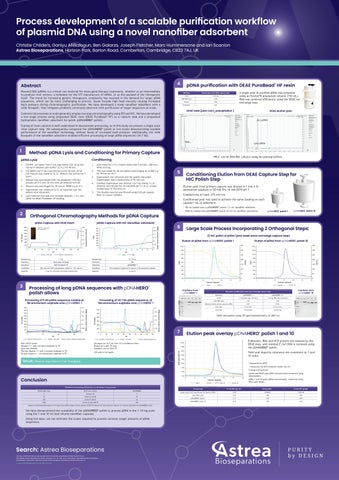
pDNA purification with DEAE PuraBead® HF resin
Plasmid DNA (pDNA) is a critical raw material for many gene therapy treatments, whether as an intermediate to produce viral vectors, a template for the IVT manufacture of mRNA, or as the payload of the therapeutic itself. The trend for increasing genetic therapeutic complexity has resulted in the demand for larger pDNA sequences, which can be more challenging to process. Issues include high feed viscosity causing increased back pressure during chromatographic purification. We have developed a novel nanofiber adsorbent with a wide flowpath, that mitigates problems commonly observed with purification of larger sequences at scale.
METHOD
Elution pool from DEAE capture step
Yield
14.5 mg
260/280 ratio
2.00
Protein
LOD
Endotoxin
LOD
A single pool of purified pDNA was prepared using an Evolve®D prepacked column (192 mL). RNA was removed efficiently using the DEAE ion exchange step
DEAE load (post CaCl2 precipitation )
Commercial processes at scale generally employ two step chromatography using IEX and HIC. We have developed a two-stage process using prepacked DEAE resin (DEAE PuraBead® HF) as a capture step and a prepacked hydrophobic nanofiber adsorbent for polish (pDNAHERO® polish) .
DEAE elution pool (sc) pDNA
Scaling of resin columns is well understood in downstream processing, so in this study we present a single scale resin capture step. We subsequently compared the pDNAHERO® polish at two scales demonstrating scalable performance of the nanofiber technology, without issues of increased back pressure. Additionally, the wide flowpath of the nanofiber adsorbent enabled efficient processing of large pDNA sequences (34.7 kb). RNA
1
(oc) pDNA
Method: pDNA Lysis and Conditioning for Primary Capture
pDNA Lysis
Conditioning
1. CD19HC cell paste from E Coli expression (222.43 g) was stirred in Alkaline lysis buffer* (2.5 L) for 40 min.
1. Lysis material (1.5 L) mixed slowly with 5 M CaCl2 (300 mL) while stirring.
2. 5 M NaOH (167.5 mL) was stirred in over 40 min; pH of the mixture was raised to 12.21. Mixture was stirred for 2 hours.
2. This was mixed for 30 min before centrifuging at 12 000 x g for 30 min at 18°C. 3. Supernatant was collected and the pellets discarded. (Supernatant had a conductivity of 92 mS/cm).
3. Mixture was neutralized with 3 M potassium (170 mL) acetate pH 5.5 over 30 min until pH lowered to 8.28.
4. Clarified supernatant was diluted 1 to 5 by mixing 1 L of material with 50 mM Tris 10 mM EDTA pH 7.5 (4 L), to give conductivity of 34.4 mS/cm.
4. Mixture was centrifuged for 30 min at 10000 x g at 4°C. 5. Supernatant was collected (2.9 L of material) and the pellets were discarded.
5
Conditioning Elution from DEAE Capture Step for HIC Polish Step
• Elution pool from primary capture was diluted 4:1 into 4 M ammonium sulphate in 50 mM Tris 10 mM EDTA pH 7
5. The diluted material was filtered using 0.45 µM capsule filter to reduce turbidity.
6. Lysis material was split into multiple aliquots. 1.5 L was taken for DEAE PuraBead® HF binding.
HPLC run on DNA PAC column using ion pairing buffers
• Conductivity of load: 275 mS/cm. • Conditioned pool was used to achieve the same loading on each capsule/ mL of adsorbent: - 100 mL loaded onto a pDNAHERO® polish 1 (1 mL nanofiber adsorbent
Orthogonal Chromatography Methods for pDNA Capture
40
400 20
200 0
0
20
40
60
80
100
120
0.2 0.15
300
0.1
200
0.05
100 0
0
140
0.25
400
0
2
4
6
8
10
mL Chrom.1 UV mAU
12
14
16
18
0 20
6
2) HIC polish of pDNA (post weak anion exchange capture step) Elution of pDNA from pDNAHERO® polish 1
mAU
MPa
Plasmid size
11 kb
Plasmid size
4.7 kb kb
Chemistry
Weak anion exchange
Chemistry
HIC
Elution of pDNA from pDNAHERO® polish 10 350
1550
mL Chrom.1 Cond mS/cm
Large Scale Process Incorporating 2 Orthogonal Steps:
1350
300
1350
300
1150
250
1150
250
950
Adsorbent
DEAE PuraBead® HF
Adsorbent
pDNAHERO® 1
Conditions
Post lysis and CaCl2 precipitation, loaded at ~0.01 mg/mL
Conditions
Pure sequence Loaded at 0.4 mg/mL in 3M ammonium sulphate
Capacity
~1 mg/mL nucleotide (including residual RNA)
Capacity
4 mg/mL
750 150 550 350
0.3
600
0.2
500
0.15
400 300
0.1
200
0.05
100 0
600 500
100
0.15
300
0.1
200
0.05
100 0
150
0
20
40
mL Chrom.1 Cond mS/cm
Chrom.1 UV mAU
60
80
100
120
140
160
180
0
mL Chrom.1 DeltaC pressure MPa
Post CaCl2 lysate Diluted 1:1 with 4 M Amm Sulphate in TE Spun and filtered Filtrate diluted 1:1 with 4 M Amm Sulphate in TE To give lysate in ~ 3 M ammonium sulphate in TE
Chrom.1 Cond mS/cm
Chrom.1 UV mAU
15
20
25
30
CIP with 0.5 M NaOH
pDNA target (mg)
pDNAHERO® 1
pDNAHERO® 10
Yield
1.3 mg (84% step recovery)
13.8 mg (86% step recovery)
1.81
1.82
Maximum delta column pressure (MPa)
700500400300200-
0.02
0.06
Flow rate
5 mL/min
5 0 mL/min
Run time
30 minutes
30 minutes
7
pDNAHERO®
Evolve S 50
1 10
100
Evolve D 200 50
50
1000
Evolve Process 600 50
250
Based on achieving pDNA capture of 14 mg of pure pDNA using a 192 mL column of DEAE PuraBead® HF, and maximum capacity at 4 mg/mL adsorbent for pDNAHERO® polish
• We have demonstrated the scalability of the pDNAHERO® polish to process pDNA in the 1-10 mg scale using the 1 and 10 mL bed volume nanofiber capsules. • Using this data, we can estimate the scales required to process common target amounts of pDNA sequences.
Search: Astrea Bioseparations Any data or results provided are only examples and do not provide any guarantee of similar results in future. The products of Astrea Bioseparations may be covered by or for use under one or more patents: astreabioseparations.com/patents All trademarks, trade names, trade dress, product names and logos are the property of Astrea UK Services Ltd. © 2024 Astrea Bioseparations Ltd. All rights reserved
Fractions from pDNAHERO® 10
00000000700050004000300020001500100070050040030020075-
Endotoxin, RNA and HCP protein are cleared by the DEAE step, and residual E Coli DNA is removed using the pDNAHERO® polish.
1350 1150
Yield and impurity clearance are consistent at 1 and 10 scale.
950 750
* Measured by qPCR
550
~ measured my NCS endosafe reader LAL kit # measured by ELISA
5
10 mAU 1
Evolve D 140 50
30
Elution peak overlay pDNAHERO® polish 1 and 10 1550
15
20
25
Column Volumes
DEAE resin column
25
mS/cm 10
Yield calculated using UV spectrophotometry at 260 nm
75-
0
4
20
HIC polish of pDNA (post-weak anion exchange capture step) Adsorbent 260/280 ratio
-50
40
15 mAU 10
150
Estimation of processing efficiencies at scale using a 2-step process
10
mS/cm 1
350
Conclusion
5
mAU 1
Chrom.1 DeltaC pressure ml
Result: Pressure stays below 0.5 bar throughout.
0 0
Column volumes
1000-
All steps run at 5 mL/min (12 s residence time) Eluted at in 60% TE step Gradient run to 100% TE
50
-50
Column volumes
1500-
mAU and mSc/cm
50
0.2
400
0 0
0.25
Delta column presure (Mpa)
UV (mAU)
700
10
0000000070005000400030002000-
0.3
0.25
UV (mAU)
800
Delta column presure (Mpa)
900
5
100
150
0
Fractions from pDNAHERO® 1
Processing of 34.7 Kb pDNA sequence, at 3M ammonium sulphate onto pDNAHERO® 1
150
350
50
0
Processing of long pDNA sequences with pDNAHERO® polish allows
200
750 550
100
-50
Processing of 11 Kb pDNA sequence, loaded at 3M ammonium sulphate onto pDNAHERO® 1
950
200
150
3
350
1550
mS/cm 1
mAU 10
mS/cm 10
30
Lysate and DEAE pool pDNA concentration measured using densitometry pDNA 1 and 10 pools pDNA concentration measured using HPLC post desalt
Process step
E Coli DNA ug/ mg *
Eu/mg pDNA ~
E Coli HCP ug/mg#
Lysate (post CaCl2 and dilution for load on DEAE)
6.00
6476600
11620.68
post DEAE pool
0.53
LOD
LOD
pDNAHERO polish 1
0.17
LOD
LOD
pDNAHERO® polish 10
0.14
LOD
LOD
®
mS/cm
600
0.3
600 500
mAU
60
800
700
mAU
UV (mAU)
1000
800
mAU
80
mS/cm
pDNA Capture with HIC Nanofiber Adsorbent 100
1. Generuler 1 kb Ladder 2. 11 kb post DEAE
Conducitivity (mS/cm)
1 2
1200
delta column pressure (Mpa)
pDNA Capture with DEAE Resin 1400
pDNAHERO® polish 10
pDNAHERO® polish 1
- 1000 mL loaded onto pDNAHERO® polish 10 (10 mL nanofiber adsorbent)
2