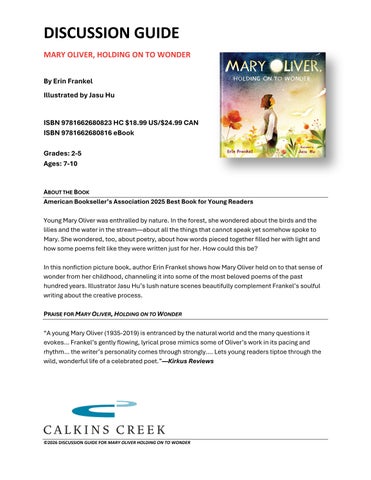
MARY OLIVER, HOLDING ON TO WONDER Discussion Guide
DISCUSSION GUIDE
MARY OLIVER, HOLDING ON TO WONDER
By Erin Frankel
Illustrated by Jasu Hu
ISBN 9781662680823 HC $18.99 US/$24.99 CAN
ISBN 9781662680816 eBook
Grades: 2-5
Ages: 7-10
ABOUT THE BOOK
American Bookseller’s Association 2025 Best Book for Young Readers
Young Mary Oliver was enthralled by nature. In the forest, she wondered about the birds and the lilies and the water in the stream about all the things that cannot speak yet somehow spoke to Mary. She wondered, too, about poetry, about how words pieced together filled her with light and how some poems felt like they were written just for her. How could this be?
In this nonfiction picture book, author Erin Frankel shows how Mary Oliver held on to that sense of wonder from her childhood, channeling it into some of the most beloved poems of the past hundred years. Illustrator Jasu Hu’s lush nature scenes beautifully complement Frankel’s soulful writing about the creative process.
PRAISE FOR MARY OLIVER, HOLDING ON TO WONDER
“A young Mary Oliver (1935-2019) is entranced by the natural world and the many questions it evokes… Frankel’s gently flowing, lyrical prose mimics some of Oliver’s work in its pacing and rhythm… the writer’s personality comes through strongly…. Lets young readers tiptoe through the wild, wonderful life of a celebrated poet.”—Kirkus Reviews
“There is a delicate grace to this picture book biography, with quietly elegant prose calling up the vivid descriptiveness of Oliver’s own poetry (‘how the sun must feel when it folds itself slowly, gently back into the sky or how it feels to be wild and free and how pictures and words might capture such beautiful things’). While the primary text is light on biographical details, its delighted tone captures Oliver’s deep sense of wonder, and informative backmatter fills in many of the main narrative’s gaps. The digital art, evocative of watercolor and ink, emanates warmth and joy, with layered dappling creating an almost glowing effect...”—The Bulletin of the Center for Children’s Books
DISCUSSION QUESTIONS
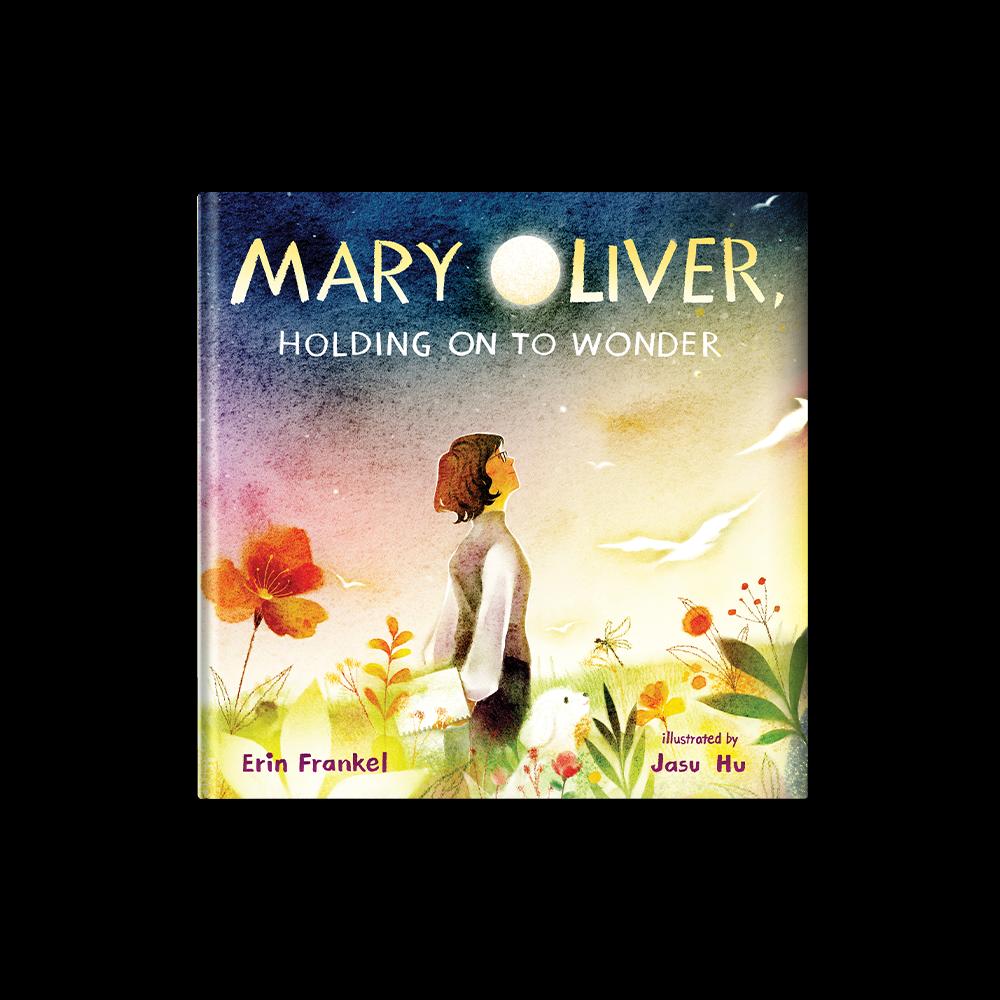
Looking at the cover…
What do you think Mary Oliver is doing? Where might she be? Why do you think she is holding a notebook?
Illustrator Jasu Hsu decided to include Mary’s dog on the cover of the book. What does this tell us about Mary?
More Questions
Author Erin Frankel writes that the beautiful woods near Mary’s home felt like “another world,” to Mary. What makes a place feel like another world? Have you ever had this feeling? Is there a word that the author uses to let the reader know that things were hard at home for Mary?
Author Erin Frankel writes that Mary wondered “about all the things that could not speak yet somehow spoke to Mary.” What do you think this means?
When we read and write stories, we imagine what it feels like to be the characters. And in the book, Mary wonders often about feelings. Do you ever wonder how others feel?
Have you ever loved a place like Mary did and what are some words that you might use to capture the feelings you have in that place?
DISCUSSION GUIDE
MARY OLIVER HOLDING ON TO WONDER
The author explains how Mary felt like some poems were written just for her. Have you ever read something and had the feeling that the author was writing to you? Have you ever felt that the writer knew how you were feeling?
Mary wondered about the poets she admired. Do you ever wonder about the lives of famous authors?
How do you think Mary felt to have the opportunity to visit and work in the place where one of her favorite poets, Edna St. Vincent Millay, once lived and wrote?
What did Mary love about being outdoors in nature? How did taking notes in her notebook help Mary write poems later? Is there a place where your imagination can “run free”?
Mary had a gift for writing poetry. Do you have a gift that you share or would like to share with the world?
Mary and her partner Molly were both artists Mary, a poet and Molly, a photographer. Artists can capture more than just what the eye sees with their pictures and words. They can often capture a feeling. Looking through the pages of the book, what feelings do the illustrations evoke?
Mary Oliver had many dogs throughout her life. What did she notice about them that she loved? Is there an animal that you love, and what have you noticed that makes them beautiful to you? Is there a word you like to use to describe the things you love?
Mary hid pencils in the woods. Why do you think Mary was worried about not having a pencil when she needed one?
When Mary Oliver won the important Pulitzer Prize for poetry, did she want her life to change now that she was famous? Why not?
When Mary taught poetry, she helped students notice elements of poetry such as rhythm, sound, rhyme, line, repetition and imagery. Do you see any examples of these throughout the story?
Why do you think illustrator Jasu Hu shows Mary Oliver wondering at all different ages? What do you think she was trying to show?
DISCUSSION GUIDE
MARY OLIVER HOLDING ON TO WONDER
In many of Mary Oliver’s poems she speaks to not only loving the natural world, but to being loved by the natural world. Have you ever had the feeling that the world loves you back?
How do you think poetry helped Mary after Molly died? Author Erin Frankel writes that poetry “made the hard parts softer.” What do you think this means?
Can you remember a time when words, either written or spoken, made you feel better? Even though moving was a big change for Mary, “the world was still at her fingertips.” What did Mary keep doing even after she moved?
What gave Mary Oliver hope? What does it mean to hold on to wonder?
CURRICULUM CONNECTIONS
Poetry Workshop Ideas
I NOTICE, I WONDER,
I WRITE
Ask your students to spend some time noticing and observing the natural world. Encourage them to take notes on what they notice and wonder.
Read Mary Oliver’s poem “The Summer Day.” What did Mary notice and wonder about in this poem? Notice how Mary went from asking a big wondering question to zooming in on something more specific a grasshopper. Instruct your students to find something specific in their notes that they would like to zoom in on and try to capture in a poem.
PLACE POEMS
Ask your students to think about a place they love as much as Mary loved her special places. It can be anywhere. Maybe it is someplace outdoors, or perhaps it is a room that they love in a house or at school.
Students should take notes on what they love about that place. How does it make them feel? What are the elements in that place that speak or sing to them? Students should write down questions about how some of these things might feel. For example, if they love a grassy spot under a tree,
DISCUSSION GUIDE
MARY OLIVER HOLDING ON TO WONDER
they might wonder how it feels to be the grass: How does it feel to be soft and fluffy? How does it feel to be a place where someone rests?
Students should have fun putting all their questions together in a way that sounds poetic and gives the reader a sense of this place that they love.
PEOPLE POEMS
Using a similar process as with “Place Poems,” encourage students to write about a real-life person or a character from a story they love.
Students should take notes on what they love and wonder about that person. For example, if their favorite poet is Mary Oliver, they might wonder how it feels to sit quietly and listen to the world like Mary?
Students can then look back at the questions they wrote and try answering one as if they are that person. They can shape their answer into a poem that gives readers a sense of who that person is.
For extra fun, students can try turning poems into a shape or concrete poem that takes the shape of the person or something they want to highlight about the person they are writing about. For example, if a student writes about Mary Oliver, they might write a poem in the shape of a notebook, or a dog, or something she loved in nature.
WONDEREAD
Reading gives us much to wonder about. Students can answer some of the questions from the book.
● “How would it feel to be a forest creature or to have wings and fly?”
● “Is the center of a flower called the heart?”
● “Are rocks somehow alive?”
How do you think the sun might feel when it folds itself slowly, gently back into the sky?
DISCUSSION GUIDE
MARY OLIVER HOLDING ON TO WONDER
ELEMENTS OF POETRY
In the book, the lines “foxes and moon snails; black bears and owls; snow crickets and goldfinches; sunflowers and ponds Mary wrote on and on,” have a poetic rhythm and sound. Read the lines out loud several times with students. What it is about the way these words are arranged that make them feel and sound poetic?
Ask your students to make a list of things that bring them joy. They can try grouping the items on their lists in different ways and reading them out loud until they find a rhythm and sound they like.
Students should also think about how they will arrange their words. Where will they end each line? What punctuation will they use, if any, and why? How does their arrangement change the way their poems might be read?
Invite your students to draw a picture that captures the feeling they get when they think of the words they have chosen. Finally, they can put their words and illustrations together. Encourage your students to notice how they feel while creating their wonderful works of art.