http://asthanepal.com/pokhara/
POKHARA, THE HEART OF NEPAL Pokhara is a beautiful place, which is Nepal’s second-biggest city in both population and area. Pokhara is located 120 miles west of the capital, Kathmandu. The Annapurna Range is only 24 to 56 km away from the Pokhara valley which includes the world’s three highest mountain peaks out of the top 10 highest mountains namely Dhaulagiri, Annapurna, and Manaslu. Because of the beautiful environment and adventurous sites, Pokhara is considered to be the tourism capital of Nepal. It is also a base for trekkers undertaking the Annapurna Circuit through the Annapurna Conservation Area region of the Annapurna ranges in the Himalayas, which make it more popular for inside and outside tourists.
HISTORY Pokhara was ruled by a branch of the Shah Dynasty during the 17 th century and was a part of the Kingdom of Kaski which was one of the 24 Kingdoms of Nepal.
POKHARA AS IMPORTANT TRADE ROUTE AND TOURISM The city Pokhara was an important trade route between India and Tibet. Since it was already an important old trade route and In the mid 18 century, it became more important as a trade center. As time passed the changes in the trade relations between India and China resulted in the significance of Pokhara as a trading post to diminish. However, the town took on a new role in 1959 as a transit hub for many Tibetan refugees who fled Tibet for India following its annexation by China.
Tal Barahi Temple The Tibetan community has maintained a presence in the city since the 1960’s functioning as a transit hub. The addition of the Siddhartha Highway in 1968 led to Pokhara is accessible by road, before which it was only accessible by foot. Following the addition of road access, Pokhara is developed into a major tourist destination that it is today.
CASTE LIVING IN POKHARA Since Prithvi Narayan Shah conquered Kathmandu Valley, Kathmandu Valley was under the control of the Shah Dynasty. After that Newar person of the Kathmandu Valley was invited to Pokhara by the Kingdom of Kaski. A large number of Newari people went there. They started to live in Pokhara. At that time, people of other castes were also living there. Some of the other castes were Brahmin, Thakuri, Gurung, etc.
GEOGRAPHY Pokhara City lies in the north-west of the Pokhara Valley. Because of the high rise in elevation from 1,000 to 7,500 meters within 19 miles, the area of Pokhara has one of the highest precipitation rates in the country. As a result, the mountains are also near. Since Seti Gandaki (White Gandaki) is the main flowing river in the city, it has created several gorges and canyons around Pokhara. Pokhara is bordered by Phewa Tal in the south at an elevation of about 827 m above sea level while Lumle in the north, which touches the base of the Annapurna Range. There are many caves in the Pokhara due to the porous that are under the Pokhara Valley. David’s fall is also located in Pokhara which is widely popular because this fall disappears into an underground. There different famous places where you can visit Pokhara. Some of them are mentioned below.
PHEWA TAL/LAKE
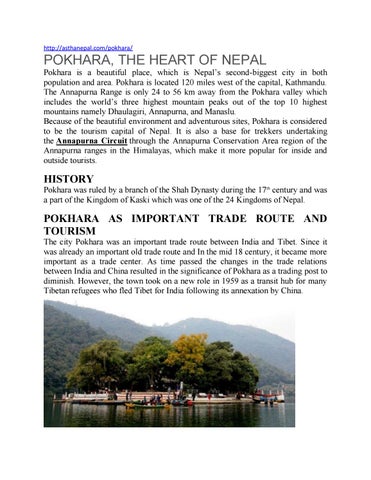
Famous Phewa Lake Pokhara Phewa Tal is the most beautiful location in Pokhara city. The lake water in the early mornings is something amazing that will make everyone stunned. Phewa Lake is surrounded by a combination of monkey-filled forests and the high white peaks. People can use brightly painted boats available for a ride to enjoy the beauty of Phewa Lake.
BEGNAS TAL/LAKE This Lake is also a widely known lake around Pokhara because it is quiet, clean and peaceful. It is the third-largest lake in Nepal after Phewa Lake in the Pokhara Valley. There is fluctuation in the water level due to rainfall and utilization in irrigation. The water here is regulated through the help of the dam which was built in 1988.
DAVI’S FALL (HELL FALL) Davi’s fall is one of the most astonishing falls, which makes the fall disappear in the gorge. This fall is named after the person called David who jumped into the fall
to see where this fall ends too. Its Nepali name is Patale Chango, which means “underground waterfall.” This is one of the most visited places in Nepal. The water from the fall passes through a cave called Gupteshwor Mahadev or “cave beneath the ground.” The cave also acts as a tourism site because it has complex designs and people even forget the way inside the cave.
SHANTI STUPA (WORLD PEACE PAGODA) Shanti Stupa is located in the south of Phewa lake at the top of the mountain which was established in 1999. Peace Stupa offers great views of the Annapurna Mountains, including Fishtail, Dhaulagiri, Annapurna South, and Annapurna III. This is a great place to watch the sunrise or sunset over Pokhara.
Peace Stupa Pokhara The white pagoda has two tiers for tourists and religious visitors to circumambulate. The second tier displays four statues of the Buddha presented as souvenirs from different countries. Each statue represents an important event relating to the Buddha. And was named according to where they took place.
SARANGKOT Sarangkot is one of the most popular hills for hiking as well as paragliding from where you can get an astonishing view of mountains and Pokhara city. It provides
you the best serene and mesmerizing environment. It lies at an elevation of 1590m which is just above the Pokhara city. You can see panoramic views of Annapurna, Manaslu, Machhapuchhre, Dhaulagiri and other mountain ranges. This is another spot for enjoying the sunrise and sunset over the majestic Himalayas. Moreover, you can enjoy the view of the Pokhara valley, Phewa Lake, and many green hills. As it has a suitable environment for paragliding, many people come here for paragliding purposes as well. It can really be an unforgettable memory if you truly enjoy nature. Not only for the youth and middle-aged people but people of all ages can hike in this area because of the well-managed route and its low elevation.
MAHENDRA GUFA (MAHENDRA CAVE)
Famous Mahendra Cave Pokhara Mahendra Cave is the large limestone cave which is located close to Kali Khola. Inside the cave, you can see the statue of Lord Shiva. This cave is named after former King Mahendra Bir Bikram Shah Dev. The cave inside is very dark and water keeps dripping from the wall and ceiling. Because of the darkness, people kept artificial bulbs so that visitors can easily travel the area.
CHAMARA GUFA (BAT CAVE) Bat cave is another famous cave in Pokhara, which is about a 10-minute walk from Mahendra cave. This cave is full of bats hanging downward in the cave. It is really
spectacular site to see all the bats. And there is a narrow way from the cave to the ground. There is a local saying that a person with many sins won’t be able to pass through the narrow way leading to the ground through the Bat cave.
GUPTESHWOR MAHADEV CAVE Gupteswor Mahadev cave is another cave that is famous for its religious importance which is located in the southern end of the city, Chhorepatan. In this cave, there is also a statue of Hindu God Lord Shiva. As walking deeper into this cave, you can find the waters of David’s fall itself.
ADVENTUROUS SPORTS Pokhara is not only famous for its good environment, mountain views, or religious places but also for adventurous sports such as hiking, boating, canoeing, paragliding and many more. Mainly the trekking routes of the Annapurna region begin from Pokhara including Annapurna Base Camp, Poon Hill, Mardi Himal, TAAN Model Trek, Khopra Ridge Trek, and Jomsom – Muktinath. Conclusively, Pokhara is one of the cities of Pokhara Valley, which is famous for its tourism hub and has many caves, lakes, religious sites, and temples as well as a mysterious David’s fall. It is also famous for its different adventurous sports. There would be no one who will want to lose the chance to visit and enjoy holidays in Pokhara because many of the things as a traveler want to do and see are present.