Issue 9 | October 2026
YEAR
INDUSTRY newsletter
100 ANNIVERSARY
1927-2027
Behind Every Smile, A Team That Cares for itself too Practical tips to foster wellbeing and resilience in your team
2027 ASOFRE Foundation Meeting Save the date: Foundation Dinner and 100-year ASO Anniversary
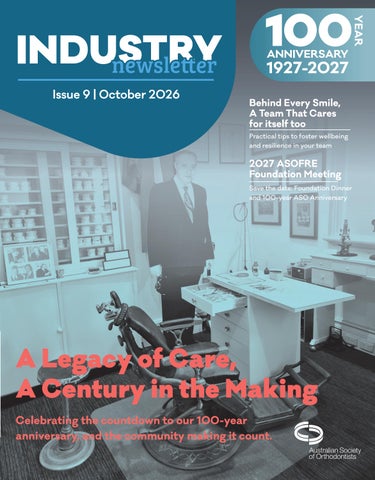
A Legacy of Care, A Century in the Making Celebrating the countdown to our 100-year anniversary, and the community making it count.
WELCOME
W
elcome to a special edition of the Industry Newsletter, celebrating the countdown to the ASO’s milestone 100-year Anniversary in 2027.
This edition highlights some of the wonderful work happening within our orthodontic community, both here in Australia and overseas. We feature D3’s Chalky Teeth Campaign, the Begg Society’s cleft lip and palate project in Timor-Leste, the Perth Children’s Hospital cleft and craniofacial Conference for postgraduates, and the latest Give a Smile update - all excellent examples of the difference our profession can make beyond our day-to-day clinical work. We also want to recognise the incredible work of our wider orthodontic teams, particularly our dedicated oral health professionals. We simply couldn’t deliver the clinical outcomes we do without them. With that in mind, we’ve included two practical articles on supporting mental health and wellbeing within our teams. A warm thank you to all our guest contributors for their time and expertise; • A/Prof Roisin McGrath, Population Oral Health Consultant • Tanya Harding OLY, a four-time Olympic medallist, speaker and coach • Gladwin Mendez, Global Top 100 Innovator in Data & Analytics and • Jon Cousin, Wealth Management Ord Minnett. Finally, thank you to our industry sponsors for their ongoing support. I hope you enjoy this edition as we head towards this very special milestone for the ASO. Dr Doreen Ng ASO Federal Secretary
Australia’s Australia’sMost MostIntegrated IntegratedOrthodontic OrthodonticPlatform Platform
Orthobridge Orthobridgeconnects connectsyour yourentire entirepractice: practice: • •Local Local Australian Australian implementation implementation && support support • •Seamless Seamless Dental Dental Monitoring Monitoring integration integration • •Angel Angel Aligner Aligner automatic automatic case case workflow workflow • •Paperless Paperless Patient Patient Journey Journey • •Online Online bookings bookings && Appointment Appointment on on Demand Demand
Powering Poweringthe thefuture futureofofOrthodonticss OrthodonticssininAustralia Australia Book Bookyour yourdemo demotoday todayemail emailhello@orthobridge.eu hello@orthobridge.euor orcall call0405 0405184 184752 752
Together we
GROW
ClearCorrect® is built on shared progress. Delivering results you can trust, confidence you can feel, and better care your patients experience. Connected Digital Ecosystem
Backed by the Straumann® Group
Patient-Centred Aligner Design
Designed to help you plan with confidence, work more efficiently and deliver more consistent outcomes.
Built on decades of clinical precision and innovation.
Supporting patient comfort, compliance and long-term outcomes.
ClearPilot®
Straumann SIRIOS™ X3
ClearCorrect® RemoteCare
Customise and control treatment setups from submission to approval.
Streamline case submission with fast, intuitive scanning and seamless access to the ClearCorrect digital workflow.
Monitor patient progress remotely between appointments, supporting timely communication and a more convenient patient experience.
Celebrating 20 Years of Confident, Connected Orthodontic Care
Explore ClearCorrect solutions Scan to learn more
COMMUNITY & I M PA C T
Contents Feature Sponsor Clearcorrect Community and Impact Chalky Teeth Campaign – Dr Mark Leedham AM .................................................. 04 From compromised molars to global health – Prof Mike Hubbard ...........................................................08 Begg Orthodontic Museum – Dr Helen McLean AM........................................................14 Perth Children’s Hospital cleft and craniofacial Conference – Dr Kip Homewood...............................................................16 Give a Smile: Celebrating 21 years of Giving Back....................... 18 Promoting Wellbeing in the orthodontic team – A/Prof Roisin McGrath................................................... 20 When Stress Multiplies: Rethinking resilience for you and your team – Tanya Harding OLY.............................................................24 Practice Management What I tell clients about AI: The principles that matter – Gladwin Mendez ................................................................. 28 Planning for retirement: What orthodontists need to know – Jon Cousin, Ord Minnett .............................................30 Save the date 2027 ASOFRE Foundation Meeting ................... 27 For all enquiries: E communications@aso.org.au The articles in this newsletter are for information purposes only and do not constitute an endorsement or recommendation from the ASO. Cover image: Photo of the Begg Orthodontic Museum, courtesy of Dr Helen Mclean AM and Dr Mark Leedham AM
TIMOR-LESTE CL
Since 2016, Volunteer Orthodo By Dr Mark Leedham AM
T
he people of Timor-Leste, just over one hours flying time from Darwin, belong to one of the poorest nations on earth. Timor-Leste has been an independent country since only 2001. The population is about 1.4m, with about 20% living in the capital Dili. Access to basic medical and dental care is limited. Comprehensive care for cleft lip and palate conditions as we know it does not exist. In 2016, Dr Simon Freezer and I discussed the possibility of providing orthodontic care to people with CL&P conditions in Timor. We liaised with Mr Mark Moore of the Adelaide Women’s and Children’s Hospital, and head of the Craniofacial Unit, and who had been visiting Timor-Leste and Indonesia, proving plastic surgery services for many years. We also spoke to Dr Terry Yuen, from the Burnside Lions Club in Adelaide, who has been supporting a dental clinic in the suburbs of Dili since 2001. After a visit to Dili and the Clinic, the Australasian Begg Society of Orthodontists (ABSO) felt it could support these patients. We commenced visiting on a regular 6 to 8 week schedule with one or two orthodontists. Since the unfortunate hiatus of almost two years, because of Covid travel restrictions, we have returned to Timor. In the last two years we have improved the clinic greatly, by supplying a new dental
LEFT LIP AND PALATE PROJECT
ontists have been quietly transforming lives in Timor-Leste chair, autoclave, OPG machine, digital scanner, and other equipment. This is all available for the clinic to use when we are not there. Much of this equipment was donated or purchased at cost. At present, only limited surgery is available for lip and palate repair, and for some alveolar bone grafting. Within these constraints, we are providing comprehensive orthodontic treatment. We often see unrepaired palatal clefts in teenagers and adults. Maria, who established the clinic with Dr Terry Yuen, and Domingos who works there full time, are a great team. They organise the patients, and provide the basic dental care that our patients often need before we start any orthodontics. The caries rate is quite high, and often molars need to be removed which we would rather keep.
Portuguese. Domingos has good English language skills, so this is an enormous help in the clinic with patient explanations. We are fortunate to be supported by several orthodontic equipment suppliers, as well as ADI, ICD and PFA who have given us grants for specific pieces of equipment and freight costs. ABSO members also pay a small levy each year to support the project. The University of Adelaide sends a team of Orthodontic postgraduates each year, as part of this project. This provides them with a great opportunity to treat CLP patients under expert guidance, and experience the conditions in a third world country.
Another challenge is language. Most people in Timor-Leste are multilingual, and the national languages are Tetum (the local language) and Portuguese. Many people also speak some Indonesian and English. We have provided written instructions in Tetum, English and
www.aso.org.au | 5
TIMOR-LESTE CL&P P RO J ECT (C O N T I N U E D)
The work is quite challenging, but very rewarding, as we are providing care that is otherwise not available. The people of Timor-Leste are very patient and grateful for our assistance. The minimum wage in Timor-Leste is only about $USD120 per month, and there is no social security, so very few can afford dentistry let alone orthodontics. The clinic where we are based provides low-cost basic dentistry, or sometimes at no cost. Extractions are very common, especially in younger people, mostly from a poor diet. We are steadily getting busier, and where possible we now send a team of four people with at least two orthodontists. Sometimes we can get a Dental Assistant or Hygienist to travel with the team, and this is extremely helpful.
I strongly recommend to visiting teams, that they should stop by the Resistance Museum while in Dili, as it provides some background to the Indonesian occupation from 1975 to 1999. About 30% of the population died during the occupation. We are always looking for volunteers, and we are organising trips and teams for 2027 now. Qantas flies daily to Dili, and we usually stay at Timor Plaza Hotel, but teams can stay anywhere, and can do a bit of tourism before or after the clinical work. Trips are usually of about 4 days duration. Treatment is usually fixed appliances, but we are using aligners in some cases where we can. Each team has Orthodontists who have been before and have experience with cleft conditions. Trips are also preceded by a Zoom briefing to let everyone know what is happening, and how patients are progressing. Volunteers pay their own way, but we can provide advice on travel and accommodation as well as local conditions. If you think you can help, or would like to volunteer, contact ABSO or the ASO. beggsociety.org
Maria Dias, Dr Helen McLean AM, Dr Mark Leedham AM, Domingos and Zeze in the PAS Clinic in Dili.
How would you treat this patient? Clinical Case: This patient is not satisfied with their smile, their anterior teeth being tilted and their lateral being out of the arch. Let’s take a closer look • Class II Div. 2 • Deep bite
• Crowding
• Bolton discrepancy • Midline deviation
From challenges to choices Finding the best treatment for you and your patient
With just
With just
Clarity™ Aligners
Clarity™ Digital Bonding
With the combination of Clarity™ Aligners
Clarity™ Digital Bonding
Scan or click on the QR Code to explore the treatment options or to request a demo Go to info.engage.solventum.com/ftCTxDesignAsia
www.aso.org.au | 7
COMMUNITY & I M PA C T
FROM COMPROMISED MOLARS TO GLOBAL HEALTH: A CENTENARY OPPORTUNITY FOR AUSTRALIAN ORTHODONTICS By Professor Mike Hubbard, University of Melbourne
"rampant caries", yet this burden remains largely unrecognised. Learn more.
A
What is the Chalky Teeth Problem? – D3G defined three levels: the health burden of chalky teeth; allied ignorance across society; and insufficient research attention. Meeting this challenge demands stronger science, better practice and attention to social good. Learn more.
s the ASO approaches its 100-year anniversary, Australian orthodontists are helping drive a bold new health movement – linking maternal and child health, dentistry, public health and groundbreaking research – to pursue a medical cure for chalky molars and reduce the global burden of childhood tooth decay. The Chalky Teeth Problem offers three levels of opportunity for social good What are chalky teeth? – D3G has developed a translational set of terms that is both scientifically rigorous and publicfriendly, enabling smooth conversations from public square to clinic and laboratory. "Chalky teeth" is the accessible entry point that embraces developmental defects of enamel – especially "chalky molars" (molar hypomineralisation; MH) – and "white spot lesions". Learn more. Why do chalky molars matter? – They are the most socially damaging "D3" (developmental dental defect) given their high prevalence and propensity to decay. Taking 2-year, 6-year, and 12-year molars together, MH affects over 1-in-5 kids worldwide. Severe MH may account for half of childhood tooth decay and manifest as 8 | ASO Newsletter October 2026
What blocks translational attack? – Classical disciplinary approaches feature fragmented knowledge, limited intercommunication and unclear problem ownership. D3G’s answer has been to gather stakeholders, share perspectives, identify common problems and prioritise joint action. From a translational perspective, the orthodontic domain was rather maloccluded: its clinical, research, education and public-facing elements had not yet achieved functional alignment around the needs of families and society. Realigning orthodontics for the D3 era Orthodontists bear distinctive powers for realigning the field, given a translational mindset. Rising above traditional boundaries, shooting for a translational future – The aspiration is to "unshackle tradition, think outside the square, and forge new
ULTRA FAST DEEP CLEAN IN JUST 3 MINUTES
Retainers Aligners
Night Guards Mouthguards
To request complimentary patient samples, visit www.haleonhealthpartner.com or scan the QR code For directions for use, contraindications, warnings and precautions, refer to www.haleonhealthpartner.com/en-nz/oral-health/brands/polident/products/retainer
AU
When used as directed. **In laboratory tests. Reference: Kiesow, A. et al. (2016) J. Prosthet. Dent. 115(2) 189-198. Sponsored by Haleon. +
Trade marks owned or licensed by Haleon. © 2026 Haleon or licensor. PM-AU-POLD-25-00136. TAPS BG5557. Haleon, Sydney NSW Australia and Auckland, New Zealand.
NZ
COMMUNITY & I M PA C T (C O N T I N U E D)
partnerships" for a holistic attack on the Chalky Teeth Problem. Such innovation beckons stronger interaction with patients, referrers, industry, policymakers, and researchers. Learn more. Adopting "D3 lingo" – Moving from "compromised" or "hypoplastic" molars to knowledgeable use of "chalky molars" and "MH" is a wise investment, made easier with D3G resources. Public-friendly tooth naming – particularly 2-year, 6-year and 12-year molars – aids discussion of aetiology and extractions. Learn more. Evolving beyond MIH thinking – Chalky 6-year molars were highlighted in the "MIH era", but its resulting tunnel vision spawned an "alphabet soup" of supplementary clinical terms (e.g. HSPM) while overlooking key scientific and preventive considerations. In contrast, "MH" and "HM" – at case and hypomineralised-tooth levels, respectively – provide clinical and scientific precision. These conceptual changes equip orthodontists to co-lead the D3-chalky teeth movement. Learn more. Gaining traction: from science to social good Over the past decade, translational implementation has succeeded across multiple fronts, orthodontics included. Stronger science across lab, clinic and beyond – D3G applied medical lifecourse thinking to reconceptualise MH as a continuum – from medical origins in babies through to adult healthcare. This new paradigm prioritises preschool screening of chalky canines and 2-year molars, and was boosted by a 100-year research 10 | ASO Newsletter October 2026
breakthrough on the path to curing MH medically. Learn more. Better communication and education – The 'Speak Chalky Teeth' initiative integrated D3 lingo across the sector, from the new academic definition of MH at MEDLINE through to practice websites, patient handouts and the popular kids' reader, 'Sam's Story'. Accessible online resources offer a one-stop education hub for beginners and experts alike. Learn more. Social reach and recognition – Although currently English-language only, D3G's resources have broad social reach, evidenced by more than 800 website visits daily and adoption of "chalky teeth" equivalents in multiple languages. The Nakao Foundation recognised this impact with a Worldwide Oral Health award in 2025, honouring D3G's unique "science to social good" mission. Learn more. How three mates inspired a cast of thousands Serendipitously, today's international movement began 26 years ago in Melbourne, thanks to an orthodontist, a philanthropic lawyer, and an oral surgeon. Their brainstorming foresaw an innovative "bench to bedside" initiative combining medicine, dentistry and basic science for the good of children. An orthodontic thread has permeated 'D3-chalky teeth' activities ever since. For example, 'Sam's Story Club' was hatched at the 2015 NZAO congress, and American orthodontics joined in after MH-savvy AAO president, Norman Nagel, attended the 2023 NZDAD3G minisymposium – prompting an AAO News article and 2025 WOCON lecture in
'Sam’s Story' helps families understand how orthodontists can contribute to the care of children with chalky molars. Copyright D3G, reproduced with permission.
ASO President Dr Sam Whittle, signs up as a WFCT champion in the fight against chalky teeth.
www.aso.org.au | 11
COMMUNITY & I M PA C T (C O N T I N U E D)
Honolulu. Similar stories involve paediatric dentists, oral health professionals, scientists, industry, government and chalky teeth families. Today, D3G actively works with over 100 "D3ers" worldwide and communicates with thousands of others. Learn more. Pitching in to accelerate the D3-chalky teeth movement We invite readers to 'Join the Club D3'. You can help in three ways: 1.
Learn from D3G's educational resources, and share them with colleagues and affected families;
2. Participate in D3G ventures – such as the 'We Fight Chalky Teeth' network – and give back by sponsoring 'Sam's Story' or 'D3 Pay It Forward' memberships; 3.. Champion D3G to potential partners, philanthropists and social-impact backers – Learn more. Your support is timely as D3G spins out from the University of Melbourne to become a social-purpose organisation. Together, let’s strengthen the D3 community by helping chalky teeth families get the understanding, support and best-practice care they deserve, while fostering better global health across the lifecourse.
Why we support D3G 20-30w each Paul Schneider, MRUFD co-founder & ASO-D3G liaison officer – "I’m proud that our early vision has blossomed into a global movement dedicated to D3 research, education, and advocacy. Philanthropy has been pivotal throughout, and remains crucial for improving the lives of kids with chalky teeth." Alwyn Wong & Chris Theodosi, founding 'WFCT Specialist Practice' – "We joined 'We Fight Chalky Teeth', inspired by D3G's vision of taking cutting-edge science through to global impacts on child health. Knowing how often chalky molars can complicate orthodontic treatment plans, we encourage our colleagues to join this movement." Annu Nangia, Chair ASO Foundation for Research and Education – "ASOFRE has proudly supported D3G research, education and advocacy through WFCT network membership since 2019, believing it is important to promote awareness of chalky teeth – not only amongst dental professionals but also in the wider community."
Acknowledgements and enquiries D3G gratefully acknowledges the wonderfully diverse contributions that have both inspired and supported our journey to date. A special thanks to the Aussie 'We Fight Chalky Teeth' orthodontists for their collaborative thinking and philanthropy, and to the ASOFRE for ongoing financial and moral support. 12 | ASO Newsletter October 2026
Learn More about MH, chalky teeth and D3G • What's a translational event look like? Watch a 3 minute video trailer. • A deeper tour of the MH problem? Watch the influential Colgate-D3G webinar, earn 1 hour CPD.
Because side matters.
Just as each foot requires its own shoe, each side of the arch requires its own biomechanics. 83% Of Class II Patients Exhibit Significantly Mesially Tipped First Molars* Why Is a Side-Specific Design Important?
Right Side
Left Side
Correcting molar rotation alone may not fully address a Class II malocclusion. When molars are tipped forward, they can continue to occupy excessive space in the arch and influence the position of neighbouring teeth. Because the left and right molars move differently during treatment, each side requires a specific range of motion and appliance angulation to achieve optimal correction. Watch The Video
*Data on file
Dr Ahmed & Dr Carriere explain why they use Carriere Motion
Watch Now
www.aso.org.au | 13
COMMUNITY & I M PA C T
THE P.R. BEGG ORTHODONTIC MUSEUM Remembering the man who shaped Australian orthodontics By Dr Helen McLean AM
Dr
PR Begg AO was an orthodontic pioneer. He completed his schooling in Adelaide as a classmate of Howard Florey. He was awarded a Bachelor of Dental Science from the University of Melbourne in 1923. Dr Stanley Wilkinson was one of his teachers in Melbourne, and this may have influenced his choice of orthodontics for further study. Dr Begg then travelled to the US to study orthodontics under Edward Angle for 2 years. PR Begg was Adelaide’s first orthodontist. In 1925 he was appointed Lecturer in Orthodontics at the University of Adelaide and Honorary Dental Surgeon at the Adelaide Dental Hospital. He opened his private orthodontic practice in Adelaide in 1926. Dr Begg became a founding member of the Australian Society of Orthodontists in 1927. Dr Begg commenced early investigations of dental crowding and orthodontic relapse in the late 1920s with his studies focused on attritional occlusion. As a result of this early research, he treated his first extraction case in 1934. In 1935 he was awarded the Doctor of Dental Science from the University of Adelaide but his thirst for knowledge didn’t stop there, and he kept researching over the next 40 years. He initially used the Edgewise appliance but subsequently 14 | ASO Newsletter October 2026
returned to using Angle’s ribbon arch bracket system. The Begg Museum has some displays pertaining to Dr Begg’s time at the Angle School and the ribbon arch appliance. During the 1950s and 1960s Dr Begg carried out significant research with colleagues. Some of the ideas pioneered by Dr Begg during that time still underpin modern treatment philosophies to this day. He researched new metallurgy and materials to facilitate orthodontic tooth movement and bravely discussed the need to extract teeth as a necessary part of some treatments. His rationale for extracting teeth for patients with crowding was based on his published and peer reviewed research findings. As a result of his research Dr Begg went on to develop the Lightwire Differential Force Technique. Dr Begg kept excellent and comprehensive patient records and provided evidence of the predictable results when using his light-wire technique through publications and courses which he presented globally. Many of these publications and some of his presentations can be viewed in the Begg Museum. Dr Begg had a most enquiring mind, constantly trialling new ways of moving teeth. He has been reported as having an “extraordinary memory and vision
www.aso.org.au | 15
for orthodontics”. He would develop prototypes, test them and if they worked, he would then patent his inventions, and have them manufactured. Many of his patents and prototypes are displayed in the Begg museum as are the manuals for the Begg Courses which were delivered nationally and internationally. The Begg Course Manuals show treatment cases with full patient records and treatment details. Dr Begg introduced a “Stage System” to orthodontic treatment and many patient models demonstrating the stages and progress of treatment for his patients are also on display in the museum. In 1963, at the age of sixty-five, Dr Begg retired from the University of Adelaide as Senior Lecturer, handing over the reins to Dr Milton Sims AO, for whom there is also a small display in the museum. Dr Begg continued working in his private practice and travelling the world teaching the Begg technique. At the time Begg Societies existed in America, Europe, Japan, United Kingdom and Australia and the Begg Journal of Orthodontics was in publication. Records from these associations and the Begg journal are on display in the museum. In 1981 Dr Begg was appointed Officer of the Order of Australia for Services to Humanity and his presentation medals are displayed in the museum. In 1988 Dr Begg AO was recognised as one of the 200 most significant Australians as part of nation’s Bicentennial celebrations. He is the only Australian dentist to be inducted into the Pierre Fauchard Academy Hall of Fame. Permanent displays of the Begg Technique can be found in the Smithsonian Institution and the library of the American
Dental Association. However the most comprehensive collection which includes a display of his clinical operatory with the original dental chair, his instruments, wires etc, just as they were on his final day of clinical practice, can be seen at the PR Begg Museum in Adelaide. Dr Begg was a hoarder which has meant that the Australasian Begg Society of Orthodontists has been left a comprehensive and rich collection of orthodontic history. The legacy of Dr Begg, that of innovation, progressive ideals and the pursuit of treatment excellence lives on in the Begg Museum. The museum is open to the public on the first Friday of each month, during the South Australian History Festival and by appointment. beggsociety.org
COMMUNITY & I M PA C T
PERTH CHILDREN’S HOSPITAL (PCH) CLEFT AND CRANIOFACIAL CONFERENCE FOR ORTHODONTIC POSTGRADUATES By Dr Kip Homewood
Drs
Chris Wholley and Steven Singer should be congratulated for the fantastic cleft lip and craniofacial Conference which was held at the Perth Children's Hospital during August this year. It is organised for the postgraduate orthodontic students and other professions related to cleft patient care. Over the past week and a half, I have been reflecting on the excellent two days I spent at the Conference, marvelling at the professional expertise and exceptional skills presented throughout the conference.
Practice your way, succeed together. Smile Partners is a growing network of independently branded orthodontic practices across Australia. We partner with orthodontists at every stage of their career – whether you’re building something new, growing what you’ve built, or planning for succession.
Learn more at smilepartners.com.au
16 | ASO Newsletter October 2026
I’ve shared my experiences with many friends and colleagues, particularly the comprehensive care provided by the multidisciplinary team, including plastic surgeons, oral and maxillofacial surgeons, orthodontists, speech therapists, periodontists, dentists, psychologists, dental therapists and nursing staff. I have been emphasising the outstanding care provided to these patients and the importance of a truly team-centred approach in achieving such fantastic outcomes. The meticulous digital planning undertaken by the orthodontic team allowed the entire multidisciplinary team to visualise
the anticipated orthodontic outcome and, importantly, to modify the surgical plan to achieve the best possible facial and speechrelated outcomes. This careful planning also reduced the amount of post-surgical orthodontic detailing required, thereby shortening overall treatment times. This is particularly valuable for cleft patients, who already undergo multiple surgical and orthodontic procedures throughout their childhood and adolescence. The subsequent plastic surgical and oral and maxillofacial procedures are carefully planned and executed, with truly exceptional outcomes. The results are so refined that, to the layperson, it can be difficult to appreciate the underlying cleft anomaly. What I found particularly interesting was the emphasis placed on outcomes from the patients’ perspective. Even after the surgical and orthodontic procedures had been completed, speech remained one of
their principal concerns. This highlighted the importance of ensuring that treatment planning extends beyond facial aesthetics and dental outcomes to achieving the best possible functional and speech-related outcomes for each patient. The students were also extremely impressed by what they observed, and I have been stressing the importance of team-based care in orthodontics, even in routine cases where appropriate. While routine orthodontic treatment is obviously nowhere near as complex as cleft care, the principles of collaboration and involving the appropriate professionals when necessary are equally important. It was a wonderful experience, and I am very grateful for the opportunity to attend and learn from such an exceptional group of professionals.
August 2026 Conference attendees
www.aso.org.au | 17
COMMUNITY & I M PA C T
GIVE A SMILE: CELEBRATING 21 YEARS OF GIVING BACK
G
ive a Smile (GAS) was once again proud to be part of the ASO booth at the 30th Australian Orthodontic Congress in Melbourne this May. Members dropped by throughout the Congress to ask questions about GAS, sign up, or simply say hello. On Friday 22 May, GAS Chair Dr Jonathan Rooke shared the latest GAS update. If you missed it, or would like to revisit the presentation, the recording is now available below.
W AT C H T H E VIDEO
Dr Jonathan Rooke
“Vale to GAS Co-founding member Dr John Armitage We honour his memory by continuing the work he helped build” “Why be a GAS Orthodontist? – Excellence without heart risks becoming an exclusive club."
18 | ASO Newsletter October 2026
“ASOFRE is the brains of the ASO – Give a Smile is the heart”
Support their confidence through
every stage.
for kids and teens
iTero Lumina™ scan, screening at first ortho visit
Invisalign® Palatal Expander System
Invisalign First™ treatment
Invisalign® System with mandibular advancement
Invisalign® product options for teens
Vivera™ retainers
©2026 Align Technology, Inc. ALIGN, INVISALIGN and ITERO are trademarks of Align Technology.
www.aso.org.au | 19
COMMUNITY & I M PA C T
PROMOTING WELLBEING IN THE ORTHODONTIC TEAM By A/Prof Roisin McGrath Melbourne Dental School
O
rthodontics is a fundamentally people-centred profession. Every day, orthodontic teams work together at pace to deliver high-quality care while managing patient and family expectations, busy schedules, evolving technologies and workflows, and the many demands of running an orthodontic practice. For many teams these pressures are purely part of the job, but when they become persistent, they can affect physical health, psychological wellbeing, workplace relationships and the capacity to find satisfaction in clinical work. Left unaddressed, sustained pressure increases the risk of illness and burnout, higher staff turnover, and have the potential to diminish the quality of patient care.
factors that shape our quality of life and overall satisfaction; it is the interplay between psychological and physical health, relationships, having a sense of purpose, and meaningful engagement in things that matter to us. It is important to recognise that wellbeing is not just about being happy or avoiding stress in our lives. Positive wellbeing is understood as a state in which we are able to function, feel connected, find meaning and flourish. Wellbeing at work is dynamic rather than fixed, changing across time and in response to circumstances such as workplace culture,
What do we mean by wellbeing? There is no single, universally accepted definition of wellbeing. It is recognised as a multidimensional and inherently personal concept that means different things to different people. Broadly speaking, wellbeing describes the combination of 20 | ASO Newsletter October 2026
A/Prof Roisin McGrath
workload and the support available from colleagues and the wider community. We can be highly committed to our work and still experience stress, fatigue or periods when our wellbeing is not where we would like it to be. The distinction between wellbeing and mental illness is also important. Promoting wellbeing does not replace the need to recognise and respond to mental health difficulties. Rather, it is part of creating workplaces where people are supported to stay well, identify concerns early and seek help when it is needed. Why does this matter in orthodontics? The dental profession has well-documented challenges relating to occupational stress, burnout and psychological distress. Research highlights the experiences of the whole dental team, rather than focusing solely on orthodontists. Orthodontic teams experience their own particular challenges. High patient volumes and a fast clinical pace require sustained concentration and effective teamwork. Teams work with children, adolescents and
adults, often alongside parents and carers who may have high expectations about treatment experience and outcomes. Staff recruitment and retention can create additional strain. While practice leaders frequently carry responsibility for clinical care, staff wellbeing, business operations and the navigation of an increasingly complex regulatory and technological landscape. Technology can be both an enabler and a source of stress. Digital workflows, intraoral scanning, aligner systems and other innovations can improve care and efficiency, but they also require continuous adaptation, training and investment, which can be disruptive for teams. There are clear physical demands too, including the musculoskeletal stresses associated with clinical practice that, without attention to ergonomics, can lead to pain and reduced capacity to work. None of these factors necessarily causes poor wellbeing on its own. Rather, it is the accumulation of demands, and how individuals and workplaces respond to
1800 643 055
www.aso.org.au | 21
COMMUNITY & I M PA C T (C O N T I N U E D)
them, that determines whether pressure becomes harmful. Foundations for flourishing One framework that can help us think about wellbeing at work is the PERMA model, developed by positive psychologist Martin Seligman. It identifies five elements that contribute to wellbeing: Positive emotion, Engagement, Relationships, Meaning and Accomplishment. Research has found that interventions targeting these dimensions can improve aspects of wellbeing. Positive emotion Positive emotion includes experiences such as enjoyment, gratitude, optimism and contentment. In a busy clinical environment, deliberately noticing what has gone well - a patient reaching a milestone, a productive clinical session or a colleague stepping in to help - can help us recognise the positives that can otherwise be overlooked. Engagement Engagement is about becoming absorbed in activities that capture our attention and allow us to use and develop our skills. For orthodontic professionals, this might come through clinical work, professional development, learning a new skill or just being fully present with a patient. This immersion both enhances work performance and makes it more intrinsically rewarding. Relationships Supportive relationships at work are central to wellbeing. Trusted colleagues, a sense of belonging and the freedom to ask for 22 | ASO Newsletter October 2026
help, share ideas and raise concerns create psychological safety. This not only protects individual wellbeing but also strengthens team functioning and patient care. Meaning Meaning comes from recognising why our work matters beyond individual tasks. Orthodontic teams do more than ‘straighten teeth’: they promote oral health, confidence and quality of life. Keeping sight of this broader purpose at work helps sustain motivation when routine pressures make the day feel difficult. Accomplishment Accomplishment is about acknowledging progress and achievement. In a profession committed to continual improvement, it is tempting to move straight on to the next challenge. Pausing to recognise individual and team achievements reinforce a sense of progress, fuels momentum and affirms the value of the work undertaken. Wellbeing is a team responsibility Perhaps the most important message is that wellbeing cannot be left solely to individuals. We often respond to workplace wellbeing by telling people to exercise, meditate, become more resilient or take better care of themselves. These strategies have value, but they cannot compensate for a workplace that consistently creates excessive demands, poor communication, unclear roles and responsibilities.
A healthier approach is to consider wellbeing at multiple levels. • At an individual level, we can develop strategies to recognise stress, regulate emotions, build healthy habits, maintain boundaries and seek support when needed. • At an organisational level, practice leaders can consider how work is designed. Do staff have opportunities to pause and recover? Are roles clear? Is communication respectful? Are people recognised for their contribution? Can team members raise concerns without fear? Are physical working conditions supporting rather than undermining health? • And at a system level, professional associations, universities and policymakers also have a role in advocating for environments that enable dental professionals to work safely and sustainably. What can we do tomorrow? Promoting wellbeing does not require a complete overhaul of your practice. Start by asking the team ‘what makes your working day harder than it needs to be?’ Maybe it’s the morning rush, inadequate breaks, unclear responsibilities, communication between clinical and administrative staff, or simply never having time to acknowledge what is going well. Then choose one issue and do something about it. It might be introducing a brief team check-in at the beginning of the day. It might be protecting staff breaks, reviewing a workflow that repeatedly creates frustration, recognising achievements more
regularly, or creating a clearer process for raising concerns. Small changes can signal that ‘the wellbeing of our team matters’. Building a healthy future for orthodontics Orthodontic practices are communities. Promoting wellbeing in the orthodontic team is therefore not merely about helping individuals cope with the demands of orthodontic practice. It is about creating workplaces where people feel valued, connected, capable and able to do their best work. Fostering wellbeing is a collective responsibility that requires clear communication, realistic workload planning, attention to team dynamics and accessible support when colleagues may be struggling. By prioritising these measures, we can create more resilient, supportive working environments that benefit both staff and patients. Resources mhwd.org/framework/ fdimentalhealthtoolkit.org/ positivepsychology.com/perma-model/ blackdoginstitute.org.au/the-essentialnetwork/ dpsupport.org.au/
This article is produced by a third party (not the ASO) for guidance purpose only. Advice should be sought for your Practice’s circumstances.
www.aso.org.au | 23
Tanya pitching at the 2008 Beijing Olympics
WHEN STRESS MULTIPLIES Rethinking resilience for you and your team
By Tanya Harding OLY
S
tress in small business rarely arrives one problem at a time. It stacks.
A team member calls in sick. A patient complaint lands in your inbox. A supplier issue needs attention. At the same time, something at home needs you too. In an orthodontic practice, you might shift between clinician, employer, leader, recruiter, financial decision-maker, problem-solver and strategist — sometimes within the same hour. Then you do it all again tomorrow.
better at carrying more. Perhaps it’s about recognising when the load is affecting us and developing the capacity to respond, adapt and recover. I used to think resilience meant being tough For much of my life, I thought I understood resilience. As an elite athlete, I represented Australia at four Olympic Games and played
The Australian Small Business and Family Enterprise Ombudsman reports that around one-third of Australian business owners experience moderate or higher psychological distress. Given the load many owners carry, that figure is perhaps not surprising. So maybe resilience isn’t about becoming 24 | ASO Newsletter October 2026
Tanya Harding OLY
professional softball around the world. I became very good at working hard, tolerating discomfort and continuing when things were difficult.
It makes me stop and say, either out loud or in my head, what I’m actually experiencing: I’m overwhelmed. I’m frustrated. I’m anxious about this decision.
There is definitely a place for grit in sport. Australian sporting teams are renowned for their determination and that unmistakable Aussie fighting spirit. For years, that was how I understood resilience: push through, get back up and keep going.
Naming it creates a pause between what I’m feeling and what I do next. I can then frame the situation more clearly: What is actually happening here? What is within my control? What does this situation need from me?
But some of the hardest seasons of my life came after sport.
Elite sport also taught me that calm isn’t always the goal. Before an Olympic final, I needed energy and intensity, but I also needed clarity and focus. At my best, I was relaxed but ready.
Transitioning out of being an elite athlete, becoming a single mum of three and struggling to find my place in the workforce tested me in ways an Olympic final never had.
The better question is often: What state do I need for what I’m about to do?
That’s where my understanding of resilience changed. It became less about how much I could endure and more about my capacity to adapt when life changed, recognise when I was struggling, ask for help and keep finding a way forward.
What’s Important Now?
Sometimes resilience means pushing. At other times, it means pausing, changing the plan or putting something down.
What helped was returning to the process: the next pitch, the next play, the next thing I could influence.
Name it. Frame it.
Legendary American football coach Lou Holtz popularised the question W.I.N.
A significant part of resilience is awareness not only of what we’re thinking, but of what is happening in our body. Stress might show up as an increased heart rate, tight chest, stomach discomfort, disrupted sleep or difficulty concentrating. You may notice yourself becoming impatient, rushing, micromanaging or suddenly treating everything as urgent. One simple practice I use is “Name it. Frame it.”
When the stakes were high in sport, focusing too heavily on winning, losing or making a mistake pulled my attention towards things I couldn’t control.
What’s Important Now? It’s just as useful when you’re running a business. When your mind is trying to solve ten problems at once, ask: What genuinely requires my attention now? What can I influence? What is the next useful action? In sport, we didn’t win by staring at the
www.aso.org.au | 25
scoreboard. The outcome came from repeatedly executing the process well.
When stress multiplies, you don’t have to solve everything at once.
Your team is watching too
Start with what’s important now.
How you manage pressure influences the environment around you. If you become reactive when something goes wrong, people may become reluctant to raise problems. If everything is urgent, priorities quickly become unclear.
Tanya Harding OLY is a four-time Olympic medallist, speaker and coach with experience spanning elite sport, leadership and emergency management. She works with organisations and teams through keynotes, workshops and practical sessions exploring resilience, self-leadership, human performance and performing under pressure.
And it’s okay to be vulnerable, even when you’re the boss. Your team can probably recognise when you’re struggling anyway. Appropriately acknowledging, “There’s a lot going on, and I’m feeling the pressure too,” shows the human being behind the title. Vulnerability doesn’t mean making your team responsible for your emotions; it means being honest while remaining responsible for how you manage them.
To connect with Tanya or discuss working with your team, contact harding.tanya7@ gmail.com or connect with her on LinkedIn.
This article is produced by a third party (not the ASO) for guidance purpose only. Advice should be sought for your Practice’s circumstances.
Psychological safety isn’t created simply by telling people they can speak up. It’s created by how we respond when they do. When pressure starts to multiply Try coming back to three simple questions: 1. Name it. Frame it. What am I experiencing right now? 2. Check your state. What state do I need for what I’m about to do? 3. W.I.N. What’s Important Now? Resilience isn’t about having everything together or proving how much you can carry. It’s about recognising when pressure is affecting you, knowing how to adjust and bringing your attention back to what you can influence.
26 | ASO Newsletter October 2026
Tanya with her three kids aged 25, 16, 14
www.aso.org.au | 27
PRACTICE MANAGEMENT
WHAT I TELL CLIENTS ABOUT AI: THE PRINCIPLES THAT MATTER MOST An orthodontist, an AI leader and a CFO walk into a bar. Hours later they've agreed on only one thing: everyone's a little misaligned and someone's going to have to pay to fix it* By Gladwin Mendez, Global Top 100 Innovators in Data & Analytics
A
I has been around since the 1950’s. The big difference is that in recent years, companies such as Open AI (the company behind ChatGPT) have made Generative AI / Large Language Models available to the general public. AI promises the opportunity to dramatically increase your practices productivity so that you can spend more of your time on customers and driving more impact to your patients and communities. MIT found that 95% of AI projects do not deliver a bottom-line impact, however, the areas that did deliver were back office administrative duties primarily. Some of the reasons are outlined below: • Poor use case selection • Legacy systems • Poor governance • Poor data and information context • Lack of capability and training on AI usage
Yes, unlike any other technology we have ever had, it’s like we were given the keys to a Ferrari, without an understanding of how to drive and the road rules! However, when you know how to use it properly it can be a force multiplier. From 28 | ASO Newsletter October 2026
quickly transcribing and summarising notes securely, organising your emails and like your personalised E.A. There are also platforms that help triage patients by scanning their teeth with their mobiles - saving them time, money and reduced anxiety. Additionally, there are platforms that scan x-rays and radiographs to rapidly provide AI assisted cephalometric analysis in seconds (however, see considerations overleaf) Research found the use of digital technologies like telehealth helps to alleviate patient anxiety. However, KPMG’s Australia AI insights found 58% of people found a loss of human interaction and connection due to AI. This means a careful balance of technology used to reduce anxiety and use as an enabler where it doesn’t increase disconnection. Some key takeaways and principals I find my clients find useful to consider with AI and AI platforms: • When deciding if AI is a good use case, select high volume, low risk and low complexity use cases (see graduate point below), build that muscle and expand from there. Make sure you measure outcomes to ensure you are getting ROI • Directors need to apply professional judgement to challenge promises being made by vendors.
www.aso.org.au | 29
o Requirements – Specific constraints or limits, e.g. word count tone etc
• From an ethical and privacy standpoint – Ask, if you knew AI was being used on you and your data how would you feel about it?
o Instructions – Specific guidance on how to carry out the task
• Always assume that any data especially sensitive and patient data you are putting into an AI platform (both paid and unpaid) is being used to improve and train the vendors model, unless you have written assurances that it does not • When something goes wrong and it will (all Large Language Models LLM hallucinate) the AI and the vendor is not liable for the mistake • AI enhances your skills, but still requires your final judgement as research has found it still gets things wrong (Nature2) • AI is the cheapest it will ever be, the trillions spend by venture capital and private equity mean returns need to be delivered. Think Uber • Treat AI like a graduate, its only as good as the instructions you give it and the context you give it. Utilise the RTRI[C5.1] framework when using Generative AI o Role – What is the role perspective that you want the AI to respond to (act as marketing executive) o Task – What are the details of what you are asking it to do (the main goal you want to achieve
• You’d would check the work of a graduate? So always do the same for any AI outputs you get. Always finish your AI prompt with “Ask me any questions before you do anything” Yes, AI is a powerful tool, but it also comes with serious risks for you and your patients. AI delivers on the promise, only when the patient is your guiding north star. When it is used securely, for the right use cases to free up orthodontists - to do what they do best, prevent, diagnose and treat dental and facial irregularities. Transparency Note – AI used to learn about the orthodontist industry and most importantly to find an orthodontist joke - I didn’t know any, and as a board member / AI executive I’ve been told I don’t have a sense of humour. 2
Nature - https://www.nature.com/articles/s41405-025-00319-7
This article is produced by a third party (not the ASO) for guidance purpose only. For tailored advice for your Practice, please contact Gladwin Mendez via his LinkedIn Profile.
Exciting New Dental Study Tours Small groups led by expert tour leaders
Dental Study Tour to Japan 5 – 16 October 2026 www.jonbainestours.com/japandental
Dental Study Tour to Egypt with a Nile Cruise 11 – 24 January 2027 www.jonbainestours.com/dentalegypt
Dental Study Tour to South Africa 1 – 12 March 2027 www.jonbainestours.com/dentalSA
Medical, Dental & Cultural Cruise to Iceland 8 – 18 May 2027 www.jonbainestours.com/icelandcruise
Godafoss Falls, Iceland
EMAIL info@jonbainestours.com CALL +61 (0)3 9343 6367 VISIT www.jonbainestours.com Scan for tours
NEW TOUR COMING
Dental Study Tour to Mexico November 2027
PLANNING FOR RETIREMENT
What Orthodontists Need to Know By Jon Cousins Ord Minnett
F
or orthodontists, retirement planning involves more than simply building a superannuation balance. Many practitioners have spent decades growing successful practices, accumulating wealth through both business ownership and personal investments. The challenge is ensuring that years of hard work translate into long-term financial security, lifestyle flexibility and peace of mind throughout retirement. Start with a Vision A successful retirement plan begins with a clear understanding of what retirement might look like for you. Some orthodontists may plan to travel, while others may spend more time with family, pursue personal interests or gradually reduce clinical hours rather than retire completely. Your vision for retirement will determine how much income and capital you need to accumulate. It is important to estimate future expenses, including housing, healthcare, travel and lifestyle goals. Having a realistic picture of your expected 30 | ASO Newsletter October 2026
spending allows you to establish financial targets and develop an investment strategy designed to support those objectives. Look Beyond the Practice For many orthodontists, wealth is typically built through: 1.
The practice itself.
2.
Ownership of the practice premises.
3.
Superannuation.
4. Investment portfolios. While a successful practice can represent a significant portion of net worth, it is important to recognise that a practice should form only one component of a broader retirement strategy. A common challenge for orthodontists is that a large proportion of their financial future may depend on their practice. Building investments outside the practice can reduce concentration risk and create additional sources of retirement income. A diversified portfolio across Australian and international shares, property, fixed income
and cash investments can help provide flexibility and financial resilience, regardless of future practice values. Make the Most of Superannuation Superannuation remains one of the most tax-effective structures available for retirement planning. Regular contributions, combined with the power of compounding returns over time, can significantly enhance long-term wealth accumulation. Orthodontists can sometimes underutilise the opportunities available through concessional and non-concessional contributions. Those in their peak earning years may benefit from making additional contributions where appropriate and taking advantage of available contribution caps. By maximising superannuation opportunities, investing for long-term growth and developing a clear retirement plan, you can position yourself for a financially secure and rewarding retirement. The earlier the planning begins, the more options you are likely to have when the time comes to enjoy the lifestyle you have worked so hard to create. Invest for Long-Term Growth Retirement planning is not simply about saving money. It is about investing effectively to outpace inflation and preserve purchasing power over the long term. Orthodontists often enjoy strong earning capacity throughout their careers and these years can provide a valuable opportunity to accelerate wealth creation and diversify beyond the practice. Practice profits can be directed towards a combination of: •
Superannuation contributions
•
Investment portfolios
•
Debt reduction strategies
•
Property investments
A disciplined, long-term investment approach has historically provided the strongest foundation for building wealth. While short-term market volatility can be unsettling, successful investors generally remain focused on long-term objectives rather than reacting to market noise. Seek Professional Advice Retirement planning can be complex, particularly when navigating everchanging superannuation legislation, taxation rules and investment markets. Professional financial advice can help identify opportunities, avoid common mistakes and provide confidence that your retirement strategy remains aligned with your objectives. Whether you're reviewing your investment strategy or planning for the future, Senior Investment Adviser Jon Cousins from Ord Minnett, Sydney, can help you assess your position. For a discussion regarding your personal circumstances, Jon can be reached on (02) 8216 6616 or jcousins@ ords.com.au. Jon Cousins is an Authorised Representative (ASIC FAR No. 001267281) of Ord Minnett Ltd ABN 86 002 733 048, AFS Licence 237121. This article contains general financial advice only and cannot be construed as personal advice as your goals and circumstances have not been taken into consideration.
This article is produced by a third party (not the ASO) for guidance purpose only. Financial advice should be sought for your individual circumstances.
www.aso.org.au | 31