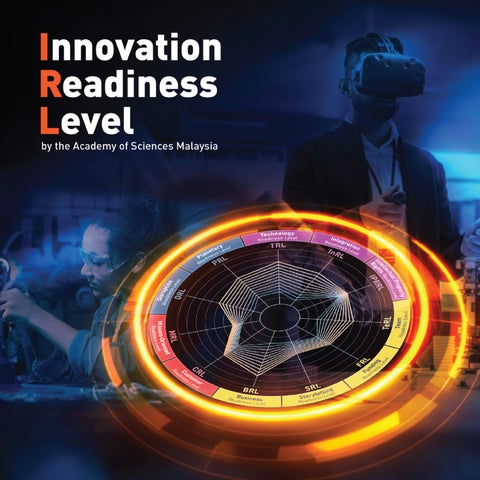
Innovation Readiness Level by the Academy of Sciences Malaysia

Page 1


INNOVATION READINESS LEVEL

by the Academy of Sciences Malaysia

Innovation Readiness Level by the Academy of Sciences Malaysia © 2025 Academy of Sciences Malaysia All rights reserved.

Licensed under Creative Commons Attribution-NonCommercial-ShareAlike 4.0 International (CC BY-NC-SA 4.0)

This publication is an adaptation of the KTH Innovation Readiness Level™ framework, developed by KTH Innovation. © KTH Innovation. Licensed under CC BY-NC-SA For more information, visit: https://kthinnovationreadinesslevel.com

No part of this publication may be reproduced, stored in a retrieval system, or transmitted in any form or by any means, electronic, mechanical, photocopying, recording, or otherwise, without prior written permission of the publisher, except as permitted under the Creative Commons license terms stated above.

Published by: Academy of Sciences Malaysia 20 Floor, West Wing, Matrade Tower, Jalan Sultan Haji Ahmad Shah, Off Jalan Tuanku Abdul Halim, 50480 Kuala Lumpur, Malaysia www.akademisains.gov.my

Cataloguing-in-Publication Data

Cataloguing-in-Publication Data

National Library of Malaysia

National Library of Malaysia

A Catalogue record for this book is available from the National Library of Malaysia

A catalogue record for this book is available from the National Library of Malaysia

eISBN 978-629-7712-13-0

eISBN 978-629-7712-13-0

LIST OF TABLES

FOREWORD

Malaysia’s aspiration to become a high-income, inclusive, and sustainable nation is intrinsically linked to our ability to harness science, technology, and innovation (STI) as key drivers of growth and competitiveness. As global challenges grow increasingly complex and interconnected, the translation of research into solutions that deliver tangible value to society, industry, and the economy has become a national imperative. Innovation today must move beyond discovery; it must be deployable, scalable, and impactful.

In this context, the Innovation Readiness Level (IRL) Framework introduced in this publication represents a timely and strategic advancement in Malaysia’s innovation agenda. By expanding beyond conventional measures of technological maturity, the framework provides a comprehensive lens for assessing innovation readiness, encompassing market relevance, regulatory preparedness, funding pathways, talent capabilities, and alignment with national priorities. This holistic approach reflects the realities of modern innovation systems and strengthens our collective ability to move research outcomes from laboratories into real-world applications.

The Ministry of Science, Technology and Innovation (MOSTI) recognises that the success of national R&D investments depends not only on scientific excellence, but also on coordinated efforts across government, academia, industry, and society. Frameworks such as the IRL are critical tools in enabling this coordination, offering a shared language and structured pathway for decision-making, prioritisation, and collaboration. They support more effective public funding deployment, de-risk innovation for industry adoption, and enhance confidence among stakeholders.

This framework also aligns strongly with MOSTI’s ongoing efforts to strengthen research translation, promote demand-driven innovation, and foster a resilient

STI ecosystem that supports Malaysia’s socio-economic goals. By embedding readiness considerations early in the innovation lifecycle, we can better ensure that publicfunded research delivers meaningful outcomes, whether in economic growth, societal well-being, environmental sustainability, or national resilience.

I commend the Academy of Sciences Malaysia (ASM) for its leadership and foresight in developing the Innovation Readiness Level Framework. It is my hope that this publication will serve not only as a practical guide but also as a catalyst for mindset change, encouraging all stakeholders to embrace innovation readiness as a strategic enabler.

MOSTI remains committed to working closely with ASM and our partners to ensure that Malaysia’s innovation ecosystem continues to evolve in step with global best practices, while remaining firmly grounded in national priorities. Together, we can accelerate the journey from knowledge to impact and ensure that STI remains a cornerstone of Malaysia’s future development.

FOREWORD

As Malaysia advances towards becoming a knowledgedriven and innovation-led economy, the role of STI has never been more critical. Our ability to translate research into impactful solutions for society, industry, and the nation depends not only on the strength of our scientific discoveries but also on how ready these innovations are to address real-world needs. This calls for a more holistic approach to innovation, one that systematically addresses existing gaps across research readiness, translation, adoption, and impact.

The IRL Framework presented in this publication reflects the ASM’s commitment to strengthening the nation’s research and innovation ecosystem. It extends beyond the conventional Technology Readiness Level (TRL) by introducing a more holistic perspective that incorporates business viability, regulatory and societal alignment, team capability, funding pathways, and national priorities. This approach is designed to ensure that Malaysian innovations are technically sound and strategically positioned to create meaningful economic and societal impact.

In my capacity as the President, I have witnessed firsthand the pressing need for such a framework through the i-Connect Programme implemented by ASM. Too often, promising research has not achieved its intended potential due to gaps beyond technology readiness— whether in market demand, regulatory preparedness, or alignment with national strategies. By addressing these challenges, the IRL framework provides researchers, policymakers, and industry partners with a common language and structured pathway to move ideas from laboratories to markets and communities.

This publication is therefore more than a guideline; it is a call to action that seeks to instil a mindset change among Malaysian researchers and innovators, encouraging them to view readiness not as a hurdle but as a roadmap

towards excellence and impact. Through this shared framework, we can build a stronger ecosystem, enhance the competitiveness of Malaysian research, and ensure that innovation serves as a cornerstone of national development.

I wish to express my appreciation to the ASM team and our partners for their dedication in developing this framework. It is my hope that it will inspire our research community to aim higher, collaborate deeper, and deliver innovations that truly make a difference for Malaysia and the world.

Academician Datuk Dr Tengku Mohd Azzman Shariffadeen FASc President, Academy of Sciences Malaysia

STI Advisor to the Prime Minister and the Nation

CHAPTER 1: INTRODUCTION

Why Innovation Readiness Matters

Innovation is more than just having a functioning technology. For research outcomes to translate into real-world impact, multiple dimensions must be ready — not just the technical proof of concept. Innovation Readiness provides a holistic perspective by assessing whether an idea or technology is supported by the necessary ecosystem of market demand, business viability, team capability, funding, regulatory, and national alignment.

Without such readiness, promising technologies often remain in the lab, unable to scale or attract partners, investors, or policy support.

Why a Structured Readiness Framework Matters

Guide researchers in identifying gaps beyond the lab.

Enable funders and evaluators to make more informed, transparent decisions.

Encourage a mindset shift towards innovation that is market-relevant, sustainable, and aligned with national priorities.

The Technology Readiness Level (TRL), developed by NASA, serves as a useful benchmark for gauging the maturity of technology development—from initial concept through prototype to deployment. In Malaysia, the government has adopted TRL as a mechanism to differentiate between basic research, applied research, and experimental development for funding purposes. However, it represents only one dimension of readiness.

Limitations of Relying Solely on TRL

Ignores market demand

A technology may be at TRL 7 but fail commercially if there is no market need.

Overlooks business and funding readiness

Many technologies stagnate because the business model, financing strategy, or partnerships are underdeveloped.

Neglects regulatory and national alignment

Deployment may be blocked if regulatory approvals, environmental considerations, or national policy priorities are not addressed.

Misses team and organisational capacity

Even with strong technical progress, weak leadership, lack of interdisciplinary skills, or poor project management can hinder success.

Therefore, while TRL remains an essential element, it must be complemented by other readiness dimensions to ensure innovations can be translated, scaled, and sustained.

Challenges That Innovation Readiness Seeks to Solve

The introduction of Innovation Readiness is not simply about adding another layer of evaluation. It is a response to persistent structural issues in the way research and innovation projects are assessed and supported. The framework seeks to address several interrelated challenges that undermine both the fairness and effectiveness of current evaluation processes.

Lack of Transparency

Limited visibility for researchers

Many researchers are not provided with detailed scoring criteria or weightage, leaving them uncertain about how their proposals will be assessed.

Subjective evaluations

In the absence of clear benchmarks, evaluations often rely heavily on personal judgement or “gut feeling,” which reduces inter-rater reliability and consistency across panels.

Unhelpful feedback

Feedback provided is frequently vague (e.g., “not strong enough”), offering little actionable guidance for researchers to improve their proposals for resubmission or future calls.

Evaluator Bias & Experience Gaps

Knowledge gaps

Evaluators may lack sufficient domain expertise to probe the right issues, leading to an incomplete assessment of the proposal’s potential.

Overemphasis on technical aspects

Scoring often places disproportionate weight on technical depth, while neglecting other critical dimensions such as market demand, business model, funding feasibility, team capability, environmental sustainability, and national alignment.

Narrow lens of evaluation

This imbalance may result in technically sound projects being favoured over those with stronger overall innovation potential or societal relevance.

Communication Gaps & Misalignment

Weak proposal structuring

Proposals are sometimes poorly written or incomplete, missing critical information needed for evaluators to form a holistic view.

Risk of misinterpretation

Communication gaps may cause evaluators to misjudge the strengths of a project, leading applicants to feel unfairly assessed or misunderstood.

Challenges Amplified in International Collaborations

These challenges are further compounded in bilateral and multilateral programmes, where differences in evaluation standards, expectations, and communication practices across countries amplify the risk of misalignment.

CHAPTER 2: INNOVATION READINESS LEVEL

FRAMEWORK

Overview of Dimensions

Innovation Readiness is best understood through a set of interrelated dimensions that capture the full ecosystem required to move ideas from conception to impactful outcomes. While TRL assesses technical maturity, it is only one part of the bigger picture. The following dimensions broaden the scope, ensuring that innovations are not only technically feasible but also strategically viable, socially relevant, and globally competitive.

Most evaluations focus primarily on project feasibility, cost, potential impact, and novelty. However, a more holistic assessment requires expanding the scope to include additional dimensions that capture the broader ecosystem necessary for innovation success.

The framework of Innovation Readiness spans 11 key dimensions (Table 2.1).

Figure 2.1: Transitioning from Traditional Evaluation to Innovation Readiness

Dimension Description

Technology Maturity (Technology Readiness)

Multidisciplinary Innovations (Integration Readiness)

Protectability & Freedom to Operate (Intellectual Property Rights Readiness)

Capability & Cohesion (Team Readiness)

Investment Attractiveness (Funding Readiness)

Refers to the technical development stage of an innovation, building on the established TRL framework. It measures how far the concept has evolved from basic principles to prototypes, pilots, and real-world deployment.

Recognising that today’s grand challenges cannot be solved within the boundaries of a single discipline, this dimension measures the feasibility and maturity of integrating two or more distinct technologies or systems into a cohesive, functional solution that seamlessly integrates into the broader ecosystem, enhancing adoption and scalability.

Assess the strength and protection of intellectual property (IP), which is vital for securing a competitive advantage. Clear IP protection safeguards the project’s innovations, making it more attractive to investors and ensuring commercial returns.

Evaluates the capabilities of the team — their experience, skills, and the ability to execute the project successfully. The quality of the project team is often the determining factor in the success or failure of R&D initiatives. A strong team enhances project adaptability and longterm viability.

Gauge the project's financial sustainability. Proper funding management ensures the project will continue from proof of concept to commercialisation without abrupt financial disruptions. This readiness level also evaluates the capacity to attract additional funding sources.

Narrative Power (Storytelling Readiness)

Commercialisation & Scalability (Business Readiness)

National/Global Mission Alignment (Mission-oriented Readiness)

Demand-driven R&D (Customer Readiness)

Environmental Sustainability (Planetary Readiness)

Transformative Potential (Disruption Readiness)

Acknowledges the importance of clear communication. This dimension evaluates how well the innovation’s value proposition is articulated to diverse audiences, from policymakers and funders to the general public. A compelling narrative secures support and builds trust by clearly telling the story of the innovation’s journey — from its humble beginnings, to its current state, and its envisioned future.

Assess the project's market readiness and the business model's viability in both the short and long term. Ensuring that the project can scale commercially and sustain itself without constant reliance on government support is essential for attracting future investment and guaranteeing its success beyond funding.

Assesses how well an R&D project aligns with national, regional or global missions that address urgent challenges, whether an innovation or solution is fit for purpose in addressing real-world, high-priority goals.

Assess how well the product or technology is tailored to the customer’s needs and whether there's clear demand. Projects should understand the market’s needs and demonstrate that customers are ready for or willing to adopt the proposed solution.

Evaluates the environmental sustainability of the innovation. It emphasises responsible innovation that minimises harm, promotes resilience, and supports long-term value creation.

Determine the potential for the technology to disrupt existing industries or systems. Projects with high disruption potential have the power to reshape industries, create new markets, or transform societal norms. This level assesses whether the innovation truly has the power to change the status quo.

From KTH IRL to ASM IRL

The ASM Innovation Readiness Level (ASM-IRL) is adapted from the KTH Innovation Readiness Level (figure 2.2) developed by the KTH Royal Institute of Technology, Sweden. The original framework was designed to help innovators and start-ups assess and advance their innovation journey across six key dimensions of readiness: Technology, Business, Intellectual Property Rights (IPR), Team, Funding, and Customer.

CUSTOMER

©KTH Innovation. Licensed under CC BY-NC-SA. https://kthinnovationreadinesslevel.com

KTH Royal Institute of Technology, n.d.

Building upon this foundation, the Academy of Sciences Malaysia (ASM) has expanded and refined the model to serve as a comprehensive framework for the evaluation and monitoring of R&D projects. Five additional dimensions were introduced, collectively referred to as the ASM PlaSMID model (figure 2.3). PlaSMID is an acronym representing dimensions on Planetary, Storytelling, Mission-Oriented, Integration, and Disruption.

Figure 2.2: KTH Innovation Readiness Level™

Ensures that innovations are developed sustainably, aligned with global standards, and future-proofed against emerging sustainability-driven trade restrictions.

PLANETARY

READINESS LEVEL

Distinguishes between incremental improvements and transformative breakthroughs, assessing solution’s potential to disrupt existing systems from the outset.

DISRUPTION READINESS LEVEL

INTEGRATION READINESS LEVEL

Multidisciplinary technologies integrate with existing systems, ensuring seamless alignment — technologically, operationally, and organisationally.

Funders, particularly government agencies want to see clear, compelling narratives that demonstrate how their support is making a real impact to the industry/ community

STORYTELLING READINESS LEVEL

MISSION-ORIENTED READINESS LEVEL

Reflects how effectively a project connects with overarching public goals and policy priorities, contributing to the bigger picture.

Through this adaptation (figure 2.4), the IRL provides a more holistic approach tailored to Malaysia’s national priorities and global aspirations, enabling researchers, policymakers, and industry to better understand and accelerate the journey from research to impactful innovation.

Figure 2.3: ASM PlaSMID Model
Figure 2.4: Evolution of the ASM Innovation Readiness Level
© 2025 Academy of Sciences Malaysia. Licensed under CC BY-NC-SA 4.0

Innovation Readiness Level Matrices

The IRL is structured around nine readiness levels, designed to align and synergise with NASA’s TRL framework and KTH Innovation Readiness Level.

Know Your Opponent (KYO)

Understand market forces, competitors, external threats, and systemic disruptions

Know Your Technology (KYT)

Evaluate technology maturity, integration, and IP protection

Know Your Customer (KYC)

Know customer needs and alignment with the national mission

Know Yourself (KYS)

Assess your team, funding, storytelling, and business model

Technology Readiness Level (TRL)

Guiding Question:

What is the current stage of your technology, and how close is it to real-world application?

Table 2.2: Technology Readiness Level (TRL) Matrix

KTH Royal Institute of Technology, n.d.

TRL Description

TRL 9

Actual technology system proven in operational environment

TRL 8 Actual technology system completed and qualified through test and demonstration

TRL 7 Technology prototype demonstration in operational environment

TRL 6 Technology demonstration in a relevant environment

TRL 5 Technology validation in relevant environment

TRL 4 Technology validation in laboratory

TRL 3 Analytical and experimental proof-of-concept of critical function and/or characteristics

TRL 2 Technology concept and/or application formulated

TRL 1 Basic principles observed

©KTH Innovation. Licensed under CC BY-NC-SA. https://kthinnovationreadinesslevel.com

Integration Readiness Level (InRL)

Table 2.3: Integration Readiness Level (InRL) Matrix

Guiding Question:

How easily can your technology be integrated into existing systems, infrastructures, or platforms?

Question for local collaborative projects:

How easily can your technology be integrated with the technology of your collaborative partners?

Question for international collaborative projects:

How does your project integrate with your international partner’s project?

InRL Description

InRL 9

InRL 8

InRL 7

The project sets new benchmarks for integrating multidisciplinary technologies towards mission goals.

Systems operate fully together in mission scenarios, showing seamless multidisciplinary collaboration and benefits.

Systems, workflows, and teams are aligned for real-world joint operation under mission conditions.

InRL 6

InRL 5

Multidisciplinary systems function together effectively, with performance optimisation across domains.

Integrated prototype demonstrating functional interactions between technologies in a relevant environment.

InRL 4

InRL 3

InRL 2

Small-scale, controlled environment testing of combined technologies for basic interoperability.

Hypotheses tested on whether multidisciplinary technologies can technically or operationally coexist.

Basic mapping of how different technologies might fit together conceptually.

Early identification that multiple disciplines or technologies could contribute to a shared mission. © 2025 Academy of Sciences Malaysia. Licensed under CC BY-NC-SA 4.0

InRL 1

Intellectual Property Rights Readiness Level (IPRRL)

Table 2.4: Intellectual Property Rights Readiness Level (IPRRL) Matrix

Guiding Question:

How well protected and strategically positioned is your intellectual property (IP)?

Critical Documents for Intellectual Property Readiness Levels (IPRRL):

IPRRL 9

• Granted patent certificates in relevant jurisdictions.

• Proof of patent renewal/maintenance fee payment (to show patent is in force).

IPRRL 6

• Evidence of positive response from patent/IP office (e.g., first examination report, notice of allowance, or equivalent).

• Initial Freedom-to-Operate (FTO) or IP landscape assessment report.

IPRRL 5

• Filing receipt or application number for the first complete patent (or other IP registration, such as trademark/design).

KTH Royal Institute of Technology, n.d.

IPRRL Description

IPRRL 9

IPRRL 8

Strong IPR support and protection for business. Patent granted in relevant countries and maintained in force.

IPR strategy and IP management are fully implemented. More complete assessment of freedom-to-operate.

IPRRL 7 All relevant IPR filed (e.g. additional patents). Patent entry into national/regional phase.

IPRRL 6

IPRRL 5

IPR/patent strategy implemented and supporting business. Positive response on filed applications, initial assessment of freedom-to-operate (or landscape).

Draft of IPR/patent strategy in place to use IPR for business. Filed first complete patent application (or other IP registrations).

IPRRL 4

Confirmed if protection is possible and for what (e.g. patentability). Decided why to protect certain IPR (business relevance).

IPRRL 3

IPRRL 2

IPRRL 1

Detailed description of possible key IPR (e.g. invention or code). Initial search of the technical field and existing IPR.

Identified different forms of possible IPR that you have. Ownership is clarified, and you clearly own/control IPR.

Hypothesising on possible IPR you might have (such as patents, software, copyright, designs, trade secrets, etc.).

©KTH Innovation. Licensed under CC BY-NC-SA. https://kthinnovationreadinesslevel.com

Team Readiness Level (TeRL)

Guiding Question:

Do you have the right team to successfully deliver this project?

Question for local academiaindustry collaborative projects:

If your team is leading the research component, who within the consortium is responsible for managing the commercial component— identifying market demand and developing a viable commercialisation plan?

Question for international collaborative projects:

Do both your international partner(s) and your team collectively have the necessary expertise, capacity, and resources to deliver the proposed outcomes?

Early Warning Sign:

A project leader who shows no intention of strengthening the TeRL throughout the project is a strong negative signal, it may suggest the innovation is likely to remain confined to the laboratory. Many proposals tend to present licensing as an “easy way out”, but without a committed team or partner to actively champion and promote the innovation, such strategies often fail.

TeRL Description

TeRL 9

TeRL 8

TeRL 7

High performing, well-structured team and organisation that is maintained and performs over time.

Management and CEO in place. Professional use of board/advisors. Activated plan and recruitment for building long term team.

Team and culture are fully in place and proactively developed. Updated plan for building necessary team on longer term.

TeRL 6

TeRL 5

TeRL 4

Complementary, diverse and committed team with all necessary competencies/resources, including both business and tech.

Initial founding team with main needed competencies. Team agrees on ownership and roles and has aligned goals.

A champion is present. Several needed competencies in place. Initiated plan for recruiting or securing additional key resources.

TeRL 3

TeRL 2

TeRL 1

A few of necessary competencies/resources are present. Defined needed competencies/ resources (and plan for finding).

Insight and first idea on necessary competencies or external resources (e.g. partners).

Little insight into the need for a team (typically an individual). Lack of necessary competencies/resources.

©KTH Innovation. Licensed under CC BY-NC-SA. https://kthinnovationreadinesslevel.com

Table 2.5: Team Readiness Level (TeRL) Matrix KTH Royal Institute of Technology, n.d.

Funding Readiness Level (FRL)

Guiding Question:

How will you manage the funds, and do you have a plan for follow-up funding?

Early Warning Sign:

A project leader who shows no intention of improving the FRL throughout the project represents a strong negative signal, as this may indicate that the innovation is likely to remain confined within the laboratory. Despite being aware that the project cannot be sustained without a commercialisable product, and that R&D funding is limited to research activities, the company chooses not to pursue funding from alternative sources.

Table 2.6: Funding Readiness Level (FRL) Matrix KTH Royal Institute of Technology, n.d.

FRL Description

FRL 9

FRL 8

Investment obtained. Additional investment needs and options are continuously considered.

There is corporate order and structure enabling investment. Term sheet discussions with interested investor(s).

FRL 7

FRL 6

Team presents a solid investment case, including status and plans. Discussions with potential investors are ongoing around an offer.

Improved investor presentation in place, including business/ financials. Decided on seeking private investors, and initial contacts taken.

FRL 5

FRL 4

FRL 3

Investor-oriented presentation and supporting material tested. Applied for and secured additional larger funding (soft or other).

Good pitch and short presentation of the business in place. Plan in place with different funding options over time.

Well-described business concept and initial verification plan. First small soft funding secured.

FRL 2

FRL 1

Description of business concept. Defined funding needs and funding options for initial milestones.

Initial business idea with vague description. No clear view on funding needs and funding options.

©KTH Innovation. Licensed under CC BY-NC-SA. https://kthinnovationreadinesslevel.com

Storytelling Readiness Level (SRL)

Guiding Question:

Can you clearly explain your project’s value to non-experts and key stakeholders?

Can you articulate the innovation’s journey — from its origin and early struggles to its current achievements, and its envisioned future impact?

Can you effectively communicate the transition of your innovation from basic research to applied research, highlighting milestones that demonstrate progress toward real-world application?

Table 2.7: Storytelling Readiness Level (SRL) Matrix

SRL Description

SRL 9

SRL 8

SRL 7

SRL 6

SRL 5

SRL 4

SRL 3

SRL 2

Project becomes a recognised model of success; storytelling focuses on transformation, lessons learned, and future potential.

Broader impact is visible across ecosystems, industries, or communities; storytelling links project to systems-level change.

Narrative shifts from “we can” to “we are” — showing real-world adoption examples.

Prototypes or trials generate measurable, credible impact data; storytelling backed with evidence.

Early users, testers, or partners start validating the impact story informally.

Early lab or controlled environment results show signals of impact; initial success cases.

Draft scenarios show possible positive outcomes, backed by preliminary assumptions.

Rough narrative of who might benefit and how; still theoretical.

Early-stage speculation about potential benefits; no real-world connection yet. © 2025 Academy of Sciences Malaysia. Licensed under CC BY-NC-SA 4.0

SRL 1

Business Readiness Level (BRL)

Guiding Question:

What is your plan to bring this product or technology to market?

Required Information for Business Readiness Level (BRL):

BRL 6

• Invoices or receipts from early test sales.

• Signed purchase orders (POs).

BRL 4

• Business model canvas (with cost/revenue streams.

• Initial Freedom-to-Operate (FTO) or IP landscape assessment report.

BRL 3

• Market research report (size, trends, growth).

• Competitor benchmarking matrix (features, pricing, market share).

BRL Description

BRL 9

BRL 8

BRL 7

Business model is final and is scaling with growing recurring revenues that result in a profitable and sustainable business.

Sales and metrics show business model holds and can scale. Business model is fine-tuned to explore more revenue options.

Product/market fit, and customers' payment willingness demonstrated. Attractive revenue vs cost projections (validated by data and sales).

BRL 6

BRL 5

BRL 4

Full business model, including pricing verified on customers (by test sales).

Parts of business model tested on market, and canvas updated. First version of revenue model, including pricing hypotheses. Verified competitive position/ uniqueness through market feedback.

First version of full business model in canvas, including revenues/costs. First projections to show economic viability and market potential.

BRL 3

BRL 2

BRL 1

Draft of business model in canvas, excluding revenues/costs. Described market potential and complete competitive overview.

First possible business concept described. Identified overall market and some competitors/alternatives.

Hypothesising on possible business concept. Little knowledge or insight into market and competition.

©KTH Innovation. Licensed under CC BY-NC-SA. https://kthinnovationreadinesslevel.com

Table 2.8: Business Readiness Level (BRL) Matrix KTH Royal Institute of Technology, n.d.

Customer Readiness Level (CRL)

Guiding Question:

Who are your intended customers or end users, and how do you know they need this solution?

Critical

Documents for Customer Readiness Levels (CRL):

CRL 6

• Pilot test reports (summaries of trials with metrics, results, testimonials).

• Letters of support/endorsement from industry partners.

CRL 5

• Letters of intent (LOIs) from potential buyers or partners.

• Pre-orders or reservation agreements.

CRL 3

• Survey results.

Early Warning Sign:

Table 2.9: Customer Readiness Level (CRL) Matrix KTH Royal Institute of Technology, n.d.

CRL Description

CRL 9 Widespread product sales that scale.

CRL 8 First products sold and increased structured sales efforts.

CRL 7 Customers in extended product testing or first test sales.

CRL 6 Benefits of the product confirmed through partnerships or first customer testing.

CRL 5 Established interest in product and relations with target customers.

CRL 4 Confirmed problem/needs from several customers or users.

CRL 3 First market feedback established.

CRL 2 Identified specific needs in market.

CRL 1 Hypothesising on possible needs in market.

©KTH Innovation. Licensed under CC BY-NC-SA. https://kthinnovationreadinesslevel.com

A project leader who shows no intention of engaging potential customers or validating market needs represents a strong negative signal, as this may indicate that the innovation is likely to remain detached from real-world application. Despite being aware that long-term sustainability requires clear demand and adoption pathways, the company chooses not to establish contact with target customers, conduct pilot trials, or seek early feedback. Such behaviour reflects an inward-looking “technology-push” mindset, in which solutions are developed in isolation without ensuring alignment with customer problems or market demand. This often results in innovations that fail to gain traction, limiting their impact and commercial potential.

Mission-Oriented Readiness Level (MRL)

Guiding Question:

How aligned is your project to the national/ regional/global mission?

Critical Documents for MissionOriented Readiness Level (MRL):

MRL 6

• Inclusion in national/sectoral roadmaps.

• Programme governance documents showing the project as a workstream or subcomponent.

• Official press releases/public statements from ministries/programmes referencing the project as part of their mission portfolio.

MRL 5

• Consortium agreement/collaboration agreement/letter of intent (LoI) (industry–academia–government partnerships).

• Stakeholder mapping document identifying roles of each ecosystem actor.

MRL 4

• Endorsement letters/support Letters from relevant ministries, agencies, or governmentlinked companies.

• Meeting minutes/Memorandum of Understandings (MoUs)/ Memorandum of Agreements (MoAs) where strategic alignment was discussed and recorded.

Table 2.10: Mission-Oriented Readiness Level (MRL) Matrix

MRL Description

MRL 9

MRL 8

MRL 7

MRL 6

MRL 5

MRL 4

MRL 3

MRL 2

MRL 1

Fully embedded in national systems and contributing to long-term transformation.

Project contributes to measurable progress on mission KPIs (e.g., CO₂ reduction, national supply security).

Clear plan for pilot/scale-up with alignment to policy instruments (incentives, procurement, regulation).

Integrated into a larger programme or roadmap addressing mission targets.

Project builds partnerships with missionrelevant actors (industry, academia, local government, etc.).

Stakeholders (e.g., ministries, agencies) acknowledge strategic value and alignment.

Early studies or models demonstrate potential impact towards mission objectives.

Clear articulation of how the research fits within a specific mission or national agenda.

Research idea loosely relates to a national strategic direction or grand challenge.

© 2025 Academy of Sciences Malaysia. Licensed under CC BY-NC-SA 4.0

Disruption Readiness Level (DRL)

Table 2.11: Disruption Readiness Level (DRL) Matrix

Guiding Question:

Does your project have the potential to disrupt or transform current practices or industries? (e.g., new entrants, regulations, shifts in global dynamics)

DRL Description

DRL 9

DRL 8

DRL 7

System-wide disruption achieved; new standard or dominant model emerges (e.g., post-disruption normal).

Scaling underway; existing value chains are being rewritten or absorbed; measurable economic/societal impact.

Adoption by early adopters disrupts traditional players, prompting regulators or industry players to respond.

DRL 6

DRL 5

DRL 4

Clear potential to displace or transform part of an industry/process; early market resistance observed.

Demonstrated shift in cost, access, or performance indicators vs incumbents in a pilot or testbed.

Early validation with limited stakeholders showing signs of real-world disruption potential.

DRL 3

DRL 2

DRL 1

Disruption model is validated on a small scale or in simulation (e.g., new business model, value chain shift).

Early hypothesis of disruption; disruptive angle is articulated in concept papers or foresight studies.

Speculative potential — disruptive impact is purely theoretical; no model or use case yet.

Planetary Readiness Level (PRL)

Guiding Question:

How does your project consider environmental sustainability or minimise negative impact?

Table 2.12: Planetary Readiness Level (PRL) Matrix

PRL Description

PRL 9

PRL 8

PRL 7

Recognised as a benchmark for pollution prevention, 3Rs advancement, and ecosystem preservation in the sector.

System validated across industries or real-world sites, showing measurable environmental gains.

Project includes environmental lifecycle assessments (LCAs), circularity models, or regulatory green-compliance systems.

PRL 6

PRL 5

PRL 4

Prototype tested with specific green KPIs (carbon reduction, recyclability, waste minimisation).

Early environmental standards or 3R guidelines are tested in near-real conditions.

Basic environmental tests in lab settings show potential for reduced pollution or better resource use.

PRL 3

PRL 2

PRL 1

Initial environmental benefit assumptions are linked to the technology's proof of concept.

Rough ideas proposed for how the innovation can support pollution prevention, 3Rs, or ecosystem protection.

Conceptual awareness of possible environmental issues linked to project.

CHAPTER 3: HOW TO USE THE ASM INNOVATION READINESS LEVEL

The ASM IRL is designed as a practical tool for all stakeholders in the research and innovation ecosystem. Its purpose is to provide a common language, clear benchmarks, and a structured pathway for advancing innovations from research to real-world impact. Different stakeholders will use the framework in different ways, but all will benefit from a shared understanding of readiness.

How Funding Agencies Will Use the Framework

Monitoring and Evaluation:

Agencies often face difficulties assessing the true impact of funded projects when evaluations focus narrowly on traditional metrics such as the number of PhDs and Master’s produced, publications, or patents filed. Some agencies have attempted to go further by examining commercialisation outcomes, but these efforts have not always provided consistent or meaningful insights. The proposed framework provides a more holistic approach by enabling agencies to systematically track project progress over time—not only technological maturity but also business viability, long-term sustainability, and societal impact.

Strategic Allocation of Resources:

Funding agencies can use the framework to differentiate between proposals that are technically sound but not marketor mission-ready, versus those that demonstrate higher overall readiness. This ensures more effective use of limited funds.

Policy Alignment:

By mapping projects against the readiness dimensions, agencies can better ensure alignment with national priorities, sectoral roadmaps, and global commitments such as the SDGs.

International Collaboration:

For bilateral and multilateral programmes, the framework provides a transparent and harmonised benchmark, reducing misunderstandings and evaluation inconsistencies across partner countries.

How Evaluators Will Use the Framework

Structured Assessment:

Evaluators can use the readiness dimensions as a checklist, ensuring that all critical aspects—technology, business, team, regulatory, societal, and mission alignment—are considered systematically.

Reducing Subjectivity:

By scoring against clear criteria, evaluators reduce reliance on “gut feeling” and improve inter-rater reliability.

Balanced Weighting:

The framework helps evaluators move beyond an overemphasis on technical depth to a more holistic view of project readiness and impact potential.

Targeted Feedback:

Instead of vague responses like “not strong enough,” evaluators can provide applicants with specific guidance on which readiness dimensions need strengthening.

How Researchers Will Use the Framework

Self-Assessment Tool:

Researchers can use the readiness levels to identify their current position (“start point”) and set realistic goals for where they aim to be by the end of the funded project (“end point”).

Proposal Structuring:

By addressing each readiness dimension, researchers can prepare more complete and compelling proposals that resonate with both evaluators and funders.

Mindset Change:

The framework encourages researchers to think beyond technical novelty, considering broader factors such as scalability, sustainability, and societal value.

Roadmap for Growth:

Researchers gain a clearer understanding of what is required to advance their innovation, helping them plan partnerships, funding strategies, and capacity-building activities more effectively.

How Investors Will Use the Framework

We acknowledge that investors and venture capital firms utilise their own internal frameworks and methodologies to assess companies. However, the IRL can serve as a complementary tool that provides a common language across researchers, evaluators, funders, and investors.

Risk Mitigation:

By highlighting gaps in readiness (e.g., weak IP protection, lack of funding strategy, unclear sustainability pathway), the framework helps investors make informed decisions and manage portfolio risks.

Growth Potential:

Investors can quickly identify innovations with strong transformative potential and national/global alignment, increasing their likelihood of success in competitive markets.

Portfolio Management:

Venture capitals and private investors can use the readiness levels as a tool and a common language to track the progress of their investees, ensuring they move steadily toward commercialisation and impact milestones.

How Organisations Will Use the Framework

The IRL serves as a practical tool for organisations to assess, strengthen, and monitor their innovation management capabilities in alignment with ISO 56001 Innovation Management Systems. While ISO 56001 provides a qualitative standard outlining what mechanisms and processes should be in place, the IRL Framework complements it by offering a structured, level-based measurement of how ready an organisation is to innovate effectively.

Under ISO 56001, organisations are required to establish, implement, maintain, and continually improve their innovation management systems. The IRL Framework enables organisations to operationalise this requirement by:

Diagnosing Innovation Maturity

Organisations can use the IRL Framework to evaluate their current innovation capacity across key dimensions, such as leadership, culture, processes, resources, and ecosystem linkages. This provides a readiness “score” that highlights strengths and areas needing improvement, supporting the context of the organisation and performance evaluation clauses of ISO 56001.

Guiding System Implementation

The IRL levels provide a roadmap for progressive improvement. Organisations can use these levels to plan and prioritise actions required to meet ISO 56001 requirements, ensuring that innovation systems are not only compliant but also scalable and sustainable.

Benchmarking and Continuous Improvement

The IRL Framework allows organisations to benchmark their innovation performance over time or against peers. This aligns with ISO 56001’s focus on continuous improvement and evidence-based decision-making, where periodic IRL assessments demonstrate measurable progress.

Supporting Certification Readiness

For organisations pursuing ISO 56001 certification, the IRL Framework offers a pre-assessment tool to verify that the necessary mechanisms, governance, and culture are in place before formal audits. This reduces compliance gaps and improves audit readiness.

CHAPTER 4: NEXT STEPS AND FUTURE OUTLOOK Understanding Human Readiness in Innovation

While technological maturity, funding capacity, and market potential are crucial, the ultimate determinant of innovation success lies in human readiness—the willingness and capacity of societies, institutions, and individuals to adopt, adapt, and accept new technologies. This twelfth dimension recognises that innovation does not exist in isolation; it interacts with cultural values, ethical considerations, and social structures.

Human readiness requires:

Cultural and Religious Sensitivity

ensuring innovations are developed and introduced in a way that respects local beliefs, traditions, and values.

Acceptance of Technologies that Transcend Human Boundaries

addressing concerns around AI, genetic engineering, human–machine integration, or neurotechnology, where technologies begin to challenge definitions of identity, privacy, or morality.

Societal Trust and Legitimacy

building public confidence through transparent communication, ethical governance, and inclusive participation.

Future Outlook

Looking ahead, the Human Readiness Dimension will become increasingly decisive as innovations move beyond incremental improvements to paradigm-shifting technologies that touch the essence of what it means to be human.

AI and Autonomy:

Societies must navigate questions of accountability, bias, and human dignity when machines make decisions that affect lives.

Biotechnology and Genomics:

Cultural and religious perspectives will shape acceptance of gene editing, synthetic biology, and enhancements that blur the line between treatment and augmentation.

Human–Machine Interfaces:

From brain–computer interfaces to cybernetic enhancements, the boundary between human identity and technology will become a global conversation.

Ethical Diplomacy:

As Malaysia and the region engage in international collaborations, harmonising cultural sensitivities with global technology norms will be essential.

HRL Description

HRL 9

HRL 8

HRL 7

Technology becomes a model case for diversitysensitive innovation, strengthening national unity and societal progress.

Technology is successfully adopted across multiple societal groups, with measurable acceptance and adaptation.

The technology is ready for broader national rollout with strategies tailored to race, gender, culture, and religious sensitivities.

HRL 6

HRL 5

HRL 4

HRL 3

Pilots or demonstrations in real communities across diverse segments show positive reception patterns.

Based on feedback, adaptations are made to make the technology more acceptable to different groups.

Early-stage prototypes are tested for perception and acceptance among diverse groups.

Early strategies proposed for adapting the technology to diverse societal values and norms.

HRL 2

HRL 1

Identification of cultural, religious, gender, and ethnic factors that could affect technology perception in the target country.

Project teams recognise that race, gender, culture, and religion can influence technology acceptance.

Table 4.1: Conceptual Human Readiness Level (HRL) Matrix

REFERENCES

KTH Royal Institute of Technology – KTH Innovation (n.d.) KTH Innovation Readiness Level™ framework. Available at: https://kthinnovationreadinesslevel.com/

ACKNOWLEDGEMENTS

This publication was prepared by the Malaysia Science Endowment Unit from the Academy of Sciences Malaysia (ASM), with contributions from experts across policy, research, and implementation domains.

ASM Management

Hazami Habib, Chief Executive Officer

Dharshene Rajayah, Chief of International Affairs and Communication

Lead Authors

C. H. Loh, Senior Analyst

Ng Yin Zhuang, Analyst

Kausaalya Nagaraja, Analyst

Natasya Nureen, Analyst

Editorial & Creative Production

Mohd Najmie Mohd Yusoff, Senior Executive

Naina Afifi Rosly, Graphic Designer

Ilham Raudhah Syazwani Mohd Razman, Editor

Turn static files into dynamic content formats.

Create a flipbook