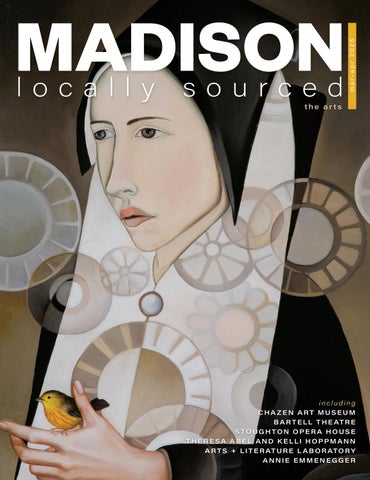
Madison Locally Sourced March - April 2026

Page 1


publisher & editorial director

Amy S. Johnson

lead designer

Jennifer Denman

copy editor & lead writer Kyle Jacobson

sales & marketing director

Amy S. Johnson

designers

Linda Walker, Barbara Wilson

administration

Lisa Abler, Olivia Leichsenring

contributing writers

Arts + Literature Laboratory, Bartell Theatre, Chazen Museum of Art, Efrat Koppel

photographer Eric Tadsen

additional photographs

Abel Contemporary Gallery, Arts + Literature Laboratory, Chazen Museum of Art, Jim Escalante, J Miner Photography, James Kreul, MOD Media Photography, Lesley Numbers, SNoll Photography, Stoughton Opera House, SV Photography

Watch for the next issue MAY-JUN 2026

PUBLISHER

subscriptions

Madison Locally Sourced is available free at over 150 locations. To purchase an annual subscription (six issues), send $24 and mailing information to:

Madison Locally Sourced c/o ASJ Publishing LLC, PO Box 559 McFarland, WI 53558 comments

We welcome your questions and comments:

Madison Locally Sourced c/o ASJ Publishing LLC, PO Box 559 McFarland, WI 53558 mls@madisonlocallysourced.com advertise

To inquire about advertising space, please call (608) 729-4888 or email mls@madisonlocallysourced.com

all rights reserved. © 2026 No portion of this magazine may be reproduced without prior written permission from ASJ Publishing LLC.

If you’re a regular Madison Locally Sourced reader, you’ve likely noticed at least one arts-related article in each issue—a reflection of my love for the arts. I’m thrilled to introduce you to our first issue dedicated entirely to the arts.

The Chazen Museum of Art provides opportunities to enjoy rotating exhibits featuring thousands of works. And admission is free!

The historic Stoughton Opera House entertains patrons with a variety of musical and theatrical performances each year, and Madison’s Bartell Theatre is home to five resident theater companies: Madison Public Theatre, Madison Shakespeare Company, Madison Theatre Guild, Mercury Players Theatre, and Stage Q.

Local singer/musician Annie Emmenegger regularly performs sets filled with great music, from bluegrass to country to blues and more. Look for her own band, Annie & the Oakies, and her performances with other groups, such as Flying by the Seat and Grouvin Family Band, at some favorite local venues.

cover photograph Circle Girl by Kelli Hoppmann and Theresa Abel, oil on panel, 16x24 inches, provided by Abel Contemporary Gallery photographs on page 3 (top left to right) Annie Emmenegger taken by Eric Tadsen Emily Popp teaching Senior Sewing Class, 2024, at Arts +Literature Laboratory taken by James Kreul (bottom left to right): Vestments 4 by Kelli Hoppmann and Theresa Abel, oil and collage on paper, 13.5x10.5 inches, provided by Abel Contemporary Gallery Bartell Theatre photograph by SNoll Photography

Arts + Literature Laboratory (ALL) is a Madison nonprofit offering numerous creative programs, such as visual arts exhibitions, an artist mentorship program, a Native Art Market, and film screenings. They also hold the annual Wisconsin Writers Awards, the Madison Jazz Festival, and the Auricle New Music Series. And they have arts summer camps and year-round writing and visual arts classes. Phew!

Finally, I’m excited to showcase one of my favorite things in the visual arts: artist collaborations. Local artists Theresa Abel and Kelli Hoppmann are successful individual artists who have also created extraordinary collaborative work during their 40-year friendship. Their story is heartwarming, and the images show how their individual styles and talents combine beautifully. We also included additional images of their individual work on madisonlocallysourced.com.

So much to explore so time to get started!

Stoughton OPERA HOUSE

From its opening act, The Doctor’s Warm Reception , on February 22, 1901, to the local politics and school performances that defined its early life, Stoughton Opera House has cemented its legacy. After closing in the 1950s, the building sat dormant for 30 years before the city considered tearing it down. Public outcry followed, leading to an engineering study that found the structure to be sound. With funding from both the city to renovate the first floor and basement and a special interest group committed to restoring the theater upstairs, a painstaking 18-year restoration began in 1983.

The Opera House reopened in 2001, with Stoughton’s city hall occupying the first floor and performances returning upstairs on occasion. This was the shape of things in January 2007, when

Bill Brehm took over as Opera House director and recognized that the theater’s story was far from over.

He recalls the struggle to determine exactly what to do with this restored theater. “When I started, we were

doing maybe a dozen shows in a calendar year,” says Bill. “I think for the first five or six years, they were still thinking that it was a theater specifically for just people who live in Stoughton to come and see a show. … Myself and Christina Dollhausen,

who’s actually now back doing fund development work for the Stoughton Opera House Friends Association (SOHFA), we had this crazy idea of what if we put on shows that people from outside of town would come to see.

“The first booking that we really, really were excited about was Arlo Guthrie. The mayor at the time was really supportive. The guarantee for him was well above what they were dealing with at the time, and the tickets were going to be $40. There were people who were very skeptical of the Opera House and of me and Christina. Of course, it sold out really quick.”

Over those first years, Bill proved the skeptics wrong, and today, the Opera House puts on six times as many acts, averaging up to 80 a year. Contemporary acts have included the likes of Roseanne Cash, Iris DeMent, Billy Strings, Brandi Carlile, and Greg Brown as well as favorite returning acts, such as Los Lobos and BoDeans. If you ever tour the facility, you’ll ascend the stairs connecting the first-floor green room to the main stage. There, you’ll see hundreds upon

hundreds of signatures from a range of performers who’ve played the Opera House, including Gillian Welch, who preferred to paint her name rather than use a marker.

2014 brought another successful chapter when SOHFA put on the first Catfish River Music Festival at the Rotary Park gazebo outside the Opera House. That first year saw another list of great folkmusic headliners, but was again met with skepticism as some argued that the festival’s success came from the weekend being shared with the Stoughton Fair. That sentiment soon faded as people came to understand that the crowds at the festival weren’t the same ones at the fair. Turns out the people coming to a folk music festival aren’t the same ones checking out a carnival and demolition derby, though either event certainly draws some visitors from one site to the other.

With the Opera House further evolving into a destination for people from all over the country, the community of Stoughton has experienced a boost to its local economy. “We did a development

study on the Opera House,” says Bill. “We figure we pull about 25,000 people into town each year. I think the economic impact of it was something like $3.2 million spent in Stoughton other than at the Opera House by people coming to a show, whether they live in town and are going out for the night or they’re coming into town and staying overnight.”

One of Bill’s biggest supporters in the growth of the Opera House has been Mayor Tim Swadley, who in 2019 provided an opportunity to add one of the Opera House’s newest attractions: the Ghost Light Lounge. “I want to give Tim credit,” says Bill. “It was his idea that if the city hall moved to the McFarland State Bank building then the Opera House could have actual space to grow. Not everybody was into that idea, but it’s entirely because he realized that we had no way to grow. That was a big turning point.”

The Ghost Light Lounge is an even more intimate experience than the main stage’s 475-seat capacity, with a simple raised stage in the main level of the building where the mayor’s desk used to be. Here,

people can enjoy a drink as they listen to smaller, often local acts. The whole vibe serves as a precursor to the experience upstairs, offering something charming and distinct. The patina of that space comes through in wood accents and century-old architecture, with design decisions serving to further distinguish the stage. You’re also steps away from the piano bar, made out of pianos and separated from the stage area by a sitting room with comfortable leather furniture.

Bill encourages the main act to check out the Lounge if they have time beforehand. In addition to the excitement a performer experiences when looking out to the crowd to see a music icon in attendance, some have been invited to play tour dates, teach songwriter camps, and establish connections that wouldn’t have otherwise existed. “It can be a life-affirming or even a life-changing moment,” says Bill.

From the building to the staff to the acts themselves, everything is held together by the glue Bill calls the Love System™. It’s nothing too out there: treat people with kindness and respect, and somehow that will be returned. “I’ve seen it play out as something that’s real and exists,” says Bill. “We get these great artists that are calling us up wanting to come through because they’ve heard about the Opera House and how we treat people. We have patrons who come

through, and they make donations and get memberships and write us thank you notes. It feels like a community. When it comes down to it, it’s just good business to treat people well.”

With Bill’s perspective and stewardship, how can I not expect the Stoughton Opera House, this wonderful beacon of meaningful connection, to have continued success well into the future? May we always be so fortunate.

Kyle Jacobson is a writer who believes we’re better off being on.

Photographs provided by Stoughton Opera House.

Drumlin Ridge, located just outside Madison, offers a private rental space for small gatherings. Guests can relax with a glass or a custom flight of locally produced wine while overlooking the hillside vineyard. Enjoy small plates or browse the gift shop.

6000 River Rd., Waunakee 608-849-9463

Edgerton Hospital is proud to partner with Orthopedic & Spine Centers of Wisconsin to offer top-quality orthopedic care. With over 20 years of experience in Rock County, their Board Certified and Fellowship Trained physicians specialize in areas like orthopedic surgery, sports medicine, joint replacement, spine care, and more They focus on personalized treatment plans and the latest techniques to deliver better outcomes and patient experiences

Photograph by Barbara Wilson
Kyle Jacobson

At right is Adoration of the Shepherds, painted between 1570 and 1571, by Giorgio Vasari. When the museum reveals its reinstalled permanent collection, this altarpiece will be a focus object in gallery 16.

CHAZEN Museum of Art Reimagines Visitor Experience with Object-Centered Approach

The Chazen Museum of Art is undertaking a comprehensive reinstallation of its permanent collection, slated for September 2026, that adopts an object-centered approach instead of traditional chronological and geographic organization. Each gallery will include a thoroughly researched artwork—a focus object—surrounded by a constellation of artworks from across time, media, and cultures with common connections. This change will provide multiple paths to engagement; encourage close looking and discovery; prompt contemplation, comparison, and contrast; and ultimately foster deeper connections between art and daily life. This new model for exhibiting the Chazen’s holdings will encourage museum visitors to explore the collection.

While the Chazen typically hosts several temporary exhibitions each year, the permanent collection galleries haven’t been reorganized in recent memory. Temporary exhibitions are on view for weeks or months and can be organized by other museums or organizations. The collection galleries hold artworks that are part of the Chazen’s own collection, and while individual artworks may go on or off view for various reasons, the collection galleries don’t change much— until now.

“The Chazen Museum of Art’s reinstallation represents a subtle, yet profound shift toward seamless engagement and demonstrates the art museum’s power to forge new understandings and actively engage

with the rapidly changing world,” said Amy Gilman, director of the Chazen Museum of Art and senior director for the arts and media at University of Wisconsin–Madison. “As an institution committed to remaining nimble, taking risks, and adapting to change, the Chazen will present the permanent collection in a way that will make the museum experience more enriching and intellectually accessible for everyone.”

As a museum embedded in a leading research university, the Chazen leverages the expertise of UW–Madison faculty, staff, and students across diverse fields— from history and religion to material sciences and studio art—to guide its reinstallation. This collaboration is helping the Chazen successfully

integrate new scholarship and maximize interdisciplinary connections with art.

The long-contemplated project began several years ago with curators and subject matter experts exploring the more-than-25,000 artworks in the Chazen’s care. The reinstallation highlights strengths in the collection, showcasing works previously less emphasized and weaving important threads through social history.

The reinstallation is rooted in visitor experience. As part of this effort, the staff is carefully considering what makes museums special alongside elements that might intimidate visitors. Staff have researched visitor interaction with artwork—from how long guests linger to contemplate works to the amount of time spent reading labels. One-on-one and small-group meetings with experts at UW–Madison and in the broader community ensure the reinstallation is structured to resonate with a wide range of perspectives. The Chazen will continue to gather visitor feedback through observation and surveys.

to right) Katherine Alcauskas, chief curator; Derek Hibbs, preparator; and John Berner, preparator, discuss new arrangements of sculpture.

Using this valuable information, the Chazen is reinstalling its collection to spark wonder rooted in intellectual engagement. Visitors will recognize a refined focus that encourages seamless

interactions with both objects and their accompanying labels. This thoughtful process ensures that while the space feels familiar, visitors will enjoy deeper and more-rewarding connections with

(Left
View of the Chazen Museum of Art
VIsitors will enjoy deeper and morerewarding connections with the art, creating an elevated museum experience.

the art, creating an elevated museum experience. With comfortable spaces in the galleries to reflect, visitors will have the opportunity to delve deeper into artistic processes and enjoy enriching conversations about the art world, ultimately fostering a more engaging art museum experience that both accurately explores the past and is easily adaptable for the present.

“The Chazen’s reinstallation highlights the art museum’s power to shape contemporary discourse and sets an important precedent for the museum field that other institutions can adopt or learn from as they respond to their own unique collections,” said Katherine Alcauskas, chief curator at the Chazen Museum of Art. “The Chazen’s reinstallation gives renewed attention to time-honored favorites from the collection, illuminating them with fresh perspectives from new scholarship. This approach will allow visitors to discover something new about familiar pieces and facilitate encounters with works that are new to them.”

The Chazen’s reinstallation will also make the educational components of art more legible to a wider community, emphasizing its connection to social issues and ability to illuminate other fields. Designed to significantly enhance the Chazen’s mission as a learning institution, the reinstallation mirrors object-based learning, a method the Museum has successfully employed with classes at UW–Madison. This approach illustrates how a single artwork can be considered across various disciplines. By mixing genres, mediums, and eras, the reinstallation provides a unique opportunity for collaboration, demonstrating how museums can actively enhance learning rather than simply serving as viewing spaces.

The Chazen proved the benefits of using a single work to prompt dialogue and navigate complex issues with “re:mancipation,” their first implementation of the singleobject model to reframe a work in the permanent collection. The multi-year project included extensive research and educational materials; a documentary; and a 2023 exhibition that critically examined and reinterpreted Thomas Ball’s Emancipation Group, which shows Abraham Lincoln standing over a kneeling, partially clothed, formerly enslaved man. The Chazen paired the controversial 19th century sculpture with works from the Museum’s permanent collection and loans to confront its history and its place within the Museum. The initiative provided critical historical

context, addressed themes of systemic violence and institutional racism, and included a new commissioned sculpture by artist Sanford Biggers in response. The exhibition was a major success, prompting a rise in visitation and receiving positive feedback. The Chazen’s permanent collection reinstallation aims to create similar dialogues with other works in its holdings.

“By redefining how museums can present their artworks, the Chazen Museum of Art at UW–Madison is offering a tangible roadmap for museums seeking new approaches to their collections,” said Amy. “We recognize that modern life often involves nonlinear exploration, and the Chazen creates an environment in which visitors can take

Spirit Wall will be the central focus of a newly organized gallery 4 in the Elvehjem building.

the path that suits them best and explore at their leisure, inviting close looking and critical examination.”

With free admission, visitors can drop in often without the pressure of seeing everything in one day. By approaching artwork from different disciplinary perspectives, the reinstallation will enhance knowledge accessibility for visitors, creating various educational entry points for experiencing the beauty and complexity of the collection.

Contributed by Chazen Museum of Art. chazen.wisc.edu

Photographs provided by Chazen Museum of Art

Chazen Museum of Art 750-800 University Avenue Madison, WI 53706 (608) 263-2246 chazen.wisc.edu

Emmenegger Annie

You’re at The Harmony Bar & Grill in Madison waiting for tonight’s headliner, Annie & the Oakies, to break through the churn of laughter and conversation. A dancing pluck of banjo soon fills the air, carried by a stand-up bass, accompanied by a mandolin and fiddle. Then a voice weaves through it all, grounded and confident with nods to Patsy Cline and Lorde. It almost takes you by the hand, and there’s no doubt in your mind that Annie Emmenegger was born to perform.

Well, that would be news to Annie. She says, “I was always passionate about music, but I never had a passion to be a performer.” Growing up in Middleton, Annie enjoyed CCR and Bob Dylan and took part in church choir, but nothing outside of that. Her voice was nurtured at home, where her mom would often sing around the house. When she turned 16, her dad gave her his Sigma guitar. All of that made music part of her life, but performing? Meh.

After graduating high school, in 2002, Annie briefly attended UW–Milwaukee. One year in, she realized that big-city life wasn’t her jam, and transferred to Stevens Point. Here, she would drift into the bluegrass scene by current, not sail, and make some lifelong friends.

“I ended up dating a guy who played guitar in a local band with his buddies,” says Annie. “They taught me how to flatpick. Got really into Doc Watson and Tony Rice and some Norman Blake. … Art Stevenson & High Water, they would play at Northland Ballroom every Wednesday night. They’d been doing that for years. We would go out there and have beers and dance.”

College was also where Annie often did open mics. The way she tells it, this was more something she did with her friends for fun, not as a career jump-off point. But it was during performances that she found encouragement from friends and strangers alike to put her voice out there as much as she possibly could.

So what next? Playing in a band, touring the West, then coming back home? No. Again, performing wasn’t driving her. But much like John Muir, she heard the call of the mountains, and headed out to the Methow Valley, on the east side of the North Cascades in Washington, and the Applegate Valley, in Oregon. “I lived out there most of my adult life,” says Annie. “When I moved out West, I got an internship with a goat dairy out in the Applegate Valley and learned how to make cheese. Interestingly enough, my great grandparents made cheese in Wisconsin. I ended up living in the country—three-and-a-half hours to Seattle and three-and-a-half hours to Spokane. I feel like a country girl

at heart, and I hope to move back to the country someday. That’s the longterm plan—to end up in the mountains some day.”

Music remained a force in her life out West. Aside from the wide range of local groups, the dairy she worked at had a stage, which she would perform on. She also spent some time working at Old Schoolhouse Brewery, granting her access to a variety of music as well as another stage. From 2014 to 2018, Annie joined an alternative country band called Danville. “That’s where I blossomed as a performer,” says Annie. “From doing open mics to performing in a band.” Whether at a wedding in the mountains or a local venue, she was learning about connection to community through music.

She moved back to Madison in 2018, and something odd struck her. For the first time in her life, she missed performing. As fate would have it, “I happened to be out at the Malt House one night having a few drinks and ended up striking up a

conversation with a guy at the bar sitting next to me. He was the bass player for this band, The Oak Street Ramblers, and he’s like, ‘One of our members is taking a hiatus. Do you want to come to our practice in my basement next week?’

So I ended up going to practice, and I’m still playing with those guys eight years later. We changed our name to Annie and the Oakies. Playing with them has been amazing.”

Today, in addition to the Oakies, Annie is also playing solo gigs; performing as part of Flying by the Seat, a trio focused on country and blues; and she just started playing with the Grouvin Family Band. That would seem like more than enough for anyone’s plate, but three years ago, she became a mother, something she plainly states wasn’t part of the plan. But she couldn’t stop performing. With a two-year-old and a three-year-old running around, she simply keeps going.

She admits there’s less time to practice now, but she’s started to explore songwriting. Annie has a wealth of

stories these days, and she’s feeling an increasing pull to get them down. “I really want to create an album,” she says. “Leave these stories behind when I’m gone.”

One such story involves the 1941 Martin 0018 she found at Norm’s Rare Guitars in Los Angeles. She flipped a coin that pinged off the body of the instrument. The side that landed up told her not to drain her savings into the guitar, but she bought it anyway. Then there was a three-week rafting trip down the Colorado River through the Grand Canyon. Each night, she and a few other musicians would play together in side canyons of ancient rock walls, the river moving below, voices carrying. “It’s one of the greatest experiences I’ve had in my life,” she says.

Annie and her husband recently purchased a small property where they’re building an urban farm, complete with goats, an orchard, and plans to start making cheese. Eventually, there will even be a stage. She says, “My long-term

goal is to have music events and perform and tie in the farming community with the music community. Have it be a gathering place for all kinds of people.”

Whether to the land, community, friends, or family, Annie has built a life shaped by connection. These connections aren't built by chasing moments, but by being fully present when they arrive.

Kyle Jacobson is a writer by trade, musician by hobby, father by circumstance, jedi by fantasy, and living by default.

Photographs provided by Eric Tadsen

Photograph by Barbara Wilson
Kyle Jacobson

THEATRE Bartell

After 29 years of operation, Bartell Theatre in Madison is distinguished by its status as the oldest collaboratively run performing arts institution in the United States. Unlike traditional venues, it operates as a theater cooperative governed by a board of directors selected from its resident companies in a unique arrangement.

Originally built in 1906, the Bartell has evolved from a variety of uses, including a dance academy and a movie theater, into a vibrant hub for local artists and audiences alike. It fosters creativity through its resident companies and a host of nonresident companies renting performance space, each contributing to the dynamic arts scene in Madison. Each resident company produces a full season of plays, with actors and production teams volunteering their time for the joy of community theater participation.

The upstairs Drury Stage is a traditional proscenium space seating 199 and 4 wheelchair spaces. The stage space measures 30 feet deep by 40 feet wide.

It has a full lighting rig with installed dimmers, an ETC Ion lighting control desk, and a rep plot with conventional and LED fixtures. The Drury has a full sound system with a front of house mixing position, amplifiers, speakers, and wireless microphones. The Evjue Stage is a flexible black box space seating up to approximately 80 to 90, depending on the arrangement of the seating blocks. It has a Unistrut grid for hanging lighting instruments, a 48-circuit ETC Sensor Dimmer rack, and an ETC EOS Element lighting control system. It has a sound system with two speakers, a 12-channel mixing desk, CD players, and amplifier. Both theaters are available for rent when not booked by resident company productions.

Bartell Theatre resident companies:

Madison Theatre Guild, founded in 1946 and an original Bartell company, with rehearsal and set construction space at the old firehouse on Monroe Street.

Mercury Players Theatre, a founding member producing new, unusual, and original plays, including an annual holiday panto and the New Year’s Eve Ball Drop Blitz. Mercury shares

rehearsal and set construction space with Madison Public Theatre and Stage Q, two additional resident companies.

Madison Public Theatre, circa 2024, produces classics and new works with a focus on inclusion and mentoring of the next generation of theater practitioners.

Stage Q is Madison’s queer theater with plays focused on LGBTQ+ stories and a safe space for performers and practitioners.

Madison Shakespeare Company, another recent addition to the resident companies, focuses on Shakespearean and classic works.

The Bartell Theatre Foundation Board is responsible for oversight of the theater, with a Bartell Theatre Corporation Board responsible for the property. Both Boards are chaired by President Stephanie Monday. Foundation directors are Vice President Steve Noll, Treasurer Julia Houck, and Secretary

Jason Compton. At-large directors are Zak Stowe, Bonnie Balke, Ren KasparTracy, and Kendra Thompson. This team represents the resident companies and is responsible for theater policy, operations, and fundraising.

The Bartell Theatre Foundation Board, a mix of business professionals and highly experienced theater professionals, has worked tirelessly to achieve its goals. The current fundraising project entails upgrades to the 120-year-old building and theater equipment to sustain the work as the Board begins to pass it in succession to the next generation of theater artists serving our Greater Dane County community. The goal is to stabilize the building and technical equipment and pass a viable, thriving theater to the next generation. The Board resolved a number of safety issues in 2025.

The Board has established the Bartell Film Series, a fundraising arm of the Foundation providing film classics on a collapsible screen in the Drury Theatre, and the Bartell Theatre Company, a

semiannual fundraising production supported by all participating theater companies to raise funds for ongoing Bartell Foundation projects. Home to the Wisconsin and Madison Film Festivals, the Bartell Film Series is the only remaining cinema in downtown Madison.

The resident companies have mentored young people with new theater degrees arriving in Madison from across the country for decades, with significant growth in numbers post-pandemic. The Bartell Theatre mission since 1998 remains “to equip, operate, and maintain a live-performance facility created by the foundation for the benefit of the participating theater companies, and additional publicly supported organizations of the same class, so as to assist them in carrying out the purposes for which they’re organized.”

The Bartell annually serves more than 10,000 audience members. The theater provides a creative, supportive community environment imbued with the hope, joy, and teamwork that only live theater can produce. At the Bartell, our community finds affordable Sunday matinee entertainment for the elderly living in downtown Madison; a safe environment for the disabled young man living in a downtown group home to learn work skills as he volunteers his time; and a home for friendships, creativity, and artistic expression of the theater people of our community.

by SNoll Photography

Photograph

Lab3 Exhibition at ALL's original location, 2018

What It’s ALL About

Recently, a visitor to Arts + Literature Laboratory (ALL) asked, “With so many programs, how do you tell your story?”

It’s a fair question for the independent arts nonprofit located just a mile from the state capitol. The organization’s threestory building houses a dizzying array of programs: visual arts exhibitions; a mentorship program for artists; low-cost artist studios; the Native Art Market; film screenings, such as the monthly Mills Folly Microcinema and the annual Midwest Video Poetry Fest; a curated lending library of small press books; a monthly reading series; the annual Wisconsin Writers Awards; write-ins; the Madison Jazz Festival; the Auricle New Music Series; other concerts; arts summer camps; and year-round classes for youth, adults, and seniors in writing and visual arts.

While the programming is complex, director Rita Mae Reese’s answer is simple: “We can’t tell our story alone because, really, we are a mosaic of stories, so we need the community’s voices.

Our motto is ‘your ideas belong here,’ reflecting the fact that we aren’t a topdown organization. We exist so that the arts community—which we believe can and should include everyone—can create

its own stories. And that’s why this work is so exciting.”

ALL was founded by artist Jolynne Roorda, who helped launch an earlier

Battle @ Da Badgers Hip-Hop by the Hitterz Collective, 2024
Photograph provided by Arts + Literature Laboratory
Photograph by James Kreul

iteration of the organization in New Haven, Connecticut, in 2003 to support women artists and writers. After moving to Madison in 2015, Jolynne searched for an arts organization that provided space for writers and artists to develop and share their work and found that nothing quite fit. So she began building community one relationship at a time, meeting with artists, writers, and musicians across Dane County. That network became the volunteer team that launched ALL in late fall of 2015. Rita Mae was one of the first people Jolynne spoke with and has been part of the organization ever since.

ALL was entirely volunteer led for its first five years and initially operated out of a 700-square-foot space on Winnebago

Street. The community response was enthusiastic, and the organization grew quickly. By 2020, ALL moved into its current over-10,000-square-foot building at Livingston and Main and hired its first staff.

The arts can sometimes be dismissed as a luxury, particularly in precarious times, but they remain central to our humanity. Beyond mental health benefits, such as reduced stress, the arts foster community and civic engagement and help us imagine change. These aren't luxuries; they’re essential.

Yet public funding for the arts in Wisconsin is consistently among the lowest in the nation. The state currently ranks 49th, allocating just 18 cents per person per year. By comparison, Minnesota spends $10.07 per person—a difference reflected in its thriving cultural scene and in the challenges Wisconsin artists face in sustaining their work locally.

A core tenet of ALL is keeping programs free or low cost while paying artists fairly. One quarter of summer camp spots are reserved for youth who need full or partial financial assistance. Education programs are free for Native students. Exhibitions, readings, film screenings, and most concerts are free to attend; the programs that aren’t free are offered at low cost.

Photograph by Lesley Numbers
Midwest Video Poetry Fest, 2024
Photograph by SV Photography
Day Off MADE Exhibition Camp, 2025

The organization’s mission is to steward a community laboratory for creative experimentation, collaboration, and excellence in contemporary visual, literary, and performing arts.

The organization’s mission is to steward a community laboratory for creative experimentation, collaboration, and excellence in contemporary visual, literary, and performing arts. This stewardship means keeping expenses low, prioritizing people, and cultivating

sustainable funding. This is how ALL is able to pay artists, rent, and staff. Nearly one-third of ALL’s annual budget goes directly to paying artists for teaching or presenting their work. The organization relies on grants; small donations; earned income, such as tuition and ticket sales;

and the time and talent of dozens of volunteers to manage approximately 200 events each year with a small staff.

Ultimately, it’s the many voices of the community that fuel ALL’s evolving story. One such voice is Charles Payne’s. Charles, a social artist and current Lab4 curator, first connected with ALL by attending a jazz show in 2016. After that, he became a regular participant in writing workshops before recently teaching one himself. He says, “If you look at the artists who are part of the organization, it’s a rainbow of different identities working and dialoguing … so they can create the most beautiful art possible and show our youth how to work together rather than divide themselves. I can’t think of a better place to connect across disciplines and people and be your full self.”

Musician, sound designer, and artist Lorna Dune echoes this sentiment. “Earlier in my career, I lived in cities, like Brooklyn and Portland, where I saw many new-music venues close due to lack of funding. I can’t emphasize how

Photograph by MOD Media Photography
Groundbreaking Mural, 2019
Hunt Quartet Performance, 2025
Photograph

important it is to have a local platform for explorative music and sound. It develops community and, on a personal level, plants a seed of belief in oneself. I’ve never seen such deep listening or a more dedicated audience in Wisconsin than at the Auricle Series.”

Artist Hannah O’Hare Bennett shares another perspective. Six years ago, she slept in her closet so she could use her bedroom as an art studio. In 2020, she moved into one of ALL’s four studios. “I feel such fulfillment when I open the door to my studio,” she says. “A space I dreamed of since childhood—with good light and high ceilings—has been part of my daily life for years. ALL has made this possible for me and for many other artists in Madison.”

Perhaps the most powerful voices come from youth, like Arina, whose family fled Ukraine following the 2022 Russian invasion. That summer, she attended eight weeks of ALL camp with full tuition assistance and has returned every year since. Reflecting on what the experience

has meant to her, she says, “There are a lot of kids in the same situation as me. I’m very thankful for ArtLitLab—that it exists and that I got a scholarship— because without it, I wouldn’t be the me I am right now.”

Regardless of circumstance, discipline, or career stage, commitment is rewarded at ALL, and the entire community reaps the benefits. And that is what ALL is all about.

Contributed by Arts + Literature Laboratory

Collaborations in Life and Work Theresa Abel and Kelli Hoppmann

When I asked Theresa Abel and Kelli Hoppmann what four decades of friendship feels like, Theresa responded, “What is oxygen?” Their lasting relationship, defined by creative trust, collaboration, and motivation, has shaped two singular artistic practices and supported both women in actualizing full artist lives. Their story is evidence of what enduring friendship can make possible.

Theresa and Kelli are individually highly successful fine artists. They’re also

Photograph provided by Abel Contemporary Gallery
Twins
Kelli Hoppmann and Theresa Abel oil and gold leaf on panel 36x36 inches
Collaboration isn’t a project; it’s a life structure.

best friends. What distinguishes their relationship is not only longevity, but the way they’ve grown up together as artists, shaping their bodies of work as well as their lives oriented around making. Collaboration isn’t a project; it’s a life structure.

The two met as co-workers at U Frame It in Madison. Theresa was 19, newly returned from studying in Florence. Kelli had just returned to Madison after living in New York for a few years. Both came from working-class families that were hands off enough to not push against them pursuing lives as artists. The two became fast friends. The early stages of their relationship were defined by a shared hustle to survive as working artists. “We were highly motivated, and we were young and excited, so we painted all the time,” says Theresa. “We’d work together and then hang out after work and just talk about our paintings and what we were doing.”

The two helped found local artist collective ArtBite, and Kelli would research Madison retail vacancies, coldcalling owners to see if ArtBite could hold a pop-up show in their spaces, often for just one night. The shows had huge crowds, and ArtBite left the spaces better than they found them, earning recommendations that led to more shows. “Oddly, never got a no,” says Kelli. Hosting the shows and selling art were formative experiences for Theresa, who would go on to found Abel Contemporary Gallery.

Theresa and Kelli also asked the U Frame It owner to display original artwork, including their own, instead of massproduced posters. "We sold regularly," says Theresa, noting that while income was meager, it was enough to continue making work.

Yesterday's Troubles

Kelli Hoppmann and Theresa Abel oil, gold leaf, and graphite on panel 40x27 inches

Photograph provided by Jim Escalante
The work moves back and forth, each artist engaging with it until it's complete.

Many Hands Make Light Work

Kelli Hoppmann and Theresa Abel oil and gold leaf on panel 16x24 inches

Their first collaborative body of work, exhibited in the walk-in cooler space of Artisan Gallery in Paoli, emerged organically from the same scrappiness that defined the early years of their friendship. Its success led to an invitation to exhibit new work at Kohler Arts Center followed by further projects over the years, with the most recent collaborative show, Stones and Stoics, at Abel Contemporary Gallery in 2023.

“That’s one thing we’ve had our entire lives for these 40 years: a constant dialogue about our art,” says Theresa. “It weaves through every conversation we have.” Theresa then says to Kelli, “I probably have seen almost every painting you’ve ever painted.”

Theresa and Kelli’s closeness resists easy categorization. Both have other deep friendships, but this one is singular—what Kelli describes as “ditchdigging” together over decades. The depth of their friendship has produced a remarkably unique collaborative process, which emerges from this wordless understanding. One begins a sketch, transfers it to a panel, and starts painting before handing it to the other. The work moves back and forth, each artist engaging with it until it's complete.

Over time, they've established the twins theme, which they often revisit both individually and as a team. Their collaborations are a meditation moving organically over stretches of years. In these works, each artist paints a face. Theresa and Kelli’s faces contain universes: vigilance and resignation, remorse and resolve, concern, wisdom. As viewers, their complexity pulls at our own.

The theme of twins carries into their other collaborations. In Vestments, inspired by Bauhaus design and David Bowie costuming, they built upon Theresa’s painted paper dolls using

Photograph provided by Abel Contemporary Gallery

origami paper Kelli collected. Layered bodies and a crow’s head enter to remind us of our frailty and our need. Vestments finds the two artists relishing in pattern, evoking the geometry of Theresa and the vivid color schemes of Kelli. Their collaboration also allows for conversation across separate canvases.

After Kelli was commissioned to paint Kingfishers for a collector, Theresa decided to paint a reprise. Together, the dramatic pieces feel like a conversation about destiny, consequence, the future, and the limits of our control. The collector ended up purchasing both pieces.

For all of that, their individual practices are distinct. Theresa’s exploration of personal narrative and her Catholic upbringing through medieval religious iconography contrasts with Kelli’s allegorical figures interrogating power and humanity’s primal forces, making their ability to work fluidly together all the more remarkable.

Fans of each other's work, Kelli says about Theresa’s The Stone Path , “It

was a retrospective in one piece, so it was fascinating to see how she pieced together her life story in this one long singular panel. And it's so beautiful. I've been watching her paint forever, and it

seemed to be the realization of a lifetime of thoughts.”

About Kelli’s work, Theresa says, “Sometimes Kelli paints these

Vestments 3
Kelli Hoppmann and Theresa Abel oil, gold leaf, and collage on

Kingfisher

Kelli Hoppmann oil on panel 60x36 inches

Kingfisher Reprise

Theresa Abel oil and gold leaf on panel 60x36 inches

multilayered narratives with many people, and they're all conversing with each other and interacting. They can be arguments or cocktail parties, and those are really complex and spectacular. Then sometimes she makes paintings with only one or two figures on a stark background, and I think of them as sharp as a knife. And I love that because they're like an exclamation point.”

For both artists, the most important story brought to the work is the viewer's interpretation. They hold the primacy and value of allowing the viewer to relate in an unadulterated way. Theresa says, “The really exciting thing for visual art is it's only a completed experience when someone else sees it.” Underlying all of this is a shared sense of art as service. Painting, for Kelli, is a way to hold up a mirror. She says, “Sometimes we can aspire to be better animals.”

Over 40 years of sustained attention, Theresa and Kelli demonstrate that collaboration is more than a method. It can be a way of making risk survivable and a form of care. Their partnership suggests that artistic life doesn’t have to be solitary to be rigorous, and that with friendship, commitment, and time, it’s possible to build something enduring and extraordinary.

Efrat Koppel is an arts writer and lifelong arts lover and practitioner. Efrat writes about local artists, creative process, and the role of place in shaping artistic identity.

You can find the individual and collaborative work of Theresa and Kelli at Abel Contemporary Gallery. abelcontemporary.com

Efrat Koppel
Photograph provided by Abel Contemporary Gallery

• Feb 14 e Flat Five

• Feb 21 Vienna Teng

• Feb 27 Don’t Mess with Cupid & Compact Deluxe

• Feb 28 e Hot Club of Cowtown

• Mar 5 Le over Salmon

• Mar 6 Steely Dane

• Mar 7 Ruthie Foster

• Mar 12 Railroad Earth

• Mar 13 & 14 Los Lobos

• Mar 19 JD Simo & Luther Dickinson

• Mar 20 e Jimmys

• Mar 21 Charlie Parr

• Mar 26 Louisiana Calling with Sonny Landreth and e Iguanas

• Mar 27 e People Brothers Band

• Mar 28 Sam Bush

• Apr 9 & 10 BoDeans

• Apr 11 Marty Stuart and His Fabulous Superlatives

• Apr 16 Larry Keel’s Electric Larry Land

• Apr 17 Suzy Bogguss

• Apr 18 Yasmin Williams

• Apr 19 Opera For the Young— Elixir of Love

• Apr 20 Jorma Kaukonen with Special Guest John Hurlbut

• Apr 23 Michael Perry

• Apr 24 Della Mae

• Apr 25 Horseshoes & Hand Grenades

• Apr 26 Mad ddle

• Apr 30 Mama’s Broke

• May 1 em Coulee Boys

• May 2 Big Richard

• May 3 Stoughton Festival Choir Spring Concert

• May 6 Jake Shimabukuro

• May 7 Tommy Castro & the Painkillers

• May 8 Steep Canyon Rangers

• May 9 Chicago Farmer and e Fieldnotes

Turn static files into dynamic content formats.

Create a flipbook