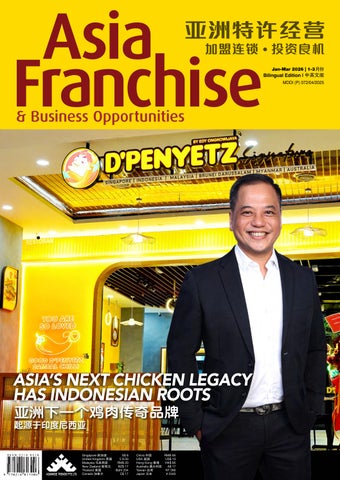
Jan-Mar 2026 | 1-3月份 MDDI (P) 072/04/2025
ASIA’S NEXT CHICKEN LEGACY HAS INDONESIAN ROOTS 亚洲下一个鸡肉传奇品牌 起源于印度尼西亚
Presented by
Organised by
www.FranchiseLicenseAsia.com
Empowering Franchising & Licensing Success in Asia
13 - 15 August 2026
Sands Expo & Convention Centre, Singapore
Jan-Mar 2026
2
Why Venture Capitalists and Family Offices Invest in Franchises
F
ranchises occupy a unique space in the business world: they combine the entrepreneurial spirit of small business ownership with the scalability of corporate systems. This hybrid model has increasingly attracted the attention of venture capitalists (VCs) and family offices, both of whom see franchises as a compelling investment opportunity. Why VCs and Family Offices Invest in Franchises • Scalability and Replication: Franchises are designed to expand rapidly across regions using standardized processes. Investors value this built-in growth potential.
• Accelerated Growth: Funding enables rapid scaling nationally or internationally. • Enhanced Credibility: Association with reputable investors can boost brand reputation and attract new franchisees. Cons for the Franchise Being Targeted • Loss of Control: Founders may need to share or cede decision-making authority. • Pressure for Aggressive Expansion: VCs in particular may push for rapid growth, risking operational strain.
• Proven Business Models: Unlike startups, franchises often have established track records, reducing risk.
• Brand Dilution: Fast scaling can consistency and customer experience.
• Recurring Revenue Streams: Royalties, fees, and predictable cash flows make franchises attractive for investors seeking stability.
• Exit Expectations: Investors often expect liquidity events (IPO, acquisition), which may not align with the franchise’s long-term vision.
• Diversification: Family offices use franchises to balance portfolios that may already include real estate, equities, and private businesses.
• Cultural Misalignment: Family offices may prioritize stability, while VCs chase high returns, creating tension in strategy.
• Long-Term Capital Alignment: Family offices often prefer patient capital strategies, which align well with franchise growth timelines, while VCs may push for faster scaling and eventual exits.
Conclusion
Pros for the Franchise Being Targeted • Capital Infusion: Access to significant funding for marketing, technology, and expansion. • Strategic Expertise: Investors bring operational knowledge, networks, and professional management practices.
compromise
For venture capitalists and family offices, franchises represent a balance of growth potential and reduced risk. For the franchise itself, investment can be both a blessing and a challenge: it provides the resources to expand but may also force compromises in autonomy and brand integrity. Ultimately, success depends on aligning investor expectations with the franchise’s long-term vision.
Jan-Mar 2026
3
为什么风险投资机构和家族办公室会投资加 盟连锁企业
加
盟连锁企业在商业世界中占据独特的位置:它们 既体现了中小企业的创业精神,又具备跨区域复 制和扩张的能力。这种混合模式越来越受到风险 投资机构(VC)和家族办公室的关注,他们认为加盟连锁 是一种极具吸引力的投资机会。
风险投资与家族办公室投资加盟的原因 • 可扩展性与复制性:加盟模式天生适合快速扩张,标准 化流程让投资者看到增长潜力。 • 成熟的商业模式:相比初创企业,盟主连锁(品牌拥有 者)往往已有成功案例,风险更低。 • 稳定的现金流:加盟费和持续的特许权使用费带来可预 测的收入。 • 投资组合多元化:家族办公室常用加盟企业来平衡其在 房地产、股票等领域的投资。 • 资本周期匹配:家族办公室倾向于长期资本投入,与加 盟企业的成长节奏契合;而VC则更注重快速扩张和退 出。 对盟主,品牌拥有者企业的优势 • 资金支持:获得充足的资金用于市场推广、技术升级和 新店扩张。 • 战略资源:投资者通常带来管理经验、人脉资源和专业 化运营。
• 加速扩张:资金助力企业在全国或国际范围内快速成 长。 • 品牌信誉提升:与知名投资者合作能增强市场信任度, 吸引更多加盟商。 对盟主,品牌拥有者企业的劣势 • 控制权下降:创始人可能需要让渡部分决策权。 • 扩张压力:VC尤其可能要求激进的增长速度,导致运营 压力。 • 品牌稀释风险:过快扩张可能影响服务质量和客户 体验。 • 退出预期:投资者通常期待IPO或并购等退出方式,可 能与企业长期愿景不符。 • 文化差异:家族办公室偏好稳健,而VC追求高回报,战 略上可能存在冲突。 结论 对风险投资机构和家族办公室而言,加盟连锁企业兼具增 长潜力与较低风险。对盟主企业来说,投资既是机遇也是 挑战:它能提供扩张所需的资源,但也可能带来自主性下 降和品牌稀释。最终的成功取决于投资者与企业愿景的契 合度。
Jan-Mar 2026 (电子版)
Asia Franchise & Business Opportunities (Digtial)
Note from the Editor 编辑的话
5
Calendar of Events 世界特许经营活动表
39
Cover Story 封面故事 Asia’s Next Chicken Legacy Has Indonesian Roots 亚洲下一个鸡肉传奇品牌起源于印度尼西亚
8-9
Business Insights 学者专栏
16
Why Venture Capitalists and Family Offices Invest in Franchises 为什么风险投资机构和家族办公室会投资加盟连锁企业
2
The Legal Environment of Franchising in Singapore 新加坡特许经营的法律环境
12-14
Franchise Agreements in Thailand: Guidance on Nonrefundable Fees and Purchasing Conditions 泰国特许经营协议:关于不可退还费用及采购条件的指引
22-24
Ipsos Views: From Pixels To People 市场研究和洞察提供商:益普索观点: 从像素到人
26-29
News Station 消息站
22
26
Singapore acting as the Gateway: Macao Brands Target ASEAN Expansion 新加坡作为门户:澳门品牌瞄准东盟扩张
16
The Hong Kong Trade Development Council will host three major trade fairs in 2026 新加坡作为门户:澳门品牌瞄准东盟扩张
21
FLAsia 2025 Concludes with Resounding Success 新加坡品牌授权及特许经营展览会 FLAsia 2025 圆满落幕
18-19
The Hong Kong Trade Development Council will host three major trade fairs in 2026
21
Diamond Island Convention and Exhibition Centre (DIECC) 2025 柬埔寨餐饮及酒店展CAMFOOD + HOTEL 2025
30
Design Business Chamber Singapore (DBCS) and Consulus: Launching the World Design Business Organization (WDBO) 新加坡设计业总商会DBCS和凯思勒Consulus:启动全球设计商务组织 (WDBO)的成立
32
Franchising Opportunities in Timor-Leste: Leveraging ASEAN Membership 特许经营在东帝汶的机遇:借力东盟成员身份
34
Note from the Editor NOTE FROM THE EDITOR F
编辑的话
ranchise companies, once they have built a solid
I opine that before venturing overseas, doing tons
network of outlets in their own country, will often
of pre-entry homework, and evaluating the external
start to look at overseas markets. Because many
environment of a business by breaking down the
entry barriers can be overcome via franchising, this
opportunities and risks into Political, Economic,
is naturally a preferred model for overseas expansion.
Social, Technological, Environmental, and Legal factors (PESTEL) is totally essential.
However, in my 33 years in franchise consulting, I have seen many franchisors rush overseas in the most
May 2022 be a year when great breakthroughs
unprepared conditions – e.g., when their financial
happen for the good of all humanity.
position is still relatively weak; when their team members are still inexperienced and psychologically unprepared to travel frequently overseas; and when their intellectual property protection is not in place… Interestingly, I recently read an article about
Wars and conflicts are never good for business. Even the most established global including franchises professor Exequiel (Zeke) Hernandez whobrands, studied thrive inon and trust, cannot escape the athat phenomenon the consistency banking industry in his paper, “When Do Ethnic Foreign disruption thatCommunities violence Affect brings. Supply chains fracture, Location Choice? Dual Entry Strategies of Korean consumer confidence erodes, and the very foundations of Banks in China..” Professor Hernandez mentioned commerce—stability shaken. the example of a Korean bank and which,predictability—are among other
international expansion by Wharton management
strategies it deploys, open branches in China
Franchises, design, populated by peopleby of its own ethnicrely group.on adherence to standards,
laws, and regulations. When conflict undermines these The topic might seem unusual, but the phenomenon pillars, both franchisors and franchisees suffer. Local of firms expanding into foreign markets [to follow entrepreneurs, who invest their livelihoods into these immigrants] is actually quite common. I am inclined to partnerships, often bear heaviest burden. Their rights see Philippines’ fast-food Jollibee as athe real example. Their first outlets were in California because there and interests deserve protection, are not jeopardy. many Filipinos who live there…
It is therefore in the interest of all parties—governments, But not all companies will find it desirable to locate businesses, and communities worldwide—to seek peace. where immigrants from their home country live. There Stability fosters growth, innovation, and opportunity. are cases in which companies deliberately avoided Respect forimmigrants laws and norms ensures fairness locating where live international because they didn’t want be associated with catering to a ‘niche-y’ andtoresilience. Only through peace and adherence to ethnic group of customers or workers. Instead, they regulations can brands, whether global icons or local actually wanted to serve the broader market. Professor franchises, continue toquite serve communities and create Hernandez’s ‘dual entry strategy’ is interesting. “If I am a firm and I’m considering expansion into a prosperity. location that has an ethnic population, I’m going to do
itAs if thatwe location has ainto weak institutional environment step 2026, may the world
become more peaceful, and may all involved with franchising thrive in but I will not or I will be at least much less swayed their endeavours. by the ethnic population in places where institutional
— weak courts, weak laws, weak property rights —
environments are strong.”
Publisher 出版 Asiawide Franchise Consultants Pte Ltd 爱思威特许经营顾问有限公司
Editor-In-Chief 总编辑 Albert Kong 江进兴
7B Aliwa Street, Level 3 Room 2 Tel 电话: (65) 9679 3947 Chen Leonn Building Email电邮:199900 info@asiawidefranchise.com.sg Singapore
We welcome views and comments from our readers. Correspondence should be addressed to Editor-inChief at the above address.
Website网站:www.asiawidefranchise.com.sg Facebook: @AsiawideFranchiseConsultants X: @Asia_Franchise Linkedin: @Aisa-franchise Wechat: XinjiapoJiangJinXing Designer 设计 Compassage Design Pte Ltd Media Reps 广告代理
albert@asiawidefranchise.com.sg Compassage Design Pte Ltd MDDI (P) 072/04/2025
Asia Franchise & Business Opportunities (AFBO) reserves the right to edit letters for publicaiton and also reserves the right to refuse advertising. With the publicaiton of AFBO, Asiawide Franchise Consultants Pte Ltd is not offering legal, financial or any professional advice or endorsements. Readers are encouraged to seek advice from professionals in specialized fields before acting on any information published herein. The views and opinions expressed in AFBO are those of the author(s) and do not necessarily reflect the views and opinions of Asiawide Franchise Consultants Pte Ltd.
江进兴 Albert Kong
Albert Kong Editor 编辑
Editor 编辑
战争与冲突从来不是商业的福音。即使是最具影响 力的全球品牌,包括依赖一致性与信任的特许经营体 系,也无法逃脱暴力带来的冲击。供应链被打断,消 费者信心受损,商业赖以生存的稳定性与可预测性随 之动摇。 特许经营的本质在于遵守标准、法律与规章制度。当 冲突破坏这些根基时,特许人和被特许人都会受到损 害。那些投入毕生心血的本地企业家,往往承受最沉 重的代价。他们的权利与利益理应得到保护,而不是 被置于风险之中。 因此,世界各地的政府、企业与社会各方都应当追 求和平。稳定孕育增长、创新与机遇;遵守法律与国 际规范确保公平与韧性。唯有通过和平与守法,品 牌——无论是全球巨擘还是本地特许经营——才能持 续服务社区,创造繁荣。 随着我们迈入2026年,愿世界更加和平,愿所有从 事特许经营的人在事业中蓬勃发展。
A Global Stage for Business
The exhibition became a dynamic international marketplace, buzzing with energy as 258 exhibitors from across the globe connected with 19,868 professional visitors. This convergence of key players from Thailand, Malaysia, India, China, the U.S., and beyond created a fertile ground for discovery and deal-making, with products spanning from innovative F&B to smart retail solutions sparking countless new partnerships.
PARTIAL EXHIBITORS
CO-LOCATED ACTIVITIES
ASEAN SHOP Leader Industry Conference A hub of industry insights. Leaders shared forward-thinking strategies, empowering attendees with knowledge for immediate impact. MEGA Food x ASEAN SHOP Competition A culinary spectacle that captivated the crowd. Live stations buzzed with energy as chefs battled, drawing non-stop engagement. MIXOLOGIST Competition FLAIR BARTENDING Competition Where flavor met flair. A vibrant showcase of mixology artistry and breathtaking performances that became the talk of the show. Email: marketing@grandeurint.com Contact
Tel/Whatsapp: 86 13005541389 Website: www.aseanfnb.com
Jan-Mar 2026
8
Asia’s Next Chicken Legacy Has Indonesian Roots (Singaporebased, Now in 7 Countries)
ABOUT D’PENYETZ GROUP D’PENYETZ was founded in Singapore in 2009 by Edy Ongkowijaya, starting from a single humble outlet. Over the past 20 years, the brand has grown into a leading Indonesian Halal cuisine chain with operations across 7 countries: Singapore, Australia, Indonesia, Malaysia, Brunei, Myanmar, Timor leste and looking into Japan and Middle East in 2027. This growth reflects a proven and scalable business model supported by strong operational systems and centralized production. D’PENYETZ is best known for its real Indonesian sambal chili, available in 9 spicy levels to suit diverse customer preferences. All sambal sauces, premix paste, are produced at the Jakarta central kitchen, using high-tech, Halal-certified processes, ensuring consistency, quality control, scalability across all markets and no dependency on skilled chefs. Beyond its signature ayam penyet, the menu includes beef, fish, vegetables, soups, noodles, and affordable side dishes, appealing to a wide customer base internationally. With more than a decade of hands-on experience, ups and downs, operational challenges, continuous R&D’s and continuous refinement, Edy Ongkowijaya has built a resilient and profitable franchise system. D’PENYETZ is widely recognized as one of the fastest-growing Indonesian Halal F&B brands, trusted by customers and partners across multiple countries. Having received multiple international awards and recognitions, D’PENYETZ offers a long term business
opportunity for investors seeking a PROVEN, scalable, and globally relevant Halal F&B brand. With strong product differentiation, a centralized kitchen system, and broad market appeal, the brand is well positioned for continued international expansion. Franchise Support
- D’PENYETZ franchisees receive end-to-end support, including pre-opening consultancy, site surveys, and layout planning - The Do’s & the DON’Ts and mentorship from 20 years of founder experience - Recruitment and comprehensive training for both BOH and FOH teams - SOP manuals, simulation training, and on-site coaching by HQ operations - Access to brand assets, menu designs, and marketing materials - Central supply of exclusive premix pastes and sauces from Jakarta - Daily operational support via WhatsApp reporting and video calls
Jan-Mar 2026
- Fresh meats, vegetables, and dry goods can be sourced locally to maintain cost efficiency while adhering to brand standards. Expansion Roadmap 2026: Dili, Timor Leste 2026: Tokyo, Japan 2027: Dubai, UAE We welcome partners who share our vision of bringing authentic Indonesian Halal cuisine to the world and building a strong, profitable global brand together. For more information: https://www.dpenyetz.sg/franchise-opportunity/
9
肉、鱼类、蔬菜、汤、面条和价格实惠的小菜,吸引了众多国 际顾客。凭借十余年的实践经验,历经起伏跌宕、运营挑战、 持续研发和不断改进,Edy Ongkowijaya 打造了一个稳健且盈 利的特许经营体系。D’PENYETZ 被公认为印尼发展最快的清 真餐饮品牌之一,深受多个国家客户和合作伙伴的信赖。 D’PENYETZ 荣获多项国际奖项和认可,为寻求成熟、可扩展 且具有全球影响力的清真餐饮品牌的投资者提供长期投资良 机。凭借强大的产品差异化优势、集中式厨房系统和广泛的市 场吸引力,该品牌已做好充分准备,继续拓展国际市场。 加盟支持: - D’PENYETZ 加盟商将获得全方位支持,包括开业前咨询、 选址勘察和布局规划 - 20 年创始人经验,提供“必做事项”和“禁忌事项”指导
亚洲下一个鸡肉传奇品牌(总部位于新加 坡,现已遍布7个国家)起源于印度尼西亚
- 为后厨和前厅团队提供招聘和全面培训
D’PENYETZ 由 Edy Ongkowijaya 于 2009 年在新加坡创立, 最初只是一家不起眼的小店。在过去的 20 年里,该品牌已发 展成为领先的印尼清真餐饮连锁品牌,业务遍及 7 个国家: 新加坡、澳大利亚、印尼、马来西亚、文莱、缅甸和东帝汶, 并计划于 2027 年进军日本和中东市场。
- 使用品牌资产、菜单设计和营销材料
这一增长得益于其成熟且可扩展的商业模式,该模式以强大的 运营系统和集中化生产为支撑。D’PENYETZ 最为人熟知的是 其正宗的印尼叁巴辣椒酱,共有 9 种辣度可供选择,以满足 不同顾客的口味偏好。所有叁巴酱和预拌酱料均在雅加达中央 厨房采用高科技清真认证工艺生产,确保了产品品质的一致 性、可控性以及在所有市场的可扩展性,且无需依赖专业厨 师。除了招牌菜印尼炸鸡(ayam penyet)外,菜单还包括牛
- 总部运营部门提供标准操作程序 (SOP) 手册、模拟培训和 现场指导 - 从雅加达集中供应独家预拌酱料和调味酱 - 通过 WhatsApp 报告和视频通话提供日常运营支持 - 新鲜肉类、蔬菜和干货可本地采购,以在符合品牌标准的 前提下降低成本 扩张路线图: 2026 年:东帝汶帝力 2026 年:日本东京 2027 年:阿联酋迪拜 我们欢迎与我们拥有共同愿景的合作伙伴,共同将正宗的印尼 清真美食带给世界,并携手打造一个强大且盈利的全球品牌。
Franchise Expo Paris, the world’s leading franchising event Order your badge here Or on www.franchiseparis.com with the code PAR6GC
An event
organised by
in partnership with
12
Jan-Mar 2026
The Legal Environment of Franchising in Singapore 新加坡特许经营的法律环境
Given Singapore’s strict laws, legal expertise and legal infrastructures that promote a pro-business environment, Singapore is pivotal to Southeast Asia’s tremendous franchise success — a view shared by many franchise experts, including Mr Albert Kong, Founder / CEO of Asiawide Franchise Consultants. 新加坡严谨的法律制度、专业的法律人才以及支持 商业发展的法律体系与架构皆为新加坡在推动东南 亚特许经营的巨大成功方面发挥了关键作用——此 观点广受特许经营专家(包括江进兴先生,爱思威特 许经营顾问公司创始人兼首席执行官)普遍认同。 This article delves into the legal principles and intellectual property laws that underpin franchising in Singapore. Firstly, it reviews key recent and past Singapore court decisions that shaped the franchise landscape. Secondly, it illuminates potential pitfalls of franchisors and franchisees. 本文将通过审视对新加坡特许经营格局有深远影响的重要 司法判决,并阐明特许经营商和加盟商可能面对的潜在风 险与隐患,深入剖析支撑新加坡特许经营体系的法律原则 与知识产权的法规。 Managing Franchise Contracts 管理特许经营合同 Essentially, the franchise contract is a commercial contract governed by contract law, principles of tort law, with oversight from statutes such as Unfair Contract Terms Act 1977 (“UCTA”) and the Misrepresentation Act 1967. Noncompliance of contractual terms (“Breach”) can lead to dire consequences. Parties must structure key terms and clauses to ensure their respective obligations are clearly defined and properly executed. 特许经营合同在本质上属于一种受合同法与侵权法原则所 规范的商业合同,同时也受到《1977年不公平合约条款 法》(UCTA)及《1967年失实陈述法》等法规的监管。若 不遵守合同条款(“违约”),可能会导致严重后果。合 同各方必须妥善设计合同中的关键条款与条文,确保清楚 陈明各自的义务并妥善履行。
GNC Holdings LLC v ONI Global Pte Ltd and another ([2025] SGHC(I) 25), a case involving health products and dietary supplements, illustrates the pitfall of gathering insufficient direct evidence when alleging a Breach. Due to mistrust and suspicion, the Singapore franchisee, LAC, thought that the US-based franchisor, GNC Holdings, wanted to remove it from the franchise and had therefore committed a Breach. LAC, then terminated the franchise contract on its own. Without cogent evidence to support their termination, the franchisee wrongly believed that they would be legally released from the post-termination obligations. This wrong belief then led the franchisee to rebrand GNC into LAC in all its stores in Singapore overnight, without good legal reasons or the consent of the franchisor and thereby committed a Breach. 健安喜控股有限责任公司 (GNC)诉 ONI Global 私人有限 公司及另一方案([2025] SGHC(I) 25)是一起涉及保健品 与膳食补充剂的案例,说明了在指控对方违约时若缺乏充 分有力且明确的证据,会带来严重隐患。由于不信任及怀 疑总部位于美国的特许商 GNC想将其从特许体系中移除, 新加坡的加盟商 LAC 认为特许商已构成违约,遂自行终 止特许经营合同。在欠缺有力证据支持其单方面终止合同 的情况下,加盟商错误地相信自己可以因此合法免除终止 后的各项义务。受此错误认知驱使,加盟商随后在一夜之 间,未经特许人同意,也缺乏正当法律依据,将其在新加 坡所有门店由“GNC”改为“LAC”品牌,从而构成违约。 The GNC-LAC dispute was first arbitrated in the US and the arbitration award was in favour of the franchisor. When the franchisor tried to enforce the arbitration award in Singapore, the franchisee unsuccessfully mounted a challenge before the Singapore International Commercial Court (“SICC”) which largely agreed to enforce the earlier US arbitration award in Singapore and ordered the franchisee to give the franchisor rights to the leases of all its Singapore outlets and pay the franchisor damages to the tune of US$18.9 million. GNC 与 LAC 的纠纷最初在美国进行仲裁,仲裁裁决结果有 利于特许商。其后,当特许商尝试在新加坡执行该仲裁裁
Jan-Mar 2026
决时,加盟商向新加坡国际商业法庭(“SICC”)提出挑 战,结果失败。SICC 在很大程度上同意在新加坡执行美国 先前的仲裁裁决,并指令加盟商将其在新加坡所有门店的 租约权转让给特许商,同时赔偿特许商约 1,890 万美元的 损失。 Ng Siew Lan v The Laundry Club Pte Ltd ([2021] SGDC 20), a laundry-sector case, reinforces the importance of documenting to preserve evidence and to ensure that operational expectations and business targets are clearly defined and realistic in the franchise contract. The franchisor terminated the franchise contract due to dissatisfaction with the franchisee’s operational performance. In response, the franchisee claimed wrongful termination, arguing that the franchisor had repudiated the contract, and sought a refund of previous payments along with compensation for financial losses. The franchisor, in turn, filed a counterclaim. The court dismissed both parties’ claims. It ruled that the franchisee failed to provide sufficient evidence to support the wrongful termination allegation. Ng Siew Lan 诉 The Laundry Club 私人有限公司([2021] SGDC 20)是一起涉及洗衣业的案例,再次强调了妥善记录 以保存证据的重要性,并凸显了在特许经营合同中将运营 期望与业务目标清晰明确地界定的必要性。特许商因不满 加盟商的营运表现而终止了特许经营合同。加盟商回应时 指控特许商错误终止合同,而且已经否定并拒绝履行合同 义务,因而要求退还先前支付的款项及赔偿其经济损失; 特许商则提出反诉。法院最终驳回双方的提控,裁定加盟 商未能提供足够证据支持其关于特许商错误终止合同的指 控。 The Best Source Restaurant Pte Ltd v Wan Chai Capital Holdings Pte Ltd ([2009] SGHC 266) case illustrates the pitfall of withholding operational essentials from the franchisee in the F&B sector. The franchisee claimed that the franchisor failed to provide essential operational details, including recipes for menu items. Proprietary recipes are trade secrets, protected under the branch of intellectual property law known as confidential information. In a franchise model built on a replicable business system, the franchisor must share such trade secrets to ensure consistent results, and the franchisee is not obliged to take steps to obtain them. In return, franchisors typically receive upfront fees and ongoing royalties. The court ruled that the franchisor Wan Chai Capital Holdings’ obligation to supply this information was fundamental to the contract. As a result, the franchisee The Best Source Restaurant was justified in terminating the contract. The Best Source Restaurant 私人有限公司 诉 湾仔资 本控股私人有限公司([2009] SGHC 266)此案例揭示了在 餐饮业中向加盟商隐瞒关键运营要素所带来的风险。加盟 商因特许商未能提供必要的运营细节,包括菜单上各项目 的食谱而向其索赔。专有食谱属于商业秘密,受知识产权
13 法中“保密信息”领域的保护。在依赖可复制商业系统的 特许经营模式中,特许商必须将此类商业秘密与加盟商分 享,以确保运营成果一致,而加盟商并没有自行设法取得 这些信息的必要。一般情况下,特许商通常会收取预付费 用及持续的权利金作为回报。法院裁定,特许商湾仔资本 控股私人有限公司提供这些信息的义务是合同中的核心条 款,因此,加盟商The Best Source Restaurant终止合同 是合理且合法有据的。 The Franchise Term Sheet and its legal implications 特许经营条款清单及其法律影响 Once both franchisor and franchisee have negotiated the terms of the arrangement, the next step is to formalise those discussions in a legally binding franchise contract. Unlike standard commercial contracts, franchise deals typically involve multiple stages: a Term Sheet, preliminary contracts, and the final franchise contract. The Term Sheet should outline all key terms and conditions agreed upon by both parties. 当特许商与加盟商就合作条款协商完毕后,接着便需将这 些讨论结果拟成正式具有法律约束力的特许经营合同。 与一般商业合同有异之处是特许经营安排通常包含多个阶 段:条款清单、初步合同以及最终的特许经营合同。条款 清单应概述双方已达成一致的所有关键条款与条件。 In D’Oz International Pte Ltd v PSB Corporation Pte Ltd ([2009] SGDC 221, Appeal [2010] 3 SLR 267, [2010] SGHC 88, a case involving the China education sector, the Singapore court ruled that the Term Sheet, Preliminary Agreement, and unsigned Franchise Contract collectively formed the full contractual understanding between the parties. It found that the franchise relationship had been established once the Term Sheet was signed, even though the subsequent final Franchise Contract had yet to be executed. 在 D’Oz International Pte Ltd 诉 PSB Corporation Pte Ltd([2009] SGDC 221上诉案 [2010] 3 SLR 267;[2010] SGHC 88)这一宗涉及中国教育业的案件中,新加坡法院裁 定:条款清单、初步协议以及尚未签署的特许经营合同三 者共同构成双方对合同完整的理解。法院认为,一旦双方 签署了条款清单,特许经营关系即已成立,即使后续的最 终特许经营合同尚未正式签署亦然。 Licensing A Brand Through Franchise Contracts 通过特许经营合同授权经营品牌 At the core of every successful franchise is its brand, proprietary know-how, systems, processes and technology. Protecting these valuable intangible assets is essential, and that protection comes from understanding and using the appropriate Intellectual Property (“IP) laws. As IP rights are territorial, franchise contracts must be tailored to work across multiple countries or regions, ensuring that the brand stays consistent and legally protected wherever the franchisees operate.
14 每一个成功特许经营体系的核心都在于其品牌、专有技 术、运营系统、流程与技术。这些宝贵的无形资产必须受 到妥善保护,而保护的基础在于充分理解并正确运用相关 的知识产权(“IP”)法律。由于知识产权具有地域性, 特许经营合同必须根据不同国家或地区的法律环境进行相 应调整,以确保无论加盟特许经营者身在何处,品牌都能 保持一致性并获得法律上的充分保护。 For the brand and other intangible assets to be properly licensed to franchisees, a well-crafted franchise contract should set out the following: 要将品牌及其他无形资产妥善授权给加盟商,一份精心拟 定的特许经营合同应明确阐述以下内容: The scope of the licence (which territories it covers) brand usage guidelines and quality control standards the relationship between the IP owner (franchisor) and the licensee (franchisee) dispute resolution mechanisms. • 许可范围(涵盖地区) • 品牌使用规范与质量控制标准 • 知识产权所有人(特许商)与被许可人(加盟商)之间 的关系 • 纠纷解决机制 Leveraging Singapore’s Legal Expertise, Legal Infrastructure and Global Franchise Networks for Success 发挥新加坡的法律专长、法律体系架构与全球特许经 营网络的优势以取得成功 As a leading hub for legal services, Singapore offers access to highly skilled legal professionals and a world-class judiciary with expertise in both domestic and international dispute resolution. The SICC is a testament to Singapore’s international commercial dispute resolution reputation and strategic location within Asia. This strong legal ecosystem is further enriched by Singapore’s active participation in global legal and franchise networks, such as: 作为区域领先的法律服务枢纽,新加坡除了拥有高素质的 法律专业人才,其司法体系在国内与国外解决纠纷方面享 誉盛名。新加坡国际商业法庭(SICC)更是体现了新加坡 在国际商业事务纠纷解决领域的声誉与其在亚洲占有战略 性的重要地位。新加坡通过积极参与全球法律与特许经营 网络,进一步巩固并丰富了这一强大的法律生态体系,例 如: The World Franchise Council, a global body formed by national franchise associations, counts Singapore’s own Franchise and Licensing Association (FLA) as one of the founding members (https://worldfranchisecouncil.net/). 世界特许经营理事会是由各国特许经营协会组成的全球性 机构,其中新加坡特许经营与许可协会(FLA)是其创始成 员之一。(https://worldfranchisecouncil.net) The Licensing Executives Society (LES) Singapore is part of Licensing Executives International (LESI), a
Jan-Mar 2026
highly respected global organisation that held its annual conference in Singapore last year, reinforcing Singapore’s standing in the IP and licensing world (https://lesi.org/ and https://les-singapore.com/). 新加坡许可专家协会(LES Singapore)隶属国际许可专 家协会(LESI),该组织是全球享有盛誉的知识产权与许 可专业机构。其年度大会去年在新加坡举行,进一步巩固 了新加坡在知识产权与授权领域的国际地位。(https://lesi. org/ 与 https://les-singapore.com) Singapore’s legal infrastructure now has a streamlined litigation track designed to make resolving intellectual property disputes faster and more accessible. (Supreme Court Practice Directions 2021, Part 23: Simplified Process for certain Intellectual Property Claims). 新加坡的法律基础设施如今设有一套更为精简的诉讼程 序,旨在让知识产权纠纷的解决过程更为快捷、更加易于 使用。(见《2021年最高法院实践指引》第23部分:某些 知识产权索赔的简化程序。) Conclusion Franchising operates at the intersection of law, investment, venture capital, multi-billion business, and entrepreneurship. All these five aspects are served well by Singapore’s policy of not having franchise-specific legislation as it avoids creating additional regulatory and cost burdens on businesses and helps foster entrepreneurship. For both franchisors and franchisees, this would mean working in a legal environment that supports trust, transparency, fairness, reliability and confidence — while also allowing the flexibility to negotiate, structure, and manage franchise relationships through clear contracts and self-regulation. 结语 特许经营处于法律、投资、创业资本、价值数十亿规模的 大型产业与创业活动的交汇点。新加坡不设特许经营专门 立法的政策,有助于避免对企业施加额外的监管与成本负 担,从而促进创业精神。对特许经营商和加盟商而言,这 意味着在一个以信任、透明、公平、可靠与信心为基础的 法律环境中运作,同时仍保有通过清晰合约与自我规管来 协商、建立架构及管理特许经营关系的灵活性。
Authored by: Ms Constance Leong, Advocate & Solicitor (Singapore), Solicitor (England & Wales), Consultant at Goh Phai Cheng LLC 作者:梁彩玲女士,新加坡(诉讼与咨询)律师、英格兰 与威尔士事务律师,吴沛镇律师事务所顾问
24th INTERNATIONAL FRANCHISE AND INVESTMENT OPPORTUNITIES EXHIBITION
BUYBRAND EXPO OPPORTUNITIES FOR SCALING YOUR BRAND IN NEW MARKETS
29.09 – 01.10 2026
CONTACT US FOR MORE DETAILS
MOSCOW, RUSSIA
INFO@EXPOMTG.COM
200+
FRANCHISE BRANDS
5000+
INVESTORS FROM 15 COUNTRIES
WWW.BUYBRANDEXPO.COM
Jan-Mar 2026
16
Singapore acting as the Gateway: Macao Brands Target ASEAN Expansion
F
or Macao food manufacturers seeking ASEAN expansion, Singapore continues to serve as a practical test market. That positioning was reflected at the Asia Pacific Food Expo (5–8 December 2025), where The Commerce and Investment Promotion Institute (IPIM) of the Macao Special Administrative Region, in collaboration with Asiawide Franchise Consultants (AFC), organised and facilitated pre-arranged business matching meetings between 26 Macao brands and 14 Singaporebased distribution and procurement participants. The sessions were designed to move beyond surfacelevel expo engagement by enabling direct discussions on commercial viability, including pricing structures, supply terms, and go-to-market readiness. Exhibitors at the Macao Pavilion presented products such as traditional biscuits, artisanal sauces, premium noodles, speciality beverages, and health products, with several featuring halal-certified offerings relevant to regional demand patterns. For Singapore distributors, the format provided access to manufacturers that cited export-relevant credentials such as ISO and HACCP practices, along with product recognition, including Monde Selection awards. For Macao brands, Singapore offered a concentrated environment to validate product acceptance and identify potential distribution pathways. Following the expo, some Singapore participants continued follow-up discussions to assess product fit, documentation readiness, and commercial terms before advancing to next steps. The initiative reflects a methodical approach to market development—using Singapore as an international trade hub and buyer concentration to test viability before committing to a wider regional deployment.
新加坡作为门户:澳门品牌瞄准东盟扩张 对于寻求东盟市场扩张的澳门食品制造商而言,新加坡持 续充当实用的测试市场。这一定位在2025年亚太食品博览 会(12月5日至8日)上得到体现,澳门特别行政区招商投 资促进局(IPIM)与爱思威特许经营顾问(AFC)合作,为 26个澳门品牌和14家新加坡分销及采购参与者安排了预先 安排的商务配对会议。 这些会议旨在超越表面的展览互动,通过就商业可行性进 行直接讨论,包括定价结构、供应条款和市场准备度。澳 门展馆的参展商展示了传统饼干、手工酱料、优质面条、 特色饮料和保健品等产品,其中一些产品具有与区域需求 模式相关的 清真认证。 对于新加坡分销商而言,这种形式提供了接触制造商的机 会,这些制造商具有出口相关资质,如ISO和HACCP认证, 以及产品认可度,包括Monde Selection奖项。对于澳门品 牌而言,新加坡提供了一个集中的环境来验证产品接受度 并识别潜在的分销途径。 博览会结束后,一些新加坡参与者继续进行后续讨论,以 评估产品匹配度、文件准备情况和商业条款,然后再进入 下一步。该举措反映了一种有条不紊的市场发展方法—— 利用新加坡作为国际贸易枢纽和买家集中地来测试可行 性,然后再承诺进行更广泛的区域部署。
TAIWAN 2026
International
Chain and Franchise Exhibition
3/13 - 3/16 6/12 - 6/15 TWTC HALL
10/2 - 10/5 TaiNEX 2 Organizer
BE PART OF THE BIGGEST FHA IN A DECADE Food & Beverage
HoReCa
ProWine
FHA 2026 KEY FIGURES *Projected
80,000+
115
100,000
2,750+
ATTENDEES
COUNTRIES / REGIONS
SQM EXHIBITION AREA
EXHIBITORS
CLAIM YOUR FREE* PASS NOW! *Pre-registration closes on 20 April 2026 at 6PM (SGT). On-site registration fee of SGD100 applies thereafter.
ORGANISER
Jan-Mar 2026
21
The Hong Kong Trade Development Council will host three major trade fairs in 2026
T
he Hong Kong Trade Development Council (HKTDC) will host three major trade fairs—the Hong Kong Toys & Games Fair, Hong Kong Baby Products Fair, and Hong Kong International Stationery & School Supplies Fair—from 12–15 January 2026. These flagship events will gather thousands of global exhibitors after attracting over 80,000 buyers from 119 countries in 2025. Dedicated sourcing zones will cover a wide range of segments from educational and tech-integrated toys to infant-care products and creative stationery, offering extensive opportunities for international buyers. https:// tinyurl.com/33kude3b A major highlight is the debut of Pop & Play, a new zone open to both trade visitors and the public, featuring pop culture collectibles, international IPs, and creator-fan interactions such as interviews, autograph sessions, and board-game experiences. Other key attractions include the Brand Name Gallery featuring over 320 renowned brands, the Smart-Tech Toys zone showcasing AR/ VR-enabled products, the Green Toys zone focused on eco-friendly materials, and Kidult World catering to adult collectors. Global pavilions from Mainland China, Taiwan, Korea, and Europe will once again showcase regional innovations. Beyond product displays, the fairs will host various seminars covering market trends, toy safety, licensing opportunities, baby-product developments, and the evolution of tech-driven stationery. The Asian Toys & Games Forum will focus on empowering the industry for global success. Under HKTDC’s EXHIBITION+ hybrid model, buyers and exhibitors can continue networking and sourcing through the Click2Match platform and the Scan2Match feature on the HKTDC Marketplace App, extending business opportunities beyond the physical event dates.
香
港贸易发展局(贸发局)将于2026年1月12日至15 日举办三大大型贸易展览会——香港玩具及游戏 展、香港婴幼儿用品展及香港国际文具及学校用
品展。继2025年吸引来自119个国家和地区的超过8万名买家之 后,这三大旗舰展会将汇聚数千家全球参展商。展会设有专门 的采购区,涵盖从益智玩具、科技玩具到婴幼儿护理用品和创 意文具等众多领域,为国际买家提供丰富的采购机会。 本次展会的一大亮点是全新推出的“潮玩馆”(Pop & Play) 专区,该专区面向专业观众和公众开放,展出流行文化收藏 品、国际知名IP产品,并提供创作者与粉丝互动环节,例如访 谈、签名会和桌游体验。其他亮点包括汇聚320多个知名品牌 的“品牌廊” 、展示AR/VR智能玩具的智能科技玩具区、专注 于环保材料的绿色玩具区,以及专为成人收藏家打造的“大童 世界-Kidult World” 。来自中国大陆、台湾、韩国和欧洲的 国际展馆将再次展示区域创新成果。 除了产品展示外,展会还将举办各类研讨会,涵盖市场趋势、 玩具安全、授权机会、婴幼儿产品开发以及科技文具的演变等 主题。亚洲玩具及游戏论坛将着重探讨如何助力行业走向全球 成功。在香港贸发局的“EXIBITION+”线上线下混合模式下, 买家和参展商可通过“Click2Match”平台和香港贸发局市场 应用软件的“Scan2Match”功能继续拓展人脉和采购渠道,将 商机延伸至展会之外。
HKTDC Hong Kong Toys and Games Fair – hktoyfair.hktdc.com HKTDC Hong Kong Baby Products Fair – hkbabyfair.hktdc.com Hong Kong International Stationery & School Supplies Fair – www.hkstationeryfair.com
Jan-Mar 2026
22
Franchise Agreements in Thailand:
Guidance on Nonrefundable Fees and Purchasing Conditions
Authors: Kasama Sriwatanakul and Victoria MacLeod
T
hailand currently lacks a specific franchise act. Consequently, the legality of any franchise agreement is determined by its compliance with various existing laws, such as the Civil and Commercial Code, the Trademark Act B.E. 2534 (1991) (as amended), and the Unfair Contract Terms Act B.E. 2530 (1997). Thailand is a freedom-to-contract jurisdiction. This allows for a high degree of flexibility and autonomy in contractual arrangements, provided that the terms do not violate any laws or public policy and do not fall under the scope of unfair contract terms. Given this, the requirement for fairness in franchise agreement terms often leads to uncertainty, but decisions from Trade Competition Commission of Thailand (TCCT) can provide guidance on whether specific contentious terms are in fact fair. One issue worth examining in this light is the inclusion of terms on non-refundable franchise fees and strict purchasing conditions. Franchise Fee: Unfair to Refuse Refund? Nonrefundable franchise fees represent a significant upfront investment for franchisees, often becoming a point of contention if the franchise relationship deteriorates or
the franchisor ceases operations. Their fairness and enforceability are frequently scrutinized by regulatory bodies like the TCCT, highlighting the critical balance between contractual freedom and franchisee protection. Faced with one such case, the TCCT considered whether it was unfair for the franchisor to refuse to refund the franchise fee after the franchisor ceased operations. The franchisee had entered into a service agreement on August 2, 2021, and begun operating on October 9, 2021. However, by November 21, 2023, the franchisee was notified that the system would be shut down for maintenance, and by December 26, 2023, the franchisor announced the cessation of operations due to financial losses. The franchisee then requested a refund of the franchise fee. Unfortunately for the franchisee, the TCCT found that the franchisor’s shutdown and cessation of services were justified by business reasons and that both parties had freely entered into a written agreement containing the clause pertaining to the fee being nonrefundable. The TCCT determined that inclusion of this clause did not constitute an unfair trade practice, so there was no violation under the Trade Competition Act B.E. 2560 (2017).
Jan-Mar 2026
23
Purchasing Conditions: Are They Unfair?
Conclusion: Structure Agreements Correctly
Purchasing conditions, particularly those involving practices such as tying, bundling, and conditional sale, are generally considered unfair trade practices under Thai trade competition law, as they can restrict competition and consumer choice. However, the TCCT has, in certain circumstances, recognized exceptions to this general rule. For instance, the franchise agreement between a bubble tea brand and a franchisee contained a purchasing condition that required the franchisee to purchase green tea, Thai tea, and Taiwanese tea from the franchisor. Although there were no problems at the start, there was then a period of over a year where the franchisee did not purchase any green or Thai tea. As a result, the franchisor refused to sell Taiwanese tea unless the franchisee ordered all three teas. The franchisor stated that they had concerns over the quality control and suspected that the franchisee was sourcing the green and Thai tea from another supplier, which would be a breach of the agreement.
The key takeaway from these cases is the importance of having reasonable and explicit agreement terms. It is common for franchise fees to be nonrefundable, and the TCCT decision on described above supports franchisors who clearly communicate this term. If the non-refundable nature of the fee is made clear to the franchisee and both parties sign a memorandum or terms-of-use agreement, the TCCT is likely to uphold the term. However, if the non-refundable fee is mentioned only in informal correspondence or letters of intent, its enforceability may be subject to the TCCT’s interpretation.
In this matter, the TCCT found in favor of the franchisor, ruling that these purchasing conditions, despite potentially resembling tying or conditional sale, were not unfair under the Trade Competition Act in this specific franchise context. The TCCT agreed with the franchisor that these conditions were reasonable as the franchisor needed to maintain product quality and brand standards, which are crucial for a franchise model. Additionally, the agreement was explicit in its requirement for purchasing all three teas from the franchisor. This case highlights that the TCCT recognized an exception in this franchise scenario and again shows the importance of ensuring the agreement is clear and that any purchasing conditions align with legitimate business justifications. If the condition is explicit, aligns with accepted business practices, and is demonstrably necessary to ensure brand standards and quality controls, the TCCT may find such conditions not to be unfair, even if they might otherwise be seen as anticompetitive.
While practices such as tying, bundling, and conditional sales are generally considered unfair under Thai trade competition law, the TCCT may permit such purchasing conditions within franchise agreements if they are explicit, align with brand standards, and are necessary for quality control. Franchisees should be given adequate time to review the terms, and any potentially onerous provisions should be clearly highlighted before signing. This ensures that, in the event of a dispute before the TCCT, the franchisor can demonstrate that the franchisee was fully informed of the terms and their implications.
https://www.tilleke.com
Jan-Mar 2026
24
泰国特许经营协议:
关于不可退还费用及采购条件的指引 作者:Kasama Sriwatanakul 和Victoria MacLeod
https://www.tilleke.com
泰
国目前尚无专门规范特许经营的独立法案。因此, 任何特许经营协议的合法性需依据其是否遵守相 关现行法律来判断,包括《民商法典》、《商标 法》(佛历2534年,即1991年,经修订)和《不公平合同条 款法》(佛历2530年,即1997年)。 泰国实行合同自由制度。这一制度使合同安排在不违反适用 法律、公共政策、或落入不公平合同条款范畴的前提下,具 有较高的灵活性和自主性。在此背景下,对特许经营协议条 款的公平性要求往往产生一定的不确定性。然而,泰国贸易 竞争委员会(TCCT)的相关裁决可为特定争议条款是否构成 公平提供参考。从这一角度出发,特许经营协议中关于不可 退还的特许经营费及严格采购条件的规定,尤为值得关注。
加盟费:拒绝退款是否公平? 不可退还的加盟费对加盟商而言是一项重要的前期投入,一 旦特许经营关系恶化或特许人停止运营,该费用往往会成为 争议的焦点。此类条款的公平性及其可执行性经常受到TCCT 等监管机构的审查,凸显出在合同自由与加盟商保护之间寻 求平衡的重要性。 在审理该类案件时,TCCT 考量了特许人在停止运营后拒绝 退还加盟费是否公平。加盟商于2021年8月2日签订了服务协 议,并于2021年10月9日开始运营。然而,到2023年11月21 日,加盟商接到通知称系统将因维护而暂停运作;至2023年 12月26日,特许人宣布因财务亏损而停止运营。加盟商随后 要求退还加盟费。 不幸的是,TCCT认定,特许人关闭系统和停止服务是出于商 业原因,且双方均自愿签订了包含加盟费不可退还条款的书 面协议。TCCT认定,该条款的设置并不构成不正当竞争行 为,因此不构成对《佛历2560年(2017年)贸易竞争法》的 违反。 采购条件:是否不公平? 采购条件,尤其是涉及搭售、捆绑销售和附条件销售等做法 的采购条件,通常被视为泰国贸易竞争法下的不公平贸易行 为,因为此类做法可能限制竞争并削弱消费者选择。然而, 泰国贸易竞争委员会在某些情况下也承认对此一般规则的例 外。例如,一家奶茶品牌与其加盟商之间的特许经营协议中 包含一项采购条件,要求加盟商必须从特许人处购买绿茶、 泰式奶茶和台湾茶。虽然起初并无问题,但随后一年多的时 间里,加盟商未再购买任何绿茶或泰茶。基于此,特许人拒 绝向其出售台湾茶,除非加盟商同时订购三种茶。特许人解
释称,他们对产品质量控制存在担忧,并怀疑加盟商从其他供 应商处采购绿茶和泰茶,构成违反协议的行为。 在本案中, TCCT裁定特许人胜诉,认为这些采购条件虽然可 能类似于搭售或附条件销售,但在特定的特许经营背景下,并 不违反《贸易竞争法》。TCCT同意特许人的观点,认为这些条 件是合理的,因为特许人需要维持产品质量和品牌标准,这对 特许经营模式至关重要。此外,双方签署的协议已明确规定加 盟商必须从特许人处购买全部三种茶品。 本案凸显,TCCT在此类特许经营情境中认可了例外情况,并再 次表明确保协议清晰明确以及任何采购条件均符合合法商业理 由的重要性。如果条件明确、符合公认的商业惯例,并且对于 确保品牌标准和质量控制而言确属必要,即使这些条件在其他 情况下可能被视为具有反竞争性质,TCCT仍可能认定其并不构 成不公平贸易行为。 结论:正确构建协议 这些案例表明,制定合理且明确的协议条款至关重要。特许经 营费通常不可退还,而TCCT在上述案例中的裁决支持特许人明 确传达这一条款。如果特许经营费不可退还的性质已明确告知 加盟商,且双方签署了备忘录或使用条款协议,TCCT 通常会 支持该条款。但是,如果不可退还的费用仅在非正式信函或意 向书中提及,其可执行性可能取决于 TCCT 的解释。 虽然搭售、捆绑销售和附条件销售等做法通常被视为泰国贸易 竞争法下的不公平贸易行为,但如果这些购买条件明确、符合 品牌标准且对质量控制必要,TCCT 可能会允许在特许经营协 议中加入此类条件。应给予加盟商充足的时间审查条款,并在 签署前明确指出任何可能苛刻的条款。这样可以确保,如果特 许经营权争议提交至TCCT,特许经营人可以证明加盟商已充分 知悉相关条款及其法律后果。
Jan-Mar 2026
26
Ipsos Views:
From Pixels To People Combining Human Empathy and Artificial Intelligence for Brand Growth
The New Brand Duality. We are at a pivotal moment in brand management. The rapid integration of AI into daily life has created a powerful, often invisible, touchpoint for every brand. Consumers now use Large Language Models (LLMs) for conversation, advice, and inspiration— reshaping the path to purchase. Yet, many organizations remain blind to this shift. Consumer sentiment is divided: 52% are excited about AI, while 55% are nervous. Only 14% believe they benefit most from companies’ use of AI, while 51% believe companies are the primary beneficiaries. Trust is at stake: 74% agree that companies using AI should be required to disclose it. To succeed, brands must master two forces: 1. Artificial Intelligence (AI) – to understand and connect with consumers on an unprecedented scale. 2. Human Intelligence (HI) – especially empathy, to build deep, authentic connections that build lasting value. The future belongs to brands that synthesize the scale of machines with the soul of humanity. The AI Imperative: Scaling Understanding in a New Digital Reality. AI is not just a tool—it’s a new environment where brand perceptions are formed. Marketers must master this space to stay relevant.
From SEO to GEO: The Rise of Generative Engine Optimization. As consumers turn to AI chatbots for queries and recommendations, Generative Engine Optimization (GEO) becomes essential. Unlike SEO, which focuses on search rankings, GEO ensures your brand’s data and values are accurately represented in AIgenerated answers. Key Challenges for Brands:
- What are consumers hearing about your brand from AI assistants? - How does your brand feature in GenAI responses vs. competitors’? - Which sources are LLMs prioritizing?
Jan-Mar 2026
A 4-Step GEO Strategy:
1. Identify what consumers are asking. 2. Collect AI responses at scale. 3. Categorize responses by visibility, sentiment, and competitive positioning. 4. Optimize by influencing the sources AI models learn from.
27 Connecting with the Consumer of Now: The “Nouveau Nihilism”. Younger generations, facing economic and social uncertainty, are leaning into living for today. This “Nouveau Nihilism” manifests in behaviors like “doom spending” on small treats and seeking immediate gratification.
Recommendation: Conduct a GEO audit to understand your brand’s AI presence and build a competitive advantage.
Recommendation: Understand the cultural tensions shaping consumer behavior. Align your brand’s purpose with the desire to live fully in the present.
Unlocking Predictive Insights with Synthetic Data. Synthetic data can enhance research by speeding timelines, filling data gaps, and modeling scenarios. But it also carries risks: poor models can amplify bias and lack human nuance.
The Hi-AI Brand Roadmap. Success lies in blending AI and HI—using AI to scale human understanding, and human insight to make AI smarter.
Uses of Synthetic Data:
Action Steps for Marketers:
1. Audit AI Touchpoints: Understand how your brand is portrayed in LLMs.
- Data Boosting: Enhancing datasets with simulated respondents.
2. Invest in Human Intelligence: Prioritize qualitative and cultural insights.
- Data Imputation: Filling missing information.
3. Bridge AI and HI: Use AI to surface patterns but empower humans to interpret them.
- Data Fusion: Combining datasets to create new ones. Recommendation: Use synthetic data as a supplement— not a replacement—for real consumer insights. Always validate with human feedback. The Human Imperative: Forging Connection Through Empathy. In an automated world, human connection is a brand’s most potent competitive advantage. Creativity grounded in empathy breaks through the noise. The ROI of Empathy:
- Empathy-driven creative is 79% more likely to drive brand choice. - Consumers spend up to 7x more on brands they feel close to. - Emotional connection now drives brand closeness more than functional attributes like price or quality. Example: Apple’s “Heartstrings” Campaign: Apple’s AirPods Pro 2 campaign highlighted hearing aid features, connecting with audiences through real-life stories of hearing loss. It demonstrated how empathydriven creativity drives both purpose and profit.
4. Communicate Transparently: Frame AI use around customer benefit. 5. Double Down on Creativity: Invest in bold, humancentric ideas AI can’t replicate. Conclusion: The Future Is Human, Scaled by AI. Brand leaders must embrace both technological complexity and the growing value of human connection. AI must be guided by a deep understanding of human behavior, and empathy must be applied intelligently across the consumer journey. The brands that thrive will be those that use AI to listen more intently, understand more deeply, and connect more meaningfully. Ipsos AI-HI Toolkit Includes: Ipsos Synthesis GEO; PersonaBots; CreativeSpark AI; HyEVC AI; Contextual Brand Tracking; Synthetic Participant Research
Author: Emmanuel Probst, Global Lead, Brand Thought Leadership, Ipsos Source: Ipsos Views White Paper, October 2025; www. ipsos.com/en/ai
Jan-Mar 2026
28
市场研究和洞察提供商 益普索观点
从像素到人 融合人类同理心与人工智能, 助力品牌增长 品牌的新二元性 : 我们正处于品牌管 理的关键时刻。人工智能迅速融入 日常生活,为每个品牌创造了一个 强大而又往往不易察觉的触点。 消费者现在使用大型语言模型 (LLM) 进行对话、获取建议 和灵感,从而重塑了购买路 径。然而,许多企业仍然对 此转变视而不见。 消费者情绪分歧:52% 的人 对人工智能感到兴奋,而 55% 的人则感到担忧。只有 14% 的人认为自己是企业使 用人工智能的最大受益者, 而 51% 的人则认为企业才 是主要受益者。信任岌岌可 危:74% 的人认为,使用人 工智能的企业应该被要求披 露相关信息。 为了取得成功,品牌必 须掌握两大力量: 1. 人工智能 (AI)——大规模 地了解并与消费者建立联系。 2. 人类智能 (HI)——尤其是同理 心,以建立深刻而真诚的联系。 未来属于那些能够将机器的规模与人 性的灵魂完美融合的品牌。
Jan-Mar 2026
人工智能势在必行:在新数字现实中扩展理解. 人工智能不仅 仅是一种工具,它更是一个塑造品牌认知的新环境。营销人员 必须掌握这一领域才能保持竞争力。 从搜索引擎优化 (SEO) 到生成式引擎优化 (GEO):生成式引 擎优化的崛起. 随着消费者转向使用人工智能聊天机器人进行 查询和获取推荐,生成式引擎优化 (GEO) 变得至关重要。与 专注于搜索排名的搜索引擎优化 (SEO) 不同,GEO 确保您品 牌的数据和价值观能够准确地体现在人工智能生成的答案中。 品牌面临的主要挑战: - 消费者通过人工智能助手了解到了哪些关于您品牌的信 息? - 与竞争对手相比,您的品牌在生成式人工智能 (GenAI) 的 回复中表现如何? - 潜在客户 (LLM) 优先考虑哪些来源? 四步生成式引擎优化 (GEO) 策略:
29 - 如今,情感联系比价格或质量等功能性属性更能拉近品牌 与消费者的距离。例如:苹果的“心弦”营销活动:苹果 的 AirPods Pro 2 广告活动突出了助听器的功能,通过讲 述听力损失的真实故事与受众建立联系。它展现了以同理 心(情感共鸣)为驱动的创意如何同时实现目标和盈利。
与当下消费者建立联系:“新虚无主义”: 面对经济和社会的 不确定性,年轻一代更倾向于活在当下。这种“新虚无主义” 体现在诸如“末日消费”(即购买小件零食)和追求即时满足 等行为中。 建议:了解影响消费者行为的文化矛盾。让您的品牌宗旨与人 们渴望活在当下的愿望相契合。 人工智能品牌路线图: 成功的关键在于融合人工智能 (AI) 和人类智能 (HI)——利 用人工智能扩展人类理解力,并利用人类洞察力提升人工智能 的智能水平。
1. 识别消费者正在询问的内容。 2. 大规模收集人工智能回复。 3. 按可见度、情感和竞争定位对反馈进行分类。
营销人员行动步骤:
4. 通过影响人工智能模型学习的数据来源进行优化。
1. 审核人工智能触点:了解您的品牌在生命周期管理 中的呈现方式。
建议:进行地理位置审计,了解您品牌的人工智能应用情况, 并建立竞争优势。 利用合成数据解锁预测洞察. 合成数据可以通过加快研究进 度、填补数据空白和模拟场景来增强研究效果。但它也存在风 险:模型质量差可能会放大偏见,并且缺乏人性化的细微差 别。 合成数据的用途:
(LLM)
2. 投资人类智能:优先考虑定性和文化洞察。 3. 连接人工智能和人类智能:利用人工智能发现模式,但要 赋予人类解读这些模式的能力。 4. 透明沟通:围绕客户利益构建人工智能的应用框架。 5. 加倍投入创意:投资于人工智能无法复制的、以人为本的 创新理念。
- 数据融合:合并数据集以创建新数据集。
结论:未来属于人类,人工智能助力其规模化发展. 品牌领导 者必须同时拥抱技术的复杂性和日益增长的人际连接价值。人 工智能必须以对人类行为的深刻理解为指导,并且必须在整个 消费者旅程中巧妙地运用同理心。
建议:将合成数据作为真实消费者洞察的补充,而不是替代 品。始终使用人工反馈进行验证。
那些能够利用人工智能更专注地倾听、更深入地理解并建立更 有意义的联系的品牌,终将蓬勃发展。
- 数据增强:使用模拟受访者增强数据集。 - 数据插补:填充缺失信息。
以人为本:通过同理心建立联系. 在自动化时代,人与人之间 的联系是品牌最强大的竞争优势。以同理心为本的创意能够突 破重重阻碍。 同理心的投资回报率: - 以同理心为驱动的创意比以同理心为驱动的创意更有可能促 成品牌选择,可能性高出 79%。 - 消费者在他们感觉亲近的品牌上的花费最多可达其他品牌 的 7 倍。
益普索人工智能-人机交互工具包 包含:益普索合成地理信息系统 (Ipsos Synthesis GEO); PersonaBots;CreativeSpark AI;HyEVC AI;情境品牌追踪; 合成参与者研究
Jan-Mar 2026
30
TEL 2025 22–24 October 2025
Diamond Island Convention and Exhibition Centre (DIECC)
A Record Year of Innovation, Connection and Excellence • 11th edition of Cambodia’s leading F&B and hospitality exhibition • 10,722 trade professionals attended • 150 brands and companies from 15 countries • Strong regional participation and international showcase • Total Brands/Companies: 150 • International Countries Represented: 15 (China, South Korea, Singapore, Vietnam, Belgium, Japan, Spain, France, Italy, Indonesia, USA, Denmark, Malaysia, Thailand, Finland) • On-Floor Attendees: 10,722 • Visiting Countries/Regions: China, Singapore, Vietnam, Japan, Malaysia, South Korea, Philippines, Afghanistan, Italy, Australia
柬埔寨餐饮及酒店展CAMFOOD + HOTEL 2025 于10月22–24日在金岛会议及展览中心(DIECC)展开。对主办 方来说,这是创新、交流与卓越的创纪录一年: • 第11届 • 共有10,722名专业观众参观 • 来自15个国家的150个品牌及公司参展 • 强劲的区域参与及国际展示 • 品牌/公司总数:150 • 国际代表国家:15(中国、韩国、新加坡、越南、比利时、 日本、西班牙、法国、意大利、印度尼西亚、美国、丹麦、 马来西亚、泰国、芬兰) • 现场观众:10,722 • 参观国家/地区:中国、新加坡、越南、日本、马来西亚、 韩国、菲律宾、阿富汗、意大利、澳大利亚。
Special Highlights • Opening Ceremony: Led by H.E. Hout Hak, Minister of Tourism • Seminar Series: Kitchen Math, Food Creation, Food Cost Mgt • Heritage on a Plate: Daily Khmer cuisine demonstrations • Wine Service Competition: Showcased top sommelier talents • Davinci Barista Craft Competition & Masterclass: Coffee artistry and advanced brewing • Tourism Career Fair: Recruitment and networking for hospitality talent • Ministry of Tourism Workshop: Vocational training standards and career pathways • Grand Closing Ceremony: Awards presented by H.E. Ouk Dara Rithy
• 盛大开幕典礼:由旅游部长侯特哈克阁下主持 • 研讨会系 列:厨房数学、食品创意、食品成本管理 • “盘中遗产”: 每日柬埔寨美食展示• 葡萄酒服务比赛:展示顶级侍酒师才 艺• 达芬奇咖啡师技艺比赛及大师班:咖啡艺术与高级冲泡• 旅游职业博览会:招募和社交交流酒店业人才• 旅游部工作 坊:职业培训标准与职业发展路径• 盛大闭幕式:由达拉·瑞 提阁下颁发奖项.
Next Edition: CAMFOOD + HOTEL 2027 November 3–5, 2027
下一届:CAMFOOD + HOTEL 2027,2027年11月3–5日
特色亮点
ASIA‘S LARGEST FOOD & BEVERAGE TRADE SHOW
Jan-Mar 2026
32
Design Business Chamber Singapore (DBCS) and Consulus:
Launching the World Design Business Organization (WDBO)
T
he inaugural launch of the World Design Business Organization on November 25th at Singapore’s iconic Gardens by the Bay, attended by President Tharman Shanmugaratnam, marks a groundbreaking milestone in elevating design to a key economic and social driver globally. Organized by the Design Business Chamber Singapore (DBCS) in partnership with Consulus, this initiative introduces the World Design Business Organization (WDBO), emphasizing the strategic importance of design as a measurable contributor to economic success. The Significance of the Design Power Index (DPI) At the heart of this movement is the Design Power Index (DPI), the world’s first longitudinal economics index dedicated to quantifying the tangible economic impact of design. For businesses, including franchise enterprises, understanding and leveraging design is no longer optional but essential. The DPI provides a data-driven way to evaluate how design strategies can directly influence profitability, market expansion, technological innovation, and social impact. Why Businesses Must Take Note Design serves as a foundational pillar that can significantly elevate a company’s competitive edge. Here’s how businesses, including those in franchising, should align their strategy with these insights: 1. Driving Business Growth. Design enhances branding, user experience, product innovation, and service delivery—leading to increased revenue and customer loyalty. 2. Creating and Capturing New Markets. Design-thinking enables brands, including franchise brands, to develop innovative offerings and enter new segments, transforming traditional business models into more agile, adaptive ones. 3. Accelerating Technological Adoption. Integrating design into technology development ensures usercentric solutions that can fast-track commercialization and adoption. 4. Generating Social and Sustainable Impact. Design can bolster a brand’s reputation as socially responsible, sustainable, and inclusive, traits increasingly valued by consumers and investors alike.
The Global Impact and Opportunities The inaugural DPI features 40 organizations with a combined commercial value exceeding S$140 billion, operating in over 60 countries with a workforce of around 140,000. Notably, prominent Singapore-based entities— such as Lam Soon, Banyan Group, and V3—are leading the charge, demonstrating that design is a strategic asset woven into their core operations. This underscores an important point for businesses: by embedding design strategically into your operations (and into your franchise model), you can unlock new revenue streams, enhance brand value, and gain a competitive advantage on the global stage. The Role of Consulus and the Future of Design in Business Consulus, a global creative change firm, plays a pivotal role in developing the DPI by supporting its goal to attribute measurable economic value to design. As Lawrence Chong, CEO of Consulus, emphasizes: “For investors, ‘design’ used to be a soft metric. The DPI gives us the rigor, a financial language, to truly value design IP—improving profit margins, asset valuation, and social impact. It shifts capital allocation perspectives, similar to ESG (environmental, social and governance -- refers to a set of standards used to measure an organization’s environmental and social impact) principles, demonstrating how sustainable design is both financially viable and strategically essential.” Key Takeaways for Business Leaders 1. Prioritize design as a core strategic asset—it’s proven to drive growth, innovation, and social impact. 2. Leverage data and metrics, like the DPI, to demonstrate the value of design investments to stakeholders and investors. 3. Embed design thinking into your business model— from branding and customer experience to product innovation and social responsibility. 4. Recognize design as a global competitive advantage. Those who strategically harness it can lead markets and create new opportunities. Companies who already grow their business by design can join WDBO at wdbo.org
Jan-Mar 2026
33
新加坡设计业总商会DBCS和凯思勒Consulus: 启动全球设计商务组织(WDBO)的成立 全球影响及未来机遇;首批在该指数出现的公司经济规模巨 大,其合计商业价值超过1400亿新币,遍布60多个国家,拥有 约14万人全球员工。值得注意的是,像 MediaCorp(新传媒) 、新加坡 Banyan 悦榕集团和 Zig 等本地知名企业,已经将 设计融入到核心运营中,展现了设计作为战略资产的力量。这 也提醒所有加盟企业:通过将设计战略融入企业和加盟模型, 不仅可以开拓新收入来源,还能提升品牌价值并在国际舞台赢 得竞争优势。 凯思勒的角色以及设计在未来商务中的地位: 凯思勒 作为一 家全球创新变革公司,在 DPI 的制定中扮演关键角色,致力 于赋予设计可衡量的经济价值。正如凯思勒总裁张福强所强调 的: “对投资者来说, ‘设计’曾经是一个软性指标。DPI 为我们提供了严谨的财务语言,能够真正衡量设计知识产权的 价值——改善利润空间、资产估值和社会影响。这改变了资本 配置的思维方式,类似于ESG, “ 企业领导者的关键启示 1.将设计视为核心战略资产——它能推动增长、创新和社会影 响。 11月25日在新加坡滨海湾花园举行的首次启动仪式,以新加坡 尚达曼总统为主宾,标志着一项具有开创性的里程碑——将设 计提升为全球重要的经济和社会驱动力。由新加坡设计业总商 会(DBCS)与凯思勒合作发起,此项倡议成立了世界设计商务 组织(WDBO),强调设计作为可衡量的经济贡献核心战略的重 要性。 设计动力指数(DPI)的意义:此运动的核心是设计动力指数 (DPI)——世界首个以数据为基础、纵向追踪设计经济影响 的指数。对于企业,包括连锁加盟企业,理解和利用设计变得 不可或缺。 DPI 提供一种数据驱动的方式,证明设计策略如 何直接影响盈利能力、市场扩张、技术创新和社会影响。 企业应重视设计的原因 设计是提升企业竞争力的核心要素。以下是企业特别应结合的 几个方面: 1.推动业务增长。设计改善品牌形象、用户体验、产品创新和 服务质量,从而带来收入增长和客户忠诚度提升。 2.创造和占领新市场。设计思维帮助品牌开发创新产品和进入 新市场,改造传统商业模式,实现更敏捷、适应性强的发展。 3.加快技术应用。将设计融入技术开发,确保以用户为中心的 解决方案,有助于快速实现商业化。 4.社会和可持续发展。设计可以增强品牌的社会责任感与可持 续性,赢得消费者和投资者的青睐。
2.利用数据和指标,如 DPI,向利益相关者和投资者展示设计 投资的价值。 3.在经营模式中融入设计思维——从品牌和客户体验,到产品 创新和社会责任。 4.认知设计作为全球竞争优势——善用战略设计,可以引领市 场、创造新机遇。
Jan-Mar 2026
34
Franchising Opportunities in Timor-Leste:
Leveraging ASEAN Membership
T
imor-Leste’s accession to ASEAN in 2025 represents a turning point in its economic trajectory. As the 11th member of ASEAN, the country gains access to regional trade frameworks, investment flows, and regulatory harmonization. For franchise brands across Southeast Asia, this milestone opens a frontier market with limited competition, offering first-mover advantages and the chance to shape consumer habits. While challenges remain — including infrastructure gaps and workforce readiness — the potential rewards for early entrants are significant. ASEAN Membership as a Catalyst • Economic integration: Timor-Leste now participates in the ASEAN Economic Community, which promotes free movement of goods, services, and investments. • Investor confidence: Membership signals political stability and commitment to reforms, reducing perceived risk. • Trade facilitation: Gradual removal of tariffs and non-tariff barriers will make cross-border franchise operations more cost-effective. • Regional visibility: ASEAN membership elevates Timor-Leste’s profile, attracting attention from investors who previously overlooked the market.
Jan-Mar 2026
35
Challenges and Risks • Small market size: With a population of ~1.3 million, scalability is limited compared to larger ASEAN peers. • Infrastructure gaps: Logistics, energy, and transport systems remain underdeveloped, raising operating costs. • Workforce readiness: Training will be essential to align local staff with franchise standards, particularly in service industries. • Regulatory learning curve: While ASEAN membership improves predictability, local bureaucracy may still pose hurdles. • Consumer education: Franchising is a relatively new concept in Timor-Leste, requiring awareness-building among potential franchisees.
Market Potential for Franchises • Consumer demand growth: ASEAN integration is expected to boost employment and disposable income, creating a stronger base for consumer spending. • First-mover advantage: Few international franchises currently operate in Timor-Leste, leaving space for early entrants to establish brand loyalty. • Sector opportunities: • Food & Beverage: Rising urbanization and youth demographics create demand for fast food, cafés, and casual dining. • Retail: Convenience stores and supermarkets can fill gaps in distribution and modern retail formats. • Education & Training: English-language schools, vocational training, and tutoring services align with government priorities for workforce development. • Healthcare & Wellness: Clinics, pharmacies, and fitness centers can meet growing demand for accessible health services. • Tourism synergy: As Timor-Leste develops its tourism sector, franchises in hospitality and leisure can benefit from increased visitor traffic.
Strategic Recommendations for Franchise Brands • Pilot in Dili: Launch flagship outlets in the capital to test consumer response before scaling. • Local partnerships: Collaborate with Timorese entrepreneurs who understand cultural preferences and can adapt offerings. • Leverage ASEAN frameworks: Use regional supply chains and tariff reductions to optimize operations. • Invest in training: Build capacity through franchisee education and workforce development to ensure brand consistency. • Government engagement: Work with agencies like TradeInvest Timor-Leste to navigate incentives and regulatory processes. • Corporate social responsibility: Position franchises as contributors to local development by supporting community initiatives and workforce training. Long-Term Outlook • Economic diversification: Timor-Leste is seeking to reduce reliance on oil revenues by expanding privatesector participation. Franchising aligns with this goal by empowering local entrepreneurs. • Regional integration: As ASEAN deepens economic ties, Timor-Leste will benefit from shared growth, making its market more attractive over time. • Sustainable growth: Early entrants can shape consumer habits, establish brand loyalty, and expand alongside the country’s development trajectory. Conclusion
Timor-Leste’s ASEAN membership is more than symbolic — it is a catalyst for economic transformation. Franchise brands that act now can secure early leadership in a frontier market, while empowering local entrepreneurs to participate in regional growth. The window of opportunity is open; those who move first will reap the greatest rewards.
Jan-Mar 2026
36
特许经营在东帝汶的机遇: 借力东盟成员身份
东
帝汶于2025年正式加入东盟,这一历史性事件标志 着其经济发展进入新阶段。作为东盟第11个成员 国,东帝汶将受益于区域贸易框架、投资流动以及 监管协调。对于东盟范围内的特许经营品牌而言,这一里程碑 为进入一个尚未充分开发的市场提供了契机。虽然仍存在基础 设施不足和劳动力培训等挑战,但对于早期进入者而言,潜在 回报十分可观。
东盟成员身份的催化作用 • • • •
经济一体化:东帝汶现已参与东盟经济共同体,推动商 品、服务和投资的自由流动。 投资信心:成员身份象征着政治稳定和改革承诺,降低了 投资风险。 贸易便利化:关税和非关税壁垒将逐步消除,使跨境特许 经营运作更具成本效益。 区域能见度:加入东盟提升了东帝汶的国际形象,吸引此 前忽视该市场的投资者关注。
特许经营的市场潜力 • • •
•
消费需求增长:东盟一体化预计将提升就业和可支配收 入,增强消费能力。 先行者优势:目前东帝汶的国际特许经营品牌数量有限, 早期进入者可建立品牌忠诚度。 潜力行业: • 餐饮业:城市化和年轻人口结构推动快餐、咖啡馆和 休闲餐饮需求。 • 零售业:便利店和超市可填补现代零售模式的空白。 • 教育培训:英语学校、职业培训和辅导服务符合政府 提升劳动力技能的目标。 • 医疗健康:诊所、药房和健身中心满足日益增长的健 康需求。 旅游协同效应:随着东帝汶发展旅游业,酒店和休闲类特 许经营可受益于游客流量。
特许经营品牌的战略建议 • • • • • •
长期展望 •
挑战与风险 • • • • •
市场规模有限:人口约130万,规模较其他东盟国家偏 小。 基础设施不足:物流、能源和交通体系尚未完善,可能增 加运营成本。 劳动力准备度:服务行业需大量培训以符合特许经营标 准。 监管学习曲线:虽然东盟成员身份提升了可预测性,但本 地官僚程序仍可能带来障碍。 消费者认知:特许经营在东帝汶仍属新概念,需要加强宣 传和教育。
首选帝力试点:在首都帝力开设旗舰店,测试市场反应后 再扩展。 本地合作:与东帝汶本地企业家合作,结合本地文化偏好 进行调整。 利用东盟框架:借助区域供应链和关税减免优化运营。 投资培训:通过加盟商教育和员工培训确保品牌一致性。 政府互动:与 TradeInvest Timor-Leste 等机构合作, 获取激励措施并顺利进入市场。 企业社会责任:通过社区项目和技能培训,树立品牌的社 会贡献形象。
• •
经济多元化:东帝汶正努力减少对石油收入的依赖,扩大 私营部门参与。特许经营模式与此目标高度契合。 区域一体化:随着东盟深化合作,东帝汶将共享区域增长 红利,市场吸引力逐步增强。 可持续发展:早期进入者可塑造消费习惯,建立品牌忠诚 度,并伴随国家发展共同成长。
结论 东帝汶加入东盟不仅是象征意义,更是经济转型的催化剂。特 许经营品牌若能及时进入,将在这一新兴市场中占据领先地 位,同时赋能本地企业家参与区域增长。机遇窗口已经打开, 率先行动者将收获最大成果。
Jan-Mar 2026
39
SAVE THE DATES
2026
Asiawide Franchise Consultants’ Franchising Calendar of Events Note: All event dates and formats (physical or virtual) are subject to change.
注意:所有活动日期或形式可能因不同情况而更改
2026 – 1ST QUARTER
2026 - 3RD QUARTER & 4TH QUARTER
Feb 13-15
Info Franchise & Business Concept Expo 2026 – ICE, Indonesia
Jul 15-17
SIGEP Asia & Restaurant & Speciality Asia—Sands Expo, Singapore
Mar 4-6
Japan Franchise Expo in Tokyo (JFA) Japan
Jul 15-17
Malaysia Intl Food & Beverage (MIFB) KLCC, Malaysia
Mar 11-13
ThaiFex HOREC BKK, Thailand
Jul 23-25
Mar 13-16
Taipei Spring Franchise Expo (ACFPT) Taiwan
Franchise Expo Malaysia – KLCC Malaysia
Aug 7-9
Mar 14-16
Paris Franchise Expo (FFF), France
China Franchise Show—Shanghai New Intl Expo Center (SNIEC), China
Aug 13-15
FLAsia – Marina Sands Exhibition & Convention Centre, Singapore
Aug 26-27
IP Week @SG, Singapore
Sep 10-12
ASEAN Food & Beverage Exhibition – MITEC KL, Malaysia
Sep 28-Oct 4
APFC/WFC meetings, Taiwan
Sep 29-Oct 1
BuyBrand Expo. Moscow, Russia
Oct 2-5
Taipei Int’l Chain & Franchise Autumn Expo, Taiwan
Oct 9-11
Franchising Indonesia (Panorama / WALI). NICE. PIK2, Indonesia
Oct 22-24
IFS Autumn. COEX, Seoul, Korea
Nov 6-8
Info Franchise & Business Concept Expo 2026 ( Indonesian Franchise Association) – ICE, Indonesia
2026 – 2ND QUARTER Apr 2-5
Intl Franchise Show in Seoul (KFA) Korea
Apr 21-24
Food & Hospitality Asia Singapore
Apr 24-26
Franchise Intl in Manila (PFA) Philippines
May 7-9
Int’l Café & Beverage Show- KLCC Malaysia
May 7-10
Franchising Indonesia (Panorama / WALI). JIExpo Kemayoran, Indonesia
May 21-23
Franchise Intl Malaysia (MFA), Malaysia
May 26-30
ThaiFex Anuga Asia, Bangkok, Thailand
May 29-31
China Franchise Expo, Beijing (CCFA)APFC & WFC Meetings, China
June 4-7
TFBO. BITEC, Thailand
June 10
World Franchise Day, Worldwide
Jun 10-12
Franchise Expo and Brand Forum 2026. Zagreb, Croatia
NOTE: For the latest updates, please visit https://www.asiawidefranchise.com.sg/events
M
SI
NG
AP
OR
A
L
A
Y
S
IA
E
THE FRANCHISE STRATEGIST Asiawide Franchise Consultants (Asiawide) is Singapore’s pioneer franchise strategist.
DIFFERENTIATED: Our consultants have real franchising experience. They are certified by various bodies. We do things differently in ethical, smarter, better, faster ways.
Our current CEO, Albert Kong, saw a mismatch between the growth opportunities afforded by franchising and the lack of capabilities to leverage on this great business multiplier way back in 1989.
EXUBERANT: We bring incredible energy to every project we take on.
That was why he bought over his then employer’s company so as to help business owners access excellent franchise strategy consulting. We know all about franchising because we have first-hand experience (first as a franchisee for Singapore , then as master franchisee – Asia- of a franchise consulting business based in Britain) in running a franchise business. We continue to be a true-blue franchise strategist that is 100% focused on helping your business make quantum leaps by putting 35+ years of franchising know-how at your disposal. BORN TO FIGHT UNETHICAL UNDERDELIVERY All of us have experienced vendors who overpromised and underdelivered, and we are sure you hate that as much as all of us at Asiawide. That is why we made sure we delivered on what we promised, without fail. THE BRAND BEHIND TOP FRANCHISE BRANDS This is the vision that Asiawide has been chasing since day one. We want to be the brand that helps transform good businesses into great franchises. We do this through our 3-pronged mission which is: • We develop proprietary, workable, versatile franchisingrelated solutions. • We deliver systematic franchise consulting services in a hands-on way. • We deploy only knowledgeable and passionate people to serve our clients.
SYSTEMATIC: We plan our work carefully and work our plan diligently. ACCOUNTABLE: We take extreme pride and ownership in all that we do. Our satisfied clients refer clients to us. SOLID, CREDIBLE TRACK RECORD: We have developed and audited close to 1500 franchises and related packages/ projects in over 10 countries. These clients hail from all sorts of industries: food & beverages, education, wellness/beauty, retail, leisure, services, etc. 5 MARKETING PLATFORMS TO PROMOTE YOUR FRANCHISE: The best franchising strategy means nothing if you don’t have the means to bring this strategy to the markets you want. 1. We have a carefully-cultivated 60+ countries (and growing) network with strong and dependable partners in each one to shorten your market entry curve so that your franchise can start generating revenue quickly. 2. We participate in close to 30 franchise & related exhibitions and events every year in the Asia region. 3. We publish the world’s only bilingual Asia Franchise & Business Opportunities magazine since March 1994 4. We organize franchising activities like match-making sessions and franchise study missions to different parts of the world 5. Our website and the social media platforms and email blasts – these create a lot of buzz and help our clients gain eyeballs Talk to us today to explore how we can help you achieve your franchising goals ASIAWIDE FRANCISE CONSULTANTS PTE LTD 152 Beach Road, Gateway East #25-01, Singapore 189721 Website: www.asiawidefranchise.com.sg
DU
BAI
早在1989年,我们的现任首席执行官江进兴(Albert Kong)就
良好的业绩: 我们已在 10 多个国家开发和/或审核了近 1500
发现特许经营领域存在巨大的增长机会,但企业却缺乏利用这一
个特许经营及相关特许经营体系与项目。 这些客户来自各个行
潜力的能力。为了填补这一空白,他决定收购当时雇用他的公
业:食品和饮料、教育、健康/美容、零售、休闲、服务等。
司,致力于为企业提供优质的特许经营战略咨询服务。 我们对特许经营了如指掌,因为我们拥有亲身经营特许经营的丰 富经验。起初我们是英国FDS特许经营咨询公司在新加坡的加盟
5个营销平台来推广您的品牌: 1)全球策略联盟:我们拥有60多个国家的策略联盟伙伴网络, 每个国家都拥有强大且可靠的合作伙伴,帮助您迅速进入市
商,后来成为其区域主加盟商。如今,爱思威特许经营顾问公司 仍然是业界公认的特许经营战略专家,凭借超过35年的专业知 识,致力于帮助您的企业实现飞跃。
场并开始创收。 2)展览和活动:我们每年在亚洲地区参加近30个特许经营及相 关展览和活动。 这更定会提高我们客户品牌知名度。
我们都经历过承诺过多但交付不足的情况。正因为如此,爱思威
3)《亚洲特许经营与投资良机》杂志:自1994年3月起,我们出
特许经营顾问公司的每一位员工绝不会容忍这样的事情发生。我
版了全球唯一的双语特许经营杂志。这将使我们能够接触到
们承诺,言出必行,绝不辜负您的期望。
世界各地的英文和中文客户。
爱思威特许经营顾问公司是许多顶级特许经营品牌背后的推手。
4)特许经营活动:我们组织各种特许经营活动,如前往世界不 同地区的的当地的第三方机构(如银行,商会)一起主办的
这一愿景自公司成立之初就已确立。我们的目标是帮助优秀企业
配对会议和特许经营考察团。
转变为卓越的特许经营品牌。我们通过以下三管齐下的使命来实
5)线上平台和社交媒体:我们通过网站、社交媒体平台和电子
现这一目标:
邮件群发引起大量关注,帮助客户赢得眼球。
1. 开发专有的、可行的、多功能的特许经营解决方案 2. 以亲身实践的方式提供系统的特许经营咨询服务 3. 只部署知识渊博、充满热情的员工来为客户提供服务
差异化:
各位老板们, 今天就与我们联系,让我们一起探讨如何帮助您 实现并超越您的拓展事业和国际化目标。
我们的顾问拥有真正的特许经营经验,并获得了各 种机构的认证。我们以更合乎道德、更聪明、更 好、更快的方式开展工作。
旺盛精力:我们为每个项目带来令人难以置信的正能量。 系统化:
我们认真规划工作,勤奋执行计划。
负责任:
我们对所做的一切负有高度责任感,并引以为豪。 满意的客户会推荐新客户给我们。
@AsiawideFranchiseConsultants @albert-kong-b145b1
@albert-kong-b145b1
Asiawide_Franchise
xinjiapoJiangJinXing
[BUSINESS MISSION] BEIJING,CHINA | 27 MAY - 1 JUNE 2026 STRATEGIC ENTRY TO ASIA'S $7 TRILLION CONSUMER MARKET VIA FRANCHISING Limited Slots Available ! Secure Your China Market Entry NOW!
Beijing is a strategic entry point to China’s consumer market and a core franchise hub, with master franchisees, investment groups, and the China Chain Store & Franchise Association (CCFA). This mission delivers structured business matching and market orientation, introducing delegates to qualified partners to explore potential franchise opportunities.
Scan the QR Code to register your interest
Key event: Beijing Franchise Expo 2026 is organised by CCFA and supported by the Ministry of Commerce. Since 1999, it has delivered 63+ editions, featured 9,400+ brands, and attracted 1.58 million professional investors.
WHY YOU SHOULD ATTEND
Fee for the trip: To be confirmed
Enter a High-Growth, High-Potential Market For more information, contact Position your brand in China’s rapidly expanding Jonathan @+ 65 96206428 | consumer landscape, where franchising is a Jonathan@asiawidefranchise.com.sg proven vehicle for nationwide expansion. Secure High-Quality Local Counterparts Connect with qualified Chinese franchisees, investors, and operators through structured matching sessions and expert briefings on regulations, intellectual property, and compliance. Transform Exposure into Expansion Present your brand in a premium franchise environment, earning credibility with serious investors and building momentum for regional and national roll-out.
Who Should Attend Brand owners, franchisors, executives seeking:
Master or area franchise partners joint venture or licensing arrangements Strategic partnerships with established Chinese partners
Franchising’s Biggest Event. Evolved For You.
LEARN MORE & REGISTER FOR THE 2026 IFA CONVENTION
FRANCHISE.ORG/CONVENTION