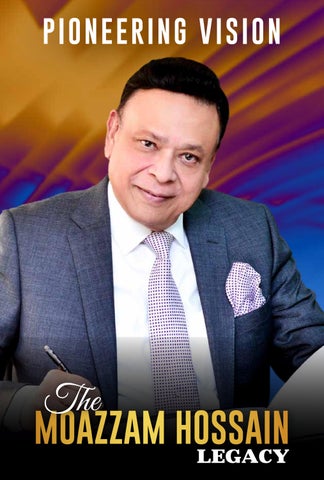
LEGACY MOAZZAM HOSSAIN


First published in 2024 by
ASIAONE MEDIA GROUP
AsiaOne Media Holdings LLC
Office No. 606, 6th Floor, DLF South Court, Saket District Centre, New Delhi - 110017
Email: india@asiaone.co.in
AsiaOne FZE, UAE
Q1-08-0058/C, SAIF Zone Sharjah, United Arab Emirates, PO Box - 124144
Email: dubai@asiaone.co.in
URS AsiaOne PTE LTD.
151, Chin Swee Road. #07-12 Manhattan House Singapore - 169876
Email: Singapore@asiaone.co.in
Text & images copyright © AsiaOne Media Holdings LLC
ALL RIGHTS RESERVED. No part of this book may be reproduced or transmitted in any form by any means, electronic or mechanical, including photocopying and recording, or by any information storage and retrieval system, except as may be expressly permitted in writing by the publisher.
THE MOAZZAM HOSSAIN LEGACY PIONEERING VISION
RNI NO. DELENG / 2016 / 68514 ASIAONE MEDIA GROUP
Foreword
Dr. Kamaluddin Ahmed
Advisor, Hosaf Group Secretary (Retired)
Govt. of People Republic of Bangladesh and Former Executive Chairman of Bangladesh Investment Development Authority (BIDA)
It is both a privilege and delight to pen the foreword for the inspiring biography of Moazzam Hossain, a distinguished figure who has immensely contributed towards the business and social sector of the country for the last fifty years. As someone who has had the honour of knowing Moazzam Hossain personally while witnessing his remarkable journey, I am thrilled to see his story captured in these pages.
Hossain’s life is not merely a narrative of personal success, it is a testament to the transformative power of education when combined with visionary leadership and unyielding dedication. From his early days filled with youthful mischief
to his educational pursuit across global institutions, and his eventual return to Bangladesh to spearhead innovative initiatives in the business arena of a war-torn country, Hossain’s journey is a compelling saga of resilience and ingenuity.
This biography does not only chronicle the milestones of a successful entrepreneur and social worker, but also serves as a beacon of inspiration for the youth of our nation and beyond. His story encourages us to think globally while acting locally, pursuing the boundaries of traditional thinking to meet the demands of the rapidly evolving business in the world.
Congratulations, Mr. Hossain, on the publication of your biography. It is a source of great inspiration and a valuable resource for anyone aspiring to make a significant impact in the field of business or any endeavor they choose to pursue.
Your journey teaches us that with passion, perseverance and a strong desire to make a difference, anything is possible.
Note of Thanks
As I reflect on the journey recounted in my biography, I am overwhelmed with gratitude for the multitude of individuals, who have touched my life and shaped my path.
First and foremost, I extend my heartfelt thanks and gratitude to my parents whose resilience, love and compassion have been my guiding light, igniting within me a profound sense of determination.
To Mr. Uno, son of the Chief Engineer of Mitsubishi of Japan and Mr. Hayshi of a renowned trading company in Japan, my friends, I express my deepest appreciation and gratitude for their unwavering support in my needs and belief in my ability. They have not only empowered me but have also fueled my commitment by introducing me to big business companies in Japan.
To the dedicated staff and employees of Hosaf Group, as well as all those I have had the privilege to work with in my life, I extend my sincere gratitude for your tireless dedication and team work.
My gratitude knows no bounds as I acknowledge the unwavering love and support of my family, who have been my pillars of strength. To my late father, late mother, late father and mother in laws and to my brothers and sisters, my wife, sons, daughters and in laws, and grandchildren I owe everything.
Thank you from the bottom of my heart for being a part of this incredible journey!
With deepest appreciation,
MOAZZAM HOSSAIN
MOAZZAM HOSSAIN
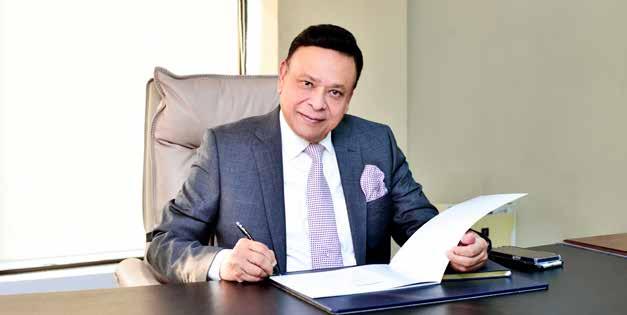
CHAPTER 1
EARLY LIFE AND INFLUENCES OF MOAZZAM HOSSAIN
Moazzam Hossain, the esteemed Chairman of the Hosaf Group in Dhaka, Bangladesh, stands as a beacon of industrial prowess and visionary leadership. With a career spanning decades, Moazzam has propelled the Hosaf Group to the forefront of Bangladesh's private sector, cementing its reputation as a leading entity in commerce and industry. His unwavering commitment to excellence and future-readiness has not only fortified the group's stellar reputation but also significantly contributed to the country's economic landscape. From an early age, Moazzam displayed a progressive mindset, grounded in the principles of honesty, integrity, courage, and tolerance. His journey is a testament to his vision, resilience, and the transformative power of education and international exposure. Today, Moazzam's dedication to uplifting Bangladesh is evident through his numerous philanthropic initiatives, including recruiting academically strong youth from less affluent villages to help them become successful professionals. His early life and educational journey laid the foundation for his remarkable entrepreneurial success and enduring commitment to social responsibility.
CHILDHOOD IN FENI
In a candid conversation, Moazzam Hossain shared profound insights into his early life, educational journey, and the motivations that shaped his entrepreneurial spirit. He was born in Feni, near Chittagong, Bangladesh. Feni district, situated in the southeastern part of Bangladesh, falls under the Chittagong division. Covering an area of 928 square kilometres, it is a region of diverse landscapes and cultural heritage. To the north, Feni is bordered by the Comilla district and India, providing a gateway to cross-
Moazzam Hossain
border interactions and trade. The southern boundary meets with Noakhali and Chittagong districts, highlighting its strategic location within the region.
To the east, Feni shares its border with the Tripura State of India, fostering cultural exchange and connectivity with the neighbouring country. This proximity has historically influenced the district's cultural and economic dynamics. On the western side, Feni is bordered by Noakhali district, creating a harmonious blend of natural landscapes and cultural traditions.
The geographical features of Feni district are diverse, ranging from lush greenery to coastal areas. Its proximity to the Bay of Bengal influences its climate and economic activities, with fisheries playing a significant role in the local economy. The district's strategic location, along with its rich history and cultural heritage, makes it a unique and
vibrant part of Bangladesh.
Moazzam was raised in a nurturing and dynamic environment. His lineage traces back to esteemed figures, with his grandfather, Khan Bahadur Mojaffar Ahmed, a man of great distinction, and his grandmother, Chowdhurani Amena Khatun, known for her grace and wisdom. His family background played a crucial role in shaping his values and ambitions. He attended Feni Pilot High School, one of the twelve best schools selected by the American government at the time. This school played a significant role in his formative years, providing a unique educational environment under the guidance of a head teacher from the USA. The exposure to diverse cultural and educational influences during his school years fostered a broad worldview and a strong foundation for his future endeavours.


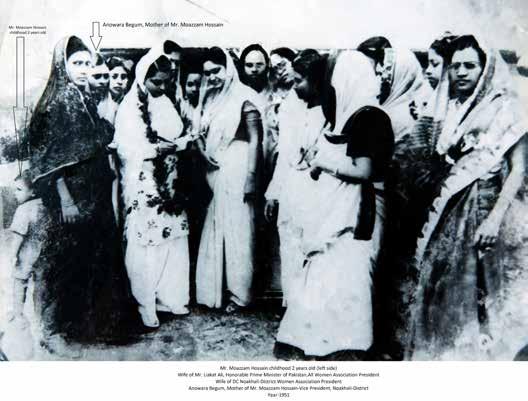
Mr. Moazzam Hossain as a two-year-old (left), pictured with the wife of Mr. Liakat Ali, Prime Minister of Pakistan and President of the All Women’s Association; the wife of DC Noakhali and President of the District Women’s Association; and Anowara Begum, his mother and Vice President of Noakhali District Women’s Association.
Chowdhurani Amena Khatun, grandmother of Mr. Moazzam Hossain captured in the year 1958, embodying the grace and legacy of a bygone era. Mr. Khan Bahadur Mojaffar Ahmed, maternal grandfather of Mr. Moazzam Hossain captured in the year 1880.
Maozzam Hossain was profoundly influenced by his father during his childhood, a period marked by significant turmoil and challenges for Bangladesh. The country, then East Pakistan, was grappling with a multitude of difficulties, both politically and socially. The growing desire for autonomy and subsequent oppressive measures from West Pakistan had intensified public outrage and resistance.
Amidst this backdrop of national unrest and aspiration for independence, Moazzam's father played a crucial role in grooming him into a well-rounded and globally aware individual. Discontent among Bangalee officers and soldiers in the Pakistani military due to systemic discrimination had led to an organised movement towards East Pakistan's independence. The underground movement, resulting in numerous arrests, highlighted the severe political repression and the efforts to undermine demands for autonomy.
Growing up during this turbulent time, Moazzam was exposed to the harsh realities of political struggle and the quest for justice. His father, deeply committed to the cause of Bangladesh’s autonomy, imparted lessons of resilience, perseverance, and leadership. He taught Maozzam the importance of standing firm in the face of adversity and instilled in him a sense of duty towards his nation and its people.
Tragic events where protestors faced brutal suppression left an indelible mark on young Moazzam. The city, overwhelmed with grief and defiance, transformed into a hub of processions demanding justice and autonomy. Despite desperate attempts to quell the growing unrest, the movement's momentum only increased, further fuelling the determination of the Bangalee people. These events underscored the brutal realities of the struggle for
independence and the profound sacrifices made by many. Moazzam's father, amidst this environment, ensured that his son was not only aware of these sacrifices but also understood the broader implications of these historical events. He emphasised the value of education, global awareness, and the importance of contributing positively to society. Through his father's guidance and the backdrop of the national struggle, Maozzam Hossain developed into a well-groomed global citizen, equipped with the values of resilience, justice, and a deep sense of responsibility towards his community and country.
This upbringing laid a strong foundation for Moazzam, enabling him to navigate the complexities of the global business environment while maintaining a steadfast commitment to his roots. His father's influence, during one of the most pivotal times in Bangladesh's history, was instrumental in shaping him into the leader he is today, capable of steering his ventures with a balanced perspective of local and global challenges and opportunities.
THE CRICKET DILEMMA
In times of national uncertainty, Moazzam Hossain's remarkable talent on the cricket field shone as a beacon of hope and potential. His prowess had earned him the coveted opportunity to train with the Pakistan Cricket Control Board in Karachi and Lahore, a notable achievement for a young man from Bangladesh. However, this chance coincided with his crucial high school examinations, creating a significant dilemma. Upon returning home from his training, his father posed a profound question: would he pursue a professional cricket career or focus on his studies to become a doctor or engineer? Reflecting on his father's wisdom and the importance of balancing sports and academics, Moazzam
Moazzam
made the difficult decision to set aside his cricketing dreams and dedicate himself to his studies. This pivotal moment, influenced by the unstable political environment, marked the beginning of his academic journey and highlighted his father's strong influence. Moazzam's unwavering commitment, determination, and adaptability smoothed this transition, as he never compromised on giving his all.
Moazzam's profound interest in cricket reflects his dedication to a game that holds deep historical and cultural significance in Bangladesh and the broader Indian subcontinent. Cricket's popularity in this region is deeply rooted in its colonial past, as Bangladesh was once a part of British India until 1947. This shared history has made cricket not just a sport but a cultural phenomenon enjoying immense support from both state agencies and the masses. The origins of cricket in India can be traced back to the 18th century when the British East India Company introduced the sport. Initially played among British military personnel, cricket gradually spread to the Indian elites who adopted it as a recreational activity. Over time, this colonial pastime evolved into a symbol of resistance against the colonial rule and, eventually, a source of national pride. The game became deeply ingrained in the cultural fabric of the subcontinent, transcending social and economic boundaries.
For Bangladesh, the history of cricket predates its independence in 1971 by nearly two centuries. Cricket was introduced to Bengal by the British in the 18th century, but its growth in East Bengal was slow. Following the Partition and the creation of East Pakistan, both first-class and Test cricket were played in the region during the 1950s and 1960s. Despite cricket's popularity, especially in Dhaka, the country lost its first-class status after independence and had to re-establish itself in international competition as
an Associate Member of the International Cricket Council (ICC). In this context, Moazzam Hossain's passion for cricket is not merely about the sport itself but also about its historical significance and the unifying force it represents for the people of Bangladesh. Growing up in a nation that was rebuilding itself and striving for recognition on the global stage, Moazzam found in cricket a source of inspiration and national pride. His dedication to the game reflects the larger narrative of cricket in Bangladesh—a story of perseverance, resilience, and the quest for excellence.
Cricket in Bangladesh, much like in India, extends far beyond the confines of stadiums. It permeates everyday conversations, influences societal rituals, and brings together people from diverse backgrounds. The legendary performances of cricketers have inspired generations, fostering a sense of collective identity and national pride. For Moazzam, being involved in cricket is a way to connect with this rich heritage and contribute to a tradition that continues to shape the cultural landscape of Bangladesh. Moazzam Hossain's involvement in cricket goes beyond mere fandom; it is a testament to his commitment to preserving and promoting a sport that symbolises much more than just a game. It embodies the struggles, aspirations, and triumphs of a nation. Through his dedication, Moazzam not only honours the historical roots of cricket in Bangladesh but also supports its future, ensuring that the game remains a vibrant and unifying force in his country.
The choice Moazzam made to focus on his studies, influenced by his father's guidance and the unstable political environment did not diminish his love for cricket. Instead, it instilled in him a profound appreciation for balance and the importance of prioritising long-term goals. This decision, though challenging, showcased Moazzam's resilience and
the ability to adapt to changing circumstances, qualities that would later define his professional and personal life. His journey from a promising cricketer to a dedicated student and eventually a successful entrepreneur serves as an inspiring testament to his multifaceted talents and enduring commitment to excellence.
As Moazzam Hossain delved deeper into his academic pursuits, his love for cricket never waned. He followed the sport closely, drawing parallels between the strategic thinking required on the field and the analytical skills he honed in his studies. His ability to navigate complex problems with ease was a testament to the discipline and focus he had developed during his cricket training. This blend of passion and intellect became the cornerstone of his approach to life.
Moazzam's academic journey was marked by significant achievements. He excelled in his studies, earning accolades and scholarships that opened doors to prestigious institutions. His determination to succeed was fuelled by a desire to make his family proud and honour the sacrifices his parents had made. Despite the rigorous demands of his academic schedule, he remained connected to the world of cricket, often volunteering as a coach for local youth teams and organising community tournaments. These activities allowed him to stay close to the sport he loved while giving back to his community.
Over time, Moazzam's academic success led him to a career in engineering. He secured a position with a leading multinational company, where his innovative thinking and problem-solving abilities quickly set him apart. His colleagues admired his ability to remain calm under pressure, a skill he attributed to his cricketing background. Moazzam's rise through the corporate ranks was swift, and
he soon found himself in leadership roles, guiding teams and spearheading major projects.
Despite his professional achievements, Moazzam never forgot his roots. He continued to support cricket initiatives in Bangladesh, sponsoring local teams and providing mentorship to young athletes. His contributions to the sport were recognised by the national cricket board, which invited him to serve as an advisor. In this role, Moazzam helped develop programs aimed at nurturing young talent and promoting cricket in underserved areas. His efforts were instrumental in shaping the next generation of Bangladeshi cricketers, ensuring that the sport remained a source of pride and unity for the nation.
Moazzam's story is a powerful reminder of the importance of following one's passions while also making pragmatic choices. His journey from a cricket-obsessed teenager to a successful engineer and philanthropist highlights the transformative power of dedication and resilience. By balancing his love for cricket with his academic ambitions, Moazzam was able to achieve a level of success that enriched both his personal and professional life. His legacy serves as an inspiration to others, demonstrating that it is possible to honour one's heritage while forging a path toward a brighter future.
EDUCATIONAL PURSUITS AND POLITICAL TURMOIL
Moazzam's academic journey was characterised by determination and excellence, set against the backdrop of a nation in turmoil. He completed his high school education in 1963, followed by his intermediate studies in 1965. By 1967, he had earned his bachelor's degree and, in 1968, he set his sights on Japan for higher studies. This decision was driven not only by academic ambitions but also by the turbulent
Moazzam Hossain
political climate in Bangladesh during its struggle for independence. Moazzam's resolve to pursue education in such an environment strengthened his commitment and resilience.
During his university years, Moazzam experienced firsthand the tumultuous political climate in Bangladesh. The Non-cooperation movement, spearheaded by students, aimed to assert Bangladesh's independence from Pakistani rule. Surgeon Jahrul Hoque hall of the university served as a hub for organising the movement (Surgeon Jahrul Hoque is the cousin of Mr. Moazzam Hossain). However, the movement was met with severe repression. The Pakistani army launched Operation Searchlight, targeting student halls, including Jahrul Hoque hall. This led to a tragic loss of life among the unarmed, peaceful student protesters.
The brutality continued at the university hall, where the army initiated a violent crackdown. They used mortars and indiscriminate firing, resulting in the deaths of numerous unarmed students. The violence extended beyond the dorms, affecting guests of students staying there, who also fell victim to the army's aggression. The situation was dire, with reports suggesting a high number of student deaths in various incidents.
For Moazzam, the unrest hit close to home, quite literally. His family lived in an area known for its peaceful, academic environment. The turmoil became deeply personal when his relative, a supporter of local autonomy and peace, was killed by the Pakistani army. This tragedy deeply affected Moazzam, fuelling his desire to seek education abroad, away from the chaos and violence.
Despite the challenging circumstances, Moazzam remained resolute in his pursuit of education and personal growth. His decision to study abroad was not only a means to
escape the turmoil but also a testament to his determination to succeed despite the adversities he faced. His experiences during this tumultuous time shaped his character, instilling in him a sense of resilience and a commitment to his values, traits that would define his future endeavours.
Living on Chitra Building, Elephant Road during that turbulent period meant that Moazzam's family was in the midst of a political hotbed, where every day brought new challenges and uncertainties. The area was a focal point for political activities and gatherings, drawing attention from both pro-independence activists and Pakistani authorities. The atmosphere was tense, with emotions running high as Bangladesh sought to break free from Pakistani rule.
The constant presence of political activities and demonstrations made life on Elephant Road unpredictable and often dangerous. The family often witnessed protests, rallies, and clashes between protesters and security forces, which added to the stress and anxiety of daily life. The risk of violence and reprisals from the authorities was everpresent, leading to a sense of constant fear and insecurity.
Despite the challenges, living in such a politically charged environment also instilled a sense of resilience and determination in Moazzam and his family. They were exposed to the harsh realities of the independence struggle, witnessing the sacrifices and struggles of their fellow countrymen firsthand. This environment played a significant role in shaping Moazzam's worldview and influencing his decision to seek education abroad as a means to escape the turmoil and contribute to his country's future in a different way.
EDUCATIONAL JOURNEY
Moazzam's educational journey took him from his
Moazzam
hometown to Dhaka, where he pursued a Bachelor of Science with a focus on Chemistry, Mathematics, and Physics under Dhaka University. Securing admission to Dhaka University during the challenging seventies was no small feat, yet Moazzam Hossain's determination and effort saw him through. The rigorous process demanded a keen eye for detail, a quality that Moazzam embodied.
Starting with the meticulous application process, Moazzam navigated the requirements with precision, ensuring that all the necessary forms and documents were submitted on time. His academic prowess shone through, meeting the stringent criteria set for Higher Secondary Certificate (HSC) or equivalent exams.
Choosing his subjects wisely, Moazzam displayed foresight and strategy, understanding the competitive nature of certain departments. Despite the financial considerations, he persevered, recognizing that this investment in his education was invaluable.
Moazzam's success was not just about meeting academic standards but also about showcasing his character and determination. His ability to navigate interviews and document verification demonstrated his readiness for the challenges of university life.
In the end, Moazzam's admission to Dhaka University was a testament to his hard work and dedication. It was not just a milestone in his academic journey but also a reflection of his commitment to excellence and his ability to overcome obstacles with grace and determination.
Excelling in these subjects, he consistently achieved top marks, particularly in Mathematics and Physics. His academic success fuelled his desire to further his studies abroad. Unlike many of his peers who chose the UK or Australia, Moazzam was uniquely drawn to Japan. This
choice was inspired by interactions with Japanese engineers from the Kanematsu Goto Company, who collaborated with his brother-in-law on a large ceramic industry project. The Japanese brochures and the engineers' descriptions captivated him, presenting Japan as an intriguing destination for higher education and cultural exploration.
CHOOSING JAPAN: A UNIQUE DECISION
Choosing Japan over more conventional destinations was a testament to Moazzam's innovative thinking and willingness to explore new horizons. His fascination with Japanese culture, coupled with the encouragement from his brother-in-law's associates, solidified his decision. This move highlighted his desire to step beyond the conventional paths followed by his family and peers, many of whom had studied in the UK. His time in Japan was not just about academic pursuit; it was an opportunity to imbibe the values of discipline, precision, and resilience that are hallmarks of Japanese society. These early experiences and decisions reflect Moazzam's visionary mindset and entrepreneurial spirit. His story emphasises the importance of patience, perseverance, and maintaining a calm demeanour in overcoming challenges. Moazzam's ability to remain composed and thoughtful in the face of adversity has been a cornerstone of his success. His journey from a small town in Bangladesh to becoming a renowned entrepreneur shows the power of determination, innovative thinking, and the pursuit of one's passion.
As a young boy, Moazzam Hossain was captivated by the allure of Japan and its rich culture, a fascination that would shape his life in profound ways. Initially hesitant about the foreign land, Moazzam's perception transformed as he delved deeper into the cultural tapestry of Japan. His
Moazzam Hossain
enchantment grew, and he began to see the beauty in the traditions, the elegance in the customs, and the depth in the history of this unique country.
Moazzam's arrival in Japan marked the beginning of a new chapter, filled with cultural discoveries and personal growth, set against the contrast of his tumultuous homeland. Hosted by the Soni family, prominent business collaborators of his sister-in-law, Moazzam experienced firsthand the rich culture and traditions of Japan. The Sonis' hospitality, characterised by warmth and humility, left a lasting impression on him. The stability and peace in Japan were a stark contrast to the uncertainty in Bangladesh, helping him appreciate the opportunity even more. Moazzam's initial days in Japan were challenging. He struggled with the cultural and culinary differences, losing significant weight and feeling homesick. However, the Sonis' kindness and adaptability helped him gradually acclimate. Mrs. Soni's Japanese cook, Ms. Hariko’s effort to prepare Indian-style curry to make Moazzam feel at home showed their empathy and understanding. His adaptability and determination were crucial in overcoming these initial hurdles, demonstrating his ability to thrive in new environments.
With the support of the Sonis, Moazzam began his studies at Nagoya Technical University. He faced the rigorous academic environment head-on, while also learning Japanese to better integrate into his new surroundings. Despite the initial cultural shock, Moazzam found solace in the humility and discipline of the Japanese society. The simplicity of their lifestyle, even among the wealthy, taught him valuable lessons in humility and contentment. His unwavering commitment to his education and his ability to adapt played a significant role in his success. Moazzam's
Moazzam Hossain
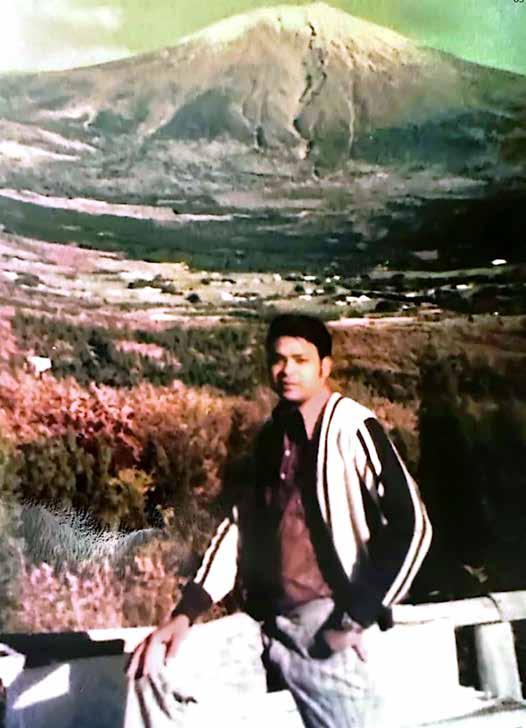
Nepal University: A nostalgic moment from 1969, as Mr. Moazzam Hossain stands proudly in front of the majestic Mount Fuji, Japan—a snapshot of his early explorations.
journey to Japan was not just a physical relocation but an emotional and intellectual transformation. The memories of political turmoil in Bangladesh and the serene, structured life in Japan created a stark contrast in his experiences. This period of his life taught him resilience, adaptability, and the pursuit of knowledge amidst adversity. His determination to make the most of his circumstances and his unwavering commitment to his goals were evident throughout this journey.
Moazzam's love for Japan stemmed not just from its modernity but also from its deep-rooted history. He admired how Japan's ancient past seamlessly blended with its contemporary society, creating a harmonious balance between tradition and innovation. This blend was reflected in every aspect of Japanese life, from its architecture to its art, and it left a lasting impression on Moazzam.
What truly enamoured Moazzam was Japan's commitment to preserving its cultural heritage while embracing modernisation. He saw how Japan revered its past, with temples and shrines standing tall amidst bustling cities, bound to its rich history. Yet, he also witnessed Japan's technological advancements and its forward-thinking approach, which fascinated him and inspired him to strive for excellence in his own endeavours.
Moazzam's admiration for Japan was not just superficial; it was deeply rooted in his appreciation for the values and traditions that underpinned Japanese society. He admired the discipline and dedication of the Japanese people, their respect for elders, and their commitment to excellence in all aspects of life. These values resonated with him and became an integral part of his own ethos.
Ultimately, Moazzam's journey in Japan was not just about exploring a new culture; it was about discovering
himself. His time in Japan taught him the importance of embracing diversity, respecting traditions, and striving for excellence in everything he did. It was a transformative experience that shaped his worldview and instilled in him a deep appreciation for the beauty and complexity of different cultures.
EARLY ENTREPRENEURIAL INCLINATIONS
From a young age, Moazzam displayed an inclination towards business. He recounted a pivotal moment at the age of twelve when he decided against pursuing a traditional professional career, opting instead for the entrepreneurial path. Observing his grandmother and mother engage in seasonal trading—buying paddy during the rainy season to sell at higher prices in winter—sparked his interest in market dynamics and the potential of business. This early exposure to trading not only taught him the basics of supply and demand but also inspired a lifelong passion for entrepreneurship.
Moazzam’s humane qualities and strong commitment to a value-based life have significantly contributed to his growth as a leader. His unwavering dedication to ethical principles and social responsibility has earned him immense respect and recognition. These qualities have been instrumental in establishing him among the top business houses of Bangladesh. His business decisions are deeply rooted in the values he inherited from his family, emphasising fairness, integrity, and the well-being of the community. This ethical approach has not only driven his success but also created a legacy of trust and respect within the business community and beyond.
Moazzam Hossain's early years were marked by a profound respect for his cultural heritage and strong family
values. Growing up in a culturally rich environment, he developed a deep appreciation for traditions and customs, which greatly influenced his outlook on life. This respect for his cultural roots was evident in his admiration for the elegance of the sari, traditional Bengali attire, reflecting his appreciation for the finer aspects of his culture.
Family was a central pillar in Moazzam's life, and this was reflected in his approach to important decisions, such as marriage. Despite his own reservations and personal preferences, he valued his family's opinions and sought their advice in matters of great significance. His sister's enthusiastic efforts to find him a suitable match showcased the importance he placed on familial relationships and the respect he had for their involvement in his life decisions.
Moazzam's respect for family extended beyond his immediate relatives to include close family friends, such as General Karim. Their friendship, rooted in their shared cultural background and experiences, played a pivotal role in Moazzam's life. General Karim's introduction of Mary, his sister's daughter, as a potential match for Moazzam highlighted the interconnectedness of relationships in his life and the significance he placed on cultural and familial connections. In his interactions with General Karim and Mary, Moazzam demonstrated a sense of humility and openness, despite his initial shyness. His willingness to consider General Karim's proposal and meet Mary at the university showed his respect for the introductions made by his family and close friends. He truly believed in the importance of these connections and the value he placed on cultural compatibility in relationships.
Overall, Moazzam Hossain's early life reflects a young man deeply rooted in his cultural heritage and family values. His respect for tradition, appreciation for cultural nuances,
and strong familial bonds laid the foundation for his future endeavours and leadership style. These early experiences shaped his character and decisions, guiding him towards a path of responsibility, respect, and cultural preservation. Moazzam’s narrative is not just about business success; it is also about the values he upholds and the legacy he aims to create. His early decisions, influenced by his family’s ethical practices and his own entrepreneurial ambitions, laid the groundwork for his later achievements. Today, Moazzam's story serves as an inspiration to aspiring entrepreneurs, proving that with vision, dedication, and a commitment to ethical values, one can achieve remarkable success and make a meaningful impact on society. His journey emphasises the importance of leading with empathy, integrity, and a sense of purpose, qualities that have defined his path and continue to shape his contributions to the business world and the community.
Moazzam Hossain's early life and family influence laid the groundwork for his future endeavours. His father's guidance, the pivotal decision to prioritise academics over cricket, and his experiences amidst political turmoil and cultural adaptation in Japan all contributed to shaping the man he would become. These formative years, marked by unwavering commitment, determination, grit, hard work, and adaptability, imbued him with resilience, humility, and a deep appreciation for knowledge and cultural diversity, setting the stage for his future successes as the Chairman of Hosaf Group. His story is a testament to the power of values and hard work in overcoming adversity and achieving greatness.
Moazzam
CHAPTER 2
FAMILY AND PERSONAL REFLECTIONS OF MOAZZAM HOSSAIN
Moazzam Hossain, Chairman of Hosaf Group, is a man whose life is deeply intertwined with both professional achievements and personal values. His journey from a curious student in Japan to a visionary leader in Bangladesh is marked by continuous self-reflection and a commitment to integrity. In this chapter, we explore the profound impact of his family, the unwavering support of his wife, and the shared values that have guided his life and leadership. Through introspection, Moazzam has developed a strong selfconcept that not only influences his personal relationships but also drives his vision for societal transformation. This chapter delves into the essence of his reflections, highlighting the importance of unity, adaptability, and the enduring legacy he strives to build for his community and country. Self-reflection has been a cornerstone of Moazzam Hossain’s life, contributing significantly to his self-concept and overall identity. By meditating on his character, actions, and motives, he has been able to navigate his roles with clarity and integrity. This practice has influenced his mood, judgment, and behaviour, enhancing his personal growth and ability to lead. Through his reflections on family, relationships, and future vision, Moazzam continues to inspire those around him, embodying the essence of a reflective and visionary leader.
ESTABLISHING A LEGACY: THE HOSAF FAMILY AND BUSINESS
For "Hosaf Group", Moazzam designed the logo himself, as he wanted to be personally involved in every aspect of the business. This personal touch extends to the employment benefit schemes and insurance policies introduced by Moazzam, which were revolutionary at the time and set a
precedent for corporate social responsibility in Bangladesh.
Looking ahead, Moazzam is focused on several ambitious projects, including a 100-megawatt solar power plant and a coal mine joint venture with a Chinese company. These initiatives reflect his commitment to sustainable development and energy security, embodying his vision for a greener and more efficient future.
Self-reflection, defined as “meditation or serious thought about one’s character, actions, and motives,” is a practice that Moazzam Hossain has deeply integrated into his life. For Moazzam, taking a step back to reflect on his life, behaviour, and beliefs has been instrumental in shaping his self-concept, which is a vital component of his identity. This practice has allowed him to navigate the complexities of his roles as a family man, entrepreneur, and visionary leader with clarity and purpose.
Moazzam’s self-concept, encompassing his thoughts about his traits, abilities, beliefs, values, roles, and relationships, has been significantly influenced by his regular self-reflection. This self-awareness has not only enhanced his personal growth but has also positively impacted his interactions with others, his decision-making processes, and his overall approach to life.
The practice of self-reflection has played an influential role in Moazzam’s mood, judgment, and behavioural patterns. By regularly evaluating his thoughts and actions, he has been able to cultivate a positive mindset and maintain emotional balance, even in the face of challenges. Moazzam’s reflections often extend to his family and the unique bonds he shares with each member. He takes pride in the achievements and roles of his children, each contributing significantly to the family business and society at large. His eldest son, Mabroor Hossain is deeply
involved in the family business, embodying the values and work ethic Moazzam has instilled.
Reflecting on his siblings, Moazzam acknowledges their significant contributions to society and their influence on his life. His sister’s involvement in social service, following in their mother’s footsteps, highlights the family’s commitment to community welfare. These familial ties and shared values underscore the importance of unity and support, principles that have guided Moazzam throughout his life.
Moazzam's success story is intricately woven with the strong support and unwavering love of his family, which have been a driving force behind his achievements. Throughout
Moazzam Hossain
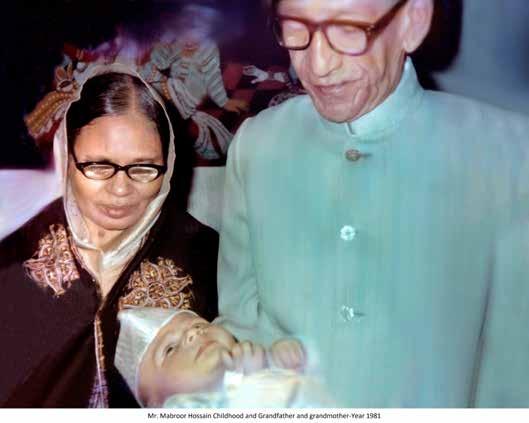
A heartwarming family moment from 1981, capturing a young Mr. Mabroor Hossain with his beloved grandparents.
his journey, his family has stood by him, offering not just financial support but also emotional encouragement and a sense of security.
His eldest son, Mabroor Hossain, who followed in his father's footsteps by completing his MBA from United College London (UCL) in the UK, has been instrumental in expanding and realising Moazzam's business vision. Mabroor’s involvement is not just about professional growth but also about honouring the family's legacy and values, which have been passed down through generations.
Moazzam's younger son Mudrek Hossain, after completing his under graduation degree in Economics from United College London (UCL) and post graduation from London School of Economics (LSE), joined Deloitte and started his career there. He completed his Chartered Accountancy while working at Deloitte. Mudrek has a strong passion for golf and has thereby played and participated in
a number of tournaments since childhood. He has won a lot of tournaments and is now a member of the Finchley club in the UK where he is a regular golfer.
Moazzam's daughter, Mehtaj Hossain completed her under graduation from United College London (UCL) and post graduation from London School of Economics (LSE) in the UK. She is known for her exceptional administration skills, exemplifies the family's commitment to excellence. Her efficient leadership in the finance department reflects the values instilled by Moazzam and his wife, emphasising the importance of dedication and hard work.
Similarly, his economist son's achievements are a testament to the intellectual rigour and commitment to education within the family. His advisory roles with major corporations on knowledge and innovation, traits that have been pivotal in Moazzam's own success.
During the challenging times of the COVID-19 pandemic, Moazzam's youngest daughter's Melika Hossain under graduation from Smith, Boston, USA selfless dedication to her parents' well-being underscores the deep bond and mutual care that define the Moazzam family. Her actions reflect the values of compassion and support that have been at the core of their family dynamic.
Overall, the strong support from his family has not only provided Moazzam with a sense of happiness and balance but has also been instrumental in his success. Their encouragement, solidarity, and belief in his abilities have been essential for his mental health and resilience, laying a strong foundation for his achievements and the continued success of the Moazzam family.
MEMORIES OF SIBLINGS AND THEIR CONTRIBUTIONS
Moazzam Hossain's reflections on his siblings, especially
Moazzam Hossain
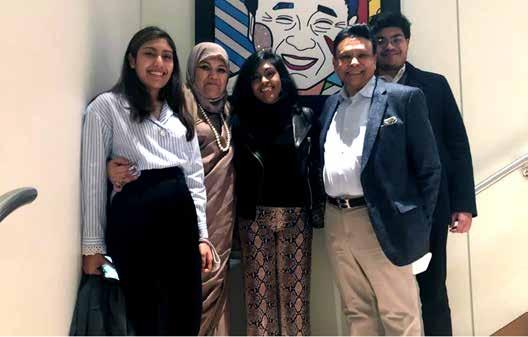
A cherished family portrait featuring Moazzam’s wife, their eldest daughter Mehtaj, younger son Murdek, and younger daughter Melika Hossain.
his sister's contributions, highlight the importance of family values and social service in their lives. His sister's active involvement in the All Women Association, following their mother's legacy, showcases a commitment to social welfare and community development. This dedication to service underscores the values instilled in them by their upbringing, emphasising the importance of giving back to society.
In Bangladesh, the challenges faced by both men and women in accessing high-quality, full-time employment are significant, with many jobs concentrated in the informal sector. However, women often face additional hurdles, including limited access to financial resources and opportunities for advancement. This disparity is exacerbated by structural barriers such as gender discrimination, limited job access, and heavy domestic responsibilities, all of which contribute to women's unemployment and underemployment.
Despite these challenges, Moazzam's family's unity and mutual support serve as a beacon of hope and resilience. Their shared values and commitment to social service demonstrate a deep-rooted belief in making a positive impact on society, even in the face of adversity. This unity not only strengthens their familial bonds but also inspires others to strive for social change and equality.
Moazzam's memories of his siblings and their contributions focus on the importance of family support and shared values in navigating life's challenges. Their dedication to social service and community welfare serves as a powerful example of the impact individuals can have when they work together towards a common goal.
The story of Moazzam began with a unique and remarkable meeting that laid the foundation for a lifelong
partnership with Mrs. Ilya R. Hossain, an Honours graduate in Social Welfare at Dhaka University. After returning from Japan, Moazzam was immersed in various business ventures. Despite his family's efforts to introduce him to numerous potential brides, none seemed to capture his interest. However, fateful meeting arranged by Moazzam’s sister at a university brought into his life partner.
Moazzam’s marriage to Mrs. Ilya R. Hossain is another area where self-reflection has played a critical role. Reflecting on their unique and remarkable meeting, Moazzam often expresses gratitude for Mary’s grace, simplicity, and unwavering support. Her role extends beyond personal support to professional involvement, managing the insurance company they established and balancing family responsibilities with remarkable skill. Mary’s independence, nurturing nature, and integrity have been pillars of support for both Moazzam and the Hosaf Group, reinforcing the values of dedication, compassion, and loyalty.
Moazzam Hossain never shies away from sharing the profound impact of his wife, Mary, on his life. He describes Mary as a source of unwavering emotional support, guiding him through life's ups and downs with grace and strength. Coming from a reputable family, influence has played a pivotal role in his personal and emotional growth. She has been not just a life partner but also a mentor, encouraging him to strive for excellence in all aspects of life. Her companionship has brought joy and meaning to his life, creating a deep bond built on trust and mutual respect. Moazzam emphasise role in his personal development, highlighting her influence in shaping him into the person he is today.
Mrs. Ilya R. Hossain, in her early years of studying for
Moazzam
her honours degree in Public Relations, stood out with her grace and simplicity. Wearing a simple yet elegant sari, she immediately captivated Moazzam. Their connection was instant, and Moazzam expressed his interest in getting to know her better. Learning about her distinguished family background further solidified his confidence in pursuing a relationship with her. Her uncle, General Karim, was a high-ranking officer in the Pakistan Army and a close friend of Moazzam, who has taken initiative to marry Mrs. Ilya R. Hossain.
Mrs. Ilya R. Hossain and Moazzam’s partnership extended beyond personal support to professional involvement. After they married, Mary took on the role of Director in the insurance company they established. Her dedication and skill in managing the company balanced with her responsibilities at home were remarkable. She ensured the education and upbringing of their children with great care, instilling in them the values of obedience, manners, and education.
An independent and nurturing partner, Mary embodies the qualities of self-respect, dedication, compassion, kindness, loyalty, and integrity. Her understanding of the purpose of life and her unwavering support have been crucial pillars in both their personal lives and the success of Hosaf Group. Even at 68, Mary remains youthful in spirit, reflecting the vitality and grace that have characterised her throughout their marriage.
Mrs. Ilya R. Hossain’s role in supporting Hosaf Group cannot be overstated. Her involvement in the insurance company and her ability to balance family and professional responsibilities have significantly contributed to the group's success. Her independence, nurturing nature, and dedication have made her a central figure in the family's
narrative and business ventures. Mary’s compassionate and kind nature, combined with her loyalty and integrity, have been instrumental in creating a supportive and harmonious environment for the Hosaf Group to thrive.
BALANCING FAMILY AND BUSINESS
Throughout their marriage, Mary has managed to balance family and business responsibilities with remarkable skill. Her ability to nurture and support her children, while also contributing to the family business, showcases her multifaceted talents. Mary ensured that their home was filled with love and care, providing a stable and nurturing environment for their children to grow up in.
Mrs. Ilya R. Hossain’s dedication to her family and business reflects shared values of integrity, compassion, and commitment. Her support has enabled Moazzam to focus on his vision for societal transformation and business success, knowing that he has a steadfast partner by his side. Together, they have navigated the complexities of life and business, building a legacy of love, support, and shared purpose.
Mrs. Ilya R. Hossain is more than just Moazzam’s wife; she is a central figure in his personal and professional narrative. Her grace, simplicity, and unwavering support have been instrumental in both their personal lives and business ventures. As an independent, nurturing, and dedicated partner, Mary has played a crucial role in the success of Hosaf Group. Her qualities of compassion, kindness, loyalty, and integrity, combined with her understanding of the purpose of life, have made her a great pillar of support for Moazzam and the entire Hosaf Group.
Mrs. Ilya R. Hossain continues to be a pillar of strength in Moazzam's life, playing a pivotal role in his personal and
emotional growth. Coming from a reputable family, she brings grace, decency, and education to their relationship, enriching Moazzam's world in numerous ways. As his girlfriend and later his wife, Mary has been providing him with unwavering emotional support, standing by him through both the good and bad times. Her presence is a source of comfort and reassurance, helping Moazzam navigate life's challenges with confidence.
Beyond emotional support, Mary plays a significant role in Moazzam's personal growth. Her influence encourages him to strive for excellence in all aspects of life, pushing him to be a better person. She is not just a partner but a mentor, guiding him towards self-improvement and helping him realise his full potential.
In addition to being a life partner, Mary is a constant companion to Moazzam, sharing life's experiences and joys. Their companionship creates a deep bond between them, strengthening their relationship and providing a sense of unity and purpose. Mary's presence brings joy and meaning to Moazzam's life, making every moment they spend together special and memorable.
In conclusion, Mary's role in Moazzam's life is profound and multi-faceted. As a partner, mentor, and friend, she provides him with the emotional support, personal growth, companionship, and relationship skills necessary for a fulfilling and meaningful life. Her presence enriches every aspect of Moazzam's life, making her an indispensable part of his journey.
VISION BEYOND BUSINESS
Effective leaders are often characterised by key traits such as accountability, adaptability, confidence, creativity, empathy, positivity, and team-building skills. Moazzam, the visionary
Chairman of Hosaf Group, exemplifies these qualities in his approach to business and societal transformation. His leadership has not only driven the success of his company but also led to significant societal progress in Bangladesh.
Moazzam’s vision extends beyond mere business success. He emphasises the importance of preparing the younger generation to adapt to a rapidly changing world. Recognising the impact of technological advancements, he advocates for the integration of technology and innovation in everyday life. His forward-thinking insights predict a future where remote work, online education and digital transactions become the norm, ensuring that his legacy is one of societal progress and adaptation.
Moazzam's leadership is marked by a strong sense of accountability. He takes responsibility for the outcomes of his decisions, ensuring that both successes and failures are learning opportunities. His adaptability has allowed Hosaf Group to navigate the complexities of the business world and the evolving socio-economic landscape of Bangladesh. By embracing change and encouraging flexibility, he has positioned his company and community to thrive in the face of new challenges.
Confidence and creativity are hallmarks of Moazzam’s leadership. His confidence in his vision and decisions has instilled trust and respect among his team members and stakeholders. Creativity in problem-solving and strategic planning has enabled Hosaf Group to innovate and lead in various sectors, from energy solutions to social responsibility initiatives.
Empathy is a cornerstone of Moazzam’s approach to leadership. He understands the needs and concerns of his employees, customers, and community, fostering a supportive and inclusive environment. His positivity and
optimism have been crucial in motivating his team and driving forward the company’s mission. By maintaining a positive outlook, he has been able to inspire others to pursue ambitious goals and contribute to societal wellbeing.
Moazzam’s vision extends beyond business to societal transformation, a perspective deeply rooted in his reflective practices. This vision is a testament to his foresight, humility, and entrepreneurial spirit, shaped and refined through continuous self-reflection.
FOSTERING COLLABORATION AND SOCIETAL TRANSFORMATION THROUGH TECHNOLOGICAL ADAPTATION
Team-building skills are essential to Moazzam’s leadership style. He values collaboration and actively works to build strong, cohesive teams that can tackle complex challenges. By fostering a culture of teamwork and mutual respect, he has created an environment where innovation and excellence thrive.
Moazzam’s advocacy for technology and innovation is a key aspect of his vision for societal transformation. He understands that the future will be shaped by digital advancements and strives to prepare the younger generation for this reality. His efforts to promote remote work, online education, and digital transactions highlight his commitment to integrating technology into daily life, thus enhancing efficiency and accessibility.
Moazzam Hossain’s journey from a student to a visionary leader in Bangladesh is a testament to his foresight, humility, and entrepreneurial spirit. His ability to navigate different cultures, seize opportunities, and lead with integrity has shaped the success of Hosaf Group and continues to inspire
those around him. His story encapsulates the essence of a man who sees beyond the present and envisions a brighter future for his community and country. By embodying these leadership traits, Moazzam has not only achieved remarkable business success but also made significant contributions to societal progress. His legacy is one of transformative leadership, driven by a commitment to accountability, adaptability, confidence, creativity, empathy, positivity, and team-building. Through his efforts, Moazzam Hossain has paved the way for a future where technology, innovation, and societal wellbeing are intertwined, ensuring that his impact will be felt for generations to come.
Moazzam Hossain
CHAPTER 3
GENESIS OF HOSAF GROUP
The Hosaf Group emerged during the most challenging period in Bangladesh's history, at a time marked by widespread poverty, political instability and severe skill shortages. Amidst this backdrop of adversity, the group's founding is a testament to the vision and tenacity of Mr. Moazzam Hossain. Hosaf International addressed critical needs and stimulated economic activity by introducing innovative solutions like importing reconditioned cars, microbuses and irrigation pumps to drive commerce in the region. The group's commitment to modernisation, exemplified by the introduction of gas and water meters, showcased their forward-thinking approach. Despite the immense challenges of those times, Hosaf Group's strategic initiatives and relentless drive laid a robust foundation for growth, making it a cornerstone of Bangladesh's economic development. Their resilience and ingenuity during these tumultuous times highlight the greatness of Hosaf Group as a pivotal force in the nation's progress.
THE CHALLENGES OF POST-INDEPENDENCE BANGLADESH
The early years of Bangladesh's independence were characterised by a host of challenges that threatened to derail the nation's progress. However, the resilience and determination of its people, combined with strategic efforts by both the government and private sector, enabled the country to overcome these obstacles. The story of Bangladesh's recovery is a testament to the indomitable spirit of its leaders and entrepreneurs, who navigated an environment of widespread poverty, political instability, infrastructure deficits and the daunting task of rehabilitation and reconstruction — to lay the foundations for a brighter
The war of independence in 1971 left deep scars, and the path to recovery was strewn with obstacles that tested the resilience and determination of the country's leaders and entrepreneurs.
In the aftermath of independence, Bangladesh faced formidable challenges that made setting up and running a business a daunting task. The widespread poverty that afflicted the nation was a significant obstacle. The war had left the economy in ruins, with a large portion of the population struggling to make ends meet. This dire economic situation made it difficult for businesses — mostly for the ones importing goods, due to shortage of foreign currency — to find a market for their products and services. The lack of purchasing power among the populace dampened demand, creating a challenging environment for entrepreneurs.
Moreover, the political instability that plagued postindependence Bangladesh added another layer of complexity. The frequent changes in government and policy shifts created an environment of uncertainty. Entrepreneurs had to contend with a volatile political landscape where long-term planning was nearly impossible. The instability also led to inconsistent economic policies, further complicating the business environment. This constant state of flux made it challenging for businesses to adapt and thrive, as they were constantly forced to reassess their strategies in response to changing political dynamics.
In addition to the economic challenges, the psychological impact of the war losses, genocide, and the crippled economy had a profound effect on the minds of the common folk in Bangladesh. The scars of war ran deep, with many individuals and families grappling with the
trauma of loss and violence. The genocide perpetrated by the Pakistani army left a legacy of pain and suffering that reverberated throughout the nation.
Since the war losses were not just material; they also included the loss of lives, livelihoods, and a sense of security. Many people lost their homes, their loved ones, and their sense of normalcy. The atrocities committed during the war left a lasting impact on the psyche of the Bangladeshi people, creating a sense of fear, distrust, and uncertainty about the future.
The crippled economy only exacerbated these psychological challenges, as people struggled to rebuild their lives amidst the rubble of war. The lack of basic necessities, such as food, shelter, and healthcare, added to the burden of the already traumatized population. The combination of these factors created a heavy psychological future.

The visionary Hosaf Tower, a towering symbol of ambition and progress envisioned by Mr. Moazzam Hossain.
toll on the people of Bangladesh, making it difficult for them to envision a brighter future.
Despite these challenges, entrepreneurs like Moazzam Hossain persevered, driven by a strong sense of determination and resilience. They navigated the complex economic and political landscape, finding innovative ways to overcome obstacles with sheer will and tenacity to build successful enterprises. Their stories serve as a testament to the indomitable spirit of the Bangladeshi people, who refused to be defined by the challenges they faced, but instead, forged ahead with the courage to build a brighter future for themselves and their nation. Mr. Moazzam Hossain introduced the ‘pay as you earn’ basis system post independence, as the country didn’t have any foreign exchange to invest in industries.
INFRASTRUCTURE DEFICITS CAUSED BY WAR
The war-torn landscape of Bangladesh post-independence presented a formidable challenge in rebuilding its infrastructure. The country faced a severe shortage of adequate transportation networks, reliable energy sources, and efficient communication systems. The destruction caused by the war had left roads, bridges, and other critical infrastructure in ruins, severely limiting the movement of goods and people. This lack of infrastructure hindered the growth of industries, making it difficult for businesses to operate smoothly and efficiently.
The energy sector was also severely affected, with frequent power outages and a shortage of reliable energy sources. This posed a significant challenge for industries that required a consistent and stable power supply to operate effectively. Additionally, the communication systems in Bangladesh were underdeveloped, with limited
access to modern telecommunications infrastructure. This made it difficult for businesses to communicate with their suppliers, customers, and partners, further complicating their operations.
These infrastructure deficits not only hindered the growth of existing industries but also deterred potential investors from investing in Bangladesh. The lack of reliable infrastructure made it risky for investors to establish businesses in the country, as they were unsure of the reliability and efficiency of the infrastructure. This further exacerbated the challenges faced by Bangladesh in its efforts to rebuild and develop its economy in the aftermath of the war.
REVIVING FINANCIAL, INDUSTRIAL, AND BUSINESS SECTORS
Many financial institutions, industries, and businesses had been disrupted or destroyed during the war. Restoring these sectors was crucial for economic recovery. This revival required substantial effort and investment, as well as innovative strategies to rebuild the confidence of both domestic and international stakeholders. The financial sector needed to be stabilised to facilitate investment, while industrial and business sectors had to be revitalised to generate employment and spur economic activity.
The human toll of the war was immense. Thousands of people had lost their homes, livelihoods, and loved ones. Rehabilitating displaced individuals and rebuilding damaged infrastructure were monumental tasks. The government and private sector had to work tirelessly to provide basic necessities and restore a sense of normalcy. This period of rehabilitation and reconstruction required immense resources and coordinated efforts to address
the immediate needs of the population while laying the groundwork for future development.
GOVERNMENT EFFORTS AND PRIVATE SECTOR PARTICIPATION
The government of Bangladesh played a crucial role in reviving the country after the devastation of the war. Despite the challenges it faced, the government prioritised the reconstruction and economic development, implementing policies to promote agriculture, industrialization, and private sector participation. This commitment to rebuilding was met with equal determination from entrepreneurs like Mr. Moazzam Hossain, who played a significant role in driving economic recovery forward.
Strategic planning was another cornerstone of the government's efforts. Comprehensive plans were formulated to address various aspects of development, including military, diplomatic, and domestic initiatives. This strategic approach, coupled with support from countries like India during Bangladesh's liberation war, played a crucial role in achieving successful outcomes.
One of the key strategies employed by the government was the construction of rural feeder roads in the late 1980s and 1990s. These roads connected villages to larger cities, improving connectivity and accessibility throughout the country. By 1997, the network of feeder roads had expanded from 3,000 kilometers to 15,500 kilometers, transforming rural infrastructure and opening up new opportunities for economic growth.
These efforts bore fruit, with Bangladesh having achieved sustainable economic growth, significant poverty reduction, and improvements in human development
indicators since its independence. The government's strategic contributions, in spite of hindrances, have been instrumental in shaping Bangladesh's development over the past five decades.
THE ESTABLISHMENT OF HOSAF GROUP: OVERCOMING CHALLENGES
Establishing Hosaf Group in the challenging economic and political landscape of Bangladesh was no small feat. The post-independence era was fraught with difficulties, including infrastructural damage, political instability, and a struggling economy. Amidst these obstacles, Mr. Moazzam Hossain's unwavering grit, determination, and hard work laid the foundation for what would become one of the country's leading private sector entities to help the government of Bangladesh to set up power plant under supplier’s credit with soft loan from China.
GENESIS OF HOSAF GROUP: A LEADING CONGLOMERATE
The Hosaf Group's remarkable journey began in the war-torn landscape of post-independence Bangladesh. Amidst the chaos and uncertainty of a newly sovereign nation, Mr. Moazzam Hossain founded Hosaf Group with a vision of transforming adversity into opportunity. From its humble beginnings, the company set out with a relentless commitment to excellence, aiming to establish itself as a preeminent business institution across various sectors. Under Mr. Hossain's exemplary leadership, Hosaf Group grew to embody values of integrity, responsibility and respect, setting new benchmarks in each industry it entered. In order to help the banking sector, Mr. Moazzam Hossain, along with a few of his close friends and famous
Moazzam Hossain
banker Mr. Hyder Chowdhury, set up the first private bank called National Bank of Bangladesh in 1981.
NAVIGATING A POST-WAR ECONOMY
In the aftermath of Bangladesh's war of independence, the nation's economy was in dire straits. The extensive damage to infrastructure, coupled with political upheaval, created a daunting environment for business ventures. Establishing a private enterprise required navigating bureaucratic red tape, securing financial resources, and dealing with unreliable supply chains. Mr. Hossain faced these challenges head-on, leveraging his entrepreneurial spirit and resourcefulness to identify opportunities wherever he saw obstacles.
OVERCOMING FINANCIAL HURDLES AND BUILDING A RELIABLE SUPPLY CHAIN
Securing capital for new ventures in a war-torn country posed significant difficulties. Traditional financial institutions were often reluctant to lend to emerging businesses due to the high risks involved. Mr. Hossain's determination and resolve were critical in overcoming these financial hurdles. To address this issue, he sought out alternative funding sources, including international trade partners and personal savings, to kickstart his business initiatives. His ability to build trust and credibility with stakeholders played a crucial role in garnering the necessary support to establish Hosaf Group.
In a country grappling with infrastructural deficiencies, establishing a reliable supply chain was a formidable challenge. The import of goods and materials was often hampered by logistical issues and inconsistent regulatory policies. Mr. Hossain's strategic thinking and perseverance were key to overcoming these barriers. He forged strong
relationships with international suppliers and partners, ensuring a steady flow of resources essential for his business operations. His innovative approach to problemsolving and unwavering focus on quality helped Hosaf Group navigate these supply chain complexities.
CREATING A SKILLED WORKFORCE
In the nascent stages of Bangladesh's industrial sector meant that finding and developing a skilled workforce was another significant challenge for entrepreneurs. Mr. Hossain's commitment to excellence drove him to invest in training and development programs for his employees. He recognised the importance of building a knowledgeable and capable team to drive the growth of Hosaf Group. Through continuous training and mentorship, he cultivated a workforce that was not only skilled but also aligned with the company's values and vision.
Mr. Moazzam Hossain's journey as the Chairman of Hosaf Group is a testament to his undying spirit and relentless pursuit of doing something worthwhile in a country ravaged by war and economic challenges. His innovative and strategic initiatives have significantly contributed to Bangladesh's economic development, showcasing his unwavering commitment to transforming the nation.
VISION OF HOSAF GROUP
Hosaf Group's evolution from its humble beginnings in a war-ravaged Bangladesh to a prominent conglomerate accentuates the visionary leadership of Mr. Moazzam Hossain and the group's unwavering dedication to its core values. The mission of Hosaf Group — deeply connected to Mr. Hossain's personal vision — is to establish itself as
Moazzam Hossain
a leading business institution by strategically expanding its influence across all levels of operation and within every sector it participates in.
Mr. Hossain's unstoppable quest for excellence has shaped the company's goal to be a dominant and respected presence, fostering innovation and setting new standards of performance in each industry it enters. He envisions Hosaf Group as a beacon of integrity, responsibility, and growth, with a commitment to sustainability and social welfare.
Under Mr. Hossain's leadership, the group's vision is not just to achieve business success but to drive meaningful change and contribute to national development. By integrating cutting-edge technology, ethical practices, and a growth-oriented mindset, Hosaf Group strives to exceed expectations and create value for its stakeholders. This
vision is additionally anchored in a deep sense of duty towards the community and the environment, reflecting Mr. Hossain's belief that true progress encompasses economic, social, and environmental dimensions. Through this comprehensive approach, Hosaf Group aims to inspire other businesses and set a powerful example of sustainable and inclusive growth.
OVERCOMING CHALLENGES AND ESTABLISHING A LEGACY
The path to establishing Hosaf Group was fraught with challenges, including bureaucratic red tape, difficulty in obtaining necessary approvals, and an underdeveloped business infrastructure. Despite these obstacles, Mr. Hossain's strategic vision and unwavering determination turned these challenges into opportunities for growth and innovation. By building strong relationships with key stakeholders and leveraging strategic investments, Hosaf Group overcame these initial hurdles and laid a solid foundation for its future endeavours.
Through strategic diversification and innovative solutions, such as introducing reconditioned cars and venturing into deep-sea fishing, Hosaf Group continually found ways to turn potential crises into opportunities for growth. This ability to adapt and innovate in the face of adversity has been a hallmark of the company's success.
PIONEERING DEEP-SEA FISHING AND BARTER TRADE
In 1975, Mr. Hossain ventured into the unexplored domain of deep-sea fishing by initiating Bangladesh's first joint venture with South Korea. This bold move demonstrated his innovative thinking and willingness to explore new frontiers. The joint venture not only introduced advanced
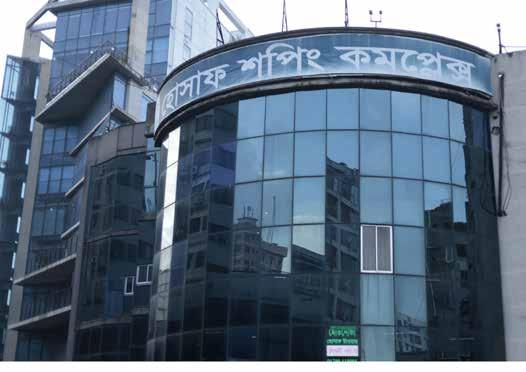
Hosaf Shopping Complex and Hosaf Convention Centre, a landmark destination in Malibagh, Dhaka, Bangladesh.
Further diversifying his ventures, Mr. Hossain facilitated barter trade with East European countries. He imported truck-mounted standby generators, leather, tea, and steelbody trucks, showcasing his strategic acumen in leveraging international trade for national development. These barter trade initiatives not only strengthened Bangladesh's trade relations but also ensured the availability of essential goods and services, aiding in the country's recovery and growth. The idea of standby genset mounted on a truck was given by Mr. Moazzam Hossain to the manufacturer, Mr. Poland Pazale, to overcome the shortage of electricity supply in hospitals, water pump stations and various emergency power supply departments.
INNOVATIVE VENTURES IN A CHALLENGING ENVIRONMENT
In the aftermath of Bangladesh's war of independence, the country faced immense challenges in rebuilding its economy. Amidst this backdrop, Mr. Hossain introduced the idea of importing reconditioned cars from Japan as part of a wage-earning scheme. This initiative provided much-needed transportation solutions while generating employment opportunities. This foresight in recognising the potential of reconditioned vehicles helped diversify the market and offered an affordable alternative to the struggling population. Recognising the critical need for improved infrastructure, Mr. Hossain also focused on developing the country's communication sector. He imported microbuses, irrigation pumps, and small boat engines, which played
a vital role in enhancing connectivity and agricultural productivity. These imports not only facilitated better transportation but also supported the livelihoods of many, contributing to the overall socio-economic development of Bangladesh.
MODERNISING BANGLADESH'S POWER SECTOR
In the 1980s, Mr. Hossain embarked on a mission to modernise Bangladesh's infrastructure, particularly in the power sector. One significant initiative was the introduction of gas and water meters, which played a crucial role in improving the country's utility management and ensuring efficient resource utilisation. By modernising the infrastructure, Mr. Hossain played a pivotal role in enhancing the quality of life for citizens and paving the way for sustainable development.
The Hosaf Group, under Mr. Hossain's leadership, has made substantial contributions to addressing Bangladesh's power shortage. One of the key ventures in this area is Energyprima Limited, established by the Hosaf Group, which focuses on power generation. Amidst Bangladesh's serious power shortage, Energyprima Limited has made significant contributions to the critical area of power generation, helping to alleviate the country's energy deficit. Another subsidiary company of Energyprima Limited and a concern of the Hosaf Group is HF Power Limited. Established in 2017 as a Public Limited Company, HF Power Limited was set up with the objective of setting up power plants in Bangladesh. They supply electricity under rental or Independent Power Producer (IPP) basis, contributing to the overall power generation capacity of the country.
In 2019, HF Power Limited achieved a significant milestone when it was awarded a 113 MW HFO Fired fishing techniques but also created job opportunities and bolstered the country's fishing industry. This initiative marked a significant milestone in Bangladesh's economic evolution, highlighting Mr. Hossain's pioneering spirit.
Moazzam Hossain
IPP Power Plant by the Bangladesh Power Development Board. This power plant, with a 132 KV Power Evacuation Capacity, is situated on 7.7 acres of land, further enhancing Bangladesh's power generation capabilities. Through these ventures, Mr. Hossain and the Hosaf Group have played a significant role in modernising Bangladesh's power sector and addressing the country's energy challenges.
A FUTURE-READY VISION
One of Mr. Hossain’s notable strengths is his focus on future-readiness. He has consistently emphasised the importance of innovation, technology adoption, and sustainable practices. This forward-thinking mindset has enabled Hosaf Group to stay ahead of industry trends and maintain its competitive edge. By investing in cuttingedge technologies and fostering a culture of continuous improvement, the group is well-prepared to tackle future challenges and seize new opportunities. Mr. Hossain’s significant contributions extend beyond the confines of Hosaf Group. His active involvement in Bangladesh’s commerce and industrial landscape has made him a respected and influential figure in the country’s economic landscape. Through his leadership roles and participation in various industry associations, he has played a crucial role in shaping policies and driving initiatives that benefit the broader business community.
FORTIFYING REPUTATION AND INFLUENCE
The stellar reputation of Hosaf Group in the industry is a reflection of Mr. Hossain’s commitment to quality, integrity, and excellence. His leadership has fostered a culture of high standards and ethical practices, earning the trust and respect of clients, partners, and stakeholders. This strong
foundation has contributed to the group’s growth and reinforced its position as a leader in the private sector.
A LEGACY OF RESILIENCE AND VISION
Mr. Moazzam Hossain's undying spirit and innovative ventures have left an indelible mark on Bangladesh's economic landscape. His ability to identify opportunities amidst challenges and his commitment to national development show the expanse of his visionary leadership. Through his strategic initiatives, Mr. Hossain has not only diversified the market but also positioned himself as a key figure in Bangladesh's economic evolution.
His journey is testimonial to the power of resilience, innovation, and unwavering commitment to making a difference. Mr. Hossain's efforts in rebuilding a war-torn nation and driving its progress serve as an inspiration to future generations, embodying the true spirit of entrepreneurship and national service.
THE UNDYING SPIRIT: PIONEERING GROWTH AND DEVELOPMENT
Hosaf Group stands as a beacon of industrial excellence in Dhaka, Bangladesh, under the astute leadership of its Chairman, Mr. Moazzam Hossain. With decades of experience and a visionary approach, Mr. Hossain has propelled the group to the forefront of Bangladesh’s private sector, cementing its status as a leading entity in the nation’s commerce and industry.
Mr. Moazzam Hossain’s journey with Hosaf Group is a testament to his unwavering commitment to excellence and innovation. As a seasoned industrialist, he has navigated the group through various phases of growth, ensuring its adaptability and resilience in a rapidly changing economic
landscape. His strategic foresight and operational expertise have been instrumental in establishing Hosaf Group as a formidable force in the market. Under Mr. Hossain’s leadership, Hosaf Group has not only expanded its business operations but also diversified its portfolio across multiple sectors. This diversification strategy has enabled the group to mitigate risks and capitalize on emerging opportunities. From manufacturing and construction to energy and technology, Hosaf Group’s presence in key industries underscores its comprehensive approach to business development.
Mr. Hossain's initiatives within his company ensure that everyone is treated with respect and care. Employee retention and satisfaction are crucial components of Hosaf Group's CSR strategy. By implementing policies and programs that benefit their workforce, such as generous maternity and paternity leave, educational opportunities, and financial inclusion initiatives, the company creates a supportive and inclusive workplace environment. This commitment to employee welfare not only enhances job satisfaction but also attracts top talent who are looking for employers that prioritize their well-being. As a result, Hosaf Group enjoys a more engaged and motivated workforce, which in turn drives the company’s success and innovation.
HOSAF GROUP: PIONEERING CORPORATE SOCIAL RESPONSIBILITY FOR SUSTAINABLE SUCCESS
Mr. Hossain believes that sustainability doesn’t mean sacrificing profits or putting success on the back burner. Instead, it has become a crucial element of any organisation’s successful strategy. A business that doesn't factor in sustainability risks is less successful in several measures, including profitability, growth, and employee retention.
Improper practices not only damage an organisation’s reputation and cost it customers, but also divert valuable human and financial resources from the core business due to the necessity of dealing with public relations disasters. According to Mr. Hossain, a purpose-driven approach is a significant competitive advantage in today's business landscape. Sustainability does not detract from business goals; instead, it infuses the company with a sense of purpose that can help attract a motivated, skilled workforce, driving financial success. Studies have shown that organisations with a shared purpose enjoy greater employee satisfaction, with 89 percent of executives believing this to be true. Additionally, 85 percent of executives are more likely to recommend a company with a strong purpose to others. By becoming an organisation that does good in the world, rather than just providing paychecks, companies can attract
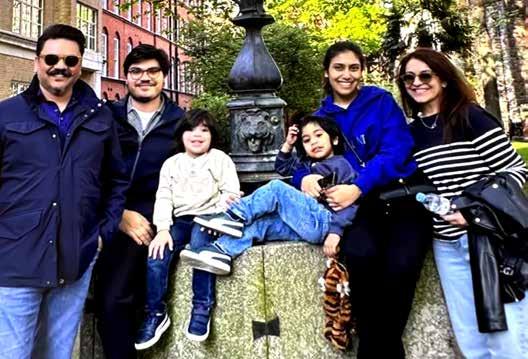
A cheerful snapshot of Mr. Moazzam’s family—his elder son Mabroor, younger son Mudrek, Mabroor’s twin sons Mayriar and Zabiyar, younger daughter Melika, and Mabroor’s wife Nadia, all posing with joy.
the best talent and enhance their competitive edge. Consumers nowadays, rightfully so, are becoming increasingly conscious of the environmental and social impact of their purchases. As a result, they are more likely to support companies that demonstrate a commitment to sustainability. This shift in consumer behavior presents a lucrative opportunity for businesses that prioritise sustainable practices. By aligning their products and services with the values of environmentally and socially conscious consumers, companies can tap into new markets and drive growth.
Sustainability is not just an ethical choice but a strategic imperative for any company. It protects the business from reputational and financial risks, enhances employee satisfaction and retention, and opens up new market opportunities. Embracing sustainability allows companies to thrive in the long term while contributing positively to society and the environment.
Hosaf Group's commitment to corporate social responsibility (CSR) is not only a testament to their ethical values but also a strategic move that enhances their financial stability and reputation. By integrating CSR into their core business strategies, Hosaf Group has successfully improved its triple bottom line, focusing on profit, people, and the planet. This holistic approach ensures longterm sustainability, positioning the company not only for immediate profitability but also for sustained success. By addressing environmental and social issues alongside economic goals, Hosaf Group attracts socially conscious investors and gains a competitive edge in the market, leading to enhanced customer loyalty and higher sales.
Moreover, the positive impact of Hosaf Group's CSR initiatives extends beyond the company itself, creating a
trickle-down effect that benefits the broader community. The company's efforts in sustainable development and social equity garner significant media attention, highlighting their role as a leader in corporate citizenship. This public recognition not only enhances the company's image but also fosters deep customer loyalty, as consumers increasingly prefer to support businesses that contribute positively to society. By promoting ethical practices and sustainable development, Hosaf Group sets a powerful example for other businesses, encouraging a culture of responsibility and care.
Hosaf Group's dedication to CSR also aligns with global initiatives such as the United Nations' 17 Sustainable Development Goals (SDGs). By addressing critical issues like poverty, health, education, climate change, and gender equality, the company contributes to a global effort to improve lives and foster sustainable development. These initiatives not only reduce operational costs through efficient resource management and waste reduction but also strengthen Hosaf Group's reputation as a socially responsible entity. This global alignment further enhances their competitive advantage, making them a preferred partner for stakeholders who value ethical business practices.
THE VALUE-DRIVEN HOSAF GROUP UNDER MR. MOAZZAM HOSSAIN CHAPTER 4
According to Mr. Hossain, company values are more than mere statements displayed on a website or posters on office walls; they are the essential principles that form the bedrock of an organisation's culture and drive its long-term success. These values act as the moral compass for the company, guiding employees in their day-to-day decisions and ensuring that their actions remain consistent with the organisation's core principles. When these values are deeply understood and genuinely embraced by the employees and management within the company, they create a unified environment where decisions are made with a shared understanding of what truly matters. This shared understanding establishes and fosters a culture of trust, accountability, and alignment, where each employee knows the boundaries within which they operate and the ethical standards they must uphold.
As we have seen in all the successful companies of the world, the importance of company values extends beyond individual decision-making; they are instrumental in creating alignment within teams and across the organisation. When employees are not only aware of but also committed to the company's values, it becomes easier to communicate the larger purpose of the organization, fostering a sense of unity even within diverse teams. This alignment is critical as it not only enhances collaboration but also significantly boosts motivation. Groups that operate with clear, explicit values and a well-defined mission tend to be more engaged and driven. When employees feel a very strong connection to the company's purpose, they are more likely to invest their best efforts, often going above and beyond their basic job requirements.
However, as per Mr. Hossain, in a business environment like that of Bangladesh and the broader Indian
subcontinent, companies face complex tensions between economic objectives and societal expectations. Societal set up in Bangladesh, like India, is very diverse, complex and uneven. While the economic sphere often emphasises profit and growth, society increasingly demands that businesses contribute to the common good and foster social cohesion. Society looks at the industry from their own perspectives. There are companies which may not be best in economic terms but they are able to create a good perception in the minds of employees and people. These are the companies where there are minimal conflicts and attrition rate is also very low. Reconciling these two often conflicting demands is a longstanding challenge, one that reflects the evolving expectations society places on corporations. The idea that "companies cannot be successful in societies that fail" underscores the interdependence between a company's success and the health of the society in which it operates. This perspective highlights the importance of companies integrating social responsibilities into their business models, ensuring that their pursuit of profit does not come at the expense of societal well-being.
In this context, ethical values serve as a guide and a benchmark for evaluating the actions of both individuals and organisations. These values, which are fundamental to the moral fabric of a community, help in establishing norms and principles that define what is considered right and just. In the business context, when companies align their actions with ethical values, they not only meet societal expectations but also strengthen their long-term viability. However, when companies prioritise one-sided interests, such as profit maximisation, over broader social considerations, conflicts with stakeholders and society can arise.
To avoid these conflicts and navigate the complex interplay between economic and social responsibilities, corporate values must be ethically grounded. Business ethics play a crucial role in this context, addressing the question of which moral values companies should uphold in their actions. The focus is always on improving business practices, particularly when it comes to the practical impacts and solutions for morally ambiguous economic activities. For employees who may face dilemmas between corporate mandates and moral actions, reflecting on and justifying individual and organisational values is essential. Companies often develop vision or mission statements to establish these values as motivational and strategic tools, providing direction for their operations. These values, when deeply integrated into the company's ethos, serve as a powerful force for good, guiding the organisation towards sustainable success while fulfilling its role as a responsible corporate citizen in society.
Moreover, company values significantly influence how customers perceive a brand. Customers often choose to support companies whose values align with their own, as those shared values enhance brand loyalty and attract like-minded customers. This alignment of values between the company and its customers creates a strong and loyal customer base, fostering long-term relationships that benefit both parties. Additionally, strong values play a vital role in attracting and retaining top talent. In today’s competitive job market, prospective employees are not just looking for a job; they are seeking organisations whose values align with their own. By hiring individuals who resonate with the company’s values, organisations can build a team of like-minded individuals who contribute to a positive workplace culture. This shared sense of purpose
and commitment creates a supportive and dynamic work environment where employees feel valued and motivated to perform at their best.
For Hosaf Group, these principles are not just theoretical concepts but lived realities that have been integral to the company’s growth and impact. As one of the leading corporate entities in Bangladesh, Hosaf Group has long recognised that its success is deeply intertwined with its commitment to these foundational principles. The group’s leadership, particularly under the guidance of Mr. Moazzam Hossain, has championed a business philosophy that goes beyond profitability, focusing on the broader role that businesses play in society.
The group’s commitment to inclusivity, respect, and integrity has been particularly instrumental in its ability to operate successfully in a diverse and often divided society. These values have guided the company’s approach to everything from employee relations to customer service, ensuring that every decision is made with a clear understanding of its impact on the broader community. In a business environment where the tension between economic objectives and societal expectations is ever-present, Hosaf Group has managed to strike a balance that allows it to thrive while also contributing positively to society.
One of the key ways in which Hosaf Group has demonstrated its commitment to these values is through its focus on creating a workplace culture that reflects the diversity of Bangladesh. The group understands that in order to be truly representative of the society it serves, it must foster an environment where all employees, regardless of their background, feel valued and respected. This has involved not only implementing policies that promote diversity and inclusion but also actively working to create a
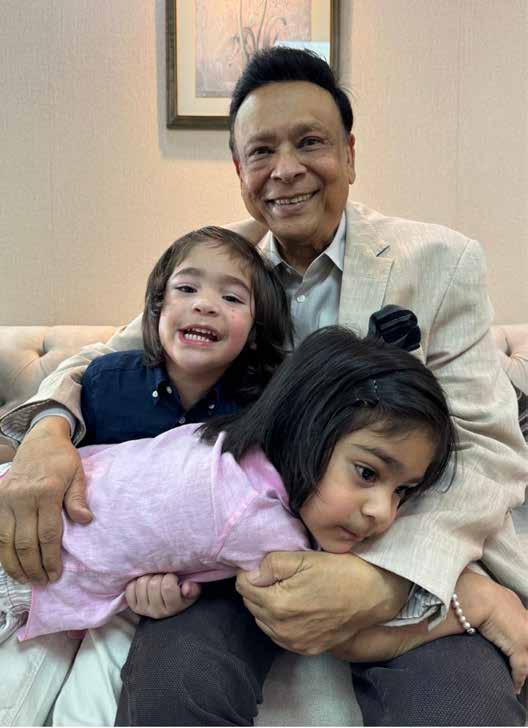
Moazzam Hossain
A heartwarming embrace between Mr. Moazzam and his grandsons, as they visit him at his office—a treasured family moment.
culture of mutual respect and collaboration.
Furthermore, the group’s commitment to ethical business practices has been a key factor in its ability to build and maintain trust with its stakeholders. In an era where corporate scandals and unethical behavior can quickly erode public trust, Hosaf Group has distinguished itself by adhering to the highest standards of integrity and transparency. This commitment to ethical behaviour is not just a matter of following the law; it is about doing what is right, even when it is difficult or unpopular.
CORE STRENGTHS OF HOSAF GROUP
Organisations are dynamic entities that exist within a constantly evolving external environment. To thrive and succeed over time, they must be able to adapt to the speed and nature of these external changes. This adaptability requires a holistic approach, encompassing every aspect of the organisation, from its operational processes and structural design to its leadership style and strategic direction.
One of the core strengths of the Hosaf Group lies in its remarkable adaptability and agility in responding to the ever-changing business environment. This ability to quickly and effectively align organisational operations with the current external context is fundamental to the group’s sustained success. By staying attuned to changes in market trends, technological advancements, regulatory requirements, and other external factors, Hosaf Group ensures that it remains competitive and relevant. For instance, in the rapidly evolving technology sector, the group swiftly adjusts its product development and marketing strategies to stay ahead of competitors and meet the evolving needs of customers.
The flexibility of Hosaf Group's organisational structure is another significant strength. The group’s willingness to reorganise departments, create new teams, and adopt new processes is pivotal in maintaining efficiency and responsiveness. By moving away from traditional hierarchical structures to more agile and decentralised approaches, Hosaf Group enables faster decision-making and fosters innovation. This structural flexibility allows the group to capitalise on new opportunities and navigate challenges with greater ease.
Leadership at Hosaf Group is another critical pillar of its core strengths. Leaders within the organisation are not only visionary and strategic but also flexible and collaborative. They possess the ability to anticipate change, inspire others to embrace it, and lead by example. This leadership style is crucial in navigating uncertainty and driving transformational change. Under the guidance of Mr. Moazzam Hossain, the group's leadership has been instrumental in fostering a culture of continuous improvement and innovation.
Hosaf Group's commitment to continuous learning and development is also a key strength. The organisation invests significantly in the professional growth of its employees, ensuring they are equipped with the latest skills and knowledge to adapt to industry changes. This focus on employee development not only enhances individual capabilities but also drives the overall performance and resilience of the organisation.
Furthermore, Hosaf Group’s emphasis on innovation is a defining strength. The group continually seeks to leverage new technologies and innovative practices to improve its products and services. This commitment to innovation ensures that Hosaf Group remains at the forefront of
Moazzam
industry advancements, providing cutting-edge solutions that meet the needs of its customers and stakeholders.
Collaboration and teamwork are deeply ingrained in the culture of Hosaf Group, contributing to its adaptability and success. By fostering a collaborative work environment, the group ensures that diverse perspectives are considered in decision-making processes. This collaborative approach enhances problem-solving capabilities and drives collective success.
MAINTAINING THE HIGHEST STANDARDS OF HONESTY IN ALL BUSINESS DEALINGS
At the heart of Hosaf Group's remarkable success lies its steadfast commitment to core values, particularly integrity and transparency. These values aren't mere slogans but are deeply ingrained in the fabric of the organisation. Integrity, for Hosaf Group, isn't just about complying with regulations; it's about conducting business with honesty, fairness, and adherence to strong moral principles. This resolute commitment has earned the company the trust and respect of its stakeholders, including customers, partners, and regulators.
Transparency in operations is another fundamental strength of Hosaf Group. The company believes in open communication and full disclosure, ensuring that all its business dealings are conducted in a manner that is straightforward and accountable. This transparent approach fosters a culture of trust and reliability, both internally among employees and externally with clients and partners. By maintaining the highest standards of honesty and transparency, Hosaf Group has ensured that its reputation remains impeccable, which is crucial for longterm sustainability and success. Integrity and transparency,
exemplified by Hosaf Group, are not isolated virtues but cornerstones of a broader value system shared by many successful corporations.
Additionally, many successful corporations prioritize values such as sustainability and corporate social responsibility. They recognize that their actions have broader impacts on society and the environment, and they strive to operate in a way that is ethical, sustainable, and beneficial to all stakeholders.
Hosaf Group's commitment to inclusivity and diversity is a testament to its progressive and forward-thinking approach. The company recognises that a diverse workforce brings a wealth of perspectives, ideas, and experiences that drive innovation and enhance decision-making. By promoting a culture that respects and values differences, Hosaf Group creates an environment where all employees feel valued and empowered to contribute their best. The group's policies and practices are designed to foster an inclusive workplace where everyone has the opportunity to thrive, regardless of their background, gender, ethnicity, or any other characteristic. This inclusive culture not only enhances employee satisfaction and retention but also improves the group's ability to understand and serve its diverse customer base effectively. By embracing diversity, Hosaf Group ensures that it remains adaptable and resilient in an ever-changing global marketplace.
The success of Hosaf Group marks the importance of a strong value system in achieving long-term success. By embodying values such as integrity, transparency, inclusivity, and sustainability, companies can build trust, foster innovation, and create a positive impact on society, setting themselves apart as leaders in their respective industries.
COMMITMENT TO EXCELLENCE: STRIVING FOR THE HIGHEST QUALITY IN ALL PRODUCTS AND SERVICES
Excellence is a core value that drives every aspect of Hosaf Group's operations. The company is dedicated to delivering the highest quality in all its products and services, consistently exceeding industry standards and customer expectations. This commitment to excellence is reflected in rigorous quality control processes, continuous improvement initiatives, and a culture that encourages innovation and creativity.
Bangladesh, despite its dynamic economic landscape, faces several substantial challenges that impact business operations. Weak infrastructure is a primary concern, with inadequate transportation networks, unreliable energy supplies, and inefficient logistical support creating significant bottlenecks. These infrastructure issues lead to delays in the movement of goods, higher operational costs, and reduced productivity. The road and rail networks are often congested and poorly maintained, while frequent power outages disrupt manufacturing processes. Inefficient logistics further complicate inventory management and distribution, affecting businesses' ability to meet customer demands effectively.
In addition to infrastructure difficulties, businesses in Bangladesh encounter challenges related to ineffective regulatory processes. The bureaucratic landscape is characterised by complex and time-consuming procedures for obtaining licenses, permits, and approvals. This inefficiency leads to delays and increased administrative costs. Furthermore, regulatory uncertainty and frequent changes in regulations create unpredictability, complicating long-term planning and compliance.
Access to financial services is another significant
hurdle for businesses. Many companies struggle to secure financing due to stringent lending criteria and high interest rates. This limited access to credit hampers growth and expansion efforts, particularly for small and mediumsized enterprises (SMEs). High borrowing costs further impact profitability and limit investment in new projects. Additionally, financial inclusion remains a challenge, with a significant portion of the population unbanked or underbanked, affecting businesses' ability to access affordable financial products.
Despite these considerable challenges, the success of Hosaf Group stands as a testament to its unwavering commitment to excellence, dedication to its core ethos, and the supportive work culture it fosters. Hosaf Group's ability to thrive amidst these adversities reflects its focus on delivering high-quality products and services, its proactive approach to overcoming regulatory and financial obstacles, and its investment in creating a positive and empowering work environment.
For Hosaf Group, commitment to excellence is not just a principle but a driving force behind its operations and success. This commitment is embedded in every aspect of the company’s strategy, focusing on delivering the highest quality in all products and services. Excellence in quality is more than a goal; it is a continuous pursuit that involves rigorous standards and relentless improvement. By setting high benchmarks, Hosaf Group ensures that every product and service exceeds customer expectations, reinforcing its reputation as a leader in the Bangladeshi market.
Achieving quality excellence requires cultivating a quality-centric culture within the organisation. At Hosaf Group, this cultural shift begins with empowering employees to take ownership of their work and prioritise
quality. This involves encouraging decision-making that aligns with quality standards and creating a supportive environment where employees can raise quality concerns without fear. Continuous learning is also crucial, as it helps employees stay updated with the latest techniques and best practices. Leadership plays a pivotal role by setting a personal example of commitment to quality, thereby building trust and motivating others to follow suit.
In the digital age, leveraging data is essential for quality management. Hosaf Group utilises data-driven decisionmaking to enhance its quality management processes. This involves implementing quality metrics to track performance and using data analytics to identify trends and opportunities for improvement. By analyzing customer feedback, the group gains valuable insights into areas that need enhancement.
Hosaf Group embraces agile and lean methodologies to enhance quality management. Agile practices, such as iterative development, allow the company to break down projects into manageable phases, facilitating regular evaluations and adaptations. Lean principles help eliminate waste in processes, streamline operations, and reduce costs, ultimately improving quality. Cross-functional teams collaborate on quality improvement projects, bringing diverse perspectives and expertise to drive innovation and efficiency.
Embracing technology is vital for maintaining quality excellence. Hosaf Group integrates advanced technologies to gain a competitive edge. Automation reduces human error and improves consistency, while quality management software streamlines processes and provides real-time visibility into quality metrics. The use of IoT and big data analytics in manufacturing helps monitor and enhance
product quality, ensuring that the group remains at the forefront of technological advancements.
Inadequate infrastructure facilities lead to big challenge when it comes to effective supply chain management. Recognising the fact that it’s very crucial for maintaining quality standards across globalised operations. Hosaf Group focuses on collaborating with suppliers to uphold stringent quality standards through regular audits and performance evaluations. Risk mitigation strategies are in place to address potential disruptions, and traceability systems are implemented to ensure transparency and accountability throughout the supply chain.
Regulatory compliance is an integral part of quality management. Inspite of regulatory challenges, Hosaf Group develops robust processes to monitor and assess compliance with industry regulations. By proactively incorporating compliance into quality processes, the group not only meets regulatory requirements but also enhances overall quality. Continuous improvement is emphasised to adapt to evolving standards and maintain high-quality standards.
Hosaf Group invests heavily in Research and Development (R&D), ensuring that its offerings remain at the forefront of industry advancements. This commitment to the highest quality has earned the group numerous accolades and a loyal customer base.
Eco-friendly processes and environmental responsibility are central to Hosaf Group’s quality excellence strategy. Mr. Moazzam Hossain has plans to set up an eco-friendly Auto Brick processing plant where the hollow bricks will be distributed to the consumers directly. This will help to reduce the air pollution caused by the coal fired brick fields surrounding Dhaka. The company implements green
Moazzam Hossain
practices in product design, manufacturing, and packaging to align with customer expectations for environmentally friendly products. Embracing a circular economy approach, including reusing, recycling, and reducing waste, not only benefits the environment but also opens new business opportunities. Transparent communication about sustainability efforts builds trust and demonstrates the company’s commitment to environmental stewardship.
Working while maintaining work life balance in any South Asian developing country is a big challenge.The wellbeing and engagement of employees are closely linked to quality excellence. Hosaf Group promotes work-life balance to prevent burnout and increase job satisfaction, leading

build skills and confidence, which translates into improved quality. Recognising and rewarding contributions to quality excellence further motivates employees to deliver their best work. Looking at the progress chart of Hosaf one can easily see that inspite of an era of frequent disruptions, effective risk management is essential for maintaining quality. Hosaf Group develops scenario planning and contingency plans to address potential disruptions and enhance resilience. Diversification of suppliers, markets, and processes reduces vulnerability to risks, while technology-enabled solutions, such as remote work capabilities, enhance operational resilience.
Despite these considerable challenges, the success of Hosaf Group stands as a testament to its unwavering commitment to excellence, dedication to its core ethos, and the supportive work culture it fosters. Hosaf Group's ability to thrive amidst these adversities reflects its focus on delivering high-quality products and services, its proactive approach to overcoming regulatory and financial obstacles, and its investment in creating a positive and empowering work environment. This success highlights how a steadfast commitment to operational excellence and a supportive organisational culture can drive significant achievements, even in the face of substantial challenges.
ACTIVELY ENGAGING IN INITIATIVES: FURTHERING INNOVATION, AGILITY, ADAPTABILITY AND UNDERSTANDING EMPLOYEE ATTITUDE
At Hosaf, values are not just an add-on; they are the very foundation upon which the company's culture is built. The character of Hosaf is deeply aligned with the understanding that employee attitudes are critical to the organisation’s success. This is reflected in their core statements like
Moazzam
A striking aerial view of the 113 MW HF Power Limited (Hosaf Power Plant Limited), a testament to Mr. Moazzam’s industrial vision in Chowmuhani, Noakhali, Bangladesh.
"We care" and "What you do matters," which emphasise the importance of every individual’s contribution to the collective goal. The emphasis on values shapes not only the way employees are treated but also how they approach their work, decisions, and interactions.
Hosaf has clearly defined its culture by focusing on employee attitudes and aligning them with the company's strategic objectives. It is not enough to merely address attitude; the key lies in ensuring that every employee understands the strategic direction of the company, whether it is reducing costs, minimising business complexity, or scaling up through mergers. By using real-world dilemmas and challenges, Hosaf ensures that its employees are equipped to make decisions that move the business forward.
In an ideal world, once you find your right-fit candidates, each would blossom into the employee of your dreams. However, reality is more complex. Hosaf recognises this and understands that while some hires may exceed expectations, others may fall short. The true test of a company’s culture is not just in the hiring process but in how it deals with these varying outcomes. Hosaf’s culture is designed to handle these situations with grace and fairness, ensuring that the company remains resilient and adaptive.
Hosaf has also made a deliberate shift from a culture focused on error elimination, consistency, and replicability to one that embraces adaptability, innovation, and empowerment. This change is increasingly necessary in the digital age, where the ability to quickly change direction, remove bureaucratic obstacles, and take calculated risks in pursuit of new ideas is crucial. By encouraging managers to foster a culture of innovation and agility, Hosaf is positioning itself to thrive in an ever-evolving business landscape.
THE POWER OF PURPOSE: HOW HOSAF GROUP'S CORE VALUES DRIVE SUSTAINABLE SUCCESS
Hosaf Group's work ethic and thought process reflect a deep understanding of the intricate dynamics of global business, especially in a culturally diverse landscape. They have mastered the art of navigating the nuanced differences in thought processes among employees from various backgrounds, which is crucial for fostering innovation and effective decision-making. At Hosaf, consensus-building is a cornerstone of their approach, recognising that decisions often require broad agreement among stakeholders. This emphasis on collective harmony over individual opinion has allowed the company to cultivate a strong, cohesive workforce that values collaboration and unity. The Group's respect for hierarchy, combined with a cautious approach to untested innovations, marks their commitment to longterm stability and success.
What sets Hosaf Group apart is their ability to balance tradition with modernity. While they honour the importance of seniority and established methods, they also embrace the fresh perspectives brought by the younger generation. Many of these new thriving businesses within Hosaf are family-owned, with younger leaders introducing innovative business techniques and management methods to scale operations. By appreciating these differences and adopting a flexible, culturally informed approach, Hosaf has successfully navigated the complexities of the global marketplace.
One of the hallmarks of the most successful companies is their ability to introduce unique concepts to the world. As a rapidly growing entity in Bangladesh's private sector, the Hosaf Group has positioned itself as an innovative force in manufacturing and services. Since its inception in the
mid-seventies, when it embarked on an ambitious venture into deep-sea fishing—an unexplored sector at the time— the company has evolved into one of Bangladesh's leading business houses. With a substantial turnover and a dedicated team of skilled professionals, the Hosaf Group continues to innovate and redefine industry standards. The Group's current portfolio includes investments in the financial sector, power and energy, LED lighting, electric meters, real estate, ecofriendly Auto Bricks industry, Solar Power Plant, Halal Food and hospitality. With a proactive team constantly seeking new opportunities for expansion, both locally and globally, the group has diversified into various subsidiaries. These include Hosaf Meter Industry Limited, Hosaf Proficient Energy Limited, Hosaf International
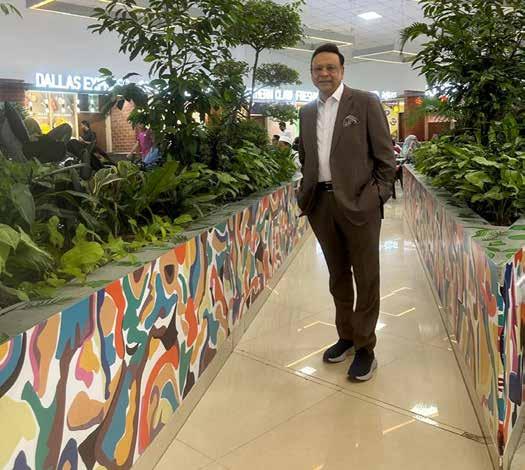
Limited, Energyprima Limited, Citilink Apartment Limited and Citymart Limited.
Presently, Citilink Apartment Ltd has built a 22 storied modern eco-friendly building at 10, Mohakhali Commercial Area called Hosaf Skyline, with helipad, which will be its future corporate office. They also plan to build a 30 storied commercial building in the heart of the Dhaka City in the near future.
Energyprima Limited, a subsidiary of the Hosaf Group, stands as a pioneer in the private sector's rental power generation in Bangladesh. Committed to providing uninterrupted electricity, Energyprima plays a crucial role in addressing the country's power shortage—a significant impediment to Bangladesh's development. Through its rental power plants, Energyprima contributes to reducing power shortages, significantly improving the lives of the populace.
Hosaf International Limited focuses on providing solar energy solutions to promote green energy in Bangladesh. By manufacturing energy-efficient, pollution-free, cost-saving, and eco-friendly products requiring minimal maintenance, Hosaf International is at the forefront of the country's green energy movement.
Another subsidiary, Hosaf Meter Industry Limited, is renowned as one of Bangladesh's leading electric energy meter manufacturers. The company has earned a reputation for delivering excellent quality products and services. With a team of highly skilled hardware and software engineers, Hosaf Meter Industry has garnered years of experience in developing innovative, high-quality, reliable, and costeffective products, like the pre-paid electric meter.
Hosaf Group has recently ventured into the Food and Beverage industry by establishing City Mart Limited.
Moazzam Hossain
Mr. Moazzam Hossain captured at the newly opened food court, embodying his grounded yet influential persona.
Considering the increasing demand for food and the need for dining options in the city, ‘At the Table’ was launched in June 2024 as a one-of-a-kind food court at a prime location near Magbazar Crossing. It offers a diverse array of culinary options with exceptional seating capacity.
The Hosaf Group's commitment to corporate social responsibility is evident in its efforts to provide better facilities for its employees, stakeholders, and communities, while also prioritising environmental conservation. The group's charitable endeavours have significantly strengthened the Bangladeshi community. For instance, the construction of the Bokter Munshi Moazzam Hossain High School in Shonagazi, Feni, and the annual awarding of scholarships to meritorious students demonstrate its commitment to education and moral values.
The Hosaf Group exemplifies a values-driven organisation, where business success is not just measured by profit but by the positive impact it has on society. Through its innovative products, commitment to sustainability, and dedication to social welfare, the group continues to illuminate the path towards a brighter, more prosperous future for Bangladesh and its people.
FORGING UNITY: THRIVING IN A DIVERSE BUSINESS LANDSCAPE
In today’s rapidly evolving global marketplace, businesses are increasingly realizing the importance of fostering a deep understanding of cultural dynamics and social diversity within their operations. This is particularly crucial in the Indian subcontinent, where countries like India, Bangladesh, Pakistan, and Sri Lanka are characterised by a complex mosaic of cultures, traditions, and social structures. The region is marked by significant disparities in social
status, beliefs, and backgrounds, yet there is a profound and widespread pride in preserving and celebrating one’s cultural heritage. Under the quintessential leadership of Mr. Moazzam Hossain, the Hosaf Group stands out as a prime example of how a culturally attuned approach can lead to sustained success in this multifaceted region. By embracing principles of inclusivity, adaptability, and respect for the diverse cultural and social landscapes in which they operate, Hosaf has successfully navigated the complexities of the subcontinent. Their approach goes beyond traditional business practices, focusing on building a corporate environment that resonates with the diverse communities they engage with.
In the intricate socio-cultural landscape of the Indian subcontinent, the nations, with their rich tapestry of diverse cultures, languages, beliefs, and social strata, embody a spirit of resilience and inclusivity that is both inspiring and complex. For businesses operating in such environments, the challenge is not just about navigating economic or market dynamics but also about honouring and integrating these deeply ingrained values into their operational ethos.
The Hosaf Group stands as a beacon of how a valuedriven approach can lead to sustainable success in such a diverse and challenging environment. At the heart of Hosaf’s philosophy is the recognition that human values—tolerance, respect, empathy, and integrity—are not just ethical guidelines but essential pillars for building a thriving organisation. The Group’s commitment to inclusivity and equity goes beyond mere compliance with governmental regulations; it is a conscious effort to create a workplace where every individual feels valued, respected, and empowered to contribute their best.
Hosaf’s vision of a utopian workplace is one where
Moazzam Hossain
barriers of prejudice, discrimination, and historical marginalisation are systematically dismantled. They have implemented policies that ensure equal opportunities for all, irrespective of personal characteristics or socioeconomic background. This includes fostering an environment where diversity is celebrated, and every employee has the opportunity to grow and succeed. By addressing issues such as infrastructure adjustments, fair recruitment practices, equitable employment benefits, and unbiased promotion criteria, Hosaf has created a workplace that truly reflects the inclusive spirit of the subcontinent.
The strength of Hosaf Group lies in its ability to harmonise traditional values with modern business practices. In a region where respect for hierarchy and collective harmony often take precedence, Hosaf has successfully balanced these cultural imperatives with the need for innovation, adaptability, and forward-thinking. Their approach to leadership is one that respects tradition while also embracing new ideas and perspectives, particularly those brought in by the younger generation within the family-owned businesses. This blend of old and new has allowed Hosaf to remain agile and responsive in an ever-evolving global marketplace.
In a world that is increasingly interconnected yet fragmented by differences, Hosaf’s commitment to human values offers a blueprint for building a more inclusive, equitable, and harmonious future for all. In conclusion, company values are not just abstract concepts; they are the bedrock upon which successful organisations are built. For Hosaf Group, these values have been the driving force behind its success in Bangladesh’s complex and dynamic business environment. By embedding its operations with principles of inclusivity, respect, integrity, and a
commitment to the broader well-being of society, Hosaf has not only achieved economic success but also created a positive and lasting impact on the communities it serves.

My greatest strength is the love for my people, my greatest weakness is that I love them too much
– Sheikh Mujibur Rahman, Father of the Nation (Bangladesh)
CHAPTER 5
Bangladesh has emerged as an excellent example of economic resilience and human potential. Since gaining independence in 1971, it has faced immense challenges, including poverty, natural disasters, and refugee crises. However, despite these obstacles, the nation has quietly transformed into one of the world's most notable economic success stories. With a rapidly expanding manufacturing sector, particularly in garments, tourism, and the textile industry, Bangladesh has achieved an impressive average annual growth rate of over 6% for nearly a decade, reaching a remarkable 7.86% in the year through June.
CRAFTING A DISTINCTIVE COMPANY
DNA FOR HOSAF GROUP
Bangladesh, located in South Asia, is the world’s 8th most populous country as well as one of the world's most densely populated. Most of the country is covered by the Bengal Delta. The country is currently considered a middle power and a developing nation. It has the 43rd largest economy by nominal GDP and the 29th largest by purchasing power parity. Since its independence, the country has achieved tremendous growth in the areas of industrial production and economic growth. Bangladesh remains an important trade partner to the EU, the US, China, Japan, Singapore, and India. Its strategic location between South, Southeast, and East Asia makes it an important promoter of cooperation and regional connectivity. Key industries such as textiles, shipbuilding, tourism, information, communication, technology, cotton, and jute contribute substantially to the nation’s economy.
From the brink of mass starvation in 1974, Bangladesh has achieved near self-sufficiency in food production for its vast population of over 166 million. Per capita income has almost tripled since 2009, reaching $1,750 this year, and the proportion of people living in extreme poverty has more
than halved, from about 19% to less than 9% over the same period, according to the World Bank.
THE DYNAMIC READY-MADE GARMENT (RMG) SECTOR: DRIVING FORCE BEHIND THE NATION’S REMARKABLE PROGRESS
The driving force behind Bangladesh's remarkable progress can be attributed to its dynamic private sector, which employs over 90% of the country's 70 million-strong workforce. Government policies and financial support have played a crucial role in nurturing this growth, with incentives such as reduced export tariffs for the garment industry and similar support for the pharmaceuticals and electronics sectors. As a result, global consulting firms like PricewaterhouseCoopers (PWC) project that Bangladesh's economy is on track to surpass the $1-trillion mark by 2040, positioning it as the 28th largest economy by 2030 and further climbing to the 23rd position by 2050.
Hosaf Group, a prominent entity in Bangladesh, has carved its identity within the business landscape by nurturing a distinctive organisational DNA. Much like global giants Google, Infosys, and Tata, Hosaf Group's DNA revolves around innovation, social responsibility, inclusivity, and adherence to strong values. This approach has been instrumental in aligning the group's vision with the nation's economic transformation.
The success story of Bangladesh's economy is directly related to the development of its ready-made garment (RMG) sector, which has not only transformed the country's industrial landscape but has also been a significant driver of job creation and economic growth. With more than 4 million jobs created, the RMG sector has emerged as a vital source of employment, particularly for women,
contributing to their empowerment and socio-economic mobility. Hosaf Group has been deeply connected to this transformation, reflecting the broader economic trends in its business strategies and community engagements.
In addition to the RMG sector, Bangladesh has benefited from a strong inflow of remittances, which have provided a crucial source of foreign exchange earnings and supported the country's balance of payments. This steady stream of remittances has been a lifeline for many families in Bangladesh, supporting their livelihoods and contributing to poverty alleviation. Hosaf Group recognises the importance of these economic flows and has tailored its financial services and products to cater to the needs of these remittance-dependent households.
These positive outcomes have been supported by prudent government policy choices, which have focused on creating an enabling environment for economic growth and development. Key policy measures, such as investment in infrastructure, trade liberalisation, and the provision of incentives for export-oriented industries, have helped to drive Bangladesh's strong and resilient growth. Hosaf Group has aligned its corporate strategies to leverage these government policies, ensuring that its business operations are in sync with national development goals.
Even during the pandemic outbreak, Bangladesh demonstrated resilience, with its economy showing remarkable resilience in the face of adversity. The RMG sector, in particular, adapted quickly to new health and safety protocols to continue operations safely. This resilience is a testament to the strength and dynamism of Bangladesh's economy and its ability to weather external shocks. Hosaf Group played its part by implementing robust health and safety measures across its operations, ensuring business
continuity while safeguarding its workforce.
Looking ahead, Bangladesh's economic prospects remain positive, with the country well-positioned to continue its trajectory of strong and inclusive growth. By building on the success of its RMG sector, harnessing the potential of its young and growing population, and continuing to pursue prudent policy choices, Bangladesh is poised to achieve even greater economic success in the years to come. Hosaf Group is committed to being at the forefront of this growth journey, continually adapting its strategies to support and drive forward the nation's economic ambitions.
The dynamic private sector is the backbone of Bangladesh's economic success, and within this sector, Hosaf Group stands out as a beacon of innovation, social responsibility, and strong values. By aligning its operations with national policies and market demands, and by investing in sectors that drive economic resilience and growth, Hosaf Group not only contributes to the nation's prosperity but also ensures its sustainable success in the future.
UNLOCKING SUCCESS THROUGH DIVERSIFICATION: THE HOSAF GROUP APPROACH
Bangladesh's textile and garment industry has indeed achieved remarkable success, positioning the country as the world's second-largest apparel exporter. This sector has been a driving force behind Bangladesh's economic growth, contributing significantly to the country's total exports, accounting for 84% of them. With thousands of garment factories, Bangladesh has established itself as a global leader in the textile and garment manufacturing industry.
The growth of the garment industry in Bangladesh has been fuelled by several factors, including low labour costs, a large and productive workforce, and preferential trade
agreements with key markets such as the European Union and the United States. Additionally, the government's supportive policies and initiatives have played a crucial role in fostering the industry's growth, including the establishment of special economic zones and the provision of incentives for export-oriented industries.
However, despite the remarkable success of the garment industry, there is a growing recognition of the need to diversify Bangladesh's economy. Overreliance on a single industry exposes the economy to risks such as fluctuations in global demand and competition from other low-cost
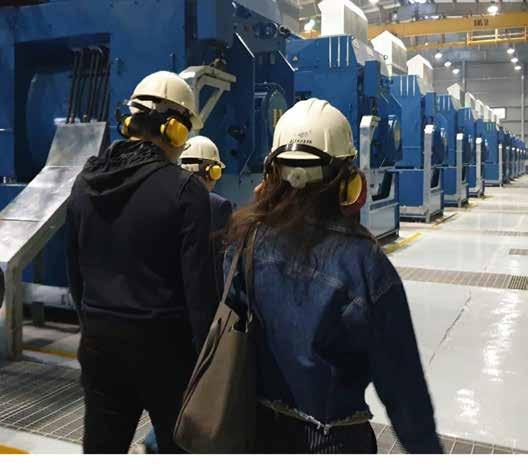
Mr. Moazzam Hossain taking a detailed tour of the power plant, closely examining its operations.
manufacturing countries. Therefore, there is a concerted effort to promote diversification and value addition in other sectors such as Agriculture, Pharmaceuticals, Information Technology, and Tourism.
For Hosaf Group, the journey of diversification is not just a strategic necessity but a deeply personal commitment to the future of Bangladesh. Under the visionary leadership of Mr. Moazzam Hossain, Hosaf Group has embraced diversification as a core principle, reflecting the broader economic trends of the nation while carving out unique opportunities for growth and innovation.
Recognising the need to mitigate the risks associated with overreliance on the garment sector, Hosaf Group has strategically diversified its operations across multiple industries. This includes significant investments in various sectors like Energy, Real Estate, Financial Services, and Technology, among others. Each of these sectors represents a critical component of Bangladesh's economic fabric and offers immense potential for sustainable growth.
In the energy sector, Hosaf Group has made substantial strides through its subsidiaries, Energyprima Limited and HF Power Limited. These companies have been instrumental in addressing Bangladesh's power shortages by establishing rental power plants and investing in renewable energy solutions. This not only supports the country's energy needs but also aligns with global sustainability goals.
In real estate, Hosaf Group's Citilink Apartment Limited has developed numerous projects that cater to the growing demand for residential and commercial spaces in urban areas. These projects are designed to enhance the quality of life and contribute to the urban development of Bangladesh.
The financial services sector is another area where Hosaf Group has made a significant impact. Through
its involvement with National Bank Limited, Pragati Life Insurance Limited, and Pragati Insurance Limited, the group has helped to drive financial inclusion and innovation. These institutions provide a range of financial products and services that support both individuals and businesses, fostering economic stability and growth.
Hosaf Group's commitment to technology and innovation is evident in its efforts to integrate advanced technologies into its operations. The group's focus on digital transformation and technological advancement ensures that it remains at the forefront of industry trends, driving efficiency and enhancing competitiveness.
For Mr. Moazzam Hossain, the journey of diversification is deeply personal. It reflects his commitment to not only the success of Hosaf Group but also the broader economic development of Bangladesh. By diversifying its operations, Hosaf Group is helping to create new opportunities for growth and employment, contributing to the resilience and sustainability of the national economy.
The story of Bangladesh's economic progress is one of resilience, innovation, and strategic foresight. Hosaf Group embodies these qualities through its diversified approach, playing a pivotal role in shaping the future of the nation's economy. By leveraging its strengths across various industries, Hosaf Group is not just unlocking success for itself but also contributing to the sustainable development and prosperity of Bangladesh.
CULTIVATING A STRONG AND RESILIENT ORGANISATIONAL CULTURE
By ingraining a specific culture code into the fabric of the organisation, Hosaf Group ensures that its values are not just words on a page but lived realities within the
company. This serves as a powerful compass, guiding employees' behaviour, shaping the group's interactions with stakeholders, and fostering a sense of cohesion and alignment across all levels of the organisation.
Ultimately, Hosaf Group's strategic approach to shaping its company DNA enables it to cultivate a strong and resilient organisational culture that reflects its core values and aspirations. This culture, grounded in principles of innovation, social responsibility, inclusivity, and integrity, has been instrumental in driving the group's ascent to leadership in Bangladesh and beyond.
THE SIGNIFICANCE OF REMODELLING THE POWER SECTOR
The energy sector plays a pivotal role in Bangladesh's economic development, impacting its ability to improve living standards and achieve sustainable growth. However, the country faces critical challenges in meeting growing energy demand, improving governance and transparency, addressing environmental concerns, and ensuring financial viability in the power sector. These challenges not only pose risks but also present opportunities for companies like the Hosaf Group to contribute to Bangladesh's energy sector development and economic growth.
The development of the power sector is crucial for scripting a nation's growth, particularly in countries like Bangladesh. The country's progress in improving living standards and achieving the UN's Sustainable Development Goals (SDGs) heavily relies on its energy sector. However, the country faces several critical challenges that need to be addressed for sustainable growth.
One of the key challenges is meeting the growing energy demand while transitioning to a cleaner energy mix.
Bangladesh has experienced rapid energy demand growth, outpacing the growth in primary energy consumption. This has led to an increased reliance on imports, particularly for crude oil and refined products, which has impacted the country's current account. Despite having significant domestic natural gas production, Bangladesh still faces challenges in meeting its energy needs efficiently.
Improving governance and transparency in the energy sector is another challenge. The sector in Bangladesh is highly centralised, with the Ministry of Power, Energy, and Mineral Resources and several state-owned corporations playing a dominant role. While centralization can streamline decision-making, it also raises concerns about transparency and accountability.
Addressing environmental degradation and climate change is a crucial aspect of Bangladesh's energy sector development. The country is vulnerable to climate change, facing challenges such as rising sea levels and extreme weather events. Transitioning to a cleaner energy mix and improving energy efficiency are essential for mitigating these risks.
Achieving power sector financial viability is also critical for sustainable growth. Despite significant investments in the power sector, Bangladesh still faces challenges in ensuring financial sustainability. This includes issues such as tariff rationalization, improving revenue collection, and reducing system losses.
For the Hosaf Group, the development of the power sector in Bangladesh presents both challenges and opportunities. Investing in renewable energy and energy efficiency projects can not only support the country's sustainable development goals but also provide a competitive advantage for the company. By addressing these challenges and embracing
sustainable practices, the Hosaf Group can contribute to Bangladesh's economic growth while ensuring its longterm viability and competitiveness.
ENERGYPRIMA LIMITED: A PIONEERING FORCE IN POWER GENERATION
Energyprima Limited (EPL), a subsidiary of the esteemed Hosaf Group, has emerged as a pioneering force in Bangladesh's private sector rental power generation industry. Established with a steadfast commitment to ensuring uninterrupted electricity supply, EPL has strategically utilised its capital, machinery, and human resources to meet the escalating energy demands of the nation. The company's unwavering dedication to enhancing customer satisfaction and optimising resource management propels its ambition to become the foremost private sector power producer in Bangladesh.
In response to Bangladesh's severe power deficit, Hosaf Group has played a pivotal role in bolstering the country's power generation capacity through the establishment of Energyprima Limited. Initially established as a private limited company on January 15, 2008, and subsequently converted into a public limited company on March 30, 2010, EPL was entrusted with four rental power plant projects in early 2008. EPL participated in the international tender to set up power plants of 20 MW and 50 MW capacity. A completion time of three months from the date of issuing letter of intent by the Chairman Bangladesh Power Development Board (BPDB) was given. However, this was one of the big challenges for Energyprima Ltd. (EPL) as they had to complete four Power Plants within a timeline of 3 months by importing caterpillar engines from USA for Kumargaon 50 MW and Shahjibazar 50 MW. For the
Fenchugonj 50 MW power plant, engines were imported from Wartsilla, Finland. For the Bogra 20 MW at that time, EPL did not get the cooperation from BPDB to get suitable land to set up the power plant. The intension was to discourage set up of rental power plant by local companies. Even though they set up two power plants within 3 months; and the rest two within 6 months, BPDB did not consider the genuine reason of the delay due to unavailability of workable land being handed over to EPL.
These projects, outfitted with state-of-the-art Caterpillar and GE Jenbacher gas engines have been instrumental in mitigating the power shortfall, collectively supplying a steady 170 MW of electricity to the National Grid. Motivated by the vast potential of the power sector, Energyprima Limited remains steadfast in its commitment to establishing additional power plants across the country, aligning with the government's vision of ensuring universal access to electricity and transforming Bangladesh into a nation free from the scourge of load shedding.
HF Power Limited, a subsidiary of Energyprima Limited and a part of the distinguished Hosaf Group, was established in 2017 as a Public Limited Company with a clear mission: to establish power plants in Bangladesh that would supply electricity under rental or Independent Power Producer (IPP) arrangements. This strategic move was prompted by the urgent need to address Bangladesh's persistent power shortages, exacerbated by the nation's rapid economic growth, urbanisation, industrialisation, and burgeoning developmental needs, all of which contributed to a surge in electricity demand.
In recognition of the pressing need for sustainable power solutions, Hosaf Group has played a commendable role in the energy sector through its subsidiaries — Energyprima
Limited, established in 2008, and HF Power Limited, founded in 2017. Both of these firms have been instrumental in alleviating Bangladesh's power crisis. These initiatives align closely with the Government's ambitious vision of ensuring "Electricity for all by 2021." Notably, HF Power Limited was entrusted with a significant project by the Bangladesh Power Development Board (BPDB): the 113 MW HFO Fired IPP power plant in Chowmuhani, Begumganj, Noakhali, Bangladesh. This project, awarded for a 15-year period, commenced supplying electricity to the national grid on December 31, 2019, marking a significant milestone in the nation's quest for sustainable energy solutions.
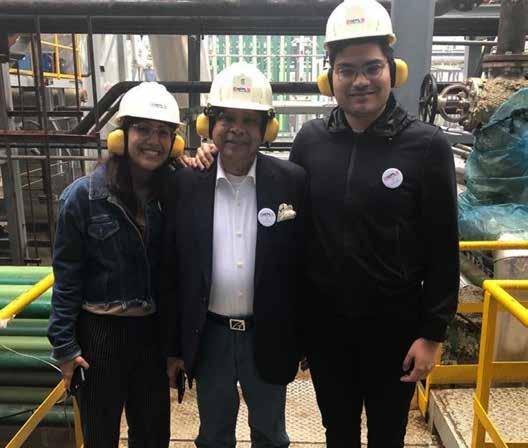
The Hosaf Group's remarkable contributions to the energy sector in Bangladesh, through Energyprima Limited and HF Power Limited, underscore its unwavering commitment to addressing the country's energy needs and driving economic growth. As Bangladesh continues its journey towards energy self-sufficiency, the role played by the Hosaf Group in pioneering sustainable power solutions is truly commendable.
HOSAF METER INDUSTRY: COMMITMENT TO EXCELLENCE
Hosaf Meter Industry, a prominent electric energy meter manufacturer in Bangladesh, has earned a stellar reputation for its commitment to excellence in quality, performance, and competitive pricing, establishing itself as a trusted brand in the country. The industry's roots can be traced back to the 1980s when it entered into a technical collaboration with machinery and equipment manufacturers in Shanghai, China. This collaboration enabled the company to acquire state-of-the-art computerised machinery under the direct guidance of Chinese experts, laying the foundation for the production of high-quality, reliable, and cost-effective products by its skilled team of hardware and software engineers in the year 1982.
The success of Hosaf Meter Industry is underscored by its impressive track record of supplying over 5 million meters to prestigious organisations such as the Bangladesh Power Development Board (BPDB), Bangladesh Rural Electrification Board (BREB), Bangladesh Military's Ordinance Factory (BOF), as well as to private companies and domestic consumers. Hosaf Meter's unwavering commitment to quality is evident through its stringent quality control measures and performance tests, which
Moazzam
Mr. Moazzam overseeing operations at his Powerplant, sporting safety ear equipment with the air of a seasoned leader.
adhere to IEC and BSTI standards. Additionally, the industry has achieved KEMA certification from the Netherlands, further validating its dedication to maintaining highquality standards.
To ensure the reliability and accuracy of its meters, Hosaf Meter Industry conducts meticulous checks using highly sophisticated computer calibrators and the BSTI conducts periodic evaluations randomly to select and test to uphold unwavering quality and performance standards. This steadfast commitment to precision and excellence led to the company's recognition with ISO 9001:2008 certifications in June 2003, reinforcing its reputation both domestically and internationally as a manufacturer of superior electric energy meters.
HOSAF PROFICIENT ENERGY: LEADING THE WAY IN SOLAR SOLUTIONS
Hosaf Proficient Energy (HPE), a subsidiary of the renowed Hosaf Group, has undertaken the noble mission of addressing Bangladesh's pressing energy needs through sustainable solar energy solutions. Despite the country's abundance of natural resources and a skilled workforce, rapid growth and industrialisation over the past three decades have led to a severe power shortage, posing a significant challenge. While the government strives to ensure uninterrupted power supply to manufacturing plants, the limited availability and high cost of alternative energy sources have forced industries to rely on diesel generators, which are not only expensive and high maintenance but also contribute to environmental pollution. Hosaf International, a sister concern of Hosaf Group, was awarded 100 MW Solar Power Plant project to set up in Sylhet district. The 100 MW Solar Power Plant shall be completed by 2025. Despite
unavoidable delays, the progress continues steadily.
In response to this critical issue, HPE has undertaken the responsibility of providing cost-effective, eco-friendly solar energy solutions in Bangladesh. By introducing solar panels and energy-efficient lighting, HPE aims to reduce electricity consumption and ease the burden on the national grid, thereby enhancing overall efficiency in electricity utilisation. HPE's innovative technology, including LED tube lights, bulbs, DC ceiling fans, and DC water pumps, consumes only 30% of the electricity compared to regular electric products, offering significant cost savings and environmental benefits.
Moreover, HPE's solar water pumps are designed to serve areas with no access to electricity or unreliable power supply, reducing electricity consumption to only 10% of what conventional pumps require. With a comprehensive range of solar products, including charge controllers, inverters, streetlights, and portable solar solutions for rural areas, HPE emphasises high quality and efficiency in all its offerings.
Furthermore, HPE's on-grid and hybrid solar solutions not only provide electricity during the day but also switch to backup batteries at night, with the capacity to supply surplus power to the national grid. This marks a significant step toward sustainable and efficient energy utilisation in Bangladesh, showcasing HPE's commitment to a greener tomorrow.
HOSAF INTERNATIONAL LIMITED: PIONEERING ENERGY SOLUTIONS FOR BANGLADESH'S FUTURE
Hosaf International Limited, an esteemed sister concern of the Hosaf Group of Companies, was incorporated on 12th March 1994 as a Private Limited Company. One of the most
notable ventures of Hosaf International is the Khalashpir Coal Mine Project, located in the Pirganj Upazila under the Rangpur district of Bangladesh.
The Khalashpir Coal Mine Project highlights Hosaf International's proactive approach to meeting Bangladesh's growing energy demands. In October 2003, Hosaf International Limited obtained an exploration license from the government of Bangladesh to conduct coal exploration in Khalashpir, covering an area of 25.00 sq.km. This license marked the beginning of a comprehensive initiative aimed at tapping into the country's untapped coal resources. This project marks the group's strategic vision and dedication to advancing the nation's energy infrastructure.
In collaboration with the Hosaf-Chinese Consortium, Hosaf International conducted a Techno-Economic Feasibility Study of the Khalashpir Coal Deposit under an Exploration License Contract with the Bureau of Mineral Development (BMD). This study was a crucial step in understanding the potential of the coal deposit and devising a strategic plan for its development. The collaboration with Chinese experts brought in valuable technical expertise and experience, ensuring that the project adhered to international standards and best practices.
The development of the Khalashpir Coal Mine is projected to span four years. The initial phase of the project involves the construction of necessary infrastructure and the setup of mining operations. By the 5th year, the project aims to achieve initial coal production of 1.00 million tonnes. This milestone will coincide with the generation of 500 MW of electricity, significantly contributing to the national grid and alleviating the country's power shortages. Looking further ahead, the production is expected to increase to 2.00 million tonnes by the 7th year. This steady
ramp-up in production capacity not only ensures a reliable supply of coal but also demonstrates Hosaf International's commitment to sustainable and scalable energy solutions. The Khalashpir Coal Mine Project is poised to become a cornerstone of Bangladesh's energy strategy, providing a stable and efficient source of power for industrial and domestic use.
For Hosaf Group, the Khalashpir Coal Mine Project is a reflection of their deep-rooted commitment to national progress and energy security. Mr. Moazzam Hossain, the visionary leader, has always emphasised the importance of energy infrastructure in driving economic growth and improving the quality of life for the people of Bangladesh. Under his guidance, Hosaf International Limited has taken bold steps to explore and harness the country's natural resources, ensuring that the benefits of these projects are felt across the nation.
DRIVING ECONOMIC GROWTH: THE ROLE OF INFRASTRUCTURE DEVELOPMENT IN BANGLADESH AND THE IMPACT ON HOSAF GROUP
Infrastructure development plays a pivotal role in driving economic growth, particularly in emerging economies like Bangladesh. The successful launch of the Bangabandhu Satellite-1 and the self-funding for the Padma Multipurpose Bridge signify Bangladesh's commitment to enhancing its infrastructure. These initiatives, coupled with extensive public investments in physical infrastructure and integrated connectivity networks, have not only contributed to the country's economic growth but also presented significant opportunities for companies like the Hosaf Group.
For Hosaf Group, infrastructure development is not just a business opportunity; it is a personal commitment
to the progress and prosperity of Bangladesh. Under the visionary leadership of Mr. Moazzam Hossain, Hosaf Group has always recognised the critical importance of robust infrastructure in enabling economic growth and improving the quality of life for the Bangladeshi people.
Rural infrastructure development is a key focus area in Bangladesh's development plans. The government has implemented policies to upgrade heavily used roads to dual lanes, maintain existing road networks sustainably, and construct new roads within villages. Additionally, the construction and reconstruction of bridges and culverts spanning rivers and streams are essential to enhancing connectivity in rural areas. Significant efforts have also been made to establish growth centers, Union Parishad complexes, Upazila complexes, and cyclone shelter centers. These initiatives are vital drivers of Bangladesh's rural economy, enhancing connectivity, facilitating trade, and improving living standards in rural communities.
For Hosaf Group, investing in rural infrastructure is a strategic priority that aligns with the country's development goals. The group understands that improving rural infrastructure is crucial for the socio-economic development of these areas. By participating in these projects, Hosaf Group not only helps to bridge the urbanrural divide but also creates opportunities for sustainable growth. The group's involvement in constructing roads, bridges, and other essential infrastructure in rural areas demonstrates its commitment to fostering inclusive development.
Investing in Bangladesh's infrastructure development creates opportunities for Hosaf Group to expand its market reach and improve efficiency in transporting goods. Enhanced infrastructure reduces logistical challenges,
lowers transportation costs, and facilitates smoother trade operations. This efficiency is particularly important for a diversified conglomerate like Hosaf Group, which operates across various sectors including energy, real estate, financial services, and technology.
Additionally, the group's involvement in rural infrastructure projects, for example, helps to improve access to education, healthcare, and markets for rural populations. Better connectivity through roads and bridges enables rural communities to access essential services and economic opportunities, thereby improving their quality of life.
By leveraging improved infrastructure, Hosaf Group can optimise its supply chain, ensuring timely delivery of products and services. This not only enhances customer satisfaction but also strengthens the group's competitive edge in the market. The group's strategic investments in infrastructure projects are aligned with its long-term vision of growth and sustainability.
For Hosaf Group, infrastructure development is also intertwined with its corporate social responsibility (CSR) objectives. The group believes that businesses have a responsibility to contribute to the welfare of the communities they serve. By supporting infrastructure projects, Hosaf Group aims to make a positive impact on the socio-economic fabric of Bangladesh.
Mr. Moazzam Hossain's personal commitment to national progress is evident in Hosaf Group's proactive approach to infrastructure development. Under his leadership, the group has consistently sought to align its business strategies with national development priorities. Mr. Hossain's vision of a prosperous and self-sufficient Bangladesh has driven Hosaf Group to take on projects that
contribute to the country's economic resilience and growth.
CITILINK APARTMENT LIMITED: AN EPITOME OF REAL ESTATE EXCELLENCE
Citilink Apartment Limited, a sister concern of the renowned Hosaf Group, has firmly established itself as a reputable real estate company known for its meticulous management and unwavering commitment to client satisfaction. Since its inception in the 1980s, the company has been dedicated to acquiring and developing real estate properties to cater to the growing demand for new towns and industries, prioritising comfort and service in all its endeavours.
Over the years, Citilink Apartment Limited has completed several noteworthy projects in Dhaka. These projects include a six-storied residential building on Mirpur Road in Dhanmondi, the corporate office of Hosaf Group in the 14-storied High Tower at Mohakhali, C/A, a 16-storied shopping-cum-office complex in Malibagh, Dhaka, and the Hosaf Convention Center with a hall capacity of 2500 guests, located at the Hosaf Malibagh Shopping Complex. Through these exceptional ventures, Citilink Apartment Limited continues to make a significant impact on the property development landscape of Dhaka.
THE CRUCIAL ROLE OF THE FINANCE SECTOR IN BANGLADESH'S GROWTH AND HOSAF GROUP'S PIONEERING ROLE
Bangladesh's impressive economic trajectory over the past decade has positioned it among the world's top 10 fastestgrowing economies, with its Gross Domestic Product (GDP) more than tripling during this period. Looking ahead, Bangladesh is set to graduate from its Least Developed
Country (LDC) status in 2026 and aspires to reach upper middle-income status by 2031, reflecting its steady increase in per capita income. This remarkable journey of economic progress is intertwined with the dynamic contributions of the finance sector and the proactive role of Hosaf Group in shaping the financial landscape of the nation.
Job creation and employment are major benefits of the service sector, providing opportunities for educated and skilled individuals. As this sector expands, it generates more jobs, helping to reduce unemployment rates and improve livelihoods, particularly in a developing economy like Bangladesh. The growth of the service sector thus directly impacts the nation's workforce, supporting economic stability and social well-being. Hosaf Group, with its diverse portfolio, has been at the forefront of employment generation. The group’s investments in financial services have not only created jobs but have also contributed to the professional development of thousands of individuals, fostering a skilled and capable workforce ready to drive Bangladesh's economic ambitions.
The service sector drives structural transformation and globalisation. Over the past few decades, the rapid growth of services has outpaced manufacturing in many developing economies, including Bangladesh. The sector's active participation in market integration and international trade further enhances its significance. By contributing to intermediate services, the service sector enhances future economic benefits and plays a crucial role in the global economy. Hosaf Group has leveraged this transformation by strategically positioning its financial services to meet both domestic and international market demands. Through its various financial institutions, the group has facilitated trade, investment, and economic activities that connect
Bangladesh to the global market.
Hosaf Group's financial institutions have been at the forefront of fostering financial inclusion and innovation. By offering a range of financial products and services tailored to the needs of diverse customer segments, the group has ensured that financial resources are accessible to all, from urban entrepreneurs to rural farmers. This inclusive approach has empowered individuals and communities, enabling them to participate actively in the economy and improve their living standards.
Moreover, Hosaf Group's emphasis on innovation has led to the adoption of cutting-edge technologies in its financial services. From mobile banking to digital insurance solutions, the group has embraced technological advancements to enhance customer experience, streamline operations, and improve service delivery. This forward-thinking approach not only strengthens the group's competitive edge but also aligns with the broader national agenda of digital transformation and economic modernisation.
Mr. Moazzam Hossain's personal commitment to economic progress is evident in Hosaf Group's proactive role in the financial sector. Under his visionary leadership, the group has consistently sought to align its business strategies with national development priorities. Mr. Hossain's dedication to financial inclusion, innovation, and socio-economic development has driven Hosaf Group to take on initiatives that contribute significantly to Bangladesh's economic resilience and growth.
Mr. Hossain's leadership has fostered a culture of integrity, excellence, and social responsibility within the group, ensuring that Hosaf Group remains a catalyst for positive change in the financial sector. His vision of a prosperous and self-sufficient Bangladesh has guided
the group's efforts to create sustainable economic opportunities, enhance financial stability, and support the overall development of the nation.
NATIONAL BANK LIMITED: A LEGACY OF INNOVATION AND STRENGTH
National Bank Limited (NBL) showcases the power of Bangladesh's banking evolution, boasting a prosperous history, a thriving present, and a promising future enriched by ongoing projects and initiatives. As the foremost private sector bank fully owned by Bangladeshi entrepreneurs, NBL has risen as the largest of its kind, overcoming challenges and advancing with time. The board of directors, composed of innovative businessmen and leading industrialists, steers the bank's course. Among these visionary leaders is Mr. Moazzam Hossain, the Chairman of Hosaf Group, who holds approximately 10% ownership of the sponsor portion and serves as a sponsor director. Under his guidance, NBL remains in a position of strength, embodying the principles and strategic foresight that have come to define the Hosaf Group.
Embracing modernisation, NBL has computerised its branches to align with the demands of today's competitive commercial landscape, while ongoing infrastructure enhancements reflect its forward-looking approach. Currently operating 221 branches and 34 sub-branches, NBL's commitment extends to accommodating diverse customer needs through rural expansion, SME financing, and offshore banking endeavours. This comprehensive approach ensures that NBL not only serves the financial needs of urban clients but also reaches out to the underserved rural population, aligning with Hosaf Group's mission of inclusive growth.
Moazzam Hossain
The conception of National Bank Limited marked a pivotal moment in Bangladesh's financial landscape, as visionary entrepreneurs united to uplift the nation's economy during times of recession. As the first Bangladeshiowned private sector bank, NBL's unwavering resolve to contribute significantly to the national economy remains steadfast, offering a renewed banking experience infused with prompt service, dedication, and dignity for all. This pioneering spirit is a reflection of the values instilled by Hosaf Group, which has always championed innovation, resilience, and social responsibility.
For Mr. Moazzam Hossain, the connection with NBL is deeply personal and integral to his broader vision for economic development in Bangladesh. His involvement with NBL is a manifestation of his belief in the transformative power of financial inclusion and innovation. Under his leadership, NBL has implemented various initiatives aimed at enhancing customer service and operational efficiency, including the digitization of banking processes and the introduction of new financial products tailored to meet the evolving needs of customers.
Unfortunately in the last few years due to COVID-19 and the Ukraine war, the banking sector all over the world has been facing a financial crisis, affecting the global economic development. In case of Bangladesh, a group of Bank directors by syndication, transferred over trillions of dollars including NBL. Key figures within the syndication of those 7 to 8 banks were identified by several former directors. Currently, under the leadership of Dr. Mohammad Yunus and with the support of 23 advisers, the government is taking decisive steps to recover the funds that were siphoned out of Bangladesh.
The group honours the students who sacrificed their lives
in the pursuit of democracy in Bangladesh and envisions a new nation free from syndication, injustice, and in need of profound reforms in the judicial and other sectors.
Moazzam Hossain
THE EXEMPLARY
LEADERSHIP OF THE HOSAF GROUP CHAIRMAN: TRAITS THAT DEFINE GREATNESS CHAPTER 6
To ensure a company's success, it is crucial to have good people as CEOs who can navigate daily challenges effectively. Research and academic studies on the role of CEOs often fail to shed light on how successful CEOs think and what they do to excel. While recent studies detail how CEOs spend their time, they don't distinguish between effective and ineffective use of time. However, academic research highlights that traits such as drive, resilience, and risk tolerance contribute significantly to a CEO's success.
Globally, the CEO sare responsible for setting the strategic direction of the company, ensuring its execution, and being ultimately accountable for its success or failure. With their decisions often accounting for about 45 percent of overall company performance,this role requires continuous monitoring of key financial metrics and a perpetual readiness to secure necessary capital, whether through angel, seed, or venture funding. The pressures are particularly intense for those leading emerging growth companies, where tough decisions and potential liabilities are a daily reality. In an era of rapid industry transformation, CEOs must not only anticipate changes but also respond with swift and informed decisions. Yet, even as they manage these high-stakes responsibilities, the best CEOs do so with a strong moral compass, understanding that long-term success is rooted in the ethical treatment of all stakeholders.
Effective communication and proactive engagement with the board of directors are also crucial aspects of the CEO’s role. Building strong relationships with board members, based on transparency and trust, allows CEOs to navigate complex challenges more effectively. Regular updates on material developments and seeking input before major decisions help align the board’s support with the
company’s strategic goals. Despite the evolving demands of the role, certain leadership fundamentals remain constant. A CEO must set a clear direction, align the organisation’s efforts, and mobilise leadership across the board. However, to truly thrive in today’s business environment—especially in challenging regions like the Indian subcontinent—CEOs must go beyond traditional metrics of success and embed human values into the fabric of their organisations. By doing so, they not only enhance their companies' resilience and adaptability but also contribute to a more equitable and sustainable business landscape.
To understand the mindsets and practices of excellent CEOs, we can start by examining the six main elements of a CEO's job, which are consistently highlighted in literature on the role: setting the strategy, aligning the organisation, leading the top team, working with the board, being the face of the company to external stakeholders, and managing one’s own time and energy.
Setting the strategy involves making the final call on the overall vision, strategic moves, and allocation of capital. This is a critical aspect of the CEO's role, as it defines the company's direction and long-term goals. Aligning the organisation ensures that the company's structure, culture, and resources are in sync with the strategy. This alignment is essential for effective execution and achieving strategic objectives.
Leading the top team requires building and managing a strong executive team capable of executing the strategy effectively. A CEO must ensure that the top team is cohesive, motivated, and aligned with the company's goals. Working with the board involves maintaining a productive relationship with the board of directors, providing them with necessary information, and gaining their support
for strategic initiatives. This collaboration is crucial for governance and strategic decision-making.
Being the face of the company means representing the company to external stakeholders, including customers, investors, and the media. A CEO must effectively communicate the company's vision, strategy, and performance to build trust and credibility. Finally, managing one’s own time and energy is all about balancing personal time and energy to maintain high performance and prevent burnout. This involves prioritising tasks, delegating effectively, and ensuring personal well-being.
These six elements can be further broken down into 18 specific responsibilities unique to the CEO's role. By focusing on these core areas, CEOs can better navigate challenges and drive their companies toward success. The combination of strategic vision, strong leadership, and effective management of both internal and external relationships is key to being an excellent CEO.
In developing countries, CEOs face the daunting task of navigating a complex web of challenges that extend far beyond those encountered by their counterparts in more developed regions. Issues like dealing with government entities, raising funds, and securing suitable human resources are often significantly more challenging due to the unique economic and regulatory environments of developing economies. Regulatory agencies can be difficult to navigate, and securing the necessary approvals or support can be a time-consuming and complicated process. In countries like Bangladesh, these challenges are compounded by socio-economic disparities, regulatory hurdles, and infrastructural constraints. Succeeding in such environments demands a rare combination of grit, stamina, unwavering determination, and a deep passion
for the business. The resilience required to overcome these obstacles is immense, and only leaders with exceptional skills and vision can steer their companies toward sustainable growth and success in these demanding regions.
Hosaf Group was fortunate to have a CEO of the highest calibre, which has been instrumental in the company's success. The exceptional leadership and strategic vision of the CEO have guided the Group through various challenges and opportunities, positioning it as a prominent player in its industry.
Having a CEO with the right mix of drive, resilience, and risk tolerance has allowed Hosaf Group to navigate the complexities of the business landscape effectively. The CEO's ability to set a clear strategy, align the organisation, lead a strong executive team, work productively with the board, and represent the company to external stakeholders has been crucial in driving Hosaf's growth and success.
This combination of strategic vision, strong leadership, and effective management has been key to the success of Hosaf Group, marking the importance of having a leader of the highest competence at the helm.
In a candid and illuminating interview, Mr. Moazzam Hossain, Chairman of Hosaf Group, provided deep insights into his visionary leadership and strategic approach to innovation across diverse business ventures. His journey from wool trading to deep-sea fishing to energy banking and insurance shows his remarkable ability of identifying untapped opportunities and a remarkable capacity to navigate risks with a high success rate.Mr. Hossain's strategic vision revolves around thorough research and understanding of each business opportunity before making critical decisions. He emphasised the significance of dedication, sincerity, hard work, patience, and the
avoidance of hasty decisions. His approach involves comprehensive risk assessment, proactive problem-solving, and meticulous consideration of all aspects of a venture to ensure its success.
Transparency and integrity are foundational to Mr. Hossain's leadership style. He advocates for honesty and straightforwardness in all dealings, ensuring that decisions are made with integrity and in alignment with ethical standards. His unwavering commitment to maintaining dignity and upholding quality standards is evident in every aspect of his business operations.To manage his diverse business portfolio effectively, Mr. Hossain has implemented a unique policy within his company. He requires all employees to resign annually, followed by a six-month contract period during which they must demonstrate their capabilities. This approach not only allows for a comprehensive evaluation of performance but also ensures that employees are focused on delivering tangible results for the company. Looking to the future, Mr. Hossain's vision for Hosaf Group is ambitious and forward-thinking. Hosaf Group has made its entry into the Food and Beverage (F&B) sector with the launch of City Mart Limited. Responding to the growing demand for food and dining experiences in the city, they introduced ‘At the Table’ in June 2024—a unique food court strategically located near Magbazar Crossing. This venue boasts an extensive variety of culinary choices and an impressive seating capacity.
Mr. Moazzam Hossain's visionary leadership and strategic innovation have been instrumental in shaping the success of Hosaf Group. His dedication to honesty, transparency, and quality serves as a beacon for his business ventures, ensuring that they remain at the forefront of their respective industries.
Moazzam Hossain
Mr. Moazzam Hossain, Chairman of Hosaf Group, shared insightful perspectives on various aspects of his business and life during another interview. One of the key points he emphasised was the importance of insurance in managing risks in business. He mentioned that insurance coverage provides a sense of security and helps in decision-making regarding risky ventures. Mr. Hossain also highlighted a major challenge he faced in his entrepreneurial journey related to the power sector business. He explained the financial difficulties he encountered due to unpaid revenues from the government, which led to significant interest payments and forced him to sell assets to manage cash flow.
Despite these challenges, Mr. Hossain expressed his determination to overcome the crisis and mentioned his strategic plans, including selling assets and managing from rental income to resolve the financial difficulties. He also discussed his approach to problem-solving and decisionmaking, emphasising the importance of revising strategies to mitigate risks and ensure business continuity.
Moreover, Mr. Hossain shared his vision for the future, which includes succession planning for his business and a focus on family and personal fulfillment. He expressed his intention to retire from business and dedicate his time to travel and spending quality time with his family, especially with his younger children, whom he feels he could not give enough time due to business commitments earlier in life.
In terms of his legacy, Mr. Hossain outlined his plans to transition his wealth and assets to his children and siblings, ensuring that his philanthropic activities, such as funding education and healthcare, continue beyond his lifetime. He also highlighted the importance of education and innovation in his business ventures and stressed upon the need to balance profitability with social responsibility.
Overall, Mr. Hossain's interview provides a comprehensive view of his entrepreneurial journey, his values, and his plans for the future, showcasing a blend of business acumen and social consciousness.
THE HOSAF GROUP: LEADING WITH A HUMANCENTRIC APPROACH
A human-centric approach, often embodied in HumanCentered Design (HCD), is fundamental to a company's success. HCD is a problem-solving method that prioritises the needs, desires, and limitations of end-users throughout the design and development process. By understanding people's behaviors, motivations, and challenges, companies can craft solutions that are intuitive, user-friendly, and effective. This approach has several advantages for users, stakeholders, and developers, making it a critical strategy for any business aiming for long-term success.
A human-centric approach in leadership is fundamentally about placing people at the heart of business operations and decision-making. It means recognising employees as whole individuals with unique talents, needs, and aspirations, rather than viewing them solely through the lens of their job roles. This approach emphasises empathy, respect, and genuine care for the well-being of each team member. By focusing on the human element, leaders can create an environment where employees feel valued and supported, leading to higher levels of engagement, loyalty, and productivity. This approach is not just about making employees feel good; it’s about understanding that the success of a company is intrinsically linked to the satisfaction and development of its people. When leaders invest in their employees' growth and well-being, they are in turn investing in the sustainable growth of the company.

THE STRATEGIC IMPORTANCE OF HUMAN-CENTRIC LEADERSHIP
The strategic importance of a human-centric approach in running a successful company cannot be overstated. In today’s rapidly evolving business landscape, where industries are being transformed at unprecedented speeds, the ability of a company to adapt and innovate often hinges on the capabilities and commitment of its workforce. A human-centric approach fosters a culture of continuous learning and adaptability, ensuring that employees are not just prepared for change but are also active contributors to innovation. This leadership style helps build a cohesive
team that is aligned with the company’s vision and goals, which is essential for executing strategies effectively. Moreover, in a time when attracting and retaining top talent is increasingly competitive, companies that prioritise the human element stand out as desirable places to work. Such companies are more likely to attract individuals who are not only skilled but also deeply committed to the company’s success, thereby creating a strong foundation for long-term growth.
NAVIGATING COMPLEXITY IN DIVERSE ENVIRONMENTS LIKE BANGLADESH
In countries like Bangladesh, where societal structures are complex and employees come from diverse cultural, religious, and social backgrounds, implementing a humancentric approach is both a challenge and a necessity for successful company operations. The workforce in such regions is a mosaic of different values, beliefs, and expectations, which requires leaders to be highly attuned to the nuances of cultural sensitivity. A human-centric approach in this context means creating a workplace that is not only inclusive but also responsive to the diverse needs of its employees. Leaders must be adept at balancing these differences while fostering a sense of unity and shared purpose within the organisation. This involves being flexible, understanding, and proactive in addressing the unique challenges that arise from such diversity. The ability to build a cohesive team in a culturally diverse environment is crucial for the smooth functioning of a company, as it directly impacts employee morale, collaboration, and overall productivity.
Moreover, in a country like Bangladesh, where economic disparities and regulatory hurdles add layers of complexity,
Moazzam Hossain
Mr. Moazzam Hossain inspiring the audience during the prize-giving ceremony at the 6th Hosaf President Cup Golf Tournament.
a human-centric approach can be a powerful tool for navigating these challenges. Leaders who understand the local context and are committed to their employees’ well-being can build strong relationships both within and outside the organisation. This approach can enhance the company’s reputation, making it easier to gain the trust and support of stakeholders, investors, and customers. Ultimately, in such environments, the success of a company depends not just on its business strategies, but also on its ability to connect with and support the people who drive its operations. By embedding human-centric leadership into the core of their business, CEOs can create resilient organisations that are capable of thriving even in the most challenging conditions.
For users, HCD ensures an enhanced user experience by tailoring products or services to meet specific needs and preferences. This leads to intuitive and user-friendly solutions that foster a deeper connection and satisfaction with the product or service. By focusing on understanding user behaviours and needs, HCD creates solutions that directly address users’ pain points, resulting in higher satisfaction levels and a positive relationship between users and the technology they interact with.
Moreover, HCD places importance on inclusivity by considering diverse user groups, leading to products or services that are accessible to a wider range of users, including those with disabilities or varying needs. This inclusivity not only broadens the customer base but also demonstrates the company’s commitment to social responsibility. Additionally, user-centric design encourages higher adoption rates as users find solutions easier to understand, use, and integrate into their daily lives.
Mr. Hossain also believes that for stakeholders,
the benefits of a human-centric approach are equally compelling. Products and services designed with HCD are more likely to meet market needs and preferences, resulting in a better market fit and competitive advantage. A focus on user satisfaction and experience builds customer loyalty, reducing churn rates and enhancing brand reputation. These positive outcomes further translate into increased sales, customer retention, and overall business growth.
For developers, HCD offers an efficient development process. Understanding user needs and pain points early in the design planning process reduces the need for extensive revisions and rework, leading to a more streamlined and cost-effective development cycle. Furthermore, a humancentric approach encourages creativity and innovation, as developers strive to meet the diverse needs of users, resulting in more innovative and effective solutions.
Hosaf Group's success can be attributed significantly to its adoption of a human-centric approach. The company’s CEO, known for his high calibre and strategic vision, has emphasised the importance of understanding and addressing the needs of all stakeholders, from employees to customers and the broader community. Hosaf Group has consistently prioritised user experience, ensuring that their products and services are tailored to meet the specific needs and preferences of their customers. By focusing on creating intuitive and user-friendly solutions, the company has enhanced overall user satisfaction and loyalty.
The company’s commitment to inclusivity has resulted in products and services accessible to a wider range of users, including those with disabilities or varying needs. This approach not only broadens their customer base but also demonstrates Hosaf Group's dedication to social responsibility. By adopting a human-centric design, the
group has seen higher adoption rates of their products and services. Customers find their solutions easier to understand, use, and integrate into their daily lives, contributing to the company's market success.
Hosaf Group’s focus on user satisfaction and experience has built strong customer loyalty and a positive brand reputation. This loyalty translates into repeat business, lower customer acquisition costs, and a competitive edge in the market. The human-centric approach has been a cornerstone of Hosaf Group’s success.
The Hosaf Group stands out as a shining example of success, not just in Bangladesh but across South Asia, due in large part to its human-centric approach to leadership. In today's rapidly evolving business landscape, where technology and innovation reign supreme, the group has recognized the importance of prioritizing people above all else. This approach has not only driven the group's growth but has also set a new standard for leadership in the region.
Human-centred leadership, as practiced by the Hosaf Group, revolves around valuing individuals for their unique qualities and respecting their individual circumstances. It goes beyond job titles, recognising employees as people with personal needs and aspirations. This approach involves listening to employees, understanding their needs, and offering support where necessary, creating a workplace where people feel valued and empowered.
At the core of human-centered leadership are three key qualities identified by a Gartner survey: authenticity, empathy, and flexibility. Leaders who embody these qualities act with genuine purpose, show care for their employees' well-being, and are willing to adapt to meet employees' unique needs. This approach stands in stark contrast to traditional task-oriented leadership, which
focuses solely on performance, profitability, and results.
The Hosaf Group’s Chairman stands as a beacon of exceptional leadership, guiding the organisation to remarkable heights and contributing significantly to Bangladesh's economic success. His leadership is characterised by a unique blend of integrity, self-awareness, courage, respect, empathy, and gratitude. These qualities not only define his personal and professional ethos but also inspire and drive his team towards achieving outstanding results. The Chairman's ability to adapt, innovate, and maintain a positive outlook, even in challenging times, has cemented his reputation as a visionary leader. Through effective communication, accountability, and a growth mindset, he has cultivated a culture of excellence within the Hosaf Group, making it a pivotal force in the private sector's contribution to Bangladesh's development.
PROMOTING SPORTS AND EXTRA-CURRICULAR ACTIVITIES
In the modern day organisations, where stress, sedentary lifestyles, and the pressures of high-demand environments are prevalent, the compulsory inclusion of sports and extracurricular activities by the human resource of organisation has become a crucial factor in a company’s success. These activities go beyond the scope of traditional wellness programs by offering tangible benefits that enhance both the physical and mental well-being of employees, ensuring overall better performance of a company. As we are all aware that contemporary jobs, prolonged sitting and a lack of physical activity have lead to serious health issues, such as obesity, cardiovascular problems, and musculoskeletal disorders. By integrating regular sports activities into the workplace, companies can
actively promote physical fitness, improve posture, and significantly reduce the risk of chronic illnesses among their employees. This not only leads to healthier individuals but also results in a more energised and productive workforce.
Work-related depression is also very common in the employees these days. In addition, the impact of sports and extracurricular activities extends into mental health, serving as an effective stress reliever in high-pressure work environmentsirrespective of the nature of workplace or kind of organisation. Engaging in physical exercise has been proven to release endorphins, which naturally alleviate stress, anxiety, and depression. This boost in mental well-being translates into greater focus, creativity, and overall job satisfaction, creating a positive ripple effect throughout the organisation. There are lot of success stories and we have found that the companies that prioritize these activities have been very successful in cultivating a positive work culture, where employees feel supported and valued. The extraordinarycamaraderie and teamwork fostered through sports activities also enhance collaboration and communication, which are essential for achieving organisational goals. By focusing on the physical and mental health of their workforce through sports and extracurricular initiatives, companies have not only ensured the well-being of their employees but also succeeded in driving the overall success and sustainability of the business. Hosaf is one such company which proudly has created an environment to support sports and extracurricular activities.
At Hosaf Group, the integration of sports and extracurricular activities into the workplace has been a transformative force, driving the holistic development of employees and fostering a vibrant, inclusive company culture. Recognising that employee well-being extends
beyond the confines of their professional roles, Hosaf Group has actively encouraged participation in a variety of activities that cater to diverse interests, from sports to community service initiatives. This approach has not only enhanced the physical and mental health of the workforce but has also unlocked creativity and innovation, leading to increased efficiency and productivity across the organization. Employees who engage in these activities return to their work with renewed energy, sharper problemsolving skills, and a greater sense of balance, contributing to the overall success of the company.
Under the visionary leadership of Mr. Moazzam Hossain, the Hosaf Group has consistently demonstrated a profound commitment to holistic development. One of the prime examples of this dedication is the sponsorship of events such as the Hosaf President Cup Golf Tournaments at the Savar Golf Club. By promoting sports and other extracurricular activities, the Hosaf Group emphasises a well-rounded approach to education and personal development. This initiative not only nurtures physical fitness and mental well-being but also fosters team spirit, discipline, and a sense of camaraderie among participants.
Moreover, these initiatives at Hosaf Group have played a pivotal role in cultivating a strong sense of team spirit, camaraderie, and genuine human connections within the company. By providing a platform where employees and their superiors can interact outside of the traditional work environment, the Group has successfully broken down hierarchical barriers, fostering relationships built on mutual respect and trust. Sports tournaments, group volunteering activities, and creative workshops have all contributed to a more cohesive and harmonious work environment, where collaboration and collective effort
are the norms. This human-centric approach to employee engagement has ensured that the workforce at Hosaf Group is not just more productive but also more connected, loyal, and committed to the company’s mission. The result is a thriving organisational culture that values each individual’s contribution and supports their all-around development, making Hosaf Group a leader not only in business but also in creating a workplace where employees truly flourish.
THE LEARNING FROM JAPANESE LIFE
The Chairman of Hosaf Group embodies many of the globally well-known Japanese principles, demonstrating how their integration can significantly enhance leadership and organisational success. Omoiyari, or genuine consideration for others, is evident in the Mr. Hossain’s approach to fostering a compassionate and supportive workplace, where the well-being of employees is a priority. His commitment to Ikigai is reflected in his passion for the company’s mission, driving both personal fulfillment and corporate success.
Embracing Wabi-sabi, Mr. Hossain acknowledges and celebrates imperfections, striving for excellence without the unrealistic pursuit of perfection. This mindset helps the organisation adapt and innovate while maintaining a focus on continuous improvement. The principles of Mottainai and Shin-Gi-Tai are also apparent, with the Chairman promoting sustainability and ensuring that employees maintain a healthy balance of mind and body to achieve peak performance.
The Chairman’s dedication to Shu-Ha-Ri is evident in their approach to learning and growth, starting with mastering the basics, experimenting, and then innovating to drive the company forward. Kaizen is a core value, with
a focus on small, ongoing improvements that contribute to long-term success. His ability to appreciate the transient nature of success, as taught by Mono no aware, ensures a balanced perspective on achievements and setbacks.
Omotenashi is exemplified by the Chairman’s commitment to providing exceptional service and support, both internally and externally, without expecting immediate rewards. Finally, the principle of Ho-Ren-So is ingrained in his communication strategy, fostering an environment where transparency, collaboration, and timely reporting are key to resolving issues and achieving organisational goals. Through these traits, the Chairman of Hosaf Group not only leads with effectiveness but also inspires a culture of empathy, continuous improvement, and sustainable success.
During his studies in Japan, Mr. Moazzam Hossain, Chairman of Hosaf Group, also learned several foundational lessons that have profoundly influenced his leadership and the values of the Group. One of the key lessons was about politeness. In Japan, politeness is a deeply ingrained cultural trait, consistently displayed towards customers, colleagues, and strangers alike. Mr. Hossain was impressed by the genuine and courteous interactions in Japanese stores, where customers are always greeted with respect. This experience inspired him to instil a culture of politeness and respect within the Hosaf Group, ensuring these values are reflected in their customer service and business practices. Respect is another crucial lesson Mr. Hossain learned in Japan. He observed that respect permeates every aspect of Japanese culture, extending not only towards elders and authority figures but towards everyone, including the environment and resources. This profound respect influenced his approach to leadership and management,
Moazzam Hossain
shaping his belief in the importance of respecting all individuals, their opinions, and the environment. Consequently, Hosaf Group emphasises respect as a core value, ensuring it is evident in their interactions with employees, partners, and the community.
Punctuality, another value that Mr. Hossain adopted, taught him the importance of reliability and commitment. He saw how being punctual demonstrates respect for others' time and signifies professionalism. This value was integrated into Hosaf Group's operations, ensuring that deadlines are met, and commitments are honoured. Mr. Hossain's experience in Japan also shaped his understanding of the blend of simplicity and complexity. He learned that simplicity in design and approach can lead to greater efficiency and effectiveness. This principle has influenced Hosaf Group's business strategy, with the management ensuring streamlined processes and clear communication.
Mr. Moazzam Hossain’s journey and the values he adopted from his time in Japan have not only shaped his leadership style but have also become the bedrock of Hosaf Group's success. His emphasis on politeness, respect, punctuality, and simplicity has created a corporate culture that is both humane and efficient, creating an environment where employees and stakeholders alike feel valued and respected.
The Hosaf Group’s Chairman exemplifies the traits of a successful business leader, significantly contributing to the group's role in scripting Bangladesh's success story. Key traits that define his leadership include integrity, self-awareness, courage, respect, empathy, gratitude, accountability, adaptability, confidence, creativity, and positivity. These attributes have not only helped him steer
the Hosaf Group towards excellence but also played a crucial role in the broader development of Bangladesh's private sector.
LEARNING AGILITY AND HARNESSING A GROWTH MINDSET
The Chairman's commitment to lifelong learning not only enhances his own capabilities but also inspires his team to strive for excellence. His decisiveness, fairness, enthusiasm, and persistence further contribute to his ability to lead effectively, even in complex and dynamic environments. Effective leaders, like the Chairman of Hosaf Group, possess strong problem-solving and resilience skills, enabling them to navigate both positive and challenging situations with a focus on achieving long-term goals. His respect for his team, transparency in decision-making, and trust in their abilities build a strong sense of loyalty and commitment within the organisation. By fostering an environment of respect and support, he cultivates a team that is both dedicated and motivated to achieve the company's objectives.
Accountability is a cornerstone of his leadership. By taking responsibility for his actions and those of his team, he sets a standard for accountability across the organisation. This culture of responsibility ensures that everyone in the organisation is aligned with the company's goals and values. Active listening and collaboration are also critical components of his leadership style. He values feedback from his team and fosters partnerships to achieve the best outcomes, creating a collaborative environment where innovative ideas can flourish.
The Chairman's courage is demonstrated in his willingness to take on new challenges and push
Moazzam Hossain
the boundaries of what is possible. His effective communication skills ensure that he can articulate his vision and expectations clearly, while his empathy allows him to understand and support his team's needs. This combination of clear communication and empathy helps to build a strong, cohesive team that is ready to tackle any challenge.
Flexibility and focus are essential traits that enable the Chairman to adapt to changing circumstances while maintaining a clear vision. His growth mindset and eagerness to learn keep him at the forefront of industry trends and innovations, driving Hosaf Group's success. He understands that the business landscape is constantly evolving, and he is always prepared to pivot when necessary to keep the company moving forward.
Innovation and optimism are also key qualities that the Chairman possesses. He encourages creativity within his team and maintains a positive outlook, even during difficult times. His passion for the company's goals and his work inspires his team to engage deeply and work collaboratively towards shared objectives. This optimism not only helps to keep their morale high but also encourages a culture of continuous improvement and innovation.
Patience and problem-solving skills are vital for navigating the complexities of business operations. The Chairman understands that mistakes and setbacks are part of the journey and approaches challenges with a calm and focused mindset. His resilience ensures that he can lead by example, maintaining stability and direction for the organisation even in the face of adversity. This steadfastness provides a solid foundation upon which the team can rely, knowing that their leader is capable and composed.
Respect and self-awareness are integral to his leadership
approach. By valuing the contributions of his team and understanding his own strengths and limitations, the Chairman fosters a culture of mutual respect and continuous improvement. He recognises that the success of the company is built on the collective efforts of the entire team and ensures that everyone feels valued and heard. Transparency and trust are also crucial, as he builds open and honest relationships within the organisation, empowering his team to take ownership of their roles and responsibilities. This trust not only empowers employees but also fosters a sense of pride and commitment to the company's success.
Through these qualities and leadership practices, the Chairman of Hosaf Group has created a thriving and dynamic organisation. His ability to balance empathy with decisive action, and innovation with stability, has been pivotal in driving the company's success. By maintaining a humancentric approach and fostering a culture of accountability, respect, and continuous improvement, he has positioned Hosaf Group as a leader in its industry, admired for both its business achievements and its commitment to its people.
The Chairman's ability to develop and apply these leadership qualities has been instrumental in the Hosaf Group's success and its significant role in Bangladesh's economic growth. By embodying these traits, he not only drives the company's achievements but also sets a benchmark for effective leadership in the private sector, contributing to the broader development and prosperity of Bangladesh.
TRANSFORMATIVE POWER OF VISION AND DETERMINATION
Emerging from modest beginnings, Mr. Hossain's
ambitions for his company were nothing short of monumental. His leadership has propelled Hosaf Group to become one of the nation's top corporate groups. In an era when deep-sea fishing was an unexplored frontier in Bangladesh, he courageously led the group into this uncharted territory in the mid-seventies. This bold move,whileshowcasing his pioneering spirit,also laid the groundwork for redefining an entire sector.
The decision to venture into deep-sea fishing was not made lightly. It required a blend of foresight, calculated risk-taking, and a deep understanding of market dynamics. Mr. Hossain's keen business acumen enabled him to perceive opportunities where others saw only challenges. By taking this leap of faith, he diversified Hosaf Group's portfolio while positioning the company as a trailblazer in an industry ripe for innovation. His ability to identify and capitalise on untapped opportunities has been a hallmark of his leadership, setting Hosaf Group apart from its competitors.
Mr. Hossain's foray into deep-sea fishing was not without its obstacles. The sector was fraught with challenges, including technological limitations, regulatory hurdles, and logistical complexities. However, his unshakable determination and commitment to success propelled Hosaf Group forward, overcoming these obstacles one by one. Through strategic partnerships, investment in cutting-edge technology, and a staunch pursuit of excellence, Mr. Hossain transformed Hosaf Group into a powerhouse in the deepsea fishing industry. His resilience in the face of adversity and his ability to turn challenges into opportunities have been critical to the Group's success.
Moreover, Mr. Hossain's leadership extends beyond mere business acumen. His vision for Hosaf Group has
always been deeply seated in a commitment to social responsibility and community development. This ethos is reflected in the Group's diverse CSR initiatives, which have significantly enhanced the quality of life for many.
Mr. Hossain's leadership qualities—his vision, determination, resilience, and commitment to social responsibility—have been instrumental in shaping Hosaf Group into a leading corporate entity in Bangladesh. His ability to innovate, take calculated risks, and drive excellence across all facets of the business has ensured that Hosaf Group remains at the forefront of industry innovation and community impact. Through his exemplary leadership, Mr. Hossain has not only elevated the status of Hosaf Group

Moazzam Hossain
A memorable moment from 2018, as Mr. Moazzam Hossain honors a participant during the 14th Hosaf President Cup Golf Tournament prize ceremony.
but has also set a benchmark for corporate excellence and social responsibility in Bangladesh.
Mr. Moazzam Hossain’s significant contributions to Bangladesh’s commerce and industry, coupled with his focus on future-readiness, make him an influential figure in the country’s economic landscape. His unwavering commitment to excellence drives the ongoing saga of growth, continually fortifying the Hosaf Group’s stellar reputation in the industry. Mr. Hossain's forward-thinking approach has not only expanded the Group's business horizons but also positioned it as a leader in innovation and market adaptation. His strategic vision ensures that Hosaf Group remains resilient and competitive in an everevolving market, consistently setting benchmarks for others to follow.
PHILANTHROPIC ENDEAVOURS DEEPLY ROOTED IN MR. HOSSAIN’S BELIEFS
Mr. Hossain’s philanthropic endeavours are deeply rooted in his belief that education is a powerful tool for social change. His efforts to empower the underprivileged through education and professional development reflect his vision of a more equitable and prosperous society. By bridging the gap between talent and opportunity, he is creating pathways for success for those who might otherwise be overlooked. This initiative is a testament to his dedication to social justice and his commitment to harnessing the potential of every individual, regardless of their socioeconomic background.
In addition to his remarkable business acumen, Mr. Hossain is dedicated to uplifting Bangladesh through various philanthropic initiatives. His commitment to social responsibility is evident in his proactive efforts to recruit
academically strong youth from less affluent villages in Bangladesh, providing them with the resources and opportunities to become successful professionals. This initiative not only transforms individual lives but also contributes to the broader socioeconomic development of the country. By investing in the education and professional growth of underprivileged youth, Mr. Hossain is fostering a new generation of leaders and innovators who will drive Bangladesh's progress in the years to come.
Furthermore, Mr. Hossain’s approach to philanthropy goes beyond mere charity; it is about creating lasting impact and driving systemic change. He understands that true progress requires more than financial support; it requires mentorship, training, and a nurturing environment that fosters growth and innovation. By providing holistic support to the youth, Mr. Hossain ensures that they are well-equipped to face the challenges of the modern world and contribute meaningfully to society. His philanthropic initiatives have not only uplifted individuals but have also strengthened communities, creating a ripple effect of positive change across Bangladesh.
INSPIRING LEADERSHIP AND LASTING IMPACT
The Chairman of Hosaf Group, Mr. Moazzam Hossain, is not only an inspiration to his children, employees, and business stakeholders but also to the youth of Bangladesh. As the nation embarks on an exciting journey towards greater prosperity and development, his human qualities and deep concern for society have left an indelible mark on everyone around him. Mr. Hossain's significant contributions to commerce and industry, coupled with his visionary leadership and commitment to social responsibility, have made him a pivotal figure in Bangladesh’s economic and
social landscape.
Mr. Hossain’s leadership is characterised by his unwavering dedication to excellence and future-readiness, ensuring that Hosaf Group continues to thrive and set industry standards. His strategic vision has not only driven the company's success but also positioned it as a leader in innovation and sustainability. His respect for his team, transparency in decision-making, and trust in their abilities have built a strong sense of loyalty and commitment within the organisation. This culture of respect and support cultivates a team that is both dedicated and motivated to achieve the company’s objectives, driving Hosaf Group to new heights.
Through his exemplary leadership and unwavering dedication to progress, Mr. Moazzam Hossain is shaping a brighter future for Bangladesh and its people. His influence extends far beyond the confines of his company, inspiring a new generation of leaders who are committed to making Bangladesh more prosperous and developed. His legacy is one of visionary leadership, compassionate service, and a relentless pursuit of excellence. As the youth of Bangladesh look to the future, they can draw inspiration from Mr. Hossain’s journey and strive to emulate his values and achievements, contributing to a thriving and inclusive society.
The purpose of human life is to serve, and to show compassion and the will to help others
– Albert Schweitzer
Moazzam Hossain
THE HOSAF GROUP'S PHILANTHROPIC JOURNEY: UPLIFTING LIVES AND BUILDING A BETTER FUTURE CHAPTER 7
Corporate philanthropy is an essential component of Corporate Social Responsibility (CSR) that focuses on a company’s direct contributions to society, whether through financial donations, product or service offerings, or employee volunteerism. While CSR encompasses a broad range of activities aimed at integrating social and environmental considerations into business strategies and stakeholder relationships, corporate philanthropy specifically addresses the need for businesses to engage in charitable endeavours that benefit the communities in which they operate. This form of giving is not merely an act of goodwill; it plays a pivotal role in fostering sustainable and successful organisations. Philanthropy plays a vital role in shaping a better future, especially in developing countries that face significant financial, resource, and economic challenges. By addressing critical issues such as education, healthcare, and infrastructure, philanthropic efforts can help bridge gaps that governments alone cannot fill. In regions where resources are scarce, philanthropy can provide essential support, fostering sustainable development and empowering communities to overcome adversity. Ultimately, corporate philanthropy contributes to longterm stability and growth, creating opportunities for a brighter and more equitable future in these nations.
Corporate philanthropy significantly enhances a company’s reputation, positioning it as a socially responsible entity that cares about the well-being of society. A strong reputation built on philanthropic activities can lead to increased customer loyalty, greater brand recognition, and a stronger market position. Additionally, employees often take pride in working for a company that positively impacts
society. This sense of pride can lead to higher levels of job satisfaction and loyalty, reducing employee turnover and enhancing the company’s ability to attract top talent. A positive reputation and proud workforce create a virtuous cycle that contributes to long-term organisational success.
Philanthropic initiatives offer employees opportunities to engage in activities outside their usual job roles, which can be instrumental in their personal and professional development. By participating in volunteer work or leading charitable projects, employees can develop crucial skills such as leadership, problem-solving, and project management. These experiences not only enrich employees’ lives but also translate into enhanced capabilities that benefit the organisation. Companies that invest in their employees' growth through philanthropy are likely to see a more competent, motivated, and innovative workforce, which is essential for sustaining business success.
Corporate philanthropy provides companies and their employees with the opportunity to make a meaningful impact on pressing social and environmental issues. By addressing critical challenges such as education, healthcare, and environmental sustainability, companies can contribute to the betterment of society while also creating a sense of fulfillment and purpose among their employees. The positive social impact generated through corporate philanthropy not only benefits the community but also reinforces the company’s role as a responsible and valued member of society. This dual impact—improving lives while enhancing the company’s standing—supports the long-term sustainability of the organisation.
A company’s philanthropic efforts can significantly enhance its public image, making it more attractive to customers, partners, and investors. Consumers today are
increasingly conscious of the social and environmental impact of the companies they support, and they are more likely to patronise businesses that demonstrate a commitment to giving back. By engaging in philanthropy, companies can differentiate themselves from competitors, build stronger relationships with customers, and foster brand loyalty. A positive image built on corporate philanthropy not only drives business growth but also ensures the company’s relevance and success in an everevolving marketplace.
Philanthropic activities often take companies into new and challenging environments where they can gain valuable insights and experiences. For example, companies involved in last-mile vaccine delivery or remote infrastructure development encounter complex issues that require innovative solutions. The lessons learned from these philanthropic endeavors can feed back into the business, informing and inspiring innovation on the commercial side. This cross-pollination of ideas and experiences can lead to the development of new products, services, and business models that contribute to the company’s competitive edge and long-term success.
The best thing about Hosaf group is that corporate philanthropy is more than just a moral obligation; it is a strategic tool that helps businesses build a strong reputation, enhance employee engagement, attract top talent, and make a meaningful impact on society. By integrating philanthropy into their core operations, the companyhas been able to foster a culture of giving and social responsibility that not only benefits the communities they serve but also contributes to their own sustainability and success.
In a world where corporate success is often measured
solely by financial metrics, the Hosaf Group stands out as a beacon of holistic prosperity, demonstrating that true success encompasses far more than profit margins. The remarkable philanthropic journey of the Hosaf Group reveals their unwavering commitment to uplifting lives and fostering sustainable development by building a better future for countless individuals and communities. In a world where consumers and employees alike are increasingly valuing ethical behavior and social impact, corporate philanthropy is a key driver of long-term business success. Through strategic investments in education, healthcare, and community development, the Hosaf Group transformed the socio-economic landscape of Bangladesh while setting a new standard for Corporate Social Responsibility.
At the heart of Hosaf Group's ethos lies a profound commitment to philanthropy and a deep-seated belief in giving back to society. Guided by a strong sense of nationalism, the group's initiatives are not just acts of charity but are integral to their vision of a prosperous and equitable Bangladesh. By fostering an inclusive approach to development, Hosaf Group demonstrates how businesses can play a pivotal role in national progress. Their projects are designed to address pressing social issues, uplift underserved communities, and create opportunities for all, embodying the spirit of national solidarity and community welfare.
The journey of Hosaf Group in philanthropy is a testament to their belief that true leadership is about making a positive impact on society. From building educational institutions to providing healthcare services and supporting community development projects, the group's efforts are rooted in a genuine desire to improve lives and create lasting change.
Through their comprehensive and compassionate initiatives, Hosaf Group exemplifies how businesses can harmoniously blend financial success with social responsibility. Their story is one of vision, commitment, and a relentless pursuit of a better future for all. As we delve into the intricacies of their philanthropic journey, it becomes evident that Hosaf Group's success is measured not just in terms of financial growth but also by the positive transformations they have sparked across Bangladesh.
THE INTEGRATION OF COMPATIBILITY AND INNOVATION AT HOSAF GROUP
Innovation is a critical driver of success in the corporate sector, enabling companies to stay competitive and meet the ever-evolving demands of the market. However, the integration of innovative technologies and processes into existing systems poses significant challenges. Resistance to change is a common hurdle, as organisations and individuals often cling to familiar methods. This resistance can slow down the adoption of new technologies, as seen when smartphones replaced traditional cell phones, requiring users to adapt to touchscreen interfaces and new features. Additionally, legacy systems and technical debt create barriers to seamless integration, as outdated infrastructure struggles to accommodate modern innovations. For example, in the banking sector, legacy systems have often lagged behind the fast-paced evolution of online banking, requiring costly and complex upgrades.
Compatibility issues further complicate the integration of innovations, as new technologies must often be adapted to work with existing systems. These challenges can manifest as software conflicts, data format mismatches, or hardware limitations, such as the initial compatibility
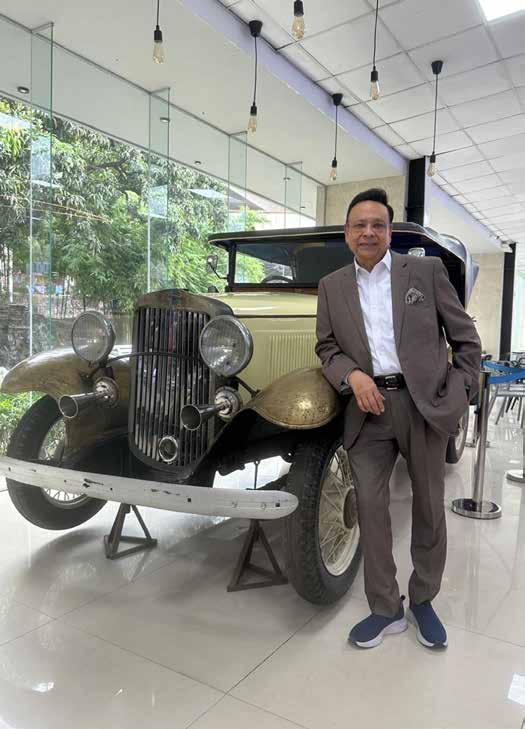
issues faced by virtual reality (VR) technology with existing gaming consoles. Beyond technical compatibility, businesses must also consider the cost and resource allocation required to implement innovations. The adoption of advanced AI systems, for instance, demands substantial investments in data infrastructure and skilled personnel. Security and privacy concerns are paramount, as integrating new technologies like Internet of Things (IoT) devices introduces potential vulnerabilities. Moreover, user training is essential to ensure that employees, customers, and end-users can effectively utilise new innovations, as seen in the healthcare industry's shift to electronic health records (EHRs). Successfully navigating these challenges is crucial for businesses to leverage innovation as a catalyst for sustained growth and success. Hosaf has been particularly successful in this regard, demonstrating its ability to integrate cutting-edge innovations seamlessly into its operations, ensuring continued growth and competitiveness in a rapidly evolving marketplace.
Hosaf Group's approach to business is a profound testament to the compatibility and mutual reinforcement of traditional principles and innovative strategies. The company's journey is a remarkable narrative of how age-old values and modern advancements can not only coexist but also enhance each other, leading to unprecedented success. By seamlessly integrating time-honoured values with cutting-edge innovation, Hosaf Group has propelled itself to the forefront of Bangladesh's private sector, showcasing a model of business excellence that harmonises tradition with modernity.
At the heart of Hosaf Group's philosophy lies a deep respect for the traditional principles that have guided businesses for generations. These principles—integrity,
Moazzam Hossain
Mr. Moazzam Hossain standing proudly beside a classic antique car, reflecting his taste for elegance and history.
quality, responsibility, and community—are not just abstract ideals but are woven into the very fabric of the company's operations. For Hosaf Group, maintaining these core values is paramount, even as they embrace the transformative power of innovation. This blend of tradition and innovation is evident in every aspect of their business, from their corporate governance to their product offerings and community initiatives.
Hosaf Group's story is not just about adhering to old values; it is about reimagining these values in a contemporary context. The group has turned conventional business wisdom on its head, demonstrating that principles such as integrity and responsibility are not only compatible with modern business practices but are essential to achieving long-term success. By prioritising ethical conduct and social responsibility, Hosaf Group has built a reputation for trustworthiness and excellence that sets it apart in the competitive business landscape.
The integration of compatibility and innovation is most evident in Hosaf Group's diverse ventures across various industries. Unlike many businesses that specialise in a single sector, Hosaf Group has ventured into a wide array of fields, including Power, Real Estate, Manufacturing, Renewable Energy, Coal, Auto Brick Industry and Banking This diversification is not a departure from their core values but a strategic expansion that leverages their strengths across different domains. Each venture is guided by the same commitment to quality and innovation, ensuring that Hosaf Group remains a leader in every industry it touches.
In the Power sector, for example, Hosaf Group has invested in both traditional and renewable energy sources. Their projects are designed to meet the growing energy demands sustainably, positioning the company as a
leader in the energy transition. Similarly, in Real Estate, Hosaf Group has developed a reputation for quality and innovation, with projects ranging from residential developments to commercial properties, all designed with a focus on sustainability and community impact.
Hosaf Group's venture into Manufacturing Housing highlights their commitment to providing affordable and high-quality living solutions. By leveraging advanced manufacturing techniques, the company produces durable and cost-effective housing units, addressing a critical need in many markets. This approach not only meets the immediate housing demands but also contributes to the long-term socio-economic development of communities.
In the realm of Renewable Energy, Hosaf Group's investments in solar, and other sustainable sources underscore their dedication to environmental conservation and energy security. These initiatives are not just about reducing carbon footprints but about ensuring a sustainable and independent energy future for Bangladesh.
Even as Hosaf Group embraces modern technologies and innovative practices, they remain firmly rooted in their traditional values. Their presence in the financial sector, including banking and insurance, is a testament to their versatility and strategic vision. Offering a range of financial services, Hosaf Group meets the diverse needs of their customers, from personal banking solutions to comprehensive insurance products, all while upholding their commitment to integrity and responsibility.
Hosaf Group's integration of compatibility and innovation is a masterclass in how businesses can thrive by blending the best of the old with the new. By turning traditional principles upside down and embracing diversification, Hosaf Group has positioned itself as a
leader in multiple industries. Their success across a broad spectrum of sectors demonstrates the effectiveness of their integrated strategy, which combines ethical foundations with bold, forward-thinking practices. This unique blend of tradition and innovation continues to drive Hosaf Group's growth and influence, making it a formidable force in the global business landscape.
COMPATIBILITY AND INNOVATION: ESSENTIAL TO ONE ANOTHER
The idea that traditional business principles and innovative approaches are not only compatible but essential to one another is at the core of Hosaf Group's strategy. The company seamlessly integrates time-tested values such as integrity, quality, and responsibility with forward-thinking practices that include boldness, agility, and innovation. This synergy ensures that Hosaf Group can navigate the complexities of modern business while maintaining a strong ethical foundation.
Hosaf Group's journey is a profound narrative of blending traditional values with contemporary advancements. From its inception, the company has been deeply rooted in the principles of honesty, excellence, and social responsibility. These values are not just a part of their mission statement; they are lived and breathed in every decision and action. Integrity, for instance, is not merely about adhering to laws and regulations but about doing the right thing, even when no one is watching. This commitment to integrity builds trust with stakeholders, from employees and customers to suppliers and the broader community.
Boldness is an attribute that defines their approach. Hosaf Group is not afraid to take calculated risks, enter new markets, or invest in innovative technologies. This boldness
is balanced with agility, enabling the company to respond swiftly to market changes, technological advancements, and emerging opportunities.
Hosaf Group's success is built on its ability to rethink and innovate upon traditional business principles. The company challenges conventional wisdom by embracing diversification and exploring a wide array of industries, rather than specializing in a single sector. This approach has allowed Hosaf Group to leverage its core strengths across various fields, creating a robust and resilient business model.
In a world where many companies choose to specialise in a single niche, Hosaf Group stands out by its diversification strategy. This strategy is not just about spreading risk but about recognising and seizing opportunities across different sectors. By not putting all its eggs in one basket, Hosaf Group has created a business model that is bothresilient and dynamic, capable of weathering economic downturns and capitalizing on growth trends in various industries.
This approach of turning traditional principles upside down is evident in Hosaf Group's operational philosophy. Instead of viewing diversification as a dilution of focus, the company sees it as an expansion of its core competencies. Each venture, whether in Power, Real Estate, Manufacturing, or Finance, is treated with the same level of dedication and pursuit of excellence. This strategic diversification has allowed Hosaf Group to build a broad portfolio, mitigating risks associated with market volatility and economic cycles.
POWER AND REAL ESTATE
Hosaf Group has established itself as a significant player in the Power sector, investing in both traditional and renewable energy sources. The company's power projects
are designed to meet the growing energy demands sustainably, positioning Hosaf as a leader in the energy transition. By focusing on both traditional and renewable energy, Hosaf Group ensures a balanced approach to energy generation, addressing immediate needs while planning for a sustainable future.
In Real Estate, Hosaf Group has developed a reputation for quality and innovation. The company's projects range from residential developments to commercial properties, all designed with a focus on sustainability and community impact. Hosaf Group's venture into Manufacturing Housing highlights its commitment to providing affordable and high-quality living solutions. The company leverages advanced manufacturing techniques to produce durable and cost-effective housing units, addressing a critical need in many markets.
Real estate projects undertaken by Hosaf Group are not merely about constructing buildings; they are about creating communities. Each project is meticulously planned to include green spaces, recreational facilities, and essential services, ensuring a holistic living experience for residents. This attention to detail and community-centric approach has earned Hosaf Group a reputation for excellence and innovation in the real estate sector.
RENEWABLE ENERGY AND FOSSIL FUEL
As a pioneer in renewable energy, Hosaf Group invests heavily in wind, solar, and other sustainable energy sources. These investments not only contribute to environmental conservation but also ensure long-term energy security and independence. Hosaf Group's renewable energy projects are designed to reduce carbon footprints and promote cleaner energy solutions, aligning with global sustainability goals.
While maintaining a commitment to sustainability, Hosaf Group also recognises the ongoing importance of coal in the global energy mix. The company operates coal ventures with a focus on responsible mining practices and environmental management. By adopting best practices in coal extraction and usage, Hosaf Group ensures that its coal operations are as environmentally friendly as possible, balancing the need for energy with environmental stewardship.
Hosaf Group's dual focus on renewable and fossil fuel energy reflects a pragmatic approach to energy
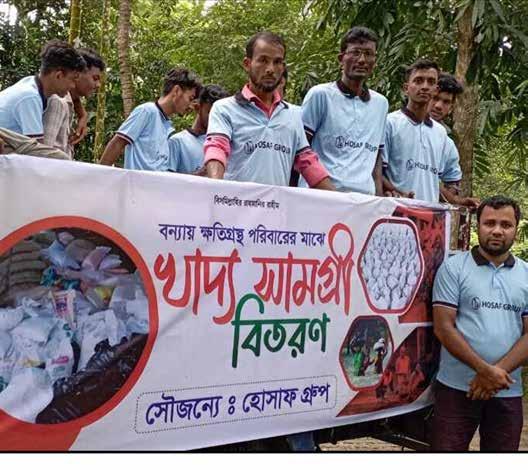
A moment of compassion—Hosaf Group leading a relief distribution for flood-affected people, making a positive impact.
management. While aggressively pursuing renewable projects, the company acknowledges the current reliance on fossil fuels and strives to make this usage as sustainable and efficient as possible. This balanced approach ensures energy security while contributing to global efforts to combat climate change.
A MODEL OF BUSINESS EXCELLENCE
Hosaf Group's approach to business exemplifies how traditional principles and innovative strategies can complement and enhance one another. By turning conventional business wisdom upside down and embracing diversification, Hosaf Group has positioned itself as a leader in multiple industries. The company's success across such a broad spectrum of sectors demonstrates the effectiveness of its integrated strategy, which combines ethical foundations with bold, forward-thinking practices. This unique blend of compatibility and innovation continues to drive Hosaf Group's growth and influence, making it a formidable force in the global business landscape.
TRANSFORMING CHALLENGES INTO TRIUMPH: THE INSPIRING SUCCESS STORY OF HOSAF GROUP IN POST-LIBERATION BANGLADESH
Corporate philanthropy has long been at the heart of the Hosaf Group's strategy, playing a crucial role in the company's success, especially in the challenging environment of Bangladesh. By actively participating in philanthropic initiatives, Hosaf has been able to bring its corporate values to life, fostering a culture of giving within the organisation. This commitment to social responsibility has allowed the company to make meaningful connections with the communities it serves, benefiting both the business
and the broader society. Through these efforts, Hosaf has not only uplifted the communities around it but has also built stronger relationships with its customers, creating a positive public image that resonates with both current and potential customers.
From a business perspective, Hosaf's investment in philanthropy has proven to be highly beneficial. Studies have shown that companies engaged in philanthropic activities often enjoy increased customer loyalty, improved customer satisfaction, and higher employee morale and productivity. For Hosaf, this has translated into a thriving business even in the tough conditions of Bangladesh. By differentiating itself through its commitment to giving back, Hosaf has set itself apart from its competitors, showcasing its dedication to making a positive impact on society. This approach has not only reinforced the company's standing in the market but has also fostered a strong sense of community, further solidifying its relationships with customers and employees alike. Through its philanthropic endeavors, Hosaf has successfully turned its commitment to social responsibility into a foundation for enduring success.
The Hosaf Group's success story is deeply intertwined with the remarkable journey of Bangladesh's postliberation era. In the aftermath of the 1971 Liberation War, Bangladesh faced immense challenges, both economic and social. Despite being labelled a "basket case" by Henry Kissinger, the country, under visionary leadership, began a journey of transformation that would defy all odds.
Dr. Kamal Hossain, a key figure in Bangladesh's liberation struggle, played a pivotal role in shaping the country's destiny. Emerging from imprisonment during the war, Mr. Hossain went on to contribute significantly to the drafting of Bangladesh's constitution, laying the foundation
for a democratic and progressive nation.
One of the cornerstones of Bangladesh's success was its commitment to trade liberalisation and private sector growth. The country's early adoption of these policies, coupled with a conducive labour regulatory environment, set the stage for sustainable economic growth. The Hosaf Group, under the visionary leadership of its Chairman, Mr. Moazzam Hossain, embraced these changes, positioning itself as a key player in Bangladesh's economic resurgence.
The Hosaf Group's strategic focus on sectors such as Infrastructure, Education, and Manufacturing not only contributed to the country's economic growth but also played a crucial role in uplifting communities across Bangladesh. By aligning its business goals with the country's development objectives, the Hosaf Group became a beacon of progress and prosperity.
Furthermore, Bangladesh's partnership with nongovernmental organisations (NGOs) played a significant role in its development journey. The Hosaf Group actively supported NGOs working in various sectors, including economic development, health, and education, further cementing its commitment to social responsibility.
Today, Bangladesh stands as a shining example of resilience and progress. With a growing economy, declining poverty rates, and improved human development indicators, the country has truly defied expectations. The Hosaf Group's story is not just one of business success but also a testament to the power of visionary leadership, strategic planning, and a deep commitment to the wellbeing of society.
IMPROVING BRAND AWARENESS AND REPUTATION
Through its philanthropic efforts, the Hosaf Group has
enhanced its brand reputation with employees, customers, partners, and the community at large. By donating funds to charities under its name and offering employee matching gift programmes, the group has strengthened its brand perception and maximised opportunities to connect with positive social initiatives. This has helped improve the reach and reputation of the group, positioning it as a socially responsible organisation.
TAX DEDUCTIONS
While the primary goal of corporate philanthropy is to make a positive impact on the community, it also provides economic rewards in the form of tax deductions. By properly tracking and recording its donations, the Hosaf Group has been able to maximise its tax savings and ensure compliance with all tax requirements. This has allowed the group to continue its philanthropic efforts while also benefiting financially.
CONSTRUCTING EDUCATIONAL INSTITUTIONS
As part of its corporate social responsibility, Hosaf Group constructed the Bokter Munshi Moazzam Hossain High School in Shonagazi, Feni. The school has a competent headmaster with 28 trained teachers and 925 students. The performance of the students in the Secondary School Certificate examination is well above the average. Hosaf Group believes in education as a power to eliminate poverty in Bangladesh. With this view in mind, it also set up the Bhor Bazar Belayet Hossain High School in Shonagazi. Since its inception, Hosaf Group has been continuously patronizing this institution with all necessary financial and logistic support. The establishment of Amirabad Anowara Girls' High School in Sonagazi, Feni is another example of
Hosaf Group's role in contributing to the socio-economic development of the country.
AWARDING SCHOLARSHIPS AND PROMOTING EXTRACURRICULAR ACTIVITIES
In addition, Hosaf Group has been instrumental in awarding scholarships to meritorious students every year for higher studies in the country, giving much emphasis on moral education. The company has also played an important role in promoting sports and other extracurricular activities by sponsoring the Hosaf President Cup Golf Tournaments at the Savar Golf Club.
EMPOWERING COMMUNITIES AND INSPIRING CHANGE: THE PHILANTHROPIC ACTIVITIES OF HOSAF GROUP
Mr. Moazzam Hossain's philanthropic journey as the Chairman of Hosaf Group is marked by a profound commitment to social welfare and community empowerment. His visionary leadership extends beyond the business realm, deeply rooted in his values and compassion for the underprivileged. In an interview, Mr. Hossain shared insights into his and his wife's initiatives to support the elderly and orphans, highlighting their dedication to making a positive impact on society.
Mr. Hossain's wife, Mrs. Ilya Hossain plays a significant role in silently supporting the elderly in old homes, providing them with medical treatment, food, and companionship. Their commitment to this cause demonstrates a genuine desire to make a difference in the lives of the less fortunate, without seeking recognition or praise. Their efforts go beyond financial assistance, as they personally engage with the elderly, offering them emotional support and a sense of
belonging. This compassionate approach reflects the core values of the Hosaf Group and sets a standard for corporate social responsibility.
Additionally, Mr. Hossain's involvement in the "Home for Homeless People" programme showcases his proactive approach to addressing social issues. By pioneering this initiative and providing homes to the homeless, he has set an example for others to follow, inspiring thousands to join the cause and make a difference in their communities. This programme not only provides shelter but also empowers individuals to rebuild their lives with dignity and hope.
Moreover, Mr. Hossain's vision for the future includes securing a production license for a coal mine, a project that has been a focus of his for many years. This endeavour not only reflects his commitment to economic development but also his dedication to achieving his goals despite challenges and setbacks. If successful, this project has the potential to create employment opportunities and stimulate economic growth in the region, further contributing to the welfare of the community.
Mr. Moazzam Hossain's philanthropic efforts and dedication to social causes exemplify his role as a visionary leader and a compassionate human being. His initiatives have not only impacted the lives of those directly involved but have also inspired others to contribute to the betterment of society. Through his actions, Mr. Hossain has shown that true leadership is not just about achieving personal success but also about using one's influence and resources to uplift others and create a positive impact on the world.
MR. HOSSAIN'S LEADERSHIP STYLE AND COMMITMENT TO CSR
Mr. Hossain's leadership style, characterised by humility
Moazzam Hossain
and a deep sense of responsibility towards society, has set a benchmark in the corporate world. He embodies the principle that business success and social responsibility are not mutually exclusive but rather complementary. This philosophy has driven Hosaf Group to undertake numerous initiatives aimed at improving the quality of life for underprivileged communities, thereby enhancing the firm's reputation and stakeholder trust.
The CSR initiatives led by Mr. Hossain include the construction of schools, scholarships for students, healthcare programmes, and support for sports and extracurricular activities. These efforts highlight his understanding of CSR as a holistic approach to business, one that encompasses economic, social, and environmental dimensions. His visionary leadership has thus enabled Hosaf Group to make substantial contributions to societal welfare while maintaining robust business growth.
Mr. Moazzam Hossain's role as Chairman of the Hosaf Group exemplifies the profound impact of CEO leadership on a firm's CSR performance. His unwavering commitment to social responsibility, coupled with his strategic vision, has positioned Hosaf Group as a model for corporate citizenship. This alignment of business objectives with societal needs reflects a broader understanding of the interconnectedness of economic success and social well-being, making Mr. Hossain a pivotal figure in the advancement of CSR in Bangladesh.
EMPLOYEE RETENTION AND SATISFACTION
Employee retention and satisfaction are crucial components of Hosaf Group's CSR strategy. By implementing policies and programmes that benefit their workforce, such as generous maternity and paternity leave, educational opportunities,
and financial inclusion initiatives, the company creates a supportive and inclusive workplace environment. This commitment to employee welfare not only enhances job satisfaction but also attracts top talent who are looking for employers that prioritise their well-being. As a result, Hosaf Group enjoys a more engaged and motivated workforce, which in turn drives the company’s success and innovation.
Moazzam Hossain
CHAPTER 8
NAVIGATING CHALLENGES AND CRISES: TURNING CHALLENGES INTO OPPORTUNITIES
In our swiftly evolving world, the ability to transform challenges into opportunities is paramount for corporate success. The modern workplace is characterised by a rapid pace of innovation and shifting trends, making adaptability not just a survival strategy but a powerful catalyst for both personal and professional growth.
Recognising change as an opportunity rather than a disruption can foster resilience and enhance one's skill set. Embracing change enables individuals and organisations to develop new perspectives, acquire fresh skills, and remain relevant in a dynamic work environment. This adaptability is essential in a world where technological advancements and market demands evolve at an unprecedented rate. To navigate change effectively, it's crucial to approach it with curiosity and openness. Embracing uncertainty involves seeking out learning opportunities, engaging with new ideas, and exploring uncharted territories. This mindset encourages continuous improvement and innovation, allowing individuals and teams to stay ahead of the curve.
Mr. Hossain believes that flexibility and a willingness to step outside your comfort zone are key to adapting to change.
Viewing change as a chance to innovate, collaborate, and showcase capabilities can turn potential disruptions into avenues for growth. By harnessing the power of change, individuals and organisations can position themselves as valuable assets, ready to tackle any challenge that comes their way.
The capability to deal with challenges is critical for success in our rapidly changing world. Embracing change as an opportunity rather than a disruption fosters resilience,
enhances skill sets, and drives innovation. By adopting an adaptable mindset, individuals and organizations can thrive amidst change, turning potential obstacles into stepping stones towards success.
TURNING CHALLENGES INTO OPPORTUNITIES
Under the visionary leadership of Mr. Moazzam Hossain, the Hosaf Group has successfully mastered the art of transforming challenges into opportunities. From its inception, the company faced numerous obstacles, including market volatility, regulatory hurdles, and economic fluctuations. However, Mr. Hossain's strategic acumen and unwavering determination turned these challenges into catalysts for growth. For instance, when the automobile market in Bangladesh faced stringent import regulations, Hosaf Group pivoted to introduce reconditioned cars, from Japan creating a new market segment and meeting consumer demand. Similarly, during economic downturns, the company diversified its portfolio, investing in sectors such as deep-sea fishing in South Korea and barter trade with mostly socialist countries, thereby ensuring sustained growth and stability. This ability to navigate and capitalise on change has not only solidified Hosaf Group's position as a leader in the private sector but has also set a benchmark for resilience and innovation in the business community.
TRIUMPH AMIDST TURMOIL: HOSAF GROUP'S RISE IN POST-INDEPENDENCE BANGLADESH
In the wake of the Liberation War of 1971, Bangladesh emerged as a nation facing a daunting array of challenges. The war had left the country with devastated infrastructure, widespread poverty, and a severely weakened economy. Unemployment was rampant, and there was a significant
lack of investment, both domestic and foreign, which stifled economic growth. The scarcity of skilled labour, coupled with ineffective policies and a fragmented market, created an environment of uncertainty and hardship. International cooperation was minimal, and essential resources needed to establish and sustain businesses were in short supply. Despite these formidable obstacles, Hosaf Group, under the visionary leadership of Mr. Moazzam Hossain, managed to navigate these turbulent times with remarkable resilience and innovation. Through strategic investments and diversification, the group not only overcame these challenges but also emerged as a leader in various industries, playing a pivotal role in the nation's recovery and development. This narrative of how Hosaf Group turned adversity into opportunity set a new standard for business excellence in post-independence Bangladesh.
THE IMPORTANCE OF CRISIS HANDLING FOR ESTABLISHING A SUCCESSFUL BUSINESS
Crisis management is a strategic approach that businesses use to navigate and mitigate the adverse effects of unpredictable events. It starts with proactive planning and identifying key responders responsible for managing the situation. This involves understanding the political, legal, and cultural contexts in which crises might unfold, allowing businesses to be better prepared when they arise. To enhance readiness, companies often conduct tabletop exercises that simulate potential crisis scenarios. These exercises are crucial for determining how the company would survive the initial stages of a crisis, manage relationships with stakeholders, and avoid missteps with government agencies.
Effective crisis management also requires maintaining
employee well-being and ensuring clear communication. Leaders play a pivotal role during crises, and the best leaders remain calm and composed, providing clear and concise communication across all necessary channels. This is vital because employees, already under stress, need reassurance and guidance from their leaders. A leader who is visibly anxious can exacerbate the situation, leading to further confusion and demotivation among employees. Additionally, crisis management involves maintaining strong relationships with various stakeholders, requiring leaders to engage effectively with different groups and address their concerns.
Adaptability and creativity are essential during crisis response. Crises often demand innovative and creative solutions, as standard business practices may no longer apply. Leaders must think creatively to devise new strategies that address the evolving situation. Flexibility is also crucial, as situations can change rapidly during a crisis, requiring leaders to pivot strategies on short notice. This adaptability ensures that the company can respond effectively to new information and shifting circumstances.
Coordination and oversight are the key components of crisis management. Once a crisis is identified, assembling a well-coordinated team that includes both internal resources and external experts is essential. This team should have clear roles, and there should be established protocols for involving the board of directors, particularly in monitoring and oversight. Managing the flow of information is one of the most critical functions of crisis management. A qualified crisis communications team should be empowered to gather facts and communicate with stakeholders, including government agencies, employees, customers, and the public. This team must operate with an understanding of
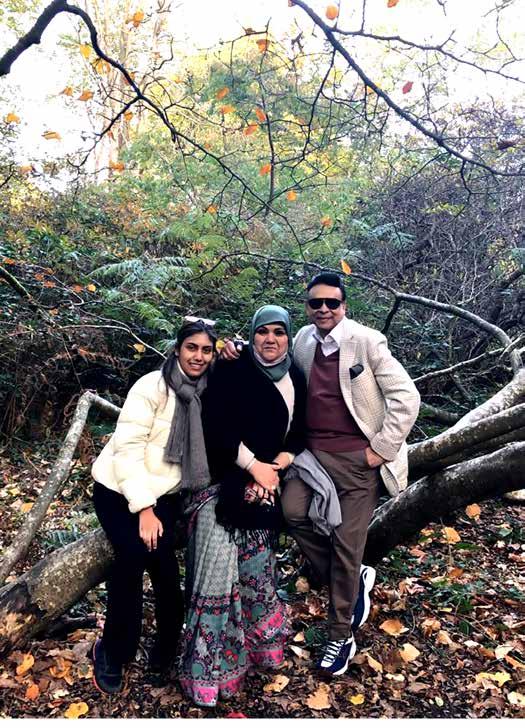
Moazzam Hossain
A joyful snapshot of Mr. Moazzam Hossain with his wife Ilay Raaz Hossain and daughter Melika, enjoying a family trip together.
cultural differences and the relevant political and legal contexts.
Ultimately, the goal of crisis management is to ensure business continuity and mitigate risks during challenging times. By having a well-defined crisis management plan that includes clear roles, communication strategies, and flexibility, companies can maintain operations during a crisis while safeguarding employee well-being and stakeholder relations.
The story of Hosaf Group's rise amidst post-independence turmoil in Bangladesh highlights the critical importance of crisis handling in establishing a successful business. Effective crisis management not only stabilizes a company during turbulent times but also sets the foundation for long-term success. The following leadership qualities are essential for navigating crises and leading a business to thrive in the face of adversity.
A good leader keeps an open line of communication with team members and can succinctly explain organisational goals and tasks using different types of communication channels, such as one-on-one sessions, email, video, chat, phone calls, and social media. An effective leader shares clear messages and makes complex ideas easy to understand for everyone. In the case of Hosaf Group, open communication enabled the team to stay aligned and motivated, ensuring that everyone worked towards the common goal of overcoming post-war challenges.
Empathetic leadership focuses on identifying with others and understanding their perspective. Leaders who show empathy are successful because they can better understand how employees feel about their work environment. This enables leaders to bring positive changes to the workforce. Mr. Moazzam Hossain's empathetic approach helped
build a supportive and resilient team, which was crucial in navigating the hardships of a nascent market.
Leaders need strategic and critical thinking skills, as they are tasked with challenging decision-making. A strong leader makes well-researched and objectively scrutinized decisions that can lead an organisation toward achieving its goals. Hosaf Group's strategic investments and diversification into various industries were key to its success, demonstrating the importance of foresight and planning.
A creative leader can brainstorm new ideas and inspire others toward creativity and innovation. For example, a successful leader will always recognise and reward employees for their creative input. Hosaf Group's innovative solutions, such as introducing reconditioned cars and venturing into deep-sea fishing, showcased the power of creativity in transforming challenges into opportunities. A great leader brings positivity into the work environment, which in turn uplifts the employees and encourages them to perform better. Positivity can be cultivated by showing care, respect, diplomacy, and empathy toward the team. Despite the bleak circumstances, Hosaf Group maintained a positive outlook, motivating the team to persevere and excel.
The best leaders get out of their comfort zones and quickly adapt to changing work conditions. They wear multiple hats and can problem-solve and improvise on the fly. A successful leader also promotes employee engagement and is willing to accept constructive feedback from the team. Hosaf Group's ability to adapt to the ever-changing business landscape was pivotal in its growth and success.
A great leader not only knows how to avoid conflicts in the workplace but can also resolve them efficiently and timely.
Moazzam Hossain
While resolving conflicts, the leader stays level-headed and decides analytically. Effective conflict resolution helped Hosaf Group maintain harmony and productivity within the organisation during challenging times.
This is an essential skill for leaders, as they need to delegate tasks, prioritise commitments, set attainable goals, and multitask. Successful leaders practice time management skills by setting SMART goals for themselves and their team members. Hosaf Group's efficient time management allowed it to handle multiple projects simultaneously, ensuring steady progress and growth.
A strong leader is dependable and one that people can count on for fulfilling commitments and meeting deadlines. This encourages the team to appreciate the leader's decisions and follow in their footsteps. Hosaf Group's reliability in delivering results built trust and credibility, which were vital for its success.
Great leaders are always ready to mentor and teach to bring out the best in their employees. They put in a lot of effort to make the team successful by using positive reinforcement, clarity, motivation, and rewarding achievements. Mr. Moazzam Hossain's mentorship fostered a culture of learning and growth within Hosaf Group.
Additionally, great leaders have a keen eye for recognising potential talent and competencies in the workplace. They also don't shy away from acknowledging the abilities and achievements of their employees. Hosaf Group's ability to identify and nurture talent played a significant role in its rise to prominence.
The success and failure of a team ride on the shoulders of a leader. Therefore, leaders should be accountable for their actions and willing to take the blame when mishaps happen. Great leaders take responsibility and devise
strategies for improvement instead of pointing fingers and blaming others. Hosaf Group's leadership demonstrated responsibility and accountability, which earned the respect and loyalty of its employees.
Leadership positions depend heavily on organisational skills. A successful leader can handle a variety of different projects, spend ample time on each, prioritise, and ensure that all project deadlines are met. Hosaf Group's organisational prowess enabled it to manage complex operations and achieve its goals.
Sometimes, it's difficult for leaders to let go of the projects they're passionate about. However, a great leader knows the strengths and key skills of each employee and delegates accordingly based on the project requirements. This also helps with relationship building within the team as employees feel valued, respected, and trusted. Hosaf Group's effective delegation practices under the leadership of Mr. Hossain ensured that tasks were completed efficiently and employees were empowered.
OVERCOMING INSURMOUNTABLE ODDS
In the aftermath of the Liberation War, Bangladesh was a nation grappling with numerous economic and social challenges. There was an acute lack of investment, both domestic and foreign, which hampered the development of vital infrastructure.
Against this backdrop, Hosaf Group emerged as a pioneer. With limited resources but an abundance of determination, Mr. Moazzam Hossain and his team took bold steps to overcome these barriers. They focused on building a skilled workforce by investing in training and development. By leveraging innovative business models and fostering strong local partnerships, Hosaf Group was
Moazzam Hossain
able to navigate the complexities of a nascent market. In the dynamic world of business, navigating challenges and crises is essential for long-term success and sustainability. For Hosaf Group, under the astute leadership of Chairman Mr. Moazzam Hossain, this journey has been marked by significant challenges that tested the resilience and adaptability of both the leader and the organisation. From natural disasters to economic downturns, Hosaf Group has faced numerous crises headon. Through critical decision-making under pressure and a commitment to innovation and flexibility, Mr. Hossain has steered the company through turbulent times, ensuring its continued growth and stability. This chapter delves into the strategies and insights that have enabled Hosaf Group to overcome obstacles and thrive, highlighting the pivotal role of effective crisis management in the company's success.
MAJOR CRISES AND THEIR OVERCOMING
Hosaf Group has encountered various significant challenges throughout its history. One notable instance was during the global financial crisis, which posed a substantial threat to the company’s financial stability. Mr. Moazzam Hossain, recognising the gravity of the situation, led a comprehensive assessment to understand the potential impact and associated risks. By identifying critical areas of concern and implementing stringent cost-control measures, the company managed to navigate through the financial turbulence. This strategic clarity and prompt action exemplify the company’s ability to overcome formidable obstacles.
DECISION-MAKING UNDER PRESSURE
Effective decision-making under pressure has been a hallmark of Mr. Hossain’s leadership. During a critical supply chain disruption caused by unforeseen geopolitical events, Hosaf Group faced potential delays in product deliveries that could damage its reputation. Mr. Hossain convened an emergency task force to evaluate the situation and explore alternative supply routes. Through decisive leadership and collaboration with key stakeholders, the company swiftly restructured its supply chain operations, minimizing disruption and maintaining customer satisfaction. This incident underscores the importance of clear, decisive action in times of crisis.
The resilience and adaptability of Hosaf Group have been instrumental in its ability to navigate changing circumstances. The COVID-19 pandemic, for example, presented unprecedented challenges that required immediate and innovative responses. Mr. Hossain emphasised the need to re-evaluate strategic priorities and adapt to the evolving situation. By fostering a culture of innovation, the company explored novel solutions such as remote work arrangements and digital transformation initiatives. This proactive approach not only ensured business continuity but also positioned Hosaf Group favourably for future growth in the post-pandemic world.
While addressing immediate crises, Hosaf Group has consistently maintained a focus on long-term objectives. The company’s strategic planning incorporates both short-term crisis management and sustained growth. During economic downturns, Mr. Hossain has led efforts to balance immediate financial stability with investments in innovation and new business ventures. This dual focus has enabled the company to emerge stronger from crises, continually evolving to meet market demands.
Encouraging team members to think creatively and explore unconventional strategies has fostered an environment where innovation thrives, driving long-term success.
Transparent and proactive communication has been a cornerstone of Hosaf Group’s crisis management approach. Mr. Hossain believes in maintaining open lines of communication with all stakeholders, including employees, customers, and investors. During crises, timely updates and accurate information sharing have built trust and ensured that all parties are aligned with the company’s actions and objectives. This commitment to transparency has fortified the company’s relationships and reinforced its reputation as a trustworthy and reliable organisation.
The ability of Hosaf Group to navigate challenges and crises effectively is a testament to the leadership of Mr. Moazzam Hossain and the company’s strategic resilience. By assessing situations comprehensively, making decisive actions under pressure, fostering innovation, and maintaining a long-term vision, Hosaf Group continues to thrive amidst uncertainties. The lessons learned from these experiences not only strengthen the company’s foundation but also pave the way for a promising future.
Crisis management at Hosaf Group has played a pivotal role in protecting the business’s reputation. By preventing negative publicity and swiftly addressing any damage to the company’s image, Hosaf has managed to maintain its standing in the market. This proactive stance has not only preserved customer trust but also reinforced the company's credibility among investors and other stakeholders. A well-managed crisis response demonstrates the company’s commitment to transparency and accountability, which are critical for long-term success.
The ability to ensure continuity of operations during crises has been a cornerstone of Hosaf Group’s crisis management strategy. Whether dealing with supply chain disruptions or unexpected market shifts, the company has implemented robust plans that minimise potential losses and maintain business functions. This approach has allowed Hosaf to sustain its operations even in the face of significant challenges, ensuring that it can continue to meet customer needs and maintain market presence.
Crisis management plans at Hosaf Group are designed to mitigate the financial impact of crises. By taking timely and appropriate actions, the company has been able to limit financial losses and stabilize operations. For example, during economic downturns, Hosaf has employed costcontrol measures and strategic financial planning to navigate financial turbulence. This preparedness has allowed the company to weather financial storms and emerge resilient.
Proper crisis management planning at Hosaf Group has also helped minimise legal exposure. By preventing potential lawsuits and addressing legal concerns promptly, the company has protected itself from legal liabilities that could arise during crises. This legal foresight ensures that the company complies with regulations and maintains its integrity, even under pressure.
Effective crisis management begins with a comprehensive understanding of the potential risks that could impact the business. For Hosaf Group, this includes natural disasters, technological failures, economic downturns, and reputational damage. By identifying and assessing these risks, Hosaf has been able to develop targeted strategies to mitigate them. This proactive approach involves clearly defining worst-case scenarios
Moazzam Hossain

and crafting resilient response strategies to ensure preparedness.
A robust crisis management plan is the cornerstone of Hosaf Group’s approach to crisis management and business continuity. This plan encompasses clear communication protocols, designated roles and responsibilities, and procedures for effective decision-making under pressure. Regular updates to the plan reflect changing circumstances and new insights, ensuring that Hosaf is always prepared to respond effectively to any crisis.
Hosaf Group emphasises the importance of crisis management training and conducting simulations to ensure that the crisis management plan is more than just a document. Regular drills and simulations test the plan’s effectiveness and the team’s readiness, ensuring that the response is swift, coordinated, and effective when a real crisis hits. This hands-on approach ensures that Hosaf is well-prepared to handle any unexpected situations.
Business continuity and crisis management at Hosaf Group are fundamentally about resilience and adaptability. The company has developed a culture that can withstand shocks and adapt to new challenges.
This means investing in resilient infrastructure, fostering a culture of continuous learning, and encouraging innovative thinking to tackle unforeseen challenges. By building resilience and flexibility, Hosaf ensures that it can navigate any crisis and continue to grow.
Hosaf Group’s crisis management plans are tailored to its specific needs and capacities, recognising that stakes can be higher for businesses with fewer resources. These plans include effective communication strategies, a designated crisis response team, and a continuity plan to minimize disruptions. By focusing on building resilience
Moazzam Hossain
Moazzam Hossain and son Mabroor Hossain, immersed in the electrifying atmosphere of the 2018 World Cup at Luzhniki Stadium, Moscow.
and flexibility, often turning to technology and community support, Hosaf has bolstered its crisis management efforts and ensured its ability to navigate challenges successfully.
THE CRUCIAL ROLE OF SUCCESSION PLANNING IN HOSAF GROUP'S SUCCESS
In the dynamic world of business, change is inevitable, and leadership transitions are a significant part of that change. Effective succession planning ensures that a company can maintain continuity and stability, even amidst unexpected changes. For Hosaf Group, a leading conglomerate in Bangladesh, succession planning has been integral to its sustained success and resilience.
Leadership is the guiding compass of any organisation, and without it, navigating the complexities of the business landscape can be challenging. Hosaf Group, under the astute leadership of Mr. Moazzam Hossain, has exemplified the importance of continuous leadership. Mr. Hossain has seamlessly passed on the responsibilities to his children, ensuring that the company remains steadfast in its vision and operational goals. His children, having been groomed under his guidance, have adeptly taken the helm, demonstrating that effective succession planning is not just about filling positions but about sustaining the company's values and strategic direction.
In the unpredictable world of business, being prepared for unexpected changes is crucial. Leaders might retire, face health issues, or pursue new opportunities. Hosaf Group's succession planning acts as a safety net, ensuring resilience in the face of such changes. Mr. Hossain has meticulously identified and developed potential successors within the family, equipping them with the necessary skills and knowledge to lead the company. This
proactive approach mitigates risks and ensures that the company is never caught off guard, maintaining stability and continuity in its operations.
Succession planning at Hosaf Group has facilitated smooth leadership transitions. When Mr. Hossain decided to step back from day-to-day operations, his children were already prepared to step in. This seamless transition minimised disruptions and maintained productivity, allowing the company to continue its upward trajectory without missing a beat. The new leaders, well-versed with the company's goals and challenges, ensured that the transition period was short and the learning curve minimal, reinforcing the importance of having a readyand-prepared leadership team.
Hosaf Group's succession planning aligns with its long-term business goals. By developing future leaders who share the company's vision, Mr. Hossain has ensured that the company's strategic objectives remain on track. His children, now at the helm, are driving the company towards sustained growth and innovation, embodying the same passion and commitment that has been the hallmark of Hosaf Group. This alignment ensures that the company's progress is steady and consistent, with leadership development embedded in its core values.
Succession planning at Hosaf Group has significantly boosted employee morale and engagement. Employees are more likely to stay and perform at their best when they see a clear path for their growth and development. By investing in the development of future leaders and showing a commitment to their career progression, Hosaf Group has created a positive and motivating work environment. This investment in people has paid off in terms of higher employee satisfaction and loyalty, contributing to the
Moazzam
overall success of the company.
In a competitive market, attracting and retaining top talent is a challenge. Hosaf Group's succession planning has positioned it as an employer of choice. The clear progression track and development opportunities make it an attractive destination for ambitious professionals. Mr. Hossain's children, now leading the company, continue to uphold these values, ensuring that Hosaf Group remains a magnet for the best and brightest talents. This focus on talent development and retention is a cornerstone of the company's enduring success.
Succession planning at Hosaf Group has helped foster a strong organisational culture. Leaders who emerge from within the ranks carry forward the company's core values and practices. This internal succession reinforces the company's ethos and ensures that the cultural fabric remains intact. As the baton passes within the family, the culture of innovation, integrity, and excellence is perpetuated, providing a solid foundation for the company's continued growth.
Effective risk management is another critical aspect of succession planning. By having a pre-identified and well-trained successor, Hosaf Group minimises disruptions in critical processes and decision-making. This approach ensures continuity and stability, even in the face of unforeseen challenges. The smooth transition of leadership responsibilities to Mr. Hossain's children is a prime example of how succession planning can mitigate risks and maintain business continuity.
The success of Hosaf Group marks the importance of succession planning. By preparing future leaders, aligning with long-term goals, building a strong talent pipeline, and fostering a positive organisational culture,
Mr. Moazzam Hossain has ensured that the company not only survives but thrives. His strategic foresight and commitment to leadership development have set a benchmark for businesses in Bangladesh and beyond, proving that effective succession planning is crucial for sustained success and resilience.
Moazzam
ECHAPTER 9
BUILDING A LEGACY
stablishing a legacy is crucial for any sustainable corporation because it encompasses the creation of long-term value, enduring impact, and a resilient foundation that transcends the immediate business horizon. A legacy ensures that a corporation’s mission, values, and strategic goals persist through successive generations, providing stability and continuity in leadership and operations. This long-term perspective helps corporations resist the pitfalls of short-term thinking, enabling them to make decisions that favour sustainable growth over immediate profits. By focusing on legacy, corporations are better equipped to maintain a consistent vision and direction, even during the times of leadership transition or market turbulence. This continuity is vital for upholding the company’s reputation, fostering trust among stakeholders, and ensuring that the business can navigate and thrive through various challenges. Moreover, a legacyoriented approach emphasises the importance of ethical conduct, corporate social responsibility, and community engagement, which enhances the corporation’s standing and fosters goodwill. It also attracts and retains top talent, as employees are more likely to commit to organisations that invest in their development and offer clear career progression pathways. Ultimately, a well-established legacy is a testament to a corporation’s commitment to creating lasting positive impacts on society, the economy, and the environment, ensuring its relevance and success for generations to come.
BUILDING A LEGACY IN A COUNTRY LIKE BANGLADESH HOLDS IMMENSE SIGNIFICANCE
Building a legacy in a country like Bangladesh holds
immense significance, given its unique demographic, societal set-up, and cultural framework. Bangladesh, with its young and rapidly growing population, presents a dynamic and evolving marketplace that demands sustainable and forward-thinking business practices. The country’s demography, characterised by a large youth population, necessitates the creation of enduring business models that not only provide economic opportunities but also foster innovation and skills development. By establishing a legacy, corporations can ensure that they are contributing to the long-term prosperity of the nation, addressing issues like unemployment and skill gaps which are crucial for sustainable development.
The societal set-up in Bangladesh, with its complex layers of tradition and modernity, requires businesses to navigate and harmonise with deeply rooted cultural values while promoting progressive changes. A legacy-oriented approach helps businesses build trust and credibility within the community, as it reflects a commitment to ethical practices, social responsibility, and the well-being of the people. This is particularly important in Bangladesh, where community and familial ties play a significant role in societal dynamics. By embedding these values into their operations, businesses can create a loyal customer base and a supportive community, which are essential for long-term success.
Culturally, Bangladesh has a rich heritage that values resilience, adaptability, and collective progress. For businesses, aligning with these cultural values through legacy building means not only respecting and preserving cultural norms but also driving transformative changes that uplift communities. This involves initiatives that go beyond profit-making, such as investing in education,
healthcare, and infrastructure, which are critical for societal development. By contributing to these areas, businesses can help address the socio-economic challenges that Bangladesh faces, such as poverty, abysmal healthcare access, and educational disparities.
Furthermore, in a developing economy like Bangladesh, the challenges of limited resources, inadequate infrastructure, and evolving regulatory frameworks can be daunting. A legacy-focused strategy equips businesses to tackle these challenges by fostering a culture of innovation, strategic planning, and sustainable practices. Companies that prioritise legacy are better positioned to adapt to changes, leverage opportunities, and mitigate risks, ensuring their longevity and relevance in the market. In conclusion, building a legacy in Bangladesh is not just about creating a lasting business presence; it is about making a meaningful impact on the nation’s socio-economic fabric. It requires a deep understanding of the local context, a commitment to ethical and sustainable practices, and a vision that extends beyond immediate gains. By doing so, businesses can contribute to the holistic development of Bangladesh, ensuring that their growth is inclusive, sustainable, and beneficial for future generations.
The legacy of Hosaf Group, under the visionary leadership of Chairman Moazzam Hossain, is a testament to a humane and forward-thinking approach to business. Moazzam's deep-seated values and innovative mindset have left an indelible mark on the corporate landscape, particularly in the realm of nation building, social responsibility and employee welfare.
LONG-TERM IMPACT AND SUSTAINABILITY
Hosaf Group, under the visionary leadership of Chairman
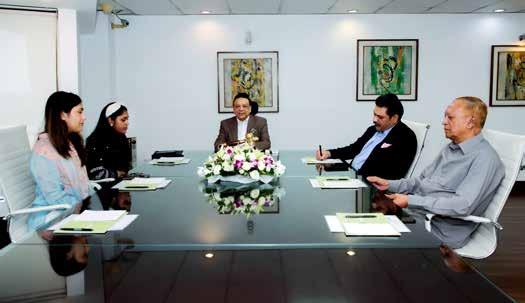
Moazzam Hossain, has firmly established itself as a prominent and influential corporation in Bangladesh. The legacy that Hosaf Group has been creating is not only a testament to its current success but also a promise of sustainable growth and positive impact for future generations. Let's explore the reasons why this legacy is vital and how it has been achieved.
Hosaf Group's commitment to long-term impact and sustainability goes beyond mere profitability. The company prioritises a broader purpose, focusing on solving societal problems, fostering a strong company culture, and contributing positively to the community, Moazzam Hossain's vision has always been to create a business that stands the test of time, addressing not only the economic needs but also the social and environmental challenges of Bangladesh. This holistic approach ensures that Hosaf Group's operations are sustainable and beneficial for the larger society.
One of the most powerful aspects of Hosaf Group's legacy is the enduring influence of its leadership. Chairman Moazzam Hossain has set a high standard for leadership, and has ensured that his impact will be felt well into the future, even after he is no longer directly involved. By grooming his children to take over the reins, he has made sure that the values, vision, and strategic direction he has established will continue to guide the company. This preparation allows Hosaf Group to benefit from consistent leadership that upholds the same principles and drives continuous growth and innovation.
The remarkable legacy of Hosaf Group is largely due to the vision, dedication, and leadership of Chairman Moazzam Hossain. His strategic foresight and commitment to ethical business practices have set the foundation for a legacy that extends far beyond his tenure. By empowering his children to lead and ensuring that they are well-prepared for the challenges ahead, Moazzam has created a lasting impact that will benefit the organisation, its employees, and the community for years to come.
Focusing on legacy encourages a long-term perspective, helping leaders resist the temptation of making short-term decisions that might compromise future stability. Chairman Moazzam Hossain has always emphasised the importance of long-term viability, making strategic decisions that prioritise lasting value over immediate gains. This forwardthinking approach ensures that Hosaf Group remains resilient and adaptable, capable of navigating challenges while maintaining its trajectory towards sustained success.
In today's business environment, a strong legacy is built on caring for the business, its team, and its clients. Hosaf Group, under the guidance of Moazzam, has earned respect not only for its economic achievements but also
Moazzam Hossain
The dynamic board of directors of the Hosaf Group, deep in discussion at a strategic meeting.
for its ethical conduct and treatment of people. The company's reputation for integrity, respect, and community involvement has solidified its standing as a trusted and responsible corporate entity. This focus on people and reputation ensures that Hosaf Group's legacy is one of honour and respect, fostering loyalty and goodwill among stakeholders.
The legacy that Hosaf Group is building under Chairman Moazzam Hossain's leadership is a powerful example of how long-term impact, strategic planning, and ethical practices can create lasting value. This legacy not only ensures the company's continued success but also serves as a model for other businesses aiming to achieve sustainable growth and positive societal impact.
One of the most significant aspects of Moazzam's business philosophy is his unwavering commitment to the well-being of his employees. Keeping in mind that Hosaf group started during the most difficult times and had to innovate in order to adapt to the challenges. Recognising that a company's strength lies in its workforce, he introduced a range of employment benefit schemes that were groundbreaking at the time. These initiatives included comprehensive insurance schemes designed to cover medical costs for labourers who met with accidents on the job. This approach not only provided financial security to employees but also fostered a culture of care and support within the organisation.
Moazzam's rational and humane thinking extended beyond the confines of the workplace. Under his leadership, Hosaf Group became a pioneer in corporate social responsibility (CSR), sponsoring numerous projects in education, healthcare, and sports. These initiatives were not merely acts of charity but strategic investments in the
long-term development of communities. For example, Hosaf Group funded the construction of schools and offered scholarships to underprivileged students, ensuring their access to quality education and creating opportunities for future generations. With regard to healthcare, the group supported hospitals and health camps, significantly improving medical access in underserved areas. Additionally, by sponsoring sports programs, Hosaf Group promoted physical well-being and community engagement.
During Moazzam's tenure, Hosaf Group evolved into arguably India’s largest private sponsor of CSR projects. His vision and dedication to social responsibility set a benchmark for other corporations, demonstrating that business success and societal welfare are not mutually exclusive but can thrive together. Moazzam's legacy is characterised by a profound understanding of the symbiotic relationship between a company and its community, a perspective that was ahead of its time and has since been widely acknowledged and emulated.
The Hosaf Group's enduring commitment to these principles continues to inspire and guide its operations. Today, the group remains a beacon of corporate excellence, known not only for its business achievements but also for its unwavering dedication to improving lives and fostering sustainable development. Chairman Moazzam Hossain's legacy is a powerful reminder that true business success encompasses both economic growth and positive social impact.
FOUNDATIONS OF PHILANTHROPY
The roots of Moazzam Hossain's philanthropic vision are deeply embedded in his early life experiences and values. Growing up in a modest household, Moazzam witnessed
firsthand the struggles and hardships faced by many in his community. These formative years instilled in him a profound sense of empathy and a commitment to uplifting those in need. His early exposure to the importance of education and community support laid the groundwork for his later philanthropic endeavours. As Moazzam embarked on his entrepreneurial journey, these values remained central to his mission. He envisioned a business that not only thrived economically but also served as a vehicle for social change. This dual focus on business success and societal impact became the bedrock of Hosaf Group's philosophy. Under his leadership, the company has been consistently prioritising giving back to society, channeling resources into initiatives that address pressing social issues. Moazzam's dedication to philanthropy has grown alongside Hosaf Group, with each success further fueling his commitment to making a positive difference in the world.
CORPORATE SOCIAL RESPONSIBILITY INITIATIVES
Under the visionary leadership of Moazzam Hossain, Hosaf Group has become a beacon of corporate social responsibility (CSR). The company has spearheaded a wide range of initiatives aimed at improving the quality of life for communities across Bangladesh and beyond. In education, Hosaf Group has established schools and scholarship programs, providing opportunities for underprivileged children to receive quality education and break the cycle of poverty. Healthcare is another major focus, with the company funding hospitals, organising health camps, and supporting medical research to enhance healthcare access and outcomes. In terms of community development, Hosaf Group has launched projects that include infrastructure
development, vocational training programs, and support for local businesses, fostering economic growth and stability in underserved areas. Environmental sustainability is also a key priority, with initiatives in renewable energy, conservation, and the implementation of green practices within the company's operations. These CSR efforts have led to tangible, positive changes, improving lives and promoting sustainable development. Each project reflects Moazzam's unwavering commitment to social responsibility, ensuring that Hosaf Group's success translates into meaningful benefits for society.
Moazzam Hossain's unwavering commitment to education is a cornerstone of his philanthropic efforts through Hosaf Group. Recognising education as a powerful tool for social change, Moazzam has spearheaded numerous initiatives to provide quality education to underprivileged communities. Under his leadership, Hosaf Group has established several schools in rural and underserved areas, offering children access to education that would otherwise be out of reach. These schools are not merely institutions of learning but also centers of hope, transforming the lives of countless families.
One notable initiative is the Hosaf Scholarship Program, which provides financial support to meritorious students from low-income backgrounds. This program has enabled many students to pursue higher education, who might have otherwise been forced to abandon their academic aspirations due to financial constraints. The scholarships cover tuition fees, books, and other essential expenses, ensuring that recipients can focus on their studies without the burden of financial stress.
As a part of its corporate social responsibility, Hosaf Group has demonstrated a profound commitment
Moazzam Hossain
to education and community development, significantly contributing to the social and economic upliftment of Bangladesh. One of the most notable initiatives is the construction of the Bokter Munshi Moazzam Hossain High School in Shonagazi, Feni. This institution, named in honour of Chairman Moazzam Hossain, stands as a beacon of quality education in the region. The school boasts a competent headmaster, 28 trained teachers, and an impressive enrollment of 925 students. The students' performance in the Secondary School Certificate examination consistently surpasses the national average, reflecting the high standards of education provided.
Believing in the power of education to eliminate poverty, Hosaf Group also established the Bhor Bazar Belayet Hossain High School in Shonagazi, Feni. From its inception, this school has received continuous patronage from Hosaf Group, which provides all necessary financial and logistic support. This unwavering commitment ensures that the school can offer quality education and resources to its students, fostering an environment where learning and development thrive.
Furthermore, the establishment of Amirabad Anowara Girls' High School in Sonagazi, Feni, is another testament to Hosaf Group's dedication to education and gender equality. By supporting girls' education, the group contributes significantly to the socio-economic development of the country, empowering young women to achieve their full potential and become active contributors to society.
In addition to building and supporting educational institutions, Hosaf Group awards scholarships to meritorious students every year, facilitating their pursuit of higher education. These scholarships focus on not only academic excellence but also moral education, ensuring
that recipients develop into well-rounded individuals with strong ethical foundations.
Hosaf Group's commitment to holistic development extends beyond academics. The company actively promotes sports and extracurricular activities, recognising their importance in nurturing well-balanced individuals. One such initiative is the sponsorship of the Hosaf President Cup Golf Tournaments at the Savar Golf Club. By supporting such events, Hosaf Group encourages physical fitness, teamwork, and sportsmanship among young people.
In summary, Hosaf Group's extensive efforts in education and community development highlight its dedication to creating a brighter future for Bangladesh. Through the establishment and support of educational institutions, scholarship programs, and the promotion of sports, the group plays a pivotal role in empowering individuals and fostering sustainable growth. Chairman Moazzam Hossain's vision and leadership continue to inspire these initiatives, leaving a lasting legacy of positive impact on society.
COMMUNITY DEVELOPMENT PROJECTS
Moazzam Hossain's vision for Hosaf Group extends far beyond business success; it encompasses a deep commitment to community development and empowerment. Recognising that sustainable growth is rooted in the well-being of local communities, Hosaf Group has undertaken numerous projects aimed at improving infrastructure, providing vocational training, and supporting local businesses.
One of the key areas of focus for Hosaf Group has been infrastructure development. The company has invested in building and upgrading essential facilities such as roads, bridges, and water supply systems in underserved areas.
Moazzam
These projects have significantly improved quality of life for residents. For instance, the power in a remote village has not only facilitated easier lifestyle but also boosted local commerce by enabling farmers to utilise power for efficient farming.
Vocational training programs are another cornerstone of Hosaf Group's community development efforts. Understanding the importance of skills development in fostering economic independence, the company has established several training centers that offer courses in various trades such as carpentry, tailoring, and computer skills. These programs are designed to equip individuals, particularly the youth and women, with the skills needed to secure employment or start their own businesses. One notable success story is that of a group of women who, after completing a tailoring course, formed a cooperative and started producing garments. This initiative has not only provided them with a steady income but also empowered them to contribute to their community's economic growth.
Supporting local businesses is also a key aspect of Hosaf Group's community development strategy. The company provides financial assistance, mentoring, and resources to small and medium-sized enterprises (SMEs) to help them thrive. By fostering entrepreneurship and local industry, Hosaf Group is creating a more vibrant and resilient local economy. For example, a local artisan, with the support of Hosaf Group, was able to expand his pottery business, creating jobs for others in the community and preserving traditional crafts.
Through these comprehensive community development projects, Hosaf Group, under the leadership of Moazzam Hossain, has made significant contributions to empowering communities and fostering sustainable growth. These
initiatives have created a ripple effect, improving livelihoods, boosting local economies, and fostering a sense of community pride and self-reliance.
Bangladesh's rapid industrial growth over the past three decades has created another pressing challenge: an acute power shortage. Despite the government's efforts to ensure an uninterrupted power supply to manufacturing plants, the reliance on diesel generators due to limited and expensive alternative energy sources has led to high costs, maintenance issues, and significant environmental pollution. Recognising this critical issue, Hosaf Group has taken a pioneering step through its subsidiary, Hosaf Proficient Energy (HPE), to provide sustainable solar energy solutions across Bangladesh.
Hosaf International portable solar solutions are particularly beneficial for rural regions where traditional electricity infrastructure may be lacking. These portable systems offer reliable and autonomous power sources, enabling communities to access essential services and improve their quality of life without relying on grid electricity. Whether it’s for lighting, charging devices, or powering small appliances, Hosaf International’s portable solar solutions ensure that even the most remote areas can benefit from renewable energy.
Through these products, Hosaf International not only demonstrates its dedication to environmental sustainability but also contributes to the broader goal of energy equity. By making solar technology accessible and practical, Hosaf International is helping to drive a global shift towards cleaner, more sustainable energy practices.
Hosaf International’s on-grid and hybrid solar solutions represent a significant advancement in sustainable energy utilisation. These systems provide electricity during the
Moazzam Hossain
day, with any excess power stored in backup batteries for nighttime use. Moreover, the capability to supply surplus power back to the national grid not only enhances energy efficiency but also supports the broader energy infrastructure of Bangladesh.
TOWARDS A GREENER TOMORROW
Hosaf International 's initiatives are a testament to Hosaf Group’s commitment to environmental stewardship. By focusing on high-quality, efficient, and sustainable energy solutions, Hosaf International is playing a crucial role in mitigating the impact of power shortages and promoting a greener, more sustainable future for Bangladesh. Through its innovative products and technologies, HPE is not only reducing the environmental footprint of industrial activities but also contributing to the socio-economic development of the country by providing reliable and cost-effective energy solutions.
Hosaf Group's environmental initiatives, spearheaded by Hosaf International, exemplify a strategic approach to addressing energy challenges while fostering sustainable growth. The group's dedication to high standards in business conduct and environmental responsibility ensures that they remain at the forefront of promoting sustainable and efficient energy utilisation in Bangladesh.
Environmental sustainability is a core principle for Hosaf Group, driven by Moazzam Hossain's unwavering commitment to conserving natural resources and reducing the company's environmental footprint. Recognising the critical importance of environmental stewardship, Moazzam has championed various initiatives in renewable energy, conservation, and the implementation of green practices within the company's operations.

One of the most impactful initiatives has been Hosaf Group's investment in renewable energy projects. The company has developed and deployed solar and wind energy solutions, significantly reducing reliance on fossil fuels and contributing to the reduction of greenhouse gas emissions. These renewable energy projects not only provide clean energy but also create jobs and stimulate local economies. For instance, a solar power plant established
Moazzam Hossain
The newly planned head office of the Hosaf Group, Hosaf Skyline, featuring a state-of-the-art helipad—a testament to their forward-thinking leadership and ambition.
by Hosaf Group in a rural area has provided electricity to hundreds of households, improving their quality of life and enabling new economic opportunities.
Conservation efforts are another critical aspect of Hosaf Group's environmental strategy. The company has launched several reforestation projects aimed at restoring degraded landscapes and increasing biodiversity. These projects involve planting native tree species, which help combat soil erosion, improve water quality, and provide habitats for wildlife. In one notable project, Hosaf Group collaborated with local communities to reforest a large area that had been depleted due to illegal logging. This initiative has not only restored the ecosystem but also raised environmental awareness among the local population.
Green solutions are vital for a highly polluted country like Bangladesh, especially given the pressing challenges posed by climate change. As a country that is particularly vulnerable to environmental degradation and climaterelated disasters, adopting sustainable practices and technologies is crucial for safeguarding its future. The rapid industrialisation and urbanisation in Bangladesh have led to significant pollution, adversely affecting air and water quality and contributing to health issues among its population. In this context, green solutions such as renewable energy, waste management, and sustainable agriculture become indispensable.
Implementing renewable energy solutions, such as solar power, can play a transformative role in reducing Bangladesh’s carbon footprint. Solar energy is abundant and offers a clean alternative to fossil fuels, which are a major source of pollution and greenhouse gas emissions. By investing in solar infrastructure, including solar panels, charge controllers, and inverters, Bangladesh can reduce
its dependency on non-renewable energy sources, lower emissions, and promote environmental sustainability. Solar-powered streetlights and portable solar solutions can enhance energy access in rural and underserved areas, providing reliable power while minimising environmental impact.
In addition to renewable energy, effective waste management practices are critical for addressing pollution and mitigating climate change effects. Recycling, composting, and proper waste disposal can significantly reduce the amount of waste that ends up in landfills, decreasing methane emissions and preventing soil and water contamination. Initiatives to promote recycling and waste segregation can also create job opportunities and stimulate economic growth in a sustainable manner.
Sustainable agriculture is another key area where green solutions can make a significant difference. Techniques such as organic farming, agroforestry, and precision agriculture can enhance food security while conserving natural resources and reducing environmental damage. By promoting sustainable farming practices, Bangladesh can ensure long-term agricultural productivity and resilience against climate change impacts, such as erratic weather patterns and soil degradation.
Overall, embracing green solutions is essential for Bangladesh to combat pollution and address the multifaceted challenges of climate change. These efforts not only contribute to environmental conservation but also improve public health, enhance energy security, and foster economic development. As Bangladesh navigates its path towards sustainable growth, the integration of green technologies and practices will be crucial for creating a cleaner, healthier, and more resilient future.
Numerous green practices within Hosaf Group's operations further underscore the company's commitment to sustainability. The company has implemented comprehensive waste management systems, reducing waste generation and promoting recycling. Additionally, Hosaf Group has adopted energy-efficient technologies and practices across its facilities, significantly lowering energy consumption and operational costs. For example, the introduction of energy-efficient lighting and machinery in the company's manufacturing units has led to substantial reductions in energy use and emissions.
Hosaf Group's dedication to environmental stewardship is also reflected in its support for environmental education and advocacy. The company organises workshops and seminars to educate employees and local communities about the importance of environmental conservation and sustainable practices. By fostering a culture of environmental responsibility, Hosaf Group is ensuring that sustainability is integrated into every aspect of its operations.
Under the visionary leadership of Moazzam Hossain, Hosaf Group's environmental stewardship initiatives have made a meaningful impact on the environment and communities. These efforts not only demonstrate the company's commitment to sustainability but also set a powerful example for other businesses to follow, showcasing the possibility of achieving economic success while preserving and protecting the planet.
Legacy planning at Hosaf Group involves a wellthought-out strategy for transferring the business and its assets to future generations. Chairman Moazzam Hossain has ensured continuity and stability by preparing his children to take over leadership roles. This careful planning
safeguards the company's values and mission, ensuring that Hosaf Group remains true to its founding principles while continuing to evolve and grow. The seamless transition of responsibilities to the next generation not only secures the company's future but also demonstrates the effectiveness of robust succession planning.

Make a career of humanity. Commit yourself to the noble struggle for equal rights. You will make a better person of yourself, a greater nation of your country, and a finer world to live in
– Martin Luther King, Jr.
Moazzam Hossain
A LEGACY OF VISIONARY LEADERSHIP AND UNYIELDING COMMITMENT
Moazzam Hossain, the esteemed Chairman of the Hosaf Group, stands as a paragon of entrepreneurial excellence and visionary leadership in Bangladesh. With decades of experience, he has transformed the Hosaf Group into one of the nation’s most formidable private sector powerhouses, driving growth across multiple industries, including Energy, Finance, and Real Estate. His relentless pursuit of innovation, paired with a deep commitment to the country’s development, has left an indelible mark on Bangladesh’s industrial landscape.
This biography offers an intimate look at Moazzam Hossain's extraordinary journey—from his formative years shaped by the cultural and political turbulence of his homeland to his rise as an influential industrialist with global ambitions. His dedication to excellence and future-readiness, honed through international exposure, has not only fortified his business empire but also made significant contributions to Bangladesh’s economic progress.
As a philanthropist, Mr. Hossain has been equally transformative, dedicating his resources to uplift the less fortunate. Through education, mentorship, and social initiatives, he has empowered countless youth from underserved communities to achieve professional success, all while fostering a pollution-free environment and championing wildlife preservation.
In this inspiring account, readers will discover the man behind the success—a leader whose humility, resilience, and strategic foresight have not only built an empire but also touched the lives of many. Whether you are an entrepreneur, a business enthusiast, or simply someone seeking to learn from a life well-lived, Moazzam Hossain’s story will offer you valuable lessons on the power of vision, dedication, and unwavering integrity.