We’ve got you covered from Hollywood to Broadway... and Online!
JUNE 19-25, 2020 Volume 13 - No. 33 • 16 Pages 133-30 32nd Ave., Flushing, NY 11354 • 2500 Plaza S. Harborside Financial Center, Jersey City, NJ 07311 • Tel. (212) 655-5426 • Fax: (818) 502-0858
Also published in LOS ANGELES, ORANGE COUNTY/INLAND EMPIRE, LAS VEGAS, NORTHERN CALIFORNIA
US voices concern over Ressa’s guilty verdict by Ritchel
Mendiola AJPress
THE United States on Tuesday, June 16, expressed concern over Rappler executive editor and chief executive officer Maria Ressa and writer Reynaldo Santos Jr. being convicted of
cyber libel by a Manila court. “The United States is concerned by the trial court’s verdict against journalists Maria Ressa and Reynaldo Santos and calls for resolution of the case in a way that reinforces the U.S. and Philippines’ long shared commitment to freedom of expression, including for members
of the press,” said U.S. Department of State spokesperson Morgan Ortagus in a statement. Meanwhile, U.S. Senators Edward Markey, Patrick Leahy, and Dick Durbin slammed the court’s verdict, calling it a “travesty of justice.”
“It is shocking to see the Philippine government strain to extend its legal reach to target journalists while so many extrajudicial abuses cry out for investigation and prosecution,” they said. “At the very least, the defendants must be
u PAGE 2
PH tourism stakeholders tell DATELINE balikbayans: Fil-Am man in SF Postpone trips to confronted by white the homeland couple for stenciling ‘Black Lives Matter’ in front of own home
USA
from the AJPress NEWS TEAM across America
by Momar
G. Visaya
AJPress
A FILIPINO American man was stenciling “Black Lives Matter” in chalk outside his San Francisco home last week when a white couple confronted him and accused him of defacing private property. A video of the June 9 encounter, which has reached over 19.6 million views on Twitter,
u PAGE 6
Palace: Duterte to wait for anti-terror bill to be vetted before making his decision by Ritchel
Mendiola AJPress
MANY Filipinos in the United States are looking at the possibility of traveling back to the Philippines even while the world is going through a pandemic. However, the tourism sector stakeholders are asking them not to travel back in the next three to four months, if possible. “I wouldn’t really recommend it for now, nakita naman natin (we have seen) how stringent the policies are, the quarantine, swab testing. Definitely we see that the balikbayan market, the
u PAGE 2
Nanay Fedelina, human Remittances fall by trafficking survivor kept by $100 billion worldwide Filipino family for 4 generations in Southern California, dies at 83 by Pia Lee-Brago Philstar.com
by Christina
Malacañang on Wednesday, June 17, said President Rodrigo Duterte will be waiting for the vetting process to be finished before deciding whether to sign or veto the anti-terrorism bill. When he spoke about the anti-terror bill, he was saying, “I’m waiting for Senator Lacson to finalize his commas and periods before I sign the bill,’” said presidential
u PAGE 4
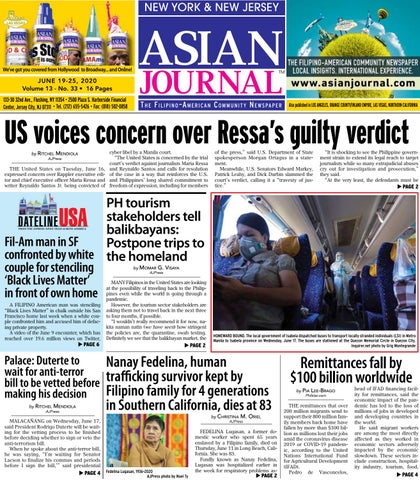
HOMEWARD BOUND. The local government of Isabela dispatched buses to transport locally stranded individuals (LSI) in Metro Manila to Isabela province on Wednesday, June 17. The buses are stationed at the Quezon Memorial Circle in Quezon City. Inquirer.net photo by Grig Montegrande
M. Oriel
AJPress
Fedelina Lugasan, 1936-2020 AJPress photo by Noel Ty
FEDELINA Lugasan, a former domestic worker who spent 65 years enslaved by a Filipino family, died on Thursday, June 11 in Long Beach, California. She was 83. Fondly known as Nanay Fedelina, Lugasan was hospitalized earlier in the week for respiratory problems as-
u PAGE 2
THE remittances that over 200 million migrants send to support their 800 million family members back home have fallen by more than $100 billion as millions lost their jobs amid the coronavirus disease 2019 or COVID-19 pandemic, according to the United Nations International Fund for Agricultural Development (IFAD). Pedro de Vasconcelos,
head of IFAD financing facility for remittances, said the economic impact of the pandemic has led to the loss of millions of jobs in developed and developing countries in the world. He said migrant workers are among the most directly affected as they worked in economic sectors adversely impacted by the economic slowdown. These sectors include construction, hospitality industry, tourism, food,
u PAGE 4
JUNE 19-25, 2020 • NEW YORK AND NEW JERSEY ASIAN JOURNAL
http://www.asianjournal.com • (212) 655-5426
From the Front Page
PH tourism stakeholders tell... PAGE 1 Fil-Am market will be one of the first ones to come back once travel restrictions are eased, once flights are easier to come by,” said Tourism Congress of the Philippines President Jose Clemente III at a virtual Kapihan sa Manila Bay forum. His colleagues, including Ricky Isla of Air Asia, agreed, “unless it is really urgent.” “Maraming (There are many) factors to be considered like flights. At this time, it is still very tumultuous, there are so many things still up in the air. Maybe towards Christmastime, okay na (then),” Clemente added. “Kung hindi naman kailangan umuwi, huwag na muna kayong umuwi (if you don’t need to come home, don’t go home for now). It’s not that we don’t want you here, but we don’t want you to go through all the inconveniences that you have to go through.” Tourism Secretary Berna Romulo-Puyat chimed in and agreed with her colleagues as well and mentioned the policies that they have been crafting in order to ensure that once the
country has fully reopened, travel would be safe for both tourists and the communities in the destinations that they are going to visit. Puyat shared that they have developed a Tourism Response and Recovery Program to make sure that every stakeholder is ready to get back on track and the gaps in tourism infrastructure are addressed. The TRRP was made in coordination with the respective national agencies and private sector tourism stakeholders through the Tourism Congress of the Philippines (TCP). She said she is looking forward to the signing of the proposed P1.3-trillion Accelerated Recovery and Investments Stimulus for the Economy (ARISE) Act, where DOT-accredited tourism enterprises will be assisted through interest-free loans or issuance of loan guarantees with terms of up to five years for maintenance and operating expenses. Also included in the ARISE bill is the utilization of information technology for the improvement of tourism services,
development of a tourist tracking system for emergency response and establishment of spatial database to improve planning capacity. “Let’s introduce things that will enhance the travel experience like cashless, interactive and integrated experiences. Safety first, then innovation to make things better,” said Talino Ventures Lab chief executive officer Winston Damarillo. “Dahan dahan (slow) and progressive recovery, starting with making sure that it is safe and mako-contact trace natin ang lahat ng mga (and we can contact all) guests. Let us take this opportunity to innovate habang nag-re-recover tayo (while we are still recovering).” Damrillo and his team have developed an app called SafePass, which he said can help in contact tracing and can be done digital and contact-free. For now, however, the tourism sector is looking at domestic tourism as a start since there are still travel restrictions all over the world. “Huwag nating maliitin ang
u PAGE 6
US voices concern over Ressa’s guilty... PAGE 1 afforded every opportunity to appeal this decision,” they added. Peter Greste, UNESCO Chair in Journalism and Communication, likewise, criticized the court’s decision, calling it a “blow to journalists…to press freedom in the Philippines, and to stability in the region.” Even former U.S Secretary of State Hillary Clinton voiced out her support for Ressa. “Maria Ressa was convicted in the Philippines yesterday for doing her job. As Amal Clooney wrote, the message to other journalists is ‘Keep quiet, or you’ll be next’,” she said on Twitter. “We must fiercely protest attacks on the press. They are attacks on democracy,” she added. U.S. news outlets also took a stand both for Ressa and press freedom. “It is not merely that Ms. Ressa and her colleagues need and deserve support: her case has such frightening implications beyond her own country. When Mr. (Rodrigo) Duterte is given a free pass for his behaviour, other leaders take note,” wrote The Guardian in its editorial. “Without freedom of the media, it is impossible to protect other freedoms: citizens cannot know what is being done in their name. Journalists are targeted because they sound the alarm. They must not be silenced,” it added. The Washington Post, meanwhile, urged the U.S. government to show “much greater resistance” against Ressa’s
Rappler CEO and Executive Editor Maria Ressa spoke on a panel on
guilty verdict. “The Philippines’ slide toward dictatorship deserves much greater resistance from Washington – if not from the White House, then from Congress,” the news outlet said. “A court verdict that could lead to a prison sentence of up to 7 years for her and a colleague showed that Mr. Duterte is succeeding in compromising the Philippines’ justice system, even as he personally flouts the rule of law,” it added. Ressa and Santos were found guilty of violating Section 4(c)(4) of the Cybercrime Prevention Act of 2012, or cyber libel, sentencing them to the indeterminate penalty of imprisonment ranging from six months and one day as a
minimum to up to six years, according to the sentence handed down by Manila Regional Trial Court Branch 46 Judge Rainelda Estacio-Montesa. According to Rappler, the court allowed bail under the same bond. It also ordered Ressa and Santos to pay complainant Wilfredo Keng P200,000 in moral damages and another P200,000 (a total of $7,900) in exemplary damages. Keng in 2017 filed cyber libel charges against the two for naming him in an article as the owner of a sports utility vehicle (SUV) used by the late Chief Justice Renato Corona, who was then facing impeachment in 2012. Meanwhile, the court found Rappler Inc. to have no corporate liability in the case. “A news organization who claims to adhere to accuracy, fairness and balance in terms of reporting, would have retracted, or at the very least issued a clarificatory article if there have been some indications of falsity to its previous article... This clearly shows actual malice,” the court’s decision read. “[T]he court is mandated to decide solely on the basis of the evidence presented by the parties and to apply the law. No more, no less,” it added. “The Courts are tasked to strike a balance between the enforcement of one’s right to speak his mind and the protection of another’s right against defamation of his honor and reputation without regard to the stature of the personalities involved.” n
Nanay Fedelina, human trafficking... PAGE 1 sociated with COVID-19, the disease caused by the novel coronavirus, according to the Pilipino Workers Center (PWC). PWC, the Historic Filipinotown-based workers’ rights organization, was vital in helping Lugasan adjust to her life of freedom after she was rescued from her employer in 2018. For the past two years, she had been living at a skilled nursing facility in Long Beach. “As she transitioned into a new life of freedom, Nanay Fedelina has truly helped us understand what it means to be resilient. She did not wallow in what she had been de-
u PAGE 8
For the first time, Lugasan celebrated her birthday last July 2019 when she turned 83 years old with members of the Pilipino Workers Center and the Philippine Consulate in Los Angeles. Photo courtesy of Pilipino Workers Center
(212) 655-5426 • http://www.asianjournal.com
NEW YORK AND NEW JERSEY ASIAN JOURNAL • JUNE 19-25, 2020
JUNE 19-25, 2020 • NEW YORK AND NEW JERSEY ASIAN JOURNAL
http://www.asianjournal.com • (212) 655-5426
Palace: Duterte to wait for anti-terror... PAGE 1 spokesperson Harry Roque in an interview on ABS-CBN News Channel’s Headstart. According to him, Duterte has not yet received the copy of the proposed measure — meaning, the Office of the Executive Secretary and the Department of Justice are still in the process of vetting it. Roque, however, said that the Office of the Chief Presidential Legal Counsel has already finished reviewing the bill. “There are at least three departments that are given the leeway to comment on this legislation. The most important is the Office of the Executive Secretary, specifically the Deputy Executive Secretary for Legal Affairs, and of course, it’s important to listen to the Department of Justice as well, ” he said. The spokesman also assured that Duterte will be studying the provisions of the bill. “Let’s not forget, that the President was also a criminal lawyer, a public prosecutor.
WEEKLY MEETING. President Rodrigo Duterte holds a meeting with members of the InterAgency Task Force on the Emerging Infectious Diseases (IATF-EID) at the Malago Clubhouse in Malacañang on Monday, June 15. Malacañang photo by Robinson Niñal
He will read the bill himself and he will himself make a determination if there’s any provision that is contrary to the bill of rights and the Constitution,” Roque said. The DOJ on Tuesday, June 16, confirmed it has finished its review of the bill and was in the process of drafting its comments to be submitted to the President. “To the extent possible, we have considered the operational needs of the gov-
ernment in dealing with terrorism as well as our international commitments, without losing sight of the legal and constitutional parameters within which all state actions should be circumscribed,” Justice Secretary Menardo Guevarra said Wednesday. He also said that the DOJ kept in mind “for whom and against whom the anti-terror bill was crafted” while reviewing the measure. n
Remittances fall by $100 billion...
PAGE 1 agribusinesses, transport and domestic work. The majority of migrant workers are from low and middle-income countries who need to support their families through the remittances they send home on a regular basis. It is estimated that the world’s 200 million migrant workers send money regularly to 800 million family members to help them access food, health and education. “Therefore, one in nine people in the world are directly impacted by remittance flows,” de Vasconcelos explained. In 2019, remittances to low and middle-income countries totaled $554 billion, with about half reaching families living in small towns and rural villages. However, as a result of COVID-19, these flows are projected to make their sharpest decline in history, falling by 20 percent in 2020 to $445 billion, as indicated by a recent World Bank forecast. “Although in the past remittances have been relatively resilient to external shocks, COVID-19 is different. It impacts senders and recipients simultaneously,” de Vasconcelos said. He pointed out that fami-
lies living in rural areas in developing countries have been severely affected by lockdowns and social distancing. Markets have closed and transport has been disrupted. Small-scale farmers have been unable to sell their produce or buy inputs, such as seeds or fertilizer. Daily laborers, small businesses and informal workers, who are often women and young people, are among the worst affected. IFAD is tracking the impact of declining remittances on the “receiving end” in developing countries, where typical remittances of $200 to $300 per month on average account for 60 percent of household income. While the reduction in remittances will not fall evenly across countries and communities, IFAD said the impact is likely to be substantial in rural areas where remittances count most. “Initial indications from countries that rely heavily on remittances are deeply concerning,” he added, citing reports ranging from the Philippines, Senegal, Kenya, El Salvador and Nepal and Eastern Europe “confirm not only the significant drop in remittances but also the return home of hundreds of thousands of jobless migrant
workers to their strained households and communities in rural areas.” Marking International Day of Family Remittances, the UN recognized the determination of the 200 million migrants who regularly send money home, and 800 million families, in communities throughout the developing world, who depend on those resources. Meanwhile, Philippine Ambassador to Japan Jose Laurel V said yesterday that almost all Filipinos in Japan who were infected with COVID-19 have recovered. He also said during the Laging Handa briefing that no Filipino in Japan died of the disease. Six Filipinos in Tokyo and one in Nagoya were infected with the coronavirus. Of the 21 Filipinos infected in Osaka, 19 have recovered. Laurel said almost 1,000 Filipinos were sent home since the outbreak in Japan. At least 126 more—including overseas Filipino workers, tourists and students—are waiting for repatriation. The Department of Foreign Affairs (DFA) reported 17 new deaths among Filipinos in the Middle East, now the major geographical region with the highest number of
u PAGE 7
BEATING THE DEADLINE. Customers wait for their turn to pay their bills at a branch of a telecommunications company along FB Harrison St. in Pasay City on Tuesday, June 16. Utility companies have given their customers a grace period to settle their unpaid accounts as Metro Manila and other areas in the country shifted to a more relaxed general community quarantine. PNA photo by Avito C. Dalan)
Supreme Court rules federal antidiscrimination law protects LGBT workers by Klarize
Medenilla AJPress
IN the middle of Pride Month, the United States Supreme Court on Monday, June 15 ruled that a landmark federal civil rights law that protects workers from discrimination applies to gay and transgender workers. Supreme Court Justice Neil M. Gorsuch was instrumental to the 6-3 favorable ruling of Bostock v. Clayton County, Georgia, the original case that pondered whether or not firing an employee solely based on their sexuality violates the Civil Rights Act of 1964. A known literalist of the law, Gorsuch, a Trump-appointed conservative-leaning justice referenced Title VII of the Civil Rights Act in his majority opinion, writing, “Today, we must decide whether an employer can fire someone simply for being homosexual or transgender. The answer is clear. An employer who fires an individual for being homosexual or transgender fires that person for traits or actions it would not have questioned in members of a different sex. Sex plays a necessary and undisguisable role in the decision, exactly what Title VII forbids.” The original lawsuit was filed by Gerald Bostock who in 2013 was fired for joining a gay softball league and publicly calling for volunteers. Bostock, who worked for the county in a government program that provided help for neglected youth, was then fired for “conduct unbecoming of a county employee,” according to the original audit. In his majority opinion,
Gorsuch said that protections for cisgender workers (people who identify with the sex they were born with) also apply to transgender workers, writing, “Or take an employer who fires a transgender person who was identified as a male at birth but who now identifies as a female. If the employer retains an otherwise identical employee who was identified as female at birth, the employer intentionally penalizes a person identified as male at birth for traits or actions that it tolerates in an employee identified as female at birth. Again, the individual employee’s sex plays an unmistakable and impermissible role in the discharge decision.” Joining Gorsuch in the surprising decision include Chief Justice John Roberts (a conservative appointee of President George W. Bush) and Justices Ruth Bader Ginsburg, Stephen G. Breyer, Sonia Sotomayor and Elena Kagan. Though the decision is a landmark civil rights ruling that sets an important benchmark in the history of LGBT workers rights in the United States, it comes at a time when those within the community, especially black trans individuals, find their very existence especially vulnerable. Last week two black trans women — 25-year-old Riah Milton and 27-year-old Dominique Fells — were found dead, news that comes two weeks after Tony McDade, a black trans man, was shot and killed by police in Tallahassee, Florida. Moreover, the court’s ruling comes mere days after the Trump administration issued
a new rule that removed an Obama-era rule that protected transgender patients against discrimination by doctors and health care providers. The Trump administration also previously urged the Supreme Court to barr most transgender soldiers from serving in the military. But the fact that during a time when civil unrest runs rampant across the country and divisions are being planted across political, social and racial lines, the court’s decision on Monday is a major victory for the LGBT+ community. Award-winning trans writer and activist Meredith Talusan celebrated the Supreme Court’s ruling in an Instagram post, writing that the court’s decision “is deeply personal for me, because I’m one of the many trans people whose lives have been immensely disrupted by job discrimination.” Talusan, whose widelypraised book “Fairest: A Memoir” details her personal journey as a trans woman, shared in her Instagram post that after she came out as transgender in 2014 she was harrassed by a then-coworker. When she tried to report the incident she faced “intense scrutiny because I apparently was not a perfect enough victim.” “As an immigrant trans woman of color who has had to face numerous obstacles to get to where I am, my ability to tell stories in the face of gross injustice has been my main source of power, and I refuse to give it up both for my sake and on behalf of all trans people,” Talusan wrote. n
(212) 655-5426 • http://www.asianjournal.com
NEW YORK AND NEW JERSEY ASIAN JOURNAL • JUNE 19-25, 2020
Features
Opinion
Stranded by the pandemic THE unprecedented community quarantines have given the government an indelible lesson: if you want to keep people off the streets or drastically curb human mobility, stop mass transportation. Unfortunately for the majority of Filipinos with no private cars, the restriction also means being stranded and unable to go home. In the early days of the enhanced community quarantine in Luzon, many opted to walk from Metro Manila to neighboring provinces, even if it meant sleeping on the road for several days while dodging arrest for breaching ECQ rules. Many more, however, were stuck, mostly in Metro Manila, with no place to stay. With their meager funds soon depleted, they had to beg for food. Even those who were offered transportation to return home were advised by the local government units in their hometowns to stay away, for fear that the returning residents might be carriers of killer pathogens. Their ranks swelled so much that a phrase was coined to describe them: locally stranded individuals, or LSIs.
Michelle Silvertino became the face of the LSIs. Intent on returning to her four children in Bicol, the 33-year-old left her job as a housemaid in Antipolo, Rizal and stayed for five days in a footbridge in Pasay as she hoped to get a bus ride to Calabanga in Camarines Sur. She died of a respiratory affliction on June 5. How many other Silvertinos are still out there? While overseas Filipino workers displaced by the pandemic are getting all the help from government to return to the Philippines, LSIs have been left to fend for themselves as they wait for flights, bus or ship rides back to their hometowns. Many have been forced to live in the streets and resort to begging. The LSIs have families waiting for them back home. A number of them are hoping to find work or livelihood opportunities outside Metro Manila amid the pandemic. They deserve assistance from the government. Proper coordination among LGUs and the Department of Social Welfare and Development could prevent more tragedies like the one that befell Michelle Silvertino. (Philstar.com)
Editorial
Philstar.com photo
Maria Ressa found guilty of cyber libel: Is the Philippines really independent? A dangerous precedent not only for Street journalists but for everyone online? Talk The Fil-Am Perspective Gel Santos-Relos THE name of veteran journalist and Rappler CEO Maria Ressa evokes both pride and fury among Filipinos in the world, depending on which
lens they are wearing as they look at what’s happening in the Philippines, especially during the presidency of Rodrigo Duterte. Maria Ressa is a multiawarded Filipino American journalist and author who co-founded the online news organization Rappler and became its chief executive officer. Ressa was born to Filipino parents in Manila and relo-
cated at the age of 10 with her parents to Toms River, New Jersey. She graduated cum laude at Princeton University and was awarded a Fulbright Fellowship to study political theater at the University of the Philippines Diliman. I first knew about Maria when she co-founded independent production company Probe in 1987, along with Cheche Lazaro, my forPAGE 10
Greg B. Macabenta ON June 12, 1998, Filipinos the world over commemorated the first centennial of Philippine independence, based on the establishment of the Philippine Republic by Gen. Emilio Aguinaldo on June 12, 1898 from the balcony of his home in Kawit, Cavite. To generate proper ob-
servance in America of the centennial, I accepted a pro bono appointment as deputy executive director for the US of the Philippine Centennial Commission. My dear friend, the late Louie Morales, was executive director and former Vice President Salvador “Doy” Laurel was chairman. Both were appointed by President Fidel V. Ramos. Some folks questioned the historical accuracy of the event. They pointed out that the Kawit declaration of independence was never recognized by the United States, which had assumed
sovereignty over the Philippines by virtue of the Treaty of Paris, signed with Spain on December 10, 1898. According to them, Philippine independence was granted by the U.S. on July 4, 1946. Of course, the counter to that was Republic Act 4166, passed during the tenure of President Diosdado Macapagal, which officially recognized Aguinaldo’s Kawit declaration on June 12, 1898 as Araw ng Kalayaan – making this year’s observance the 122nd. However, to avoid any arPAGE 6
The views expressed by our Op-Ed contributors are solely their own and do not necessarily reflect the predilection of the editorial board and staff of Asian Journal.
ADVERTISING AND ADVERTORIAL POLICIES ROGER LAGMAY ORIEL Publisher & Chairman of the Board Main Office: 1210 S. Brand Blvd Glendale, CA 91204 Tels: (818) 502-0651 • (213) 250-9797 Fax: (818) 502-0858 • (213) 481-0854 e-mail: info@asianjournalinc.com http://www.asianjournal.com Northern California: 1799 Old Bayshore Hwy, Suite 136 Burlingame CA 94010 Tel.: (650) 616-4150 • Fax: (650) 239-9253
Manila Office: 2nd Floor Units D&E, Fort Palm Springs 30th Street, Cor. 1st Ave., Bonifacio Global City, Taguig Tel.: (632) 856-4921 • Fax: (632) 856-1661 New York and New Jersey: 133-30 32nd Ave., Flushing, NY 11354 Tel.: (212) 655-5426 • Fax (818) 502-0858 2500 Plaza S. Harborside Financial Center, Jersey City, NJ 07311 Tel. (212) 655-5426 • Fax: (818) 502-0858
Las Vegas Sales Office: 2770 S. Maryland Pkwy., Suite 201, Las Vegas, NV 89109 Tel.: (702) 792-6678 • Fax: (702) 792-6879
CORA MACABAGDAL-ORIEL President
ELIZABETH HILARIO SISON Chief Financial Officer MOMAR G. VISAYA Executive Editor and Editor-in-Chief New York/New Jersey Asian Journal
Asian Journal Publications, Inc. (“AJPI”) reserves the right to refuse to publish, in its sole and absolute discretion, any advertising and advertorial material submitted for publication by client. (“Client’s Material”) Submission of an advertisement or advertorial to an AJPI sales representative does not constitute a commitment by AJPI to publish a Client’s Material. AJPI has the option to correctly classify any Client’s Material and to delete objectionable words or phrases. Client represents and warrants that a Client’s Material does not and will not contain any language or material which is libelous, slanderous or defamatory or invades any rights of privacy or publicity; does not and will not violate or infringe upon, or give rise to any adverse claim with respect to any common law or other right whatsoever (including, without limitation, any copyright, trademark, service mark or contract right) of any person or entity, or violate any other applicable law; and is not the subject of any litigation or claim that might give rise to any litigation. Publication of a Client’s Material does not constitute an a greement to continue publication. Client agrees and covenants to indemnify AJPI and its officers against any and all loss, liability, damage, expenses, cost, charges, claims, actions, causes of action, recoveries, judgments, penalties, including outside attorneys’ fees (individually and collectively “Claims”) which AJPI may suffer by reason of (1) Client’s breach of any of the representations, warranties and agreements herein or (2) any Claims by any third party relating in any way to Client’s Material. AJPI will not be liable for failure to publish any Client’s Material as requested or for more than one incorrect insertion of a Client’s Material. In the event of an error, or omission in printing or publication of a Client’s Material, AJPI shall be limited to an adjustment for the space occupied by the error, with maximum liability being cancellation of the cost of the first incorrect advertisement or republication of the correct advertisement. Under no circumstances shall Asian Publications, Inc. be liable for consequential damages of any kind. ASIAN JOURNAL PUBLICATIONS, INC. publishes the Los Angeles Asian Journal, published twice a week; Northern California Asian Journal, Las Vegas Asian Journal and the New York / New Jersey Asian Journal which are published once a week and distributed to Los Angeles, Riverside, San Bernardino, Orange Counties, Northern California, Las Vegas and New York and New Jersey respectively. Articles published in this paper do not necessarily reflect the opinions of the publisher. Letters to the Editor are welcome. Letters must contain complete name and return address. The materials, however, are subject to editing and revisions. Contributions and advertising deadlines are every Mondays and Thursdays. For advertising rates and other informations, please call the L.A. office at (213) 250-9797 or the Las Vegas Sales Office at (702) 792-6678 or send us an email at info@asianjournalinc.com
JUNE 19-25, 2020 • NEW YORK AND NEW JERSEY ASIAN JOURNAL
http://www.asianjournal.com • (212) 655-5426
Fil-Am man in SF confronted by white couple... PAGE 1 shows a couple asking James Juanillo, 50, if he lives in the Pacific Heights house before alleging that they know the homeowner and claiming he was engaging in an illegal activity. Juanillo’s post was accompanied with the message, “A white couple call the police on me, a person of color, for stencilling a #BLM chalk message on my own front retaining wall. ‘Karen’ lies and says she knows that I don’t live in my own house, because she knows the person who lives here.” (Karen is the online term typically used to describe white women who confront and call the police on black individuals or people of color who are doing ordinary activities.) Social media users identified the woman as Lisa Alexander, founder and CEO of LaFace Skincare, while her husband Robert Larkin stood in the background. “It’s private property,” Alexander is heard saying on video. “But if I did live here and this was my property this would be absolutely fine,” Juanillo responded. “And you don’t know if I live here or if this is my property.” “We actually do know,” Alexander retorted. “We know the person who does.” He dared the couple to “call the cops,” with Alexander saying “Yes, we will do so” as they walk away. “And that, people, is why black lives matter. That’s ‘Karen’ and she’s calling the cops,” he said at the end of the video. Juanillo has not responded to several requests for comment from the Asian Journal about the incident. Juanillo, who has lived in
James Juanillo, a Filipino American resident of San Francisco’s Pacific Heights neighborhood, poses for a selfie with ‘Black Lives Matter’ stenciled with chalk on wall outside of his home. Juanillo was confronted by a white couple last week for the artwork after they alleged he did not live at the property. Photo courtesy of James Juanillo/Facebook
the home since 2002 and owns a dog walking business, told NBC Bay Area that it was important to show solidarity for the Black Lives Matter movement in the particular neighborhood, considered one of the priciest in the city. “In this environment, [Lisa] knows calling the cops on a person of color for a perceived crime could result in death,” he said in the interview. “She called the cops anyway.” He advised other people of color and protesters not to dare “Karens to call the cops,” but he only did because he has known the officers in his area since he’s been a resident there for 18 years. A police officer reportedly arrived at the scene within two minutes after the couple walked away but did not investigate or get out of his car because he recognized Juanillo. Since the video’s circulation, Alexander has received backlash online, prompting LaFace to take its website offline and Birchbox, a makeup subscription company, to cut ties with the company. Alexander publicly apologized for the incident and said she “should have minded [her]
own business.” “The last 48 hours has taught me that my actions were those of someone who is not aware of the damage caused by being ignorant and naive to racial inequalities,” she continued. “When I watch the video I am shocked and sad that I behaved the way I did. It was disrespectful to Mr. Juanillo and I am deeply sorry for that. I did not realize at the time that my actions were racist and have learned a painful lesson. I am taking a hard look at the meaning behind white privilege and am committed to growing from this experience.” Her husband was fired from his job at Raymond James, a wealth management firm, which said it “has zero tolerance for racism and discrimination for any kind.” “As a first-generation Filipino American, you have to fight for it,” Juanillo told CNN’s Don Lemon in an interview. “And as a homosexual, we fight every day for recognition, for visibility, for equality. So the reason BLM resonates with me is because I’ve been fighting for equality all my life.” (by Christina M. Oriel / AJPress) n
PH tourism stakeholders...
want to hear, but it is realistic,” Clemente said. “I am more on the conservative side of it. This is going to take a while.” Arthur Lopez, president of the Philippine Hotel Owners Association, echoed what Clemente said and added that while returning to a normalized state could happen in two years, getting back to a preCOVID-19 state is possible in three years. n
PAGE 2 (let us not underestimate) domestic tourism, it is very, very important. Out of the 12.7% of our GDP, 11.1% is actually from domestic tourism,” Puyat said. “I see the light at the end of the tunnel. Palawan, Baguio, we have places that are under modified GCQ. It is up to the
data.” Asked about when they think situations would begin to normalize, the panelists gave their forecast. “To be realistic about it, with the vaccine, maybe in the next 12 to 18 months. Without it, maybe 18 to 24 months. It may not be something that people
Is the Philippines really independent...
PAGE 5 guments, in the AT&T advertising campaign that I created for the event, I referred to it as the First Centennial of the Declaration of Philippine Independence. I also used the
term Araw ng Kasarinlan, which is the more faithful Tagalog equivalent of Independence Day – Araw ng Kalayaan literally means Freedom Day. At any rate, to this day,
“Philippine independence” continues to be a favorite topic among nationalists and intellectuals, as well as hairsplitters and corner store philosophers. It is debated PAGE 7
(212) 655-5426 • http://www.asianjournal.com
NEW YORK AND NEW JERSEY ASIAN JOURNAL • JUNE 19-25, 2020
Dateline Philippines
Tycoon Danding Cojuangco dies at 85 Is the Philippines really independent... by Ritchel
Mendiola
AJPress
BUSINESS tycoon Eduardo “Danding” Cojuangco Jr. on Tuesday, June 16, passed away at the age of 85. The chairman and chief executive officer of San Miguel Corporation (SMC) died of pneumonia and heart failure before 11 p.m. at the St. Luke’s Medical Center. “San Miguel announces the passing of its chairman and chief executive officer, Mr. Eduardo M. Cojuangco Jr. on the evening of June 16, 2020,” the conglomerate said. “His vision for San Miguel – to be a beacon of hope for the Philippines and a partner in nation-building – remains at the core of everything we do,” it added. Cojuangco was ranked by Forbes as the 15th richest man in the Philippines and 2,048th in the world, with a net worth of $1.1 billion (about 55 billion). Aside from SMC, he was also the chairman of Ginebra San Miguel Inc.; San Miguel Food and Beverage, Inc.; Petron Corporation; ECJ & Sons Agricultural Enterprises, Inc., and Northern Cement Cor-
Inquirer.net photo
poration. Cojuangco also delved into politics. He founded the Nationalist People’s Coalition (NPC) in 1992, and ran for president under his political party. He ultimately lost to Fidel Ramos. Prior to that, he served as the governor of Tarlac from 1967 to 1969. Malacañang on Wednesday, June 17, sent its condolences to the family. “We are deeply saddened by the passing of Mr. Eduardo ‘Danding’ Cojuangco, Jr.,” Presidential Spokesperson Harry Roque said. “Mr. Cojuangco, through
his San Miguel Corporation, where he served as its chairman of the board and chief executive officer, had immense contribution to the socioeconomic development of the Philippines through the company’s operations in food, beverages, energy, power, oil refining, and infrastructure,” he added. Communications Secretary Martin Andanar, in a separate statement, said: “Mr. Cojuangco was vital to San Miguel Corp.’s success as a conglomerate and its pursuit of socioeconomic progress for the Philippines through its diversified corporate endeavors.” The Philippine Basketball Association also paid tribute to Cojuangco, who owned San Miguel Beermen, Barangay Ginebra San Miguel, and Magnolia Hotshots in the league. “Chairman and CEO of San Miguel Corp., politician, diplomat, businessman, team owner, sports patron… Thank you for your countless contribution to the PBA and sports!” the association said in a tweet. “Our prayers and condolences to his family and loved ones. Requiescat in pace!” it added. n
ECQ prevented 80,000 cases – UP experts by Red
Mendoza ManilaTimes.net
A GROUP of experts from the University of the Philippines said the number of COVID-19 cases would have shot up had the government not restricted the movement of the public. Dr. Emmanuel Baja of the UP Independent Pandemic Response team for COVID19 said the country’s total cases could have ballooned to 80,000 in a day if the enhanced community quarantine (ECQ) were not enforced in March. “Nung nagsimulang magdeklara ng ECQ ang pama-
halaan, ang pinakamataas na bilang ng kumpirmadong may COVID-19 ay umabot lamang sa isang libo sa isang araw (When the government declared the ECQ, the highest number of cases was a thousand in a single day),” Baja said. He warned that as restrictions had been eased to general community quarantine (GCQ), the healthcare system might fail if people ignored health protocols. “Kung hindi po tayo magiingat ngayong nasa GCQ na tayo… maari pong dadami ulit ang magkasakit sa COVID 19, at ‘pag nangyari
ito… mahihirapan po ang ating mga frontliners at ang buong healthcare system po na nag-aalaga ng sakit (If we don’t take care, the number of people getting sick due to COVID-19 will rise, and if that happens, our frontliners and the healthcare system will be swamped),” Baja said. He added that the current case fatality ratio of 4.24 percent and the recovery rate of 22.96 percent meant that the country’s health system was well prepared and that health workers were more capable of dealing with the virus. PAGE 8
Remittances fall by $100 billion...
PAGE 4 Filipino fatalities at 169. It also confirmed 25 new cases, bringing the total number of Filipinos afflicted by COVID-19 to 5,566. Filipinos who have recovered from the disease now number 2,497 with six new re-
coveries in the Americas and Middle East. “The total number of fatalities is now 426 with 17 new deaths recorded in the Middle East as well, while those who remain under treatment is at 2,643,” the DFA said. Based on the latest figures,
the Middle East remains to have the highest number of recorded Filipinos infected with COVID-19 at 3,446 as well as highest total recoveries and total patients undergoing treatment at almost 1,400 and almost 1,900, respectively. n
PAGE 5 on the basis of chronology and terminology, “economic independence” and “military self-sufficiency,” and such esoteric issues as “freedom from hunger” and “freedom from fear.” Indeed, listening to all the arguments, defining “Philippine independence” can be elusive, just as is the more proper date of its observance. The joke is that who wins the argument often depends on who buys the drinks. I think it will help to set all the issues in historical context. Just as the U.S. did not recognize the Kawit declaration of independence, Aguinaldo and his fellow revolutionaries also refused to recognize the validity of the Treaty of Paris and American sovereignty. They believed they had a good reason for this. On August 23, 1896, Andres Bonifacio and the Katipunan launched the Philippine revolution against Spain. By 1897, Aguinaldo and his forces had begun to wear down the Spaniards. Spain also had its hands full with the Cuban struggle for independence, which started in February 1895. In July 1897, sensing a weakening of the enemy, Aguinaldo declared the Philippine Republic of Biak-naBato, framed a Constitution, and issued several demands to the Spanish government, among them, the expulsion of the friars and return of the friar lands to the Filipinos, representation for the Philippines in the Spanish Cortes, freedom of the press and of religion and equality before the law. Feeling the pressure, the Spanish authorities signed the Pact of Biak-na-Bato on December 15, 1897, by which Spain committed to allow the Filipinos self-rule in 3 years, on condition of a cessation of hostilities, exile in Hong Kong for Aguinaldo and the other leaders of the revolution, and payment to them of P800,00 Mexican pesos. But neither party trusted each other. Aguinaldo was not yet done with the revolution, while Spain only gave a partial payment to the revolutionaries and did not seem inclined to pay the balance. Meanwhile America had begun to ask itself why the Europeans appeared to have
a monopoly on imperialism. Coining the phrase “Manifest Destiny” – meaning that God wanted it to impart its beneficence across the American continent – America mounted an aggressive expansion, in the process taking over large chunks of Mexico. The U.S. then cast a covetous eye on the Spanish colonies, particularly nearby Puerto Rico and Cuba. Finding a justification for initiating the Spanish-American War (with the mysterious explosion of the USS Maine, docked in Havana), the U.S. dispatched Commodore George Dewey to attack the Spanish armada in Manila on May 1, 1898. Believing that the U.S. was on their side (he had returned to the Philippines from Hong Kong on board a U.S. warship), Aguinaldo and his forces declared Philippine independence a little over a month later, on June 12, 1898. But the Americans had other plans. Obsessed with their manifest destiny, America signed the Treaty of Paris with Spain on December 10, 1898, paying the latter $20 million to assume colonial control of the Philippines, Cuba, Puerto Rico and Guam. The Philippines thus became a colony of the United States. Having fought Spain, the Filipinos found themselves fighting the United States in what the U.S. characterized as a “Philippine insurrection” and what Filipino historians refer to as the PhilippineAmerican War. Of course, history is invariably written from the point-of-view of the victors. Even Aguinaldo had to acknowledge American dominance. On April 1, 1901, he swore allegiance to the United States. America turned out to be a benign colonizer. It established a civil government, appointed Filipinos to high office, including Cayetano Arellano as Chief Justice of the Supreme Court, sent Filipino pensionados to the U. S., and set up an Americanstyle educational system with American teachers (known as the Thomasites, because they came over on board the USS Thomas). Then in 1935, the U.S. established the Philippine Commonwealth. Filipinos trooped to the polls to elect Manuel L. Quezon as President and
Sergio Osmeña as Vice President. Members of the National Assembly, a unicameral Legislature, were also elected at the time. This was supposed to be in preparation for granting independence to the Philippines. But that plan was aborted by the Japanese occupation of the Philippines. Thus, it was not until after the Japanese had been defeated that the U.S. turned its attention to the matter of an independent Philippines. On July 4, 1946, coinciding with America’s own independence day, the U.S. granted independence to the Philippines. But this had several strings attached, such as retention of US military bases and parity rights for US citizens and corporations over the country’s natural resources, among other onerous conditions. An article by Alan Berlow in the Los Angeles Times described the event as “The Independence Day That Wasn’t.” Filipino nationalists eventually persuaded President Diosdado Macapagal to designate June 12, 1898 as Philippine Independence Day, by virtue of Republic Act 4166. July 4th has since been nominally observed as PhilippineAmerican Friendship Day. But it would take more decades before the other strings, such as the presence of the U.S. military bases, could be untied. Even now, the Philippines is said to be attached to America, in the economic and military context. This prompted author Leon Wolff to call the Philippines, America’s Little Brown Brother in his book of the same title. Does that make Philippine independence “not genuine”? Like the proverbial fellow who is “a legend in his own mind,” is Philippine independence only in our mind? But then, in a world dominated by the global powers, including an emerging China, how are we to characterize the smaller countries in Europe, Latin America, the Middle East and Asia that depend on the giants? And what about Israel? Are these countries also not independent? That is obviously another topic for hair-splitters and corner store philosophers to argue over. Of course, whoever buys the drinks wins. * * * (gregmacabenta@hotmail.com)
JUNE 19-25, 2020 • NEW YORK AND NEW JERSEY ASIAN JOURNAL
Nanay Fedelina, human trafficking... PAGE 2 nied, but instead took delight in the chance to experience new adventures like having her first-ever birthday party celebration! In the two years that we have known her, she has transformed from a victim of abuse to an empowered survivor leader — a symbol of hope to the oppressed and an inspiration to many,” the organization said in a statement. Originally from Leyte, Philippines, Lugasan had worked since she was 16 years old as a domestic helper for four generations of Benedicta Cox’s family, first in Manila, before they brought her to the United States in 1980 where they settled in Northridge, a city north of Los Angeles. During her time with the Cox family, Lugasan did not receive any days off and was not paid for her work, which included household chores and taking care of the children and then grandchildren, as previously reported by the Asian Journal. Lugasan’s passport, birth certificate, and other important documents were taken away from her, and she was subjected to physical and ver-
Ambassador Romualdez shakes hands with Nanay Fedelina, an 83-year-old woman who was granted freedom in 2018 after being trafficked and abused by a Filipino family for 65 years, during a meeting at the Philippine Consulate in Los Angeles on Sunday, September 15, 2019. She was joined by Consul General Adelio Cruz, Pilipino Workers Center operations manager Malou Villacisneros and Executive Director Aquilina Soriano Versoza. Photo courtesy of Benjamin Garcia-Ascue/Philippine Consulate General in Los Angeles
bal abuse through the years. She also slept on the floor at the house, according to previous reports. When Cox was hospitalized, Lugasan kept a close watch and stayed by her bedside. Lugasan barely slept or ate for several days, leading her vomiting and collapsing. A nurse at the hospital alerted law enforcement, which resulted in the FBI searching Cox’s residence and the eventual rescue of Lugasan in 2018. The FBI alerted the Philippine Consulate General in LA, the Asian Pacific Islander Human Trafficking Task Force,
the U.S. Committee for Refugees and Immigrants, and PWC about Lugasan’s case. PWC had estimated that through her decades of work, Lugasan’s back wages come to about $1.6 million, using California’s minimum wage at the time she began employment with the Cox family in 1980. Despite the working conditions over the decades, Lugasan forgave her employer. Cox was put on house arrest in 2019, sentenced to probation for five years and ordered to pay $101,119.98 in restitution. Cox died about six months
http://www.asianjournal.com • (212) 655-5426
ECQ prevented 80,000 cases – UP experts...
PAGE 7 UP Resilience Institute’s Dr. Mahar Lagmay said once Filipinos go back to their usual habits, infections would rise. UP Executive Vice President Dr. Teodoro Herbosa stressed that health promotion was an important factor in changing
the behavior of Filipinos amid the pandemic. Health Undersecretary Maria Rosario Vergeire called on the public to remain vigilant in fighting the disease by continuing to follow health standards such as washing of hands, physical distancing
and the wearing of masks. “Mas lumalaki ang indibidwal na responsibilidad ng bawa’t isa sa ating mga mamamayan na siguruhing hindi sila magkakasakit (We have a bigger responsibility to ensure that no one will get sick),” Vergeire noted. n
into the arrest. As Lugasan relished in her newfound freedom, she also became an advocate for antihuman trafficking efforts and lent her voice to the plight of modern day slavery. Last fall, Lugasan met Philippine Ambassador to the United States Jose Manuel Romualdez and expressed her desire to return to her hometown and see if her siblings or other relatives were still alive. Because she was under a T visa for victims of human trafficking, Lugasan was unable to go back to the Philippines. However, the Philippine Consulate and Embassy helped expedite the process of securing a U.S. visa for her older sister Leonila Cinco, who is the only surviving sibling. Cinco, together with her daughter Luz Albado and granddaughter Chrystine Ab-
cede, arrived in Los Angeles at the beginning of March. The family spent 10 days sightseeing and making up for lost time with Lugasan. “She epitomized the hardworking Filipino who sought greener pastures abroad, but was victimized by cruel and heartless people. I console myself with the fact that in the end, even for a fleeting moment, she obtained justice, happiness and and freedom from her employers paving the way to reconnect with her loved ones even for two short weeks,” Philippine Consul General Adelio Cruz told the Asian Journal. Lugasan was the center of a documentary by The Filipino Channel’s newscast Balitang America, entitled “Kept: Six Decades of Servitude,” which won a Northern California Emmy in the human interest
category on Sunday, June 7. Steve Angeles, the writer and producer of the documentary, told the Asian Journal that in the process of capturing Lugasan’s story, he noticed how “she went from a frail, timid, woman, who showed the telltale signs of human trafficking, into a healthy, strong advocate speaking out against human trafficking as she shared her stories.” “In the end, Kept’s main mission is to shed light and put a face on human trafficking. We are all blessed that she was alive, and open enough to share her story for the greater good. It’s a heartbreaking, but often too common topic that we do news about. While Nanay is physically gone, her stories and advocacies will live on,” Angeles said. Memorial details for Lugasan have yet to be announced.
(212) 655-5426 • http://www.asianjournal.com
NEW YORK AND NEW JERSEY ASIAN JOURNAL • JUNE 19-25, 2020
10
JUNE 19-25, 2020 • NEW YORK AND NEW JERSEY ASIAN JOURNAL
http://www.asianjournal.com • (212) 655-5426
Maria Ressa found guilty of cyber libel...
PAGE 5 mer professor and chairman of the Department of Broadcast Communication of the University of the Philippines’ College of Mass Communication, where I graduated and worked as an instructor before I became active in the broadcasting industry in Manila. Maria also served as CNN’s bureau chief in Manila until 1995, and eventually ran the network’s Jakarta bureau from 1995 to 2005, where she specialized in investigating terrorist networks. I personally worked with Maria when I was already anchoring the news for ABSCBN’s The Filipino Channel’s daily newscast “Balitang America.” She was director of ABS-CBN News from 2004-2010 and was replaced by my colleague Ging Reyes, former News Bureau Chief of ABS-CBN’s North America Bureau when Maria decided not to renew her contract. Maria Ressa established the online news site Rappler in 2012. Rappler is a pioneering online news portal in the Philippines and has received numerous local and international awards. Maria and Rappler’s most recent and notable awards were: - November 2017, Ressa, as the CEO of news organization Rappler : 2017 Democracy Award by the National Democratic Institute to three organizations at its annual Democracy Award Dinner in Washington, D.C., entitled “Disinformation vs. Democracy: Fighting for Facts” - June 2018: Ressa was the recipient of the World Association of Newspapers’s Golden Pen of Freedom Award for her work with Rappler - December 2018: Ressa was included in Time’s Person of the Year 2018, as one of “The Guardians”, a collection of journalists from around the world combating the “War on Truth”. Ressa is the second Filipino to receive the title after former President Corazon Aquino in 1986. - April 2019: Ressa was included in Time’s 100 Most Influential People in the World - May 2019: Ressa won the Columbia Journalism Award from the Columbia University Graduate School of Journalism, the school’s highest honor, “for the depth and quality of her work, as well as her courage and persistence in the field.” - June 2019: Ressa received the Canadian Journalism Foundation’s Tribute
honour, which recognizes a journalist who has made an impact on the international stage - October 2019: Ressa was named in the list of BBC 100 Women ALL OF THESE achievements and awards did not earn the trust and respect of President Rodrigo Duterte’s allies and supporters. On social media, they are furious about Ressa, called her fake news queen and said she deserves to be in jail along with another Duterte critic, Senator Leila de Lima. They would always post as “proof” Ressa mistakenly stating in an interview with ABC News Australia that ABS-CBN has 11 million employees who will suffer as a result of the shutdown of the network [instead of 11 thousand]. Maria later apologized for this error. For them, the guilty verdict handed down by Manila court Judge Rainelda Estacio-Montesa on the cyber libel case against Ressa, and former Rappler reporter Reynaldo Santos Jr. is a reason to celebrate, especially after this verdict followed the shutdown of ABS-CBN Broadcasting Corporation just a few weeks ago. For Duterte, his allies and supporters, this decision is justice at work, and a vindication for all the critical reporting of both Rappler and ABS-CBN of President Duterte, especially when it comes to his war on drugs and his alliance with the Chinese government. The Duterte adminstration, and especially the president himself, had been very vocal against both news organizations [plus Philippine Daily Inquirer], and had made multiple efforts to threaten their closure both judicially and extra-judicially. For those in the Duterte camp, such relentless critical reporting is fake news and politically motivated, and not an exercise of the free and independent press’ sacred obligation to hold the country’s public officials accountable, especially the President, whose position has been accorded by the Constitution power and public trust that when abused, may again subject the Filipino people to the oppression and tyranny of the Marcos dictatorship. The Duterte administration has called the public to respect the court’s decision and maintained that Duterte “has never been behind any effort to curtail press free-
dom in the country.” They contended that this was a case filed by a private citizen who was aggrieved by Rappler and the president does not have a hand on it. But according to an October 2019 report by Rappler, “Duterte gives Wilfredo Keng’s daughter a government post...Patricia C. Keng is appointed member of the Philippine Commission on Women by President Rodrigo Duterte, who claimed he did not know her father, the businessman who filed a cyber libel case against Rappler.” “In an email to Rappler on Tuesday, October 8, PCW confirmed that the ‘Patricia Anne C. Keng’ named PCW member is the same Patricia Keng who ran as a nominee of the Wow Pilipinas party list in the May 2019 elections. This Patricia Keng is the daughter of Wilfredo Keng, as he said in a September 18 affidavit.” Cyber libel case vs Rappler As ABS-CBN News online reported, Rappler CEO Maria Ressa was on Monday, June 15 found guilty of cyber libel over a 2012 article that linked a businessman to alleged illegal activities. In a report before the guilty verdict, Ressa said in jest, “Essentially, if we do lose the case, it would be because someone in Rappler fixed a typo.” The article in question was published on May 29, 2012 — less than four months BEFORE Republic Act No. 10175 or the Cybercrime Prevention Act was signed into law on September 12, 2012 by former President Benigno “Noynoy” Aquino. In indicting Ressa, Santos and Rappler in February 2019, the Department of Justice (DOJ) admitted the 2012 article is not covered by the Cybercrime Prevention Act of 2012, which punishes cyber libel with a heavier penalty. However, the DOJ argued that when the 2012 article was “republished” in February 2014, it became subject to the new Cybercrime law with the correction of the typographical error: from “evaTion” to “evaSion.” To understand this cyber libel case, let me share with you how ABS-CBN explained and reported just before the verdict came out: Malice is an essential element of libel. The general rule under the Revised Penal Code is that “Every defamatory imputation is presumed to be malicious, even if it be true, if no good intention and justifi-
BIKE TO WORK. Cyclists stop at the red traffic light at the corner of Edsa and Quezon Avenue in Quezon City on Monday, June 15. The Department of Transportation (DOTr) and Metropolitan Manila Development Authority (MMDA) have started to put up a designated bicycle lane at the major thoroughfare as more workers travel through bicycles due to limited public transportation. PNA photo by Robert Oswald P. Alfiler
able motive for making it is shown.” But it provides for 2 exceptions: a private communication in the performance of a legal, moral or social duty; and a fair and true report, in good faith, without any comments or remarks. The defense said the article was a “fair and true report without any additional personal defamatory statements” and that they merely quoted an intelligence report and a report from the Philippine Star. But the prosecution said the intelligence report cited was “unconfirmed” and Mr. Keng was not asked about his supposed involvement in murder, human trafficking, sale of illegal drugs or illegal smuggling. They also took issue with the statement: “The document also said Keng was involved in a murder case for which he was ‘never jailed.’ It could be referring to the death of Manila Councilor Chika Go in 2002 where Keng had been identified as a mastermind.” The last sentence, they said, is a comment and not a fair and true report. The prosecution also said Rappler did not take down the story and did not publish a new story based on Keng’s evidence. The defense said an article was drafted but due to an editorial decision, the subsequent article was not published. They also said Keng’s side was published in the published article. The judge convicted Ressa and Santos but not Rappler. They could face between six months and six years in prison and must also pay almost $8,000 in damages, the court ruled. After handing down the guilty verdict, Judge Rainelda Estacio-Montesa said “freedom of the press could not be used as a “shield”. As Reuters reported, “the court ruling said Rappler showed
“actual malice” for not publishing at least a clarification after Keng complained. Ressa and Santos will remain on bail they previously posted and have been given 15 days to consider their next move, according to their counsel, former Supreme Court spokesman Theodore Te, in the ABS-CBN News report. “Obviously legal steps forward would include questioning the decision and the appropriate proceeding. We still have to meet, we’ll have to go over the decision carefully,” he said. Rappler issued a statement after the verdict: This decision is historic. It was handed down during a pandemic, with community quarantine restrictions still in place. It is the first verdict on one of the many court cases lodged against Rappler since President Rodrigo Duterte became president in 2016. It comes just 3 days after the country commemorated its 122nd year of independence. And it convicts a journalist, Maria Ressa – among TIME Magazine’s 2018 Person of the Year awardees – and a former researcher-writer Rey Santos Jr over a case built on flimsy ground: a corrected typographical error. They used it as basis to make an incredible claim about “republication” of an article that was, in truth, published before the cybercrime law was enacted. This creative reinterpretation and twisting of the law became grounds to prosecute this case, filed 5 long years after the publication of a story about the late former chief justice Renato Corona and his ties to businessman Wilfredo Keng. Today’s verdict sets a dangerous precedent not only for journalists but for everyone online. It weakens the ability of journalists to hold power to account as the one-
year prescription period of libel is extended to 12 years. Even before the cybercrime law took effect, Filipino journalists and press freedom advocates had been pushing for the decriminalization of libel. This ruling, coupled with the cybercrime law, has made the space for a free press, free speech, and free expression even tighter and narrower. The decision today marks not the rule of law, but the rule of law twisted to suit the interests of those in power who connive to satisfy their mutually beneficial personal and political agenda. Today marks diminished freedom and more threats to democratic rights supposedly guaranteed by the Philippine Constitution, especially in the context of a looming antiterrorism law. We call on our media colleagues, our community, and other advocates of a free and independent press to be vigilant and vocal now more than ever. This is not just about Maria or Rey or Rappler. This is about fundamental rights of every citizen who refuses to be intimidated by the powerful who do wrong and whom they dare criticize and expose. Journalists are not exempt from the law. We are lawabiding citizens too. Despite the rage in our hearts, we will follow the judicial process and elevate the case to the Court of Appeals and, if need be, to the Supreme Court. #CourageOn #DefendPressFreedom #HoldTheLine *** Gel Santos Relos has been in news, talk, public service and educational broadcasting since 1989 with ABS-CBN and is now serving the Filipino audience using different platforms, including digital broadcasting, and print, and is working on a new public service program for the community. You may contact her through email at gelrelos@icloud.com, or send her a message via Facebook at Facebook.com/Gel.Santos.Relos.
(212) 655-5426 • http://www.asianjournal.com
NEW YORK AND NEW JERSEY ASIAN JOURNAL • JUNE 19-25, 2020
COMMUNITY Journal
July 2020 priority dates
Immigration Corner
The Priority dates for the Philippines are as follows: FAMILY CATEGORY:
Atty. Michael Gurfinkel, ESQ
First Preference
EACH month, the Visa Office of the State Department publishes, in the Visa Bulletin, the priority dates for that particular month, for the various family and employment-based categories. A priority date is a person’s “place in line” for a visa, meaning immigrant visas (or green cards) would be available for persons whose priority date is earlier than the cut-off date listed below. If your priority date was “current,” but later retrogressed (or “moved backwards” and became unavailable) before your immigrant visa was issued (or before you adjusted status in the U.S.), you would have to wait until it becomes current again. Beginning in October 2015, the format of the Visa Bulletin changed, in that a new column was added, called the “Application Filing Date.” If a person’s priority date is earlier than the Application Filing Date, they can already file for adjustment of status and work authorization (provided they are otherwise eligible and USCIS indicates on its website it will use the Application Filing Date for that month). This could allow people to obtain work authorization much sooner than before, where they had to wait for the priority date to be current (in the Visa Issuance or Final Action Date column) in order to both file for adjust-
Unmarried sons and daughters of US citizens (over 21 years of age)
Application Filing Date
Visa Issuance Date
February 08, 2012
June 01, 2011
(2A) Spouse and Second Preference minor children (below June 01, 2020 21 years old) of green card holders
Current
(2B) Unmarried sons and daughters (21 August 01, 2011 January 01, years old or older) 2011 of green card holders Third Preference
Married sons and daughters of US Citizens
April 22, 2002
August 15, 2001
Fourth Preference
Brothers and sisters of US Citizens
January 08, 2002
June 01, 2001
Application Filing Date
Visa Issuance Date
LABOR CERTIFICATION:
Second Preference
Advanced Degree (Masters)
Current
Current
Third Preference
Professional/ Skilled Workers
April 01, 2019
April 15, 2018
Other Workers
Non-Skilled Workers
April 01, 2019
April 15, 2018
ment and be eligible for a green card. *** Michael J. Gurfinkel has been an attorney for over 35 years and is licensed, and an active member of the State Bars of California and New York. All immigration services are provided by, or under the supervision of, an active member of the State Bar of California. Each case is different and results may depend on the facts of the particular case. The information and opinions contained herein (including testimonials, “Success Stories”, endorsements and re-enactments) are of a general nature, and are not intended to apply to any particular
case, and do not constitute a prediction, warranty, guarantee or legal advice regarding the outcome of your legal matter. No attorneyclient relationship is, or shall be, established with any reader. WEBSITE: www.gurfinkel.com Follow us on Facebook.com/ GurfinkelLaw, Twitter @GurfinkelLaw and YouTube: US Immigration TV Call Toll free to schedule a consultation for anywhere in the US: 1-866-487-3465 (866) – GURFINKEL Four offices to serve you: LOS ANGELES ∙ SAN FRANCISCO ∙ NEW YORK ∙ PHILIPPINES (Advertising Supplement)
Lea goes viral for cursing at Philippines, hating 2020 By Jan
Milo Severo Philstar.com
Lea Salonga
11
ABS-CBN photo
INTERNATIONALLY-acclaimed singer Lea Salonga drew flak from social media users after she posted her disappointment for year 2020. “I hate this year. I really, really hate this year,” Lea wrote on her Twitter ac-
count. Twitter users commented on Lea’s post, agreeing that 2020 is a disappointing year, but suggested for “The Voice Philippines” coach to use her voice to speak about issues instead. “It’s a disappointing year. I used to idolize you a lot, like to the point na i defend PAGE 12
Contributed photos
‘Mabuhay’ mural unveiled in Queens FILIPINO organizations, businesses, artists, local elected officials, and community leaders unveiled a new mural on the southeast corner of 69th Street and Roosevelt Avenue known as “Little Manila” on Friday, June 12. The ceremony extended its appreciation to Filipino businesses and healthcare workers risking their lives on the front lines of the COVID-19 epidemic. The ceremony began with community health worker PAGE 12
Amazing Grace owners attended the unveiling of the mural in Woodside.
12
JUNE 19-25, 2020 • NEW YORK AND NEW JERSEY ASIAN JOURNAL
‘Mabuhay’ mural unveiled in...
PAGE 11 and leader, Sockie Laya Smith honoring people we have lost due to COVID-19 complications. “Mabuhay to their spirits that inspired us to be the best of ourselves and to contribute our gifts to serve the community and humanity. For the transnational people of Philippines ancestry who make up [a] huge sector of the global health system. Our gathering will keep reminding the world of the skills, dedication, and the self-sacrifice demanded of healthcare workers so humanity may be healed—specifically during the COVID-19 pandemic,” Laya Smith said. “This is to remember them as human beings—not simply as a labor percentage, a deceased statistic, or an immigration number. We thank you, say thy name. Mabuhay!” She then proceeded to start naming Filipino healthcare workers around the world who died from COVID-19, from a list compiled by the Kanlungan Memorial Project. “Little Manila” is considered one of the largest concentrations of Filipino businesses located in NYC and historically has been a common crossroads for immigrants to the area. About two dozen people witnessed the unveiling in person, as well as viewing virtually online. While being aware of social distancing, people gathered at the mural wall shared by the restaurant Amazing Grace which faces the Q47 Bus Stop and underneath the 7 train’s 69th Street Subway station. The mural resides at the busy intersection, functioning as both a welcome sign and art to beautify the neighborhood. It has the color combination of sunshine yellow with glistening traces of gold, hues of green growth and the sampaguita (or jasmine) flower flourishing from background of blue, with the prominentlydisplayed “Mabuhay,” a Philippine expression that has many meanings: cheers, welcome, may you live. For more than ten years, there had been attempts to have a Philippine mural in the Little Manila neighborhood. This was an effort to finally achieve that goal, and to also enact creative placekeeping to represent the values of the Filipino community. Painted by Princes ‘Diane’ De Leon, Ezra Undag, Hannah Cera,
Jaclyn Reyes, and Xenia Diente, the visual vocabulary is rooted in the history and landscape of the Philippines. The typography is based on lettering found on the iconic jeepneys; the illustration style of the plants is based on Malay batik design from Mindanao, Indonesia, and Malaysia; the gold in the linework is an homage to goldsmith artistry of precolonial Philippines. In front of the mic stand, stood a handmade street sign in green with white lettering, “Little Manila.” Two youth leaders, Princes ‘Diane’ De Leon and Hannah Cera, emceed the unveiling ceremony together as they gave their personal testimonies. De Leon is the daughter of Mary Jane and Efren De Leon, the owners of Amazing Grace Restaurant and Bakery; Cera is the daughter of Brenda and Raul Cera, who also work at the restaurant. Amazing Grace was one of three Filipino restaurants open at the height of the crisis in Little Manila when most businesses were closed. As a business that opened only in November 2019, the De Leon and Cera families worked to keep the restaurant running, while also working as healthcare workers in Manhattan and in Queens, including Elmhurst Hospital—at one point, the epicenter of the NYC pandemic—and Flushing Hospital. Diane, a graduating high school senior, and Hannah, a high school junior, worked alongside their parents and the reduced staff to stay open for the community. Several community members shared their personal involvement in the neighborhood and the significance of the location. For Joe Castillo, growing up nearby, he has seen first hand the area go through many changes. His parents opened up Phil-Am Food Mart in 1976, and during that time there were only two Filipino stores. “It’s very rare that you see this many Filipinos all in one place... I’ve been to other Filipinos communities all over the country — California, Jersey City—but the Woodside community is very special. We all come together. We all support each other. All these businesses would not be thriving if it weren’t for one another, so there’s no competition. Everybody shops at all these different places... And it’s true: all ships rise
with the tide of everyone’s support. To see something beautiful like this [the mural] in the neighborhood, it’s been special for me personally and I’m actually very much honored to be a part of this today,” he said. Little Manila Queens Bayanihan Arts, a year-long project supported by The Laundromat Project’s Create Change Program, seeks to create public art installations and interventions through December 2020 in Woodside, Queens. Artistsin-Residence Xenia Diente and Jaclyn Reyes set out to partner with local businesses and explore the immigrant experience, putting Little Manila in dialogue with nearby immigrant communities from South Asia, Southeast Asia, and South America. During the COVID-19 crisis, they pivoted their efforts to address the needs of the moment and the community. June 12 is Philippine Independence Day, and the timing of the mural unveiling also signifies the completion of the Meal To Heal Initiative, a project led by Little Manila Queens Bayanihan Arts in partnership with the National Alliance for Filipino Concerns Northeast (NAFCON-NE), and collectively fundraised with the help of Filipino American National Historical Society Metro NY (FANHSMNY) that sought to mutually aid Filipinos at predominantly Queens-based, immigrant-owned businesses and healthcare facilities throughout NYC. Every delivery was organized to deepen ties and enact social cohesion between Philippine businesses, healthcare workers, residents, activists, and volunteers. Through their efforts, 300+ meals were delivered from April through June. The ceremony opened up remarks about what the community had endured. Michael Vaz, Executive Director of Woodside on the Move, who affirmed “the work [the Filipino community has] done during the pandemic,” acknowledged collective loss and the importance of unity. New York State Nurses Association (NYSNA), not present at the event, extended their support in this historic moment in time, saying, “This mural gives us hope—it’s a reminder that we are seen, we are united, we are essential, PAGE 13
http://www.asianjournal.com • (212) 655-5426
Actress Hailee Steinfeld’s show ’Dickinson’ wins Peabody Award By Ritchel
Mendiola AJPress
THE Apple TV+ original series “Dickinson,” starring 23-year-old Hailee Steinfeld, recently garnered a Peabody Award for Entertainment. The series, of which Steinfeld also serves as executive producer, is a historical comedy-drama that revisits the world of famous American poet Emily Dickinson. It also explores the poet’s romantic feelings for best friend Sue Gilbert (Ella Hunt). “I am so proud to be part of a show that is about such an important woman in history who was way ahead of her time,” Steinfeld said in her acceptance speech, which was posted on her Twitter account on Wednesday, June 10. She continued, “I’m even more proud to be part of a show that is about fighting for what you believe is right, a show that is about seeing and being seen and understood, and a show that is about seeing everyone as equal.” The series debuted in November 2019 and was immediately renewed for a second season to be released later this year. “Creator Alena Smith lovingly and playfully embraces anachronism, bringing a contemporary sense, sensibility, and soundtrack to 19th-century New England and the world of poet Emily Dickinson. Hailee Steinfeld offers a standout performance in a show that excels at being fun while crackling with energy and wild originality,” praised the Peabody Awards.
Hailee Steinfeld stars as Emily Dickinson in Apple TV+’s “Dickinson.” Photo courtesy of Apple
Steinfeld stressed the importance of shedding a light on marginalized stories and to fight for equality. “I believe we must continue to shine a light and celebrate the stories of those who are marginalized and oppressed because by doing so we’re forced to think critically about how far we’ve come but how far we still have to go,” she said, adding, “Their stories matter and it’s so important that we continue to shine a light on these stories and fight for equality.” “Dickinson” is one of the 10 shows recognized by the award-giving body, beating out almost 1,300 entries from television, radio, podcasts, and other forms of digital media. “The Peabody Awards has named 30 programs as the most compelling and empowering stories released in broadcasting and digital media during 2019. The Peabody 30 are the best of nearly 1,300 entries sub-
mitted from television, radio/podcasts, and the web across the genres of entertainment, news, documentary, children’s and public service programming,” said Peabody Executive Director Jeffrey P. Jones in a statement. He added, “This year’s winners are a vibrant collective of inspiring, innovative, and powerful stories. True to the spirit and legacy of Peabody, our winners are also distinguished by the presence and resilience of many emerging and diverse voices.” Steinfeld, who was nominated for an Oscar at the age of 14 for her performance in “True Grit” (2010), traces her Filipino heritage back to her maternal grandfather, Ricardo Domasin, who was half-Filipino. Aside from her acting career, Steinfeld is a multiplatinum recording artist and released an EP entitled “Half Written Story” in May.
Lea goes viral for cursing...
PAGE 11 you sa comments section of yt. But with what’s happening in our country and you enabling this govt, reality slapped me in the face. You’re talented but has no empathy for ordinary Filipinos,” a Twitter user commented. “Dapat ganito, ‘I hate this Government. I really, really hate this Duterte Government.’ Nauto ako!! Ganern,” another user recommended. “You hated this year but
not the culprits causing it. Lol,” another commented. Likewise, Lea became a number one trending topic on Twitter this week after she cursed the country she represented a lot of times in the world stage. “Dear Pilipinas, p***** ina, ang hirap mong mahalin,” Salonga wrote in a Facebook post. She also wrote her displeasure against the antiterrorism bill that is now waiting for President Rodrigo Duterte’s signature.
“Criticism of one’s government shouldn’t be considered an expression of hatred, but one of love and a desire to see the country succeed,” she wrote. “I would like to think that in a functioning democracy, this should never be anyone’s fear, that their criticism would land them in jail, or worse, a corpse lying on a curb,” she added. Because of her statements, “#IStandWithLeaSalonga” trended on Twitter.
(212) 655-5426 • http://www.asianjournal.com
NEW YORK AND NEW JERSEY ASIAN JOURNAL • JUNE 19-25, 2020
Stella Abrera, the first Fil-Am principal dancer of the American Ballet Theatre, retires after 24-year career By Christina
M. Oriel
AJPress
STELLA Abrera, the first Filipino American principal dancer of the American Ballet Theatre, has retired after 24 years with the classical ballet company. Under coronavirus-free circumstances, 42-year-old Abrera’s farewell performance would have been the title role of “Giselle” at the Metropolitan Opera House in New York on June 13. “I always thought my heart would break on this day, and it’s true that it does ache, but I see now that it’s because my heart is so full—it’s bursting with love and gratitude for everyone who has made this twisty, exhilarating, colorful journey I’ve been on, one of which dreams are made,” Abrera wrote in an Instagram post on Monday, June 15. “ABT will forever be in my heart—thank you and farewell.”
SERVICES
Stella Abrera Photo from Instagram/ @stellaabreradetsky
Her last performance with the company was “Giselle” at the Kennedy Center in Washington, D.C. in February. Abrera was named artistic director for Kaatsbaan, a cultural park for dance in Tivoli, New York, earlier this year. “As the artistic director of Kaatsbaan, I began a sum-
mer coaching and training initiative for young professional dancers in the ranks of apprentice to year five corps de ballet. This demographic is kind of a waiting area. They’re paying their dues. I offer two weeks for a small group to work on the pas de deux and solos that they don’t really get to work on during their season. I ask them to choose one dream role, like Juliet or Odette/Odile, and then I also ask them to pick a solo that’s within the realm of their next possible step, such as the Swan Lake pas de trois,” she told Dance Magazine in a recent interview. The youngest of five children, Abrera and her family moved from the Philippines to South Pasadena, California when she was 4 years old. A year later, she took her first ballet class and has been dancing ever since. The family moved often because of her father’s work as
SERVICES
13
‘Mabuhay’ mural unveiled in... PAGE 12 and we are alive to care for each other one more day.” Council Member of District 26 Jimmy Van Bramer offered gratitude to the efforts behind the mural stating, “Woodside is more beautiful today than it was yesterday.” Standing in front of the handmade “Little Manila” street sign, he asked the crowd “shouldn’t we have a street name ‘Little
Manila?’”—pointing to years of on-the-ground discussion and efforts by community leaders and activists to officially mark the Philippine enclave. He ended by stating, “I’m telling you today as your Council Member, we will rename the street ‘Little Manila’ and make this happen once and for all.” The sunny celebratory afternoon ended with a group photo and certificates of ap-
preciation signed by community leaders given out to the participating neighborhood restaurants namely: Amazing Grace Restaurant and Bakery, Ihawan, Baby’s Grill & Restaurant, Tito Rad’s Grill, Phil-Am Food Mart, Kabayan Grill, Kabayan Turo-Turo, Ihawan, Woldy Kusina, Rosario’s Ihawan, Renee’s Kitchenette, and Papa’s Kitchen.
a civil engineer, which also brought them to San Diego and Sydney, Australia. She began her studies with Philip and Charles Fuller and Cynthia Young at Le Studio in Pasadena and continued it at the West Coast Ballet Theatre in San Diego when they moved there. She also spent three years studying the Royal Academy of Dancing method with Joan and Monica Halliday at the Halliday Dance Centre in Sydney. In 1996 at the age of 17, she joined the ABT as a member of the corps de ballet after being an apprentice for a few months. Five years later, she was promoted as a
soloist. “I am so lucky. I had this dream to be a ballerina when I was a little girl and I grew up and became one. Not everyone has that luck, timing wise, but I worked hard and I am grateful,” Abrera said in 2016, as reported by the Asian Journal. The Fil-Am dancer suffered a crippling back injury in 2010 that threatened to end her blossoming career and sidelined her for 18 months. She returned to the stage and got injured again before recovering and taking the stage six months later. Abrera debuted in the title role of “Giselle” in 2015 af-
ter she filled in for an injured dancer. She then made history when she ascended to a principal dancer role soon after, becoming the first person of Filipino descent to reach the elite ballet company’s highest rank. “To be honest, it’s mostly the feeling of responsibility, to help inspire the next generation of dancers not only Filipinos but all of them. It warms my heart to see these young Filipina dancers on social media saying that I inspire them. That’s very heartwarming, and it’s a responsibility that I am happy to take on,” she previously told the Asian Journal.
SERVICES
14
14
JUNE 19-25, 2020 • NEW YORK AND NEW JERSEY ASIAN JOURNAL
• (212) N E W http://www.asianjournal.com YO R K / N E W J E R S EY 655-5426 J U N E 1 9, 2 0 2 0
people events arts culture entertainment
How Fil-Am moms approach current events, ‘the talk’ with their half-black kids
A
by
Christina M. Oriel / AJPress
S protests continue across the United States for a third straight week, families are finding themselves having uncomfortable, yet crucial conversations about race, injustice and police brutality.
For many multicultural Filipino American families, these discussions are not new, but the latest events have renewed the national discourse and awareness around the systemic issues that disproportionately affect black Americans. In her book “Raising Multicultural Children: Tools for Nurturing Identity in a Racialized World,” Farzana Nayani, a Filipina-Pakistani diversity, equity and inclusion specialist, made an argument for normalizing multiraciality and talking about race in a positive, nonstigmatized manner. However, she recommended approaching the conversations holistically and with historical context to prevent children from gathering stereotypes or incomplete depictions of race from external influences. “Conversations about race without talking about systemic inequity present an incomplete picture of reality and can do harm because
they can leave children unprepared when facing challenges or new awareness to societal issues. It is important to teach our children and others around us how generations of systemic oppression and current unconscious bias, negative stereotyping, and explicit discrimination can and do happen due to race,” Nayani wrote. For Jennifer Taylor, a mother of two daughters ages 22 and 19 and one 17-year-old son in Arcadia, California, the self-education on raising a biracial family began as early as when she was pregnant with her first child to anticipate future questions and curiosity about being both Filipino and black. Through the years, she and her husband have been candid and truthful about American society’s treatment towards black Americans. “I have been reading books on interracial and multicultural parenting since I was
pregnant with my first child so I knew that the conversation about colorism and their mixed identity had to happen at a young age,” Taylor told the Asian Journal. “My husband and I have always been open in conversations and not sheltering the kids from the harsh reality of anti-blackness. There’s no need to candy coat hate.” One particular book Taylor found helpful to read to her children is “I’m Chocolate, You’re Vanilla: Raising Healthy Black and Biracial Children in a Race Conscious World” by Marguerite Wright. Reaching out to friends and family members who are black has also helped through the years and inspired her and her daughters to start Swirls for Girls, a non-profit organization for multicultural girls and their caregivers in the Los Angeles area. Monica Alvarez-Mitchell, a mother of four between the ages of 22 to 14 in the New York area, said the awareness of race began around the age of five when her eldest son was in school and a classmate called him black. Experts say the start of schooling is around the time when children begin to ask questions about the differences they perceive in others. “My son didn’t know that he was black because his skin was light. So it became important that we explained why he was being called black. My son was confused about skin Jennifer Fontanilla with her son CJ, age 9.
color versus culture,” AlvarezMitchell told the Asian Journal. “We had to explain that cultures define identity and that being black and Filipino was pretty special because we had two cultures to call our own. Despite what anyone says or how they say it, be proud because we were not only equal but in some ways even luckier than others.” Jennifer Fontanilla, a mom in La Palma, California, similarly said that at the age of 4, her son began asking why his father has a darker skin tone. Other conversations have come along the way as her son, who is now 9 years old, is more becoming more perceptive of the world around him. “I had to explain that there are different cultures and races and that that is ok and a beautiful thing because ‘we created you.’ Every stage is different and each conversation is started because of a new encounter of information,” she told the Asian Journal. While history classes at school cover certain historical moments like slavery, segregation and the civil rights movement, Fontanilla has sought other venues for teaching her son about black history, such as going to museums and watching movies. “Of course this needs to be appropriate. I remember my son watched ‘Hidden Figures’ with me and it gave him the perspective of how black women were treated in the workplace. What’s important for him to note is how white people mistreated these people based upon the color of their skin and see how life PAGE 15
Monica Alvarez-Mitchell (center) with her family (L-R) daughters Lydia, 21, and Abigail, 14, husband DeRohn, and sons Bryan, 15, and DeRohn Jr., 20. Contributed photos
Jennifer Taylor (second from right) with her children Gregory, 17, Savannah, 22, and Jillian, 19, and husband Rod
Maria Hendy (right) with her husband Stuart and their daughter Harmony, and adopted sons, James and Matthew.
(212) 655-5426 • http://www.asianjournal.com
NEW YORK AND NEW JERSEY ASIAN JOURNAL • JUNE 19-25, 2020
Kyline puts debut on hold By Honey
Orio-Escullar
Philstar.com
BECAUSE of the pandemic, Kyline Alcantara might postpone her “Maleficent-inspired” debut in September and her 18th-birthday gift to herself, a vacation in Bali, Indonesia. “It can wait until all of this is over,” she told The STAR in an e-mail interview. “Syempre we don’t want to take a risk hanggang wala pang vaccine. It’s better to stay indoors talaga unless you have important things to do like work.” She can’t wait for the day when she can resume work on the TV adaptation of Bilangin ang Bituin sa Langit which also stars Nora Aunor and Mylene Dizon. “We were about to tape some crucial scenes when the lockdown was imposed. I know that the GMA executives and the production people are now crafting the guidelines and protocols for the safety and security of the artists, plus the staff and crew.
Kyline Alcantara: Things can wait until the pandemic is over. Philstar.com photo
It is better to be safe,” Kyline said, adding that while she already misses acting, she’s thankful that she can showcase her craft in singing and dancing via the online edition of All-Out Sundays. “Somehow kumportable naman po ako mag-perform online, but iba pa rin po kasi yung may audience na nagpa-participate at nakakahalubilo ninyo kasi nakakapagpa-hype pa rin yun ng performance namin. But, we don’t want to put them at risk and we need to abide wiht the guidelines na ini-implement so for now, virtual hugs po at high five muna
kami with the audiences.” Meantime, you can see Kyline in the rerun of Kambal, Karibal (KK) on GMA 7, the show that made her a star to be reckoned with. “(I feel) nostalgic. Kambal, Karibal will always have a special place in my heart. Utang na loob ko sa KK kung ano man ang meron ako ngayon. Every moment I had on that show was the best for me.” While on lockdown, Kyline grabbed the chance to learn new things like cooking, baking and playing the guitar. “I realized na marami pa pala akong hindi alam sa buhay gaya ng pagluluto or learning a new talent like playing the guitar. Carpe diem! Seize the day and make the most out of it. I believe that life is wonderful and beautiful if you keep it the way God wants you to enjoy life.” She also took advantage of her free time to visit her grandparents in Bicol before the ECQ (Enhanced Community Quarantine) was implemented.
Christopher on mom’s passing, dealing with COVID-19, cancer in family By Deni Rose M. Afinidad-Bernardo Philstar.com
AWARD-winning actor Christopher de Leon reflected on experiencing both novel coronavirus disease 2019 (COVID-19) and cancer in the family. During today’s online teleconference for his ABSCBN drama series “Love Thy Woman,” the COVID-19 survivor shared to Philstar. com how he is coping from the passing of his mom, post-war actress Lilia Dizon, who died of lung cancer complications Monday at 92 years old. “We were ready for this,” he said. “She had this lingering cancer several years already. But she’s already 90 years old so bonus, bonus na ‘yan para sa amin. And now she is in heaven with our Lord God.” Lilia’s only son also explained to the press what he learned from the lockdown. “I’ll start with my mom. Cancer is deadlier than what we’re hearing right now. What we’re hearing is more fear than anything else. Of course, this too will pass. I’m more on relying
Christopher de Leon
ABS-CBN photo
on ‘Ano ba tayo, what we will be, what this taught us in this trying times. Will we be better after this?’” According to him, the lockdown and his COVID-19 experience made him a better person. “I’ve been more patient, more loving than anything else. Nicer to situations. There’s nothing to fear but fear itself. Malalagpasan natin lahat ito. I should be better after this.”
Most importantly, his experiences during the quarantine taught him to love God and his family more as he now uses his time at home in joining online Bible studies and listening to inspirational talks from priests and pastors on YouTube. “You try to fix the problems of your loved ones but of course, ‘di mo naman talaga magagawa ‘yung ganu’n. In times of crises like this, you have to balance yourself and your loved ones.” Christopher will be resuming taping for “Love Thy Woman,” directed by Jerry Lopez Sineneng, Andoy Ranay, and Jojo Saguin and produced by Dreamscape Entertainment. The drama series is one of the three ABS-CBN scripted dramas that have resumed production under strict safety and quarantine protocols, along with “FPJ’s Ang Probinsyano” and “A Soldier’s Heart.” The series also spawned the digital talk show “Love Thy Chika” on OKS or oks. abs-cbn.com, where Ruffa Gutierrez chats with Christopher and their other costars in quarantine. “Love Thy Chika” streams every Sunday at noon.
15
How Fil-Am moms approach...
PAGE 14 back then included using separate bathrooms and drinking fountains,” she said. An added layer for black families is “the talk” about what to do and not do when confronted by a police officer. Taylor said she and her husband spoke to their children when they were preteens about how to manage if they are stopped. “I don’t remember the exact words, but I do remember that it made me sad and mad enough to secretly excuse myself from the dinner table and cry alone in the bathroom. I never had those talks as a young Filipina girl. I do know what it feels like to be thought of and treated inhumanely,” Taylor said. For Alvarez-Mitchell, it was brought up following the death of Trayvon Martin, a 17-year-old black unarmed teenager who was shot by a neighborhood watch volunteer in Florida in 2012. Martin’s death and the acquittal of his murderer subsequently ignited the Black Lives Matter global movement. Her children were told to be aware of their surroundings, to not be out and about alone, and to stay calm and not escalate a situation if someone is trying to harm them. When her older kids got their driver’s licenses, the conversations shifted to what to do if they get pulled over, which included tips like keeping hands visible and to not fight back with the cops. “These were very no-nonsense conversations. We simply had to tell them that this is the reality they have to deal with. I remember that they asked questions about what if the cops did this or that,” Alvarez-Mitchell said. “We had to tell them the truth: that a cop can do whatever to them, they simply must take it. Even if the cop does anything wrong, the only focus is to get away from the cops [and out] of the situation alive.” Following the more recent deaths of Breonna Taylor, Ahmaud Arbery and George Floyd, families are balancing the collective emotions in the household as well as how they can stand in solidarity and use their voices. It’s important that parents create a space for their kids to process the events, especially as graphic images and videos are played out online and on the news — including the videos of Arbery and Floyd which have been widely shared. As children often receive cues from their parents, Fon-
tanilla made it a point to remain calm when reacting to current events and passing the information to her son in terms he could grasp. It also initiated part of “the talk” between the two of them. “I had to explain that the events are not just stemming from one incident but rather a culmination of what has been happening for centuries. I had to explain about how we are to treat and respect different cultures and that not all cops are bad. If he hears anything that is hurtful, he needs to remember that those are lies and not the truth. I reminded him that it will hurt and I saw that it made him sad as the tears welled up in his eyes. I started introducing the idea to him that he needs to be aware that as a black person, there are things that he needs to take extra precautions on because of his skin color,” Fontanilla said. Maria Hendy, a mother in Burbank, California, said that while there were no explicit discussions about racism and discrimination through the years, her 19-year-old daughter Harmony is participating in protests and engages in discussions at home about what she sees in the media. “Now that she is 19 and these protests are going on, she is listening and she has the understanding of the situation. We will watch the news together and she will listen to what her dad will say. She has several friends that are walking [in] the protests and she will tell us that there are some incidents on the protests that are not being shown on TV,” Hendy told the Asian Journal. As Taylor’s children are now young adults, they are processing and reacting to the events differently in their own ways, but she and her husband reiterate that they are “strong, smart and resilient.” “We are having raw conversations about the injustice of being black. One of my kids is angry that her non-black friends and family did not know how much pain black people are in and what has led up to this point. Another one of my kids feels that nothing is going to change and has resigned to life being unfair,” Taylor said. “We are still in the middle of the storm so it is hard to say how we will come out with this. But we are giving our kids the room to express their emotions and individually letting them approach the issue with whatever they feel is best for them.” While the whirlwind of emotions is valid, Alvarez-
Mitchell’s family is trying to be proactive and see a glimmer of hope in the protests and calls for change. “We have a myriad of emotions from sad to angry to frustrated to helpless at times. But we accept that this is our reality. So now [we] are trying to focus our efforts on how to create change. We are focused on protesting, educating our social circles of the black American reality and changing the narratives we are seeing from certain media outlets. We are also trying to keep some level of hope through it all,” she said. On social media, many FilAms have expressed the tough discussions they’ve been having with older relatives about anti-blackness, colorism, colonial mentality and internalized racism. For biracial Fil-Ams, they have shared encountering microaggressions or ignorant remarks from other Filipinos or even extended family members about the color of their skin or their appearance. “There are ignorant people who do not understand the damaging effects that are said, and that can come from people you would least expect it to come from. In the Filipino culture, one of the saddest things I have experienced is that there is no tact. Statements are said almost with no regard, [like] ‘You’re taba!’ or ‘Sobrang itim mo!’ The part that is sad is that in our culture, we’re taught to respect our elders. So this makes it difficult when we want to defend what is right, but then that can come off disrespectful when you’re trying to make your point and correct what is wrong,” Fontanilla said. Alvarez-Mitchell emphasized that their children have the right to respond and express how certain comments have made them feel but to be respectful in the delivery. It can also be a teaching moment for both parties. “Stay patient. Family is important. So try to forgive ignorance and focus on love and respect for your family member. Even when you are pushed by them, stay calm,” she said. “When family gets too much to bear, express your feelings. Be firm about how you see things. Never let a family member’s misguided beliefs go without stating your differing point of view. Your voice matters. But remember that you won’t always change their opinion or vice versa. Just ensure your family does not minimize your opinion or voice.”
16
JUNE 19-25, 2020 • NEW YORK AND NEW JERSEY ASIAN JOURNAL
http://www.asianjournal.com • (212) 655-5426