We’ve got you covered from Hollywood to Broadway... and Online!
OCTOBER 22-28, 2021 Volume 14 - No. 51 • 16 Pages
133-30 32nd Ave., Flushing, NY 11354 • Tel. (212) 655-5426
Also published in LOS ANGELES, ORANGE COUNTY/INLAND EMPIRE, LAS VEGAS, NORTHERN CALIFORNIA
Fil-Am labor leader Larry Itliong DATELINE USA More women inducted into California Hall of Fame are targets of FROM THE AJPRESS NEWS TEAM ACROSS AMERICA
xenophobic hate Immigrant women account for most of the victims of hate crimes. Why is this phenomenon so pervasive?
by AJPRESS
FILIPINO American labor activist Larry Itliong is among the six notable individuals posthumously inducted into the California Hall of Fame.
California Gov. Gavin Newsom and First Partner Jennifer Siebel Newsom on Tuesday, October 12, announced the honorees for the California Hall of Fame 14th class through a webcast streamed by the California Museum. “Sometimes the Hall of Fame gives us the
opportunity to bring outstanding Californians out of the shadows when their contributions to society have been largely overlooked in history books,” said Siebel. “And there is no better example of that than Larry Itliong.” Newsom added, “We all benefit from Larry’s
u PAGE 2
PH updates green list, quarantine protocols for travelers
MUSLIM, Asian and Latina women are the main victims of xenophobic attacks in the United States during an increase in hate crimes against immigrants. The phenomenon, said experts convened by Ethnic Media Services, reflects the fact that marginalized groups end up being the scapegoat for everything that goes wrong in
New measures don’t apply to US arrivals
u PAGE 4
by RITCHEL
MENDIOLA AJPress
Presidential Spokesperson Harry Roque Inquirer.net file photo
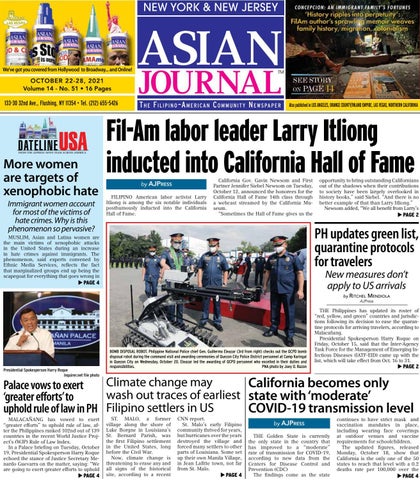
BOMB DISPOSAL ROBOT. Philippine National Police chief Gen. Guillermo Eleazar (3rd from right) checks out the QCPD bomb disposal robot during the command visit and awarding ceremonies of Quezon City Police District personnel at Camp Karingal in Quezon City on Wednesday, October 20. Eleazar led the awarding of QCPD personnel who excelled in their duties and responsibilities. PNA photo by Joey O. Razon
THE Philippines has updated its roster of “red, yellow, and green” countries and jurisdictions following its decision to ease the quarantine protocols for arriving travelers, according to Malacañang. Presidential Spokesperson Harry Roque on Friday, October 15, said that the Inter-Agency Task Force for the Management of Emerging Infectious Diseases (IATF-EID) came up with the list, which will take effect from Oct. 16 to 31.
u PAGE 2
Climate change may California becomes only Palace vows to exert wash out traces of earliest state with ‘moderate’ ‘greater efforts’ to uphold rule of law in PH Filipino settlers in US COVID-19 transmission level MALACAÑANG has vowed to exert “greater efforts” to uphold rule of law, after the Philippines ranked 102nd out of 139 countries in the recent World Justice Project’s (WJP) Rule of Law Index. In a Palace briefing on Tuesday, October 19, Presidential Spokesperson Harry Roque echoed the stance of Justice Secretary Menardo Guevarra on the matter, saying: “We are going to exert greater efforts to uphold
u PAGE 4
ST. MALO, a former village along the shore of Lake Borgne in Louisiana’s St. Bernard Parish, was the first Filipino settlement in the United States, long before the Civil War. Now, climate change is threatening to erase any and all signs of the historical site, according to a recent
CNN report. St. Malo’s early Filipino community thrived for years, but hurricanes over the years destroyed the village and forced many settlers to other parts of Louisiana. Some set up their own Manila Village, in Jean Lafitte town, not far from St. Malo.
u PAGE 4
by AJPRESS THE Golden State is currently the only state in the country that has improved to a “moderate” rate of transmission for COVID-19, according to new data from the Centers for Disease Control and Prevention (CDC) The findings come as the state
continues to have strict mask and vaccination mandates in place, including wearing face coverings at outdoor venues and vaccine requirements for schoolchildren. The updated figures, released Monday, October 18, show that California is the only one of the 50 states to reach that level with a 0.2 deaths rate per 100,000 over the
u PAGE 4
2
OctOber 22-28, 2021 • NeW YOrK AND NeW JerSeY ASIAN JOUrNAL
http://www.asianjournal.com • (212) 655-5426
Comelec dismisses ‘false Fil-Am labor leader Larry Itliong... reports’ on 2022 elections by Zacarian
Sarao
Inquirer.net
MANILA — The Commission on Elections (Comelec) dismissed a “false report” which claimed that Commissioner Rowena Guanzon is pushing for the scrapping of the May 2022 polls that went viral on social media. “Commissioner Guanzon is NOT, repeat NOT, recommending that the 2022 National and Local Elections be scrapped,” said Comelec spokesperson James Jimenez. “This Adobo Chronicles report stating otherwise is obviously #fakenews. #fightfake,” he added. The report came from The Adobo Chronicles, a satirical website founded in 2013, which describes itself as “the best source for unbelievable news.” Meanwhile, in a following tweet, Jimenez admitted that he is “leery” in accepting satirical news. “In an environment where a significant segment of the public are unable to separate fact from fiction, I am leery of accepting the ‘satire
card’,” said Jimenez. The Comelec spokesperson also earlier denounced another post that spread on social media claiming that the Comelec has disqualified Vice President Leni Robredo from the presidential race. “VP Leni Robredo has not been disqualified. Video and articles that imply or suggest otherwise are #fakenews. COMELEC’s reminders on prohibited sources of funding apply to all would-be candidates. #fightfake,” Jimenez tweeted on Sunday, October 17. These claims surfaced over the weekend after Robredo’s supporters launched an online fundraising page for her presidential campaign. However, Commissioner Rowena Guanzon already clarified that foreigners cannot contribute to any Filipino candidate. Apart from this, the Comelec has not yet released the official list of candidates in the upcoming elections, which means none can be disqualified yet, according to Jimenez. The final set of candidates is set to be released by December, according to Comelec. n
PH updates green list, quarantine... PAGE 1 Romania is the only country that has been included in the red list, or those classified as “high risk” based on their COVID-19 diseases incidence rate On the other hand, there are 49 states and jurisdictions in the green list, or those classified as “low risk” for COVID-19 infections: Algeria, American Samoa, Bhutan, Burkina Faso, Cameroon, Cayman Islands, Chad, China (Mainland), Comoros, Republic of the Congo, Cook Islands, Eritrea, Falkland Islands (Malvinas), Gibraltar, Hong Kong (Special Administrative Region of China), Kiribati, Madagascar, Mali, Marshall Islands, Federated States of Micronesia, and Montserrat. Also included in the green list are Nauru, New Zealand, Nicaragua, Niger, Niue, North Korea, Northern Mariana Islands, Palau, Poland, Saba (Special Municipality of the Kingdom of the Netherlands), Saint Helena, Saint Pierre and Miquelon, Samoa, Sierra Leone, Sint Eustatius, Solomon Islands, Sudan, Syria, Taiwan, Tajikistan, Tanzania, Tokelau, Tonga, Turkmenistan, Tuvalu, Uzbekistan, Vanuatu, and Yemen. Meanwhile, all other countries, jurisdictions, or territories not mentioned are included in the yellow list, or those classified as “moderate risk” for COVID-19. The United States is under the yellow list. Testing, quarantine pro-
tocols Roque also said that the IATF-EID has “streamlined and codified” the testing and quarantine protocols for international travelers entering the Philippines. Arriving travelers coming from or who have been to red countries within the last 14 days prior to their arrival in the Philippines will be barred from entering. However, travelers who are merely transiting through the red country should not be deemed as “having come from or having been to said country or jurisdiction or territory if they stayed in the airport the whole time and were not cleared for entry by its immigration authorities,” said Roque. Filipinos returning to the country through governmentinitiated or non-governmentinitiated repatriation, as well as Bayanihan Flights, will also be allowed subject to testing and quarantine protocols. Passengers from the red countries who are allowed to enter the Philippines are required to undergo a 14-day quarantine upon arrival. The first 10 days shall be observed in a quarantine facility, while the last four days will be completed at home. They are also mandated to take a reverse transcriptionpolymerase chain reaction (RT-PCR) test on their seventh day in the country. “Notwithstanding a negative test result, the arriving passenger shall complete the
facility-based quarantine period of 10 days,” Roque said. The Bureau of Quarantine (BOQ) has been directed to ensure strict symptom monitoring while in the facility quarantine for 10 days. For fully-vaccinated travelers from yellow countries, they are required to undergo a facility-based quarantine until the release of their negative RT-PCR test result taken on their fifth day in the Philippines. “After which, they shall be required to undergo home quarantine until their 10th day,” added Roque. Foreign nationals are also required to secure their prebooked accommodation of at least six days. For unvaccinated, partially vaccinated, or individuals whose vaccination status cannot be independently verified, they need to undergo a facility-based quarantine until the release of a negative RT-PCR test taken on the seventh day. After which, they are required to undergo home quarantine for another week. Foreign nationals must also secure their pre-booked accommodation of at least eight days. Meanwhile, fully vaccinated foreign nationals coming from the green list territories are no longer required to undergo a facility-based quarantine. Instead, they need to yield negative RT-PCR test results taken within 72 hours prior to departure from the
PAGE 1 leadership and unapologetic advocacy.” Itliong, according to his description on California Museum’s website, was one of the most important civil rights leaders of the 20th century and a father of the West Coast labor movement. He was born in the Philippines and migrated to the United States in 1929, working in the Alaskan fish canneries and along the West Coast as a farm laborer. After serving in the U.S. Army during World War II, Itliong became a U.S. citizen in 1954 and settled in Stockton, where he organized for the Agricultural Workers Organizing Committee (AWOC). “He was so good at recruiting new members that union leaders asked him to move to Delano to organize Filipino grape workers,” noted the California Museum. “It was there that he helped change the history of farm labor.” Among Itliong’s achievements include uniting with the National Farm Workers Association (NFWA) and starting the Delano Grape Strike and Boycott, which is one of the most important social justice and labor movements in American history. Itliong also formed the United Farm Workers (UFW) with César Chávez, with the latter as director and the former as assistant director. In addition, Itliong successfully secured funding for the construction of the Paulo Agbayani Retirement Village in Delano, which has provided housing and support for retired Filipino farmworkers
country of origin. “Upon arrival, no facilitybased quarantine will be further required but the passenger is enjoined to self-monitor for any symptoms until the 14th day,” Roque said. Fully-vaccinated Filipinos, on the other hand, can choose facility-based quarantine until the release of a negative RTPCR test taken in the quarantine facility upon arrival, or no facility-based quarantine after getting a negative RT-PCR test within 72 hours prior to departure from the country of origin. They are likewise enjoined to self-monitor for any symptoms until the 14th day. As for unvaccinated, partially vaccinated, or individuals whose vaccination status cannot be independently verified, and those vaccinated but
Larry Itliong as photographed by Jon Lewis Courtesy of Beinecke Rare Book & Manuscript Library, Yale University
since 1974. Aside from Itliong, LGBTQ advocates Del Martin and Phyllis Lyon, artist Ruth Asawa, singer-songwriter and guitarist Jerry Garcia, and rock music icon Ritchie Valens were inducted into the California Hall of Fame. “Jennifer and I are pleased to induct this group of extraordinary Californians into the Hall of Fame,” said Newsom. “There is no doubt their lives and legacies have helped make California synonymous around the world with innovation, imagination and progress,” he added. The new inductees joined 134 other Californians recognized for embodying the
state’s “innovative spirit.” “These luminaries represent the best of California,” said Siebel. “Each one has left their own indelible mark on history and reminds us of the creativity, ingenuity and courage that lives inside all of us.” The California Hall of Fame was established in 2006 at the California Museum by former Governor Arnold Schwarzenegger and First Lady Maria Shriver. Inductees are selected from all walks of life and have made distinguished achievements across a variety of fields, including the arts, education, business and labor, science, sports, philanthropy and public service. n
failed to comply with the testbefore-travel requirements, they are required to undergo a facility-based quarantine until the release of a negative RT-PCR test taken on the fifth day. “In the case of foreign nationals, they shall be required to secure hotel reservations for at least six days,” said Roque. Unvaccinated or partially vaccinated minors traveling with their fully vaccinated parents or guardians, on the other hand, are required to observe quarantine protocols corresponding to their vaccination status. A parent/guardian will need to accompany the child in the quarantine facility for the full term of the latter’s facilitybased quarantine period.
To validate their vaccination status, international Filipino travelers, their spouse, parent/s, and/or children; and foreigners vaccinated in the Philippines can present either VaxCertPH digital vaccination certificate, International Certificate of Vaccination or Prophylaxis (ICV) issued by BOQ or the World Health Organization (WHO), or the national digital certificate of the foreign government accepting VaxCertPH to validate their vaccination status. Foreigners vaccinated abroad, on the other hand, can present WHO-issued ICV, or the national digital certificate of the foreign government which has accepted VaxCertPH under a reciprocal agreement unless otherwise permitted by the IATF-EID. n
(212) 655-5426 • http://www.asianjournal.com
NEW YORK AND NEW JERSEY ASIAN JOURNAL • OctObER 22-28, 2021
3
4
OctOber 22-28, 2021 • NeW YOrK AND NeW JerSeY ASIAN JOUrNAL
http://www.asianjournal.com • (212) 655-5426
From the Front Page
Climate change may wash out traces of... PAGE 1 They made a living from fishing and introduced a unique process of drying shrimps. Although there’s little historical documentation on the early Filipinos in Louisiana and stories about them were mainly handed down through generations, Filipino Americans say more people need to know about the villages of St. Malo and Manila Village in Jean Lafitte and how climate change could erase any trace of them. Some say that the Filipino community in St. Malo goes back to as early as 1763 when both the Philippines and Louisiana were under Spanish rule. Today, The U.S.
An early depiction of “Manila Village” in Jean Lafitte, Lousiana.
Census Bureau estimates there are around 8,000 Filipinos in Louisiana. Randy Gonzales, an English professor at the University of Louisiana at Lafayette, and co-vice president of the Philippine-
Louisiana Historical Society, told CNN that in the late-1700s Filipinos likely escaped from globesailing Spanish ships and went deep in the bayous of Louisiana, building huts over the wetlands.
The Philippine-Louisiana Historical Society successfully lobbied for a marker to commemorate St. Malo. Gonzales said it was a challenge to put up since no one ever goes to St. Malo, and they wanted it protected. As the climate crisis intensifies, Louisiana’s coast is being battered by sea level rise, more frequent hurricanes and erosion. Traces of St. Malo and even the Jean Lafitte settlement may disappear soon. Louisiana has lost about 25% of its coastal land the size of Delaware since in 1932, according to the U.S. Geological Survey, cited by the CNN report. (Inquirer. net) n
A plaque marks an area nearest the early Filipino settlement in St. Malo, in a Louisiana bayou. Photos courtesy of FANHS
Palace vows to exert ‘greater efforts’ to... California becomes only... PAGE 1 and promote the rule of law in the country.” Further, he stood by Guevarra’s statement that the crime rate in the country has been decreasing in recent years. “Sabi nga ni Secretary Guevarra, from where he stands, except for a few sensational cases, ang crime rate naman po sa bansa ay bumaba (As Secretary Guevarra said, from where he stands, except for a few sensational cases, the country’s crime rate decreased),” said Roque. “At bukod pa rito, ang gobyerno ay tinutugunan ‘yung mga paglabag ng karapatang pantao at saka iyong mga alleged abuses sa conduct ng campaign against illegal drugs (Aside from this, the government is addressing the human rights violations and alleged abuses in the conduct of the campaign against illegal drugs),” he added. Roque also said that the five pillars of the rule of law need to “unite.” “Alam ninyo kasi itong rule of law, limang tinatawag na pillars. At ang ehekutibo po ay incharge sa dalawa — ito ‘yung pulis at saka iyong kulungan. So kinakailangan magsama-sama ‘yung iba’t ibang mga pillars kasama na ang lipunan dahil kabahagi bilang pillar ng criminal justice system ang lipunan (You know, the rule of law has five pillars. The executive is in charge of two — the police and jails. The different pillars need to unite including society as it is part of the criminal justice system),” he said. “Pero kinakailangan ang hudikatura, bilisan ang proseso at
kinakailangan din na ang civil society magmatyag pa rin ‘no at talagang gamitin ang proseso para lahat noong lalabag ay maparusahan kung kinakailangan (But we need our judiciary to hasten the process, and we need our civil society to keep watch and use our process so that all violators will be punished if necessary),” he added. Rule of Law index Last week, the WJP released its annual Rule of Law Index 2021, which assesses the rule of law in 139 nations based on national surveys of over 138,000 families and 4,200 legal practitioners and experts worldwide. The Philippines placed 102nd, dropping several notches down from last year’s ranking of 91 out of 128 countries. In East Asia and the Pacific region, the Philippines remained at 13th place out of 15 countries. The index measures adherence to the rule of law based on eight indicators namely constraints on government powers, absence of corruption, open government, fundamental rights, order and security, regulatory enforcement, civil justice, and criminal justice. In the latest index, the Philippines scored 0.46 on a zero to one scale. A score of one indicates strongest adherence to the rule of law. The country’s scores in other indicators likewise declined, except in regulatory enforcement and criminal justice, which stayed at 0.48 and 0.31, respectively. In addition, the index noted a statistically significant change in
the country’s score in order and security, which dropped by 0.02 to 0.63. “Significant trends for the Philippines included a deterioration in the factor measuring order and security,” the WJP said Thursday, Oct. 14. Nonetheless, it pointed out that decline of rule of law is a global trend this year. “In a year dominated by the global COVID-19 pandemic, 74.2% of countries covered experienced declines in rule of law performance, while 25.8% improved,” the organization said. “The 74.2% of countries that experienced declines this year account for 84.7% of the world’s population or approximately 6.5 billion people,” it added. In response to the ranking, Guevarra maintained that the country’s judicial system is “functioning” as it should. “Our law enforcement, prosecutorial and judicial institutions, although imperfect like any other human institutions, have been functioning as they should,” he said Saturday, Oct. 16. “Be that as it may, the government will exert greater efforts to uphold and promote the rule of law in our country,” he added. Guevarra also insisted that the crime rate in the Philippines has been “on a downward trend.” “Except for a few sensational cases, the general crime rate in our country has been on a downtrend in recent years, and the government has been addressing reported violations of human rights and alleged abuses in the conduct of the campaign against illegal drugs,” he said. (By Ritchel Mendiola/AJPress) n
PAGE 1 past seven days. Meanwhile, the state has a 34.4 cases rate per 100,000 during the same period. Joining California in the “moderate” level are two territories, Puerto Rico and the Northern Mariana Islands. Nationwide, eight states are categorized under the “substantial” or orange level of community transmission and 44 states are considered “high” transmission, including Washington, Nevada, Arizona, Texas and New York.
The California Department of Public Health reports a 2% 7-day positive rate. From Friday, October 16 to Sunday, October 18, the department reported 16,764 new cases, with cases largely among unvaccinated populations, bringing the total confirmed cases to date to 4,588,231. Meanwhile, 3,669 are hospitalized and 1,006 are in the ICU with confirmed COVID-19. The state continues to lead in vaccination rates with 51,271,175 vaccines administered and 24,426,200 individuals considered fully vaccinated. n
More women are targets... PAGE 1 the country. But why women? According to the new survey “Islamophobia in the eyes of Muslims,” women (76.7%) are more likely than men (58.6%) to be victims of Islamophobia, and 91% of women reported that Islamophobia affects their emotional and mental well-being compared to 84% in the case of men. “Women are viewed as a symbol of a visible (wearing the hijab), external and opposing culture,” said Basima Sisemore, researcher for the Global Justice Program at the Othering & Belonging Institute at UC Berkeley, who conducted the survey. “And that culture is Islam and the East, and Muslims who supposedly are at odds with western ideals and democratic values.” The survey is the first national study to ask Muslim Americans (about 3.5 million people) their perceptions and experiences regarding Islamophobia. It was conducted in 50 states and 1123 respondents participated. 62% of all respondents reported that they, relatives, friends or members of their community have been affected by federal and / or state policies that
disproportionately discriminate against Muslims. Islamophobia, says Sisemore, already existed before the attacks of September 11, 2001 and dates back to the beginning of the nation as 20% of the African slave population was Muslim. It has been perpetrated by people in individual acts of violence, but also institutionalized by “structural racism” in the United States with policies such as “the travel ban for Muslims, Countering Violent Extremism (CVE) programs or even anti Sharia legislation.” “Liberal and imperialist feminism feeds into the false and dangerous narrative of Muslim women as oppressed,” continued Sisemore. “That feminism says that women have no equality under Islam, and are seen in need of being saved from violent and oppressive Muslim men, which is a very dangerous narrative that played out in the invasions of Iraq and Afghanistan as a means to garner public support toward the narrative of white saviorism.” While in some Islamic countries women need to go out in public with their husbands or have severe restrictions on PAGE 10
(212) 655-5426 • http://www.asianjournal.com
NEW YORK AND NEW JERSEY ASIAN JOURNAL • OCTOBER 22-28, 2021
OPINION
Questions on ‘ayuda’ distribution
5
FEATURES Philstar.com photo
SINCE the multibillion-peso financial assistance or ayuda for the COVID pandemic was launched last year, anomalies have hounded the aid distribution. There were complaints of favoritism, and provision of aid even to the wealthy. There were problems with the list of beneficiaries. As early as May last year, 134 barangay officials, mostly captains, faced criminal charges before the Department of Justice for various types of irregularities in ayuda distribution. Among the offenses were the collection of “processing fees” ranging from P50 to P1,000 from each recipient, and inclusion of unqualified relatives of barangay officials among the beneficiaries. Despite the filing of criminal charges and suspension of those indicted, the aid anomalies have continued. Last August, for example, three barangay officials led by the captain together with a civilian were arrested in Manila on charges of stealing the P8,000 cash aid from two beneficiaries. In the latest ayuda-related controversy, senators are questioning a contract awarded by the Department of Social Welfare and Development to what they described as a little
known financial service provider to distribute about P50 billion worth of aid to over 1.89 million beneficiaries. The DSWD has defended the award of the bulk of the contract to Starpay, saying it was one of just two FSPs accredited to do mixed manual and electronic payouts. Senators wondered why bigger entities such as GCash, PayMaya and RCBC have fewer beneficiaries than Starpay, which was allotted up to seven million beneficiaries, each of which would be charged P50. Only 800,000 have downloaded the Starpay app as of last week, the senators said. DSWD officials have said it was the Bangko Sentral ng Pilipinas that selected the FSPs for the distribution of the social amelioration program. The department had to “recalibrate” after it turned out that many beneficiaries did not have contact numbers. Only Starpay and RCBC “signified” readiness to
Editorial
Babe’s Eye View BABE ROMUALDEZ AS the current chairman of the ASEAN Committee in Washington (ACW) an organization composed of ambassadors of ASEAN member-nations in Washington – we have organized a list of activities aimed at elevating the concerns of Southeast
distribute the SAP to such beneficiaries, the DSWD explained. Senators, on the other hand, urged the Bangko Sentral and investigative bodies to probe the deal with Starpay, a company that reportedly declared bankruptcy in 2019. Apart from failing to fully distribute the
aid, Starpay reportedly deposited the undisbursed amount in a private bank before it began returning the funds in installments to the DSWD, the senators said. The country has struggled to deal with pandemic, and the government must ensure that aid distribution is efficient and aboveboard. (Philstar.com)
Climate change: the next global challenge Asian nations and further strengthening the political and economic ties with the United States. Last Wednesday, October 13, we chaired the ASEAN committee meeting at our embassy where we invited former State Secretary, now Special Presidential Envoy on Climate John Kerry, to discuss climate change and its inherent consequences affecting the world which could be equated with
COVID-19. Secretary Kerry gave us a rundown on what the U.S. wants to accomplish together with other countries – the reduction of carbon emissions and a commitment to phase out fossil fuels such as coal, petroleum and natural gas. President Biden has pledged to cut U.S. greenhouse gas emissions by 50 percent (based on 2005 levels) by 2030, create a carbon
pollution-free power sector by 2035 and a net zero emissions economy by no later than 2050. According to Secretary Kerry, we have less than 10 years – by 2030 in fact – to get the world on the right path and avoid a potential climate catastrophe. He believes we can reverse the dangerous warming of the planet by limiting the rise in our temperature to that level of 1.5 degrees Celsius.
Secretary Kerry spoke about the upcoming 26th UN Climate Change Conference (COP26) in Glasgow, Scotland this November where leaders are expected to step up on their commitment to reduce carbon emissions. Each country that signed up on the 2015 Paris Agreement committed to a target known as a Nationally Determined Contribution (NDC) to reduce greenhouse gas
emissions by 2030. Finance Secretary Sonny Dominguez, the chairperson-designate of the Climate Change Commission, will be our representative to COP26, but perhaps Secretary Teddy Locsin may be joining him at that important two-week summit with an estimated 30,000 delegates that include world leaders as well as scientists and PAGE 10
The views expressed by our Op-Ed contributors are solely their own and do not necessarily reflect the predilection of the editorial board and staff of Asian Journal. ADVERTISING AND ADVERTORIAL POLICIES ROGER LAGMAY ORIEL Publisher & Chairman of the Board
Main Office: 1210 S. Brand Blvd Glendale, CA 91204 Tels: (818) 502-0651 • (213) 250-9797 Fax: (818) 502-0858 • (213) 481-0854 e-mail: info@asianjournalinc.com http://www.asianjournal.com
New York and New Jersey: 133-30 32nd Ave., Flushing, NY 11354 Tel.: (212) 655-5426 • Fax (818) 502-0858
With offices in Los Angeles, New York/New Jersey, Las Vegas, San Diego, Philippines
CORA MACABAGDAL-ORIEL President
MOMAR G. VISAYA Executive Editor and Editor-in-Chief New York/New Jersey Asian Journal
Asian Journal Publications, Inc. (“AJPI”) reserves the right to refuse to publish, in its sole and absolute discretion, any advertising and advertorial material submitted for publication by client. (“Client’s Material”) Submission of an advertisement or advertorial to an AJPI sales representative does not constitute a commitment by AJPI to publish a Client’s Material. AJPI has the option to correctly classify any Client’s Material and to delete objectionable words or phrases. Client represents and warrants that a Client’s Material does not and will not contain any language or material which is libelous, slanderous or defamatory or invades any rights of privacy or publicity; does not and will not violate or infringe upon, or give rise to any adverse claim with respect to any common law or other right whatsoever (including, without limitation, any copyright, trademark, service mark or contract right) of any person or entity, or violate any other applicable law; and is not the subject of any litigation or claim that might give rise to any litigation. Publication of a Client’s Material does not constitute an a greement to continue publication. Client agrees and covenants to indemnify AJPI and its officers against any and all loss, liability, damage, expenses, cost, charges, claims, actions, causes of action, recoveries, judgments, penalties, including outside attorneys’ fees (individually and collectively “Claims”) which AJPI may suffer by reason of (1) Client’s breach of any of the representations, warranties and agreements herein or (2) any Claims by any third party relating in any way to Client’s Material. AJPI will not be liable for failure to publish any Client’s Material as requested or for more than one incorrect insertion of a Client’s Material. In the event of an error, or omission in printing or publication of a Client’s Material, AJPI shall be limited to an adjustment for the space occupied by the error, with maximum liability being cancellation of the cost of the first incorrect advertisement or republication of the correct advertisement. Under no circumstances shall Asian Publications, Inc. be liable for consequential damages of any kind. ASIAN JOURNAL PUBLICATIONS, INC. publishes the Los Angeles Asian Journal, published twice a week; Northern California Asian Journal, Las Vegas Asian Journal and the New York / New Jersey Asian Journal which are published once a week and distributed to Los Angeles, Riverside, San Bernardino, Orange Counties, Northern California, Las Vegas and New York and New Jersey respectively. Articles published in this paper do not necessarily reflect the opinions of the publisher. Letters to the Editor are welcome. Letters must contain complete name and return address. The materials, however, are subject to editing and revisions. Contributions and advertising deadlines are every Mondays and Thursdays. For advertising rates and other informations, please call the L.A. office at (213) 250-9797 or the Las Vegas Sales Office at (702) 792-6678 or send us an email at info@asianjournalinc.com
6
OctOber 22-28, 2021 • NeW YOrK AND NeW JerSeY ASIAN JOUrNAL
http://www.asianjournal.com • (212) 655-5426
Dateline PhiliPPines
Palace: Duterte not remiss in Displaced Marawi investigating drug war killings residents return home by ritchel
MendiolA AJPress
PHILIPPINE President Rodrigo Duterte is “not remiss” in his obligation to investigate human rights abuses in the country, according to Malacañang. Presidential Spokesperson Harry Roque on Wednesday, October 20, made the statement after the Philippine Department of Justice (DOJ) released a 21-page information table on over 50 cases of deaths during police anti-drug operations. “I can only commend the DOJ for this conclusion because this proves that the President has not been remiss in his obligation to investigate perpetrators of these crimes,” he said in an interview at the Kapihan sa Manila Bay news forum hosted by Marichu Villanueva. According to Roque, the matrix belies “all claims” that Duterte is responsible for the killings. “I think these findings of the DOJ will belie all claims that the President is responsible under the principle of command responsibility because on the
contrary, it proves that the Philippine state has in fact investigated and prosecuted individuals for these extralegal killings,” he said. Further, the matrix shows no evidence of the chief executive’s “culpability.” “I don’t think it says anything about the culpability of the President because in the 52 cases there’s not been an instance where there’s been a determination that the President ordered the killing or that the President did not do anything to punish those who committed criminal acts,” said Roque. On Tuesday, Oct. 19, the DOJ authorized the release of an information table concerning certain details of the 52 cases. In its press statement, the agency said that the release of case details is for the purpose of informing the families and loved ones of the deceased suspects that the circumstances surrounding each incidence of death are undergoing a determination of possible criminal liabilities on the part of erring police officers. The matrix was also part of the PAGE 7
by Jerry
AdlAw ManilaTimes.net
FOUR years after the Marawi siege in 2017, some 100,000 residents affected by the war between government forces and the extreme Maute group were hoping to return to their homes, said chairman Drieza Lininding of the Moro Consensus Group in an interview. Lininding said most of the displaced residents used to live in Ground Zero, where the Task Force Bangon Marawi (TFBM) have been developing infrastructure projects. Muslim families were seen cleaning housing units in Barangay Gadongan, the site of the 150 permanent shelters that the United Nations Human Settlements Program (UN-Habitat)
and the National Housing Authority (NHA) built with additional funding from the Japanese government. The NHA already developed 100 units and also procured and developed the land. “The new 90-square-meter house is small compared to the old model unit being constructed by residents of Marawi. These would at least give them a comfortable zone, which will now become their permanent home,” said Lininding. The residents affected by the siege wanted to begin a new life with their new home with the help of the P73,000cash assistance from the government. “With regards to housing, there is none yet for sharers but they were provided with financial assistance (worth) P35,000 per family including
those vendors who rented their stalls inside MAA but lost their businesses during the siege,” added Lininding. The government, however, declared as “no-dwell zone” the areas within the 3- to 6meter easement of the Lake Lanao, at the riverbanks and within the reclamation area where the government is doing infrastructure projects. The UN-Habitat had previously awarded permanent shelters to displaced families in Hadiya Village Phase 1 in Barangay Dulay West (109 units), at Phase 2 in the same location (120 units) and at the Pamayandeg Ranao Residences (50 units) in Barangay MipantaoGadongan. The UN agency said 910 permanent houses are set to PAGE 10
(212) 655-5426 • http://www.asianjournal.com
NEW YORK AND NEW JERSEY ASIAN JOURNAL • OctObER 22-28, 2021
7
Palace: Duterte not remiss in...
SFIO has recently established a new headquarters in New York City to accommodate U.S. investors and business partners.
SFIO commences US roadshow led by newly-appointed advisory board members
SFIO has started to embark on its six-month roadshow program across the United States through SFIO’s ‘The Global Academy.’ SFIO’s ‘The Global Academy’ (Training Hub for Entrepreneurship) is a strategic learning provider of masterclasses and workshops for business partners, shareholders and potential investors. It is led by newly appointed Advisory Board member Jonathan Petalver, who has over 25 years of designing and conducting learning and development programs under his belt. Coach Petalver, the CEO and co-founder of ‘The Global Academy.’ is headquartered in New Zealand, and with offices in New York, Melbourne, Dubai and Manila, it has extensive experience in conducting and facilitating masterclass programs in entrepreneurship and business leadership across Asia, Middle East, North America and Europe. Petalver will also be conducting conferences with existing investors during the roadshows. He is to be joined by Roger Oriel, another newly appointed Advisory Board member of SFIO, and the CEO of Asian Journal Publication, Inc. headquartered in Los Angeles. SFIO has recently established a new headquarters in New York City to accommodate U.S. investors and business partners. Messrs. Petalver and Oriel will travel to Los Angeles to meet potential business
partners for SFIO’s property development projects in the U.S. and to expand the business opportunity in the U.S. Moving toward the expansion in the U.S., Petalver scheduled to meet with the potential business partner who will operate the pilot store of Epiphany Cafe. He will be in Silicon Valley, where SFIO plans to establish its technology and development division. Then he will proceed with meeting a partner in San Francisco, who has been shortlisted to operate the commissary of Ardent Bakers in the U.S. The six-month roadshow program is planned to complete in April 2022. The Chairman of SFIO, Jeths Lacson and the New Zealand team will follow in the first quarter of 2022. To achieve the SFIO’s target of a $100M business roadmap, SFIO officially appointed the CEO of Australia-based MLV group, Michael Venezuela, as the new Chief Financial officer with over 30 years of tax, accounting and audit international experience. His vision is to offer affordable charges of professional tax, accounting and business advisory services to a well-diversified customer base. The commencement of the U.S. roadshow with the new appointment is all part of SFIO’s $100M business roadmap to be achieved by 2022.
(Advertising Supplement)
5-10% of private health workers in PH resign to work overseas – hospitals group MANILA — Around five to 10 percent of health workers have filed their resignation to work overseas, Private Hospitals Association of the Philippines Inc. President Dr. Jose Rene De Grano said on Tuesday, October 19 as he cautioned that continuous resignation may strain the country in the next six months. “For the past siguro mga two or three weeks, nakita natin na medyo mga around five
percent or more ng ating mga nurses — lalo na po ang ating mga nurses — ay nag-fa-file ng mga kanilang resignations dahil gusto po nilang mag-work sa ibang bansa,” De Grano said during the Laging Handa briefing. (For the past maybe two or three weeks, we saw that around five percent or more of our nurses — especially our nurses — file PAGE 10
PAGE 6 DOJ’s recognition of the importance of transparency in its review process. 52 cases Of the cases that the DOJ reviewed, the majority were buy-bust operations that turned into shootouts after the subjects resisted arrest. However, the agency noted some glaring lapses in the police reports about the conditions surrounding the suspects’ deaths. In the case of suspect Ryan Robosa, who was killed in a shootout during a December 2016 buy-bust operation in Taguig, the DOJ said that the police records do not support that narrative. “There are no pre-operation report, coordination form, chain of custody form, ballistics or paraffin test result, or autopsy result on record,” it said. Officers involved who were “found guilty of grave irregularity in the performance of duty” were only given a reprimand. In another case, police said they killed Anwar Sawadjaan, Noel Rey Bacalso, and Angelo Hofer at a checkpoint allegedly out of self-defense in July 2016, but the DOJ said that the medico legal report showed the victims appeared to have been shot at close range. The cops were dismissed from service as a result. The DOJ also highlighted one case that had a non-drug-related death. In December 2016, a victim who was allegedly of unsound mind was shot by the police in
Laguna. “At the time he was shot, the suspect did not appear to have posed any direct imminent danger to the police operative. The victim was not in possession of any deadly weapon or firearm,” noted the DOJ. For this, the cops involved were only handed a 180-day suspension. According to the DOJ, around 150 policemen were involved in the 52 cases. However, names were not released because of “due process considerations.” Justice Secretary Menardo Guevarra, for his part, said that the National Bureau of Investigation will conduct a case build-up and will file criminal charges against the cops involved. Meanwhile, Philippine National Police Chief Gen. Guillermo Eleazar welcomed the DOJ’s move to release the matrix, saying that it was “in the interest of truth, transparency and justice.” He also urged the families of the victims to come forward and hold erring police officers accountable. “Ito rin ang pagkakataon para sa mga pamilya ng nasawi sa police anti-illegal drug operation para sila’y makapagsumite ng complaint-affidavit o kaya’y magharap ng testigo upang maisampa ang kaukulang kasong kriminal sa korte (This is also the chance for the families of the individuals killed in the police anti-illegal drug operation to submit their complaintaffidavit or find a witness to file appropriate criminal cases in court),” said Eleazar. n
8
OctOber 22-28, 2021 • NeW YOrK AND NeW JerSeY ASIAN JOUrNAL
http://www.asianjournal.com • (212) 655-5426
(212) 655-5426 • http://www.asianjournal.com
NEW YORK AND NEW JERSEY ASIAN JOURNAL • OctObER 22-28, 2021
9
10
OctOber 22-28, 2021 • NeW YOrK AND NeW JerSeY ASIAN JOUrNAL
http://www.asianjournal.com • (212) 655-5426
More women are targets of xenophobic... PAGE 4 their rights, Sisemore says these are “extreme examples” and that the media could highlight other aspects of Muslim culture as “women play an intrinsic role in all parts of society.” According to Elsadig Elsheikh, Director of the Global Justice Program at the Othering & Belonging Institute at UC Berkeley, in some African countries women have led the struggle against dictatorships and invasions and there are exemplary cases of leadership in the East like that of Sheikh Hasina, current prime minister in Bangladesh, and Benazir Bhutto, the first woman to head a democratic government in a Muslimmajority country like Pakistan. “I’m not quite sure the representation of women in most liberal democracies in the West exceeds 20%,” Elsheikh said. Elsheikh said that another worrying finding from the survey is that almost a third or more of Muslims have hid or attempted to hide their religious identity, “because Islamophobia has made their place of worship linked to ‘terrorism’ which makes it hard for Muslims to engage with each other… if I see a guy with a turban on his head, I am also filled with rage against those who will come into bombing our country.” Many Muslims censor themselves by avoiding talking about their beliefs or place of origin and in the case of women “almost nine out of 10 women do that in their everyday life, they try to get away
from speaking their mind.” For Elsheikh, Muslims and other marginalized groups, “seem to be the scapegoats for everything wrong in the United States.” This experience is similar for AsianAmerican communities that have been the subject of a wave of racist and xenophobic incidents related to the origin of COVID in Asia. According to the Stop AAPI Hate center, from March 2020 to June 2021, more than 9,000 incidents have been reported against this community and more than 66% of those attacks have been against AsianAmerican women, including school-age girls. “With that idea of ‘Make America White Again”, the rest of us are foreign invaders and whole groups of people are rendered as being second-class, less than human,” said Helen Zia, AAPI activist, author, and journalist. “Add to that a layer of gender based attacks against women, which puts immigrant women to face multiple jeopardy for being just who they are.” Zia mentioned the massacre in Atlanta, Georgia, where six Asian-American women who worked in spas were killed, and said that the hate incidents, although not documented by gender, date back to 1980. “The sexualization of Asian women, and women of color in general, plays a role in these kinds of incidents,” Zia said. The most difficult thing for women
is to report “because they know that in society overall they are diminished, they are shamed and blamed, and they may even face stigma within their own community.” Among the Latino community, labor and sexual exploitation occurs in silence due to the latent threat of deportation. Latina and indigenous agricultural workers, particularly immigrants from Mexico, Central and South America escape various forms of violence in their countries of origin and by seeking refuge in the United States, they continue to be victimized. “Latina women have faced a lot of sexual violence, especially in the fields, considering the dynamic that exists with their citizenship status,” said Irene de Barraicua, Director of Operations for Lideres Campesinas, a network of agricultural workers that supports women with their asylum cases. “They are afraid of retaliation and deportation and do not seek assistance for fear of being deemed a public charge,” added Barraicua. During the pandemic “they were the first to go when business and growers farmers had to stop or wanted to keep the fastest workers.” The leader says that all these forms of violence can only stop when “we see a fair immigration reform” and for that “we will continue lifting these voices.” (Jenny Manrique/Ethnic Media Services) n
Displaced Marawi residents...
PAGE 6 be completed by December 2021 in five resettlement sites. Lininding said in September, a legislation for the compensation of residents of the war-torn city inched closer to approval in the Senate with the Special Committee on Marawi City Rehabilitation chaired by Sen. Ronald “Bato” de la Rosa. Dela Rosa has given the assurance to expedite the approval of the bill as both legislative houses will work double time to pass this measure for the people of Marawi. The lower house passed its version, House Bill 9925, on September 6 which, under the bill, private property owners shall be compensated for loss or destruction based on the current market value. Some families affected by the fivemonth siege received permanent
shelters from the partnership between private organizations and TFBM. Most of these were distributed prior to President Rodrigo Duterte’s visit on Saturday and later presented in a symbolic ceremony at the Rizal Park. According to the Rebuilding Marawi Project of the UN-Habitat, in partnership with the NHA, 250 families were awarded permanent house and lot units. Marawi residents represented by Norjannah Amerol, 46, said it is an opportunity to rebuild part of what they lost in the war. “The new house that we now have is a blessing, a symbol that if a person patiently waits, Allah will provide his blessings,” Amerol said crying as she recalled how she feared for the lives of her two sons who chose to stay behind to take care of the family’s belongings, thinking that the gunfight will last for
just three days at the most. One of Amerol’s sons was hit by a stray bullet as other members of the family made their way to the boat by the lake that brought them to safety. “Four years! Whatever hardships my family went through, those were assuaged by this house. I will not let my children be separated from me again. That kind of fear as a mother is something that I do not want to experience again. This is where we will rebuild our lives, together,” Amerol said. Last Saturday’s (October 16) visit of President Duterte in Marawi led to the unveiling of the marker of the recently finished Jameo Mindanao Al-Islamic Masjid, otherwise known as the Grand Mosque, as he went to the Rizal Park to commemorate the fourth anniversary of Marawi’s liberation from the siege perpetrated by the Maute terrorists. n
5-10% of private health workers in PH resign to...
PAGE 7 resignations to work in other countries.) “Siguro mga at least five to 10 percent po ‘yan na mga naga-abroad lang,” he added. (Maybe at least five to 10 percent want to work overseas.) De Grano said that while health workers who resign do not hastily leave their duties and notify their employers of working abroad, he said that without immediate replacement, the country’s health system will be strained. “‘Yun po ang kinakatakot natin kasi ‘pag masyado tayo lumuwag sa pagpapalabas ng ating mga healthcare workers at wala naman tayong maipalit kaagad sa kanila ay baka tayo po maubusan ng mga healthcare workers,” De Grano
lamented. (We fear that if more healthcare workers will be allowed to leave and we cannot find a replacement immediately, we may run out of healthcare workers.) “So, ‘yun po ang ating nakikita na siguro kung hindi po natin medyo mapipigilan itong pag-alis na ‘to, baka po in another six months, baka po maubusan na tayo ng mga nurses at mapipilay po talaga ang ating mga health facilities at healthcare system,” he said. (We observe that if they cannot be prevented from leaving, maybe in another six months, we will lose our nurses and our health facilities, and the healthcare system will be paralyzed.) (By Daniza Fernandez/Inquirer.net) n
Climate change... PAGE 5 environment advocates. All eyes will be on the COP26 (which was postponed from last year due to the COVID-19 pandemic), acknowledged as the biggest and most important climate conference and dubbed by many as “the world’s best last chance” to keep the worst consequences of the climate crisis at bay. A major factor in helping countries move forward in the goal to reduce their carbon footprint is new technology, such as “green hydrogen” using a chemical process that extracts hydrogen from water using electricity from renewable sources, which can be a replacement for fossil fuels. Secretary Kerry discussed opportunities for alternative sources of energy – green energy – which can be a driver in reversing the impact of global warming and climate change. He mentioned the technology that develops small, modular nuclear reactors as sources of renewable energy that require smaller investment capital plus greater scalability. In fact, Bill Gates – who authored “How to Avoid a Climate Disaster” – founded TerraPower, an advanced nuclear innovation company that aims to develop carbon-free small modular reactors, the first of which will be built in an abandoned coal station in Wyoming. Scientists have long been saying that nuclear energy can combat climate change because it is low carbon, and power plants do not emit greenhouse gases during operation. In the Philippines, one of the most passionate advocates of nuclear energy is former Pangasinan Congressman Mark Cojuangco, who has been calling for the revival of the Bataan nuclear power plant to boost the supply in Luzon and avert a power shortage as it could add 600 megawatts of reliable power. Mark believes reviving the BNPP will help provide consumers with a stable source of electricity at a lower cost. He also cites NEDA estimates that the Philippines will need 13,000 megawatts of electricity to cope with the rising demand, and small modular reactors with a capacity of up to 300 megawatts
could address this rising need in the electricity grid. This is something that we should continue to study and, hopefully, the next administration will seriously look at alternative sources of energy as the only way to go. During our meeting with Secretary Kerry, I precisely asked him about his thoughts on nuclear energy. The secretary was very clear: he was a firm believer in nuclear energy. As I said, the United States is already developing a safe modular type of nuclear energy power plant that will be ultra-safe and can be easily installed in many countries. The U.S. plans to share this technology as soon as it is fully developed. To this day, the impact of Super Typhoon Yolanda (Haiyan) can still be felt, with people in low-lying coastal areas getting distressed every time strong rains start pouring. A few days ago, Severe Tropical Storm Maring (Kompasu) battered several provinces in northern Luzon, dumping more than a month’s worth of rain that submerged many towns, with damage to agriculture estimated at P1 billion. While the COVID-19 pandemic is a global concern, climate change is an “existentialist threat” that also poses the “greatest threat” to global public health, increasing the number of heat-related deaths and illnesses, causing a rise in infectious diseases and impacting the mental health of people, with lives and livelihoods lost due to droughts, floods, fires and other disasters. As Secretary Dominguez noted, the pandemic is a problem – but climate change issues that we have faced and will continue to face will impact the next generation. Hopefully, leaders – especially those from the G20 economies – will deliver on their climate change commitments because the time to act is now, not tomorrow. (Philstar.com) *** The opinions, beliefs and viewpoints expressed by the author do not necessarily reflect the opinions, beliefs and viewpoints of the Asian Journal, its management, editorial board and staff. *** Email: babeseyeview@gmail. com
Community Journal
(212) 655-5426 • http://www.asianjournal.com
NEW YORK AND NEW JERSEY ASIAN JOURNAL • OctObER 22-28, 2021
11
The November 2021 priority dates: No change from September Immigration Corner
The priority dates for the Philippines are as follows: FAMILY CATEGORY: First Preference
Atty. MichAel Gurfinkel, eSQ THE November priority dates are typically the start of the new “fiscal year” for visas, where a new annual supply of visas is made available. Usually, with a new supply of visas, the priority dates move forward in the various family categories. However, for November 2021, the priority dates did not move at all. They are the same as September 2021. Fortunately, employment-based visas remain “current.” Each month, the Visa Office of the State Department publishes, in the Visa Bulletin, the priority dates for that particular month, for the various family and employmentbased categories. A priority date is a person’s “place in PAGE 12
Unmarried sons and daughters of U.S. citizens (21 years old or older)
Application Filing Date
Visa Issuance Date
April 22, 2015
March 01, 2012
(2A) Spouse and Second Preference minor children June 01, 2021 (below 21 years old) of green card holders
Current
(2B) Unmarried sons October 01, and daughters (21 years old or older) 2013 of green card holders
October 22, 2011
Third Preference
Married sons and daughters of U.S. Citizens
October 01, 2003
June 08, 2002
Fourth Preference
Brothers and sisters of U.S. Citizens
February 01, 2004
August 22, 2002
Application Filing Date
Visa Issuance Date
LABOR CERTIFICATION:
Second Preference
Advanced Degree (Masters)
Current
Current
Third Preference
Professional/ Skilled Workers
Current
Current
Other Workers
Non-Skilled Workers
Current
Current
NIECE PETITIONS HER AUNT AS HOUSEKEEPER THIS SUNDAY ON CITIZEN PINOY. Many people believe the only way to bring relatives to the U.S. is through a family petition. This is not true. Family can petition other family members through an employment-based visa, which can be much faster and is perfectly legal. This is exactly what Ana (center) did when she petitioned her aunt Susan (left) as her housekeeper, through the help of Attorney Michael J. Gurfinkel (right). Watch this success story on a brand-new episode of “Citizen Pinoy” this Sunday, October 24 at 6:30 PM PT (9:30 PM ET) through select Cable/Satellite providers, right after TV Patrol Linggo. (Advertising Supplement)
Bea on her birthday: I had the time of my life
KAPUSO actress Bea Alonzo on her 34th birthday said she had the time of her life—thanks to boyfriend Dominique Roque who went out of his way to
surprise her. In an Instagram post, Alonzo shared how the romantic Roque made her day special. Roque surprised his girl-
friend with a box of red roses and cake on the eve of her birthday last Sunday, October 17. He also gifted her with a PAGE 12
12
OctOber 22-28, 2021 • NeW YOrK AND NeW JerSeY ASIAN JOUrNAL
Health@Heart PhiliP S. Chua, MD, FaCS, FPCS DO people need (is it safe) to be vaccinated against COVID-19? The almost 6.5 billion COVID-19 vaccines given have shown the vaccines are safe and effective. The massive global deaths are a compelling proof we all need the vaccines. The majority of COVID-19 deaths in the United States, the Philippines and other nations were from among those who refused the vaccines, which is the reason it has been referred to as “a pandemic of the unvaccinated.” When dealing with a disease like COVID-19 we must think like scientists and deal with evidence-based clinical data, and not listen to and be misled by ignorant civil rights agitators, spineless self-serving politicians, or purveyors of dangerous misinformation in social media. For our electrical problems at home, who would we believe, plumbers or electricians? Riskier than Mount Everest Before making a choice, we must first be adequately informed of the facts – not myths, not lies – and be able to do the analysis and the math ourselves. For example: Around 750,000 in the U.S. have died from COVID-19 and about 7,900 died after receiving the vaccines (many of them were not directly caused by the vaccine itself). So, which one is the more likely to kill people, COVID-19 or the vaccines? More precisely, the risk of taking the vaccines is only a fraction of 1 percent (0.0105%), compared to the 10-20 percent risk of dying from COVID-19. Getting the vaccines is at least 90 times safer than getting COVID-19. The risk from COVID-19 is said to be greater than the risk of climbing Mount Everest. Getting the vaccines is obviously the wiser/safer choice! A no-brainer, even for a 5th grader. What we now know The scientific facts we know today about COVID-19 (the deadliest pandemic in American history), which started in China in December 2019, are as follows: 1. Masking (covering both nose and mouth) and social distancing greatly reduce the transmission of the virus, which could also be spread in aerosol mode (virus flying
Booster shot?
in the air) and not only by droplet infection (breathing, talking, sneezing, shouting, coughing, singing). The trajectory could be 20 feet or more, depending on the airflow. The spread is greatly minimized with 6 feet of social distancing. Cloth masks, even the expensive designer ones, are not as protective as the KN95 masks. 2. Wearing a mask, even for hours does not cause harm. It is best to mask up, do social distancing, and avoid crowds, even after a booster shot, until this pandemic is over. 3. Governors, judges, and others who are against a vaccine mandate or who mandated against social distancing or masking are doing a great disservice to the public. Their arrogant un-medical harmful advocacies have caused preventable miseries and countless deaths, with some victims being children. Albeit not malicious, their reckless actions could lead to potential lawsuits. One person is enough to transmit a killer virus to millions. How do you think did the one person in Wuhan infected by SARSCoV2 virus lead to the 242 million cases and have killed close to 5 million around the world (nearly 46 million cases and about 750,000 deaths in the U.S. alone)? Indeed, one person can cause a pandemic within days in our shrunken world today where one could have breakfast in Las Vegas and dinner in Paris on the same day. 4. The unvaccinated are at the greatest risk to get COVID-19. When infected, they have more severe symptoms and are six times more likely to die, compared to those who have been fully vaccinated, and especially to those with a booster shot. Trying to get infected in order to get natural immunity is insane. Remember the famous personalities who were against the vaccines and ended up getting infected and died? They regretted their previous dangerous advocacy, and before they died, they urged everyone to get vaccinated. They did not survive to benefit from natural immunity. 5. Natural immunity is not as good, not as stable, and long-lasting when compared to immunity from the vaccines. Natural immunity (without vaccination) will NOT protect the unvaccinated from getting infected AGAIN by a newer variant! Those who have recovered should still get vaccinated to
get 2-tiered immunity, greater protection than those who had the two shots but did not get infected. 6. Vaccine effectiveness wanes after 6 months. Those vaccinated need the booster shot, which will “boost” their antibody titer 8-10 times higher. The FDA says mixand-match boosters are safe. Without the booster, they could still get breathrough COVID-19 infection, like the one that killed former U.S. Secretary of State Colin Powell, who had the 2 shots. 7. Vaccines for children 5-11 are here. The new antiCOVID-19 pills will be a game changer. More are in the pipeline. Monoclonal antibodies have saved countless lives. COVID-19 vaccines and the flu shot (for the winter’s twin-demic) may be given at the same time, just like children getting their multiple shots for school. A deadly delay The COVID-19 pandemic is being prolonged by the 20 percent of Americans who refuse the vaccines. Their bodies are acting as a huge reservoir where the virus continuously replicate and mutate to more severe (and deadlier) strains. They will spread the virus around exponentially, possibly making it necessary someday for people to need annual COVID-19 vaccination, like the annual flu shot. Medically speaking, only a federally-mandated COVID19 vaccination (like children’s legal school vaccination requirements today) could fully eradicate this deadly virus. Vaccines ended Polio 65 years ago. Smallpox and various other infectious diseases are practically gone, thanks to vaccines. But abuse of freedom, political correctness, and cancel culture today are standing in the way. In a democracy, national societal interest and safety must always prevail over individual civil rights. Think about this: Would you allow people who have active tuberculosis or any deadly infectious disease and who refuse treatment (as their constitutional right) to spread the disease and kill thousands? Would a federal mandate to compel these patients to get treatment to protect the public not be justified? A single individual is enough to perpetuate this pandemic. Why then allow the 20 percent (about 60 million) who refuse the vaccines to hold the majority (260.8 million) of Americans hos-
http://www.asianjournal.com • (212) 655-5426
Family petitions family for employment this Sunday on Citizen Pinoy MOST people think they can only file family petitions for relatives. Actually, they can also petition their family member for a green card through employment. In this brand-new episode, viewers can learn how Ana petitioned her aunt, Susan, as a housekeeper. Since the minimum requirement for the job was three months experience in housekeeping, Aunt Susan was qualified since she worked as a housekeeper in the Middle East and Canada for years. Ana consulted with, and retained, leading
U.S. Immigration Attorney Michael J. Gurfinkel, who prepared and submitted all necessary documents, including police clearances from Canada and other countries where Aunt Susan has worked before. Watch this success story on a brand-new episode of “Citizen Pinoy” this Sunday, October 24 on its new time at 6:30 PM PT (9:30 PM ET thru select Cable/Satellite providers), right after TV Patrol Linggo. Citizen Pinoy is also available on iWantTFC. Viewers may download the app for free. (Advertising Supplement)
The November 2021 priority dates... PAGE 11 line” for a visa, meaning immigrant visas (or green cards) would be available for persons whose priority date is earlier than the cut-off date listed below. If your priority date was “current,” but later retrogressed (or “moved backwards” and became unavailable) before your immigrant visa was issued (or before you adjusted status in the U.S.), you would have to wait until it becomes current again. *** Michael J. Gurfinkel has been an attorney for over 40 years and is licensed, and an active member of the State Bars of California and New York. All immigration services are provided by, or under the supervision of, an active member of the State Bar of California. Each case is different and results may depend on the facts of the particular case. The information and opinions contained
herein (including testimonials, “Success Stories”, endorsements and re-enactments) are of a general nature, and are not intended to apply to any particular case, and do not constitute a prediction, warranty, guarantee or legal advice regarding the outcome of your legal matter. No attorney-client relationship is, or shall be, established with any reader. WEBSITE: www.gurfinkel.com Follow us on Facebook.com/GurfinkelLaw, YouTube: US Immigration TV and Instagram.com/gurfinkellaw Call Toll free to schedule a consultation for anywhere in the US: 1-866-487-3465 (866) – GURFINKEL Four offices to serve you: LOS ANGELES ∙ SAN FRANCISCO ∙ NEW YORK ∙ PHILIPPINES (Advertising Supplement)
Bea on her birthday...
Bea Alonzo Photo from Instagram/@beaalonzo
PAGE 11 puppy and treated her to a weekend getaway in Batangas, the actress said. Alonzo shared a barefaced photo of her during the surprise. “Thank you for all your love and well wishes on my birthday. You never cease to make me feel special on my birthday every year. But for me, this year is different. A lot has happened, and all I have in my heart right now
is GRATITUDE. I am thankful for all the lessons and courage that this year has brought me. I am now seeing myself in a different light,” she said. “What more can I ask for? Thank you, Lord, for a life so beautiful; I wouldn’t want it any other way,” she added. Alonzo was also greeted by fellow celebrities and fans on her birthday. (By Doris Mondragon/Inquirer. net) n
tage, forcing the 80 percent to face a lingering nightmare and potential death, not to mention a national economic disaster, simply because the unvaccinated are wrongfully invoking the freedom of (a bad) choice that kills? Is this just? Any choice that endangers the lives of others is not the kind of freedom guaranteed by the Constitution. How many thousands more deaths are we waiting for before we do the right thing? ***
The opinions, beliefs and viewpoints expressed by the author do not necessarily reflect the opinions, beliefs and viewpoints of the Asian Journal, its management, editorial board and staff. *** The main objective of this column is to educate and inspire people live a healthier lifestyle to prevent illnesses and disabilities and achieve a happier and more productive life. Any diagnosis, recommendation or treatment in our article are general medical information and not intended to be applicable or appropriate for anyone.
This column is not a substitute for your physician, who knows your condition well and who is your best ally when it comes to your health. *** Philip S. Chua, MD, FACS, FPCS, a Cardiac Surgeon Emeritus based in Northwest Indiana and Las Vegas, Nevada, is an international medical lecturer/author, a Health Advocate, and Chairman of the Filipino United Network-USA, a 501(c)3 humanitarian foundation in the United States. Websites: FUN8888.com, Today. SPSAtoday.com, and philipSchua.com; Email: scalpelpen@gmail.com.
(212) 655-5426 • http://www.asianjournal.com
NEW YORK AND NEW JERSEY ASIAN JOURNAL • OctObER 22-28, 2021
Why Aubrey enjoys the extra weight By alex
Brosas Inquirer.net
ACTRESS and health buff Aubrey Miles does enjoy gaining a little weight every now and then, but at the same time, she does not want to be complacent. Miles spoke about gaining and losing weight in her Instagram page last Friday, Oct. 15, as she shared a short video of herself examining her physique while facing a mirror. “In a weird way, I’m enjoying my heavier weight,” she said. “It’s on and off though. I can gain it in a week or [two] and lose it easily. It’s somehow a pleasure to see my body with a little meat here and there.” While she may be comfortable with the additional pounds, Miles said she can’t stay in such a form for a long time. “I can’t stay in this weight coz I don’t want to shop for new clothes and new size LOL,” she explained. “Motivation is I don’t have to shop or more I don’t want to shop.”
Direk Paul gets ‘most personal’ in ‘Real Life Fiction’ By Nathalie
tomada Philstar.com
Aubrey Miles
Miles admitted that she is the “best and worst critic” of her own body. “I can’t always have the best abs, only people with solid abs [know] how hard to maintain it unless that’s their job/profession,” she said. “For a normal body like
Photo from Instagram/@milesaubrey
[mine, you] see it comes and [goes]!” she added, while stressing that what’s important is one being “healthy inside and out.” Aside from being a health buff, Miles is also a known plantita, owning very pricey and beautiful plants. n
13
FILMMAKER Paul Soriano has created his “most personal” work yet in Real Life Fiction. Starring Piolo Pascual and Jasmine CurtisSmith, the psychological drama attempts to shed light on the psyche and limits to which actors push themselves and the people around them “to find brilliance in madness.” Being a director for 15 years now has given Paul a frontrow seat to the lives of actors who create fiction for real. The director, who is also married to one, Toni Gonzaga, and the grandson of one, Nestor de Villa, has had opportunities to explore and observe what he called as the thin, blurry line that actors cross day in and day out. His film is borne out of his observations on the methods and processes actors do when creating characters, and how these affect who they are and how they live their lives when cameras stop rolling. Real Life Fiction is produced under Paul’s production house TEN17P with Spring Films and Viva Films. Its first official trailer was released on Sunday, October, 17, which is also the director’s 40th birthday. “I’ve been fortunate and blessed to work with many different actors — some of the most popular ones, some of the better-known character actors and some first-timers. I got to know them personally and professionally,”
direk Paul told The STAR in a recent virtual interview. “I have the most respect for actors because technically their job is to be somebody else, to create a character that can convince strangers in a cinema and make them believe in their journey. It’s a very respectable thing to do because how do you separate yourself from real life and from fiction? There’s that blurred line that sometimes for some actors, there’s no more line and it becomes just them.” Casting Piolo In his film, Paul goes into the mind of an actor played by Piolo, whom he described as perfect for the role. “He’s also had, what, 30-plus years in the industry, so his journey as an actor, as a character was also kind of a release for him. We got along and he was able to really encapsulate the character of Paco for Real Life Fiction.” As the synopsis puts it, Paco is a seasoned actor surrounded by people who think they know who he truly is. In hopes of coming to terms with his own mortality and rediscovering who he really is and what he has become, Paco decides to write, direct and act in his own movie. In the course of doing so, he meets a new actress, Paula (Jasmine), who becomes his on and off-screen muse. She turns into all the characters he creates for her, from assassin, therapist to a woman he plans to marry. PAGE 15
14
14
OctOber 22-28, 2021 • NeW YOrK AND NeW JerSeY ASIAN JOUrNAL
• (212) N E W http://www.asianjournal.com YO R K / N E W J E R S EY 655-5426 O C TO B E R 22 , 2 0 2 1
people events arts culture entertainment
CONCEPCION: AN IMMIGRANT FAMILY’S FORTUNES ‘History ripples into perpetuity’: FilAm author’s sprawling memoir weaves family history, migration, colonialism by MOMAR
G. VISAYA / AJPress
UTHOR and BuzzFeed News inequality editor Albert Samaha’s second book Concepcion is his definitive love letter to his family, and the entire Filipino A diaspora by extension.
Samaha was born in Vallejo, went to Kindergarten in Manila, first through third grade in San Francisco, fourth grade in San Mateo, then middle school and high school in Sacramento. “I went to six different schools from Kindergarten to 8th grade, and having to keep adapting to those new environments and being constantly presented with the unfamiliar certainly shaped who I am today in ways I’m still untangling,” he told the Asian Journal in an earlier interview. Photo shows Samaha reading excerpts from his book at a reading in Brooklyn sponsored by the Asian American Writers Workshop.
The author on how the book’s central message evolved: While I had abstract notions about the book’s central message, I couldn’t conceive or sharpen my points until I equipped myself with knowledge I lacked. One of the most important ways the book evolved was in my fundamental conception of its point of view: While I initially thought of this book primarily as an immigration story, I came to see that the ideas I was developing were products of my second generation experience, and so I framed the history through that lens.
The book tells the personal journey of Samaha’s family leaving a comfortable life in Manila to start fresh in the United States and the author cleverly weaves the migration narrative into the colonial history of the Philippines along with that of Filipinos in America. “If I have any single dream for the book, it’s that I hope enough people read it and are moved by it that it contributes to rolling back the oppressive rules by which our world operates, shrinking the gap between colonists and colonized, served and servers,” Samaha told the Asian Journal. From a more practical perspective, he hopes the book helps people from immigrant diasporas better understand their place in the global age — and see themselves represented. “I hope kids read it to frame the mythologies presented in their textbooks. I hope it helps Filipino Americans unaware of our history embrace our collective past and interrogate our impulse to assimilate. And, above all, I hope it inspires others to investigate their own family histories. As I note in the book, my family’s story is but one thread in a vast tapestry, and the more stories we record, the fuller our vision of the world,” he added. Critics are raving, Publishers Weekly calls it “an extraordinary look at the
Albert Samaha and his mom, Lucy. He told us, “If there was anything I know I’ve learned from this process, it was about my own understanding of my privileges as the American-born child of immigrants and the duties that came with that: to push my country toward the ideals that lured my elders here.”
freedoms and perils of making a new life in America” while Kirkus Reviews says it is “an expansive view of Filipino history and the experiences of Filipino immigrants... that provides an intimate perspective on the legacy of colonialism.” Samaha seamlessly blending multiple story arcs involving Philippine history, FilAm history in America and his own family’s immigrant journey makes Concepcion an interesting, engaging, and compelling read. How else would one explain getting the feels of an epic history lesson interspersed
Samaha with his uncle Spanky Rigor of VST. “When I was young I knew he’d been in a well-known band called VST & Company, but had no sense of how famous he was,” Samaha shared. “I never thought to dig into that past -- which now feels a bit shameful.” Photos courtesy of Albert Samaha
with an intimate family narrative, all in one chapter? Concepcion is his mom’s family name, and it’s the name that links the main characters in the story: from his grandparents and uncles, aunties to his cousins. The second-generation FilAm read more than 50 books, dozens of research papers, and hundreds of pages of primary source documents just to learn the ins and outs of the history he hoped to explore in the book. His initial plan was to complete all the research before he started writing, only to realize within a few
months that the breadth of information he was gathering “was far too massive to digest all at once — plus, I was restless to start putting words to the scenes and ideas bouncing around in my head.” Thus, he ended up writing one page, one section at a time. Once he had all the elements he needed for one section, he would start to write and build up the chapter. He admits he initially struggled with the structure, braiding together two timelines. The first began with PAGE 15
(212) 655-5426 • http://www.asianjournal.com
NEW YORK AND NEW JERSEY ASIAN JOURNAL • OctObER 22-28, 2021
15
‘History ripples into perpetuity’...
Paul’s directorial comeback, Real Life Fiction, is borne out of his observations on the processes actors go through when creating characters — and how these affect who they are and how they live their lives when cameras stop rolling. Philstar.com photo
Direk Paul gets ‘most personal’...
PAGE 13 As he relentlessly pursues his film, his ways put a strain on his relationship with Paula and take a toll on his life. As lines between what’s real and not are blurred, Paco is haunted by memories that push him to make a choice between finally ending his misery, or getting out of his head and forgiving himself. Paul acknowledged that his film has a “very existential” nature, heavily influenced by the likes of Terrence Malick, François Truffaut, Federico Fellini — the masters he has studied or watched for inspiration. The director also confirmed that the movie has a meta-quality to it in that “it is kind of like a film within a film because you actually see the making of the film. You also see bits and pieces of the film they’re shooting. It’s kind of what the structure of Real Life Fiction is.” Most personal film According to Paul, Real Life Fiction is 15 years in the making “because that’s kind of what I needed to be able to write something like this.” “I think it’s definitely my most personal from a filmmaker’s perspective, just from my experiences. (It’s about) being a filmmaker for the past 15 years and what I got from it,” he further shared. “I am very thankful, obviously, that I had the opportunity to do a film like this. It’s a little bit niche, it’s experimental...” He began writing it in 2019 while attending the Tokyo Film Festival for his last film Mañanita and enjoying different cinematic works there. On the day the country was put on a hard lockdown in March 2020, he was with Piolo in his office in Quezon City, pitching the concept. “He instantly gravitated towards the project, saying that’s kind of been his life and he signed on. He gave me this word that he’d do it. Then, the pandemic happened and I was able to write more.” In August 2020, when things improved, they locked themselves in a bubble and shot the film for a month. It is now done but no release date yet. He is, however, definite about having it screened in cinemas. Paul further said of his choice for a directorial comeback. “It just felt right. I never really know what my next film is. Like right now, if you ask me, I’m working on three or four films. There is one film that could be
it. But I guess my next film is always whatever feels right, whatever organically happens well. Real Life Fiction all just came together. All the pieces were happening. Piolo said yes, Jasmine, yes, the team was okay, the location was okay, so game.” Biggest change as director From directing music videos and concerts, direk Paul ventured into full-length features starting in 2009 with A Journey Home. Citing his filmography, The STAR asked if it was his intention to take on varying genres. “It’s funny that you say that, like, one of the next films I’m doing, it really does not coincide with any of my past films. I know there’s a tendency to brand certain filmmakers. But I guess with me, I just want to be branded to the kind of story I want to tell,” he said. “It doesn’t necessarily mean that I always do a love story or drama or action or science fiction, but if there’s a story I can fall in love with and sacrifice possibly a year, or a year and a half of my life, then I think it’s worthtelling.” Noting he’s not “genre-picky,” he added, “I love all kinds of films, from local to world cinema. I think my taste in films can go from ‘very shallow’ movies to what people consider critically-acclaimed. I keep an open mind, I think.” Asked if he’s the type of director who, after every film, clinically looks at it and assesses what he could have done better, he said, “I think what every film I’ve done shows where I was at that particular moment in time of my life. Like when I did Thelma (2011), when I watch that film, I kind of know what I was thinking, what my inspirations were. Or when I did Kid Kulafu (2015), First Love (2018), Siargao (2017), (each film) brings me back to the Paul Soriano at that time. We’re all evolving, we’re all changing. We’re all hopefully getting better, learning from our mistakes. I would like to think every film that I do is kind of the best version of me at that particular moment.” He continued, “The best part about making films is that it’s so subjective, to the point where you have really good discussions. And from those discussions, you get better.” One thing’s certain, the biggest change in him as a filmmaker was brought about by the arrival of his son, Seve, five years ago. “That brought out a whole plethora of
PAGE 14 his grandmother Caridad’s arrival in the US in 1978, the other that stretched back to his ancestors on pre-colonial Mindanao and chronicled the path that led to their family’s exodus from the Philippines. Trying a bunch of different arrangements and combinations, Samaha added the second-generation experience, the lens that he was looking into. He also opted for short chapters that quickly jumped back and forth in time, but that muddled the core ideas and felt like laying out a bunch of dots without enough lines connecting them. Eventually, it became clear to him, with help from many conversations with his editor Becky Saletan, that one of the central messages in the book is that “history ripples into perpetuity, the events of the past forever shaping the basic tenets of our reality.” “To show how past and present are linked, I decided to build longer chapters that paired a segment from each timeline under a shared theme — for instance, weaving the experiences of migrant Filipino workers in 1930s northern California with my cousin’s upbringing in 1990s Vallejo, California, to show how American definitions of race dictate opportunities,” he shared. “This structure posed its own challenges: how did the puzzle pieces best fit together, with chronology in order and the themes aligned? I’d print out early drafts and cut out sections with scissors so I could move the parts around on my living room floor until I eventually came to the arrangement that you see in the book.” Asked if there was a specific moment that inspired him to come up with the book, Samaha said that the inspiration accumulated over time. Looking back, he thinks he first gained a vague inkling that he wanted to better understand his family history when he visited his granduncle Tomas in Italy in 2009 after former Philippine
president Corazon Aquino died. He was in college and writing about his role in the People Power revolution for a Filipino community newspaper in California. Even before that, however, he had been curious about his roots, that over the following years he began to ask his elders more questions about their respective migrations. “Then one day in 2016, when I was back in the Bay Area visiting family and contemplating the struggles my elders faced, I was suddenly struck by the impulse to promote my curiosities into a specific project — to build the stories I was hearing into a single, cohesive narrative,” he said. As a journalist, he had exclusively been telling the stories of others, but deep within him he knew he had a story to tell as well. “The more I learned about my family’s history, the more I realized that it was so fascinating to me because I so rarely encountered books or shows or movies that presented experiences that reflected our own, even fewer exploring the second generation perspective I carried. That revelation convinced me that our story was worth sharing,” he added. He then embarked on this project with a question he didn’t know the answer to: “Were my elders’ immigrant sacrifices worth the price they paid?” He was deeply fascinated by his Uncle Spanky Rigor’s career as a rockstar and one of the founding members of the pioneering ‘70s disco band VST & Company, and his choice to leave it all behind. Rigor worked as a baggage handler at San Francisco International Airport for almost 30 years, since he immigrated to the U.S. from the Philippines. When Samaha last visited the Philippines in April 2017, he went with his mom, for an essay he wrote about President Rodrigo Duterte later. His mom grew up in Manila, though her parents are from northern Mindanao.
emotions I had never felt before. I think for the first time, you literally can’t control anything. Toni said it best, that your heart is literally living outside your body. I never understood that until I had my own son. You can only do so much to give him the best and protect him as much as you can, but at the end of the day, you have to learn to slowly let them grow,” Paul reflected. “That kind of emotion I have now as a father
His dad is from Beirut and currently lives there. The couple met on an airplane. His mom was a flight attendant, his dad was a passenger. “They separated when I was young. I lived with my mom in California, but saw my dad at least once a year, and much more often in recent years. I grew up around my mom’s side, so culturally I felt full Filipinx growing up,” he told Asian Journal in an earlier interview. As a journalist, Samaha said he was accustomed to the struggle of finding critical sources and digging up enough puzzle pieces to stitch together a truthful story. This project posed an opposite challenge. “I had easy access to the relatives I was writing about and had no trouble compiling a vast trove of material, from interviews and recollections — but what to omit?” he asked. Certainly not the fact that Albert’s mother is ultrareligious and a Trump supporter, or that she had to go through financial trouble years ago. Samaha shared that some relatives were more forthcoming than others. “My family, like a lot of Filipino families love to chismis, to talk and gossip about one another. I learned how to tell stories from my mom, from my family. We were always talking,” he said at a book reading in Brooklyn last week. “A lot of our friends, even some of our relatives don’t know some of the details revealed in the book.” His initial reaction when he saw the book for the first time? “Sheer joy, man. Just sheer joy. And relief. A big weight off the shoulders. And immense, personal pride.” “This project took me five years and has been on my mind for much longer. To see my family’s name there on the front of a hardcover — it brought me to tears and all I could think about was how excited I was to show my mom and aunties and uncles and cousins,” he said. n
maybe has changed me also as a storyteller. I guess, I’m more sensitive. I’m very choosy with my projects because it means I’m going to be away from Seve. Is it worth to be gone for a month and miss milestones maybe or miss something? When I became a father, I kind of organically became more emotional, which I think as a filmmaker is very positive because you should feel empathy, you should feel sympathy, you should feel happy, sad.” n
16
OctOber 22-28, 2021 • NeW YOrK AND NeW JerSeY ASIAN JOUrNAL
http://www.asianjournal.com • (212) 655-5426