Foreclosure filings rise as officials warn homeowners about deceptive rescue offers
First-half activity increased 21 percent nationwide as agencies urged distressed borrowers to verify anyone promising mortgage relief
by AJPress
WASHINGTON, D.C. - U.S. foreclosure filings increased during the first half of 2026, prompting warnings about businesses that promise to save homes in exchange for fees.
A total of 227,548 properties received at least one foreclosure filing from January through June, up 21 percent from the same period in 2025 and 28 percent from two years earlier, according to ATTOM, a property-data company.
The figure does not mean that 227,548 homes were repossessed. ATTOM’s count includes default notices, scheduled auctions and bank repossessions.
California recorded filings on 21,543 properties, up nearly 13 percent from the first half u PAGE 3
Marcos vows no family favors in flood- control cases, seeks tax and power relief
President’s
by AJPress
Address outlines tax changes, lower electricity charges and expanded public services
tioned flood-control projects as he presented tax, electricity and social-service proposals during his fifth State of the Nation Address on Monday, July 27.
Before a joint session of Congress at the
Lawmakers move to restore SBA loans for businesses owned by green card holders
House and Senate resolutions target restrictions on the SBA’s 7(a) and 504 programs
by AJPress
WASHINGTON — Sen. Edward J. Markey of Massachusetts and Rep. Nydia M. Velázquez of New York introduced matching resolutions seeking to overturn Small Business Administration rules that bar businesses with any lawful permanent-resident ownership from new financing under the agency’s 7(a) and 504 programs.
Markey introduced S.J. Res. 202 in the Senate, while Velázquez filed
H.J. Res. 207 in the House on July 23. Both Democrats are the ranking members of their chambers’ small-business committees.
As of July 30, congressional records showed no action beyond introduction and referral to those committees. Official records listed no committee hearing, markup or vote. Introduction itself does not alter eligibility.
The resolutions invoke the Congressional Review Act, which permits Congress to disapprove
Senate receives Duterte financial records as trial examines confidential funds
Former LandBank managers described P612.5 million in agency withdrawals as unusual but did not determine how the money was spent or whether any law was violated
by AJPress
MANILA — The Senate impeachment court received tax, bank and anti-money laundering records involving Vice President Sara Duterte and her husband on Thursday, July 30, as prosecutors continued presenting evidence over confidential funds.
Batasang Pambansa, Marcos cited information he said came from the Office of the Ombudsman concerning possible cases against “the former speaker.”
Marcos did not name the former speaker.
Estrada seeks bail in P573.75million plunder case
Sandiganbayan must determine whether prosecution evidence is strong before deciding whether the detained senator may be released
by AJPress
MANILA, Philippines. Sen. Jinggoy Estrada has asked the Sandiganbayan to grant him bail while he faces a plunder charge linked to alleged irregularities in Department of Public Works and Highways projects.
Estrada filed the petition July 29 before the anti-graft court’s Fifth Division. His lawyers argued that the prosecution’s evidence is not strong enough to justify his continued detention while the case is tried.
Vice president accuses Marcos and Trillanes of influencing proceedings against her father; Palace rejects allegation as tribunal prepares for trial u
Senate Secretary and impeachment court clerk Renato Bantug Jr. said six banks had complied with subpoenas: BDO Unibank,
Philippine Savings Bank, Metropolitan Bank and Trust Co., Security Bank, Land Bank of the Philippines and Bank of the Philippine Islands. Other institutions requested time.
The Anti-Money Laundering Council also delivered records. The materials had not yet been released to the House prosecution or Duterte’s defense, inventoried for presentation or admitted into evidence. Access
by AJPress
President Ferdinand Marcos Jr. delivers his 5th SONA at the Batasang Pambansa on Monday (July 27, 2026).
PNA photo by Joan Bondoc
MANILA — President Ferdinand Marcos Jr. said relatives and political allies would receive no special treatment in investigations of ques-
MANILA — Vice President Sara Duterte and Malacañang exchanged conflicting claims Thursday over possible political influence in the International Criminal Court case against former president Rodrigo Duterte, who is scheduled to go on trial in The Hague later this year.
fifth State of the Nation
F rom the F ront P age
Marcos vows no family favors in...
PAGE 1 als
Former House speaker and Leyte Rep. Martin Romualdez, the President’s cousin, later responded.
“I am the president of the Philippines, and my duty is to you,” Marcos said after stating that relatives and friends would not be exempted from investigation.
The Ombudsman ordered Romualdez and other respondents to submit counter-affidavits addressing recommendations by special investigators involving complaints of plunder, graft, bribery and money laundering related to questioned flood-control spending.
The directive is part of a preliminary investigation. It is not a finding of probable cause, the filing of criminal charges in court or a determination of guilt.
Romualdez denied wrongdoing, said he had not sought special treatment and expressed readiness to answer the allegations.
Marcos said cases had also been pursued against contractors, officials and lawmakers linked to flood-control projects. He reported that nearly P25 billion in assets had been recovered, frozen or preserved, while more than P800 million had been returned to the national Treasury.
Frozen or preserved assets have not necessarily been permanently forfeited. Marcos did not provide a case-by-case breakdown.
He said the Department of Public Works and Highways was reviewing projects, publishing information through an online transparency portal and working with civil society groups to monitor construction.
Tax and electricity propos-
Marcos asked Congress to raise the annual taxable-income exemption to P350,000 from P250,000.
He also proposed lower rates for other individual taxpayers, removal of the minimum corporate income tax for qualified small businesses and an amnesty covering certain unpaid income, estate, donor’s and value-added tax liabilities and penalties.
The measures require congressional approval. Their scope, fiscal cost and implementation dates will depend on final legislation and regulations.
The Philippine Statistics Authority reported that inflation eased to 6.4 percent in June from 6.8 percent in May but remained above the 1.4 percent recorded a year earlier.
Marcos also asked Congress to amend the Electric Power Industry Reform Act to stop system-loss charges and the corresponding value-added tax from being passed to consumers.
Existing rules allow utilities to recover approved system losses within limits set by the Energy Regulatory Commission. Removing the charges would require legislation and new regulatory rules and would not take effect immediately.
Assistance, education and health
Marcos said the government would continue about P60 billion in assistance through year’s end for roughly 7.5 million families affected by higher food, fuel and transportation costs.
In education, he said the government would deploy 10,000 school counselor associates, create more than 30,000 positions and build
Senate receives Duterte financial...
would remain restricted while the documents were secured and processed.
President Ferdinand Marcos Jr. authorized the Bureau of Internal Revenue to release Duterte’s tax records. The authorization permits disclosure but does not determine whether documents will be admitted or what weight the senator-judges will give them.
tified about four checks worth P125 million each, totaling P500 million, encashed by an Office of the Vice President special disbursing officer between December 2022 and July 2023.
more than 16,000 classrooms in Luzon through public-private partnerships. Promotions had also been approved for more than 80,000 teachers and school heads.
On health care, Marcos said about 25 million Filipinos had registered for the YAKAP primary-care program and around 4.5 million had received consultations.
He said more than 2,000 providers were participating in the GAMOT outpatient medicine program, which offers qualified patients up to P20,000 annually for medicines. Nearly 3 million people had benefited from zero-balance billing in government hospitals.
Investment and foreign policy
Marcos said projects valued at more than P6 trillion had been facilitated through the government’s Green Lanes program and were expected to generate about 400,000 jobs.
Facilitated projects receive assistance with permits and approvals. The figure does not mean the full amount has been invested or that all projected jobs have been created.
On foreign policy, Marcos reaffirmed the Philippines’ reliance on the 2016 arbitral award concerning the South China Sea and said the government would defend the country’s maritime rights through peaceful and lawful means.
China rejects the ruling and continues to assert claims that overlap with the Philippines’ exclusive economic zone.
The Ombudsman proceedings will continue under its procedures. The tax and electricity proposals require congressional approval and subsequent implementing rules from agencies before implementation.n
The records were sought under the article accusing Duterte of accumulating wealth allegedly disproportionate to her lawful income and failing to make complete financial disclosures. Duterte has denied wrongdoing and described the proceeding as politically motivated.
The court limited the use of older financial records involving Duterte and her husband, Manases Carpio, to establishing a baseline for evaluating assets and transactions during her current term. The materials cannot introduce allegations outside the House-approved articles.
The turnover followed a July 29 hearing in which prosecutors presented two former LandBank branch managers under Article I, which alleges culpable violation of the Constitution, graft and corruption, and betrayal of public trust arising from the alleged misuse of P612.5 million in confidential funds.
Violeta Constantino, formerly manager of LandBank’s Shaw Boulevard branch, tes-
Nenita Camposano, former manager of the LandBank branch serving the Department of Education, testified about three checks worth P37.5 million each, totaling P112.5 million, encashed by a DepEd special disbursing officer in 2023 while Duterte was education secretary.
Both witnesses described withdrawals of that size in cash as unusual based on their banking experience. They said government agencies generally used checks or electronic transfers for large disbursements.
Their testimony did not establish that the withdrawals were illegal, improperly authorized or formally classified as suspicious transactions under anti-money laundering law. The witnesses said the checks were properly funded and supported by the required bank advice. They also said they did not know then that the money was intended for confidential expenses.
The testimony established the amounts, dates and bank procedures, but not how the cash was distributed, who received it or whether the reported expenditures served authorized activities. Those issues require additional records and testimony.
Constantino said the original negotiated checks had been destroyed under the bank’s one-year document-retention policy. Images or copies were presented. She did not link the destruction to the impeachment allegations.
Duterte’s lawyers waived cross-examination of Constantino and questioned Camposano briefly. Defense spokesperson Michael Poa said further questioning was unnecessary. The decision did not constitute an admission that the withdrawals were unlawful or that the funds were misused.
Presiding Officer Francis Escudero rejected a proposal to alternate prosecution and defense presentations after each article. Because the parties did not agree, prosecutors must complete their evidence before the defense begins its case.
The trial was scheduled to resume Monday, Aug. 3, with Commission on Audit personnel expected to testify about the use, liquidation and accounting of the confidential funds. Their testimony may help determine whether prosecutors can connect the withdrawals to the alleged irregularities under Article I.
The July 29 testimony and the receipt of financial records the following day broadened the prosecution’s documentary foundation but did not establish liability. Any judgment will depend on evidence admitted by the court, the defense response and the votes of the senator-judges. n
Estrada seeks bail in P573.75-million...
PAGE 1
The Office of the Ombudsman alleges that Estrada and several former public works officials took part in a scheme involving budget insertions, project allocations and illicit payments tied to infrastructure projects for fiscal year 2025. Prosecutors allege that Estrada accumulated or received P573.75 million through the arrangement.
The accusations have not been proven in court. Estrada has denied wrongdoing, and all defendants are presumed innocent unless convicted beyond reasonable doubt.
In his petition, Estrada disputed claims that he demanded or received commissions or kickbacks from then Public Works Undersecretary Roberto Bernardo, directly or through intermediaries. He also
denied seeking payments from Bulacan district engineer Henry Alcantara and rejected allegations that he conspired with former Public Works Secretary Manuel Bonoan and other defendants.
The filing followed a July 24 resolution denying Estrada’s earlier request for the court to immediately set a bail amount.
The Fifth Division ruled that the motion was premature because the court had not yet determined whether the evidence of guilt was strong.
The distinction is important.
A motion to fix bail asks the court to set the amount and conditions of release. A formal bail petition in a case punishable by reclusion perpetua requires a hearing at which prosecutors must demonstrate that the evidence of guilt is strong.
Plunder is punishable by reclusion perpetua, but the charge does not create an absolute prohibition against bail. Bail is not available as a matter of right, yet the court may grant it if the prosecution fails to meet the required evidentiary threshold.
The bail hearing will not determine Estrada’s guilt or innocence. Its limited purpose is to decide whether he may be provisionally released while the criminal case continues.
The Ombudsman filed one plunder count and two graft counts against Estrada in May. He surrendered June 1 after the court issued a warrant in the plunder case and was detained at the New Quezon City Jail Male Dormitory in Payatas. As of publication, the Sandiganbayan had not ruled on the formal July 29 bail petition. n
ASSERTING SOVEREIGNTY. National Defense Secretary Gilberto Teodoro Jr. graces the Kapihan sa Manila Bay forum on Wednesday (July 29, 2026). He discussed the Philippines’ position on the West Philippine Sea and China’s recent designation of him as persona non grata (unwelcome). PNA photo by Yancy Lim
Social Security nears 2032 trust-fund deadline as Congress faces difficult choices
Trustees project that retirement and survivor reserves will be depleted in late 2032, leaving incoming revenue sufficient to cover about 78% of scheduled benefits unless lawmakers act
by AJPress
WASHINGTON – Social Security is approaching a financial deadline that could affect tens of millions of retirees, survivors and their families unless Congress agrees on a plan to strengthen the program.
The Old-Age and Survivors Insurance Trust Fund, which finances retirement and survivor benefits, is projected to exhaust its reserves in the fourth quarter of 2032, according to the Social Security trustees’ 2026 annual report.
At that point, continuing revenue would be sufficient to pay about 78% of scheduled retirement and survivor benefits, leaving a projected shortfall of approximately 22% under current law.
The projection does not mean Social Security would disappear. Workers and employers would continue paying payroll taxes, and those receipts would continue fi-
nancing most benefits. The problem is that incoming revenue would no longer be enough to pay all scheduled benefits in full.
Social Security maintains a separate Disability Insurance Trust Fund, which is projected to remain adequately financed throughout the trustees’ 75-year forecast period. If the retirement and disability funds were considered together, their combined reserves would be depleted in the third quarter of 2034, with revenue sufficient to pay about 83% of scheduled benefits. Combining the legally separate funds would require congressional action.
Social Security paid benefits to approximately 71.3 million people in June, including about 54.6 million retired workers. The average monthly benefit for retired workers was $2,084.40. The program is financed mainly through payroll taxes.
Employees and employers
each pay 6.2% of covered wages, while self-employed workers generally pay 12.4%.
In 2026, the tax applies to earnings up to $184,500.
The long-term shortfall reflects demographic and economic changes that have developed over decades. The baby-boom generation has moved into retirement, while lower birth rates have slowed labor-force growth. The trustees also lowered their longrange fertility assumption, contributing to a less favorable financial projection.
Two recent laws affected the outlook but did not create the underlying imbalance. The Social Security Fairness Act repealed provisions that had reduced benefits for certain public-sector retirees and their spouses or survivors. A separate 2025 tax law created an additional deduction for some taxpayers age 65 and older, reducing income-tax revenue credited to the trust
u PAGE 4
Trump administration to end temporary Medicare Part D premium stabilization program after 2026
Prescription drug coverage will continue; final 2027 plan premiums are expected in September
by AJPress
WASHINGTON, D.C. - The Trump administration will end a program limiting premium increases for stand-alone Medicare prescription drug plans. Its expiration could contribute to higher costs for some beneficiaries in 2027, although final premiums have not been released.
The decision does not end Medicare Part D. It concludes the voluntary Part D Premium Stabilization Demonstration, which operated in 2025 and 2026 as insurers adjusted to a redesigned Medicare drug benefit.
The Centers for Medicare & Medicaid Services announced July 28 that the demonstration will end after 2026. CMS said insurers had gained enough experience to prepare 2027 bids without the additional measures.
Part D plans in 2026, while 31.4 million received prescription coverage through Medicare Advantage, according to KFF.
CMS set the 2027 national base beneficiary premium at $41.33, up from $38.99 in 2026. Law limits annual growth in that figure to 6 percent through 2029. The amount helps calculate plan-specific premiums and is not what every beneficiary will pay.
The Biden administration introduced the demonstration for 2025 as Inflation Reduction Act provisions changed how Part D costs are divided among beneficiaries, insurers, drug manufacturers and Medicare.
cording to GAO. GAO modeled what could have happened without the program in 2025. Among beneficiaries not eligible for the low-income subsidy, average premiums would have nearly doubled if they remained in the same or a successor plan. About 37 percent would have faced increases exceeding $40.
Those findings describe a hypothetical 2025 scenario, not a 2027 projection.
CMS expects to release final average premiums in September and finalized plan offerings in mid-to-late September. Costs will vary by plan and service area.
The demonstration applies to stand-alone prescription drug plans used with traditional Medicare, not to Medicare Advantage drug plans.
About 24.9 million people were enrolled in stand-alone
For 2025, CMS reduced participating plans’ base premiums by as much as $15 a month, limited annual total-premium increases to $35 and provided government risk sharing. In 2026, CMS reduced the adjustment to $10, raised the permitted annual increase to $50 and restored standard risk-sharing rules.
The Government Accountability Office reported that 782 of 818 eligible stand-alone plans participated in 2025. CMS officials estimated the demonstration would cost the federal government $9.8 billion during 2025 and 2026, ac-
Separate Part D benefit updates will take effect in 2027. For beneficiaries without the low-income subsidy, the standard deductible will rise from $615 to $700, while the annual out-of-pocket threshold for covered drugs will increase from $2,100 to $2,400. Those changes are separate from the demonstration’s expiration. Medicare open enrollment runs from Oct. 15 through Dec. 7, with changes effective Jan. 1. Beneficiaries should compare premiums, deductibles, formularies, pharmacy networks and expected annual costs. Those considering Medicare Advantage should verify whether their doctors and hospitals participate. Ending the demonstration does not repeal Medicare Part D or eliminate prescription benefits. n
Foreclosure filings rise as officials...
of 2025, or about one in every 680 housing units. The state also recorded 16,040 foreclosure starts and 2,644 completed bank repossessions.
The increase indicates stress in parts of the market but does not establish a repeat of the crisis that followed the 2007 housing collapse. Fullyear 2025 filings remained 87 percent below the 2010 peak. Officials say distressed homeowners can become targets because foreclosure notices are public records.
In March 2025, the Arizona Attorney General’s Office filed a civil lawsuit accusing Cameron Jones, Gazelle Investors, Samuel Sutton, Magnum Financial and other defendants of targeting homeowners facing foreclosure.
The state alleges that representatives tracked foreclosure notices, approached home-
owners and presented themselves as relief specialists or representatives of a purported charity called Arizona’s Helping Hands. The complaint claims some homeowners transferred properties for substantially less than their accumulated equity.
The allegations have not been adjudicated. Jones’s attorney disputed the state’s case, arguing there was no coordinated scheme and that Jones’s conduct did not constitute equity stripping. The case is civil, not criminal.
Federal agencies warn against demands for upfront payment, instructions to stop communicating with a mortgage servicer, requests to send payments elsewhere, pressure to sign immediately and proposals requiring transfer of a deed or title.
Federal rules generally bar mortgage-relief companies
from collecting payment before obtaining a written offer from a lender or servicer that the homeowner accepts. Limited exceptions apply to qualifying attorneys.
Homeowners struggling with payments should contact their mortgage servicer. Options may include repayment plans, forbearance, loan modification, short sale or deed in lieu of foreclosure.
HUD-approved counselors provide assistance nationwide, at no or minimal cost. Officials also advise homeowners to seek independent legal advice before transferring a deed or signing documents involving valuable equity.
The increase warrants attention but does not establish a broad housing collapse. Signing an unverified rescue agreement can reduce options for preserving a home or its equity. n
PAGE 1
Lacson rejects reported truce as Taguig project allegations reach Ombudsman
Cayetano denies involvement; DPWH pledges cooperation as NBI and Senate reviews proceed
by AJPress
MANILA — Sen. Panfilo Lacson said Thursday that he rejected an indirect proposal for a “ceasefire” after his office submitted documents and witness accounts to the Office of the Ombudsman concerning alleged irregularities in government infrastructure projects in Taguig City.
Lacson did not identify who allegedly sought the truce, who conveyed it or what terms were proposed. No independent confirmation of the reported approach had been made public as of Thursday.
The statement intensified Lacson’s dispute with Senate Minority Leader Alan Peter Cayetano over flood-control,
drainage and slope-protection projects in Taguig.
Lacson has sought to link Cayetano to some of the questioned projects. Cayetano has denied involvement in wrongdoing and said the accusations should be resolved through formal investigative and legal processes.
Lacson said his office delivered documentary and testimonial material to the Ombudsman on Tuesday, July 28, for evaluation and possible investigation. He said the submission included government records and information provided by sources assisting his staff.
According to Lacson, the materials describe suspected ghost projects, duplicate appropriations, repeated billing and photographs allegedly
reused from completed contracts to support claims involving newer projects. He also alleged that reclamation work had been represented as slope-protection construction.
Those claims remain allegations. Lacson has not publicly released the complete evidentiary package, and the Ombudsman has not announced findings that the projects were fictitious, improperly billed or connected to Cayetano.
Lacson’s office estimated that Taguig received about P14.4 billion in infrastructure projects from 2020 through 2025. The figure has not been presented as an audited conclusion by the Commission on Audit, the Department of u PAGE 5
Palace, Sara Duterte clash over...
cos assumed the presidency in June 2022.
the vice president accused President Ferdinand Marcos Jr. and former senator Antonio Trillanes IV of working with or benefiting from the proceedings against her father.
Duterte called Marcos and Trillanes “traitors” and described the ICC as their “lapdog.” She also asserted that Marcos supported the tribunal and that the tribunal, in turn, supported the president. She did not present evidence during the speech establishing that either man controlled the court or its judges.
Palace Press Officer Claire Castro rejected the accusations, calling them baseless and nonsensical. She said the ICC case developed years before Marcos became president and argued that he could not have initiated proceedings that began while he was a private citizen.
The public record shows that lawyer Jude Sabio submitted a communication to the ICC in 2017 concerning alleged killings linked to Rodrigo Duterte’s years as Davao City mayor and his administration’s anti-drug campaign. Trillanes and then-representative Gary Alejano submitted a supplemental communication on June 6, 2017.
The ICC prosecutor opened a preliminary examination on Feb. 8, 2018. The court authorized a formal investigation in September 2021, before Mar-
Trillanes’ involvement in submitting information to the ICC is therefore documented.
That involvement, however, does not by itself establish Duterte’s broader allegation that he or Marcos controlled the court’s prosecutorial or judicial decisions.
The jurisdictional dispute centers on the Philippines’ withdrawal from the Rome Statute, the treaty that created the ICC. The Philippines became a state party on Nov. 1, 2011, and its withdrawal took effect on March 17, 2019.
Duterte’s lawyers have argued that the withdrawal deprived the court of jurisdiction and have challenged the legality of the proceedings against him. The ICC maintains that it retains authority over alleged crimes committed while the Philippines was bound by the treaty.
On April 22, the ICC Appeals Chamber, by majority, rejected Duterte’s appeal challenging the court’s jurisdiction. That decision governs the case within the ICC system, although the defense and Duterte’s family continue to oppose the tribunal’s authority.
A 2021 Philippine Supreme Court decision requires careful distinction. The court dismissed petitions challenging the country’s withdrawal largely on procedural grounds. In its discussion, however, it said withdrawal did not di-
Social Security nears 2032 trust-fund...
PAGE 3
funds.
minish the ICC’s power to continue a probe commenced while the Philippines was a state party and did not erase possible liability for conduct through March 17, 2019.
Rodrigo Duterte was arrested by Philippine authorities in March 2025 and transferred to ICC custody. His family and lawyers have criticized the arrest and transfer as unlawful and have sought his release, citing jurisdictional objections, his age and his health.
The ICC has kept him in detention after reviewing whether the statutory conditions for continued custody remained satisfied. The court has not found him guilty.
On April 23, ICC judges unanimously confirmed three counts of crimes against humanity and committed Duterte to trial. Court records identify 49 incidents involving 78 victims in the charging material. Confirmation means the judges found sufficient grounds for a trial; it is not a determination of guilt.
Duterte remains presumed innocent. Prosecutors must prove the charges at trial, while the defense may challenge the evidence, question witnesses and present its own case.
The trial is scheduled to open Nov. 30, when the opposing accounts of the alleged anti-drug campaign and Duterte’s responsibility will be tested before the ICC trial chamber. n
Congress could raise payroll taxes, increase or remove the taxable earnings ceiling, change benefit formulas, raise the retirement age, reduce some future benefits or provide additional federal revenue.
The bipartisan PROMISE Act, introduced in the Sen-
ate on July 14, would direct the Social Security Advisory Board to recommend changes intended to preserve the program’s solvency for at least 50 years. Supporters say the process could force action, while critics, including AARP, favor a fully open legislative process.
The last major bipartisan Social Security overhaul was
enacted in 1983. The approaching deadline does not make benefit reductions inevitable. Congress can act before reserves are depleted. But under current projections, Social Security cannot pay all scheduled retirement and survivor benefits after 2032 without additional revenue, reduced obligations or a combination of both. n
Lawmakers move to restore SBA loans...
PAGE 1
certain federal agency rules. They target an SBA policy notice issued Feb. 2 and a procedural notice issued Feb. 11. The measures state that the combined rule should have no force or effect.
The requirements took effect March 1. They provide that all direct and indirect owners of an applicant business, together with guarantors required by the SBA, must be U.S. citizens or U.S. nationals whose principal residence is in the United States, its territories or possessions.
Lawful permanent residents, commonly called green card holders, may not own any percentage of a business seeking new 7(a) or 504 financing. Earlier SBA procedures allowed permanent residents living in the United States to own applicant businesses. Agency guidance permits lenders to continue servicing loans approved before March 1, but generally bars increases when a borrower no longer
satisfies the revised eligibility requirements.
The 7(a) program is the SBA’s principal business-loan guarantee program. The 504 program provides long-term, fixed-rate financing for major assets, including land, buildings and equipment. Private lenders and certified development companies participate in originating or financing the loans.
The Government Accountability Office concluded July 1 that the February notices constitute a rule subject to the Congressional Review Act and should have been submitted to Congress and the comptroller general. GAO did not invalidate the policy or decide whether it was economically justified.
The SBA reported a different figure in March, saying it approved 3,358 fiscal 2025 loans for businesses owned partly by lawful permanent residents, about 4 percent of roughly 85,000 approvals. Public records do not reconcile the two counts.
SBA Administrator Kelly Loeffler said federally guaranteed financing should be prioritized for U.S. citizens because the agency’s lending authority is capped annually by Congress. The rules do not prevent green card holders from owning businesses or seeking financing outside SBA-supported programs.
The restrictions currently remain in effect. To overturn them, identical resolutions must pass both chambers and be signed by President Trump, or Congress must override a veto.n
Democratic staff of the Senate Small Business and Entrepreneurship Committee estimated that nearly 5,700 fiscal 2025 loans involving businesses with green card-holder ownership totaled about $5.7 billion and supported the creation or retention of more than 80,000 jobs. Those figures are committee estimates, not independently audited SBA findings.
WITNESS. Former Land Bank of the Philippines Shaw Boulevard branch manager Violeta Constantino takes the witness stand on Day 10 of the impeachment trial of Vice President Sara Duterte at the Senate in Pasay City on Wednesday (July 29, 2026). Constantino said the four PHP125 million cash withdrawals made by the Office of the Vice President were unusual and unlike the transactions of other government agencies.
PNA photo by Avito Dalan
Ayungin arrangement gives China no authority over Philippine outpost, council says
July 30 statement defines the limits of the 2024 resupply mechanism after Beijing alleges unauthorized activity aboard BRP Sierra Madre
by AJPress
MANILA
— The Philippines’ 2024 understanding with China was designed to manage rotation and resupply missions to Ayungin Shoal and does not give Beijing authority over the BRP Sierra Madre or Philippine activities there, the National Maritime Council said Thursday, July 30.
Ayungin is the Philippine name for Second Thomas Shoal, a coral reef about 104 nautical miles from the nearest point on Palawan. It is classified as a low-tide elevation, meaning it is submerged at high tide while portions of the reef are exposed at low tide. The 2016 South China Sea arbitral award found that the shoal lies within the Philippines’ exclusive economic zone and continental shelf and gener-
ates no maritime entitlement of its own.
The Philippines deliberately grounded the BRP Sierra Madre at Ayungin in 1999 and has since maintained a small military contingent aboard the commissioned Navy vessel. Philippine forces regularly deliver food, water and other supplies and rotate personnel assigned to the outpost.
The council issued its clarification after Chinese Ambassador Jing Quan accused Philippine personnel of violating the provisional understanding by allegedly conducting construction work aboard the Sierra Madre.
Jing said Chinese personnel observed Filipino troops preparing barrier nets and carrying out construction activity, prompting China Coast Guard boats to approach the area. The allegation re-
mained part of China’s account of the incident.
The council rejected the ambassador’s interpretation, saying the understanding did not curtail Philippine sovereign rights or grant China jurisdiction over activities within the country’s maritime zones.
According to the council, the mechanism was established solely to facilitate lawful and safe rotation and resupply operations and reduce the possibility of misunderstanding or miscalculation. It did not authorize China to supervise, approve or restrict normal activities aboard the Philippine vessel.
The Department of Foreign Affairs gave a similar account on July 23. It said the provisional understanding does not require the Philippines to seek China’s permission for resupply missions, allow
Lacson rejects reported truce as Taguig...
4
Public Works and Highways or the Ombudsman.
Cayetano has said that, to the best of his knowledge, Taguig had no ghost flood-control projects and that projects in the city had undergone repeated inspections. He welcomed Lacson’s submission, said he was prepared to answer in the proper forum and warned against what he called malicious accusations.
He also questioned why Taguig was receiving concentrated scrutiny when similar allegations had surfaced elsewhere. Cayetano said he was willing to be held accountable if investigators
Chinese personnel to board or inspect Philippine vessels, or concede Philippine sovereignty, sovereign rights or jurisdiction.
Foreign Affairs Secretary Ma. Theresa Lazaro said the arrangement, reached in July 2024, had facilitated 13 routine rotation and resupply missions.
The dispute over its scope followed a July 20 encoun-
proved irregularities but urged authorities to apply the same standards nationwide.
Public Works Secretary Vince Dizon said the DPWH would provide the Ombudsman with documents needed for its review. The National Bureau of Investigation is separately examining 11 Taguig flood-control projects implemented in 2022.
Justice Secretary Fredderick Vida said the DOJ did not direct that inquiry and that the bureau was acting under its own mandate. The agency has not publicly announced any preliminary conclusion from that examination.
The Senate Blue Ribbon
ter near the Sierra Madre.
The Armed Forces of the Philippines accused a China Coast Guard member of striking a Navy sailor with a wooden baton and damaging a Philippine rubber boat.
China said Philippine boats rammed a Chinese craft and accused Filipino personnel of aggressive conduct. Each government rejected the other’s account.
Committee may also consider the allegations as part of its inquiry into public-works contracting. Any Senate proceeding would be conducted in aid of legislation and would not determine criminal liability.
As of Thursday, no publicly announced Ombudsman, NBI, DPWH or court finding had established criminal or administrative liability against Cayetano, Taguig officials or contractors in connection with Lacson’s allegations. Any determination will depend on authenticated records, inspections, payment documents and testimony reviewed by the proper authorities. n
China has refused to accept the 2016 arbitral ruling and continues to assert expansive claims in the South China Sea.
The Philippine government said its legal position remains unchanged and that rotation, resupply and normal shipboard activities at the Sierra Madre will continue as Philippine government functions under international law. n
FeAtures OPiniOn
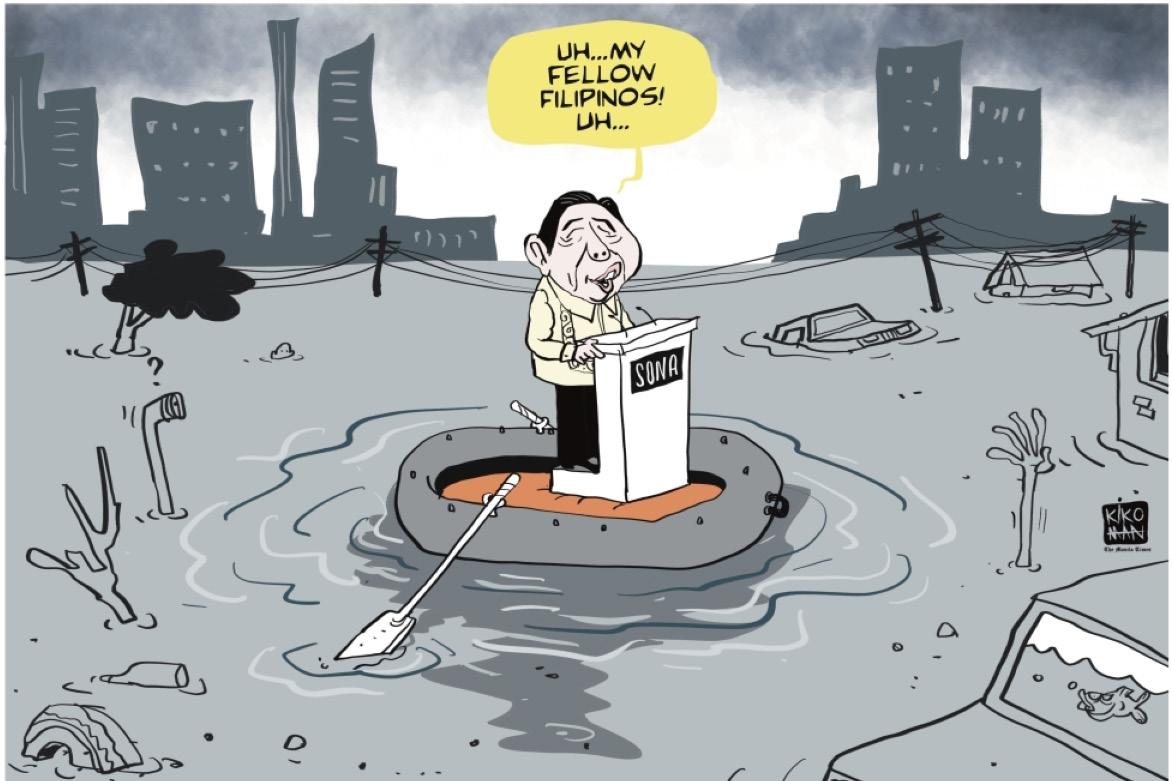
The SONA’s real test is whether government can choose and execute
PRESIDENT Ferdinand Marcos Jr.’s fifth and penultimate State of the Nation Address presented an expansive program. Its breadth may reassure constituencies that their concerns have been heard. It also creates a more difficult question: Can an administration approaching the final two years of its term distinguish the urgent from the desirable, sequence reforms realistically and hold specific institutions responsible for delivery?
That is the central test now. The country does not lack diagnoses. It lacks consistent execution across agencies, budgets and political cycles.
A State of the Nation Address naturally gathers many subjects into one speech. But government cannot treat every promise as equally immediate. Some measures require legislation. Others depend on regulation, procurement, appropriations or administrative discipline. Still
THE communist revolutionary movement, now represented by the New People’s Army, is considered one of the longest-lasting Marxist revolutionary movements in the world. There have been several books written about this movement and the revolutionary figures that were prominent in its history. Among them were Jose Maria Sison, Luis Jalandoni and Commander Dante or
others, particularly in energy and infrastructure, demand years of preparation that will extend beyond the present administration.
The responsible course is not to promise less ambition, but to impose order on it.
The administration should identify a limited number of priorities for the remainder of the term and publish the machinery behind each one: the lead agency, required legislation, funding source, timetable, measurable target and official accountable for delays. Without that structure, a broad agenda can become a collection of intentions that no institution fully owns.
The flood-control controversy illustrates the difference between announcing accountability and building it. Complaints under preliminary investigation by the Office of the Ombudsman name former House speaker Martin Romualdez and other respondents. Romualdez has
How communism began in the Philippines
Bernabe Buscayno.
Another much written episode in the history of revolutionary movements in the Philippines is the story of the Hukbalahap, which dominated the underground movement until it was replaced by the NPA. Among its most known figures were Pedro Abad Santos, Luis Taruc and the Lava brothers.
Surprisingly, very little literature has been written about the story of how the Com -
munist Party started in the Philippines. That’s why the book “Komunista: The Genesis of the Philippine Communist Party from 1902-1935” (Ateneo de Manila University Press, 2011) by Jim Richardson is a welcome addition to this body of works. This book is one of the most meticulously researched studies on the origins of the Philippine communist movement. It sources archival materials, intelligence reports,
denied wrongdoing, and the proceedings have not established criminal liability. Due process must remain intact.
babe’s eye view
IT is very clear that the rage-bait AI video, reportedly produced by a state-sponsored foreign publication depicting Filipinos as monkeys, is undoubtedly another crude attempt to undermine a landmark ruling by an international arbitration body. After all, we all know that our worth as a nation is not defined by such stupid, inane caricatures but by how steadfast we are in
But the public interest is larger than the fate of any individual respondent. The deeper issue
protecting and asserting our sovereign rights.
I find it quite ironic, however, that in trying to disparage Filipinos, they chose a meme with a monkey – a creature that is depicted in their traditional folklore and literature as smart, resourceful and brave, not afraid to fight immortals and demons. In fact, numerous movies have been made over the years about an archetypal hero known as “the monkey king.” More significantly, there are also the “three wise
monkeys” that embody core principles of ancient eastern philosophy.
For centuries, the image of the three wise monkeys has endured, serving as a reminder as well as an admonition for people to be mindful of their conduct, and to guard against malicious and improper behavior. These images are very familiar: one monkey covers his eyes, another cups his hands over his ears, while the third one puts his hands
&
LAGMAY
Babe Romualdez
ElfrEn S. Cruz breakthrough
The SONA’s real test is whether...
services, higher borrowing or reduced investment.
is whether government systems can detect weak project design, manipulated procurement, deficient inspection or nonexistent work before money is lost and communities remain exposed.
Prosecution addresses alleged misconduct after the fact. Prevention requires a public project registry, traceable appropriations, independent inspection, disclosure of contractors and beneficial owners, and clear documentation of changes in cost or scope. These are less dramatic than a televised declaration, but they are the instruments through which accountability becomes routine rather than selective.
The same need for institutional clarity applies to economic relief.
The proposed increase in the zero-percent income-tax threshold may ease pressure on workers, while relief from the minimum corporate income tax may help qualifying small businesses. Yet every tax reduction carries a fiscal consequence. Congress should ask not only who benefits, but what revenue will be forgone, whether the relief is well targeted and how essential services will be protected.
That is not an argument against tax relief. It is an argument for honest accounting. A policy cannot be judged solely by the benefit visible on a payslip if its cost later emerges through weaker public
Electricity reform presents a similar trade-off. Preventing avoidable system losses from being passed to consumers is a legitimate objective. But removing a charge from a bill does not make the underlying cost disappear. Lawmakers must distinguish technical losses from theft, meter tampering and other failures, then decide who bears the remaining cost and what incentives utilities face to reduce it.
Nuclear energy raises an even longer institutional horizon. It may eventually contribute to diversification and energy security, but it requires a credible regulator, transparent financing, safety systems, waste-management plans and public confidence. The question is not merely whether nuclear power is technically possible. It is whether the state can govern it competently over decades. These examples point to a common weakness in Philippine policymaking: measures are often debated as isolated promises rather than as parts of an administrative system. Tax relief affects revenue. Energy pricing affects investment. Infrastructure spending affects public safety. Anti-corruption enforcement affects confidence in the state. Each policy changes the conditions under which the others must operate.
Congress therefore has a duty beyond approving or rejecting the President’s agen-
da. It must test whether proposals are coherent, funded and administratively feasible. The opposition, for its part, should challenge weak assumptions and hidden costs rather than oppose measures reflexively. Administration allies should resist the opposite temptation of treating the SONA as a command list.
The West Philippine Sea also demands institutional continuity. Defending maritime rights cannot depend on the force of a single speech or the tenure of one administration. It requires a sustained legal strategy, capable civilian and military agencies, disciplined diplomacy and partnerships that survive political transition.
A penultimate SONA is different from an inaugural one. The time for building expectations is nearly over; the period for demonstrating capacity has begun. The administration now needs fewer slogans, clearer priorities and a public record of implementation that can be examined before 2028.
The final measure of this address will not be whether every proposal becomes law. No serious government could achieve that. It will be whether the administration chose wisely, explained the tradeoffs, strengthened institutions and completed enough difficult work to leave the state more capable than it found it.
The country has heard the agenda. It now needs to see the governing architecture behind it. (AJPRess) n
What we know so far about the space rocket launch Marcos mentioned in his 2026 SONA
by GIDEON TINSAY
"YES, we are going to launch a rocket into space."
That line from President Ferdinand Marcos Jr.'s fifth State of the Nation Address on July 27 wasn't a joke or a premise for a science fiction movie—it was an announcement of one of the country's most ambitious science projects yet that could mark the Philippines' biggest foray into the global space industry.
The government is eyeing a sounding rocket launch test in Cagayan in 2027, the first of its kind in the country and a key milestone toward establishing a Philippine spaceport.
But what exactly is the project and what does it mean for the Philippines? Here's what
we know so far.
What will happen?
The planned mission is a demonstration flight of a liquid-fueled sounding rocket that will launch from Cagayan in 2027.
The rocket will carry a locally developed payload weighing up to two kilograms and is expected to reach an altitude of at least five kilometers. Unlike rockets that send satellites into orbit, sounding rockets, as defined by NASA, "carry scientific instruments into space along a parabolic trajectory. Their overall time in space is brief, typically 5-20 minutes, and at lower vehicle speeds for a well-placed scientific experiment."
According to Philippine Space Agency Director General Gay Jane Perez, the goal
How communism began in the...
PAGE 6
party documents, letters and rare pamphlets. It reconstructs how Filipino workers, peasants, intellectuals and organizers shaped a radical political tradition from the early 1900s to the founding of the Partido Komunista ng Pilipinas (PKP) in 1930.
The book situates the Philippine Left not as an imported ideology forced onto local conditions but as an evolving political movement rooted in genuine grievances, class contradictions and grass roots activism. In his Introduction, Richardson writes: “In a country where politics has traditionally revolved around personalities, patronage and pork barrel, the Partido Komunista ng Pilipinas (PKP) founded in 1930 and the Communist Party of the Philippines (CPP) established in 1968 as a Maoist breakaway from the PKP have been the only durable parties to have based their program and appeal on ideological principle.”
One of Richardson’s major contributions is demonstrating that communism in the Philippines emerged organically from the life experiences of the country’s marginalized sector. Far from being a mere ideological transplant from Europe or the Soviet Union, early Philippine communism was forged in the crucible of colonial capitalism, urban labor exploitation and agrarian unrest. The strikes, tenant uprising and early attempts at worker organizing in the early 1900s provided fertile ground for radical ideas.
also writes: “Socialist parties and parties of the ultra-Right have come and gone; neither a Trotskyite nor an anarchist party has ever been formed. Despite a near lifetime of illegality and suppression, the PKP has sustained a presence in the Philippine political scene whose importance is beyond dispute.”
One of the most interesting parts of the book is the reconstruction of the socio-political environment of the early American colonial period. This is a narrative not often found in most Philippine history books. The book traces how the introduction of wage labor, industrial work places and new forms of capitalist discipline in Manila and other urban centers led to the emergence of the first trade unions. These early unions, such as the Congreso Obrero de Filipinas, became platforms for worker education, political consciousness and agitation.
This book gives special attention to the personage of Crisanto Evangelista whose role as labor leader, theorist and organizer proved critical to the founding of the communist movement of the Philippines. Evangelista’s encounters with Asian and international labor federations, his collaboration with foreign communists and his leadership in developing distinctly Filipino socialist ideas are presented in rich detail.
communist movement. It also highlights the political pressure exerted by the American colonial authorities, who viewed labor mobilization as a threat to public order and capitalism. According to the book, surveillance reports, arrests and legislative restrictions attempted to eradicate left wing organizing. However, all these attempts only hardened the movement’s resolve.
Richardson also writes in his Introduction: “Despite a near lifetime of illegality and suppression, the PKP has sustained a presence in the Philippine political scene, whose importance is beyond dispute…. The period reviewed in most detail in these pages commences in 1922 when the Partido Obrero, the forerunner of the PKP, was first launched, and ends in mid 1935 when the initial ultra-Leftist phase of the PKP history drew to a close.”
The book is essential reading, especially for those interested in the history of the Philippine Left, labor movements, anti-colonial struggles and the formation of political ideology. It challenges the simplistic narratives that portray communism as foreign or illegitimate, instead portrays a movement deeply embedded in the aspirations of Filipino workers and peasants.
is to develop a Philippine spaceport "for the long-term sustainability of commercial rocket launches in the Philippines."
Who is behind the project?
The launch is being implemented through a public-private partnership involving government agencies and corporations: the Philippine Space Agency, the Department of Information and Communications Technology, the Cagayan Economic Zone Authority, Philippine aviation corporation Ascend International Gateway Inc., and South Korean space mobility company Perigee Aerospace Inc.
The collaboration is based on a memorandum of understanding signed during the Philippines-Korea Business
Richardson writes about the little-known individuals who articulated an early socialist vision and helped build networks that would eventually result into the PKP. In his introduction, Richardson
Forum in March 2026.
Why the Philippines and why Cagayan?
As Marcos mentioned, Cagayan is "geographically and economically primed" to become the country's gateway to space.
Perez said the Philippines is a strategic location that offers several advantages. As the country is facing the Pacific Ocean, rocket launches can take place over open waters, reducing risks to populated areas. Its proximity to the equator also allows rockets to maximize the Earth's rotational speed, making launches more efficient and potentially less expensive.
Richardson emphasizes that Evangelista was not simply a follower of international directives but an active interpreter of Marxism within Philippine realities. Under Evangelista’s leadership, the labor movement grew increasingly militant and the foundation for the PKP was solidified.
The book documents the debates, alliances and disputes that shaped the early
What is a spaceport and why is the Philippines pursuing one?
A spaceport is a groundbased facility where organizations can launch craft into space, according to Space. com.
Perez said PhilSA is envisioning a "commercial-driven, government-enabled spaceport, with predictable timelines for launch licensing and authorization," and a "gateway for safe, responsible, and sustainable space access for the region and the world.
He adds that the goal is for launch companies to consider the Philippines for their space operations as the country con-
Richardson’s work reminds us that the struggle for social justice did not begin with the PKP’s founding. It was part of a long story of resistance against exploitation and inequality. (Philstar.com)
* * *
The opinions, beliefs and viewpoints expressed by the author do not necessarily reflect the opinions, beliefs and viewpoints of the Asian Journal, its management, editorial board and staff
* * *
Email: elfrencruz@gmail.comn
tinues to meet international obligations.
PhilSA and Perigee Aerospace cited the rapidly growing global space industry as a reason for the Philippines to further venture into space exploration.
According to the Space Foundation's Global Space Economy Report, the first half of 2026 recorded 153 orbital launches—a pace expected to surpass the previous annual record of 329 launches in 2025.
With launch sites around the world becoming increasingly booked, the agencies say new spaceports are being PAGE 9
Philstar.com
The fourth monkey...
6 on his mouth. These have been traditionally interpreted as “see no evil, hear no evil, speak no evil” – a guardrail or moral anchor for one to avoid wrongdoing.
But in today’s world of social media that has made it so easy to quickly spread and amplify viral videos, share manipulated images, sow disinformation and circulate uninformed opinions at the click of a mouse or the press of a button, perhaps it is about time to examine the three monkeys under a different lens to reveal the fallacy of “deliberate ignorance and passive complicity” that comes with the mistaken belief that it is OK to ignore wrongdoing because it can help in avoiding conflict.
Every single day, we are bombarded with information – some of them factual, but a lot more of them serving as “bait” – carefully crafted to provoke emotion, sow division or manipulate public opinion. Clever memes, sarcastic posts, anonymous and troll accounts, edited videos and fake art cards can now travel faster than reason itself. And the louder the noise, the harder it becomes to distinguish truth from propaganda.
The greater menace today is not seeing evil – it is refusing to see the truth or worse, being willfully blind to the truth because it is convenient and effortless. The bigger danger today is not hearing unpleasant words but refusing to listen to facts that challenge our biases. The bigger risk today is not speaking carelessly – it is refusing to speak the truth when one’s conscience demands it.
The temptation is great to simply accept anything that confirms our own beliefs and
biases, because that path is the most convenient and expedient to take. However, democracies, friendships and even families cannot survive if people stop asking questions and don’t think for themselves.
Which brings me to this point – perhaps the first monkey should no longer put his hands over his eyes. Instead, he should open them wide enough to see reality as it is and not according to how others want him to perceive it.
The second monkey should stop clamping his hands over his ears. Listening only to voices that echo one’s own opinions is not wisdom, it is folly. Real understanding comes from listening patiently, weighing evidence and recognizing that truth is often more complicated than slogans or motherhood statements.
The third monkey should uncover his mouth. Silence is sometimes prudent, but staying quiet in the face of deception allows falsehood to flourish. Speaking the truth requires courage, particularly when doing so is unpopular.
History offers many examples of nations that have stumbled and floundered because citizens accepted convenient lies over uncomfortable facts. Leaders have failed because advisers were afraid to speak honestly. Institutions have weakened because too many people chose comfort over integrity.
At the same time, history also reminds us that societies recover because there are always individuals willing to see clearly, hear fairly and objectively and speak responsibly. This reminder applies not only to governments but to each one of us. So before
sharing or forwarding a sensational message, verify whether it is true or not. Before reacting to an inflammatory post or video, pause and ask who would benefit from your anger. Before judging another person, reflect first and consider if you have heard the entire story or not.
The strongest societies are not those that never argue or disagree. They are those whose citizens value truth more than tribal loyalty, evidence more than emotion and independent judgment more than popular applause.
The challenge before every nation, every institution and every citizen is not simply to avoid evil. It is to refuse to become blind to reality, deaf to truth or mute when integrity calls. In the end, real wisdom is not found in silence alone a– it is exemplified in the courage to see the truth, hear the truth and speak the truth.
The ancient proverb of the three wise monkeys remains prudent and judicious, but perhaps it now deserves a contemporary iteration. Imagine a fourth monkey – not one covering his face, but one standing upright with eyes open, ears attentive and ready to speak the truth with a steady voice. He neither follows the crowd blindly nor repeats what others expect him to say. Instead, he listens carefully, examines the facts and then speaks with honesty and conviction – the ultimate ideal for a real monkey from ancient times. (Philstar.com)
The opinions, beliefs and viewpoints expressed by the author do not necessarily reflect the opinions, beliefs and viewpoints of the Asian Journal, its management, editorial board and staff.
Email: babeseyeview@gmail.com. n
What we know so far about the space...
7
developed to accommodate rising demand.
Ascend International Gateway said they are "building the infrastructure, partnerships, and operational capabilities necessary to position the country as a key participant in the future space economy.”
Rocket training for Filipino engineers
Part of the initiative includes a technology transfer and training program with Perigee Aerospace.
Selected Filipino engineers will undergo advanced
training using Perigee's Blue Whale-class sounding rocket platform to build local expertise in rocket engineering and launch operations.
PhilSA also plans to support universities conducting rocketry research, helping cultivate the next generation of Filipino aerospace professionals. How will the country benefit from the project?
Officials say the project goes beyond simply launching rockets.
DICT Secretary Henry Aguda said having sovereign launch capability could eventually allow the Philippines to independently deploy com-
The Pax Silica challenge is functional upgrading
by Leonardo Lanzona Jr Inquirer.net
PRESIDENT Marcos’ 2026 State of the Nation Address (Sona) placed the proposed Pax Silica Industrial Hub at the center of the country’s industrial ambitions.
The president described it as an artificial intelligence (AI) ecosystem that would create quality jobs, strengthen industrial competitiveness, revitalize the economy and position the Philippines as an advanced manufacturing and logistics hub within the global AI value chain.
Criticisms that focus primarily on environmental risks or fears of bloc fragmentation are, in important respects, counterproductive. As a latecomer in technology and industrial development, the Philippines cannot afford an avoidance-based approach to emerging industries. Environmental concerns can be addressed through regulation and compliance, while geopolitical fragmentation, while real, can be strategically navigated. The key challenge is not fragmentation itself, but whether the Philippines can achieve structural transformation within it.
Participation is not transformation
For a country that has long struggled to industrialize, this membership to a Global Production Network (GPN) deserves serious consideration. The Philippines cannot remain on the sidelines while global production reorganizes around artificial intelligence, semiconductors, advanced manufacturing and digital technologies. Participating in these industries is no longer optional if we hope to remain competitive.
in this new geography of production, making it an attractive location for AI-enabled manufacturing, logistics, semiconductor activities and related industries.
Transitional upgrading and its limits
Many late-industrializing economies initially experience what may be called transitional upgrading. They enter technologically sophisticated industries and generate higher incomes through new investments, but much of the work performed locally remains concentrated in standardized production, operations, testing, logistics and support activities. The higher value generated by these industries often reflects the ownership of technology, intellectual property, capital and global production networks rather than the nature of work undertaken domestically.
This stage is a natural point of entry for countries seeking to industrialize. Japan, South Korea, Taiwan, China, Malaysia and Vietnam all began by integrating into fragmented global production systems before developing their own technological capabilities.
But the danger lies not in engaging with foreign interest. The question is in learning to move to a higher stage of production.
From investment promotion to capability building
cating in the Philippines but also for creating measurable domestic capabilities. Companies benefiting from public incentives should be encouraged to develop local supplier networks, collaborate with universities and technical institutions, strengthen micro, small and medium enterprises, support community enterprises, expand research partnerships and gradually transfer technology to Philippine firms. Investment should leave behind knowledge, not merely infrastructure.
This approach is consistent with the broader aspirations of the Tatak Pinoy strategy. Beyond investment, the ultimate objective is to strengthen Philippine productive capabilities so that local enterprises increasingly create, adapt, commercialize and own the technology rather than simply utilize it.
The real economic question
munication satellites, Earth observation systems, and navigation assets that support the country's digital infrastructure.
Meanwhile, CEZA Administrator Katrina Ponce Enrile said the project could "create opportunities in aerospace, advanced engineering, scientific research, education, innovation, and high-value investments that will benefit future generations of Filipinos."
Ultimately, the public-private partnership is dubbed "a sustained effort to develop the Philippines’ capabilities in launch, testing, and aerospace innovation." n
Yet the success of Pax Silica should not be measured solely by the volume of foreign investment or the number of jobs it creates. The more important question is whether these investments strengthen the country’s productive capabilities or simply integrate the Philippines into another low-value stage of global production.
This distinction is often overlooked.
Industrialization has always involved fragmented production. Countries no longer manufacture entire products from beginning to end. Instead, production is divided into specialized tasks distributed across many countries. Pax Silica seeks initially to position the Philippines with-
The President’s Sona correctly emphasized the importance of joining the global AI economy. But the speech did not explain how the Philippines intends to move beyond participation toward ownership of productive capabilities. It highlighted AI, advanced manufacturing and quality jobs, but did not categorically indicate that these investments must generate and form domestic technology, stronger local suppliers, research partnerships, engineering capabilities, or innovation ecosystems.
That is the difference between transitional and functional upgrading.
Functional upgrading occurs when domestic firms, workers, universities and research institutions progressively undertake higher-value activities such as engineering, product development, systems integration, software, design, research and innovation. On top of hosting advanced industries, the objective is to shape them.
Fiscal incentives should reward firms not only for lo-
The debate over Pax Silica has largely been framed around geopolitics. Supporters see it as an opportunity to join strategic supply chains, while critics fear environmental risks, foreign dependence, or entanglement in great-power rivalry. While deserving of careful consideration, these issues should not obscure the more fundamental economic question. This is whether the Philippines develops the domestic capabilities needed to benefit from participation in these GPNs.
Pax Silica should, therefore, be judged not simply by the investments it attracts or the factories it builds, but by the productive capabilities it leaves behind. If it strengthens local enterprises, develops Filipino engineers and innovators, deepens supplier networks, and creates institutions capable of generating new technologies, it can become the foundation of long-term industrial transformation.
If not, the country may once again participate in the industries of the future while leaving ownership of that future to others. —CONTRIBUTED INQ
* * *
The opinions, beliefs and viewpoints expressed by the author do not necessarily reflect the opinions, beliefs and viewpoints of the Asian Journal, its management, editorial board and staff. *
Leonardo Lanzona Jr. is a professor of economics at the Ateneo de Manila University. n
Tax relief plan could cut collections by P66 billion a year
Proposals would raise the tax-free income ceiling and end a minimum corporate levy, but Congress must determine their final scope and how the government will offset foregone revenue
by AJPress
MANILA: A tax-relief package could increase the take-home pay of more than 3 million workers and ease the burden on thousands of businesses, while reducing government collections by an estimated P66 billion a year, according to the Department of Finance.
Acting Finance Secretary Frederick Go said about P60 billion of the projected foregone revenue would come from raising the personal income tax exemption, while P6 billion would result from abolishing the minimum corporate income tax, or MCIT. The measures remain subject to congressional approval.
House Bill 10345 would raise the zero-tax threshold from P250,000 to P350,000 in annual taxable income beginning in 2027. The threshold refers to taxable income, not necessarily gross salary, and the final tax brackets may still change during deliberations.
The Finance Department estimates that 3.13 million
workers could receive some relief. About 1.2 million additional workers could become fully exempt, increasing the total number of income tax-exempt workers from 5.1 million to 6.3 million.
Workers with taxable income between P250,000 and P350,000 could save as much as P15,000 a year, while those earning more than P350,000 could receive up to P17,500 in take-home pay, based on preliminary government calculations. Actual savings would depend on the final law and each taxpayer’s circumstances.
House Bill 10346 would abolish the MCIT for domestic corporations beginning Jan. 1, 2027. Under current law, the MCIT is generally equal to 2 percent of gross income and applies beginning in a corporation’s fourth taxable year when it exceeds the regular corporate income tax.
The Finance Department estimates that more than 78,000 micro and small enterprises could benefit. The
12 MRT-7 stations set to open next year, vows Marcos
by PhiLstar com
House bill, however, appears broader than the administration’s stated focus on smaller businesses because it would apply to domestic corporations generally. Congress may refine the coverage.
The P66-billion estimate comes as the government projects a 2026 budget deficit of about P1.659 trillion, or 5.4 percent of gross domestic product.
Go said officials are studying excise and health taxes as possible sources of replacement revenue. No new tax, rate or product coverage has been approved.
The administration also proposed a separate amnesty for certain unpaid national taxes and related penalties. The available P66-billion estimate covers only the personal income tax and MCIT proposals.
None of the changes is yet in force. The final exemptions, corporate coverage, effective dates and replacement revenue will depend on legislation passed by Congress and signed into law. n
Lake Sebu named Philippines’ first FAO Village for climate resilience
by AJPress
LAKE SEBU, South Cotabato - Lake Sebu has been recognized as the Philippines’ first “FAO Village,” highlighting community efforts to protect Indigenous farming knowledge, traditional rice varieties and natural resources as climate pressures intensify.
The recognition was conferred by the Food and Agriculture Organization of the United Nations, or FAO, the U.N. agency that promotes food security, sustainable agriculture and rural development.
The designation was formally marked in July with the unveiling of an FAO Village marker at Gono Menos Bnek, the Lake Sebu Rice Museum, in Sitio El Lumet, Barangay Luhib.
FAO cited Lake Sebu for conserving biodiversity and food traditions, linking rural heritage with education and tourism, and combining community knowledge with scien-
tific approaches to sustainable development.
The municipality is home to T’boli and Ubo-Manobo communities whose livelihoods are closely tied to farming, forests and freshwater ecosystems. Their practices include cultivating traditional crops, maintaining local seed systems and passing agricultural knowledge across generations.
A central part of the recognition is the conservation of 102 traditional rice varieties. The seeds are being safeguarded through community seed banks and at the Philippine Rice Research Institute Genebank under a “black box” agreement intended to protect Indigenous Peoples’ rights while preserving planting materials against loss.
Conserving the varieties does not guarantee protection from every drought, flood or temperature shift. It does, however, preserve genetic diversity and crops connected to local diets, livelihoods and culture.
Climate Change Commission
Vice Chairperson and Executive Director Robert E.A. Borje said the designation reflects the Philippine National Adaptation Plan for 2023 to 2050, which identifies agriculture, food security, biodiversity and cultural heritage among the country’s adaptation priorities.
FAO Representative in the Philippines Lionel Dabbadie said Lake Sebu’s significance lies in the long relationship among its people, farms, forests and lakes.
The recognition follows years of work involving Indigenous communities, local governments, the Department of Agriculture, PhilRice, academic institutions and development partners. Earlier programs established seed banks, demonstration farms and facilities for conserving local crops.
FAO launched the Villages Recognition Initiative in 2025 to honor rural communities that preserve biodiversity, food
MANILA, Philippines — Twelve stations of MRT-7 are set to open next year, President Ferdinand Marcos Jr. said Monday, July 27, as he pitched mass transport projects as relief for commuters affected by high fuel prices.
In his fifth State of the Nation Address, Marcos said many Filipinos have relied on public transport amid rising petroleum prices, prompting the government to focus on trains, busways, transport hubs, integrated terminals, airports and seaports.
"Sa susunod na taon, bubuksan na rin ang 12 istasyon ng MRT-7," Marcos said. (In the
following year, the 12 stations of MRT-7 will also be opened.)
After nearly three decades, Marcos said, the MRT system will have a new line running from North Avenue to Sacred Heart in Quezon City.
He said the line would eventually reach San Jose del Monte, Bulacan.
The president said the project would bring major relief to nearly 1 million passengers daily.
Marcos also credited the recently enacted Accelerated and Reformed Right-of-Way Act, saying it would help resolve right-of-way issues faster and remove one of the biggest choke points in the country's mass transit development program.
Other transport projects Marcos also said trains of the North-South Commuter Railway are expected to run between Valenzuela and Malolos next year.
The Department of Transportation, he said, would work to complete the railway up to Clark in Pampanga before the end of his administration.
Marcos also cited progress in bus rapid transit projects, saying the first phase of the Cebu Bus Rapid Transit is already open.
A bus rapid transit project in Ilocos Norte is set to be inaugurated next year, he added. — with reports from Anj Andaya (Philstar.com). n
Drive to lower power bills turns focus to electricity theft
DOE-led review examines how to lower electricity bills without weakening grid reliability
by AJPress
MANILA — Malacañang has directed electricity distributors to intensify efforts against power theft as government agencies develop legislation and regulations that could remove system-loss charges and the corresponding value-added tax from consumer bills.
Palace Press Officer Claire Castro said utilities should strengthen monitoring against illegal connections, meter tampering and other forms of electricity pilferage. She said President Ferdinand Marcos Jr. wants paying customers protected from avoidable losses but does not intend simply to transfer all costs to utilities without studying the effect on service reliability and operations.
Marcos asked Congress during his July 27 State of the Nation Address to amend the Electric Power Industry Reform Act of 2001, or EPIRA. The proposal covers the system-loss component and its corresponding VAT, not the full 12 percent VAT applied to other taxable portions of electricity service.
The Department of Ener-
traditions and sustainable livelihoods. Its first phase received more than 300 nominations from 69 countries.
The designation brings in-
gy has formed a task force with the Energy Regulatory Commission, National Electrification Administration and electric cooperatives to prepare the required legislative, technical and regulatory framework. The review will include stronger anti-theft enforcement, improved utility operations and network modernization.
System loss is the difference between electricity entering a transmission or distribution network and the amount ultimately recorded and billed. It includes technical losses, which occur naturally as power moves through lines and transformers, and non-technical losses caused by theft, meter interference and billing irregularities.
Under EPIRA, the ERC sets recoverable system-loss limits using technical and commercial factors. Utilities may pass on losses only within the applicable cap. Costs above that limit must be absorbed by the utility.
Meralco’s published 2025 average bill breakdown placed system loss at about 5 percent of a customer’s total bill. The company describes it as a regulated pass-through cost,
ternational recognition for Lake Sebu, but not a guarantee of funding or protection. Its lasting value will depend on sustained conservation, effec-
not distribution revenue. A Senate estimate found that a Meralco household using 200 kilowatt-hours monthly paid an average P148.95 in system-loss charges from August 2025 through July 2026, excluding VAT. The figure is not nationally applicable because rates and network conditions vary.
Electricity theft is already prohibited under Republic Act No. 7832. Utilities may pursue differential billing, disconnection and criminal complaints, but must follow statutory notice and evidentiary safeguards.
Meralco and electric cooperatives have supported lower bills while seeking clarity on who would absorb unavoidable technical losses and related tax costs. No immediate bill reduction will occur until Congress amends the law and regulators issue implementing rules.
The final policy must distinguish preventable losses from the physical losses inherent in electricity delivery while ensuring that utilities retain sufficient resources to maintain, secure and modernize their distribution networks nationwide and sustain reliability. n
tive governance and practical support for the communities protecting the area’s natural and cultural resources over time. n
Kim Chiu to proceed with complaint against sister, agency says
by AJPress
Actress and television host
Kim Chiu intends to continue pursuing a qualified theft complaint against her older sister, Lakambini “Lakam” Chiu, according to a statement released Thursday by her talent agency.
Star Magic issued the clarification after a 2023 interview resurfaced in which Chiu spoke warmly about her sister. The agency said the interview accurately reflected their circumstances at the time but should not be interpreted as representing the present situation.
According to Star Magic, Chiu later obtained what the agency described as material information that came to light in 2025 and prompted her to take legal action.
The agency said the criminal complaint remains pending before the proper authorities and that Chiu would pursue the matter through established legal procedures.
“Kim remains firm in her decision to pursue the case through the proper legal process in order to establish the truth, hold the responsible parties accountable, and seek justice,” Star Magic said.
Those objectives represent Chiu’s stated position. No finding of criminal responsi-
bility has been reported, and the allegations remain subject to evaluation by prosecutors and, should charges eventually be filed, adjudication by a court.
Chiu filed the qualified theft complaint on Dec. 2, 2025, in Quezon City. In a statement released at the time, she said the action followed months of internal review into what she characterized as serious financial discrepancies within her business operations.
She alleged that substantial amounts connected to busi-
ness assets had been found missing. Chiu said filing the complaint was necessary to protect her company, its employees and the business she had built.
Her legal counsel said at the time that the complaint concerned transactions during 2025 and that Lakambini had been part of the business’s management. The company involved, the amount being questioned and the precise scope of Lakambini’s duties were not publicly disclosed.
The assertions concerning
the business and its finances are allegations made by Chiu and her representatives. They have not been independently established through a final prosecutorial determination or court judgment.
Star Magic said its latest statement was intended to explain the sequence of events and prevent Chiu’s earlier remarks from being taken out of their original context.
The agency asked the public to respect her privacy while the complaint proceeds through the legal system. n
SB19 named Philippine tourism ambassadors as DOT taps
P-pop’s global reach
gin at 6:40 p.m. Central time.
by AJPress
—
The Major League Baseball game is scheduled to be-
SB19 billed the appearance as the first time a Filipino group would throw a ceremonial first pitch at an MLB game.
The Chicago engagement is part of three consecutive days of appearances in Los Angeles and Chicago for SB19, composed of Pablo,
Josh, Stell, Ken and Justin. On July 28, the group is scheduled to appear at the Grammy Museum in Los Angeles for a sold-out edition of Global Spin Live. The museum program is scheduled to include a discussion of SB19’s career and music followed by a performance.
SB19 is then set to per-
form July 30 at Lollapalooza, which runs through Aug. 2 at Grant Park in Chicago. Festival organizers list July 30 as the opening day of the fourday event.
The White Sox appearance places the group in an American sports setting between two music-related engage-
Regulator seeks position paper and stronger safeguards after July 24 broadcast; no ruling or suspension has been issued
by AJPress
The Movie and Television Review and Classification Board has given the producers and broadcast partners of “It’s Showtime” seven calendar days to answer complaints over allegedly racist, colorist and inappropriate material aired during the noontime program’s July 24 episode.
The directive followed a July 29 hearing before the MTRCB’s Hearing and Adjudication Committee. Representatives and lawyers for the program, ABS-CBN Corp., GMA Network Inc., Zoe Broadcasting Network Inc. and ALLTV attended, according to the board.
The respondents were ordered to submit a verified joint position paper within seven days of receiving the order. They must also file a joint undertaking describing concrete measures to improve
compliance with MTRCB standards, particularly during live, improvised and comedy segments.
The board further directed the program to designate an on-air compliance officer authorized to monitor live broadcasts and intervene when necessary to help prevent possible violations.
The proceeding arose from complaints concerning the “Memerimar” skit in the “Laro Laro Pick” segment. The MTRCB said complainants and its Monitoring and Inspection Unit raised concerns about statements attributed to host Vice Ganda and a separate “lugaw,” or rice porridge, scene involving Vice Ganda and Ion Perez.
The allegations have not been adjudicated. The MTRCB said the case remains pending and will be resolved after the committee evaluates the parties’ submissions and
Photo from Facebook/@KimChiuOfficial
CHICAGO
Filipino pop group SB19 is scheduled to participate in the ceremonial first pitch before the Chicago White Sox host the New York Yankees on July 29 at Rate Field.
MANILA.
Julia Barretto open to opportunities as 'independently
by Jan Milo Severo Philstar.com
MANILA, Philippines — Julia Barretto is embracing a new phase in her career as an independently managed actress, saying she is now "open to opportunities" as she takes on projects with different production outfits.
Her new journey begins with the Regal Films' Metro Manila Film Festival 2026 entry "Haunted Carnival."
The upcoming horror-slasher marks Julia's first collaboration with Regal Entertainment.
Speaking during the film's media junket in Quezon City on Sunday, July 26, Julia said she sees this stage of her career as an opportunity to work with more storytellers and filmmakers.
"It's a good time in my life to be able to explore and work with everyone kasi lahat may magandang istorya, and gusto ko ma-grab opportunity na 'yun kapag naisip nila ako para sa proyekto," she said.
The actress, however, clarified that she does not consider
managed' artist
herself a freelancer.
"'Wag natin gamitin 'yung word na [freelancer]. Gamitin natin na open to opportunities," she said.
Julia also expressed gratitude to the management teams and production companies that have supported her throughout her career. She was most recently under Viva Artists Agency after parting ways with Star Magic.
"I don't wanna burn bridges, you know why? Sa lahat ng network, management, production house, naalagaan ako, na-protektahan ako, naging mabuti and sobra akong grateful," she said.
Despite her new career set-up, Julia emphasized that she remains open to working again with Viva, ABS-CBN, Star Cinema and other production companies.
"Andon pa rin 'yung desire ko na makipagtrabaho sa lahat — from Viva, to Star Cinema, to Regal, with all the production houses. Gusto kong patuloy pa rin iyong trabaho, basta naman may magandang storya," she added.
Julia also revealed that she intentionally stepped back from acting following the com-
PAGE 13
Baron Geisler bonds with daughter Sophia, mum on wife’s ‘drug rehab’ remark
by anne PaSaJol Inquirer.net
WHILE he has yet to address the “drug rehabilitation” remark made by his wife Jamie Evangelista, Baron Geisler has remained active on his social media where he recently expressed his love for his daughter Sophia.
The actor spent quality time with Sophia — his daughter with actress Nadia Montenegro — at a Japanese restaurant, as seen in the photos shared on his Instagram page on Monday, July 27.
The father and daughter looked visibly delighted together, with Baron even hugging Sophia in one of the photos.
“Mahal kita anak ng sobra!” he said in the caption, adding Sophia’s handle and a red heart emoji.
Baron’s post came over a week after Evangelista hinted at a dispute between them and urged the actor to seek “drug rehabilitation.”
“Find a drug rehabilitation sponsor who can help you address the root cause of your problems. I doubt a facial can heal that,” Evangelista commented on a post featuring the actor at an aesthetic clinic.
This sparked speculation
that Baron, who struggled with substance and alcohol addiction in the past, might have relapsed. Baron has seemingly opted to remain mum on the matter.
Aside from Sophia, Baron has a daughter named Tali with Evangelista. n
Baron Geisler (right) and his daughter Sophia. Image: Instagram/@baron-geisler
Julia Barretto during the launch of Regal Films Metro Manila Film Festival entry "Haunted Carnival" at the Valencia Events Place in Quezon City on July 26, 2026. Philstar.com / Jan Milo Severo
No red carpet, celebrities, but guests still make fashion statements at Sona
Sarah Geronimo, Matteo Guidicelli joined by Cardinal Tagle for her birthday
by anne PaSaJol Inquirer.net
ASIDE from her reuniting with her parents, Sarah Geronimo and her husband Matteo Guidicelli marked her 38th birthday by hosting an intimate celebration attended by Cardinal Luis Antonio Tagle.
Geronimo and Guidicelli, along with his family, shared a meal with the cardinal at the latter’s restaurant, as seen on the actor’s Instagram page on Monday, July 27. Tagle was also seen blessing the family’s religious items during the gathering.
There may have been only a few to no celebrities present at the fifth State of the Nation Address (Sona) of President “Bongbong” Ferdinand Marcos Jr. on Monday, July 27, but the House of Representatives’ plenary session hall was not wanting of a glittering assemblage.
Fashion once again took a back seat for the second year as attendees largely embraced Malacañang’s directive to forgo the traditional red carpet and long gowns in favor of simpler attire. The memo likewise stated that there would be no celebrities or A-listers in this year’s program.
Weeks before the annual address, House Secretary General Cheloy Garafil announced that there would be no ceremonial red carpet similar to last year, and that guests are encouraged to wear “simple but dignified” clothing, with invitations specifically discouraging long gowns.
Despite the colorful gowns here and there, many female guests followed the memo and opted for simple, modern Filipiniana dresses in white and neutral colors, while men largely stuck to barong Tagalog.
Tootsy Angara, wife of Education Secretary Sonny Angara, was a vision in simple sophistication in Rajo Laurel’s modern interpretation of the traditional Balintawak ensemble.
First Lady Liza Araneta Marcos donned a Michael Leyva Filipiniana dress in soft pink, featuring delicate callado details, an overlapping pencil skirt silhouette, and intricate lace appliqué, as described by the designer himself. Leyva said that the gown was exclusively designed for this year’s Sona.
Senator Risa Hontiveros, meanwhile, wore an ivory silk terno by Filipino designer Jo Rubio as her usual way of “supporting locals”.
Undersecretary Margarita Gutierrez was one of the standouts as she defined elegance in a soft powder blue archival piece by Mark Bumgarner. The piece is defined by clean lines, sculpted butterfly sleeves, and “palay” pattern in fine hand embellishments.
Jocelyn Tulfo, the wife of Senator Raffy Tulfo, who in previous year appeared to have missed the memo for wearing her luxurious jewelry set, toned down her ensem-
ble this year with a tasseled mustard yellow Filipiniana by Michael Leyva and statement emerald earrings.
Audrey Zubiri, wife of Senator Juan Miguel Zubiri, struck simplicity in her cream-colored off-the-shoulder dress with intricate lace detailing and voluminous sheer sleeves.
Kabataan partylist Rep. Renee Co, on the other hand, found ways to inject a bold statement into her otherwise restrained looks through a fiery illustration that gave a nod to the appeal of the youth in relation to corruption.
Unlike previous years, celebrities like Heart Evangelista, wife of Sen. Francis “Chiz” Escudero, whose outfits were always worth looking out for, were a no-show at this year’s SONA.
GMA Senior Vice President Annette Gozon-Valdes was one of those who opted for color as she donned a deep blue Filipiniana by Michael Leyva.
Meanwhile, Senators Alan Peter and Pia Cayetano alongside Sen. Imee Marcos chose to wear black ensembles as their way of protesting today’s event. Some of the minority bloc senators said they decided to skip the President’s fifth Sona. n
Julia Barretto open to opportunities...
mercial success of the romantic drama "Un/Happy for You," her blockbuster reunion film with Joshua Garcia.
The break, she said, allowed her to reassess the kind of projects she wants to pursue.
"Ginusto kong mas maging maingat sa susunod kong gagawin. Gusto kong maging masaya sa proyektong
gagawin ko. I want to finish the project na fulfilled ako, na may impact siya sa akin. So nag-hintay ako ng tamang timing. You just have to be patient and God is good, dumating 'to, and I have an exciting project also with this," she shared. Reflecting on the decision to pause, Julia said timing ultimately played a key role in shaping her next career move. "I guess timing is everything
and everything happens for a reason. Sometimes it's good to take a pause para malaman mo 'yung direction na gusto mong puntahan," she said. Set for release on Christmas Day as part of the 2026 Metro Manila Film Festival, "Haunted Carnival" also stars Maricel Soriano, John Arcilla, James Reid, Fyang Smith, Joaquin Arce, Celyn David and Charlie Fleming. n
“A beautiful evening celebrating Sarah’s birthday, surrounded by family, made even more meaningful by the presence of Cardinal Tagle,” Guidicelli said.
Addressing Tagle, he added, “Thank you, Your Eminence, for sharing the Word
with us and guiding us with your wisdom. Salamat po.”
This is not the first time the couple has met the cardinal, as they also met and received his blessing in 2025.
In a separate post, Guidicelli also greeted his wife, showing glimpses of their treasured moments with loved ones and
friends.
“Happy birthday my love! This will be the best year ever,” he wrote.
Sarah’s earlier reunion with her parents Delfin and Divine Geronimo came after their falling-out that stemmed from the actress-singer’s secret wedding to Guidicelli in 2020. n
SB19 named Philippine tourism...
PAGE 11
ments. It is a ceremonial role rather than a scheduled musical performance at the ballpark.
Several Filipino public figures have previously thrown ceremonial first pitches at MLB games, including boxer Manny Pacquiao, actress Liza Soberano and comedian Jo Koy.
The group released Wakas at Simula in March. The album includes “Visa,” “Toyfriend” and “Emoji.”
The baseball ceremony adds another type of U.S. public appearance to SB19’s schedule as the group moves between a museum program, a major-league ballpark and one of the country’s largest music festivals. n
MTRCB gives ‘It’s Showtime’...
PAGE 11
the evidence on record. It also said it would refrain from further comment that could prejudge the outcome.
Vice Ganda apologized on the program’s July 25 episode after some viewers criticized the previous day’s jokes. The host acknowledged that audience members had found portions of the broadcast offensive or insensitive, said the program had not intended to offend viewers and pledged that its team would try to do better.
The board is examining the episode under Presidential Decree No. 1986 and its
implementing rules. The law gives the MTRCB authority to review television programs and determine whether material is objectionable under standards that include law, good customs and contemporary Filipino cultural values. The case renews scrutiny of how live entertainment programs handle spontaneous comedy while meeting broadcast rules intended to protect audiences, including children. It also places attention on colorism, or discrimination and bias based on skin tone, a concern that can operate within the same racial or eth-
nic community.
“It’s Showtime” previously faced MTRCB sanctions in 2023 over a separate episode. The board imposed a 12-airing-day suspension after complaints about a July 25 “Isip Bata” segment. ABSCBN sought reconsideration but later chose not to appeal to the Office of the President, while maintaining that the program had not violated applicable law. No suspension has been imposed in the current case. Any further action will depend on the committee’s review and its final ruling. n
(from left) Undersecretary Margarita Gutierrez, Audrey Zubiri, First Lady Liza Araneta Marcos, and Senator Risa Hontiveros. Photo: Instagram/@markbumgarner, @michaelleyva_, @hontiverosrisa
by: JeSSica ann evangeliSta Inquirer.net
Photo from Facebook/@SB19Official
(From left) Cardinal Tagle, Matteo Guidicelli and Sarah Geronimo. Image: Instagram/@matteog
Health @Heart
PhiliP S. Chua, MD, faCS, fPCS
Pancreatic cancer is deadly because it is usually diagnosed when it is already advanced, Stage IV, with metastases all over, and inoperable. The reasons for the delay in diagnosis are: early subtle symptoms, hidden location (way at the back) which escapes physical examination, and lack of any early screening tools.
A new major validation research at the Mayo Clinic Network “confirmed that specialized AI tools can detect pancreatic cancer up to 3 years before standard diagnosis.” Early detection will be a boon to reducing the mortality from pancreatic cancer, which, today, in the United States kills 144 people every day, and 1,500 a day worldwide. In the Philippines, 11 people die from pancreatic cancer each day.
*** Scientists at USC “successfully used stem cells-inspired techniques to grow a virtually limitless supply of cancer-fighting immune cells, vastly improving the potential scale of immune therapy in the treatment of many forms of cancer.”
***
GLP-1 (Glucagon-like Peptide-1) injection, now available in pill form, for the treatment of T2 diabetes and obesity, has been found to be very effective. The benefits appear to extend to the brain, the heart, and the kidneys. One little side-effect found in the analysis of electronic health record (EHR) data: “There is a 48% increased risk of overall smell and taste disturbances over a 2-year follow-up period compared with matched controls using other antidiabetic agents.” Luckily, these problems are transient.
***
As we grow older, our bones, especially among females, become more porous and brittle, hence more prone to fractures. Because of reduced balance control, falls are common among seniors. More than 14 million adults, or about 25 percent (one in four) of adults over 65, report falling each year, and 37 percent of these falls require hospitalization. Falls are very dangerous and life-threatening for seniors. They are the second leading cause of accidental deaths globally. A recent study shows that “vitamin D, calcium, or a combination of the two may not offer as much bone protection as once
Med-info capsules
thought, providing little or no meaningful benefit” for bone health. If concerned, discuss the details with your physician.
***
Processed meat, like bacon, is unhealthy. If prepared occasionally, it is better (healthier) to microwave it. Place bacon strips on 2-3 layers of paper towel, and cover with paper towel to prevent splatter. Microwave on high, 1 minute per slice, adding 30 increments till crispy. Microwaving (produces a higher temperature than pan-frying) bacon reduces the fat and calories, and precludes the formation of harmful chemicals, like inflammatory cancer-causing nitrosamines and AGE (Advanced Glycation End products), which happens with pan-frying.
Corn cobs, plantain bananas, and potatoes may also be cooked in a microwave. Cover with a wet paper towel and microwave each for 3 to 3 ½ minutes. Check and cook longer if needed.
***
When we were in the womb, we were immersed in a liquid called the amniotic fluid, which kept our skin well-moisturized. Nature requires our skin, all over us, to be moisturized, to be healthier.
Moisturizers are not only for women. Men’s skin also needs moisture to remain healthy and smoother, with fewer wrinkles. High-end cosmetic creams are not necessary. The popular regular medium-priced moisturizers provide the same protection. The same with face creams. No face cream will remove eye bags or deep wrinkles, but it will generally improve the complexion.
***
Physical exercises, a solid foundation of health, can be as effective as medications in managing mild to moderate depression, for free and without side effects. They also reduce our risk for diseases, including cardiac and cancer.
***
Alzheimer’s disease, the most common form of dementia, affects more than 55 million people globally and is projected to increase to 150 million by 2050. Detecting it early is challenging; hence, treatments are almost always delayed. Current diagnostic tools rely on expensive imaging scans or invasive procedures. Now, new studies suggest ‘that tiny ribonucleic acid (RNA) molecules carried in blood may help detect Alzheimer’s disease earlier and less invasively than current diag-
nostic methods.”
Researchers identified brain-derived RNA biomarkers that may help detect Alzheimer’s disease through a simple blood test, potentially reducing reliance on expensive brain scans and invasive spinal taps, and allowing earlier diagnosis and hence more prompt treatment at an earlier stage.
***
New studies on 22 beverages reveal that city-filtered tap water is better than swallowing pills with other liquids, like alkaline mineral water, distilled water, or worse, with soft drinks (the poisonous liquid candy). The timing of medication release for effectiveness is better with tap water.
***
Ketogenic or keto diet (severely limiting carbs and upping intake of fats and protein) has been popular among celebrities and other weight-watchers. Recent studies reveal it may even be beneficial to health in other ways, like in improvements in treatment-wresistant depression, managing blood sugar levels, and sending type 2 diabetes into remission. The advent of GLP-1 medication (very effective for diabetes and obesity) induced many to switch to this new wonder drug.
***
Obesity is a well-established risk factor for many forms of cancer, including colorectal, pancreatic, ovarian, liver, uterine, and breast. A new study posted in Annals of Oncology revealed a potential link between taking GLP-1 drugs, like Ozempic, Wegovy, Zepbound, and Mounjaro, and a 50 percent decrease in the overall risk of developing obesity-related cancers in people without diabetes. The ongoing “RESTORE” trial also suggests that semaglutide may improve fertility-related outcomes in females with PMOS (polyendocrine metabolic ovarian syndrome).
***
Drinking plain, undiluted coconut water helps lower blood pressure. It is a natural source of magnesium and potassium, a single cup containing between 400 and 470 milligrams of potassium, more than from one medium-sized banana. Potassium acts like a diuretic and makes the kidneys flush out more excess sodium (salt), reducing stress on the blood vessel walls. One to 2 cups a day is healthy, on top of filtered water for daily hydration. Water is essential..
Kara David on her bipolar disorder: 'It's my superpower'
by KriStofer Purnell Philstar.com
MANILA, Philippines — Seasoned broadcast journalist Kara David is embracing every part of her journey living with bipolar disorder.
Kara was the guest on the July 29, 2026 episode of "Fast Talk with Boy Abunda," where she discussed her early musings to be an actor and her relationship with husband LM Cancio.
Boy then brought up how open the newcaster is about navigating having bipolar condition and briefly asked her message for others dealing with it too.
"While it's called bipolar disorder, if you learn to accept it and seek the right help, it's a gift [and] not a curse," Kara shared. "It's a disorder pero in my case dahil natuto akong yakapin ang aking condition at humingi ng tulong... I actually
view it as a gift, it's my superpower."
The journalist explained how persons living with bipolar disorder experience manic and depressive phases, and during the former, they can be very creative, think fast, and exude confidence when managed well.
She even recounted being bolder, able to write scripts quickly, and think on the fly when in her manic phase, but reiterated the need for proper management at the risk of crashing out suddenly.
"You can't do it alone. Sana 'yung community hindi kami tinitignan as 'baliw,' 'loka-loka,' 'krung-krung,'" Kara ended, reiterating that people living with bipolar disorder can make the condition work in their favor rather than against them.
After the titular "Fast Talk" segment, Kara and Boy also discussed the journalist jointly
winning Best Public Service Host at the inaugural FAMAS Broadcast Arts Awards with Ivana Alawi and the so-called contoversy brought about by content creator Boss Toyo regarding Kara's coverage of an illegal dumpsite on Aeta ancestral land. n
Emma Roberts wears Monique Lhuillier dresses to Cody John wedding
by Kristofer PurneLL Philstar.com
MANILA, Philippines — Actors Emma Roberts and Cody John tied the knot last July 25, Saturday, with the bride donning two creations by Filipina designer Monique Lhuillier.
According to fashion magazine Vogue, Emma had her final fitting with the designer a week prior accompanied by her sisters (who were her bridesmaids), mother Kelly Cunningham, and some cousins and friends.
The actress, Lhuillier, and the latter's stylists all collaborated on a wedding gown with a custom fabric color dubbed "antique rose" — Emma's middle name is Rose — for a "tea-stained effect," as Emma did not want to be in a purely white dress.
"I just knew that I wanted it to feel very vintage-inspired. I'm obsessed with antique books and treasure hunting, and I love collecting old
The opinions, beliefs and viewpoints expressed by the author do not necessarily reflect the opinions, beliefs and viewpoints of the Asian Journal, its management, editorial board and staff.
Philip S. Chua, MD, FACS, FPCS, a Cardiac Surgeon Emeritus based in Northwest Indiana and Las Vegas, Nevada, is an international medical
ephemera, so I really wanted that to shine through in the dress," she continued. "I kind of wanted to look like a ghost — a little antique ghost doll."
The designer delivered on Emma's request by using 25 yards of antique rose-dyed fabric draped across a corset with boning still seen through silk chiffon, a layered skirt with a slit, and a draped bustle.
Additional touches by Lhuillier were a shawl accented with ecru French lace, a veil also in antique rose-dyed silk tulle, and a lace voilette that covered Emma's eyes but could be pushed back like a headband.
The whole gown took a thousand hours to complete across nine months, and the first fitting of the whole look had Emma feeling "like an elfin fairy."
Lhuillier then handed the actress an old dress from her fall 2004 collection — a black two-piece with a Chantilly lace
lecturer/author, Health Advocate, medical missionary, newspaper columnist, and Chairman of the Filipino United Network-USA, a 501(c)3 humanitarian foundation in the United States. He is a decorated recipient of the Indiana Sagamore of the Wabash Award in 1995, presented by then Indiana Governor, US senator, and later a presidential candidate, Evan Bayh. Other Sagamore
corset and a hand-cut layered silk organza skirt — for Emma to wear at the after party.
"I love the idea of wearing black for the after party," said the actress. "We love doing something that's a little unexpected. This looks like it could be totally vintage from 100 years ago, or from now. This is going to be so fun in Idaho at the after party."
The couple exchanged "I do" in an intimate wedding in Sun Valley, Idaho at a private home, the groom wearing a customized double-breasted Ferragamo ensemble. Emma and John confirmed they were dating in 2022 and got engaged two years later. Emma has a son named Rhodes with her former partner and fellow actor Garrett Hedlund.
The actress is best known for starring in "Scream Queens," "Aquamarine," "Nancy Drew," "We're the Millers," "Unfabulous," and is making a return to "American Horror Story." n
past awardees include President Harry S. Truman, President George HW Bush, Astronaut Gus Grissom, pugilist Muhammad Ali, distinguished educators, renowned scientists, etc. (Wikipedia). Websites: FUN8888.com, Today.SPSAtoday.com, and philipSchua.com. On Amazon.com, search for “Where is My America?” Email: scalpelpen@ gmail.com n
Kara David won several awards at the inaugural FAMAS Broadcast Arts Awards last July 20, 2026 at the Manila Hotel Kara David via Facebook
Philippine Export Opportunities in Latin America
(People, Events,Places)
rogElio ConStantino MEDina My P.E.P.
Several centuries ago, the galleon trade was the first means of global commerce that enabled cross-continental trade from Asia to Latin America. At present, there is a challenge to reinvigorate Philippine trade links with Latin America because of the culture and history the Philippines shares with Latin American countries.
It is interesting to recall that six years ago, the Philippines' Department of Trade and Industry held a webinar that encouraged Philippine startup and experienced companies to do business with Latin American countries, like Chile and Brazil.
Latin America is a market of over 600 million consumers with opportunities for Philippine exports of processed food, personal life care products and other fast-moving consumer items
EO No. 75 on Export Promotion
Signed on November 22, 2024 by President Ferdinand R. Marcos Jr., this version of Executive Order No. 75 (s. 2024) aims at strengthening the Center for International Trade Expositions and Missions (CITEM) and optimizing promotion efforts for the country's export capabilities.
Notably, the said EO is designed to synchronize the government's export promotion efforts, address duplication of functions among agencies, and ensure effective implementation of the export development thrust.
By boosting CITEM's role, the EO supports the general strategy of diversifying trade and investment partners and expanding into new markets, including those in Latin America such as Chile and Brazil. This executive action is part of a larger push by the present administration to expand the country's global trade reach beyond traditional partners.
In short, EO No. 75 (s. 2024) provides the institutional support to strategically position the Philippines for expanded international trade, facilitating the government's efforts to finalize bilateral agreements and explore opportunities in markets like Chile and Brazil.
Emerging Markets
According to statista.com,
most exports to Latin America, including Chile and Brazil, are dominated by agricultural products such as coconut oil and fresh bananas and selected manufactured, processed goods.
In fact, the Philippines is actively pursuing stronger economic ties with both Chile and Brazil as part of its strategy to open new markets and reduce dependence on traditional trade partners.
From an investment standpoint, both Chile and Brazil offer diversification opportunities away from US and Asian markets. Latin American equities, including those in Chile and Brazil, are currently seen as attractively valued compared to global benchmarks. Investors looking for exposure to commodities and a resilient domestic consumer base often focus on this region.
Likewise, both Chile and Brazil are classified as established emerging markets, widely recognized by major financial and economic indices like MSCI and S&P Global. They are among the largest and most influential economies in the Latin American emerging market region.
Chile
Chile is known for its economic stability and high level of openness to international business and trade. It is often considered a fast developing economy that has progressed significantly towards developed status.
Interestingly, Chile is the world's leading exporter of copper and also a significant producer of lithium, both crucial for the global energy transition. Its growth is primarily driven by fixed investment, with a projected GDP growth of around 2.3-2.5% for 2025.
The country also boasts strong financial and political institutions and has an extensive network of trade agreements with 60 countries. Its foreign investment promotion agency, InvestChile, actively seeks foreign capital, particularly for sustainability projects.
According to the United Nations' COMTRADE database on international trade, in 2024 the Philippines exported about $43.21 million in goods to Chile, with the top products including machinery, electronic equipment, essential oils, and footwear.
Other exports are also made up of products like personal care items, fats and oils, and packaged food. The Philippines and Chile are currently
in talks for a Comprehensive Economic Partnership Agreement (CEPA) to potentially increase trade. Both the Philippines and Chile agreed to accelerate the signing of the agreement which goes beyond trade in goods and services, including areas like digital economy and intellectual property rights, and positions Chile as a gateway to the Latin American region.
On September 29 to October 1, 2026 in Santiago, Chile, the Philippines will hold a market scoping mission to Espacio Food & Service, Chile’s premier gathering for the food industry, bringing together professionals from across Latin America and beyond.
Brazil
Brazil is the largest economy in Latin America and a founding member of the BRICS nations, a major bloc of emerging economies. Its vast natural resources have historically been the force behind its economic development.
The Brazilian economy is characterized by a strong, resilient domestic market and robust agribusiness sector. While its trade integration is relatively low compared to other emerging markets, exports have become a key growth driver. The country is seeing strong private consumption and a tight labor market.
This country attracts significant foreign direct investment, with São Paulo acting as a major hub for venture capital. However, high fiscal deficits and the need for fiscal reform remain key challenges that impact private-sector investment and interest rates.
Brazil is also a prospect for future free trade agreements (FTAs) as the Philippines seeks to develop trade relations with various Latin American nations.
Commerce between the Philippines and Brazil has grown significantly in recent years, reaching approximately USD 2.4 billion in 2024.
The Philippines and Brazil share growing partnerships in trade, food security, defense, and technology. Moreover, both countries are exploring agricultural trade opportunities, with top Philippine exports to Brazil including desiccated coconuts, coconut water, and virgin coconut oil.
Beyond agriculture, cooperation is being explored in areas such as renewable energy, science, technology, and innovation. It should be noted that the Philippines previously
signed a letter of intent with Brazil on enhancing trade relations in 2015.
On August 4-6, 2026, the Philippines joins in conducting market scoping mission to Food Ingredients South America at Sao Paulo Expo Exhibition & Convention Center in Sao Paulo, Brazil. This is the international exhibition and conference for the food industry. It provides a platform for food ingredient suppliers to meet with buyers, learn about the latest industry trends, and source the latest and most innovative ingredients as well as features a number of educational features, such as seminars, workshops, and keynote presentations..
* * *
The opinions, beliefs and viewpoints expressed by the author do not necessarily reflect the opinions, beliefs and viewpoints of the Asian Journal, its management, editorial board and staff.
* * * rogeliocmedina@yahoo.com n
On September 29 to October 1, 2026 in Santiago, Chile, the Philippines will hold a market scoping mission to Espacio Food & Service, Chile’s premier gathering for the food industry.
August 4-6, 2026 Food Ingredients South America at Sao Paulo Expo Exhibition & Convention Center in Sao Paulo, Brazil.