New federal aid could help workers train for better-paying jobs
Expanded Pell Grants will allow eligible students to seek federal aid for approved short-term career programs, creating a new option for workers seeking skills in health care, technology, transportation and skilled trades.
WASHINGTON, D.C.— Workers looking for a faster and more affordable way to train for better-paying jobs may soon have new federal help.
Beginning July 1, a major expansion of the federal Pell Grant program takes effect, allowing eligible students to use grant aid for certain short-term workforce training programs. The program, known as Workforce Pell, is intended for students who may not need a traditional two-year or four-year degree but still need training for growing fields.
For ordinary families, the change could matter in practical ways. A parent returning to
DACA renewal delays put jobs and work permits at risk across U.S.
WASHINGTON — Delays in renewals for Deferred Action for Childhood Arrivals (DACA) are raising concerns that some immigrants brought to the United States as children could lose valid work authorization while awaiting federal decisions, creating uncertainty for workers, employers and families nationwide.
DACA, established in 2012, provides temporary deferred action from deportation and eligibility for work authorization to certain immigrants brought to the country as children. It does not grant lawful immigration status, permanent residency or a path to citizenship. Recipients must renew their protection and employment authorization every two years.
USCIS continues to accept and process renewal requests from current recipients, while first-time DACA requests remain restricted under court orders. The agency recommends filing renewals 120 to 150 days before expiration. Lawmakers say some ap-
Gatchalian elected PH Senate president after weeks of turmoil
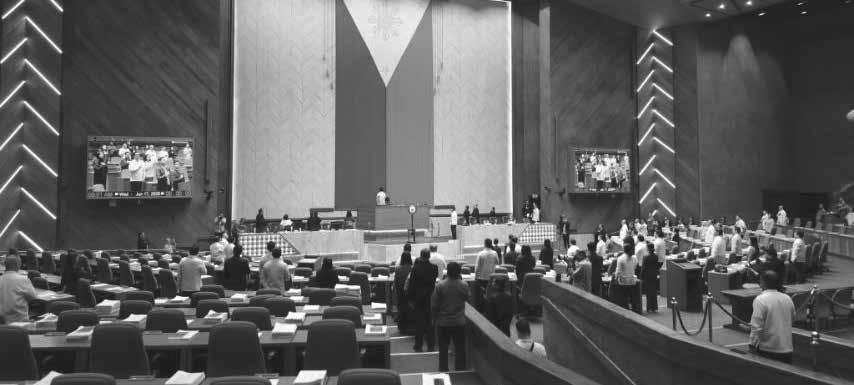
After weeks of dispute, Sherwin Gatchalian takes the Senate presidency while Alan Peter Cayetano moves to the minority, with a Supreme Court case still pending.
by AJPress
Marcos, Putin put energy and food security at center of renewed PH-Russia talks
by AJPress
Senate starts preparations for Sara Duterte impeachment trial
Pangilinan denies ‘maleta’ claim in flood-control controversy
His wife, Sharon Cuneta, said claims linking their family to supposed cash deliveries were false.
by AJPress
deliveries linked to public works projects have fueled hearings, public statements and social media attacks.
Pangilinan said the accusation had no basis. He said those making the claim should submit evidence to a competent forum, not rely on public insinuation. He also warned that those spreading defamatory allegations could be held liable.
Sharon Cuneta, Pangilinan’s wife, also rejected the claim. The actress-singer said allegations linking their family to supposed cash deliveries were false and ob-
by AJPress
economic issues at the center of a Philippine-Russian relationship marking its 50th year. The meeting took place Wednesday, June 17, on the sidelines of the ASEAN-Russia Commemorative Summit, where Southeast
No supply deal was announced, but the Kazan meeting gave Manila and Moscow a venue to explore practical cooperation after 50 years of diplomatic relations Clarkson’s Knicks title gives Filipino basketball a historic NBA first
The June 18 pre-trial conference began organizing evidence and disputed issues for proceedings scheduled to start July 6, while the chamber has yet to choose its presiding officer.
by AJPress
MANILA — The Senate began preparations Thursday, June 18, for the impeachment trial of Vice President Sara Duterte, bringing House prosecutors and defense lawyers together to identify documents, stipulations and contested issues before hearings scheduled to start July 6. The first day of the pre-trial conference focused on documents
connected with Articles III and IV of the impeachment complaint, according to Duterte lawyer Michael Poa. Proceedings are scheduled to resume Monday, June 22, to address materials related to Articles I and II. Senate Secretary Renato Bantug Jr., clerk of the impeachment court, oversaw the conference. Article III concerns allegations of direct bribery involving pur-
New York’s title run places Clarkson in the record books as the first player of Filipino descent to be part of an NBA championship team
by AJPress
WHEN the New York Knicks ended one of the NBA’s longest championship waits, Jordan Clarkson secured a milestone that reached beyond the franchise.
The veteran guard became the first player of Filipino descent to win an NBA championship. New York defeated the San Antonio Spurs, 94-90, in Game 5 of the NBA Finals to win the series, 4-1, and capture the franchise’s first title since 1973. Jalen Brunson led the Knicks with 45 points and was named Finals Most Valuable Player
The championship brought New York a ticker-tape parade through Lower Manhattan’s Canyon of Heroes on Thursday, June 18. The celebration began at Battery Park, moved up Broadway and ended at City Hall, where the team was honored by the city.
FILIPINO American journalist Yasmin Tayag has won a 2026 James Beard Media Award, earning national recognition for reporting that examined food, health, policy and consumer culture.
Tayag, a staff writer at The Atlantic, won in the Health and Wellness category of the James Beard Journalism Awards. The winning package included Tayag’s reporting on wellness politics, reformulated processed foods and the booming market for muscle-building supplements.
The James Beard Foundation said the category recognizes foodand drink-related journalism on subjects that may include diet, nutrition, chronic disease, aging, mental health and public health. The 2026 Media Awards were presented June 13 at the Art Institute of Chicago. Tayag’s reporting has focused on how wellness claims, food marketing, political movements and health trends shape what Americans buy, eat and believe about nutrition. Her work places food coverage beyond recipes and restaurants, treating it as a window into policy, science and everyday behavior.
Tayag has built a beat around the future of food, using science,
Yasmin Tayag, James Beard Media awardee Photo from yasmintayag.com
MANILA — The Philippine Senate entered a
MANILA — Sen. Francis “Kiko” Pangilinan denied receiving a suitcase of cash tied to
KAZAN, Russia — President Ferdinand Marcos Jr. and Russian President Vladimir Putin discussed expanding cooperation in energy, food security, agriculture and trade during a bilateral meeting in Kazan, placing
From the Front Page
Gatchalian elected PH Senate...
PAGE 1
The dispute began after rival blocs in the 24-member Senate were divided over control of the chamber. Former Senate President Alan Peter Cayetano and his allies maintained that he remained the legitimate leader. Senators aligned with Gatchalian moved to reorganize the chamber, saying the Senate had to resume work.
The deadlock first came to a head on June 3, when senators opposing Cayetano convened after Sen. Francis “Chiz” Escudero appeared and helped establish a quorum. That session led to the reorganization of Senate posts, with Gatchalian named Senate president pro tempore and acting Senate president. Cayetano’s side rejected the move and later asked the Supreme Court to nullify the June 3 proceedings.
President Ferdinand Marcos Jr. then called Congress to a special session on June 17 through Proclamation No. 1318, citing the need to act on priority legislation and pending appointments. The special session became the moment when the leadership question was settled inside the chamber, even as the Supreme Court case remained pending.
Thirteen senators were present and backed Gatchalian as Senate president. Cayetano and allies in his bloc were absent from the leadership vote. The vote formalized Gatchalian’s election as Senate president.
In his first speech as Senate president, Gatchalian called for a reset.
“Let’s begin again,” he told
colleagues, urging senators from both the majority and minority blocs to set aside division and face the country’s challenges together.
He said senators may hold different political views, but their duty is the same: to defend the law and serve the Filipino people.
“Magtatrabaho ang buong Senado para sa inyo,” Gatchalian said.
The new leadership lineup also installed Sen. Vicente “Tito” Sotto III as Senate president pro tempore, while Sen. Juan Miguel “Migz” Zubiri retained the majority leadership. Later in the session, Sen. Loren Legarda manifested for the record that Cayetano would serve as Senate minority floor leader. Legarda said the arrangement was made without prejudice to the final resolution of the pending Supreme Court case.
The distinction is central to the Senate’s new posture: Cayetano’s move to the minority leadership allowed the chamber to function, but it did not erase his bloc’s legal challenge. The Supreme Court has yet to finally resolve the dispute over the June 3 reorganization.
The Senate now faces pressure to show that it can return to its core work. The leadership fight had delayed action on bills, appointments and other pending matters. The special session was called to move forward priority measures, including social protection, education, senior health care, nutrition, scholarship and anti-political dynasty legislation, as well as pending
appointments before the Commission on Appointments.
The stakes are heightened by the Senate’s expected role in the impeachment proceedings involving Vice President Sara Duterte. The proceedings have added political weight to the question of who presides over the chamber. Duterte has denied wrongdoing and has described the impeachment effort as politically motivated.
The practical effect of the June 17 session was to give the Senate a working leadership structure: Gatchalian holds the presidency after all 13 senators present backed him, while Cayetano assumes the minority leadership without abandoning his bloc’s challenge before the Supreme Court.
That arrangement does not erase the dispute that preceded it. It allows the chamber to proceed while the legal questions run their course.
Gatchalian begins his presidency under unusual scrutiny.
Beyond presiding over legislation, appointments and an expected impeachment trial, he inherits the task of restoring the Senate’s capacity to act as an institution after weeks in which internal conflict overshadowed public work.
His appeal for unity was therefore less a ceremonial opening than a test of authority.
The measure of the new leadership will be whether the Senate can turn a working arrangement into a functioning chamber, and whether its members can move from procedural conflict back to the obligations of lawmaking, oversight and public service. n
Marcos, Putin put energy and food security...
Asian leaders met with Putin for talks on trade, investment, energy, agriculture, technology, tourism and regional issues. Marcos attended as the Philippines led ASEAN’s rotating chairmanship.
No Philippine-Russian supply deal on fuel, gas, fertilizer or food products was announced from the bilateral meeting. The immediate outcome was more limited but still significant: both governments publicly identified energy and food security as priority areas where they want broader cooperation.
Putin said there was potential to expand supplies of agricultural products and energy resources, adding that bilateral trade had exceeded $500 million but remained below what Moscow viewed as possible.
Marcos, in turn, said the two countries had “a great deal more” to do in trade and investment. He cited the Joint Commission on Trade and Economic Cooperation, which met in Moscow last September, as the main channel through which the two sides had identified energy and food security as mutual priorities.
The Philippine side also pointed to business-to-business discussions held alongside the commission meeting. Those exchanges, Marcos said, helped companies from both countries establish networks and explore possible joint ventures. Memoranda of understanding cited by the Philippine government covered innovation, retail products, cosmetics, food processing and industrial collaboration.
Ahead of the meeting, a Philippine foreign affairs official said the talks were expected to focus on food and energy security, as well as people-to-people ties, tourism, education, culture, science and technology. Officials linked the agenda to broader supply pressures affecting energy and food markets.
The bilateral meeting unfolded within a wider ASEAN-Russia summit in Kazan. Reuters reported that ASEAN countries agreed in a summit statement to increase cooperation in renewable energy, natural gas, liquefied natural gas and energy transition.
The Associated Press reported that Russia and ASE-
AN leaders used the summit to call for expanded strategic partnership across trade, energy, agriculture, digitalization, science, tourism and humanitarian contacts.
The diplomatic setting was complex. The Philippines remains a treaty ally of the United States, while Russia continues to face Western sanctions and diplomatic pressure over its war in Ukraine.
ASEAN, however, has maintained engagement with Moscow as a dialogue partner, reflecting the bloc’s practice of keeping diplomatic channels open despite differing alignments among its member states.
Marcos also invited Putin to the 21st East Asia Summit in Manila in November. No acceptance was announced in the verified record.
The Kazan meeting did not mark a completed shift in Philippine energy or food policy. It opened a new conversation over whether Manila and Moscow can turn a long-standing diplomatic relationship into practical cooperation in sectors that affect prices, supply chains and household costs. n
New federal aid could help workers...
PAGE 1
work, a young adult seeking a first career, a laid-off worker changing industries or an employee hoping to qualify for a higher-paying position may be able to seek aid for approved programs that take weeks or months instead of years.
The aid is not automatic, and not every training course will qualify. Students must meet Pell Grant eligibility rules, and the program itself must be approved under federal and state requirements. But for those who qualify, Workforce Pell could reduce costs that many students previously paid on their own.
Pell Grants are federal grants for students with financial need. Unlike loans, they generally do not have to be repaid. For the 2026–27 award year, the maximum Federal Pell Grant is $7,395, though awards vary based on financial need, cost of attendance, enrollment status and other factors.
Federal rules say eligible programs must prepare students for high-skill, high-wage or in-demand jobs and meet standards related to length, completion, job placement and earnings outcomes. In general, eligible programs must last at least eight weeks but less than 15 weeks and include 150 to 599 clock hours, or the equivalent in credit hours. Fields that may benefit include allied health, nursing support, information technology, commercial driving, welding, automotive technology, HVAC, manufacturing and skilled trades. The exact programs available will vary by state, school and approval process. Students should ask questions before enrolling. A school may advertise career training, but that does not automatically mean the program qualifies for Workforce Pell. Students should contact the school’s financial aid office and ask whether the specific program has been approved, when aid may become available and how much of the cost could be covered. They should also ask about the full price, graduation rates, job placement rates, licensing requirements and whether employers recognize the credential. Federal aid can lower the cost of training, but it does not guarantee employ-
ment. For Filipino American families and immigrant households, the program may be especially relevant for those considering approved health care and direct-care credentials, while also opening potential pathways in other workforce fields that meet federal and state requirements. The most practical step is to complete the FAFSA, contact prospective schools and verify whether a specific program is eligible before paying out of pocket. The new aid is not a blank check and not a promise of a better job. But for eligible students in approved programs, Workforce Pell could make career training more affordable as many workers look for new skills, stronger credentials and better-paying work. (AJPress)
Clarkson’s Knicks title gives Filipino...
PAGE 1
Clarkson’s championship came as part of a deep Knicks roster built around Brunson and a core that included Karl-Anthony Towns, Mikal Bridges, OG Anunoby and Josh Hart. At 33, Clarkson gave New York veteran scoring depth and playoff experience, the kind of steady presence championship teams often need across a long postseason run.
A second-round pick in 2014, Clarkson built a long NBA career with the Los Angeles Lakers, Cleveland Cavaliers, Utah Jazz and Knicks. He won the NBA Sixth Man of the Year award in 2021 and became one of the league’s most visible players of Filipino heritage.
His connection to the Philippines deepened through Gilas Pilipinas, the national team he represented in international competition. In a country where basketball holds a central place in sports culture, his career has been followed as both an NBA story and a Filipino one.
The Knicks’ title gave Clarkson the distinction no player of Filipino descent had previously held.
In the Philippines and among Filipino communities abroad, the moment carried meaning beyond the parade route: a player with deep ties to Gilas Pilipinas had reached the peak of profes
sional basketball as a champion.
role was one part
Senate starts preparations for Sara Duterte...
PAGE 1
ported payments to Department of Education officials. Article IV covers alleged threats and livestream remarks involving President Ferdinand Marcos Jr., first lady Liza Araneta-Marcos and former House speaker Martin Romualdez.
Articles I and II concern allegations involving the use and liquidation of P612.5 million in confidential funds allocated to the Office of the Vice President and the Department of Education, as well as alleged unexplained wealth and assets not disclosed in Duterte’s statements of assets, liabilities and net worth.
Duterte has denied wrongdoing. Her legal team has asked the Senate to dismiss the case, arguing that the articles are constitutionally and procedurally defective and that the prosecution has not established sufficient grounds for conviction.
The House prosecution panel, led by Batangas Rep. Gerville Luistro, is expected to present witnesses and documentary exhibits. The defense may challenge the prosecution’s evidence and present its own case.
The Senate has not selected a presiding officer.
Senate President Sherwin “Win” Gatchalian said the cham-
ber had not formally discussed the matter and that, under the arrangement, he would preside.
The Senate’s amended impeachment rules allow senators to elect another member to lead proceedings in cases not involving the President.
Sen. Panfilo Lacson earlier said members of the new majority bloc had reached an initial agreement to choose Sen. Francis “Chiz” Escudero, a former Senate president. Gatchalian and Escudero said no final decision had been made.
Marcos expressed confidence in Escudero’s ability to manage the trial but said the choice belonged to the Senate. Speaking to reporters in Kazan, Russia, he said the 2025 proceedings ended because of a Supreme Court ruling, not Escudero’s conduct as presiding officer.
Several civil-society organizations opposed Escudero’s possible selection and called on Gatchalian to preside. Luistro urged the public not to prejudge Escudero and said the prosecution would carry out its role regardless of who is chosen.
The question arose after Gatchalian was elected Senate president June 17, replacing Alan Peter Cayetano following weeks of disagreement over the chamber’s
leadership.
Escudero presided when the Senate convened as an impeachment court in June 2025. The Supreme Court later declared that complaint unconstitutional, ruling that it violated the one-year prohibition against initiating more than one impeachment proceeding against the same official within a year and did not meet due-process requirements. The court said the Senate did not acquire jurisdiction over that case. It also said the ruling did not absolve Duterte of the allegations and that another complaint could be initiated beginning Feb. 6, 2026. The House voted 257-25, with nine abstentions, on May 11 to impeach Duterte under the new complaint. Senators took their oaths as impeachment judges May 18.
Under the 1987 Constitution, the House has the exclusive authority to initiate impeachment cases, while the Senate has the sole power to try and decide them. Conviction requires the concurrence of two-thirds of all senators. A conviction may result in removal from office and disqualification from holding public office. Any criminal or civil liability would require separate proceedings. n
Pangilinan denies ‘maleta’ claim in flood-control...
PAGE 1
jected to the use of family photographs in posts about the issue. The “maleta” allegation surfaced as the flood-control inquiry moved deeper into a volatile phase, with purported insiders seeking to link public officials to alleged cash transfers. Pangilinan’s denial shifts the immediate question to evidence: whether the accusation can be supported in a forum with authority to examine testimony, documents and other records. The controversy has widened beyond questions of public works spending into a broader contest over credibility, political accountability and reputational damage.
Allegations involving public money and public officials carry consequences, but they require more than repetition in hearings, interviews or online posts.
Pangilinan has not been charged in connection with the “maleta” claim. Cuneta, who holds no public office, has no official role in the proceedings. n
DACA renewal delays put jobs and work...
PAGE 1
plicants have nevertheless faced prolonged waits, including cases pending for months. When a renewal is not approved before a recipient’s current authorization expires, the consequences can be immediate. Employers may place the worker on leave or end employment. Depending on state rules, a lapse can also affect a driver’s license. For families that rely on that income, the delay can quickly become a financial strain.
In May, Reps. Jim Costa, Adam Gray, David Valadao and Josh Harder wrote to DHS and USCIS urging action on what they described as significant DACA renewal delays in California’s Central Valley. The lawmakers said their offices had seen a sharp increase in cases, including many still pending after six months. They said affected recipients included first responders, educa-
tors, bus drivers and health care professionals.
In March, senators led by Catherine Cortez Masto and Dick Durbin, joined by California Sens. Alex Padilla and Adam Schiff, also urged DHS and USCIS to reduce renewal delays. They warned that lapses in work authorization can cost recipients jobs and disrupt employers, particularly in health care, education and small businesses. USCIS data show the scale of the program. As of Sept. 30, 2025, there were 505,940 active DACA recipients nationwide. California had the largest number, with 141,470 recipients, followed by Texas with 84,430. Other states with significant DACA populations include Illinois, Florida, New York, North Carolina, Arizona, Georgia, Washington and New Jersey. The program also spans national-origin communities. USCIS data show active DACA re-
cipients born in 169 countries. Most were born in Mexico, but the data also list recipients born in South Korea, the Philippines, India and other countries. USCIS listed 2,260 active DACA recipients born in the Philippines, underscoring the program’s reach into Asian immigrant families as well as Latino communities. DACA’s legal future remains unsettled. Congress has not enacted a permanent legislative solution for immigrants brought to the country as children, leaving current recipients dependent on renewals, agency processing and the timing of federal decisions. The delays have placed DACA’s fragile structure back in view. More than a decade after the program began, its recipients remain protected only temporarily, their ability to work still tied to court orders, agency policy and the pace of federal processing. (AJPress)
Clarkson’s
of a larger Knicks championship story. But his presence on the roster gave the victory
President Ferdinand Marcos Jr. and Russian President Vladimir Putin discussed energy, food security, agriculture, trade and broader bilateral cooperation on the sidelines of the ASEAN-Russia Commemorative Summit in Kazan, Russia, on June 17, 2026. Photo from Philippine Presidential Communications Office
The new Workforce Pell program broadens how federal student aid may be used, with a focus on approved training tied to in-demand occupations. Photo from the U.S. Department of
Healthcare costs in Philippines push
Filipinos to work abroad, report finds
by Renalyn RamiRez Philstar.com
—
MANILA
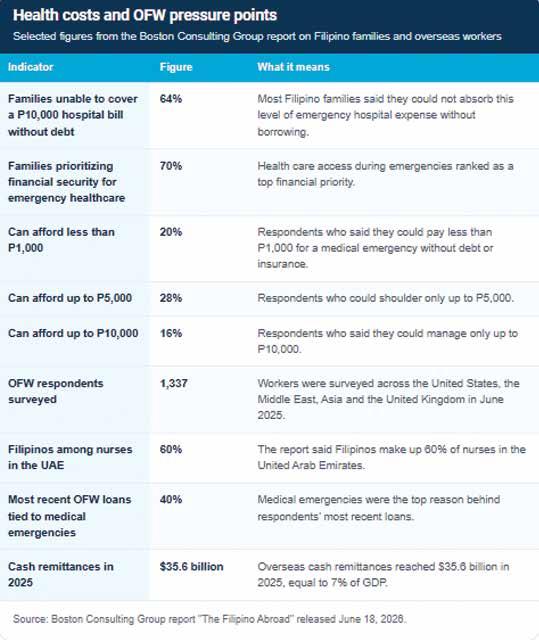
Sixty-four percent of Filipino families cannot afford a P10,000 hospital bill without going into debt, pushing many Filipino workers to seek better income abroad just to secure access to basic healthcare, according to a new report.
The Boston Consulting Group surveyed 1,337 overseas Filipino workers across the United States, the Middle East, Asia and the United Kingdom in June 2025. It found that access to healthcare was among the main forces behind their decision to work abroad.
Based on the report, financial security that can guarantee access to health services during medical emergencies is a top priority for 70% of Filipino families. However, most respondents also admitted they struggle to pay even small emergency health expenses.
Twenty percent of respondents said they could pay less than P1,000 for a medical emergency without borrowing money or using health insurance. Twenty-eight percent said they could pay only up to P5,000, while 16% said they could afford up to P10,000.
"For many households, getting sick is a major financial event just as much as it is a medical event, which can mean debt, delayed tuition, or rapidly eroded savings," the report said.
Health workers, health worries
The report noted that Filipinos make up 60% of nurses in the United Arab Emirates, supporting the medical system of a major global economy.
It also found that many of them are older Filipino workers whose main motivation for working abroad is earning more income for their family’s health needs.
"The OFW, then, is one of the family’s most important forms of insurance, strengthening the family against fragility by leaving it," the report said.
The report grouped the 1,337 OFW respondents into four clusters: Long-Haul Guardians, or older OFWs; Family Lifelines, or millennial breadwinners; Anchored Earners, or older Gen Z workers to millennials who treat overseas work as temporary; and
Self-Builders, or younger millennials seeking to build their own life abroad.
While all clusters identified "higher income potential" and "overall quality of life" as their main reasons for working abroad, the report found that Long-Haul Guardians were the most concerned about the health of family members left in the Philippines. Forty-three percent of them said this was their top concern.
A majority of Long-Haul Guardians, described by the report as "emotionally depleted Gen X OFWs," work in the Middle East. Healthcare was among the top three industries where they work.
Based on the report, LongHaul Guardians were the only OFW cluster with healthcare among their top three industries. Younger OFWs were more concentrated in construction, hospitality and food services.
In the Philippines, the government allocated P448.125 billion for the health sector in the 2026 national budget. Economic think tank IBON Foundation, however, criticized the amount, saying it remains "far from the 5% standard" of the World Health Orga-
nization.
Medical emergencies and debt
Medical emergencies accounted for 40% of the most recent loans of OFWs, indicating that unexpected health concerns were also the top reason Filipino workers abroad resorted to borrowing.
Medical emergencies were also the top reason for extra remittances among respondents.
In the past year, 39% of OFWs in the US, 31% in the Middle East, 46% in Asia and 56% in the United Kingdom said they had to send extra money to families in the Philippines to pay for emergency medical expenses.
Share of OFWs who said they sent additional money in the past year to cover relatives’ emergency medical costs
The report noted that OFW remittances are the third-largest source of foreign currency inflows in the Philippines, equivalent to 7% of gross domestic product, with overseas cash remittances reaching $35.6 billion in 2025.
"The Philippines has become increasingly dependent on the support that overseas Filipinos send home," the report said.
Another Trillion Peso March set on June 28
by maRc Jayson cayabyab, bella caRiaso Philstar.com
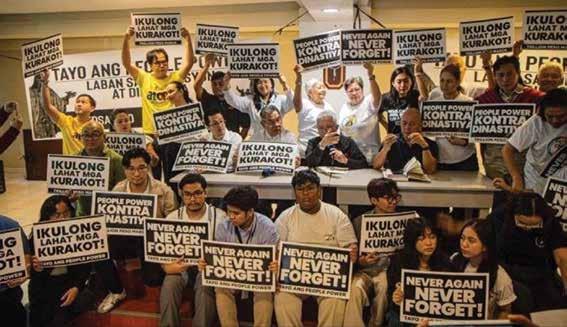
MANILA — Leaders of the Catholic church and other religious groups and civil society organizations will hold another big rally at the EDSA People Power Monument on June 28, Sunday, in a continuation of the Trillion Peso March as they push for accountability amid the corruption scandal in the country.
At a press conference, Catholic Bishops’ Conference of the Philippine (CBCP) InterReligious Leaders’ Council for National Transformation lead convenor and Kidapawan Bishop Colin Bagaforo said rally will be dubbed the “White Ribbon Movement March.”
“We will have a big rally this June 28, 2026 and we will do this at the People Power Monument. It will be led by the Inter-Religious Leaders Council for National Transformation. We emphasize that this rally is therefore faith-based, faith-generated and the product of discernment by the council formed through prayer, listening and shared responsibility before God,” Bagaforo said.
He added that the rally is meant to again remind the government that Filipinos deserve a better future.
“We believe that a better future can only be achieved through better politics, politics that serves the people’s interests, protects human dignity and is guided by justice rather than greed,” he said.
Bagaforo said participants will start to march at noon toward the People Power Monument.
According to Bagaforo, those involved in corruption should be held accountable and should be jailed.
He said participants will also push for the implementation of a real anti-political dynasty law.
“We should start implementing what is written in the Constitution about the political dynasty and the so-called electoral reforms, change the mechanism and system of our electoral system,” the bishop said.
A Trillion Peso March series was held amid the ghost project scandal in the country.
“We invite all religious organizations, civil society organizations, non-government organizations, educational associations, farm workers, fishermen,
laborers to join and rally with us, together we will pray, we will pray that God will hear our prayers and may the hearts of our political leaders, may the hearts of those who are guilty, may they change and listen to the voice of the people and to the voice of the Lord,” he added.
Win: No cover-up
Senate President Sherwin Gatchalian yesterday denied his predecessor Sen. Alan Peter Cayetano’s allegation that the new leadership would cover up for the masterminds in the flood control mess.
Speaking to radio dzMM yesterday, Gatchalian said the Senate Blue Ribbon committee chaired by Sen. Erwin Tulfo would continue the investigation that was started last year by Sen. Panfilo Lacson. As for the 18 alleged “bagmen” or bodyguards of fugitive Zaldy Co who have accused several administration officials and allies of receiving flood control kickbacks in suitcases, Gatchalian said they were invited to attend the June 8 Blue Ribbon consultative meeting, but they chose to hold a press briefing in Sen. Robin Padilla’s office instead.
He said the opportunity for them to tell the truth was wasted.
Gatchalian dared the men to separately issue affidavits to back up their sweeping claims they delivered kickbacks in suitcases to several lawmakers and officials, instead of resorting to media fanfare. The new Senate President also vowed to cooperate with the Supreme Court that is conducting oral arguments on the petitions challenging the constitutionality of unprogrammed appropriations and the billions in alleged “budget insertions” in the General Appropriations Act.
In an interview in Cebu City, Sen. Risa Hontiveros echoed Gatchalian’s remarks denying Cayetano’s claims of a cover-up.
“I don’t know what cover-up Senator Alan is talking about,” she said, adding that the 18 alleged bagmen were invited to the Blue Ribbon consultative meeting, which they chose to ignore.
New Senate President Pro Tempore Vicente Sotto III in the meantime scoffed when asked to react to the latest Facebook Live session of Cayetano.
“It’s not good for the country. Let’s move on to more urgent issues to help our countrymen,” Sotto said.
Caritas Philippines with civil society organizations during the press conference on February 11, 2026 for Trillion Peso March part 3. Philstar.com / Ian Laqui
Mindanao quake death toll rises to 78
by Michael Punongbayan Philstar.com
MANILA — The National Disaster Risk Reduction and Management Council (NDRRMC) reported 10 more deaths yesterday, bringing the total number of fatalities in last week’s magnitude 7.8 earthquake in Mindanao to 78.
According to Office of Civil Defense information officer Diego Mariano, the additional casualties include seven retrieved cadavers and three more previously reported as missing.
The 10 new recorded deaths are all from Davao Occidental where there are now a total of 20 reported casualties.
Sarangani still has the highest number of fatalities with 33, followed by South Cotabato with 24, and one reported death in Davao del Sur.
Mariano earlier explained that changes in figures being released by the NDRRMC are the result of continuing search, rescue and retrieval operations as well as validations and verifications of reported deaths, missing persons and injuries.
The latest NDRRMC report added that at least 30 persons remain missing; including 15 in Sarangani, 13 in Davao Occidental and two in South Cotabato.
As of June 18, the number of injured persons remain at 1,399 in the Davao Region, South-Central Mindanao (Soccsksargen), and the Bangsamoro Autonomous Region in Muslim Mindanao.
The number of affected population has risen to more than 357,000 families or more than 1.50 million individuals including some 5,000 families or over 21,900 persons staying in 47 different evacuation centers.
With 14 cities and municipalities under state of calamity, the NDRRMC said estimated cost of damage to infrastructure stands at P1.29 billion.
The powerful earthquake re-
portedly damaged 774 structures excluding more than 74,000 houses, of which some 13,700 were reported as totally destroyed. Estimated cost of damage to agriculture is currently at P29.8 million in various areas of Davao del Norte and Davao del Sur alone.
So far, displaced families and most-affected communities have received more than P184.9 million in food and non-food assistance.
Crackdown on scammers After two women were arrested for posing as Department of Public Works and Highways (DPWH) officials, Philippine National Police chief Gen. Jose Melencio Nartatez Jr. yesterday ordered police units to intensify operations against scammers in quake-hit areas. “There is a special place in hell for these people who take advantage of the situation in Mindanao for their personal gains but right now, our focus is to identify all of them and haul them off to jail,” Nartatez said in a statement.
Criminal cases for usurpation of authority and falsification by private persons and use of falsified documents were filed against the suspects, known only
as Chel and Cham, who were arrested at the DPWH’s Davao regional office on June 14.
The suspects allegedly introduced themselves as DPWH officials from Metro Manila and told public works employees in Davao that they were there to inspect infrastructure such as bridges and roads affected by the recent earthquake that struck Mindanao. They even called for a meeting at the regional office.
Red Cross deploys personnel
To ensure uninterrupted humanitarian operations in earthquake affected areas, the Philippine Red Cross (PRC) said it has deployed 264 staff and volunteers across Sarangani, General Santos City, Davao Occidental and South Cotabato.
The PRC personnel were supported by a range of operational assets including nine ambulances, six rescue vehicles, four water tankers, two food trucks, two relief trucks, three generator sets, two drones, and one Starlink satellite communications unit.
“We are moving ahead to reach even the most isolated communities,” PRC chairman and CEO Richard Gordon said. – with reports from Rhodina Villanueva, Emmanuel Tupas n
Pulong Duterte claps back at Remulla over ‘high’ remark: Get a mirror
by gabriel Pabico lalu Inquirer.net
MANILA — Davao City Rep.
Paolo “Pulong” Duterte has fired back at Interior Secretary Jonvic Remulla’s remark that he was “high” when he claimed that International Criminal Court (ICC) arrest orders are underway, saying that the cabinet official should check his mirror first.
Duterte on Thursday, in a statement posted on his Facebook page, asked Remulla whether it is him who is high and stoned due to illegal drugs or the people he is with in Malacañang.
In an interview with reporters in Camp Crame, Remulla was asked about Duterte’s claims that the ICC has ordered the arrest of Senator Bong Go. In response, the Department of the Interior and Local Government (DILG) chief said Duterte may have been high on drugs when a source gave him this information.
“You had the gall to call me ‘high’ and ‘stoned’, Secretary Jonvic Remulla? Me? Or maybe you were mistaken about who you were referring to and what you really wanted to point at were those inside Malacañang?” Duterte asked.
“That’s why, before you label someone ‘high’ and ‘stoned,’ it might be better to look at the mirror first. Maybe the answer to your question is there,” he added. According to Duterte, the solution to proving these claims is simple as getting a hair follicle test. However, the Davao City solon also explored the possibility that Remulla was referring to a
different kind of ‘high.’
“If you really want to know who is ‘high’ and who is ‘stoned,’ the solution is simple. Let us go through hair follicle drug testing. Bring your boss, his wife, and children with you, so that we will do one testing and end all rumors,” he added.
“But maybe you are referring to a different kind of being high, Jonvic. Maybe it’s about being high on power. High on corruption. High on arrogance. High in the belief that people no longer know who really does his job and who shows off whenever there’s a camera around,” he added, speaking in mixed Filipino and Cebuano.
The ICC has been going after individuals linked to the drug war of Duterte’s father, former president Rodrigo Duterte, due to allegations that he and his enforcers committed the crime against humanity of mass murder.
Over the six-year term of this father, over 6,200 individuals died in legitimate police operations. However, human rights groups claimed that the true number of drug war-related deaths may be higher, ranging from 12,000 to 30,000. Former President Duterte himself was arrested on March 11, 2025 after the Philippine National Police (PNP)—which operates under the DILG—assisted the International Criminal Police Organization (Interpol) in implementing the red notice for the arrest order issued by the ICC. A similar arrest order has been issued against Sen. Ronald “Bato” dela Rosa, Duterte’s first PNP chief.
As head of the police force, Dela Rosa implemented the Duterte administration’s grassroots anti-drug campaign known as Oplan Tokhang, a portmanteau of Visayan words “toktok” or to knock, and “hangyo” or to plead.
Go, meanwhile, is a longtime ally of the Dutertes, even when the former president was still Davao City mayor. During the first three years of Duterte’s presidency, Go was the special assistant to the president.
But during the hearings of the House of Representatives’ quad committee, back in the 19th Congress, former police colonel, Royina Garma, admitted that former President Duterte messaged her in May 201—right after the ex-leader won the presidential race—about building a task force to implement a rewards system in the drug war, just like what was done in Davao City.
According to Garma, the socalled Davao template involved providing cash rewards worth P20,000 to P1 million to cops who kill drug suspects.
At another hearing, Garma said that she can directly visit former president Duterte when he was in Malacañang, by going through Go.
Garma also said that former police colonel Edilberto Leonardo told her that he made a proposal outlining the task force’s operations, coursed through Go.
She also admitted that initially, she facilitated the meetings between Go and Leonardo. Eventually, Garma said that the two men “established direct communication” n
Trillanes says no ICC warrant against Bong Go
by Zacarian Sarao Inquirer.net
MANILA — Former Sen. An-
tonio Trillanes IV on Thursday refuted claims by Davao City Rep. Paolo Duterte that an arrest warrant has already been released by the International Criminal Court (ICC) against Sen. Bong Go.
To recall, it was Trillanes who first revealed the ICC arrest warrants against former President Rodrigo Duterte, as well as Sen. Ronald “Bato” dela Rosa.
“Don’t believe Pulong. No ICC warrant has been issued for anyone yet,” said Trillanes in a social media post written in Filipino.
“Should a warrant indeed come out later, he definitely won’t know about it, just like his father didn’t know that he had a warrant,” he added.
Aside from Trillanes, the Department of Interior and Local Government, the Philippine National Police, along with the Department of Justice, have likewise stated that they have yet to receive any information about the alleged warrant.
Bong Go leaves it to a higher being Meanwhile, Go in response to the ICC warrant rumors said he will simply leave it up to a higher being—all while maintaining that he has never violated any
laws. “I leave everything to God. In my entire life, I have never broken any human law or God’s law,” said Go in a statement.
“Police matters have never been part of my mandate. I hope and pray that the issue regarding the alleged ICC warrant against me will not be politicized,” he added.
He then assured the public that he would continue doing his job as a senator despite the rumors.
on government records, and over 30,000 based on human rights records, including children. n
UP remains top PH university in QS World University Rankings 2027
by Melanie uson Philstar.com
THE University of the Philippines maintained its rank as the top Philippine university in the 2027 QS World University Rankings.
In the ranking released on June 18, UP ranked No. 402 with an overall score of 38.
The platform noted that UP is the only Philippine university in the Asia Pacific Rim Universities, a network of leading institutions across 19 economies recognized for academic and research excellence.
"UP is the only Philippine university in the ASEAN-European University Network, a network of universities that aim to promote the continuous internationalization of education and research. It is a founding member of the
ASEAN University Network. As of April 2022, UP has international linkages with 350 higher education and research institutions in 43 countries," it added.
While it maintained its position as the country's top university, UP dropped 40 places from its No. 362 ranking in 2026.
Other Philippine universities also ranked lower this year. Ateneo de Manila University fell 70 places, from 511th to 581st, while De La Salle University dropped from 654th to the 751–760 bracket.
Meanwhile, the University of Santo Tomas slipped from the 851–900 range to the 951–1,000 band, and Adamson University moved down from the 1,001–1,200 bracket to the 1,201–1,400.
Topping this year's list is Massachusetts Institute of Technolo-
gy, which retained its position as the world's leading university. It was followed by Imperial College London and Stanford University in a tie for second place. University of Oxford ranked fourth, followed by Harvard University in fifth and University of Cambridge in sixth.
Completing the top 10 were California Institute of Technology, ETH Zurich, University College London, and National University of Singapore. The QS World University Rankings 2027 assessed more than 1,500 universities from 106 countries and territories, measuring performance across indicators including academic reputation, employer reputation, citations per faculty, employment outcomes, internationalization, faculty-to-student ratio, and sustainability. n
by ayie licsi Philstar.com
Former Sen. Antonio Trillanes IV in file photo. INQUIRER/ MARIANNE BERMUDEZ
While the arrest warrant against Go hasn’t been confirmed yet, a pending warrant was recently released against Dela Rosa — who has been in hiding since the arrest order was made public.
Dela Rosa’s warrant stems from his alleged role in the Duterte administration’s bloody war against drugs, which killed over 6,000 people based
Photo from IPOPHL handout
OPiniOn
If we want better leaders, we must become better voters
The midterms are a test of whether communities will show up informed, not just angry
WE recently wrote about primary elections and why voters should not treat them as political warm-ups. Across the United States, primaries are often where the real choices begin. They determine who advances, who disappears and what options voters will face in November.
We recently wrote about primary elections and why voters should not treat them as political warm-ups. Across the United States, primaries are often where the real choices begin. They determine who advances, who disappears and what options voters will face in November.
This editorial continues that conversation and looks ahead to the midterm elections, when voters will have another chance to show that participation must be informed, not merely reactive.
It is easy to be angry when the ballot does not offer the choices we wanted. It is easy to ask why certain candidates advanced, why stronger candidates did not make it through, or why November now feels like a choice between imperfect options.
But democracy asks a harder question first: Where were we when those choices were being shaped?
The 2026 midterm general election will be held on Nov. 3. Midterm elections take place halfway
babe’s
eye view
Babe Romualdez
FOREIGN policy will like-
ly become a major issue in the 2028 presidential elections. The next president, whoever he or she may be, will inherit a world marked by geopolitical rivalry, economic uncertainty, technological competition and growing security challenges.
Foreign policy is not simply an abstract concept discussed in conference rooms or diplomatic receptions. It affects fishermen sailing into the West Philippine Sea, overseas Filipino workers seeking protection abroad, entrepreneurs hoping to attract foreign investment and families concerned about food and ener
gy prices.
Foreign policy decisions will directly affect our national security, economic prosperity and global standing. Our location, alliances and economic potential have made us increasingly relevant to global affairs, putting us at the center of some of the most important strategic developments in the Indo-Pacific region, clearly demonstrated by continuing developments in the West Philippine Sea.
For years, the Philippines has
Commentary
Joseph Jadway Marasigan
THESE days, one senses a peculiar exhaustion hanging over the Philippines. Inflation persists even when statistics tell us it is easing. Political discourse has become tribal. Public debate no longer seeks truth but victory. Families are divided not merely by ideology but by algorithm. Entire online communities now inhabit parallel realities sustained by misinformation, disinformation, and emotional manipulation. Researchers and officials alike have warned that Filipinos are increasingly being “polarized” and “pitted against Filipinos” through digital falsehoods amplified online. We have become a nation suspicious of institutions and distrustful of one another. Elections no longer simply select leaders; they now function as battles over historical memory itself. Scholars have described the Philip-
through a president’s four-year term. The presidency is not on the ballot, but the balance of power in government is. Voters will decide all 435 seats in the U.S. House of Representatives, 35 seats in the U.S. Senate, dozens of governorships and thousands of state legislative, county, city, judicial and local offices. That is why midterms should never be treated as secondary elections. They determine who writes laws, approves budgets, conducts oversight and shapes policy on taxes, immigration, health care, public safety, education, housing, labor, business regulation and civil rights. At the state and local level, midterm-year elections can decide school boards, judges, sheriffs, county supervisors, city councils and ballot measures that affect daily life more directly than many national debates.
Recent primaries have already set several consequential November matchups. In Georgia, Repub-
Our foreign policy: A major issue in the 2028 elections
sought to defend its sovereign rights and maritime entitlements under international law. What was once a distant geopolitical issue has become part of the national conversation, with Filipinos increasingly recognizing that the West Philippine Sea is not merely about territory but about sovereignty, food security, energy security, national dignity and the protection of our resources for future generations.
The next president will inevitably be asked: where do you stand on these issues? Will the Philippines continue defending its rights peacefully but firmly? Will the government continue to strengthen strategic partnerships that contribute to regional stability? Will a policy that combines diplomacy, restraint and national resolve be maintained?
These questions are not theoretical – these questions will affect our country’s future.
The alliance between the Philippines and the United States will absolutely be a major topic in 2028. Over the past several years, the alliance has experienced a remarkable resurgence. Defense cooperation has expanded significantly. Military interoperability has improved. Economic cooperation continues
to grow in strategic sectors.
I have witnessed firsthand the extraordinary level of bipartisan support in the United States for the Philippines. Whether members of Congress, administration officials, governors, business executives or policy experts –there is consistent appreciation for the importance of the Philippines-US partnership. This is not based solely on history. It is rooted in shared interests, shared values and a shared belief that a free and open Indo-Pacific benefits all nations.
President Marcos Jr. has pursued an independent foreign policy that emphasizes strategic partnerships while maintaining open channels of communication with nations willing to engage constructively with the Philippines. His administration has strengthened long-standing alliances and expanded economic engagement – ensuring that strong partnerships advance Philippine interests while preserving sovereign decision-making.
Whether one agrees or disagrees with specific policies, there is little doubt that foreign policy has become far more visible during his administration u PAGE 7
The ‘Filipino Mafia’ and the crisis of trust
pines as “ground zero” in the global disinformation epidemic, where political mythmaking and networked propaganda matured long before the rest of the world fully grasped the implications of algorithmic politics. And yet, amid this fragmentation, there remains an intriguing sociological phenomenon worth reflecting upon—not in Malacañang or Congress, but aboard American warships. For decades, Filipinos have occupied a peculiar and respected place within the culture of the United States Navy. So visible has Filipino presence become in certain naval communities that sailors jokingly coined an informal term for it: the “Filipino Mafia.” The phrase does not refer to criminality, of course, but to the perception that Filipino sailors had become deeply embedded in the institutional bloodstream of the Navy—especially within the enlisted ranks and the Chief’s Mess.
THE Philippines is not short of potential. It is short of time.
For decades, we have been told that our breakthrough is just around the corner. Yet millions still wake up every day worrying about the same problems – expensive food, high electricity bills, congested roads, inadequate public services, criminality, corruption and a political system that is more focused on preserving power than solving national problems.
The truth is uncomfortable but impossible to ignore. The greatest threat to the Philippines is not lack of resources, talents or opportunities. It is the worsening gap between what the country is capable of becoming and what it continues to tolerate.
The current political chaos has actually been triggered by the maneuverings for the 2028 national election. But are the aspirants for the top post ready for the gargantuan task? The next president will inherit a nation confronted with defining challenges. Whoever occupies Malacañang will face three battlefronts that will
ultimately determine whether the Philippines finally achieves its promise or remains trapped in a cycle of unrealize potential: the economy, peace and order and political reforms.
The first battlefront is the economy. For most Filipinos, the economy is not measured by GDP growth rates or investment pledges. It is instead measured every time they buy rice, pay their electricity, purchase fuel or struggle to stretch a paycheck until the next payday. Economic growth means little if ordinary families continue to feel that prosperity remains beyond their reach.
The Philippines has become one of Asia’s fastest-growing economies, yet growth alone is not enough. The country must build an economy that produces more than what it consumes, creates more than what it imports and generates opportunities that allow Filipinos to succeed at home rather than seek a future abroad.
For generations, overseas Filipino workers have carried the nation on their shoulders with their remittances that, on the average, is more than $30 billion. Their
their lands.
When I first encountered the term years ago, I dismissed it as one more piece of military folklore. But the older I got, the more I think the phenomenon deserves reflection, particularly from Filipinos ourselves.
For what exactly does this “Filipino Mafia” reveal?
Certainly not domination in the simplistic sense. Filipinos do not control the US Navy. Nor did they arrive there through inherited privilege. In fact, the history began under conditions far less flattering. Early Filipino recruits in the American colonial period were often confined to service roles shaped by the racial hierarchies of the time. Yet over generations, something remarkable happened. The community adapted. Families built mentorship chains. Knowledge was passed down. Young recruits entered naval service not alone but socially equipped—with guidance, expectations, and u PAGE 7
WHERE are we now with agrarian reform in the Philippines?
On June 10, 38 years would have passed since the enactment of the Comprehensive Agrarian Reform Program. Earlier this year, Department of Agrarian Reform (DAR) Secretary Conrado M. Estrella III told the media that only 700,000 hectares of agricultural land remain to be redistributed. After four decades of continuous implementation, the government claims that agrarian reform is almost complete. However, an emerging coalition named the “June 10 Land Rights Committee,” is questioning claims that agrarian reform can already be concluded. Agrarian and climate justice movements that compose this committee point to the unfinished business of agrarian reform in the country. Many rural working people have yet to benefit from land redistribution, even as the lack of state support has compelled many beneficiaries to sell
Research we have conducted with the national rural working peoples’ movement KATARUNGAN or Kilusan para sa Repormang Agraryo at Katarungang Panlipunan identifies four interconnected challenges faced by the agrarian sector: reform reversals and land reconcentration; contestations over conflicting land laws and overlapping claims; escalating capitalist land grabs and violence; and a deepening price scissors between higher farming costs and low farm gate prices, resulting in the loss of agrarian livelihoods.
Significant but partial land redistribution was made possible through the “bibingka strategy” of strong peasant mobilization from below and coalition-building with state reformers in the 1990s and early 2000s. This resulted in the redistribution of nearly half of the country’s 13 million hectares of agriculturally productive lands including alienable and disposable public lands, private agricultural lands and forest lands covered under Community-Based Forest Management Program, which
sacrifices have sustained families and supported the economy. But the ultimate measure of success should not be how many Filipinos leave. It should be how many no longer have to.
The next administration must focus on affordable food, lower power costs, modern infrastructure, agricultural productivity, industrial development and investment-driven job creation. Every policy, project and reform should answer one question – will this improve the daily lives of struggling Filipinos?
The second battlefront is peace, order and national security. No nation can prosper where criminality, corruption and lawlessness are allowed to thrive. Every smuggled shipment weakens legitimate businesses. Every trafficking operation exploits the vulnerable. Every online scam damages public trust. Every peso lost to corruption is a peso stolen from schools, hospitals, roads and public services. Peace and order today extends far beyond traditional crimes. It includes securing borders, protecting critical infrastructure, combating cybercrime, u PAGE 7
benefited about three-fifths of all peasant households. But neoliberal policies of liberalizing agricultural imports and slashing government support services for farmers have challenged the gains made by agrarian movements. The past four decades have also seen rapid urbanization and the expansion of metropolitan areas like Metro Manila, which have increasingly absorbed rural land and labor for nonagricultural activities. Reflecting global trends, almost 50 percent of the Philippine population now lives in urban areas. This development has come alongside the rise of a large reserve of jobless or near-jobless working people with precarious livelihoods and food insecurity. Meanwhile, the intensifying impacts of climate change have exposed peasants and other rural working people to unpredictable weather and ecological shocks. Together, these factors have eroded their capacity to sustain their livelihoods on the land, making dispossession a gradual yet persistent reality. The shifting political and sou PAGE 8
licans nominated Rep. Mike Collins to challenge Democratic Sen. Jon Ossoff and selected health care executive Rick Jackson to face Democrat Keisha Lance Bottoms for governor. In Texas, Attorney General Ken Paxton defeated four-term Sen. John Cornyn in the Republican runoff and will face Democratic state Rep. James Talarico. In Ohio, former Democratic Sen. Sherrod Brown will face Republican
Sen. Jon Husted. Maine Democrat Graham Platner will challenge Republican Sen. Susan Collins, while former Democratic Gov. Roy Cooper and Republican Michael Whatley will compete for North Carolina’s open Senate seat. In California, Democrat Xavier Becerra and Republican Steve Hilton advanced from the state’s top-two gubernatorial primary. Rep. Baru PAGE 8
In defense of the Barong Tagalog Redemption or deja vu? Analysts
How Jose Y. Lauchengco Jr. turned a dress-code dispute into a statement of Filipino dignity
by AJPress
LOS ANGELES — For the late Atty. Jose Y. Lauchengco Jr., the Barong Tagalog was not merely attire. It was formal dress, national identity, and a visible assertion of dignity in a country where Filipino presence often had to justify itself before being accepted.
The Barong Tagalog, the Philippines’ national dress for men, traces its origins to pre-Hispanic garments woven from lightweight fibers such as piña and jusi. During the Spanish colonial period, it became a symbol of Filipino identity, worn untucked and often hand-embroidered to reflect status and craftsmanship. By the 20th century, leaders such as President Manuel Quezon elevated the barong as formal attire, a practice reinforced by Malacañang’s 1975 declaration of Barong Filipino Week, which promoted its use as a symbol of national pride.
Lauchengco’s story most often begins in Orange County in 1975, when a dress code became a test of recognition. He mounted a formal challenge against a socially exclusive restaurant that had refused to treat the Barong Tagalog as equivalent to Western formalwear. The dispute concluded with an apology and a revised policy acknowledging the barong as proper formal attire, a small but enduring affirmation of Filipino identity.
The episode has remained a touchstone in the Filipino American community, not because of legal precedent, but because it raised a larger question: whether cultural dress carried from one country could be received in another without diminished standing. Lauchengco’s answer, in action, was yes.
Born in Manila on Dec. 6, 1936, he came to the United States at age 14 and attended Brown Military Academy in San Diego, graduating as valedictorian in 1955. He later studied political science at the University of the Philippines, where he was an entrance scholar, ROTC Corps Commander, and later a regular officer in the Philippine Army Rangers.
Those experiences shaped a sensibility that carried into his legal career: an awareness of how institutions define inclusion, assign status, and draw invisible lines around belonging.
He returned to Los Angeles for graduate and professional studies, earning a master’s degree in business administration from the
University of Southern California in 1964 and a law degree from Loyola University of Los Angeles in 1971. He was admitted to the State Bar of California in January 1972.
Over four decades, Lauchengco built a practice in criminal defense and civil litigation, representing clients in matters ranging from serious criminal charges to complex disputes involving securities, torts, wrongful death, insurance, libel, and negligence.
The barong dispute was more than a question of clothing; it raised the deeper issue of how institutions define what is considered formal and whose standards are treated as the norm.
In American formal settings, Western suits have long been treated as the baseline. Other garments, even when formal within their own cultural systems, are often interpreted as deviation. Lauchengco challenged that hierarchy, asserting that Filipino formalwear did not require external validation.
In the Philippines, the barong had already been embedded in official ceremonies and public ritual. Lauchengco’s challenge extended that recognition into an American context where Filipino immigrants were still negotiating visibility.
Lauchengco’s legal career later intersected with another defining moment in Philippine history. In 1986, he was counsel in litigation connected to the Philippine government’s effort to recover assets linked to Ferdinand and Imelda Marcos in Los Angeles, part of post-authoritarian recovery efforts led by the Presidential Commission on Good Government.
Beyond litigation, he remained active in Filipino American legal life. He taught trial advocacy through the Philippine American Bar Association (PABA), served on its board of directors, and mentored younger lawyers. He also served on public and professional bodies in Los Angeles, including judicial and human rights commissions.
In 2021, PABA featured the late Lauchengco during Filipino American History Month, recognizing his place among Filipino American lawyers who helped shape the profession in Southern California.
Today, the Barong Tagalog continues to be widely visible - in Independence Day celebrations, weddings, oath-taking ceremonies, awards nights, and public gatherings. What once required explanation now moves freely through public space.
His defense of the barong remains a resonant chapter in Filipino American history. It was about claiming a place in public life without leaving one’s heritage at the door. In defending the barong, Jose Y. Lauchengco Jr., who died on March 27, 2017, affirmed that Filipino identity deserves recognition not only within the community, but in the formal institutions of American society.
Editor’s Note: Asian Journal revisits the story of the late Atty. Jose Y. Lauchengco Jr., whose defense of the Barong Tagalog in California became a lasting expression of Filipino dignity. This legacy feature reflects on a moment when cultural identity, legal advocacy and national pride converged at the doorway of American public life.
The ‘Filipino Mafia’ and the crisis of trust...
PAGE 6
institutional memory already inherited from fathers, uncles, cousins, and neighbors.
It is one of the most undervalued forms of power in modern society.
The success of Filipino sailors in the US Navy was not primarily a story of individual brilliance. It was a story of networks. Of communities teaching one another how institutions work. Which assignments matter. Which qualifications open doors. Which mistakes to avoid. How to survive bureaucracy without losing dignity.
In other words, Filipinos succeeded not merely because they worked hard, but because they worked collectively.
This is perhaps the painful contrast with contemporary Philippine society.
In our own country, public institutions are often treated not as repositories of trust but as instruments of extraction.
Merit competes constantly with patronage. Expertise loses to spectacle.
Yet aboard foreign ships under a foreign flag, Filipino mi-
grants managed to cultivate something our own society increasingly struggles to sustain: institutional trust.
This is what fascinates me about the so-called “Filipino Mafia.” It was never merely about ethnicity. It was about the long accumulation of credibility. Filipino sailors became associated with reliability, adaptability, and technical competence. Over time, this generated informal influence. Institutions remember who consistently delivers value.
One wonders: what if we built Philippine institutions the same way Filipino migrants built their reputations abroad?
The tragedy of the Philippines is not the absence of capable Filipinos. Our diaspora proves otherwise daily. The tragedy is that many Filipinos encounter functioning institutions only after leaving the country.
Abroad, they become nurses trusted with lives, engineers trusted with systems, educators trusted with children, and sailors trusted with national security.
Perhaps this explains why stories of Filipino excellence
abroad provoke such complicated emotions among us—pride mixed with quiet sorrow.
For they remind us not only of what Filipinos are capable of becoming, but also of what the Philippines itself has failed to become.
And yet there is still hope in this story.
The lesson of the “Filipino Mafia” is not ethnic triumphalism. It is something deeper: communities rise when they cultivate trust, competence, solidarity, and intergenerational responsibility.
The Filipino sailors who quietly earned respect in the US Navy did not do so through noise. They did it through consistency over generations.
Perhaps that is the lesson we most need today. (Inquirer.net)
* * *
The opinions, beliefs and viewpoints expressed by the author do not necessarily reflect the opinions, beliefs and viewpoints of the Asian Journal, its management, editorial board and staff.
*
* * Joseph Jadway “JJ” Marasigan is a US naval officer currently stationed in Great Lakes, Illinois.
by renalyn raMirez Philstar.com
MANILA — Sen. Chiz Escudero’s possible second chance at presiding over the Senate impeachment trial may either become the redemption of his career or a “deja vu” of the first impeachment proceeding he presided over last year, political analysts said. Escudero’s previous stint in the 2025 impeachment proceedings against Vice President Sara Duterte was cited by political analysts as a basis for assessing the possible implications of electing him again as the presiding officer.
In June 2025, then-Senate president Escudero was criticized for allegedly delaying the proceedings of the first impeachment case against Duterte after the Senate returned the Articles of Impeachment to the House of Representatives instead of conducting a trial.
He was accused by critics of allegedly violating the constitutional rule requiring the Senate to act “forthwith” on matters of impeachment.
The Supreme Court later stepped in on the issue, deciding that the term “forthwith” is not synonymous with the word “immediate”, but rather means “within a reasonable time, which may be longer or shorter, depending on the circumstances of each case.”
The possibility of electing Escudero as the presiding officer was shared by Sen. Ping Lacson with the media on the sidelines of the first special session of Congress on Wednesday, June 17. He not-
ed, however, that the decision on this matter has yet to be finalized and formally discussed when the Senate impeachment court reconvenes on July 6. Is it a correct move?
It was earlier confirmed by Senate President Sherwin Gatchalian that they are considering either Sen. Kiko Pangilinan or Escudero as the presiding officer, given that both senators are lawyers. Under recent amendments to the Senate rules, the presiding officer for the Senate impeachment court is not automatically designated to the Senate president. Instead, the post may be given to any senator-judge as long as there is a majority vote from the upper chamber.
On the other hand, Dennis Coronacion of the University of Santo Tomas’ Department of Political Science questioned this amendment.
“I question the wisdom of that resolution. Maaaring legally allowed pero morally speaking, is it a correct move on the part of the senators?” Coronacion said. “Siya ang principal actor kung bakit na-dismiss ‘yon at na-delay.”
(I question the wisdom of that resolution. It may be legally allowed but morally speaking, is it a correct move on the part of Senators? He was the principal actor why it [previous impeachment case] was dismissed and delayed)
Coronacion further added that with Escudero’s role as presiding officer, the public may even expect that the 2026 impeachment trial may be just the same as last year.
“Do we expect a deja vu or do we expect a different behavior on the part of Senator Chiz?”, Coronacion added.
Rehabilitation opportunity
Political analyst Ronald Llamas said that while the majority bloc’s initial decision is bad optics for them, electing Escudero as the presiding officer again may also become an opportunity for his political rehabilitation.
“Re-electionist sya sa 2028. Ito posible ang kanyang rehabilitation dahil bagsak na bagsak siya dahil sa mga nangyari,” Llamas said, citing Escudero’s “forthwith” issue and the cases he faces before the Commission on Elections and Ombudsman.
(He was a re-electionist in 2028. It is possible that this is his rehabilitation [opportunity] because he was ruined from his past issues.)
Llamas added that Escudero should perform better on his second chance as a presiding officer should he be elected because the public is expected to closely watch how he handles the evidence against Duterte.
“Dapat dalhin niya ito where the evidence will logically lead. Kailangan aprubahan niya as presiding officer ‘yung mga ebidensya, huwag harangan,” Llamas said.
“Doon siya titignan ng buong bansa, ‘yung handling ng ebidensya.”
(He must bring [the impeachment trial] to where the evidence will logically lead. He must approve, as the presiding officer, the evidence, not obstruct them. That’s where the whole country will watch him, his way of handling the evidence.)
The three battlefronts that will define...
PAGE 6
strengthening law enforcement and ensuring that the rule of law applies equally to the powerful and the powerless.
At the same time, the Philippines faces increasing external challenges in an uncertain geopolitical environment. National security can no longer be viewed as a distant concern reserved for diplomats and the military officials. A nation that cannot protect its sovereignty, secure its territory and defend its interests cannot fully control its future.
Peace and order is not about fear. It is about confidence – the confidence to invest, build businesses, raise families and pursue opportunities without constantly worrying about instability and insecurity.
The third battlefront is political reform. This may be the most difficult battle because it requires confronting the very structures that produce political power.
For too long, our politics has been dominated by personalities rather than institutions and platforms. Political dynasties continue to wield enormous influence. Party switching remains commonplace. Elections often revolve around popularity rather than competence, while many long-overdue reforms remain chained in partisan politics.
The result is a system that frequently rewards short-term political survival over long-term national development.
The next president should champion reforms that strengthen political parties, increase transparency, modernize government services, professionalize the bureaucracy and improve accountability at every level of government. Constitutional reforms should also be discussed with openness and maturity, particularly those that can improve competitiveness, attract investments, strengthen institutions
and prepare the country for the realities of a rapidly changing world. These three battlefronts are inseparable. Economic transformation cannot succeed without peace and order. Peace and order cannot be sustained without effective institutions. Political reform creates the foundation upon which both economic progress and national security can endure.
These are not impossible goals. If we fail to win them now, we may spend another generation asking why a country with so much promise continues to settle for so much less. We need to do better. (Philstar.com)
* * *
The opinions, beliefs and viewpoints expressed by the author do not necessarily reflect the opinions, beliefs and viewpoints of the Asian Journal, its management, editorial board and staff.
* * * Email: arielnepo.philstar@gmail.com
Our foreign policy: A major issue...
PAGE 6 than at any time in recent decades. A central issue in the next election will be relations with China, an important economic partner with trade, tourism and investment opportunities remaining significant. However, differences in the West Philippine Sea continue to test the relationship. Future leaders must therefore demonstrate both realism and principle. Economic cooperation should continue, but never at the expense of Philippine sovereignty and national interests. Another important dimension of foreign policy involves ASEAN – one of the most successful regional organizations in the world. ASEAN is more than a diplomatic forum; it is a strategic asset that amplifies our voice and helps advance regional peace and prosperity. As 2026 chair, the Philippines demonstrated its ability to play a constructive leadership role in Southeast Asia, reaffirming our commitment to regional cooperation, stability and economic integration. Foreign policy is also greatly linked to economic policy. Countries that project confidence and stability attract investment, creating jobs that in turn strengthen national resilience. This is why many policymakers now
consider economic security and national security as two sides of the same coin. Equally important is the welfare and protection of millions of Filipinos living and working overseas, and this requires effective diplomacy, strong bilateral relationships and responsive government institutions. During a series of meetings here in Washington, I was reminded again how much the world’s perception of the Philippines has changed. In one discussion with senior policymakers and business leaders, the conversation turned to developments in the Indo-Pacific, and the Philippines occupied a significant portion of that discussion. What really struck me was that no one questioned whether the Philippines mattered. Instead, they wanted to know where the Philippines would be heading next, how we intended to navigate complex regional challenges and whether future leaders would continue our current strategic trajectory. Years ago, an experienced American statesman told me that geography is permanent, but diplomacy determines whether geography becomes an advantage or a liability. The Philippines will always be situated at the crossroads of some of the
world’s most important sea lanes and strategic waterways. But through wise leadership, sound diplomacy and national unity, that geography can be turned into a tremendous advantage. That is why foreign policy will matter in 2028. The next president will not merely be managing relations with other countries. He or she will be helping define the Philippines’ place in the world for the next generation. In an era of great-power competition and rapid global change, the true measure of leadership will be the ability to protect our sovereignty, strengthen our partnerships, expand opportunities for our people and ensure that our nation remains respected, secure and prosperous. In 2028, the presidency will not simply be about winning an election. It will be about selecting a leader capable of safeguarding our sovereignty, strengthening our alliances, expanding our economic opportunities and
future for
ations of Filipinos.
Sen. Chiz Escudero and other senators appear for the convening of the impeachment court, May 18, 2026 Senate of the Philippines /
Sandiganbayan puts Jinggoy Estrada under 90-day suspension over graft case
by cecile baltasar Philstar.com
THE Sandiganbayan Second Division has placed Sen. Jinggoy Estrada under a preventive 90-day suspension over his graft case in connection with the flood control scam.
Estrada, who is currently detained at the New Quezon City Jail in Payatas, is facing two graft charges as well as a non-bailable plunder charge. He was able to post a P90,000 bail for graft on May 29, but remains in police custody for plunder. He has been in detention since June 1.
Per a The Philippine STAR report, Estrada submitted a comment regarding his preventive suspension, arguing the court should not suspend him as he has not been given the full opportunity to challenge the initial investigation carried out by the Office of the Ombudsman and the Department of Justice. By suspending him without sufficient justification, the senator said, the court is not granting him "due process of law."
In response, the prosecution, citing Republic Act 3019, said the preventive suspension is part of the mandated process when a case has been filed against an individual.
The anti-graft court said Estrada had the chance to argue against the validity of his case at a June 4 pre-suspension hearing. The Sandiganbayan had set the hearing to specifically resolve Estrada's motion questioning the case and his request to dismiss it.
While Estrada and the prosecution had the opportunity to present their arguments orally, the senator was able to submit a written plea where he "exhaustively" presented his defense.
In its resolution, the Sandiganbayan wrote, "After arraignment, accused Senator Estrada was given a non-extendible period of 10 days to show cause why he should not be preventively suspended."
The court further wrote that under the law, the presumption is that an accused individual might interfere with prosecution or may commit more unlawful acts; thus, the mandatory nature
of a preventive suspension. With this suspension in place, Estrada will be unable to perform his senatorial duties. Corruption allegations vs Estrada
Estrada was named by former DPWH engineer Brice Hernandez as among those who were allegedly involved in kickback schemes in Bulacan. The senator has since denied the claims and filed perjury charges against Hernandez in December 2025. The DOJ junked the case due to a lack of evidence.
On May 28, the Ombudsman filed plunder and graft charges against Estrada, Bonoan, and others as recommended by the Department of Justice for supposedly maneuvering allocations, rigging public bidding processes, and siphoning government funds stemming from major national infrastructure budget systems.
The following day, May 29, the Sandiganbayan 2nd Division issued an arrest warrant against him for graft. He was allowed to post a P90,000 bail later in the day.
On June 1, the Sandiganbayan Fifth Division issued an arrest warrant against Estrada for a non-bailable plunder charge connected to his alleged receipt of P573 million in kickbacks from flood control projects. Hours later, Estrada surrendered to the Philippine National Police.
This is Estrada's third time facing corruption accusations.
In 2001, he was jailed for plunder alongside his father, Joseph Ejercito Estrada. Then in 2014, he was detained over his alleged involvement in the multibillion-peso pork barrel scam, where he was accused of channeling Priority Development Assistance Fund allocations to bogus non-government organizations linked to businesswoman Janet Lim-Napoles.
He was later granted bail in 2017 after the Sandiganbayan ruled that the evidence against him for plunder was not strong, although the case itself remained pending. n
Kidlat Tahimik returns National Artist medal as symbolic protest vs CHED's curriculum proposal
Tahimik has surrendered his National Artist for Film medallion to the National Commission for Culture and the Arts and offered to waive the privileges associated with the award to protest the curriculum overhaul proposed by the Commission on Higher Education.
Tahimik, whose given name is Eric Oteyza de Guia, announced his decision at the beginning of a youth leadership seminar in Baguio City on June 16.
"As a protest, I am surrendering my prestigious medallion of the Order of National Artists and I will forego my National Artist amenities," Tahimik wrote in a position paper addressed to CHED chairperson Shirley Agrupis, as shared online by his godson.
In April, CHED announced a proposed reframing of the general education curriculum for college undergraduates, which includes reducing the number of units, particularly in the humanities and social sciences, from the current 36 down to 18. The commission argued the adjustment was meant to address job-market demands and encourage higher education institutions to produce employment-ready graduates.
Following widespread opposition to the proposal, Agrupis announced in May that CHED will postpone the implementation of the curriculum revision to 2028 after it examines concerns of various stakeholders.
Tahimik argued that CHED's proposal reverts the Philippine education system to colonial times.
"To me, such policy moves are a regression backwards to our colonial-imposed education," he wrote. He warned that today's "babysitter classrooms" are merely training students "for next-generation skills at the assembly line."
The National Artist asserted that "competency is the keyword in mass education manuals to-
PAGE 6
MANILA — Sen. Panfilo “Ping” Lacson on Thursday said the Senate spent an estimated P700 million during the 28 days that Sen. Alan Peter Cayetano served as Senate president, with only “chaos” to show for it. According to Lacson, Cayetano’s time was “a waste of taxpayer’s money.”
“THE PHILIPPINE SENATE in 28 days under Alan Peter Cayetano: Estimated Cost – P700M. Output – chaos, gunfire, Bato’s escape despite ICC-issued warrant while under its ‘protective custody,‘ session boycott, failed destabilization attempt, unauthorized committee hearings highlighted by one not presided nor attended by a single senator,” Lacson wrote on X. Cayetano became Senate president on May 11 after Sen. Ronald “Bato” dela Rosa resurfaced in the Senate, giving Cayetano the 13th vote needed to unseat then Senate President Vicente “Tito” Sotto III. The coup was followed by Cayetano placing dela Rosa under Senate “protective custody” amid an International Criminal Court-issued warrant, only for dela Rosa to flee from the Senate premises after a historic gunfire incident.
Following dela Rosa’s departure and Sen. Jinggoy Estrada’s arrest, the Senate found itself at an impasse, with both the majority and minority blocs having 11 senators each. Cayetano’s bloc subsequently boycotted Senate sessions.
Sen. Francis “Chiz” Escudero, who had previously aligned himself with Cayetano’s bloc, attended the June 3 session, allowing Sen. Sherwin Gatchalian’s group to establish a quorum of 12 senators. During that session, senators
declared all leadership positions vacant and elected Gatchalian as Senate president pro tempore. Because 13 votes are required to elect a Senate President, Gatchalian served as the chamber’s presiding officer while holding the top post in an acting capacity.
Cayetano has since maintained he was Senate president, claiming that the June 3 session was not valid.
They likewise conducted their own hearings for the blue ribbon committee despite changes in the committee’s chairpersonship.
The impasse ended during the June 17 special session after Sen. Joel Villanueva joined Gatchalian’s bloc, giving it the 13 votes needed to formally elect Gatchalian as Senate President.
Cayetano eventually conceded before the election took place and expressed his cooperation with whoever got elected.
Lacson’s P700 million estimated 28-day cost appears consistent with Gatchalian’s earlier statement that the Senate spends around P25 million daily on electricity, utilities, salaries, and other operating expenses.
Responding through another Facebook live, Cayetano rejected Lacson’s computation as “simplistic” and accused him of being “divisive” and engaging in political intrigue.
He argued that the Senate’s estimated P25 million daily operating cost remains the same regardless of who serves as Senate president.
Cayetano likewise said that legislative output slowed because the Gatchalian bloc refused to fill committee posts and participate in Senate work, then later showcased a burst of legislative activity during the June 17 special session to contrast with his 28-day tenure. n
ry Moore won Alabama’s Republican Senate runoff, Oklahoma voters rejected a proposal to raise the state minimum wage, and Janeese Lewis George won Washington, D.C.’s Democratic mayoral primary in the city’s first use of rankedchoice voting. Other major contests remain unsettled, including Alaska, where former Democratic Rep. Mary Peltola is challenging Republican Sen. Dan Sullivan ahead of the state’s primary. These outcomes are reminders that elections do not wait for the casual voter to become interested. They move forward with whoever shows up. That is where communities must be honest with themselves.
Nonvoting and low-information voting are not the same. A person may miss an election for many reasons: work, caregiving, illness, confusion over rules, lack of access, disillusionment or the belief that no candidate earned their vote. That does not automatically make the person uninformed. But when voters sit out the pri-
day—to equip skills for learners to compete globally. This means less focus on enhancing humanistic wholeness in our youth," Tahimik wrote.
He further described today's "educational mantra" as being focused on exporting "more skilled Pinoys to bring back more dollars to our ailing economy." In the process, he wrote, it is not giving teachers enough time to "indulge in compassionate ethics, communal inter-person relations, in harmony with nature, and in spiritual balancing."
“These unquantifiables are invisible in the econometrists' balance-sheet of 'progress,'" Tahimik continued.
He accused today's tertiary institutions as being "Western models of education-for-growth sake at the expense of ginhawa ng sambayanan."
By giving up his National Artist medal and privileges in a symbolic gesture of dissent, Tahimik— who emphasized that his protest was his own, with no other National Artists involved—decried the direction of Philippine education.
“This is my personal gesture (in good faith) to spotlight that somehow our country's 'walang-paki' DNA might be traceable to the 3-'R's-only pedagogy of our colonizers," Tahimik wrote, referring to the colonial curriculum used by Thomasites in Philippine schools during the American colonization, where "reading, 'riting, and 'rithmetic" were the focus of lessons.
"If this elementary-level menu is today being extended to college levels, quo vadis?" he wrote, essentially asking, "Where are we headed?"
Cultural warrior
PhilSTAR L!fe spoke to Tahimik on Thursday afternoon, when he narrated how he rushed to beat the June 15 deadline for position papers regarding CHED's curriculum proposal.
As he was writing his letter, he realized what would best bring his point across was a visual cue, which ended up as his offering
maries, ignore the process while choices are being shaped, and then complain in November about the candidates left standing, the community has a civic problem. And when voters do cast ballots based mainly on name recognition, party label, personality, social media clips, ethnicity, celebrity endorsements or anger rather than preparation, the problem deepens.
One weakens turnout. The other weakens judgment. Together, they weaken a community’s political influence.
Low-information voting is not about intelligence. It is about preparation. It happens when voters make choices without taking enough time to understand the office, the candidates, the issues, the records or the consequences of the ballot.
A familiar name is not a governing plan. A viral moment is not a record of public service. A party label is not a substitute for judgment. A candidate’s presence at community events may be welcome, but it should never replace
to surrender his National Artist medal to the National Commission of Culture and the Arts, which, along with the Cultural Center of the Philippines, nominates and screens individuals for the Order of National Artists, according to Republic Act No. 7356.
"I went to NCCA yesterday to return [the medal]," Tahimik told L!fe. But he clarified he did not do it out of anger at the commission.
"I explained to them, 'Look, I'm not angry at you. I know you're on the same boat as me. We both want to increase 'yung cultural output. Hindi ko kayo sinasampal just because I'm angry at CHED. I'm giving you this for safekeeping," he said. "I love that medallion. I respect the honor na binigay sa akin. But I wanted to use it to call attention to the problem. I hope CHED listens, with my stature as a National Artist. Please listen to this problem. I'm coming from a cultural point of view."
“I think our whole country is so much on this Mother America track," he said, wondering at the fact that both the Philippines and the US do not have a Cabinet-level Cultural Ministry. "We're imitating our colonial mentors, especially our educational systems and cementing our 'walang-paki' DNA."
For Tahimik, culture is the backbone of any country's economy, which makes the CHED curriculum proposal especially dangerous. It was exactly the reason why he rushed to beat CHED's deadline for position papers and announced it in front of an auditorium full of young Filipinos. Recalling the letter, Tahimik chuckled at some of the more passionate phrases he wrote at the height of his anger, including identifying himself as an "ex-National Artist," which he said he regrets; though he stood by his other identifiers, "ex-MBA [graduate]" and "ex-economist for growth."
Aside from his gold-plated National Artist medallion, which, according to the Philippine Information Agency, is crafted by
scrutiny of ethics, experience, policy knowledge and the ability to deliver results. If we want better leaders, we must become better voters. That begins now. Check your registration. Know your district. Learn the deadlines in your state. Understand what each office actually does. Read the voter guide. Compare records. Study qualifications. Follow campaign money. Attend forums when possible. Listen for substance, not just slogans. Families should talk about elections before ballots are mailed.
Churches, civic organizations, business groups, student associations and neighborhood leaders can help voters understand the process without telling them how to vote. Younger voters should be encouraged to study candidates, not simply follow political trends online. Elders and new citizens should receive help navigating registration, deadlines, mail ballots, early voting and Election Day procedures. This is especially important for
the
was also willing to give up privileges the award comes with, including medical and life insurance, a lifetime stipend, and a state funeral upon death.
"I didn't know my gesture and letter would go viral. For whatever it's worth, I hope CHED will read with feeling 'yung position paper ko," the National Artist said. "Sugod, mga kapatid!" In a statement sent to L!fe, NCCA said they acknowledge and respect Tahimik's decision to surrender his National Artist medallion.
"The NCCA respects his decision and recognizes his right to express his views on matters of public interest, contributing to the broader discourse on education, culture, and the arts," they said.
The agency confirmed that his status as a National Artist for Film and Broadcast Arts—along with all legally mandated benefits and privileges— "remains unchanged."
"The Commission shall continue to uphold and extend these benefits consistent with the provisions governing the Order of National Artists Award, should he choose to avail of them," they continued.
They continue to honor Tahimik’s enduring impact on Philippine arts, saying that his work remains an "integral part of the nation’s cultural heritage and the continuing narrative of Philippine creativity and expression." n
immigrant, minority and working communities that want a stronger voice in public life. Representation matters, but representation alone is not enough. Shared background can be meaningful, but it must not become the only measure of fitness for office. Communities that want influence must become known not only for turnout, but for informed turnout.
The midterms are a test of whether communities will show up informed, not just angry. If you did not vote in the primary, vote in the midterm election. If you were uninformed before, become informed now. If you complained after the fact, participate before the decision is made. If you were disappointed by the choices, help build a stronger electorate for the next cycle.
Low-information voting weakens a community. Nonvoting can surrender its influence. The answer is not despair. The answer is growth. It is time to study earlier, vote seriously and choose competence over popularity. (AJPress)
The unfinished business of agrarian reform...
PAGE 6
cio-ecological landscape has exposed the limits of relying solely on land redistribution for attaining agrarian justice, pro-poor rural development, and sovereign industrialization. This is why contemporary agrarian movements are advancing a holistic framework for agrarian reform: the 4Rs—Redistribution, Recognition, Restitution, and Regulation. The 4Rs, now pushed by a broad global coalition of social movements, progressive academics, and rights advocates, were crystallized into an agenda during the Second International
Conference on Agrarian Reform and Rural Development (ICARRD+20) in Cartagena, Colombia, in February 2026. Redistribution remains essential, but it must be complemented by recognition of the diverse land rights of indigenous peoples, women, and youth, as well as the customary and communal tenure systems that persist outside formal titles. Restitution is necessary to address past and ongoing injustices and to provide reparations for dispossession and displacement. Regulation is crucial to prevent new waves of land grabbing, set limits on accumulation, prevent agricultural land-use conversion, and ensure that land serves people’s needs, including food and housing, for the present and the future. Agrarian and climate justice movements and advocates will be trooping to the DAR Central Office on June 10 to highlight issues of land grabbing, reform reversals, and
land redistribution. But this is only the beginning. Philippine agrarian reform today stands at a crossroads.
SPECIAL SESSION. The House of Representatives holds a special session at the Batasang Pambansa in Quezon City on Wednesday, June 17, 2026. Speaker Faustino Dy III said President Ferdinand R. Marcos Jr.’s call for a special session of Congress provides an opportunity to complete legislative action on priorityA measures aimed at strengthening social protection, expanding access to education and healthcare, and improving the quality of life of Filipino families.
PNA photo by Joan Bondoc
By: Sen. Panfilo Lacson (left) and Sen. Alan Peter Cayetano (file photos)
by isabelle Pechay Inquirer.net
RENOWNED filmmaker Kidlat
Photo from National Commission for Culture and the Arts / Facebook
by cecile baltasar Philstar.com
Bangko Sentral ng Pilipinas, Tahimik
Five Benefits of establishing a Revocable Living Trust
Barrister’s Corner
THERE is never the perfect time to think about who you would like to inherit from your estate in case you pass away or at least who among your closest friends (BFFs) and family members are even deserving of inheriting from your estate. In doing so, you should also think about which vehicle you plan to use in implementing your estate plan. One of the best vehicle in implementing your estate plan is a revocable living trust. Five major benefits of establishing a revocable living trust are:
1. Your estate can avoid the time, cost, and hassle of going through the probate court process.
If you pass away without a will (intestate) in California, one of your close family would have to file a petition in probate court to probate your estate. Your estate will be divided and distributed according to the California probate code rules of intestate succession. Even if you have a will when you pass away, your family would still need to file a petition in probate court if your estate is worth over $184,500 and go through the probate process. This can become a circus if certain beneficiaries contest the validity of the Will or the distribution of the estate. Your estate will pay for attorney’s fees, probate referee fees, appraisers and other experts, CPA fees, etc. If people contest the case, your estate would end up paying legal fees to defend the estate in litigation. The entire process can take anywhere from 9 months to years depending on the contentiousness of the probate case.
With a revocable living trust, your trustee or successor trustee if you were the initial trustee, would administer the trust and distribute the estate ac -
Pastor’s Notes
reverend rodel G. BAlAGtAs
cording to the trust document without having to open a probate court case. If the trust is funded with all your assets, it is possible to administer and distribute the trust assets without any Court involvement at all. This process is a lot faster than going through probate.
2. Your estate is not public record
When you file a probate case, the public has access to your probate case file. The public will know the assets of the estate including the values of those assets. If the Will is admitted into probate, the terms of the Will is open to public scrutiny.
Establishing a revocable living trust makes your estate affairs private. Strangers do not have access to the terms of your living trust. Only certain beneficiaries and possible heirs can request a copy of the revocable living trust after you pass away.
3. You can dictate who will inherit from your estate. If you pass away without a Will, your estate will be divided and distributed in Probate Court following the rules of intestate succession in the California probate code. Certain relatives will be entitled to a share of your estate even if you feel they are not deserving. By establishing a revocable living trust, you can designate who you want to inherit from your estate. You can designate what and how much each one will received from your estate after you pass away. The assets distributed to each beneficiaries does not have to be equal. The people you designate as beneficiaries of your living trust does not even have to be close family members. You can designate anyone as a beneficiary, with certain exceptions, of your estate.
4. You can structure your estate to minimize estate taxes If your estate is valued above the estate tax exemption, establishing a trust can allow you to divide up your estate into smaller sub trusts to minimize the overall estate tax effect on your estate. It allows you to set up a vehicle for certain charita -
ble giving which carries tax advantage and asset protection.
5. You can choose who will administer your estate after your death When you establish a revocable trust, you can appoint someone else as trustee or you can appoint a successor trustee if you are the initial trustee. The trustee will be administering (managing) the trust after you pass away without a need to open a probate court case. This allows for continuity in operating the trust and the efficient and cost effective distribution of estate assets. If you are concerned about whether you can trust any family members as your trustee, you can appoint an institution as a professional trustee to carry out the terms of the declaration of trust. These type of trustee services are often offered by banks, financial institutions, wealth management firms, and business management firms for a reasonable fee. This minimizes conflicts within the family and prevents negligence and wrong doing by inexperienced family members.
* * * Please note that this article is not legal advice and is not intended as legal advice. The article is intended to provide only general, non-specific legal information. This article is not intended to cover all the issues related to the topic discussed. The specific facts that apply to your matter may make the outcome different than would be anticipated by you. This article does create any attorney client relationship between you and the Law Offices of Kenneth U. Reyes, APLC. This article is not a solicitation.
* * * Attorney Kenneth Ursua Reyes is a Certified Family Law Specialist. He was President of the Philippine American Bar Association. He is a member of both the Family law section and Immigration law section of the Los Angeles County Bar Association. He is a graduate of Southwestern University Law School in Los Angeles and California State University, San Bernardino School of Business Administration. He has extensive CPA experience prior to law practice. He is founder and Managing Partner of LAW OFFICES OF KENNETH REYES, APC located at 3699 Wilshire Blvd., Suite 747, Los Angeles, CA, 90010. Tel. (213) 388-1611 or e-mail kenneth@kenreyeslaw.com or visit our website at Kenreyeslaw.com. (Advertising Supplement)
Parish Carnival Message
GOD has high hopes for us.
This is a truth we must firmly believe. As the Book of Jeremiah 29:14 tells us, "For surely I know the plans I have for you," says the Lord, "plans for your welfare and not for harm, to give you a future with hope."
However, our hope for the Church, our country, communities, and the world requires a common faith in humanity and a mutual understanding of what needs to be done. Pope Francis, in his book "Let Us Dream: The Path to A Better Future," emphasizes the importance of fraternity, stating:
"To dream of a different future, we need to choose fraternity over individualism as our organizing principle. Fraternity, the sense of belonging to each other and to the whole of humanity, is the capacity to come together and work towards a shared horizon of possibility.”
Beyond the fun, food, rides, games, and the grand raffle at this weekend’s parish carnival, we celebrate hope for humanity grounded in a fraternal spirit here in this part of our nation, the City of Glendale, California. We demonstrate goodwill, peace, love, and care for our fellow parishioners, neighbors, friends, and fellow city dwellers. We hope for more opportunities to come together in peace and harmony. In a world and country plagued by conflicts and division, we must be agents of peace and reconciliation.
Often, our dreams for a better world start with the persistent efforts of an individual, a group of people, a small organization, or a local church. This weekend’s successful carnival serves as an example of this truth. Several years ago, our faithful and persistent parishioner, Joe Chavez, along with his supportive wife, Frances, approached the pastor about organizing a carnival and a car raffle to raise funds for the needs of the parish. The pastor believed in Joe’s ability, and the success of this event, now one of the most anticipated community gatherings in Glendale and the most successful fundraiser for our church, was beyond any -
one's imagination. All it took was the aspiration of one man.
The narrative of our community aligns well with the Gospel that illustrates how the Kingdom of God starts like a mustard seed, the smallest of all seeds on earth. When sown, it grows into the largest plant, providing shelter for birds. Similarly, one person’s idea and aspiration became a catalyst for a significant community event in our context.
Each of us has the potential to achieve remarkable feats. With faith in God, we can contribute profoundly to our churches and communities. Instead of focusing on the negatives in our world, let’s consider the positive ways we can promote harmony, peace, justice, and prosperity.
Happy Carnival! Enjoy and thank you so much for your overwhelming support!
In Christ’s love, Fr. Rodel G. Balagtas Pastor
* * * The opinions, beliefs and viewpoints expressed by the author do not necessarily reflect the opinions, beliefs and viewpoints of the Asian Journal, its management, editorial board and staff.
* * * Fr. Rodel “Odey” Balagtas is the pastor of Incarnation Church in Glendale, California
Queries from readers
Health @Heart
s. ChUA, Md, FACs, FPCs
TODAY, we shall answer some queries sent in by our readers, inquiries that we welcome and are grateful for, and useful information for our general readership. What is conscious tooth brushing?
When I introduced the term conscious dental brushing years ago, I was encouraging people to concentrate when they brush their teeth, and not to simply do it haphazardly, thinking of many things on their mind, and not being conscious of which set of teeth they are brushing. Total awareness and dedication are vital to brushing our teeth.
Our dental health affects our cardiovascular, pulmonary, and gut health. Bacteria in our mouth can enter the bloodstream and cause an inflammatory response, which can adversely impact our general health. Oral health is vital, so brushing our teeth after each meal is important, and doing it consciously and conscientiously is essential.
As we brush, we must adopt a strategy to know which sets of teeth we are brushing, so we do not miss any. And brushing, scraping the back of the tongue (which is loaded with bacteria), should be a part of conscious brushing. Using a mouth rinse (I prefer one with stabilized chlorine dioxide/ sodium chlorite) will also eliminate bad breath.
Those who take one brushing for granted, or not seriously, are quietly harming their health. People have developed lung cancer from decades of poor oral hygiene. Not to mention disgusting halitosis (terrible bad breath). I strongly believe that our mouth, used wisely, is our gateway to general health and well-being. Let’s take good care of our mouths and not allow any poison to get in.
Are soft drinks really unhealthy?
For the past four decades, this column has been repeatedly warning people against what I termed the “liquid poison candy,” soft drinks. These beverages, diet or regular, cola or uncola, are all hazardous to our health, especially to our children’s delicate bodies. Imbibing soft drinks regularly increases the risk of the development of metabolic syndrome, a cluster of conditions, including high blood pressure, high blood sugar, excess fat around the waist, and abnormal cholesterol levels, which will lead to hypertension, T2 diabetes, heart attack and stroke, and indirectly to
Alzheimer’s and cancer. Nothing beats 6-8 stage reverse osmosis filtered water, or fruit juices (diabetics should add this with their caloric allowance). There are beverages today that are nothing but water plus a hint of fruit flavor, zero calorie. Of course, alcoholic drinks are out!
Why continue with the old ignorance and old poison when, today, we have all the vital medical information, especially with AI, and available healthier food and drinks?
What is the new limit for alcohol?
We have recently addressed this issue, showing new recent studies that change all the old stages of recommendation, from a glass or two of wine, with dinner declared healthy, a can of beer or two a day was fine, popular since 1991. The massive Global Burden of Diseases (GBD) study, which was published in the journal Lancet in August 2018, declared a definitive scientific consensus that “no amount of alcohol is safe.” The landmark evaluation fundamentally changed the global truth about the dangers of the chemical ethanol or ethyl alcohol, alcoholic beverages. Beer contains 3-10 percent ethanol, wine, between 12-15 percent, and distilled spirits (Vodka, gin, whiskey, rum, brandy, cognac, etc.), 40 percent, or 80 proof. The current medical recommendation is total abstinence from alcohol, none, even for occasional or social drinking.
Is Stem cell Rx effective?
Stem cell ads are greatly ubiquitous, like many therapies and drug supplements, because these trillion-dollar industries are largely unregulated, allowing clinics and vendors to market unproven and expensive treatments, victimizing unsuspecting gullible consumers.
Stem cell therapy is being advertised for cosmetic, “instead of plastic surgery,” for “rejuvenation, to feel younger,” for joint disorders, back pains, autoimmune or neurological diseases (Parkinson’s, Multiple Sclerosis, Alzheimer’s), etc. These are false claims with no medical basis.
The only genuine indication and use of stem cell therapy today, “the only FDA-approved stem cell therapies, are hematopoietic (blood-forming) stem cell transplants derived from umbilical cord blood, bone marrow, or peripheral blood. These are strictly approved to replace or rebuild a compromised blood and immune system:
FDA-Approved Indications:
•Blood and Bone Marrow Cancers: Leukemia, lymphoma, and multiple myeloma.
•Blood and Immune Disorders: Severe aplastic anemia, WiskottAldrich syndrome, and certain immune-deficiency or metabolic diseases.
•Genetic Conditions: Sickle cell
disease (treated via genetically modified autologous stem cells).
•Bone Marrow Transplant Support: Accelerating blood cell recovery and reducing infection risk after high-dose chemotherapy or radiation.”
The FDA has not approved stem cell therapy for any other conditions. Any other claims are experimental, unproven, and illegal. And dangerous! Are nightshades unhealthy?
The myth that we should not eat the following foods called “Nightshades,” because they are inflammatory still persists, listing tomato, potato, eggplant, pepper, and paprika as ‘unhealthy” to consume. Leading health authorities clearly consider edible nightshades as nutritional powerhouses packed with vitamins, essential minerals, and potent antioxidants. Some nightshades are toxic, like tobacco, Atropa belladonna, black nightshades, etc. Unhealthy food items include red meat more than twice a week and processed and ultra-processed foods, which increase the risk of dementia by 58 percent. Fermented foods are healthy for our microbiome (gut health). Is avocado bad for diabetics? No, avocado has been known as a health food for centuries. New studies revealed that one avocado a day may help control blood sugar levels by reducing the dietary glycemic load, which is beneficial to diabetics and nondiabetics. Avocado also provides the added benefit of lowering the risk of cancer in the general population. The new insulin inhaler (no more needles) is
PhiliP
UCLA Fil-Am Alumnus Reappointed as Palm Springs Human Rights Commissioner
ON June 3, 2026, UCLA
alumnus Bobby Rimas was sworn in as a Commissioner on the Palm Springs Human Rights Commission during his oath of office ceremony held at Palm Springs City Hall. His appointment follows approval by the Palm Springs City Council at its May 19, 2026 meeting, marking another term of service on the Commission.
The Palm Springs Human Rights Commission is dedicated to fostering understanding and inclusion throughout the community. The Commission develops programs that bring diverse groups together, works to address the effects of past discriminatory practices and proactively responds to current intergroup tensions.
A Palm Springs native whose family has been part of the local community for generations, Rimas expressed gratitude for the appointment, stating, “I am deeply honored to once again serve on the Palm Springs Human Rights Commission and look forward to contributing to efforts that strengthen our community. I hope my service will make both the City of Palm Springs and my family proud.”
In addition to his public service, Rimas serves as Associate Professor and Interim Director of the Paralegal Studies Cer
tificate Program at California State University, Los Angeles. He is also a Paralegal at an Am Law 100 international law firm and currently serves as President of the University of California, Los Angeles (UCLA) Lambda Alumni Association. His commitment to diversity, equity, and inclusion extends to his role as Vice President of Diversity, Equity, and Inclusion for the Stonewall Democratic Club.
Rimas holds a Bachelor of Arts in History from UCLA, a Master of Legal Studies degree, cum laude, with a concentration in Compliance and Legal Risk Management from
the University of Arizona James E. Rogers College of Law, a Master of Arts in Education with a concentration in Diversity, Equity, and Social Justice in Education from The University of Texas at El Paso, and a Master of Education in Curriculum and Instruction from Louisiana State University Shreveport. His leadership experience also includes service as Chair and President of the UCLA Pilipino Alumni Association and President of the Los Angeles Paralegal Association, reflecting a longstanding commitment to education, professional development, community engagement, and advocacy.
An Invitation to the PUPAA-USA Gala
COME and join us for an afternoon of superb food, music, and dancing on Saturday, September 19, 2026, from 11:00 AM to 3:00 PM at the Quiet Cannon, Crystal Ballroom 1, located at 77 Bella Verde Drive, Montebello, CA 90640.
The admission ticket for this formal gala is $80 per person.
Our theme, “Give Back and Move Forward to a New Beginning,” aims to provide support to economically disadvantaged yet academically outstanding students of the Polytechnic University of the Philippines. The event will also feature the Induction of New Members of PUPAA-USA and the Installation of the 2026–2028 Board of Directors and Officers.
To RSVP, please contact:
• Linda Reynolds – (323) 705-7870
• Aimee Sarmiento – (323) 450-6019
• Marie Valleser – (213) 321-0797
• Vangie Codilla - (818) 468-3386
A Festive Philippine Heritage Night Baseball Game
DESPITE the uncertainty and the many issues we face today, from the war in Iran and escalating fuel prices to inflation and affordability concerns, one thing remains certain: We are resilient as a people, like bamboo. I make this observation because Filipino Heritage Night at Dodger Stadium on June 15 brought us together in Los Angeles, not only among the large Filipino community, but also with Americans of many cultural backgrounds who came to enjoy a favorite American pastime.
The atmosphere was festive, almost fiesta-like. For a few hours, we were able to set aside the challenges of daily life, including the traffic and parking woes at Dodger Stadium, to watch the defending World Series champion Dodgers face the Tampa Bay Rays. The parking lots around Chavez Ravine were filled with vehicles, and the reported attendance was more than 53,000 ardent, vociferous fans.
The enthusiastic crowd roared when our compatriot, comedian Jo Koy, threw the ceremonial first pitch before the 7:10 p.m. game between the Dodgers and the Tampa Bay Rays of St. Petersburg, Florida.
The Sunshine State team had a strong start, taking a 2-0 lead in the first inning on Ryan Vilade’s two-run homer. Tampa Bay added another run in the second inning on Taylor Walls’ safety squeeze to make it 3-0. Then Kyle Tucker hit a threerun home run over the rightfield fence, bringing two Dodgers home and tying the score, 3-3.
In the seventh inning, pinchhitter Miguel Rojas unleashed a solo home run into the leftfield stands. The home crowd rose to its feet with a deafening
My Memory of Teaching at the University of Makati
DRA. Elenita Binay, wife of former Makati Mayor and former Vice President Atty. Jejomar “Jojo” Binay, encouraged me to teach at the University of Makati. Years ago, I visited Mayor Binay’s residence with photographer Ms. Mandy Navasero, who passed away recently, before we proceeded to UMak. We had lunch at the UMak premises with Benigno “Noynoy” Aquino III, who joined Mayor Binay, Mandy and me. I had a vision that I would one day teach at UMak. It came true in July 2019.
I was assigned to UMak’s College of Liberal Arts and Sciences, with Dr. Acel German as our dean. I taught economics, entrepreneurial mindset, art appreciation, ethics, Philippine history and Rizal subjects. I also got to know the late Dr. Merriam Bernardo, my dancing partner during UMak special events. I gave her two dogs, which she cared for. For my Rizal subject, I invited guests to give inspirational talks, including descendants of Dr. Jose Rizal. Among them were former Tourism Secretary Gemma Cruz Araneta, the Philippines’ first Miss International, and her cousins Mia Syquia Faustmann, Sanya Faustmann, Encarnacion Laurel Loewen and Ester Azurin. They spoke to UMak students about Rizal’s life and family history.
“I’m grateful that I was able to hear stories from the grandnieces of Dr. Rizal,” said Jeremiah Manlapaz, then a computer science student. “This was a oncein-a-lifetime opportunity to hear stories from the bloodline of our national hero.” John Clark Marcelo added: “Without Jose Rizal, there would be no freedom in the Philippines.
This sentence, said by Ms. Gemma Cruz, was the one thing I will not forget from the lecture.” Gemma later gave copies of two books she wrote, Rizal’s True Love and 50 Years in Hollywood: The USA Conquers the Philippines, to some students and to UMak through Dean German.
Singer-actor Lance Raymundo returned to UMak for a third visit. His first was during the launch of his indie film Fidel; his second was when he was invited to judge a contest. This time, he spoke to Art Appreciation students. Raymundo impressed them with his humility and kindness, despite the serious gym accident he survived years ago. “I want to thank Mr. Lance Raymundo for giving his time to us,” said then student assistant Theresa Torres. “His story is very inspiring because he is a humble and kind person. He shared about his career and the accident that happened in his life, but he never gave up.” Lance later sang several songs for the students.
Animator Jess Espanola, the first Filipino to win an Emmy Award, also gave a heartfelt talk to UMak students interested in animation. Ryan Jake Antig remarked in Filipino that Espanola’s story proves that a person’s life is not a waste. He added that Espanola’s early habit of drawing on notes helped him rise from poverty and achieve success. After a year, I was promoted from Associate Professor 2 to Associate Professor 3, or Senior Lecturer 1. Thanks to UMak.
Dr. Elyxzur Ramos, UMak’s 10th President UMak, which evolved from a local community college founded in 1972 into a globally recognized local university, has made a mark in education. It became a national pioneer as the first university in the Philippines to implement the K-to12 senior high school pilot system through the Higher School of UMak. It is also the first local university or college in the Philippines to receive institutional accreditation from the Philippine Accrediting Association of Schools, Colleges and Universities. According to the World University Rankings for Innovation, UMak climbed to Rank 136 globally, strengthening its status as the top-ranked innovative local university in the National Capital Region. Under Dr. Elyxzur C. Ramos, UMak has focused on innovation, academic excellence and community-driven development. As the university’s 10th president, he has championed milestones that position UMak as a benchmark for local universities and colleges across the Philippines. Dr. Ramos also assumed the chairmanship of the World University Network of Innovation
cheer. The Dodgers were never seriously threatened after that, backed by remarkable defense.
And when the Dodgers failed to score with two runners on base, my seatmate groaned, “Sayang” — too bad.
Among the game’s highlights: Shohei Ohtani went hitless in four at-bats and struck out twice. Tampa Bay finished with eight hits, while the Dodgers had seven, but Los Angeles still had the upper hand, 4-3. Kyle Hurt relieved Eric Lauer in the seventh inning. Will Klein entered in the eighth, and Alex Vesia later replaced Klein. Between innings, Jo Koy was shown on the video board urging the crowd to make more noise. When he thought it was not loud enough, he shouted, “Get louder. Scream.” He told the crowd, “I can’t hear you.”
A Filipino American man wearing a barong Tagalog was also flashed on the big screen. Filipino fans, including children, were shown throughout the game. And on cue from the organist, the crowd yelled, “Charge!”
The weather was warm before I left our Cerritos home with my family. But by 8 p.m., I was shivering as the temperature dropped. We entered through the west side of Chavez Ravine. Just 30 seconds before we arrived, the specially made Filipino Heritage Night jerseys, which were part of the prepaid ticket package, had run out. But my son followed up with the Fan Services staff because he knew we were entitled to the jerseys.
Lo and behold, midway through the game, another Dodgers staff member came to our bleacher row and delivered five jerseys. They were emblazoned with a Philippine flag patch on the right sleeve, the World Series champion Dodgers logo on the left sleeve and the word “Mabuhay” on the back. When I arrived home, I
for Presidents. UMak secured a placement in the Global Top 200 Innovative Universities list of the World Universities with Real Impact and produced more than 100 Scopus-indexed research publications, which the university describes as the highest output among local colleges in the country. Beyond campus, his work has extended to Philippine education policy through his role as a standing committee member of the Second Congressional Commission on Education, or EDCOM 2. He has also prioritized UMak’s transition into a Laudato Si’ sustainable institution through environmental education, ecological preservation initiatives and community programs linked to the United Nations Sustainable Development Goals.
Birthday Greeting to President Trump Belated birthday greetings to Donald J.
realized that the jersey design appeared to be patterned after the polo barong Tagalog. To me, the jersey is a rare collectible item.
At my age, I no longer relish braving traffic-choked Los Angeles freeways, waiting in long lines, finding parking and making my way to our assigned seats. But for Filipino Heritage Night, it was worth the hassle. The last time I was at Dodger Stadium was in 2015, when my son surprised us with tickets to a Paul McCartney concert. Without giving me a hint, he told me we were going to have dinner in Chinatown. Then, all of a sudden, our SUV was going uphill until I saw the banner: “Paul McCartney In Concert.” It threw me off my chair. He knew all along that I was a Beatles fan. I first saw the Beatles perform at Rizal Memorial Football Stadium in Manila in 1966.
As a bit of trivia, the first time I participated in Filipino Heritage Night was in 1991, when I threw a ceremonial first pitch along with a fellow community leader. I was invited, then as president of the Filipino-American Press Club of Los Angeles, by a public relations representative of the Dodgers organization. Those were the heydays, the halcyon days of my life. It was indeed a remarkable Filipino Heritage Night to remember. A rap song, “Ako’y Filipino, Filipino,” echoed through storied Dodger Stadium. As a cultural and ethnic community, Filipinos were recognized by the Dodgers organization for our strength and presence. It was another milestone for our thriving community.
Trump, the 45th and 47th President of the United States, who marked his birthday on June 14.
Logo of the University of Makati.
Singer-actor Lance Raymundo with then UMak students. Lance Raymundo in camaraderie with some UMak students. Emmy Award-winning animator Jess Espanola (center, standing with certificate of appreciation) at the University of Makati.
Associate Professor 3 Rogelio Constantino Medina at the University of Makati’s faculty room. Dr. Elyxzur Ramos, the 10th President of the University of Makati. Dr. Elyxzur Ramos in Washington DC.
US President Donald J. Trump.
Former Tourism Secretary Gemma Cruz Araneta at the University of Makati with then computer science students.
Descendants of Dr. Jose Rizal with Gemma Cruz Araneta (seated) with Prof. Rogelio Constantino Medina (in red-blue-white shirt) and then UMak students.
LOS ANGELES
Jimuel Pacquiao, Carolina Pimentel marry in California ceremony
The eldest son of Manny and Jinkee Pacquiao exchanged vows in a family-centered celebration in Temecula, with their baby Clara joining the occasion.
by AJPress
TEMECULA, Calif. — Emman-
uel “Jimuel” Pacquiao Jr., the eldest son of boxing icon Manny Pacquiao and Jinkee Pacquiao, has married Carolina Pimentel in a California ceremony attended by relatives, close friends and members of the Pacquiao family’s boxing and entertainment circle.
The couple exchanged vows in Southern California in a ceremony reported to have taken place at Pechanga Resort Casino in Temecula. The celebration was intimate and family-centered, with a soft color palette of white, pink and maroon reflected in the setting and wedding party.
Jimuel wore an all-white suit with a light pink necktie, while Carolina walked down the aisle in a classic white bridal gown and veil. Manny Pacquiao attended in a navy suit, while Jinkee Pacquiao wore a lilac satin gown. Jimuel’s sisters, Princess and Queenie, wore pink dresses, while his brother Israel was also dressed in a coordinated ensemble.
Family moments shaped the ceremony, including Carolina’s walk down the aisle and the couple’s recessional as guests showered them with flower petals.
The wedding marked another public milestone for the Pac-
quiao family. Jimuel and Carolina welcomed their daughter, Clara, in Los Angeles in November 2025. At the wedding celebration, Clara appeared with the couple and members of both families.
At the reception, Jimuel and Carolina entered with their daughter as guests welcomed them with cheers and music. The program also included the couple’s first dance and a mother-and-son dance between Jimuel and Jinkee. Singer Sofronio Vasquez performed during the reception. Boxer Mark Magsayo also extended congratulations to the couple.
Jimuel has built a public profile of his own while carrying one of the most recognizable surnames in Philippine sports. He joined ABS-CBN’s Star Magic in 2020 and later turned professional as a boxer. In April, he recorded his first professional victory, stopping Darrick Gates in the second round of a lightweight bout at Pechanga Resort Casino in Temecula.
The wedding brought together several parts of the Pacquiao family’s public life – boxing, entertainment, faith and family –while centering the occasion on Jimuel, Carolina and baby Clara as they begin their next chapter as a family.
Korina Sanchez-Roxas clarifies BNC role during North America tour
LOS ANGELES — Korina San-
Veteran broadcaster says her work with the channel is on camera, not in corporate ownership by AJPress news, with programming that now reaches into public affairs, national issues, sports and lifestyle for viewers on Philippine broadcast and cable platforms.
chez-Roxas brought her familiar broadcast presence to Los Angeles as Bilyonaryo News Channel reached out to Filipino audiences in North America, but questions about her role beyond the anchor desk also became part of the conversation.
During BNC’s North America Caravan, Sanchez-Roxas addressed speculation over whether her prominent role on the channel extended to an ownership stake. She clarified that her role at BNC is on camera, not in corporate ownership.
The clarification drew a clear line between Sanchez-Roxas’ work as one of the channel’s on-air personalities and the ownership of the media orga-
she addressed questions about her role at the network. - Photo taken at Island Pacific Supermarket
nization. At BNC, Sanchez-Roxas’ role has been public-facing rather than corporate. She appears as one of the channel’s anchors as the network broadens its identity beyond business
The available ownership references point elsewhere. Prage Management Corporation lists Bilyonaryo and BNC.PH among its media properties, while Media Ownership Monitor Philippines identifies Prage as a private stock corporation owned equally by Renato M. Marfil and Gil C. Cabacungan Jr.
The Los Angeles stop capped a three-city North America tour that also brought BNC before Filipino audiences in San Francisco and Las Vegas, underscoring the network’s effort to reach viewers beyond the Philippines and strengthen its connection with Filipino communities overseas.
Michelle Dee says friendship with Rhian Ramos not affected by legal issues
by Jan Milo Severo Philstar.com
MANILA — Actress and beauty queen Michelle Dee revealed that her friendship with Rhian Ramos and Samantha Panlilio has not been affected despite legal issues they faced.
In her interview with "Fast Talk with Boy Abunda," Michelle said they remained close to each other. Hindi naman naapektuhan. We’re still very, very close, and we’d like to keep it that way,” she said. Michelle also said that she is doing fine despite the legal challenges that happened earlier this year.
“I mean, especially kasi January pa nangyari I’m really focused on things that I’m working on. Pero, you know, nobody wants to be put in that spot — to be under national spotlight, scrutiny, [and] accusations — especially without fact-checking,” she said.
The Miss Universe Philippines 2023 also said that she is glad that social media users now fact check before believing stories in the internet.
“I guess I’m also lucky na matalino na 'yung mga tao ngayon. Matalino silang mag-husga. They can connect the dots, they can check facts, they can discern, and we’ve always said this, the truth is going to come out. It has been coming out and you can see it sa general opinion talaga,” she said. She also zeroed in on the pervasive problem in social media.
“Fake news is such a problem nowadays and it’s so easy to come out with a story without even fact-checking. I think people should stay
Olivia Rodrigo’s third album opens with major streaming marks and strong reviews
The Filipino American pop star’s new record extends a run that began with SOUR and GUTS
by AJPress
LOS ANGELES — Olivia Ro-
drigo’s third album has opened with one of the strongest streaming starts of the year, reinforcing the Filipino American singer-songwriter’s place among pop’s most closely watched artists.
Rodrigo released you seem pretty sad for a girl so in love on June 12 through Geffen Records, returning with a 13-track album that moves beyond the heartbreak and pop-punk charge of her first two records. SOUR, released in 2021, made her a global breakout star. GUTS, released in 2023, confirmed that “drivers license” was not a one-album phenomenon. Her third album arrives under a test: whether the directness that made her famous can grow into something darker.
The early response suggests demand remains large. Spotify reported that the album became the most-streamed album in a single day in 2026 so far by a female artist. Amazon Music also said it was the platform’s biggest first 24-hour global streaming debut for any album this year. Together, the figures place Rodrigo’s album among the strongest pop releases of 2026, reinforcing the durability of a chart run that began with SOUR
The album’s early reviews have focused on artistic growth,
noting a shift toward 1980s-influenced textures, with new wave, post-punk and chamber-pop elements folded into Rodrigo’s confessional songwriting. One notable turn is “what’s wrong with me,” a collaboration with Robert Smith of The Cure. Other tracks include “drop dead,” “stupid song,” “honeybee,” “purple,” “the cure,” “begged,” “less,” “expectations” and “cigarette smoke.” Rodrigo’s rise has made her one of the most visible Filipino American figures in global pop. Few artists of Filipino descent
have reached her level of visibility, and her success has unfolded without being confined to identity as a marketing category. Her staying power rests on the work: the songs, the voice, the exacting emotional language and the ability to turn private disarray into mass recognition. Rodrigo is no longer being introduced as a breakout act. With you seem pretty sad for a girl so in love, she is being measured as an artist in transition — emotionally direct, but increasingly in command of the world she is building around her music.
Korina Sanchez-Roxas speaks during her appearance in Los Angeles as part of Bilyonaryo News Channel’s North America Caravan, where
Jimuel Pacquiao and Carolina Pimentel with baby Clara, their parents and grandmothers at their Temecula, California wedding celebration. (Photo from Jinkee Pacquiao’s Instagram)
Photo from Olivia Rodrigo's official Instagram
Rhian Ramos, Michelle Dee, and Samantha Panlilio Pilipino Star Ngayon / File
PCGLA marks 128th Philippine Independence Day with diplomatic and cultural reception in Los Angeles
by donnaBelle Gatdula-arevalo
LOS ANGELES, California — The Philippine Con-
sulate General in Los Angeles (PCGLA) hosted a distinguished diplomatic and cultural reception at the Los Angeles Public Library on June 12, 2026, to commemorate the 128th Philippine Independence Day.
The grand Tom Bradley Wing of the Los Angeles Public Library, a venue thoughtfully chosen to honor Filipino narratives in the diaspora, was transformed into a vibrant tapestry of Filipino culture and civic pride as government officials, city leaders and community guests gathered to mark the historic occasion and celebrate Filipino heritage in Southern California.
With the theme “Kalayaan. Kinabukasan. Kasaysayan,” PCGLA Consul General Adelio Cruz, in his welcome remarks, paid tribute to the heroes of 1898 who fought for Philippine sovereignty.
“We remember the men and women who fought for the freedom we enjoy today,” Cruz said. Cruz also reflected on freedom, history and the future of a resilient nation.
“As we mark this occasion, we call on Filipinos everywhere to carry their legacy forward by staying connected to our history and working together for a better future for the Philippines,” he said.
Presidential Assistant for Northern Luzon Assis-
tant Secretary Ana Carmela V. Remigio, in her inspirational message, also spoke about celebrating the nation’s hard-won freedom while recognizing the enduring and evolving partnership between the Philippines and the United States, including the vital contributions of the Filipino American community.
“We honor the legacy of our heroes while recognizing that our hard-earned sovereignty is continually strengthened by the enduring friendship, strategic partnership and deep cultural ties between the Philippines and the United States,” Remigio said.
President Ferdinand Marcos Jr., in a video message, said he was honored to see members of the Filipino American community gather to commemorate the special occasion.
During the reception, renowned Filipino fashion designer Puey Quiñones showcased ensembles that blended traditional Filipino heritage with contemporary global couture. Quiñones frequently incorporates Western high-fashion embellishments, such as intricate beading, embroidery and structural pleating techniques associated with French couture houses, into traditional Filipino designs.
Moving beyond standard neutrals, his celebratory gala pieces often feature vibrant colors and dramatic silhouettes, including sweeping capes and tulle overlays.
Certificates of Recognition were also awarded to the PCGLA for its outstanding role in the community, particularly in organizing the historic Philippine Independence Day celebration.
Guests were also serenaded with musical performances by local Filipino talents Mark Mabasa, Alyssa Mabasa, Mariah Mabasa and Marvin Aritrangco.
‘FPJ’s Batang Quiapo’ airs as 'Gangs of Manila' in Africa
by Jan Milo Severo Philstar.com
MANILA — The Coco Martin action-drama se-
ries “FPJ’s Batang Quiapo” has reached its African fans as it airs in 41 countries across the continent.
Known internationally as “Gangs of Manila,” the series is being aired on the StarTimes platform in English, Portuguese, and French. The expansion comes after the program established itself among its international fans during its airing from 2023 to 2026. The show's popularity has also extended to digital platforms, where episode clips have generated significant engagement on StarTimes’ Facebook and TikTok accounts.
The fourth book chronicles the final chapter of Tanggol’s (Coco) journey as he seeks to restore peace and order in the city while serving as its mayor.
"Batang Quiapo," adapted from one of Fernando Poe Jr.'s hit movies, earned multiple honors at
the inaugural Philippine Arts, Film, and Television Awards (PAFTA). The series won Best Drama Series, while Coco received the Best Drama Actor award and Maris Racal was recognized for Best Breakthrough Performance. It ended last March, but Coco will be back on primetime through the action-romance series Sigabo,” where he reunites with real-life partner Julia Montes.
Film Academy of the Philippines begins next Oscar hunt
by KriStofer Purnell Philstar.com
MANILA — The Film Acade-
my of the Philippines (FAP) has opened the call for entries for the Philippines' official nominee to the 99th Academy Awards next year. The government agency simultaneously also announced it is open to submissions for its new grants program for local films vying for recognition at the Oscars and other prestigious award-giving bodies.
FAP's Pinoy Oscars Pursuit program will provide government support to the selected entry for the Best International Feature film category and any projects eyeing other Oscar categories, including documentaries and short films.
The agency confirmed to Philstar.com during a press conference held on June 18 in Quezon City that the program will also support selected films in its For Your Consideration promotions across various industry-led honors.
"A win for the Philippines is a win for the industry as a whole," said FAP's director-general Paolo Villaluna in a provided statement. "When a Filipino film earns a place on the world stage, the whole country gains."
Villaluna also shared that a nomination or even being shortlisted can draw investment, raise the value of workers' labor, and bring global attention to the Philippines as a place to tell stories and make films.
It is worth noting that for the upcoming awards, international films not chosen as their country's submission are eligible for consideration if they win the following:
•Golden Bear at the Berlin Film Festival
•Best Film at the Busan Film Festival
•Palme d'Or at the Cannes Film Festival
•World Cinema Grand Jury Prize at the Sundance Film Festival
•Platform Award at the Toronto Film Festival
•Golden Lion at the Venice Film Festival
Any film that win any of these awards may still apply for FAP's grants program, as Villaluna stressed the government will aggressively support any Filipino film gunning for Oscars glory.
Nomination benefits
Villaluna listed during the press conference the economic and national benefits of an Academy Award nomination or even just making an Oscars category shortlist.
He cited the actual economic growth in Mexico after the
success of Alfonso Cuaraon's "Roma," which saw the country's audiovisual sector reach $7.3 billion (P442 billion) in total value, supporting over 77,000 jobs.
In Brazil, which bannered "I'm Still Here" and "The Secret Agent" in back-to-back years, audio-visual exports grew to 19% annually while local theater attendance grew by 15% — a jump from the 2% growth in 2023.
The director-general also touched on jetsetting tourism and cultural exports, noting how 53% international travelers reportedly went to Brazil because of the two previously mentioned movies.
South Korea's capital, Seoul, on the other hand, added the filming sites of Best Picture winner "Parasite" to official tourism promotions. National visitors to the location of the Oscar-winning film increased by 15%.
"A high-profile Oscar lifts a country's global image, boosting tourism and exports," wrote the FAP in its segment on soft power. "National pride and global visibility elevate the country's image, storytelling, talent, and social issues resulting in talent awareness and spotlight."
Prestige also brings streamer money from investors and co-productions. After the historic win of "Parasite," analysts projects up to 30% pay rate gains for Korean talent.
The box office "Oscar bump" also cannot be denied. Weekend sales of "Parasite" in the United States after its Oscar wins jumped by 234% en route to around $260 million (P15.7 billion) at the global box office on a 13.5 billion won (P534 million budget).
The South African film "Tsotsi" validated the country's public firm funding and spurred more local productions after it won the Best International Feature Film Oscar in 2006. Villaluna also shared that Nollywood or Nigerian cinema is the third most valuable film industry in the world after Hollywood in
the United States and Bollywood in India.
Submissions
Directors and producers wishing to put up their movies for consideration as the Philippines' Oscar entry have until July 31 to submit requirements to the FAP.
A pre-selection committee will evaluate submissions based on their artistic merit, cultural relevance, and capacity to mount and sustain an international campaign.
The agency will announce a seven-film shortlist on August 15 to be deliberated by a National Selection Committee composed of seven individuals within the local film industry.
The latter committee will submit their chosen film to Villaluna who will help announce it as the official entry on September 2, just as Philippine Film Industry Month begins and ahead of the Academy of Motion Picture Arts and Sciences' own deadline at the end of the month.
Last year's entry by the Philippines was Lav Diaz's "Magellan," starring Gael Garcia Bernal, as the Portuguese explorer that encountered Cebu in 1521.
"Magellan" was one of four films that received a total of P40 million in financial support from FAP during the most recent awards campaigning season.
Funds were used for events, agency and entry fees, online promotions, flights and hotels, entry to 50 film festival, and 25 targeted screenings for Academy members.
The other films were the West Philippine Sea documentary "Food Delivery," Don Eblahan's short film "Vox Humana," and the Rachel Alejandro-starrer "Song of the Fireflies" about the Loboc Children's Choir in Bohol. "Food Delivery" and "Vox Humana" were being campaigned for nominations in the Oscars' Documentary Feature and Short Film categories, while "Song of the Fireflies" was vying for a nod in the Golden Globes' Best Original Song category.
Ice Seguerra and Sitti’s signature songs mark milestones
by Boy aBunda
The Philippine Star
ORIGINAL Pilipino Music (OPM) hitmakers Ice Seguerra and Sitti are celebrating significant milestones in their respective music careers. It has been 25 years since Ice’s timeless song, Pagdating ng Panahon, came out in 2001, while Sitti’s hit single, Para sa Akin, marks its 20th year. Both songs have transcended time and become soundtracks of our lives, including courtships, weddings, anniversaries, heartbreaks and reconciliations. They acknowledged that their iconic songs have brought them to where they are now in the music industry.
by evanGeline valderraMa Inquirer.net
LIKE a burst dam, Lotlot de Leon turned emotional as she directly confronted her brother Ian de Leon for allegedly spewing lies on national television about the supposed inheritance left by their mother, the late Superstar and National Artist Nora Aunor.
Speaking at the story conference for her new movie “40 Days,” Lotlot lashed out at Ian, whom she addressed directly as she denied allegations that she and their other siblings — Matet, Kenneth and Kiko — were after whatever properties Aunor had left behind.
Lotlot was referring to Ian’s interview with “Fast Talk with Boy Abunda,” wherein he said that his siblings were duly informed of the plans to form a one-person corporation (OPC) to handle Aunor’s legacy. The OPC is headed by Ian as legal heir, but his adoptive siblings were supposedly excluded.
“Enough! Enough with the lies! Tahimik ako, tahimik si Matet, si Kiko at si Ken. Wala na kaming sinasabi, and then you go out on a TV show and tell everyone na sinabi mo sa amin [OPC], which is not true,” she said.
“And it pains me so much kase tinuring ko syang… inalagaan ko sya bilang kapatid. Binilin sa’kin ng nanay ko,” she further said as she started to tear up. Before her outburst, Lotlot apologized profusely to film director Louie Ignacio, and the other cast members, namely, Dina Bonnevie, Snooky Serna, Elizabeth Oropesa, Lloyd Samartino, among others, for taking over the event to address Ian’s remarks.
Lotlot, the eldest of the de Leon siblings and children of Aunor with ex-partner Christopher de Leon, further recalled that on the 40th day of their mother’s death, she approached Ian to ask if he would be willing to form a cor-
poration to properly preserve Aunor’s legacy. She said that she did not do this for herself, but because she wanted to continue her mother’s advocacy of helping the needy. She also belied allegations thrown at them that she and the other adoptive siblings were after Aunor’s inheritance.
“Mana? Wala namang mana. Ang naiwan lang ay yung mga lupa sa Bicol… at kung mayroon man, sa kanya na lahat. Wala kaming hinihingi. He can have it all. Sapat na sa akin na matawag kong mommy si Nora Aunor, na mapalaki ng isang Superstar,” she said.
This marked the first time that Lotlot spoke about the falling-out among the siblings, particularly, between Ian and the others. Previously, Lotlot issued a statement through her lawyer, which she now said is deliberate so as not to further aggravate the situation.
“Pagdating ng Panahon 25 years na, and for me, it’s one of the biggest milestones ng career ko. I don’t think I’d be sitting here with you now if it weren’t for that song. The 25 years deserve to be celebrated kasi di naman parating nangyayari iyon na kahit 25 years na ang lumipas, the clamor for it every time I play gigs, hindi ko siya pwedeng hindi kantahin talaga,” Ice remarked during their guesting on “Fast Talk with Boy Abunda.”
He recorded and released a new version of the ballad. “The ‘25’ release is not just to celebrate, but at the same time to look back on the journey of Pagdating ng Panahon as it grew with me. If you listen to the first and the second releases, makikita mo rin iyong maturity ng singer at ng kanta. I have known Sitti for a long time since I used to manage her career. She has a soothing voice that calms both body and soul. I’m proud that her song, Para sa Akin, is still part of the listening public’s playlist two decades after her debut album, “Café Bossa,” was released. The country’s Bossa Nova queen recently celebrated the 20th anniversary of the song through a concert that was directed by Ice. “This also chron-
icles my journey and growth as an artist. It’s a celebration of love, music and friendship,” she said. I asked Sitti and Ice about the role of music in these ongoing societal problems plaguing the country right now. Ice replied, “Music is not just about entertainment. I think music iyong paraan rin na masasabi iyong mga nararamdaman natin kasi ang music, tama sa puso, diretso iyan. I think sa panahon ngayon talagang lalabas din iyong nararamdaman nating mga Pilipino through these songs.” Ice shared that the song titled Lupang Pinangako, which he wrote more than 10 years ago, remains relevant today. “Parang walang pinagbago. Kung ano ang nag-inspire sa akin — the frustrations I felt — kaya ko nasulat iyon; ganoon pa rin.
Sitti commented, “When I feel something so deeply, and I feel like wala akong magagawa about it, that’s when I retreat into music. Hindi tamang sabihin sa panahon ngayon na mag-e-escape tayo into the music kasi talagang this is not the time to just let things happen na wala kang gagawin.”
She recalled a songwriting camp in Dumaguete that she attended in 2013 after Typhoon Yolanda. “There were so much deaths that could have been prevented. Ito iyong tanong ko lagi:
tuwing may sakuna sa bansa natin, bakit hindi tayo mas prepared? Bakit hindi tayo natututo?” As musical artists, how do they keep themselves competitive and relevant in this digital age?
“I really believe that we have to show our uniqueness coz that’s the only way you can be competitive. Kapag gumaya tayo, I think that would be your downfall. No. 2 is that you really have to be the best at your craft. You have to do better every single time. Hindi ka pwedeng mag-relax,” Ice remarked.
“For me, pour out more of your humanity to whatever craft you are doing. Iyon talagang hindi ka na mag-ho-hold back pa,” Sitti added.
Music is an emotional outlet that could help in the healing process of someone suffering from grief and pain. The two singers discussed how they use music to deal with the passing of their beloved mothers. Sitti said, “It’s a release. It’s saying the things you can’t say. Iyong minsan, wala kang words talaga. Only the music
Film Academy of the Philippines director-general Paolo Villaluna flanked by local filmmakers and actress Jasmine Curtis-Smith Kristofer Purnell - Philstar.com
Consul General Adelio Angelito S. Cruz addressing and welcoming guests during the reception
The Philippine Consulate General in Los Angeles team, including members of the attached agencies from Philippine Trade and Investment Center, Social Security System, Migrant Workers’ Office, Office of the Police Liaison for the West Coast, and the Philippine Department of Tourism, with Consul General Cruz (6th from right) and Mrs. Catherine A. Cruz (7th from right).
Presidential Assistant for Northern Luzon, Assistant Secretary Ana Carmela Remigio (2nd from right), was a special guest at the celebration.
Mr. Marvin Aritrangco serenading the guests. Photos from PCG Los Angeles
The entry of colors marking the start of the program proper.
Mini Fashion Exhibit by Puey Quiniones.
The Man Who Refused to Leave Boxes Behind
How Joel P. Longares Took on the Mission of Delivering Abandoned Balikbayan Boxes
FOR more than three decades, Joel P. Longares has witnessed the rise and fall of many cargo companies. Some entered the market offering prices that seemed too good to be true. Others promised faster delivery and bigger savings. Yet time and again, some operators were unable to sustain those promises, leaving behind what mattered most: the trust of the Filipino people.
The abandoned balikbayan box problem is not new. For years, overseas Filipino workers have been affected by cargo operators offering unrealistically low rates, only for shipments to become delayed, stranded, or abandoned. Behind every abandoned box is a family waiting for groceries, clothing, medicines, gifts, and reminders that their loved ones abroad have not forgotten them.
When customs officials sought help in addressing the growing number of abandoned shipments, Joel P. Longares answered the call. What began as a request evolved into a continuing mission that remains active today.
In recent years, LOGO Cargo has been involved in helping deliver abandoned balikbayan boxes that were left behind by failed consolidators. As part of this effort, LOGO Cargo has helped deliver 87 containers of abandoned balikbayan boxes free of charge, reaching more than 30,000 boxes for affected families across the Philippines.
The task has been enormous. Many containers and boxes have required recovery, sorting, coordination, and delivery. Despite rising fuel costs, increasing operational expenses, and the absence of financial assistance to offset the deliveries, the company continued to move forward.
The reality is that every abandoned box delivered comes with a cost. Resources that could have been invested elsewhere, including funds intended for company growth and employee development, have often been redirected toward the recovery and delivery of abandoned shipments. It is a commitment that makes little business sense on paper, but one
that reflects a deeper responsibility to the Filipino community.
The challenge extends beyond one location or one group of senders. Similar situations have emerged in different parts of the world, creating a wider issue that affects overseas Filipinos and their families. Wherever these abandoned shipments originate, the consequences are always the same: families are left waiting, often without answers.
Longares believes the root of the problem remains unchanged.
In many cases, problems begin when operators enter the market with prices that are difficult to sustain. While affordability is important, the true cost is often revealed later when promises cannot be fulfilled.
For this reason, LOGO Cargo has focused on building systems, processes, and infrastructure capable of supporting long-term operations. Customers are encouraged to look beyond price alone and evaluate the reliability, accountability, and operational capacity of the company they choose.
Today, LOGO Cargo operates an extensive pickup network throughout Southern California, including Ventura County, San Bernardino County, Riverside County, Los Angeles County, Orange County, and San Diego County. Supported by dedicated personnel, warehouses, technology, and logistics systems developed over decades, the company continues to serve the needs of Filipino communities abroad.
VOIC3S: Three Legends, One Extraordinary Night
Martin Nievera, Sofronio Vasquez & Jed Madela Live at Pechanga Resort Casino
TEMECULA, CALIF.— Pechan-
ga Resort Casino proudly pres-
ents VOIC3S — an unforgettable concert event uniting three of the Philippines’ most celebrated vocal powerhouses for one extraordinary night of music, emotion, and world-class entertainment. Filipino music icon Martin Nievera, historic “The Voice” champion Sofronio Vasquez, and internationally acclaimed vocalist Jed Madela will take the stage inside the Pechanga Theater at Pechanga Resort Casino Sunday, July 12with performances at 2:30 p.m. and 7:30 p.m.
Continuing its longstanding commitment to bringing premier Filipino entertainment to Southern California audiences, Pechanga Resort Casino welcomes an unparalleled evening that celebrates the artistry, legacy, and vocal brilliance of three generations of OPM excellence. VOIC3S promises a rare and intimate concert experience featuring timeless hits, powerhouse performances, and unforgettable musical moments from some of the Philippines’ most beloved performers.
Known worldwide as the “Concert King,” Martin Nievera has captivated audiences for more than four decades with his signature voice, commanding stage presence, and enduring catalog of OPM classics. With numerous platinum-selling albums and historic performances at prestigious venues including the Hollywood Bowl and Walt Disney Concert Hall, Nievera remains one of the most influential figures in Filipino music history.
Joining him is Sofronio Vasquez, who made international headlines after becoming the first Filipino and first male Asian artist to win Season 26 of The Voice. Celebrated for his soulful delivery and emotionally resonant performances, Vasquez has quickly emerged as one of the most exciting Filipino artists on the global stage. His appearance at VOIC3S offers Southern California audiences a rare opportunity to witness one of the Philippines’ fastest-rising international stars in an intimate live setting. Completing the trio is Jed Madela, the internationally acclaimed countertenor often referred to as
The company has also expanded beyond traditional cargo and remittance services. Through digital platforms, including the LOGO Mobile App and online marketplace initiatives, customers can access services more conveniently while staying connected with their shipments and transactions.
Despite industry challenges and global uncertainties that remain beyond anyone’s control, Longares says the company’s mission has never changed. The goal is not simply to move boxes from one destination to another, but to provide confidence and peace of mind to every customer.
“Kapayapaan sa iyong pag-iisip sa lahat ng pinapadala.”
Peace of mind in every shipment.
That promise, according to Longares, is only possible because of the trust customers have given the company through the years.
As LOGO Cargo continues to grow, he remains grateful to the Filipino community that supported the business from its earliest days. From a garage startup to a global logistics operation, the journey has always been about serving families.
And for as long as there are families waiting for boxes to arrive, the mission continues.
(Advertising Supplement)
H Mart Celebrates Winners of the 2026 National I Heart Children Art Contest!
LYNDHURST, NJ – H Mart, the largest Asian supermarket chain in the United States, is proud to announce the winners of its 2026 “I Heart Children” Art Contest. Held from April 3 through April 26, the contest invited children across the country to illustrate their favorite H Mart moments, resulting in an inspiring display of creativity, imagination, and artistic talent.
This year, H Mart selected a total of 90 young artists as contest winners. After carefully reviewing all submissions, H Mart is pleased to recognize Stephanie Yang (Pre-K–1st Grade Division) and Jace Lee (2nd–5th Grade Division) as the Grand Prize winners of the 2026 contest. Each Grand Prize winner will receive a $1,000 H Mart Gift Certificate and a personalized award plaque.
In addition to the Grand Prizes, First Prize winners will each receive a $500 H Mart Gift Certificate and an award plaque. Second Prize winners will each receive a $300 H Mart Gift Certificate and a trophy. Third Prize winners will each receive a $100 H Mart Gift Certificate and a trophy. Happy Prize recipients will each receive a $20 H Mart Gift Certificate and a trophy.
All winners have been notified via email and will be invited to collect their prizes in person. Winners may claim their prizes by visiting the Customer Service Center at the store where they submitted their artwork and presenting a valid photo ID along with their H Mart Smart Rewards Card for verification.
H Mart said, “We are delighted to celebrate the outstanding creativity and imagination demonstrated by this year’s participants. The artwork submitted by children across the country captured meaningful family moments and memorable
“The Singer’s Singer.” Madela became the first Filipino grand champion winner of the World Championships of Performing Arts in Hollywood and continues to earn acclaim worldwide for his extraordinary vocal range and precision. His remarkable performances — including a legendary 17-second sustained high note — earned standing ovations and worldwide acclaim.
Tickets for VOIC3S are available now at the Pechanga Box Office, by calling 888.810.8871, or online at Pechanga.com/entertain. Seats are expected to sell quickly for this highly anticipated concert event. An Intimate Concert Experience Shows in the Pechanga Theater offer a comfortable and intimate concert experience. With 1,200 seats in its theater, each show features state-of-the-art and acoustically perfected sound. Enjoying favorite artists at Pechanga versus other venues proves effortless with free valet and self-parking for guests, complimentary casino/ resort shuttles, gourmet and casual dining options on site, plus comfortable chairs and an up-close view from every theater seat.
***
About Pechanga Resort Casino Pechanga Resort Casino offers one of the largest and most expansive resort/casino experiences anywhere in the United States. Voted best casino/resort in the United States by readers of Condé Nast Traveler, the best casino outside of Las Vegas by Newsweek and rated a Four Diamond property by AAA since 2002, Pechanga Resort Casino provides an unparalleled getaway, whether for the day or for an extended luxury stay. Offering 5,500 of the hottest slots, 151 table games, 1,100 hotel rooms and suites , dining, luxury spa and golf at Journey at Pechanga, Pechanga Resort Casino features a destination unrivaled anywhere in California. Pechanga Resort Casino is owned and operated by the Pechanga Band of Indians. For more information, call toll free (877) 711-2946 or visit Pechanga. com. Follow Pechanga Resort Casino on Facebook, Instagram and on X @PechangaCasino. (Advertising Supplement)