20 - No.23 • 16 Pages We’ve got you covered from Hollywood to Broadway... and Online! JUNE 5 - JUNE 11, 2026
611 North Brand Blvd., Suite 1300, Glendale, CA 91203 • Tel: (818) 9379981 • (818) 937-9982 • (213) 250-9797 • info@asianjournalinc.com
Trump administration clarifies green-card policy after confusion over who
must apply abroad
DHS says qualified applicants will not be barred from permanent residence, but immigration lawyers warn the new guidance could still bring greater scrutiny and delays
by AJPress
LOS ANGELES — The Trump administration has clarified a recent green-card announcement after immigration lawyers, employers and applicants raised concerns that the new policy could force many people already living legally in the United States to leave the country and complete permanent-residency processing abroad. The issue centers on adjustment of status, the process that allows eligible
Philippine Senate operates under rival claims after disputed leadership vote
by AJPress
and a new Senate majority as
acting Senate president, while Sen. Alan Peter Cayetano rejected the June 3 reorganization and maintained that he remains the chamber’s legitimate leader.
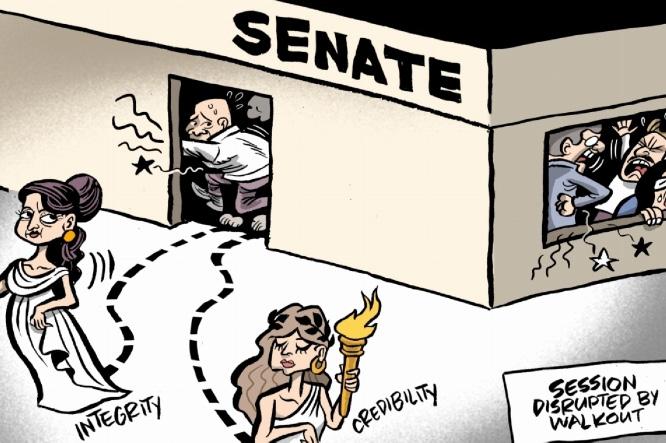
The leadership fight followed a walkout or boycott by Cayetano and his allies, whose absence prevented the Senate from conducting business for two days. The impasse ended on June 3 when Sen. Francis “Chiz” Escudero appeared on the floor, allowing 12 senators opposed to Cayetano to declare a quorum and
Marcos open to special session as Senate dispute threatens legislative work
Malacañang says President would act on formal request from Senate leadership recognized by Palace
by AJPress
MANILA — President Ferdinand Marcos Jr. is open to calling a special session of Congress if Senate leaders formally ask him to reconvene lawmakers, Malacañang said Thursday, June 4, as a leadership dispute in the chamber raised questions over pending legislation before the congressional break.
Palace Press Officer Claire Cas-
tro said Marcos was inclined to grant a formal request if it contains valid grounds, citing concern that Senate work could be delayed by the impasse. She said the President would act once a request is transmitted by the Senate leadership recognized by Malacañang.
Under Article VI, Section 15 of the 1987 Constitution, the President may call a special
u PAGE 3
Ombudsman files new graft, malversation charges vs. Discayas over Bulacan flood-control project
Case involving P53.9 million Calumpit project adds to separate pending proceedings involving contractor couple
by AJPress
ect in Calumpit, Bulacan. The case, filed before the Regional Trial Court in Malolos, stems from DPWH Contract ID No. 22CC0058, which covered the rehabilitation of a river protection structure in Calumpit. According to the Ombudsman, the questioned transactions allegedly gave St. Timothy Construction Corp. unwarranted benefits totaling P53,917,731.92 and caused
MANILA — The Office of the Ombudsman has filed graft and malversation charges against contractor couple Pacifico “Curlee” Discaya II and Cezarah Rowena “Sarah” Discaya, a company officer and several Department of Public Works and Highways personnel over alleged irregularities in a ₱53.9-million flood-control proju PAGE 2
Tony Meloto case draws response from GK USA as proceedings move forward
U.S.-based nonprofit says founder has had no role or authority with the organization since 2017 separation from Gawad Kalinga
by AJPress
MANILA — The arrest of Antonio “Tony” Meloto, founder of Gawad Kalinga, has prompted a public response from GK USA, the United States-based nonprofit connected to the Gawad Kalinga network, as the criminal case against him proceeds in the Philippines.
Meloto, 76, was arrested in Angat, Bulacan, on May 29 in connection with two counts of qualified trafficking in persons, according to authorities. Police said the arrest was carried out after a court issued a warrant, with no bail recommended.
PAGE 2
Padilla, Remulla scuffle at Senate as leadership dispute reaches flood-control hearing
The hallway confrontation came as rival Senate blocs clashed over whether a Blue Ribbon Committee proceeding could continue after a disputed reorganization.
by AJPress
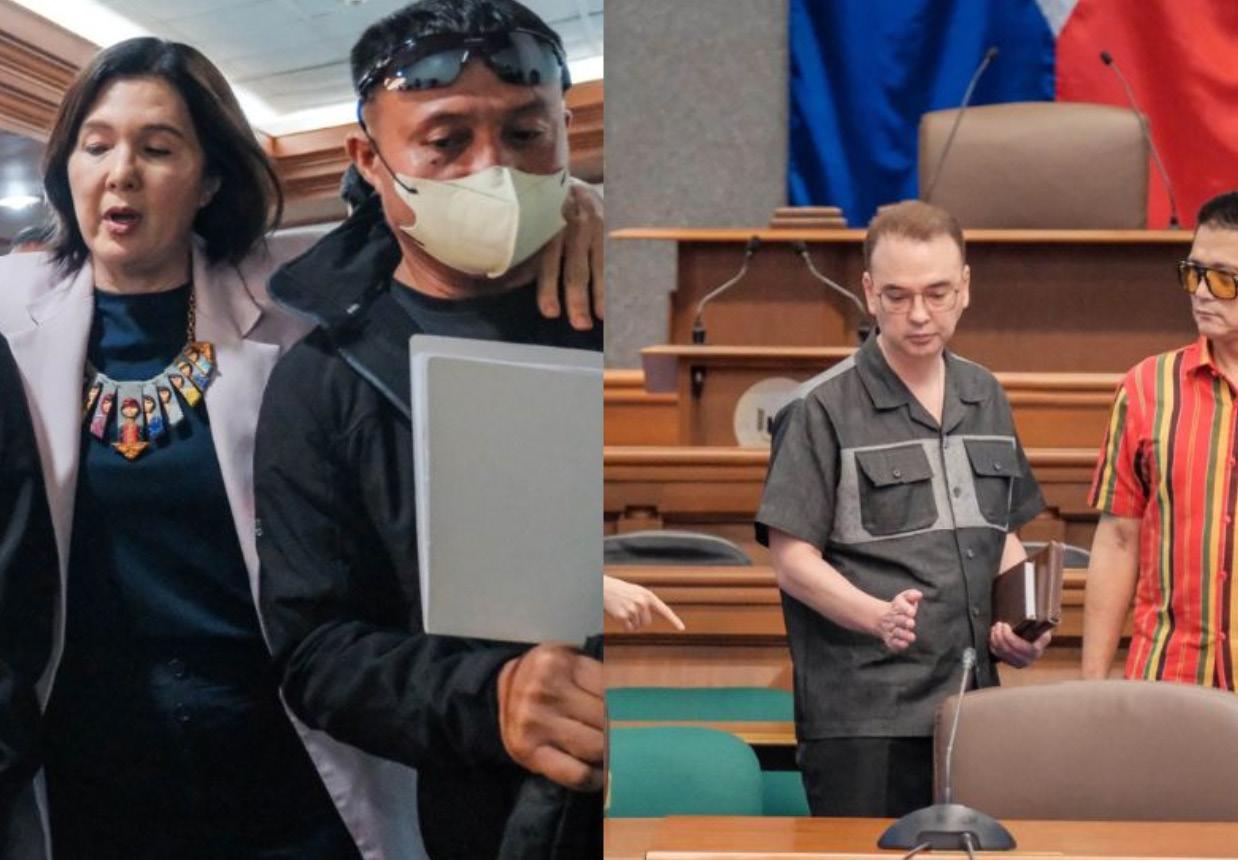
MANILA — A dispute over control of the Philippine Senate moved into public view Thursday, June 4, when Sen. Robinhood Padilla and Interior Secretary Jonvic Remulla figured in a brief scuffle during a contested Blue Ribbon Committee proceeding on alleged flood-control anomalies.
The incident occurred as Padilla and Sen. Pia Cayetano accompanied 18 men identifying
PAGE 2
Also published in LOS ANGELES, ORANGE COUNTY/INLAND EMPIRE, LAS VEGAS, NORTHERN CALIFORNIA, SAN DIEGO
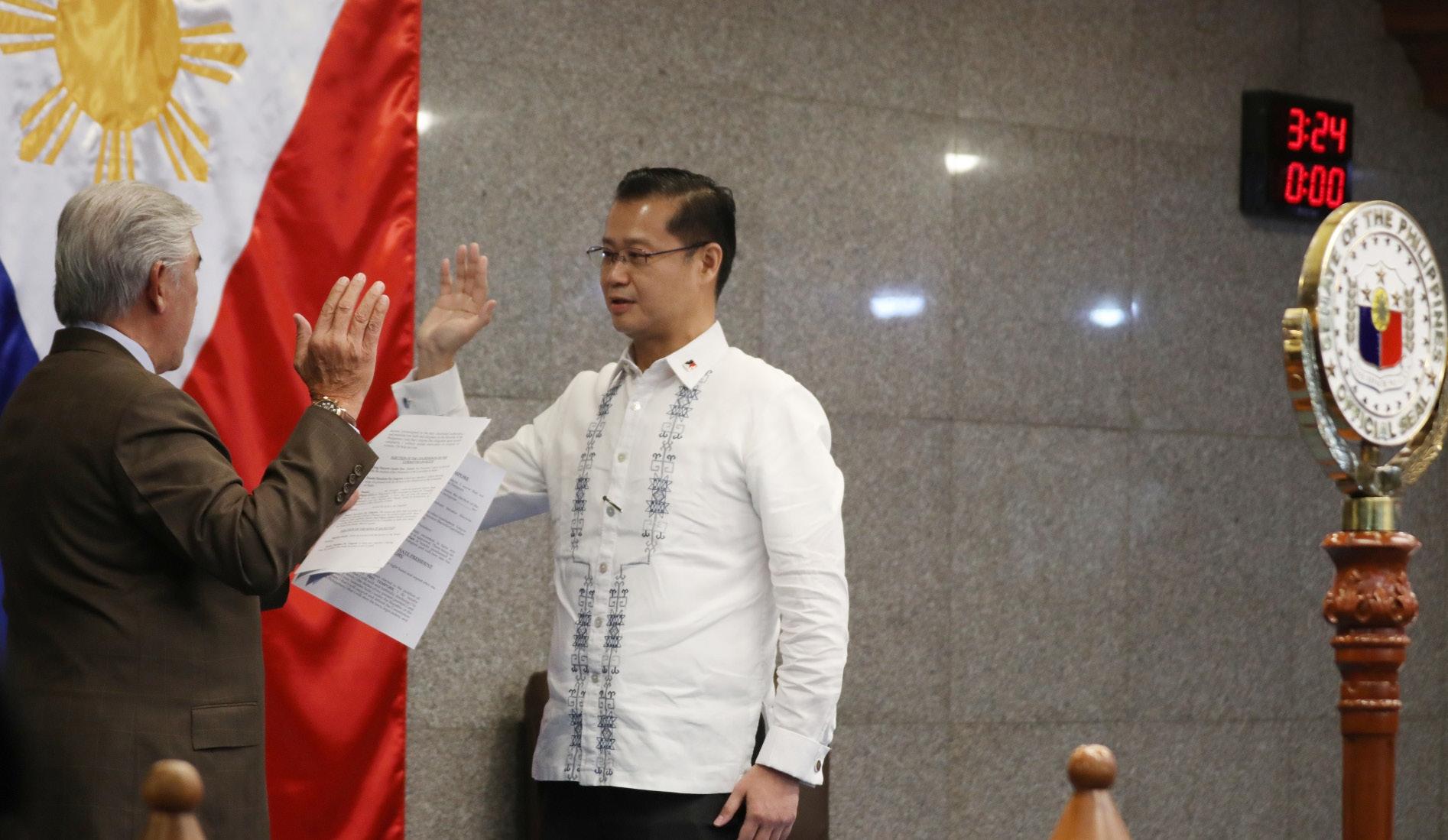
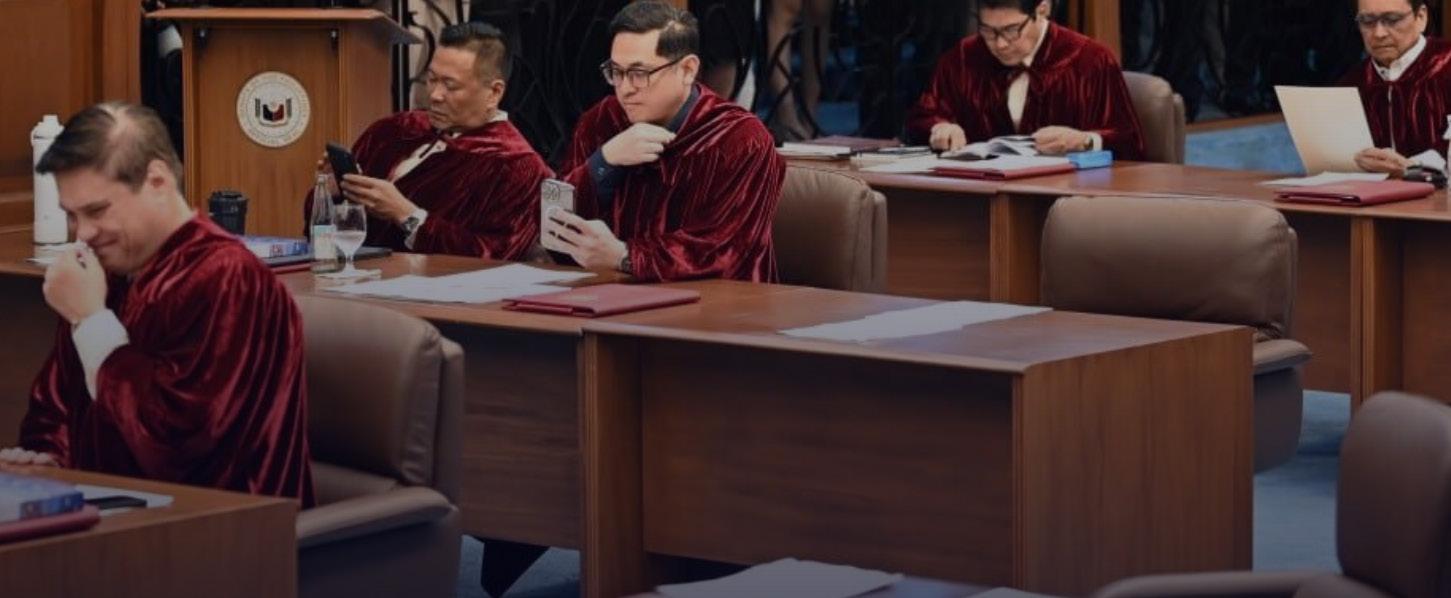
NEW SENATE LEADERSHIP. Senator Sherwin Gatchalian takes his oath as Senate President Pro Tempore and acting Senate President on Wednesday (June 3, 2026). The Senate adjourned sine die after electing a
MANILA — The Philippine Senate is operating under rival claims of authority after Sen. Sherwin “Win” Gatchalian was recognized by Malacañang
Gatchalian recognized as acting Senate president, Cayetano contests June 3 reorganization
F rom the F ront P age
Philippine Senate operates ...
PAGE 1 in court.
reorganize the chamber.
The session came after President Ferdinand Marcos Jr. publicly urged senators to return to work. Once a quorum was declared, the senators present elected Gatchalian Senate president pro tempore and designated him to exercise the powers of Senate president. Malacañang later recognized Gatchalian’s acting leadership, saying it respected the decision of the new Senate majority.
Cayetano rejected the proceedings and said he remained Senate president, arguing that the session and leadership change were invalid. His bloc has continued to challenge the reorganization and assert that the prior leadership remains in force.
The result is a Senate able to act, but under procedural uncertainty. Gatchalian’s side is exercising official leadership functions involving schedules, committee organization and internal operations, while Cayetano’s allies dispute that authority and could challenge major decisions politically or
That uncertainty became visible almost immediately.
On June 4, senators aligned with Cayetano proceeded with a Blue Ribbon Committee hearing on alleged irregularities in flood-control projects despite the leadership dispute. The hearing underscored the practical consequences of the row: senators can still convene and attempt to conduct proceedings, but the official status of those proceedings may depend on which leadership claim is ultimately recognized.
The legal dispute centers on quorum. The Integrated Bar of the Philippines said the June 3 session was lawful and valid under the Avelino doctrine, the 1949 Supreme Court ruling often cited in Senate quorum disputes. The IBP said 12 senators constituted a valid quorum under the circumstances and that acts made during the session are presumed official unless set aside by competent authority.
Former Senate President Franklin Drilon has said Su-
Tony Meloto case draws ...
The case stems from a Department of Justice resolution finding probable cause and directing the filing of charges in court. Meloto has denied the allegations and is presumed innocent unless proven guilty.
In a statement to volunteers and partners, GK USA Chairman Francis de los Reyes III said the news had been “stressful” for many supporters whose lives have been connected to the organization’s work in the Philippines.
GK USA said allegations of this nature involve “real people and families” and affirmed the importance of “a fair and impartial process for everyone involved.”
GK USA said its position had not changed since its official statement in July 2025.
The organization said Gawad Kalinga in the Philippines acted after hearing complaints in 2017, removed Meloto as chairman and separated him from official functions, leading to the public announcement of his resignation in January 2018.
In a March 10, 2025 official statement, Gawad Kalinga in
preme Court intervention may be needed if the leadership row is formally challenged. His view points to the central issue now hanging over the chamber: whether the June 3 reorganization stands unless a court rules otherwise, or whether Cayetano’s challenge can prevent Gatchalian’s leadership from being treated as settled.
The stakes extend beyond Senate titles. The chamber is expected to handle proceedings connected to the impeachment case against Vice President Sara Duterte, who has denied the allegations against her. Control of the Senate presidency affects who presides, who controls the calendar, how rules are interpreted and how committees are organized.
Until the Senate resolves the dispute internally or the Supreme Court issues a ruling, the chamber will continue to operate under contested authority: Gatchalian’s side exercising the recognized leadership functions, and Cayetano’s side challenging the validity of that authority. n
Ombudsman files new graft
financial injury to the government.
Named in the case were the Discaya couple; Ma. Roma Angeline Discaya Rimando of St. Timothy Construction Corp.; and DPWH Bulacan 1st District Engineering Office personnel Merg Jaron Caparas Laus, Brice Ericson Diaz Hernandez, Jaypee De Leon Mendoza, Ernesto Cosay Galang, Norberto de Leon Santos, Lorenzo Alcoriza Pagtalunan, Juanito Coronel Mendoza and Floralyn Yutuc Simbulan.
...
basis for computation or supporting documents to establish project accomplishment.
The charges include one count of violation of Section 3(e) of Republic Act No. 3019, or the Anti-Graft and Corrupt Practices Act, and one count of malversation of public funds through falsification of public documents under the Revised Penal Code. Recommended bail for the graft charge was set at P90,000 for each accused, while no bail was recommended for the complex malversation charge, according to the filing.
P96.5-million flood-control project, where the defense has disputed the “ghost project” characterization. Curlee Discaya has separately been reported under Senate detention after a contempt citation that the Pasay City Regional Trial Court upheld in February 2026. The couple is also facing BIR tax complaints involving P7.18 billion in alleged liabilities, separate from the Ombudsman cases.
the Philippines said several male SEED scholars who were part of the Spartan program raised complaints in 2017 alleging physical violations by Meloto. The organization said its Board of Trustees conducted an internal investigation and that Meloto tendered his resignation as chairman of Gawad Kalinga, SEED Philippines and Enchanted Farm on Oct. 26, 2017.
Gawad Kalinga said it acted discreetly at the request of complainants to protect their privacy and initiated support measures with professionals, including a crisis interventionist and therapists.
In a July 18, 2025 statement addressed to GK leaders, the Gawad Kalinga Board said questions had arisen about Enchanted Farm and Meloto’s involvement after his 2017 resignation. The board said Meloto visited and engaged members of the Enchanted Farm community in May 2025 and worked with some community leaders and members to organize an event there.
The board said it formally advised Meloto not to visit Enchanted Farm because of
pending complaints against him. It said the situation created tensions involving some community leaders, members and mission workers, and that talks of physical threats against some mission workers circulated. To de-escalate the situation, GK said its leadership decided to pull out GK and SEED mission workers.
GK USA, in its latest statement, said Meloto has had “no role, authority, or affiliation” with the U.S. nonprofit since his separation from Gawad Kalinga in 2017. The organization described itself as a U.S. nonprofit 501(c)(3) and said it is committed to honoring and abiding by the judicial process in the Philippines.
“As a community based on advocating for those who have less, we stand for justice for all,” the statement said.
GK USA also said it does not tolerate “abuse, exploitation, harassment, or misconduct in any form,” and urged supporters to respect the process as the case proceeds. It said GK is “not just one person” and that volunteers remain committed to working with communities in the Philippines. n
The Ombudsman alleged that payment for the project’s first billing was released despite an unapproved disbursement voucher. It also alleged that full payments for dredging and embankment items were made without sufficient
The Bulacan case adds to separate pending matters involving the Discayas. Sarah Discaya has been reported detained at the Lapu-Lapu City Jail in connection with a Davao Occidental graft and malversation case over an alleged
The new Bulacan case represents another formal stage in the government’s scrutiny of alleged irregularities in public infrastructure projects. The filing of charges does not constitute a conviction. The allegations must still be established in court, where all accused are presumed innocent unless proven guilty beyond reasonable doubt. n
Padilla, Remulla scuffle at Senate ...
1
themselves as former Marines into the Senate complex. The men had been invited as resource persons by the bloc aligned with Sen. Alan Peter Cayetano, who continues to challenge the June 3 reorganization that placed Sen. Sherwin Gatchalian in the role of acting Senate president.
Video footage of the incident showed Padilla, Remulla and others in a crowded hallway near the Senate elevators before the encounter turned physical. The footage showed jostling, but the sequence that led to the scuffle and the intent of those involved remained disputed.
Remulla denied that he tried to block Padilla, Cayetano or the invited resource persons. In a message to reporters, Remulla said he was walking out when he was pushed aside. Gatchalian had earlier said he sought Remulla’s
assistance to help maintain order and protect the Senate premises.
The confrontation unfolded a day after senators opposed to Cayetano’s leadership moved to reorganize the chamber.
Gatchalian was recognized by the Marcos administration as acting Senate president, while Cayetano denounced the action and maintained that he remained the lawful head of the Senate.
The dispute immediately affected committee work.
Gatchalian’s side said no official Senate business would be held on June 4, including committee hearings. The Cayetano bloc proceeded with the Blue Ribbon proceeding, with Sen. Pia Cayetano continuing to preside. The Gatchalian-led side had recognized Sen. Erwin Tulfo as the new Blue Ribbon Committee chair after the reorganization.
The result was a rare public collision of competing claims
of authority: one bloc asserting control over the Senate’s official schedule and committee assignments, and another proceeding under the leadership structure it continued to recognize.
Malacañang urged senators to restore order. Palace Press Officer Claire Castro, asked about the disorder in the chamber, said the President’s message to senators was: “Umayos kayo” - get your act together.
The Senate dispute comes as the chamber faces politically sensitive proceedings, including investigations into public works spending and its expected role in the impeachment process involving Vice President Sara Duterte. The leadership conflict has raised questions about which bloc may validly control committee hearings, staff instructions and the conduct of Senate business before Congress fully resumes. n
PAGE
ROLLBACK. A “Price Drop Alert” sign is displayed at a gasoline station along Quezon Avenue in Quezon City on Tuesday (June 2, 2026). Oil firms slashed pump prices by PHP4 per liter for gasoline, PHP8 per liter for diesel, and PHP10 per liter for kerosene, marking the second consecutive week of fuel price reductions. PNA photo by Robert Oswald P. Alfiler
Trump administration clarifies ...
PAGE 1
noncitizens already in the United States to apply for lawful permanent residence without first leaving the country. Federal immigration guidance continues to describe adjustment of status as an available pathway for eligible applicants inside the United States.
On May 22, U.S. Citizenship and Immigration Services announced that it would grant adjustment of status only in “extraordinary circumstances.” The announcement said the immigration system is designed for temporary visitors to leave when their authorized stay ends and that a temporary visit should not function as the first step in the green-card process.
That language prompted immediate concern because adjustment of status has long been used by eligible applicants in family-based, employment-based and other categories. Immigration attorneys said the announcement created uncertainty over how broadly the new policy would be applied.
The Department of Homeland Security later clarified that the policy would not prevent applicants who legitimately and properly qualify from obtaining a green card, though some applicants may have to process their cases overseas through the State Department. DHS also said the change would not have a noticeable impact on highly qualified applicants and skilled professionals who have followed the law.
The clarification does not erase the significance of the USCIS policy memo.
The May 21 memorandum instructs officers to evaluate adjustment of status as a discretionary benefit and to consider whether consular processing abroad is available to the applicant. In practical terms, immigration lawyers said the guidance could give officers more room to ask why an applicant should be allowed to complete the process inside the United States rather than through a U.S. consulate overseas.
For applicants, the practical effect remains unsettled. The impact may depend on visa category, immigration history, family relationship, employment basis, length of stay, unlawful-presence issues, humanitarian factors and whether the applicant is found to merit a favorable exercise of discretion.
The uncertainty is especially important for immigrant communities with large numbers of family- and employment-based applicants, including Filipinos. The policy does not appear to impose one uniform rule on all green-card applicants. But it may expose some applicants to additional questions, requests for evidence or pressure to complete the process abroad.
Immigration lawyers said some applicants have already faced questions about why they sought adjustment of status in the United States instead of applying through a U.S. embassy or consulate in their home country. Some
have also reported additional requests tied to financial support, public-charge concerns and other case-specific issues.
The stakes are substantial. In fiscal year 2024, the most recent complete year available in federal annual data, nearly 1.36 million people became lawful permanent residents. More than 780,000 adjusted status from within the United States. Partial 2025 data indicate the pathway remained heavily used, but full-year figures have not yet been published in the same annual format.
The administration has framed the guidance as a return to the intended distinction between temporary stays and permanent immigration. Immigration advocates and legal-service organizations have warned that the announcement could discourage lawful applicants, separate families or create avoidable delays for people already pursuing permanent residence through existing legal channels.
The new policy signals a stricter and more discretionary review of some green-card applications filed from inside the United States.
Applicants with pending or planned cases are being urged by immigration attorneys not to rely on broad public summaries. The effect of the memo will likely depend on the facts of each case and on how USCIS applies the guidance in interviews, requests for evidence and final decisions. n
Marcos open to special session ...
PAGE 1
session of Congress at any time. The current legislative calendar set June 5 as the last day of session before Congress adjourns from June 6 to July 26.
The issue follows days of uncertainty in the Senate after rival blocs asserted competing claims of authority.
Malacañang has recognized Sen. Sherwin Gatchalian as acting Senate president after a group of senators moved to reorganize the chamber.
Sen. Alan Peter Cayetano has disputed the move, called it unconstitutional and maintained that he remains
the lawful Senate president. The Senate had failed to convene earlier in the week amid the standoff, prompting Marcos to urge senators to return to work. Proceedings resumed after enough senators appeared to establish a quorum, allowing Gatchalian’s bloc to proceed with leadership and committee changes.
Castro did not provide a complete list of measures that could be taken up in a special session. Palace statements and news reports framed the possible reconvening as a way to avoid fur-
Pentagon chief cites Philippines as example of defense burden sharing
by AJPress
SINGAPORE — U.S. Defense Secretary Pete Hegseth cited the Philippines as an example of the kind of ally Washington wants in the Indo-Pacific: a treaty partner investing more in defense, improving coordination with American forces and preparing for a security environment increasingly shaped by competition with China.
Speaking at the Shangri-La Dialogue in Singapore, Hegseth said the United States is moving away from alliances built on dependency and toward partnerships defined by shared responsibility. He said Washington wants “partners, not protectorates,” arguing that security in the Pacific can no longer rest disproportionately on American military power.
The remarks placed Manila inside a broader U.S. push for allies to assume more of the financial and operational burden of regional defense. Hegseth said a favorable balance of power requires partners with military strength, industrial capacity and political resolve, and he urged countries in the region to increase defense spending.
Hegseth singled out the Philippines after discussing other U.S. partners in Asia. He said Manila is shifting its focus toward external defense, enhancing interoperability with American forces
and investing in the modernization of its military and coast guard. He also cited this year’s Balikatan exercises, which U.S. officials described as the largest iteration of the annual drills, as an example of joint training involving advanced American capabilities.
Philippine and U.S. officials have increasingly framed the alliance around deterrence, maritime security and territorial defense.
The shift comes amid repeated confrontations between Chinese and Philippine vessels in the South China Sea, including waters Manila refers to as the West Philippine Sea. Beijing claims much of the South China Sea, despite a 2016 arbitral ruling that rejected the legal basis of its sweeping claims. China does not recognize the ruling.
Under President Ferdinand Marcos Jr., the Philippines has expanded security cooperation with the United States while deepening defense ties with Japan, Australia and other partners.
In February, Manila and Washington reaffirmed the 1951 Mutual Defense Treaty and said it applies to armed attacks on either country’s armed forces, aircraft and public vessels, including coast guard vessels, anywhere in the South China Sea.
The alliance also rests on the Visiting Forces Agree-
ment and the Enhanced Defense Cooperation Agreement, which allow rotational access, joint training and expanded military cooperation. U.S. and Philippine officials have identified those frameworks as central to improving interoperability and supporting a more modern Philippine defense posture.
Hegseth said Marcos had approved a budget that included a 12% increase in defense spending. Philippine budget materials for 2026 list P423.7 billion for national defense, an allocation the Department of Budget and Management has linked to sovereignty protection amid evolving geopolitical conditions.
Hegseth’s comments on China were direct but calibrated. He cited Beijing’s military buildup as a source of concern, while also saying the United States seeks a stable relationship with China and more regular military-to-military communication to reduce the risk of miscalculation.
The significance of Hegseth’s remarks was not that Manila has completed its defense transition, but that Washington sees the Philippines moving in the direction it now expects of key allies: higher defense investment, closer operational coordination and a larger role in sustaining deterrence in the Indo-Pacific. n
Marcos names Lino Cayetano as new PTV-4 chief
ther delay in pending legislative work and appointments. A special session would allow Congress to meet during the adjournment period, but it would not by itself resolve the Senate leadership dispute. That question remains within the chamber’s internal processes unless raised before the courts.
Marcos had not issued a call for a special session. Malacañang says the President is prepared to act if a formal request is submitted with sufficient grounds by the Senate leadership it recognizes. n
by AJPress
MANILA — President Ferdinand Marcos Jr. has appointed former Taguig Mayor Lino Edgardo Cayetano as general manager of People’s Television Network Inc., placing a former local executive and television director at the helm of the state-run broadcaster.
The Presidential Communications Office announced the appointment on June 3, saying Cayetano would succeed Maria Lourdes Fagar as head of PTV-4. He took his oath on June 4 before PCO
Acting Secretary Dave Gomez.
Cayetano is part of one of the country’s most visible political families. He is the younger brother of Senate President Alan Peter Cayetano and Senator Pia Cayetano, and the son of the late former senator Rene Cayetano. Before entering politics, Cayetano worked in television as a director and creative consultant. According to the PCO, he earned a Mass Communication degree from the University of the Philippines and a diploma in film from the New York Film Academy. His public career inclu-
ded serving as representative of the Second District of Taguig-Pateros from 2013 to 2016 and mayor of Taguig from 2019 to 2022.
PTV-4 operates as a government television network under the Marcos administration’s communications structure. The leadership change comes as state media faces a more fragmented information environment shaped by digital platforms and heightened scrutiny of official messaging.
The PCO thanked Fagar for her service but did not provide a detailed public explanation for the change. n
Luistro: House to heed Gatchalian’s orders on Duterte impeachment trial
by Gabriel Pabico lalu Inquirer.net
MANILA, Philippines — If the two warring camps in the Senate send their directives regarding the impeachment trial of Vice President Sara Duterte, the prosecution team will heed the instructions of acting Senate President Sherwin Gatchalian, Batangas Rep. Gerville Luistro said on Thursday.
Luistro, lead prosecutor for the impeachment trial, explained in an online interview that the prosecution team would follow only the position of the institution it represents, the House of Representatives.
According to Luistro, the House leadership had already acknowledged the legitimacy of Gatchalian’s position, as Speaker Faustino “Bojie” Dy III congratulated Gatchalian on Wednesday.
“I think it is logical that we follow the position of the House of Representatives, and yesterday, I understand, the House of Representatives recognized the new leader-
ship of the Senate, and that is through the acting [the] Senate president, Sen. Win Gatchalian,” she explained.
“I understand that yesterday, the Palace, which represents the executive branch, also recognized the new Senate leadership,” she added.
On May 26, the Senate ended its session after the minority bloc walked out of the plenary in response to the majority’s push to discuss a proposed amendment to the Senate rules from Sen. Rodante Marcoleta.
Marcoleta had sought to change the rules to allow online voting. However, minority senators questioned why the matter was being rushed and why the rule change was being raised through a motion instead of a resolution.
In response to the walkout, the majority bloc refused to attend the session last Monday and Tuesday, resulting in the chamber failing to conduct any legislative work.
The paralysis ended when a majority member, Sen. Francis Escudero, attended
the session on Wednesday, giving the senators a quorum.
During the session, Gatchalian was elected Senate president pro tempore, replacing Sen. Loren Legarda. Sen. Juan Miguel Zubiri, meanwhile, was elected majority leader.
Luistro said this scenario, where the two blocs continue to trade barbs, “causes apprehensions” among lawmakers.
Despite these concerns, Luistro said it is clear that the prosecution will heed the current leadership.
“With all due respect to the previous leadership, we will follow the instruction and order coming from the new leadership. Again, the reason is we are just following the direction of the institution. And since the House of Representatives has already recognized the new leadership, it means the 11 prosecutors should also follow that leadership,” she added.
Duterte was impeached u PAGE 8
Jalen Brunson’s dad once played for Ginebra in the PBA
Before the Knicks captain became one of the NBA’s biggest guards, his father Rick Brunson made a brief Philippine basketball stop with Gordon’s Gin
by AJPress
Jalen Brunson is now one of the defining guards of his NBA generation: a New York Knicks captain, a two-time NCAA champion from Villanova and a second-round pick who became the face of one of basketball’s most demanding franchises.
But Filipino basketball fans have a fun fact to add to the Brunson story.
Long before Jalen became a Knicks star, his father, Rick Brunson, played briefly in the Philippine Basketball Association. The elder Brunson, now an assistant coach with the Knicks, suited up as an import for Gordon’s Gin, the Ginebra franchise, during the 1998 PBA Governors’ Cup.
ski. Even brief imports can remain part of the country’s basketball memory, especially when they passed through Ginebra.
It was a cameo, not a long PBA career. Rick Brunson appeared in one game, a do-or-die elimination matchup against Formula Shell on Nov. 6, 1998. In that lone outing, he finished with 21 points, five rebounds and seven assists before being replaced as the team’s import.
For Filipino fans, the detail lands because of the team involved. Gordon’s Gin was part of the Ginebra line, one of the most followed franchises in Philippine basketball, then guided by legendary playing-coach Robert Jawor-
The connection became more charming years later, when Jalen Brunson visited Manila with Team USA for the 2023 FIBA Basketball World Cup. Asked about his father’s brief PBA appearance, the younger Brunson appeared surprised to learn that Rick had played in the Philippines before him.
That moment gave Filipino fans a local thread to one of the NBA’s most prominent current players: Jalen Brunson was not the first Brunson to play on Philippine soil.
Rick Brunson’s larger ca-
reer was in the NBA. Undrafted out of Temple, he worked his way into a nine-year NBA career and appeared in 337 regular-season games. After his brief Philippine stop, he returned to the United States and became part of the Knicks team that reached the 1999 NBA Finals.
Jalen has since built a far larger basketball profile of his own. He won national titles at Villanova, began his NBA career with Dallas, signed with New York in 2022 and was named the Knicks’ 36th captain in 2024.
The PBA footnote does not define Jalen Brunson’s career. It simply gives Filipino fans a small, delightful claim on the family story. n
GMA profit falls as election ad boost fades
Network remains a ratings leader, but first-quarter results show the strain on traditional broadcast advertising
by AJPress
MANILA — GMA Network
Inc. reported a steep drop in first-quarter earnings in 2026, as the absence of election-related advertising exposed continuing pressure on a broadcast business still heavily dependent on commercial placements.
The company’s net income fell to about P102 million in the first three months of the year, down 87 percent from roughly P801 million a year earlier. Revenues declined 28 percent to P3.36 billion, while advertising revenue dropped 31 percent to P2.98 billion, according to the company’s quarterly report.
GMA attributed the decline largely to the loss of political advertising that had lifted results during the 2025 midterm election cycle. The comparison was unusually strong: in the first half of 2025, the network reported consolidated revenues of P10.1 billion and advertising revenue of P9.3 billion, driven in part by election-related placements.
The latest figures do not suggest a collapse in GMA’s audience position. The company remains one of the Philippines’ dominant free-to-air broadcasters and continues to report ratings leadership. But the results show a broader challenge for traditional television: large audiences
do not automatically produce the same earnings when advertising budgets are spread across broadcast, streaming, social media, online video and other digital channels.
GMA reported growth in consumer sales, production services, licensing fees and digital advertising. Still, those gains did not fully offset the decline in core advertising revenue.
The first quarter placed GMA’s business model in sharper focus. Ratings remain valuable, but in a fragmented media market, the larger test is whether broadcast scale and digital reach can be converted into steadier earnings. n
Former NBA guard Rick Brunson, father of New York Knicks star Jalen Brunson, is seen during his brief 1998 PBA stint with Gordon’s Gin, the Ginebra franchise, in the Governors’ Cup. Brunson played one game as an import, finishing with 21 points, five rebounds and seven assists.
FeAtures OPiniOn
Pride month reminds us no one should be shamed into silence
Pride Month is observed every June, but its meaning should not be reduced to a calendar observance, a parade route or the rainbow colors that appear across public spaces each year. At its core, Pride carries a lesson every community must continue to learn: respect is not optional, acceptance is not weakness, and human dignity should never depend on public approval.
Pride commemorates the June 1969 Stonewall uprising in New York City, a defining moment in the modern LGBTQ+ rights movement. What began as resistance to harassment and exclusion became part of a broader demand for recognition, safety and equal treatment. It reminded the world that no community should have to plead for the right to exist openly.
That history matters because progress often begins when people pushed to the margins refuse to disappear. Pride Month asks the public to see LGBTQ+ individuals not as issues to be
debated, but as sons and daughters, neighbors, co-workers, friends, relatives and citizens whose lives carry the same human worth as anyone else’s.
Respect does not require everyone to share the same beliefs, language or life experience. It requires the discipline to listen before condemning, to speak without demeaning, and to recognize that disagreement must never become permission for cruelty.
Acceptance goes deeper. It means making space for people to live without shame or fear. It means a young person should not have to choose between honesty and belonging. It means families, schools, workplaces, faith communities and civic institutions should not become places where people are forced to hide parts of themselves in order to be safe. For Filipino and immigrant communities, where family, faith and reputation often car-
ry enormous weight, the lesson is especially meaningful. Love cannot be limited only to the child who conforms, the relative who is easy to
explain, or the neighbor whose life mirrors our own. A family’s true strength is tested not when
No Free Lunch
Cielito F. Habito
DISGRACEFUL,” “outrageous,” “shameless,” “hypocrites,” “inutile,” “grandstanding,” “power-tripping,” “arrogant,” “greedy opportunists,” and more are words flying about nowadays to describe the Philippine Senate, or some members thereof. Someone in my family humorously remarked, “Ang sarap nilang tirisin” (I’d love to crush them between my thumbnails, like
When politics consumes a nation
a flea or bedbug, which is what she in effect likens them to—tiny and repulsive.) Many of us look back with nostalgia to when members of that once august chamber truly lived up to that adjective, defined by my dictionary as “inspiring awe and reverence, majestic, dignified, worthy of respect.” Those who now lord it over that chamber are—in the eyes of most of us, I believe—the diametric opposite. Instead of
inspiring awe and reverence, they invite rebuke and ridicule. Rather than be admired, they are despised for shaming the nation. To me, listening to them talk can be stomach-turning.
The recent events in the Senate have made us all see quite graphically how the country’s political system has degenerated through the years, rather than progressed and matured
babe’s eye view
In third and fourth year high school, I would save my baon so I could take a jeepney ride to go to the Senate once a week near Luneta Park, usually on Fridays. In those days, there was no such thing as No ID, No Entry for Senate visitors; no need for a QR code to enter the august halls of what was then the most prestigious legislative assembly in Asia.
In white shirt and khaki
Intolerable politics may kill us in the end
short pants, I would sit at the orchestra seating area, first row, separated only by a solid narra wood railing from the senators. You could touch the senators, in flesh and blood, looking so respectable in their white suits of gabardine fabric. Back then, the senators’ conscience was as white as their clothing.
The years were 1964 and 1965. That was the best Senate the Philippines ever had.
I saw Ferdinand E. Marcos presiding as Senate president. Senators in action were a sight
to behold. There was respect and camaraderie. The language was perfect English; Spanish was their other language. No Tagalog then. Oratory was first class. Verbal insults were delivered in such elegant language and nuance you wouldn’t notice immediately you just suffered an uppercut. Answers to interpellation offered lessons rich in law, history, public policy, moral uprightness and educational brilliance. There were no crying ladies. No
PAGE 7
Babe Romualdez
Pride month reminds us ...
everyone agrees, but when difference asks for compassion.
Pride Month does not ask society to abandon conviction. It asks society to reject humiliation. The ability to hold firm beliefs while still protecting another person’s humanity is not moral confusion. It is maturity.
The work of acceptance is often quiet. It happens when a parent chooses to listen, when a friend refuses to mock, when a workplace protects fairness,
and when a community stops treating someone’s identity as a scandal. These acts may not make headlines, but they can change the life of someone who has long carried fear in silence.
Pride Month, then, is not only a celebration of visibility. It is an invitation to examine how we treat people when their lives challenge our assumptions. It calls us to build communities where dignity is not conditional, where re-
Intolerable politics ...
shouting and boxing matches, on and off session hall. There were no fashion shows; no use of tablecloth as formal garb at the rostrum. Senators’ offices did not serve double duty for marijuana sessions, beauty enhancement work, nor storage rooms for maletas of cash.
In the 1960s batches of senators were several Bar topnotchers – Marcos, Jose W. Diokno, Juan Liwag, Emmanuel Pelaez, Jovito Salonga, Tecla San Andres Ziga, Rodolfo Ganzon, Lorenzo Sumulong and Arturo M. Tolentino, to name some. The nationalist and anti-collaborator prosecutor Lorenzo Tañada was there too. He was UP Law and a Harvard Law masters. Tecla San Andres Ziga was the first woman Bar topnotcher. She was senator of the 1960s. Eva Estrada Kalaw was the only woman in the Fifth Congress. She was a beauty-and-brains queen and journalist and had a master’s degree in social work. Jose Roy and Dominador Aytona were lawyer-economists. Soc Rodrigo was a lawyer-poet. Wenceslao Lagumbay had a master in comparative law at George Washington University.
Up to the late 1960s, a third of 24 senators then were Bar topnotchers or topnotch lawyers. Several were tycoons who made money the old-fashioned way – through hard work and entrepreneurship –Fernando Lopez, Gil Puyat, Gaudencio Antonino. There were perennial reformers and orators like Raul Manglapus and Manuel Manahan.
Back in the 1960s, you could approach your senators anytime. As a campus journalist, I asked for an interview with Senator Jose W. Diokno. He sat down with me for two hours in his Senate office to explain the Investment Incentives Act of 1967 (Republic Act 5186), the
spect is practiced even before full understanding, and where acceptance becomes a bridge rather than a battleground. In the end, Pride teaches a simple but demanding truth: people do not need to be identical to belong. They need to be seen, protected and treated as fully human. That is not only an LGBTQ+ lesson. It is a lesson for every family, every faith tradition, every neighborhood and every nation that claims to value justice. (AJPress) n
law that created the Board of Investments (BOI). I also asked to interview Beningo “Ninoy” S. Aquino Jr., elected senator in 1967. He met with me briefly and told his young chief of staff, Raul S. Roco, 26, to explain to me, a campus journalist, the law that would lower the voting age. For two hours. By tradition, the Senate was the training ground for future presidents. And presidents were usually Bar topnotchers. In fact, eight presidents were Bar topnotchers – Manuel Quezon, Sergio Osmeña, Manuel Roxas, Jose P. Laurel, Elpidio Quirino, Carlos Garcia, Diosdado Macapagal and Ferdinand Marcos Sr. During their time as presidents, the Philippines became the second most prosperous country in Asia, after Japan.
In fact, I believe the Philippines was the most prosperous or richest country in Asia from the late 1930s to the late 1960s – four decades of solid economic growth unmatched then anywhere in the region. Japan was devastated by two nuclear bombs. True, Manila was devastated but it was because of the US Army bombing which levelled the city designed by the famous Burnham. The master urban blueprint of Manila was designed by renowned American architect-city planner Daniel Burnham in 1905. Known as the Burnham Plan, it envisioned Manila as a tropical Washington DC with wide boulevards, grand waterfront parks and majestic neoclassical government buildings.
Today, you are a college dropout, a plain housewife, a general, an economist, a bigotilyo or simply a bum, or a bigtime plunderer – you run for president. It’s the next best thing to doing nothing. Because of the declining quality of presidential material lately,
I have been training my dog to run for president. Why a dog for president?
Well, a dog is loyal to his master. He won’t steal. A dog is a good guard. He will protect the West Philippine Sea. A dog has more bark than bite. He won’t kill people. A dog has sharp sense of smell. He won’t do or deal with drugs. Of course, dogs have no first ladies. Today, in the present Senate, senators behave worse than fighting cats and dogs.
A third of senators today are siblings – good ones, bad ones, in between. A third of senators today are movie stars or broadcasters. Two are being hunted for being murderers – criminals against humanity. Five are facing cases of plunder or massive stealing of taxpayers’ money. Two are being investigated for stock market manipulation. A number are swindlers. They don’t keep their promises. There are a few lawyers, but not Bar topnotchers. The lawyer-senators are known for things other than excellence in law. And nearly all senators love money – for the fun and fund of it.
Why did the Senate decline to its present nadir? Answer: the abolition of the two-party system, the Nacionalista and the Liberal Party. Until 1972, the NP and LP competed for power. To capture Malacañang, the party must first capture the Senate. To capture the Senate, you needed quality candidates –the Bar topnotchers. To capture Malacañang, you needed quality candidates – the Bar topnotchers. (Philstar.com)
The opinions, beliefs and viewpoints expressed by the author do not necessarily reflect the opinions, beliefs and viewpoints of the Asian Journal, its management, editorial board and staff.
Email: babeseyeview@gmail.com n
When politics consumes a nation ...
PAGE 6
toward bringing us closer to a prosperous, secure, and nurturing republic. There seems to be no better example than the Philippines of how the politics of power can consume a nation to the point of threatening a slide into a failed state. In the past, I’ve called politics our national malady, because it’s not only those wielding political power who are consumed by it, but also ordinary citizens who are spectators, victims, and enablers all at the same time. And it’s that pervasiveness of politics in our daily lives that makes it so hard for us to get out of the quagmire we have been trapped in as a nation for too long.
As an economist, I’ve struggled to explain our stigma of consistently ranking at or near the bottom on so many measures of socioeconomic well-being. I’ve constantly written about them over the past 23 years of this column, and addressed them in countless talks with various audiences. Be it price inflation, unemployment, average income or gross domestic product, poverty, export performance, agricultural output including agri-based exports, foreign direct investments, exchange rate stability, quality of infrastructure and logistics, power cost, ease of doing business, malnutrition and child stunting, education outcomes, and much more, the list of things where
we are a miserable loser and bottom-dweller just goes on and on.
Are we such a God-forsaken nation that we find ourselves at the tail end of nearly every measure that matters for human welfare and national well-being? How can we say so, when we are in fact among the most naturally endowed countries on Earth, blessed with abundant minerals, wide biodiversity, year-round favorable agro-climatic conditions not seen in rich countries, and yes, plentiful human resources? We are a classic illustration of the “natural resource curse,” aka “paradox of plenty” described in development literature, where resource-rich countries tend to have less economic growth, less democracy, and worse development outcomes than far less-endowed countries. One only needs to look at Singapore or Japan to see the contrast. Why the paradox? Is it because where there’s abundance, a small minority will always manage to capture it for their own narrow benefit? Or does such wealth always attract foreigners who siphon it away from the locals, who logically have a claim for the benefits, especially in places with a colonial past? Or does abundance naturally breed complacency, mismanagement, and greed? I have long believed that the single biggest reason why the Philippines failed to keep up with its neighbors is politics and bad politicians. How did we get
to a point where nearly every institution and facet of governance has been so thoroughly mangled as to no longer serve the common good, which was what they were designed and meant for, but instead feed the lust for wealth and power of a few? It has so permeated the bureaucracy that even the lowliest of bureaucrats see their positions of even minor power as vantage points for extracting whatever cash they can from the general public. We are witnessing a total perversion of public servants’ anointed mission of promoting the greatest good of the greatest number, twisted into one where they pursue for themselves the greatest gain from (the hardearned taxes of) the greatest number.
Eight years ago, I wrote that unless and until our politicians find it in their hearts to put the common good above self-gain, politics will remain our biggest block to building our economy and our nation (“Our biggest block,” 8-8-18). It still is, even more so. How and where do we begin to arrest our downhill slide when those who make the rules are the ones causing it? Sorry, but I don’t have ready answers. I can only rant, hope, and pray. (Inquirer.net)
* * *
The opinions, beliefs and viewpoints expressed by the author do not necessarily reflect the opinions, beliefs and viewpoints of the Asian Journal, its management, editorial board and staff. * * * Email: cielito.habito@gmail.comn
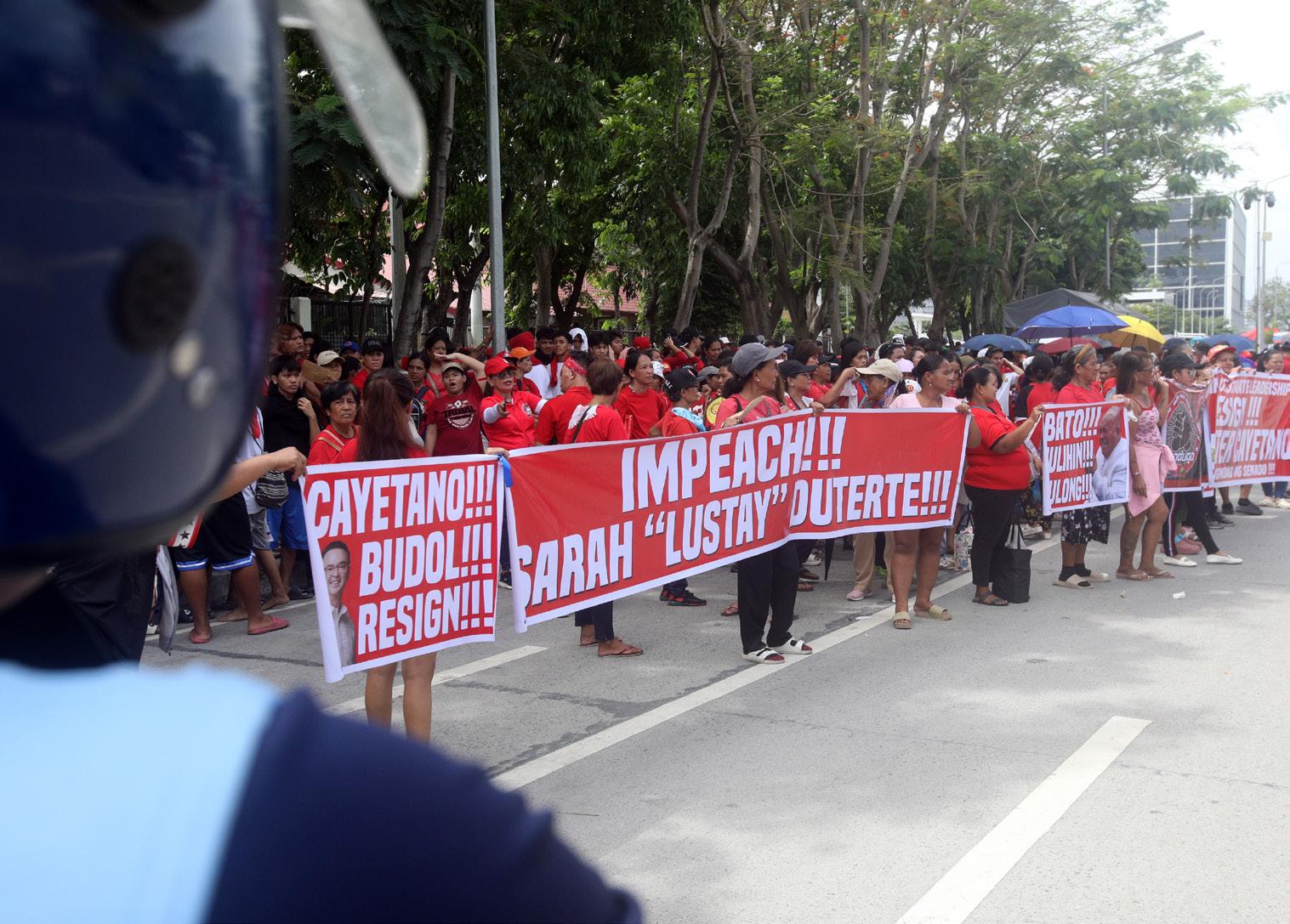
IMPEACHMENT CALL. Groups calling for the impeachment of Vice President Sara Duterte rally outside the Senate compound in Pasay City on Thursday (June 4, 2026). The rallyists are also calling for the resignation of Senator Alan Peter Cayetano as Senate President amid the confusion that ensued following a leadership shakeup in the chamber.
(PNA photo by Yancy Lim)
Luistro: House to heed...
by the House on May 11, with 257 lawmakers voting in favor of adopting House Resolution No. 989, which contains the Articles of Impeachment against Duterte. The trial at the Senate Impeachment Court is expected to start on July 6.
Gatchalian and Cayetano’s struggle over Senate leadership and the push for a functional chamber is the latest in a weeks-long internal rift.
Since May 11, the Senate has been embroiled in controversy — from Cayetano assuming the Senate presidency after Sen. Ronald “Bato” dela Rosa’s return gave his camp a slight edge to dela Rosa evading arrest from National Bureau of Investigation (NBI) personnel serving an arrest order from the International Criminal Court.
On May 13, violence erupted in the Senate after gunshots were heard inside the facility. Cayetano’s camp claimed the Senate was under attack from NBI personnel stationed at the adjacent Government Service Insur-
Batangas Rep. Gerville Luistro. Screengrab from the Facebook page of the House of Representatives of the Philippines
ance System (GSIS) building.
Both the Senate and GSIS buildings are located within the GSIS compound in Pasay City. The NBI said the GSIS had requested its presence to ensure security on the premises.
An initial investigation showed that acting Sergeantat-Arms Ma.O. Aplasca fired the first warning shot. Police investigators also said Aplasca’s warning shots were excessive.
After the minority walkout and the majority’s snub of sessions, concerns were raised that the Senate was on the verge of violating the
Constitution.
Deputy Speaker Albee
Benitez said in an earlier interview that a provision of the 1987 Constitution states that the Senate cannot adjourn its session for more than three days without informing the House.
Benitez was referring to Article VI, Section 16 of the Constitution, which states that “neither House during the sessions of the Congress shall, without the consent of the other, adjourn for more than three days, nor to any other place than that in which the two Houses shall be sitting.” /mcm /atm n
Can a Senate hearing run from behind bars?
by Carl Martin agustin Inquirer.net
A coup, a shooting, and a hunt for an on-the-run senator, all within the span of a few days. The Senate is, without a doubt, in flux. But instead of restoring public trust in our leadership, they have done everything but that. Case in point: On May 12, Senator Robin Padilla took issue with Senator Kiko Pangilinan’s tone and threatened to file an ethics complaint against the minority member.
Meanwhile, on May 25, Senator Imee Marcos, during her privilege speech, showed a video alleging ongoing efforts promoting a constitutional assembly plot—to which several Senators described the presentation as “propaganda,” “fake news,” and “conspiracy.”
Now, with Vice President Sara Duterte’s impeachment in view, the Senate turns to its latest priority: Can Senators attend work through Zoom?
A fragile Senate
Last Tuesday, on May 26, the minority bloc walked out of the plenary session in re-
sponse to the majority’s efforts to expedite a proposal allowing members of the Senate to attend and vote remotely. Former Senate President Pro Tempore Panfilo “Ping” Lacson, who kickstarted the debate, questioned why the committee on rules was bypassed—with the proposal already being discussed in plenary.
According to our legislative process, after a bill goes through its first reading (in this case, when Senator Rodante Marcoleta introduced the proposed bill on May 11, 2026), the committee conducts hearings and consultation meetings before approving it with or without amendment. It is only then that it is scheduled for a second and third reading.
And if approved, it is passed down to the House of Representatives.
However, according to Senate President Alan Peter Cayetano, they did not need to go through that process because the proposed bill was simple enough to be discussed in plenary. This prompted Senator Pangilinan to take issue with the apparent expediting, saying, “Why are we railroading this process? I have a number of issues that I’d like to raise regarding this motion.”
After Senate President Cayetano continued in spite of these protests, the minority bloc walked out, leaving behind 12 Senators on the floor, forcing an adjournment due to a lack of quorum—basically, the minimum number of
When leaders curse: Its impact on the national psyche
Words matter more than we like to admit
by dr rafael r castillo Philstarlife.com
WE often say, “It’s just talk,” especially when public figures—politicians, influencers, even leaders we admire—use strong language, curse in frustration, or casually throw around harsh, sometimes violent words in speeches and interviews.
Many adults shrug it off. “Ganyan talaga ang politika,” we say. That’s just how things are. But if we pause for a moment and look beyond the noise, a more important question emerges: What happens when this kind of language becomes normal—not just for us, but for the next generation?
The invisible audience: Our children
Every public speech today is no longer confined to a podium or a rally. It is clipped, shared, replayed, and amplified across screens— phones, tablets, televisions. And watching, often quietly, are children and young people.
They may not fully understand policy debates or political context, but they understand tone. They absorb emotion. They notice who is being praised—and who is being mocked, insulted, or attacked.
In medicine, we know that early exposures matter. The environments we grow up in—what we hear, see, and feel—shape how our brains develop and how we respond to the world.
The same is true for language.
How behavior is learned
Psychologists have long established that behavior is learned not only through instruction, but through observation. Children imitate what they see, especially when it comes from authority figures. And today, politicians are among the most visible authority figures in society.
When a leader curses or uses aggressive language, it sends a subtle but powerful signal: This is acceptable. This is how power speaks.
For a child, the lesson is not theoretical. It is practical. “If they can say that, maybe I can, too.”
From words to attitudes
It would be easy to dismiss
this as harmless imitation— just words, after all. But words rarely stay as words. Language shapes thinking. Thinking shapes behavior. If we normalize harsh words at the top, we should not be surprised when they echo at every level below.
When harsh, insulting, or violent language becomes common, it gradually lowers the standard of how we treat one another. We begin to see disagreement not as something to discuss, but something to defeat. We shift from arguing ideas to attacking people.
Over time, respect becomes optional. Civility becomes negotiable.
In clinical practice, we often see how repeated exposure changes perception. What once felt shocking becomes familiar. What was once unacceptable becomes tolerated.
This is how desensitization works—not suddenly, but slowly, quietly, almost unnoticed.
The emotional climate we create
Beyond individual behavior, there is a broader effect—the emotional tone of society. When public discourse is filled with anger, sarcasm, and hostility, it creates an environment that feels tense, reactive, and divided. Even those who do not participate directly are affected.
We see it in everyday conversations. Social media exchanges become more combative. Differences escalate more quickly. People become less willing to listen— and more ready to respond, and curse back.
For young people growing up in this environment, this becomes their baseline. They learn that public life is loud, confrontational, and unforgiving. They learn that strength is shown not through calm reasoning, but through forceful expression.
The subtle cost to the national psyche
This is where the issue moves beyond language and into something deeper—the national psyche. A nation’s psyche is shaped not only by its history and institutions, but by its everyday interactions—how its people speak,
disagree, and relate to one another.
When public language becomes persistently coarse, it affects how we see each other. Trust becomes harder to build. Empathy becomes harder to sustain. Dialogue becomes harder to maintain.
In medicine, we would describe this as a slow, systemic condition—one that does not cause immediate collapse, but gradually weakens the overall health of the system.
The danger is not dramatic. It is gradual.
Leadership beyond policy Leadership is often measured by decisions, policies, and results. But there is another dimension that is less visible, yet equally important: example.
Leaders do not only govern through what they do. They influence through how they speak.
This does not mean leaders must be perfect or emotionless. Passion has its place. Strong opinions are part of democratic life. But there is a difference between speaking with conviction and speaking without restraint.
One inspires. The other erodes.
What can we do?
This is not a problem that can be solved by a single rule or regulation. It requires awareness—and responsibility.
Leaders must recognize that their words carry weight beyond the moment. A line delivered for effect can echo far longer than intended.
Media and digital platforms must exercise discernment—not amplifying the loudest voices simply because they attract attention.
Parents and educators must help young people interpret what they hear—reminding them that visibility does not always equal virtue. And as citizens, we must be more deliberate in what we reward.
If we applaud noise, we will get more noise. If we value clarity, respect, and substance, we will encourage more of the same.
A standard worth protecting
At its core, this is not about restricting speech. It is about protecting standards. The
Palace blames political noise for PH’s failed
UN Security Council bid
by luisa cabato Inquirer.net
MANILA, Philippines — Malacañang on Thursday blamed the current political noise for the Philippines’ failed bid for a non-permanent seat on the United Nations Security Council.
The Philippines lost its bid for a non-permanent seat for the 2027–2028 term to Kyrgyzstan.
“All the political noise, all the political tensions affect this, and this is what the entire nation and the whole world see as the impression of the Philippines,” Palace press officer Claire Castro said.
“So it becomes negative because of these noises, most of which are obstructionists, as described by the president during the recent Kapihan with the Media,” she continued.
Kyrgyzstan secured the seat in the fourth round of voting in the General Assembly, obtaining 142 votes out of 191 ballots cast, surpassing the required two-thirds majority. The Philippines received 49 votes.
In a statement, Foreign Affairs Secretary Theresa Lazaro said the Philippines respected
the decision of UN member states and extended its congratulations to the Kyrgyz Republic, which secured the Asia-Pacific seat after multiple rounds of voting at UN Headquarters in New York.
“We thank the international community for the support and goodwill extended to the Philippines throughout our candidacy,” Lazaro said in a statement.
“Our campaign was anchored on our longstanding commitment to peace, dia-
logue, international law, and cooperation among nations,” she said. “These remain principles that the Philippines will continue to uphold and advance in the global community.”
Blue Ribbon Committee hearing led by Pia Cayetano pushes through
by Gideon tinsay Philstarlife.com
The Blue Ribbon Committee hearing on flood control, led by Sen. Pia Cayetano, pushed through on June 4. This is despite an announcement from Sen. Sherwin Gatchalian, who was elected Senate president pro tempore on June 4, that there would be no hearing for the committee on Thursday.
" Walang pagdinig ngayon," he emphasized at around 9 a.m., adding that he did not plan to lock the Senate.
"Ako, 'di ako mahilig sa padlock, basta sundan lang ang protocol," Gatchalian
kind of language we normalize today becomes the culture we pass on tomorrow. And culture, once formed, is far harder to change than to guide.
In the end, the question is not whether leaders will
continued. "May protocols tayo for security. For example, kung walang hearing, walang resource persons, wala rin arrangements kung walang hearing."
During his press conference, senators Alan Peter Cayetano, Pia Cayetano, Robin Padilla, and Rodante Marcoleta appeared in the plenary hall for the Blue Ribbon meeting.
Gatchalian added that he sought the help of Interior and Local Government Secretary Johnvic Remulla to maintain security in the Senate grounds, albeit there is no particular person to watch out for.
"Pre-emptive action ito,
continue to speak strongly. They will.
The question is: what kind of strength will they choose to show? Because somewhere, a child is listening— not to the policy, not to the politics —but to the tone.
wala kaming tinituro kung sino nanggugulo," Gatchalian said, while denying DILG would arrest anyone.
Scuffle in Senate
After Gatchalian's press conference, at around 9:45 a.m., a scuffle broke out on the first floor of the Senate as Remulla allegedly tried to block Padilla and Pia, who brought in with her 18 ex-Marines purportedly involved in the delivery of billions of pesos in kickbacks to administration officials.
News5's live video showed Padilla pushing Remulla, as the senators made their way to the plenary hall.
The Philippines has sought a nonpermanent seat on the Security Council as part of its long-standing engagement with the United Nations. It previously served on the council in 1957, 1963, 1980–1981, and 2004–2005. /dasn PAGE 10
And from that tone, they are learning what it means to speak, to disagree, and to lead. Words matter. Especially when they come from those who shape the voice of a nation. n
Palace press officer Claire Castro
Blue Ribbon Committee ...
Once seated, Pia formally opened the hearing, slamming the incident.
"May nagsasabi na 'di dapat papasukin ang ating mga resource persons, so kailangan ko silang sunduin," she explained her earlier action.
"I never thought the day would come na someone would prevent me from getting into the Senate. This is my office... This is the Senate. [These are] the halls of democracy. We [will] hold our hearing, and we will continue," she added.
For his part, Remulla denied that he attempted to block the senators from entering.
"I was pushed aside," he said, according to a Philippine STAR report. "I was walking out when I was pushed aside. I was alone. I was about to go home."
Hearing or no hearing?
On June 3, Gatchalian announced that the Senate will have no official business on June 4 while a work-fromhome setup is allowed for Senate staff. He issued an advisory authorizing all on-site
Senate employees and officials to leave the office starting at 10 a.m.
"This measure is being undertaken to prioritize the welfare of Senate personnel while allowing offices to continue carrying out their functions through appropriate work arrangements," the letter read.
New Blue Ribbon Committee chair Erwin Tulfo moved the hearing on alleged anomalous flood control projects to June 8. However, Alan Peter said that the scheduled com-
mittee hearings would push through on Thursday.
"[Tuloy] ang hearing ng Blue Ribbon Committee. I am still the legitimate, legal, moral Senate President of the Republic of the Philippines," he said. "There is still functioning committees. We have to hear the testimonies, invited po, pati po yung mga gumawa ng illegal ngayon."
The hearing invited 18 ex-Marines who claimed to have delivered billions of pesos in alleged kickbacks to administration officials. n
Emergency numbers should be part of every Philippines travel plan
For balikbayans, tourists and visiting families, a saved safety list can matter as much as a passport, itinerary or hotel booking
by AJPress
Travelers heading to the Philippines should prepare for more than flights, hotels, family visits and resort bookings. They should also keep emergency numbers within easy reach before they arrive.
The reminder is especially useful for balikbayans, Filipino American families, older travelers, students, firsttime visitors and tourists moving between airports, hotels, provinces, resorts and private homes. In an emergency, knowing whom to call can save critical minutes.
The Philippines uses 911 as its unified national emergency hotline for urgent police, fire, medical, rescue and other emergency assis-
tance, according to the Department of the Interior and Local Government. Travelers should also save the Philippine Red Cross emergency hotline, 143, along with its main trunkline, +63 2 8790 2300.
For travel-related concerns, the Department of Tourism’s Tourist Assistance Call Center may be reached through 151-TOUR or 151-8687. Visitors should also keep the contact details of their hotel, host family, airline, travel insurance provider, nearest hospital and local embassy or consulate, when applicable.
Before departure, travelers should create a simple emergency card and save it on every mobile phone. A printed copy should be placed in each bag, especially when traveling with
children, elderly relatives or family members with medical conditions. The card should include the traveler’s full name, blood type if known, allergies, maintenance medications, local address in the Philippines and emergency contacts in both the Philippines and the country of residence. The most important detail is the address where help should be sent. In a crisis, a caller may be too shaken to explain directions clearly, especially in an unfamiliar city or province. Prepared travel is not fearbased. It is practical. For visitors to the Philippines, emergency numbers should be treated as part of the itinerary: saved before the trip, shared with the family and kept close at hand from arrival to return. n
The Philippine STAR / Ryan Baldemor
Daniel Padilla’s post with Kaila Estrada puts a quiet spotlight on their public closeness
The “Incognito” co-stars drew fresh attention after Padilla shared an Instagram carousel featuring Estrada, though neither actor has publicly defined their relationship.
by AJPress
Daniel Padilla gave fans another reason to look closely.
The actor drew renewed attention online after posting an Instagram carousel that included actress Kaila Estrada, his “Incognito” co-star and the subject of months of public speculation. The post was understated, but its effect was immediate: followers and entertainment pages treated the image as one of Padilla’s clearest public gestures yet involving Estrada.
Padilla captioned the post: “There are no ifs, woulds, coulds, shoulds. Its just is. And we just are.” The line quickly circulated across entertainment coverage and fan accounts, with many reading it as a quiet acknowledgment of the actors’ closeness.
Neither Padilla nor Estrada has issued a formal statement defining their relationship. That distinction matters. The
Instagram post is a public social media moment, not an official confirmation of a relationship status.
The attention follows a series of public posts and appearances that have kept the two actors in the conversation. In April, Estrada was seen in photos from Padilla’s 31st birthday celebration, adding to speculation that had already grown around their pairing. The two also appeared together in “Incognito,” the action-drama series that brought them before audiences as part of a larger ensemble cast.
Padilla, long one of Philippine entertainment’s most closely watched leading men, has remained a figure of public interest since the end of his long-term relationship and screen partnership with Kathryn Bernardo in 2023. Estrada, meanwhile, has continued to build her own name in television and streaming, stepping out from the shad-
ow of her well-known parents, actors John Estrada and Janice de Belen. What made the post resonate was not a declaration, but its restraint. In an industry where private lives often become public narratives, Padilla’s carousel offered just enough to invite attention
without offering a label.
Neither Padilla nor Estrada has publicly defined the relationship. Padilla’s carousel offered just enough to invite attention without offering a label, leaving their connection closely watched, carefully interpreted and still theirs to explain. n
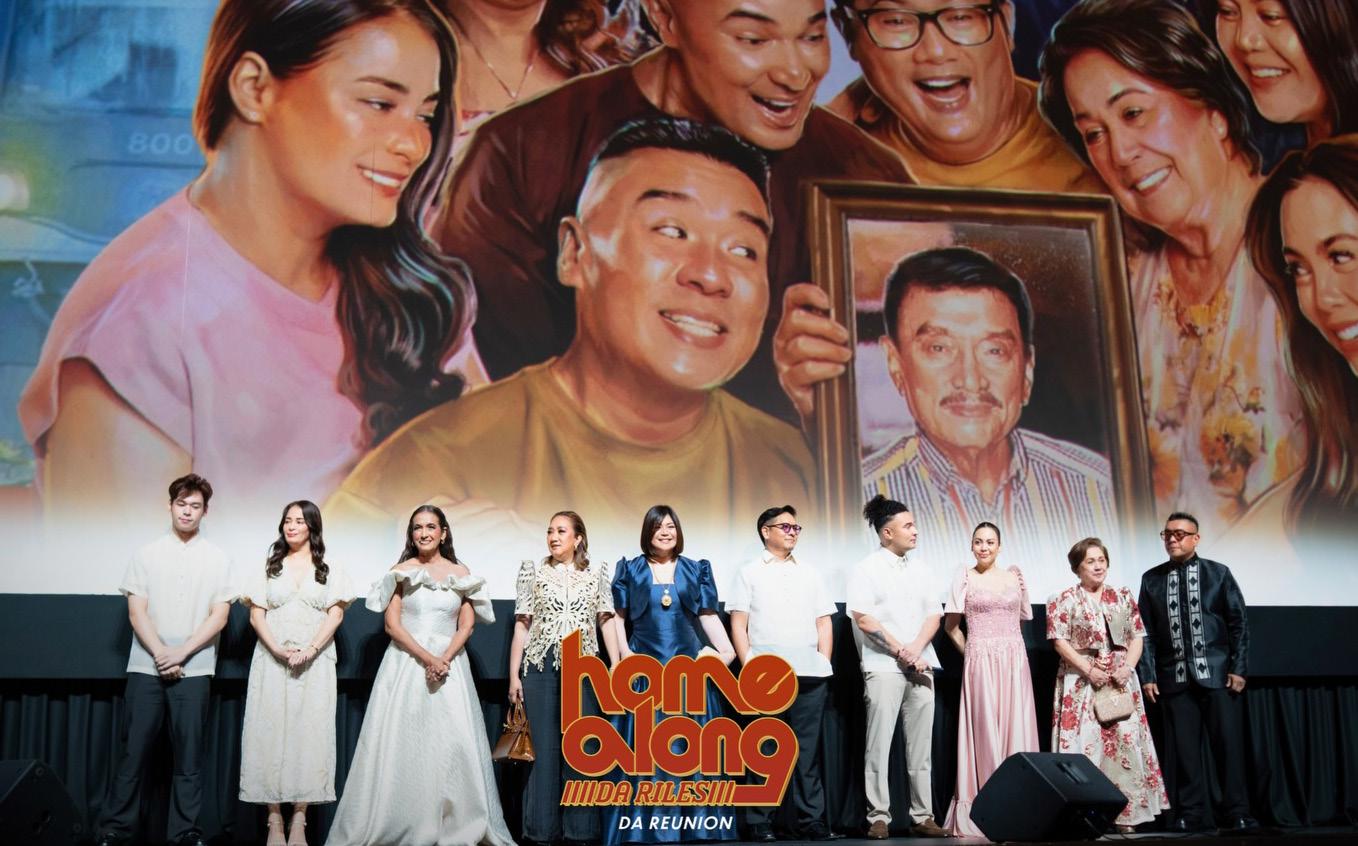
As “Home Along Da Riles” returns to the screen, supporters again point to the late comedian’s lasting place in Filipino entertainment
A tribute film tied to one of Dolphy’s best-loved television roles is renewing calls for the late Rodolfo “Dolphy” Quizon Sr. to be formally recognized as a National Artist.
by AJPress
The renewed attention comes ahead of the theatrical release of “Home Along Da Riles: Da Reunion,” which revisits the world of the long-running sitcom that made Dolphy’s Kevin Cosme one of the most familiar father figures in Philippine television. The project brings
back several members of the show’s extended cast while introducing the story to younger viewers who may know Dolphy more by reputation than from weekly television.
Dolphy, who died in 2012, remains widely known as the country’s “King of Comedy.” His career spanned stage, radio, film and television,
crossing generations and social classes with a comic style built on timing, warmth and an instinctive understanding of ordinary Filipino life.
In interviews tied to the film, Vandolph Quizon, one of Dolphy’s sons and a cast member in the reunion project, said the family remains hopeful that his father will
eventually receive the country’s highest recognition for artists. He said Quezon City Mayor Joy Belmonte and Manila Mayor Isko Moreno Domagoso had expressed support for the effort.
The campaign has surfaced before. In 2025, Manila Rep. Joel Chua filed House Resolution 41 seeking to no-
Kim Chiu celebrates 20 years in showbiz and the life she once prayed for
The actress and host looks back on the girl from Cebu who dreamed quietly and the two-decade career that followed
by AJPress
Kim Chiu is taking a moment to look back.
The actress and television host marked her 20th year in show business with a message of gratitude, reflecting on the life she once prayed for and the career that began when she entered “Pinoy Big Brother: Teen Edition” in 2006.
In a public anniversary post, Chiu said the milestone “still feels unreal.” She looked back on her younger self in Cebu, recalling how she used to pray for simple but life-changing things: good grades, help with school, a home for her family and the ability to stand on her own.
Two decades later, Chiu wrote that she can see those prayers in the life she has been able to build. Her message was less about celebrity than perspective. Chiu thanked the people who stayed with her through the years, including her supporters, colleagues, brands and ABS-CBN family. The tone was grateful and reflective, a pause from the pace of a career that has kept her moving across television, film, hosting and streaming. Chiu first became known to national audiences as the winner of the first teen edition of “Pinoy Big Brother.” What followed was a long-running
Kaila Estrada
Image from Instagram/@supremo_dp
‘Direk Bobot’ returns to the songs that started his career
For younger audiences who know Bobot Mortiz from television, “Goin’ Standard” offers a glimpse of the singer and teen idol who came before the director’s chair.
by AJPress
For many younger Filipino viewers, Edgar “Bobot” Mortiz is simply “Direk Bobot”, the familiar name behind television comedy, family programming and generations of young performers.
But before the director’s chair, before the production rooms and before his name became attached to ensemble television, Mortiz had another public life. In the 1970s, he was a singer, actor and teen idol, part of a Philippine entertainment era when young stars were expected to do almost everything: record songs, act in films, appear on variety shows and carry a public image across several platforms at once.
That earlier chapter is returning to view through “Goin’
Standard,” his music project built around classic standards and songs associated with Frank Sinatra and the American songbook tradition. The project, which includes an album and a June 13 concert at The Proscenium Theater in Makati, is less about spec-
As “Home Along Da Riles” ...
PAGE 11
minate Dolphy as National Artist for Film and Broadcast Arts. The resolution cited Dolphy’s long record in Philippine entertainment and sought assistance in preparing the requirements for submission once the official nomination process opens. Any formal recognition would still have to go through the established process for the Order of National Artists, which is administered through the National Com-
mission for Culture and the Arts and the Cultural Center of the Philippines, with final conferment by the President upon recommendation. The most recent nomination period closed in 2024, making any renewed bid subject to the next official cycle. For supporters, the return of “Home Along Da Riles” offers a sharper measure of Dolphy’s cultural reach. The sitcom’s durability rested on a plain but powerful idea: that the pressures of Filipi-
Dolly de Leon gets noticed in Apple TV’s Maximum Pleasure Guaranteed
Dolly de Leon is once again drawing attention from Filipino viewers, this time for her role in Apple TV’s darkly comic thriller Maximum Pleasure Guaranteed.
The 10-episode series, led by Tatiana Maslany and Jake Johnson, premiered globally in May, with new episodes scheduled weekly through July 15. Created and showrun by David J. Rosen, the halfhour thriller follows Paula, played by Maslany, a newly divorced mother pulled into a dangerous mix of blackmail, murder and youth soccer while navigating a custody battle and a personal crisis.
De Leon appears as Detective Sofia Gonzales, a police investigator who enters the story as Paula begins to report and pursue what she believes may be a crime.
Apple’s official cast mate-
rials list de Leon alongside Maslany as Paula Sanders; Johnson as Karl Hendricks; Jessy Hodges as Mallory; Jon Michael Hill as Detective Baxter; Charlie Hall as Rudy; Kiarra Hamagami Goldberg as Geri; Nola Wallace as Hazel; and Murray Bartlett as Dennis.
Early public reaction has noted the clarity and authority of de Leon’s performance. In one clip, her Detective Gonzales meets Maslany’s Paula with a steady, unsentimental presence - the kind of performance that draws attention precisely because it does not appear to be asking for it.
Part of the response centered on de Leon’s unforced
delivery and natural accent. For many viewers, the scene resonated because it felt understated and natural rather than deliberately highlighted. The role continues de Leon’s growing international run following Triangle of Sadness, the Ruben Östlund film that brought her wider global recognition and major awards attention. In Maximum Pleasure Guaranteed, de Leon’s presence is measured but memorable. She brings quiet authority to the screen - precise, composed and unmistakably her own - adding another assured turn to a career increasingly watched beyond Philippine cinema. n
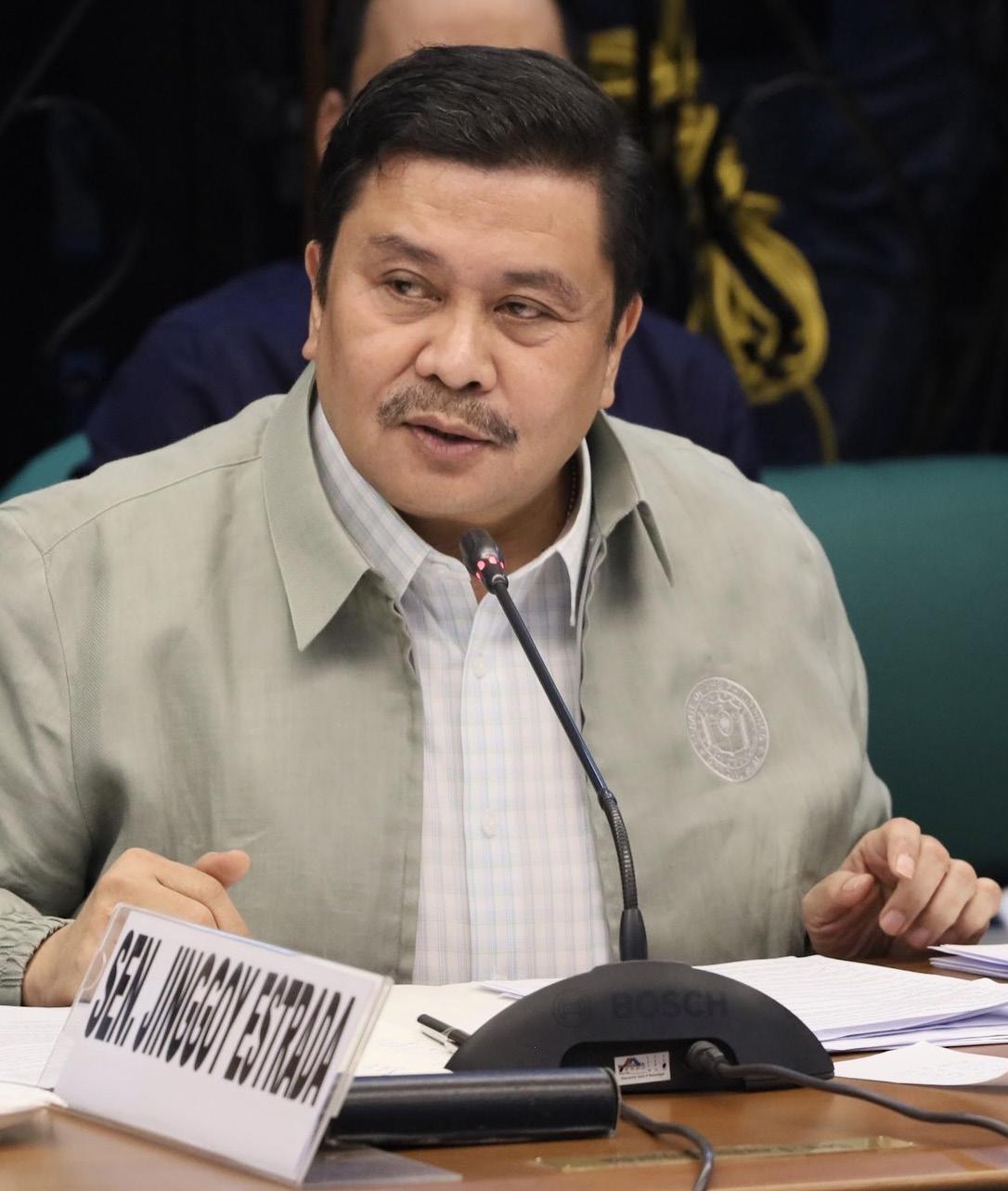
Karen Davila comments on Senate reaction after Jinggoy Estrada arrest
no family life - work, money, pride, sacrifice and affection - could be rendered with humor without diminishing their weight.
The formal process remains separate from the public sentiment around the film. What the tribute has done is return Dolphy to the center of a familiar debate: how a national culture measures an artist whose influence was built not in rarefied spaces, but in the living rooms of ordinary Filipinos. n
The broadcaster’s post followed the senator’s surrender and detention in connection with a plunder case tied to alleged flood-control kickbacks.
by AJPress
Broadcast journalist Karen Davila commented on the public reaction to the arrest of Sen. Jinggoy Estrada, after reports and images showed senators becoming emotional as he was taken into custody.
Estrada surrendered and was taken into custody on Monday, June 1, after the
Sandiganbayan issued an arrest warrant in connection with a plunder case tied to alleged kickbacks from flood-control projects.
In a public post, Davila referred to the scene involving lawmakers and their colleague.
“Senators were seen crying yesterday as a colleague was being arrested for plunder,” Davila wrote, adding that her comment was “in no
way an indictment of the accused senator.” Davila also wrote: “Iyakan n’yo ang ninanakawang Pilipino” (“Cry for the Filipino people being robbed”); “Iyakan n’yo ang binabaha dahil sa nakawan sa flood control” (“Cry for those flooded because of theft in flood-control projects”); and “Iyakan n’yo ang gutom nating mga kababayan” (“Cry for our fellow
Image from Instagram/@homealongdareels
by AJPress
Image from Facebook/@dollyedeleon
Image from Instagram/@direkbobot PAGE 13
Joshua Garcia reflects on career lessons
Actor says experience has taught him to value discernment, boundaries and peace of mind
by AJPress
Joshua Garcia is taking stock of what more than a decade in show business has taught him.
Garcia made the remarks during a recent Star Magic Spotlight press conference. Speaking about his years in the industry, the actor said experience has taught him that not everyone around a public figure is necessarily present for the right reasons. The comment was framed as a personal reflection on maturity and self-protection, not as an allegation against any specific person.
The actor said he now places greater value on peace of mind and on the people who have remained sincere in his life. His statement adds to recent comments about growth, pressure and the need to maintain boundaries while working in an industry where personal and professional attention often overlap.
Garcia’s latest reflections come as he remains active onscreen through “Love Is Never Gone,” a Prime Video series from ABS-CBN Studios that pairs him for the first time with Ivana
Alawi. The production has drawn attention for its Morocco-set storyline, a rare international location for a Filipino streaming drama, and for placing Garcia in a romance-suspense role built around migration, deception and personal reinvention. The cast also includes Jameson Blake, Jane Oineza, Michael de Mesa, Epy Qui-
zon, Dina Bonnevie, Fyang Smith and JM Ibarra. Garcia first gained wider attention after “Pinoy Big Brother: All In” and later became one of ABS-CBN’s most visible leading men. His latest comments suggest an actor focused not only on career longevity, but on the boundaries needed to sustain it. n
Karen Davila comments on Senate ...
Filipino singer Matty Juniosa finishes
fourth in ‘Britain’s Got Talent’ final
by AJPress
Filipino singer and theater performer Matty Juniosa ended his “Britain’s Got Talent” journey on a high note, finishing fourth in the Series 19 final and coming within a fraction of a percentage point of the top three.
According to ITV’s official voting figures, Juniosa received 9.16% of the public vote in the finale. Anastasiia & Salsa placed third with 9.28%, putting Juniosa just 0.12 percentage point behind a top-three finish. The Hawkstone Farmers Choir won the competition with 28.72% of the vote, followed by Celestial with 13.36%.
For his final performance, Juniosa sang “Nothing Compares 2 U,” closing a memorable run that introduced him to a wider audience in the United Kingdom and among Filipino viewers around the world.
Juniosa first captured attention with his audition performance of “Purple Rain,” which earned him a Golden Buzzer from Simon Cowell. He later advanced to the final after performing Aerosmith’s “Dream On,” a live-show number that earned Amanda Holden’s Golden Buzzer.
Although he did not win the competition, Juniosa’s fourth-place finish marked a strong international showing for the Filipino performer. His result placed him ahead of several other finalists in a crowded field of singers, dancers, magicians and variety acts.
His momentum is also continuing beyond the BGT stage. Andrew Lloyd Webber’s official site lists Matty J,
Kim Chiu celebrates 20 years ...
entertainment career that took her from reality television to drama series, romantic comedies, variety shows and digital projects.
Juniosa’s professional stage name, among the cast of “Jesus Christ Superstar” at The London Palladium, where he is set to play Annas. The production is scheduled to run from June 20 to September 5, 2026.
For Juniosa, the BGT finale was not the end of the story. It was a national television breakthrough — and, with a West End role ahead, a new stage for what comes next. n
Filipinos who are hungry”).
Prosecutors allege Estrada received more than P570 million in kickbacks linked to flood-control projects. The plunder case has been de-
PAGE 12 scribed in official reports as carrying no right to bail. Estrada has denied wrongdoing and has described the case as politically motivated. Before being detained, he said he would not seek custody in the Senate and would submit to the judicial process. The case remains pending before the anti-graft court and Estrada retains the presumption of innocence. n
In recent years, she has remained active onscreen, with credits that include
“Linlang,” “What’s Wrong With Secretary Kim?,” the Star Cinema film “My Love Will Make You Disappear” and “The Alibi,” her romance-suspense project with Paulo Avelino.
But in marking 20 years, Chiu kept the focus on something more personal: the PAGE 11
‘Direk Bobot’ returns to the ...
particularly in comedy and youth-oriented entertainment.
distance between where she began and where she is now.
For the girl from Cebu who once prayed for stability, the anniversary was not just a career marker. It was a quiet acknowledgment of answered prayers, hard work and the people who helped carry her through. n
tacle than memory. It brings Mortiz back to the sound that first placed him before an audience.
For those who grew up watching programs such as “Goin’ Bulilit,” Mortiz may be remembered less as a performer than as the man shaping timing, tone and comic rhythm from behind the scenes. His career became closely associated with television direction and production,
“Goin’ Standard” gently shifts that frame. It reminds audiences that Mortiz did not begin as a director who later decided to sing. He was a performer first, a young entertainer whose early career unfolded in front of cameras and microphones before he spent decades helping others find their place there.
The project has been described in entertainment cir-
cles as a return to his “first love.” The phrase fits, but not because it turns the story sentimental. It works because it is chronological. Music was one of Mortiz’s starting points. For older fans, the songs may feel like a return to the Bobot Mortiz they first knew. For younger audiences, they offer a more complete portrait of “Direk Bobot” - not only the director behind the credits, but the singer who came first. n
Image from Instagram/@garciajoshuae
Britain's Got Talent via Instagram
Karen Davila and Jinggoy Estrada Image from Instagram/@iamkarendavila, jinggoyestrada_
Health @Heart Genetic engineering
PhiliP S. Chua, MD, FaCS, FPCS
Why did some people, like my paternal grandmother, who smoked to their mid90s, not develop cancer? Why can some individuals consume a lot of alcoholic beverages and not develop liver cirrhosis and hepatoma? Why are some people who eat a lot of sweets daily and do not develop T2 diabetes, others eating a lot of salty foods do not develop high blood pressure, or consume tons of red meat and do not develop lipid problems or colorectal cancer?
“Lucky” genes
Only 10-20 percent of smokers develop lung cancer, and some other forms of cancer; about the same percentage of those who imbibe a lot of alcoholic drinks get liver cancer; 12 percent of sweet lovers come down with type 2 diabetes; 25 percent of salt “addicts” acquire high blood pressure, and only 18 percent of daily red meat-eaters develop colorectal cancer. In the USA, only 21 percent of men and 33 percent of women reach the age of 90. Why those lucky few?
Until medicine is morally and legally allowed to do genetic engineering on us as a society, it behooves the rest of us to stay away from those factors detrimental to health. To be on the safe side, let us presume that we do not have the “lucky genes” and therefore are not “immune” to those diseases mentioned above, and should be careful with our behavior and lifestyle.
The “exceptions” seem to be because some people have superior genes, commonly labeled as “lucky genes.” These genes made the body cells more resistant to trauma and inflammation; they also have an inherited robust DNA repair mechanism that fixes cellular damage daily before it mutates into metabolic disease or cancer.
Epigenetics
Your genes do not fix your destiny. Your fate depends on what you eat, don’t eat, do, and don't do. Epigenetics refers to how lifestyle factors, such as diet, behavior, stress, and exercise, can modify how your genes are expressed. Centenarians often ”maintain healthier epigenetic clocks,
delaying age-related changes that negatively affect cellular function.” To explore your personal genetic profile, you may consider the direct-to-consumer genetic testing and biotechnology company, 23andMe, as advertised on TV. Our health and longevity significantly rest on us.
Gene mapping
Gene mapping is the process of determining the specific location of genes and the distances between them on a chromosome. It is like a GPS for the genome. This aids the researchers in understanding inherited traits, locating disease-causing mutations, and developing targeted medical treatment.
Genetic modification
Genetic engineering, modification, or manipulation, is the direct artificial manipulation of an organism’s DNA using laboratory technologies. This enables scientists to add, delete, or alter specific genes to introduce or enhance desired traits. This revolutionizes fields like medicine to mass produce insulin, develop advanced cancer therapies, and research gene therapies for inherited diseases, and the field of agriculture to create genetically-modified organisms (GMOs), such as crops that are resistant to pests, tolerate herbicides, or contain higher natural nutrients.
Ethical issues
To the religious, all this might be interference with God’s natural order or plan. The pragmatic and scientific ethical considerations include: “Unintended Consequences - modifying ecosystems with genetically altered plants or animals could have unpredictable environmental effects. Human Ethics – The potential for editing human genes raises major moral concerns regarding safety, long-term health risks, and the societal implications of designer babies” or genetic inequality.”
Legally allowed
Today, legally and morally, “genetic engineering is universally permitted when used for somatic cell gene therapy in living patients to treat severe, untreatable, genetic diseases. In contrast, altering reproductive cells or embryos for enhancement (altering physical traits or intelligence) remains strictly prohibited.”
For those of us who have T2 diabetes, high blood
pressure, COPD, Sleep Apnea, heart disease, osteoarthritis of the spine, hips, and knees, genetic engineering to treat specific genetic defects is allowed only in the form of clinical trials. The technology is available, but it is not yet allowed for routine clinical use.
The future will come when more advanced gene therapy will be a part of standard medical care to cure hereditary diseases among newborns and children and eliminate the common “diseases of old age” listed above.
When that time arrives, we shall also know with our individual genetic profile who among us can eat a lot of carbohydrates and not develop T2 diabetes, consume red meat daily with abandon and not have colorectal and other cancers, and not exercise and remain fit and healthy.
Indeed, the future, especially with the advent of artificial intelligence and more enabling advances in medical and technological sciences, is exciting and surely full of wonders.
Longevity boosters
In the United States, there are 101,000 centenarians and 2.1 million nonagenarians. In the Philippines, there are about 1000 to 1200 centenarians and 60,000 to 70,000 nonagenarians as of 2026. Average life expectancy in the Philippines is 70.2 years; in the USA, 79; in Hong Kong, 85.6; in Japan, 84.8; and in Singapore, 83.9.
Recent studies have revealed three ways to boost health and longevity: diet, exercise, and social life.
These lifestyle factors (including abstinence from tobacco and alcohol) are linked to living healthier, longer lives. The details of the research are:
“One clear factor is diet: Eating less red meat, skipping salt, and following a Mediterranean-style diet consistently have all been linked to longevity.
Then, there is exercise: As little as taking a daily walk could help prolong lifespan, and several studies are now shedding light on the mechanisms by which physical activity slows aging.
Finally, tending to your social life is also important to longevity: People who feel chronically lonely and those who are socially isolated face a higher risk of early death, mounting evidence
Can a Senate hearing run ...
PAGE 8
members required to be present at a meeting.
Robinhood’s charity
A fierce supporter of said motion, Senator Padilla invoked force majeure on May 27—claiming that the intensifying El Niño, as well as the ongoing war in the Middle East, are valid circumstances that should allow Senators to attend work remotely.
“El Niño… but I don’t know how that [will] affect whether a senator doesn’t have to come in. Because it’s hot?” said Senator Erwin Tulfo in a television interview following the plenary session.
According to the Cambridge Dictionary, force majeure refers to unexpected events that prevent someone from carrying out their legal obligations. This is echoed in Article 1174 of the Civil Code of the Philippines, which classifies “force majeure” as “fortuitous events,” further stating that “no person shall be responsible for those events which could not be foreseen, or which, though foreseen, were inevitable.” Simply put, under force majeure, public officials aren’t held accountable for failing to complete their duties in the event of circumstances that prevent them from doing so.
For Senator Risa Hontiveros, force majeure applied to circumstances such as the COVID-19 pandemic, which physically prevented the Senate from operating as usual. She also shared that these global events shouldn’t stop public officials from going to work, but instead encourage them to continue their work.
“The war in the Middle East is happening to the people in other regions, precisely in the Middle East, and the impact of that oil crisis on our countrymen, that’s the reason we physically go in and do our jobs.”
It raises the question: Why is
suggests. Making healthy choices around these three factors may be key to living the long, fulfilling lives we strive for, and since it is never too late to start making positive changes, now is as good a time as any to make health a top priority.”
* * *
The opinions, beliefs and viewpoints expressed by the author do not necessarily reflect the opinions, beliefs and viewpoints of the Asian
a months-long issue now being used as a means to avoid going to the Senate when Filipinos have continued to go to work despite its effects on prices across the board?
A matter of due process
Meanwhile, on a Facebook post, Senator Padilla doubled down on his support for Senator Ronald “Bato” dela Rosa. He explained that, while dela Rosa wants to continue serving his country, he cannot do so without being arrested and brought to the ICC.
“Hindi niya gusto na hindi siya pumapasok. Malayong magkaiba ‘yon [sic]; ayaw pumasok dahil isasakay sa eroplano at dadalhin sa dayuhang bansa at ikulong!”
He also added that because no one can be viewed as a criminal without a conviction, dela Rosa should at least be allowed to continue his work as a Senator—as someone who was voted to do so. “Iniluluklok siya ng taumbayan na maging senador. Hayaan natin siyang magtrabaho para sa taumbayan sa pamamagitan ng online.”
That said, how can we argue for the due process that should be afforded to Senator dela Rosa, when he himself, by hiding from the law, is preventing that due process from being carried out? If one is truly innocent until proven guilty, then he should at least open himself to scrutiny and prove his apparent innocence.
Reading between the bars It doesn’t take much to put two and two together. In Senator dela Rosa’s exclusive interview with Jessica Soho, he shared that he was asked by Senate President Cayetano to attend the May 11 session to bolster numbers and assure the success of the Senate coup.
Now, with Vice President Sara Duterte’s impeachment trial scheduled for July 6, dela Rosa’s vote is certainly invaluable to prevent a two thirds majority vote (or 16 out of 24
Journal, its management, editorial board and staff.
Philip S. Chua, MD, FACS, FPCS, a Cardiac Surgeon Emeritus based in Northwest Indiana and Las Vegas, Nevada, is an international medical lecturer/author, Health Advocate, medical missionary, newspaper columnist, and Chairman of the Filipino United Network-USA, a 501(c)3 humanitarian foundation in the United States. He is a decorated recipient of the Indiana Sagamore of the
senators) to convict Duterte. That said, following the shooting incident and his sudden midnight disappearance, it is highly improbable that dela Rosa can again walk the Senate halls and leave without issue—given that the next time he does, he will likely leave in handcuffs.
But dela Rosa isn’t the only one at risk: Senators Jinggoy Estrada, Joel Villanueva, and Chiz Escudero are all currently being investigated for anomalies surrounding the flood control scandal. Meanwhile, the Office of the Ombudsman has targeted Senator Marcoleta for plunder and indirect bribery during the 2025 elections.
And the Philippine National Police-Criminal Investigation and Detection Group (PNP-CIDG) recently filed a complaint for obstruction of justice against Senator Padilla for allegedly helping dela Rosa escape the Senate grounds on May 14, 2026. According to Senator Imee Marcos, the aforementioned cases are highly politicized attempts at weakening the Senate majority through legal pressure. But President Ferdinand Marcos Jr. responded by saying that the case buildup is simply the result of findings by the Senate Blue Ribbon Committee and other investigative bodies. In fact, he goes on to say that these were conducted and reported even when they still comprised the minority bloc.
That said, politically charged or not, 11 of the 13 senators in the majority, according to the Philippine Center for Investigative Journalism, are all facing active or unresolved investigations. Should this bill pass, we could even have senators working from home simply because showing up could land them behind bars. Are those seriously the type of people we want leading our legislative branch? n
Wabash Award in 1995, presented by then Indiana Governor, US senator, and later a presidential candidate, Evan Bayh. Other Sagamore past awardees include President Harry S. Truman, President George HW Bush, Astronaut Gus Grissom, pugilist Muhammad Ali, distinguished educators, renowned scientists, etc. (Wikipedia). Websites: FUN8888. com, Today.SPSAtoday.com, and philipSchua.com. On Amazon.com, search for “Where is My America?” Email: scalpelpen@gmail.com n
Interacting with animals can significantly lower cortisol, the primary stress hormone, and decrease blood pressure. Just 10 minutes of petting a dog or cat can trigger the release of “happy hormones” like oxytocin, serotonin and dopamine, which promote relaxation and happiness.
Pets, in other words, can be natural stress relievers that improve both mental and physical health.
I randomly asked eight respondents the same two questions:
(1) Tell me something about your pet or pets.
(2) In what way has your pet or have your pets helped you? Their answers:
Sweden-born Andrew Stewart, a risk manager at Shell UK, has a pet named Max: (1) “My pet is very sweet, playful and loyal. He always makes me smile with his funny habits and loving personality. He is an important part of my life and feels like family to me.” (2) “My pet helps me feel less stressed and happier every day. Spending time with him gives me comfort, especially after a long day, and he always brightens up my mood.”
Dr. Matt Macalaguing, director of the University of Makati’s Center for Technology Incubation and Enterprise Development: (1) “He came when the Vatican released the white smoke and shouted habemus papam in 2013. I named him Francis. Pope Francis died in April 2025; my Francis ran free in April 2026. He had been my joy, the Yakult-drinker pooch and Fido. His eyes spoke volumes of emotions every time we played.” (2) “Francis is my prayer companion. He never missed a hug when I left for work and arrived home. He came at just the right time when I wanted and was ready to take care of another canine, two years after my first dog, Heaven, died. Francis is still my phone photo wallpaper.”
Film/TV/theater actor Jim Pebanco: (1) “I have five dogs, namely Patsy, the matriarch Mitchy, the daughter Datchy, the granddaughter Bentot, the only thorn among the roses, and Ibyang, the ‘Speedy Gonzales’ of the pack. And I
A Pet as a Stress Reliever and Real Friend Part 2
have a cat named Missy. Pets are fun to be with.” (2) “They are stress relievers and real friends.”
Guia Cruz Buenaventura, host of Media House Express’ “Coffee, Tea on MHE”: (1) “Oreo, my loving shih tzu furbaby, is more than just a pet — he is a pillar of strength for our whole family when my husband passed away in March 2021, right in the middle of the pandemic.” (2) “Oreo’s presence brought comfort and solace to me, my son and my daughter, helping us navigate through the darkest days of grief. I love my Oreo dearly and am so glad he always greets me with his wagging tail and follows me wherever I go, as if scolding me not to be out for a long period of time because he misses me.”
PhilStagers actor Fidel Redado still mourns the recent loss of his beloved pet: (1) “He is Pol, a Russian Blue cat. He looks like Tom in the ‘Tom and Jerry’ animated cartoon. He’s the sweetest soul I’ve ever known. And he is different from any other kind,
for he is like a human — he embraces, he comforts and he stays. Every life is indeed a blessing. Well, he is quite the biggest blessing I have ever cherished. His memories will stay in my heart.”
(2) “Pol is different. He has offered his life to me. I know it when he chose to save me countless times from drowning in my own emotions. He is like a walking bright light, a charming face with a wet nose. Whenever he appears, he never fails to share his very warm presence. He cuddled as if I was his only life. He has the patience of a friend whenever I am far. He has the discipline of a family whenever we eat. He is one of the best miracles that happened to me.”
Paranormal expert, nurse and actress Maia Alcazar owns three dogs: (1) “Macadamia and Aldie are a combination of shih tzu and Pomeranian. Their mom, Reese, is a Pomeranian. Between the two siblings, Aldie is sweet, while Macadamia is very playful and will always try to get ahead of anyone whenever he sees food being available. Mean-
while, mommy Reese seems nonchalant but will be very reactive whenever there is a sudden sound heard in the surroundings.” (2) “I find my pets as a form of relief from everyday stress and hurdles in life by means of spending time and playing with them.”
Desiree Tibay Dungo, a housewife, has a pet named Bruno: (1) “Bruno is 6 years old, and he is amiable, loyal and caring. We treat him as a member of the family. He has been part and parcel of our lives.” (2) “Bruno absolutely helps reduce our stress in our day-to-day existence. He is a real friend.”
Bee Vitug of the Philippine Development Foundation, or PhilDev: (1) “Currently, our family owns two dogs: Aries, a rescue dog that we adopted years ago, he is an aspin, and Stevey, a corgi gifted to us by a family relative.” (2) “I regard them both as my emotional support when things get heavy at work — beyond, of course, being our typical companions for security at home. Going out for a walk with our dogs really helps in clearing my
headspace.”
Johnrey Rivas in Wish 107.5
Emerging artist Johnrey Rivas, a pet lover, recently showcased his original songs, “Sabi Mo Sa Akin” and “Umalis Ka Na Sa Puso’t Isip Ko,” aboard the Wish Bus.
Yeng Constantino in Canada
The Home Free Global Crusade came to Calgary, Canada, last May 31, 2026, at the WinSport Event Centre. It was nice to experience a
night of praise and worship led by my cousin Yeng Constantino. And most importantly, the Word of God, preached by Global Evangelist Jonathan S. Ferriol.
* * * The opinions, beliefs and viewpoints expressed by the author do not necessarily reflect the opinions, beliefs and viewpoints of the Asian Journal, its management, editorial board and staff. * * * rogeliocmedina@yahoo.com n
Rogelio ConStantino MeDina
My P.E.P.
(People, Events,Places)
Desiree Tibay Dungo’s pet Bruno.
Actor Jim Pebanco with his dogs, from left, Mitchy, Ibyang, Datchy, Patsy and Bentot.
PhilStagers actor Fidel Redado with his Russian Blue cat Pol.
Guia Cruz Buenaventura with her shih tzu furbaby Oreo.
Maia Alcazar’s dogs Macadamia and Aldie.
Dr. Matt Macalaguing with his dog Francis, who is still in his phone photo wallpaper.
Andrew Stewart’s dog Max.
Emerging artist Johnrey Rivas aboard the Wish Bus.
Bee Vitug with his pet Aries.
Yeng Constantino’s “Biyaheng Bente” in August 2026.