Many green-card applicants may now have to complete process at U.S. consulates abroad
USCIS says temporary visa holders seeking permanent residence should generally use consular processing outside the United States, often in their home countries, except in “extraordinary circumstances.”
The policy does not abolish adjustment of status, but it makes the in-country green-card path more discretionary and uncertain.
WASHINGTON, D.C. — Many foreign nationals already living in the United States could now be directed to complete the greencard process through U.S. consulates abroad under new immigration guidance issued by the Trump administration.
U.S. Citizenship and Immigration Services
Primm’s last full-time casino resort to close July 4
The planned shutdown will affect 344 workers and further dim a once-familiar stop for Southern California travelers heading to Las Vegas
PRIMM, Nevada — Primm, the Nevada border town long known to Southern California motorists as the first gambling stop on the road to Las Vegas, is facing a major turning point after the operator of its remaining fulltime casino resort notified state officials that it plans to close several properties on July 4.
The Primadonna Company, LLC told the Nevada Department of Employment, Training and Rehabilitation in a May 5 WARN notice that it will permanently close operations at Primm Valley Resorts, Buffalo Bill’s Resort & Casino, Whiskey Pete’s Hotel & Casino, Primm Center and Flying J. The company said the shutdown will result in the termination of 344 employees.
The filing marks a major setback for Primm,
LAS VEGAS
Ombudsman files plunder, graft cases vs. Jinggoy Estrada over flood-control projects
Anti-graft prosecutors allege more than P573 million in kickbacks tied to public works allocations; the senator denies wrongdoing and says he will pursue legal remedies.
by AJPress
Atong Ang remains at large as Taal Lake search expands in missing sabungeros case
Police say more than 2,000 bones have been recovered and examined, but no confirmed DNA match to the missing men has been announced
by AJPress
MANILA — Businessman Charlie “Atong” Ang remained the subject of a continuing manhunt as authorities pursued arrest warrants issued in connection with the disappearance of cockfighting enthusiasts, or sabungeros, while
forensic work in Taal Lake expanded in one of the country’s most closely watched criminal investigations.
The Philippine National Police Forensic Group said Thursday, May 28, that more than 2,000 bones had been recovered and exam-
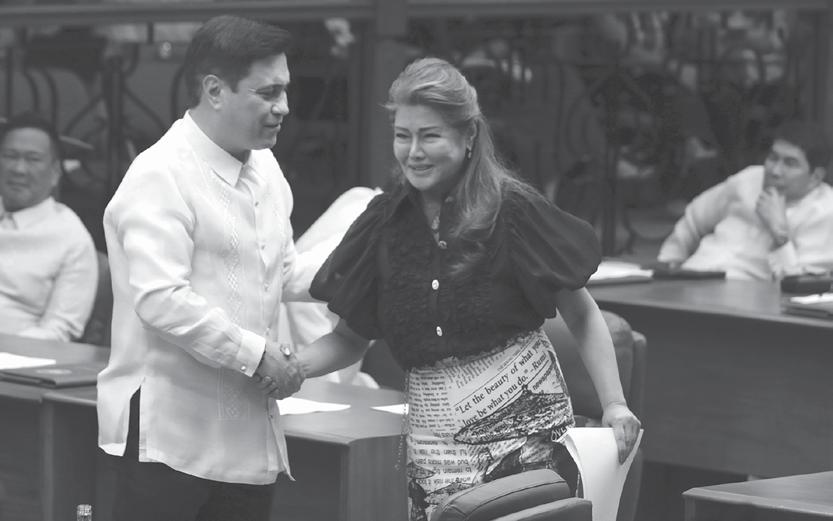
Senate remote-voting fight tests meaning of presence and power
The Philippine-born restaurant group was recognized under TIME’s “Disrupters” category as it expands its global store network and pushes deeper into international markets. by AJPress
ket. TIME placed Jollibee in its “Disrupters” category and described the brand as a “fried-chicken phenom,” citing its strong po-
sition in the Philippines and its growing international presence. For Jollibee, the recognition comes as the company works to turn a brand built on Filipino taste and family dining into a broader global restaurant platform. Jollibee Group said it now operates more than 10,400 stores and cafés in 33 countries through a portfolio of 20 brands, including Jollibee, Chowking, Tim Ho Wan, Smashburger and
Palace says no emergency justifies online voting as minority senators challenge proposal raised amid Dela Rosa’s absence
by AJPress
MANILA — A proposal to allow Philippine senators to participate and vote remotely has moved beyond a technical rules debate, becoming a test of how the Senate defines presence, quorum and accountability at a politically charged moment.
The proposed rule change, associated with Sen. Rodante Marcoleta, would allow senators to take part in plenary sessions through teleconference, videoconference or other electronic means. Supporters have described the measure as a procedural update for lawmakers unable to attend in person. Minority senators have objected, saying a change affecting attendance and voting cannot be rushed without strict compliance with Senate rules.
The dispute escalated after minority senators walked out of a ple-
Filipino talent shines at AMAs with KATSEYE, apl.de.ap wins
Sophia Laforteza’s KATSEYE won three honors, including New Artist of the Year, while Black Eyed Peas, featuring Filipino American artist apl.de.ap, won Best Throwback Song.
by AJPress
cording to the official AMAs winners announcement. The fan-voted awards were held Monday, May 25, at the MGM Grand Garden Arena, with Queen Latifah as host. KATSEYE’s wins carried particular significance for Filipino fans because of Laforteza, one of the most prominent Filipina performers in a major internation-
CIDG files obstruction complaint against Padilla over Dela Rosa’s Senate departure
Police investigators allege the senator’s ride formed part of a coordinated effort to avoid arrest under an ICC warrant; Padilla denies helping Dela Rosa escape.
by AJPress
MANILA — The Philippine National Police Criminal Investigation and Detection Group has filed an obstruction of justice complaint against Sen. Robinhood “Robin” Padilla and five others before the Department of Justice, escalating a politically sensitive inquiry into how Sen. Ronald “Bato” Dela Rosa left the Senate after the International Criminal Court unsealed an arrest warrant against him.
Prosecutor General Richard Fadullon confirmed that the complaint was filed shortly before 5 p.m. Thursday, May 28, according to reports citing the Department of Justice. The filing places the matter before prosecutors for evaluation. It is not a conviction, and it does not by itself establish criminal liability.
The complaint centers on Dela Rosa’s reported departure from the Senate after the ICC warrant became public. Padilla has said Dela Rosa merely asked to ride with him out of the Senate building and that he later dropped off the former national police chief
in Makati, where another vehicle picked him up.
The CIDG has characterized the episode differently. CIDG director Maj. Gen. Robert Morico II said investigators believe the movement was not accidental and described it as a “highly coordinated” maneuver. Investigators also alleged that another vehicle tailed Padilla’s car as a security escort and backup vehicle. Those assertions remain police allegations and have not been tested in court. Padilla has denied helping Dela Rosa escape. His reported defense is that Dela Rosa only hitched a ride and that Padilla did not act to obstruct justice. ICC warrant
Dela Rosa is the subject of an ICC arrest warrant over alleged crimes against humanity of murder linked to the Duterte administration’s anti-drug campaign. The ICC unsealed the warrant on May 11, citing alleged conduct from July 3, 2016, through the end of April 2018 involving at least 32 deaths. Dela Rosa has not been convicted and retains the right to contest the allegations.
of the Ombudsman has filed plunder and graft cases before the Sandiganbayan
Eala, Tabudlo lead Philippine entries in Forbes 30 Under 30 Asia list
The 2026 list recognizes young achievers across sports, music, technology, social impact and consumer startups.
by AJPress
MANILA — Tennis player Alexandra “Alex” Eala and singer-songwriter Zack Tabudlo are among the Philippine-linked honorees included in Forbes’ 2026 “30 Under 30 Asia” list, joining a regional roster of young entrepreneurs, artists, athletes, technologists and advocates recognized across the Asia-Pacific.
Forbes’ 11th annual Asia list covers 10 categories, including Entertainment and Sports, Social Impact, Retail and Ecommerce, and Consumer and Enterprise Technology. The honorees were selected from close to 4,000 candidates and evaluated by Forbes Asia editors and judges based on factors including industry impact, revenue or funding, inventiveness, product-market fit and potential.
Eala, 21, was named under Entertainment and Sports after a period of rising visibility in international tennis. The International Tennis Federation lists her WTA singles ranking at No. 37 as of May 25, 2026, with a career-high No. 29 reached on March 16. The Women’s Tennis Association lists her birthplace as Quezon City and her career-high singles ranking at No. 29. Tabudlo was also listed under Entertainment and Sports. The Fil-
ipino singer-songwriter is known for songs including “Pano” and “Give Me Your Forever,” and has been cited for strong streaming performance and a broad following among younger listeners. The Social Impact category included Saje Miguel Molato, founder of Siklab; Steph Naval, founder of Empath; and Emmanuel Mirus Ponon, founder of the ASEAN Youth Advocates Network. Their work spans youth development, education, skills training, climate programs, mental health services, policymaking, peacebuilding and sustainable development.
In Retail and Ecommerce, Forbes recognized Fan Connection SEA cofounders Pauline Dizon and Adrian Jumangit, as well as GoRocky cofounders Kiyanusch Braun and Martin Joaquin Palaña. Fan Connection SEA operates in entertainment, fandom, merchan-
dise licensing, bookings and live events. GoRocky is a digital men’s health platform connecting users with licensed doctors and pharmacies.
Kharl Christian Yeung, cofounder of Amico Innovations, was also listed among the Philippine entries. In Consumer and Enterprise Technology, Forbes recognized BayaniChain Tech cofounders Raphael Sevilla and Brandon Angelo Wong. BayaniChain develops blockchain systems for government and enterprise clients.
India had the largest number of entries in the 2026 Asia list according to Forbes, followed by China, Australia and Japan. The list underscored the range of young talent emerging from the Philippines, spanning sports, music, civic advocacy, mental health, blockchain technology and consumer startups. n
Naga declared highly urbanized city
by AJPress
MANILA — President Ferdinand Marcos Jr. has declared Naga City in Camarines Sur a highly urbanized city, according to Mayor Leni Robredo, marking a new administrative milestone for one of Bicol’s key urban centers. Robredo announced the development during the commemoration of the 68th birth anniversary of her late husband, Jesse Robredo, who served as Naga mayor before becoming secretary of the
Primm’s last full-time casino resort...
PAGE 1
an unincorporated Clark County community at the California-Nevada line along Interstate 15. For decades, the town’s casino cluster, hotel rooms, outlet shopping, gas stations and food stops made it a familiar landmark for travelers driving between Los Angeles and Las Vegas. That roadside economy has been weakening for years. Whiskey Pete’s had already closed, while Buffalo Bill’s was operating only for special events, according to local reporting. Primm Valley Resorts remained the last fully operational casino resort in town.
The shutdown is both an employment story and a community story. Local reports said many affected employees live in company-linked housing, adding displacement concerns to the job losses. Some workers also face transportation challenges as they search for new jobs and housing. State and county officials are preparing assistance. Nevada’s workforce agency said affected workers can receive rapid response services and unemployment guidance, while Clark County social services staff has been assessing needs in the area. Some observers have described
Primm as a possible “gambling ghost town,” but the phrase remains a characterization, not an official designation. The closure of Primm’s remaining full-time casino resort operation and related businesses would end a central chapter in the town’s identity as a border gambling stop for California travelers. For years, Primm was the point where the Las Vegas trip began to feel real. Its closure marks the fading of a roadside economy built on proximity, convenience and the promise that Nevada gaming was just across the state line. (AJPress)
RELOCATED. Department of Environment and Natural Resources (DENR) personnel transplant two Narra trees at the Hidden Garden in Manila on Thursday, May 28, 2026 as an environmental safeguard measure for viable trees affected by infrastructure and development projects. The trees were relocated from Quirino Avenue, where tree-cutting activities are being undertaken for the proposed 40.62-km. Southern Access Link Expressway project. PNA photo by Yancy Lim
Composite photo of Alex Eala and Zack Tabudlo Image from facebook/@IamZackTabudlo, AlexEala
PAUNAWA SA MAAGANG PAGBOTO PARA SA 2024 PANGKALAHATANG HALALAN
IPINAPAALAM SA PAMAMAGITAN NITO na ang maagang pagboto para sa Hunyo 9, 2026,, Pangunahing Halalan ay magsisimula sa Mayo 23, Sabado, at magpapatuloy hanggang Hunyo 5, Biyernes.. Ang kahit na sinong rehistradong botante sa Clark County ay maaaring bumoto sa kahit na saang lugar ng maagang botohan. Ang magkaparehong-araw ng pagpaparehistro ay maaaring gawin para sa lahat ng mga taong karapat-dapat na bumoto ngunit sa kasalukuyan ay hindi naka rehistro upang bumoto.Kinakailangan ay mayroon silang Nevada Driver’s License, Nevada Identification Kard, Nevada DMV “Pansamantalang Dokumento,” o Identipikasyon na galing sa Tribo alinsunod sa NRS 232.006. Ang Magkaparehong-araw na mga pagbabago ng pangkasalukukang rehistrasyon ay maaari ring gawin..
Ang maagang lugar ng botohan, petsa at oras ay naka lista sa ibaba. Ang lahat ng lugar ng botohan ay naaayon sa ADA Para sa karagdagang kaalaman, tawagan, ang Clark County Kagawaran ng Halalan sa (702) 455-VOTE (8683). The TTY/TDD na number ay 711. Tingnan din online sa www. ClarkCountyNV.gov/vote.
2026 Pangunahing Halalan
Lugar ng Maagang Botohan / Mga Lugar na Paghuhulugan ng Koreong Balota Mayo 23 (Sabado) hanggang Hunyo 5 (Biyernes), 2026
Ang lahat ng lugar ng maagang botohan ay maaari ring paghuhulugan ng mga koreong balota sa kapanahunan ng mga naka listang petsa at oras.
Ang mga hindi inaasahang kaganapan o pangyayari ay maaaring magdulot ng mga pagbabago sa lugar ng maagang botohan o sa oras ng pamamalakad. Tingnan ang pinakabagong impormasyon sa aming website: www.ClarkCountyNV.gov/vote o tumawag sa (702) 455-Vote (8683) o (702) 455-7871 (Filipino)
Ang kahit na sinong rehistradong botante ng Clark County ay maaaring bumoto sa pamamagitan nang personal bago dumating ang Araw ng Halalan sa kahit na saang lugar ng maagang botohan sa halip na bumoto sa pamamagitan ng koreo.
Maaari mo ring ihulog ang iyong ibinotong koreong balota sa kahit na saang Lugar ng Maagang Botohan sa kapanahunan ng mga nakatakdang petsa at oras na nakalagay sa Iskedyul. Sa iyong halimbawang balota o online sa www.ClarkCountyNV.gov/vote, tingnan ang listahan para sa “Araw ng Halalang Sentro ng Botohan” at Kagawaran ng Halalan at ang Klerk ng Lungsod na Lugar na Paghuhulugan” para sa ibat-ibang opsyon. Dapat mong pirmahan ang labas ng iyong Kagawaran ng Halala’ng sobreng ibabalik, na nakikita ang iyong pangalan at address, ilagay at isara ang iyong ibinotong balota sa loob ng sarili mong sobre’ng ibabalik bago mo ito ihulog sa drop box. Huwag mong pagsamahi’ng ilagay ang iyong balota at ang balota ng ibang botante sa i-isang sobreng ibabalik.
Kung napagpasyahan mong bumoto nang personal sa halip na sa pamamagitan ng koreo, kinakailangan mong gawin ang isa sa mga sumusunod: • Kapag dala mo ang iyong koreong balota, ibalik ito sa pakete’ng ipinadala sa iyo sa isang opisyal ng halalan sa lugar ng botohan
• Kung hindi mo dinala ang iyong balota ngunit natanggap mo ito sa koreo, ikaw ay pipirma ng isang pagpapatunay sa sentro ng botohan na ikaw ay nanunumpa na hindi ka pa bumoboto sa kasalukuyang halalan at naiintindihan mo na walang sinuman ang maaaring magtangkang bumoto o aktwal na bumoto ng mahigit sa isang beses sa magkaparehong halalan.
Mga Pang Matagalang Lugar ng Botohan/Mga Lugar na Paghuhulugan ng Koreong Balota, Mayo 23 hanggan Hunyo 5, 2026
Mga Pang Matagalang Lugar ng Maagang Botohan / Mga Lugar na Paghuhulugan ng Koreong Balota/ Address/ Mga Kalapit na Kalye Petsa / Oras
Arroyo Market Square, TENT NG KAGANAPAN Paradahan malapit sa Men’s Wearhouse 7225 Arroyo Crossing Pkwy., Near CC-215 / S. Rainbow Blvd.
Blue Diamond Crossing, TENT NG KAGANAPAN Paradahan sa Pagitan ng Target at Kohl’s
4100 Blue Diamond Rd. / Hinson St.
Cambridge Recreation Center
3930 Cambridge St., Pagitan ng E. Flamingo Rd. and E. Katie Ave.
Craig Ranch Regional Park, TENT NG KAGANAPAN
Paradahan East ng Revere St. Pumasok sa W. Craig Rd.
Desert Breeze Community Center
8275 Spring Mountain Rd. / S. Cimarron Rd.
Downtown Summerlin, TENT NG KAGANAPAN
Paradahan East ng S. Pavilion Center Dr.
Enter on S. Spruce Goose St. South of Marketwalk Pl.
Galleria at Sunset
Kohl’s Court, 1st Floor
1300 W. Sunset Rd., East of N. Stephanie St.
Henderson City Hall
240 S. Water St. / W. Basic Rd.
Ikea, TENT NG KAGANAPAN, Paradahan
6500 Ikea Way, malapit sa S. Durango Dr. at Rafael Rivera Way
Las Vegas Athletic Club – Decatur, TENT NG KAGANAPAN Paradahan, 6050 N. Decatur Blvd. / W. Tropical Pkwy.
Las Vegas Athletic Club – Rainbow, TENT NG KAGANAPAN
Parking Lot, 1725 N. Rainbow Blvd., South of W. Lake Mead Blvd.
Las Vegas City Hall
495 S. Main St. / E. Clark Ave. Libreng paradahan kapag na-validate
Meadows Mall Malapit sa Round1, 1st Floor
4300 Meadows Ln. / S. Valley View Blvd.
Mountain Crest Community Center
4701 N. Durango Dr., South of W. Lone Mountain Rd.
Mountain’s Edge Regional Park, TENT NG KAGANAPAN, Paradahan
8101 W. Mountains Edge Pkwy., East of S. Durango Dr.
Nellis Crossing Shopping Center, TENT NG KAGANAPAN Paradahan malapit sa Target, 1250 S. Nellis Blvd. / E. Charleston Blvd.
North Las Vegas City Hall
2250 Las Vegas Blvd. North / Civic Center Dr.
Silverado Ranch Park, TENT NG KAGANAPAN
9855 Gilespie St. / E. Silverado Ranch Blvd.
Skyview Multi-Generational Center
3050 E. Centennial Pkwy., Gitna ng Losee Rd. at N. Pecos Rd.
Thunderbird Family Sports Complex, TENT NG KAGANAPAN Paradahan 6105 N. Durango Dr. Sa Pagitan ng W. Centennial Pkwy. at W. Tropical Pkwy.
UNLV Lied Library
4505 S. Maryland Pkwy. E. Harmon Ave., East of University Center Dr.
ng E. Cheyenne Ave.
West
/
Mga Panandaliang Lugar ng Maagang Botohan / Mga Lugar na Paghuhulugan ng Koreong Balota Address / Kalapit na Kalye Petsa / Oras
Abston, Sandra B. Elementary School 9950 W. Tompkins Ave., East of Hualapai Way Mayo 23-24 (Sab.-Ling.)................9nu-6ng
Aliante Library 2400 W. Deer Springs Way, East of N. Aliante Pkwy. Mayo 26 (Mar.)...............................10:30nu-7ng
Boulder City Recreation Center 900 Arizona St. / Utah St. Mayo 26-29 (Mar.-Biy.)...................9nu-6ng
Cadence Home Finding Center 1170 E. Sunset Rd., #100, Henderson / E. Lake Mead Pkwy. Mayo 28-29 (Huw.-Biy.)..................9nu-5nh Cardenas Market, 4421 E. Bonanza Rd. / Lamb Blvd. Mayo 23-25 (Sab.-Lun.)..................9nu-6ng
Centennial
Clark County Building Department 4701 W. Russell Rd., Between S. Decatur Blvd. and Arville St. Mayo 23-24 (Sab.-Ling.) 9nu-6ng
Clark County Library 1401 E. Flamingo Rd. / Escondido St. Mayo 30-31 (Sab.-Ling.) 10nu-5nh Hunyo 1 (Lun.) 10nu-7ng
Coleman Senior Center 2100 Bonnie Ln. / E. Lake Mead Blvd.
College of Southern Nevada, Henderson Campus Student Union, 700 College Dr. / Heather Dr. Hunyo 2 (Mar.) 9nu-6ng College of Southern Nevada, North Las Vegas Campus Student Union, 3200 E. Cheyenne Ave. / Campus Dr. Hunyo 5 (Mar.) 9nu-6ng College of Southern Nevada, West Charleston Campus Student Union, 6375 W.
Mayo 23-Hunyo 4 (Sab.-Huw.)... 9nu-7ng Hunyo 5 (Biy.)............................. 9nu-8ng
Pearson Community Center 1625 W. Carey Ave., West of N. Martin Luther King Blvd.
Rainbow Library 3150 N. Buffalo Dr. / W. Cheyenne Ave. Hunyo 2-3 (Mar.-Miy.)
LORENA PORTILLO Tagapagtala ng Botante Clark County Nevada
Inilathala: Mayo 15, 22, 29 at Hunyo 5, 2026 Las Vegas Asian Journal
Marcos to Pinoys: Look beyond desires, commit to values
by Helen Flores, JoHn Unson Philstar.com
MANILA — President Marcos
yesterday called for unity and compassion among Filipinos as he joined Muslims in observing Eid’l Adha, or the Feast of Sacrifice.
In his message, the President said the occasion serves as a reminder of “unwavering faith, complete submission to Allah’s will and trust in a purpose greater than ourselves.”
“It calls us to look beyond our personal desires and recognize that true fulfillment is found in obedience, humility and devotion,” he added.
“May this sacred observance inspire deeper reflection and renew our commitment to the values that bind us together as one people and one nation,” Marcos said.
Marcos has declared May 27 a regular holiday for Eid’l Adha, one
of the two most important events in the Islamic calendar, after Eid’l Fitr or the Feast of Breaking the Fast.
Philippine National Police chief Gen. Jose Melencio Nartatez Jr. has assured Muslims of the police force’s commitment to serve them with fairness, respect and inclusivity. In Cotabato City, open-field congregational worship rites by Muslims in Central Mindanao were peaceful.
Preachers talked about the need for interfaith solidarity to boost efforts to address underdevelopment in local communities.
Police and soldiers, mostly Christians, secured different venues.
Muslim personnel of the Army’s 6th Infantry Division performed rites at a worship site near Camp Siongco in Barangay Awang in Datu Odin Sinsuat, Maguindanao
del Norte. Vice Gov. Marshall Sinsuat urged his constituents to continue supporting the police, military and the Bangsamoro government’s joint peacebuilding programs. In Manila, Mayor Isko Moreno expressed solidarity with 6,000 Muslims who gathered at the Quirino Grandstand to celebrate the holiday. (With report of Emmanuel Tupas, Andrew Ronquillo)
Many green-card applicants...
PAGE 1
announced on May 22, 2026, that adjustment of status, the process that allows eligible applicants to seek lawful permanent residence without leaving the United States, should be granted only in “extraordinary circumstances.”
The agency described the move as a return to the structure of immigration law, under which temporary visa holders are admitted for limited purposes and are generally expected to leave when that purpose ends.
The guidance does not eliminate adjustment of status. It also does not mean every green-card applicant will be ordered to depart immediately. But it changes how USCIS says officers should treat the process, shifting many applicants away from in-country processing and toward consular processing abroad.
Consular processing means completing the immigrant visa process outside the United States through the U.S. Department of State, usually at a U.S. embassy or consulate. Although USCIS and DHS have described the policy as requiring many applicants to return to their “home country,” the process may occur in the applicant’s country of nationality, country of residence or another
country where a U.S. consulate accepts jurisdiction.
The central point is that USCIS is no longer treating adjustment of status as the routine path for many temporary visa holders who later seek permanent residence. The agency’s policy memorandum describes adjustment of status as discretionary relief and “administrative grace,” not an entitlement.
Immigration lawyers said the change could affect a broad range of applicants, including temporary workers, students, visitors, some spouses of U.S. citizens and others who are physically present in the United States and may otherwise qualify to file Form I-485.
Under the new guidance, statutory eligibility alone may not guarantee approval. Officers are instructed to review the totality of circumstances before approving adjustment of status. That review may include immigration history, maintenance of lawful status, unauthorized employment, possible misrepresentation, family ties, hardship, public interest factors and other favorable or adverse equities.
The practical consequences could be significant for Filipino immigrants and other foreign na-
tionals with pending or planned green-card applications. Consular processing may involve international travel, added expense, family separation, visa interview delays, additional screening and uncertainty about returning to the United States.
The policy has also raised concern because it is agency guidance, not a new law enacted by Congress. Adjustment of status remains part of federal immigration law, but USCIS has adopted a narrower approach to when it should be granted. Legal challenges or additional agency guidance could determine how broadly the policy is enforced.
The effect is narrower than the most alarming headlines but still consequential. The government has not abolished the in-country green-card process. It has made that path harder, more discretionary and less predictable, while directing many applicants toward consular processing abroad unless they can show extraordinary circumstances.
Applicants with pending or planned green-card filings should seek case-specific legal advice before leaving the United States, filing a new application or changing from adjustment of status to consular processing. (AJPress)
Ombudsman files plunder...
PAGE 1
locations and kickbacks tied to Department of Public Works and Highways projects.
Clavano said the alleged kickbacks attributed to Estrada totaled more than P573 million. The allegation has not been proven in court, and Estrada has denied wrongdoing.
Case reaches the Sandiganbayan
The Ombudsman filed the cases after the Department of Justice recommended charges against Estrada, Bonoan and other respondents over alleged corruption in flood-control projects. The recommended charges included plunder and graft, as well as related offenses arising from the alleged handling of public works allocations.
Aside from Estrada and Bonoan, reports identified other respondents as former DPWH officials and private individuals allegedly linked to the questioned projects. The Ombudsman said it did not recommend bail for the plunder case and would seek hold departure orders against the accused.
The Sandiganbayan will determine the next procedural steps, including probable cause, warrants and bail questions.
Under the Anti-Plunder Law, prosecutors must prove that a public officer amassed, accumulated or acquired ill-gotten wealth through a combination or series of overt or criminal acts meeting the statutory threshold. The filing of charges does not establish guilt.
Alleged kickback scheme
Prosecutors allege that certain public works allocations were used as part of a scheme to generate commissions from government-funded flood-control projects. That allegation will have to be tested before the Sandiganbayan through admissible evidence.
The broader flood-control controversy has involved official reviews and public allegations concerning defective, incomplete or nonexistent flood-control infrastructure, as well as possible links among public officials, contractors and budget allocations.
Estrada denies wrongdoing Estrada has denied the allegations and said he will pursue legal remedies. He has also questioned the handling of the proceedings, arguing that evidence favorable to his defense was not properly considered.
Among the points raised by Estrada is a certification from the Senate Legislative Budget Research and Monitoring Office, which he said showed no record that he initiated budget insertions in the 2025 national budget. The Ombudsman, however, said the certification was limited and did not cover all stages of the budget process where insertions could allegedly be made.
The accused are presumed innocent unless and until proven guilty by final judgment. The filing of charges does not establish guilt, and the allegations must be proven before the Sandiganbayan through admissible evidence. n
The case also raises questions about how flood-mitigation funds were allocated, implemented and audited. Those questions are now part of a wider public debate over infrastructure spending, disaster preparedness and accountability in the use of public funds.
Jollibee named to TIME100...
PAGE 1
The Coffee Bean & Tea Leaf.
The company’s flagship brand remains closely tied to Filipino identity. Its fried chicken, sweetstyle spaghetti and other menu items have long been associated with family gatherings in the Philippines and with immigrant communities overseas. But the company’s expansion strategy has increasingly moved Jollibee into a different competitive frame: not only as a homegrown favorite, but as a restaurant group seeking scale in major international markets.
Jollibee Group President and Chief Executive Officer Ernesto Tanmantiong said the TIME recognition reflected the work of the company’s teams and the relevance of its brands outside the Philippines.
“We are honored to be named to TIME’s Top 100 Most Influ-
ential Companies list,” Tanmantiong said in a company statement.
The company’s international growth has accelerated in recent years. In 2025, Jollibee launched its first franchising program in the United States while continuing to grow its North American network beyond 100 stores. The move signaled a more formal push to widen its U.S. footprint, where Filipino communities have helped anchor demand but where the company is also trying to reach a broader customer base.
That challenge is central to Jollibee’s next phase. The company must preserve the cultural familiarity that made it beloved among Filipinos while adapting to markets where consumers may encounter the brand first as a chicken chain, not as a Philippine institution.
For Filipino communities abroad, the recognition carries symbolic weight. Jollibee stores overseas have become more than places to eat. For many immigrants and second-generation Filipino families, they serve as familiar spaces where food, family and cultural identity converge.
TIME’s 2026 listing places that story in a wider business frame. Jollibee is no longer being assessed only as a Philippine success story or a diaspora comfort brand. It is increasingly being viewed as a global restaurant company attempting to scale while keeping the Filipino identity that helped distinguish it. The recognition also sharpens Jollibee’s business narrative: a Philippine company with a deeply local brand identity is now competing for scale, customers and investor attention across international markets. n
Atong Ang remains at large as
PAGE 1
ined from Taal Lake as part of the search connected to the missing sabungeros case. Police officials said DNA testing and cross-matching were continuing, but authorities have not announced any confirmed match identifying any recovered bone as belonging to any of the missing men.
The lake search followed allegations that some victims were killed and dumped in Taal Lake. Those claims remain subject to forensic verification, prosecution review and court proceedings. The recovery of bones does not, by itself, establish the identity of the victims, the number of deaths or the criminal liability of any accused person.
Ang, whose full name is Charlie Tiu Hay Ang, has been described by the Department of Justice as a fugitive from justice after arrest warrants were issued against him.
Prosecutor General Richard Anthony Fadullon earlier said cases had been filed and that Ang would have to submit himself to the jurisdiction of the court to seek legal relief. The DOJ earlier ordered the filing of charges against Ang and 21 others in connection with the missing sabungeros case. Prosecutors said 10 counts of kidnapping with homicide were filed before regional trial courts in Lipa City, Batangas; Sta. Cruz, Laguna; and San Pablo, Laguna. Government efforts to locate Ang have continued for months. The Department of the Interior and Local Government has offered a P20-million reward for information leading to his arrest. In April, Interior Secretary Jonvic Remulla said authorities were looking into information that Ang had been seen in Vietnam, though no arrest
Taal Lake...
was announced.
Ang has denied involvement in the disappearances. Through counsel, he has also asked the DOJ to drop him from a Manila Arena-related portion of the case, arguing that he should not be included as a respondent in that proceeding.
The missing sabungeros case traces back to the disappearance of at least 34 cockfighting enthusiasts from 2021 to 2022 in several areas of Luzon. Earlier forensic updates showed the technical difficulty of the search: in July 2025, the PNP said six of 91 bone pieces recovered from Taal Lake were possibly human and would undergo DNA testing. The case remains unresolved. Ang and the other accused have not been convicted, and the charges must still be proven in court. n
Filipino talent shines at AMAs...
PAGE 1
al pop group. Netflix’s official Tudum guide identifies Laforteza as originally from Manila and fluent in English and Tagalog.
KATSEYE was formed through the HYBE x Geffen project that produced “The Debut: Dream Academy” and was later documented in Netflix’s “Pop Star Academy: KATSEYE.” The group is composed of Daniela Avanzini, Lara Raj, Manon Bannerman, Megan Skiendiel, Sophia Laforteza and Yoonchae Jeung.
At the AMAs, KATSEYE performed “PINKY UP,” appearing as a five-member lineup with Lara, Megan, Sophia, Daniela and
Yoonchae. Rolling Stone reported that HYBE and Geffen Records had announced in February that Bannerman would take a temporary hiatus.
The group’s three wins placed Laforteza within one of the ceremony’s breakthrough storylines, giving Filipino audiences a direct connection to a new-generation pop act built for an international audience.
KATSEYE’s recognition also placed the group alongside BTS among the ceremony’s major HYBE-affiliated winners. BTS won Artist of the Year, Best Male K-pop Artist and Song of the Summer for “Swim,” taking the
AMAs’ top honor for the second time after its 2021 Artist of the Year win.
The night also included another Filipino American connection. Black Eyed Peas won Best Throwback Song for “Rock That Body,” according to the official AMAs winners list. The group includes apl.de.ap, born Allan Pineda Lindo, whose Filipino heritage has long made him a prominent figure for Filipino American music audiences. Together, Laforteza and apl. de.ap gave Filipino fans something unmistakable to claim: a place in the sound, spectacle and recognition of global pop. n
President Ferdinand Marcos Jr. The Philippine STAR / Noel Pabalate
Senate remote-voting fight tests...
NOTICE IS HEREBY GIV-
EN that the City of San Diego (City) is seeking to receive Electronic Bids for the below named Public Works project.
The solicitation, including plans and specifications, may be obtained from the City’s website at: https://www.sandiego.gov/cip/bidopps
Contractors intending to submit a Bid must be prequalified. Please refer to the solicitation for instructions.
Project Name: El Camino Real Half Mile to Via De La Valle
Mandatory Pre-Bid Meeting: 06/02/2026 10:00 AM (Microsoft Teams)
Mandatory Site Visit:
6/09/2026 11:00 AM (Location: 14555 El Camino Real, Del Mar, CA 92014 (Meeting to be held at the west lot))
Bid Opening Date: 7/15/2026, at 2:00 P.M
License Requirement: A
It is the policy of the City of San Diego to encourage equal opportunity in its Construction and Consultant contracts. Bids or proposals from local firms, small, minority-owned, disabled, veteran-owned, and women-owned businesses are strongly encouraged. Contractors are encouraged to subcontract with and/or participate in joint ventures with these firms. The City is committed to equal opportunity and will not discriminate with regard to race, religion, color, ancestry, age, gender, disability, medical condition or place of birth; and will not do business with any firm that discriminates on any basis.
Bids shall be received no later than the date and time noted above at: City of San Diego’s Electronic Biding Site PlanetBids at: https://www.planetbids. com/portal/portal.cfm?CompanyID=17950
Claudia C Abarca, Director
Purchasing & Contracting Department
May 20, 2026
5/29/26
CNS-4045713# ASIAN JOURNAL
nary session, leaving the chamber without a quorum and stopping action on the proposal. Their argument rests on Senate rules but reaches beyond parliamentary form. For the minority, the question is whether the chamber can change the terms of attendance and voting without eroding the safeguards that make its proceedings open, verifiable and accountable to the public.
Under the Senate’s rules, amendments may be made by motion, but the motion should be presented at least one day before consideration and approved by a majority of senators present in session. The rules also allow remote sessions only in limited circumstances, including force majeure or a national emergency, when such conditions prevent the chamber from convening or senators from being physically present.
That emergency framework was used during the COVID-19 pandemic, when public health restrictions made ordinary physical meetings difficult. Minority senators say that precedent does not justify a broader online voting system under current conditions.
Malacañang has made a similar point while stopping short of dictating to the Senate. Palace officials said there is no present calamity or force majeure comparable to the pandemic that would justify online voting, adding that the matter remains for the Senate to decide as a coequal branch.
The proposal has become politically sensitive because Sen. Ronald “Bato” Dela Rosa has been absent from Senate proceedings while facing an arrest warrant unsealed by the International Criminal Court. The ICC warrant is connected to alleged crimes against humanity arising from the Duterte administration’s anti-drug campaign. Dela Rosa has not been convicted and retains the right to contest the allegations before the court.
Sen. Robinhood Padilla has publicly defended remote participation, saying Dela Rosa should be allowed to continue working online because he was elected by voters. That argument has
PAGE 1
sharpened the minority’s objections, with critics warning that the proposed amendment could effectively create a new path for absent senators, including those facing legal proceedings or possible detention, to take part in plenary work.
The record does not establish that the proposed rule change was written solely for Dela Rosa or any other senator. What is clear is that Padilla has invoked Dela Rosa’s situation in defending remote participation, while minority senators have warned that the proposal could alter the Senate’s standards for attendance, voting and accountability.
The debate is unfolding alongside a separate legal issue involving Padilla. The PNP-Criminal Investigation and Detection Group has said it is preparing an obstruction of justice complaint against him and others over allegations that they helped Dela Rosa leave the Senate premises. Padilla has denied wrongdoing.
The Constitution gives each chamber of Congress authority to set its own rules and requires a majority to constitute a quorum. That framework places the meaning of presence at the center of the dispute.
The question before the Senate is no longer only whether remote participation should be allowed outside emergency conditions. It is whether the chamber can expand the meaning of attendance without weakening the rules that make debate, voting and public accountability verifiable.
Supporters may cast the proposal as a modernization of legislative work. Opponents see it as a consequential change in how presence is defined, raised at a time when Dela Rosa’s absence carries legal and political weight. How the Senate resolves the dispute could set a precedent beyond the current controversy. It will determine whether remote participation remains an emergency tool or becomes part of ordinary plenary practice, and whether that shift can be made without diminishing the expectation that senators appear, answer for their vote. n
Philippine economy faces pressure from El Niño risk, U.S. rates and policy uncertainty
MUFG says
the Philippines is among Asian economies more exposed to climate, financial and policy risks as
growth slows and inflation rises
by AJPress
MANILA — The Philippines faces a more difficult economic setting as analysts warn that a possible El Niño, elevated U.S. interest rates and domestic policy uncertainty could add pressure on growth, inflation and the peso.
MUFG, or Mitsubishi UFJ Financial Group, is one of Japan’s largest financial groups and the parent company of MUFG Bank, a major global lender whose research notes are closely followed in regional financial markets. In a recent note, MUFG identified the Philippines, India and Indonesia as among the Asian economies more vulnerable when climate, global interest-rate and domestic policy risks are taken together.
The warning comes as the Philippine economy has already shown signs of strain. The Philippine Statistics Authority said gross domestic product grew 2.8% in the first quarter of 2026, sharply slower than
the 5.4% growth recorded in the same period last year. Services remained the main driver of expansion, while agriculture and industry contracted slightly.
Inflation has complicated the outlook. The PSA reported that headline inflation rose to 7.2% in April from 4.1% in March, bringing the January-to-April average to 3.9%. The April reading was above the Bangko Sentral ng Pilipinas’ 2% to 4% target range.
The BSP responded on April 23 by raising its key policy rate by 25 basis points to 4.5%, citing rising inflation pressures. Governor Eli Remolona Jr. has said subsequent inflation data would be important to the Monetary Board’s next decision as the central bank weighs whether further action is needed.
Weather risk adds another layer of uncertainty. PAGASA said ENSO-neutral conditions still prevailed as of early May, but most climate models showed a 79% probability that El Niño would
emerge in the June-July-August season and persist until early 2027. The U.S. Climate Prediction Center similarly said El Niño was likely to emerge soon.
A strong El Niño could weaken farm output, strain water supply and raise power demand in the Philippines, with possible spillovers to food prices and household costs.
MUFG also flagged the possibility of further U.S. Federal Reserve rate hikes and elevated Treasury yields, although it said that was not its base-case scenario. Higher U.S. yields can make dollar assets more attractive, putting pressure on emerging-market currencies and raising borrowing costs.
The economy retains sources of resilience, including services, remittances, exports and domestic consumption. But the latest indicators point to a narrower margin for error as policymakers try to contain inflation without further weakening growth. n
CIDG files obstruction complaint against Padilla...
The Supreme Court earlier denied his request for temporary relief that would have barred authorities from arresting, detaining or transferring him based on the
ICC warrant, an Interpol notice or another foreign judicial instrument without prior judicial authorization. Prosecutorial review The DOJ review now shifts the matter from the wider ICC controversy to a narrower question: whether the CIDG complaint supports an obstruction case under Philippine law. Key questions include what Pa-
dilla knew, whether the movement was coordinated to avoid authorities, whether others took part and whether the alleged conduct satisfies the obstruction statute. The ICC warrant against Dela
Rosa remains outstanding, but the allegations against him have not resulted in a conviction. Padilla and the other respondents are presumed innocent unless proven guilty in court. n
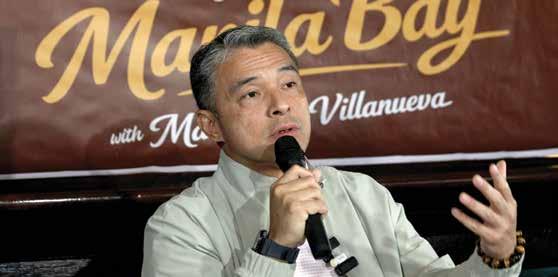
Secretary Juan Miguel Cuna is the featured guest during the Kapihan sa Manila Bay forum on Wednesday (May 27, 2026). Cuna said the tree-cutting activities along Quirino Avenue in Manila were voluntarily halted after environmental groups opposed the move, which was made to give way to the Southern Access
FeAtures OPiniOn
Primary elections and what is at stake: why we need to vote wherever we may be in the
U.S.
THE most consequential elections in America are not always the ones that draw the largest crowds, loudest rallies or most dramatic headlines. Often, the choices that shape public life are made earlier and more quietly, in primary elections, when candidates are narrowed, party direction is tested and the names that appear on the general election ballot are decided.
That is why the primary election deserves more than casual attention. It is not a political warm-up.
It is not merely a rehearsal for November. In many races, especially in districts dominated by one party or in states with top-two primary systems, the primary may be the decisive contest. By the time the general election arrives, many meaningful choices may already have been made.
For Filipino Americans, Asian Americans, immigrants, young voters, workers, business owners, parents and seniors, the question is not whether politics feels inspiring every election year. The question is whether we can afford silence when decisions are being made about schools, health care, immigration policy, housing, public safety, small businesses, taxes, transportation, climate resilience, civil rights and the cost of living. Voting is not only about choosing a president. It is also about choosing city council members,
IN third and fourth year high school, I would save my baon so I could take a jeepney ride to go to the Senate once a week near Luneta Park, usually on Fridays. In those days, there was no such thing as No ID, No Entry for Senate visitors; no need for a QR code to enter the august halls of what was then the most prestigious legislative assembly in Asia.
In white shirt and khaki short pants, I would sit at the orchestra seating area, first row, separated only by a solid narra wood railing from the senators. You could touch the senators, in flesh and blood, looking so respectable in their white suits of gabardine fabric. Back then, the senators’ conscience was as white as their clothing.
The years were 1964 and 1965. That was the best Senate the Philippines ever had. I saw Ferdinand E. Marcos presiding as Senate president. Senators in action were a sight to behold. There was respect and camaraderie. The language was perfect English; Spanish was their other language. No Tagalog then. Oratory was first class.
RECENTLY, I had the privilege of speaking before the Philippine Air Force’s Public Affairs and Family Conference at the Villamor Air Base in Pasay City.
I was requested to discuss a concept that was gaining urgent traction in defense and strategic communications circles around the world: the cognitive domain.
I admit that this topic was not all too familiar at first instance.
But the longer I sat with the subject, the more I was convinced that understanding the cognitive domain was not just a military imperative, it was also a civic and economic one. Every institution that depended on public trust, whether it was the Armed Forces of the Philippines or even a mining company, had a stake in this conversation.
Military strategists have long organized conflict across de-
county supervisors, sheriffs, judges, school board members, state legislators, members of Congress and governors. These offices decide the everyday architecture of civic life: how safe neighborhoods feel, how schools are funded, how public money is spent, how disaster response is managed, how immigrants are treated and how communities are heard.
That is why the phrase “wherever we may be in the U.S.” matters. Civic responsibility does not end when people move from one state to another, from Los Angeles to Las Vegas, from San Francisco to New York, from San Diego to Houston, from New Jersey to Florida. Democracy is local before it is national. The ballot changes by zip code, but the responsibility remains.
For immigrant communities, the act of voting carries a layered meaning. Many came from countries where political power was inherited,
Verbal insults were delivered in such elegant language and nuance you wouldn’t notice immediately you just suffered an uppercut. Answers to interpellation offered lessons rich in law, history, public policy, moral uprightness and educational brilliance. There were no crying ladies. No shouting and boxing matches, on and off session hall. There were no fashion shows; no use of tablecloth as formal garb at the rostrum. Senators’ offices did not serve double duty for marijuana sessions, beauty enhancement work, nor storage rooms for maletas of cash. In the 1960s batches of senators were several Bar topnotchers – Marcos, Jose W. Diokno, Juan Liwag, Emmanuel Pelaez, Jovito Salonga, Tecla San Andres Ziga, Rodolfo Ganzon, Lorenzo Sumulong and Arturo M. Tolentino, to name some. The nationalist and anti-collaborator prosecutor Lorenzo Tañada was there too. He was UP Law and a Harvard Law masters. Tecla San Andres Ziga was the first woman Bar topnotcher. She was senator of the 1960s. Eva Estrada Kalaw was the only woman in the Fifth Congress. She was a beauty-andbrains queen and journalist and had a master’s degree in social work. Jose Roy and Dominador Aytona were lawyer-economists. Soc Rodrigo was a lawyer-po-
et. Wenceslao Lagumbay had a master in comparative law at George Washington University.
Up to the late 1960s, a third of 24 senators then were Bar topnotchers or topnotch lawyers. Several were tycoons who made money the old-fashioned way – through hard work and entrepreneurship –Fernando Lopez, Gil Puyat, Gaudencio Antonino. There were perennial reformers and orators like Raul Manglapus and Manuel Manahan.
Back in the 1960s, you could approach your senators anytime. As a campus journalist, I asked for an interview with Senator Jose W. Diokno. He sat down with me for two hours in his Senate office to explain the Investment Incentives Act of 1967 (Republic Act 5186), the law that created the Board of Investments (BOI). I also asked to interview Beningo “Ninoy” S. Aquino Jr., elected senator in 1967. He met with me briefly and told his young chief of staff, Raul S. Roco, 26, to explain to me, a campus journalist, the law that would lower the voting age. For two hours. By tradition, the Senate was the training ground for future presidents. And presidents were usually Bar topnotchers. In fact, eight presidents were Bar topnotchers – Manuel Quezon, u PAGE 7
The Invisible War
fined domains: land, sea and air. As technology advanced, two more were added: cyberspace and outer space.
Scholars contended that human cognition itself constituted a sixth domain of military competition, one that sits alongside land, sea, air, cyber and space. This was not metaphorical. Cognitive warfare can be compared to propaganda, disinformation, and psychological operations, and its ultimate goal was to plant ideas, change public opinion, and bring about the active or passive participation of a target, whether a group of individuals or an entire nation.
The crucial distinction from old-fashioned propaganda was the scale and precision now enabled by digital technology. Cognitive warfare sought to exploit vulnerabilities in how the human brain processed information, with the objective of changing not only what people thought about, but also on how they acted.
It operated below the threshold of kinetic conflict and was,
purchased, manipulated or reserved for the connected. Some carry memories of elections shaped by patronage, fear or dynasties. Others grew up believing government was something to endure rather than something to help shape. America is imperfect. Its democracy is often noisy, expensive, polarized and frustrating. But the vote remains one of the few equal instruments
Rodrigo Duterte, is now a fugitive—hunted by the very institution he once commanded. He slipped out of the Senate in the early hours of the morning to evade an International Criminal Court (ICC) arrest warrant, leaving behind a chamber in panic, its security forces firing shots to create the impression that the Senate was under assault.
The irony is almost too neat: the man who oversaw a drug war that killed thousands could not summon the nerve to face a single warrant. He ran. That is all that needs to be said about Bato dela Rosa. The more important revelation is that he is so unlike the man he served, and that difference tells us about the nature of impunity as an element of populist power.
Impunity, at its most potent, is not merely the ability to break the law and escape punishment. It is a form of power, one that works by projecting an aura of
COMMENTARY
therefore, far harder to detect, attribute, and counter. False information was known to affect judgment and decision-making even after being refuted, and exposure to disinformation posed a major challenge to the functioning of societies in the Information Age.
The speech I delivered to our Air Force communicators centered on the implications of this reality for those of us in the business of shaping and defending narratives. And I wanted to be clear: “shaping narratives” was not a euphemism for deception. It was the deliberate, principled work of ensuring that truth reached people before falsehood did, and that it reached them in a form they can receive and believe.
The Philippines was not an abstraction in the cognitive domain — we were an active theater of operations in it. The country was confronting conflict that unfolded without ships crossing our waters or troops landing on our shores, beginu PAGE 8
IMPEACHMENT is often invoked as one of the strongest safeguards of democracy in the Philippines. Enshrined in the Constitution, it is meant to ensure that the highest officials of the land can be held accountable for wrongdoing. In principle, it affirms a simple but powerful idea: no one is above the law. In practice, however, impeachment has rarely lived up to this ideal. Instead, it has increasingly become a reflection of political power—less about justice, and more about who holds the numbers.
The process has rarely succeeded in fully holding a sitting President to account. The country’s first major experience with it, during the presidency of Joseph Estrada, underscores this reality. While historic, Estrada’s impeachment ultimately collapsed before reaching a formal Senate conviction. A key reason lies in the structural advantage
invincibility. The person who wields it does not simply evade accountability; he appears to stand above the very authority that would hold him accountable. This is what gives impunity its mystique. People stand in awe before it, and institutions hesitate. Followers are emboldened, and even some critics, sensing that resistance is futile, fall silent.
This was the kind of power Rodrigo Duterte wielded during his violent presidency. When he appeared before congressional hearings, no longer president, facing questions about thousands of deaths, he was almost unperturbed. Yes, he said, in effect: I ordered it. So be it.
The legislators questioning him were visibly deferential, reminding him almost apologetically that he was confessing to crimes. He merely shrugged. No Philippine court ever formally charged him. The families of his victims, denied justice at home, decided to bring their cases to the ICC.
His response to the ICC was the most brazen expression of impunity. He simply withdrew the Philippines from the Rome Statute—unilaterally, with minimal resistance. It was a declaration that not even international law applied to him. His followers
read it as validation of what they already believed: that he was beyond the reach of any law. His subordinates drew their own conclusion: that they, too, were shielded, having acted on his orders.
What finally broke the aura of immunity was not legal argument but political calculation. As long as the Marcos-Duterte alliance held, the ICC warrant was a dead letter. Without state cooperation, arrest was unlikely. But when the Dutertes became a liability to the Marcos presidency rather than an asset, the shield vanished. Suddenly the law had room to move.
I suspect Duterte knew what was coming. He could have remained in Hong Kong where he was vacationing, and where his relationships with Chinese leaders would have made extradition impossible. He came home genuinely convinced that his presence alone would give the arresting officers pause. He had become a prisoner of his own mystique.
But he was wrong about one man: Gen. Nicolas Torre did not hesitate. He arrested Duterte, calmly read him his rights, and, despite Duterte’s delaying attempts, escorted him to the u PAGE 7
of the presidency—particularly its control over public resources.
This “power of the purse” enables the President to influence the allocation and release of funds for local and national programs. For many politicians, especially at the local level, access to these resources determines political survival. Under such conditions, loyalty is shaped less by principle than by necessity. It is therefore unsurprising that impeachment has rarely functioned as an effective mechanism for holding a chief executive fully accountable.
The Vice Presidency operates under a very different set of dynamics. Ideally, the President and Vice President work in tandem to provide stability in governance. But the Philippine system allows for divided mandates, where the two officials often come from competing political camps. When these alliances fracture, the Vice Presidency can become an alternative center of power—and, consequently, a target of intense political pres-
sure. This is the context in which the impeachment complaints against Vice President Sara Duterte must be understood. The allegations— ranging from the misuse of confidential funds and unexplained wealth to statements perceived as threats—are serious and warrant scrutiny. But Duterte’s response—that the process is politically motivated—also resonates in a system where accountability mechanisms are deeply entangled with power struggles. The ongoing proceedings reflect not only legal questions but also the widening divide between the Marcos and Duterte camps, once united during the 2022 elections. What is unfolding is not simply a legal process; it is a contest over influence, legitimacy, and the future political landscape, especially with the 2028 elections on the horizon. This is where impeachment begins to take on a different character. Rather than functioning solely as a tool of accountu PAGE 7
SEN. Ronald “Bato” dela Rosa, the former chief of the Philippine National Police under former President
Marcos, Japan deepen strategic ties during state visit
Defense cooperation, trade and regional security lead talks as Manila and Tokyo elevate relations to a comprehensive strategic partnership
by AJPress
TOKYO — President Ferdi-
nand Marcos Jr. and Japanese Prime Minister Sanae Takaichi agreed Thursday, May 28, to elevate relations between the Philippines and Japan to a Comprehensive Strategic Partnership, marking a new stage in ties increasingly shaped by defense cooperation, trade and maritime security.
The agreement was reached during Marcos’ state visit to Japan from May 26 to 29, undertaken at the invitation of the Japanese government. Japan’s Ministry of Foreign Affairs said Marcos and Takaichi held a summit meeting at the Akasaka Palace State Guest House, issued a joint statement and outlined future cooperation as comprehensive strategic partners.
Defense cooperation was among the main items on the agenda. The two leaders agreed to begin negotiations on an agreement covering the protection of classified military information, a step that could support closer security coordination between Manila and Tokyo. They
PAGE 6
also agreed to accelerate defense-level discussions on possible equipment transfers, including Abukuma-class destroyers and TC-90 aircraft.
The talks come as Japan moves to loosen longstanding limits on defense exports and as the Philippines continues to strengthen its maritime capabilities. The proposed information-sharing pact is expected to help facilitate future Japanese transfers of military equipment to Manila while both governments expand defense ties.
The summit also reflected broader security pressures facing both countries. The Philippines has reported repeated confrontations with Chinese vessels in disputed areas of the South China Sea, while Japan has its own concerns in the East China Sea and around Taiwan. In their talks, Marcos and Takaichi expressed serious concern over the situation in the East and South China seas and opposed unilateral attempts to change the status quo by force or coercion, according to Japan’s foreign ministry. Economic cooperation was another major part of the visit. Ja-
pan said both sides agreed to advance discussions on upgrading the Japan-Philippines Economic Partnership Agreement and the ASEAN-Japan Comprehensive Economic Partnership Agreement. Takaichi also welcomed the Philippines’ request to join the Comprehensive and Progressive Agreement for Trans-Pacific Partnership and expressed support for an early start to the accession process.
The two governments also witnessed the signing of a new tax convention and discussed cooperation in artificial intelligence, digital infrastructure, supply chains, disaster risk reduction, health care, human resource development and the Luzon Economic Corridor.
For Manila, the visit reinforced a foreign policy strategy that seeks to widen security and economic partnerships while preserving its treaty alliance with the United States. For Tokyo, closer cooperation with the Philippines fits a broader effort to work with Southeast Asian partners facing similar pressures over maritime security, supply chains and regional stability. n
I saw the greatest Senate...
Sergio Osmeña, Manuel Roxas, Jose P. Laurel, Elpidio Quirino, Carlos Garcia, Diosdado Macapagal and Ferdinand Marcos Sr.
During their time as presidents, the Philippines became the second most prosperous country in Asia, after Japan.
In fact, I believe the Philippines was the most prosperous or richest country in Asia from the late 1930s to the late 1960s – four decades of solid economic growth unmatched then anywhere in the region. Japan was devastated by two nuclear bombs. True, Manila was devastated but it was because of the US Army bombing which levelled the city designed by the famous Burnham. The master urban blueprint of Manila was designed by renowned American architect-city planner Daniel Burnham in 1905. Known as the Burnham Plan, it envisioned Manila as a tropical Washington DC with wide boulevards, grand waterfront parks and majestic neoclassical government buildings.
PAGE 6
Today, you are a college dropout, a plain housewife, a general, an economist, a bigotilyo or simply a bum, or a bigtime plunderer – you run for president. It’s the next best thing to doing nothing. Because of the declining quality of presidential material lately, I have been training my dog to run for president.
Why a dog for president?
Well, a dog is loyal to his master. He won’t steal. A dog is a good guard. He will protect the West Philippine Sea. A dog has more bark than bite. He won’t kill people. A dog has sharp sense of smell. He won’t do or deal with drugs. Of course, dogs have no first ladies.
Today, in the present Senate, senators behave worse than fighting cats and dogs.
A third of senators today are siblings – good ones, bad ones, in between. A third of senators today are movie stars or broadcasters. Two are being hunted for being murderers – criminals against humanity. Five are facing cases of plunder or massive stealing of taxpayers’ money.
Two are being investigated for stock market manipulation. A number are swindlers. They don’t keep their promises. There are a few lawyers, but not Bar topnotchers. The lawyer-senators are known for things other than excellence in law. And nearly all senators love money – for the fun and fund of it. Why did the Senate decline to its present nadir? Answer: the abolition of the two-party system, the Nacionalista and the Liberal Party. Until 1972, the NP and LP competed for power. To capture Malacañang, the party must first capture the Senate. To capture the Senate, you needed quality candidates – the Bar topnotchers. To capture Malacañang, you needed quality candidates – the Bar topnotchers. (Philstar.com)
* * * The opinions, beliefs and viewpoints expressed by the author do not necessarily reflect the opinions, beliefs and viewpoints of the Asian Journal, its management, editorial board and staff.
* * * Email: biznewsasia@gmail.com
The Invisible War...
ning quietly through unseen hands on keyboards.
We saw this most vividly in the West Philippine Sea. By claiming as its own the entirety of the South China Sea under a nine-dash line with no coordinates, one state had embedded a disinformation architecture into its geopolitical posture, seeking legitimacy for deployments that the international community had rejected but cannot easily reverse. Cognitive warfare had become a vital domain in modern conflict, with adversaries aiming to “win without fighting” by embedding influence operations across both civilian and military sectors. Social media was the delivery mechanism and artificial intelligence or AI accelerated it. The target was not just military morale. It was also institutional credibility, democratic cohesion, and public willingness to support policies that served the national interest.
I also knew this from mining as chairman of the Chamber of Mines of the Philippines. Mining in the Philippines had long been fought on two fronts: the geological and the narrative. The cognitive attacks against the mining sector — misinformation about
environmental practices, fabricated statistics, coordinated disinformation campaigns amplified on social media — were not incidental. They followed a recognizable pattern of perception management. They were designed to erode the social license upon which our operations, and thousands of Filipino jobs, depended upon.
This was why I found it deeply encouraging to speak with the PAF’s public affairs and family conference participants. The Philippine Air Force had invested in strengthening its public affairs leadership and enhancing its strategic communication practices, including through exchanges with allied forces. This is exactly the right instinct and I laud its current commanding general, Lt. Gen. Arthur M. Cordura, PAF (GSC), for taking big strides in this respect.
But building resilience in the cognitive domain required more than communications training. It required a doctrine of truth telling that was faster, more agile, and more trusted than the disinformation it competes with.
The Air Force’s public affairs officers were not just information clerks. They were, in the fullest sense of the phrase, defenders of the institution’s integrity in a contested information
environment.
We live in a world where a smartphone can be a weapon of mass persuasion, where a manufactured video can undermine an institution’s reputation overnight, and where foreign interests can wage a campaign against a country’s sovereignty without ever declaring war.
The cognitive domain is the battlefield of our time, and it is already active. Those of us who lead institutions, whether in uniform or in corporate offices, have a shared responsibility to understand it, to communicate with discipline and honesty, and to build the kind of trust that makes communities resilient against manipulation.
In a VUCA (Volatile, Uncertain, Complex and Ambiguous) yet connected world such as ours, perception is not merely optics. It is power.
The ones who understand this earliest, such as the women and men of the Philippine Air Force, will be the ones best positioned to defend it. (Philstar.com)
* * * The opinions, beliefs and viewpoints expressed by the author do not necessarily reflect the opinions, beliefs and viewpoints of the Asian Journal, its management, editorial board and staff.
* * * Email: eleanor@shetalksasia.com
Mango growers seek science-based support
by AJPress
MANILA — Malacañang said Philippine authorities may immediately serve future arrest warrants issued by the International Criminal Court, making clear that the Marcos administration expects law enforcement agencies to act once a warrant is properly received and verified.
Palace Press Officer Claire Castro said the government would follow the position earlier laid out by the Department of Justice: that valid ICC warrants may be implemented by Philippine authorities without waiting for a separate local court order.
She said the administration remains guided by law, due process and the proper handling of official processes. The statement places the focus on procedure as the Philippines faces continuing questions over cooperation with the ICC after the country’s 2019 withdrawal from the Rome Statute. The ICC has maintained that it may exercise jurisdiction over alleged crimes committed while the Philippines was still a state party. Under the Palace position, future ICC warrants would have to be received through official channels, checked for validity and transmitted to the proper
law enforcement agencies for implementation. Officials did not announce any new warrant or identify any additional person subject to ICC action. The issue has drawn renewed attention after the ICC unsealed an arrest warrant on May 11 for Sen. Ronald “Bato” Dela Rosa, who has not been convicted and may contest the allegations and jurisdiction. The ICC has also set Nov. 30, 2026, for former President Rodrigo Duterte’s trial. The Palace statement signals continued cooperation with the ICC, while leaving Philippine courts to address any legal challenges that may arise from enforcement. n
ICC sets Duterte trial for Nov. 30
by AJPress
THE HAGUE — The International Criminal Court has scheduled the opening of former Philippine President Rodrigo Duterte’s trial for Nov. 30, 2026, moving the crimes against humanity case against him into its next major phase.
Trial Chamber III set the date Wednesday, May 27, after a status conference in The Prosecutor v. Rodrigo Roa Duterte, according to the ICC. Duterte, 81, is charged with crimes against humanity in connection with alleged murders and attempted murders tied to
anti-drug operations during periods when he served as mayor of Davao City and later as president of the Philippines. He denies wrongdoing and has not been convicted.
In April, ICC Pre-Trial Chamber I confirmed the charges against Duterte and committed the case to trial, finding substantial grounds for proceedings to continue. The ruling was procedural and did not determine guilt.
ICC prosecutors have alleged that the crimes formed part of a broader attack on civilians suspected of involvement in illegal drugs. The case stems from the
ICC’s investigation into alleged killings linked to Duterte’s anti-drug campaign. The court has said it retains jurisdiction over alleged crimes committed while the Philippines was still a party to the Rome Statute before its withdrawal took effect in 2019. Duterte was arrested in the Philippines and transferred to ICC custody in The Hague in March 2025. His lawyers have raised concerns about his health and fitness to stand trial. The Nov. 30 proceedings will begin the courtroom phase of the case, where prosecutors must prove the charges beyond reasonable doubt before ICC judges. n
Primary elections and what is at stake...
PAGE 6
those who stay home still live with the outcome. A renter who does not vote still faces housing policy. A small-business owner who does not vote still faces taxes and regulation. A parent who does not vote still sends children to schools shaped by elected boards. A worker who does not vote still depends on wage laws, transportation systems and health policies. A community that does not vote may later wonder why candidates do not speak its language, visit its neighborhoods or understand its concerns.
Political influence is not given to communities because they are good, deserving or hardworking. It is built through participation. Candidates listen to voters who show up. Parties study turnout. Campaigns track neighborhoods. Public officials notice which communities vote consistently and which communities can be ignored without consequence.
For Filipino Americans and other Asian American communities, visibility cannot depend only on cultural festivals, heritage months or celebratory proclamations. Representation begins with being counted, not only in the census, not only in business success, not only in
PAGE 6
professional achievement, but at the ballot box.
To vote in a primary is to say: we are not an afterthought. It is also to reject the habit of waiting for perfect candidates. Democracy rarely offers perfection. It asks for judgment. It asks voters to compare records, priorities, temperament, integrity and competence. It asks citizens to distinguish between slogans and solutions, between charisma and character, between grievance and governance. There are always reasons not to vote. People are busy. The ballot feels confusing. Candidates sound alike. Politics feels toxic. One vote seems too small. But history is shaped not only by sweeping movements; it is shaped by accumulated acts of participation. A few votes can decide local races. A low-turnout primary can elevate candidates who would not prevail in a broader electorate. Silence, repeated often enough, becomes surrender.
The work begins before Election Day. Check your registration. Know your state’s primary rules. Read the ballot. Study the candidates. Look beyond party labels. Ask who funds them, what they have done, what they propose and whether their plans are realistic. Help new citizens
understand deadlines. Offer rides. Share official election information, not rumors. Vote early where allowed. Return mail ballots on time.
Voting is not a cure for every injustice. It will not instantly lower prices, repair institutions, end division or guarantee wise leadership. But not voting guarantees only one thing: other people will decide. The primary election is where democracy begins to narrow its choices. It is where the public decides who is worthy of advancing, who should be entrusted with a larger platform and which ideas deserve to move forward. To skip that moment is to arrive late to a decision already made.
The stakes are not abstract. They are the schools our children enter, the streets we drive on, the hospitals we depend on, the businesses we build, the rights we exercise, the courts we face, the taxes we pay, the neighborhoods we call home and the future we leave behind.
Wherever we may be in the United States, the obligation is the same: register, learn, vote and help others vote. Because democracy does not only ask what we believe. It asks whether we showed up when it mattered. (AJPress)
The mystique of impunity...
plane that delivered him to ICC custody. The mystique has been dented but is not shattered.
The polls show that the Duterte aura lives on in his daughter, Vice President Sara Duterte, who is positioning herself for the 2028 presidential race. Her allies in the Senate are doing everything in their power to block any legal or political process that might keep her off the ballot. The sorry spectacle of recent days— the fabricated panic, the fugitive senator who surfaced just to vote for a new Senate president, the shots fired at phantoms—is part of this rearguard action to preserve what remains of the Duterte culture of impunity.
But that spectacle also reveals
PAGE 6
that the mystique is not always transferrable. The memes that came in the wake of Bato dela Rosa’s stumble at the stairs proved that. So did those that ridiculed the senators who panicked at the sound of shots that their own security had fired. Sara Duterte is a different and more serious question. She is her father’s daughter in ways that go beyond biology. She’s combative and skilled at channeling the resentments of those who feel avenged by her father’s boldness. Whether she carries enough of the mystique to reconstitute the impunity system around herself is something we cannot yet answer. The 2028 election will be that answer. If the Filipino people
choose to return the Duterte brand to power—knowing now what it costs and having seen where it leads—impunity will not merely survive. It will have been ratified. And a ratified impunity is far more dangerous than one that simply evades the law, for then it will carry a democratic mandate. Only an electorate that refuses to be seduced by the mystique of defiant power can end the culture of impunity. (Inquirer.net)
* The opinions, beliefs and viewpoints expressed by the author do not necessarily reflect the opinions, beliefs and viewpoints of the Asian Journal, its management, editorial board and staff.
* Email: public.lives@gmail.com
Impeachment or Political Theater?...
ability, it becomes a stage for political performance. The two chambers of Congress play entirely different scripts in this theater. The Lower House, tethered tightly to presidential patronage, often moves with swift, partisan predictability to marshal the numbers. The Senate, with its national mandates and independent ambitions, becomes a wilder arena where old alliances go to die and future presidential bids are born.
Consequently, legislative hearings cease to be just venues for establishing facts—they are platforms for messaging. Legislators do not merely weigh evidence— they signal loyalty, assert influence, and position themselves within shifting alliances. Media coverage amplifies these dynamics, turning a constitutional process into a public spectacle where narratives compete as much as evidence.
The result is a troubling shift. Impeachment risks becoming less about determining guilt or innocence and more about
demonstrating political strength. It becomes a numbers game, where outcomes depend on coalition-building rather than principled deliberation. When this happens, the credibility of impeachment as a democratic safeguard is weakened, looking less like a mechanism of justice and more like a weapon of political convenience. This is not to say that impeachment should be dismissed as inherently flawed. On the contrary, it remains an essential tool for holding leaders accountable. But its effectiveness depends entirely on how it is used. When applied selectively—pursued aggressively against opponents while ignored for allies—it undermines the very principle it is meant to uphold. Accountability loses its meaning when it is contingent on political alignment. Ultimately, the challenge is not simply institutional, but cultural. Strengthening impeachment requires more than procedural safeguards; it demands a political environment where evidence matters more than alliances, and
where public office is treated as a trust rather than a prize. Until then, impeachment will continue to mirror the realities of Philippine politics: a system where power shapes outcomes, and where accountability remains as much a political question as a legal one. In this light, the question is not whether impeachment works— but for whom it works, and under what conditions. Until that question is confronted, impeachment will remain suspended between its promise as a tool of
and its reality as an instrument of power. (Inquirer.net)
Quorum dispute turns Senate remote voting debate into test of presence and power
A minority walkout halted proceedings and underscored how legislative attendance can determine whether the chamber may act.
by AJPress
A DEBATE over remote voting in the Philippine Senate has become a larger test of presence, procedure and political power inside one of the country’s most closely watched institutions.
The issue came to a head on Tuesday, May 26, when minority senators walked out of a plenary session as the majority moved to take up proposed changes that would expand the circumstances under which senators may participate and vote remotely. The walkout left the chamber without enough members to continue formal business, forcing adjournment and shifting attention from the technology of online participation to the basic question of quorum. Under the 1987 Constitution, “a majority of each House” constitutes a quorum to do business.
In the 24-member Senate, that generally means at least 13 senators must be present, or otherwise counted under rules recognized by the chamber, before official business may proceed. A smaller number may adjourn from day to day or compel the attendance of absent members, but it cannot act as a full Senate. The Senate’s own rules follow the same standard. Rule XV provides that, except in the election of officers, a majority of senators constitutes a quorum. The rules also set procedures for verifying a lack of quorum and determining whether business may continue.
That is why the walkout carried
OJ Arci is a prominent Filipino theater actress and singer. In the competitive world of Philippine performing arts, she and the Philippine Stagers Foundation (PSF) advocate absolute punctuality as a foundational professional virtue.
As a national mobile theater group, PSF frequently mounts consecutive multi-city performances across Luzon, Visayas and Mindanao. A single delay can disrupt logistics, technical setups and travel windows. PSF also states in its nationwide casting calls and annual theater and film workshop registrations that “punctuality is a must.” Lateness is viewed as a lack of respect for fellow ensemble actors, production crews and paying audiences.
OJ Arci, also known as OJ Ar Ci, is a staple lead and supporting actress in PSF’s major historical and socio-political musical plays, notably Katips: Ang Mga Bagong Katipunero, Hero Z, a zombie historical fiction musical, and Juan Luna: Isang Sarswela.
Beyond the stage, her crossover into cinema earned her a Best Supporting Actress nomination at the FAMAS Awards for her role in La Traidora. As PSF’s secretary-general, she helps oversee organizational discipline, scheduling and training for new batches of theater apprentices. The judges of PSF Theater Festival 2026
The PhilStagers Foundation is pleased to announce the jury members who will choose the winners for its annual theater festival: Richard Quan, film and television actor; Joel Lamangan, director and film and television actor; Dr. Anton Juan, director, playwright and professor; and BJ Crisostomo, playwright and theater actor.
Two-week festival show sched-
ule: First week, May 23, Saturday; second week, May 30, Saturday; and awards night, June 6, Saturday. For ticket reservations at the PhilStagers Blackbox Theater, please call or text +63991 100 2483 or +63976 501 5558.
University of Washington pays tribute to Vicente Rafael
Posted on Facebook by Lila Shahani, daughter of the late Senator Leticia Shahani:
“Thank you all for being a part of our final farewell to Vince. I particularly appreciated those who took the time to come to his funeral in Manila and those who went to the trouble of recording such moving video messages. I’m also grateful for the many published eulogies and obits people have written, not to mention the wonderful messages friends and family have sent me here on Facebook. Your letters, words, thoughts, flowers, food and warm hugs have been a source of great comfort.
“I’d also like to share that the Department of History and the
consequences beyond protest. In a chamber of only 24 members, the absence of a small bloc can determine whether the Senate may proceed at all.
At the center of the dispute is a proposed revision of Senate rules on remote attendance and electronic voting. Existing provisions allow sessions through teleconference, videoconference or other electronic means in limited circumstances, such as force majeure or a national emergency that prevents senators from convening or being physically present in the session hall. The proposed change would broaden when remote participation may be used.
Supporters have described remote participation as a practical adaptation to modern conditions. Minority senators have questioned the timing and scope of the proposal, warning that attendance and voting rules should not be rewritten in a way that could alter how power is exercised on the floor.
The legal issue is limited but decisive: quorum rules do not settle the merits of remote voting. They determine whether the Senate has enough members, counted under its own rules, to exercise its authority at all.
The larger test is institutional. In deciding how far remote participation may go, the Senate is also defining what presence means in a deliberative chamber, and whether efficiency can be expanded without weakening visibility, accountability and public trust. n
Palace says future ICC warrants may be served immediately
Malacañang says valid warrants from the international court may be enforced once received and verified by Philippine authorities.
by AJPress
MANILA — Malacañang said Philippine authorities may immediately serve future arrest warrants issued by the International Criminal Court, making clear that the Marcos administration expects law enforcement agencies to act once a warrant is properly received and verified.
Palace Press Officer Claire Castro said the government would follow the position earlier laid out by the Department of Justice: that valid ICC warrants may be implemented by Philippine authorities without waiting for a separate local court order.
She said the administration remains guided by law, due process and the proper handling of official processes.
The statement places the focus on procedure as the Philippines faces continuing questions over cooperation with the ICC after the country’s 2019 withdrawal from the Rome Statute. The ICC has maintained that it may exercise jurisdiction over alleged crimes committed while the Philippines was still a state party.
Under the Palace position, future ICC warrants would have to be received through official channels, checked for validity and transmitted to the proper
Center for Southeast Asia and its Diasporas (CSEAD) at the University of Washington will be hosting a memorial for Vince on Saturday, May 30. The eulogists will include Adam Warren of UW History; John Pemberton of Columbia University, by video tribute; Judith Henchy and Christoph Giebel of CSEAD, UW; Ileana Rodriguez-Silva of UW History; Tony Lucero of Comparative History of Ideas, UW; current and former students by video tribute; John Treat of Japanese Studies, UW; Cindy Domingo of the Union of Democratic Filipinos, LELO; and Leloy Claudio of UC Berkeley, by video tribute. I’ll be giving the closing eulogy.” PhilDev annual gala fundraiser at EDSA Shangri-La It was nice to see Maria Banatao, Filipino-American philanthropist, community leader and co-founder of the Philippine Development Foundation, during the PhilDev Annual Fundraiser held on May 23, 2026, at EDSA Shangri-La hotel.
Alongside her late husband, Silicon Valley tech visionary Diosdado “Dado” Banatao of Cagayan, Maria has dedicated decades to advancing education, technology and entrepreneurship for Filipinos in the Philippines and across the diaspora. She graduated from St. Paul College Manila in 1968 be-
fore moving to the United States. She later earned a master’s degree in educational psychology and counseling from the University of Washington. She met Dado Banatao in Seattle in 1968. Together, they raised three children, Rey, Desi and Tala, while navigating the fast-paced growth of Silicon Valley.
That evening at EDSA Shangri-La coincided with the commemoration of PhilDev founder Dado’s birth and the launch of the book The Dado Banatao Story: A Tale of Two Valleys, celebrating his life and enduring contribution to Filipino innovation.
The gala brought together around 200 scholars, beneficiaries, partners and supporters united by a shared vision of leveraging science, technology and innovation for nation-building.
I also saw my boss, Asian Journal Publications publisher Roger Oriel, and my former editor Chit Lijauco, now managing editor of Philippine Tatler magazine.
Thanks, too, to Bee Vitug and Allan Rey Tato, both of PhilDev, as well as to Syrah Vivien Inocencio of Tatler Philippines, Alvin Kasiban of Daily Tribune, Gelo Gonzales of Rappler and Kenneth Stern of Ayala Foundation. Fusion unveiled: Songs and poetry in photographs It was a duet of sight and soul as BusinessMirror’s Bernard Testa brought his songwriter’s eye while Pilipino Mirror’s Riza Zuniga delivered verses honoring Filipino photographers, with a special
dedication to George Tapan, at the exhibit held at San Beda College Museum and Archives’ Wall Gallery Business on May 25, 2026, in Muntinlupa City. Inspiration overflowed with messages from distinguished guest speakers PTFoMS Undersecretary Jose Torres Jr.; Press Photographers of the Philippines President Edwin Bacasmas; Arnel Macariola; and SBC Museum and Archives Administrator Joseph Richard Renta III. The exhibition runs until June 30, 2026.
A Tomas B. Lopez Jr. call for innovation
Project RISE’s Top 10 Final Pitch and Demo will feature the brightest young innovators and changemakers of Makati, who will showcase bold ideas and sustainable solutions that could create real community impact on May 27 at Makati Diamond Residences. The Top 10 teams will present their innovations, entrepreneurial vision and passion for building a better future through technology, resiliency and sustainability.
Organized by the University of Makati-CTIED in partnership with QBO Innovation, the event continues to empower the University of Makati’s young Herons by nurturing innovation, entrepreneurship and impactful collaboration.
* * * The opinions,
and
* * * rogeliocmedina@yahoo.com
law enforcement agencies for implementation. Officials did not announce any new warrant or identify any additional person subject to ICC action.
The issue has drawn renewed attention after the ICC unsealed an arrest warrant on May 11 for Sen. Ronald “Bato” Dela Rosa, who has not been convicted and may contest the allegations and jurisdiction. The ICC has also set Nov. 30, 2026, for former
‘DOH can’t donate money to WHO’
by rhodina VillanueVa Philstar.com
MANILA— The Department of Health (DOH) is not in a position to donate money to the World Health Organization (WHO), a network of health development experts said yesterday.
The Universal Health Care (UHC) collective said that a donation, if indeed necessary, should be initiated by the Department of Foreign Affairs (DFA).
In an interview, Juan Antonio Perez III of the UHC said that being the lead agency for the United Nations, the DFA has the mandate to support the UN and not the DOH specifically.
“The DFA, not DOH, should have a comprehensive plan to support the United Nations, in-
cluding the WHO (World Health Organization) and the United Nations Population Fund or UNFPA which work closely with our health and population programs,” said Perez. Health Secretary Ted Herbosa had earlier committed $10 million or around P620 million to the WHO, with the disbursement carried out over four years from 2024. While Perez ackowledged the WHO’s need for funding especially after the US withdrew its financial contribution, he said, “The DFA should make these decisions, not the DOH. It is a geopolitical decision that DFA makes.” He said the Philippines is also in dire need of funding for public health care. n
Plunder cases could flip Senate to minority within weeks, Lacson says
by Cristina Chi Philstar.com
MANILA — Two looming plun-
der cases against majority senators could collapse the bloc that controls the Senate and hand de-facto power to the minority within weeks, Sen. Ping Lacson said Thursday, May 28.
Speaking on ANC’s “Headstart,” Lacson explained the numbers game that would give his side control of key committees even as they do not yet have the numbers to change the Senate president.
The majority bloc supporting Senate President Alan Peter Cayetano effectively numbers 12, because Sen. Bato dela Rosa has gone into hiding to dodge an International Criminal Court warrant. The minority — which brands itself “Solid Bloc 11” — sits at 11.
Lacson stated that if warrants are issued for two majority senators, the ratio would become 11 against 10, giving the minority a one-member edge and effective control of the Senate.
Ombudsman Jesus Crispin
Remulla said this week he expected to file plunder and malversation charges against Sen. Jinggoy Estrada before the Sandiganbayan on Thursday morning. “Give 24 to 48 hours, baka ma-issue ng warrant,” Lacson said.
If Estrada is detained by Monday, the floor splits 11 to 11, Lacson said, and the majority can no longer assemble the 13 senators needed to force a quorum and ram through a vote. The turning point comes if a second case follows. Remulla said the same day that a separate plunder complaint against Sen. Joel Villanueva is “ripe” and could be filed within two weeks. Should Villanueva also be served, Lacson said, the count becomes 11 for the minority against 10 for the majority.
“Effectively we will be the majority,” he said. At that point, Lacson said, the bloc would move to declare every committee chairmanship vacant and re-elect the chairs.
“It takes 13 votes to elect a Senate president,” Lacson explained, but “it only takes a simple majority to elect the chairman or the [members] of the committee.”
A hypothetical scenario. Lacson was careful to say that the entire
scenario was hypothetical, and he said the minority bloc took no pleasure in the prospect of an arrest being made to one of his colleagues. “We’re not praying, we’re not hoping that one or two or three of our colleagues would go to jail,” he said.
Most of the senators facing charges, he noted, are his friends. Walkout was Sotto’s idea
The walkout by minority senators on Tuesday was Sotto’s idea, Lacson said, hatched in real time as the majority pressed to force a vote on Marcoleta’s motion to let senators join sessions by teleconference.
After Cayetano repeatedly moved to “divide the house” — which means to call a vote — it was Sotto who thought of walking out, Lacson said, and Zubiri who moved to do it. Their exit left Sotto as the lone minority senator remaining. The chamber at the time had dropped to just 12 senators, one short of the 13 needed to proceed, since majority Senators Chiz Escudero and Dela Rosa were not present.
At present, Senate rules permit remote sessions only under emergency conditions and bar counting an absent senator’s vote.
Marcoleta’s amendment is meant to loosen that rule to allow a remote vote “for justifiable reasons” — a change the minority suspects is tailored to let dela Rosa, and any senator later facing arrest, keep voting from outside the chamber.
Hanging over the entire dispute is the impeachment trial of Vice President Sara Duterte, set to begin July 6. The same May 11 vote that installed Cayetano was widely read as a move to shield Duterte.
Convicting the vice president requires 16 of 24 senators, and her allies, who dominate the new majority, need only to keep the count below that. Dela Rosa is one of those allies. However, Lacson argued the maneuver is pointless. He said that because two-thirds is an absolute number, the threshold to convict stays at 16 no matter how many senators are unavailable, and an abstention counts the same as an acquittal.
“Hindi naman sinabing zero dapat ang mag-acquit,” he said. “Ang sinabi 16 dapat ang mag-convict.” n
From left: Richard Quan, Joel Lamangan, Dr. Anton Juan and BJ Crisostomo.
Rogelio Constantino Medina, right, with Chit Lijauco, managing editor of Philippine Tatler.
Riza Zuniga of Pilipino Mirror.
From left: Richard Quan, Joel Lamangan, Dr. Anton Juan and BJ Crisostomo.
Bernard Testa of BusinessMirror.
Project RISE 2025: A Tomas B. Lopez Jr. Call for Innovation.
Maria Banatao, right, with Rogelio Constantino Medina.
OJ Ar Ci in Hero Z, a zombie historical fiction musical.
Vicente Rafael.
Thespian OJ Arci.
DENR UPDATES. Department of Environment and Natural Resources acting Secretary Juan Miguel Cuna is the featured guest during the Kapihan sa Manila Bay forum on Wednesday (May 27, 2026). Cuna said the tree-cutting activities along Quirino Avenue in Manila were voluntarily halted after environmental groups opposed the move, which was made to give way to the Southern Access Link Expressway (SALEX) project.
rogelio ConStantino Medina
My P.E.P. (People, Events,Places)
ASIAN
Zubiri apologizes after Inday Badiday remark in Senate dispute over Imee Marcos video
by AJPress
MANILA — Sen. Juan Miguel
“Migz” Zubiri has apologized to the family of the late television host and entertainment journalist
Lourdes “Inday Badiday” Carvajal after mentioning her name during a tense Senate exchange over a video presented by Sen. Imee Marcos.
The remark came during the Senate’s May 25 session, when Marcos showed a video that claimed some senators were linked to discussions on constitutional amendments through a constituent assembly, commonly referred to as “con-ass.” The video claimed that former Senate President Vicente “Tito” Sotto III met with House Speaker Faustino “Bojie” Dy to discuss Charter change. It also suggested possible moves to extend President Ferdinand Marcos Jr.’s term and raise the minimum age requirement for presidential candidates to 50, a change that would affect Vice President Sara Duterte’s possible 2028 presidential bid.
Sotto denied involvement in any Charter change effort. Several senators also objected to the video’s inclusion in the Senate proceedings, questioning its basis and propriety.
Zubiri, who objected to the presentation, described the video as opinionated, unparliamentary and improper for the chamber.
He moved to strike the video from the Senate record while allowing Marcos’ privilege speech to remain. Marcos later withdrew the video after Senate President Alan Peter Cayetano asked her to do so. During the exchange, Zubiri
roughly asked in Filipino whether the Senate had become “Inday Badiday,” invoking the late broadcaster whose name has long been associated with showbiz talk and intrigue.
The remark drew a public response from Badiday’s grandson, actor and host IC Mendoza, who said his grandmother’s name should not be used as a political punchline. Mendoza said Badiday’s legacy should not be reduced to gossip or casually tied to political accusations.
Badiday, also known to viewers as “Ate Luds,” was one of Philippine television’s most recognizable entertainment journalists. She hosted the GMA talk show “Eye to Eye” from 1988 to 1996, a program associated with celebrity interviews, public confessions and showbiz talk. She died in 2003. Zubiri later apologized directly to Badiday’s family, saying the remark was a “slip of the tongue” made during a heated debate. He
said he took responsibility for not being more careful with his words and did not intend to disrespect Badiday’s memory or diminish her contributions to Philippine media.
Mendoza accepted the apology, saying he understood Zubiri’s frustration and believed the senator meant no malice. Still, he said it was unsettling for the family to see Badiday’s memory associated with what he described as “fake news peddlers.”
Badiday’s name occupies a distinct place in Philippine entertainment culture. Before the internet-era term “Marites” became shorthand for gossip, Badiday belonged to an earlier broadcast age, when entertainment talk shows helped shape public conversation around celebrities, television, film and private lives made public.
The apology appeared to ease the public exchange between Zubiri and Badiday’s family.
DOT eyes BINI as possible tourism ambassadors after Coachella spotlight
The tourism department says it has reached out to the P-pop group’s camp, but no formal appointment has been announced
by AJPress
MANILA — Tourism Secretary
Dita Angara-Mathay said the Department of Tourism has reached out to BINI’s camp as it considers the P-pop group for a possible tourism ambassador role, following the group’s high-profile appearance at the Coachella Valley Music and Arts Festival in California. The proposal remains pending. No formal appointment has been announced, and the DOT has indicated that it is still awaiting a response from the group’s representatives.
Angara-Mathay made the remarks while in Tokyo, where she joined President Ferdinand Marcos Jr.’s state visit to Japan. She cited BINI’s Coachella appearance as an example of Filipino talent gaining visibility on an international stage.
The DOT earlier congratulated
BINI and Sophia Laforteza of KATSEYE after their Coachella performances, saying Filipino talent had been brought to one of the world’s major music festivals. The department also highlighted BINI’s milestone as a Filipino act performing at Coachella.
BINI is an eight-member P-pop girl group composed of Aiah, Colet, Maloi, Gwen, Stacey, Mikha, Jhoanna and Sheena. The group is identified as the country’s “Nation’s Girl Group,” a title widely used by fans and entertainment audiences.
The possible partnership would come as the DOT looks to refresh domestic tourism messaging while continuing the “Love the Philippines” campaign. Angara-Mathay has said the slogan will remain, with adjustments intended to make the campaign more relatable.
The proposed partnership comes as the DOT looks for ways
Photo from Instagram/@bini_ph
to encourage Filipinos at home and abroad to rediscover destinations across the country. Tapping BINI would place one of P-pop’s most visible acts within a tourism campaign built around youth culture, domestic travel and the global appeal of Filipino talent. For BINI, the possible role would add a public-facing cultural assignment to a career already drawing attention beyond the Philippines.
Fil-Am designer R’Bonney Gabriel joins ‘Project Runway’
The late broadcaster’s grandson, IC Mendoza, said the family accepted the senator’s apology but objected to seeing her name invoked in a political exchange by
season 22
The Miss Universe 2022 titleholder will compete in the fashion design series’ largest contestant lineup.
AJPress
Filipino American fashion designer and Miss Universe 2022 R’Bonney Gabriel has joined the cast of “Project Runway” season 22, extending her public career from pageantry and advocacy into a televised design competition.
Gabriel, who also uses the professional name R’Bonney Nola, is among 22 designers announced for the new season, the largest contestant field in the show’s history. The season is scheduled to premiere July 9 on Freeform and stream afterward on Hulu and Disney+.
Heidi Klum, Law Roach and Nina Garcia will serve as judges, with “Project Runway” season 4 winner Christian Siriano returning as mentor. The series is built around timed challenges in which contestants are assessed on concept, construction, styling and runway presentation.
A Texas-based designer, model and sewing instructor, Gabriel won Miss Universe 2022 after representing the United States. Pageant officials identified her as the first Filipino American to win Miss USA, according to the Associated Press. Gabriel has often linked her fashion work to sustainability, including the use of recycled materials and sewing education. She has also spoken
Eric Quizon says planning kept Dolphy heirs from inheritance fight
At the mediacon for “Project Baby,” the actor-director said his family’s experience was different from the reported estate issues now being discussed around Nora Aunor’s children.
MANILA — Actor-director
Eric Quizon said the children of the late Rodolfo “Dolphy” Quizon Sr. avoided a major inheritance dispute because the family had time to prepare, consult lawyers and discuss estate matters before the Comedy King’s death. Quizon made the comments during the grand mediacon for his film “Project Baby,” where questions about celebrity families and inheritance surfaced amid continuing public discussion over reported estate issues involving the children of the late National Artist Nora Aunor.
“Yung sitwasyon kasi nila is totally different from ours,” Quizon said, referring to Aunor’s children. “Kasi kami talaga lahat, we were all children of my dad except for one. However, like I said, maaga pa lang kasi, na-prepare kami. My dad didn’t die suddenly.”
Dolphy, legally Rodolfo Vera Quizon, died on July 10, 2012, after years of illness. He had 18 children from several relationships, leaving behind a large blended family and an estate that required legal and family coordination.
Because his father’s death did not come suddenly, Quizon said, the family had years to prepare for questions that often become difficult after a parent dies. He said the siblings were able to raise concerns, seek legal advice and discuss possible points of disagreement before they escalated.
He acknowledged that there
Alex Gonzaga, Mikee Morada expecting first child Kuh
by Jessica ann evangelista Inquirer.net
AFTER years of trying to conceive and experiencing multiple miscarriages, Alex Gonzaga and Mikee Morada are about to become parents as they announced that they are expecting their first child.
In an Instagram post on Thursday, May 21, Gonzaga shared that she is pregnant following three pregnancy losses.
“After almost 6 years of marriage and 3 heartbreaking losses, we never lost faith and continued to surrender everything to the Lord,” she captioned a video compilation of their sad and hopeful moments.
The video included clips of Gonzaga hospitalized due to a miscarriage, as well as clips of her and Morada dressed in white as they revealed the actress’ growing
baby bump and the ultrasound of their child.
Gonzaga revealed that she and Morada had been preparing for in vitro fertilization (IVF) before learning about her natural pregnancy. The actress also thanked those who supported and prayed for them throughout their journey to parenthood.
“By God’s grace, our prayers have been answered, and we are finally going to be mommy and daddy,” she expressed. “The Lord Jesus truly answers prayers.”
The couple asked the public to continue praying for a safe and healthy pregnancy until the arrival of their baby.
In March 2025, Gonzaga and Morada released a wish lantern into the sky at Shifen Old Street in Taiwan, wishing for “healthy babies.” Morada disclosed last year that
by AJPress by AJPress
OPM veteran Kuh Ledesma has released “Ano Ba’ng Nangyari sa Atin,” a new single about a relationship that has begun to lose its warmth. The song looks at the quiet distance that can grow between two people after the early intensity of love has faded. Its title asks a question familiar to many couples: what happened to us?
Ledesma said the song is about love “growing cold,” but not necessarily love ending. She described it as a reminder that relationships can still have room for humility, reflection and another chance.
In speaking about the single, Ledesma also cautioned against letting arguments turn cruel. Words spoken in anger, she
were arguments, as in many families, but said the Quizon siblings worked through them by keeping communication open. His account presents the process not as effortless harmony, but as a deliberate effort to keep estate issues from dividing the family.
The estate carried added legal complexity because of Nicole Quizon, Dolphy’s adopted daughter with Zsa Zsa Padilla.
Previous legal reporting after Dolphy’s death noted that an adopted child may be treated as a legitimate child under Philippine succession rules, giving Nicole a different inheritance position from children born outside marriage.
Quizon has said in earlier interviews that Nicole later signed a waiver after family discussions about what Dolphy wanted for his children. Public reports after Dolphy’s death also identi-
Eric Quizon and Padilla as co-executors of the late actor’s will, a role that involved administering and conserving estate assets during the legal process. The timing of Quizon’s remarks gave the issue renewed relevance. “Project Baby,” directed by Quizon, deals with family, parenthood and modern choices. But the inheritance question placed him back in a real-life family narrative that has followed Dolphy’s legacy for more than a decade.
Eric’s account points to a practical lesson: estate conflicts are often shaped not only by property, but by timing, documentation and communication. In Dolphy’s case, a large blended family and a formal estate process could have produced deeper friction. Early preparation helped prevent those complications from becoming a lasting family rupture.
said, can wound deeply and may be difficult to take back. Her message is simple: step back before anger does permanent damage.
“Ano Ba’ng Nangyari sa Atin” reunites Ledesma with songwriters Marq Dollentes and Malo Cruz, with whom she previously collaborated on “Titindig Ako.” Her recent releases include “Sama Sama sa Pasko” and “I Love You,”composed by Vehnee Saturno. Ledesma, whose career has long been associated with OPM ballads, said a song lasts when its message connects with listeners and when the lyrics, melody and arrangement work as one. The new single keeps her in familiar territory: love examined not as spectacle, but as a
IC Mendoza and Sen. Migz Zubiri
Photos from Facebook/@ic.mendoza; @migzzubiri
Alex Gonzaga and Mikee Morada
Photo from Instagram/@cathygonzaga
Photo from Instagram/@kuhledesma
Photo from Facebook/@rbonneynola
Eric Quizon at the tomb of his father Dolphy Photo from Instagram/@eric_quizon
publicly about teaching sewing to women who survived abuse and exploitation. Her casting adds another point of visibility for Filipino American, in mainstream U.S. fashion and entertainment. It follows a recent Filipino milestone in the franchise when designer Veejay Floresca won season 21.
fied
What’s the proper way to care for a Barong Tagalog?
by John Patrick Magno ranara Philstar.com
FROM weddings to state events, the Barong Tagalog remains a staple of Filipino formal wear. Yet beyond its embroidered details lies a garment that requires special care.
Discussions on how it should be properly cleaned arose when American dry cleaning business Yale Cleaners posted a video showing how they restored an 80-year-old Barong. In the clip, the formalwear could be seen having a yellowish tint and had visible stains that had built up over time.
To clean it, Yale Cleaners soaked the Barong Tagalog in a sodium perborate bath for an hour before doing an aflon bath. Afterwards, the shirt is hand-rinsed and hung to dry.
However, they noted that the shirt’s texture became “wrong,” so they decided to rehydrate and dry clean it in a washer, but they stressed that it did not go through the full cycle. They only let it fully saturate before taking it out and placing it in a mesh bag and drying it again.
The process was then completed with careful pressing to restore its final shape.
Since the video noted that the business owner has never worked on the piña fabric before, many social media users criticized the restoration process, pointing out that traditional Barong Tagalogs made from piña are not typically meant to undergo intensive cleaning methods.
“It was supposed to have that lightly yellowish tint. It’s supposed to be lightly stiff from cornstarching it before letting it dry. The fabric should have a very, very delicate sheen,” one user said.
Another commented, “The amount of bleach and the industrial pummeling that barong Tagalog was subjected to just took 80 years out of the life of that garmen. If you had only looked up what this fabric is supposed to look like, you would have seen that it’s retained its natural color beautifully over time.”
What are Barong Tagalogs made of?
Before we get into the nitty-gritty of how it should be cleaned or preserved, it’s important to understand what gives the Barong Tagalog its unique character in the first place.
According to Heritage Barong, a Laguna-based clothing brand that specializes in making Barong Tagalogs, the formal shirt can be made in a variety of fabrics. The most common one is the piña, which is crafted from the fibers of red Spanish pineapple leaves.
The brand noted that it shows a “yellowish or light champagne-gold hue” and is a “treasured fabric” due to its scarcity and limited availability.
Piña is not to be confused with piña-silk, however, which is handwoven from pineapple and silk fibers. While it also has a yellowish tinge, it is lighter than piña fabric and is widely available in most barong shops throughout the Philippines.
Another handwoven fabric used is abaca-cotton, which is extracted from cotton strands and abaca fibers. Heritage Barong noted that it is “thicker and less transparent than piña fabric.”
Cocoon silk can also be used, but it doesn’t have the sheen of the piña, and its natural color is offwhite. Lastly, some Barong Tagalogs are made using jusi, which is a woven fabric from silk that is less transparent.
Fashion designer Kelvin Morales told PhilSTAR
L!fe that upon checking the Yale Cleaners’ video, he observed that the material of Barong Tagalog cleaned “actually looks more like silk rather than piña because of its very fine texture.”
“Barongs can come in different colors, they don’t necessarily have to be bright white or heavily bleached. Traditional piña barongs usually have a natural ivory or slightly yellow tone, while some modern barongs are dyed or treated depending on the desired finish,” he said.
How should Barong Tagalogs be cared for?
Morales highlighted that the cleaning process depends on the fabric used.
“For natural fibers like piña and silk, I highly recommend delicate handwashing or professional dry cleaning,” he said.
“Modern barongs made with polyester sheer materials are generally more durable and can sometimes handle whitening agents if the goal is to achieve a brighter white or off-white color,” he added.
RJ Santos of Randolf Clothing, meanwhile, recommended handwashing barongs with mild soap “without wringing the fabric.”
“Just soak it in water with soap, then in clean
HEALTH @HEART
Philip S. Chua, MD, FACS, FPCS
water to rinse,” he told L!fe.
While chemicals can be used, Morales emphasized that they should only be in “controlled amounts” as “harsh or excessive chemicals may damage the embroidery or make natural fibers like piña brittle over time.” Instead, opt for gentler cleaning methods using mild soap, vinegar, or delicate textile solutions.
“Based on the video, the fabric appears to be silk rather than piña, so making it smoother, softer, or less structured is generally safer for the material,” he said.
After washing the barong, Santos recommends air-drying the garment and ironing it.
“Make sure the barong is completely dry before storing it,” he said.
To know how to properly care for your Barong Tagalog, it’s important to identify the fabric first and consult a textile expert when possible.
“In general, Barongs made from natural fibers don’t need frequent washing, especially if they’re not heavily soiled, since many natural fibers have breathable and naturally antibacterial properties. It’s best to handwash gently with delicate soap, air dry properly, and avoid machine washing if you’re not aware of the textile blends,” he advised.
The Perfect Storm
U.S. News and World Report
writer Mary Brophy Marcus wrote an article a few years back about the critical shortages of physicians in the United States and the escalating cost of healthcare due to the malpractice crisis, which she titled “Healthcare’s ‘Perfect Storm.’”
The description was, indeed, most appropriate, one that predicted an ominous future for the Americans.
That bad omen came true. Today, there is a serious crisis in healthcare costs that is bankrupting Medicare and other private insurance companies and medical care providers in the United States, thanks to the mandated malpractice insurance for all physicians in America and the massive Medicare fraud.
The same crisis could wreak havoc on the healthcare system in the Philippines and cause people immeasurable pain and suffering if we, the people, allow our legislators to pass a law mandating that all physicians in the country buy malpractice insurance, as physicians in the United States are required to have. The Philippines is different and could do without malpractice insurance for its physicians, as it has for the past 156 years. Since that U.S. law was passed, malpractice lawsuits have skyrocketed, malpractice lawyers have mushroomed, and so have ambulance chasers and billboard advertisements encouraging patients to sue physicians, medical staff, clinics, and hospitals. Physicians were forced to practice defensive medicine, ordering more tests, X-rays, CT scans, MRIs, etc., in order “to be extra careful” and protect themselves. Healthcare costs escalated. America has grown into the litigious society it is today. Because of large settlement awards to plaintiffs, insurance companies had to jack up malpractice premiums to a prohibitive level. Unable to cope with the financial burden, many physicians had called it quits. The vicious cycle continued, leading to the present healthcare crisis in the United States.
In this revealing and alarming essay, the author related how a Las Vegas OB-GYN specialist with a thriving practice, seeing 40 patients a day and delivering 20 babies a week, had to fold his obstetrics practice after 12 years because of skyrocketing malpractice premiums in the United States. Although he had never been sued before, his malpractice rate jumped from $33,000 (more than 1.3 million pesos) to a more ridiculous $108,000 (almost 4.5 million pesos) a year! At an income tax (bracket) rate of almost 50%, this physician had to earn about $216,000 (almost 9 million pesos) a year just to be able to pay Uncle Sam the annual income tax and the malpractice premium of $108,000, with nothing left in his pocket for himself, his family, his office staff, and other overhead expenses.
The example the writer illustrated above is typical and widespread across North America, where there is currently a healthcare crisis, almost to a catastrophic proportion. The runaway malpractice insurance premium rate is forcing countless physicians, especially those specialists regularly performing high-risk procedures (heart surgeons, obstetricians, neurosurgeons, orthopedic surgeons, emergency room physicians, etc.), to curtail their practices or retire prematurely, or change careers, to avoid debts or bankruptcy.
“People are dying,” stated Loren Johnson, president of the American College of Emergency Physicians’ California chapter. The reason is that states are running low on vital medical specialists and services as a result of this malpractice crisis.
The Washington County Hospital in Hagerstown, Maryland, like many other hospitals, had shut down its trauma center (emergency room) because of a lack of physicians and the very costly malpractice premiums. Many training hospitals are concerned that the high cost of malpractice premiums they have to buy for
their residents might cause them to close their programs. And this will further reduce the number of practicing physicians in the country, making healthcare even less accessible for the people.
The potential profitability of filing a suit against a physician becomes a strong incentive for many patients to sue their physician at a drop of a hat. Indeed, the United States, most unfortunately, has become a very litigious society, for a fast buck! There are about 20,000 medical malpractice lawsuits filed each year, almost 55 cases a day.
In Las Vegas, for instance, like in many other metropolises, one sees a billboard almost every mile, advertising personal injury lawyers, with a “no-legal-fee-if-welose” incentive, practically enticing people to sue their physicians. Can this crisis happen to the Philippines? Yes, since we, Filipinos, are very fond of copying everything and anything from the United States. As a matter of fact, it appears many of our legislators are still bent on importing the scary and potentially devastating idea of mandating malpractice insurance coverage for every physician in the Philippines. Are these legislators misinformed, miserably blind, simply dumb, or cleverly planning to invest in or put up malpractice insurance companies in the Philippines? If the reason is none of the above, then why in heaven’s name would they, who have sworn to serve and protect the interest and welfare of the Filipinos, could even think of importing a harmful piece of legislation, like the mandatory malpractice insurance for physicians in our country, when the same experiment has despondently failed in the United States and has been causing a healthcare havoc, pain, and suffering among the Americans? Only our legislators, malpractice lawyers, ambulance chasers, and insurance companies will benefit from a national suicidal law such as this. Why do we have to import mistakes, miseries, and heartaches from abroad when we have more than enough of our share right here in our country, courtesy of some of our elected government officials? For Filipinos in the United States who have seen “the future,” this proposed law is a sugar-coated poison that could kill our healthcare system and the medical profession, with the patients and their families as the ultimate victims.
If we must, let us import from the United States ideas and programs that will be good for our people, and not a bad piece of legislation that has already been proven deleterious by the Americans themselves, who are now trying very hard to undo and correct their errors of the past. Let us learn from this bad experiment in the United States and not bring this killer dinosaur to our shores.
The
El Niño watch raises concern for California beaches
notice warmer coastal waters and shifting shoreline conditions in the months ahead as federal fore casters monitor a developing El Niño pattern in the Pacific.
mospheric Administration’s Cli mate Prediction Center issued an El Niño Watch on May 14, saying there is an 82% chance El Niño will develop from May to July 2026 and a 96% chance it will continue through December 2026 to February 2027.
in ENSO-neutral conditions for now, but ocean and atmospheric indicators increasingly favor El Niño formation. The agency has
cisco and the Philippine Department of Tourism Office joined the Consulates & Communities: AAPI Cultural Fair at San Francisco State University on May 6, 2026 as part of Asian American and Pacific Islander Heritage Month.
eral of Japan in partnership with SFSU.
ed information and answered questions on Phil ippine tourism and consular services. The booth also distributed tourism brochures, Love the Philippines pens, luggage tags, stickers, Filipino snacks and notepads bearing the logo of the 80th anniversary of Philippines-U.S. diplomatic rela tions.
and Tonga also participated, along with commu nity organizations including the Samoan Commu nity Development Center, Kazakh American Asso ciation and Korean Center Inc.
cisco hosted a special presentation of “Daunt less,” a book by Filipino author Marie Silva Vallejo, on May 5, 2026 at Kalayaan Hall of the Philippine Center.
research into the stories of soldiers from the First and Second Filipino Regiments, who carried out covert reconnaissance missions in support of Al lied forces and played a role in the liberation of the Philippines during World War II.
cess materials to document the experiences of thousands of Filipino soldiers, including her fa ther, Lt. Col. Saturnino Ramos Silva, who enlisted in the U.S. Army to fight alongside Allied forces during the war.
can National Historical Society – East Bay Chap ter, served as moderator and added historical