Las Vegas-to-Southern California rail project remains active as financing questions grow
The planned high-speed rail line remains in development, while audited disclosures for Brightline’s separate Florida operation have raised liquidity concerns tied to debt obligations
LAS VEGAS — Brightline West, the planned high-speed rail line between Las Vegas and Southern California, remains in development after audited financial disclosures raised liquidity concerns at Brightline’s separate Florida passenger rail system.
Brightline West is planned as a 218-mile,
Nevada primary gives party voters first say in November races
The June 9 election will determine which Democratic, Republican and nonpartisan candidates move forward, with party registration shaping who may vote in partisan contests.
LAS VEGAS — Nevada voters will cast ballots in the state’s primary election on Tuesday, June 9, 2026, in a nominating contest that will determine which candidates advance to the November general election for congressional, statewide, legislative and eligible nonpartisan offices.
Early voting runs from Saturday, May 23, through Friday, June 5, according to the Nevada Secretary of State’s 2026 election calendar. The secretary of state recommends that voters returning ballots by mail send them at least one week before Election Day. Ballots may also be returned at official drop boxes or cast in person during early voting or on Election Day.
Nevada uses a closed primary system for federal and state partisan races. Registered Democrats may vote in Democratic primary contests, while registered Republicans may vote in Republican primary contests. Voters
LAS VEGAS
Senate impeachment court opens proceedings against Vice President Sara Duterte
The vice president has until June 1 to answer the summons, after the Senate formally convened as an impeachment court on May 18
by AJPress
DOJ orders arrest of Sen. Dela Rosa after Supreme Court declines to block ICC warrant
by AJPress
of an International Criminal Court warrant against him.
Pia Cayetano takes over Senate blue ribbon committee
The leadership change places one of the chamber’s most powerful investigative panels under new management as the Senate reorganizes under Alan Peter Cayetano’s presidency. by AJPress
MANILA — Sen. Pia Cayetano has taken over as chairperson of the Senate blue ribbon committee, replacing Sen. Panfilo “Ping” Lacson at the helm of the chamber’s principal investigative panel. Cayetano confirmed her designation in a statement released by the Senate, saying she was accepting the post and thanking the Senate leadership for the trust.
Justice Secretary Fredderick Vida said Thursday that the warrant may now be enforced, following the high court’s denial of Dela Rosa’s request for a temporary restraining order or status quo ante order. The Supreme Court voted 9-5-1 to deny interim relief, leaving the main constitutional and jurisdictional issues for further resolution.
DNC releases 2024 election review while rejecting its findings
Party chair Ken Martin said the long-delayed report did not meet his standards, but released it after months of criticism over the party’s handling of its post-election review.
by AJPress
WASHINGTON — The Dem-
ocratic National Committee has released a long-delayed review of the party’s 2024 election defeat, even as its chair cautioned Democrats and the public not to treat the document as an endorsed or fully verified assessment of what went wrong.
Philippine Senate shakeup puts Cayetano’s fragile majority under watch by
Speculation over a possible counteralignment has kept attention on the Senate’s fragile majority, but Alan Peter Cayetano remains Senate president as the chamber moves through Sara Duterte’s impeachment trial.
AJPress
— The Philippine Senate’s leadership uncertainty deepened this week as Senate President Alan Peter Cayetano remained in control of the chamber while fresh remarks from Sen. Erwin Tulfo gave public weight to speculation that rival blocs are still testing whether another 13-vote majority can be assembled. Cayetano’s hold on the Senate presidency follows the May 11 leadership change that removed Vicente “Tito” Sotto III and installed Cayetano as the chamber’s new presiding officer. The Senate vote was reported at 13-92, underscoring the narrowness of the new majority. The numbers re-
DHS proposes $18,000 fee for certain immigrants ordered removed after missed court hearings
The directive clears the NBI and PNP to move on the warrant while the high court continues to consider the broader legal challenge. The proposed rule would raise an existing fee from $5,130 and would apply only to noncitizens ordered removed in absentia who are later arrested by ICE.
by AJPress
WASHINGTON, D.C. — The Department of Homeland Security is proposing to raise a federal immigration enforcement fee to $18,000 for certain noncitizens who are ordered removed after failing to appear in immigration court and are later arrested by U.S. Immigration and Customs Enforcement.
The proposal, published by the Federal Register on May 20, would increase the existing fee from $5,130 to $18,000. DHS said the amount is intended as partial reimbursement for the cost of arresting people with removal orders issued in absentia, the legal term for proceedings decided when a person does not appear. Public comments are due June 22.
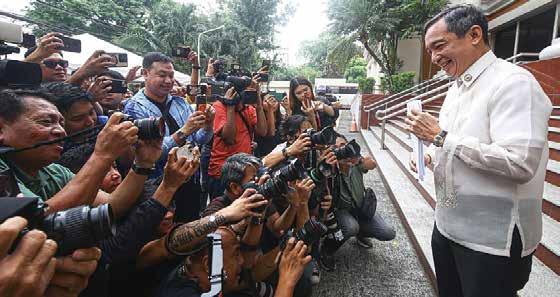
DNC Chair Ken Martin said Thursday, May 21, that he was
making the report public “in its entirety, unedited and unabridged,” after months of pressure from party members who had called for a fuller accounting of the Democratic Party’s losses in the 2024 campaign. In his statement, Martin said the DNC added annotations where claims could not be verified because source material had not
The proposed rule is narrower than some headlines suggest. It is not a general fine on all immigrants, all undocumented immigrants or all people facing deportation. Under the propos-
Congress created the underlying fee in Public Law 119-21, the budget reconciliation law signed on July 4, 2025, and codified it at 8 U.S.C. §1814. The statute requires the fee as partial reimbursement for the cost of arresting a noncitizen ordered removed in absentia and later arrested by ICE. It also provides that the fee may not be waived or reduced.
DHS said the proposed increase reflects the cost of identifying, arresting, detaining, processing and removing people with final in absentia removal orders. The agency said half of the collected fees would be credited to ICE and deposited
Reports also said she was elected chairperson of the committee, marking her return to a position she previously held. The blue ribbon committee, formally the Committee on Accountability of Public Officers and Investigations, has jurisdiction over inquiries involving alleged malfeasance, misfeasance and nonfeasance by public officers and employees. It may also investigate matters of public interest brought al, the fee would apply to noncitizens who are ordered removed in absentia under federal immigration law and are subsequently arrested by ICE. The fee would not apply if the in absentia removal order is rescinded.
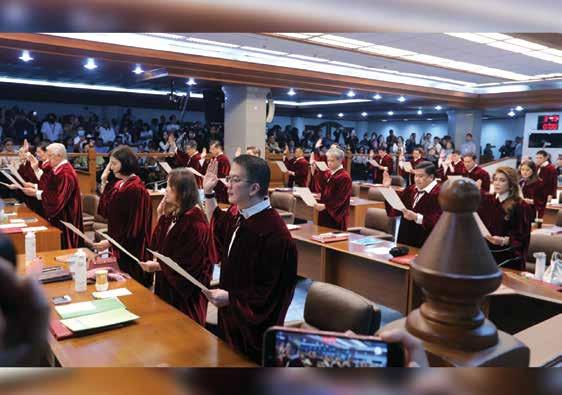
MANILA — The Philippine Senate has formally convened as an impeachment court for the trial of Vice
President Sara Duterte, moving one of the country’s most closely watched political cases from the House of Representatives to the chamber constitutionally empowered to try impeachment complaints. Senate President Alan Peter Cayetano opened the
proceedings on Monday, May 18, with senators sitting as judges in the case. The action marked the formal start of the Senate impeachment court process, but not the immediate beginning of evidentiary hearings. u PAGE 3
MANILA
MANILA — The Department of Justice has directed the National Bureau of Investigation and the Philippine National Police to arrest Sen. Ronald “Bato” dela Rosa after the Supreme Court declined to temporarily stop enforcement
PAUNAWA SA MGA BOTANTE NG PAGSASARA NG PAGPAPAREHISTRO PARA SA PANGUNAHING HALALAN NA GAGAWIN SA MARTES, HUNYO 9, 2026
IPINAPAALAM SA PAMAMAGITAN nito na si , Lorena S. Portillo, na Tagapagtala ng Botante sa Clark County, Nevada, ay gaganapin ang pagpaparehisto ng mga karapat-dapat na botante para sa Pangunahing Halalan na gagawin sa Martes, Hunyo 9, 2026.
Ang kahit na sinumang karapat-dapat na botante na ang pangalan ay hindi nakalista sa opisyal na talaan ay maaaring mag apply para magparehistro sa pamamagitan ng koreo, personal, online o sa pamamagitan ng magkaparehong-araw ng pagpaparehistro na sang ayon sa pamamaraan na pinahihintulutan at alinsunod sa batas batay sa mga naka takdang huling araw na naka lista sa ibaba. (NRS 293.3568, 293.560, 293.565, 293.5832,293.5837, 293.5842, 293.5852)
Ang huling araw para magparehistro sa unang pagkakataon o i-update ang iyong pagkarehistro sa pamamagitan ng koreo o online para magiging ontime sa nakatakdang panahon na Hunyo 9, 2026, Pangunahing Halalan na maaari ka pa ring makatanggap ng koreong balota ay naka lista sa ibaba. Pagkatapos ng mga petsang ito. Ang mga botante na nina-nais na magparehistro sa unang pagkakataon, o gagawa ng pagbabago sa kanilang umiiral na impormayon ng pagkarehistro ay dapat dumaan sa proseso ng magkaparehong-araw ng pagpaparehistro, sa online o personal na pamamaraan (sa mga lugar ng Maagang Botohan o sa Sentro ng Botohan sa Araw ng Halalan). Ang mga bagong rehistrante ay kinakailangang bumoto sa pamamagitan ng pansamantalang balota sa personal na pamamaraan sa kahit na saang lugar ng maagang botohan o sa Araw ng Halalang Sentro ng Botohan. Lubos naming inirerekomenda na ang lahat ng mga kwalipikadong botante na magparehistro upang maka boto o i-update ang kanilang rehistrasyon sa lalong madaling panahon. 2026 PANGUNAHING HALALAN HULING ARAW AT ORAS NG PAGPAPAREHISTRO NG BOTANTE
Martes, Mayo 12 (Huling Araw)
Pamamaraan ng Pagpaparehistro Petsa Oras Pamamagitan ng koreo, ahensya ng gobyerno, o personal na aplikasyon sa pagpaparehistro: Clark County Kagawaran ng Halalan 965 Trade Drive, Suite A North Las Vegas, NV 89030
7:30 n.u. - 5:30 n.h.
Biyernes, Sabado, at Linggo Sarado
Martes, Mayo 26, 2026 (Huling Araw)
Philippines among Asia-Pacific’s least affordable housing markets
by Cristina Eloisa BaClig Inquirer.net
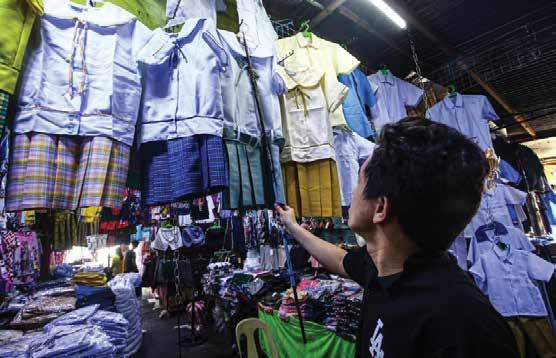
MANILA — A typical family in Metro Manila would need nearly 20 years of its entire income to afford a median-priced condominium unit, a new regional housing study found, underscoring how difficult homeownership remains for many Filipinos.
Online lamang sa, www.RegistertoVote.NV.gov, Dapat mayroong balidong Nevada DMV na ID o Driver’s License
Magkaparehong Araw
Ng Pagpaparehistro (nang personal), dapat mayroong balidong Nevada DMV na ID, Driver’s License, o Nevada Tribal Identification kard (ayon sa NRS 232.006)
Para makatanggap ng koreong balota o bumoto ng pangkaraniwang balota sa personal at sa mga Lugar ng Maagang Botohan o Araw ng Halalang Sentro ng Botohan. Mayo 27–Hunyo 09 (Online Magkaparehong-araw ng Pagpaparehistro), dapat na ipakita ang ID sa kahit na saang sentro ng maagang botohan o sa Araw ng Halalang Sentro ng Botohan at maaaring bumoto lamang ng pansamantalang balota sa pamamaraan nang personal na pagboto sa kahit na saang Lugar ng Maagang Botohan o Sa Araw ng Halalang Sentro ng Botohan.
Mayo 23 Hunyo 9 sa Lahat ng Maagang Lugar ng Botohan, sa mga oras ng pagboto, at sa Araw ng Halalan sa lahat ng Lugar ng Botohan, hanggang sa magsara ang mga lugar ng botohan
LUNGSOD NG KLERK NA TAGGAPAN HULING ARAW NG PAGPAPAREHISTRO AT ORAS (Koreo o sa Mismong Tanggapan ) Lokasyon Petsa Oras
Lungsod ng Boulder City
Tanggapan ng Klerk
401 California Avenue
Boulder City, Nevada
Lungsod ng Henderson
Tanggapan ng Klerk
240 S. Water Street Henderson, Nevada
Lungsod ng Henderson
Tanggapan ng Klerk
495 S. Main Street 2nd Floor Las Vegas, Nevada
Lungsod ng Mesquite
Tanggapan ng Klerk
10 E. Mesquite Blvd. Mesquite, Nevada
Lungsod ng North Las Vegas
Tanggapan ng Klerk 2250 Las Vegas Blvd. North North Las Vegas, Nevada
Lunes–Huwebes
Martes, Mayo 12 (Huling Araw)
Lunes–Huwebes
Martes, Mayo 12 (Huling Araw)
Lunes–Huwebes
Martes, Mayo 12 (Huling Araw)
Lunes–Huwebes
Martes, Mayo 12 (Huling Araw)
Lunes–Huwebes
Martes, Mayo 12 (Huling Araw)
7:00 n.u.–6:00 n.g.
Biyernes,Sabado at Linggo Sarado
7:00 n.u.–6:00 n.g.
7:30 n.u.–5:30 n.h.
Biyernes, Sabado,at Linggo Sarrado
7:30 n.u.–5:30 n.h.
7:00 n.u.–5:30 n.h.
Biyernes, Sabado, at Linggo Sarado
7:00 n.u.–5:30 n.h.
7:30 n.u.–5:00 n.h.
Biyernes, Sabado, at Linggo Sarado
7:30 n.u.–5:00 n.h.
8:00 n.u.–5:45 n.h.
Biyernes, Sabado, at Linggo Sarado
8:00 n.u.–5:45 n.h.
Ang karapat-dapat na botante na mayroong Nevada driver’s license o ID kard na ibinigay ng DMV at nag na-nais na makatanggap ng isang koreong balota, ay maaaring mag parehistro o i-update ang kanyang impormasyon sa pagboto sa online hanggang 11:59 n.g., sa Mayo 26, 2026, ekslusibo sa www.RegistertoVote.NV.gov, (Nevada Kalihim ng Estado na website). Ang mga karapat-dapat na botante na magre-rehistro online ay magsisimula sa Mayo 27, 2026, hanggang Hunyo 9, 2026, ay hindi makakatanggap ng Koreong balota, dapat bumoto sa pamamaraan nang personal sa isang Maagang Lugar ng botohan o sa Araw ng Halala’ng isang Sentro ng Botohan, maaaring bumoto lamang sa pamamaraan nang pansamatalang balota, at dapat handang ipakita ang kanilang Nevada driver’s license, ID kard na inisyu ng DMV, Nevada DMV Interim na Pansamatalang dokumento, o Nevada Tribal ID (per NRS 232.006) bago maaaring bumoto.
Ang Nevada at ang batas na pederal ay nangangailangan na ang mga botante na boboto sa unang pagkakataon ay dapat na magbigay ng numero ng identipikasyon (Nevada Driver’s License number o ang huling apat na numero ng kanilang Social Security Number). Kapag hindi ito magkapareho sa Rekord na pinanatili ng Department of Motor Vehicles o Social Security Administration, ang botante ay kinakailanganin na ipakita ang kanyang identipikasyon bago papayagang bumoto. Ang mga ibat-ibang uri ng pangkasalukuyan at tinatanggap na identipikasyon ay dapat na mayroong larawan na identipikasyon na kasama ang pangalan at pisikal na address ng botante (Nevada Driver’s License, Nevada I.D. Kard) O kopya ng kasalukuyang utility bill, statement ng bankgo, paycheck, o dokumento na galing sa sangay ng gobyerno, na mayroong pangalan at pisikal na address ng rehistradong botante. Inabisuhan na ang mga indibidwal na ito.
Para sa karagdagang kaalaman, tawagan ang Clark County Kagawaran ng Halalan sa (702) 4558683 (Ingles) o (702) 455-7871 (Filipino).
Pinetsahan ngayong ika-23 ng Abril, 2026
LORENA S. PORTILLO
Tagapagtala ng Botante
Inilathala: Mayo 1, 8, 15, at 22, 2026 Las Vegas Asian Journal
In 2022, President Ferdinand Marcos Jr. pledged what he described as an “aggressive housing program” to address the country’s housing shortage, saying the government was aiming to build “1 million low-cost and socialized homes a year.”
An analysis by University of the Philippines Diliman professor and Inquirer data scientist Dr. Rogelio Alicor Panao of the 2025 Urban Land Institute (ULI) Asia Pacific Home Attainability Index found that the Philippines remains among the least affordable housing markets in the region.
The report, which covered 41 cities across 11 Asia-Pacific countries, showed that Metro Manila’s median condominium price stood at $176,936 — about 19.8 times the median annual household income of $8,957, according to Panao’s analysis. The ratio is far above the commonly used affordability threshold of five times income.
Townhouses were found to be even less attainable, with prices reaching 33.4 times the median annual household income.
Renting also remained beyond the reach of many families. According to the analysis, median monthly condominium rent in Metro Manila reached $1,052, equivalent to around 141% of the median monthly household income.
“This means that in Metro Manila, the typical condo rent is 41% higher than what the typical household earns in an entire month. Thus, if a family makes P100, rent alone costs P141,” Panao explained.
“This does not mean renters are actually paying that much, but that condos are built for people with well-above-average incomes, such as dual-earner couples, overseas Filipino workers sending money home, or high-paid professionals,” he added.
“A single earner on a typical salary simply cannot afford a formal condo rental.”
Oversupply, but not affordable
The findings come despite signs of an oversupply in Metro Manila’s condominium market.
In March last year, the Bangko Sentral ng Pilipinas (BSP) said residential property prices in Metro Manila contracted by 0.4% year on year in the fourth quarter of 2024 amid concerns over excess supply of residential units.
Panao said Metro Manila’s affordability ratio improved from
25 in 2024 to 19.8 in 2025, largely due to falling condominium prices linked to excess inventory.
“Many of these units were targeted at the now-banned Philippine Offshore Gaming Operator industry, leaving developers with a backlog expected to take years to clear,” he said.
Roy Amado Golez Jr., director for research, consultancy and valuation at Leechiu Property Consultants, said Metro Manila had about 80,300 unsold condominium units as of November 2025, with most concentrated in the upper-middle and upscale segments. Less than 1% of the remaining inventory was classified as low-income housing.
The report also cited data showing that household incomes in the National Capital Region grew by only 20% since 2019, while residential property prices rose by 62% during the same period.
Outside Metro Manila, Panao said Davao City posted a price-toincome ratio of 14.0, while condominium rents there consumed about 94% of the median monthly household income.
“Taken together, these figures point to a structural imbalance,”
Panao said. “Rapid urban migration driven by a young and growing population continues to concentrate demand in major cities, while infrastructure and affordable housing supply fail to keep pace.”
“The result is a housing system where shelter near economic opportunity is increasingly defined not by access, but by exclusion,” he added.
Housing backlog
The country’s broader housing shortage has remained a long-standing challenge.
In 2022, Marcos said the Philippines was facing a shortfall of about 6 million housing units as he launched the government’s Pambansang Pabahay para sa Pilipino Program.
The Department of Human Settlements and Urban Development (DHSUD) has since expanded the program to include rental housing and subsidized financing options.
Last February, Marcos said that from July 2022 to January 2026, the government constructed or financed 423,430 housing units
under the Expanded Pambansang Pabahay Para sa Pilipino (4PH) program.
“We have come a long way, but we continue to work hard to reach our target of providing housing in the years ahead,” the president said at the time.
The DHSUD has also rolled out subsidized interest rates and expanded access to housing loans for overseas Filipino workers and other beneficiaries under the 4PH program.
Still, housing experts have pointed to deeper structural issues affecting affordability.
The DHSUD previously reported that the country’s housing backlog reached 10.65 million units in 2024 and could grow further unless housing production accelerates in underserved segments.
Estimates by Winston Padojinog of the University of Asia & Pacific and its think tank, the Center for Research and Communication, show average annual demand for new homes reached about 478,000 units from 2018 to 2024, while the private sector produced only around 128,000 housing units during the same period. Golez said this resulted in an estimated annual housing shortfall of about 350,000 units, according to the report.
“Closing the gap requires 282,000 units to be produced yearly from 2025 to 2030, and a staggering 1.6 million units annually from 2031 to 2040,” he said. An October 2025 editorial by the Philippine Daily Inquirer, meanwhile, noted that many Filipinos still could not afford even socialized housing units because of low incomes and limited access to financing.
“The problem that the 4PH program faces is not housing; it is low income,” urban planner Nathaniel von Einsiedel wrote in a previous commentary cited by the editorial.
For Panao, the latest ULI index highlights how the country’s housing problem goes beyond supply alone.
Even as condominium prices soften because of oversupply, many units remain inaccessible to ordinary wage earners because they were built for higher-income buyers and investors.
Nevada primary gives party voters...
PAGE 1
registered as nonpartisan, independent or with another political party generally may vote only in nonpartisan contests for which they are eligible during the primary. Clark County election guidance describes the primary as a preliminary nominating election used, when needed, to select Democratic, Republican and nonpartisan candidates for the general election.
The rule places party registration at the center of the primary process. Voters who want to participate in a Democratic or Republican primary contest must be registered with that party. Nonpartisan voters may still receive a ballot, but it generally will not include Democratic or Republican contests for partisan offices.
The primary does not decide the final winners in most parti-
san races. Instead, it determines which candidates will represent their parties in November. Minor-party, other-party and independent candidates for partisan contests generally appear on the general election ballot rather than in the Democratic or Republican primary.
Nevada’s system has drawn renewed attention because nonpartisan voters now make up a large share of the state’s electorate. State voter registration trends show nonpartisan voters have become the largest registration group in Nevada, a shift linked in part to automatic voter registration procedures through the Department of Motor Vehicles.
Under the current process, eligible residents who do not select a party through the registration process are registered as nonpartisan. They may later update their party affiliation
through election officials or online voter services. State lawmakers considered changes to primary access in 2025, but the current structure remains in place. Gov. Joe Lombardo vetoed legislation that would have allowed nonpartisan voters to participate in Democratic or Republican primary contests, leaving Nevada’s closed primary system intact for the 2026 election cycle. For voters, the practical question before the
CHAMPIONS. Senators led by Senate President Alan Peter Cayetano present a copy of Senate Resolution No. 394 to members of the Philippine National Barebow Archery Team during the plenary session on Wednesday, May 20, 2026. Senator Robinhood Padilla sponsored the resolution congratulating the team for winning a gold and two bronze medals at the Asia Barebow Championship 2026 in Shah Alam, Malaysia. PNA photo by Avito Dalan
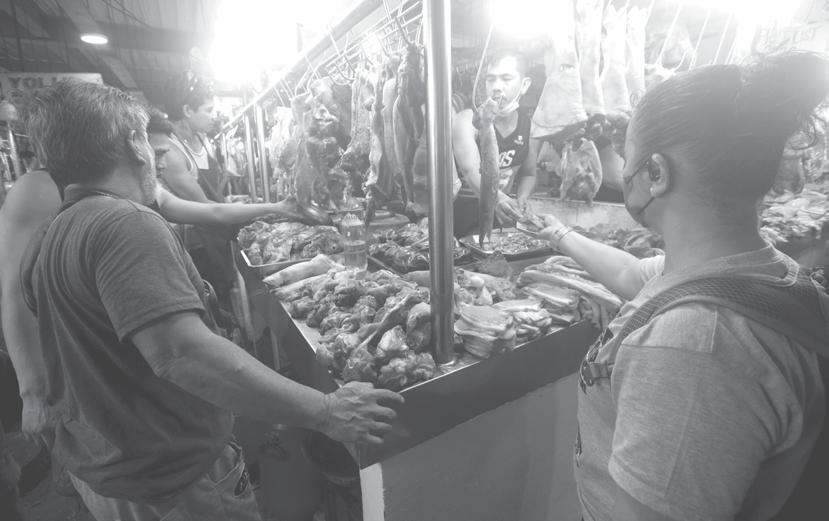
Housing market composite
Photo from INQUIRER files.
Senate impeachment court...
Duterte faces articles of impeachment approved by the House of Representatives on May 11. The allegations include misuse of public funds, unexplained wealth and threats against President Ferdinand Marcos Jr., First Lady Liza Araneta-Marcos and former House Speaker Martin Romualdez. The allegations remain unproven unless established before the impeachment court. Duterte has denied wrongdoing and has described the case as politically motivated.
The Office of the Vice President received the Senate impeachment court summons on Wednesday, May 20. Under the impeachment court rules cited by Cayetano, Duterte has 10 calendar days from service of summons to file her answer. Because the 10th day falls on Saturday, May 30, the deadline moves to the next working day, Monday, June 1.
The date sequence has been a source of public confusion. May 18 was the date the Senate convened as an impeachment court. May 20 was the date the summons was served. June 1 is the deadline for Duterte’s answer. Those dates do not mean full trial hearings began on May 18. The Senate must still proceed through pleadings, possible replies, pretrial arrangements and scheduling before the presentation of evidence.
After Duterte files her answer, the House prosecution panel may
submit a reply within the period allowed by the impeachment court rules. Senators are then expected to settle procedural matters, including the calendar for the next phase of proceedings. A July trial date has been discussed publicly, but the operative schedule remains dependent on the completion of pleadings and orders of the impeachment court. The case follows an earlier impeachment controversy that reached the Supreme Court. On April 29, the Court dismissed a petition seeking to compel the Senate to immediately convene as an impeachment court. The Court said the Constitution does not impose an exact date for the Senate to begin trial and that the term “forthwith” must be understood within a reasonable time, taking into account preparatory acts required before trial. At the same time, the Court cautioned that the Senate must avoid undue delay.
The new proceeding arises from the House’s May 11 vote to impeach Duterte and transmit the case to the Senate. The House said the complaint was approved by a vote of 257-25-9, sending the articles of impeachment to trial before senator-judges.
If convicted, Duterte may be removed from office and barred from holding public office. Conviction requires the concurrence of two-thirds of all members of the 24-seat Senate, or at least 16 senators.
The case now moves through the Senate against the backdrop of the Marcos-Duterte rupture. The two ran as allies in 2022 before tensions over governance, confidential funds and political direction hardened into open conflict. Marcos has said the impeachment process belongs to Congress.
The impeachment court also opened days after a dramatic Senate leadership change. Cayetano replaced Vicente “Tito” Sotto III as Senate president on May 11, the same day the House voted to impeach Duterte. The shift occurred against the backdrop of Sen. Ronald “Bato” dela Rosa’s brief reappearance in the Senate and later absence from public view.
Dela Rosa’s status adds another layer of uncertainty to the proceedings, given the ICC warrant against him and his absence from public view. His possible role as a senator-judge may still be shaped by procedural questions.
The impeachment case remains in its procedural stage, with Duterte’s answer expected to define the next steps before the Senate court. Beyond the immediate filings and scheduling questions, the proceeding now tests whether the chamber, sitting as a constitutional tribunal, can separate legal judgment from political alignment in a case with consequences for the vice presidency, the 2028 political landscape and public confidence in the rule of law. n
Pia Cayetano takes over Senate...
PAGE
to the Senate’s attention.
The leadership change comes after Alan Peter Cayetano was elected Senate president, triggering a broader reshuffle of committee assignments in the chamber. Before the change, Lacson had chaired the blue ribbon panel while Pia Cayetano served as a member. Lacson had led the committee during high-profile inquiries involving alleged irregularities in government projects and public spending. Senate records show that on May 4, 2026, he filed a resolution directing the blue ribbon
committee to conduct an inquiry, in aid of legislation, into reported massive corruption in the Philippine Statistics Authority. The committee is among the Senate’s most visible panels because its hearings can compel testimony, examine public records and shape legislation after investigations. Its findings, however, are legislative in nature and do not by themselves determine criminal liability, which remains within the authority of courts and prosecutorial agencies. Cayetano’s assumption of the post gives her control over the committee’s agenda, hearing cal-
endar and handling of pending or future inquiries. As chair, she will be positioned to determine which matters move forward, which hearings are scheduled and how the panel frames its reports.
The change carries political weight because it places one of the Senate’s most powerful investigative committees under new leadership during a broader reorganization of the chamber. With Lacson out and Cayetano now at the helm, the blue ribbon committee’s direction will be judged less by the reshuffle itself than by how it handles pending inquiries, new referrals and future investigations.
Las Vegas-to-Southern California rail project...
PAGE 1
all-electric rail line running largely along the Interstate 15 corridor. The project includes planned stations in Las Vegas, Apple Valley, Hesperia and Rancho Cucamonga.
The route is intended to connect Las Vegas to Rancho Cucamonga, where passengers would be able to transfer to Metrolink service into the broader Los Angeles region.
Brightline West has promoted the project as an alternative to driving on the I-15 corridor, the main highway route between Las Vegas and Southern California. The company says nearly 50 million trips are made each year between the Los Angeles area and Las Vegas, more than 85 percent of them by car. It has projected 9 million one-way passengers annually once service begins.
The Nevada Department of Transportation describes Brightline West as a 218-mile high-speed rail project and says preliminary construction began in early 2024. NDOT says major construction is expected to take about four years once it begins.
Brightline’s Florida rail system, which operates between Miami and Orlando, has reported liquidity concerns. Audited financial statements for Brightline Trains
Florida LLC said the company did not currently have the liquid funds needed to service its debt and other obligations. Financial and bond-market reporting has placed the Florida system’s debt load at about $5.5 billion and said the audits raised “substantial doubt” about the company’s ability to continue as a going concern.
The warning applies to Brightline’s Florida operation, not directly to Brightline West. The two systems are separate projects. Both are part of Brightline ventures backed by Fortress Investment Group.
Brightline West has received federal support and bond authority. The U.S. Department of Transportation approved $2.5 billion in private activity bond authority for the project in January 2024, following a previous $1 billion allocation in 2020. Federal officials also awarded a $3 billion grant to the Nevada Department of Transportation for the project in December 2023.
Federal credit-assistance records list DesertXpress Enterprises LLC, doing business as Brightline West, as seeking a $6 billion Railroad Rehabilitation and Improvement Financing direct loan for a California-Nevada rail project with an estimated cost of $21.05
billion. As of this writing, public federal records reviewed for this report did not show approval of that loan. Public financial reporting has said bondholders approved extending a capital-raise deadline to Aug. 1, 2026, giving Brightline West more time to raise $400 million for construction. The previous deadline was March 31. Brightline West has continued to list project activity in 2026. Its construction advisories reported field investigation work in Southern California in March, including geotechnical borings, sampling, utility potholing and land surveying. The company also listed May project update meetings with transportation and local officials, including representatives connected to Hesperia, Rancho Cucamonga and Las Vegas economic development. As of this writing, public agency and company materials reviewed for this report continue to describe Brightline West as a Las Vegas-to-Southern California rail project in development. The outstanding issues include remaining financing, the $6 billion federal loan request, the reported Aug. 1 capital-raise deadline and the transition from preliminary work to major construction. (AJPress)
and activities,
Digital fraud in PH becomes more frequent, even as losses stay smaller
TransUnion data show Filipino consumers are being targeted more often through phishing, smishing and online seller scams
by AJPress
MANILA
— Digital fraud in the Philippines is becoming more frequent, even as the typical amount lost per incident remains below the global median, according to new data from TransUnion.
The credit information and risk analytics company said the Philippines recorded a suspected digital fraud rate of 4.1 percent in 2025, higher than the global rate of 3.8 percent. It was the sixth straight year the country exceeded the worldwide level.
The findings point to a fraud environment where consumers are not necessarily losing the largest amounts per case, but are being targeted more often and across more digital channels.
TransUnion said 72 percent of Filipino consumers it surveyed
reported being targeted by fraud attempts through online, email, phone or text channels between August and December 2025. The global figure was 53 percent. Thirty-eight percent of Filipino respondents said they lost money to digital fraud last year.
The median reported loss in the Philippines was $850, or about P50,000, compared with the global median of $1,671, or about P98,000.
Phishing was the most commonly reported scheme among Filipino consumers who said they were targeted, at 45 percent. Smishing, or scam text messages, followed at 38 percent, while third-party seller scams on legitimate online retail platforms accounted for 28 percent.
TransUnion also found that fraud risk was highest at the account login stage, where the Philippines posted a 6.1 percent
rate, compared with 4.3 percent globally.
The report comes as Philippine authorities continue to strengthen rules against online financial scams. Republic Act No. 12010, or the Anti-Financial Account Scamming Act, penalizes financial account scamming and related offenses, including money muling and social-engineering schemes. The Bangko Sentral ng Pilipinas has also issued implementing rules for supervised financial institutions.
The numbers show a practical warning for consumers and businesses: digital scams are becoming more routine, more varied and harder to ignore. For banks, retailers, delivery platforms and users, prevention now depends not only on catching large fraud cases, but on stopping repeated smaller scams before they erode trust in online transactions. n
Fil-Am guard Dylan Harper named to NBA All-Rookie First Team
The San Antonio Spurs rookie earns leaguewide recognition after a debut season that began with a 15-point opener beside some of the franchise’s biggest names.
by AJPress
SAN ANTONIO — Filipino
American guard Dylan Harper has been named to the 2025-26 Kia NBA All-Rookie First Team, one of the league’s annual postseason honors recognizing the top first-year players as selected by a media voting panel.
The NBA announced the All-Rookie teams on Wednesday, May 20, 2026. Harper joined Cooper Flagg of Dallas, Kon Knueppel of Charlotte, VJ Edgecombe of Philadelphia and Cedric Coward of Memphis on the First Team. He appeared on all 100 ballots, receiving 93 First Team votes and seven Second
Team votes. Harper, the No. 2 overall pick in the 2025 NBA Draft, opened his regular-season career with 15 points, four rebounds and two assists in San Antonio’s 125-92 win over Dallas on Oct. 22, 2025. Spurs game notes list him among the last five San Antonio rookies to score at least 15 points in an NBA debut, along with Victor Wembanyama, Tim Duncan, David Robinson and Sean Elliott.
The performance became an early marker in a rookie season that culminated in leaguewide recognition. Harper’s 15-point opener placed him on a Spurs debut list that includes some of the franchise’s most accom-
plished names, while his season-long production earned him a place on the NBA’s All-Rookie First Team.
For Filipino American basketball followers, Harper’s rise carries added resonance through his mother, Maria Pizarro Harper, a Filipina immigrant who played Division I basketball and later coached in New Jersey. Harper is also the son of former NBA guard Ron Harper, a fivetime NBA champion. The recognition gives Harper’s first season a national marker beyond San Antonio. It also places a Filipino American rookie in both the Spurs’ record book and the NBA’s recognized rookie class. n
DHS proposes $18,000 fee for certain immigrants...
into its Detention and Removal Office Fee Account, while the remainder would go to the general fund of the U.S. Treasury.
Philippines seeks Japan’s backing for Trans-Pacific trade bloc bid
Manila is pursuing entry into the CPTPP, a high-standard trade pact that could widen export access, attract investment and deepen the country’s role in regional supply chains.
by AJPress
MANILA — The Philippines is seeking Japan’s support for its bid to join the Comprehensive and Progressive Agreement for Trans-Pacific Partnership, a trade pact linking economies across Asia, the Pacific, the Americas and the United Kingdom.
Trade Secretary Ma. Cristina Roque said the government intends to ask Japan to endorse the Philippines’ accession effort, placing trade policy among the issues surrounding President Ferdinand Marcos Jr.’s state visit to Japan from May 26 to 29. Japan’s Ministry of Foreign Affairs has confirmed the visit, while the Japanese Embassy in Manila said Ambassador Endo Kazuya met Roque on May 18 to discuss trade, investment promotion and regional cooperation.
The CPTPP is a high-standard free trade agreement among Australia, Brunei, Canada, Chile, Japan, Malaysia, Mexico, New Zea-
land, Peru, Singapore, Vietnam and the United Kingdom. It traces its current form to the agreement signed in Santiago, Chile, in 2018 after the United States withdrew from the original Trans-Pacific Partnership.
For the Philippines, membership could bring wider access to major markets, including Japan, Canada, Australia, Mexico and the United Kingdom. That could benefit exporters in electronics, garments, agriculture, processed food, services and other industries that depend on predictable trade rules and lower barriers.
CPTPP entry could also strengthen the country’s investment appeal. Membership would signal that the Philippines is prepared to meet higher standards on trade, investment, services, intellectual property, digital commerce, government procurement and regulatory practices. It could also help the country compete for companies seeking to diversify production and sourcing across several markets.
The bid reflects Manila’s effort to deepen its place in regional supply chains at a time of shifting trade patterns and uncertainty in global markets. The Philippines is already part of the Regional Comprehensive Economic Partnership, the broader Asia-Pacific trade agreement involving ASEAN members and major regional partners. CPTPP membership would add another layer of access.
Japan’s support would be significant because it is one of the CPTPP’s leading members and one of the Philippines’ most important economic partners. But Tokyo’s endorsement would not by itself determine the outcome.
Accession requires approval from existing members and a review of whether an applicant can meet the agreement’s standards.
For now, the Philippines’ approach remains diplomatic and procedural: secure support from key members, undergo review and negotiate terms that would determine how and when the country could join. n
Irregularities found in SALN of lawmakers in flood probe
by DaphnE galvEz, MarC Jayson CayaByaB Philstar.com
MANILA, Philippines — The Office of the Ombudsman has found irregularities in the declared wealth of members of the House of Representatives who are tagged in the flood control project scandal.
ger under his helm, taking pride in last year’s series of investigations on the flood control mess that resulted in the filing of cases and investigations on his colleagues allegedly involved in the kickbacks scheme.
The rule remains a proposal, its final form, effective date and any legal challenges remain unresolved.. n
The proposal comes as the Trump administration continues to pair immigration enforcement with voluntary departure incentives. DHS announced in 2025 that certain immigrants who arrange voluntary self-departure through the CBP Home app could receive travel assistance and a $1,000 stipend after returning to their home country. For affected immigrants, the legal consequence is specific but serious. A missed immigration court hearing can lead to an in absentia removal order if the government meets the statutory requirements for notice and removability. If the proposal becomes final, a person later arrested by ICE under that type of order could face not only removal but also a federal debt tied to the enforcement action.
DOJ orders arrest of Sen. Dela Rosa...
Vida described Dela Rosa as a “fugitive from justice” and said authorities had leads on his whereabouts, though he declined to disclose operational details. He also warned that anyone helping the senator evade arrest could face legal consequences.
The NBI said it would act “without delay.” PNP Chief Gen. Jose Melencio Nartatez Jr. said the police would perform its mandate under existing laws, due process and established operational procedures, and assured the public that any action would respect constitutional rights.
The Supreme Court’s action did not resolve the broader challenge to ICC enforcement in the Philippines, but it removed any interim restraint preventing law enforcement agencies from acting on the warrant. Dela Rosa’s whereabouts remained publicly unconfirmed. He had been under Senate “protective custody” from May 11 to May 14 before leaving the premises before dawn on May 14, after a tense episode at the Senate compound involving gunfire and law enforcement presence. His brief return to the Senate has drawn scrutiny because it came during the leadership vote that installed Sen. Alan Peter Cayetano as Senate president. In an interview on GMA’s “Kapuso Mo, Jessica Soho,” Dela Rosa said Cayetano had asked him
to return to the Senate because his presence was needed for the vote. He also said a van had been arranged to bring him to the chamber.
Dela Rosa’s account places his return within the Senate leadership contest, but it does not, by itself, establish the purpose of the reorganization. The confirmed sequence is limited to his appearance at the chamber, his participation in the vote and Cayetano’s election as Senate president.
The Supreme Court has not issued a final ruling on the broader constitutional questions, but with no temporary restraint in place, the Justice Department has moved from argument to enforcement. n
Philippine Senate shake-up...
main decisive. In the 24-member Senate, 13 votes are enough to elect or replace a Senate president. Cayetano’s ascent depended on that margin, making his leadership vulnerable if even a small number of senators move to another bloc.
The speculation gained new force after Tulfo said attempts to change the Senate leadership were continuing and described the numbers as “tempting.” Tulfo said the situation could shift if “only one person has to make a step,” a remark that underscored how closely the chamber’s blocs are watching one another. His comments added an on-record basis to the broader political chatter, although they do not by themselves establish that a formal challenge has been launched or that Cayetano has lost majority support. Political reports and Senate discussions have pointed to continuing questions over whether a counteralignment could replace him. Among the names surfacing in those discussions are Senators Francis “Chiz” Escudero and Sherwin Gatchalian. Escudero, a former Senate president, has been mentioned in connection with a possible return to the post, while Gatchalian’s name has also
emerged in public discussion of possible alternatives. No formal vote has been held, and no official leadership change has displaced Cayetano.
Former Senate President Juan Miguel “Migz” Zubiri was earlier floated in political reports as a possible alternative, but more recent accounts have placed greater attention on Escudero and Gatchalian. The available public record does not establish that Zubiri is currently leading or actively organizing a challenge.
The speculation intensified as the Senate moved through a broader reorganization of committee leadership following the change at the top. The unsettled committee landscape has added to scrutiny of how the chamber’s new majority is consolidating control and whether its internal alliances will hold.
The leadership uncertainty is unfolding as the Senate formally opened Vice President Sara Duterte’s impeachment trial process on May 18, when it convened as an impeachment court. The case remains in its early procedural stage. Duterte faces allegations involving misuse of public funds, unexplained wealth and threats against political figures, which she denies and has described as politi-
cally motivated.
The chamber’s political balance is now central to how the impeachment proceedings are being read. Conviction in an impeachment trial requires a two-thirds vote of the Senate, meaning bloc alignments could affect the practical difficulty of securing a judgment even as senators are expected to sit as judges in a constitutional process. The leadership shift also unfolded after Sen. Ronald “Bato” dela Rosa briefly reappeared in the Senate before again dropping from public view. Dela Rosa, a Duterte ally and former national police chief, is wanted by the International Criminal Court over alleged crimes against humanity tied to the drug war under former President Rodrigo Duterte. He denies wrongdoing and has challenged the warrant. For now, the Senate remains politically unsettled, but no second leadership change has been completed. The chamber continues to operate under intense scrutiny, both as a legislative body and as an impeachment court. The immediate test is not only who holds the gavel, but whether the Senate can preserve institutional credibility while its own leadership remains the subject of open political maneuvering. n
Assistant Ombudsman Mico Clavano said the irregularities were found when investigators looked into the statements of assets, liabilities and net worth (SALNs) of the lawmakers, who have also been subjected to lifestyle checks.
“We found there are (irregularities),” he said yesterday over dzBB when asked about updates on cases involving alleged “congtractors.”
“We are strengthening our lifestyle checks at the Office of the Ombudsman because what happens there is, the SALNs we receive we compare to all the registries and we check if what they declared matches those found listed on the registries,” Clavano added.
He declined to name the lawmakers with alleged irregularities in their SALNs as “it is still an ongoing investigation” and the anti-graft body “has more to do.”
In April, the Office of the Ombudsman obtained copies of the SALNs of 26 House members who have been tagged in the flood control controversy.
Clavano said copies of other congressmen’s SALN will also be subpoenaed as the anti-graft body digs deeper into the scandal.
He earlier clarified that the ombudsman’s efforts to secure copies of SALNs of lawmakers is not limited to the flood control project scandal alone but also include other infrastructure-related anomalies.
Clavano also said Ombudsman Jesus Crispin Remulla has ordered lifestyle checks on the 26 House members, who are allegedly also acting as government contractors or “congtractors.”
Last year, Remulla said there are 12 to 15 House members with undeniable links to construction firms that bagged millions in government public works contracts. He said more than 10 percent of the 317seat chamber may be involved in the multibillion-peso flood control project controversy.
Ping: Sigh of relief
Sen. Panfilo Lacson heaved a sigh of relief now that the powerful Blue Ribbon committee is no lon-
“Double relief. I feel relieved that I am now relieved of my duties as the Senate Blue Ribbon Committee chairman,” Lacson said on X. Lacson said that all chairpersons of the Senate committees are elected by their peers and thus serve at the pleasure of their colleagues. He added losing the Blue Ribbon post to Sen. Pia Cayetano will not sway him in his fight against corruption as senator. “I will continue to fight a corrupt and rotten system in the misuse and abuse of public funds as I have consistently done in the course of my long years in public service,” Lacson said.
In a statement, Cayetano thanked the leadership of her younger brother Senate President Alan Peter Cayetano for entrusting her with the post to investigate in aid of legislation government malfeasance and corruption.
“I thank the Senate leadership for the trust and confidence placed in me in once again designating me as the Chairperson of the Blue Ribbon Committee. I do not take this lightly,” Cayetano said.
“As a lawyer, a former Chairperson of the Blue Ribbon Committee, and one of the most senior members of the Senate, I will begin reviewing the matters referred to the Committee,” she added.
“Given the many ongoing issues affecting our country and our people, including the ongoing energy crisis, households struggling to make ends meet, and the rising cost of doing business, I will determine what matters will be prioritized by the Blue Ribbon Committee. Updates will be provided in due course,” she said.
During the 19th Congress, the Blue Ribbon while Cayetano was chair investigated the Filipino citizenship for sale scheme by local civil registries, the Philippines’ “Dirty Ashtray” award for allegedly promoting the tobacco industry, the collapse of the Cabagan-Sta. Maria Bridge in Isabela, and former president Rodrigo Duterte’s war on drugs.
But Cayetano only led the probe on Dirty Ashtray award and the citizenship for sale issue, leaving it to other colleagues to head subcommittees to investigate the other pressing topics.
DNC releases 2024 election review...
been provided. Martin’s statement accompanying the release was unusually blunt. He said the report did not meet his standards and made clear that the DNC was not adopting the document as its own official judgment.
“I am not proud of this product; it does not meet my standards, and it won’t meet your standards,” Martin said. “I don’t endorse what’s in this report, or what’s left out of it.”
The 192-page report, authored by Democratic consultant Paul Rivera, reviews the party’s performance in the 2024 presidential election, when Republican Donald Trump defeated Democrat Kamala Harris. It examines campaign strategy, voter outreach, party infrastructure and the Democratic brand at a time when the party is trying to regroup before the 2026 midterm elections. The report argues that Dem-
ocrats lost ground by failing to maintain sustained relationships with key groups of voters, including rural voters, men, non-college voters and irregular voters. It also criticizes the party’s dependence on late-cycle advertising and calls for deeper year-round organizing through state and local party structures.
Martin, in his own statement, pointed to similar areas of concern but separated his judgment from the report itself. He said Democrats need a stronger message on affordability, earlier organizing, renewed attention to young voters and a broader 50-state strategy. He also acknowledged that the Democratic brand “is in trouble and needs repair.” The release ends one internal dispute but leaves others unresolved. Martin said he had initially decided not to release the report because he believed it was not ready and could distract from preparations for the 2026 mid-
terms. He later said withholding the document had created a larger distraction and apologized for the handling of the process.
The report also leaves open several of the most contested questions from the 2024 cycle, including Biden’s initial decision to seek reelection, Harris’ late elevation as the nominee and divisions within the Democratic coalition over U.S. policy toward Israel and Gaza.
The report lands with an unusual contradiction for Democrats : a party document released under the party’s name, but not fully embraced by the party’s own chair. It gives critics the transparency they sought, while also exposing the limits of a postmortem that arrives annotated, disputed and politically inconvenient.
Before the 2026 midterm elections, the party will have to show that the review is not merely a record of what went wrong, but a forcing mechanism for what must change. n
FLOODING MESS. House of Representatives Deputy Minority Leader and ACT Teachers Party-list
PAUNAWA SA MAAGANG PAGBOTO PARA SA 2024 PANGKALAHATANG HALALAN
IPINAPAALAM SA PAMAMAGITAN NITO na ang maagang pagboto para sa Hunyo 9, 2026,, Pangunahing Halalan ay magsisimula sa Mayo 23, Sabado, at magpapatuloy hanggang Hunyo 5, Biyernes.. Ang kahit na sinong rehistradong botante sa Clark County ay maaaring bumoto sa kahit na saang lugar ng maagang botohan. Ang magkaparehong-araw ng pagpaparehistro ay maaaring gawin para sa lahat ng mga taong karapat-dapat na bumoto ngunit sa kasalukuyan ay hindi naka rehistro upang bumoto.Kinakailangan ay mayroon silang Nevada Driver’s License, Nevada Identification Kard, Nevada DMV “Pansamantalang Dokumento,” o Identipikasyon na galing sa Tribo alinsunod sa NRS 232.006. Ang Magkaparehong-araw na mga pagbabago ng pangkasalukukang rehistrasyon ay maaari ring gawin..
Ang maagang lugar ng botohan, petsa at oras ay naka lista sa ibaba. Ang lahat ng lugar ng botohan ay naaayon sa ADA Para sa karagdagang kaalaman, tawagan, ang Clark County Kagawaran ng Halalan sa (702) 455-VOTE (8683). The TTY/TDD na number ay 711. Tingnan din online sa www. ClarkCountyNV.gov/vote.
2026 Pangunahing Halalan Lugar ng Maagang Botohan / Mga Lugar na Paghuhulugan ng Koreong Balota Mayo 23 (Sabado) hanggang Hunyo 5 (Biyernes), 2026
Ang lahat ng lugar ng maagang botohan ay maaari ring paghuhulugan ng mga koreong balota sa kapanahunan ng mga naka listang petsa at oras.
Ang mga hindi inaasahang kaganapan o pangyayari ay maaaring magdulot ng mga pagbabago sa lugar ng maagang botohan o sa oras ng pamamalakad. Tingnan ang pinakabagong impormasyon sa aming website: www.ClarkCountyNV.gov/vote o tumawag sa (702) 455-Vote (8683) o (702) 455-7871 (Filipino)
Ang kahit na sinong rehistradong botante ng Clark County ay maaaring bumoto sa pamamagitan nang personal bago dumating ang Araw ng Halalan sa kahit na saang lugar ng maagang botohan sa halip na bumoto sa pamamagitan ng koreo.
Maaari mo ring ihulog ang iyong ibinotong koreong balota sa kahit na saang Lugar ng Maagang Botohan sa kapanahunan ng mga nakatakdang petsa at oras na nakalagay sa Iskedyul. Sa iyong halimbawang balota o online sa www.ClarkCountyNV.gov/vote, tingnan ang listahan para sa “Araw ng Halalang Sentro ng Botohan” at Kagawaran ng Halalan at ang Klerk ng Lungsod na Lugar na Paghuhulugan” para sa ibat-ibang opsyon. Dapat mong pirmahan ang labas ng iyong Kagawaran ng Halala’ng sobreng ibabalik, na nakikita ang iyong pangalan at address, ilagay at isara ang iyong ibinotong balota sa loob ng sarili mong sobre’ng ibabalik bago mo ito ihulog sa drop box. Huwag mong pagsamahi’ng ilagay ang iyong balota at ang balota ng ibang botante sa i-isang sobreng ibabalik.
Kung napagpasyahan mong bumoto nang personal sa halip na sa pamamagitan ng koreo, kinakailangan mong gawin ang isa sa mga sumusunod:
• Kapag dala mo ang iyong koreong balota, ibalik ito sa pakete’ng ipinadala sa iyo sa isang opisyal ng halalan sa lugar ng botohan
• Kung hindi mo dinala ang iyong balota ngunit natanggap mo ito sa koreo, ikaw ay pipirma ng isang pagpapatunay sa sentro ng botohan na ikaw ay nanunumpa na hindi ka pa bumoboto sa kasalukuyang halalan at naiintindihan mo na walang sinuman ang maaaring magtangkang bumoto o aktwal na bumoto ng mahigit sa isang beses sa magkaparehong halalan.
Mga Pang Matagalang Lugar ng Botohan/Mga Lugar na Paghuhulugan ng Koreong Balota, Mayo 23 hanggan Hunyo 5, 2026
Mga Pang Matagalang Lugar ng Maagang Botohan / Mga Lugar na Paghuhulugan ng Koreong Balota/ Address/ Mga Kalapit na Kalye Petsa / Oras
Arroyo Market Square, TENT NG KAGANAPAN Paradahan malapit sa Men’s Wearhouse 7225 Arroyo Crossing Pkwy., Near CC-215 / S. Rainbow Blvd.
Blue Diamond Crossing, TENT NG KAGANAPAN Paradahan sa Pagitan ng Target at Kohl’s
4100 Blue Diamond Rd. / Hinson St.
Cambridge Recreation Center
3930 Cambridge St., Pagitan ng E. Flamingo Rd. and E. Katie Ave.
Craig Ranch Regional Park, TENT NG KAGANAPAN
Paradahan East ng Revere St. Pumasok sa W. Craig Rd.
Desert Breeze Community Center
8275 Spring Mountain Rd. / S. Cimarron Rd.
Downtown Summerlin, TENT NG KAGANAPAN
Paradahan East ng S. Pavilion Center Dr.
Enter on S. Spruce Goose St. South of Marketwalk Pl.
Galleria at Sunset
Kohl’s Court, 1st Floor
1300 W. Sunset Rd., East of N. Stephanie St.
Henderson City Hall
240 S. Water St. / W. Basic Rd.
Ikea, TENT NG KAGANAPAN, Paradahan
6500 Ikea Way, malapit sa S. Durango Dr. at Rafael Rivera Way
Las Vegas Athletic Club – Decatur, TENT NG KAGANAPAN Paradahan, 6050 N. Decatur Blvd. / W. Tropical Pkwy.
Las Vegas Athletic Club – Rainbow, TENT NG KAGANAPAN
Parking Lot, 1725 N. Rainbow Blvd., South of W. Lake Mead Blvd.
Las Vegas City Hall
495 S. Main St. / E. Clark Ave. Libreng paradahan kapag na-validate
Meadows Mall
Malapit sa Round1, 1st Floor
4300 Meadows Ln. / S. Valley View Blvd.
Mountain Crest Community Center
4701 N. Durango Dr., South of W. Lone Mountain Rd.
Mayo 23-Hunyo 4 (Sab.-Huw.)... 9nu-7ng Hunyo 5 (Biy.)............................. 9nu-8ng
Mayo 25-29 Hunyo 1-5 (Lun.-Biy.) 9nu-6ng Mountain’s Edge Regional Park, TENT NG KAGANAPAN, Paradahan
8101 W. Mountains Edge Pkwy., East of S. Durango Dr.
Nellis Crossing Shopping Center, TENT NG KAGANAPAN Paradahan malapit sa Target, 1250 S. Nellis Blvd. / E. Charleston Blvd.
North Las Vegas City Hall
2250 Las Vegas Blvd. North / Civic Center Dr.
Silverado Ranch Park, TENT NG KAGANAPAN
9855 Gilespie St. / E. Silverado Ranch Blvd.
Mayo 23-24 at Mayo 30-31 (Sab.-Ling.) SARADO
Mayo 23-Hunyo 4 (Sab.-Huw.)....9nu-7ng Hunyo 5 (Biy.)..............................9nu-8ng
Mayo 23-Hunyo 4 (Sab.-Huw.)....9nu-7ng Hunyo 5 (Biy.)..............................9nu-8ng
Mayo 23-24 at Mayo 30-31 (Sab.-Ling.) SARADO
Mayo 25 (Lun., Memorial Day).....SARADO
Mayo 26-28 (Mar.-Huw.)...............8nu-5nh
Mayo 29 at Hunyo 5 (Biy.)............SARADO Hunyo 1-4 (Lun.-Huw.).................8nu-5nh
Mayo 23-Hunyo 4 (Sab.-Huw.)....9nu-7ng Hunyo 5 (Biy.)..............................9nu-8ng Skyview Multi-Generational Center
3050 E. Centennial Pkwy., Gitna ng Losee Rd. at N. Pecos Rd.
Thunderbird Family Sports Complex, TENT NG KAGANAPAN Paradahan 6105 N. Durango Dr. Sa Pagitan ng W. Centennial Pkwy. at W. Tropical Pkwy.
UNLV Lied Library
4505 S. Maryland Pkwy. E. Harmon Ave., East of University Center Dr.
Ave.
West
Mga Panandaliang Lugar ng Maagang Botohan / Mga Lugar na Paghuhulugan ng Koreong Balota Address / Kalapit na Kalye Petsa / Oras
Abston, Sandra B. Elementary School 9950 W. Tompkins Ave., East of Hualapai Way Mayo 23-24 (Sab.-Ling.)................9nu-6ng
Aliante Library 2400 W. Deer Springs Way, East of N. Aliante Pkwy. Mayo 26 (Mar.)...............................10:30nu-7ng Mayo 27-28 (Miy.-Huw.).................10nu-7ng
Boulder City Recreation Center 900 Arizona St. / Utah St.
Cadence Home Finding Center 1170 E. Sunset Rd., #100, Henderson / E. Lake Mead Pkwy. Mayo 28-29 (Huw.-Biy.)..................9nu-5nh Cardenas Market, 4421 E. Bonanza Rd. / Lamb Blvd. Mayo 23-25 (Sab.-Lun.)..................9nu-6ng
Centennial Hills
Clark County Building Department 4701 W. Russell Rd., Between S. Decatur Blvd. and Arville St. Mayo 23-24 (Sab.-Ling.) 9nu-6ng
Clark County Library 1401 E. Flamingo Rd. / Escondido St. Mayo 30-31 (Sab.-Ling.) 10nu-5nh Hunyo 1 (Lun.) 10nu-7ng
Coleman Senior Center 2100 Bonnie Ln. / E. Lake Mead Blvd. Mayo 26-28 (Mar.-Huw.) 9nu-6ng
College of Southern Nevada, Henderson Campus Student Union, 700 College Dr. / Heather Dr. Hunyo 2 (Mar.) 9nu-6ng
College of Southern Nevada, North Las Vegas Campus Student Union, 3200 E. Cheyenne Ave. / Campus Dr. Hunyo 5 (Mar.) 9nu-6ng
College of Southern Nevada, West Charleston Campus Student Union, 6375 W. Charleston Blvd. / Community College Dr. Hunyo 1 (Lun.) 9nu-6ng
Debra March Center of Excellence 2200 Via Inspirada / Via Nobila
Desert Vista Community Center 10360 Sun City
Mayo 23 at Mayo 30 (Sab.)........10nu-2nh
Mayo 24 at Mayo 31 (Ling.)........SARADO
Mayo 25-29 at Mayo 1-5 (Lun.-Biy.)10nu-6ng
Mayo 23-Hunyo 4 (Sab.-Huw.).....9nu-7ng Hunyo 5 (Biy.)................................9nu-8ng
Mayo 23-24 at Mayo 30-31 (Sab.-Ling.) SARADO
Mayo 25 (Lun., Memorial Day)......SARADO
Mayo 26-29 (Mar.-Biy.)..................9:30nu-6ng Hunyo 1-5 (Lun.-Biy.)....................9:30nu-6ng
LORENA PORTILLO Tagapagtala ng Botante Clark County Nevada
Inilathala: Mayo 15, 22, 29 at Hunyo 5, 2026 Las Vegas Asian Journal
The Philippine Senate and the erosion of institutional trust
FOR much of the period after the first Marcos presidency, the Philippine Senate cultivated an image of itself as the republic’s stabilizing institution: imperfect, partisan and occasionally theatrical, yet ultimately conscious of the difference between political conflict and institutional breakdown.
This past week, that distinction appeared increasingly difficult to maintain.
Editorial
What unfolded inside the Senate was not merely another leadership contest or another round of political maneuvering. It was the visible convergence of several unresolved national tensions at once: the continuing reckoning over the Duterte administration’s anti-drug campaign; the deepening fracture between the Marcos and Duterte political camps; the constitutional implications of impeachment proceedings involving Vice President Sara Duterte; and the escalating legal uncertainty surrounding Sen. Ronald “Bato” dela Rosa and the International Criminal Court.
Individually, each issue carries enormous political weight.
Together, they created the sense of an institution operating under cumulative strain.
The Senate leadership transition that elevated Sen. Alan Peter Cayetano took place as the chamber prepared for what could become one of the most politically consequential impeachment proceedings in recent years. At nearly the same time, the ICC confirmed the unsealing of an arrest war-
view
all accounts,
under the leadership of President Marcos Jr. was a considerable success.
Several diplomats even privately remarked that it was by far among the most substantive ASEAN meetings in recent years – not because of grandstanding or dramatic announcements, but because the discussions focused on urgent and practical concerns affecting the nearly 700 million population across the Southeast Asian region.
The summit focused heavily on urgent priorities that include regional energy security, food security and protection of ASEAN nationals abroad – issues that directly affect ordinary families, and not abstract diplomatic concepts. The summit’s theme of “Navigating Our Future, Together” is certainly reflective of the prevailing mood among leaders that no ASEAN nation can face the current geopolitical and economic turbulence alone. Unfortunately, the success of the ASEAN Summit in Cebu has been marred by the chaos in the Philippine Senate last Wednesday where multiple gunshots
UNDERCURRENT
POLITICAL disagreements have always existed. As the daughter of an Ilocano Marcos loyalist (my dad) and a Cory Aquino advocate (my mom), I witnessed my parents debate the pros and cons of martial law at the dinner table long before social media existed. What feels different today is the growing conviction that disagreement itself is intolerable. Last week, I saw host and TV personality Bianca Gonzalez-Intal get heavily criticized online. Amid the chaos in the Senate, people questioned why she remained friends with a certain senator’s wife and why she had not publicly spoken against their family. Increasingly, political belief is being treated as the measure of moral character, and differences in opinion have become justification enough to erase years of friendship and shared history. Online, who you support matters as much
rant against dela Rosa over allegations of crimes against humanity tied to killings during the Duterte administration’s anti-drug campaign, when he served as chief of the Philippine National Police. Dela Rosa has denied wrongdoing and questioned the court’s jurisdiction. The allegations remain accusations before an international tribunal and are not findings of guilt.
Yet beyond the legal arguments and political positioning, it was the atmosphere surrounding the week that lingered most heavily. The Senate compound itself became associated with lockdowns, security confrontations, conflicting assertions of authority and reports of gunfire connected to efforts surrounding dela Rosa’s possible arrest. Public exchanges among senators grew unusually sharp. A confrontation involving Senators Robinhood Padilla and Francis Pangilinan reportedly extended beyond formal proceedings and into the Senate lounge.
The institution remained operational. Sessions continued. Constitutional mechanisms formally held. But functioning institutions can still exhibit
were fired, with members of the media seen scrambling for cover. So much publicity has come out over the episode, with international news agencies from the UK to France to as far as Kenya and Ghana dubbing it as a “standoff.”
Here in the United States, coverage has been extensive from major networks such as ABC’s World News Tonight anchor David Muir reporting from Beijing and Top Story with Tom Llamas of NBC News. Time magazine’s headline read “Gunshots, mayhem in Philippine Senate: What to know about the senator at the center of the chaos,” with the Washington Post, Reuters, The Wall Street Journal and other media organizations also putting out their own reports with similar headlines.
An initial suspect has been identified and concerned authorities are working together to get to the bottom of the whole incident, so we are hoping that the confusion can be sorted out soon because there are so many positive developments that are happening, especially on the economic front. For instance, our participation in the Pax Silica initiative that would establish a 1,619-hectare (40,000-acre)
economic security zone (ESZ) in the Luzon Economic Corridor, specifically in New Clark City, that is expected to boost the country’s economic growth.
The Philippines joined the Pax Silica initiative last month following the meetings we arranged between the Philippine delegation led by Trade Undersecretary and Board of Investments head Perry Rodolfo with US Undersecretary of State for Economic Affairs Jacob Helberg. The Philippines is the 13th signatory to Pax Silica and, aside from Singapore, is the only other ASEAN country to join the US-led initiative that will help us secure our place in building the industries of the future such as AI, semiconductors and advanced manufacturing, where global innovation and resilient supply chains create higher value for the Philippines and its partners.
The ESZ will serve as a high value industrialization and technology hub that would elevate the country from low-value assembly to high-value manufacturing for semiconductors, electronics and artificial intelligence technology that would advance innovation, attract more foreign u PAGE 7
signs of deeper fatigue.
The Senate now appears caught between two competing roles. It is expected to remain a constitutional stabilizer while simultaneously becom
ing the principal arena where the country’s unresolved political conflicts are unfolding. That is a difficult burden for any democratic institution.
SOME laws are ahead of their time. Their enactment may have been initially performative—intended primarily to signal adherence to international norms and thus convey a sense of belonging to the wider community of civilized nations. Such laws are typically forgotten until unforeseen events rouse them from dormancy. Like stars unexpectedly aligning, they provide the perfect solution to knotty legal problems that couldn’t have been anticipated even by their original proponents.
Such a law is Republic Act No. 9851, “An Act Defining and Penalizing Crimes Against International Humanitarian Law, Genocide and Other Crimes Against Humanity, Organizing Jurisdiction, Designating Special Courts, and for Related Purposes,” passed on Dec. 11, 2009, timed perfectly for International Human Rights Day. Who would have thought that this obscure law would someday be invoked to justify the arrest and surrender of a former president and an incumbent senator to face charges of crimes against
Legislatures are designed to manage disagreement. They are not designed to function
nitely under conditions where every
decision is interpreted primarily through the
of political allegiance, historical grievance
tional survival. Yet that increasingly appears to be
humanity before the International Criminal Court (ICC) at The Hague?
What RA 9851 effectively accomplished was to make prevailing international norms and covenants on international humanitarian law, genocide, and other crimes against humanity an integral part of Philippine domestic law. This meant, among other things, that we as a nation voluntarily recognized the authority of international tribunals like the ICC—two years before we formally ratified the Rome Statute, the treaty that established the ICC. It is significant that RA 9851 predates our ICC membership. Since its validity as domestic law does not rest on that membership, it may reasonably be assumed that the country’s withdrawal from the ICC in 2019 did not diminish its enforceability. Unless repealed by Congress, it remains in full force. Why does this matter?
Section 17, second paragraph, of this law expressly provides:
“In the interest of justice, the relevant Philippine authorities may dispense with the investigation or prosecution of a crime punishable under this Act if another court or international tribunal is already conducting the inves-
tigation or undertaking the prosecution of such crime. Instead, the authorities may surrender or extradite suspected or accused persons in the Philippines to the appropriate international court, if any, or to another State pursuant to the applicable extradition laws and treaties.”
This provision was not part of either the original House or Senate versions of the bill. It was inserted during the final Senate deliberations—and its insertion was consequential. The idea of deferring to the authority of an international tribunal already investigating or prosecuting such a crime reflects an understanding of how international and domestic jurisdictions are meant to relate to each other. Such a provision could only have been championed by senior legislators with deep familiarity with international humanitarian law. My strong hunch is that these were the late Sen. Miriam Defensor-Santiago, who was later elected as an ICC judge, and former Sen. Richard Gordon, who as chair of the Philippine National Red Cross was a member of the national committee for international humanitarian law (IHL). In today’s climate of resurgent nationalism and reflexive hostility tou PAGE 8
We are victims of our own political chaos The law they forgot they passed We are more than the labels we put on ourselves
Unfriending over politics
as who you visibly denounce. The anger is understandable. Many Filipinos are exhausted by corruption, disinformation, injustice, and incompetence that affect their day-to-day survival. For a middle-class employee who sees 33 percent deducted from a hardearned monthly paycheck while struggling with rising prices and reading about ill-gotten wealth, politics is deeply personal. There is a deeper danger, however, in reducing people solely to their political affiliations. When relationships collapse due to political disagreements, societies lose the ability to engage in meaningful discourse that helps us form more nuanced perspectives. Not all opinions are equally valid, and some beliefs need to be challenged, especially when they spread fake news or espouse ideas that could harm another person’s dignity. But a healthy democracy requires the difficult discipline of remaining in conversation with people we disagree with. Societies fracture and lose social cohesion when citizens stop seeing each other as human beings capable of
complexity and change.
Still, remaining in conversation doesn’t mean people need to tolerate abuse and harassment, under the guise of a “healthy debate.” For instance, if we find ourselves emotionally dysregulated by a friend’s opinions, maintaining some distance or muting their posts for a while is a reasonable act of self-care. The key, however, is not to stay inside that bubble so long that we start believing everyone else should think exactly as we do.
Research on polarization consistently shows that isolation often radicalizes people. The more individuals interact only with those who think exactly like them, the more extreme their views can become. Ironically, cutting people off may sometimes deepen the very beliefs one hopes to address and challenge.
Psychologist and neuroscientist Joshua Greene, in his book “Moral Tribes,” argues that groups fight not because they are inherently selfish, but because they operate with different versions of “comu PAGE 8
IDENTITY is how you understand who you are, and this helps us put ourselves in the context of a larger system. Each of these categories also points to where I am located in society. I know that I am a “Filipino” “man” who is a “trentahin” “millennial.” I know that I am “Filipino”—not “Brazilian” or “Vietnamese.” I know that I am a “man,” not a “woman” or “non-binary.” I know that I am “trentahin” and a “millennial,” which implies its own set of age-specific contexts, such as being nostalgic for 2010s dance music—personally, something in me comes alive when I hear the first notes of Zedd’s “Clarity.”
Each of us is a mix of identities, but we can meet each other at certain points. Not all Filipinos are men, or trentahin. Not all millennials are Filipino. This should be common sense. Human beings are diverse and exciting. There are so many ways
Our identities show us where we belong, and at some point, we will have to choose to wear them with pride or to leave them behind
to be human, and so many ways to express human experiences. There are hundreds of languages and cultures, thousands of special dishes and clothing styles. It is in this diversity that life can flourish.
Compulsive categorizing
Of course, it can be fun to categorize ourselves: This is why horoscopes and personality tests are so popular. But when categorizing becomes compulsive—when we are always looking for ways to box ourselves and other people—then it becomes dangerous.
For example, it has been a dangerous fad to categorize yourself based on a mental illness. This is popular on social media, where influencers misappropriate clinical terminology to tell you the “Five Signs that You Have ADHD” or the “Three Ma-
jor Signs of Trauma,” and so on. It is never safe to self-diagnose because it only adds unnecessary anxiety and prevents people who might actually have a condition from seeking professional help.
An “illness” is something that prevents us from living a decent life. When we self-identify with a curable disorder, we have less incentive to actually cure ourselves—ironically, we may continue to suffer.
Categorizing oneself can take on more sinister, harmful forms, such as:
1. Enforcing strict gender roles, such as “tunay na lalaki” or “kababae mong tao.” This limits the unique expression of what a person can be. So many people have suffered through violence because they were forced to “fit” u PAGE 7
ElEanor Pinugu
Babe Romualdez
BY
the 48th ASEAN Summit in Cebu
A STRONGER peso is usually interpreted as a sign of confidence, while a weaker peso is often dismissed as a temporary disruption caused by external shocks or speculative trading.
Yet history suggests that major currency trends rarely develop because of a single event. More often, exchange rates reflect the gradual accumulation of structural imbalances that markets initially underestimate, then eventually reprice much faster later on.
This was the main argument we discussed in June 2024 in this column, “Why the peso will continue to fall”, when the peso was still trading around P58 against the US dollar.
At that time, we argued that the peso’s temporary strength was unlikely to last because the country’s structural external imbalances remained unresolved. Persistent trade deficits, current account pressures, and narrowing interest rate differentials with the United States continued to point toward further weakness in the peso over time.
At that point, hopes for monetary easing improved sentiment, and the peso temporarily stabilized. Yet less than two years later, the peso has already weakened into the P61 range, which confirms much of our original thesis.
What initially appeared to be only temporary volatility now looks more like a deeper economic adjustment. The reason is that many of the structural pressures identified in 2024 still persist. In some cases, they have even worsened.
The Philippines continues to run a sizable current account deficit, with Bangko Sentral ng Pilipinas projections now pointing to a gap of roughly $20 billion or about 4 percent of gross domestic product. In simple terms, the country still requires more dollars for imports and external obligations than it generates from exports and other inflows. Over time, such persistent dollar demand tends to place continued pressure on the peso.
Oil prices are now adding further pressure on the peso,
Why the peso could weaken to 65:$1
especially as tensions in the Middle East continue to keep global energy prices elevated. Since the Philippines remains heavily dependent on imported fuel, every sustained increase in oil prices raises domestic demand for dollars and worsens the country’s trade balance.
In many ways, the peso’s weakness today is no longer just a currency story but increasingly an energy-import story embedded within the structure of the economy itself.
Global conditions have also become less favorable for emerging markets. US interest rates remain elevated, which keeps the dollar attractive to investors. In such an environment, countries with persistent external deficits like the Philippines become more vulnerable to currency pressure.
But economics alone may no longer fully explain the peso’s continued weakness.
Currencies are also driven by confidence and uncertainty. Investors often react to rising risks even before these fully appear in economic data, which can place additional pressure on the peso.
Recent political tensions may also add pressure on the peso by increasing the uncertainty premium investors demand for local investments.
A 2021 study by researchers from the Pontifical Catholic University of Rio de Janeiro titled “The Impact of Political Risk on the Currencies of Emerging Markets” found that political risk can become embedded into emerging-market currencies through a risk premium mechanism.
Using the study’s risk-premium framework, the peso’s exchange rate can be simplified as: actual exchange rate = structural fair value + uncertainty premium.
If we apply this framework, one way to estimate the hidden value of uncertainty is to first estimate the peso’s structural fair value. For example, pure inflation-adjusted purchasing power parity may imply a peso value of around P52.20 to the dollar.
However, once structural external deficits and oil import dependence are considered, the peso’s macroeconomic fair
value could move closer to the P58 range. The gap between that level and the current market rate near P61.70 could partly represent a growing political risk premium embedded in the currency.
In other words, if the peso’s structural fair value is around P58 while the market exchange rate trades near P61.70, then roughly P3.70 of excess depreciation represents uncertainty and political risk premium assigned by the market.
What this framework suggests is that the peso does not necessarily require a full-blown financial crisis to weaken toward P65. It merely requires markets to assign a larger political risk premium to the peso.
Should oil prices continue to rise, external deficits widen further or political uncertainty intensifies, the peso may eventually move toward P65 not because of panic alone, but because markets begin to reprice the country’s long-term vulnerabilities more aggressively.
Financial history shows that exchange-rate adjustments often occur gradually before accelerating once confidence weakens more decisively. Markets rarely overlook structural weaknesses forever.
The peso’s continued weakness, therefore, reflects not merely temporary volatility but growing concerns over the country’s external position and rising political uncertainty that increasingly affects investor confidence.
Unless these economic and political pressures ease, periods of peso weakness could become more persistent over time. In such an environment, a move toward P65 may no longer appear as an extreme outcome, but as a gradual adjustment to risks that markets begin to price into the currency. (Inquirer.net)
The opinions, beliefs and viewpoints expressed by the author do not necessarily reflect the opinions, beliefs and viewpoints of the Asian Journal, its management, editorial board and staff.
Henry Ong is a registered financial planner of RFP Philippines. To learn more about investment planning, attend 116th batch of RFP Program this June 2026. To register, e-mail at info@rfp.ph.
The Philippine Senate and the erosion...
surrounding the Senate.
A leadership vote is no longer viewed simply as an internal parliamentary exercise but as a declaration of political alignment. A security decision becomes interpreted as protection or persecution. Legal proceedings are framed not only as questions of law but as extensions of broader political wars.
Under such conditions, institutions risk losing the distance necessary to preserve public confidence. Institutional trust is ultimately the invisible architecture that sustains democratic systems. Democracies do not rely solely on constitutions, elections or formal procedures. They also depend on a shared public belief that institutions continue operating according to principles larger than individual loyalties or temporary political advantage.
Once citizens begin assuming that every institutional act is merely factional strategy in procedural form, trust begins eroding not only in elected officials
but in the institution itself.
That erosion rarely arrives dramatically. More often, it develops gradually through normalization: normalization of permanent political crisis, normalization of hostility replacing deliberation and normalization of the idea that institutions exist chiefly to defend allies or weaken opponents.
The Senate has historically projected a different ideal.
Even during turbulent periods of Philippine political history, the chamber generally maintained the appearance of procedural gravity. Its rivalries could be intense, its debates theatrical and its ambitions transparent, yet the institution itself often retained the sense that constitutional continuity still mattered.
This past week suggested how difficult preserving that image may become in the years ahead.
The Philippines is entering a political period where legal accountability, dynastic rivalry, historical judgment and presidential succession are increasingly intersecting in the same
institutional spaces. That convergence places extraordinary pressure on democratic bodies expected to remain measured while the political environment around them grows more emotionally charged and deeply polarized.
The Senate therefore faces a challenge larger than any individual senator or faction.
Can it continue functioning not merely as a stage for national conflict, but as a structure capable of containing it?
The Senate’s challenge now is not simply to survive the week’s turbulence, but to recover the authority that makes survival meaningful. A chamber can remain open, hold sessions and follow procedure, yet still lose public confidence if it appears governed more by factional instinct than institutional restraint.
What unfolded this past week was not institutional failure, but institutional warning: a reminder that the Senate’s highest duty is not to absorb the nation’s divisions, but to rise above them.
(AJPress)
We are victims of our own political chaos...
PAGE 6 investments and create thousands of jobs, especially for those in the IT and engineering sectors.
The Luzon Economic Corridor – a flagship initiative of the Philippines, United States and Japan – will link Subic, Clark, Manila and Batangas to serve as a backbone for infrastructure, investment and supply chain resilience. Just a few days ago, the trilateral partnership issued a joint statement that seven global powers – Australia, Denmark, France, Italy, the Republic of Korea, Sweden and the United Kingdom – have joined the LEC initiative, bringing with them technical and financial resources and capabilities as well as investment capacity that would go a long way in accelerating and broadening the strategic impact of the LEC. This most recent development underscores the growing significance of the LEC to like-minded nations who see the importance of maintaining a free and open Indo-Pacific region. The visit to Manila of a US delegation led by State Under-
secretary for Economic Affairs
Jacob Helberg (together with Ambassador Heather Variava, who serves as Senior Adviser for Economic Affairs, as well as private sector representative and Foxconn chairman and president Young Liu) is very timely as they will be discussing further opportunities for major investments.
Undersecretary Helberg is the founder of The Hill & Valley Forum, a bipartisan coalition of executives from Silicon Valley and US lawmakers, and which has been a major force in bridging the knowledge gap between Silicon Valley and Capitol Hill. He also served as Google’s global lead for Search policy and was part of the founding team at GeoQuant, an AI-driven technology company that was acquired by the Fitch Group in 2022. Headquartered in Taiwan, Foxconn (also known as Hon Hai Technology Group) is the world’s top manufacturer of AI servers and is a major assembler of electronics for Apple, Nvidia and other global tech companies. Foxconn’s chairman and president Young Liu, who has
The illusion of peace through appeasing China
News Commentary
JEssE M. PasCasio
THE Philippine public discourse on Philippine-China relations is again filled with a resurgence of dangerous arguments that warrant careful scrutiny, and which were recently reinforced by no less than China’s Ambassador to Manila. The recycled claim is that Manila’s supposedly “aggressive” stance against China has “backfired”; that the Philippines should tone down the West Philippine Sea issue because economic engagement matters more than maritime resistance; and that China can help the Philippines weather the global oil crisis and other international issues for that matter if cooperation is prioritized over maritime dispute.
The Filipino public must recognize these arguments for what they truly are – blackmail disguised as goodwill, and acquiescence framed in the language of benevolence. The message from these arguments is clear: the Philippines-China relationship is not one between sovereign equals, and sovereignty, sovereign rights, and jurisdiction are negotiable commodities exchangeable for some paltry sums of aid and temporary economic comfort.
The failures of the past Philippine approaches have never been excessive assertiveness. It has been the opposite: a long lingering disease of meekness, hesitation, operational caution and self-limitation justified as prudence. For too long, parts of the national security establishment treated naval deployment as provocation, alliance coordination as aggravation, and exercising rights as escalation. Previous policy approaches in Manila treated access to the resources of the West Philippine Sea not as rights but as privileges calibrated according to China’s comfort.
Understanding the lessons of the past
Under the Ferdinand E. Marcos Sr. administration, regardless of how one views his domestic rule, there was at least a more strategic maritime instinct: sovereignty required permanent presence, which necessitates occupation before legal assertion could be transformed into effective control. The Armed Forces of the Philippines occupied strategic areas before the promulgation of Presidential Decree No. 1596 that declared the Kalayaan Island Group part of Philippine territory and described the area as vital to national security and economic survival. Unfortunately, this strategic
instinct weakened in the succeeding decades when Manila was overwhelmed with internal security and other domestic demands. Naval and air force modernization was neglected, while national attention and resources were redirected toward domestic insurgencies and other urgent internal concerns. China saw this vacuum as a strategic opportunity. In 1994, China began its occupation of Panganiban (Mischief Reef), a coercive engagement where Manila relied on protests and dialogue rather than sustained physical presence to counter China’s advance. Eventually, the Philippines lost control of the reef not because it was defeated militarily, but because Manila failed to maintain presence when it mattered most. This lesson of history became even more pronounced in 2012 during the Bajo de Masinloc (Scarborough Shoal) standoff. The Philippines initially responded through naval enforcement. It later scaled back its presence by relying on coast guard ships , believing that this will open avenues for peaceful dialogue and de-escalation. Manila later withdrew altogether after a supposed mutual disengagement arrangement that China never honored.
The reality the Filipino public must understand is that in China’s mindset, absence is surrender, and silence is read as acquiescence. Every time the Philippines steps back to “deescalate”, China steps forward to take the space left behind. Purely rhetorical approaches unsupported by permanent presence, resilient capacity, and international support are viewed as a form of dignified capitulation. In highly contested maritime spaces like the West Philippine Sea, Beijing respects persistence, operational leverage, and national resolve.
The Mythology of Chinese benevolence
The proponents of accommodation often invoke examples of Chinese benevolence. The most common narratives are those of vaccines, tourists, promised investments, and aid in time of dire need. These claims should not be accepted uncritically and should be measured against China’s actual behavior.
The vaccine narrative collapses under China’s own contradictions. The public should remember that Sinovac procurement became controversial because of questions overpricing, transparency, and public accountability. Likewise, while the first Sinovac doses arrived on February 28, 2021, China escalated its actions in the West Philippine Sea such that, by March 2021, about 220 Chinese vessels were reported to have swarmed at Julian Felipe (Whitsun) Reef. As China demonstrated that it could provide vaccines and pressure the
Philippines at sea at the same time, the aid was never intended as a genuine gesture of friendship but rather of coercive leverage.
The tourism myth is just as overstated and strategically misleading. While Chinese tourism is arguably important enough to justify market development, it is insufficient to justify supporting a “false tourism value” narrative that implies the Philippines must mute its strategic or legal positions to protect the economy. The national economy was never dependent on this market at a scale that would warrant strategic accommodation and acquiescence. Beijing has previously restricted chartered tours and discouraged outbound travel to the Philippines during periods of tension. Yet, the country adjusted, diversified, and even grew.
Conclusion
The lesson is clear: economic cooperation does not restrain Chinese coercion. Energy would be no different. If anything, energy dependence would give Beijing a more dangerous lever: the ability to influence the Philippine decisions by threatening supply, delaying projects, or attaching political conditions.
The Philippines should engage China where cooperation is lawful, transparent, and reciprocal. But it should reject the illusion that China can be the answer to Manila’s problems because what China is offering is not resiliency, but deeper insecurity.
This is also where Beijing must be judged by its own responsible-power narrative. A responsible power does not weaponize economic relief in exchange for a neighbor’s sovereignty and sovereign rights at sea. If China wants to be regarded as a responsible power in the Indo-Pacific, it should welcome and support a Philippines that is prosperous, independent, and confident in its relationship with the rest of the global community.
Keeping the door open to cooperation should mean a partnership between sovereign equals. The foundation of bilateral stability should not be based on concessions extracted through coercion. It also should not rest on economic comfort that requires Manila to step back from its own waters, own people, and own future. This is the standard of a responsible China should meet and the same one the Philippines and regional governments must col
lectively uphold. (Philstar.com)
We are more than the labels...
PAGE 6 into one of only two boxes.
2. Racism, such as when we categorize all people from a certain nationality as “stinky,” “barbaric,” or “untrustworthy.” In some countries, immigrants are hunted down and deported—stripped away from their families.
3. People from opposing sides of political colors call each other the nastiest names, and each side, believing that the other side is “bobotante.” This prevents realistic dialogue that could be mutually educational, and it stops us from seeing each other as fellow Filipinos. In the end, we will all suffer the consequences of our actions.
Identity is belongingness
a BS in Electrophysics and an MS in Computer Engineering, is a highly accomplished tech entrepreneur and engineer. We are hoping he will see President Marcos during the bilateral meetings arranged by the US embassy and the Department of Foreign Affairs. With the spiraling prices of oil and basic commodities due to the situation in the Middle East, we must avoid the impression of chaos that has generated negative publicity in the international community. It is obvious that this kind of publicity is the last thing we need. Our ASEAN neighbors and the rest of the world are facing challenges, too, but they seem to be handling their situation much better. Clearly, we must get our act together because the Filipino people deserve nothing less. (Philstar.com) * * * The opinions, beliefs and viewpoints expressed by the author do not necessarily reflect the opinions, beliefs and viewpoints of the Asian Journal, its management, editorial board and staff.
* * * Email: babeseyeview@gmail.com
When we are asked, “Sino ka?” our answer reflects where we belong. Our bodies and names are given to us by our familial lineage. Our affiliation with schools, friend groups, religious groups, or organizations shows our conditioning and sense of kin. We
didn’t choose to be born where we were—but we are shaped by the contexts we happen to be in.
Sure, we can leave our societies. We can remove ourselves from groups. We can change our names and alter our bodies. We can have a transformation from within, a pagbabagong-loob, and become a totally different person—bagong tao. But even these are actions influenced by our contexts. Whatever we do, wherever we go, it is a reaction to our interconnectedness.
This is why we cannot just categorize ourselves basta basta without first participating in a community. We cannot just have an identity out of thin air. When we want “representation,” especially for sociopolitical issues, we are not just talking about ourselves as individuals; we are talking about the people we care about, and the people who are like us.
When we continue to live in our personal kingdoms, our private algorithms, it can be easy to
forget how beautifully varied and diverse we truly are as human beings. There are billions of us, and billions more before any of us living today were even alive, and that number is incredibly hard to even imagine.
Our identities show us where we belong, and at some point, we will have to choose whether this is something we must wear with pride or something we might have to leave behind. We all change across time: our bodies age, our mindsets shift, and things may happen in our lives that alter who we are. If we are compulsive about putting people in boxes, as if that is who they are forever, we simplify them, and we deny ourselves (and even the people themselves) the chance to transform. (Inquirer.net)
* * *
The opinions, beliefs and viewpoints expressed by the author do not necessarily reflect the opinions, beliefs and viewpoints of the Asian Journal, its management, editorial board and staff.
Senators refute Pia’s claim minority did not check on them
by Marc Jayson cayabyab Philstar.com
MANILA — Emotions are running high in the Senate a week after the May 13 gunfire incident, as minority bloc senators denied Sen. Pia Cayetano’s allegation they did not check on the majority senators locked down in the Senate that chaotic night. Sen. Panfilo Lacson did not mince words in bristling at Cayetano’s emotional outburst during the Wednesday, May 20, session, that the minority senators did not even check on their majority colleagues as gunshots rang out.
“Quote of the day: ‘No one bothered to check in on us!’ How can you check on those who were happily eating, having coffee and doing FB Live just to accuse the minority bloc of having knowledge about the gunshots in the Senate?” Lacson posted in Filipino on X.
It was a pointed jab at his colleagues, who went on Facebook Live over dinner while media were on the frontlines covering what was perceived as a shootout with the National Bureau of Investigation agents, but was eventually ruled out as gunfire initiated by suspended Senate Sergeant-at-Arms Mao Aplasca on retreating NBI agents.
Lacson also defended Sen. Risa Hontiveros’ privilege speech criticizing the leadership of Pia’s brother Senate President Alan Peter Cayetano for moving on from the incident by not discussing it during the plenary session.
The Senate President has asked for “prudence” from his colleagues during the Wednesday session, saying that the shooting incident will be tackled in the upcoming Monday session as several senators have requested to deliver speeches about the Senate’s security.
“Quote of the day: ‘It’s like nothing happened,’” Lacson said of Hontiveros’ speech that angered Pia Cayetano, who called it an insensitive remark on those in the Senate building that night.
For Lacson, Hontiveros was only reacting to the leadership’s move to brush the incident un-
der the rug. “My two lady colleagues were speaking from different timelines and contexts.
Sen Risa challenged the Senate leadership to act quickly and appropriately to investigate the chaotic situation in the Senate that led to last week’s shooting incident and not act as if – ‘It’s like nothing happened,’” Lacson said.
“Sen Pia took offense and turned emotional, calling out the members of the new minority bloc for trivializing the incident as if – ‘It’s like nothing happened.’ Who is fair and who is unfair?” Lacson asked.
Minority senators were also quick to deny Cayetano’s claim that they did not ask how they were while they were holed up in Senate President Cayetano’s office on the second floor, meters from the bridgeway where Aplasca and two other Senate security staff fired several rounds at NBI agents who only fired five as cover and had already retreated.
Sen. Erwin Tulfo confirmed the screenshot of a WhatsApp group making the rounds on social media that the minority had asked them how they were at the height of the incident.
Tulfo said Pia Cayetano – who said she had ill feelings for not getting any regards in their old majority chat group – may not have seen their messages that night.
Pia was a member of the majority bloc then led by Vicente Sotto III before bolting and supporting her brother Alan for the Senate presidency. Sotto’s allies now comprise the minority.
In a separate video of the Wednesday session as posted by GMA reporter Mark Salazar, Sen. Sherwin Gatchalian was heard telling Pia “I texted first” in reaction to her claim of being abandoned by her friends in politics.
PNP denies CCTV video spliced
Philippine National Police chief Gen. Jose Melencio Nartatez Jr. defended their investigators after suspended OSAA chief Aplasca claimed the CCTV footage presented during a press
conference in Malacañang on Tuesday “was spliced to support their own narrative.”
Nartatez disputed Aplasca’s statement, saying police investigators meticulously pored over the pieces of evidence gathered in the Senate after the gun-related incident.
The probe showed the incident was not a shootout but a one-sided shooting by Aplasca and two OSAA personnel, with NBI agents only retaliating.
“The integrity of our investigative process is paramount and the footage we presented is authentic, time-stamped and direct from the source, leaving no room for claims of manipulation,” Nartatez said in a statement.
The Criminal Investigation and Detection Group has recommended the filing of criminal complaints against Aplasca and OSAA personnel Joemil Ledesma and Charlie Montilla for violation of Republic Act 11917, or the Private Security Services Industry Act.
Nartatez emphasized that the evidence they obtained speaks for itself about the facts surrounding the shooting at the Senate. Saying the PNP has nothing to hide, Nartatez said their investigators are open to further technical review if needed to preserve public trust in the investigation.
“We remain fully transparent and welcome any objective, expert validation of these files, as our only objective is to present the unvarnished truth of the events that transpired at the Senate,” he said. – Emmanuel Tupas n
Ombudsman orders Chiz to answer flood scandal allegations
by DaphnE galvEz Philstar.com
MANILA — The Office of the Ombudsman has ordered Sen. Francis Escudero to answer the allegations on his supposed involvement in the flood control scandal.
Assistant Ombudsman Mico Clavano said the probe against Escudero has reached the preliminary investigation stage and the anti-graft body has ordered Escudero to submit his counter-affidavit on the allegations.
“I believe our panel is waiting for his counter-affidavit so the preliminary investigation can move forward,” he said in an interview yesterday with dzBB.
The Office of the Ombudsman has been investigating Escudero for alleged plunder, graft and bribery in relation to his role in the issues in the national budget tied to the flood control controversy.
The senator was tagged in the flood control scandal after former public works undersecretary Roberto Bernardo said that businessman Maynard Ngu asked for a list of projects to be included as insertions in the General Appropriations Act and they had agreed to a 20-percent cut.
Bernardo alleged P1.4 billion worth of projects in Valenzuela, Marinduque, Oriental Mindoro and Quezon City were prepared for Escudero.
He claimed he delivered P160 million, or 20 percent of around P800 million, to Ngu’s building in
Actor-dancer Gerald Magallanes in focus
I could never forget the dance workshop facilitated by Gerald Magallanes.
Once upon a time, during my younger years, I was a champion on the dance floor. I won the “John Travolta of the Philippines” Dance Competition many years ago and was also a nonstop dancing competition champion. But during the workshop, I found myself at a loss, especially now that I am already 66 years old. It was the first time I had done dance exercises after years of quiescence.
Being a relative of the late National Artist for Dance Leonor Orosa-Goquingco and being linked to a family of dancers added to the pressure. Thanks to Gerald Magallanes, an accomplished Filipino theater actor, dancer and choreographer, for reviving my terpsichorean capability.
Over more than a decade with the Philippine Stagers Foundation, Gerald has earned multiple Aliw Award nominations, including nods for Best Supporting Actor in a Musical and two nominations for Best Choreographer. He has trained with respected dance institutions, including Ramon Obusan, Ballet Philippines and PowerDance.
On screen, he is credited for his work in Otso and the musical film Ako si Ninoy. His recent productions include Bagets: The Musical; Reverse Card, where he reprises his role as John in the twin-bill show Double Take; and Dalaga na si Maxie, a drag musical extravaganza staged in 2025.
What a hectic day it was to learn folk, jazz, modern and contemporary dance exercises from Gerald, a longtime resident artist and choreographer of the Philippine Stagers Foundation, which he joined in 2009. Songs and poetry in photographs
Two press photographers turn images into music and poetry.
BusinessMirror’s Bernard Testa brings his songwriter’s eye.
Pilipino Mirror’s Riza Zuñiga brings verses honoring Filipino photographers, with a special dedication to George Tapan. It is
a duet of sight and soul.
The photo exhibit Fusion Unveiled opens on May 25, 2026, at 10:30 a.m. at the San Beda Museum and Archives’ Wall Gallery at San Beda College Alabang in Muntinlupa City. The exhibition runs until June 30, 2026.
Elia Ilano to star in Violet One of Elia Ilano’s most notable upcoming projects is Violet a short film that highlights the importance of peace and education among children and young people. The film is backed by the KidsRights Foundation, an international non-governmental organization based in the Netherlands, alongside WereldWijd voor Kinderen, a Dutch charity committed to improving children’s lives through health care, nutrition, education and development opportunities.
Produced through State of Youth Manila, Violet was selected as a recipient of the International Children’s Peace Prize Project Fund 2026 under the theme “Peace and Education.”
Elia takes on the lead role alongside Kian Co, Ataska Mercado, Randy dela Cruz, Malou Canzana and Josiah Cillo. It is expected to premiere in select cinemas nationwide in July 2026. Elia also joins the musical
production Rizal 3000, which reimagines the ideals of national hero José Rizal in a futuristic world shaped by technological advancement and social transformation. Despite her transition into more mature projects, Elia remains grounded in the programming that first introduced her to young audiences. Since Season 2 of the educational children’s show Artsy Craftsy, now in its seventh season, she has become one of the program’s familiar hosts. The show, recognized with the Anak TV Foundation Seal, continues to inspire creativity and learning among children. Introducing Carl Rasco I found out that Carl Rasco is a very good actor and director. He is a product of Pamantasan ng Lungsod ng Maynila, where I used to teach Mass Communications subjects.
He was my director in Vince Tañada’s Sa Azotea, part of the “Sa” series staged recently at the PSF Blackbox Theatre in Sampaloc, Manila.
I truly admired his acting and directing capabilities, which helped me win Best Supporting Actor during the first week’s recital of the PSF Theatre and Film Summer Workshop. The recital was judged by Anton Juan, JP
Lopez and Paul Jake Paule. PhilDev annual gala fundraiser on May 23
The Philippine Development Foundation’s annual gala fundraiser will be held on May 23, 2026, starting at 6 p.m. at EDSA Shangri-La Manila. The event carries the theme “Celebrating the Legacy of Filipino Excellence” and coincides with the commemoration of the late PhilDev founder Dado Banatao’s birth, as well as a book launch in his honor.
For more than 15 years, PhilDev has remained a trusted partner in advancing inclusive development in the Philippines. It has supported 346 scholars across Luzon, Visayas and Mindanao, trained more than 3,897 students in technopreneurship, and supported 98 startups. Certainly, PhilDev aims to expand its impact by equipping Filipino talent to meet the challenges and opportunities that come with artificial intelligence and a shifting environment.
Manila, followed by a second delivery of P120 million at the same location in 2025.
Clavano also said the allegations against former House speaker and Leyte Rep. Martin Romualdez linked to the flood control mess, particularly the case of money laundering, is also under preliminary investigation.
Ombudsman Jesus Crispin Remulla earlier said the cases involving Romualdez and Escudero would mainly revolve in the crafting of the national budget, particularly on how it was passed by the two houses of Congress and how things have been implemented because of that.
He said his office is looking at the national budget for 2024 and 2025 but this could go back from the time of former House speaker Lord Allan Velasco, who served from 2020 to 2022 during the Duterte administration.
The case buildup, he said, looked into the testimonies of the witnesses from the Senate Blue Ribbon committee’s hearings on the flood control controversy last year.
Romualdez and Escudero have since denied involvement in anomalous flood control projects.
Project suspension
The Department of Public Works and Highways (DPWH) yesterday ordered the immediate suspension of all lifting operations of Legacy Construction Corp. following a fatal crane boom failure during construction activities at
In
resulting in the death of one of the
Public Works Secretary Vince Dizon directed the agency’s Mimaropa office to conduct a thorough investigation into the incident to determine whether the accident was caused by material fatigue, overloading or inadequate equipment maintenance. The investigation will also examine whether comprehensive safety protocols were being implemented at the project site.
The DPWH likewise issued a cease and desist order covering all lifting operations of Legacy Construction Corp. pending the outcome of the investigation. (With reports from
The law they forgot they passed...
PAGE 6 ward international institutions, it is hard to imagine such a provision surviving legislative scrutiny. It is worth noting, if only briefly, that the loudest voices today protesting the arrest and surrender of former President Rodrigo Duterte to the ICC—and now of Sen. Ronald “Bato” dela Rosa as well—include senators who were officially identified with the passage of RA 9851: Senators Jinggoy Estrada, Loren Legarda, and Francis “Chiz” Escudero. They have apparently forgotten that they had anything to do with a law that is now doing much of the work of justifying the turnover of both men to The Hague. The irony speaks for itself.
Credit must go, above all, to those who quietly took the initiative to draft the bills that became the law’s foundation. Chief among them is civil society leader, retired Naga Regional Trial Court judge, and passionate long-term advocate of international huma-
nitarian law, Soliman M. Santos Jr. Working with the Philippine National Red Cross IHL national committee, Santos helped push the legislation through in 2009. In a paper he wrote the following year, he noted that he used the Rome Statute itself as the model for his drafts—which makes it all the more fitting that the law he helped bring into being now serves as the domestic legal bridge to the very court that Statute created. Yet in many ways, RA 9851 did more than anticipate our obligations as a state party to the ICC. It made them unequivocal—and, as a domestic law, it has outlived our membership in the ICC itself. (Inquirer.net)
* * * The opinions, beliefs and viewpoints expressed by the author do not necessarily reflect the opinions, beliefs and viewpoints of the Asian Journal, its management, editorial board and staff.
* * * Email: public.lives@gmail.com
Unfriending over politics...
PAGE 6
mon sense.” People across political divides genuinely believe they are defending justice, patriotism, or the national good. Each side feels they are “undeniably right,” so some people tend to interpret the difference in perspective as proof that the other is irrational or immoral.
Greene suggests that we need to move from automatic emotional reactions to more reflective reasoning. It helps to ask ourselves whether we have become too quick to vilify those who do not share our beliefs and flatten them into caricatures. People are shaped by their upbringing, socioeconomic conditions, religion, media exposure, and lived experience. Some vote out of shared ideologies, others out of inherited loyalties, misinformation, or the direct material benefits they have received. It is also important to remember that while truth is not relative, algorithms are now serving people entirely different versions of reality. More and more, we are no longer seeing the same set of facts that shape our judgment.
This is where empathy matters. Empathy for where the other person is coming from can be the starting point for a civil and respectful dialogue. Intellectu-
al humility matters too. After all, who wants to listen to someone who believes moral clarity always belongs entirely to their own side? In the last elections, I found some of Papa’s choices deeply frustrating. Despite how hard I tried, I wasn’t able to change his mind. Does that mean I should have denounced him as my father?
Politics
And while ordinary citizens sever friendships and tear each other apart online, some of the very politicians fueling this outrage continue to enjoy their private jets, designer bags, and lavish lifestyles funded by the taxes of the same people now too divided to hold them accountable. (Inquirer.net)
Photo caption 1: Clockwise, from bottom: JP Lopez facilitates the sixth day of the workshop, focusing on dance; the 2026 participants of the PhilStagers Theatre and Film Workshop; JP Lopez and Gerald Magallanes facilitate the sixth day; dance instructors lead the dance workshop.
Press photographers Riza Zuñiga and Bernard Testa.
Dado Banatao.
Stage actor-director Carl Rasco.
Elia Ilano in Violet.
FLOODING MESS. House of Representatives Deputy Minority Leader and ACT Teachers Party-list Rep. Antonio Tinio shows to the media a copy of the complaint he filed before the Office of the Ombudsman in Quezon City on Tuesday, May 19, 2026, seeking an investigation into alleged PHP4.4
residents vulnerable to deadly flooding. PNA photo by Joan Bondoc
the Udalo Bridge project in Barangay Udalo, Abra de Ilog, Occidental Mindoro.
a statement, the DPWH said the incident occurred during lifting operations when the crane boom reportedly failed,
contractor’s workers.
Rainier Allan Ronda)
Senator Chiz Escudero STAR / Jesse Bustos
The sizzling debate behind sisig
Kapampangan author, local historian, and food and heritage advocate Ruston Banal sets the record straight on the iconic Filipino dish
by reggie aspiras Inquirer.net
RUSTON Banal says there is perhaps no other Filipino dish as controversial—and passionately debated—as sisig. Its origins, how it should be prepared, and what truly belongs in it remain subjects of endless discussion.
“Put an egg or mayonnaise on top of this sizzling chopped pork dish mixed with onions and chilies, post it on social media, and in no time, it is bound to ignite a frenzy—especially among Kapampangans, many of whom passionately claim to be the inventors and rightful keepers of sisig,” Banal says. Of tasty origins
For years, the Kapampangan author, local historian, and food and heritage advocate has been tracing the story of sisig through old dictionaries, passed-down stories, oral histories, and family recipes that existed long before the now-famous sizzling version served in Angeles City.
Many trace modern sisig to Aling Lucing Cunanan, who, in the 1970s, near the old train station beside Clark Air Base, began serving chopped grilled pig’s ears, cheeks, and maskara soaked in vinegar as pulutan for beer drink
ers and American servicemen.
Over time, the dish became wildly popular, eventually helping turn Angeles City into what many now consider the “sisig capital of the Philippines.”
In 2017, Angeles City even passed an ordinance declaring sizzling sisig babi a cultural heritage dish and protecting what it considered the “original” version—further fueling debates surrounding sisig, from whether it should be served sizzling to whether egg or mayonnaise should ever be added.
A process or a dish?
But according to Banal, versions of sisig already existed long before Aling Lucing’s now-iconic version.
One of the strongest references he found was the word “sising,” which already appeared in a 1732 Kapampangan dictionary by Fray Diego Bergano. Interestingly, the entry did not describe the sisig most Filipinos know today. Instead, it referred to a sour salad made with green papaya and chili.
That alone, Banal says, reveals something important: Sisig may not have originally referred to one fixed dish, but rather to a style or process of preparing food. As such, sisig is not limited to pork, but could refer to practically anything chopped, mixed, and steeped in vinegar. Older Kapampangan households also served dishes called sisig matwa or quilo babi—boiled pig’s face mixed with onions, chilies, and vinegar. Dom Martin de Jesus Gomez of San Fernando recalled versions of this being casually served at home as early as the 1950s.Another version from Betis, Guagua, long predating the Angeles sisig boom, followed a similarly simple preparation using boiled
pork maskara, vinegar, onions, chili, pepper, and salt. Banal also found references to similar vinegar-based dishes in old Tagalog dictionaries, suggesting sisig was never confined to Pampanga alone. Some theories even point to Chinese culinary influence, particularly from early Chinese communities that settled in Pampanga centuries ago and whose food traditions eventually blended into local cuisine.
An intangible culinary heritage For Banal, the story of sisig reflects the larger story of Filipino food itself—constantly evolving, adapting, borrowing, and transforming through movement, migration, trade, and shared experience.
So did Kapampangans invent sisig?
Banal believes Pampanga undoubtedly helped shape, refine, and popularize the version many Filipinos recognize today. But his years of study also suggest that sisig, much like Filipino cuisine itself, cannot be reduced to a single inventor, town, or province.
In the end, one thing remained true for Banal: Sisig is a shared heritage that cannot belong solely to one province. Its story has traveled from place to place, kitchen to kitchen, evolving through time. It cannot simply be called Kapampangan, Bulacan, or Ilocano—but an intangible culinary heritage shared by the Filipino people.
Ruston Banal will be presenting “Sisig: A Lunch Buffet of 15 Types of Sisig.” Those who wish to learn more about sisig can join the lecture and cooking class on May 29 at the Philippine Heritage Kitchen.
You may register through +63 968 727 7834
Papaya sisig
Banal shared a papaya sisig recipe that is crisp, tangy, and naturally refreshing Ingredients
1kg unripe papaya, sliced on the bias 1/2kg mango, diced 1/4kg cucumber, diced Red chilies, chopped 2 cups Nipa palm vinegar
Brown sugar, to taste Salt and ground pepper, to taste
Procedure
Whisk together the vinegar, sugar, salt, and pepper to create the dressing base. Combine the sliced papaya, diced mango, cucumber, and chilies in a bowl. Pour the liquid mixture over the top.
Chill in the refrigerator for 1 hour to let the flavors marinate. Serve cold.
Pro-tip: Keep it stored in a glass container to preserve the clean, crisp flavors of the vinegar
Mariel Padilla says Robin Padilla has not ruled out politics after Senate term
by AJPress
— Senator Robin Padilla’s political future remains open-ended after his wife, television host Mariel Padilla, said he is not yet retiring from politics. Her remarks clarified earlier comments by Padilla that had raised questions about whether the actor-turned-lawmaker intended to leave public office after his Senate term ends in 2028. Padilla, who was elected to the Senate in 2022, has previously said he was considering retiring abroad and stepping away from politics if the country’s system of government does not change by the end of his term. The statement prompted speculation over whether he planned to seek another elective post or exit public life.
Mariel’s clarification stopped short of announcing any future campaign. Instead, it placed Padilla’s plans in a more measured frame: no formal 2028 decision has been declared, but retirement from politics is not settled. Padilla, officially listed in the Senate as Robinhood C. Padilla, has focused much of his legislative work on constitutional change, federalism, cultural communities, Muslim affairs and public informa-
Filipino VR film ‘Yellowfin’ enters Cannes immersive competition
The 15-minute virtual reality work by E del Mundo is listed as a world premiere in the 79th Festival de Cannes’ Immersive Competition.
by AJPress
MANILA — The Filipino virtual reality work “Yellowfin” has been selected for the Immersive Competition of the 79th Festival de Cannes, placing a Philippine-produced project in the festival’s section devoted to emerging forms of screen-based storytelling.
The Cannes listing identifies “Yellowfin” as a world premiere directed by E del Mundo. The 15-minute work is listed under the Philippines, with Screen Asia and Create Cinema named as production companies. Cannes also lists Eduardo Kawasan Jr. and Aly Cabral among the cast.
The Film Development Council of the Philippines included “Yellowfin” in its Cannes 2026 Philippine slate, identifying the project as an official selection in the Immersive Competition. FDCP listed Pamela Reyes, Gian Carlo Librojo and Kyle Nieva as producers and described the project as a CreatePHFilms grantee.
The Immersive Competition, now part of Cannes’ expanding platform for new audiovisual formats, features works that use virtual reality, video installation and other experience-based technologies. For 2026, Cannes said the competition includes nine works from
eight countries, with presentations held from May 12 to 22 at the Carlton Hotel in Cannes.
“Yellowfin” joins a lineup that includes projects from the United Kingdom, France, Spain, Portugal, Italy, South Korea and Taiwan, among others. Cannes describes the section as a showcase for works that explore how stories are created, shared and experienced beyond conventional cinema formats.
For Philippine cinema, the selection adds another point of visibility at Cannes, where Filipino filmmakers and producers are also participating in industry
programs and project platforms.
Rather than a conventional theatrical premiere, “Yellowfin” enters Cannes through a category shaped by technology, spatial storytelling and audience immersion — a growing part of the global film conversation. At a festival long associated with red-carpet premieres and auteur cinema, the inclusion of “Yellowfin” signals a broader path for Filipino creators: one that extends beyond traditional film screens and into the evolving space where cinema, technology and lived experience increasingly overlap.
Photo from Instagram/@marieltpadilla
(From left) Team “Yellowfin” at Cannes 2026: Kyle Nieva (Producer), E del Mundo (Writer/ Director), Gian Carlo Librojo (Producer), Jennielyn Abrot (Executive Producer), and Jan Pineda (Tarzeer Pictures).
MANILA
Ruston Banal Tinapa Sisig Wrapped in Repolyo
Sisig Matwa Quilo Damulag (Kalabaw)
Papaya Sisig
Kristel Herrera ends ‘Britain’s Got Talent’ run in semifinals
The Filipina singer performed Whitney Houston’s “Run to You” in her audition and Sienna Spiro’s “Die On This Hill” in the fourth live semifinal.
by AJPress
MANILA — Filipina singer Kristel Herrera has ended her run on “Britain’s Got Talent” after competing in the fourth live semifinal of the British talent program, stopping short of the final but gaining a wider platform outside the Philippines. Herrera first drew attention on the show with her audition performance of Whitney Houston’s “Run to You,” a demanding ballad from “The Bodyguard” soundtrack. She later returned for the live semifinal round, where she performed Sienna Spiro’s “Die On This Hill,” shifting from a classic vocal showcase to a more contemporary pop selection.
In the fourth live semifinal, Herrera competed against a mixed field of singers, musicians, dancers and variety acts, including Epic Sax Guy, Glantaf Boys Choir, Rafferty Coope, Ren DMC, Sonny
Green, Wei Yamin and Welsch Master Team. She did not advance to the final. The public-vote slot went to young magician Rafferty Coope, while spoken-word performer Sonny Green also moved forward after receiving a Golden Buzzer during the live show. For Herrera, the result ended a competitive run that had already placed her voice before a large international audience. The format of a talent show gives singers only a few minutes to make an impression, often through songs already closely associated with major vocalists. By choosing Houston for her audition, Herrera entered a high-risk lane that required technical control, restraint and emotional scale.
Her semifinal performance offered a different test: whether the early impact of a strong audition could be sustained in a live round, against performers from several disciplines competing for limited final slots.
Photo from Facebook/@kriste20lherrera
The semifinal result closed one chapter, not the larger pursuit. Herrera leaves “Britain’s Got Talent” with the same practical challenge faced by many artists after a televised breakthrough: how to convert a few minutes of visibility into a career that can last beyond the show.
Philip S. Chua, MD, FACS, FPCS
US Secretary of Health and Human Services Robert F. Kennedy, Jr., has been focusing on foods and their effects on health, guiding the public to eat normal, natural foods instead of processed foods.
There is no question that we are what we eat, and that some food items we eat are inflammatory, causing all sorts of ailments among us. Inflammation, like an imbalanced microbiome (“good and bad,” gut bacteria), is the initiating factor for most diseases. Foods, besides habits and behavior, have grave influences on our health and longevity.
The association between processed foods (bacon, hot dogs, sausages, etc., most deli meats) and cancer has been under scrutiny for decades. Studies have “shown that consumption of ultra-processed foods (UPFs) which are manufactured and often contain additives, preservatives, and artificial ingredients, is associated with an increased risk of several
Cancer-causing foods
types of cancer, including breast, colorectal, and pancreatic cancer…the association may be due to the high levels of saturated fat, sugar, and sodium in UPFs, which can contribute to weight gain and inflammation, both known risk factors for cancer…additionally, UPFs contain potential carcinogens, such as titanium dioxide and nitrites.”
Various mechanisms on how UPFs increase the risk for cancer include increased inflammation, DNA damage, oxidative stress, and hormonal imbalance.
There are countless ongoing research projects around the world seeking to validate and confirm these initial findings.
In the meantime, let’s abstain from eating processed foods and consume fresh meats, especially white meat (chicken, turkey, duck, pheasant, quail, etc.), healthy green leafy vegetables of various colors, some healthier nuts (walnuts, chestnuts, pistachios, pecans, pine nuts, hazelnuts, a little macadamia nuts) preferably not peanuts (could have aflatoxin and has phytic acid), almonds (lots of oxalates), cashews (raw cashews contain urushiol, a toxic agent found in poison ivy, may seep into the cooked ones). For diabetics, include all food items consumed in the total caloric count.
Measles does kill
Measles, a most contagious viral disease, is a dreaded infection.
I lost a professor of mine to measles pneumonia. Children under 5 are most at risk for severe complications, and those unvaccinated children and adults are in danger.
Measles does kill.
First thought to be anti-vax, HHS Secretary Robert F. Kennedy, Jr., emphatically stated that vaccination is the most effective way to prevent measles, and that while Vitamin A in itself cannot prevent measles, it helps boost the immune system.
The World Health Organization has declared Measles eliminated from the United States in the year 2000 because of its great success in the vaccination program. Travelers from abroad continue to reintroduce the measles virus, besides others, in the USA, and anti-vaccination sentiments (due to ignorance or fake news on social media) make the situation worse.
The US-CDC reported there were 285 cases in 2024, and the recent Measles outbreak in Texas on March 7, 2025, “is believed to have started in a rural Mennonite community in Texas with low vaccination rates.”
This highlights the vital importance of vaccines for infectious diseases, like the Flu, COVID-19, RVS, measles, and others. The mandated pre-school vaccination program has saved billions of children and adults around the world since Edward Jenner, an English physician, introduced the first vaccine in 1796.
As I have highlighted in my upcoming book, Civil Rights Versus Science, America’s Achilles Heel, vaccines in general are safe, effective, and save lives, and the anti-vax civil rights protestors and the disinformation on social media are risking the lives of millions of Americans (billions, around the world).
The FDA is recommending everyone get vaccinated with the MMR (Measles, Mumps, Rubella) vaccine, which is safe and effective. Children get two doses: the first one at 12 to 15 months of age, and the second dose at age 4 to 6. All those older children, adolescents, and adults get one or two doses of MMR if they don’t have evidence of immunity.” Those going abroad should get fully vacci-
nated before they travel.
Hantavirus not COVID
The Hantavirus that killed 3 individuals on board the MV Hondius cruise ship is not COVID, but since it is the rare Andes strain, it could be transmitted person to person, hence the concern around the world. The common Hantavirus infections are also caused by inhaling aerosolized droppings, urine, and saliva from carrier rodents, and do not spread person to person. This virus is where rodents are, even in anyone’s home. Drinking beer or soft drinks directly from the can could be a source of infection.
Eggs and the brain
A recent study (2025-2026) revealed that moderate egg consumption (1-2 a day) is healthy for most people and may offer cognitive benefits. Regular egg consumption (5-7 eggs per week) is linked to a 27 percent lower risk for Alzheimer’s Disease and cardiovascular deaths among those over 70 years of age. Boiled or poached eggs are healthier than fried, which is about 30-40 calories higher because of the oil or butter. Eggs have high-quality protein (6-7 g per egg), essential amino acids, key vitamins, and minerals like choline, selenium, iron, zinc, phosphorus, Vitamin D, B12, and riboflavin. Eggs also contain antioxidant lutein and zeaxanthin for eye health, and healthy fats. Choline is crucial for brain health, nervous system health, and fetal development.
Deadly gas detectors
Our homes are full of dangerous chemicals in the garage, kitchen, and bathrooms, like cleaning bleaches, ammonia, lye, sulfuric acid, detergents, air fresheners, carpet cleaners, etc. Minimizing the use of these poisons and using natural, environmentally safe, non-toxic agents is obviously healthier.
Besides those harmful agents, smoke, fire, and killer gases (carbon monoxide, butane, propane, radon, hydrogen sulfide, etc.) are potential grave hazards to life too. There are now detector alarms to protect our family and us. One of them is the 4-in-1 Gas and Carbon Monoxide Temp and Humidity detector-alarms available on Amazon. It detects other gases besides carbon monoxide. Just plug this life-saver into an electric outlet
by HannaH Mallorca Inquirer.net
MANILA — Three decades after a beer commercial made her one of Philippine entertainment’s most recognizable faces, Ina Raymundo is again drawing attention, this time for how she has carried her public image into midlife. Raymundo, who turned 50 in December 2025, remains closely associated with the 1995 “Sabado Nights” commercial that helped define her early career. The renewed attention places that image beside her current work as an actress, mother and television personality who remains visible in the industry.
In a recent television interview, Raymundo spoke about the habits behind her appearance and fitness. She said she had become more mindful about exercise after realizing that some body pains came from working out too intensely. Her routine, she said, is no longer built around nonstop high-intensity training every day, but around balance and control.
Raymundo also said she had temporarily stopped drinking alcohol, describing herself at the time of the interview as 115 days alcohol-free. She clarified that the decision was not because of alcoholism, but because she disliked
Photo from Instagram/@inaraymundo95 how occasional drinking made her feel afterward.
Asked whether she feared aging, Raymundo answered directly: no. “I wanna age gracefully,” she said, framing the goal less as preserving youth than maintaining health and avoiding chronic discomfort as she grows older. Raymundo remains professionally active. She appears in “The Secrets of Hotel 88” as Frida Almazan, the mother of characters played by Mika Salamanca, River Joseph, Josh Ford and Bianca de Vera. She has also said she is
and care.
NightLife: Mabuhay celebrates Filipino culture at
phasized shared culinary heritage munity programs connected to the mances, music and a festive atmosphere centered on Guests may also visit the academy’s Philippine Coral Reef exhibit, which features coral forests and giant rays inspired by the marine biodiversity of the The event is open to guests 21 and older. For more
promoted Filipino American ditions in San Francisco for more
eration beyond Southeast Asia, sular assistance and emergency support for ASEAN nationals in
gardless of their status in the U.S.,” he said, adding that the Consulate works to remain transparent while protecting the identities of those it serves in line with data privacy
cessible and transparent services mote Filipino heritage and identity