Democrats recalibrate redistricting strategy as court rulings narrow path to House control
After setbacks in Louisiana and Virginia, party leaders face a harder question: whether defending fair-map principles is enough when control of Congress may turn on mid-decade redistricting fights.
WASHINGTON, D.C. — For Democrats, the redistricting fight has become more than a dispute over congressional boundaries. It is now a test of strategy, message and institutional power in the battle for control of the U.S. House.
The party has long argued for independent commissions, limits on partisan gerrymandering and stronger voting-rights protections. But recent court rulings have intensified pressure on Democrats to confront a more immediate question: whether holding to reformist principles, without an
Americans look abroad as U.S. migration picture shifts
New estimates show a sharp slowdown in migration into the United States, while more Americans appear to be exploring life overseas.
The United States has long been defined by arrival. For generations, its demographic story was shaped by people crossing oceans and borders in search of work, education, safety and reinvention. Now, the picture is less straightforward. Recent reports suggest that more Americans are moving abroad or weighing residence, retirement and second-citizenship options overseas. The trend is not a mass departure. Nor is it easy to measure with precision. But it is emerging as immigration into the United States has slowed
26 Filipino
LAS VEGAS
Philippine Senate drawn into crisis after ICC warrant, gunfire and Dela Rosa’s exit
The former police chief’s sudden return to the Senate after a nearly six-month absence, his placement under protective custody, chaotic gunfire inside the chamber and his departure from the building have turned an ICC warrant into a domestic institutional crisis.
by AJPress
Filipino executive pleads guilty in U.S. publishing fraud conspiracy case
by AJPress
SAN DIEGO — A Filipino business executive has pleaded guilty in federal court in California in connection with a publishing and film-related fraud conspiracy that U.S. prosecutors said caused more than $48 million in losses to aspiring authors across the United States.
According to the U.S. Department of Justice, Michael Cris Traya Sordilla, founder and chief executive officer of Cebu-based Innocentrix Philippines, entered a guilty plea
seafarers deported after San Diego federal operation tied to child exploitation probe
Consulate expresses “grave concern” as advocacy groups question due process following CBP inspections aboard cruise vessels by AJPress
SAN DIEGO — The Philippine Consulate General in Los Angeles confirmed that Filipino seafarers were among foreign cruise ship crew members detained and returned to their home countries following a federal enforcement operation conducted at the Port of San Diego.
According to U.S. Customs and Border Protection (CBP), federal officers boarded eight cruise vessels between April 23 and April 27, 2026, as part of an investiga-
tion involving alleged child sexual exploitation material, commonly referred to by law enforcement agencies as CSEM. Authorities said the operation involved interviews and inspections of electronic devices aboard several vessels, including the Disney Magic and Holland America Line’s Zaandam.
CBP stated that 28 crew members were interviewed during the operation. Of those, 26 were Philippine nationals, while the remaining individuals were identified as citizens of Portugal and Indonesia.
on May 7 in the U.S. District Court for the Southern District of California to conspiracy charges involving mail fraud, wire fraud and money laundering. Federal prosecutors alleged that from approximately 2017 through 2024, companies connected to the operation solicited payments from aspiring writers after promising book publishing contracts, literary representation, marketing campaigns, and purported film or streaming adaptations. Prosecutors said the operation primarily targeted authors
Duterte defense changes lead lawyer as release bid remains before ICC
Former president’s case has moved to trial at The Hague; defense cites health concerns in seeking interim release
by AJPress
THE HAGUE — Former
Philippine President Rodrigo Duterte’s defense team at the International Criminal Court has changed lead counsel as his case moves toward trial, with outgoing lawyer Nicholas Kaufman making another request for interim release before stepping aside.
Kaufman asked Trial Chamber III on May 8 to allow him to withdraw as lead counsel, telling the
court that Duterte’s legal team was being restructured. British barrister Peter Haynes has been identified as Duterte’s new lead counsel for the trial phase and is expected to represent him at a May 27 status conference.
The change comes weeks after ICC Pre-Trial Chamber I unanimously confirmed the charges against Duterte and committed the case to trial. The court said
Alan Peter Cayetano elected Senate president as chamber prepares for Duterte impeachment trial
Veteran legislator and former foreign affairs secretary replaces Vicente “Tito” Sotto III in a leadership shakeup that places him at the center of looming impeachment proceedings involving Vice President Sara Duterte
by AJPress
Sotto III, who had led the chamber since September 2025, later assumed the role of minority leader after losing majority
Cayetano alleges
bid as Senate power struggle continues
by AJPress
MANILA — Senate President Alan Peter Cayetano accused unnamed minority senators of trying to mount what he called a “counter-coup,” turning the Senate’s leadership change into an ongoing fight for control of the chamber.
Cayetano said Thursday, May 14, that some minority senators were attempting to persuade members of the majority bloc to switch sides after the vote that installed him as Senate president. He alleged that intimidation was used but did not publicly identify the senators involved, say how many were part of the supposed effort, or present details that could be independently verified.
The allegation is being reported strictly as Cayetano’s claim, not as an established fact.
The claim came days after Cayetano replaced Vicente “Tito” Sotto III as Senate president, a sudden shift that redrew the chamber’s political lines. The leadership vote created a new majority and a new minority, with former Senate leaders and their allies now positioned outside the ruling bloc.
Cayetano’s accusation suggests that the contest over Senate control did not end with the vote. Instead, the chamber is entering a period of continued maneuvering,
as rival blocs test whether the new majority can hold. The immediate question is numerical as much as political: whether Cayetano can keep enough senators aligned behind him to control the Senate presidency, committee organization and floor agenda. The answer could shape how the chamber manages major proceedings in the coming days, including its constitutional role as an impeachment court. The accusation underscored how fragile Cayetano’s hold on the chamber may still be. While he has the title and the declared majority, his warning about a possible “counter-coup” suggested that the leadership fight has moved from the floor vote to the quieter work of counting, persuading and holding senators in line. No senator has been publicly named in connection with the alleged effort, and Cayetano has not presented evidence that would allow the claim to be independently tested. But the charge itself signals a Senate still in flux, with the new leadership trying to consolidate control and the minority bloc seeking leverage in a chamber where even a small shift in numbers can alter the balance of power. n
MANILA — What began as an International Criminal
PAUNAWA SA MAAGANG PAGBOTO PARA SA 2024 PANGKALAHATANG HALALAN
IPINAPAALAM SA PAMAMAGITAN NITO na ang maagang pagboto para sa Hunyo 9, 2026,, Pangunahing Halalan ay magsisimula sa Mayo 23, Sabado, at magpapatuloy hanggang Hunyo 5, Biyernes.. Ang kahit na sinong rehistradong botante sa Clark County ay maaaring bumoto sa kahit na saang lugar ng maagang botohan. Ang magkaparehong-araw ng pagpaparehistro ay maaaring gawin para sa lahat ng mga taong karapat-dapat na bumoto ngunit sa kasalukuyan ay hindi naka rehistro upang bumoto.Kinakailangan ay mayroon silang Nevada Driver’s License, Nevada Identification Kard, Nevada DMV “Pansamantalang Dokumento,” o Identipikasyon na galing sa Tribo alinsunod sa NRS 232.006. Ang Magkaparehong-araw na mga pagbabago ng pangkasalukukang rehistrasyon ay maaari ring gawin..
Ang maagang lugar ng botohan, petsa at oras ay naka lista sa ibaba. Ang lahat ng lugar ng botohan ay naaayon sa ADA Para sa karagdagang kaalaman, tawagan, ang Clark County Kagawaran ng Halalan sa (702) 455-VOTE (8683). The TTY/TDD na number ay 711. Tingnan din online sa www. ClarkCountyNV.gov/vote.
2026 Pangunahing Halalan Lugar ng Maagang Botohan / Mga Lugar na Paghuhulugan ng Koreong Balota Mayo 23 (Sabado) hanggang Hunyo 5 (Biyernes), 2026
Ang lahat ng lugar ng maagang botohan ay maaari ring paghuhulugan ng mga koreong balota sa kapanahunan ng mga naka listang petsa at oras.
Ang mga hindi inaasahang kaganapan o pangyayari ay maaaring magdulot ng mga pagbabago sa lugar ng maagang botohan o sa oras ng pamamalakad. Tingnan ang pinakabagong impormasyon sa aming website: www.ClarkCountyNV.gov/vote o tumawag sa (702) 455-Vote (8683) o (702) 455-7871 (Filipino)
Ang kahit na sinong rehistradong botante ng Clark County ay maaaring bumoto sa pamamagitan nang personal bago dumating ang Araw ng Halalan sa kahit na saang lugar ng maagang botohan sa halip na bumoto sa pamamagitan ng koreo.
Maaari mo ring ihulog ang iyong ibinotong koreong balota sa kahit na saang Lugar ng Maagang Botohan sa kapanahunan ng mga nakatakdang petsa at oras na nakalagay sa Iskedyul. Sa iyong halimbawang balota o online sa www.ClarkCountyNV.gov/vote, tingnan ang listahan para sa “Araw ng Halalang Sentro ng Botohan” at Kagawaran ng Halalan at ang Klerk ng Lungsod na Lugar na Paghuhulugan” para sa ibat-ibang opsyon. Dapat mong pirmahan ang labas ng iyong Kagawaran ng Halala’ng sobreng ibabalik, na nakikita ang iyong pangalan at address, ilagay at isara ang iyong ibinotong balota sa loob ng sarili mong sobre’ng ibabalik bago mo ito ihulog sa drop box. Huwag mong pagsamahi’ng ilagay ang iyong balota at ang balota ng ibang botante sa i-isang sobreng ibabalik.
Kung napagpasyahan mong bumoto nang personal sa halip na sa pamamagitan ng koreo, kinakailangan mong gawin ang isa sa mga sumusunod:
• Kapag dala mo ang iyong koreong balota, ibalik ito sa pakete’ng ipinadala sa iyo sa isang opisyal ng halalan sa lugar ng botohan
• Kung hindi mo dinala ang iyong balota ngunit natanggap mo ito sa koreo, ikaw ay pipirma ng isang pagpapatunay sa sentro ng botohan na ikaw ay nanunumpa na hindi ka pa bumoboto sa kasalukuyang halalan at naiintindihan mo na walang sinuman ang maaaring magtangkang bumoto o aktwal na bumoto ng mahigit sa isang beses sa magkaparehong halalan.
Mga Pang Matagalang Lugar ng Botohan/Mga Lugar na Paghuhulugan ng Koreong Balota, Mayo 23 hanggan Hunyo 5, 2026
Mga Pang Matagalang Lugar ng Maagang Botohan / Mga Lugar na Paghuhulugan ng Koreong Balota/ Address/ Mga Kalapit na Kalye Petsa / Oras
Arroyo Market Square, TENT NG KAGANAPAN Paradahan malapit sa Men’s Wearhouse 7225 Arroyo Crossing Pkwy., Near CC-215 / S. Rainbow Blvd.
Blue Diamond Crossing, TENT NG KAGANAPAN Paradahan sa Pagitan ng Target at Kohl’s
4100 Blue Diamond Rd. / Hinson St.
Cambridge Recreation Center
3930 Cambridge St., Pagitan ng E. Flamingo Rd. and E. Katie Ave.
Craig Ranch Regional Park, TENT NG KAGANAPAN
Paradahan East ng Revere St. Pumasok sa W. Craig Rd.
Desert Breeze Community Center
8275 Spring Mountain Rd. / S. Cimarron Rd.
Downtown Summerlin, TENT NG KAGANAPAN
Paradahan East ng S. Pavilion Center Dr.
Enter on S. Spruce Goose St. South of Marketwalk Pl.
Galleria at Sunset
Kohl’s Court, 1st Floor
1300 W. Sunset Rd., East of N. Stephanie St.
Henderson City Hall
240 S. Water St. / W. Basic Rd.
Ikea, TENT NG KAGANAPAN, Paradahan
6500 Ikea Way, malapit sa S. Durango Dr. at Rafael Rivera Way
Las Vegas Athletic Club – Decatur, TENT NG KAGANAPAN Paradahan, 6050 N. Decatur Blvd. / W. Tropical Pkwy.
Las Vegas Athletic Club – Rainbow, TENT NG KAGANAPAN
Parking Lot, 1725 N. Rainbow Blvd., South of W. Lake Mead Blvd.
Las Vegas City Hall
495 S. Main St. / E. Clark Ave. Libreng paradahan kapag na-validate
Meadows Mall
Malapit sa Round1, 1st Floor
4300 Meadows Ln. / S. Valley View Blvd.
Mountain Crest Community Center
4701 N. Durango Dr., South of W. Lone Mountain Rd.
Mayo 23-Hunyo 4 (Sab.-Huw.)... 9nu-7ng Hunyo 5 (Biy.)............................. 9nu-8ng
Mayo 23-Hunyo 4 (Sab.-Huw.)... 9nu-7ng Hunyo 5 (Biy.)............................. 9nu-8ng
Mayo 25-29 Hunyo 1-5 (Lun.-Biy.) 9nu-6ng Mountain’s Edge Regional Park, TENT NG KAGANAPAN, Paradahan
8101 W. Mountains Edge Pkwy., East of S. Durango Dr.
Nellis Crossing Shopping Center, TENT NG KAGANAPAN Paradahan malapit sa Target, 1250 S. Nellis Blvd. / E. Charleston Blvd.
North Las Vegas City Hall
2250 Las Vegas Blvd. North / Civic Center Dr.
Silverado Ranch Park, TENT NG KAGANAPAN
9855 Gilespie St. / E. Silverado Ranch Blvd.
Mayo 23-24 at Mayo 30-31 (Sab.-Ling.) SARADO
Mayo 23-Hunyo 4 (Sab.-Huw.)....9nu-7ng Hunyo 5 (Biy.)..............................9nu-8ng
Mayo 23-Hunyo 4 (Sab.-Huw.)....9nu-7ng Hunyo 5 (Biy.)..............................9nu-8ng
Mayo 23-24 at Mayo 30-31 (Sab.-Ling.) SARADO
Mayo 25 (Lun., Memorial Day).....SARADO
Mayo 26-28 (Mar.-Huw.)...............8nu-5nh
Mayo 29 at Hunyo 5 (Biy.)............SARADO Hunyo 1-4 (Lun.-Huw.).................8nu-5nh
Mayo 23-Hunyo 4 (Sab.-Huw.)....9nu-7ng Hunyo 5 (Biy.)..............................9nu-8ng Skyview Multi-Generational Center
3050 E. Centennial Pkwy., Gitna ng Losee Rd. at N. Pecos Rd.
Thunderbird Family Sports Complex, TENT NG KAGANAPAN Paradahan 6105 N. Durango Dr. Sa Pagitan ng W. Centennial Pkwy. at W. Tropical Pkwy.
UNLV Lied Library
4505 S. Maryland Pkwy. E. Harmon Ave., East of University Center Dr.
Ave.
West
Mga Panandaliang Lugar ng Maagang Botohan / Mga Lugar na Paghuhulugan ng Koreong Balota Address / Kalapit na Kalye Petsa / Oras
Abston, Sandra B. Elementary School 9950 W. Tompkins Ave., East of Hualapai Way Mayo 23-24 (Sab.-Ling.)................9nu-6ng
Aliante Library 2400 W. Deer Springs Way, East of N. Aliante Pkwy. Mayo 26 (Mar.)...............................10:30nu-7ng Mayo 27-28 (Miy.-Huw.).................10nu-7ng
Boulder City Recreation Center 900 Arizona St. / Utah St. Mayo 26-29 (Mar.-Biy.)...................9nu-6ng
Cadence Home Finding Center 1170 E. Sunset Rd., #100, Henderson / E. Lake Mead Pkwy. Mayo 28-29 (Huw.-Biy.)..................9nu-5nh Cardenas Market, 4421 E. Bonanza Rd. / Lamb Blvd. Mayo 23-25 (Sab.-Lun.)..................9nu-6ng
Centennial Hills
Clark County Building Department 4701 W. Russell Rd., Between S. Decatur Blvd. and Arville St. Mayo 23-24 (Sab.-Ling.) 9nu-6ng
Clark County Library 1401 E. Flamingo Rd. / Escondido St. Mayo 30-31 (Sab.-Ling.) 10nu-5nh Hunyo 1 (Lun.) 10nu-7ng
Coleman Senior Center 2100 Bonnie Ln. / E. Lake Mead Blvd. Mayo 26-28 (Mar.-Huw.) 9nu-6ng
College of Southern Nevada, Henderson Campus Student Union, 700 College Dr. / Heather Dr. Hunyo 2 (Mar.) 9nu-6ng
College of Southern Nevada, North Las Vegas Campus Student Union, 3200 E. Cheyenne Ave. / Campus Dr. Hunyo 5 (Mar.) 9nu-6ng
College of Southern Nevada, West Charleston Campus Student Union, 6375 W. Charleston Blvd. / Community College Dr. Hunyo 1 (Lun.) 9nu-6ng
Debra March Center of Excellence 2200 Via Inspirada / Via Nobila
Desert Vista Community Center 10360 Sun City
Mayo 23 at Mayo 30 (Sab.)........10nu-2nh
Mayo 24 at Mayo 31 (Ling.)........SARADO
Mayo 25-29 at Mayo 1-5 (Lun.-Biy.)10nu-6ng
Mayo 23-Hunyo 4 (Sab.-Huw.).....9nu-7ng Hunyo 5 (Biy.)................................9nu-8ng
Mayo 23-24 at Mayo 30-31 (Sab.-Ling.) SARADO
Mayo 25 (Lun., Memorial Day)......SARADO
Mayo 26-29 (Mar.-Biy.)..................9:30nu-6ng
LORENA PORTILLO Tagapagtala ng Botante Clark County Nevada
Inilathala: Mayo 15, 22, 29 at Hunyo 5, 2026 Las Vegas Asian Journal
Philippine Senate drawn...
PAGE 1
man wanted by an international tribunal.
Dela Rosa, the former Philippine National Police chief who led the early phase of then-President Rodrigo Duterte’s anti-drug campaign, left the Senate after several days under what Senate officials described as protective custody.
Senate President Alan Peter Cayetano confirmed Thursday, May 14, that Dela Rosa was no longer inside the Senate and said the senator had been free to leave at any time. Cayetano denied obstruction of justice and said he had not seen an ICC warrant being served inside the chamber.
The extraordinary sequence unfolded over four days: the ICC unsealed a warrant; Dela Rosa returned to the Senate after a nearly six-month absence; the Senate placed him under protective custody; gunfire erupted inside the Senate compound; and Dela Rosa later left the building, with authorities now investigating whether the shooting or commotion may have been staged or used as cover for his departure. That remains an investigative theory, not an established finding.
No casualties were reported from the gunfire. Accounts of the incident described panic, security confusion and a lockdown inside the Senate, but no deaths or injuries were reported.
A warrant reaches the Senate
The ICC unsealed the arrest warrant against Dela Rosa on May 11, 2026, after it had been issued under seal on Nov. 6, 2025, in the court’s investigation into the Philippines’ drug war.
The warrant accuses Dela Rosa of the crime against humanity of murder involving at least 32 people between July 2016 and the end of April 2018, when he served as Duterte’s first national police chief and one of the most visible officials in the anti-drug campaign.
Philippine police have said suspects killed in anti-drug operations fought back or resisted arrest. Human rights groups, victims’ families and ICC prosecutors have alleged a broader pattern of unlawful killings. Dela Rosa and Duterte have denied wrongdoing.
The case remains pending before the ICC. The allegations are
charges, not findings of guilt.
A senator returns after months away Dela Rosa’s reappearance at the Senate on May 11 came after a nearly six-month absence from Senate sessions and activities. He had not attended Senate proceedings since Nov. 11, 2025, following public claims that the ICC had issued or was preparing an arrest warrant against him. His return came the same day the ICC publicly unsealed the warrant. It also coincided with a Senate leadership change that installed Cayetano as Senate president.
Dela Rosa arrived at the Senate before seeking help from allied senators as agents attempted to act in connection with the ICC warrant.
Protective custody draws scrutiny
The Senate placed Dela Rosa under protective custody, a move that immediately raised legal and political questions. Supporters framed the arrangement as a security measure involving a sitting senator. Critics said it risked turning the Senate into a refuge from lawful accountability.
Akbayan party-list Rep. Perci Cendaña accused the Senate of undermining itself by protecting what he called a “fugitive” senator. His remarks, echoed by other critics, is being treated as political criticism rather than a legal finding.
For Cayetano, the institutional defense was that Dela Rosa was not detained, that the Senate did not obstruct justice and that the senator was free to leave. For critics, the institutional question was whether the Senate used its authority and security apparatus to protect one of its own from a warrant issued by an international court.
Gunfire, confusion and no reported casualties
The most dramatic moment came Wednesday night, May 13, when gunfire was heard inside the Senate compound.
The account of the incident has begun to narrow, though the full sequence remains under investigation. Acting Senate Sergeant-atArms Mao Aplasca acknowledged that he fired the first warning shot during the confrontation,
saying the shot was fired after he encountered National Bureau of Investigation personnel inside the Senate complex. Palace Press Officer Claire Castro had earlier said Aplasca fired a warning shot at an NBI agent, an account that was later aligned with Aplasca’s admission.
The episode unfolded amid heightened tension over Dela Rosa’s possible arrest or transfer in connection with the ICC warrant.
More than a dozen gunshots were reportedly heard, prompting people inside the compound to take cover. No casualties or injuries were reported.
The National Bureau of Investigation and the Philippine National Police are investigating the incident. President Ferdinand Marcos Jr. ordered the agencies to look into the Senate chaos, including a review of CCTV footage and other available evidence. The Presidential Communications Office said the NBI and PNP were directed to investigate the Senate incident.
Investigators are also examining whether the gunfire or commotion may have been staged or used to facilitate Dela Rosa’s departure. That possibility remains an investigative theory, not an established fact. Authorities have not issued a final public account explaining the full sequence of events, including why armed personnel were inside the Senate complex, how the exchange escalated or whether the incident was coordinated.
Marcos called for calm after the incident and said authorities would get to the bottom of what happened. The NBI also clarified, according to the Presidential Communications Office, that Marcos did not order Dela Rosa’s arrest while the legal matter was pending before the Supreme Court. That clarification became important because the Senate standoff unfolded amid confusion over who had authority to act on the ICC warrant and whether Philippine agencies would assist in enforcing it.
The courts enter the standoff Dela Rosa has asked the Supreme Court to intervene. On May 11, he filed an urgent manifestation in response to reports that
Seven more countries join Luzon Economic Corridor partnership
by AJPress
nal infrastructure and investment initiative aimed at strengthening transport, energy, digital and industrial connectivity across key economic areas in Luzon.
The new partner countries are Australia, Denmark, France, Italy, South Korea, Sweden and the United Kingdom, according to reports citing the U.S. Embassy in the Philippines. The corridor, led by the Philippines, the United States and Japan, is focused on improving links among Subic Bay, Clark, Metro Manila and Batangas while supporting investment in logistics, energy systems, digital infrastructure and advanced manufacturing supply chains.
The Luzon Economic Corridor was announced in 2024 under the Partnership for Global Infrastructure and Investment, a U.S.backed infrastructure initiative. It has been described by officials as the first PGI corridor in the Indo-Pacific.
Finance Secretary Frederick Go, who co-chairs the Luzon
Economic Corridor Steering Committee, said the expanded partnership reflects cooperation among countries working toward transparent infrastructure development and shared economic growth. The participating countries are expected to contribute through technical assistance, financing support and private-sector investment facilitation.
Australia’s participation includes investment mobilization through its Manila Deal Team, technical assistance under the Partnerships for Infrastructure program and a P1.9-billion partnership with the Philippines focused on inclusive economic growth. Denmark’s participation includes shipbuilding and green maritime initiatives, with officials citing a jobs target tied to shipbuilding development. France is expected to provide official development assistance for 100 bridges and support aeronautics-related industrial capacity. Italy plans to increase public financial support to help facilitate private investment from Italian companies in transport, semiconductors and manufacturing.
South Korea’s participation includes support for transport and digital connectivity, including a P1.5-billion grant for the National Cyber Security Center and involvement in the Ninoy Aquino International Airport modernization public-private partnership project. Sweden is providing a P74-million grant for a feasibility study on signaling systems and operational models for the Subic-Clark-Manila-Batangas freight railway.
The United Kingdom is deploying its Growth and Investment Partnerships program for the corridor, including technical assistance, export-finance support and capital mobilization for infrastructure and energy projects. Reports placed the UK export-finance support at P411 billion.
The expanded partnership comes as the Philippines seeks to position Luzon as a stronger logistics, manufacturing and investment hub in the Indo-Pacific, while drawing financing and technical support from allied and partner countries. n
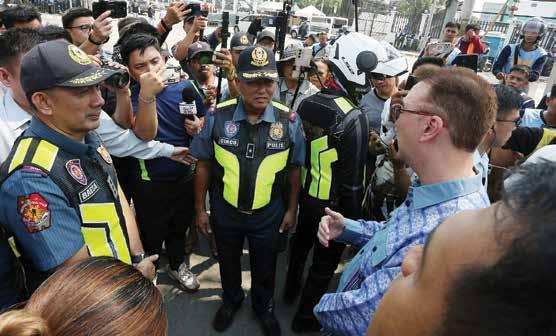
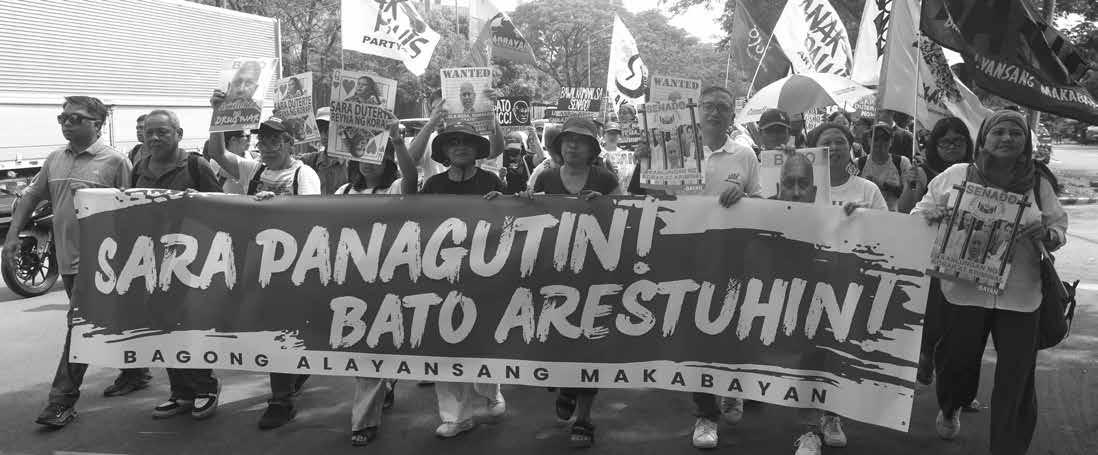
BRIEF VISIT. Senate President Alan Peter Cayetano (in striped blue shirt) visits police personnel deployed to the Senate premises, led by
Southern Police District Director Brig. Gen. Glenn Cinco (center), on Wednesday (May 13, 2026). Police officers have heightened security in the vicinity of the Senate as groups gathered to call for the arrest of Senator Ronald “Bato” Dela Rosa, who has an arrest warrant from the International Criminal Court, and the impeachment of Vice President Sara Duterte. PNA photo by Avito Dalan
PAUNAWA SA MGA BOTANTE NG PAGSASARA NG PAGPAPAREHISTRO PARA SA PANGUNAHING HALALAN NA GAGAWIN SA MARTES, HUNYO 9, 2026
IPINAPAALAM SA PAMAMAGITAN nito na si , Lorena S. Portillo, na Tagapagtala ng Botante sa Clark County, Nevada, ay gaganapin ang pagpaparehisto ng mga karapat-dapat na botante para sa Pangunahing Halalan na gagawin sa Martes, Hunyo 9, 2026.
Ang kahit na sinumang karapat-dapat na botante na ang pangalan ay hindi nakalista sa opisyal na talaan ay maaaring mag apply para magparehistro sa pamamagitan ng koreo, personal, online o sa pamamagitan ng magkaparehong-araw ng pagpaparehistro na sang ayon sa pamamaraan na pinahihintulutan at alinsunod sa batas batay sa mga naka takdang huling araw na naka lista sa ibaba. (NRS 293.3568, 293.560, 293.565, 293.5832,293.5837, 293.5842, 293.5852)
Ang huling araw para magparehistro sa unang pagkakataon o i-update ang iyong pagkarehistro sa pamamagitan ng koreo o online para magiging ontime sa nakatakdang panahon na Hunyo 9, 2026, Pangunahing Halalan na maaari ka pa ring makatanggap ng koreong balota ay naka lista sa ibaba. Pagkatapos ng mga petsang ito. Ang mga botante na nina-nais na magparehistro sa unang pagkakataon, o gagawa ng pagbabago sa kanilang umiiral na impormayon ng pagkarehistro ay dapat dumaan sa proseso ng magkaparehong-araw ng pagpaparehistro, sa online o personal na pamamaraan (sa mga lugar ng Maagang Botohan o sa Sentro ng Botohan sa Araw ng Halalan). Ang mga bagong rehistrante ay kinakailangang bumoto sa pamamagitan ng pansamantalang balota sa personal na pamamaraan sa kahit na saang lugar ng maagang botohan o sa Araw ng Halalang Sentro ng Botohan. Lubos naming inirerekomenda na ang lahat ng mga kwalipikadong botante na magparehistro upang maka boto o i-update ang kanilang rehistrasyon sa lalong madaling panahon. 2026 PANGUNAHING HALALAN HULING ARAW AT ORAS NG PAGPAPAREHISTRO NG BOTANTE
Pamamaraan ng Pagpaparehistro Petsa Oras
Pamamagitan ng koreo, ahensya ng gobyerno, o personal na aplikasyon sa pagpaparehistro: Clark County
Kagawaran ng Halalan 965 Trade Drive, Suite A North Las Vegas, NV 89030
Online lamang sa, www.RegistertoVote.NV.gov, Dapat mayroong balidong Nevada DMV na ID o Driver’s License
Magkaparehong Araw Ng Pagpaparehistro (nang personal), dapat mayroong balidong Nevada DMV na ID, Driver’s License, o Nevada Tribal Identification kard (ayon sa NRS 232.006)
Martes, Mayo 12 (Huling Araw)
7:30 n.u. - 5:30 n.h.
Biyernes, Sabado, at Linggo Sarado
Martes, Mayo 26, 2026 (Huling Araw)
Para makatanggap ng koreong balota o bumoto ng pangkaraniwang balota sa personal at sa mga Lugar ng Maagang Botohan o Araw ng Halalang Sentro ng Botohan. Mayo 27–Hunyo 09 (Online Magkaparehong-araw ng Pagpaparehistro), dapat na ipakita ang ID sa kahit na saang sentro ng maagang botohan o sa Araw ng Halalang Sentro ng Botohan at maaaring bumoto lamang ng pansamantalang balota sa pamamaraan nang personal na pagboto sa kahit na saang Lugar ng Maagang Botohan o Sa Araw ng Halalang Sentro ng Botohan.
Mayo 23 Hunyo 9 sa Lahat ng Maagang Lugar ng Botohan, sa mga oras ng pagboto, at sa Araw ng Halalan sa lahat ng Lugar ng Botohan, hanggang sa magsara ang mga lugar ng botohan
LUNGSOD NG KLERK NA TAGGAPAN HULING ARAW NG
PAGPAPAREHISTRO AT ORAS (Koreo o sa Mismong Tanggapan ) Lokasyon Petsa Oras
Lungsod ng Boulder City
Tanggapan ng Klerk
401 California Avenue
Boulder City, Nevada
Lungsod ng Henderson
Tanggapan ng Klerk
240 S. Water Street Henderson, Nevada
Lungsod ng Henderson
Tanggapan ng Klerk
495 S. Main Street 2nd Floor Las Vegas, Nevada
Lungsod ng Mesquite
Tanggapan ng Klerk
10 E. Mesquite Blvd. Mesquite, Nevada
Lungsod ng North Las Vegas
Tanggapan ng Klerk 2250 Las Vegas Blvd. North North Las Vegas, Nevada
Lunes–Huwebes
Martes, Mayo 12 (Huling Araw)
Lunes–Huwebes
Martes, Mayo 12 (Huling Araw)
Lunes–Huwebes
Martes, Mayo 12 (Huling Araw)
Lunes–Huwebes
Martes, Mayo 12 (Huling Araw)
Lunes–Huwebes
Martes, Mayo 12 (Huling Araw)
7:00 n.u.–6:00 n.g.
Biyernes,Sabado at Linggo Sarado
7:00 n.u.–6:00 n.g.
7:30 n.u.–5:30 n.h.
Biyernes, Sabado,at Linggo Sarrado
7:30 n.u.–5:30 n.h.
7:00 n.u.–5:30 n.h.
Biyernes, Sabado, at Linggo Sarado
7:00 n.u.–5:30 n.h.
7:30 n.u.–5:00 n.h.
Biyernes, Sabado, at Linggo Sarado
7:30 n.u.–5:00 n.h.
8:00 n.u.–5:45 n.h.
Biyernes, Sabado, at Linggo Sarado
8:00 n.u.–5:45 n.h.
Ang karapat-dapat na botante na mayroong Nevada driver’s license o ID kard na ibinigay ng DMV at nag na-nais na makatanggap ng isang koreong balota, ay maaaring mag parehistro o i-update ang kanyang impormasyon sa pagboto sa online hanggang 11:59 n.g., sa Mayo 26, 2026, ekslusibo sa www.RegistertoVote.NV.gov, (Nevada Kalihim ng Estado na website). Ang mga karapat-dapat na botante na magre-rehistro online ay magsisimula sa Mayo 27, 2026, hanggang Hunyo 9, 2026, ay hindi makakatanggap ng Koreong balota, dapat bumoto sa pamamaraan nang personal sa isang Maagang Lugar ng botohan o sa Araw ng Halala’ng isang Sentro ng Botohan, maaaring bumoto lamang sa pamamaraan nang pansamatalang balota, at dapat handang ipakita ang kanilang Nevada driver’s license, ID kard na inisyu ng DMV, Nevada DMV Interim na Pansamatalang dokumento, o Nevada Tribal ID (per NRS 232.006) bago maaaring bumoto.
Ang Nevada at ang batas na pederal ay nangangailangan na ang mga botante na boboto sa unang pagkakataon ay dapat na magbigay ng numero ng identipikasyon (Nevada Driver’s License number o ang huling apat na numero ng kanilang Social Security Number). Kapag hindi ito magkapareho sa Rekord na pinanatili ng Department of Motor Vehicles o Social Security Administration, ang botante ay kinakailanganin na ipakita ang kanyang identipikasyon bago papayagang bumoto. Ang mga ibat-ibang uri ng pangkasalukuyan at tinatanggap na identipikasyon ay dapat na mayroong larawan na identipikasyon na kasama ang pangalan at pisikal na address ng botante (Nevada Driver’s License, Nevada I.D. Kard) O kopya ng kasalukuyang utility bill, statement ng bankgo, paycheck, o dokumento na galing sa sangay ng gobyerno, na mayroong pangalan at pisikal na address ng rehistradong botante. Inabisuhan na ang mga indibidwal na ito.
Para sa karagdagang kaalaman, tawagan ang Clark County Kagawaran ng Halalan sa (702) 4558683 (Ingles) o (702) 455-7871 (Filipino).
Pinetsahan ngayong ika-23 ng Abril, 2026
LORENA S. PORTILLO
Tagapagtala ng Botante
Inilathala: Mayo 1, 8, 15, at 22, 2026 Las Vegas Asian Journal
Americans look abroad as U.S. migration...
1
sharply, raising new questions about affordability, mobility and the country’s long-held pull as a destination.
The U.S. Census Bureau reported in January that the country’s population grew by 1.8 million people, or 0.5 percent, between July 1, 2024, and July 1, 2025, reaching 341.8 million. The agency said the slowdown was driven largely by a historic decline in net international migration, which fell from 2.7 million the previous year to 1.3 million. If current trends continue, the bureau projected net international migration could fall to about 321,000 by July 2026. Brookings Institution economists separately estimated that net migration may have turned negative in calendar year 2025, with losses ranging from 10,000 to 295,000 people. Brookings described the estimate as the first negative net migration year in at least half a century, while cautioning that reduced data transparency makes the numbers uncertain.
Those figures require careful reading. Net migration is not a
count of U.S. citizens leaving the country. It measures people entering and leaving the United States, including immigrants, temporary residents, removals, voluntary departures and citizens moving abroad. The United States also does not maintain a comprehensive, real-time count of Americans who relocate overseas.
Why some Americans are looking elsewhere
The reasons vary. Recent reporting has pointed to housing costs, health care expenses, education costs, political unease, safety concerns, remote-work flexibility and the search for a lower-stress life. Mexico, Portugal, Spain, Ireland and parts of Asia have appeared frequently in coverage of American relocation, though countries track arrivals and residence categories differently.
The trend carries a particular resonance for Filipino Americans, whose family histories are often rooted in migration toward the United States. The newer question is not only who still wants to come to America, but whether some Americans now see opportunity, affordability or stability elsewhere.
Moving abroad is also not the same as renouncing citizenship. Renunciation is a separate formal legal act with tax and immigration consequences. The IRS publishes a quarterly Federal Register list of certain individuals who have chosen to expatriate, but that list should not be read as a complete count of Americans living overseas.
The clearest conclusion is not that the United States is being emptied by a citizen exodus. It is that America’s migration advantage has weakened, the number of people leaving has increased, and more U.S. citizens appear willing to imagine a life beyond its borders. (AJPress)
For some Americans, leaving is a retirement calculation. For others, it is a family decision, a professional move or a way to use ancestry-based citizenship and long-stay visa programs. For dual citizens and naturalized Americans, relocation may also mean returning to a family’s country of origin or living across borders.
Duterte defense changes lead lawyer...
PAGE 1
the case would proceed on three counts of crimes against humanity brought by prosecutors in connection with alleged killings tied to the Philippines’ anti-drug campaign.
Duterte, a former longtime Davao City mayor who became president in 2016, built his national political identity around a hard-line anti-drug campaign that remains central to the ICC case. Sen. Ronald “Bato” dela Rosa, Duterte’s former national police chief, became one of the most visible officials associated with that campaign.
Duterte has denied criminal liability. Dela Rosa has also denied wrongdoing. Neither man has been convicted by the ICC.
Release request
Before withdrawing, Kaufman asked the court to reconsider interim release for Duterte, citing medical concerns that the defense said affected the former president’s condition in detention. The defense filing referred
to short-term memory problems, balance issues and an increased risk of falling. Prosecutors opposed interim release, arguing that continued detention remains necessary to protect the integrity of the proceedings. Lawyers representing victims also opposed the request, citing concerns about flight risk and witness protection.
Duterte, who turned 81 on March 28, has been in ICC custody since his transfer to The Hague in March 2025. ICC materials state that his initial appearance before the court took place on March 14, 2025.
Case moves forward
The ICC case concerns alleged crimes committed from Nov. 1, 2011, to March 16, 2019, the date the Philippines’ withdrawal from the Rome Statute took effect. The court has maintained that it retains jurisdiction over alleged crimes committed while the Philippines was a State Party to the treaty.
The confirmation of charges is not a conviction. It is a pretrial ruling that allows the case to proceed after judges found that the legal threshold for trial had been met.
Wider proceedings The proceedings against Duterte are unfolding alongside a separate ICC warrant for dela Rosa. The warrant was issued under seal on Nov. 6, 2025, and unsealed on May 11, 2026. It accuses him of crimes against humanity in connection with the alleged murders of at least 32 people between July 2016 and April 2018.
For Duterte, the next immediate question is whether judges will grant his renewed request for interim release.
Beyond that ruling, the case is headed toward a trial that will test the prosecution’s evidence, the defense’s challenges and the ICC’s jurisdiction over one of the most politically charged cases to emerge from the Philippines’ drug war. n
Democrats recalibrate redistricting strategy...
PAGE 1
equally forceful map strategy, could leave them at a structural disadvantage.
The pressure grew after the U.S. Supreme Court’s April 29 ruling in Louisiana v. Callais. The court held that the Voting Rights Act did not require Louisiana to create an additional majority-minority district and that the state had no compelling interest justifying the use of race in drawing the challenged congressional map, known as SB8. The ruling affirmed a lower-court decision that found the map unconstitutional.
For Republicans and conservative litigants, the decision reinforced constitutional limits on race-conscious districting. For Democrats and civil-rights advocates, it raised concerns that protections against minority vote dilution could become harder to defend, particularly in Southern states where race, party affiliation and voting patterns often overlap.
Virginia created another complication for Democrats. The Supreme Court of Virginia blocked a Democratic-backed redistricting effort on procedural grounds, leaving the current congressional map in place. The ruling did
not decide whether the proposed map was too partisan or whether it would have complied with federal voting-rights law. But politically, it removed one of the clearest ways Democrats could have offset maps in Republican-controlled states. That is the strategic bind facing House Democratic Leader Hakeem Jeffries and national Democrats. A party that has criticized partisan gerrymandering is now being pushed by circumstance toward a more forceful response in states where it has the power to act. According to the National Conference of State Legislatures, states are undertaking mid-decade redistricting at rates not seen since the 1800s. As of early May, eight states had implemented new congressional maps, including California, Florida, Missouri, North Carolina, Ohio, Tennessee, Texas and Utah. The legality of mid-decade redistricting varies by state, and many state constitutions do not clearly address congressional redistricting between census cycles. Georgia is among the next states to watch. Gov. Brian Kemp has called a special legislative session for June 17 to address congressional and state legisla-
tive districts after the Callais decision. Any new maps are expected to matter more for the 2028 cycle than the current election schedule. The Democratic strategy now appears to be shifting on two tracks. Publicly, party leaders are likely to keep emphasizing voting rights, minority representation and the dangers of unchecked partisan mapmaking. Operationally, they are under pressure to consider countermeasures in Democratic-led states if Republican-led states continue to redraw maps. That approach carries risk. A more aggressive redistricting posture could make Democrats vulnerable to charges of inconsistency on gerrymandering. But restraint also carries a cost if Republicans use mid-decade maps to secure enough favorable districts to shape House control for years. For Democrats, the map fight is no longer simply about defending legal doctrine. It is about preventing redistricting from becoming, in their view, a durable Republican advantage. The challenge is whether they can do that while still credibly defending the democratic norms they say are at stake. (AJPress)
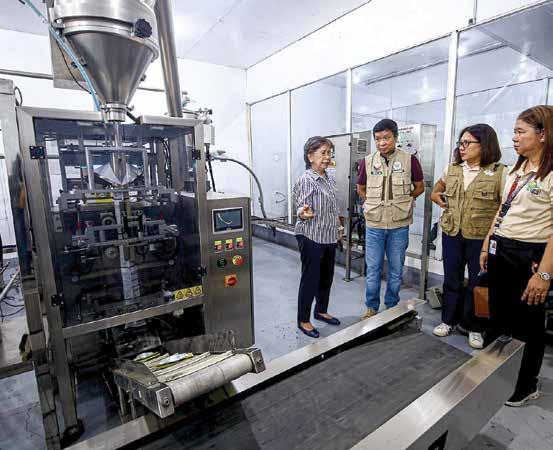
ORGANIC. Department of Agriculture - Bureau of Soils and Water Management staff make a site visit at the Yama-N biofertilizer plant in Pulilan, Bulacan on Wednesday (May 13, 2026). The department has been promoting biofertilizers, liquid fertilizers, and soil ameliorants even before the Middle East crisis erupted in late February and affected global supply chains. PNA photo by Joan Bondoc
DAteline PhiliPPines
Marcos sets 30-day P50 price ceiling on imported rice
by AJPress
Ferdinand Marcos Jr. has ordered a temporary nationwide price ceiling of P50 per kilogram on imported rice, a 30-day intervention aimed at addressing what the government described as unjustified increases in the price of the staple food.
The measure was issued through Executive Order No. 118, signed on May 13, 2026, following the recommendation of the National Price Coordinating Council.
The order applies to imported rice with 5 percent broken grains and will remain in force for 30 days un-
less lifted earlier by the President upon the council’s recommendation.
The NPCC was directed to review the implementation of the price ceiling every 15 days and recommend whether it should be continued, adjusted or lifted based on prevailing market conditions and available data.
The Department of Trade and Industry and the Department of Agriculture were tasked to enforce the order, including through price monitoring and investigation of abnormal price movements. The Bureau of Customs was directed to conduct inspections and enforcement operations against hoarding,
smuggling and illegal importation of rice, including seizure or forfeiture of smuggled rice where warranted.
The order cited the need to protect consumers from profiteering and other abusive market practices while ensuring adequate supply, reasonable pricing and access to rice.
The measure comes as the government continues to manage rice prices through a mix of import policy, tariff adjustments and market monitoring. Rice remains among the country’s most politically and economically sensitive commodities, with price movements affecting both consumers and farmers. n
DMW shuts down Pasig consultancy over alleged illegal recruitment for U.S. caregiver jobs
by AJPress
MANILA — The Department of Migrant Workers has shut down a Pasig City-based travel and visa consultancy firm for allegedly recruiting Filipinos for caregiving jobs in the United States without the required government license and approved job orders.
The DMW identified the establishment as State 101 Travel Visa Consultancy, located in Ortigas, Pasig City. The closure operation was carried out Thursday, May 14, by the department’s Migrant Workers Protection Bureau and National Capital Region office, in coordination with the Pasig City Police, according to the DMW account reported by the Philippine News Agency.
Authorities said the firm was not licensed or authorized to recruit and deploy overseas Filipino workers. The DMW said officers and employees of the company are now facing possible illegal recruitment complaints, with the agency preparing
charges for large-scale illegal recruitment and syndicated estafa.
The department said the operation stemmed from complaints involving applicants who were allegedly promised caregiver or companion jobs in the United States. According to the DMW, the consultancy allegedly referred applicants to U.S. employers using tourist visas, a setup that raised concerns because tourist visas do not authorize employment in the United States. Authorities said two former overseas Filipino workers were intercepted during the operation as they were reportedly about to submit documents for the promised U.S. jobs. Initial findings cited by the DMW indicated that the two applicants, along with two other complainants, had already paid substantial placement and processing fees.
The DMW alleged that applicants were promised monthly salaries of about $1,800, or roughly P109,800, and were asked to pay as much as P150,000 for documentation, processing and related expenses before sup-
posed training and deployment.
The department said State 101 had no approved job orders for deployment to the United States. Under Philippine regulations, recruitment for overseas work must be handled only by agencies licensed by the DMW and supported by verified job orders.
The closure brought to 12 the number of establishments shut down by the DMW this year for alleged illegal recruitment activities, according to the department.
The DMW urged other applicants who may have dealt with the consultancy to coordinate with the Migrant Workers Protection Bureau for legal assistance and possible case filing. It also reminded aspiring overseas workers to transact only with licensed recruitment agencies and to verify approved job orders before paying any fees.
The allegations remain under government investigation. No court finding of liability against the company, its officers or employees was cited in the DMW announcement. n
Comelec: Losing candidates in 2025 polls may now be considered for government posts
The constitutional one-year appointment ban has lapsed, but any appointment remains subject to qualification, civil service and confirmation rules.
by AJPress
CEBU — President Ferdinand Marcos Jr. and Vietnamese Prime Minister Lê Minh Hung on Thursday agreed to establish a longterm rice trade mechanism and strengthen food security cooperation during a bilateral meeting on the sidelines of the 48th Association of Southeast Asian Nations (Asean) and Related Meetings here. The leaders also discussed expanding cooperation in addressing transnational crimes and en-
hancing collaboration in tourism. “On agriculture, both sides agreed to establish a long-term rice trade mechanism aimed at ensuring stable supply and strengthening food security cooperation between the two countries. The two leaders also discussed expanding cooperation in addressing transnational crimes, including scam hubs and human trafficking, as well as enhancing collaboration in tourism,” the Presidential Communications Office said. In line with the 50th anniversary of their bilateral relationship this
year, the leaders expressed confidence that the milestone would lead to stronger cooperation in trade and economic engagement.
Marcos, during their meeting, also congratulated the prime minister on his assumption of office last April and welcomed him to his first Asean Summit.
Exactly a year ago, during the Asean Summit in Malaysia, Marcos and then Vietnamese Prime Minister Pham Minh Chinh renewed their commitment to bolster diplomatic cooperation between their nations. n
GT Capital donates 15-hectare Cavite site for future Ateneo campus
by AJPress
GENERAL TRIAS CITY, Cavite
— Ateneo de Manila University is moving closer to establishing a new campus in Cavite after GT Capital Holdings Inc. formally donated a 15-hectare property at Riverpark, a township development in General Trias City. The Deed of Donation was signed on Monday, May 11, at the GT Tower International in Makati City, following a memorandum of agreement between GT Capital and Ateneo de Manila
the Ateneo de Manila University Riverpark campus is targeted to open in 2030. GT Capital said the project adds to other developments planned or underway within Riverpark, including the Uniqlo Logistics Facility and the upcoming SM City General Trias. The township is also expected to benefit from planned access improvements through two Cavite-Laguna Expressway interchanges: the Open Canal Interchange, scheduled for completion in 2026, and the Riverpark-General Trias Interchange, targeted for 2027. GT Capital is a diversified holding company with interests in banking, automotive, proper
and
Zubiri, Ejercito sit as independents after Senate leadership change
The two senators abstained from the vote that replaced Tito Sotto with Alan Peter Cayetano as Senate president, keeping themselves outside both the majority and minority blocs.
by AJPress
MANILA — Senators Juan Miguel “Migz” Zubiri and JV Ejercito said they would sit as independents after abstaining from the vote that installed Sen. Alan Peter Cayetano as Senate president, replacing Vicente “Tito” Sotto III in a leadership change that came as the chamber prepared for possible impeachment proceedings involving Vice President Sara Duterte.
The Senate voted 13-9-2 on Monday, May 11, to elect Cayetano as Senate president. Zubiri and Ejercito were the two senators who abstained from the vote, while the remaining senators were divided between Cay-
etano and Sotto. Their decision placed them outside both formal blocs at a politically sensitive moment for the Senate. The chamber is expected to play a central role in the impeachment process after the House of Representatives voted to impeach Duterte and send the case to the Senate for trial.
The impeachment complaint accuses Duterte of misuse of public funds, accumulation of unexplained wealth and threats against President Ferdinand Marcos Jr., the first lady and a former House speaker. Duterte has denied the allegations.
The leadership change drew heightened attention because the Senate president would pre-
side over the trial if the chamber convenes as an impeachment court. Cayetano’s election altered the Senate leadership as the Duterte case moved toward trial. For Zubiri and Ejercito, declaring independence gives them room to act outside the chamber’s new majority-minority alignment. Their abstention also distinguished them from senators who voted directly for either Cayetano or Sotto. The shift leaves the Senate with a new leadership configuration as it faces one of its most consequential constitutional duties: deciding how and when to proceed with the impeachment trial of the vice president. n
Alan Peter Cayetano elected Senate president...
1
Senators reported to have backed Cayetano included Pia Cayetano, Bong Go, Robin Padilla, Loren Legarda, Imee Marcos, Camille Villar, Mark Villar, Ronald “Bato” dela Rosa, Joel Villanueva, Jinggoy Estrada, Francis “Chiz” Escudero and Rodante Marcoleta.
The leadership transition unfolded as the House of Representatives voted to impeach Vice President Duterte, formally setting the stage for a Senate trial under the Constitution. Reuters reported that 257 lawmakers voted in favor of impeachment, while 25 opposed the complaint and nine abstained. Duterte has denied wrongdoing and questioned both the allegations and the political motivations behind the impeachment process.
Days after assuming the Senate presidency, Cayetano announced that the chamber is expected to convene as an impeachment court on May 18.
Under the Constitution, senators serving in an impeachment court take oaths as impeach-
ment judges and ultimately decide whether to convict or acquit the impeached official.
Conviction requires a two-thirds vote of all Senate members.
Under Philippine law, the Senate president plays a central procedural role during impeachment proceedings, overseeing trial sessions and parliamentary procedures, although the final outcome depends on votes cast by senators sitting as judges.
Cayetano has denied suggestions that the leadership overhaul was designed to influence the impeachment proceedings, describing the transition instead as part of broader institutional realignments within the chamber.
The reorganization also elevated Loren Legarda as Senate president pro tempore and Joel Villanueva as majority leader.
The session drew additional attention because Ronald dela Rosa appeared publicly in the Senate after months away from regular proceedings and participated in the closely watched leadership vote.
Cayetano, 55, previously served as secretary of foreign affairs under former President Rodrigo Duterte and later became speaker of the House of Representatives from 2019 to 2020. He was also Duterte’s vice presidential running mate during the 2016 national elections.
Born into a prominent political family, Cayetano is the son of the late senator Renato “Compañero” Cayetano and the brother of Pia Cayetano. He studied law at Ateneo de Manila University before entering public service.
In remarks following his election, Cayetano called for unity within the Senate and said lawmakers must remain focused on economic concerns, geopolitical tensions and institutional stability.
The abrupt leadership transition has intensified scrutiny of the Senate as political blocs reposition ahead of the 2028 national elections and a possible impeachment trial involving one of the country’s most influential political figures. n
Advertisement for Bids
Notice is hereby given that the San Diego Unified School District, acting by and through its governing board, will electronically receive bids for the furnishing of all labor, materials, transportation, equipment, and services for: CC27-0134-52-00-00 OLD TOWN ACADEMY TEMPORARY FENCING
A mandatory site visit is scheduled for 9:00 a.m. on THURSDAY, MAY 21, 2026, at the project site located at 1350 Fashion Valley Road, San Diego, CA 92108; park in the garage and meet between the parking garage and the main building. All attendees must preregister with the District prior to attending the site walk at sandiegounified.org/sitewalks. The Bid and Contract Documents may be downloaded free of charge at the District’s online Planroom at sandiegousdplans.com. All bids must be received electronically via PlanetBids before 1:00 p.m. on THURSDAY, JUNE 4, 2026. Prime contractors interested in submitting a bid must go to tinyurl. com/SDUSD-PlanetBids then search under “Bid Opportunities” for “Invitation number” CC27-0134-52-00-00 Old Town Academy Temporary Fencing. For new vendors, please register under “New Vendor Registration.” The project estimate is between $273,000 and $315,000, inclusive of allowances. This is not a PSA project but requires the District’s prequalification for projects estimated under $1 million The District requires that Bidders possess any of the following classification(s) of California State Contractors License(s), valid and in good standing, at the time of bid opening and contract award: A or C-13, or other appropriate license, subject to District approval. SAN DIEGO UNIFIED SCHOOL DISTRICT, George A. Harris III, Director, Fiscal Controls and Information Systems, Facilities Planning and Construction CC27-0134-52-00-00
FeAtures OPiniOn
Asian American, Native Hawaiian, and Pacific Islander Heritage Month: recognition, reality, and the unfinished American narrative
LOS ANGELES — Each May, the United States observes Asian American, Native Hawaiian, and Pacific Islander (AANHPI) Heritage Month, a federally recognized commemoration that reflects a population now firmly embedded in the country’s demographic, economic, and civic structure.
The observance traces its roots to congressional action in 1978, when a weeklong recognition was first established and later expanded into a month by 1992. May was selected to mark two historical reference points: the arrival of early Japanese immigrants to the United States in 1843 and the completion of the transcontinental railroad in 1869, built with the decisive labor of Chinese workers. They are foundational chapters in the formation of the modern United States. Federal cultural institutions, including the Library of Congress and the Smithsonian Institution, now coordinate national programming that situates the observance within a broader historical and educational framework. The federal designation itself has evolved to explicitly include Native Hawaiian and Pacific Islander communities, reflecting a more precise and inclusive standard.
THERE has been a noticeable shift in tone lately here in Washington, DC whenever the Philippines is discussed. The country is no longer framed merely as a treaty ally with a long-shared history with America. It is increasingly being viewed as a central pillar in a rapidly evolving Indo-Pacific strategy – one that has moved from theory to action.
In a recent Nikkei Asia commentary written by University of Southern California political science professor Derek Grossman, he described what many are calling a “renaissance” in the US-Philippines alliance. That word, definitely, is not used lightly because it reflects a genuine resurgence in cooperation and, above all, strategic clarity between the longtime allies.
However, a closer look at the commentary’s title – “Under Trump, the US-Philippines alliance enjoys a renaissance, for now” – clearly highlights the cautionary phrase that should give everyone serious pause: “for now.”
That’s because what we are witnessing is not simply the natural course of diplomacy but the convergence of leadership, neces-
long view
L. Quezon III
THIS is what we forget about impeachment. It was intended to be the instrument of last resort, the “break glass in case of emergency” system when a society was confronted by an otherwise-unstoppable instance of unfitness for office. We have forgotten this aspect of impeachment because, by design, the framers of our present Constitution decided to make it easier rather than harder, apparently taking a cue from the endlessly amended 1973 Constitution (while forgetting this was a cosmetic allowance since it was a constitution designed for a single-party state for all intents and purposes).
The Supreme Court, for all its self-interest (but then, nothing is more effective as a motivator than self-interest, self-preservation being the most basic of instincts), can be said to be trying to use its powers to channel impeachment
Editorial
Yet the pace of demographic and economic change has moved faster than public understanding.
Data from the U.S. Census Bureau identifies Asian Americans as one of the fastest-growing population groups in the country. In states such as California, they represent a significant share of residents, shaping labor markets, education systems, housing demand, and electoral dynamics. Economic indicators reinforce that presence. Market research places Asian American purchasing power in the trillion-dollar range, supported by high levels of entrepreneurship and strong representation in sectors such as healthcare, technology, and finance. Educational attainment levels are among the highest nationally, particularly in science, engineering, and medical professions. But aggregate strength conceals uneven out-
The window that we must not waste
sity and timing. And like all such moments in history, this presents a window – but one that will not remain open indefinitely. Under the leadership of President Marcos Jr., the Philippines has made a decisive and confident return to the center of its alliance with the United States. This has translated into tangible developments: expanded access to Enhanced Defense Cooperation Agreement sites, more frequent and sophisticated joint exercises and deeper coordination across defense and security channels – all operational realities, not abstract policy shifts.
In recent months, large-scale exercises such as Balikatan have reached unprecedented levels, involving not just American and Filipino forces but more partners from like-minded nations. Interoperability has improved, coordination has deepened, with the alliance demonstrating what credible deterrence looks like in practice. This transformation is driven by a shared recognition of regional challenges, particularly in the South China Sea, where tensions continue to test the boundaries of international law and the principle of freedom of navigation. Geography matters, now more than ever. The Philippines sits at
a strategic crossroads, at the heart of critical sea lanes through which trillions of dollars in global trade pass each year. It is also positioned along what defense planners refer to as the first island chain, a line of strategic locations central to maintaining balance and stability in the Indo-Pacific.
In this context, the alliance is not just historical – it is in our mutual interest. Yet it would be a mistake to assume that this renewed strength is self-sustaining. The current alignment between Manila and Washington is aided by a convergence of interests and perspectives. The current US leadership’s approach – often described as transactional – has, in this case, worked in the Philippines’ favor. Our strategic value is clear, and our willingness to engage actively has reinforced that perception. But transactional relationships depend on continued relevance and results. Priorities in Washington can shift. Leadership changes, both here and at home, can recalibrate policies. The urgency of today’s challenges may evolve. And if we are not careful, the momentum we now enjoy could gradually dissipate.
That is why this moment must be understood for what it is: not an u PAGE 7
Instrument of last resort
away from what it perceives as a system for political lynching or mob rule, toward something more regulated and sedate like its own proceedings. In other words, it’s what the politically ignorant do, when confronted with politics. To be precise: it is what those no longer imbued with the thinking of the Age of Enlightenment do when confronted by one of its artifacts, which is what impeachment is–not merely an artifact of Anglo-Saxon parliamentary practice, but of the Enlightenment Age debates during the founding of the American republic. What both the framers of the current Constitution and its manglers in the institutions that it chartered have in common, is an undercurrent of distrust both in public opinion and in popular democracy which has, at its heart, the creation of, and thus respect for, majority rule while safeguarding minorities from persecution. Instead, minorities are placed above majorities, even institutions: so the framers wanted legislation that could originate outside Congress, impeachments mounted
comes within the broader category.
Research from the Pew Research Center and academic institutions shows wide variation across communities. While some groups report high median incomes and advanced degrees, others, particularly among Southeast Asian and Pacific Islander populations, continue to face challenges in income stability, access to education, and healthcare equity. The cate-
the flood control investigations is that the corruption uncovered there was a replica, on a grander scale, of the Priority Development Assistance Fund (PDAF) or pork barrel scam that roiled the country in 2013. That scheme, masterminded by Janet Lim Napoles, defrauded the country of P10 billion over 10 years.
Public furor erupted into mass demonstrations. The Supreme Court eventually declared PDAF and all congressional participation in project execution unconstitutional, for violating the separation of powers. Napoles was jailed, along with three senators found to have profited from their allocations. The senators were later freed; Napoles remains in jail. This time, Lacson reported, the amounts involved in just the first three years of the Marcos presidency are several times larger. The number of legislators and officials implicated is greater. Their behavior was so brazen that it seemed, to them, merely the normal exercise of their office.
by minorities, limits on terms and on who can run for office, instead of leaving it to the electorate to decide; in decreeing a multiparty system without runoff elections, it practically made electoral majorities–which is a fundamental requirement for mandates to be respected—impossible to achieve. And yet it seems to me the legitimacy of impeachment has been fostered over the years we’ve resorted to it. The epidemic of performative impeachment attempts against former President Gloria Macapagal Arroyo (who gave a counterdemonstration in bare-knuckled coalition management, while also adopting the Marcosian Theory of Political Law: The Right Loophole Will Always Beat the Noblest Intention) taught us impeachments aren’t supposed to be easy. The impeachments that did succeed after former President Joseph Estrada, particularly that of Renato Corona, proved legitimate because of something no one noticed at the time. They hewed closer to impeachment as it was u PAGE 7
WHEN corruption becomes public, the instinct is to look for people to blame. The names. The faces. The villains. That instinct is understandable. People should be held accountable. But if that is all we look at, then we miss the bigger problem. Corruption is rarely just the story of a dishonest official. More often, it is the story of a system that was too easy to exploit: a process with too many gaps, controls that existed only on paper, records nobody kept properly, approvals given too casually and responsibility spread around just enough that, in the end, nobody seems answerable.
That is the part we do not like to confront. It is easier to believe that corruption begins and ends with bad actors. It is harder to admit that institutions can make abuse easier to commit, easier to conceal and harder to stop. Any serious anti-corruption effort has to begin there.
gory itself encompasses multiple migration histories and socioeconomic realities that do not converge into a single experience.
Representation reflects similar asymmetry. Asian Americans, Native Hawaiians, and Pacific Islanders have expanded their presence in public office and civic institutions, and voter participation has inu PAGE 7
What media highlighted was the senator’s finding that there was no “overall mastermind” orchestrating the entire scheme. But this was not Lacson’s main point. What he stressed was that the corruption occurred across various regions, following more or less the same modus operandi, without central coordination. It was, in short, a distributed system. In retrospect, even the PDAF scam attributed to Napoles was never a monopoly. There were many lesser-known Napoleses, not as well-connected as the queen of the pork barrel but operating by the same model. Why does this matter? Our political culture predisposes us to look for the key person to blame. This is understandable. It simplifies what is otherwise a dense system of institutional vulnerabilities, vulnerabilities that remain unpatched precisely because they furnish the resources of political patronage. And so even when investigations reveal the systemic nature of corruption, we keep shifting our gaze toward the culprits. It satisfies the public need to assign blame. It is also, not coincidentally, what is politically expedient.
The price of this simplification is incalculable. We fail to un-
derstand what it actually takes to combat corruption. We fail to see how, over time, everyone becomes complicit in its normalization— learning to tolerate it, to underestimate its long-term damage, even as we reserve our outrage for its most shameless practitioners. A less moralistic view would look beyond greed and focus instead on the structural conditions that enable corrupt behavior to take root, persist, and evolve. Many practices that sustain corruption are not themselves illegal. Accommodating a legislator’s request for more publicly funded projects in his district is not, per se, unlawful. It is, in fact, what constituencies expect of their representatives. What the law prohibits is legislative interference in project identification and execution. But this is a gray area, and gray areas are where corruption breeds.
When pork barrel allocations flow to favored districts without public justification, the door opens to precisely the kind of dealings we have seen in both the PDAF and flood control scandals. A legislator learns to treat the perks that attach to project execution as simply part of the privileges of u PAGE 7
Corruption isn’t just a people problem, it’s a systems problem
Of course integrity matters.
Public office should demand integrity. But no institution can run on character alone. If an office works only because the person at the top is competent, disciplined and serious, then what you have is not a strong institution. What you have is a temporary exception.
And government cannot be built on exceptions. We have seen offices improve under one leader, only to slip the moment that person leaves. The energy fades. Standards become uneven. Rules become flexible again. The same weaknesses return because they were never actually fixed. They were only kept in check for a while. That is the difference between reform and supervision. One changes the institution. The other just manages its weaknesses. Real reform is quieter. It rarely produces the drama people associate with accountability. More often, it looks like better systems: procurement rules that are harder to game, records that are complete and easy to trace, approvals that
clearly show who did what, audit trails that cannot be cleaned up after the fact and internal controls that catch problems early instead of waiting for a scandal. These things sound technical until public money disappears. A weak system does not stay inside an office. It shows up in roads that are never finished, flood control that fails, overpriced contracts, ghost deliveries, delayed services and projects that look complete in reports but not on the ground. Institutional weakness is not abstract. The public pays for it in very concrete ways.
That is why corruption should not be treated only as a question of personal morality. It is also a question of design. What was the process? Where was the discretion? Who checked the documents? Who signed off? Who was supposed to verify? Why was the irregularity not detected earlier? Why was it so easy to move from proposal to approval to release without anyone stopping to ask whether the transaction u PAGE 7
ManilaTimes.net photo
ONE of the startling conclusions in Senate blue ribbon committee Chair Sen. Panfilo Lacson’s report on
A PURPLE reign is taking root across the globe, from coffee shops in New York to bakeries in Sydney and beauty retailers in London,” declared a recent CNN article about Philippine “ube” or purple yam. Dubbed “the new matcha” in foodie circles, we exported around 1,700 metric tons (MT) of ube products last year worth more than $3 million, a hefty 20.4 percent jump over the 2024 level. Nearly half went to the United States, which doubled what it bought from us the year before, exceeding our combined ube exports to the five next biggest markets of Canada, Australia, the United Kingdom, the Netherlands, and New Zealand. From various food and drink preparations to cosmetics, ube products are sweeping the world, and we can’t produce enough of them. Worse, our production of this new “purple gold” is actually falling. In a country of so many missed opportunities, we must get our act together and not let this be yet another addition to the list. The painful reality is that we now produce less than half of the ube we produced 20 years ago, when the Bureau of Agricultural Statistics reported 30,074 MT of domestic production of the crop, and production has been constantly falling. The 12,483 MT we produced last year fell short of the 13,381 MT in 2024, below the 14,150 MT in 2021, and still lower than the 15,799 MT reported back in 2012. Why the consistent decline? The Philippine Root Crop Research and Training Center, based at the Visayas State University, cites both natural and human factors. Climate change and the unpredictable rainfall and extreme
Make way for ‘ube’— and more
weather it brings hurt the crop. Farmers’ interest is said to be weakened by inconsistent yields, a long six- to 12-month growth cycle, poor postharvest facilities, and lack of access to markets. Also cited is the lack of government support, especially for high-quality planting materials. In a New York Times article last December, a top Department of Agriculture (DA) official was quoted lamenting how Congress even trimmed the 2026 budget for ube by 10 percent down to a measly P10 million. The amount could hardly help provide planting materials to fill the need under surging world demand. The biggest insult is that we now even have to import ube from Vietnam, which, along with China, is ramping up production to cash in on the surge. There are similar zooming export opportunities for avocado (particularly of the Hass variety with rough, bumpy skin) and calamansi, our ubiquitous “Philippine lemon” that is a fixture at every Filipino table. Dole Philippines started exporting Hass avocados in late 2023, when the first shipment of about 18 to 20 tons was made to South Korea in September. In November 2024, we became the first Asian country to export them to Japan, sourced by Dole from Davao, Bukidnon, and South Cotabato. The Mindanao Development Authority is pushing “Green Mindanao” projects to convert highland areas into Hass avocado orchards, while the DA is pursuing export markets beyond South Korea and Japan, such as Russia and other parts of Europe. The global Hass avocado market was estimated to range between $11 and $20 billion in 2025, and is projected to grow to $26 billion by 2030. From our tiny perspective, this offers practically unlimited growth potential,
provided we do the right things to seize the opportunity.
Calamansi is the fourth most widely grown fruit in the Philippines after banana, mango, and pineapple, and the country is the only major producer of the crop worldwide–so far. Lately, we have been exporting an estimated 160,000 to 190,000 MT of calamansi juice annually. But like ube, our production of the crop has been falling through the years, having dropped by a substantial 43 percent since 2010, when we produced 188,300 MT. By 2017, this had fallen to 116,700 MT, and last year, it was down to only 107,700 MT. We must reverse this decline if we are to cash in on growing world interest in this fruit that has traditionally been largely our own. But like ube, it is now being increasingly grown by Vietnam, which is eyeing to cash in on growing demand in South Korea, Japan, the US, Canada, and the Middle East markets. In 2024, we earned $9.25 billion from agricultural exports. Vietnam, Thailand, Indonesia, and Malaysia had $62.5, $52.2, $46.9, and $44.8 billion, respectively, all several times our own figure. There’s no reason why we can’t narrow, if not close that huge gap. The good news is that we’re gaining speed, with a 19.3 percent growth in overall farm exports last year, and a 35.6 percent surge in fruit exports–all in spite of US tariffs and global trade disturbances. But our neighbors are not standing still either. We must do what’s needed to make sure that ube, Hass avocado, calamansi, and other up-and-coming farm export stars get the attention, support, and investments they need, and not join the list of the many opportunities we’ve blown and lost to our neighbors before. n
The window that we must not waste...
PAGE 6 endpoint, but an opportunity.
The task before us is to ensure that the gains we are seeing today are institutionalized – embedded not just in policy but in practice, capability and public understanding. This means continuing to invest in our own defense modernization, strengthening our maritime domain awareness and ensuring that our armed forces are equipped, trained and ready to meet the demands of a changing security environment.
But for an alliance to be resilient, it should go beyond defense – felt not only in military exercises but in economic growth and shared prosperity. Trade, investment, infrastructure and technology partnerships should reinforce the strategic foundation.
The role of the Filipino people must also be recognized. In recent years, public support for the alliance has strengthened, driven in part by a clearer understanding of the challenges we face. However, this support must be nurtured through transparency, commu-
nication and a consistent demonstration that policies serve the national interest. Alliances endure not just because of governments, but because of people.
Here in Washington, there is also growing appreciation that the Philippines is not simply a partner, but a proactive contributor to regional stability. Our voice carries weight not only because of our history, but because of the choices we are making today.
This was underscored during a recent conversation with a senior policymaker who remarked that the Philippines has “moved from the margins to the center of the conversation.”
That observation captures the essence of this moment. We are no longer on the sidelines; we are at the table, helping shape the agenda.
But being at the table comes with responsibility. We must be clear-eyed about the challenges ahead, disciplined in our approach and unwavering in our commitment to protect our sovereignty while contributing to regional
peace. To be clear, our strengthening alliance today is not directed against any one country. Rather, it is anchored on principles: respect for international law, freedom of navigation and the peaceful resolution of disputes – principles that benefit all nations, large and small.
As we move forward, the question is not whether the alliance will remain important – it will –but whether we will have done enough, during this period of renewed momentum, to ensure that it remains strong regardless of changing circumstances.
History has a way of judging such moments not by the opportunities presented, but by what was done with them.
This “renaissance” is real, but it is not guaranteed. It is a window –and one that we must not waste.
(Philstar.com)
* * *
The opinions, beliefs and viewpoints expressed by the author do not necessarily reflect the opinions, beliefs and viewpoints of the Asian Journal, its management, editorial board and staff.
* * * Email: babeseyeview@gmail.com
Corruption with no mastermind...
PAGE 6
office. The executive, meanwhile, dispenses pork barrel to secure legislative support for his agenda.
Those he appoints know this. The late Department of Public Works and Highways Undersecretary Catalina Cabral went so far as to devise a parametric model to “rationalize” pork barrel allocations across congressional districts—a bureaucratic innovation that normalized legislative interference in project identification and execution rather than checked it. When the President is seen as comfortable with this arrangement, content to entrust the details to subordinates, the line between executive and legislative functi-
ons is blurred. President Marcos’ complaint in his 2025 State of the Nation Address that the approved budget left little room for his own centerpiece projects had the ring of someone surprised to find that the game he had allowed had costs. In our system of government, nearly everyone in the legislature, the bureaucracy, and I would venture even the judiciary, takes their cues from the president. That is how powerful the office is, not merely in its formal authority, but in the signals it sends and what it tacitly permits. If a president consistently demonstrates a clear and stubborn commitment to enforce the law in its spirit and let-
ter—through the quality of his appointments, through his own daily conduct as chief executive—those below him will think hard before abusing their positions. There was no mastermind in the flood control corruption scheme. But there was also no one in charge of resolutely protecting the system of governance from being corrupted. That absence is fatal.
(Inquirer.net)
* * * The opinions, beliefs and viewpoints expressed by the author do not necessarily reflect the opinions, beliefs and viewpoints of the Asian Journal, its management, editorial board and staff.
* * *
Email: public.lives@gmail.com
Instrument of last resort...
PAGE 6 understood before 1973, than its warped evolution since then.
We should pause to think that had the rules been different, could Vice President Sara Duterte still have been impeached? Under the 1935 Constitution, a two-thirds majority is needed to impeach, and three-fourths majority in the Senate to convict. Earlier (19351940), when the 1935 Constitution still provided for a unicameral National Assembly, impeachment was decided in a special Commission on Impeachment in that body; two-thirds of its members had to approve any articles of impeachment, while conviction required three-fourths of the entire National Assembly. Under the 1973 Constitution, with its unicameral legislature, the bar required to impeach was lowered significantly. One-fifth of the Batasan was needed to impeach, and two-thirds of the Batasan was
needed to convict. The present Constitution requires one-third of the House to impeach, and twothirds of the Senate to convict, a decision that made impeachment and conviction significantly easier, politically speaking. When the House impeached Estrada, it exceeded the minimum one third needed by 29 votes, but this was less than half of its members; when it impeached Corona, however, exactly two-thirds of the House voted to impeach him. Ronald Llamas’ estimate of the actual voting in plenary is a low of 190 and a high of 230, which means, at a minimum, just above a simple majority (160 votes) and at maximum, exceeding a two-thirds majority (which would be 212 votes) and very close to (but still slightly below) a three-fourths majority (239 votes). In other words, if at least 212 representatives vote to impeach the Vice President, even by the requirements of the 1935
We are a nation divided. THAT would probably best describe this country, most especially after this theater of the absurd opened on our TV sets and other smart gadgets one intense summer afternoon on Monday, May 11, showing this senator running for his life, away from a pursuing team, led by a former senator and dozens of NBI agents, past the well-guarded doors and stairs of the Senate.
Death without trial Sen. Ronald “Bato” dela Rosa, a former police chief accused of having taken part in the summary execution of thousands in former president Rodrigo Duterte’s “Oplan Tokhang,” was running obviously scared, as seen in the footage, fearing for his life. He had denied the allegation and said proudly that he had never been charged with any crime related to “salvaging” in the Philippines.
His refusal to be served the arrest warrant from the International Criminal Court for the charges caused the chase. He had not been in the Senate for the last six months since reports of the warrant surfaced in November 2025.
It was tragicomedy, to say the least, reminiscent of that iconic scene from the film Gone with the Wind, showing Scarlett O’Hara running desperately, in her headstrong survival instinct, declaring she would never want to go hungry again, even if it means she has to lie, steal, cheat, or kill.
Dela Rosa’s return to the Senate was cheered and jeered; It was supposed to add more votes to the coup led by Sen. Alan Peter Cayetano seeking to oust Senate President Vicente Sotto. Cayetano got the votes, but dela Rosa’s long-awaited homecoming and the attending run-and-chase footage eclipsed the revolt.
By the time dela Rosa reached the plenary, he was visibly agitated. The camera zoomed in and provided a much clearer view: There he was on the floor, standing alongside Sen. Cayetano. He was furious, raising his voice and fist with one of his fingers bruised, he said, because he had to fight it out with some of the pursuing NBI agents, led by lawyer Melvin Matibag, a known Duterte lieutenant-turned NBI chief of the Marcos Jr. administration. Imagine the trash and traces the battle had left on the stairs.
That was last Monday at the Senate, supposedly an august hall, a deliberative body where its members once upon a time tackled what was right and wrong about this country with neither fear nor favor until, of course, one day it was shut down with the declaration of martial rule.
Reality TV
The public was not watching an action film on Netflix shot at some dark alleys; it was not a scene from Maynila sa mga Kuko ng Liwanag showing Julio Madiaga (played by Bembol Roco) cornered by his pursuers: “Sa bawat latay kahit aso’y nag-iiba. Sa unang latay siya’y magtataka. Sa ikalawa, siya’y mag-iisip. Sa ikatlo, siya’y
A circus called the Senate
magtatanda. Sa ika-apat, humanda ka.”
Those two scenes were worlds apart, to be sure, coming from different circumstances. Julio is no Bato.
While Julio was talking about a man’s threshold of tolerance for violence, dela Rosa talked about his pursuers having no respect for the Senate as an institution.
Who’s talking? He may not have taken part in summary execution, but did he stop it from happening? Nothing breeds lawlessness than the lawless enforcement of the law.
But like Julio, Bato now felt he was under siege. Bato had disappeared and came back fuming. “Push me one more time, but be ready?”
There must be a better way to arrest a sitting senator?
When then-NBI director Gen. Alfredo Lim showed up at the Senate in February 1990 to arrest Sen. Juan Ponce Enrile on charges of “rebellion with murder and multiple frustrated murder” for the failed December 1989 coup against former president Corazon Aquino, everybody felt tense. People were waiting for a fight-orflight scenario inside the chamber. Sen. Enrile yielded peacefully. So did Senators Leila de Lima and Antonio Trillanes in their time.
There was no violence. They had to; nobody was—and still is— above the law.
Who is clueless?
That gala at the Senate last Monday was full of surprises and twists. Until then, the public had no idea if Trillanes, an ex-Navy soldier and one of the country’s most celebrated coup plotters, and the NBI agents knew all along that dela Rosa would suddenly come out of his hibernation that Monday afternoon.
Neither did the public have any idea if Trillanes and the NBI agents knew that Sen. Alan Peter Cayetano would lead a coup, though this Senate shake-up had been going the rounds for many, many months.
The coup was a game-changer; it apparently spoiled the arrest script and thus probably triggered the chase to arrest Dela Rosa, as if there was no tomorrow.
But was dela Rosa also clueless about the presence of Trillanes and the NBI agents? His vote was beyond the required number to stage the Senate shake-up.
Of clowns and plagiarists
That the Senate shake-up was meant to face head-on the House impeachment complaint against Vice President Sara Duterte was a giveaway. It was choreographed, not a product of a confluence of events, not of independent actors seeking a reversal of fortune.
By itself, the Senate has carved out over the past many years that image of a circus. Some of its members were jokers and clowns, tagged plagiarists, vote buyers, accused of plunder, and suspected murderers and coup plotters.
It has become a tragedy for people who knew the old chamber when it was peopled by the likes of the Rectos, Tolentinos, Tanadas, Dioknos, Mitras, Pimentels, Arroyos of this world, who lived like Caesar’s wife.
The added protagonists Trillanes and Matibag, both ob-
viously wanting publicity, did not make things any better in that Monday’s circus.
Victim is comic Dela Rosa didn’t say he disappeared because he was a victim of injustice, unlike Sen. Ping Lacson, when he faced murder charges and hid for 15 months until a court dismissed the complaint. He must have been trying to woo public sympathy, but his appearance only provided the tragicomedy twist in it, but it hurts.
The circus at the Senate was one awful thing; the televised show at the other legislative body, the House of Representatives, dominantly celebratory, was another.
At the House, an overwhelming majority of 257 lawmakers voted to impeach Sara, while 25 others voted against and nine abstained. So many lacked elegance in criticism.
The no-holds-barred, free-forall public statements on social media of so many other people who mattered and others who probably don’t were another thing. It is bloody. So many have been suffering verbal diarrhea.
Of bias and prejudices
All the angry men and women active in social media are mostly partisan, purveyors and keepers of their own truth. But is the truth based on available evidence the truth itself? Can anyone recognize the truth if it is not his own version?
People see what they want to see. The problem lies when people cannot keep intact their moral ascendancy, even to their perceived political enemies. People dish out their opinion, unmindful of the facts. That awful show at the Senate triggered some people to say, “Philippines, it is very difficult to love you” the moment they heard of the shake-up. Other comments were even below the belt.
Who can control the people’s rage? Rage, that first word in Homer’s Iliad, a collective expression or display of anger of people demanding accountability from their leaders. Haven’t they, b****y as they all are, waited for Sen. dela Rosa to show up?
But rage is likewise one of the prime movers of the social media platform, of lies and engagement. Lies are peddled systematically.
So many sounded agitated, so said their supporters in chorus, but the other side of the public found them equally agitating.
Not clickbait
But justice is not clickbait, and in this country, where everybody with access to a social media platform becomes an instant juror, truth is an instant casualty.
The Senate coup was another night of the long, long knives! Was it a comedy? Or a tragedy? Is tragedy the mirror of comedy? Who looked silly? Naive? Wrong? Who is the real winner? The circus was a continuing struggle between truth and lies in this country. Here’s hoping that the Senate shakeup may finally uncover the truth about the plunder of public funds involving all government officials, not just Vice President Sara Duterte.
Otherwise, all the mockery, all the sound and fury, all that tragedy is the people’s misfortune! n
Corruption isn’t just a people problem...
PAGE 6 made sense?
Those are not side questions; they are often the real ones.
By the time a corruption case becomes public, the system has usually already failed more than once. The failure may have happened at procurement, at supervision, at audit, at documentation or in the simple absence of discipline inside the office. Public outrage may focus attention, but it does not fix a weak process. Anger is not an internal control.
responsibility.
There is nothing glamorous about internal controls. Until you work without them.
We should stop acting as though cleaner government is only a matter of finding better people. Good people matter. Strong leaders matter. But if the institution underneath them is weak, even the best intentions can only go so far.
Public office is temporary. Institutions are supposed to last.
but whether we can build a public system disciplined enough to make abuse harder to commit, easier to detect and more difficult to hide. Because in the end, corruption survives not just where there is greed, but where there is room. And too often, weak institutions leave too much room.
and 1973 Constitutions, the Veep would’ve been impeached.
A low success is still formidable: a majority is a majority, but a high success sends a powerful message since ours is still a representative democracy. To a certain extent, it explains why Estrada being toppled at Edsa could be followed by an urban insurrection that sprouted in the same place, only to destroy itself at the gates of the presidential palace for lack of leadership. And why the Supreme Court had to exact its revenge by resorting to its own rules, which do not admit the participation of other institutions. (Inquirer.net)
* * * The opinions, beliefs and viewpoints expressed by the author do not necessarily reflect the opinions, beliefs and viewpoints of the Asian Journal, its management, editorial board and staff.
* * * Email: mlquezon3@gmail.com; Twitter: @mlq3
That work is harder. It requires less performance and more discipline. Less reliance on personalities and more attention to structure. Prevention, in government, is often procedural. It is in the record-keeping, the cross-checking, the limits on discretion, the visibility of transactions and the clarity of
If we are serious about accountability, then we should spend less time pretending that one person, no matter how strong, can sustain an institution indefinitely. We should spend more time asking whether the system itself can withstand pressure, resist abuse and keep working when the personal
ities change. That is the real test.
Asian American, Native Hawaiian, and Pacific...
PAGE 6
creased in recent election cycles. Still, proportional representation remains incomplete, particularly in senior policymaking and executive leadership roles.
This imbalance reflects a longer historical pattern shaped by cycles of labor demand, legal exclusion, and later reintegration. From 19th-century migration to early 20th-century restrictions and post-1965 immigration reforms, AANHPI history has been defined by shifts in access, status, and recognition.
Policy analysts, including those at the Brookings Institution, increasingly frame AANHPI communities as integral to the nation’s economic competitiveness and long-term workforce. Their influence extends beyond
Educational coverage has yet to fully close that gap. Standard curricula often emphasize a limited set of historical episodes, leaving broader contributions underrepresented. Efforts to expand ethnic studies programs in states such as California aim to address that imbalance, though implementation remains uneven. In recent years, AANHPI Heritage Month has taken on expanded meaning. It now serves not only as a cultural commemoration but also as a platform for examining current issues, including representation, civil rights, and public safety.
demographic growth into structural roles across industries and institutions.
Recognition, however, is only a starting point. Asian American, Native Hawaiian, and Pacific Islander Heritage Month acknowledges contributions that have long been part of the American foundation. The measure of its relevance lies in whether public understanding, institutional inclusion, and policy frameworks evolve at the same pace as the communities themselves.
The American narrative continues to expand. The question is whether it expands with sufficient precision to reflect those who are shaping it. (AJPress)
gerry Lirio
CFO reminds Filipino exchange visitors that J-1 visa violations may affect future US immigration opportunities
by AJPress
LOS ANGELES — Philippine officials are reminding Filipino students and young professionals participating in U.S. exchange programs that violations of J-1 visa conditions may affect future travel and immigration opportunities in the United States.
The advisory was recently emphasized by the Commission on Filipinos Overseas during a Pre-Departure Orientation Seminar (PDOS) held at Far Eastern University in Manila for students preparing to participate in internship and cultural exchange programs in the United States.
For many Filipino and Filipino American families, the Exchange Visitor Program has long provided opportunities for students and trainees to gain international exposure in fields such as hospitality, tourism, culinary arts, healthcare, and business administration. Philippine officials, however, cautioned participants against viewing the J-1 visa as a guaranteed pathway to permanent employment or immigration in the United States.
The J-1 visa, officially known as the Exchange Visitor Visa, is a temporary non-immigrant visa administered by the U.S. Department of State through its BridgeUSA Program. The program allows foreign nationals to participate in approved educational, internship, training, research, and cultural exchange programs in the United States.
“Many participants view the Exchange Visitor Program as a gateway to permanent work in the U.S., but that is a dangerous misconception,” Kristine Gacer, identified by the CFO as a senior emigrant services officer, said during the seminar.
“The J visa is strictly for educational and cultural exchange. Failure to return home as promised is not just a breach of pro-
gram terms; it creates a legal barrier that could close the doors to the U.S. for years to come.”
Officials specifically discussed the “two-year home-country physical presence requirement” under Section 212(e) of the U.S. Immigration and Nationality Act, a provision that applies to certain — but not all — J-1 visa holders.
According to the U.S. Department of State, the requirement may apply when a program is funded by the U.S. government or a participant’s home government, when a participant’s field appears on the Exchange Visitor Skills List, or when the individual participates in graduate medical training. Participants subject to the rule generally must return to their home country for two years before becoming eligible for certain U.S. immigration benefits unless they obtain an approved waiver.
The CFO also warned participants against overstaying beyond the authorized duration of their program or engaging in unauthorized employment while in the United States, saying such actions may negatively affect future visa applications.
“Our role is to protect our youth and ensure they are fully informed of the legal gravity of their status,” Gacer said.
Far Eastern University’s Institute of Tourism and Hotel Management also participated in the seminar. Dean Harold B. Bueno said the university continues to monitor students participating in overseas exchange programs to help ensure compliance with program regulations.
Established under Batas Pambansa Bldg. 79, the CFO operates under the Office of the President of the Philippines and oversees programs involving emigrants, exchange visitors, dual citizens, and Filipino spouses or partners of foreign nationals. n
26 Filipino seafarers deported...
PAGE 1
Federal authorities alleged that 27 of the 28 individuals were linked to the “receipt, possession, transportation, distribution or viewing” of CSEM. CBP said the crew members’ visas were subsequently revoked and removal proceedings were initiated.
In an advisory released this week, the Philippine Consulate General expressed “grave concern” regarding the detentions while acknowledging the authority of U.S. federal agencies over admissibility decisions at ports of
entry.
“While the Consulate provides welfare checks and coordinates with family, CBP admissibility decisions preclude external intervention,” the statement said.
The Consulate added that it had forwarded case information to the Department of Migrant Workers (DMW) in Manila. The DMW, through the Migrant Workers Office (MWO) in Los Angeles, is coordinating reintegration support and legal assistance for the repatriated Filipino seafarers.
The operation has drawn scru-
tiny from migrant advocacy organizations, including Unión del Barrio and Tanggol Migrante Movement, which questioned the speed of the removals and the absence of formal court proceedings before deportation.
Benjamin Prado of Unión del Barrio described the operation as a “mass roundup” and cited video footage showing several crew members being escorted from vessels in zip-tie restraints. Advocacy groups said the detentions raised concerns regarding access to legal counsel and due process protections. Disney Cruise Line confirmed in a statement that it maintains a “zero-tolerance policy” involving child exploitation offenses and said the employees involved “are no longer with the company.” As of publication, federal authorities had not publicly announced criminal charges in U.S. court against the deported crew members. Immigration enforcement actions, including visa revocations and removals, may proceed separately from criminal prosecution.
Philippine Senate drawn into crisis...
the ICC had issued a warrant for his arrest. He sought a temporary restraining order, preliminary injunction or status quo ante order to prevent his arrest, detention or transfer without prior judicial authorization.
On May 13, the Supreme Court said it had required respondents to comment within a non-extendible period of 72 hours. As of that press briefer, the court had not announced that it had issued a temporary restraining order.
Dela Rosa’s filings also questioned actions by Philippine authorities and individuals he accused of trying to serve or act on the ICC warrant. The Supreme Court proceedings are now central to whether any Philippine agency may arrest, detain or transfer him in relation to the ICC process while domestic legal questions remain unresolved.
The dispute is rooted in the Philippines’ withdrawal from the Rome Statute, which took effect in 2019. The ICC has maintained that it retains jurisdiction over alleged crimes committed while the Philippines was still a state party. That position underpins the court’s investigation into the Duterte-era drug war and its cases involving Duterte and Dela Rosa.
A crisis beyond one senator
The Senate standoff unfolded against a broader political rupture between the Marcos and Duterte camps. Duterte was arrested in Manila in March 2025 and transferred to The Hague, where he faces ICC proceedings. The Dela Rosa warrant now brings the same international accountability process directly into the Philippine Senate, where Dela Rosa remains a sitting member.
The chamber is also expected to play a central role in impeach-
Thanks to director Anton Juan for nominating me as Best Supporting Actor
THE rehearsals were exhaust-
ing, often lasting until late midnight, for Vince Tañada’s “SA” Series at the Philippine Stagers Foundation Blackbox Theater on Calabash A corner G. Tuazon streets in Balic-Balic, Sampaloc, Manila.
On the day of the show, I prayed to Divine Providence, or Allah, to guide me and Kashmir, the character played by teenager Charles Denmark Pantalita, so we could deliver a good performance. We mustered our best efforts for the characters we portrayed.
This was my first time to attend a theater and film workshop, although I once acted on stage at the Cultural Center of the Philippines when I was in high school at Saint Andrew’s School in Parañaque City.
I came from a family of actors, directors and artists. I vividly remember director Joey Reyes asking me if I was content with just writing, as he invited me to try acting in film. At the time, I was about to interview then-presidential daughter Kris Aquino for her TV series, while working as a presidential message writer at the Office of the Press Secretary.
Then a friend of mine, Regal Films line producer Arnel Caranto, invited me to be part of a Nora Aunor-Jaclyn Jose movie directed by Frank Rivera. But I first attended to my volunteer work for the late Father Pierre Tritz, SJ, a Mother Teresa and Ramon Magsaysay awardee. I served as a teacher for SABANA, or Samahan ng mga Batang Nananambakan, a group that helps former child scavengers in Tondo, Manila, and also volunteered for FAHAN, or Foundation for the Assistance to Hansenites, an organization that helps leprosy patients. Now, at a later age, I decided to attend a workshop to harness my acting capability. It was a surprise to learn that I won Best Supporting Actor for my role as
a traditional, conservative Muslim father who adheres to the laws of the Quran. My thanks to the esteemed judges — directors Anton Juan, JP Lopez and Paul Jake Paule — who watched the six plays during the “SA” Series: “Sa Carwash,” which won for Jeremy Peter and Reign Marpuri as Best Actor and Best Actress, respectively; “Sa Carinderia”; “Sa Bubungan,” which won Best Play; “Sa Azotea”; “Sa Barong-Barong”; and “Sa Parlor.”
A day with Cecile Guidote-Alvarez At Camp Aquino Station Hospital in Camp Servillano Aquino in Barangay San Miguel, Tarlac City, I attended a mural art exhibit participated in by 11 artists. It was organized by Col. Dominador V. Acoba Jr., CASH commanding officer. I was with Radyo Balintataw host and Ramon Magsaysay awardee Cecile Guidote-Alvarez, president emeritus of Earthsavers ITI Philippines Center, who gave a very significant speech. National Anti-Poverty Commis-
sion Secretary Lope B. Santos III was the guest of honor that bright afternoon at CASH. The master of ceremonies was Mark David Magaoay. It was indeed a memorable day with Cecile Guidote-Alvarez, wife of the late Senator Heherson Turingan Alvarez. Johnrey Rivas in “AL.TER” FAMAS Best Supporting Actor Johnrey Rivas delivers a powerful performance in a divided world of truth and illusion in Kho Lab Productions and Artist Playground’s “Double Take: Reverse Card & AL.TER,” a new psychological twin bill running from May 29 to June 21, 2026, at Illumination Studio, 2723 Sabio Street corner Chino Roces Avenue, Makati City. “Double Take” showcases two powerful one-act plays in a single evening, delving into sexual identity, power dynamics and vulnerability within confined spaces. The result is a layered theatrical experience where perspectives shift and nothing is ever quite as it seems. The cast also includes Gerald
Magallanes, Lance Cabradilla, James Ramada, Drei Arias, John Ven Soco, CJ Tiongson, Gerhard Krysstopher, Jarold Brimbuela and Inah Evans. It is directed by Paul Jake Paule, 2016 Aliw Awards Best Actor in a Featured Role and 2017 BroadwayWorld Best Featured Actor. Elia Ilano joins the PSF summer workshop I am glad that former FAMAS Best Child Actress Elia Ilano recently joined me in this year’s theater and film workshop. She joined the Diversicat group, while I joined the Jollipeers group. The other group is Daisy Siete. Good luck to both of us for our Broadway musical performance this week. Birthday greetings Belated birthday greetings to Eduard Bañez.
ment proceedings involving Vice President Sara Duterte, the former president’s daughter. The Senate confrontation came amid heightened political tensions involving the Duterte family and the Marcos administration.
Both claims now sit beside a formal investigation into the gunfire and a pending Supreme Court process that could determine the limits of Philippine cooperation with the ICC warrant.
Unresolved questions
By Thursday, key facts in the standoff remained unresolved.
Dela Rosa’s whereabouts after leaving the Senate had not been publicly confirmed. It was also unclear whether Philippine authorities would move to enforce or assist in enforcing the ICC warrant, whether the Supreme Court would grant injunctive relief, or whether the Senate’s protective custody arrangement would carry legal or political consequences.
The gunfire inside the Senate compound remained under in-
vestigation. Authorities had not released a final account of the sequence of events, including why Acting Senate Sergeant-atArms Mao Aplasca fired the first warning shot, why NBI personnel were inside the complex, how the confrontation escalated, or whether the incident was spontaneous, accidental, coordinated or staged.
The episode showed how quickly an international warrant could become a domestic institutional crisis. Within days, a case pending before a tribunal in The Hague had triggered a confrontation inside one of the Philippines’ highest political institutions, sharpening disputes over accountability, sovereignty, due process and the limits of political protection.
Dela Rosa has not been convicted by the ICC. References in this report to crimes, killings or responsibility refer to allegations, charges or claims made by prosecutors, investigators, court filings, human rights groups or other identified sources. n
Filipino executive pleads guilty...
1
seeking commercial success and Hollywood exposure, including elderly Americans.
“Sordilla is the first of four defendants to admit his role in a scheme that targeted authors — most of them seniors — by promising to elevate their work to major publishing deals and Hollywood film adaptations,” the Justice Department said in a public statement announcing the plea.
The Justice Department identified several companies allegedly tied to the scheme, including PageTurner Press and Media LLC, Metro Films LLC, and WP Lighthouse LLC. Prosecutors alleged that the entities presented themselves as legitimate publishing or entertainment firms with supposed industry connections in order to gain the trust of aspiring authors.
According to court documents summarized by prosecutors, Sordilla admitted that Innocentrix Philippines operated a call center in the Philippines where sales representatives allegedly contacted victims in the United States while posing as literary agents, publishing executives, or entertainment industry representatives. Authorities alleged the callers falsely claimed that victims’ books had been selected by publishers, movie studios, or streaming companies.
Federal prosecutors alleged that victims were persuaded to pay upfront fees for editing, publishing, promotional services, taxes, and transaction processing expenses before their works could supposedly move forward for publication or screen adaptation. Authorities said many of the represented opportunities were fictitious or materially misrepresented.
“As part of the conspiracy, the conspirators impersonated literary agents and executives from major publishers, motion picture studios, and popular video streaming services,” the DOJ release stated. Prosecutors further alleged that the companies involved had “no relationship to either traditional publishers or Hollywood entertainment companies.”
The Department of Justice stated that the alleged conspiracy affected more than 800 victims nationwide, with reported losses exceeding $48.7 million. Prose-
cutors alleged that at least $42 million was laundered through domestic and international financial transfers connected to the operation.
According to prosecutors, victim payments were first routed through bank accounts in the United States before portions of the funds were transferred to accounts in the Philippines allegedly controlled by members of the conspiracy. Court filings cited by the DOJ alleged that Sordilla directed co-conspirators to open and manage bank accounts associated with the companies named in the case.
As part of the plea agreement, prosecutors said Sordilla agreed to forfeit approximately $2.7 million and faces a restitution order totaling at least $48,719,156.38. Sentencing is scheduled for July 24, 2026.
“The defendants didn’t just steal money — they stole dreams, leaving victims with empty promises and devastating losses,” U.S. Attorney Adam Gordon said in the DOJ statement. Gordon added that the guilty plea “serves as a warning that legitimate publishers and filmmakers do not demand upfront fees.” FBI San Diego Special Agent in Charge Mark Remily said investigators alleged that the defendants “preyed on the hopes and dreams of authors to have their stories come to life.” He described the case as a “Hollywood dream scheme” that caused losses exceeding $48 million.
Federal prosecutors said the conspiracy and money laundering charges each carry potential prison sentences of up to 20 years under U.S. law, although sentencing determinations remain solely with the court.
The Justice Department said three additional defendants charged in connection with the case remain pending before the court. Proceedings involving those defendants are ongoing, and they are presumed innocent unless proven guilty in court. The investigation was conducted by the Federal Bureau of Investigation and the United States Postal Inspection Service.
Internationally acclaimed director-playwright Anton Juan.
From left: Bon Labora, NAPC Secretary Lope B. Santos III, Cecile Guidote-Alvarez and CASH Commanding Officer Col. Dominador V. Acoba Jr., partially hidden.
CASH Commanding Officer Col. Dominador V. Acoba Jr., fourth from left, with guests NAPC Secretary Lope B. Santos III and Cecile Guidote-Alvarez.
From left: PX Ilano, Elia Ilano, Rogelio Constantino Medina and Ssheng Ilano.
Clockwise from bottom: Winners of the “SA” Series; from left, Rogelio Constantino Medina with directors Bong Antonio, Paul Jake Paule and Vic Lee Tiro; Rogelio Constantino Medina and Charles Denmark Pantalita; from left, Rogelio Constantino Medina, Bong Antonio, Bon Labora, Riza Zuniga and Bernard Testa. Johnrey Rivas in “AL.TER.”
Lance Cabradilla in “Reverse Card.”
SEEKING ACCOUNTABILITY. A group stages a protest outside the Senate of the Philippines in Pasay City on Wednesday, May 13, 2026, calling for the arrest of Senator Ronald “Bato” Dela Rosa and demanding accountability from Vice President Sara Duterte. A police barricade consisting of approximately 1,000 police officers blocked the Senate gate. PNA photo by Yancy Lim
ASIAN
May 15, 2026
Bea Alonzo, Vincent Co’s wedding in Spain is off, says source
WHAT was touted to be the wedding of the year between Bea Alonzo and Vincent Co may no longer push through as the couple called off their Spanish wedding amid alleged conflict in certain provisions of their prenuptial agreement.
This was according to a highly-placed source privy to the wedding plans who told INQUIRER Entertainment that showbiz’s drama darling and the scion of one of the country’s most prominent business clans have reached a stalemate in the signing of their prenup agreement.
According to the source, there were certain provisions that the family of Co deemed to be “unfair,” but which Alonzo insisted on. While INQUIRER Entertainment was informed of some of these conditions, the source asked not to make these public.
The cancellation of the wedding came amid reports that some of the wedding guests and family members of the couple have already flown to Spain, which counts Alonzo as an official resident since purchasing an apartment in Madrid in 2022.
The source explained that these guests opted to use the plane tickets meant for the wedding. “Nakabili na sila ng tickets, kaya tinuloy nalang nila.”
The couple — who have been notorious in keeping details of their relationship, more so, their wedding, private — was initially speculated to tie the knot at the St. Peter the Apostle Parish in Manila, until it was reported that an ultra-private ceremony will be held in the European state.
This was also fueled by sightings of Alonzo’s family at an airport in Spain. Dimples Romana and Boyet Ahmee, who are known to be close to the actress, were also seen boarding a first-class flight to “a foreign country.”
Prior to her relationship and subsequent, albeit unannounced, engagement to the Filipino-Chinese Co, son of retail magnate Lucio Co, Alonzo also got engaged to another actor, Dominic Roque.
Gerald
They however broke their engagement after several months, also allegedly due to disagreements in their prenup.
Co currently holds the following positions in these publicly-listed companies: chairman of Cosco Capital, Inc. and Puregold Price Club, Inc.; chairman and president of Da Vinci Capital Holdings, Inc.; and director of Philippine Bank of Communications.
Alonzo herself is a billionaire owing to her multiple business enterprises and properties, and a lucrative career, to boot. Various reports have surfaced claiming Alonzo’s management was holding back the actress from signing the prenup. Her camp has yet to address the allegations.
Amid her reported wedding plans, the actress is currently preparing for her TV comeback. GMA earlier confirmed that filming for her upcoming political drama “Whispers From Heaven” has already begun.
Alonzo and Co have yet to address the speculations about their wedding, as of this writing. (Inquirer.net)
Anderson on why
he is still single: ‘I want to become a better partner’
by HannaH Mallorca Inquirer.net
EIGHT months after his split with Julia Barretto, Gerald Anderson is making a conscious effort to stay single for the meantime, saying he wants to focus on building himself up to become a better partner, In an interview on Stars on Stars on Saturday, May 9, Anderson was asked by his “Blood vs Duty” co-star Baron Geisler if he’s focusing on himself for now while busy with some projects instead of jumping into a new relationship.
“Focusing on myself, yeah. That’s the reason [why] I’m single now because I want to become a better partner, person, son, brother, provider, magagawa ko ‘yun (I would be able to do that) if I focus on myself muna,” he said.
Anderson recalled a past exchange with Geisler, in which he told the latter that his deliberate choice for singlehood stems from a desire to rebuild himself before jumping into a new relationship.
“Sabi [ni Baron], ang dami
kong ginagawa [but it’s because] I want to build myself. I want to be a better person. I want to be the best version [of myself], and I have to start now. Focus muna ako sa sarili ko,” he said.
(Baron said I’m doing a lot of things right now, but it’s because I want to build myself. I want to be a better person. I want to be the best version of myself. And I have to start now. I want to focus on myself first.)
The actor’s sentiments mirrored his past statement in a December 2025 media con, where he said that he is not in a rush to get back into the dating scene. “Being single right now, I’m taking time talaga to absorb, pag-aralan kung ano pa pwede kong i-improve bilang isang tao. I have to be the best possible person bago ako pumasok sa relationship.”
(Being single right now, I’m taking the time to absorb and discover how I can improve as a person. I have to be the best possible person before entering into a relationship.)
Anderson’s recent public re lationship was with Barretto,
Ruffa Gutierrez to ex-husband Yilmaz Bektas: ‘I chose love for our children’
by HannaH Mallorca Inquirer.net
RUFFA Gutierrez admitted that she was emotional after receiving a heartfelt tribute from her ex-husband, Yilmaz Bektas, saying that she “chose love” for their daughters despite what happened to them.
Bektas expressed his appreciation for Gutierrez in a Mother’s Day message on Monday, May 11, through his Instagram Stories, which have already expired, and included photos of them when they were younger.
“I sincerely thank you for everything and carry endless gratitude in my heart. Endless gratitude for everything you have given, every sacrifice you made, and every beautiful memory you left behind,” he said.
In response to his message, the actress took to TikTok to express her gratitude to her ex-husband for honoring the “years of love, strength, and sacrifice” she poured into raising their daughters, Lorin and Venice.
“You really have a unique way of making me cry, Yilmaz. Thank you for recognizing the years of love, strength, and sacrifice that went into raising our daughters.
No matter where life has taken us, Lorin and Venice will always remain our greatest blessings,” she said. Gutierrez said Bektas’ mes sage means a lot to her, especial ly since she chose love for their daughters’ sake.
“And hearing those words of gratitude from you means more than you know. Through every season since the day we met 26 years ago today in Cannes, I sim ply chose love for our children — and I would do it all over again,” she said.
“Thank you for honoring my journey in raising Lorin and Venice with kindness, sincerity, and respect,” she added. The former Miss World Philippines titleholder confirmed in March 2025 that she and Bektas are already on good terms. She added that the latter proposed to her again, which she initially thought was a joke.
Gerald Anderson on why he is still single: ‘I want to become a better partner’
by HannaH Mallorca Inquirer.net
MANILA — Actress Matet de Leon tried to clear the air on issues swirling around the inheritance of her mother, the late National Artist Nora Aunor. Matet appeared on the May 7, 2026 episode of “Fast Talk with Boy Abunda” where the host mostly circled the conversations around the actress fondly known as Ate Guy.
Nora’s first death anniversary was celebrated last April 16 by a tribute event in the Libingan ng mga Bayani — where the actress’ remains are — organized by Ian de Leon, Nora’s only biological son whom she had with ex-husband Christopher de Leon.
Boy noted that Matet and her other siblings adopted by Nora and Christopher — Lotlot, Kiko and Kenneth — instead attended a mass elsewhere, though Matet did say Kiko had also attended the other event.
Matet explained that she, Lotlot and Kenneth opted for an intimate commemoration because what the family went through last year was “very, very painful,” even admitting to drinking before facing Ate Guy’s fans when Nora had died.
According to Matet, she and Lolot did not receive an invitation to Ian’s event until a week before, however, the two actresses declined as they still weren’t prepared to face fans. She also clarified that her viral “walang mana” post of her, Lotlot, Kiko, and Kenneth was not a dig at Ian but at detractors
and bashers claiming the four have no right to be called Nora’s heirs.
“Kumulo ako, as if we’re not thankful? We’re grateful for her. I’m here talking with you because of my mom. I am Matet because of my mother,” Matet pointed out, quipping that her family was “mayaman sa bastusan.” Matet choked back tears, asking the public to respect her family, who were still mourning Nora, and her inheritance was nowhere near the top of their minds.
The actress also made it clear that the four of them do not have an argument with Ian but rather a misunderstanding, also confirming that Ian was indeed Nora’s sole legal heir and executor of her estate.
She echoed what Lotlot had previously shared that they were not involved in the establishment of a One Person Corpora-
tion for a foundation and enterprise dedicated to their mother, though she assumed Kiko and Kenneth may have had some idea.
Matet said she and Ian have not spoken in person since their mother passed away but could not recall what their last conversation was about nor how their misunderstanding can be resolved.
“Magagalit po [si mama],” Matet told Boy after being asked how Nora would feel, comparing to how she’d feel about feuds within her side of the family. “Naiintindihan ko na ngayon, ngayon na nanay ako. Ayaw [ni mama] ng ganito.”
The actress ended confirming that Nora indeed left numerous properties in her name as invested by the late Superstar and her mother Antonia, however Matet does not know — nor does she want to — if Nora left a Last Will and Testament.
Five months later, Gutierrez clarified that she and Bektas didn’t get together, and that they share a positive co-parenting relationship. whom he dated for six years. Their breakup was confirmed by their respective labels, Star Magic and Viva Artists Agency, which asked the public not to make any assumptions about how their romance ended. The actor is one of the lead stars of “Blood vs Duty,” which also stars Geisler, Richard Gutierrez, Barbie Imperial, and Bela Padilla.
Ruffa Gutierrez and Yilmaz Bektas
Gerald Anderson Screengrab from YouTube/Jeepney TV
Nora Aunor and Matet de Leon Photo from Instagram/Matet de Leon/ STAR File
Vincent Co and Bea Alonzo Photo from Instagram/@beaalonzo.empire
Philip S. Chua,
THE former recommendation of “one drink for women and two drinks for men” has been shown by new studies to be unsafe.
New research examined the neurological impact of alcohol consumption in healthy adults, using MRI, and discovered a correlation between alcohol intake and decreased blood flow to the brain. The findings were published in the journal Alcohol.
Alcohol is a toxic chemical, especially to the liver, but other organs are not immune to its toxicity, either. In the United States, there are 178,000 alcohol-related deaths each year. It is a leading preventable cause of death. Moderate drinking, social drinking, and even occasional drinking are deemed unsafe. No amount of alcohol is safe.
Hantavirus on a cruise
A rare, severe, often fatal respiratory illness transmitted to humans primarily through inhalation of aerosolized virus from infected rodent waste (droppings, saliva, urine). The May 4, 2026, Andes hantavirus outbreak, which caused 3 deaths, occurred on the MV Hondius, a polar expedition ship operated by Oceanwide Expeditions. Where there are rodents, hantavirus infection is possible, even at home. The common hantavirus is not transmitted from human to human, but the Andes variant, unfortunately, is. Hence, the global concern.
Warning: IV therapy
The trending IV therapy for rejuvenation is just a hype, and could be dangerous, especially for healthy people. It could help people who are sick and dehydrated. The “extra” vitamins in the therapy could lead to excess vitamin intake, which is toxic to the body. Complications include infection, nutrient overload, and heart and kidney strain. Taking supplements by mouth is safer when taken as prescribed. Stay away from IV therapy, which will only benefit the deep pockets of the therapists, not the unsuspecting, ignorant patient. The FDA should investigate this unhealthy trending IV therapy. Be wise. Don’t be a victim of “snake oil” scams.
Vitamin D3
Vitamin D3 (Cholecalciferol) is essential for calcium absorption, bone health, and immune function. This is the most important among the supplements we take daily. D3 is formed when ultraviolet (UV) rays from sunlight hit our skin. Food sources include fatty fish (salmon, sardines, etc.), egg yolk, and beef liver. This vitamin supports the immune system and keeps muscles and brain cells functioning well. Deficiency can lead to Rickets, Osteomalacia, and a weakened immune system response. The usual dose is between 600-800 IU for adults, based on condition, sun exposure, and age. Discuss the dosage fr you with
Alcohol: No safe level
your physician. Vitamin D3 is one supplement that is FDA-approved and vital to health. Greek Yogurt Gut health (microbiome) is fundamental to our overall health. One food item that supports our microbiome is Greek yogurt, which contains live and active cultures of good bacteria (probiotics). Each 5.3 to 7 oz serving provides 95 to 150 calories, 15-20 grams of protein, and about 4-8 grams of carbohydrates. Greek yogurt with fruits, obviously, has added calories, but it helps in encouraging people to consume yogurt. My favorite is the Chobani Vanilla Greek Yogurt - Mango-Passion Fruit, for breakfast, snack, or dessert. The plain ones are better for diabetics and those trying to lose weight. Overall, Greek yogurt plays an essential role in maintaining our gut health.
Caution: sleep aids
About 8.4 percent of Americans (20 million people) use some form of sleep aid to fall or stay asleep. Many of these medications are over-the-counter drugs, including the natural herbal varieties. Some take sedatives or tranquilizers. Warning: These can cause rebound insomnia, dependency, addiction, drowsiness, dizziness, cognitive impairment, even dangerous sleep-driving, increased falls and dementia, urinary retention, blurred vision, increased risk of stroke or heart issues, especially among seniors. Reports have revealed that users of sleep aids, even diphenhydramine (Benadryl), herbals, or hypnotics, have shorter life expectancy and a higher incidence of fatal accidents and health complications. Do not take any sleep aid, even melatonin, magnesium, or herbals, without consulting your physician.
Peace of mind
In today’s unsettling incidence of crimes, including home invasion, about 75 percent of households in the United States, and 16.6 percent in the Philippines, use some form of home security alarms. Many of them are new, easy-to-install DIY systems, which are modestly priced as low as $300. The more sophisticated security system with smart home security (WiFi) devices is obviously more expensive. A recent (2024) survey shows that about 31 percent of Americans regularly experience stress and anxiety about potential home break-ins, and 44 percent worry about their home being burglarized while they are away. A home alarm system, with WiFi security cameras, provides priceless peace of mind. Some even add a shotgun and/ or a S&W Magnum .357 to their system. It is sad, but times have changed, and we have to adapt to the new social disorder to protect our family, ourselves, our home, and property.
Colonoscopy
Is there any age limit to having a colonoscopy, or major surgery, for that matter? With today’s more sophisticated and safer anesthesia and surgical
techniques, minimally invasive procedures, or even robotic surgery, there is practically no age limit to any of these procedures. The condition and health of the patient are the main determining factors, more than the age. Medicare covers colonoscopy among seniors, with no age limit, every 10 years, or every 2 years for those with polyps or those at high risk. Colonoscopy is a lifesaver, a brief procedure that could be done under twilight or deep sedation. Let’s take advantage of the advances in medical technology to attain or maintain good health. Broccoli and cancer
Between 9 and 20 percent of people dislike or hate broccoli, but surveys reveal that 85 percent of Americans like it, more than turnips, beets, or Brussels sprouts. Broccoli, like other cruciferous vegetables, is associated with lower colon cancer risk. Colon cancer diagnoses under the age of 50 are on the rise; one cause is a diet high in processed foods. Other risk factors are a sedentary lifestyle, obesity, alcohol, and environmental factors. As of 2022, there were more than 1.9 million new cases of colorectal cancer worldwide. A new study (data from 17 studies involving 97,000 participants) posted in the journal BMC states that eating cruciferous vegetables, like broccoli, cauliflower, and Brussels sprouts (20-40 grams a day), helps lower the risk for colorectal cancer by 20 percent. The cancer-fighting compounds in them are sulforaphane, indoles, and glucosinolates. Previous studies linked cruciferous veggies to decreased risk for colon, ovarian, bladder, lung, stomach, prostate, and pancreatic cancers.
* * * The opinions, beliefs and viewpoints expressed by the author do not necessarily reflect the opinions, beliefs and viewpoints of the Asian Journal, its management, editorial board and staff.
* * * The main objective of this column is to educate and inspire people live a healthier lifestyle to prevent illnesses and disabilities and achieve a happier and more productive life. Any diagnosis, recommendation or treatment in our article are general medical information and not intended to be applicable or appropriate for anyone. This column is not a substitute for your physician, who knows your condition well and who is your best ally when it comes to your health.
*
* * Philip S. Chua, MD, FACS, FPCS, a Cardiac Surgeon Emeritus based in Northwest Indiana and Las Vegas, Nevada, is an international medical lecturer/author, Health Advocate, medical missionary, newspaper columnist, and Chairman of the Filipino United Network-USA, a 501(c)3 humanitarian foundation in the United States. He is a decorated recipient of the Indiana Sagamore of the Wabash Award in 1995, presented by then Indiana Governor, US senator, and later a presidential candidate, Evan Bayh. Other Sagamore past awardees include President Harry S. Truman, President George HW Bush, Astronaut Gus Grissom, pugilist Muhammad Ali, David Letterman, distinguished educators, scientists, etc. (Wikipedia). Websites: FUN8888.com, Today. SPSAtoday.com, and philipSchua.com. On Amazon.com, search for “Where is My America?” Email: scalpelpen@gmail.com.
Liza Soberano, H.E.R. stun as Gold Gala presenters ahead of ‘Forgotten Island’
by HannaH Mallorca Inquirer.net
LIZA Soberano and Gabriella Wilson (best known as H.E.R.) were stylish as presenters at the Gold House Gala in the months leading up to the release of “Forgotten Island,” an animated film that celebrates their Filipino heritage. Soberano and Wilson were among the presenters of the Gold Gala’s fifth iteration on Saturday, May 9, emulating the sisterly bond between their characters.
The Filipino-American actress was a breathtaking sight in a gown from Phan Huy’s Fall/Winter 2026 Collection, adorned with hand-woven fans on the bodice. The look was completed with her wavy tresses framing her face and simple accessories. Meanwhile, Wilson flaunted her curves in a red Phan Huy mermaid-style gown with confetti-like fabric pieces on the bodice. Other presenters include Chrissy Teigen,
Da’Vine Joy Randolph, Lee Sung-jin, Candace Parker, Maia Kealoha, Jane Li, Shannon Lee, OpenTable CEO Debby Coo, and Pop Culture Collaborative CEO Bridgit Antoinette Evans, among many others.
The Gold Gala is an annual celebration that brings together Asian American and Pacific Islander (AAPI) celebrities who have made a mark in their chosen fields. Some of the honorees in this year’s gathering were Jet Li, Simu Liu, Priyanka Chopra Jonas, Charles Melton, Jet Li, Simu Liu, and Eileen Gu.
Soberano and Wilson are the leads in “Forgotten Island,” an animated film that tells the story of best friends Raissa and Jo, who were close from the 1990s to the present. With Raissa preparing to move to the US with her family, Jo desperately wanted her to stay, until they were suddenly transported to the forgotten island of Nakali.
The film also features the voices of Dave Franco, Manny Jacinto, Lea Salonga, Jenny Slate, Dolly de Leon, and Jo Koy. It is set to hit cinemas in September 2026.
Dina Bonnevie on the unexpected joys of being a stepmother
by allan PolicarPio Inquirer.net
DINA Bonnevie never imagined she would be-
come a stepmother—certainly not to five children.
But fate has a curious way of moving things in unexpected directions, and in 2012—when she married for a third time—she found herself in that role.
After all, being a mother to your own children is challenging enough; doing the same for children raised in another home is another matter altogether.
“Being a stepmother is harder, especially when they come into your life already grown-up,” the veteran actress tells Lifestyle Inquirer. “You don’t know them. They might be used to a different type of discipline or upbringing, so you can’t just come in and impose your own.”
True enough, the early days of her marriage to her late husband, former politician and agriculture secretary DJ Savellano, were a period of adjustment—of his children, then already in their teens and early 20s, perhaps wondering: “Why is she our stepmom?” And frankly, she had her own doubts, too.
Breaking the ice
But instead of hemming and hawing, Bonnevie figured the best way to break the ice was to cut to the chase. She did the groceries and cooked for them at home. She bought them clothes and other personal items. She went to school for parent-teacher meetings. She looked after them when they were sick.
“Parang ginampanan ko na ‘yong duty ko as a stepmom. I took that responsibility,” she says. “Eventually, they got used to my style of discipline and guidance.”
Except for the eldest, who was already married then, Bonnevie has lived with her stepchildren at various points over the past 14 years—either in her home in Manila or theirs in Ilocos Sur. However, it was Marie, the youngest, with whom she grew closest, because she stayed with her the longest.
Through the years, what she first thought would amount to nothing more than pakikisama gradually grew into genuine care and affection. Before she knew it, her stepchildren warmed up to her, so much so that they grew comfortable confiding in her about their problems and even heartbreaks.
“Once nakasundo mo na ang mga stepchildren mo, napakasarap ng feeling—dahil minahal ka ng tao kahit ‘di mo naman sila kadugo,” she says. They don’t call her mom or mama, but “Tita D”—and she’s completely fine with that. After all, Bonnevie has always been careful not to overstep her boundaries or come across as trying to take their biological mother’s place. In any case, she still treats and loves her stepchildren “like my own.”
“Hindi ako nagdadalawang-isip na tawagin silang anak,” she says.
With a blended family that now includes her own children (Danica Sotto and Oyo Sotto, with Vic Sotto), stepchildren, and grandchildren, Bonnevie has realized that motherhood, for her, has taken on many forms. As such, Mother’s Day is an especially busy—and meaningful—occasion for
the actress.
She has been busy working on the new romantic drama thriller series, “Love is Never Gone,” on Prime Video, so she wouldn’t mind receiving flowers—or just enjoying a nice lunch or dinner with her family. “They have to take me out!” she says, laughing.
Touch and kisses
The 64-year-old star is known as a feisty, intimidating figure in the industry, and traces of that persona do show in her parenting. She’s strict across all facets of motherhood: You can’t be a picky eater, come home past 2 a.m., or leave your room messy. And while she’s gentler with her grandchildren, she’s not one to spoil them. But beneath her no-nonsense exterior, Bonnevie is warm and physically affectionate—unlike her Swiss mother, whom she recalls as emotionally distant during the first eight years they lived together. Afterward, her parents separated: Her mother returned to Switzerland, while she stayed with her father.
“I became everything my mom wasn’t. Hindi siya malambing and touchy, so kulang ako sa yakap. That’s why I make sure na sagana sa touch and kisses ang mga anak ko,” she says. “To be fair, though, it was from her that I learned how to cook, sew, and decorate the house.” From those contrasts with her own upbringing, Bonnevie inevitably formed her own approach to motherhood. She has a few firm, but simple rules.
First, there’s no one-size-fits-all way of raising a child—what works for an outgoing, art-loving child may not work for a quiet one who’s interested in cooking. Second—you must listen “not only with your ears, but also with your hearts.” But while it’s important to be involved, make sure to respect their privacy and agency.
“You can only guide them; you don’t make decisions for them or live their lives for them,” she says.
Lastly, she learned that even after more than 40 years of motherhood, the responsibility doesn’t really end there—not even when your children marry and have their own families. “My kids still call me to ask for advice and ask me to help fix something in their house,” she says, laughing. Bonnenvie doesn’t mind. No matter the season of life, it feels good to know that the independent children she raised can still, once in a while, become the same little ones who come running back to her. “Nakakatuwa na kailangan ka pa rin nila,” she says. “I will always love being a mom!”
Why the story of ‘Drug War’ deserves to be told beyond the Philippines
by HannaH Mallorca Inquirer.net
FORGING conversations about the horrors of former President Rodrigo Duterte’s war on drugs is one of the main goals of Shugo Praico as the director of the limited series “Drug War: A Conspiracy of Silence.”
Helmed by KC Global Media at Rein Entertainment, the gripping six-episode series follows individuals whose lives were affected by Duterte’s war on drugs. The center of the story is Father Tom (Ian Veneracion), who is in charge of a holistic drug rehab program, but is hesitant to comply with authorities planning to take over the operations.
One of the highlights of episode one is Father Tom’s fatherly bond with Kiko Agustin (Harvey Bautista), a drug addict in hiding after his father (Romnick Sarmenta) was found dead in his home.
“There’s part of us as storytellers [to tell] the stories of the people that we heard. Ang mga characters na nandito represent ang mga tao [na dapat ikwento] not only sa Pilipinas but also globally,” Praico said in an advanced screening event.
“It’s a critical period in our history. It’s a story na hindi dapat natin makalimutan and dapat marinig ng ating kababayan,” he continued.
(There is a part of us as storytellers to tell the stories of the people that we heard. The featured characters represent the people whose stories deserve to be told not only in the Philippines but also internationally. It’s a critical period in our history. It’s a story that we shouldn’t forget, and it should be heard by our countrymen.)
Political relevance
The series is especially relevant in today’s political landscape in the face of Duterte’s incarceration at The Hague following the arrest implemented by the International Criminal Court for crimes against humanity due to the alleged extrajudicial killings committed during his administration.
The drug war shook not only the country but the world for its violence as much as the allegations that the killings were state-sanctioned, a claim that the former president’s allies had tried
much to deny.
Duterte’s trial is expected to proceed after the ICC recently confirmed all charges against him, but his defense suffered a setback when his lead counsel Nicholas Kaufman and assisting counsel Dov resigned.
Aside from the series, two other movies about the former president’s anti-drug campaign came out during his term: “On the President’s Orders” and “Gramo”. The first one made the rounds of European and US cinemas in September 2019, depicting a bloody picture of the war on drugs.
Three months later, the government came out with “Gramo” (gram), a “rebuttal” documentary from its point of view and which was intended to counter the bad impressions made by the first movie in the image of the country before the international community, and further justifying the killings as “saving the nation.”
Moral core Veneracion, who stood as the series’ moral and emotional core, said he made an effort to be part of the project and did his best to rearrange his schedule to set aside time for filming.
“I’m proud of this project. After reading the script — despite the schedules — I felt like I had to be a part of this. We have to tell this story. It’s the story of our people, history, and our humanity. It raises a lot of questions, and ‘yun ang gusto natin, to [ask ourselves] about the policies,” he said. Since “Drug War: A Conspiracy of Silence” is about a critical
period of the Duterte regime, Veneracion pointed out that the series doesn’t intend to “solve problems and give answers.”
“We are here to point out different perspectives — that is our intention. We want to show different perspectives through these characters on how to fix the drug problem, whether it’s to rehabilitate or punish them,” he said, reiterating that people have different opinions about the matter and it’s a matter of having “long conversations” with them to understand where one is coming from.
Agreeing with Veneracion, Praico hopes the series will foster open conversations among the public.
“The story is also [a joint effort] of what our talents can show together. Sana magkaroon ng conversation with the people who see it, lalo na sa [pag-share ng] pananaw at paniniwala. Sa conversations na ‘to, magkakaroon ng pag-unawa sa isa’t isa,” he said.
(The story is also a joint effort of what our talents can show together. I hope we can have conversations with the people who see it, especially about sharing points of view and perspectives. Through these conversations, we learn how to understand each other.)
“Drug War: A Conspiracy of Silence” also stars Jane Oineza, Yayo Aguila, Joem Bascon, Ryan Eigenmann, and Gabby Padilla. Each episode lasts for an hour, though further details on the release date and platform have yet to be announced.
H.E.R. and Liza Soberano are proud to showcase Filipino culture.
Photo from DreamWorks
Photo from Instagram/@dinabonnevie
Ian Veneracion (left) and Harvey Bautista in a scene from “Drug War.” Photo from Rein Entertainment so
Film Nevada partners with SetJetters
May 28 program at Charleston Heights Arts Center will feature