Supreme Court ruling narrows Voting Rights Act in redistricting cases
WASHINGTON, D.C. — The U.S. Supreme Court on April 29 issued a 6-3 ruling in Louisiana v. Callais, finding that Louisiana’s congressional map creating a second majority-Black district was an unconstitutional racial gerrymander, narrowing how the Voting Rights Act applies in redistricting cases nationwide.
Writing for the majority, Justice Samuel Alito said the state’s use of race did not meet constitutional standards under the Equal Protection Clause. The Court held that the Voting Rights Act did not require Louisiana to create an additional majority-minority district and therefore did not justify race as a predominant factor in drawing the map. The ruling affirms a lower court decision that blocked the map. Louisiana must now proceed under a different congressional con-
Republicans revisit capital gains tax cut as inflation debate sharpens in Washington
WASHINGTON — Republican lawmakers are pressing the Trump administration to consider lowering taxes on investment gains by adjusting capital gains for inflation, reviving a longstanding policy debate centered on tax fairness, federal revenue and income distribution.
The proposal, commonly referred to as indexing capital gains, would allow taxpayers to increase the original purchase price, or cost basis, of an asset to reflect inflation before calculating taxable profit. Taxes would then apply to inflation-adjusted gains rather than nominal increases in value.
Under current federal law, capital gains are generally taxed when an asset is sold. Shortterm gains are taxed as ordinary income, while long-term gains are subject to preferential rates, typically 0 percent, 15 percent or 20 percent depending on taxable income. Some
Senate prepares for possible Sara Duterte impeachment trial as House set for plenary vote
With Congress back in session this May, the House is expected to take up the case in plenary, while Duterte’s camp says it will participate if the proceedings reach the Senate.
by AJPress
to review procedures, logistics and operational requirements
should the House transmit
nears 62 per dollar as global pressures intensify
by AJPress
2
Zaldy Co believed in Paris as asylum bid complicates Philippine return effort
Philippine officials say the former Ako Bicol lawmaker is seeking asylum in France after his release from Czech custody, raising legal and diplomatic hurdles for Manila’s efforts to bring him home.
by AJPress
— Philippine authorities are working to verify reports that former Ako Bicol Rep.
Foreign Affairs Secretary Ma. Theresa Lazaro said information from a “highly regarded” diplomatic source indicated Co’s presence in the French capital, but stressed that the government has yet to con-
Entalula Beach in the Philippines named No. 1 in World’s 50 Best Beaches 2026 ranking
Economic managers led by Arsenio Balisacan link the peso’s slide toward 62 per dollar to global dollar strength, rising oil import costs, and risk-off sentiment, while underscoring stable domestic fundamentals. A remote stretch of Palawan now leads the world’s best beaches, as the Philippines captures global attention with untouched coastlines and striking natural formations.
MANILA — The Philippine peso has come under renewed downward pressure, approaching the 62-to-$1 level as global economic conditions continue to favor the U.S.
dollar, while government officials maintain that the movement reflects external forces rather than domestic fragility.
The currency’s decline mirrors broader trends across emerging markets, where capital has shifted toward dollar-denominated
Palace: French, Czech envoys tight-lipped on Zaldy
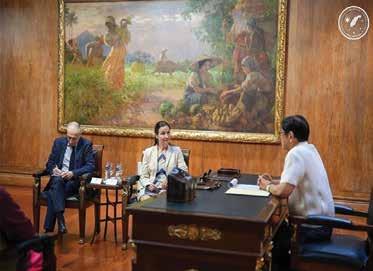
MANILA, — Despite President Marcos’ personally requesting them for information about flood control scam suspect Zaldy Co, the Czech and French diplomats he met last Wednesday, April 29, chose to remain tight-lipped, explaining their lack of authority to speak on the matter as well as the need to follow asylum-related laws.
Czech Republic Chargé d’Affaires Eva Tenzin confirmed Marcos’ announcement last April 16 that Co was detained in Prague because of invalid travel documents, according to Undersecretary Claire Castro.
In his meeting with the diplomats, the President asked for additional information about Co, who is facing an arrest warrant for alleged malversation of public funds and graft over a questionable road dike project. “But the President was not granted his request because the Czech Republic is following international law, European and national laws,” Castro said yesterday in Filipino.
Justice Secretary Fredderick Vida, who traveled to the Czech Republic to process Co’s return to the Philippines, was also not given additional information, according to Castro.
“But their only response was
President Donald Trump signs bipartisan measure reopening core Homeland Security operations, while immigration enforcement funding is deferred to separate negotiations. Congress restores most DHS funding, ending 75-day shutdown
by AJPress
WASHINGTON, D.C. — The U.S. Congress on Thursday, April 30, approved legislation restoring funding for most operations of the Department of Homeland Security, bringing to a close a 75-day partial shutdown that disrupted agency functions and delayed compensation for federal personnel.
President Donald Trump signed the measure into law the same day after it cleared both chambers of Congress, allowing several core security and emergency-response agencies to resume normal operations through the remainder of the fiscal year.
by AJPress
MANILA / LOS ANGELES — Entalula Beach in El Nido, Palawan has been named the No. 1 beach in the world in the World’s 50 Best Beaches 2026 ranking, placing the Philippines at the top of a global list shaped by environmental quality, limited access and consistency of natural conditions.
The 2026 list identifies Entalula Beach as the top-ranked destination, followed by Fteri Beach in Greece and Wharton Beach in Australia, according to the official ranking published by the World’s 50 Best Beaches organization. A second Philippine site, Kalanggaman Island in Leyte, placed No. 25, giving the country two entries in the global top 50. In its official citation, the ranking described Entalula as “Palawan’s overlooked slice of heaven,” highlighting the beach’s
defining features and relative seclusion.
According to the listing, Entalula is distinguished by towering limestone cliffs rising behind a stretch of soft white sand, creating what evaluators described as one of the most visually striking coastal settings in the region and globally. Compared to nearby beaches in El Nido, it receives fewer visitors, a factor that is immediately evident upon arrival. The organization noted that the water is exceptionally clear with typically calm conditions, allowing for easy swimming and uninterrupted views of the surrounding seascape. Access is limited to boat travel, which helps maintain lower visitor density and preserves the beach’s natural character. It added that the contrast between dramatic cliff formations,
by Alexis RomeRo Philstar.com
preparations
a possible
Articles of Impeachment. Senate officials underscored that the chamber’s role remains preparatory unless the constitutional process in the House is completed. The move followed the House Committee on Jusu PAGE
MANILA
Elizaldy “Zaldy” Co is in Paris, where he is believed to be seeking political asylum following his release from Czech custody, according to senior government officials.
From the Front Page
Senate prepares for possible...
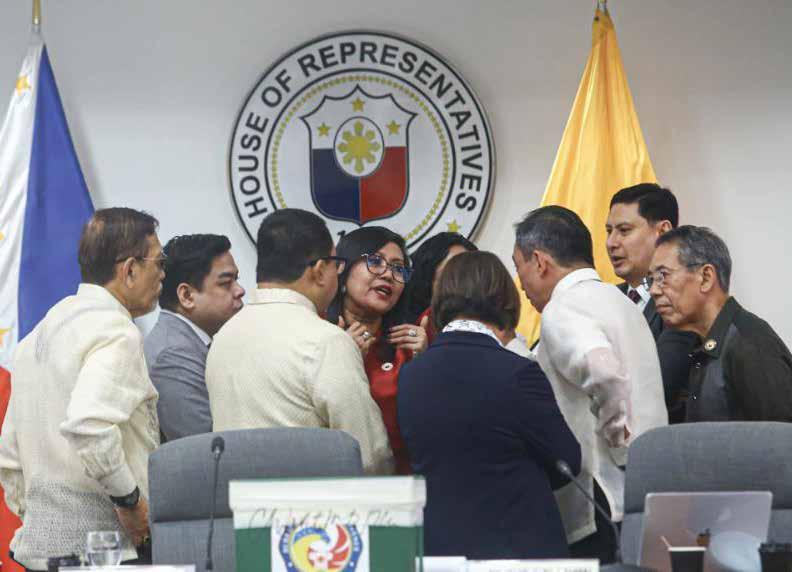
tice’s unanimous 53–0 vote on April 29 finding probable cause in impeachment complaints filed against Duterte. The panel consolidated the complaints into draft Articles of Impeachment now set for consideration by the full House.
Legislative threshold and May timetable
With Congress back in session this May, the House is expected to take up the impeachment case in plenary. Under the Constitution, at least one-third of all House members must vote in favor for the Articles of Impeachment to be transmitted to the Senate.
If that threshold is met, Sen-
ate leaders have indicated the chamber could convene as an impeachment court within days of receipt.
timing of such proceedings falls within the chamber’s discretion, provided it acts within a reasonable period.
Palace: French, Czech envoys tight-lipped...
PAGE 1
that they cooperate in accordance with their laws,” the Palace press officer said.
Castro said Marcos also informed French Ambassador Marie Fontanel about Co’s status as a fugitive, but was not given the information he requested.
“The French ambassador said she understands and she already knows that Mr. Zaldy Co is a fugitive and he needs to face accountability. But as far as she is concerned, she said she could not provide information as long as she is (not) authorized to say something about that,” Castro added.
(LACMTA)
LACMTA will receive Bids/ Proposals for PS131250(2) - Central Plant Maintenance
As-Needed Servicesat the 9th Floor Receptionist Desk, Vendor/Contract Management Department, One Gateway Plaza, Los Angeles, CA 90012. A Virtual Pre-Bid conference will be held on Wednesday, May 6, 2026, 2:30 p.m. via Microsoft Teams. All Bids must be submitted electronically to Bids@Metro.net on or before 2:00 p.m. Pacific Time on Wednesday, May 27, 2026, at which time bids will be opened and read via a virtual public bid opening. Bids received after the above date and time may be rejected and returned unopened. Each Bid must be sealed and marked Bid No. PS131250(2). For a copy of the Proposal/ Bid specification visit our Solicitation Page on our Vendor Portal at https://business.metro. net or for further information email Carolina Gyodakyan at gyodakyanc@metro.net.
5/2/26 CNS-4036687# ASIAN JOURNAL
The complaints cite allegations involving the use of confidential and intelligence funds, discrepancies in the Vice President’s Statements of Assets, Liabilities and Net Worth, and statements interpreted by complainants as threats against President Ferdinand Marcos Jr., the First Lady and a former House leader.
House officials have maintained that the committee’s finding of probable cause was based on documents and testimony presented during hearings, and that the plenary vote will determine whether the case advances to trial.
Institutional readiness and constitutional limits
At the Senate, discussions have focused on trial readiness rather than the merits of the case. Senators reviewed potential courtroom arrangements, staffing, security protocols and procedural rules in the event the chamber is required to function as an impeachment court.
Senate President Pro Tempore Panfilo Lacson has said funds remain available for impeachment proceedings under continuing appropriations, indicating that the chamber is financially prepared should a trial proceed.
The Supreme Court has clarified that while the Constitution directs the Senate to proceed with impeachment trials, the
Legal posture and defense position
Vice President Duterte has denied the allegations. Her legal team has questioned the basis of the complaints and the conduct of the House proceedings, arguing that the case lacks sufficient evidentiary support and raises constitutional concerns.
In a subsequent development, her camp confirmed it would participate in a Senate impeachment trial if the case is transmitted, signaling readiness to contest the charges within the formal process even as it continues to dispute the proceedings in the House.
Supporters of the Vice President have described the impeachment effort as politically motivated, while proponents in the House maintain that the allegations warrant full trial as a matter of public accountability.
Procedural next steps A finding of probable cause by a House committee is not a determination of guilt. If the plenary approves the Articles of Impeachment by the required one-third vote, the case will be transmitted to the Senate, where senators would sit as judges in a formal trial.
Until that threshold is reached, the Senate’s preparations remain provisional, and the allegations against the Vice President remain unproven. n
Marcos revealed on social media last April 16 that Co was held in Prague because he did not possess proper documents. Eight days later, the Department of Justice clarified that the flood control scam suspect was “not technically arrested,” although he experienced a “deprivation” of his liberty “to a certain degree.”
On Tuesday, Castro disclosed Co’s application for political asylum in France and disputed his claim he is facing political persecution. She also said the Philippine government won’t ask
French authorities to deny Co’s asylum bid.
Castro said Marcos had described the events unfolding as “very unsatisfactory” because they happened even if the Philippines was coordinating with the Czech Republic.
“The President expressed disappointment after the release of the fugitive Co from the custody of the Czech Republic,” she added.
“The President gave assurance that the government would tap all legal and diplomatic means to bring the fugitive Co back to the Philippines so he can face the graft and malversation cases filed against
Castro said Marcos had also emphasized the readiness of the Philippines to fast-track the forging of extradition treaties and other similar forms of legal cooperation with other countries.
‘BILL SHOCK’. The
President Ferdinand Marcos Jr. meets with the ambassador of France and the chargé d’affaires
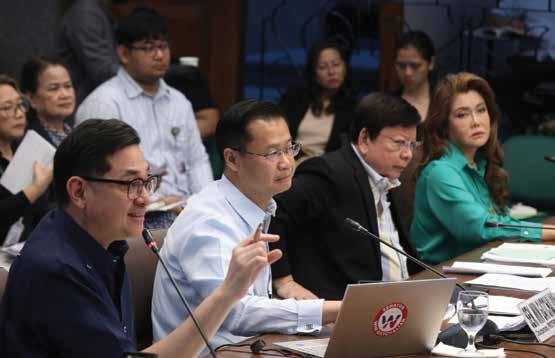
Senators held a meeting to discuss the Senate’s agenda for the resumption of session on Monday Photo from Instagram/@migzzubiri
Supreme Court ruling narrows Voting Rights...
PAGE 1
figuration.
The case arose after post-census redistricting disputes in a state where Black residents make up roughly one-third of the population. Lawmakers adopted a revised map with a second majority-Black district following earlier litigation over minority voting strength. That map was later challenged by voters who argued race predominated in its design.
The Court agreed, concluding the state lacked sufficient legal basis to rely on race.
Redefining the boundaries of Section 2 enforcement
The decision alters how Section 2 of the Voting Rights Act functions in redistricting disputes. For decades, courts allowed challenges based on discriminatory effects, even without direct proof of intent.
The ruling narrows that framework. While Section 2 remains in place, the circumstances un-
der which states may use race to draw districts aimed at preserving minority voting strength are more limited. Future cases are expected to focus more directly on whether race predominated and whether its use can withstand strict constitutional scrutiny.
A recalibration of map-drawing authority across states
The decision is expected to influence redistricting nationwide.
Lawmakers may have broader discretion to rely on traditional districting principles such as compactness and contiguity, without being required to create additional majority-minority districts absent a clear constitutional mandate.
Legal observers anticipate renewed litigation as states reassess maps drawn under earlier interpretations of the Voting Rights Act. Implications for minority voting strength
Voting rights advocates say the
ruling could affect the number of districts where minority voters can elect preferred candidates. Section 2 has long served as a safeguard against practices that dilute voting power. Under the Court’s decision, such outcomes may stand if states show district lines were based on race-neutral principles. Supporters of the ruling say it reinforces constitutional limits on the use of race.
Legal landscape heading into the next election cycles
The ruling builds on earlier decisions, including Shelby County v. Holder, which narrowed federal oversight of voting laws. With Section 2 now more constrained, the decision establishes a new benchmark for future redistricting disputes. As the 2026 and 2028 election cycles approach, its impact is expected to unfold through further litigation and legislative adjustments. (AJPress)
Entalula Beach in the Philippines named No. 1...
clear water and seclusion gives
Entalula a distinct identity, describing it as a place that feels both visually dramatic and notably calm.
The ranking body said its annual list is based on input from travel professionals, beach ambassadors and its internal team, with evaluation criteria that include water clarity, unique landscape features, calm conditions, accessibility, absence of overcrowding and overall environ-
mental integrity. Also included in the 2026 rankings, Kalanggaman Island placed No. 25, recognized for a long, narrow sandbar that extends into open water at both ends. The island’s slender strip of white sand is bordered by clear, shallow waters on both sides, with minimal infrastructure and controlled access helping preserve its natural condition.
The Philippines, an archipelago of more than 7,600 islands,
has long positioned coastal destinations as a central component of its tourism profile. The 2026 rankings reinforce a competitive advantage rooted in preservation, as global travel metrics increasingly favor destinations that remain largely undisturbed.
Sustaining that position will depend on continued environmental stewardship and visitor management, as international visibility of Philippine coastal destinations continues to expand. n
Republicans revisit capital gains tax cut...
PAGE 1
higher-income taxpayers are also subject to a 3.8 percent net investment income tax, according to the Internal Revenue Service.
Supporters argue that the current system taxes gains that may reflect inflation rather than real increases in purchasing power. Republican lawmakers have urged the Treasury Department to consider whether existing regulatory authority could allow such an adjustment, framing the proposal as a correction to how taxable income is measured. The effort comes as economic messaging increasingly focuses on cost-of-living pressures and the effects of inflation on household finances.
Some proponents also link the policy to housing market dynamics. They argue that capital gains taxes can discourage property sales, a phenomenon often described as a lock-in effect, and that reducing the tax burden on gains could encourage more transactions. Economists generally acknowledge the existence of lock-in effects, though estimates of their magnitude vary.
Critics emphasize the distributional and fiscal implications. Capital gains income is concen-
trated among higher-income households, and policy analysts note that tax reductions tied to those gains would disproportionately benefit top earners. Separate fiscal analyses have consistently found that higher-income taxpayers receive the largest share of benefits from capital income tax reductions.
The revenue impact is also significant. Policy estimates indicate that indexing capital gains could reduce federal revenues by roughly $170 billion over a 10-year period if applied only to newly acquired assets, and more than $1 trillion if applied more broadly, depending on design and assumptions. These figures are based on modeling by nonpartisan research institutions.
Legal authority remains unsettled. Some supporters argue that the Treasury Department could reinterpret how cost basis is defined under existing regulations. Opponents, including tax law specialists, contend that such a change would effectively alter statutory definitions and therefore require congressional approval.
Prior federal legal reviews have raised similar concerns, and no administration has implemented indexing through executive ac
Congress restores most DHS...
PAGE 1
The law funds key components of DHS, including the Transportation Security Administration, U.S. Secret Service, Federal Emergency Management Agency and the U.S. Coast Guard. Lawmakers, however, excluded funding for Immigration and Customs Enforcement and Customs and Border Protection, placing those agencies at the center of a separate legislative track expected to be taken up in the coming weeks.
The funding lapse began on February 14 following a prolonged impasse over immigration enforcement policy. Democratic lawmakers had sought additional oversight measures governing federal immigration operations, while Republican leadership pushed to maintain or expand enforcement funding aligned with the administration’s border priorities.
The standoff left a department of approximately 260,000 employees operating under constrained conditions. Aviation security operations faced staffing pressures, while broader concerns emerged regarding emer-
gency preparedness, protective services and maritime enforcement capacity. Officials warned that temporary funding mechanisms supporting payroll would soon be exhausted without congressional action.
To resolve the immediate crisis, congressional leaders adopted a two-step approach. The first measure restored funding for the majority of DHS functions. A second, still-pending proposal is expected to address immigration enforcement appropriations, potentially through a budget reconciliation process that would allow passage in the Senate by a simple majority. The enacted law stabilizes dayto-day operations across most of the department but leaves unresolved a central dispute over immigration enforcement policy, including funding levels and oversight of agencies such as Immigration and Customs and Border Protection. That disagreement is expected to be taken up in separate legislation in the coming weeks, setting the stage for continued negotiations ahead of the next fiscal deadline. n
tion.
There is also disagreement over broader economic effects.
While lower capital gains taxes can reduce incentives to hold assets indefinitely, evidence is mixed on whether indexing alone would materially increase investment activity or housing supply.
Analysts point to other structural factors, including interest rates, zoning constraints and construction costs, as more significant drivers of housing availability.
Relevance in the current policy cycle
The renewed focus on capital gains taxation reflects a broader policy divide. Supporters argue that inflation-adjusted taxation more accurately reflects real income. Critics emphasize the implications for federal revenue and income distribution. Whether the proposal advances through legislation or is tested through executive interpretation remains unresolved. (AJPress)
OP141314. For a copy of the Proposal/Bid specification visit our Solicitation Page on our Vendor Portal at https://business.metro.net or for further information email Ricardo Narvaez at narvaezr@ metro.net. 5/2/26 CNS-4038413# ASIAN JOURNAL
Kumuha ng edukasyon at suporta para makabuo ng mas magandang kinabukasan para sa iyong sarili at sa iyong komunidad. Alamin
Sa isang California community college, maaari kang makatanggap ng serbisyo para sa estudyante, tulong-pinansyal, at mga scholarship para matulungan kang maabot ang iyong mga layunin.
Pumili mula sa 116 na community college, kabilang ang higit sa isang dosenang may on-campus na tirahan at isa na ganap na online. At dahil may higit sa 200 na career education programs at garantisadong transfer sa nakalaan na puwesto sa isang kalahok na four-year university, makakakuha ka ng edukasyon na kailangan mo para magtagumpay.
Entalula Beach in El Nido, Palawan, named the No. 1 beach in the world in the 2026 World’s 50 Best Beaches ranking, is described by evaluators as “Palawan’s overlooked slice of heaven.” Photo courtesy of World’s 50 Best Beaches / worlds50beaches.com
Zaldy Co believed in Paris as asylum bid...
PAGE 1 firm a direct physical sighting.
Malacañang has separately confirmed that Co has initiated an asylum request in France, placing him under French jurisdiction while the process is being evaluated.
Co, who previously chaired the House appropriations committee, is facing graft and malversation cases in the Philippines in connection with alleged irregularities involving flood-control projects in Oriental Mindoro. The cases remain pending before the courts, and the allegations have not been adjudicated.
Verified signals and unresolved presence
Officials emphasized that while intelligence points to Paris, confirmation remains procedural rather than physical. The Department of Foreign Affairs said monitoring is ongoing through diplomatic channels, with verification subject to French authorities and privacy protections under local law.
Custody lapse and procedural constraints
Co was earlier held in Prague on April 16 after authorities raised immigration-related concerns, including the reported use of an expired Philippine passport while attempting to
cross a border.
Acting Justice Secretary Fredderick Vida said a Philippine team traveled to the Czech Republic to coordinate possible custody, but Co had already been released before arrangements could be completed. Officials said the absence of an Interpol Red Notice at the time, along with limits in police cooperation frameworks, constrained the government’s ability to secure his transfer.
Senate President Pro Tempore Panfilo Lacson described the outcome as a “lost opportunity,” urging faster operational response in similar cross-border cases.
Documentation issues and identity review Philippine authorities are examining Co’s travel records.
Officials said his Philippine passports had been canceled by court order in December 2025.
Justice department records indicate the possible use of multiple travel documents, though the existence or validity of any foreign passport has not been confirmed.
Unverified reports regarding a European passport remain under investigation and have not been substantiated by Philippine authorities.
Diplomatic posture and legal
pathway
The Department of Foreign Affairs said the Philippine embassy in France is “looking intently” into Co’s reported presence and coordinating within the limits of French jurisdiction.
President Ferdinand Marcos Jr. has expressed disappointment over the failure to secure custody in Europe and has directed agencies to pursue all available legal and diplomatic remedies.
Any request for Co’s return must now proceed through formal channels, including diplomatic engagement, potential international law enforcement coordination and compliance with French asylum procedures.
Asylum process and jurisdictional limits
Under French law, asylum applicants remain under national jurisdiction while their claims are assessed. The process may extend for weeks or longer depending on case complexity, affecting the timing and viability of any external request for custody.
For now, Co’s case has moved beyond a domestic prosecution into a cross-border legal process shaped by asylum law, documentation issues and the limits of international enforcement mechanisms. n
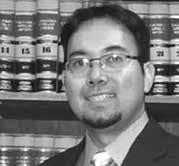
Korean Filipino American sworn in as NYC Civil Court judge
Eve Cho Guillergan makes history as the first Korean Filipino American elected Civil Court judge in New York
by Elton lugay Inquirer.net
NEW YORK — Korean Filipino American lawyer Eve Cho Guillergan, a trailblazing voice for immigrants, was recently sworn in as a New York City Civil Court judge in Queens County. She has been recognized as the first Korean Filipino American elected Civil Court judge in New York, a milestone celebrated by supporters from Filipino and Korean communities, who packed the courtroom for the ceremony.
Guillergan was sworn in five months after winning a hard-fought November 2025 election that followed her decisive Democratic primary victory in Queens’ 2nd Municipal Court District.
The induction was held earlier this month in a ceremonial courtroom in Queens, where Justice Phillip Hom of the Appellate Division of the Supreme Court administered the oath and New York State Senator John Liu served as emcee.
Speakers praised her as a “very productive judge” who had already begun work in January, resolving 656 cases and deciding 402 motions in just 56 days on the bench.
Judge Eve Cho Guillergan’s journey
Guillergan’s journey to the judiciary began years earlier and halfway around the world.
The daughter of a Korean mother and a Filipino father from Iloilo City, she came to the United States at age 12.
As a young immigrant, she often translated Korean to English for others, a role she later described as the beginning of her
advocacy, saying that volunteer work helped her understand immigrants’ stories and the importance of a voice in the legal system.
Proud to represent Korean, Filipino communities Judge Guillergan has said she is proud to represent both Korean and Filipino communities and hopes she is “not the last” Filipino American to serve on the bench in New York.
Before joining the court, Guillergan led a varied legal career. She served in the New York City Bar Association’s Small Law Firm Center from 2019 to 2025, rising from manager to director, where she supported solo and small-firm practitioners.
From 2003 to 2019, she ran her own law practice, building a reputation for helping immigrants and small businesses navigate complex legal issues.
In January 2026 she began her term as a Queens Civil Court judge in the New York State Unified Court System, taking on a busy docket that includes landlord-tenant, consumer and small-claims matters affecting everyday New Yorkers.
Democratic primary for Civil Court judge
Guillergan first drew citywide attention after winning the Democratic primary for Civil Court judge in June 2025, a win Filipino and Asian American media called historic for the Filipino American community in New York’s judiciary.
In heavily Democratic Queens, that primary victory – where she secured about 57.7 percent of the vote – positioned her as the favorite heading into the November general election, which
she went on to win.
Breakthrough for representation
The Fil-Am community hailed the result as a breakthrough for representation, noting that she would be the first judge of Korean Filipino heritage on the Queens Civil Court. In public statements, Guillergan has emphasized that civil court is “often where regular people turn to,” stressing the importance of treating litigants with kindness, professionalism and respect.
At her induction, she thanked family, mentors, community leaders and volunteers who backed her grassroots campaign, telling them, “Thank you for the opportunity to serve. Thank you that I got a lot of help.”
‘In every case, there is a story’
She pledged to be a thoughtful and fair judge, adding that “in every case, there is a story,” and closed with “Gamsahamnida,” the Korean word for thank you.
Guillergan has publicly acknowledged the support of Filipino American elected officials such as New York Assemblymember Steven Raga and former colleagues in the bar, saying she hopes her ascent will inspire more Filipino Americans and Asian Americans to enter the legal profession and pursue judgeships.
Drawing on both her Korean and Filipino roots, she has said her upbringing taught her perseverance, community spirit and care for others, values she now brings into her courtroom in Queens. n
‘President Marcos not spared from flood control scandal probe’
by nEil Jayson sErvallos Philstar.com
MANILA — President Marcos will not be spared from the Senate’s probe into the multibillion-peso flood control scandal if the evidence points to him, Senate President Pro Tempore Panfilo Lacson said yesterday, though noting unsworn allegations made against the President on social media currently hold no legal weight.
“If the evidence points to the President, we can’t do anything about that,” Lacson said in Filipino in an interview on dzBB.
However, the panel chairman dismissed former congressman Zaldy Co’s recent social media claims that kickbacks were delivered directly to the presidential residence.
The former lawmaker made the accusations on Facebook rather than under oath, Lacson pointed out, thus the committee cannot legally adopt them.
“Zaldy Co’s story has no evidentiary value because it was not said under oath,” the senator said.
“What he did was post a story on Facebook. How can we use his story if it is not within the power or jurisdiction of the Blue Ribbon Committee?” he added.
Lacson recalled previously suggesting for Co to visit a consulate wherever he was hiding to formally authenticate his affidavit, but was scrapped when Sen. Ronald dela Rosa raised concerns about the Senate’s inability to cite Co for contempt if he lied from overseas.
Lacson said he applied the same standard to former military whistleblower Orly Guteza,
who also implicated the President.
“It was the same with Guteza. He implicated Marcos, but I said if there is no corroboration and Guteza never came back, how will that be explained?” he said.
Lacson readies ‘progress report’
To break the current deadlock in the investigation, Lacson announced he is preparing a “Chairman’s Progress Report” on the flood control scandal, which aims to pave the way for the resumption of hearings and provide crucial case build-up material for the Department of Justice (DOJ) and Office of the Ombudsman.
The strategy bypasses the need to wait for the required nine signatures to sponsor the panel’s official partial report on the Senate floor.
“We owe it to the Filipino people. The Blue Ribbon Committee has conducted eight hearings on the matter, but has yet to come up with even a partial report,” he said. The upcoming progress report will contain the findings of the pending partial report, complete with visual aids and documentary evidence gathered during the hearings as attachments.
“Rendering the chairman’s progress report is as good as sponsoring the partial report. We can resume hearings once the chairman’s progress report is rendered because the contents of the partial report become a matter of public record,” Lacson said.
He noted that the ombudsman has informally requested a copy of the committee’s findings.
Once hearings resume, Lacson is keen on summoning former speaker Martin Romualdez back to the Senate. n
“We have drafted a Chairman’s Progress Report. I cannot report out the partial committee report on the Senate floor due to the lack of needed signatures. So, to get it over with, I have thought of drafting the Chairman’s Progress Report, which has a precedent,” Lacson said.
Peso nears 62 per dollar...
PAGE 1
assets amid elevated U.S. interest rates set by the Federal Reserve. Higher yields in the United States have strengthened the dollar, prompting outflows from developing economies, including the Philippines.
Balisacan said the peso’s movement is largely externally driven, noting that core indicators such as growth, remittance inflows, and the business process outsourcing sector remain stable.
Global dollar strength reshapes capital flows
Investor preference for dollar assets has intensified amid persistent inflation concerns in the United States, reinforcing the dollar’s strength against regional currencies. Safe-haven demand has also increased due to geopolitical uncertainty, amplifying depreciation pressures on the peso. Oil import burden widens trade gap Rising global oil prices have
added strain to the Philippines’ external position. As a net fuel importer, the country requires more dollars to finance energy purchases, widening the trade deficit and increasing demand for foreign exchange. Inflation pressures test policy balance
A weaker peso raises the cost of imported goods, particularly fuel and food inputs, creating pass-through inflation risks. This complicates efforts by the Bangko Sentral ng Pilipinas to maintain inflation within its target range. Analysts also point to the 62-to-$1 level as a psychological threshold that could influence market sentiment.
Measured response from the Bangko Sentral ng Pilipinas Officials have signaled a calibrated approach, emphasizing that current conditions do not indicate structural weakness. The central bank retains tools to smooth excessive volatility while
balancing inflation control with economic growth. Remittances and exports offer partial offsets
A weaker peso provides limited support through higher peso-equivalent remittances from Overseas Filipino Workers. Export-oriented sectors may also gain some price competitiveness, although higher input costs can offset these benefits. Outlook tied to shifts in U.S. monetary policy
The peso’s near-term trajectory is expected to remain closely linked to global developments, particularly U.S. interest rate policy and commodity prices. Officials indicate that any easing by the Federal Reserve could help stabilize emerging market currencies.
Policymakers remain focused on containing inflationary effects and maintaining macroeconomic stability as external pressures persist. n
President Ferdinand “Bongbong” Marcos Jr. inspects a P55.7-million ghost river wall project in Bulacan on Wednesday, Aug. 20, 2025. Presidential Communications Office / Released
DAteline PhiliPPines
Get to know the judges of the ICC Trial Chamber handling Rodrigo Duterte’s case
by
THE Presidency of the International Criminal Court has formed the Trial Chamber that will oversee the case involving former President Rodrigo Duterte. This came after the pre-trial judges unanimously confirmed on April 23 all three counts of murder lodged against Duterte as crimes against humanity, saying they constitute “serious violations committed as part of a large-scale attack against any civilian population.”
This moves the case to trial.
“Promptly after it is constituted, the Trial Chamber will hold status conferences, confer with the parties and participants in order to set the date of the commencement of the trial and adopt the procedures necessary to facilitate the fair and expeditious conduct of the proceedings,” the tribunal said.
“The Chamber will rule on several preliminary issues, including the timing and the manner of disclosure of evidence,” it added.
Get to know the judges who will oversee Duterte’s case.
Judge Joanna Korner
Hailing from the United Kingdom of Great Britain and Northern Ireland, Judge Korner joined the ICC in September 2021 and is expected to finish her term in March 2030.
Before joining the tribunal, Korner was a judge of the Crown Court of England and Wales and served as a senior prosecutor at the International Criminal Tribunal for the former Yugoslavia for a total of eight years.
She has been a Queen’s Counsel since 1993 and has represented both the prosecution and defense in numerous cases before the courts of England and Wales.
Korner was also the Senior Legal Adviser to the Chief Prosecutor of Bosnia and Herzegovina during the establishment of a War Crimes Section in the country’s State Prosecutor’s Office. She studied law at the Inns of
Court School of Law. In 2004, she was appointed a Companion of the Order of St. Michael and St. George (CMG) in recognition of her contributions to international law. Some of the notable cases she tried were Prosecutor v. Mićo Stanišić and Stojan Župljanin, Prosecutor v. Radoslav Brđjanin and Momir Talić, and Prosecutor v. Milomir Stakić.
Judge Keebong Paek Paek studied law at Seoul National University. He obtained an LLM from Columbia Law School and a PhD from Hanyang University.
He started as a Public Prosecutor for the Republic of Korea in 1992. He also served as a Deputy Director and later as a Director at the Ministry of Justice, where he was tasked with managing ICC-related matters, drafting the implementation bill for Korea’s ratification of the Rome Statute, and representing the country at ICC Preparatory Commission sessions and the Kampala Review Conference.
Outside Korea, Paek also worked at the United Nations Office on Drugs and Crime, where he played a key role in assisting Member States with the implementation of the UN Convention against Transnational Organized Crime, particularly by enhancing law enforcement capabilities.
Following a 22-year career as a prosecutor, Paek moved into private practice in 2014, joining Kim & Chang as an attorney. He focused on law enforcement and regulatory compliance, particularly in areas such as white-collar crime, extradition, mutual legal assistance, and cross-border asset recovery. He also played a key role in helping companies develop compliance systems and carry out internal investigations.
He officially joined the ICC in March 2024.
Judge Nicolas Guillou Guillou, who hails from France, joined the ICC in March 2024. He earned a Master’s degree in International and European Criminal Law from Sor-
bonne University. He started his career as an investigative judge. Before he was elected Judge of the tribunal, he worked as a Pre-Trial Judge at the Kosovo Specialist Chambers for four years.
From 2015 to 2019, he was Chef de Cabinet to the President of the Special Tribunal for Lebanon, and earlier, from 2012 to 2015, he worked as a Liaison Prosecutor at the US Department of Justice, facilitating judicial cooperation in both criminal and civil cases.
Between 2006 and 2012, Judge Guillou held various roles within the French Ministry of Justice, including Deputy Head of the Commercial Law Section, Adviser on Criminal Affairs to the Minister, and Diplomatic Adviser.
He also regularly teaches and oversees training programs for judges on international justice at the French National School for the Judiciary.
What’s next?
After the Trial Chamber is formed, it will hold status conferences with the prosecution and defense teams.
Among the details to be ironed out with the case participants is the date for the commencement of the trial. From the conferences, the chamber will also determine which procedures will allow a fair and efficient trial. Additionally, the chamber will decide on the timing and manner of disclosure of evidence.
Article 63 of the Rome Statute dictates accused persons have to be present in the courtroom during their trial.
Duterte previously waived his right to attend his confirmation of charges hearing in February. Duterte was also absent from the pre-trial court hearing on April 22 for the defense’s appeal on jurisdiction. The last time Duterte was seen in the ICC Pre-Trial Chamber was on March 14, 2025, two days after he was arrested at the Ninoy Aquino International Airport. He appeared via video link from his detention cell at The Hague. n
MElaniE uson Philstar.com
FeAtures OPiniOn
Hospice fraud tests oversight of end-of-life care
HOSPICE care is built on a simple premise: when cure is no longer the goal, care should center on comfort, dignity and support. In California, a series of recent enforcement actions has put that premise under strain, raising questions about whether oversight has kept pace with the rapid growth of the industry.
Hospice is a specialized model of care for patients with life-limiting illness, generally those expected to live six months or less if the disease follows its usual course. Services focus on pain control, symptom management, counseling and family support, often delivered in the patient’s home. Eligibility depends largely on a physician’s certification of prognosis and supporting documentation. That reliance on clinical judgment, while necessary, also creates vulnerabilities when oversight is uneven. Those vulnerabilities are now the focus of federal and state investigators.
Editorial
Enforcement actions point to systemic weaknesses
Recent cases brought by the U.S. Department of Justice and reviewed by the U.S. Department of Health and Human Services Office of Inspector General allege that some operators enrolled patients who were not terminally ill in hospice programs and billed Medicare or Medi-Cal for services that were not medically necessary or not provided. Prosecutors have described schemes involving falsified certifications, patient recruitment through in-
Minister Mark Carney in Davos.
For those who missed it, let me enumerate them again: First, the rules-based global order is fading fast. Second, great powers will increasingly weaponize trade, finance, supply chains and technology. Third, middle powers negotiating alone will do so from a position of weakness. Thus, countries must build strategic alliances to strengthen their positions. Fourth, nations must develop strategic autonomy in energy, food, defense and basic manufacturing to survive. And fifth, middle powers must act together – because “if you’re not at the table, you’re on the menu.”
Carney’s warnings should serve as a wake up call for President Bongbong Marcos. Only preparedness and strategic autonomy will insulate us from a harsher, less forgiving and more transactional world that is upon us. The good thing is that the Philippines begins with real
BACK when President Bongbong Marcos and relatives were seriously discussing the idea of a “presidential run,” one of his cousins claimed to have opposed the idea for several reasons. First of all, the Marcos-Romualdez clan had gone through the experience under a Marcos presidency and “look where it got us?”
The relative also pointed out that the second generation as well as the third generation Marcoses and Romualdezes were all doing well and occupied various positions in government. Something hard to imagine after EDSA 1. God forbid, would the clan be willing to go through a repeat of history and who would be there to protect their necks or what army could they rely on to defend them? Little did he realize his words were prophetic.
ducements and the use of business structures that obscured control of hospice entities. These allegations remain subject to court proceedings.
California authorities have pursued parallel investigations, including cases alleging large-scale improper billing tied to hospice operations. Taken together, the cases suggest not isolated misconduct, but pressure points within a system that relies heavily on documentation and good faith. Growth has outpaced regulation The expansion of hospice providers in California, particularly in Los Angeles County, has been well documented. A review by the California State Auditor found a sharp increase in licensed hospices over the past decade, far exceeding national averages relative to the senior population. Oversight resources have not expanded at the same rate. Hospice reimbursement structures can amplify risk. Once a patient is deemed eligible, providers receive a per-patient rate for services, rather than payment tied to each procedure. That model supports coordinated care, but it can also reward volume if safeguards are weak.
Future proofing the country for a harsher world
strengths. We are young. We are English-speaking. We sit on one of the world’s most strategic maritime crossroads. We have a large domestic market. We have an established electronics base, a strong services sector and a diaspora that still gives us global reach. From 2010 to 2022, Philippine GDP growth averaged 5.2 percent, placing the country among the stronger middle-income performers, according to the World Bank. For this, we have the reforms of the Aquino administration to thank. But our weaknesses are just as real. The economy has weakened under Marcos’ watch, saddled by a flagging manufacturing sector and failing agriculture. How can we achieve strategic autonomy when power costs are inordinately high, logistics are inefficient, bureaucracy is stifling and corruption pervades in government programs? Without fixing these, strategic autonomy is impossible. Yet, President Marcos shows little urgency. Reforms are slow, if not negligible. There has been no visible or substantive progress towards food or energy autonomy.
How better governed countries are preparing
India is leveraging its massive domestic market to attract investments in manufacturing. It is looking to be an electronics powerhouse that exports $500 billion worth of products by 2030. It is well on its way. This is how a country turns market size into strategic leverage.
Militarily, India is no longer just importing arms – it is becoming a defense producer and exporter. Indian defense exports was at $4.6 billion last year, a 62.66 percent increase over 2024.
Vietnam is positioning to be a high-value manufacturing and technology hub. It aims to sustain six to seven percent GDP growth on the back of robust exports and massive FDI intakes.
Geopolitically, Vietnam is steadily elevating ties with major and middle powers in pursuit of its multipolar hedging strategy.
Indonesia is asserting strategic autonomy through resource nationalism. By restricting raw mineral exports and forcing domestic processing, Jakarta captures more value-added domestically. It welcomes foreign capital – but on its terms – ensuring control over critical resources and supply chains. u PAGE 7
Accidental prophesy
As it turns out, they now have an extended simmering family feud, complete with scandalous public revelations and veiled threats. Even worse, they are embroiled in much the same way their parents, titos and titas were, neck deep in claims, suspicions, even charges of corruption, conspiracy and amassing ill-gotten wealth.
George Santayana said: “Those who do not learn from history are doomed to repeat it” and we often think this applies only to the Filipino people who keep voting or choosing the wrong set of leaders. I would say that the warning also applies to the Marcoses and the Romualdezes. Clearly, only one short branch of the family knew enough to know what disaster awaits all if things got out of hand, which they have. Unfortunately, like all Filipino families, that does not relieve them of the embarrassment, discomfort and annoyance towards family members who have caused the innocents so much “kahihiyan.”
Federal agencies have begun to respond with tighter controls, including enhanced screening of new providers and closer monitoring of billing patterns.
A national issue with regional concentration
The concerns are not limited to California. The Centers for Medicare & Medicaid Services has placed states such as Nevada under enhanced over-
idea of the future used to be
Things happen as they will, and we can only hope and pray that life will be the same, if not better. Today, in the modern world, we are told that we can do more than hope. We can act or decide now so that whatever may come will make little difference. This involves calculating the risk and assigning a price to it. In this manner, we bind the future. We first encounter this mode of thinking in the form of an insurance policy. Today it is everywhere. With stunning suddenness, the horizon of the future has come to our doors in just the past two months, because of the Middle East war. Though far from where we are, and though we played no part in starting it, this war has upended our daily lives in ways we have only started to count.
Many of my middle-class friends find themselves calculating the future in precisely this way. They are asking how much it costs to install solar panels on their rooftops, and whether the investment will pay off. They are looking at the Chinese or Vietnamese electric vehicles
(EVs) that have become popular almost overnight, wondering whether it makes sense to trade in the family car. Even the cheapest EV comes at a price, and one must ask if it is worth drawing down the family’s savings for a vehicle that may not fetch a good resale value when the time comes to let it go. No one knows when the war will end, or how, or what the world will look like after. But the big players of the economic world are not content to wait and see. At every moment, they are calculating risks and pricing uncertainty. In doing so, they are making decisions that effectively serve as public communications about the future. In calculating the future, they shape it, and they pass on the costs to the rest of us. The prices of oil futures are a small part of this story, though the most visible.
Financial markets operate almost entirely on their calculations of the future as seen from the present. More importantly, they bind the future by trading it today. A so-called derivative is a present transaction whose object is a future state of the world. But it is more than a description of that state. The moment the derivative is created and traded, it reshapes the future it was supposed only to anticipate. The complexity this generates is not easy for the lay-
person to untangle. We pay for it all the same. Here at home, we have been preoccupied with wild swings in pump prices and the prospect of fuel rationing. Many of us have given up trying to understand the reasoning behind the numbers. We suspect price manipulation or profiteering somewhere along the line. I think it is more complicated than that. These prices are the structural outcomes of a modern practice of trading future presents. Markets sell the illusion of steering the future while in fact foreclosing it.
Outside Metro Manila, countless Filipino families are doing a different kind of calculation, one that is more existential. Should a relative working in Abu Dhabi, or Doha, or Dubai come home now, while it is still possible and while government repatriation flights are still available? We have more than a million overseas Filipino workers in the region. Business has abruptly stopped in what used to be one of the busiest economic hubs in the world. If they come home now, it may not be easy to return when things settle down. Jennifer, a mother of two, has worked for two years as a cleaner for a service company in Abu Dhabi. She calls her husband Dan u PAGE 7
What about the rest of us?
What lessons can we derive from what Harry Belafonte called “shame and scandal in the family?” How can it be that, with all the power and the wealth, people still recklessly “gamble” for more, and sometimes at all cost? How much is enough?
The first cause is pride. We become too full of ourselves when we are able to get away with something. It’s not an adrenaline rush, it’s a shot of pride fueling our ego and making us believe that “We did it!” or it was because of us and that we can do it again. There is a direct warning from God concerning the inevitability of pride misleading us and he wrote this specific warning in Chapter 8 of the book of Deuteronomy: 8:2 “Remember how the Lord your God led you all the way in the wilderness all these 40 years, to humble and test you in order to know what is in your heart, whether or not you would keep his commands.”
u PAGE 7
THE greatest irony about the “change” narrative in the Philippines is that it has not changed. It has become a seasonal product repackaged every six years. Every election, we search for who has the best “change” packaging—a leader with political will, a strong reformer to fix the system, a powerful personality to impose order. We keep waiting for a messiah. But countries rarely transform because of political superheroes. They transform because of strong institutions. These are the silent, technical, and often invisible systems that shape norms and incentives, constrain power and influence, and allow progressive reforms to withstand challenging political climates.
This is not speculation. In “Why Nations Fail: The Origins of Power, Prosperity, and Poverty,” economists Daren Acemoglu and James A. Robinson argue that nations prosper not because of leadership, but because of consistent-
ly inclusive institutions—systems that distribute power, enforce rules across the board, and align incentives toward set goals.
On the other hand, where institutions are extractive—concentrated in the hands of a few, highly politicized, and unfairly discretionary—growth and reforms collapse along with expiring political superheroes. That diagnosis sounds uncomfortably familiar.
If real change has to come in this country, we need to face the reality that not one superhero could single-handedly fix all institutions at the same time. Instead, we need many committed Filipinos to work in our various institutions, each doing their part to make the system work.
One of those institutions is government. Its agencies and offices shape how public services are actually delivered. Let’s take, as an example, the government agencies involved in personnel administration. These offices have the mandate to set the tone for government workers. They are meant to build a culture of merit, performance, and accountability. That tone matters.
But too often, the focus is elsewhere.
These agencies spend time and resources policing administrative compliance—tardiness, lunch breaks, submission of routine forms, and attendance to flag ceremonies. Anyone who has worked in or with government offices has seen this firsthand. Meanwhile, bigger questions that actually shape the performance of workers get less attention—how to deal with chronic understaffing, mechanisms for genuine professional growth, and objective measures of real office performance. In that kind of system, innovation dies quietly and miserably inside government offices. This is not simply a human resource problem. It is an incentive problem built into the institution itself. Here’s the thing. Whether it’s personnel administration or any of the many agencies that shape how public service is delivered, reform in government is not glamorous. It is slow, technical work. It requires rethinking how the bureaucracy operates—what it u PAGE 7
THE U.S.-Israel conflict with Iran has accelerated the warnings laid out by Canadian Prime
OUR
simple.
The Corner oracle
Andrew J. Masigan
Hospice fraud tests oversight of end-of-life care...
clustering seen in parts of California. This distribution underscores a consistent finding from regulators: fraud tends to follow gaps in oversight and incentives in payment systems, rather than any single geographic or demographic profile.
Avoiding misdirected conclusions
Public records show that several individuals of Filipino descent have been among those charged or arrested in hospice-related cases. That fact warrants accurate reporting, but it does not define the broader problem. Enforcement actions across states indicate that hospice fraud networks are multi-layered and cross demographic lines, involving owners, medical professionals and intermediaries linked through complex business arrangements. For communities with strong representation in healthcare, in-
cluding Filipino Americans, careful framing is essential. The issue is not one of identity. It is one of system design and enforcement. The stakes extend beyond billing
The consequences of hospice fraud are not confined to financial loss. If patients are inappropriately enrolled in hospice, they may forgo treatments aimed at prolonging life. Families may make decisions based on incomplete or inaccurate information. Trust in clinicians and institutions can erode.
That is what distinguishes hospice fraud from other forms of healthcare abuse. It operates at a moment when patients and families are most vulnerable and most dependent on professional guidance.
A need for calibrated reform Enforcement alone will not resolve the underlying risks. Policymakers face a more complex task: strengthening oversight
without undermining access to legitimate hospice care. That may include stricter licensing review, clearer ownership transparency, improved data monitoring and safeguards to ensure that patients understand and consent to hospice enrollment. Hospice remains an essential part of the healthcare system. The challenge is to protect its integrity while preserving its purpose.
A test of accountability
The current investigations present a broader test of institutional accountability. Systems designed around trust require oversight that is both vigilant and precise. Where that balance falters, the consequences are measured not only in public funds, but in the quality of care at the end of life.
Restoring confidence will depend on whether enforcement actions lead to durable reforms. In hospice care, the margin for error is narrow and the stakes are deeply human. (AJPress)
The boring road to real change...
PAGE 6 values, how reforms are implemented, and how performance is measured. And it must do two things at once: make public service responsive to citizens; and make it sustainable—not sacrificial—to those expected to deliver it. And yet government is just one institution; civil society organizations (CSOs) and the media are equally important. We often see both as watchdogs critical of the government, but they are powerful institutions in their own right. Their strength determines the quality of public discourse, and that shapes policies.
I recall a public protest I witnessed in Australia opposing an infrastructure project. The placards did not read “Scrap the project.” They read: “Release the feasibility study.” “Show the
PAGE 6
cost-benefit analysis.” The battle cry was not ideological. It was institutional. Protesters were not rejecting the government solution being offered. They were demanding transparency, procedural integrity, and data instead of template rhetoric. Imagine if our public debates—with the help of CSOs and the media—moved in this direction. That shift—from emotional mobilization to institutional accountability—is also part of the boring road to change. None of these are likely to deliver quick fixes, generate trending headlines, or inspire mass mobilization. But without these collective institutional reforms, we remain trapped in the vicious cycle of waiting for the next political superhero. One who may never come.
Political superheroes are not
the problem. Having more of them doing an “Avengers assemble” is not wrong. The problem is thinking that they are enough. Until our institutions are strengthened, reforms will always stand to be episodic rather than sustained.
The road to real change is slow. Technical. Incremental. Boring. But maybe that is the point. This “boring” collective work is what could finally deliver the real change we have been waiting for. In a country built on bayanihan (“communal unity”), perhaps the work of real change was never meant for a single hero. (Inquirer. net)
* * * The opinions, beliefs and viewpoints expressed by the author do not necessarily reflect the opinions, beliefs and viewpoints of the Asian Journal, its management, editorial board and staff.
Binding the future...
almost daily to say she is safe. Her company has retrenched half its workforce; she is among the lucky ones who’ve been retained. Ben, a neighbor in the same barangay, works as an assistant electrician in Doha. He calls his wife Elsa to assure her he is still employed and intends to stay on as long as he can. Their employers, no doubt, are making their own calculations about how long before they must close shop.
Millions like Jennifer and Ben are hanging on to threadbare lives amid the uncertainties of this war. Many once worked at the Doha
and Dubai airports and are now on unpaid leave, waiting for normal operations to resume. Then there are the thousands of Filipino seafarers on oil tankers and cargo ships stranded in the Persian Gulf and the Arabian Sea, unable to sail because of the blockades imposed separately by Iran and the United States. We do not have an exact count of them, or a clear picture of how they are coping, because communication is restricted. Rescue, at this point, is not a near prospect. Their fates, in a real sense, are held by the shipowners and their insurers in London. The insurers
see these tankers in terms of the monetary value of the cargo they carry, and the price of each crew member’s life. The insurance markets are not constituted to reflect what those lives mean to the families and communities that wait for them. That work is left to us. To name them, one by one, when the markets cannot. ((Inquirer.net)
* * * The opinions, beliefs and viewpoints expressed by the author do not necessarily reflect the opinions, beliefs and viewpoints of the Asian Journal, its management, editorial board and staff.
* * * Email: public.lives@gmail.com
Ang Los Angeles County Metropolitan Transportation Authority ay magsasagawa ng pampublikong pagdinig tungkol sa Ipinapanukalang Budget para sa FY27 (Hulyo 1, 2026 – Hunyo 30, 2027) sa ganap na ika-10:00 ng umaga sa Huwebes, Mayo 21, 2026. Ang pagdinig na ito ay gaganapin nang personal (in-person). Maaaring magbigay ng komento ang publiko nang live, personal o sa pamamagitan ng telepono. Ang link para sa live streaming ng pagdinig at para makita ang mga presentasyong ilalahad sa pagdinig ay ilalakip sa agenda ng pampublikong pagdinig na ilalathala nang hindi bababa sa 72 oras bago ang petsa ng pagdinig. Magiging available din ang link upang mapanood nang live ang pagdinig sa boardagendas.metro.net. Ang mga interesadong miyembro ng publiko ay hinihikayat na lumahok at dumalo nang virtual sa nalalapit na pampublikong pagdinig upang magbigay ng kanilang testimonya. Ang mga indibidwal na hindi makadadalo ay maaaring magsumite ng nakasulat na testimonya na may tatak-koreo (postmark) o ipadala hanggang alas-5:00 ng hapon, Mayo 20, 2026. Maaaring isumite ang mga komento sa elektronikong paraan sa BoardClerk@metro.net; ang mga liham na ipadadala sa koreo ay dapat ipadala sa sumusunod na address: Los Angeles Metropolitan Transportation Authority One Gateway Plaza, M/S 99-3-1 Los Angeles, CA 90012-2932
Attn: Board Clerk
Upang makakalap ng karagdagang opinyon mula sa publiko at mga stakeholder tungkol sa taunang budget, naka-iskedyul ang mga budget workshop/pagpupulong sa mga buwan ng Pebrero, Marso, Abril, at Mayo kasama ang Metro Regional Service Councils, Policy Advisory Committee, Community Advisory Council, San Gabriel Valley COG-Transportation Committee, Westside Cities COG, South Bay Cities COG-Transportation Committee, Gateway Cities Cogs, Valley Industry & Commerce Association, Accessibility Advisory Committee, Technical Advisory Committee, Bus Operations Subcommittee, Streets & Freeways Subcommittee, at Local Transit Systems Subcommittee. Inaanyayahan din ang publiko na lumahok sa My Metro Budget Activity (https://mybudget.metro.net/online) at hinihikayat ang mga kabataang wala pang 18 taong gulang na makilahok sa pamamagitan ng My Metro Priorities (https://mybudget.metro.net/prioritize). Para sa karagdagang impormasyon tungkol sa proseso ng pagbuo ng Ipinapanukalang Budget para sa FY27, iskedyul ng mga pagpupulong ng stakeholder, at iba pang detalye kaugnay ng pagbuo ng budget, mangyaring bisitahin ang Budget Portal www.budget.metro.net. Ang mga resulta mula sa FY27 My Metro Budget Activity at sa bagong youth-focused na My Metro Priorities ay magiging available sa Portal sa Hunyo 2026. Ang mga kopya ng dokumento ng budget ay magiging available para sa pamamahagi sa publiko 15 araw bago ang pagdinig at maaaring makuha mula sa Records Management Center (RMC) sa pamamagitan ng pagpapadala ng kahilingan sa email sa RMC@metro.net. Maari ring kunin ang mga kopya ng dokumento ng budget sa RMC sa Plaza level ng Gateway Building o tingnan online sa www.metro.net.
Ang nalalapit na pagdinig pampubliko ay isinasagawa alinsunod sa mga pederal na kinakailangan para sa pampublikong pagdinig na nakasaad sa Section 5307(b) ng Title 49 ng U.S.C., at sa mga alituntunin para sa pampublikong pagdinig na nakabalangkas sa Section 2-50-025 ng Administrative Code ng Metro, na binago.
MGA KINAKAILANGAN SA ILALIM NG ADA: Kapag hiniling, ang serbisyong interpretasyon sa sign language, mga materyales sa alternatibong format, at iba pang akomodasyon, makukuha ang mga ito ng publiko para sa mga pulong at kaganapang inisponsor ng Metro. LIMITADONG KAKAYAHAN SA INGLES: Kapag hiniling, may mga interpreter na available para sa publiko sa mga pulong at kaganapang inisponsor ng Metro. Ang mga agenda at minutes ay maaari ring makuha sa iba pang mga wika kapag hiniling. Ang lahat ng kahilingan para sa makatuwirang akomodasyon, serbisyong interpretasyon, at mga materyales sa iba pang wika ay dapat isumite nang hindi bababa sa tatlong araw ng may trabaho (72 oras) bago ang nakatakdang petsa ng pulong. Mangyaring isumite ang mga kahilingan sa pamamagitan ng pagtawag sa (213) 922-4600 mula alas-8:00 ng umaga hanggang alas-5:00 ng hapon, Lunes hanggang Biyernes. Ang aming linya para sa TDD ay (800) 252-9040. Ang mga indibidwal na may kapansanan sa pandinig o pagsasalita ay maaaring gumamit ng California Relay
PAGE 6
8:3
Accidental prophesy...
“He humbled you… to teach you that man does not live on bread alone but on every word that comes from the mouth of the Lord.”
8:10 “When you have eaten and are satisfied, praise the Lord your God for the good land he has given you. 11. Be careful that you do not forget the Lord your God, failing to observe his commands, his laws and his decrees that I am giving you today.”
8:12 “Otherwise, when you eat and are satisfied, when you build fine houses and settle down and when your herds and flocks grow large and your silver and gold increase and all you have is multiplied, then your heart will become proud, and you will forget the Lord your God…
8:17 “You may say to yourself, ‘My power and the strength of my hands have produced this wealth for me.’ But remember the Lord your God, for it is he who gives you ability to produce wealth and
so confirms his covenant which he swore to your ancestors, as it is today.”
8:19 “If you ever forget the Lord your God and follow other gods (idols) and worship and bow down to them, I testify against you today that you will surely be destroyed. 20. Like the nations the Lord destroyed before you, so you will be destroyed for not obeying the Lord your God.”
As it turned out, that level of power and amount of pride became the undoing of King David who covets, consumes his lust with Bathsheba, arranges the death of her husband, simply because he could.
God confronts King David through the prophet Nathan and tells him in 2 Samuel 12:7-9: “I anointed you king over Israel, and I delivered you from the hand of Saul. I gave your master’s house to you, and your master’s wives into your arms. “I gave you Israel and Judah. And if all this had been too little, I
would have given you more. Why did you despise the word of the Lord by doing what is evil in his eyes?” 12:11 “This is what the Lord says: Out of your own household (family) I am going to bring calamity on you. Before your very eyes I will take your wives and give them to one who is close to you, and he will sleep with your wives in broad daylight. You did it in secret, but I will do this thing in broad daylight before all Israel.” King David lost one child, one of his sons drove him out of his own kingdom and did exactly what the Lord said would happen. May this be a lesson to
Future proofing the country...
PAGE 6
Militarily, Indonesia is accelerating defense spending to 1-1.5 percent of GDP and diversifying suppliers rather than relying on just the US.
What the Philippines must do to future proof
To its credit, the Philippines is not doing nothing. It is modernizing its military and building alliances. The Department of National Defense is in the midst of a $35-billion military modernization program and is expanding its defense ties with Japan, Australia, South Korea and others.
But to truly future-proof the country, Marcos must get serious about reforms to strengthen both the economy and our geopolitical position. Insiders have confirmed that LEDAC has identified the right measures to do so. The problem is execution – Marcos does not drive reforms with resolve, often leaving it all to his Cabinet. And the Cabinet does not push hard either. Reforms stall when they become difficult or face resistance from political donors and vested interests. There is little fear of consequences since the President does not push hard anyway. The sense of urgency and organizational accountabilities are absent. This
is largely why this government is drifting. It’s time Marcos acts as real Chief Executive. There is a lot to do to future-proof the country. In the economy, he must revive manufacturing by addressing the perennial bottlenecks. That includes cheaper power, faster permits, modern ports, bonded logistics, industrial rail and road connectivity and special economic zones. More importantly, it means choosing a few sectors where the Philippines can still compete: electronics back-end work, medical devices, ship repair, agribusiness processing, defense-adjacent manufacturing and higher-value digital exports.
Second, he must treat food and energy security as national security issues, not as popularity talking points. A country that cannot feed itself or keep the lights on at competitive rates is not sovereign in any meaningful sense. Agriculture needs consolidation, mechanization, storage, cold chain, irrigation and logistics. Energy policy must move from emergency patchwork to long-term resilience. This includes development of renewables, storage capacity, grid modernization, domestic gas where viable and strategic fuel reserves. Third, in foreign policy, he
must prepare the country for an era where America remains important but unreliable. Dependence must diminish in favor of self-reliance.
The Philippines must deepen economic and strategic partnerships not only with established middle powers but also with emerging powers like Mexico and Brazil.
Fourth, Marcos must get serious with corruption and stop gaslighting us all with false promises of arrests. Corruption is what makes government weak, inefficient and ineffectual. It is the great obstacle to our progress. No amount of geopolitical hedging will matter if the state itself is hollowed out by rent-seeking politicians. So they need to be punished to serve as an example. Only then can an ethics revolution begin.
The Philippines still has time to future-proof itself. But time is not infinite. Marcos must start leading with urgency, discipline and clarity. (Philstar.com)
* * * The opinions, beliefs and viewpoints expressed by the author do not necessarily reflect the opinions, beliefs and viewpoints of the Asian Journal, its management, editorial board and staff.
* * * E-mail: andrew_rs6@yahoo.com. Follow him on Twitter @aj_masigan
Duterte lead narrows in early OCTA poll on 2028 presidential race
OCTA Research shows Vice President Sara Duterte ahead of Leni Robredo in a hypothetical matchup, with a smaller margin and a notable share of undecided voters.
by AJPress
MANILA — The National Bureau of Investigation (NBI) confirmed that Vice President Sara Duterte had contracted an assassin to carry out her threat to kill President Marcos and members of his family.
Senior NBI agent Jeremy Lotoc made the confirmation in answer to questions raised by Akbayan party-list Rep. Chel Diokno during the House committee on justice impeachment hearing on Wednesday, April 29.
“Our investigation is ongoing, but there are people that have already been spoken to. There is an assassin,” Lotoc said.
The hearing on Wednesday, April 29, focused on the Nov. 23, 2024 televised assassination threats made by the Vice President against President Marcos, First Lady Liza Marcos and then speaker Martin Romualdez.
The committee played the video of Duterte’s meltdown, which the NBI also authenticated.
“The authentication is verifying that the video is the same and true recording of what transpired. We are ensuring that it is not edited, spliced or AI (artificial intelligence)-generated,” NBI agent John Mark Calilung told lawmakers. The NBI agent outlined the verification process, which included coordination with Meta Platforms to preserve the original URL, screen recording of the livestream and hash value computation to detect any alteration.
“The hash value calculation is like a fingerprint of digital file. If the video is edited, the hash value
will change,” Calilung said.
Meanwhile, Lotoc, who was part of a four-man NBI team that investigated the Vice President, also informed the justice committee that his team had subpoenaed Duterte twice in relation to their investigation, but she did not show up to attend to “office matters” in connection with ongoing hearings in the House of Representatives. He said in the second letter to the NBI sent by the Vice President’s lawyers, they denied that she had threatened the President, the First Lady and Romualdez. Lotoc and other members of his team likewise confirmed that they had recommended the filing of one count of inciting to sedition and three counts of grave threats against Duterte. The case is still pending with the Department of Justice (DOJ).
“There is already a resolution but is currently pending review with the division chief, which will then be transmitted to the Prosecutor General,” DOJ spokesman Polo Martinez said in a message to reporters.
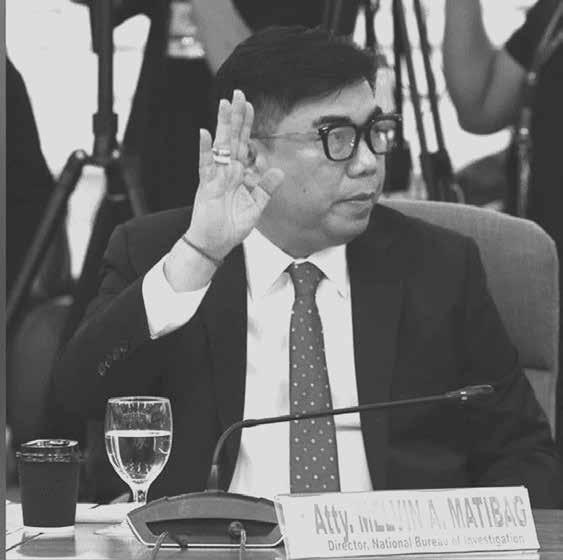
For his part, NBI director Melvin Matibag described the threat against the President as “serious.”
“Any threat against the President, and for that matter against any official, we take it seriously. And we investigate,” he told the committee.
“We have leads already. We have some personalities that are under surveillance, and we are already tailing them. We are zeroing in on several individuals already,” Matibag added.
Matibag also confirmed the creation of a task force to monitor threats against the President and
other top officials.
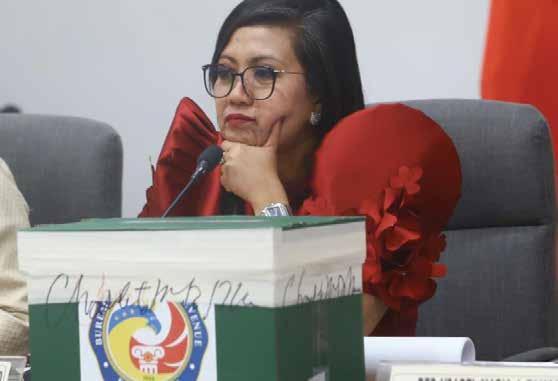
House senior deputy minority leader and ML party-list Rep. Leila de Lima, who endorsed the Saballa impeachment complaint, said Duterte’s videotaped threats “are one of the most serious, if not the most serious, grounds for impeaching her.”
House senior deputy majority leader and Iloilo Rep. Lorenz Defensor shared De Lima’s views, calling the Vice President’s public remarks as impeachable offenses, including her “designated survivor” statement.
According to the NBI director, Duterte went to see self-confessed bagman Ramil Madriaga in jail twice, refuting claims by the Vice President that no such visits took place.
“We have established that on two occasions, VP Duterte visited the Bureau of Jail Management and Penology in Taguig, initially trying to visit Ramil Madriaga but we were informed by Madriaga that he didn’t want it, he didn’t want to face her,” Matibag told lawmakers.
“At the same time when it happened, the other guy she visited was (former Negros Oriental congressman) Arnie Teves,” he said.
Shortly after this, Madriaga allegedly received death threats in prison.
On the subject of unexplained wealth, House justice committee chair and Batangas 2nd district Rep. Gerville Luistro reiterated that Duterte cannot hide behind the bank secrecy law, arguing that the Constitution’s demand for public accountability carries greater weight in an impeachment proceeding n
Batangas aid dispute draws competing accounts over barangay assistance rollout
Gov. Vilma Santos-Recto calls for calm as a lawmaker alleges 84 barangays were left out of a P200,000 aid rollout, while Malacañang cites documentation issues and no official finding has been issued.
by AJPress
BATANGAS CITY, Philippines
— A dispute over the distribution of barangay financial assistance in Batangas has drawn competing accounts from Batangas 1st District Rep. Leandro Leviste and national officials, with Gov. Vilma Santos-Recto urging restraint as questions over the rollout continue.
Leviste has called for an inquiry into what he described as the non-inclusion of 84 barangays in his district from the April 24 distribution of P200,000 in assistance per barangay. The aid was announced as part of President Ferdinand Marcos Jr.’s “Bawat Bayan Makikinabang” activity in the province, which targets all 1,078 barangays in Batangas. In seeking a review by the Office of the President and Congress, Leviste said the amount involved in the reported non-re-
lease totals approximately P16.8 million. He maintained that funds intended for all barangays should be released equitably and without regard to political considerations. He also said barangay officials from the affected areas are prepared to participate in any formal inquiry.
Malacañang has rejected claims of political bias in the distribution. Palace officials have said the delay affecting some barangays was due to incomplete or pending documentation, adding that all qualified barangays are expected to receive the assistance once requirements are satisfied.
Santos-Recto, in a public statement released this week, acknowledged that her administration is navigating challenges but did not directly address each allegation. She urged constituents to remain calm and emphasized that criticism is part of governance.
“You cannot please everybody,” the governor said, adding that public service often involves balancing competing expectations. Provincial officials have maintained that the distribution of assistance is ongoing and subject to standard administrative, accounting and auditing procedures. Leviste, for his part, has said a formal investigation is necessary to reconcile differing accounts and ensure transparency in future disbursements. To date, no final determination has been issued by the Department of the Interior and Local Government, the Commission on Audit or Congress establishing discrimination, misuse of public funds or political retaliation in the Batangas aid rollout. The issue remains under review, with both sides standing by their positions while awaiting any formal findings from oversight authorities.
NBI confirms Sara hired assassin to kill President Marcos
by Ghio onG, Delon Porcalla Philstar.com
MANILA — The National Bureau of Investigation (NBI) confirmed that Vice President Sara Duterte had contracted an assassin to carry out her threat to kill President Marcos and members of his family.
Senior NBI agent Jeremy Lotoc made the confirmation in answer to questions raised by Akbayan party-list Rep. Chel Diokno during the House committee on justice impeachment hearing on Wednesday, April 29.
“Our investigation is ongoing, but there are people that have already been spoken to. There is an assassin,” Lotoc said.
The hearing on Wednesday, April 29, focused on the Nov. 23, 2024 televised assassination threats made by the Vice President against President Marcos, First Lady Liza Marcos and then speaker Martin Romualdez.
The committee played the video of Duterte’s meltdown, which the NBI also authenticated.
“The authentication is verifying that the video is the same and true recording of what transpired. We are ensuring that it is not edited, spliced or AI (artificial intelligence)-generated,” NBI agent John Mark Calilung told lawmakers. The NBI agent outlined the verification process, which included coordination with Meta Platforms to preserve the original URL, screen recording of the livestream and hash value computation to detect any alteration.
“The hash value calculation is like a fingerprint of digital file. If the video is edited, the hash value will change,” Calilung said.
Meanwhile, Lotoc, who was part of a four-man NBI team that investigated the Vice President, also informed the justice committee that his team had subpoenaed Duterte twice in relation to their investigation, but she did not show up to attend to “office matters” in connection with ongoing hearings in the House of Representatives. He said in the second letter to the NBI sent by the Vice President’s lawyers, they denied that she had threatened the President, the First Lady and Romualdez. Lotoc and other members of his team likewise confirmed that they had recommended the filing of one count of inciting to sedition
and three counts of grave threats against Duterte. The case is still pending with the Department of Justice (DOJ).
“There is already a resolution but is currently pending review with the division chief, which will then be transmitted to the Prosecutor General,” DOJ spokesman Polo Martinez said in a message to reporters.
For his part, NBI director Melvin Matibag described the threat against the President as “serious.”
“Any threat against the President, and for that matter against any official, we take it seriously. And we investigate,” he told the committee.
“We have leads already. We have some personalities that are under surveillance, and we are already tailing them. We are zeroing in on several individuals already,” Matibag added.
Matibag also confirmed the creation of a task force to monitor threats against the President and other top officials.
House senior deputy minority leader and ML party-list Rep. Leila de Lima, who endorsed the Saballa impeachment complaint, said Duterte’s videotaped threats “are one of the most serious, if not the most serious, grounds for impeaching her.” House senior deputy majority
leader and Iloilo Rep. Lorenz Defensor shared De Lima’s views, calling the Vice President’s public remarks as impeachable offenses, including her “designated survivor” statement.
According to the NBI director, Duterte went to see self-confessed bagman Ramil Madriaga in jail twice, refuting claims by the Vice President that no such visits took place.
“We have established that on two occasions, VP Duterte visited the Bureau of Jail Management and Penology in Taguig, initially trying to visit Ramil Madriaga but we were informed by Madriaga that he didn’t want it, he didn’t want to face her,” Matibag told lawmakers.
“At the same time when it happened, the other guy she visited was (former Negros Oriental congressman) Arnie Teves,” he said. Shortly after this, Madriaga allegedly received death threats in prison.
On the subject of unexplained wealth, House justice committee chair and Batangas 2nd district Rep. Gerville Luistro reiterated that Duterte cannot hide behind the bank secrecy law, arguing that the Constitution’s demand for public accountability carries greater weight in an impeachment proceeding. n
Palace: Marcos trusts AFP amid NBI probe into assassination plot
by Luisa Cabato Inquirer.net
MANILA — President Ferdinand Marcos Jr. fully trusts the active members of the Armed Forces of the Philippines (AFP) amid the National Bureau of Investigation’s (NBI) probe into an alleged hitman reportedly hired by Vice President Sara Duterte to assassinate him, according to Palace press officer Claire Castro.
This developed after NBI Director Melvin Matibag said during a House committee on justice hearing on Wednesday that the alleged hitman could be a member of the AFP.
“For the active members of the AFP, the president’s trust in them is complete. Whoever this may be that is being referred to now by the NBI Director, Atty. Matibag, as possibly part of the vice president’s security, let us just allow them to do their work, because it may not be necessary to disclose the details of their operation,” Castro said in Filipino.
She also weighed in on the House justice committee’s finding of probable cause to impeach Duterte following three clarificatory hearings on the two complaints under its jurisdiction.
“That is the job of Congress. If we look at the vote,
President Ferdinand Marcos Jr.
National Bureau of Investigation chief Melvin Matibag takes oath as a resource speaker at the House justice committee’s impeachment hearing against Vice President Sara Duterte on Wednesday, April 29. Miguel De Guzman
Reduce your cancer risk
Health @Heart
PhiliP S. Chua, MD, FaCS, FPCS
FOR decades, I have advocated self-help to protect and maintain our own health. I have always stated our health, possibly our longevity too, was, to a great extent, in our hands.
While I recognize that there are unmodifiable risks within us, like our genes, our gender, our world environment and its pollution, many factors are modifiable, like living a healthy lifestyle, distancing ourselves away from poisons and carcinogens, getting HPV vaccines to prevent cervical cancer, etc. These are within our control.
We know that factors such as a diet high in processed meat and low in fiber, obesity, and physical inactivity have been linked to colorectal cancer risk.
“Cessation of smoking, healthy lifestyle and obesity reduction, exercise, awareness of environmental carcinogens such as asbestos, a healthy diet reducing processed food, reduction or abstinence from alcohol intake, HPV vaccination, hepatitis B and C control, weight control, exercise, routine testing and subsequent treatment of H. pylori, and air and water pollution control, are important in cancer in reduction in both men and women, and are all part of the overall strategy to reduce the risk for cancer in general.
Healthier diet
The Planetary Health Diet (PHD) is a flexible, plant-forward eating pattern emphasizing fruits, vegetables, whole grains, nuts, and legumes, with limited amounts of meat, dairy, and added sugars, designed for optimal human health and environmental sustainability. It's a "win-win" approach, reducing risks for major diseases like cancer, heart disease, and diabetes while lowering greenhouse gas emissions, fertilizer use, and cropland demand, serving as a model for healthy, sustainable food systems.
The principles
• Mostly Plants: Half your plate should be fruits and vegetables, with whole grains making up another third.
• Plant Proteins: Focus on beans, lentils, and nuts for primary protein.
Limited Animal Products: Small portions of fish, poultry, eggs, and dairy are included, with red meat and processed meats minimized.
•Minimize Unhealthy Foods: Cut back on added sugars, rice, refined grains, and starchy vegetables like potatoes.
The Philippines is an ideal country for this Planetary Health Diet because we have fresh produce daily. If desired, adding fish and seafood to this diet makes it even healthier.
The basic idea is to stay away from red meat (saturated fats), which is linked to heart disease and cancer.
Risks of GLP-1s
GLP-1 drugs are generally safe, but they come with potential risks. Persistent nausea or vomiting can lead to dehydration, kidney problems, or malnutrition in some cases. People with serious gastrointestinal conditions, like gastroparesis or uncontrolled inflammatory bowel disease, should not take GLP-1 medications. And these medications are not considered safe for use during pregnancy or breastfeeding.
Other health risks include pancreatitis, gall bladder problems, thyroid tumors, and muscle loss. If you are on a GLP-1 drug, it is prudent for you to discuss this with your prescribing physician.
Beyond diabetes and weight loss, researchers are exploring other potential benefits of GLP-1 drugs. Major areas of exploration include: heart health, brain health, addiction treatment, liver disease, and sleep apnea
The most notable benefits of GLP-1 receptor agonists for patients with diabetes or obesity are their ability to promote significant weight loss, reduction in appetite, and improvement in blood sugar control. – MedPageToday.
Dancing and brain aging
In the past, we knew that creative activities can keep our brains healthy. Now studies have shown that even dancing, reading, doing video games, gardening, and playing a musical instrument can help delay brain aging. “As the population ages, more and more people live long enough to experience cognitive decline and dementia, which are very costly not only for the health system but for families and caregivers.” This new discovery will certainly be a boon to slowing down cognitive decline and dementia.
Cruciferous veggies and cancer
In a study with more than 92,000 subjects, researchers found that those who ate more cruciferous vegetables (kale, cabbage) – between 20 to 40 grams per day – had a 20 percent lower risk for colon cancer, compared to those who ate less. Those veggies contain cancer-fighting agents like sulforaphane, indoles, glucosinolates, flavonoids, and phytochemicals. There were studies in
the past that associated cruciferous vegetable consumption with reduced risk for colon, ovarian, prostate, bladder, lung, stomach, and pancreatic cancers.
Proper use of a bidet
Roughly 17 percent of people in the United States use a bidet, almost all people in Italy have a bidet, and hundreds of millions of people, especially in Asia and Europe, use one. A 2025 survey in the United States showed that more than 50 percent of bidet users would rather give up their cellphones than their bidets. The proper use of a bidet for best hygiene is to use toilet paper wipes first, followed by the use of the bidet. It is not supposed to be a substitute for toilet paper. Using a bidet, without first wiping, could be very messy and workintensive. The use of a bidet is like the rinsing procedure after brushing teeth.
Warning about oatmeal
Oat meal is generally healthy, but since it contains gluten and phytic acid, it is an antinutrient, reducing the absorption of iron, zinc, and calcium. But these problems are easily solved by soaking oatmeal for 12 hours, with lemon juice or yogurt to get rid of the gluten and phytic acid. Cooking also gets rid of phytic acid and gluten. Fermentation even breaks them down faster. Also, adding sugar and a lot of fruits, or eating packaged ready-to-eat oatmeal in cups, is not healthy, especially for diabetics. The old-fashioned gluten-free oatmeal is healthier.
*
* * The opinions, beliefs and viewpoints expressed by the author do not necessarily reflect the opinions, beliefs and viewpoints of the Asian Journal, its management, editorial board and staff.
* * * The main objective of this column is to educate and inspire people live a healthier lifestyle to prevent illnesses and disabilities and achieve a happier and more productive life. Any diagnosis, recommendation or treatment in our article are general medical information and not intended to be applicable or appropriate for anyone. This column is not a substitute for your physician, who knows your condition well and who is your best ally when it comes to your health.
*
* * Philip S. Chua, MD, FACS, FPCS, a Cardiac Surgeon Emeritus based in Northwest Indiana and Las Vegas, Nevada, is an international medical lecturer/author, Health Advocate, medical missionary, newspaper columnist, and Chairman of the Filipino United Network-USA, a 501(c)3 humanitarian foundation in the United States. He is a decorated recipient of the Indiana Sagamore of the Wabash Award in 1995, presented by then Indiana Governor, US senator, and later a presidential candidate, Evan Bayh. Other Sagamore past awardees include President Harry S. Truman, President George HW Bush, Astronaut Gus Grissom, pugilist Muhammad Ali, distinguished educators, renowned scientists, etc. (Wikipedia). Websites: FUN8888.com, Today. SPSAtoday.com, and philipSchua.com On Amazon. com, search for “Where is My America?” Email: scalpelpen@gmail.com
On Keeping Faith Alive in Our Parishes
IN recent weeks, we have been reflecting on the lives of the early Christians during our weekday and Sunday readings. Despite facing persecution, their numbers continued to grow. None of these hardships deterred them from preaching the Gospel. In fact, the more they were persecuted, the stronger they became in their faith. Why was this? It was due to the power of the Holy Spirit in their lives, which provided them with the courage, strength, and wisdom needed to navigate the challenges of their missionary efforts. Moreover, they were united, working collaboratively to support their mission. For instance, in this Sunday's First Reading, we learn how they received wisdom from the Holy Spirit to appoint worthy fellow believers to tend to the needs of the poor while the apostles focused on preaching the Gospel to various communities. The Twelve sum-
moned the community of disciples and declared, “It is not right for us to neglect the word of God in order to serve at tables. Brothers, select from among you seven reputable men, filled with the Spirit and wisdom, whom we shall appoint to this task; whereas we shall devote ourselves to prayer and to the ministry of the word.”
We have much to learn from the early Christians, especially in today's context, as we face challenges in sustaining and strengthening our ministries due to factors such as a lack of volunteers and economic difficulties. We must adopt a spirit of generosity in supporting our parishes with our time, talents, and treasures. Furthermore, we must trust our clergy, who are working diligently to spread the Gospel and bring faith to our communities. Fortunately, we are witnessing a growing interest among our young people in returning to the Church, driven by their hunger for God, meaning, and connection. For example, at St. Joseph Church in New York City, young people are flocking to Sunday Masses. In a recent interview, a young man expressed how secular society had misled them by removing God from their lives.
The Duty to Provide Complete and Accurate Financial Disclosure in a California Divorce
Couples that are going through the divorce process in California should understand that the Family Code and the Family Courts requires that they provide complete and accurate disclosure to the other spouse. The financial disclosures are taken seriously by the Courts and failure to disclose could have serious consequences for the non-disclosing party in a divorce case. The parties are required to prepare and exchange preliminary declaration of disclosure which includes and fl-142 schedule of assets and debts, fl-150 income and expense declaration, 2 years tax return, a statement of all material facts and information regarding the valuation of all assets that are community property or in which the community has an interest, a statement of all material facts and information regarding obligations for which the community is liable, and an accurate and complete written disclosure of any investment opportunity, business opportunity, or other income-producing opportunity presented since the date of separation that results from any investment, significant business, or other income-producing opportunity from the date of marriage to the date of separation. If the case does not settle and proceeds to trial, the parties would have to exchange final declaration of disclosure which consists of the above information with the characterization of the assets and debts whether community or separate and the valuation of those items.
Family Code Section 2100 states that "[a] full and accurate disclosure of all assets and liabilities in which one or both parties have or may have an interest must be made in the early stages of a proceeding for dissolution of marriage or legal separation of the parties." This disclosure must be made regardless of the characteriza-
tion of the assets and liabilities as community or separate property.
Family Code Section 1100 defines disclosure as "the act of providing information to the other party or to the court." Disclosure can be made in a variety of ways, including through the exchange of financial documents, such as tax returns and bank statements, or through written declarations.
Family Code Section 721 states that "[e]ach party to a proceeding for dissolution of marriage or legal separation has a duty to make full and accurate disclosure of all financial information and material facts."
This duty includes disclosing information about all assets and liabilities, as well as information about income and expenses.
The duty of disclosure is important for several reasons. First, it allows each spouse to have a full understanding of the marital estate before they enter into negotiations, settlement, or go to trial. This helps to ensure that the division of property and debts is fair and equitable.
Second, the duty of disclosure helps to reduce the likelihood of fraud and concealment of assets. If a spouse fails to disclose all of their assets or liabilities, the other spouse may be able to set aside the divorce judgment.
Finally, the duty of disclosure helps to promote the public policy of California, which favors the speedy and efficient resolution of divorce cases.
If a spouse fails to comply with their duty of disclosure, they may face a number of penalties. The court may order the spouse to pay the other spouse's attorney's fees and costs. The court may also order the spouse to disclose the hidden assets or liabilities and award the non-disclosed asset to the other spouse. In some cases, the court may even set aside the divorce judgment.
Now, they realize the need for a “higher Source” to rely on in today’s troubled world. This is an inspiring and encouraging sentiment from a young person.
So, friends, let us not be discouraged as we share our faith in Jesus. Let’s believe in the power of the Holy Spirit to guide and strengthen us. Let us engage more actively in the Church’s efforts to increase participation in our Masses and ministries.
At Incarnation Church, the staff and members of the parish and finance councils have been meeting regularly to evaluate the vitality of our liturgies and ministries. There have been honest and fruitful dialogues, allowing us to consider everyone’s suggestions and insights. We hope to continue these candid and courageous conversations, and we encourage parishioners to share their thoughts in respectful and constructive ways.
Once again, let us trust in the power of the Holy Spirit to guide us as we move forward together.
* * * The opinions, beliefs and viewpoints expressed by the author do not necessarily reflect the opinions, beliefs and viewpoints of the Asian Journal, its management, editorial board and staff.
* * * Fr. Rodel “Odey” Balagtas is the pastor of Incarnation Church in Glendale, California
1. Disclose all assets and liabilities, regardless of the characterization as community or separate property.
2. Disclose all income and expenses, including income from employment, investments, and businesses.
3. Disclose all debts, including credit card debt, student loans, and mortgages.
4. Disclose all gifts and inheritances received during the marriage.
5. Disclose all business interests, including partnerships, corporations, and limited liability companies.
6. Disclose all information about any income-producing opportunities that arose after the date of separation but that resulted from any
The best way to comply with the duty of disclosure is to be honest and forthright with your spouse and with the court. Gather all of your financial documents and review them carefully. If you have any questions about what to disclose, consult with an experienced divorce attorney. Here are some specific tips for complying with the duty of disclosure:
The secrets of the blue zones Philippine Embassy in Washington approves 803
FQ (Financial Quotient)
by Rose FRes Fausto Philstar.com
I LOVE the thesis of the Blue Zone study because it aligns perfectly with my personal belief and advocacy about having a healthy financial life, a high FQ. Let me show you what I mean.
American explorer and National Geographic fellow, Dan Buettner, studied the lifestyles and diets of regions where people live the longest (with many centenarians) and healthiest until their last days.
These are:
1. Ikaria, Greece
2. Okinawa, Japan
3. Sardinia, Italy
4. Nicoya Peninsula, Costa Rica
5. Loma Linda, California, USA
The common lifestyle habits of the Blue Zone inhabitants that Buettner calls the Power 9 are as follows:
1. Move naturally – No gyms or marathon runners but they are just nudged by their environments to constantly move without thinking.
2. Purpose – Ikigai for the Okinawans and plan de vida for the Nicoyans give them the reason to wake up in the morning.
3. Downshift – Stress management that includes praying, napping, remembering their ancestors.
4. 80% Rule – This is called hara hachi bu by the Okinawans or stop eating when 80% full.
5. Plant Slant – Plants are the cornerstone of their diet with meat taken just five times per month on average.
6. Wine @ 5 – They consume alcohol moderately, usually with friends.
7. Belong – They are members of faith-based communities.
8. Loved ones first – They put their families first, committed to a life partner, invest in their children, and care for aging parents and grandparents who live with them or nearby.
9. Right Tribe – They were born into or choose social circles that support healthy behaviors like the Okinawans’ moai (groups of five friends committed to each other for life).
Years ago, I watched Buettner’s Netflix series and read his books, and the lessons
there are very similar to the main point of FQ Book 3, i.e., the power of design, the power of our environment. In one of his books, he even wrote this in the Introduction: Years ago, I watched Buettner’s Netflix series and read his books, and the lessons there are very similar to the main point of FQ Book 3, i.e., the power of design, the power of our environment. In one of his books, he even wrote this in the Introduction:
“If you’re overweight, suffering from diabetes, heart disease, or even several kinds of cancer, it’s probably not your fault. Politicians like to shake their finger at us and tell us our health is up to us, that it’s our “individual responsibility.” I don’t buy it.”
He went on to enumerate the changes that have happened in the environment like the proliferation of fast-food restaurants, junk food, upsizing of meal portions, coupled with sedentary lifestyle, crisis of loneliness, etc.
His conclusion: People who live a long time in the Blue Zones don’t really know why they live a long time. They don’t have heroic discipline, don’t know something we don’t, and they certainly have no more “individual responsibility” than we do. Their secret: They live in an environment where the healthy choice is not only the easy choice, but often the only choice!
Choice architecture
Clearly, we see how our lives are significantly shaped by our environment. In the five Blue Zones, the residents are lucky to be in an environment where doing the right thing is not just the easier option but sometimes the only option; consequently, making them take care of their health. Our bodies are designed to move, eat certain types of food already provided by nature, embrace our human nature of being social creatures surrounded by loved ones, and live with a sense of purpose. However, our current lifestyle has become sedentary where working is usually sitting down at your desk for long hours,
usually alone, eating processed food, with hardly any time for faith-based activities, and away from loved ones.
This is where Choice Architecture becomes crucial.
Choice Architecture is the use of design to influence the choices that we make. The options are presented in such a way that we will easily pick the choices the architect is nudging us to make.
In the five Blue Zone areas, the main choice architect is nature. Unfortunately, as we progressed and invented all sorts of comforts for our everyday life, we have designed our environment in such a way that the easier choices are almost always the unhealthy choices for us. I am not saying that we should totally abandon our practical present-day lifestyle, but we should at least be aware that we have the capability to do something about our environment to make it easier for us to do the right thing consistently. We don’t need to go to the boondocks to live healthier lives but we can use the power of Choice Architecture where we are right now.
As a matter of fact, Buettner recently declared our neighbor country, Singapore, as the world’s sixth Blue Zone. Unlike the original five, which developed organically through traditions and practices that have flourished through the years, Singapore is a manufactured Blue Zone through the effective use of Choice Architecture. Over 80% of its residents live in high-rise public apartment blocks designed to encourage interaction in playgrounds, fitness centers, community gardens, etc. Walking is encouraged and driving your own car is discouraged through their restrictive Certificate of Entitlement and the efficient public transport system. The government’s proximity housing grant (up to Sing $30,000 for married couples and half of it for singles) encourages
adult children to live near their parents. This is their way of tackling the aging problem. On the nutrition aspect, their hawker centers sell various cheap and delicious meals under one roof allowing interaction, and now using “Healthier Choice” symbol, an easy-to-understand sign to denote healthier food options so that consumers can make better-informed decisions more effortlessly.
In our own immediate surroundings, let’s see what we can do to implement Choice Architecture to make it easier for us to:
1. Move naturally.
2. Live our purpose.
3. Manage our stress.
4. Stop eating at 80% full.
5. Eat more vegetables and fruits.
6. Unwind at the end of workday.
7. Belong to a local group like church or civic organization.
8. Have great relationships with our families.
9. Be in the right tribe, your inner circle or moai.
I wish you a good week of tweaking your environment and creating your own Blue Zone wherever you are right now.
In the next article, we will discuss how we can apply the secrets of the Blue Zone to our financial life.
ANNOUNCEMENT
1. Living to 100 is great, but living to 100 with peace of mind is better. Align your money habits with the Power 9 principles of purpose, tribe, and downshifting. How healthy is your relationship with money? Find out in minutes. Take the FQ Test Now!
2. You don't need to move to Greece or Italy to find your Blue Zone. You just need to change the "Choice Architecture" of your home and heart.
Start your journey toward a high-FQ life with the complete FQ Trilogy. Because a life welllived deserves a bank account that can keep up.
FL Melania Trump at the 113th Annual First Lady’s Luncheon
FIRST Lady Melania Trump delivered remarks at the 113th Annual First Lady’s Luncheon held at the Washington Hilton in Washington, D.C., emphasizing initiatives focused on children and youth.
She addressed congressional spouses and highlighted programs linked to foster care reform, referencing ongoing efforts to improve outcomes for young people transitioning out of the foster system. Her remarks follow recent participation in a House Ways and Means Committee roundtable discussion on foster care policy.
The First Lady’s Luncheon, hosted annually by The Congressional Club Museum and Foundation since 1912, is a bipartisan event that recognizes the sitting First Lady and supports nonprofit organizations. This year’s gathering also marked the 250th anniversary of the signing of the Declaration of Independence.
Trump marked her 56th birthday on April 26.
ADB’s 59th Governors’ Meeting
The Ministry of Foreign Affairs of Uzbekistan has issued temporary foreign journalist accreditation to cover the 59th Annual Meeting of the Board of Governors of the Asian Development Bank, scheduled from May 3 to 6, 2026, in Samarkand.
This year’s theme, “Crossroads of Progress: Advancing the Region’s Connected Future,” will focus on connectivity, digital transformation, and resource mobilization for resilient growth. Events will take place at the Silk Road Samarkand complex, which includes a congress and expo center.
Organizers are also expected to present a preview of the 60th Annual Meeting, to be hosted in Nagoya, Japan, in 2027.
Red Tape Experience in the Philippines
The release of an honorarium from the Department of Trade and Industry–Center for International Trade Expositions and Missions (DTI-CITEM), amounting to PHP 78,162 and covering services rendered in December 2025, remains pend-
ing as of late April 2026. Correspondence from March to April indicates that internal review processes, including legal and audit clearances, have contributed to delays. Updates provided through official communication channels cited ongoing documentation and compliance requirements before check release.
Follow-ups on March 26, April 13, and April 25 confirmed that the payment remained under processing, with assurances that efforts were underway to complete the remaining requirements.
Separately, compensation from Mabalacat City College for the previous academic term was released in March 2026 after several months. Aquinas School Homecoming 2026
The author recently represented his nephew, entrepreneur Aljun Xavier Varsovia (Batch 2009), who was recognized as one of the 2026 Ten Outstanding Men of Aquinas
during the Aquinas School homecoming in San Juan City.
Although having attended the institution briefly from 1969 to 1971, the author noted a continued affinity with the school’s legacy, citing its emphasis on academic discipline, faith-centered formation, and leadership.
Meeting Ynah Zimmerman for the First Time
At the Santolan MRT Station along EDSA, the author encountered members of ISDA Youth Philippines en route to an event at Club Filipino in San Juan City. At the venue, he met Ynah Zimmerman, identified as a youth leader and content creator. Zimmerman is affiliated with ISDA Youth Philippines and has been involved in public service initiatives, including youth-related programs connected with the Office of the Vice President’s Disaster Operations Center since 2022. She is also part of the cast of Spring in Prague, a film project
by
AJPress
WASHINGTON, D.C. – The Philippine Embassy’s Resident Election Registration Board (RERB) has approved a total of 803 overseas voter applications covering registration, certification, reactivation, and related requests filed between December 1, 2025 and March 31, 2026.
The approvals were finalized during the board’s first meeting for the current registration cycle, held on April 20, 2026.
The Embassy has made the list of approved applicants publicly available through its official channels, allowing registrants to verify their status.
The ongoing overseas voter registration period, which be -
gan in December 2025, will run through September 30, 2027. The process enables qualified Filipinos residing abroad to participate in the 2028 Philippine national elections, including voting for president, vice president, senators, and party-list representatives.
Election officials reiterated that overseas voter registration requires personal appearance at the Philippine Embassy or designated consular outreach missions. Applicants must submit the required documentation and complete biometric data capture as part of the process.
Filipinos overseas may register or check their voter records through the Embassy’s official voter information portal.
PHILCONGEN attends world of
San Diego
by AJPress
The Philippine Consulate General in Los Angeles attended World of Coffee (WOC) at the San Diego Convention Center in San Diego, California from 10–12 April 2026.
The three-day event brought together the specialty coffee community from the US and abroad, from coffee shops, restaurants, brokers and roasters as well as other companies whose products are ancillary to the coffee business such as tea companies, labeling and packaging companies, pastry, sweeteners, flavorings among others. World of Coffee San Diego,
formerly known as Specialty Coffee Expo, hosted more than 4,500 booths and drew a record 15,000 plus attendees from more than 90 countries.
Consul Francis Maynard S. Maleon joined Teofilo Coffee Company represented by Mr. Ron Dizon and Mr. Adrian Verueco and the Philippine Coffee Board represented by Mr. and Mrs. Jose and Jocelyn Mamar in showcasing the quality of Philippine varieties and viability in the specialty coffee market. For more information, please visit www.philippineconsulatela. org and Facebook page (@PHLinLA).
produced by Borracho Films, and maintains an active presence on social media platforms where she shares professional and lifestyle content.
Birthday Greetings Birthday greetings are extended to the following: Boy Katindig; Marites Danguilan Vitug (May 2); Dino Cruz; Star Yoo (May 3); Monica Rodriguez Herrera (May 4); UP President Angelo “Jijil” Jimenez (May 5); Ramil Cabrera; Oscar Garcia; Ellen Mondez Cruz; Philip Lumagbas; Brian Masigan; April Abello-Bulanadi (May 6); Rebecca Amor (May 7); Annette del Rosario; Sheilah Kalfors; Emelyn Santos (May 8); Josie Natori; Jay Ar DelRosario Sanchez (May 9); Lheng Divinagracia Gonzales (May 10).
Image by Rose Fres Fausto
President Donald Trump with First Lady Melania Trump.
(From left) Rogelio Constantino Medina; Jay Ar DelRosario Sanchez; Gio Colmenares; Rjay Rondilla; Vincent Martelino.
(From left) Carl John Vallega; Ynah Zimmerman; Rogelio Constantino Medina; Elle Ramirez; Emily Teodoro; Mayline Serapino Villester at Club Filipino.
Rogelio Constantino Medina (center) representing Aljun Xavier Varsovia at the Aquinas School Homecoming 2026.
ADB’s 59th Annual Meeting of the Board of Governors in Samarkand, Uzbekistan.
Rogelio Constantino Medina at CITEM, an attached agency of the Department of Trade and Industry.
2026 Ten Outstanding Men of Aquinas (TOMA).
Rogelio Constantino Medina with Ynah Zimmerman. Rogelio Constantino Medina with Josie Natori.
Los Angeles PCG Photo
BINI receives Billboard Global Force honor in Los Angeles
The P-pop group becomes the second Filipino honoree of the award, following Sarah Geronimo’s recognition in 2024.
LOS ANGELES — P-pop girl
group BINI received the Global Force Award at the 2026 Billboard Women in Music, marking another international milestone for Filipino music following the group’s recent Coachella appearance.
The award was presented April 29 at the Hollywood Palladium. Billboard Philippines selected BINI as its Global Force honoree, making the group the second Filipino act to receive the distinction after Sarah Geronimo in 2024.
Model and actress Cara Delevingne presented the award, citing the group’s global reach and growing influence.
Members Colet and Jhoanna accepted the recognition on behalf of the eight-member group.
Colet described the honor as more than a milestone, saying it carries responsibility as BINI represents Filipino music on the global stage. Jhoanna thanked supporters and concluded in Fil-
ipino: “Salamat at mabuhay ang musikang Pilipino.”
The recognition follows BINI’s recent performance at the Coachella Valley Music and Arts Festival, which Philippine and international music outlets described as a significant breakthrough moment for the group. BINI — composed of Aiah, Colet, Maloi, Gwen, Stacey, Mikha, Jhoanna and Sheena — is scheduled to continue its international expansion with the
“Signals” world tour. The tour is set to open with Philippine dates in June before proceeding to international stops, including the United States, Canada and parts of Asia.
The Global Force recognition places BINI among a growing list of artists cited by Billboard’s regional platforms for advancing music beyond domestic markets, reinforcing the Philippines’ expanding presence in the global pop landscape.
Sharon Cuneta urges Leni Robredo to reconsider 2028 run
Public appeal comes after Robredo says a national candidacy is not in her plans, even as early surveys keep her name in the 2028 conversation
by AJPress
— Actress and singer Sharon Cuneta has publicly urged Leni Robredo to reconsider a possible presidential run in 2028, adding to a growing number of appeals from supporters despite Robredo’s stated decision to remain focused on local governance.
Cuneta made the appeal through an Instagram post, asking Robredo to “please reconsider” and describing the former vice president as a figure capable of uniting different political groups. She also said she and her husband, Francis Pangilinan, would support Robredo should she decide to run. Pangilinan, Robredo’s running mate in the 2022 presidential election, returned to the Senate in 2025 following the proclamation of winning candidates by the Commission on Elections.
Robredo has said she is not seeking a national post in 2028. In an April 2026 interview, she stated that a return to national politics is “far from” her horizon,
emphasizing her focus on her role as mayor of Naga City. Robredo previously served as vice president from 2016 to 2022 before returning to local office in 2025. Early polling continues to keep her name in the national conversation. A March 2026 survey conducted by OCTA Research showed Sara Duterte leading Robredo, 46 percent to 35 percent, in a hypothetical head-to-head presidential race, with a portion of respondents remaining undecided. The survey reflects early sentiment and does not constitute an official candidate lineup. Other public figures have echoed calls for Robredo to re-
consider. Television host Vice Ganda has expressed continued support for a potential Robredo candidacy despite her stated position.
No certificate of candidacy has been filed for the 2028 presidential race. Robredo’s position remains unchanged: she has said she is focused on governing Naga City and is not planning a national run at this time.
The appeals from Cuneta and other supporters underscore sustained public interest in Robredo’s political future, but remain, at this stage, expressions of support rather than formal political developments.
Ryan Agoncillo, Judy Ann Santos emphasize trust over jealousy in show business marriage
In a recent television appearance, the veteran couple addressed on-screen partnerships with humor, underscoring a relationship built on independence and mutual respect.
by AJPress
— Ryan Agoncillo and Judy Ann Santos presented a composed and pragmatic view of marriage in the entertainment industry, emphasizing trust and professional autonomy during a recent joint television appearance. The couple appeared on the pilot episode of Matteo G Primetime, hosted by Matteo Guidicelli, where they were asked about jealousy and the realities of working with on-screen partners. A brief moment drew attention after Agoncillo, in a joking tone, said “Subukan mo” when the discussion turned to Santos selecting potential leading men. He subsequently clarified that the remark was not intended as a restriction. In context, Agoncillo indicated that he defers to Santos’ judgment on career decisions, describing her as capable and experienced in navigating roles and professional relationships. His comments reflected a broader position that disagreements, if any, can be addressed privately
rather than preemptively limiting opportunities. Santos responded with similar ease, saying she would allow Agoncillo to take on projects involving a leading lady. Her answer aligned with the couple’s consistent public stance that acting roles should be treated as part of the profession, not as a source of personal conflict. Professional boundaries in
an industry where audience interest often
extends beyond the screen. Rather than framing jealousy as a defining issue, both presented it as manageable through communication and mutual respect.
Agoncillo and Santos, who have been together since 2004 and married in 2009, are widely regarded as one of Philippine entertainment’s enduring partnerships. Their remarks reinforced a pattern seen in previous interviews, where both have emphasized independence within the relationship while maintaining a unified public front.
‘The
Devil Wears Prada 2’ draws scrutiny over Asian character
Online criticism focuses on the naming, styling and introduction of Jin Chao, a new
LOS ANGELES — The Devil
Wears Prada 2 opened in theaters May 1 with its original creative team and principal cast returning, but early audience reaction has been shaped in part by criticism surrounding the portrayal of a newly introduced Asian character.
The sequel is directed by David Frankel and written by Aline Brosh McKenna, with Meryl Streep, Anne Hathaway, Emily Blunt and Stanley Tucci reprising their roles. New cast members include Kenneth Branagh, Lucy Liu, Simone Ashley, Justin Theroux and Helen J. Shen, based on studio production listings.
Character construction and audience reception
Discussion online has centered on Jin Chao, portrayed by Shen, who is introduced in a promotional clip released in April. In the scene, the character presents herself to Andy Sachs, Hathaway’s role, citing academic credentials including Yale, a 3.86 GPA and a perfect ACT score.
Some viewers on international social platforms have described the portrayal as reflecting familiar patterns historically associated with Asian characters in Western media, including the highly accomplished but socially rigid assistant figure. Others have pointed to wardrobe choices, including conservative lay-
assistant portrayed by Helen J. Shen
ering and oversized eyewear, as reinforcing a narrow bookish visual identity. Naming considerations and cultural sensitivity
A separate line of criticism has focused on the character’s name, with some users noting that its English pronunciation may carry unintended phonetic associations. These observations remain part of online discourse and have not been formally addressed in studio materials.
Studio posture and absence of formal response
Official materials released by the studio outline the film’s release, cast and narrative setting but do not include a detailed response to the specific concerns raised online. As of publication, no formal clarification has been
issued regarding the intent behind the character’s naming or presentation.
Global reception and industry context
The response reflects a recurring dynamic in global film distribution, where character portrayals are assessed across different cultural contexts. Elements framed as satire or exaggeration in one market may be interpreted differently in another, particularly when they align with established cultural archetypes.
For some viewers, the issue extends beyond a single role to the cumulative effect of repeated portrayals. For studios, the episode underscores the level of scrutiny applied to major releases as international audiences continue to expand.
by AJPress
by AJPress
MANILA
MANILA
Vice Ganda reacts to Joey de Leon's remark on ABS-CBN
by Jan Milo seveRo Philstar.com
MANILA, Philippines — Vice Ganda responded to the issue regarding Joey de Leon's viral joke about ABS-CBN.
During an interview with members of the Society of Philippine Entertainment Editors (SPEEd) last night, April 27, Vice was asked about the said issue.
“E, siyempre, hindi natin masasaklawan ang komedyante. Hindi rin natin masasaklawan ang reaksiyon ng mga taong makakarinig ng joke," he said.
“So, that’s life, 'di ba? E, komedyante si Sir Joey, nag-joke siya. E, trabaho niya 'yun. Nagdyo-joke siya,” he added.
In an episode of “Eat Bulaga” on TV5, the veteran host and comedian made a joke about ABSCBN that angered some viewers.
This happened last April 23, when Mister Pampanga 2026 candidate RJ Perkins was a guest on its “The Age is Right” segment.
Vic Sotto and Maine Mendoza were interviewing RJ, which went viral on social media when he
appeared in the swimwear competition.
Joey then interrupted saying: “Saka hindi na uso 'yung abs. Wala na nga 'yung abs, e.”
When his co-hosts said he was referring to someone else, the veteran comedian said: “Ay, ABS-CBN pala 'yun, sorry, sorry.”
Fans of the network have been criticizing Joey, calling him insensitive.
The
actor couple frames parenting as a balance of consistent rules and individualized care in a modern Filipino household.
by AJPress
and Jennylyn Mercado are presenting a measured view of family life, emphasizing the discipline required to raise a blended household with different personalities and needs.
Married in 2021, the couple is raising children from previous relationships alongside their daughter, a structure that reflects a growing segment of Filipino families. In recent public remarks, both actors described parenting as a continuous process shaped by balance, communication and adjustment.
Trillo has underscored fairness as a core principle, noting the importance of ensuring that each child feels equally valued. Mercado added that equality does not always mean identical treatment, as each child may require different forms of attention and support.
Consistency and individual needs
The couple’s approach combines structure with flexibility. Household rules are applied consistently, while space is given for each child’s age, temperament and circumstances. This balance, they indicated, helps maintain stability within a blended environment.
They also acknowledge that daily life is not seamless. Their home, they said, is often shaped by routine negotiations, shifting schedules and differing preferences. These realities are treated
as part of family life rather than disruptions to it.
A shifting family narrative
Their account reflects a broader change in how Filipino families are portrayed, with blended households becoming more visible in public discourse. The emphasis is moving away from idealized images toward more experience-based narratives.
For Trillo and Mercado, the focus remains practical. Parenting, they suggest, is less about meeting a fixed standard and more about sustaining fairness, attention and a sense of belonging over time.
Padilla weighs retirement abroad if system remains
by AJPress
MANILA — Robin Padilla said he is considering retiring abroad and may step away from politics if the country’s system of government remains unchanged by the 2028 elections, according to remarks he made in a recent interview.
Padilla tied his political future to long-standing calls for structural reform, including proposals to change the Philippines’ form of government. He said that without such changes, he does not see a continued role for himself in the current political framework.
Padilla, whose Senate term runs through 2028, has not made a formal declaration regarding a reelection bid.
Retirement tied to reform agenda
Padilla said he has been contemplating retirement for years, noting that the idea dates back to around 2010. He indicated that his decision to remain in public service would depend on whether reforms he has advocated gain traction before the next national elections.
He added that, absent such developments, he would prioritize private life with his wife, television host Mariel Rodriguez, and their children.
Quezon City property placed on the market
Padilla also confirmed that the family’s Museo de Padilla
unchanged by 2028
property in Quezon City is for sale. The residence, described as a Spanish-inspired home that has also been used for private functions, forms part of what he characterized as preparations for a possible retirement abroad. He clarified that the sale is not intended to fund any political campaign for 2028.
Options abroad under consideration
Padilla said he and Rodriguez have explored several potential retirement locations, including Brunei, Iceland, the Netherlands and Germany.
He said Brunei was initially considered but ultimately deemed unsuitable due to climate preferences, while Iceland was described as appealing but expensive. The couple has also visited parts of Europe while assessing long-term options. No final decision has been an-
nounced.
Conditional outlook ahead of 2028
Padilla’s remarks were framed as contingent on future political developments rather than as a confirmed plan. He did not state that he will retire, leave the Philippines, or decline to run in 2028.
In a lighter exchange, he said he would prefer any property transaction to be conducted in U.S. dollars, citing personal concerns about the peso. The comment was delivered humorously and not as a formal economic position.
Padilla’s statements underscore uncertainty about his political future as the next election cycle approaches, with his continued participation in public office tied to the outcome of broader governance reforms he has supported.
Matty Juniosa reaches BGT final, joins West End cast of ‘Jesus Christ Superstar’
The Filipino singer advances after a second Golden Buzzer performance and secures a role in the London Palladium staging of the Andrew Lloyd Webber rock opera.
by AJPress
LONDON — Filipino singer and theater actor Matty Juniosa has advanced to the grand final of Britain’s Got Talent Season 19 after receiving a second Golden Buzzer during the April 25 semifinal broadcast.
Juniosa performed Dream On by Aerosmith, delivering a highrange vocal that prompted judge Amanda Holden to send him directly to the final. The moment followed his earlier audition, where Simon Cowell awarded him a Golden Buzzer for his rendition of Purple Rain by Prince.
Receiving two Golden Buzzer selections in a single season is considered uncommon under the program’s format, which al-
lows each judge limited use of the mechanism across the competition stages.
Prior to his UK television run, Juniosa was a Top 12 finalist on Idol Philippines Season 1 and later performed with the vocal group iDolls, building his profile within the Philippine music scene. Separately, Juniosa has been cast in the London staging of Jesus Christ Superstar at The London Palladium, where he is set to portray Annas, one of the high priests in the production. The role is typically associated with demanding upper-register vocals and precise ensemble performance. The Britain’s Got Talent final is determined primarily through public voting, with results an-
Viva unveils next-generation talents from showbiz families
New VAA roster acknowledges industry access tied to legacy names while emphasizing individual merit and career sustainability.
MANILA — Viva Artists Agen-
cy has introduced a new group of young performers drawn from well-known entertainment families, marking a generational shift as the industry adapts to streaming and digital-first platforms. The roster includes Vito Quizon; Ashley Diaz; sisters Gabbi Ejercito and Icee Ejercito; brothers Rob Walcher and Ryan Walcher; Jac Abellana; and Jaime Yllana.
Quizon is the son of Vandolph Quizon and the grandson of Alma Moreno and comedy icon Dolphy. Diaz is the daughter of Joko Diaz and granddaughter of Paquito Diaz. The Ejercito sisters are the daughters of Gary Estrada and Bernadette Allyson. The Walcher siblings are the sons of Patricia Javier and Robert Walcher. Abellana is the son of Jojo Abellana, while Yllana is the son of Anjo Yllana.
Access and expectations
The emergence of second-generation performers continues to draw attention, often framed through the term “nepo baby.”
Members of the group have acknowledged that family ties may
nounced during the live broadcast. Juniosa is expected to compete against other finalists as the season concludes, while his stage casting signals a parallel expansion into the UK theater circuit. open doors, while stressing that sustained careers depend on training, discipline and audience reception.
Industry observers note that visibility alone is insufficient. Performers are ultimately assessed on range, consistency and their ability to adapt to evolving formats.
Early projects and direction Some of the artists have begun appearing in Viva-backed productions, including My Husband is a Mafia Boss and Hell University, with additional titles such as Project Loki in development under Viva Entertainment.
The agency’s rollout reflects a broader shift toward platform-driven content, where emerging talent is introduced through digital and streaming channels.
For this new roster, the transition from inherited recognition to individual credibility remains the defining test.
JM de Guzman links ‘My Bespren Emman’ to personal recovery and faith journey
by AJPress
— Actor JM de Guzman describes his latest television project, My Bespren Emman, as closely connected to his own experiences with recovery and faith, framing the role as part of a broader effort to translate personal struggles into meaningful storytelling.
The series, airing on TV5 and produced by Numinous Narratives with Spring Films, explores themes of redemption, spiritual conflict, and second chances.
De Guzman has previously spoken in interviews about living with anxiety, depression, and bipolar disorder, as well
as his recovery from substance use. In discussing the series, he characterizes those experiences as informing his approach to the role and as a basis for encouraging conversations around mental health.
In My Bespren Emman, he plays Mateo, a man seeking to rebuild his life after past mistakes. The character is guided by Emman, portrayed by Ely Buendia, whose presence reinforces the show’s spiritual dimension.
The actor has acknowledged the emotional demands of the role, noting that he draws from real-life experiences while maintaining boundaries during pro-
duction. He has also described a recent period of personal difficulty marked by a sense of disconnection from faith, followed by a renewed focus that coincided with the project. Across his public statements, De Guzman has consistently identified faith as a stabilizing force through periods of instability. He said he hopes the series resonates with viewers navigating their own challenges. Producers position the series within a growing slate of Philippine programs addressing mental health and personal recovery, with an emphasis on accountability, healing, and the possibility of renewal.
MANILA
MANILA — Dennis Trillo
(From left) Vito Quizon, Jaime Yllana, Icee Ejercito, Ryan Walcher, Rob Walcher, Ashley Diaz, Gabbi Ejercito and Jac Abellana Photos from Viva Artists Agency
by AJPress
Janice de Belen advises daughter Kaila Estrada: 'Guard your heart' Jayda
by Jan Milo seveRo Philstar.com
MANILA, Philippines — Ac-
tress Janice de Belen admits that she prefers not to interfere when it comes to her children's relationships and lets them make their own decisions.
In an interview with Julius Babao, Janice said that she does not meddle with the love lives of her children, including her daughter Kaila Estrada.
She said she trusts her children's decisions and does not want to control their lives.
“I will have to trust them, love them, get along with them.
Kasi malay ko ba, baka mamaya sila na nga talaga 'yung mag-aalaga sa anak ko,” she said. When asked for her advice for Kaila about love, Janice's answer was simple.
“She’s 30 years old. Basta guard your heart,” she said.
She also explained that her parenting style focuses on giv-
ing her children freedom and independence.
“I don’t coddle my children,” she said. Her statements came as Kaila's name continues to be linked to her "Incognito" costar Daniel Padilla, although there has been no direct confirmation from the two about any
romantic relationship.
On Tuesday night, April 28, eagle-eyed social media users noticed that Kaila posted a picture of herself and Daniel hugging each other on an Instagram story with the background song "Hallelujah" by Justin Bieber. Daniel turned 31 last April 26.
by Jessica ann evangelista Inquirer.net
JAYDA Avanzado expressed gratitude after her cover of “Thinking of You” by Katy Perry surpassed 10 million views across platforms, even as it drew mixed reactions online.
“Thank you for 10.8 million views across all platforms for ‘Thinking of You’!!” the actress-singer wrote in a post celebrating the milestone on Wednesday, April 29.
The performance sparked varied feedback from netizens, with some describing the rendition as “airy,” saying that the singer sounded like she was “gasping for air” and noted her pronunciation, saying it carried too much emphasis on the letter “h.”
Addressing the comments, Avanzado later shared the full version of her cover and joked about the criticisms. “Ito na, nakapag-nebulizer na po. Dahil diyan, ito na yung full cover,” she wrote, playfully referencing re-
marks about her vocal delivery. The young singer also changed her profile icon to her photo wearing a nebulizer, further poking fun at the feedback.
Originally recorded by Perry, “Thinking of You” is a ballad from her 2008 debut album “One of the Boys.” The song, known for its emotional lyrics about longing and lost love, has remained a fan favorite over the years. Perry recently made headlines after she was reported to be under investigation in Aus-
tralia over allegations of
“Flicker
The
Kaila Estrada and her mom Janice de Belen
Jayda Avanzado
Photo: TikTok/@jedijayda
sexual assault made by Australian actress Ruby Rose. Jayda, the daughter of OPM veterans Jessa Zaragoza and Dingdong Avanzado, rose to fame after she performed the opening act for Niall Horan’s
World Tour” in Manila in 2018.
young singer-actress currently stars as Lorelei Rios in the television adaptation of the Wattpad hit “Project Loki” opposite Dylan Menor and Marco Gallo.