


WASHINGTON, D.C. — The Trump administration is considering whether to require U.S. banks to collect citizenship information from customers, according to a report first published by The Wall Street Journal.
The Journal reported that administration officials have discussed possible executive action or regulatory steps that could direct financial institutions to obtain citizenship data from both new and existing account holders. The report cited people familiar with the matter. No executive order or formal regulation has been issued as of publication.
The White House has not publicly announced a finalized policy. Details of any potential directive - including scope, implementation method, or documentation requirements - have not been formally released.
Existing federal requirements
Under current U.S. law, banks must comply with Customer Identification Program (CIP) rules established under the USA PATRIOT Act and the Bank Secrecy Act. These reguu PAGE 4

by AJPress
shed. To understand its significance, historians point to the turbulent years that preceded it — a period marked by martial law, economic strain, political assassinations, and a fractured ruling coalition.
Martial law and consolidation of power
by AJPress
MANILA — The National Unity Party (NUP) said it is unlikely to support the impeachment of Vice President Sara Duterte unless complainants present new and compelling evidence, as the House of Representatives prepares to begin committee-level review of the latest impeachment complaints.
vote for impeachment, noting that several issues cited in the complaints had already been discussed in prior congressional hearings. He said the party would not obstruct the constitutional process and would evaluate evidence formally presented during proceedings.
NUP Secretary General Reginald Velasco said the party does not see sufficient new basis at this stage to justify a u PAGE 9
by Germelina a laCorte Inquirer.net
DAVAO CITY–Amid veiled threats of economic sanctions issued by China against the Philippines as tensions over the West Philippine Sea (WPS) heightened, US Embassy Chargés d’Affaires Y. Robert Ewing said here on Thursday that the United States still stands by the Philippines as a partner in prosperity and a long-time ally.
described as the largest Balikatan exercises in the country this year.
“I am pleased to meet with President Marcos (Jr.) recently for the 80th anniversary celebration of the US-Philippine diplomatic ties and the 75th anniversary of the alliance,” referring to the Mutual Defense Treaty signed between the country and the US in August 1951.
“We stand by the Philippines as partners in prosperity, as friends, partners, and allies. This alliance is ironclad, and
President Ferdinand Marcos declared martial law on Sept. 21, 1972 through Proclamation No. 1081, citing threats from communist insurgents and social unrest. Congress was dissolved, media outlets were shut down or placed under state control, and opposition figures were
Sara: Family no longer expects Duterte’s return
by Bella Cariaso Philstar.com
MANILA, Philippines — The family of former president Rodrigo Duterte no longer expects to bring him back to the country from The Hague where he is detained while awaiting trial for crimes against humanity by the International Criminal Court (ICC), his daughter Vice President Sara Duterte said yesterday.
“We are no longer looking at the chances of (the former president) coming home. We’re no longer talking about that,” Duterte said in an interview in Iligan City.
After five months of delay, the confirmation of charges against the former president formally opened at the Courtroom 1 of the ICC headquarters in The Hague on Monday.
18 individuals presented as former Marines file affidavit before Ombudsman; Palace disputes claims
by AJPress
Sworn complaint alleges cash deliveries from 2022 to 2025; Navy verifies service records as Ombudsman review remains pending
Ewing described the alliance between the US and the country as “iron-clad,” adding that several countries will join what he u
MANILA — A sworn affidavit executed by 18 individuals presented in public statements as former members of the Philippine Marine Corps has been filed before the Office of the Ombudsman, placing a series of allegations under potential review by the country’s anti-graft authority. Malacañang has publicly rejected the claims and emphasized that the matter must proceed through proper legal channels. According to statements made by the affiants’
However, NUP chairman and Deputy Speaker Ronaldo “Ronnie” Puno clarified that the party has not adopted a binding collective position on the impeachment complaints. He indicated that members u PAGE 3 u PAGE 4

test, citing alleged manipulation of results.
Four decades of post-EDSA governance
arrested.
Among those detained was Senator Benigno Aquino Jr., a prominent critic of the administration. Aquino was later allowed to travel to the United States for medical treatment in 1980.
Marcos formally lifted martial law in 1981, but retained broad executive powers under the 1973 Constitution. That same year, he won a presidential election boycotted by major opposition groups.
Assassination and opposition unity
On Aug. 21, 1983, Aquino returned to Manila and was assassinated upon arrival at the Manila International Airport. The killing triggered widespread public mourning and intensified political dissent.
Aquino’s funeral drew hundreds of thousands of participants and became a visible display of opposition solidarity.
Civic organizations, religious leaders, business groups, and student movements began coordinating more openly.
The Catholic Church, led in Manila by Jaime Cardinal Sin, emerged as a moral voice urging peaceful reform and civic participation.
The snap election of 1986
In November 1985, amid economic decline and mounting international scrutiny, Marcos announced a snap presidential election scheduled for Feb. 7, 1986. The opposition rallied behind Aquino’s widow, Corazon Aquino, who ran with Salvador Laurel.
The Commission on Elections proclaimed Marcos the winner. However, the National Citizens’ Movement for Free Elections, an accredited independent watchdog, released a parallel tally indicating Aquino was ahead. Dozens of Commission on Elections computer tabulators walked out in pro-
The dispute deepened divisions within the political and military establishment.
The military break
On Feb. 22, 1986, Defense Minister Juan Ponce Enrile and Armed Forces Vice Chief of Staff Fidel V. Ramos withdrew support from Marcos and fortified Camp Aguinaldo and Camp Crame along EDSA.
That evening, Cardinal Sin appealed over Radio Veritas for civilians to support the defecting officers through peaceful assembly. Over the next four days, hundreds of thousands, and by many estimates millions, gathered along EDSA in prayerful protest, forming human barricades between loyalist troops and rebel camps.
On Feb. 25, 1986, Marcos conducted an inauguration ceremony at Malacañang Palace. On the same day, Corazon Aquino took her oath of office at Club Filipino in San Juan, alongside her vice president, Salvador Laurel.
Later that evening, as military support eroded and civilian crowds continued to gather in the capital, U.S. officials facilitated Marcos’ departure from Malacañang Palace. He and his immediate family were flown from Clark Air Base to Hawaii, where they lived in exile. Marcos died there in 1989.
The constitutional reset Aquino abolished the 1973 Constitution and established a provisional government pending the drafting of a new charter. The 1987 Constitution, ratified by plebiscite, reinstated term limits and bolstered constitutional safeguards among the executive, legislative, and judicial branches.
It restored a bicameral Congress, strengthened judicial independence, and created constitutional commissions designed to enhance accountability.
Since 1987, the Philippines has held regular national elections and experienced multiple peaceful transfers of presidential power. Successive administrations — from Fidel V. Ramos and Joseph Estrada to Gloria Macapagal Arroyo, Benigno Aquino III, Rodrigo Duterte, and Ferdinand Marcos Jr. — have governed within the constitutional order established after EDSA.
The country has faced recurring debates over political dynasties, economic inequality, human rights policy, and proposals for constitutional revision. In 2001, large-scale demonstrations known as EDSA II led to the resignation of President Estrada, demonstrating both the continuing mobilizing power of public protest and the resilience of constitutional processes.
The electoral victory of Marcos Jr. in 2022 reflected shifting political alignments and generational perspectives, underscoring how historical memory evolves within a functioning electoral system.
EDSA at 40
Four decades after the uprising, the central legacy of EDSA remains institutional: the restoration of constitutional governance, civilian supremacy over the military, and the regular conduct of competitive elections.
The revolution did not resolve all structural challenges. It did, however, establish a democratic framework within which political contestation continues to unfold.
As the Philippines marks the 40th anniversary of People Power, the historical record reflects a nation that moved from centralized rule to constitutional democracy and continues to navigate the responsibilities and complexities that accompany that transition. n

ceedings against her.
“If you see his statement in court, he told the court that ‘I have accepted that it is possible that I will die here in the ICC prison.’ It was stated in his statement to the court that he would not attend the hearings on confirmation of charges,” she added.
According to the Vice President, she did not watch the confirmation of charges against her father.
“I have no feelings or reaction to that,” she replied, when asked about her sentiments about the ICC hearings.
She noted that the ICC did not allow her family to see in person the family patriarch during the hearings.
“I would have liked to be able to meet and talk to former president Rodrigo Duterte. This is the confirmation of the charges period. But the family’s applications were not approved this week,” the Vice President said.
She also thanked her father’s defense team led by Nicholas Kaufman.
“I am thankful to Atty. Kaufman and the entire legal defense team of former president Rodrigo Duterte on his case at the ICC, his preparations and how they showed confidence that there is no evidence to prove that former president… committed the alleged crimes,” she added.
2028 bid not linked to impeachment
Also in the interview, Duterte denied insinuations that she made an early declaration of her 2028 presidential bid to forestall impeachment pro-
“Last year, the impeachment was already there but I haven’t made a decision yet. If the impeachment doesn’t proceed this year, 2026, next year, I’m sure, the impeachment will still be there because that is the plan of the administration. What the administration is doing is silencing all the people who are saying the truth about their shortcomings and their lack of action on the problems of the people,” Duterte said.
“Yesterday, tomorrow, today, the impeachment is there. The impeachment was not a factor in my decision,” Duterte maintained. She had earlier promised to reveal her 2028 plans by December.
She said that many politicians would rather not make early declaration of their candidacy for fear of being subjected to black propaganda. Long before she made her intentions known, Duterte said she already been parrying attacks from political rivals.
“So why would I delay saying I’m running if I’ve already made a decision?”
She said that after finalizing her decision to run for president in the fourth quarter of 2025, she “started to pray, reflect and meditate.”
Duterte said her legal team is expected to meet after the four verified complaints against her were forwarded to the committee on justice for proper deliberation. The justice committee will begin its hearings on March 2.
The four separate impeachment complaints were filed by the Makabayan bloc, civil society group Tindig Pilipinas,
church and religious groups led by lawyer Amando Virgil Ligutan and lawyer Nathaniel Cabrera.
‘Good luck’
On President Marcos and Naga City Mayor and former vice president Leni Robredo crossing paths again – this time at Malacañang on Monday – Duterte said she could only wish them good luck. Robredo was at Malacañang for the launch of a program expanding the Local Government Support Fund (LGSF). Days earlier, Marcos met her in Naga City during his inspection of a flood control project. During his Naga City visit, Marcos turned over P500 million to fund the retrofitting and modernization of the Jesse M. Robredo Coliseum, named after Robredo’s late husband.
In 2016, Marcos lost to Robredo in the vice presidential race. Robredo ran for president in 2022 but lost to Marcos, who had Duterte for running mate. Robredo had to fend off massive mudslinging from supporters of Marcos and Duterte during the 2022 campaign period.
While Marcos repeatedly dismissed political alliance with Robredo during his visit to Naga City, the Chief Executive in a media interview showed his pink socks.
Meanwhile, Duterte again refused to give details on her hand-picked running mate for 2028.
“He hasn’t made a decision yet. So we need to protect him. Because he might be subjected to attacks and his name will be ruined,” Duterte added. n
by BRETT KELMAN KFF Health News
Last month, Justin and Amy Miller packed their vehicles with three kids, two dogs, a pet bearded dragon, and whatever belongings they could fit, then drove 2,000 miles from Wisconsin to British Columbia to leave President Donald Trump’s America.
The Millers resettled on Vancouver Island, their scenic refuge accessible only by ferry or plane. Justin went to work in the emergency room at Nanaimo Regional General Hospital, where he became one of at least 20 U.S.-trained nurses hired since April.
Fear of Trump, some of the nurses said, was why they left.
“There are so many like-minded people out there,” said Justin, who now works elbow to elbow with Americans in Canada. “You aren’t trapped. You don’t have to stay. Health care workers are welcomed with open arms around the world.”
The Millers are part of a new surge of American nurses, doctors, and other health care workers moving to Canada, and specifically British Columbia, where more than 1,000 U.S.-trained nurses have been approved to work since April. As the Trump administration enacts increasingly authoritarian policies and decimates funding for public health, insurance, and medical research, many nurses have felt the draw of Canada’s progressive politics, friendly reputation, and universal health care system.
Additionally, some nurses were incensed last year when the Trump administration said it would reclassify nursing as a nonprofessional degree, which would impose strict federal limits on the loans nursing students could receive.
Canada is poised to capitalize. Two of its most populous provinces, Ontario and British Columbia, have streamlined the licensing process for American nurses since Trump returned to the White House. British Columbia also launched a $5 million advertising campaign last year to recruit nurses from California, Oregon, and Washington state.
“With the chaos and uncertainty happening in the U.S., we are seizing the opportunity to attract the talent we need,”
Josie Osborne, the province’s

health minister, said in a statement announcing the campaign.
Fears Realized
Amy Miller, a nurse practitioner, said she and her husband were determined to move their children out of the country because they felt Trump’s second term would inevitably spiral into violence.
First, the Millers got nursing licenses in New Zealand, but when the job search took too long, they pivoted to Canada.
Justin was offered a job within weeks.
Amy found one within three months.
So they moved. And just a few days later, the Millers watched with horror from afar as their fears came true.
As federal immigration forces clashed with protesters in Minneapolis on Jan. 24, federal agents fatally shot an ICU nurse, Alex Pretti, as he filmed a confrontation and appeared to be trying to shield a woman who was knocked down. Video of the killing showed border agents pinning Pretti to the ground before seizing his concealed, licensed handgun and opening fire on him.
The Trump administration quickly called Pretti a “domestic terrorist” who intended to kill federal agents. That allegation was disputed by eyewitness videos that circulated on social media and spurred widespread outrage, including from nurses and nursing organizations, some of whom invoked the profession’s duty to care for the vulnerable.
“I don’t want to say it was expected, but that’s why we are here,” Amy Miller said. “Even our oldest kid, she was like: ‘It’s OK, Mom, because we are not there anymore. We are safe here.’ So she recognizes that, and she’s not even in middle school yet.”
Both the U.S. and Canada
have a severe need for nurses. The U.S. is projected to be short about 270,000 registered nurses, plus at least 120,000 licensed practical nurses, by 2028, according to recent estimates from the Health Resources and Services Administration. In Canada, nursing job vacancies tripled from 2018 to 2023, when they reached nearly 42,000, according to a recent report from the Montreal Economic Institute, a Canadian think tank.
When asked to comment, the White House noted that industry data shows the number of nurses licensed in the U.S. increased in 2025. It dismissed accounts of nurses moving to Canada as “anecdotes of individuals with severe cases of Trump derangement syndrome.”
“The American health care workforce is the finest in the world, and it continues to expand under President Trump,” White House spokesperson Kush Desai said. “Employment opportunities in the American health care system remain robust, with career advancement and pay that far exceed that of other developed nations.”
‘A Sense of Relief’ It is unknown precisely how many American nurses have moved north since Trump returned to office, because some Canadian provinces do not track or release such statistics.
British Columbia, which has done the most to recruit Americans, approved the licensing applications of 1,028 U.S.-trained nurses from when the province’s streamlined application process took effect in April 2025 through January, according to the British Columbia College of Nurses and Midwives. In all of 2023, only 112 applicants
Easing Treasury yields and moderating inflation have pushed borrowing costs lower, offering limited relief to buyers amid tight supply and persistent affordability pressures.
by AJPress
Mortgage rates in the United States have slipped below 6% for the first time since 2022, offering measured relief to prospective homebuyers after more than two years of elevated borrowing costs.
According to the latest Primary Mortgage Market Survey released by Freddie Mac, the average rate on a 30-year fixed mortgage declined to just under 6%, marking its lowest level since September 2022. The 15-year fixed-rate mortgage also moved lower, reflecting easing in long-term borrowing costs. The survey is widely cited as a national benchmark, though individual loan pricing varies by borrower profile, credit score, and lender terms.
The decline coincides
with moderation in Treasury yields, particularly the benchmark 10-year note, which mortgage rates generally track. Bond yields have eased as inflation pressures continue to cool compared with the peaks reached in 2022.
The Federal Reserve has maintained a restrictive policy stance, holding its benchmark federal funds rate steady while signaling that future decisions will remain data dependent. Recent data from the Bureau of Labor Statistics show inflation trending lower on a year over year basis, though still above the Fed’s long-term 2% objective.
Housing activity remains restrained. Data from the National Association of Realtors show existing home sales below pre pandemic norms, as many homeowners continue
to hold mortgages secured at substantially lower rates. This dynamic has limited resale inventory and slowed transaction volume.
At the same time, home prices have remained comparatively firm. The Federal Housing Finance Agency reports continued year over year price gains nationally, although growth has moderated from the rapid increases recorded during the pandemic housing surge. While a return to sub 6% rates carries psychological significance, affordability conditions remain tighter than during the ultra low rate period of 2020 and 2021. Analysts say sustained improvement will depend on the trajectory of inflation, employment trends, and broader economic stability.
PAGE 1
lations require financial institutions to verify a customer’s identity before opening an account.
Standard required information generally includes:
• Legal name
• Date of birth
• Residential or business address
• Taxpayer identification number (such as a Social Security number)
Citizenship status is not universally required under baseline federal CIP rules for standard deposit accounts.
Oversight of anti–money laundering (AML) compliance falls under the U.S. Depart-
ment of the Treasury, including the Financial Crimes Enforcement Network (FinCEN).
Scope and uncertainty
According to the Journal’s reporting, internal discussions have included whether banks might be required to request additional documentation relating to citizenship status. It remains unclear whether any potential measure would:
• Apply only to new accounts or also to existing customers
• Require documentary proof, such as passports
• Affect eligibility for banking services or solely mandate data collection
No draft rule or proposed
regulation has been published in the Federal Register. Regulatory considerations Legal analysts note that any expansion of bank compliance obligations would require a clear legal basis, whether through executive authority, agency rulemaking, or congressional action. Changes to identity verification standards could prompt regulatory review and potential legal challenges, depending on how they are structured. At this stage, the discussions described in the Journal’s report remain under consideration. No new banking requirement has been formally enacted. n
from the U.S. were approved, the agency said. In 2024, it was 127.
Increased interest from American nurses was also confirmed by nursing associations in Ontario and Alberta, as well as by the nationwide Canadian Nurses Association.
Angela Wignall, CEO of Nurses and Nurse Practitioners of British Columbia, said American nurses used to move north because they had fallen in love with Canada (or a Canadian). But more recently, she said, she had met nurses who feared the White House would spur violence and vigilantism, particularly against families that included same-sex couples.
“Some of them were living in fear of the administration, and they shared a sense of relief when crossing the border,” Wignall said. “As a Canadian, it’s heartbreaking. And also a joy to welcome them.”
Vancouver Island, which has a population of about 860,000, has gained 64 U.S.trained nurses since April, including those at Nanaimo Re-
gional, said Andrew Leyne, a spokesperson for the island’s health agency.
One of the nurses was Susan Fleishman, a Canadian who moved to the U.S. as a child, then worked for 23 years in American emergency rooms before leaving the country in November.
Fleishman said hateful rhetoric from Trump has fueled an angry division that has permeated and soured American life.
“It wasn’t an easy move — that’s for sure. But I think it’s definitely worth it,” she said, happily back in Canada. “I find there is a lot more kindness here. And I think that will keep me here.”
Brandy Frye, who also worked for decades in American ERs, said she moved to Vancouver Island last year after waiting to see whether Mark Carney would become Canada’s prime minister. Carney’s rise was widely viewed as a rejection of Trumpism. Meanwhile, Frye said, the California hospital where she worked had been stripping words associated with diversity and equity out of its paperwork to appease the Trump
administration. She couldn’t stand it.
“It felt like a step against everything I believe in,” Frye said. “And I didn’t feel like I belonged there anymore.”
Like many of the American nurses who have moved to Vancouver Island, Frye was first wooed to the area by a viral video that was meant to attract tourist dollars but ended up doing much more.
About a year ago, Tod Maffin, a social media content creator and former CBC Radio host, invited Americans to the port city of Nanaimo for a weekend event designed to offset the impact of Trump’s tariffs on the local economy.
Maffin said about 350 people attended the April event.
“A lot of them were health care workers looking for an escape route,” Maffin said. “They were there to help support our economy but also to look into Canada.”
* * *
KFF Health News is a national newsroom that produces in-depth journalism about health issues and is one of the core operating programs at KFF — the independent source for health policy research, polling, and journalism. n

Balikatan, which allows us to stand shoulder-to-shoulder for interoperability exercises, is coming,” he added.
“We are pleased to work side by side with Philippine partners and allies for interoperability exercises this year, the largest Balikatan is upcoming this year,” he added.
Ewing was at the Ateneo de Davao University to meet with beneficiaries of the US Embassy’s program to improve English proficiency among pupils in rural public schools.



He said the US Embassy’s Access program to improve the English proficiency of 50 selected pupils from the city’s far-flung public schools would be setting them up for future leadership roles in business, economics, and other fields.
On Wednesday, Ewing said
he was pleased to meet a 90-year-old Filipino veteran in Tagum City, Davao del Norte, during the awarding of the Congressional Gold Medal, the highest civilian honor conferred by the US Congress, to 50 Filipino World War II veterans in the area.
The 90-year-old war veteran was one of only two still alive. The rest were honored posthumously for their bravery, service, and sacrifice on Wednesday, the first time that the awarding ceremony was held in Mindanao since 2019./ coa n
legal counsel during public briefings, the affidavit alleges that from 2022 to 2025 the individuals were instructed to transport substantial amounts of cash in suitcases and, at times, paper bags to certain public officials and other named individuals.
Public statements associated with the filing referenced an alleged cumulative total of approximately P805 billion, representing what the affiants claim were multiple deliveries over several years.
These assertions originate from the sworn affidavit and accompanying public statements. The amounts, identities, and described logistics have not been independently verified in court proceedings.
As of this writing, no documentary exhibits beyond the affidavit have been publicly released, and no court has made factual findings regarding the truth or falsity of the allegations.
Malacañang addressed the matter in press briefings, where Palace officials disputed the claims and described them
as unsubstantiated. Officials stated that sworn accusations alone do not establish criminal liability and underscored the importance of due process.
Separately, the Philippine Navy confirmed that it reviewed official personnel records to verify the identities and service history of the individuals identified in connection with the complaint.
Navy spokesperson Capt. Marissa Martinez said the review showed that four of the 18 individuals were never members of the Philippine Navy or the Philippine Marine Corps, based on official records. The Navy further stated that several of the remaining individuals were retirees, while others had been separated from service, including some who were reportedly dishonorably discharged.
The Navy’s statements addressed only service record verification and did not constitute findings regarding the substance or credibility of the allegations contained in the affidavit.
Under Philippine law, the Office of the Ombudsman evalu-
ates complaints against public officials for possible violations of anti-graft statutes and related offenses. The process is governed by Administrative Order No. 07.
Upon receipt of a complaint, the Ombudsman determines whether it is sufficient in form and substance and whether it falls within its jurisdiction. The complaint may be dismissed outright if legally insufficient. If further scrutiny is warranted, the Ombudsman may initiate fact-finding or a preliminary investigation, during which respondents are given the opportunity to submit counter-affidavits.
Only upon a finding of probable cause, supported by evidence beyond sworn allegations, may criminal charges be filed before the appropriate court.
As of this writing, the Office of the Ombudsman has not publicly announced the filing of charges or the commencement of a formal preliminary investigation. Public officials named in the affidavit are presumed innocent unless proven otherwise in court. n


THE presidency has never been just about governance. It has shaped national identity, influenced the country’s survival and determined its direction at critical junctures.
After more than 333 years of Spanish colonial rule from 1565 to 1898, the aspiration for sovereignty culminated in the declaration of independence in June 1898.
Emilio Aguinaldo became president of the First Philippine Republic on January 23, 1899, marking the establishment of what is widely regarded as Asia’s first constitutional republic and the most organized assertion of Filipino self-governance up to that point. The republic was inaugurated in Malolos following the ratification of the Malolos Constitution, formalizing a government that Filipino revolutionaries believed gave institutional form to the independence they had proclaimed months earlier.
Yet sovereignty was already in dispute.
The Treaty of Paris, signed on December 10,
Eleanor Pinugu
THERE is a well-researched concept in psychology called ”time famine.” This refers to the feeling that a person gets when they have a lot of things to do, but only have very little time to complete them. Studies show that time famine significantly impairs brain function. When one constantly feels pressed for time, the brain copes through “hurry sickness” and prioritizes immediate, short-term tasks over long-term planning. This compromises a person’s cre-
1898, transferred the Philippines from Spain to the United States for 20 million dollars, without Filipino representation in the negotiations.
Armed conflict between Filipino and American forces began on February 4, 1899, marking the start of the Philippine-American War.
The Philippines subsequently came under American control. Military rule lasted until 1901, followed by civil government under American supervision. Over time, limited representative institutions were introduced within the framework of U.S. sovereignty.
A clearer pathway toward independence emerged with the Tydings-McDuffie Act of 1934, authorizing the establishment of the Commonwealth of the Philippines.
Manuel L. Quezon became president of the Commonwealth on November 15, 1935, leading a transitional government intended to prepare the nation for full sovereignty.
World War II disrupted that timetable. During
ativity, memory, attention, and decision-making capabilities.
A person experiencing time famine feels they are perpetually behind, no matter how much they actually accomplish. The sustained strain eventually leads to physical and mental exhaustion. Across professions, cultures, and socioeconomic levels, time famine has been consistently identified as a major driver of burnout.
Perhaps nowhere is this more acutely felt than in the education sector. Teaching, by its very nature, demands a high amount of emotional,
cognitive, and relational labor. Educators are expected to give generously of themselves in order to respond to the varied and often complex needs of their students.
In schools with limited resources, this burden is further compounded by the inability to hire for key positions, which often forces teachers and staff to constantly wear multiple hats. While this may appear cost-efficient on paper, decades of experience running a nonprofit school have taught me otherwise. Over time, this

the Japanese occupation, Jose P. Laurel led the Second Republic under wartime conditions. Full independence was ultimately recognized on July 4, 1946, and Manuel Roxas became the
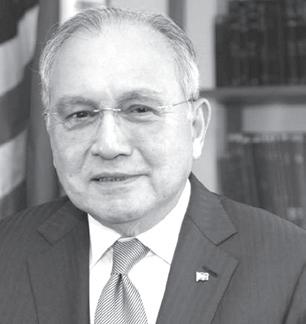
LAST week, we hosted the 12th round of the Philippines-US Bilateral Strategic Dialogue (BSD), a mechanism that may be unfamiliar to many Filipinos but has quietly become a major pillar of our alliance. Having spent the past several years in Washington, I have so far attended seven
of these dialogues, which is regarded at the highest levels of the United States government.
Outwardly, it is a meeting –formal, structured, diplomatic. But in reality, it is much more than that: it is where two treaty allies sit down as partners to shape the future of their relationship amid an increasingly uncertain and complex world. It is where priorities are aligned, concerns addressed and commitments reaffirmed.
This year’s dialogue was especially meaningful because it took place as we celebrate 80 years of diplomatic relations and 75 years of our Mutual
The views expressed by our Op-Ed contributors are solely their own and do not necessarily reflect the predilection of the editorial board and

LAGMAY ORIEL Publisher & Chairman of
Defense Treaty – a relationship forged in the aftermath of World War II, strengthened by decades of shared sacrifice, cooperation and mutual trust. From our embassy in Washington, it’s clear that the Philippines today is viewed not simply as a friend, but as a key strategic partner in maintaining peace and stability in the Indo-Pacific. The BSD reflects that reality and underscores our growing importance on the regional and global stage. The discussions covered a wide range of issues – from defense and security cooperation
and covenants to indemnify AJPI and its officers against any and all loss, liability, damage, expenses, cost, charges, claims, actions, causes of action, recoveries, judgments, penalties, including outside attorneys’ fees (individually and collectively “Claims”) which AJPI
first president of the independent Republic of the Philippines, inaugurating what is commonly described as the Third Republic.
The presidency then evolved through reconstruction and reform under Elpidio Quirino, Ramon Magsaysay, Carlos P. Garcia, Diosdado Macapagal, Ferdinand Marcos Sr., Corazon Aquino, Fidel V. Ramos, Joseph Estrada, Gloria Macapagal Arroyo, Benigno Aquino III, Rodrigo Duterte and Ferdinand Marcos Jr..
Each presidency reflected the national condition of its time. The office has evolved through the interplay of public choice, institutional design and historical circumstance.
And that is why 2028 matters.
The nation at stake
Today, the Philippines is home to more than 110 million people, one of the most populous nations in Asia. It is young, urbanizing, digitally connected and globally mobile. Its workforce powers industries abroad. Its diaspora of more than 10 million Filipinos overseas extends the nation’s reach across continents.
This is not a small republic. It is a complex society marked by regional diversity, economic contrasts and generational change. The president elected in 2028 will govern not a monolith, but a living mosaic.
The leader must reflect that breadth.
The emerging 2028 landscape
The next election cycle is already taking shape. Sara Duterte has publicly declared her intention to run in 2028, becoming one of the first nationally recognized officials to signal interest in the presidency. Her declaration marks the start of early positioning for the next presidential race.
Her announcement does not define the field, nor does it predetermine the outcome. It simply marks the beginning of what is expected to be a competitive and consequential national election.
Three structural forces elevate the stakes.
Institutional credibilityPublic trust in governance and democratic institutions must be reinforced and safeguarded against institutional decline.
Geopolitical positioning - The Philippines sits at the center of Indo-Pacific recalibration. Leadership will determine how sovereignty, alliances and economic strategy are balanced.
Generational transition - A youthful electorate demands economic mobility, digital opportunity and climate resilience. The next president must combine continuity with forward competence.
Homeland and diaspora
More than 10 million Filipinos live or work abroad. Their remittances sustain families. Their professional networks expand the country’s global footprint.
For them, what happens in Manila carries direct consequences, shaping investment decisions, migration frameworks, labor protections and long-term security.
Other globally dispersed communities illustrate how distance does not dilute identity. The worldwide Jewish population is relatively small, yet Jewish identity has remained cohesive across centuries and continents. Whether American, Israeli or European nationals, many maintain a shared historical consciousness that transcends geography. Engagement with developments affecting Jewish communities is rarely seen as optional. It is treated as a matter of collective responsibility.
The comparison underscores a simple truth.
A dispersed people can remain united when identity precedes geography.
If Filipinos everywhere embrace a disciplined Filipino-first identity, not in conflict with adopted citizenships but as a durable cultural anchor, homeland governance becomes a civic obligation. National direction is no longer distant. It carries consequences across borders.
In that framework, the presidency is not merely a domestic office. It becomes a symbol of
national continuity for Filipinos wherever they reside.
The standard we must demand
A president does not create a nation’s character. A president reflects it and, at decisive moments, amplifies it.
The leader Filipinos choose in 2028 must represent more than a coalition. The leader must reflect a population of over 110 million citizens and millions more abroad, diverse in region, class and generation, yet united in aspiration.
If Filipinos desire institutional stability, the leader must respect institutions.
If Filipinos want economic dignity, the leader must practice fiscal discipline.
If Filipinos demand global respect, the leader must conduct foreign policy with clarity and steadiness.
If Filipinos seek unity across regions, classes and beliefs, the leader must govern inclusively.
Representation is not symbolic. It is embodied in leadership.
A people this large and this globally dispersed deserve leadership equal to their scale. A people who see themselves as principled should elect a principled president. A people who value resilience should choose a resilient steward. A people who seek global competitiveness should prioritize administrative competence over personality-driven politics.
In the end, 2028 is not solely about one candidacy or one coalition.
It is about alignment between a nation of more than 110 million citizens and the individual entrusted to lead them.
The leader should not merely win the Filipino vote.
The leader should reflect the Filipino nation.
When that alignment occurs, governance gains legitimacy that extends beyond law. It rests on moral authority.
The result is not simply the election of a president, but an affirmation of who the Filipino nation believes itself to be. (AJpress) n

Enrique de la Cruz, Ph.D.
A news article from Reuters, February 2, headlines, “ICE to Spend $38.3 Billion On Detention Centers Across the US.” $38 billion is a lot of beds. Have we been here before? The plan to build large-scale ICE detention centers reminds me of those concentration camps the U.S. built to detain Japanese Americans during the 2nd World War (WWII).
Eighty-four years ago this week, on February 19, 1942, President Franklin D. Roosevelt issued Executive Order (EO) 9066, ordering the relocation of Americans of Japanese ancestry into concentration camps for national security reasons. In the six months that followed EO 9066, Japanese Americans, especially those living along the West Coast, were forcibly relocated into concentration camps hastily built at various locations within the western region of the United States. Major camps were established in desolate locations, notably Manzanar and Tule Lake in California; Poston and Gila River in Arizona; Rohwer and Jerome in Arkansas; Minidoka in Idaho; and
along with streamlined systems are institutional time-saving investments that help prevent unnecessary mental drain.
The Second Congressional Commission on Education (Edcom 2) has rightfully identified teacher burnout in public schools as a critical issue. According to their findings, 42 percent of teachers work over 50 hours per week. Aside from teaching, educators spend significant hours on nonteaching duties, including administrative, clerical, and coordination work. Fragmented attention, constant deadline pressure, and compliance with multiple metrics create conditions that inevitably cause chronic time scarcity.
Topaz, Heart Mountain, and Amache in Utah, Wyoming, and Colorado, respectively.
Roughly 120,000 Japanese Americans were incarcerated in these camps.
For ICE (Immigration and Customs Enforcement), Reuters notes that “the detention centers will be paid for with funds from the massive spending package the Republican-controlled Congress passed in July 2025. That package, known as the ‘One Big Beautiful Bill,’ included an unprecedented $170 billion for immigration enforcement, with $45 billion earmarked for detention.”
The 2024 fiscal year budget designated only $3.4 billion for immigration detention. $45 billion is a 13-fold increase.
Various reports note that ICE is rapidly expanding detention capacity to 100,000 beds within its many detention centers. It is converting warehouses into mass detention centers in Texas, Georgia, New York, and other locations. In Texas, a large, multi-building facility is under construction with a capacity of up to 8,500 beds. Sites in Social Circle, GA, and Chester, NY are being established. Florida hosts the notorious “Alligator Alcatraz” in the Everglades. Among these are “mega” centers in El Paso, where Camp East Montana is being
the time and flexibility to do their jobs well. This starts with making their classes more manageable. Class size functions as a time multiplier: a dedicated teacher finds ways to personalize the same content based on the skill level and unique needs of every student in her class. No matter how efficient, a teacher who is constantly handling a class of 50 to 60 students will always play catch-up. Addressing classroom shortages is a crucial step to counter time famine, ensuring teachers will have enough time not just to teach, but also to think, plan, and recover.
expanded with tent structures; Hutchins, near Dallas, is being expanded to accommodate 9,500 detainees. In Clint, El Paso County, DHS recently acquired warehouses for $123 million to establish a mega-center. In Florida, aside from the recently opened Alligator Alcatraz, a high-capacity site named “The Everglades” is planned. Warehouse conversions are underway or planned in Surprise, Arizona; Washington County, Maryland; Berks County, Pennsylvania; and Romulus, Michigan.
These construction projects are being opposed by local communities. Georgia Senator Raphael Warnock has filed an amendment to block funding for Oakwood and Social Circle ICE detention centers, citing opposition from his constituents.
American WWII concentration camps under Executive Order 9066 were maintained from 1942 to 1946, leaving an indelible mark on the lives of over 120,000 Japanese Americans. During their years of incarceration, they were denied the right to vote. They lived behind barbed-wire enclosures, with guards posted 24/7. Despite this, many Japanese American men enlisted and were assigned to Army Battalion 442, one of the most highly decorated combat units of WWII.
PAGE 8
and intentions behind these directives with what is relevant and genuinely responsive to the needs of their school community, rather than implementing everything for the sake of compliance.
approach erodes effectiveness, increases vulnerability to burnout and high staff turnover, and ultimately becomes more costly due to the cycle of constant hiring and retraining. The emotional weight of carrying a mission-driven vocation is
already heavy. When layered with time famine, it becomes unsustainable.
Research on well-being offers an important insight.
Studies in the science of happiness show that spending on conveniences that enable a person to “buy more time”
leads to improved well-being and life satisfaction. Common examples are childcare support, household help, or delivery services. Relief comes from the mental space created by the perception of having more free time. Applied to organizational settings, administrative support,
In response, the Department of Education (DepEd), with guidance from Edcom 2, has since committed to reducing teachers’ paperwork by 57 percent by streamlining reporting systems and hiring more administrative officers, targeting 20,000 new positions to support schools.
Teachers are our greatest assets, and we should give them
Time famine also occurs because of guidelines that do not always take into consideration the realities and complications faced by those on the ground. In a previous column, I wrote about the challenges of implementing cocurricular activities in public schools. Without clear priorities, everything in the list of prescribed events feels urgent and important. School leaders must be trained and empowered to align the goals
The education crisis is not a problem of effort or commitment. Many of our public school teachers are willingly extending themselves to do more for their students, carrying a heavier mental, emotional, and physical load in the process. But an entire sector is exhausted, and understandably so. Until we take time seriously as a finite resource that needs to be strategically utilized and safeguarded, we will continue to undermine the very people we depend on to shape the next generation. (Inquirer.net)
* * *
The opinions, beliefs and viewpoints expressed by the author do not necessarily reflect the opinions, beliefs and viewpoints of the Asian Journal, its management, editorial board and staff.
* * * Email: eleanor@shetalksasia.com n
to economic ties, energy security, technological collaboration and regional stability. These are not abstract concepts; they directly affect our ability to protect our sovereignty, grow our economy and secure a better future for our people.
Perhaps the most important aspect of the dialogue is the shared commitment to strengthening deterrence capabilities. Deterrence does not mean seeking conflict. On the contrary, it is about preventing conflict. It is about ensuring that peace is preserved because potential aggressors understand that alliances are firm and commitments are real.
Our Mutual Defense Treaty remains the cornerstone of that assurance. Through initiatives such as the Enhanced Defense Cooperation Agreement, expanded Balikatan exercises and closer coordination between our armed forces, the Philippines is steadily building its capacity to defend itself.
Equally important are the economic dimensions of our partnership. The US remains one of the Philippines’ largest trading partners and a major source of investment. American companies have helped develop key sectors of our economy, creating jobs and opportunities for generations of Filipinos. As a matter of fact, because of the importance of our strategic alliance, many American companies already in the country are either expanding their operations or, more importantly, their interest in investing in the Philippines has increased exponentially.
Today, new opportunities are emerging in areas such as clean energy, critical minerals, infrastructure, agribusiness and advanced technology. These industries will define the future, and the Philippines stands to benefit from them through our partnership.
Energy security was also a major focus of the dialogue. Reliable and affordable energy is essential to sustain economic growth, and cooperation with the US opens doors to new technologies and investments that can help the Philippines meet its growing energy needs.
Technology is another critical frontier. In an era defined by digital transformation, artificial intelligence and cybersecurity, partnerships with trusted allies are essential. The Philippines stands to gain enormously from collaboration in these areas.
Beyond the substance of the discussions, the dialogue itself sends a powerful signal. It demonstrates that the alliance is active, evolving and forward-looking, showing that both countries are committed to working together to address shared challenges.
Just as important, it reflects mutual respect. Our relationship today is no longer defined by dependence, but by partnership between two sovereign nations with shared interests and shared values.
President Ferdinand Marcos Jr. has pursued a foreign policy anchored on protecting Philippine sovereignty while strengthening alliances and maintaining constructive engagement with all partners. This balanced approach serves our national interest and enhances our strategic flexibility. Again, because of this strategic alliance with the United States, we have been able to expand our multilateral relationships with a lot more nations, particularly with European countries and like-minded traditional friends and allies.
The Bilateral Strategic Dialogue reaffirms that approach. It reinforces the reality that the Philippines is not alone. We are part of a network of partnerships that contribute to regional stability and peace.
PAGE 7
As I reflect on the dialogue, I am reminded of how far our alliance has come. When I arrived in Washington as ambassador in 2017, there was already renewed interest in the Philippines. Today, that interest has deepened into genuine strategic partnership.
American officials now speak of the Philippines with clarity and respect. They recognize our importance, and value our role. This did not happen by accident. It is the result of steady leadership, consistent engagement and a clear commitment to protecting our national interest.
The dialogue in Manila reaffirmed that our alliance remains strong and relevant. It also reaffirmed that the Philippines has an important role to play in shaping the future of our region.
In a world filled with uncertainty, strong alliances provide stability. But more importantly, they provide assurance that nations with shared values and aspirations will stand together in defense of peace.
For the Philippines, this partnership has never been about dependence. It has always been about strengthening our ability to stand on our own feet with confidence, secure in the knowledge that we are not alone in safeguarding our sovereignty and advancing the welfare of our people.
In the end, dialogues such as these do more than define the present – they help secure the future of a nation determined to remain free, sovereign and respected among the community of nations for generations to come. (Philstar.com) * * *
The opinions, beliefs and viewpoints expressed by the author do not necessarily reflect the opinions, beliefs and viewpoints of the Asian Journal, its management, editorial board and staff.
* * *
Email: babeseyeview@gmail.com n
Their forced removal and incarceration were disruptive. Imprisonment meant losing their freedom, careers, and, for many, their lifelong savings. Families lost property, jobs, access to schools, necessary health services, etc. They lost personal belongings, homes, farms, and businesses. Many properties were abandoned, and many were lost forever to tax delinquency or theft. Losses also extended to culture and community due to familial disruption, loss of heirlooms, and the destruction of community structures. These economic losses are estimated in the billions (in current value).
The least measurable, and most invisible loss, was the loss of face resulting from their incarceration. For decades, those who experienced the camps refused to talk about their experience, somehow taking their detention as a mark of disloyalty to the United States. But the Civil Rights Movement of the 1960s and 1970s, which resulted in the passage of civil rights legislation, encouraged the Japanese American Citizens League (JACL) to initiate a campaign for redress and reparations for detainees.
In 1980, the Commission on Wartime Relocation and Internment of Civilians (CWRIC) was formed to examine the internment camps. Three years later, the CWRIC published its findings in a report titled Personal Justice Denied, where the Commission concluded that the forced relocation and internment of persons of Japanese ancestry under EO 9066 had not been justified by military necessity, and that Executive Order 9066 was based on “racial prejudice, wartime hysteria, and a failure of political leadership” (emphasis added). These are damning words.
In 1988, Congress passed the Civil Liberties Act of 1988, which acknowledged and apologized on behalf of the United States government for the injustice done to Japanese Americans. It additionally created a public education fund so American schoolchildren could learn about America’s concentration camps and offered restitution of $20,000 to those who were interned. As President Ronald Reagan signed the legislation into law, he commented that the incarceration of Japanese Americans during WWII was a “grave mistake” which
required the nation to “right a grave wrong” and reaffirm its commitment to “equal justice under the law.” He emphasized that the $20,000 restitution payments were less about property and more about restoring honor and admitting a mistake.
I would be very remiss if I did not give credit to Aiko Herzig-Yoshinaga, herself a detainee, for her painstaking research at the National Archives to uncover documentation that would lead the CWRIC Commission and Congress to conclude that the incarceration of Japanese Americans was based on “racial prejudice, wartime hysteria, and a failure of political leadership.”
America closed the book on the detention of Japanese Americans through the Civil Liberties Act of 1988, which issued a formal apology and provided reparations for those detained.
The book on ICE is still open.
ICE has largely targeted law-abiding immigrants and, in the process, killed two citizens and injured more who tried to protest their raids. This is appalling. Their actions are devoid of common decency, as even a 5-year-old child is arrested, and are rife with human rights violations as families are torn apart and wages and livelihoods are lost. Fear is causing children to be absent from school; workers and day laborers are choosing to stay away from jobs and workplaces that may be subject to ICE raids. ICE is arresting and detaining people without warrants. And many who do not have access to legal representation are summarily deported to detention centers in foreign countries, where the United States pays a hefty fee for each detainee.
The tally of misguided and extrajudicial detention of immigrants, together with injuries and the murder of protesters, is an open book that has yet to be fully investigated. Trump is unapologetic about these, as is his chief enforcer, Attorney General Pam Bondi, who has called Alex Pretti and Renee Good “local terrorists” to justify their murders. Bondi has also pursued “vendetta indictments” against U.S. senators and other political opponents such as Mark Kelly, James Comey, Adam Schiff, and former intelligence officials John Brennan and James Clapper. But the guardrails against these attempted in-
dictments are holding; grand juries, composed largely of ordinary citizens, are refusing to play along. Their refusal to indict Senator Mark Kelly and five other House Democrats for political speech and for exercising their First Amendment rights is salutary and commendable.
As ICE builds detention capacity, raids and arrests continue, ignoring legal guardrails. A federal judge in Minnesota has expressed frustration that ICE has been ignoring hundreds of court orders. But there is a silver lining: USA Today reports that “a striking trend is unfolding at federal courthouses across the nation: judges appointed by both parties are issuing uncharacteristically scathing rebukes of the Trump administration’s immigration crackdown.”
The arrest of immigrants, some being arrested as they come for their immigration hearings, has the ring of the targeting of Jews by Nazis. These mass arrests and detentions are unprecedented in that they are extrajudicially executed without the benefit of warrants. The construction of massive ICE detention facilities akin to those used to detain thousands of Japanese Americans during WWII is alarming. Executive Order 9066 marked a shameful episode in American history, for which an American president issued a formal apology and taxpayers footed the bill for monetary reparations.
This drift toward authoritarianism today can be stopped. When the Trump administration subverts the Constitution it is sworn to protect, the People must reclaim the powers they have delegated by affirming the rule of law and by exercising their power through elections. The Trump regime is actively trying to subvert elections by undermining the power of the states to conduct them. We must defend state sovereignty in administering elections. Then, through our vote, express our outrage against the assault on the Constitution, the rule of law, the violation of civil liberties, killings, and detentions. These we must do or run the risk of having American concentration camps again.
* * *
The opinions, beliefs and viewpoints expressed by the author do not necessarily reflect the opinions, beliefs and viewpoints of the Asian Journal, its management, editorial board and staff. n
of the bloc may ultimately vote according to their individual assessment of the evidence and the constitutional standards governing impeachment.
Supreme Court ruling frames timetable
The renewed impeachment effort follows the Supreme Court’s July 25, 2025 decision declaring unconstitutional the Articles of Impeachment previously transmitted to the Senate. The Court cited the Constitution’s one-year bar rule and due process considerations, ruling that the Senate did not acquire jurisdiction over the earlier proceeding.
The Supreme Court clarified that it did not make a determination on the merits of the allegations against Duterte. It held that any new impeachment complaint could only be filed after the expiration of the one-year prohibition period, which lapsed in early February 2026.
On January 29, 2026, the Court announced that
it denied with finality the motion for reconsideration filed in relation to that decision.
House justice panel to assess sufficiency
Under House rules, the Committee on Justice must first determine whether the complaints are sufficient in form and sufficient in substance before further action may proceed. The sufficiency-in-form stage examines compliance with constitutional and procedural requirements. The sufficiency-in-substance stage evaluates whether the allegations, if assumed true, constitute impeachable offenses under the Constitution.
Publicly filed complaints reference allegations related to the alleged misuse or mishandling of confidential funds and other asserted acts that complainants argue may constitute impeachable violations. Vice President Duterte has previously denied wrongdoing in matters involving confidential funds and has criticized impeachment efforts
against her.
Process remains preliminary Malacañang has stated that impeachment is a constitutional function of Congress and that lawmakers are free to determine their respective positions.
At this stage, proceedings remain procedural. No determination of guilt or innocence is before either chamber. If the committee finds the complaints sufficient in form and substance, the process would advance in accordance with constitutional and House rules.
is a constitutional function of Congress and that lawmakers are free to determine their respective positions.
At this stage, proceedings remain procedural. No determination of guilt or innocence is before either chamber. If the committee finds the complaints sufficient in form and substance, the process would advance in accordance with constitutional and House rules. n
by mark ernest Villeza Philstar.com
MANILA, Philippines — Pasig City has been named one of 24 global winners of the Bloomberg Philanthropies 2025-2026 Mayors Challenge.
The city will receive $1 million, along with operational support, to scale up its plan to co-design floating parks and create new community spaces that reconnect its residents to the Pasig River.
Pasig is the only Philippine city included in the list of winners, which spans 20 countries and serves over 35 million people worldwide.
Mayor Vico Sotto said the project aims to address the lack of open and usable public spaces while promoting participatory governance.
“But more than building parks, we want to do this in a way that models participatory governance. We want Pasigueños involved, from designing and building to managing these parks, not just as visitors,” Sotto said.
He said the grant would allow the city to refine its planning processes and deepen

stakeholder engagement to make development programs more sustainable.
The winning proposal evolved during the competition’s prototyping phase. Initially focused on crafting a unified parks master plan, Pasig shifted to piloting floating parks after consultations showed strong community interest and support.
Pasig was selected from
more than 630 applicant cities worldwide. As a finalist last year, it received $50,000 to test and improve its concept with residents.
Michael Bloomberg, founder of Bloomberg Philanthropies and former mayor of New York City, said the challenge supports cities that are “bold, creative and proactive in solving problems and meeting residents’ needs.”n

by andrew ronquillo Philstar.com
MANILA, Philippines —
Manila Mayor Isko Moreno announced yesterday that he would not seek a national post in the 2028 general elections, vowing to focus on continuing local government initiatives and development.
“Be assured: I will just be here in Manila in 2028. As long as the people want me, I’m here for them,” Moreno declared.
Moreno, who lost in the 2022 presidential election, gave the same answer when asked on Feb. 23 about his rumored candidacy in 2028.
He denied that Vice President Sara Duterte visited and
asked him to be her running mate.
Moreno, however, joked that he would run for a second term in the nation’s capital.
Moreno thanked President Marcos for extending financial help to the city to construct a medical school building and procure commercially priced rice for residents.
“We are grateful to the President for the assistance, especially with our fiscal situation, ” Moreno said.
He vowed to prioritize programs for Manila residents such as housing, education, health care and jobs.
Moreno led yesterday the groundbreaking of a 15-story

Binondominium 2 on Delpan street, marking the sixth vertical housing project of the city government.
by KrisTofEr purnEll Philstar.com
MANILA, Philippines — Marks & Spencer (M&S) plans to continue operating in the Philippines under another franchise partner, the British fashion label clarified.
This follows the announcement by Tantoco family-led speciality retailer SSI Group

by EmmanuEl Tupas Philstar.com
MANILA, Philippines — Fed up with misfits in the Bureau of Fire Protection, Interior Secretary Jonvic Remulla has set his sights on dismantling what he described as a deeply entrenched corruption network in the BFP.
Remulla vowed to rid the bureau of scalawags as administrative complaints have been filed against 12 regional BFP officials linked to a slot-forsale scheme and other irregularities.
He said the corruption in the BFP, which has persisted for decades, should be stopped.
“Enough is enough. We have to break the culture of corruption in the BFP,” Remulla said in a statement.
According to Remulla, cor-
that it would shut down all M&S stores by May this year. However, a spokesperson from M&S head office in London said in an emailed statement on Thursday: “After over 20 years of partnership with the SSI Group, we have made the decision to transition to a new franchise partner to sup-
ruption in the BFP has evolved into an estimated P15-billiona-year enterprise through illegal recruitment practices, compromised fire safety inspections, forced sale and refilling of fire extinguishers, and allegations that some business owners were required to pay fees before firefighting services were extended.
The Department of the Interior and Local Government has received 40 complaints related to the slot-for-sale scheme.
Of the number, 21 have been referred to the police Criminal Investigation and Detection Group. The remaining complaints are undergoing verification with the complainants.
Those who were placed on a 90-day preventive suspension were former BFP- Eastern Visayas director Chief Supt. Adel Bautista, Senior Superin-
port our ambitious growth plans in the region. Our contract with SSI will end in May 2026, we thank them for their partnership.”
The spokesperson said M&S objective is to build a trusted global brand by bringing “the best of M&S” to customers around the world.
“We remain committed to the Philippines and the growth opportunity in the region,” the retailer said.
The British brand, which has been operating in the Philippine market for 40 years, said it would share updates on its growth plans “in due course.” /dda

by AJPress
MANILA — Actress and singer Sharon Cuneta publicly expressed admiration for the recent meeting between President Ferdinand Marcos Jr. and Naga City Mayor Leni Robredo, describing their interaction as sincere and free from political insincerity.
In a social media post reacting to photos of the two leaders together, Cuneta wrote that what she saw was “walang balimbingan, plastikan,” a Filipino phrase suggesting there was no opportunism or pretense in the exchange. Her remarks followed the President’s visit to Naga City, where Marcos met with local officials, including Robredo, in connection with infrastructure and community initiatives.
Marcos and Robredo were political rivals in the 2022 presidential election, a contest that underscored deep divisions among their respective
supporters. Their recent public interaction drew attention because of that history.
Cuneta’s post emphasized what she interpreted as mutual respect between the two officials despite past political competition. She suggested that civility and cooperation in governance should not be viewed through a partisan lens, particularly when local concerns and public service are involved.
The President’s visit to Naga City was tied to official engagements related to infrastructure and local development. Government communications about the trip highlighted collaboration with local leadership in addressing community needs.
Public reaction to Cuneta’s remarks has been mixed, reflecting the broader political climate. Some commenters praised her call for respectful engagement across political lines, while others expressed skepticism. n
by AJPress
MANILA — Actress Jasmine Curtis-Smith has denied undergoing plastic surgery, addressing online speculation about changes in her appearance and stating that cosmetic procedures are “just not for me.”
In recent on-the-record remarks during a televised interview, Curtis-Smith clarified that she has not had any surgical enhancements. She said she does not judge those who choose cosmetic procedures, but emphasized that she personally has never undergone one. She also refuted claims circulating on social media suggesting she altered specific facial features.
Responding to photograp-

addresses plastic surgery rumors, says it is “not for me”

hs that prompted speculation, the actress explained that temporary swelling affected how she appeared in certain images. She said emotional strain and crying contributed to changes in her eyes at the time the photos were taken. Curtis-Smith has previous-
ly shared that she has been grieving the loss of her father, James Curtis-Smith. Her sister, actress and television host Anne Curtis, also publicly mourned their father’s passing. The family’s bereavement occurred in January 2024.
She added that if she were ever to consider cosmetic enhancements in the future, she would be transparent about the decision. For now, she reiterated that such procedures are not aligned with her personal preferences.
Curtis-Smith has been active in Philippine film and television since her teenage years and continues to take on roles in both mainstream and independent projects. She has previously spoken about body image, self-acceptance and navigating public scrutiny in the digital age.
Her remarks come amid ongoing conversations in the entertainment industry about beauty standards and personal choice, while affirmin. n
‘Traumatic’

by AJPress
PARIS — For Heart Evangelista, the Filipina actor and fashion icon known globally as a fixture of the front row, the City of Light has long served as a professional stage. But during the recent Paris Men’s Fashion Week, the choreographed glamour was punctured by a security breach that has reignited concerns regarding the safety of high-profile figures in the French capital.
Evangelista and her mother, Cecilia Ongpauco, are reportedly safe following a harrowing unauthorized entry into their Parisian residence in January.
While the incident remained shrouded in "blind items" for weeks, entertainment commentator Ogie Diaz recently detailed a midnight encounter that tested the composure of one of the Philippines' most recognizable exports.
The Anatomy of the Breach
According to accounts provided by Diaz and corroborated by Evangelista’s subsequent public remarks, an intruder gained entry into the apartment where the pair was staying. The suspect reportedly reached the living quarters, turning a routine fashion excursion into a survival scenario.
Evangelista, 41, has since been lauded for her "presence of mind" during the encounter. Reports suggest she remained silent, holding her mother’s hand to prevent an outcry that
might have provoked the intruder. The standoff reportedly ended when a security alarm was triggered, prompting the suspect to flee.
While initial, unverified reports suggested the pair sustained minor abrasions, subsequent public appearances show no signs of physical injury. The loss appeared limited to a bag containing "fancy accessories" and a semi-precious stone; higher-value jewelry remained secured.
From Trauma to Television
The episode underscores a persistent shadow over the international fashion calendar. Paris has a storied history of targeting high-net-worth individuals during major industry events—most notably the 2016 robbery of Kim Kardashian. As of late February, French authorities have not issued a formal statement identifying a suspect.
In typical fashion for the digital age, the line between private trauma and public narrative is blurring. During a press event this month for her reality series, Heart World, Evangelista alluded to a "traumatic" experience that occurred during her European travels.
"I wasn’t ready to talk about it then," she told reporters, suggesting the full scope of the incident would be a central arc in the show’s premiere on March 7. For Evangelista, the event serves as a rare moment of vulnerability in a career defined by curated perfection. n
by AJPress
— Actor and civic advocate Dingdong Dantes called on young Filipinos to move beyond memorizing dates and instead understand the deeper spirit of the People Power Revolution, as the country marked its 40th anniversary this week.
Speaking during anniversary-related engagements, Dantes emphasized that Edsa was not only a political turning point but also a demonstration of collective courage and civic participation. He said younger generations, many of whom were born decades after 1986, should take time to examine the values that drove millions of Filipinos to gather peacefully along Epifanio de los Santos Avenue.
The four-day uprising in February 1986 led to the departure of then-President Ferdinand Marcos and the installation of Corazon Aquino as president, ending more than a decade of martial law and authoritarian rule. Historians widely describe the movement

as largely peaceful, marked by civilian resistance, military defections and religious involvement.
Dantes noted that the anniversary provides an opportunity for dialogue between generations. He said stories shared by parents, teachers and survivors of the events can help contextualize the risks taken by ordinary citizens.
According to publicly reported remarks, he encouraged young people to reflect on how democratic freedoms were secured and how they can be
protected.
Commemorative activities marking the 40th year included gatherings at the Edsa Shrine, educational forums and cultural programs revisiting the movement’s historical impact.
Dantes clarified that his message centered on civic awareness rather than partisan politics. He framed the anniversary as a reminder of shared responsibility in sustaining democratic institutions and promoting informed participation in national affairs. n
“Kwento ng buhay namin,” she said. “It’s about a father-daughter relationship. It’s also about forgiveness. Like what I posted before, there’s a line there that really made me say yes to this project. Marami talagang maiiyak sa movie na ‘to.”
“Nakaka-relate (ako) oo! I love you, Pa!” she added.
“Wala naman,” was her answer to the question if she and her father were going through something during the shoot.
“It’s just that I think lahat ng father-daughter relationships makaka-relate dun sa nangyari dun sa kuwento.”
She acknowledged her social media post that the “movie healed me in ways I so desperately needed.”
“Kasama yung movie na ‘to sa paghi-heal ko sa part na yun, if ever man meron,” she further told the press. “It had a huge impact on me really.”
Asked if she could relate from the point of view of a parent herself, she said, “Hindi ko pa iniisip ‘yun that way. Pero kung may sasabihin man ako sa mga anak ko, it’s the same thing — dapat mag-forgive

In the film, her father is played by veteran star Albert Martinez, who readily agreed how “The Lotto Winner” could resonate with parents and their children.
“Actually, many people will be able to relate to the story because you know how our world is nowadays, the family is busy, the parents are busy and maybe it’s not intentional but neglect happens when it comes to the children,” the actor explained.
“I’m sure many will be touched by this. It’s a wake-up call for others. Parang wait a minute, this is more important. Minsan kasi trabaho tayo nang trabaho that we forget that someone is waiting for
by kristofer Purnell Philstar.com
MANILA, Philippines —
The National Bureau of Investigation issued subpoenas to beauty queens Michelle Dee and Samantha Panlilio, as well as actress Rhian Ramos, in relation to a controversy involving the latter's driver.
It is alleged that that three women assaulted and "tortured" the driver inside the actress' condominium on January 17, causing him to contemplate ending his life.
The three denied the claims, with Michelle even filing a blotter report against the driver, noting that he "physically harmed her on the right arm that left bruises and scratches and nail marks."
Another point of contention was whether the driver allegedly stole an "angpao" that contained sensitive photographs of the women.
Michelle's attorney Maggie Abraham-Garduque confirmed to Philstar.com that their office received the subpoena for the Miss Universe Philippines 2023 titleholder last week.
"We understand that part of the case build-up/investigation of [the] NBI is to send subpoenas to respondents so that their side can also be heard on this matter," Abra-

ham-Garduque said. "We will comply with the subpoena and will assess whatever evidence [the] NBI has gathered against our client and will submit the counter-affidavit of Michelle, if necessary."
Abraham-Garduque also said that the other party received a subpoena from the Office of the City Prosecutor of Makati regarding the qualified theft case Michelle filed against the driver dubbed Totoy.
Ramos and Michelle Dee Rhian Ramos via Instagram posed to be hearing for the submission of Totoy's counter-affidavit but he appeared at the hearing and merely asked for an additional period to file his counter-affidavit," the lawyer shared. She said the fiscal gave the driver until March 3 to submit the counter-affidavit or else the case will be submitted for resolution.
"On February 24 ang unang pandinig which was sup-
"We hope that at the end of the day, the truth shall prevail and justice be served to those who duly deserved it," Abraham-Garduque ended. n
you, for your hug, for your love and you’re not there. Ito po yung magbibigay sayo ng liwanag, teka muna, meron pa pala akong dapat isipin pa.”
According to the synopsis, “The Lotto Winner” — directed by RC Delos Reyes — follows an estranged father (Albert Martinez) and his daughter whose lives are upended after he wins the lottery. Set against the backdrop of Canberra, Australia, the family drama focuses less on the windfall itself and more on its emotional aftermath, exploring how sudden wealth impacts their fractured relationship and uncovers deeper family secrets. It’s still showing in SM Cinemas nationwide. n
MANILA — Veteran Filipino actor Pepito Rodriguez, born Jose Maria Rodriguez, has died at the age of 83. His passing was confirmed by family members on Thursday, February 26, 2026. He reportedly died of pneumonia.
Rodriguez was widely recognized as one of the contract stars of Sampaguita Pictures, one of the country’s major film studios during the postwar era. He was introduced as part of the studio’s “Stars of ’66,” a batch of young performers groomed for leading roles at a time when the Philippine film industry operated under the traditional studio system. Emerging in the 1960s, Rodriguez built his screen career during a formative period for local cinema. The
studio model relied on inhouse actors, directors and production teams to produce a steady slate of commercial films. Within that system, Rodriguez developed a following among moviegoers
and became known for his matinee-idol appeal.
Colleagues and relatives described him as soft-spoken and gracious to fans. In later years, he made occasional public appearances connected to retrospectives honoring veteran artists of the studio era. In 2024, he was among the senior performers recognized for contributions to Philippine cinema during an awards ceremony celebrating industry milestones.
Rodriguez’s passing marks the loss of another figure from the generation of actors who helped define mainstream Filipino filmmaking in the 1960s and 1970s. His body of work remains part of the legacy of the studio period, a chapter often cited as foundational to the evolution of the country’s motion picture industry. n

MANILA — Yardstick Coffee has been included in the 2026 edition of the World’s 100 Best Coffee Shopslist, making it the only Philippine coffee chain recognized in this year’s global ranking.
The Makati-founded specialty coffee company placed No. 34 in the 2026 roster. The annual list is compiled by an independent international ranking platform focused on specialty cafés. According to its published methodology, the selection process combines verified public voting with evaluations conducted by industry professionals.
Criteria include coffee quality, barista expertise, service standards, innovation, ambiance, sustainability practices, food offerings, and overall operational consistency.
Founded in 2013 by Andre Chanco, Jessica Lee, and Kevin Tang, Yardstick operates as a privately owned Philippine company. It is not affiliated with a multinational beverage conglomerate and maintains independent operations, including its own inhouse roasting program.
Within the Philippine specialty coffee sector, the brand is known for sourc-
ing traceable beans, refining roast profiles internally, and implementing structured barista training to maintain consistency across branches. Its menu development balances specialty-grade precision with broader market accessibility, while its café design and service approach align with international specialty standards. Yardstick previously ranked No. 18 in the 2025 edition of the list. Despite the change in placement, it remains the sole Philippine chain included in the 2026 rankings. n
by Jan milo sEvEro Philstar.com
MANILA, Philippines — BINI leader Jhoanna believes that her girl group deserves the right to keep certain parts of their personal lives private.
This is to protect not only themselves but also their families and loved ones who are not in showbiz.
According to Jhoanna, “mutual respect” between artists and their supporters is very important in today’s world, especially when it comes to “relationships and personal affairs.”
“’Yung pagiging curious nila, normal naman ‘yun. Siyempre supporters namin sila. Ever since, may nakasama kami simula pa lang. Pagiging curious, it is okay,” BINI leader Jhoanna told ABS-CBN News.
“Pero feeling ko natutunan namin last year na, some

things are meant to be private and protected.”
Jhoanna pointed out: “Hindi lang ito dahil gusto namin itago. Gusto namin i-protect. ‘Yun din sana maintindihan nila.
“Siguro ‘di lang Blooms, pati casuals. Human din kami. Paano nila i-treat sarili nila, ganoon din kami. Normal din po kami,” she added.
REVIEW: 'Sisa' is a powerful story of madness in a time of war
by miKhail lEcaros Philstar.com
Jun Robles Lana's Sisa takes place in 1902, three years after Spain's infamous ceding control of the Philippines (along with Guam and Puerto Rico) to the United States after losing the Spanish-American War. For a people who'd been promised independence from colonial rule before the treaty, the betrayal led Filipinos to rise against the Americans in one of our nation’s bloodiest chapters.
Sisa opens with Hilda Koronel's (Insiang, The Mistress) titular madwoman approaching the outer perimeter of a concentration camp, where Filipino survivors of the ongoing genocide live in brutal conditions under the watch of American soldiers. Forced to live in the compound, Sisa assimilates into life with the local women, performing menial tasks for the colonizers. As the days progress, we learn that Sisa's madness belies a keen analytical mind, constantly observing the camp's goings-on to fulfill an unknown agenda. By the time we reach the film's climax, nobody in the camp will ever forget the name of Sisa.
While far from the battlefields of Heneral Luna or Sakay, the conflicts depicted here are no less brutal or provocative—from Eugene Domingo as a wife robbed of her husband and sons, to Jennica Garcia’s Leonor carrying on an illicit relationship with the garrison commander, experiencing the war through the traditionally marginalized female lens gives it a perspective rarely seen in the genre.
Koronel is the main draw here, and with good reason— despite this being her first onscreen role in thirteen years, you wouldn’t know it from her performance. With Sisa remaining purposefully mute for the bulk of the film, Koronel’s
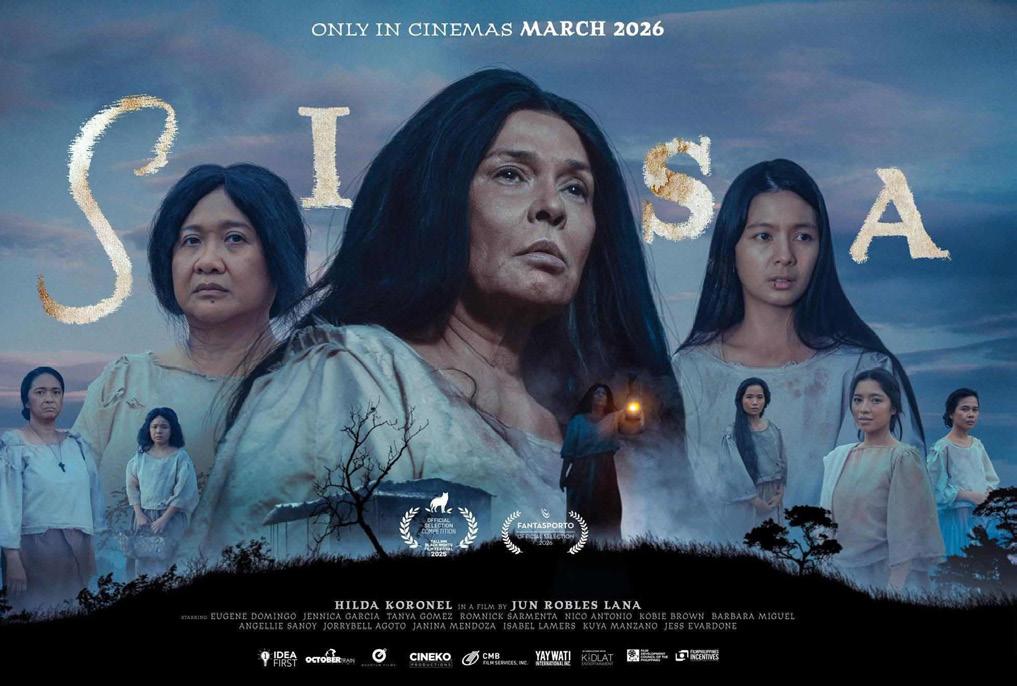
legendary ability to convey character through body language and facial expressions is on full display. Introduced as a near-silent amnesiac, the moments where Sisa does use her voice are made all the more impactful.
Domingo reunites with her And the Breadwinner Is… director Lana to deliver a solid turn as a broken matriarch, her overwhelming distrust of the occupying forces being justified in the worst possible way. Garcia's character is decidedly more complex, fraternizing with the enemy in every sense, blinded to the Americans’ atrocities by a woeful combination of self-delusion and naiveté.
While the script takes a definitive stance on the morality (or lack thereof) of the events taking place, it largely avoids placing judgments on its characters for their actions. Given that few, if any, of the people watching would have found themselves in similar circumstances, it’s difficult to say what one would do in any of these characters’ places. It’s a question that Lana’s screenplay asks of the audience, while leaving the answer entirely up to interpretation.
At the media conference immediately after the preview screening, Lana shared that his intention wasn’t to present
history as it was, but to place his narrative in a representation of the time period—an experience heightened by non-diegetic sound design, costume choices, color grading, and computer-rendered skies that enhance the shooting location’s landscapes. This may not be an entirely accurate historical recreation, but the questions posed by the story are endlessly relevant. By the time we reach the bravado final act, the tension reaches an almost breathless intensity, anchored by everything we’ve learned about these characters and their respective situations. If one had to nitpick, it would have been nice to see some of the scenarios discussed, though that's more a question of resources than anything else; what we’re given here is rendered no less compelling by their absence.
Overall, the film is a fascinatingly raw take on one of the darkest periods of Philippine history, told from an angle that demands conversation. That the Filipinos of the time were subjugated goes without saying, the fact that divisions and marginalization existed and continue to exist gives the film its core. It’s an intriguing dilemma, and one well worth exploring further. Long live the revolution.
'Okay kami': Ai Ai delas Alas gets in touch with Kris Aquino
Members of the girl group have faced issues in the past.
Jhoanna herself was recently the subject of rumors after social media users speculated that she and rapper Skusta Clee were an item. Some claimed that the two were spotted in Vietnam after similar photos of the places they allegedly visited were posted on social media. n
by Jan milo sEvEro Philstar.com
MANILA, Philippines —
Comedian Ai Ai delas Alas revealed that she and Kris Aquino are now talking again, noting that time heals all wounds.
Ai Ai was asked by Boy Abunda in an episode of the latter's afternoon show aired last February 12 if she was
able to contact Kris again. She revealed in her past interview with the media that she sent a message to Kris but did not get a reply.
“Okay kami. Nag-usap na kami. Sabi nga, time heals all wounds. Of course, I wish her well because she is my friendship all the way,” she said.
Ai Ai said during the ambush interview that Kris will
always be her friend despite past issues.
“She'll always be my friendship,” Ai Ai told reporters at last week's press conference for her new movie "Batang Paco."
“Si Kris ay naging part ng buhay ko. She’s my friendship. She’ll [always] be my friendship kahit anong mangyari,” she added. n
by John paTricK magno ranara Philstar.com
In February 1986, nearly two million Filipinos gathered along EDSA in a peaceful show of defiance that would change the course of the nation’s history.

THE People Power Revolution ended the two-decade rule of former president and dictator Ferdinand Marcos Sr.; however, it did more than restore democracy in the Philippines.
The four-day uprising proved that a dictator could be toppled not by armed struggle, but by collective civilian action, prayer, and unity. Because of this, it sent a powerful message across
after EDSA)
One of the movements said to have been inspired by the EDSA Revolution was the fall of the Berlin Wall, which was a heavily guarded concrete barrier that divided the city of Berlin from 1961 to 1989 during the Cold War. It was built by the government of East Germany to prevent its citizens from fleeing to West Germany,
the globe: that ordinary citizens, when mobilized peacefully, can challenge even the most entrenched authoritarian regimes.
In the years that followed, many other countries followed Filipinos' footsteps and held their own waves of non-violent protests in an effort to make a change in their country. Here are some of the revolutions and democratic movements that were known to have been inspired, in part, by the legacy of EDSA:
Dismantling of the Berlin Wall (1989, three years
stretching about 155 kilometers and included guard towers, barbed wire, and a so-called “death strip” to stop escape attempts.
On Nov. 9, 1989, after weeks of protests, East German authorities announced that citizens could cross the border freely. Crowds peacefully gathered, checkpoints opened, and the wall was eventually torn down. Due to the role of the People Power Revolution in inspiring the movement, the Berlin Senate Chancellery donated a segment of the Berlin Wall to the Philip -
ries of nationwide protests calling for constitutional reforms and direct presidential elections.
the suppression of political opposition.
After years of authoritarian rule, mounting public
pines as a symbol of unity and freedom, arranged through the Department of Foreign Affairs and the Philippine Embassy.
The section is on display at the National Museum of the Philippines.
Ouster of South Korean dictator Chun Doo-hwan (1987, a year after EDSA)
Similar to the Philippines, South Korea was also ruled by a brutal authoritarian regime under its former president Chun Doo-hwan.
Doo-hwan was a South Korean army general who served as the fifth president of South Korea from 1980 to 1988. His rule was marked by strict military control that led to the arrest of opposition leaders, suppression of the press, and the massacre of protesters.
Public anger against authoritarian rule continued

Doo-hwan eventually conceded and allowed the December 1987 presidential election to be free and open.
Lawyer Michael Yusingco of the Ateneo School of Government stated in his article that the EDSA Revolution was the "watershed event that inspired South Koreans to remove their own despotic leader."
Overthrow of Chilean dictator Augusto Pinochet (1988, two years after EDSA)
Augusto Pinochet, who became president of Chile in 1974, was another dictator who was ousted from his position thanks to peaceful demonstrations.
The regime of Pinochet

to grow throughout the 1980s, eventually culminating in the June Democratic Uprising in 1987—a se -
was marked by widespread human rights violations, including enforced disappearances, torture, and
protest calling for democratic reforms and an end to military dictatorship.
However, the otherwise peaceful protest ended in bloodshed as troops opened fire on demonstrators, resulting in thousands of deaths.
While the 8888 Uprising did not immediately topple the military regime, it became a powerful symbol of resistance. Research database EBSCO noted how the political events in Burma were "following the trajectory of the People Power movement in the Philippines."
Wild Lily student movement (1990, four years after EDSA)
pressure and international scrutiny led to a historic plebiscite in 1988. In the national referendum, Chileans were asked to vote “Yes” or “No” on whether Pinochet should remain in power for another eight years.
In a largely peaceful exercise, the “No” campaign
Another peaceful protest that took place after the EDSA Revolution is the Wild Lily student movement in Taiwan.
This is a large-scale protest that lasted for six days in 1990 and was organized primarily by students from different universities, involving more than 20,000

prevailed, effectively ending Pinochet’s 15-year rule.
The vote paved the way for democratic elections in 1989 and Chile’s transition back to civilian governance.
The 8888 Uprising (1988, two years after EDSA)
Myanmar—then known as Burma—was also grappling with decades of totalitarian rule under the Burma Socialist Programme Party, headed by General Ne Win. Because of the party's focus on economic isolation and the strengthening of the military, Burma became one of the world's most impoverished countries. Eventually, the public had had enough, and on Aug. 8, 1988—hence the name “8888”—thousands took to the streets in a nationwide
participants.
It was made to challenge the continued dominance of the old National Assembly, which had been in power since the 1940s, and called for the direct election of the country's president and vice president. Protesters adopted the white wild lily as a symbol of purity and strength.
When the National Assembly prepared to elect the president in 1990, thousands of university students gathered at Chiang Kai-shek Memorial Square in Taipei to demand democratic reforms.
Then-president Lee Teng-hui met with student leaders and later initiated political reforms.
n
My P.E.P. (People, Events,Places)

I voted for then-presidential candidate Jose Claveria de Venecia Jr. in 1998, but he lost in the national elections. Despite that defeat, he never stopped serving the country. His public life continued well beyond any single electoral outcome.
I first learned of his passing from Carissa Cruz Evangelista, my former officemate at DTI-CITEM and a former trade undersecretary. She is the eldest daughter of Congresswoman Gina de Venecia. The congresswoman has long expressed admiration for her husband, Joe, underscoring his commitment to national service and his role as a devoted family man.
During the last night’s wake at Heritage Memorial Park for the people’s beloved Joe — JDV or Pepe, as he was fondly called — Carissa delivered a moving eulogy for her stepfather:
“Now I stand here in my 50s, eulogizing a man of destiny and history — a five-time Speaker who will be buried as a hero of our nation this Wednesday. I look back at how my stepfather shaped the woman I am today. When I met you years ago, I had no idea how you would impact my life, or that I would have a stepfather who helped shape a nation and would be buried as a hero. I read somewhere that to find the true meaning of one’s life, you find it only in death. It is only after we die that it becomes clear what our mission in life was. From all the eulogies and stories, your mission is now clearer to me: father, grandfather, husband, uncle, cousin, friend, peacemaker, consensus builder, international diplomat, journalist, fivetime Speaker, businessman, Father of Pangasinan, elder statesman, and hero.”
On the first and last nights of the wake, I also met Sandra de Venecia Haner, the eldest daughter of Congressman Joe de Venecia. She studied for her doctorate in Chemistry at Princeton University in New Jersey. She shared a person-
al memory:
“My happy memory of my dad is when he visited me in Princeton. He was always asking questions about what I did and why I should do it. He was intellectually curious. He was really a very good man.”
Later, Joey de Venecia — whom I first interviewed during the 1998 presidential elections for Philippine Graphic Magazine’s cover story — reflected on his father’s later years:
“I have a lot of good memories with my father. There were moments when I spent a lot of time with him, especially after he retired from politics. I saw him often after he left Congress in 2010. For the last 15 years, we treasured good memories — traveling with him, participating in conferences, and spending quality time on the non-political side of life.”
As I thanked Sandra for the interview, she introduced me to William Xiao, one of the Chinese scholars who studied in the Philippines. Xiao recalled JDV’s warmth:
“When we visited his house in Makati City, Joe de Venecia, my mentor, was happy and generous in showing us many photos of world leaders, including Chinese leaders. He had good personal relationships with them and was a peacemaker. Thank you, Joe de Venecia, for your hospitality and generosity while we were studying in the Philippines.”
Fresh in my memory was an excerpt from Alin de Venecia-Medalla’s tribute to her uncle JDV. She is the daughter of Tito de Venecia, JDV’s youngest brother:
“Choosing laziness — or just ‘being lazy’ — was especially sweet after JDV spent hours meeting hundreds of constituents during long campaign stretches, meetings, and countless events. He would randomly call my dad and ask if he could spend a few hours at our beachside home in Bolasi, San Fabian, Pangasinan. JDV already had his famous beachside home in Binloc, but he still preferred to come to Bolasi to just chill — somewhere no one would see or bother him. He loved swimming in the pool and at the beach, and having picnics afterward in the garden. JDV truly enjoyed the simple joys. He worked



hard, but he also knew when it was time to relax and recharge.”
Pulitzer Prize winner and former president of the Foreign Correspondents Association of the Philippines Manny Mogato shared his recollection:
“I used to go to his Dasmariñas Village house in Makati City for interviews. He was so much fun to interview. He was a very warm and amiable person.”
Cecile Guidote-Alvarez, UNESCO Artist for Peace and president of the International Theatre Institute-Social Change Network, remembered JDV’s support for indigenous peoples and environmental advocacy. She cited his role in opening the Batasan complex for a historic gathering of indigenous leaders and youth, attended by President Fidel V. Ramos, Prince Alfred von Liechtenstein of Austria, and Nobel laureate Rigoberta Menchú. The gathering contributed momentum to the Indigenous Peoples’ Rights Act and broader recognition of cultural heritage and environmental stewardship.
Connie Guanzon-Garcia, wife of Ambassador Victor Garcia, recalled JDV’s concern during the Great Hanshin Earthquake that struck Kobe on January 17, 1995:
“House Speaker Jose de Venecia Jr. was the first to call us. He and Gina were so concerned. He immediately advised the Department of Foreign Affairs to assist us and members of the Filipino community. My husband was consul general in Kobe at the time. We are grateful for their love and concern during such a difficult period in our diplomatic life.”
Lastly, Gerald Tabadero, district chief of Rep. Toff de Venecia and Rep. Gina de Venecia, described a leader whose influence extended beyond titles:
“When I think of Jose de Venecia Jr., the first



thing that comes to mind is not that he was a fivetime Speaker. I remember Tatay Joe — always smiling, always with a tap on the shoulder. He had a very personal way of motivating people. Even if you were just staff or newly introduced, he would talk to you as if he had known you for years. If he could help, he would help. No fuss. I will never forget his signature gesture — a tap, a point, and a wink — as if to say, ‘You can do it. I know you can.’ He led not just from the podium, but from the heart.”
Listening to these memories, one sees a portrait that goes beyond legislative accomplishment. It is the

portrait of a father, mentor, bridge-builder and statesman — a man remembered not only for holding office, but for the encouragement he gave and the relationships he nurtured.
I was proud to have voted for him for president in 1998. Today, it is clear that for many, his legacy lives not only in political history, but in personal memory. He will be deeply missed.
Biblical Verse (Ephesians 2:8) “For it is by grace you have been saved, through faith.”
Birthday Greetings
Happy birthday to Sam Paderes (Feb. 24); Aldrin Nidar Gantes and Ding Nava -
sero (Feb. 25); Peter Parker Tanada, actress Chanda Romero Alejandrino, Pao Mendoza, and Star Monica Echo (Feb. 26); Jojo Salvador (Feb. 27); actor Lito Gruet and Marie Uy (Feb. 28); Jocel Sallan Zamora, Coco Laurel, Lea Mae Suycano, and Jenny Juico (March 2); Lila BM, Tolits Contaoi, Marino Boy London, Rowena Carranza Paraan, and Roy Iglesias (March 3).
* * *
The opinions, beliefs and viewpoints expressed by the author do not necessarily reflect the opinions, beliefs and viewpoints of the Asian Journal, its management, editorial board and staff.
* * * rogeliocmedina@yahoo.com n
