Rev. Jesse Jackson, champion of economic justice and civil rights, dies at 84
CHICAGO — The Rev. Jesse Jackson, a Baptist minister who spent more than five decades linking civil rights advocacy to economic empowerment, died Tuesday, February 17 at age 84, according to his family.
Jackson died at his home in Chicago, his family said, describing his passing as peaceful and surrounded by loved ones.
While he first rose to prominence during the 1960s civil rights era working alongside
Major U.S. cities issue directives limiting ICE use of municipal property; prosecutors warn of state-level accountability
Several major U.S. cities have issued executive directives in recent weeks aimed at limiting how and where agents of U.S. Immigration and Customs Enforcement (ICE) may operate within municipal boundaries, particularly with respect to city-owned property.
The actions — announced in Los Angeles, New York City, Chicago, Boston, Oakland and Seattle — focus on restricting the use of municipal facilities and directing local law enforcement to document certain federal immigration enforcement activities occurring within city limits.
Municipal directives
In Los Angeles, Mayor Karen Bass signed an executive directive prohibiting the use of city-owned or city-controlled property for federal immigration staging, processing or operational purposes. The directive also in-
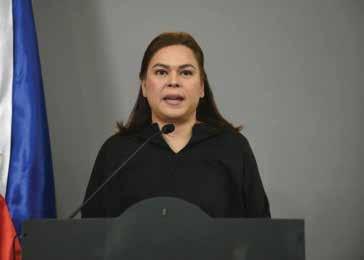
Sara Duterte declares 2028 presidential bid
by AJPress
Authorities say vlogger Jack Argota appeared before investigators and submitted a sworn statement, while Malacañang stresses that the case remains under investigation and no charges have been filed. The longtime Baptist minister and founder of Operation PUSH and the Rainbow PUSH Coalition spent more than five decades pressing corporations and political institutions to expand economic opportunity alongside racial equality.
Marcos, Robredo set to meet in Naga
by Alexis RomeRo Philstar.com
MANILA — Will President Marcos and his former political rival Leni Robredo bury the hatchet to counter a common opponent?
Speculations mounted that the Marcos administration and the Robredo camp may forge an alliance for the 2028 elections after Malacañang revealed that the President would visit Naga City to discuss flood control projects with local officials.
Robredo, who defeated Marcos in the
NBI subpoenas vlogger in probe of fabricated Marcos medical report
by AJPress
The National Bureau of Investigation has subpoenaed a social media personality as part of its investigation into the circulation of a fabricated medical document concerning President Ferdinand Marcos Jr., officials confirmed this week.
NBI Director Angelito “Lito” Magno identified the individual as vlogger Jack Argota, who appeared before investigators and submitted a sworn statement after receiving the subpoena. According to Magno, Argota told investigators that he reposted the document in order to generate online “engagement.” Authori-
vice presidential race in 2016 but lost in their rematch during the presidential elections six years later, is now the mayor of Naga City.
Presidential Communications Undersecretary Claire Castro said Marcos would oversee the implementation of the flood mitigation project Oplan Kontra Baha in Naga City this weekend.
“The personnel of DPWH (Department of Public Works and Highways) are busy cleaning creeks, drainage and the river in Naga City. The President will visit that and
by AJPress
MANILA — Philippine cash remittances climbed to a record $35.634 billion in 2025, up 3.3 percent from $34.493 billion in 2024, according to preliminary data released by the Bangko Sentral ng Pilipinas (BSP).
December inflows helped lift the annual total. Cash remittances coursed through banks reached $3.522 billion in December 2025, a 4.2 percent increase from $3.380 billion in December 2024 and higher than the $2.910 billionrecorded in November 2025.
Cash remittances refer to transfers sent through formal banking channels and represent a major component of the country’s external receipts. The BSP also reported that personal remittances, which include cash transfers as well as compensation of employees and other current transfers, reached a record $36.619 billion in 2025. In December alone, personal remittances totaled $3.892 billion.
6th District Rep. Bienvenido “Benny” Abante Jr. and La Union 1st District Rep. Francisco Paolo Ortega V, who serves as deputy speaker. Under Article XI of the Constitution, any citizen may file an impeachment complaint with the endorsement of a House member. The House of Representatives has the exclusive power to initiate imu PAGE 2
MANILA — House Senior Deputy Majority Leader Lorenz Defensor said that securing the endorsement of one-third of all House members to impeach Vice President Sara Duterte now appears unlikely, especially after she announced her 2028 presidential bid. “As of right now, as of today, I cannot see getting one-third of endorsement from the members of the House of Representatives,” he said in an ambush in
terview on Wednesday, February 18. “But I can
ing President Bongbong Marcos win the 2022 elections. Defensor added that House lawmakers who endorsed the fourth complaint in 2025 are still dismayed
MANILA — A coalition of civil society organizations, churchlinked groups and political reform advocates plans to gather along Epifanio de los Santos Avenue (EDSA) on Feb. 25, marking the 40th anniversary of the 1986 People Power Revolution with what organizers have labeled the “3rd Trillion Peso March.”
Activities are expected to center near the People Power Monument and the EDSA Shrine, sites closely associated with the civilian-led uprising that led to a transfer of national leadership and the restoration of constitutional democratic governance.
A coalition platform
The Trillion Peso March operates as a coalition platform composed of civic groups, church-linked networks, political reform advocates and individual convenors coordinating under a shared banner rather than a formally registered organization.
Organizers have said the Feb. 25 rally will not call for the resignation of President Ferdinand Marcos Jr. or Vice President Sara Duterte.
Among publicly identified convenors is Francis Joseph “Kiko” Aquino-Dee, a Filipino political
analyst and civicadvocate, and a grandson of former Senator Benigno “Ninoy” Aquino Jr. and former President Corazon Aquino. He has been publicly identified as a co-convenor of reform coalitions associated with the march.
Political advocacy groups such as Akbayan have also been publicly linked to previous gatherings under the same banner. Participating organizations retain their independent legal identities while collaborating on messaging and program coordination.
Organizers have publicly framed the Feb. 25 gathering as reform-driven, emphasizing proposals such as legislation against political dynasties, revisions to the party-list system and broader governance accountability measures. These positions reflect the views of the organizing coalition and are not judicial findings unless validated by competent investigative or judicial authorities.
Security preparations
The National Capital Region Police Office (NCRPO) has announced that Metro Manila will be placed on full alert beginning Feb. 21 in anticipation of anniversary-related gatherings.
by Dominique nicole FloRes Philstar.com
Sara Duterte declares 2028...
PAGE 1
peachment proceedings, while the Senate has the sole authority to try and decide impeachment cases. Conviction requires a two-thirds vote of all senators.
An impeachment complaint constitutes an allegation and does not, by itself, establish wrongdoing.
Public reporting on previous impeachment efforts referenced allegations involving the use of confidential funds and claims of betrayal of public trust. Duterte has previously denied allegations of impropriety and characterized impeachment moves as politically motivated.
Constitutional context
The renewed filing follows prior rulings by the Supreme Court of the Philippines involving earlier impeachment efforts.
In July 2025, the Supreme Court ruled that a previous impeachment process violated constitutional safeguards, citing the one-year bar that prohibits initiating impeachment proceedings against the same official more than once within a year. On January 29, 2026, the Court announced that it had denied with finality the House’s motion for reconsideration of that ruling.
The latest complaint was filed
following the lapse of the period referenced in the Court’s earlier decision.
Political implications
Duterte’s early declaration places her at the forefront of what is expected to be a closely watched 2028 presidential race.
Political analysts interviewed by international and local media described the move as significant, noting that it situates ongoing legislative proceedings within a broader electoral context.
As of this writing, House leadership has not announced
a timetable for referring the complaint to the appropriate committee. Any impeachment process would proceed under constitutional and House rules, with potential transmission to the Senate if approved by the House.
For now, Duterte’s presidential bid and the renewed impeachment effort move forward on parallel tracks – one political, the other constitutional – each likely to shape the national discourse in the years leading to 2028. n
NBI subpoenas vlogger in probe...
ties emphasized that the matter remains under investigation and that no charges have been filed against him as of publication.
“He honored the subpoena issued to him. He gave his statement there. It is still under investigation,” Magno told reporters.
Related complaints filed
In a separate development, the NBI earlier filed a cyberlibel complaint against former broadcaster Jay Sonza and vlogger Jeffrey Luces Celiz, also known as “Ka Eric Celiz,” in connection with the same issue involving the fabricat
ed medical report. Officials said those complaints are proceeding independently.
When asked whether other personalities are being investigated, Magno declined to provide details.
“Right now we can’t say who else we’re investigating as well as
the other things we are doing,” he said. “But rest assured that all of that is being done fairly and professionally.”
Magno also cautioned the public about sharing unverified information online, noting potential liability under the Cybercrime Prevention Act.
“Be very careful because unknowingly, your shared posts might be investigated because this is a violation of our law,” he said.
“There is nothing wrong with sharing. We are just saying to be careful because what you share may be prohibited under our Cybercrime Law,” he added.
Government and hospital denial
The circulating document claimed that the president was suffering from “severe sigmoid diverticulitis” requiring urgent surgical
consultation. The Presidential Communications Office described the report as “fake” and said the president remains fully capable of performing his duties.
St. Luke’s Medical Center also denied the authenticity and accuracy of medical test results bearing the hospital’s name, reiterating that unauthorized use of its branding or purported patient records is improper. Medical information in the Philippines is protected under data privacy and confidentiality laws. Authorities said any determination of criminal liability will depend on the outcome of the ongoing investigation and subsequent prosecutorial review.
For now, officials stressed that the case remains under active inquiry, and no formal charges have been announced against Argota. n
Major U.S. cities issue directives limiting ICE...
1
structs local law enforcement to document enforcement activity occurring on municipal property.
In New York City, Mayor Zohran Mamdani announced policies barring non-city law enforcement agencies from using city property — including certain parks and municipal buildings — as bases of operation for immigration enforcement.
In Chicago, Mayor Brandon Johnson signed an executive order directing the Chicago Police Department to document alleged unlawful conduct by any law enforcement personnel operating within the city, including federal agents.
Boston Mayor Michelle Wu has reiterated enforcement of existing local ordinances limiting cooperation with federal immigration authorities. Officials in Oakland and Seattle have issued comparable guidance regarding access to municipal property and documentation practices.
Comparable policies in other jurisdictions
Several other large cities maintain similar frameworks.
In Philadelphia, compliance with ICE detainer requests is generally limited absent a judicial warrant. District Attorney Larry Krasner has publicly stated that federal officers operating within Pennsylvania remain subject to state criminal statutes if evidence supports violations.
In San Francisco, municipal law restricts the use of city funds or personnel to assist civil immigration enforcement, subject to legal exceptions.
In Denver, local authorities limit voluntary cooperation with civil immigration enforcement and have clarified that municipal facilities are not available for federal staging without authorization.
In Portland, policy aligns with Oregon state law restricting the use of state and local resources for federal immigration enforce-
ment activities not mandated by statute.
In Washington, D.C., the District limits compliance with ICE detainers absent judicial warrants and regulates use of municipal facilities.
In Minneapolis, police policy generally prohibits officers from inquiring about immigration status except where required by law.
Constitutional framework
Immigration enforcement is a federal responsibility under authority delegated by Congress and the executive branch. Under the U.S. Constitution’s Supremacy Clause, federal law generally prevails over conflicting state or local measures, while municipalities retain authority over their property and local personnel.
As of this writing, no court has invalidated the newly announced municipal directives, and no specific prosecution of a federal immigration agent under the coalition framework has been publicly reported. (AJPress)
Will Sara Duterte’s presidential bid...
PAGE 1
after the Senate delayed the trial for six months, and later, when the Supreme Court struck down the impeachment as unconstitutional.
“As of today, malabo ‘yung express na may one-third endorsement and immediate transmittal to the Senate for trial forthwith,” he said.
The so-called “express” or “fast-track” mode of impeachment requires the endorsement of at least one-third of all House members in a single complaint, allowing it to proceed directly to the Senate as articles of impeachment.
This was the approach the House attempted last year. However, the Supreme Court ruled that Congress failed to refer the first three complaints to the justice committee within the required 10-session-day period, which it clarified should be counted as calendar days in the context of impeachment.
The calendar days would cover Mondays to Wednesdays, when Congress is in session, excluding holidays.
Defensor, one of the elected impeachment prosecutors in the 19th Congress, said the more likely scenario is that the complaints will be referred to the House justice committee, which will determine their sufficiency in form and substance.
Even if a complaint is not endorsed by one-third of House members, the plenary must still vote on whether to adopt the justice committee’s recommendation to impeach Duterte or not.
A one-third vote of all members is still required to approve the articles of impeachment and authorize their transmittal to the Senate.
For Defensor, however, Duterte’s announcement appears to be a “strategic decision” designed to rally allies ahead of the 2028 polls, potentially shaping how some lawmakers position them-
selves on the impeachment issue.
“There is a possibility na it will affect the voting of all the members and it will also depend on how the evidence against her will be presented, kung napakabigat (if it’s grave) it may sway towards against her, or it will sway in her favor. Depends. It is a strategic decision to announce it today,” he said.
Since the first two impeachment complaints were filed on February 2, the House of Representatives must include them in the Order of Business by February 24. Otherwise, the impeachment proceedings will again be barred under the one-year rule. The complaints repeat earlier allegations against Duterte, including the alleged misuse of P612.5 million in confidential funds, “fictitious” fund recipients, bribery at the Department of Education, conspiracy to commit murder over alleged death threats against the president, and abuse of power. n
PAGE 1
it’s true, he will undertake a visit and he will be with the mayor, Leni Robredo, of Naga City, on Feb. 21, Saturday,” the Palace press officer said at a press briefing on Thursdy, February 19.
Asked if Marcos and Robredo would have conversations outside the flood control project, Castro replied: “Iyan ang abangan ninyo (That’s what you have to watch out for).”
“That’s the only information provided, since the President has started the Oplan Kontra Baha and one of the areas he wants to focus on is Naga City. As to the other topics they will discuss, let’s watch out for it,” Castro said.
Castro confirmed Marcos’ visit to Naga City a day after Vice President Sara Duterte, a former close ally-turned-arch critic of the administration, announced her plan to seek the presidency in 2028.
Some analysts claim that an alliance between the erstwhile feuding forces supporting Marcos and Robredo is the key to beating Duterte, who continues to enjoy high trust and satisfaction ratings despite efforts to impeach her.
Duterte, who ran alongside Marcos under the now defunct UniTeam coalition in 2022, has been accused of seeking to assassinate Marcos, First Lady Liza Marcos and former House speaker Ferdinand Martin Romualdez and failing to properly account for the confidential
funds allocated to her office, among other allegations. She stepped down as education secretary and vice chair of the government’s anti-insurgency task force in June 2024 following the souring of the relationship between her family and the Marcoses.
As she announced her intention to run for president last Wednesday, Duterte apologized to voters for helping Marcos win and urged them to bring back courage and concern in government. Malacañang wished her luck, but maintained that she has to apologize for the procurement issues during her stint as education secretary, “fake news” and the alleged extrajudicial killings committed during the time of her father, former president Rodrigo Duterte.
Castro said it is too early to talk about politics when asked about the possible political alliances for the 2028 polls.
Among the potential partnerships being floated are that of the Vice President and Marcos’ sister Sen. Imee Marcos and that of Robredo and Sen. Risa Hontiveros.
“There are no discussions on campaigns or candidates for 2028. It’s not yet the time for that. It is too early to announce that you will run or you will not run. It is too early for politics,” Castro said.
“We have a lot of things to fix in our country.”
The Palace press officer also gave assurance that Duterte’s plan to seek the presidency
would not affect the work of Marcos, who she said is focused on growing the economy.
“The announcement that she (Duterte) will run is not shocking because even before, her campaigning is already felt,” Castro added.
Running mates Sen. Bam Aquino Thursday, February 19 denied he will be the running mate of Vice President Sara Duterte in 2028. Aquino posted a short statement on Facebook to call out an Abante News story hinting that a Duterte-Aquino is in the works Aquino was elected to the Senate in 2025. He has a sixyear term and is eligible for reelection.
Rumors of a Duterte-Aquino tandem swirled after Aquino in a television interview said murder as a crime against humanity trial of former president Rodrigo Duterte should “ideally” happen in Philippine soil.
He clarified that he respected the International Criminal Court proceedings against Duterte. In a separate ambush interview, Sen. Erwin Tulfo denied he would make a good running mate of former vice president Leni Robredo should the Naga City mayor again attempt to seek the presidency, this time against Duterte in 2028.
Tulfo pointed to his colleagues Aquino and Sen. Risa Hontiveros as more qualified running mates for Robredo.
Tulfo also was elected to the Senate last year. (With report from Marc Jayson Cayabyab)
President Ferdinand R. Marcos Jr. during a full meeting of the 20th Congress, held at Malacañang Palace on February 10, 2026.
President Marcos is welcomed Thursday, February 19 by students of Minuyan Elementary School in San Jose del Monte, Bulacan, where the
Yaman ng Health Program and DepEd’s Kalinga Caravan are being implemented STAR / File
Marcos, Robredo set to meet in Naga...
Vice President Sara Duterte announced her 2028 presidential
Palace urges Duterte allies named in ICC case to face proceedings as confirmation hearing nears
With the International Criminal Court set to open a confirmation of charges hearing on February 23, Malacañang has urged Philippine officials identified in the prosecution’s case against former President Rodrigo Duterte to face the legal process. The Department of Justice says it will await Supreme Court action before responding to any future warrants. Those named have denied wrongdoing.
by AJPress
MANILA — As the Interna-
tional Criminal Court prepares to open a pivotal pre-trial hearing in the case against former President Rodrigo Duterte, the political and legal implications are unfolding in Manila.
The confirmation of charges hearing, scheduled for February 23–27 in The Hague, will determine whether ICC judges find “substantial grounds to believe” the crimes alleged by prosecutors should proceed to trial. The hearing is procedural and does not determine guilt or innocence.
Who is named in the ICC case
In a less-redacted Document
Containing the Charges dated February 13, 2026, the ICC’s Office of the Prosecutor identified several Philippine officials as alleged co-perpetrators in connection with killings linked to the government’s anti-drug campaign during Duterte’s tenure as mayor of Davao City and later as president from 2016 to 2022.
Those identified in the prosecution filing include:
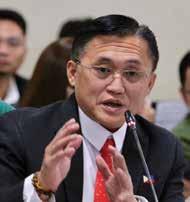
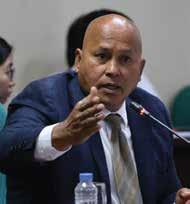
• Ronald “Bato” dela Rosa, a sitting senator and former chief of the Philippine National Police
• Christopher Lawrence “Bong” Go, a sitting senator and former special assistant to the president
• Vitaliano Aguirre II, who served as justice secretary from 2016 to 2018
• Former senior police officials
Vicente Danao, Oscar Albayalde, Isidro Lapeña and Camilo Cascol-
an
• Former National Bureau of Investigation director Dante Gierran
As of publication, no ICC arrest warrants have been publicly announced for the individuals named in the prosecution filing.
Palace: Respect the process Malacañang said it would re-
spect the ICC process and would not shield individuals named in the prosecution filing. Press Secretary Claire Castro urged the officials identified in the document not to “hide” and to face the legal proceedings, referring to senators named as alleged co-perpetrators.
The Palace added that it would not interfere in any legal proceedings arising from the ICC case and would defer to judicial mechanisms.
DOJ: Await Supreme Court ruling
The Department of Justice said it would await a ruling by the Philippine Supreme Court on consolidated petitions concerning Duterte’s arrest and transfer before taking action on any potential future ICC warrants involving other individuals.
Justice officials indicated that domestic judicial review would factor into any enforcement decision within Philippine territory.
Denials from those named Go has publicly denied involvement in unlawful acts and rejected the prosecution’s characterization of his role.
Aguirre has denied participating in criminal conduct related to the anti-drug campaign and said he would pursue legal remedies should a warrant be issued.
Dela Rosa has previously ques-
tioned the ICC’s jurisdiction over the Philippines and maintained that actions taken during his tenure as police chief were lawful. Earlier reporting indicated he had described himself as remaining in hiding, though no official confirmation of his whereabouts has been issued.
The stakes at the February 23 hearing Duterte remains in ICC custody in The Hague. Judges have ruled that he is fit to participate in the proceedings.
At the confirmation of charges hearing, prosecutors will present the evidentiary basis for the case, while defense lawyers are expected to challenge both the substance of the allegations and jurisdictional questions. Judges will then decide whether there are “substantial grounds to believe” the crimes alleged should proceed to trial.
If the charges are confirmed, the case advances to a full trial phase. If not, the charges may be declined or amended.
With the hearing days away, attention now centers on whether prosecutors’ allegations will meet the evidentiary threshold required under ICC rules, a decision that could shape both the international legal process and the domestic political response in the Philippines. n
Eala’s Dubai run ends in quarterfinal loss to Gauff
by AJPress
DUBAI, United Arab Emir
ates — Alexandra Eala exited the Dubai Duty Free Tennis Cham
pionships on Thursday, February 19, after a 6-0, 6-2 quarterfinal defeat to world No. 4 Coco Gauff. Gauff, the tournament’s third seed, established control from the opening game, applying sustained return pressure and dictating baseline rallies with depth and pace. The American secured multiple service breaks in a swift first set and maintained that intensity into the second.
Eala found improved rhythm midway through the match, extending exchanges and creating brief openings on return. But Gauff’s first-serve consistency and disciplined shot selection limited momentum shifts, allowing her to close in straight sets. The quarterfinal appearance marked Eala’s deepest run in Dubai and one of her strongest showings at the WTA 1000 level. The 20-year-old advanced with wins over Hailey Baptiste and Sorana Cîrstea, along with a straight-sets upset of Top 10 player Jasmine Paolini earlier in the
Philippine cash remittances...
PAGE 1
By type of worker, remittances from land-based overseas Filipinos accounted for $2.83 billion of December inflows, while sea-based workers sent $0.69 billion, based on BSP data.
The United States remained the largest source of cash remittances, accounting for 39.7 percent of the total. Other major contributors included Singapore (7.3 percent), Saudi Arabia (6.6 percent), Japan (5.0 percent), and the United Kingdom and the United Arab Emirates (4.6 percent each). Additional source economies cited were Canada (3.5 percent), Qatar (2.9 percent), Taiwan (2.8
percent), and Hong Kong (2.5 percent).
The BSP has noted that remittance data are attributed to the country where the remitting institution is located. Transfers coursed through global financial centers may therefore be recorded under those jurisdictions even if the overseas Filipino worker is based elsewhere.
Remittances remain one of the Philippines’ most stable sources of foreign exchange and continue to support household consumption and external sector stability. The BSP releases remittance data monthly as part of its monitoring of balance of payments developments. n
tournament. Though her campaign ended short of the semifinals, Eala’s performance underscored continued progress on the WTA Tour against elite competition. n
SCRRA is seeking bids for the Bundled Marengo & Rancho Siding Extension Projects. Documents may be downloaded at SCRRA’s website at https//metrolinktrains.com/ contracts/ (Select Vendor Portal). Bids are due at 2:00 P.M. (PST) on April 10, 2026. Register in advance for the virtual ZOOM Pre-Bid conference held on 2/18/2026 at 10:30 a.m. See Summary Sheet in the Instructions to Bidders. For further information, contact Sharon Williams, Sr. Contract & Compliance Administrator at williamsS@scrra.net 2/14, 2/21/26 CNS-4010207# ASIAN JOURNAL (L.A.)
SEN. Bong Go and Sen. Ronald “Bato” dela Rosa ManilaTimes.net file photo
OUT. Filipino Alexandra Eala prepares to serve in the
Ex-Duterte appointee takes over NBI
by Mark ErnEst VillEza Philstar.com
MANILA — An erstwhile Cabinet official of for-
mer president Rodrigo Duterte is set to assume the leadership of the National Bureau of Investigation (NBI).
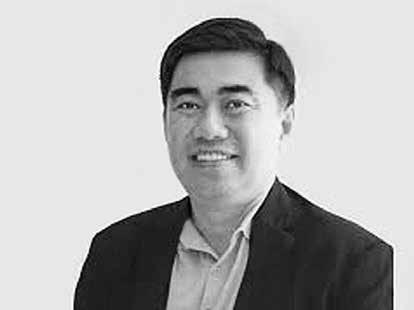
Lawyer Melvin Matibag, who served as Duterte’s Cabinet secretary, will be named NBI director, Presidential Communications Undersecretary Claire Castro said at a press briefing oon Thursday, February 19.
Matibag will replace Lito Magno, who became the NBI’s officer-in-charge in October last year following the resignation of former director Jaime Santiago.
“That’s just the information given to me, that there would be a new NBI director in the person of Atty. Melvin Matibag,” Castro said when asked why President Marcos appointed Matibag to the post.
“First, that’s the prerogative of the President. We can say that he appointed someone because the trust is there. He saw Atty. Melvin Matibag as someone he can trust, someone who can work for the government. But with regard to the reasons, the details were not provided to me,” she said.
Matibag also worked as Manila International Airport Authority general manager and National Transmission Corporation president and chief executive officer under Duterte.
He was also the secretary-general of PDP-Laban, the political party of Duterte, whose family is now at odds with the Marcos administration.
Matibag resigned as the party’s secretary-general in 2023.
Meanwhile, the NBI assured the public of the
continuity of its services as Matibag assumes leadership of the bureau.
In a statement, the NBI expressed gratitude to Magno for his “steadfast and principled lead-
Melvin Matibag
ership,” citing his integrity, professionalism and dedication to public service during his tenure.
“Serving as director of the National Bureau of Investigation has been both an honor and a profound responsibility. I am deeply grateful to the dedicated agents and personnel who stood with me in upholding our mandate,” Magno said.
“I have full confidence that the bureau will continue to carry out its mission with integrity, courage and commitment under its new leadership,” he added.
The bureau said it stands united in ensuring a seamless and dignified transition while assuring Matibag of its full cooperation and support.
It reiterated its commitment to deliver justice “without fear or favor” and to continue serving the Filipino people regardless of changes in leadership.
At the same press briefing, Castro denied rumors that Customs Commissioner Ariel Nepomuceno would be removed from his post.
She said the fake documents about Nepomuceno’s status would be sent to the NBI to determine where they originated. n
Vico files election case vs Discaya
MANILA — Pasig Mayor Vico Sotto has filed an election complaint against former mayoral candidate Sarah Discaya for allegedly violating the campaign spending rules in the 2025 elections.
Accompanied by his counsel Romulo Macalintal, Sotto filed the case with the Commission on Elections-Political Finance and Affairs Department.
Sotto alleged that Discaya made untruthful declarations in her Statement of Contributions and Expenditures (SOCE).
Sotto said he filed the complaint to uphold compliance with election laws, particularly the requirement for candidates to properly declare campaign expenses.
He said the move was not politically motivated.
The complaint alleged that Discaya’s SOCE failed to disclose her campaign expenses, such as billboards, online advertisements
and other promotional materials. According to Sotto, Discaya declared only P895,000 in campaign spending, an amount he said appeared inconsistent with the scale of campaign activities launched by the contractor in 2025. Sotto said a separate complaint for perjury was filed against Dis-
caya before the Pasig prosecutor’s office over her citizenship. Discaya, who lost to Sotto by a landslide in the mayoralty race, is being held at the Lapu-Lapu City Jail in Cebu on graft and malversation charges related to anomalous flood control projects in Davao Occidental. (Philstar.com)
On EDSA’s 40th year, coalition plans...
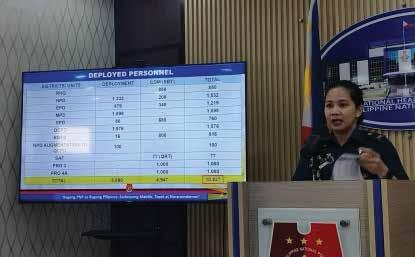
The Philippine National Police (PNP) has said more than 11,000 personnel will be deployed nationwide during the an
niversary period to secure events and manage crowd safety.
Police officials have publicly stated that, as of their latest assessments, no specific threats directly tied to the march have been identified, while coordination continues with intelligence units and local government part
ners.
The Quezon City Government confirmed issuance of a rally permit for Feb. 25 authorizing activities within designated public areas along EDSA, subject to standard public assembly and safety regulations.
Motorists and commuters have been advised to expect increased police visibility and possible traffic slowdowns near rally sites.
Record of previous marches
Two prior gatherings under the Trillion Peso March banner were held in 2025. Participation estimates reached the tens of thousands based on organizer projections and police crowd management assessments. Law enforcement agencies described those events as largely peaceful.
As of this writing, no law has been enacted directly in response to the marches, and no court ruling has attributed specific legal findings to the demonstrations themselves. Legislative proposals cited by organizers re-
main subject to the regular congressional process.
Anniversary context Feb. 25 marks four decades since civilians assembled along EDSA in 1986, an event widely regarded as a turning point in the country’s political history. Commemorative events, including religious observances, are expected nationwide in addition to the planned rally in Metro Manila.
By returning to EDSA on that date, organizers are situating contemporary reform demands within the historical memory of the People Power movement, operating within the constitutional framework governing peaceful public assembly in the Philippines. n
Rev. Jesse Jackson, champion of economic justice...
PAGE 1
the Rev. Martin Luther King Jr., Jackson’s enduring legacy was rooted in his insistence that political equality must be matched by economic access. Over decades, he argued that voting rights, employment, corporate participation and capital access were inseparable pillars of justice.
Linking civil rights to economic power
In 1971, Jackson founded Operation PUSH — People United to Save Humanity — in Chicago. The organization focused not only on protest but on economic leverage: negotiating with corporations to expand minority hiring, increase supplier diversity and open executive pathways to historically excluded communities. That effort later evolved into the Rainbow PUSH Coalition, which combined grassroots mobilization with corporate accountability campaigns and voter registration drives. Jackson frequently framed economic inclusion as the next frontier of civil rights, pressing major companies to diversify workforces and procurement contracts. His advocacy extended beyond symbolic gestures. Jackson and his organization regularly met with Fortune 500 executives, organized shareholder activism and used public pressure campaigns to push for measurable commitments in hiring and contracting practices.
National politics and expanded participation Jackson carried that economic justice message into national politics. His presidential campaigns in 1984 and 1988 were historic not only for expanding Black voter participation but also for advancing a platform that centered jobs, trade fairness, urban investment and anti-poverty initiatives.
In 1988, he won multiple Democratic primaries and caucuses, demonstrating that a co-
alition built around racial equity and economic reform could compete nationally. His campaigns helped reshape the Democratic Party’s approach to minority outreach and broadened conversations about income inequality. A decades-long public presence Even in later years, despite serious health challenges, Jackson remained publicly engaged in discussions on corporate diversity, criminal justice reform and voting access. He appeared at national conventions and civil rights commemorations, continuing to advocate for economic opportunity as a core civil rights principle.
Public officials across party lines issued statements recognizing Jackson’s influence on American civic life, particularly his role in
Mayor Vico Sotto
Philstar.com / Martin Ramos
Lawyer
STAR / File
DAteline PhiliPPines
PAL names José María “Chema” Alvarado regional head for North America amid route expansion
Philippine Airlines (PAL) has appointed José María “Chema” Alvarado as Regional Head for North America, reinforcing the carrier’s push to expand revenue performance and deepen partnerships across the United States and Canada.
Alvarado brings more than two decades of senior leadership experience spanning international airlines, global alliances and travel-technology organizations. In his new role, he will oversee sales and distribution across North America, strengthen corporate and travel trade relationships, and guide commercial strategy in one of
by AJPress PAL’s most significant long-haul markets. He will also work with cross-functional teams to improve distribution effectiveness and support sustained growth. Justin Warby, PAL’s Vice President for Sales and Distribution, described North America as a cornerstone market, pointing to planned frequency increases and the deployment of the airline’s new flagship aircraft, the Airbus A3501000, on key long-haul routes. PAL currently operates the largest network of nonstop flights between the Philippines and North America. The airline serves Los Angeles, San Francisco, New York (JFK), Seattle, Honolulu, Vancouver, Toronto and Guam. Service
to Los Angeles is scheduled to increase from 14 to 18 weekly flights beginning June 1, 2026, while daily flights operate to San Francisco and Vancouver. Additional services also operate from Cebu to Guam. The appointment comes as PAL continues fleet modernization and network expansion to meet rising demand for transpacific passenger and cargo services. The airline operates from hubs in Manila, Cebu, Clark and Davao, serving 31 domestic and 39 international destinations. PAL has been recognized as an APEX Four Star airline and was named by Cirium in 2025 as the Asia-Pacific carrier with the highest on-time performance. n
Palace not shocked by Duterte’s 2028 bid, mum on ‘Team Itim’ tandem
by luisA cAbAto Inquirer.net
MANILA — The Marcos administration is not alarmed by Vice President Sara Duterte’s presidential bid, nor by the possibility of a Duterte–Imee Marcos tandem in the 2028 elections, according to Palace press officer Claire Castro.
During Thursday’s briefing, Castro said Duterte’s announcement was not surprising, implying that the vice president had allegedly been campaigning abroad in recent months.
“Would the President be frightened? It wasn’t really that frightening when she announced that she would run for the presidency, because you could clearly feel— even before—that she was already campaigning outside. So it wasn’t surprising when she announced that she would run for president,” Castro said, when asked whether the Marcos admonition frightened by Duterte’s move.
Marcos also has no reaction so far to the proposed Duterte–Marcos tandem floated by Sen. Robin Padilla.
“They were also the ones previously called ‘Team Black.’ So for now, there is no response yet, and the President has not responded or reacted regarding that,” said Castro in Filipino.
She further maintained that Marcos remains unfazed by recent political developments and will continue focusing on his work.
“None, it will not be affected. Would the President’s work really be affected just because a vice
president merely announced that he/she is running for office?” she asked.
Castro then said, “If our President were to think only about what the Vice President is saying, this government would no longer function. So the President’s focus on improving the country’s economy, uplifting the lives of every Filipino, and resolving the flooding issue that has remained unsolved for so long will not be affected.”
Duterte, on Wednesday, declared that she will run for president in 2028.
“I am Sara Duterte. I will run for president of the Philippines,” the vice president said in Filipino.
“It took me 47 years to understand that my life was never meant to be only mine,” Duterte also said. “Unlike others, I may not have been born just to chase hap-
piness.”
Duterte’s announcement also came less than a week before her father, former President Rodrigo Duterte, again faces the International Criminal Court for his confirmation of charges hearing on Feb. 23.
The elder Duterte is accused of crimes against humanity over the thousands killed in his anti-drug campaign.
In a press briefing hours after the announcement, Castro said Marcos wished his former Uniteam partner “goodluck” in her presidential aspiration.
Marcos and Duterte formed the UniTeam alliance that went on to dominate the 2022 presidential race. As vice presidential candidate, Duterte received 32,208,417 votes, or 62 percent of the votes cast. n
ICC prosecution opposes Duterte bid to skip confirmation hearing
by chARie AbARcA Inquirer.net
MANILA, — The International Criminal Court (ICC) Prosecution has opposed former president Rodrigo Duterte’s request to waive his right to appear at the confirmation hearing, saying there’s no reasonable cause for him not to appear in person in court.
In a six-paged filing dated Feb. 19, Deputy Prosecutor Mame
Mandiaye Niang argued that the former president, in his request, failed to provide any compelling reason that would justify the confirmation hearing being held in his absence.
“Mr. Duterte primarily seeks to waive his right to appear on the basis that he does not ‘recognize the jurisdiction’ of the Court, states that he was ‘kidnapped’, and claims that the charges against him constitute ‘an outrageous lie’ invented by his political opponents. These statements are a continuation of Mr. Duterte’s rejection of the legitimacy of the proceedings against him before the Court,” the filing reads.
“His refusal to acknowledge the legitimacy of the proceedings does not constitute cause to hold the confirmation hearing in his absence,” it emphasizes.
Niang then underscored that Duterte is fit, competent, and physically and mentally able to attend the hearing in person, adding that his health has been comprehensively examined and litigated before the chamber.
“To this end, the Chamber has concluded that he is both physically and mentally fit to participate in the confirmation proceedings, and has put measures in place to ensure his comfort throughout the hearing,” the prosecution noted.
“It has done so with the benefit of extensive independent medical evidence and expert opinion. As such, Mr Duterte’s complaints that he is ‘old, tired, and frail’ are irrelevant,” it pointed out.
Niang likewise argued that the fact that Duterte does “not wish to attend” should be given minimal weight in the Chamber’s decision on this matter, saying that general health concerns alleged by Duterte have been fully considered and accommodated by the chamber as necessary, and cannot now be recycled as cause to hold the confirmation hearing in his absence.
“In addition, the fact that Mr. Duterte has stated that he will not even follow the proceedings via video link demonstrates that his reasons to avoid appearing in public are not health related but rather due to his lack of respect for the Court,” the filing further states.
With this, the Prosecution is requesting that the chamber reject Duterte’s request to waive his right to appear at the confirmation hearing scheduled to open on Feb. 23.
In a text message to the Inquirer on Friday afternoon, Duterte’s lead counsel, Atty. Nicholas Kaufman, said the law entitles the former president to present a waiver, and so he did.
“The Prosecution has not encountered a situation like this previously, and it clearly conveys in its filing its irritation and belief that it is not the former president who should be controlling the narrative,” he said in response to the prosecution’s comment on the waiver.
Kaufman also explained that Duterte has never recognized the ICC’s jurisdiction over him and that, as of the date of his waiver, the matter is still “awaiting an appeals judgment.”
“For this reason, there are no grounds to reproach him. Accordingly, the judges will now have to decide whether to compel the former President’s appearance and how that should be enforced,” he said. Meanwhile, Sen. Robin Padilla, a known Duterte ally, also took a jab at ICC prosecutors, asking whether they were really studying law.
ICI’s Reyes crafts 140-day report ‘with
more recommendations’
by mARy Joy sAlceDo Inquirer.net
MANILA — Independent Commission for Infrastructure (ICI) chair Andres Reyes said on Thursday that he is currently crafting a 140-day report detailing the commission’s accomplishments with “more recommendations.”
The ICI chair, meanwhile, said during the Manila Overseas Press Club’s event that he cannot give further details about the report.
“We have a 30-day report, a 60day report… I’m making another one for a 140-day report with more recommendations,” Reyes said as he presented the commission’s accomplishments in the past 125 days since its creation in September.
“Syempre [Of course] this [is] a report, I cannot divulge to you what is inside this report until it has been transmitted publicly to the Ombudsman,” he added.
Recently, the ICI submitted its 125-day report to the Office of the President showcasing the rundown of its breakthroughs in the flood control probe following Marcos’ earlier remark that the commission is “coming toward the end” and that the appointment of new commissioners would depend on the amount of the commission’s remaining work.
On Wednesday, February 18, the President said he is still studying the 125-accomplishment report submitted by the investigating body.
‘To fight until the end
According to Reyes, the ICI will continue their fight against corruption by investigating flood control anomalies “if allowed.”
“I’m telling you straight from the heart, you can trust us, and we will not abandon our fight against corruption,” Reyes said.
“We will fight until the very end if allowed. And we will fight until whatever it takes,” he emphasized.
When asked in an ambush interview after the event what he meant by his statement that the ICI will continue its fight “if allowed,” Reyes noted that he cannot do all the work on his own.
“I cannot function because I’m by myself,” the ICI chair said.
But he also said that the investigating body “is still functioning”
and studying other cases. He declined to comment when asked if he wants new commissioners to be appointed for the commission. Reyes is the only commissioner left at the ICI following the recent resignations of former Public Works Sec. Rogelio “Babes” Singson and SGV Country Managing
Partner Rossana Fajardo.
The ICI was created on Sept. 11 last year following public clamor for transparency and accountability on the flood control anomalies. The body has a specific mandate of investigating anomalous infrastructure projects—not only flood control projects—across the country in the past decade. n
PAUNAWA NG 2026 TRUTH ACT COMMUNITY FORUM IBINIBIGAY ANG PAUNAWA
TRUTH Act Community Forum, sa panahon ng regular na pagpupulong ng lupon ng mga superbisor, alinsunod sa seksyon 7283.1(d) ng kodigo ng pamahalaan. Ang layunin ng Transparent Review of Unjust Transfers and Holds (“TRUTH”) Act Community Forum ay magbigay ng impormasyon tungkol sa access
Immigration and Customs Enforcement (ICE) sa mga indibidwal at tumanggap at isaalang-alang ang pampublikong komento, alinsunod sa Mga Seksyon 7283 at 7283.1 ng Kodigo ng Pamahalaan. Ang mga gustong magkomento ay maaaring dumalo nang personal o nang virtual sa pampublikong forum o magsumite ng mga nakasulat na komento, na dapat matanggap ng County bago ang forum. Ang mga nakasulat na komento ay dapat ipadala sa CLERK OF THE BOARD, 1600 Pacific Highway, Room 402, San Diego, CA 92101, o maaaring isumite online sa pamamagitan ng sistema ng eComment ng Clerk ng Lupon sa www.sandiegocounty.gov/ecomment kasunod ng pag-post ng agenda ng pulong. Ang mga gustong lumahok sa pulong nang virtual ay dapat bumisita sa www.sandiegocounty.gov/ telecomments para sa impormasyon kung paano ito gagawin. Ang interpretasyong Spanish ay ibibigay sa panahon ng TRUTH Act Community Forum. Ang mga interpreter ay maaari ding maging available para sa sabay-sabay na interpretasyon sa Arabic, Chinese, Korean, Persian, Somali, Tagalog, at Vietnamese. Ang mga residenteng nangangailangan ng interpretasyon ay dapat makipagugnayan sa Clerk ng Lupon ng Mga Superbisor sa (619) 531-5434 bago ang Marso 17, 2026, upang magkaroon ng interpreter sa panahon ng forum. Ang pampublikong pagdinig na ito ay maa-access ng mga indibidwal na may mga kapansanan. Kung kailangan ng mga serbisyo ng interpreter para sa may kapansanan sa pandinig, tawagan ang County’s Americans with Disabilities Act Coordinator sa (619) 5314908, o California Relay Service, kung aabisuhan ng TDD, hindi lalampas sa limang araw bago ang petsa ng pagdinig. 2/21/26 CNS-4011092# ASIAN JOURNAL (L.A.)
Padilla said it is within an accused’s rights to waive the right to appear before the court.
“It’s the accused’s right. I thought this prosecution was… are you even studying law? It’s the accused’s right if he doesn’t want to appear, especially since he is already old. That is his right — human rights,” he said in Filipino.
“He can use all kinds of laws to avoid appearing there, especially here in our country, the Philippines — or when you see him again, you’ll say that Digong looks old and turn it into a joke, oh my. We already know that. It is the right of our former president to say that he does not want to appear,” he added.
The confirmation of charges hearing will be held until Feb. 27.
After this, the ICC said within 60 calendar days following the hearing, the judges will make a decision on whether or not to confirm all or any of the charges brought against Duterte by the prosecutor.
If one or more charges are confirmed, the suspect is then considered an accused, and the case is committed for trial before a Trial Chamber.
Duterte is suspected of the crimes against humanity of murder and attempted murder, allegedly committed on the territory of the Philippines between Nov. 1, 2011 and March 16, 2019 in the context of his socalled “war on drugs” campaign. According to the Prosecution’s submission of the Document Containing the Charges, Duterte is suspected of the following 3 counts of crimes against humanity:
• Murders in or around Davao City during the Mayoral period by the Davao Death Squad
• Murders of High-Value Targets during the Presidential period
• Murders and attempted murders in barangay clearance operations during the Presidential period. n
ICI chair Andres Reyes. Mary Joy Salcedo / INQUIRER
File photo of Vice President Sara Duterte and Sen. Imee Marcos. INQUIRER.net file photo / CATHY MIRANDA
FeAtures OPiniOn
When numbers become the goal: ICE enforcement metrics and the cautionary tale of the cobra effect
PUBLIC policy often fails not because of ill intent, but because of flawed incentives. Economists have long described this phenomenon through what is known as the cobra effect, a term rooted in a colonial-era anecdote from British-ruled India.
According to the widely cited story, colonial authorities in Delhi sought to reduce the population of venomous cobras by offering a bounty for every dead snake turned in. At first, the program appeared successful. But soon enterprising residents began breeding cobras to collect the reward. When the government discovered the scheme and canceled the bounty, breeders released the now-worthless snakes into the wild. The cobra population reportedly increased.
Editorial
While historians debate whether the episode occurred exactly as described, the story has endured in economic and public policy literature because it captures a recurring dynamic: when authorities reward a narrow metric, people optimize for that metric, sometimes in ways that undermine the policy’s purpose. Modern governance provides more sophisticated versions of the same risk.
Recent developments in U.S. immigration enforcement illustrate how incentive design can shape outcomes. Reuters has reported that senior officials
is done raging about the barefaced corruption that overrun the agency he now leads. He has now refocused on finding solutions to cure the vulnerabilities of the agency – specifically technological solutions.
Dizon met with the Blockchain Council of the Philippines to seek help. He has since come up with his idea of an “integrity chain portal” to ensure transparency in the vital work the DPWH does.
We heard about proposals to use blockchain technology to allow full public monitoring of the national budget. The technology is not perfect. All information technology is heir to GIGO (garbage in, garbage out). But the use of blockchain technology will be a major leap in tracking how our taxpayer money moves.
Much earlier, reformists at the DPWH conceived of what they thought was a failsafe solution to the prevalence of ghost projects. They required public works projects to be geolocated using GPS coordinates.
in President Donald Trump’s administration pressed U.S. Immigration and Customs Enforcement (ICE), an agency within the U.S. Department of Homeland Security, to meet specific daily arrest benchmarks, initially reported at around 1,000 arrests per day and later rising to 3,000 per day. Administration officials have disputed the characterization of these figures as formal quotas, but Reuters reporting indicates that numerical arrest targets were communicated internally. When performance is assessed against daily totals, those totals inevitably influence operational behavior. At the same time, Reuters reported on February 13, 2026, that ICE is planning a significant expansion of detention capacity across the United States, with billions of dollars projected for additional facilities. The expansion anticipates sustained increases in arrests and removals. Infrastructure and enforcement targets reinforce one another. Greater capacity supports higher arrest numbers, and higher arrest numbers justify expanded capacity.
This seemed to be a brilliant solution at first. Projects could be easily monitored, even tracked from the air using drones. The pace of completion could be measured – daily, if necessary. But the deeply-rooted syndicates in the agency proved smarter. They put in the wrong coordinates. The former public works secretary is accused of misleading the President, no less, by feeding him wrong coordinates about project sites. The wrong coordinates completely blinded the auditors and officials charged with oversight over public works spending.
Numerous entries containing intentionally erroneous coordinates caused a mountain of confusion. Projects could not be located. Even projects that were dutifully completed were reported as “ghost projects” because they could not be located according to the coordinates written in the official records.
Something more impermeable to this sort of casual manipulation needed to be devised. The solution might lie in applying blockchain technology to produce a digital ledger of public works projects. Blockchain is better protected against mali-
cious tinkering.
Dizon’s idea of an “integrity chain portal” – complementing the transparency portal – might accomplish the transparency we need to combat corruption. Dizon described this portal as some sort of “blockchain-powered digital ledger.”
So far, the idea seems to be a rough draft. We will have to see the full product to make a judgment of its efficacy in fighting corruption in the agency. But it is a step in the right direction. Corruption is so insidiously rooted in many government agencies. We need to reinforce transparency efforts with the use of new information technology – including artificial intelligence (AI) if necessary.
Our tollways companies, for instance, are studying the feasibility of using AI to capture and record vehicles that use the facilities. Eventually, this should remove the need for vehicles to stop at booths as they ingress and egress tollways. This will greatly ease efficiency of movement. If we can use AI to record tollway usage, we can surely do much using this technology to keep track of the tens of thouu PAGE 7
THE sad picture painted by recent data is impossible to ignore: billionaires are now 4,000 times more likely to hold political office than ordinary citizens. In the Philippines, this isn’t an abstract statistic. It is our reality, evident in the billion-peso net worths of our highest officials and the grinding poverty of millions who face involuntary hunger. As Oxfam and scholars like professor Maria Ela Atienza warn, this fusion of extreme wealth and political power is not merely unfair; it is a machine that perpetuates inequality and erodes democracy itself.
The fundamental question we must confront is this: can a system dominated by an economic elite truly govern for the benefit of all? The evidence suggests it cannot. When the wealthy make the laws, the rules inevitably tilt to protect and enhance their own interests, be it through tax policies, business regulations, or budget allocations. The result is a country ranked among the world’s most unequal, where billionaire wealth soars while families struggle with stagnant wages, overcrowded ho-
spitals, and the daily ordeal of a broken transportation system.
Tinkering at the edges is futile.
We need deep, structural reforms that dismantle the machinery of elite dominance and build a foundation for equitable development. This requires a conscious, sustained movement by the electorate to demand transformative changes from our government, particularly from a Congress currently populated by the very beneficiaries of the status quo.
First, we must break the stranglehold of political dynasties. The concentration of power within a small number of interconnected families stands as a central driver of inequality in the Philippines. When political authority is monopolized by familial networks, it suppresses healthy competition and entrenches systems of patronage. This dynamic ensures that both political influence and the economic advantages tied to it remain confined to a select group, preventing broader participation in governance.
To dismantle this closed system, the public must actively pressure Congress to enact a robust antipolitical dynasty law. Such legislation would not serve
ing simpler and more rewarding, ensuring that the wealth generated from global trade translates into more jobs and better opportunities for every Filipino family,” said Trade Secretary Cristina Roque.
to target or punish families but instead open the democratic process to genuine competition.
Second, we must weaponize transparency and accountability by fully funding our Constitutional commissions. The Office of the Ombudsman, the Sandiganbayan, the Commission on Audit, and the Civil Service Commission serve as vital institutional checks, safeguarding against corruption and abuse of power in government. However, these bodies have long been hampered by insufficient resources, limiting their capacity to perform thorough investigations and enforce accountability.
To ensure these commissions can function effectively and independently, it is imperative that Congress allocates substantially increased budgets. With adequate funding, these agencies will possess the necessary tools, personnel, and authority to investigate those in positions of power and protect the integrity of public service.
Third, we must build the infrastructure of equity: universal public goods and transformative connectivity. Inequality is cemenu PAGE 7
gear under the Marcos administration in 2024 after being stalled in 2017 over issues such as human rights during the Duterte administration.
THERE is a particular silence known only to the Filipino abroad. It arrives after the shift ends, when the streets are unfamiliar, when winter air feels heavier than usual, when the time difference makes it impossible to catch a child before bedtime. It is the quiet knowledge that while the passport says “migrant,” the heart still says “home.”
For decades, overseas employment has been woven into the Filipino story. Today, more than 10 million Filipinos live and work abroad, and remittances consistently contribute roughly nine to 10 percent of the country’s GDP. These remittances keep households afloat, pay for tuition, fund hospital bills, build modest homes, and cushion the economy during global shocks. We celebrate this resilience. We call them “modern-day heroes.”
But behind every dollar sent home is a decision that is rarely simple. Ask many Filipino migrants privately and you will hear a common
confession: If there were enough opportunities back home – stable jobs, livable wages, reliable public services – they would choose to stay. So the question must be asked gently but honestly: Can they be blamed for leaving? Or does their departure reflect something deeper about the system they left behind?
The arithmetic of survival Migration is often framed as ambition. In truth, it is frequently arithmetic. When wages at home cannot keep pace with rising costs of food, transportation, education, and healthcare, the decision becomes less about preference and more about survival. A nurse may earn a fraction locally of what she could abroad. An engineer may face contractual instability. A skilled worker may spend years in underemployment. The issue is not talent. The Philippines produces globally compet-
itive professionals. The issue is absorption – our economy’s capacity to provide dignified, well-paying jobs at scale.
Economic growth rates, while respectable in many recent years, have not always translated into broad-based wage growth. Informal employment remains significant. Regional disparities persist. Infrastructure gaps, bureaucratic inefficiencies, and governance challenges compound the frustration. In that context, migration becomes rational.
No parent leaves a child lightly. No spouse boards a plane without cost. But when the choice is between physical distance and financial insecurity, many choose distance – because insecurity feels more dangerous. Love for country is not the problem
It would be simplistic – and unfair – to say migrants abandon the country. In many ways, they u PAGE 8
AMID dismal Philippine economic numbers, exports emerged as a rare bright spot in 2025, delivering a surprise growth that the Department of Trade Industry (DTI) said signaled “a stronger domestic industry capable of generating more local jobs and boosting family spending power.”
Led by electronics, receipts rallied by more than 20 percent for three straight months in the last quarter of 2025, bringing total exports to a record high $84.41 billion, 15.2 percent more than the previous year’s $73.27 billion.
This was despite the 19-percent “reciprocal” tariffs imposed by the Trump administration last year, though later modified to spare about half of the total exports to the United States, the Philippines’ largest export market.
“Building on this strong finish, the DTI will intensify efforts to help exporters reach more markets. Our goal is to make export-
Indeed, given the heady export numbers, the Marcos administration—which is desperately searching for economic growth drivers—rightly wants to build on the momentum by forging more free trade deals with larger economies such as the European Union and Canada.
Global supply chain
This will open up more and bigger avenues for local goods—including agricultural products and mineral products such as nickel used in producing stainless steel and electric vehicles—to become part of the global supply chain.
The government’s eagerness to forge comprehensive trade agreement has not gone unnoticed. A high-level delegation from the European Parliament’s International Trade committee, for example, arrived in the country on Feb. 16 to build on the “very good progress” in trade negotiations that kicked back into
Talks are entering a “critical” stage in March, according to Trade Undersecretary Allan Gepty, but if all goes well, then the talks that began back in 2015 will lead to the conclusion of a trade agreement by the end of the year, thus unlocking another $12 billion in export potential.
After the visit of the European Parliament mission, the Philippines will have no rest as it then begins the first round of talks for a bilateral trade pact with Canada with formal negotiations set from Feb. 18-20.
A two-way street Canada and the Philippines announced in 2024 exploratory discussions for a potential free trade agreement, followed up by the face-to-face meeting between President Marcos and Canadian Prime Minister Mark Carney during their meeting in Kuala Lumpur, Malaysia in October 2025.
According to Gepty, Mr. Maru PAGE 8
Manny Ilao
Alex Magno
In early 2026, federal authorities launched Operation Metro Surge, described by officials as the largest immigration enforcement effort in U.S. history, centered in the Minneapolis–Saint Paul region. According to reporting by the Associated Press and
The Washington Post, thousands of agents were deployed, resulting in large-scale arrests before a mid-February drawdown. The operation drew intensified scrutiny after two u PAGE 7
DPWH Secretary Vince Dizon
Joe Zaldarriaga
THERE’S no slowing down
Vietnam’s vibrant tourism industry. This is something I realized after spending a week in Hanoi, fully immersed in the sights, sounds and rich culture of our Southeast Asian neighbor.
Despite the many challenges the country continues to face, such as language barrier and infrastructure gaps, Vietnam has managed to rise above them and captivate the world, as reflected in the steady influx of tourists drawn to its unique charm.
Why is this so? Vietnam has successfully positioned itself as an accessible, affordable and welcoming destination. Yes, there are the occasional taxi scams (which I believe authorities should look into and address), but beyond that, the country provides a generally reassuring and pleasant environment for travelers. Most visitors find that traveling in Vietnam offers great value for money — an appealing proposition for those seeking rich cultural experiences without the hefty price tag. And this is visible in the numbers. Vietnam pulled in more than 21 million international visitors in 2025. This is more than triple the Philippines’ 6.4 million.
Despite our numerous high-value tourist assets, which I dare say are among the finest in the world, the Philippines continues to lag in both tourist arrivals and receipts.
Our country is home to the pristine beaches of Palawan, Siargao and Boracay; cultural treasures like Vigan and Intramuros; a rich tapestry of gastronomic delights and of course, the warmth of our unique Filipino hospitality. All the
PAGE 6
Tourism as a growth engine Tribute to House Speaker JDV, Who Could Have Been Philippine President
ingredients for tourism success are already here. In fact, tourism contributed an estimated P694 billion in receipts last year, based on initial figures from the Department of Tourism (DOT). Yet, challenges remain. One growing concern that is recently amplified across social media and news reports, centers on the cost of domestic travel. Many have lamented that airfares to local destinations such as Siargao can rival, or even exceed, the price of international flights to countries like Singapore and Hong Kong. In response, Malacañang has noted that the DOT is actively working to address the issue, with local airlines committing to take steps to help bring down domestic fares.
While this is a welcome development, improving our tourism industry needs to go beyond making airfares affordable and should only be part of a broader strategy to make the Philippines a truly competitive destination in the region. In a previous piece I wrote, I emphasized several key areas we must focus on: making travel easier, promoting emerging destinations, showcasing local cuisine and wellness experiences and upgrading airports, seaports and roads. Affordable airfares are just one piece of the puzzle. A strong tourism industry demands reliable infrastructure that ensures seamless connectivity between islands, clean and well?maintained accommodations, consistent safety and service standards, accessible health and emergency services when needed. All these, complemented by strong branding will help elevate the Philippines on the global tourism stage. The Philippines should not be positioned simply as a tropical paradise but a safe, accessible and a truly premium destination.
There are still some persistent challenges that continue to dampen the visitor experience. Tourists have reported issues ranging from costly domestic flights that hinder inter?island travel to safety concerns such as taxi overpricing and inadequate health facilities in key destinations. Leaving them unaddressed can have significant long?term implications, particularly when it comes to reputation and overall perception of the country.
Vietnam’s tourism boom illustrates an important lesson: even with modest facilities, the perception of safety, order and accessibility can attract millions. The Philippines, endowed with undeniably premium destinations, should be aiming higher, with world?class systems and visitor experiences that match the beauty of our landscapes. Our cultural depth, ranging from centuries?old churches to indigenous traditions, offers something rare — an authenticity and richness no other country can replicate.
Tourism is more than leisure; it is livelihood. It is an ecosystem that sustains communities and uplifts local economies. Every visitor who sets foot in the Philippines supports workers, artisans, farmers and families. Done right, tourism can stand shoulder?to?shoulder with remittances as a major pillar of inclusive, regional growth. Our country has been blessed with natural assets that make it capable of becoming a truly world?class, premium destination. What we need now is strategic investment, unwavering consistency and a relentless commitment to elevating the visitor experience. If we can deliver on these fronts, tourism will not remain a supporting sector. It will become, as it should, a powerful driver of national progress.
When numbers become the goal...
U.S. citizens were fatally shot during enforcement actions connected to the crackdown. Federal investigations into those incidents are ongoing. The events prompted nationwide protests and renewed congressional attention. Rep. Josh Gottheimer subsequently announced the proposed ICE Standards Act, intended to establish clearer guardrails for DHS enforcement practices.
Separately, Reuters reported on February 14, 2026, that federal courts have ruled thousands of times that ICE unlawfully detained individuals, and that compliance challenges persist despite those rulings. Taken together, these developments raise a structural question. Immigration enforcement serves legitimate objectives: upholding federal law, securing borders, and prioritizing individuals who pose
genuine public safety risks. But when success is measured primar
ily through arrest volume, the system may rationally expand toward cases that are easiest to execute rather than those that most directly advance safety goals.
This is the modern cobra effect. If arrest numbers become the dominant performance signal, enforcement activity may intensify even when marginal safety gains diminish. Detention facilities expand. Litigation rises. Community trust erodes. Political polarization deepens. The policy continues to produce impressive metrics, but the broader objective becomes harder to sustain.
The lesson of the cobra effect is not that enforcement is inherently wrong. It is that incentive design matters.
Arrest counts are easy to measure. Reductions in violent crime attributable to targeted enforce-
Integrity chain...
ment are harder to isolate but more meaningful. Due process compliance rates, conviction quality, and community cooperation are complex indicators, yet they align more closely with public safety outcomes.
The colonial cobra bounty reminds policymakers of a simple truth: systems reward what they measure. When measurement becomes detached from mission, rational actors will adapt accordingly.
Whether in immigration enforcement, homeland security, public health, or infrastructure, governments must ensure that metrics reflect purpose. Otherwise, the appearance of control may conceal the slow accumulation of unintended consequences, and the problem policymakers sought to solve may return in a different, more complicated form.
(AJPress)
PAGE 6
sands of public works projects government spends for every year. Combining blockchain with AI will surely keep contractors on their toes. With effective use of modern communications technologies, complementing administrative reforms, should bring down the volume of corruption. The latest global corruption index saw the Philippines dropping dramatically in its standing. This could not be good for the economy. The longer we remain in the list of countries vulnerable to corruption, the less investments we will be able to attract. This will condemn us to stagnation. The flood control project scandal dramatically slowed down our economic expansion the past two quarters. If we fail to impress the global investment community that we are responding to the corruption crisis in a comprehensive manner, our economy will be condemned to the doldrums. It is particularly important for
PAGE 6
the DPWH to demonstrate gains against the syndicates of corruption. Public investments in infra determines how quickly our domestic economy grows. As it is, the corruption scandal has stymied our infra investments. This preserves the inadequacy of our logistics backbone which is essential for drawing investments. The more quickly we put infra investments back on track, the better off our economy will be. The investments, on their own, will help pump prime growth. Better infra will improve our economic efficiency.
We can only get our infra spending back on track by convincing the public that transparency and accountability are better ensured. This is the context for every innovation in the way we do our public works. There is great urgency in doing the reforms and introducing new technologies in our governance. The sooner we are able to return to our pre-scandal level of public spending on infra projects, the better our econom-
ic prospects will be. Conversely, the longer it takes to restore public trust in the integrity of our infra spending, the greater the peril of economic stagnation. We have to do what it takes to restore public trust in government spending.
We hope Dizon moves fast in the administrative reforms needed at the DPWH. Modern information technologies must be embedded in the program of reforms. They are needed both to improve bureaucratic efficiency and build public confidence.
But the criminal nexus between powerbrokers and corrupt bureaucrats must be broken. This is how corruption happens on such a bewildering scale in this country. There is no technological cure to that criminal enterprise.(Philstar.com)
The opinions, beliefs and viewpoints expressed by the author do not necessarily reflect the opinions, beliefs and viewpoints of the Asian Journal, its management, editorial board and staff.
Wealth, power, and the Filipino...
ted by a lack of access. Advancing equity requires a deliberate effort to establish comprehensive systems and projects that guarantee every Filipino’s dignity and opportunity. A universal health-care system and free education for all are essential foundations for an equitable society. These public goods provide a safety net that helps break the cycle of poverty and ensures that every citizen has the means to lead a dignified life.
A modern, efficient public transportation system in our urban centers is vital to improving the daily lives of millions. By ending the hardships endured during commutes, such a system will boost national productivity and deliver a tangible enhance-
ment in overall quality of life. Strategic railways and seaports in Luzon and, crucially, in Mindanao, are more than mere infrastructure projects. They serve as instruments of national unity and economic justice. The deliberate development of Mindanao’s logistical backbone will not only decongest Metro Manila but also empower regional economies, disperse opportunities across the country, and address the historical neglect of the South. Therefore, the crucial actor is the Filipino electorate. Our collective demand must be for a government that builds for the many, not profits for the few. We must vote for platforms, not pedigrees, and sustain pressure for a comprehensive agenda of structural change.
The choice is between a stagnant plutocracy and a dynamic, just republic. Passing an antidynasty law, empowering antigraft bodies, guaranteeing social services, and building transformative national infrastructure are the pillars of the latter. Our shared future depends on the relentless pressure we exert today. Let us demand nothing less. (Inquirer. net)
reflect the opinions, beliefs and viewpoints of the Asian Journal, its management, editorial board and staff. * * * Manny Ilao is a former chief financial officer, draws on his experience in finance and familiarity with Philippine banking laws to share informed opinions on good governance.
From My Point of View
Note: The author is the Board Chairman of the Philippine Global Media Group Immediately after landing at the Los Angeles International Airport on Feb. 10 at 7 p.m. from Manila, I received a text from my brother Amor that five-time Philippine House Speaker Jose de Venecia Jr. (also known as JDV), my former BIG BOSS at Landloil Resources Corporation, had passed away while I was already in the cloudy skies en route to L.A. via Taipei.
My immediate reaction was immense grief because I wanted to visit him as part of my ritual whenever I visited Manila. But on this recent journey, I could not reach this looming public figure, one of the intellectual giants of Pangasinan and one of the consistently outstanding congressmen and proactive House speakers of the Philippine Congress. He was my idol, my mentor, my father figure and older brother figure. He had many distinctions that perhaps can only be equaled by my other idol, the late modern-day hero Benigno “Ninoy” Aquino. They had something in common: they were former journalists, articulate public speakers, public servants, and international luminaries who both loved their country.
My first glimpse of JDV, whom I later addressed as Sir or Boss, then Kuya Joe, was when he was 29 years old in 1965 and I was still in my short pants at 14. He was campaigning as an independent Liberal Party candidate in our barangay Quetegan, Mangatarem, Pangasinan, for congressman of the 2nd district composed of Mangatarem, Urbiztondo, San Carlos, Dagupan City, and Binmaley. It was a three-way electoral fight with incumbent Liberal Party Congressman Angel Fernandez and challenger Laureano “Jack” Soriano of San Carlos, now a city. With two Liberals dividing the votes, Jack Soriano, a Nacionalista, won. But in the ensuing campaign four years later, in 1969, at the age of 33, JDV was victorious in a free zone as declared by then Liberal Party Secretary General Benigno “Ninoy” Aquino. He assumed office in January 1970 at age 34, still one of the youngest representatives at that time.
Why do I pay my tribute to JDV?
Despite being one of the most revered public servants and global business leaders from our province of Pangasinan, a statesman, a towering figure in national and international forums, president and board chairman of a conglomerate like Landoil, hobnobbing with world leaders such as U.S. Presidents Bill Clinton and George W. Bush, Egypt President Hosni Mubarak, South Africa President Nelson Mandela, and Pope John Paul II, among others, and all the accolades that he received in his lifetime, JDV remained humble, down to earth, a regular guy, affable with a soft heart. He was also generous to a fault.
He was a coalition and consensus builder, a peace advocate, and an organizer of parliamentary bodies like the Inter-Parliamentary Union and the ASEAN Inter-Parliamentary Assembly, and president of the Lakas-Christian Muslim Democrats Party, among others. He could have been an ideal president of the Republic of the Philippines. But fate had a different twist as JDV was up against the popular pang-masa actor Joseph Estrada.
Let me count the ways why I admire this “Global Filipino” and “A Man for All Seasons.” After graduating with a B.S. in Medical Technology from Centro Escolar University, I knew that it was not my calling to be a clinical scientist. At a young age, I aspired to be like JDV and Ninoy Aquino and become a public servant someday. But my dad, a trial lawyer, refused to let me change my pro-
fessional career. Then martial law was declared. There were no elections for many years.
To further hone my natural inclinations, I decided to enroll in Journalism, English Literature, Communication Arts, Political Science, and Business Policy at Ateneo de Manila University in Loyola Heights. Eventually, I became a freelance writer with Mod Magazine and Sports Weekly Magazine. I engaged in freelance writing and public relations with several clients under my belt, which I enjoyed immensely. I had the chance to travel the length and breadth of the Philippines, Japan, and other countries. It was also on the Ateneo campus where I co-organized the Alpha Phi Omega Collegiate Fraternity (Gamma Kappa Chapter) with Brod Tonette Ampil Tuazon. It is still thriving now with resident brods and sorority sisters.
JDV, who was then a top executive of Landoil and Basic Petroleum in Makati, provided me with a supplemental scholarship grant for one semester. He eventually hired me as assistant for public relations and corporate communications. He allowed me to leave our Makati office at 4 p.m. to commute to Katipunan in the afternoon.
Eventually, I moved to Philippine Cellophane Film Corporation, an affiliate of the Herdis Group of Companies, as head of public relations and corporate communications and as editor of our corporate newsletter, TINIG. Although I moved to the United States in 1981, my contacts with JDV remained robust. I sent him our family’s yearly Christmas greetings and visited him in Congress for courtesy calls with then Solicitor General Oscar Garcia, a fellow Pangasinense, or at his home in Forbes Park with fellow journalists. He also visited us, his fellow Pangasinenses in Los Angeles and San Francisco, not only as a congressman or speaker but as a private citizen. At one time, he invited me to his house in Forbes Park and promised to cook for me. I demurred, “Kababaing Kuya Joe,” or “Nakakahiya naman, Kuya Joe” (It’s shameful, Kuya Joe). He retorted, “Basta, that’s a non-issue.”
JDV brought me to his private reception room. He advised me, “Just wait here for a few minutes.” He then proceeded to his huge kitchen. I took a peek. I saw him really cooking with his house helpers. His menu was misua soup con patola and shredded beef, my favorite when I was a kid. Instead of eating moderately, I savored his concoction with gusto.
After three hours of his precious time bonding, shooting the breeze, and discussing multiple topics, he signaled me, “Let’s wrap it up because in 20 minutes, the ambassador of China will also visit me.” When he accompanied me toward the gate and reached out his hand for a farewell blessing, he asked me, “Kailan ka ba babalik sa America?” I tersely responded, “Bukas po, Kuya Joe.”
He graciously retorted, “Ako pala ang last priority mo?” I was speechless and flabbergasted. Oh my!
Whenever he came to California, whether to Los Angeles or San Francisco, he asked somebody to reach out to me, usually my former fellow Landoil employees: Fred Joves of the Bay Area or Ads Diaz of L.A.
In the case of Los Angeles, we would meet at a hotel, Chinatown, In-N-Out Burger, or at LAX before he would depart for Manila.
On Dec. 7, 2008, JDV met with his fellow Pangasinenses for the book launch of his authorized biography, “Global Filipino,” which truly defined his persona, written by Brett M. Decker, at the Sheraton Hotel in Carson City. With him were Manay Gina and son Christopher. He signed the book that he gave me and wrote a brief dedication: “To Dan, my favorite press adviser, who has contributed to my life and career. I am proud of your work in America. You are truly a global Filipino.” Of course, I was flattered.
On many other occasions, whether he was still in Congress or not, he asked me to invite fel-
low journalists for a press conference. As a former journalist himself, JDV wanted to surround himself with newsmen and loved exchanging ideas.
At one time while JDV was in San Francisco, he called, facilitated by fellow Landoil employee Fred Joves. JDV profusely thanked me for facilitating the publication of his unredacted speeches as organizer of the ASEAN Inter-Parliamentary Assembly and Inter-Parliamentary Union during his sorties in several countries. I used my connection as a former correspondent and columnist of Philippine News through its publisher Francis Espiritu. Overwhelmed by the full-page publication in the broadsheet, JDV earnestly invited me to take a vacation in his seaside home in Bonuan Binloc, Dagupan City. From my end, I did not attempt it due to scheduling conflicts. When both of my parents died, JDV attended their wake in Quezon City. Those who attended were amazed by his presence. They enthused, “Ang lakas mo naman kay Speaker? Naka-dalaw pa siya rito!”
During the martial law era, we happened to visit JDV at his mansion in Dasmariñas Village, Makati, with fellow journalist Jun Velasco, also of Dagupan City. Jun V was JDV’s confidant, editorial consultant, and relative by affinity. When we were in his car, we asked him, “Now that there are no more elections, what’s your take?” He responded without batting an eyelash, “When there’s no election or campaigning, go into business and diversify.”
As an orator and great communicator, JDV was animated, fiery, colorful with words, replete with statistics, very hopeful, optimistic, and positive about the possible rise of the Philippines, overcoming its status as the sick man of Asia. He loved to hear that the Philippines was the Rising Tiger of Asia, that the best was yet to come. Remember, he was the author of many bills, including the Dollar-Remittance Program. This earned him the TOYM (Ten Outstanding Young Men) award for economic leadership from the Philippine Jaycees. That is why he was also referred to as “Sunshine Joe.” Oftentimes, his admirers like me mimicked his speeches.
Sample No. 1: “From this very plaza of the people, we declare, we assert that under one flag, one umbrella, we shall break the frontiers of lethargy of a thousand years.”
Sample No. 2 in Pangasinense dialect: “No wala ray problema yo o kerewen yo, agko ra tan seneran. Agko ra tan benegan, agko ra tan batikan. Sabaten ko ra tan ya problema yo.”
In translation: “If ever you have problems or want anything from me, I will not shirk my responsibilities or set aside those problems. I will not run away. Instead, I will meet them head on to resolve those problems.”
One time when JDV delivered his corporate annual report as president and board chairman of Landoil, his employees, including me, were seated strategically at several tables around the hall. During the Q&A, one shareholder asked a challenging question. As a consequence, one Landoil employee stood to calm down the investor. Instead, JDV, confident, articulate, and un-nerved, softened the audience: “Here in Landoil, we respect corporate freedom and democracy. Please proceed with your question.”
In another instance, JDV requested me to accompany him at the Asian Institute of Management (AIM) as a resource speaker. After his speech, he asked me, “How did I fare with my speech?” Caught off guard, I just innocently responded, “It was an eloquent speech, and it resonated well.”
* * * The opinions, beliefs and viewpoints expressed by the author do not necessarily reflect the opinions, beliefs and viewpoints of the Asian Journal, its management, editorial board and staff.
* * * Dan E. Niño is the Board Chairman of the Philippine Global Media Group. Email: denino1951@gmail.com
Dan E. Niño
A global chokepoint: Why the Taiwan Strait matters DÉJÀ VU: ICE Detention Centers and WWII American concentration camps
by KuRt DelA PeñA Inquirer.net
FROM a distance, the First Island Chain looks like a simple maritime arc stretching from Japan through Taiwan and the Philippines toward Borneo. In reality, it is one of the world’s most important geographic features — not only for defense, but also for millions of households that have to make do with limited resources.
But if China attacks Taiwan in a bid to take over the self-governed island, a ripple effect could break the maritime cordon in the First Island Chain and bring serious economic consequences for the developing world. There would be no exemption — including the Philippines, which sits at the southern gate of the western Pacific.
Latest data from the Philippine Statistics Authority show inflation last month remained within the Bangko Sentral ng Pilipinas’ 1.4% to 2.2% forecast range, despite accelerating to an 11-month high of 2% from 1.8% in December.
The Congressional Policy and Budget Research Department of the House of Representatives said heightened geopolitical tensions — including a possible conflict between China and the United States over Taiwan — could lead to renewed inflationary pressures through supply shocks and higher import costs.
Over the long term, the department said “persistent and intensified tensions” could trigger worldwide economic fragmentation that would bring substantial uncertainties and erode market sentiment.
Taiwan’s geopolitical position and its role in global value chains mean any shift in the cross-strait status quo would carry profound ramifications for international stability and prosperity, according to the policy research institute Center for Strategic and International Studies, or CSIS.
Chester Cabalza, a defense analyst and president of the think tank International Development and Security Cooperation, told INQUIRER.net that in the event of what he described as an existential shock, Taiwan would become China’s “forward base,” aimed at “retaliating from Japan’s militaristic stance” and “challenging US supremacy in the western Pacific.” “Northern Luzon will become an automatic buffer zone, and
EDCA, or Enhanced Defense Cooperation Agreement, sites would become the first line of defense,” Cabalza said.
President Ferdinand Marcos Jr. has said the Philippines would not be able to stay out of a conflict if China seizes Taiwan by force.
“Inevitable,” he said. The risks, however, would not be limited to military concerns.
Vital for maritime economy
In its report “Crossroads of Commerce: How the Taiwan Strait Propels the Global Economy,”
CSIS said “maritime trade is the lifeblood of the global economy,” noting that “each year, thousands of massive container ships and tankers ferry more than $11.5 trillion in goods and energy across the world’s oceans.”
It said these vessels follow established routes that converge at strategic chokepoints where maritime traffic is especially vulnerable to disruption. Asia’s geography, and its centrality to global commerce, have heightened the importance of chokepoints like the Strait of Malacca and, increasingly, the Taiwan Strait.
CSIS said an estimated $2.45 trillion worth of goods — over onefifth of global maritime trade — passed through the Taiwan Strait in 2022. It warned that disruptions, even through less severe actions by China, could send shockwaves well beyond Beijing and Taipei, affecting key US allies and broad swaths of the Global South.
CSIS said disruption to merchant traffic “may prompt shipping companies to avoid the area to limit risks and avoid increased costs from spikes in insurance premiums,” placing “trillions of dollars’ worth of trade” at risk.
Based on CSIS data, 18.77% of the Philippines’ total trade passes through the Taiwan Strait, with 21.57% of imports and 14.8% of exports traversing the waterway.
The think tank said many countries would feel the effects of potential disruptions, but Japan and South Korea — which the Philippines considers key partners for trade, development assistance, and investment — would be among the most affected, given their reliance on the Taiwan Strait for imports, exports, and shipments of electronics and machinery. The CSIS estimated that 32% of Japan’s imports and 25% of its exports — a total of almost $444
billion — transited the strait in 2022. South Korea depended on the Taiwan Strait for 30% of its imports and 23% of its exports, amounting to about $357 billion in goods, it said.
Critical stake
CSIS, in its report “Understanding Global South Perspectives on Taiwan,” said the economic cost of a Chinese invasion of Taiwan — estimated to reach $10 trillion — would “fall heavily on the developing world,” which it said would suffer disproportionately from a global economic downturn and face major supply chain disruptions.
Taiwan, it said, produces over 90% of the most cutting-edge chips used in smartphones, data centers, and advanced military equipment, warning that disruptions to the supply of these technologies could wipe “trillions of dollars” from global gross domestic product, or GDP.
“The precedent of larger powers using force to incorporate smaller ones could destabilize fragile borders around the world, especially if Beijing were to succeed,” CSIS said. It added that “many Global South countries prefer to chart a nonaligned path in which they do not have to ‘choose’ between the US and China, instead maximizing the benefits both powers can offer.”
“A war over Taiwan would make such a position impossible,” CSIS said.
Cabalza said China and Taiwan are major trade partners of the Philippines, particularly for semiconductors and electronics, which he said account for a large portion of Philippine manufacturing and exports. He said any disruption would “weaken local production and consumer tech.”
Based on data from the Observatory of Economic Complexity, the Philippines exported $2.79 billion in semiconductor devices in 2024, primarily to China ($663 million), Hong Kong ($390 million) and Singapore ($383 million). It imported $1.76 billion, mainly from China ($591 million), South Korea ($195 million) and Taiwan ($156 million).
Cabalza said: “The biggest socioeconomic risks would be the immediate loss of billions of pesos in remittances from overseas Filipino workers in Taiwan.”
The BSP has said Taiwan consistently ranks among the top 10 sources of cash remittances. n
Crafting win-win trade deals...
PAGE 6
cos has laid out a clear policy direction: to conclude as many trade negotiations as possible to diversify export markets and thus cushion the impact of sudden and unexpected trade shifts such as the sweeping Trump reciprocal tariffs that turned the global trade system on its head.
Just this year, the Philippines entered into a Comprehensive Economic Partnership Agreement with the United Arab Emirates, the first such trade part with a Middle Eastern country, thus widening market access for goods and services in the growing region.
It also aims to conclude talks for a similar pact this year with Chile, the first with a Latin American country that could lead to more deals with other countries in the region that is also attracted by the Philippine market that is open to
buying goods from abroad.
This is where the government should also exercise caution. Trade, after all, is a two-way street where opening of foreign markets to local goods also means the opening of the large domestic market of the Philippines to products from abroad.
Competitive edge
Thus if domestic producers are not strengthened and prepared for the entry of competing goods from other countries, then the trade deals might end up doing more good than harm as local producers are pushed out of the local market.
Conversely, if locally produced goods are barred from entry for failing to meet the standards of other countries, such as phytosanitary and quality requirements, then the Philippines will be unable to take full advantage of the opened markets.
Government agencies should also judiciously use their budget allocations this year to sharpen the competitive edge of local industries, especially those in the farm sector that may be impacted negatively by the entry of agricultural products that other countries are also eager to send out to help their own constituents.
The government should make sure that it will go to the negotiating table with these countries with a singular intent of crafting the best possible deal that can result in wins for both sides, and not exploitative agreements where one party will get more at the expense of the Philippines.
(Inquirer.net)
The opinions, beliefs and viewpoints expressed by the author do not necessarily reflect the opinions, beliefs and viewpoints of the Asian Journal, its management, editorial board and staff.
When home is where the heart is...
A news article from Reuters, February 2, headlines, “ICE to Spend $38.3 Billion On Detention Centers Across the US.” $38 billion is a lot of beds. Have we been here before? The plan to build large-scale ICE detention centers reminds me of those concentration camps the U.S. built to detain Japanese Americans during the 2nd World War (WWII).
Eighty-four years ago this week, on February 19, 1942, President Franklin D. Roosevelt issued Executive Order (EO) 9066, ordering the relocation of Americans of Japanese ancestry into concentration camps for national security reasons. In the six months that followed EO 9066, Japanese Americans, especially those living along the West Coast, were forcibly relocated into concentration camps hastily built at various locations within the western region of the United States. Major camps were established in desolate locations, notably Manzanar and Tule Lake in California; Poston and Gila River in Arizona; Rohwer and Jerome in Arkansas; Minidoka in Idaho; and Topaz, Heart Mountain, and Amache in Utah, Wyoming, and Colorado, respectively. Roughly 120,000 Japanese Americans were incarcerated in these camps.
For ICE (Immigration and Customs Enforcement), Reuters notes that “the detention centers will be paid for with funds from the massive spending package the Republican-controlled Congress passed in July 2025. That package, known as the ‘One Big Beautiful Bill,’ included an unprecedented $170 billion for immigration enforcement, with $45 billion earmarked for detention.”
The 2024 fiscal year budget designated only $3.4 billion for immigration detention. $45 billion is a 13-fold increase. Various reports note that ICE is rapidly expanding detention capacity to 100,000 beds within its many detention centers. It is converting warehouses into mass detention centers in Texas, Georgia, New York, and other locations. In Texas, a large, multi-building facility is under construction with a capacity of up to 8,500 beds. Sites in Social Circle, GA, and Chester, NY are being established. Florida hosts the notorious “Alligator Alcatraz” in the Everglades.
Among these are “mega” centers in El Paso, where Camp East Montana is being expanded with tent structures; Hutchins, near Dallas, is being expanded to accommodate 9,500 detainees.
In Clint, El Paso County, DHS recently acquired warehouses for $123 million to establish a mega-center. In Florida, aside from the recently opened Alligator Alcatraz, a high-capacity site named “The Everglades” is planned. Warehouse conversions are underway or planned in Surprise, Arizona; Washington County, Maryland; Berks County, Pennsylvania; and Romulus, Michigan.
Japanese Americans. During their years of incarceration, they were denied the right to vote.
They lived behind barbed-wire enclosures, with guards posted 24/7. Despite this, many Japanese American men enlisted and were assigned to Army Battalion 442, one of the most highly decorated combat units of WWII. Their forced removal and incarceration were disruptive. Imprisonment meant losing their freedom, careers, and, for many, their lifelong savings. Families lost property, jobs, access to schools, necessary health services, etc. They lost personal belongings, homes, farms, and businesses. Many properties were abandoned, and many were lost forever to tax delinquency or theft. Losses also extended to culture and community due to familial disruption, loss of heirlooms, and the destruction of community structures. These economic losses are estimated in the billions (in current value).
The least measurable, and most invisible loss, was the loss of face resulting from their incarceration. For decades, those who experienced the camps refused to talk about their experience, somehow taking their detention as a mark of disloyalty to the United States. But the Civil Rights Movement of the 1960s and 1970s, which resulted in the passage of civil rights legislation, encouraged the Japanese American Citizens League (JACL) to initiate a campaign for redress and reparations for detainees.
In 1980, the Commission on Wartime Relocation and Internment of Civilians (CWRIC) was formed to examine the internment camps. Three years later, the CWRIC published its findings in a report titled Personal Justice Denied, where the Commission concluded that the forced relocation and internment of persons of Japanese ancestry under EO 9066 had not been justified by military necessity, and that Executive Order 9066 was based on “racial prejudice, wartime hysteria, and a failure of political leadership” (emphasis added). These are damning words.
In 1988, Congress passed the Civil Liberties Act of 1988, which acknowledged and apologized on behalf of the United States government for the injustice done to Japanese Americans. It additionally created a public education fund so American schoolchildren could learn about America’s concentration camps and offered restitution of $20,000 to those who were interned. As President Ronald Reagan signed the legislation into law, he commented that the incarceration of Japanese Americans during WWII was a “grave mistake” which required the nation to “right a grave wrong” and reaffirm its commitment to “equal justice under the law.”
He emphasized that the $20,000 restitution payments were less about property and more about restoring honor and admitting a mistake.
palling. Their actions are devoid of common decency, as even a 5-year-old child is arrested, and are rife with human rights violations as families are torn apart and wages and livelihoods are lost. Fear is causing children to be absent from school; workers and day laborers are choosing to stay away from jobs and workplaces that may be subject to ICE raids. ICE is arresting and detaining people without warrants. And many who do not have access to legal representation are summarily deported to detention centers in foreign countries, where the United States pays a hefty fee for each detainee. The tally of misguided and extrajudicial detention of immigrants, together with injuries and the murder of protesters, is an open book that has yet to be fully investigated. Trump is unapologetic about these, as is his chief enforcer, Attorney General Pam Bondi, who has called Alex Pretti and Renee Good “local terrorists” to justify their murders. Bondi has also pursued “vendetta indictments” against U.S. senators and other political opponents such as Mark Kelly, James Comey, Adam Schiff, and former intelligence officials John Brennan and James Clapper. But the guardrails against these attempted indictments are holding; grand juries, composed largely of ordinary citizens, are refusing to play along. Their refusal to indict Senator Mark Kelly and five other House Democrats for political speech and for exercising their First Amendment rights is salutary and commendable. As ICE builds detention capacity, raids and arrests continue, ignoring legal guardrails. A federal judge in Minnesota has expressed frustration that ICE has been ignoring hundreds of court orders. But there is a silver lining: USA Today reports that “a striking trend is unfolding at federal courthouses across the nation: judges appointed by both parties are issuing uncharacteristically scathing rebukes of the Trump administration’s immigration crackdown.”
PAGE 6
sustain it. Remittances provide a steady inflow of foreign exchange. They support consumption, stabilize the peso during volatile periods, and reduce poverty in many provinces. Entire communities depend on them.
Yet dependence is not development. When a nation relies heavily on exporting labor, it risks normalizing separation as policy. The emotional cost – missed birthdays, absent parents, long-distance marriages – does not appear in GDP statistics. But it is real.
So can migrants be blamed?
The honest answer is no. Most do not leave because they love the Philippines less. They leave because they love their families more – and because the system has not made staying equally viable.
Is it a failure of government?
Blame alone solves nothing. But accountability matters. Government’s role is not to prevent migration – mobility is a human right. Rather, it is to ensure that staying is a dignified option.
This means confronting hard truths:
• Are wages sufficient to support a family without requiring two overseas contracts?
• Are healthcare and education accessible enough that remittances are not the only safety net?
• Is corruption sufficiently addressed so that public funds translate into public benefit?
• Are investments in manufacturing, technology, and agriculture robust enough to generate high-quality domestic employment?
The issue is not merely economic policy. It is institutional trust. When citizens feel that systems are predictable, fair, and responsive, they are more likely to invest their future locally. When institutions feel fragile, migration becomes insurance.
A national response
Addressing this longing requires more than sentiment. It requires structural commitment. First, we must strengthen domestic job creation – not just in quantity but in quality. Incentivizing industries that provide skilled employment, supporting small and medium enterprises, and improving ease of doing business are foundational.
Second, wage growth must keep pace with productivity and cost of living. Economic expansion that does not translate into household stability fuels outward migration. Third, we must invest seriously in human capital – healthcare, education, and social protection. When families feel secure, migration becomes a choice, not a necessity. Fourth, governance reforms
matter. Transparency, efficiency, and rule of law are not abstract ideals; they influence whether investors stay, whether entrepreneurs risk capital, and whether citizens trust the future.
Finally, we must change the narrative. Overseas Filipinos are heroes—but they should not have to be heroic to survive. National pride should not depend on sacrifice.
The longing remains For many migrants, the dream is not to leave forever. It is to return – to aging parents, to children grown taller in their absence, to a country where opportunity matches potential.
The tragedy would be to interpret their absence as indifference. It is not indifference. It is constrained choice.
As a nation, we must aim for a future – where leaving is an option – but staying is equally promising; where prosperity is not something earned thousands of miles away; and where the silence after a long shift is not filled with longing.
Home should not only be where the heart is. It should also be where opportunity lives. (Philstar. com)
These construction projects are being opposed by local communities. Georgia Senator Raphael Warnock has filed an amendment to block funding for Oakwood and Social Circle ICE detention centers, citing opposition from his constituents.
American WWII concentration camps under Executive Order 9066 were maintained from 1942 to 1946, leaving an indelible mark on the lives of over 120,000
I would be very remiss if I did not give credit to Aiko Herzig-Yoshinaga, herself a detainee, for her painstaking research at the National Archives to uncover documentation that would lead the CWRIC Commission and Congress to conclude that the incarceration of Japanese Americans was based on “racial prejudice, wartime hysteria, and a failure of political leadership.”
America closed the book on the detention of Japanese Americans through the Civil Liberties Act of 1988, which issued a formal apology and provided reparations for those detained.
The book on ICE is still open. ICE has largely targeted law-abiding immigrants and, in the process, killed two citizens and injured more who tried to protest their raids. This is ap-
The arrest of immigrants, some being arrested as they come for their immigration hearings, has the ring of the targeting of Jews by Nazis. These mass arrests and detentions are unprecedented in that they are extrajudicially executed without the benefit of warrants. The construction of massive ICE detention facilities akin to those used to detain thousands of Japanese Americans during WWII is alarming. Executive Order 9066 marked a shameful episode in American history, for which an American president issued a formal apology and taxpayers footed the bill for monetary reparations. This drift toward authoritarianism today can be stopped. When the Trump administration subverts the Constitution it is sworn to protect, the People must reclaim the powers they have delegated by affirming the rule of law and by exercising their power through elections. The Trump regime is actively trying to subvert elections by undermining the power of the states to conduct them. We must defend state sovereignty in administering elections. Then, through our vote, express our outrage against the assault on the Constitution, the rule of law, the violation of civil liberties, killings, and detentions. These we must do or run the risk of having American concentration camps again.
The opinions, beliefs and viewpoints expressed by
Commentary By Enrique de la Cruz, Ph.D.
Do I need a Premarital Agreement before
In the absence of a premarital agreement, the general community property presumption under California family code section 760 controls which provides “ ….all property, real or personal, wherever situated, acquired by a married person during the marriage while domiciled in this state is community property.” Family Code §760. This becomes a problem if you are the spouse that has the substantially higher income or the one who accumulates the majority of the assets during the marriage. You are called in family law lingo “the in spouse.” The other spouse (or in our lingo also called the “out spouse” gets a half interest on everything accumulated during the marriage even if the asset is under your name alone or it was accumulated solely due to your sweat and hard work. The out spouse, who stayed at home most of the marriage, gets a one half interest on all the accumulations during the marriage under California community property law. For example, if you opened a savings account during the marriage under your name alone for which you religiously and diligently stash away 25% of your earnings during the marriage while your spouse blows away his/her salary during the marriage, your spouse still gets a half interest in the money you saved in your savings account. Another example would be if you purchase a piece of real property during the marriage under “your name alone” and have your spouse sign a “quit claim” deed, your spouse may still have a claim for a half interest in your real property. Another example would be if you owned a business prior to marriage, but due to your hard work, long hours of labor, and efforts, the business grew exponentially during the marriage, your spouse may still have a claim for an interest
getting married?
in the business. Signing a premarital agreement may serve as added protection to the future “in spouse” and a hurdle for the future “out spouse” by avoiding or altering the applicability of California community property law to assets 1) already owned by each and 2) to property and income to be acquired or earned during their marriage. Marriage of Dawley (1976) 17 C3d 342, 349, 131 CR 3, 7; Marriage of Grinius (1985) 166 CA3d 1179, 1186, 212 CR 803, 807 Premarital agreements may validly provide that the earnings and accumulations of each party during marriage will remain that party's separate property, free of any claims, community property or otherwise, of the other party. Marriage of Dawley, supra, 17 C3d at 350, 131 CR at 8; Cheney v. City & County of San Francisco Employees Retirement System (1936) 7 C2d 565, 569, 61 P2d 754, 756. Premarital agreements may also serve to preserve a person’s estate for his or her heirs, free of the other party's inheritance claims. Estate of Wamack (1955) 137 CA2d 112, 115, 289 P2d 871, 872.
Pursuant to Family Code §1612(c ),“ Parties to a premarital agreement may contract with respect to all of the following:(1) The rights and obligations of each of the parties in any of the property of either or both of them whenever and wherever acquired or located. (2) The right to buy, sell, use, transfer, exchange, abandon, lease, consume, expend, assign, create a security interest in, mortgage, encumber, dispose of, or otherwise manage and control property. (3) The disposition of property upon separation, marital dissolution, death, or the occurrence or nonoccurrence of any other event.(4) The making of a will, trust, or other arrangement to carry out the provisions of the agreement.(5) The ownership rights in and disposition of the death benefit from a life insurance policy.(6) The choice of law governing the construction of the agreement.(7) Any other matter, including their personal rights and obligations, not
in violation of public policy or a statute imposing a criminal penalty. However, the right of a child to support may not be adversely affected. Family Code §1612(b).
Premarital agreements that are entered into voluntarily by parties who are each represented by independent counsel and aware of the effect of the agreement, a post 1985 premarital waiver of post dissolution support does not offend contemporary public policy and is not per se unenforceable. Fam.C. § 1612(c); Marriage of Pendleton & Fireman (2000) 24 C4th 39, 53–54, 99 CR2d 278, 288–289; Marriage of Facter (2013) 212 CA4th 967, 981, 152 CR3d 79, 90. Under both the Uniform Premarital Agreement Act and prior law, the spouse claiming the agreement is invalid or not enforceable bears the burden of proof on that allegation. Family Code. § 1615(a); Marriage of Bonds, supra, 24 C4th at 27, 99 CR2d at 269; Marriage of Iverson (1992) 11 CA4th 1495, 1502, 15 CR2d 70, 74–75; However, the UPAA (as amended effective 1/1/02) deems that a premarital agreement was not executed voluntarily unless the court makes five prescribed findings provided for under Family Code. § 1615(c)
(1) The party against whom enforcement is sought was represented by independent legal counsel at the time of signing the agreement or, after being advised to seek independent legal counsel, expressly waived, in a separate writing, representation by independent legal counsel. The advisement to seek independent legal counsel shall be made at least seven calendar days before the final agreement is signed.
(2) One of the following:
(A) For an agreement executed between January 1, 2002, and January 1, 2020, the party against whom enforcement is sought had not less than seven calendar days between the time that party was first presented with the final agreement and advised to seek independent legal counsel and the time the agreement was signed. This
Myths about eating
MYTHS about eating, food items, fake news, and other mis- and disinformation abound in social media. What a waste of a wonderful and valuable technological advance in communication! In this column today, we shall debunk some of those common myths.
1. Eating out is healthier
Unless you are a lousy cook or have a poor choice of food items, home-cooked food with fresh ingredients, even meat, will certainly be a lot healthier than restaurant food. The quality and quantity of them are under your total control. Eat real food, occasional canned foods, and minimal processed foods (deli meats), if at all. This strategy will minimize the risk for developing heart disease and cancer, among other ailments.
2. Fasting is good
Occasional fasting, within reason, is fine, but eating small portioned quantities more than the usual 3 times a day, even up to 8 times a day, can be healthier as far as having a more even keel in blood glucose level (less fluctuation), so long as you eat within your normal total calories a day. Dividing the total calorie intake into several times a day is healthier than fasting or missing a meal or two a day. The less blood glucose fluctuation, the better.
3. Eating healthy is costly
This is false. If one eats less red meat, which is healthier (it even lowers your risk of getting cardiovascular disease and cancer), the grocery bills would be leaner. Some frozen food items are cheaper than fresh ones. Eating fish and vegetables, combined with regular physical exercise, could even make one look and feel younger and improve longevity.
4. Fat-free and low-fat foods are healthy
Low-fat and fat-free diets were popular in the 80s and 90s, but polyunsaturated fat protects our organs, absorbs essential vitamins, supports our
Volt Bohol, President of ATOM
Through the late actor-politician Butz Aquino and Reli German, I was baptized in street protests and rallies. Through them, I came to know ATOM, or the August Twenty One Movement.
Today, Volt Bohol is the president of ATOM, a civic organization in the Philippines advocating for good governance, anti-corruption, and the preservation of democracy. As a vocal activist, he leads protests against corruption, specifically issues like flood control project anomalies, and encourages public accountability. Moreover, he defends the 1987 Constitution, participates in the “ROAR: A Walk Against Corruption,” and commemorates the EDSA People Power Revolution. On February 22, there will be a “ROAR! Walk for People Power” at Araneta Center Cubao in Quezon City at 7 a.m. Certainly, as I met Volt Bohol during a press conference with Jesuit priest Father Tito Caluag, Running Priest Father Robert Reyes, and Kiko Aquino Dee—regarding the “Trillion Peso March
Part 3: Tayo ang People Power laban sa Korapsyon at Dinastiya” for the February 25 EDSA People Power Revolution’s 40th Anniversary—he emphasized that “the Filipino is worth fighting for” and has been advocating for citizen vigilance.
Who’s Francis Kong?
Francis Kong is a renowned Filipino motivational speaker and leadership expert. I vividly remember that Francis has engaged with the Career Executive Service Board (CESB), where I was connected as a writer, and similar public sector initiatives by sharing his expertise on ethical leadership and organizational growth.
I saw him recently during a press conference at Ayala Malls Manila Bay. He was a featured speaker at SpeakersCon 2026, held last February 11, 2026, at Space at One Ayala in Makati City. As a renowned leadership expert, he joined a lineup of speakers and focused on “Redefining
Authenticity,” leadership, and impactful communication. The event, which carried the theme “Moving people through clarity, credibility, and character,” promised insights on influence, leadership, and personal growth. Other speakers I saw were Mark Schaefer, Inka Magnaye, Ida Tiongson, Eri Neeman, Kia Abrera, Alan Reyes, and Dr. Donald Patrick Lim, who is a prominent Filipino business leader widely regarded as the “Father of Digital Marketing” in the Philippines and the 78th president of the Management Association of the Philippines. Filipinos Shine in NYC Billboard
It caught me by surprise. Right at the heart of Broadway, at 1627 Broadway, New York, NY 10019, a massive 2880 x 960 px LED billboard is shining bright anew, powered by Alegre de Pilipinas.
The billboard features the prestigious 4th Philippine Finest Business Awards and Outstanding Achievers 2026, organized by La Visual Corporation and Sirbisu Channel. I am fortunate to be included on the billboard with four other Filipinos: Lae Manego, the poprock singer-artist; Charrie Rose Apilado, Vice President/CEO of BCLS Logistics Services; Dr. Allen M. Quirit, MD, Internal Medicine/Adult Disease Specialist; and Steward Fantilaga, SCPA Development owner; along with myself, Rogelio Medina, freelance journalist. From the Philippines to the world stage, this is more than exposure—this is GLOBAL RECOGNITION. This is excellence without borders.
Ready to be a part of the next
wave of honorees? For further information, you may contact: Web: www.philippinefinestbusinessaward.com / www.lavisualcorporation.com Email: Info@philippinefinestbusinessaward.com / contact@ lavisualcorporation.com Phone: (+632) 721-91823 | +63917-137-2316
The spotlight is waiting. Will your name be next on Broadway?
U.S. AI and Technology Policy
I recently attended an Artificial Intelligence (AI) briefing via Zoom, thanks to the New York Foreign Press Center and the Manhattan Institute.
The Manhattan Institute in New York City hosted an in-depth virtual and onsite briefing led by two of its distinguished scholars, Danny Crichton and James Meigs. This session focused on the critical role of AI as a “U.S. national security imperative,” as articulated in the National Security Strategy (NSS). The speakers explored the strategic implications of AI and how U.S. technology policy, including global standards and economic/military benefits, positions the United States as a global leader and sets an example for the world.
Among those who attended the virtual portion of the briefing were Kerry Soropoulos (host), Africa-Related Nigeria, Andres Fidanza, Jukka Lehtinen Kauppalehti, Lorie Baker, Marie-Astrid Langer (NZZ), Melissa de Teffe, Tomomi Shimizu of Jiji Press, and myself, Rogelio Constantino Medina of Asian Journal Publications.
PAFTA Awards on Feb. 21
The Philippine Arts, Film and
cell membranes, and promotes growth and development. Not all fats are the same. Saturated and trans fats in fatty red meats and high-fat dairy products are unhealthy. Unsaturated fats from olive oil, avocados, and their oil, and nuts provide healthy fats.
5. All big fish are safe to consume Big fish, like albacore tuna, shark, orange roughy, southern bluefin tuna, ray, swordfish, barramundi, marlin, king mackerel, and gemfish, have high mercury contents. Regular mackerel, salmon, canned yellowfin, and regular small tuna are safe.
Unlike eating red meats that increase the risk for cardiovascular diseases and cancer, consuming fish 5 or more times a week helps boost the immune system, improves brain health, prevents blood clots, and reduces the risk for heart attack, stroke, and cancer.
6. Unrefined sugars are healthier
A popular myth is that unrefined sugar, like raw sugar, maple syrup, coconut sugar, and honey, provides fewer calories. All sugars, except artificial sweeteners, are carbohydrates with high calories and are fattening. The calories from consuming unrefined sugars should be counted accordingly, especially among diabetics or those trying to lose weight.
Using regular table sugar for coffee once or twice a day is safer than consuming artificial sweeteners.
7. Processed foods are safe
Definitely not! While it is commonplace to see people all around us eat processed foods like hot dogs, bacon, ham, salami, sausages, processed veggies, etc., they increase the risk for the development of cancers, especially of the gastrointestinal tract, including the pancreas and the colon. The risk is greater with meats grilled at high temperatures, with burnt edges or surfaces.
8. Detox pills are necessary
False! These pills or bowel cleaners (irrigation, enemas) could be dangerous to health.
The best detox items are foods like vegetables, fish, nuts, and fruits, which are all antioxidants and detoxifying agents via our liver, gastrointestinal tract, and kidneys, our natural detoxifying organs, day in and day out, 24/7, cleansing our body of toxins and poisons. Eat a healthy diet, avoid processed and ultraprocessed foods, minimize fast food, drink a lot of water (not poisonous soft drinks), and exercise daily to rejuvenate yourself. Supplements and herbals are useless and could be dangerous to health. If you live a healthy lifestyle, which includes a wholesome diet, you will not need to detoxify your body.
9. Soft drinks are better than water
Although soft drinks may contain some minerals, they are all (cola or uncola, diet or regular, caffeine-free or not) toxic to our body, and more so to children. The phosphoric acid in them is only one scary chemical, which many use to clean car carburetors or flush a blocked toilet or kitchen drain. All soft drinks increase the risk of metabolic syndrome, which shortens our longevity. Soft drinks are indeed poisonous and
Television, Inc. (PAFTA) is a professional arts and entertainment organization dedicated to recognizing excellence and outstanding achievements in Philippine arts, film, television, and related creative industries. It serves as a credible platform that honors artists, performers, filmmakers, media practitioners, and creative professionals whose work contributes to the cultural enrichment and global recognition of Filipino talent.
The PAFTA Awards will be held on February 21 at the Manila Hotel. PAFTA is headed by Filipino women: Teresita Tolentino Pambuan, a retired teacher from the U.S. and wife of a former ABS-CBN executive vice president, and Rotarian Christina Aliada.
Biblical Inspiration
Jeremiah 17:14: “Heal me, Lord, and I will be healed; save me and I will be saved, for you are the one I praise.
Birthday Greetings Happy birthday to Gina de Venecia (Feb. 15); Senator Jinggoy Estrada, Nini Veloso, Rochie Hernandez Pedersen (Feb. 17); Mylene Padilla, Christopher Clark Coria Quito, Regina Benitez (Feb. 19); director Nuel Naval, Lorenzo Leviste (Feb. 20); Richard Hinola, Teresita Tolentino Pambuan, Yul Servo Nieto
21);
and Adrian Elisan (Feb. 23).
AS we step into the sacred season of Lent, the word sobriety takes on a deeper meaning. It’s not just about giving something up for 40 days—it’s about stepping into a journey of spiritual renewal and transformation. Lent invites us to confront the things that hold us back—whether it’s alcohol, unhealthy relationships, overeating, endless scrolling on social media, or even shopping habits—and release them to make space for something greater.
Sobriety isn’t just about abstaining from substances; it’s about reshaping our relationships—with ourselves, others, and the divine. It’s about cultivating mindfulness, finding purpose, and navigating life’s challenges with grace instead of relying on distractions or quick fixes. It’s a process, a journey, and an op-
portunity to reclaim inner peace and align with the loving spirit of creation.
This Lent, I challenge you to reflect deeply: What’s weighing you down? What attachments are keeping you from living fully? Consider what you might offer up—not just for the season, but as a step toward lasting transformation.
The road won’t always be easy, and discouragement may come— but every step forward is a step toward embracing your sacred worth. You are deeply loved, cherished, and worthy of joy and spiritual fulfillment.
Let’s make this Lent a time of awakening, liberation, and connection with the Source of love and light that guides us all. Together, we can create space for divine possibilities in our lives. What are you letting go of this Lent? Share your reflection with your family and friends.
PhiliP S. Chua, MD,
ReveRenD RoDel G. BalaGtaS
Notes
(Feb.
writer Gina Marissa Tagasa, Jeff Dy (Feb. 22); TinTin Solomo, Ana Marie Tabora-Echevarria,
(From right) Rogelio Constantino Medina, Volt Bohol, Bien Gonzales, and Gerwin Ferreras.
Right at the very heart of New York City, five Filipinos—Lae Manego, Charrie Rose Apilado, Dr. Allen M. Quirit, Steward Fantilaga, and Rogelio Constantino Medina—shine.
Rogelio Constantino Medina with Francis Kong (right).
Rogelio Constantino Medina and Teresita Tolentino Pambuan.
ZOOM briefing on U.S. AI and Technology Policy at the Manhattan Institute in New York City.
The PAFTA Awards will be held on February 21 at the Manila Hotel.
Trump Required Hospitals To Post Their Prices for Patients. Mostly It’s the Industry Using the Data.
by Darius Tahir KFF Health News
Republicans think patients should be shopping for better health care prices. The party has long pushed to give patients money and let consumers do the work of reducing costs. After some GOP lawmakers closed out 2025 advocating to fund health savings accounts, President Donald Trump introduced his Great Healthcare Plan, which calls for, among other policies, requiring providers and insurers to post their prices “in their place of business.”
The idea echoes a policy implemented during his first term, when Trump suggested that requiring hospitals to post their charges online could ease one of the most common gripes about the health care system — the lack of upfront prices. To anyone who’s gotten a bill three months after treatment only to find mysterious charges, the idea seemed intuitive.
“You’re able to go online and compare all of the hospitals and the doctors and the prices,” Trump said in 2019 at an event unveiling the price transparency policy.
But amid low compliance and other struggles in implementing the policy since it took effect in 2021, the available price data is sparse and often confusing. And instead of patients shopping for medical services, it’s mostly health systems and insurers using the little data there is, turning it into fodder for negotiations
that determine what medical professionals and facilities get paid for what services.
“We use the transparency data,” said Eric Hoag, an executive at Blue Cross Blue Shield of Minnesota, noting that the insurer wants to make sure providers aren’t being paid substantially different rates. It’s “to make sure that we are competitive, or, you know, more than competitive against other health plans.”
Not all hospitals have fallen in line with the price transparency rules, and many were slow to do so. A study conducted in the policy’s first 10 months found only about a third of facilities had complied with the regulations. The federal Centers for Medicare
& Medicaid Services notified 27 hospitals from June 2022 to May 2025 that they would be fined for lack of compliance with the rules.
The struggles to make health care prices available have prompted more federal action since Trump’s first effort.
President Joe Biden took his own thwack at the dilemma, by requiring increased data standardization and toughening compliance criteria. And in early 2025, working to fulfill his promises to lower health costs, Trump tried again, signing a new executive order urging his administration to fine hospitals and doctors for failing to post their prices. CMS followed up with a regulation intended to up the fines and increase the level of detail required within the pricing data. So far, “there’s no evidence that patients use this information,” said Zack Cooper, a health economist at Yale University. In 2021, Cooper co-authored a paper based on data from a large commercial insurer. The researchers found that, on average, patients who need an MRI pass six lower-priced imaging providers on the way from their homes to an appointment for a scan. That’s because they follow their physician’s advice about where to receive care, the study showed.
Executives and researchers interviewed by KFF Health News also didn’t think opening the data would change prices in a big way. Research shows that transparency policies can have
CDPH urges measles vaccination as cases rise across California
SACRAMENTO – The California Department of Public Health (CDPH) is urging residents to review their immunization status and get vaccinated against measles following multiple confirmed cases across several counties.
Local health departments have reported cases in Los Angeles, Orange, San Bernardino, Riverside and Shasta counties. The cases include an outbreak of eight related infections in Shasta County, marking California’s first measles outbreak since 2020. All affected individuals were either unvaccinated or had unknown vaccination histories.
As of February 9, 2026, a total of 17 measles cases have been reported statewide. Public health officials are investigating additional suspected cases.
Two recent cases visited Disneyland on January 22 and January 28 while infectious. Local health authorities are working
mixed effects on prices, with one 2024 study of a New York initiative finding a marginal increase in billed charges.
The policy results thus far seem to put a damper on longheld hopes, particularly from the GOP, that providing more price transparency would incentivize patients to find the best deal on their imaging or knee replacements.
These aspirations have been unfulfilled for a few reasons, researchers and industry insiders say. Some patients simply don’t compare services. But unlike with apples — a Honeycrisp and a Red Delicious are easy to line up side by side — medical services are hard to compare.
For one thing, it’s not as simple as one price for one medical stay. Two babies might be delivered by the same obstetrician, for example, but the mothers could be charged very different amounts. One patient might be given medications to speed up contractions; another might not. Or one might need an emergency cesarean section — one of many cases in medicine in which obtaining the service simply isn’t a choice.
And the data often is presented in a way that’s not useful for patients, sometimes buried in spreadsheets and requiring a deep knowledge of billing codes. In computing these costs, hospitals make “detailed assumptions about how to apply
with Disneyland Resort to notify potentially exposed employees. Members of the public who were at the park on those dates are advised to contact a health care provider if they develop symptoms consistent with measles.
Dr. Erica Pan, CDPH director and state public health officer, encouraged families to ensure they are up to date on the measles, mumps and rubella vaccine. She noted that the United States is experiencing its highest number of measles cases and outbreaks in more than 30 years, driven largely by lower vaccination rates in some communities.
Measles is a highly contagious viral disease. Approximately 90 percent of unvaccinated individuals exposed to the virus will contract it. Symptoms typically begin with fever, followed by cough, runny nose, conjunctivitis and a red rash. Individuals infected with measles can spread the virus from
complex contracting terms and assess historic data to create a reasonable value for an expected allowed amount,” the American Hospital Association told the Trump administration in July 2025 amid efforts to boost transparency.
Costs vary because hospitals’ contracts with insurers vary, said Jamie Cleverley, president of Cleverley and Associates, which works with health care providers to help them understand the financial impacts of changing contract terms. The cost for a patient with one health plan may be very different than the cost for the next patient with another plan.
The fact that hospital prices might be confusing for patients is a consequence of the lack of standardization in contracts and presentation, Cleverley said.
“They’re not being nefarious.”
“Until we kind of align as an industry, there’s going to continue to be this variation in terms of how people look at the data and the utility of it,” he said.
Instead of aiding shoppers, the federally mandated data has become the foundation for negotiations — or sometimes lawsuits — over the proper level of compensation.
The top use for the pricing data for health care providers and payers, such as insurers, is “to use that in their contract negotiations,” said Marcus Dorstel, an executive at price transpar-
about four days before rash onset to four days afterward. California reported more than 95 percent MMR vaccination coverage among kindergarteners for the 2024–2025 school year, a level considered necessary to reduce the risk of sustained community transmission. However, outbreaks remain possible in communities with lower vaccination rates. Health officials recommend that individuals 12 months and older receive two MMR doses before international travel. Infants ages 6 to 11 months are advised to receive one dose prior to traveling abroad. MMR vaccines are covered by most health insurance plans, including Medi-Cal. Residents can check their vaccination records through the California Digital Vaccine Record and schedule appointments at MyTurn.ca.gov, through local pharmacies or with their health care providers.
ency startup Turquoise Health.
Turquoise Health assembles price data by grouping codes for services together using machine learning, a type of artificial intelligence. It is just one example in a cottage industry of startups offering insights into prices. And, online, the startups’ advertisements hawking their wares often focus on hospitals and their periodic jousts with insurers. Turquoise has payers and providers as clients, Dorstel said.
“I think nine times out of 10 you will hear them say that the price transparency data is a vital piece of the contract negotiation now,” he said.
Of course, prices aren’t the only variable that negotiations hinge on. Hoag said Blue Cross Blue Shield of Minnesota also considers quality of care, rates of unnecessary treatments, and other factors. And sometimes negotiators feel as if they have to keep up with their peers — claiming a need for more revenue to match competitors’ salaries, for example.
Hoag said doctors and other providers often look at the data from comparable health systems and say, “‘I need to be paid more.’”
* * * KFF Health News is a national newsroom that produces in-depth journalism about health issues and is one of the core operating programs at KFF — the independent source for health policy research, polling, and journalism.
Do I need a Premarital Agreement...
requirement does not apply to nonsubstantive amendments that do not change the terms of the agreement.
(B) For an agreement executed on or after January 1, 2020, the party against whom enforcement is sought had not less than seven calendar days between the time that party was first presented with the final agreement and the time the agreement was signed, regardless of whether the party is represented by legal counsel. This requirement does not apply to nonsubstantive amendments that do not change the terms of the agreement.
(3) The party against whom enforcement is sought, if unrepresented by legal counsel, was fully informed of the terms and basic effect of the agreement as well as the rights and obli-
gations the party was giving up by signing the agreement, and was proficient in the language in which the explanation of the party’s rights was conducted and in which the agreement was written. The explanation of the rights and obligations relinquished shall be memorialized in writing and delivered to the party prior to signing the agreement. The unrepresented party shall, on or before the signing of the premarital agreement, execute a document declaring that the party received the information required by this paragraph and indicating who provided that information.
(4) The agreement and the writings executed pursuant to paragraphs (1) and (3) were not executed under duress, fraud, or undue influence, and the parties did not lack capacity to enter into the agreement.
(5) Any other factors the court deems relevant.
A premarital agreement may be unenforceable if found to be unconscionable when it was executed and the requisite disclosures were lacking and not waived Additionally, a spousal support provision in a premarital agreement executed under the UPAA, whether before or after January 1, 2002, is not enforceable if found to be unconscionable at the time of enforcement. Family Code § 1612(c).
If you are the higher earning spouse and have assets to protect, it is important to seek the representation of experienced counsel in drafting a premarital agreement to make sure that all statutory requirement are met which increases the likelihood that your premarital agreement will be deemed enforceable when attacked in court in case
LOS ANGELES
10 stars born in the Year of the Horse who made a mark in PH pop culture
by hannah Mallorca INQUIRER.net
Not everyone knows that many celebrities who made an impact on Philippine pop culture were born in the Year of the Horse. Since horses are noted for being energetic and charismatic, it’s no surprise that the public loves them.
It’s a Chinese New Year tradition to seek the help of feng shui as a way to test one’s luck. As we ring in the Year of the Horse, many experts claim that those who were born at this time will experience high energy, passion, and major changes. From this, it’s clear that those born in 1954, 1966, 1978, 1990, 2002, 2014, and 2026—including these celebrities—will prosper.
Here are 10 stars born in the Year of the Horse who are undeniably pop culture icons in their own right.
Sharon Cuneta – Jan. 6, 1966
As the Megastar, Sharon Cuneta’s contributions to the Philippine entertainment industry are nothing short of remarkable. She was part of one of the biggest loveteams, became a recording artist with hit songs (“Mr. DJ” and “Bituing Walang Ningning,” anyone?), and an actress with a knack for different roles.
Some of her notable roles on film and TV include a professional mourner (“Crying Ladies”), a caregiver (“Caregiver”), a college student hoping to be loved
"Sisters of 23 years!"- Sharon Cuneta at Judy Ann Santos Image: Instagram/@reallysharoncuneta
by her best friend (“Kung Ako Na Lang Sana”), and an aspiring singer (“Bituing Walang Ningning”). She is also the recipient of three Gawad Urian Best Actress awards and a Box Office Hall of Famer, to name a few. Not to mention that she is used as a popular reference on social media, notably her “The Voice” stint and her “mabuhay ang manggagawa” line on “Crying Ladies.”
Judy Ann Santos – May 11, 1978
One of the biggest actresses of her generation, Judy Ann Santos was born to be a star. She can cry even before her cue; her face shows a wide range of emotions without much effort, and she can disappear completely into her character. She appeared
in several films and TV shows throughout her career, with “Mara Clara,” “Esperanza,” and “Kasal, Kasali, Kasalo” among the public’s favorites. Santos is also a successful celebrity chef who has introduced herself to a new generation of fans through her digital cooking show.
Rufa Mae Quinto – May 28, 1978 Whenever Rufa Mae Quinto makes an appearance, holding in a laugh is impossible. Her dumb blonde-esque humor, witty punchlines (especially her “go, go, go”), and signature tone make it no surprise that she solidified her spot as one of the country’s most beloved comediennes. Her impact on
Aiko Melendez, Onemig Bondoc go Instagram official
Nearly three decades after an earlier courtship that did not progress, the actress-councilor and the former teen star publicly confirm they are together.
by AJPress
MANILA — Actress and Quezon City councilor Aiko Melendez and actor Onemig Bondoc have confirmed they are in a relationship, making it “Instagram official” in mid-February through social media posts and a vlog that publicly acknowledged their status.
Melendez shared a Valentine’s Day message on Instagram referring to Bondoc as her “soulmate” and marking what she called their “first Valentine’s Day together.” Bondoc likewise posted photos and messages expressing affection and gratitude. Philippine entertainment outlets characterized the posts as confirmation that the two are officially together.
The pair also addressed their relationship in a February vlog filmed in Zambales, where Melendez responded “yes, kami na po” when asked about their status. The video circulated widely online and was reported by national entertainment desks.
Earlier in January, Bondoc referenced having courted Melendez approximately 29 years ago, writing “Happy together… after 29 yrs” in a social media caption. Entertainment reports indicated that his earlier courtship in the late 1990s did not progress into a relationship at the time, and that the two later reconnected decades after first knowing each other.
Melendez was previously married to Jomari Yllana and later to Martin Jickain; both marriages were annulled. Bondoc was previously married to Valerie Bariou in 2009; the marriage later ended in separation. Neither has announced further details beyond confirming they are together.
Melendez is a veteran actress who currently serves as a councilor in Quezon City. Bondoc rose to prominence in the 1990s through youth-oriented television, including the series T.G.I.S., and later appeared in films and drama projects. In recent interviews, he has indicated he is not actively pursuing a full-time return to mainstream acting and has focused on private business ventures.
Onemig Bondoc and Aiko Melendez. Image: Instagram/@aikomelendez
10 stars born in the...
pop culture extended to films such as “Booba,” “Super B,” and “Status: Single,” the latter of which people often lip-sync to on TikTok.
Jolina Magdangal – Nov. 6, 1978
Ask a 90s or 2000s kid who they grew up with, and many would mention Jolina Magdangal. Not only will her work in music (“Chuva Choo Choo” is always a crowd favorite) and film be loved by the public, but her colorful makeup, shiny barrettes, and Y2K outfits have also become fashion staples in their own right, with many people recreating her look on social media.
Megan Young – Feb. 27, 1990
Megan Young is often touted as the standard of what a Miss World titleholder should be. She is elegant without putting in too much effort, articulate without being too pretentious, and effortlessly queenly. Her stint in the global tilt is often an inspiration for beauty queens, but it has also become a double-edged sword for Filipina beauties who compete in the Miss World pageant.
Kim Chiu – April 19, 1990
Kim Chiu is dubbed as one of the “Pinoy Big Brother” greats, having made a name for herself in the industry beyond her Big Winner title. Many knew her as a “Chinita Princess,” but she went through the different stages of stardom without relying on internal connections or a famous last name.
At the same time, Chiu’s career underwent seamless shifts. She began as a teen star and later blossomed into an actress who can take on different roles, as seen in “My Binondo Girl,” “Linlang,” and “The Alibi.”
Janina San Miguel – Nov. 14, 1990
Janina San Miguel is not a celebrity, but her Binibining Pilipinas stint will always be a fixture in pop culture. Any Filipino knows her viral question-
and-answer blunder, almost to the point that it’s impossible for anyone not to know “my pamily” word by word.
Maloi Ricalde of BINI – May 27, 2002
Bubble skirts, midi bottoms paired with colorful tights, and hyperfeminine elements in fashion — it’s hard not to imagine them as a trademark of BINI’s main vocalist Maloi. Being in a large girl group, it might be difficult for some to establish their own unique personalities. But the P-pop powerhouse made it possible.
In Maloi’s case, she was able to combine coquette and Cubaoexpo-inspired fashion sense to make her signature look. At the same time, her love for art and the creative process added to her unique personality, making fans fall in love and be inspired by her.
Belle Mariano – June 10, 2002
These days, it’s hard for Gen-Z stars to separate themselves from the pack. Belle Mariano made her own mark. She didn’t just become one-half of a popular onscreen tandem. She built her own brand as a multi-hyphenate, and it’s clear she still has a brighter path ahead of her. Yet what made people fall in love with Mariano was her hardworking nature. She started from the bottom and
worked her way to the top.
Sophia Laforteza of KATSEYE – Dec. 31, 2002
It is difficult for a Southeast Asian to make it big in the international scene. But Sophia Laforteza made it possible for many young girls to see people who look like them onstage. Of course, Laforteza is not the only Filipino who went global. Yet what made her story captivating was that she joined “Dream Academy” hoping to represent her country, and she didn’t rely solely on her heritage or her famous mother; she worked hard and is great entirely on her own.
Kim Chiu says she feels secure, sees growth in partnership with Paulo Avelino
by AJPress
MANILA — Actors Kim Chiu and Paulo Avelino emphasized mutual respect and professional growth as they promoted the expanded television release of their series The Alibi: Ang Buong Katotohanan, even as questions about their off-screen relationship resurfaced.
At a recent press conference, both actors declined to define the status of their personal relationship, choosing instead to focus on the evolution of their working partnership. Chiu said she feels “secure” collaborating with Avelino, noting that their dynamic has become more grounded and mature compared to their earlier projects together.
The discussion briefly turned to a Valentine’s Day bouquet that Chiu shared on social media. When asked directly whether Avelino sent the flowers, Chiu confirmed in Filipino that they were from him, and Avelino acknowledged the gesture. Chiu added that what mattered to her was the thoughtfulness behind the act rather than the size or extravagance of the arrangement. Avelino responded that he was
simply glad she appreciated it. The pair are headlining the free-TV edition of The Alibi: Ang Buong Katotohanan, an expanded version of their previously released streaming project. According to information released by ABS-CBN, the television cut includes additional scenes and an alternate ending intended to further develop the storyline and character arcs. The mystery-romance drama centers on a complicated relationship intertwined with a
investigation.
among others.
While speculation about Chiu and Avelino’s off-camera connection continues to circulate online, neither actor made any declarations beyond acknowledging their close collaboration. Both maintained that their focus remains on delivering a stronger, more nuanced performance for audiences as the series reaches a wider primetime viewership.
Dominic Roque
by AJPress
MANILA — A regional trial court in Pasig City has acquitted entertainment columnist and online host Cristy Fermin in the cyberlibel case filed against her by actor Dominic Roque in 2024. Fermin confirmed the ruling on Wednesday and described it as a vindication.
“Anak, nakuha natin ang hustisya, panalo tayo sa kasong libelo na isinampa ni Dominic Roque. Salamat sa Diyos sa paggabay,” she said. ( “My child, we have obtained justice — we won the libel case filed by Dominic Roque. Thank God for the guidance.”)
The Complaint
Roque filed the cyberlibel complaint on May 31, 2024 before the Office of the City Prosecutor in Pasig City. The complaint stemmed from commentary aired on Fermin’s online entertainment program.
He alleged that certain statements and insinuations made during the broadcast were defamatory and damaging to his reputation. The case was later brought before a regional trial court under the Cybercrime Pre-
K Brosas claps back at Alvin Aragon for criticizing celebrities with queer kids
by KrisTofer Purnell Philstar.com
MANILA, Philippines — Alvin Aragon drew flak anew for his comments about the LGBTQIA community, this time from hostcomedienne K Brosas whom the ex-actor namedropped for being proud of their queer children.
Aragon appeared on a vlog episode of content creator Cris Rafael where he continued to discuss and criticize the sexual orientation of his stepchild Sofia, the eldest daughter of his wife and former SexBomb Girls member Izzy Trazona.
The former actor listed a number of celebrities, including Brosas, for supposedly tolerating their kids who identified as queer.
"Si Gloc 9, tuwang-tuwa, ginawan pa ng kanta yung anak niya," Aragon said, referring to the rapper's song "Sirena." "Ayun ba ikinalulugod ng Diyos? [Parang] palakpakan mo yung lalaki mong anak na ginawa Niya na nagpakabakla, whooo!"
Aragon continued, "Si K Brosas, tuwang-tuwa. Si Ian Veneracion, tuwang-tuwa. Tapos sino yung tumatayo sa kung anong tama sa mata ng Diyos na huwag kang magpakabakla? Kami ni Izzy, kami pa masama? Kumusta, world? Pinapalakpakan natin yung mali. Ine-encourage niyo pa. Sasabihin niyo love yon, i-accept?"
Brosas clearly took notice as she posted a five-minute video on Facebook which began with a clip of Rafael's video with Aragon
before airing her side.
The comedienne admitted she did not plan on speaking up, only doing so because Aragon namedropped her.
"Parang kinondena mo kami dahil tanggap namin yung mga anak namin, dahil member sila ng LGBTQ," Brosas said. "Ano namang pakialam mo? May ambag ka ba kahit noong preschool, nagbigay ka ba ng baon? Mayroon pang palakpak na 'whooo!' Iba yung galit mo, kuya." She pointed out she supported her daughter Crystal when the latter came out as a lesbian in 2020, noting not everyone praised her for it.
"Marami din naman, mangilanngilan na siyempre mga katulad mo — hardcore na Christian, although may mga kilala rin naman akong Christian na may respeto naman. Ikaw kasi, yung galit mo, iba, eh," Brosas continued. "Huwag kang mag-alala. Feeling ko, one of these days, makakatikim ka rin ng palakpak sa mukha. Charot lang." Brosas even mentioned how Aragon always brought up the Bible in his criticisms, and the comedienne admitted disliking the subject as discussions on homosexuality would always include the cities of Sodom and Gomorrah.
"Yung totoo, Kuya, nandon ka ba [sa Sodom at Gomorrah]? Baka na-Facebook Live mo. Charing," Brosas joked further before stressing that Aragon's anger isn't just directed at
queerness but also at people's clothes and song choices. "So, ilan na lang kayo pupunta sa langit? Pito?"
In her belief, heaven is accommodating to everyone as the Lord would look into someone's heart, not whether they've danced to "The Spagetti Song" or worn revealing shorts.
"I mean, come on! Naniniwala ako na meron tayong Panginoon na accommodating," Brosas said as she acknowledged people with other or no religions.
"Nakalagay nga sa Bible, 'Love thy neighbor.' Walang nakalagay doon na, 'Love thy neighbor, puwera sa mga bading at mga tomboy,'" she continued. "Ang sasabihin ko lang, hangga't wala kang inaapakang tao, naniniwala ako na may sarili akong relationship kay Lord, wala tayong pakialamanan." Brosas recognized that Aragon was entitled to his own opinion but dragging other people's names was a step too far.
"Huwag mong husgahan ang pagpapalaki ko sa anak ko. At least hindi kriminal, hindi nag-addict, hindi addict, or something," the comedienne said. "Hindi perpekto ang relationship namin, pero ang masasabi ko, may tama akong ginawa. Spread love. Irespeto natin ang isa't isa sana at kalma. Kumalma ka, kuya."
She ended with a message of support for Sofia, albeit forgetting her name, cheering how proud she and likely many others was of her.
Albert Martinez on love, loss and the choice to remain single
by AJPress
Veteran actor Albert Martinez returns to the big screen in Lotto Winner, a drama about an estranged father and daughter forced to confront unresolved wounds after a terminal diagnosis. Beyond the film’s emotional core, however, it was Martinez’s personal reflections that resonated.
In an interview with entertainment columnist Dolly Anne Carvajal, Martinez addressed why he remains single 11 years after the death of his wife, actress Liezl Martinez, who passed away in 2015 following a battle with cancer.
His response was direct: “There’s only one Liezl. She’s irreplaceable.”
The film required Martinez to portray a husband facing his wife’s death from cancer — a storyline that mirrors his own life. He acknowledged that filming hospital scenes was emotionally difficult.
“The hospital scene was difficult,” he said. “It triggered the pain I’ve experienced since Liezl passed away. I haven’t healed completely and am still recovering from my sorrow.”
Martinez did not present his single status as a declaration against love. Instead, his remarks reflected acceptance and continuity, an understanding that grief evolves but does not disappear. Asked what advice he would of-
fer widowers struggling to move forward, he responded: “When you lose someone you love, it’s hard to move on, but the best thing you can do is keep living and find inner peace.”
For Martinez, remaining single is a personal decision grounded in gratitude for the life he shared with Liezl and in acceptance that the love he shared with her leaves a lasting imprint that does not simply fade with time.
Epy Quizon completes college degree after three decades
by AJPress
MANILA — Actor Epy Quizon has completed his college degree nearly 30 years after first enrolling, fulfilling a personal commitment he said he carried quietly through decades of work in film, television, and theater. Quizon began his studies at De La Salle University in 1996. In a recent social media post, he shared that he had been just a thesis away from graduating before stepping away from school due to professional and personal responsibilities. This year, he completed the remaining requirements and joined fellow graduates from the university’s College of Liberal Arts. In photos posted online, Quizon appeared in academic regalia and described the diploma as a promise kept.
Quizon is the son of the late comedy icon Dolphy, born Rodolfo Vera Quizon Sr., and actress Pamela Ponti, whose real name is Alice Smith. Public biographical records confirm that Dolphy and Pamela Ponti had four children together: Ronaldo “Ronnie” Quizon, Enrico “Eric” Quizon, Madonna Quizon, and Jeffrey “Epy” Quizon. In his message, Quizon noted that his father did not live to see the milestone, but his mother would. He described the achievement as both personal and generational, emphasizing perseverance and the value of completing unfinished goals. Over the years, Quizon has appeared in projects such as Markova: Comfort Gay, Goyo: Ang Batang Heneral, Dirty Linen, Firefly, and Greed. His graduation closes a chapter that
murder
The supporting cast includes Sam Milby, John Arcilla, and Zsa Zsa Padilla,
Kim Chiu and Paulo Avelino
Photo courtesy of Prime Video Epy Quizon
Cristy Fermin
Photo: Screengrab from YouTube, Showbiz Now Na
Composite photo of K Brosas and Alvin Aragon K Brosas via Facebook, Alvin Aragon via Instagram
(From left) Sophia Laforteza, Rufa Mae Quinto, Maloi Ricalde, and Jolina Magdangal.
Images: From the artists’ respective social media accounts
Sam Milby reacts after Catriona Gray shares details of canceled engagement
by AJPress
MANILA — Actor and televi-
sion host Edu Manzano publicly emphasized the importance of integrity in golf following reports that a private club in southern Metro Manila withdrew awards from a recent member-guest tournament after an internal review.
In a social media post that circulated over the weekend, Manzano said the issue was “never just a game,” describing golf as a sport built on the honor system, where players are expected to call penalties on themselves and submit accurate scores. He did not name individuals but underscored the principle that adherence to rules sustains trust in competition.
Separate Philippine media reports stated that the board of a prominent private golf club voted to rescind awards granted during its annual member-guest tournament. The decision reportedly followed a review by the tournament and golf committees, which cited unusual scoring patterns under the club’s handicap system.
Published accounts indicated that trophies awarded during the
February 7 ceremony were requested to be returned. No criminal complaint has been reported, and coverage has characterized the matter as one confined to internal tournament governance and enforcement of club rules.
As of the latest published reports, the club has not publicly released a full investigative report detailing its findings.
Manzano’s remarks focused broadly on character and accountability, arguing in substance that integrity in small settings reflects personal standards in larger
arenas.
Golf organizations worldwide rely on handicap systems designed to balance competition among players of varying skill levels. Tournament committees retain discretion to review scorecards and impose remedies, including disqualification or withdrawal of prizes, when irregularities are found.
The episode has sparked discussion within the local golfing community about transparency and adherence to long-standing norms of sportsmanship.
Charo and Boots embrace lesbian love and the privilege of aging
In “Until She Remembers,” Charo Santos-Concio and Boots
Anson Roa-Rodrigo play roles they weren’t ready for in their youth, but now welcome with open arms
by
MANILA, Philippines — Had they been asked to play lesbians in their early showbiz days, Boots
Anson Roa-Rodrigo and Charo Santos-Concio—“in all honesty”—would likely have declined. But not out of prejudice, they’re quick to add.
It’s worth remembering that the two screen legends rose to fame in different decades—Roa-Rodrigo in the 1960s, Santos-Concio in the 1970s—but it was still a period when same-sex relationships were generally frowned upon. So it’s not hard to imagine how concerns over public perception could have stirred initial misgivings.
Still limited-perspective
For Roa-Rodrigo, the worries were closer still. “At the time, my children were still young. I was concerned that they, and my husband (the late actor Pete Roa), wouldn’t understand what compelled me to do a role like that,” she tells Lifestyle Inquirer. And this doesn’t apply only to this hypothetical scenario. She had, in fact, turned down projects—roles that would end up winning awards for other actresses—for the exact same reason. “Even though I badly wanted the actress in me to prevail and accept roles more challenging and different than usual, I couldn’t,” she says.
Santos-Concio, on the other hand, simply chalked it up to the still-limited perspective that can come with being young.
“I accept you for who you are. Pero siguro mas maliit pa ang pag-intindi ko sa buhay. But in my 30s, mas lumawak na ang pangunawa ko,” she tells Lifestyle Inquirer. She adds that hosting the drama anthology “Maalaala Mo Kaya,” which helped give face to queer stories on national television, deepened her understanding of the community’s struggles and triumphs.
If she hadn’t gone on an acting hiatus back then to focus on production work, and eventually, her duties as a top executive at ABS-CBN, she probably would have had the “more courage to accept such a role.”
The perfect timing
But if there’s one thing RoaRodrigo and Santos-Concio have come to realize, it’s that the better you know yourself, the less you care about what other people think. This self-assurance, they say, is a privilege that can only come with age.
So when Cannes-winning director Brillante Mendoza sought them to play a lesbian couple in his upcoming movie, “Until She Remembers,” they didn’t have to think twice. At 81 and 70, respectively, Roa-Rodrigo and SantosConcio—hardened by trials and enriched by experience—agree that the timing couldn’t have been better.
“When the opportunity to play female lovers came, yes, I welcomed it with open arms,” SantosConcio says. “Wala ng fear of rejection. You accept yourself for who you are, regardless of what the world says. I believe being at peace with yourself is the best place you can be.”
'Human din kami': Jhoanna asserts BINI's right to keep personal lives private
MANILA, Philippines — BINI leader Jhoanna believes that her girl group deserves the right to keep certain parts of their personal lives private. This is to protect not only themselves but also their families and loved ones who are not in showbiz.
According to Jhoanna, “mutual respect” between artists and their supporters is very important in today’s world, especially when it comes to “relationships and personal affairs.”
“’Yung pagiging curious nila, normal naman ‘yun. Siyempre supporters namin sila. Ever since, may nakasama kami simula pa lang. Pagiging curious, it is okay,” BINI leader Jhoanna told ABSCBN News.
Pero feeling ko natutunan namin last year na, some things are meant to be private and protected.”
Jhoanna pointed out: “Hindi lang ito dahil gusto namin itago. Gusto namin i-protect. ‘Yun din sana maintindihan nila.
'Okay kami': Ai Ai delas Alas gets in touch with Kris Aquino
MANILA, Philippines — Comedian Ai Ai delas Alas revealed that she and Kris Aquino are now talking again, noting that time heals all wounds.
Charo Santos-Concio and Boots Anson Roa-Rodrigo
“Ngayon, kahit anong role, puwede ko nang gawin,” says RoaRodrigo, who’s grateful to have a husband (lawyer King Rodrigo) who supports her unwavering desire for growth. “He said, ‘If that will improve your craft, go for it.’ And I knew it would.”
Hoping against hope
Produced by Solar Pictures and showing on Feb. 25, “Until She Remembers” follows Catherine (Roa-Rodrigo) and Concha (Santos-Concio), whose young love is torn apart by their families, who deem their relationship unacceptable.
Decades later, Angel (Barbie Forteza)—a struggling student from whose point of view the story is told—moves in with her grandmother, Concha. There, the young woman discovers the love she never felt from her own parents. This newfound closeness sparks a curiosity about her lola’s past, immortalized by old photos and unopened letters. It turns out, despite having a family of her own, Concha never forgot Catherine, who remained her moral compass through the years. They eventually track down Catherine in a senior nursing home, only to find out that she has already lost her memory. Still, Concha and Angel take her in—hoping against hope that she finds her way back to her old self, however fleeting that may be. Labels, stigmas, and gender bias
While queer stories in film have come a long way since their beginnings in the industry, preconceived notions associating them with sex still persist. For instance, when Roa-Rodrigo’s acquaintances learned that she was doing this project, one of the first questions she got was, “Meron ba kayong laplapan diyan?”
Though seemingly said in jest, the comment still unwittingly revealed the underlying stigma.
“I don’t even know what that
means,” she says, laughing.
“But it also got me thinking: sex scenes, prurience— ‘yun agad ang naisip nila. I have realized how much gender bias is in our society. Kahit may openness about same-sex relationships, ‘di pa rin nawawala ‘yung mga labels.”
The film couldn’t be further from that. “It just so happens that it’s about love between two people of the same gender,” she stresses.
The challenge, then, is to present the story without making queerness its defining factor.
“Mabibigyang-buhay mo lang ang isang character kung wala kang panghuhusga. You have to get out of the box,” Santos-Concio says.
“It’s human nature to give names and titles. But at the end of the day, we’re all human beings—and loving is a human experience, regardless of gender.”
Love is a commitment
Beyond its queer romance angle, the film gives a relatively rare look at love in old age and how it intersects with society’s view of one’s diminishing utility in life. We often hear the phrase “aging gracefully.” But what of “aging happily?”
“Ang ilan sa atin ay nalulungkot kapag tumatanda na tayo. We feel na ‘di na tayo kailangan at relevant, useful, o mapapansin Na hindi na tayo vital part of the community. That’s the greatest challenge of being old,” RoaRodrigo says.
But through the film, they hope to show that these things don’t completely disappear with the passing of time. Love is still a reality, although it may take a form different from what we’re used to. And at this stage in their lives, sacrifice may well be the ultimate expression of love.
“Love is a decision you make,” Roa-Rodrigo says. “Love is very personal—as personal as your commitment to God and as personal as your commitment to your family and community.”
Ai Ai was asked by Boy Abunda in an episode of the latter's afternoon show aired last February 12 if she was able to contact Kris again.
She revealed in her past interview with the media that she sent a message to Kris but did not get a reply.
“Okay kami. Nag-usap na kami. Sabi nga, time heals all wounds. Of course, I wish her well because she is my friendship all the way,” she said.
Ai Ai said during the ambush interview that Kris will always be her friend despite past issues.
“Siguro ‘di lang Blooms, pati casuals. Human din kami. Paano nila i-treat sarili nila, ganoon din kami. Normal din po kami,” she added.
Members of the girl group have faced issues in the past. Jhoanna herself was recently
the subject of rumors after social media users speculated that she and rapper Skusta Clee were an item. Some claimed that the two were spotted in Vietnam after similar photos of the places they allegedly visited were posted on social media.
Sam Milby and Catriona Gray. Image: Jolo Luarca via Instagram/@samuelmilby
BINI Jhoanna
Photo from Puregold
Comedian AiAi Delas Alas (left) says she will always see Kris Aquino (right) as a friend despite past issues. Philstar.com / EC Toledo, AiAi delas Alas via Instagram
by Jan Milo severo Philstar.com
“She'll always be my friendship,” Ai Ai told reporters at last week's press conference for her new movie "Batang Paco."
“Si Kris ay naging part ng buhay ko. She’s my friendship. She’ll [always] be my friendship kahit anong mangyari,” she added.