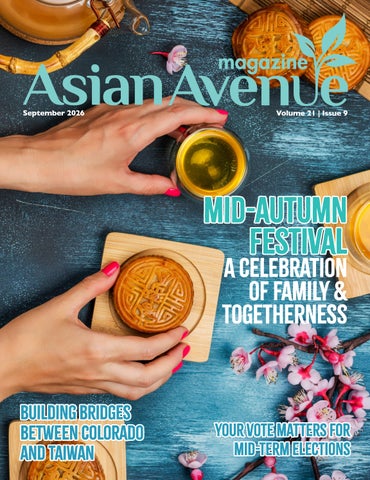
September 2026
Volume 21 | Issue 9
Mid-autumn Festival A Celebration of Family & Togetherness
Building Bridges Between Colorado and Taiwan
Your Vote Matters FOR MID-TERM ELECTIONS
ASIAN AVENUE - PRESIDENT’S NOTE This issue of Asian Avenue is all about connection. As we look ahead to the midterm elevtion, we’re sharing voter information because our voices and participation matter. Whether you are a longtime voter or voting for the first time, I hope this information help you feel more informed and ready to make your voice heard. Look for upcoming events at the Social Fabric Hub to learn more about candidates and what you will see on the ballot.
Annie Guo VanDan, President Asian Avenue magazine Connect with us! asianavemag@gmail.com @asianavemag Election Day is November 3. Make sure your voter information is up to date and know where and how you can vote. Check your registration at GOVOTECOLORADO.ORG, voting
4
We’re also celebrating the Mid-Autumn Festival—a time centered around family, food, tradition and togetherness. As a mom of three, I’m especially aware of how quickly time passes and how meaningful it is to create traditions and memories with the people we love. Last month, I also had the opportunity to interview Director General Debby Huang of the Taipei Economic and Cultural Office in Denver. Our conversation touched on Taiwan’s relationship with Colorado, investment and trade, and the important work of building connections between Taiwan and communities in the United States. We also discussed Taiwan’s experiences with international representation which remind us that our local communities can be connected to much larger global conversations. At Asian Avenue, we’ve spent the last 20 years telling stories that connect us, to our cultures, our communities and one another. I’m grateful that, after two decades, we are still finding new ways to bring our community together.
location, and ballot information ahead
With gratitude,
of time so you’re ready to participate.
Annie Guo VanDan
September 2026 | President’s Note
专家护理。非凡结果。
关节置换, 对医护团队的信心至关重要. 在我们的中心, 我们的专家专注于膝关节和髋 关节疾病, 从关节炎到关节置换, 均能提供先进的治疗, 帮助您自由活动. Charlie Yang博士确保每位患者在就医过程中都能感受到理解、支持和妥善的照料。
Colorado Joint Replacement at Porter • •唐宁街 2535 • • 100 • • •间 科罗拉多州丹佛市 80210 720-524-1367 扫描二维码了解更多信息
ASIAN AVENUE TEAM Publisher & Founder CHRISTINA YUTAI GUO President ANNIE GUO VANDAN Graphic Designer JON NGUYEN Staff Writer GIL ASAKAWA JADYN NGUYEN Website Manager KAI VONG
on the cover Families across the world will celebrate the Mid-Autumn Festival, or Moon Festival, this month which will fall on September 25, 2026. Beyond mooncakes, it is a time to celebrate the moon and be thankful for harvest. Asian Avenue magazine (ISSN 1932-1449) reserves all copyrights to this issue. No parts of this edition can be reproduced in any manner without written permission. The views expressed in articles are the authors’ and not necessarily those of Asian Avenue magazine.
Looking to promote your business? Asian Avenue magazine offers businesses a costeffective way to reach consumers in the Denver/Boulder metro areas and beyond. For more information, call 303.937.6888 or e-mail us at asianavemag@gmail.com for our media kit and ad rates. Send story ideas to asianavemag@gmail.com. Asian Avenue magazine is in association with the Colorado Asian Culture and Education Network.
6
September 2026 | Table of Contents
IN THIS ISSUE 4 8
PRESIDENT’S NOTE
19
FEATURE: Voter Information and and AAPI Survey Data
11 14
COVER STORY: Mid-Autumn Festival is a time to celebrate the moon in the company of friends and family
20
INSIDE STORY: Building Bridges Between Taiwan and Colorado: Director General Debby Huang on strengthening partnerships across the region
22
14 ASIAN AVENUE MAGAZINE P.O. Box 221748 Denver, CO 80222 Tel: 303.937.6888 E-mail: asianavemag@gmail.com
ON SCENE: Happy Living Adult Daycare promotes mental health and physical wellness for seniors through workshop and Colorado Dragon Boat Festival WELLNESS COLUMN: Managing toxic relationships with parents or family members OP-ED: Community is Culture; SCFD: We Fund Culture
19 Find us @AsianAveMag #AsianAveMag asianavemag.com
New Asian American Voter Survey Data: 90% of AAPI Adults Plan to Vote in 2026 Midterms as Cost-of-Living Tops Voter Concerns Asian & Pacific Islander American Vote (APIAVote) and AAPI Data released findings from the 2026 AAPI Voter Survey (AAVS), the longest-running survey of Asian American voters. Since 2012, the multilingual survey has tracked the attitudes, priorities and voting behavior of Asian American voters and provided critical insights into one of the fastest-growing segments of the U.S. electorate. The 2026 survey also provides new insights into the attitudes and experiences of Pacific Islander (PI) voters. Among the topline findings: • 90% of AAPI registered voters say they plan to vote in the 2026 midterm elections, up from 84% in 2022 and 86% in 2018. Seventy-one percent say they are absolutely certain they will vote. • Cost of living and inflation are the dominant concerns, with 90% of Asian Americans and 89% of Pacific Islanders saying it is very or extremely important in deciding how they vote. • Democratic candidates currently lead in congressional vote choice, and Democrats hold an advantage on voters’ top issue: 63% select the Democratic candidate for U.S. House compared with 24% Republican. On voters’ top issue, cost of living and inflation, 44% trust Democrats to do a better job compared with 18% who trust Republicans. • Many AAPI voters remain unreached: 42% report no contact from the Democratic Party and 58% no contact from the Republican Party. Community organizations reach approximately as many AAPI adults as the Democratic Party, with 58% reporting some contact from each.
90% of AAPI registered voters say they plan to vote in the 2026 midterm election November 3, 2026. (up from 84% in 2022)
8
September 2026 | Feature
• Family and friends (62%) and academic experts (60%) are the most trusted messengers, followed by community journalists (50%) and AAPI community-serving organizations (47%). Pacific Islander adults report particularly high trust in AAPI community-serving organizations (59% vs. 45% of Asian Americans). “For the last 14 years, APIAVote and our local partners have organized and mobilized AAPI communities across the country, helping drive continued increases in voter participation election after election. This year we are seeing even more voters planning to cast their ballots for the midterms,” said Christine Chen, Founder and Executive Director of APIAVote. “Together, we are committed to keeping that momentum going by reaching voters with trusted, in-language information and making sure they can safely and properly cast their ballots and have their votes counted.” “With Asian Americans being the fastest-growing electorate in the country, it’s crucial that we have the latest data on what motivates them to turn out and vote,” said Karthick Ramakrishnan, Founder and Executive Director of AAPI Data. “Our data show that many AAPI voters still haven’t been contacted by either party, signaling that there is tremendous electoral potential waiting to be activated.” The 2026 AAPI Voter Survey examines AAPI voters’ attitudes, priorities, voting plans and civic engagement heading into the 2026 midterm elections. For information about the survey, visit: aapidata. com/featured/2026-aapi-voter-survey.
Save the Date! Sunday, October 4, 2026 at Social Fabric Hub Colorado Governor Candidate Forum for the AANHPI Community Hear directly from Colorado’s gubernatorial candidates in a respectful, moderated conversation about issues important to AANHPI communities and all Coloradans. This is a nonpartisan forum, not a debate.
A midterm election is a major U.S. election held in the middle of a president’s four-year term. It takes place two years after a presidential election. In the 2026 midterm election, voters will decide who represents them in Congress, including all 435 seats in the U.S. House of Representatives and one-third of the U.S. Senate. Voters may also decide on state and local races and ballot measures, depending on where they live.
MARK YOUR CALENDAR
Tuesday, November 3, 2026 General Election
In Colorado: • Most registered voters automatically receive a ballot by mail. • You can return your ballot by mail or use an official drop box. • You can also vote in person at a Voter Service and Polling Center. • If you miss the mail-registration deadline, you can still register and vote in person through Election Day. • In-person voting ends at 7 p.m. on Election Day. Important date - October 26, 2026 Last day to register/update your registration and still receive a ballot by mail for the General Election. Don’t wait until Election Day to figure out how you’re voting.
Are You Registered?
Before every election, make sure your registration information is current. Check: • Your name • Your address • Your mailing address • Your party affiliation • Your voter status You can check your registration and access your voter information through GoVoteColorado.gov.
Who can register?
Eligible voters must be U.S. citizens, Colorado residents, and meet other eligibility requirements. Colorado also allows teens as early as 15 to preregister, although they cannot vote until they are 18. If you recently became a U.S. citizen, one of your new rights as a citizen is to participate in elections. Register to vote and learn about the candidates and issues before Election Day.
VOTER FAQ
Can I vote if I didn’t vote in the last election? Yes. Not voting in a previous election does not by itself remove you from the voter rolls. Check your registration to make sure your information is current. Can I vote if I recently moved? You should update your voter registration with your current residence. Can I vote if I’m a naturalized citizen? Yes, if you meet Colorado’s voter eligibility requirements. Can I vote if I don’t speak English well? Language assistance and election resources are available. Contact your county clerk or the Colorado Secretary of State for assistance. What if I lost my ballot? Contact your county clerk or visit an official voting center for options. Do I have to vote for every race? No. You can make choices on the races and measures you wish to vote on.
Register at: wfco.org
AAPI Voter Information | Asian Avenue Magazine
9
All You All You Can Can Eat Eat
Seafood · Japanese Sushi · Mongolian BBQ Chinese Hot Dishes · Cantonese Dim Sum
Lunch Buffet
Freshly Made
MON – FRI
Fresh Sushi Bar Mongolian BBQ Variety of Seafood & Hot Dishes Salad Bar Dessert Bar Chocolate Fountain Ice Cream Fresh Fruit
11:00 AM – 3:30 PM
Adults $16.99 Kids $12.09 Free under age 3 (Weekend & Holiday All Day Dinner Buffet)
Dinner Buffet MON – THUR
3:30 PM – 9:30 PM
FRI
3:30 PM – 10:00 PM
Adults $21.99 Kids $14.09 $5.49 under age 3
Cozy Space · East & West Flavors All You Can Enjoy
13680 E Alameda Ave, Aurora, CO 80012 Tel: 720-541-6448 Web: kingbuffetaurora.com
Mid-Autumn Festival: A Time to Gather, Give Thanks and Look Up at the Moon By Hannnah Cho
There is something special about looking up at the moon during the Mid-Autumn Festival. Across Asia and around the world, families pause from their busy lives to gather, share food, tell stories and appreciate the people who make a house feel like home. Also known as the Moon Festival or Mooncake Festival, the Mid-Autumn Festival is celebrated on the 15th day of the eighth month of the lunar calendar, when the moon is traditionally believed to be at its fullest and brightest. In 2026, the festival falls on Friday, September 25. For generations, the full moon has represented reunion, harmony and togetherness. That message continues to resonate for Asian American families today— even when grandparents, parents, children and loved ones may live thousands of miles apart. More Than Mooncakes Ask someone what comes to mind when they hear “Mid-Autumn Festival,” and mooncakes are likely to be one of the first answers. These round pastries are traditionally shared among family and friends, with their circular shape symbolizing completeness and reunion. Classic mooncakes may contain lotus seed paste and salted egg yolks, while
today’s bakeries and restaurants offer countless variations, from custard and chocolate to fruit, tea and ice cream flavors. Sharing mooncakes is about more than dessert. They are often given as gifts to family members, friends, coworkers and neighbors, a small gesture that says “I’m thinking of you.” And just as Asian American communities have evolved, so have mooncakes. Modern flavors and creative designs have made the traditional treat accessible to younger generations, while many families continue to seek out the familiar flavors they remember from childhood. A Festival Rooted in Family The Mid-Autumn Festival has a long history, with traditions surrounding the moon dating back more than 2,000 years in China. Over time, celebrations developed throughout East and Southeast Asia, each community adding its own customs, foods and stories. One of the most famous legends associated with the festival is the story of Chang’e, the Moon Goddess. According to one version of the tale, Chang’e drinks an elixir of immortality and ascends to the moon, where Mid-Autumn Festival | Asian Avenue Magazine
11
Family and togetherness are at the heart of the Mid-Autumn Festival, most often celebrated around a table filled with favorite foods. she remains separated from her husband, Hou Yi. During the Mid-Autumn Festival, people traditionally look toward the moon and remember the story. But there is no single way to celebrate. In China and Taiwan, families may gather for a meal, eat mooncakes and admire the moon. In Vietnam, the festival is known as Tết Trung Thu and has a particularly
strong connection to children, with lanterns, lion dances and traditional celebrations. In Korea, Chuseok takes place around the same time of year and centers on family gatherings, food and honoring ancestors. Across cultures, the details may differ, but the underlying themes are remarkably similar: family, gratitude, abundance and connection.
Once Upon a Bite
Asian Connect Denver Mid-Autumn Festival Special Event Saturday, September 19, 2026 | 2pm to 4:30pm Location: 10150 E Belleview Ave, Englewood, CO 80111 RSVP at asianconnectdenver.com Celebrate the Mid-Autumn Festival with an afternoon of
food, culture, music, and hands-on family fun! Once Upon a Bite brings people together through food and cultural experiences. Families and friends can taste specialties
from different Asian countries and regions, make mooncakes, explore traditional crafts, enjoy music and per-
formances, and experience the traditions and joy of the Mid-Autumn Festival together.
12
September 2026 | Cover Story
Keeping the Tradition Alive For Asian Americans, cultural traditions can sometimes take on new meaning. Parents may remember celebrating the festival with their own parents in Taiwan, China, Korea, Vietnam or another country. Their children, meanwhile, may experience the holiday primarily through a family dinner, a mooncake from an Asian grocery store or a lantern-making activity at school. That doesn’t make the tradition less meaningful. Each generation has an opportunity to make the festival its own. Grandparents might teach grandchildren a favorite Mid-Autumn story. Children might make paper lanterns or learn how to say “Happy Mid-Autumn Festival” in their family’s heritage language. Even something as simple as stepping outside together to look at the moon can become a family tradition. For families separated by distance, technology can also bridge the gap. A video call with grandparents, sharing photos of a family dinner or sending a box of mooncakes across the country can create a sense of connection when gathering in person isn’t possible.
In Colorado, there are several events to celebrate the festival with good food, music, and performances, and an opportunity to give thanks and gratitude. Looking Up and Celebrating Together Perhaps the most beautiful part of the Mid-Autumn Festival is also the simplest, appreciating the moon. The moon is something we can all share. Whether you’re celebrating in Denver, Taipei, Seoul, Hanoi, Los Angeles or somewhere in between, the same moon shines above us. Families may speak different languages, eat different foods and celebrate in different ways, but the tradition offers a reminder that connection doesn’t always require a complicated ceremony. This year, consider making a little time to celebrate. Buy a box of mooncakes. Invite family or friends over for dinner. Make lanterns with the kids. Call someone you haven’t talked to in a while. Step outside after dark and look up at the moon. The Mid-Autumn Festival is, at its heart, a celebration of being together, and a reminder to appreciate the people who make our lives feel whole.
Happy Mid-Autumn Festival from Asian Avenue Magazine!
Mid-Autumn Festival | Asian Avenue Magazine
13
Building Bridges Between Taiwan and Colorado Director General Debby Huang on strengthening partnerships across the region
Whether she is meeting with a governor, visiting a university, talking with business leaders or attending a community festival, Director General Debby Huang has a consistent goal: connect people with Taiwan. As Director General of the Taipei Economic and Cultural Office (TECO) in Denver, Huang represents Taiwan across a six-state region that includes Colorado, Kansas, Missouri, Nebraska, North Dakota and South Dakota. Her responsibilities range from government and economic relations to education, cultural exchange, community engagement and consular services. But at the heart of her work, she says, is helping people understand Taiwan—and recognizing the many ways Colorado and Taiwan can work together. “My goal is to help people better understand Taiwan and identify areas where we can work together,” Huang said. Huang wants people to know that Taiwan is not a distant partner. Taiwan is here to help, and TECO Denver can help build the connections across communities. “If you are interested in Taiwan, you should visit,” she said. “Do business, study in Taiwan, visit Taiwan—you can come to us to better understand Taiwan’s role in the world.” More than semiconductors: A growing economic relationship Taiwan is perhaps best known internationally for its semiconductor industry. But Huang believes there is a much bigger story to tell about the economic relationship between Taiwan and the United States.
14
September 2026 | Inside Story
Taiwan and the U.S. have developed deep and increasingly diverse economic ties, with Taiwanese companies expanding investments throughout the country in semiconductors, artificial intelligence, advanced manufacturing, electronics and other industries. Huang pointed to approximately $265 billion in Taiwanese investment commitments in the United States as evidence of Taiwan’s long-term confidence in the American economy. Importantly, those investments are not concentrated in one or two states. “They are establishing operations and partnerships in states across the country,” Huang said. “This means that Taiwan-U.S. economic relations are increasingly becoming state-to-state and community-to-community relationships.” That creates a natural opportunity for Colorado. Colorado is a national leader in aerospace, quantum technology, research and innovation, while Taiwan brings worldclass expertise in semiconductors, advanced manufacturing and electronics. Huang sees those strengths as complementary. “I see tremendous room for growth,” she said. “The foundation is already there. Now our task is to turn these connections into more investment, more partnerships, and more opportunities for people on both sides.” A new chapter for Taiwan and Colorado One significant milestone came earlier this year when Huang
The Taipei Economic and Cultural Office (TECO) in Denver celebrated the 114th anniversary of the Republic of China (Taiwan) National Day at the Denver Botanic Gardens.
TECO in Denver hosted a dinner for the Taiwan delegation from the Association of Young Political Leaders of America to connect with the Colorado Office of Economic Development and International Trade.
and Colorado Governor Jared Polis signed a Taiwan-Colorado Memorandum of Understanding covering areas including trade, investment, agriculture, education and talent exchange. For Huang, the agreement represents more than a document. It is an opportunity to put greater focus on the relationship and identify tangible ways for businesses, universities and communities to work together. The Colorado Office of Economic Development and International Trade is also preparing to lead a delegation to Taiwan, creating another avenue for Colorado companies to explore opportunities in the Taiwanese market. Huang describes TECO’s role as that of a matchmaker— connecting Colorado leaders and businesses with potential Taiwanese partners. “We want to see if we can persuade high-tech companies in Taiwan to come to Colorado and invest in Colorado,” she said. She also sees potential beyond technology. During a recent visit to Palisade, Colorado, Huang joined local officials and representatives from other diplomatic offices to experience the region’s agriculture and agritourism—including peaches, apples, wineries and local businesses. The immediate opportunity may be helping Colorado agricultural producers reach Taiwanese consumers. But Huang says the larger goal is building relationships that can grow over time. “We think about how we can do more for a long-term relationship with Taiwan,” she said. “One way is through agriculture.” That state-to-state approach is part of a larger shift in how Huang views Taiwan-U.S. relations. The relationship is no longer simply centered in Washington, D.C. Huang noted that U.S. federal agencies—including the Departments of State, Commerce and Agriculture—have encouraged state and local governments and business organizations to deepen engagement with Taiwan. “Stronger relations with Taiwan are not only a foreign policy issue,” Huang said. “They can create real economic, educational,
agricultural and technological opportunities for American states and communities.” Taiwan’s message to the international community: We can help While economic development is an important part of Huang’s work, she also wants Coloradans to understand another dimension of Taiwan’s international role. Taiwan has long sought greater participation in international organizations, including the United Nations and the World Health Organization. Huang argues that Taiwan’s exclusion prevents
Taipei Economic and Cultural Office | Asian Avenue Magazine
15
The Taipei Economic and Cultural Office (TECO) in Denver represents Taiwan across SIX STATES: Colorado, Kansas, Missouri, Nebraska, North Dakota and South Dakota. the international community from fully benefiting from Taiwan’s expertise and experience. She particularly points to Taiwan’s healthcare system and its experience responding to public health emergencies such as SARS and COVID-19. “We are willing to help,” Huang emphasized. She notes that Taiwan is a vibrant democracy of 23 million people. “This year marks 30 years since Taiwan held its first direct presidential election in 1996. We have built a free and open society with competitive elections, peaceful transfers of power, a free press, and a very active civil society. Yet despite everything Taiwan has achieved, our 23 million people are still excluded from the United Nations and many international organizations.” Her message is that Taiwan has knowledge, expertise and resources that can benefit the world. Huang is particularly focused on the interpretation of United Nations General Assembly Resolution 2758, which addressed the question of China’s representation at the United Nations. According to Huang, the resolution did not resolve the broader question of Taiwan’s participation in international organizations, yet she believes China has used its interpretation of the resolution to oppose Taiwan’s involvement in international forums. As the United Nations General Assembly prepares to convene in New York in September, Huang hopes more people will understand Taiwan’s perspective. “Taiwan is ready and willing to contribute,” she said. “We simply ask for the opportunity to participate meaningfully.”
16
their own borders to silence critics and political opponents. Huang sees this as a concern not only for Taiwan, but for anyone who speaks publicly about issues involving China. She pointed to cases involving journalists, activists and politicians as examples of what she describes as China’s efforts to intimidate voices. “It is important for Americans to understand that the challenge posed by authoritarianism does not always stop at national borders,” she said. She referenced the case of Hong Kong media executive Jimmy Lai, a British citizen who has been imprisoned in Hong Kong, as an example of the broader concerns surrounding the reach of China’s legal and political system. For her, it is about whether people can speak freely without fear of repercussions outside their own country’s borders. She also pointed to concerns involving Taiwanese lawmakers and advocates who speak openly about China’s actions. “People living in a free society should be able to speak openly, participate in community activities, and express their identity without fearing pressure from a foreign government,” Huand said. “That is why Taiwan believes democracies need to recognize transnational repression for what it is and work together to protect the open civic space that allows our communities to thrive.” She hopes Colorado leaders and the broader American public will continue learning about these challenges while maintaining opportunities for dialogue and engagement.
Raising awareness about transnational repression Another issue Huang believes deserves greater attention is transnational repression, the use of intimidation, harassment, surveillance or other forms of pressure by governments beyond
Connecting communities, not just governments One of the most personal aspects of Huang’s work is her engagement with Colorado’s Asian American and Taiwanese communities. She says she has been impressed by the strength and diversity
The Taiwan team at the 2026 Colfax 5K Marathon in Denver promoted support for Taiwan’s participation in the World Health Assembly.
Director General Huang joined Denver Mayor Mike Johnston, and Consul General of Japan Hiroyuki Okajima at the Colorado Dragon Boat Festival.
September 2026 | Inside Story
of the communities she has encountered since arriving in Colorado. Taiwanese Americans have established businesses, cultural institutions, Chinese schools and community organizations, while the broader Asian American community has created its own networks of support and collaboration. “These communities are not simply cultural bridges,” Huang said. “They are also important participants in business, education, civic life and public service.” She has also made a point of supporting cultural events and community organizations, including Taiwanese film programming and local Asian American initiatives. Huang emphasized that strengthening Taiwan-Colorado relationships is not the responsibility of one organization. “It is not one community, or one organization,” she said. “It is all the communities coming together.” She sees events such as Taiwan Day at Coors Field as opportunities not only to celebrate Taiwanese culture, but also to bring together business leaders, government officials and community members. The event, organized with the Taiwanese Chamber of Commerce, provides opportunities for networking and greater visibility for the Taiwanese business community.
An invitation to visit and better understand Taiwan Huang’s vision for TECO Denver is ultimately grounded in accessibility. She wants elected officials, businesses, universities, community organizations, students and individuals throughout the six-state region to see Taiwan as a partner they can engage with directly. She hopes Colorado legislators, state and local officials, business leaders and journalists will visit Taiwan to experience the country firsthand. And that is also the spirit behind inviting Asian Avenue Magazine to participate in a media tour of Taiwan this year. “I want American journalists to see Taiwan as it really is: a diverse, democratic, creative and open society. I want them to meet our people, experience our culture, visit our businesses and universities, and see how democracy functions in everyday life,” she said. Taiwan is more than semiconductors. It is a place of innovation, agriculture, culture, democracy, healthcare, entrepreneurship and community. And Colorado, she believes, has much to offer in return. “I see tremendous room for growth,” Huang said. As Taiwan and Colorado continue developing their relationship, Huang’s role is to help turn that potential into real connections throughout the region.
The Taiwan-Colorado MOU was signed by Director General DEBBY Huang and Governor Jared Polis to deepen economic, technological, and agricultural ties by emphasizing:
Advanced Technology
Boost collaboration and research in quantum technology, photonics, and semiconductors.
Precision Agriculture
Expand trade, investment, and innovative agricultural practices.
Professional Exchange
Promote talent sharing, economic cooperation, and supply chain diversification. Taipei Economic and Cultural Office | Asian Avenue Magazine
17
The Chinese seniors of Happy Living Adult Daycare performed at the 2026 Colorado Dragon Boat Festival including a tai chi demonstration, ballroom dance, and choir songs.
Happy Living Adult Daycare emphasizes mental wellness and movement for aging seniors What does home mean to you? For the Chinese seniors at Happy Living Adult Daycare in Aurora, the question brought back memories of places, people, food and sounds from long ago. During a recent Aging with Grace workshop, 80 seniors gathered for a morning focused on mental wellness, connection and the importance of caring for our emotional health as we age. Made possible through support from the National Asian American Pacific Islander Mental Health Association, the workshop brought in Dr. Anne YJ Hsu, a clinical psychologist, to lead the group through an interactive session. Dr. Hsu brings a multicultural perspective to her work, having received her education in Canada, Taiwan, India and the United States. For this workshop, Dr. Hsu’s ability to speak Mandarin was particularly meaningful. She was able to communicate directly with the seniors in their own language while creating a space that felt familiar, culturally responsive and welcoming. Dr. Hsu began with a simple breathing and grounding exercise, inviting everyone to slow down and be present. She then asked the seniors to think about the meaning of “home.” Was home the place they live today? Or was it a hometown left behind many years ago?
“What does it smell like?” she asked. “What does it sound like?” The room came alive. The seniors began recalling their hometowns, favorite foods from childhood, familiar mountains and landscapes, and the sights and sounds that shaped their memories. They wrote and drew their reflections, creating a space where memories could be shared and celebrated. Then Dr. Hsu encouraged everyone to get up and connect with one another. Participants were asked to greet someone new, offer words of encouragement and well wishes. The room quickly filled with smiles and laughter. For many of the seniors, these simple moments of connection seemed especially meaningful. They began introducing one another and sharing stories about the people around them. The group also sang a popular Chinese song together, filling the room with familiar voices and memories. Only after everyone had experienced these activities did Dr. Hsu explain the
mental health benefits behind them. She talked about how depression can sometimes appear differently than we expect. A person may not necessarily describe themselves as “sad,” but may feel increasingly tired, isolated or unmotivated, even finding it difficult to leave the house. These changes can be easy to overlook, especially when they happen gradually. The activities throughout the morning offered simple ways to support mental and cognitive wellness. Revisiting memories of home can stimulate cognition and memory. Singing can bring joy and increase positive feelings. Reaching out to another person, offering a hug or simply checking in can benefit both the person giving and receiving that connection. Even with a group of about 80 people, Dr. Hsu moved throughout the room, engaging participants and making the workshop feel personal. For older adults, mental wellness can be supported in many small, everyday ways. Sometimes it begins with remembering where we came from. Sometimes it is singing a familiar song. Sometimes it is simply sitting beside someone. On August 29, a group of the seniors performed at the Colorado Dragon Boat Festival. They spent weeks practicing their performances including tai chi, ballroon dancing, and singing in a choir, and were overjoyed to perform for the community. On Scene | Asian Avenue Magazine
19
Ask Dr. Amy Dear Dr. Amy, I see more people cutting off from toxic family members. I’ve always thought this would be so difficult as an Asian person, and yet I have so much resentment, anger, and guilt towards my parents for the way they raised me. Is parent-child estrangement on the rise? What can I do with my complicated feelings towards them? — Not ready to walk away There are many cultural dynamics
and, at the same time, feel enormous
my relationship with my parents to look
hard to navigate. In many AAPI families,
have done for you. Those feelings can
alignment with my own values?
that can make family conflict especially emotional pain isn’t something we
talk about openly, and maintaining the
gratitude for everything your parents exist together.
And then there is the complicated
harmony of the family can take priority
question of sacrifice. Many of us grow
may be handled indirectly—through
the generations before them—gave
over addressing individual hurt. Conflict silence, the silent treatment, brushing
things under the rug, or even an apology expressed through food rather than
words. If that’s what you grew up with,
it can be hard to know how to talk about what hurt you, what you need now, or
even what kind of relationship you want with your parents.
It can be especially complicated
to think about estrangement in AAPI
families because our relationships with
up knowing that our parents—and
up a great deal for their families. That can create a powerful sense of duty or obligation. You may find yourself
thinking, “How can I be angry at them
when they sacrificed so much for me?”
you sort through the anger, resentment, guilt, grief, and love underneath these
complicated feelings and identify what
matters most to you. It can also help you find places where you can change your
relationship to the pain, even when you can’t change what happened.
Ultimately, you don’t have to choose
minimize how their choices affected you.
toward a decision that is thoughtful
came from doesn’t mean you have to
You can hold compassion for their story while still making room for your own. There is certainly more openness
interdependence. You can feel deeply
but I don’t think the question has to be,
you were raised
particularly powerful. Therapy can help
between complete reconciliation and
today around talking about family
hurt or angry about how
This is where therapy can be
But understanding where your parents
parents are often shaped by deeply held
values around family, duty, sacrifice, and
like, and what would allow me to live in
estrangement and setting boundaries, “Should I cut my parents off?” A more
useful question might be: What do I want
complete estrangement. You can work and intentional rather than driven by
guilt, anger, or obligation. You may never reconcile every conflict or feeling—and that’s okay. The goal may simply be to reconcile as much as you can, make
peace with what you cannot, and build a relationship with your parents that feels right for you.
Dr. Amy King is a clinical psychologist and founder of InnerWoven Therapy, a Colorado-based group practice specializing in Asian mental health. In this column she answers your mental health questions—readers are invited to submit their own for future features.
Scan the QR code or visit: innerwoventherapy.com/askdramy Wellness Column | Asian Avenue Magazine
21
y t i n u is Culture Comm By Emma Mantooth
On Santa Fe Drive, an arts hub hums with light and color. Prints and artwork adorn the interiors of nearly every building. Nestled amongst museums and coffee shops, you’ll find the seemingly unassuming Access Gallery, a quiet, sunny space filled with original art. It’s much more than meets the eye. A nonprofit organization, its open doors welcome people with disabilities to access, experience and benefit from the arts by providing unique creative, educational, and economic outlets. Access Gallery’s Executive Director Damon McLeese shares, “for more than 40 years, Access Gallery has worked to increase access to the arts for people with disabilities. As both a studio and a gallery, we create opportunities for artists to develop their practice, exhibit and sell their work, teach, mentor, and earn income while helping address the 70–90% unemployment rate among people with disabilities. Our studio, digital, gallery, and community programs ensure that the perspectives of artists with disabilities are part of Colorado’s cultural conversation. SCFD funding helps make those opportunities possible while giving the public the chance to experience the talent, ideas, and perspectives of artists who have too often been left out of traditional arts spaces. When more artists are included, the entire community benefits.” I first visited Access Gallery last summer for a presentation from a cohort of interns who came together to create, curate, and manage a gallery exhibition. Each summer, the gallery hires 10-15 high school students who have an interest in the arts, and happen to have disabilities, to provide them with hands-on experience in the arts industry. I was unprepared for the vulnerability and pure joy woven through each intern’s story and the artwork they shared. From a huge recycled-cardboard octopus to colorful paintings and drawings, each program participant shared their favorite works of art from the summer and the story behind them. Many expressed that the space to create art helped them reflect on challenges they experienced or sources of happiness that they wanted to share, build friendships with fellow interns, and allowed them to explore new mediums and potential career
22
September 2026 | Op-Ed
paths. Each presentation was met with riotous applause and thoughtful questions from fellow interns and family members. If it wasn’t clear before, it became clear to me then that Access Gallery is more than just a gallery, it’s a source of community. Now more than ever, community is key. And culture is a cornerstone of that. It’s so easy to get sucked into scrolling on your phone with the ever-present draw of what your personalized algorithm could serve you next, or to turn inwards when things can feel divided in your own family or friend group. Being alone can feel safe, and your for-you-page can feel like the embrace of a loved one sometimes. But that can only take you so far.
Enjoy other SCFD funded partners through a free cultural experience: Museum of Outdoor Arts’ Marjorie Park Free Day - Sept. 9 Friendship Powwow and Free Day at Denver Art Museum - Sept. 12 Brighton Art in the Park - Sept. 12 Clyfford Still Museum 15th Anniversary Community Celebration - Sept. 15 Wings Over the Rockies Air & Space Museum - Sept. 20 Highlands Ranch Cultural Affairs Association’s Oktoberfest Celebration - Sept. 26 Dinosaur Ridge Paleo Art Fest and Free Day - Sept. 27 Historic Elitch Gardens Theatre’s Concert in the Carousel - Sept. 27
There’s something in all of us that itches for more – I hear it at happy hours with friends or in conversations at lunch with coworkers: people are taking up pottery and collaging and reading. It’s why the recent pro-shot of “Hadestown” just took the crown as the highest-grossing live stage-capture film in recent history according to Playbill. Arts and culture give us something to connect with, and by extension, a way to connect with each other. One afternoon, a woman walking past Access Gallery noticed a brightly colored, bejeweled painting by one of Access’ artists, Blossom. Blossom had been worried that people wouldn’t like her artwork and that no one would ever buy it – but she didn’t need to be. After entering the gallery and reading the story displayed along the piece, the woman purchased it. Weeks later, Blossom received a photo of her painting hanging in the collector’s home in Florida. That’s the power of culture for all! Sometimes all it
takes is one workshop or internship for a spark to ignite, for relationships to form, and for an artist to be born. That’s why third spaces are so important. And why SCFD is proud to support Access Gallery and more than 300 other nonprofits across the Denver metro area who provide that key ingredient for district residents - connection. We see it within all our funded partners, between dancers in 3rd Law Dance/Theater, musicians in the Broomfield Symphony, visitors at Foothills Arts Center, and beyond. “Culture and community are synonymous to me. Art, theatre, dance, music, science, history…all of these things bring people together in their own way. It’s wonderful that residents in the district know this and have supported SCFD’s vision to provide culture for all for nearly 40 years now,” said SCFD’s Executive Director, Andrea Albo.
SCFD: We Fund Culture | Asian Avenue Magazine
23