Irish Printer Issue 2 2026

Page 1


Joe O’Callaghan chats to Irish Printer about two decades of training excellence

Andrew Carson, Robbie Carson and David Duffy at JR Labels talk about the power of relationships

22 Diversity

Danna Drion on the importance of empowering women in the print industry 24

Careers

The capability of modern production equipment sparked Mark Lynam’s passion for the industry

ED’S LETTER

Welcome to issue 2 of Irish Printer for 2026.

This year, Design, Print and Packaging (DPP) Skillnet is celebrating two decades of training excellence. The initiative, which was founded by the late Lorcán Ó hÓbáin in 2006, aims to drive skills and innovation in the print industry through accessible high-quality training. Over the years, its diverse range of courses have boosted productivity and operational efficiency in print firms across the country.

On page 10, Network Manager Joe O’Callaghan chats about all that has been achieved over the past 20 years and the Skillnet’s upcoming courses, including a new training programme designed to get more young people interested in the industry.

Heidelberg’s new Jetfire 75 is our cover feature for this issue of Irish Printer. The press combines sheetfed offset printing with digital printing, creating a hybrid production environment that offers customers maximum flexibility and efficiency. Its large B2 format gives print firms the flexibility to produce everything from brochures and books to labels, stickers, posters and calendars. It is, says Heidelberg Chief Technology and Sales Officer Dr David Schmedding, “shaping the future of digital industrial print production and taking it to a whole new level.” For more on the new press, turn to page 18.

Elsewhere in this issue, we chat with Andrew Carson, Robbie Carson and David Duffy at JR Labels about the firm’s success to date. Almost five decades in business, JR Labels was established by Andrew’s father Ron (still going strong at 90 years of age). Andrew attributes the firm’s longevity to hiring the right staff, building relationships and cutting your cloth to suit your market. For the next few years, the focus will be on maximising the potential of the print firm’s latest investment – a new Mark Andy Digital Pro Max – and continuing to provide the trade with the same high quality, cost-effective service it’s become known for.

Editor: Denise Maguire

Email: editor@irishprinter.ie

Creative Director: Jane Matthews

Designer: Lenny Rooney

Production: Nicole Ennis

Contact: Irish Printer, Ashville Media Group, Unit 55, Park West Road, Park West, Dublin 12, D12 X9F Tel: (01) 432 2200 Web: www.irishprinter.ie

Printed by: McGowans Print

Printed on: HP Indigo 10000 using Novatech paper supplied by Antalis.

All rights reserved. Every care has been taken to ensure that the information contained in this magazine is accurate. The publishers cannot, however, accept responsibility for errors or omissions. Reproduction by any means in whole or in part without the permission of the publisher is prohibited. © Ashville Media Group 2026. All discounts, promotions and competitions contained in this magazine are run independently of Irish Printer. The promoter/advertiser is responsible for honouring the prize. ISSN 0790-2026

As always, we’d love to hear from you. If you have any thoughts on this issue, please drop us a line at editor@irishprinter.ie. Enjoy!

Rethink the Finish: Automated Perfection from Edge to Edge

This industry-first inline trimmer delivers professional, shelf-ready products by slitting, trimming, creasing, and perforating with precision. From business cards to oversized banners, it eliminates manual touchpoints to provide flawless finishing at the speed of your press.

• Cuts business cards, DL, A5 & many more

• Reduces manual intervention & labour costs

• Produces ready-to-pack, fully finished jobs

• Optional crease, perforation & banner units

• Integrates seamlessly into existing RIP workflows: Fiery, Creo & Konica Minolta

To schedule a live demonstration, please contact Mark Lynam

Mark Lynam T. + 353 1 466 3500 E. info@mjflood.ie W. mjflood.ie

UPDATES

The National Print Museum TURNS

On 4 April 1996, then President Mary Robinson officially opened the National Print Museum at the Old Garrison Chapel in Beggars Bush Barracks, Dublin 4. Thirty years later, the Museum is celebrating three decades of preserving, sharing and championing the power of print in Ireland

Founded by members of Ireland’s printing industry, the Museum was established to preserve the tools, skills and stories of a craft that shaped how ideas, culture and information were shared for centuries. Over the past three decades it has grown into a nationally and internationally recognised cultural institution and the custodian of Ireland’s printing heritage, safeguarding a remarkable working collection of historic presses, type and printed material, while bringing the story of print vividly to life for new audiences.

Today, the Museum is one of Dublin’s most distinctive visitor experiences and a vibrant place of discovery for people of all ages, with over 55,000 visitors annually. Through exhibitions, demonstrations and hands-on workshops, visitors can experience the craft of printing first hand and discover how print has shaped Irish society, culture and design. Education sits at the heart of the Museum’s impact. Each year, hundreds of school and college students take part in formal learning programmes that connect the history of print with creativity, literacy and design. The

Museum also delivers a well-established Culture and Heritage course, in conjunction with the City of Dublin Education and Training Boards, that supports adult learners and community participants, helping people build new skills while engaging with Ireland’s cultural heritage in a meaningful

and practical way.

The Museum’s exhibitions and programmes explore the extraordinary breadth of print’s influence on everyday life. It has collaborated with academics, cultural institutions and other organisations, including the Victoria and Albert Museum,

the National Library of Ireland, the National Museum of Ireland and An Post. Past exhibitions have examined subjects including the printing of the Easter Rising, the role of print in the Irish women's suffrage movement, the visual culture of vinyl records, political ephemera, label art, stamps and theatre posters. Together they reveal how print has shaped politics, culture, music, commerce and public debate.

The Museum’s programme also connects the historic craft of printing with contemporary creativity. It has collaborated with leading Irish writers such as Colm Tóibín, Clare Keegan, Anne Enright, Sebastian Barry and Roddy Doyle, alongside musicians including Imelda May. The Museum has also partnered with contemporary visual artists such as Maser and Anthony Burrill, offering fresh perspectives on the collection and

To mark its 30th anniversary, the Museum is planning a special festival – The BIG Type: 30 Bold Years 5

demonstrating how the traditions of print continue to inspire new generations of artists and designers.

Beyond its home in Beggars Bush, the Museum works with audiences across Ireland through outreach programmes at festivals, schools, libraries and community events, sharing the craft of printing with people of all ages. The Museum also participates in European cultural projects that connect Ireland’s printing heritage with wider international conversations about craft, design and cultural memory.

A major milestone came in 2019 when letterpress printing was formally inscribed on Ireland’s National Inventory of Intangible Cultural Heritage under the UNESCO Convention for the Safeguarding of Intangible Cultural Heritage. This recognition affirms the importance of printing as a living cultural practice whose skills and knowledge must continue to be shared and sustained.

Looking ahead, the Museum’s ambition is bold. It aims to expand its reach, deepen its educational impact and strengthen its role

as a centre for the appreciation of print, design and visual communication in Ireland. By connecting heritage craft with contemporary creativity, the Museum ensures that the story of print continues to inspire future generations.

To mark its 30th anniversary, the Museum is planning a special festival. ‘The BIG Type: 30 Bold Years’ will celebrate not only its own history but also the wider story of print in Ireland, past, present and future.

The Museum is currently seeking print partners who may be able to support the summer festival through in-kind printing (programmes and other associated materials) or offer unique venues for talks or events. Participating companies will benefit from branding opportunities and complimentary tickets to the events.

To find out more, contact CEO Carla Marrinan Funder at carlamarrinan@nationalprintmuseum.ie www.nationalprintmuseum.ie

CANON

SPOTLIGHT ON…

TASKALFA PRO 15000C

Making photography accessible

‘World Unseen’, a photography exhibition for people with visual impairments, made its Irish debut at the Photo Museum Ireland in Dublin’s Temple Bar in February. The exhibition was created and produced by Canon and o ered visitors a tactile and sensory experience through elevated prints, audio descriptions and braille. Canon’s print technology, powered by its PRISMAelevate XL software and Arizona printer series, has been used globally to support museums and galleries in making art more inclusive. This exhibition continued that mission, o ering a striking showcase of how innovation can open new possibilities for people with visual impairments.

Following an agreement between Kyocera and Ricoh USA, the TASKalfa Pro 15000c has joined the Ricoh Europe Graphic Communications portfolio. The colour SRA3 sheetfed press delivers fast single pass printing at speeds of 150 A4 pages per minute. It harnesses Ricoh input and output media technologies, such as the Large Capacity Tray (LCT) and high capacity stackers, and is engineered to sustain duty cycles of up to 1,000,000 sheets per month. Ricoh says it can also process a broad range of media substrates with weights up to 360 gsm. It’s particularly suitable for transactional printing and mailing houses, providing an accessible entry point into inkjet technology. An optional 4,000 sheet inline finisher enables end to end production for folded letters, tri-fold brochures and booklets. It also delivers stapling for up to 100 sheets, booklet folding and stapling for up to 20 sheets and two- and three-hole punching.

Key Features

Eco-friendly: Uses water-based inks and consumes significantly less energy (up to 70% less) than comparable toner-based printers, reducing carbon footprint

Easy installation: Designed to run on standard power with no specific infrastructure, it allows for installation across many di erent types of print environments

Cost e ective: O ers a lower cost per page and strong ROI for high volume printing

Versatile media handling: Supports a variety of paper sizes and weights up to 360gsm

Reliable and durable: Uptime is maximised and supported by remote servicing options

Scalable: Small footprint that minimises space impact, with the flexibility to grow as demand increases.

Guido Jacobs, Managing Director, Canon UK & Ireland

Peak Postal is a family-run business, serving at the heart of the Irish envelope market for nine years

Dependability and quality

Starting as an offshoot of the original stationery business, Peak is now in its third generation of the family, maintaining its family values, while growing and developing our team, who are taking our organisation to the next level. We combine strong in-house production capabilities with significant manufacturing capacity. Our focus remains on delivering dependable supply and consistent quality across bespoke and printed envelopes, as well as a wide range of postal packaging solutions. In Ireland, our Senior Account Manager, Anne Jackson, has been part of the operation since its inception, offering valuable continuity and deep customer insight. Anne works alongside Susan, who joined our team in 2025 with extensive industry experience. Together, they

provide knowledgeable local support, backed by the strength and stability of an established manufacturing group with more than 53 years of experience.

At a time when reliability and continuity of supply matter more than ever, Peak remains committed to building long-term partnerships, delivering responsive service and offering competitive commercial solutions – factors that have been central to our success in Ireland. As the printing and packaging landscape continues to evolve, we are increasingly focused on expanding into new markets, developing new opportunities and delivering innovative postal packaging solutions, while continuing to excel in our dependable envelope and print specialities.

Rolf Doouss, MD, Peak

THE BAR RAISING

Last month, Canon Ireland hosted ‘World Unseen’ at Photo Museum Ireland in Dublin, an immersive and accessible exhibition that invited visitors to experience print and photography in a completely new way. World Unseen is an inclusive photography exhibition that makes art accessible to blind and partially sighted people by transforming iconic photos into tactile prints using Canon PRISMAelevate XL

Canon’s elevated print is making photography more accessible

and Arizona technology, complemented by braille and audio descriptions for a multi-sensory experience. The event was a huge success, attracting strong attendance across its five-day run. Visitors encountered a series of striking images that showed how imagery could be experienced through touch to tell stories, communicate and evoke emotion.

Bringing the exhibition to life

“At Canon, we believe that images have the power to transform the world and that’s why we say that ‘to see what we can change, we must change what we can see.’

But what if you can’t see? And this is what inspired ‘World Unseen’. It was created by Canon as a first-of-its kind photography exhibition to enable people with varying visual impairment to better engage with the visual world,” said Audrey Frost, Canon Ireland.

The aim of the exhibition is to raise awareness of the need for accessibility in the arts and highlight how inclusive design can enhance experiences for all audiences, uncovering new untold stories.

The technology

Using tactile print technology has enabled Canon to produce braille and relief prints for famous paintings and artworks in the recent past, but with World Unseen, we saw an opportunity to curate an entire exhibition experience for all. Leveraging the same tactile print technology for photography and complementing it with immersive audio description and braille descriptions provided a unique photography experience to demonstrate universal design that we hope will inspire the whole visual arts industry.

Canon’s PRISMAelevate XL software and Arizona printer series play a pivotal role in making photography tactile. When printing, the Arizona produces very thin layers of UV curable ink which are continuously printed on top of each other until an elevation is achieved. Each layer is thinner than a human hair. After every layer,

At Canon, we believe that images have the power to transform the world and that’s why we say that ‘to see what we can change, we must change what we can see’

the ink is cured using UV lights, which results in a hard, thin layer.

The relief printing brings textures, contours and shapes to life - enabling users to “feel” a photograph. Also, the exhibition display plinths were ergonomically designed to meet accessibility standards, with optimal height, angle and Braille layout for comfortable interaction.

The Arizona 1300 with FLXflow technology offers enhanced productivity for growing-mid-volume operations. Its patented technology allows for intelligent media handling, including both holding and floating options, making it easier to work with heavy and delicate media. The ‘Instant Switch’ function enables you to

transition quickly between ‘Hold’ and ‘Float’ for even easier media handling.

Using tactile print technology has enabled Canon to produce braille and relief prints for famous paintings and artworks

The printers are versatile, handling a wide range of rigid and flexible media, as well as irregular- shaped substrates, making it ideal for a broad range of applications. Additional innovations such as UV-LED curing technology and 3rd-generation VariaDot technology further boost its performance.

Bringing World Unseen to Ireland was a collaborative effort between CBB, who created the print ready files, Hacketts who produced the elevated reliefs on the Canon Arizona and the supporting prints on the Canon Colorado M5.

To learn more about the technology used to bring World Unseen to life, please contact marketing.ireland@canon.ie

TRAINING

DPP Skillnet Network Manager Joe O’Callaghan chats to Irish Printer about two decades of excellence

DESIGNED SUCCESS for

This year, Design, Print and Packaging (DPP) Skillnet is celebrating a special anniversary. Two decades ago, it began offering specialised training to businesses in the design, print, packaging, signage and label sectors. “From the start, our aim has been to provide strategic, cost-effective training to the industry, to drive skills and innovation and improve business performance through accessible high-quality training. We work closely with companies to identify and prioritise their training requirements through a structured training needs analysis process. Training is affordable –most of it is sponsored by Skillnet – and we also facilitate networking events which encourage knowledge sharing. All of this helps businesses in the print industry stay ahead of the marketplace. As we approach our 20th anniversary this year, we’re essentially marking two decades of excellence in delivering training and development solutions to businesses of all sizes. It’s something to be proud of,” says Network Manager Joe O’Callaghan.

It wouldn’t have been possible without the foresight of Lorcán Ó hÓbáin. He paved the way for what we have today

DPP Skillnet was the brainchild of the late Lorcán Ó hÓbáin, past President of the Irish Printing Federation and past Chairperson of Northside Partnership. Twenty years ago, Lorcán approached several people in the industry, including Joe, and asked them to become part of Skillnet. “Their first question was, what is Skillnet? I had no idea what it was about back then. Lorcán was really ahead of his time in terms of what he envisioned the Skillnet to be. He asked me to join the team and become chairperson, which I did.” So began an initiative whose programs have led to measurable improvements in productivity, operational efficiency and employee engagement for print firms across the country. Courses are diverse, ranging from digital transformation and leadership development, to sustainability training. The goal, says Joe, is to equip businesses with the skills they need to remain competitive. “Our engagement with policymakers and industry stakeholders ensures that our training programs anticipate future skills needs, creating a resilient workforce ready for emerging challenges.”

DPP Skillnet has also provided an alternative training pathway for print apprentices. “The industry was lacking an apprenticeship programme so in 2023, I put together an idea and brought it to Skillnet. Along with the Irish Printing Federation, we launched the Print Media Technician

When was JR Labels established?

Andrew: The business was set up in 1978 by my father, Ron Carson, who’s still going strong at 90 years of age. He was joined in the early 1980’s by his late son-in-law David Lesware and myself. The business began as a packaging supplies company but only a few years later, he recognised a gap in the market for self-adhesive label manufacturers, in the print and stationery trades in particular. We bought a few small machines and it wasn’t long before the packaging supplies side of the business got overtaken by the label manufacturing side.

Family Values

Andrew Carson, Robbie Carson and David Duffy at JR Labels talk about staying the course and the power of relationships

We purchased our first 6 colour Mark Andy label press back in the 90’s and have continuously added to our stock of high quality flexographic machinery since

Back in the early 1980’s, what was the labels market like?

Andrew: There were only two or three companies in Ireland back then. Labels hadn’t taken off to the extent that they have today. You had Avery Dennison and one or two others. We actually bought one of our first machines – an overprinting machine – from Avery Dennison for about £900, which was a lot of money back in the early 80’s. We were definitely one of the first small, family-based businesses in this sector and we’ve always supplied to the trade – that’s our bread and butter.

Where were you based?

Andrew: In those early days, we were working from a shed in Ron’s back garden before we moved into our first premises, a converted cow shed on Kellystown Road, Rathfarnham, now covered by the M50 at the back of Marley Park. The business continued to grow – we took on a new range, of what was then known as “Taktik” or boxed and sheeted print ready labels, and we needed to invest in larger printing/converting equipment. To accommodate this expansion, we purchased our first industrial unit at 23 Crag Crescent in the early 90’s and within five years, we needed more space yet again. There were new units being built just across the road, of which we purchased two – 9 and 10 Crag Crescent and that’s where we still operate from today. We’ve cut our cloth to suit the building – we could have gone bigger but, as I mentioned, we specialise in trade work which means the machinery we purchase is suitable for the work the trade requires. Since the start, we’ve focused on sustainable, steady growth and that has suited us.

Did you take on new staff at that time?

Andrew: We did. In 1995, we were joined by two of our longest standing members of staff – David Duffy and Jane Clarke, who I’m delighted to say are still with us. Without a doubt, they have helped us get to where we are today. We also have other terrific long-standing staff members including Stephen Hamm who has been with JR Labels for 28 years and Ksenija Ranceva, who has been with us for eight years. We’ve been lucky with

We have been lucky with our sta ; every single member of the team are of paramount importance to our operations

our staff; every single member of the team is of paramount importance to our operations.

Did investment go into new machinery?

Andrew: We have always invested in new technology so we can keep up with the needs of the industry. We purchased our first 6 colour Mark Andy label press back in the 90’s and have continuously added to our stock of high quality flexographic machinery since. In 2020, we purchased our first digital press and this year, we invested in a Mark Andy Digital Pro Max, the first machine in Ireland.

How are you finding the new machine?

Robbie: It’s great. It will help us to be more competitive and efficient, especially with longers runs for digital work. Hopefully it will also help us consolidate our trade business. Investing in new technology like the Mark Andy Digital Pro Max makes it so much easier to train staff. These new machines are simple to operate compared to older technology.

Is staffing a challenge?

Robbie: It can be, but we’re very lucky with our staff. I think a bigger challenge for us is capital expenditure

ALL UNDER THE SAME ROOF

Complete Print Finishing

& Lamination Solutions

P2 Finishing

Servicing the Print & Packaging Trade

PRINT FINISHING, PERFECTED

PRECISION • QUALITY • RELIABILITY

DIE CUTTING & CREASING

• Automatic die cutting from A5 to B1

• Stock from 90gsm paper to 700mic board.

• Emboss, Deboss & Top Splits.

• Expert die making service & advise

GLUING & CONVERT

• Straight line, Crash Lock, 4‑corner, 6‑corner Multi Point Gluing for medical style cartons.

• Cold & Hot Melt Options

• Nested trays, Leakproof Trays, Burger Boxes from 200gsm – 600gsm.

LAMINATION TO SPOT UV ONE PLACE. EVERY PROCESS.

WATER BASED LAMINATION

• SRA4 – B1

FINISHES

• Matt

• Window Patching – applying flexible windows using Polyester, Acetate, Cellulose or Breathable film ranging from 36μm – 95μm film (Ideal for the food industry), on many style cartons.

TAPE APPLICATION

• High Speed double‑sided tape application

• Rippa Tape application

• Gloss

• Soft Touch

• Matt Anti Scuff OTHER SERVICES

• Thermal Lamination for Digital Print

• Spot UV varnishing (SRA3 – B1)

• Stencil making facilities in house

• Encapsulation (A6 – A3)

Printing made EFFORTLESS

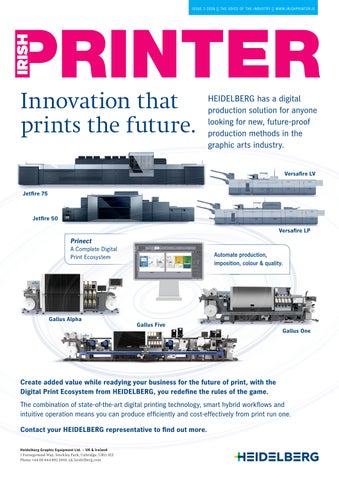
Boasting high speeds and maximum flexibility, Heidelberg’s new Jetfire 75 is redefining industrial digital print production

There’s only one constant in the print industry and that’s change. Today, the average print run is becoming shorter, whilst the number of print jobs is increasing. For print firms to ensure they remain profitable, they require more flexibility and automation in their production operations. One highly efficient solution increasingly being employed by print firms is to go down the hybrid route – digital print alongside sheetfed offset printing presses for longer runs. Heidelberg’s Jetfire 75 provides print firms with that flexibility.

An inkjet press in B2+ format, the Jetfire 75 is more than just a digital printing press – it’s a strategic building block for your future. With a production capacity of up to 58 million sheets per year and a speed of 9,800 4up sheets per hour (simplex), it offers true industrial performance. Thanks to the large B2 format (614 × 750 mm), not only standard products such as brochures and books are possible, but also special formats such as posters or banners. It is fully embedded in the Heidelberg digital ecosystem, encompassing machines, software, consumables, service and training. It also offers users the best possible print quality, maximum flexibility and a level of productivity that’s never before been seen in digital printing. Customers can access all key information and services via the Heidelberg Customer Portal.

It also offers users the best possible print quality, maximum flexibility and a level of productivity that’s never before been seen in digital printing

With the Jetfire 75, we are sending out a clear signal that Heidelberg is shaping the future of digital industrial print production and taking it to a whole new level

The Jetfire 75 has been developed for maximum user-friendliness. A high degree of automation and intuitive user guidance reduce training time and minimises manual intervention. Automatic processes take care of maintenance and servicing, while switching between offset and digital production takes seconds – including automatic colour adjustment.

The new press can also be integrated into a print company’s overall workflow using Prinect Production and the new Prinect Touch Free workflow, allowing for additional cost efficiencies. Prinect Touch Free goes far beyond traditional automation – it has the ability to orchestrate the entire production process, from order entry to delivery. It also combines offset and digital printing in a seamless hybrid workflow, ensuring maximum efficiency with minimal manual effort. That translates to faster turnaround times, fewer errors, continuous cost optimisation and significant relief for your employees. When combined with Prinect Touch Free, the Jetfire 75 is able to process over 1000 print jobs per day on a fully automated basis. Customers ordering a Jetfire 50 or Jetfire 75 will exclusively get the new workflow when they install their digital press.

“Following on from the successful market launch of the Jetfire 50, we are sending out a clear signal with the Jetfire 75, namely that Heidelberg is shaping the future of digital industrial print production and taking it to a whole new level. We are combining the strengths of our sheetfed offset printing presses with innovative digital printing solutions to create a hybrid production environment that offers our customers maximum

flexibility and efficiency,” said Dr David Schmedding, Chief Technology and Sales Officer at Heidelberg.

Thanks to Heidelberg’s ‘self-service’ concept, Jetfire 75 users also benefit from excellent machine availability. This involves giving operators special training so they can carry out certain types of service work themselves. In addition, operating the press only requires a few days of training. “By launching the Jetfire 75, Heidelberg is underscoring its approach as a comprehensive systems integrator in the printing sector – an approach that helps our customers become more profitable and more competitive,” said CEO Jürgen Otto.

The Jetfire 75 combines industrial productivity, the best possible print quality and maximum flexibility for everything from short runs and personalised products to high volume print jobs. The range of products that can be handled includes brochures, advertisements, flyers, catalogues in short runs, books, magazines, labels, stickers, posters and calendars. Added to that are special digital print jobs such as personalised mailshots, jobs with a run size of one, photobooks, time critical print on-demand jobs and more.

Customers can place orders for the Jetfire 75 with immediate effect. From summer 2026, the press will be available for demonstrations in the Print Media Center – Home of Print at the Wiesloch-Walldorf site.

Support that’s always there

Heidelberg’s expertise spans the entire print journey and its engineers have been trained to provide a service that matches that expertise. As industry leaders, Heidelberg engineers have access to an impressive digital documentation system that’s updated automatically to ensure they’re always working with the latest information. Every solution created by Heidelberg feeds back into the system for analysis and improvement –ensuring the Jetfire 75 continues to perform at a high level every single day. As Jetfire technology integrates with inline finishing and production software, Heidelberg’s team is ready with the skills and systems to keep production seamless, offering fully integrated advanced software that simply cannot be found anywhere else in the industry.

Heidelberg’s team is ready with the skills and systems to keep production seamless, offering fully integrated advanced software that can’t be found anywhere else in the industry

JETFIRE 50 - B3 Inkjet Printing system for high productivity

With the Jetfire 50, users can produce efficiently and cost-effectively from print runs as short as one. Inkjet digital printing also enables cost-effective on-demand production of personalised or sorted editions, even for long runs. This allows print firms to optimally expand their product and service range. With a print speed of up to 4,560 SRA3 sheets per hour in duplex mode it prints quickly and reliably, while a resolution of 1,200 dpi along with the Color Grip process, razorsharp print images on both coated and uncoated substrates are guaranteed.

Ease of use - The high level of automation and intuitive user guidance with the Jetfire 50 makes the operator’s work easier and reduces the training period. In addition, automatic processes facilitate care and maintenance, reducing manual intervention to a minimum. Creating added value - Added value is created through the interaction of all components. Smart hybrid workflows, digital services and a dense local service network are important, as are available and optimised consumables. HEIDELBERG offers print firms all this, plus the

JETFIRE 75 – key features

Printing unit

» Water-based inkjet

» 1,200 x 1,200 dpi

Workflow

» Prinect Production Manager

» Prinect Touch Free

Max. paper size

» 614 x 750 mm (24 x 29 in)

Print speed/hour

» Up to 9,800 4-up sheets per hour (simplex)

Grammage

» Uncoated 60 - 450 g/m²

» Coated 75 - 450 g/m²

Paper thickness

» 0.06 mm to 0.61 mm (0.0024 in to 0.0240 in)

highest quality and partnership-based cooperation.

Automatically flexible - With the Prinect Production Manager and the Digital Print Manager, jobs can be produced fully automatically, whether digital or offset. Jobs can be switched between technologies in a matter of seconds with automatic colour matching. The production of short runs becomes simple and offers the flexibility print companies need in today’s production environment.

DIVERSITY

Across all industries, cultivating a diverse and inclusive workplace is increasingly recognised as valuable and essential to long-term success. However, despite the print industry’s significant advancements in technology and innovation, visible representation of women remains limited. As the sector grapples with low recruitment, it’s important to challenge outdated perceptions. Creating real change, however, requires collective effort – no single company can do it alone.

As we mark International Women’s Day on 8th March, it is an important moment not only to celebrate the achievements of women across industries, but also to reflect on the tangible actions we can take to build a more inclusive and representative future for print.

The importance of empowering women in the print industry

So, how can we empower the women already working within the industry and provide them

Achieving true inclusivity and diversity will require continued e ort from companies, organisations and individuals

with the visibility and support they need to succeed? Studies have identified that the lack of female representation can leave female employees feeling isolated. According to the KPMG Women’s Leadership Study, over 80% of women felt encouraged to pursue leadership positions when they saw women already in those positions. Ensuring that both women and men are equally recognised is essential in transforming the face of what the print industry is. This can take many forms – from hosting seminars and talks to simply showcasing female talent on company social media platforms. In light of that, women-led organisations like Girls Who Print are also crucial in bridging these gaps. They offer mentorship, provide advice and a sense of community that helps women navigate the unique challenges of the industry with confidence. Mentorship programmes are especially valuable, offering aspiring female professionals the chance to learn from seasoned print leaders and further their own career and skillset.

Creating change also means looking beyond the companies themselves – to customers and collaborators. Supporting women-led

initiatives and creatives is key. Mimaki, for example, has collaborated with several inspiring female artists and designers such as Tessa Koops, Claire Vos and Sigrid Calon. Furthermore, supporting non-profits like Tiny Miracles, which employs women from marginalised backgrounds in India by providing a steady income, helps create more opportunities for women globally.

Attracting women to the industry: changing perceptions

Another challenge arises in how to encourage a more diverse workplace in the first place. Print is often overlooked as a career path, unless you know of someone working within the industry and this poses a problem in hiring diversely across the board. This is especially true for women, as print is frequently perceived as a traditional manufacturing sector, which has historically been male dominated. Such misconceptions can discourage women from seeing print as a viable or inspiring career option.

In reality, the print industry is incredibly diverse and creative, spanning interior décor,

KEEPING PRINT

Danna Drion on the importance of empowering women in the print industry

INCLUSIVE

More women are entering the field, taking on high-level positions and in general, helping to shape the industry’s future

signage, medical 3D printing prototypes and more. It’s not just about production, it’s about technology, innovation and design. With the growing use of cutting-edge technologies like robotics and artificial intelligence, the industry now requires highly skilled employees who can operate and manage complex machinery.

To attract more women – and more diverse talent in general – it’s crucial to shift the narrative. Print is no longer just about machines and manufacturing – it’s a forwardlooking, technology-driven industry where people with diverse skillsets can thrive.

Rebranding the print industry as a dynamic and creative career path is essential to attracting a more diverse workforce for a more inclusive future.

At Mimaki, we believe in leading by example. Personally, I’ve been mentoring students for

many years at the University of Amsterdam, with a particular focus on empowering young women as they take their first steps into the job market. This experience has given me the opportunity to highlight the diversity, creativity, and technological innovation that define today’s print industry – and to inspire more women to see themselves as part of its future. Over the years, we have also developed an internship programme that continues to grow and deliver excellent results, helping young talent gain hands-on experience and contribute new perspectives to our teams.

A step in the right direction

While the print industry still faces challenges when it comes to female representation, the developments made in recent years are encouraging. More women are entering the

field, taking on high-level positions and in general helping to shape the industry’s future. However, achieving true inclusivity and diversity will require continued effort from companies, organisations and individuals. By supporting female talent, offering mentorship opportunities and breaking down outdated perceptions about the industry, we can ensure that the print sector becomes a place where all employees, regardless of gender, feel valued and empowered.

To continue this conversation, check out Mimaki’s Women in Print episode, part of Mimaki’s Print Different podcast series: https://www.youtube.com/ watch?v=Bt5XHbo-8Wk

Danna Drion is General Manager Marketing and Product Management at Mimaki Europe

WHERE IT ALL STARTED

The scale and capability of modern production equipment sparked MARK LYNAM’s passion for the industry

When I joined MJ Flood in June 2010 as a service engineer, I wasn’t just starting a job. I was stepping into an industry that would shape my professional identity.

I’ve always been interested in figuring out how things work. The technical challenge and problem-solving side of print immediately appealed to me. What began as a hands-on engineering role quickly grew into something more specialised and I developed deep expertise in digital production print technology.

From the start, I worked directly with production print devices in the field, carrying out installations and responding to service calls. Those early days proved invaluable. I quickly discovered that success in print isn’t just about technical knowledge – it’s about problemsolving under pressure, understanding customer expectations and working collaboratively as part of a team.

When a production device goes down in a busy print room, time is critical. You need to think clearly, diagnose issues efficiently and communicate confidently with both colleagues and customers. Developing those skills early laid the foundation for my future leadership role. What truly sparked my passion for the industry was witnessing the scale and capability of modern production equipment. The first time I saw a high-volume press running at full capacity, producing consistent, highquality output at incredible speed, I realised how much engineering excellence sits behind what many people take for granted. Understanding how these complex systems operate and helping customers maximise

performance became a major source of professional satisfaction.

A key lesson throughout my career has been the importance of continuous learning. Production print technology evolves rapidly, from advanced colour management systems to automated workflows and finishing solutions. Technology doesn’t stand still. If you don’t keep moving with it, you get left behind. By embracing ongoing training and developing specialist expertise, I managed to steadily progress within the organisation.

Today, as Production Print Manager and Konica Minolta product specialist at MJ Flood, I oversee and manage sales of Konica Minolta production print devices across the island of Ireland, while also providing advanced technical consulting. Moving into a supervisory and strategic role taught me that technical expertise alone isn’t enough. Supporting, mentoring and developing engineers across multiple branches has become one of the most rewarding aspects of my career.

Print is often described as a traditional industry but in reality, it’s constantly evolving. No two days are ever the same. For anyone considering a career in print, my advice would be – stay curious, embrace technology and never stop learning. It’s an industry that rewards adaptability, teamwork and dedication, and offers far more opportunity than many people expect.

Mark Lynam is Production Print Manager at MJ Flood

A Smarter Way to Send, Manage and Deliver Mail.

No contracts.

No minimum volumes.

No hidden licence fees.

Benefit from over 30 years of expertise in Direct Mail management.

Most organisations don’t want to run a print room, they just want communications sent accurately, securely, and on time.

Hybrid Mail Solutions gives organisations a reliable, compliant way to deliver business-critical communications without internal complexity.

Our platform allows teams to upload documents from any location, automate their workflows, and benefit from discounted costs.

Digital Printing For Labels

Turn static files into dynamic content formats.

Create a flipbook
Irish Printer Issue 2 2026 by Ashville Media Group - Issuu